Volume II, pages 454–472 of the 1732 edition, from PRO to PTO: everything printed on these pages, in order.
Continued from Procula
the Devil, who was in Suspense about something, and was in Fear of the Subversion of his Empire. Others a impute it to a good Spirit.
PROFANE. This is said of the Contempt and Abuse of holy Things. A Man who is defiled, and touches any sacred Thing, pollutes or profanes it. He is called profane, who is not distinguish’d by any sacred Character. Profane Persons are not to meddle with, to speak or write upon sacred Matters. A profane Man, or Laick, is not to touch the holy Vessels, or to be employ’d in divine Mysteries. He that makes a Jest of sacred Things, who profanes them by the Abuse he makes of them, who defiles himself by impure or shameful Actions, is a profane Person. The Scripture calls Esau profane, Heb. xii. 16. Gen. xliii. 32.because he sold his Birth-right, which was consider’d as an holy Thing. The Egyptians would not admit the Hebrews to their Tables, because they held them as profane. Profanum putant hujusmodi convivium. The Priests of the Race of Aaron were enjoyn’d to distinguish between sacred and profane, between pure and defiled; and for this Reason Lev. x. 10.the Use of Wine was forbid them in the Temple, during their Time of Waiting. It was forbid them to keep the Flesh of the Peace-offerings above two Days. If they eat of it on the third Day, they were punish’d as Profaners of holy Things. Profanus erit, & Lev. xix. 7.impietatis reus.
Animals that were declared unclean by the Law, made those that touched them, or eat of them, unclean, profane, and polluted. Isa. lxv. 4.Isaiah calls those profane, who eat of the Flesh of Swine, or who have profane Broth in their Pot. Jus profanum in vasis eorum. When the City of Jerusalem is compared to the Temple, the Soil of this City is called Ezek. xlvii. 15. 2 Mac. xii. 23.profane; that is to say, appointed to common Uses, and for an Habitation of Laicks. Profana erunt urbis in habitaculum. In the second Book of Maccabees, the Heathen that composed the Army of Timotheus, are called profane. St. Paul marks as profane, such novel Words and Expressions as are needlesly 1 Tim. vi. 20.introduced into Religion. Profanas vocum novitates.
To profane the Temple, to profane the Sabbath, to profane the Altar, are common Expressions, to denote the Violation of the Repose of the Sabbath, the entering of Foreigners into the Temple, the Irreverences that are committed there, the impious Sacrifices that are offer’d on the Altar of the Lord.
Ps. lxxxix. 31.To profane the Statutes, or the Commandments of God, is to transgress and violate them.
To profane the Covenant, or Prom-Ps. lxxxix. ises which are sworn to by an Oath, is 34. to frustrate them, or not perform Ecclus. xlvii. 22. Deut. xx. 5.them.
To profane his Race, to blemish the Glory of it. The Author of Ecclesiasticus says, that Solomon profaned his Race, because by his Sins he was the Occasion, that God did not give his Spirit of Wisdom to his Son Rehoboam, who by his Imprudence alienated the Minds of the Israelites, and caused the Revolt of the ten Tribes from Levit. xix. 23. Jer. xxxi. 5.him.
To profane a Vine, or a Tree, is to make them common, and proper to be employ’d in ordinary Uses. What Man is he that hath planted a Vineyard, and hath not yet eaten of it? The Hebrew says literally, who hath not yet profaned it. In Leviticus, where Moses passes a Law concerning the Fruit of Trees newly planted, he expresses the Impurity of the First-fruits by the Name of Circumcision Ye shall count the Fruit thereof as uncircumcised. For the three first Years, these Fruits were cut off as impure. The fourth Year they offer’d what was produced in the Temple. Lastly, in the fifth Year the Owner had the Liberty of making use of the Fruit as his own, which then became profane or common. Jeremiah promises the Israelites, that they should return again into their own Country, that they should plant Vineyards on the Mountains of Samaria, and should profane them; that is, should eat of the Fruit thereof. The Vulgate says, Plantabunt plantantes, & donec tempus veniat, non vindemiabunt. They should not touch thereof ‘till the fifth Year. The Hebrew says, Plantabunt plantantes, Job xi. 8. Job xvii. 16. Isa. vii. 11.& profanabunt.
PROFOUND, Deep. The Latin Word profundus, or profundum, is often put for the Grave, or for the Place wherein Souls are detain’d after Death. The antient Hebrews placed it below the Waters, in the most profound Abyss. It is as high as Heaven, what canst thou do? deeper than Hell, what canst thou know? And again, In profundissimum infernum descendent omnia mea. I shall go down to the Bottom of the Grave. And Isaiah; Ask a Sign of the Lord from the deepest Hell, or from the Exod. xiv. 25. xv. 5. Ps. cvi. 24.highest Heaven.
Profundum, the Deep, is often put for the Sea. The Army of Pharaoh that was drowned in the Red-Sea. Ferebantur in profundum, & descenderunt in profundum quasi lapis. And David; Those that go to Sea have seen the Lord’s Wonders in the Deep. Mirabilia ejus in profundo. The Words of a wicked Woman are as deep Water, or as a deep Pit. Prov. xxii. 14. xxiii. 27.
Profound1
Prov. xviii. 4. Ps. xcii. 5. Isa. xxix. 15.Profound Thoughts is generally us’d in a good Sense for deep Wisdom, prudent Counsels. The Words of a wise Man are like deep Water. Aqua profunda verba ex ore viri. And again; Sicut aqua profunda sic consilium in corde viri. The Intentions of a Man are unsearchable. And the Psalmist; Thy Thoughts are very deep; no one is able to penetrate into them. Isaiah takes it in a bad Sense. Woe to those that are of a deep Heart. Væ qui profundi estis corde. That conceal their Sentiments, and think they can hide them from the Sight of God.
Ezek. iii. 5, 6. 1 Cor. ii. 10.Ezekiel; I send you not to a People of a profound Language, or of an unknown Tongue. Non enim ad populum profundi sermonis & ignotæ linguæ tu mitteris. In this Passage profound is put for difficult, Dan. ii. 22.conceal’d, unknown; as also in St. Paul; The Mind searches into all Things, even into the most profound Secrets of God. Omnia scrutatus, etiam profunda Dei. And Daniel; ‘Tis God that reveals profound and hidden Things: Revelat profunda & abscondita.
Rom. viii. 39. Ephes. iii. 18.St. Paul says; that nothing shall be able to separate us from the Love of God, neither the most exalted Height, nor the profoundest Depth: Neque altitudo, neque profundum: Nor Heaven, nor the Abyss, nor Angels, nor Devils. This is a kind of Proverb and Hyperbole. And elsewhere; That you may comprehend with all the Saints, what is the Breadth, and Length, the Height and Depth of the Mysteries of God, of his Power, of his Love, of his Counsels, &c.
Isa. xxxi. 6. Hos. ix. 9. Isa. vii. 2.To sin profoundly is read in Isaiah, and in Hosea, to denote a long Habit of Crimes, an obstinate Course of Idolatry; or else a profound and very great Iniquity, a Crime that has taken deep Root in the Soul by long and inveterate Custom. Profundè peccaverunt, ut in diebus Gabaa. They have carry’d on their Wickedness to such a Pitch, as to imitate the antient Crimes of Gibeah, says Hosea; Return to the Lord, as you have so profoundly withdrawn yourselves from him, says Isaiah. Convertimini sicut in profundum recesseratis. And elsewhere; Ask from the Lord a Token from the Depth of Hell. The Hebrew says literally; Make your Demands deep, ask something difficult, something as it were conceal’d in the Bottom of Hell.
Gal. iii. 16.PROMISES. The Word Promise in the New Testament is usually taken for those Promises that God heretofore made to Abraham and the other Patriarchs, to send them the Messiah. ‘Tis in this Sense that St. Paul commonly uses the Word Promise. Abrahæ dictæ sunt promissiones. The Time Rom. iv. 13, 14, 15, & passim. Acts vii. 17.of the Promises is the Time of the Coming of the Messiah. The Children of the Promise are, first, the Israelites descended from Isaac, in Opposition to the Ishmaelites descended Rom. ix. 8. Gal. iv. 28.from Ishmael and Hagar; and secondly, the Jews converted to Christianity, in Opposition to the incredulous Jews, who will not believe in Jesus Christ: The Christians have enjoy’d the Promises made to the Patriarchs, from which the incredulous Jews have fallen away. The holy Eph. i. 13.Spirit of Promise, which the Christians have received, signati estis spiritu promissionis sancto, signifies the Holy Ghost which God has promis’d to those that shall believe in him, which is the Pledge of their everlasting Happiness. The first Commandment to which God has annex’d a Promise, primum Eph. vi. 2.mandatum in promissione, is that, Honour thy Father and thy Mother; to which God has subjoin’d this Promise, that their Days shall be multiply’d upon the Earth.
Promises in general also denote eternal Life, which is the Object of a Christian’s Heb. x. 6.Hope. Ut reportetis promissiones. The antient Patriarchs were Heirs of the PromisesHeb. vi. 12. by their Faith and their Patience. Fide & patientiâ hæreditabant promissiones. All 2 Cor. i. 20.the Promises of God are accomplish’d and fulfill’d in Jesus Christ.
Numb. xxx. 13. Eccles. v. 5.Lastly, the Word Promise is often put for a Vow. If a Woman makes a Vow, and her Husband shall not give his Consent to it, she is not to be held to her Promise: Non tenebitur promissionis rea. And Ecclesiastes; It is much better not to vow at all, than to vow, and not keep one’s Promise.
Exod. xx. 20.PROOF, Tryal, Temptation. God intended to prove you, to see if you would walk in his Ways. After he had proved you and afflicted you, he had Pity on you. God Deut. viii. 16.commands Gideon to bring his Troops to a Brook, that he might prove them there. As Judg. vii. 4.Gold and Silver are try’d in the Furnace, so God proves the Heart. The Verb probo is also put for to know, to examine, Omnia probate, Prov. xvii. 3. 1 Thes. v. 21. Luk. xii. 56. Phil. i. 10.quod bonum est tenete. You know how to examine the Appearance of the Heaven. Faciem cœli, nostis probare. And elsewhere; Ut probetis potiora. And again; Be renew’d in Spirit, that you may know what is the Will of God. Ut probetis quæ sit voluntas Rom. xii. 2.Dei bona, &c. Probare tirones; 2 Kings xxv. 10. He that exercises them, or that proves the young Soldiers. The Hebrew says, He that is the Master of the Butchers, 2 Kings xxv. 10. רב טבחיםor of the Cooks, or of the King’s Guard.
PROPHET. This Word comes from the Greek, Prophetes, which signifies one that foretells future Events. The Hebrews 1 Sam. ix. 9. ראהvidens. נביאNabi, Propheta.at the Beginning call’d them Seers. Afterwards they call’d them Nabi, which comes from the Root Nibba, to foretell, to divine. Also the Scripture often gives them the Name of Men of God, and of Angels, or Messengers of the Lord. The Verb Nibba to prophesy, in the Hebrew is of very great
Extent. Sometimes it signifies to foretell what is to come; at other times, to be inspired, to speak from God. God says to Exod. vii. 1.Moses, Aaron thy Brother shall be thy Prophet; that is to say, he shall explain thy Sentiments to the People. St. Paul in his Epistle to Titus, i. 12. quoting a profane Poet, calls him a Prophet; One of themselves, even a Prophet of their own: Because the Pagans thought their Poets inspired by the Gods. The Scripture often gives the Name of Prophet to Impostors, who falsely boasted of Inspiration.
As the true Prophets, at the times that they were transported by the Motions of God’s Spirit, were sometimes agitated in a violent Manner; those Motions were call’d Prophesying which they exhibited, whether they were fill’d with a good or evil Spirit. 1 Sam. xviii. 10.For Example, Saul being moved by an evil Spirit prophesy’d in his House; that is to say, he was agitated with Violence, as the Prophets were. To prophesy is also put for to sing, to dance, to play on Instruments. Thou shalt meet a Company of Prophets, says 1 Sam. x. 5, 6.Samuel to Saul, coming down from the high Place, with a Psaltery, and a Tabret, and a Pipe, and a Harp before them, and they shall prophesy. And the Spirit of the Lord shall come upon thee, and thou shalt prophesy with them, and shalt be turned into another Man. We read in the Chronicles, that the Sons of 1 Chron. xxv. 1.Asaph were appointed to prophesy upon Harps.
This Term is also used in St. Paul, for 1 Cor. xi. 4, 5. xiv. 1, 3, 4, &c.explaining Scripture, speaking to the Church in publick; probably because they that exercised these Functions were look’d upon as replete with the Holy Ghost, and gave themselves Motions like those of Enthusiasts. The Scripture uses this Term in an extraordinary Sense, instead of saying, to work a Miracle, to raise the Dead. Thus it is said of the Bones of Elishah, that after his Ecclus. xlviii. 13.Death his Body prophesy’d, because they had restored a dead Person to Life, as if they had still been actuated by the Soul of this Prophet. Lastly, ‘tis said, that the Bones of the Patriarch Joseph prophesy’d also after Ecclus. xlix. 15.his Death, because they were as a Pledge of the Promise he had made to his Brethren, that they should one Day be deliver’d from their Servitude in Egypt, and that they should be in Possession of the Land of Canaan.
The most usual Way by which God communicated himself to the Prophets was Inspiration, which consisted in illuminating the Mind of the Prophet, and exciting his Will to proclaim what the Lord dictated to him from within. ‘Tis in this Sense that we acknowledge as Prophets, all the Authors of the Canonical Books of Scripture, both of the Old and New Testament. God also communicated himself to the Prophets by Dreams and nocturnal Visions. Joel promises to the People of the Lord, that their young Men should see Visions, and their old Men should have prophetick Dreams. St. Peter in the Acts fell into an Ecstacy at Noon-day, and had a Revelation concerning the Call of the Gentiles to the Faith. The Lord appear’d to Abraham, to Job, to Moses in a Cloud, and discover’d his Will to them. He has often made his Voice to be heard in an articulate Manner. Thus he spoke to Moses in the burning Bush, and upon Mount Sinai, and to Samuel in the Night. St. Austin acknowledges three Sorts of Prophets; those of the Jews, those of the Gentiles, and Joel ii. 28. Acts x. 11, 12. Gen. xvi. 10. Job. xl. 1. Exod. xiii. 21, &c. Exod. iii. 2. 1 Sam. iii. 4. Aug. Præfat. in lib. 19. contra Faust.those of the Christians. Those of the Jews are known: Those of the Gentiles are their Poets and their Divines; and those of the Christians are the Apostles, and Apostolical Men, of whom Jesus Christ has said;2 Wherefore behold, I send unto you Prophets, and wise Men, and Scribes.
We have in the Old Testament the Writings of the sixteen Prophets; that is, of four greater Prophets, and twelve lesser Prophets. The four great Prophets are Isaiah, Jeremiah, Ezekiel, and Daniel. Baruk is commonly reckon’d with Jeremiah. The Jews do not properly place Daniel among the Prophets, because (they say) he lived in the Splendour of temporal Dignities, and in a kind of Life different from that of the other Prophets. The twelve lesser Prophets are, Hosea, Joel, Amos, Obadiah, Micah, Jonah, Nahum, Habakkuk, Zephaniah, Haggai, Zachariah, and Malachi.
This is pretty nearly the Chronological Order in which they may be ranged.
-
Hosea prophesy’d under Uzziah King of Judah, who began to reign in the Year of the World 3194; and under Jotham, Ahaz, and Hezekiah, Kings of Judah, and under Jeroboam II. King of Israel, and his Successors, to the Destruction of Samaria, which happen’d in the Year of the World 3283.
-
Amos began to prophesy in the twenty-third Year of Uzziah, and of the World 3219, and about six Years before the Death of Jeroboam II. King of Israel, which happen’d in the Year of the World 3220.
-
Isaiah began to prophesy at the Death of Uzziah, and at the Beginning of the Reign of Jotham King of Judah, in the Year of the World 3246. He continued to prophesy to the Reign of Manassah, which began in the Year of the World 3306. He caus’d Isaiah to be put to Death by sawing him with a Saw.
-
Jonah lived in the Kingdom of Israel under the Kings Joash and Jeroboam II.
about the same time as Hosea, Isaiah, and Amos. Jeroboam II. died in the Year of the World 3220.
-
Micah lived under Jotham, Ahaz, and Hezekiah, Kings of Judah. Jotham began to reign in 3245, and Hezekiah died in 3306. Micah was contemporary with Isaiah, but began later to prophesy.
-
Nahum appeared in Judah under the Reign of Hezekiah, and after the Expedition of Sennacherib, that is, after the Year 3291.
-
Jeremiah began in the thirteenth Year of the Reign of Josiah King of Judah, in the Year of the World 3375, and Zephaniah prophesy’d about the same time. Jeremiah continued to prophesy under the Reigns of Shallum, Jehoiakim, Jeconiah, and Zedekiah, to the taking of Jerusalem by the Chaldeans, in the Year of the World 3416. ‘Tis thought he died two Years after in Egypt, in 3418. Baruch was the Disciple and Amanuensis of Jeremiah.
-
Zephaniah appear’d at the Beginning of the Reign of Josiah, and before the twenty-eighth Year of this Prince, which is the Year of the World 3381; and even before the taking of Nineveh, which happened in 3378.
-
Joel under Josiah, about the same time as Jeremiah and Zephaniah.
-
Daniel was taken into Chaldea in the Year of the World 3398, which was the fourth Year of Jehoiakim King of Judah. He prophesy’d at Babylon to the End of the Captivity, which happen’d in 3468, and perhaps longer than that.
-
Ezekiel was carry’d Captive to Babylon along with Jeconiah King of Judah, in the Year of the World 3405. He began to prophesy in the Year 3409. He continued till towards the End of the Reign of Nebuchadnezzar, who died in the Year of the World 3442.
-
Habakkuk lived in Judea at the Beginning of the Reign of Jehoiakim, about the Year 3394, and before the coming of Nebuchadnezzar into the Country in 3398. He dwelt in Judea during the Captivity, and carry’d Food to Daniel in the Lyon’s Den.
-
Obadiah lived in Judea after the taking of Jerusalem, which happen’d in 3414, and before the Desolation of Idumea, which happen’d (as we believe) in 3410.
-
Haggai was brought to Jerusalem in 3414; he return’d from the Captivity in 3468, and prophesy’d the second Year of Darius Son of Hystaspes, which was the Year of the World 3484.
-
Zachariah prophesy’d in Judea at the same time as Haggai, and he seems to have continued to prophesy after him.
-
Malachi has not put any Date to his Prophecies. If he was the same as Esdras, as is very probable, he may have prophesy’d under Nehemiah, who return’d into Judea in 3550.
Under the several Articles of these Prophets, may be seen the Proofs of what is here advanced, and the Particulars of their Lives and Actions, of their Prophecies, their Characters, and Deaths.
Besides the Prophets we have now mentioned, there are found the Names of a great many more in the Scripture. Clemens AlexandrinusClem.Alex. Strom. l. 1. p. 145. seu 400. nov. edit Oxon. Potteri. reckons up Thirty-five after Moses, and Five before him, which are Adam, Noah, Abraham, Isaac, and Jacob. He reckons five Prophetesses, which are Sarah, Rebeccah, Miriam the Sister of Moses, Deborah, and Huldah. Epiphanius3 reckons up Seventy-three Prophets, and ten Prophetesses, in both the Old and New Testament. The Prophets are, 1. Adam. 2. Enoch. 3. Noah. 4. Abraham. 5. Isaac. 6. Jacob. 7. Moses. 8. Aaron. 9. Joshua. 10. Eldad. 11. Medad. 12. Job. 13. Samuel. 14. Nathan. 15. David. 16. Gad. 17. Jeduthun. 18. Asaph. 19. Heman. 20. Etham. 21. Solomon. 22. Abiah. 23. Shameah. 24. Oded. 25. Eli, the High-priest at Shiloh. 26. Joad. 27. Iddo. 28. Azariah. 29. Ananiah, otherwise Azariah. 30. Jehu. 31. Micaiah the Son of Imlah. 32. Elijah. 33. Uzziel.4 1 Kings xxii. 8.b 34. Eliad. 35. Jesus Son of Hananiah. 36. Elisha. 37. Jonadab. 38. Zachariah otherwise Hananiah. 39. Another Zachariah. 40. Hosea. 41. Joel. 42. Amos. 43. Obadiah. 44. Jonah. 45. Isaiah. 46. Micah the Morasthite. 47. Nahum. 48. Habakkuk. 49. Obed. 50. Abdadon. 51. Jeremiah. 52. Baruch. 53. Zephaniah. 54. Uriah. 55. Ezekiel. 56. Daniel. 57. Esdras. 58. Haggai. 59. Zachariah. 60. Malachi. 61. Zachariah Father of John the Baptist. 62. Simeon. 63. John the Baptist. 64. Enoch. 65. Methusalah. 66. Lameel. 67. Balaam. 68. Saul. 69. Abimilech. 70. Amasa. 71. Zadok. 72. The anonymous Prophet that came to Bethel. 73. Agabus, mentioned in Acts xxi. 10. He might have added the Apostles, and particularly St. Barnabas, Simon Niger, Lucius of Cyrene, and Manahem, mentioned in the Acts xiii. 1, 2. And he might have omitted others, for Example, Ethan, who is the same as Jeduthun; Joad, Obed, Abdadon, all unknown, and Balaam, who was a wicked and false Prophet; and some others who hardly deserve to be put into the List of true Prophets.
The Prophetesses are 1. Sarah. 2. Rebecca. 3. Miriam the Sister of Moses. 4. Deborah. 5. Huldah. 6. Hannah the Mother of Samuel. 7. Judith. 8. Elizabeth. 9. Anna5
the Daughter of Phanuel. 10. The Virgin Mary. To these may also be added the Acts xxi. 9.Daughters of Philip the Deacon.
The Hebrews in the Book Megillah, c. 1. acknowledge but Forty-eight Prophets, and seven Prophetesses. The Prophets are, 1. Abraham. 2. Isaac. 3. Jacob. 4. Moses. 5. Aaron. 6. Joshua. 7. Phinehas. 8. Elchanah. 9. Eli. 10. Samuel. 11. Gad. 12. Nathan. 13. David. 14. Solomon. 15. Iddo. 16. Micajah the Son of Imlah. 17. Obadiah. 18. Abijah. 19. Jehu Son of Anani. 20. Azariah Son of Oded. 21. Haziel Son of Matthaniah. 22. Eliazar Son of Dodo. 23. Hosea. 24. Amos. 25. Michah the Morasthite. 26. Amos (probably the Father of Isaiah.) 27. Elijah. 28. Elisha. 29. Jonah. 30. Isaiah. 31. Joel. 32. Nahum. 33. Habakkuk. 34. Zephaniah. 35. Jeremiah. 36. Uriah. 37. Ezekiel. 38. Daniel. 39. Baruch. 40. Neriah. 41. Seraiah. 42. Mahaziah. 43. Haggai. 44. Zechariah. 45. Malachi. 46. Mordecai. 47. Hanameel Father of Jeremiah. 48. Shellum the Husband of Huldah.
The Prophetesses are, 1. Miriam Sister of Moses. 2. Deborah. 3. Hannah the Mother of Samuel. 4. Abigail. 5. Huldah. 6. Esther. 7. The Midwives of Egypt, who preserved the First-born of the Hebrews.
After Malachi no Prophets were found in Israel as before; so that in the Time of the Maccabees, a when the Altar of Burnt-sacrifices was demolished, which had been prophaned by the Gentiles, the Stones thereof were set aside, till a Prophet should arise to declare what should be done with them. But in this Interval God did not desist from raising up inspired Writers, as the Authors of the Books of Esther, of Judith, of the Maccabees, of Wisdom, and of Ecclesiasticus, which the Christian Church has received into her Canon. ‘Twas about the same time that the three Sects were form’d, the Essenians, the Pharisees, and the Sadducees, which afterwards became so famous among the Jews.
Aug. l. 18. de Civit. c. 41.The Prophets, according to St. Austin, were the Divines, the Philosophers, the Instructors, and the Guides of the Hebrew People in the Ways of Piety and Virtue, They generally lived retired from the People, in some Country Retreat, and in a sort of Community, where they and their Disciples were wholly employ’d in Prayer, in labouring with their Hands, and in Study. Their Habitations were plain and simple, which they built themselves, and cut down the Wood for this Purpose. Yet they exercised no Trade for Gain, nor did they undertake any Work that was too laborious, or inconsistent with the Repose that their Employment required. Thus Elisha1 Kings xix. 20. quitted his Plough, as soon as Elijah had called him to the prophetick Office. Zech. xiii. 5.Zechariah says, he is no Prophet, but an Husbandman. Amos says, he is no Prophet, but an Herdsman, and a Gatherer of Amos vii. 14.Sycamore-fruit.
Elijah was cloathed with Skins, and 2 Kings i. 8.girded with a Girdle of Leather. Isaiah wore Sack-cloth, that is, a coarse rough Zech. xiii. 4.Habit, of a dark brown Colour, which was the ordinary Cloathing of the Prophets. Zechariah says, speaking of the false Prophets who imitated the true Prophets of the Lord, as to their Outside, that They should not wear a rough Garment to deceive. Rev. xi. 3.In the Revelations, the two Witnesses, thought to be Enoch and Elijah, are represented as cloathed in Sackcloth. Their Poverty is conspicuous in all their Actions. The Presents they received were only Bread, Fruits, and Honey, as being made to poor Men. The first Fruits of the Earth were given them, as being Persons that possess’d nothing themselves. 1 Sam. ix. 7, 8. 1 Kings xiv. 3. 2 Kings iv. 42.The Woman of Shunem, that entertain’d Elisha, put into the Prophet’s Chamber no Furniture but what was plain and necessary. The same Prophet refuses the rich Presents of Naaman, and drives away from his Presence Gehazi who had received them. 2 Kings iv. 10. 2 Kings v. 26. 2 Kings iv. 27.Their Frugality appears through their whole History. ‘Tis well known what is related of the wild Gourds, (Coloquintida) that one of the Prophet’s caus’d to be boiled for the Refreshment of his Brethren. The Angel gave to Elijah only Bread and Water for a long Journey. 2 Kings iv. 38, 40. 1 Kings xix. 6. Bell & Dragon, 33. 1 Kings xviii. 7. Isai. viii. 3. Hosea i. 2, &c.Habakkuk brought to Daniel nothing but Broth or Pottage. Lastly, Obadiah, the Governor of Ahab’s Houshold, gave nothing but Bread and Water to the Prophets that he fed in the Caves.
All the Prophets were not Observers of a strict Continency; for Samuel had Children, and Isaiah had a Wife, who is call’d the Prophetess. Hosea received Orders to marry a Prostitute. But there were no Women or Wives in the Societies of the Prophets. Neither Elijah nor Elisha had any that we hear of, and we see with what Reserve the Woman that entertained Elisha accosted him and spoke to him; she speaks to him only by the Interposition of Gehazi; she dares not so much as enter in to him, or present herself before him. If in the Transport of her Affliction she would throw herself at the Feet of Elisha, Gehazi hinders her, and takes her away. The Prophets were often exposed to the Railleries, the Insults, the Persecutions, the ill Treatment both of Kings and People, whose Vices and Irregularities they undertook to reprove. St. Paul6
St. Paul acquaints us, that many of them died by a violent Death. Others were tortured, not accepting Deliverance, that they might obtain a better Resurrection. And others had Trial of cruel Mockings, and Scourgings; yea, moreover of Bonds and Imprisonment. They were stoned, they were sawn asunder, were tempted, were slain with the Sword: They wander’d about in Sheep-skins and Goat-skins, being destitute, afflicted, tormented. (Of whom the World was not worthy.) They wander’d in Deserts, and in Mountains, and in Dens, and Caves of the Earth. Such were the Lives and the Deaths of the Prophets.
We shall not here enter into the Particulars of their Lives, because this is already done in their several Articles. The Reader may also see our Prefaces before each of them, and our general Preface upon the Prophets. Father Boulduc, a Capuchine, in his Book called Ecclesia ante legem, pretends, that the Prophetical Order began even before the Deluge; that then it was divided into several Branches, and that these different Orders composed the whole Ecclesiastical Hierarchy. Upon this Occasion he delivers many things that are very particular and extraordinary, and which certainly may be said to be very visionary. They that love such kind of Entertainment, may consult the Author himself.
PROSELYTE. This Term comes from Πεοσήλυ -τος. גר Ger. נכר Necher.the Greek Word Proselytos, which signifies a Stranger, one that comes from Abroad, or from another Place. The Hebrew Word Ger or Necher, has the same Signification. In the Language of the Jews they go by this Name, who come to dwell in their Country, or who embrace their Religion, though they are not Jews by Birth. In the New Testament they are call’d sometimes Proselytes, and sometimes Gentiles, fearing God, or Godly. Viri religiosi & timentes Deum.
Acts ii. 5. x. 2, 22. xiii. 16, 50.The Hebrews distinguish two Kinds of Proselytes. The first are called Proselytes of the Gate, and the others, Proselytes of Justice. The first are those that dwelt in the Land of Israel, or even out of this Country, and who, without obliging themselves to Circumcision, or to any other Ceremony of the Law, fear’d and worshipp’d the true God, observing the Rules that were imposed upon the Children of Noah, which we have already enumerated under the Article NOACHIDES. Of this Number was Naaman the Syrian, Nebuzardan General of Nebuchadnezzar’s Army, Cornelius the Centurion, the Eunuch of Queen Candace, and some others, of whom mention is made in the Acts of the Apostles.
The Rabbins teach, that in order to make a Proselyte of Habitation, or of the Gate, he that would enter into this Engagement, xi. 35, &c.must promise with an Oath, in the Presence of three Witnesses, to keep the seven Precepts of the Noachidæ; that is, according to them, that Law of Nature to which all the Nations of the World are obliged, and the Observation of which might bring them to eternal Salvation. The Jews say, That the Proselytes of the Gate have ceased in Israel, ever since the Observation of the Jubilee has been left off, and that the Tribes of Gad, of Reuben, and of Manasseh, abiding on the other Side of Jordan, were led away Captive by Tiglath -pileser. But these Observations are not just, since we see many Proselytes in the Time of Jesus Christ, and that our Saviour reproaches Matt. xxiii. 15.the Pharisees with compassing Sea and Land to make a Proselyte, and after this, with making him a greater Sinner than he was before. And St. Luke in the Acts speaks of a great Number of Proselytes, and those that fear’d God, that were Acts ii. 11.then at Jerusalem, when the Holy Ghost descended upon the Apostles. I am apt to believe, that the greatest Part of these were Proselytes of Justice; but it cannot be deny’d but that some of them might be Proselytes of the Gate.
The Privileges of Proselytes of the Gate were, first, that by the Observation of the Rules of natural Justice, and by Exemption from Idolatry, Blasphemy, Incest, Adultery, and Murder, they might have Pretensions to eternal Life. Secondly, they might dwell in the Land of Israel, and have a Share in the outward Prosperities of the People of God. ‘Tis said they did not dwell in the Cities, but only in the Suburbs and the Villages. But it is certain, that the Jews have often admitted voluntarily into their Cities, not only Proselytes of Habitation, but also Gentiles and Idolaters, as appears by the Reproaches they suffer’d on this account, through the whole Scriptures. In the time of Solomon there were in Israel One hundred Fifty-three thousand and Six 2 Chron. ii. 17, 18.hundred of these Proselytes, whom this Prince compell’d to hew Wood, to draw and to cut Stones, and to carry Burthens for the Building of the Temple. These Proselytes were Canaanites, who had continued in the Country ever since Joshua’s Time. Deut. xiv. 21.Moses forbad the Israelites to eat any Animals that died of themselves, or were strangled, so that the Blood remain’d in them, but order’d them to sell or give such Animals to the Strangers and Proselytes.
The Proselytes of Justice, are those that were converted to Judaism, who had engaged themselves to receive Circumcision, and to observe the whole Law of Moses. Thus were they admitted to all the Prerogatives of the People of the Lord, as well in this Life as the other. The Rabbins inform us, that before Circumcision was administred
Vide Seld. de Syned. l. 2. c. 2. art. 5.ministred to them, and before they were admitted into the Religion of the Hebrews, they were examin’d about the Motives of their Conversion; to know whether their Change was voluntary, or whether it proceeded from any Reasons of Interest, Fear, Ambition, or such like. Maimonides assures us, that under the happy Reigns of David and Solomon, they received no Proselyte of Justice, because there was Reason to fear, that it was rather the Prosperity of these Princes, than any Love to their Religion, that made them Converts to Judaism. The Talmudists say, that Proselytes are as it were the Canker and Rust of Israel, and that too much Caution cannot be taken not to admit them too easily.
When the Proselyte was well proved and instructed, they gave him Circumcision; and when the Wound of his Circumcision was healed, they gave him Baptism, by plunging his whole Body into a Cistern of Water, by one only Immersion. This Ceremony being a judicial Act, was to be Vide Seld. de Jure Nat. & Gent. l. 2. c. 2, 3.perform’d in the Presence of three Judges, and could not be done upon a Festival Day. The Proselyte also caus’d Circumcision and Baptism to be administer’d to his Slaves, who had not yet compleated thirteen Years of Age. But those that were so old or older, could not be compell’d, but he must sell them to others, if they were obstinate in not embracing Judaism. As to Female Slaves, they were only to be baptized, if they would become Converts, if not, they were to be sold to others. The Baptism that a Proselyte had once received, was never repeated, neither in the Person of the Proselyte, though he should afterwards apostatize, nor in that of his Children, that should be born to him after Baptism, unless they were born from a Pagan Woman; in which Case they were to be baptized as Pagans, because they follow’d the Condition of their Mother. Partus sequitur ventrem.
Boys that had not yet compleated the twelfth Year of their Age, and Girls that had not arrived to their thirteenth Year, could not become Proselytes, till they had first obtained the Consent of their Parents, or in Case of Refusal, the Concurrence of the Officers of Justice. Baptism in respect of Girls, had the same Effect as Circumcision in respect of Boys. Each of them by means of this, received (as it were) a new Birth, so that those that were their Parents before, were no longer look’d upon as such after this Ceremony, and those that before were Slaves, now became Freemen. Children born before the Conversion of their Father had no Right to inherit. If a Proselyte died without having had Children after his Conversion, his Estate belong’d to the first Occupier, and not to the publick Treasury. When Proselytes became Jews, they received from Heaven a new Soul, and a new substantial Form. This is what the Rabbins teach concerning their Proselytes of Justice. They require three Things in a compleat Proselyte, which are Baptism, Circumcision, and Sacrifice;7 but for Women only Baptism and Sacrifice. ‘Tis thought that our Saviour made Allusion to the baptizing of Proselytes, when he John iii. 5, 10.told Nicodemus, that for those that would obey the Law, it was necessary they should be born again. Except a Man be born of Water, and of the Spirit, he cannot enter into the Kingdom of God. And when Nicodemus appear’d surprized at this Doctrine, our Saviour says to him, Art thou a Master of Israel, and knowest not these Things? As though he would insinuate, that what he had now told him had nothing extraordinary in it, since the Baptism of Proselytes was a thing practised every Day in Israel.
Deut. xxiii. 1, 2, 3, &c.Moses in Deuteronomy, excludes certain Persons from the Privileges of the People of Israel, or, as he there speaks, from the Congregation of the Lord. Some for ever, and others only for a certain time. All Eunuchs, in whatsoever manner they became so, are excluded for ever. Bastards, or illegitimate Children were not to be admitted till after the tenth Generation. The Moabites and Ammonites were in the same Circumstances. He received the Egyptians and Idumeans after the second Generation. It was allow’d to these Persons to be converted to the Lord, and to become Proselytes, when they pleased. The Door of Conversion was always open to them. Johannes Hircanus Prince of the Jews,8 compelled the Idumeans to be circumcised, and to embrace the Law of Moses; and from this time, says Josephus, they were look’d upon as Jews. Achior Prince of the Ammonites,9 became also a Jew, without any other Preparation than that of being instructed in what he was to believe and observe in this Religion: Therefore the Power of being converted was not taken away from these Nations, but they were not admitted to Offices or Employments, to Dignities and the other external Prerogatives of the People of God, till after a certain time, and till they had given sufficient Proofs of their Perseverance in the true Religion.
The Hebrews believe, that the Populace of Egypt, that follow’d the Israelites, when they Exod. xii. 38.left that Country, vulgus promiscuum innumerabile ascendit cum eis, were all Converts and Proselytes of Justice: They
Exodus xviii. 10, 11, 12. Gen.xxxiv 14, 15.will have it, that Jethro the Father-in- Law of Moses had also embraced their Religion. Jacob admitted the Shechemites for Proselytes, by only requiring that they should receive Circumcision. Some Rabbins inform us, that in the Time of Solomon they receiv’d the Gentiles to Judaism by Baptism only, because of the great Number that then became Converts. But others acquaint us, as before observed, that then they would admit of no Proselytes in Israel. If he that presented himself to be admitted as a Convert had already been circumcised, they contented themselves with just opening the Scar left after Circumcision, so as to draw a few Drops of Blood. As to the Sacrifices that the Proselyte was to offer, I observe, that Jethro the Father-in-Law Exodus xviii. 12.of Moses offered Burnt-Offerings and Peace-Offerings to the Lord. ‘Tis said, that anciently the Proselytes offered for a Burnt-Offering a Sacrifice of large Cattle, or two Turtles, or two young Pigeons: But as now, for a long Time, the Jews have neither Temple nor Altar, they do not oblige their Proselytes to offer Sacrifices. Upon this Head the Reader may consult Selden, de Jure Naturali & Gentium, l. 2. c. 2, 3, 5, 6. and de Synedriis, l. 1. c. 3, 4. and de Successione in Bona, c. 26. and Basnage’s History of the Jews, tom. 5. l. 7. c. 8. Paris Edition; and Leo of Modena, Ceremonies of the Jews, p. 5. c. 3. And upon the Baptism of Proselytes, and the other Ceremonies of their Conversion, see Lightfoot upon St. John, chap. iii.
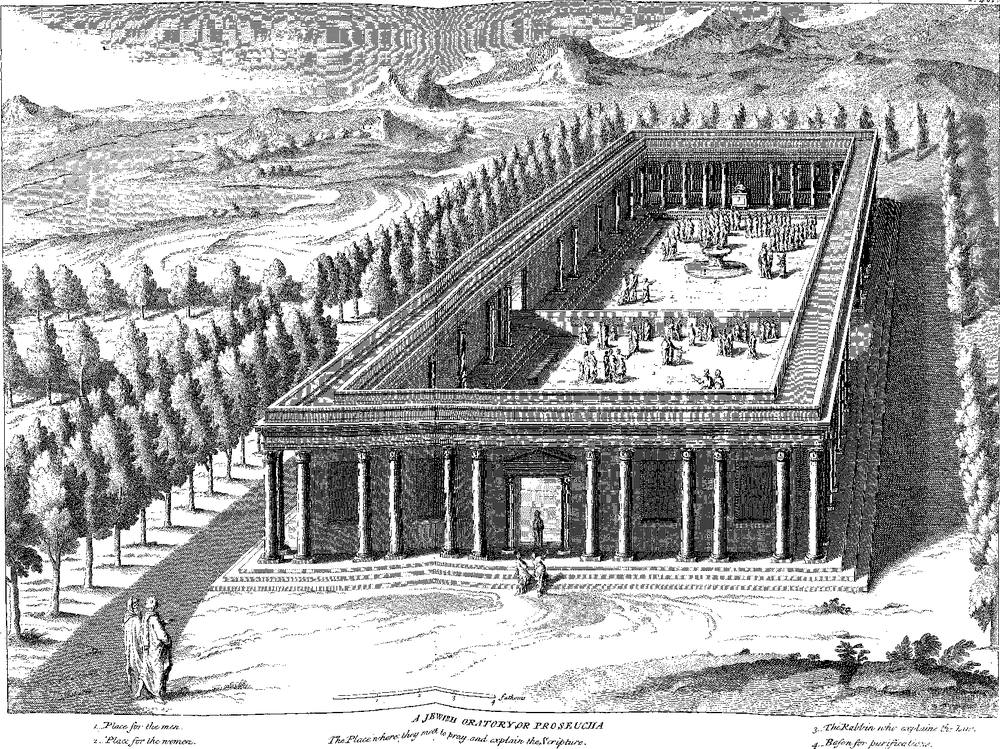
Προσευχή, Oratio. Juvenal. Sat. 3. v. 296. In quâ te quæro Proseuchâ.PROSEUCHE. The Word Proseuche is Greek, and signifies Prayer. It is taken for the Places of Prayer of the Jews, and was pretty near the same as their Synagogues. But the Synagogues were generally in the Cities, and were Cover’d Places; whereas, for the most part, the Proseuches were out of the Cities, and upon the Banks of Rivers, having no Covering, except, perhaps, the Shade of some Trees, or some cover’d Galleries. Acts xvi. 12.In the Acts, mention is made of the Proseuche of Philippi in Macedonia, which was out of the City. Maimonides says, That the Proseuches ought to be built in such Manner, that those that come into them, may turn their Faces towards the Temple of Jerusalem; Respect being had to the Situation of the Place and of the City where they were. The Author of the 3d Book of 3 Macc. cap. ult.Maccabees often says, That the Jews of Egypt, being deliver’d from the Danger to which they had been exposed under Ptolemy Philopator, built a Proseuche near the City of Alexandria. St. Epiphanius Epiphan, Hæres. 80.says, That at two Miles from Shechem there was a Proseuche of the Samaritans, situate in a Plain, built in Form of a Theatre, and without a Roof; in which, (says Epiphanius) as well as ,משליMishle. Παραβολαί, Parabolæ.in every thing else, they copy from the Jews. However, we must allow, that often Josephus and Philo confound the Proseuches with the Synagogues, and that they place them in the 1 Kings x. 1. Menander & Dius apud Joseph. Antiq. l. 8. c. 2.Cities. See SYNAGOGUE.
PROVERBS. The Hebrews give the Name of Proverbs, Parables, or Similitudes, to moral Sentences, Maxims, Comparisons, or Enigma’s, express’d in a Stile that is Poetical, figurative, close and sententious. The Hebrews call this Kind of Proverbs Mishle. Solomon says, That in his Time, Maxims of this Sort, were the chief Study of the Learned: A wise Man will endeavour (says he) to understand a Proverb, and the Interpretation; Prov. i. 6. Ecclus. xxxix. 1, 2, 3.the Words of the Wise, and their dark Sayings. And Jesus the Son of Sirach says, He will keep the Sayings of the renowned Men; and where subtil Parables are, he will be there also: He will seek out the Secrets of grave Sentences, and be conversant in dark Parables. The Queen of Sheba came from the utmost Parts of the Earth to see Solomon, to prove him, and to propose dark Riddles to him; Tentare eum in ænigmatibus. Hiram King of Tyre (they say) kept a Correspondence, by Letters, with Solomon, and proposed enigmatical Questions to him, and explain’d those that were proposed to him by Solomon. The ancient Sages of Greece had also this kind of Exercise in much Esteem. Cleobulus composed no less than three thousand Songs and Diogen. Laert. in Cleobul. Eccles. xii. 9.mysterious Sayings; and Cleobulina his Daughter writ enigmatical Verses.
The Proverbs of Solomon, are, without doubt, the most valuable Part of his Works: He tells us himself, they were the Fruits of his most profound Meditations, and of his most excellent Wisdom: Because the Preacher was wise, he still taught the People Knowledge; yea, he gave good Heed, and sought out and set in Order many Proverbs. In this Book we find Rules for the Conduct of all Conditions of Life; for Kings, Courtiers, Men engaged in the Affairs of the World; for Masters, Servants, Fathers, Mothers, Children. Some have doubted Rab. & Grot. in Prov. 2 Kings xviii. 18.whether Solomon alone was the Author of this Book: Grotius thinks this Prince took Care to have a Compilation made, for his own Use, of whatever was then excellent in Points of Morality, from all the ancient Writers of his own Nation; That under Hezekiah this Collection was enlarged, by adding whatever of this Nature had been written since Solomon; ‘Twas Eliakim, Shebna, and Joah (says he) that compleated this Collection. But these Conjectures not being supported by any Proof, ought not to be of such Weight with us, as to make us depart from the Opinions of the Fathers and Interpreters, who ascribe this whole Book to Solomon.
גם אלה לחכמיםTrue it is, we may there observe some Difference of Style and Method: For Example; the nine first Chapters, which have for their Title The Proverbs of Solomon, are written as a continued Discourse, and may be consider’d as a Preface to the whole Book; and to Chap. x. where we see the same Title again, the Style changes to short Sentences, which have little Connexion with one another, and which, generally, contain a kind of Antitheses. This goes on to Ver. 17. of Chap. xxii. Here we find a new Style to prevail, that approaches nearer to that of the nine first Chapters, and supports it self to Chap. xxiv. Ver. 23. where there is a new Title in these Words, Hæc quoque Sapientibus. This is still address’d To the Wise; or, Here are some farther Sayings of the Wise. Their Style is short and sententious. At the beginning of Chap. xxv. we read, These are also Proverbs of Solomon, which the Men of Hezekiah King of Judah copied out. And, doubtless, it was upon this Authority that Grotius has advanced, that this Collection was made by Eliakim, Shebna, and Joah, famous Men under the Reign of Hezekiah. This Collection goes on as far as Chap. xxx. 1. where we read thus; The Words of Agur the Son of Jakeh. Lastly, The Title of the xxxi. and last Chapter, is this; The Words of King Lemuel.
From all which, it seems certain, that the Book of Proverbs, in the State we find it at this Day, is a Collection of Part of the Proverbs of Solomon, compiled by several Hands. Wherefore we cannot conclude from hence, that this is not the Work of Solomon. This Prince being inspired of the Holy Ghost, 1 Kings iv. 32.had composed no less than three-thousand Proverbs. Several Persons might have made Collections of them; Hezekiah, among others, as mention’d in Chap. xxv. Agur, Isaiah, Esdras might have done the same. From these several Collections the Work was composed, that we have now in our Hands. Nothing is more reasonable to be admitted than this Supposition. It is no-where here said, that Solomon himself had made a Collection of Proverbs and Sentences. The Title, Solomon’s Proverbs, rather shews the Author, than the Compiler. The Rabbins generally Vid. Zemach David, & Seder Olam. Rabba, c. 15.maintain, That King Hezekiah, observing the Abuse that the People made of several of the Works of Solomon, chiefly of those which contained the Virtues of Plants, and Secrets of Natural Philosophy, he suppressed several of these Works, and only preserved those that are handed down to us.
No Doubt is made of the Canonicalness of The Book of Proverbs. We only know Concil. C. P. iv. Collat. 4. Art. 63.Theodorus Mopsuestensis among the Antients, and among the Moderns the Author of a Letter inserted among the Sentiments of some Divines of Holland, who have raised any Scruple about this Matter, and who have pretended that Solomon composed this Work by meer human Industry. The Greek Version of this Book is often very different from the Hebrew, and adds a great many Verses that are not found in the Original. The Roman Edition of the Greek transposes whole Chapters. For Example: After Chap. xxiv. ver. 22. it inserts the fourteen first Verses of Ch. xxx. Then it returns to Ver. 23. and the rest of Chap. xxiv. After which, it puts Ver. 15. and the rest of Ch. xxx. Then Ch. xxxi. and, lastly, Ch. xxv. and those that follow, as far as Chap. xxix. After which, is Chap. xxxi. Ver. 10. and the rest, which conclude the Book. I don’t mention the lesser Transpositions which may be seen in the Body of the Book; nor is it known from whence these Irregularities have proceeded. In the ancient Latin Editions we see several Verses added, which have been left out from the Time of St. Jerom: Yet there still remain some, which have been mark’d and suppress’d in the first Tome of the new Edition of St. Jerom.
Eccles. iii. 1, 19, 20. Joseph. Antiq. l. 3. c. 9. de Bello, l. 2. c. 12. p. 788.PROVIDENCE. ‘Tis a Tenet of the Christian and Jewish Religion, That God disposes and governs every Thing by his Providence; That this Providence is Eternal and Infinite; That it extends over all Things, even to the Hairs of our Heads, to the most minute Animals or Herbs of the Field. The Atheists, whose Sentiments are produced by Solomon, in his Book of Ecclesiastes, and the Sadducees who arose afterwards, deny’d this Providence: They maintain’d, That nothing happen’d to us, either by the Power of Fate, or by the Will of God; That God is incapable of doing or committing Evil; That we are the only Causes of our own Happiness or Misfortune, according to the good or ill Choice we make, in the Use of our Liberty.
See Basnage’s Hist. of the Jews, t. 4. l. 6. c. 13. Paris Edit.But these Notions are rejected by the generality of the Jews; tho’ they are not agreed among themselves, in the manner of explaining the Effects of Providence. Maimonides seems to think, That Providence does not act in the Moving of a Leaf, or in the Production of a Worm; but that whatever relates to the Production of Animals, or other Things of less Importance, is perform’d by Chance. Moreover, the generality of the Jews hold, That Mankind enjoys a perfect Liberty as to Good or Evil; and that whatever happens to him, is as a Recompence for his good Actions, and as a Punishment for his bad ones.
Eccles. v. 7.“ Say not before the Angel, There is “ no Providence; lest God should be provoked against you, and destroy all the “ Works of your Hands.” Thus speaks Solomon, in the Book of Ecclesiastes. Take
care how you deny in secret the Being of Providence; your Angel will be a Witness of your most secret Thoughts, and God will punish you in his Anger. The Hebrew expresses this; Say not, before the Angel, It is a Fault of Ignorance: Why should you expose your self to the Anger of the Lord by your Words, and lose all the Labour of your Hands?
PROVIDEO. This Word, which commonly signifies to provide, Deus providebit sibi victimam, is also used for, to foresee, to Gen. xxii. 8. Gen. xli. 33. Psal. xv. 8. Rom. xii. 12. 2 Cor. viii. 21. Gal. iii. 8. Acts ii. 31.seek, to prepare; Provideat Rex virum sapientem. Elsewhere it is taken for, to be attentive, to consider; Providebam Dominum in conspectu meo semper; I had God always before my Eyes. Elsewhere it is put for, to take care, to labour. We endeavour to do good, not only before God, but also before Men.; Providemus bona, non solùm coram Deo, sed etiam coram hominibus. Lastly, Provideo, is sometimes put for, to foresee, and to foretell; Providens autem spiritus sanctus. And elsewhere; David providens locutus est de resurrectione Christi.
PSALMS. The Book of the Psalms, is call’d, in the Hebrew, a Sepher Tehillim, The Book of Hymns. In the Gospel it is named, sometimes, The Book of Psalms; and sometimes only, The Prophet, or David, from the Name of its principal Author. This Book is justly esteem’d as a kind of Abridgment of the whole Scripture: It contains, in short, whatever is found in the other sacred Books. Psalmorum liber quæcumque utilia sunt ex omnibus continet, says St. Austin. ‘Tis a general Library, wherein we may meet with whatever is requisite for our Salvation, says Cassiodor. Præf. in Psalm.Cassiodorus; In hoc libro spiritualis Bibliotheca instructa est. The sacred History instructs Ambros. Præf. in Psalm.us, says St. Ambrose, the Prophecies declare what is to come, the Reproofs restrain the Wicked, the Morality persuades them; but the Psalms produce all these Effects. Agreeableness and Usefulness are there so happily mix’d, that it is not easy to decide which is most prevalent. Certat in Psalmo doctrina cum gratia simul. Hence proceeds that great Veneration that has always been given to the Psalms. ‘Twas almost become a general Rule, That the Bishops, the Priests, and all religious Persons, were to have the Psalter by heart: The Church has made it a principal Part of her Service, and has obliged her Ministers to rehearse some Portions of it every Day.
The Hebrews commonly divide the Psalter into five Books; and several of the Fathers10 admit of this Division, and think it very ancient. Eusebius says, It may be observ’d in the Hebrew Original, and in the best Editions of the Septuagint. St. Ambrose expressly refutes those who rejected this Division, and who thought it contrary to the New Testament, which quotes the Psalter only as a single Book. This last Reason was satisfactory to St. Hilarius11, St. Jerom12, and St. Austin13, so as to cause them to give up this Division of the Psalter into five Books, as being contrary to Scripture. Modern Commentators are not more unanimous than the Antients upon this Point: Some think the Psalter was distributed into five Books by the same Authors that collected the Psalms; but Others will have this to be much more modern, and even since the Times of the Apostles. In Reality, this Dispute is of no great Consequence.
But what persuades us that this Distribution is very antient, and even from the Time of the first Authors that collected the Psalms into a Body, is, that at the End of each Book we read the same Conclusion, which seems to have been put there by Esdras, or by those that had the Care of collecting the sacred Vid. Muis ad Psal. xl. The English Version follows the Distribution of the Hebrew.Books after the Captivity of Babylon. This is certain, that neither the Jews nor Christians have ever reckon’d the Collection of Psalms but as one Book, in the Enumeration of the Books of Holy Scripture. The first Book of the Psalter, according to the Hebrews, ends at our fortieth Psalm. The second at the seventy-first. The third at the eighty-eighth. The fourth at the hundred and fifth. The fifth at the hundred and fifti-eth. The four first Books conclude with these Words, Amen, Amen, in the Hebrew, and with fiat, fiat, in the Latin. The fifth with Hallelujah both in the Hebrew and the Latin. The Number of Canonical Psalms has always been fix’d among the Jews, as also among the Christians, at one hundred and fifty; for the hundred and fifty-first, to be found in the Greek, has never been received as Canonical. But tho’ the Number of the Whole has been agreed on, yet there is a Variety in their Distribution. The Jews make two of the ninth, and begin their tenth at these Words of Psalm ix. 22. Why standest thou afar off, O Lord? so that from this Place to Psalm cxiii. their Citations and Numbers are different from ours, and from those of the Greeks. They are always a Psalm before us, and that which is our nineteenth is their twentieth, and so of the rest. The Protestant Churches, following this Division of the Hebrews, quote the Psalms in like manner; which is necessary to be observed in reading their Books.
At Psalm cxiii. When Israel went out of Egypt, they recede still farther from us,
for they divide this Psalm into two, and begin the cxiv. at these Words, Not unto us, O Lord. So that Psalm cxiv. according to the Greeks and Latins, is their cxvi. But afterwards they come nearer us again, by uniting Psalms cxiv. and cxv. together, so that they differ from us but by one as far as the cxlvi. And then uniteing again Psalms cxlvi. and cxlvii. they coincide with us, and continue to reckon with the Vulgate to the End of the Psalter.
There is also some Difference among the antient Greek and Latin Copies, about the Division of the first and second Psalm; some making but one of both, and others dividing them into two, as we do at this Day. ‘Tis true in general, that the Division of the Psalter is not of that Antiquity that might be imagin’d, and that sometimes one is obliged, in order to pursue the Sense of some of the Psalms, to connect one to another, or to separate them, as the Matter requires. St. Hilarius affirms,14 that in his Time the Distribution of the Psalms was not yet settled among the Hebrews, and that some divided them in one manner, and some in another. Origen makes the same Observation.15 He says, that in the Hebrew the Psalms are mark’d by 1, 2, 3, &c. and in the Time of Kimchi, that is, in the twelfth Age, the Matter was yet undetermined.16 In our Preface upon the Psalms, Art. II. and in the Commentary, it may be seen, that often several Psalms have been made of what ought to have been but one, by the Intention of the Author that composed them.
It is a Tradition among the Hebrews and Christians, that Esdras is, if not the only, yet the principal Author of the Collection of the Book of Psalms. Eusebius, St. Hilary, Theodoret, the Author of the Synopsis printed under the Name of St. Athanasius, venerable Bede, and several others impute this Honour to him. Philaster says, that Philastr. hæres. 77.wise Men of the Jewish Nation having collected them together, ranged them in the same Order that they had received from their Ancestors, who had preserved them from the Hands of their Enemies. Even before the Captivity there was a Collection of the Psalms of David, since Hezekiah, when 2 Chron. xxix. 25, 26, &c.he restor’d the Worship of the Lord in the Temple, caus’d the Psalms of David to be sung there. In the Library that Nehemiah erected at Jerusalem, he caused the Psalms 2 Mac. ii. 13.of David to be deposited.
Speculative Men have exercis’d themselves very much, upon the Order and Disposition that the Psalms ought to observe among themselves. They have discovered Mystery and Design, some in one manner and some in another. Some17 have thought they could observe a Succession of the Events of the Life of David. Others have pretended, that Regard was had to the Order of the Solemnities that were celebrated in the Temple. St. Chrysostom observes, that generally speaking the first Psalms are upon Subjects of Sorrow, and the latter upon more joyful and comfortable Subjects. St. Austin acknowledges, that he could not yet discover the Mystery of the Disposition of the Psalms, but that it seems to him, that every fiftieth hath a Relation to the Vocation, the Justification, and the Glorification of the Saints; since the fiftieth relates to Repentance, the hundredth to Mercy, and the hundred and fiftieth to the Praise of God in his Saints. But St. Jerome observes, that it is impertinent to expect in the Psalter a chronological Series of Canticles, which have relation to certain Events of History, since it is not the Custom of the Authors of Lyricks to observe any such Order in their Compositions; and indeed, a very little Examination of the Text and Spirit of the Psalms may convince us, that those that undertook this Collection had no other Design, than to give us all these holy Canticles as they found them, with a religious and exact Scrupulosity, without putting themselves to the Trouble either of retrenching what had been already repeated, or of supplying what might seem deficient, or of connecting what had been separated, or of separating what had been improperly join’d together. They have left the Care of making these Observations to those that were to study the Letter of the Psalms. See our Preface to the Psalms, Art. III.
The Authority and Canonicalness of the Book of Psalms have always been acknowledg’d by both Jews and Christians. Philastius says, that the Nicolaites, the Gnosticks, and the Manichees deny’d that David was a Prophet, or that his Works were the Effect of the Inspiration of the Holy Ghost. Also some Anabaptists have deny’d the Inspiration of the Book of Psalms. But the general Sentiment of the Christian Church has always been, that all the hundred and fifty Psalms contain’d in the Psalter were the Work of the Holy Ghost. One thing only creates a Difficulty with some Persons of Piety, that in the Psalms we sometimes find a kind of Imprecation against the Wicked, and the Enemies of the Prophet. But the Fathers and Interpreters commonly explain these Passages, as if they were Predictions of those Calamities
mities that were to befall them, or Wishes for their Conversion. As if it were said, that they should certainly perish, if they continued in their disorderly Courses; or, let them perish if they were not converted. St. Chrysost. in Psal. cxxxvi.11.Chrysostom says, that in these Passages the Psalmist does not so much deliver his own Sentiments, as those of others. St. AthanasiusAthan. Argumento in Ps. lxxii. maintains, that he makes these Curses and Imprecations, not against Men his visible Enemies, but against the Devils which are his invisible Enemies. The Reader may see M. Bossuet, Bishop of Meaux, in his Preface to the Psalms, and our Commentary upon Psalm xxxiv. p. 373, 374.
Nothing can be a greater Argument of the Obscurity of the Book of Psalms, than the great Number of Commentaries that have been made upon them, and which are still made every Day, in order to explain Bocchius in Psalm. p. 806. Draud. Bibliot. Class. p. 522, &c.them. Bocchius and Draudius have reckon’d up above five hundred. Father Le Long of the Oratory, in the second Tome of his Bibliotheca Sacra, has enumerated as far as six hundred and thirty, without reckoning those which have wrote upon the Scripture in general, or those that have commented upon a Part of the Psalms only; so that if we would comprehend all these, it may be affirm’d, that above a thousand Writers have undertook to illustrate the Psalms. The Difficulty of succeeding in the Explication of these divine Canticles proceeds from several Sources. The first is, the Obscurity of the Hebrew Text. The second is, the Nature of the Style, which is very sublime, and at the same time very different from our manner. The third is, the Abstruseness of the Matter. The Hebrew Text of the Psalms is more obscure than that of the other Books of Scripture, as in general the Style of Poetry is more difficult than that of Prose. Besides, the Copyers having understood it less, and having oftner transcrib’d this Book, have occasion’d many Faults therein. We need but compare the several Manners in which the Seventy, the Syriack, and St. Jerome have translated this Text, with what we read at this Day, to perceive this Difference.
Men are agreed about the Authority of the Book of Psalms, and acknowledge the Authors to have been divinely inspired; but they are not agreed whether they are owing to one Author or to many, or who he was, or they were, who composed them. Some assert they all belong to David, which others again deny. St. Chrysostom, a St. Ambrose,18 St. Austin,19 Theodoret,20 Cassiodorus,21 Euthymius,22 Philastrius,23 and many of the Moderns, maintain, that David alone was the Author of them all. St. Hilary,24 the Author of the Synopsis ascribed to Athanasius, and several others, pretend the contrary. The Reasons of each Opinion are to be discuss’d. Those that think David to have written the whole Psalter, rely upon these: 1. That in Scripture this holy King is marked out by his 2 Sam. xxiii. 1, 2.Character of Psalmist of Israel. The sweet Psalmist of Israel said, The Spirit of the Lord spake by me, &c. 2. In all the Ceremonies wherein mention is made of Singers, or of Psalms, generally the Psalms of David are intended. Thus at the Dedication of the Temple of Solomon, the Levites rehearsed the Canticles that David had 1 Chron. xxiii. 5.composed. When Hezekiah was about to restore the Worship of the Lord in the 2 Chron. xxix. 30.Temple, he commanded the Levites to praise the Lord with the Words of David and of Asaph the Seer. Asaph was principal Ezra iii. 10. Nehem. xii. 35, 39. 2 Macc. ii. 13.Musician in David’s time, to whom this Prince sent his Canticles, in order to be set to Musick by him, and to be sung by the Choir over which he presided. At the Dedication of the second Temple, after the Return from the Captivity, they sung the Praises of the Lord in the Canticles that David had composed. Nehemiah sets up the Psalms of David in the Library he had founded at Jerusalem. Jesus the Son of Sirach commends the Zeal of David, for having composed Hymns to be sung before the Lord. In the New Testament our Saviour Ecclus. xlvii. 10.and his Apostles always quote the Psalms by the Name of David’s;25 and make use of ‘em as such, in the Presence of the Jews, who never contradicted them in this, though in every thing else they were ready enough to oppose them, and very glad to find Room for an Objection. Nor do they only quote under his Name such as bear the Title of David, but they cite others also under his Name, which have no particular Title; as the second Psalm quoted by St. Peter, Acts iv. 25.
But, 3. The antient, uniform, and constant Use of the Church, which gives to the Psalter the Name of the Psalms of David, is another Proof of the Persuasion propagated from the very Beginning, that this holy King and Prophet was the Author of these divine Canticles. Usus Ecclesiæ catholicæ spiritus sancti inspiratione, generaliter & immobiliter tenet, ut quicumque eorum Psalmorum cantandus fuerit, Lector aliud prædicare non audeat, nisi Psalmos David, says Cassiodorus. Philastrius has carry’d this Matter so far, that Cassiod. Præf. in Psalmos. Philastr. hæres. 79.he places those among Hereticks, who deny’d that David was the Author of all the Psalms. Perez26
in his Commentary upon the Psalms asserts, that Josephus the Historian, Jonathan the Paraphrast, and all the antient Jews were persuaded, that David composed the whole Psalter; but that the Rabbins relinquish’d this Opinion, when they found themselves press’d hard by Origen, who assaulted them by Passages quoted from this very Book. But what could the Rabbins gain by denying David to have been the Author of the Psalms, since they acknowledg’d them all to have been inspired, and to have been the Work of some of the Prophets? In what remains to us of Origen, we cannot distinctly see what was his Opinion upon this Question; but Genebrard assures us, that the Talmudists and Rabbins commonly teach, that all the Psalms are not to be ascribed to David as their Author.
This is what has been advanced to prove, that David was the Author of the whole Psalter. But the contrary Opinion has been supported with good Arguments, and the Number of those that contend, that David has had Partners with him in this Honour, is not inferior to those of the Opinion now proposed. St. Hilary27 says expressly, that the Psalms have for their Authors the Persons whose Names they bear in their Titles. Absurdum est Psalmos David dicere vel nominare, cum ibi Auctores eorum ipsis inscriptionum titulis commendantur. St. Jerome in his Letter to Sophronius, which is a Preface to the Psalter, says the same thing as St. Hilary; and in another Place he looks upon it as an Error to affirm, that all the Psalms are of David. Sciamus errare eos, qui omnes Hieron. Ep. ad Cyprian. 139.Psalmos David arbitrantur, & non eorum quorum nominibus inscripti sunt. We read in a Note upon the Title of the first Psalm, in the Commentary of St. Austin upon the Psalter, that all the Psalms are not David’s. Non enim omnes Psalmi à David editi sunt. But the Learned think, that this Annotation does not belong to him, and that his true Sentiments are to be found in l. 17. c. 14. of The City of God, where he evidently declares himself on the Side of David, saying; Mihi credibilius videntur existimare, qui omnes illos centum & quinquaginta Psalmos ejus operi tribuunt.
The Greek Fathers are not less inclined to that Opinion, that several Authors were concerned in composing the Psalms, than the Latin Fathers were. St. Athanasius28 disapproves the contrary Opinion. He reckons up but seventy-two Psalms that belong to David, and thinks that those without Titles are to be ascribed to the same Author as the Psalm aforegoing. In his Synopsis, if it be his Work, he says there are Psalms of Jeduthum, of Asaph, of the Sons of Korah, of Haggai, of Zechariah, and of Heman: That there are some which belong to all these Authors together, as those that have in the Title Hallelujah. He adds, that the Name of the Psalms of David was given to the Psalter, because he was the first Author of this kind of Works, he regulated the Order, the Seasons, and the Functions of some other Writers, whose Names are at the Head of some of the Psalms. Eusebius of Cæsarea ascribes to David only seventy-two of the Psalms.29 He thinks the others belong to those whose Names they bear. The Sons of Korah composed eleven, Asaph twelve, Solomon two, Moses one, Ethan the Ezrahite one. He represents David to us in the Midst of a Band of inspired Musicians, singing alternately as the Holy Ghost inspired them, while all the rest, and even David himself, continued in Silence, contenting themselves to answer in the Chorus Hallelujah.
To these Authorities of the Fathers may be added the Suffrage of an infinite Number of modern Authors, as the Rabbins, and many Christian Commentators of all Communions, the greatest part of which acknowledge, that in the Psalter there are many Canticles that were written since David’s time, and which carry in themselves the Marks of their Novelty; for Example, when they speak of the Captivity of Babylon, which happen’d long after the time of David. True it is, that the Titles of the Psalms are very antient; but there are many of them that have other Names besides that of David. We may conclude from thence, that at least at that time they were thought not to belong to David. And this Argument will have still more Weight with them, who contend, that the very Titles of the Psalms are owing to Inspiration, as we shall now see.
The Titles of the Psalms, are a Matter about which Interpreters have much exercis’d their Sagacity, and in which we have very little Light or Certainty. Some of ‘em have a profound Respect for these Titles, and look upon them as making a Part of these divine Canticles. Others think they were added afterwards, and that they are of small Consideration. Some imagine these Titles to be, as it were, a Key to the Psalm, and that whoever could understand them well, might easily enter into the Sense of the Author. Others believe them of little Importance for the understanding of the Text, as having been added in After-times, and that very often at random. It is said again by others, that even allowing these Inscriptions might have been useful for the right understanding of the Psalms, yet we can
have but little Use from them, the greatest Part of ‘em being now so obscure, that the most learned Interpreters dare not flatter themselves that they understand them, and own they contribute nothing to illustrate the Psalm. Parum est damni in hujus vocis (haggittith) ignoratione, cum illa, ut & aliæ similes, quæ passim occurrunt in titulis Psalmorum, ad argumentum & materiam carminis, In Psalm viii. 1.nihil prorsus pertineant, says De Muis, one of the most learned Commentators that we have upon the Psalms.
The Fathers are generally agreed as to the Obscurity of these Titles, but they have a far different Opinion of their Usefulness. Origen Origen. edit. Huet. t. 1. p. 39.delivers a Notion that he had learn’d from a Jew, about the Obscurity of the Scriptures in general, which will be very apposite to the Book of Psalms. The Scripture, said he, is like a vast and magnificent Building, wherein are many Apartments and Chambers, every one of which has its proper Key: But the Key that is found at every Door is not that which belongs to it. Often it is misplaced, and the Business is to find it out, and to distinguish it from many others. St. Austin says, that the Title declares the Subject of Aug. in Psal. 139. p. 1552.the Psalm. Tanquam præco Psalmi est titulus Psalmi. The Title of the Psalm and the Psalm itself, are two things that ought not to be separated, says St. Hilary, they mutually Hilar. in Psal. cxix. Prolog. p. 367. n. 1.support and assist each other. Cum sibi invicem auctoritatem præstent Psalmus & titulus, debilis erit sermo, si de aliquo eorum sine altero disseratur. The Title is the Key of the Psalm, says the Author of the Commentary upon the Psalms, printed under the Name of St. Jerome. As one cannot enter into the Hieronym. Prol. in Psal.House without the Key, so the Canticle cannot be understood except the Title be explain’d. Quid est titulus nisi clavis? In domum non ingreditur, nisi per clavem; ita & unius cujusque Psalmi intellectus per clavem, id est, per titulum intelligitur.
St. Austin gos still farther, for he looks Aug. in Psal.lxiv. Angl. li.upon these Titles as inspired, as well as the rest of the Psalm. Upon Psalm lxiv. whose Title is A Song of Jeremiah and of Ezekiel, &c. he says, We are here to acknowledge the Voice of holy Inspiration, by the Title of this Psalm. And elsewhere, speaking of the Title of the Fiftieth Psalm, which is, A Psalm of David, when Nathan the Prophet came unto him, after he had gone in unto Bath-sheba, he says, This is not to be found in the Body of the Psalm, but is read at length in the Books of the Kings: But both of these are divine Scripture. Utraque autem Scriptura canonica est. Theodoret30 is still more express, for he says that these Titles were added by Esdras, who was inspir’d by the Holy Ghost; and Bosuet in Psalmos. Dissert. de Psalm’s. c. 6. p. 68.that they were read and preserved by the Seventy Interpreters, who themselves had received Inspiration from Heaven, and who would not be forward to mingle the Notions of Men with the Words of the Holy Ghost. The Jews in their Synagogues chant the Titles of the Psalms, as well as the rest of Scripture, and the Rabbins expound them in their Commentaries. The Septuagint and St. Jerome have preserved them in their Translations, and in the sacred Texts. The greatest Part of both the Antients and Moderns have consider’d them as a Key to the Psalms. Without them how should we distinguish the Authors of each Psalm? M. Bosuet Bishop of Meaux, says positively, that they were put at the Head of the Psalms by the Inspiration of the Holy Ghost, to point out to us the Author and Subject of every one of these divine Canticles; and that we ought not to separate the Inscriptions of the Psalms from the Body of the Scriptures, since they are read in a continued Order, and without Distinction, not only in the Hebrew Text, but in all the Versions. For the same Opinion, the Reader may consult M. Du Pin, in his Preface to the Psalms, Article the Third.
But I think this is carrying the Matter too far, to maintain that all the Titles of the Psalms in general are Canonical and from Inspiration. Many Catholick Divines31 have positively asserted, that the greatest Part of them are of no Use for the Explanation of the Psalm. The Fathers, and among others, St. Austin, Hilary, Theodoret, Cassiodorus, have acknowleged, that often these Titles have no relation to the Body of the Psalm, and that in the Place they were put they contributed nothing to the Sense. The Catholick Church has never made any Injunction that they should be sung in her Office, nor has ever determin’d them to be Canonical. For it is agreed, that the Council of Trent, by declaring the Text of the Latin Vulgate to be Canonical and Authentick, has never pretended to receive into the Canon all the Titles of the Holy Books. The Septuagint, and the other later Greek Translators, have added Titles to some of the Psalms which have none in the Hebrew. If the Titles of the Psalms had been look’d upon as Canonical, would any body have been permitted to meddle with them, to alter them, to suppress them, to add to them? Which of the Commentators is there, whether Jew, Catholick, or Protestant, who thinks it incumbent upon him to follow the Title of the Psalm in his Commentary? And yet both Jews and Christians receive the Psalms as holy Writ.
And therefore in this Question we should observe a due Medium. 1. To treat the Titles of the Psalms with great Respect, because there are,doubtless, a great Number of them that are authentick. 2. To acknowledge such as are derived from the first Authors, from the antient Prophets, or, lastly, from Esdras, to be canonical and inspired. 3. That those which have been added, either before or after Esdras, by Jews not inspired, or by the Greeks; also those that are apparently against History, or contrary to the Spirit of the Psalm, deserve no particular Consideration on their own Account. 4. Lastly, that the Fathers themselves, who seem to have thought them to be canonical and inspired, are to be understood to speak of those that were in the original Text, and written by the Hand of Esdras, or of the antient Prophets; for as to the rest, they make no Difficulty to give them up, as may be seen in Theodoret upon several Occasions. The Reader may see our Dissertation upon the Titles of the Psalms, Pag. xxix. xxx. wherein we examine this Question at length. See also Father Alexander, Hist. v. Test. Dissert. 24. Quæst. 1. Art. 1.
According to the Titles of the Psalms, as they are found in our Bibles, there are seventy-two that bear the Name of David; fifty that are without the Name of their Author; but the Rabbins hold, that they are to be referr’d to that Author, whose Name is immediately before: And this Tradition of the Jews is related and received by Origen, by St. Jerom, by Eusebius, by Hilary, and Athanasius. a
Psalms ascribed to the Sons of Korah, are xli, xliii, xliv, xlv, xlvi, xlvii, xlviii; as also lxxxiii, lxxxiv, lxxxvi, lxxxvii.
Ascrib’d to Solomon, the lxxi. Deus judicium tuum Regi da. And cxxvi. Nisi Dominus ædicaverit domum.
Imputed to Ethan, the lxxxviii. Misericordias Domini in æternum cantabo.
To Jeduthun, the lxxvi. Voce meâ ad Dominum clamavi.
To Moses, the lxxxix. Domine, refugium factus es nobis.
To Asaph, the xlix. Deus Deorum Dominus locutus est.
The lxxii. Quàm bonus Israel Deus. The lxxiii. Ut quid, Deus, repulisti in finem.
The lxiv. Confitebimur tibi Deus. Also the lxxv, lxxvi, lxxvii, lxxviii, lxxix, lxxx, lxxxi, lxxxii, lxxxiii.
Ascribed to Adam, the xci. Bonum est confiteri Domino.
To Melchisedech, the cix. Dixit Dominus Domino meo, Sede à dextris meis.
To Jeremiah and Ezekiel, the lxiv. Te decet hymnus.
To Jeremiah, the cxxxvi. Super flumina Babylonis. Which is also ascribed to David.
To Haggai and Zechariah, the cxi. Beatus vir qui timet Dominum. And the cxlv. Lauda, anima mea, Dominum.
Besides the hundred and fifty Psalms now mention’d, and which are receiv’d as Canonical, there is one more which is not in the Canon, and which is to be found neither in the Hebrew, nor in the Chaldee, nor in the Vulgate; but it is read in the Syriac, in most of the Greek Copies, in the Arabick, in the Anglo-Saxon Version, in the Books of the Prayers of the Greeks. St. Athanasius32, Euthymius33, Vigilius of Thapsus34, the Author that interpolated the Epistles of St. Ignatius35, make mention of it, and quote it. St. Chrysostom alludes to it, in his seventeenth Homily to the People of Antioch. Its Title is, A Psalm of Thanksgiving of David, when he had overcome Goliah. It begins thus; I was the least of my Brethren, and the youngest of the House of my Father, and I fed my Father’s Sheep, &c. We have given it in Latin and French, with an Explication, at the End of our Commentary upon the Psalms.
Joseph. Christian. in Hypomnest. M.S. l. 2. c. 120. Mich. Glycas Annal. par. 2. p. 182.The Author of the Synopsis attributed to St. Athanasius, says, That David had composed three thousand Psalms, out of which Number King Hezekiah selected one hundred and fifty, and suppress’d all the rest. He quotes this, as taken out of the Chronicles, where we read nothing like it. A Greek Author call’d Josephus Christianus, says the same thing, and quotes it as in the Chronicles. Michael Glycas cites Psellus, who says the same thing, and he seems to believe it himself: He adds, That after the Captivity, Esdras selected the hundred and fifty Psalms which we find in our Bibles, out of three hundred, or more, which he had before him. The Author of the Syriac Version says, That some add twelve Psalms to the End of the Psalter; but he rejects them as useless, and without Authority.
Psalms of Solomon; or, The Psalter of Solomon. See the Title SOLOMON.
Psalms of Degrees. This Name is given to fifteen Psalms of the Psalter, which are the cxix. and all that follow to the cxxxiv. inclusive. The Hebrew Text calls them,36 A Song of Ascents: The Chaldee, A Song that was sung upon the Steps of the Abyss. This Explication is taken from the Tradition of the Hebrews, which relates, That when they were laying the Foundations of37
the Temple, at the Return from Babylonish Captivity, there came out of the Earth such a prodigious Quantity of Water, that it rose to the Height of fifteen Cubits; and that it would have drowned the whole World, if Achitophel, the famous Achitophel who hang’d himself in the Time of David, about five-hundred Years before, had not stopt its Progress, by writing the ineffable Name of Jehovah upon the fifteen Steps of the Temple. To the same Event they refer Psalm cxxix. De profundis clamavi, &c. which is one of the Psalms of Degrees. This is what the Jews say about them. Junius and Tremellius translate the Hebrew by, A Song of Excellencies; or, An excellent Song: Which Translation is not disapprov’d by De Muis, and by other skilful Interpreters. But the common Translation, or Psalms of Degrees, has more generally obtain’d.
But whence have they this Denomination? The Interpreters think, ‘twas because they were sung upon the fifteen Steps of the Temple. They are not agreed about the Place where these Steps were. Some think them to be without this holy Place; Others, at its Entry. Others think them to be the fifteen Steps mention’d by Josephus, to ascend from the Inclosure of the Women in the great Court. Lastly; Others will have them to be the Steps by which they ascended from the Court of the Priests, to the Porch which was before the holy Place. But it cannot be proved, neither from Josephus, nor from Scripture, that the Steps of the Porch, or of the Gates of the Temple, or those without the Temple, were just fifteen Ezek. xl. 22,26,31, 37,49.in Number. We see, by Ezekiel, that one had eight, and the other had seven Steps. Besides, we do not find, by any Passage of Scripture, that the Levites sung upon the Steps of the Temple; their Place was round about the Altar of Burnt-Offerings, in the Court of the Priests.
Some have thought, that these were call’d Psalms of Degrees, because they were sung in a Gallery, which was in the Court of IsraelEzra ix. 4., where, sometimes, the Levites read the Law. But we do not find, by any Passage of Scripture, that Singers were placed in this Gallery, or that they sang these Psalms in particular. The Author of the Commentary upon the Psalms, printed under the Name Pseudo-Hieron Exposit. 2. in Psal. cxix.of St. Jerom, says, that in the Temple there were several Degrees of Dignity among the Priests and the Levites. This is true: But it is not any-where said, that these Degrees were fifteen. There were assuredly four and twenty sacerdotal Families, and as many of Saadias, Hammond, Gataker, Vatab. Du Pin, Ainsworththe Levites. But what does all this make for the fifteen Psalms of Degrees? Some Rabbins, and a good Number of Commentators, translate the Hebrew by Psalms of Elevation; because (they say) they were sung with an exalted Voice, or because at every Psalm the Voice was raised.
But, no longer to multiply Conjectures in this Matter, I shall now produce my own Hypothesis. I translate the Hebrew by A Song of Ascent, or, of the Coming up of Israel from the Captivity of Babylon. The Scripture commonly applies the Phrase, to ascend, to express this Return. Cyrus, in his Proclamation in Favour of the Jews, says, Ezra i. 3, 5. & ii. 2. & vii. 5, 6.Who is there among you, of all his People? His God be with him, and let him go up to Jerusalem. And a good Number of Persons presented themselves to go up, says Ezra. Ezra i. 11. & ii. 1.And Shesh-bazzar brought up with them of the Captivity, that were brought up from Babylon to Jerusalem. Now these are the Children of the Province, that went up out Ezra vii. 6, 7, 9.of the Captivity. This Ezra went up from Babylon. And there went up some of the Children of Israel. For upon the first Day of the first Month was the beginning of the going up from Babylon. In Psalm cxxi. which is one of the Psalms of Degrees, it is said, whither the Tribes go up (to Jerusalem.) Lastly; Jeremiah, foretelling the Return Jer. xxvii. 22.from the Captivity, says, Then will I bring them up, and restore them to this Place. Ezekiel xxxix. 2.Ezekiel expresses himself in the same manner.Joseph. de Bello, l. 1. c. 14. in Græco, p. 917.
All these Expressions sufficiently shew, that the Hebrews commonly made use of the Term to go up, when they spoke of their journeying from Babylon to Jerusalem; because Babylon was situated in a Plain, and Jerusalem in a mountainous Country. Therefore, it is very natural to call those Psalms of Ascent, which were composed on the Occasion of the Deliverance from the Captivity of Babylon, whether it were to implore this Deliverance from God, or to return Thanks for it after it had happen’d; and this is what is really observed in those Psalms. They have all some Relation to this great Event. They make mention of it in several Places; and the greatest Part of ‘em cannot be otherwise explain’d. This alone wou’d suffice to determine us to explain in this Sense the Term Psalm of Degrees, or, of Ascent. We need not exhibit here a great Number of Passages taken out of these Psalms, to prove the Truth of what we advance; to open the Psalter only, is enough to convince any one. See our Dissertation, which serves as a Preface to the Psalms of Degrees.
Acrostick Psalms. These are Psalms, that, in the Hebrew, begin every Verse, or half Verse, with a Letter of the Alphabet, ranged according to the Order of the Alphabet. These Psalms are,
Psalm xxv. Ad te, Domine, levavi animam meam.
The xxxiv. Benedicam Dominum in omni tempore.
The xxxvii. Noli æmulari in malignantibus.
The cxi. Confitebor tibi, Domine, in toto corde meo.
The cxii. Beatus vir qui timet Dominum.
The cxix. Beati immaculati in via. The cxlv. Exaltabo te, Deus meus Rex.
PSALTER, or, Book of Psalms. See PSALMS.
PSALTERY, Psalterion, or Psalterium. The first of these two Words is Greek, and the other Latin, each of ‘em signifying either the Psalter, or Book of Psalms; or else, an Instrument of Musick, call’d the Psaltery. As to the Psaltery, or Instrument of the ancient Musick, of which mention is sometimes made in Scripture, we think it answers to the Hebrew Word Nebel,38 which the Septuagint generally translate by Psalterion, or Nablon. ‘Twas an Instrument of Wood, having Strings, and which was made use of, with other Instruments, in the Solemnities and Ceremonies of Religion39. It should seem, by some Passages of the Psalms, that the Nebel Psal. xxiii. 2. & cxliv. 9.was the same as the Decachord, or Instrument of Ten Strings, call’d in Hebrew Gnashur; but in other Places it is sufficiently distinguish’d from it: Upon an Instrument of Psal. cxii. 3.ten Strings, and upon the Psaltery; or upon the Nebel and the Gnashur.
Certain it is, that these two Instruments had a great Conformity to each other. The ancient Nablium was very near of the Figure of a Delta Δ, according to Saint Jerom, Cassiodorus, and Isidorus, having a hollow Hieron. in Psal. xxxi, cxlix, cl. Cassiod. Præf. in Psalm. Basil. in Psal. 1. Aug. in Psal. xxxii. Hilar. Prolog. in Psalm.Belly above, and strings stretch’d from Top to Bottom over-against this Cavity, which makes them give a Sound, when touch’d by the Finger or the Bow. The Difference observ’d by St. Basil, St. Austin, St. Hilary, and those above cited, between the Psalterion and the Cithara, is, that the Psaltery was play’d upon below, and gave its Sound above; whereas the Cythara was play’d upon above, and founded below.
These Instruments approach’d very near to our Harp. Ovid says, that the Nablium was play’d upon with both Hands. Ovid. l. 3. de Arte. Antiq. l. 8. c.2. p.262.Disce etiam duplici genialia nablia palmâ Plectere, conveniunt dulcibus illa modis.
Josephus says, that the Nablia of the Temple of Jerusalem were made of a precious Metal call’d Electrum; but the Books of 1 Kings x. Kings and the Chronicles expresly shew, 12. 2 Chron. ix. 11. Joseph. Antiq. l. 7. c. 10.that Solomon made them of Almugim or Algumim-wood, which is a Sort of Wood unknown to us. The same Josephus says, in another Place, That the Nablium had Aristor. apud Scalig. Poetic. l. 1. c.48. Juba apud Athen. l. 4. c. 25.twelve Strings, and that it was touch’d with the Fingers. Aristotle speaks of a Triangular Psaltery, the Strings of which were all equally distended. Juba, in Athenæus says, That Alexander of Cythera added several Strings to the Psaltery, and laid it up in the Temple at Ephesus, as the Master -piece of his Industry.
The modern Psaltery is a flat Instrument, of a Triangular Form: It is strung with three Rows of Strings, of Iron or Brass Wire, tuned to an Unison or to an Octave, raised upon two Bridges which are on the two Sides; these Strings are extended from Side to Side, and are play’d upon by a kind of Bow. Thus is this Instrument very different from the ancient Psaltery.
PSEPHINA. Josephus speaks of a Tower at Jerusalem, and of a Gate of the same City, which was call’d Psephina, or Psephinos.
PSEUDO-APOSTOLI40, Pseudo- Christi41, Pseudo-Prophetæ42, false Apostles, false Christs, false Prophets. The Term Pseudo comes from the Greek Pseudos, which signifies a Lye.
Stephen. in Ethnic. Ptolemais. Vide & Etymolog. mag. Vide, si lubet, Reland. Palæst. l. 3. p. 538. Judg. i. 31.I. PTOLEMAIS, a City of Phœnicia, upon the Mediterranean Sea, having Mount Carmel to the South, being a considerable Sea Port. Its antient Hebrew Name is Accho. See Judges i. 31. The Greeks have given it the Name of Ake, and we have already spoke of it under the Name Accho. The Greeks not knowing that Accho was a Hebrew Word, have derived Ake from the Verb Akeomai, which signifies to cure or heal; imagining that it took this Name, because Hercules had been cured here of the biting of a Serpent. The River Belus or Beleus, falls into the Mediterranean near Ptolemais. See BELUS. I have not found who the Ptolemy was, that gave his Name to this City. It afterwards became a Roman Colony under the Reign of Claudius, and there are several antient Medals that prove it a Roman Colony. The Christians that undertook the Expedition of the Holy War, gave it the Name of Akre, or of St. John of Acre. The Arabians at this Day call it Acca. This City was assign’d by Joshua to the Tribe of Ashur, who did not drive out the Inhabitants. Ummah, an unknown City mentioned in Joshua xix. 30. might well be Accho, which the Transcribers have changed to Ummah.
The Crusado’s gave the Name of St. John of Akre to this City, because of a magnificent Temple, which was there dedicated to St. John. This City is built in a triangular Form, wash’d by the Sea to the West and South, surrounded by two strong
Walls towards the Land, at about fifty Paces from each other, and fortify’d by a great Number of Towers at equal Distances. On the first Wall towards the East was a Tower larger and stronger than the rest, call’d the King’s Tower; and at the middle Angle was such another Tower, which was always call’d the cursed Tower. And it proved its Right to this Name; for it was by this that the Saracens enter’d the City, and took it, as was observed at that time. Juste proinde maledicta vocata est Turris illa, qua maledicta gens Saracena subintravit, anno 1291, & qui illi nomen imposuit, eventum tam diri infortunii nesciens quid diceret, prophetavit. This was the last City that the Christians had possession of in Syria. The Sultan of Egypt, Elpy, sirnamed Melle-messor, having besieged it in 1291, with Sixty thousand Horse, and an Hundred thousand Foot, the Knights of St. John of Jerusalem defended it bravely; but at last they were forced to give Ground; it was taken and almost destroy’d.
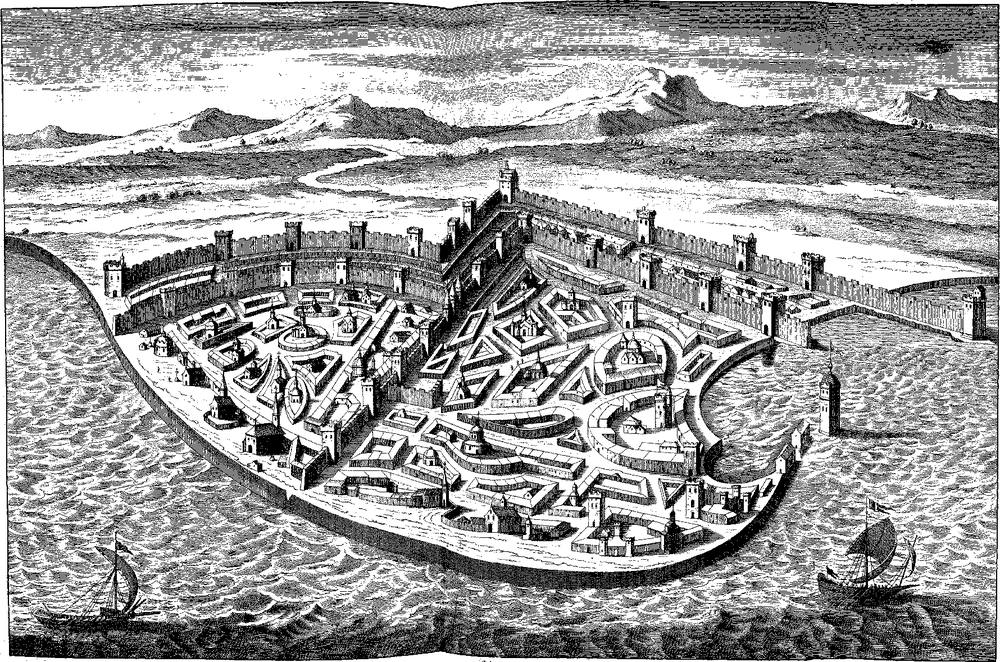
II. PTOLEMAIS, or Rozetta, a City of Egypt sixty Miles to the East of Alexandria. The Jews of Egypt being deliver’d from the Persecution of Philopator, assembled here, and built themselves a Proseuche, 3 Macc. vii.
Just. l. 15. c. 2.PTOLEMY. All the Kings of Egypt, from Ptolemy Son of Lagus, to the Conquest of Egypt by the Romans, a bore the Name of Ptolemy. We have given a List of these Kings, and the Duration of their several Reigns, under the Article EGYPT. At present we shall give an Abstract of the Lives of those that are mentioned in Scripture.
I. PTOLEMY, Son of Lagus, sirnamed Soter, or Saviour, after the Death of Alexander the Great, brought the Body of this Prince into Egypt,43 in order to be interr’d at Alexandria. In the Distribution of Alexander’s Conquests among his Generals, the Government of Egypt fell to Ptolemy. He at first contented himself with the Title of Governor, nor took upon himself the Title of King, till after the Death of all of Alexander’s Race. Yet he manag’d the Minds of the People of Egypt, and of the neighbouring Princes, with a View of laying a solid Foundation for his future Power. Some Years after he was settled in Egypt,44 he bethought himself of reducing Phenicia and Cele-syria. At first he endeavoured to corrupt Laomedon with Money, who govern’d those Provinces under Antipater and Perdiccas. But not succeeding this Way, he sent one of his Generals named Nicanor into this Province, who took Laomedon, and in a little time made himself Master of Cele-syria and Phenicia.
Ptolemy himself marching into Judea, enter’d into Jerusalem, while the Jews were in no other Concern but to observe the Sabbath.45 Appion says, That having brought the City into Subjection, he demolish’d its Walls; and Josephus from Aristeus adds, That this Prince carried away about One hundred thousand Jews from Palestine into Egypt, out of which Number he chose about Thirty thousand, and incorporated them into his Armies, putting them into his Garrisons, Appian. Syriac. p. 119, 121. Joseph. Antiq. l. 12. c. 2. ex Aristæa hist. 70. Interp. Vid. Just. l. 16. Pausan. in Atticis. Lucian. in longævis.as knowing that the Jews were very religious Observers of their Fidelity. He gave up the rest to his Soldiers, that they might make Slaves of them for their necessary Occasions. From hence proceeds that great Number of Jews, that were afterwards to be found in Egypt, Libya, and the Cyreniaca.
Two Years before his Death,46 and at the Beginning of the thirty-ninth Year of his Reign, Ptolemy, the Son of Lagus, associated with him in the Kingdom his Son Ptolemy Philadelphus, whom he had by Berenice, after which he reign’d two Years along with him. Justin affirms, That Soter not only associated his Son with him in the Throne, but reduced himself to the Quacity of one of Philadelphus’s Guards, judging it to be more glorious to be the King’s Father, than to be King himself. Pater ei regnum non tantum publice tradidit, sed etiam privatim officium Regi inter satellites fecit; omni regno pulchrius Regis esse Patrem dicens. We are assured, that Demetrius Phalereus had advised him to leave his Kingdom, not to Ptolemy Philadelphus Son of Berenice, but to the Son of Euridice: And this was the Reason that afterwards Philadelphus sent Demetrius into Banishment. See hereafter the Article of the SEVENTY INTERPRETERS. Ptolemy Son of Lagus, died two Years after he had associated his Son with him in the Kingdom, in the Year of the World 3721, before Christ 279, before the vulgar Era 283, in the fortieth Year of his Reign.
Just. l. 16. c. 2.II. PTOLEMY PHILADELPHUS, Son of Ptolemy Soter, whom we have now discoursed of, was associated in the Kingdom from the Year of the World 3719. Justin even affirms, that his Father Ptolemy intirely quitted to his Son, and esteem’d it as a sufficient Honour to become one of his Life-Guards. But other Historians think, he continued to reign with Philadelphus to the Year 3721, which was the Year of his Death, and the first of the Reign of Philadelphus. This Prince was sirnamed Philadelphus,47
Philadelphus, that is, a Lover of his Brethren, probably by way of Irony; for upon several Pretences, he caus’d two of his Brothers to be put to death. The younger was called Argeus, and was Son of Berenice as well as himself, and the other was Son of Eurydice. Pausan. in Atticis, p. 6.He was one of the most powerful Princes that ever reign’d in Egypt. But nothing gave a Vid. Hier. in Dan. xi.greater Lustre to his Reign than his Love for Learning, the Library he founded at Alexandria, and the Version of the Septuagint, which ‘tis said he procured to be made. Epiphanius affirms, he began this Undertaking Epiphan. lib. de pond. & mentur.of the Version of the Septuagint in the seventh Year of his Reign, in the Year of the World 3727, before Christ 273, before the vulgar Era 277. We have spoken at length of this Translation under the Article of the SEVENTY INTERPRETERS, where we have shewn that what is related concerning it, is at least very doubtful, not to say worse of it. But though we retrench such of the Circumstances of this History, as are plainly fabulous, yet we adhere to the main Part of the Story, which is, that under the Reign of this Prince the Jewish Scriptures were translated out of Hebrew into Greek, either in whole or in part; or, that the Jews of Egypt then translated the Pentateuch at least, for the Use of such among them as could no longer understand the Hebrew or the Chaldee. The Authors may be consulted, who have expresly treated of these Matters.
The Antients48 are all unanimous in their Testimonies, concerning the Affection that Ptolemy bore for the Sciences, and the Care he took to collect Books and to erect a copious Library; but no other than the false Aristæus, and such as have followed him, have affirmed that Demetrius Phalareus was his Librarian. We have already seen in the History of Ptolemy the Son of Lagus, that this Philosopher was not in favour with Philadelphus, but had been banished by him; and ‘tis known he was accessory to his own Death, by causing himself to be bit by an Asp, not being able to support the Tiresomness of his Banishment. Vitruvius mentions Aristophanes, and Suidas Diogen. Laert. in Demet. l. 5. seg. 78, 79. Cicero pro Rab. &c.speaks of Zenodotus, who were Library-keepers to Philadelphus, at the Alexandrian Library. Aristæus is the only original Author who assigns this Employment to Demetrius. Josephus allows Philadelphus thirty-nine Joseph. Antiq. l. 12. c. 2.Years of Reign, Clemens Alexandrinus thirtyseven, and Ptolemy, Porphyrius, and Eusebius, but thirty-eight. Usher thinks he reigned in all eight and thirty Years, and about eight Months. He fixes his Death in the Year of the World 3758, before Christ 242, before the vulgar Era 246. He had for Successor his Son Ptolemy sirnamed Euergetes, or the Benefactor, Son of Arsinoe, who was the Daughter of Lysimachus. Philadelphus had also a Daughter called Berenice, whom he married to Antiochus Theus, King of Syria, as will be seen in the following Article.
See St. Jerome upon Daniel Ch. xi.III. PTOLEMY EUERGETES, or the Benefactor, Son of Ptolemy Philadelphus, ascended the Throne of Egypt in the Year of the World 3758, before Christ 242, before the vulgar Era 246. His Father Ptolemy Philadelphus, for a long time having had War with Antiochus Theus, at last made Peace with him, and gave him his Daughter Berenice in Marriage,49 and in the mean while his Wife Laodice was alive, by whom he had had two Children. This Marriage was celebrated with extraordinary Magnificence, and Philadelphus gave his Daughter so much Gold and Silver to her Portion, that she was thence call’d Phernophoros, or the Dowry-bringer. But this Alliance did not prove happy. Antiochus was poisoned by his Wife Laodice, who likewise gave Orders, that Berenice and the young Son she had by Antiochus, should be killed also. In Appian. Syriac. p. 130. Hieronym. in Dan. xi. Joseph. contra Ap. l. 2. p. 1064.the mean time Philadelphus died, and Euergetes being informed of the Danger his Sister was in, who had betaken herself to the Asylum of Daphne, made haste into Syria with an Army to her Assistance: But he came too late, for Berenice and her Son were assassinated. But such a Number of the Cities of the Kingdom of Syria submitted themselves to the Government of Euergetes, that he thereupon found himself the most powerful King of the East. Josephus says, That when this Prince came to Jerusalem, he there offered Sacrifices to the Lord, as a Thanksgiving for the many Successes he had received from him. Concerning this, See Dan. x. 5, 6. and St. Jerome upon this Passage of Daniel.
Galen. Comment. 2. in Hipp. l. 3. Epid.Euergetes did not less distinguish himself for his Love of Books and Learned Men, than his Father had done. Galen assures us, that this Prince caused exact Copies to be taken of all the Books that came to his Knowledge, and which deserved any Consideration. No sooner did any Ship arrive at Alexandria, but he caused all the Books therein to be brought to him, of which he took Copies and returned them to the Owners, setting up the Originals in his Library. Having once borrowed of the Athenians the Works of Euripides, Sophocles, and Eschylus, with a Promise of returning them again as soon as Copies should be taken of them, and for Security of this, having given them a Pledge of fifteen
Ptolemy Euergetes (III) continues on the next page
Footnotes
-
Ambros. l. x. in Origen, Chrysost. Hieron. in Matth. Leo Magn. Serm. xi. de Passione. Mald. Grot. Brug. in Math. ↩
-
Matth. xxiii. 34. See also Acts xiii. 1. Erant Antiochiæ Prophetæ & about Doctores, &c. Probably Son of Rechab. ↩
-
Epiphan. Fragment. apud Coteler. not. in Canon. Apost. l. 4. c. 6. p. 276. ↩
-
Probably he that is mention’ ↩
-
1 Chron. xxiv. 24. and 2 Chron. xxix. ↩
-
1 Macc. iv. 46. In the Year of the World 3840, before Christ 160, before the vulgar Era 164. ↩
-
Gemarr. Babylon. ad tit. Jabimoth. c. 4. Vid. Maimon. Halac-Ifuribiah. c. 13, 14. a ,שפר תהיליםLiber Hymnorum. Ψαλτήριον. Psalterium. Βίβλος Ψαλμῶν. Luke xx. 40. ↩
-
Joseph. Antiq. l. 13. c. 17. In the Year of the World 3875, before Christ 125, before the vulgar Era 129. ↩
-
Judith xiv. 6. In the Year of the World 3348, before Christ 652, before the vulgar Era 656. ↩
-
Nyssen. tract. 1. in Psal. c. 5. Epiphanius lib. de Mensur. c. 5. Euseb. in Psal. Ambros. & Author. Comment. in Psalm. sub nomine Hyeronim. ↩
-
Hilar. Præfat. in Psalm. ↩
-
Hier. Præfat. in Psalm. ad Sophron. & Ep. ad Cyprian. ↩
-
Aug. in Psal. cl. p. 1604. ↩
-
Hilar. Polog. in Psalm. vi. & in Psal. ii. p. 29. ↩
-
Origen. in Psal. ii. Vide nov. Edit. Hexapl. p. 475. t. 1. ↩
-
Vide Genebrard. in Psalm. ix. 23. seu Psal. x. in Hebr. & Kimchi ibidem. Apolog. David. c. 8. Origen. in Epist. ad Rom. l. 3. c. 3. ↩
-
Hilar. Prolog. in Psalm. Ambros. ↩
-
Ambros. Præfat. in Psal. i. ↩
-
Aug. l. 17. c. 14. de Civit. ↩
-
Theod. Præf. in Psal. ↩
-
Cassiod. Prolog. in Psal. ↩
-
Euthym. Præf. in Psal. ↩
-
Phylastr. hæres. 79. ↩
-
Hilar. Prolog. in Psal. ↩
-
Matth. xxii. 42. Luke xx. 41. Mark xii. 36. ↩
-
Chrysost. in Psal. l. ↩
-
Hilar. Præfat. in Psalmos, & Comment. Psal. cxxxi. p. 446. Græc. PP. ↩
-
Athanas. in Psal. p. 70. t. 2. nov. Edit. Collect. Græc. PP. ↩
-
Euseb. Præfat. in Psalmos, p. 7, 8. & in Inscript. Psal. p. 2. & in Psal. xli. lx. lxii. ↩
-
Theodoret. Præf. in Psalm. p. 396. B. & initio Exposit. in Psalm. i. ↩
-
Vide Natal. Alex. hist. V. T. Dissert. 24. qu. 1. Ferrand. in Psal. Lyran. Præf. in Psal. Du Pin. Præf. in Psal. n. 14, &c. De Muis in Psal. viii. 1, &c. ↩
-
Athanas. serm. ad Marcel. t. 1. p. 958. Item in Synopsi, t. 2. p. 57. ↩
-
Euthym. in Psalm. ↩
-
Vigil. Thapsi. l. 1. c Ep. Ignat. ad Mariam. Castobel. c. 4. ↩
-
Ep. Ignat. ad Mariam. Castobel. c. 4. ↩
-
70 . .שיר המעלותὨδὴ ἀναβαθμῶν. Theod. Ἆσμα τῶν ἀναβάσεων. Aqu. Sym. Εἰς τὰς ἀναβάσεις. ↩
-
Vid. Origen. Opusc. nuper edit. in Hexapl. p. 79. t. 1. Eusëb. in Psal. xxvii Hieronym. in Malach. & Ep. ad Cypr. Hilar. Prolog. in Psalm. p. 3, 4, Athanas. Præfat. in Psalm. p. 70. t. 2. nov. edit. a ,נבלNebel. 70. Ψαλτήριον, or Νάβλον. We find, Dan. iii. 5, 7. the Hebrew Word Psanterim for Psalterion. ↩
-
נבל, Nebel. 70. Ψαλτήριον, or Νάβλον. We find, Dan. iii. 5, 7. the Hebrew Word Psanterim for Psalterion. ↩
-
See 1 Kings x. 12. 2 Chron. ix. 11. 2 Sam. vi. 5. 1 Chron. iii. 8. ↩
-
2 Cor. xi. 13. ↩
-
Matth. xxiv. 24. Marc. xiii. 22. ↩
-
Zech. xiii. 2. Matth. xxiv. 11, &c. ↩
-
In the Year of the World 3681, before Christ 319, before the vulgar Era 323. ↩
-
In the Year of the World 3685, before Christ 315, before the vulgar Era 319. ↩
-
Agathareides Cnidius apud Joseph. lib. 1. contra Appion. p. 1050. Vide & Antiq. l. 12. c. 2. ↩
-
In the Year of the World 3719, before Christ 281, before the vulgar Era 285. ↩
-
That is, from the Year of the World 3631 to 3974, or from the Death of Alexander to the Death of Cleopatra Spouse of Mark An- thony. ↩
-
Plutarch. apud. Athen. l. 12. c. 17. Vitruv. Præf. l. 7. Architect. Tertull. Apologet. c. 8. ↩
-
In the Year of the World 3744, before Christ 256, before the vulgar Era 260. ↩