FIRST-BORN. This word is not always to be understood strictly according to the letter; it is sometimes taken for that which is first, most excellent, most distinguished in any thing. Thus it is said of Jesus Christ, that he is the First-born of every creature; and in another place, the First-begotten, or First-born of the dead; that is to say, begotten of the Father before any Creature was produced; and the first who rose from the dead by his own power. Wisdom in like manner says, that she came out of the mouth of the most high, before he had produced any creature. Primogenita ante omnemEcclus. xxiv. 3. Vulg. If. xiv. 30. creaturam. Thus in Isaiah, The First-born of the poor, signifies the most miserable of all the poor; and in Job, The First-born of death, the most terrible of all deaths. And so in other instances.
Job. xviii. 13. Ex. xii. 29. Ib. xiii. 2, 3, &c. 12, 13.When God by the sword of the destroying Angel had killed all the First-born of the Egyptians, he ordained, that all the First-born both of men and tame beasts for service, should be consecrated to him. The male children only were subject to this law. If a woman’s first child were a girl, the father was not obliged to offer any thing either for her, or for the children who came after her, tho’ they were males. And if a man had many wives, he was obliged to offer the First-born of every one of them to the Lord. The children who were First-born, were offered at the Temple, and their Relations redeemed them for the sum of five shekels.
Levit. xxvii. 6. Exod. xiii. 13. Numb. xviii. 16. Numb. xvii. 17, 18, 19.If it were a clean beast, as a calf, a lamb, or a kid, it was to be offered at the Temple. It was not to be redeemed, but it was killed; the blood of it was sprinkled about the Altar, the fat was burnt in the fire upon the Altar, and the flesh was for the Priest. If it were an unclean beast, and such as they were not allowed to eat, such as an Horse, an Ass, or a Camel, it was either redeemed, or something else was given in exchange for it. The First-born of an Ass was redeemed by giving a Lamb, or five shekels. If it were not redeemed, it was to be killed. There are some Commentators1 who hold, that the First-born of dogs were killed, because they were unclean; and that nothing was given Ex. xiii. 13. and xxxiv. 20.for them to the Priests, because there was no trade driven with them. See Deut. xxiii. 18. Thou shalt not bring the price of a dog into the house of the Lord.
As to the first-fruits of trees, see Levit. xix. 23. The fruit was reckoned unclean for the three first years. In the fourth year all the fruit was the Lord’s. The proprietor had no right to gather any for his own use, till the fifth year.
It has been made a question, whether our Saviour, as the First-born of the blessed Virgin, was subject to this Law. Concerning this particular, there are three opinions. Some believe our Saviour was not subject to it, because his mother’s womb was not opened, when he was born, and he came into the world without breaking the seal of her virginity2. Others3 think, that by the terms of the law he was obliged to it; that plainly declaring without exception, that all the First-born of male children should be consecrated to the Lord, and that in the passage of Exodus here in question, Omne masculinum adaperiens vulvam, is equivalent to omne masculinum primogenitum. Now Jesus Christ was without doubt the First-born of Mary. Lastly, others4 seem to believe, that Moses’s words are prophetical, and, rigorously speaking, have a regard to Jesus Christ only, who by his birth opened the Blessed Virgin’s womb; whereas at the birth of other men, their mother’s womb is opened in the act of marriage, before it is so at their birth. Quia omnium mulierum, non partus infantis, sed viri coitus, vulvam reserat, says Origen. Ecquis proprie vulvam adaperuit, quàm qui clausam patefecit? says Tertullian.
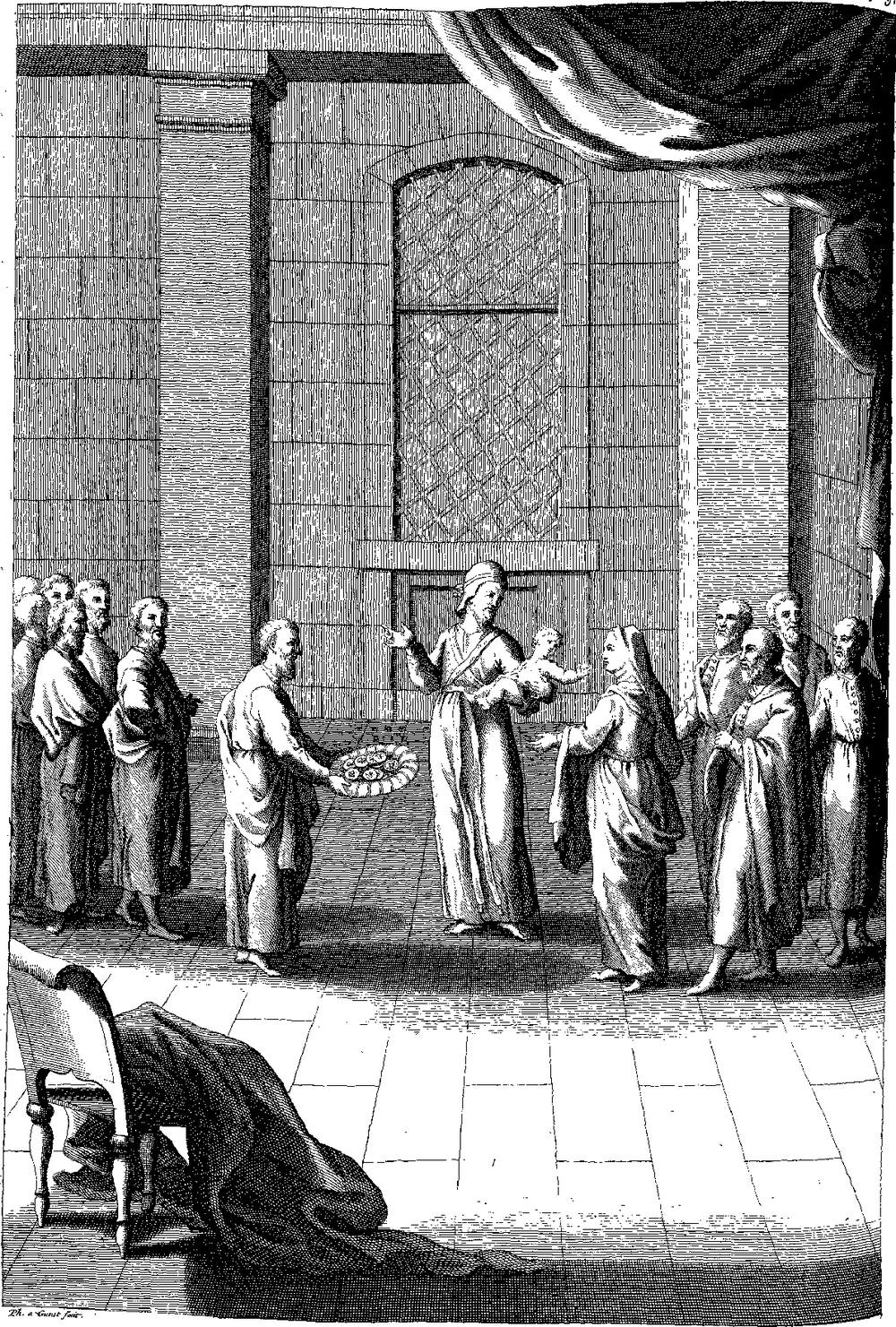
The ceremonies which the Jews observe at present for the redemption of their First-born, are as follows. If it be a girl, Leo of Modena’s ceremonies of the Jews. Part 4. ch. 9.there is no particular ceremony; but if it be a boy, when the child is full thirty days old, one of the descendants of Aaron is sent for, who is most agreeable to the father; and many persons being met together in the house, the father brings a good deal of gold and silver in a cup or bason. Then the child is put into the Priest’s hands, who with an audible voice asks the mother, Whether this boy is her’s? She answers, Yes. He adds, Have you never had any other child, male or female, no untimely birth, or miscarriage? She answers, No. If so, says the Priest, this child, as the First-born, belongs to me.
Then turning to the father, he says, If you desire to have him, you must redeem him. This gold and silver, the father replies, is offered to you for this purpose only. The Priest goes on, Are you then willing to redeem him? I am, says the father. Then the Priest turning to the assembly, says, This child, as the First -born is therefore mine, according to this Law, Those that are to be redeemed from a month old shalt thou redeem, according to thine estimation for the money of five shekels, &c. but I am content with this in exchange. At the conclusion of these words, he takes two gold crowns, or thereabouts, more or less, as he pleases; and after this restores the infant to the father and mother. This is a day of rejoicing in the family. If the father or mother are of the race of the Priests, or Levites, they do not redeem their son.
Besides the First-born of men and beasts which were offered to the Lord, or were redeemed by giving money to the Priests, there was another kind of First-born which were carried to the Temple, in order to make feasts of charity with them. It is of this last kind that mention is made in Deuteronomy xii. 17,18. Thou mayst not eat within thy gates the tythe of thy corn, or of thy wine, or the firstlings of thy herds, or of thy flock, nor any of the vows which thou vowest; … but thou must eat these things before the Lord thy God in the place which he shall chuse, thou, and thy son and thy daughter, thy man-servant and thy maid-servant, and the Levite that is within thy gates: and thou shalt rejoice before the Lord thy God in all that thou puttest thine hands unto. And again Deuteronomy, ch. xv. ver. 19. All the firstling males that come of thy herd and of thy flock, thou shalt sanctify unto the Lord thy God; thou shalt do no work with the firstling of thy bullock, nor shear the firstling of thy sheep. Thou shalt eat it before the Lord thy God year by year, in the place which the Lord shall chuse.
It is certain that the First-born as well of men as of beasts belonged plainly to the Lord, and that private people were not allowed to eat, or to devote them, nor to employ them even in pious uses, or make religious feasts with them. They did in no way belong to them: but after they were redeemed, they might use them as their own property. Of these First-born therefore they probably made the entertainments we have been speaking of; or else under the name of First-born we are to understand the best and most excellent parts of such animals as were designed for the religious repasts which were to be made before the Lord, in like manner as by First-fruits are comprehended all the offerings of every thing which was best.
The First-born among the Hebrews, as well as among all other nations, enjoyed particular privileges: and as Polygamy was in use with them, it was highly necessary to fix these rites. Moses regulates this particular Deut. xxi. 15, 16, 17.in the following manner: If a man have two wives, one beloved, and another hated, and they have borne him children, both the beloved and the hated; and if the First-born son be hers that was hated: then it shall be when he maketh his sons to inherit that which he hath, that he may not make the son of the beloved, First-born, before the son of the hated, which is indeed the First-born: but he shall acknowledge the son of the hated for the First-born, by giving him a double portion of all that he hath. The privileges of the First-born consisted, first, in a right to the Priesthood, which, before the Law, was fixed to the eldest of the family. Secondly in his having a double portion among his brethren.
The right to the Priesthood continued in force only while brothers dwelt together in the same place and family: for as soon as they were separated, and made a family apart, every one became the Priest and Head of his own house.
As to the double portion, it is explained two ways. Some believe, that half of the whole inheritance was given to the elder brother, and that the other half was shared in equal parts among the rest. But the Rabbins Selden. de Successsion. in bona. c. 5. 6. 8.inform us on the contrary, that the First-born for his share took twice as much as any one of his brothers. If a father left six sons, they made a division into seven equal parts; whereof the eldest had two, and each of the others one. If the eldest was dead, and had left children, his right devolved upon his children, and his heirs. The daughters had none of these privileges, notwithstanding they were elder than either their brothers or their sisters.
The Patriarch Jacob transfer’d the right of the First-born from Reuben to Joseph; Isaac from Esau to Jacob; and David from Adonijah to Solomon: but all this was done by the particular order of Providence, and a revelation from God.
The First-born are called in Scripture the Principle, or the Beginning, or First-fruits of their father’s strength, Gen. xlix. 3. Reuben primogenitus meus, tu fortitudo mea & principium doloris mei. The Hebrew, fortitudo mea & principium roboris mei. Compare Deut. xxi. 17. Psal. lxxvii. 51. The First-born are the first-fruits, the first efforts of the father’s youthful vigour.
Read this article in its place on the printed pages
Footnotes
-
Vide Lyran. ad Deut. xxiii. 18. Bochart. de animal. facr. part. 1. l. 2. c. 56. ↩
-
Cyril. Ierosol. homil. de Occursu Domini. ↩
-
Rupert. Jansen. Tostat. alii. vide Cornel. a Lapide in Exod. xiii. 1. ↩
-
Origen. in Luc. homil. 14. Tertull. de Carne Christ. c. 23. Ambros. in Luc. l. 2. art. 56. Hieron. l. 2. contra Pelag. Theophyl. Enthym. in Luc. ii. ↩