Volume II, pages 644–662 of the 1732 edition, from SEA to SEP: everything printed on these pages, in order.
Continued from Sea
Joseph. Antiq. l. 2. c. ult. Thom. in 1 Cor. x.Josephus having related the History of the Passage through the Red-sea, as it is told by Moses, adds, that this ought not to be look’d on as impossible, since God might as well have open’d a Passage for the Israelites thro’ the Waters, as a long time afterwards he open’d one for Alexander and his Macedonians, when they pass’d thro’ the Sea of Pamphilia. But the Historians,1 that have mention’d this Passage of the Macedonians, assure us, that they enter’d into the Sea, and coasted the Shore where it was not deep; so that the Soldiers marched all Day in the Water, which was not above their Middle. Arrian says, that this is unpassable when the South Winds blow; but the Wind having changed on a sudden, gave the Soldiers an Opportunity of passing without Danger. ‘Twas perhaps this Reflection of Josephus that gave Occasion to some of the Antients to think,2 that the Israelites did not pass thro’ the Red-sea from Shore to Shore, but only coasted it, and during the Time of the Flux ascended a little from the Place they were in towards the Shore upon the higher Ground; so that they made a Kind of Semicircle in the Sea. This Opinion is also espoused by Thomas Aquinas, Tostat, Paul de Burgos, Grotius, Genebrard, Vatablus, and some Rabbins.
But not to enter into a nice Discussion of all these Opinions, not to undertake to refute them particularly, and not to deny that the Red-sea may have its Ebbing and Flowing; we need only alledge the Text of Moses and other sacred Authors, who have mention’d this miraculous Passage: We may see plainly that no other Account is supportable, but that which supposes the Hebrews to pass through the Sea from Shore to Shore, in a vast space of dry Ground, which was left void by the Waters at their retiring. Lift thou up thy Rod, and stretch out thine Hand over the Sea, and divide it; and the Children of Israel shall go on dry Ground through the midst of the Sea. And Moses stretched out his Hand over the Sea, and the Lord caused the Sea to go back by a strong East-wind all that Night, and made the Sea dry Land, and the Waters were divided. And the Children of Israel went into the midst of the Sea upon the dry Ground, and the Waters were a Wall unto them on their right Hand and on their left. When the Egyptians likewise were enter’d into the Sea, the Lord said unto Moses; Stretch out thine Hand over the Sea, that the Waters may come again upon the Egyptians, upon their Chariots, and upon their Horsemen. And Moses stretched forth his Hand over the Sea, and the Sea returned to his Strength when the Morning appeared, and the Egyptians fled against it, and the Lord overthrew the Egyptians in the midst of the Sea. But the Children of Israel walked upon dry Land in the midst of the Sea, and the Waters were a Wall unto them on the right Hand and on the left.
Ex. xv. 8. Ps. lxxviii. 13. Psal. cxiv. 3, 5. Psa. lxxvii. 19. Isai. lxiii. 11, &c. Habak. iii. 15.And in the Canticle that Moses sung at their coming out of the Red-sea, he says; With the Blast of thy Nostrils (or, with the Wind of thy Fury) the Waters were gathered together; the Flood stood upright as an Heap, and the Depths were congealed in the Heart of the Sea. And the Psalmist says; He divided the Sea, and caused them to pass through, and he made the Waters to stand as on a Heap. He says elsewhere, that the Sea fled at the Sight of God; that the Lord made himself a Path in the Sea; that he walked in the midst of the Waters. Isaiah says, that the Lord divided the Waves before his People, that he conducted them through the Bottom of the Abyss, as a Horse is led through the midst of a Field. Habakkuk says, that the Lord made himself a Road to drive his Chariot and Horses cross the Sea, across the mud of great Waters. Lastly, the Author of the Book of Wisdom says, that the dry Land appear’d all on a sudden in a Place where Water was before; that a free Passage was open’d in a Moment through the Wisd. xix. 7, 8. See also Wisd. x. 17, 18.midst of the Red-sea; and that a green Field was seen in the midst of the Abyss, &c. See the Commentators upon Exod. xiv, M. le Clerc’s Dissertation upon the Passage over the Red-sea, and that which we have compos’d upon the same Subject, prefix’d to our Commentary upon Exodus. ‘Tis thought the Place where the Hebrews pass’d the Red-sea, is two or three Leagues below its northern Point, at the Place call’d Kolsum, or Chysma, where some of the Antients3 have testify’d, that in their Time might still be seen the Ruins of the Wheels of Pharaoh’s Chariots, and evident Marks of those Chariots.
The Dead-sea, Salt-sea, Eastern-sea, Sea of Sodom, Sea of the Wilderness, or of the Plain. This is the Lake Asphaltites, to which Josephus allows five hundred and fourscore Furlongs in Length, and one hundred and fifty Furlongs in breadth, that is to say, about twenty-five Leagues long, and five or six broad. The Jordan empties itself into the Dead-sea, and we are assured, that the Salt and Bitumen, with which the Waters are impregnated, make them so pungent and briny, that no Fish can live there. This Sea has taken Possession of that Part of the Country that was formerly occupy’d by the Cities of Sodom, Gomorrah, Admah, and Zeboim,
and their Territory, which was heretofore as the Paradise or Garden of the Lord. This Sea is properly no more than a Lake, having no sensible Communication with any other Sea. See what we have observed under the Article ASPHALTITES. The Name of Dead-sea is not read in the Text of Scripture; it is probable this Name was given it, because nothing can long continue in it alive. The Name of Salt-sea, or Sea of Salt, is of the same Signification as the Sea of Asphaltites; for under the Word SALT the Hebrews comprehend Asphaltus, Bitumen, and Nitre. The Name of the Eastern-sea is given it, because of its Situation, being opposite to the Western-sea, or the Mediterranean. Lastly, the Name of the Sea of the Wilderness, or of the Plain, in Hebrew, Arabah, comes from Araboth, desart Plains which are beyond Jordan, to the West and North of the Sea we are now speaking of.
The Sea of Semechon; it is not mention’d in the Text of Scripture, but only in the Writings of the Rabbins. See the Article SEMECHON.
The Sea of Jazar; this is only a Lake or Pool that lay near this City. See JAZER.
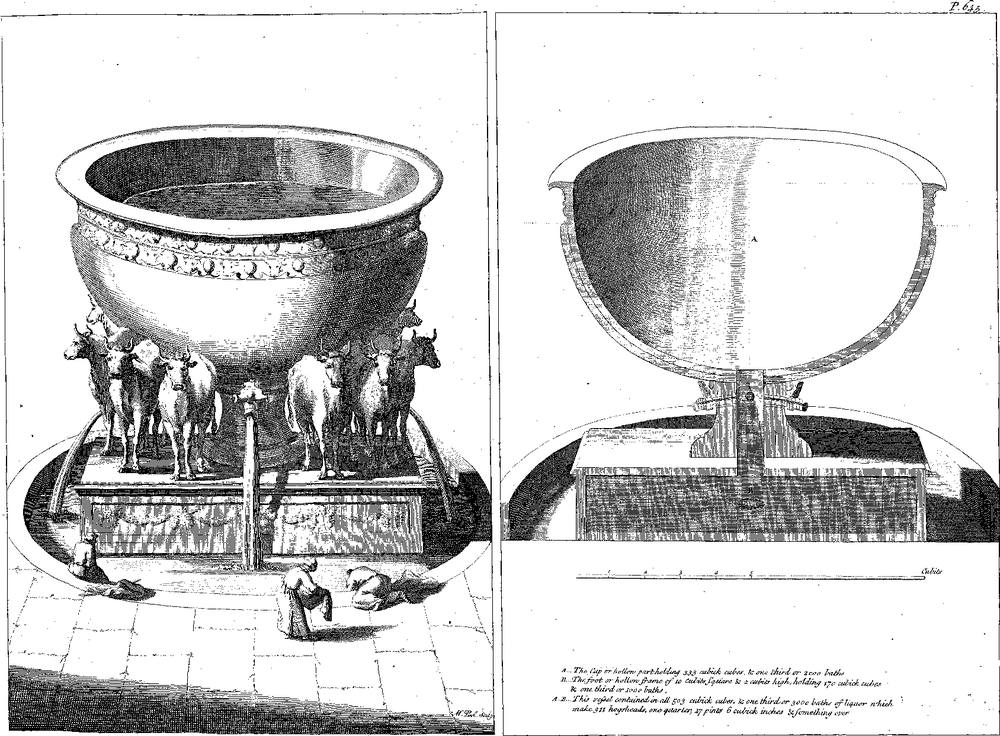
The brazen or molten Sea that Solomon made for the Temple; it had ten Cubits in Diameter from Side to Side, and therefore about thirty Cubits in Circumference. Taking the Hebrew Cubit at twenty 1 Kings vii. 23,26, &c.Inches and an half, the ten Cubits make seventeen Foot and an Inch; and the thirty Cubits make one and fifty Foot and three Inches. This Vessel was round, and of the depth of five Cubits. The Brim was adorn’d with an Edging, and embellish’d with Lilies, and Knobs and Oxe’s Heads in The Bath contains about 7 Gall. 4 Pints.Demi-relief. It contain’d three thousand Baths, as is said 2 Chron. iv. 5. or two thousand Baths, as mention’d 1 Kings vii. 26. This may be reconciled by saying, that the Cup or Bowl contain’d two thousand Baths, and the Foot, which was hollow, contain’d a thousand more. Thus this great Vessel was but of one Capacity within, tho’ it seem’d without to be double. This Sea was supported by its Foot now mention’d, which was as a thick hollow Column; besides which it was supported by twelve Oxen of Brass, disposed into four Groups, by three in a Group, and leaving four Passages between, by which they went to draw Water by three Cocks fix’d to the Foot of this Vessel. See 1 Kings vii. 23, &c. 2 Chron. iv. 2, 3, 4, 5, &c.
The Sea of Egypt, mention’d in Isaiah xi. 15. means that Part of the Mediterranean that waters the Coasts of Egypt.
The Tongue of the Sea. The Hebrews and Arabians call that a Tongue of the Sea which runs into the Land; as we call that a Tongue or Neck of Land, that advances into the Sea. See Joshua xv. 5. xviii. 19. Isai. xi. 15.
SEAH, Satum; a a Kind of hollow Measure among the Hebrews. Its Capacity was of about two Gallons and a half, liquid Measure; or about a Peck, dry Measure. See the Table of Measures.
Esth. ii. 12.SEAL, sigillum, signum, signaculum. The antient Hebrews wore their Seals or Signets in Rings on their Fingers, or in Bracelets on their Arms. Haman seal’d the Decree of King Abasuerus against the Jews with the King’s Seal. The Priests of Bel desired the King to seal up the Door of the Temple of this God with his own Seal, to convince him that they did not go in there by Night. Bell. ii. Cant. viii. 6.The Spouse in the Canticles wishes, that his Spouse would wear him as a Signet upon her Arm: Pone me ut signaculum super brachium tuum.
Plin. l. 33. c. 1.Pliny observes, that the Use of Seals or Signets was yet rare at the Time of the Trojan War, and that they were put to the Shift of shutting up their Letters with several Knots: But among the Hebrews they are much more antient. Judah the Son of Jacob left his Seal, his Bracelet, and his Genesis xxxviii. 25. Deuter. xxxii. 34. Job ix. 7.Staff, as a Pledge with Tamar, whom he did not know. Moses says in Deuteronomy, that God keeps seal’d up in his Treasuries, under his own Seal, the Instruments of his Vengeance. Job says, that he keeps the Stars as under his Seal; that he is Master of them, and allows them to appear when he thinks proper. And elsewhere; My Transgression Job xiv. 17.is seal’d up in a Bag.
Isai. viii. 16, 17.When they intended to seal up a Letter, or a Book, they wrapp’d it up with Flax or Thread, and then apply’d the Wax to it, and afterwards the Seal. The Lord commanded Isaiah to tie up or wrap up the Book wherein his Prophecies were written, and to seal them up till the Time he should bid him to publish them. Liga testimonium, & signa legem in discipulis meis.
He gives the same Command to Daniel. Dan. xii. 4Tu autem Daniel, signa sermones, & claude librum usque ad tempus. The Book that was shewn to St. John the Evangelist in the Revelations, was seal’d with seven Seals, Rev. v. 1. vi. 1, 2, &c.and written within and without. No one durst open it, or explain it to him, but the Lamb that was slain from the Beginning of the World. It was a rare thing to put such a Number of Seals; but that insinuated the great Importance and Secrecy of the Matter.
In civil Contracts they generally made two Originals, one continued open, and was kept by him for whose Interest the Contract4
Contract was made: The other was seal’d up, and deposited in some publick Office. It was seal’d up to prevent any Fraud or Falsification. Jeremiah bought a Field in his Country of Anathoth, of one call’d Hananeel; he himself wrote the Contract, call’d Jerem. xxxii. 10, 11, 14.Witnesses, and seal’d it up: He put it into the Hands of his Disciple Baruch, and said to him; Take these Evidences, this Evidence of the Purchase, both which is sealsd, and this Evidence which is open, and put them in an earthen Vessel, that they may continue many Days. The Grecians did in the same manner with their Writings: They preserved the Originals of their Contracts, and other Instruments of any Consequence, in Vessels of Brass or Earth. See the Scholiasts upon Aristohpanes, in vespis, upon the Word ECHINOS.
SEAT. The Seat of Moses, upon which the Scribes and Pharisees sat, is to express the Authority of the Doctors of the Law, and the Office of Teaching which was granted to them, or which they took upon themselves. Our Lord commanded that they should be heard and respected, but he forbid that their Actions should be made Precedents and Examples.
Psal. I. 1.The Seat of the Scorners, of the Pestilent, of which there is mention in the first Psalm, stands for scandalous Discourse, the licentious Manners of Libertines, who corrupt as much by their scandalous Example and Conduct, as by their loose Principles, all those that hear them and keep them Company. Instead of Pestilent, the Hebrew says Scorners, Revilers, those pretended Free-thinkers, that deride the Credulity and Simplicity of plain and honest Minds. Solomon often speaks of them in his Proverbs5, and takes great Care to secure his Pupil against the Strokes of their dangerous Tongues.
The Seat of Honours, mention’d by EcclesiasticusEcclus. vii. 4., the chief Places in the Synagogues, which the Pharisees assum’d to Matth. xxiii. 6.themselves; the Seat that was prepar’d for Job in the Assemblies, the Seat or Throne of the King, and of God, are clear enough of themselves. The Throne belongs to God, and to the King, the Seat of Honour to the Friends of the King, and to great Men. The Seat of the Doctors belongs to such as make it their Profession to teach and instruct.
Gen. x. 7. Saba.SEBA or Saba, the Son of Cush. Josephus thinks6 he dwelt in the Island of Saba, known since by the Name of the Isle of Meroe. St. Jerome, Bochart, and several others, place him in Arabia Fœlix.
SEBASTE. This is the Name that Herod the Great gave to the City of Samaria, when he rebuilt and embellish’d it in Honour of Augustus. See SAMARIA.
Josh. xv. 61.SECACAH, Sechacha, or Sachacha, a City of the Tribe of Judah. It was situate at the southern Limit of this Tribe, and in the Desart.
SECT. This Latin Word has the same Signification as the Greek Word Hæresis, tho’ the Sound be not so odious. Among the Jews were known four several Sects, which were distinguish’d by the Singularity of their Practices and Opinions, and yet continued united in Communion with each other, and with the Body of their Nation. These Sects are those of the Pharisees, the Saducees, the Essenians, and the Herodians, of which we have already spoke under their several Articles. At the Beginning of Christianity they would have had the Religion of Jesus Christ to pass as a new Sect of Judaism. Tertullus the Advocate for Act. xxiv. 5.the Jews, accusing St. Paul before Fœlix, says, that he was Chief of the seditious Sect of the Nazarenes; and the Jews of Rome said to St. Paul, when he arrived in this Act.xxviii. 22. 2 Pet. ii. 1—10.City, that as to this Sect, it was every where spoke against. St. Peter in his second Epistle, foretels to the Faithful, that false Teachers should arise among them, who privily shall bring in damnable Heresies (or Sects) even denying the Lord that bought them, and bring upon themselves swift Destruction. He adds, that these People being great Lovers of themselves, blaspheme sound Doctrine, and are not afraid to introduce new Sects; but here the Word Sect is taken in the same Sense as Heresy.
1 Cor. i. 12. iii. 22, &c.What probably gave Birth to the different Sects among the Jews, was what they observed to obtain among the Greeks, whose Philosophers were divided into different Sects. For Example, the Academicks, the Stoicks, the Peripateticks, the Cynicks, the Epicureans, &c. The Jews, in Imitation of the Greeks, began to divide themselves into several Sects, about the Time of the Maccabees. It seems as if the Corinthians had a mind to introduce something like this into Christianity, when they boasted, I am a Disciple of Peter, I of Paul, I of Apollos. Which Abuse St. Paul with great Vehemence corrects in his first Epistle to the Corinthians. Even at this Day, in the Christian and Catholick Church, we labour under a kind of Sects in Philosophy, and even in Divinity, in respect of some Questions that the Church has not decided, and which it leaves to the Liberty of the Schools. Thus we see in Philosophy Peripateticks, Scotists, Nominals, Cartesians, Gassendists, &c. and in
Divinity Thomists, Augustinians, Scotists, Molinists, Congruists.
SECUNDUS, a Disciple of St. Paul, Acts xx. 4. We know none of the Particulars of his Life. He was of Thessalonica, and follow’d St. Paul out of Greece into Asia, in the 58th Year of Jesus Christ. The Bolland. 15 Mai. p. 442. a.Spaniards acknowledge a St. Secundus, who they pretend was sent into their Country by the Apostles St. Peter and St. Paul.
SECURUS, and Incendens. 1 Chron. iv. 22. These are two Men, call’d in Hebrew, one Joash, and the other Saraph, whose Names St. Jerom thus translates into Latin.
SEEING, to See. This is said, not only of the Sense of Vision, by which we perceive external Objects, but also of inward Perception, of the Knowledge of spiritual Things, and even of that supernatural Sight of hidden Things, of Prophecy, of Visions, of Ecstasies. Whence it is that formerly they were call’d Seers, who afterwards were call’d Nabi, or Prophets: And that Prophecies were call’d Visions; Visio Amos, Visio Abdiæ, &c.
Moreover, the Verb to See, is used to express Exod. xx. 18.all kind of Sensations. It is said in Exodus, that the Israelites saw Voices, Thunder, Lightning, the Sound of the Trumpet, and the whole Mountain of Sinai cover’d Aug. ep. 167. nov. edit. c. 1. p. 476.with Clouds, or Smoke. And Saint Austin observes, that the Verb to See, is imputed to all the five natural Senses; to see, to hear, to smell, to taste, to touch: He says, Non enim tantum dicimus, vide quid luceat, sed etiam, vide quid sonet, vide quid oleat, vide quid sapiat, vide quid caleat.
Psal.xxvi. 13.To see Good, or Goods, is, to enjoy them: Credo videre bona Domini in terra viventium; I hope that God will bring me back into my own Country, into the Land of Job vii. 7.Judea, and that I shall live there in Peace and Prosperity. Job says, Non revertetur oculus meus, ut videat bona; I shall die, and see no more; I shall no longer enjoy the Psal. iv. 6.good Things of this World. And the Psalmist says, There be many that say, Who will shew us any Good? Can we hope still Esth. i. 10, 14.to enjoy any Happiness in this Life?
To see the Face of the King, to be of his Houshold, to approach near him. The Kings of Persia, under the Pretence of maintaining that Respect and Majesty that was due to them, seldom permitted their Subjects to see them, and hardly ever shew’d themselves in Publick: None but their most intimate Friends, or their familiar Domesticks, had the Advantage of beholding their Faces. Erant primi & proximi qui videbant faciem Regis, says Esther. Frequent Allusion is made to this Custom in Scripture, when mention is made of the seven principal Angels that have the Honour of seeing the Face of the Lord, and of appearing in his Presence. See Tobit xii. 15. Ego sum Raphael Angelus, unus de septem qui astamus ante Dominum. See Rev. i. 4.
I. SEGUB, Son of Hezron, and of a Daughter of Machir; he was Father of Jair. See 1 Chron. ii. 21, 22.
II. SEGUB. Hiel of Bethel having undertaken to rebuild Jericho, God punish’d him for it, by the Death of Abiram his first-born Son, who died as he was laying the Foundations of it; and also, by the Death of Segub his younger Son, who had the 1 Kings xvi. 34.same Fate when he hung up the Gates of the City. And this was in pursuance of the Imprecation that Joshua made,7 about five hundred and thirty-three Years before, against him that should rebuild it; Cursed be the Man before the Lord, that riseth up and buildeth this City Jericho. He shall lay the Foundation thereof in his First-born, and in his youngest Son shall he set up the Gates of it.
SEILA: This is the Name given by some to Jephtha’s Daughter. But as the Scripture does not inform us of her Name, ‘tis in vain to seek after it. All that can be said on such Occasions will always be uncertain.
I. SEIR, or Sehir, the Horite, whose Gen.xiv.6. & xxxvi. 20. Deut. ii. 12.Dwelling was to the East and South of the Dead-sea, in the Mountains of Seir, where at first reign’d the Descendants of Seir the Horite, of whom Moses gives us the List in Gen. xxxvi. 20, 21, — 30. See also 1 Chron. 38, 39, &c. The Posterity of Esau afterwards were in Possession of the Mountains Gen.xxxii. 3.& xxxiii. 14. & xxxvi. 8,9. Deut. ii. 12.of Seir, and Esau himself dwelt there when Jacob return’d from Mesopotamia. Moses acquaints us, that Esau made War with the Horites, and utterly destroyed them; but we know none of the Particulars of these Wars. As to Seir the Father of the Horites, he must needs be very ancient, since the Horites or Chorites his Children were already a powerful and numerous People in Gen.xiv.6.the Time of Abraham, before the Birth of Isaac, when Chedorlaomer and his Confederates came to make War with the Kings of Pentapolis8. ‘Tis without good Reason, what some have advanced, that Esau himself had born the Name of Seir, or the Hairy9; for he was never known by this Name, tho’ his Country is often call’d the Country of Seir, because of the first Inhabitants that dwelt there.
II. SEIR, or, the Mountains of Seir: They were to the East and South of the
Deut. i. 2.Dead-sea. Moses tells us, there were eleven Days Journey between Horeb and Kadesh-barnea, by the Way of Seir; or rather, going round the Mountains of Seir, Deut. i. 1, 4, 5, 8. Deborah, in her Canticle, says, that the Lord is come forth from Seir, Judges v. 4. Moses affirms, that the Lord appeared to his People at Seir, at Sinai, and at Paran, Deut. xxxiii. 2. This proves, that the Mountains of Seir were to the South of the Dead-sea, inclining towards Elath and Esiongeber upon the Red-sea.
Gen. xxxii. 3. & xxxiii. 16.Jacob, at his Return from his Journey to Mesopotamia, fearing that Esau should come and set upon his Company, sent to him at Seir; and Esau soon after came to meet him, between Peniel and Jordan, and returned the same Day to Seir: Therefore he must live not far off, in the Mountains which are to the East of the Dead-sea. Joshua seems to say, that they stretched out still farther towards the North, since he gives an Account, that he Josh. xi. 17. & xii. 7.made a Conquest of all the Country, from Seir, as far as Baal-gad, at the Foot of Libanus, and of Mount Hermon, and that he distributed all this Country among the Children of Israel. But it is known, that the Israelites had no Possessions beyond the Country of Moab to the East, nor to the South. Lastly, Moab and Mount Seir are frequently 2 Chron. xx. 10, 22, 23. Ezek. xxv. 8.mention’d together; but Moab inhabited to the East of the Dead-sea. See IDUMEA.
III. SEIR, a Mountain upon the Frontiers of the Tribes of Judah and Dan. See Josh. xv. 10.
SEIRATH. After that Ehud had kill’d Eglon King of Moab, who oppress’d the IsraelitesJudg. iii. 26., he went to Seirath, which probably was towards Bethel or Gilgal, near to a Place where there were Images or Idols: Pertransivit פסיליםPesilim, Sculptura.locum Idolorum, unde reversus fuerat, venitque in Seirath10. There is some likelihood, that these Engravings or Inscriptions that were at Seirath, are those that Josephus would insinuate, when he says, that in Syria Jos. Antiq. l. 1. c. 2.there were Pillars full of Inscriptions, which had been there from before the Time of the Deluge, and which had been made by the Children of Seth. This Conjecture is proposed and admitted by several learned Men, as Vossius, Huet, Valois. See our Commentary upon Genesis vi. 13.
This is what Josephus relates, concerning Jos. Antiq. l. 1. c. 3.the Pillars set up in this Place; “ The Posterity of Seth, having heard that Adam “ had foretold, that the World should one “ time be destroyed by a Deluge of Water, “ and at another time by Fire; they resolved to preserve the Discoveries they “ had made in Astronomy, and in the “ Knowledge of heavenly Things: Therefore they erected two Columns, one of “ Stone, and the other of Brick, that if “ the Deluge should destroy that of Brick, “ at least that of Stone might remain, to “ inform Mankind of what they should “ transmit to Posterity. And it is said, says “ Josephus, that the Column of Stone “ which they erected is still in Being in “ Seirath, or Syrias. ”
This Relation of Josephus is confirm’d by Manetho,11 who says, that the second Mercury King of Egypt, surnamed Trismegistus, translated, or rather transcribed into the ordinary Letters, what the first Mercury, or Thoth, had formerly caused to be engraven in Hieroglyphick Characters, upon Columns that he had caused to be set up in Syriad. If Josephus took what he related from Manetho, he has plainly corrupted it, since both the Thoths, or Mercuries, are much later than the Deluge; but he might have had this Tradition by some other Canal. Monf. de Ammian. l. 23.Valois, in his Notes upon Ammianus Marcellinus, conjectures, that instead of Syriadike ge, as it is read in Manetho, it ought to be read Syringice, the same as in Ammianus Marcellinus, who says, that the Antients, foreseeing the Deluge that was about to come, and fearing that the Knowledge of their Ceremonies would then be lost, dug subterraneous Places which they call’d Syringas, with a vast deal of Labour, and in different Places, and upon the Rocks of these Cavities they engraved several Figures of Animals, which they call’d hieroglyphical Letters. Pausanias says, that there were SyringesPausan. l. 1. p. 78., or subterraneous Caverns, at Thebes in Egypt, on the other Side of the Nile, not far from that Statue at Memnon, which render’d an harmonious Sound at Sun-rising.
From all these Passages thus set together, and compared one with another, it is a very hard Matter to get a distinct Knowledge, either of these ancient hieroglyphick Inscriptions, mention’d by Ammianus Marcellinus and Manetho, and which one of ‘em places in Syrias, and the other in the Syringes in Thebais. The Invention of Letters, and particularly of the Hieroglyphicks in Egypt, is doubtless more modern than the Deluge; the two Thoths also lived after this famous Event; but what Josephus tells us, must have happen’d before the Deluge. And if it is true, that the Stone Pillars he mentions were in Palestine and at Seyrath, they must be different from those of Manetho: So that nothing certain can be collected from all this.
סלהSelah. LXX. Διάψαλμα.SELAH. This Hebrew Word is found seventy times in the Hebrew Text of the Psalms, and thrice in Habakkuk. The
Septuagint read it still oftener, since they have put Diapsalma in some Places where we don’t find Selah in the Hebrew. Those Interpreters, a Symmachus and Theodotion, generally translate Selah by Diapsalma, which signifies a Rest or Pause in Singing. Diapsalma interpositum in canendo silentium, says St. Austin: Or a Change of Tone, according to Theodoret12 and Suidas. Others will have it, that it marks the Beginning of a new Sense, or a new Measure of Verses: Quidam Diapsalma dixerunt esse Hieron. ad Marcellam.commutationem metri, alii pausationem spiritûs, non-nulli alterius sensûs exordium, sunt qui rythmi distinctionem, says St. Jerom. He adds, that Selah joins that which follows to that which goes before, and shews, that what has been said, deserves to be always remember’d: Ex quo animadvertimus hoc verbum superiora pariter & inferiora connectere, aut certè dicere sempiterna esse quæ dicta sunt. He follows Aquila, in the fifth and sixth Edition, in translating Selah by for ever.
Some Antients have thought,13 that Selah shew’d the Intermission or Cessation of the actual Inspiration of the Psalmist, or of the internal Motions of his Devotion14. Saint Hilary and Cassiodorus think,15 that Diapsalma points out a Change of the Voice, or of the Person, or of the Tune, in the Psalms. Some Moderns pretend,16 that Selah has no Signification, and that it is only a Note of the ancient Musick, whose Use is no longer known. And indeed, Selah may be taken away from all the Places where it is found, without interrupting the Sense of the Psalm: It only perplexes the Text, instead of making it any thing clearer. Others say,17 it was a Note which shew’d the Elevation of the Voice; and that in these Places the Reader should cry out, and make an Exclamation. Aben-ezra teaches, that it is as the Conclusion of a Prayer, and answers nearly in Signification to Amen, or, So be it. At the End of their Epitaphs and Books the Jews generally put Selah, Finis, So be it.
We make no doubt but that Selah intimates the End, or a Pause, and that this is its proper Signification: But as we do not always find it at the End of the Sense, nor at the End of a Canticle, we guess that the ancient Musicians sometimes put Selah in the Margin of their Psalters, to shew where the Pause was to be made, and where the Tune ended. Just as in the old Books of the Gospels,18 which were read solemnly in the Church, they writ upon the Margin, either at Length, or with a Contraction, the Greek Word Telos, or the Latin Word Finis, to shew the Place where the Deacon was to make an End of the Lesson: For at that time the Text was read in Books which contain’d the four Evangelists at Length. Or else the ancient Hebrews sung pretty nearly as the Arabians do at this Day,19 with great Pauses, ending all at once, and also beginning again all at once. For this Reason, it was necessary, in publick Ceremonies, to mark in the Margin of the Psalm the Place of the Pause, and of the End, that the whole Choir might rest at once, and begin again at the same time.
SELENE, or Helene, the Wife of Simon the Magician. See SIMON MAGUS.
I. SELEUCIA. This is the Name that Stephan. in Gadara.King Seleucus gave to the City of Gadara, situate beyond and to the East of the City of Tiberias. See GADARA.
II. SELEUCIA, a City of Gaulanitis, lying upon the Lake of Semechon20.
III. SELEUCIA, a City of Syria, situate upon the Mediterranean, near the Place where the Orontes discharges it self into this Acts xiii. 4.Sea. St. Paul and St. Barnabas arrived at Seleucia, where they imbarked to go to Cyprus. This is the same City of Seleucia 1 Macc. xi. 8.which is mention’d in the First Book of the Maccabees, where it is said, that Ptolemy Philometor made himself Master of all the maritime Cities as far as Seleucia, which is upon the Sea.
I. SELEUCUS, King of Syria, surnamed Nicanor, Chief of the Race of the Seleucidæ. He began to reign in the Year of the World 3682, one Year after the Death of Alexander the Great, and reign’d for forty-two Years, dying in the Year 3724, before Christ 276, before the Vulgar Era 280. We do not see that his History has any Relation to that of the Jews; since in his Time Judea was under the Jurisdiction of Ptolemy the Son of Lagus King of Egypt. Yet Josephus says, Jos. Antiq. l. 12. c. 3.that he shew’d great Favour to the Jews in his Territory, and granted them the Right of Freedom in such Cities as he built, and particularly in Antioch the capital City of Syria.
II. SELEUCUS, surnamed Callinicus, or Pogon: He reigned twenty Years, from the Year of the World 3759, to 3779.
III. SELEUCUS, surnamed Ceraunos, or Thunder: He reigned three Years, from the Year of the World 3779, to 3781. As no mention is made in Scripture of either of these two last Princes, we give only their Names, and the Date of ther Reigns.
IV. SELEUCUS Philopator, or Soter, Son of Antiochus the Great: He reigned twelve Years, from the Year of the World21
3816, to the Year 3828, before Christ 172, before the Vulgar Era 176. ‘Twas he that sent Heliodorus to Jerusalem, to take away the Treasures of the Temple22. This History may be seen under the Title HELIODORUS, and in the Second Book of the Maccabees, chap. iii. 3, &c. where it is said, that under the Reign of this Prince Judea enjoy’d a profound Peace, insomuch that Seleucus himself furnish’d the Sacrifices of the Temple at his own Cost and Charge.
V. SELEUCUS, Son of Demetrius Nicanor: He reign’d one Year, which was the Year of the World 3880. His Successor was Antiochus Gryphus.
VI. SELEUCUS, Son of Antiochus Gryphus: He made War with his Uncle Antiochus Cyzicenus, overcame him, took him in Battle, and put him to Death23. Some time after, Antiochus surnamed Pius, Son of Antiochus Cyzicenus, came to Arade, took the Diadem, made War with Seleucus, defeated him, and drove him out of Syria. Seleucus retired in Cilicia, where endeavouring to raise large Tributes from the People of this Province, they would not submit to it; and revolting against him, they burn’d him and all his Friends in his Palace24.
SELLING. The Hebrews might sell their own Liberty; Fathers had a Power of selling the Liberty of their Children: Si Lev. xxv. 39.paupertate compulsus vendiderit se tibi frater tuus, non eum opprimes servitute famulorum; If your Brother sells himself to you because of his Poverty, you shall not oppress him, nor sell him again as a Slave: He shall abide with you only as a Workman for Hire. Maimonides says, that an Hebrew could not sell his Liberty, but in Exod. xxi. 7.case of extreme Necessity. If a Man sell his Daughter to be a Maid-servant, she shall not go out as the Men-servants do. Her Master shall not dismiss her, as another Slave is dismiss’d at the Sabbatical Year. He shall take her as his Wife, or shall marry her to his Son. If he cares to do neither of these, he shall set her at Liberty.
Mat. xviii. 25. 2 Kings iv. 1.They sold also insolvent Debtors, and even their Children, as we find by the Gospel, and by the Books of the Kings. Sometimes they sold Free-men for Slaves, as Joseph was sold by his Brethren. This Crime was call’d Plagium, and the Law Exod. xxi. 16. Deut. xxiv. 7.punish’d it with Death: Qui furatus fuerit hominem, & vendiderit eum, convictus noxæ, morte morietur. The Jews confine this to the Theft of a Man of their own Nation. Esau sold his Birthright; and for Hebr. xii. 16.this, it is thought, that St. Paul calls him profane. Isai. l. 1 Zech. xi. 3 Joel iii. 8 Baruch. vi. 6. 1 Kings xxi. 25. Macc. i. 16.It is said in the Prophets, that the Lord had sold his People to their Enemies; as a Master parts with a vicious Slave, to punish him for his Infidelity.
Thou hast sold thy self to work Evil in the Sight of the Lord, said the Prophet Elijah to Ahab; Qui venundatus est, ut faceret malum in conspectu Domini. And the wicked Israelites mention’d in the Maccabees; Venundati ut facerent malum: They sold themselves as Slaves to Sin, being Subjects to all their bad Inclinations, as Slaves are to their Masters. These Expressions were very familiar to the Hebrews. See Judith vii. 13.
Rom. vii. 15.St. Paul, speaking of himself in like manner, or rather speaking of all Mankind in his own Person, makes no scruple to say, Ego autem carnalis sum, venundatus sub peccato; I am altogether carnal; and sold under Sin; the Slave of Concupiscence and of Sin by Nature, but set at Liberty from Sin by Baptism, and fortify’d against Concupiscence by the Grace of Jesus Christ.
Joseph. de Bello, l. 4. c. 1. Serrar. Bonfrer. Reland. alii. Josh. xi. 5, 7. Judg. v. 18. Joseph. de Bello, l. 3. c. 18. Joseph. Antiq. l. 5. c. 6.SEMACHIAH, or Samachias, Son of Shemaiah a Levite, and a Porter belonging to the Temple. 1 Chron. xxvi. 7.
SEMECHON, or Samechon, a Lake through which the Jordan passes; it is sixty Furlongs long, and thirty broad; that is, about seven thousand five hundred Paces long, and three thousand seven hundred and fifty broad. Some think this is the same Lake that, in Joshua, is call’d the Waters of Merom, or, the Upper Waters; and in Judges, the Canton of Merome25. But we think Merom to be near Dothaim, and far enough from Semechon. See EUSEBIUS, and our Commentary upon Josh. xi. 5. ‘Tis not known whence the Name Semechon was taken: Some derive it from Samach, which in Arabick signifies a Fish; others, from the Chaldee Word samak, which signifies red, as if the Waters were reddish and turbid. Certain it is, that there was marshy Ground about this Lake: The City of Hazor, where Jabin a King of the Canaanites reign’d, was upon the Side of the Lake Semechon; and afterwards the City of Seleucia was there.
Joseph. de Bello, l. 4. c. 1.The Lake Semechon must be pretty near the City of Dan, and the Fountains of Jordan, and at one hundred and twenty Furlongs from the Lake of Tiberias, towards the South. Josephus says, that the Marshes of this Lake extended even as far as Daphne. But there is great Probability, that, instead of Daphne, it should be read Dane; for he says in the same Place, that the Waters of Jordan fall into this Pool, below the Temple of the Golden Calf.
Now it is known, that the Temple of the Golden Calf was at Dan. It is pretty extraordinary, that this Lake should never be took Notice of, or mention’d in any Passage of the Scripture, as we know of. ‘Tis thought that Pliny intended to speak of this Lake, when he says, that there is a Lake at one hundred and fifty Furlongs Plin. l. 12. c. 22.from the Mediterranean, not far from Libanus, where the sweet-scented Reed grows.
SEMIRAMIS Daughter of Dercetis, or of the Syrian Venus, a famous Queen of Assyria, the Wife of Ninus, who for a long time govern’d the Empire of Assyria, during the Minority of her Son Ninias. She undertook several Wars, which succeeded very fortunately, and executed many great Works at Babylon, and elsewhere. Herodot. l.1. c.184.Herodotus speaks of several Ramparts and Moles that she had thrown up near Babylon. Diodor. l. 1. Bibloth. Trog. seu Justin. l. 1. Strab. Geograph. l.2,16.Diodorus Siculus, Trogus, Strabo, and many others, ascribe to her the Honour of building the Walls of Babylon; but the more exact Chronologers believe, that Semiramis did nothing at Babylon; and it is very probable, that her other Actions have been extravagantly enlarged upon. However this be, as this Princess is no-where named in Scripture, we shall content our selves with observing, that she began to reign at Nineveh in the Year of the World 2789, before Christ 1211, before the Vulgar Era 1215, about the Beginning of the High-priest Eli’s Administration; and that she died after two and forty Years Reign, in the sixty-second Year of her Age, in the Year of the World 2831, before Christ 1169, before the Vulgar Era 1173. Ninias her Son kill’d her, out of Horror at the Proposal she made him, of Lying with her. Justin. l. 1. See Usher upon the Years of the World 2789, and 2831.
SENAAH, or Senaa: The Inhabitants of Senaah, to the Number of Three thousand six hundred and thirty, contributed very much to the Building of Jerusalem, after the Return from the Captivity. Ezra ii. 35.
SENECA : Lucius Anneus Seneca, a Native of Corduba, a Disciple of Sotio the Stoick, Preceptor to Nero, and famous for his Writings, would have no Place in this Dictionary, but on Account of certain Letters, that are extant, which bear the Title of St. Paul to Seneca, and of Seneca to St. Hieron. in CataScript. Eccles. Aug. Ep. 153. nov. Edit.Paul. St. Jerom makes mention of them, and this determined him to place Seneca among the Ecclesiastical Writers. St. Austin also mentions these Epistles, and several modern Authors after him. They are found printed in many Places; and James le Fevre of Estaples thought them genuine, publish’d them with those of St. Paul, and wrote a Comment upon them. Sixtus Sinensis, in his Bibliotheca Sacra, has wrote in Defence of them, as also Antonius Posfevinus, Alphonsus Salmeron, Franciscus Bivarius, Jacobus Pamelius, Margarin de la Biggue. Others26 have suspected, that perhaps heretofore there might have been true Epistles of St. Paul to Seneca, and of Seneca to St. Paul, which were known to St. Jerom and St. Austin; but being since lost, some Impostor has compos’d others in their Place, which are those we now have. But as no Proof is given of this Conjecture, we readily acknowledge our selves to be of the Number of those, who admit that the Epistles we now have, are the same that were known to the Antients, and which, however, are not the better for that, nor do they deserve any Consideration. The Reader may consult such as have written Ecclesiastical Bibliotheca’s, particularly Monf. Fabricius in his Apocryphal Works of the New Testament, tom. 1. p. 880, &c. where he exhibits the Judgment of several learned Men concerning these Letters, before the Edition that he has made of them.
SENNABRIS, a Place between ScythopolisJoseph. de Bello, l. 3. c. 16. p. 857. and Tiberias, thirty Furlongs from this last City. ‘Tis also written Enabris, and Gennabris. The Talmudists call it Zinnabris. Lightfoot. Centur. Chorograph. in Matth. c. 70.
SENNACHERIB, King of Assyria, Son and Successor of Shalmaneser; he began to reign in the Year of the World 3290, before Christ 710, before the vulgar Era 714. He reign’d but four Years, having been kill’d by his own Sons in the Year of the World 3294, as we shall see afterwards. Hezekiah, King of Judah, having shook 2 Kings xviii.7,13.off the Yoke of the Assyrians, which King Ahaz, his Father, had suffer’d to be put on 2 Kings xvi. 11. 2 Chron. xxviii.20, 21.by Tiglath-pilneser King of Assyria; Sennacherib had Notice of the Revolt of this Prince, marched an Army against him,27 and took all the strong Cities of Judah. Hezekiah seeing that he had nothing left but Jerusalem, and which, perhaps, he found Difficulty enough to secure, sent Ambassadors to Sennacherib, who was then engaged at the Siege of Lachish, and told him; “ I have committed a Fault; but withdraw your Army out of my Territories, and I will bear whatever you shall impose upon me.” Sennacherib demanded of him three hundred Talents of Silver, and thirty Talents of Gold; which Hezekiah remitted to him soon after. But yet the King of Assyria would not leave him for all this.
He sent from Lachish to Jerusalem three of his chief Officers, Tartan, Rab-saris, and Rab -shakeh, to summon Hezekiah to surrender himself. Rab-shakeh, among his other Discourse, utter’d many Blasphemies against God, and many Insults against Hezekiah. For this may be seen the Articles of RAB-SHAKEH and HEZEKIAH. In the mean Time Sennacherib quitted the Siege of Lachish, and apply’d himself to that of Libnah. Rab-shakeh 2 Kings xix. 8.having given him an Account of what he had said to Hezekiah, and having told him that this Prince return’d him no Answer, Sennacherib wrote a Letter to him, in which he urged him to return to his Duty, and to follow the Example of so many other Nations that had submitted to his Empire. At the same Time he went away with all his Army, to meet Tirhakah, King of Ethiopia, or of Cush, who was marching towards him to give him Battle. But the Lord sent a destroying Angel against the Army of Sennacherib, who put to Death in one Night an hundred and eighty-five thousand Men. Sennacherib rising next Morning, and finding himself almost 2 Kings xix. 35.alone, was forced to return with all speed to Niniveh. But he did not live long there in Peace; for while he was paying his Adorations to his God Nisroch in his Temple, his two Sons Adrammelech and Sharezer slew him with their Swords, and then fled into Armenia. Esar-haddon his Son reign’d in his stead, in the Year of the World 3294, before Christ 706, befor the vulgar Era 710.
Tob. i. 21.Tobit acquaints us, that when Sennacherib return’d to Niniveh, he began to persecute the captive Israelites whom he look’d upon as the Cause of his Disgrace. But five and forty Days were hardly over, according to the Latin Text, or five and fifty according to the Greek, but this Prince was put to Death by his own Sons, as has been now related. The Rabbins think,28 that what determin’d Sennacherib’s Sons to use him thus, was a Resolution he had made, as they were inform’d, of sacrificing them to his Idol. Wherefore they thought it best to prevent him.
As to the Defeat of his Army by the destroying Angel, our Dissertation may be consulted upon this Subject, prefix’d to the Commentary upon Isaiah. The Rabbins believe,29 that Fire fell upon them from Heaven, and reduced their Bodies to Ashes, without doing any Harm to their Cloaths, which fell to the Possession of the Israelites, as they pretend. They found this Tradition upon a Passage of Isaiah. Therefore shall the Lord, the Lord of Hosts, send among his fat ones Leanness, and under his Glory he shall kindle a burning, like the burning of a Fire. By Glory, they say, is meant their magnificent Habits. Other Hebrews30 had told St. Jerome, that the Angel Gabriel was sent forth among the Assyrians, to destroy them. Some fansy31 it was the Plague, or some internal Distemper, that kill’d them all in one Night. Others will have it, that this vast Army was disturb’d by a Tempest, and that being seized by a panick Fear, and mistaking each other for Enemies, they turn’d their Arms against themselves, and kill’d one another.
Herodotus speaking of Sennacherib, relates his Disaster in a very different Manner from what we have here seen. He quotes the Authority of the Egyptian Priests, who had told it him in this Manner. Sethon King of Egypt, and Priest of Vulcan, having been attacked by Sennacherib King of the Arabians and the Assyrians, and seeing himself deserted by his own Soldiers, address’d himself to Vulcan, and begg’d of him some speedy Assistance. Vulcan appear’d to him the Night following, and promis’d to help him. Sethon therefore began to march with the few Troops he had remaining, and advanced as far as Pelusium. The same Night a Body of Field-Rats came pouring upon the Camp of the Assyrians, and gnaw’d the Thongs of their Bucklers, and the Strings of their Bows; so that the next Morning, when they found themselves in no Condition to make use of their Arms, they were forc’d to betake themselves to Flight.
The greatest Part of Commentators are of Opinion, that the Army of Sennacherib was destroyed before Jerusalem, as they were preparing for the Siege of this City. But it appears Isai. x. 24, 25, 26.plainly from Isaiah, that Sennacherib did not actually form the Siege of this Place, and that it was in his March against Tirhakah, that this Calamity fell upon him. Berosi apud Joseph. Antiq. l. x. c. 1. Joseph. Antiq. l. x. c. 1.Berosus tells us, that Sennacherib had carry’d the War into Egypt, and had subdued all Asia. Josephus relates, that this Prince having spent a long Time in the Siege of Pelusium, when his Works were now far advanced, and he was upon the Point of becoming Master of the Place, he was obliged to raise the Seige, for fear the King of Ethiopia should surprize him in his Camp, who was now advancing with a vast Army, to the Assistance of the Egyptians. Lastly, the Rabbins pretend, that the Angel that destroyed Author. Tradit. in Lib. Reg. & Paral.the hundred and eighty-five thousand Assyrians in one Night, cut off the Hair and Beard of Sennacherib himself, and sent him home into his own Country thus loaded with Ignominy and Disgrace.
They found this Tradition upon these Isa. vii. 20.Words of Isaiah: In the same Day shall the Lord shave with a Razor that is hired, namely, by them beyond the River, by the King of Assyria, the Head and the Hair of the Feet, and it shall also consume the Beard.
The Babylonian Thalmud will have it, that the Army of Sennacherib was destroy’d by Thunder. The Targums, or Chaldee Paraphrases, are quoted, which affirm the Prideaux’s same thing. Others believe, that they perish’d Connect. t. 1. l. 1. p. 43.by means of a hot Wind, that God caus’d to blow against them, a Wind very common in those Parts,32 and which makes great Ravages there, stifling thousands of Persons in a Moment, as it often happens to those great Caravans of Mahometans, that go yearly on Pilgrimage to Mecca. JeremiahJer. li. 1. calls this Wind a destroying Wind. The Threatning made by Isaiah to Sennacherib; Behold I will send a Blast upon him, and he shall hear a Rumour, seems also to insinuate this great Wind.
D’Herbel. Bib. Orien. p. 804.Khondemir relates, that in the 18th Year of the Hegira, or 640 of Jesus Christ, under the Kaliphship of Omer, while the Mussulmen were making their Conquests in Syria, and at a Time that the Pestilence raged; they found in a Sepulchre under Ground in Mount Libanus, the Body of Sennacherib, in a Chair of Gold inscribed with Syrian or Chaldee Characters, which were to this Effect; “ The greatest Evil “ that can happen to Men, is the Forgetfulness of Death, and of the Account that “ they must give to God of their Actions; “ although the Sepulchres of their Friends “ and Relations, with which they are surrounded, give them notice of these “ two Things. ” But I doubt very much whether this Tomb was that of Sennacherib King of Niniveh. They add, that this Sennacherib we now speak of, was of the Race of Esau, and that he had suffer’d great Calamities in his Life-time. This also is not compatible with that Sennacherib mention’d in Scripture.
SENSE of the Scripture. These five different Senses may be distinguish’d in the Scripture. I. The Grammatical Sense. II. The Historical or Literal Sense. III. The Allegorical or Figurative Sense. IV. The Anagogical Sense. V. The Tropological or Moral Sense.
I. The Grammatical Sense is that which the Words of the Text present to the Mind, according to the proper and usual Signification of those Words. Thus when it is said that God repents, that he is in Anger, that he ascends or descends, that he has Eyes open, or Ears attentive, &c. the Grammatical Sense of all these Expressions might induce one to think, that God is corporeal, and subject to the same Weaknesses as ourselves. But as Reason and found Faith will assure us, that he has none of our Infirmities and Imperfections; upon such Occasions we are not to abide by, or confine ourselves to, the Grammatical Sense.
II. The Literal and Historical Sense is that which belongs to the History or Fact, to the Sense which the Rehearsal and Terms of the Scripture immediately present to the Mind. Thus when it is said, that Abraham marry’d Hagar, that he afterwards sent her away, that Isaac was born of Sarah, that he received Circumcision: All these Facts, taken in the Historical and Literal Sense, mean nothing else than what is express’d in the History; that is, the Marriage of Abraham with Hagar, the Birth of Isaac, &c.
III. The Allegorical and Figurative Sense, is that which examines what may be conceal’d under the Terms, or under the Event mention’d in the History. Thus the Marriage of Abraham with Hagar, who was afterwards repudiated and driven away because of her Insolence, and that of her Son; is a Figure or Representation of the Synagogue, which was only a Slave, and which was divorced and rejected because of its Infidelity and Ingratitude. Sarah is the Figure of the Christian Church, and Isaac of the People chosen of God.
IV. The Anagogical Sense, or Sense of Analogy and Agreement, is that which refers some Expressions of Scripture to eternal Life and Happiness; because of some Conformity or Similitude between the Terms that are brought to express something happening in this World, and what shall happen hereafter in Heaven. For Example, on Occasion of the Sabbath, or of the Seventh-Days Rest that was enjoyn’d the People of God, a Transition may be made to that Repose or Rest that the Saints enjoy in Heaven. On Occasion of the Israelites entering into the Land of Promise, we naturally pass to treat of the entering of the Elect into the Land of the Living, &c.
V. The Moral or Tropological Sense, is that which deduces Moral Reflections for the Conduct of Life, and for the Reformation of Manners, from what is related historically and literally in Scripture. For Example, on Occasion of those Words of Deut. xxv. 4.Deuteronomy, Thou shalt not muzzle the Ox, when he treadeth out the Corn, St. 1 Cor. ix. 10.Paul says, that the Preachers, and those that instruct us, ought to be supply’d with the Necessaries of Life.
The Object of the Literal Sense are Facts and History; of the Allegorical, what we believe, or the Mysteries of our Faith; of the Anagogical, eternal Happiness,
and what has relation thereto; of the Moral or Tropological, the Regulation of our Manners; all which is comprehended in this Distick.
Litera gesta docet, quid credas Allegoria, Moralis quid agas, quò tendas Anagogia.
These five Senses now mention’d may be observed in this one Word Jerusalem. According to the Grammatical Sense, it signifies the Vision of Peace; according to the Literal and Historical, the capital City of Judea; according to the Allegorical, the Church Militant; according to the Anagogical, the Church Triumphant; according to the Moral, a faithful Soul, of which Jerusalem is a Kind of Figure.
SEORIM. The Family of Seorim was the fourth in Order of the twenty-four Sacerdotal Families. 1 Chron. xxiv. 8.
SEPHAR, a Mountain of the East, probably about Armenia. The Sons of Joktan had their Dwelling from Mesha, as thou Gen. x. 29.goest unto Sephar a Mount of the East. We believe these Mountains to have been the Dwelling of the Sepharvaim, of which mention is made in Scripture; and of the Saspires, of whom the Geographers speak. See the Article SEPHARVAIM.
Obad. 20.SEPHARAD. This Hebrew Word is found in Obadiah. Here is the whole Passage of this Prophet. Transmigratio exercitûs hujus filiorum Israel, omnia loca Chananæorum usque ad Sareptam, & transmigratio Jerusalem, quæ in Bosphoro est, possidebit civitates Austri. Instead of Sarepta here, the Hebrew Text reads Zarphath; and instead of Bosphorus, it reads Sepharad. By the Name of Canaanites, the Jews understand Germany; by Zarphath, France; and by Sepharad, Usque ad Zarphath. Quæ in Sepharad. Hieron. in Abdiam.Spain. The Jew that taught St. Jerome the Hebrew Tongue, did assure him, that Sepharad stood for the Bosphorus, which is (said he) the Place whither the Emperor Adrian transported the Jews. The modern Hebrews by the Name Sepharad understand Spain. But there is a much greater Probability that this Word signifies one of those Cities beyond the Euphrates, whither the Jews had been transplanted; and perhaps it may be Sippara, or Sipparat in Mesopotamia, a little above the Division of the Euphrates. By this Name the Septuagint seem to have understood the Euphrates,
or the City of Ephrata, which is Bethlehem.LXX. Ἐφρ. alias Ἐφραθά. But Ephrata makes no Sense in this Place. The Jews of Jerusalem were certainly carry’d away beyond the Euphrates by Nebuchadnezzar. Cyrus sent them back into their own Country, and there they inhabited the southern Cities, Idumea, and Arabia Petræa.
The Jewish Historians33 tell us, that Nebuchadnezzar besieged Jerusalem, assisted by a great Number of Allies, who lent him their Troops. One of the chief of them, as they say, was Hispanus, who gave his Name to Spain. He was present at this Siege along with his Son-in-law Pyrrhus King of the Grecians. When the City was taken, it was easy for them to divide the Spoil and the Prisoners, because the City was separated by three Enclosures of Walls. Nebuchadnezzar took for his Share all the Artisans and Handicraft Men, who were in the first Enclosure, and gave to Pyrrhus all that were within the second. That was the Dwelling of the House of David, and of the Priests. Pyrrhus took his Prisoners along with him into Andalusia, and from thence to Toledo. The Descendants of David pass’d on to Seville, and into the Kingdom of Granada. Thus, say they, we see the Completion of the Prophecy of Obadiah. But as all this is but meer Fable, we shall not give ourselves the Trouble to refute it. The same is to be understood of such other Monuments, which, they say, have been found in Spain, by which they pretend to prove, that King Solomon extended his Empire into that Country. These are Inscriptions invented at Pleasure, to establish a chimerical Empire.
Jun. Milvend. Grot. ad 4 Reg. Ptolem. l. 5. c. 18. Abyden. Herodot. l. 1. c. 103. l. 3. c. 94. l. 7. c. 79. Ezr. iv. 10SEPHARVAIM. When Shalmaneser, King of Assyria, carry’d away the Israelites from the Kingdom of Samaria to Places beyond the Euphrates, he brought other People in their stead into Palestine, among whom were the Sepharvaim.34 It is not exactly known where the Place was of their former Habitation. Some pretend they inhabited the City of Siphera, or the City of the Sipharenians, upon the Euphrates. We think their Dwelling to have been in the Mountains of Sephar, of which mention is made Gen. x. 29. and that the Saspires, who, according to Herodotus, were the only People that inhabited between the Colchians and the Medes, are the same as the Sepharvaim of the Scriptures. Strabo, l. 10. places the Sarapares in Armenia. In the Book of Ezra, this Transportation of the Nations from beyond the Euphrates into the Country of Samaria, is imputed to the great and noble Asnappar, who is probably King Esarhaddon. But in the Enumeration that is there made, of all those Nations, we do not find the Sepharvaim, or Sepharvaites; except they are express’d by the Name of the Tarpelites, which may be put for the Tapyres, or Sapires, according to the Pronunciation of the Chaldeans.
Isa. xxxvii. 13. 2 King. xx. 13.The Scripture speaks of the King of the City of Sepharvaim, which probably
was the Capital of the People of this Name; and the King of Sepharvaim is no other than the God of these People. This appears pretty plainly from comparing these Passages. Where are the the Gods of 2 Kings xviii. 34. Isa. xxxvii. 13. 2 King. xix. 13. 2 Kings xvii. 31.Hamath, and of Arpad? Where are the Gods of Sepharvaim, Hena, and Ivah? And elsewhere, Where is the King of Hamath, and the King of Arpad, and the King of the City of Sepharvaim, of Hena, and Ivah? Lastly, it is said, The Sepharvites burnt their Children in the Fire to Adrammelech and Anammelech the Gods of Sepharvaim. There is therefore great Probability that Hena and Ivah are the same as Anammelech and Adrammelech, the Gods of the Sepharvites. But Anammelech apparently stands for the Moon, and Adrammelech for the Sun. The first Word signifies merciful King, and the second magnificent King. The Orientals gave to the Moon the Name of God and King.
SEPHET. Tobit was of the City of Tob. i. 1. Vulgat.Naphthali, situate in the Upper Galilee, having on its Left-hand the City of Sephet. This is the only Place in the Vulgate where we find any mention of Sephet; but we read in the Septuagint of Sephaat, or Zephaat, or Horma. But Sephet of Galilee was at a great Distance from Sephaat, which was to the South of Judah, or of Simeon. Some Moderns have pretended, that Sephet of Galilee was Bethulia, but without any Proof. They say it is between Ptolemais to the West, and Naashon to the East, twelve Miles from Carmel, and six from Cana of Galilee. Others place it nine Miles from Bethsaida, in the Upper Galilee. I cannot reconcile this with Tobit, who places Sephet on the Left-hand, or to the North of the City of Naphthali, which apparently is Cedes. However this be, Sephet or Sapheta is built upon a Mountain with three Eminencies, and very difficult of Access. The Jews live there in great Numbers, and have a famous Academy there, where Youth is sent to study the Hebrew Tongue, and the Law of Moses. And for some Ages the Academy of Sapheta is for the Jews, what Tiberias was heretofore, whose Place it has taken. ‘Tis likely this Academy was not erected so soon as the Time of Benjamin of Tudela, at the End of the twelfth Century, since he makes no mention of it; but it must be soon after.
SEPHIROTH. This Hebrew Word signifies Brightnesses; and the Cabalists give the Name of Sephiroth to the most secret Parts of their Science. The Knowledge of the Sephiroth is not acquired but with much Study and Labour; and is the highest Step of the Contemplative Theology. They reckon up ten Sephiroths,
185, 186. which are sometimes represented by ten different Circles included in each other: And sometimes by the Figure of a Tree, pretty much like what, in the Schools, they call Porphyry’s Tree, to shew the different Categories of Ens, or Being. The ten Sephoriths are, first, the Crown; secondly, Wisdom; thirdly, the Understanding; fourthly, Strength (or Severity); fifthly, Mercy (or Magnificence); sixthly, Beauty; seventhly, Victory (or Eternity); eighthly, Glory; ninthly, the Foundation; tenthly, the Kingdom. These are the Perfections and Attributes of the Divine Essence, which are inseparably united together, and on the Connection of which depends the Creation, the Preservation, and the Management of the Universe.
They have imagin’d Canals, by which the Influences of one Brightness or Splendor are communicated to another. The World, said Simon Jochaid, a the first of all the Cabalists, could not be managed by Mercy alone, and by the Column of Grace; so that God was obliged to add to it the Column of Strength, Force, or Severity, which makes the Judgment. It was moreover necessary, to reconcile these two Columns, and to put all things in Proportion, and in a natural Order. Wherefore, the Column of Beauty is put in the Middle, which adapts Mercy to Justice, and introduces Order, without which it is impossible that the Universe should subsist. From Mercy, which forgives Sins, proceeds a Canal extending to Victory, or to Eternity. Lastly, The Canals that proceed from Mercy and Strength, and reach to Beauty, are replete with a great Number of Angels; there are five and thirty in the Canal of Mercy which reward the Saints, and a like Number in that of Strength to punish Sinners.
The Rabbin Shabte compares the Sephiroth, or Splendors, to a Tree, in which are distingish’d the Root, the Trunk, and the Branches: These three Things compose the Tree; and the only Difference to be observed therein, is, that the Root is conceal’d, while the Trunk and the Branches appear. The Trunk communicates its Virtue to the Branches, which bring forth Fruit: But at the Bottom, the Trunk and the Branches belong to the Root, and form together one and the same Tree. The same thing is to be said of the Brightnesses: The Crown is the Secret and inaccessible Root; the three Spirits, or Sephiroth, are the Trunk of the Tree; and the seven other are the Branches united to the Stock, without a Possibility of being separated: For he that would separate them, does as a Man that would tear35
tear off the Branches of a Tree, would cut off the Trunk, and offer it Nourishment, after he had separated it from its Root. The Crown is the Root which unites all the Brightnesses which propagates its Influences to them; they are comprehended in its Bosom, and in its Virtue.
We must also observe the Connexion that is found among these Brightnesses, and that which they have with the Creatures that compose the Universe. To each Sephiroth they annex a Name of God, one of the principal Angels, one of the Planets, one Member of the human Body, one of the Commandments of the Law; and on this depends the Harmony of the Universe. Besides, one of these Things makes one think of the other, and serves as a Step to arrive at a higher Degree of Knowledge in the speculative Theology. Lastly, by this one learns the Influence that the Brightnesses have upon the Angels, the Planets and the Stars, and upon all the Parts of a human Body.
A learned Man, who had much studied the Mysteries of the Cabala, thinks that the SephirothsMorin. epist. in Cabalam, t. 2. p. 53. are only Numbers, which have a Relation to the ten Fingers of the Hand. Others think a, that in it they discover the Mystery of the Trinity. But it is needless to seek for more Mysteries therein, than what the Cabalists find themselves. They will always disown what is not according to their Taste, and of their own Invention. The best way is to leave their mysterious Secrets to themselves, and not to lose one’s time in endeavouring to penetrate into ‘em. See M. Basnage’s History of the Jews, tom. 4. l. 6. c. 5. n. 7, 8. and tom. 6. l. 9. c. 11.
SEPHORIS, a famous City of the Tribe of Zebulun, and Capital of Galilee. Afterwards it had the Name of Diocæsarea. The Jews Rabb. in Echa Rabbati, fol. 75. 2.place it at eighteen Miles from Tiberias, though others put it but at ten Miles from this City. It was not far from Tabor, and the great Plain. I do not find it in Joshua, nor in any other of the sacred Authors; but Josephus often speaks of it. He says, that Gabinius placed Jos. Antiq. l. 14. c. 10.there one of the five Tribunals, which he set up in Judea for deciding of Controversies; that Sephoris was in the Midst of Judea, that it was the largest and best City in this Country, and that it became the Capital of it, after Nero had Joseph. de bel. l. 3. c. 3. c. 1. Joseph. de vita sua, p. 1025. Joseph. de bel. l. 2. c. 23.given Galilee to the younger Agrippa; that Mount Asamon is pretty near Sephoris, which is as it were the Center of Galilee. The first City of Galilee that one came to from Ptolemais, was Sephoris.
SEPTUAGINT, or Seventy Interpreters. By this Name are generally understood the Seventy, or rather Seventy-two Interpreters, who, according to the prevailing Opinion, translated from Hebrew into Greek the Books of the Old Testament, or at least the Pentateuch, if we will believe St. Jerome, and several other Criticks. Here is the History of this Hieronym. in Ezech. c. 5. & in Mich. ii.Translation, as Aristæus relates it. Demetrius Phalareus, Librarian to King Ptolemy Philadelphus, having used his utmost Industry to collect a vast Number of Books in the Library at Alexandria; King Philadelphus asked him one Day, how many Books he had already? Demetrius answered, that he had Two hundred thousand, and hoped in a short time to have Five hundred thousand; For, says he, I have been informed, that the Laws of the Jews deserve well to have a Place here, but they ought to be first translated out of Hebrew into Greek. The King replied, he would write to the High-Priest of the Jews about it.
Then Aristæus, Author of this Narration, who was then present, and who had the Honour of being of the Life-Guard to this Prince, thought of a Matter that he had had a good while in his Mind, and which he had communicated to Sosibius of Tarentum, and to Andreas, two of his Friends, that were chief Officers in the King’s Guards; which Matter was, to procure the Liberty of a great Number of Jews, whom King Ptolemy, Son of Lagus, and Father of Ptolemy Philadelphus, had formerly brought Captive into Egypt, when he made War in Syria and Phenicia. Aristæus, Sosibius, and Andreas took therefore this Opportunity to tell the King, that since he desired to have a Translation of the sacred Books of the Jews, it would become his Liberality and Magnificence, to free from Servitude a great Number of Jews that were in his Territories, that the whole Nation being obliged by this Favour, might the more readily send him the Books that he desired.
The King then asking, how many these Captives might be, it was answered, about One hundred thousand. This large Number did not discourage Philadelphus, and he promised to set them at Liberty. At the same time he gave Orders, that twenty Drachma’s a Head should be distributed to all those that had Jewish Slaves, who were forthwith to be made Free. And he published an Edict in their Favour, in which he restored to Liberty, not only all the Jews that his Father or himself had brought into Egypt, but likewise all others that might happen to be in Servitude there, upon any Account whatever. The King’s Expence on this Occasion was above Six hundred Talents, which in our Money is 136,875 l. Sterling, taking the Talent to be the Egyptian, Attick, or Eubœan Talent of Silver, of 228 ⅛ Pound.
After this Philadelphus wrote to the High-Priest Eleazar, to desire him to send him36
the Books of the Law, together with Translators capable to render them out of Hebrew into Greek. This Letter was carried by Ambassadors, who had rich Presents with them; and Andreas and Aristæas were of the Number of those whom the King sent to Jerusalem on this Occasion. Eleazar complied with the King’s Request without any Hesitation, and sent him the Book of the Law, together with Seventy-two Jews, who were skilful in the Greek and Hebrew Tongues, that they might translate those sacred Books. At the same time he wrote to the King, to give him Thanks for his rich Presents, to commend his Piety towards God, and the Generosity he had shewed to the Jews that were in his Dominions.
Philadelphus received Eleazar’s Commissioners with great Humanity, expressed a great Respect for the holy Books they had brought, worshipped them, and bowed himself before them for seven times together, admired the Beauty of the Vellum, and the writing in golden Letters, as also the Variety of the Colours and Embellishments of the Leaves. He assured these Deputies, that he should always look upon the Day of their Arrival as a Festival Day. And as this Day fell upon the same on which this Prince had overcome Antigonus in a Sea-fight, he did them the Honour of making them eat with him. At Dinner he put several Questions to them, to which they returned Answers intirely to his Satisfaction. And the King was so pleased with their Conversation, that he treated them for seven Days together, that he might hear them all one after another.
Three Days after this, Demetrius Phalereus took these Seventy-two Hebrews, and conducted them into the Isle of Pharos, by a Causey seven Furlongs long; and having brought them over the Bridge, he led them into a very fine House, built at the Northern Part of the Island, upon the Sea-shore, and at a Distance from any Noise, that they might with the greater Tranquillity apply themselves to the Translation of the Holy Books. They began therefore to go about their Work, and discussing among themselves whatever Difficulties they might meet with, when they had fixed upon any thing, and brought it to a Condition of being enter’d fair, they reported it to Demetrius, who had it fairly writ down by his Copyers. They laboured thus from Morning to the ninth Hour, that is, till three Hours before Sun-set; then they returned into the City, where they were plentifully furnished with whatever Necessaries they wanted. The next Day early in the Morning they returned into the Isle of Pharos, to their Work; which they applied themselves to, as soon as they had washed their Hands, and said their Prayers. This they continued to do for Seventy, or rather Seventy-two Days together37. When the Work was finished, they put it into the Hands of Demetrius, who read it in an Assembly of the Jews at Alexandria, that they might be Judges of its Agreement with the Original. They were much pleased with it, and greatly extoll’d, as well Demetrius who had procured them this Version, as the Interpreters that had made it. After which they pronounced an Anathema against any one that should make any Alteration in the Text of this Version, in any manner whatever. The King being informed of what had passed, expressed much Satisfaction at it. He had the Law of Moses read to him, and greatly admired the Wisdom of it. He asked Demetrius, why no Historian or Poet had made any mention of so divine a Work? Demetrius replied, it was out of that Respect which had always been paid to this Divine Book, that Authors had been deterred from it: That Theopompus having inserted something of it in his History, had been struck with a Disease that had deprived him of his Understanding; and that Theodotus, a Tragick Poet, endeavouring to put something of it in his Poems, had been struck with Blindness: But that each of ‘em had been miraculously cured, after having acknowledged and confessed their Fault.
Philadelphus therefore received the Work of the Interpreters with great Tokens of Veneration, and caused it to be laid up in his Library, where he ordered it to be kept with great Care. He greatly caressed the seventy Translators, invited them to come often to see him, and sent them back into Judea with ample Rewards, and rich Presents for Eleazar. This is the Substance of the History of Aristæas, which this Author addresses to his Brother Philocrates, to whom he gives an account of all this as an Eye-witness, and as Jos. Antiq. l. 12. c. 2. Philo de vit. Moni. l. 2. p. 659.one that was perfectly well informed of every Thing that passed. The same Story we read in Josephus, who has taken it out of Aristæas. Philo also speaks of the Version of the Septuagint, as having been performed by inspired Writers; but he makes no mention either of Aristæas or Demetrius Phalereus.
Justin Martyr’s Account is very different Just. Mart. Exhort. ad Græcos.from this of Aristæas. He says, that Ptolemy King of Egypt being informed, that the Jews had antient Histories written in Hebrew, he sent for seventy Men from Jerusalem, to translate these Works out of Hebrew into Greek. He had these Men put into the Isle of Pharos, into seventy different Cells, that they might study without Interruption, and without communicating with each other; so that he might be the more
secure of the Faithfulness of the Translation. God himself order’d it so, that they should translate in so uniform a manner, that they did not only use the same Words, but also in the same Number. This caused in the King so great an Admiration, that he gave them great Rewards, and sent them back with Honour into their own Country. Justin adds to this, that when he was at Alexandria, they shewed him, in the Isle of Pharos, the Ruins of those Cells in which these Interpreters had been shut up.
The same Justin in his second Apology relates the Thing in another manner; he says, that Ptolemy having a Design to collect a very ample Library, wrote to Herod King of the Jews, to send him the Books of the Prophets which were in his Country. Herod sent them to him, but as these Books were written in Hebrew, Ptolemy sent again to Herod, to desire him to send some Men to him, that were able to translate them into Greek. This being done, the Books were put into the King of Egypt’s Library, where they are at present, says St. Justin, in the Iren. l. 3. contr. adv. hæres. c. 25. seu 21. nov. edit. Cyrill. Jerosol. Catech. 4. p. 36, 37. Epiph. de ponderibus & mensuris, n. 9, 10, 11.Hands of all the Jews. St. Irenæus, St. Cyril of Jerusalem, St. Chrysostom, and St. Austin, speak also of the Seventy-two Cells of the Seventy-two Interpreters; but Epiphanius allows but Thirty-six. Thus he relates the Story;
He says, that Aristæas, in his History of the seventy Interpreters, informs us, that Ptolemy Philadelphus erected a Library at Alexandria, in the Place called Bruchium, and committed the Care of it to Demetrius Phalereus. One Day as the King was asking Demetrius how many Books he had, Demetrius answered, there were about Fifty -four thousand and Eight hundred, but that there might easily be a much greater Number, if Translations were made of such Books as were among the Ethiopians, the Indians, the Persians, the Elamites, the Babylonians, the Assyrians, the Chaldeans, the Romans, the Phenicians, the Syrians, and those that inhabited in Greece, says he, formerly called Latins, and not Romans. In all appearance he meant the Greeks of Italy, or of great Greece. He added, that in Judea, and at Jerusalem, there were several Divine Books written by Prophets, which might be obtained if they were desired of the Jews.
The King wrote therefore a Letter to the Jews, which is to be seen in Epiphanius, by which he desires them to send him these Books. The Jews sent him the Two and twenty Books of the Old Testament, written in Golden Letters; as also Seventy-two Apocryphal Books. But these Works being in Hebrew, the King wrote to them again, desiring them to send him Interpreters, to render them into Greek. They sent him Seventy-two chosen Men, six out of each Tribe; and in order that the Translation might be as exact as possible, and that the Interpreters might have no Communication with each other, the King caused to be built, in the Isle of Pharos, Thirty-six Cells, in each of which he shut up two Translators, that they might study together: And he allowed them Servants to attend them, and Transcribers to write down in Notes or Short-Hand, what should be dictated to ‘em. These Cells had no Windows, that no body might look within; but they had each a Sky-light. Every two Interpreters had a Book given them, and when they had translated it, it passed through the Hands of those in the next Cell, and so on, till all the Books were translated six and thirty times.
They laboured thus shut up from Morning to Evening, and at Night they were fetched away in six and thirty Boats, and brought to the Palace, where they eat with the King. Then they were put into six and thirty Chambers, where they lay by two in a Chamber. The Day following early in the Morning they were carried back in the like manner to their Cells. When the whole Work was finished, the King sate upon his Throne, and had the Work read to him. Thirty-six Readers held the Thirty-six Copies of the Translation, and a Thirty-seventh held the Hebrew Original. In confronting all these Versions, it was found, they were so perfectly alike, that what one had added or retrenched, had also been added or retrenched by every one; and that what was retrenched was really useless and superfluous. This convinced all the Assembly that the Interpreters had been inspired by the Holy Ghost. The King laid up the Translation in the Library called Bruchium, which was as the Mother of the second Library called Scrapæum.
The Talmuds of Jerusalem and Babylon say, that King Ptolemy having made the Seventy-two Elders come to him, without letting them know what he desired of them, he shut them up in Seventy-two Cells. Then he told them he would have them translate the Holy Books out of Hebrew into Greek. They complied with the King’s Desire, and with such Success, and God so happily directed them, that they all translated in the same manner. The Samaritans have also laid Claim to the Honour of this Translation; and they relate, that the King of Egypt having caused the High-Priest of the Samaritans to come to him, and also that of the Jews, with other Assistants on both Sides to translate the Holy Scriptures into Greek; the Translation of the Samaritans was preferred before that of the Jews, and laid up in the Library of Alexandria.
Philo de vit. Mos. l. 2. p. 659.Philo relates, that the Jews of Egypt were so transported upon making this Translation of the Law into Greek, that they appointed an annual Feast to perpetuate the Memory of it. They went every Year into the Isle of Pharos, accompanied by several
Strangers, who came thither out of Devotion as well as themselves; and after this they refreshed themselves with Entertainments of Piety, some under Tents, others upon the Shore, and upon the Sand, being filled with Respect for a Place which had been sanctified by the Presence of the seventy Interpreters. The Hebraizing Jews, on the contrary, conceived so much Contempt and Abhorrence for this Version, that they made a Fast on the eighth Day of Thebet38, which answers to the Month of December, to shew how much they disapprove of the Liberty the Hellenistical Jews had taken in translating the Laws into a foreign and impure Language. They say, that the Day on In Massechet Sopherim.which this Translation was made, was as fatal to Israel, as that on which Jeroboam the Son of Nebat made the the golden Calves; and that then the Heavens were covered with Darkness for three Days together.
Many of the antient Fathers of the Church39 have had so great a Respect for this Version of the Septuagint, that they have looked upon it as infallible, and as inspired by the Holy Ghost; and St. Austin has carried this Point so far, that he thinks in those Passages where the Septuagint differs from the Hebrew, which often happens, we ought to believe that the Holy Ghost, who inspired them as well as he inspired the first Authors, conducted their Pen by a particular Providence; so that each of ‘em tell us nothing but what is absolutely certain, though sometimes they appear contrary and different from each other. Thus this holy Doctor preserves the Authority of the Septuagint, without derogating from that of the original Text. St. Hilary will have it, that in such Places where different Interpreters vary Hilar. in Ps. cxxxi. n. 24.from each other, upon any Passage of the Old Testament, we ought to adhere to the Septuagint, as the most antient Version, and which has been most authorized by the Use of the Church.
This Sentiment of the Fathers concerning the Inspiration of the Septuagint, was founded upon that surprizing Agreement which was found among the several Copies of those Interpreters, though they had no Communication with each other, having been shut up separately in Thirty-six, or in Seventy-two different Cells. But as this Fact itself is very doubtful, it could not serve as a Foundation for an Article of this Consequence. Therefore the Church has never made any Decision about the Inspiration of these Interpreters; and St. Jerome40 very much inveighs against the first Author that invented the Fable of the seventy Cells. He maintains, that these Interpreters conserred Hieron. in Ezech. v. & in Mich. ii.together, and assisted each other in their Translations. In a Word, that they were nothing else but mere Translators, and no Prophets. In una Basilica congregatos contulisse, non prophetasse; aliud est enim esse Vatem, aliud Interpretem. He shews there are many Faults in their Translation, and he thinks that they did not translate the whole Scripture, but only the five Books of Moses. He says, that Josephus and Philo, and the whole School of the Hebrews affirm the same; and Aristæas, who is the first Author of the Version of the Seventy, says only, that they read to the King the Books of the Law.
The greatest Part of modern Criticks undertake to shew the Falsity of what has been said, concerning the Manner by which the Version of the Septuagint was made; and it must be own’d, that their Reasons have the Appearance of Truth. They shew, First, The Diversity of Opinions that have been started in this Matter. Secondly, Aristæas, who is said to be the Author of the oldest Account we have of this Matter, does but ill support the Part he acts. He would pass for a Pagan, and yet speaks and acts as if he were a zealous Jew. Thirdly, He speaks of Ptolemy Philadelphus, as of a wise and religious Prince, full of Respect for the True God, for his Temple, and for his Scriptures; and yet it is known from History, that he was a very corrupt and wicked Prince. Fourthly, He tells us, that Demetrius Phalereus was Friend and Library-keeper to King Philadelphus; whereas it is known,41 that Demetrius having advised Ptolemy the Son of Lagus to exclude his Son Ptolemy Philadelphus from the Kingdom, he was so provoked at it, that when he came to the Throne, he sent Demetrius into Exile, ‘till he should determine something farther about him. But Demetrius not being able to bear the Tiresomeness of this Banishment, put himself to Death by the Bite of an Asp. Fifthly, They observe the same Stile, and that a Stile full of Hebraisms, in the whole History of the pretended Aristæas, in the Letters of Philadelphus to the High-priest Eleazar, and in those of Eleazar to the King, and in the Petition of Demetrius to the same Philadelphus. Several other Remarks are made upon the History of Aristæas, which make it much to be suspected, and give reason to judge, that it is the Work of some Jew, who has borrow’d the Name of Aristæas, the better to disguise his Forgery42.
But what then are we to think of the ancient Greek Version of the Bible, that we
have at this Day in our Hands, and which goes under the Name of the Septuagint? ‘Tis agreed, that this must be an ancient Version, and might well have been made in the Time of Ptolemy Philadelphus; at least, the five Books of Moses, the Translation of which is more faithful and exact than that of the other Books; but we cannot know precisely, either the Time, or the Authors of it. The Translations of the other Books seem to have been done by other Hands, which are as much unknown as the former, and the Authors might live at different Times; for there is no Proof that they were by the same Pen. The Diversity of Stile, and of the Manner in which the same Word is translated, give reason to judge, they were done by several Hands. Neither can it be known, whether it proceeds from the Translators or Copiers, that so many Variations are found in the Greek Text of Scripture, from the Hebrew Original; and the Alterations that have been made in Genesis, concerning the Ages of the Patriarchs that lived before and after the Flood, as far as the Building of Babel. These Changes and Additions could not be the Effect of Chance, they are so very numerous; especially in Job, in the Proverbs, in the Great Prophets, and in the Books of Samuel and the Kings.
Gen. xxiii. 4, 6.Those that would see more at large what are the Opinions of learned Men concerning the Septuagint, may consult the Criticks who have expresly handled this Matter; as Scaliger, Usher, Walton, Frassen, M. du Pin, Vandal, Hoddy, the new Edition of Origen’s Hexapla, and several others.43
SEPULCHRE, or Grave. The Hebrews have always taken great Care about the Burial of their Dead. The greatest Part of their Sepulchres were hollow Places dug into Rocks; as for Example, that bought by Abraham for the burying of Sarah; those of the Kings of Judah and Israel, and that wherein our Saviour was laid in Mount Calvary. Sometimes also their Graves were dug in the Ground, and commonly without their Towns, in Burying-places set apart on Purpose. Generally they used to put some hewn Stone, or other thing, over the Grave, to shew it was a Burying-place, that the Passengers might be warned not to come near it, that they might not be polluted.
Mat. xxiii. 17.Jesus Christ, in the Gospel, says, that the Pharisees were like whited Sepulchres, which appeared fine without, but inwardly were full of Rottenness and Corruption. Lightfoot shews, that every Year, on the Luke xi. 44.15th of February, they took care to whiten them anew. In another Place, our Saviour compares the Pharisees to Graves which appear not, and the Men that walk over them are not aware of them, or know not that the Places are unclean, so that they contract an unknown and involuntary Impurity. We have spoke of the Sepulchres of the Jews, in our Dissertation concerning their Funerals. The Reader may also consult the Book of John Nicholai, de Sepulchris Judæorum; and for the Moderns, Leo of Modena’s Ceremonies of the Jews, Part 5, 6. and Buxtorf’s Synagog. Judæorum, c. 35.
Sepulchres or Graves of Lust. See KIBROTH-HATTAAVAH.
Sepulchre of Rachel. We have given a Description of it under the Article of RACHEL.
Sepulchre of Absalom, or the Hand, Pillar, or Monument of Absalom. ‘Tis seen at this Day to the East of Jerusalem. See the Article ABSALOM.
Sepulchre of Sarah. Abraham not being Master of a Foot of Land in Canaan, apply’d himself to the Children of Heth, who dwelt at Hebron, desiring them to sell him the Sepulchre which was in the Field of Ephron the Son of Zohar, Gen. xxiii. This he bought for four hundred Shekels of good Money, and buried Sarah there. The Vulgate calls the Place where she was buried, Speluncam Duplicem, a Double Cave; whether because it might contain two Cavities dug in the Rock, or because there were two Tombs in the same Cavern. The Hebrew Text calls it Ambrosiast. in Gal. iii. Jude 9.the Cave of Makpelah. See MAKPELAH.
Sepulchre of Moses. After the Death of this famous Law-giver, the Arch-angel Michael had a Dispute with the Devil about his Body. But what was the Subject of this Dispute, has been much contested for a long Time. Some have thought,44 that the Devil withstood the Burial of Moses, maintaining, that he had not deserved this Honour, having unjustly kill’d an Egyptian in Egypt. Others have maintain’d,45 that Moses was buried by the Hands of Angels, without letting the Hebrews have any Knowledge of it, for fear they should be tempted to pay him divine Honours after his Death.
Lastly, Others pretend, that the Devil would have had him be buried with publick Solemnity, that the People might thence take Occasion of frequenting his Tomb, and worshipping him as a God. There are those that think46 he did not die like other Men, but that he was translated out of this World into the Earthly Paradise. Clemens Alexandrinus47, and
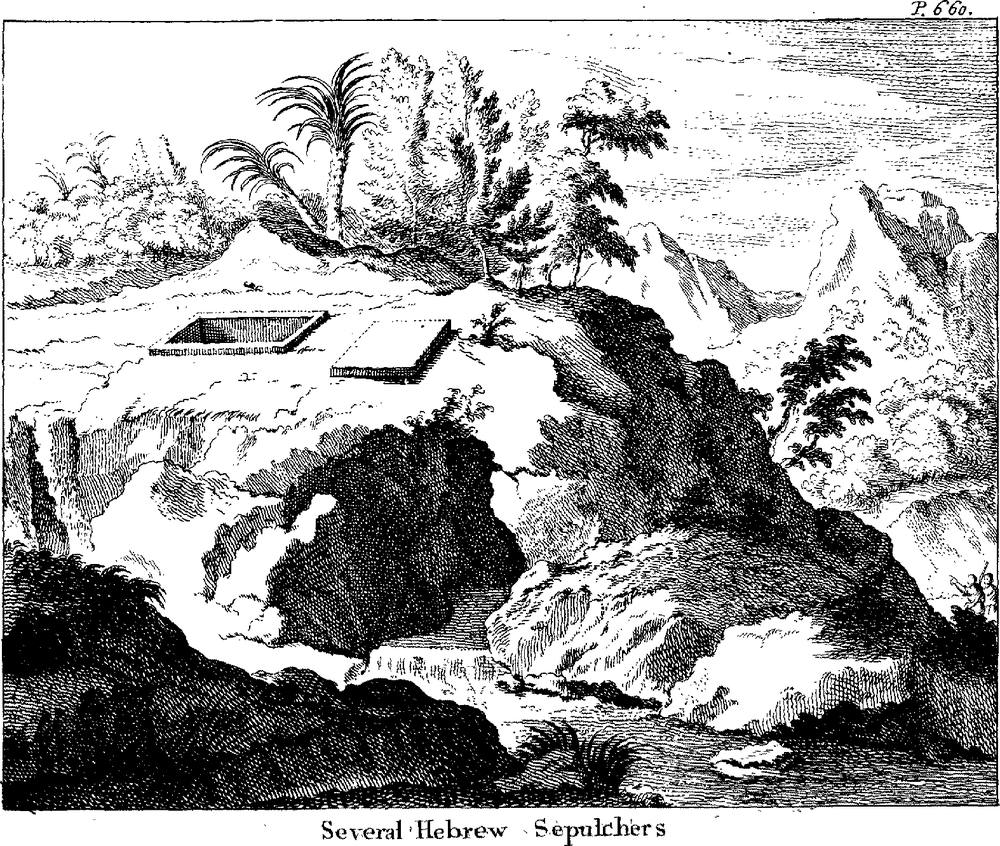
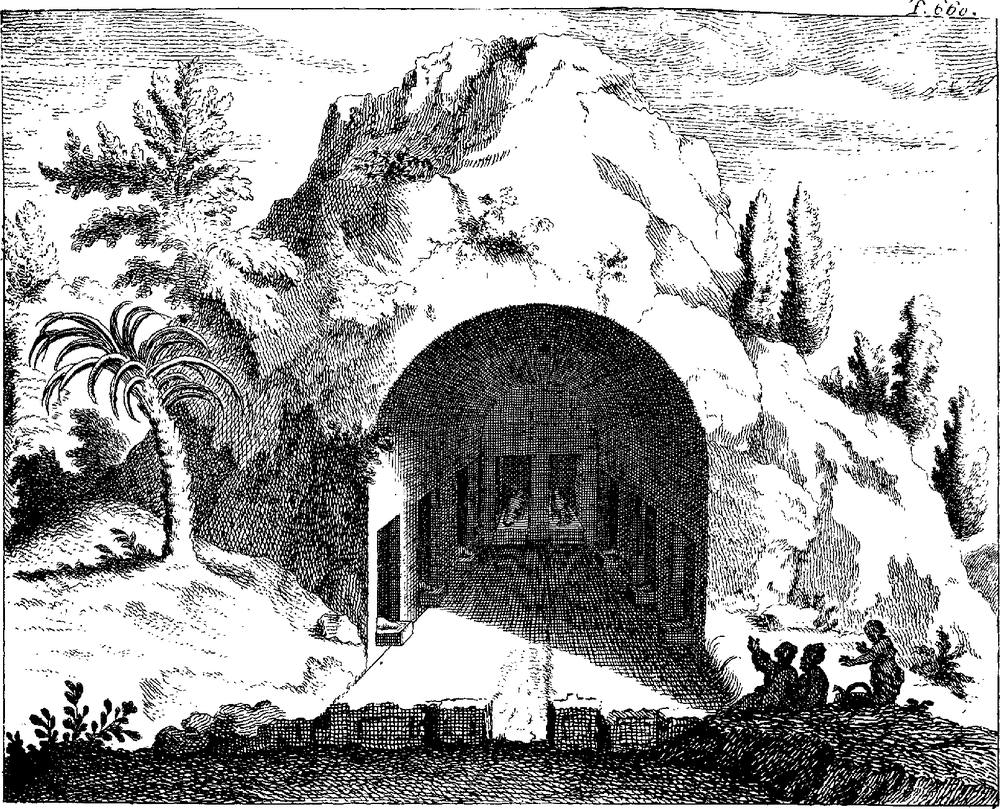
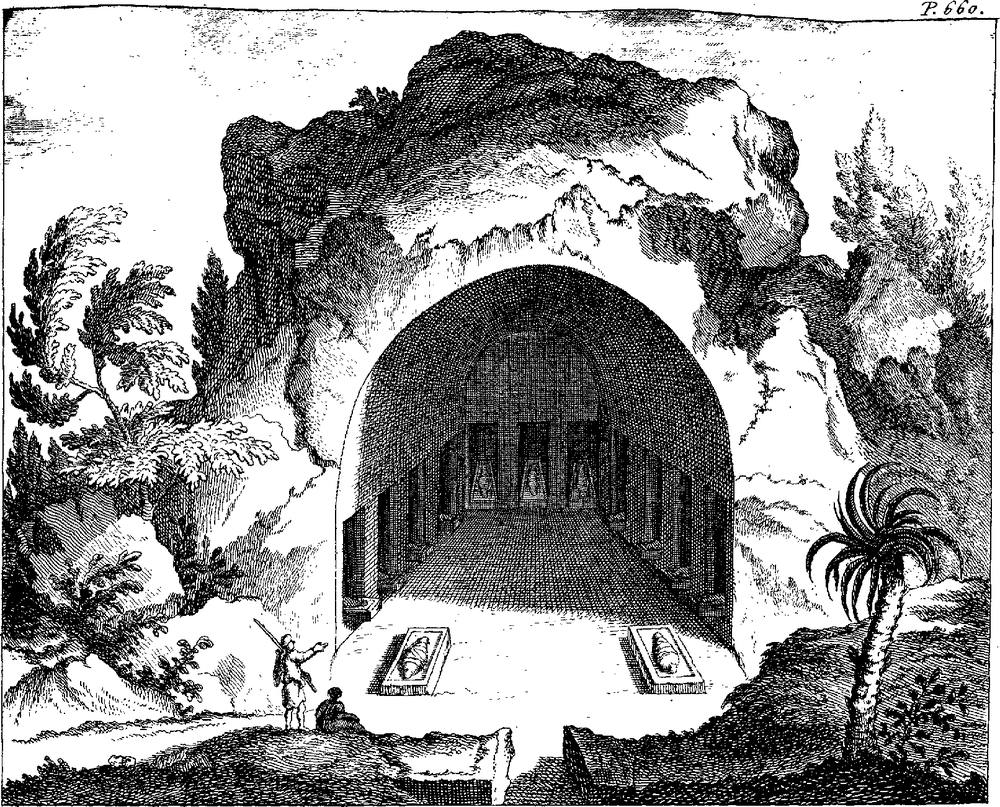
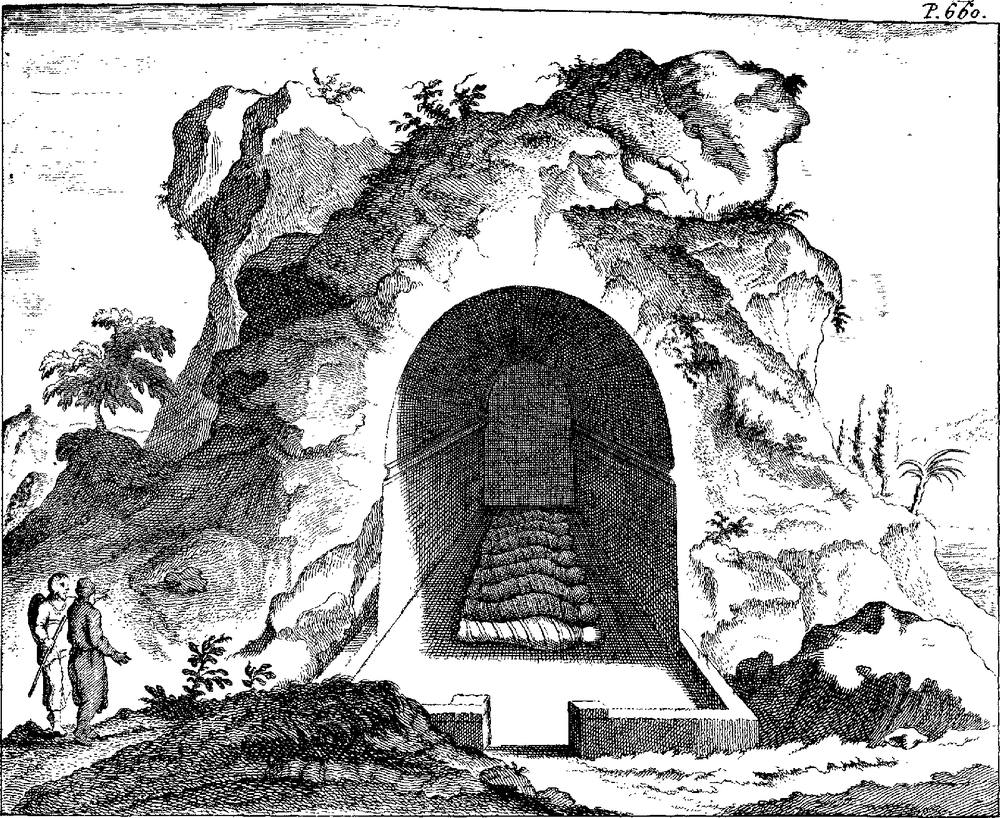
Evodius in St. Austin, say, that after the Evod. Epist. ad Aug. ep. 259. inter Augustin.Death of Moses, there were found two Bodies of this Law-giver, one to be buried in his Tomb, and the other which was to remain with the Angel that was his Guide.
Cedrenus relates, that Moses’s Tomb is Cedren. Hist. l. 1.always cover’d with a bright Cloud, which conceals it from the Eyes of Men, and hinders them from approaching to it. The Text of Deuteronomy says expressly, that no one Deuteron. xxxiv. 6.knows the Place of his Burial to this Day. Yet, for all this, it is told, that in 1655, in Vid. Horn. hist. Ecclef. sæcul. 17. art. 31.the Month of October, as some Marionite Shepherds were feeding their Goats in the Mountains of Nebo and Abarim, they observed that, from time to time, some of their Goats would straggle from the Flock for two or three Days Journey, and, at their return, they appear’d as it were embalmed with Perfumes of a most excellent Scent. To find out the Reason of such an extraordinary Event, they follow’d their Goats, and arrived at Precipices of a prodigious Depth, in the midst of which they perceived a small Valley, but extremely agreeable, at which they could not come but over a Number of broken Rocks, which had probably been tore up from the neighbouring Mountains by Earthquakes.
They got thither with a great deal of Trouble, where they found a Cave dug into a living Rock, wherein was a short Inscription which they could not understand. The whole Cavern was fill’d with a most delicious Perfume; and the Shepherds went back with their Cloaths scented strongly with this Perfume. This Affair was presently related by them to Mataxat Patriarch of the Marionites, who dwelt upon Mount Libanus, in the Monastery of Canobean Kadischa Mariam. The Smell of their Cloaths, was a sufficient Proof of the Truth of what they related.
The Patriarch sent thither two of his Priests, Men of approved Knowledge and Wisdom, particularly Aben-Useph, who had recommended himself by his great Learning and Capacity. They found the Monument which had been described to them, and read the Inscription upon it, which was, Moses, the Servant of God. The Patriarch was transported with Joy, and went to wait on Morat the Basha of Damascus, to ask of him the Keeping of the Tomb. The Greeks, the Armenians, the Jews, the Franciscans were inform’d of this Affair, made great Interest, and disbursed a great deal of Money, to obtain the Care of this precious Tomb, exclusive of others: The Jews especially bestirr’d themselves much in this Matter, to have it determin’d in their Favour: They remonstrated, that it belong’d to them preferably to all others, because Moses was their Founder and Law-giver. The Ottomans were already flatter’d with the Glory of being the Depositaries of the Sepulchres of Jesus Christ at Jerusalem, of Moses upon Mount Nebo, and of Mahomet at Mecca.
Hornius adds, that to elude the Hopes and frustrate the Pretensions of all these Competitors, the Jesuits obtain’d from the Turks, that the Tomb and all the Avenues to it should be shut up, and that, upon Pain of Death, all Persons should be prohibited from going thither. So that the Basha Morat sent Orders to the Saniac of Jerusalem and of Saphet, to have the Tomb and the Cave stopt up. But this was not the View of those who had procured this Order: They did it with this Design, that they themselves might remove the Body out of the Tomb, and carry it into Europe; for which Purpose they took with them the Druses of Mount Libanus, and went privately to open the Sepulchre; but they found nothing in it: Yet however, they resolved to bring along with them at least some of the Stones of this Tomb. But the Saniac of Jerusalem being inform’d of this Enterprize, sent People after them, who dispersed them, and disappointed their Expectations.
This Accident made a great Noise at the Court of Constantinople, and the Learned were divided in their Sentiments about this Discovery. A learned Jew named Jechonias, Son of Gad, who dwelt at Saphet, composed a Book to prove, that this was not the Sepulchre of Moses the Law-giver of the Hebrews, but of another Moses who was his Junior by many Ages. Thus that Hope vanish’d, with which they had fed themselves upon this Occasion. This is what Hornius acquaints us with. But Bartolocci48, who has nicely enquir’d into this whole History, shews the Falshood of it, or at least makes it to be very suspicious, by these three Observations. The First is, That the Jew Jechonias Son of Gad is unknown, and seems to be an imaginary Person. Secondly, The Patriarch of the Marionites, who lived in 1655, was not call’d Mataxat, but John, whose Successor was George Besbebel. Thirdly, The Basha of Damascus at that time was call’d Beschis, and not Morat.
The Sepulchre of Elisha, is known to us by a very remarkable Circumstance: In the very Year of the Death and Burial of this Prophet, some Parties of Moabites coming to make an Inroad upon the Territories of Israel; it happen’d that some Israelites going to bury a Man, threw him hastily into the Tomb of this Prophet, that they might fly away with more Expedition. But the Corpse had no sooner touch’d the dead Body of Elisha, but the Man revived
and stood upon his Feet. They are not agreed as to the Place where the Tomb of this Prophet was: St. Jerom49, and several others after him, have told us, that it was at Samaria, or thereabouts; and they found themselves upon this, that probably he died at Samaria, and therefore may be presum’d to be buried there too. Others will have him to have been buried at Abelmeula his own Country; others, on Mount Carmel. See the Article ELISHA.
Sepulchre of David. We have already spoke of it under the Article DAVID, as also of the Riches that were pretended to be there conceal’d. Here is the Description that curious Travellers give us of this Sepulchre:50 ‘Tis a magnificent Edifice, which now is without the Walls of Jerusalem, but probably was then included within the Walls of the City. You first enter into a large Court, about six and twenty Foot square, cut out and smooth’d within the Rock, which is of Marble. On the Left -hand is a Gallery, cut out of the Rock likewise, as also the Pillars that support it. At the End of the Gallery there is a little Opening, thro’ which you pass by, creeping upon the Ground, to go into a large Chamber of about four and twenty Foot square, round about which there are other smaller Chambers, which communicate one with the other, by Doors of Stone. The Ceiling, the Doors, as well as the rest, their Hinges, their Posts, their Frames, &c. are all out of the same Rock, which is justly look’d upon as a Wonder; for the Doors were never out of their present Places, nor brought from elsewhere; they were work’d before the Chambers, and they still adhere to the same Rock, out of which they were wrought. In the Sides of the small Chambers now mention’d are several Niches, within which the Bodies of the Kings are deposited in Stone Coffins. This Work is perhaps the only real one that now remains of Ancient Jerusalem. See the Figure.
Sepulchre of the Maccabees, at Modin. See the Article of JONATHAN the Asmonean.
Sepulchre of the Kings of Judah. See the Article DAVID.
Sepulchre or Tomb of our Lord Jesus Christ. This was upon Mount Calvary, to John xix. 41.the North-west of Jerusalem, and was hewn out of a Rock, as the Gospel informs us. ‘Tis a kind of small Chamber, almost square within; its Height from Bottom to Top eight Feet and an Inch, its Length six Feet and an Inch, and its Breadth fifteen Feet and ten Inches. The Entrance, which looks towards the East, is but four Feet high, and two Feet four Inches wide: This Door Mark 16. 3. Matthew xxviii. 2.was shut up by a Stone out of the same Rock: ‘Twas to this Stone that the Chief Priests affix’d their Seal, and which the holy Women doubted they had not Strength to remove: Who shall roll us away the Stone from the Door of the Sepulchre? Lastly, ‘Twas upon this same Stone that the Angel sate down, after Jesus Christ was come out of the Tomb. The Place where the Body of our Saviour was laid takes up a whole Side of this Cave; ‘tis a Stone rais’d from the Ground to the Height of two Feet and four Inches; its Length is five Feet eleven Inches, and its Breadth two Feet and eight Inches, placed lengthwise from East to West. It remains even to this Day, but all incrusted with a white Marble. See the Voyage of Paul Lucas in Asia Minor, t. 2. p. 12, &c. He has several times visited this holy Place, and gives an exact Description of it, as it is to be seen at this Day.
Concil. t. 3. p. 561, 574.Sepulchre of the Holy Virgin. There are two Traditions concerning the Burial of the Holy Virgin, as there are two concerning the Place of her Death. Those who affirm, that she follow’d St. John the Evangelist to Ephesus, and that she died there, pretend, that her Tomb was still to be seen in the Year 431, when the Council of Ephesus was held: And this Opinion is expressly taken Notice of, in a Letter of this Council’s. According to another Opinion, she died at Jerusalem, where her Tomb is to be seen; which Opinion is as much follow’d as the other. Juvenal Bishop of Jerusalem, who could not be ignorant of what had pass’d at the Council of Ephesus, since he himself was present at it, wrote to the Empress Pulcheria, and to the Emperor Marcian, who sent to him for Relicks of the Virgin Mary, That her Tomb was shewn at Gethsemani near to Nicepb. Hist. l. 2. c. 32. & l. 15. c. 14.Jerusalem, but that it was empty. ‘Tis added, that when the Emperor was inform’d of this, he caus’d this Tomb to be brought to Constantinople, with an Handkerchief that was put therein, and which he caus’d to be set up about the Year 455, in the new Church consecrated to our Lady of Blaquern.
Yet since that time they have not left off to shew the Tomb of the Virgin at Jerusalem. Adamnan says, that it was to be Adamnan. de locis sanctis, c. 9. Beda, l. 3. lib. de loc. SS. c. 3.seen in the Valley of Jehoshaphat near to this City. Bede testifies, that it might be seen at Jerusalem in his Time, but empty. It was put into the Basilicon that the Empress Helena caused to be built there. Travellers assure us,51 that it may still be seen in the Vale of Jehoshaphat, wherein the Brook Kedron runs, but on the other Side of this Brook, over-against Gethsameni
Sepulchre continues on the next page
Footnotes
-
Strabo. l. 14. Arrian. l. 1. de expedit. Alex. hist. l. 1. c. 10. Greg. Turon. hist. l. 3. c. 10. Cosmas. Monach. l. 5. p. 194. ↩
-
Quidam apud Greg. Turon. l. 1. c. 10. hist. ↩
-
Paul. Orof. ↩
-
ΝΑΟ Seah. LXX. Σάτον*, Satum*, or Μέτρον*, Mensura*, or Οἶφι*, Ephi*. ↩
-
Prov. i. 22. iii. 34. ix. 7. 8, 12. xiii. 1. xiv. 6. xv. 12, xix. 25. xx. 1, &c. Collat. cum l. 1. c. 7. p. 14. A. B. ↩
-
Joseph. Antiq. l. 2. c. 5. p. 58. ↩
-
Josh. vi. 26. In the Year of the World 2553, before Christ 1447, before the Vulgar Era 1451. Ahab, in whose time Jericho was rebuilt, began to reign in the Year of the World 3086. before the Vulgar Era 1912. ↩
-
In the Year of the World 2092, before Christ 1908, ↩
-
Joseph. Antiq. l. 1. c. 19. Ὑπεχώρησεν εἰς Σικιμα - - - - τὸ χωρίον ἀπὸ τῆς αὐτοῦ τειχίσεως. Vide & c. 18. ↩
-
Translators’ note. Our Translation reads this Passage thus; And Ehud escaped while they tarried, and passed beyond the Quar- ries, and escaped unto Seirath. ↩
-
Manethon. apud Euseb. & Syncell. ἐν Σηριαδικῇ γῇ. ↩
-
Theod. Præf. in Psalm. & Suidas. Μέλος ἐναλλαγή. ↩
-
Euseb. in Psalm. iv. p. 28. Vide & Præf. in Psalm. p. 8. Quidam apud Theodoret. Præf. in Psalm. ↩
-
Nyssen. Præfat. in Psalm. ↩
-
Hilar. & Cass. Præf. in Psalm. ↩
-
Vid. Geier. Ham. Forster. Buxtorf. ↩
-
Kimchi, Muis, Grot. Genebr. Mariana, &c. ↩
-
See M. Simon’s Critical History of the New Testament, chap. 33. ↩
-
M. Darvieu’s Customs of the Arabians, p. 59, 60. ↩
-
Joseph. Antiq. l. 13. c. 23. l. 18. c. 3. de Bello, c. 25. l 4. c. 1. ↩
-
Origin. apud Hieronym. Epist. ad Marcellam. ↩
-
In the Year of the World 3828, before Christ 172, before the Vulgar Era 176. ↩
-
Joseph. Antiq. l. 13. c. 21. ↩
-
In the Year of the World 3910, before Christ 90, before the Vulgar Era 94. 3911, before Christ 89, before the Vulgar Era 93. ↩
-
Translators’ note. In our Translation, the high Places of the Field. ↩
-
Lipf. de Vita Senec. c. 10. Tillemont. Hist. des Emper. t. 1. p. 560. ↩
-
In the Year of the World 3291, before Christ 709, before the Vulgar Era 713. ↩
-
Hebræi apud Hieron. in Isai. x. & apud Lyr. Grot. alios. fratres in Eremo. Hugo Cardinal. in 4 Reg. Antiq. l. 10. c. 2. Vid. Tost. & Salian. ↩
-
Hebræi apud Hieron. in Isai. x. 16. Author serm. ad fratres in Eremo. Hugo Cardinal. in 4 Reg. ↩
-
Hebræi apud Hieron. in Isai. xxxiii. 3. ↩
-
Berosi. apud Joseph. ↩
-
Thevenot. Voyage part. 1. l. 2. c. 20. part. 2. l. 1. c. 20. l. 3. c. 16. ↩
-
See Basnage’s History of the Jews, t. 1. l. 2. c. 6. p. 338. 3283, before Christ 717, before the vulgar Era 721. ↩
-
2 Kings xvii. 24, 31. In the Year of the World ↩
-
Simeon ben-Jochai in Jezirah, cum notis Rittangel. p. ↩
-
Kirker Oedip. Ægypt. Gymnas. Hieroglyph. class. 4. c. 9. t. 2. the ↩
-
Ita Aristæas apud Joseph. ex Versione Rufini. Euseb. Cyrill. Alexand. Cedren. ↩
-
Scaliger Notis in Chronic. Eusebi. ad an. 1134. p. 134. ↩
-
Clem. Alex. l. 1. Stromat, Justin. Exhort. ad Gentes, & Dialogo contra Tryphon. Cyrill. Jerosol. Cathech. 4. Iren. l. 3. contra hæres. c. 25. seu 21. Epiphan. de pond. & mensur. Chrysost. homil. 4. in Genes. Aug. l. 2. de Doctr. Christ. c. 15. & l. 2. de consensu Evangelist. c. 66. ↩
-
Hieronym. præfat. in Pentateuc. ad Desiderium. Nescio quis primus Autor septuaginta Alexandriæ mendacio suo extruxerit. ↩
-
Hermippus apud Laert. l. 5. in Demetrio. Ita & Suidas. ↩
-
Translators’ note. No Aristæas, or Heathen Greek; but some Hellenistical Jew, under his Name, was the Author of that Book. Prid. Connect. p. 2. ↩
-
Translators’ note. The English Reader may peruse Dr. Prideaux’s accurate Account of this Translation of the Septuagint, in his Connection of the Old and New Testament, under Ptolemy Philadelphus. ↩
-
Œcum. in Ep. Judæ, ex antiquor. traditione. Glycas, parte 2. Annal. &c. ↩
-
Philo de Vita Mosis lib. iii. Epiphan. heres. 9, 84, &c. ↩
-
Clem. Alex. l. 1. Strom. Hilar. in Matth. xx. ↩
-
Clem. Alex. l. 6. Strom. Vide & Ambros. in l. 1. de Cain & Abel. c. 2. & Hieronym. in Amos vii. ↩
-
Bartholoc. Bibl. Rabbin. l. 3. p. 930. See Basnage’s History of the Jews, t. 4. l. 6. c. 17. ↩
-
Hieron. in Epitaph. Paulæ Epiphan. seu alius. Vita Prophet. Isidor. Doroth. alii. ↩
-
Thevenot. Voiage, part i. l. 2. c. 40. Maundrel’s Journey from Aleppo to Jerusalem. ↩
-
Brocard de locis SS. Adrichom. a Pietro della Valle, ex 13, &c. ↩