Volume II, pages 663–681 of the 1732 edition, from SEP to SHE: everything printed on these pages, in order.
Continued from Sepulchre
and the Mount of Olives; that the Part of the Monument which appears above-ground is very little raised; that they descend into the Sepulchre by fifty Steps; that it is made in the Form of a Cell, or small Grotto, where is seen something like an Altar of Stone, upon which the Coffin or the Body might have been placed; that both the Cell and the Altar are hewn out of the Rock. This is what they say of it; but this is not Authority enough to convince us, that this is the real Sepulchre of the Holy Virgin.
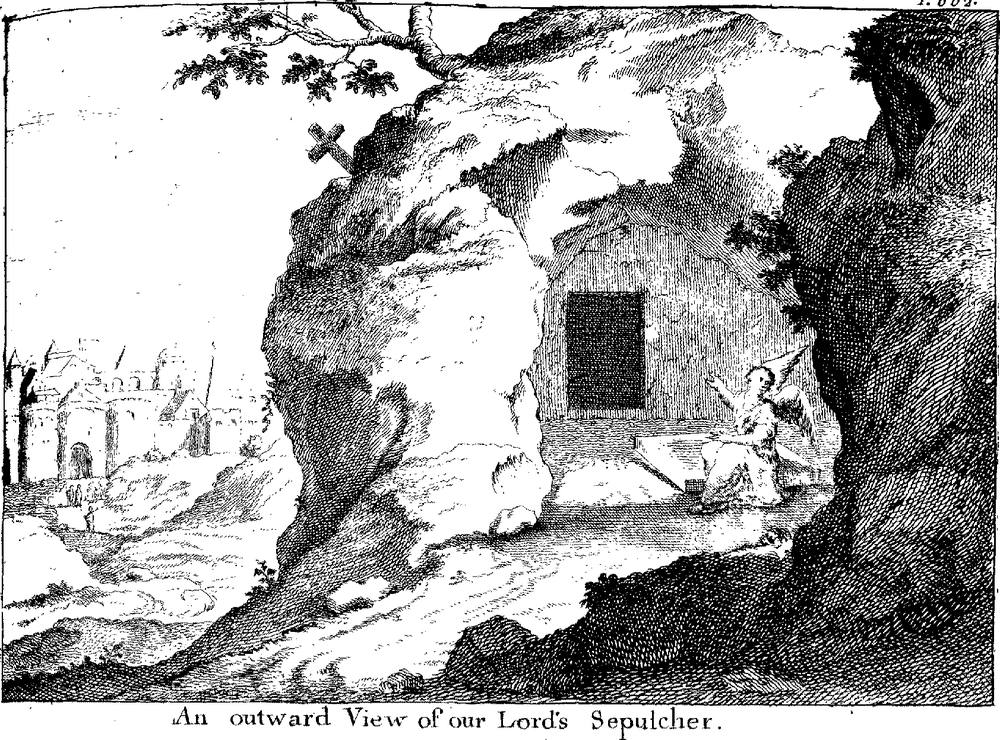
Sepulchre of Daniel, of Ezekiel, of the Maccabees, &c. See the Articles belonging to these Persons.
Tacit. Annal. c. 5.SEPULTURE, or Burial. The Hebrews, as is said, were always very careful about the Burial of their Dead. To be deprived of Burial, according to them, was one of the greatest Misfortunes that could happen to a Man. They did not refuse to pay this Duty to any one, not even to their Enemies. But it was not perform’d to such as had laid violent Hands upon themselves, a till after the Sun was set; and they believed that their Souls were plunged into Hell. This great Care about Sepulture proceeded from their full Persuasion of the Immortality of the Soul. The Scripture threatens the Wicked, that they should be deprived of Sepulture, as one of the greatest Calamities that can be inflicted on them. Altho’ a Man should live a long Time, and should have an hundred Children; yet when he dies, if he should be deprived of the Honour of Burial, I maintain, says the Ecclef. vi. 3. Jer. viii. 2.Wiseman, that he would be no better than an Abortion. Jeremiah threatens the Kings, Priests, and false Prophets, who have worshipp’d Idols, that their Bones should be cast out of their Graves as the Dung of the Earth. The same Prophet foretells, that Jehoiakim, King of Judah, Jer. xxii. 18, 19.who built up his House in Iniquity, who deliver’d up himself to all sorts of criminal Actions, to Avarice and Violence; he tells him, he should be buried with the Burial of Asses; Sepulturâ asini sepelietur; That he should be cast out of the Gates of Jerusaleem to the Fowls of the Air. It is observable, that Jason, who had hindred 2 Macc. v. 10.many Jews of the Honour of Sepulture, was himself treated after the same manner. He dy’d in a strange Country, and was thrown out like Carrion into the Fields, without so much as being put into a strange Grave. Sepulturâ negne peregrinâ usus. Good Men made it a Part of their Piety and Devotion to bury the Dead, as may be seen by the Example of Tobit. See SEPULCHRE, and our Dissertation upon the Funerals of the Hebrews, printed before the Book of Ecclesiasticus; and the Book of John Nicolai, De Sepulchris Hebræorum, and what we have already said upon the Article of the DEAD.
I. SERAIAH, or Saraia, David’s Secretary. 2 Sam. viii. 17.
II. SERAIAH, Father of one call’d Joab, of the Tribe of Judah. 1 Chron. iv. 14.
III. SERAIAH, Son of Asiel, and Father of Josibiah. 1 Chron. iv. 35.
IV. SERAIAH, High-priest of the Jews, Successor of Azariah, and Father of Jehozadak. He was the last High-priest before the Captivity of Babylon. Being taken by Nebuzar-adan, he was carried to Nebuchadnezzar then at Riblah, where he was put to Death, with seventy others of the chief Men of Jerusalem, in the Year of Jerem. li. 24.—27. 2 Kings xxv. 18, 21.the World 3416, before Christ 584, before the vulgar Era 588. Jehozadak, Son to Seraiah, was carry’d Captive to Babylon.
V. SERAIAH, one of the chief among the Jews, that return’d from Babylon with Ezra. Ezr. ii. 2. Nehem. x. 2. xii. 1.
VI. SERAIAH, Son of Tanhumeth, a Native of Netophah. 2 Kings xxv. 23.
VII. SERAIAH, Son of Neriah, and Baruch i. 1. Jerem. xxxii. 12. Jerem. li. 59, 60. שר המנוחהBrother of Baruch, the Companion and Secretary of Jeremiah. Seraiah was sent to Nebuchadnezzar at Babylon, in the fourth Year of the Reign of Zedekiah, and of the World 3409, before Christ 591, before the vulgar Era 595. Seraiah was Head of the Prophecy. Princeps Prophetiæ, or Chief of the Embassy, appointed to carry the Word, or the Denunciations against Babylon. The Hebrew reads, he was Prince of Menucha; which may be translated by Prince of Menucha, a City or Canton of the Tribe of Benjamin; (see 1 Chron. ii. 52, 54. viii. 6.) or Prince of Rest, Guard of the King’s Chamber or Bed; or Prince of the Presents, Distributer of the King’s Liberalities, his Almoner, or Intendant of the Offerings the King made to the Temple; or rather, in this Deputation Seraiah was charged with the Tributes or Presents that Zedekiah sent to Nebuchadnezzar; and this Acceptation of the Words returns to that of the Vulgate, Princeps Prophetiæ, Head of the Embassy or Deputation.
When therefore Seraiah was sent to Babylon by King Zedekiah,1 Jeremiah sent a Letter by him, which was to be read to the Captives there. This Letter contain’d a Prophecy of the Fall of Babylon; and after it was read, Seraiah was order’d to tie it to a Stone, and to throw it into the2
Euphrates, and to say; Thus shall Babylon sink, and shall not rise from the Evil that I will bring upon her. Baruch went with his Brother Seraiah upon this Commission. See Baruch, l. 1.
Judg. iii. 3. Seranim, Satrapæ.SERANIM. This is the Name of the Lords, or of the Satrapæ of the Philistines. See SATRAPAS and SURENA.
SERAPHIM, or Zeraphim. This Word comes from the Hebrew Word Zaraph, which signifies to burn, to melt Metal, to purify. Zeraphim is us’d to signify Goldsmiths Zeraphim. Aurifices, Conflatores. Numbers xxi. 6.or Founders. Also the Name Seraphim or Saraphim is given to those winged fiery Serpents, that destroy’d the Israelites in the Desart, and which we have spoke of under the Article SARAPH, and shall mention again under the Title Isai. vi. 2. Sheraphim.SERPENTS. Lastly, Seraphim, in Isaiah, is put for a Kind of Angels, which were over the Throne of the Lord, and had six Wings; with two of which they cover’d their Face, with two they cover’d their Feet, and flew with the two others. They cry’d to one another and said; Holy, holy, holy is the Lord of Hosts, the whole Earth is full of his Glory. The Word Seraphim taken in this Sense, is found only in this one Place of the Old or New Testament. Their Name is writ with שShin or Schin; but the Signification is still the same as if it had been writ with צTzade. In the Distinction of the nine Choirs of Angels, the Seraphims are put in the first Rank, and above the Cherubims.
SERAPIS, a God of the Egyptians. His Name is not to be found in the Text of Scripture; but we can hardly be excused from bringing it in here, because it has been pretended, that the Egyptians adored the Patriarch Joseph under the Name of Serapis. This Opinion is found in some antient Authors, as Julius Firmicus and Jul. Firm. de Errore prophan. Religion. Rufin. hist. l. 2. c. 23.Rufinus, and has been embraced by some learned Moderns, as Vossius, Onzelius, Spencer, and some others. They found their Opinion upon several seeming Coincidences, between Joseph and Serapis. ‘Tis said that Serapis had merited divine Honours in Egypt, for having deliver’d the Country from a grievous Famine; he is painted with a Basket, and Ears of Corn upon his Head.
They pretend that Serapis is the same as Apis, and that there is no more Difference between them, than between an Ox alive, and an Ox dead and put into a Coffin. While the Bull Apis was alive, he was worshipp’d by the Name of Apis; but he was no sooner dead, than they gave him the Name of Serapis, which is as much as to say in Greek, Apis en soro, Apis in his Coffin, or Soros Apidos, the Coffin of Apis3. Serapis was also confounded with Pluto, with Jupiter, with Osiris, with the Sun, with Esculapius. Besides, they gave him an Hebrew Etymology, which is still more conformable to the Character of Joseph. Sar,4 in Hebrew, signifies a Prince; Apis, the Bull Apis; or Sar-abir, the powerful Prince. And as between Joseph and Apis or Osiris, there are still found other Strokes of Resemblance, they are persuaded, that the Egyptians intended to honour Joseph under the Names of these Deities.
But to all this a Reason is oppos’d, which subverts this whole Hypothesis. The Historians teach us, that Serapis is but an upstart Deity in Egypt. Tacitus5 relates the History of his Translation from Sinope, a City of Pontus, to Alexandria, by the Care of Ptolemy, the first King of Egypt. Origen, Origen. l. 1. contra Cels. p. 257.speaking of this God, says, that he was but a new Comer into Egypt; that his Story was long, and of little Credit, and that he was not in Vogue till King Ptolemy brought him in, who attempted to introduce his Worship into his Kingdom. Upon this Account it cannot be affirm’d, that Serapis is the same as Joseph; or that the Egyptians intended to pay Adoration to this Patriarch under the Name of Serapis, since Joseph was so many Ages more antient than Serapis in this Country. As for the Etymologies of the Word Serapis, taken from the Greek Language, they deserve no Consideration, since the Greek Tongue was not known in Egypt till after the Time of the Ptolemy’s; and besides, these Etymologies prove nothing at all for that Opinion, that makes him the same as Joseph.
‘Tis true, some have thought,6 that there were two Serapis’s acknowledged in Egypt, one more ancient, known long before him, who was brought from Sinope, since he is the same as Apis and Osiris; the other more modern, of whom we have Tacit. hist. l. 4. c. 84.spoke before. Tacitus clearly distinguishes these two Deities, when he says, that King Ptolemy caus’d a magnificent Temple to be built to Serapis, at Rachotis, a Place where formerly was a Chapel consecrated to Serapis and Isis. Fuerat illic sacellum Serapidi atque Isidi antiquitus sacratum. But how came this pretended antient Serapis to escape the Diligence of Herodotus, and other Antients, who have treated of the Religion of the Egyptians? Therefore Tacitus has certainly put Serapis and Isis instead of Osiris and Isis.
Gen. xlvi. 14. Num. xxvi. 26.SERED, or Sared, the eldest Son of Zebulun, and Head of the Family of the Sardites.
SERGIUS PAULUS, Proconsul or Governor of the Island of Cyprus, who was converted by St. Paul, in the Year of Acts xiii. 7.Christ 44 or 45. This Proconsul, who was otherwise a Man of Prudence, had a Magician about him, whom he took for a Man enlightened and favoured of God. Having heard of the Arrival of Paul and Barnabas in the Isle of Cyprus, he sent for them, and desired to hear the Word of God. But Elymas did what he could to hinder him from it. Then Paul, fill’d with the Holy Ghost, said to him; O full of all Subtilty and all Mischief, thou Child of the Devil, thou Enemy of all Righteousness, wilt thou not cease to pervert the right Ways of the Lord? And now behold, the Hand of the Lord is upon thee, and thou shalt be blind, not seeing the Sun for a Season. And he immediately became blind. When Sergius Paulus beheld this, he embraced the Christian Faith, and admired the Doctrine of the Lord. Some believe7 Sergius Paulus to be the same whom the Church at Narbonne honours as its first Bishop; but the more knowing think, that this Bishop must be later than Sergius Paulus by above two Centuries. Others think8, St. Paul did not bear this Name till after the Conversion of Sergius Paulus, and that he took it up as a Trophy of the Victory he had obtain’d upon this Occasion, over the Prince of Darkness. But this Opinion is not universally follow’d, tho’ St. Luke does not give him the Name of Paul till after this Event.
1 Macc. iii. 14, 23.SERON, General of the Army of Antiochus Epiphanes. He having heard of the Defeat of Apollonius, and that Judas Maccabæus had gather’d together an Army of Jews zealous for the Law of their Fathers; fancied with himself, that he had an Opportunity of acquiring great Glory and Reputation, by fighting with Judas and those that adhered to him, who contemned the Orders of the King. He came therefore with a powerful Army, and advanced as far as Bethoron. Judas took the Field against him with his little Army; and his People seeing the Multitude of their Enemies, said to him; How shall we be able to fight with so great an Army, especially being weakened with Fasting, as we are this Day? But he encouraged them, saying; It is equally easy to God, either to give the Victory to the many or the few. And at the same Time he charged the Army of Seron, put it to flight, and pursued it as far as Bethoron and the Plain. He kill’d eight hundred of them, and the rest took Refuge in the Land of the Philistines. No farther mention is made of Seron in History after this Battle, which happen’d in the Year of the World 3838, before Christ 162, before the vulgar Era 166.
Gen. iii. 15. נחש Opis Serpens. Eccles. xxv. 15.SERPENT; in Latin, Serpens; in Greek, Ophis; in Hebrew, Nachash. Interpreters have much speculated concerning the Nature of the first Serpent, that tempted Eve. Some have thought, that then the Serpent had two, or four, or many Feet. But there is no Probability that this Animal was otherwise than what it is now. And it cannot be doubted, but that under the Name of the Serpent we are to understand the Devil, who made use of a real Serpent to seduce the first Woman. In the Curse that God gave the Serpent, he told him, that the Seed of the Woman should bruise the Serpent’s Head; because in reality, the Serpent having his Heart under his Throat, and very near his Head, the readiest way to kill him is to squeeze or cut off his Head. Many have suppos’d that his chief Subtilty, or Wisdom, as the Gospel calls it,9 consists in this, that he chuses to expose his whole Body to Danger, that he may save his Head.
Jesus, the Son of Sirach, says, There is no Head above the Head of a Serpent; but by the Word Head in this Place, we should understand the Venom: For the Hebrew Word Rosh, which signifies the Head, signifies See Deut. xxxii. 33.also the Venom of a Serpent, which some place in its Gall, others in its Tongue, and others in its Teeth. The Scripture in different Passages expresses itself, sometimes as supposing the Gall of the Serpent to be its Venom, Job xx. 14. His Meat in his Bowels is turned; it is the Gall of Asps within Psal. cxl. 3. Proverbs xxiii. 32.him. David seems to place it in the Tongue. They have sharpened their Tongues like a Serpent. And Solomon in the Teeth. At the last it biteth like a Serpent, and stingeth like an Adder.
Gen. iii. 14. Isa. lxv. 25. Mic. vii. 17.Another Curse that God gave the Serpent was, that it should feed upon Dust. Dust shalt thou eat all the Days of thy Life. Isaiah says also, that Dust is the Food of the Serpent. Dust shall be the Serpent’s Meat. And Micah; They shall lick the Dust like a Serpent. ‘Tis true, however, that they eat Flesh, Birds, Frogs, Fish, Fruits, Grass, &c. But as they continually creep upon the Earth, it is impossible but that their Food must be often defiled with Dust and Dirt. Some of ‘em may really eat Earth out of Necessity, or at least Earth-worms, which10 they cannot swallow without a good deal of Dirt with them.
The Craft, the Wisdom, the Subtilty of the Serpent, are things insisted on in Scripture, as Qualities that distinguish them from other Animals. Moses intending
to prepare the Mind of his Reader for the relation of Eve’s Temptation, begins with affirming, Now the Serpent was more subtil than any Beast of the Field which the Lord God had made. And Jesus Christ himself recommends to his Apostles, to have the Wisdom of the Serpent. They bring several Proofs of this Subtilty of the Serpent. They tell us, that the Cerastes hides himself in the Sand, in order to bite the Horse’s Foot, that he might throw his Rider. Jacob makes an Allusion to this in the Blessing he gave to Dan. Dan shall be a Serpent by the Way, an Adder in the Path, that biteth the Horseheels, so that his Rider shall fall backward. Epiphan. Physiolog.Epiphanius brings four Proofs of the Wisdom of the Serpent. First, When he is old, he has the Secret of growing young again, and of stripping off his old Skin or Slough, by squeezing himself between two Rocks. Secondly, He assaults a Man if he sees him naked, but flees if he finds him cloathed. But it is probable there is a Fault in this Passage of Epiphanius, and that he intends to say the contrary of this. For it is generally affirm’d,11 that the Serpent is afraid of a naked Man, but attacks him if he has his Cloaths on. Thirdly, When he is assaulted, his chief Care is to secure his Head. This is attested by a great Number of Writers. Lastly, When he goes to drink at a Fountain, he first vomits up all his Poison, for fear of poisoning himself as he is drinking. This Observation is not assented to by every Body, tho’ it has a great many Defenders.
They relate still other Instances of the Serpent’s Subtilty; as, for Example, it stops up its Ears that it may not hear the Voice of the Charmer or Inchanter. The Psalmist takes notice of this piece of Subtilty of the Adder. Like the deaf Adder that stoppeth her Ear, which will not hearken to the Voice of the Charmers, charming never so wisely. ‘Tis said it applies one of its Ears hard to the Ground, and stops up the other with the End of its Tail. We have written a Dissertation upon this, which is put before our second Tome upon the Psalms. See also Bochart, De Animal. sacr. par. 2. l. 3.12. 6. and the Commentators upon Psalm lviii. 4. Others say, the Subtilty of the Serpent consists in its Agility and Suppleness; or in a Secret it has in recovering its Sight by the Juice of Fennil. Lastly, every one proposes his own Conjectures in this matter. Bochart. de animal. sacr. t. 1. l. 3. c. 5.We have particularly spoken of the Serpents mentioned in Scripture, under their proper Articles. There were eleven Kind of Serpents known among the Hebrews;13 1. Ephe, the Viper. 2. Chephir, a sort of Aspick, or a Lion. 3. Acshub, the Aspick. 4. Pethen, the Aspick. 5. Tzeboa, a speckled Serpent, call’d Hyena by the Greeks and Egyptians. 6. Tzimmaon, according to St. Jerome. This is the Serpent call’d Dipsas, because of the Thirst that its Biting produces. But Bochart maintains, that it does not signify a Serpent, but a dry and burnt-up Place. 7. Tzepha, or Tziphoni, a Basilisk: Not the fabulous Serpent or Cockatrice, of which they tell so many foolish Stories, but the true Regulus or Basilisk, which is a Serpent made like others, but more dangerous, and whose Poison is more subtil. See BASILISK, and Bochart de Animal. sacr. p. 2. l. 3. c. 9, 10. 8. The Kippos, which the Septuagint, St. Jerome, and the Chaldee understand of the Urchin or Hedge-hog; but the same Bochart thinks it to be the Serpent call’d by the Greeks Acontias, that is to say, the Dart, so call’d, because it darts itself very far and very high after its Prey. See Bochart, de Animal. sacr. par. 2. l. 3. c. 11, and the Authors he refers to. 9. The Shephiphon, which St. Jerome has translated by Cerastes, Gen. xlix. 17. This Serpent is of the Colour of Sand, in which it hides itself, and where it watches its Prey. The Name of Cerastes is given it, because it has a sort of fleshy Horns, or two Bunches in the Shape of Grains of Barley. Bochart, de Animal. sacr. p. 2. l. 3. c. 12. 10. The tenth sort of Serpents is call’d in Hebrew, Shacal, and is mention’d in Psalm xci. 13. Thou shalt tread upon the Lion and Adder; the young Lion and the Dragon shalt thou trample under Feet. The Septuagint, the Syriack, and the Arabick understand it here; Bochart supports their Opinion,12 and shews, that the Name of Black, for that’s the Signification of Shacal, agrees to several Serpents, and particularly to the Aspick, the Dipsas, the Hydra, &c. but the greatest Part of the more knowing Interpreters are of Opinion, that the Word Shacal, in this place, signifies a Lion, and not a Serpent. And this Sentiment seems to us much more probable. It is certain that this Hebrew Word generally signifies a black Lion, as this Author proves himself. 11. Lastly, the Saraph is a flying Bochart. de animal. sacr. t. 1. l. 3. c. 5.Serpent, and is the only Serpent that we know that has Wings. The Word Saraph properly signifies to burn, and ‘tis thought this Name was given it, either because of its Colour, or because of that Heat and
Herodot. l. 2. c. 75, 76.Thirst it creates by its Biting. Herodotus, who had seen of these Serpents, says, they had great resemblance to those which the Greeks and Latins call’d Hydræ. Bochart endeavours to prove they were real Hydræ. The same Herodotus tells us, he went on purpose to the City of Butus, to see those flying Serpents of which he had heard speak. He saw near this City great Heaps of Bones, and the Spines of those Animals, that had been put to Death and devoured by the Ibis. The Place, says he, where they are to be seen is a narrow Neck that widens towards Egypt. When therefore, at the Beginning of the Spring, these Serpents endeavour to come out of Arabia into Egypt, the Bird call’d Ibis sets upon them, and destroys a great Number of them. The Wings of these Serpents are not Feathers, like the Wings of Birds, but rather like to those of Batts.
Idem. l. 3. c.107,108, 109, 110.He says elsewhere, that these Serpents are not large; that they are speckled, or of several Colours; that they are in such great Quantities in Arabia, that the Inhabitants could not subsist for ‘em, if Providence had allow’d them to multiply according to the usual Laws of Nature. But the Arabians affirm, that the Female puts the Male to Death when they engender, and that the young ones at their Birth kill their Mother. They love sweet Smells, and frequent such Trees as bear Spices, and the Marshes where the aromatick Reed (or Casia) grows. The Arabians drive them away from about the Trees by the Smoke of Styrax; and when they go to gather the Reed (or Casia) they cloath themselves with Skins, and cover their Heads, all but their Eyes; then they go into these Marshes, from whence they drive away the winged Serpents, whose Flight has something terrible, and whose Biting is very dangerous.
We have a little enlarged upon these Numbers xxi. 9. Isa. vi. 2. xiv. 29. xxx. 6.Serpents, call’d Saraph in Scripture, because it was these Serpents that made so great a Destruction among the Israelites, and were the Death of so many People in the Desart. ‘Twas one of these Saraphs that Moses caus’d to be put up in the Wilderness, at the Sight of which the Israelites were made whole. On this Subject may be read Bochart de Animal. sacr. p. 2. l. 3. c. 13, and Cicero, l. 1. de Natura Deorum; Mela, l. 3. c. 9. Lucan, l. 6. Solinus, c. 32. Ammianus Marcellinus, c. 22. Ælian, l. 2. c. 38. and other of the Moderns, quoted by the same Bochart, who speak of these flying Serpents.
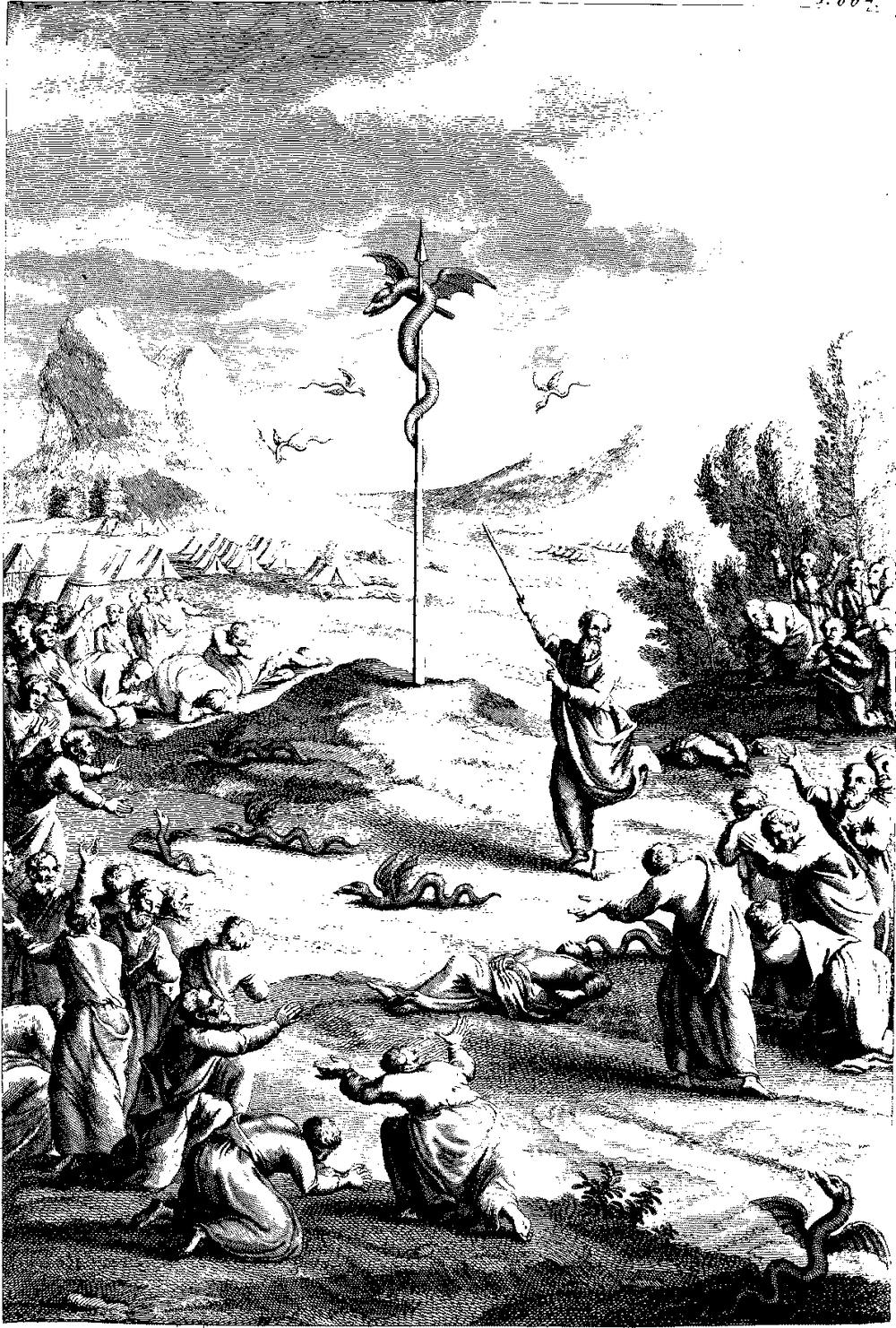
Brazen Serpent. This was a Figure of the Serpent Saraph, of which we have now spoke, which Moses caus’d to be put on the Numbers xxi. 9.Top of a Pike, promising the Hebrews, that all those that should be bit by Serpents, and who should look upon this Image, should be presently healed. The Event was answerable to this Promise. Our Saviour John iii. 14.in the Gospel of St. John informs us, that this Serpent thus rais’d up, was a Representation of his Passion and Crucifixion. As Moses lifted up the Serpent in the Wilderness, even so must the Son of Man be lifted up. This Brazen Serpent was preserved among the Israelites down to the Time of Hezekiah, who being inform’d the People paid a superstitious Worship to it, had it broke in Pieces, and by way of Contempt gave it the Name of Nehushtan, that is to say, a brazen Bawble or Trifle. See 2 Kings xviii. 4.HEZEKIAH and NEHUSHTAN.
The Arrow Serpent, call’d in Greek, Acousias, is a flying Serpent, known to the Bib. Orien. p. 684.Turks by the Name of Ocilan. They are often seen in the Archipelago, and chiefly in the Island of Metelin; they fight with one another in the Air, but do Men no Harm. ‘Twas this kind of Serpent that set upon the Israelites in the Wilderness. A learned English-man pretends14, that the Activity and Splendor accompanying these Animals, may serve for an Emblem to express the Zeal and Purity of the Angels which in Scripture are call’d Seraphim, which is the Name that the Hebrews gave to the Serpents we are speaking of. He thinks that the Angels, when they made their Appearances to Men, assum’d the Form of Seraphs, or of flying Serpents; that the Devil spoke to Eve in the same Shape; that it was this that deceived her, and made her fall into the Snare, imagining him to be a Seraphim or Angel. He adds, that it was this that gave occasion to that odd Thought of some antient Hereticks,15 who pretended, that the Serpent who tempted Eve was the Son of God, or the Christ, very different from Jesus, and that she believed him as such. But to leave these Whimsies;
I think we may put into the same Class another Marsham. Canon. Chronic.Opinion of a learned Man, who imagin’d that the Brazen Serpent was a kind of Talisman, that is to say, one of those Pieces of Metal which are cast and engraven under certain Constellations, from whence they derive an extraordinary Vertue to procure Love, to cure Distempers, and such like. Some impute their Effects to the Devil; others to the Nature of the Metal, and to the Influence of the Constellation. This Author, therefore, would make us believe, that the Brazen Serpent set up by Moses cured the Hebrews when bit by Serpents, just as the Talismans cure certain Distempers by the Sympathy there is between the Metals of
which they are made, or the Influence of the Stars under which they are form’d, and the Disease they are to cure. Buxtorf, on the contrary, thinks,16 that the Sight of the Brazen Serpent, ought naturally to increase the Distemper of the Wounded, instead of healing it; and that God shew’d a double Efficacy of his Power, by healing with Means which ought to have had a quite contrary Effect. But it is to little purpose to multiply Miracles here; that which God wrought by the Brazen Serpent is here very manifest.
In the Church of St. Ambrose at Milan they pretend to keep a Brazen Serpent, which they shew for that of Moses; but every one may believe of this as he pleases. The Serpent that is always represented with Esculapius, and with the Goddess Salus, and often with the Egyptian Deities, is a Symbol of Healing or Health, which perhaps is derived from the Brazen Serpent of Moses.
The Worship of the Serpent is observed through all the Pagan Antiquity. The Devil who tempted the first Woman under the Shape of a Serpent, takes a Pleasure to deify this Animal, as a Trophy of his Victory over Mankind. The Babylonians in Daniel’s Time worshipp’d a Dragon, which was demolish’d Bell and Dragon.by this Prophet. ‘Tis well known what Worship was paid to the Serpent at Epidaurus, and the Manner in which it was pretended he was brought to Rome. The Egyptians sometimes represented their Gods with the Bodies of Serpents; and they paid an Idolatrous Worship to these so odious and dangerous Animals. They call’d them their good Genius’s, and look’d upon them as the Symbol of Medicine, of the Sun, of Apollo. They were put into the Charge of Ceres and Proserpine. Herodotus says, that in his time, near Herodot. l. 2. c. 74.Thebes, were to be seen tame Serpents consecrated to Jupiter. They did nobody any harm, and after their Death they were buried in Jupiter’s Temple. They were of the Cerastes, had two Horns, and were but small.
Ælian. de anim. l. xi. c. 22. Idem. l. xi. c. 17.Elian speaks of a sacred Dragon, that was kept in Phrygia, in a Wood dedicated to Diana. He also speaks of domestick Serpents, which were in the Houses of the Egyptians, were there fed, and look’d upon as Houshold-Gods; and of another Serpent worshipp’d in a Tower at Melitus in Egypt. He had a Priest and Officers to attend him. He was served every Day upon a Table or Altar with Meal kneaded up with Honey, which the next Day was found to be eaten up. At this Day Serpents are honour’d in Calecut; the Kings and the Bramins look upon them as sacred Animals, created by God to afflict Men, and to punish them for their Sins.
The Ophites took their Name from Ophis, which, in Greek, signifies a Serpent. These antient Hereticks17 worshipp’d the Serpent that betray’d Eve, and ascribed all sorts of Knowledge to this Animal, of which they thought them to be Masters and Inventors. In a word, they believed the Serpent that tempted Eve was the Christ, which afterwards came down and was incarnate in the Person of Jesus. That it was Jesus, but not the Christ, that suffer’d. For which reason they made all Proselytes to their Sect to renounce Jesus. When their Priests celebrated their Mysteries, they made one of these Creatures to come out of his Hole, and after he had roul’d himself upon the things that were to be offer’d in Sacrifice, they said that Jesus Christ had sanctified them, and then gave them to the People to worship them.
Isa. xxv. 1. נחש ברחSerpent crossing like a Bar; Serpens vectis, Vulgate. This Serpent is found in two Passages of Scripture: First in Isaiah, In die illa visitabit Dominus in gladio suo ——— super Leviathan serpentem vectem,18 & super Leviathan serpentem tortuosum. The Hebrew says, Nachash beriach, and Nachash aktalon. Job19 speaks of the same Serpent; but St. Jerome has translated the Hebrew by serpentem tortuosum. Some render the Hebrew, Nachash beriach, by flying Serpent, or shutting Serpent, as a Bar that shuts a Door. Bochart20 thinks, that this Serpens vectis is no other than the Baratell, a Fish known in Oppian, Elian, Galen, Suidas, under the Name of Zygæna. Its Head is neither round, nor high, nor flat, nor pointed, but swelling on the two Sides, one stretching transversly like a Bar. ‘Tis known that the Hebrews reckon’d Fishes in the Tribe of Reptiles and Serpents, and that the Crocodile or Leviathan is also of this Number.
Job xxvi. 13. Is. xxvii. 1.Serpent is also taken for the Devil. The invisible Serpent that tempted Eve by the Organs of the sensible Serpent, was the Devil, as the Scripture and the Commentators allow. Some also explain of the Devil what Job says of the crooked Serpent, and what Isaiah says of the Serpent like a Bar. See the foregoing Rev. xii. 9, 14.Article. St. John in his Revelation observes plainly, that the Old Serpent is the Devil and Satan. And the great Dragon was cast out, that Old Serpent call’d the Devil and Satan, which deceiveth the whole Word. The Jews also call the Devil, the Old Serpent.
SERUG, or Sarug, Son of Reu, and Father Gen. xi. 20, 21, 22. 1 Chron. i. 26.of Nahor.
‘Tis pretended that it was Serug, who was the first after the Deluge, that began to worship Clem. Alex. Euseb. Epiphan. Theodor.the Creatures. In his Time Men form’d a Multitude of Idols, by which the Devil perform’d many Prodigies. He thought he might adore the Images of Men, who had distinguish’d themselves by their Vertues, and by the good Deeds they had perform’d for Mankind. This introduced the Worship of the Dead, and by natural Consequence, all sorts of of Idolatry and Polytheism.
I. SERVANT. This Word generally signifies a Slave. For formerly among the Hebrews, and the neighbouring Nations, the greatest Part of Servants were Slaves, that is to say, they belong’d absolutely to their Masters, who had a Right to dispose of their Persons, their Bodies, Goods, and even of their Lives in some Cases.
II. SERVANT. The Hebrews had two Levit. xxv. 44, 45, &c.sorts of Servants or Slaves. Some were Strangers, either bought, or taken in the Wars, and their Masters kept them, exchanged them, or sold them; in a Word, dispos’d of them as their own Goods. The others were Hebrew Slaves, who being poor, sold themselves, or were sold to pay their Debts; or were deliver’d up for Slaves by their Parents, in Cases of Necessity. This sort of Hebrew Slaves continued in Slavery but to the Year of Jubilee; then they might return to Liberty again, and their Masters could not retain them against their Wills. If they would continue voluntarily with their Masters, they were brought before the Judges; there they made a Declaration, that for this Time they disclaim’d the Privilege of the Law, had their Ears bored with an Awl, by applying them to the
Exod. xxi. 2, 5, 6, 7, &c.Door-posts of their Master; and after that they had no longer any Power of recovering their Liberty, except at the next Year of Jubilee, which was at the end of nine and forty Years.
III. SERVANT, is also taken for a Man that dedicates himself to the Service of another, by the choice of his own Will and Inclination. Thus Joshua was the Servant of Moses, Elisha of Elijah, Gehazi of Elisha, St. Peter, St. Andrew, St. Philip, and the rest, were Servants of Jesus Christ.
IV. SERVANT, is also put for the Subjects of a Prince. The Servants of Pharaoh, the Servants of Saul, and those of David, are their Subjects in general, and their Domesticks in particular. In like manner also the Philistines, the Syrians, and several other Nations, were Servants of David; they obey’d him, they were his Subjects, they paid him Tribute.
V. The SERVANTS of God, the Servants of the Lord, are the Priests, the Prophets, those that make Profession of a particular Piety. The Name of the Man of God, and the Servant of God, is often given to Moses by way of Eminence; and St. Paul often takes the same Character. He gives very excellent Rules of Morality to Christian Slaves. See 1 Cor. vii. 21, 22; &c. Ephes. vi. 5, 6, 7. Colos. iii. 22. 2 Tim. ii. 9.
VI. SERVANTS, or Slaves, as oppos’d to those that are free, and to the Children of the Promises, represent the Jews in Contradistinction to the Christians. The Jews were the Slaves, represented by Hagar and by Ishmael; the Christians are the Children of Liberty, represented by Sarah and by Isaac. St. Paul confirms this Truth through all his Epistles, and especially in that to the Galatians.
SESOSTRIS, a King of Egypt. We should not have mention’d this Prince here, since his Name is not to be found in Scripture; but that several have pretended that he is the same as Shishak, or Sesac, who came to invade Rehoboam, Son of Solomon King of Judah; wherefore it is proper to speak a Word or two of him in this Place. Herodot. l. 2.This is what Herodotus informs us of him. This Author says, that from Maris till Sesostris, there was no King whose Actions deserved any Notice. When this Prince had reduced the People which were beyond the Gulph of Arabia, or the Red-sea, he turn’d his Arms against those Nations that dwelt upon the Continent, and brought them under his Obedience. But those whom he found to be warlike, and valiantly to fight for their Liberties, he distinguish’d from others by honourable Inscriptions, which he set up in their Countries, that made mention of their Valour and brave Resistance. But those, on the contrary, who did not gallantly defend themselves, he set a Mark of Infamy upon, by erecting Monuments in their Country, which shew’d they had behaved themselves like Women. And this was expressed upon the Monuments after a manner that was equally shameful and ignominious, not only by Letters, but also by Figures engraven thereon.
He was not satisfied with subduing the Nations of Asia, but he passed into Europe, and conquer’d the Thracians and Scythians; and what made it believed that he went no farther, was, that none of Sesostris’s Monuments are found beyond these Countries. Herodotus thinks, that from thence they pass’d into the Country of the Colchians, of which he has no certain Proofs, except that the Colchians, as well as the Egyptians, received Circumcision; that their Tongue is the same, and that they make Linen after the same manner. Herodotus assures us, that in Palestine he had seen these Inscriptions and Monuments of Sesostris, with disgraceful Figures, shewing
the small Resistance, and little Generosity he had found among those People. The Inscriptions bore these Words; I have won this Country by my Shoulders.
While he was absent, his Brother usurped the Government of Egypt; and when Sesostris return’d, he was invited by his Brother to enter into a House, where he was immediately surrounded by Flames, which proceeded from Wood placed round about. On this Occasion Sesostris follow’d the Counsel of his Wife, who had kept him Company in all his Expeditions. He cast two of his six Sons upon the lighted Wood, and thus making himself a Passage through the Flames, he step’d over their Bodies with his other Sons, and so escaped the Danger. He severely punish’d his Brother for what he had done against him, and employ’d a Multitude of Captives, which he had brought along with him, to perform several great Works in Egypt. His Successor was Pheron. This is the Substance of what Herodotus informs us concerning Sesostris, wherein he mentions but one Word about the Conquests of this Prince in Palestine; yet this is all the Foundation that they have, who make Shishak to be the same as Sesostris.
SESTERTIUS, a Roman Money. Its Name is not found in Scripture. Its value was about three Half-pence;21 ten Sestertii made one Shilling and five Pence; one hundred Sestertii made fourteen Shillings and three Pence; and a thousand Sestertii made seven Pounds, two Shillings, six Pence three Farthings, and three Quarters of a Farthing, Sterling.
A great Sestertius, unum Sestertium, was valued at a thousand small Sestertii.
SETH, Son of Adam and of Eve, was Gen. v. 3, 6, 10, 11.born in the Year of the World 130. Seth at the Age of one hundred and five Years begat Enos, in the Year of the World 235. He lived after this eight hundred and seven Years; in all nine hundred and twelve Years, and died in the Year of the World 1042, before Christ 2958, before the vulgar Era 2962. Seth was the Chief of the Race of the Saints, and of the Children of God, as the Scripture calls them, who preserved the Gen. vi. 2.true Religion and Piety in the World, when as the Descendants of Cain gave themselves up to all Sorts of Wickedness.
The Apocryphal Book call’d the lesser Syncell. Chronic. p. 10. ex parva Genesi.Genesis, pretends, that when Seth was forty Years of Age, he was rapt, up into Heaven by the Angels, and was there told of the Crime that the Watchers or Angels should commit; the Deluge that should drown the World, and the coming of our Saviour into the World: Of which Events he inform’d his Parents Adam and Eve. ‘Tis there read also, that the Posterity of Seth continued for a thousand Years after the Creation of the World in the Country, just above Eden, where they lived in profound Peace and Quiet; but the Devil being envious of their Happiness and Innocence, seduced them by the Charms and Beauty of the Daughters of Men. Or as Moses says, The Sons of God saw the Daughters of Men, that they were Fair; and they took them Wives of all which they chose. Lastly, the same Book tells us, that Seth at the Age of one hundred and ninety one Years, took to Wife his own Sister call’d Azura. Epiphanius a calls her Orea; Irenæ. l. 1. c. 34. ex Gnost. Epiphan. hæres. 39. c. 1.and Irenæus, or rather the Gnosticks in Irenæus, call her Norea.
The Hereticks call’d Sethians believed, that Seth was the Christ, and that Jesus Christ was no other than this Patriarch, who after having been transported out of the World, did at last return into it again in a miraculous Manner, and was named Jesus. They did not acknowledge his Birth of the Virgin Mary, but pretended he appear’d again in the World after a Manner that was altogether miraculous. They said he had the Name of God given him before the Deluge;22 for it was of his Sons that it was said, The Sons of God saw the Daughters of Men. And this was either because of his eminent Piety, or because he invented the Use of Letters and Writing, and the Names of the Stars and Planets. An antient Chronicle says23, that this Patriarch being snatch’d up into Heaven, as we have said before, his Face ever afterwards appear’d luminous, like Moses’s Face after he had conversed with the Lord upon Mount Sinai. Several impertinent Books have been Ex. xxxiv. 29, 30. Joseph. Antiq. l. 1. c. 2.ascribed to Seth. ‘Tis known what Josephus says of the two Columns erected before the Deluge by the Children of Seth. One was of Brick, to withstand the Fire; and the other was of Stone, to withstand the Water, upon which they inscribed their Discoveries in Astronomy. Lambecius cites Lamb. l. 7. p. 261.a Manuscript in the Emperor’s Library, call’d, The Astronomy delivered by an Angel to the Patriarch Seth. The Author of the imperfect Work upon St. Matthew, Aut. Oper. imperf. in Matth. homil. 2.speaks of a certain Book that bore the Name of Seth, which mention’d the Star that appear’d to the Magi, and the Presents they made to our Saviour. Epiphanius says,24 that the Gnosticks and Sethians had several Books that bore the Name of Seth. The Mahometans assure us,25 that God sent Seth not less than fifty Volumes, which were26
brought him from Heaven. The Arabians, the Ethiopians, and the Samaritans, pretend also to have the Books of this antient Patriarch. See Fabricius, Apocrypha V. T. Art. SETH.
The Mussulmen hold by a fabulous D’Herbel. Bib. Orien. p. 734. col. 2. Gen. vi. 2.Tradition, that those who are call’d in Scripture, the Children of God, were of a peculiar Species, between Men and Angels. They made a continual War with the Dives or Giants, which were the Children of Cain. The Patriarch Seth had made a Law, which was contain’d in a Book call’d, the Book of Seth, wherein were the pretended Revelations he had received to confirm his Mission. And his Descendants usually swore, by the true Law of the Prophet Seth. The same Mussulmen believe, that when this Patriarch had visited the Sepulchre of Adam, which was in the midst of the Earth, in the Place where afterwards was built Jerusalem, and the Temple; he came into Arabia foelix, and there built the City Medinath Al-Scheith, the City of Seth, and Medinoth Al-Jemen, the Cipital City of Jemen, which still bear those Names.
SETHIANS, or Sethites, certain Hereticks which took their Name from the Patriarch Seth. See the Article SETH.
SETHON, King of Egypt, reign’d in this Country, at the Time that Sennacherib invaded Hezekiah King of Judah. Herodotus l. 2. thus speaks of this King Sethon: “ He succeeded King Amasis, who was Blind. Sethon committed a great Fault in Government, by neglecting warlike Men, as useless, disgracing them on all Occasions, and taking from them those Estates that had been given them by the Kings his Predecessors. This was the Reason that in the War, which was declared against him by Sennacherib King of Assyria and Arabia, they refused to obey him. In this Perplexity Sethon address’d himself to his God, and with Tears laid before him the Danger he was in. After Prayer he fell asleep, and while he slept his God commanded him in a Dream, to march out boldly to meet his Enemy, and he would supply him with auxiliary Troops. He therefore took with him what Soldiers he had, and went to encamp at Pelusium, which is, as it were, the Key of Egypt. His little Army was compos’d only of Citizens and Merchants, Men without Experience in Affairs of War; for those that had made War their Profession would not follow him. The same Night that he arrived at Pelusium, a Multitude of Field Rats set upon the Camp of the Enemy, gnaw’d their Bows and Quivers, and the Thongs of their Bucklers; so that the Day following, finding themselves unable for War, they betook themselves to Flight, after losing many of their Men. To preserve the Memory of this Event, they represented Sethon in the Temple of Vulcan, in a Statue of Stone, holding a Rat in his Hand, with this Inscription; Those that look upon me, let them remember to be pious. This Figure was still to be seen in Herodotus’s Time.
‘Twas thus the Egyptian Priests related the Defeat of Sennacherib; but the Hebrews tell it in another Manner, as may be seen under the Article of this Prince.
SEVEN. The Number Seven is consecrated in the holy Books, and in the Religion of the Jews, by a great Number of Events and mysterious Circumstances. God created the World in the Space of seven Days, and consecrated the seventh Day to Repose. This Rest of the seventh Heb. iv. 4.Day, according to St. Paul, intimates eternal Rest. And not only the seventh Day is honour’d among the Jews, by the Repose of the Sabbath, but every seventh Year is also consecrated to the Rest of the Earth, by the Name of a Sabbatical Year; as also the seven times seventh Year, or forty-nine Years, is the Year of Jubilee. In the Prophetick Style, a Week often stands Dan. ix. 24, 25, 26. Numbers xxvii. 11. xxix. 17, 21, &c. Josh. vi. 4, 6, 8.for seven Years. Jacob served his Father-in-law Laban seven Years for each of his Daughters. Pharaoh’s mysterious Dream represented to his Imagination seven fat Oxen, and seven lean ones; seven full Ears of Corn, and as many that were empty and shrivell’d. These stood for seven Years of Plenty, and seven of Scarcity. The Number of seven Days is observed in the Octaves of the great Solemnities of the Passover, of Tabernacles, of the Dedication of the Tabernacle and the Temple, the seven Branches of the golden Candlestick, the Number of seven Sacrifices appointed on several Occasions: Seven Trumpets, seven Priests that founded them, seven Days to surround the Walls of Jericho. In the Revelations, are the seven Churches, seven Candlesticks, seven Spirits, seven Stars, seven Lamps, seven Seals, seven Angels, seven Phials, seven Plagues, &c. In a word, we may say we find the Number seven in every Page of Scripture.
Isa. iv. 1. 1 Kings ii. 5. Jer. xv. 9.In certain Passages the Number Seven is put for a great Number. Isaiah says, that seven Women should lay hold on one Man, to ask him to marry them. Hannah the Mother of Samuel says, that she who was barren should have seven Children: Or, according to the Vulgate, hath had several Children: Peperit plurimos. Jeremiah makes use of the same Expression. God threatens his People, to smite them seven Lev. xxvi. 24.times for their Transgressions; that is to say, several times. The Psalmist, speakspeaking
of very pure Silver, says it is purify’d seven times. And elsewhere; Render unto our Neigbbours sevenfold into their Bosom. Punish them severely, and as often as they deserve it. The Slayer of Cain was to be punish’d seven times; but of Lamech seventy times seven times. The Wiseman Ecclus. vii. 3.says; Sow not upon the Furrows of Unrighteousness, and thou shalt not reap them sevenfold; that is, many times. The slothful Prov. xxvi. 16.Man thinks himself wiser than seven Men, that set forth Proverbs. He thinks himself of more Worth than seven wise Men. St. Peter asks our Saviour, How Mat. xvii. 21, 22.many times shall I forgive my Neighbour? Till seven times? And Christ answers him, I say not only seven times, but seventy times seven times. Amos often repeats, Super Amos i. 3, 6, 9. ii. 13.tribus sceleribus, & super quartam non parcam. I will not pardon the seven Sins of Damascus, of Edom, of Gaza, of Tyre, of Ammon, &c. but I will punish them with the utmost Rigour.
See the Articles WEEK, SABBATH, SABBATICAL YEAR, JUBILEE, &c.
The seventy Weeks of Daniel. We have spoke of them sufficiently under the Article Prideaux Conexion. t. 1. p. 13, 14, &c.WEEK. Dr. Prideaux, in the new History of the Jews lately publish’d, begins them from the seventh Year of King Artaxerxes Longimanus, the Year of the Decree, which he made in favour of Esdras, for his returning to Jerusalem. He treats of this Matter very amply.
SEVENTY Interpreters. See SEPTUAGINT.
SEVENTY Disciples. This is the Name that is given to those seventy-two Disciples that were chosen by Jesus Christ, and sent to preach before him, in all the Places where he was to come himself. Luke x. 1, 17. See the Article DISCIPLE.
SEXTARIUS, a Roman Measure for Liquids. It contain’d two Heminæ, or ten Roman Ounces, according to Fannius.
Heminas recipit geminas Sextarius unus.
Budeus, l. 5. de Asse, thinks the Sextarius was nearly the same as the Pint of Paris. St. Jerome upon Ezekiel says, that a Man might be supported, by only drinking two Sextarii a Day.
SHAALABBIN, Shaalbin, Salebim, or Selebin. A City of Palestine, in the Tribe of Dan, Josh. xix. 42. It joins to Ajalon, and to Heres, Judg. i. 35, and to the Cities of Makaz and Bethshemesh. All which Circumstances pretty nearly shew its Situation. The present Hebrew Text reads it Shaalabim. Eusebius calls it Salaba, and Euseb. in locis Hebr.places it in the Canton of Samaria. Psal. xii. 6. Hieron. Com. in Ezekiel xlviii. LXX. in Graec. Josh. xix. 42. Psal. lxxix. 12. Judg. i. 8. Joseph. de Bello, l. 3. c. 2. p. 835. Gen. iv. 15, 24.St. Jerom calls it Salebi, and joins it to Ajalon and to Emmaus. The Septuagint call it Salamin, or Talamin.
SHAALBON, or Salabon, the Name of a Place in Judea. We read of Eliabba of Shaalbon, one of the Heroes of David’s Army, 2 Sam. xxiii. 32. and 1 Chron. xi. 32. Shaalbon is doubtless the same as Sel-
Dan. bon beyond Jordan. This must be a considi. 7. erable Place, since Josephus takes Notice of it, as giving Name to the Canton Selbenite, which limits Perea towards the East, with Philadelphia and Gerar.
SHAARAIM, or Saarim, a City of the Tribe of Simeon, 1 Chron. iv. 31. apparently the same as Sharaim, or Saraim, of the Tribe of Judah, Josh. xv. 36. Several of the Cities of Judah were afterwards yielded up to the Tribe of Simeon.
SHADRACH, or Sidrach: This is the Chaldean Name that was given to Ananias the Companion of Daniel, at the Court of King Nebuchadnezzar. See ANANIAS.
SHAGE, or Sage, Father of Jonathan: This Jonathan was one of the Heroes of David’s Army, 1 Chron. xi. 34. Jonathan the Son of Shage the Hararite. But 2 Sam. xxiii. 33. reads Jonathan, Shammah, the Hararite.
SHAHARAIM, or Saharaim, Son of Uzzah, and Father of Jobab, Zibia, Mesha, &c. He was of the Tribe of Benjamin, 1 Chron. viii. 8.
SHALIM, or Salim. See SALEM, and 1 Sam. ix. 4. where Shalem may stand very well for Jerusalem.
SHALISHA, or Salissa, or Baal-salisa. Mention is made of Shalisha, 1 Sam. ix. 4. and of Baal-shalisha, 2 Kings iv. 42. Shalisha was fifteen Miles from Diospolis, in the Canton Thamnitica, to the North of Jerusalem27.
I. SHALLUM, Shillem, Salom, Sellem, or Sellum, Son of Naphtali, Chief of the large Family of the Shallumites, Numb. xxvi. 49.
II. SHALLUM Son of Jabesh, or perhaps a Native of Jabesh. He treacherously kill’d Zechariah King of Israel, and usurp’d his Kingdom, but kept it but one Month. Menahem the Son of Gadi kill’d him in Samaria28. The Scripture says, that Shallum was the Executioner of the Threatnings of the Lord, against the House of Jehu.
III. SHALLUM, Son of Tikvah, or Tikvath, or Native of Tikvah: He was the 2 Kings xxii. 14.Husband of the Prophetess Huldah, who lived under Josiah King of Judah.
IV. SHALLUM Son of Sisami, and Father of Jekamiah, 1 Chron. ii. 40. He was of the Tribe of Judah.
V. SHALLUM Son of one call’d Shaul, and Father of Mibsam, of the Tribe of Simeon, 1 Chron. iv. 25.
VI. SHALLUM the fourth Son of Josiah King of Judah, 1 Chron. iii. 15. and Jer. xxii. 11. He is the same as Jehoahaz, who was made King after the Death of Josiah, and whom the King of Egypt took Prisoner, 2 Kings xxiii. 30, 31, 34.and carry’d into Egypt. See his History before, under the Title JEHOAHAZ.
VII. SHALLUM Son of the High-priest 1 Chron. vi. 12, 13.Zadok, and Father of Hilkiah the High-priest. Shellum is call’d Meshullam, 1 Chron. ix. 11. He lived in the Time of Hezekiah, or of Abaz, and was the immediate Father of Azariah, and only Uncle to Hilkiah. See our Dissertation upon the Succession of the High-priests of the Jews. It seems to be him that is call’d Salom in Baruch i. 7.
VIII. SHALLUM Son of Kore, 1 Chron. ix. 19, 31. He was spared in the Desart, when the Earth opened and swallowed up his Father, Numb. xxxi. 11. The Descendants of Shallum had an Office in the Temple, which was to take Care of the Cakes that were fried there.
IX. SHALLUM Son of Colhozeh, Chief of the Town of Mizpah; he rebuilt at his own Nehem. iii. 15.Charge the Fountain-gate at Jerusalem, after the Return from the Captivity.
SHALMANESER, or Salmanasar, King of Assyria; he succeeded Tiglath-pileser, and had Sennacherib for his Successor: He began to reign in the Year of the World 3276, reigned fourteen Years, and died in 3290. It is very probable ‘tis he who is call’d Enemessar 2 Kings xvii. 3. Tob. i. 2. Hos. x. 14.in the Greek of Tobit, and Shalman in Hosea: Here is what the Scripture tells us of Shalmaneser. This Prince came into Palestine, subdued the Kingdom of Samaria, and obliged Hoshea the Son of Elah to pay him Tribute. Hoshea continued in Subjection to Shalmaneser for three Years a; but in the third Year, being weary of paying Tribute, he took secret Measures with So King of Egypt, to deliver himself out of this Subjection. When Shalmaneser knew this, he brought an Army against him, ravaged the whole Country of Samaria, besieged Hoshea in his capital City; and notwithstanding his long Resistance, (for he held out three Years29) he took the City, put Hoshea into Bonds, carry’d away the People beyond the Euphrates; and thus he ruin’d the City and Kingdom of Samaria, which had subsisted for two hundred and fifty-four Years, from the Year of the World 3030, to the Year 3283, before Christ 717, and before the Vulgar Era 721. Tobit was of the Number of those Captives that Tob. i. 14.were carry’d away by Shalmaneser, but afterwards got into the good Graces of this Prince, who gave him Liberty to do what he pleas’d, and to live where he would: He even made him his Purveyor, according to the Greek, which was an Officer to furnish Provisions to the King’s Houshold. This is all we know of Shalmaneser. His Successor was Sennacherib, whom we have spoken of already.
But besides what we know from the Scripture concerning Shalmaneser, profane Authors tell us,30 that this Prince made War also with the Tyrians. Eluleus King of Tyre, seeing the Philistines were much weaken’d by the War which they had with Hezekiah King of Judah, took this Opportunity of reducing to his Obedience again the City of Gath, which had revolted from him some time before. The Gittites, fearing the Power of the King of Tyre, had recourse to Shalmaneser, who marched with all his Forces against the Tyrians. At his Approach the City of Sidon, otherwise Ace, afterwards Ptolemais, and now Acre, and the other maritime Cities of Phenicia, which ‘till then were subject to the Phenicians, shook off this Yoke, and submitted themselves to Shalmaneser.
But the Tyrians, with only twelve Ships, having in a Sea-fight defeated the united Fleet of the Assyrians and Phenicians, acquired by this Victory so great a Reputation at Sea, and became so formidable, that Shalmaneser durst no more engage with them by Sea: He withdrew therefore into his own Dominions, but left a great Part of his Army to form the Siege of Tyre. But when the Besiegers made but a slow Progress, by reason of the brave Resistance of the Besieged, the Troops of Shalmaneser stopt up the Aqueducts, and cut the Pipes that brought the Water into the City, which brought the Tyrians to the last Extremity. To remedy this Scarcity of Water, the Tyrians began to dig Wells in their City, and, by means of this Assistance, they held out well enough for five Years longer; and in the mean time, Shalmaneser happening to die, they were then deliver’d of their Siege. Usher places this Siege of Tyre in the Year of the World 3287, before Jesus Christ 713, before the Vulgar Era 717.
SHAMA, or Samma, Son of Hothan the Aroerite, 1 Chron. xi. 44. He is call’d Shammah the Harodite in 2 Sam. xxiii. 25. and Shammoth the Harorite, 1 Chron. xi. 27.
SHAMAI, a famous Rabbin. We have already spoke of him, under the Word SAMEAS.
Lev. xviii. 15, 17, &c.SHAME, Ignominia. To uncover the Shame, Ignominy, or Nakedness of a Person, are synonymous Terms. Isaiah threatens the Egyptians, that they should be led away Isai. xx. 4.Captive stark naked, without any thing to31
cover their Shame, or their Nakedness. The golden Calf worshipped by the Israelites in the Wilderness, is call’d by Moses, Ignominia Exodus xxxii. 25.sordis, a filthy Shame, an Idol of Dross and Filth. Habakkuk calls shameful Hab. ii. 16.Spewing, that which a Man is obliged to return, in a shameful and indecent manner, after drinking to Excess. St. Paul calls Rom. i. 26.shameful or vile Affections, those ignominious and brutish Passions, which were indulged Prov. iii. 35.by the carnal Pagans: Shame shall be the Promotion of Fools; Stultorum exaltatio ignominia. The Promotion of Fools shall be their own Shame, and the Disgrace of those who promote them. He that reproveth a Prov. ix. 7.Scorner, getteth to himself Shame: He loseth his Labour, and shall only get Discredit by Psal. lxxxii. 16.it. Fill their Faces with Shame, says the Psalmist: Reprove them, O Lord, and let them fall into Disgrace. When the Syrians took King Joash Captive, they executed shameful Judgments against him; they 2 Chron. xxiv. 24.treated him shamefully, or made him suffer Corrections that were shameful, and not befitting the Dignity of a King.
SHAMED, or Samad, Son of Elpaal, of the Tribe of Benjamin, 1 Chron. viii. 12.
SHAMGAR, or Samgar, Son of Anath, Judg. iii. 31.who was the third Judge of Israel, after Ehud, and before Barak. The Scripture informs us of none of the Particulars of his Administration, except that he defended Israel, and kill’d six hundred Philistines with an Ox-goad. From the Peace obtain’d by Ehud in the Year of the World 2679, to whom Shamgar succeeded, ‘till the Servitude under the Canaanites, which happen’d in 2699, are twenty Years.
Jer. xxxix. 3.SHAMGAR-NEBO, or Semegar-nabu, one of the Great Men or General Officers of Nebuchadnezzar’s Army.
SHAMHUTH, or Samaoth, of Israh, one of the Generals of David’s and Solomon’s Army, who commanded twenty-four thousand Men, 1 Chron. xxvii. 8.
I. SHAMIR, or Samir, Son of Micah, a Levite, 1 Chron. xxiv. 24.
II. SHAMIR, a City of the Tribe of Judah, Josh. xv. 48. Some Copies of the Septuagint read Saphir instead of Shamir.
III. SHAMIR, a City of the Tribe of Ephraim, in the Mountains belonging to this Tribe, where dwelt Tola the Judge of Israel, Judg x. 1.
IV. SHAMIR a : This Word is found in several Places of the Hebrew Text of the Old Testament, and signifies sometimes Thorns, Briars32, or the Place where they grow; and sometimes a Stone33, or an Instrument of extraordinary Hardness, proper to polish Precious-stones; from whence it is sometimes translated by Diamond. The Rabbins have much amused themselves about the Shamir; they pretend it was a Worm, and that it was one of the ten Vid. Pirke Aboth.Things that God created on the Saturday Evening: They think that Moses made use of it to polish and engrave the Precious-stones of the Breast-plate; that Solomon used it also to polish and cut the Stones that were used in the building the Temple, 1 Kings vi. 7.where the Scripture says, there was neither Hammer, nor Axe, nor any Iron Tool to be heard; because, according to the Rabbins, Solomon without any Noise, by means of the Shamir, cut all the Stones as they were brought out of the Quarry. Some Hebrews pretend, that the Devil Asmodeus, having been taken and chain’d by this Prince, was forc’d to give him this marvellous Worm. Others tell us, that Solomon having inclosed the Young-ones of a Lap-wing in a Glass Vessel; in order to deliver her Young-ones out of Prison, the Lap-wing went and fetch’d the Worm Shamir, by means of which she easily broke the Glass. This Experiment let Solomon into the Knowledge of the Virtue of this little Animal. Vincent Vincent. Bellov. l. 16. c. 123.of Beavais, in his Doctrinal, was not unacquainted with this Fable; but instead of a Lap-wing, he has put an Ostrich; and instead of Shamir, he has put Thamur.
Bochart. de Animal. sacr. p. 2. l. 6. c. 12.Bochart having well examin’d what is said of the Shamir, has very well proved, that it was neither a Worm, nor a Rock, nor a Diamond, but a Stone that is so hard, that the Lapidaries commonly make use of it to polish their Precious-stones. This Author shews, against the Opinion of Cardan, that the Antients knew it, and apply’d it to this Use.34 Hesychius says, it was a kind of Sand; but this is, because it is reduced to Powder, which Powder is used in polishing Gems.
I. SHAMMAH, Samma, or Semma, Son of Reuel, and Grandson of Esau, Gen. xxxvi. 13.
II. SHAMMAH, Son of Jesse, and Brother of David, 1 Sam. xvi. 9.
III. SHAMMAH, the Harorite, Son of Agee, one of the Heroes of David’s Army, 2 Sam. xxiii. 11.
I. SHAMMAI, Sammai, or Sameas, Son of Rekem, and Father of Maon, 1 Chron. ii. 44. Rekem is the same as Petra, the capital City of Arabia Petrea. Maon is also a City of the same Canton. Maon is near Beth-shur, another City on the Southern Part of Judah. These Genealogies of Cities, are to shew the People that first inhabited them.
II. SHAMMAI. See SAMEAS.
I. SHAMMUA, Sammua, Simmaa, or Samua, Son of Zaccur, of the Tribe of35
Reuben, Numb. xiii. 4. He was one of those whom Moses sent from Kadesh-barnea to view the Land of Promise.
II. SHAMMUA, or Shimea, Son of David and Bathsheba, 1 Chron. iii. 5.
I. SHAPHAM, Shaphan, or Saphan, Son of Azaliah, Secretary of the Temple in the Time of King Josiah36. It was Shaphan who inform’d this Prince, that the Book of the Law of the Lord was found in the Temple. We find several Sons of Shaphan, viz. Ahikam, Elasa, Gamariah, and Jezoniah; but I cannot say they are all Sons of the same Shaphan.
שפןShaphan. Lev. xi. 5. Vulgat. Prov. xxx. 26. Psal. ciii. 8. Deut. xiv. 7. Prov. xxx. 26.II. SHAPHAN, an Animal often mention’d in Scripture, and which is sometimes render’d by Chœrogrillus, at other times by Lepusculus, and lastly by Herinacium. Moses declares it to be unclean, tho’ it is a ruminating Animal, because it does not divide the Hoof37. Solomon, in his Proverbs, says, that the Shaphan keeps it self among the Rocks; and he insinuates, that they keep together in Troops. Bochart thinks it to be a kind of great Rat common in Arabia, and good to eat, call’d Aliarbuho. It is not so large as a Squirrel, of a greyish Colour, with the Fore-feet and Tail of a Rat: The End of its Tail, the Eyes, and the Head, are like those of a Rabbit: Its Hindlegs are longer than those before: It chews the Cud, loves to be among the Rocks, and they herd together in Flocks. These are the Qualities agreeing with the Shaphan.
III. SHAPHAN, Son of Gad, who dwelt in the Country of Basan, 1 Chron. v. 12.
IV. SHAPHAN Son of Machir, 1 Chron. vii. 15.
I. SHAPHAT, or Saphat, Son of Hori, of the Tribe of Simeon, and one of the twelve that were deputed to view the Land of Canaan, Numb. xiii. 5.
II. SHAPHAT, of the City of Abelmeholah: He was Father to the Prophet Elisha, 1 Kings xix. 16, 19. 2 Kings iii. 11.
III. SHAPHAT Son of Shemaiah, 1 Chr. iii. 22. He was of the Royal Family of David by Jeconiah.
IV. SHAPHAT Son of Adlai, who had the chief Care of the Herds of Cattle that King David had in Basan, 1 Chron. xxvii. 29.
SHAPHER, or Sephir, Numb. xxxiii. 23. Mount Shapher was one of the Encampments of the Israelites in the Desart, between Kehelathah and Haradah.
SHARAI, or Sarai: He was one of those who, after the Captivity of Babylon, dismiss’d their strange Wives, Ezra x. 40.
SHARAIM, or Saraim, a City of the Tribe of Judah38. See Zorah.
SHARESER, or Seresèr, or Sar-ezer, one of the Lieutenants or Officers of Nebuchadnezzar, Jer. xxxix. 3. His Name signifies the Prince of the Treasure, because probably he had the Care of the King’s Treasures.
I. SHAREZER, or Sarasar, second Son of King Sennacherib: He assassinated his Father while he was paying his Devotions to his God Nisroch, 2 Kings xix. 37. Tob. i. 21.
II. SHAREZER, and Regem-melech, Jews of Babylon, who consulted the Zech. vii. 2.Prophet Zechariah concerning the Fast of the fifth Month. See Regem-melech.
SHARON, or Saron, or Sarona. There are three Cantons of Palestine known by the Name of Sharon. This Name was almost become a Proverb, to express a Place of extraordinary Beauty and Fruitfulness. See Isai. xxxiii. 9. and xxxv. 2.
Euseb. & Hieron. in Saron.I. SHARON, a Canton between Mount Tabor and the Sea of Tiberias.
II. SHARON, a Canton between the City of Cæsarea of Palestine and Joppa39.
III. SHARON, a Canton beyond Jordan, in the Country of Basan, and in the 1 Chron. v. 16.Division of the Tribe of Gad. Mr. Reland maintains, that there was no Sharon beyond Jordan; and that those of the Tribe of Gad came to feed their Flocks as far as the Canton that lies about Joppa, Cæsarea, and Lydda40: which to us seems incredible, because of the Distance of the Places: Besides the Country of Basan it self was very fine and fruitful.
IV. SHARON. Modern Travellers give this Name also to the Plain that lies between Ecdippe and Ptolemais.
V. SHARON, or Lasharon, a City whose King was taken and slain by Joshua, Acts ix. 35.Josh. xii. 18. St. Luke, in the Acts, seems to take notice of a City by the Name of 1 Chron. xxvii. 29.Sharon or Saron; and in the Chronicles we find one call’d Shitrai the Shoronite: But these Passages may well enough be suppos’d to stand for a Country or Canton, and not a City by the Name of Sharon.
SHARUHEN, or Saruhen, a City of the Tribe of Simeon, Josh. xix. 6. probably the same as Saharem.
SHASHAK, or Sesac, one of the Posterity of Benjamin, who dwelt at Jerusalem with his Children, probably at the Return from the Captivity of Babylon, 1 Chron. viii. 25.
Gen. xiv. 17.SHAVEH, or Save, the Valley of Shaveh, otherwise call’d the Valley of the King. It was probably pretty near Jerusalem; because Melchisedech King of this City,
Gen.xiv.5.and the King of Gomorrha, came to meet Abraham at his Return from the Defeat of the five Kings, as far as the Valley of Shaveh.
SHAVEH-KIRIATHAIM. The Emims, an ancient People beyond Jordan, dwelt at Kiriathaim. Chedorlaomer and his Confederates defeated them the same Year that they attack’d the five Kings of Pentapolis41. Afterwards the Moabites drove Deut. ii. 10.out the Emims, and destroy’d them. Shaveh-kiriathaim is probably a Plain near the City of Kiriathaim: But this City was beyond Jordan, ten Miles from Medaba towards Eufeb. in locis. Numbers xxxii. 37. Josh. xiii. 19.the West, as Eusebius says. It was given to the Tribe of Reuben; but afterwards it was possess’d by the Moabites. See Ezek. xxv. 9.
SHAVING. The Use of Shaving the Beard and Hair, and sometimes the whole Body, was common among the Hebrews. Numbers viii. 7. Lev. xiv. 8, 9. Deut. xxi. 12.The Levites on the Day of their Consecration, the Lepers at their Purification, shaved all the Hair of their Bodies. A Woman taken Prisoner in War, when she married a Jew, shaved the Hair of her Head. The Hebrews, and Nations bordering upon Palestine, shaved themselves when they mourn’d, as also in Times of great Calamity, whether publick or private42. God commanded Lev. xxi. 5. Numb. vi. 9, 18.the Priests to cut neither their Hair nor Beards in their Mournings. The Nazarites also meddled not with their Hair for the whole Time of their Nazaritesbip: But if it should happen that, during this time, any Man should die in their Presence, they were to shave their Hair, and begin the Exercises of their Nazaritesbip anew. The Strength of Samson, was in the Hair that he wore without cutting it, in the manner of a Nazarite; for no sooner was he shaved, but he became as feeble as another Man.
To shave the whole Beard and all the Hair, or but half the Beard and Hair, was 2 Sam. x. 4. 1 Chron. xix. 4.an Insult, and a Piece of Mockery. Hanun King of the Amorites having thus treated David’s Ambassadors, this Prince took his Revenge by a War, which was fatal to the Ammonites: God said, he would make use of a borrow’d Razor, to shave off all the Hair from the Body of his People: Radet Isai.vii.20.Dominus in novacula conducta, caput, & pilos pedum, & barbam universam; that is to say, he would take Vengeance against his People, by the Sword of the People inhabiting beyond the Euphrates. In Mourning, sometimes, they suffer’d their Beards to 2 Sam. xix. 24.grow long. Mephibosheth did not shave his Beard for the whole time that King David was driven away from Jerusalem by Absalom. Jer. xi. 26.Jeremiah describes the Arabians bordering upon Judea, by their manner of shaving their Heads: His qui attonsi sunt in comam. They cut their Hair in a Circle, in Honour of a profane Deity. God prohibits the Israelites to imitate them, Levit. xix. 27. Neque in rotundinem attondebitis comam. See SISOE.
SHAUL, or Saul, Son of Simeon, and Grandson of Jacob, Numb. xxvi. 13.
SHAVSHA, or Susa, one of David’s Secretaries, 1 Chron. xviii. 16.
SHEAF. The Day after the Feast of the Lev. xxiii. 10,11,12.Passover they brought a Sheaf into the Temple, as the First-fruits of the Barley-harvest; and these are the Ceremonies that were then perform’d: On the fifteenth of the Month Nisan, in the Evening, when the Feast of the first Day of the Passover was ended,43 and the second Day was begun, which was a Working-day; the House of Judgment deputed three Men to go in Solemnity and gather the Sheaf of Barley. The Inhabitants of the neighbouring Cities came together, to be present at the Ceremony. The Barley was gather’d in the Territory of Jerusalem. The Deputies demanded, three times together, if the Sun was set; and were as often answer’d, that it was. Afterwards they demanded three times, if they might have Leave to cut the Sheaf; and Leave was as often granted. They reap’d it out of three different Fields with three different Sicles, and put the Ears into three Boxes, to carry them to the Temple.
When the Sheaf, or rather the three Sheaves, were in the Temple, they were thresh’d in the Court; and of the Grain that came out, they took a full Omer, that is, about three Pints: After it had been well winnow’d, parch’d, and bruised, they sprinkled over it a Log of Oil, that is, near a Pint.
They added to it an Handful of Incense; and the Priest that receiv’d this Offering shook it before the Lord, towards the four Quarters of the World cross-wise; he cast part of it upon the Altar, and the rest was his own. After this, every one might begin their Harvest.
SHEAL, or Saal, Son of Bani: He was one of those that quitted their Wives, which they had married contrary to the Appointment of the Law, Ezra x. 29.
SHEALTIEL. See SALATHIEL.
Gen. x. 7. שבאSheba.I. SHEBA, Son of Raamah. ‘Tis thought he inhabited Arabia Fœlix, where his Father Raamah had his Dwelling.
Gen.x. 26. שבאSheba.II. SHEBA, Son of Joktan. Bochart places him in Arabia Fœlix; but we rather think he should be placed in Persia or Armenia. There are found Footsteps
of his Name; and his Father Joktan, with his other Children, had their Settlements about these Countries.
Gen. xxv. 3.III. SHEBA Son of Jokshan. Probably he dwelt in Arabia Deserta, or thereabouts. We think, with Bochart, that they Job i. 15.were the Descendants of this Sheba, who took away Job’s Cattle.
IV. SHEBA, the Queen of Sheba, of whom mention is made in the Book of Kings44, and who in the Gospel is call’d45 Queen of the South, was, according to some46, a Queen of Arabia; according to others47 a Queen of Ethiopia. Josephus says, that Sheba was the ancient Name of the City of Meroe, before Cambyses gave it that of his Sister; and that it was from thence the Queen came, of whom we are speaking. This Opinion has much prevail’d. The Ethiopians at this Day maintain, that this Princess was of their Country, and that her Posterity reign’d there for a long time48. They preserve the Catalogue of them, their Names, and Successions. The Eunuch of Queen Candace, who was converted and Acts viii. 27.baptized by Saint Philip, was an Officer belonging to a Princess of the same Country. The Antients acknowledge, that Women are us’d to govern in this Country49. The Isle of Meroe is sometimes comprehended in Ethiopia; and this Country, as well as Egypt, is to the South of Palestine.
Those who would have this Princess to come from Arabia, rely, First, upon the general Consent of all the World, that there are Sabeans and Cushims, or Ethiopians, in Arabia. This Princess was Queen of Sheba, or of Cush, and Ethiopia. Secondly, Arabia is to the South from Judea. Thirdly, This Country, I mean Arabia Fælix, may very well be said to be at the uttermost Parts of the World; as it is said, that Matth. xii. 42.the Queen of Sheba came from the uttermost Parts of the Earth, to hear the Wisdom of Solomon; because Arabia the Happy borders upon the Ocean to the South, and formerly they knew no Land beyond it: Tacit. l. 5. hist.Terra, finesque, quæ ad orientem vergunt, Arabiâ terminantur, says Tacitus. Fourthly, Arabia abounds in Gold, Silver, Spices, and Precious-stones, which are the Presents that this Princess made to Solomon; which cannot be conveniently said of the Island of Meroe. Lastly, several understand these Verses of Claudian, of the Sabeans in Arabia Fælix, where, he says, the Women are us’d to govern:
Claudian. in Eutrop. l. ii. v. 321.Medis, levibusque Sabæis Barbariæ pars magna jacet.
And if popular Traditions may be any thing rely’d on, that of the Arabians may be produced, who think that Queen Balkis came out of the City of Sheba, otherwise call’d Marib or Mareb, situated in Yemen, to visit Solomon.
The Reader may see what has been said in the Article of Candaule, which is the Name that Josephus and several others give to the Queen of Sheba: She came to see Solomon about the Year of the World 3012, before Christ 988, before the Vulgar Era 992.
V. SHEBA, a City of the Tribe of Simeon, Josh. xix. 2.
VI. SHEBA, Josh. xix. 2. the same City as Beer-sheba, or perhaps the same as Shema, Josh. xv. 26.
VII. SHEBA, Son of Abihail, of the Tribe of Gad, who dwelt in the Country of Bashan, 1 Chron. v. 13.
VIII. SHEBA, Son of Bichri, of the Tribe of Benjamin, a very turbulent Fellow, who was very near engaging the Israelites in a Civil War. After the Defeat of Absalom, when the Tribe of Judah, without waiting for the other Tribes, came to King David, and brought him over the River Jordan on his Way to Jerusalem; the other Tribes resented the little Notice that was taken of them, and said50, Why have you taken our King away, and brought him over Jordan without us? Those of Judah answer’d, Because we are most concerned in the King. There was other provoking Language given on both Sides, insomuch that Sheba the Son of Bichri sounded a Trumpet, put himself at the Head of the Mal-contents of Israel, and proclaim’d; We have no Share 2 Sam. xx. 1,2,3,&c.in David, nor any thing to do with the Son of Jesse: O Israel, return every Man to his own House. Thus all Israel forsook David, and followed Sheba.
When David came to Jerusalem, he sent Abishai, with what Troops were at hand, in pursuit of this Traytor. Joab also took the Soldiers under his Command, and crossing over the Country which is to the North of Jerusalem, he arrived at Abel- Beth-maacha a City lying at the Entrance of the Pass that is between Libanus and Antilibanus, whither Sheba was retired, with the Choice of his Army. Joab besieged the Place, and began to demolish the Walls, when a Woman of the City, who was wiser than the rest, spoke to him from the Wall, and asked, If he was come to destroy Abela? Joab answer’d, That he had to do with none but with Sheba the Son of Bichri, who was a Rebel. She told him, That Sheba’s Head should be thrown to him over the Wall. She then persuaded the People to cut off Sheba’s Head, and to
throw it to Joab. This was no sooner done, but Joab and his Army retired, without entring into the Town.
SHEBAM, or Sebama, a City beyond Numbers xxxii. 3.Jordan, in the Distribution of the Tribe of Reuben. See SHIBMAH.
SHEBAN, or Saban, a City of the Tribe of Reuben, Numb. xxxii. 3. Perhaps it may be the same as SHEBAM above.
I. SHEBANIAH, Sabania, or Sebenias, 1 Chron. xv. 24.a Priest in the Time of David: He assisted at the Ceremony of bringing the Ark, and blew the Trumpet therein.
II. SHEBANIAH, a Priest who return’d from the Captivity with Zerubbabel, Nehem. xii. 3.
III. SHEBANIAH, one of the principal Jews, Nehem. ix. 4.
SHEBARIM, or Sabarim, a Place about Ai and Bethel. The Inhabitants of Ai pursu’d the Israelites from the Gate of their City as far as Shebarim51. Some52 take Shebarim in an Appellative Sense. They pursu’d them ‘till they had intirely routed them.
SHEBAT, Sebat, Sebet, or Shebet, the fifth Month of the Civil Year of the Hebrews, and the eleventh of the Ecclesiastical Year. It answers to our Moon of January. The Jews began by Shebet, to number the Years of the Trees they planted, the Fruits of which were esteem’d profane and impure ‘till the fourth Year.
The Tenth of Shebet was a Fast for the Death of the Elders, who succeeded Joshua in the Government of the People, Judg. ii. 7, 10.
The Twenty-third of Shebet was made a Fast in Memory of the Resolution that was taken by the Israelites, to make War with Benjamin, to revenge the Outrage that was done to the Wife of the Levite, Judg. xix, xx.
On the Thirteenth of the same Month Simon Maccabæus was assassinated by Ptolemy Son of Abubus his Son-in-law, 1 Mac. xvi. 14, 15, 16. in the Year of the World 3869, before Christ 131, before the Vulgar Era 135.
SHEBER, or Saber, Son of Caleb and of Maacah his Concubine, 1 Chron. ii. 48.
Isai. xxii. 15.SHEBNAH, or Sebna: He exercised the Office of Secretary under King Hezechiah, 2 Kings xviii. 18. This Prince sent Shebnah, Joah, and Asaph, to hear what Rab-shakeh had to propose from King Sennacherib. Some have pretended, that Shebna had been High-priest; but the Scripture only gives him the Title of Treasurer, or Præpositus Templi, which is very different from the Dignity of High-priest. See the אל הסכן ad hunc Sochen.Prophecy that Isaiah pronounced against him: Go, says the Lord, get thee unto this Treasurer (Sochen), even unto Shebna, which is over the House, or the Temple. The Word Sochen, signifies one that has the Oversight of the King’s Magazines, a Treasurer.
What he is to say to him there, follows; What hast thou here; and whom hast thou here; that thou hast hewed thee out a Sepulchre here, as he that heweth him out a Sepulchre on high, and that graveth an Habitation for himself in a Rock? Behold, the Lord will carry thee away with a mighty Captivity (as a Cock with the Feet tied together, says St. Jerom) and will surely cover thee53: Or, He will fall upon you, as a Bird of Prey falls upon his Game. He will surely violently turn and toss thee, like a Ball, into a large Country; there shalt thou die, and there the Chariots of thy Glory shall be the Shame of thy Lord’s House: And I will drive thee from thy Station, and from thy State shall he pull thee down. And it shall come to pass in that Day, that I will call my Servant Eliakim the Son of Hilkiah. ‘Tis thought that all this happen’d to Shebna, under the Reign of Manasseh, and that he was taken Captive with this Prince to Babylon, in the Year of the World 3328, before Christ 672, before the Vulgar Era 676.
SHEBUEL, or Subael, eldest Son of Gershom Son of Moses, 1 Chron. xxiii. 16. He had the Care of the the Treasures of the Temple, 1 Chron. xxvi. 24. He that is mention’d in 1 Chron. xxvi. 24. must be only a Descendant from Shebuel the Grand -son of Moses.
I. SHECANIAH, or Sechenias. There are several Persons by this Name: There was one very well known under Nehemiah. See Nehem. vi. 18.
II. SHECANIAH, Son of Obadiah, and Father of Shemaiah, of the Race Royal of Judah, 1 Chron. iii. 21.
III. SHECANIAH, a Priest, Head of the tenth Family of the Priests, 1 Chron. xxiv. 11. Ezra viii. 3, 5.
I. SHECHEM, Sechem, or Sichem, Son of Gilead, and Chief of the Family of the Shechemites, Numb. xxvi. 31.
II. SHECHEM, Son of Hamor, Prince of the Shechemites: He took away Dinah the Daughter of Jacob, as she went to see one of the Festivals of the Shechemites54, and dishonoured her: Then asking her in Marriage, he obtain’d her, on this Condition, That he, and all the Men of Shechem, should be circumcised. This was agreed to; but on the third Day after, when the
Wound of the Circumcision was at the forest, Simeon and Levi, the two Brothers of Dinah by the same Mother, took their Swords and enter’d the City of Shechem, and slew all the Males they could meet with. After which, the other Sons of Jacob, and their Domesticks plunder’d the City.
III. SHECHEM, a a City of Samaria, call’d otherwise Sichar, Neapolis, or Naplouse. Josephus says, that the People of the Country call’d it Mabartha; perhaps because of the Vale of Moreh that Josh. xvii. 7. xx. 7.was hard by. Joshua appoints this City to the Tribe of Benjamin; it was in the Mountains belonging to this Tribe. We have elsewhere spoke of Mount Gerizim, Gen. xlvii. 22. Josh. xxiv. 32. John iv. 5.situate near Shechem. Jacob bought a Field in the Neighbourhood of this City, which by way of Overplus he gave to his Son Joseph, who was buried there. Near the same City was to be seen Jacob’s Well or Fountain, near which Jesus Christ enter’d into Discourse with the Woman of Samaria. After the Ruin of Samaria by Shalmaneser, Schechem was the Capital of the Samaritans; and Josephus says,55 it was still so in the Time of Alexander the Great. It was ten Miles from Shiloh,56 forty from Jerusalem, and fifty-two from Jericho57. St. Jerome says,58 that St. Paula visited the Church that was built upon Jacob’s Fountain. Antoninus Martyr, Adamnanus, and Villibaldus, who wrote in the eighth Century, speak then of this Church. Phocas who wrote in the twelfth Century makes no mention of it.
SHEDEI, or Sedei, Father of Zedekiah. Baruch i. 1.
SHEDEUR, or Sedeur, Father of Elizur, of the Tribe of Reuben. Numb.59. 5.
SHEEP. The Sheep or Lamb was a very common Sacrifice of the old Law. When Moses speaks of this kind of Victims, he never omits to appoint,60 that the Rump must be laid whole upon the Fire of the Altar. This was the most delicate and valuable Part of this Animal. In the East there are seen Sheep, whose Tails or Rumps are all over fat, and weigh sometimes five and twenty Pounds or more. Those of Tartary, according to the Testimony of John Kinson, are so large, that they weigh sometimes eighty Pounds. Those of Indostan have also their Tails large and heavy, and their Wool very short and fine. The Tails alone of the Sheep of Madagascar weigh fifteen or sixteen Herodot. l.3. c.113.Pounds. Herodotus says, that in Arabia are seen two sorts of Sheep of a singular Kind. Some have their Tails so long, Busbeg. Ep. 3.that they reach even three Cubits, and if they are suffer’d to draw them along the Ground, they are much bruised, and become ulcerous. Therefore the Shepherds of that Country are forced to make little Carriages, upon which they lay the Tails of these Sheep, and draw them about with them where-ever they go. The other Sheep are not less extraordinary; they have their Tails two Cubits long, or about three Feet. Busbequius tells us in his Voyage, that some of this sort are found in Asia Minor. In eam aliquando magnitudinem accrescit, ut duas rotulas cum media tabella subjici necesse sit.
When Jacob was employ’d in Mesopotamia, in feeding the Sheep of his Gen. xxxi. 12, 13, 14.Father-in-law Laban, the Angel of the Lord appear’d to him, and said: Lift up now thine Eyes and see, all the Rams which leap upon the Cattle are ringstreaked, speckled, and grisled. At the same Time he discover’d to him a Secret, to make all the Sheep be produced of different Colours, by means of Branches of Trees, half peeled and half with the Bark on; which were to be placed near the Troughs at which the Sheep drank. The Matter is related at full length in the thirtieth Chapter of Genesis; as also how Laban alter’d and changed Jacob’s Wages several times. We shall not dwell upon that, but shall content ourselves to examine three things. First, whether the Artifice here made use of by Jacob were natural or miraculous. Secondly, in what Jacob’s Request consisted, for the Text does not clearly explain it. And thirdly, whether this Artifice of Jacob may be look’d upon as lawful, fair, and allowable.
As to the first Question, it is agreed, that the Females of all Animals, have received from Nature a very great Power of communicating to their Offspring certain Inclinations, Antipathies, Figures, Marks, and Colours. We have so many Evidences of this from every Day’s Experience and Observation, that it cannot by any means be doubted. Women have experience of this every Day; and we see it especially in domestick Animals, which are more exposed than others to receive Impressions from the several Objects that are presented to their View. Horses, Dogs, Cats, Pigeons, Fowls, tame Rabbits, are often of different Colours, and their Young generally take the Colour of what strikes the Imagination of the Dam the most forcibly at the Time of Conception. This is what is observed by both antient and modern Philosophers;61 and this is what St. Jerome,62 and St. Austin i,
and the greatest Part of the Commentators acknowledge after them, upon the present Question. Therefore there was nothing miraculous in what Jacob did in this Matter; but the Miracle consisted in the Appearance of the Angel, who discovered to him in a Dream a natural Method of propagating Sheep of different Colours.
As to the second Difficulty, we think that Jacob requir’d of Laban, 1st, Every thing that should be born spotted and of several Colours, both of the Sheep and Goats. 2dly, What should be produced quite black, or with some white Spots. He left to Laban whatever should be quite white, both among the Sheep and the Goats. After this Laban and he separated from the rest whatever was wholly white, both among the Goats and Sheep, and Laban left all these Animals to the Care of Jacob, thinking that Sheep or Goats would be produced from them only of one Colour. This was to make Jacob’s Condition the least favourable to him that was possible, and would certainly have been so, had he not prevented it by a Stratagem. The party-colour’d Branches of Trees laid at the Watering-places, had the same Effect upon the Imaginations of the Sheep and Goats, as party-colour’d Sheep and Goats themselves would have had. As to Laban, he took under his own immediate Care all the Animals of different Colours, that might naturally be presum’d to produce young ones of different Colours.
A second Artifice of Jacob was, not to expose the party-colour’d Branches at all times, nor to all sorts of Sheep or Goats; but only to expose them in the Spring, that he might have his Young in Autumn; and, on the contrary, to let Nature proceed in her ordinary Course in Autumn, that Laban might have the Lambs conceived in Autumn, Boch. de animal. sacris.and yean’d in the Spring. Or according to others, he expos’d his Branches only to the best and strongest Ewes in the Flock, letting the others take the natural Course. Besides, it is thought, that when the Number of Lambs and Kids of several Colours was sufficient, instead of the striped Branches he expos’d these Lambs and Kids, which would produce the same Effect.
As to the third Difficulty, it is objected, that Jacob made use of a kind of Trick to out-wit Laban. No doubt but Laban understood the Bargain made between him and Jacob in the most obvious and natural Sense, in which Jacob was to yield up to him all such Lambs and Kids as should be produced white, and reserve to himself only the black ones, or party-colour’d; and instead of honestly pursuing this Intention, he has Recourse to an Artifice unknown to Laban, and of which he had no Suspicion, to make the greatest Part of the Kids and Lambs fall to his own Share. This appears to be directly contrary to all the Rules of common Honesty and fair proceeding. It signifies nothing to say, that Jacob had a Right to do himself Justice against the Incroachments and Iniquity of Laban, who for so many Years had made him no Recompence for all the Service he had done him; for according to the Rules of true Morality, No-body is to make himself a Judge in his own Cause, nor to take it upon himself to do himself Justice. Besides, in Strictness, what did Laban owe to Jacob? Had he not obliged himself to serve Laban fourteen Years for his two Daughters? After this Term was ended, Jacob had nothing else to do but to withdraw. But the best Argument for Jacob’s Vindication is this, that God himself approved of his Conduct, and suggested this Method to him by the Mediation of an Angel. This Judge, infinitely Just, saw Laban’s Injustice, and intimated to Jacob a sure Method how he might grow rich at Laban’s Expence, without giving Laban any just Cause of Complaint, if he consider’d the Matter in Strictness and Rigour. Is it not allow’d every one to make Use of his own Industry, and to advance his Interests by Art and Stratagem, especially when he has to deal with Persons of Laban’s Character?
By the Name of Sheep, the Scripture often understands the People; We are thy People, and the Sheep of thy Pasture. And Ps. lxxviii. 3. Ps. lxxx. 1. Matth. xv. 24.elsewhere, O Shepherd of Israel, thou that leadest Joseph like a Flock. Jesus Christ says, that he was sent only to the lost Sheep of Israel. The Righteous are often compared to Sheep, exposed to the Violence of the Wicked, to the Fury of Wolves, to the Slaughter. Psal. lxiii. 22. Æstimati sumus sicut oves occisionis. At the last Judgment, the Just, being represented by Sheep, shall be at the Right-hand of the Sovereign Judge, and put in Possession of the Kingdom of Heaven. Our Saviour says, that Deceivers are Wolves that are cloathed in Sheep’s Cloathing. Matth. vii. 15.
SHEKEL, Siclus; an Hebrew Weight and Money. It is derived from the Verb Shacal, which signifies to weigh. The Name of Shekel is used to denote the Weight of any thing, as Iron, Hair, Spices, Exod. xxx. 23, 24. 2 Sam. xiv. 26.and all other things. Among the different Opinions that have been proposed, concerning the Weight and Value of the Shekel, we shall adhere to the Sentiments of M. Le Pellitier of Roban, who says it is of the Weight of half an Ounce, or four Roman Drachmæ, or nine Penyweight and three Grains; and that the Shekel of Silver is worth two Shillings three pence Farthing and half a Farthing of our Money. Moses and Ezekiel say, it
was worth twenty Oboli, or twenty Gerah. Numb. xviii. 16. Ezek. xlv. 12. See the Table of Weights and Measures.
The Shekel of Gold was of half the Weight as the Shekel of Silver, and was worth eighteen Shillings and three Pence of English Money.
The Shekel of the Sanctuary, according to several Interpreters, was double to the common Shekel; but this Opinion wants good Proof. We think it to be the same as the common Shekel, and the Words of the Sanctuary are added, to express a just and exact Weight, according to the Standards that were kept in the Temple or Tabernacle.
SHEKINAH. Nothing is more frequent שכינה Shekinah.in the Writings of the Jews, than the Shekinah, by which they understand the Presence of the Holy Spirit. In the Targums, or Chaldee Paraphrases, we find the Names Jehovah, or God; Memar, or the Word; and Shekinah, or the Holy Ghost.63 They suppose the Holy Spirit, as speaking and communicating itself to Men by Revelation, first, in the Prophets; secondly, in the Urim and Thummim, which were in the Highpriest’s Breast-plate; and thirdly, the Shekinah resides in what the Hebrews call Bath-col, or the Daughter of the Voice. The Shekinah was given them only since the Ruin of the first Temple, and when Prophecy and the Oracle of Urim was taken away from them. The Bath-col is Tradition, which supplies the Place of Revelation, and explains the Law. The Shekinah is the Presence of the Holy Ghost, which resided in the Temple of Jerusalem, and which, as the Rabbins say, drove away from thence the Princes of the Air, and communicated a particular Sanctity to it.
They say also, that it rests upon the Mild and the Humble, but that it flies from the fierce and passionate Man. It resides with him, whose House is open to the Stranger, and is found in the midst of two or three Persons that meet to study the Echa Rab. fol. 59. 1.Law. Lastly, they say, that the Shekinah has ten times changed its Dwelling; and lastly, going upon the Mount of Olives, it continued there three Years and an half, crying out to the Israelites; Return to me, my Children, and I will return to you. But seeing they would not be converted, it retired to its own Place. This last Circumstance seems to denote our Saviour’s Preaching among the Jews, and his Ascension that happen’d to be from the Mount of Olives.
The Shekinah was the most sensible Mark of the Presence of God, which was to be observed among the Hebrews, and which rested over the Propitiatory, or over the golden Cherubims, which adhered to the Propitiatory, or the Covering of the Ark. There the Shekinah abode in the Shape of a Cloud. ‘Twas from thence that God gave forth his Oracles with an articulate Voice, when he was consulted by the Highpriest in Favour of his People. Thence it is that it is often said in Scripture, that God sits upon the Cherubims, or between the Cherubims; that is to say, that he gives the most evident Tokens of his divine Presence, by answering from hence the Israelites that consulted him. The Rabbins tell us, that the Shekinah first resided in the Tabernacle prepared by Moses in the Wilderness, and that it descended therein on the Day of its Consecration in the Figure of a Cloud. It passed from thence into the Sanctuary of Solomon’s Temple, on the Day of its Dedication by this Prince; where it continu’d to the Destruction of Jerusalem and of the Temple by the Chaldeans, and was not afterwards to be seen there.
See in the Article SAMUEL, what we have related from the Orientals concerning the Shekinah.
SHELAH, or Sela, Son of Judah. Judah having successively given his two Sons Onan and Er to Tamar, and God having put them to Death because of their Wickedness; Judah bid Tamar continue a Widow, till his third Son Shelah should grow up. But Judah having no mind to give him to Tamar for a Husband, for fear the same should happen to him as to his Brothers; wherefore she went in to Judah, as may be seen under the Articles TAMAR or JUDAH. Shelah was Chief of the Family of the Shelanites. Numb. xxvi. 20.
I. SHELEMIAH, Selemia, or Salmiau. He was one of those that put away their Wives, which they had taken contrary to the Law, at their Return from the Captivity of Babylon. Ezr. x. 39.
II. SHELEMIAH, of the Race of the Priests. Nehem. xiii. 13. He was appointed by Nehemiah to have the Inspection of the First-fruits and Tenths that belong’d to the Temple.
SHELEPH, or Saleph, second Son of Joktan. Gen. x. 26.
SHELESH, or Selles, Son of Helem, of the Tribe of Asher. 1 Chron. vii. 35.
SHELOMI, or Salomi, Father of Ahibud, of the Tribe of Asher. This Ahibud was one of the Commissioners for dividing the Land of Promise. Numb. xxxiv. 27.
Lev. xxiv. 10, 11.I. SHELOMITH, Salomith, or Salumith, Daughter of Dibri, of the Tribe of Dan, and Mother of that Blasphemer, who having blasphemed the Name of the Lord
Shelomith (I) continues on the next page
Footnotes
-
Jerem. li. 54. The Vulgate insinuates, that Zedekiah went himself to Babylon, and that Seraiah only accompanied him; but the Hebrew will admit of another Sense, which is follow’d by several good Interpreters. Seraiah went to Babylon on the behalf of Zedekiah. .בלכתו את צרקיהוAs if it had been .מאת צרקיהוWe know that אתis sometimes put for .מאתSee Gen. iv. 1. xliv. 4. xlix. 25. Exod. ix. 29, &c. ↩
-
Joseph. de Bello l. 3. c. 25. in Græco p. 852, 853. ↩
-
Suidas ex Plutarch. Aug. de Civit. l. 15. c. 8. Vide etiam Euseb. præpar. l. x. c. 12. אביםApis, Taurus; or שר אביר Shar-abir, Princeps fortis. Vide & Plutarch. de Iside & Osiride. Clem. Alex. protreptic. ↩
-
שרShar, Princeps. ↩
-
Tacit. hist. l. 4. ↩
-
See Basnage’s History of the Jews, l. 2. p. 625. ↩
-
Vide Bolland. 22. Mart. p. 371, 372, &c. ↩
-
Aug. Confess. l. 8. c. 4. Hieronym. in Philemon. p. 259. ↩
-
Matth. x. 16. Vide Epiphan. hæres. 37. & Physiolog. Chrysost. in Psal. cxiv. Isidor. Hispal. Orig. l. 12. c. 4. Peluziot. l. 1. Ep. 126. alii. ↩
-
Nicander. Theriac. v. 372. & Phil. c. 59. Vide Bochart. de animal. sacr. p. 1. l. 1. c. 4. to ↩
-
Eustath. in Hexaemer. Hieronym. seu alius, Ep. ad Præsidium. Isidor. l. 12. c. 4. Origen. &c. ↩
-
Bochart. de animal. sacr. t. 2. l. 3. c. 3. p. 375, 376. ↩ ↩2
-
- אפעה Ephe, a Viper. 2. כפיר Chephir, a sort of Aspick. 3. עכשוב Acshub, an Aspick. 4. פתן Peten, an Aspick. 5. צבוע Tzeboa, a Serpent call’d Hyena. 6. צמאון Tzimmaon, a dry Place. See Boch. de animal. sacr. par. 2. l. 3. c. 8. 7. צפע or צפעני Tzepha or Tziphoni, the Basilisk. 8. קפוז Kippos, the Serpent call’d Acontias, or the Dart. 9. שפיפון Shephiphon; this is the Cerastes or Hæmorrhous. 10. שחל Shacal. LXX, ἀσπίς. 11. שרף Sharaph. Serpens adurens & volucer.
-
Thom. Tennison, Discourse of Idol. c. 14. p. 354. ↩
-
Tertull. de præscript. Hæretic. c. 4, 7. Epiphan. hæres. 37. ↩
-
Buxtorf. fil. Hist. de Serpente æneo. Tertull. de præscript. c. 47. ↩
-
Epiphan. de hæres. 37. tren. l. 1. c. 34. Origen. l. 6. contra Cels. ↩
-
Translators’ note. In our Translation, the piercing Serpent. Serpentem tortuosum. ↩
-
Job xxvi. 13. נחש ברחVulg. ↩
-
Bochart. de animal. sacr. p. 2. l. 5. c. 13. ↩
-
Translators’ note. The Roman Sestertius, according to Dr. Arbuthnot, was in Value something more than is determin’d by our Author. He makes it one Penny, three Farthings, and three Quarters of a Farthing of our Money. ↩
-
Theodoret. qu. 47. in Genes. Suidas in Seth. ↩
-
Vide Rader. animadvers. in Chronic. Alex. p. 18. ↩
-
Epiphan. hæres. 28. Gnostic. c. 8. & hæres. 39. c. 5. ↩
-
Compend. Theolog. Mahamedicæ, cum versione. Reland. p. 73. ↩
-
Epiphan. hæres. 39. quæ est Sethianorum, c. 5. ↩
-
See Eusebius, and St. Jerom, in Beth-schalisa. Christ 768, before the Vulgar Era 772. ↩
-
2 Kings xv. 10, 11, 12. In the Year of the World 3232, before ↩
-
2 Kings xvii. 1, 5, 6, 7, &c. and xviii. 9, 10. ↩
-
Menander ↩
-
From the Year of the World 3276, to 3279, apud Joseph. Antiq. l 9. c. 14. & cont. Ap. l. 1. ↩
-
Isai. v. 6. vii. 23, 24, 25. ix. 18. x. 17. xxvii. 4. xxxii. 13. ↩
-
Jerem. xvii. 1. Ezek. iii. Zech. vii. 12. ↩
-
Diascorid. l. 5. Σμίλεις λίθος ἐστιν, ᾗ τὰς ψήφους οἱ δακτυλιογλύφοι σμήχουσι. ↩
-
שמירShamir. Spinæ, adamas, lapis finiris. ↩
-
2 Kings xxii. 12. 2 Chron. xxxiv. 20. Jer. xxix. 3. & xxxvi. 10. Ezek. viii. 11. ↩
-
Translators’ note. In all the Texts here quoted, our Interpreters render Shaphan by Coney. ↩
-
Josh. xv. 36. 1 Kings xvii. 52. 1 Chron. ii. 54. Dimidium requietionis Sarai. Vid. Joseph. Antiq. l. 8. c. 3. ↩
-
Euseb. & Hieronym. in loco citato. Vid. Hieronym. in Isai. xxxiii, & lxv. ↩
-
Reland. Palæst. l. 1. c. 55. p. 370. & l. 3. p. 988. ↩
-
In the Year of the World 2092, before Christ 1908, before the Vulgar Era 1912. ↩
-
Jer. xlviii. 37. & xli. 5. Baruch vi. 30. Isai. vii. 20. & xv. 7. ↩
-
Cod. Menachot. 6. 3. Vide Maimonid. in Temidim & Mosaphim. Imperat hic sexus, Reginarumque sub armis a 1 Kings x. 1, 2, &c. 1 Chron. ix. 1. ↩
-
1 Kings x. 1, 2, &c. 1 Chron. ix. 1. ↩
-
Matth. xii. 42. Mark xi. 31. ↩
-
Raban, Hugo. Dionys. Tost. Jansen. Maldon. Cornel. alii. ↩
-
Hieronym. in Isai. lx. Theodor. & Procop. in 3 Reg. Vatab. Sanct. &c. ↩
-
See Ludolph, and Jerom Almeida, Hist. of Ethiopia. ↩
-
Strab. l. 16. c. 17. Plin. l. 6. c. 26. ↩
-
2 Sam. xix. 41, 42, 43, &c. In the Year of the World 2981, before Christ 1019, before the Vulgar Era 1023. ↩
-
Josh. vii. 5. עד השברים ↩
-
LXX. Ἕως συντελέσαι αὐτούς. you elsewhere, O mighty Man, powerful Warrior, &c. ↩
-
The Hebrew says, The Lord will transplant In translating this Passage, St. Jerom has followed the Sense that Gib- bar ought to have here, according to the Opinion of the Jew that taught him Hebrew. Elsewhere it signifies a stout Man; but here he pretended it signify’d a Cock. ↩
-
Gen. xxxiv. 1, 2, 3, &c. About the Year of the World 2265, before Christ 1735, before the Vulgar Era 1739. ↩
-
שכםShechem. Νεάπολις, Neapolis, Σίκιμα, Sichima, Σιχάρ, Sichar, Μαβαρθά, Mabartha. Joseph. de Bello, l. 5. c. 4. Flavia Neapolis. b Joseph. Antiq. l. xi. c. 8. ↩
-
Euseb. & Hieron. in locis. ↩
-
Vide Reland. in Sichem. ↩
-
Hieron. Epitaph. Paulæ. ↩
-
Aug. qu. 93. in Genes. & lib. 13. c. 5. de Civ. Dei. ↩
-
Exod. xxix 22. Levit. iii. 9. vii. 3. viii. 25, &c. ↩
-
Aristot. prob. sect. x. Plin. ib. 7. c. 12. Oppian. de Venal. l. 1. ↩
-
Hieron. quæst. Hebr. in Genes. ↩
-
See Basnage, History of the Jews, l. 6. c. 5. art. 19. ↩