SEA, in Latin, Mare; in Hebrew, Jam; in Greek, Thalasse. The Hebrews give the Name of Sea to all great Collections of Water, Hieron. Tradit. Hebr. in Genes. i, &c.to great Lakes or Pools. Thus the Sea of Galilee, or of Tiberias, or of Cinereth, is no other than the Lake of Tiberias or Genezareth in Galilee. The Dead Sea, the Sea of the Wilderness, the Sea of the East, the Sea of Sodom, the Sea of Salt, or the Salt -sea, the Sea Asphaltites or of Bitumen, is no other than the Lake Asphaltites, or the Lake of Sodom. The Sea of Semechon is the Jerem. xvii. 32.Lake of the same Name. The Sea of Jazer is the Lake that was near the City Jazer, beyond Jordan. The Sea of Suph or Zuph is the Red-sea. The western Sea, or the great 1 Kings vii. 23.Sea, or the hindermost Sea, is the Mediterranean.Matt. xxi. 42. Ibid. xxvi. 54. 2 Tim. iii. 16. They gave also the Name of Sea to a very great brazen Basin, that Solomon caus’d to be made for the Temple, for the Conveniency of the Priests, who there wash’d the Feet and Bowels of the Sacrifices, and the Instruments they made Use of for sacrificing.
Herbelot. Bib. Orien. p. 672.The Arabians, and Orientals in general, sometimes also give the Name of Sea to great Rivers, as the Nile, the Euphrates, the Tigris, and others, which by their Magnitude, and by the Extent of their Overflowings, seem as little Seas or great Lakes. It is necessary to give some Proofs of this, because there are several Passages in Scripture, the Explication of which would be almost impossible without this Consideration. Isaiah Isai. xi. 15.says, The Lord shall utterly destroy the Tongue of the Egyptian Sea, and with his mighty Wind shall he shake his Hand over the River, and shall smite it in the seven Streams, and make Men go over dry-shod. All this can be understood only of the Delta, which is, as it were, the Tongue of the Nile, here call’d the Egyptian Sea. ‘Tis known that upon the Coasts of the Mediterranean, where it washes the Shores of Egypt, there is neither Tongue of Land or of Sea; and besides the whole Description of the Prophet marks out the Nile, and its seven Arms. Septemplicis ostia Nili.
The same Prophet again denotes the Nile by the Name of Sea in this Passage. Woe to Isai. xviii. 1, 2.the Land shadowing with Wings, which is beyond the Rivers of Ethiopia. (He calls here Plin. l. 6. c. 22.the Red-sea by the Name of the Rivers of Ethiopia, or of Cuth, because the People of Cuth inhabited upon the Eastern Shore of this Sea.) That sendeth Ambassadors by the Sea, even in Vessels of Bulrushes upon the Waters. Here he insinuates the Nile by the Word Sea. These Vessels of Bulrushes were peculiar to Egypt, as Pliny observes. Ex ipso papyro navigia texunt, & ex libro vela. The Prophet Isaiah goes on to address his Words to those Ambassadors, who sailed upon the Nile in Vessels of Bulrushes. Go, ye swift Messengers to a Nation scattered and peeled, to a People terrible from their Beginning hitherto; a Nation meted out and trodden down, whose Land the Rivers have spoiled. This Description could only agree to Egypt, which was then torn in Pieces by domestick Divisions. Egypt is known and wasted by the Inundations of the Nile; ‘tis a Country meted out and trodden down, because the Mud being often spread over the Land, and so concealing the Bounds and Limits, they are often obliged to measure it out again, &c.
The Country of Babylon, which was water’d by the Euphrates, is call’d by the same Isai. xxi. 1.Prophet, the Desart of the Sea: Whether it was because of that Solitude and Devastation to which it was to be reduced; or by way of Irony or Antiphrasis, because Babylon was then a much frequented and populous City. This City situate upon great Waters, upon the Sea, and which is the Habitation of such a Multitude of People. Jeremiah speaks of it in Jerem. li. 36,42. Isai. xxvii. 1. Eze. xxxii. 2.the same manner. The Sea is come up upon Babylon, she is covered with the Multitude of the Waves thereof. And a little before; I will dry up her Sea, and make her Springs dry. And Isaiah, speaking of the King of Babylon, calls him Leviathan, or the Dragon that is in the Sea. Ezekiel gives the same Name to the King of Egypt; Thou art as a Whale in the Seas, because his Habitation was upon the Banks of the Nile.
Dan.xi.45.Daniel, speaking of Antiochus, who carry’d his Army beyond the Euphrates, and who encamped in the Plains of Mesopotamia, says, that he encamped at Padan, between the Seas, that is, between Tigris and Euphrates. Hosea calls the Hos.xi.10. Vulgat.Babylonians and Egyptians, Children of the Sea. Formidabunt filii maris, & avolabunt quasi avis ex Ægypto, & quasi columba de terra Assyriorum; and the Jews that were Captives in Babylonia, Nahum iii. 8.and in Egypt, shall return into their own Country. Nahum, speaking of the City of No, or No-ammon, which many think to be the same as Thebes, or Diospolis, says, that the Sea is its Treasure, and that the Waters serve it for a Rampart. This Sea, and these Waters, certainly can mean nothing else but the Nile.
The great Sea, the western Sea, the hindermost Sea, the Sea of the Philistines, generally express the Mediterranean, which was to the West of the Land of Promise, and which was consider’d as behind a Man who should look towards the Sun-rising, having his Left-hand to the North, and his Right-hand to the South. For ‘tis thus the Hebrews mark out the Situation of Places, which are to the right or left, before or behind. The Sea is often put for the West, as the Right is put for the Gen. xii.8. xiii. 14. & passim.South. ‘Twas upon the Mediterranean that Jonah embark’d himself; and it was upon this Sea that they floated the Timber that was cut down from Mount Libanus, and which was brought to Joppa, for the building of the Temple.
The Sea of Suph or Zuph; that is to say, the Sea of Rushes, is what we call now the Red-sea. It is call’d the Sea of Suph, because of the great Quantity of Rushes or Sea-wrack which is found at its Bottom, and on its Shores. It is still, at this Day, call’d Bahrsuf, and the Weed that grows there is call’d Sufo. Diodorus Diodor. Sicul. Bibl. l. 3.Siculus says, that it appears all over green, because of the Weeds that grow under its Waters. Those that have sailed upon this Sea tell us, that it appears red in some Places, because of a red Sand at the Bottom. In other Places the Water seems to be white, because of the white Sand that is found there. Lastly, it appears green where the Sea-wrack is found. But this is only observed in such Places where the Water is low; and the Colour of the Sand or Weeds appears through the Water, only because it is very clear and transparent. Don John de Castro, Viceroy of the Indies for the King of Portugal, believes, that the Name of the Red-sea had its Original from hence, because there is a great Quantity of Coral found in this Sea. Certain it is, that the Books of the Old Testament never Name this the Red-sea, but the Sea of Zuph. Pliny says,1 that it obtain’d the Name of the Red-sea, in Greek Erythrea, because of a certain King call’d Erythros, who reign’d in Arabia, and whose Tomb was to be seen in the Island Tyrine or Agyris.
Several learned Men believe, that this King Erythros is no other than Esau or Edom. Edom, in Hebrew, signifies red or ruddy, just as Erythros does in Greek. But I cannot be persuaded that Edom ever dwelt, either upon the Shores of the Red-sea, or the Persian Gulph, which is sometimes also call’d by the Name of the Red-sea. His Dwelling was to the East of the Land of Canaan, towards Bozra. Those that have observed the reddish Parts of this Sea tell us, that there were none at the Place where the Israelites passed over, nor a great deal lower. That is to say, there were none from Tor, over-against Mount Sinai, as far as Suez, to the northern Extremity of this Sea. So that I am inclined to believe, that the Name of the Red-sea was not given to it, till after the Idumeans descended from Edom had spread themselves from East to West, as far as the Red-sea. Then it might have the Name of the Sea of Edom given to it, which the Greeks render’d by the Red-sea, or Thalassa Erythrea. In the Books of the Kings and Chronicles, I find the Sea 1 Kings ix. 26. 2 Chron. viii. 17.of Suph in the Land of Edom, which may be brought as a Confirmation of this Conjecture.
This is the Description of the Sea of Kolsum, or of the Red-sea, according to Abulfeda2. It takes its Name from the City of Kolsum, lying at the Extremity of its northern Coast, under the forty-fourth Degree and a Quarter; others say the forty-sixth Degree and a Half of Longitude, and under the twenty-third Degree and one-third of Latitude. From Kolsum this Sea runs on to the South, bending a little towards the East, as far as Kasir, which is a Harbour of Kous, whose Longitude is forty-nine Degrees, and Latitude twenty-six. From thence it runs on still to the South, verging a little towards the West, about Aidad, whose Longitude is forty-eight Degrees, and Latitude twenty-one. From Aidad it goes on in a right line towards the South, as far as Sawakam, a little City of Ethiopia, which is also under the forty-eighth Degree of Longitude, and the seventeenth of Latitude. Thence, going on towards the South, it wheels about the Island of Dahlac, which is at a small Distance from the western Coast, and whose Longitude is one and sixty Degrees, and Latitude fourteen. From this Island the Sea stretches still on towards the South, and washes the Shores of Ethiopia, as far as Cape Almandab; and there is the end, or rather beginning of the Red-sea, toward the South, near the Strait or Mouth, by which the great Indian Sea pours in, or the Eastern Ocean. The Mountain of Almandab, and the Desarts of Aden, are very near to each other, and are only separated by so narrow a Strait, that one Man may see another from the opposite Shore. This Strait is call’d Bab-al-mandab; and Travellers have assured me, that Bab-al-mandab is below Aden, and is as far distant from Aden towards the North-west, as a Ship may sail in a Day and a Night. The Mountains of Almandab are situate in the Country of the Abyssines, and they may be seen from the Mountains of Aden, tho’ they are at a great Distance. In this Place the Mouth of the Sea of Kolsum is entirely shut up and straitened in the manner we have already described. Aden in, respect of Bab-al-mandab, lies between the East and the South; and this is all we find observable upon the western Coast of the Red-sea, from Kolsum to Mandab.
Now let us proceed to the Shore which stretches out from the other Side of the Mountain of Mandab, and which is the Land of Aden. Here we may take notice, that from Aden the Red-sea runs toward the North. The Longitude of this City is sixty-six Degrees, and its Latitude eleven. Then this Sea turns about the Coasts of Yemen, till it arrives at the Extremity of the Coast bearing this Name, where the Longitude is sixty-seven Degrees, and the Latitude nineteen all but ten Minutes. From thence it stretches still towards the South, as far as Gioddah, whose Longitude is sixty-six Degrees, and Latitude twenty-one. From Gioddah it runs North-west, as far as Algiahasah, a Station of the Egyptians, under the sixty-fifth Degree of Longitude, and the twenty-second Degree of Latitude. Afterwards it goes on towards the North, verging a little westwardly, as far as the Shore of Yambaak, whose Longitude is sixty-four Degrees, and Latitude twenty-six. From thence it runs wholly between the West and the North, till having left Madian, it arrives at Ailah, which is under the fifty-fifth Degree of Longitude, and the twenty-ninth Degree of Latitude. Almoshtarec says in the Kanum, that the Longitude of Ailah is fifty-six Degrees, and forty Minutes, and its Latitude is twenty-eight Degrees fifty Minutes. From Ailah this Sea bends about towards the South, as far as Altour, which is the Mountain of Sinai, which by a very high Promontory stretching out into this Sea, divides it into two Arms. Thence turning about towards the North, it arrives again at Kolsum, whose Position we have already determin’d. Kolsum and Ailah are situated at the two Ends of this Sea; Ailah at the Extremity of the eastern Arm, and Kolsum towards the Extremity of the western Arm. Mount Altour or Sinai is situated between these two Cities, upon a Kind of Peninsula, surrounded by the Sea towards the East, West, and South, and joined to the Land only towards the North.
Every one knows the famous Miracle of the Passage over the Red-sea, when the Lord open’d this Sea, dry’d it up, and made the Israelites pass through it dry-shod, to the Number of six hundred thousand Men, without reckoning the old Men, Women, or Children. The Rabbins and many of the antient Fathers,3 relying upon these Words of Psalm cxxxvi. 13. To him which divided the Red-sea into Parts. Qui divisit mare rubrum in divisiones, have maintain’d, that the Red-sea was so divided, as to make twelve Passages; so that each of the twelve Tribes pass’d through a different Passage. But other Authors4 have advanced, that Moses having lived a long time near the Red-sea, in the Country of Midian, had observed that it kept its regular Ebbing and Flowing like the Ocean; so that taking the Advantage of the Time of the Ebb, he led the Hebrews over; but the Egyptians not knowing the Nature of the Sea, and rashly entering it just before the Return of the Tide, were all swallowed up and drowned, as Moses relates it. ‘Twas thus that the Priests of Memphis explain’d it, according to the Report of Artapanus; which Opinion has been adopted by a great Number of the Moderns.
Joseph. Antiq. l. 2. c. ult. Thom. in 1 Cor. x.Josephus having related the History of the Passage through the Red-sea, as it is told by Moses, adds, that this ought not to be look’d on as impossible, since God might as well have open’d a Passage for the Israelites thro’ the Waters, as a long time afterwards he open’d one for Alexander and his Macedonians, when they pass’d thro’ the Sea of Pamphilia. But the Historians,5 that have mention’d this Passage of the Macedonians, assure us, that they enter’d into the Sea, and coasted the Shore where it was not deep; so that the Soldiers marched all Day in the Water, which was not above their Middle. Arrian says, that this is unpassable when the South Winds blow; but the Wind having changed on a sudden, gave the Soldiers an Opportunity of passing without Danger. ‘Twas perhaps this Reflection of Josephus that gave Occasion to some of the Antients to think,6 that the Israelites did not pass thro’ the Red-sea from Shore to Shore, but only coasted it, and during the Time of the Flux ascended a little from the Place they were in towards the Shore upon the higher Ground; so that they made a Kind of Semicircle in the Sea. This Opinion is also espoused by Thomas Aquinas, Tostat, Paul de Burgos, Grotius, Genebrard, Vatablus, and some Rabbins.
But not to enter into a nice Discussion of all these Opinions, not to undertake to refute them particularly, and not to deny that the Red-sea may have its Ebbing and Flowing; we need only alledge the Text of Moses and other sacred Authors, who have mention’d this miraculous Passage: We may see plainly that no other Account is supportable, but that which supposes the Hebrews to pass through the Sea from Shore to Shore, in a vast space of dry Ground, which was left void by the Waters at their retiring. Lift thou up thy Rod, and stretch out thine Hand over the Sea, and divide it; and the Children of Israel shall go on dry Ground through the midst of the Sea. And Moses stretched out his Hand over the Sea, and the Lord caused the Sea to go back by a strong East-wind all that Night, and made the Sea dry Land, and the Waters were divided. And the Children of Israel went into the midst of the Sea upon the dry Ground, and the Waters were a Wall unto them on their right Hand and on their left. When the Egyptians likewise were enter’d into the Sea, the Lord said unto Moses; Stretch out thine Hand over the Sea, that the Waters may come again upon the Egyptians, upon their Chariots, and upon their Horsemen. And Moses stretched forth his Hand over the Sea, and the Sea returned to his Strength when the Morning appeared, and the Egyptians fled against it, and the Lord overthrew the Egyptians in the midst of the Sea. But the Children of Israel walked upon dry Land in the midst of the Sea, and the Waters were a Wall unto them on the right Hand and on the left.
Ex. xv. 8. Ps. lxxviii. 13. Psal. cxiv. 3, 5. Psa. lxxvii. 19. Isai. lxiii. 11, &c. Habak. iii. 15.And in the Canticle that Moses sung at their coming out of the Red-sea, he says; With the Blast of thy Nostrils (or, with the Wind of thy Fury) the Waters were gathered together; the Flood stood upright as an Heap, and the Depths were congealed in the Heart of the Sea. And the Psalmist says; He divided the Sea, and caused them to pass through, and he made the Waters to stand as on a Heap. He says elsewhere, that the Sea fled at the Sight of God; that the Lord made himself a Path in the Sea; that he walked in the midst of the Waters. Isaiah says, that the Lord divided the Waves before his People, that he conducted them through the Bottom of the Abyss, as a Horse is led through the midst of a Field. Habakkuk says, that the Lord made himself a Road to drive his Chariot and Horses cross the Sea, across the mud of great Waters. Lastly, the Author of the Book of Wisdom says, that the dry Land appear’d all on a sudden in a Place where Water was before; that a free Passage was open’d in a Moment through the Wisd. xix. 7, 8. See also Wisd. x. 17, 18.midst of the Red-sea; and that a green Field was seen in the midst of the Abyss, &c. See the Commentators upon Exod. xiv, M. le Clerc’s Dissertation upon the Passage over the Red-sea, and that which we have compos’d upon the same Subject, prefix’d to our Commentary upon Exodus. ‘Tis thought the Place where the Hebrews pass’d the Red-sea, is two or three Leagues below its northern Point, at the Place call’d Kolsum, or Chysma, where some of the Antients7 have testify’d, that in their Time might still be seen the Ruins of the Wheels of Pharaoh’s Chariots, and evident Marks of those Chariots.
The Dead-sea, Salt-sea, Eastern-sea, Sea of Sodom, Sea of the Wilderness, or of the Plain. This is the Lake Asphaltites, to which Josephus allows five hundred and fourscore Furlongs in Length, and one hundred and fifty Furlongs in breadth, that is to say, about twenty-five Leagues long, and five or six broad. The Jordan empties itself into the Dead-sea, and we are assured, that the Salt and Bitumen, with which the Waters are impregnated, make them so pungent and briny, that no Fish can live there. This Sea has taken Possession of that Part of the Country that was formerly occupy’d by the Cities of Sodom, Gomorrah, Admah, and Zeboim, and their Territory, which was heretofore as the Paradise or Garden of the Lord. This Sea is properly no more than a Lake, having no sensible Communication with any other Sea. See what we have observed under the Article ASPHALTITES. The Name of Dead-sea is not read in the Text of Scripture; it is probable this Name was given it, because nothing can long continue in it alive. The Name of Salt-sea, or Sea of Salt, is of the same Signification as the Sea of Asphaltites; for under the Word SALT the Hebrews comprehend Asphaltus, Bitumen, and Nitre. The Name of the Eastern-sea is given it, because of its Situation, being opposite to the Western-sea, or the Mediterranean. Lastly, the Name of the Sea of the Wilderness, or of the Plain, in Hebrew, Arabah, comes from Araboth, desart Plains which are beyond Jordan, to the West and North of the Sea we are now speaking of.
The Sea of Semechon; it is not mention’d in the Text of Scripture, but only in the Writings of the Rabbins. See the Article SEMECHON.
The Sea of Jazar; this is only a Lake or Pool that lay near this City. See JAZER.
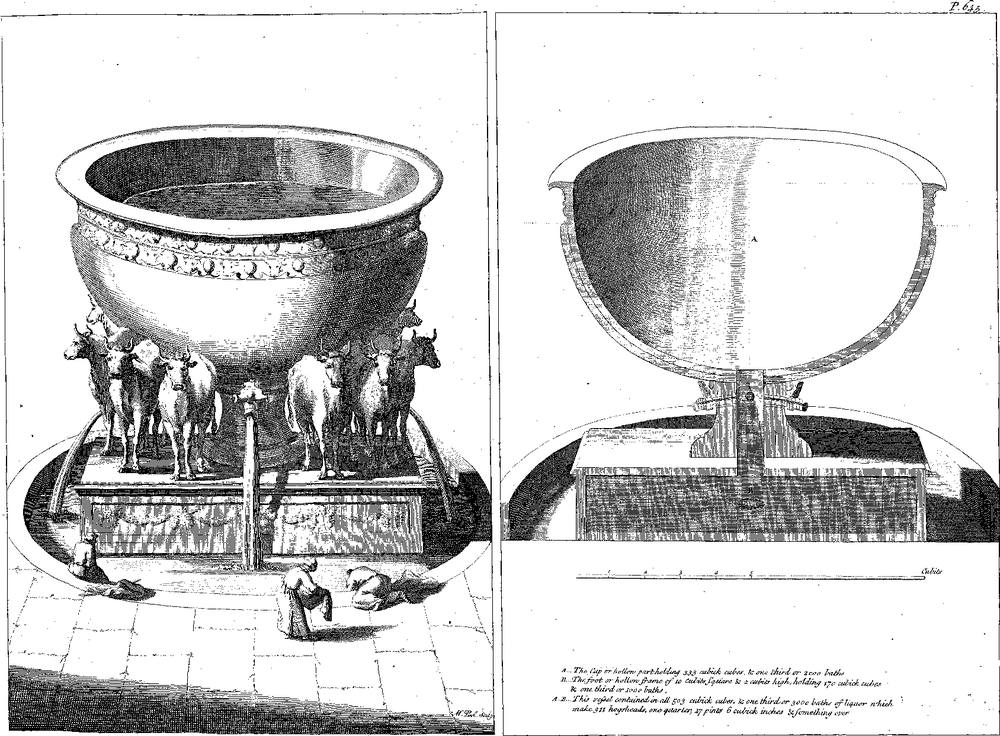
The brazen or molten Sea that Solomon made for the Temple; it had ten Cubits in Diameter from Side to Side, and therefore about thirty Cubits in Circumference. Taking the Hebrew Cubit at twenty 1 Kings vii. 23,26, &c.Inches and an half, the ten Cubits make seventeen Foot and an Inch; and the thirty Cubits make one and fifty Foot and three Inches. This Vessel was round, and of the depth of five Cubits. The Brim was adorn’d with an Edging, and embellish’d with Lilies, and Knobs and Oxe’s Heads in The Bath contains about 7 Gall. 4 Pints.Demi-relief. It contain’d three thousand Baths, as is said 2 Chron. iv. 5. or two thousand Baths, as mention’d 1 Kings vii. 26. This may be reconciled by saying, that the Cup or Bowl contain’d two thousand Baths, and the Foot, which was hollow, contain’d a thousand more. Thus this great Vessel was but of one Capacity within, tho’ it seem’d without to be double. This Sea was supported by its Foot now mention’d, which was as a thick hollow Column; besides which it was supported by twelve Oxen of Brass, disposed into four Groups, by three in a Group, and leaving four Passages between, by which they went to draw Water by three Cocks fix’d to the Foot of this Vessel. See 1 Kings vii. 23, &c. 2 Chron. iv. 2, 3, 4, 5, &c.
The Sea of Egypt, mention’d in Isaiah xi. 15. means that Part of the Mediterranean that waters the Coasts of Egypt.
The Tongue of the Sea. The Hebrews and Arabians call that a Tongue of the Sea which runs into the Land; as we call that a Tongue or Neck of Land, that advances into the Sea. See Joshua xv. 5. xviii. 19. Isai. xi. 15.
Read this article in its place on the printed pages
Footnotes
-
Plin. l. 6. c. 28. Vide Strabon. l. 16. p. 520. & Q. Curt. l. 10. ↩
-
Abulfeda, p. 70. of the Description of Arabia. ↩
-
Origen. homil. 5. in Exod. Eufeb. in Psal. cxxxv. Epiphan. hæres. 64. alii quidam ex Christian. ↩
-
Artapan. apud Eufeb. præpar. l.4. c. 17. ↩
-
Strabo. l. 14. Arrian. l. 1. de expedit. Alex. hist. l. 1. c. 10. Greg. Turon. hist. l. 3. c. 10. Cosmas. Monach. l. 5. p. 194. ↩
-
Quidam apud Greg. Turon. l. 1. c. 10. hist. ↩
-
Paul. Orof. ↩