Volume II, pages 625–643 of the 1732 edition, from SAT to SEA: everything printed on these pages, in order.
Continued from Satan
We have observed elsewhere, that the Hebrews ascribed to the Operation of Satan, the greatest Part of Bodily Distempers. Thus, Ought not this Woman, being a Daughter of Luke xiii. 16.Abraham, whom Satan hath bound, lo these eighteen Years, be loosed from this Bond on the Sabbath-Day?
By collecting all the Passages where Satan or the Devil is mentioned, it may be observed, that he fell from Heaven, with all his Company; that God cast him down from thence for the Punishment of his Pride; that by his Envy and Malice, Death, and all other Evils came into the World; that by the Permission of God he exercises a Sort of Government in the World, over his Subordinates, over Apostate Angels like himself; that God makes use of him to prove good Men, and chastise bad ones; that he is a lying Spirit in the Mouth of false Prophets, Seducers, and Hereticks; that it is he, or some of his, that torment, obsess, or possess Men, that inspire them with evil Designs, as he did David when he suggested to him to number his People, and to Judas to betray Jesus Christ, and to Ananias and Sapphira to conceal the Price of their Field. That he roves about full of Rage, like a roaring Lion, to tempt, to betray, to destroy us, and to involve us in Guilt and Wickedness.
That his Power and Malice are restrained within certain Limits, and controuled by the Will of God; that he sometimes appears to Men to seduce them; that he can transform himself into an Angel of Light; that he sometimes assumes the Form of a Spectre, as he appeared to the Egyptians while they were involved in Darkness in the Days of Moses; that he creates several Diseases to Men; that he chiefly presides over Death, and bears away the Souls of the Wicked to Hell; that at present he is confined to Hell, as in a Prison, but that he will be unbound and set at Liberty at the End of the World, in the Time of Anti- Christ; that Hell-fire is prepared for him and his; that he is to be judged at the Last Day. But I cannot perceive very clearly from Scripture, that he torments the Souls of the Wicked in Hell, as we generally believe.
SATRAPAS, or Satrapa. This is a Persian Word, which in its Original properly signifies an Admiral, or Commander of a Naval Armament, but afterwards it was generally given to Governors of Provinces, and to the principal Ministers of the Kings of Persia. We even find them a long time before the Kings of Persia, in the Satrapys of the Philistines, which were in being in the Times of Joshua and the Judges. ‘Tis true, that the Satrapys of the Philistines Judg. iii. 3. סרנים Seranim, Satrapæ.are called in Hebrew, Seranim; Plutarch. in Crasso. Jer. li. 27. שפסר Taphsar.from whence comes the Word Surenæ, which was also a Name of Dignity among the Persians. The General of the Army of the Parthians that killed Crassus, was called Surena. As for the Word Satrapas, with which we are now concerned, I find it in the Chaldee of Daniel1, in Ezra, and in Esther, under the Name of Achashdarpana, from whence the Greeks have formed Satrapa, by the Elision of some Letters both from the Beginning and End of the Word. This Term, in its Etymology, signifies a great Person that sees the Face of the King, or the Supporters of Majesty. See the Authors of the Hebrew and Chaldee Dictionaries, and the Commentators upon Dan. iii. 2. We find also in Jeremiah and in Nahum the Word Tapsar, which the Interpreters translate by Satrapas.
The Satrapæ, or Lords of the Philistines, were as so many petty Kings, who governed the five Satrapys with absolute Authority, that is, the five principal Cities of the Philistines. These People had sometimes Kings also in other Cities. Abimelech King of Gerar, for Example, and Achish King of Gath, were Philistines, but different from the Surenæ or Satrapæ of the five Satrapys, of which there is frequent mention made in the Book of Judges, and in the first Book of Kings. But the Persian Satrapæ were mere Governors of a Province, sent by the King, or Officers in his Armies. St. Jerome sometimes translates by Satrapæ2 the Hebrew Word Pachat, which signifies a General of an Army, or Governor of a Province; whence comes the Word Bacha, or Pacha, which is still a Word in use among the Turks to this Day. But the true Name of Satrapa is disguised under the Word Achashdarpana, which is read in Daniel, Ezra, and Esther, which are Books that were written during the Captivity, or soon afterwards.
SATUM, in Hebrew, Seah3, a sort of Measure of Capacity among the Hebrews. It contained about two Gallons and an half liquid Measure, or something above a Peck dry Measure.
SATURN, a Pagan Deity, whom they make Father to Jupiter. The Scripture no where mentions this false God, but several Interpreters think he is insinuated under the Name of Remphan, Acts vii. 43. where St. Stephen quotes Amos v. 26. See before the Article REMPHAN.
The Mythologists, and Fable-Writers, make Saturn to be the Son of Cælus and Vesta, or Heaven and Earth. He made his Father an Eunuch, that he might have no more Children. He married Cybele, or Rhea, by whom he had several Children; and knowing that one of ‘em was to deprive him of
the Government, he devoured them all as soon as they were born. Rhea being desirous of preserving her Son Jupiter, that was newly born, instead of the Child, gave to Saturn a Stone wrapt up in a Cloth, which he swallowed. When Jupiter grew up, he made War with his Father, overcame him, loaded him with Irons, and threw him into Hell, with all the rest that had assisted him in that War.
Saturn had three Sons by Rhea; Jupiter, Neptune, and Pluto; and a Daughter called Juno, a Twin-Sister, and the Wife of Jupiter. Some add to these Ceres and Vesta. ‘Tis said that Saturn governed in Italy after Janus, that there he set up a Community of Goods, and Equality of Conditions. Hence it was, that at the Feasts called Saturnalia, which were kept in the Month of December, Servants were used to sit at Table with their Masters, or even the Masters waited at the Table of their Servants. ‘Twas this Reign of Saturn which was called the Golden Age. Saturn was painted heretofore as a crooked old Man, having a Scythe in his Hand. The Dominion over the Times and Seasons was imputed to him, and in Greek they gave him the Name of Chronos, which signifies Time.
The Name of this false Deity has no Right to be admitted into a Dictionary of the Bible, which naturally should receive no other Names, but such as are consecrated to us by being mentioned in Holy Writ: But as Saturn has several Strokes of Resemblance with the Patriarch Noah; and as several false Gods, mentioned in Scripture, are the same as Saturn, according to the Opinion of several learned Men, the Reader will not think much to find this particular Account of him. It has been thought, that Baal, that Moloch, that Remphan, were the same as Saturn; that the Custom of sacrificing human Victims was derived from Saturn; that he was confounded with Abraham, or with Israel. The Antients speak of Saturn the Phenician, of Saturn the African or Carthaginian, of Saturn the Egyptian. See what has been said of BAAL, MOLOCH, and of the sacrificing of human Victims.
As to those Marks of Resemblance between Noah and Saturn, they are very evident. He is represented with a Scythe, as the Inventor of Agriculture. Noah in Scripture Gen. ix. 20.is called Vir Agricola, and it is said he began first to Till the Ground. The Saturnalia that were celebrated with Wine and Licentiousness, and wherein Masters became equal to their Servants, shew the Drunkenness of Noah, and the Curse that made Canaan subject to his Brethren, tho’ he was their Equal by Birth. Saturn is said to have devoured all his Children, except only Jupiter, Neptune, and Pluto. Noah saw the Waters of the Deluge destroy all the Men of his Time, many of which were his Relations, and younger than himself. In the Style of Scripture a Man is often said to do a Thing which he does not hinder to be done, or even what he foretells shall be done.
Jupiter, they say, made his Father an Eunuch, because Ham saw Noah’s Nakedness, and did not cover him. Shem, Ham, and Japheth, the Sons of Noah, are very plainly Typhon, or Pluto, Jupiter, and Neptune. Ham or Jupiter had Africa for his Portion; Japheth or Neptune had the Sea, or the Islands; Shem, or Pluto, had Asia. Shem had the greatest Privileges of all his Brethren, in respect of the True Religion. He was firm to the Lord, and always faithful to him; he dwelt with his Father. This Attachment made him odious to his Brethren, and their Posterity. Such great Prerogatives provoked their Hatred and Jealousy; for this Reason they feigned that he was God of Hell.
SAVARAN, or Saura. This is the Surname of Eleazar the Brother of Judas 43. Ἐλεάζαρ ὁ ΣαυαρὴνMaccabæus. Some think that Saura, or Savaran, was the Surname of Mattathias Father of Eleazar, because the Vulgate reads, Eleazar filius Saura. But the Greek has it, Eleazar surnamed Savaran; and the Syriack, surnamed Horam. ‘Tis not known whence he had the Surname of Saura. In 1 1 Mac. vi. Macc. xi. 5. he is surnamed Avaran, Avaron, or Abaron.
SAVIOUR, Salvator, Soter. This Name is appropriated to our Lord Jesus Christ, the Saviour of the World, who was prefigured by all those to whom the Scripture of the Old Testament gives the Name of Saviour, as Joshua, the Judges of Israel, the Kings David, Solomon, Josiah, and the Great Men raised up in an extraordinary manner, to deliver the People of God, as Mattathias, Judas Maccabæus, and the rest. The Prophets had marked out Jesus Christ under the Name of Saviour; thus, Isai. xii. 3. Isai. xix. 20. Isai. xliii. 11.for Example, With Joy shall ye draw Water out of the Wells of Salvation, or of the Saviour. The Lord shall send them a Saviour, and a Great One, and he shall deliver them. I, even I am the Lord, and beside me there is no Saviour. Lastly, the Apostles and sacred Writers of the New Testament, generally give to Jesus Christ the Name of Saviour by way of Eminence. When the Angel proclaimed his Birth, he said he should be called Jesus, that is, a Saviour; for he shall save his People from their Sins. Matth. i. 21. See also John iv. 42. Acts xiii. 23. Philipp. iii. 20. and elsewhere in many Places.
Saviour, to save, Salvation. We have already examined the several Acceptations of the Word Salvation under its proper Article. The Name Saviour is given
to the Patriarch Joseph. Pharaoh changed his Name, when he took him into his Service, and call’d him in the Egyptian Tongue, the Saviour of the World4. The Hebrew reads only, he call’d him Zaphnath-phaneah; and these Words are rather Hebrew than Egyptian. St. Jerome himself acknowledges, in his Hebrew Questions upon Genesis, that they signify in Hebrew, he that discovers Secrets. But in Egyptian they may have another Signification. And those who were consulted by St. Jerome upon this Point, might probably tell him, that they signified the Saviour of the World. Nevertheless Philo, Josephus, and others, who thought them also Egyptian, maintain, that in this Language Zaphnath-phaneah signifies one that discovers Secrets, or that interprets Dreams. The Syriack and Chaldee Paraphrasts, and two or three antient Greek Interpreters, are quoted for this, who explain it in the same Sense.
God often takes to himself the Name of Saviour of Israel. Vivit Dominus Salvator 1 Sam. iv. 39.Israel. David also calls him his Strength and his Saviour. Robur meum & Salvator meus. There is no Saviour besides me, says the Lord in the Prophet Hosea. And Isaiah; Thou hast Isai. xvii. 10.forgotten the God of thy Salvation, or thy Saviour. And in truth, God is the Saviour of Saviours, the God of Gods; without him there is neither Salvation, nor Deliverance, nor Succour to be hoped for. ‘Tis he that raises up Saviours to his People. For Example, he raised them a Saviour in the Person of Othniel, the Son of Kenez, against the King of Mesopotamia, who oppressed them. He raised them up another in Ehud, Son of Gerah, against Eglon King of the Moabites. ObadiahJudg. iii. 15. Obad. 21. promises, that the Lord will send Saviours upon the Mountain of Sion, to judge the Mountain of Esau. Probably he means the Maccabees, who subdued the Idumeans.
To save is commonly taken for defending any one in Danger. ‘Tis also taken for flying. Save yourself (or escape) upon this Mountain. I cannot save myself (or escape) upon the Gen. xix. 17, 19.Mountain. To save is also put for preserving; for Example, those who have escaped any Danger; who have fled from a Rout or Defeat, those who have escaped the Sword of the Conqueror. Salvatæ sunt reliquiæ populi, says Deborah in her Song. God has preserved his People, and defended it from the Hand of King Jabin. David fled and was saved. David fugit & salvatus est.
Gen. xix. 17. Prov. xi. 21.To save one’s Soul, to save one’s Life. The Seed of the Righteous shall be delivered, or saved. To save the Souls, is to save and preserve the Persons. Thou hast kept me alive (or saved me) from that I should not Ps. xxx. 3.go down to the Pit. Thou hast protected me, and preserved my Life; thou hast not suffer’d me to be reduced to the Condition of the Psal. lix. 3.Dead. Save me from bloody Men; deliver me out of their Hands. I will save thee from Jer. xxx. 10. Psal. xxxvi. 6. Mat. xxvii. 40, 42.afar; I will bring thee back from a distant Country, I will deliver thee out of Captivity. Thou preservest (or savest) Man and Beast; thou givest them their Subsistance; thy Providence is exerted over both of them, tho’ after a different Manner. Save thyself. He saved others, himself he cannot save. Thus said the Jews to Jesus Christ. Let him deliver himself out of this Danger; let him deliver himself from Death, as he has deliver’d others.
I. SAUL, King of Idumea, Gen. xxxvi. 37. This Saul was of Rehoboth, and succeeded Samlah of Masrekah.
II. SAUL, the Son of Kish, of the Tribe 1 Sam. ix. 1, 2, 3, &c.of Benjamin, the first King of the Israelites. One Day when Kish had lost his She-asses, he sent his Son Saul to seek after them5. After he had in vain travell’d over a good Part of the adjacent Country, and was upon the Point of returning to Gibeah to his Father, one of his Servants, that went with him, made this Proposal to him; Here is a very famous Prophet hard by, let us go and consult him; perhaps he may give us some Light into the Matter we were sent about. They went therefore to Ramah, where they were told that Samuel was just come into the City, and was going to offer a solemn Sacrifice with the Chief of the People. Saul therefore advanced towards him, and as soon as Samuel perceived him, he knew by Revelation, that this was he that was to reign over Israel. Saul asked him, where the Seer or the Prophet lived? and Samuel said to him; “‘Tis I that am the Seer. Come along with me, you shall eat with the Chief of the People whom I have invited, and to Morrow I will send you away, and will tell you all that you desire to know. As to the Asses you have lost, you need not be in any Concern for them, for they are already found. Who should have of the best of all Israel but you, and the House of your Father?” Saul answered him; “Am I not of the Tribe of Benjamin, which is the smallest in Israel? And is not my Family the least in the whole Tribe? Why therefore do you speak to me in this manner?” Samuel made Saul and his Servant enter into the Room where the Feast was kept, and placed them at the Head of the Table, and, by way of Distinction, served up to Saul a whole
Shoulder of a Sacrifice. After Supper Samuel conducted Saul to his Lodging, which was upon the Platform of the House, and on the Morrow Morning he brought him down again, and came with him below the City of Ramah.
As they were going down the Hill, Samuel said to Saul; Make your Servant go before, and stay with me a little, that I may let you know what the Lord has said to me concerning you. At the same time Samuel took a little Phial of Oil, which he poured upon the Head of Saul, kissed him, and 1 Sam. x. 1, 2, 3, &c.told him; “By this Unction the Lord consecrates you this Day to be the Prince of his Inheritance, and you shall deliver his People from their Enemies. And this is the Token that you shall have, that the Lord has chosen you for King: As soon as you shall have left me, you shall meet two Men coming from towards the Grave of Rachel, who will tell you that your Father’s Asses are found again. From thence, when you come to the Oak of Tabor, you shall meet three Men who come to worship the Lord at Bethel; they shall present you with three Loaves, which you shall receive from their Hands. Lastly, when you shall come to the Hill of God, where is the Station of the Philistines, you shall find a Company of Prophets coming down from the high Place, with all Sorts of Instruments of Musick. At the same Time the Spirit of the Lord shall seize you, you shall prophesy along with them, and you shall be changed into another Man. After all these Signs shall have been given you, act as Occasion shall require, and the Lord shall be with you.” All that Samuel had foretold him was fulfilled that same Day, and God changed him into another Man. When he came to the Company of the Prophets, he began to prophesy along with them; and all those that saw him, said with wonder; What is it that has happened to the Son of Kish? Is Saul also among the Prophets? And this afterwards became a kind of Proverb among them.
Some time after this,6 Samuel assembled all the People at Mizpeh, to give them a King as they had desired. He cast Lots upon all the Tribes of Israel, and the Lot fell upon the Tribe of Benjamin. Then he cast them upon all the Families of this Tribe, and it fell upon the Family of Matri. Lastly, he cast them upon the Family of Kish, and the Lot fell upon the Person of Saul. He was immediately sought for, but could not be found. They then consulted the Lord, and he gave Answer; That he was then concealed in his own House. They ran thither, and brought him forth; and when he was in the midst of the People, he appeared taller than the rest by the whole Head. Then Samuel said to the People; You see who it is that the Lord hath chosen. And all the People shouted and cry’d, God save the King. After this Samuel declared before all the People, what were the Laws and Conditions of the new Kingdom, and then dismiss’d the Assembly. Saul returned to Gibeah, accompanied by a Part of the Army, consisting of such whose Hearts the Lord had inclined to the Interests of Saul. Others despised Saul, and said; How shall this Man save us? But Saul regarded them not, and pretended not to hear them.
About a Month afterwards, Nahash King of the Ammonites, laid Siege to the City of Jabesh-Gilead; and the Men of Jabesh agreed to surrender themselves to him, if in seven Days none should appear in Israel to bring them Relief. To this Nahash consented, and Messengers were sent from Jabesh to Gibeah, to acquaint the People, that the King of the Ammonites had lain down before the City, and threatened to put out every Man’s right Eye, and to make them all a Reproach to Israel. Saul then happened to return out of the Field with his Oxen, and seeing the People weep, he asked the Reason of it. When he was told it, he fell into a great Passion, took his Oxen and cut them to Pieces, and sent the Pieces into all the Coasts of Israel, saying; Thus shall it be done to the Oxen of all those that shall not follow Saul and Samuel. All the People therefore repaired to Bezek, where Saul reviewed them, and found the Number of the Men of Israel to be three hundred thousand, and those of Judah thirty thousand. The Army then began to march, pass’d over Jordan, and the Day following by Break of Day arrived near the Camp of the Ammonites. Saul attack’d them in three Places at once, put them to the Rout, and kill’d a great Number of them; and so dispersed them, that hardly two could be found together. After this all the People return’d to Gilgal, where they solemnly renewed the Election and Inauguration of King Saul. This is what happened in the first Year of the Reign of Saul7.
Two years afterwards8 Saul chose three thousand Men out of all Israel, of which he gave a thousand to Jonathan, and kept two thousand about his own Person, that he might make head against the Philistines, who had taken Possession of strong Posts at Mickmash, Bethel, and Gibeah. Jonathan
defeated the Garison that was at Gibeah, upon the News of which the People took Courage, and thought that this was the Time for shaking off the Yoke of the Philistines. They assembled therefore in great Numbers, and appear’d in Arms before Saul in Gilgal. On the other side, the Philistines having Intelligence of this, came with a prodigious Army, and encamped at Michmash, to the East of Bethel. When the Israelites saw themselves thus inclosed, they began to withdraw themselves, some one way and some another. Saul continued seven Days at Gilgal, expecting the Arrival of the Prophet Samuel. At last, seeing he did not come, tho’ he had promised to be with him within seven Days, he began to offer Sacrifices to God. But he had no sooner finished than Samuel arrived, and told him he had done ill to offer Sacrifices, without staying for an Order from the Lord. If he had done this, God would have confirmed his Kingdom for ever over Israel. But now, added he, your Reign will not continue long; the Lord has found out a Man according to his Heart’s Desire, whom he has appointed to be the Head of his People, because you have not obey’d what he had directed by my Mouth, and have not staid for my Arrival for seven Days.
1 Sam. xiv. 1, 2, 3, &c.Samuel and Saul, with the six hundred Men that had continued with them, went from Gilgal to Gibeah; and the Philistines that were at Michmash came also and encamped at Gibeah. One Day as Jonathan and his Armour-bearer went towards the Camp of the Philistines, and entering therein in such manner as is mentioned before under the Article JONATHAN; all on a sudden the Camp of the Enemy was in Confusion, and the Centinels of the Camp of Saul saw the Ground all covered with dead Bodies. They began to examine then who was gone out of the Camp, and it was found to be Jonathan. Saul then consulted the Lord by the High-priest; but before the Ceremony was over, a great Noise was heard, ‘twas perceived that the Philistines had slain one another, and had made a great Havock in their Camp. Saul with his People then began to pursue the Enemy; and the Israelites rallying that had fled away before, they kill’d a great Number of the Philistines, and pursued them on one Hand as far as Bethel, called afterwards Beth-aven, because of the golden Calves that were set up there; and on the other Hand as far as Aijalon.
But upon this Occasion there happened a thing that gave some Disturbance in Israel. Saul on this Day had denounced a Malediction, and said; Cursed be he that shall eat any thing till the Even. Now Jonathan not knowing what had passed, as he went through a Wood he found some Honey, and taking some upon the End of his Staff, he just tasted it. In the Evening, when the People were gathered together after the Victory, Saul said to ‘em; This Night let us make an Assault upon the Camp of the Philistines, and let not one remain till to morrow Morning. The People answered him; Do what you please. The High-priest proposed to them to consult the Lord, but the Lord answered not. Then Saul judging that God was provoked by some Crime that had been committed among them, he ordered the Lot to be cast upon all the Tribes, and all the Families of Israel; and the Lot fell upon Jonathan. Saul told him, that on Necessity he must dye for his Inadvertence; but all the People opposed it, and delivered him from this Danger. When Saul had strengthned himself in the Kingdom of Israel, he carried his Arms abroad, among all the Enemies of his Nation; against Moab, Ammon, Edom, against the Kings of Zobah in Syria, and against the Philistines;9 and which way soever he turn’d himself, he always remained victorious. The Times and Circumstances of these Wars are unknown.
After this Samuel brought him Orders from the Lord, that he should make War against the Amalekites, and utterly exterminate this People; that he should spare no body, neither Man nor Beast, nor any valuable Things whatever that should fall into their Hands. Saul therefore took the Field against the Amalekites, set upon them and defeated them; but he saved the Life of the King, and of the best of the Cattle, and preserved some of the best Things of the Booty. Afterwards he returned to Gilgal; but as he passed by Mount Carmel, which is to the South of the Portion of Judah, and very different from that Carmel that lies upon the Mediterranean, he there erected a Triumphal Arch; or, as the Hebrew speaks,10 He set him up a Hand,11 or Monument. Samuel also coming to Gilgal, Saul went to meet him, and said to him; I have fulfilled the Word of the Lord. To which Samuel replied; Whence then is this lowing of Oxen, and bleating of Sheep, that sounds in my Ears? Saul answered him; The People have brought of the best of the Flocks of Amalek, to offer Sacrifices to the Lord. Then Samuel said to him; When you were little in your own Eyes, the Lord made you the Head of his People, and he sent you utterly to root out Amalek; but you, on the contrary, have
preserved what you thought fit of the Plunder of this People. Saul endeavoured to excuse himself, and would have thrown the Fault upon the People, who were obstinately bent to preserve these Things for a Sacrifice to the Lord. But Samuel told him; It is not Sacrifice that the Lord requires, but an implicit Submission to his Commands: That Obedience was better than Burnt-offerings, and that God regards the Sin of Disobedience with the same Detestation as Witchcraft or Idolatry. As you have rejected the Word of the Lord, so has the Lord rejected you, and will not have you any longer as a King over his People.
Saul then replied to Samuel; I have sinn’d in disobeying the Commands of the Lord; but pray to God that he will forgive me this Fault, and come along with me to worship the Lord. Samuel said he would not go, and at the same time turn’d away from him. But Saul laying hold of his Garment, it tore in his Hands. Then Samuel said to him; Thus has the Lord torn away the Kingdom from you, and has given it to another that is better than you. a The Strength (or Victory) of Israel will not lye nor repent; for he is not a Man that he should repent. Some apply these Words to Saul; as if Samuel, by a bitter Irony, should say, that a Prince like him that could erect triumphal Arches, was not a Man to repent: But it seems most eligible to refer them to God, who would not revoke the Sentence he had pronounced against Saul. However Samuel did not persist in refusing to follow Saul, but return’d with him to the Camp at Gilgal. Then he made Agag King of the Amalekites be brought before him, and cut him in Pieces with his own Hand.
Some Years afterwards12 Samuel went by Order from the Lord, to give the Royal Unction to David; from which Time the Spirit of the Lord withdrew from Saul, and God suffered that he should be actuated by an evil Spirit, who taking Occasion from the evil Disposition of the Humours of this Prince, and his melancholy Temper, moved and agitated him, or possessed him. Then his Courtiers caus’d David to attend him, to sooth his Distemper by the Sound of musical Ita Rab. & Interpret. plures.Instruments, upon which David could play very skilfully. Saul took an Affection for David, made him his Esquire or Armour-bearer, and always had him near his Person. About eight Years afterwards,13 when the Philistines came and encamped between Shochoh and Azekah, Saul with the Army of Israel took their Station in the Vale of Elah. But in the Army of the Philistines there was a Giant, by Name Goliath, who came daily to insult the Army of Israel, challenging any one to come forth and fight him. Saul had promis’d to give his Daughter in Marriage to any one that should fight with him and overcome him, but no one was found hardy enough to encounter him. David, who now for a long Time had retired from Court, and lived with his Father at Bethlehem, was sent by him into the Camp about this Time; and being offended at these daily Insults of Goliath, undertook to fight with him, which he did, and beat him, as we have elsewhere observed under the Articles GOLIATH and DAVID. Saul had now so far lost all Remembrance of David, that he knew him not when he presented himself before him. But after this Victory over Goliath, he kept him always about him, and made him one of his Commanders.
1 Sam. xviii. 1, 2, 3, &c.But he took a Grudge against him, because at his Return from an Expedition against the Philistines, the Women that sung and danced before the victorious Army, cry’d out, that Saul had kill’d his thousands, and David his ten thousands. One Day therefore, as he was in his House under the Influence of the evil Spirit, and David was playing upon an Instrument before him, he attempted to pierce him through with a Lance that he held in his Hand: But David turned aside, and avoided the Blow. He afterwards gave him the Command of a thousand Men, and promis’d him Merab his eldest Daughter, tho’ at the same Time he had no Intention to let him have her. He only sought for an Occasion of putting him to Death by the Hand of the Philistines, by often exposing him to imminent Dangers. He afterwards marry’d his Daughter Merab to another, and promis’d him his second Daughter Michal; then he acquainted David, that he required no other Dowry for his Daughter than an hundred Foreskins of the Philistines. David soon perform’d this Condition, and married Michal. Saul seeing that David by his Valour acquired new Reputation every Day, resolved to put him to Death14. Jonathan for a time diverted him from his Purpose; but afterwards, when Saul relapsed into his usual Melancholy, and being moved by the evil Spirit, he attempted once more to pierce David with the Lance he held in his Hand. David escaped this Blow also, and immediately retired to his own House, which Saul order’d to be beset. In the Night-time Michal let him down out of a Window, by which means he escaped.15
He then withdrew to Samuel at Naioth in Ramah. Saul sent some Messengers thither to apprehend him, but those he sent, for three times together, were no sooner come to Naioth, but were seized there by a prophetick Spirit, and began to prophesy among the Prophets, in the midst of whom was David. When Saul at last came thither himself, he began to prophesy as well as the rest. In the mean Time David withdrew 1 Sam. xix. 1, 2, 3, &c.to Gibeah, where he had a Conference with Jonathan Saul’s Son. There they renew’d their Friendship, and Jonathan promis’d David to let him know two Days after, all that he could discover of Saul’s Intentions concerning him. The Day following he spoke to his Father, and easily perceived by the Answer he received, that David’s Destruction was resolved upon. He gave him Information of it, and then they parted. See the Articles DAVID and JONATHAN.
1 Sam. xxii. 6, 7, 8, &c.David then came to Nob, a and having received a Sword and some Refreshments from the High-priest Ahimelech, Saul was inform’d of it some time after by Doeg the Idumean, who happened to be at Nob when David came thither. Saul immediately sent to Nob, to fetch all the Priests to him that were there; and no sooner did they come before him, but he severely reproached them with having supported his Enemy; and not having Patience to hear their Excuses, he had them all butcher’d before his Face, to the Number of fourscore and five Persons. He went himself afterwards to Nob, and put all the Inhabitants to the Sword, Man, Woman, and Child; not so much as sparing the sucking Infants, nor the Cattle that came in his way.
Some time after,16 Saul being informed that David was in the City of Keilah, he said to himself; Now has God delivered him into my Hands, since he is shut up in a walled City. But David quitted this City, and retired into the Wilderness of Ziph, so that Saul’s Expectation was disappointed. Once when this Prince was advertised, that David concealed himself in the Desart of Maon, he pursued him thither with an Army; but when he was very near taking him, he had Intelligence that the Philistines were just coming to make an Irruption into the Country; upon which he quitted his Pursuit, and went to the Succour of his own People.
Then David retired into the Wilderness of En-gedi,17 and Saul went after him with his Troops; but finding himself constrain’d by the Necessity of Nature, he enter’d into a Cave, where David and his People were hid. David coming softly behind him, cut off the Lappet of his Coat, he not perceiving any thing of the Matter. When he went out, and was at a good Distance, David went after him, and shew’d him the Lappet of his Coat that he had cut off, and told him, that it was in his Power to have killed him, but that he would never lift up his Hand against the Lord’s Anointed. Saul was moved with the Generosity of David, and could not forbear shedding Tears; acknowledging himself to be unjust, in thus pursuing the Life of a Man that intended him no Harm. After this he went back into his own House, and David retired into the Wilderness of Ziph18. When the Ziphites knew it, they went presently and gave Saul Notice of it, who came with his Army upon the Hill of Hachilah. While he was encamped in this Place, David went by Night into his Camp, and penetrated even into the King’s Tent, where having found every body asleep, he took the King’s Lance and Cup, and then went again out of the Camp.
When he was on the other Side of the Mountain, he cry’d out to the Camp of Saul, that some one should come to fetch the King’s Cup and Lance that he had taken; and at the same Time made Remonstrances of his Innocence to Saul, and of his Injustice in persecuting him thus, tho’ he had never done him any Injury. Saul acknowledged both, and returned again to own House. But David being apprehensive that he might at last fall into the Hands of this Prince, he took Refuge with the King of Gath; which when Saul 1 Sam. xxvii. 1, 2, 3, &c.knew, he thought no longer of seeking after him. Some Years after this the Philistines invaded the Land of Israel with a powerful Army,19 and encamped at Shunem in the Valley of Jezreel. Saul and his Troops took the Field also, and encamped upon the Mountains of Gilboa. But when Saul saw the Army of the Philistines, which was very formidable, his Heart began to fail. He consulted the Lord by his Priests and Prophets, but the Lord returned him no Answer; so that not knowing who to address himself to, he found out a Witch or Enchantress, who had a Spirit of Prophecy, or a familiar Spirit, and who was then famous for raising the Ghosts of the Dead.
Some time before, Saul had banish’d all Wizards and Magicians out of his Dominions; and that he might not be known by the Witch, he disguised himself, and20
went with a small Retinue. He desired her to raise up Samuel to him, who had been now dead for some time. As soon as she saw the Prophet come up, she put forth a great Cry, and said to Saul; Why have you deceived me, for you are Saul? Saul bid her fear nothing, and asked her who she saw. She answer’d, I see the Gods, or a great 1 Sam. xxviii. 13. אלהים ראיתMan, a Prince, a Judge of Israel. The Hebrew makes use of Elohim, which is a Name given to Princes and great Men. What is he like? says Saul. She answer’d; He is an old Man covered with a Mantle. Saul knowing it to be Samuel, fell down at his Feet; and Samuel said to him; Why have you disturbed my Rest, by raising me up? The Lord is withdrawn from you, and will perform all that he has promis’d in favour of your Competitor. To Morrow you shall be with me, you and your Sons, and the Lord will deliver the Camp of Israel into the Hands of the Philistines. Saul fell down immediately, and remain’d extended upon the Earth; for he had eat nothing all that Day.
The Witch intreated him to take a little Nourishment, and not to suffer himself to be overcome by his Trouble. He refused it at first, but being much importuned by the Woman, and by his own People, he eat something of what was at hand; after which he went away, and marched all Night, that he might come soon enough to his Camp. The next Day the Battle was 1 Sam. xxix. 1, 2, 3, &c.fought, in which the Israelites were put to Flight before the Philistines; and the Sons of Saul, Jonathan, Abinadab, and Malchishua, were slain in the Battle. Saul himself was pressed very hard, the Archers shooting at him, and wounding him dangerously. Seeing his Case was desperate, he said to his Armour-bearer; Draw your Sword and kill me, that these Uncircumcised may not still insult me, and take away my Life; but his Armour-bearer was startled at this Proposal, and refused to do it. Saul then took his Sword and fell upon it; and his Armour-bearer finding him to be dead, follow’d his Example, and slew himself also. Thus died Saul the first King of Israel, after a Reign of forty Years. An Amalekite, who by chance was near, took off his Crown and Bracelet, and brought 2 Sam. i. 1, 2, 3, &c.them to David. He told David that he himself had slain Saul, because the Sword of Saul could not pierce through his Armour; but we think he disguised the Truth to David, and falsly boasted that he had slain the King of Israel. He hoped, no doubt, that David would have given him some great Reward for this Service; but instead of that he had him put to Death, for presuming to lay Hands upon the Lord’s Anointed. David bewail’d the Fate of Saul and Jonathan, and composed a mournful Elegy upon this Occasion, in which he celebrated the Valour and great Actions of those two Princes.
1 Sam. xxxi. 8, 9.The Day after the Battle, when the Philistines came to take the Spoils of the Dead, they found Saul and his three Sons extended upon the Plain. They cut off Saul’s Head, and took away his Armour, which was carried to the Temple of Ashtaroth; and they hung up his Body against the Walls of Beth-shan, which probably were opposite to the chief Street, 2 Sam. xxi. 12.because it is said in the Second Book of Samuel, that his Body was hung up in the Street of this City. As to his Head, we 1 Chron. x. 10. 1 Sam. xxxi. 11, 12, 13.read in the Chronicles, that it was fastened up in the Temple of Dagon. Some time after, when the Inhabitants of Jabesh-gilead were inform’d of the Indignities that were offer’d by the Philistines to the Bodies of Saul and his Sons, whom they had hung up against the Walls of Beth-shan; they went by Night and took them down, and brought them into their City beyond Jordan, where they burnt the Remains of the Flesh of the Bodies, and buried the Bones in the Grove that was near their City. They fasted and mourned for the King for seven Days, in Commemoration of that Service he had done their City at the Beginning of his Reign, when he delivered them from the Cruelty of the King of the Ammonites. Several Years afterwards David had these Bones removed from the Grove at Jabesh, and put into the Sepulchre of Kish the Father of Saul, at 2 Sam. xxii. 12, 13, 14.Gibeah. Ish-bosheth, the fourth Son of Saul, succeeded him in the Kingdom, and reigned at Mahanaim beyond Jordan, over the eleven Tribes; for David then began to reign over the Tribe of Judah.
It has been Matter of Inquiry, whether Saul upon this Occasion could put himself to Death, without being guilty of a Crime? And what may be thought of his Salvation? The Rabbins a commend Saul for his Submission to the Orders of God, and exalt the Obedience of this Prince, who notwithstanding the terrible Denunciations of Samuel, and the Certainty of his own and his Sons Death in the Battle, yet did not endeavour to avoid it. They add, that what induced him to put himself to Death was, the Fear he had that the Name of God should be blasphemed and affronted by the Philistines, if the King of his People should come alive into their Hands. But these Reasons have but little Solidity in them. In the last Actions of Saul, no more than in the first, there does not appear any Mark of a certain and solid21
Rom. iii. 8.Repentance. We do not see that he had Recourse to God, or that he had any View to his Glory, when he put himself to Death. And tho’, by an erroneous Conscience, he might persuade himself that by this means he should hinder the Philistines from blaspheming the Name of God; it would not follow that his Action would be lawful or praise-worthy. St. Paul tells us, that we must not do Evil that Good may come of it. But Self-murder is certainly a very great Evil. Besides Saul by his Death could not prevent the blaspheming of the Philistines, since they would equally blaspheme the Name of the Lord, whether Saul fell into their Hands dead or alive. Lastly, the Scripture will not allow us to doubt of the final Perdition of Saul, when 1 Chron. x. 13, 14.it says; So Saul died for his Transgression which he committed against the Lord, even against the Word of the Lord, which he kept not, and also for asking Counsel of one that had a familiar Spirit, to enquire of it: And enquired not of the Lord. Therefore he slew him, and turned the Kingdom unto David the Son of Jesse.
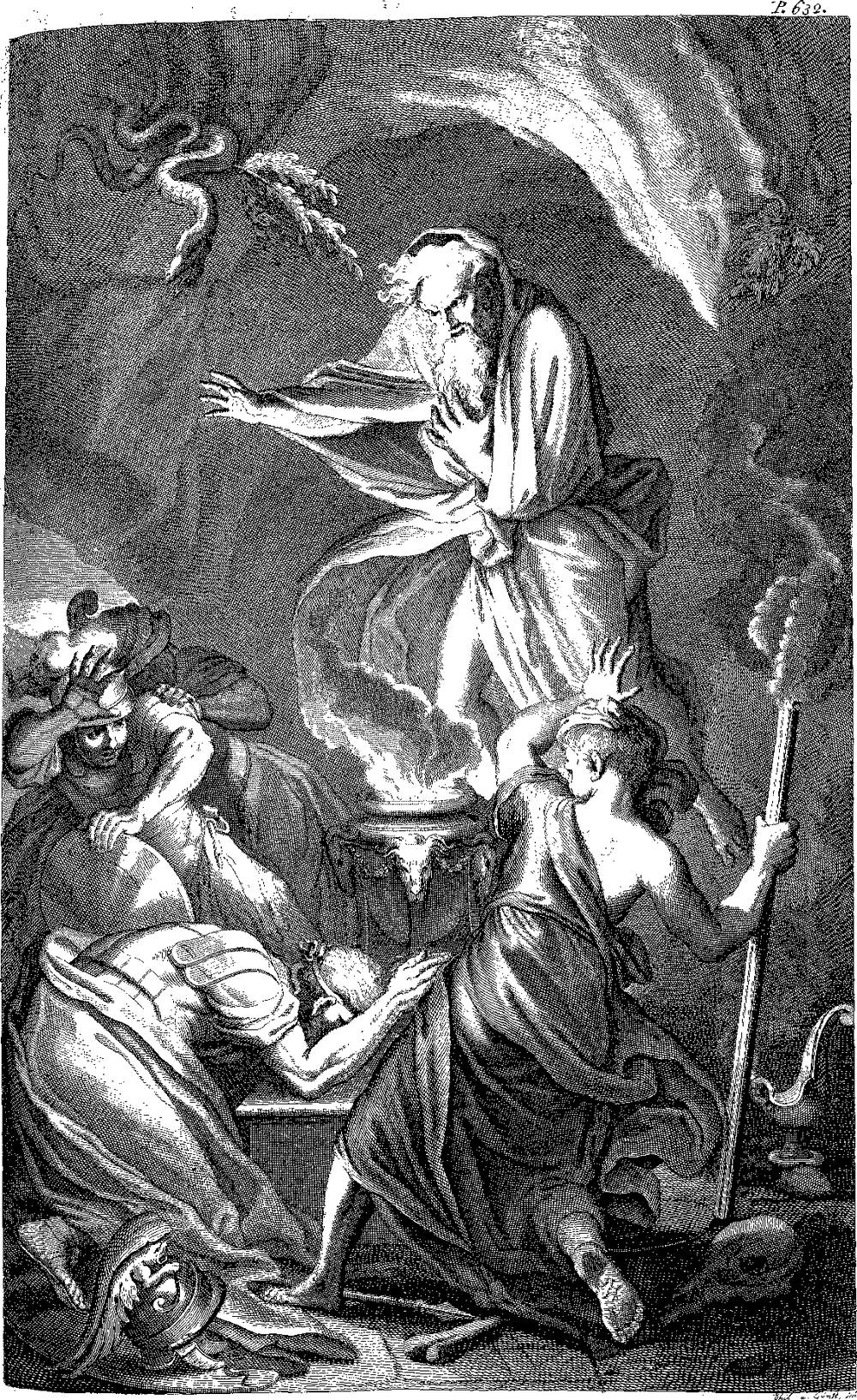
As to Saul’s Action of consulting the Witch, it is needless to examine it according to the Rules of Morality, since it is so manifestly contrary to the Laws of God. Under the Article SAMUEL, we have already seen the several Opinions that have been advanced concerning the Appearance of this Prophet to Saul.
III. SAUL. Saulus, surnamed Paul. See PAUL.
SAW. The Punishment of the Saw was not unknown among the Hebrews. It is mentioned in Daniel, and in the Epistle to the Hebrews. I imagine this Punishment came originally from the Persians or the Chaldeans. I am assured that it is still in Use among the Switzers, and that they put it in Practice not many Years ago, upon one of their Countrymen guilty of a great Crime, in the Plain of Grenelles near Paris. They put him in a Kind of Coffin, and saw’d him at Length, beginning at his Head, as a Piece of Wood is sawn. Parisalis, King of Persia, caused Roxana to be sawn in two alive. Valerius Maximus Ctesias in Persic.says,22 that the Thracians sometimes made living Men to undergo this Torture: Vivos homines medios secare. The Laws of the twelve Tables, which the Romans had borrowed from the Greeks, condemned certain Crimes to the Punishment of the Saw. But the Execution of them was so rare, as Aul. Gell. Noct. Att. l. 12. c. 2. Herodot. l. 6.Aulus Gellius says, that none remembred to have seen it practised. Herodotus relates, that Sabacus, King of Egypt, received an Order in a Dream, to cut in two all the Priests of Egypt. Caius Caligula the Emperor, often condemn’d People of Condition to be sawn Sueton. in Caio.in two through the Middle; aut medios serrâ dissecuit.
This Matter is not less frequent in Scripture. St. Paul in his Epistle to the Hebrews23, speaking of the Calamities suffered by the Prophets and Saints of the Old Testament, says, there were some who had undergone the Torture of the Saw. Serrâ secti sunt. Origen24, Justin Martyr25, St. Jerome26, the Author of the Poem against Marcion, printed under the Name of Tertullian27, and several others of the Antients, have explain’d this Passage concerning the Death of Isaiah, who is said to have been put to Death by King Manasses, with a wooden Saw. This Circumstance of a Saw of Wood is perplexing; for no Saws are made of Wood; and besides, a Man could not be cut in two with such a Saw. We have elsewhere proposed our Conjecture upon this Matter, by supposing this Saw of Wood was perhaps nothing else but a Sledge loaded with Stones and Iron Spikes, with which they smooth’d the Ears of Corn, to get out the Grain. Or might it not be understood more simply of a Wood-Saw, that is, a Saw fit for sawing Wood? For there are Saws of several Kinds, for Stone, for Marble, for Iron, for Bones, for Trees, for the Use of Gardeners, for Wheelwrights, for Joiners.
Daniel also speaks of the Punishment Susan. 55.of the Saw. Even now the Angel of God hath received the Sentence of God, to cut Mat. xxiv. 51.thee in two. St. Matthew says, that the wicked Servant shall be cut in two, and thrust among the Hypocrites. The Hebrew Text of the Old Testament often makes Allusion to this Custom, when it uses the Word, to cut in two, to divide, for putting to Death. See 1 Sam. xvi. 31, 33. Exod. xix. 14. and 2 Sam. vi. 8.
SCANDAL, Scandalum. This Word in antient Greek Authors, according to Pollux, signifies that Part of a Mouse-trap, that is suspended by the Noose; or the bended Piece of Wood that supports what they call the Hammer, according to the Scholiast of Aristophanes. In general, according to Hesychius, Scandalum signifies a Snare, an Incumbrance. In Scripture and in Ecclesiastical Authors, Scandal is put for Levit. xix. 14. apud 70.any thing that a Man finds in his Way, that may occasion him to fall. Thus Moses forbids to put a Stumbling-block (or Scandal) before the Blind; that is, neither Wood, Stone, nor any thing else, that may Ex. xxiii. 33.make him stumble or fall. Elsewhere he forbids the Israelites to make a Covenant with the Canaanites, for fear they should be perverted
to Idolatry, which would be a great Snare or Scandal to them. Saul gave David his Daughter Michal in Marriage, hoping this Match might prove a Snare and Scandal to 1 Reg. xviii. 21.him. Ut fiat ei in scandalum. The Lord shall be the Happiness and the Sanctification of those that fear him; but for a Stone of stumbling, and for a Rock of Offence (a Scandal) to both the Houses of Israel; for a Gin, and for a Snare to the Inhabitants of Jerusalem. Jesus If. viii. 14.Christ says to St. Peter, when he would persuade him against his Passion; Get thee behind Matt. xvi. 23.me, Satan, thou art an Offence unto me. Lastly, he says of himself; Blessed is he whosoever Matt. xi. 6.shall not be offended (or scandalized) in me; or for whom I shall not be an Occasion of Scandal; to whom my Life, my Poverty, my Birth, my Death, my Cross, shall not give or administer Scandal.
The Greek Word Scandal a answers to the Hebrew Mashcul, which comes from the Root Shacal, to fall, to tumble; and in the Conjugation Hiphil signifies, to make to fall, to overthrow, to lay Snares, &c. In a moral Sense, there is an active and a passive Scandal. The first is that which we afford others by our Words or Actions; and the second is that which we receive from others, by seeing their evil Actions, or by hearing their pernicious Discourses. Jesus Christ in his Gospel affirms, It must needs be that Offences come, or Scandals Matt. xviii. 7.must of necessity arise. But he adds, Woe to that Man by whom the Offence cometh. If your Hand or Foot are a Cause of Scandal to you, cut them off, and cast them from you; you had better enter into the Kingdom of God without Hand or Foot, than be cast into outward Darkness with all your Limbs intire. He says moreover, Have a Care of offending (or scandalizing) one of these little ones that Mark ix. 41.believe in me; it were better for him that gives the Scandal that a Mill-Stone were hung about his Neck, and he were cast into the Sea, than that he should administer an Occasion of Scandal. Jesus Christ, in respect of the Jews, was a Scandal and Rock of Offence, against which they struck, and upon which they have fallen, and are broken.
Rom. ix. 33. 1 Pet. ii. 8.In the Latin Vulgate, the Word Scandalum is often used in different Senses, which it may be convenient to explain here. UsquequExod. x. 7.ò patiemur hoc Scandalum? How long shall Moses be a Snare to us? How long shall he pursue us, as a Fowler pursues his Game? Or else, How long shall we suffer the Israelites to continue among us, who are a stumbling Block to us? Or, more plainly, How long shall we suffer these Misfortunes that thus overwhelm us? Pax multa diligentibus legem Psal. cxviii. 165.tuam, & non est illis scandalum.Ezek. vii. 19. They enjoy profound Peace, without Misfortune, without Discontent. Scandalum iniquitatis eorum factum est. They are fallen into those Disasters which their Iniquities deserved. They have undergone the Punishment of their Crimes. Ne ponas scandalum Prov. xxii. 25.animæ tuæ. Do not expose yourself to the Fury of a passionate Man, for fear it should be as much as your Life is worth. The Humiliation of Jesus Christ, his Cross and Sufferings, are, as it were, for a Stone of Stumbling, and for a Rock of Offence to both the Houses of Israel, for a Gin and for a Snare to the Inhabitants of Jerusalem28, because they could not be convinced, that such humble Qualifications could belong to the Messiah they expected.
Eccl. xxiii. 7. Eccl. xxxii. 19.The Author of Ecclesiasticus generally takes the Verb to scandalize, in the Sense of exposing one’s self to Danger. Ne fueris hypocrita, & non scandalizeris in labiis tuis29. Forbear to use Hypocrisy and Dissimulation, and let not your Lips expose you to the Danger of passing for a double Heart. The Greek says, Form not yourself upon the Words of Men, and give no Attention to their Discourse. Reckon not upon every Thing that Men may say of you, nor upon what they may say to you. Their Discourse ought not to be the Rule of your Conduct. And elsewhere, Doctrinam oris audite, filii, qui custodierit illam ----- non scandalisabitur in operibus pessimi. He that will hear my Instructions, shall not fall into criminal Actions: Or rather, shall not be overturned, as a Man that hits against a Stone, and he shall not be seen to commit criminal Actions. And again, Qui insidiose agit scandalisabitur in ea (sapientia). He that seeks not Wisdom sincerely, instead of finding it, shall fall into a Snare, and be overthrown.
The Mountain of Scandal, Mons offensionis, was the Mountain of Olives, upon which Solomon built Temples, and erected Altars to his false Gods, to please the strange Wives he had taken. See 1 Kings xi. 4. 2 Kings xxiii. 13.
SCENOPEGIA, a Greek Word30, which properly signifies the rearing of Tents, and which is used for the Feast of Tabernacles, in which the Hebrews dwelt under green Tents for eight Days, in Commemoration of the Pilgrimage of their Fathers in the Wilderness, where they lodged under Tents for forty Years. Levit. xxiii. 34, 35, &c. See TABERNACLE and FEAST OF TABERNACLES.
SCEPTRE, Sceptrum, in Greek, Skeptron, in Hebrew, Shebet. This Word properly signifies, I. A Rod of Command, a Staff of Authority, a Sceptre, which is supposed to be in the Hand of the Gods, of Kings, of31
Governors of a Province, of the Chief of a People. Jacob foretold to Judah, that the Gen. xlix. 10.Sceptre should not depart from Judah, nor a Lawgiver from between his Feet, until Shiloh come, and unto him shall the gathering of the People be. And Balaam also foretelling Numb. xxiv. 17.the Coming of the Messiah, says, A Sceptre shall rise out of Israel. Baruch speaks of the Sceptre that the Babylonians Bar. vi. 14.put into the Hands of their Gods. Sceptrum habet ut homo, sicut Judex regionis. They are given also to Scribes, to Commissaries, Judges v. 14. Isai. xiv. 5. xix. 11,14.who keep a List of the Troops. Also the Prophets often speak of the Sceptre of Dominion; and Amos represents the sovereign Power by him that holds the Sceptre. Abasuerus carried in his Hand a Golden Sceptre, Amos i. 5, 8.&c. Esther viii. 4.
II. The Sceptre is put for the Rod of Correction, for the sovereign Authority that punishes and humbles. Thou shalt break Psal.them with a Rod of Iron, or with an Iron Sceptre. The wise Man often uses the Hebrew Word Shebet, to express the Rod with which the disobedient Son, and the intractable Servant are disciplined.
III. The Sceptre is very often taken for a Tribe; probably, because the Princes of each Tribe carried a Sceptre or a Wand of Command, to shew their Dignity. The Seventy, and St. Jerom, generally translate this Hebrew Word by Tribe; but sometimes also they preserve the Word Sceptre. For the Seventy, see 1 Sam. ix. 21. x. 19, 20, 21. xv. 17. 1 Kings viii. 16. xi. 13, 32, 35. xii. 20, 21. And for the Vulgate, see Numb. xviii. 2. Jerem. li. 19.
IV. The Sceptre, or the Hebrew Word Lev. xxvii. 32. 2 Sam. xxxiii. 21. 1 Kings xviii. 14. Isai. xxviii. 27. Acts xix. 14, 15, 16. 1 Chron. xxiv. 7, 8, &c.Shebet, signifies a Shepherd’s Wand, the Truncheon of a Warrior, or any common Staff; the Dart, Javelin, or Lance of a Soldier, the Rod or Flail with which they thrash the smaller Grains.
SCEVA, chief of the Priests; that is to say, either Chief of the Synagogue at Ephesus, according to some, or rather, Chief of one of the Twenty-four Sacerdotal Families, who waited each in their Turn in the Temple at Jerusalem. Lastly, they gave the Name of Chief of the Priests to the High-Priests that were deposed, and were Joseph. Antiq. l. 17. c. 15.no longer in Office. Josephus speaks of the High-Priest Jesus the Son of Siah, who lived nine or ten Years after the Birth of Jesus Christ. The same Author speaks also in another Place32, of another Priest called Jesus the Son of Sapha, or Saphia, who had a great Share in the Affairs of the Jews, during their last War against the Romans. This might be the Son of the one or the other of these Priests, who went from City to City, as several other Jews did, to exorcise those that were possessed. These Exorcists being at Ephesus, pretended to invoke the Name of Jesus over those that were possessed; saying, We conjure thee by Jesus whom Paul preaches. But the evil Spirit answered them; Jesus I know, and Paul I know, but who are ye? And at the same time, he that was possessed, threw himself upon two of these Exorcists, and handled them so rudely, that they were forced to run out of the House naked and wounded.
SCHAMIR; see SAMIR. This is a very hard Stone, which the Lapidaries make use of to polish precious Stones.
SCHINUS, or Schinum, a Lentisk or Mastick-Tree. This Word is found in Susanna, ver. 54. Daniel asked one of Susanna’s Accusers, under what Tree he had observed Susanna in the Company of her Lover? He answered, under a Mastick-Tree, Sub Schino. Daniel alluding to this Word, replied, The Angel of God hath received the Sentence of God, to cut thee in two: Schisai se. As this Allusion can take place only in the Greek, it gives reason to doubt, whether this Story of Susanna, in which it is read, was ever writ in Hebrew. See PRINUS before.
SCHISM, a Word formed from the Greek Word Schisma, which signifies Rupture, 1 Cor. i. 10.or Division. St. Paul exhorts the Corinthians to live in Union together, that there may be no Schisms among them: Joh. ix. 16.That there be no Divisions among you. St. John says, that the Jews were divided among themselves concerning Jesus Christ, some affirming, that he was a true Prophet, and others, that he was a Deceiver. And there was a Division (or Schism) among them. When Jeroboam revolted against Rehoboam, and was acknowledged as King of the Ten Tribes, he made a Schism, and separated from the Religion of the Lord, forsook the Communion of the Tribe of Judah, and no longer frequented the Temple, which was the chosen and appointed Place, to offer to the Lord the Worship that was due to him. The Cuthites, otherwise called Samaritans, who came from beyond the Euphrates, to settle in the Cities of the Ten Tribes, continued also in Schism, ‘till the Establishment of the Christian Religion. The Jews at this Day look upon the Caraites as Schismaticks, because they do not receive their Traditions.
We have seen several Seditions in the Christian Church, from its Original to this Day. The Difference they make between Schism and Heresy, is this, that Heresy is founded upon Capital Errors, which the Heretick maintains obstinately, and in Contempt of the Censures and Thunders of the Church. Schism, on the contrary, is not merely founded upon the Errors of him that separates from the Church, but upon his Obstinacy in not acknowledging its true Head, or in continuing separate from its
Communion. Thus we have often seen Schisms in the Churches of the West, because some obeyed one Pope, and some another, when there were several Competitors that claimed the Popedom. The Greeks, and the greatest part of the Christians of the East, are still Schismaticks to this Day, because they acknowledge not the Authority of the Pope, and do not communicate with the Latin Churches.
SCHOOLS, or Academies of the Jews. The Hebrews were always very diligent to teach and study the Laws that they had received from Moses. The Father of the Family studied and taught them in his own Family. The Rabbin taught them in the Temple, in the Synagogues, and in the Academies. They pretend that even before the Deluge33 there were Schools for Knowledge and Piety, of which the Patriarchs had the Direction. They place Adam at their Head, then Enoch, and lastly Noah. Melchizedek, as they say, kept a School in the City of Kariath-zepher, otherwise Hebron, in Palestine. Abraham, who had been instructed by Heber, taught in Chaldea and in Egypt. From him the Egyptians learned Astronomy and Arithmetick. Jacob succeeded Abraham in the Office of teaching. The Scripture Jos. Antiq. l. 1. c. 8. Gen. xxv. 27.says, he was a plain Man dwelling in Tents; which according to the Chaldee Paraphrast, is, that he was a perfect Man, and Minister of the House of Doctrine.
All this indeed, must needs be very precarious and uncertain. It cannot be doubted, but that Moses, Aaron, and the Elders of Israel, instructed the People in the Wilderness; and that many good Israelites were very industrious to instruct their Families in the Fear of God. But all this does not prove to us that there were any such Schools we are now inquiring after. Under Joshua we see a kind of Academy of the Prophets, where the Children of the Prophets, that is, their Disciples, lived in the Exercise of a retired and austere Life, in Study, in the Meditation and Reading of the Law of God. There were Schools of the Prophets at Naioth in Ramah; David and Samuel withdrew thither. 1 Sam. xix. 19,20, &c.Saul sent Messengers thither to apprehend David, but no sooner had they come near the Company of the Prophets, who had Samuel at their Head, but they also prophesied themselves. The second and third Troop of Officers that this Prince sent for the same Purpose, did in like manner. And when he himself went at last, he was seized with the Spirit of God, and began to prophesy as well as others.
We find more also under the Prophets Elijah and Elisha at Bethel34, and in the Plain of Jericho. There was also a great Number of them in the Kingdom of Israel35. Some have thought36, that Elijah had also a Society of them upon Mount Carmel. These Prophets were consulted upon Affairs of Importance: People went to hear their Lessons, as appears from the Hostess of Elisha. Her Husband asks her, Why she went to see the Prophet, seeing that Day was neither the Sabbath nor the New-Moon? These Schools continued Lightfoot, Centur. p. 661. 2 Kings iv. 23. Ezek. xx. 1, 2, 3, &c. xiv. 1, 2. xxv. 31.down to the Captivity of Babylon; and it should seem, that even the Captives went still to hear the Prophets, when there were any in the Places where they resided. Ezekiel relates several Conversations that he had with the Elders of Israel, who came to see him, and to consult him several times. The People also assembled about him, as it were to hear him, and be instructed by him; but they were not very careful to put his Instructions in practice.
These Schools or Societies of the Prophets were succeeded by the Synagogues. ‘Tis doubted whether there were any before the Captivity of Babylon. Yet we Psal.read in the Psalms, that Nebuchadnezzar burnt all the Synagogues of the Country. The Elders of Israel passed the Night in Judith vi. 21, 22.Prayer in the Place of Assembly. Per totam noctem intra Ecclesiam oraverunt, asking the Assistance of the Lord against Holofernes. The Greek of Esther, iv. 16. insinuates, that there were also Synagogues at Susa in the Time of Esther and Mordecai. We are assured, that they were become so numerous in Judea, after the Return from the Captivity, that in the City of Jerusalem only, there were upwards of Four hundred, according to some, or Three hundred, fourscore and fourteen, according to others. Every trading Company had their own, and the Strangers had several also37.
‘Twas only after the Return from the Captivity that there was found in Israel that Distinction of Sects, of Pharisees, Sadducees, Essenians. We also find that of the Herodians mentioned in the Gospel. Each Sect had their particular Schools. See their several Articles.
The Method of teaching in the Synagogues and in the Schools, is plainly observable in the Gospels and in the Acts. When Jesus Christ was of the Age of twelve Years, he was found in the Temple in the Midst of the Doctors, hearing them and asking them Questions. Entring Luk. ii. 46. Luke iv. 16, 17.one Day into the Synagogue of Nazareth, his own Country, they presented to him the Volume of the Prophet Isaiah. He unfolded and opened it, and having read a Passage out of the Prophet, he rolled it up again, and sat down to speak. He read it therefore standing,
just as we now read the Gospel. St. Paul says, that he had studied at the Feet of Gamaliel. Philo relates, that in the Assembly of the Essenians, the Children sit at the Feet Philo lib. quod omnis probus liber.of their Masters, who interpret the Law to them, and explain the figurative and allegorical Sense of it, after the manner of the antient Philosophers. The Author published under Ambrosiast. in Cor. xiv.the Name of St. Ambrose, upon the Epistles of St. Paul, says, that among the Hebrews the Rabbins sat upon Chairs that were raised aloft, the Scholars, that were the greatest Proficients, were upon Benches just below their Masters, and the younger Sort sat upon the Ground on Hassocks. But the Authors of the Thalmud teach us, that antiently the Thalmud. tit. Megillah.Masters sat down and the Scholars stood up. But this Custom was changed even before the Destruction of the Temple by the Romans; and from that Time, the Master sat in the first Place, and the Scholars sat round about him in Chairs, or upon the Ground. The Master taught either by himself, or by an Interpreter. If he made use of an Interpreter, he spoke Hebrew to him, and the Interpreter explained it in the vulgar Tongue. If the Scholars had a mind to propose any Question to their Master, they addressed themselves to the Interpreter, who proposed it to the Rabbin, and reported his Answer to the Scholars.
Hieronym. in Isai. c. 8. l. 3.St. Jerome says, that a little before the Birth of Jesus Christ, two famous Rabbins, Shammai and Hillel, the Heads of two celebrated Schools, formed two Parties among the Jews, and were Masters of the Scribes and Pharisees. Akiba succeeded them, and was Master of the famous Aquila, the Translator of the Scriptures of the Old Testament. Akiba had Meir for his Successor, after whom appeared Jobanan Son of Zachai, then Eliezer, afterwards Delphon, Joseph the Galilean, and lastly Joshua, who presided over this School at the taking of Jerusalem. ‘Twas thus that the Jews made out the Succession of their Doctors in the Time of St. Jerome.
The Rabbins affirm, that after the Destruction of Jerusalem, they set up a School at Japhne in Galilee, called afterwards Iveline, and another at Lydda, or Diospolis. Akiba first professed at Diospolis, then at Japhne. Gamaliel succeeded him at Diospolis, and he succeeded Gamaliel at Japhne. But the most famous Academy of all this Country, was that of Tiberias upon the Sea of Galilee. There Juda the Holy, a Disciple of Meir, Chinina, and Johanan, were Professors successively. After some time Juda withdrew from Tiberias, and opened a School at Sephoris, and there professed for seventeen Years. But it is proper to observe, that all this Succession of Masters and Schools is very uncertain. See Acts xxii. 3.F. Morin in his Exercitationes Biblicæ, l. 2. Exer. 2. c. 1, 3.
After the Fall of the Schools in Palestine, which is fixed to be about the Middle of the third Century, the Jews are constrained to seek the Succession of their Doctors beyond the Euphrates, at Sora, at Pundebita, at Nahardea, and at Perutz-shibbur; Places but little known, and of which the very Situation is doubtful. They think it was the Doctors Rab and Samuel, Disciples of Juda the Holy, who founded them about the Year 220. They subsisted, as they say, for Eight hundred Years, till about the Year of Jesus Christ 1030, when they were destroyed by the Saracens.
Upon the Ruins of these Schools were formed those of Egypt and Europe. Their Doctors chiefly made their Appearance in Spain. Moses Son of Maimon, or Maimonides, was born at Cordua, he was a Disciple of Averroes, he withdrew into Egypt, and there died about the Year of Christ 1205. Rabbi Nathan, Chief of the School of Rome, died in 1106. Abenezra, another famous Rabbi, died at Rhodes in 1174. Rabbi Solomon, otherwise called Raschi or Jarchi, a Native of Lunel in Provence, or of Troyes in Champaign, died at Treves in 1180. Kimchi was born at Narbonne, he flourished from the Year 1200, till towards the Year 1250. These are the principal Rabbins, and the Times in which they lived. By what has been said, one may form a Notion of their Schools, and of the Succession of their Doctors. We have treated of this more at large in a Dissertation concerning the Schools of the Jews.
SCINIPHES, or Ciniphes; the third Plague wherewith God punished the Egyptians, was that of the Sciniphes, or Flies, which some have taken for what we call Gnats. Origen says, that the Sciniphe is so Origen. in Exod. Homil. 4.small a Flie, that it is hardly perceptible to the Eye, but when it fixes to the Body, it causes a very quick Pain, and a sharp stinging. Philo reports, that these little Insects Philo de vita Mosis. l. 1. p. 618.penetrate into the very Eyes, the Nose, and the Ears, where they make the Points of their Stings to be felt. The Hebrew Word Kinnim38, which the Septuagint have rendered by Sciniphes, signifies Lice according to the Syriack, and several good Interpreters. See Bochart. de Animal. sacr. par. 2. l. 4.. 18. p. 572, 573.
SCOPAS, an Etolian, General of the Armies of Ptolomy Epiphanes, King of Egypt39; he was sent by the King his Master into Judea, and into Cele-syria40, to recover the Cities and Provinces that Antiochus the Great had conquered from him. Scopas had first all the Advantage on his Side, probably because his Expedition was in the Winter; but the Summer following
he was beaten by Antiochus near Paneas, about the Sources of Jordan. St. Jerom, Excerpt. Valesi. p. 77, 86. Liv. l. 35.upon chap. xi. of Daniel, says, that Scopas retiring into the City of Sidon, was there besieged by Antiochus; that Ptolemy Epiphanes attempted to deliver him from thence, and sent three very experienced Captains, Æropus, Menocles, and Damoxenus; but they not being able to raise the Siege, Scopas was forced to surrender, happy enough in having his Life saved, with the Remainder of his Troops. He return’d into Egypt, but did not long remain quiet; for two Years afterwards41 he took it in his Head to be made King of Egypt, with the Assistance of the Etolians whom he commanded; but his Irresolution ruin’d him. Aristomenes and Polycrates accused him of High Treason; and he was become so stupefy’d, that not knowing what Defence to make, he was unanimously condemn’d to die, by all that were present. The following Night Aristomenes put him to Death in Prison, by making him swallow some Poison he had provided for him.
SCOPOS, a Place seven Furlongs, or eight hundred and seventy-five Paces to the North of Jerusalem, where Titus posted two Legions, Joseph. de Bello, l. 6. c. 3. p. 908. d.when he came to attack Jerusalem.
SCORIA, the Scum or Dross of Metals. Argentum tuum versum est in scoriam, says Isaiah; Thy Silver is become Dross. But the Isai. i. 22, 25. Sig. Argentum mixtum.Hebrew Text rather signifies, a Metal debased by the Mixture of Lead or Copper. See Ezek. xxii. 18, 19.
SCORPION. The Scorpion is a small Animal that has a Bladder full of a dangerous Poison: It may be distinguish’d into three Parts; the Head, the Breast, and the Belly. The Head appears to be join’d and continu’d to the Breast: It has two Eyes in the Middle of its Head, and two towards its Extremity, between which come out, as it were, two Arms, which are divided into two, like the Claws of a Lobster. It has eight Legs proceeding from its Breast, every one of which is divided into six Parts, cover’d with Hair, at the End of which are six Talons or Claws. The Belly is divided into seven Rings, from the last of which the Tail proceeds, which is divided into seven little Beads, of which the last is arm’d with a Sting. In some are observed six Eyes, and in others eight may be visibly perceived. The Tail is long, and made after the manner of a String of Beads ty’d End to End, one to another, the last bigger than the others, and something longer, at the End of which are sometimes two Stings, which are hollow, and fill’d with a cold Poison, which it squirts into the Part which it stings. The Scorpion is of a blackish Colour, like Soot; it waddles as it goes, and fixes violently with its Snout, and by its Feet, on such Persons as it seizes upon, so that it cannot be pluck’d off but with Difficulty. There are some that have Wings, like those of Locusts, which fly from one Region to another; and are something like Bats, as is affirmed by Pliny and Strabo. There are also of several Colours: The Antients mention the black ones, yellow, ash-coloured, red, green, white, wine-colour’d, of the Colour of Soot. They say, the Dam brings forth eleven young ones, which are small round Worms, hardly bigger than a Louse: The Mother sits upon them; and we are told, that when they are hatch’d, they kill the Mother that gave them Life. They are more mischievous to Women than Men, and more to Girls than Women. Those which have seven Knots in their Tails are more dangerous than those that have but six.
They tell us, that in cold Countries the Scorpions are not venomous, no more than those that are of a whitish Colour. The best and the surest Remedy against the Bite of a Scorpion, is, to squeeze it to Pieces upon the Wound. Moses tells us,42 that the Hebrews passed through great and terrible Wildernesses, where were Scorpions, and the Serpent call’d Dipsas. Tertullian, at the Beginning of his Book call’d Scorpiacum, has well described the Scorpion. The Hebrew reads Hakarab, or Akrab; from whence is Acrabatene, a Name given to a Canton of Palestine, and the Ascent of Akrabbim, or Scorpions.
In Scripture, Scorpions are used in a figurative Sense, for wicked Men; Thou dost dwell among Scorpions; Thou livest with wicked and rebellious People, says the Lord to Ezekiel. He that hath hold of her, (an evil Wife) is as though he had held a Scorpion, says the Author of Ecclesiasticus: He runs a Hazard of being infected by her Poison. Ezek.ii.6. Ecclus. xxvi. 7. Ecclus. xxxix. 36. Rev. ix. 3,5.The same Author places Scorpions among the Instruments of God’s Vengeance. St. John, in his Revelations, very well describes the Qualities of the Scorpion, and the Pain that proceeds from its Biting: And there came out of the Smoke Locusts upon the Earth, and unto them was given the Power, as the Scorpions of the Earth have Power. And to them it was given that they should not kill them, but that they should be tormented five Months. And their Torment was as the Torment of a Scorpion, when he striketh a Man.
Scorpions were also a kind of Whip armed with Points. When the Israelites complained to Rehoboam, of the Weight of the Yoke wherewith Solomon had loaded them, he returned them this Answer;43 My Father hath chastised you with Whips,
but I will chastise you with Scorpions; that is, with Rods or Whips armed with Points, or pointed Thorns, like the Tail of a Scorpion. Isidor.
Numbers xxxiv. 4. Josh.xv. 3.The Mountains call’d the Scorpions, or Akrabbim, or Acrabim, were towards the Extremity of the Red Sea, to the South of the Tribe of Judah. As for Acrabatene, lying in the Country of Samaria, and which also took its Name from the Scorpions, or from the Place call’d Akrabbim, see this Word, and ACRABATENE.
1 Macc. vi. 51.Scorpions were also Machines of War, with which Arrows were thrown. The Name of Scorpion was also given to the Arrows themselves. This Machine is thus described by Tertullian, at the Beginning of his Book call’d Scorpiacum: Bellicam machinam, & retractu tela vegetantem, de Scorpio nominant. Id spiculum & fistula est, patula tenuitate in vulnus & virus, quâ figit, effundit. And Vegecius, l. 4. c. 22. Scorpiones dicebantur quos nunc manubalistas vocant: ideò sic nuncupati, quod parvis subtilibusque spiculis, inferant mortem. See Justus Lipsius, l. 3. Poliorcetic. Dialog. 4.
Deut. xxv. 1, 2, 3.SCOURGE, or Whip. This Punishment was very common among the Jews. Moses ordains, That if there be a Controversy between Men, and they come unto Judgment, that the Judges may judge them; then they shall justify the Righteous, and condemn the Wicked. And it shall be, if the wicked Man be worthy to be beaten, that the Judge shall cause him to lie down, and to be beaten before his Face, according to his Fault, by a certain Number. Forty Stripes he may give him, and not exceed; lest if he should exceed, and beat him above these with many Stripes, then thy Brother should seem vile unto thee. There were two ways of giving the Lash; one, with Thongs or Whips, made of Ropes-ends, or Straps of Leather; the other, with Rods, Twigs, or Branches of some Tree.
The Rabbins think, that ordinary Faults committed against the Law, and submitted to the Penalty of the Scourge, were punish’d, not with Blows with a Rod, but with a Whip. They reckon up as far as One hundred and sixty-eight Faults liable to this Penalty44; and they hold, that all punishable Faults, to which the Law has not annex’d the Penalty of Death, are to be punish’d by the Scourge. The Offender was stript from his Shoulders to his Middle, and he was tied by his Arms to a pretty low Pillar, that he might lean forward, and the Executioner might the more easily come at his Back. There are some that maintain, that they never gave more or less than thirty-nine Strokes, but that in greater Faults they struck with greater Violence. But others think, that when the Fault and Circumstances required it, they might add to this Number of Blows. St. 2 Cor. x. 24.Paul informs us, that at five different times he received nine and thirty Blows from the Jews; which should insinuate, that this was a fix’d Number, and that they never went beyond it.
Acts xxii. 24, 25.The same Apostle clearly shews in the same Place, that the Correction with Rods, was different from that with a Whip; Ter virgis cæsus sum. And when he was seized by the Jews in the Temple, the Tribune of the Roman Soldiers ran and took him out of the Hands of the Jews; and desiring to know the Reason of the Tumult that happen’d upon this Occasion, he or-der’d him to be tied and stretch’d upon the Ground, to put him to the Question, and to have him beat with Rods; for so, commonly, the Romans put the Question. The Bastinado, that was sometime given upon the Back, and which at this Day, among the Eastern People, is given upon the Soles of the Feet raised aloft, while the Patient lies down upon his Belly; this Punishment is different from that of the Scourge or Whip.
The Rabbins teach us, that the Penalty of the Scourge was not at all ignominious among them, and that it could not be objected as a Disgrace to those that had suffer’d it. They pretend, that no Israelite, not so much as the King, or High-priest, was exempted from this Law, when he had committed any Fault that deserved this Punishment. But this must be understood of the Punishment of Whipping that that was inflicted in their Synagogues, and which was rather a legal and particular Penalty, than a publick and shameful Correction. Philo in Flacc. & de Specialibus legib.Philo, speaking of the Manner with which Flaccus treated the Jews of Alexandria, says, he made them suffer the Punishment of the Whip, which (says he) is not less insupportable Mat. xx. 19.to a Free-man, than Death it self. Our Saviour, speaking of the Pains and Ignominy of his Passion, commonly puts his Mark x. 34. Luk. xviii. 32.Scourging in the first Place.
SCRIBE, Scriba; in Hebrew, Sopher45; in Greek, Grammateus. The Word Scribe is very common in Scripture, and has several Significations. I. A Clerk, Writer, or Secretary. This was a very considerable Employment in the Court of the Kings of Judah, in which the Scripture often mentions the Secretaries, as 2 Samuel viii. 17. 2 Samuel xx. 25. 1 Chron. xxiv. 6. 1 Kings iv. 3.the first Officers of the Crown. Seraiah was Scribe or Secretary to King David. Shevah and Shemaiah exercised the same Office under the same Prince. In Solomon’s time we find Elihoreph and Ahiah
2 Kings xix. 2. 2 Kings xxxii. 8, 9, 10.Secretaries to the King: Shebna under Hezekiah; and Shaphan under Josiah. As there were but few in those Times that could write well, the Employment of a Scribe or Writer was very considerable.
II. A Scribe, is put for a Commissary or Muster-master of an Army, who makes the Review of the Troops, keeps the List or Roll, and calls them over. It is said, for Example, that in the War of Barak against Sisera, Out of Machir came down Governors, and out of Zebulun they that handle the Pen of the Writer. Under the Reign of Uzziah King of Judah there is found Jeil the Scribe, who 2 Chron. xxvi. 11.had under his Hand the King’s Armies. Jeremiah speaks of a Scribe that was Prince or Chief of the Soldiers, and who made the newlisted Soldiers perform their Exercise: Scribam principem militum, qui probabat tirones. The Hebrew has it, The Scribe, Jer. lii. 25. 2 Kings xxv. 19.Prince of the Army, who made the People of the Country go to War. In the Books of Maccabees, Judas gives Orders to the Scribes, to stand upon the Banks of the Brook that the Army was to pass over, and bids 1 Macc. v. 42.them let no one remain beyond the Water, but cause them all to pass over to the War.
III. Scribe, is put for an able and skilful Man, a Doctor of the Law, a Man of Learning, that understands Affairs. Jonathan, David’s Uncle by the Father’s side, was a 1 Chron. xxvii. 32.Counsellor, a Wise-man, and a Scribe. Baruch the Disciple and Secretary of Jeremiah, is also call’d a Scribe; so is Gemariah the Son of Shaphan; and Jonathan, who lived under Jer. xxxvi. 10, 12, 20, 26. Ecclus. x. 5.the Reign of Josiah. Jesus the Son of Sirach says, In the Hand of God is the Prosperity of Man, and upon the Person of the Scribe shall he lay his Honour. ‘Tis known what Commendation the Scripture gives to Ezra, who is celebrated as a skilful Scribe in the Law of Ezra vii. 6.his God; He was a ready Scribe in the Law of Moses. The Scribes of the People, which are frequently mention’d in the Gospel, were publick Writers, and profess’d Doctors of the Law, which they read and explain’d to the People.
Vid. Casaubon. Exercit. in Baron. exercit. 1. n. 8. Judg. v. 14.Some place the Original of Scribes under Moses; but their Name does not appear ‘till under the Judges. Others think that David first instituted them, when he established the several Classes of the Priests and Levites. Epiphanius places their Original at the Time 1 Chron. xxiv, xxvi. Acts xxiii. 9.when the Sect of the Sadducees began. Mention is made in the Acts, of Scribes that were of the Party of the Pharisees; which has made some believe, that all the Scribes were of the Sect of the Pharisees. But they did not espouse any particular Sect, but there were some of all Sects.
Scribes, and Doctors of the Law, in Scripture-phrase, mean the same thing. And he that in St. Matthew xxii. 35. is call’d a Doctor of the Law, in St. Mark xii. 28. is named a Scribe, or one of the Scribes. And as the whole Knowledge of the Jews, at that time, chiefly consisted in Pharisaical Traditions, and in the Use that was made of ‘em to explain the Scriptures; the greatest Number of the Doctors of the Law, or of the Scribes, were Pharisees; and we almost always find them join’d together in Scripture. Each of ‘em valu’d themselves upon their Knowledge of the Law, upon their studying and teaching it: They had the Key of Mat. xxii. 52. Mat. xxiii. 2.Knowledge, and sat in Moses’s Chair. Epiphanius, and the Author of the Recognitions, imputed to St. Clement, reckon the Scribes among the Sects of the Jews; but it is certain, they made no Sect by themselves; they were only distinguish’d by their Study of the Law.
SCRIPTURE, or Writing. There is great Dispute concerning the first Inventer of Letters and Writing. Some maintain, that there was Writing before the Deluge, and that Adam was the Inventer of Letters. Others think, that Moses is the first Author of whom we have any Writings, and that before him there were no written Monuments. Thro’ the whole Lives of the Patriarchs, we see no Footsteps of any Writing. Moses does not quote any Writing that was extant before his own; for the Book of the Wars of the Lord, mention’d Numb. xxi. 14. is a Passage added to the Text of Moses, or was a Writing compos’d in his Time. It is true, they talk of a Book compos’d by Adam, and another by Enoch, and that certain other Writings are ascribed to the First Man, and to Enoch. Josephus speaks of certain Pillars with Inscriptions made before the Deluge; they mention also certain Writings that were said to have been compos’d by Abraham: but all this is look’d upon as fabulous and apocryphal, in the Judgment of the most judicious Criticks.
It is agreed by all, that there is nothing extant this Day in the World, either more ancient, or more authentick, than the Books of Moses; but it will not follow from thence, that there was no Writing before him. It appears, on the contrary, by his own Account, that Writing was common enough at that time, both in Egypt, from whence the Hebrews were just come forth, and also among the Hebrews. This People seemed already prepared and accustomed to express their Thoughts and Sentiments after this manner. The Chief of the Nation, without doubt, read the Tables of the Law. Moses had been instructed in all the Knowledge of the Egyptians, and, doubtless, had learned their Manner of Writing46. See the Article LETTERS.
The Word Scripture taken absolutely, generally stands for the sacred Books of the Old and New Testament. Did ye never read in the Scripture? How then shall the Scriptures be fulfilled? All Scripture is given by Inspiration of God, and is profitable for Doctrine, for Reproof, for Correction, for Instruction in Righteousness.
Canonical Scriptures. See the Article CANON OF SCRIPTURES. They generally ascribe the forming of the Canon of Scriptures, or the Collection of the sacred Books of the Old Testament, to Esdras, who ranged them in a convenient Order. First, the Law: Secondly, the Prophets: Thirdly, the Kelubim, or Hagiographa, that is to say, sacred Writings. Our Saviour seems to have had regard to this old Manner of dividing the Bible, when he says; All things must be Luk. xxiv. 44.fulfilled which were written in the Law of Moses, and in the Prophets, and in the Psalms, concerning me. The Psalms are at the Head of the Hagiographa. Josephus, Lib. 1. contra Appion.against Appion, acknowledges the same Distribution. We have, says he, two and twenty Books that are of divine Authority, of which five are of Moses; the Prophets that succeeded Moses compos’d thirteen of them; the other four are Hymns to the Honour of God, and Rules for the Conduct of Life. We must however observe, that the Jews have varied in the Division of their holy Books; and at this Day, instead of twenty-two they reckon twenty-four. But this is a Difference only in Name; and when it is said, that the Canon was fix’d by Esdras we must understand it with some Restriction; for he could not insert Malachi into it, nor Esther, nor even Nehemiah, where there is mention of the High-priest Jaddus, and of Darius Codomannus, King of Persia, who lived all after Esdras.
SCYTHOPOLIS, otherwise Beth-shan, a City on the western Side of Jordan, at some Distance from the Place where this River comes out of the Lake of Genezareth. See the Article BETH-SHAN.
SEA, in Latin, Mare; in Hebrew, Jam; in Greek, Thalasse. The Hebrews give the Name of Sea to all great Collections of Water, Hieron. Tradit. Hebr. in Genes. i, &c.to great Lakes or Pools. Thus the Sea of Galilee, or of Tiberias, or of Cinereth, is no other than the Lake of Tiberias or Genezareth in Galilee. The Dead Sea, the Sea of the Wilderness, the Sea of the East, the Sea of Sodom, the Sea of Salt, or the Salt -sea, the Sea Asphaltites or of Bitumen, is no other than the Lake Asphaltites, or the Lake of Sodom. The Sea of Semechon is the Jerem. xvii. 32.Lake of the same Name. The Sea of Jazer is the Lake that was near the City Jazer, beyond Jordan. The Sea of Suph or Zuph is the Red-sea. The western Sea, or the great 1 Kings vii. 23.Sea, or the hindermost Sea, is the Mediterranean.Matt. xxi. 42. Ibid. xxvi. 54. 2 Tim. iii. 16. They gave also the Name of Sea to a very great brazen Basin, that Solomon caus’d to be made for the Temple, for the Conveniency of the Priests, who there wash’d the Feet and Bowels of the Sacrifices, and the Instruments they made Use of for sacrificing.
Herbelot. Bib. Orien. p. 672.The Arabians, and Orientals in general, sometimes also give the Name of Sea to great Rivers, as the Nile, the Euphrates, the Tigris, and others, which by their Magnitude, and by the Extent of their Overflowings, seem as little Seas or great Lakes. It is necessary to give some Proofs of this, because there are several Passages in Scripture, the Explication of which would be almost impossible without this Consideration. Isaiah Isai. xi. 15.says, The Lord shall utterly destroy the Tongue of the Egyptian Sea, and with his mighty Wind shall he shake his Hand over the River, and shall smite it in the seven Streams, and make Men go over dry-shod. All this can be understood only of the Delta, which is, as it were, the Tongue of the Nile, here call’d the Egyptian Sea. ‘Tis known that upon the Coasts of the Mediterranean, where it washes the Shores of Egypt, there is neither Tongue of Land or of Sea; and besides the whole Description of the Prophet marks out the Nile, and its seven Arms. Septemplicis ostia Nili.
The same Prophet again denotes the Nile by the Name of Sea in this Passage. Woe to Isai. xviii. 1, 2.the Land shadowing with Wings, which is beyond the Rivers of Ethiopia. (He calls here Plin. l. 6. c. 22.the Red-sea by the Name of the Rivers of Ethiopia, or of Cuth, because the People of Cuth inhabited upon the Eastern Shore of this Sea.) That sendeth Ambassadors by the Sea, even in Vessels of Bulrushes upon the Waters. Here he insinuates the Nile by the Word Sea. These Vessels of Bulrushes were peculiar to Egypt, as Pliny observes. Ex ipso papyro navigia texunt, & ex libro vela. The Prophet Isaiah goes on to address his Words to those Ambassadors, who sailed upon the Nile in Vessels of Bulrushes. Go, ye swift Messengers to a Nation scattered and peeled, to a People terrible from their Beginning hitherto; a Nation meted out and trodden down, whose Land the Rivers have spoiled. This Description could only agree to Egypt, which was then torn in Pieces by domestick Divisions. Egypt is known and wasted by the Inundations of the Nile; ‘tis a Country meted out and trodden down, because the Mud being often spread over the Land, and so concealing the Bounds and Limits, they are often obliged to measure it out again, &c.
The Country of Babylon, which was water’d by the Euphrates, is call’d by the same Isai. xxi. 1.Prophet, the Desart of the Sea: Whether it was because of that Solitude
and Devastation to which it was to be reduced; or by way of Irony or Antiphrasis, because Babylon was then a much frequented and populous City. This City situate upon great Waters, upon the Sea, and which is the Habitation of such a Multitude of People. Jeremiah speaks of it in Jerem. li. 36,42. Isai. xxvii. 1. Eze. xxxii. 2.the same manner. The Sea is come up upon Babylon, she is covered with the Multitude of the Waves thereof. And a little before; I will dry up her Sea, and make her Springs dry. And Isaiah, speaking of the King of Babylon, calls him Leviathan, or the Dragon that is in the Sea. Ezekiel gives the same Name to the King of Egypt; Thou art as a Whale in the Seas, because his Habitation was upon the Banks of the Nile.
Dan.xi.45.Daniel, speaking of Antiochus, who carry’d his Army beyond the Euphrates, and who encamped in the Plains of Mesopotamia, says, that he encamped at Padan, between the Seas, that is, between Tigris and Euphrates. Hosea calls the Hos.xi.10. Vulgat.Babylonians and Egyptians, Children of the Sea. Formidabunt filii maris, & avolabunt quasi avis ex Ægypto, & quasi columba de terra Assyriorum; and the Jews that were Captives in Babylonia, Nahum iii. 8.and in Egypt, shall return into their own Country. Nahum, speaking of the City of No, or No-ammon, which many think to be the same as Thebes, or Diospolis, says, that the Sea is its Treasure, and that the Waters serve it for a Rampart. This Sea, and these Waters, certainly can mean nothing else but the Nile.
The great Sea, the western Sea, the hindermost Sea, the Sea of the Philistines, generally express the Mediterranean, which was to the West of the Land of Promise, and which was consider’d as behind a Man who should look towards the Sun-rising, having his Left-hand to the North, and his Right-hand to the South. For ‘tis thus the Hebrews mark out the Situation of Places, which are to the right or left, before or behind. The Sea is often put for the West, as the Right is put for the Gen. xii.8. xiii. 14. & passim.South. ‘Twas upon the Mediterranean that Jonah embark’d himself; and it was upon this Sea that they floated the Timber that was cut down from Mount Libanus, and which was brought to Joppa, for the building of the Temple.
The Sea of Suph or Zuph; that is to say, the Sea of Rushes, is what we call now the Red-sea. It is call’d the Sea of Suph, because of the great Quantity of Rushes or Sea-wrack which is found at its Bottom, and on its Shores. It is still, at this Day, call’d Bahrsuf, and the Weed that grows there is call’d Sufo. Diodorus Diodor. Sicul. Bibl. l. 3.Siculus says, that it appears all over green, because of the Weeds that grow under its Waters. Those that have sailed upon this Sea tell us, that it appears red in some Places, because of a red Sand at the Bottom. In other Places the Water seems to be white, because of the white Sand that is found there. Lastly, it appears green where the Sea-wrack is found. But this is only observed in such Places where the Water is low; and the Colour of the Sand or Weeds appears through the Water, only because it is very clear and transparent. Don John de Castro, Viceroy of the Indies for the King of Portugal, believes, that the Name of the Red-sea had its Original from hence, because there is a great Quantity of Coral found in this Sea. Certain it is, that the Books of the Old Testament never Name this the Red-sea, but the Sea of Zuph. Pliny says,47 that it obtain’d the Name of the Red-sea, in Greek Erythrea, because of a certain King call’d Erythros, who reign’d in Arabia, and whose Tomb was to be seen in the Island Tyrine or Agyris.
Several learned Men believe, that this King Erythros is no other than Esau or Edom. Edom, in Hebrew, signifies red or ruddy, just as Erythros does in Greek. But I cannot be persuaded that Edom ever dwelt, either upon the Shores of the Red-sea, or the Persian Gulph, which is sometimes also call’d by the Name of the Red-sea. His Dwelling was to the East of the Land of Canaan, towards Bozra. Those that have observed the reddish Parts of this Sea tell us, that there were none at the Place where the Israelites passed over, nor a great deal lower. That is to say, there were none from Tor, over-against Mount Sinai, as far as Suez, to the northern Extremity of this Sea. So that I am inclined to believe, that the Name of the Red-sea was not given to it, till after the Idumeans descended from Edom had spread themselves from East to West, as far as the Red-sea. Then it might have the Name of the Sea of Edom given to it, which the Greeks render’d by the Red-sea, or Thalassa Erythrea. In the Books of the Kings and Chronicles, I find the Sea 1 Kings ix. 26. 2 Chron. viii. 17.of Suph in the Land of Edom, which may be brought as a Confirmation of this Conjecture.
This is the Description of the Sea of Kolsum, or of the Red-sea, according to Abulfeda48. It takes its Name from the City of Kolsum, lying at the Extremity of its northern Coast, under the forty-fourth Degree and a Quarter; others say the forty-sixth Degree and a Half of Longitude, and under the twenty-third
Degree and one-third of Latitude. From Kolsum this Sea runs on to the South, bending a little towards the East, as far as Kasir, which is a Harbour of Kous, whose Longitude is forty-nine Degrees, and Latitude twenty-six. From thence it runs on still to the South, verging a little towards the West, about Aidad, whose Longitude is forty-eight Degrees, and Latitude twenty-one. From Aidad it goes on in a right line towards the South, as far as Sawakam, a little City of Ethiopia, which is also under the forty-eighth Degree of Longitude, and the seventeenth of Latitude. Thence, going on towards the South, it wheels about the Island of Dahlac, which is at a small Distance from the western Coast, and whose Longitude is one and sixty Degrees, and Latitude fourteen. From this Island the Sea stretches still on towards the South, and washes the Shores of Ethiopia, as far as Cape Almandab; and there is the end, or rather beginning of the Red-sea, toward the South, near the Strait or Mouth, by which the great Indian Sea pours in, or the Eastern Ocean. The Mountain of Almandab, and the Desarts of Aden, are very near to each other, and are only separated by so narrow a Strait, that one Man may see another from the opposite Shore. This Strait is call’d Bab-al-mandab; and Travellers have assured me, that Bab-al-mandab is below Aden, and is as far distant from Aden towards the North-west, as a Ship may sail in a Day and a Night. The Mountains of Almandab are situate in the Country of the Abyssines, and they may be seen from the Mountains of Aden, tho’ they are at a great Distance. In this Place the Mouth of the Sea of Kolsum is entirely shut up and straitened in the manner we have already described. Aden in, respect of Bab-al-mandab, lies between the East and the South; and this is all we find observable upon the western Coast of the Red-sea, from Kolsum to Mandab.
Now let us proceed to the Shore which stretches out from the other Side of the Mountain of Mandab, and which is the Land of Aden. Here we may take notice, that from Aden the Red-sea runs toward the North. The Longitude of this City is sixty-six Degrees, and its Latitude eleven. Then this Sea turns about the Coasts of Yemen, till it arrives at the Extremity of the Coast bearing this Name, where the Longitude is sixty-seven Degrees, and the Latitude nineteen all but ten Minutes. From thence it stretches still towards the South, as far as Gioddah, whose Longitude is sixty-six Degrees, and Latitude twenty-one. From Gioddah it runs North-west, as far as Algiahasah, a Station of the Egyptians, under the sixty-fifth Degree of Longitude, and the twenty-second Degree of Latitude. Afterwards it goes on towards the North, verging a little westwardly, as far as the Shore of Yambaak, whose Longitude is sixty-four Degrees, and Latitude twenty-six. From thence it runs wholly between the West and the North, till having left Madian, it arrives at Ailah, which is under the fifty-fifth Degree of Longitude, and the twenty-ninth Degree of Latitude. Almoshtarec says in the Kanum, that the Longitude of Ailah is fifty-six Degrees, and forty Minutes, and its Latitude is twenty-eight Degrees fifty Minutes. From Ailah this Sea bends about towards the South, as far as Altour, which is the Mountain of Sinai, which by a very high Promontory stretching out into this Sea, divides it into two Arms. Thence turning about towards the North, it arrives again at Kolsum, whose Position we have already determin’d. Kolsum and Ailah are situated at the two Ends of this Sea; Ailah at the Extremity of the eastern Arm, and Kolsum towards the Extremity of the western Arm. Mount Altour or Sinai is situated between these two Cities, upon a Kind of Peninsula, surrounded by the Sea towards the East, West, and South, and joined to the Land only towards the North.
Every one knows the famous Miracle of the Passage over the Red-sea, when the Lord open’d this Sea, dry’d it up, and made the Israelites pass through it dry-shod, to the Number of six hundred thousand Men, without reckoning the old Men, Women, or Children. The Rabbins and many of the antient Fathers,49 relying upon these Words of Psalm cxxxvi. 13. To him which divided the Red-sea into Parts. Qui divisit mare rubrum in divisiones, have maintain’d, that the Red-sea was so divided, as to make twelve Passages; so that each of the twelve Tribes pass’d through a different Passage. But other Authors50 have advanced, that Moses having lived a long time near the Red-sea, in the Country of Midian, had observed that it kept its regular Ebbing and Flowing like the Ocean; so that taking the Advantage of the Time of the Ebb, he led the Hebrews over; but the Egyptians not knowing the Nature of the Sea, and rashly entering it just before the Return of the Tide, were all swallowed up and drowned, as Moses relates it. ‘Twas thus that the Priests of Memphis explain’d it, according to the Report of Artapanus; which Opinion has been adopted by a great Number of the Moderns.
Sea continues on the next page
Footnotes
-
Dan. iii. 2. אחשדרפניאAchashdarpana. So Esr. viii. 36. Esth. iii. 12. ↩
-
2 Kings xviii. 24. 2 Chron. ix. 14. פחותSatrapæ, פחתSatrapa. ↩
-
סאהLXX. Σάτον, Satum, or μέτρον, mensura, or οιφί, Ephi. ↩
-
Gen. xli. 45. צפנת פענחZaphnat Phaanach. LXX. Ψονθομφανήχ. Sym. Σαφαθφανή. ↩
-
In the Year of the World 2909, before Christ 1091, before the vulgar Era 1095. Shoulder ↩
-
1 Sam. x. 17, 18, &c. In the Year of the World 2909, before Christ 1091, before the vulgar Era 1095. ↩
-
See what has been observed under Samuel, in the Year 2911. ↩
-
1 Sam. xiii. 1, 2, 3, &c. In the Year of the World 2911, before Christ 1089, before the vulgar Era 1093. ↩
-
1 Sam. xv. 1, 2, 3, &c. In the Year of the World 2930, before Christ 1070, before the vulgar Era 1074. ↩
-
1 Sam. xv. 12. והנה מציב לו ידEt ecce erexit sibi manum. Confer 2 Reg. xviii. 18. Absalom erexit sibi manum. ↩
-
Translators’ note. Eng. He set him up a Place. ↩
-
1 Sam. xvi. 1, 2, 3, &c. In the Year ↩
-
1 Sam. xvii. 1, 2, 3, &c. In the Year of ↩
-
1 Sam. xix. 1, 2, 3, &c. In the Year of the ↩
-
1 Sam. xv. 29. In the Year of the World 2934, before Christ 1066, before the vulgar Era 1070. In the Year of the World 2942, before Christ 1058, before the vulgar Era 1062. In the Year of the World 2943, before Christ 1057, before the vulgar Era 1061. ↩
-
1 Sam. xxiii. 1, 2, 3, &c. In the Year of the World 2945, before Christ 1055, before the vulgar Era 1059. ↩
-
1 Sam. xxvi. 1, 2, 3, &c. In the Year of the World 2946, before Christ 1054, before the vulgar Era 1058. ↩
-
1 Sam. xxiv. 1, 2, 3, &c. In the Year of the World 2947, before Christ 1053, before the vulgar Era 1057. ↩
-
1 Sam. xxviii. 1, 2, 3, &c. In the Year of the World 2949, before Christ 1051, before the vulgar Era 1055. ↩
-
1 Sam. xxi. 1, 2, 3, &c. In the Year of the World 2944, before Christ 1056, before the vulgar Era 1060. ↩
-
Vide Rabb. in Hymno in 1 Reg. xxxi. & Grot. l. 2. de jure B. & P. c. 19. n. 5. ↩
-
Valer. Max. l. 9. c. 2. Exempl. 4. extern. ↩
-
Hebr. xi. 37. ἐπρίσθησαν. Serrâ secti sunt. ↩
-
Origen. ex lib. quodam apocrypho. ↩
-
Just. Dialog. cum Tryphone. ↩
-
Hieron. in Isai. l. 15. ad finem. ↩
-
Tertull. cont. Marcion. l. 3. ↩
-
Isai. viii. 14. Luke ii. 24. Rom. ix. 33. 1 Pet. ii. 7. ↩
-
Ecclus. i. 37. Μὴ ὑποκρίνου ἐν στόμασιν ἀνθρώπων, καὶ ἐν τοῖς χείλεσί μὴ πρόσκοπτε. ↩
-
John vii. 33. Σκηνοπηγία, Scenopegia. Tabernaculorum erectio, seu tentorii fixio. ↩
-
Σκάνδαλον, or πρόσκομμα, or σκῶλον, answer to the Hebrew משכולMashcul, which signifies Fall, Ruin, Sin, that which hinders from walking, and makes one fall. ↩
-
Joseph. l. de vita sua, pag. 1003. c. 1008, 1009, 1020, 1021. & de bello, l. 2. c. 25. p. 822. ↩
-
See Bolduc. Ecclesia ante legem. Sander. vindic. Bibliot. Basnage, l. 5. t. 7. c. 7. Hist. of the Jews. Egressi sunt filii Prophetarum qui erant in Bethel. ↩
-
2 Kings ii. 3. ↩
-
2 Kings ii. 5. Accesserunt filii Prophetarum qui erant in Jericho. ↩
-
2 Sam. xviii. 4, 13, &c. xix. 1. xx. 35, &c. ↩
-
Vitringa de Synagog. veter. l. 1. p. 2. c. 10. Franc. Burman. Dissert. p. 257. ↩
-
Kinnim. LXX. Σκνίφες, Sciphes; alias φθεῖρες, pediculi. ↩
-
Joseph. Antiq. l. 12. c. 3. Polyb. hist. l. 16. ↩
-
In the Year of the World 3806, before Christ 194, before the Vulgar Era 198. ↩
-
In the Year of the World 3808, before Christ 192, before the Vulgar Era 196. ↩
-
Deut. viii. 15. עקרבHakarab. בעקרביםLXX. Ἐν σκορπίοις. ↩
-
1 Kings xii. 11, 14. 2 Chron. x. 11, 14. ↩
-
Vide, si lubet, Selden. l. 2. c. 15. de Synedriis, & Schikard, de Jure Reg. c. 2. Theor. 7. Sopher. LXX. Γραμματεύς. ↩
-
Scriba, Heb. ספר Secretaries ↩
-
See our Dissertation upon the Matter and Form of the Ancient Books. ↩
-
Plin. l. 6. c. 28. Vide Strabon. l. 16. p. 520. & Q. Curt. l. 10. ↩
-
Abulfeda, p. 70. of the Description of Arabia. ↩
-
Origen. homil. 5. in Exod. Eufeb. in Psal. cxxxv. Epiphan. hæres. 64. alii quidam ex Christian. ↩
-
Artapan. apud Eufeb. præpar. l.4. c. 17. ↩