1 Sam. xvi. 1, 2, 3, &c.DAVID, the son of Jesse, of the Tribe of Judah, and little town of Bethlehem. After the rejection of Saul, the Lord sent Samuel to Bethlehem, in order to anoint one of the sons of Jesse, whom he should appoint to be king. Samuel coming to the house of Jesse, and declaring the occasion of his journey, Jesse produced his seven sons one after another; but the Lord revealed to his prophet, that he who was to reign was not among them: David therefore was sent for, who was very young, being no more than about fifteen years of age, and Samuel confer’d on We fix the birth of David to the year of the World 2919, and his anointing by Samuel to 2934. before J. C. 1066. 1 Sam. xvi. 15, 16.him the Royal Unction in the midst of all his brethren. After which, David returned to his ordinary occupation, which was that of feeding his father’s flocks.
Some time after, Saul falling into a dismal state of melancholy, wherewith an evil spirit troubled him, was advised to send for David, to play to him on some musical instruments, and relieve him, when his distemper came upon him1. He was told, that David was a mighty valiant man, and a man of war, and prudent in matters, and a comely person, and that the Lord was with him. David therefore must In the year of the World 3942, before J. C. 1058. David was then two or three and twenty. 1 Sam. xvii. 1, 2, 3, &c.have acquired this reputation for valour, between the age of fifteen, when he was anointed king, and two or three and twenty, which was his age at that time. David acquitted himself so well in performing what was required of him, that the king made him his armour-bearer: notwithstanding which, he returned to his father’s, as soon as Saul grew better. Some years after, the Philistins took the field, and incamped at Azekah and Shocoh. There was a Giant in their army, of an extraordinary strength and stature, called Goliath, who insulted the Israelites, and challenged any of their number to come out and fight him. The two armies continued incamped in sight of one another for forty days, and not one Israelite was found, who had the courage to undertake the combat with Goliath.
In the mean time, Jesse sent David to the camp, where he had three sons in the service, to enquire after them. David, upon his arrival, hearing how this Giant had defied the whole forces of Israel, was inspired with a generous resolution, and declared he would encounter him. His eldest brother reproved him for his rashness; but David’s declaration being at last reported to the king, he sent for him, and asked him, if he thought himself able to engage with the Philistin. David replied, he was, and that none ought to be terrified with the discourses and threatnings of this Giant. Saul told him, he was too young to attack a man who had been all his life enured to war. But to this David answered, Thy servant kept his father’s sheep, and there came a lion and a bear, and took a lamb out of the flock: And I went out after him, and smote him, and delivered it out of his mouth; and when he arose against me, I caught him by his beard, and smote him and slew him. Thy servant slew both the lion and the bear, and this uncircumcised Philistin shall be as one of them.
Saul admiring David’s courage, would have dressed him in his own armour: but David having tried it, and attempting to go, returned it, saying, he could not go with it. He took his staff therefore, which he generally carried with him, and having chosen five well-polish’d stones out of the brook, he put them in his scrip, and with the sling in his hand, marched against Goliath, who, advancing near to him, and observing him to be a young man of a beautiful and fresh complexion, despised him, and said, Am I a dog, that thou comest to me with staves? Come, come, and I will give thy flesh unto the fowls of the air, and to the beasts of the field. David, without being at all dismay’d, marched against him, and flung a stone at him, which struck him in the middle of his forehead with so much violence, that he fell down upon the ground: whereupon David run immediately and threw himself upon him, drew Goliath’s sword and cut his head off with it. The Philistins therefore seeing their hero was thus killed, fled, and were pursued with great cries by the Hebrews.
When Saul saw David marching against this Philistin, he enquired of Abner, who he was? Abner answered, That he had no knowledge of him. Which is very strange, considering that this prince had seen him so often in his own house, when he play’d before him on his harp, and had made him his armour-bearer. His face, his voice, and air, must have been very much changed since he last appeared before Saul, or else he must at this time have been very intent upon something else. But however this may be, Abner presented David to the king, after the victory, with the head and sword of Goliath in his hands. From this instant Jonathan conceived a great affection for David, and continued ever afterwards to love him as himself. Now it happened, that when Saul and David returned from this expedition, the women of Israel came out to meet them, singing and dancing, and said, Saul has killed his thousands, 1 Sam. xviii. 6, 7.and David his ten thousands; which so enraged Saul against David, that from this time he no longer looked on him with a good eye. Notwithstanding, he kept him about his person, and would not permit him to return any more to his father’s house. He farther gave him the command of some troops; but refused to give him his daughter in marriage, though he had promised her to any man, who should kill Goliath.
The next day Saul returning to his own house, the evil Spirit seized on him, and 1 Sam. xviii. 10.David play’d upon the harp before him. Saul had a spear in his hand, with which he attempted twice to run David through; but he avoided the blow: from this time Saul began to be apprehensive of him, and defend himself against him. Yet still he promised him his eldest daughter Merab, hoping all along, that he would at last fall into the hands of the Philistins, and that he would be killed by them: but David behaved himself with so much prudence and discretion, that he disengaged himself out of all dangers. Nevertheless Saul, instead of giving him his daughter Merab, married her to Adriel the Meholathite.
Michal, Saul’s second daughter, entertained kind thoughts of David; her father was extremely pleased at it, and appointed some persons to tell him, that to merit the honour of becoming the king’s son-in-law, he required no more of him, than an hundred foreskins of the Philistins: his design in this demand was, to have him fall into their hands. Some days after, David, with his people, went and attacked the Philistins, killed two hundred of them, and brought their foreskins to the king. Saul therefore no longer could refuse him the marriage of his daughter; but still did not lay aside his intention to procure his destruction. He conversed with his son Jonathan about it, and with the principal persons of his court: and Jonathan diverted him from this resolution.
Soon after the war broke out again; and David defeated the Philistins. He cut in pieces a great number of them, and put the rest to flight. Now it happen’d that the evil Spirit once more possessing Saul, David again play’d upon the harp before him; the king endeavoured to pierce him with his lance by darting it at him, but he avoided once more the intended blow, and fled away that night. Saul sent his guards, as soon as it was light, to seize him; but Michal let him down through a window, and so he made his escape. The next day, when they came with a purpose to lay hold on him, Michal pretended that he was sick; and the king having given his orders that he should be brought even in his bed, Michal discovered to them that he was not there, and shewed them an image in the bed, with a pillow of goat’s hair for his bolster.
David being thus happily delivered, went to Samuel at Ramah, and related what had passed to him; from whence they both went together to Naioth, which was not far off, where there was a community of prophets2. Saul having intelligence of this, sent people to seize on David; but they upon their arrival at the place where the prophets were, began to prophesy with them. Saul still sent other messengers, who did the same; at last, he went himself, and he too prophesied with the rest of them. Nevertheless, David not thinking himself secure at Naioth, made a visit secretly to Jonathan, and complained to him of his father’s conduct towards him. Jonathan gave him encouragement, and desired him to conceal himself in a certain field, with a promise of discovering Saul’s real dispositions on the third day after their conference. The next day, which was the first of the month, Saul being at table with Jonathan and Abner, the place which David should have been in, remained void. The king took no notice of it, imagining that perhaps he might have been prevented by some pollution, which he might have contracted. But the day after, Saul asked, why the son of Jesse did not come. Jonathan replied, that he had requested him to give him leave to go to Bethlehem, in order to be present at a solemn Sacrifice made there by his family, and that he had permission from him to go thither. Whereupon Saul was very much enraged with Jonathan, and threatned to kill him with his lance.
Jonathan was assured by this, that the destruction of David was a thing resolved on, and the day following he went to the particular field agreed upon between him and David, with a shew of exercising himself in shooting; and after he had shot some arrows, he dismissed his armour-bearer with his bow and quiver: when he was alone, David came to him, and was informed by him, that Saul had determined to destroy him. The two friends made new protestations to each other of perpetual friendship; after which, David retired to the High-priest 1 Sam. xxi. 1 Sam. xxi. 6, 7, 8, 9, 10.Abimelech at Nob, to whom he said, that the king had sent him upon an affair which required dispatch, without giving him leisure to take his arms and necessary provision with him. Abimelech gave him Goliath’s sword, which was deposited in the Tabernacle, and some of the Shew-bread, which the day before was taken from the golden table. Doeg the Edomite was then at Nob, and some time after discovered what had passed between David and Abimelech to Saul; which was the cause of Abimelech’s death, and of the other Priests, who were cruelly massacred by Saul’s order.
David believing himself not to be secure in Saul’s territories, retired to Achish king of Gath, a prince of the Philistins: but being there soon discovered, he preserved himself by counterfeiting madness, and an epilepsy. From thence he went to Adullam, 1 Sam. xxii.where his brethren and relations, with many other persons resorted to him, so that he saw himself at the head of about four hundred men. But he did not continue here long. Upon the prophet Gad’s, admonition to return into the land of Judah, he went into the forest of Hareth, whither Abiathar the priest followed him, bringing with him the High-priest’s Ornaments. At that time the Philistins having made an inroad into 1 Sam. xxii. 20.the country, and fallen upon 1 Sam. xxiii. 6, 7,the threshing-floors of Keilah, David came with speed to their assistance, and dispersed the Philistins. Saul having understood that David was at Keilah, marched with an intention to besiege and take him. But David retreated into the wilderness of Ziph, and from thence removed to the desart of Maon. Saul had notice of it, and pursued him with all his people. David lay on one side of the mountain, and Saul on the other. But upon information at the same time, that the Philistins had invaded the land, he desisted from pursuing David, and made haste to oppose them.
1 Sam. xxiv. About the year of the World 2946. before J.C. 1054. before the Vulgar Æra 1058.David being delivered out of this danger, retired to the wilderness of En-gedi, whither Saul soon followed with three thousand men in search of him. But going into a cave upon some natural necessity, David, who lay there concealed with his people, cut off the skirt of his robe, without his perceiving any thing of it, and suffered him to go out without doing him any harm. When he was got to some distance, David went out, cried after him, remonstrated his innocence to him, and assured him that he was so far from having any design upon his life, that he had made no attempt upon it at a time, when God seemed to have delivered him up into his hands: and then immediately produced the skirt of his robe, which he had cut off in the cave. Saul was touched with what he said, shed tears, and acknowledged, that David was a more just person than himself. He proceeded to desire of him, that he would promise with an oath not to exterminate his family, whenever he should be advanced to the throne of Israel; and David having sworn this to him, he returned to his house; and David retreated to places of greater security.
1 Sam. xxv. About the year of the World 2047. before J.C. 1053. before the Vulgar Æra 1057.While David continued in the Wilderness of Maon, he took a great deal of care to restrain his people from doing any injury to Nabal’s flocks, who dwelt not far from him at Carmel, which lies south of Judah, and is very different from another Carmel, situated on the Mediterranean to the south of Ptolemaïs. The time being come, when Nabal was to shear his sheep, David sent some of his people to desire he would give him something. Nabal received his messengers very ill, spoke to them very brutally, and dismissed them without sending any present. David, provoked at this refusal, and Nabal’s insolent behaviour, pursued the first fire of his resentment; and swore, that he would that very day utterly destroy Nabal’s whole family. And with this resolution he set forward. But Abigail, Nabal’s wife, being informed of what had passed, made haste to meet David, made him presents. and stopt the effects of his indignation. David was very thankful to God for sending her, and so preventing him from executing what he had too rashly sworn to do. Some few days after Nabal died, and David married Abigail.
The Ziphites knowing that David lay 1 Sam. xxvi.concealed in the hill of Hachilah, gave notice of it to Saul, who marched with three thousand men to take him. But David by night getting into Saul’s tent, took his spear, and a cruse of water that was near his bolster, and went away, without any one’s perceiving it. When he was got to the other side of the hill, he called to Abner with a loud voice, and told him, that he was a bad guardian; that they had entred into the king’s tent, and taken thence his spear and cruse of water; but that he would send some person who should restore them. Saul hereupon acknowledged the integrity of David, and returned to his house.
After all this, that Saul might no longer have any inclination to pursue him farther, David fled for refuge among the 1 Sam. xxvii.Philistins to Achish king of Gath. This prince gave him Ziklag for an habitation; and while he abode there, he made several excursions on the Amalekites, and upon the people of Geshur and Gezri, and in these expeditions killed all he met with, both men and women, to prevent any one’s discovering where he had been: but he brought all the cattle he could take to Achish, telling this prince, that these were what he had found in the southern parts of Judah, Jerahmeel, and Keni; thus disguising things in a manner, which is by no means to be imitated. By this conduct, David so far acquired the confidence of Achish, that this prince made no scruple of carrying him with him to the war which the Philistins declared some time after, against Saul. But the other princes of the Philistins observing him, prevailed with In the year of the World 2949 before J. C. 1051 before the Vulgar Æra 1055. 1 Sam. xxviii. 1 Sam. xxix.Achish to send him back, being apprehensive, that in the day of battle he might turn against them, in order to procure a reconciliation with Saul.
There can scarce be any doubt, but that this dismission was very agreeable to David, who was engaged in very nice circumstances, and must either have failed in the performance of his promise, or have fought against his king and country: notwithstanding he politickly pretended to be much concerned at it; and Achish made excuses to him upon this occasion. David 1 Sam. xxx.therefore returned to Ziklag, and coming thither after a march of three days, he perceived that the Amalekites had pillaged it, set fire to the place, and carried off all the persons they could find there. David and his people pursued them, and meeting with an Egyptian slave, whom his master, who was an Amalekite, had been obliged to leave behind him in the wilderness, because he was not able to follow, they learned from him, where they were who had plundered Ziklag. David, upon this intelligence, fell upon them, cut them in pieces, and recovered all the persons and the booty which they had taken.
In the mean time a battle was fought by the Philistins and Hebrews on mount 1 Sam. xxxi.Gilboa, wherein Saul was overpowered, and died in the engagement, together with Jonathan his son, and a great number of the 2 Sam. i. 2 Sam. iv, v. In the year of the World 2957. In the year of the World 2959. 2 Sam. xi.Israelites. Three days after this action, an Amalekite came to Ziklag with the news of it to David, and boasted that he had assisted Saul in dispatching himself. At the same time he presented him with Saul’s diadem and bracelet. David and all his people expressed abundance of sorrow for the death of Saul, and the defeat of the Israelitish forces. David composed a mournful song in honour of Saul and Jonathan; and ordered the Amalekite to be put to death, who boasted that he had laid his hands upon the Lord’s Anointed.
Then David by God’s direction withdrew to Hebron, and the places adjacent, 2 Sam. ii.with his company; and they of the Tribe of Judah acknowledged him to be their King, and accordingly anointed him. In the mean time, Ishbosheth the son of Saul reigned at Mahanaim beyond Jordan, over the other Tribes of Israel. There were some conflicts from time to time between the parties of Ishbosheth and David, wherein David’s 2 Sam. iii. In the year of the World 2956. before J. C. 1044. before the Vulgar Æra 1048.had always the advantage. Ishbosheth having one day reprimanded Abner, the General of his Forces, he was so exasperated at it, that he went to David, and promised to make him master of all Israel. But Joab growing jealous of him, and fearing lest David might confer on him the command of his army, he treacherously killed him at the gate of Hebron. David was extremely displeased with this Action, but Joab at that time had so much credit with the soldiers, that he could not take a just revenge; he contented himself therefore with declaring publickly his detestation of it, and with making a magnificent funeral for Abner.
Ishbosheth having been assassinated soon after in his bed, David commanded the murderers to be put to death, and was proclaimed king over all Israel. He dispossessed the Jebusites of Jerusalem, and there settled his residence. The Philistins being informed that he was acknowledged king of all Israel, came twice and incamped near Jerusalem; but they were defeated by him, and forced to fly. Some years after he removed the Ark of the Lord from Kirjath -jearim to Jerusalem, into a place, which he had prepared for it in his palace. But upon the death of Uzzah, who was smitten of God for laying his hand upon the Ark, David left it near the city in the house of Obed-edom. Nevertheless he brought it soon after to his own palace; upon which occasion Michal having rallied him for dancing, as she thought, in an indecent manner before the Ark, David replied to her; Yes, before the Lord, who chose me before thy father, to appoint me ruler over all his people, I will play, and will be yet more vile than thus, and will be base in mine own sight, and shall be had in honour for it of all the people.
2 Sam. viii.David observing himself to be at peace in his palace, formed the design of building In the year of the World 2960. before J. C. 1040. before the Vulgar Æra 1044.a Temple to the Lord. He communicated his thoughts to the prophet Nathan, who applauded him for his intention. But the night following, God discovered to this Prophet, that this was an honour reserved for David’s son; and that for his part, he had shed too much blood to be employ’d in so holy a work. David therefore was satisfied with preparing every thing in gold, silver,3 copper, iron, and wood, which was necessary for this Edifice.
After this, David made war with the Philistins, and freed Israel intirely from these enemies, who had so long molested them. He attacked also the Moabites, and treated them with such a degree of severity, as we shall not venture to condemn, or to approve, because we are not well acquainted with the motives and circumstances of these wars. The Scripture informs us, that he divided them into two parts, one whereof was crushed in pieces by chariots armed with iron and stones, such as were made use of at that time in grinding; and the other part was preserved, and made subject to the payment of a tribute. He subdued likewise all Syria, and obliged Hadadezer to pay him tribute. At his return from an expedition, which he made as far as the Euphrates, he conquered the eastern Edomites in the Valley of Salt, which lies in all probability between Palmyra and Idumæa, killed eighteen thousand of their men, and placed garrisons every where in the country. The particular time of all these wars is not exactly known to us.
Nahash king of the Ammonites being dead, David sent his compliments of condolance to the son and successor of this Prince. But the great men who were about the king, persuaded him, that David sent Ambassadors to him with no other view than to observe his forces, with a design at one time or other of making war against him. The too credulous young prince hereupon commanded the Ambassadors to be seized, their beards to be half shaved, and half their clothes to be cut off. To revenge this affront, David sent Joab the General of his troops, against Nahash, by whom the Ammonites were routed, and the Syrians, whom they had incited to assist them. The next year David marched in person against the Ammonites, who had received succours from the Syrians inhabiting beyond the In the year of the World 2968. before J. C. 1033. before the Vulgar Æra 1037.river Euphrates. But both the Ammonites and they who came to their aid, were intirely dispersed. The war however was not yet ended. David therefore the year following resolved to make himself master of the capital City of the Ammonites, and subject them to his dominion. To this end he sent Joab with his army to besiege Rabbah; and for his part he continued at Jerusalem.
David rising one day from his bed after refreshing himself at noon, and walking on his Terrace4, saw Bathsheba bathing herself in a place provided for that purpose, belonging to her house. She was the wife of Uriah the Hittite, who was at that time in Joab’s army beyond Jordan. David sent for her, lay with her, and dismissed her. In some short time after she gave intelligence to him, that she was with child by him: whereupon, to conceal his crime, and secure the honour of Bathsheba, he sent for Uriah, directing him to leave the camp, and come immediately to Jerusalem. When he came, he persuaded him to pass the night at his own house with Bathsheba his wife; but he not complying, David sent him to the Camp again, with Letters directed to Joab, wherein he commanded him so to manage matters, that Uriah might be killed by the Ammonites. These orders Joab executed; and in an assault made upon the Town, Uriah being deserted by the other soldiers, perished by the enemy’s sword. As soon as David was informed of this, he married Bathsheba, and sent for her to his own house. This action was extremely displeasing to God. All Israel was scandalized at it; and the very Strangers themselves took from hence an opportunity of blaspheming the name of the Lord.
Nathan, by God’s appointment, visited David, and under a parable invented for this purpose, of a rich man, who had taken from another, that was poor, the only Ewe-lamb 2 Sam. xii.he had, obliged David to condemn himself, and acknowledge his offence. Nathan threatned him to fill his house with blood, and deliver up his wives to a stranger, who should abuse them in the sight of all the world; and this as a punishment of the crime, which he had secretly committed. He farther added, For your part, the Lord hath transferred your sin, and you shall not die: but the Child which is born to you, shall lose its life; accordingly he died within a few days after. But the year after, Bathsheba had another son, called Solomon, In the year of the World 2971. before J. C. 1029. before the Vulgar Æra 1033.and by Nathan named, The beloved of the Lord.
Joab having reduced Rabbah to extremities, invited David to come and take it. David went, took the City and plunder’d it; ordered his people to saw the bodies of the inhabitants asunder, to crush them in pieces under harrows of iron and axes of iron, and throw them into the brick-kilns. We do not pretend to justify David’s conduct in this particular. It is very credible, that he fell into this excess of cruelty before his acknowledgement of the crime, whereof he had been guilty with Bathsheba, while he was yet in all the pollution of his iniquity, and forsaken by the Spirit of grace.
In the year of the World 2972. before J. C. 1028. before the Vulgar Æra 1032. 2 Sam. xiii. In the year of the World 2974. before J. C. 1030. 2 Sam. xiv. 2 Sam. xv. In the year of the World 2980. before J. C. 1020. before the Vulgar Æra 1024.After this, Amnon, David’s son, having conceived a violent passion for his sister Tamar, and forced her in the manner related under the Article Amnon, Absalom, Tamar’s own brother, resolved to be revenged of him; and accordingly did take full vengeance for this rape two years after, by procuring Amnon to be killed at an entertainment to which he had invited him. When this was done, he fled to his father-in-law the king of Geshur, with whom he continued three years.
At the expiration of this term, David, by Joab’s means was reconciled to him, and invited him to Jerusalem; and was at last prevailed with to suffer him to come into his presence: but he soon abused his father’s indulgence, and aspired to the royal dignity. He went to Hebron with a company of people in whom he could confide, and there procured himself to be acknowledged king of Israel. As soon as David was informed of it, he fled from Jerusalem with a design to go beyond Jordan; and was followed by his guards, his best troops, and principal friends. Hushai the Archite intended likewise to accompany him; but David enjoined In the year of the World 2981.him to return, and told him, that he would be more serviceable to him in the city, by pretending to adhere to Absalom, and defeating the councils of Ahitophel, who was engaged in his son’s party, and gave strange uneasiness to David, who was well acquainted with his abilities.
David had scarce passed mount Olivet, which lies to the east of Jerusalem, before Ziba the servant of Mephibosheth, met him 2 Sam. xvi.with a couple of asses loaded with provisions, which he presented to the king. David asked him, why Mephibosheth did not come? Ziba replied, that he continued at Jerusalem, and said, To-day shall the house of Israel restore to me the kingdom of my father. David, without examining the matter more particularly, gave Ziba the whole inheritance of his master; and the sequel shewed, that he gave credit too easily to Ziba, who, as it appeared afterwards, would not provide an ass for Mephibosheth, that so he might be in a condition to follow the king.
David being arrived near Bahurim, Shimei the son of Gera, advanced towards him, loading him with curses and injurious language; but David endured all with a truly heroick patience, which shewed very evidently, how deeply he was affected with the sense of his past faults. In the mean while, Absalom came to Jerusalem, and was received there by all the people. Even Hushai, David’s friend, waited on him with offers of his service, and protested that he would be his, as before he had been David’s. All which was but disguise: for Hushai being called to Absalom’s council, opposed the advice that was given by Ahitophel to pursue the king, without allowing him leisure to look about him. Hushai gave intelligence of every thing to David, who understood how to make a proper use of it, and passed the river Jordan without halting, till he came to Mahanaim. Absalom followed him thither the next day, and a battle 2 Sam. xvii. 2 Sam. xviii.immediately ensued, wherein Absalom’s army was defeated, and put to flight, and he hanging by the hair upon a tree, was run through by Joab and killed.
The news of his death being brought 2 Sam. xix.unto the king, he was overwhelmed with sorrow, and expressed his concern in the most passionate and tender exclamations. Joab represented to him how much his interests would suffer by this conduct, whereupon he shewed himself publickly to the people, and set forward on his journey to Jerusalem. The Tribe of Judah met him; but the other tribes complained with envy, that this tribe seemed solely to engross the king; and some harsh expressions passed on both sides. At last, one Sheba the son of Bichri, began to sound the trumpet, saying, We have no part 2 Sam. xx.in David, neither have we inheritance in the son of Jesse. Every Man to his tents, O Israel. All Israel therefore followed Sheba. But the Tribe of Judah adhered with constancy to David. As soon as this Prince came to Jerusalem, he sent Joab after Sheba, who had retired to Abila, a Town in the country of Maachah, where Joab besieged him.
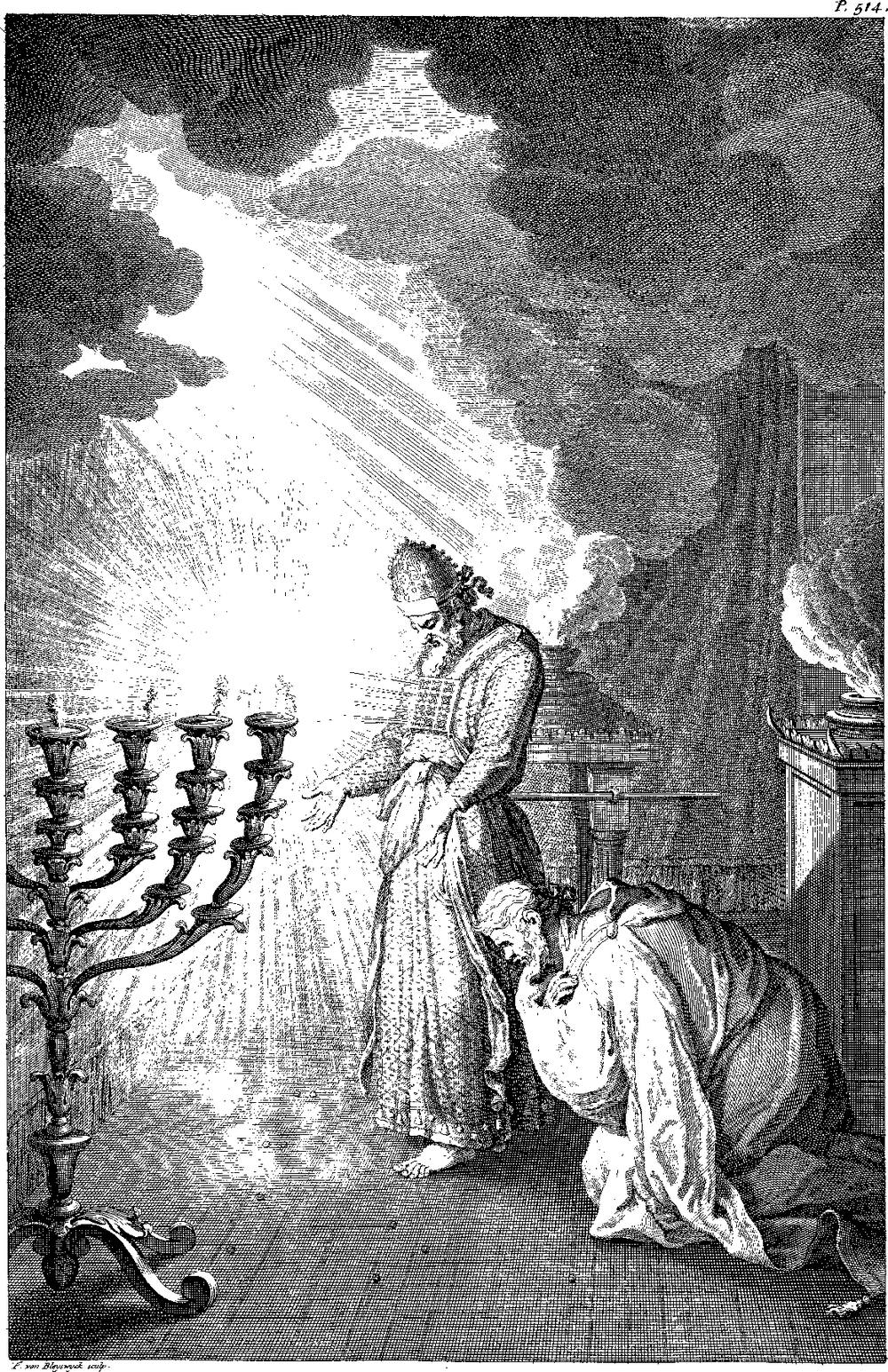
But a wise woman of the city persuaded the inhabitants to give up Sheba; and his head being thrown over the wall, the siege was raised, and the insurrection quell’d.
God having visited the land with a great famine of three years continuance, the oracle In the year of the World 2983. before J. C. 1017. before the Vulgar Æra 1021. 2 Sam. xxi.of the Lord declared, that it was owing to the blood of the Gibeonites which had been unjustly shed by Saul. David sent therefore for the Gibeonites, and asked what satisfaction they required to repair the injury which they had sustained. They demanded seven of Saul’s sons, in order to hang them up in Gibeah. David complied with this demand, and they hanged them up accordingly in Gibeah, the place of Saul’s birth.
Some years after, David having commanded In the year of the World 2987. before J. C. 1013. before the Vulgar Æra 1017. 2 Sam. xxiv.all the people to be numbred, the Lord was offended at it, and the prophet Gad came to him, and said, That he was sent by God to offer him the choice of three scourges which were prepared for him; either that the land should be afflicted with a famine for seven years, or that he should fly three months before his enemies, or that the pestilence should make havock in his dominions for three days. David chose the latter, and the next day it began to rage, and during those three days, seventy thousand persons died. Nor was the sentence executed with full rigour; for God was mov’d by David’s prayers, and said to the destroying Angel, It is enough. David, as an act of thanksgiving, erected an Altar in the threshing-floor of Araunah, where the Angel had appeared to him. Some are of opinion, that the Temple was built afterwards in this place.
The king being very old, could scarce receive In the year of the World 2989. before J. C. 1011. before the Vulgar Æra 1015. 1 Kings i.any warmth: a young woman therefore, a Shunamite, whose name was Abishag, was brought to him; she lay with him, and attended him in his old age. It is our opinion, that she was really David’s wife; though she always continued a virgin. In the mean time, Adonijah began to set up the equipage of a king, and formed a party of the great Men in the kingdom, who upon occasion might be able to support him. Nathan, who knew what promises had been made by David in favour of Solomon, acquainted Bathsheba with what was carrying on, and advised her to go to the king about it. She went, and while she was in conversation with him, Nathan came himself, and remonstrated to him, that Adonijah without his knowledge, and contrary to what the Lord had promised Solomon, intended to have himself proclaimed king. David hereupon immediately gave orders, that Solomon should be mounted on his own mule, and conducted to Gihon, and there should be anointed king. Which was executed without any delay.
David perceiving himself to be now near his end, sent for Solomon, put into his hands the plans and models of the Temple, the gold In the year of the World 2990. before J. C. 1010. before the Vulgar Æra 1014. 1 Kings ii.and silver which he had prepared for this purpose; charged him to be constantly faithful to God, and advised him not to let Joab go unpunished, whom too great credit had made insolent, and who besides had committed several actions, whereby he had deserved death. This was what this pious Prince believed was due from him to justice and posterity. He likewise enjoined him to punish Shimei for the ignominious language, which he had given him, while he was flying from Absalom at the time of his rebellion. After this, he slept with his fathers, and was buried in the City of David, in the year of the World 2990, before the birth of Jesus Christ 1010, before the Vulgar Æra 1014. He reigned seven years and an half at Hebron, and three and thirty at Jerusalem, in all forty years. He died in the seventy first year of his Age5.
Joseph. Antiq. l. 7. c. ult.Josephus relates, that Solomon put abundance of riches into David’s Monument, and that thirteen hundred years after, the High-priest In the year of the World 3870. before J. C. 130. before the Vulgar Æra 134.Hircanus being besieged in Jerusalem by King Antiochus the Pious, and not knowing where to get the money, which he wanted to induce this prince to raise the siege, Hircanus opened David’s monument, took out three thousand talents, and gave him part of them. He adds, that many years after, Herod the Great having once more searched this monument, took great sums out of it.
It is very probable that Josephus had read something like this in other Memoirs of his country, and added such improvements as had been made by the tradition of the people. In the Memoirs which are published in the Arabian tongue by M. le Jay in his Polyglot, we read of a report, that Hircanus, while he was besieged by King Antiochus Sidetes, opened a treasure chamber, which belonged to some of David’s descendants, and that after he had taken a large sum of money out of it, he still left a great deal in it, and sealed it up again. This is very different from Josephus’s account.
Benjamin of Tudela, who wrote about the year 1173, relates, that not above fifteen years before, a wall belonging to Mount Sion, fell down, and the Priests set twenty men at work upon it. Two of these workmen being one day left alone there, when the rest were gone, took up a stone, which opened a passage into a subterraneous place, which they entered. They found there a Palace supported by marble Pillars, and crusted over with gold and silver. At the entrance was a Table, and upon this Table a golden Crown and Scepter. This, says the Jew, was David’s Monument, and opposite to it was Solomon’s, adorned in the same manner. There too they saw Urns, but could not discern what it was that they contained. As they were attempting to penetrate farther, they were over-set by a whirlwind, and remained there senseless till the evening. Then they heard a voice bidding them rise and be gone. Benjamin assures us, that he had this story from the mouth of one Abraham a Pharisee, who, as he said, had been consulted concerning this event by the Patriarch of Jerusalem; and declared, that this was David’s Monument. But this whole account has so much the air of a fable, that it is needless to confute it.
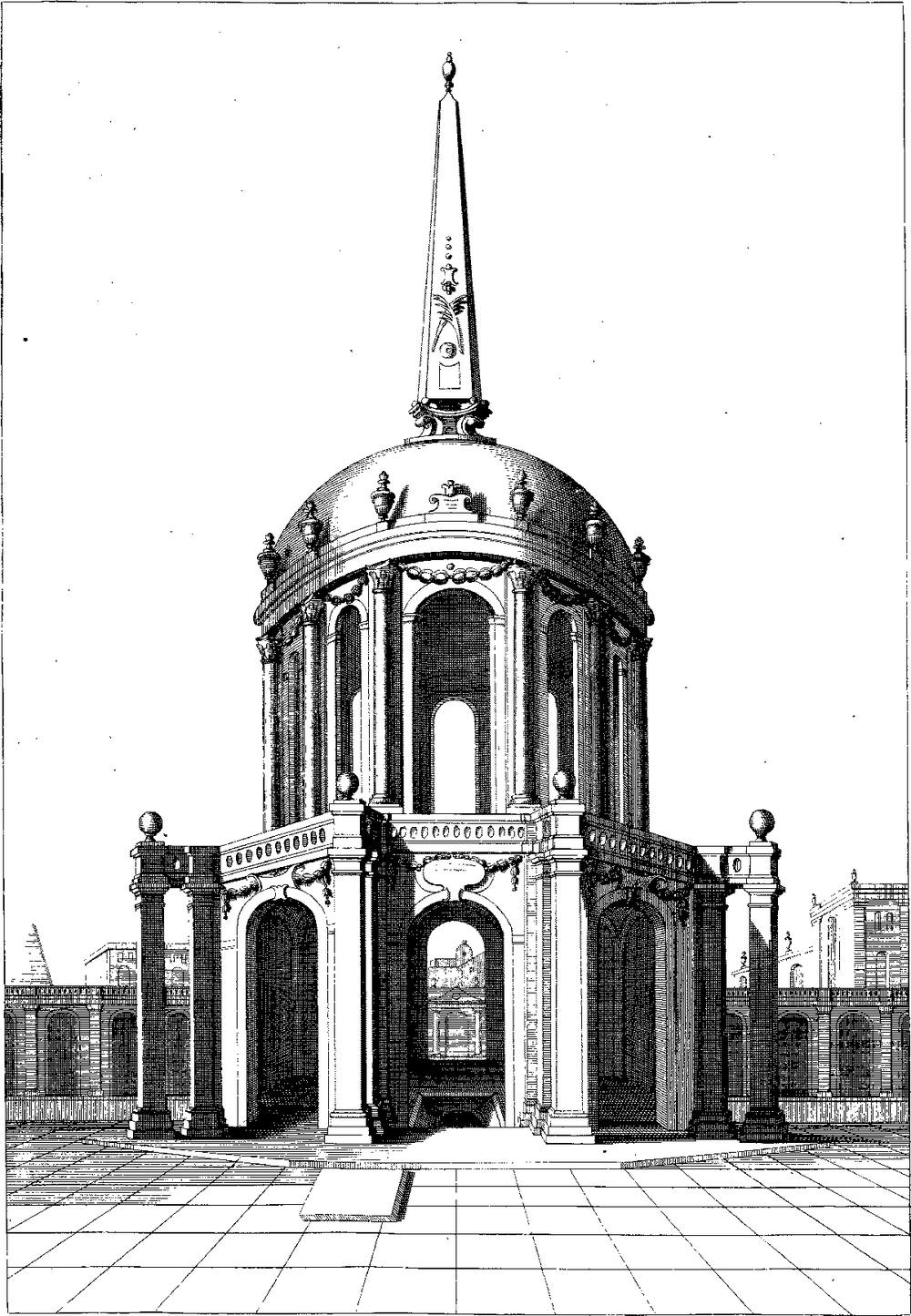
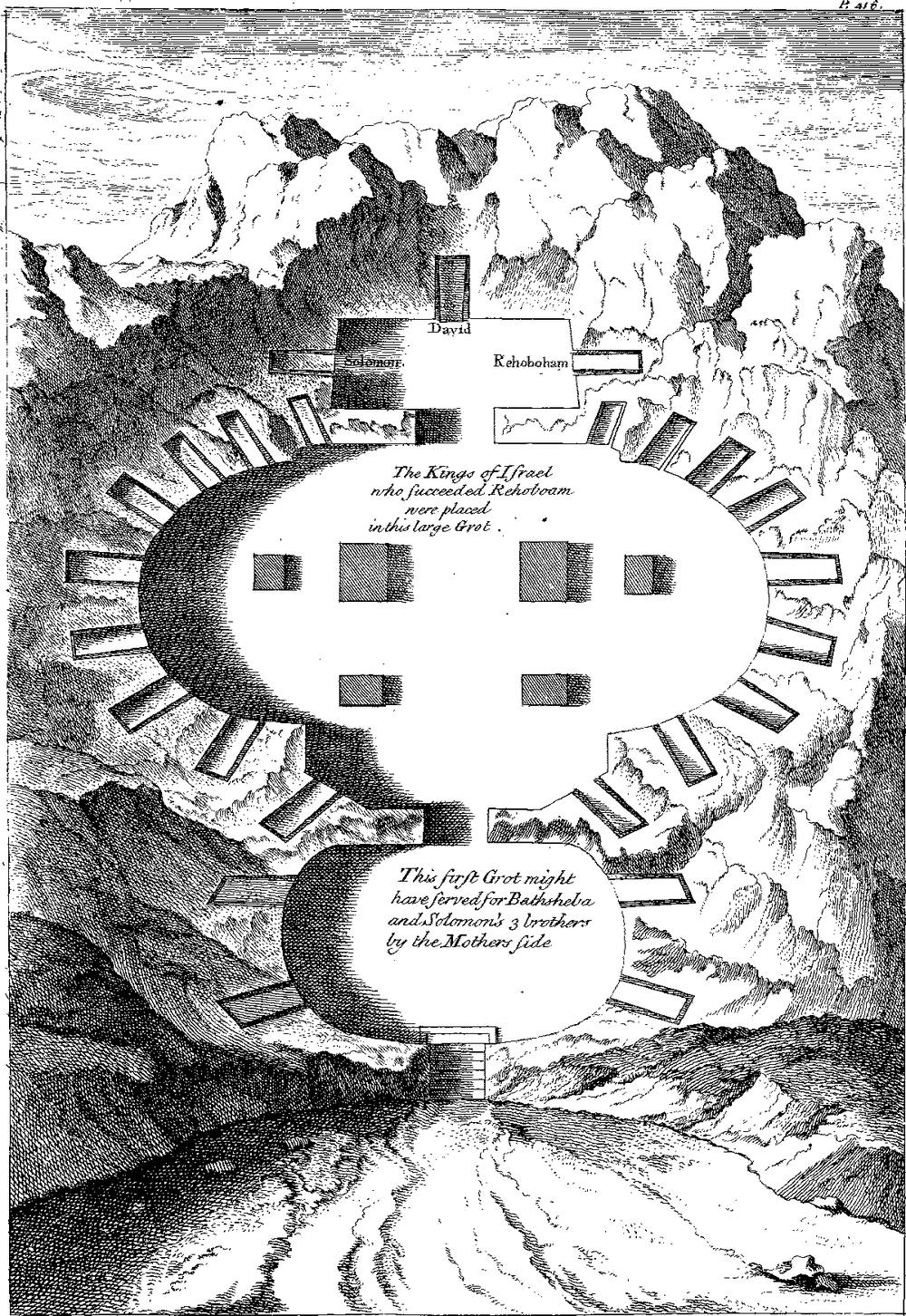
It is certain, that David’s Monument was always very much respected by the Jews. St. Peter in his discourse to the Jews, tells them, that this Prince’s Sepulchre was still with them: The Heathens themselves knew it; and Dio in Adriani vita.Dio informs us, that part of this Mausolæum fell down in the Emperor Adrian’s reign. St. Jerom relates, Hieronym. Ep. ad Marcellam.that he often went to pray at this holy Prophet’s Sepulchre. Cardinal Grimani has given us the representation of this Monument, which some assert to be David’s. Apud Sefinon de Architectura, l. 3. & apud Pinedam de Rebus Salom. l. 8. c. 3. Doubdan, ch. 26. Morizon, &c.Modern Travellers describe to us some very magnificent Monuments, dug in a Rock, which are said to be those that were made formerly for the kings of Judah6. They are doubtless very ancient, but it would be very hard to distinguish David’s from the rest.
David is generally reputed the Author of the Book of Psalms, and these sacred hymns are cited under his name. It is certain that he composed a good number of them; but it would be difficult to prove in particular that he composed them all. Amos vi. 5.Amos reproaches the voluptuaries of Israel with sleeping in beds of ivory, with diverting themselves in singing to the sound of instruments, and flattering themselves that they had, like David, the gift of writing songs. Sicut David putaverunt se habere vasa cantici. See the Article PSALMS.
The Jewish Doctors have added several particulars to the history of David. They say, that Jesse, the father of David, having sollicited his maid-servant, she informed her mistress of it, who took her servant’s place, and conceived David. Jesse believing he was born of a slave, sent him to keep his flocks, and did not think him worthy to appear before Samuel. But Samuel declared to Jesse, that this stone rejected by the Architect, would become the head of the corner. They add, that David came into the world circumcised. This opinion they found upon the title of some Psalms, which have Michtam in the front of them; that is to say, perfectly struck, as having been circumcised with the hand of God. Others say, that he was not circumcised till he was fourteen years of age; and that it was not till this moment that God said to him, Thou art my son, this day have I begotten thee. He would have died as soon as he was born, if Adam, to whom God had foretold this, had not lent him seventy years of his life.
They tell us, that David was red like Esau, and of a physiognomy not much to be liked; that Samuel having taken notice of him, and designing to reject him by reason of his savage air, God told him, that Esau killed men without the forms of justice, and of his own authority; but that David would not put any one to death, without consulting the Sanhedrim. When David looked askew upon any one, he made a leper of him; thus Goliath, and particularly the front of this giant, was immediately covered with a leprosy. Joab suffered the same fate, and something worse. David himself became leprous, God withdrew from him, and the whole Sanhedrim forsook him, during the six months continuance of this disease.
When he appeared before Saul to go and encounter Goliath, Saul was astonished to see his armour fitted him, though they were of a very different stature. He concluded from thence, that David would be king; but David penetrating Saul’s thoughts, excused himself from using his armour.
His son Absalom was damned: of the seven gates through which there is an entrance into hell, he had already passed five of them; but upon David’s crying five times, Absalom my son, at each time he repassed one of these gates; and thereupon David sung aloud this verse of the lxxxvi. 17. Lord give me some marks of thy favour, that they who hate me may see it, and be ashamed.
They say, that David had a harp, which when a certain wind blew, play’d of itself all night; this sound sometimes awakened him, and he was used to value himself upon it, observing that he awakened the morning, whereas the morning awakens other kings. We are moreover told, that he married the two sisters, daughters of Saul, both living at the same time, namely Merab and Michal. But we know he never wedded Merab, though she had been promised to him in marriage. They accuse this Prince of having given into the follies of Astrology, Magick, and even into Idolatry, and of having despaired of his own salvation.
But that which shews the height of their extravagancy, is, the story they relate of this Patriarch’s death. He knew by revelation that he should die upon some sabbath-day. He did not like the day, because they could neither mourn for him upon it, nor provide for his funeral. He desired some little delay till the next day, but could not obtain it; all the favour God would grant him, was, not to die till saturday in the evening. The devil waited the moment of his ceasing to read the law, in order to give him his death’s wound; but as he did not discontinue the reading of it, Satan bethought himself of going and knocking down apples in the king’s garden, and by this means to draw him off. David run out upon the noise, and as he was descending too hastily by a wooden-ladder, in order to discover the thief, the devil moved it, and the king fell and killed himself.
His dead body remained exposed to the dogs, because no one would venture to stir it on the sabbath-day. The University was consulted to know what was to be done in so melancholy a juncture, and the Doctors directed pieces of bread to be thrown about the dead body for the dogs, till the sabbath was over. The dogs prefer’d the bread to the dead body of the king, and David was buried. Thus the Hebrew Doctors disfigure the most serious histories with their silly impertinences; we should not amuse our selves with relating them, if we were to consult only our own inclination, or the contempt we have of them: but it is one part of wisdom to know the errors and follies of mankind. Transivi ad contemplandam sapientiam, Eccl. ii. 12.erroresque & stultitiam, says Solomon.
Bibl. Orient. p. 284.The Mahometans have as many fabulous stories as the Jews, when they speak of David. Mahomet says, that this Prince killed Goliath; that God gave him the kingdom, and wisdom, and taught him whatever he desired to know. Hereupon a certain Commentator Alcoran Cap. Bacrat.of the Alcoran, says, that Saul’s army consisted only of three hundred and thirteen men, whom God had chosen, because they had drunk of the stream only out of their hands. He confounds the history of Gideon with that of Saul. After David had killed Goliath, God gave him the kingdom; because Saul had promised his daughter in marriage and half his kingdom to him, who should dispatch the Giant; and Saul dying soon after, David entred into the possession of his dominions. God gave him likewise wisdom; that is to say, the gift of prophecy, and his Spirit in order to compose the Psalms. Lastly, God taught him every thing he had a mind to know; that is to say, the gift of making coats of mail, of hair-shirts and sackcloaths, which was the common trade of the prophets; and even the gift of understanding the language of birds. Some add, that the birds and stones obey’d him, that iron grew soft within his hands; and that during the forty days of his lamenting his sins, his tears were so copious and so fertile, that they made plants grow.
Read this article in its place on the printed pages
Footnotes
-
Translators’ note. That Musick should cure settled diseases in the Body, we should hardly believe, if we had not both human and divine Testimony for it. Pliny tells us of the Gout and Sciatica being cured by it; that it had the effect of a good Styptick, and stopt a flux of blood. Plin. l. 28. c. 1. And Theophrastus witnesses, that many in his time, especially the Thebans, used the Pipe for the cure of several sicknesses, which Galen calls καταυλεῖν τῷ τόπῳ, super loco affecto tibia canere; or, Loca dolentia decantare. An ingenious Author assigns the true natural Reason of this Effect to be, that as musical Sounds move the outward Air, so that does the inward, and that the Spirits, and they the Humours, (which are the seat of diseases) by condensation, rarefaction, dissipation, or expulsion of Vapours. As for the cure of the Tarantism by Musick, the experiments of it are too notorious to be denied. ↩
-
Translators’ note. These, as a learned Man observes, were not properly called Prophets, or Foretellers of future things, but religious Persons, who separated themselves from the business of the world, to employ their time in the contemplation and praise of God. Saul’s messengers saw the company of Prophets prophesying (that is, saw them together in divine Service) and Samuel standing as appointed over them; Stantem super eos, which the Chaldee interprets Stantem docentem eos, preaching to them. At Bethel and Jericho there were Sons of the Prophets, 2 Kings ii. 3, 5. so called because taught by some great Prophets; or as the Greeks term Physicians Ἰατρῶν παῖδας. ↩
-
Translators’ note. The Sum collected for this use by David is so prodigious, says Dr. Prideaux, as gives reason to think, that the Talents whereby that sum is reckoned, were another sort of Talents of a far less value than the Mosaick Talents. For what is said to be given by David (1 Chr. xxii. 14, 15, 16. and xxix. 3, 4, 5.) and contributed by his Princes (xxix. 6, 7, 8.) towards the building of the Temple of Jerusalem, if valued by the Mosaick Talents, exceeded the value of eight hundred millions of our money. The 3000 Talents of gold which David gave out of his own private fortune, amounted to one and twenty millions of our mon- ey, besides the 7000 Talents of refined silver, which made part of his present. Prid. Connect. &c. P. 1. B. 1. ↩
-
Translators’ note. Some be- lieve the Terrace here mentioned to be a Garden upon the top of David’s Palace, the use whereof was very frequent among the Ancients; and that it was so particularly among the Hebrews in David’s time, several Texts of Scripture seem to shew; as 2 Sam. xxvi. 22. They spread for Absalom a Tent upon the top of the house, and Absalom went unto his father’s concubines in the sight of all Israel. And 1 Sam. ix. 25. Samuel communed with Saul upon the top of the house. It appears from Seneca and Pliny, that this piece of luxury had made its way from Asia to Rome. ↩
-
Translators’ note. It is surprizing to see in what manner the Rabbins treat this great Prince, the man after God’s own heart, and the Glory of their nation: They tell us, that he was begotten after a criminal manner; that he lived for some years without a soul; that there was something of Sorcery in his looks; that in his Physiognomy he resembled Esau*; that he was ignorant, proud, hypocritical, and guilty of incest; that he was a Magician, and great dealer in judi-* cial Astrology; and that he died in a tragical manner by a stratagem of the devil’s See Basnage Histoire des Juifs, l. v. c. 2. Thus it is that the Rabbins falsify the clearest Histories, and blemish the memory of those, whom in other places of their writings they mention with the greatest honour. ↩
-
Translators’ note. Maundrell describes particularly these famous Grots, call’d the Sepulchres of the Kings: but for what reason they go by that name, is, he says, hard to resolve; for it is certain, none of the Kings either of Jerusalem or Judah were buried here; the Scriptures assigning other places for their Sepultures. ↩