ABSALOM, the Son of David, born of Maachah, the Daughter of Talmai, King of Geshur, was, according to the Scripture, the most beautiful Man in all Israel, and had the 2 Sam. xiv. 25.finest Head of Hair. When he had his Hair cut, which he had once a year, because it was heavy, and incommoded him, it weighed two hundred shekels by the King’s weight; which two hundred shekels may be computed to be about one and thirty Ounces, which is indeed pretty extraordinary, but by no means is incredible; since by the relation of Perriwigmakers, there are some Women who have two and thirty ounces of Hair upon their Heads1. Absalom had a Sister named Tamar, who also was extremely handsome. Amnon, the Son of David, but not by the same Mother, conceived so violent a Passion for his Sister, that it made him languish away exceedingly. He prevailed with the King to let Tamar come into his chamber, and prepare something for him to eat. While she was there he ravished her, and then dismissed her with Reproach and Shame.
2 Sam. xiii.In the Year of the World 2972, before J. C. 1028, before the vulgar Æra 1032.Absalom received her into his House, and resolved to revenge the outrage offer-ed to his Sister. He took no notice of it to Amnon, expecting perhaps that the King his Father should punish so wicked an Attempt. Two years after, Absalom going to a Sheep-shearing at Baal-hazor, near Ephraim, invited the King thither, with all the Royal Family. David excused himself, but, pressed by Absalom’s Entreaties, he consented that Amnon and his Brethren should go. When they were warmed with Wine, Amnon, by Absalom’s Direction, was assassinated; upon which the In the Year of the World 2974, before J. C. 1026, before the vulgar Æra 1030.King’s Sons fled immediately to Jerusalem. Absalom, for his part, retired to King Talmai, his Mother’s Father in the Country of Geshur: There he continued for three Years, in all which time David gave himself no trouble in pursuing him; but Joab, Absalom’s Uncle, observing a Fondness in the King’s Heart for his Son, found means by the Interposition of a Woman of Tekoah, who spoke to the King to procure his 2 Sam. xv.Consent for Absalom’s Return. Absalom came back therefore to Jerusalem, but David would not suffer him to come into his Presence. He continued thus for two Years in Disgrace, 2 Sam. xiv.In the Year of the World 2977, before J. C. 1023. before the vulgar Æra 1027. In the Year of the World 2979, before J. C. 1021. before the vulgar Æra 1025.at the end of which Time he sent for Joab with a purpose of engaging him to intercede with the King on his behalf; but he refusing to come, Absalom commanded his Servants to set fire to a Field of Barley belonging to him, which he being informed of, he came and made his complaints to Absalom: Absalom confessed that this was done by his Orders, with the hopes only of having an opportunity thereby to desire his Mediation with his Father, to intreat the King intirely to forgive him, and admit him to his Presence. Joab went, and related all that had passed to David, who order’d Absalom to be introduced, immediately embraced him, and received him into favour as before.
After this Absalom set up a magnificent Equipage, looking upon himself as presumptive Heir to the Crown; and every morning he came constantly to the Palace-gate, calling all those who had any business, and came to demand justice of the King, saying, Whence are you? and when they had reported their Business, he told them, Your Matters indeed seem good and right, but there is no Man deputed of the King to hear you: O that I were made Judge in the Land, that every Man which hath any Suit or Cause, might come unto me, and I would do him justice! And when any Man came nigh to do him reverence, he put forth his Hand, and took him and kissed him. He was thus for four Years preparing the Minds of the People, and winning by degrees upon them; and when he thought he might declare himself, he desired permission from the King to go to Hebron, under pretence of performing some Vow there, which he had made during his Abode at Geshur.
The Text reads 40 Years, but several Latin MSS. Josephus, and Theodoret, read 4 only. This happened in the Year of the World 2980, before J. C. 1020, before the vulgar Æra 1024.He went therefore to Hebron, attended by two hundred Men, who followed him in the Simplicity of their Hearts, without having the least Knowledge of his wicked Design. At the same time he sent particular Persons, whom he had made his own intirely, throughout all the Tribes of Israel, with Orders to sound the trumpet pet, and publish every where that Absalom was King at Hebron. Hereupon there was very soon a great resort of People to him, and Absalom was acknowledged by the greatest part of Israel. David was informed of Absalom’s Revolt, and that all Israel was of his Party; David therefore and his Officers fled from Jerusalem, leaving no other Guard in the Palace but the King’s Wives. 2 Sam. xvi.Absalom, without loss of time, went directly to Jerusalem, where he was received without any Resistance. Abitophel advis’d him publickly to abuse his Father’s Concubines, that all the People might comprehend by this Action that the Breach was without hopes of Reconciliation, and might continue firm to him, without any thoughts of returning to their Obedience.
At the same time Ahitophel proposed to Absalom that some Troops might be sent in pursuit of David, that so he might be quite oppress’d before he had leisure to look about him, and gather strength; but Hushai, David’s Friend, who pretended to be of Absalom’s Party, diverted him from this Council, and gave notice of it secretly to David, advising him to pass the Jordan with all diligence, and throw himself into some place of Defence, where he might be able to secure himself. David therefore retired to Mahanaim, which was before the Residence of Ishbosheth, the Son of Saul, and there received several Reinforcements from those who continued faithful to him.
Absalom the next day marched against David with all his Forces, and having cross’d the River Jordan, disposed himself to attack the King his Father. David on his part order’d his Troops to march out of the City under the Command of Joab; and both Sides engaging, Absalom’s Army was routed, and cut in pieces: twenty thousand were killed upon the Spot, the rest saved 2 Sam. xviii.themselves by flight. Absalom was mounted on a Mule, and as he fled into the Forest of Ephraim, and was passing under a large Oak with very thick Boughs, his Head was intangled in the Branches, and his Mule going on swiftly, he hung between Heaven and Earth.
A Soldier seeing him in this Condition, gave intelligence of it to Joab, who ask’d him why he did not kill him; and the Man answered, Tho’ I should receive a thousand Shekels of Silver in mine Hand, yet would I not put forth mine Hand against the King’s Son; for in our hearing the King charged thee and Abishai, saying, Beware that none touch the young Man Absalom. Then said Joab, I may not tarry thus with thee; and he took three darts in his Hand, and thrust them through the Heart of Absalom. And while he was yet breathing, and hanging on the Oak, ten young Men that bare
VOL. I. a Joseph. Antiq. l. 7. c. 9. Joab’s Armour, compassed about, and smote him and slew him. His Body was carried off, and thrown into a great Pit which was there in the Wood, and a large Heap of Stones was laid upon him.
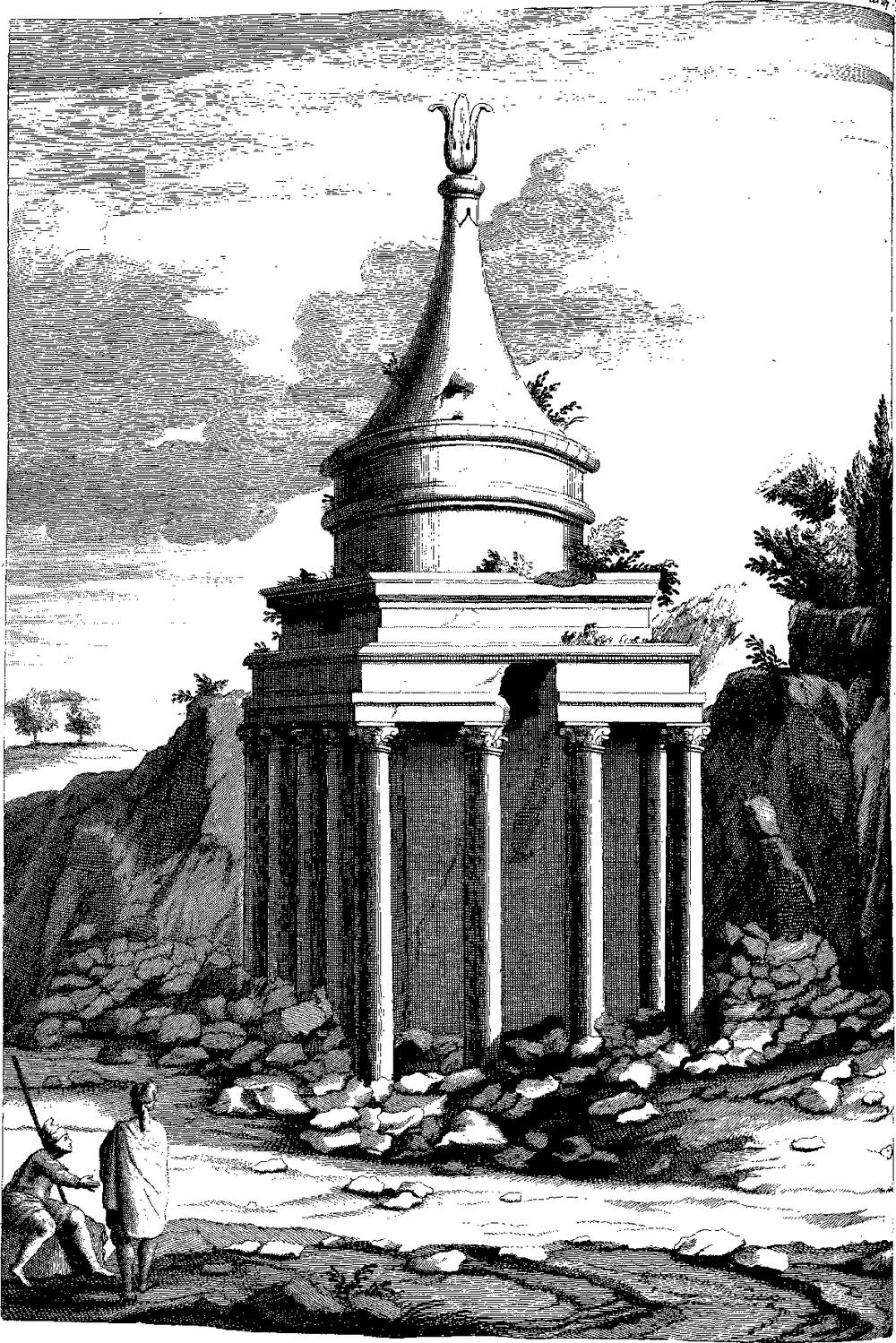
Now Absalom in his Life-time had erected a Pillar in the King’s Valley, saying, I have no Son, and this shall be a Monument to perpetuate my Name. He called the Pillar therefore after his own name, and it is called unto this day Absalom’s Place. This is what the Author of the Books of Samuel tells us. There is a Monument shewn at present Eastward of Jerusalem, in the valley of Jehosaphat, which is said to be this of Absalom’s. After the death of Absalom, the 2 Sam. xviii. 17.Scripture says, They took him, and cast him into a great Pit in the Forest (of Ephraim, where the Battle was fought) and laid a very great Heap of Stones upon him, &c. From hence it might be concluded that he remained buried under these Stones; but we may believe with more probability, that David, who lamented him with such excessive grief, remov’d him from thence, in order to have him laid in the Sepulchre belonging to the Kings, or perhaps somewhere about the place where the Monument which is still at this day shewn to Travellers, was dug in a Rock.
It is a little Chamber wrought with a Chisel out of one piece of Rock, standing apart at some little distance from the Mountain, being a Square of eight paces from out to out. The inside of this Cabinet is all plain, but the outside is adorn’d with some Pilasters of the same kind of Stone. The upper part or Covering is made in the form of a Conick Pyramid, pretty high and large, with a kind of Flower-pot upon the Top. The whole is about four or five Fathoms in height; the Pyramid is composed of several Stones, but the Monument itself is square, and cut out of one Block of Stone.
This may be very well called the Pillar or Hand of Absalom; for the Hebrews give every thing the name of Pillar which is set up for a Monument, and call every thing by the name of Hand which is made use of to shew and preserve the Memory of any thing. For example, that which Saul erected on Mount Carmel, to perpetuate the Remembrance of his Victory against the 1 Sam. xv. 12. Ex. xvii. 16.Amalekites, is called Hand. And Moses, in the Book of Exodus, seems to allude to something like this, when after the Battle with the Amalekites, he says, that the Hand is upon the Throne of the Lord, as a Monument of their Malice, and of the Vengeance which God, by reason thereof, would one day take on them. Josephus, speaking of Absalom’s Monument a, says it was a marble Column, dis tant about two furlongs, or three hundred paces from Jerusalem. Travellers assure us, that all who pass by Absalom’s Pillar throw a Stone at it, to shew their abhorrence of the Son’s Rebellion against his Father. There is so great a Heap of Stones near it that they almost hide the lower part of this Monument.
2 Sam. xviii. 18.The Scripture seems to intimate, that when this Prince erected it, he had no Children. It is said however four Chapters before 2 Sam. xiv. 27.that he had three Sons and one Daughter of exceeding beauty, whose name was Tamar: But there is some probability that these Children, at least the Sons, did not live; for there are persons who believe that Tamar his Daughter married Rehoboam, King of Judah. The death of Absalom happened in the year of the World 2980, before Jesus Christ 1020, before the vulgar Æra 1024.
Observations upon Absalom’s Defeat by David’s Army in the Forest of Ephraim. 2 Sam. xviii.The order and disposition of the two Armies, as described by the Designer, do not agree entirely with my notions of this matter. The Action was in a forest, where the Troops were ranged, not according to the order usual at that time, but according to the nature of the Ground, which must have been a rule to the Combatants. Here one would believe that the Battle was fought in a plain. The Army marched in order of Battle against Israel, says the Scripture, and the Battle was in the wood of Ephraim; which proves that there were some few trees in this place, where formerly there had been an Engagement, wherein Gideon got the better of Zeb and Zebah. Here is a passage which deserves our Observation: Considerato David populo suo, constituit super eos Tribunos & Centuriones. David having reviewed his People, set Tribunes and Centurions over them. In this there was nothing new; the Jewish Armies, as well as those of other Asiaticks, were divided into Regiments, and these into Companies, and the Companies were subdivided into three parts. David was not the first who introduced this discipline, and these Subdivisions among his troops, the Captains over hundreds, and Commanders of thousands, whom the Vulgate calls Tribunos & Centuriones. This would induce me to believe that David had been deserted by the greatest part of his Forces and principal Officers, who were gone over to Absalom’s Party; so that this Prince was obliged to levy a new Army, to distribute it into Regiments of a thousand, which he split into Companies of an hundred each, which proves that his Army was much more numerous than Josephus2 allows, who tells us that it consisted of no more than four thousand men. Dom Calmet is of Grotius’s opinion, which is opposite to that of Josephus: For, says he, David never would have hazarded a Battle, if his Army had been so much inferior in number to that of his Enemies. This however does not prove that he actually did not run this hazard, because we every day see small Armies beat others that are more numerous, when they happen to be commanded by able Generals; and Joab, who was a very great Captain, risked very little by encountring Generals of much less experience and capacity for Command. I am very well persuaded that David’s Army was a great deal inferior to that of the Rebels. The Scripture says nothing of the disposition of the two Armies in the Forest; it only tells us that David marched in order of Battle against Israel. The wood and the nature of the Country would scarce have permitted him to draw up in a parallel line: it is my opinion that they engaged in Bodies and small Detachments; and as David’s Army was doubtless not by half so strong as the other; he must have left large intervals between the several Bodies, because they fought independently of one another, by reason of the extraordinary depth of the Files, and particularly when they were so far exceeded on their wings, without troubling themselves about being broken, whatever intervals they left between them. Absalom was defeated, and his Army cut in pieces, and twenty thousand Men were left upon the spot. I should not be surprized to find that four thousand Men, to keep to Josephus’s computation, should overcome a great Army, but I should be scarce able to comprehend how so small a number could kill twenty thousand.
Read this article in its place on the printed pages