Volume II, pages 606–624 of the 1732 edition, from SAM to SAT: everything printed on these pages, in order.
Continued from Samuel
the Door of the Sanctuary. Samuel thinking it to be the Voice of Eli, ran hastily to him, and said; Here am I, for you call’d me. Eli bid him return, and lie down to sleep, for he did not call him. Samuel did so, and the same thing happen’d to him three times. The third time Eli, judging there must be something extraordinary in the Matter, sent Samuel back, and said to him; Go and sleep, and if you are call’d any more, say; Speak, Lord, for thy Servant heareth.
He return’d, and the Lord calling him again, Samuel answer’d; Speak, Lord, for thy Servant heareth. Then the Lord said to him; I am going to do a thing in Israel, that shall make the Ears tingle of all those that shall hear of it. I shall accomplish all that I have resolved against Eli, and against his House, because knowing the Iniquity of his Children, he has not restrain’d them. Wherefore I have sworn that the Iniquity of this House shall never be expiated, neither by Sacrifices nor Offerings. When Day was come, Eli call’d Samuel to him, and obliged him to discover what the Lord had said to him. Samuel told him the whole, and conceal’d nothing from him; to which Eli answer’d, It is the Lord, let him do what is pleasing in his own Eyes. Then it was known to all Israel, that Samuel was the chosen Prophet of the Lord; and whatever he declared, whether to Eli or the People, had always its due Effect.
We have elsewhere related a the Manner in which the Ark of the Lord was taken by the Philistines; the Death of the High-priest Eli, and that of his two Sons Hophni and Phinehas; the manner in which the Ark of the Lord was sent back to Bethshemesh, and from thence placed at Kirjath-jearim. This may be seen related at length in the first Book of Samuel, iv, v, vi.
After the Death of Eli the High-priest,1 Samuel was acknowledg’d as Judge by all Israel, and as Governor of the People. Probably this was done by that Assembly that met together, on the Occasion of removing the Ark from Beth-shemesh to Kirjath-jearim. Samuel then made this Declaration to the People; If you return to the Lord with all your Hearts, take away the strange Gods from among you, and prepare your Hearts to serve only the Lord, and he will deliver you from all your Enemies. Then the Children of Israel renounced all their strange Gods, and apply’d themselves wholly to the Service of the God of their Fathers. Afterwards Samuel convened another Assembly at Mizpeh, where all the People met in Arms. Samuel pray’d for them; they fasted and pray’d, they pour’d out Water before the Lord;2 they confess’d their Sins, and Samuel judged them in the same Place. The Philistines hearing that Israel was assembled at Mizpeh, took the Alarm, and came into the Field against them. Samuel call’d upon the Lord, and offered a sucking Lamb for a Sacrifice. No sooner was the Fight begun, but a dreadful Peal of Thunder was heard, that struck Terror and Consternation among the Philistines. They betook themselves to Flight, and Israel pursued them as far as Beth-car. This Defeat was so signal, that for a long Time they durst not any more appear upon the Frontiers of Israel; for the Hand of the Lord was over them as long as Samuel governed the People, and the Philistines were obliged to restore such Cities as they had taken from the Israelites.
Samuel was about forty Years of Age when he began to judge Israel. He judged 1 Sam. vii. 15.them the whole Time of his Life; for under the Reign of Saul he preserved a great deal of Authority, as well in respect of Saul himself, as the whole People. He went every Year to Bethel, thence to Gilgal, then to Mizpeh; afterwards he return’d to his House at Ramah, and so distributed Justice to all Israel. He also built an Altar at Ramah, as well for the Use of his own private Devotion, as to keep up the Religion of the People, who flock’d to him from all Parts, to consult him, and to have their Causes decided. When he grew old himself,3 he appointed his Sons as Judges over Israel, and they discharged this Office in Beer-shebah, a City lying upon the southern Limits of the Land of Canaan. But they, instead of walking in the Steps of their Father, were venal and mercenary Judges, and suffer’d themselves to be corrupted by Bribery and Avarice.
Then all the Elders of Israel came to Samuel, and said to him;4 You see that you are grown old, and that your Children do not pursue your Steps; set a King over us, as all other Nations have, that he may judge us. This Proposal was not agreeable to Samuel, and he address’d himself to God by Prayer. The Lord said to him; Hear the Voice of the People, and give them what they ask for, for it is not you, but me, they have rejected, that I may not reign over them. But declare to them what are the Prerogatives of a King, and what are the Rights he will insist on. Samuel gave Answer to those that had made this Request to him, That the Lord was5
not averse to their having a King, but they ought well to consider what would be the Consequences of kingly Power: That this King would take their Children from them, to make them serve in his Wars, and in his House: That he would force them to do his Drudgery and Labour, both in City and Country: That he would take their Daughters to make them serve as his Perfumers, Cooks, and Bakers, and in other menial Offices: That he would make them pay the tenth Part of the Profit of their Corn, Vines, and Flocks. That then they would cry unto the Lord, and the Lord would not hear them. But the Israelites were not moved with these Remonstrances; they persisted in desiring a King, and God told Samuel he would appoint them one.
A little while after a Saul the Son of Kish, of the Tribe of Benjamin, being sent by his Father to seek some Asses that were stray’d, came to advise with Samuel about the Asses; but the Prophet told him, that God had appointed him King over his People, and gave him the royal Unction, as we shall more amply relate hereafter, under the Article of SAUL. After which Samuel held an Assembly of the People at Mizpeh, that they might proceed to the Election of a King. The Lot was cast for all the Tribes separately, and fell upon the Tribe of Benjamin. Then it was cast for all the Families of this Tribe, and fell upon that of Matri. Lastly, it fell upon Saul, the Son of Kish. He was sought for immediately, but was not to be found. They ran therefore to the Place where the Baggage was deposited, where he had hid himself, and brought him forth among the People. Samuel then said to ‘em; You see who it is the Lord hath chosen, and that there is none like him among all the People. After this he writ down the Laws and Constitutions of this new Kingdom, and publish’d them to the People, and then dismiss’d them.
A Month was scarcely pass’d after Saul’s Election, but a War broke out between the Ammonites and the City of Jabesh, in the Country of Gilead.6 Saul, at the Head of all Israel, marched against the Ammonites, and set Jabesh at Liberty. See SAUL and JABESH. At their Return from this Expedition, Samuel said to the People; Let us go to Gilgal, and there let us confirm the Election of the King. They did so, and acknowledged Saul as King. They offer’d Peace-offerings, and made great Rejoycings. Then Samuel addres’d himself 1 Sam. xii. 1, 2, &c.to the People, and asked them, Whether they had had any Reason to find fault with his Conduct? The People answer’d, that he had given them no Reason of Complaint. Samuel proceeded, and said to ‘em, The Lord is therefore my Witness to Day, and so is also the King he has appointed, that you have nothing to reproach me with. To which the People answer’d; They are Witnesses. Samuel then told them, That God having granted them a King according to their Request, they ought to remain faithful and obedient to the Lord: That if they did so, God would shower down Blessings upon them and their King: That if, on the contrary, they forsook the Lord, the Hand of the Lord would be upon them, as it was upon their Fathers. To which he added, Is it not now Wheat-harvest? A Season in which it is very rare in Palestine to see Rain. Yet I shall call upon the Lord, and he will send out his Thunder, and shower down his Rain, that you may know how great an Evil it is in the Eyes of the Lord, that you have presumed to ask for a King.
At the same Time he cry’d to the Lord, and the Lord sent Thunder and Rain in great abundance. This put the People into such a Consternation, that they asked Pardon of God for the Fault they had committed, in asking him for a King. Samuel exhorted them to continue faithful to the Lord; and promised them, that he would not cease to intercede for them, and to instruct them in the right way. After which every one return’d to his House; and this was what pass’d in the first Year of the Reign of Saul.
In the second Year after his Election7, he made choice of three thousand Men that were good Soldiers,8 of which he kept two thousand about his own Person, to drive out the Garisons of the Philistines that were at Michmash and Bethel; and the other thousand Men were with Jonathan his Son, wherewith to drive out the Philistines that were posted at Gibeah. This Jonathan effected, and Saul being desirous to pursue this Advantage, call’d all the People together at Gilgal. The Philistines on the other Side took Arms, and assembled at Michmash, to the Number of thirty thousand Chariots, six thousand Horse, and an innumerable Multitude of Foot. These Preparations so terrified the Israelites that were got together with Saul at Gilgal, that they fled to hide themselves, every one where he best could. Saul staid at Gilgal six Days expecting Samuel9
, and seeing he did not come, on the seventh Day, he had the Victims brought to him, and offer’d a Burnt-sacrifice.
He had hardly compleated his Sacrifice but Samuel came. Saul went out to meet him, and saluted him; Samuel says to him, 1 Sam. xiii. 8, 9, 10, &c.What have you been doing? Saul replies, That seeing himself press’d hard by the Philistines, and almost intirely abandoned by his own Soldiers, he had offer’d a Burnt-offering. Samuel told him again, That he had committed a piece of Folly. If, says he, you had obey’d the Commandment of the Lord, the Lord would have confirmed your Kingdom over Israel for ever; but now your Reign will not long continue. The Lord has found a Man after his own Heart, to place at the Head of his People. From thence Samuel went to Gibeah, and Saul follow’d him thither with his little Army, which was hardly above six hundred Men: Yet it was with this Handful of Men that Saul fought the Philistines, and beat them, as has been already observed under the Article of JONATHAN, and may be seen under SAUL; or may be read in the xiii and xiv Chapters of the First Book of Samuel.
After this Samuel came to Saul10, by an Appointment from God, to bid him make War with the Amalekites. Cut them in Pieces, says he, spare none, but destroy all; they are all devoted to the Curse of Extirpation, both Man, Woman and Child, even those that suck the Breast; even their Oxen, Camels, Sheep, and Asses. Saul therefore marched out against Amalek, cut them in Pieces, took and ravaged the whole Country; but, however, he thought fit to preserve such a Part of their Goods and Cattle as he thought deserved it best. Then God said to Samuel; I repent that I have made Saul King, because he has forsaken me, and done contrary to my Orders. Samuel was much afflicted at this, and cry’d to the Lord all Night. The Day following he came to Saul to Gilgal, where he was offering a Sacrifice of the Firstlings of the Flocks, that he had taken from Amalek. Saul saluted him, and told him; He had perform’d the Commands of the Lord. Whence then, says Samuel, is this Lowing of Oxen, and Bleating of Sheep in my Ears? Saul answer’d him, The People brought away what they thought best, to offer in Sacrifice to the Lord their God. Samuel upbraided him very vehemently with his want of Obedience; and Saul, to excuse himself, threw all the Blame upon the People; but Samuel reply’d to him, Is it Burnt-offerings and Sacrifices that the Lord requires? Obedience is more acceptable to him than any Sacrifice. To disobey him is equal to the Crime of Witchcraft, and to withstand him is as the Sin of Idolatry. As therefore you have rejected the Word of the Lord, so also the Lord has rejected you, and will not have you any longer for a King over his People.
1 Sam. xv. 35. 1 Sam. xvi. 1, 2, 3, 4, &c.Then says Saul to Samuel, I have sinned in having too great Complaisance for the People; but bear with my Iniquity, and come with me, that we may worship the Lord. Samuel answer’d him, I will not go with you, and at the same time turn’d hastily away from him to be gone. Saul having then hold of Samuel’s Garment, it tore in his Hands. On which Occasion Samuel said to him; Thus has the Lord tore the Kingdom out of your Hands, to give it to another, who is better than you. Saul reply’d, I confess I have sinn’d, but however do me the Credit of appearing with me before the Elders of the People, and before all Israel: Return with me, and let us worship the Lord. Samuel was then prevail’d with to follow him, and they return’d to the Camp at Gilgal. There Samuel caus’d Agag, King of the Amalekites to be brought out before him, whose Life had been saved, and who had been brought to Gilgal with the rest of the Booty. Samuel hew’d him to Pieces, and told him, That as his Sword had made so many Mothers childless, so likewise should his Mother be made childless among Women. Then Samuel return’d to Ramah, and Saul went to his House at Gibeah. From this Time Samuel saw Saul no more; but, however, he continually bewail’d him, because the Lord had rejected him, and repented that he had made Saul King of his People Israel.
Some Years after this,11 the Lord said to Samuel; How long will you mourn for Saul? Arise and go to Bethlehem, and give the Royal Unction to one of the Sons of Jesse, whom I have chosen to be the King of my People. Samuel made Answer; How shall I go? Saul will be inform’d of it, and will put me to Death. The Lord said to him; Go thither as if it were to sacrifice, and you shall invite Jesse to partake of the Sacrifice, and there I will shew you him you are to anoint. Samuel went therefore to Bethlehem, and all the Elders of the Place came to shew their Respect to him, whom he invited to the Solemnity of the Sacrifice. When he went into Jesse’s House, all the Sons of this venerable old Man came to salute him. And when they were before him, Samuel seeing Eliab the eldest, said within himself; Surely this is he the Lord has chosen for his Anointed. But the Lord answer’d him; Have no Regard to a good Appearance, or an advantageous Stature;
for this is not he whom I have chosen: I judge not of Men by the outside, but by what is within the Heart. Then Jesse caused his seven Sons to come one after another; but Samuel told him, God has not chosen any of these. Jesse said, he had still a younger Son, but he was keeping the Sheep. Send for him, says Samuel, for we will not sit down to Table till he comes. This eighth Son of Jesse was David, who was fetch’d out of the Field; and as soon as he came in, the Lord said to Samuel, Anoint him quickly, for this is he. Samuel poured upon his Head the Oil he had brought with him; and from that very time the Spirit of the Lord rested upon David, and departed from Saul.
Samuel return’d to Ramah, and dwelt there all the rest of his Life among the Prophets, who lived under his Conduct in a kind of Community. Several Years after, a when David was in Disgrace with Saul, and had very hardly escaped out of his Hands, he came to take Refuge with Samuel at Ramah. He acquainted him with the manner of Saul’s Behaviour towards him, and they went together to Naioth, where they continued for some Time. Saul had Intelligence of this, who presently sent forth a Party to surprize David. But the Messengers finding Samuel, who was then prophesying in the midst of the Prophets, they were also seized by the Spirit, and began to prophesy among them; that is to say, they were surprized with certain irregular Motions and Agitations, and pronounced certain Words, as the Prophets were us’d to do in their Fits of Enthusiasm. When this was told Saul, he sent a second and a third Company of Messengers, who all were seized in like manner. Lastly, he went himself, and was seized with the Spirit of God, and prophesy’d among the rest. This gave David an Opportunity to escape, and to withdraw himself elsewhere.
Samuel died at the Age of ninety-eight, about two Years before the Death of Saul12. All Israel gathered together to mourn for him, and he was buried at his own House at Ramah. Jesus the Son of Sirach, Author of Ecclesiasticus, has consecrated this Eulogy to Ecclus. xlvi. 13, 17, 20.his Memory: Samuel the Prophet of the Lord, beloved of his Lord, established a Kingdom, and anointed Princes over his People. By the Law of the Lord he judged the Congregation, and the Lord had Respect unto Jacob. By his Faithfulness he was found a true Prophet, and by his Word he was known to be faithful in Vision. He called upon the mighty Lord, when his Enemies pressed upon him on every Side, when he offered the sucking Lamb. And the Lord thundered from Heaven, and with a great Noise made his Voice to be heard. And he destroyed the Rulers of the Tyrians13, and all the Princes of the Philistines. And before his long Sleep, he made Protestations in the Sight of the Lord and his Anointed; I have not taken any Man’s Goods, so much as a Shoe: And no Man did accuse him. And after his Death he prophesied, and shewed the King his End, and lift up his Voice from the Earth in Prophecy, to blot out the Wickedness of the People.
What the Author of Ecclesiasticus here alludes to, happened about two Years after the Death of Samuel14. This is what we read 1 Sam. xxviii. 1, 2, 3, &c.of it in the first Book of Samuel: The Philistines, having invaded the Territories of Israel with a powerful Army, encamped at Shunem, in the Vale of Esdrelon, and Saul with his Troops took Possession of the Eminencies of Gilboa. This Prince being in great Consternation at the Multitude of his Enemies, and being not able to obtain any Answer, either by Dreams, or by the Priests, or by the Prophets, resolved at last to consult some Witch or Sorceress, to know what would be the Event of this War. It was told him, there was an Enchantress at En-dor, a Place at about two or three Leagues from Mount Gilboa. He disguised himself, and came hither with a small Attendance, that the Witch might not know him; for some Years before he had drove all those of her Profession out of the Country.
Coming then to this Woman, he desired her to raise the Ghost of Samuel to him. She had recourse to her Charms and Spells, and when she saw Samuel really to appear, she set forth a great Cry, and said to Saul; Why have you deceived me, for you are Saul? Saul gave her some Assurances to encourage her, and asked her what she saw? I see, said she, the Gods coming forth out of the Earth15. Saul asked her what Sort of a Man it was? She said, an old Man covered with a Mantle. Saul knew it to be Samuel, and bowed himself to the Earth. Samuel said to him, Why have you disturbed my Rest, and caused me to be raised up? Saul answered him, That being in great Straights, and not knowing to whom he should address himself, because God had not given him any Answer, he found himself necessitated to have Recourse to him by the Art of Magick. Samuel told him, that the Lord would deal with him as he had already told him, that the Kingdom should be taken from him, and given to David his Son-in-Law; that God would deliver Israel16
into the Hands of their Enemies the Philistines. To which he added, To-morrow you shall be with me, you and your Sons, and the Lord shall abandon the Camp of Israel to the Philistines.
Upon this History, a very important Question has been moved, that has divided both Antients and Moderns, that is, Whether the Ghost of Samuel did really appear to Saul, or whether all that is here related of this Matter is only a Trick of the Sorceress, who herself spoke to Saul, and feigned the Voice of Samuel. ‘Tis asked also, whether this was done by the Power of the Devil, and by Art Magick; or, whether God permitted that Samuel should appear, by the miraculous Effect of his Power, and not by any Effect of Magick. Justin Martyr, Origen17, Anastasius of Antioch believed the Justin. Dial. cum Tryphon. Anast. Antioch. in Odego. qu. 12.Demons had some Power over the Souls of the Saints, before Jesus Christ descended into Hell, and delivered them out of the Hands of this Prince of Darkness. St. Austin18 finds no greater Inconvenience in saying, that the Devil caused the Soul of Samuel to appear, than in supposing him to present himself before the Lord among the Children of God, or in supposing him to place our Saviour upon a Pinacle of the Temple.
The Rabbin Manasseh-ben-Israel19, according to the Principles of the Book Zohar, believes, there are Demons which have so much Power over the Souls of the Dead, for the first Year after their Death, that they do with them almost whatever they please, and oblige them to take whatever Bodies they think fit. We cannot agree that this happened the same Year as the Death of Samuel, but think it was about two Years after the Death of this Prophet: And besides, the Principles of this Rabbin are by no means supportable. But on the other hand, it is hard to oppose a positive Assertion of the Scripture, which expresly affirms, that Samuel appeared, that he spoke, that he foretold the Death of Saul, the Defeat of the Israelites, and the Victory of the Philistines.
Those that maintain that Samuel did not really appear to Saul, are divided among themselves. Some20 think that the Devil assumed the Form of Samuel, and spoke thus to Saul. Others affirm21, that the Witch saw nothing, but pretended to see the true Samuel, and spoke in his Name, and so imposed upon Saul and his Attendants. Lastly, others22 maintain, that the Devil did not appear, nor took the Form of Samuel; but that God, of his own Will and Power, and independantly of the Art of Magick, took occasion from this Invocation of the Enchantress, to make the Figure of Samuel to appear to the Eyes of Saul, to pronounce to this Prince the Sentence of his Death, and his intire Destruction. The Rabbi Levi-ben-Gerson will have it, that all this passed only in the Imagination of Saul. He says, that this Prince being struck with the Apprehension of his present Danger, and with the Consideration of the Threats that God had made to him, believed he saw Samuel appear to repeat these Threats, and to foretel his approaching Destruction.
Of all these Opinions, that which seems to us the most probable, and the best founded, is, that Samuel really appeared to Saul. We are far from imagining that this could be effected by the magical Charms of the Sorceress, or by the Power of the Devil; it could only be by the Almighty Power of God, who, to punish Saul for his criminal Curiosity, might permit the real Samuel to appear to him, on the Occasion of the Witch’s Incantations, and discover to him his last and greatest Calamity. Upon this the Reader may consult Allatius, in his Notes upon the Treatise of Eustathius, called De Engastrimytho, as also the Commentators upon 1 Sam. xxviii. and our Dissertation upon this Subject, printed before the First Book of Samuel.
To Samuel are ascribed the Book of Judges, that of Ruth, and the first Book of Samuel. There is, indeed, great Probability that he composed the twenty-four first Chapters of the first of Samuel, since they contain nothing but what he might have written, and in which he had not a great Share. However, in these twenty-four Chapters there are some small Additions, which seem to have been inserted after his Death. We read in the Chronicles, that he 1 Chron. ix. 22.assisted in regulating the Distribution of the Levites made by David for the Service of the Temple. This may be explained by saying, that David pursued the Order already settled by Samuel, during the Time he was Judge of Israel, after the Death of the 1 Chron. xxvi. 28.High-Priest Eli. We read also in the same Book, that Samuel enriched the Tabernacle of the Lord, by magnificent Presents, and by rich Spoils, which had been taken from the Enemies of Israel during the Time of his Judicature. 1 Chron. xxix. 29.Lastly, it is there read, that he wrote the History of David in Conjunction with the Prophets Nathan and Gad. Probably he might write the Beginning of this History, and the two other Prophets might write the Continuation and Conclusion of it; for Samuel was dead before David came to the Throne. The two
first Books of Kings bear the Name of the Books of Samuel; but it must be allowed that he could not be the Author of the Second of these Books, which contains Transactions that happened a long time after his Death. Neither could he write the latter End of the First, since his Death is mentioned in the Beginning of Chap. xxv. of this same Book.
It is said, Chap. x. 25. of the first Book of Samuel, that this Prophet wrote in a Book, the Manner of the Kingdom, which was nothing else but the Rights, Prerogatives, and Revenues of the King, and the Limits of his Power and Authority over the People. In a Word, it was a Repetition of what he had proposed, vivâ voce, a little before to the People. The Rabbin Levi-ben-Gerson affirms, that when he had finished it, he put it into the Ark; and Bodin assures us, upon Bodin. de Repub. l. 1. c. 10.the Credit of the Rabbins, that the Kings destroyed and suppressed this Book, that they might reign afterwards with less restraint, in what manner they pleased.
Samuel began the Chain of the Prophets, which was never broke or discontinued, from his Time, to that of Zechariah and Malachi. See Acts iii. 24. All the Prophets from Samuel, and those that follow after, as many as have spoken, have likewise foretold of these Days. The Body of Samuel was transported from Palestine to Constantinople, in the Time of the Emperor Arcadius. St. Hieron. cont. Vig.Jerome says, they carried the Ashes of this Prophet in a Golden Vessel, lapped up in Silk: That the Bishops and People every-where received them in Multitudes with a Joy not to be expressed, and with Honours almost infinite. The Roman Martyrology sets down his Festival on the Twentieth of August.
Besides the true History of Samuel, which we have given above, there are several Traditions subsisting concerning this Prophet, most of which are very uncertain. The Orientals D’Herbel. Bib.Orient p. 735. & 1021.relate, for Example, that Samuel having made his Report to God, that the Hebrews were resolved to have a King; God gave him two Things, one of which was, a Vessel or Horn full of Oyl, and the other was a Staff. He then revealed to him, that the Man in whose Presence the Oyl should boil in the Vessel, and whose Stature should be equal to that Staff, was the Person appointed by God for their King. No sooner was this Determination published among the People, but all the Chiefs of the Tribes came with great Eagerness to measure themselves by the Staff, and to try if the Oyl would boil in their Presence. But neither was any of them of the same measure as the Staff, nor would the Oyl boil before them.
Saul also, otherwise called Sharek, and surnamed Thalout, that is, the Tall, who was no more than a Carrier of Water, or Dresser of Leather, came also to the Prophet among the rest, and immediately the Water began to boil in the Vessel, and he was found to be just of the Heighth of the miraculous Staff. Upon these Tokens Samuel declared him to be King; but the Heads of the Tribes, especially that of Judah, to whom the Royal Dignity had been promised, expostulated with the Prophet, saying; How can this Man be our King, who has no Estate? How can he support the Expence and Dignity of the Royal State? But Samuel replied, ‘Tis the Lord who has chose him, and ‘tis he who disposes of Kingdoms without Controul, to whomsoever he pleases.
The Israelites would not yet submit, but insisted upon having a Sign from Samuel, that they might be assured from God, that this was his Will. Samuel answered them, This is the Miracle that God gives you to confirm this Choice, The Ark of the Lord, which was taken away by the Philistines, shall be brought back to you by Angels.
This Ark, according to the Description that the Musselmen give of it, was a Chest made of several Metals, round about which the Pictures of all the Patriarchs were engraven, and upon which the Shekinah, or the Majesty of God, rested. This Shekinah, or Sckinah, was the Cherubims, whose Eyes were like two Lamps, and whose dazzling Splendor cast Terror into the Hearts of all those that beheld it. He had the Shape of a Leopard, and in the Time of War he raised himself up, and put forth such a dismal Cry, as put all the Enemies of Israel to Confusion. Others imagine him to have the Figure of a Man, and say; That when the Ark was carried into the Army, he stood up upon his Feet, and came forth like a vehement Wind, that poured upon the Enemies of the People of God, and intirely defeated them.
In this Ark was kept, as they say, the Tables of the Law, the Bason in which the Angels washed the Hearts of the Prophets, the Rod of Moses, the High-Priest’s Mitre, the Pontifical Robes of Aaron, the Vessel full of Manna, and a Piece of the Wood Aluah, which sweetned the Waters of Marah.
When therefore the Election of Saul was proclaimed, the Philistines being resolved to conceal the Ark of the Lord, which had caused them so many Misfortunes by its Presence, they hid it in a Dunghil. But they were smote with a shameful Disease in their secret Parts, which made them resolve to send it back to the Confines of the Land of Israel. It was no sooner arrived at this Place, but the Angels of the Lord took it up, and carried it to the Tabernacle at Shiloh; and this Miracle secured Saul in his Kingdom. It is convenient sometimes even to know such Things that deserve neither Esteem nor Credit, if it were only by that, to obtain a Right of contemning them.
II. SAMUEL, whom they make to be Son to the Prophet Urijah. Jeremiah xxvi. 23. speaks of the Prophet Urijah, but says nothing of this Samuel. The Scripture no where mentions him, and what the Spaniards say of him deserves no Consideration. They pretend he came into Spain, where he died, and that Six hundred Years after St. James Minor brought him to Life again, baptized him, called him Peter, and made him Bishop of Brague, where he ended his Life again by Martyrdom.
SANBALLAT, the Chief or Governor of the Cuthites or Samaritans, and was always a great Enemy to the Jews. He was a Native of Horon, or Horonaim, a City beyond Jordan, in the Country of the Moabites. When Nehemiah came from Shushan to Jerusalem23, and began to build the Walls of Jerusalem, Sanballat, Tobiah, and Geshem made themselves Sport with him, and sent to know upon what Authority he undertook this Enterprize, and whether this was not a Revolt against the King. But Nehemiah answered them, ‘Tis the God of Heaven that assists us, and we are his Servants: As for you Cuthites, you have no Part or Right in Jerusalem, and your Names shall be forgot there. But Nehemiah proceeding with Vigour in his Undertaking, Sanballat was extremely provoked, and said before the Samaritans; What are Nehem. iv. 1, 7.these poor Jews a-doing? Will the People let them go on? Will they finish their Work, and dedicate it one Day? Will they build with these Stones that the Fire has destroyed and reduced to Dust? All these Objections did not make Nehemiah desist, or abate his Courage and Zeal, but he proceeded with so much Diligence and Perseverance, that at last the Walls of Jerusalem were intirely compleated.
Then Sanballat, Tobiah, and Geshem24, sent to Nehemiah, to desire him to come along with them into the Field, that there they might enter into an Alliance together, and swear inviolable Friendship to each other: But Nehemiah perceived this was only a Stratagem to surprize him, and to do him some Violence. He therefore sent Word, that he was engaged in a great Work that required his constant Attendance, and which he could not intermit upon any Account. They made him the same Invitation four times together, and he as often returned the same Answer. At last Sanballat writ to him in such Terms as these, ” There ” is a Report spread among the People, ” and Geshem confidently affirms it, that ” you and the Jews intend a Revolt: That ” your Design in Rebuilding the Walls of ” Jerusalem, is to declare yourself King of ” the Jews; that with this View you have ” suborned Prophets to suggest to the ” People, that you ought to be King of the ” whole Country. Now as all these Things ” are to be represented to the King, it will ” be convenient for you to give us a Meeting, that we may confer together about ” ‘em.” But instead of going himself, Nehemiah only sent a Messenger to tell him, that these Things were all of his own Invention, and had nothing of Truth in them. Nehem. vi. 10.Sanballat also had gained over to his Interest a certain false Prophet called Shemaiah, who would have intimidated Nehemiah, advising him to shut himself up in the Temple, to prevent any Attempt upon his Life. But Nehemiah, by his great Prudence, avoided falling into this Snare.
Nehemiah being obliged to return to King Artaxerxes to Shushan25, in this Interim, the High-Priest Eliashib married his Grandson Manasseh, the Son of Joiada, to a Daughter of Sanballat, and he allowed one called Tobiah, a Kinsman of Sanballat’s, to have an Apartment in the Temple. But Nehemiah at his Return to Jerusalem26, drove Tobiah out of the Temple, and would not suffer Manasseh, the High-Priest’s Grandson, to continue in the City, nor to perform the Functions of the Priesthood. Manasseh being thus expelled, retired to his Father-in-Law Sanballat, who provided him the Means of exercising his Priestly Office upon Mount Gerizim, upon the following Occasion.
When Alexander the Great came into Phenicia27, and lay down before the City of Tyre, Sanballat quitted the Interests of Darius King of Persia, and went at the Head of Eight thousand Men, to offer his Service to Alexander. This Prince readily entertained him, and being much sollicited by him, gave him Leave to erect a Temple upon Mount Gerizim, where he constituted his Son-in-Law Manasseh the High-Priest. Sanballat must at this time be very old, for One hundred and twenty Years before, that is, in the Year of the World 3550, he was then Governor of the Samaritans. Indeed, some have been of Opinion28, that the Sanballat who lived in the Time of Alexander, was different from that Sanballat who so eagerly opposed Nehemiah; but we see no absolute Necessity of admitting this.29
However, Josephus makes Sanballat a Cuthite originally, and makes no mention of him that withstood Nehemiah. The Wife of Manasseh he calls by the Name of Nicaso, and says, that Sanballat died nine Months after he had submitted himself to Alexander.
SANCHONIATHON. It is said that this Name in Phenician signifies the Zeal of the Law. Porphyry, as quoted by Eusebius, Euseb. Præpar. l. 1. c. 9.says, that Sanchoniathon of Berythus, who lived before the Trojan War, being desirous to make a compleat History of what related to the Phenicians, gathered together out of publick Archives, and from particular Cities, all that might contribute to his Design. That to this he joined the Study of the Jewish History, which was supplied him out of the Memoirs of Jerombal Priest of the God Jevo. This Work of Sanchoniathon was first written in Phenician, and afterwards translated into Greek by Philo of Biblos. Porphyry makes large Extracts out of it, which Eusebius has copied, and has inserted into his Books of the Evangelical Preparation. Some Learned Men have thought30, that Jerombal Priest of the God Jevo, was no other than Gideon, to whom the Scripture Judg. vi. 32.gives also the Name of Jerubbaal, and who might have been taken for a Priest of the God Jevo, because he sacrificed to the God Jehovah, and had an Ephod or Sacerdotal Judg. vi. 20, 26, 27. viii. 27, 29.Vestment in his Possession. But other learned Men in great Numbers31, make a Doubt of all that is said of Sanchoniathon; and some of them proceed so far, as to doubt whether such an Author really existed or no, and think that Porphyry, who only has quoted him, was the first Contriver of him.
These are the chief Reasons that gave room to believe, that this Author never had any Being, and that this Work is fictitious, intending to weaken the Authority of the Sacred Books of the Jews, by shewing that their Theology is taken from that of the Phenicians, and at the same time to subvert the Christian Religion, which is founded upon the Old Testament. The first Argument that is advanced against its being authentick, is the Silence of the Antients. What Probability is there that the Grecians, who made so many Conquests in the East, and who were so inquisitive into antient Books, should neglect or forget this? ‘Tis said, that Philo of Biblos did not translate it but in the Time of Adrian. This was still soon enough for its being known and quoted by the antient Greek Fathers, as Justin Martyr, Tatian, Origen, who lived in Egypt or Palestine, who yet make no mention of it. Eusebius, who quotes it, had not seen it intire, he only knew some Fragments of it that were cited by Porphyry.
The second Argument is taken from the Book itself, or from the Fragments of the pretended Sanchoniathon. We may see through his whole Story that he would copy from Moses, and adjust him to the Fables of the Greeks. But in this he succeeds so lamely, that he betrays himself in every Line. He was acquainted with the Chaos of Moses, the Spirit that moved upon the Waters, the Formation of Reasonable Creatures, and of those that are devoid of Reason. He represents the Almighty Fiat of the Creator under the Notion of Thunder, which awakens these Animals, and gives them Life; and under the Name of the Wind Kolpia, or the Word of the Mouth of God. The First-born that he speaks of is Adam, who worships Baal Samin, or the God of Heaven. Nemrum is the same as Nimrod. The Hunter and the Fisher are probably the Founders of Sidon; Zeida in Hebrew signifying Fishing and Hunting. The Husbandman is Noah. Misor is Mizraim the Founder or Father of the Egyptians. Berith is the Wife of Elion. Elion in Hebrew signifies the Most-High; Berith is Covenant. Baal Berith is known in the Book of Judges. Hitherto it is tolerable.
But what does he mean when he says, that the God Dagon is derived from Wheat, and is the same as Jupiter the Siton; that Saturn was surnamed Israel by the Phenicians; that the same Saturn sacrificed his Son Jehud; that they gave the Name of Elohim to the Allies of Ilus or Israel? He had some Knowledge of the History of Abraham and Isaac, but it was so superficial, that he confounds the former with his Grandson Jacob or Israel. The Hebrews sometimes give to God the Name Shadai, that is to say, Self-sufficient. The pretended Sanchoniathon derives it from another Root which signifies the Fields. He has taken many Things from the Fables of the Greeks, which he shuffles into the Theology of the Phenicians and Hebrews. What he says of Leon, and of the First-born, seems to be taken from the Mistake of the Valentinians.
‘Tis affirmed, that he has fallen into a gross Error in speaking of the City of Tyre, which must have been unknown to him, supposing that he lived in the Time of Gideon, and before the Trojan War; because it is believed that Tyre was not built till about Two hundred and forty Years before the Temple of Solomon. But this last Fact is Joseph. Antiq. l. 8. c. 2.attended with Difficulties upon two Accounts; The first is, because Gideon lived Two hundred and forty Years before Solomon; and the second, because old Tyre,
Josh. iii. 5. Isai. xiii. 3.built upon the Continent over-against the new one, was probably in being, even from the Time of Joshua. See the Article TYRE. As to Sanchoniathon, the Authors may be consulted whom we have above mentioned.
SANCTIFY. To sanctify is often put instead of to prepare. Thus Joshua says to the People, Sanctify yourselves, for To-morrow the Lord will do Wonders among you. Prepare yourselves to pass over Jordan. In Isaiah, the Lord calls the Medes his sanctified. Ego mandavi sanctificatis meis. I have appointed, and, as it were, consecrated them to be the Executioners of my Vengeance against Babylon. See also Numb. xi. 18. Sanctify yourselves against To-morrow, and ye shall eat Flesh. And Joshua vii. 13. Up, sanctify the People, and say, sanctify yourselves against To-morrow, for thus says the Lord God of Israel, There is an accursed Thing in the Midst of thee, O Israel. Jerem. vi. 4. Prepare ye War against her, or sanctify the War against Jerusalem; prepare yourselves to make War against her. And xii. 3. Pull them out like Sheep for the Slaughter, and prepare them for the Day of Slaughter. The Hebrew says, sanctify them. And li. 27, 28. Assemble the Troops against Jerusalem, prepare the Nations against her, or sanctify them. And Joel i. 14. Sanctify ye a Fast, ordain a solemn Fast. Mich. iii. 5. The false Prophets sanctify (or prepare) War against those who will not give them something: They declare War, or denounce Evils against them. Zeph. i. 7. The Lord hath prapared his Victims for the Day of Vengeance, he hath bid his Guests: The Hebrew says, sanctified them.
We desire of God, that his Name may be sanctified or hallowed; that is to say, honoured, praised, and glorified through the whole World, and especially by those who have the Happiness of knowing him. Let them sanctify it by their good Lives, their Fidelity, their Submission to his Orders. And they that know him not, that they may come to the Knowledge of him, may hear his Word, may become tractable to the Instructions of his Preachers. We may apprehend yet better what is meant by sanctifying the Name of God, by what is opposite to it; that is, profaning the Name of God, by vain swearing, baspheming, and ascribing his Name to Idols; by furnishing wicked Men and Infidels with an Occasion of blaspheming it by our bad Lives, and scandalous Conversation.
Levit. x. 3.It is said, I will be sanctified in them that come nigh me; in his Priests, when by the terrible and exemplary Punishment of Nadab and Abihu, the Lord shewed what Purity he required in his Servants, what punctual Exactness he expected in his Service. The Lord complains in another Place, that Moses and Aaron did not sanctify him before the People of Israel. Because ye believed me not, to sanctify me in the Eyes of the Children of Israel, therefore ye shall not bring Numb. xx. 12.this Congregation into the Land which I have given them. And how did they not sanctify him? By shewing some Distrust to his Words. Because ye believed me not. God Gen. ii. 3. Ex. xiii. 2.sanctify’d the seventh Day, or consecrated it to his Service. He sanctified all the First-born, he commands that they should be offered to him, that they should not be held as prophane, and appointed to vulgar Use. Exod. xix. 10. xiv. 12.Moses sanctifies the Israelites, and by Bathing, by Abstinence from the Use of the Marriage-bed, by the Purity of their Cloaths, he prepares them for appearing before the Lord, for receiving him, and entring into a Covenant with him.
Ex. xxix. 37.Those that approach to holy Things are sanctified; for Example, ‘tis allowed to the Priest only to offer Sacrifices at the Altar. If any one of the Laity should approach thereto, he would have contracted an Uncleanness which must have been expiated. So that to sanctify often stands for to defile, or to contract an Impurity, which would require to be purified by Sacrifices, or at least by bathing and washing of the Cloaths. See also Exod. xxx. 29. Qui tetigerit ea sanctificabitur. Levit. vi. 18, 27. Compare Levit. xxii. 15, 16. when God expresly forbids that the Laity should eat of the sanctified Things.
SANCTUARY. They called by this Name that part of the Temple of Jerusalem, which was the most secret and most retired of all the rest, in which was the Ark of the Covenant, and wherein none but the High-Priest might enter, and he but once in a Year, which was upon the Day of solemn Expiation. The same Name was also given to the most sacred Part of the Tabernacle, which was set up in the Wilderness, and which remained still some time after the Building of the Temple. Each of these were called Sanctuarium, or Sancta Sanctorum. The Reader may see the Sanctuary described, with all its Dimensions, in the Article TABERNACLE, and in that of TEMPLE.
Sometimes the Word Sanctuary is used in general for the Temple, or for the holy Place, for the Place appointed for the publick Worship of the Lord. It should seem Ex. xv. 17.also, that Moses makes use of it instead of the Holy Land. Thou shalt bring them in, and plant them in the Mountain of thine Inheritance, in the Place, O Lord, which thou hast made for Thee to dwell in; in the Sanctuary, O Lord, which thy Hands have established.
Levit. xx. 3.And elsewhere he says, of those who offer their Children to the God Moloch, They defile my Sanctuary, and profane my holy Name. Levit. xxi. 11.He forbids the High-Priest to go out of the Temple, to mourn for his Relations; Neither shall he go out of the Sanc
tuary, nor prophane the Sanctuary of his God. The Temple is here denoted by its principal Part. ‘Tis believed that Sanctuary is sometimes Deuter. xxvi. 15.put for Heaven. Respice de Sanctuaria tuo, & de excelso cœlorum habitaculo. The Hebrew says, Look from the Dwelling of thy Sanctuary, from the high Heaven.
SAND. A Similitude taken from the Sand of the Sea is often made use of, to express a very great Multitude, or a very great Weight, or something very mean and of little Consequence. God promises Abraham and Jacob to multiply their Posterity as the Stars of Heaven, and as the Sand of the Sea. Job compares the Weight of his Misfortunes to that of the Sand of the Sea. And Solomon Proverbs xxvii. 3.says, That tho’ Sand and Gravel are very heavy things, yet the Anger of a Fool is much heavier. And the Author of EcclesiasticusEcclus. xxii. 18. says, That a Fool is more insupportable than the Weight of Sand, Lead, or Iron.
We have already taken notice, under the Article GLASS, that the Sand of Palestine was much used for the making of Glass. See Deut. xxxiii. 19.
We have also observed, under the Word PHÆNIX, that the Passage of Job translated by sicut palma, or sicut Phœnix multiplicabo dies, signifies according to the Hebrew, I will multiply his Days as the Sand. Job xxix. 18.
The Prophets magnify the Omnipotence Jer. v. 22.of God, who has fix’d the Sand of the Shore for the Boundaries of the Sea, and has said to it; Hitherto thou shalt come, and here thou shalt break thy foaming Waves, and shalt pass no further.
Matth. vii. 26.Our Saviour tells us, that the Fool lays the Foundations of his House upon the Sand; whereas the Wise-man founds it upon a Rock.
Wis. vii. 9. Ecclus. xviii. 8.The Author of Ecclesiasticus says, That the Years of the longest Life of Man are but as a Drop of Water, or as a Grain of Sand. And the Author of the Book of Wisdom says, That all the Gold in the World, compared to Wisdom, are but as the smallest Grain of Sand.
SANDALS. We find the Name of Sandals in three Passages of Scripture. When Judith went to the Camp of Holofernes, she put Sandals on her Feet. And Holofernes was captivated at the Sight of these Sandals. Her Sandals ravished his Eyes. They were a magnificent Kind of Stockens or Buskins, of an extraordinary Beauty, and were proper only to Ladies of Condition, and such as dress’d themselves out to be admired. They had generally Slaves to carry their Sandals, which were sometimes of Gold, or other precious Matter; and they had often Cases or Plaut. in Trinum. Act. 2. scen. 1. Mat. iii. 11.Boxes to put them in. These Cases in Menander are called Sandalothecæ; and the Slaves that carry’d the Sandals are call’d Pueri sandali-geruli, or Puellæ sandaligerulæ. John the Baptist says of himself, that he was not worthy to be sandali-gerulus to our Saviour. Whose Shoes I am not worthy to bear. The prophane Writers say, That when Hercules became Slave to Omphale, she often us’d to give him Correction with her Sandal32. But there were Sandals also belonging to Men, and which were by no means of any Value. Jesus Christ allows the Use of ‘em to Mar. vi. 9. Strabo Geograph. l. 16.his Disciples; and whole Nations wore them, as the Nabatheans. At first Sandals were only Soles tyed to the Feet with Strings or Thongs; afterwards they were cover’d, and at last they call’d even Shoes Sandals. In Authors that speak of Ecclesiastical Rites and Ornaments, we find the Word Sandals to signify a valuable Kind of Shoes, worn by the Prelates at Solemnities. The Reader may consult Benedictus Baudouinus, in his Treatise de Calceo antiquo. M. Du Cange, Glossar. Sandalia, Saumaise upon Tertullian, De Pallio, &c.
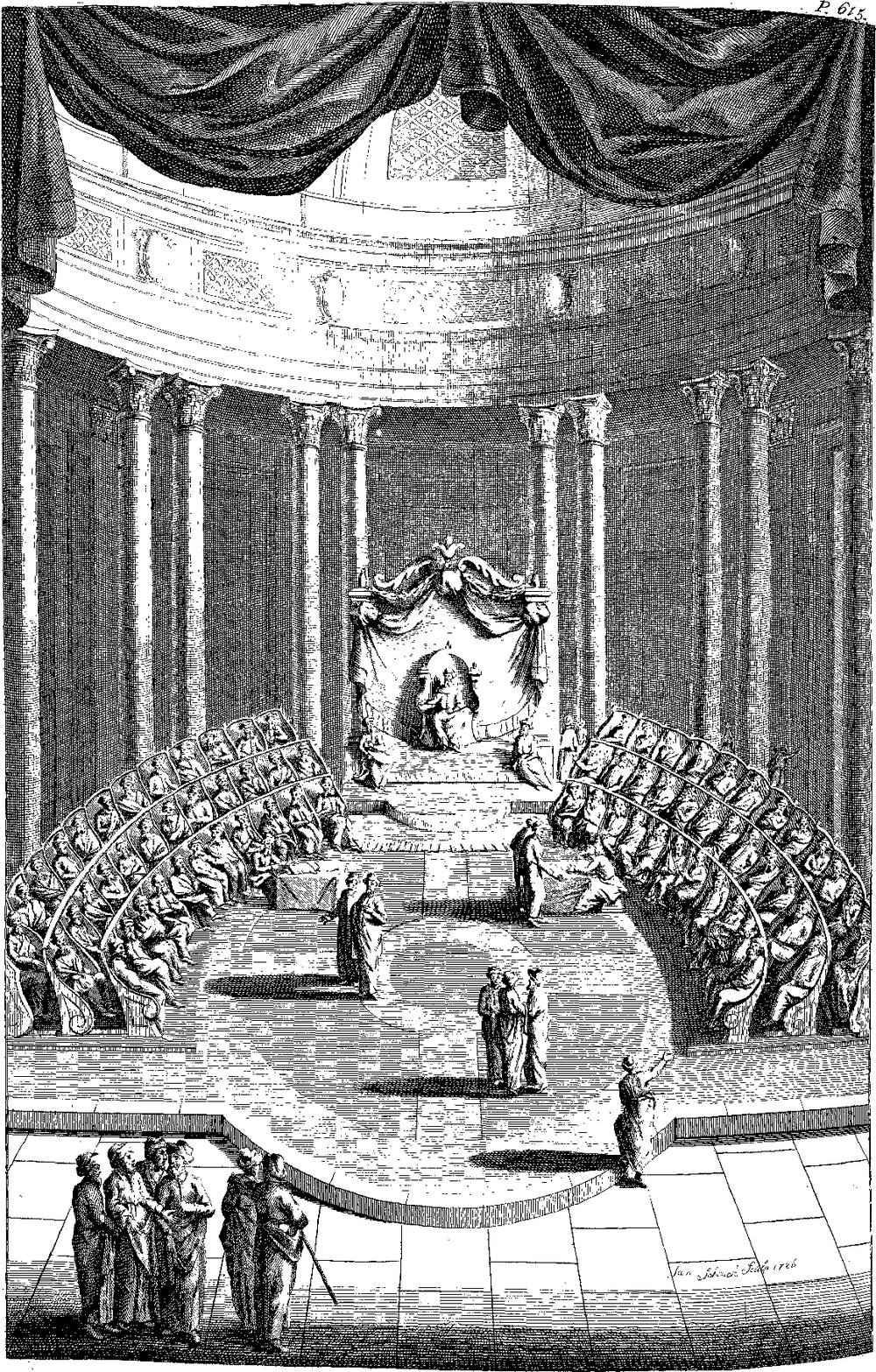
SANHEDRIM, or Sanhedria, a corrupted Word, and form’d from the Greek Word Synedrion, which signifies an Assembly, as those of Parliaments and Sovereign Courts, where many Judges and Counsellors meet together, to consult on and determine great Affairs. The Jews call Sanhedrim or Beth-din, the House of Judgment, a Council of Seventy Senators, who assembled in an Apartment of the Temple of Jerusalem, and there determin’d the most important Affairs of the Nation. The Chief of this Assembly was called Nasi or Prince; his Deputy was called Abbeth-din33, Father of the House of Nashi, Princeps.Judgment, and the Sub-Deputy was call’d Chacam, that is, the Wise. The rest were called Elders or Senators. The Room they Chacham, Sapiens. Senes, Senatores.met in was a Rotunda, half of which was built without the Temple, and half within; that is to say, there was one Semicircle of the Room within the Compass of the Temple, and as it was never allowed to sit down in the Temple, they tell us this Part was for those that stood up; the other Half or Semicircle extended itself without the Holy Place, and ‘twas here the Judges sat.
The Nasi or Prince sat upon a Throne at the End of the Hall, having his Deputy at his Right-hand, and Sub-Deputy at his Left. The other Senators were ranged in order on each Side. This Hall was call’d Lishcath-Haggazith,34 or the Hall paved with Stones; and some think it to be the same call’d in St. John35 Lithostrotos, or
paved with Stones. a They suppose what to me is very improbable, that when the Jews accused Jesus Christ before Pilate, they would not enter into the Praetorium, that they might not be defiled, but prevailed with Pilate to come into the Sanhedrim, there to hear their Accusations against our Saviour.
The Rabbins pretend, that the Sanhedrim has always subsisted in their Nation from the Time of Moses, down to the Destruction of the Temple by the Romans. They date the Establishment of it from what happen’d in the Wilderness, some time after the People departed from Sinai36. Moses being discouraged by the continual Murmurings of the Israelites, addressed himself to God, and desired to be relieved at least from some Part of the Burden of Government. Then the Lord said to him; Gather unto me seventy Men of the Elders of Israel, whom thou knowest to be the Elders of the People, and Officers over them; and bring them unto the Tabernacle of the Congregation, that they may stand there with thee. And I will come down and talk with thee there; and I will take of the Spirit which is upon thee, and will put it upon them; and they shall bear the Burden of the People with thee, that thou bear it not thy self alone. The Lord therefore poured out his Spirit upon these Men, who began from that Time to prophesy, and have not ceased from that Time. The Sanhedrim was composed of seventy Counsellors, six out of each Tribe, and Moses, as President, made up the Number seventyone37. To prove the uninterrupted Succession of the Judges of the Sanhedrim, there is nothing unattempted by the Partisans of this Opinion. They find a Proof where others cannot so much as perceive any Appearance or Shadow of it. Grotius may be seen in many Places of his Commentaries upon Scripture, and in his First Book De jure belli & pacis, c. 3. art. 20. and Selden in his large Work divided into three Tomes, where he treats de Synedriis veterum Hebraeorum. Lastly, our Dissertation may be consulted, concerning the Polity of the antient Hebrews, printed before our Comment upon the Book of Numbers.
As to the personal Qualifications of the Judges of this Bench; their Birth was to be untainted. They were often taken of the Race of the Priests or Levites, or out of the Number of the inferior Judges, or from the lesser Sanhedrim, which consisted only of Twenty-three Judges. See the Article JUDGES. They were to be skilful in the Law, as well Traditional as Written. They were obliged to study Magick, Divination, Fortune-telling, Physick, Astrology, Arithmetick, and Languages. The Jews say, they were to know to the Number of seventy Tongues, that is, they were to know all the Tongues, for the Hebrews acknowledged but Seventy in all, and perhaps this is too great a Number. Eunuchs were excluded from the Sanhedrim, because of their Cruelty, Usurers, decrepid Persons, Players at Games of Chance, those that had any bodily Deformities, those that had brought up Pigeons to decoy others to their Pigeon-Houses, and those that made a Gain of their Fruits in the Sabbatical Year. Some also exclude the High-priest and the King, because of their too great Power; but others will have it, that the Kings always presided in the Sanhedrim, while there were any Kings in Israel. Lastly, it was required, that the Members of the Sanhedrim should be of mature Age, rich, of handsom Countenance and Body. We speak now according to the Notions of the Rabbins, without pretending to warrant their Opinions. We have sufficiently explained our selves in this Matter, in the Dissertation referr’d to above.
The Authority of the great Sanhedrim was vastly extensive. This Council decided such Causes as were brought before it by way of Appeal from the inferior Courts. The King, the High-priest, the Prophets, were under its Jurisdiction. If the King offended against the Law, for example, if he married above eighteen Wives, if he kept too many Horses, if he hoarded up too much Gold and Silver, the Sanhedrim had him stripp’d and whipp’d in their Presence. But Whipping, they say, among the Hebrews was not at all ignominious; and the King bore this Correction by way of Penance, and himself made Choice of the Person that was to exercise this Discipline over him. Also the general Affairs of the Nation were brought before the Sanhedrim. The Right of Judging in Capital Cases belong’d to this Court, and this Sentence could not be pronounced in any other Place, but in the Hall called Laschat-haggazith; from whence it came to pass that the Jews were forced to quit this Hall, when the Power of Life and Death was taken out of their Hands, forty Years before the Destruction of their Temple, and three Years before the Death of Jesus Christ.
In the Time of Moses this Council was held at the Door of the Tabernacle of the Testimony. As soon as the People were in Possession of the Land of Promise, the Sanhedrim followed the Tabernacle. It38 was kept successively at Gilgal, at Shiloh; at Kirjath-jearim, at Nob, at Gibeon in the House of Obed-edom; and lastly, it was settled at Jerusalem, till the Babylonish Captivity. During the Captivity it was kept up at Babylon. After the Return from Babylon, it continued at Jerusalem to the Time of the Sicarii or Assassins. Then finding that these profligate Wretches, whose Number increased every Day, sometimes escaped Punishment by the Favour of the President or Judges, it was removed to Hanoth, which were certain Abodes situated, as the Rabbins tell us, upon the Mountain of the Temple. From thence they came down into the City of Jerusalem, withdrawing themselves by degrees from the Temple. Afterwards they removed to Jamnia, thence to Jericho, to Uzzah, to Shepharvaim, to Bethsanim, to Sephoris, last of all to Tiberias, where they continued to the Time of their utter Extinction. And this is the Account the Jews themselves give us of the Sanhedrim.
But the Learned do not agree with them Petav. de Doctrin. temp. l. 2. c. 26.in all this. Father Petau fixes the Beginning of the Sanhedrim not till Gabinius was Governor of Judea, who erected Tribunals in the five principal Cities of Judea39; at Jerusalem, at Gadara, at Amathus, at Jericho, at Sephora or Sephoris, a Grot. ad 1 Par. xxi. 4.City of Galilee. Grotius places the Beginning under Moses, as the Rabbins do, but he makes it determine at the Beginning of Herod’s Reign. Mr. Basnage,40 in his History of the Jews, at first thought that the Sanhedrim began under Gabinius; but afterwards he places it under Judas Maccabæus1 Macc. xii. 6., or under his Brother Jonathan. We see indeed, under Jonathan Maccabæus, in the Year 3860, that the Senate with the High-priest sent an Embassy to the Romans. The Rabbins say, that Alexander Janneus, King of the Jews, of the Race of the Asmoneans, appear’d before the Sanhedrim, and claim’d a Right of sitting there, whether the Senators would or no. Josephus informs us, that when Herod was but yet Governor of Galilee, he was summon’d before the Senate, where he appear’d. It must be therefore acknowledg’d, that the Sanhedrim was in Being before the Reign of Herod. It was in Being afterwards, as we find from the Gospel, and from the Acts. Jesus Christ in St. Mat. v. 22.Matthew distinguishes two Tribunals. Whosoever is angry with his Brother without a Cause, shall be in Danger of the Judgment. This, they say, is the Tribunal of the twenty-three Judges. And whosoever shall say to his Brother, Raca, shall be in Danger of the Council: That is, of the great Sanhedrim, which had the Right of Life and Death, at least generally, and before this Right was taken away by the Romans. Some think that the Jurisdiction of the Council of twenty-three extended to Life and Death also; but it is certain that the Sanhedrim was superior to this Council. See also Mark xiii. 9. xiv. 55. xv. 1. Luke xxii. 52, 66. John xi. 47. Acts iv. 15. v. 21. where mention is made of the Synedrion.
John xviii. 31.From all this it may be concluded, that the Origen of the Sanhedrim is by no means to be depended upon; for the Council of the seventy Elders established by Moses, was not what the Hebrews understand by the Name of Sanhedrim. Besides, we cannot perceive that this Establishment subsisted either under Joshua, the Judges, or the Kings. We find nothing of it after the Captivity, till the Time of Jonathan Maccabæus. The Tribunals erected by Gabinius were still very different from the Sanhedrim. This was the only one of its Kind, and fix’d at Jerusalem; whereas Gabinius establish’d five at five different Cities, which Tribunals do not appear to be subordinate one to another. Lastly, it is certain, that this Senate was in Being in the Time of Jesus Christ, and when St. Matthew, Mark, Luke, and John writ their Gospels; since they are mention’d in their Writings: But the Jews inform us themselves, that they had no longer then the Power of Life and Death. See the Authors above cited concerning this Matter.
Euseb. in locis, in Σωρδμ.SANIM. Eusebius says, there is a Place that goes by this Name in the Territory of Samaria, in the Canton call’d Acrabatene.
SANSANNAH, or Sensenna, a City of the Tribe of Judah. Josh. xv. 30.
SAOSDUCHIN. We think him to be the same who is call’d Nebuchodonosar in the Book of Judith. He succeeded Esar-haddon in the Year of the World 3336, before Christ 664, before the vulgar Era 668. He reigned twenty Years, and died in the Year of the World 3356, before Christ 644, before the vulgar Era 642. His Successor was Chinaladan, or Saracus. It is needless to repeat here what we have already said of this Prince, under the Articles NEBUCHADNEZZAR I. and HOLOFERNES.
SAPH, or Sippai, of the Race of the Giants. He was kill’d by Sibbechai the Hushathite. See 2 Sam. xxi. 18. and 1 Chron. xx. 4. In Samuel it is said, that the Battle in which Sippai was kill’d, was fought at Gob; and in the Chronicles it is said to have been fought at Gezer.
SAPHEC. Perhaps it should be Aphek. This City is mentioned in the Greek of 1 Sam. xxx. 29.
SAPHET, or Sapheta, a City of Galilee. See SEPHET.
SAPHIR. The Greek Copies of Joshua xv. 48. place a City call’d Saphir in the Mountains of Judah: But the Hebrew there reads Shamir. Micah i. 11. speaks also of the Inhabitants of Saphir. Transite vobis habitatio pulchra. The Hebrew says, Mic. i. 11.Pass ye away, into a strange Country, thou Inhabitant of Saphir. But perhaps by this the Prophet intends the City of Sephoris, or Sephora in Galilee. Eusebius says, that there is a City by the Name of Saphir, between Eleutheropolis and Askalon.
SAPPHIRA, a Christian Woman, and Wife of Ananias. They having sold together a Field in their Possession, brought a Part of the Price of the Field, and laid it at the Feet of the Apostles, as if it had been the whole Price, reserving the rest for their own Use. But for this Prevarication they were both struck with sudden Death ; as Acts v. 1, 2, 3, &c.we have seen before under the Article ANANIAS.
Exodus xxviii. 18. Shaphir. & xxxix. 11.SAPPHIRE, a precious Stone, which in Hebrew also has the Name of Shaphir. The Greeks and Latins write it Sapphirus, and it is often mentioned in Scripture. Job says, Job xxviii. 6.there are Places whose Stones are Sapphires ; that is to say, that Sapphires are very common in some Countries. Pliny says, that the best come out of Media ; perhaps, Plin. l. 37. c. 9. Gen. x. 30. Ezek. i. 26. & x. 1.out of the Country of the Sapires, or from Mount Sephar mention’d by Moses. The Oriental Sapphire is of a blue Sky-colour, or a fine Azure ; whence it is, that the Prophets describe the Throne of God, as it were of the Colour of a Sapphire ; that is, Exodus xxiv. 10.of a celestial Blue or Azure. Shaphir, in Hebrew, also signifies Beauty.
To express the Beauty and Value of the Tables of Moses, and of the wonderful Rod of this Legislator, the Hebrews say they were of Saphir. The Orientals had an extraordinary Esteem for this Stone ; those that had it about ‘em, thought it to be the Occasion of all their Happiness and good Fortune.
SARABALLA. It is said in Daniel, a that when the three Hebrews were cast into the fiery Furnace, the Fire did them no Harm, and that their Saraballa, their Coats, or Mantles, remain’d unhurt : Saraballa eorum sunt immutata. The Word Saraballa is Chaldean, and it is read in the Original of Nebuchadnezzar’s Edict, Dan. iii. 21. Aquila, Theodotion, and SymmachusTertull. de Pallia, c. 4. Trinit. have read Sarabara. Tertullian reads the same ; he says, that Alexander the Great was not ashamed to quit the military Habit of the Greeks, and to put on the Sarabara of the conquered Nations. These Sarabara were a kind of Breeches, or Bandage, that were wrapt about the Thighs and Legs. Sarabara is found also for an Ornament of the Head. See Salmasius upon Tertullian, de Pallio, c. 4. and Monf. du Cange’s Glossary.
SARABATHA, or Sabaratha. Epiphanius says, that this was the Country Epiphan. de Vita & Morte Prophet. Ita Eutyc. Alex. in Chronic.of the Prophet Zephaniah.
SARAC, or Saracus, otherwise call’d Chinaladan, succeeded Saosduchin in the Kingdom of Assyria, in the Year of the World 3356, before Christ 644, before the Vulgar Era 648 : He reigned two and twenty Years, and died in the Year of the World 3378, before Christ 622, before the Vulgar Era 626. His Reign is famous in History, because it was in his time that Nabopolassar and Astyages, ( the first being a Babylonian, and General of Sarac’s Army, and the latter being Son of Cyaxares King of the Medes) conspired together against him, besieged Nineveh, took it, deprived Sarac of the Kingdom, and divided his Dominions between them. Astyages reigned in Media, and Nabopolassar in Assyria. This Event is a famous Epocha among the Chronologers. We place it, with Usher, in the Year of the World 3378, before Christ 622, before the Vulgar Era 626.
I. SARAH, or Sarai, or Sara, the Wife of Abraham, Daughter of Terah, but born of a Mother different from Abraham’s ; since Abraham himself assures us,41 that she was really his Sister, the Daughter of his Father, but not the Daughter of his Mother. Terah might have had several Wives at once, according to the Custom of the Country where he lived ; or might have marry’d again, after the Death of Abraham’s Mother, by which last Wife he might have had Sarai. However this be, this Opinion seems to us much better founded, than the Opinion of those who make Sarah the same as Iscah the Daughter Gen. xi. 29.of Haran the Niece of Abraham, and Grand-daughter of Terah. However, this is the Opinion of Josephus42, of St. Jerom43, of St. Austin44, of Tostat, of Genebrard, and of a great Number of Commentators.
Sarai was born in the Year of the World 2018, before Christ 1982, before the Vulgar Era 1986. She marry’d Abraham before this Patriarch left the City of Ur45; and when Abraham went out of his Country, he made an Agreement with Gen. xx. 13.Sarah, that she should always say she was his Sister. For, being a Woman of exquisite46
Beauty, he was afraid she should be taken away from him, and that he might be put to Death on her Account. When the Famine prevail’d in the Land of Canaan, which was the Year after Abraham came into this Country, he was obliged to withdraw into Egypt, where the Famine did not reach47. He then said to Sarah; I conjure you to say that you are my Sister, that the Egyptians may use me well for your sake, and not take away my Life. When Abraham came into the Country, Sarah was taken away from him, and carry’d to Pharaoh’s Palace. But the Lord visited this Prince and all his Family with great Plagues, because of Sarah. And Pharaoh then knowing that she was Abraham’s Wife, he reproved him very sharply, for saying she was his Sister, by which means he might have taken her to Wife, if God had not prevented him. He therefore restored her to Abraham, and had them conducted out of Egypt, for fear any Injury or Outrage might be done them.
This Conduct of Abraham and Sarah has given Occasion to many Speculations among the Learned. Abraham seem’d to expose Sarah to the Danger of committing Adultery; and she seem’d too easily to consent to it, by pretending she was only the Sister of Abraham, and not his Wife. There is some Difficulty in vindicating such a Management on both Sides. In Abraham, there seems to have been Lying, Disguise, and too great Easiness, in tempting his Wife’s Chastity; and in her, too Origen. homil. 6. in Genes. Gen. xx. 12.great Forwardness to consent to it. Origen, speaking of what happened to Abraham, in respect of Abimelech King of Gerar, where he was in the same Circumstances as these now mention’d, says, that this Patriarch not only told a Lye, but even betray’d and expos’d his Wife’s Chastity. Faustus the Manichean48 calls Abraham an infamous Barterer of his Wife’s Modesty, which he sold to two Kings, to gratify his own Avarice and Gluttony. St. Chrysostom49, who seriously endeavours to excuse Abraham and Sarah, acknowledges, however, that this Patriarch exposed Sarah to the Danger of committing Adultery; and that Sarah consented to be exposed to this Danger, to save the Life of her Husband. Lastly, Some Moderns50 have very loudly declared, that in this Matter, they could not approve the Conduct of Abraham and Sarah.
St. Austin51 makes an Apology for Abraham, saying, 1st, That he did not tell a Lye, by affirming Sarah to be his Sister, as indeed she was: He conceal’d a Truth which he was not obliged to discover, by not telling that she was his Wife. 2dly, That being exposed at the same time to two Dangers, one of losing his Life, and the other of having his Wife taken from him, or dishonoured, and not being able to avoid either of them, by owning her for his Wife, but thinking it at least probable that he should escape Death, if he only own’d her for his Sister; he took this last Resolution, and of two Evils, he chose what seem’d to him the least, leaving to Providence the Care of his Wife’s Chastity, and knowing besides her virtuous Disposition, that whatever Injury her Body might suffer, her Will would have no Share in it; so that the Adultery (if it should happen) being involuntary on both Sides, it would be without either Guilt or Infamy. St. Chrysostom may be read upon this Passage, and the Commentators upon Gen. xii. 12, 13, &c.
But let us return to the History of Sarah. Knowing, on the one hand, that God had promised a numerous Posterity to Abraham, and, on the other, finding her self to be barren, she thought that possibly the Promises of God were to be performed by Means of some other Woman that her Husband might take; she therefore desired Abraham to take her Servant Hagar,52 that at least, by her Means, she might see some Issue from Abraham. He complied with his Wife’s Request, and took Hagar as a Wife of the second Order, according to the Custom of those Ages. But when Hagar found her self with Child, she began to use her Mistress with Contempt. Sarah complain’d of it to Abraham; who told her, that Hagar was still her Slave, and she might dispose of her at her Pleasure. Upon this she began to use her ill, and Hagar fled away from her; but she return’d some time after, and submitted her self to her Mistress.
Gen. xviii. 1,2,3,&c.Some Years after, God appeared to Abraham,53 made a Covenant with him, instituted Circumcision; changed his Name of Abram, or Exalted Father, into that of Abraham, or Father of a great Multitude; and changed the Name of Sarai, or My Princess, into that of Sarah, or Princess; and promis’d Abraham that he should have a Son by Sarah. The same Year he entertain’d in his Tent three Angels in the Form of Men, who repeated to him the Promise made by God, of the Birth of a Son, and assured him, that the present Year should not expire, before he saw the
Completion of this Promise. Sarah was behind the Door of her Tent, and hearing this, began to laugh within her self, saying, After I am now become old, and my Lord is old also, shall I receive Pleasure? Then the Lord said to Abraham, Why did Sarah laugh? Is there any thing impossible to God? Sarah shall indeed have a Son within a Year’s time. Sarah deny’d that she had laugh’d; but the Lord said to her, It is not so, for you surely did laugh.
A little while after,54 Abraham went to dwell at Gerar a City of the Philistines; and Abimelech King of this City took away Sarah, who, tho’ now fourscore and ten Years old, and then with Child of Isaac, was still a very handsome Woman. But the Lord appeared to Abimelech in a Dream, and threatned to punish him with Death, if he did not restore her to her Husband. The Day after, early in the Morning, this Prince came to Abraham, and brought his Wife to him, reproaching him very much with his Dissimulation, in pretending she was his Sister. Abraham excused himself, by saying, that she was indeed his Sister, being born from the same Father, tho’ not from the same Mother. Abimelech made great Presents to Abraham, and offer’d a thousand Pieces of Silver to Sarah, that she might purchase a Veil to cover her Face, and be no more expos’d to the same Danger.
Gal. iv. 29.The Year following she brought forth a Son,55 to whom she gave the Name of Isaac, that is Laughter, as by way of Allusion to her Laughing, when God promis’d her a Son, and to shew the great Joy that this Birth produced in her: She suckled the Child her self; and when it was to be weaned, that is, about three Years after, as the most probable Opinion is, Abraham made a great Feast for his Friends. Some time after this,56 when Sarah saw Ishmael at play with Isaac, or, according to St. Paul, Ishmael then persecuted or teized Isaac, she said to Abraham, Cast out this Servant, with her Son, for Ishmael shall not inherit with Isaac. Abraham made some Difficulty at complying with this Request, but God ordered him to do what Sarah desired; so that he sent away Hagar and Ishmael, in the Manner we have mention’d under their Articles.
The Scripture tells us no more of Sarah Gen. 23. 1, 19.‘till her Death, which happen’d some Years after the famous Trial that God made of Abraham’s Faith,57 by commanding him to sacrifice Isaac. Sarah was an hundred and twenty-seven Years old when she died: She was then in the Valley of Hebron, Duplex. See Machpelah.and Abraham came to Beer-sheba to mourn for her. We know not the Occasion of this Absence of Abraham; but the Scripture says expresly, he went into this Valley to mourn for her; and that after he had paid this his last Duty to her, he came into the City, and bought a Field of Ephron the Ammonite, in which there was a Cave hewn into the Rock, where there were new Tombs. The Text of the Vulgate calls this Cave by the Name of Double; but the Hebrew Text calls it Machpelah, which perhaps might be the Name of the Field where this Cave was.
Rab. quidam apud Tostat. in Gen. xxiii.Some have thought, that Sarah knew nothing of Abraham’s Intention of sacrificing his Son, and that she was not acquainted with it ‘till after they were return’d from Moriah. Others have maintain’d, that she died with Grief, when she was told, that Abraham had really sacrificed Isaac. ‘Twas a false Report made to terrify her. Josephus says, she died soon after this Event: But, according to his Calculation, she must have liv’d twelve Years after that; since, according to him, Isaac was five-and-twenty Years old when his Father would have sacrificed him, and Sarah was ninety Years old when she bore Isaac, and one hundred and twenty-seven when she died. Usher also puts eleven or twelve Years between Abraham’s Trial, and the Death of Sarah. The Talmudists and St. Epiphanius put Sarah in the Catalogue of Prophetesses of the Old Testament.
D’Herbelot, Bibl. Orient. p. 759.Sarah, Abraham’s Wife, according to the Orientals, was Daughter of Nahor, and Grand-daughter of Terah, and, consequently, Mother to this Patriarch. Sarah’s Mother was another Sarah, Daughter of Terah and Tahouiah his second Wife; for his first Wife, whose Name was Jounah, was Mother to Abraham.
II. SARAH, Daughter of the Patriarch Asher. Numb. xxvi. 46.
III. SARAH, Daughter of Raguel and of Anna of the Tribe of Naphtali, and of the Kindred of Tobit. Sarah was an only Daughter, and her Father had married her to seven Husbands successively; but God had smitten them all with Death, before they consummated their Marriage58. ‘Twas said, that an Evil Spirit call’d Asmodæus hindred them from coming near her. One Day, when Sarah was reproving one of her Maids for some Fault she had committed, she upbraided Sarah, saying, Let us never see either Son or Daughter from you, you that have murder’d your Husbands: Would you also kill me, as you have already kill’d your seven Husbands? At these
Words, Sarah went up into a Chamber that was at the Top of the House, and there continued in Prayer for three Days and three Nights, without either eating or drinking. The third Day she thus finish’d her Prayer to God; ” May thy Name be ” blessed, O God of our Fathers! Deliver ” me, O Lord, from this Reproach, or ” take me away from the Face of the ” Earth. Thou knowest that I have never ” desired an Husband, and that I have ” preserved my Soul pure from all evil ” Desires, and that I have never sought ” for the Company of such as are light ” and vain. If I have consented to take ” an Husband, I have done it in thy Fear, ” and not to gratify any Inclinations of ” my own: Either I was unworthy of ” those that were given me, or perhaps ” they were not worthy of me, and because thou hast reserved me for some ” other Spouse. O God of Israel, may ” thy Name be blessed in all Ages!”
This Prayer of Sarah was offer’d up to the Lord at the same time as that of Tobit, whom God had afflicted with the Loss of his Sight; and the Lord sent the Angel Raphael to relieve them both. The History of TOBIT may be seen under his Article. Young Tobias being upon his Journey to Rages, under the Conduct of Raphael, who had assumed a human Shape, they came to the City of Ecbatana59. Tobias asked Raphael where they should lodge. The Angel told him, There is here a Man call’d Raguel, who is of your Tribe, and one of your Relations; he has a Daughter call’d Sarah, who is his only Child; all his Estate ought to come to you; and you being his nearest Kinsman, according to the Law, ought to marry his Daughter: Ask her therefore of her Father, and he will give her you in Marriage. Tobias told him, He was afraid that the same thing might happen to him, as had already happen’d to Sarah’s seven former Husbands. But Raphael encouraging him, and having inform’d him in what Manner good People Tob. vii. 1,2,3,&c.should undertake Matrimony, they went together to Raguel. Tobias demanded Sarah in Marriage, and obtain’d her without Difficulty; especially when the Angel acquainted Raguel, that he had nothing to apprehend on this Account; that the young Man feared God; that his Daughter was reserved for him, and that it was upon his Account that no other could have her for Wife. Raguel having put his Daughter’s Hand into that of Tobias, he bless’d their Marriage, wrote the Contract, and made them a great Feast.
Tob. viii. 1,2,3,&c.When the Evening was come, Tobias was introduced into the Chamber of Sarah; then taking out of his Pocket a Part of the Liver of a Fish that he had taken in the Tigris, he put it upon burning Coals. The Demon Asmodæus being not able to endure this Fume, retired from thence; and the Angel Raphael seized him, and chained him down in the Upper Egypt. This was perform’d in an invisible manner, and no one was sensible of the Departure of the Evil Angel, but by the Safety of young Tobias. It is not easy to apprehend, according to the Notion that we now have of Good and Evil Angels, how Fumes and ill Scents are able to drive them away, nor how they can be pleased with good Smells and Perfumes. The Antients did not judge of these Things as we do. But abstracting from their Prejudices and our own in this Matter, we may believe that this Fume was only the moral or occasional Cause of the Flight of the Demon, and that it was Raphael, by God’s Appointment, that really drove him away. The good or ill Smell of the Liver of this Fish, might also make some Impression on the Senses of the married Couple; and might suppress in them the Motions of Concupiscence, and dispose them to pass this Night and the two following in Prayer and Continence. And this was, besides, a very effectual Method to drive from them the Demon of Impurity.
As to the rest, the Scripture often speaks of chaining the Devil a. Even profane Authors sometimes make use of this way of Speaking, to express the Action of a superior Force, or that of a more powerful Demon commanding an inferior, and not suffering him to act; and this, when they speak, for Example, of the Effects produced by Magick and Inchantment, or whether the Demon is overpower’d by Herbs, dead Bones, &c. But in Scripture and the Church, we acknowledge only the Force of the Name of Jesus Christ, the Prayers of the Saints, Exorcisms, and other spiritual Arms, that can really produce this Effect over Demons. Thus, when it is said, that the Angel Raphael chain’d down the Devil in the Desarts of the Upper Egypt; we ought to understand it, of the Power of God, in the Name and by the Orders of whom Raphael acted in all this. Our Dissertation may be consulted concerning the Demon Asmodæus, before the Book of Tobit.
To return to Sarah: Tobias having taken her to Wife, brought her back with him to Nineveh, where his Father Tobit dwelt: She was there the Mother of a numerous Posterity; and after the Death of old Tobit, Tobias took her back to her Parents at Ecbatana, with all their Children and Grandchildren.60
And this, because his Father Tobit, before his Death, had told them, that the Destruction of Nineveh was at hand, and that they ought to leave it as soon as possible, that they might not be involved in its approaching Calamity. The Year of Sarah’s Death is unknown; but she lived after the Year 3363, before Christ 637, before the Vulgar Era 641.
SARAIAS. See SERAIAH.
1 Macc. xiv. 28.SARAMEL, or Asamarel. We think it to be the Place Millo, mention’d 2 Sam. v. 9. Asbar-millo signifies the Court of Millo. Others, as Vatablus and Tirinus, have imagin’d, that Saramel was put for Jerusalem. Serrarius translates this Word by The Prince of the Lord, or, The Prince of the People of the Lord; and he explains it by the High-Priest Simon, who then govern’d.
SARAPH, the Name of a Man, which, 1 Chron. iv. 22.in the Vulgate, is translated by Incendens, Burning; Securus & incendens, qui fuerunt Principes in Moab. The Hebrew says, Joab and Saraph, who have ruled in Moab. ‘Tis thought these two Persons are the same as Chilion and Mahlon, Sons of Elimelech, who married in the Country of Moab, one to Ruth, and the other to Orpah. See Ruth, chap. i, ii, iv.
Saraph also signifies a kind of winged Serpent, common in Arabia, which God sent among the Hebrews, to punish them Numbers xxi. 6.for their Murmurings; Misit in eos ignitos serpentes, The Hebrew says, Seraphim Serpents. We shall speak to them under the Article SERPENT.
Judg. xvi. 31. Jos. Antiq. l. v. c. 10.SARASA: ‘Tis thus Josephus calls the City of Zorah, where Samson was buried.
SARASINS, or Saracens. This Name is not found in the Bible; but we often meet with the Arabians there, the Hagarens, and the Ishmaelites, who are confounded with the Sarasins. These were not begun to be talk’d of ‘till about the fifth Century. The Criticks are not agreed about the Etymology of their Name. Some derive it Sozom. & alii nonnulli.from Sarah the Wife of Abraham; as if these People, who were descended from Hagar and Ishmael, had been ashamed of their Original, and had taken the Name of Sarasins, or Children of Sarah, instead of Hagarens, or Children of Hagar. But what overthrows this Etymology, is this, that the Antients call’d them Sara-kenoi, and not Sarænoi, or simply Sarasenoi, as they must have been call’d, if their Name had been derived from Sarah.
Scaliger derives the Name Sarakeni from the Arabic Word Sarack, which signifies to שארקsharak, furari, prædari.steal, or plunder. Others fetch their Name from the City Sharakah, or Sharakiah, in Arabia. However this Matter be, as to the Etymology of their Name, ‘tis known that they embraced Christianity in the seventh Century; a Prince of theirs, call’d Terebon, having been miraculously cured of a Distemper, by the Name of Jesus Christ. But they soon forsook the true Religion, to follow Mahomet, and they were the first that follow’d him. Their Habitation was in Arabia Fœlix, on the Borders of Arabia Petrea: Satrippa, now Medina, was their Capital. At present there is no Nation known by the Name of Sarasins; they are not distinguish’d from the Turks and Arabs.
SARDANAPALUS King of Assyria. He is not known in Scripture under the Name of Sardanapalus; but there is great Probability that ‘tis he that repented at Jonah iii. 6.the Preaching of Jonas, and who was overcome by Arbaces Governor of Media, and by Belesus Governor of Babylon. We 2 Kings xix. 20. 1 Chron. v. 26. Vid. Justin. l. 1. Diodor. Sicul. l. 2. Ctesiam. Athenæum, l. 12.think that Pul King of Assyria, who came to the Assistance of Menahem King of Israel, was Father to Sardanapalus: As if it were said Sardan-pul See PUL. Belesus Governor of Babylon is probably the same as Baladan, mention’d in Isai. xxxix. 1. and 2 Kings xx. 12. and who is known in profane Authors by the Name of Nabonassar. Usher places the first Year of the Reign of Sardanapalus in the Year of the World 3237, before Christ 763, before the Vulgar Era 767. He reigned twenty Years at Nineveh, according to Eusebius and Julius Africanus. Every one knows, that the Wealth, the Luxury, and the Effeminacy of this Prince were excessive, even to a Proverb. Being shut up with his Women in the midst of his Palace, he hardly ever appear’d in Publick, and entirely neglected the Affairs of his Kingdom. Two of his Nobles, Arbases and Belesus, ashamed of his Weakness, and weary of obeying so degenerate a Prince, revolted against him in the Year of the World 3254, before Christ 746, before the Vulgar Era 750. They set upon him with an Army of four hundred-thousand Men, compos’d of Medes and Persians, Babylonians and Arabians.
This Army was beaten in the three first Engagements; but in the fourth the Bactrian Troops coming over to their Side, it became victorious, and drove the Enemy out of the Field, having attack’d them by Night. Sardanapalus had left the Command of his Army to a Brother-in -law of his call’d Salæmen, and he himself retired to Nineveh. Salæmen was defeated in two Battles, and lost almost his whole Army. Then the Confederates prepared themselves to besiege Sardanapalus in Nineveh. This Prince, not caring to trust to the Event of a War, sent his three Sons and two Daughters into Paphlagonia, to Cotta the Governor of this Province, that they might be there in Security. He made great Levies of Soldiers, and laid up Store of Pro
visions in Nineveh, to be ready there to hold out a long Siege. The City was besieged for three Years, and might have held out much longer, if the Tigris had not overflow’d its Banks, being swell’d by an extraordinary Fall of Rain, which overthrew the City Wall for twenty Stadia, or three thousand five hundred Paces.
Then Sardanapalus, finding he could hold out no longer, made himself a funeral Pile in the midst of his Palace, where -in he gather’d together all his immense Riches, and wherein he burnt himself, with his Concubines and Eunuchs, by putting Fire to his Palace. As soon as the Waters were assuaged, the Conspirators easily entred into Nineveh. Thus ended the Assyrian Empire, a after it had subsisted five hundred and twenty Years, as Herodotus affirms, l. 1. c. 95. Arbaces was proclaimed King of the Medes; and Belesus, or Nabonassar, or Baladan, was made King of Babylon. But this did not hinder the Assyrians from setting up a new King, who governed Assyria properly so called, and reduced to its ancient Bounds. This King, by profane Writers, is call’d Ninus Junior, and by the sacred Authors, Tiglath-pilneser. See 2 Kings xv. 29. and xvi. 7, 10. 1 Chron. v. 6, 26. 2 Chron. xxviii. 20.
SARDIS, a City of Asia Minor, formerly the Capital of Crœsus King of the Lydians. St John, in his Revelations, writing in behalf of Jesus Christ, to the Angel Rev. iii. 1,2,3,&c.or Bishop of Sardis, says thus: These things saith he that hath the seven Spirits of God, and the seven Stars; I know thy Works, that thou hast a Name that thou livest, and art dead. Be watchful, and strengthen the things which remain, that are ready to die: for I have not found thy Works perfect before God. Remember therefore how thou hast received, and heard, and hold fast, and repent. If therefore thou shalt not watch, I will come on thee as a Thief, and thou shalt not know what Hour I will come upon thee. Thou hast a few Names even in Sardis, which have not defiled their Garments; and they shall walk with me in White: for they are worthy. He that overcometh, the same shall be cloathed in white Raiment; and I will not blot out his Name out of the Book of Life, but I will confess his Name before my Father, and before his Angels.
Vid. Halloix. in Melitone, p. 819, 820, 838, 839.We know not the Name of the Bishop that was then at Sardis. Some Moderns have thought that it was St. Melito, a famous Bishop of this City, and Apologist for our Religion, who wrote in the Time of Marcus Aurelius, about the Year 170, or 175, of Jesus Christ. If this were so, we must allow him to have been Bishop above seventy-five Years; which is not easy to believe: For none of the Antients have said that he was a Disciple of the Apostles, or that he lived a very long Time. We ought not therefore to impute this Antiquity to him without any Proof; which besides is not very honourable to him, since St. John speaks of the Angel of Sardis in Terms not at all advantageous to him.
אדםO-dem.SARDIUS, or Ruby: Sardius Lapis;61 in Hebrew, Odem. This Word signifies Redness; wherefore some translate it by Ruby, or by Pyropus. The Sardius is reddish, approaching to white, as a Man’s Nail.
SARDONYX; as if it were, a Sardius united to an Onyx. The Onyx is a Precious -stone, commonly call’d Cornelian. The Basis of the Cornelian is white, as the Nail growing under the Flesh. The Hebrew שוהםShohem.Word Shohem, has been translated by Sar -donichus lapis, which rather signifies an Emerald.
SARERA. Epiphanius says, that Ezekiel was of the Country of Sarera.
SARGON King of Assyria. We believe him to have been the same as Assaradon, or Esar-haddon. Isai. xx. 1. See ESAR-HADDON.
SARID, a City of Zebulun. Josh. xix. 10, 12. We read of Saridim, Joel ii. 32. and Theodotion has taken it for a proper Name. But St. Jerom translates it by Reliquiæ, a Remnant. He owns, however, that the Jews take it for the Name of a Place.
SARON. See SHARON.
SARSECHIM, one of the Chiefs of the Babylonian Army62. This is a Name of Dignity, and signifies, The Chief of the Cup-bearers.
SARTHAN, or Sarthana, a City that some place to the East of Jordan, but it was rather to the West. The Waters retired Josh. iii. 16.as far as Sarthan, or Zaretan, when the Israelites passed over Jordan. Between Succoth and Zarthan King Solomon had 1 Kings vii. 46.the great Brazen Vessels cast, which were for the Use of the Temple. Sarthan is the same as Zeredathah, 2 Chron. iv. 17. and perhaps also the same as Zereda, 1 Kings xi. 26. which was the Country of Jeroboam the Son of Nebat.
שטןAdversarius.SATAN, or Sathan, or Sathanas: This is a meer Hebrew Word, and signifies an Adversary, an Enemy, an Accuser. It is often translated by Adversary, in the Septuagint1 Samuel xxix. 4., and in the Vulgate. For Example; the Princes of the Philistines say to Achish, Send back David, lest in the Battle he be an Adversary to us, and turn his Arms63
624
against us. And again, The Lord 1 Kings xi. 14, 23, 24.stirred up Adversaries to Solomon, in the Persons of Hadad and Rezon.
Sometimes St. Jerom has preserved the Word Satan in the Sense of an Adversary; 1 Kings v. 4. 2 Sam. xix. 22.for Example, Non est Sathan, neque occursus malus. I have neither Enemy nor Misfortune. Cur efficiamini mihi hodie in Sathan? Ye Children of Zeruiah, why are ye become my Enemies? At other times Satan is put for Job i. 6, 7, 11, &c.the Devil; for Example, in Job Satan presented himself among the Sons of God. And the Lord said unto Satan, Whence comest Ps. cix. 6.thou? And in the Psalms, Let Satan stand at his Right Hand. And in Zechariah, Satan standing at his Right Hand. And the Zech. iii. 1, 2.Lord said unto Satan, The Lord rebuke thee, O Satan.
In the Books of the New Testament, the Word Satan is taken, both in the Sense of an Adversary, and also for the Devil; for Example, Matt. xvi. 23. Mark viii. 33.Jesus Christ says to Peter, Get thee behind me, Satan, thou art an Offence unto me; that is to say, Begone, O my Adversary, you that withstand what I most desire. But most commonly Satan is taken for the Devil. If Matth. xii. 26. Mark iii. 23.Satan cast out Satan, he is divided against himself. And in the Revelation, He laid hold on the Dragon, that old Serpent, which is the Rev. xx. 2Devil and Satan, and bound him a thousand Years.
The Word Satan in Scripture, is often put for an Accuser, a Plaintiff in a Suit, and I think this to be the most literal Signification of the Word. Zechariah says64, And he shewed me Joshua the High-Priest standing before the Angel of the Lord, and Satan standing at his Right-Hand to resist him. The Septuagint have translated this Word by Diabolus, which also signifies an Adversary, a Slanderer, an Accuser. Satan, or the Accuser, is at the Right-Hand of Joshua, as also in Psal. cviii. 6. Constitue super eum peccatorem, & Diabolus stet à dextris ejus. The Hebrew says, Sathan stet à dextris ejus. Zechariah goes on; And the Lord said unto Satan, The Lord rebuke thee, O Satan. Let him despise thy Accusations, let him contemn thy Malice.
To this Passage is referred what is said in Jude 9.St. Jude. Yet Michael the Arch-angel, when contending with the Devil, he disputed about the Body of Moses (which the Devil would have discovered to the Children of Israel, in order to seduce them to pay it a superstitious Worship) durst not bring against him a railing Accusation, but said, The Lord rebuke thee. Diabolus in this Passage is the same as Satan in Zechariah.
Kingdom of Satan. In the Gospel65, Jesus Christ represents Satan to us as a Monarch, who has other subordinate Devils obedient to him. Beelzebub is, as it were, Acts xxvi. 18.their King. If Beelzebub, says he, drives out Devils, his Kingdom is divided against itself, he labours for his own Ruin, which is by no means credible; it is therefore false that I drive out Devils in the Name of Beelzebub. St. Paul acknowledges in the Acts, that all those which are not in the Religion of Jesus Christ, are under the Empire and Power of Satan. St. John in the Revelations says, Rev. xx. 7.that after a thousand Years Satan should be unbound, should come forth from Hell, and seduce the Nations.
Rev. ii. 9, 13. Rev. ii. 24. τὰ βάθεα τοῦ σατανᾶThe Synagogue of Satan, of which the same Evangelist makes mention, are probably the unbelieving Jews, the false Zealots for the Law of Moses, who at the Beginning were the most eager Persecutors of the Christians. They were very numerous at Smyrna, where St. Polycarp was Bishop, to whom St. John speaks in this Passage.
The Heights or Depths of Satan. S. John writes to the Christians of the Church of Thyatira, and says to them, You know not the Heights or the Depths of Satan, which have not known the Depths of Satan; that is to say, the Mysteries of the Nicolaitans, and of the Simonians, who concealed their Errors under a mysterious Abstruseness; they spoke of certain Intelligences that had created the World, and that were in Opposition to the Creator. They taught a profound Knowledge concerning the Nature of the Angels, and their different Degrees. They had secret Books written in an abstruse and mysterious Manner; and these are what St. John calls the Depths of Satan.
To be delivered up to Satan, is to be excommunicated and surrendered to the Devil for a Season, who visibly possessed this Sort of People, that had deserved this Punishment for their Crimes or Errors. St. Paul delivered up to Satan, Hymeneus and 1 Tim. i. 20.Alexander, that they might learn not to blaspheme. He also surrendered up to him 1 Cor. v. 5.the incestuous Person of Corinth, for the Destruction of the Flesh, that the Spirit may be saved in the Day of the Lord Jesus.
Luke x. 17, 18.When Jesus Christ sent forth his Disciples to preach in the Cities and Villages of Judea, they returned back with great Joy, and told him, saying, Lord, even the Devils are subject unto us through thy Name. Jesus tells them, I beheld Satan as Lightning fall from Heaven. He seems to allude to that Is. xiv. 12.Passage of Isaiah; How art thou fallen from Heaven, O Lucifer, Son of the Morning! By which he insinuated, that the Kingdom of the Devil was coming to a Period. Elsewhere Luke xxii. 31.he says to Peter, Simon, Simon, behold Satan hath desired to have you, that he may sift you as Wheat, but I have prayed for thee, that thy Faith fail not, shewing thereby what vain Efforts the Devil would make to destroy the Infant Church.
Satan continues on the next page
Footnotes
-
1 Sam. vii. 3, 4. In the Year of the World 2888, before Christ 1112, before the vulgar Era 1116. ↩
-
Some understand it of the Tears they shed; others of the Water wherewith they purify’d themselves; others explain it of the Libations of Water which they made before the Lord, perhaps because they had no Wine. See our Comment upon 1 Sam. vii. 6. ↩
-
1 Sam. viii. 1, 2, 3. In the Year of the World 2908, before Christ 1092, before the vulgar Era 1096. ↩
-
1 Sam. viii. 4, 5, 6, &c. In the Year of the World 2909, before Christ 1091, before the vulgar Era 1095. not ↩
-
See the Articles ELI, HOPHNI, and PHINEHAS, the ARK and DAGON. ↩
-
1 Sam. xi. 1, ↩
-
In the Year ↩
-
1 Sam xiii. 1, 2, 3, &c. The Vulgate ↩
-
1 Sam. ix, x. In the Year of the World 2909, before Christ 1091, before the vulgar Era 1095. 2, 3, &c. In the Year of the World 2909, before Christ 1091, before the vulgar Era 1095. of the World 2911, before Christ 1089, before the vulgar Era 1093. has it. Filius unius anni erat Saul cum regnare cœpisset, duobus autem annis regnavit super Israel. But the Hebrew is thus: Saul was the Son of a Year in his Kingdom; or, he had reign’d a Year; and he reigned two Years over Israel, and he chose,—or, in the second Year of his Reign over Israel he chose,— The Commentators upon 1 Kings xiii. 1. may be consulted, for the different Senses that are given to this Passage. ↩
-
In the Year of World 2930, before Christ 1070, before the vulgar Era 1074. 1 Sam. xv. ↩
-
In the Year of the World 2934, before Christ 1066, before the vulgar Era 1070. ↩
-
In the Year of the World ↩
-
This Circumstance of the Kings of Tyre, is not read 1 Sam. vii. 11, 12. The sacred Author has here supplied it. ↩
-
In the Year of the World 2949, before Christ 1051, before the Vulgar Era 1055. ↩
-
The Plural is here used instead of the Singular, for a Token of Honour. The Hebrew Word Elohim is taken for a God, a Magistrate, an Angel, a Judge. ↩
-
In the Year of the World 2944, before Christ 1056, before the Vulgar Era 1060. ↩
-
Origen. in 1 Reg. xxviii. & tom. 27. in Joan. & apud Eustat. Antioch. ↩
-
Aug. l. 2. de divers. qu. 4. ad Dulcitium, qu. 6. de Doctrin. Christ. l. 2. c. 32. ↩
-
Menasse Ben-Israel, l. 2. c. 6. de resurrect. mort. ↩
-
Auth. qu ad Orthodox. qu. 52. Tertull. l. de anima, c. 57. Basil. in c. 8. Isai. Nyssen. Epist. ad Theodos. Episc. ↩
-
Eustat. Antioch. de Engast. Hieronym. in c. 7. Isai. & in Matth. vi. Cyril. Alex. l. 6. de adorat. in Spirit. & verit. alii plures. ↩
-
Vid. Aug. l. 15. de cura pro mort. Ambros. in Luc. c. 1. Zeno Veron. serm. de resurrect. D. Thom. 2. 2. q. 174. art. 5. ad. 4. alii plures, ad 1 Reg. xxviii. ↩
-
Nehem. ii. 10. 19. In the Year of the World 3550, before Christ 450, before the Vulgar Era 454. ↩
-
Nehem. vi. 1, 2, 3, & ↩
-
In the Year of the World 3550, before Christ 450. before the Vulgar Era 454. ↩
-
The exact Year of his Return is not known. ↩
-
Joseph. Antiq. l. 11. c. ult. In the Year of the World 3672, before Christ 328. before the Vulgar Era 322. ↩
-
Translators’ note. Dr. Prideaux in his Connexion of the Histories of the Old and New Testament, rejects the Solution of this Difficulty, by supposing two Sanballats, and endeavours to reconcile it to Truth and Probability, by shewing it to be a Mistake of Josephus. This Author makes Sanballat to flourish in the Time of Dar- ius Codomannus, and to build his Temple upon Mount Gerizim by Licence from Alexander the Great; whereas it was performed by Leave from Darius Nothus, in the fifteenth Year of his Reign. This takes away the Difficulty arising from the great Age of Sanballat, and brings him to be Cotemporary with Nehemiah, as the Scripture History requires. ↩
-
Nehem. xiii. 6, 28. In the Year of the World 3563, before Christ 437, before the Vulgar Era 441. ↩
-
Vide Bochart. Chanaan. l. 2. c. 17. Huet. Demonstr. Evang. prop. 4. c. 3. art. 2. Voss. de hist. Græc. l. 1. c. 1. ↩
-
Anton. Van- dal. de Sanchon. Du Pin. Bibl. Eccles. Henric. Dodwell Dissert. peculiar. Anglice edit. Henr. Ursinus de Zoroastr. & Sanchoniat. Al- bert, Fabrit. Bibl. Græc. l. 1. c. 28. See also a Dissertation upon this Subject in the Journal de Trevoux, for Jan. 1714, &c. ↩
-
Lucian. lib. de scribenda historia, Terent. Eunuch. Act. 5. scen. 8. Judicii. ↩
-
אב בית דיןAb-beth-din. Pater Domûs ↩
-
לשכת הגזיתLishcath-haggazith. ↩
-
John xix. 13. Λιθόστρωτον. Lithostrotos. ↩
-
Numb. xi. 16. In the Year of the World 2514, before Christ 1486, before the vulgar Era 1490. ↩
-
Translators’ note. Six Senators out of each Tribe make in all seventy-two Persons, which, with the President, constitute a Council of seventy-three; and accordingly the Sanhedrim consisted of seventy-three Counsellors, according to some. ↩
-
Casaubon. in Sueton. l. 1. c. 46. Selden. de Synedriis, l. 2. c. 13. §. 4. Lightfoot. Hor. Hebr. in Joan. alii. ↩
-
Joseph Antiq. l. 19. c. 10. p. 476. gr. & de Bello, l. 1. c. 6. p. 722. P. c. 4. l. 5. c. 1. art. 12. ↩
-
Basnage’s History of the Jews, l. 1. SAPHEC. ↩
-
Gen. xii. 13. & xx. 12. Alias & verè soror mea est, filia patris mei, & non filia matris meæ, & duxi eam in uxorem. ↩
-
Joseph. Antiq. l. 1. c. 8. ↩
-
Hieronym. quæst. Hebr. in Genesin. ↩
-
Aug. contra Faust. l. 2. c. 35. ↩
-
Gen. xi. 29, 31. In the Year of the World 2082, before Christ 1918, before the Vulgar Era 1922. ↩
-
Dan. iii. 94. Vide & Chaldæum in ver. 21. סרבליםSym. Ἀναξυρίδας, Breeches. Aqu. Theodot. Σαράβαρα, Sarabara. ↩
-
Gen. xii. 10, 11, 12, &c. In the Year of the World 2084, before Christ 1916. before the Vulgar Era 1920. ↩
-
Faust. Manich. apud August. l. 22. c. 33. contra Faust. ↩
-
Chrysost. homil. 32. in Gen. ↩
-
See Bayle’s Dictionary, under the Article SARA. ↩
-
Aug. lib. 1. contra Mendac. c. 10. & lib. 22. contra Faust. c. 34, 35, 36. & lib. 16. de Civit. c, 19. ↩
-
Gen. xvi. 1, 2, 3, &c. In the Year of the World 2093, before Christ 1907, before the Vulgar Era 1911. ↩
-
Gen. xvii. 1, 2, 3, &c. In the Year of the World 2107, before Christ 1893, before the Vulgar Era 1897. ↩
-
Gen. xx. 1, 2, 3, &c. In the Year of the World 2107, before Christ 1893, before the Vulgar Era 1897. ↩
-
Gen. xxi. 1, 2, 3, &c. In the Year of the World 2108, before Christ 1892, before the Vulgar Era 1896. ↩
-
In the Year of the World 2113, before Christ 1887, before the Vulgar Era 1891. ↩
-
Usher places this Trial of Abraham in the Year 2133, and Sarah’s Death in 2145. ↩
-
Tob. iii. 7, 8, 9. About the Year of the World 3322, before Christ 678, before the Vulgar Era 682. ↩
-
Tob. vi. 10, 11, 12, &c. In the Year of the World 3322, before Christ 678, before the Vulgar Era 682. ↩
-
Matth. xii. 19. Mark iii. 27. Rev. xx. 2. 2 Pet. ii. 4. Jude 5. ↩
-
Exod. xxviii. 17, 39. and xxviii. 13. Rev. xxi. 20. ↩
-
Jerem. xxxix. 3. שר שקיםPrinceps Pincernarum. ↩
-
In the Year of the World 3257, before Christ 743, before the Vulgar Era 747. Angel of Satan. See ANGEL before. ↩
-
Zech. iii. 1. על־ימינו לשטנו והשטן עמדLXX. καὶ ὁ διάβολος ἱστήκει. Luke xi. 18. ↩
-
Matth. xii. 16. Mark iii. 23. 3 We ↩