Volume II, pages 20–38 of the 1732 edition, from LAC to LAW: everything printed on these pages, in order.
Continued from Lacedæmon
Jonathan, Brother to Judas Maccabæus, wrote to the People and Senate of Lacedæmon2 Macc. xii 6., to renew their ancient Alliance; their Relation was an Article not contested. It must be nevertheless confessed, that if this were founded only upon the Monuments remaining with us in the holy Scriptures, or in prophane Authors, their Belief was ill enough grounded. But they might at that Time have Proofs and Monuments in their Possession which are unknown to us.
Let this be as it will, the Conjectures which are offered to give Light to this Relation are such as here follow. Some1 have advanced, Gen. x. 28.that Ebal the Son of Joktan, was the same with Ebalus, the Father of Tyndarus, and Grandfather of Castor, Pollux, and Helena; but Chronology cannot be reconciled with this Opinion; and besides, this would not prove that the Lacedæmonians and Jews had Abraham for their common Father, since Ebal is six or seven Generations older than Abraham.
D. Thom. seu alius in Libb. Mac.Others believed, that the Lacedæmonians were sprung from one of the two Wives of Abraham, Hagar, or Keturah; but this is too uncertain, and gives us no Light beyond a Conjecture, which is not supported by the least Proof. Grotius imagines, that the Relation between the Jews and Lacedæmonians is founded upon the Lacedæmonians being descended from the Dorians, and the Dorians from the Pelasgians; and as these last were originally of the Countries adjacent to Syria or Arabia, it has been said at Random, that the Lacedæmonians and Jews were of the same Race; this is one of those agreeable Opinions which will not allow of an accurate and rigid Examination.
Eutychius Patriarch of Alexandria, deduces this Relation from Esau’s Side: He believes, that Esau married not only Women of Canaan, but likewise Greek Women; and that from thence proceeded the Alliance betweeen the Jews and Greeks. It were to be wished, that this supposed Marriage between Esau and these Grecian Women were so much as probable.
Some derive it from Cadmus, who being a Phœnician, and coming into Greece with some Arabians, gave Room for this Report of the Lacedæmonians descending from Abraham. The Foundation of the City of Lacedæmon is attributed to Cadmus, and the Etymology of the Name Sparta, which signifies sown, is borrowed from Cadmus’s having sown the Serpent’s Teeth, out of which sprung Men.2 Apollodorus adds, that Cadmus being frightened to see Men compleatly Diodor. Sicul.armed rising out of the Earth, threw Stones at them: That they gathering up the Stones, began to combat and to kill one another; so that but five of them remained, at the Head of whom was Udæus. Would not any one have taken this Udæus for Judæus, in Order to derive from him the Original of the Jewish Lacedæmonians?
Diodorus Siculus relates, that a Multitude of Strangers settling in Egypt, and beginning to alter the Laws and Customs of it, the Natives of the Country drove them out, and obliged them to retire where they could: Part of them withdrew into Greece under the Conduct of Danaus and Cadmus; the others having Moses at their Head, made themselves Masters of Judæa, which at that Time was intirely desolate. Here again is Matter whereupon to found a Conjecture concerning the common Original of the Lacedæmonians and Jews.
Tacit. Hist. l. v. initio.The Foundation of Sparta is by some Authors attributed to a Jew whose Name was Sparton, and who accompanied Bacchus in his Wars and Travels; others attribute it to Spartus the Son of Phoroneus. Some will have it, that this Sparton, Bacchus’s Companion, was a Jew; if this were well proved, there would be no other Foundation wanting to affirm, that the Jews and Lacedæmonians were derived from the same Father. But Pausanias remarks, that the Lacedæmonians knew of no Pausan. Corinth. P. 58.such Man, and did not acknowledge him to be the Founder of their City.
Joseph. Antiq. l. xii. c v. 1 Macc. xii. 9.The Ancients believed, that the Jews were originally of the Isle of Crete. This Opinion was still common in the Time of Tacitus: Judæos Creta insula profugos novissime Lybiæ insedisse, &c. Mount Ida, not very different from that of Juda; the Idæi not much unlike Judæi; the River Jarden having the same Name as Jordan in Palestine; the Laws of the Cretans given by Minos, those of the Lacedæmonians by Lycurgus, those of the Jews by Moses: All this in the most remote Antiquity. The Cretan People sent Colonies into Palestine: The Philistines were originally Cretans. Lycurgus the Lacedæmonian Legislator dwelt a long Time in Crete, and borrowed his Laws from thence; which he established among his Countrymen. All this might have given Room for Belief, that the Jews and Lacedæmonians were of the same Original3.
Josephus took the Passage of Jonathan’s Letter to the Senate of Lacedæmon in a Sense different from what we read in the Books of Maccabees. These Books import, that although the Jews had no Want of the Assistance of the Lacedæmonians, nor of an Alliance with them, did notwithstanding send proper Persons to renew it with them: Albeit we need none of these Things, for that we have the holy Books of Scripture to comfort us. Josephus makes Jonathan say, that for the Jews, they wanted not the Testimony of Strangers to be persuaded, that the Jews and Spartans were Brethren, having the sacred Writings in their Hands which furnished them with Proofs of it, &c. This Explanation of Josephus is followed by many Interpreters, but where are these Passages of Scripture which demonstrate the Relation between these two People? This is what no one hitherto could shew, any otherwise than by supposing what is very uncertain, that the Lacedæmonians came from the Edomites or Ishmaelites.
The Result of all that has been said is this, that the Relation of these two People is a very dubious Point, and that probably the Jews and Spartans were willing in this Particular to be agreeably mistaken. The Scripture does not oblige us to believe what Arius and Jonathan believed; if it be an Error, it is one for which they are responsible. The Books which we believe to be inspired and indubitable, do sometimes relate the Errors and vain Opinions of Men, without approving or authorizing them.
LACHISH, a City Southward of the Tribe of Judah, Joshua x. 23. xv. 39. Eusebius and St. Jerom tell us, that in their Time there was a Village called Lachish, seven Miles from Eleutheropolis, Southward: Sennacherib besieged Lachish, but did not take 2 Kings xviii. 17. xix. 8. and 2 Chr. xxxiv. 9. Lacus. Ita passim in vulgata. Gen. xxxvii. 20. xl. 15. Levit. xi. 36. & saepius. Mark xii. 1. Rev. xix. 19, 20. Ps. xxvii. 1. cxliii. 7. xxx. 4. lxxxviii. 7. Prov. i. 12. Isai. xiv. 15, Joseph. Antiq.it. It was from thence that he sent Rabshakeb against Jerusalem.
LACUS in the Latin Text of Scripture, and Lacos in the Greek, and Bor in the Hebrew, are taken in different Senses; sometimes for a Lake, at other Times for a Well or Cistern, and elsewhere for a Reservoir, or Cistern for the Reception of Wine and Oil; and in other Places for a Grave or such Caves as were dug in Rocks to lodge dead Bodies in.
LAHMAS, a Town in the Tribe of Judah, Joshua xv. 40. The Hebrews read Lachma.
LAISH, the Father of Phalti, of the Town of Gallim. 1 Sam. xxv. 44.
LAIS or Lesem, otherwise Paneas, afterwards Cæsarea Philippi, and last of all Neronias. Many are of Opinion that it is the same as Dan. But it is certain that Dan was different from Lesem and Paneas. Dan was four Miles from Paneas, on the Side towards Tyre4. See PANEAS.
LAISA. See ELEASA.
LAKE. There were three great Lakes in Judæa; the Lake Asphaltites, the Lake of Isa. xxii. 11.Tiberias, and the Lake Semechon. There was also in the Borders as you go towards Egypt, the Lake Sirbon. All these Lakes are to be sought for under their proper Articles. Besides these great Lakes, there were some Pools called also by this Name; as the Lake of Cendervia, from whence the little River Beleus flowed, to the East of Ptolemais; the Lake near Cæsarea of Palestine, the Lake Phiala, at the Foot of Libanus; the Lake Jazer, and that of Hesebon beyond Jordan. Isaiah speaks likewise of a Lake which Manasseh caused to be made, between the two Walls of Jerusalem.
There is Mention in the Book of Samuel 1 Sam. xxx. 30.of the Lake Ashan; there was a Lake probably near the City of Ashan, which belonged to the Tribe of Judah. See Joshua xv. 42. The Hebrew5 reads Cor Ashan, which is the Town of Ashan just now mentioned. It was given at first to Judah, and afterwards a Cession of it was made to Simeon. Joshua xix. 7. St. Jerom read Bebor-Asan, in Lacu Asan, instead of Becor-Acan.
1 Macc. ix. 33.The Lake Asphar, spoken of in the Maccabees, is no other than the Asphaltite, or the Dead Sea. See ASPHALTITE.
Isai. li. 1. Ps. vii. 16. Ps. xxviii. 1.Lacus is often used for a Cistern. Consider the Hole of the Lake whence they were taken out, says Isaiah, that is to say, the Covenant of your Fathers and Mothers. And as their Tombs were generally Holes dug in Rocks, or under Ground, wherein the Bodies of the dead were disposed in a Sort of Niches, and lay long concealed, the Scripture likewise often calls Tombs, Lakes; for Example, Lacum aperuit & effodit eum, & incidit in terram, quam fecit. And again, Unto thee will I cry, O Lord, my Rock, be not silent to me, answer me, lest, if thou be silent to me, Assimulabor descendentibus in lacum, who go down into the Grave, the Pit.
Lacus, Fossa, Cisterna. Zach. ix. 11. Jer. xxxviii. 6, 7, 8. Jer. Thr. iii. 56. Ezek. xxxii. 23.The Hebrew Word Bor signifies in General, a Pit, a Cistern, a Lake, a Sepulcher, a hollow deep Place, wherein wild Beasts are shut up such as Lions, and Slaves, as is still practiced at this Day in Africk, and other Places. Zachary says, Emisisti vinctos tuos de lacu, out of Prison. Jeremiah was cast into Prison, which Prison was a Well without Water, that had nothing in it besides Mud. Lacus novissimus signifies the deepest, the furthest Part of the Tomb or Prison: Invocavi nomen tuum, Domine, de lacu novissimo. And Ezekiel speaking of the King of Assyria’s Sepulcher says, that it is placed in the deepest Part of the Cave: Quorum Sepulcra data sunt in novissimis laci.
And as in Palestine, Wine and Oil were reserved in great Tubs or subtertanean Cisterns, in the Manner almost wherein Water
is preserved; these Tubs are likewise called Lakes: For this Reason, when they are talking of a Press, they say, they dig a Lake or subterraneous great Tub, for receiving the Gen. iv. 18, 19, 20, &c. Mark xii. 1. Antiq. l. i. c. 5. Rev. xiv. 19. 20.Wine: Vineam plantavit homo, & circumdedit sepem, & fodit lacum. And St. John in the Revelations says, that the Lord had sent his Angel to gather the Grapes, which he cut and put into the Lake of God’s Wrath, that he had trodden them; that the Blood came out of them, and overflowed the Length of sixteen hundred Furlongs. See the Article WINE-PRESS.
LAKUM, a City in the Tribe of Nephtali. Joshua xix. 33.
LAMB. Under the Word Lamb in Scripture the Kid is sometimes comprehended; for Example, the Hebrews at the Passover were left at Liberty to chuse indifferently either the one or the other for a Victim6. The original Seb in general signifies the Young either of a Goat or Ewe. Agnus anniculus, which is translated a Lamb of a Year old, may likewise be interpreted a Lamb of the Year, born in the Year, but that does not suck: For to sacrifice the Paschal Lamb while it used the Exod. xii. 5. Exod. xxiii. 19.Teat, and seethe it in the Milk of its Dam, was a Thing prohibited. Upon every other Occasion the Law required, that the Young should be left eight Days with its Dam before Exod. xxii. 30. Lev. xxii. 27.it was offered in Sacrifice.
The Prophets represent the Messiah to us like a Lamb abounding in Meekness, which If. liii. 7. Jerem. xi. 19. Joh. i. 29, 36. Rev. v. 6, 8, 12, 13. vi. 1. vii. 9. xii. 11, &c.is sheered and carried to the Altar without making a Complaint. St. John Baptist describes our Saviour by the Name of the Lamb of God; and in many Places of the Revelations he is pointed out to us under the Idea of a Lamb that has been sacrificed. In Isaiah xii. 6. it is said, that in the Time of the Messiah, the Lamb and the Wolf will feed peaceably together; and in the Gospel the Wicked at the Day of Judgment are compared to Goats, the Righteous to Lambs. Our Saviour sent his Disciples to preach the Gospel to the Gentiles like Lambs amidst Wolves. Luke x. 3.
PASCHAL LAMB. See PASSOVER.
LAMB OF GOD. This is the Name whereby John the Baptist called Jesus Joh. i. 29, 36.Christ, when he saw him coming to him, to signify the Innocence of this divine Saviour, and his Quality as a Victim which was to be offered up for the Sins of all the World. Lastly, he might allude to these Words of the If. liii. 7.Prophet: He is brought as a Lamb to the Slaughter, and as a Sheep before his Shearers is dumb, so he openeth not his Mouth.
I. LAMECH, the Son Methuselah, and Father of Noah. He lived a hundred Gen. v. 25, 31.fourscore and two Years before the Birth of Noah; and after it he lived five hundred and ninety five Years longer; thus the whole Time of his Life was seven Hundren seventy seven Years, being born in the Year of the World 874, and dying in the Year 1651.
II. LAMECH, of the Race of Cain, was the Son of Methusael, and Father of Jabal, Jubal, Tubalcain, and Naamah. Lamech is celebrated in Scripture for his Polygamy, whereof he is thought to be the first Author in the World. He married Adah and Zillah. Adah was the Mother of Jabal and Jubal; and Zillah of Tubalcain and Naamah his Sister. One Day Lamech said to his Wives, “ Hear me, ye Wives of Lamech; I “ have slain a Man to my wounding, and a “ young Man to my Hurt. If Cain shall be “ avenged sevenfold, truly Lamech seventy “ and seven Fold.” These Words are an unintelligible Riddle. The Reader may consult the Commentators. There is a Tradition among the Hebrews, that Lamech growing blind, killed Cain a hunting, ignorantly, and believing that he killed some Beast; and that afterwards he slew his own Son Tubal-Cain, who had been the Cause of this Murder, because he had directed him to shoot at a certain Place in the Thickets where he had seen something stir. Several other Suppositions are produced in Order to explain this Passage concerning Lamech, and all almost equally uncertain and absurd. We have related them for the most Part in our Comment. See likewise Pererius upon Genesis ch. iv. and M. Bayle in the Article Lamech. Josephus says, that Lamech had seventy seven Sons by his two Wives; but the Scripture mentions only three Sons and one Daughter. We have said something concerning each of them under their particular Articles. The Author of a Book intitled, Polygamia Triumphatrix, makes Lamech his Hero, and asserts, that Scripture mentions his Polygamy, in Order to commend it.
LAMENTATIONS. A mournful Poem is so called, composed by Jeremiah, upon the Occasion of the pious King Josiah’s Death; it was a long Time in the Mouths of the Singing Men and Singing Women of Israel. 2 Chr. xxxv. 25.This famous Poem is believed to be lost, but we have another of the same Prophet remaining, composed upon the Destruction of Jerusalem by Nebuchadnezzar. The Proofs of this are to be seen in every Chapter of the Lamentations. The Preface, which is very ancient, expresly shews it; Jeremiah speaks throughout of Jerusalem and the Temple, as Things destroyed, laid waste, and prophaned; the Author of Ecclesiasticus says, that after the taking of Jerusalem, the Enemies made the Ways which lead to it quite desolate, alluding to this Passage in the Lamentations, The Ways of Zion do mourn, because none come to the solemn Feasts.
In the two first Chapters of the Lamentations, Jeremiah is principally taken up in describing the Calamities of the Siege of Jerusalem. In the third he deplores the Persecutions which he himself had suffered. The fourth turns upon the Ruin and Desolation of the City and Temple, and upon the Misfortune of Zedekiah. See how he speaks of this Lament. iv. 20.unhappy Prince. The anointed of the Lord whom we love as our Life, who was as dear to us as our selves, was taken for our Iniquities: This Prince, so good, to whom we said, We live under thy Shadow among the Heathen. The fifth Chapter is a kind of Form of Prayer for the Jews in their Dispersion and Captivity. At the End of all he speaks of the Cruelty of the Edomites, who had insulted Jerusalem in her Misery, and contributed to the Demolition of it; he threatens them with the Wrath of God. This last Chapter was written probably after the rest, for it supposes the Temple to be so destroyed as to serve for a Retreat to Foxes, and that the People were already in Captivity.
The four first Chapters of the Lamentations are in acrostick Verse, and Abecedary, every Verse or Couplet beginning with one of the Letters of the Hebrew Alphabet, ranged in alphabetical Order. The first and second Chapters contain two and twenty Verses, according to the Number of Letters in the Alphabet. The third Chapter has three Verses together, which begin with the same Letter; and includes in all sixty six Verses. The fourth Chapter is like the two first, and has only two and twenty Verses; the fifth is not an Acrostick.
There is one Thing particular in the second, third, and fourth Chapters, viz. that the Letter Pe is before Ain; whereas in the first Chapter, and in all the Acrostick and Abecedary Psalms, Ain always goes before Pe. The Reason of this disorderly placing of them is not known to us; the Copists have attempted to repair this supposed Defect, but the Sequel of the Discourse requires, that Things should be left as they are.
The Hebrews call the Book of Lamentations Echa, from the first Word in the Text; or Kinnoth, that is to say, Lamentations7. The Greeks call them Threnoi, which signifies the same Thing in their Language. The Style of Jeremiah’s Lamentations is lively, tender, pathetick and affecting. It was the particular Talent of this Prophet to write melancholy and moving Things. There never was a Subject more worthy of Tears, nor written with more tender and affecting Sentiments. The Hebrews were used to make Lamentations or mournful Songs upon the Death of great Men, Princes, and Heroes, who had distinguished themselves in Arms, and upon any Occasion of publick Miseries and Calamities. They had Collections of these Sorts of Lamentations, as appears from the Chronicles, 2 Chr. xxxv. 25. Behold they are written in the Lamentations. We have those still which were composed by David upon the Death of Absolom and Jonathan. The Prophets Isaiah, Jeremiah, and Ezekiel, after having foretold the Desolation of Egypt, Tyre, Sidon, and Babylon, made Lamentations on the Fall of these Cities or States. It seems by Jeremiah, that they had Women hired on Purpose to weep. Is. xiv. 4, 5. and xv. xvi. Jer. vii. 29. ix. 10. xlviii. 32. Ezek. xix. 1. xxviii. 11. xxxii. 2. Jerem. ix. 17.Call for the mourning Women, that they may come, and send for cunning Women that they may come: And let them make haste and take up a wailing for us, &c.
LAMIÆ. The Ancients gave the Name of Lamiæ, Lemures, Larvæ, and Empusæ to certain Women, or rather certain Devils, who in the Shape of Women drew young Children after them with their Caresses, and afterwards devoured them. These She-Devils never, in all Probability, had any Existence, but in the Imagination of Nurses, and silly Women; no more than those Witches who are said to have their sabbatical Meetings in the Night, and to be transported through the Air. St. Jerom notwithstanding makes no Scruple of using this Word in two Places of the Vulgate. In the Lamentations of Jeremiah it is said, Sed & Lamiæ nudaverunt mammam, lactaverunt catulos suos: Filia populi mei crudelis, quasi struthio in deserto. The Hebrew Word Thannim signifies a large Fish, a Sea Dragon; and it is very credible, that St. Jerom in this Place by Lamiæ meant Sea-Dogs, or Whales which produce their Young alive, and nourish them with their Milk. This makes good Jeremiah’s Comparison with the Daughter of his People.
The Lamia is a Sea-Monster so exorbitantly large, that some have been seen which weighed thirty thousand Pounds, and such as two Horses in a Waggon could scarce draw. Some of them were taken at Nice and Marseilles, and in their Stomachs were found Men intire, and compleatly armed. Rondelet says, that he saw one in Xaintonge, the Mouth whereof was so large, that a large fat Man entered it with great Ease: He adds, that if it were held open with a Gag, the Dogs could get in very easily, in Order to eat what they could find in its Stomach. Gamer confirms this Account, and describes the Creature after the same Manner. It is the greediest Fish that is, and digests in the least Time. Its Teeth are large, sharp and biting, of a triangular Figure, cut like a Saw, disposed in six Rows, the first whereof
Chald alii quidam.appears out of its Mouth, those of the second are strait, and the third are turned inwards.
The other Passage wherein there is Mention of the Lamia, is in Isaiah8. This Prophet, according to the Vulgate, says, that the Land of Edom, or of the Idumeans, shall be reduced to a Desart; Ibi cubavit Lamia & invenit sibi requiem: The Hebrew Word is Lilith, which signifies, as some say, an Owl, or some other Bird of Night. The Rabbins9 tell us, Lilith was Adam’s first Wife, who quarrelling with her Husband, pronounced the Name of Jehovah, which it is not lawful to utter, and immediately was carried away into the Air. Adam complained to God of his Wife’s Elopement, and God sent three Angels after her, with Orders for her to return; and upon her Refusal, to threaten her that a Hundred of her Children should dye every Day. Lilith obstinately refused to return to her Husband, and chose rather to consent to the Death of her Children, than to be reconciled with him. The three Angels hereupon attempting to use Compulsion, she desired them to leave her in the Air, and promised them, that she would do no Harm to the Children who should wear the Names of these three Angels inscribed on any Thing about them: Hence it is that the Jews, to defend their Children from the Violence of this ill Woman have a Custom of writing their Names upon a Piece of Parchment, which they hang about their Childrens Necks. The Names are Lexoï, Sanfenoï, Sammangeloph. See hereafter LILITH.
לחם Lakan, vorare, ex Arab.The Fable says, that Lamia was a very beautiful Woman, who having had Children by Jupiter, Juno was so enraged at it, that she took Care to make all her Deliveries fatal, so that she brought dead Children always into the World. Lamia was so afflicted at this, that she grew very ugly, and out of Envy devoured the Children of other People. The Name Lamia, in all Probability, is derived from the Hebrew Lakem, which signifies to devour. It has still this Signification in Arabick.
The Arabians tell a thousand Stories of Lamia’s Fairies, or Medusa’s, whom they believed to be some of those Dæmons or evil Genius’s, to whom God gave the Government of the World before he trusted Eblis with it, who afterwards rebelled against God, and was thrown headlong into Hell. They believe that the ancient Genii, or Dives, or Ginns, were Male and Female; the Dives were the Males, the Peri’s the Females. D. Herbelot. Bibl. orient. p. 701, 702.The Peri’s are of an extraordinary Beauty, and do no Harm; on the contrary, the Dives are ugly and mischievous, and are generally at War with the Peri’s. These last feed upon the most excellent Odours, their Countrey is called Ginnistan, as much as to say Rainy-Land, the Countrey of the Genii, Fairies or Lamiæ. They say that Solomon having had the Advantage of overcoming one of these Lamiæ, employed her in Abundance of wonderful and extraordinary Things.
LAMNATZEACH. This is an Hebrew Word10, which we read in the Beginning of many Psalms. In the Septuagint and Vulgate it is translated, In finem, for the End, or for Eternity. Many understand this Word as relating to the coming of Jesus Christ, who appeared in the World at the End of the Times and Ages, preordained for this Purpose. Others interpret it of the calling of the Gentiles and Reprobation of the Jews: Others again of Eternity or the last Judgment; but these Explanations are rather moral and mystical than literal. There are some who construe, In finem, by always. A Psalm which deserves to be eternally in the Mouths and Memories of the faithful.
The Greek Interpreters Aquila, Symmachus and Theodotion, render the Hebrew, Lamnatzeach, victorious, or who giveth Victory, or a Song upon some Victory. But if we examine the Text of the Psalm to which this Title is prefixed, we generally find nothing at all relating to Victory. Wherefore this Translation cannot be maintained as literal. They who suppose these Titles to relate to the Victories of Jesus Christ, and so explain them, open indeed a larger Field for themselves, since our Saviour overcame the World, Death, and the Devil by his Sufferings, Humiliations, and Death, as well as by his Resurrection, Ascension, and glorious Mysteries; but we look for a grammatical and literal Explanation.
The Generality of modern Interpreters maintain with the Rabbins, that the Hebrew, Lamnatzeach, signifies to the Master of the Musick, or to him who presides over the Class of Singers, or Musicians, who sung in the Temple. It is certain, that the Verb Natzach, whence Lamnatzeach is derived, signifies to have the Direction of Workmen11, to preside over Singers or Musicians. There is no Passage wherein the Word Lamnatzeach is to be met with, which might not
easily be explained in this Sense. This therefore is, in all Probability, its true Signification.
There was a great Number of Levites in the Temple, who were employed in singing the Praises of God. Every Company of Singers or Musicians had its particular President or Master. We see a long Enumeration of them in the Chronicles, which concludes 1 Chro. vi. 31.with these Words: These are they whom David set over the Service of the Song in the House of the Lord. The principal of these Masters were Asaph, Heman, Ethan, and Jeduthan. The Companies of Singers were distinguished not only by their Families, and the Rank they held in the Temple, but likewise by the musical Instruments they used. Every one of these Companies had their particular President or Natzeach. Chenaniah, for Example, was celebrated for the Strength and Sweetness of his Voice; his Care was to preserve the Harmony of their Musick, or to tune and guide the Quire of Singers: And 1 Chro. xv. 22.Chenaniah chief of the Levites was for Song: He instructed about the Song, because he was skilful. When the Ark was removed to Jerusalem, Nenaiah presided over the Band of young Women who sung in this Ceremony. 1 Chro. xv. 18. 20. Pf. xi.In the Titles of the Psalms we see some for Example, which are addressed to the President of the Eighth, or of the third Band. Others were set over those who played upon Neginah, that is to say, upon a musical Instrument which was played on with the Fingers.
There were some of these Menatzeachs, or Presidents in the Courts of Princes, directing the Companies of Musicians of both Sexes which were employed there, as well as elsewhere in the religious Ceremonies. Upon Festivals and Rejoycings, and solemn mournful Occasions, there were People who sung and played upon Instruments, and all this was performed with Method. Among the Women who were hired to mourn, as well as those of the same Sex who were Musicians, there was a female President, who directed the Company, and tuned their Lamentations. As soon as David had composed any Pieces of sacred Poetry, he gave them generally to Asaph, to have them set and sung in the Temple. This we are to understand from Scripture, when it says that Asaph prophesied according to the 1 Chr. xxv. 2.Order of the King; and we find several Psalms entitled to Asaph President of the Musick. David himself did not think it below him sometimes to preside over the Quires of Musicians, and direct a Band of Singers, this is what we may infer from the Psalms with Titles such as these: To David the Servant of God, President of the Musick. Pf. xi. and xxxvi. or to David Head of the Musick.
LAMPS. There is frequent Mention made in Scripture of Lamps, and it may be worth observing what the Form of them was anciently. The Ancients did not commonly make Use of Wax or Tallow, but rather burnt Oil in their Lamps. The Lamp or Candlestick with seven Branches which Moses placed in the Holy, and those which Solomon placed afterwards in the Temple of Jerusalem, were Chrystal Glasses filled with Oil, and fixed upon the Branches of the Candlestick. The Lamps or Candlesticks made Use of in Houses were commonly put upon a pretty high Stand on the Ground. The Lamps of Gideon’s Soldiers, and those of the foolish and wise Virgins mentioned in the Matt. xxv. 1, 2, &c.Gospel were of another Sort. They were a Sort of Torches made of Iron or Potters Earth, wrapped about with old Linnen, which was moistened from Time to Time with Oil. M. Bernier says, that in the Indies M. dethey still make Use of Lamps of this Kind. They are nothing, says he, but a Piece of Iron let into Sticks, the Ends whereof are wound about with old Rags, which from Time to Time are moistened with Oil. He that carries the Light moistens it out of a Vessel made of Brass or Tin, with a long Neck, which he carries continually in his Hand. Gallonius says, that there are some of the ancient Lamps still to be found in the Ruines of Martyr.Rome, whereof I shall here give you a Description. They were Vessels made of Iron or Potter’s Earth, large, and with Holes on the Top about four Inches wide, or something more, ending in a Point below, and grafted into a Piece of Wood, which served for an Handle. In these Vessels they put Oil, or some other combustible Matter, to keep up the Fire or Light. In Homer they light up a Fire with a Sort of oily, sweet smelling Wood upon high Candlesticks, placed in the Middle of the Chamber. Notwithstanding what we have been saying, we must acknowledge Odyss. Σ. v. 106.likewise, that anciently they made Use of Wax-Candles, Flamboys, and Lights done over with Wax, and other combustible Materials, and even of oily, gummy Woods in particular Ceremonies: For Example, when Jason, High-Priest of the Jews, received King Antiochus at Jerusalem by Torch Light, with great Acclamations. Cum facularum luminibus, & laudibus.
Besides the common Signification of this Word, it signifies likewise in the figurative Sense of it, the Hope, Heir, Resource, and Guide of the People. After the Danger which David had been exposed to, in the Attack made upon him by the Giant Ishbibenob, the Israelites said to him; Thou shalt go no more out to War with us, least thou extinguish the Lamp of Israel. God would not suffer all the Tribes to shake off the Yoke of Rehoboam, that David might have a Lamp always before the Lord in Jerusalem; that there might be always a Prince of his Family. See the same Expression, 1 Kings xv. 4. and 2 Kings viii. 19. and 2 Chr. xxi. 17.
H
Quoties lucerna impiorum extinguetur. And Prov. xxiv. 20. and Psalm cxxxi. 17. Paravi lucernam Christo meo, are to be understood in the same Sense.
The Lord is called the Lamp of his Servants, their Hope, their Succour: Lucerna 2 Sam. xxii. 29. Job. xxix. 3.mea Dominus. And Psalm xvii, 29. Tu illuminas lucernam meam Domine. And Job speaking of his first Prosperity; Oh that I may again see those Days of old, wherein his Lamp shined upon my Head, and by his Prov. xiii. 9.Light I walked through Darkness? And Solomon; The Light of the righteous rejoyceth; but the Lamp of the Wicked shall be Prov. xx. 20.put out. And in another Passage; Whoso curseth his Father or his Mother, his Lamp shall be put in obscure Darkness: Which may be understood as meaning either the Death of such Sons, or the abandoned State which they will be left in.
Lamps sometimes signify Lightning, and Fire from Heaven. Populus ridebat voces Exod. xx. 18. Judith iii. 10.& lampades: The Thunder and Lightning.
The People received Holofernes cum coronis & lampadibus, in Order to do him Honour. They observed the same Custom in their Compliments to new married People, as Matt. xxv. 1, &c. Ps. cxviii. 105.appears by the Parable of the ten Virgins.
The Commandments of God are, as it were, a Lamp to guide the righteous: Lucerna pedibus meis verbum tuum. And in Proverbs vi. 23. Mandatum lucerna est. See Light. St. John Baptist is called a burning and a shining Light, John v. 35. And in the Revelations our Saviour is the Lamp of the new Jerusalem. Rev. xxi. 2.
LAND. The Land denotes often the Countrey of the Israelites, or in General, the Countrey or Canton which is spoken of; the Land of Canaan, the Land of Egypt, the Land of Ashur, the Land of Moab. Behold my Land is before thee, Gen. xx. 15. It is in your Power to settle your self, and go where you think proper. The Hebrews who were sent to view the promised Land reported, that it was a Land which devoured its Inhabitants, Numb. xiii. 33. it was filled with warlike People, was encompassed with Enemies, exposed to continual Dangers.
The Land of the Living, signifies the Habitation of the Blessed in the other Life, or even Palestine, in Opposition to the Land of Captivity, where the Jews looked upon themselves to be, as it were, in the Grave. See Psalm xxvi. 13. li. 7. lv. 23. cxli. 6. Isai. xxxviii. 11. liii. 8. &c.
The Land of Forgetfulness, of Obscurity, signifies the Grave. Psalm. lxxxvii. 13. Job. x. 21, 22. Psalm lxii. 10, &c.
LANGUAGE. There are several Questions proposed relating to this Subject, as 1. Whether God is the Author of the first Language, whether Adam received it from him by Infusion, or formed and invented it himself by his own Industry and Labour. 2. Whether this Language is still in Being. 3. Which is it. It is Matter of Dispute with some, whether Mankind have a natural Language, as Birds are said to have a natural Way of singing, and Animals of crying: Dogs bark, Horses neigh, Wolves howl, and Asses naturally bray: Thus in Proportion Ravens croak, Pigeons coo, and other Birds do something much after the same Manner: Some cry, others chirp, every one according to their Nature and Species. Thus likewise should Men have some certain natural Language, which is the Tongue that all should speak, and probably did speak before the Deluge. And as they groan when they are sorrowful, and make a chearful Noise when they are glad, they threaten and cry very loud when they are angry: And all this they do naturally and uniformly: wherefore it is presumed by some, that they would all speak the same Language, that primitive one, which was Adam’s, if Education did not change our natural Notions, and the Habits which we are made to contract when we are young, did not stifle the Voice of Nature in us.
The Ancients, who were unacquainted with the true History of the World’s Creation, were of Opinion, that under the happy Reign of Saturn, not only all Men, but even all terrestrial Animals, Birds, and even Fishes, spoke the same Language12: That Mankind not sufficiently sensible of their Happiness, sent a Deputation to Saturn, desiring Immortality of him, and telling him, that it was not just that they should be without a Prerogative granted by him to Serpents, which are every Year refreshed by shedding their old Skin, and assuming a new one. Saturn in great Rage not only refused to comply with their Request, but punished their Ingratitude, by depriving them of that Unity of Language, which kept them linked so close together. He confounded their Languages, and thereby put them under a Necessity of separating from one another.
Others13 have believed, that Chance or Nature produced Men and Animals of different Species in different Places, that it gave them certain Sounds and Accents to express their Passions, their Joy, Grief, Astonishment, and Desire: That afterwards Usefulness or Necessity put them upon inventing certain Words and Expressions to signify Things that were without them, and whereof they stood in Need; but that it was folly to imagine any one had named Things, and taught Men to speak.
Lucret. l. v. ver. 10. 40.Putare aliquem tunc nomina distribuisse Rebus, & inde homines didicisse vocabula prima Despipere est.
Nature produced Sounds, and Necessity taught Men to invent Language.
Ac varios linguæ sonitus natura subegit Mittere, & utilitas expressit nomina rerum.
Vitruv. l. ii, de Architectura. c. 1.Vitruvius says, that the first Men continued for a long Time like Beasts in Caves under Ground, without having any Use of Speech; the only Way they had of making themselves understood by one another, was by repeated Postures, and ill-articulate Voices; that by signifying the same Thing by the same Sounds, they accustomed themselves to speak, and struck out a regular Language.
Herodot. l. ii. c. 2.Psammetichus King of Egypt, being persuaded that the Earth had produced Men in different Places, and at different Times, was curious to know who were the first created. He imagined one sure Means of discovering this, might be to have a Sight of those who spoke the most antient Language in the World; and to this End he took two new born Infants, and had them brought up separately, so that no one might speak to them: He believed that the Language which these Children should speak, being the natural and primitive Language of Men, he might from thence infer, that the People who still speak it, might well pass for the oldest that the Earth had produced. When therefore the Children were of Age to talk, the Shepherd who had the Care of them observed, that as often as he saw them, they cried out to him Beccos. He gave the King Notice of it, who experienced the same Thing. All the Question that remained was, to know in what Language Beccos was a significant Term, and it was found, that among the Phrygians it meant Bread: Whereupon it was concluded, that the Phrygians were the most ancient People in the World.
This Way of Reasoning was on many Accounts erroneous: For was it certain that the Phrygians, supposing them to have been the most ancient People in the World, had preserved their primitive Language in its Purity? Again, had they consulted generally all People in the World, to know whether there were none besides the Phrygians with whom Beccos signified any Thing? Lastly, might not Chance have produced Beccos, as it does Abundance of other Words in all Languages? It is very credible that these two Children having been bred up by a Shepherd, and among Sheep, might imitate the Voice of these Animals, and might learn from their Bleatings to say Bêc, for os, which is at the End of the Word, is a Greek Termination, in which Language Herodotus has told this Story.
If there were any Language natural to Man, all Men would speak it, or at least they would have a great Propensity, and great Dispositions to speak it, many Footsteps of it would remain among the different People of the World. Children that were abandoned and exposed, or deaf, would speak this Language; all which is contrary to Experience. Let any one leave a Child without talking to it, and it will never speak any Language, either known or unknown. Melabdin Echebas King of Indostan, or Great Mogul14, having appointed a certain Child to be brought up at a Distance from the Company of Men, the Child continued without ever speaking. There were two Boys of about nine Years old found in 1661, amidst a Troop of Bears in Poland, one of which was taken, and great Endeavours were used to teach him to speak; but this could never be accomplished: He should, however, have spoken the Language which was natural to Man, there having been no Defect, as the Physicians reported, in his Tongue.
We must conclude therefore, that there is no national Language peculiar to Man. He has indeed certain Sounds, Motions, and natural Signs to express his Passions, his Joy, Pleasure, Grief, and Desires; but he has no Speech or articulate Sound, whereby to signify his other Thoughts. The Induction which some pretend to draw from other Animals, who have, they say, a kind of Language among them, is many Ways false and defective. Animals have certain Cries and Sounds which are natural to them, whereby they declare their Joy, their Appetite, or Pain: In like Manner as Man gives Indications of his Joy by laughing, and of his Grief by sighing; but this is very different from Speech. It is said farther, that Birds have a sort of Language which is understood among them, and which particular Men have pretended likewise to understand. But let any one make the Experiment, let them take a young singing Bird that has not as yet learnt any Note from the old ones, and it will imitate any other Note or chirping that they would have it learn: It will imitate Birds, or even the Sound of Instruments that is heard by it: And if it were possible to breed it up in such a Manner, that it should hear nothing at all, it would produce only uncertain, undeterminate, and chance Sounds.
So that taking the Matter right, neither Men nor Animals have any natural Language; and for the System which supposes Men and Beasts to have been produced by Chance in different Places of the World, and to have formed each to themselves a particular
Language after their own Fancy, as Necessity, Conveniency, or any other Cause required, it is not maintainable. Chance is not a Cause capable of producing a living organized Body, and much less a reasonable Animal; to put Matter in Motion there must be a moving Cause different from Matter; and to impress a regular Motion on Bodies, requires a reasonable and intelligent Cause; and although Man may invent Words, and form a certain Language wherein he may agree with those who are like him; yet it does not follow, that the first Men formed their Language after this Manner, nor that any Nation made one in particular for itself: There is sometimes a great Distance between Possibility and Fact.
Moses represents Adam and Eve to us, as the Father and Mother of all Mankind, and as the Stock from whence all Nations in the World spring. He describes them to us as reasonable and intelligent, speaking and imposing Names on Things as soon as they were created. This Legislator’s System concerning the Creation of the World, is the only one to be maintained; there is a Necessity for supposing the Almighty Power of God to intervene, not only to derive Beings out of nothing, but likewise to give them Form, Life, and Reason; and if we admit God to be the Creator, there is no more Difficulty to be made in owning him as the Author of that Language wherewith he inspired the first Man. The Scripture does not tell us how it was done, but it relates that Adam conversed with his Wife, and named Things at a Time when he could not have had Leisure to have framed a Language.
But what was this first Language which God himself taught Adam? In discussing this Question several Difficulties arise. The Generality believe, that this primitive Language is the Hebrew; others hold for the Syriac, Chaldee, Æthiopian, or Armenian. There is scarce any Eastern Language which has not pretended to this Honour. Becanus15 has maintained seriously, that it was the Flemish, and has derived some plausible Etymologies from it, of the Name Adam, Eve, Abel, Cain, Methuselah; Adam he derives from Haasdam, that is to say, who hateth the Heaps; Eve, from Euvat, Vessel of the Age; Abel, from Haas-Belg, who hateth War; Cain, from Quaat-Ende, bad End; Methuselah, from Machtusalig, save your selves, (Supply from the Deluge.) Other learned Men assert, that the first Language is entirely extinct, and is no more to be recovered in any of the Languages which are known to us. Others believe that it still subsists in the Hebrew Tongue, and others derived from it, but so impaired and changged, that some Remains of it only are to be found there.
D. Herbelot. Bibl. orient.If we would refer our selves to the Sabians, the Dispute would be very soon decided; since they shew a Book which they ascribe to Adam; the Character of it is very singular, but the Language is almost entirely Chaldee. Upon this Footing the Language of this Book must carry it, and Chaldee be acknowledged to come nearest to the Language of Adam; but we know how far we may reckon upon the Pretensions of the Sabians, of whom we shall say something in another Article.
Origen16, Saint Gregory of Nyssa17, and Theodoret18 believe, that God among the other Favours which he shewed the Israelites at their Departure out of Egypt, vouchsafed to them immediately the Knowledge of the Hebrew Tongue. To prove this Opinion they cite the Psalmist’s Words, lxxxi. 5. When he came out of the Land of Egypt he heard a strange Language. But it is much more probable that this Passage signifies nothing else, but that the Israelites after their Departure out of Egypt, heard at Mount Sinai the Voice of the Lord, which till then had been never heard among them.
If the Hebrew Language is that which God taught Adam, we must conclude from this Passage, that the two Fathers above cited, and they from whom they received this Tradition, believed, that when the Israelites left Egypt, it was entirely forgotten, since it was necessary, that God should by a new Miracle recover it among his People. But it is to no Purpose to insist much on this Opinion, which in Reality deserves no Notice. There can be no Argument deduced from thence for the Antiquity, Preservation, or Loss of the primitive Language.
The Generality of Criticks have declared for the Hebrew Tongue, and given it the Preference before all others. The Conciseness, Simplicity, Energy, and Fertility of it, and the Relation it has to the most ancient oriental Languages, which seem to derive their Origine from it, the Etymology of the Names whereby the first of Mankind were called, which naturally occurs in this Language; the Names of Animals, which are all significant in the Hebrew Tongue, and describe the Nature and Property of these very Animals, Particulars which are not to be observed in any other Language, all these Characters meeting together, raise a Prejudice very much in Favour of its Primacy and Excellency; it has farther another Privilege, which is this, that the most ancient and venerable Books in the World are written in Hebrew.
Nevertheless several very able Criticks19 are of Opinion, that the Hebrew Tongue, such as we see it at present in the Bible, and as it was in the Time of Moses, is not the primitive Language, pure, and incorrupted; they observe many Words in the Bible, the Originals whereof are not to be found in Hebrew. They are willing to allow, that there are more Footsteps of Adam’s Language preserved in the Hebrew, than in any other Tongue; but this they say has undergone diverse Changes and Alterations; and in the Series of so many Ages from Adam down to Moses, many Roots of this Language were lost, and others of a foreign Extraction received. It must be confessed, that if the Hebrew Tongue were more known, and we were informed how copious and extensive it was in Moses’s Time, we might be better able to pronounce decisively in this Matter.
Theodoret20 and the Maronites maintain, that the Syriac or Chaldee, is the true Language of Adam. This Assertion they found upon the Roots and Etymologies of the Names Adam, Eve, Abel, &c. which are to be seen in the Syriac and Chaldee Tongues; and upon Abraham’s speaking Chaldee, which was his natural Language, before he spoke Hebrew, this being the Language of the Land of Canaan. But to this it is replied, that as to Etymologies, the Hebrew Tongue has the same Advantage as the Chaldee, and is preferable to it with Respect to the Simplicity and Energy of it, and seems to be rather the Parent than the Child of the Chaldee: And lastly, there is so much Affinity between these two Languages, that it is very credible Abraham spoke both, and that Hebrew, as the most simple and ancient, was preferred by this Patriarch and his Descendants.
I shall not stay to confute the other Opinions which are offered with Relation to this Matter. The Eastern Languages are for the most Part derived from the Hebrew. Noah, in all Probability, spoke the same Language as Adam, and Noah’s was preserved among his Descendants till the Confusion of Languages, Gen. xi. 1, 2.which happened at Babel. At that Time, says the Scripture, the whole Earth was of one Language, and of one Speech. Erat terra labii unius, & sermonum eorundem.
The Question is, in what Manner this Confusion happened. 1. Some believe that the Words which we have just now cited from Moses, may be understood as signifying only the Agreement and Union of Opinions, which prevailed among Men at that Time, who were resolved by their joint Labours and Endeavours to build a Tower; in Order to make their Names celebrated. Others think, that God by an Effect of his extraordinary Power wrought a sudden Change in their Memory and Imagination, by producing a Forgetfulness of their natural Language, and teaching them immediately a new one; or at least by putting them under a Necessity of learning another, while they were unable to make Use of that which was before current with them.
St. Gregory of Nyssa21 is of Opinion, that by this Account from Moses, something very simple and natural was intended, which was no more than this; that while Men were dispersed in different Places of the Earth, it happened, as a natural Consequence of their Dispersion, that every one making some Alteration in the Language which he had learned from his Forefathers, in Process of Time it became so distinct, that they were no longer able to understand one another. This System was adopted by M. Simon22, and M. le Clerc23, with some little Variation; but the Generality of other Criticks have not approved it; because the whole Miracle which is described to us by Moses, in the History of the Confusion of Babel, is reduced by it to nothing. We need only read his Text to be satisfied, that he intended to describe a miraculous Event. And the Lord came down to see the Tower which the Children of Men builded; and he said, Behold the People is one, and they have all one Language; and this they begin to do: And now nothing will be restrained from them which they have imagined to do. Go to, let us go down, and there confound their Language, that they may not understand one another’s Speech. So the Lord scattered them abroad from thence upon the Face of the Earth, and they left off to build the Tower.
Deut. xxxii. 8.Another Question is proposed relating to the Number of Languages which were formed at the Confusion of Babel. The Ancients24, for the most Part, were of Opinion, that the Number of Languages which were then formed, was equal to the Number of those who undertook the Edifice of the Tower; as there were at that Time seventy Heads of Families, there were likewise seventy Languages. But where have they Intelligence of these seventy Heads of Families? In Deuteronomy, where it is said, that when the most High divided to the Nations their Inheritance, when he separated the Sons of Adam, he set the Bounds of the People according to the Number of the Children of Israel: Now the Children of Israel who
went down into Egypt with Jacob were seventy Deut. xlvi. 27.in Number: Omnes animæ domus Jacob, quæ ingressæ sunt in Ægyptum fuere Septuaginta.
Others take this Number precisely of seventy Languages from the Enumeration which Moses makes of Noah’s Descendants. Gen. x.Japheth had fourteen Sons, Ham had thirty, and Shem twenty six, in all seventy. Some reckon seventy two, because the Septuagint added two Persons to those enumerated by Moses; namely, Elisa to the Genealogy of Japheth, and Caïnan to that of Ham. Euphorus, who is cited in Clemens Alexandrinus, reckoned seventy five Languages, and PacianusClem. Alex. l. i. Strom. Pacian. Ep. contra Novatianos. Bishop of Barcelona an Hundred and twenty.
Without entring at present into an Enquiry concerning the Number of Languages, but examining only the Nature of the Proofs on which this Number of seventy is founded; we may say, that nothing herein is solid, besides the Passages of Deuteronomy and Genesis, taken in the Sense which we have shewn. The Septuagint instead of these Words; according to the Number of the Children of Israel, read according to the Number of the Children of God: From whence some have concluded, that they intended to describe seventy Nations under the Government of so many tutelar Angels. The Names Caïnan and Elisa, added by the Septuagint to the Text of Moses, no Way concern those who adhere to the Hebrew; they reject the Number of seventy two Languages, and are content with seventy. They who believe that Arphaxad, Salah, and Eber were not concerned about the Tower of Babel, nor in the Punishment of that Division which was the Consequence of it, lessen the Number seventy by three; Joktan the Son of Eber, and his Sons, to the Number of thirteen, in all Probability were not born at the Time of this Tower of Babel, and consequently here is again a new Diminution.
Some reckon but twenty Sorts of Languages in Scripture, which too were more perhaps than were formed at the Confusion of Babel. Others will have it, that at first there were but three Languages, one for each great Family of Shem, Ham and Japheth. The Number of seventy Languages appears too large, and was not at all necessary for God’s Design; three would not have been sufficient to oblige Men to a Separation, but ten or twelve Languages were more than were requisite for such a Purpose.
The Chinese Language we know has no Analogy with any others. The Teutonick or German, from which all those spoken in the North are derived; Biscayan, or the Language of lower Britany, are likewise Mother Tongues, which were spoken formerly in Gaul and Great Britain; as is also the Sclavonian Language, which is used in Illyria and other Countries. But of these last Languages we have no Mention in the Scripture.
Acts xi. 4, 5, &c. Acts xiv. 11.Saint Luke in the Acts of the Apostles relates, that the Holy Ghost having descended on the Apostles upon the Day of Pentecost, in the Form of fiery Tongues, they began to speak all Sorts of Languages; so that Strangers, who came to Jerusalem from all Parts of the World, were amazed when they heard them speaking every one in his own Language. They said hereupon among themselves, Are not all these which speak Galileans? And how hear we every Man in our own Tongue, wherein we were born? Parthians and Medes and Elamites, and the Dwellers in Mesopotamia, in Judæa and Cappadocia, in Pontus and Asia, in Phrygia and Pamphylia, in Egypt, and in the Parts of Lybia, about Cyrene, Strangers of Rome, Jews and Proselytes, Cretes and Arabians. Saint Luke speaks also of the Lycaonian Language, The People lift up their Voices, saying in the Speech of Lycaonia, the Gods are come down to us in the Likeness of Men. But these Languages, for the most Part, are either modern, or are but Dialects of the original and Mother Tongues.
Dan. iii. 4, 7, &c.In Daniel, the People who were under the Dominion of Nebuchadnezzar were distinguished by Languages, Tribes and Nations; Vobis dicitur, Populis, Tribubus & linguis.Rev. 5, 9, &c. alibi, &c. Gen. x. 5, 20, 31. In the Revelations in like Manner the Kingdom of the Messiah is distributed by People, Nations, Tribes and Languages, Thou hast redeemed us out of every Kindred, and Tongue, and People and Nation. Moses relating the Distribution of the several Countries of the World among the Sons of Ham, Shem, and Japheth, says, that they were divided in their Lands every one after his Tongue, after their Families, and after their Nations.
Col. ii. 1. Coloss. iv. 16. καὶ τὴν ἐκ Λαοδικείας ἵνα καὶ ὑμεῖς ἀναγνῶτε.LAODICEA. There are several Cities of this Name, but the Scripture speaks only of that in Phrygia, upon the River Lycus, near Colossæ. Its ancient Name was Diospolis. It was afterwards called Rhoas. Lastly, Antiochus the Son of Stratonice rebuilt it, and called it Laodicea, from the Name of his Wife Laodice. Saint Paul never was in this City, and the faithful of Laodicea had never seen his Face in the Flesh. Notwithstanding upon Information from Epaphras their Apostle, that false Teachers had propagated some pernicious Doctrines in Laodicea and Colossæ: He wrote to the Colossians, with Order to arm them against the Influence of these Seducers, and desires them, when they had read his Letter, to send it to the Laodiceans; and writes in the like Manner that the Laodiceans would send their Letter to the Colossians. And when this Epistle is read amongst you, cause it to be read also in the Church of the Laodiceans, and that ye likewise read the Epistle from Laodicea.
Saint Paul’s Expression to the Colossians, And ye likewise read the Epistle from Laodicea, is ambiguous. It may either signify the Letter, which Saint Paul wrote to those of Laodicea, or that which the Laodiceans wrote to Saint Paul. Hereupon Interpreters have been divided; some25 taking it in the former, others in the latter Sense. We have still at this Day a Letter under the Name of St. Paul to the Laodiceans. Theodoret26 and Saint Jerom27 had seen one with this Title. The Fathers of the seventh Council say28, that their Predecessors had likewise a Knowledge of one. But both rejected it as false and spurious; and all Men of Learning are at present convinced of that’s being a Counterfeit, which is cited under St. Paul’s Name, and is inserted in some antient Bibles printed in Germany and Antwerp. We find it likewise in some old Manuscripts. There is Reason also to question whether that which the Ancients speak of be the same with this, since we have it not in Greek; that published by Hutter in this Language having been translated by him from a Latin Copy. Besides, Philaster says, that the Hereticks have added something to the Epistle to the Laodiceans; and Timotheus Priest of Constantinople29 tells us, that it was forged by the Manichees, now there are no Footsteps of Manechism, nor of any other Heresy visible in that which we have in our Hands, whereof you have here a Copy.
Paulus Apostolus non ab hominibus, neque per hominem, sed per Jesum Christum, Fratribus qui sunt Laodicex, gratia vobis & pax a Deo Patre nostro, & Domino Jesu Christo. Gratias ago Christo per omnem orationem meam, quod permanentes estis, & perseverantes in operibus bonis, promissionem expectantes in die Judicii. Neque disturbent vos quorundam vaniloquia insimulantium veritatem, ut vos avertant a veritate Evangelii quod a me præ-dicatur. Et nunc faciet Deus ut qui sunt ex me ad perfectum veritati Evangelii sint deservientes, & benignitatem operum facientes, quæ sunt salutis vitæ æternæ. Et nunc palam sunt vincula mea, quæ patior in Christo, in quibus lætor & gaudeo. Et hoc mihi est ad salutem perpetuam quod factum est orationibus vestris, & administrante spiritu sancto, sive per vitam, sive per mortem. Est enim mihi vivere vita in Christo, & mori gaudium. Et ipse in vobis faciet misericordiam suam, & eandem dilectionem habeatis, & sitis unanimes.
Ergo, dilectissimi, ut audistis præsentiam Domini ita sentite, & facite in timore, & erit vobis vita in æternum. Est enim Deus qui operatur in vobis; & facite sine peccato quæcunque facitis, & quod est optimum. Dilectissimi, gaudete in Domino Jesu Christo, & cavete omnes sordes in omni lucro. Omnes petitiones vestræ sint palam apud Deum: Estote firmi in sensu Christi, & quæ integra, vera, & pudica, & casta, & justa, & amabilia sunt, facite; & quæ audistis & accepistis in corde retinete, & erit vobis pax. Salutant vos omnes sancti. Gratia Domini nostri Jesu Christi, cum spiritu vestro. Amen. Et hanc facite legi Colossensibus, & eam, quæ est Colossensium, vobis.
You have here the same Epistle in English. Paul an Apostle not of Men, nor by Man, but by Jesus Christ, to the Brethren who are in Laodicea, Grace and Peace to you from God our Father, and from our Lord Jesus Christ. I thank God in all my Prayers, that you are firm and persevering in good Works, waiting for the Promise of God at the Day of Judgment. Suffer not your selves to be moved by the vain Talk of those who accuse the Truth, that so they may persuade you to forsake the Gospel which I have preached. I trust that God will so order Things, that my Disciples may continue fixed to the Perfection of the Truth of the Gospel, and in the Practice of good Works, whereby they will deserve eternal Life. The Bonds which I bear for Jesus Christ are known of all the World, I rejoyce at them, and take Pleasure in them; and this will be of Use to me in procuring eternal Salvation, by the Help of your Prayers, and the Assistance of the holy Spirit, whether in Life or Death; for to me to live in Christ is Life, and to die is Joy. He will grant you through his Mercy to be always united with the most perfect Love. Wherefore, dearly beloved Brethren, as ye have learned that the Lord must come, continue in the same Sentiments, and guide your selves in his Fear, and ye shall have eternal Life, for it is God that worketh in you. Do therefore every Thing that you do without Sin, and practise continually that which is most perfect. My dearest Brethren, rejoice in our Lord Jesus Christ, and shun all sordid Gain. Direct all your Petitions to God; remain firm in the Opinion that ye have of Jesus Christ, and practice always that which is most perfect, true, pure, just, and lovely. Retain in your Hearts what ye have learned, and ye shall have Peace. All the Saints salute you. The Grace of our Lord Jesus Christ be with your Spirit, Amen. Cause this to be read to the Colossians, and read that which is directed to the Colossians.
But if this Epistle is spurious, as it is agreed it is, what must that be of the Laodiceans, which St. Paul requires the Colossians to read in their Assembly? Marcion30 pretended
that this was the Epistle to the Ephesians; and Grotius is of the same Opinion, as are likewise M. le Clerc and Hammond. They say St. Paul having written an Epistle to the Ephesians and Laodiceans, conceived in the same Terms, he desired that these two should be looked upon as circular Letters throughout all Asia Minor, and should be sent from one Church to another. Now as Laodicea was nearer to Colossæ than Ephesus, Saint Paul chose rather, that the Colossians should address themselves to the Laodiceans, than Ephesians, in Order to have a Communication of this Letter.
Others in great Number31, both among the Ancients and Moderns, tell us, that this was an Epistle, which they of Laodicea had written to Saint Paul, and which this Apostle was desirous that the Colossians should read for their Edification and Instruction. There is some Probability in this Hypothesis; but we cannot deliver it as a true one. Saint Paul, one would think, should rather have sent from Rome the Letter which he received from the Laodiceans, if he had a Mind, that it should be read to the Colossians, than refer the Colossians to those of Laodicea for a Copy of it, while it was uncertain whether these had preserved one or not.
Others32 affirm, that Saint Paul wrote a Letter to the Laodiceans at the same Time as he sent one to the Colossians, which Letter is not come to our Hands. But there is an indisputable Proof, that Saint Paul did not then write to those of Laodicea; for in his Epistle to the Colossians he desires them to salute the Brethren of Laodicea in his Name33. We had better therefore suppose, that Saint Paul’s Design was to speak here of the Letter he received from those of Laodicea, which is lost. It is true this Fact is not certain; but it is the most plausible Supposition of all that are proposed, in Order to explain the Passage here in Question.
LAPIDOTH, the Prophetess Deborah’s Husband, Judg. iv. 4. Some are of Opinion, that Lapidoth was the Place of this Prophetess’s Birth or Habitation. Others considering the Signification of Lapidoth, which signifies Lamps, have imagined, that Deborah employed her self in making Matches for the Candlestick in the Tabernacle.
Lev. xi. 19.LAPWING, in Latin, Upupa, a Bird by Moses declared to be unclean. A Lapwing is about as large as a Thrush; its Beak is long, black, thin, and a little hooked; its Legs are grey and short. Upon its Head it has a Tuft of Feathers of different Colours, which it raises or lowers as it pleases. Its Neck and Stomach are something reddish. Its Wings and Tail black with white Streaks. The Hebrew Name of this Bird is Dukipha. The Septuagint and Saint Jerom translate it Lapwing.
It is very beautiful, but does not sing, it only makes a hoarse Noice, which is heard at some Distance. Its Wings do not terminate in a Point like those of other Birds, but in a Round, which makes it very slow in its Flight. Pliny calls the Lapwing Trimestris, because it is to be seen only three Months. It retires, in all Probability, betimes into warmer Countries. It rarely pearches, and lives generally in old Ruines, or along the high Ways. It is said to feed upon Worms and human Excrements, and to make its Nest of them. Aristotle affirms, that it does not build any Nest, but only retires into the hollow Parts of Trees, and that it lays its Eggs there without any other Preparation. It generally lays three Eggs, which are like a Partridge’s. Albertus Magnus relates, that Lapwings when they grow old live with their Young, which feed them during the moulting Season, when they have cast their Feathers; and that when they have lost their Sight, they recover it for them, by the Help of an Herb which is naturally known to them, and with which they touch the Eyes of their old ones. The The Male has a fuller and higher Tuft than the Female, and the Colours of its Feathers is brighter and more lively. There is no such Thing as a Lapwing to be seen in any Part of England, but there are abundance of them in Germany.
LASHA. Moses describing the Limits of the Land of Canaan says, that it reaches Southward as far as Lasha. The Chaldee and Saint Jerom think Lasha to be the same as Callirhoe, which lies Northward of the Dead Sea, and discharges itself into it. But it is much more natural to understand it of the City of Lasha, Lusa, or Elusa, which was at pretty near an equal Distance between the Dead Sea, and the Red Sea. Ptolemy mentions this City of Lusa, and so do Josephus, Joseph. Antiq. l. xiv. c. 2.and Stephens the Geographer.
LASTHENES, Prince of Crete, who settled Demetrius Nicator, the Son of Demetrius Soter, upon the Throne of Syria, by the Help of those Troops which he supplied him with34, Demetrius, as an Acknowledgement for this Service, gave Lasthenes the Government of Syria, and the principal Authority in his Kingdom; he called him his Father and Cousin. But Lasthenes abusing his Power35, involved King Demetrius in great Perplexities, out of which he never could disengage himself perfectly.
LATHYRUS. Ptolemy Lathyrus. See PTOLEMY.
LATRIA, a Term peculiar to Theology and the Language of the Church, denoting that supreme Worship which is due to God Aug. de Civit. l. x. c. 1. iv. 2only . Saint Austin, Latreia secundum consuetudinem qua locuti sunt, qui nobis divina eloquia condiderunt, aut semper, aut tam frequenter, ut penè semper, ea dicitur servitus, quæ pertinet ad colendum Deum. But in the Greek Text of Scripture, Latreia is likewise made Use of to signify the external Service of the Priests in the Temple, the Ceremonies, Worship, and the whole Religion of the Jews. For Example, speaking of the Paschal Ceremonies : Keep this Service (Latreian) and when your Children shall say unto you, what mean you by this Service (Latreia.) It answers to the Hebrew Abodah36, which St. Jerom translates Cæremonia, cultus, religio, mos, servitus. The Author of the first Book of Maccabees37 speaking of the Idolatry which Antiochus Epiphanes resolved to introduce in Israel, says, that many consented to this Worship, Latria, to this false Religion; and that Mattathias said to his Sons38, God forbid that we should forsake our Religion, which is a right Way, to follow any other Way. In the New Testament39 Jesus Christ tells his Disciples, that they who persecute them, shall think that they do God Service, Latreian.
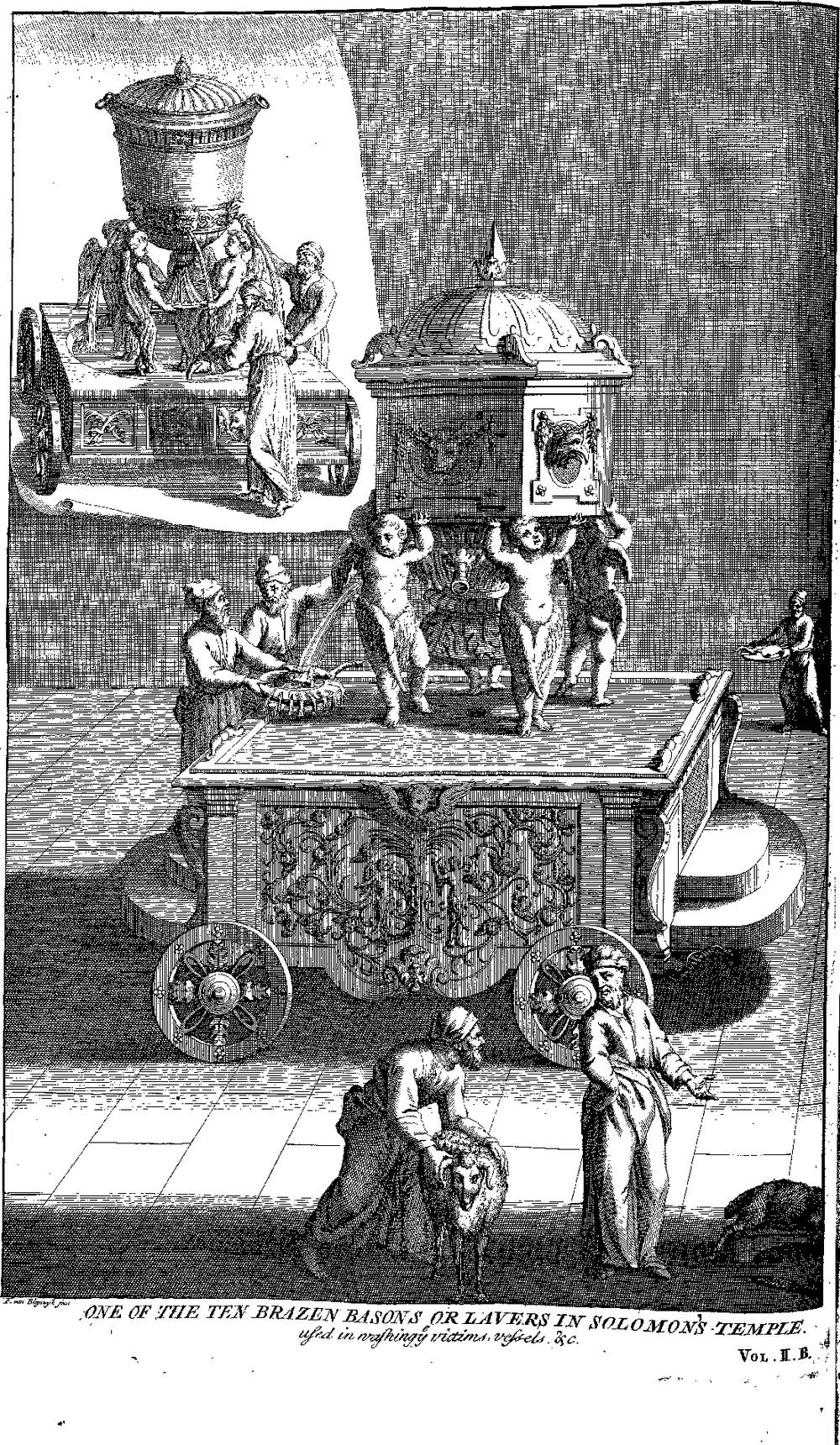
LAVERS, of Solomon’s Temple. These were Vessels born by four Cherubims, standing upon Bases or Pedestals, mounted upon brazen Wheels, and having Handles belonging to them, with the Help whereof they might be drawn, and conveyed from one Place to another, as they should be wanted in the Temple. These Lavers were double, that is to say, composed of a Basin, which received the Water that fell from another square Vessel above it, from which they drew Water with Cocks. The whole Work was of Brass, the square Vessel was adorned with the Heads of a Lion, an Ox, and a Cherubim; that is to say, of extraordinary and hieroglyphick Creatures. See the Figure. Each of these Lavers contained forty Baths, or four Bushels, one and forty Pints, and forty cubick Inches of Paris Measure. There were ten made in this Form, and of this Capacity; and five of them were placed to the right, and five to the left Hand of the Temple, between the Altar of Burnt-Offerings, and the Steps which lead to the Porch of the Temple.See 1 Kings vii. 27. 39. and our Comment on this Place.
LAUGHTER, Risus. Laughter is an Indication of Joy, Insult, Mockery, Assurance, or Admiration. Sarah in the Transport of her Gen. xxi. 6. Luke vi. 25.Joy called her Son Isaac, that is to say, Laughter. Wo unto them that laugh now, says our Saviour, for they shall weep. At Destruction and Famine thou shalt laugh; thou shalt not fear it, thou shalt be perfectly secure against these Evils. God laugheth at the wicked; he despises their vain Efforts, he laughs at them in the Day of their Destruction. Ego quoque interitu vestro ridebo. Prov. i. 26. Gen. xxi. 9. Gal. iv. 30.Ishmael laughed at Isaac, he insulted him, he treated him ill according to Saint Paul’s Explanation. A Fool looks upon it as Matter of Laughter, as Sport, to commit Abomination. Quasi per risum stultus operatur scelus.
Laughter in general is used for Rejoycing. There is a Time to laugh, and a Time to weep, says Solomon; a Time to rejoice, and a Time to be afflicted. Blessed are they who weep now, Prov. x. 23. Luke vi. 21. 25. Eccles. ii. 2. James iv. 9. Eccles. viii. 8.for ye shall laugh. I said of Laughter, of Joy, Pleasure, it is mad. Your Laughter shall be turned into Mourning, your Joys shall terminate in Sorrow, in Repentance, in Remorse.
Laughter does not become a wise Man. A Fool lifteth up his Voice with Laughter, but a wise Man doth scarce smile a little. The Laughter of a Fool is as noisy as the crackling of Thorn. Sicut sonitus spinarum ardentium sub illa, sic risus stulti.
Gen. xvii. 17.Abraham’s Laughter, when God promised him a Son, was a Mark of Admiration and Gratitude, not of Doubt: The Scripture which relates it, does not disapprove of it, as it does of Sarah’s.
LAWS. The Word Law in Scripture, when alone, is taken for the Law of Moses, and sometimes for the whole Religion of the Jews in Opposition to the Christian Religion and the Gospel. The Law of Moses is the most ancient that we know of in the World. For although the Egyptians, for Example, the Assyrians, and several other People were already formed in his Time, and consequently had already some kind of Laws amongst them; nevertheless we do not see any Nation that had a Body of Laws before the Hebrews. Josephus remarks40, that the Greek Legislators were very modern in Comparison of Moses, and that the ancient Greeks were unacquainted with the very Term Nomos, which signifies Law, and it is not to be met with in Homer, the most ancient Writer, as many think, that the Greeks had.
The Rabbins41 pretend, that Noah’s Sons,
received certain Laws which compose the Law of Nature, and have always obliged all People in the World, of whatever Countrey they may be. Maimonides believes, that the six first were given to Adam, and that God added a seventh to Noah and his Sons. These Precepts are such as here follow. The First ordains Submission to Judges and Magistrates; the Second forbids Blasphemy against God; the Third Idolatry and Superstition; the Fourth Incest, Sodomy, Bestiality, and Sins against Nature; the Fifth Murder, and all Sort of Effusion of Blood; the Sixth Theft; the Seventh not to eat the Limb of any Animal while living. There is a Distinction generally made between the Law of Nature, and positive Laws. The Law of Nature is that which is stamped upon our Hearts, such as the Obligation of worshipping the supreme Being, of honouring our Parents, and those who are established in any Dignities, to obey Superiors, to do that to no Man which we would not have any one do to us, &c. Positive Laws are of several Sorts; some are moral, others civil and political, and others again ceremonial. Moral Laws are generally no more than Consequences or Explanations of the Laws of Nature. Judicial, Civil, and Political Laws regard principally the Duties of Men among themselves, the Order and Polity of the State; they restrain the Attempts of wicked Men, defend the weak from the Opposition of the strong, and regulate the Rights and Power of temporal Potentates. Lastly, ceremonial Laws have a Respect to the external Worship which is due to God, the Duties of both Ministers and People towards God, and their reciprocal Obligations to one another, with Relation to the divine Being.
The old Law was given to the Hebrews, by the Intervention of Moses, on Mount Sinai, fifty Days after their Departure out of Egypt, in the Year of the World 2513 before J. C. 1487. before the Vulgar Æra 1491. The principal Laws are these of the Decalogue, which God gave to Moses written Exod. xx. 1, 2, &c.upon Tables of Stone; which Laws are these following.
-
Thou shalt have no other Gods before me.
-
Thou shalt not make to thy self any graven Images, nor any Representation of any Thing above in the Heavens, nor of any Thing below upon the Earth, nor of any Thing in the Waters under the Earth. Thou shalt not bow down to them, nor worship them; for I am the Lord thy God. 3. Thou shalt not take the Name of the Lord thy God in vain; for the Lord will surely punish him who shall take his Name in vain, or falsly.
-
Remember that thou keep holy the Sabbath Day. Upon this Day thou shalt do no Work, thou nor thy Son, nor thy Daughter, nor the Stranger which is in thy Gates, nor thy Man Servant, nor thy Maid Servant, nor thy Beasts for Service.
-
Honour thy Father and thy Mother, that thy Days may be long in the Land, which the Lord thy God giveth thee.
-
Thou shalt do no Murder.
-
Thou shalt not commit Adultery.
-
Thou shalt not steal.
-
Thou shalt not bear false Witness against thy Neighbour.
-
Thou shalt not covet thy Neighbour’s House, nor his Wife, nor his Slave, nor his Ox, nor his Ass, nor any Thing besides belonging to him.
These are what the Jews call the ten Words; and the Greeks, Decalogoi, from whence we form the Word Decalogue.
Some learned Men ° have been of Opinion, that Moses in the Generality of his Laws intended either to imitate those of the Egyptians, or to set down the Reverse of their Customs and Maxims, or to lay a Restraint upon the Hebrews, and thereby prevent their falling into those Errors, Idolatries and Superstitions, which they had seen in Egypt. Others on the contrary have asserted, that the Egyptians imitated, in Part at least, the Hebrew Laws. In this Diversity of Opinions, we think we ought ingenuously to confess, that the Hebrews in Reality have often imitated the Egyptians, and that reciprocally the Egyptians have likewise sometimes copied after the Hebrews: That the Egyptians having a different Turn of Mind, have upon many Occasions kept at a Distance from the Hebrews, and established religious Practices very different from theirs, with a View only of contradicting them, and gratifying their Animosity and Antipathy. In like Manner we have great Reason to believe, that the Practices of the Mosaick Laws, which are contrary to the Idolatry of the Egyptians, their Superstitions, and religious Observances, were not instituted without Design, and that the Legislator of the Jews intended to cure the Israelites of their Proneness to Idolatry, and set Barriers to the evil Habits which they had contracted in Egypt. As the Hebrew People were, as we may say, formed in Egypt, and Idolatry was very ancient in this Countrey, there can be reasonably no Question made, but that they there took up their violent Passion for Idols; and that Moses, who was no Stranger to their evil Disposition in this Respect, was very careful to provide some powerful Remedies against it. As to other Laws, whether judicial or ceremonial, we may believe that he acted according to his Prudence, in retaining42
what might be useful in those of the Egyptians, in rectifying such as might be made good, and by enacting contrary Laws, in Order to suppress such as were opposite to Justice, Charity, Reason, or even to the Interest of his People.
The Law of Moses being the Shadow only of Heb. x. 1. Heb. vii. 19.Things to come, and bringing nothing to its Perfection, as Saint Paul says, it was necessary that Jesus Christ should complete what was imperfect in it, should reform the Abuses which it tolerated, and should fulfill what that only promised and typified. This is in Reality what he has executed with great Perfection. He declares in the Gospel, that he came not to destroy the Law, but to perfect it. He has explained, Math. v. 17.modified, and restrained the Law of Moses, and particularly the Explanations which the Rabbins and Masters in Israel had made of it; Explanations, which were rather Corruptions, than Illustrations of the Law. Saint Paul hath, in some Sort, finished what our Saviour had but begun; or rather he hath set that in its full Light, which his Master only intimated, and gave a Glympse of. As that the Law of Moses is in some Sort abrogated by the Gospel, that since the Death of the Messiah the legal Ceremonies are of no Use or Obligation; that we are no longer under the Yoke of the Law, but under Grace; that Jesus Christ hath procured for us the Liberty of Sons, instead of the Spirit of Bondage, which reigned under the Old Testament: In a Word, that it is neither the Law nor the Works of it, that justify us, but Faith Rom. vi. 14.animated by Charity, and accompanied with good moral Works. As to the rest, when we say, that the Gospel hath rescued us from the Yoke of the Law, we understand only the Precepts of the Ceremonial and judicial Law, and not those moral Precepts, the Obligation whereof is indispensable, and the Observation Rom. iii. 20. Gal. ii. 16.whereof is still much more perfect, and more extensive in the Law of Grace, than it was under the Old Law.
As to the particular Laws of Moses, they who would see them in their full Extent may consult the Articles of this Dictionary, where they are treated of; for Example, Passover, Sabbath, Blasphemy, Adultery, Sacrifices, Burnt-Offerings, &c. We shall here only give a short Abridgment of the Laws of Moses, such as may be found in our Preface upon Deuteronomy.
God the Creator of Heaven and Earth chooses the Race of Abraham for his peculiar People. He makes a solemn Covenant with them at Sinai, gives them the Law, and declares that he is the only God, that he alone will be adored, loved and served. He requires all the Love and Application, the whole Heart of those who are his, and belong to him. As he is jealous of his Glory, and severe in punishing, as well as merciful towards his Servants, and faithful in his Promises: He threatens to punish the Children for their Fathers to the third and fourth Generation; but then he promises to shew Mercy unto them who fear him to a Thousand Generations. He enjoins Men to swear by his Name, when they are obliged to swear; and forbids to swear ever by strange Gods, and even to pronounce their Names, much more to adore them, and represent them under Figures of Animals, Birds, Fishes, or Stars. Blasphemy against God is punished with Death, and vain Swearing, Lying and Calumny, are condemned as Insults upon Truth, and the sacred Name of God. It is allowable not to make any Vows to Ex. xxiii.the Lord; but as soon as they are made, there is to be no Delay in performing them; if any defer paying them, God will revenge it, and impute this Delay to them as a Sin. He condemns those who tempt him, and question his supreme Power, those who consult Magicians, Soothsayers, false Prophets, and Fortune-Tellers; in a Word, he detests all Sorts of Divinations, Witchcraft, Superstitions, Magick, Sorcery, and Omens. He requires a pure and sincere Worship without a Mixture of any strange Worship, that no Notice should be taken of Dreams, that they should not cut their Hair round in Honour of any false Gods, as Idolaters do; that they should make no Marks or Incisions upon their Bodies; that Magicians should be punished with Death, and they who have a Familiar Spirit, and such false Prophets, as would induce the People to be guilty of Idolatry. In general, Idolatry, they who solicit others to it, and the Cities which fall under the Guilt of it, are devoted to the Curse and Death. Prohibitions upon Pain of Death against imitating Idolaters in their Mourning; against making Use at any Time of the anointing Oil or Perfume used in the Temple; an Order to keep themselves always pure and holy, as being the Children, Servants and People of an holy God; to study Night and Day his holy Law, to meditate upon it, to wear it upon their Wrists, and upon their Foreheads, and to write it upon the Door Posts.
In the Wilderness God ordained, that they should set up a Tent for him, as for the Monarch of Israel, who marched amidst his People; that every one should contribute to this Work; that the Priests alone should serve in it, and come near it; that Sacrifices should be offered, and Altars erected to him in this Place only: That all the Beasts which should be killed, either within or without the Camp, should be presented at the Door of the Tabernacle, under Pain, upon the Deut. xii. Contraveners of this Order, of being treated as Murderers: And when the People of Israel should come into the promised Land, they should go three Times every Year to the
Ex. xxiii. 14. xxxi. 20. Deut. xv.Temple, there to pay their Homage to their Lord in the Place, which should be chosen and appointed by God himself; and withal should not appear there with empty Hands. That they should take Care how they imitated the Canaanites in the Worship which they paid him, of erecting Statues and Altars to him, and of planting consecrated Groves, even about the Altar belonging to his Temple. He requires Deut. xvi. 21, 22.his People to bring the First-Fruits and Tenths, which he appointed for the Subsistence and Support of his Priests and Servants; and as a Mark of their Dependance and Ex. xxii. 29, 30. Deut. xxxi. 1, 2. Deut. xxvi. 4, 5. iv.Servitude they should present them to the Ministers of the Lord, with this Declaration. I profess this Day unto the Lord thy God, that I am come unto the Countrey which the Lord sware unto our Fathers for to give us. And when the Priest had taken the Basket, wherein were the First-Fruits, the Israelite continued: A Syrian ready to perish was my Father, and he went down into Egypt, and sojourned with a few, and became there a Nation great, mighty and populous. And the Egyptians evil intreated us and afflicted us, and laid upon us hard Bondage: And when we cried out unto the Lord God of our Fathers, the Lord heard our Voice, and looked on our Affliction, and our Labour, and our Oppression. And the Lord brought us forth out of Egypt with a mighty Hand, and with an outstretched Arm, and hath brought us into this Place, and given us a Land flowing with Milk and Honey. And now behold I have brought the first Fruits which thou, O Lord, hast given me.
Besides the Tythes and First-Fruits which were offered him, he required them to come every Year, and make religious Feasts in his Deut. xiv. 23, 24.Temples; upon which Occasion they rejoyced before him, and invited the Levite, the Poor, the Widow, and the Orphan. At these Feasts the following Prayer or Declaration was made before the Lord. I have brought away the hallowed Deut. xxvi. 13, 14.Things out of mine House, and also have given them unto the Levite, and unto the Stranger, to the Fatherless, and to the Widow, according to all thy Commandments which thou hast commanded me. I have not eat thereof in my Mourning, neither have I taken ought thereof for any unclean Use, nor given ought thereof for the Dead; but have hearkened to the Voice of the Lord my God. Look down therefore from thy holy Habitation, from Heaven, and bless thy People Israel, and the Land which thou hast given us, a Land that floweth with Milk and Honey. Every three Years instead of coming to keep their Feasts in the Temple, they might make them every Man in the Place of his Residence.
The Priests had many Prerogatives, and different Employments, all very honourable. They alone served at the Altar, offered the Blood and Fat, and the other Part of the Sacrifices, which were consumed by the Fire upon the Altar. They alone entred the Holy to burn Incense there, to kindle the Lamps, and place the Shew-Bread every Sabbath Day. They had their Share of all the Peace-Offerings, and of all the Sin-Offerings; and for the Offerings of Bread and Liquors, as soon as a very small Quantity of them was once thrown into the Fire upon the Altar, the rest belonged to the Priest in waiting. The Priest Lev. ii. 3. Lev. vii. 31, 32, 33. Lev. xxii. 23, &c. Exod. xiii. 1, 2. and xxxiv. 19, 20, 21. Numb. xviii. 16. Lev. vi. 20. vii. 6. V. 30, 31. Lev. vii. 1, 2, 3. Lev. vii. 18.had the right Shoulder and the Breast of the Peace-Offerings. The Fat of the Sacrifice was burnt upon the Fire; and the Blood of it was poured down at the Foot of the Altar. The rest of the Flesh belonged to him, who gave the Victim. Of the Sin-Offerings, the Kidneys, the Rump, the Fat which covers the Intrails, the Caul above the Liver, and the Blood were offered to the Lord. All the rest belonged to the Priests. The Burnt-Offerings were consumed entirely upon the Fire, and the Priest had no Advantage besides the Skin of the Victim: The Flesh of all Peace-Offerings was eaten in private Houses, or in the Temple: They could use none of it but upon the Day of Sacrifice, or the next Day; if any Thing remained upon the third Day it was burnt. The Priests were not permitted to eat the Flesh of Sin-Offerings any where but in the Temple, they were not allowed to carry any of it out: But as to their Share of the Peace-Offerings, they might eat it in their Houses with their Wives and Children, as well as the First-Fruits, Tenths, First-born, Things devoted, and Offerings made unto the Lord. None but Sin-Offerings were reserved for the Priests alone actually officiating in the Temple, Lev. x. 14. Numb. xviii. 13, &c.and exempt from any Uncleanness. If a Priest eat any Thing hallowed during his Impurity, he was punished with Death. Neither the Hireling who was working at the Priest’s House, nor any other Stranger, could partake of it; but the Priest’s Slave might eat of it. The Priest’s Daughter, as soon as she was married to a Man who was not of the sacerdotal Family, no longer partook of any hallowed Meats; but as soon as she was either a Widow or divorced, she might eat of them: Under the Name of Things hallowed were understood the Parts of the Peace-Offerings, or other Offerings made immediately at the Temple, and separated from what was offered upon the Altar: For the Tenths and First-Fruits, which were properly the Revenue of Priests, might be used indifferently like every other common and ordinary Food; otherwise what should the Priests and Levites have subsisted on during their casual or natural Impurities?
All the First-born, both of Men and tame Beasts were the Lord’s. The first-born of Men were redeemed with the Sum of five Shekels. The Firstlings likewise of Beasts, by their Nature unclean, such as the
Ass and Camel, were redeemed. The Firstling of an Ass was exchanged for a Sheep; it might likewise be redeemed for the Value of five Shekels: If it were not redeemed, V. 17, 18.it was to be killed. Clean Beasts, such as the Ox, the Sheep and the Goat, were not redeemed: they were killed, the Fat of them was offered on the Fire, and the Blood poured out at the Foot of the Altar; all the rest remained to the Priests. The Fruits of Lev. xix. 23, 24, 25.new planted Trees were esteemed unclean, during the first four Years; after the fourth Year all the Fruit was the Lords; and the fifth, the Proprietor began to taste of it.
Numb. iii. 41.The Lord, by the same Right whereby he reserved the First-born of all Israel to himself, chose the Tribe of Levi for his own Service. This Tribe was given him as it were in Exchange, and as a Compensation for the First-born of all the other Tribes; and among Lev. vi. 10, 12, 13.the Levites, he chose the Family of Aaron to exercise the Office of the Priesthood. The other Branches of this Tribe were subordinate to the Priests, and imployed according as they were wanted by them in the Exercise of their Ministry. Wherefore the Priests served immediately at the Altar, in the Holy and the Sanctuary: They were to keep up the perpetual Fire upon the Altar of Burnt-Offerings; and the Office of the Levites was to guard the Doors of the Temple, to play upon Instruments, to flea the Victims, to prepare and bring Wood to the Altar.
The High Priest had the particular Privilege of entring into the Sanctuary, which was allowed to no other. He never went into it but one Day in the Year, which was that of Lev. xvi. Deut. xvii. 12, 13.the solemn Expiation. By Virtue of his Office he was chief Judge, and Arbitrator of all Things relating to the Worship of God and Religion. He was to spring from a Woman of his own Tribe and Family, married by his Father while she was in the State of her Virginity. Lev. xxi. 13.He was to be free from those bodily Defects which excluded Persons from the Dignity of High Priest. God was pleased to Lev. xxi. 17, 18.annex the Oracle of Truth to his Person; and when the High Priest was cloathed in the Ornaments belonging to his Dignity, he gave Answers in God’s Name, by Means of the Urim and Thummim, which were in his 1 Sam. xxiii. 9. and xxx. 7. Lev. xxi. 10, 11, 12.Pectoral. He was forbidden to mourn for the Dead, without an Exception even of his own Father. He never went into any Place where there was a dead Person, for fear of contracting some Pollution. The inferior Priests Lev. x. 6. and xxi. 2, 3, 4.might be present at the Funerals of their Fathers or Mothers, their Children or their Brothers, but not of other Persons, not even of the Prince of their People. As for the Levites, they are not distinguished from other Israelites with Respect to Funerals. The Priests lived in a State of Continency all the Time they were employed in the Service of the Temple. They then abstained from Wine; and all Pollutions. They were barefoot in the Temple, they lay there, they eat there, and did not wear their Formalities out of it. The Habit of common Priests and Levites was a Linnen Tunick, which reached as low as their Feet, and a Linnen Lev. x. 9. Vide dicta Ad. Exod. xl. 29, 30. Exod. xxviii. 40, 42.Bonnet with which they covered their Heads. They wore no Hair or Beard upon the upper Lip. Their Girdle and their Drawers were, as well as the rest, of Linnen.
The High Priest’s Habit was more magnificent. He had upon his Loins a pair of Drawers made of fine Linnen, and upon his Flesh a Linnen Tunick of a particular Texture: Over the Tunick he wore a long Robe of azure Colour; it was probably without Sleeves, and all smooth. At the Bottom was a Border of gold Bells, and Pomegranates wrought with Threads of diverse Colours; disposed near one another, first a Pomegranate, then a Bell, and so on. This Robe was tied about with a Girdle of different Colours, wrought artfully by the Embroiderer. This the Scripture calls Ephod. This Ephod consisted of two Ribbons of some precious Substance, and curious Workmanship, which descended from above the Shoulders before and behind, and meeting before upon the Stomach, served as a Girdle to the Robe we have been speaking of. The Ephod was adorned upon the Shoulders with two precious Stones, on each whereof were graven the Names of six Tribes of the Israelites: And upon the Breast, where the two Ribbons cross one another, was the Rational, which was a square Piece, six Inches large, on which twelve precious Stones were fastened, upon each whereof was written the Name of the twelve Sons of Israel, according to the Order of their Birth.
The Priests could not marry a Woman of a wicked Life, nor a Prostitute, nor a Woman divorced by another Man. If a Priest’s Daughter was guilty of Incontinency, she was burnt alive, because she violated the Name of her Father. The Priests were not permitted to offer Incense with strange Fire. We know what it cost Nadab and Abibu for attempting it. In all Sacrifices the Priests made Use of Salt, but never offered any Oil or Leaven Lev. xxi. 8. V. 9. Lev. x. 1, 2. Lev. ii. 13. and Num. xv. Lev. ii. 11. Lev. xxiv. 5, &c. Matth. xii. 4. Ex. xxix. 38. Numb. xxviii. 3, 4. Lev. xxi. 17, 18. Lev. xxii. 18, 19, 20.with them; They were the Persons who furnished Materials for the Shew-Bread, which they served every Sabbath Day upon the golden Table in the Holy; they kneaded and baked it themselves, and eat the old, when they placed new in the Room of it: It was at their Expence likewise that the perpetual Burnt-offering was offered Morning and Evening, and the Libations which accompanied it. Many Defects likewise are enumerated, which excluded from the Priesthood, and many Defects in the several Victims, which rendered them impure and unfit for Sacrifices. They may be all seen in our Comment.
God assigned no Inheritances in Estate and Numb. xviii. 20, 21.Lands to the Priests and Levites, but provided for their Subsistence by Tythes, First-Fruits, Offerings, and Parts of the several Victims mentioned by us, which were given to them. These they had in Lieu of Land, and with them were very much at their Ease. He provided also for their Dwelling, by assigning eight and forty Cities for their Habitation. They possessed within the Precincts of these Cities, not above the Length of a Thousand Cubits beyond the Numb. xxxv. 23.Walls. The Houses in these Cities, which belonged to the Levites were enjoyed in the same Manner as the Lands of the Israelites: They might be redeemed for ever, and in the Jubilee Year they returned to their first Owners, unless they were redeemed before. Of the eight and forty Cities belonging to the Levites, six were appointed for Sanctuaries to those who had committed any involuntary Numb. xxxv. 6.Murder. The Priests had thirteen for their Share, all the rest were the Levites. Joshua xx. 7, 8. Josh. xxi. 19, &c.God ordained also, that in all the Cities some Part of the Paste which was kneaded should be presented to the Levites. The Learned fixed this Portion to more than the fortieth, and less than the sixtieth Part of the Lump which was baked. Moreover, as often as any Beasts were killed, a Present was made to them of the Shoulder, the Maw and the two Deut. xviii. 3.Cheeks. They had likewise Part of the Wool when the Sheep were sheered. And in Ib. V. 4.military Expeditions they had always a good Share of the Spoil given them, though they were not in the Battle. There were generally Numb. xxix. 30.some Priests in the Armies of the Hebrews. Their Office was to sound the Trumpets, and Numb. x. 8, 9.to pronounce these Words at the Head of the Army. Hear, O Israel, you approach this Deut. xx. 3, 4.Day unto Battle against your Enemies; fear not, for the Lord your God is he that goeth with you, to fight for you against your Enemies, to save you. When the Ark of the Covenant was brought to the Camp, the Priests were charged with it, and guarded it. Sam. iv. 4. and xiv. 18. and 2 Sam. xv. 24, 25.The High Priest was often in it with his sacred Ornaments, that he might consult the Lord concerning what was to be done.
When private Persons made any Entertainments in the Temple, or in particular Cities, the Levites were generally invited. The Lord in twenty Places charges the Hebrews not to forget the Levites in their Rejoycings. Remember, says he to them, the Levite who is within the Circuit of your Cities, and consider that he has no Inheritance Deut. xii. 18, 19, & passim. Lev. xxviii. 30, 31, 32.in the Land. They received the Tythe, not only of Grains and Fruits in the Countrey, but likewise of Cattle. They had the Tythe of the Herd, or of the Flock as it came, be it what it would, without making any Choice. If any one had a Mind to redeem his Tythe, he added the fifth Part V. 31.above the Value of the Thing. 38
Numb. xviii. 26.After that the Levites had received all the First-Fruits and Tenths, they separated the tenth Part of them for the Priests. The Priests and Levites served quarterly in the Temple. They entred into the sacred Ministry at the Age of five and twenty or thirty, and were excused from performing the Offices of it at fifty. In David’s Time their Order was changed, and they were received into the Temple at the Age of twenty. If a Levite thought fit to quit the Place of his Abode, with a Design of giving himself up Numb. viii. 24. and Num. iv. 3. Chr. xxiii. 24. and Chr. xxvi. 17. and Ezra iii. 8. Deut. xviii. 6. Deut. xvii. 10, 11. Deut. xvii. 18. Deut. xvii. 8, 9, 10.for ever to the Service of God’s House, he was received there, and was supported out of the Revenues, and common and daily Offerings.
One of the principal Functions of the Priests and Levites, next to the Sacrifices and Service of the Temple, was the Instruction of the People. They were obliged to read the Law solemnly in an Assembly of the whole Nation, upon the great Day of Expiation. The King, upon his Elevation to the Throne, received the Volume of the Law from their Hands, which he caused to be transcribed for his Use. In the Decision of perplexed and difficult Affairs Recourse was had to the Priests; it was ordained upon these Occasions, that the High Priest should Deut. xvii. 12, 13. Lev. xiii. xxiv. Numb. xxi. 5. Numb. v. 14, 15.be obeyed on Pain of Death. The Distinction of different Sorts of Leprosies, the Expiation of any Murder, the Author whereof was not discovered, the Causes of Divorce, the Waters of Jealousy, every Thing relating to the Vows of the Nazarites came under their Cognizance. They blessed the People solemnly, and called upon the Name of the Numb. vi. 20, 21. Numb. vi. 23, 24, 25.Lord for them: The Hebrews had several Sorts of Sacrifices. The Burnt-Offering was the most perfect: In this they burnt the whole Flesh of the Animal, after they had first taken out the Entrails and flead it. The Peace-Offering was either to obtain Favours, or to be thankful for those which were received, or it was made only to acknowledge the Greatness and supreme Dominion of God. The Blood and Fat of the Peace-Offering was offered to God; the Priest had the Shoulder and the Breast, and the Remainder of the Victim was left to the particular Person whom it belonged to. In the Sin -Offering there was nothing left for him who provided the Sacrifice. The Fat which covers the Intestins, the Caul over the Liver, and the Kidneys were burnt, and the Blood was poured out at the Foot of the Altar; the rest belonged to the Priest. None but Bulls, Cows, Calves, Rams, Ewes, Weathers, He and She-Goats, and Kids were offered. There were likewise certain expiatory Sacrifices wherein Birds were offered. Upon these Occasions one was generally killed, and the other suffered to fly away. Sacrifices of this Kind took Place only in the Expiation of a Lev. xiv. 4.Leper, who was healed, and in that of a
Man;
Laws continues on the next page
Footnotes
-
Vide apud Scal. Isagog. l. 3. p. 382. ↩
-
Apollodor. ex Pherecyd. l. 3. Biblioth. ↩
-
Vide Huet. Demonstr. Evang. Propos. iv. c. iv. Art 10. See likewise on the same Subject Huetii Demonstr. Evang. Prop. vi. Cap. viii. where the Passages above cited from Josephus are produced to shew, that this Historian misrepresents the true Meaning of the Book of Maccabees in this Place. M. Huet has another Conjecture concerning the Relation between the Jews and Spartans, which he explains in his Account of the Book of Joshua. ↩
-
Euseb. in locis Hebr. in Dan. & in Betsame. Bersabee. ↩
-
,בכור—עשןIn Cor Asan. S. Jerom. בבורLXX ter ↩
-
Exod. xii. 3. שהpecus parva, seu Agnus seu Hœdus. ↩
-
קינותKinnoth. Lamenta- ↩
-
If. xxxiv. 14, .שם הרגיעה לילית ↩
-
Vide Buxtorf. Synag. Jud. c. 2. ex lib. Benfira. ↩
-
למנצחLamnatzeach Præfecto, victori. LXX. Εἰς τὸ τέλος. In finem. Theodos. Εἰς τὸ νῖκος. In Victoriam. Aquil. τῷ νικοποιῷ. Victoriam danti seu victori. Ἐπινίκιος, Carmen victoriæ. ↩
-
Translators’ note. Thus in 2 Chr. xi. 2. where Solomon’s Workmen are numbered, there are also ,מנצחום עלרתםwhich the LXX there render rightly, ἐπιστάτας αὐτῶν, and ver. 18. ἐργοδιώκτας, and c. xxxiv. 12. ἐπίσκοποι. And this Word is particularly used of Musicians, 1 Chr. xv. 21. where Mattathiah &c. are appointed, ,לנצחas we render it to excel, but in the Margin to overfee, i. e. to order the Musick. See more concerning the Signification of נצחin Hammond’s Notes upon the Title of the fourth Psalm. ↩
-
Plato in politico. Philo de confus. ling. p. 310. Diodor. Sicul. l. i. Bibliot. ↩
-
Horat. Satyr. l i. Sat. iii. ver. 99. 100. Dio- ↩
-
Purchas. l. i. c. 8. apud Walton, proleg. 1. n. 3. ↩
-
Becan. Origin. Antwerp. l. v. p. 539. orat. 12, contra Eunom. ↩
-
Origen. l. iii. contra Celf. p. 115. ↩
-
Greg. Nyss. ↩
-
Theod. quæst. 61. in Genes. ↩
-
Grot. ad Genes. xi. 1. & Not. in lib. de verit. Relig. Christ. n. 16. Huet. demonstr. Prop. 4. c. 3. Cluver. German. Antiq. l. 1. p. 74. Georg. Horn. Not. in Sulp. Sev. l. 1. Henric. Kippeng de lingua primæva, &c. ↩
-
Theodoret. qu. 60, 61. in Genes. Georg. Arnira præfat. in Gram. Syr. Myricæus præf. in Gram. Chald. ↩
-
Greg. Nyss. orat. 12. contra Eunom. ↩
-
Simon Hist. Crit. de l’ ancien. Test. l. 1. c. 14, 15. ↩
-
Le Clerc in Gen. xi. & Lettre 19. sentiment de quelques Theologiens d’ Holland. ↩
-
Lactant. Epiphan. Eufeb. Clem. Alex. Aug. Philastr. Arnob. Beda alii passim. Vide Natal. Alex. Hist. V. T. Tom. i. ↩
-
Greg. Magn. l. xxxv. c. 15. Moral. in Job. Philastr. de hæres. c. 88. Haymo. Hervæus, &c. ↩
-
Theodoret. in Colos. iv. ↩
-
Hieronym. in Catalog. legunt quidam & ad Laodicenses Epistolam; sed ab omnibus exploditur. ↩
-
Septima Synod. Œcumen. an. 787. seu Nicena xi. Act. 6. ↩
-
Timoth. libell. de his qui ad Ecclesiam accedunt, apud Meurs. Var. divin. p. 117. ↩
-
Marcion. apud Tertul. l. v. contra Marcion. c. 11, & 17. ↩
-
Chrysost. Theodoret. Œcum. in Coloss. iv. Phot. Est. Menoch. Cornel. Baron. Tillemont. Beza. Vorst. Lightfoot, &c. ↩
-
Anselm. seu Hervæ. D. Thom. Cajet. in Coloss. iv. Bellarm. l iv. c. 4. de verbo Dei. ↩
-
Coloss. iv. 15. Salutate fratres qui sunt Laodiceæ. ↩
-
In the Year of the World 3856. before the Vulg. Æra 148. See 1 Macc. x. 67, 68. Joseph. l. xiii. c. 8. Justin. l. xxxv. ↩
-
Diodor. in excerptis Valesii. p. 346. ↩
-
עבודהhabodah, LXX λατρεία. ↩
-
1 Macc. i. 45. Consenferunt servituti ejus. ↩
-
1 Macc. ii. 22. ὃ παρελθεῖν τῆς λατρείας ὑμῶν δεξίαν. ↩
-
John xxvi. 2. Δόξῃ λατρείαν προσφέρειν τῷ Θεῷ. ↩
-
Josephus. l. ii. contra Appion. p. 1070. ↩
-
Gemar. Babylon. ad Tit. Sanhedrin. c. 7. Maimonid. Halac.Melak. c. 9 ↩
-
Vide Spencer. de legib. Hebræor. ritualib. l. iii. Differt. 1, &c. & Marsham. Canon. Egypti Chronol. Sæculo 9. Kircher. Propyl. c. 2. ↩