PASSOVER, or Pascha. This Word in Hebrew signifies Passage. The Jews pronounce it Pesach. Some have thought to derive it from the Greek Verb pascho, patior, I suffer; as if in Allusion to the Passion of Jesus Christ; but its true Etymology is from the Hebrew Verb pasach, to pass, to leap or skip over. They gave the Name of Passover to the Festival which was established in Commemoration of the coming forth out of Egypt1, because the Night before their Departure, the destroying Angel who put to Death the First-born of the Egyptians, passed over the Houses2 of the Hebrews without entering therein, because they were marked with the Blood of the Lamb, which was kill’d the Evening before, and which for this Reason was called the Paschal Lamb.
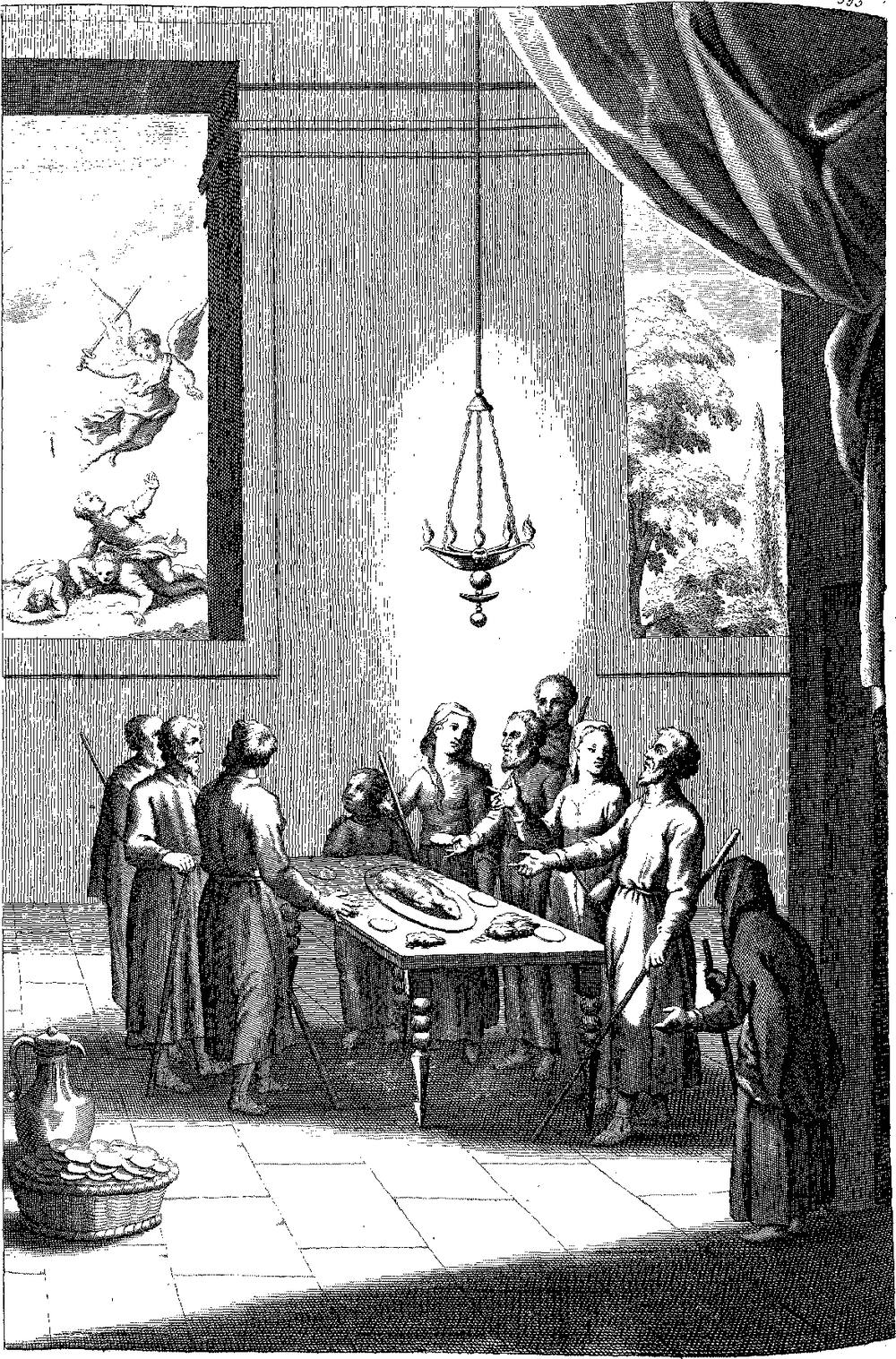
This is what God ordained concerning Exod. xii.the Passover of the Jews. The Month of the coming forth from Egypt3 was look’d upon from this Time to be the first Month of the Sacred or Ecclesiastical Year, and the fourteenth Day of this Month, between the two Vespers, that is, between the Sun’s Decline and his Setting; or rather according to our manner of reckoning, between Two a-clock in the Afternoon and Six a-clock in the Evening at the Equinox, they were to kill the Paschal Lamb, and to abstain from leavened Bread. The Day following being the fifteenth, counting from Six a-clock of the foregoing Evening which concluded the fourteenth, was the grand Feast of the Passover, which continued seven Days. But ‘twas only the first and the seventh Day that were solemn. The Lamb that was kill’d ought to be without any Defect, a Male, and yean’d that Year. If no Lamb could be found, they might take a Kid. They kill’d a Lamb or a Kid in every Family; and if the Number of those that lived in the House was not sufficient to eat a Lamb, they might join two Houses together.
With the Blood of the Paschal Lamb they sprinkled the Door-posts and Lintel of every House, that the destroying Angel at the Sight of the Blood might pass over them, and save the Hebrew Children. They were to eat the Lamb the same Night that followed the Sacrifice; they eat it roasted, with unleavened Bread, and a Sallad of wild Lettices. The Hebrew says literally, with bitter Things, as suppose Mustard, or any thing of this Nature to give a Relish. It was forbid to eat any Part of it raw, or boiled in Water, nor were they to break a Bone; but it was to be eaten intire, so much as the Head, the Feet, and the Exod. xii. 46. Numb. ix. 12. John xix. 36. Numb. ix. 13.Bowels; and if any thing remained to the Day following, it was thrown into the Fire. They that eat it were to be in the Posture of Travellers, having their Reins girt, their Shoes on their Feet, their Staves in their Hands, and eating in a Hurry. But this last part of the Ceremony was but little observed, at least it was of no Obligation, but only upon that Night they came forth out of Egypt. For the whole eight Days of the Passover no leavened Bread was to be used; and whoever should eat any, was threatned to be cut off from his People. They kept Exod. xii. 16.the first and last Day of the Feast, yet so as that it was allowed to dress Victuals, which was forbidden on the Sabbath-day.
The Obligation of keeping the Passover was so strict, that whoever should neglect to do it was condemned to Death. Exterminabitur anima illa de populis suis. But those who had any lawful Impediment, as a Journey, Sickness, or any Uncleanness, voluntary or involuntary; for Example, those that had been present at a Funeral, or by any other Accident had been defiled, were to defer the Celebration of the Passover till the second Month of the Ecclesiastical Year, or to the fourteenth Day of the Month Jiar, which answers to April and May. ‘Twas thus the Lord ordered Moses, upon the Occasion of the Enquiry of some Israelites, who had been obliged to pay their last Offices to some of their Relations, and who being thus polluted, were not capable of partaking of the Paschal Sacrifice. We see an Example of the Execution of this Law under Hezekiah4. This holy King having resolved to cause a solemn Passover to be celebrated by all his Subjects, it was remonstrated to him, that the Priests had not had Leisure to purify themselves in so great a Number, as was necessary for this Solemnity. Therefore it was resolved that the Celebration of it should be put off till the Month following, when it was celebrated accordingly.
We may add to what has been said above concerning the last Passover, that the Oriental Christians5, and especially the Syrians, insist, that on the Year that Christ died the Feast was celebrated on the thirteenth of the Month Adar, being Saturday, and that it began at the Conclusion of the Friday before; and that our Saviour forestall’d it by a Day, and celebrated it on the Friday, beginning from the Evening of the Thursday before, because he was to suffer on the Friday. Calvisius also places the same Passover on the Saturday the fourth of April, in the thirty-third Year of the Vulgar Æra, the thirty-fifth of Jesus Christ, which falls in the 344th Year of Alexandra.
The Ceremonies with which the modern Jews celebrate their Passover, are such as these6. The Feast continues a Week, but the Jews that live out of Palestine extend it to eight Days, according to an ancient Custom, by which the Sanhedrim sent two Men on purpose to observe the first Appearance of the new Moon, and immediately to give Notice of it to the chief of the Council. For fear of failing in what they ought to do, they7 kept two Days of the Festival. One was called dies latentis lunæ, and the other dies apparentis lunæ. So that the two first Days of the Passover, and the two last also are solemn; insomuch that on these two Days they were not to labour, or treat of any Business. But it is allowed to prepare Victuals, and to remove from Place to Place, whatever they have occasion for. For the four intervening Days it is only forbid to work; but they may manage their Money, and these Days are distinguished from Working-days only by some particular Things.
During the eight Days of the Feast, the Jews eat only unleavened Bread, and it is not allowed them so much as to have in their Custody any Leaven or Bread leaven’d. And the better to observe this Rule, they examine all over the House with a very scrupulous Care, to take away whatever may have any Ferment in it. For this End they search into all the Holes and Corners of their Apartments, their Boxes and Repositories, and then having well cleared their Houses, they cause them to be white-wash’d; and they either furnish them with Goods that are quite new, or with such at least for that Day. If they have been used before, and are made of Metal, they make them pass again through the Forge, and polish them. At Evening before the Vigil of the Feast, the Master of the House searches all the House over, to see if he can find any leavened Bread. Towards eleven a-clock the Day following, they burn Bread, to shew that the Prohibition of leavened Bread is then begun; and this Action is accompanied with a Form of Words, declaring that they have no Leaven in their Custody, at least that they believe so, and have used their utmost Care that it may be so.
Presently after they set about making unleavened Bread, which they call Mazzoth; and make enough of it to serve all the eight Days of the Feast. They take care that the Flour they use has not been wet, or warm’d, for fear it may have been fermented. They make it into large and thick Cakes, of different Figures; and that they may not rise, they bake them immediately in the Oven, and when they take it out, they keep it with great Cleanliness. Some make their Cakes with Eggs and Sugar, for Persons that are nice and sick; these they call Mazza aschiras, that is to say, rich Cake without Leaven.
On the fourteenth Day of Nisan the First-born of every Family are used to fast, in Memory of what happen’d the Night following, when God smote the First-born of Egypt. At Evening they go to Prayers, and at their Return they sit down to Table, which is prepared in the Day-time, and as well furnished out as their Circumstances will allow. And in order to observe the Command, that the Lamb must be eaten with unleavened Bread, and with bitter Herbs, they have in a Dish, or in a Basket, some Part of the Lamb or the Kid ready prepared with bitter Herbs, such as Sellary, Succory, or Lettuce, and a little Plate of Sauce. This Basket, and this little Equipage, is to put them in mind of the Lime and the Bricks that their Ancestors were forced to make in Egypt; and holding Glasses of Wine in their Hands, they tell of the Hardships their Forefathers endured there, and of the Wonders that God performed to deliver them from thence. Lastly, they return Thanks to God for these Mercies, and repeat Psal. cxii. Benedic anima mea Domino, & omnia quæ intra me sunt nomini sancto ejus, and those that follow, beginning with Hallelujah; after which they go to Supper. When they have supp’d, they go on to say and sing the rest of these Psalms, and other Thanksgivings proper for the Day; and then go to Bed. The Day following they do the same things over again.
The Morning Prayers are the same as those which are said upon other Festivals, unless they add what is peculiar to this, with the Psalms before-mentioned, from cxii, to cxviii. inclusive. They take the Roll of the Pentateuque out of the Chest, and read as far as the twelfth Chapter of Exodus, which contains the Institution of the Passover; and what is contained in the eighteenth Chapter of Numbers, relating to the Sacrifices proper to this Feast. Then the Prayer Mussaph; and afterwards they read out of the Prophets whatever has any Relation to what has been read out of the Pentateuque8. Then after Dinner they make a Commemoration of the Festival, and they give a Blessing for the Prince under whose Dominion they live, and pray to God that he would preserve him in Peace and Happiness, and that his Undertakings may be prosperous, that his Dominions may be enlarged, and that he may cherish their Nation. According to that Advice of Jeremiah, Seek the Peace of the City, whither I have caused you to be carried away Captives, and pray unto the Lord for it; for in the Peace thereof shall ye have Peace.
The same Things are put Practice the two following Days. This Festival is concluded by the Ceremony Habdala, or Distinction. This Ceremony is performed at the closing of the Sabbath-day, at which Time the Master of the House pronounces certain Words, and certain Benedictions, to desire that every thing may succeed well the Week that is coming. At going out of the Synagogue they go to eat leavened Bread for the last Time.
From the second Evening of the Passover they reckon nine and forty Days to the Feast of Weeks, or Pentecost. And from the Day after the Passover they reckon thirty three Days, during which they nei-ther marry, not cut out new Cloaths, nor cut their Hair, nor celebrate any publick Rejoycing; but they spend this Time in a kind of Mourning, because of a great Mortality which happened as they say, a-mong the Disciples of the Rabbin Akiba. The thirty-third Day is kept with Joyful-ness, and is observed as a Festival, because on this Day the Mortality ceased. This Day is called Lag, because the two Hebrew Letters L and G stand for 33, according to their numerical Value.
The Rabbins inform us of other Parti-culars, which are omitted by Leo of Mo-dena. As for Example; that if any one neglects to remove the Leaven out of his House, he incurs the Penalty of the Whip. He that eats it by Mistake, and without knowing of it, is to pay a Fine. They may either burn the Leaven that they find, or reduce it to Crumbs, and cast it into the Water. When the Women have made their unleavened Bread, they take great Care that it may not grow sour, they make haste to set it in the Oven, that it may not have Time for that, they sprinkle Water over it to keep it from burning. Some carry their Scrupulosity so far, as not to name the Word Leaven before their Chil-dren, for fear they should have a mind to it; in like manner, as they do not call Pork by its Name9, that they may not make it too well known.
To search the more narrowly for lea-vened Bread, they light a Candle at Noon-day, and examine every Hole and Corner, to discover the least Crumb of leavened Bread; and that the Matter may not seem to be either affected or ridiculous, they hide a bit of Bread in some Corner, of which they make the Discovery with great Joy. When all this is over, the Master of the House reserves so much leavened Bread as may suffice for his Family to the fourteenth of Nisan, and burns the rest, saying, that all the leavened Bread in his House, as well what he has found as what he has not, may become as the Dust of the Earth, and come to nothing. They are careful in choosing the Wheat or Barley that is to be used in making the unleavened Bread; and they take all possible Caution to hinder it from growing sour, or fermenting, whether be-fore or after the Grinding. They take care of the Bag it is put in, and will not carry it to the Mill on any Horse’s Back, that it may not heat. They mingle neither But-ter nor Salt, nor Oil with the unleavened Bread, for fear they should cause any Fer-mentation. It must be a Jew that is to knead it, and the most famous Rabbi’s have not disdained to take this Trouble upon them.
While the Temple was in being the Jews sacrificed a Lamb in the Temple, be-tween the two Evenings, that is, after the Noon of the 30th of Nisan, from about Two a-clock to Six in the Evening. Each private Person brought them to the Tem-ple, and there slew them; then they of-fered the Blood to the Priests, who poured it out at the Feet of the Altar. The Per-son himself, or the Levite upon this Oc-casion, might cut the Throat of the Vic-tim, but the Effusion of the Blood at the Foot of the Altar was appropriated to the Priest alone. Philo says P, that at this Feast the Levite, and even a Jewish Layman, might perform the Priests Function; which is to be understood in the Sense we have now explained it.
On the Vigil of the Feast the Matron of the Family sets out the Table in the neatest Manner She can; on which are set two unleavened Cakes, two Pieces of the Lamb, a Shoulder roasted, to put them in mind that God delivered them with a stretched-out Arm. The other Piece is boiled, in Memory of the Sacrifice. To this they add, as is said10, some small Fishes, because of the Leviathan; a hard Egg, because of the Bird Ziz; some Meat, be-cause of the Behemoth. (The Leviathan, the Behemoth, and the Ziz, are three Ani-mals appointed for the Feast of the Elect in the other Life.) Nuts and Pease for the Children, to provoke their Curiosity to ask Reasons for this Ceremony. They have a kind of Mustard that has the Ap-pearance of Mortar, which was heretofore made of Dates, and dried Figs, and at present is made of Chesnuts and Apples, to represent the Labour of making Bricks: They call it Charoteth11. The Father of the Family sits down to Table along with his Children and Slaves; because on this Day all are free. Being sat down, the chief of the Family takes of the bitter Herbs about the Bigness of an Olive, which he dips in the Charoteth, eats it, and distri-butes to the rest.
When they have done eating, they withdraw a little from Table, and then a young Lad, whose Business it is to give out the12 Hymn, proposes several Questions concerning the Original of these Ceremonies. Why on this Night they must eat none but unleavened Bread? Why they make use of none but bitter Herbs? &c. They sit again to the Table, and the Father of the Family explains the History and the Ceremony of the Paschal Lamb, and of all the Ceremonies that accompany it. He concludes with Prayer, and by exhorting the rest to pray for the Restoration of Jerusalem, and of the ancient Sacrifices, that they may there eat the Paschal Lamb, and make God propitious to them by his Blood. He gives Thanks to the Lord, for having procured their Ancestors such a glorious Deliverance. When Prayer is ended, he washes his Hands, and taking one of the unleavened Loaves, he breaks it and blesses it. He does not bless the other Loaves upon the Table, because that Night they are to be contented with a little bit of Bread. For it is the Bread of Affliction, Bread appointed for Slaves and miserable Wretches.
He mingles this Bread with the bitter Herbs, and the Charoseth, and eats it, praising God for having given this Ordinance to his People. Then he takes a bit of the Lamb, which he eats, giving Thanks to God in the same Manner. Afterwards he takes another little bit of Bread, and then he must eat no more. But they drink a third and a fourth Cup of Wine, in which some Water is mix’d. They thunder out Psalms and Thanksgivings, while this Action is performing. Heretofore, and before the Destruction of the Temple, the Paschal Lamb was to be intirely roasted; but at present they think it is not allowed them to make use of the Lamb either intirely roasted, or intirely boiled; because that would be to offer Sacrifices, and to eat them out of Jerusalem and the Temple. But they roast one Part of it, and boil another, or they take away a Part of the Animal, that it may not be intire, and so cannot pass for a Sacrifice.
To fix the Beginning of the Lunar Month, and consequently of the Feast of the Passover, which was celebrated on the 14th Day of the Moon of March, the Rabbins inform us13, that their Ancestors placed Centinels upon the Tops of Mountains, to observe the Moment of the Appearance of the new Moon, and that as soon as they had seen it, they ran in all haste to give notice to the Sanhedrim, who dispatch’d Messengers to the neighbouring Cities, to inform them that the Neomenai was begun. But it is very likely that the ancient Jews never made use of these Precautions, being subject to such great Inconveniencies, especially as to distant Cities: And we can observe no Footsteps of this either in Josephus or Philo, and much less in Scripture. Besides it appears to us as certain, that the old Hebrews did not use Lunar Months, which overthrows this whole System of the Rabbins. See the Articles MONTHS and YEARS.
1 Cor.v.8.As to the Christian Passover, it was instituted by Jesus Christ, when at the last Supper he eat with his Apostles, he gave them his Body to eat, and his Blood to drink, under the Species of Bread and Wine; and when the Day after he gave up his Body to the Jews, who condemned it to Death, and caused it to be crucify’d by the Hands of the Executioners. The Paschal Lamb that the Jews kill’d, tore to pieces, and eat, and whose Blood preserved them from the Hand of the destroying Angel, was only a Type and Figure of our Saviour’s Death and Passion, and of his Blood spilt for the Salvation of the World. This Passover is celebrated every Year with great Solemnity in the Christian Church, the Sunday after the fourteenth of the Moon of March, or Easter-day; but it ought to be celebrated in Sincerity, in Innocence, and in Truth, which are represented by Bread without Leaven. There is offered the holy Sacrifice of the Altar, which is the Memorial as well as the Substance of that which Jesus Christ offered upon the Cross, and of which the Sacrifice of the Paschal Lamb was only the Symbol. Every Day the same Sacrifice is repeated in a great many Places; so that we may say the Church celebrates the Christian Passover every Day .
Even from the Beginning there was a Diversity of Sentiments, and of Practice, about the Celebration of this Passover. From the Time of St. Polycarp the Churches of Asia kept the Passover, or Easter-Day, on the fourteeth Day of the Moon of March, whatsoever Day that might happen upon, in Imitation of the Jews; and the Romish Church kept it, as they do still, on the Sunday that followed the fourteenth Day of the Moon of March. Polycarp came to Rome in the Pontificate of Anicetus, and conferred with him upon this Subject; but neither of them being able to persuade the other to depart from their Custom, they thought they ought not to disturb the Peace of the Church about a Matter that was meerly of Custom. The Dispute upon this Subject growing warm under the Pontificate of Pope Victor, about the Year 188, the Asiaticks continued obstinately fix’d to their Practice, and Polycrates Bishop of Ephesus, with the other Bishops of Asia, having writ to the Pope a long Letter to support their Opinion, Victor sent Letters through all the Churches, by which he declared them excommunicate. The other Churches did not approve of this Rigour of Victor, and notwithstanding his Sentence, they continued united in Communion with those who still went on to keep Easter on the fourteenth Day of the Moon of March.
Things continued in this Posture till the Council of Nice, held in 325, with this Difference however, that the greatest part of the Churches of Asia were insensibly fallen into the Practice of the Romans, and no longer kept Easter-Day on the fourteenth Day of the Moon of March, but on the Sunday following. The Council of Nice made a general Determination, which ordained, that all the Churches should celebrate Easter- Day on the Sunday that followed the fourteenth Day of the Moon of March; and the Emperor Constantine caused this Decree to be published through the whole Roman Empire. Those that continued in their old Practice, notwithstanding this Decree, were look’d upon as Schismaticks in the Church, and had the Name of Quartodecimans given them, or Partisans of the fourteenth Day; and in Greek they call’d them Tessares-decatites. The Ecclesiastical Histories may be consulted for this, to which this Affair properly belongs. ‘Tis a famous Question among Commentators, whether or no our Saviour kept the Legal and Jewish Passover the last Year of his Life. Some have thought that our Saviour did not keep the Passover the last Year of hisLife, but that the Supper he eat with his Disciples on the Thursday Evening, when he instituted the Sacrament of his Body and Blood, was an ordinary Meal, where there was no Paschal Lamb eaten. Others have said14, that our Saviour had anticipated the Passover, that he kept it the Thursday in the Evening, and the other Jews only on the Friday. Others have advanced that the Galileans kept the Passover on Thursday, as Jesus Christ did; but that the other Jews kept it on Friday. Lastly, it is the most general Opinion of the Christian Church at this Day, as well Greek as Latin, that our Saviour kept the Legal Passover on the Thursday Evening, as well as the rest of the Jews.
The Evangelists St. Matthew, St. Mark, and St. Luke, seem favourable enough to the Opinion which would have it, that he kept the Passover on the Thursday Evening, as also the other Jews. But we must own, that St. John seems to contradict it, since he says that Jesus being at Table with his Disciples, John xiii. 1, 2, &c.before the Feast of the Passover, when Jesus knew that his Hour was come,&c. And afterwards when the Jews had led Jesus to Pilate, that he might condemn him and put John xviii. 28.him to Death, he observes, that they themselves went not into the Judgment-Hall, lest they should be defiled, but that they might eat John xix. 14.the Passover. Lastly, he says, that Friday was the Preparation of the Passover, and that the Saturday following was the great John xix. 31.Day of the Feast, the Sabbath-day, for that Sabbath-day was an high Day; and why so, if not because it was the Passover? And ‘twas for this that the Friday before was the Parasceue, or Preparation of the Passover, which was to be celebrated the Day following.
In the Dissertation upon our Saviour’s last Passover, which we have published before our Commentary upon St. Matthew, we have endeavoured to shew, that our Saviour did not celebrate the Passover the last Year of his Life; at least that the Jews did not celebrate it but upon Friday, the Day of his Death, and that he died upon Calvary at the same Hour that the Jews offered the Paschal Sacrifice in the Temple; so that the Substance and the Shadow coincided, and were executed at the same Time as it were by Concert. We have quoted several of the Ancients who have thought as well as we, that the true Day of the legal Passover fell this Year upon the Friday, the Day on which our Saviour suffered. For this Opinion may be consulted Tertullian against the Jews, c. 8. Hilarius Diaconus, or the Author of the Questions upon the Old and New Testament, qu. 55. p. 63. and qu. 94. p. 83. t. 3. oper. S. Aug. nov. edit. The Author of Questions for the Orthodox, under the Name of St. Justin, qu. 65. St. Chrysost. homil. 82. in Joan. p. 414. and St. Cyril of Alexandria, l. xii. in Joan. p. 1032. Theophylact upon St. John, Victor of Antioch, Caten. in Marc. xiv. 1. Apollinar. Caten. in Joan. xviii. 28. apud Toynard. Harmon. not. p. 151. Epiphan. hæres. 52. Euthym. Zygaben. l. 19. Bibl. Patr. p. 577. Petr. Alex. in Chronico Alex. præfat. Apollinar. Hierapolit. ibid. Philopon. Metridor. alii duo apud Photium. Cod. 115, 116. Cedren. alii quidam Græci apud Michael. le Quian. Differt. de Pasch. t. 1. p. lxxi. Edit. S. Joan. Damasc. &c. This Question also may be seen fully discuss’d by F. Lamy, and by M. Toynard; and to examine this Matter to the Bottom, all those should be consulted that have handled this Question both Ways; M. de Tillemont, F. Hardouin, and the Commentators upon St. Matthew and St. John.
The Word Pascha is taken, First, for the passing over of the destroying Angel. Secondly, for the Paschal Lamb. Thirdly, for the Meal at which it was eat. Fourthly, for the Festival instituted in Memory of the coming out of Egypt, and the Passage of the destroying Angel. Fifthly, for all the particular Victims that were offer’d during the Paschal Solemnity. Sixthly, for the unleavened Bread that was eat for the whole eight Days of the Passover. Seventhly, for all the Ceremonies that preceded and accompanied this Solemnity.
Read this article in its place on the printed pages
Footnotes
-
Vide Exod. xii. In the Year of the World 2513, before Christ 1487, before the Vulgar Æra 1491. ↩
-
Hieronym. in Jer. xvii. ↩
-
This Month is call’d Abib in Moses; afterwards it was call’d Nisan. In the Year of the World 2514, before Christ 1486, before the Vulgar Æra 1490. ↩
-
2 Chron. xxx. 2, 3, &c. In the Year of the World 3278. ↩
-
D’Herbelot. Bibl. Orient. p. 349. ↩
-
Leo of Modena, part. 3. c. 3. ↩
-
Numb. ix. 10, 11. ↩
-
This last Lesson is called Aftara, which is as much as to say Dismission; because after this they go away. ↩
-
They call it דבר אחרalia res, another thing. ↩
-
Machazer Bonor. 1. part. Paschas. apud Bartolocci Bibl. Rabb. ↩
-
חרושת Charoteth. ↩
-
Philo de Vita Mosis, l. iii. ↩
-
Maimon. Tract. t. 1, 2. ↩
-
Of this Opinion may be reckoned St. Cyrillus of Alex. l. xii. in Johan. St. Chrysost. homil. 82. in Johan, St. Epiphanius, Euthym. Zygaben. and several Moderns, as Paul of Bruges, Paul of Middelbourg, Henten. Onuphr. Grot. Jansen. Maldon. Scalig. Calvis. and several others. ↩