Volume II, pages 39–56 of the 1732 edition, from LAW to LET: everything printed on these pages, in order.
Continued from Laws
Man, who having sworn rashly to do something, Lev. v. 6, 7.had forgot to do it. It would be almost impossible to relate here particularly all the Ceremonies attending the Sacrifices. The first Chapters of Leviticus may be consulted in this Matter. The three principal Festivals of the Israelites, and at which all the Males were to be present, from twelve Years of Age and upwards, were those of the Passover, Pentecost, and Tabernacles or Tents. The first was instituted in Memory of the destroying Angel’s Passage who killed the First-born of the Egyptians, and spared those of the Hebrews, the Night in which they departed out of Egypt. That which distinguished this Festival, was a Sheaf of the first Barley, which was presented with Ceremony in the Temple, as the First-Fruits of the Barley-Harvest, which was to begin immediately after the Feast. There was none but unleavened Bread used during the seven Days Solemnity; and in the Evening on which the Feast began, there was a Lamb or Kid of a Year old eaten with bitter Herbs in every Family, or Assembly of ten or fifteen Persons. This was a Sacrifice of a particular Form. The Blood of it only was presented at the Foot of the Altar. It was to be eat roasted, and no otherwise dressed, it was not lawful to break the Bones, in Order to extract the Marrow. It was at the same Time a Sacrifice of Thanksgiving, and recalled to the Remembrance of the Hebrews their Deliverance out of Egypt. There were several Sacrifices peculiar to this Feast which we do not here particularly mention. The Passover with all its Formalities was ordained to be observed, Numb. xxviii. 19, &c.under the Penalty of being extirpated from among his People. If any particular Persons were not in a Condition to celebrate the Passover upon the fourteenth Day of the first Numb. ix. 13. Ex. xii, 19.Month, by Reason of some Uncleanness, which might hinder them; or because of Absence, and their being upon a Journey, they were permitted to keep it on the fourteenth Day of the second Month; which however was no Obstruction to their abstaining from Numb. ix. 6.leavened Bread, at the Time of the first Passover, in what Place soever, and what Condition soever they were in.
The Pentecost was celebrated fifty Days Ex. xxiii. 16. and xxiv. 22. Lev. xxiii. 17.after the Feast of Passover. In this Solemnity they offered two Loaves of new Wheat as the First-Fruits of the Harvest, which begun after this Ceremony. It was instituted in Order to preserve the Memory of the solemn Covenant, which the Lord had made with Israel at Sinai, when he gave them his Law. The extraordinary Sacrifices which were then Vide Numb. xxviii. 26, 27. collatum cum xxviii. 12, 20. Numb. xxix. 12.offered, were the same as those which were offered in the Passover.
The third solemn Feast of the Hebrews was that of Tents or Tabernacles, which was celebrated at the End of the civil Year Numb. xxix. 7.with Thanksgivings for all the Favours obtained from God, during the whole Course of the Year, and particularly in the Times of Ex. xxiii. 16.Harvest and Vintage. All the People then lodged under Tents made of Branches of Trees, in Memory of their Journey through the Wilderness, where their Forefathers spent Lev. xxiii. 40, 43. Lev. xxiii. 10. V. 8, 9, &c. Lev. xxiii. 37. and Numb. xxix. 13, 14, &c. Numb. xxviii. 11. Lev. xvi. 6, 7. Numb. xxix. 1. &c.forty Years, without having any other Habitations than Tents. There were particular Sacrifices for this Feast which lasted seven Days.
The tenth Day of the seventh Month in the sacred Year, which was the first of the civil Year, was a solemn Day, spent in Fasting, Repentance, and Mortification. It was appointed upon Pain of Death, for every one to afflict his Soul with Fasting on this Day. An Atonement was made for all the People with particular Sacrifices; among the rest, of two Goats, one whereof was set at Liberty, and called Azazel, and the other was sacrificed for the Sins of the People, and burnt without the Camp. Upon this Day the High Priest entred into the Sanctuary, to purify it with the Blood of a young Bullock which he had sacrificed, and afterwards with that of a Goat offered up for the Sins of the People. Some believed, that Numb. xxix. 16.on the same Day the red Heifer was sacrificed, in Order to save the Ashes of it, which were made Use of in purifying those who were polluted by Funerals.
Every first Day of the Month was a Feast Day; but they were not obliged to rest upon those Days. Some particular Sacrifices were then offered, and then Festivals were begun with the Sound of Trumpets. The first Day of the first Month in the civil Year, which was the seventh of their Ecclesiastical Year, is called in particular the Feast of Trumpets; because the Beginning of the Year was then published by Sound of Trumpets, with a particular Solemnity.
The Sabbath Day is the most antient of all the Festivals that we know of in Scripture; God sanctified this Day after the Work of the Gen. ii. 2.Creation. Moses published the Command relating to it, soon after the Departure out of Egypt, before the Hebrews came to Sinai. Ex. xvi. 23, 29.God enjoins Rest upon this Day, upon Pain of Death: He does not allow even of the kindling Ex. xxxi. 15. Numb. xv. 32. Ex. xxxv. 3.a Fire, or dressing any Thing to eat; and he extends the Command of Rest to the very Beasts and Slaves. He requires this whole Day to be employed in his Service, in praising him, and studying his holy Law. There were particular Sacrifices for the Sabbath, as well as for Ex. xx. 6. Numb. xxviii. 9.other Feasts.
Besides all these Feasts, which were observed in the Course of the Year, and lasted at most but seven Days, there were others of a much longer Duration, which were celebrated at the End of a certain Number of Years.
The first of these Feasts was the Sabbatical
cal Year, wherein it was forbidden to cultivate the Earth, and all were enjoined to leave the Fruits of the Field to the Stranger, Ex. xxiii. 10, 11. and Lev. xxv. 1, 2, &c. Deut. xv. 2. Ex. xxi. 2. Deut. xxxi. 10, 11.the Poor, the Orphan, and wild Beasts; to set the Hebrew Slaves at Liberty, to remit all Debts, to read the Law in a solemn Manner. This Law seemed to be against good Policy; but God had superior Views in it. He intended hereby to preserve the Equality of Riches and Conditions among the Hebrews, to prevent the Oppression of the Weak, to keep up the Memory of the Creation of the World, which began to be blotted out of the Minds of Men, to make his People sensible of their absolute Dependance upon God. With the same Design he ordained every fiftieth, or rather every forty ninth Year, which is named the Jubilee Year, the Privileges Lev. v, viii, &c.whereof were still greater than those of the Sabbatical Year. In the Jubilee Year, not only the Earth was suffered to rest, and no Cultivation of it allowed, Slaves were set at Liberty, and Debts forgiven; but likewise all Lands and Inheritances returned to the respective Tribe, Family and Property of those who were obliged to alienate them. This Year began about the Month of September, and ended in the same. It was proclaimed by Sound of Trumpets in a very solemn Manner. God thereby made it appear, that he was the absolute Lord of the Soil, and of the whole Countrey, of the Persons and Liberties of his People. And that he might not put their Confidence to too great Trials, by forbidding them to cultivate the Earth for the whole Year, and commanding every Thing which it produced of itself to be common to all, even to Beasts, he engages to bless every Ibid. V. 21.sixth, and forty eighth Year, in so remarkable a Manner, that it should suffice for three Years Provisions.
The Rules prescribed by Moses to the King, whom the Israelites might at any Time choose, are different from those which Deut. lvii. 14. 20. 1 Sam. viii. 11.Samuel calls the King’s Right. The King, according to Moses, was to be elected by the People, as the Lord should appoint; he was to be chosen out of the Number of his Brethren, not from among Strangers. The Prince was forbid to multiply the Number of his Horses, and oblige the People to return into Egypt to buy any there, to have too many Wives who might seduce his Heart, and have too great an Ascendant over him, to heap up too much Gold and Silver, and to exalt himself with Pride above his Brethren. Lastly, God commands him to take a Copy of the Law, to read it every Day of his Life, and not to depart from it, either to the right Hand, or the left. Samuel speaking of the King’s Right, tells the Israelites. “ The King whom you shall “ choose, will take your Sons, and appoint “ them for himself, for his Chariots, and “ to be his Horsemen, and some shall run “ before his Chariots. And he will appoint “ him Captains over Thousands, and Captains over Fifties, and will set them to “ ear his Ground, and to reap his Harvest, “ and to make his Instruments of War, and “ Instruments of his Chariots. And he will “ take your Daughters to be Confectioners, “ and to be Cooks and Bakers. And he will “ take your Fields, and your Vineyards, “ and your Olive-yards, even the best of “ them, and give them to his Servants. “ And he will take the Tenth of your Seed, “ and of your Vineyards and give to his Officers, and to his Servants. And he will “ take your Men Servants and your Maid “ Servants, and your goodliest young Men “ and your Asses, and put them to his “ Work. He will take the Tenth of your “ Sheep, and ye shall be his Servants.”
War was the principal Duty of the King of Israel. There was a great Difference between the Wars commanded against the Canaanites, and those undertaken to make Conquests, or for other Reasons of State against foreign Countries. They first made Offers of Peace to those whom they intended to attack; just and equitable Conditions were proposed to them, according to the Nature of Affairs and Circumstances: If they refused these Conditions, they made War upon them: If they besieged a City, when the Siege was long, and it was necessary to encompass it with Trenches, and take it with the Help of Towers and Terrasses raised against the Walls, as was then the Custom, it was forbidden to cut down Fruit Trees, and to ravage the Countrey, in Order V. 19, 20.to make these Machines and Terrasses. If the City was taken by Assault, all the Men were put to the Sword, and the Women and Children, Beasts and Moveables were reserved; they belonged all to the Conquerors, and were divided among the whole Army. But if it were a City of the Canaanites, every living Thing was generally put to Death, Men, Women, and Children.
If they were to fight a set Battle, before the Combat, a Priest at the Head of the Army encouraged those who were to engage, by promising them God’s Assistance. Afterwards Deut. xx. 2.the General and Officers went about, proclaiming at the Head of each Troop, that they who had built a new House, or planted a new Vineyard, or lately married a Wife, Deut. xxiv. 5.should return home, lest if they died in the War another should enjoy the Fruit of their Labours, or take the Wife, whom they had married. After these Declarations published at the Head of every Troop, Proclamation was made to the whole Army, that if any one wanted Courage, and feared Danger, he might return, lest he should spread the Terror which he was seized with among his Brethren.
The Spoil taken by the Enemy was divided equally by the General among all the
Soldiers, those who were, as well as those who were not in the Battle, but remained as a Guard to the Camp, and had the Care of 1 Sam. xxx. 24.the Booty, when taken. Moses resolved upon making a Partition of the Spoil taken from the Midianites among the Soldiers, who were in the Action, and all the People, who were then in the Plains of Moab; because at that Time all Israel was looked upon as one Army only: The Spoil was purified before it was brought to the Camp. This was performed after the following Manner. Metals, and every Thing that could resist Fire passed through the Flames. Habits, and other Things, which could not be exposed to the Flame, were purified with the Water of Atonement. The Women, who were at any Time taken in Wars made against the Canaanites, became Slaves to the Conqueror. If a Soldier had a Mind to marry one of his Captives, he carried her home to his own House, she cut her Hair, and pared her Nails, and quitted the Cloaths she wore when she was taken, and continued a whole Month in Mourning, lamenting the Loss of her Father and Mother, after which the Israelite might marry her. But if he afterwards grew weary of her, he was obliged to send her away free without selling her, or detaining her forcibly as a Slave.
The God of Israel and his Priests had their Share in the Spoils taken from the Enemy. In the War against the Midianites, God ordained that one Animal in five Hundred, both Men and Beasts taken in the Party which engaged, should be set apart and given to the Priests; and that besides this, out of that Part of the Spoil which was given to all the People, the fiftieth of all Animals should be chosen for the Levites. The General had likewise his Share distinct, as we see in the Instance of David and Gideon. In the same War with the Midianites lately mentioned, 1 Sam. xxx. Judg. viii. 24.the Generals of the Israelites made a Present to the Lord of the Bracelets and Gold Rings, which they had taken, with an Intention probably to acknowledge him as the Head and Conductor of this Enterprize.
Numb. xxxi. 49, 50.Great Order and Discipline was observed in the Camp of Israel: We see in what Manner the Tribes were disposed about the Tabernacle in the Wilderness, and the Order Numb. ii.which was observed in their Marches. They were particularly careful to keep themselves pure: Women were not allowed to be then in Expeditions, and even they to whom any Thing happened in their Sleep, were obliged to depart out of the Camp, and did not return till Evening, after they were purified and had washed themselves and their Deut. xxiii. 10, 11, &c.Cloaths. Every Soldier carried a Stake at his Girdle, to dig a Hole with in the Earth, when he went out of the Camp Ibid. v. 13, 14.for his natural Occasions. After the Battle, the Soldiers did not enter again into the Camp till seven Days were passed, because of the Pollutions contracted by touching the Numb. xxx. 19, 20, 24.Dead. They purified themselves, and washed their Bodies and their Cloaths, before they enter’d it again. This was practised in the War against the Midianites, and probably upon all the like Occasions. But when the whole Army had been engaged, this Precept could not be observed, since they were all thought impure, and the clean were not to be distinguished from the unclean.
We are not perfectly acquainted with the Polity of the Hebrews; we have discoursed in a particular Dissertation concerning the Manner of their administring Justice, and have mentioned which were their principal Tribunals. The King and the High Priest were the two first Judges of the Nation. Give us a King to judge us, said the Israelites to Samuel. The High Priest is appointed by Moses to be Judge in the last Resort of all the most difficult Affairs. Besides this, there were Judges in all the Cities, or in all the Gates, according to the Expression of Scripture; because Justice was administred at the City Gates. Moses requires Ex. xxii. 28.great Respect to be paid to Judges and Magistrates. You shall not speak Evil of the Gods, says the Scripture1, and you shall do no Violence to the Prince of the People. Princes, Judges and Magistrates were called Elohim, a Name given sometimes to God. Judges were looked upon as God’s Vicegerents, with the Lord seated in the midst of them.
It was ordained that Judges should be uncorrupt, and receive no Presents, which are sufficient to bribe the most Upright, and to Ex. xxiii. 8.pervert the best Men. That they should not follow a Multitude to do Evil. That they Ex. xxiii. 2, 3, 7, 9.should not acquiesce in the Opinion of the Majority to do an Act of Injustice. That Compassion for the Poor should not hinder them from acquitting themselves of their Duty. That they should not wrong the Innocent, nor the Stranger. That they should judge without Respect to Persons. That neither Fear of the Rich, nor Compassion for the Lev. xix. 15. Vide Deut. xvi. 18,19,20.Poor, should affect them, when they were to pronounce an equitable Judgment. That the Father should not be punished for the Son, nor the Son for the Father. That in inflicting Deut. xxiv. 16.Punishments they should not proceed with the utmost Rigour. That the Bodies of Persons executed should not be left upon the Gibbet after Sun-set. That they who were condemned to be scourged or beaten, should not receive above forty Blows. That false Witnesses and Slanderers should be punished with Severity. That they should undergo the Punishment of that Crime
Deut. xix. 16, 17. Deut. xix. 18, 19. Vide etiam Levit. xix. 16.which they imputed to their Brethren. That they should be treated without Mercy, Life for Life, Tooth for Tooth, Eye for Eye. That no one should be condemned upon the Testimony of a single Evidence: That two or three Witnesses should always be required before they proceeded to give Sentence against the Person accused.
Till the Time of the Law, Fathers and Mothers were the sole Judges of their Children. Moses limits this Authority, and transfers it to Judges; but he enjoins the latter to put to Death those Children, who should give injurious Language to their Fathers and Mothers, should strike them, should be rebellious, disobedient and debauched. Lev. xx. 19. Ex. xxi. 15.They were put to Death upon the bare Complaints of their Parents. The Law has made no Provision against Parricides, as if that had been thought to be a Crime impossible. Fathers are forbidden to make their Children pass through the Fire in Honour of the false God Moloch. Children are ordered to shew a perfect Submission to those who gave them Life. In Case of extreme Ex. x. 12.Necessity, a Father may sell his Children for Slaves. When he sold his Daughter, it was always with a Presumption that she would be his or his Son’s Wife who bought her. If See Ex. xxi. 7, 8, 9.this did not happen, the Master could not keep her, merely as a Slave: If he did not like her, he was to set her at Liberty. In general, Fathers commonly sold their Daughters to those who married them; marrying and buying a Woman was the same Thing.
Voluntary Murder was punished with Ex. xx. 13. xi. 12, 13. Ex. xx. 14.Death: But for casual and involuntary Murder, the Law appointed Cities of Refuge, whither they, who had fallen under this Misfortune, might retire. There were three of these Cities of Refuge on this, and three on the other Side of Jordan. He who fled thither gave immediately an Account of what had happened to the Judges of the Numb. xxxv. 23, 24. Deut. xix. 1, 2, &c. Ibid. v. 15. Ibid. v. 9. Ibid. v. 31.City, whither he retreated: Afterwards, if the Relations of the deceased Person required it, he was sent back under a Guard to the Place where the Affair happened, and if he were found guilty, and the Murder was declared voluntary, he was delivered to the deceased’s Relations, in Order to be punished; if not, he was sent back again to the City of Refuge, where he continued, without going out of it, till the Death of the High Priest. If he were found out of the City by any of the dead Person’s Relations, they might kill him with Impunity. These Laws are in Favour of the Israelite and Stranger. A voluntary Murderer was put to Death without Remission: The Relation of the deceased might kill him himself with Impunity, wheresoever he found him. No Money was allowed to be received in Order to the sparing of his Life: He was to be taken by Force even from the Altar, if he had fled thither for Refuge.
If two Men quarrelled, and one wounded his Companion, so that he was obliged to keep his Bed, and he walked afterwards with a Stick, he who struck him, was to be cleared upon paying the Physicians, and giving the wounded Person Satisfaction for Ex. xxi. 19, 20. Ex. xxi. 26.his Loss of Time. He who killed his Slave was to be punished as a Murderer: But if he only wounded him, and the Slave lived two or three Days after it, the Master was not punishable, since the Slave was his, and if he lost him, he lost his Money. If in a Quarrel between two Persons, a Woman with Child should happen to be going across, and be wounded, so that she miscarried, though she did not dye; he who caused this Accident was to be fined at the Discretion of the Husband, and of Arbitrators appointed for this Purpose. But if the Mother died, the Murderer was to give Life for Life, Eye for Eye, Tooth for Tooth. If a Master beat out an Eye or Tooth of his Man Servant, or his Maid Servant, he was obliged, in the Way of Reparation, to set them at Liberty. If a Woman, while her Husband was quarrelling with another Man, laid her Hands upon her Husband’s Adversary, in that Part, which Modesty obliges to conceal, she was Ex. xxi. 28, 29, &c. Lev. xviii. 6, 22, and xx. 11, 17. Deut. xxi. 18, 19. Lev. xviii. 21. and xx. 13. Deut. xviii. 10. Ex. xxi. 28. Lev. xx. 10. Deut. v. 18. and xxii. 21, 22, 23, 24.to have her Hands cut off.
If an Ox kill a Man or Woman with his Horns, he shall be stoned, and his Flesh shall not be eaten. If an Ox had gored any one before with his Horns, and the Owner of him upon Notice did not shut him up, and this Ox kill either Man or Woman, the Owner and the Ox shall both be put to Death. If the Owner has a Mind to redeem his Life, he may, paying whatever shall be demanded of him. If an Ox kill a Slave of either Sex, the Owner of the Beast shall give thirty Shekels to the Master of the Slave, and the Ox shall be stoned. If one Ox kills another, the surviving one shall be killed, and the Price shall be equally divided between the Owners of both; they shall likewise divide the Flesh of the Ox which has been killed. But if the Owner of the Ox which was the Aggressor, knew that he was used to gore with his Horns, and notwithstanding did not keep him in, he was to restore Ox for Ox, and the Beast which was killed was to be his. If a Man dig a Well or a Cistern, and does not cover it, and an Ox or an Ass fall into it, the Owner of the Cistern shall pay for the drowned Ox; but the Flesh shall be his.
Adultery was punished with Death, both in Man and Woman. If a young Woman, who is promised in Marriage, is violated in the Field by any Man, the Man alone shall die; but if this happen in the City, both shall be punished with Death. The Maid
has no Excuse; she might have cried out, and desired Help, when this Violence was offered.
Incest was likewise punished with Death, Ex. xxii. 19. Lev. xviii. 22. xx. 11. Lev. xix. 29. Deut. xxiii. 18. Ex. xxii. 16. Deut. xxii. 1, 18.as well as Sodomy. And abominable Crimes against Nature. Prostitution of either Sex was severely condemned in Israel; and it was very expressly forbidden to offer the Price of any immodest Intercourses at the Temple of the Lord. Whosoever dishonours a Maiden, shall be obliged to marry her; or if the Father of the Damsel is unwilling to give her, he shall then pay as much as the young Woman could expect for her Dowry. If the Affair is brought before the Judges, and it appear that there was any Violence on his Part who corrupted her, the young Man shall pay a Fine of fifty Shekels to the Damsel’s Father, shall marry her, and never have it in his Power to divorce Lev. xx. 18. cum Lev. xv. 24. Ex. xx. 17. Deut. v. 20.her. The Husband is forbidden to come near his Wife during her ordinary Indispositions, upon Pain of Death, if the Matter be brought before the Judges.
Although the Law does generally no more than regulate the outward Behaviour, and restrain Mens Hands, nevertheless it forbids evil Desires: It does not permit any one to covet anothers Wealth, his Wife, his Cattle. It tolerates Divorces, and allows the Parties separated to marry, but not to come together again, when the Woman has been once married to another Man. All Acts of Deut. xxiv. 1. Lev. xix. 19.abominable Lasciviousness contrary to Nature, are probably described after an obscure Manner in these Words. Thou shalt not let thy Cattle gender with divers Kinds: Thou shalt not sow thy Field with mingled Seed: Neither shall a Garment mingled with Linnen and Woollen come upon thee: Thou shalt not plough with the Ox and with the Ass, and in those which forbid any Man to put on Womens Cloaths, or Deut. xxii. 5.Women to dress themselves in Mens.
The Law prohibited all Sort of Theft in general; but the Manner of making Satisfaction Ex. xx. 15.for different Sorts of Theft, is very different. To steal a Man who is free, with a Design of making him a Slave, or selling him for such, was a Crime liable to capital Ex. xxi. 16. and Deut. xxiv. 8.Punishment. If a Man steal an Ox, he shall pay five Times double, and for a Sheep four Times. But if these Beasts are found alive Ex. xxii. 1, 2, 3, 4.in the Possession of the Thief, he shall only pay double for them: Any one might with Impunity kill a Night Robber, surprized in making a Hole through a Wall: But if any one were to kill him in broad Day-Light, the Murderer is to be treated according to the Rigour of the Laws against Murderers. If a Thief have not wherewithal to make Restitution, he may be sold for this Purpose. Ex. xxii. 4, 5.He who has done any Man Damage in his Field or Vineyard, shall make good the Wrong, which he has done, out of his Ex. xxii. 5, &c.own Field or Vineyard. He shall in like Manner make Satisfaction, if the Harvest, Corn in the Field, or the Sheaves in the Barn are through his Fault set on Fire. If what one has lodged in Trust with another is lost, Restitution shall be made twofold by the Trustee, if he is convicted of Fraud; if not, he shall be cleared and dismissed upon taking his Oath before the Judges. He likewise who is trusted with the keeping of any Cattle, must be answerable for them. If the Thing be lost by his Fault or Negligence, he shall restore it: If it dies in his Hands, or is taken by the Enemy, he shall be obliged to affirm upon Oath, that it is not through his Fault, and shall be discharged from making Restitution: If it be stolen, he shall restore the Value. If it be taken by wild Beasts, let some Part of it be brought to the Owner of the Beast, and he shall be discharged from making Restitution. If the Beast be only borrowed or hired, and it dies in the Presence of the Proprietor, there is nothing due for it. If the Proprietor be absent, the Borrower is to make Restitution.
The Practice of Usury among the Israelites towards one another is severely condemned by the Law; but is tolerated when practised by them with Strangers. If the Creditor had a Mind to take Pledges of his Debtor, he could not enter his House, but was to wait at the Door till the Debtor brought him something. He was not allowed to take at the same Time two Mill-Stones which were made Use of in grinding Corn, nor the Widow’s Garment. If he had taken his Neighbour’s Raiment or Covering, he was to restore it in the Evening, that his Brother might have wherewithal to cover himself in the Night. The Rich were commanded not to refuse lending to the Poor, upon Pretence that they should receive no Profit from what was so lent. The Hebrews were to assist one another so effectually, that there should be no Poor in Israel. No one was to touch the Limits of his Neighbour’s Field. In the Times of their Harvest and Vintage, they were not to be so exact in gathering up the Ears of Corn and the Grapes, as to leave none remaining for the Poor, who came after the Reapers and the Grape-gatherers. No one was to return and look after a Sheaf which he might have forgotten in the Field. In religious Feasts the Poor, the Stranger, the Widow, the Fatherless, and the Levite were not to be neglected.
Ex. xxii. Lev. xxv. 37. Deut. xxiv. 19. Deut. xxiv. 10. Deut. xxiv. 6. Ex. xxii. 26. Deut. xv. 8. Ib. xv. 4. Deut. xix. 14. Lev. xix. 9, 10. Deut.The Stranger particularly is very much recommended to the Hebrews. Oppress not a Stranger, says Moses, for ye know the Heart of a Stranger, seeing ye were Strangers in the Land of Egypt. God requires them to love and assist, not their Friends and Brethren only, but their very Enemies; that they should not thirst after Revenge, but leave it to God; that if they saw their
Enemy’s Beast fallen under the Weight of his Burden, they should help to raise him up again; if they found his Cattle going astray, that they should carry them back to Ex. xxiii. 4, 5. Lev. xix. 17. Deut. xxi. 1, &c.his House. They were permitted to exercise their Hatred and Revenge only against the Canaanites; were to have no Friendship, Union, or Alliance with them; were commanded utterly to root them out, and kill them without giving any Quarter. In this Particular the Hebrews were the Assertors of God’s Honour, and the Executioners of Ex. xxii. 32, 33. and xxxiv. 12. and Numb. xxx. 51, 55 and Deut. vii. 2. 16.his Vengeance. Passengers were permitted to enter into any Man’s Vineyard, and eat Grapes in it; to pluck the Ears of Corn in the Fields, and eat them; but not to carry any away with them.
There were two Sorts of Slaves among the Deut. xxiii. 24, 25.Israelites; Hebrew Slaves, and Slaves of foreign Nations; the latter continued so for ever; but the Hebrew Slaves were set at See Ex. xxii. 1, 6. Lev. xxv. 39, 40, &c.Liberty in the Sabbatical Year. If they did not think fit to take the Advantage of the Law, they went before the Magistrates, made their Declaration, and their Master carried them back to his House, and there at the Door bored their Ears with an Awl. If the Slave entered into Bondage with his Wife and Children, he was to be set at Liberty with them: If his Master married him while he was his Slave, the Wife and Children begotten of her were to be the Masters; but the Slave, if he pleased, might leave him. If an Hebrew was constrained by Poverty to sell himself to any Stranger, who was not an Israelite, his Relations, if they were in a Condition to do so, were to redeem him; if they were not in Circumstances to do so, then any Israelite might buy his Liberty, or he himself might purchase his own Freedom: And whoever did this, was to pay his Master what he cost him, deducting for the Time of his Service, and considering how long it was till the Jubilee: For in the Jubilee Year, Strangers as well as Hebrews, were to set their Israelitish Slaves at Liberty, and restore all Inheritances to the lawful Owners of them: If any Slave were ill used by his Master, and so compelled to fly into the Land of the Hebrews, he was not to be delivered to his Master, but was to be permitted to make Choice of what Town he pleased for his Deut. xxiii. 15, 16.Habitation. If a Father sold his Daughter, the Purchaser or his Son might take her as a Wife of the second Rank, or Concubine, and keep her in this Quality. If they did not, they were to set her at Liberty in the Sabbatical Year, and give her, say the Rabbins, the ordinary Present of thirty Shekels. He who is her Master cannot sell her to any other Person, and she cannot prolong her Servitude beyond the Sabbatical Year. If her Master after having married her to his Son, give his said Son another Wife besides, this new Marriage shall no Way prejudice the Rights of the first Wife. Her Husband is obliged to give her Food, Lodging and Maintenance, and to perform the Duties of Marriage with her. If he fails in any one of these Conditions, she shall be released of her Servitude without giving any Thing, or waiting till the Sabbatical Year.
Ex. xxiii. 12. Lev. xxv. 7.In Order to inspire them with Humanity towards Mankind, the Law ordained, that they should exercise it even towards Brutes. He enjoins that Beasts should not be worked upon the Sabbath Day, and that in the Sabbatical Year, they should have a free Pasture every where. There seems to be something of Indulgence extended even towards wild Beasts. It forbids any to seeth a Ex. xxiii. 19. xxxiv. 26. and Deut. xiv. 21. Deut. xxii. 6. Lev. xix. 14. Lev. xxii. 21. Deut. xxv. 1. Lev. xi. 2, &c. xx. 25. Deut. xiv. 4. Lev. xix. 19, and Deut. xxii. 10.Kid in its Mother’s Milk; to take the old one in a Nest together with its Eggs, and young ones; to eat Animals, to muzzle the Ox which trampleth out the Corn, to couple together Beasts of different Species. The Prohibition against speaking Evil of a deaf Person, and putting any Thing before a blind Man to make him fall, must be supposed to be given for the same Reason.
The Israelites did not eat all Sorts of Beasts, Birds, and Fishes indifferently; many were esteemed unclean by them, and never used. Of four-footed Beasts, all those were reckoned unclean which were clovenfooted, and did not chew the Cud. They eat no Fish but what had Fins and Scales. There were likewise several Sorts of Birds and creeping Things which were prohibited. These Creatures while they were alive did not pollute those who touched them; but their Carcasses occasioned an Uncleanness which lasted till the Evening, and was purified only by the unclean Person’s washing his Body and Clothes. The Sinew belonging to the Thigh, even of Animals that are clean, was not eaten, by Reason of the Sinew of Jacob’s Thigh which the Angel Gen. xxxii. 32. Ex. xxii. 31. Lev. xvii. 15. Lev. xvii. 11, 12. Gen. xvii. 10. Deut. xii, 23, 24. Lev. vi. 25.touched; nor any Creature that died of itself, or was torn by any Beast in the Field. The Blood and Fat of Beasts were alike prohibited.
Circumcision of male Children upon the eighth Day was enjoined Abraham. All the Israelites were obliged to it under Pain of being extirpated from among their People. There were several legal Impurities, some whereof made it necessary to separate from the Use of Things holy, and others from the Conversation of Mankind. To have touched a dead Carcase, to have been in the House where it was; and to have been present at a Funeral, made People unclean for seven Days, and they were obliged upon Pain of Death to purify themselves with the Water Numb. v. 2. xxix. 11, 12, 20. Lev. xiii. 45, 46. Lev. xv. 2. Ib. xv. 19. 3of Expiation. Leprosies, Gonorrhe-as, and the common Indispositions peculiar to Women, created Uncleanness in those who were in any of these Circumstances, as long as they continued to be so indispposed; and after their Cure they offered an expia
tory Sacrifice, as it were to satisfy God for such involuntary Faults, as they might have committed during their Pollution. They who came near Persons thus polluted, or touched any Thing which they had handled, or had sat on, contracted likewise an Uncleanness, which lasted for a Day only. A Woman who Ib. v. 4. 20.had lately lain in was likewise reckoned to be unclean forty Days after the Birth of a Boy, and fifty after the Birth of a Girl. During all Lev. xii. 4, 5, &c.this Time, she was not permitted to touch holy Things, nor to appear in the Court of the Temple. When this Time was expired, she came and offered a Lamb, a Turtle, or a young Pidgeon for her Expiation; and if she were Poor, two Turtles, or two young Pigeons only.
All People who had been never circumcised, were thought by the Israelites to be unclean. They made Use of the Word Uncircumcised to express something unclean. The Canaanites and Amalekites were devoted to Ex. xvii. 14. and Deut. xxv. 17.the Curse. Eunuchs, Bastards, or those born of Prostitutes, were not admitted into God’s Church till the tenth Generation; that is to Deut. xxiii. 1, 2,say, were excluded from a Participation of the Privileges belonging to Israelites. The Ammonites and Moabites were not admitted, even at the tenth Generation. They were forbidden Deut. xxiii. 1.to make Peace, and live in Friendship with these People. The Edomites and EgyptiansV. 6. might be received among the Israelites after the third Generation; the former in Consideration of Esau, Jacob’s Brother; and the latter, because the Israelites had lived among them as Strangers.
Moses forbids all Sort of Frauds and Cheats in Trade. He enjoins his People to have equal Measures for buying and selling, for receiving Lev. xix. 35.and delivering; to honour old Men, and stand in their Presence. That all the Israelites Deut. xxv. 13, 14. Lev. xix. 32.should wear Tufts at the four Corners of their Vestments, and Fringes on the Borders of their Garments; that by this they might be induced to remember the Law of the Lord. Numb. xv. 38.Girls did not inherit but when there were no Boys. Girls who were Heiresses married Husbands Deut. xxii. 12. Numb. xxvii. 5. and xxxvi. 3, 4, &c.of their own Tribe; that the Inheritances of one Tribe might not be transferred to another. If a Man died without Children, his Brothers were Heirs to his Estate; if he had no Brothers, his Uncles by the Father’s Numb. xxvii. 8, 9, 10, 11.Side succeeded to his Fortune, and if he had no such Uncles, his nearest Relations.
When a Man died without Children, his Brother was obliged to marry his Widow, and so revive the Memory of the deceased, whose Deut. xxv. 5, 6, 7.Estate he enjoyed. If he refused to do so, the Woman cited him to appear at the City Gate, took his Shoes from off his Feet, spit in his Face, and said, So shall it be done unto that Man that will not build up his Brother’s House. If a Man had entertained any Suspicion of his Wife, he might Numb. vi. 14. Deut. xxii. 14, 15.make her drink the Waters of Jealousy; and God in Condescension to the Hardness of the Jews, granted them this Trial to prevent greater Evils. He likewise tolerated the Husband to accuse his Wife, as not having discovered the Marks of Virginity in her; but if the Accusation appeared to be false, the Husband was condemned to be scourged or bastinadoed, to pay a Fine of an hundred Shekels for the Service of the Woman’s Father, and never to have Power to divorce her. No Husband, who had two Wives, could transfer the Rights of the first born, to any Child of the most beloved Wife of these two: He had no Power to deprive her Son of this Privilege, who had Deut. xxi. 15, 16.the least Share in his Affection.
The Land of Canaan was to be divided by Lot among all the Tribes as equally as was possible, with a Regard to the Number of Numb. xxxiii. 13. xxxiv. 13.those who composed each Tribe. When the Israelites built an House, they were to carry on a kind of Wall or Canon round about the Top of it, to prevent their falling and killing themselves who went upon it; this was in the Deut. xxii. 8. Lev. xxvii. 2, &c.Nature of a Platform.
There were several Sorts of Vows which the Hebrews were at Liberty to make. They might either devote themselves or any other Person to the Lord. Persons thus devoted were redeemed with a Sum of Money. A Man from twenty to sixty Years of Age paid fifty Shekels for his Redemption, and a Woman thirty. A Boy from five Years old to twenty gave twenty Shekels, and a Girl of the same Age, ten. A Man above sixty Years of Age gave fifteen Shekels, a Woman ten. The Poor according to their Abilities paid the Tax which the Priest laid upon them: A Beast fit to be sacrificed, which was devoted, was not to be redeemed, but was sacrificed. An unclean Beast was to be valued by the Priest; and if the Proprietor had a Mind to redeem it, he was to add a fifth Part above the Estimation. If an House were thus devoted, an Estimate was to be made of it, and it was to be sold for the Profit of the Priest. A Field also which was thus consecrated, was to be valued by the Priest, according to the Revenue it produced, and the Time remaining to the Jubilee. The Proprietor was at Liberty to redeem it, adding a fifth Part to the Price at which it was rated. But if the Proprietor did not redeem his Field, and it were sold to another, he who sanctified it, was not to have Possession of it any more, not even in the Jubilee Year. The First-born belonging to the Lord were not the proper Matter of a Vow.
Things and Animals devoted to the Curse, were not redeemable, but were put to Death if Animals; or if Houses or Inheritances, belonged Lev. xxvii. 28.to the Priests. Tithes of either Land or Beasts were redeemable, provided a fifth Part were added above their Value.
Every one was obliged to perform his Vows Numb. xxx. 3.punctually, and without Delay. If a young Woman, who remains still in her Father’s House, make a Vow, and her Father has had Knowledge of it, without saying any Thing about it, she shall accomplish her Vow. If on the contrary, her Father shall not be consenting to her Promise, it shall be void, and of no Effect. If a married Woman make a Vow, her Husband by giving or refusing his Consent, shall annul or ratify her Promises. There is but one Day allowed him to declare his Refusal: If he waits till the second Day before he makes known his Resolution, the Woman is obliged by her Vow. A Woman who is divorced from her Husband and a Widow, are bound to the Performance of all the Promises made by them.
The Nazarites were a Sort of People, who consecrated themselves to God, and abstained from Wine, and every Thing that might intoxicate; who during the Time of their being Nazarites, neither had their Hair cut, nor were present at any Funerals. When this Time was over, the Priests were Numb. vi. 1, 2, &c.to present them at the Door of the Tabernacle, and offer up a Lamb for a Burnt-Offering, an Ewe for a Sin-Offering, and a Ram for a Peace-Offering. When these Victims were sacrificed, the Nazarite was to have his Hair cut, and this was to be cast into the Fire upon the Altar. Afterwards the Priest was to put the Shoulder of the Ram, and the Offerings of Bread and Cake upon the Nazarite’s Hands; and the Nazarite returning them to the Priest, he was to lift them up before the Lord; and then the Nazarite might drink Wine. If during the Time of his Consecration, any Person by Chance were to dye in his Presence, he was obliged to run through all the Ceremonies again, to be performed by Nazarites, and to offer two young Pigeons for the Expiation of his Uncleanness.
The whole Land of Canaan being plunged into Idolatry at the Time when the Hebrews entred into it, God commanded them to destroy all the Marks they met with of this false Religion; their consecrated Groves, Altars, Stones, Pillars and Statues Lev. xvi. 1. and Deut. xiii. 2, 3. Ex. xx. 24, 25.erected in Honour of false Gods. He at first appointed an Altar made of Turf to be erected to his Honour at the Foot of Sinai; afterwards he caused one of Wood, covered with Copper Plates, and hollow within, to be made for the Tabernacle. The Fire was kindled upon a Grate of the same Matter, sunk in about half Way the Depth of this Altar. He forbad any to go up this Altar by Steps; Ex. xxvii. 8. Ex. xx. 26.lest the Priests as they went up should discover something indecent, and offensive to Modesty. He likewise ordained, that as soon as they should be entred into the Land of Promise, they should go to the Mountains Ebal and Gerizim. One Part of the Tribes Deut. xi. 29. and xxvii. 23. Josh. viii. 30, 33.was to be placed upon Gerizim, in Order to pronounce these Blessings upon those who should practise God’s Laws; and another Part on Mount Ebal, to pronounce Curses against those who should neglect them: There they were to erect a very large Altar plaistered over, upon which the Words of the Law were to be written. All this was executed by Joshua.
ORAL LAW, or Tradition, is that which the Jews say they have received by Tradition from their Ancestors. They affirm, that Moses received equally the Written, and the Oral Law, upon Mount Sinai; that the first was reduced into Writing, and the other given only by Word of Mouth, and hath been transmitted down from one Generation to another by the Elders. Thus they attribute an equal Authority to both, as having both the same Original, and flowing equally from God. Nay, they give a Preference to the Oral, before the written Law; for this they say is in many Places obscure, imperfect, and defective, and could not be made Use of as a Rule without the Assistance of the Oral Law, which supplies all that is wanting in the written Law, and removes all Difficulties.
Wherefore they do not observe the written Law without the Explanations, Modifications, and Glosses of the Oral Law, and it is a Sort of Maxim among them, that the Covenant which God made with them at Sinai, consists not so much in the Precepts of the written Law, as in those of the Oral Law; to these latter Laws they generally give the Preference. They say, for Example, that the Words of the Levites are more lovely than those of the Law; that the Words of the Law are sometimes weighty and sometimes light; whereas those of the Doctors are always of Weight: That the Words of the Elders were of greater Weight than those of the Prophets. In other Places they compare the sacred Text with Water, and the Mishna or Talmud, which contains their Traditions, with Wine or Hipocras. Besides the written Law is salt, but the Mishna and Talmud are the most exquisite Spices. The Law is only as it were the Body, and the Oral Law or Tradition, as it were the Soul of Religion. Ever since our Mark vii. 13.Saviour’s Time they have been reproached with making the Word of God of no Effect by their Traditions. See above CABBALA.
CABBALA.
LAW. By the Word Law is often understood the whole Scripture of the Old Testament. The Mahometans after their Leader Mahomet, maintain, that the Jews have corrupted the Law, as the Christians, they say, have in like Manner corrupted the Gospel. It is easy to see what is aimed at by this Accusation, viz. to discredit the genuine Scriptures, and so disarm both Jews and Christians of the Weapons necessary to attack
and destroy Mahometanism, which is founded properly on this chimerical Supposition only, and the diabolical Calumny of this infamous Impostor. As soon as he had convinced his Followers of this, he put both the Jews and Christians, the only People with whom the sacred Oracles were lodged, under a Necessity of proving that they have authentick Copies, free from Corruption, and written by the inspired Authors; and in the mean while Mahomet impudently advances what he thinks fit, corrupts the Histories of the Old and New Testament, makes the Patriarchs, Moses, and Jesus Christ speak in a Manner suitable to his Interests and System; and when we cry out against Imposture and Corruption, he says, that we our selves have altered the sacred Writings, that we have neither the Law nor Gospel intire and pure.
And wherein have the Jews falsified the Books of the Old Testament? Why, the Mahometans say, by adding Vowels which before they had not. It is true the Vowel Points are of a pretty modern Invention; but this is no Corruption of the Text, it is a Determination of the Manner wherein we are to read certain Words, which without this might admit of diverse Meanings. But these Vowel Points deprive no one of the Liberty of reading otherwise, if in so doing he can find a better Sense. They add farther, that in the Books of Moses there is no one Precept to be met with which obliges the Jews to Praying, Fasting, Almsgiving, or Pilgrimage to Jerusalem, which is manifestly false: But instead of examining the Matter, the Contest may be sooner ended by saying with Mahomet, When they who have Books present them to you, neither believe nor reject them; but say only, we believe in God, in his Books, and in his Messengers. Upon this Principle the Mussulmen think themselves forbidden to translate or cite any Thing out of the Law or Gospel.
LAYING ON OF HANDS. See IMPOSITION OF HANDS.
I. LAZARUS, or Eleazer, Brother to Martha and Mary, dwelt at Bethany with his Sisters, near Jerusalem; and Jesus Christ did him the Honour sometime to go and lodge with him, when he came into this City. One Day while Jesus was beyond Jordan with his Apostles, Lazarus fell sick;2 and his Sisters sent Information of this Accident to our Saviour, telling him, that he whom he loved was ill. Jesus upon receiving Notice of it said, This Sickness is not unto Death, but for the Glory of God and his Son. He abode two Days longer in the same Place, and then said to his Disciples, that Lazarus was asleep, but that he would go and awake him. He meant that he was dead, and he would restore him to Life. Jesus upon his Arrival found, that he had been already four Days in the Grave. Martha having got Intelligence that he was coming, went to meet him, and said; Lord, if thou hadst been here, my Brother had not now been dead. Jesus replied to her, Thy Brother shall rise again. Martha answered, I know that he will rise again at the last Day. Hereupon Jesus said unto her, I am the Resurrection and the Life: He that believeth in me, though he were dead, yet shall he live.
Within a little Time after Mary likewise went to meet Jesus, who was not as yet come into the Town; and he seeing her weeping, groaned in the Spirit, and was himself troubled. Then he asked, Where have ye laid him? They carried him to his Grave, and Jesus wept. When he was come thither, he said: Take away the Stone, which closes the Mouth of the Sepulchre. Lord, said Martha, by this Time he stinketh, for he hath lain there these four Days. Did I not tell you, said Jesus in Reply, that if you believed you should see the Glory of God? The Stone therefore was removed; and Jesus having returned Thanks unto his Father for that he had always heard him, he cried with a loud Voice, Lazarus, come forth. At that very Instant he who was dead came forth bound Hand and Foot, with Grave-Clothes, and his Face wrapped up with a Napkin. Then Jesus said unto them; loose him, and let him go. This Miracle which was wrought, as we may say, at the very Gates of Jerusalem, made a great Noise; and the Priests resolved upon the Death of Jesus, who knowing their evil Dispositions, retired to Ephraim upon the River Jordan, waiting the Time appointed by the Decrees of his heavenly Father.
Six Days before the Passover3, Jesus came again to Bethany, where he had raised Lazarus from the Dead. A Supper was provided for him, and Martha waited. Lazarus was one of those who were at Table with him; and Mary anointed our Lord’s Feet with a very costly Perfume. The Jews observing, that the Resurrection of Lazarus had made a great Impression upon the Peoples Minds, took a foolish Resolution to procure the Death of both; as if our Saviour, who had restored him to Life, when he was dead, was not able likewise to raise him, when he was killed. That Part of their wicked Design, which related to our Saviour, they executed; but holy Scripture does not tell us what became of Lazarus. Saint Epiphanius says4, that there was a Tradition of Lazarus’s being thirty Years of Age, when Jesus Christ raised him from the Dead, and that he lived still thirty Years longer.
So that he died by this Account in the 63 Year of the Vulgar Æra. The Greeks say, that he died at Citium, a Town in Cyprus5, where his Sepulchre was to be seen near the Walls of the City; and that there were some Churches in the same Island dedicated to his Honour. The Emperor Leo the Wise6, having built a Church at Constantinople in Honour of S. Lazarus, about the Year 890, sent to Cyprus, when his Body was found near the Town of Citium, in a Marble Tomb, the Inscription whereof imported, that this was Lazarus beloved by Jesus Christ, and raised again by him the fourth Day.
Others will have it, that after our Lord’s Death, the Jews took Lazarus, Mary and Martha his Sisters, Joseph of Arimathea, and some others; put them on Board a Vessel without Masts, all over rotten, and ready to sink, and so exposed them to the Mercy of the Waves upon the Mediterranean; but that by the particular Conduct of Providence their Ship came to Harbour at Marseilles, where Lazarus and his Sisters disembarked, and then began to spread the Light of the Gospel: That Lazarus having been made Bishop of Marseilles, ended his Life there by Martyrdom, after having governed this Church fifty Years. But the Learned reject this Story as having been unknown to all the Ancients, and being without any Marks of Truth sufficient to make Way for its Reception.
Luke xvi. 19. 20, &c.II. LAZARUS. The Gospel speaks of a poor Man, whose Name was Lazarus, that he lay at a rich Man’s Gate all covered with Ulcers, and desired to feed upon the Crumbs which fell from his Table, without finding any one who would give them to him. The rich Man enjoyed great Plenty, was cloathed in Purple and fine Linnen, and fared magnificently every Day. Lazarus being dead, was carried by the Angels into Abraham’s Bosom. The rich Man died also, and was buried. While he was in Hell amidst his Torments, he saw Lazarus afar off, who was in Abraham’s Bosom, and cried out; Father Abraham have Pity on me, and send Lazarus, that he may dip the End of his Finger in Water to refresh my Tongue. But Abraham answered him; My Son, remember, that thou in thy Life Time receivedst thy good Things, and likewise Lazarus his evil Things. Wherefore he is now comforted and thou art tormented.
The ancient and modern Interpreters are divided concerning the Nature of what we have been relating, viz. Whether it be an History or a Parable. Saint Irenæus7, Saint Ambrose8, Saint Gregory the Great9, Tertullian10, Euthymius11, Luke of Bruges, and some others, are of Opinion, that it is an History. The Name of Lazarus, and the several Particulars which Jesus Christ has carefully taken Notice of, intimate something more than a Parable. But Saint Chrysostom12, Saint Cyril of Alexandria13, Theophylact, and most of the modern Interpreters14 maintain, that it is a Parable. Lastly, others observe a Medium, and believe that it is neither a mere Parable, nor a perfect History; but that the Substance is historical, and that our Saviour has embellished it with some Circumstances, which are only parabolical. The Reader may consult the Commentators on Saint Luke xvi. 19, 20, &c. In French, instead of Saint Lazarus, they say Saint Ladre; and this Saint is called upon to assist leprous Persons. There were several Lazerettoes or Hospitals, dedicated to Saint Lazarus for the Relief of Lepers. There were abundance of them in France dedicated to Saint Lazarus, Saint Martha, and Saint Magdalen. Among the French, as formerly among the Hebrews, they who were seized at any Time with a Leprosy, were separated from other People. The Causes of Lepers were committed to the Ecclesiastical Court. The Council of Nougarot in Armagnac, held in 1290, forbids, in the fifth Cannon of it, all Prosecution of Lepers before Lay-Judges for personal Actions, probably because Lepers were not permitted to mix with other Men for Fear of communicating their Disease, or because they were under the Protection of the Church, which separated them from the rest of the People by a Ceremony which we still meet with in the Rituals.
LEAH, the Wife of Jacob, and Laban’s eldest Daughter. Her Father introduced her into Jacob’s Chamber, and put her to Bed with him upon the Wedding Night; Jacob took her to be Rachel, whom he had really married15. When he complained of this Cheat, Laban answered him, that it was not the Custom of that Countrey to marry the youngest Daughters before the eldest were provided for. Wherefore it was necessary that Jacob should engage to serve Laban seven Years longer, in Order to have Rachel. The Lord observing him to have more Inclination for Rachel than for Leah, gave the latter the Blessing of Fertility, and made her the Mother of six Sons and one Daughter, viz. Reuben, Simeon, Levi, Judah, Issachar, Zebulun, and Dinah; not to mention Gad and Asher,16
whom Zilpah her Servant produced to Jacob, and Leah adopted. We know not the Year of Leah’s Death; but we know that she died in the Land of Canaan, and that she was buried in the Cave where Sarah, Abraham, and Isaac Gen xlix. 31. Ex. xii. 15, 19. שארΖύμη. Fermentum. Ex. xii. 15, 19. Lev. ii. 11.had been buried before her.
LEAVEN; in Greek, Zyme; in Latin, Fermentum; in Hebrew, Seor; The Hebrews were forbidden by the Law to eat leavened Bread, or any Thing with Leaven in it during the seven Days of the Passover. They were very careful in purifying their Houses from all Leaven, as soon as the Vigil of this Feast began; and God forbad either Leaven or Honey to be offered to him in his Temple; that is to say, that in the Offerings of Cakes, or any baked Meats, which were presented to the Lord upon his Altar, there should be no Leaven, nor any Mixture of Honey. But upon other Occasions there was nothing which hindered them from offering leavened Bread and Honey17. See Numb. xv. 20, 21. where God requires them to give the First-Fruits of the Bread, which was kneaded in all the Cities of Israel, to the Priests and Levites. Saint Paul expresses his Desire, that the Faithful should 1 Cor. v. 7, 8.celebrate the Christian Passover with unleavened Bread, in Azymis, which, in the mystical Sense of the Word, signifies Sincerity and Truth; wherein he teaches us two Things. First, that the Law which obliged the Jews to a literal Observance of the Passover, is no longer in Force; and secondly, that by unleavened Bread, Truth and Purity of Heart were denoted. The same Apostle alludes to 1 Cor. v. 6.what was practiced in the Ceremony of the Passover, wherein a great deal of Care was taken to cleanse the House of all unleavened Bread, where he says, watch over your selves; for a little Leaven leaveneth the whole Lump, which is in the Baker’s kneading Trough. A Quantity of Leaven no larger than a Nut, was sufficient to make all the Bread, which was then kneaded, impure. Thus Immorality, Impurity of Heart pollutes all our Actions. Jesus Christ terms the Maxims and Doctrine of the Herodians and Pharisees, the Leaven of Matt. xvi. 6. Mark viii. 15.these People.
LEBANON. See LIBANUS.
LEBAOTH, a Town in the Tribe of Judah, Josh. xv. 32.
LEBBÆUS, otherwise Judas or Thaddæus, was Brother to St. James the Less, Son of Mary, Sister to the Blessed Virgin, and of Cleophas, Brother to Saint Joseph. He was married, and had Children; for Hegesippus, as Euseb. Hist. Eccl. l. iii. c. 20. Nicephor. l. i. c. 33.Eusebius relates, speaks of two Martyrs, his Grandsons. Nicephorus calls his Wife Mary. At the last Supper, he asked Jesus Christ why he was to manifest himself unto them, and not unto the World. We have an Epistle in Saint Jude’s Name, whereof we have spoken in the Article relating to him. The Muscovites believe, that they received the Faith from him. See Saint Jude.
LEBNA. See LIBNAH.
LEBONAH. There is Mention made of Lebonah, Judg. xxi. 19. and it is there said, that Shiloh lies Northward of Bethel, and Southward of Lebonah. Maundrell° in his Journey from Aleppo to Jerusalem, takes it to be a Place called Chan-Leban, four Leagues from Sichem Southward, and two Leagues from Bethel.
LECAH, the Son of Er, and Grandson of Judah, 1 Chr. iv. 21.
LECHI. This Word signifies the Jaw; and the Particular which gave Occasion for this Name was as follows. Samson having some Reason to be dissatisfied with the Philistines, let loose three hundred Foxes upon their Lands, with lighted Torches at their Tails, and so set Fire to all their Corn Fields. He farther beat them afterwards in several Skirmishes: Whereupon they set an Army on Foot, and entred the Territories of Judah. The Inhabitants of Judah desired to know for what Reason they made War against them. The Philistines answered: We have no Design upon any but Samson, in Order to return all the Evil upon him which he has done to us. Hereupon three Thousand Men of Judah went to Samson, and told him, that they came to bind him, and give him up to the Philistines. Promise me said Samson that you will not kill me, and I will suffer myself to be bound and carried to the Philistines. They promised him, and he permitted them to bind him.
When they were come near to the Army of the Philistines, these came against him with great Cries. But the Spirit of God having on a sudden seized on Samson, he broke the Cords, wherewith he was bound; and finding the Jaw-bone of an Ass which was upon the Ground, he took it, and falling upon the Philistines, killed a Thousand of them. He sung therefore this Song upon his Victory, “ With the Jaw-bone of an “ Ass, Heaps upon Heaps, with the Jaw-“ bone of an Ass have I slain a Thousand “ Men.” After this he threw down his Jaw-bone, and called the Place Ramath-Lechi, the lifting up of the Jaw-bone. Being afterwards very thirsty, he cried unto the Lord and said, It is thou, Lord, who hast given this great Deliverance into the Hand of thy Servant: And now shall I die for Thirst, and fall into the Hand of the uncircumcised.
Hereupon God opened one of the large Teeth in the Jaw-bone, and a Fountain sprung out of it, which seemed to allay Samson’s Thirst, and retained the Name of Lechi or Jaw-bone.
The Hebrews sometimes called naked 1 Sam. xiv. 4, 5. Job. xxxix. 28.and steep Rocks, Teeth. God therefore opened a Rock called Machtes, or the Cheek- Tooth, which was situated at the Place where Samson obtained his Victory with the Jaw-bone of an Ass, and which for this Reason he called Lechi, or the Jaw-bone. This Fountain issuing out of a Rock called the Cheek-Tooth, situated at a Place named the Jaw-bone, has persuaded several Persons18, that the Fountain here spoken of, came immediately out of a Tooth-hole in the Asses Jaw-bone, which would be a very surprizing Miracle. But as we have just now explained the Matter, the Miracle of the Fountain issuing out of the Rock at Samson’s Prayer is acknowledged, and Wonders are not to be multiplied without Necessity. The Opinion, which we have proposed, is followed by Josephus19, by the Paraphrast Jonathan, and a good Number of Commentators20. This Fountain subsisted for a long Time, and is still probably in Being in Palestine. Glycas21, and the Martyr Antoninus, speak of it, and say, that it is to be seen in the Suburbs of Eleutheropolis.
LEEK, Porrum, a Pot-Herb very generally known. The Hebrews complained in the Wilderness, that Manna grew nauseous to them, and longed for the Leeks and Onions, which they were used to eat in great Plenty in Egypt. Travellers22 assure us, that in Greece and Africk raw Onions are very good to eat. The Egyptians are reproached with swearing by the Leeks and Onions of their Gardens: Allium cepesque inter Deos in jurejurando habet Ægyptus, says Pliny23. Juvenal24 ridicules these superstitious People, who did not dare to eat Leeks, Garlick, or Onions, for Fear of injuring their Gods.
Porrum & cepe nefas violare aut frangere morsu;
O sanctas gentes, quibus hæc nascuntur in hortis
Numina!
‘Tis mortal Sin an Onion to devour,
Each Clove of Garlick is a sacred Pow’r.
Religious Nations sure and blest Abodes,
Where ev’ry Orchard is o’errun with Gods!
TATE.
LEES, Fæces. To drink up the Cup of God’s Wrath even to the Lees. To drink the whole Cup to the Bottom. We frequently meet with this Expression in the Scripture. See Psalm lxxv. 9. Isaiah li. 17. Ezek. xxiii. 34. The Rabbins say, that Zedekiah, the last King of Judah, drunk the Lees of all the foregoing Ages.
The Lees of the People, signifies the vilest and most contemptible Part of them: The Lees of Israel shall return from Captivity, Is. xlix. 6, 7. Zeph. i. 12.and be converted to the Lord. God threatens by Zephaniah, to visit those who are settled on their Lees, defixos in fæcibus suis, hardened in their Sins.
LEGIO, a Town in Palestine, celebrated in the Writings of Saint Jerom and Eusebius. It lay at the Foot of Mount Carmel, fifteen Miles Westward from Nazareth. It is in all Probability the same Place, which is still at this Day called Legune. It was a Camp, where the Romans kept a Legion of Soldiers, to defend the Passage from Ptolemais to Cæsarea in Palestine. It was, as we may say, the Key of the Country on this Side. Several Battles were fought in the Parts bordering upon Legio.
Mark v. 9. Matth. xxvi. 53.LEGION. The Roman Legions were composed each of ten Cohorts, a Cohort of fifty Maniples, a Maniple of fifteen Men; and consequently a Legion was a Body of six Thousand Soldiers. Our Saviour upon a certain Day cured one possessed of a Legion of Devils; and the same Jesus Christ said to Saint Peter, who drew his Sword to defend him in the Olive Garden: Thinkest thou that I cannot now pray unto my Father, who shall presently give me more than twelve Legions of Angels?
LEHABIM, the third Son of Mizraim. Some are of Opinion, that Lehabim denotes the Lybians, who are one of the most ancient People in Africk. There were some of them near Egypt, to the West of Thebaïs; and others of them dwelt along the Mediterranean. Lehabim signifies inflamed; Lehabah, Flame. Lybia is a Countrey very much exposed to the scorching Heats of the Sun.
LENT, in Latin Quadragesima, so called by Reason of the forty Days fast, observed first by Moses on Mount Sinai, when he received Exod. xxiv. 18. 1 Kings xix. 7, 8. Matth. iv. 2.the Law of God there; and afterwards by the Prophet Elijah in his Way to Mount Horeb, while he was flying from the Persecution of Jezabel; and lastly by our Saviour, who after his Baptism retired into the Wilderness, and there continued forty Days and forty Nights without eating or drinking. The Apostles in Imitation of them instituted
the Fast of Lent, with a Design of honouring principally our Saviour’s Fast25. We do not see the particular Institution of it in the Scripture, but herein we follow Saint Austin’s Rule26, who declares, that whatever we see generally established in the Church, without perceiving the Institution of it in any Council, should be received as a Matter established by the Apostles.
Now we believe Lent to have been settled in the Church ever since the first Ages of it. Saint Ignatius in his Epistle to the Philippians, Tertullian in his Book of Fasting, the Constitutions attributed to the Apostles, Saint Irenæus cited in Eusebius, l. v. c. 24. of his Ecclesiastical History, the Councils of Nice, Laodicæa, Agde, &c. The Fathers Leo, Saint Basil, Ambrose, and others, speak of Lent as an ancient Establishment in the Church. It is true the Way of observing it has not been always uniform, nor of strict Obligation; People have varied as to the Number of Days they fasted, and the Time of beginning it; but these very Differences prove the Antiquity and Universality of the Thing. In such Observances as relate purely to Discipline, there has been always great Liberty used in the Church, and the Manner of keeping them has been various. The Feast of the Passover, or the Resurrection of our Saviour, has always been the Term or End of Lent; but the Beginning of it has been sometimes sooner, and sometimes later. There has been a Diversity even as to the Quality of the Food People eat, and the Hour of eating. We do not enlarge upon this Matter, which does not properly relate to our Subject; it comes within the Design of this Dictionary, so far only as concerns the Institution of it.
LENTICULA, a small Lentil. Certain Vessels made of Potters Earth in the Form of a Lentil, that is to say, flat and round, were called by this Name. Tulit Samuel lenticulam olei27. The Word in the Hebrew Text is Phak, in the Greek Phacos. Now Phak and Phakos in Greek, signify Lentils. The Latins made particular Vessels in Figure like a Lentil, and called them Lenticulæ. Lenti suam esse figuram, unde vario usu translatum est in lenticulas nomen, says Pliny.
Plin. l. xviii. c. 12.LENTIL, a sort of Pulse, whereof there is Mention made in several Places of the Scripture. Esau sold his Birthright to Jacob for a Gen. xxv. 30.Mess of Lentils. The Lentils of Egypt were very much esteemed among the Ancients28. Saint Austin says29, that they were carried into several Parts of the World.
LENTISK, or Mastick-tree; in Latin, Schinus, and in Greek, Schinos; a sort of Tree, the Leaves whereof are always green, the Bark reddish, gummy, and pliable. It produces a kind of Grape; and besides this, it shoots out little Hulls bent like the Shell of a Pea, in these Hulls there is a certain Liquor, which is very clear, and in Process of Time turns to Insects, much such as those which proceed from the little Bladders visible upon Elms and Turpentine-Trees. Mastick is taken from the Lentisk-Tree, by making Incisions in the Bark of it. There is a great deal of it in the Islands of Chio and Candia, in Egypt, and the Indies.
There is Mention made in Daniel of the Lentisk-Tree30; one of the Elders, who accused Susanna, said that he saw her talking with a young Man under a Lentisk-Tree, sub Schino. Daniel alluding to the Sound of Schinus, answers him: The Angel of the Lord will cut thee in two, Schisei se Meson. From this Allusion some have imagined, that the Story of Susanna could have been written in no other Language but Greek, and consequently that Daniel was not the Author of it. This is the Objection raised against it by Julius Africanus, and Saint Jerom31, and several of the Moderns have renewed it. But in Answer to this it is said, that perhaps the Greek Translator changed the Hebrew Name of the Tree, and substituted Schinos in the Room of it, which furnished him with this Allusion; or that there really was an Allusion between the Hebrew Name of the Tree, and the Punishment threatned by Daniel; but as the Original is not now extant, it would be rash to say what this Term was, as it would be likewise to say positively, that there never was any such Original, because it is not now in Being.
LENTULUS. There has been a Letter often printed from Lentulus, the supposed Proconsul of Judæa, to the Roman Senate32. You have here the Translation of it. “ There has a Man appeared here, who is “ still living, named Jesus Christ, whose “ Power is extraordinary. He has the Title given him of the great Prophet; his “ Disciples call him the Son of God. He “ raises the Dead, and heals all Sorts of Diseases. He is a tall, well proportioned “ Man; there is an Air of Serenity in his “ Countenance, which attracts at once the “ Love and Reverence of those who see him. “ His Hair is of the Colour of new Wine “ from the Root to his Ears, and from “ thence to the Shoulders it is curled and “ falls down to the lowest Part of them. Upon the Forehead it parts in two, after the “ Manner of the Nazarenes. His Forehead “ is flat, and fair, his Face without any Defect,
and adorned with a very graceful Vermilion: His Air is majestick and agreeable. His Nose and his Mouth are very well proportioned, and his Beard is thick and forked, of the Colour of his Hair; his Eyes are gray, and extremely lively; in his Reproofs he is terrible, but in his Exhortations and Instructions amiable and courteous: There is something wonderfully charming in his Face, with a Mixture of Gravity. He is never seen to laugh, but he has been observed to weep. He is very strait in Stature; his Hands are large and spreading, and his Arms very beautiful; he talks little, but with great Gravity, and is the handsomest Man in the World.
We look upon this Letter as a Piece that is not much to be regarded, but as it is printed in several Places, the Reader perhaps will not be out of Humour to find it here.
LEOPARD, Pardus, a fierce and cruel Animal, the Skin whereof is spotted with a Diversity of Colours; it has small white Eyes, wide Jaws, sharp Teeth, round Ears, a large Tail, with five Claws upon its Fore-feet, and but four upon those behind. It is said to be extremely averse to Man. Its Name Leopard, shews that it has something of the Lion and the Pardus, or Male Panther; of which and a Lioness, or a Lion and a female Panther, it is said to be ingendered. The Word Leopard is not to be met with in Latin Authors till after the fourth Age. The Ancients read Pardus in Latin, and Pardalis or Panther in Greek: The Author of the Vulgate uses always Pardus, and never Leopardus.
Saint Ignatius, Bishop of Antioch, in his Epistle to the Romans, mentions the Word Leopard; which was a Reason with Bochart for affirming, that this Epistle was spurious, and not composed till the fourth Century; but Pearson and Vossius acknowledge this Epistle to be genuine, and reject the Remark made by those who maintain, that the Word Leopard was not known before Spartian, who makes Use of it in the Life of Geta.
The Eastern People call the Leopard sometimes Pars; the Arabians, Beber; the Turks, Jos; the Cathaians, Jem; the ancient Greeks, Jos, which the Latins sometimes translated Lynx, or Lupus-Cerviarius. The Persians, Turks, and Indians make Use of Leopards in hunting Antelopes and Hares33. Thamurath, King of the first Dynasty of the Persians, is said to have been the first who tamed this Creature, and had it taught to hunt Antelopes. Togrul-Ben-Arslan, Sultan of the Race of the Selgimides, brought up four Hundred of those Animals for Hunting, having all Gold Chains, and Scarlet Coverings.
Numb. xxxii. 3. 36. Is. xv. 6.It seems by the Scripture, that this Animal could not be rare in Palestine. We find a Town there called Beth-nemrah, or simply Nemrah, or Nemrin, a Leopard’s House, or simply Leopard or Leopards. Isaiah describing the happy Reign of the Messiah says, that Is. xi. 6. Jer. v. 6.the Leopard shall lie down with the Kid, and the Calf, and the young Lion, and the Fatling together. Jeremiah says, that the Leopard lyes in Ambuscade near the Cities of the wicked; that all they who go out thence shall be torn in Pieces by this Animal. And Hosea, that the Hosea xiii. 7.Lord will be unto them as a Lion, and as a Leopard, lurking in the Way of the Assyrians, to devour all those who should pass by.
The Hebrew, Nemor, which signifies a Leopard, denotes, according to the Letter, something speckled with a Variety of Colours. Jeremiah34 speaks of the Leopard’s Spots. Can the Æthiopian change his Colour, or the Leopard his Spots? The Scripture often joins the Leopard and the Lion, as Animals of Hab. i. 8.equal Fierceness. Habakkuk says, that the Chaldean Horses go more swiftly than Leopards. The Spouse in the Canticles speaks of Cant. iv. 8.the Mountains of the Leopards, that is to say, of Mountains stocked with wild Beasts; such as Libanus, Shenir, and Mount Hermon. Brocard says, that the Mountain called by the Name of Leopards is two Leagues from Tripoli Northwards, and one League from Libanus. I can scarce believe that Solomon in the Canticles had this particular Mountain in View. See Bochart concerning the Leopard in his de animalib. Sacr. l. iii. c. 7. p. 785.
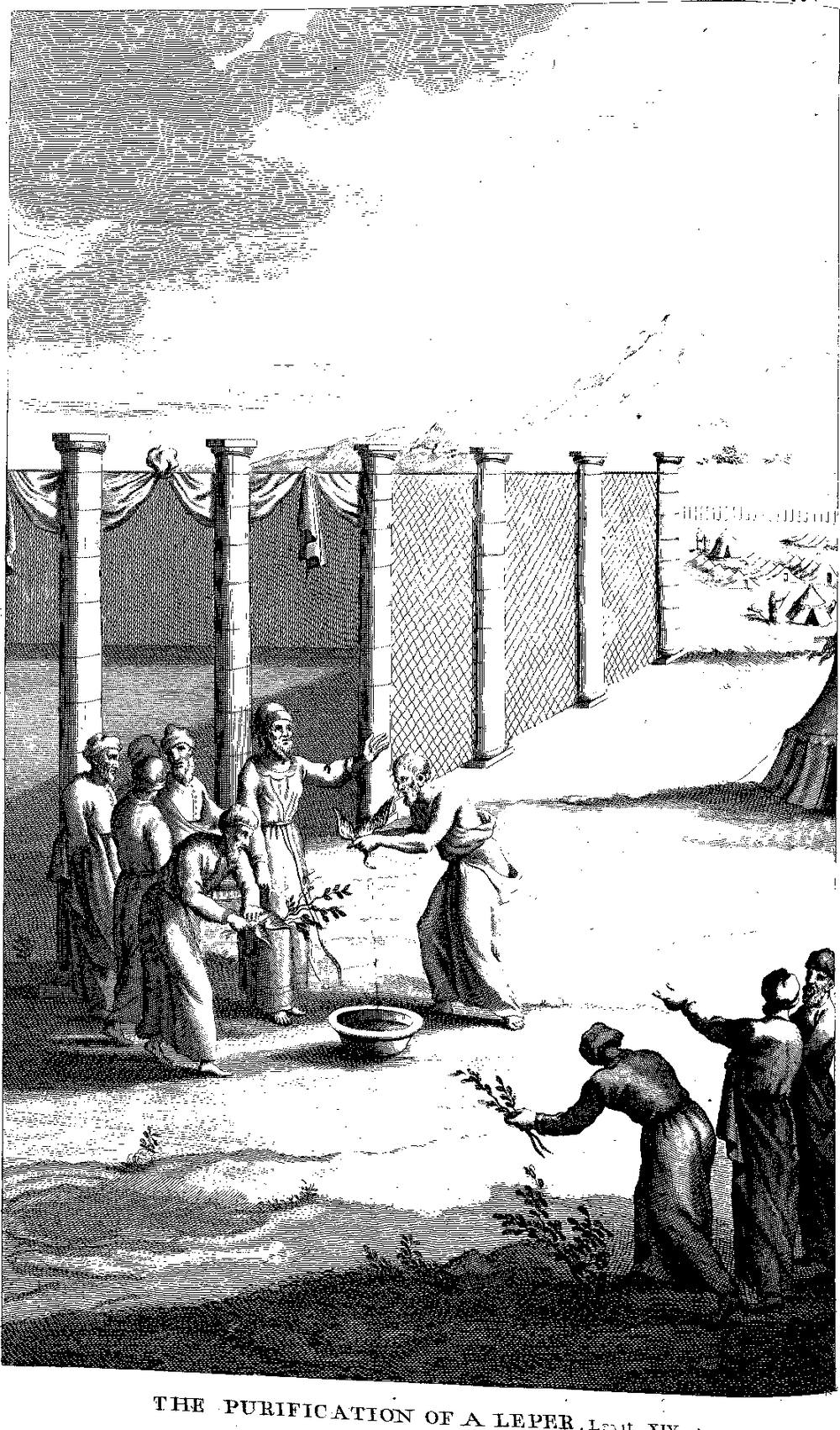
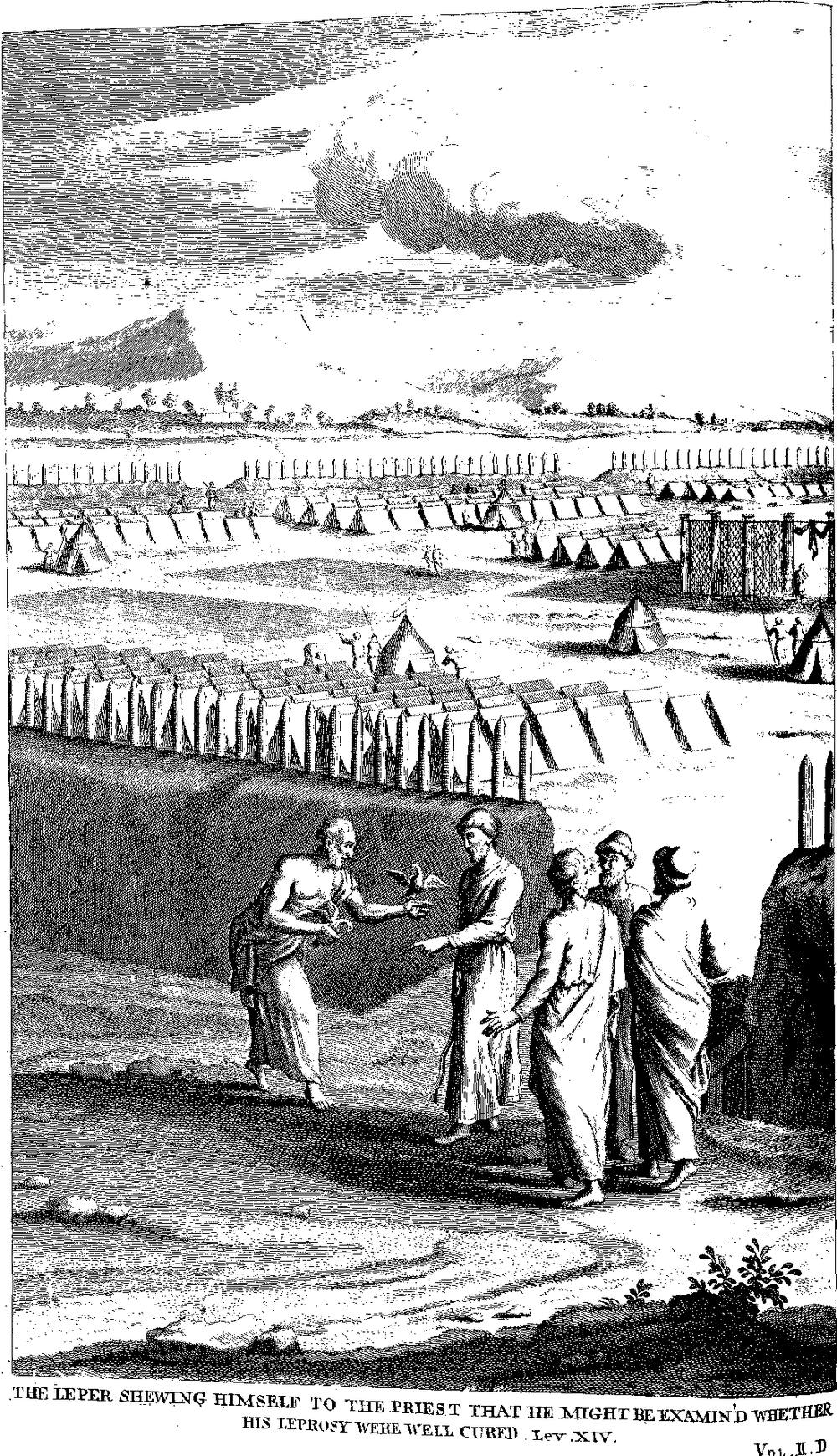
LEPER. The Law excluded Lepers from the Conversation of Mankind. It banished them into the Countrey, and Places uninhabited: Lev. xiii. 45, 46.Many Persons attacked with this Disease often got together, and composed a kind of Society. We see Examples of it in the four Lepers who were without the City of 2 Kings vii. 3, 8. Luke xvii. 12.Samaria, while Ben-hadad King of Syria besieged it; and in the ten Lepers who came to Jesus Christ, and desired to be healed by him. This Particular was observed so punctually, that even the Kings themselves were put out of their Palace, shut out of Society, and deprived of the Government, whenever this Disease laid hold of them; as in the Instance of Uzziah, or Azariah, King of Judah, who was afflicted with this Malady, for attempting 2 Kings xv. 5, 2 Chr. xxvi. 27. Lev. xiv. 1, 2, 3, 4 &c.to offer Incense in the Temple. When a Leper was cured he appeared at the City Gate, and the Priest examined whether he was truly healed or not. After this he went to the Temple, took two pure Birds, made a Whisp with a Branch of Cedar,
and another of Hyssop, tied together with a Scarlet Ribbon made of Wool; an earthen Vessel was filled with Water, and one of these Birds fastened alive to the Wisp which we have mentioned. The Leper who was cured killed the other Bird, and let the Blood of it run into the Vessel filled with Water. After this the Priest took the Wisp with the live Bird, dipped both in the Water tinged with the Blood of one of the Birds, and sprinkled the Leper with it. After this the live Bird was let loose, and the Person healed and purified in this Manner, was again admitted to the Society of the healthy, and to the Use of Things sacred.
Lepers were formerly very frequent in Europe. Some are of Opinion, that the Commerce which People carried on with the the Jews, who abounded in this Quarter of the World, contributed to the spreading Leprosies. Others maintain, that they proceeded from the frequent Voyages which were made to Palestine in the Time of the Croisades. These Lepers were called Ladres in French, and abundance of Lazarettoes were built for them, consecrated to Saint Ladre, or Lazarus, Brother to Mary and Martha, or to Saint Job. Matthew Paris says, there were nine Thousand Hospitals in Europe for these People. They were separated from the Conversation of others, and obliged to keep close in their Lazarettoes; they had Marks fixed upon them whereby they might be known. They generally carried Clappers about them, that they might be distinguished and avoided.
For these last two hundred Years Leprosies have almost entirely ceased in Europe, at least this Disease has changed its Name; and as it was before thought incurable, People have found out Remedies for it. The ablest Physicians have believed, that it differed only in Name from the venereal Disease. M. Tournefort, who saw several Lepers in his Voyage to the Levant, makes no Doubt of what we have just now said. There are some incurable, because their Distemper is inveterate, and has corrupted the whole Mass of Blood and Humours; but there are others capable of being healed, by treating them in the same Manner as they do those who have the Pox. Many are of Opinion, that Job’s Disease was a Leprosy, but in a Degree of Malignity which rendered it incurable, and so produced a Complication of other Diseases with it.
Manetho the Egyptian35, Lysimachus, Molon, Appion the Grammarian, Tacitus, and Justin, affirm seriously, that the Jews left Egypt on the Score of the Leprosy. Each of these Historians relates the Matter after his own Manner, and adds some Circumstances to it of his own framing: But they all agree in saying, that the Hebrews, who departed out of Egypt, were attacked with a Leprosy. Tacitus’s Account of the Matter is as follows. “ Several Authors agree, “ that the Distemper of the Leprosy having “ spread itself very much in Egypt, King “ Bocchoris consulted the Oracle of Ammon, “ to learn a Remedy for this Indisposition. “ The Oracle told him, that he must purge “ the Kingdom of this sort of People, and “ remove them out of the Countrey as “ hateful to the Gods. Bocchoris thereupon gathered all those together who had “ this Disease upon them, and ordered “ them to be conducted into a vast Wilderness, there to perish with Want. These “ unhappy Wretches being reduced to this “ Condition, and not knowing what to “ do, were continually weeping and bemoaning themselves; but Moses who was “ more resolute and considerate than they, “ told them that it was to no Purpose to “ implore Assistance from either Gods or “ Men, because they were detestable to “ one and the other; but if they would “ have Confidence in him, and follow him, “ as a Guide sent from Heaven, they might “ under his Conduct come into a Place of “ Rest; they followed him therefore at all “ Hazards. And as they were extremely “ incommoded with Thirst, and expected “ nothing but Death, Moses perceived a “ Company of wild Asses, which had just “ been feeding, he followed them, and having met them in a Place covered with “ green Grass, he conjectured that underneath it there might be a Spring of Water; he ordered them to dig, and found “ enough to satisfy the Thirst of all the “ Multitude which followed him.
“ After seven Days March they came “ into Judæa, and made themselves Masters of it. They observed Rest upon the “ seventh Day, as the End of their Journey and Calamities. They honoured an “ Ass, as that which had saved their Lives “ by shewing them the Spring of Water. “ They preserved a great Aversion to “ Hog’s Flesh, in Memory of the Leprosy “ with which they had been afflicted, and “ to which this Animal is said to be very “ subject.”
There are almost as many Mistakes as Words in this Recital of Tacitus: Nevertheless other Authors, who have discoursed of the Original of the Jews, speak of it in a still more wretched Manner. The Leprosy wherewith they are said to have been attacked, is what has engaged us here to take Notice of it. But if they had been all Lepers, how came they to have so
great an Aversion to those who had this Disease upon them? The Reader may see Josephus against Appion.
LEPROSY. Moses Lev. xiii. xiv.mentions three Sorts of Leprosies, in Men, Houses, and Cloaths36. A Leprosy in Men, is a Disease which affects the Skin, and sometimes increases in such a Manner, as to produce Scurf, Scabs, and violent Itchings, and corrupts the whole Mass of Blood. At other Times it is only a Deformity, and nothing more, as Hipponetus informs us37, and as the Fathers call it38, where they are speaking of the Lepers in the Gospel cured by Jesus Christ. The Jews looked upon a Leprosy as a Disease sent from God, and Moses prescribes no natural Remedy for the Cure of it. He requires no more, than that the diseased Person should shew himself to the Priest, and that the Priest should judge of the Quality of his Leprosy; and if it appeared to be a real Leprosy, capable of being communicated to others, he separated the Leper from the Company of Mankind. He appoints certain Sacrifices and particular Ceremonies for the Purification of a Leper, and for the restoring him to civil Society, the Participation of Things holy, and the Conversation of other Men.
The different Marks which Moses gives for the better distinguishing a Leprosy, are Signs of the Increase of this Disease. An outward Swelling, a Pimple, a white Spot, bright, and somewhat reddish, created just Suspicions of a Man’s being attacked with it. When a bright Spot, something reddish or white appeared, and the Hair of that Place was of a pale Red, and the Place itself something deeper than the rest of the Skin; this was a certain Mark of a Leprosy. They who have treated of this Disease, have made the same Remarks, but have distinguished a growing Leprosy, from one already formed and become inveterate. A growing Leprosy may be healed, but an inveterate one is incurable. Travellers who have seen Lepers in the East say, that this Disease attacks principally the Feet. Prosper Alpinus says39, that it is very common in Egypt. Maundrell40, who had seen Lepers in Palestine says, that their Feet are swelled like those of Elephants, or Horses Feet eaten up with the Farcy. M. Tournefort, who had observed several in his Travels, believes a Leprosy to be nothing else but an inveterate Pox; and that the Generality recovered, if they were helped in Time.
The common Marks whereby Physicians tell us that an inveterate Leprosy may be discerned are these. It makes the Voice hoarse, like that of a Dog who has been barking a long Time, and the Voice comes through the Nose rather than the Mouth. The diseased Person’s Pulse is small and heavy, slow and disordered. His Blood abounds with white and bright Corpuscles, like Millet Seeds. It is all a scurfy Serum, without any of that Mixture which is natural to it; so that the Salt which any one puts into it cannot melt. It is so dry, that the Vinegar which is mixed with it bubbles up; it is so strongly knit together by imperceptible Threads, that calcinated Lead thrown into it will swim easily upon the Surface of it. The Urine of a Leper is undigested, settled, Ash-coloured and thick; the Sediment of it like Meal mixed with Bran. His Face is like a Coal half extinguished, shining, unctuous, bloated, thick set with very hard Pimples, with small Kernels round about the Bottom of them: His Eyes are red and inflamed, and sparkle like those of a Cat, they come forward out of his Head, but cannot be moved either to the right or left. His Ears are swelled and red, eaten up with Ulcers about the Root of them, and encompassed with small Kernels. His Nose sinks, because the Cartilage rots. His Nostrils are open, and the Passages stopped with some Ulcers at the Bottom. His Tongue is dry, black, swelled, ulcerated, shortened, divided by Ridges, and beset with little white Pimples. The Skin of it is uneven, hard and insensible; whether a Hole be made in it, or it is cut, instead of Blood, nothing but a putrified Liquor issues out of it.
The Nature and Causes of a Leprosy have been much argued upon. The Generality are of Opinion, that the Cause of it is inward, in the Blood and Humours; and that it does not appear outwardly, till it has corrupted every Thing within. Others are of Opinion that it is owing to some outward Cause. I think it necessary to distinguish two Sorts of Leprosies, one proceeding from some inward Corruption, the other got by outward Communication with a Leper. Corruption of the Blood may be in different Respects, the Cause, and Effect of a Leprosy. It is the Cause of it, when the Blood being inwardly corrupted, either by bad Diet, or some other Cause, produces such external Effects as are observable in Leprosies. Corruption of the Blood is the Effect of this Disease when it is caught by touching any Person, who is infected with it, or any Thing belonging to him; for a Leprosy is very easily communicipated;
for which Reason Moses has taken so much Precaution, to prevent Lepers from having any Communication with Persons in good Health. And his Care extended so far, as even to dead Bodies thus infected, directing that they should not be buried with others.
2 Chr. xxvi. 23.We have endeavoured, in a Dissertation written purposely on this Subject, and printed before our Comment on Leviticus, to shew that Leprosies and other Diseases which have any Relation to it, are caused by an infinite Number of small imperceptible Worms, which creep in between the Skin and Flesh, and gnaw the Epidermis and Cuticula, and afterwards the Extremity of the Nerves and Flesh, and there produce at least all the Effects which are to be observed in the Beginning, Progress, and End of a Leprosy. We are of Opinion likewise, that the Venereal Disease is a kind of Leprosy, which the Ancients were but too well acquainted with, though they have not given it the same Name, nor ascribed the same Original to it, as we have to the French Disease. The Reader may see our Remarks upon Job’s Distemper.
The Leprosy of Houses, mentioned in Leviticus xiv. 34, and following Verses, must have been known to the Israelites, who had lived in Egypt, and must have been very common in the Land of Canaan, whither they were going, since Moses says to them: When ye come into the Land of Canaan which I give you for a Possession, if there be an House infected with a Leprosy, he to whom the House belongs, shall give Notice of it to the Priest, who shall go thither. If he sees as it were little Holes in the Wall, and Places disfigured with pale or reddish Spots, which in Sight are lower than the Wall, he shall go out of the House, and direct it to be shut up for seven Days. At the End of this Time, if he finds that the Leprosy is increased, he shall command the Stones infected with the Leprosy to be taken away, and thrown without the City into some unclean Place. New Stones shall be put in the Room of those which were plucked out, and the Wall shall be again rough -cast. If the Leprosy does not return, the House shall be thought clean; but if it returns, it is then an inveterate Leprosy; the House shall be declared unclean, and immediately be demolished: All the Wood, Stone, Mortar, and Dust shall be cast out of the City into an unclean Place.
The Rabbins and some others41 believed, that this Leprosy of Houses was not natural, but that it was a Punishment inflicted by God upon wicked Israelites. But we believe this kind of Leprosy to be caused by Worms which gnaw the Stones42: These Worms are black, about two Lines in [ 55 ] Length, and three Quarters of a Line broad, inclosed in a grayish Shell, with a very large Head, ten very black and very round Eyes, four kind of Jaws disposed like a Cross, which they are continually stirring, and open and shut like a Pair of Compasses with four Branches. The Mortar is eaten by an infinite Number of little Worms, which are somewhat black, about the Size of Mites in a Cheese, and like Mites, have four pretty long Feet on each Side.
The Leprosy in Clothes is likewise taken Notice of in Moses, as a Thing common in his Time. He speaks of it after this Manner: If any greenish or red Spots be observed upon any Woollen or Linnen Stuffs, or upon any Thing made of Skin, they shall be carried to the Priest, who shall shut them up for seven Days; and if at the End of this Time he takes Notice that these Spots increase, and spread, he shall burn them, as infected with a real Leprosy. If the Priest sees that these Spots are not increased, he shall command the Clothes to be washed; and in Case he afterwards observes nothing extraordinary in them, he shall declare them to be clean. If the greenish or red Spots still remain, he shall order the Garments so spotted to be burnt, as being unclean. If they spread and are increased, he shall likewise order the Garment to be burnt; lastly, if the Place suspected of a Leprosy seem to be in Colour like a singed Garment, and deeper than the rest; this Part of the Garment shall be pulled out, and the rest shall be preserved.
In Order to explain the Nature and Causes of this Leprosy in Clothes, we shall follow the same Hypothesis which we proposed concerning the Leprosy of Men and Houses; we are of Opinion, and Experience is a Confirmation of it, that Wool ill scowered, Stuffs kept too long, and some particular Tapistries in Auvergne, are subject to Worms and Moths which eat them. It is very credible, that the Leprosy in Clothes and Skins mentioned by Moses, was caused by this Sort of Vermin. In the hot Countries, and in Times when Arts and Manufactures were not carried to that Height of Perfection wherein we now see them, Stuffs and Works wrought in Wool were probably more exposed to Vermin, than they are in our Climates which are cooler; and in these Times, when Arts have been brought to so much Perfection by Experience and Industry.
LETECH, a Sort of Hebrew Measure half an Omer, and consequently contained sixteen Pecks, or four Bushels. I find this Measure no where but in Hosea iii. 2. Letech
bordeorum. The Septuagint say Nebel; the Vulgate dimidium cori.
LETTERS. The Hebrews have two and twenty Letters, the Names, Figure, Pronunciation and numerical Valuation whereof are here set down.
1.אAleph. A. 1. 2.בBeth. B. 2. 3.גGimel. Gh. 3. 4.דDaleth. Dh. 4. 5.הHe. H. 5. 6.וVau. V. 6. 7.זSain. S. 7. 8.חCheth. Ch. 8. 9.טTeth. T. 9. 10.יJod. I. 10. 11.כCaph. C. 20. 12.לLamed. L. 30. 13.מMem. M. 40. 14.נNun. N. 50. 15.סSamech. S. 60. 16.עHain. Ha. gn. or ng. 70. 17.פPe. Ph. or P. 80. 18.צTzade. Tz. 90. 19.קKoph. K. 100. 20.רResch. Rh. 200. 21.שSchin, or Sin; Sch, or Sc. 300. 22.תThaugh. T. 400. We do not know who was the first Inventor of Letters and Writing. All agree that it is an admirable and divine Art43. To paint Speech, and speak to the Eyes, and by tracing out Characters in different Forms to give Colour and Body to Thoughts.
Some have been of Opinion, that they always were in Use, and that God when he inspired Man with Reason and the Use of Speech, communicated to him likewise the Secret of expressing his Thoughts in Writing. Joseph. Antiq.We know what Josephus says of certain Columns erected before the Deluge by the Sons of Seth, upon which they had written their astronomical Observations and Inventions. Adam and Enoch by some have been reputed Authors of certain Books, they supposed consequently that they had the Use of Writing. The Work attributed by the Sabians to Adam is still in Being at this Day: The Character of it is said to be very extraordinary. As to that of Enoch, we have only some Fragments of it, which are of a Greek Translation, or rather taken from the Original itself: For no one believes that it was ever written in any other Language, or that it is any other than the Work of some Impostor.
Others maintain, that the Use of Letters is much more modern: Some give the Honour of them to Abraham; others to Moses, others to the Phœnicians, others to Saturn, and others again to the Egyptians. Others argue more rationally, and divide the Honour of this Invention among several Persons, and acknowledge that it began among the Eastern People, and much later among those in the West; that some invented, and others only perfected this Invention: That the Use of Letters in the Beginning was uncommon and imperfect, that the Figure of them was irregular and long a forming, that afterwards they were perfected, and the Use of them rendered more easy and common.
Crinitus says, that Moses invented the Hebrew Letters; Abraham the Syriac and Chaldee; the Phœnicians theirs, which they communicated to the Greeks, who carried them into Italy; Nicostratus those of the Latins, Isis the Egyptian, Ulphila those of the Goths.
But all this is probably affirmed at Random by this Author; for it is certain beyond Question, that the Hebrew and Phœnician Letters were anciently the same, or differed very little from one another. The Greek and Latin Letters are no new Invention; the Greek are taken from the Phœnician, and the Latin from the Greek. The Writing made Use of by Ulphila is taken from the Greek or Latin.
As to the Egyptian Writing, we are assured that in the Beginning it was nothing but Hieroglyphicks, or Figures of Animals, and other Things engraven upon Stone, or painted upon Wood, by the Help whereof the Egyptians preserved the Memory of great Events. This Way of Writing is perhaps the most ancient in the World. We still see many Monuments of it upon the Obelisks and Marbles which come from Egypt. Marsham44 is of Opinion, that this Way of Writing was invented by the second King of Memphis, who is no other than Thautk, whom the Greeks call the first Mercury; another Thauth, or second Mercury, put what the first had written in Hieroglyphick Letters into common Characters. All which was performed in Times of the most remote Antiquity, if it be true that Menes the first King of Memphis, was no other than Ham the Son of Noah.
Lucan affirms, that the Phœnicians invented the common Letters at a Time when the Egyptians were not as yet acquainted with the Use of Paper, and knew nothing of the Art of Writing in Hieroglyphical Characters.
Phœnices primi, famæ si creditur, ausi Mansuram rudibus vocem signare figuris. Nondum flumineas Memphis contexere biblos Noverat, & laxis tantum volucresque feræque
Letters continues on the next page
Footnotes
-
Ps. lxxxi. 1. Deus stetit in Synagoga Deorum in medio autem Deos, (or Deorum) dijudicat. ↩
-
John xi. 1. In the Year of our Lord 36. of the Vulgar Æra 33. ↩
-
John xii. 1, &c. In the Year of the Vulgar Æra 33. ↩
-
Epiphan. hæref. 66. c. 39. p. 652. ↩
-
Ita Græci apud Launoi de Magdalen. p. 222, 223, 224, 225. ↩
-
Zonar. l. v. p. 147. Menæ. 17 Octob. &c. ↩
-
Iren. l. iv. c. 4. ↩
-
Ambros. in Luc. l. viii. n. 13. ↩
-
Greg. Mag. homil. 40. in Evang. ↩
-
Tertul. lib. de anima. c. 7. ↩
-
Euthym. in Luc. ↩
-
Chrysost. homil. de Divite & Lazaro. ↩
-
Cyril. Alex. Catec. Græc. P. P. ↩
-
Theophylact. in Luc. xvi. ↩
-
Gen. xxix. 23. In the Year of the World 2245. before J. C. 2755. before the Vulg. Æra 2759; ↩
-
Justin. seu alius qu. 60. ad Orthodox. Maldonet. & Grot. in Luc. Salmas. & Serer. apud Jacob. Capell. ↩
-
Translators’ note. The several Cases of Conscience relating to this Matter are very numerous, and seem to be the principal Study of the Jewish Doctors. Decisions of the most remarkable may be seen in the Mishnah. Mishnah, Ordo Festorum, Tom. II. p. 138. ↩
-
Vat. Druf. Bonfrer. Grot. Boch. alii plerique. Mont. Druf. Pisc. Amama, Castell. Cleric. Schmid. Martyr. in itinerario. ↩
-
Joseph. Antiq. l. v. c. 10. ↩
-
Arias, ↩
-
Glycas Annal. part. ii. p. 164. Antonin. ↩
-
Bellon. observat. l. iii. c. 18. & 32. & Spon’s Travels. ↩
-
Plin. l. xix. c. 6. ↩
-
Juven. Sat. xv. ↩
-
Hieronym. Ep. ad Marcellan. Leo mag. Ser. 6. de Quadr. de Baptis. c. 24. ↩
-
Aug. Ep. 118. ad Jasmar. & l. iv. ↩
-
1 Sam. x. 1. See likewise 2 Kings ix. 1. 3. ,פך השמןLXX. τὸ φάκον τῆς ἐλαίας. ↩
-
Athenæ. Deipnosoph. l. iv. c. 14, 15. ↩
-
Aug. in Psal. xlvi. ↩
-
Dan. xiii. 54. ὑπὸ σχῖνον … ἤδη ὁ Ἄγγελος τοῦ Θεοῦ σχίσει σε μέσον. ↩
-
Hieronym. in Dan. Præfat. & Comment. in Dan. xiii. ↩
-
Vide Fabric. oper. N. T. t. i. p. 301. Tom. ii. p. 486, 487. ↩
-
D. Herbelot Bibl. orient. p. 700. Pars & p. 495-6. Πάρδαλις. vulg. Pardus. ↩
-
Jerem. xiii. 23. נמרNemor. LXX. ↩
-
Appio apud Joseph. l. i. contra Appion. l. ii. initio & Tacit. l. v. Hist. Justin. l. xxxvi. ↩
-
Translators’ note. The Jewish Doctors distinguish several Species of this Disease. Chanina reckons sixteen only, R. Doza thirty six; but Ahiba multiplies them to seventy two. See Mishnah, Tom. iv. [Hebrew] Tractatus de Plagis Lepræ, Cap. i. pag. 213, 215. ↩
-
Hipponet. l. de affectionib. ↩
-
Arnob. l. i. Aug. alii. ↩
-
Prosper. Alpin. de medicina Ægypt. l. i. c. 13. ↩
-
Maundrell’s Journey from Aleppo to Jerusalem. ↩
-
Vide Theodoret, qu. 18. in Levit. ↩
-
Journal des Sçavans de l’année, 1668. ↩
-
Brebeuf. Phasale de Lucain. ↩
-
Marsham. Can. Ægypt. Secul. 1. ex Syncello. ↩