Volume I, pages 647–665 of the 1732 edition, from HAM to HEI: everything printed on these pages, in order.
Continued from Ham
Vulgate translates it thus; Chedorlaomer overcame the Rephaims of Ashteroth Karmaim, and the Zuzims with them; but the Hebrew reading is, the Zuzims in Hem, or in Ham. What the situation was of this Gen. xiv. 5. זוזים בהםland of Ham, we cannot tell.
HAM, the son of Noah, brother to Shem and Japheth. He is believed by some to have been Noah’s youngest son.1 One day, when Noah had drank wine to excess, Ham perceived him lying in his tent, and exposed in an indecent manner: instead of covering him, he went and told Shem and Japheth, who throwing a cloak over themselves, and walking backward, cast it upon their father, and so covered his nakedness. Noah, when he awoke, being informed of what had passed, said, Cursed be Canaan, a servant of servants shall be be unto his brethren. From these words it is conjectured, that Canaan gave his father Ham intelligence of Noah’s nakedness. Others are of opinion, that Noah intended to wound Ham in a more sensible manner, by thus cursing his son Canaan. Noah added, Blessed be the Lord God of Shem; and Canaan shall be his servant. God shall enlarge Japheth, and he shall dwell in the tents of Shem; and Canaan shall be his servant.
Ham had a very numerous posterity. He was the father of Cush, Mizraim, Phut, and Canaan. We shall speak of the descendants of each of his sons in their particular articles, and of the country possessed by them. With respect to Ham, it is believed that he had all Africk for his inheritance, and that he peopled it with his children. As for himself, he dwelt in Egypt2, which is thought to be the most fruitful part of Africk. Africk is called the land of Ham, in several places of the Psalms. In Ps. lxxvii. 51. civ. 23. cv. 22. Plut. de Iside & Osiride.Plutarch, Egypt is called Chemia. There are some footsteps of the name of Ham or Cham observed in Pso-chemmis, Psittachemmis, which are cantons of Egypt. Lastly, it is believed, that Hammon, adored in Egypt and Lybia, was no other than Ham, the son of Noah.
Bibl. Orient. p. 425.The Author of Tharik-Thabari says, that Noah having cursed Ham and Canaan, the effect of this curse was, that not only their posterity was made subject to their brethren, and born, as we may say, in slavery, but likewise that on a sudden, the colour of their skin became black; for they maintain, that all the Blacks descend from Ham and Canaan. Noah seeing this so surprizing change, was affected with it, and begg’d of God that he would please to inspire Canaan’s masters with a tender and compassionate love for him: his prayer was heard; for notwithstanding we may still at this day observe the effect of Noah’s curse in the servitude of Ham’s descendants, we may remark likewise the effect of his prayer, in that this sort of black slaves is sought for, and made much of in all places.
Many have been of opinion, that the posterity of Ham was the only, or at least principal cause of building the Tower of Babel; that they first suggested the design to others, and formed the presumptuous project of erecting a tower which should reach as high as heaven, that so their name might be celebrated in all ages, and they secured from the apprehension of a new Deluge, if God at any time should send one on the earth. We shall very readily confess, that the undertaking of the builders of Babel was criminal in the sight of God; the author of the book of Wisdom calls it, a Wisd. x. 5.wicked conspiracy; but it is not just to charge it without proofs upon the race of Ham alone.
An Arabian author assures us, that Ham was the first who spread idolatry over the earth, who invented horoscopes, and magick; Abeneph. apud Kircher. Templ. Isiac.and was the author of divers superstitions, on the account whereof he was called Zoroastres, or Adris the Prophet; that is to say, the Image of a Star, or a Fire at all times giving light.
Fabulous History has preserved some footsteps of Ham’s story. It is related, that on a certain day Myrrha, wife, or as others say, nurse to Hammon, and mother of Adonis, having her son in her company, found Cyniras sleeping in his tent all uncovered, and in an indecent posture. She ran immediately, and informed Hammon of it; he gave notice of it to his brothers, who, to prevent the confusion which Cyniras might be in to find himself naked when he waked, covered him with something. Cyniras understanding what had passed, cursed Adonis, and pursued Myrrha into Arabia, where, after having wandered nine months, she was changed into a tree, which bears Myrrh. Hammon and Ham are the same person; so are Adonis and Canaan.
HAMAN, the son of Hammedatha the Amalekite, of the race of Agag; or, according
cording to other copies, the son of HamadathSee the Comment on Esther iii. 1, 2. the Bugæan or Gogæan, that is to say, of the race of Gog. Lastly, it may be read, Haman the son of Hamadath, which Haman was Bagau or Bagoas, that is to say, Eunuch or Servant to the King of Persia, in the text of Esther called Ahasuerus, who in all probability is the same as Darius the son of Hystaspes.
We have no other proof of Haman’s being an Amalekite, besides what is said in the third chapter and first verse of the book of Esther, that he was of the race of Agag; nevertheless in the Greek, chap. ix. and ver. 24. of the same book, and in the Latin, chap. xvi. 6.3 he is called a Macedonian by nation and affection; Animo & gente Macedo: which makes it dubious, whether he were by extraction an Amalekite. However this may be, King Ahasuerus having taken him into favour, gave him rank above Esth. iii. 2, 3.all the Princes of his court. And all the King’s servants who were at the palace-gate, bent the knee before Haman, and worshipped him, because the King had so commanded.
Mordecai, Queen Esther’s Uncle, but who had not yet discovered himself to be thus related to her, was the only one who refused to worship him. Haman had notice of it, and knowing him to be a Jew, he had a mind to see whether he would persist in this resolution. When he found, that Mordecai continued firm in refusing to pay those honours to him, which all the court shewed him, he determined to be revenged of him, and not of him alone, but likewise of the whole nation of the Jews, who were within the extent of Ahasuerus’s kingdom.
According to the superstition of the Persians, he proposed first to draw lots, that he might know on what day he should destroy them. Wherefore on the first month of the In the year of the World 3495 before J. C. 505, before the Vulgar Æra 509.year, in the way of reckoning the festivals, which was the seventh of the civil year, and answered to the moon of March, Haman began to cast lots, that he might know in what month, and upon what day of the month, he should begin to accomplish his design of extirpating the Jews. God, who governs all lots and chances, and sports with the vain projects of mankind, so permitted it, that the lot should determine the thirteenth day of the month Adar, which was the last of the sacred year, for the execution of his pernicious design, and so defer it for a whole year.
Haman did not omit to speak of it to the King. He told him, that there was a certain people dispersed over all his Provinces, who were Jews, people who kept very little correspondence with others, had laws and ceremonies very different from the rest of mankind, and despised his orders; that he knew very well of what importance it was to the tranquillity of his kingdom, to take care, that indulgence should not render them more insolent. He desired therefore that he would give orders for destroying this people; and to indemnify the King for any loss, which he might hereby sustain, he promised to pay ten thousand talents out of his own fortune into the treasury.4This is a prodigious sum for a private person; but Haman reckoned, in all probability, that the King would grant to him the confiscation of the goods belonging to the Hebrews, or that he would not accept the offer, which he made him.
Hereupon the King took the ring, which he was used to wear upon his finger, and gave it to Haman, telling him, that he might keep his money; and as for the people he mentioned, he might do as he pleased with them. Wherefore upon the thirteenth day of Nisan, Haman sent for the King’s Secretaries, and directed them to dispatch the Order, which commanded the extirpation of the Jews throughout the whole kingdom of Persia, and was to take place upon the thirteenth day of Adar following; that is to say, a year after the date of the Edict. The order was sent into all the Provinces by the King’s couriers, and permission given to the people to fall upon them, exterminate them, and pillage their Goods. The Edict was posted up at Shushan, where Ahasuerus kept his ordinary residence. Haman was overjoyed at his success, and the Jews were in the utmost consternation.
Mordecai, who had been the occasion of this terrible storm, rent his clothes, put on Esth. iv. 1, 2, 3, &c.sackcloth, and ashes on his head, and came full of sorrow to the palace-gate. But he was not permitted to come in with all those marks of affliction upon him. Two Eunuchs went immediately to Esther, and informed her of his condition; she sent a more proper habit for Mordecai, but he refused it. She deputed afterwards an Eunuch to him, who was in her service, to know the cause of his great grief; Mordecai related what Haman had done against the Jews, sent her a copy of the King’s Edict, and desired her to go to the King, and intercede for her country-men.
Esther replied, that she was not allowed
to visit the King, unless she was sent for. But Mordecai insisted, telling her, that God in all probability had raised her only that she might be in a condition to act upon such an occasion as this. Esther therefore gave directions to tell him, that he should pass three days and three nights in the synagogue in fasting and prayers; that she with her servants would do the same: and that after this, she would wait upon the King at the hazard of her own life. The three days Esth. v. 1, 2, 3.of fasting being over, she dressed herself in all her finest ornaments, and presented herself before the King. Ahasuerus stretched out his scepter, as an indication that he was pleased with her appearing; and told her, that she might ask what she would, it should be granted her. Esther replied, that she had one favour only to beg of the King; which was, that he would be pleased to come with Haman to an Entertainment, which she had provided for him.
The King came; and after the banquet was over, he once more desired Esther to ask whatever she pleased of him. Esther answered, that she humbly begg’d his Majesty to come again with Haman the next day to another Entertainment, which she would prepare for him, and then she would declare what she desired of him. Haman therefore left the palace with great pleasure; and observing that Mordecai, whom he met with, did not stand up before him, he was very much inraged; came home, related to his wife and his friends, the particular honour which Esther had done him, by inviting him alone to bear the King company at her banquet. But then he added, all this I shall reckon as nothing, while I see Mordecai sitting at the King’s Gate, without rising up before me. Hereupon Zeresh his wife, and all his friends, advised him to erect a Gallows fifty cubits high, and desire the King the next morning that Mordecai might be hanged upon it. This advice was agreeable to him; and immediately he gave orders for preparing the Gallows.
The next day early in the morning, Esth. vi. 1, 2, 3.Haman came into the King’s anti-chamber, to desire the death of Mordecai. Ahasuerus call’d him in to him, and said, What would the man have, whom the King delighteth to honour? Haman believing that he was the person whom the King meant, said, Let him be clothed in the King’s royal robes, be mounted upon the horse which the King is used to ride, let the royal diadem be put upon his head, and let the chief of all the Grandees belonging to the Court conduct him through the streets of the City, and cry before him, Thus shall it be unto the man, whom the King delighteth to honour. Ahasuerus answered him, Go, do as thou hast said unto Mordecai the Jew, who has discovered a conspiracy against my person, and has received no reward for it. Haman executed this command with all the reluctancy which may be imagined; and returning to his own house, related what had happened, to Zeresh his wife, and his friends; who, looking upon this to be an happy omen for the Jews, told him, it was their opinion, that if Mordecai, before whom he had fal’n, were a Jew, there couldbe no resisting him, and that he must be subject to him.
Esth. vii. 1, 2, 3, &c.While they were yet talking, Haman was called to the Entertainment prepared by the Queen. When Ahasuerus was in good humour, and had partaken plentifully of the good cheer provided, he desired the Queen to ask what she pleased of him. She answered, If I have found favour in thy sight, O King, I conjure thee to grant me my own life, and the lives of my people, for whom I implore thy clemency. Ahasuerus hereupon said to her, Who is there then so daring as to attempt thy life?
Esther answered, this Haman whom thou seest, he it is, who is our mortal enemy. Haman hearing this, was quite stunned, and could not support the looks which both the King and Queen cast upon him. At the same time Ahasuerus in great rage going out into a Garden joining to the room where they dined, Haman threw himself at the Queen’s feet, who was lying upon a bed belonging to the table, after the mode of that country: at the same time the King returning into the room, and seeing Haman on the bed, on which the Queen was, cried out, What would he too offer violence to the Queen in my presence, and in my house? Scarce were the words out of the King’s mouth, before Haman was seized on, and his face covered, like one going to be executed.
Esth. ix. 6.Hereupon Harbonah, one of the King’s Eunuchs, said, that he had seen a Gibbet at Haman’s house fifty cubits high, which he had prepared for Mordecai; and upon this the King commanded Haman to be hanged; which was done accordingly that very day: his house was given to the Queen, and his employments together with the dignity, which this Favourite possessed, to Mordecai. His ten sons were likewise put to death; and an Edict published, revoking the first, and permitting the Jews to take vengeance of their enemies. This happened in the year of the World 3496, before Jesus Christ 504, before the Vulgar Æra 508. See the Articles ESTHER and MORDECAI.
HAMATH, a celebrated City of Syria, which we take to be Emesa upon the Orontes. The entring into Hamath, which is
Josh. xiii. 5. Judg. iii. 3. 1 Kings viii. 65. 2 Kings xiv. 25. 2 Chr. vii. 8.is frequently spoken of in Scripture, is the narrow Pass leading from the Land of Canaan to Syria, through the Valley which lies between Libanus and Antilibanus. This Entrance into Hamath is set down as the northern boundary of the Land of Canaan, opposite to the southern limits, the Nile, or river of Egypt. Josephus5, and St. Jerom after him6, believed Hamath to be Epiphania. But Theodoret7, and many other good Geographers, maintained it to be Emesa in Syria.
The same Theodoret8 declares, that Aquila translated Hamath, Epiphania. For his part, he believes, that there were two cities of this name, which were to be distinguished; one surnamed the Great in Amos, Amos vi. 2.which is the same as Emesa; the other called simply Hamath, which, says he, is the same as Epiphania9. St. Jerom10 and St. Cyril of Alexandria11, believe on the contrary, that Hamath the Great is Antioch, and that Hamath without an epithet, is Epiphania. But I cannot tell whether it can be shewn by any Text of Scripture, that there were two Hamaths in Syria. Josh. xix. 35.Joshua assigns the city of Hamath to the Tribe of Naphtali. Toi King of Hamath, cultivated a good understanding with 2 Sam. viii. 9.David. This city was taken by the Kings of Judah, and retaken from the Syrians by 2 Kings xiv. 28.Jeroboam the second. The Kings of Assyria made themselves masters of it upon the declension of the Kingdom of Israel, and 2 Kings xvii. 24. & xviii. 34, &c.transplanted the inhabitants of Hamath into Samaria.
HAMATHITES, descendants of Hamath, one of the sons of Canaan. It is our opinion, that they dwelt in Emath, or Hamath, or Emesa in Syria, upon the river Orontes.
HAMMEDATHA, the father of Haman, of the race of the Amalekites. Esth. iii. 1.
HAMMON, or Chamon, a city of Asher. Josh. xix. 28. I do not know whether this be not the same with the city of this name, said to belong to Naphtali. 1 Chr. vi. 76.
HAMMON, Jupiter Hammon. It is an opinion almost generally received among the Criticks, that Jupiter Ammon, who was worshipped in Egypt, as I have hinted, is the same with Ham, whom his father Noah cursed. The conformity of names, and many other circumstances borrowed from history and fabulous accounts, have made this opinion very current. Egypt is called the Land of Ham in several passages of Ps. lxxviii. 51. cv. 23. cvi. 12.Scripture. There are some footsteps of this name farther to be observed in Pso-Chemmis, and Psita-Chemmis, which are cantons of Egypt. Plutarch speaks of this country’s Plut. de Iside & Osiride.being called Chemia. It is certain that it was peopled by Mizraïm, one Vaïagged, ויגדNuntiavit.of his sons; and that the neighbouring countries were possessed by the descendants of his other sons, Cush, Phut, and Canaan.
If Noah is the Saturn of the Heathens, Ham, the youngest of his sons, must be their Jupiter. What the Poets say of Jupiter, and the violence offered by him to his father, has a great deal of relation with the action of Ham. Jupiter castrated his father; Ham did not cover his father’s nakedness; nay, the Hebrew text may be interpreted, he castrated, instead of he told, by changing the pointing, which is a new invention. Saturn divided the whole World between his three sons; to Jupiter he gave ויגד Veiagged, He castrated.Heaven, the Sea to Neptune, and Hell to Pluto. Noah gave Africk to Ham, Asia to Shem, and Europe to Japheth. Africa is thought to be the highest country, and nearest to Heaven:
Terrarum primam Lybiam, nam proxima cœlo est, Ut probat ipse calor, tetigit. Ham is believed to have introduced Idolatry in Egypt, and himself to have received divine honours there. It is the opinion of some likewise, that originally the Stars only were worshipped, and that afterwards the same veneration was paid to illustrious Men, and Kings. Ammon is the same as the Sun, according to the old Pagan Theologists. Clem. Alex. Diodor. Sicul.Clemens Alexandrinus speaks of an Apollo the son of Ammon. Apollo we know is the Sun. Bauhen the Indian is also said to be the son of Ammon, begotten by him of the nymph Amalthæa, and that he was the inventor of presses.
The Egyptians, before the dominion of Alexander the Great in Asia and Egypt, knew nothing of the worship of the Grecian Jupiter; but these having introduced their Religion with their Language and Manners into Egypt, the Egyptians, who were the most superstitious of all people, easily received the false worship of the Greeks, and joining it with their old traditions, composed a monstrous medley of Egyptian and Greek Deities. The Greeks were willing to find their own Gods in those of the Egyptians; and the Egyptians, upon some inconsiderable mark of resemblance, made their Gods pass for those of the Greeks. Of Isis, for example, they made Diana, the Moon, Venus, Ceres, &c. of Osiris, Apollo and Adonis, &c. of Ammon, Jupiter, and the Sun, the greatest and principal of the Deities.
Q. Curt. l. 4.The Temple of Jupiter Ammon was thought to be one of the most ancient in the world: no one was able to shew the original of it. It was situated in the midst of a wood consecrated to this Deity, and served as a strong fort for the people round about. Three large walls formed the
inclosure of it: in the first inclosure, there was an old palace to be seen, which had been formerly the dwelling of the Kings of that country. In the second inclosure, were apartments for the wives and children of these Kings; and in the same were the Temple and Oracle of Ammon. Lastly, the last court contained lodgings for the Prince’s Guards and Soldiers. Quintus Curtius, from whom we have this description, says, that the Priests of Jupiter Ammon carried this Deity in a vessel, on the two sides whereof was hung a great number of silver dishes. Ammon was represented and adored under the form of a ram, or at least Antiq. expliquée, t. 1. p. 45.with the head of a ram, and the horns of a ram upon it.
Stat tortis cornibus Ammon.
See above the Article AMMON.
HAMMOTH-DOR, a city belonging to the Levites, in the Tribe of Naphtali. A cession was made of it to the Family of Gershom. See Joshua xix. 35. xxi. 32. It is the same perhaps as Hamath or Chamath belonging to the same Tribe, Joshua xix. 3. which is believed to be Tiberias. The name of Hamath or Chamath is given generally to places, where there are Baths of hot water. See HAMATH.
Ezek. xxxix. 16. המונהHamonah, Multitudo.HAMONAH, a city, where Ezekiel foretold what the burial would be of Gog and his people. We know of no town of this name in Palestine. Hamonah signifies Multitude; and the Prophet intended no more than to shew, that the slaughter of Gog’s people would be so great, that the place of their burial might be called Multitude.
Gen. xxxiv.HAMOR, Prince of Schechem, and father of a young man, whose name also was Schechem, who ravished Dinah, the daughter of Jacob, and drew upon his father and all Schechem the effects of her brothers resentment. See DINAH and SCHECHEM. In the year of the World 2265, before J.C. 1735, before the Vulg. Æra 1739. a Gen. xxxiii. 19.Jacob returning from Mesopotamia, went to Schechem, where he set up his tents, and bought of Hamor for the price of an hundred Kesitas12, that part of the field, where he had pitched his tents a.
HAMUEL, the son of Mishma. 1 Chr. iv. 26.
HAMUL, the son of Pharez, Chief of the Family of the Hamulists. Gen. xlvi. 12. and Numb. xxvi. 21.
HAMUTAL, the daughter of one Jeremiah of Libnah. Hamutal was the wife of King Josiah, the mother of Jehoahaz, and Zedekiah, Kings of Judah. 2 Kings xxiii. 31.
HANAMEEL, the son of Shallum, a kinsman of Jeremiah’s, who sold a field to this Prophet, which he had at Anathoth. Jerem. xxvii. 17, &c.
I. HANAN, the father of Rinna. 1 Chr. iv. 20.
II. HANAN, the son of Azel, of the Tribe of Asher. 1 Chr. viii. 38.
I. HANANI, father to the Prophet Jehu. 2 Chr. xvi. 7.
1 Kings xvi. 7.II. HANANI, a Prophet who came to Asa King of Judah, and said to him, Because thou hast put thy trust in the King of Syria, and not in the Lord, the army of the King of Syria is escaped out of thine hands. We do not know distinctly upon what occasion the Prophet discoursed in this manner to the King, but Asa ordered him to be seized on, and put in prison, and at the same time treated his people with great violence and injustice. Some will have it, that this Hanani was father to the Prophet Jehu: but this does not appear very clearly from the Scripture. Jehu prophesied in the kingdom of Israel, and Hanani in that of Judah. Jehu was put to death by Baasha King of Israel, who died in the year of the World 3075; and Hanani reproved Asa King of Judah, who reigned from 3049 to 3090.
III. HANANI, a Levite and Musician, who was in the eighteenth Class appointed by David for the service of the Temple. 1 Chr. xxv. 4, and 25.
I. HANANIAH, one of the three young men of the Tribe of Judah and Royal Family, who, having been carried away captives to Babylon, were chosen among others to be instructed in all the Sciences of the Chaldæans, and wait in Nebuchadnezzar’s palace. The name of Hananiah was changed into that of Shadrach, and he was brought up with Dan. i. 7. Dan. iii. 1, 2, &c.Daniel in the Prince’s Court. Nebuchadnezzar having set up a Statue in the Plain of Dura, near Babylon, and commanded all his servants upon pain of death to worship it; Shadrach, Meshach, and Abednego did not believe themselves obliged to submit to such unjust orders. They were cast therefore into the fiery furnace: but God did not permit the flames to hurt them; they came out as intire and well, as when they were thrown in. The Angel of the Lord descended to them in the furnace, and suspended the activity of the flame, so far at least as it might have affected them. This happened about the year of the World 3443, before Jesus Christ 557, before the Vulgar Æra 561. And after Nebuchadnezzar’s metamorphosis, when he was again settled in his throne, he himself related this strange transformation, and the dream which preceded it, in the Edict published by him upon the occasion of the miracle that had happened in favour of the three Hebrews. Hananiah and Daniel had been then about Dan. iii. ad finem, & iv. 1, 3, & 32, 33.seven
seven and twenty years in captivity at Babylon.
II. HANANIAH, the son of Zerubbabel. 1 Chr. iii. 9.
III. HANANIAH, the son of Azur, a Jerem. xxviii. 1, 16.false Prophet of the city of Gibeon, who coming to Jerusalem in the fourth year of the reign of Zedekiah King of Judah, and of the World 3409, said to Jeremiah before the Priests and all the People, Thus saith the Lord, I have broken the yoke of the King of Babylon. Within two full years will I bring again into this place all the Vessels of the Lord’s House, that Nebuchadnezzar King of Babylon took away from this place, and carried to Babylon. And Jeremiah answered, Amen. May it please God to perform what you have said. But hear me: I am not the only Prophet, who has denounced evils against particular Countries and Kingdoms. The event is a real justification of Prophets. It will be seen whether what I declare to you will come to pass. At the same time, Hananiah laid hold of the chains, which Jeremiah had for some time worn about his neck, as an emblem of the future captivity of Judah, and breaking them, he said, Thus saith the Lord, even so in two years time will I break the yoke of Nebuchadnezzar King of Babylon. Jeremiah, who had retired, was inspired by God to return; and directing his discourse to him, said, Thou hast broken the yokes of wood, but thou shalt make for them yokes of iron; and since thou seducest the people with falshoods, thou shalt die this year, because thou hast taught rebellion against the Lord. And Hananiah died within the year: in that of the World 3410, before Jesus Christ 590, before the Vulgar Æra 594.
HANANIEL, a Tower belonging to the city of Jerusalem, took its name from him. Zech. xiv. 8.
HANATHON, or Channathon, a Town 1 Sam. v. 6, 7.in the Tribe of Zebulon. Joshua xix. 14.
HANDS. Laying on of Hands; a ceremony very much used both in the Old and New Testament. See IMPOSITION OF HANDS.
By HAND, is sometimes understood the vengeance of God exercised upon any one. The Hand of the Lord was heavy upon them of Ashdod, after they had taken the Ark; and they were told that it would still continue to oppress them, till they should send back the Ark with presents.
Dan. i. 20. עשר ידותHand is likewise used for times. Daniel and his Companions were ten Hands wiser than all the Magi and Diviners of the country.
2 Kings iii. 11.To pour water on any one’s HANDS, signifies to serve him. Thus Elisha is said to have poured water on Elijah’s Hands, thereby meaning that he was his servant.
To wash one’s HANDS. Pilate washed his Hands, to denote his being innocent of what was required of him, when he proceeded to condemn Jesus, in whom he Matth. xxvii. 24. Pf. lviii. 11. Pf. xxvi. 6, Job xxxi. 27.found nothing to deserve such a sentence. The Psalmist washes his Hands13 in the blood of the ungodly. He approves the vengeance which God takes of their iniquity. The righteous washes his Hands with the innocent; he is in strict friendship with them.
To kiss one’s HAND, is an act of adoration: If I beheld the Sun when it shined, and my mouth hath kissed my Hand, says Job.
1 Kings xix. 18. Judg. xvii. 5, 12. VideLevit. & 1 Kings xiii. 33.To fill one’s HANDS, signifies to take possession of the Priesthood, to enter upon the enjoyment of any sacerdotal Dignity, to perform the functions of it; because in this ceremony, the parts of the victim which was to be offered, were put into the new Priest’s Hand.
2 Kings vii. 17.To lean upon any one’s HAND, is a mark of familiarity and superiority. The King of Israel had one of his confidents upon whom he leaned; and in like manner the King of Syria leaned on Naaman when 2 Kings v. 18.he went up to the Temple of his God Rimmon.
HAND is sometimes taken for the border, the side, the hinge of a door, the arms, the support of a throne, &c.
To lift up one’s HAND, is a way of taking an oath in use with all nations.
To give one’s HANDS, signifies to grant 2 Macc. xiii. 22.peace, to swear friendship, to promise all security, to make alliance: Dextram dedit, accepit, abiit. The Jews say, they were obliged to give the Hand to the Egyptians Lament. v. 6.and Assyrians, that they might procure bread; that is to say, to surrender to them, to make an alliance with them, that they might be enabled to subsist, that in their extreme necessity they might preserve their Lives.
The right HAND, with the Hebrews, signifies generally the south-side. See below
RIGHT.
Psal. lv. 11. Isa. v. 25. ix, 12, 17.To stretch out one’s HAND, signifies to chastise, to shew his severity, his justice. Extendit manum suam in retribuendo. God delivered his people out of Egypt with a stretched out Hand, and an Arm lifted up: he delivered them by performing many wonders, and inflicting many chastisements on the Egyptians. The Hand of God is still stretched out; he is still ready to strike.
To stretch out one’s HAND, is sometimes Isa. lxv. 2.a gesture that denotes mercy. I have stretched out mine Hand all the day long, towards an ungrateful and rebellious people.
Prov. i. 24. I have called, says the wise man, and ye have refused: I have stretched out my Hand, and no man regarded.
Exod. xxii. 8, 11. 1 Sam. xxiv. 10. Job i. 11.I will not put forth mine HAND against the Lord’s Anointed: I would not kill him. Put forth thine Hand now, and touch all that Job hath, and he will curse thee to thy face. Smite him, treat him rigorously, and you will see if he does not blaspheme thee.
To stretch forth one’s HAND on any thing, to take, to steal it. He shall swear, that he hath not put his Hand unto his neighbour’s goods.
HAND, Manus, is sometimes put for the extent of a thing: hoc mare magnum & spatiosum manibus, Psalm ciii. 26. and Isai. xxii. 18. Hebr. Terram spatiosam manibus; Genes. xxxiv. 11. and Neh. vii. 4.
HAND is put likewise for a Monument erected by Absalom near Jerusalem, 2 Sam. xviii. 18. Absalom erexerat sibi dum adhuc viveret, titulum in valle Regum … & appellatur manus Absalom, usque ad hanc diem.
HAND is likewise frequently taken for the power and impression of the Holy Spirit felt by some Prophet: Facta est super eum manus Domini. It is said in several places, that God gave his Law, or sent his Orders by the Hand of Moses, or some other Prophet; that he spoke to his people by the Hand of Prophets, &c. that is to say, by their means, by their mouth, &c.
The HAND lifted up, is a mark of force and authority. Thus it is said, that God brought his people out of Egypt with an high Hand, an Hand raised up, that is to say, with main force and authority, without the Egyptians being able to oppose it. The Hand lifted up, signifies likewise sometimes the insolence of a sinner, who rises up against God without respect and fear. Peccare elatâ manu. Deut. xxxii. 27.
Is. xxx. 4. Hieron. in Isai. xxx. 4.HANES, a Town mentioned in Isaiah, which St. Jerom thinks to be upon the frontiers of Ethiopia. The Chaldee and our modern Interpreters think, that Hanes is put for Taphnæ, that is to say, Daphnæ Pelusiæ, near Damietta. The Septuagint do not read Hanes.
HANNAH, the wife of Elkanah, of the Tribe of Levi, who dwelt at Ramath, 1 Sam. i. 2, & seq.or Ramathaïm, in the Tribe of Ephraim. Elkanah going one day to Shiloh, with a design of worshipping the Lord there, carried his two wives, Hannah and Peninnah, with him. Peninnah had children, who went with her to the Feast; but Hannah had none. Elkanah therefore having offered his sacrifice, which he had provided out of pure devotion, made an entertainment for his family before the Lord, and gave several parts of the victim to Peninnah for herself and children: to Hannah, his well-beloved wife, he gave but one portion of it, because she was alone, and had no children. Hannah therefore was very melancholy, and her rival Peninnah still added to her affliction, by reproaching her with barrenness. Elkanah observing that Hannah did not eat, said to her, Why eatest thou not? and why is thy heart grieved? Am not I better to thee than ten children? Hannah therefore did eat, and when she had done so, went alone to the Tabernacle, there to pour out her heart before the Lord. She made a vow in these terms: O Lord of Hosts, if thou wilt vouchsafe to look upon the affliction of thy servant, and to bless her with a son, I will give him unto thee all the days of his life; and there shall no razor come upon his head.
As she continued very long at her devotion, the High-Priest Eli believed that she had been drinking to excess, and said to her, How long wilt thou be drunken? put away thy wine from thee. But Hannah answered, Pardon me, my Lord, I am a woman overwhelmed with affliction, I have drunk no wine, nor any thing that could intoxicate, but have been pouring forth my heart before the Lord. Whereupon Eli said to her, Go in peace, and the God of Israel grant thee thy petition, that thou hast asked of him. Hannah went away, to her husband, took nourishment, and her countenance was no longer dejected. After this, they returned to Ramah; and soon after Hannah conceived, and was delivered of a son, whom she called Samuel; because she had asked him of the Lord. Samuel was born in the year of the World 2849, before Jesus Christ 1151, before the Vulgar Æra 1155.
Hannah went not to the Temple14 till she had weaned her son: then she came and brought him thither. She took three bullocks, three measures of flour, and a bottle of wine, and having made her offering, and said her prayer, she presented her son to the Lord, and put him into Eli’s hands, telling him, that she was the woman, who some years before had begg’d of God to give her a son, and had obtained the effect of his promises. Wherefore, added she, I return him into the hands from which I received him, that he may be dedicated to God as long as he lives. They therefore adored the Lord; and Hannah composed an hymn of 1 Sam. ii.thanksgiving, wherein she exalts the power of God’s mercy, who produces fruitfulness or barrenness, as he pleases. What happened to Hannah, after she had made an offering of Samuel, is not known; but we shall see in another place how many
blessings God heaped on Samuel, whose birth was the effect of his mother’s prayers and blessings.
HANNEKEB, or Nekeb, a City of Josh. xix. 33.Naphtali. The Author of the Vulgate joins it with Adami, in this manner, Adami Gemar. Ierosol. Megill. fol. 70. col. 1.quæ est Neceb. The Rabbins say, that its name was changed, and that it was afterwards called Ziadata.
HANNIEL, the son of Ephod, of the Tribe of Manasseh, was one of the Deputies appointed to go and view the promised Land. Numb. xxxiv. 23.
HANOCH. See ENOCH IV. V.
I. HANUN, the son of Nahash King of the Ammonites, is very well known in Scripture for the insult offered to David’s Ambassadors, who came to complement him upon his father’s death. Hanun by the advice of some evil counsellors, who told him, that David had no other view but to discover the weakest places of the country, in order to attack him afterwards to more 2 Sam. x. and 1 Chr. xix.advantage; gave directions to cut off the Ambassadors clothes half way their bodies, and to shave their beards: and in this manner he dismissed them. David exasperated at such a dishonourable way of proceeding, declared war against the Ammonites, and sent Joab with the choice of his troops against them. The Ammonites procured In the year of the World 2967, before J. C. 1033, before the Vulgar Æra 1037.assistance from Syria, and from beyond the Euphrates; but Joab giving part of the army to his brother Abishai, attacked the Syrians, while Abishai fell upon the Ammonites. They conquered on both sides, and dispersed the enemy wheresoever they met him. David, upon intelligence of this success, passed the river Jordan in person, with the rest of his troops, and defeated the Syrians in a set battle.
In the year of the World 2968, before J. C. 1032, before the Vulgar Æra 1036.The year following the war continued still against the Ammonites a. David sent Joab to besiege Rabbah their Capital. During this siege, David committed the sin of adultery with Bathsheba, and procured the death of Uriah by the sword of the Ammonites. When the city was reduced to the a 2 Sam. xi. xii.last extremities, Joab gave notice of it to David, who came with the rest of Israel, took the city, put the inhabitants under saws, harrows, and axes of iron, and carried off a great booty. The other cities of the Ammonites he treated in the same manner.
II. HANUN, the son of Seleph; after the return from Babylon, in the time of Nehemiah. He contributed to the building of the valley-gate. Nehem. iii. 13.
HAPHARAIM, a city in the Tribe of Josh. xix. 19.Issachar. Eusebius says, that in his time, there was a place called Apharaïm, six miles from Legio northward.
HARA, a city or canton of Assyria, whither the Israelites of the ten Tribes were transplanted by Tiglath-Pileser. 1 Chr. v. 26.
I. HARAN, the son of Caleb, and Ephah his Concubine. 1 Chr. ii. 36.
Epiphan. lib. 1. de Hæresib. Hieron. quæst. Hebr. in Genes. Lyran. in Genes. xi.II. HARAN, the eldest son of Terah, and brother to Abraham and Nahor. Haran was the father of Lot, Milcah, and Iscah. Nahor married Milcah, and Abraham, according to several Interpreters, married Sarah, otherwise called Iscah. But this last opinion with respect to the marriage of Abraham and Iscah, is very dubious. Haran died before his father Terah; a particular, whereof there had been no example till that time. St. Epiphanius says, that Haran was smitten by God, as a punishment to his father Terah, who had forged new Gods. The Rabbins tell us, that Haran was accused by Terah for refusing to adore Fire, and condemned to be cast into a burning furnace; where he was consumed in the presence of his father. Others say, that Abraham having set fire to the place where Terah’s idols were, and Haran attempting to rescue them from the flames, was himself consumed by them.
HARAN, otherwise Charræ in Mesopotamia, a city celebrated for having been the place where Abraham first retreated Genes xi. 31, 32. Gen. xxvii. 45. xxviii. 10. &c.after he left Ur; and where Terah, Abraham’s father, died and was buried. Thither it was likewise that Jacob retired to Laban, when he fled from the indignation of his brother Esau. Lastly, at Haran or Charræ in Mesopotamia, Crassus the Roman General was defeated, and killed by the Parthians. Haran was situated between the Euphrates and the river Chebar, at a good distance from the place, where these two rivers join. Some read it Charan, but the Author of the Vulgate always HaranSee Basnage Antiquitez des Juifs, t. 2. p. 542..
M. Basnage in his Antiquities of the Jews, printed in 1723, pretends that some have unadvisedly endeavoured to find the city of Ur between Nisibe and the Tigris, and the city of Haran at Charræ in Mesopotamia, between the Euphrates and the river Chaboras. He maintains that Ur was situated pretty near the place where the city of Edessa was afterwards built, the Capital of King Abgarus’s kingdom; and that Haran or Charan was a town, at present unknown, out of the limits of Mesopotamia, in Syria of Shobah, in the way towards the land of Canaan. I report this opinion only for the sake of its singularity; the Author bringing nothing but very weak conjectures Hardouin. Chronolog. V. T. p. 24.to support it.
F. Hardouin believed that Haran was in Mesopotamia; which he places between Jordan and the Euphrates; and that it is not the city Charræ, celebrated for the defeat of Crassus; but that of Palmyra, or some other city in Cœle-Syria. He endeavours to prove, that there was a Mesopotamia
on this side the Euphrates, between this river and Jordan; and this he does by the title of the Ixth Psalm, which imports that David fought in Mesopotamia and in Syria of Shobah; and again, by the iid chapter, verse 14. of the book of Judith, where it is said, that Holofernes having passed the Euphrates, came into Mesopotamia. But these authorities do by no means prove his assertion. The title of the above-named Psalm does not say, that Mesopotamia was on this side of the Euphrates; David might make war in Mesopotamia at one time, and in Syria of Shobah at another; or rather we should say, that he defeated the people of Mesopotamia in Syria, and on this side of the Euphrates. See 2 Sam. x. 16, 19. 1 Chr. xix. 19. Holofernes might have returned to the other side of the Euphrates, and into Mesopotamia, after having first of all passed this river.
The people of Charræ in Mesopotamia are said to have adored the Moon under the name and habit of a God, and not a Goddess; and that in the worship which they paid to this Deity, the men wore the habit of women, and the women that of men.
HARBONAH, Abasuerus’s Eunuch, who was appointed to see Haman executed. Esth. i. 10. vii. 9.
Gen. xlv. 5.HARD, is taken for difficult, sad, unfortunate, cruel, austere, &c. Non vobis durum esse videatur, quòd me vendidistis. The Hebrew, Now therefore be not sad that ye sold me Gen. xlix. 7.hither. Cursed be their wrath, for it was hard; in the Hebrew, for it was obstinate. Exod. i. 14.Pharaoh overwhelmed the Israelites with hard labour, with tasks that were difficult and insupportable. Ye are a people of a hard Exod. xxxii. 9. 2 Sam. iii. 39. 1 Sam. xxv. 3.head, untractable, inflexible. These sons of Zerviah are too hard for me; treat me with insolence, with unseasonable cruelty. Nabal was a hard and evil-conditioned man; a man without humanity, without gentleness, without Psal. xvii. 4.consideration. I followed hard ways, I led an austere life; my behaviour was morose. A hard heart, hardened, insensible. A hard forehead, insolent. I have made thy Ezek. iii. 8.forehead hard against their foreheads. The Israelites are hardened to the degree of insensibility: they have lost all shame. I will make you still harder and bolder in reproving evil, than they are in committing it. And in Isai. l. 7.Isaiah, I have made thy face like a rock, very hard. Thy sins are become hard and incorrigible. Propter multitudinem iniquitatis tuæ Jerem. xxx. 14.dura facta sunt peccata tua. Envy is hard as Cant. viii. 6.hell: it is Ecclus.cruel, severe, implacable as death and the grave. An untamed horse is hard; stubborn, unless it is managed betimes.
HARE. This animal is about the size of a Rabbit, but something larger. There is no creature so fruitful as an Hare. It is no uncommon thing to find female Hares actually suckling, and at the same time big with young, some with their Hair already grown; and others more or less formed according to the difference of the times wherein they are conceived. There are likewise Hares to be seen which are both male and female, and use both sexes. I have met with very credible persons, who have assured me, that they have seen and had experience of there being Hares of this kind. It is affirmed, that the Hares upon the Alps are white, while those Mountains are covered with snow, and that afterwards they become grey again like others; which I can scarce believe. Those of them which are white, acquired this colour while they were in the old one’s belly; the whiteness of the snow having made an impression on the dam, as Rabbits take the colour which is shewn the old one at the time of her conceiving.
The Hebrews esteem this to be an unclean animal; perhaps because in Palestine it is subject to the mange and leprosy like Foxes. Some Physicians are of opinion, that the flesh of this creature is dry, and promotes melancholy, that it causes obstructions in the spleen and liver, that it is hurtful to the lungs, and hinders people from sleeping15. The Romans, on the contrary, set a great value on it:
Martial. l. 13. Epig. 92. Levit. xi. 6. Arnebeth. LXX.Inter quadrupedes gloria prima lepus.
Moses ranks it among the unclean creatures, notwithstanding its chewing the cud, because it divided not the hoof. Nam & ipse ruminat, sed ungulam non dividit. Its foot is split into several nails; which alone is sufficient for its being declared unclean. At present people are persuaded that the Hare Confer Deut. xiv. 7.doth not chew the cud: but in Moses’s time they were in all probability of another opinion; for the Naturalists agree, that it does not chew the cud, and we know of no Author besides Moses, who has written that it Hist. Animal. l. 3. c. 22.does. Aristotle has observed, that the Hare has this in common with animals, which chew the cud, that we find something curdled in its stomach. Pope Zachary in his Epistle to St. Boniface, Archbishop of Mentz, exhorts Christians to abstain from the flesh of Hares. Fur
ther, Interpreters are divided concerning the signification of the Hebrew, Arnebeth. They agree that it signifies an Hare.
HARED, or Hered. See ARAD. A city in the Tribe of Judah, seated in the most southern part of this Tribe.
HARETH, a forest in the Tribe of Judah, whither David fled to avoid the persecution of Saul. 1 Sam. xxii. 5.
HARIM, the third of the twenty-four sacerdotal Families. The descendants of Harim returned from the captivity of Babylon to the number of one thousand and seventeen. Ezra ii. 39.There were some of this family, who, having married strange women, separtaed Ezra x. 21.from them in obedience to the Law.
HARIM, his children returned from Babylon to the number of three hundred and twenty. Ezra ii. 32.
HARIPH, his children returned from Babylon to the number of an hundred and twelve. Neh. vii. 34.
HARNEPHER, the second son of Zophah. 1 Chr. vii. 36.
HAROD, the Well or Fountain of Harod, Judg. vii. 1. in the great Plain at the foot of mount Gilboa.
2 Sam. xxiii. 25.HAROD, the birth-place of Shammah and Elikah, two valiant men in David’s 2 Sam. xxiii. 11.army. In another place, Shammah is surnamed the Hararite, and in the Chronicles, 1 Chr. xi. 27.Shammoth the Harorite; and in the same book, Shammoth the Izrahite.
1 Chr. xxvii. 8.HARODITE, Shammah the Harodite is mentioned in 2 Sam. xxiii. 25. and Shammah the Hararite is named in the same 2 Sam. iii. 33.chapter, verse 33. He was the son of Agee of Harari or Orori. See hereafter Shammah, See likewise 2 Sam. and 1 Chr. xi. 27.where we shall endeavour to clear what relates to the different Shammahs mentioned in the 2 Sam. xxiii. and 1 Chr. xi.
HAROSHETH, of the Gentiles, a city situated upon the lake Semechon, the place where Sisera dwelt, who commanded the Troops of Jabin, King of Hazor. Judges iv. 2.
HARP. The Harp is a musical Instrument almost of a triangular figure, and is held upright between the person’s legs who plays upon it. It has three parts; the main body of it, which consists of the right side, is made of eight flat fronts of wood, upon which is placed the table, which hath two holes made like trefoil. It has three rows of strings, which in all make seventy eight. The first row contains nine and twenty, which make four octaves; the second row makes the half-turn, and the third is the unison of the first row. There are two rows of pins, which are called buttons, on the right-side, which serve to keep the strings tight in their holes, and are fastned at the other end to three rows of pins placed on the upper side, which are called the Keys.
The Harp is played upon with both hands by pinching them in the same manner together. The musick of it is like that of the Spinnet; for all the strings go by semitones. It is certain that the ancients had no knowledge of the Harp; and Fortunatus shews sufficiently, that it comes from Barbarians.
Romanusque Lyrâ, plaudet tibi Barbarus Harpâ, Græcus Achilliaca, Crotta Bri-tanna canet. There are some disputes concerning the etymology of the word Harp: some derive it from the people called in Latin, Arpi, who made use of this instrument: others from the German, Herp or Herff; others from the Latin, Carpo. The Cimbri or English-Saxons, called it Harpa, or Hearpa; and it is very probable, that this word, and perhaps the instrument likewise, may be derived from them and their language: for hitherto we have not been informed who communicated it to us.
The figures of the Harp or Cinnor, which are to be seen upon the medals of Simon Maccabæus, have no relation to the Harp we are speaking of, and which our Painters represent King David holding in his hands: it is very like the Lute or Guittar invented by Mercury; but it has but three or four strings: and the most ancient figures of the Lyra, which we see on Basso-relievos, or on Medals, have no more. See MUSICK.
The word Cithara or Cinyra, is commonly translated Harp; and David is represented with an Harp: but we may affirm, that Cithara signifies the ancient Harp which we have described above, under the word Guittar. See our Dissertation upon the musical Instruments of the old Hebrews.
The Nebel or Nablium, or old Psaltirion, was something like our Harp; but the Hasur, or instrument with ten strings mentioned in the Psalms, was much more so. The difference between the Nebel and the Hasur, was this; the first had its hollow founding-belly at the top, and was plaid on below; the Hasur, on the contrary, had its hollow belly below, and was plaid on at the upper part.
HARSHA, Head of a Family. Ezra ii. 52.
HARUM, the father of Aharhel, and son of Cos. 1 Chr. iv. 8.
HARUPHITE. Sephatiah, one of David’s brave Officers, is surnamed the Haruphite. 1 Chr. xii. 5.
HARUZ, the father of Meshullemeth, the wife of Manasseh King of Judah. 2 Kings xxi. 19.
HASADIAH, the son of Zerubbabel. 1 Chr. iii. 20.
I. HASHABIAH, the son of Amaziah the Levite. 1 Chr. vi. 45.
II. HASHABIAH, a Levite, the son of Jeduthun. The descendants of Hashabiah had the twelfth place among the Levites, who sung in the Temple. 1 Chr. xxv. 3, 19.
III. HASHABIAH, Master of half a street at Keilah, was a contributor towards building the walls of Jerusalem. Nehem. iii. 17.
HASHBADANA, the Levite, who was at Ezra’s left hand, while he read the Law. Neh. viii. 4.
HASHEM, was a considerable Citizen of Jerusalem, 1 Chr. xi. 14. He is called Jashen in Samuel, 2 Sam. xxiii. 32.
HASHMONAH. See ASSEMON.
HASHUB, one of those who contributed towards building the walls of Jerusalem, after the Jews returned from their captivity. Neh. iii. 11. He repaired the tower of furnaces, with the assistance of Malchijah.
HASHUBAH, the son of Zerubbabel. 1 Chr. iii. 20.
HASHUM. His descendants returned from Babylon to the number of three hundred twenty eight, Neh. vii. 22. or, as in Ezra ii. 19. to the number of two hundred twenty three.
HASSENAAH; the sons of Hassenaah, after the return from Babylon, made the Gate, which was surnamed the Fish-gate, of Jerusalem. Neh. iii. 3.
TO HATE, is not always to be understood rigorously. It frequently signifies nothing more than a lesser degree of love. No one can serve two masters: for either he Luke xvi. 13.will hate the one, and love the other; that is to say, will neglect the service of the one, and attach himself to the other. And Solomon, He who spareth the rod, hateth his child. Fathers often spare their children out of an excessive love to them; ‘tis true indeed, this is not a proper instance of affection, to forbear correcting them. If a man have two wives, one beloved, and another hated; that Deut. xxi. 15.is to say, less beloved. Thus Jesus Christ says, that he who would follow him, must Luke xiv. 26.hate father and mother; that is to say, should love them less than his salvation, ought not to prefer them to God. He who loveth iniquity, hateth his own soul. And16 Psal. x. 16. Eph. v. 29.St. Paul, No one hateth his own flesh; himself, his life, his relations, &c.
HATTUSH, the son of Shecaniah, of David’s Family. 1 Chron. iii. 22. Ezra viii. 2.
Gen. x. 7. Gen. ii. 11.I. HAVILAH, the son of Cush, according to Bochart, peopled that part of Arabia the Happy, where the Tigris and Euphrates re-unite, in order to discharge themselves together into the Persian Gulf. This probably is the land of Havilah spoken of Gen. xxv. 18. 1 Sam. xv. 7. which reached as far as Shur over against Egypt. The sons of Ishmael had their inheritance in this territory; They dwelt from Havilah unto Shur that is before Egypt, as thou goest towards Assyria.
Gen. x. 29.II. HAVILAH, the son of Joktan, in all probability peopled Colchis, and the country which is encompassed by the river Pison, or Phasis. These are in Armenia, and in the territories of the Colchians, the cities Cholva and Cholvata, and the region of Choloveta, taken notice of by Haiton.
HAVOTH-JAIR. The Hebrew Havoth or Avoth signifies properly Cabbins, or Houses belonging to the Arabians, which are put together in a circle, and this collection of them produces an hamlet or village. And this is the signification of Havoth still at this day in Arabic. These villages of Jair were so called, because Jair Numb. xxxii. 41. חות יאיר Josh. xiii. 31, 32. Luke iii. 1. Joseph. Antiq. l. 17. c. 7. Hieron. ad Ezek. xlvii. 16. Apud Reland.the son of Manasseh conquered and possessed them. They were in the Batanæa, beyond Jordan, in the land of Gilead17, and belonged to the Half-Tribe of Manasseh.
HAVRAN. Ezekiel, xlvii. 16. speaks of Havran as a Canton situated to the north-east of the holy Land. Some suppose it to be the same as Ituræa. St. Luke says, that Philip the son of Herod was master of Ituræa and the Trachonitis. Josephus says, that he possessed Batanæa, Trachonitis, and Auranitis: where it is observable, that the Auranitis and Ituræa are put one for the other. St. Jerom says, that Havran is a city in the wilderness belonging to the country of Damascus. An Arabian Geographer places the land of Havran, as he speaks, or Paræst. t. 1. l. 1. c. 22. p. 107.Auran, to the south of Damascus; and Abulfeda says, that Bozra is the Capital of the country of Havran. Golius in his notes upon Abulpharga says, that the Syrians and Arabians call that part of the land Havran, where Tiberias on the sea of Galilee is situated. William of Tyre calls it the Auranitis. It is certain that the Auranitis was beyond 1 Kings xix. 15, 16.Jordan.
HAZAEL. The prophet Elijah being at mount Horeb, received orders from God to go and anoint Hazael to be King
of Syria. The Prophet set out upon his journey towards him; but it does not appear In the Year of the World 3097, before J.C. 903, before the Vulg. Æra 907. a 2 Kings vii. 7. In the year of the World 3120, before J.C. 880, before the Vulgar Æra 884.that he himself executed this commission. Elisha many years after going to Damascus a, foretold to Hazael, that he should reign over Syria. I shall give a short account of what happened upon this occasion. Benhadad King of Damascus was at that time indisposed: and being informed that the prophet Elisha was coming to Damascus, he sent Hazael with great presents to meet him, in order to consult him concerning his disease. Hazael asked the Prophet whether Benhadad would recover. Elisha answered, Tell him, he shall be cured; but God hath declared to me, that he shall surely die. At the same time Elisha shewed some sort of disorder, his countenance changed, and he shed tears.
Hazael asked him, why he wept? Because, said Elisha, I know how many calamities thou wilt bring upon the children of Israel: their strong Cities thou wilt burn, their young men thou wilt put to the sword, their little infants thou wilt dash against the ground, and rip up the women, who are big with child. Hazael answered, Is thy servant a dog, that he should do these things? The Lord, said Elisha, hath revealed to me, that thou shalt be King of Syria. Hazael returned to the King his master, told him he would recover his health; but the next day he stifled him with a cloth dipt in water, which he spread over his face; and Benhadad being dead, he reigned in his place.
Hazael without delay executed all the evils which Elisha had foretold, that he would bring on Israel. Jehu breaking up the siege of Ramoth-Gilead, and coming to 2 Kings x. 32, 33.Samaria with his army, Hazael took the advantage of his absence, fell upon his territories beyond Jordan, destroyed all the land of Gilead, Gad, Reuben, and Manasseh, from Aroer to Bashan. Many years passed without Hazael’s undertaking any thing against the Kingdom of Judah, because it was more remote from Damascus. He began not to distress it till the reign of Joash the son of Jehoahaz. He laid siege to Gath, took it, and marched against Jerusalem b. Joash perceiving himself not to be strong enough to resist him, gave him all the money, which was in his treasury, In the year of the World 3165, before J.C. 835, before the Vulgar Æra 839. b 2 Kings xii. 17, 18, &c. xiii. c 2 Chron. xxiv. 23, 24, &c.and in the treasuries belonging to the House of God, to ingage him to retire. The year following, Hazael’s army returned against Joash, c entred into the territories of Judah and Jerusalem, slew all the Princes of the people, and sent a very rich spoil to the King of Syria. The Syrian army was not numerous; but God delivered up to it great multitudes of the inhabitants of Judah; and Joash himself was treated by the Syrians with the utmost ignominy. Hazael did not spare the King of Israel any more than he had done the King of Judah; but what the mischief was which he did him, is not very distinctly known to us. He died much about the same time as Jehoahaz King of Israel; and was succeeded by his son Benhadad.
HAZAR-ADDAR, a village mentioned About the year of the World 3165, before J.C. 835, before the Vulgar Æra 839.in Numb. xxxiv. 2.
HAZAR-GADDA, a city of Judah, lying towards the south. Joshua xv. 27.
HAZAR-MAVITH, the third son of Joktan. There is a city called Asarmoth in Armenia. Some believe the Sarmatæ were so named from Asarmoth or Hazar-mavith.
HAZAR-SHUAL, a city in the Tribe of Simeon, or Judah. Josh. xv. 28. Neh. xi. 27. Hazar or Chazer-Shual may signify the dwelling of a fox.
HAZAR-SUSIM, a city of Simeon, 1 Chr. iv. 13. Chazer-Susim signifies the dwelling of horses. It is called Hazar- Susah, Joshua xix. 5.
HAZAZEL, the name given to the Scape-Goat. See AZAZEL and SCAPEGOAT.
HAZERIM, Hazeroth, Hazor, Azerothaim. These names all signify the same thing, and are often put before the names of places. Hazer or Chazer signifies a porch or dwelling. There is a town called Hazor in Arabia-Petræa, which in all probability is the same as Hazerim, the ancient habitation of the Hivites, before they were driven away by the Caphtorims, or inhabitans of the Isle of Crete, who settled in Palestine. It is likewise, according to all appearances, the same as Hazeroth, where the Hebrews incamped in their journey through the wilderness. Num. xi. 34. xiii. 1. xxxii. 1.
HAZEZON-TAMAR. This is the same as En-gedi, upon the western coast of the Dead-Sea. See EN-GEDI.
HAZIEL, the son of Shimei, a Levite, and a Singer. 1 Chr. xxiii. 9.
I. HAZOR, a city in the Tribe of Judah. Joshua xv. 2. Eusebius speaks of a Town called Hazor, to the East of Askelon.
II. HAZOR, New Hazor, otherwise Hezron, in the same Tribe. Josh. xv. 25.
III. HAZOR, a city in the Tribe of Naphtali. Joshua xix. 36. This probably is the famous city of Hazor, King Jabin’s Capital, which was taken by Joshua, after the great battle, wherein he defeated Jabin, and his allies, near the waters of Merom. Joshua xi. 7—10, 11. Hazor was situated upon the lake Semechon.
IV. HAZOR, built by Solomon. It is no contradiction to say, that it was Hazor of Naphtali, which Solomon rebuilt or fortified; for the Hebrews having no compounded name, often use the word build instead of rebuild.
HEAD,
HEAD, Caput. This word has several significations besides its natural one, whereby it denotes the Head of a Man. To be at the Head, in capite, to command, conduct, govern. Thou hast caused men to ride over our Psal. lxvi. 12. Psal. xviii. 44. Lam. i. 5. Deut. xxviii. 13. Psal. xxxix. 8.Heads: Thou hast given us masters. Thou hast made me the Head of the Heathen: Thou hast advanced me to the regal State. His enemies were upon his Head; facti sunt hostes ejus in capite. And Moses; Constituit te Dominus in caput, & non in caudam: Thou shalt be always master, and never in subjection.
HEAD, for beginning. In capite libri scriptum est de me: In the beginning of the book it is written of me. The Hebrew has, in volumine libri, in the volume of the book, or in the book folded up in rolls after the manner of the ancients. The river of Paradise was divided into four Heads, in Gen. ii. 10.quatuor capita, into four springs, four branches. The Stone which the builders rejected was placed at the Head of the corner, Psal. cxvii. 22.in caput anguli, was the first in the angle, whether it were dispos’d at the top of that angle to adorn and crown it, or at bottom to support it. Thy sons are killed, and thrown to the ground at the Head of all the streets, in the beginning of the high-ways; in capite Isa. li. 20. Job xx. 16.omnium viarum.
HEAD is taken sometimes for poison, because the Hebrew Rosch, which signifies Head, signifies likewise poison. Caput aspidum suget, he shall suck the venom of asps. Ecclus. xxv. 22.And Ecclesiasticus, Non est caput nequius super caput colubri, & non est ira super iram mulieris: there is no poison more dangerous than that of a serpent, and no wrath more impetuous than that of a woman.
Amos viii. 10.In times of mourning, they covered their Heads, they cut and plucked off their hair; super omne caput calvitium, say the Prophets, speaking of unhappy times; on the contrary, in prosperity they anointed their Heads with sweet oils: Let thy Head lack no ointments, Eccl. ix. 8.
To shake their HEADS at any one, is sometimes a gesture of contempt and insult: The virgin the daughter of Sion hath despised thee, and laughed thee to scorn; the daughter of Jerusalem hath shaken her Head at thee. Isa. xxxv. 11, 22. This sometimes was a sign of joy and admiration. Job’s friends and relations, after his cure and restoration, came to eat and rejoice with him: Et moverunt caput super eum. Job xlii. 11.
HEAP. The Ancients before the use of writing, and even afterwards, erected very often Heaps of Stone to preserve the memory of certain remarkable events. Jacob in his way to Mesopotamia, having had a vision from heaven at Bethel, set up the stone, which had served him for a pillow, to be a sort of monument, anointed it with oil, vowed that he would offer the tenth part to God of every thing that he should give him, and to look upon this as a consecrated place, and as the house of God. And accordingly, after his return from the other side of the Euphrates, he went to Bethel with all his family; there he offered sacrifices to the Lord, and performed his promises.
The same Patriarch having made a Covenant with Laban his father-in-law, Gen. xxviii. 11, —18. Gen. xxxi. 44, 45, 47.upon the mountains of Gilead, they said hereupon one to the other, Come, let us raise here a Heap of Stones; they did so: and afterwards eat upon it in token of friendship. Laban called it the Heap of Witness; and Jacob, the Heap of Testimony; each according to the propriety of his language. And Laban said to Jacob; This Heap shall be as a witness against thee and me this day: for which reason, Gilead was called, the Mountain where the Monument was erected.
Ex. xx. 25. and xxiv. 4, 5.It is very probable, that the Altar made of turf, or rough stones, at the foot of mount Sinai; and the twelve Monuments, duodecim titulos per duodecim tribus Israel, which were set up at the same place, in order to offer sacrifices there, at the ceremony of ratifying the Covenant which God had made with Israel; were likewise Monuments of this kind, to serve as memorials to posterity, as well as the Altar composed of rough stones, which was to be raised upon Deut. xxvii. 4, 5, 6, 7.mount Ebal, on which burnt-sacrifices were to be offered, and the words of God’s Covenant with his people to be inscribed.
Josh. iv. 3, 5, 6, 7, 9. Josh. xxii. 10, 11.Joshua erected two Monuments of Stone in memory of the miraculous passage of Jordan; one in the midst of the channel of this river, the other on the shore, at a place called Gilgal; That, says he, when your children ask their fathers in time to come, saying, What mean you by these stones? then ye shall answer them, that the waters of Jordan were cut off before the Ark of the Covenant of the Lord, when it passed over Jordan, whereof these stones shall be for a memorial unto the children of Israel for ever.
After the conquest and distribution of the promised Land; the Israelites of the Tribes of Reuben and Gad, and they of the Half-tribe of Manasseh, who had fought for their brethren, having repassed the Jordan, began to raise a prodigious mass of earth and stones upon the banks thereof, in order to serve as a monument to posterity, and declare to them, that the Hebrews on both sides of this river were but one people, and of the same Religion.
HEAP of Mercury, Acervus Mercurii. See the Article MERCURY.
HEAPS of Stones amassed together over the graves of odious persons. We see
Psal. lxxx. 11. Josh. vii. 26.some examples of this in Scripture in the person of Achan, whom all the people stoned, and raised a very great Heap of stones over him, which was shewn there long after. The King of Ai was served in Josh. viii. 29.the like manner: he hung upon a gibbet till evening, then his dead body was cast out of the city-gate, where a great Heap of stones was raised over him. Absalom received the same treatment. They took Absalom, and cast him into a great pit in the wood, and laid a very great Heap of stones upon him, &c. 2 Sam. xviii. 17. The Prophets likewise speak of Heaps of stones to be seen in the ruins of depopulated cities. Damascus shall be as a ruinous Heap, Isa. xvii. 1. as also of the Heaps of stones which were gathered together in fields and vineyards; I will make Samaria as an Heap of the field, and as plantings of a vineyard, Micah i. 6.
Luke i. 17.TO HEAR, is often used for to Obey: Thou hast not heard my voice; who wouldst not obey me. Why hearest thou what they 1 Sam. xxiv. 10. Gen. xvi. 5.say against David? Why believest thou my enemies? The Lord shall hear between thee and me: he shall be witness to my innocence, and the injustice that thou doest me. To Hear is used likewise for to approve, and for to hearken, to learn, &c.
HEART. This word has a particular emphasis in all languages. The Hebrews look upon the Heart as the source of wit, understanding, love, courage, grief, and pleasure. Hence are derived infinite many ways of speaking. To find his Heart, possess his Heart, incline his Heart, to bind his Heart towards the Lord. A good Heart, an evil Heart, a liberal Heart, a Heart which does an act of kindness freely, voluntarily, with generosity, &c. To harden one’s Heart, to lift up one’s Heart to God; to beseech him to change our stony Hearts into Hearts of flesh. To love with all one’s Heart: to have but one Heart and one Soul with any one. To turn the Hearts of the children to the fathers, and the Hearts of the fathers to the children; to cause them to be perfectly reconciled, and that they should be of the same mind.
Jerem. xii. 11. Hosea vii. 11.To want Heart, sometimes denotes to want understanding and prudence. Columba seducta non habens cor; a Dove without wit and cunning. O fools and slow Luke xxiv. 25. Matth. xiii. 15.of Heart; senseless men, without insight and understanding. The Heart of this people is stupified, so as to be destitute of understanding. Incrassatum est cor populi hujus … ne corde intelligant. Thou shalt speak unto all that are wise-hearted, whom I have filled with the spirit of wisdom: Exod. xxviii. 3. Ezek. xiii. 2.Cunctis sapientibus corde. The false Prophets speak from their Heart: Dices prophetantibus de corde suo, who give out their own imaginations for true prophecies. To lay any thing to Heart, or set one’s Heart on any thing; that is to say, to remember it, to apply one’s self to it, to have it at Heart. The righteous perisheth, and no one layeth it to Heart; no one concerns himself about it. To return to one’s Heart; redire ad cor, to recollect one’s self.
Ezek. xxvii. 4. Psal. xlvi. 2.Tender of Heart, that is to say, timorous. The Heart dilates with joy, contracts with sadness, breaks with sorrow, grows fat, and hardens in prosperity: it sometimes resists truth; God opens it, prepares and turns it as he pleases. To steal one’s Heart, is an expression in Gen. xxxi. 20. to do any thing without one’s knowledge. The Heart melts, under discouragement; the Heart forsakes one, under terror; the Heart is desolate, in amazement; the Heart is fluctuating, in doubt. To possess one’s Heart, to be master of its motions. To speak to any one’s Heart, to comfort him, to say pleasing and affecting things to Joel ii. 13.him.
By the Heart likewise the middle of any thing is meant; for example, Tyre is in the Heart of the sea, in the midst of the sea. We will not fear, though the Mountains be carried into the Heart of the sea. As Jonas was three days and three nights in the Whale’s belly; so shall the Son of Matth. xii. 40.man be three days and three nights in the Heart of the earth. And Moses, speaking to the Israelites, says, And the Mountain burnt with fire unto the Heart of heaven; Gen. xix. 24. Rom. x. 10.it rose as high as the clouds.
We should rent our Hearts, and not our Garments. To obtain righteousness, we must believe with the Heart: Corde creditur ad justitiam. God promises to give his Deut. xxix. 4. Heb. xiii. 9. Deut. xvii. 3. Ps. cxlvii. 4.people an understanding Heart, an Heart fearing God. The Heart should be established with Grace, and not with bodily nourishment.
HEAVEN. Heaven and Earth in Gen. i. 1. are used for all sensible creatures. Heaven likewise is often taken for the Air: the birds of Heaven, are the birds which fly in the Air: the waters of Heaven, the cataracts of Heaven, are the rainwaters. God caused fire and brimstone to rain down from Heaven on Sodom; that is to say, to descend from the Air. The Dew of Heaven, the Manna which fell from Heaven; the Clouds of Heaven, the Winds of Heaven; in all which passages, Heaven is put for the Air.
The Stars are placed in Heaven, or in the Firmament. The Hebrews conceived the Heavens, where the stars appeared, to Gen. i. 14, 15, 16, 17.be a solid and extended vault. God placed the Sun and moon in the firmament of Heaven. The stars are called the host of Heaven. God, like a powerful Monarch, calleth the stars by their names, and giveth them his orders. The God of the Hebrews is named, not only by the Jews, but also
by the heathens and strange people, the God of Heaven; because the Jews adored Ezra i. 2. v. 11. vi. 9, 10. vii. 12, &c. Judith v. 9, 12. Jonah i. 9.nothing sensible, and said their God was in Heaven; that there he had his throne, and exercised his sovereign dominion over all creatures.
The Heaven of Heavens is the highest Heaven, as the Song of Songs is the most excellent Song; the God of Gods, the Lord of Lords; the greatest of the Gods, the most powerful of Lords. There is likewise the third Heaven mentioned by St. Paul; for 2 Cor. xii. 2.the Hebrews acknowledged three Heavens; 1. The aërial Heaven, where the birds fly, the winds blow, and the showers are formed. 2. The Heaven or Firmament, wherein the stars are dispo-sed. 3. The Heaven of Heavens, or the third Heaven, which is the place of God’s residence, the dwelling of Angels and the Blessed.
The names of the Saints, of the Predestinated, Luke x. 20. Hebr. xii. 13.are written in Heaven, in the book of life. The Tables of Heaven, mentioned in the Testament of the twelve Patriarchs, and in some other ancient works, were, in all probability, certain apocryphal Books, wherein divers pretended prophecies had been collected. Others think, that they were secrets in judicial Astro-logy; others again, that they were the prototypes Vide Dodwell. Simon. apud Fabric. Apocryph. V. T. t. 2. p. 551.of Moses’s Laws, and even of the New Testament, which were believed to be in Heaven.
The Kingdom of Heaven, is understood in different senses; as may be seen under the Article KINGDOM.
HEAVINESS. Heavy. Heaviness of heart and ears, is an expression, which has been used for hardness of heart, and indocility. See the Articles HEART, EARS, and WEIGHT.
The Heaviness of God’s hand, or his 1 Sam. v. 12.hand lying heavy upon any one; denotes, that in his wrath, he uses chastisements, like a master or a father, who corrects his son or servant with severity. A heavy yoke, Deut. xxvi. 6. 1 Kings xii. 4. Ps. xxxiv. 18. Ex. viii. 24. Numb. xi. 14.or a heavy weight, signifies slavery, servitude under cruel and merciless masters.
Populus gravis, a great people, a numerous assembly. Musca gravissima, a very troublesome multitude of flies. Populus iste gravis est mihi, this people is insupportable to me. Gravis nox, an uneasy night. Infirmitas gravis, a dangerous disease. Gravis somnus, deep sleep. Multitudo gravis, a great multitude. Mandata gravia, commands hard in practice. Alligant onera gravia, they put heavy loads upon other people’s shoulders. Matth. xxiii. 4, &c.
Gen. xi. 14.HEBER, or Eber, the son of Salah, was born in the year of the World 1723, before Jesus Christ 2277, before the Vulgar Æra 2281. Several18 have been of opinion, that from Heber, one of the ancestors of the Hebrews, Abraham and his descendants after him, were called Hebrews. But it is much more probable, that this name was given to Abraham and his family, because they came from beyond the Euphrates into the Land of Canaan19; so that by Hebrew, nothing else is meant in its original, but one come from beyond the Euphrates. Heber in Hebrew, signifies beyond, or only passage. Why should Abraham, who was no nearer c 1. Heber. 2. Peleg. 3. Reu. 4 Serug. 5. Nahor. 6. Terah. 7. Abraham.than the sixth in generation to Heber c, why should he take his name rather from this Patriarch, than from any other of his Ancestors? Why not rather from Shem, for example, who is styled by Moses, the father of all the children of Heber, or of the other side of the Euphrates; than from Heber, whose life is not in any circumstance extol’d in Scripture? The first time that Abraham is called an Hebrew20, is about ten years after his arrival in the Land of Canaan, and upon the occasion of the war with Chedorlaomer and his allies. The Septuagint and Aquila translate the Hebrew, Heberi, Perates, or Peraites, which signifies a Passenger, one who came from beyond the river. They who would more particularly understand this question, may read Walton’s Prolegomena, and other books written on this subject, and our Comment upon Genesis x. 24.
There is another question upon which the Ancients and Moderns are divided; viz. Whether the Hebrew Tongue derives its name from Heber, and whether upon the confusion of Languages, which happened at Babel, it continued only in the family of Heber and his descendants. As the confusion of Languages was looked upon to be the punishment of their temerity, who undertook to build this Tower, there seems reason to presume, that Heber’s posterity, which seemed then to be designed by God to be the Stock from whence the holy Family should proceed, and to have the true Religion left in trust with them, had no share in this undertaking, nor consequently in the penalty, which followed.
Two things are said in reply to this: 1. There is no proof that Heber’s family was not concerned in building the Tower of Babel. And, 2. that the Hebrew Tongue was the language of other people, who had no relation to Heber’s family; for example, the Phœnicians or Canaanites, the Syrians and
τῷ περαίτῃ.
and Philistins, in Abraham’s time, spoke Hebrew, or a language very little different from it. It cannot be said therefore, that this language was peculiar to Heber’s family.
Why then, it will be said, was it called the Hebrew Tongue? was it because it was spoken beyond the Euphrates, as we have observed above, that Abraham was called an Hebrew, because he came from the other side of this river? I answer, 1. That there is great probability, that this language was spoken in Chaldæa and Mesopotamia in Abraham’s time, since when this Patriarch came among the Canaanites, he was at no trouble to make himself understood, or to understand the language of the country. And when Jacob went from the Land of Canaan into Mesopotamia, he spoke, understood, and was himself understood without an interpreter. His two wives Rachel and Leah, gave their children Hebrew names. The names of the persons and places in these Provinces, as well as those in Palestine, are Hebrew. It is not therefore improbable, that the Hebrew language was so called, because it was spoken beyond the Euphrates.
But it was spoken likewise on this side of this river, and that too with more purity, and for a longer time than in Chaldæa and Mesopotamia, as is proved by the Monument erected on mount Gilead by Jacob and Laban, who each gave it a different name according to the propriety of their language: which shews that even then the Gen. xxxi. 47.Syriac was pretty different from the Hebrew or Phœnician; whereas till the Empire of the Greeks took place, the Hebrew, Cananæan, and Phœnician, and the language of the Philistins and Samaritans, were all in their purity in Palestine. There seems therefore to be reason for our asserting, that the Hebrew Tongue is called so rather from the Hebrews, the descendants of Abraham, than from the people on the other side of the Euphrates, who for the most part were not descended from Heber. Besides, we are not to imagine, that the Language which we call Hebrew, was known commonly by this name among the Heathens. By them it was called the Phœnician, Syriac, or Punic21 Language, or the Language of the Jews. Among us it is so celebrated by the name of the Hebrew, or holy Language, for no other reason, but because it is the Idiom, wherein the divine Oracles of the Old Testament are written. The very letters which at this day pass for the true and ancient Hebrew letters, are rather the Chaldæan. The real Hebrew or Phœnician characters are preserved only in Medals, and in the Pentateuch of the Samaritans. See SAMARITANS.
Alcoran: chapter concerning Hond.Mahomet in his Alcoran calls Heber, Hond, and has written a whole chapter about him. You have here what he says of him: “ We sent Hond to Aad his “ brother’s people, to whom he addressed “ himself in these words: O ye people, “ adore but one God, otherwise ye will “ be reckoned among Infidels. I ask no “ reward of you for the trouble which I “ take in preaching to you; he who created “ me, will recompense me for it. Will “ you never be wise? Beg pardon of “ God, be converted, and obey his divine “ Will, and he will send you rain from “ heaven; and will encrease your strength “ and riches: be not of the number of the “ wicked. They replied, O Hond, thou “ bringst no reason to prove what thou “ sayest; thy words will not induce us to “ forsake our Gods; we give no credit to “ thy discourses, and tell thee, that some “ of our Gods will severely chastise thee. “ He answered; I take God and yourselves “ to witness, that I am innocent of the sin “ you are guilty of in adoring Idols: if “ you conspire against me, no one will be “ able to protect you at the day of Judgement: I am resigned to the Will of my “ Lord God, and yours… God adds; “ when we extirpated this people, we delivered Hond by our special Grace from “ their malice, and rescued all true Believers from very great torment. Aad’s “ people despised the Commandments of “ God, and disobeyed his Prophets; he “ was cursed in this world, and shall be “ cursed at the day of Judgment, because “ he was disobedient unto God, and formed “ a design of extirpating his brother Hond’s “ people.”
In the same chapter intitled Hond, there are several passages which relate to positive Predestination and Reprobation, which obliged Mahomet to say, that the chapter concerning Hond had made his hair turn grey before the usual time, so much he had been terrified by it.
Aad’s people, to whom Hond was sent, were an ancient people of Arabia, descended from Ad or Aad the son of Amalek, and grandson to Ham the son of Noah; or, according to others, Ad was the son of Uz, and grandson of Aram the son of Shem. Ad reigned in the Province of Adramonth in Arabia, and was father of a Tribe of old Arabians called Adites. This Tribe refusing to hearken to Hond, or Heber, and even conspiring against him, God sent a burning wind against them, named Rih-Akim, which destroyed them all; but
before this he sent a famine, which continued three years successively, during which, heaven was with respect to them shut up. During this famine, great part of the Adites perished, who were one of the most numerous and powerful people of Arabia. They addressed themselves in vain to their false Gods, who were Sakiah, whom they invoked for rain; Hafidah, whom they had recourse to for preservation against bad accidents while they were travelling; Razechah, who, as they believed, furnished them with the necessaries of life; and Salemah, whom they implored in times of sickness, for the recovery of their health.
Finding therefore that their Gods gave them no assistance, they vowed a pilgrimage to Hegiaz, where Mecca stands at present. The Deputies who were sent in the name of their nation, had at their head Morthad and Kil, the first a great favourer of Hond, and thoroughly persuaded of the truth of his sermons. Kil, on the contrary, was very averse to him, and very obstinate in his Idolatry. These Deputies coming to Moavia, who reigned in the Province of Hegiaz, desired this Prince to keep Morthad in custody, while they went and finished their pilgrimage. Moavia complied with their request, and they continued their journey: upon their arrival, Kil prayed to God in this manner; O Lord, give, we beseech thee, such rain to Ad’s people, as thou pleasest. He had no sooner ended, but three clouds appeared in heaven; one white, another red, and a third black: and at the same time, these words were heard from heaven; Chuse which of these three thou wilt. Kil chose that which was black, believing it to be the thickest and most abounding with water. But when he came into his own country, the cloud, which was swelled only with the wrath of God, produced nothing but a very cold wind; which blowing seven days and seven nights, destroyed all the inhabitants of the country, and left only the prophet Hond or Heber alive, and those who believed what he had said to them. In this same country of Adramonth, they shew a little town, called Cabarhod, that is to say, Hond’s tomb, where they pretend that this Prophet was buried.
HEBER, the Kenite, of Jethro’s Family, husband to Jael, that heroick woman, who killed Sisera, Commander in chief of Jabin, the King of Canaan’s army. Heber’s tents and flocks were very near the city of Hazor. Sisera, after his defeat, passing near In the year of the World 2719, before J. C. 1281, before the Vulgar Æra 1285.Heber’s tent, went in, and desired water for his refreshment. Jael, instead Judg. iv. 17. &c.of water, gave him milk; and while he was sleeping, she pierced his temples with one of those great nails, to which the cords of a tent are usually fastened.
HEBREW. See HEBER. As to the Epistle to the Hebrews, see the Article St. Paul, in the year of Jesus Christ 63, and the Commentators upon this Epistle.
HEBREW Kings. See the Article KINGS.
HEBREW High-Priests. See the Article PRIESTS.
Numb. xiii. 22. Josh. xiv. 15. In the year of the World 2554, before J. C. 1446, before the Vulgar Æra 1450. Josh. xv. 13.HEBRON, or Chebron, one of the most ancient cities of the world; for it was built seven years before Tanis, the capital of Lower Egypt. Now, as the Egyptians gloried much in the antiquity of their Cities, and their Country was indeed one of the first which was peopled, after the dispersion of Babel, it may be from hence concluded, that it was one of the most ancient. Some think, that it was founded by Arba, one of the oldest Giants in Palestine; for which reason it was called Kirjath-arba, or Arba’s City; which name was afterwards changed into that of Hebron. Arba was the father of Anak; and from Anak the Giants called Anakims, took their name; who were still dwelling at Hebron, when Joshua conquered the Land of Canaan.
In the Latin translation of Joshua xiv. 15. we read, the great Adam is buried there: Adam maximus ibi inter Enacim situs est. And St. Jerom22 in several a places declares it to have been the opinion of the Jews, that Adam was buried there. But the Hebrew may be construed in another sense, and translated,23 the ancient name of Hebron was Arba. This man (Arba) is the greatest, the chief of the Anakims. We cannot well tell when it first began to be called Hebron: some think, not till it was conquered by Caleb, and that he called it Hebron from one of his sons, whose name this was. But it is my opinion, that the name of Hebron is more ancient; and that Caleb, to do honour to his son, gave him the name of this anient and celebrated place.
Euseb. in locis, ad vocem Arco. Gen. xxiii. 7, 8, 9. Gen. xviii. 1.Hebron was situated upon an eminence, twenty miles southward from Jerusalem, and twenty miles north from Beersheba. Abraham, Sarah, and Isaac were buried near Hebron, in the cave of Machpelah, or the double cave, which Abraham bought of Ephron. Near to this place was the Oak or Turpentine-tree, under which Abraham received three Angels.24 Eusebius,25 Sozomen, and several others of the Ancients,26 speak of the veneration, which not only Chri-
Christians, but the very Heathens themselves had for this Turpentine-tree. It was said to have been there ever since the beginning of the World27; as if the matter were not sufficiently exaggerated by saying, that it had been there ever since the time of Abraham, that is to say, for above two thousand three hundred years28. Others said, it was the staff of one of the Angels, which had taken root in this place. Here there was a Fair settled, which was very much resorted to by all the country, and this Turpentine-tree was thought to be incorruptible; because it seemed sometimes to be all in a flame, from a fire which was made about it, and did not consume it.
Hebron was in the allotment of Judah. The Lord assigned it for the inheritance of Josh. xiv. 13.his servant Caleb. Joshua first took Hebron, and killed the King of it, whose name was Josh. x. 3, 23, 37. Judg. i. 12, 13.Hoham. But afterwards Caleb again made a conquest of it, assisted by the Troops of his Tribe, and the Valour of Othniel. It was appointed to be a dwelling for the Priests, and declared to be a City of Refuge. David, after Josh. xxi. 13.the death of Saul, settled the Seat of his Kingdom there. At Hebron, Absalom began 2 Sam. ii. 2, 3, 4, 5. 2 Sam. xv. 7, 8, &c.his rebellion. During the captivity of Babylon, the Edomites having invaded the southern part of Judah, made themselves masters of Hebron; wherefore in Josephus it is sometimes Joseph. Antiq. l. 5. c. 7.made a part of Edom. Here Zechary and Elizabeth are believed to have dwelt, and St. John Baptist to have been born. Hebron is still in being: but very much fal’n from its ancient lustre.
HEBRON, the son of Kohath, Chief of the Family of the Hebronites. Exod. vi. 18.
HEBRONA, or Ebronah, an incampment of the Israelites, in the wilderness, between Jotbathah and Elath. Numb. xxxiii. 34, 35.
HEDER. The Tower of Heder. St. Jerom observes, that the place, where the Angels declared the birth of Jesus Christ to the Shepherds, was called by this name; Luke ii. 8, 9. The Empress Helena is said to have built a Church upon that very spot, the remains whereof are still visible. See Micah iv. 8. Turris gregis.
HEDGE-HOG. Hericius, Herinaceus, Ericius, or Chærogryllus. The Hedge-hog is a little four-footed creature, covered all over with sharp prickles. As soon as it sees itself to be perceived by any man, or dog, it rolls itself up, and forms, as it were, a round ball stuck with sharp points; so that no one can touch it, without hurting himself. It lives in a hole under ground, and feeds upon wild fruits. In Leviticus29 the Hedge-hog is declared to be unclean, because it does not chew the cud . The Hebrew Schaphan, which the Septuagint and Vulgate render Chærogryllus, an Hedge-hog, signifies, according to some, a Coney; and, as others say, an Hare; and, according to Bochart, a certain large Rat, common in Arabia, and good to eat, called Aliarbuho.
We find likewise the Hebrew word Schaphan in the Psalms30; and the Septuagint translate it Lagoos, which may signify an Hare, a Coney, or even an Hedge-hog. Some old Latin Psalters read, Petra refugium leporibus, and others, Herinaciis, as our Copies have it at this day31. St. Jerom32 takes it to be a sort of Rat to be met with in Palestine, about the size of an Hedge-hog, and in the shape almost of a Bear, which lives in holes and hollow places of the rocks.
Isa. xiv. 23. LXX. Ἐχῖνος.Besides the Land Hedge-hog, we have been speaking of, there is a Sea Hedge-hog, which has abundance of scales, all covered with points, which it makes use of instead of feet; for its way of walking is rolling itself along. It is in the shape of an oven, and is very thick before and behind. Some are black, red, and inclining to a purple colour; and there are others, the scales, points, and eggs whereof, are white. There is no fish better armed than this. Isaiah speaking of the destruction of Babylon, says, that God would reduce it to be a dwelling for the Hedge-hog, and that it should be no more any thing besides a great marsh of muddy waters. The Hebrew is Kippod, קפדwhich the Septuagint translate Ἐχῖνος, and, St. Jerom, Erinacius. Bochart shews, that several by the Hebrew word understand some sea-fowl, or other water-fowl, as the bittern, heron, vultur, duck, &c. others a beaver, otter, or castor. There is mention made of the same animal in Isaiah xxxiv. 11. and Zeph. ii. 14. but this does not help us better to explain the signification of it.
HEGAI, Esther’s Eunuch. Esth. ii. 8.
Numb. xix. 2, 3, 4, &c.HEIFER, Red Heifer. The Lord said unto Moses, “ Command the Children “ of Israel to bring unto thee a Red Heifer “
intire, and without blemish, and that has never borne the yoke. Ye shall put it into the hands of Eleazar the Priest, who shall bring it forth without the Camp, and slay it before all the people. He shall dip his finger in the blood of it, and sprinkle it seven times towards the entrance of the Tabernacle, then burn the Heifer, putting the skin and flesh, the blood and excrements of it, in the flames. The Priest likewise shall throw a bundle composed of cedar-wood, hyssop, and scarlet twice dyed, into the fire that consumes the Heifer; and having washed his body and his clothes, he shall return to the Camp, and remain unclean until the even.
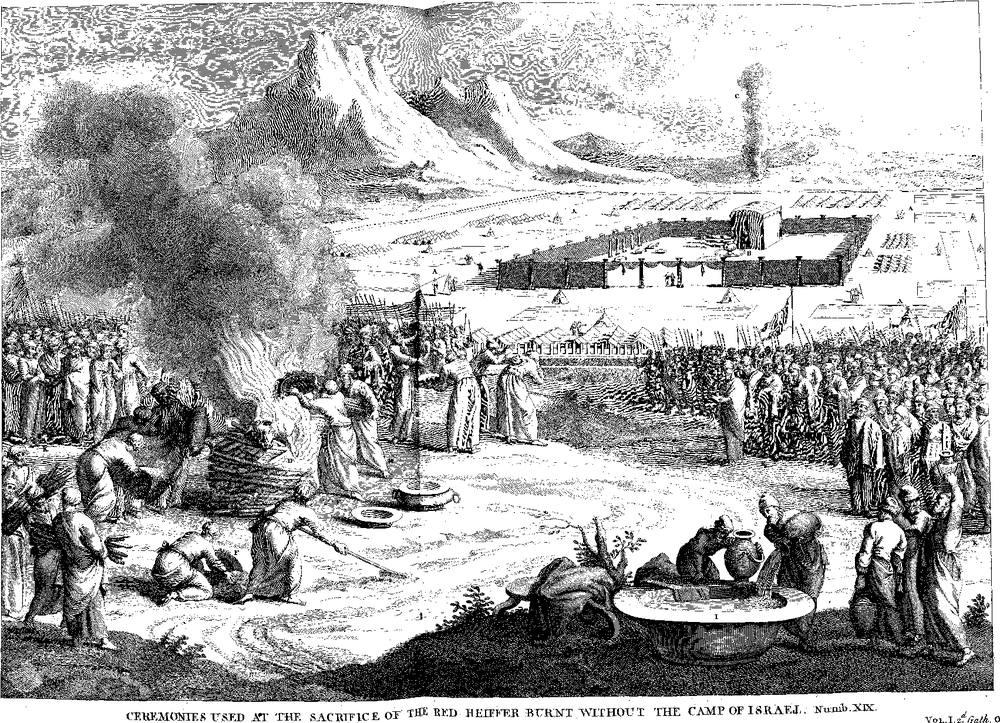
“ He likewise who burnt the Heifer shall wash his body and clothes, and remain unclean until the Evening. One that is clean shall gather up the ashes of the Heifer, and carry them out of the Camp into some clean place, that the Israelites may take of them, may carefully preserve them, and make use of them for Water of Separation, because this Heifer was burnt for sin. He who carries the ashes of it, shall wash his body and his clothes, and shall be unclean until the evening. This Ordinance shall be holy and inviolably observed by the Children of Israel, and the strangers that are among them.
“ He that toucheth the body of a dead man, and for this reason contracts pollution for seven days, shall be sprinkled with this water the third and seventh day, and so shall be purified. But if he receives no aspersion on the third day, (but on the sixth day only) he cannot be purified on the seventh, (but on the tenth or eleventh only.) Whosoever toucheth the dead body of a man, and is not sprinkled with water mingled with the ashes of the Red Heifer, will defile the Tabernacle of the Lord, (if he appears there in this condition) he shall be unclean, because he was not cleansed with the water of Separation, and his Impurity shall continue upon him.”
Spencer. l. 2. c. 15. de Leg. Hebr. rit.This is what Moses has ordained relating to this matter; whereupon the Commentators have made the following reflexions. Spencer believes this Ceremony to have been instituted in opposition to the Egyptian Superstitions. The Egyptians never sacrificed Heifers, and the Hebrews generally male creatures only. The former abhor’d red hair, and all animals of the same colour. The Hebrews made no distinction in the colour of Victims but upon this occasion. St. Jerom, Hieron. Ep. 27.and many others are of opinion, that the Red Heifer was sacrificed every year, and the ashes of it distributed throughout all the towns and cities belonging to the Israelites. Some of the Rabbins maintain, that there was but one burnt from Moses to the time of Esdras; and that from Esdras to the destruction of the Temple by the Romans, there were but six, or at most nine sacrificed. The same St. Jerom informs us, that this Ceremony was performed always upon the Mount of Olives, directly over against the Temple, from the time that the Ark was fixed at Jerusalem; and the Jews tell us, that after the building of the Temple, the High-Priest always sacrificed this Victim.
There are Authors who suppose the Sacrifice of the Red Heifer to be one of those which were offered in the name of all the people. It was required that it should be Numb. xix. 2.without blemish or defect, as well as the Victims used in other sacrifices; that the blood of it should be sprinkled seven times Ibid. vs. 4. Ibid. vs. 13.towards the entrance of the Tabernacle; that it should be burnt intirely, and the ashes which remained made use of in purifying people from pollutions contracted on the occasion of any dead body, and to prevent their defiling the Sanctuary and Holy Things.
The Red Heifer, says Abrabanel, was a Sacrifice for the Sins of the whole people of Israel. It may be said, I think, to be a Sacrifice for Sin, but it cannot, in my opinion, be called an Oblation, because this is a name given only to what was offered solemnly to God upon the Altar of Burnt-offerings. The same judgment should be made of that other Heifer, the head whereof was cut off, for the expiation of any murder committed by unknown Deut. xxi. 1,—9.persons. This Sacrifice cannot be called an Oblation, because it was not made upon the Altar of Burnt-offerings; nevertheless it was a real Sacrifice for Sin, since by it an atonement was made for murder.
Hebr. ix. 13.The Red Heifer which was sacrificed without the Camp, was the Figure of Jesus Christ, whose Blood cleanses our Consciences from all our Sins. For if the blood of bulls and of goats, and the ashes of an Heifer sprinkling the unclean, sanctifieth to the purifying of the flesh; how much more shall the blood of Jesus Christ, who through the eternal Spirit offered himself without spot to God, purge your conscience from dead works to serve the living God? See the Commentators upon Numbers, chap. xix.
An Explanation of the Plate which represents the Ceremony of the Sacrifice of the Red Heifer without the Camp of Israel.
A A A A. The Camp of Israel. B. The Tabernacle of the Congregation
C. The Pillar of Cloud which in the
Heifer continues on the next page
Footnotes
-
Gen. ix. 24. And Noah awoke from his wine, and knew what his younger son had done unto him. Which words are by some referred to Canaan the son of Ham, and grandson of Noah. But it is more natural to refer them to Ham. ↩
-
Translators’ note. M. Basnage is rather of opinion, that neither Ham nor Mizraim ever were in Egypt, but that their posterity settled in this country, and called it by the name of their ancestors. And as to Ham’s being worshipped as a God, and called Jupiter Hammon, he thinks people may have been led into this mistake by the similitude of names; and that Jupiter Hammon was the Sun, to which divine honours have been paid at all times in Egypt. See Histoire des Juifs, t. 3. c. 18. ↩
-
Translators’ note. The Reader will observe, that here, as in other places, the Author follows the Vulgate, wherein all the addi- tions to the Hebrew are inserted, from the third verse of the tenth chapter, to the end of the sixteenth chapter. These additions are supposed to be the composition of some Hellenistical Jew*; and certainly were never in the orig-* inal. ↩
-
Ten thousand talents make in all 3421870 pounds sterling. And if the Babylonish talent be meant here, which was worth 70 Eubœan Minæ*, according to* Herodotus*, that is to say, two hundred and nine pounds, and* about ten shillings; the ten thousand talents will make two millions one thousand and ninety pounds, or there- abouts. ↩
-
Joseph. Antiq. l. 1. c. 7. p. 14. ↩
-
Hieronym. in locis. in Emath. & in Amos vi. & in Isai. xlvii. ↩
-
Theodoret. in Jerem. iv. & xlvi. ↩
-
Theodoret. qu. 22. in 2 lib. Reg. ↩
-
Theodoret. in Jerem. iv. & xlvi. ↩
-
Hieronym. ad Amos vi. & in Ezech. xlvii. ↩
-
Cyrill. Alexand. in Amos, p. 312. ↩
-
Translators’ note. That is, about ninety eight pounds eight shillings and nine pence sterling. See KESITA. ↩
-
Translators’ note. Thus indeed the Vulgate has it, Manus suas lavabit in sanguine peccatoris. But the original instead of Hands, reads Feet. פעמיו ירחץ בדמה רשעOur English Version agrees with the Hebrew. ↩
-
Translators’ note. The Tabernacle is sometimes called the Temple, 1 Sam. xix. 2 Sam. xxii. 7. Psalm xviii. 3. Josephus terms it, ναὸν μεταφερόμενον*, a moveable Temple*. ↩
-
Translators’ note. Pliny tells us, on the contrary, upon Cato’s authority, Somnos fieri lepore sumpto in cibis; and takes notice of other particular qualities commonly ascribed to it. The vulgar opinion of its improving the looks of those who eat it, is not forgotten by him. To which Martial alludes in Ep. xxix. l. v. Siquando leporem mittis mihi Gellia, dicis, Formosus septem, Marce, diebus eris. See farther in Pliny, l. 28. c. 19. ↩
-
Translators’ note. Thus our Author, according to his Vulgate, which herein agrees with the Septuagint, who translate this passage in the sense wherein it is here cited, ΄Ο δὲ ἀγαπῶν ἀδικίαν μισεῖ τὴν ἑαυτοῦ ψυχήν*. Our* English Version construes the original in another manner; The Lord alloweth the righteous, but him that delighteth in wickedness does his soul abhor. But perhaps the Reader may be of opinion, that the Greek and Latin Translations above mentioned may express more exactly the meaning of the Hebrew*, which runs thus;* יהוה צדיק יבחן ורשע ואהב חמס שנאה נפשו. ↩
-
Euseb. & Hieronym. in Avoth-Jair. ↩
-
Joseph. Antiq. l. 16. Euseb. Aug. l. 16. de Civit. c. 3. & l. 18. c. 39. Eucher. in Genes. l. 2. c. 7. Beda in Genes. Lyr. Tost. Mercer. Eugub. Perer. alii. ↩
-
Ita Origen. Hieronym. Chrysost. Theodoret. Burg. Ribera. Arias. Est. Jos. Scal. Munst. Grot. Seld. Lud. Cappell. Walton, &c. ↩
-
Gen. xiv. 13. אברהם העבריLXX. Ἀβραμ τῷ περάτῃ Aquil. ↩
-
Translators’ note. We have a specimen of this language in Plautus’s Pœnulus, Act 5. Scene 1. where Hanno speaking in the Punic language, begins thus; Ythalonim vualomith, which some read, Neth alonim valonoth, &c. or, Ne eth gnaljonim vegneljonoth; or with some little alteration, Ne eth elohim veeloboth. And thus we see a plain affinity between the Hebrew and Punic languages. See Petit. lib. 2. Micell. c. 2. & Steph. Morinus de Linguâ primævâ. ↩
-
Hieronym. in Epitaph. Paulæ, & in Qu. Heb. in Genes. & in locis Hebr. in Arbog. & Comment. in Matth. xxvii. ↩
-
האדם הגדל בענקים חוא ↩
-
Euseb. Demonstr. l. 5. c. 9. ↩
-
Sozomen. l. 2. c. 3. vel 4. ↩
-
Vide Hieronym. & Euseb. in locis. Joseph. Georg. Syncell. ex Jul. Afric. p. 107. Socrat. Hist. l. 1. c. 18. ↩
-
Translators’ note. The Author mistakes Moses; the reason he gives for the impurity of this creature, is, because, as he says, it chews the cud, but does not divide the hoof. כי מעלה גרה הוא ופרסה לא יפריס ↩
-
Translators’ note. This Fable seems to be a Copy from the Ancients, who speak with veneration of the miraculous duration of some Trees; as Cicero of the Oak at Arpinum; Pliny of the Olive-tree at Athens; and of the Palm-tree at Delos; which, according to a received Tradition, had been growing there ever since the birth of Apollo, and was still in being in the time of this Historian. Tacitus takes notice of the tree under which Romulus and Remus had been suckled by a Wolf, as then existing at the distance of eight hundred and forty years. Vide Cic. de Leg. l. 1. Plin. Hist. Nat. l. xvi. Tacit. Annal. xiii. ↩
-
Levit. xi. 5. שפןSchaphan. LXX. χοιρόγρυλλος*. Chorogryllus*. ↩
-
Psal. civ. 18. Hebr. לשפניםLXX. Πέτρα καταφυγὴ τοῖς λαγωοῖς. ↩
-
See St. Augst. on Psalm ciii. Vulg. ↩
-
Hieronym. Ep. ad Suniam & Fretellam. ↩