SAMARITANS. We have already spoken of the Samaritans, under the Title Cuthites. The Samaritans are the People of the City of Samaria, and the Inhabitants of the Province, of which Samaria was the capital City. In this Sense it should seem, that we might give the Name of Samaritans to the Israelites of the ten Tribes, who lived in the City and Territory of Samaria. However, the sacred Authors commonly give the Name of Samaritans only to those strange People, whom the Kings of Assyria sent from beyond the Euphrates, to inhabit the Kingdom of Samaria, when they took away Captive the Israelites that were there before. Thus we may fix the Epoch of the Samaritans at the taking of Samaria by Shalmaneser, in the Year of the World 3283. This Prince carry’d away Captive the Israelites that he found in the Country, and assign’d them Dwellings beyond the Euphrates, and in Assyria. He sent other 2 Kings xvii. 24.Inhabitants in their stead, of which the most considerable were the Cuthites, a People descended from Cush, and who are probably of the Number of those, whom the Antients knew by the Name of Scythians.
After Shalmaneser, his Successor Esar-haddon being inform’d, that the People which had been sent to Samaria, were infested by Lyons that devoured them; a this he imputed to the Ignorance of the People in the Manner of worshipping the God of the Country. Wherefore Esar-haddon sent a Priest of the God of Israel, that he might teach them the Religion of the Hebrews. But they thought they might blend this Religion with that they profess’d before; so they continued to worship their Idols as before, in Conjunction with the God of Israel, not perceiving how absurd and incompatible these two Religions were.
Esr. iv. 1, 2, 3.‘Tis not known how long they continued in this State; but at the Return from the Captivity of Babylon, it appears they had intirely quitted the Worship of their Idols; and when they ask’d Permission of the Israelites, that they might labour with them at the rebuilding of the Temple of Jerusalem,1 they affirm’d, that from the Time that Esar-haddon had brought them into this Country, they had always worshipp’d the Lord. And indeed after the Return from the Captivity, the Scripture does not any where reproach them with idolatrous Worship, tho’ it does not dissemble either their Jealousy against the Jews, nor the ill Offices they had done them at the Court of Persia, by their Slanders and Calumnies, or the Stratagems they contrived to hinder the repairing of the Walls of Jerusalem2.
It does not appear there was any Temple in Samaria, in common to all these People who came thither from beyond the Euphrates, before the coming of Alexander the Great into Judea. Before that Time every one was left to his own Discretion, and worshipp’d the Lord where he thought fit. But they presently comprehended, from the Books of Moses which they had in their Hands, and from the Example of the Jews their Neighbours, that God was to be worshipp’d in that Place only which he had chosen. So that since they could not go to the Temple of Jerusalem, which the Jews would not allow of, they bethought themselves of building a Temple of their own upon Mount Gerizim, near the City of Shechem, which was then their Capital. Therefore Sanballat the Governor of the Samaritans, apply’d himself to Alexander,3 and told him he had a Son-in-law, call’d Manasses, Son to Jaddus the High-priest of the Jews, who had retired to Samaria with a great Number of other Persons of his own Nation; that he desir’d to build a Temple in his Province, where he might exercise the High-priesthood; that this Undertaking would be to the Advantage of the King’s Affairs, because in building a Temple in the Province of Samaria, the Nation of the Jews would be divided, who are a turbulent and seditious People, and by such a Division would be made weaker, and less in a Condition to undertake new Enterprizes.
John iv. 20.Alexander readily consented to what Sanballat desir’d, and the Samaritans presently began their building of the Temple of Gerizim, which from that Time they have always frequented, and still frequent to this Day, as the Place where the Lord intended to receive the Adoration of his People. ‘Tis of this Mountain, and of this Temple, that the Samaritan Woman of Sychar said to our Saviour; Our Fathers worshipped in this Mountain, and ye say, that in Jerusalem is the Place where Men ought to worship. See the Article GERIZIM before, where we have mention’d the several Changes of Fortune that have happen’d to this Temple.
The Samaritans did not long continue under the Obedience of Alexander. They revolted from him the very next Year4, and Alexander drove them out of Samaria, put Macedonians in their room, and gave the Province of Samaria to the Jews. This Preference that Alexander gave to the Israelites, contributed not a little to increase that Hatred and Animosity that had already obtain’d between these two People. When any Israelite had deserved Punishment, for the Violation of some important Point of the Law, he presently took Refuge in Samaria or Shechem, and embraced the way of Worship according to the Temple of Gerizim.5 When the Jews were in a prosperous Condition, and Affairs were favourable to ‘em, the Samaritans did not fail to call themselves Hebrews, and pretended to be of the Race of Abraham. But no sooner were the Jews fallen into Discredit or Persecution, but the Samaritans immediately disown’d them, would have nothing in common with them, acknowledg’d themselves to be Phenicians originally,6 or that they were descended from Joseph and Manasseh his Son. This us’d to be their Practice in the Time of Antiochus Epiphanes7.8
When this Prince would have compell’d the Jews to renounce their Religion, and to conform to that of the Gentiles, they withstood him with great Resolution, and underwent the last Extremities, rather than abandon the God of their Fore-fathers. But the Samaritans wrote in another Strain to Antiochus; that being originally Sidonians or Phenicians, and being now settled at Shechem, they found themselves under a Necessity, by reason of many Misfortunes that had happen’d to ‘em, to conform to certain Customs and Usages of the Jews, as the Observation of the Sabbath; that they had built a Temple upon Mount Gerizim, which had not been dedicated to any particular Deity ;9 that since he had thought fit to shew the Jews the Effects of his Indignation, to chastise them for their Wickedness, they besought him not to confound them with this People; since they were ready to obey his Commands, and to consecrate their Temple to the Grecian Jupiter. Antiochus admitted their Plea, and wrote to the Governors of Samaria, to give the Samaritans no Disturbance upon the Account of their Religion.
Alexander the Great carry’d with him into Egypt six thousand Samaritans,10 which Sanballat had sent him from Tyre, as auxiliary Troops. He appointed them Lands in Thebais, and trusted them with the Security of that Province. In this Country, and throughout all Egypt, these Samaritans retain’d their antient Antipathy against the Jews, maintaining that Mount Gerizim was the true Place where God was to be worshipp’d; and the Jews, on the contrary, that it was only the Temple of Jerusalem. This Dispute was managed with such Warmth between them, that it grew into a kind of Sedition, and King Philometor himself would take Cognizance of the Affair.11 It was therefore argued in his Presence, and it was agreed between the contending Parties, that no Proofs should be admitted but what should be taken out of the Books of the Law, and that the Advocates that lost their Cause should be put to Death. One call’d Sabæus and Theodorus defended the Samaritans; and Andronicus, the Son of Messalami was Advocate for the Jews. These latter gain’d their Suit, and the King condemned to Death the Advocates of the Samaritans.
We do not warrant the Truth of this Fact, tho’ it is affirm’d by Josephus in a very circumstantial manner.12 But we give still less Credit to what the Samaritans relate themselves to their own Advantage in their Chronicon,13 which was compos’d since Constantine’s Time, and under the Christian Emperors. They imagine that Joshua, the General of the People of God, caus’d a Temple to be built upon Gerizim, and there appointed Rus, one of the House of Aaron, to perform divine Service. They produce a Succession of Highpriests, who they pretend have officiated here, quite from the Time of Joshua, down to the present Age, without any Interruption. They will not admit that Jeroboam the Son of Nebat, was the first Author of their Schism ; nor own the Transplantation of the Israelites by Tiglath-pileser and Shalmaneser. They tell us, that the Kings of Syria in Confederacy with the King of Jerusalem, made an Insurrection against Bachtnezer King of the Persians. (For so they call Nebuchadnezzar King of Babylon.)
This Prince brought an Army into the Field, took Jerusalem, pass’d from thence to Shechem, gave the Inhabitants but seven Days to quit the Country, and threatned those with the severest Punishment that should dare to continue in it beyond this Time.
At the same Time he sent other People into Samaria and Judea, to inhabit the Cities thus forsaken. But these new Inhabitants could not live there, because the Fruits, which otherwise appear’d fair, contain’d a Poison in them that was mortal to all that eat of them. When Bachtnezer was inform’d of this, he consulted the former Inhabitants upon this Matter. They declared to him that this Evil would not be remedied, till the Hebrews were sent back, who had been unjustly driven away. They were allow’d then to return into their own Country again. They obtain’d an Edict that they should all assemble together to one Place, and all depart together. There arose a Dispute among the Samaritans, Sons of Joseph and Aaron, and the Jews, whether they should return to Jerusalem, and rebuild the Temple of Mount Sion ; or whether they should go to Shechem, to rebuild that of Mount Gerizim. Zerubbabel, who espoused the Part of the Jews, maintain’d, that Jerusalem was the Place mark’d out by the Writings of the Prophets. Sanballat, who stood up for Gerizim, alledged, that the Writings appeal’d to had been corrupted. The Determination of this Difference was referr’d to the Fire. The Copy of Zerubbabel was consumed in an Instant ; whereas that of Sanballat resisted the Fire in three Tryals. For this Reason the King honour’d Sanballat, made him Presents, and sent him back at the Head of the ten Tribes, who went to take Possession of Mount Gerizim and Samaria.
We need not give our selves any Trouble to refute this History, which is inconsistent with it self. We have the sacred Histories of the Kings, the Chronicles, the Books of Ezra and Nehemiah, and the Writings of the Prophets, which inform us of the Time, the Cause, the Circumstances of the coming of the Cuthites into the Country of Samaria; the Cause and the Manner in which they embraced the Law of the Jews. And Josephus has acquainted us with the History and Original of the Temple of Gerizim. The Monuments produced by the Samaritans are too modern, they have too much the Appearance of a Fiction, and are contradicted by Accounts of too undoubted Authority, to deserve the least Credit. The Rabbins have added to the History of Nehemiah, some Circumstances much to the Disadvantage of the Samaritans. They tell us that these People, to the Number of one hundred and fourscore thousand Men, going to beset Jerusalem; Ezra and Nehemiah got together three hundred Priests, who excommunicated them according to the greater Excommunication. These Priests were attended by three hundred young Boys, carrying a Copy of the Law in one Hand, and a Trumpet in the other. They sounded the Trumpet at the same Time that the Cuthites were excommunicated by the Priests. They cursed whoever should eat Bread with them, with as heavy a Curse as if they should eat Pork. They asked of God, that they might have no Part in the future Resurrection, and that they might never be allow’d to become Proselytes. This terrify’d the Cuthites in such a manner, that they all betook themselves to Flight.
The Samaritans having received the Pentateuch, or the five Books of Moses, from the Priest that was sent by Esar-haddon, have preserved it to this Day, in the same Language and Character it was then, that is, in the old Hebrew or Phenician Character, which we now call the Samaritan, to distinguish it from the modern Hebrew Character, which we now find in the Books of the Jews. They after their Captivity changed their old Characters, and took up those of the Chaldees, which they had been us’d to at Babylon, and which they continue still to use. ‘Tis wrong to give this the Name of the Hebrew Character, for that can be said properly only of the Samaritan Text. The Criticks have taken notice of some Variations between the Pentateuch of the Jews and that of the Samaritans; but these Varieties of reading chiefly regard the Word Gerizim, which the Samaritans seem to have purposely introduced, to favour their Pretensions, that Mount Gerizim was the Place in which the Lord was to be adored. The other various Readings are of small Importance.
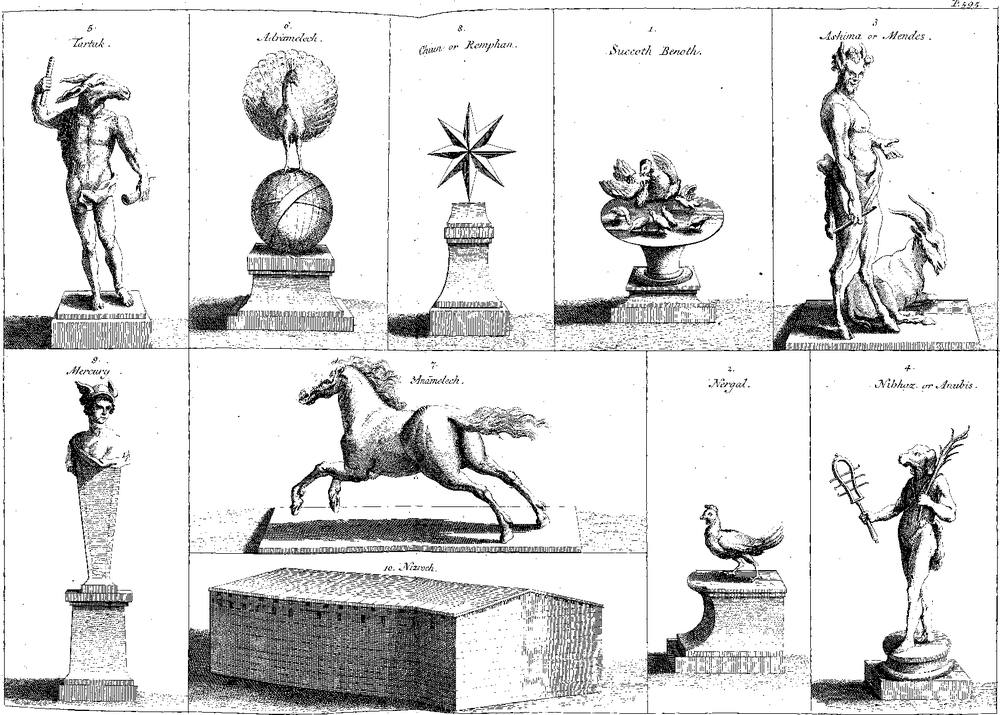
The Religion of this People was at first the Pagan. Every one worshipped the Deity they had been us’d to in their own 2 Kings xvii. 25. 2 Kings xvii. 30, 31.&alibi.Country. The Babylonians worshipp’d Succoth-benoth; the Cuthites, Nergal; the Hamathites, Ashima; the Avites, Nibhaz & Tartak; the Sepharvites, Adrammelech and Anammelech. If we would enumerate all the Names of false Gods, to whom the Samaritans have paid a sacrilegious Worship, we should have enough to do. This Matter is sufficiently perplex’d, by reason of the different Names by which they were adored by different Nations, insomuch that it would be almost impossible to clear up this Affair. We shall content our selves to relate those only, of which mention is made in Scripture, and of which we find something in antient Monuments. The Reader may see them represented in the Plate we have caused to be here exhibited.
Explication of the Figures.
- Succoth-benoth signifies the Tents of the young Women. ‘Tis believed,14 that the Scripture would here mark out these infamous Places, where the Babylonish Women were us’d to prostitute themselves once in their Lives, to the Honour of Mylitta, and for the Benefit of her Temple. Selden15 will have it, that the Name of Venus is derived from Benoth. ‘Tis perhaps Venus propagatrix, or Venus with her Harlots, represented under the Similitude of a Hen with her Chickens.
Grot.Mun. alii.2. Nergal. She was a Goddess that was worshipped under the Form of a wooden Hen, according to the Rabbins, and several Interpreters. Others think it to be the perpetual Fire, which in Persia was worshipp’d in Honour of the Sun. The Hebrew Word Nergal16, may literally signify Light, or the Fire that flames, that sparkles, that rouls.
-
Ashima, or Mendez. The Rabbins describe this Deity to us, some under the Shape of a Goat without Hair17; others18 as a Satyr, or as the Poets describe the God Pan. But all this to me seems very uncertain.
-
Nibhaz, or Anubis, was represented under the Form of a Dog, according to the Jews. The only Proof they give of it is, Latrare.that in Hebrew, Nabuch signifies to bark. We know that the Egyptians worshipp’d Dogs, and that Anubis, one of their Deities, had the Head of a Dog. Omnigenûmq; Deûm monstra, & latrator Virg. Æneid. viii. v. 698.Anubis.
SAM [ 596 ] SAM
Tartak תרתק5. Tartak had the Head of an Ass, as the Jews affirm. It is no Hebrew Word. Perhaps it may be the same as Sar-sak. Sar in שרShar, princeps. שקor שכSaca.the Hebrew signifies a Prince. Sak was a Prince, or a Babylonish God, that was very famous. The Feasts called Sacæa are mentioned by profane Authors19. Thus Tartak, according to the Chaldean Pronunciation, may signify the God Sak.
-
Adrammelech may be Juno, represented under the Form of a Peacock, or a kind of Pheasant.
-
Anammelech is under the Figure of a Horse. The Agreement that may be observed between the Victims offered to these Deities, and to Moloch the God of the Ammonites, and to Saturn the Deity of the Phenicians, has made many imagine, that they were only the same Idol under different Names.
-
Chiun, or Remphan, is commonly explained by Saturn, one of the seven Planets, represented by a great Star. Interpreters have been at great Pains to discover who this Deity was. The Reader may consult what we have said in the Dissertation concerning the Idolatry of the Israelites in the Desart, before our Commentary upon the twelve lesser Prophets.
-
Mercury. This Divinity is sufficiently known. He was the God of Eloquence, the Messenger and Interpreter of the Gods; for which Reason the Greeks called him Hermes.Acts xiv. 11. In the Acts St. Paul was taken for Mercury, because of his Eloquence, and the Vehemence of his Discourse.
2 Kings xix. 37.10. Nisroch. The Scripture says, that Sennecharib was assassinated by his two Sons, Adrammelech and Sharezer, as he was worshipping his God Nisroch, in his Temple at Nineveh. We do not exactly know who this God was. M. Basnage believes20, that it is Janus represented by Noah’s Ark, perhaps because Noah had seen both Worlds, having lived both before and after the Deluge; for, as ‘tis known, Janus had two Faces, one before, and the other behind, because he comprehended both the Time past and present, as being the God of Time. They have included all the Gods worshipped by the Samaritans, in these four Verses,
Numina, quæ Samaria colat, vis scire? tuere, Semi-hominemq; asinum, semi-hominemq; canem. En Capriceps, Gallina, Pavo, saxumq; Trigonum, Et sidus cæli: Numinis illa loco.
Afterwards, to this prophane Worship the Samaritans added that of the Lord, the 2 Kings xvii. 29, 30, 31, 32.God of Israel. They gave a Proof of their little Regard to this Worship of the True God, when under Antiochus Epiphanes, they Josep. Ant. l. 11. c. 8.consecrated their Temple at Gerizim to Jupiter Argivus. In the Time of Alexander the Great, they celebrated the Sabbatical Year, and consequently the Year of Jubilee also. We do not know whether they did it exactly at the same time as the Jews, or whether they observed any other Epoch; and ‘tis to little Purpose that some Criticks have attempted to ascertain the Petit Ecl. Chronol. l. 2. c. 4.first Beginning of it. Under the Kings of Syria they followed the Epoch of the Greeks, or that of the Seleucidæ, as other People did that were under the Government of the Seleucidæ. After that Herod had re-established Samaria, and had given it the Name of Sebaste, the Inhabitants of this City, in their Medals, and all publick Acts, took the Date of this new Establishment. But these Inhabitants of Samaria, of which the greater Part were Pagans or Jews, were no Rule to the other Samaritans, who probably reckoned their Years according to the Reigns of the Emperors they were subject to, till the Time they fell under the Jurisdiction of the Mahometans, under which they live at this Day; and they reckon their Year by the Hegira, or, as they speak, according to the Reign of Ishmael, or the Ishmaelites.
Epiphan. hæref. 9. Aug. lib. de hæref. Epiphan. hæref. 9.Some of the Antients, as Epiphanius and St. Austin, have placed the Samaritans upon the Foot of Hereticks; but they were rather Schismaticks in respect to the Jews. They have no more relation to the Christian Religion than the Jews have, since they do not acknowledge Jesus Christ as the Messiah, and are in Expectation of another. As to their Belief, ‘tis objected to them as an Error, that they receive only the Pentateuch, and reject all the other Books of Scripture, chiefly the Prophets, who have more expresly declared the Coming of the Messiah. However, they say, in their Letter to M. Ludolph, that they admit the Book of Joshua; but probably, by this Name they mean no other than their own Chronicon. They have also been accused of believing God to be Corporeal, of denying the Holy Ghost, and the Resurrection of the Dead21. Jesus Christ reproaches them with worshipping what they know not. John iv. 22. Epiphanius says, they worshipped the Teraphims that Rachel brought away from Laban, and which Jacob hid under Ground. Lastly, ‘tis said, they paid a superstitious Worship to a Pigeon, or to the Representation of one22, and that they even gave Circumcision in the Name of a Pigeon. M. Reland, in his Letter to M. Basnage, maintains, that they deny the Existence of Angels; and Leontius among the Antients, had already asserted, that they denied Angels, and the Immortality of the Soul.
Jesus Christ seems to exclude them from Salvation, when he says, that Salvation is of the Jews. True it is, that these Words might only signify, that the Messiah was to proceed from the Jews; but the Crime of Schism alone, and a Separation from the True Church, was sufficient to exclude them from Salvation. The Samaritan Woman is sufficient Testimony that the Samaritans expected a Messiah, who they hoped would clear Joh. iv. 25.up all their Doubts. Several of the Inhabitants of Shechem believed at the preaching of Jesus Christ, and several of Samaria believed at that of St. Philip; but it is said, they soon fell back to their former Errors, being perverted by Simon Magus. Josephus informs Vide Lightfoot in Mat. x. 5.us23, that a certain Impostor having persuaded the Samaritans, that he would make a Discovery of some sacred Vessels that Moses24 had hid in a hollow Place of the Mountain; the credulous People followed him, and took Possession of a pretty large Town called Tirataba, where they staid for the rest of the Nation, who were to be Spectators of this Sight. But Pilate being jealous of some intended Insurrection, sent some Troops against the Multitude, who were easily dispersed, and the Ring-leaders of this Assembly were punished with Death.
As to the present Samaritans, we may see by their Letters written to their pretended Brethren of England, and to Scaliger, that they believe in God, in his Servant Moses, the holy Law, the Mountain Gerizim, the House of God, the Day of Vengeance and of Peace; that they value themselves upon observing the Law of Moses, in many Points, more rigidly than the Jews themselves. They keep the Sabbath with the utmost Strictness required by the Law, without stirring from the Place they are in, but only to the Synagogue. They go not out of the City, and abstain from Marriage on that Day. They never delay Circumcision beyond the eighth Day. They still sacrifice to this Day in the Temple on Mount Gerizim, and give to the Priest what is injoin’d by the Law. They do not marry their own Nieces, as the Jews do, nor do they allow themselves a Plurality of Wives.
Joh. iv. 9.Their Hatred for the Jews may be seen through all the History of Josephus, and in several Places of the New Testament. The Jewish Historian informs us25, that under the Government of Coponius, one Passover-Night, when they opened the Gates of the Temple, some Samaritans had scattered the Bones of dead Men there, to insult the Jews, and to interrupt the Devotion of the Festival. The Evangelists shew us, that the Jews and Samaritans hold no Correspondence together. The Jews have no Dealings with Joh. iv. 22. the Samaritans. And the Samaritan Woman of Sychar was much surprized, that Jesus talked with her, and asked Drink of her, being a Samaritan. When our Saviour sent his Apostles to preach in Judea, he forbad them to enter into the Samaritan Cities, because Mat. x. 5. he looked upon them as Schismaticks, and as Strangers to the Covenant of Israel. One Day when he sent his Disciples to provide him a Lodging in one of the Cities of the Samaritans, they would not entertain him, because they perceived he was going to Luke ix. 52, Jerusalem. Because his Face was as though 53. he would go to Jerusalem. And when the Jews were provoked at the Reproaches of Jesus Christ, they told him he was a Samaritan, thinking they could say nothing more severe against him. Josephus relates26, that John viii. some Samaritans having killed several Jews 48. as they were going to the Feast at Jerusalem, this occasioned a kind of a War between them. The Samaritans continued their Fealty to the Romans, when the Jews revolted from them; yet they did not escape however from being involved in some of the Calamities of their Neighbours. See Josephus de bello, l. 3. c. 22.
Lib. Josue apud Hotting. p. 116.The Chronicon Samaritanum says, that the Emperor Adrian having raz’d Jerusalem, passed on to Naplouse, otherwise Shechem, and took all their Books from them; not leaving so much as their Genealogies and Histories. They were forbid to circumcise their Children, but they sent them, as fast as they were born, into the Caverns of the Earth, where they received the Sacrament of the Covenant, and they did not return till they were cured. The Romans mingled Hog’s-Flesh in the Feasts of the Samaritans; who were forced to use their Industry to avoid the eating of it. They placed a Pigeon upon Mount Gerizim, to hinder them from going thither to worship ; and they posted Troops at the Foot of the Mountain, to stop those that would go up notwithstanding the Prohibition. Some of ‘em were bold enough to attempt going up, and cunning enough to escape the Watch; but the Bird discovered them, and cried out, To the Hebrew. The Guards at this awoke; and flew those that were coming up.
This Calamity continued till Babar-raba sent one of his Nephews, called Levi, to go through a Course of Study at Constantinople. This young Man made so great a Progress in Learning, that he was made Patriarch, and obtained of the Emperor the Liberty of returning to Gerizim. His Design was to free his Nation from the Yoke of the Romans, and to restore it to its former Liberty. We are not told what became of him afterwards, for there ends the Chronicon of the Samaritans. And what it says of the City of Constantinople, is a sufficient Proof that this Chronicon can’t be antient. Just. Mart.Justin Martyr assures us, that when the Emperor Antoninus Pius granted the Jews the Liberty of circumcising their Children, he excepted the Samaritans. This holy Man being himself of Shechem, might be well informed of this Fact. Symmachus, the famous Translator of the holy Scriptures out of the Hebrew into Greek, was a Samaritan. He left his Country, and became a Jew, and for this received a second Circumcision.
Under the Empire of Zeno, the Samaritans made themselves a King in the City of Naplouse, and kill’d a great Number of Christians. But Zeno punished them severely for it, and put their King to Death. They revolted again under the Empire of Justinian, burnt the Churches of the Holy Land, and massacred many Christians; and among others the Bishop of Naplouse. Their Rage proceeded so far, that the Emperor Justinian was forced to send some regular Troops against them, who destroyed most of the Rebels.
The Chronicon of the Samaritans, called Tarik Samari, intimates, that the Samaritans separated from the antient Jews after the Death of Samson, under the Pontificate of the D’Herbelot, Bibl. Orient. p. 753.High-Priest Eli; because, they say, it was then that the Presence and Favour of the Lord, which they call Redhat, and Redhonan, departed from them, and that then Darkness expelled the Light, and involved all those that were in Palestine, except those that then withdrew upon Mount Gerizim, where they have always had Priests since that time, and afterwards Kings of their own to govern them. They also affirm, that the Prophet Samuel was a Magician, and that all his Successors were Apostates from true Judaism.
Epiph. de ponder. & mentur.There are still at this Day27 some Samaritans at Shechem, otherwise called Naplouse. They have Priests there, who say they are of the Family of Aaron. They have a High-Priest, who resides at Shechem, or at Gerizim, who offers Sacrifices there, and who declares the Feast of the Passover, and all the other Feasts, to all the dispersed Samaritans. Some of ‘em are to be found at Gaza, some at Damascus, and some at Grand-Cairo. Scaliger received a Letter from the Samaritans of Shechem, printed in 1676. They have also writ since that to their pretended Brethren in England, and M. Ludolf printed a Letter in 1688, which he received from them.
Those that would be more particularly informed of the History, the Creed, the Ceremonies of the Samaritans, may consult the Letters we have now mentioned, Hottinger, Cellarius, the Horæ Hebraicæ of Lightfoot, and the Continuation of the History of Josephus by M. Basnage, through the whole eighth Book, where he gives an Account of the Samaritan Chronicon, and of the Works that have been composed on their Occasion.
Samaritan in the Books of the Jews, is a Term of Injury and Reproach. Say we not John viii. 48.well that thou art a Samaritan, and hast a Devil? said the Jews to Jesus Christ, in their Indignation. Our Saviour (as has been already said) would not suffer his Disciples to Mat. x. 5.preach in the Cities of the Samaritans; In Civitates Samaritanorum ne intraveritis. To prove that there are no Persons whatever, but what are our Neighbours, even those from whom we are the most estranged, our Saviour in his Parable of the Jew that was wounded, Luk. x. 33.on his Journey between Jerusalem and Jericho, says it was a Samaritan that had Compassion upon him. The Samaritan Woman (as has been observed) was not a little surprized, to find that Jesus Christ conversed with her, and asked Drink from her who was a SamaritanJoh. iv. 9.; for, as the Evangelist adds, the Samaritans and Jews have no Correspondence with each other. Non enim co-utuntur Judæi Eccles. i. 25, 26.Samaritanis. The Author of Ecclesiasticus places the Samaritans among those People for whom he has the greatest Abhorrence. There be two manner of Nations which my Heart abhorreth, and the third is no Nation. They that sit upon the Mountain of Samaria28, and they that dwell amongst the Philistines, and that foolish People that dwell in Sichem. These last are the Samaritans, the most odious of all.
The Samaritan Woman converted by Jesus Christ. See the Article PHOTINA The Martyrologies put her Feast upon the Twentieth of March; and this is an Abstract of what the Greeks inform us about her. When Photina was converted by Jesus Christ, or even by St. Peter, for these Acts mention St. Peter also, she instructed her whole Family, composed of two Sons, Joseph and Victor, with Anatolina, Photo, Photis, Parascue, and Cyriaca, who were her Sisters. Photina went into Africa, where she converted the whole City of Carthage to Christianity, under the Empire of Nero. Victor, Son to Photina, was one of the Emperor’s Generals, and the Greeks say he commanded his Armies against the People call’d Avari. But the Spaniards say he was sent against the Rebels of Braga in Spain, and that he was Governor of the City Italica in Andalusia.
Victor received Orders from Nero to put to Death all the Christians in his Government. The General of the Troops knowing that Victor had been baptized by St. Peter, made great Remonstrances to him on this Head, but could gain nothing upon the Mind of Victor. God struck this General, and took from him the Use of his Speech. At the End of three Days he was enlightned of God, recovered his Speech, and cried out; That there was but one only God, which was the God of the Christians. He was then forthwith instructed and baptized by Victor.
Nero being informed of what had passed in Africa, by the Preaching of Photina, and what had happened in Spain by the Constancy of her Son Victor, ordered that the whole Family should be brought to Rome. Jesus Christ appeared to them on the Way, and encouraged them. Photina presented to the Emperor her two Sisters Photo and Photis. Nero caused them to be tortured, and then sent his own Daughter Arethusa to them, with a large Quantity of Pearls and precious Stones, thinking to corrupt them. Photina seeing her coming, cried out to her, Spouse of the Lord, you are welcome. To which the Princess replied, Madam, my Mistress, the Brightness of Jesus Christ, the Lord be with you. The Princess became a Convert, and an hundred young Women that attended on her, and they were immediately baptized by Photina. Nero was so provoked, that he would have ‘em all poisoned; but Lampadius the Magician, who prepared the Poison, became a Convert also, as soon as he perceived that his Poison had no Effect upon them. No Cruelties were spared to shake their Resolution; but when it was found that all was ineffectual, they were flay’d alive. One need but read this Story, in order to be convinced of its being fabulous. So that it is quite needless to stand to confute it.
Samaritan-Pentateuch. This is the Collection of the five Books of Moses written in Samaritan Characters, or the antient Hebrew Characters, which were in Use before the Captivity of Babylon. I have already spoken of it under the Articles PENTATEUCH and SAMARITAN. Here are still some farther Remarks upon this Subject. The Copies of the Samaritan Pentateuch were unknown in Europe till the sixteenth Century. The famous James Usher was the first, or at least one of the first, who procured it out of the Eastern Countries. Usher Ep. ad Lud. Capell.This learned Man having observed, that Eusebius of Cæsarea, Diodorus of Tharsus, St. Jerome, Cyril of Alexandria, Procopius of Gaza, Georgius Syncellus, and some others, had quoted the Samaritan Pentateuch; he could not be at rest till he had procured five or six Copies out of Syria or Palestine. And by examining these Copies carefully, he thought he could discover that they had been corrupted by one Dositheus, of whom Origen makes mention in his first Book against Celsus: An Opinion in which the Learned do not agree with him.
Pietro della Valle bought a very neat Copy at Damascus, in the Year 1616, for M. de Sansi, then Ambassador of France to Constantinople, and afterwards Bishop of St. Malos. This Book was presented to the Fathers of the Oratory, Rue St. Honoré, where it is preserved to this Day. And it was from this Copy that Father Morinus printed the Samaritan Pentateuch in 1632, which is found in M. le Jay’s Polyglot, which is the first Copy that has been printed in this Language. It has been reprinted more correctly in Walton’s Polyglot, from three Samaritan Manuscripts that belonged to Usher. See Father le Long’s Bibliotheca Sacra, t. 1. p. 124, &c.
The Criticks are much divided about the Samaritan Pentateuch. Father Simon29 in his Critical History of the Old Testament, is of Opinion, that the Priest who was sent by King Assaradon, or Esar-haddon, to the Cuthites, did not carry with him the Books of the Law of Moses, which would have been useless to a People that did not understand Hebrew, and to himself also, since without this Book, he could not put in Practice the Ceremonies of the Law, in which he had been inured from his Infancy. Therefore it was a long time after this, viz. when Manasseh undertook to build a Temple upon Mount Gerizim, that they carried thither the Copy of the Law, as it was made or reformed by Esdras, and which the Jews read in their Temple at Jerusalem.
M. Vandale maintains30, that we must distinguish between the Law and the Pentateuch. The Volume of the Law, contained only such Ordinances, the Observation of which was necessary for securing the People from the Anger of God; but the Pentateuch comprehended the History of the Creation of the World, of their Bondage in Egypt, of their Deliverance, of their Wanderings in the Wilderness, and the Body of Laws compiled by Moses. The Priest sent by Esar-haddon, brought to the Samaritans only that Law that was necessary for the Observation of all the Rites of the Hebrews; but the Pentateuch that was lost or buried under the Ruins of Jerusalem, was restored and reformed by Esdras, and could not be communicated to the Samaritans till a long time afterwards. This is the System of this Critick.
Another Critick31 thinks, that he has discovered in the Pentateuch of the Jews and the Samaritans, some Footsteps of an Author that had lived beyond the Euphrates, who was acquainted with that Country, and who mentions some Particulars of it, which Moses could not have any Knowledge of. He therefore imagines, that the Pentateuch was compos’d by the Priest who was sent to the Cuthites or Samaritans. This Man, who came from Chaldea to instruct those Idolaters, thought proper to write them a History of the Creation of the World, and of the Affairs of the Hebrews, ‘till the Delivery of the Law to them, that he might shew them there was but one God. As he wrote this exactly in the eighteenth Year of Josiah, in which the Copy of the Law was found in the Temple, he inserted this Piece into his own Work, as being very essential to it. He wrote the Whole in Hebrew, because he had not had Time enough to learn the Chaldee Tongue. The Jews made no Difficulty of receiving this Work; because the Author was not suspected by them, and because the Book contain’d only their History and their Law. This Author pretends, (who is thought to be M. le Clerc) that this Hypothesis avoids all the Difficulties that are rais’d about the Pentateuch compos’d by Moses, and about the Variations that are found between that of the Jews and that of the Samaritans.
The Generality of Divines believe, that the Samaritan Pentateuch, and that of the Jews, are but one and the same Work, written in the same Language, but in different Characters; and, that the Differences that are found between these two Texts, only proceed from the Inadvertency and Inaccuracy of Copiers, or from the Affectation of the Samaritans, who have foisted Things into it, to promote their own Interests and Pretensions; That the Additions were inserted afterwards; and that, originally, these two Copies were exactly the same. According to this Opinion, it must be allow’d, that the Pentateuch of the Jews is preferable to that of the Samaritans, as being exempt from those Alterations which have been made in the latter. But, on the contrary, others give the Preference to the Samaritan Pentateuch as an Original, which has been preserved in the same Character and the same Condition in which Moses compos’d it.
Prideaux Connect. t. 2. l. 6. An. 409 before Christ:Dr. Prideaux, who espouses M. Simon’s System, before explain’d, maintains, That the Pentateuch of the Samaritans, is only a Copy, taken in other Characters, from the Copy compos’d or reform’d by Esdras; That even this Copy has been altered by Variations, Transpositions, and remarkable Additions. To prove, that the Samaritan Code is only a Copy, he says; First, That it has all the Interpretations of the Edition of Esdras; which it would not have, if it were more ancient. Secondly, There are several Variations in the Samaritan Pentateuch, which evidently proceed from taking one Hebrew Letter for another that is like it; though, in the Samaritan Alphabet, those two Letters have no Resemblance; and consequently, the Samaritan is only a Copy from the Hebrew Pentateuch of the Jews. This incontestably proves, says he, that it was Manasseh the Son-in-law of Sanballat, who brought the Pentateuch with him, when he took Refuge among the Samaritans. And as the Samaritans were then accustomed to the Phenician Letters, the Pentateuch was written in those Characters, for their Use.
He acknowledges, that Esar-haddon sent a Priest to his new Colony at Samaria, to instruct them in the Manner in which the Israelites, who were the ancient Inhabitants of that Country, had worshipped the God of their Fathers: But it does not appear that this Priest executed this Commission, by introducing the Law of Moses among them. For, had they received this at the Beginning, would they have continu’d in their Idolatry, as it is notorious they did? And would they have made a Medley of the Worship of the True God, and of their Idols, which is expressly forbidden by the Law? It is therefore very probable, that they were instructed in the worshipping of God only by Use and Tradition.
As to the Variations, the Additions, and Transpositions which are found in the Samaritan Pentateuch, when compared with the Hebrew, they are all carefully collected, with the utmost Exactness, in the Book written by Hottinger against Father Morinus, and in the confronting of the two Texts, which is inserted in the last Volume of the English Polyglot. Of these Interpolations, some are for the better understanding of the Text; other are a kind of Paraphrase, expressing at length, what was only hinted at in the Original: Others are such Changes as the Samaritans have purposely made, to favour their Pretensions against the Jews; as when, for Example, they put Gerizim instead of Ebal. Other Varieties are only such as are pure Lapses of the Transcribers.
Besides the Hebrew Pentateuch in Phenician Characters, of which we have been now speaking, the Samaritans have also another, in the Language which they spoke at the Time that Manasseh took Shelter among them. This Language is a Mixture of the Chaldee, the Syrian, and the Hebrew, or Phenician. And, just as the Jews were obliged, in Favour of those People who did not understand the pure Hebrew, to make Versions or Paraphrases in Chaldee; so the Samaritans had their Pentateuch in the Vulgar Samaritan Tongue. This is call’d the Samaritan Version, which differs from the Jewish Paraphrases, there being Glosses and Explications; whereas the Samaritan Version is literal, and ex presses the Text Word for Word: It is printed with the Samaritan Text in the Polyglot of Paris, and also in that of London; and because of its great Conformity with the Text, they have only given one Latin Version for both of ‘em.
Read this article in its place on the printed pages
Footnotes
-
In the Year of the World 3469, before Christ 531, before the vulgar Era 535. ↩
-
See Nehem. ii. 10, 19. iv. 2, 7, &c. vi. 1, 2, &c. ↩
-
Joseph. Antiq. l. 11. c. 8. p. 384. In the Year of the World 3672, before Christ 328, before the vulgar Era 332. ↩
-
In the Year of the World 3673. Vid. Joseph. cont. App. l. 2. p. 1063. Q. Curt. l. 4. c. 21. Euseb. in Chronico. Usser ad ann. 3673. ↩
-
Joseph. Antiq. l. 11. c. ult. ↩
-
Joseph. Antiq. l. 11. c. ult. p. 386. & l. 12. c. 7. p. 410. ↩
-
Joseph. Antiq. l. 12. c. 7. In the Year of the World 3836, before Christ 164, before the vulgar Era 168. ↩
-
2 Kings xvii. 25. In the Year of the World 3295, before Christ 705, before the vulgar Era 709. See also Ezra iv. 1, 2. ↩
-
According to the Letter, that it was dedicated to a God without a Name; or rather, that the Temple was without a Name. Ἰδρυσάμενοι ἀνώνυμον ἱερὸν. ↩
-
Joseph. Antiq. l. 11. c. ult. p. 386. ↩
-
Joseph. Antiq. l. 13. c. 6. p. 433. ↩
-
See M. Bas- nage’s Critique upon it. About the Year of the World 3854, before Christ 146, before the vulgar Era 150. ↩
-
Liber Jeshue, seu Chronic. Samarit. apud in his History of the Jews, l. 8. c. 1. p. 38, 39. tom. 6. Paris Edition. Hottinger exercit. Antimorin. ↩
-
Ita Grot. hic, & Selden de Diis Syr. Syntag. 2. c. 7. נירor נרvoluit גללd Baal-aruch, Kimchi. Rab. Salv. ↩
-
Ita sentire videtur Selden loco citato. ↩
-
Lampas Druf. in Gen. i. 1. ↩
-
Baal-aruch, Kimchi. Rab. Salv. Drus. in Gen. i. 1. ↩
-
Elias Levita. Talmud. Jerosol. 5. Tartak, ↩
-
Athen. lib. 14. c. 10. Dio Chrysost. Orat. 4. de Regno. ↩
-
Basnage Republick of the Hebrews, tom. 1. p. 214. ↩
-
Epiphan. hæref. 9. Greg. Mag. Moral. in Job, l. 1. c. 6. l. 2. c. 19, &c. ↩
-
Ita Rabb. quidam in Thalmud. Ganz. Zemach. David. p. 106. ↩
-
Joseph. Antiq. l. 18. c. 5. In the Year of the vulgar Era 36. ↩
-
This is a gross Error, because Moses never enter’d into the Land of Promise; the Chronicon of the Samaritans says, that Oziz, the fifth High-Priest from Aaron, had hid some sacred Vessels. ↩
-
Joseph. Antiq. l. 18. c. 3. p. 618. The Year of the Vulgar Era 8. from the true Birth of Christ 11. ↩
-
Joseph. Antiq. l. 20. c. 5: de bello, l. 2. c. 21. p. 794. In the Year of the Vulgar Era 51, of Christ 54. ↩
-
See the History of the Jews by M. Basnage, t. 6. l. 8. c. 2. Paris Edition. ↩
-
Translators’ note. The Author here reads, There are two Na- tions that I hate, but the third I abhor above all Things; those that dwell in Seir, that is, the Idumeans, the Philistines, and the foolish People that dwell at Sichem. ↩
-
Simon Hist. Critique du vieux Testament. l. 1. c. 10. ↩
-
Vandal. epist. ad Morin. in tract. de Idolatr. ↩
-
The Sentiments of some Divines of Holland. ↩