MUSICK. The antient Hebrews had a strong Inclination to Musick and musical Instruments. They used it in their Ceremonies of Religion, in their publick and private Rejoycings, at their Feasts, and even in their Mourning. We have in Scripture Canticles of Joy, of Thanksgiving, of Praise, of Mourning; Epithalamiums, or Songs composed on the Occasion of some famous Marriages; as the Song of Songs, and Psalm xlv, which are thought to have been composed to celebrate the Marriage of King Solomon. Also mournful Songs, as those that David composed upon the Death of Saul and Abner, and the Lamentations of Jeremiah upon the Death of Josiah; Psalms to celebrate the Accession of a Prince to his Crown, as Psalm lxxii. Deus judicium tuum Regi da. Songs of Victory, Triumph, and Thanksgiving, as that which Moses sung after passing the Red-Sea, that of Deborah and Barak, and some others. Lastly, the Book of Psalms is an ample Collection of different Pieces of Musick, composed upon all Sorts of Subjects by inspired Authors. We shall say nothing here of the Hebrew Poetry, nor of the Nature of the Verse of these divine Hymns, because we shall speak of it elsewhere. See Poetry.
Gen. iv. 21.Musick is very antient in the World. Moses tells us of Jubal, who lived before the Deluge, and was the Father or Master of those who played upon the Kinnor, and the Hugab. Now the first of these manifestly signifies the Harp, and the other the antient Organ, that is, a kind of Flute composed of several Pipes of a different Bigness, joined to one another. Laban complains that his Son-in-Law Jacob had left him, without bidding him farewell, and without giving him an Opportunity of sending him away, with Mirth and with Songs, Gen. xxxi. 27.with Tabret and with Harp. Moses having passed over the Red-Sea, composed a Song, and sung it with the Men, while Miriam his Sister sung it with Dancing, and playing upon Instruments, at the Head of the IsraelitishExod. xv. 1,—20. Numb. x. 2. Women. This Legislator caused Silver Trumpets to be made, to be sounded upon solemn Sacrifices, and on religious Festivals. David, who had a great Taste for Musick, seeing that the Levites were numerous, and were no longer employed as formerly, in carrying the Boards, the Veils, and Vessels of the Tabernacle, its Aboad being fixed at Jerusalem; he appointed a great Part of ‘em to sing and play upon Instruments in the Temple.
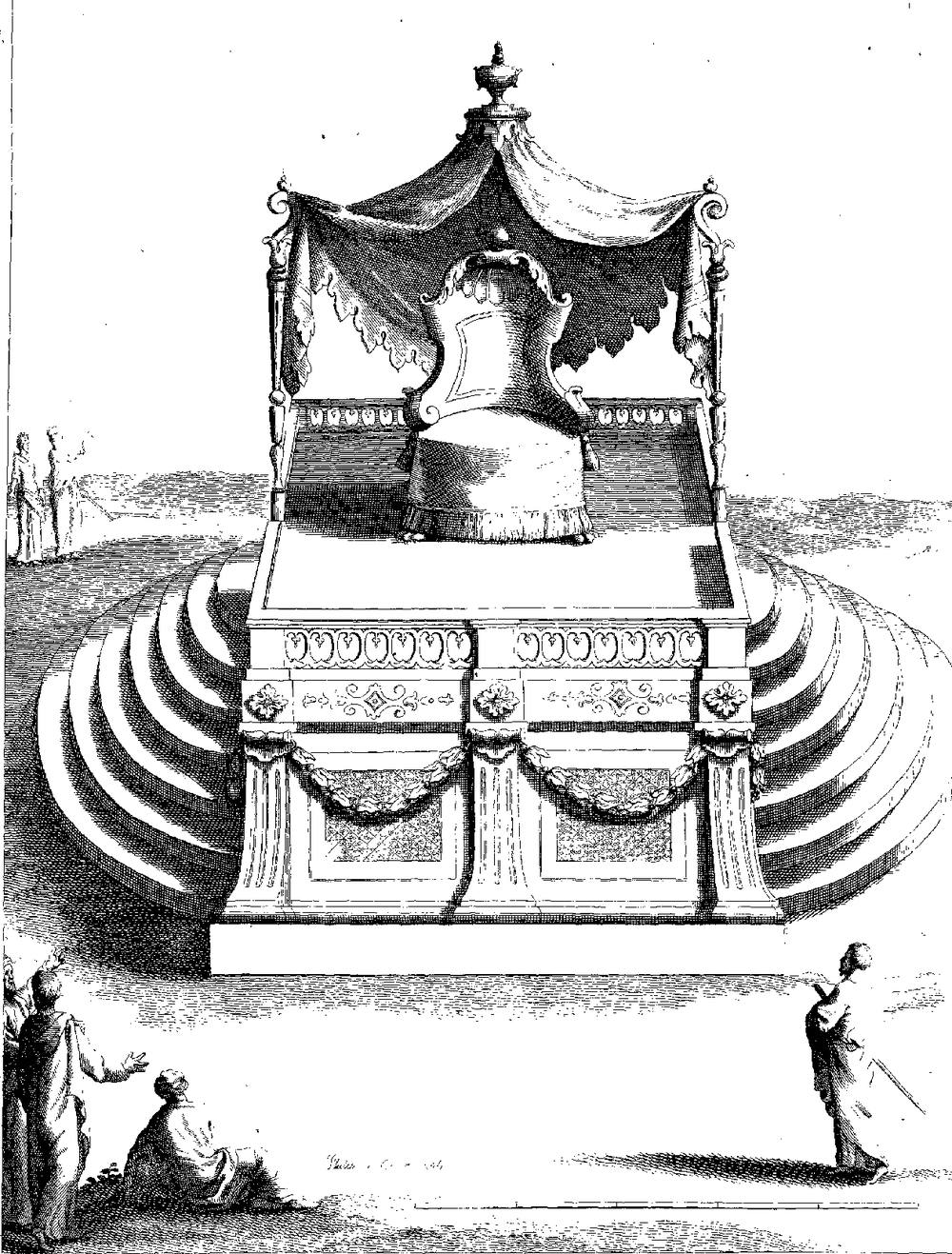
Asaph, Heman, and Jeduthun were the Chief of the Musick of the Tabernacle under David, and of the Temple under Solomon. Asaph had four Sons, Jeduthun six, and Heman fourteen. These twenty four Levites, Sons of the three great Masters of the Musick of the Temple, were at the Head of twenty four Bands of Musicians, which were very numerous, and served in the Temple by Turns. Their Number there was always great, but especially at the great Solemnities. They were ranged in Order about the Altar of Burnt-Sacrifices. Those of the Family of Kohath were in the Middle, those of Merari at the left, and those of Gershom’s Family on the right Hand. As the whole Business of their Lives was to learn and practise Musick, it must be supposed that they understand it perfectly well; whether it were vocal or instrumental Musick. The Lord had abundantly provided for their Maintenance, and nothing could hinder them from being perfect in their Art, and compleat Masters of it.
The Kings also had their particular Musick. Asaph was chief Master of Musick to King David. He was, as the Scripture says, A Prophet at the King’s Hand. And 1 Chron. xxv. 2. Vulgat.Barzillai said to David1, Can I hear any more the Voice of singing Men and singing Women? Even in the Temple, and in the Ceremonies of Religion, Female Musicians were admitted as well as Male, who generally were the Daughters of the Levites. Heman had fourteen Sons and three Daughters, 1 Chron. xxv. 5.who all understood Musick. The ninth Psalm is addressed to Benaiah, Chief of the Band of young Women that sang in the Temple. Ezra in his Enumeration of those whom he brought back with him from the Captivity, reckons up two Hundred singing Ezra ii. 65. Nehem. vii. 67.Men and singing Women. The Chaldee Paraphrast upon Chap. ii. v. 8. of Ecclesiastes, where Solomon says that he gat Singing-Men and Singing-Women, understands it of singing Women of the Temple. In the first Book of Chronicles xv. 20. it is said, in the Hebrew, that Zechariah, Aziel, and Shemiramoth, presided over the seventh Band of Musick, which was that of the young Women.
As to the Nature of their Musick, we can judge of it only by Conjecture, because it has been a long Time lost, and out of Use. But this is very probable, that it was only a Mixture of several Voices, of which all sung together in the same Tune, every one according to his Strength and Skill; and that there was not among them those different Parts, and that Combination of several Voices and Tunes, which constitute our Concerts, or compounded Musick. It is very probable also, that generally the Voices were accompanied by the Instrumental Musick. But if we may draw any Conclusions in Favour of the Excellence of their Musick, from its wonderful Effects, its Magnificence, Majesty, and the fine Sentiments contained in their Songs; we must allow that their Musick was very excellent and perfect. Every one knows, that David by his Skill upon the Harp used to dispel the melancholy Vapours to which Saul was subject, and drove away the Evil Spirit that disturbed him. The same Saul, having sent Messengers to apprehend David, who had withdrawn himself to Naioth in Ramah, and was there in the midst of a Company of Prophets; the Messengers had no sooner heard the Sound of the Instruments of the Prophets, who were there singing and playing, but they were immediately transported (as it were) by a divine Enthusiasm, and began to do the same themselves. Saul sent a 1 Sam. xvi. 23. 1 Sam. xix. 23, 24.second and a third Company after them, who did in the same Manner. Lastly this Prince came thither himself, was seized in the same Manner by the divine Spirit, and began to have all the Motions of those that are inspired, even before he came to the Place where the Prophets were assembled. The Prophet Elisha finding himself a little disturbed, caused a Minstrel to be sent for to calm his Spirits, and to put him into a Temper fit to receive the Impression of the divine Spirit. The Reader may have Recourse to 2 Kings iii. 15.our Dissertation upon the Musick of the Hebrews, at the Beginning of the second Tome upon the Psalms.
The Musical Instruments of the antient Hebrews are, perhaps, what has been hitherto least known, of any Thing in the Text of the holy Scriptures. The Rabbins themselves know no more in this Matter, than such Commentators as were least acquainted with the Affairs of the Jews. One can hardly read without Pity and Contempt, what they generally say upon certain unknown Terms, that are found in the Titles of some of the Psalms, and which at all Adventures they take for Instruments of Musick. Such are for Example, the Words Neginoth, Sheminith, Nebiloth, Shiggaion, Gittith, Muth-labben, Michtam, Aijeleth, Shahar, Shothannim, Alamoth, &c. But if we take a nearer View of this Matter, we shall find that the Hebrews had a much smaller Number of musical Instruments, and which may all be reduced to one of these three Heads. 1. Stringed-Instruments. 2. Wind-Instruments, or several Sorts of Flutes, and 3. different Sorts of Drums or Tabours.
Stringed-Instruments were the Nebel2, the Psaltery, or Psanneterim; and probably these three Instruments were much the same Thing. They have some Relation to the Harp and the antient Cithara, or the Hashur3, that is to say, an Instrument with ten Strings. Both of ‘em were pretty near of the Figure of a Capital Δ; but the Psalterion or Nablium was hollow above, and was played upon below; whereas the Cithara, or Instrument of ten Strings, was played upon above, and was hollow below. Each of ‘em was played upon with a Bow, and with the Fingers.
The Chinnor4, or antient Lyra, had sometimes three, sometimes six, and sometimes nine Strings. These Strings were strained from Top to Bottom, and sounded upon a hollow Belly that was at Bottom. It was played upon with the Fingers, or with a Bow.
The antient Symphony, or Dulcimer, was an Instrument very nearly approaching to our old one.
The Sackbut, or Sambuca, was a stringed Instrument, which we believe was very near of the Form of the modern Psaltery. And these are all the stringed Instruments, that we find mentioned in Scripture.
There may be also several Sorts of Trumpets and Flutes, of which it is very difficult to ascertain the exact Form. What is most observable of this Kind, is the antient Organ, called in Hebrew, Huggab5, which is probably nothing else than those antient Flutes, composed of several Pipes of unequal Thickness and Length, which gave an harmonious Sound when they were blown in, by moving them successively under the lower Lip.
The Drums were of several Sorts. The Hebrew Word Tuph6, from whence comes Tympanum, is taken for all Sorts of Drums, Tabors, or Kettle-Drums. The Word Tzaltzelim7 is commonly translated in the Septuagint, and in the Vulgate, by Cymbala, which was an Instrument of Copper, of a very shrill Sound, made in Form of Caps, which were held in each Hand one, and struck against each other. Later Interpreters by Tzaltzelim understand the Sistrum, which was an Instrument formerly much used in Egypt. It was of an oval Figure, or a Semicircle extended in Form of a Belt, crossed by some Brass Rods or Wires that moved in Holes, in which they were stopped by their Heads or Knobs.
The Hebrew Text speaks of an Instrument called Shalishim8, which the Seventy have translated by Cymbala, and St. Jerome by Systra. ‘Tis found only in one Place of Scripture, viz. 1 Sam. xviii. 6. The Word Shalishim should insinuate, that it was of a triangular Form, and might very well be that antient triangular Instrument, in which were several Rings moved about with a Stick, and which gave a shrill Sound.
Lastly, there is Mention made of Metzilothaim9 which was an Instrument of Copper, and gave a sharp and shrill Sound. ‘Tis commonly translated by Cymbala, but others translate it by Tintinnabula, or little Bells. The Prophet Zechariah says10, that the Time should come when they should write upon the Metziloth [or Bells] of the Horses, Holiness to the Lord: Which may incline one to think, that this Word signifies a Bell; since we know that formerly they used to put Bells upon Horses that went to Battle, in Order to accustom them to Noise. We have treated of the Instruments of Musick of the antient Hebrews, before the second Volume of the Commentary upon the Psalms. We have also said something of each of the principal Instruments under their respective Articles.
Read this article in its place on the printed pages
Footnotes
-
2 Sam. xix. 35. See also Ecclesiastes ii. 8. I gat me Men-Singers and Woman-Singers. ↩
-
Nebel, Nablum, vel Psalterium. ↩
-
Hashur, decachordum. ↩
-
Chinnor, cithara. ↩
-
Huggab, Organum. ↩
-
Tuph, Tympanum. ↩
-
Tzaltzelim, cymbala, or Systra. ↩
-
Shalishim, cymbala, vel systra. ↩
-
Metzilothaim, cymbala. ↩
-
Zech. xiv. 20. The Bells which were at the Bottom of the High-priest’s Garment are called Phaamon, LXX. Tintinnabulum. ↩