Volume III, pages 140–159 of the 1732 edition, from US to WH: everything printed on these pages, in order.
Continued from Urim
Spencer has adopted this Opinion,1 and endeavours to support it by these two Arguments. The first is, that the Urim and Thummim were a Consequence of the Divine Government, or of the Theocracy of the Hebrews. While the Lord immediately governed his People, it was necessary that there should always be a Means at hand, to consult him, and to have recourse to him. Secondly, that this Method was established to consult God upon Affairs that concerned the common Interest of the whole Nation. But the Theocracy ceased, say they, when the Kingdom became hereditary in the Person and Family of Solomon: The Interests of the Nation ceased to be common, after the Division of Israel into two Monarchies; one governed by Rehoboam, the other by Jeroboam. Lastly, what seems to be more convincing than any Reasons drawn from a Conformity of things, it does not appear from the sacred History, that there are any Footsteps of consulting the Lord by Urim and Thummim, after the Construction of the Temple of Solomon to the time of its Destruction; and after its Destruction, all are agreed, that this was never restored to them again.
USURY, Usura, or Fœnus. This is what is received for the Loan of a Sum of Money, over and above the Principal. ‘Tis said Exod. xxii. 25, 26.in Exodus, If thou lend money to any of my people that is poor by thee, thou shalt not be to him as an usurer, neither shalt thou lay upon him usury. If thou at all take thy neighbour’s raiment to pledge, thou shalt deliver it unto him by that the sun goeth Levit. xxv. 35, 36, 37.down. And elsewhere, If thy brother be waxen poor, and fallen in decay with thee, then thou shalt relieve him; yea, tho’ he be a stranger, or a sojourner, that he may live with thee. Take thou no usury of him, or increase, but fear thy God, that thy brother may live with thee. Thou shalt not give him thy money upon usury, nor lend him thy victuals for increase. The Hebrew Text may be thus translated: ” When ” your Brother shall fall into Poverty and ” Misery, you shall support him; and ” as to the Stranger or Foreigner that ” shall be settled amongst you, you shall ” take no Usury of him; you shall not ” lend him your Money for Usury, &c.” So that this Passage would contain these two Precepts: First, that a Brother was to be maintained in Poverty; and, secondly, that even the Stranger was to be relieved, without paying Usury for it.
And in Deuteronomy, Thou shalt not Deut. xxiii. 19, 20.lend upon usury to thy brother, usury of money, usury of victuals, usury of any thing that is lent upon usury. Unto a stranger thou mayest lend upon usury, but unto thy
- . 2. brother thou shalt not lend upon usury: That the Lord thy God may bless thee in all that thou settest thine hand to, in the land whither thou goest to possess it. In this Place the Lord seems to tolerate Usury towards Strangers; that is, towards the Canaanites, and the other People that were devoted to Slavery and Subjection, but not towards such Strangers with whom the Hebrews had no Quarrel, and against whom the Lord had not denounced his Judgments. To exact Usury is here, according Ambros. de Tobia. c. 25.to St. Ambrose, an Act of Hostility; ‘twas a kind of waging War with the Canaanites, and of ruining them by Means of Usury. Demand Usury from him whom you may kill without a Crime: Cui enim jure inferuntur arma, huic legitimè inducantur usuræ.----Ab hoc usuram exige, quem non sit crimen occidere. And besides, the Law does not allow Usury towards our Enemies, tho’ in a just War; it only permits us to spoil them of such things as they may make use of against us, and to our Destruction. So that the true Inference from hence is, that God did indeed tolerate, but not approve, of the Usury, which the Hebrews exercised towards the Canaanites. He allowed thus much to the Hardness of their Hearts, because it could not be entirely prevented.
But Jesus Christ, in his Gospel has entirely revoked all such Tolerations, which Luke vi. 30, 31, 32, 33.were in use under the old Law. Give to every man that asketh of thee, and of him that taketh away thy goods, ask them not again. If ye lend to them of whom you hope to receive, what thank have you? For sinners also lend to sinners, to receive as much again: But love ye your enemies, and do good, and lend, hoping for nothing again. These last Words, Lend, hoping for nothing again, Mutuum date nihil inde sperantes, may be explained three ways: 1. Lend even to the poorest, where there is no Hopes that he can be able ever to repay again. 2. Lend without expecting that the like Kindness shall be shewed to you again. 3. Lend without distrusting your Neighbour; or, lend without distrusting Providence, so that the fear of Indigence may hinder you from doing good. But we think the genuine meaning to be this: Lend to the Poor, tho’ there should be no Hopes that they can repay you again. St. August. Epist. 153.Austin would not take upon him to determine, whether that Gain be unjust that is acquired by Usury, and whether Restitution ought not to be made in this Case: What, says he, shall I say of Usury, which the Civil Laws condemn, and which the Judges oblige to Restitution? Is it more cruel to extort any thing from the Rich, than to rob the Poor of their
Lives in some manner, by oppressing them with Usury? Whatever is acquired this way, is certainly ill acquired; and I am persuaded it ought to be restored; but there are no Judges to appeal to, in order to obtain Restitution: Quid dicam de usuris, quas etiam Leges & Judices reddi jubent? Hæc2 atque ejusmodi malè utique possidentur, & vellem restituerentur; sed non est quo Judice repetantur. Probably he speaks of secret Nehem. v. 11.Usury. Nehemiah obliges the Jews, after their Return from their Captivity, to restore to their Brethren what they had unjustly extorted from them. “ Restore, I “ pray you, to them, even this Day, their “ Lands, their Vine-yards, their Olive-yards, “ and their Houses; also the hundredth “ part of the Money, and of the Corn, “ the Wine, and the Oil that ye exact of “ them.” The Hebrew says, restore, or make Restitution. But it is needless to enlarge any farther upon Usury, which is condemned by all Laws, whether Natural, Divine, or Human. See the Casuists, and the Commentators upon Exod. xxii. 25, 26.
UTHAI, or Othei, Son of Ammihud, of the Tribe of Judah, 1 Chron. ix. 4.
VULGATE. The Title of Vulgate is given to that Latin Translation of the Bible which was declared to be Authentick by the Council of Trent. These are the Concil. Trid. Sess. 4. c. 2.Words of this Council: “ The “ holy Council taking it into their Consideration, that the Church of God “ would receive no small Advantage, if “ of the several Latin Editions at this “ Day to be seen, it were known which “ it is that ought to be admitted for Authentick; it Orders, Declares, and “ Determines, that the ancient and common Edition, which has been approved “ by the Church by a long use for so “ many Ages, ought to be held as Authentick; That it ought to be received “ as Authentick in the publick Lessons, “ Disputations, Preaching, and Theological Explications; and will not allow “ that any shall be so bold as to reject it “ on any Pretence whatever.” In this Place the Council does not intend to compare the Vulgate with the Originals, for that was not the Question; but only with the other Latin Versions that were then in Vogue; many of which were very suspicious, as proceeding from Authors either unknown or Heretical. ‘Tis therefore very unreasonable, that the Adversaries of the Church should accuse the Council with having preferred the Vulgate to the Originals. Salmero,3 who assisted at this Council, and Pallavicinus,4 who wrote the History of it, both assure us, that the Council had no other Intention, than to declare, that the Vulgate was the only Latin Version that it approved of, and which it held as Authentick; as containing nothing contrary to sound Faith or good Morals.
We cannot assign either the Time or the Author of this ancient Latin Version of the Scripture, but we are persuaded, that it is only since the Establishment of Christianity, that the Scriptures were translated out of Greek into Latin. We have no Knowledge that the Jews ever render’d any of their sacred Writings into Latin, although they were very numerous in Rome and Italy. But as to the Christians, they signalized their Zeal very early, and with a Spirit of Emulation, in spreading the Truth through the World, by a great Variety of Translations of the Scripture. Infinite Numbers applied themselves to this Work, as we are told by St. Austin,c Qui Scripturas ex Hebræa Lingua in Græcam verterunt, numerari possunt: Latini autem Interpretes nullo modo. No sooner did any Man apprehend, that he had some Talent at translating from Greek into Latin, but that he made an Attempt at translating the first Greek Copy that came into his Hands; Ut enim cuique primis fidei temporibus in manus venit Codex Græcus, & aliquantulum facultatis sibi utriusque Linguæ habere videbatur, ausus est interpretari.
Hence proceeds that Multiplicity of Latin Versions of the Bible, and the little Agreement that they have with each other. This made St. Jerome,5 assert, that there were almost as many different Translations as Books: Cùm apud Latinos tot sint exemplaria ferè quot Codices, & unusquisque pro arbitrio suo vel addiderit, vel subtraxerit quod ei visum est. But among these ancient Versions, there was always one of greater Authority, and more universally received than the rest. This was known to Antiquity by the Name of the Italick Version, the Vulgar, or the Vulgate; and was called the Ancient after that St. Jerome had formed a new one from the Hebrew. The former was a Translation from the Greek, and it had the greatest Credit among the Latin Editions, because it adhered closer to the Letter of the Original, and was the most perspicuous as to Sense:6 Verborum tenacior cum perspicuetate sententiæ.
Although intelligent Persons readily allowed of the Necessity of a new Translation, which should be faithful and accurate, and which might stand instead of all the rest; yet they continued to the end
of the fourth Century, or to the beginning of the fifth, without attempting any thing in this Matter. And when St. Jerome began to make an Essay of a Latin Translation immediately from the Hebrew, he met with great opposition even from Persons that meant well, but who apprehended the Authority of the Septuagint would suffer by it, whom several looked upon as divinely inspired; and they feared it might give offence to those that were accustomed to the ancient Version, to see a new one disagreeing with the former. The good Father first made some Trials, to see if he could reform the Latin Versions made from the Greek; he twice attempted to restore the Psalter;7 he also bestowed some Labour upon several other Books of the Bible,8 but his Endeavours met with but very little Success; the old Usage still prevailed. At last he yielded to the Solicitations of many of his Friends, who desired him to undertake an entire Latin Version of the Bible from the Hebrew.9
At first he translated the Books of Samuel, and the Kings, at the Request of Paula and Eustochium. Then he translated the Book of Job, which he seems to have intended for Marcella, a Roman Lady. Thirdly, he turned into Latin the Greater and the Lesser Prophets, and some time after the Book of Esdras. Fourthly, he translated the Psalms from the Hebrew, and gave them to Sophronius to put into Greek. Fifthly, at the instances of Heliodorus and Chromatius he translated the three Books of Solomon; that is, the Proverbs, Ecclesiastes, and the Canticles. Sixthly, he undertook the Translation of the Pentateuch, at the Request of one of his Friends called Desiderius; but he could not finish this Work till after several Interruptions, because of its great Length. Seventhly, at the Intreaty of Eustochium he compleated the Version of Joshua, Judges, Ruth, and Esther. Lastly, he translated the Chronicles at the Request of Chromatius.
It is impossible to shew exactly the several Times at which each of these Works were performed; but we know, that in the Year 392 the Books of Samuel and Kings, Job, the Greater and Smaller Prophets, the Psalms, and the Books of Solomon, were already translated. That the Books of Esdras and Genesis were turned into Latin between the Years 392 and 394. He could not finish the rest of the
2 Pentateuch, that is, Exodus, Leviticus, Numbers, and Deuteronomy, before the Year 404, or 405; that is, after the Death of Paula, which happened in 404.10 After this Year he translated Joshua, Judges, and Ruth. He did not finish the Translation of the Chronicles till the Year 396, as may be collected from the Letters and Prefaces of St. Jerome. He did not meddle with such Books of the Old Testament as are only in the Greek; such as Wisdom, Ecclesiasticus, the two Books of the Maccabees, the Prophecy of Baruch, the Letter of Jeremiah, the Additions at the End of Esther, and the two last Chapters of Daniel, which are however in the ancient Vulgate. Even the Psalter, such as we sing it at this Day, is almost entirely of the ancient Italick: St. Jerome’s Version of it from the Hebrew is not found in our Bibles. Our Vulgate of the Psalter is not the ancient Latin Version reformed from the Greek by St. Jerome, but a Mixture of the ancient Italick, together with the Emendations of St. Jerome.
He translated also the New Testament from the Greek, at the Request of Pope Damasus.11 Before his Translation, there was so little Agreement among the Latin Copies, that there were almost as many different Versions as Books: Tot enim sunt exemplaria penè quot sunt codices. But to avoid giving offence to those that had been accustomed to the ancient Vulgate, he endeavoured as much as possible to retain the old ways of Expression that were already in the Text: Ita calamo temperavimus, ut his tantùm quæ sensum videbantur mutare correctis, reliqua pateremur manere ut fuerant. This did not a little contribute to make his Translation received by the whole Latin Church, to the Exclusion of the old Italick, which is no longer to be found any where compleat that we know of, and of which there only remains some Part in old Manuscripts, or some Fragments in the Writings of the Fathers that lived before St. Jerome.
The Progress of this new Translation was so rapid, that this Father could no sooner publish a Book, than it was presently dispersed through the Cities and Provinces. Rufinus,12 the Rival of St. Jerome, could not see this without some Uneasiness, and he reproaches him with it. Lucinius13 the Spaniard, a Person zealously affected to the Holy Scriptures, in
the Year 394, sent to Bethlehem six Transcribers, to write out the Versions, and all the other Works of St. Jerome. St. Austin at first was not very favourable to the Version of St. Jerome, but afterwards had so great an Esteem for it, that from it he composed his Speculum, or Looking-glass, which is a Collection of Passages of Scripture, for the use of unlearned Believers. Philip the Priest, who was a Cotemporary with St. Jerome, in his Commentary upon Job, has wholly followed the Version of St. Jerome. St. Gregory the Great,a has almost always done the same in his Morals upon Job, though he says, that in his time the Roman Church made use indifferently of the ancient Italick Version, and of the new one done from the Hebrew. Isidore of Seville,14 who lived about the Year 630, says, without any Exception, that all the Churches followed the Version of St. Jerome: Cujus Editione omnes ecclesiæ usquequaque utuntur. Lastly, Hugo Victor affirms,15 that the Latin Church made a Decree, by which it ordained, that for the time to come, no other Version should be made use of. We know nothing of this Decree; and it is very possible that no such was ever made; but the constant Use and Practice of the Church is equivalent to the strongest Decree.
The ancient Vulgate, which was in use before that of St. Jerome, although composed at a Time when the Latin Tongue was in its greatest Purity, was however very barbarous, as may be sufficiently proved by what remains of it to this Day. The first Interpreters made it much less their care to express themselves purely and elegantly, than plainly and intelligibly, so as to be understood by the most ignorant, and to render the Greek Text of Scripture faithfully and literally into Latin. St. Jerome’s Style is much purer, tho’ without any Affectation of Ornament. He studied much more to translate perspicuously than to write fine Latin. And as to the main, it may be said, that his Translation is really excellent, tho’ not altogether without Faults. The more knowing, even among the Protestants, have commended the Vulgate, and prefer it before any other Latin Translation. Ludovicus de Dieu,16 acknowledges, that the ancient Latin Translator was a very learned Man. He has his Faults and Barbarisms, says he; but I cannot help admiring his Fidelity and Judgment, even in those Places where he is most barbarous. When Grotius17 gives his Reasons for chusing the Vulgate, upon which to make his Notes upon the Scriptures, he has these remarkable Words: I have always much esteemed the Author of the Vulgate, not only because he delivers no opinion contrary to Faith, but also because he abounds with Erudition. Fagius18 looks upon those as shameless and but halflearned, who dare speak ill of this famous Translation.
When the Council of Trent gave Orders,19 that the Scriptures should be printed as soon as might be, and as correctly as possible, particularly, according to the ancient Edition of the Vulgate; Pope Sixtus V. made it his chief care to procure a perfect Edition of the Latin Vulgate, which might serve as a Model for all future Editions, for the use of the Catholick Church. He appointed many learned Divines to this Work, who laboured in it with great Application. His Edition was finished in the Year 1589, but did not come out till 1590. But as this was found not to have all the Perfection might be desired, Pope Clement VIII. made another Edition of it in 1592, which has ever since been looked upon as the Model of all that were printed afterwards. ‘Tis this Edition that the Latin Church holds for Authentick, according to the Determination of the Council of Trent, and according to the Bull of Clement VIII. Yet we are not to imagine that this Edition is entirely exempt from Faults. Cardinal Bellarmine,20 who with other Divines had attended the Correction of it, acknowledges, in his Letter to Lucas of Bruges, that there are still several Faults, which for good Reasons the Correctors did not think proper to remove. Scias velim Biblia vulgata non esse à nobis accuratissime castigata; multa enim de industria justis de causis pertransivimus.
VULTURE, a Bird of Prey, declared unclean by Moses.21 We are told, that Vultures feed upon human Flesh; whence it was that the Ancients placed them among Birds of ill Omen. Yet it is certain that the Romans were of another Opinion. The Indians, Persians, and ancient Spaniards, exposed dead Bodies to the Vultures, that they might tear out the Eyes, and eat the Carcasses.22
Tellure, ut perbibent, is mos antiquus Iberâ, Exanima obscœnus consumat corpora Vultur.23
In Hieroglyphicks ‘tis said, that the Vulture signified Pity and Sharpness of Sight, and was consecrated to Juno.
Moses calls it Daia, or Daah in Hebrew;24 but the Interpreters are not all agreed that it signifies a Vulture. Bochart distinguishes between Aia and Daia, maintaining that the former signifies a Merlin, and the other a Vulture. Others think that Daah, or Daia, signifies a Kite, and Aia a Vulture, or a Raven. Daah is translated by an Eagle in Jerem. xlviii. 40. xlix. 22; and Daia by a Kite in Isai. xxxiv. 15. The Septuagint and St. Jerome render the Hebrew Word Hait in Job25 by a Vulture, which rather signifies a Bird in general.
UZ, Us, or Hus,26 the eldest Son of Aram, and Grandson of Shem. ‘Tis thought he peopled Trachonitis, a Province beyond Jordan, having Arabia deserta to the East, and Batanea to the West. This opinion is proposed by St. Jerome and Josephus. The Ancients inform us, that Uz founded the City of Damascus. The Hebrews call by the Name of Uz the Country about Damascus, which the Arabians call Gaut or Gauta. Uz might also be placed about the Sources of the River Tigris. Diodorus Siculus, Strabo, and Pliny place thereabouts a People called Uxii, or Oxii. See HUS.
Moses says nothing of the Genealogy of Uz, or of his Posterity. But the Arabians tell us, that Uz, or Hus, had Ad for a Son, who was Father to a People called Adites, in Arabia the Happy. These People falling into Idolatry, God was provoked at this Obstinacy, and destroyed them in the manner that we have related, under HEBER. See the Bibliotheca Orientalis of M. d’ Herbelot, p. 460.
Josephus,27 and St. Jerome think,28 that Uz the Son of Aram founded the City of Damascus, and that his Descendants settled in the Trachonitis, which is near the Plain of Damascus. Bochart is of opinion, that the Husites peopled the Valley that lies between Libanus and Antilibanus, called by the Arabians, Alganta, or the Country of Gauth, or of Hus.
The Land of Uz. Eusebius and St. Jerome assure us, that according to the Tradition of the People of Palestine, and round about it, the City of Astaroth-Carnaim was the Place of Job’s Habitation. But Astaroth-Carnaim was beyond Jordan, between Mahanaim and Esdrai, upon the Jabok. Others will have him to a [Hebrew] Daia, have lived in the City of Bozra, the Capital of Idumea, and Job’s Mother is thought to have been of this same City. Others think him to have dwelt at the famous City of Emah, or Hamah, which is often mentioned in Scripture. It was in Syria upon the Orontes. Others believe he lived at Hama, which is thought to be the same as Apamea, in the same Country, and upon the same River. All this is upon Supposition, that Job was one of the Descendants of Uz the Son of Aram.
As it is our opinion, that Job may very well be the same as Jobab, mentioned in Genesis, and in the Chronicles, we also Genesis xxxvi. 32. 1 Chron. i. 43, 44.think the Country of Job was the City of Dinnabah, which the Scripture assigns for Jobab’s Dwelling-place. But Dinnabah or Denabah, according to Eusebius and St. Jerome, was in the Country of Moab, between Areopolis and Heshbon. Ptolemy places a City of this Name in Palmyrenæ.
UZAL, the sixth Son of Joktan. He is commonly placed in Arabia Fœlix. In the Book of Juchasim we find mention made of Uzal, the capital City of the Kingdom of Aljeman, or Sabas. From Uzal the Latins have formed Auzar, and call it by the Name of Myrrha Auzaritis, a kind of Plin. l. 12. c. 6.Myrrh that comes out of this Country.
UZZAH, Aza, or Oza, Son of Abinadab29 He, with his Brother Abio, conducted the new Cart, upon which the Ark of the Covenant was carried, when David ordered it to be brought from Kirjath-jearim to Jerusalem, When they were come as far as Nachon’s Threshing-floor, or, The floor that was prepared, (see NACHON, before,) Uzzah stretched out his Hand to hold up the Ark of God, which seemed to him in danger of falling, because of the stumbling of the Oxen.30 At the same time the Anger of the Lord was kindled against Uzzah, and he smote him because of his Rashness, his Mistake, and his Sin of Ignorance;31 and he died upon the Place before the Ark of the Lord.
Opinions are much divided about the occasion of the Death of Uzzah. Some think the Lord put him to Death, because he touched the Ark bare, and irreverently, without shewing sufficient respect to it. Others say, that the Lord was provoked by the Distrust he shewed upon this occasion, by holding up the Ark, as if God
was not able to do it without his Assistance. But the true Cause of this Accident is sufficiently explained by David himself, when he says, it happened because there were no Priests to carry the Ark.32 Uzzah, who was not of the Race of Aaron, was so rash as to touch it, and was (as is presumed) the Author of the Advice to carry it in a Cart, instead of having it carried upon the Shoulders of the Priests. As to the Death of Uzzah upon this occasion, it is thought to be as an Expiation of the Fault he had committed by laying Hands upon the Ark of the Lord; and that God extended his Mercy towards him in another Life.
UZZEN-SHERAH, or Ozen-Sara, a City of the Tribe of Ephraim, built by Sherah, the Daughter of Beriah, and 1 Chron. vii. 22, 23, 24.Grand-daughter of Ephraim.
UZZI, Azzi, Uzi, or Ozi, Son of Bukki, the sixth High-Priest of the Jews, of the Race of Eleazar. He had Eli for his Successor, of the Race of Ithamar. It is not known how long Uzzi held the Priesthood, but we know that Eli entered upon this Office in the Year of the World 2848, before Christ 1152, before the Vulgar Æra 1156.
1. UZZIAH, or Ozias, or Azariah, King of Judah, and Son of Amaziah. We have already spoke of him under the Name AZARIAH.
2. UZZIAH, Son of Uriel, and Father of Shaul, of the Tribe of Levi, and of the Family of Kohath, 1 Chron. vi. 24.
UZZIEL, or Oziel, Son of Kohath, a Levite, and Chief of the Family of the Uzzielites, Numb. iii. 27.
WALL. The Lord tells the Jerem. i. 18. xv. 20.Prophet Jeremiah, that he will make him as a Wall of Brass, to withstand the Disorders of the House of Israel. St. Paul calls the High-Priest Ananias a whited Wall, Acts xxiii. 3.intending to shew his Hypocrisy. Elsewhere he says, that Jesus Christ by his Death has broke down the Partition-Wall, that separated us from God: Or, Ephes. ii. 14.rather, that he has taken away the Wall that separated the Jew and the Gentile, so that these two People, when a converted to Jesus Christ, may make but one People.
Heretofore they used to hang up their Bucklers upon the Walls of the Cities, and upon any Alarm they were taken down. Hence Isaiah says, Parietem nudavit clypeis.
Isai. xvi. 7, 11.Murus cocti lateris, or murus fictilis, signifies the City Ar, the Capital of the Moabites, otherwise called Kir-aroseth, that is, the City of Bricks.
WAR. When the the Hebrews drew out their Armies, and went to War against Deut. xx. 2, 3, 4, &c.their Enemies, and that the time of Battel was now at hand, the High-Priest presented himself at the Head of the Army, and spoke to the People in this manner: Hear, O Israel, and be not in fear of your Enemies; for the Lord your God fights for you. After which the Officers proclaimed aloud at the head of every Troop; Is there any one here that hath built a new House, and has not yet inhabited it? let him depart, and return to his House, for fear that another should come and live in it first. Is there any one that hath planted a Vineyard, and has not yet had a Vintage from it? let him return, for fear another should do it before him. Is any one contracted to a Virgin, and has not yet espoused her? let him return Home, for fear he should die in the Battel, and another should take her.
To which they add; Is there any one that is timorous, and whose Heart fails him for fear? let him go back, that he may not communicate his Fear to the Hearts of his Brethren, and infuse the same Cowardise into them with which he is seized Deut. xx. 10.himself. The Lord commanded, that when the Israelites were to besiege a City, they should first offer it Conditions of Peace; which if they accepted of, and opened their Gates to them, then they were to save the Lives of the Inhabitants, and to satisfy themselves with having subdued them. But if they refused to open their Gates, then they might besiege it, and having taken it, should put all the Males to death, and preserve the rest. Lastly, he ordered, that in long Sieges, and where Machines were to be used, they should spare the Fruit-trees, and be contented with cuting down the wild and useless Trees, which they might use for carrying on their Works.
The Hebrews were formerly one of the most warlike Nations in the World. The Books that inform us of their Wars, are neither flattering Authors, nor ignorant,
nor under any Prevention; but were Writers inspired by the Spirit of Truth and Wisdom. Their Warriors were none of those fabulous Heroes, nor professed Conquerors, whose Business it was to ravage Cities and Provinces, and to reduce foreign Nations under their Dominion, merely for the sake of governing or purchasing a Name. They were commonly wise and valiant Generals, raised up by God, to fight the Battels of the Lord, and to exterminate his Enemies: These were such as Joshua, Caleb, Gideon, Jephthah, Samson, David, Josiah, the Maccabees, whose Name alone is a sufficient Encomium.
Their Wars were not undertaken upon slight Occasions, nor performed with a handful of People. Under Joshua the Affair was of no less Importance, than to make himself Master of a vast Country, which God had given up to him, and to root out several powerful Nations, which God had devoted to an Anathema, and to vindicate an offended Deity, and human Nature, which had been debased by a wicked and corrupt People, who had filled up the Measure of their Iniquities. Under the Judges, the Matter was to assert their Liberty, by shaking off the Yoke of powerful Kings, who kept them in Subjection. Under Saul and David the same Motives prevailed to undertake War; and to these were added a further Motive, of making a Conquest of such Provinces, as God had promised to his People; so far was it from their Intention, merely to reduce the Power of the Philistines, the Ammonites, the Moabites, the Idumeans, the Arabians, the Syrians, and the several Princes that were in Possession of those Countries.
In the latter Times of the Kingdoms of Israel and Judah, we may observe their Kings bearing the Shock of the greatest Powers of Asia, of the Kings of Assyria and Chaldea, Shalmaneser, Sennecharib, Esar-haddon, and Nebuchadnezzar, who made the whole East tremble. Under the Maccabees, the Business was, with an handful of Men, to oppose the whole Power of the Kings of Syria, and against them to uphold the Religion of their Fathers, and to shake off the Yoke of their Authority, who had a Design both against their Religion and Liberty. In the latter Times of their Nation, with what Courage, with what Intrepidity and Constancy, did they sustain the War against the Romans, who were then Masters of the World?
But what Armies did they not bring into the Field? In the Beginning, under Moses and Joshua, they were all Soldiers, and Men bearing Arms. They came out of Egypt to the Number of six hundred thousand fighting Men. When Joshua enter’d into the Land of Canaan, he fought sometimes with Detachments of his Troops, and sometimes with his whole Army, according as Exigences required. To signalize his Omnipotence, and to humble the Pride of Man, God would often give the Victory to very small Armies. For example, under Gideon, where he ordered this General to send away the greatest Part of his Army, and only to keep with him three hundred Men, with which he defeated an innumerable Multitude of Midianites, and Amalekites.
If we would see Examples of numerous Armies, Abijah King of Judah, with an Army of four hundred thousand Men, made War with Jeroboam King of Israel, who had to the number of eight hundred thousand. And of these eight hundred thousand, there were five hundred thousand 2 Chron. xiii. 3, — 17. 2 Chron. xxviii. 6. 2 Chron. xiv. 9, — 23.slain in one Battel. Pekah, Son of Remaliah King of Israel, in one Day killed one hundred and twenty thousand Men, of the Troops of Judah. Asa, King of Judah, having an Army of six hundred thousand Men, was attacked by Zerah King of Cush, who had an Army of a Million of Men: Zerah was entirely routed by the Troops of Asa. The usual Forces of David and Solomon were more than three hundred thousand Men, prepared for Battel. Jehoshaphat1 Chron. xxvii. 2 Chron. xvii. 14, — 19., King of Judah had eleven hundred and sixty thousand Men of War, without reckoning the Garisons in his fortified Places.
We may distinguish two kinds of Wars among the Hebrews. Some were of obligation, as being expresly commanded by the Lord; but others were free and voluntary. The first were such as God appointed them to undertake: For example, against the Amalekites, and the Canaanites, which were Nations devoted to an Anathema. The others were undertook by the Captains of the People, to revenge some Injuries offered to the Nation, to punish some Insults or Offences. Such, for example, was that which the Hebrews made against the City of Gibeah, and against the Tribe of Benjamin, which would uphold them in their Fault: And such was that which David made against the Ammonites, whose King had affronted his Ambassadors. Or to maintain and defend their Allies; as that of Joshua against the Kings of the Canaanites, to protect the Gibeonites. Lastly, whatever Reasons may authorize a Nation or a Prince to make War against another, obtained likewise among the Hebrews. All the Laws of Moses every where suppose that the Israelites might make War, and might support themselves against their Enemies.
The first of the Laws of War is this, That it should be declared to ones Enemy,
and that Reparation should be first demanded, for the wrong we think we have suffered, before we begin to attack him. Moses gives this Direction; When thou comest nigh unto a city to fight against it, then proclaim peace unto it. And it shall be, if it make thee answer of peace, and open unto thee, then it shall be, that all the people that is found therein, shall be tributaries unto thee, and they shall serve thee. And if it will make no peace with thee, but will make war against thee, then thou shalt besiege it. And when the Lord thy God hath delivered it into thy hands, thou shalt smite every male thereof with the edge of the sword. But the women, and the little ones, and the cattle, and all that is in the city, even all the spoil thereof, shalt thou take unto thy self. And thou shalt eat the spoil of thine Enemies, which the Lord thy God hath given thee. Thus shalt thou do unto all the cities which are very far off from thee, which are not of the cities of these nations: But of the cities of these people, (he means the Canaanites) which the Lord thy God doth give thee for an inheritance, thou shalt save alive nothing that breatheth.
Declaration of WAR. We have several Examples of Defiance, Challenge, or Declaration of War; or of Complaints of those that were attacked, without having War formally declared. When the Ammonites by surprize set upon the Israelites beyond Jordan, Jephthah being then chosen Captain of the Hebrews, sent to enquire of them, Judg. xi. 12.What hast thou to do with me, that thou art come against me, to fight in my land? The Ammonites were then trumping up an old Quarrel, and pretended, that the Hebrews had invaded their Country at their coming out of Egypt. Jephthah easily justified his People against this Accusation; and as the Children of Ammon would not submit to his Reasons, he sent to tell them, The Lord, the Judge, be Judge this day between the children of Israel and the Children of Ammon. After which he set upon them, and routed them. When the Philistines enter’d upon the Territory of Judah, to revenge themselves for that Fire that Samson had put to their Corn, and burnt it up, the Men of Judah came to enquire of them, Why are ye Judg. xv. 10, &c.come up against us? They told them they had no Quarrel against any but Samson, who had destroyed the Fields of the Philistines. The Men of Judah promised to deliver up the guilty Person, and then the Philistines retired.
1 Kings xx. 1.Amaziah King of Judah, being puffed up with some Advantages he had obtained again the Edomites, sent a Challenge to Joash King of Israel, saying, Come, let us 2 Kings xiv. 8, 9, 10.look one another in the face. The King of Israel, without giving himself 11, &c. 1 Sam. xi. 7. Judg. xii. 8.any Disquiet about it, sent him this Answer; The Thistle that was in Lebanon sent to the Cedar that was in Lebanon, saying, Give thy daughter to my Son to wife. And there passed by a wild beast that was in Lebanon, and trode down the Thistle. Thou hast indeed smitten Edom, and thine heart hath lifted thee up: Glory of this, and tarry at home. Amasiah would not hearkenen to this wholesome Advice; the two Kings with their Armies looked one another in the Face, at Beth-shemesh, but that of Judah was beaten. Benhadad King of Syria, came with his Army before Samaria, and sent to declare War against Ahab King of Israel, saying, Thy silver and thy gold is mine; thy wives also, and thy children, even the goodliest are mine. Ahab finding himself not powerful enough to oppose him, made Answer; My Lord, O King, according to thy saying, I am thine, and all that I have. Upon this Compliance, Ben-hadad grew more arrogant than before, and sent him word; Although I have sent unto thee, saying, Thou shalt deliver me thy silver and thy gold, and thy wives and thy children; yet I will send my servants unto thee to-morrow, about this time, and they shall search thine house, and the houses of thy servants; and it shall be, that whatsoever is pleasant in thine eyes, they shall put it into their hand, and take it away. These new Demands appeared to be very unjust and exorbitant to Ahab and his Council; they resolved therefore to stand upon their Defence, and to undergo a Siege, which Benhadad was afterwards obliged to break up, not without great Loss.
When a War was resolved upon, all the People that were capable of bearing Arms were got together, or only Part of them, according as the Exigence of the present Case, and the Necessity and Importance of the Enterprize required. For it does not appear, that before the Reign of King David there were any regular Troops in Israel. A general Rendezvous was appointed, a Review was made of the People by Tribes, and by Families, and then they marched against the Enemy. When Saul, at the Beginning of his Reign, was informed of the cruel Proposal that the Ammonites had made to the Men of the City of Jabesh-Gilead, he cut in pieces the Oxen belonging to his Plough, and sent them through the Country, saying, Whosoever cometh not forth after Saul and Samuel, to the Relief of Jabesh-Gilead, so shall it be done unto his oxen. After which he marched forth to meet the Enemy. When the Children of Israel had heard of the Crime that had been committed by the Inhabitants of Gibeah, against the Wife of the Levite of Bethlehem,
they resolved to take Vengeance for it, and not to return to their Houses till they had fully revenged this Insult. At the same time they consulted the Lord, who told them, that the Tribe of Judah should furnish them with a Leader for this Enterprize. They chose ten Men out of every hundred, an hundred out of a thousand, and a thousand out of ten thousand, to bring Provisions to the Army; after which they marched to meet the Enemy.
In the former times, those that went to War generally carried their own Provisions along with them, or they took them from the Enemy. Hence it was, that these Wars were generally but of short Continuance, because it was hardly possible to subsist a large body of Troops for any long time, with such Provisions that every one carried along with him. When David, Jesse’s younger Son, stayed behind to look after his Father’s Flocks, while his elder Brothers went to the Wars along with Saul, Jesse sent David to carry Provisions to his Brothers. We suppose 1 Sam. xvii. 13.that this Way of making War prevailed also under Joshua, the Judges, Saul, David at the Beginning of his Reign, the Kings of Judah and Israel who were Successors to Rehoboam and Jeroboam; and under the Maccabees, till the time of Simon Maccabeus, Prince and High-Priest of the Jews, who had Soldiers kept in Pay. See 1 Macc. xiv. 32. Every one also provided his own Arms for the War. The Kings of the Hebrews did not begin to have Magazines till from the time of King David.
The Kings went to War in Person, and in the earlier Times they fought on Foot, as well as the meanest of their Soldiers. We do not any where read that there were any Horses, either for the Generals or the Officers in the Times of the Judges, of Saul, or of David. From this time they were not so scarce; and it appears that the Kings of Judah and Israel went heretofore to the War, mounted upon Chariots. See the Article CHARIOTS, before.
The Officers of War among the Hebrews, were, first the General of the Armies, or the Military Prince, such as was Abner under Saul, Joab under David, and Benaiah under Solomon. The Princes of the Tribes, or the Princes of the Fathers, or of the Families of Israel, who were at the Head of their Tribes. They had also Princes of a Thousand, or Tribunes, Captains of an Hundred, Heads of fifty Men, Thirdsmen, called in Hebrew Shalishim, but whose Functions are unknown. Lastly, Decurions, or Chief of ten Men. They had also Shopherim, Scribes or Writers, who were a kind of Commissaries that kept the Muster-roll of the Troops; and Shoterim, or Inspectors, who had Authority to command the Troops under their Inspection. The Reader may consult our Dissertation concerning the Military Discipline of the ancient Hebrews, and that which we have composed concerning the Officers of the Court, and of the Armies of the Kings of the Hebrews.
WASHING, Lotion, Purification. See BAPTISM, before.
Gen. xviii. 4.WASHING of Feet. The Orientals were used to wash the Feet of Strangers, who came off a Journey, because they commonly walked with their Legs naked, and their Feet only defended with a Sandal. Thus Abraham washed the Feet of the three Angels. They washed the Feet of Eliezar, Gen. xxiv. 32.and those that accompanied him, when they arrived at the House of Laban: And likewise those of Joseph’s Brethren, when Gen. xliii. 24. 1 Sam. xxv. 41.they came into Egypt. This Office was commonly performed by Servants and Slaves. Abigail assures David, who then sought her in Marriage, that she should think it an Honour to wash the King’s Servants Feet. Our Saviour washed his Apostles Feet, to give them an Example of a perfect Humility. When St. Paul would recommend Hospitality, he would have no one chose to be a Widow and Deaconess in the Church, but one who has washed the Feet of the Saints. In a moral Sense, to wash one’s Feet, signifies, to purify one’s earthy and carnal Affections.
The Saviour of the World, after his last Supper, which he eat with his Disciples, had a mind to give them his last Lesson of Humility, by washing their Feet. After John xiii. 3, 6. John xiii. 5, 6. 1 Tim. v. 10.that he poureth water into a Bason, and began to wash the disciples feet, and to wipe them with the towel wherewith he was girded. Then cometh he to Simon Peter; and Peter saith unto him, Lord, doest thou wash my feet? Jesus answered and said unto him, What I do thou knowest not now, but thou shalt know hereafter. Peter saith unto him, Thou shalt never wash my feet. Jesus answered him, If I wash thee not, thou hast no part with me. Simon Peter saith unto him, Lord, not my feet only, but also my hands and my head.
This Threatening of our Saviour to Peter, If I wash thee not, thou hast no part with me, has given occasion to several of the Ancients to believe, that the Washing of Feet has something of the same Effect as Baptism. St. Ambrose testifies, that in his Ambros. l. de Myster. c. 6.time they washed the Feet of those that were newly baptized, at their coming out of the Holy Font. He seems to think, that as Baptism washes away actual
Sins, the Washing of Feet, which was used afterwards, takes away Original Sin, or at least subdues Concupiscence: Ideo planta abluitur, ut hæreditaria peccata tollantur: nostra enim propria per baptismum relaxantur. He says the same thing upon Psal. xlviii.33 Alia est iniquitas nostra, alia calcanei nostri. Unde Dominus discipulis pedes lavit, ut lavaret venena serpentis. But he adds, that what is cleansed by the Washing of Feet, is rather Concupiscence; or as he explains it, the Inclination that we have to Sin, than Sin itself. Unde reor iniquitatem calcanei magis lubricum delinquendi, quàm reatum aliquem nostri esse delicti. St. Austin34 quotes pretty near the same thing, from a Work of St. Ambrose upon Isaiah, which is not now found.
The Custom of washing the Feet of the newly baptized, was not peculiar to the Church of Milan;35 it was observed in other places of Italy, in Gaul, in Spain, and in Africa. Some of the Ancients have given it the Name of a Sacrament, and have ascribed to it the Grace of remitting venial Sins. St. Bernard,36 and Ernaldus37 Abbot of Bonneval, are of this opinion. An Author printed in the Appendix of the fifth Tome of St. Austin,38 imputes to it also the Power of the Remission of mortal Sins. St. Austin39 makes no doubt but that this Ceremony, if practised with Faith and Humility, may put away venial Sins. Gerard Bishop of Toul,40 every Day put in practice the washing of the Feet of a certain number of poor Men; being persuaded that he that received this Lotion obtained the Remission of his Sins; Credens, ut est vera fides, criminum sordes abluere, uti multoties sanctum audiebat Præsulem certissime prædicare. This holy Bishop dyed in 994, and his Life was written by Vidric Abbot of St. Eure, who was almost contemporary with him.
The Syrians celebrate the Festival of Washing of Feet on Good Friday. On the same Day the Greeks perform the sacred Niptere, or the Holy Washing. On this Day also in the Latin Church they practise the devout Ceremony of Washing of Feet. The Bishops, the Abbots, and Princes in many Places, practise it in Person. The Council of Elvire,41 seeing the Abuse that some made of it, by putting too great a Confidence in it, suppressed it in Spain.
Mark vii. 3, 4.To wash the Hands. The Hebrews frequently washed their Hands, as we see in St. Mark: For the Pharisees, and all the Jews, except they wash their hands oft, eat not, holding the tradition of the elders. And when they come from the market, except they wash, they eat not. The Greek Text might signify, that they washed their Hands from the Elbow to the ends of their Fingers. Elisha2 Kings iii. 11. Matth. xxvii. 24. poured Water upon the Hands of Elijah. Pilate washed his Hands as a Token of his Innocency, in the unjust Sentence that he pronounced against Jesus Christ.
Ezek. xvi. 4. Acts ix. 37.Children were washed immediately after their Birth. They also washed their Dead, as may be seen by the washing of Tabitha. They washed their Cloaths when they would purify themselves from any Uncleanness, or prepare themselves for any Action, that required a particular Sanctity. External Lotions were the Symbols of that internal Purity and Cleanness which God requires of those who approach to holy things, and in those who serve him.
Job xxix. 6. Gen. xlix. 11. Psal. lviii. 10.To wash one’s Feet in Butter, to wash one’s Cloaths in Wine, to wash one’s Feet in the Blood of the Wicked, are figurative and hyperbolical Expressions, to signify the great abundance of Butter, or Wine, and the Vengeance that the Just obtains over the Wicked.
WASHING-BALLS, Pomatum, Smigma. When Susanna went to bathe, she sent her Maids to fetch Oleum & Smigmata,42 Essence and Pomatum, or Soap, Washballs, and such kind of Compositions, that Women made use of to perfume themselves, and to make the Colour fresh, and the Skin white and smooth.
WATCHERS. Sometimes this Name is given to the Angels: Vigil & sanctus de cælo descendit, saith Daniel.43 And a little afterwards, sententia vigilum decretum est. The Chaldee Word Hir, or Ir, which is translated by Watchers, according to the Opinion of St. Jerome,44 might well enough have given Original to Iris, the Messenger of the Gods. The Chaldeans conceived these Angels, or Watchers, as a Company of Judges, who determined the Fate of Men. This appears from these Words; This matter Dan. iv. 17.is by the decree of the Watchers, and the demand by the word of the holy ones. The Holy Ones, and Watchers, are the same in these Passages.
The Septuagint in the Lamentations,45 have read Hirim, The Watchers, instead of Hi-verim, The Blind, as we now have it. The Author of the Apocryphal Book of Enoch, often speaks of the Egregoroi, or Watchers; and the Syrians owned an Order of Angels in Heaven, which they called Egregoroi. It was these Watchers who espoused the Daughters of Men, and who became Fathers to the famous Giants before the Deluge.
WATERS of Jealousy, were those which they gave to Women to drink, who were suspected of Adultery, Numb. v. 17, 18, &c. See what is said upon the Article of ADULTERY.
Leo of Modena, p. 4. c. 6.This way of Trial or Proof, described by Moses in so exact and circumstantiated a manner, and allowed among the Jews, is one of the most extraordinary things that can be imagined, and could not be put in practice without a constant and perpetual Miracle to be wrought among the Israelites. It cannot be doubted, but that the wiser Men of the Nation must always have disapproved of this Custom, and that Moses allowed it to the Jews, only for the Hardness of their Hearts, having probably been used to see such kinds of Trials among the Egyptians, or among other Nations that they had conversed with, and might have been carried to worse Extremes, and greater Violences, if this had not been permitted them.
The modern Jews have left off this kind of Proof, ever since the Destruction of the Temple by the Romans. But if a Husband had entertained any Jealousy of his Wife, he forbids her to see the Person he has a Suspicion of. If she continues to converse with him, and if they are found together, and the Circumstances are strong against her, then he is compelled by the Rabbins to divorce her, tho’ it were even against his Will, and to part from her for ever.
It is plain, that for a very long time the People of the East have had a Custom, to make those undergo several kinds of Trial, whom they had reason to suspect of several Crimes, the Discovery of which could not be made in the usual way. The most common of these Proofs are those of a red-hot Iron, and of boiling Water. They are very frequent at this time in China. When a Man is accused of a Crime that deserves Death,46 he is asked, whether he is willing to undergo either of these Trials? If he submits to it, they put upon his Hand seven Leaves from a certain Tree, and upon those Leaves they clap a red-hot Iron. He holds it there for some time, and then throws it upon the Ground. They immediately put his Hand into a Leather Pouch, which at the same time is sealed up with the Seal of the Magistrate. At the end of three Days, if the Hand is found to be sound and well, he is declared innocent, and his Accuser is condemned to pay a Mark of Gold for the use of the Prince. The Trial of Water is performed by throwing a Ring into a Kettle of boiling Water: If the Person accused can take it out from thence with his Hand, without suffering any Harm, he is pronounced Innocent.
This way of Proof was not unknown to Sophocles,47 and it was for a long time in use among the Christians of the greatest part of Europe.48 They even pretended to make it pass for a harmless and religious Rite, since we find Masses and Prayers that were said on these Occasions. The Indians to this Day continue this Practice. The Cafres oblige those who are suspected of any capital Crime, to swallow Poison, to lick a hot Iron, or to drink boiling Water, in which certain bitter Herbs have been boiled. The Negro’s of Loango and of Guinea, the Siamese, and other Indians, have the same Piece of Superstition among them, and are thoroughly persuaded, that these Trials do no Harm to any that are innocent.
Waters of the Feet. So the Hebrews called Urine. Isai. xxxvi. 12. Ut bibant urinam pedum suorum: The Hebrew says, The Water of their Feet.
Josh. xi. 5, 7.Waters often stand for Posterity. Isaiah xlviii. 1. Which are come forth out of the Waters of Judah. Numb. xxiv. 7. He shall pour the Water out of his buckets, and his seed shall be in many Waters. Prov. v. 15, 16. Drink waters out of thine own cistern, and running waters out of thine own well. Let thy fountains be dispersed abroad, and rivers of waters in the streets.
Waters of Merom. Many think these to be the Waters of the Lake Semechon, lying between the Springs of the Jordan and the Lake of Tiberias. But it is more probable that Merom, or Merome, was in the great Plain, and, as Eusebius says, twelve Miles from Sebaste, towards Dothaim. Deborah says, that Zebulun Judg. v. 18.and Naphthali fought against Sisera in the Canton of Merom. But it is plain, that they fought at the foot of Mount Tabor, and near the Brook Kishon.
WATERS. Great Waters, in the Language of the Prophets, often denote a great Multitude of People. Rev. xvii. 15. The waters which thou sawest, where the whore
whore sitteth, are peoples, and multitudes, and nations, and tongues.
Waters of the Abyss. These are the Waters of the Sea, of Rivers, the Waters that lie concealed in the Cavities within the Bowels of the Earth. They are also called the Waters of the Deep, to distinguish them from the Waters of Heaven, the Clouds, the Rain, the Dew, which are called the upper Waters, separated from the lower by what is called the Firmament ;a that is to say, the Air, or Heaven. The Scripture says, that the Lord has put the Abysses in his Treasury, that he has given them Limits and Boundaries, which they cannot pass.
Waters of Contradiction. Moses tells us, Numb. xx. 2, 3, &c.that when the Israelites came to Kadesh, and there happened to be in want of Water, they made a Sedition against him and his Brother Aaron, saying to them, “ Would to God that we had died with “ our Brethren before the Lord. Why have “ you brought us out of Egypt into this “ Wilderness, where we can neither sow “ nor reap, and where we can plant neither Vines nor Fig-trees, nor Almondtrees, and where we cannot find so “ much as Water to drink?” When Moses and Aaron had dismissed the Multitude, they entered into the Tabernacle of the Lord, and prostrating themselves to the Earth, they cried to the Lord, and said, “ Lord, hear the Cries of this People, and open thy Treasury for them; “ give them a Fountain of living Water, “ that they may quench their Thirst, “ and cease to murmur against us!” Then the Lord said to Moses, “ Take thy Rod, “ and call the People together, thou and “ thy Brother Aaron, and speak to the “ Rock before you, and it shall give you “ Drink.”
Moses therefore took his Rod, and assembled the People before the Rock, and said to them, “ Hear, O ye Rebels and “ Infidels! Shall we be able to draw you “ Water out of this Rock?” Then Moses lifted up his Hand, and striking the Rock twice with his Rod, there came forth Water in abundance, so that all the People, and all their Cattle drank to their fill. At the same time the Lord said to Moses and Aaron, “ Because you have not “ believed me, and because you have “ not sanctified me before the Children “ of Israel, you shall not bring this People into the Land that I have promised “ them.” These were the Waters of Contradiction, where the Children of Israel murmured against the Lord, and where he was sanctified in the midst of them. Instead of the Waters of Contradiction, the Hebrew reads, the Waters of Meribah, Waters of Quarrelling, of Contention, of Murmuring of the People against Moses and against God.
’Tis enquired, in what consisted the Sin of Moses committed on this Occasion, and which was so displeasing to God, that he deprived him of that Honour that was intended him, of introducing his People into the Land of Promise. The Psalmist tells us, that Moses was sowred, vexed, or troubled, at these Murmurs of the People, and expressed some Distrust by his Words, Irritaverunt Psal. cv. 32, 33.eum ad aquas contradictionis, & vexatus est Moyses propter eos, & distinxit labiis suis. He shewed some Doubt in the Promises of the Lord. God had absolutely promised him, that he should bring Water out of the Rock; Moses made some Scruple to believe it: Shall we be able to draw Water out of this Rock? He struck the Rock twice, and God had only bid him speak to it. He was afraid, that upon this Occasion, God being provoked with his People, should refuse to fulfil the Promises he had made. Anima eorum variavit in me, says the Prophet Zech. xi. 8.Zechariah; their Soul was fluctuating, wavering, and irresolute.
They did not sanctify the Lord, they did not pay that Honour that was due to him, by a strict, punctual, and faithful Obedience to his Words. They did not sanctify him before the people: They gave the People occasion to conceive too low an Idea of the Power and Goodness of God; they did an Injury, in some measure, to his Power, by shewing so little Confidence in it. Lastly, the Lord was sanctified in them; he caused his Justice and his Majesty to shine out upon them; he taught his People by them, and by the Punishment he took of them, in what manner he intended to be served and obeyed. And indeed, nothing is apter to strike an Awe and Terror in us, and to shew us how far God is jealous of his Glory, than the Punishment of Moses and Aaron, in an Affair that to us may appear of but small Importance.
Waters of Marah. See MARAH. Faithful Waters, Isai. xxxiii. 16. These are Waters that never fail, Spring-waters that corrupt not; and are opposed to lying Waters, Jerem. xv. 18. Thus a 1 Sam. ii. 35. 2 Sam. vii. 16.faithful House, is a House that will always subsist: Ædificabo ei domum fidelem, and fidelis erit domus tua. And in the same Sense, merces fidelis, a sure and certain Recompence. And again, I will fix him as a Nail in a faithful Place: Figam illum Isaiah xxii. 23.paxillum in loco fideli; in a Place that is strong and immoveable.
Living Waters, Spring-Waters, running Waters, in opposition to Waters49
that stagnate in a Cistern or in a Lake, which are Dead Waters.
As in Scripture, Bread is put for all sort of Food or solid Nourishment, so Water is used for all sorts of Drink. The Moabites and Ammonites are reproached for not meeting the Israelites with Bread and Deut. xxiii. 4.Water; that is to say, with proper Refreshments. Nabal says in an insulting manner 1 Sam. xxv. 11.to David’s Messengers, Shall I then take my bread and my water, and my flesh that I have killed for my shearers, and give it unto men, whom I know not whence they be? Jereboam’s false Prophet tells the 1 Kings xiii. 18.Prophet of the Lord, An Angel spake unto me by the word of the Lord, saying, Bring him back with thee into thy house, that he may eat bread and drink water.
Strange Waters, Stollen Waters, denote Prov. ix. 18.unlawful Pleasures with strange Women. The Israelites are reproached with having forsaken the Fountain of living Water, to quench their Thirst at broken Cisterns; Jerem. ii. 13.that is, with having quitted the Worship of God, for the Worship of false and ridiculous Deities.
Waters sometimes stand for Afflictions Lam. iii. 54. Psal. lxix. 1.and Misfortunes: Inundaverunt aquæ super caput meum. And the Psalmist, Save me, O God, for the waters are come in unto my soul. See also Psal. cxxiii. 4, 5, &c. Non me demergat tempestas aquæ, Psalm cxvii. 16.
Also Waters sometimes stand for Tears and Sweat: Quis dabit capiti meo aquas, Jerem. ix. 1.& oculis meis fontem lacrymarum? And, Per cuncta genua fluent aquæ, Ezek. xxi. 7. vii. 17.
WAY, or Path, Via. This Word is taken in a moral Sense, 1. For Conduct. For example, Make your Path strait. The Paths of the Wicked are crooked. The Lord knows the Way of the Just, &c. 2. Ways are put for the Laws of the Lord. To follow the Ways of the Lord, to forsake the Ways of the Lord: Lord, guide me in thy Paths, &c. 3. This Word is put for Custom, Manners, and Way of Life. All flesh had corrupted his Way upon the Gen. vi. 12.earth. The Way of all Flesh, the Custom of Gen. xix. 31.all Nations, the manner of all the earth, the Ways of the Children of Adam. 4. The Jerem. xxxii. 19.Way of the Lord expresses his Conduct in respect of us. My thoughts are not your thoughts, neither are your ways my ways, saith the Lord. For as the heavens are higher than the earth, so are my ways Isai. lv. 8, 9.higher than your ways, and my thoughts than your thoughts. The Lord possessed me Prov. viii. 22.in the beginning of his way, before his works of old. The meek will he teach his Psal. xxv. 9.way. Lastly, we find every where through the whole Scripture these kinds of Expression, The Way of Peace, of Justice, of Iniquity, of Truth, of Darkness. To go the way of all the earth, is put Josh. xxiii. 14.to signify Dying and the Grave.
A hard Way is often put to represent the Way of Sinners, a Way of Impiety: Non dimiserunt viam durissimam, per quam ambulare consueverant. In the Book of Wisdom the Wicked complain, that they have pursued difficult Ways. Ambulavimus vias difficiles, viam autem Domini ignoravimus. And Ecclesiasticus, xxxii. 25. Ne credas te viæ laboriosæ, ne ponas animæ tuæ scandalum. In a contrary Sense, the Ways of God, the Way of Piety, are often named straight, narrow, difficult to Psal. xvi. 4.find and to walk in. Propter verba labiorum tuorum ego custodivi vias duras: I have guided my self with the same Circumspection as a Man that walks over Precipices. And Jesus Christ, in the Gospel, Quam angusta porta & arcta via est, quæ ducit ad vitam, & pauci sunt qui inveniant eam.
The Way of Life. The Psalmist says, Thou wilt shew me the Path of Life. Thou hast taught me to know thy Will, and thy Commandments, which give Life to Man, and to the keeping of which thou hast annexed the Promise of long Life. Jesus Christ, by his Resurrection, hath shewed us the Way of Life, a Way that before was unknown to Men. The Wiseman in the Proverbs says in the same Sense, Mandatum lucerna est, & lex lux, & via vitæ increpatio disciplinæ. The Commandments of God, and his Laws, are a shining Light, and the Reproofs of a wise Man are the Way of Life. They lead us to Life, and procure a long and happy Life. The Books of the Old Testament are full of such Promises; but the more enlightened Saints raised their Hopes and Contemplations to a Life far above this. See Prov. x. 17. Via vitæ custodienti disciplinam.
Via is taken for all the Means by which any thing is done, and by which it happens to us. Job says, Where is the way where light dwelleth? the Way that leads Job xxxviii. 19, 24, 25.to its Palace. Who hath divided a watercourse for the overflowing of water, or a way for the lightning and thunder? The Wiseman acknowledges, that there are three things which appear difficult to him, and a fourth which he is entirely ignorant of: The Way of an Eagle in the Air, the Way of a Serpent upon the Earth, the Way of a Ship at Sea, and the Way of a Man in his Youth: Via viri in adolescentula. And Ecclesiasticus saith, You know not the Way of the Wind: Ignoras quæ sit via spiritûs.
In certain Passages of Scripture it is said, that God turns us away from his Ways: Errare nos fecisti Domine, de viis tuis; indurasti cor nostrum ne timeremus te.
And the Psalmist says, Declinasti semitas nostras à via tua, &c. But all these Expressions only insinuate that God suffers the Enormities of Men, which he might hinder, if the Laws of his Justice and Mercy required it, and if Men, by their Depravity and Hardness of their Hearts, did not often put a Stop to his Grace and Mercy. God does not harden the Sinner by promoting his Wickedness, but by not granting his Mercy to him, according to St. Austin.
The Pharisees tell Jesus Christ by their Matth. xxii. 16. Mark i. 3.Disciples, Master, we know that thou art true, and teachest the way of God in truth: That is, the true Principles of Religion, without accepting any Man’s Person. Prepare the way of the Lord, says St. Mark; dispose your Hearts and Minds to receive Jesus Christ, and to hear the Words of Life. Our Saviour says, that he is the Way, the Truth, and the John xiv. 6. Acts ix. 2. 2 Pet. ii. 2.Life. He teaches the Way to Heaven, he is the most perfect Pattern of Perfection; he is the essential Truth, and the Fountain of all Truth; he is the Life of the Soul. St. Paul departed from Jerusalem with a Resolution of seizing all such as should make Profession of this Way of Christianity: Ut si quos invenisset hujus viæ viros ac mulieres, vinctos perduceret in Jerusalem. The Way of Truth is blasphemed by Hereticks, says St. Peter. That is to say, the Truths of the Christian Religion are corrupted by false Teachers. They have gone in the way of Cain, says St. Jude, ver. 2. They have followed his Example.
WEDDING. See MARRIAGE.
WEEK. The Hebrews had three sorts of Weeks. 1. Weeks of Days, which were reckoned from one Sabbath to another. 2. Weeks of Years, which were reckoned from one Sabbatical Year to another, and which consisted of seven Years. 3. Lastly, Weeks of seven times seven Years, or of forty-nine Years, which are reckoned from one Jubilee to another. All this may be seen in the Constitutions of Moses, and in the Practice of the Jews consequent thereupon. See our Dissertation upon the Hebrew Chronology, printed before our Commentary upon Genesis.
The Weeks of Daniel. It is agreed, that the famous Weeks of Daniel are Weeks of Years and not of Days. But some have made them of seventy Years;50 so that the Seventy Weeks would contain four thousand nine hundred Years. Some Rabbins51 make them of forty-nine Years, or from one Jubilee to another; so that they would make three thousand four hundred and thirty Years. Others make them to consist of an hundred Years: So that the Seventy Weeks would contain seven thousand Years. But the generality of Interpreters suppose them to consist of seven Lunar or Hebrew Years; and by this Reckoning the Seventy Weeks would make four hundred and ninety Years.
The Angel Gabriel says to Daniel; Seventy weeks are determined upon thy people and upon thy holy city, to finish the transgression, and to make an end of sins, and to make reconciliation Dan. ix. Dan. ix. 24, 27. 1. R rfor iniquity, and to bring in everlasting righteousness, and to seal up the vision and prophecy, and to anoint the most holy. Know therefore, and understand, that from the going forth of the commandment to restore and to build Jerusalem, unto the Messiah, the Prince, shall be seven weeks; and threescore and two weeks the street shall be built again, and the wall even in troublous times. And after threescore and two weeks shall the Messiah be cut off, but not for himself: And the people of the prince that shall come shall destroy the city and the sanctuary, and the end thereof shall be with a flood, and unto the end of the war desolations are determined. And he shall confirm the covenant with many for one week; and in the midst of the week he shall cause the sacrifice and the oblation to cease, and for the overspreading of abominations he shall make it desolate, even until the consummation, and that determined shall be poured upon the desolate.
There are many different Hypotheses concerning the Beginning and End of Daniel’s Seventy Weeks, even among Christian Writers, who believe this Prophecy marks out the time of the Birth and Death of our Saviour Jesus Christ. Some begin them from the first Year of Darius the Mede,52 which is the Epocha of Daniel’s Prophecy, and make them to determine at the Prophanation of the Temple, which happened under the Persecution of Antiochus Epiphanes. Others begin them from the first Year of Cyrus at Babylon,53 and place the End of them at the Destruction of the Temple by the Romans. Others fix the Beginning at the first Year of Darius the Mede, in which this Revelation was made to Daniel, and put the End at the Birth of Jesus Christ. Julius Africanus54 began the Seventy Weeks at the second Year of Artaxerxes, who sent back Nehemiah into Judea, with a Commission
mission for rebuilding the Walls of Jerusalem; and he made them to determine Nehem. i. 1. ii. 5.at the Death of the Messiah, which happened (according to him) in the fifteenth Year of Tiberius. This Hypothesis or System seems to be the most rational of any that have been proposed by the Ancients, and is adhered to by the generality of Commentators. The ancient Jews, as St. Jerome reports,55 began the Seventy Weeks of Daniel at Darius the Mede, and ended them at the Destruction of Jerusalem. The eight remaining Weeks determined at the utter Dispersion of the Jews under the Emperor Adrian. The modern Jews are not agreed among themselves, fearing to be convicted from this Prophecy that the Messiah is already come, and that their Expectation of him is in vain. Some pronounce a Curse against them that compute the time, saying, it is in vain to expect the Messiah, who has been come a long while ago. Others believe he is not yet come, but that he would have come a great while ago, if the Sins of the Jews had not prevented him. Others place the Beginning of the Seventy Weeks at the Destruction of the first Temple by Nebuchadnezzar, and the End at the Destruction of the second Temple by Titus. Between these two Events they reckon but four hundred and ninety Years, which is a Proof of their great Ignorance in Matters of Chronology. They believe the Desolation of Jerusalem is to continue till the War of Gog and Magog, who are to be destroyed by the Messiah. Thus is it understood by Jarchi and Abrabanel, with the chief of the Rabbins.
Our Design is not to propose here all the different Opinions of the Fathers, of Interpreters, and of Chronologers in this Point, or to refute such Hypotheses as appear to us either dangerous or defective. Those that desire to be fully informed of this Matter may consult those Authors that have treated particularly and designedly upon this Subject. We shall content ourselves to exhibit to the Reader that System, which to us appears the most consistent, and the most agreeable to Truth. This is that of Julius Africanus,56 which is now much in request, and which is espoused, some small Particulars excepted, by the greatest part of Interpreters and Chronologers, whether Romanists or Protestants. This places the first Year of the Seventy Weeks at the twentieth Year of King Artaxerxes Longimanus, who gave a Commission or Decree to Nehemiah, to rebuild the Walls of Jerusalem. From thence to the last Week, in which Jesus Christ, the Messiah of the Lord, was put to Death, are reckoned Seventy Weeks, or four hundred and ninety Lunar Years.
There are some Variations concerning the Calculation of these Years. Chronologers differ among themselves by some Years, but the greatest Difference does not exceed nine or ten Years. P. Petavius, who has treated of this Matter in his Twelfth Book De doctrina temporum, reconciles all these Differences by shewing, that the Words of the Prophecy of Daniel, ab exitu sermonis, ut iterum ædificetur Jerusalem, ought to be understood of the compleat Execution of the Order to rebuild Jerusalem, which was not performed but by Nehemiah. He shews also, that the twentieth Year of Artaxerxes, mentioned Nehem. i. 1. ought to be explained, not of the twentieth Year of the Reign of Artaxerxes alone, but of his twentieth Year, beginning from the time that his Father associated him with himself in the Kingdom, ten Years before his Death. These ten Years being deducted from the Number of Years that elapsed from the Decree of Artaxerxes in favour of Nehemiah, to the Death of Jesus Christ, deliver the Chronologers out of their Perplexities, and dispel the Difficulties that arose from the ten supernumerary Years, given by their Calculation of the four hundred and ninety Years, contained in the Seventy Weeks of Daniel.
This Prophet adds, that after the Death of Christ, “ The People that had renounced him should be no more, that the “ Temple should be destroyed by the “ strange Prince and People, that this “ War should be followed by the Abo“ mination of Desolation.” All this clearly proves the Dissolution of that Covenant between God and the incredulous and murdering Jews, the Destruction of Jerusalem and of the Temple, and the Dispersion of the Jewish Nation by the Romans. The Abomination of Desolation, expresses the Ruin, the Erasing, the Profanation of the Temple, and the Roman Eagles set up in the Holy Place. “ During this last Week the Covenant “ shall be confirmed to many.” Jesus Christ died in the middle of the seventieth Week, and by his Death was the Covenant sealed and confirmed to many, or to those that believed on him. “ In the “ midst of the Week the Oblations and “ Sacrifices should cease.” Not that they really ceased at the very Moment of our Saviour’s Death, but from thence were become useless.
“ Lastly,
” Lastly, The Abomination of Desolation shall be seen in the Temple, and ” this Desolation shall continue to the ” End.” The Destruction of the Temple, and the Abomination of Desolation, did not happen till forty Years after our Saviour’s Death; but it was determined, and in some manner begun, from the very Moment of his Death. The Destruction of the Jews was suspended for some Years, to give them time to return to God by Repentance. After this last Calamity their Nation could never recover itself again, nor ever shall for the future. ” This ” Desolation shall continue to the end.” Yet so as that there always will be Jews, dispersed all the World over, to give Testimony to the Truth of the Scriptures and Prophecies, and to serve as a Monument of God’s Vengeance, against an ingrateful and incredulous Nation. The Reader may see Pererius upon Daniel, M. Basnage’s Dissertation upon the Seventy Weeks, F. Hardouin’s Dissertation on the same Subject, against F. Lamy of the Oratory, our Dissertation upon the same, printed before Daniel, and that of J. Frischmuth in the Thesaurus Dissertationum, at the End of the Great Criticks, &c.
WEEPING. The ancient Hebrews wept, and made their Trouble to appear openly, in Mourning and Affliction. They were not of opinion, that Courage and Greatness of Soul consisted in seeming to be insensible in Adversity, or in restraining their Tears. They surrender’d themselves up to those natural Movements, and were not ashamed to testify their Grief by their Tears. This is every where evident in Scripture. The Heroes in Homer do the same thing. It was even looked upon as a great Misfortune for any one not to be bewailed at his Funeral. Job says of the wicked Man, His widows shall not weep. Job xxvii. 15.And the Psalmist, speaking of the Death of Hophni and Phinehas, Their priests fell by the sword, and their widows made no lamentation.Psalm lxxviii. 64. God forbids Ezekiel to weep, or to express any Sorrow for the Death of his Wife, to shew that the Jews should be reduced to Ezek. xxiv. 16.so great Misfortunes, that they should not have the Liberty even to mourn or bewail themselves.
Jerem. ix. 17, 18.Weeping Men, and weeping Women. The ancient Hebrews used to hire Men and Women to weep at Funerals. So says Jeremiah, Thus saith the Lord of Hosts, Consider ye, and call for the mourning women, that they may come, and send for cunning women, that they may come. And let them make haste, and take up a wailing for us, that our eyes may run down with tears, a Thalmod. tit. Cethuboth. c. 4.
Amos v. 16. Jerem. xxxv. 25.and our eye-lids gush out with waters. For a voice of wailing is heard out of Sion. And Amos, Wailing shall be in all streets, and they shall say in all the high-ways, Alas! Alas! And they shall call the husbandman to mourning, and such as are skilful of lamentation to wailing. All the weeping Men and Women of Israel heretofore sung the Lamentations that Jeremiah composed for the Death of the pious King Josiah. The Jewish Doctors teach,57 that at the burying of the Mother of a Family, the Husband must have at least two Players upon Instruments, besides an hired Weeping Woman.
Luke vii. 32.It appears by the Gospel, that when any one met a Funeral Procession, it was expected he should mingle his Tears and mournful Songs with those that bewailed. We have piped unto you, and ye have not danced; we have mourned to you, and ye have not wept. Jesus, the Son of Sirach, insinuates, that the Ecclus. xii. 5.Company attending the Corps, and the Weeper, took a circuit round the Place. ” Man shall go to the House of his Eternity, or the Grave, and the Mourners ” shall go about the Place.” And the Prophet Zechariah describing a famous Mourning, says, that the Families shall go separately in Troops to make their Lamentation; the Men on one side, and the Women on the other. The Prophets had a Custom, after having proclaimed the Calamities of a Nation or Country, to compose a Song of Mourning, as if it were to be sung by the Weeping Men and Women on the Day that the Event came to pass. See Jerem. ix. 10, 18, 20. Ezek. xxvi. 17. xxvii. 2. xxxii. 2.
The Valley of Tears, Vallis Lacrymarum, of which mention is made, Psal. lxxxiv. 7. in the moral Sense of it, signifies this World, which, to good Men, presents only an occasion of Grief and Tears, because of the Disorders that prevail therein, of the continual Dangers to which we are exposed, and for the absence of those eternal good things which we ought to long after. But in the literal Sense, this Valley of Tears, or, according to the Hebrew, the Vale of Bocha, or Bochim, was not far from Jerusalem, and remarkable for its Barrenness and Dryness. The Psalmist says therefore, Blessed is the Man whose strength is in thee, in whose heart are the ways of them, who passing through the valley of Baca, or Tears, make it a Well, and the rain also filleth the pools.
The Place of Tears, Locus flentium, which is spoken of in the Book of Judges, ii. 5. Vocatum est nomen loci illius, locus flentium, sive lachrymarum. This is the
same we have now mentioned, under the Title of Vallis Lacrymarum, and which is also taken notice of, 2 Sam. v. 23. under the Name of the Place of Mulberry-trees, ex adverso pyrorum, or according to the Hebrew, ex adverso Bochim.
The Bread of Affliction or Tears, cibabis nos pane Lacrymarum, Psal. lxxx. 6. And my Tears have served me for Food Day and Night, Psal. xlii. 4. Fuerunt mihi lacrymæ meæ panes die ac nocte. These Expressions admirably represent the Temper of a Soul overwhelmed with Trouble, and which being sensible of the Outrages committed against God, is in a manner fed with Tears, and finds a kind of Comfort in them.
The Prophet Isaiah,58 speaking of the Troubles of Moab, thus expresses himself, I will water thee with my tears, O Heshbon and Elealeh. The Hebrew says, literally, I will make thee drunk with my Tears: I foretel that you shall be drunk with Tears. My Tears, are the Tears that I foretel to you. I will make you drunk, is as much as to say, I declare to you, that you shall be made drunk. I imagine here, that the Prophet plays upon the Words, and instead of Medeba, a City of Moab, near to Heshbon, and Elealeh, he has purposely put Dimeath, which signifies Tears, and has some Affinity with Medeba. I shall intoxicate Dimeath, the City of Tears, as also Heshbon and Elealeh.
Mal.ii. 13.Malachi upbraids the Jews with having covered the Altar of the Lord with Tears. Operuistis lacrymis altare Domini. You are the Reason that my Altar is bathed in the Tears of your Wives, whom you have put away without any just Reason. You have in some measure drowned it with Tears, and made it resound with Cries and Weeping. Covering the Altar of the Lord with tears, with weeping, and with crying out, insomuch that he regardeth not the offering any more, or receiveth it with good will at your hand. Because the Lord hath been witness between thee and the wife of thy youth, against whom thou hast dealt treacherously, yet is she thy companion, and the wife of thy covenant.
WELL, or Spring. There is frequent mention of Wells in Scripture, and under this Name Fountains are generally understood, whose Source proceeds out of the Ground, and bubbles up as from the bottom of a Well. Such is the Well spoke of by the Spouse in the Canticles; A Fountain of Gardens, a well of living waters, Cant. iv. 15.and streams from Lebanon. About a League from Tyre they shew a Well of living Water,which they pretend to be the same that the Spouse here describes. Jacob’sJohn iv. 6. Well was neat Shechem, or Sychar, and is sometimes also called the Fountain of Jacob.
Gen. xiv. 10.Heretofore in the Plain or Vale of Siddim, or Sodom, that is, in the Plain now possessed by the Lake of Sodom, there were great numbers of Slime-pits, or Wells of Bitumen, from whence they took Pitch and Bitumen, which is still found in the same Waters of the Lake of Asphaltites.
Gen. xvi. 14.Moses also speaks of the Well called Beer-lahai-roi, or the Well of the Living and Seeing, which is between Kadesh and Bered, and which the Angel shew’d to Hagar in the Wilderness, to quench the Thirst of her Son Ishmael, who was in great danger of dying with Thirst. In that Country, where Water was very scarce, they used to hide their Wells by covering their Mouths with Sand, that Strangers might not see them, nor draw Water from them. Sometimes there has been great quarelling and fighting among the Shepherds, and the Country-people, Genesis xxvi. 15, 20, 21, 32.on account of a Well. See in Genesis, the Contests that arose between the People belonging to Abimelech King of Gerar, and those of Isaac, on the same account.
At Askalon they shew Travellers certain Wells,59 of an admirable Structure, which they pretend to have been built by Abraham and Isaac.
And the Well of Jacob near the City of Shechem, where our Saviour had his John iv. 6.Conversation with the Woman of Samaria. Afterwards they built a Church upon this Fountain: And St. Jerome60 takes notice of it in his Letter called, The Epitaph of St. Paula. Antoninus Martyr saw it afterwards in the sixth Century; Adamnanus in the seventh, and Villibaldus in the eighth.61
The Hebrews call a Well, Beer;62
whence it is that this Word is often found compounded with proper Names: For example, Beer-sheba, Beeroth-bene-jakan, Beeroth, Beerah, &c. which may be seen under their several Articles.
Those that have seen the Wells that are still to be found in the Desarts of Arabia,63 say, that these Wells or Basins are nearly of the same Form. They are Wells dug into the Rock, the Mouths of which are about eighteen Palms, or six Feet in Diameter, and from nineteen to twenty Feet in Depth. Some have affirmed
that they made use of the Compass to find them out; because in this Country there are neither Cities nor High-ways, nor any other Land-marks by which they may be found, without a long and constant Acquaintance with them. So that none but the native Arabs of the Country, or those that have been a long time Slaves among them, can discover them. They generally go to ‘em only in the Night-time, because of the Danger of being met by the Arabs; and besides, they must make haste to fill their Vessels, for fear of interrupting some Company that may come after them, with whom they would be obliged to battel it. The Water of these Wells is very clear, and so cool, that they dare not drink it alone. They mingle Wine with it; but it is soon warm in a Climate so hot as this is. It is observed, that it grows sowre as soon as it is carried out of these Desarts, and when they enter into Egypt or India; but it comes to itself again, as soon as it is brought back into its own Climate. Sometimes the Arabians, out of Malice, fill up the Wells, by throwing Sand into them, and sometimes they destroy the Springs, or infect the Waters, by throwing Carrion into them, that they may hinder the Caravans from taking their Supplies of Water from hence.
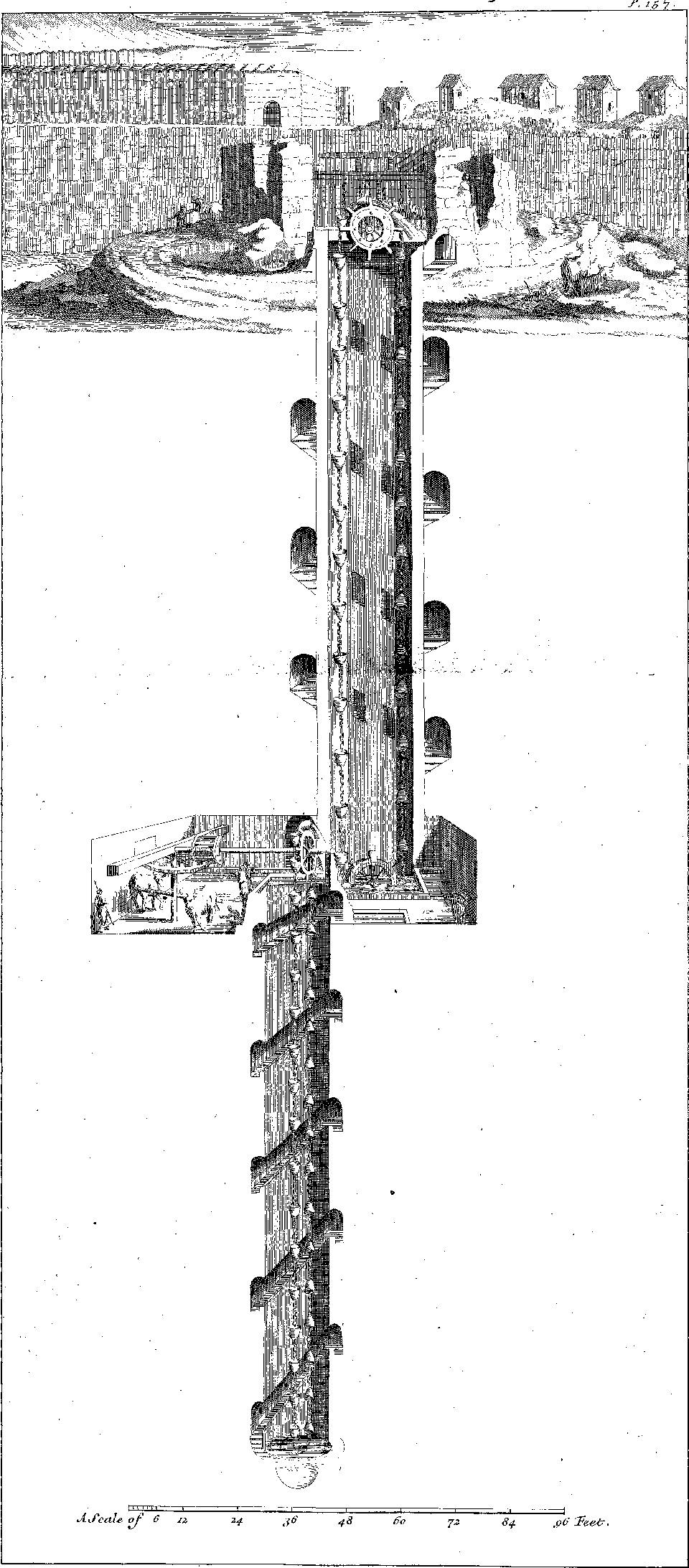
Our Travellers speak with great Admiration of Joseph’s Well, which is still to be seen at Cairo. The Mahometans make no doubt, but that it is the Work of the Patriarch Joseph. It is of an admirable Structure; and it must have cost vast Expences, and an infinite deal of Time in building. a Its whole Depth is as it were divided into two Parts: They go down from the Top about half way by a Stair-case, which winds round the Cavity, and is hewn into the Rock. By this Stair-case they let down the Oxen upon a Platform, from whence they raise the Waters by means of a Wheel, and long Chains, to which are fixed leathern Vessels, that fill and empty themselves alternately, as the Wheel goes round. The Water is drawn up at two different Times, by means of two Wheels placed one upon another. The lowest of them empties the Water into a Reservoir, from whence the second raises it up, and brings it to the Top of the Well.
The Mouth of the Well is about eighteen Feet wide, and twenty-four long; its Depth is two hundred and seventy-six Feet. The Second Part of the Well, or that which is lowest, is but fifteen Foot long, and nine wide. The Stair-case by which the Oxen go down, and which winds about from the top of the Well to the bottom, is six foot wide, and nine
a Paul Lucas, 3 Voiage, t. 2. p. 126.
Foot high. The whole is cut so nicely, that the Rock, which serves as a Rampart to this Descent, is but half a foot thick towards the Well. There are Windows from Space to Space, which let in Light to the Stair-case, and this Light comes from the Mouth of the Well.
At the second Part of the Well, which is not so wide as the former, there is also seen a Gallery, or Stair-case, of the same Figure as the former, but neither so wide nor so high. It is but four foot wide, and six foot high, and has no Parapet on the side, which makes the Descent very dangerous. The Basin, or Source of Water at the bottom of the Well, is not above eight or nine foot deep. The Water tastes a little brackish, for which Reason it is not drunk but out of necessity, and when the Castle or Well are besieged.
They speak also of another Well of Joseph’s, which they think to be that into Saadi. Bibl. Orient.which he was cast by his Brethren. It is shewn upon the Road from Damascus to Jerusalem, ten or twelve Miles from the Land of Canaan. The Mahometans have built a Mosque there, in memory of this Event. But the Situation of this Place is too far distant from Dothaim, where he went to seek his Brethren.
WEIGHTS. At the Beginning of this Dictionary we have exhibited a general Table of the Weights and Measures of the ancient Hebrews. We shall only observe here, that as the Hebrews had not the use of coined Money, which was of a certain determined Weight, they weigh’d all the Gold and Silver they used in Trade. The general Word they used to denote a Deut. xxv. 13, 15.Weight was a Stone: Thou shalt not have in thy bag divers weights; the Hebrew says, a Stone and a Stone. That is to say, they were forbid to keep two different Weights, one too heavy, to buy with, and another too light, to sell with; but only one stone of perfection Prov. xx. 10, 13.and justice, or one true Weight. Divers weights and divers measures, both of them are alike abomination to the Lord. God condemns Fraud and Injustice in Traffick. The Shekel, the Half Shekel, the Talent, are not only Denominations of Money, of a certain Value of Gold and Silver, but also of a certain Weight. When Moses expresses the Drugs which were to compose the Perfume to be burnt upon the Golden Altar, he says, for example, that they were to take the Weight of five hundred Exod. xxx. 24. 2 Sam. xiv. 26.Shekels of Myrrh, &c. In the Books of Samuel it is said of Absalom’s Hair, that it weighed two hundred Shekels. The same may be observed of the Word Talent, in Hebrew, Kikkar; ‘tis used to express any very considerable Weight.
WEIGHT of the Sanctuary, or Weight of the Temple. Moses often speaks of the Weight of the Sanctuary,64 when there was occasion to express a just, publick, and sure Weight. Several learned Men have pretended,65 that the Weight of the Sanctuary was heavier than the common Weight. But others,66 on the contrary, think the common Weights were heavier than those of the Sanctuary. They are farther divided among themselves about the Value and Weight of the two Shekels, and about the Distinction there was between the Shekel of the Sanctuary, and the publick Shekel; or the Shekel of the King,67 and the common Shekel. Some think the Weights of the Sanctuary, and the King’s Weight, are put by way of opposition to the Weight of strange Nations, as the Egyptians, the Canaanites, the Syrians. Others will have it, that the King’s Weight, means the Babylonian Weight, and the Weight of the Sanctuary the Jewish Weight: That till the Captivity of Babylon, there was no Variety among the Weights of the Jews; that the only Passage in which mention has been made of the King’s weight, was either written or corrected since the Return from this Captivity.
Finally, the best Criticks maintain, that Walton, Bonfrere, alii.the Distinction of the Weight of the Sanctuary, and the publick Weight, is only imaginary, and that the whole Difference between these two Weights consists in this, that the Standards are preserved in the Temple, or the Town-house, and those of the Merchants and Citizens are derived from thence; and this is what to us seems to have the greater Certainty. We see by the Chronicles, that there was 1 Chron. xxiii. 29.a Priest in the Temple, who had the Weights and Measures under his care: Super omne pondus atque mensuram. Moses appoints, that all things valued by their Price in Silver, should be rated upon the footing of the Weight of the Sanctuary: Omnis aestimatio siclo sanctuarii ponderabitur: Siclus viginti obolos habet. Levit. xxvii. 25.He never mentions any Difference between this Shekel of twenty oboli, of twenty Gerahs, and the common Shekel. Ezekiel, speaking of the ordinary Weights and Measures used in Traffick among the Jews, says Ezek. xlv. 12.that the Shekel weighed twenty Oboli, or twenty Gerahs. It was therefore equal to the Weight of the Sanctuary. Neither Josephus, nor Philo, nor St. Jerome, nor any ancient Author, speak of this pretended Distinction between the Weights of the Temple, and those in common use among the People.
Besides, the Custom of preserving the Standards of Weights and Measures in Clem. Alex. Strom.Temples, is not peculiar to the Hebrews. The Egyptians, as Clemens Alexandrinus informs us, had an Officer in the College of their Priests, whose Business it was to examine all sorts of Measures, and to take care of the Originals. The Romans had the same Custom.68 The Emperor Justinian decreed by a Law made on purpose,69 that the Standards of Weights and Measures should be kept in the Christian Churches.
WEIGHT, or Burden, in Latin, Onus, in Hebrew, Massa, is commonly used in the Prophets for a disastrous Prophecy. Onus Babylonis, Onus Nineve, Onus Moab, Onus Ægypti. And the Jews asking Jeremiah, by way of Insult, Quod est onus Domini? He answered them, Vos estis onus, you are as it were an insupportable Burden to the Lord; he will throw you upon the Ground, and break you to Pieces, and you shall become the Reproach of the People.
Onus deserti maris, Isai. xxi. 1. A Calamitous Prophecy against Babylon, which stood upon the Euphrates, and was watered as by a Sea; and which, from being great and populous as it was, would soon be reduced to a Solitude.
Onus Vallis visionis, Isai. xxii. 1. A dreadful Vision against Jerusalem, which is called by way of Irony, The Vale of Vision, altho’ it stood upon an Eminence. It is called of Vision, or of Moriah, because it is thought to be upon Mount Sion, or Moriah, that Abraham brought Isaac with an Intention to sacrifice him.
Onus jumentorum Austri, Isai. xxx. 3. The Prophecy in which we find these Words, very plainly have a Respect to Judea. But we cannot perceive upon what account this Inscription is found in this Place. It may easily happen, that Copiers have supplied it, for it seems to make no Sense with the Context; but, on the contrary, it interrupts and suspends it. One may thus read the Text of Isaiah, Ver.4, 5. The Jews sent their Ambassadors as far as Tanis and Hanes; but they were confounded when they saw that these People were not in a Condition to assist them. (The burden of the beasts of the South.) They went, I say, into the land of trouble and anguish, from whence come the young and
old lion, the viper and fiery flying serpent, they will carry their riches upon the shoulders of young Asses, and their Treasures upon the bunches of camels, to a people that shall not profit them.
The stone of weight, or burden, mentioned Zechariah xii. 3. In that day will I make Jerusalem a burdensome stone for all people. All that burden themselves with it shall be cut in pieces, tho’ all the people of the earth be gathered together against it. I will make Jerusalem as a Stone of burden to all Nations. All those that would lift it shall be wounded with it. All Nations round about Jerusalem had tried their Strength against it; the Assyrians, the Chaldeans, the Persians, the Egyptians, &c. but all these People had been wounded by them. They have taken the City, ‘tis true, but they paid dear for their Victory by the Losses they suffered by it. St. Hieron. in Zach. xii.Jerome observes, that in the Cities and Villages of Palestine, there was an old Custom, which continued even to his Time, to have great and heavy round Stones, which the young People used to lift up as high as they could, by way of Exercise, and to try their Strength. He assures us moreover, that in the Citadel at Athens, near the Statue of Minerva, he had seen an Iron Ball of a very great Weight, and which he could not move but with Difficulty, with which they heretofore used to try the Strength of the Athletæ, that their Abilities might be known, and that they might not be too unequally matched. Many think, that the Stone of Zobeleth, spoke of 1 Kings i. 9. was one of these Stones of Burden: And Ecclesiasticus alludes to this Custom, when Ecclus. vi. 21.he says, She will lie upon him as a mighty stone of trial, and he will cast her from him e’re it be long.
The Weight or Burden of the Day, mentioned Matth. xx. 12.by our Saviour, Which have born the burden and heat of the day, expresses the Labour and Toil of the Day, during the Meridian Heat.
2 Cor. iv. 17.A Weight of Glory, of which St. Paul speaks, a far more exceeding and eternal weight of glory, is opposed to the Lightness of the Evils of this Life. The Troubles we endure are really of no more Weight than a Straw, or of no Weight at all, if compared to the Weight or Intenseness of that Glory, which is to be hereafter as a Compensation for them.
Plin. l. 32. c. 1. Solin. c. 52.WHALE, the greatest of Fishes that we know. Pliny says, that Whales have been seen of six hundred foot long, and three hundred and sixty foot thick. And Solinus writes, that there have been seen some of eight hundred foot long. Others have said,70 that the Whale could swallow up a Ship with all its Rigging. Festus Avienus,
Protenus hæc71 ipsas absorbent sauce carinas, Involvuntque simul mox monstra natantia nantes.
But these are Fables, and extravagant Exaggerations. Father Tertre says, that in more than twelve thousand Leagues that he hath sailed, he never saw any that seemed to be above fifty or sixty foot long. We are assured however, that in America there are some so large, that they measure ninety or an hundred foot from Head to Tail. And it is owned, that the Whales in the North Seas are yet larger than those that are found upon the Coast of Guinea, or in the Mediterranean.
In Scripture there is often mention made of the Cetus or Whale. But the Hebrew Word Thannim,72 which is translated by Whale, is said in general of all large Fishes, whether of Rivers or the Sea. The Job xl. 20.Leviathan, spoke of by Job, and which several Interpreters understand of the Whale, rather signifies the Crocodile.c Lastly, the Fish that swallowed Jonah,73 was probably the Carcharias, or Sea Dog, as we have shewn in our Dissertation upon the Fish that swallowed Jonah, before the Twelve Lesser Prophets. See also FISH.
The Whale brings forth her young ones alive, as other perfect Animals. But it brings but one, or two at most, and nourishes it by the Breast, with great Care.
Whales have generally no Teeth, but only Beards, or Whiskers on the Throat; of about a Span in Breadth, and fifteen Foot long, which end in Fringes, like Hog’s Bristles at the End, which at top are set in the Palate, and ranged in order, according to their different Magnitudes. These Beards serve to extend or contract the Cheeks of the Creature, which are sometimes so large, that they are able to contain the little Whales newly born, when it blows a Storm, as Olaus pretends.
They are maintained by a Water or Froth which they suck from the Sea; and by some little Fishes, as the Sea-Flea, the Sea-Spider, Anchovies, Sea-Weed. Yet there are some of them that have Teeth, and in the Bellies of which have been found thirty or forty Cod-fish.
Whale continues on the next page
Footnotes
-
Spencer, de Urim & Thummim. c. ↩
-
August. de Doctr. Christ. l. 2. c. 11. n. 16. ↩
-
Salmero Proleg. 3. ↩
-
Pallavicin. Hist. Concil. Trid. ↩
-
Hieron. præfat. in Josue. ↩
-
Greg. Mag. Præfat. in Moral. in Job. ↩
-
About the Year 382, and again about the Year 389. ↩
-
Proverbs, Ecclesiastes, the Canticles, Job, and Chronicles. See the Second Prolegomena of the new Edition of St. Jerome. ↩
-
Hieron. præfat. in Paralip. Item, Præfat. in Job, Esdr. Josue. ↩
-
See St. Jerome’s Preface to Joshua, and the Prolegomena to the new Edition of St. Jerome. ↩
-
Hieron. Præfat. in quatuor Evangel. ↩
-
Rufin. l. 2. invectivæ in Hieron. ↩
-
Vide Epist. D. Hieron. Lucinio Bœtico, olim 28, nunc 52. nov. Edit. ↩
-
Isidor. Hispal. l. 1. de Officiis Eccles. ↩
-
Hugo Victor. l. de sacris Scripturis, c. 9. ↩
-
Lud. de Dieu notis ad Evangelia. ↩
-
Grot. Præfat. in Annotat. suas in Vet. Testament. ↩
-
Fagius Præfat. ad Collat. translat. vet. Testament. ↩
-
Concil. Trident. Sess. 4. ↩
-
Bellarm. literis datis capacæ 6. Dec. 1603. ↩
-
Levit. xi. 14. Deut. xiv. 13. ↩
-
Silius Italic. l. 13. ↩
-
Greg. Mag. Præfat. Moral. in Job. ↩
-
ריה Daia, or ראה Daah. ↩
-
Job. xxviii. 7. [Hebrew] Hait. 70. [Greek] Vulg. Vultur. ↩
-
[Hebrew] Uz, or Huz. Gen. x. 23. ↩
-
or [Hebrew] Daah. Joseph. Antiq. l. 1. c. 7. ↩
-
Hieron. Quæst. Heb. in Genes. ↩
-
2 Sam. vi. 3, 4, 5, &c. In the Year of the World 2959, before Christ 1041, before the Vulgar Æra 1045. ↩
-
The Hebrew is, [Hebrew] Quoniam calcitra- bant boves, 2 Reg. vi. 7. Bos lasciviens inclinaverat eam, 1 Par. xiii. 9. The Force of the Hebrew Word is unknown. ↩
-
ויכהו על השל ↩
-
1 Chron. xv. 13. Vide & Joseph. Antiq. l. 7. c. 4. Theodoret. qu. 19. in 2 Reg. ↩
-
Idem. in Psal. xlviii. v. 6. n. 8. ↩
-
Aug. l. 4. contra duas Epist. Pelag. c. 11. ↩
-
Vide Not. in nov. edit. S. Ambros. T. 2. l. 3. de Sacrament. c. 1. p. 362. ↩
-
Bernard. Serm. in Cæna Domini, n. 1, 2, 3. ↩
-
Ernald. Serm. de ablut. pedum. ↩
-
Serm. 145. n. 1. append. T. 5. p. 262. ↩
-
Aug. Serm. 9. nov. Edit. c. 11. ↩
-
Vita Sancti Gerardi Tull. Ep. c. 43. p. 142. Hist. de Lor. T. 1. ↩
-
Concil. Eliber. c. 48. ↩
-
Susan. 17. Afferte mihi oleum & smigmata. ↩
-
Dan. iv. 10, 14. עיר וקדש ↩
-
Hieron. in Dan. ↩
-
Lam. iv. 14. Ἐξελεύθισαν οἱ ἐγρήγορες ἀλήθης. ↩
-
A Voyage to China, in the Ninth Age, p. 37. Notes, p. 159. ↩
-
In Antigon. v. 274. ↩
-
Ducange Lexic. Ferrum candens. Juret. in Not. ad Yvon. Carnut. Baluz. in Not. ad Capitular. ↩
-
Gen. i. 6, 7. vii. 11. Exod. xv. 5. Deut. viii. 7. xxxiii. 13. Isai. li. 10, &c. ↩
-
Origen. tract. 29. in Matth. ↩
-
Rabini apud Lyr. in Dan. ix. & apud Galatin. l. 4. c. 14. ↩
-
Vid. 1 Macc. i. 17. Joseph. Antiq. l. 10. c. ult. qu. 354. Sixt. Senens. Bibl. l. 8. Est. in Dan. Marsham. Can, Ægypt. Sæcul. 18. Harduin. de lxx. hebdomad. Daniel. ↩
-
Clem. Alex. Stromat. l. 1. Quidam apud Euseb. Demonst. l. 8, alii. ↩
-
Jul. African. l. 5. temporum apud Hieron. in Dan. ix. ↩
-
Hieron. in Dan. ix. p. 1116, 1117. ↩
-
Ita Chrysost. Theodoret. Beda, Carthusian. Rupert. Zonar. St. Antonin. Galatin. Perer. in Daniel. Usser. ad An. Mund. 3550. Lamy, apparat. chronolog. Samuel Basnage, Differt. de 70. hebdom. Dainel. &c. ↩
-
Thalmod. tit. Cethuboth. c. 4. ↩
-
Isai. xvi. 9. אריון דמעתי חשבון ואלעלה ↩
-
Origen. contra Cels. l. 3. Euseb. ad vocem. Φρέαρ. Antonin. Martyr. Itinerar. Vid. Reland. Palæstin. l. 3. p. 589. ↩
-
Hieron. in Epitaph. Paulæ. ↩
-
Reland. Palæstin. l. 3 p. 1007. ↩
-
בארBeer, a Well. ↩
-
Relation of the Caravans, printed at Nancy. ↩
-
Exod. xxx. 13. 24. Levit. v. 5. Numb. iii. 50. vii. 23, 19. xviii. 16, &c. ↩
-
Rabb. Je3 chonias, Gedalias, Pagnin. Vaser. Vababl. Lipoman, &c. ↩
-
Rabb. Salom. Liran. alii. ↩
-
2 Sam. xiv. 26. Ducentis siculis pondere publico. Heb. Pondere Regis. ↩
-
Fannius, de Amphora; Amphora fit cubitis, quam ne violare liceret, Sacravêre Jovi Tarpeio in monte Quirites. ↩
-
Justinian. novell. 128. c. 15. ↩
-
Dionys. Perieget. ver. 603. Priscian. ↩
-
See our Commentary upon Job xl. 20. ↩
-
[Hebrew] Thannim. Cete grandia. ↩
-
Jonah ii. 1, 2, &c. Matth. xii. 40. ↩