MARRIAGE, Wedding, and the Festivity on that Occasion. The Hebrews commonly made Use of the Word Mishtheb1 which comes from the Verb Shathab, to drink, to signify a Feast in general, and a Marriage-Feast, or a Marriage in particular. The Greeks made Use of the Word Gamos in the same Sense, which signifies Marriage, a Wedding, and the Feasting that usually accompanies it. Sometimes this Word seems to be put for a Feast in General. See Luke xii. 36. xiv. 3.
Marriage passes among the Hebrews for a Matter of strict Obligation. They understand litterally, and as a Precept, those Gen. i. 28. Gen. i. 23.Words uttered to our first Parents, Be fruitful, and multiply, and replenish the Earth. They believe that he that does not marry his Children, deprives God of the Glory that is due to him, becomes in some Sort a Homicide, destroys the Image of the first Man, and is a Reason that the Holy Ghost withdraws himself from Israel. This Question is moved in the Thalmud. Who is he that prostitutes his Daughter? To which it is answered, The Father that keeps her too long in his House, or that marries her to an old Man. The Age at which Wedlock becomes an Obligation upon them, is the Age of twenty Years. But generally the Jews marry their Children before this Age. However, if a Father marries his Daughter before the Age of Puberty, which is at twelve Years and an half, she may be separated from her Husband for any slight Disgust she may conceive against him.
The Marriage of Adam and Eve was the grandest and most august that ever was solemnized, whether we consider the Person officiating, the Witness, the Brideman, who was God; or whether we regard the Merit and Dignity of the contracting Persons, who were the Stem of all Mankind that ever have been, or that ever shall be.
In the first Ages, Marriage, between Brothers and Sisters were not only allowable, but even necessary, because of the small Number of Persons then in the World. After Mankind were become numerous, they were unlawful, and even prohibited under great Penalties. However the Patriarchs for a good while took the Liberty of espousing their near Relations, even after the World was sufficiently peopled, so that they might have been supplied elsewhere: But this was done with a good View. For they would avoid any Alliance with Families that were corrupted by the Worship of false Gods, or to preserve in their own Families the Worship of the true God, and the Use of the true Religion, of which they were the Depositaries. ‘Twas for this Reason that Abraham married his Sister or Niece Sarah, and that this Patriarch gave such strict Orders to his Steward Eliezer, to fetch a Wife for his Son from among the Daughters of his Nephews; and that Jacob espoused two Sisters, who were the Daughters of his Uncle.
As we have appointed this Place to treat of the Solemnity of a Jewish Wedding, we shall describe it in its due Length. We shall not speak of this Affair in Qual’ty of a Lawyer, nor altogether as a Divine. In this Matter Selden may be consulted in his Uxor Hebraica, as to what concerns the Jews; and as to what relates to theological Questions concerning the Marriage of Christians, the Christian Authors may be consulted who have expresly treated of Marriage. We have already said something of Repudiation under the Article DIVORCE, and we have treated of it at Length in our Dissertation printed before our Commentary upon Numbers. So that nothing properly remains to be treated of here, but what has Relation to the Marriage -Ceremonies of the antient Hebrews. We have already discussed this Matter at full Length in a Dissertation made on Purpose, and printed before our Commentary on the Song of Songs; of which we shall content our selves here to give an Abstract.
The Hebrews generally married young. According to the Rabbins, Men should marry at eighteen2. Whoever is not married at this Age, offends against the Commandment by God given to the first Men; where he bids ‘em increase and multiply. They may anticipate this Age, but they are not allowed to go beyond it. As soon as they have compleated thirteen Years, they may marry; and they think a Man cannot live in Celebacy without Sin, or at least without great Danger of Sin. As to the Virgins, they are contracted very early; but generally they are not married till they arrive at what is called the Age of Puberty, that is, at twelve Years compleat. From whence comes these Expressions, the Spouse of one’s Youth, or, one espoused in Joel i. 8. Mal. ii. 14, &c. Prov. ii. 17.our Youth, and the Guide of one’s Youth, expressing a Husband married young,
From these Principles ‘tis easy to give an Account, why Celebacy and Barrenness was a Reproach in Israel; and why the Daughter of Jephthah went to bewail her Virginity, Judges xi. 37.that is to say, to deplore her Condition because she was to die before she was married, and before she should leave Heirs to her Father, who might make his Name to survive in Israel. From thence proceeds their Exactness, in causing the Brother of a Husband who died without Issue, to marry the Widow he had left behind; and the Disgrace that attended him who should refuse this Offer, nor would build up the House of his Brother by giving him Heirs. From hence those Threatnings of the Lord Gen. xxxviii. 3. Ruth iv. 5. Isai. iv. 1.by Isaiah: And in that Day seven Women shall take hold of one Man, saying, We will eat our own Bread, and wear our own Apparel; only let us be called by thy Name, to take away our Reproach. That we may have it to say, we have such an one for our Husband, and that we may no longer be looked on with Contempt. See also Jeremiah xxxi. 22. A Woman shall compass a Man, or Women shall apply themselves to Men for Husbands. And Cant. viii. 1. I should not be despised, or I should be delivered from the Disgrace of living single. Maids before their Marriage seldom appeared in publick. They were called Alma, Virgin, secret, shut up. Oftentimes they were sought in Marriage, without having seen the Persons that desired them. Jesus the Son of Sirach says, Ecclesiasticus xlii. 2. The Father waketh for the Daughter when no Man knoweth, and the Care for her taketh away Sleep; when she is young, lest she pass away the Flower of her Age; and being married, lest she should be hated. See also Saint Paul, 1 Cor. vii. 36. If any Man think that he behaveth himself uncomely toward his Virgin, if she pass the Flower of her Age. ‘Tis a kind of Shame to a Father, if he does not marry his Daughter in due Time.
One may see the Manner in which they demanded a Daughter in Marriage, in what was done by Hamor, the Father of Shechem, and by Shechem himself, when he Gen. xxxiv. 8, 9, &c.demanded Dinah of Jacob. ” The Soul ” of my Son Shechem longeth for your ” Daughter; I pray you give her him to ” Wife. Let me find Grace in your Eyes, ” and what ye shall say unto me I will ” give. Ask me never so much Dowry ” and Gift, and I will give according as ye ” shall say unto me; but give me the Damsel to Wife. See also Genesis xxiv. 33. the Manner in which Eliezar makes a Demand of Rebekah for his young Master Isaac; and Tobit vii. 10, 11. the Demand that Tobias made of Sara the Daughter of Raguel for his Wife. And lastly, Cant. viii. 8. What shall we do for our Sister in the Day when she shall be spoken for? In that Day when she shall be spoken to, in Order to have her Consent for her Marriage.
The Husband used to give a Dowry to his Wife; ‘twas a kind of Purchase that the Man made, of the Person that he desired to marry. Before the Contract they agreed on the Portion that the Husband should give his Bride, and the Presents he should make to her Father and Brethren. We have just now seen, that Hamor, Father of Shechem, tells Jacob and his Sons, that they might ask what Portion and what Presents they pleased, and they would gladly give them, provided they might but have Dinah. Jacob undertakes to serve seven Years for Rachel, and seven Years more for Leah; and the two Sisters complain some Years after, that their Father Laban had applied Gen. xxxi. 15.their Portion to his own Use. Saul did not give his Daughter Michal to David, till after he had received one hundred Foreskins of the Philistines. When it was insinuated to David, that he might be the King’s Son-in-Law, he answered that he was not rich enough to pretend to this Honour. But it was told him, the King did not require any other Dowry for his Daughter, but only an hundred Foreskins of the Philistines, that he might be avenged of his Enemies. Hosea bought his Wife at the Price of fifteen Pieces of Silver, and a Measure and half of Hos. iii. 2.Barley. Yet however the Rabbins assure us, that the Father was used to give his Daughter certain Presents for her Cloaths, and other Necessaries3. This was fixed at fifty Zuzims, which was a Piece of Money of one fourth Part of a Shekel.
The Betrothing was performed, either by a Writing, or by a Piece of Silver that was given to the Bride, or by Cohabitation and Consummation4. This is the Form of the Writing that was prepared on these Occasions. On such a Day, of such a Month, in such a Year, N. the Son of N. has said to N. the Daughter of N. be thou my Spouse according to the Law of Moses and the Israelites, and I will give thee for the Portion of thy Virginity the Sum of two hundred Zuzims, as is ordained by the Law. And the said N. has consented to become his Spouse upon these Conditions, which the said N. has promised to perform upon the Day of Marriage. To this the said N. obliges himself, and for this he engages all his Goods, even as far as the Cloak that he wears upon his Shoulder. Moreover he promises to perform all that is generally intended in Contracts of Marriage, in Favour of the Israelitish Women. Witnesses N. N. N.
Deut. xxiv. 1.The Promise by a Piece of Silver, and without Writing, was made before Witnesses, when the young Man said to his Mistress; Receive this Piece of Silver as a Pledge that you shall become my Spouse. Lastly, the Engagement by Cohabitation, according to the Rabbins, was allowed by the Law; but it had been wisely forbid by the Antients, because of the Abuses that might happen, and to prevent the Inconveniencies of clandestine Marriages. After the Marriage was contracted, the young People had the Liberty of seeing each other, which was not allowed them before5. If during this Time the Bride should commit any Fault against that Fidelity that she owed to her Bridegroom, she was treated as an Adulteress P. Thus the holy Virgin, after she was betrothed to Joseph, and having conceived our Saviour Jesus Christ, according to the Rigour of the Law might have been punished as an Adulteress, if the Angel of the Lord had not acquainted Joseph with the Mystery in which she was concerned. The Jewish Doctors teach, that if those that are bethrothed should make an ill Use of the Liberty of seeing each other, they are condemned to the Punishment of the Whip. Often between the Time of being espoused and married, there passed a considerable Time, whether because of the Under-age of the Persons espoused, or for other Reasons of Necessity or Decency.
When the Parties were agreed upon the Terms of Marriage, and upon the Time on which it was to be celebrated, they drew up the Contract in the Form following.
The Form of the Contracts of Marriage among the Hebrews.
Upon such a Day of such a Month, in such a Year, and upon the Banks of such a River, (for they commonly married in the open Air, and by the Side of some River) N. Son of N. said to N. Daughter of N. be thou my Wife according to the Rites of Moses and the Israelites. And with the Help of God I will honour thee, maintain thee, cloath thee, and feed thee, according to the Custom of other Husbands of our Nation, who honour, maintain, cloath, and feed their Wives, as they ought to do. I give thee for a Portion, and for the Price of thy Virginity, two hundred Zuzims of Silver6, which are due to thee according to the Law. Besides which, I engage my self to provide thee with Cloaths, and convenient Food, as also to discharge that conjugal Duty which is due to thee, according to the Custom of all Nations.
And the said N. has consented to become his Spouse. Moreover, the said Bridegroom has promised by Way of Augmentation of Dowry, that besides the principal Sum he will give ——. And what the said Bride has brought with her is estimated at the Value of ——, which the said Bridegroom acknowledges to have received and to charge himself with, and has made us the Declaration following. I accept and receive under my Care and Keeping all that is abovementioned. as well for Dowry, as upon any other Account; and oblige my self and my Heirs, under the Security of all my Goods, whether moveable or not, present or to come, even to the Cloak that I wear upon my Shoulders, to give a true and faithful Account to my said Spouse, of all that she has brought me as a Dowry, or upon any other Account, during my Life, or at my Death. All which I promise to put in Execution, according to the Form and Tenour of the usual Contracts of Marriage, in Use among the Children of Israel, and according to the Rules of our Rabbins of pious Memory. In Testimony of which we have signed these Presents, &c.
Leo of Modena says, that the Custom of the Jews is to make Choice of a Wednesday or Friday for the Celebration of a Marriage, if it is a Maid that is to be married, or of a Thursday if it is a Widow. The Evening before the Solemnity, the Bride goes to a Bath, and plunges her self into the Water. She is accompanied with several Women, who lead her to the Bath by the Sound of several kitchen Instruments, to give Notice to the Neighbourhood that she is going to be married. There is some Disagreement between Selden, Buxtorf, and Leo of Modena, upon the Subject of Marriage-Ceremonies; which shews that the Customs vary according to the Difference of Places and Persons. The Bride is set out with every Thing that can be had that is fine and rich, and then she is led into the open Air, either upon the Banks of a River, into a Court, or a Garden. Sometimes this is performed in a Hall, dressed and adorned on Purpose. The Bridegroom and Bride are placed under a Canopy, each of em’ covered with a black Veil. On their Heads is put another square Veil, having four Tufts hanging at the four Corners. This Veil is what the Hebrews call Taled, of which see the Figure.
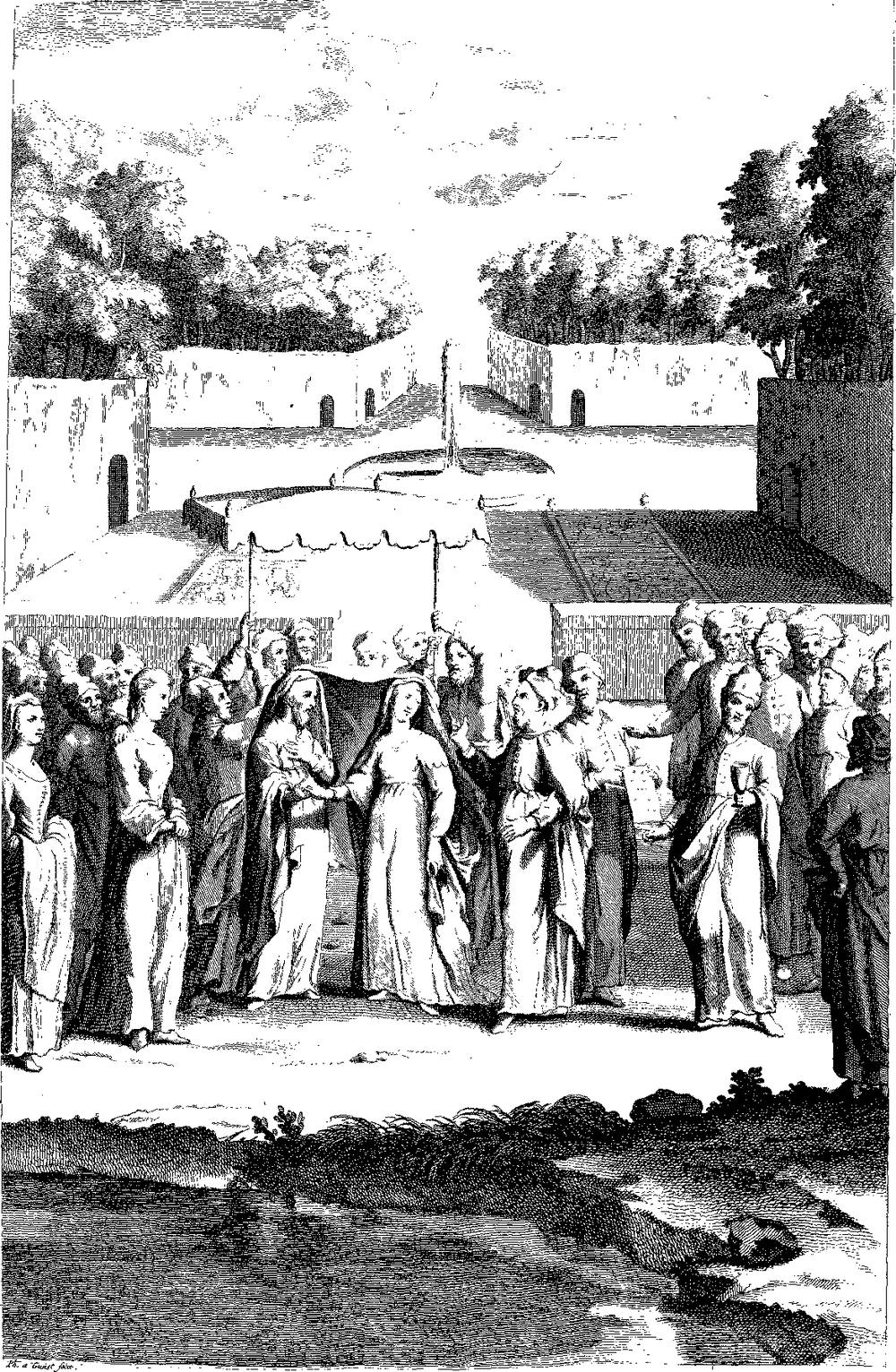
Then the Rabbin of the Place, or the Chanter of the Synagogue, or the nearest Relation of the Husband, takes a Cup full of Wine, and having pronounced this Benediction, Blessed be thou, O Lord, who hast created Man and Woman, and ordained Marriage, &c. he presents the Cup to the Bridegroom, and then to the Bride, that they may just taste it. Afterwards the Bridegroom puts a Ring upon the Finger of his Bride, in Presence of two Witnesses, saying, By this Ring thou art my Spouse, according to the Custom of Moses and the Children of Israel. Buxtorf says, that this Ring ought to be of massy Gold, and not set with any Stones; and that the Bridegroom takes the Company to Witness, that it is good Gold, and of a due Value. After this they read the Contract of Marriage, which the Bridegroom puts into the Hands of the Bride’s Relations. Then they bring Wine again in some brittle Vessel, they rehearse six Blessings, they make the married Couple drink, and they throw the rest on the Ground in Token of Chearfulness. The Bridegroom takes the Vessel, and throws it with Violence against the Ground, or against the Wall, and breaks it in Pieces in Memory, as they say, of the Destruction of the Temple.
The Rabbins inform us, that before the Temple of Jerusalem was laid in Ruines, the Bridegroom and Bride wore Crowns in the Ceremony of Marriage; but since that Time they have ceased to wear any. In the Scripture we see plainly the Crown of the Bridegroom, but not that of the Bride: And indeed, the Head-dress of the Women was by no Means convenient for the wearing of a Crown. Isai. lxi. 10. Vulg. Quasi sponsum decoratum coronâ. And Cant. iii. 11. Go forth, O ye Daughters of Zion, and behold King Solomon with the Crown wherewith his Mother crowned him in the Day of his Espousals, and in the Day of the Gladness of his Heart. The modern Jews in some Places have a Custom, to throw Handfuls of Wheat upon the married Couple, and particularly upon the Bride, saying, Increase and multiply. In other Places they mingle Pieces of Money with the Wheat, which are to be gathered up by the Poor.
Judg. xiv. Cant. v. 1. viii. 1. John iii. 29.We see by the Gospel, that the Bridegroom had a Paranymphus or Brideman, called by our Saviour the Friend of the Bridegroom. A Number of young People kept him Company during the Days of the Wedding, to do him Credit; as also young Women kept Company with the Bride all this Time. The Companions of the Bridegroom are expressly mentioned in the History of Samson, and in the Canticles; and the Companions of the Bride in the same Canticles, i. 4. ii. 7. iii. 5. viii. 4. and in Psalm xlv. 9, 14, 15. The Office of the Brideman was to perform the Ceremonies of the Wedding instead of the Bridegroom, and to obey John iii. 29.his Orders. He that has the Bride is the Bridegroom, says John the Baptist, speaking of Jesus Christ; but the Friend of the Bridegroom, which standeth and heareth him, rejoyceth greatly, because of the Bridegroom’s John ii. 9.Voice. Some think that the Archi-triclinus, or Governor of the Feast, of whom Mention is made in the Marriage of Cana, at which Jesus Christ and his Mother Mary were present, was the Brideman, Paranymphus, or Friend of the Bridegroom; who presided at the Feast, and had the Care of providing for the Guests. The Friends and Companions of the Bride sang the Epithalamium, or Wedding-Song, at the Door of the Bride the Evening before the Wedding. Psalm xlv. is an Epithalamium, intitled, A Song of Rejoycing of the well-beloved. The Ceremony of the Wedding was performed with a great deal of Decency, the young People of both Sexes not being promiscuously together. They were in distinct Apartments, and ate at different Tables, diverting themselves, young Women with young Women, and young Men with young Men. The Reservedness of the Eastern People towards their Women required this. We see Proofs of this in the Story of the Marriage of Samson, in that of Esther, and in the Canticles. The young Men diverted themselves sometimes in proposing Riddles to each other, and the Bridegroom appointed the Prize to those that could explain them.
The Story of Samson is well known, and the Riddle that he proposed to the young Philistines, who accompanied him at his Wedding.
The Wedding Ceremonies commonly held seven Days for a Maid, and three Days for a Widow. When Jacob espoused Rachel, and Laban put Leah in her Room; Jacob complaining of it, Laban told him, that it was not the Fashion in that Countrey to marry the younger Daughters before the Elder; and that he did not refuse to give him Rachel also, after he had passed with Leah the seven Days of her Marriage. Fulfil her Gen. xix. 27. Judg. xiv. 17, 18. Tob. xi. 19.Week, and we will give thee this also. The Ceremonies of Samson’s Wedding continued also seven whole Days, as also that of Tobias. The Rabbins acquaint us that the Term of seven Days was of indispensable Obligation to all married Men; and that they were to allow seven Days for the Marriage of every Wife they took, though they should marry several the same Day. In this Case they made so many wedding Weeks successively as they married Wives. These seven Days of Rejoycing were commonly spent in the House of the Woman’s Father, after which they conducted the Bride home to her Husband’s House with great Solemnity.
This Part of the Ceremony was generally performed with great Pomp, according to the Condition and Circumstances of the married Couple; and for this they often chose the Night. And from hence it comes, that in the Parable of the ten Virgins that went to meet the Bride and Bridegroom, it is said that the Virgins were asleep; and at Matth. xv. 1, &c.Midnight being awaked at the Cry of the Bridegrooms coming, the foolish Virgins found that they had no Oil to supply their Lamps; which while they went to the Shops to buy, the Bridegroom and his Attendants passed by, and at their Return they found themselves shut out from the Marriage Feast. We read in the Book of 1 Macc. ix. 37. Maccabees, that the Children of Jambri having made a magnificent Wedding at Medaba or Nadabatha, a City beyond Jordan, as they were bringing the Bride along with great Solemnity to the Dwelling of the Bridegroom, and as the Relations and Friends of the Husband went before her with Instruments of Musick and with Arms, the Maccabees fell upon them and dispersed them.
In the Ceremonies of Marriage, the Hebrews pretend that they chiefly imitate what was done at Tobias’s Wedding, which they justly look upon as a Model of a regular and happy Marriage. However the Ceremonies we have described are different enough from what was then practised. First Raguel consents that Tobias shall have his Daughter, and at the same Time puts Tobias’s Hands into those of his Daughter Sara, and gives them his Blessing. This is the essential Ceremony of the Marriage. After this Raguel calls for Paper, writes the Contract, and has it signed by the Witnesses. Then the Feast begins, which is kept for a Tob x. 7.whole Fortnight; though according to the Rules mentioned by the Rabbins, they ought to have held but three Days, because Sara was the Widow of several Husbands.
When the married Couple and their Relations are come into the House, they sit down at Table, and the Bridegroom begins to sing, as musically as he can7, a long Blessing in Hebrew. After Supper the most honourable Person in the Company takes the Bridegroom by the Hand, and the rest all round, and begin to dance together. The Women likewise do the same, but separately from the Men. This Dancing is of a very antient Tradition among them; they call it the Dance of the Commandment, pretending that God himself commanded it, in the Ceremony of Marriage.
The leading the Bride into the Marriage Chamber, is, in the Opinion of the Rabbins8, what compleats the Marrirge. For neither the Blessing, nor the other Ceremonies before it, are thought to give to this Rite its whole Perfection. The Woman has then the Name of a compleat Bride, as soon as she is entered into this Chamber, even though the Marriage had not been yet consummated. As it happens when the Woman is under the Inconveniencies attending her Sex, at which Time it is unlawful for the Man to come near her, under Pain of Lev. xx. 18.Death. Before the leading of the Bride into the Marriage-Chamber, they rehearse this Blessing, in the Presence of ten Persons of Age sufficient and free. Be thou blessed, O Lord our God, King of the World, who hast created all Things for thy Glory. Be thou blessed, O Lord our God, Creator of Man. Be thou blessed, O Lord our God, who hast created Man in thy own Image and Likeness, and hast provided him a Companion for ever. Be thou blessed, O Lord our God, Creator of Man. She that was barren shall rejoice, in gathering her Children into her Bosom. Be thou blessed, O Lord our God, who makest Sion rejoice in the Multitude of its Children. Replenish with Joy these two Spouses, as thou didst replenish Man and Woman in the Garden of Eden. Be thou blessed, O Lord our God, who heapest Pleasure upon the Bridegroom and Bride, and hast prepared for them Joy, Songs, Gladness, Dancing, Love, Friendship, Peace, and brotherly Kindness. Grant, O Lord, as soon as may be, that in the Cities of Judah and in the Places of Jerusalem may be heard Songs of Joy, the Voice of the Bridegroom and the Voice of the Bride, the Voice of the mutual Love of Spouses, and the Voice of singing Children. Be thou blessed, O Lord our God, who replenishest with Joy the Bridegroom and the Bride.
Mat. v. 32. Luke xvi. 18.As to the Marriage of Christians, Christ has restored it to its first Perfection, by banishing Polygamy intirely, and not suffering Divorce but in the Case of Adultery; nor leaving to the Parties so separated, the Liberty of marrying again. And this is very different from what the Law allowed. Our John ii. 1, 2.Saviour has blessed and sanctified Marriage, by being present himself at the Wedding of Cana. Saint Paul declares the Excellence of Eph. v. 33.a Christian Marriage, when he says, Let every one of you in Particular so love his Wife, even as himself, and the Wife see that she Reverence her Husband. And a little above, So ought Men to love their Wives, as their own Bodies; he that loveth his Wife, loveth himself. For this Cause shall a Man leave his Father and Mother, and shall be joined unto his Wife, and they two shall be one Flesh. This is a great Mystery; but I speak concerning Christ and the Church. The Union of Husband and Wife is a Mystery, which represents the Union, the sacred and spiritual Marriage of Christ with his Church. The same Apostle, assures us, that Marriage is honourable in all, and the Heb. xiii. 4.Bed undefiled; but Whoremongers and Adulterers God will judge. The sacred Books of the New Testament prescribe no particular Ceremony for the solemnizing of Matrimony; but it is certain that in the Church a Blessing has always been given to the married Couple9, and that to raise Marriage to the Dignity of one of the Sacraments of the Church , it ought to be celebrated in the Name of Jesus Christ, and with religious Ceremonies, which have varied according to Circumstances of Time and Place. We may see by Tertullian10, that they put a Veil over the married Couple, and that in Imitation of Tobias and Sara, they gave each other their Hands. Saint Ambrose says11, that Marriage ought to be sanctified by the Veil, and by the Blessing of the Priest. Saint Ignatius the Martyr12 would have Marriages be contracted by the Advice of the Bishop, that they may be according to God, and not according to the Flesh. And Tertullian13 commends those Marriages that the Church unites, the Offering of the Sacrifice confirms, of which the Angels declare the Accomplishment to God, and God himself ratifies. Unde sufficiam ad enarrandam felicitatem ejus Matrimonii, quod Ecclesia conciliat, & confirmat oblatio, & obsignatum Angeli renunciant, Pater ratum habet. The Ceremony of Espousals is very antient, as may be seen by several Councils14, and by Saint Austin15; Institutum est ut jam pactæ sponsæ non tradantur statim ne vilem habeat maritus datam, quam non suspiravit sponsus dilatam. Heretofore in several Churches the married People communicated the Day of their Marriage, and abstained that Night from the Use of the Marriage-Bed16. Sponsus & sponsa cùm benedicendi sunt à Sacerdote, à parentibus suis, vel paranymphis offerantur; qui cùm benedictionem acceperint, eadem nocte, pro reverentia ipsius benedictionis, in virginitate permaneant. This Practice is still in Use in some Places, as I am informed.
Read this article in its place on the printed pages
Footnotes
-
משחהMishteh, Nuptiæ, Convivium, Γάμος. Part iv. c. 3. ↩
-
Leo of Modena, Ceremonies of the Jews, ↩
-
Selden. Uxor Heb. l. ii. c. 10. ↩
-
Id. ibid. l. ii. c. 2. ↩
-
Leo of Modena, Part iv. c. 3. of the Ceremonies of the Jews. Apud Selden Uxor Hebr. l. ii. c. 15. ↩
-
P Selden. Uxor Heb. l. ii. c. 1. These two hundred Zuzims make about 50 Shekels of Silver. ↩
-
Buxtorf. Synag. Jud. c. 28. ↩
-
Apud Selden. Uxor Hebraica, l. ii. c. 13. Wives, ↩
-
Concil. Carth. iv. Can. xiii. Siric. Epist. ad Ec. Mediol. ↩
-
Tertul. de veland. Virg. c. 11. ↩
-
Amb. l. iii. Ep. vi. N. 7. ↩
-
Ignat. Mar. Ep. ad Polycarp. c. 5. ↩
-
Tertul. l. ii. ad Uxor c. 9. ↩
-
Concil. Ancyr. Can. xi. xxiv. Carthag. iv. Citat. iii. Pars Cap. xxvii. q. ii. c. 45, 50, 51. ↩
-
Aug. l. viii. Confes. c. 3. ↩
-
Concil. Charth. iv. Can. xiii. ↩