Eccles. ix. 8.VESTMENTS, or Garments. The Hebrews wore no other Cloaths but a Coat, or Wastcoat, called Chetonet,1 and a Cloak, called in Hebrew, Mebil. The Coat was their under Garment, which they wore next their Skin, and the Cloak over this. These two Garments together made what the Scripture calls a Change of Raiment; Mutatorias vestes, or mutatoria vestium, 2 Kings v. 15.which Naaman brought as a Present to the Prophet Elisha. The Coat was commonly of Linnen, and the Cloak of Stuff, or Woolen. As the Cloaks were only a great piece of Stuff, that was not cut; there were often Remnants of it, of which they used to make Presents. The Hebrews never changed the Fashion of their Cloaths, as we know of; but they dressed themselves after the Manner of the Country wherein they dwelt. A white Colour, or a Purple, were in most Esteem among them. Solomon, in his Ecclesiastes advises him that would live agreeably, Let thy Garments be always white. Josephus observes of this Prince, that being the most splendid and magnificent of all Kings, he was commonly Joseph. Antiq. l. 8. c. 2.cloathed in bright and white Garments. The Angels generally appeared in this Colour; and in our Saviour’s Transfiguration, his Cloaths appeared as white as Snow. Moses appoints none but white Coats to the Priests.
Mention is made in the Scripture,2 of a Coat of many Colours, Chetonet passim, with which Joseph was cloathed. Tamar, 2 Sam. xiii. 18.the Daughter of David, wore one also. Interpreters are divided about the Signification of this Word. Some translate it by a long Gown; others, by a Gown striped with several Colours; and others by a Gown with large Sleeves. The Arabians wore very great Sleeves to their Coats. These Sleeves have a very wide Opening at the End, which hangs sometimes down to the Ground, but at the Shoulder they are much narrower. In their Houses this Coat or Gown dragged upon the Ground, but abroad they tucked it up, that they might walk at more liberty; or else they tied it up with a Girdle.
We shall not here speak of the Women’s Veils or Gowns, with which they covered themselves when they appeared in Publick: We have already said something of it, under the Article THERISTRUM. Isaiah, iii. 16. - - - 25, makes a long Enumeration of the Dresses of the Women of his time. We shall not undertake to explain them, because the greatest part of the Terms which the Hebrew uses are unknown to Interpreters. The Reader may have recourse to the Commentators upon this Chapter.
Exod. xxviiii. 32.The Coats were often without Seams, and wove in a Loom, and had no Slit either at the Breast or on the sides; but only at the top, to let the Head through. Such, probably, were the Coats of the Priests, and that of our Lord Jesus Christ, which the John xix. 23.Soldiers would not divide, but chose rather to cast Lots, to determine the Possession of the whole. St. Chrysostom, Theophylact, and Theophanes, are of opinion, that it was made of two pieces of Woollen Stuff, wove in a Loom, and fine drawn together with a Needle and Woolen Yarn, as the Pieces of a wove Stocking are joined together; so that it seems to be but one Piece. Others will have it to be all needle Work from top to bottom. But the Reader may only turn to our Commentary upon St. John, xix. 23. or read Braunius de vestitu Sacerdotum Hæbræorum, l. 1. c. 16. in order to be convinced, that it was all wove in a Loom. They still make ‘em after the same manner in the Eastern Countries.
‘Tis an ancient Tradition,3 that the Holy Virgin herself wove her Son’s Coat. ‘Twas the Women formerly that made the Stuffs and the Cloth, not only for their own Cloaths, but also for their Husbands and Children. This appears from the Example of the virtuous Woman, whose Prov. xxxi. 13.Character Solomon gives us in his Proverbs, and also from that of Queen Penelope, the Wife of Ulysses. Alexander the Great, Augustus, and Charlemaign, wore Cloaths made by the Hands of their Mothers, their Wives, or their Daughters. ‘Tis another popular Tradition, that the Coat of Jesus Christ, for which the Soldiers drew Lots, was the same he had received from the Virgin Mary, while he was yet a Child, which had continually grown with him, without being wore out. But this Tradition is not vouched for by Antiquity. They preserve still the Holy Coat of our Saviour in the Cathedral Church of Treves. That which is to be seen at the Priory of Argeneüil, near Paris, is not a Coat, but a Cloak of a Purple Colour.
Deut. viii. 4.Moses informs us, that the Cloaths which the Hebrews used in the Wilderness did not wear out. Thy raiment waxed not old upon thee, neither did thy foot swell these forty years. Justin Martyr,4 and some Interpreters,5 following the Rabbins, take these Words in a literal Sense, and think that not only the Cloaths of the Israelites did not grow old, or wear out, but also that those of the Children grew along with them, and were always fit for them, at every Age. St. Jerome6 asserts, that so much as their Hair or Nails did not grow too long: Frustra tonsores & artificia didicerunt, scientes Israelitarum populum per quadraginta annos nec unguium, nec capilitiorum incrementa sensisse. But others7 think, with much more Probability, that Moses intended no more, than that God so provided them with Necessaries, that they did not so much as want Cloaths in all their Journey.
To distinguish the Israelites from other People, the Lord commanded them to wear Tufts or Fringes at the four Corners of their upper Garments, of a blue Colour, and a Border of Galoon upon the Edges.8 ‘Tis Matth. ix. 20.seen by the Gospel, that our Saviour wore these sorts of Fringes at the bottom of his Cloak. For the Woman that had the Issue of Blood for twelve Years, promised herself a Cure, if she could but touch the Hem or Fringe of his Garment. The Pharisees, the more to distinguish themselves, wore these Matth. xxiii. 5.Borders or Fringes longer than others: Magnificent fimbrias. St. Jerome adds,9 that to make a shew of greater Austerity, they fastened Thorns to them, that when they struck against their naked Legs, they might be put in mind of the Law of God.
The Jews at this Day,10 that they may comply with the Law,11 that says, neither shall a garment mingled of linnen and woollen come upon thee, do not so much as sew a woollen Garment with Thread, nor a linnen Garment with Yarn. They take care also not to dress themselves up in the Cloaths of a different Sex, according to the Command of the Law, The Woman shall not Deut. xxii. 5.wear that which appertaineth unto a Man, neither shall a Man put on a Woman’s Garment. As to the Tufts and Fringes which we have mentioned before, and which only belonged to Men to wear, the present Jews, that they may not appear ridiculous to other People, dress themselves outwardly as other Nations do, with whom they live: But under their Cloaths they wear a square piece of Stuff, with four Tufts, or Zirit. These Tufts are made of eight Woollen Threads, wove on purpose, each with five Knots that take up half the Length. That which is not knotted, is unravelled, and makes a kind of Tuft. But at the time of Prayers in their Synagogue, they cover themselves with a Wollen Veil called Taled, which has these Tufts at the four Corners. See TALED.
The Garments of Mourning among the Hebrews were Sackcloth and Hair-cloth; their Colour was dark Brown, or Black. As the Prophets were continual Penitents by Profession, their common Cloathing was Mourning. Widows also dressed themselves much in the same manner. Judith fasted every Day, except on Festival Days, and the Sabbath-day, and wore a Hair-cloth next her Skin. The Prophets Elias, and John the Baptist, were cloathed in Skins, or coarse Stuffs, Judith viii. 6. 2 Kings i. 7, 8. Matth. iii. 4. Heb. xi. 37. Zech. xiii. 4.and wore Girdles of Leather. St. Paul says, that the Prophets wore Melotes, Sheep-skins, or Goat-skins. The false Prophets put on Habits of Mourning and Penitence, the better to deceive the People: Non operientur pallio saccino ut mentiantur, says Zechariah. Leo of Modena tells us,12 that the modern Jews dress themselves in Mourning, after the Manner of the Country they dwell in, without any Commandment for it.
Judg. xvii. 10. 2 Kings v. 22. Prov. xxxi. 21.‘Tis disputed, whether the ancient Hebrews lined their Cloaths. Doubled or lined Garments are pretty often mentioned in Scripture. Micah offers his Levite ten Pieces of Money a Year, & vestem duplicem. Gehazi asks Naaman for a Talent of Silver, and doubled or lined Garments; Vestes mutatorias duplices. The Houshold of the virtuous Woman in the Proverbs, are cloathed with lined Garments: Vestiti sunt duplicibus. But it is imagined from these Expressions, that Changes of Raiment are to be understood, a Pair of Garments, two Coats, and two Cloaks; or, simply, a Coat and a Cloak, a compleat Suit; or, perhaps, a Garment so large, as that it may be doubled about one. But yet it must be owned, that Duplex, in speaking of Cloaths, is sometimes taken for a Garment that is really doubled, or lined. For example, Moses appoints that the Pectoral, or Breast-piece of the High-Priest shall be made square and lined; Quadrangulum & Duplex13.
To see Garments or Frocks entire without Seam, with Sleeves and Quarters of the same Piece, wove together in the Loom, is no rarity in the East. We are told, that in the Maldivee Islands,14 there are Workmen and Weavers so ingenious, that they make entire Shirts and Wastcoats of the Tow of the Cocoa-tree, after the manner before described. And in other Places a we hear of Cloaths wove of Cotton after so particular a manner, that the like is not to be found elsewhere. These are generally round Garments, wove so fine, that they may be drawn through the Eye of a moderate Needle.
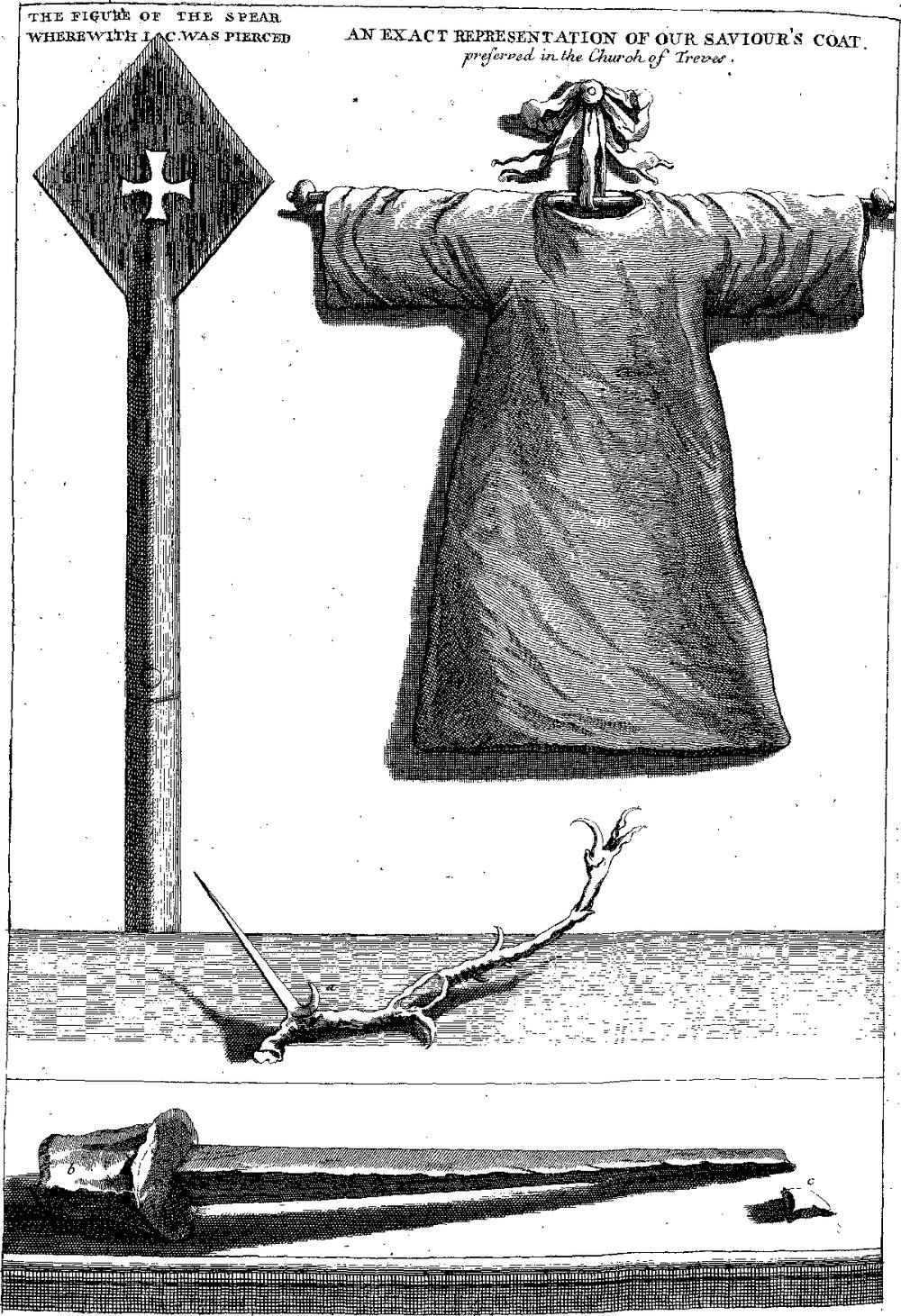
The Sacred Tunick which is preserved at Treves, and which is without Seam, is five Foot all but half a Finger:15 Its Wideness, from the End of one Sleeve to the other, is five Foot four Fingers. Each Sleeve is half a Foot long, and of the breadth of one Foot. And as the Tunick is narrower below the Sleeves, and then goes on widening downwards, its Wideness below the Sleeves is but two Foot three Inches. See its Figure, annexed, taken from the Additions of Mazenius to the Annals of Father Bronverus.
Read this article in its place on the printed pages
Footnotes
-
כתנתChetonet; מעילMebil. ↩
-
Gen. xxxvii. 3. כתנת פסים ↩
-
Vide Euthym. in Joan. xx. ↩
-
Just Martyr. Dialog. cum Tryphon. ↩
-
Vide Grot. Bonfr. Jansen. &c. ↩
-
Hieronym. Ep. 38. p. 325. nov. Edit. ↩
-
Abenezra, Cesm. Monach. l. 5. p. 205. Vidu Est. Jun. Druf. Joan. Cleric. ↩
-
Numb. xv. 38. Deut. xxii. 12. ↩
-
Hieronym. in Matth. xxiii. ↩
-
Leo of Modena, Ceremonies of the Jews, p. 1. c. 5. ↩
-
Levit. xix. 19. Deut. xxii. 11. ↩
-
Leo of Modena, Ceremonies of the Jews, par. 5. c. 9. ↩
-
Exod. xxviii 16. xxxix. 9. ↩
-
Voyage to China, by two Arabians, in the Ninth Century. At Paris, 1718, in octavo, p. 2. ↩
-
Masen. Addit. ad Annal. Bronveri. Tom. 1. p. 583. ↩