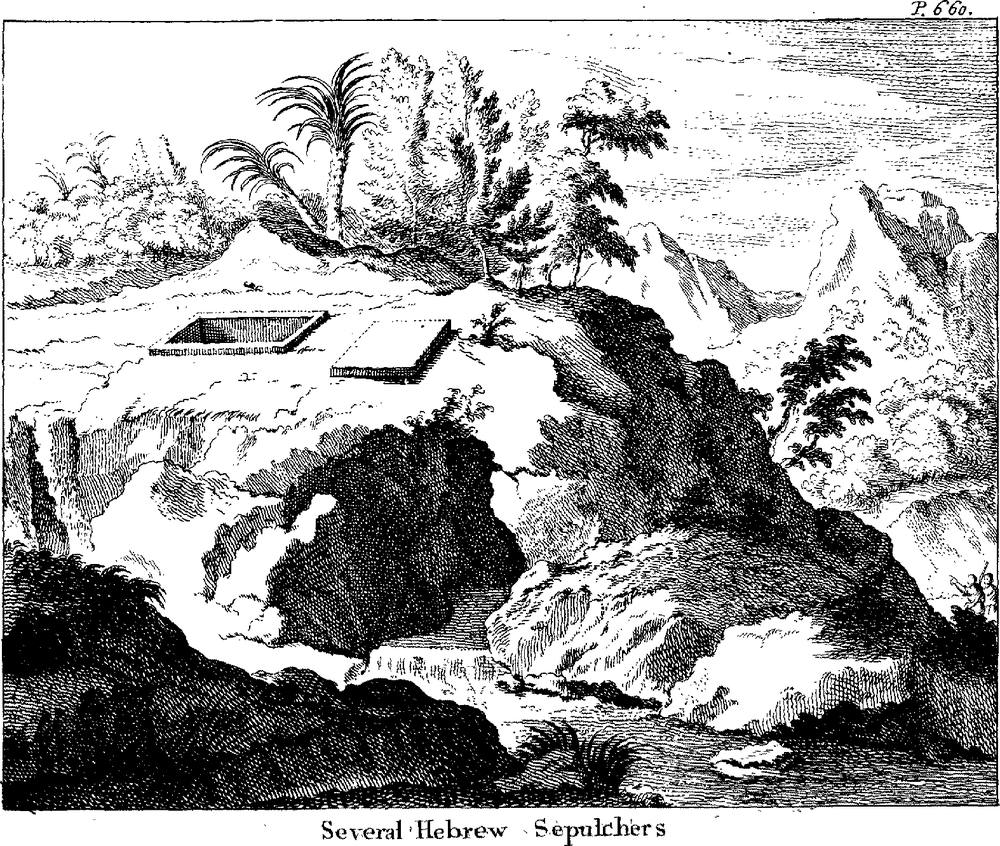
SEPULCHRE, or Grave. The Hebrews have always taken great Care about the Burial of their Dead. The greatest Part of their Sepulchres were hollow Places dug into Rocks; as for Example, that bought by Abraham for the burying of Sarah; those of the Kings of Judah and Israel, and that wherein our Saviour was laid in Mount Calvary. Sometimes also their Graves were dug in the Ground, and commonly without their Towns, in Burying-places set apart on Purpose. Generally they used to put some hewn Stone, or other thing, over the Grave, to shew it was a Burying-place, that the Passengers might be warned not to come near it, that they might not be polluted.
Mat. xxiii. 17.Jesus Christ, in the Gospel, says, that the Pharisees were like whited Sepulchres, which appeared fine without, but inwardly were full of Rottenness and Corruption. Lightfoot shews, that every Year, on the Luke xi. 44.15th of February, they took care to whiten them anew. In another Place, our Saviour compares the Pharisees to Graves which appear not, and the Men that walk over them are not aware of them, or know not that the Places are unclean, so that they contract an unknown and involuntary Impurity. We have spoke of the Sepulchres of the Jews, in our Dissertation concerning their Funerals. The Reader may also consult the Book of John Nicholai, de Sepulchris Judæorum; and for the Moderns, Leo of Modena’s Ceremonies of the Jews, Part 5, 6. and Buxtorf’s Synagog. Judæorum, c. 35.
Sepulchres or Graves of Lust. See KIBROTH-HATTAAVAH.
Sepulchre of Rachel. We have given a Description of it under the Article of RACHEL.
Sepulchre of Absalom, or the Hand, Pillar, or Monument of Absalom. ‘Tis seen at this Day to the East of Jerusalem. See the Article ABSALOM.
Sepulchre of Sarah. Abraham not being Master of a Foot of Land in Canaan, apply’d himself to the Children of Heth, who dwelt at Hebron, desiring them to sell him the Sepulchre which was in the Field of Ephron the Son of Zohar, Gen. xxiii. This he bought for four hundred Shekels of good Money, and buried Sarah there. The Vulgate calls the Place where she was buried, Speluncam Duplicem, a Double Cave; whether because it might contain two Cavities dug in the Rock, or because there were two Tombs in the same Cavern. The Hebrew Text calls it Ambrosiast. in Gal. iii. Jude 9.the Cave of Makpelah. See MAKPELAH.
Sepulchre of Moses. After the Death of this famous Law-giver, the Arch-angel Michael had a Dispute with the Devil about his Body. But what was the Subject of this Dispute, has been much contested for a long Time. Some have thought,1 that the Devil withstood the Burial of Moses, maintaining, that he had not deserved this Honour, having unjustly kill’d an Egyptian in Egypt. Others have maintain’d,2 that Moses was buried by the Hands of Angels, without letting the Hebrews have any Knowledge of it, for fear they should be tempted to pay him divine Honours after his Death.
Lastly, Others pretend, that the Devil would have had him be buried with publick Solemnity, that the People might thence take Occasion of frequenting his Tomb, and worshipping him as a God. There are those that think3 he did not die like other Men, but that he was translated out of this World into the Earthly Paradise. Clemens Alexandrinus4, and
Evodius in St. Austin, say, that after the Evod. Epist. ad Aug. ep. 259. inter Augustin.Death of Moses, there were found two Bodies of this Law-giver, one to be buried in his Tomb, and the other which was to remain with the Angel that was his Guide.
Cedrenus relates, that Moses’s Tomb is Cedren. Hist. l. 1.always cover’d with a bright Cloud, which conceals it from the Eyes of Men, and hinders them from approaching to it. The Text of Deuteronomy says expressly, that no one Deuteron. xxxiv. 6.knows the Place of his Burial to this Day. Yet, for all this, it is told, that in 1655, in Vid. Horn. hist. Ecclef. sæcul. 17. art. 31.the Month of October, as some Marionite Shepherds were feeding their Goats in the Mountains of Nebo and Abarim, they observed that, from time to time, some of their Goats would straggle from the Flock for two or three Days Journey, and, at their return, they appear’d as it were embalmed with Perfumes of a most excellent Scent. To find out the Reason of such an extraordinary Event, they follow’d their Goats, and arrived at Precipices of a prodigious Depth, in the midst of which they perceived a small Valley, but extremely agreeable, at which they could not come but over a Number of broken Rocks, which had probably been tore up from the neighbouring Mountains by Earthquakes.
They got thither with a great deal of Trouble, where they found a Cave dug into a living Rock, wherein was a short Inscription which they could not understand. The whole Cavern was fill’d with a most delicious Perfume; and the Shepherds went back with their Cloaths scented strongly with this Perfume. This Affair was presently related by them to Mataxat Patriarch of the Marionites, who dwelt upon Mount Libanus, in the Monastery of Canobean Kadischa Mariam. The Smell of their Cloaths, was a sufficient Proof of the Truth of what they related.
The Patriarch sent thither two of his Priests, Men of approved Knowledge and Wisdom, particularly Aben-Useph, who had recommended himself by his great Learning and Capacity. They found the Monument which had been described to them, and read the Inscription upon it, which was, Moses, the Servant of God. The Patriarch was transported with Joy, and went to wait on Morat the Basha of Damascus, to ask of him the Keeping of the Tomb. The Greeks, the Armenians, the Jews, the Franciscans were inform’d of this Affair, made great Interest, and disbursed a great deal of Money, to obtain the Care of this precious Tomb, exclusive of others: The Jews especially bestirr’d themselves much in this Matter, to have it determin’d in their Favour: They remonstrated, that it belong’d to them preferably to all others, because Moses was their Founder and Law-giver. The Ottomans were already flatter’d with the Glory of being the Depositaries of the Sepulchres of Jesus Christ at Jerusalem, of Moses upon Mount Nebo, and of Mahomet at Mecca.
Hornius adds, that to elude the Hopes and frustrate the Pretensions of all these Competitors, the Jesuits obtain’d from the Turks, that the Tomb and all the Avenues to it should be shut up, and that, upon Pain of Death, all Persons should be prohibited from going thither. So that the Basha Morat sent Orders to the Saniac of Jerusalem and of Saphet, to have the Tomb and the Cave stopt up. But this was not the View of those who had procured this Order: They did it with this Design, that they themselves might remove the Body out of the Tomb, and carry it into Europe; for which Purpose they took with them the Druses of Mount Libanus, and went privately to open the Sepulchre; but they found nothing in it: Yet however, they resolved to bring along with them at least some of the Stones of this Tomb. But the Saniac of Jerusalem being inform’d of this Enterprize, sent People after them, who dispersed them, and disappointed their Expectations.
This Accident made a great Noise at the Court of Constantinople, and the Learned were divided in their Sentiments about this Discovery. A learned Jew named Jechonias, Son of Gad, who dwelt at Saphet, composed a Book to prove, that this was not the Sepulchre of Moses the Law-giver of the Hebrews, but of another Moses who was his Junior by many Ages. Thus that Hope vanish’d, with which they had fed themselves upon this Occasion. This is what Hornius acquaints us with. But Bartolocci5, who has nicely enquir’d into this whole History, shews the Falshood of it, or at least makes it to be very suspicious, by these three Observations. The First is, That the Jew Jechonias Son of Gad is unknown, and seems to be an imaginary Person. Secondly, The Patriarch of the Marionites, who lived in 1655, was not call’d Mataxat, but John, whose Successor was George Besbebel. Thirdly, The Basha of Damascus at that time was call’d Beschis, and not Morat.
The Sepulchre of Elisha, is known to us by a very remarkable Circumstance: In the very Year of the Death and Burial of this Prophet, some Parties of Moabites coming to make an Inroad upon the Territories of Israel; it happen’d that some Israelites going to bury a Man, threw him hastily into the Tomb of this Prophet, that they might fly away with more Expedition. But the Corpse had no sooner touch’d the dead Body of Elisha, but the Man revivedand stood upon his Feet. They are not agreed as to the Place where the Tomb of this Prophet was: St. Jerom6, and several others after him, have told us, that it was at Samaria, or thereabouts; and they found themselves upon this, that probably he died at Samaria, and therefore may be presum’d to be buried there too. Others will have him to have been buried at Abelmeula his own Country; others, on Mount Carmel. See the Article ELISHA.
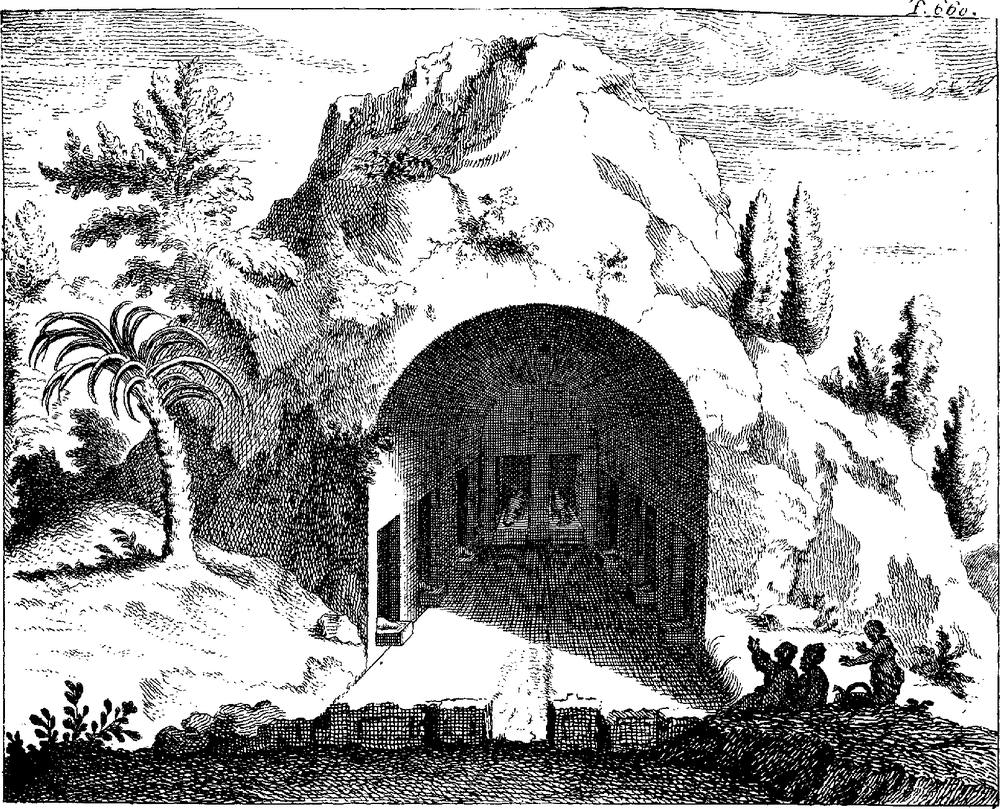
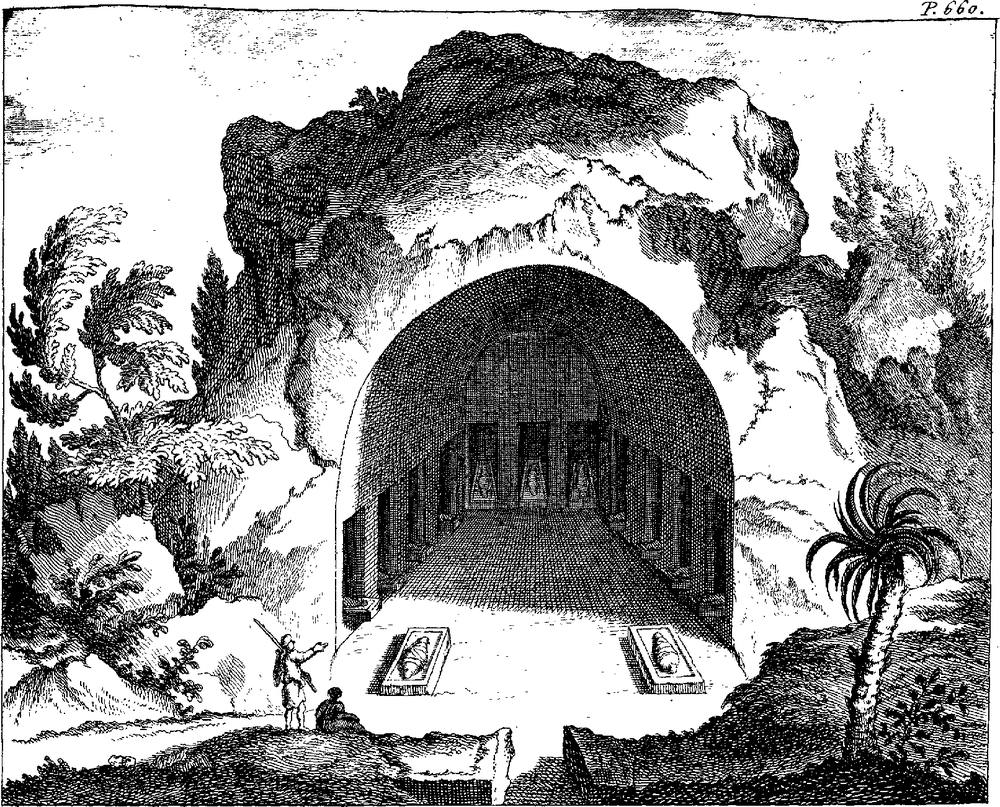
Sepulchre of David. We have already spoke of it under the Article DAVID, as also of the Riches that were pretended to be there conceal’d. Here is the Description that curious Travellers give us of this Sepulchre:7 ‘Tis a magnificent Edifice, which now is without the Walls of Jerusalem, but probably was then included within the Walls of the City. You first enter into a large Court, about six and twenty Foot square, cut out and smooth’d within the Rock, which is of Marble. On the Left -hand is a Gallery, cut out of the Rock likewise, as also the Pillars that support it. At the End of the Gallery there is a little Opening, thro’ which you pass by, creeping upon the Ground, to go into a large Chamber of about four and twenty Foot square, round about which there are other smaller Chambers, which communicate one with the other, by Doors of Stone. The Ceiling, the Doors, as well as the rest, their Hinges, their Posts, their Frames, &c. are all out of the same Rock, which is justly look’d upon as a Wonder; for the Doors were never out of their present Places, nor brought from elsewhere; they were work’d before the Chambers, and they still adhere to the same Rock, out of which they were wrought. In the Sides of the small Chambers now mention’d are several Niches, within which the Bodies of the Kings are deposited in Stone Coffins. This Work is perhaps the only real one that now remains of Ancient Jerusalem. See the Figure.
Sepulchre of the Maccabees, at Modin. See the Article of JONATHAN the Asmonean.
Sepulchre of the Kings of Judah. See the Article DAVID.
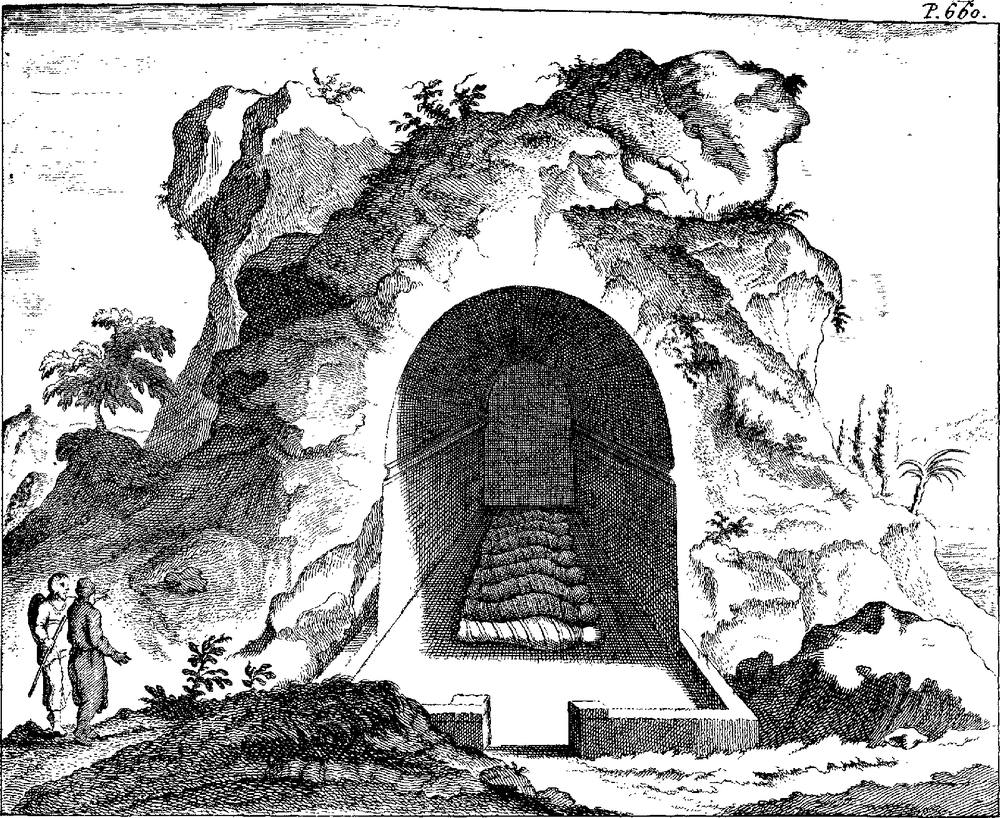
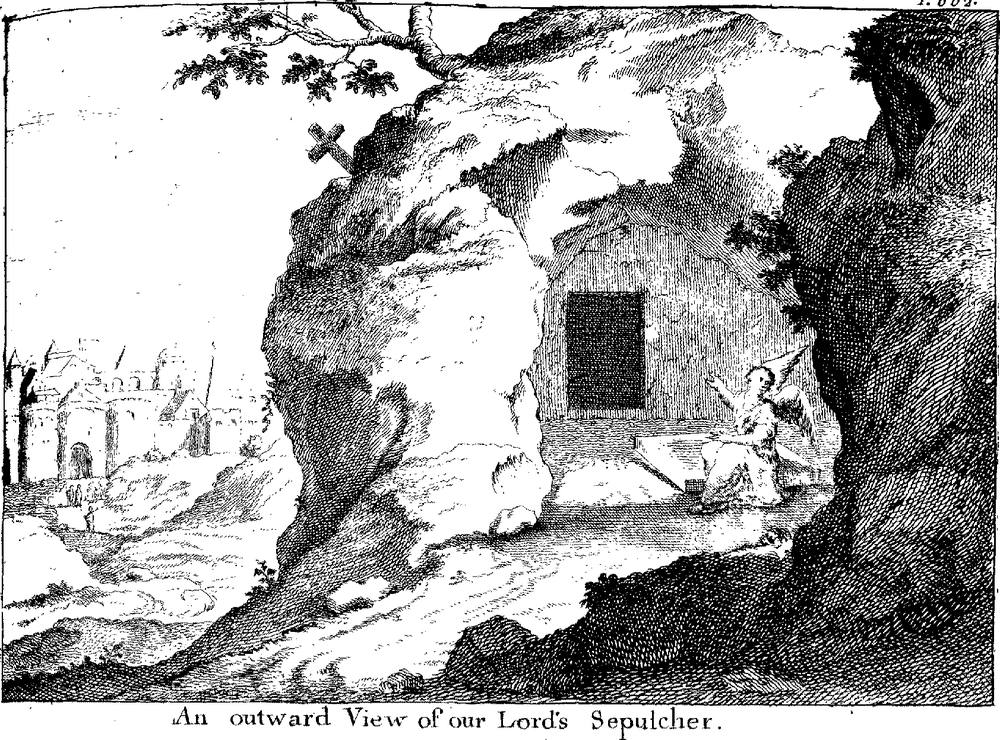
Sepulchre or Tomb of our Lord Jesus Christ. This was upon Mount Calvary, to John xix. 41.the North-west of Jerusalem, and was hewn out of a Rock, as the Gospel informs us. ‘Tis a kind of small Chamber, almost square within; its Height from Bottom to Top eight Feet and an Inch, its Length six Feet and an Inch, and its Breadth fifteen Feet and ten Inches. The Entrance, which looks towards the East, is but four Feet high, and two Feet four Inches wide: This Door Mark 16. 3. Matthew xxviii. 2.was shut up by a Stone out of the same Rock: ‘Twas to this Stone that the Chief Priests affix’d their Seal, and which the holy Women doubted they had not Strength to remove: Who shall roll us away the Stone from the Door of the Sepulchre? Lastly, ‘Twas upon this same Stone that the Angel sate down, after Jesus Christ was come out of the Tomb. The Place where the Body of our Saviour was laid takes up a whole Side of this Cave; ‘tis a Stone rais’d from the Ground to the Height of two Feet and four Inches; its Length is five Feet eleven Inches, and its Breadth two Feet and eight Inches, placed lengthwise from East to West. It remains even to this Day, but all incrusted with a white Marble. See the Voyage of Paul Lucas in Asia Minor, t. 2. p. 12, &c. He has several times visited this holy Place, and gives an exact Description of it, as it is to be seen at this Day.
Concil. t. 3. p. 561, 574.Sepulchre of the Holy Virgin. There are two Traditions concerning the Burial of the Holy Virgin, as there are two concerning the Place of her Death. Those who affirm, that she follow’d St. John the Evangelist to Ephesus, and that she died there, pretend, that her Tomb was still to be seen in the Year 431, when the Council of Ephesus was held: And this Opinion is expressly taken Notice of, in a Letter of this Council’s. According to another Opinion, she died at Jerusalem, where her Tomb is to be seen; which Opinion is as much follow’d as the other. Juvenal Bishop of Jerusalem, who could not be ignorant of what had pass’d at the Council of Ephesus, since he himself was present at it, wrote to the Empress Pulcheria, and to the Emperor Marcian, who sent to him for Relicks of the Virgin Mary, That her Tomb was shewn at Gethsemani near to Nicepb. Hist. l. 2. c. 32. & l. 15. c. 14.Jerusalem, but that it was empty. ‘Tis added, that when the Emperor was inform’d of this, he caus’d this Tomb to be brought to Constantinople, with an Handkerchief that was put therein, and which he caus’d to be set up about the Year 455, in the new Church consecrated to our Lady of Blaquern.
Yet since that time they have not left off to shew the Tomb of the Virgin at Jerusalem. Adamnan says, that it was to be Adamnan. de locis sanctis, c. 9. Beda, l. 3. lib. de loc. SS. c. 3.seen in the Valley of Jehoshaphat near to this City. Bede testifies, that it might be seen at Jerusalem in his Time, but empty. It was put into the Basilicon that the Empress Helena caused to be built there. Travellers assure us,8 that it may still be seen in the Vale of Jehoshaphat, wherein the Brook Kedron runs, but on the other Side of this Brook, over-against Gethsameni and the Mount of Olives; that the Part of the Monument which appears above-ground is very little raised; that they descend into the Sepulchre by fifty Steps; that it is made in the Form of a Cell, or small Grotto, where is seen something like an Altar of Stone, upon which the Coffin or the Body might have been placed; that both the Cell and the Altar are hewn out of the Rock. This is what they say of it; but this is not Authority enough to convince us, that this is the real Sepulchre of the Holy Virgin.
Sepulchre of Daniel, of Ezekiel, of the Maccabees, &c. See the Articles belonging to these Persons.
Read this article in its place on the printed pages
Footnotes
-
Œcum. in Ep. Judæ, ex antiquor. traditione. Glycas, parte 2. Annal. &c. ↩
-
Philo de Vita Mosis lib. iii. Epiphan. heres. 9, 84, &c. ↩
-
Clem. Alex. l. 1. Strom. Hilar. in Matth. xx. ↩
-
Clem. Alex. l. 6. Strom. Vide & Ambros. in l. 1. de Cain & Abel. c. 2. & Hieronym. in Amos vii. ↩
-
Bartholoc. Bibl. Rabbin. l. 3. p. 930. See Basnage’s History of the Jews, t. 4. l. 6. c. 17. ↩
-
Hieron. in Epitaph. Paulæ Epiphan. seu alius. Vita Prophet. Isidor. Doroth. alii. ↩
-
Thevenot. Voiage, part i. l. 2. c. 40. Maundrel’s Journey from Aleppo to Jerusalem. ↩
-
Brocard de locis SS. Adrichom. a Pietro della Valle, ex 13, &c. ↩