יובלJubel or Jobel.JUBILEE, in Hebrew, Jobel. The Jubilee year was the fiftieth year which fell out after seven weeks of years, or seven times Lev. xxv. 10.seven years: And ye shall hallow the fiftieth year; it shall be a Jubilee unto you. Notwithstanding the clearness of the text, several Commentators maintain that the Jubilee was celebrated in the forty ninth year, and exactly on the last year of the seventh week of Years. Moses favours this opinion, where he says, Lev. xxv. 8. Thou shalt number seven Sabbaths of years unto thee, seven times seven years, and the space of the seven Sabbaths of years shall be unto thee forty and nine years. They who maintain this shew the inconveniency there would be in celebrating the Jubilee in the fiftieth year, after the Sabbatical year, which falls out in the forty ninth year. These two years rest successively following one another might be attended with dangerous consequences in any country, and produce a famine there.
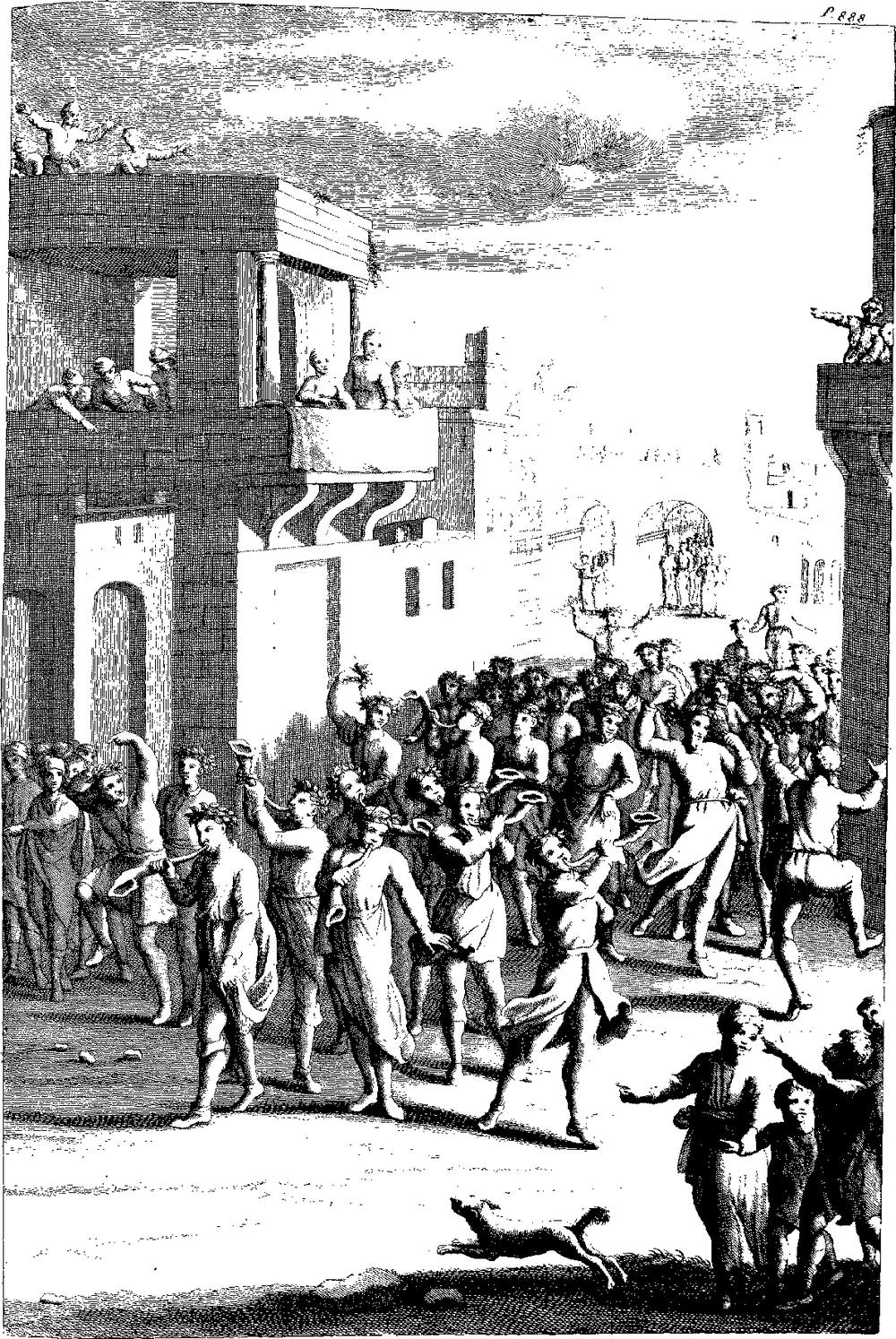
The Hebrew word Jobel signifies, according to some of the Rabbins, a ram’s horn, with which the Jubilee year was proclaimed. But how could a ram’s horn which is solid and not hollow, be made use of as a trumpet! It was therefore in all probability a brazen trumpet made in the form of a ram’s horn. Others derive the etymology of Jobel, from the Hebrew, Jubal, which formerly signified, as they say, to play upon instruments. We are of opinion, that it comes from the verb Hobil, to bring or call back; because then every thing was restored to its first possessor.
The Jubilee year began on the first day of Tizri, (which is the first month in the civil year, and answered our September) and about the Autumnal Equinox. In this year no one either sowed or reaped; but all were satisfied with what the earth Lev. xxv. 11, 12, 13, &c.and the trees produced of themselves. Every one took possession again of his inheritance, whether it were sold, mortgaged, or any way alienated. Hebrew slaves, however they came to fall into a state of slavery, were set free, together with their wives and children; even they who had renounced the privilege, which the Sabbatical year gave them of recovering their liberty. Even all foreign slaves enjoyed the right which was given by the Jubilee. There are some other particulars concerning this year, which may be read in Lev. xxv.
In order to reconcile the two opinions, which divide the Interpreters, relating to the Jubilee; namely, whether it shou’d be celebrated precisely in the fiftieth year, as Moses requires in Lev. xxv. 10. and as Philo, Josephus, Eusebius, S. Jerom, S. Austin, S. Gregory the great, S. Isidore, all the Jews, both Talmudists and Caraites, and a great number of Commentators understand it; or only in the forty ninth year, as Moses mentions pretty clearly in Lev. xxv. 8. and as several good Commentators1 and Chronologists explain it. To reconcile, I say, these two opinions, it may be said, I think, that the fiftieth year is set down for the forty ninth, for the sake only of making a round number; as we say every day, that there are eight days to a week, thirty to a month, five years to an Olympiad; tho rigorously speaking there are but seven days in a week, sometimes one and thirty, sometimes eight and twenty, nine and twenty or thirty days in a month, and four years only in an Olympiad. Besides, as the Jubilee year began after the conclusion of the forty ninth year, and at the beginning of the fiftieth, it might be called indifferently the forty ninth or fiftieth year.
The greatest difficulty consists, in knowing whether in both these years forty nine and fifty the sabbath was observed, and the earth remain’d untill’d, or only in the forty ninth year. One would think there should be too many inconveniences in observing the sabbatical rest for two years successively; the intention of the legislator was complied with, by the rest of one year only. The seventh of the sabbatical years had only more privileges annexed to it, and was more celebrated than the two preceding. By this expedient every thing is reconciled, and all difficulties disappear.
I shall here lay before you some particulars relating to the Jubilee year: it began on the first day of the month Tizri. But neither were the slaves restored to liberty, nor the lands returned to their first owners, till the tenth day of this month. The nine first days Maimonid. Halaca Schemitta Vejobel.were spent in joy and pleasures, almost like the Romans in their Saturnalia. During these nine days the slaves did not work for their masters, but they eat, drank, and were merry, and every one put a crown upon their heads. No sooner was the day of solemn expiation come, which is the tenth of Tizri, but the counsellors of the Sanhedrim ordered the trumpets to sound, and at that instant the slaves were declared free, and the lands returned to their old owners.
The motive of this Law was to hinder the rich from oppressing the poor, and reducing them to perpetual slavery, and that they should not get possession of all the lands by the ways of purchase, mortgage, or lastly, usurpation; that debts should not be multiplied too much, and consequently the poor intirely ruined: and that slaves should not continue always, they themselves, their wives and children, in servitude. Besides, Moses intended to preserve, as much as possible, the liberty of people’s persons, an equality of fortunes, and the order of families among the Hebrews. Lastly, he designed the people should be tied to their country, their lands, and inheritance; that they should have an affection for them, as estates which descended to them from their ancestors, and they were to leave to their posterity, without any fear of their going for ever out of their families.
Something like this Lycurgus establish-ed among the Lacedæmonians, in his instituting an equality of fortunes; banishing slavery, and promoting as far as he could any one’s becoming too powerful and rich. For this reason he appointed Ostracism, which consisted in banishing those citizens from the commonwealth, whose riches or too great power gave umbrage to others. Stolo was desirous of putting a check to the greediness and avarice of the old Romans, by making a law, which forbad any particular person’s having more than five hundred acres of land; but fraud soon crept in among them, and destroyed this wise constitution. Stolo himself was the first who violated his own law, and was condemn’d for possessing a thousand, jointly with his son, whom he had emancipated particularly for this purpose.
There were several privileges belonging to the Jubilee year which did not belong to the sabbatical year; and the sabbatical had likewise some small advantages above the Maimonid. loco citato. Selden. de successsion. in bona, l. iii. c. 24.Jubilee year: the sabbatical year annulled debts, which the Jubilee did not, but the Jubilee restored slaves to their liberty, and lands to their old owners; besides, it made restitution of the lands immediately upon the beginning of the Jubilee, whereas in the sabbatical year the debts were not discharged till the end of the year. The estates which had been purchased or given returned to their old masters; those which came by right of succession continued with those who enjoyed them: contracts of sale, wherein a certain number of years was expressed, subsisted during all those years, notwithstanding the Jubilee’s coming on. But absolute and unlimited contracts were voided by the Jubilee. Houses and other edifices built in walled towns did not return to the proprietor in the Jubilee year.
Maimonid. Hala. ha Schemitta Vejobel. Cunæus de Rep. Heb. l. i. c. 6. Joseph. Antiq. l. xi. c. ult.After the captivity of Babylon they continued to observe the sabbatical, but not the Jubilee year. Alexander the great granted the Jews an exemption from tribute every seventh year, by reason of the rest which they then observed. But as to the Jubilee, since it was instituted with a design only to prevent the utter destruction of the partition which had been made by Joshua, and the confusion of tribes and families, it was no longer practicable as before the dispersion of the tribes, those of them which returned from the captivity settling as they could, and where they could, and a great number of families, and perhaps whole tribes, continuing in the place of their captivity.
Usher places the first Jubilee, which was observed after the promulgation of the Law by Moses, in the year of the Julian period 3318, of the world 2609, before J. C. 1391, before the vulgar Æra 1395.
The second Jubilee in the year of the Julian period 3367, of the world 2658, before J. C. 1342, before the vulgar Æra 1346.
The third Jubilee, in the year of the Julian period 3417, of the world 2707, before J. C. 1293, before the vulgar Æra 1297, and so on. See the Chronological Tables, and reckon, as, if you please, you may, nine and forty years from Jubilee to Jubilee.
In imitation of the Jews, the Christians have likewise established Jubilees ; but they relate only to the forgiveness of sins, and the indulgence which the Church grants to sinners, by virtue of the power of binding and loosing, committed to it by Jesus Christ. These sorts of Jubilees were not established till the time of Pope Boniface VIII. in the year of J.C. 1300, nor did they begin to be called Jubilees till the reign of Sixtus IV. who was made Pope in 1471, and in his Bull dated in the year 1473, gave the name of Jubilee to that plenary and general indulgence which he granted to all the faithful. In the beginning, these Jubilees were appointed only every hundred years: but Pope Clement VI. reduced them to fifty. Gregory XI. fixed them to the space of three and thirty years; and Paul II. finding that this duration was still too long, ordained that there should be a Jubilee every five and twenty years; which from that time has been always practised. This, however, does not hinder the Popes from granting Jubilees likewise in the year of their consecration, and in the great necessities of the Church: but these are rather Indulgences in the form of Jubilees, than real Jubilees. I shall not enter farther into this matter, because it relates but indirectly to my subject; and the New Testament says nothing any where of Jubilees, unless in the way of implication, when it mentions the power of binding and loosing given to the Apostles, and that of using indulgence towards sinners who are truly penitent. See Matt. xvi. 19. and 2 Cor. ii. 10.
Read this article in its place on the printed pages
Footnotes
-
Hugo Cardinal. Mercator. Jul. Scaliger. Rador, &c. Cunæus de Rep. Heb. l. 1. c. 6. 3 in ↩