,שבתSabatum, Requies. Genef. ii. 2, 3.SABBATH. This Word, in Hebrew, signifies Rest. God having created the World in six Days, rested on the seventh; that is to say, he left off producing any new Beings, in the outward and visible Creation. He blessed this Day, and sanctified it, because he had rested upon it. From that time he set it apart, and appointed it in a peculiar Manner for his Worship. And the Hebrews, afterwards, in Consequence of this Designation, and to preserve the Memory of the Creation, sanctify’d, by his Order, the Sabbath-day, or the Seventh Day, by abstaining from all Work, Labour, and servile Employments, and by applying themselves to the Service of the Lord, to the Study of his Law, and to Prayer.
Sabbath (or Sabathum) is sometimes taken meerly for Rest; sometimes, for eternal Rest and Felicity in Heaven. See Hebrews iv. 4, &c.
The Days of Sabbath (Sabbatha) are taken, sometimes, for all the Jewish Festivals Lev. xix. 3, 30.indifferently. Keep my Sabbaths, that is, my Feasts, as, the Passover, Pentecost, Feast of Tabernacles, and the rest.
Sabbathum is also taken for the whole Week. Jejuno bis in Sabbatho, a I fast twice a Week. Una Sabbathi1 the First Day of the Week.
Upon Occasion of the Sabbath, it is disputed, whether God created the whole World by one only Fiat, all at once, by a simultaneous Action, and by a simple Act; or if he perform’d it at six distinct Operations, and in six Days successively, so that the seventh Day was really and truly a Day of Rest to the Lord, at the End of his successive Creation. Authors are much divided upon this Question. Philo2, Origen3, St. Austin4, Procopius5, and some Moderns, maintain, that God not only created Matter all at once, and in an Instant, but that at the same time He disposed it in Order, and gave every thing its proper Form, without staying for a Term of six Days. That the Account Moses gives of it, and the Distribution of the Works of the Creator into six Days, is not a Succession of Time, but only a Succession of Order and Reason, propos’d only by way of Accommodation to the Comprehension of the People, and to give them a distinct Notion of the Material Creation, by distributing it into Parts, and into a certain Disposition or Order.
But the greatest Part of the Fathers and Commentators maintain a successive Creation, agreeably to the Account given by Moses. And indeed, there is no Necessity of departing from the literal Sense of Scripture in this Place. The reiterated Acts, and the different Operations mentioned by Moses, ought indeed to be explain’d in such a manner, as is consistent with the infinite Power and perfect Simplicity of the Acts of the Creator, and which may exclude any manner of Notion of his Weakness, Weariness, or Imperfection. But all6 this may be done, without receding from a successive Creation. God, by his infinite Power, drew forth, out of Nothing, all the Matter of the Universe, or the Chaos; and, by his Wisdom, he gave the Parts all the Motions necessary, that the Chaos might display it self; and that its Parts being disengaged from one another, and each united again with others of the same Nature, might form what we call the Universe in the Condition in which we find it. This Motion, conducted by the Spirit and Wisdom of God, might continue six Days; after which, God rested himself, or ceased to produce any outward Being; but He continued still to act by his Providence and Concurrence, and to preserve the Work he had made, in the State of Beauty and Perfection in which he had created it.
As to those particular Beings, that could not be produced by a Continuation of the general Laws of Motion, communicated by God to Matter, as for Example, Men, Plants, and Animals, it must necessarily be acknowledged, that God form’d them successively, as Moses acquaints us, by applying, forming, animating Matter, agreeably to the Designs of his Wisdom; by inspiring into Man a reasonable Soul; by giving other Animals their several Instincts, for their Preservation and Producing their Kind; by putting into the Plants those Qualities that distinguish them from each other, and their Seeds and Grains that are proper for their Renovation.
Another great Question that is moved about the Sabbath, is, Whether, from the Beginning of the World, God gave the Law of the Sabbath; and whether this Day was always observed, at least among the better sort of the first Men, as the Patriarchs, before the Promulgation of the Law. Whether this be the Sense of these Words, Gen. ii. 2.And God blessed the seventh Day, and sanctified it. Some Fathers7 and some Jewish Doctors8 have asserted the Affirmative; and Menasseh Ben-Israel9 assures us, that, according to the Tradition of the Antients, Abraham and his Posterity having preserved the Memory of the Creation, observed the Sabbath also, in Consequence of the Natural Law that obliged them thereto. There are some also that believe, that the Religion of the Seventh Day is preserved among the Pagans, and that the Observation of this Day is as old as the World it self.
Philo de Mundi Opificio.In a Word, Philo says, that the Sabbath is not a Festival peculiar to any one People or Country, but is common to the whole World, and that it may be named the General and Publick Feast, and that of the Nativity of the World. Josephus advances, Joseph. contr. Apion. l 2. Euseb. l. 13. c. 12. Præp.that there is no City, either of Greeks or Barbarians, or any other Nation, where the Religion of the Sabbath was not known. Aristobulus, in Eusebius, quotes Homer and Hesiod, who speak of the Seventh Day as of a Day that is sacred and venerable. Clemens Clem. Alex. Strom. l. 5.Alexandrinus speaks of the Sabbath in the same Terms as Aristobulus, just now cited, and he adds some Passages from the Antients, which celebrate the Seventh Day.
Abenezra apud Boulduc in Job i. 2, 5. Bechaï ad Berefith. fol. 37. Ezek. xx. 12, 20.There are some that believe, that Job observed the Sabbath-day; because at the End of Seven Days he offered a Sacrifice to the Lord for his Children. Some Rabbins inform us, that Joseph also observed the Sabbath in Egypt.
But the contrary Opinion is not without its Proofs also. The greatest part of the Fathers and Commentators hold, that the Benediction and Sanctification of the Sabbath, mention’d by Moses in the Beginning of Genesis, signifies only that Appointment then made of the Seventh Day, to be afterwards solemnized and sanctified by the Jews. It does not appear from any Passage of Scripture, that the ancient Patriarchs have observed the Sabbath, or that God had any Design to oblige them thereto, before Philo Vit. Mos. l. 1.the Law took Place. Philo says, that the Hebrews having forgot which was the Day of the Creation of the World, began again to be apprised of it, when God having caused it to rain Manna all the other Days of the Week, did not permit it to rain any on the Sabbath-day. The Seventh Day, which was honoured by some Pagans, and of which they have spoke as of an Holy Day, was either dedicated to the Honour of Apollo; or it was in Imitation of the Jewish Sabbath, which some Pagans had in Honour heretofore, either out of Superstition or Devotion.
Ezekiel says expressly, that the Sabbath, and the other Feasts of the Jews, are Signs that God has given to his People, to distinguish them from other Nations. I gave them my Sabbaths, to be a Sign between me and them, that they might know that I am the Lord that sanctify them. And again, Hallow my Sabbaths, and they shall be a Sign between me and you, that ye may know that I am the Lord your God. And Moses in Deuteronomy v. 15. The Lord hath brought thee out of Egypt, therefore the Lord thy God commanded thee to keep the Sabbath-day. Justin Martyr10, Tertullian11, Eusebius12, St. Bernard13, advance, as a Matter not to be doubted, that neither the Patriarchs before the Deluge, nor those which came afterwards, observed the Sabbath. Irenæus says expressly, that Abraham had Faith, and was call’d the Friend of God; and yet was neither circumcised, nor observed the Sabbath. Abraham ipsè sine circumcisione, & sine observatione Sabbathorum, Deo credidit, & amicus Dei appellatus est. On this Subject may be seen Selden de jure naturali & gentium, juxta disciplinam Hebræorum, l. 3. c. 13, 14, 15. Spencer de legibus Hebræorum ritualibus, l. 1. c.4. Sect. 7, &c. and our Commentary upon Gen. ii. 3.
Ex. xxxi. 13. xxxv. 2.God gave the Precept of the Sabbath to the Hebrews, when they came to Marah, one Month after their coming out of Egypt, on the 15th of the Month Abib, which answers to our March, in the Year of the World 2513, before Christ 1487, and before the vulgar Era 1491. Manna began to fall, according to several of the Fathers,14 upon the Sunday, six Days before the Sabbath. According to others, it fell upon the very Eve of the Sabbath. However this be, ‘twas probably upon the Occasion of the Manna, that God commanded the Hebrews to observe the seventh Day, and not to go out to gather any on that Day, for none would fall then. The same Command of celebrating the Sabbath is found several times repeated in the Law.15 “ Remember to sanctify “ the Sabbath Day. You shall labour for “ six Days, and shall do whatever you “ have to do; but the seventh Day is the “ Sabbath of the Lord your God. Upon “ this Day you shall do no Work, neither “ you, not your Son, nor your Daughter, “ nor your Man-servant, nor your Maidservant, nor your labouring Beasts, nor “ the Stranger that shall reside among you. “ For the Lord in six Days made the Heaven and the Earth, and whatever is contain’d in them, and rested upon the “ seventh Day. Wherefore he blessed the “ seventh Day, and hath consecrated it to “ his Service ”.
Numb. xv. 32, 35.In another place it is said, that God established his Sabbath among the Children of Israel, as a Sign to make them call to mind, that he is the Lord that sanctifies them. He adds, that whosoever shall prophane the Sabbath shall be punish’d with Death; and we see the Execution of this Law upon the Man, who having gather’d Wood upon the Sabbath Day, was stoned by all the People for this Offence. Upon other Holy Days it was allow’d to light a Fire, and to dress Victuals; Ex. xii. 16.but this was expressly forbid on the Sabbath Day. The Rabbins confine this Prohibition Ex. xxxv. 2, 3.to servile Works only; as to bake Bread, to dress Meat, to forge Metals, &c. They suppose that for such sort of Works it is forbid to light a Fire, but not for one to warm himself. On the Sabbath Days the
hær. l. 4. c. 30.Ministers of the Temple enter’d upon their Week; and those that had attended the foregoing Week went out on that Day. They put upon the golden Table new Loaves of Shew-bread, and took away the Lev. xxiv. 8.old ones. Also upon this Day were offer’d particular Sacrifices of two Lambs for a Burnt-offering, with the Wine and the Meal that always accompanied these Sacrifices. Lastly, the Sabbath was celebrated, as also the other Festivals, from Evening to Evening. They began in the Evening, at which Time also they ended. A vesperâ usque ad vesperam celebrabitis Sabbatha vestra. And this is the whole, or very near it, that is commanded in the Law, concerning the Observation of the Sabbath.
And now let us inquire what has been the Practice of the Jews, in Consequence of this Institution. The first Obligation of the Sabbath express’d in the Law, is to sanctify Numb. xxviii. 9, 10it. Remember to sanctify the Sabbath Day. But it is sanctify’d by doing good Works upon it, by Prayer, by Praises and Thanksgivings, by publick and private Worship of God, by the Study of his Law, by Justice, Innocence, and Tranquillity of Mind. The second Obligation is that of Rest. Thou shalt do no Work upon the Sabbath. It was forbid to do any servile or laborious Works, that might fix the Mind, and interrupt that Attention which was to be given to God, and which is necessary when we pay any Worship to him worthy of his Majesty. The Jews have often varied about the Manner, in which they think they ought to observe the Rest of the Sabbath. In the Time of the Maccabees, they carry’d their Respect for this Day so far, as that they 1 Mac. ii. 32, 33, &c.durst not so much as defend themselves from any Invasion of the Enemy on this Day, even in the most pressing Necessity. Since this Time they have not scrupled to take Arms, and stand upon their necessary 1 Mac. ii. 41.Defence. But it may be seen by Josephus, that they would not attack their Enemies, nor hinder them from advancing their Works; nor would they march with their Antiq. l. xii. c. 3. xiii. c. 1. Antiq. l. xiii. c. 16. p. 450. Mat. xii. 11, 12.Armies, even in Time of War, or in the Enemies Country, upon the Sabbath Day.
In the Time of our Saviour, they would not water their Cattle, or take a Beast out of a Ditch that should happen to fall in, on the Sabbath Day: But by a false Delicacy they could not bear with our Saviour’s Healing the Sick on that Day. Since that Time they have determin’d, that a Man might give Food to a Beast, that should happen to fall into a Pit, but must not take him out on that Day. The same Jews complain’d of our Saviour’s Mat. xii. 1, 2. Mark ii. 27.Disciples, that passing through the Corn-fieldson the Sabbath Day, and being pressed with Hunger, they gather’d some Ears of Corn, and rubb’d them between their Hands, in order to eat the Grains of Wheat. This Action of his Apostles, our Saviour excused only from the Necessity of the thing, and because they had need of Nourishment; adding, that the Priests themselves in the Temple do some Work, which every where else would be esteem’d Violations of the Sabbath; and that the Son of Man was Lord of the Sabbath; and lastly, that the Sabbath was made for Man, and not Man for the Sabbath.
The Rabbins reckon up nine and thirty primary Prohibitions, which ought to be observed on the Sabbath Days, and several other secondary ones dependant on them, which are also obligatory. Their Number is so great, that it is almost impossible to keep them all; and the Rabbins make no Difficulty to own, that if the People of Israel could keep but two Sabbaths as they ought to be kept, they should soon see themselves deliver’d from the Evils under which they groan. Their Scrupulosity Vid, Buxtorf. Syn. Jud. c. xi.goes so far, as even to forbid to peel or to roast an Apple, to kill a Flea, a Fly, or any other Insect, if it is big enough, as that the Sex may be distinguish’d; to sing, or to play upon an Instrument, so as it may be loud enough to awaken a Child. Yet notwithstanding all this, the Samaritans16 pretend that the Jews are not religious enough in the Observation of the Sabbath. As for them, they will not light a Fire on this Day, they abstain from the Use of the Marriage-bed, they don’t stir from their Places, save only to go to the House of the Lord. They employ themselves wholly upon that Day in reading the Law, in praying to God, and in Thanksgivings.
Of all the Festivals that God has enjoin’d them in his Law, there are none of which the Jews are so jealous, or of which they speak so magnificently, as of the Sabbath. They call it their Spouse, because God has given it to them alone, exclusive of all other Nations of the World17. Here is an Extract of what may be found concerning this Matter, in Leo of Modena,18 who alone is equivalent to all the modern Jews. The Rabbins, says he, have reduced all that is forbid to be done on the Sabbath Day, to these thirty-nine Heads, each of which have their Circumstances and Dependences: These are, to till the Ground, to sow, to reap, to make Hay, to bind up Sheaves of Corn, to thrash, to winnow, to grind, to sift Meal, to knead the Dough, to bake, to shear, to whiten, to comb or card Wool, to spin, to twine or twist, to warp, to dye, to tye, to untye, to sew, to tear or pull in Pieces, to build, to pull down, to knock with a Hammer, to hunt or fish, to kill a Beast, to flay it, to dress it, to scrape the Skin, to tan it, to cut Leather, to write, to scratch out, to rule Paper for writing, to light a Fire, to extinguish it, to carry any thing from Place to Place, to expose any thing to Sale.
Besides these, there are other things forbid, as Consequences from these. For Instance, to file is comprehended under grinding, to curdle Milk under building, and so of others. They must neither light or put out a Fire or Lamp, and commonly they keep Christian Servants in their Houses, to do such Offices for them on the Sabbath Day. They not only forbear from carrying any Burdens, but upon this Day they will not put on their Cloaths, even what is necessary; and carry their Exactness so far, as to inspect the Ornaments and Cloaths of their Women, Children, and Servants. On this Day they speak of no Business or secular Affairs; they neither give or receive, neither sell or buy, or make any Bargain. They handle no Tool, nor any thing that is heavy; they touch no Money, go neither on Horse-back or in a Boat. They don’t bathe themselves, nor use any chirurgical Operations, but in Cases of great Necessity.
They may walk as much as they please within the City or Suburbs where they inhabit; but they must not go out of the City or Suburbs, above the Distance of two thousand Cubits, as we shall mention by and by.
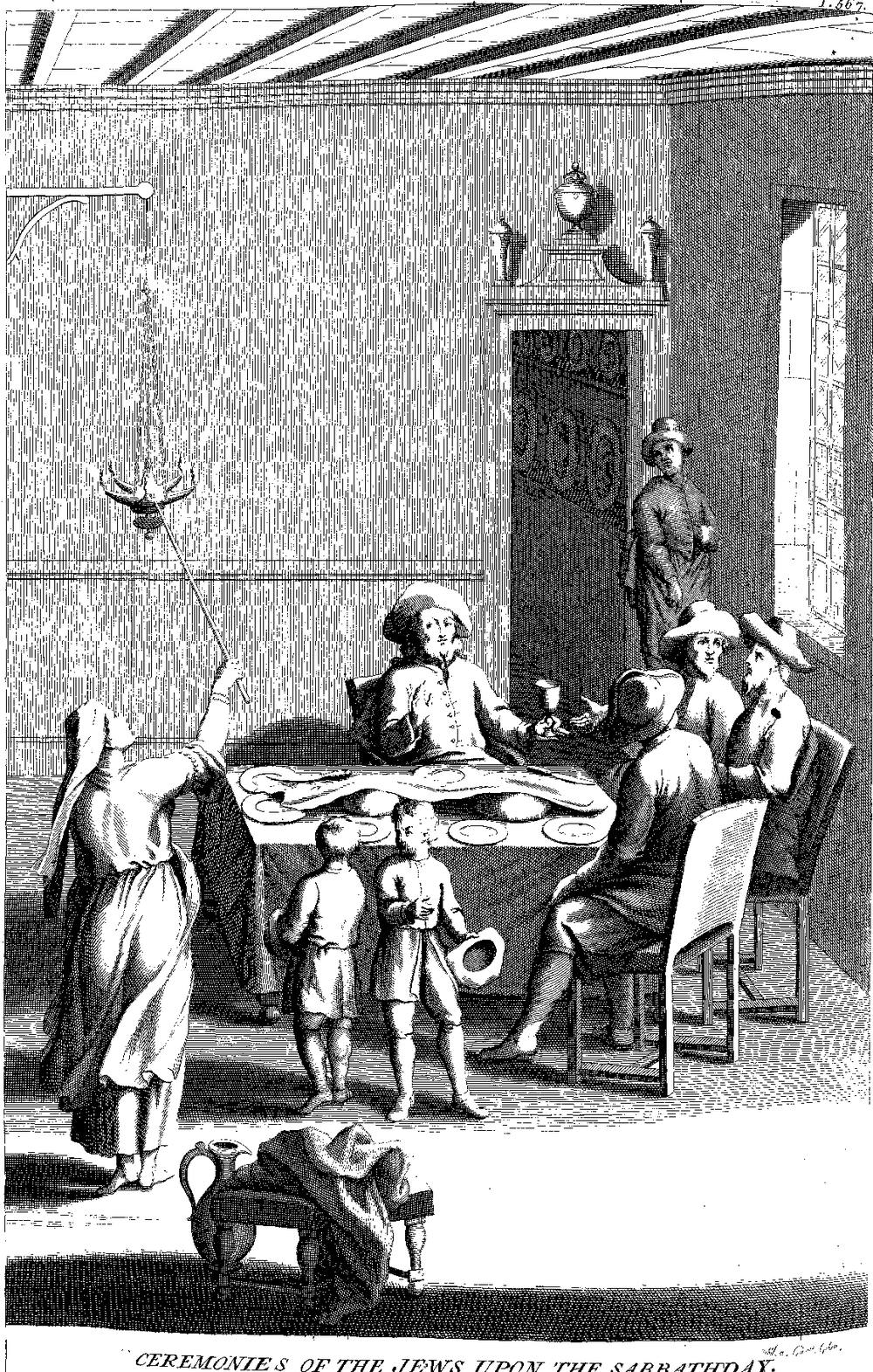
They undertake no Work on the Friday, but such as may be easily finish’d before the Evening. About an Hour before Sun-set, they put into a warm Place what they have prepar’d to eat the Day following; and about half an Hour before Sun-set all Work is left off, and the Sabbath is suppos’d to be begun. Then the Women are obliged to light a Lamp in their Chambers, which Lamp commonly has six Wicks, or, at least, four, and it burns a great Part of the Night. They also set out a Table cover’d with a fair Table-cloth, whereon they put Bread, which they cover with another long, narrow Cloth.
There are some of ‘em, who, to begin the Sabbath well, will put on clean Linen, and wash their Hands and Face. They all go to the Synagogue, where they rehearse certain Prayers set down in their Books, after which they return to their Houses, and salute one another by wishing a good Sabbath.
Being come Home, the Fathers bless their Children, and the Masters their Disciples; then sitting down to Table, the Master of the Family pronounces certain Blessings on the Bread and Wine, and makes mention of the Institution of the Sabbath. He drinks a little of the Wine that he hath bless’d, and gives it round to all that are at Table. He does the same by the Bread, and then they entertain themselves as well as they can. On the Sabbath Day in the Morning they rise later than upon other Days; and being come to the Synagogue, they rehearse several Psalms and Prayers, in Commendation of the Sabbath, intermingled with Singing, and the ordinary Prayers. Then they bring out the Pentateuch, and seven Persons read the Section that comes to be read in order. Then they read a Section out of the Prophets, which has some relation to what was read out of the Law. Lastly, He that holds the Book in his Hands, lifts it on high, and gives his Blessing to all present. They pray afterwards for those Princes under whose Jurisdiction and Protection they live; and they make a Sermon or Exhortation in the Morning or Afternoon, according to the Custom of the Place.
When Night comes, and they can discover in the Heaven three Stars of a moderate Magnitude, then the Sabbath is ended, and they may return to their ordinary Employments. Those who go to the Synagogue, add to the common Evening Prayers, certain Lessons and Benedictions, which have relation to the Sabbath; and as they think, that the Punishment of the Souls in Purgatory ceases on that Day, they prolong its Continuance as much as they can. When every one is return’d to his Home, they light a Taper or Lamp, which has, at least, two Wicks, the Master of the House takes Wine in a Cup, and sweet-scented Spices, and after pronouncing some Benedictions, he blesses the Wine and the Spices; then he flavours the Spices, and throws the Wine upon the Ground, in Token of Chearfulness, and pronounces some Blessings. Thus the Ceremony of the Sabbath is ended. Those that meet one another make their Compliments, by wishing each other a happy Week.
Some antient Fathers quote the Law which injoins the Rest of the Sabbath, with this Exception; You shall do nothing upon this Day, except what is for the Health of the Soul, or the Preservation of Life; or lastly, except in such things wherein Life is in Danger. Omne opus servile non facietis in eo, præterquam quod ad animam pertinet, as Tertullian reads it; or, as he says elsewhere, Tertul. adv. Judæo c. 4. Idem cont. Marcion. l. 4. c. 12. Hieron. in Il. xxviii.nisi quod fiat omnis animæ. Or lastly, as St. Jerom reads it, Lege præceptum est, ne in Sabbatho opus servile faciamus —— ut illa tantum faciamus, quæ ad animæ salutem pertinent. A very antient Gloss this, and authorised by the Practice of the Primitive Jews, who us’d to allow the taking of a Beast out of a Ditch, that should happen to fall in on the Sabbath, and was in Danger of its Life. And much more did they think it allowable to do good Works, either Moral or Charitable.
Such prophane Authors as have ventured to speak of the Original of the Sabbath, have only shew’d their Ignorance of Tacit. l. 5. hist.the Jewish Affairs. Tacitus thought they observed the Sabbath in honour of Saturn, to whom Saturday was consecrated in the Pagan Religion. But Plutarch asserts, it Plut. Sym. l. 4. p. 671.was kept in honour of Bacchus, who is call’d Sabbos; and because in the Festivals of this false Deity they us’d to cry Saboi. Appio l. 2. p. 1061, 1062, 1063.Appion the Grammarian maintain’d, that the Jews celebrated the Sabbath in Memory of their being cured of a shameful Disease, which in the Egyptian Language was call’d Sabbosis. Also Pagan Authors speak pretty frequently of the Fast of the Sabbath, as if the Jews had ordinarily fasted on this Day. Recutitaque Sabbatha Sat. 5.palles, says Persius. And Petronius, Et non jejuna Sabbatha lege premet. They were not aware, that Fasting was utterly forbid the Jews on the Sabbath; but either very grossly misunderstood the Sabbath for the whole Week, in which some of the Jews fasted two Days; or they took it in too comprehensive a Sense, for all sort of Feasts; and because they us’d to fast on the Day of the solemn Expiation, they very improperly concluded that they fasted upon all Sabbath Days.
A Sabbath Day’s Journey. We have already Joseph. Antiq. l. 13. c. 16. p. 450.explain’d from Josephus, under the Article of JOHN HIRCANUS, that, in an Expedition he made beyond EuphratesMat. xxiv. 20., with the King of Syria, he was the Occasion that the whole Army halted on a Sabbath Day; which proves that long Journeys were forbidden the Jews on that Day. We see the same thing in the second Book of the Maccabees, viii. 26, 27. where Judas could not pursue the Victory he had obtain’d over Nicanor, because of the Interposition of the Sabbath. Pray ye that your Flight be not in the Winter, neither on the Sabbath Day, says our Saviour in the Ovid. de remed. amor.Gospel. And Ovid says, Fear not the Rain, and let not the Jewish Sabbath hinder you.
Nec pluvias vites, nec te peregrina morentur Sabbatha.
Acts i. 12.But, however, it is evident they were allow’d to go a certain Space on the Sabbath Day, since we know they went, at least, to the Temple or Tabernacle, from the remote Parts of the City or Camp. And St. Luke informs us, that the Mount of Olives was distant from Jerusalem the space of a Sabbath Day’s Journey. Sabbathi habens iter. The Rabbins generally fix this space at two thousand Cubits. Josephus says, that the Mount of Olives was five Stadia from Jerusalem, which make six hundred and twenty-five Paces. Thus the Journey that might be made on a Sabbath Day, was about six or seven hundred Paces, or something more. For the De bello, l. 6. c. 3.same Josephus, in another Place, puts the Mount of Olives at six Stadia from Jerusalem. Origen, quoted by Oecumenius19, says, that the Journey of a Sabbath Day is one Mile, or two thousand Cubits. The Jews20 also have us’d to make a Mile consist of two thousand Cubits: So that their Cubit must be two Feet and an half, since their Mile contains a thousand Paces, or five thousand Feet, taking their Paces at five Feet a-piece. Maimonides21 will have it, that he that does not know exactly the Distance of a Place, may walk upon the Sabbath Day two thousand moderate Paces, which makes a thousand geometrical Epiph. hæres. 66.Paces of five Foot each. Epiphanius says, that the Jews believe it is not allow’d them to walk upon the Sabbath Day above six Stadia, or seven hundred and fifty Paces. The Syriack Translator of the Acts of the Apostles puts about seven Stadia for a Sabbath Day’s Journey; which is according to what some Rabbins say22, that a Mile is seven Stadia and an half. Upon this see Selden de Jur. Nat. & Gent. l. 3. c. 9.
Sabbathum secundo-primum. The second Sabbath after the first. Luke chap. vi. 1. This Expression has much divided the Commentators. Some23 have taken it for the second, others24 for the last Day of unleavened Maldon. Mercat. Ex. xxiii. 10. Levit. xxv. 2, 3, &c.Bread; and some for the Day of Pentecost. The Passover was the first Sabbath, according to them, and Pentecost the second. Others have thought, that the first grand Sabbath was the first Sabbath of the Civil Year, in the Month Tizri; and that the second was the first of the Holy Year, or of the Month Nisan. But Joseph Scaliger,25 who is follow’d in this by a great Number of able Writers26, thinks that to have been the first Sabbath, which follow’d the second Day of unleavened Bread. The Jews thus reckon’d their Sabbaths from the Passover to Pentecost; the first was call’d secundo-primum, or second after the first; that is, the first after the second Day of unleavened Bread. The second was call’d secundo-secundum, or the second Day of the Sabbath after the second Day of unleavened Bread. The third was call’d secundo-tertium, or the third Day of the Sabbath after the second Day of unleavened Bread. And so of all the rest, as far as secundo-septimum, that is to say, the seventh Day of the Sabbath after the second Day of unleavened Bread. This seventh Sabbath immediately preceded Pentecost, which was celebrated the fiftieth Day after the second Day of unleavened Bread. See the Commentators upon St. Luke, chap. vi. ver. 1.
Parasceue Sabbati, or the Preparation for the Sabbath, is the Friday before; for as it was forbid to make a Fire, to bake Bread, or to dress Victuals on the Sabbath Day, they provided against this Day, and prepared on Friday every thing that was needful for their Sustenance on the Sabbath Day. See the Article PARASCUE before.
The Sabbath transferr’d to Sunday. The Obligation of giving a Portion of our Time to God to be employ’d in his Worship and Service, is founded upon natural Right. The Law of Moses had fix’d this to the seventh Day, or the Sabbath for the People of the Jews. The Apostles of Jesus Christ, to do Honour to the Day of his Resurrection, have also determin’d it to be every seventh Day, and have fix’d it on Sunday, or the first Day of the Week among the Hebrews, and on the Day dedicated to the Sun by the Pagans. This Day, among us Christians, is known by the Name of the Lord’s-Day. See the Article SUNDAY.
Sabbatical Year was celebrated among the Jews from seven to seven Years, when the Land was to rest, and to be left without Culture. They set Slaves at Liberty, and every one re-enter’d into the Inheritance Levit. xxv. 2, 3, 4.that had been alienated.
God appointed the Observation of the Sabbatical Year, to preserve the Remembrance of the Creation of the World; to enforce the Acknowledgment of his sovereign Authority over all things, and particularly over the Land of Canaan, which he had given to the Hebrews, by delivering up the Fruits of their Fields to the Poor and the Stranger. It was a kind of Tribute which they paid to the Lord for it. Besides, he intended to inculcate Humanity to his People, by commanding that they should resign to the Slaves, to the Poor, to Strangers, and to Brutes, the Produce of their Fields, of their Vineyards, and of their Gardens.
It has been much disputed, at what Season of the Year the Sabbatical Year began. Some have been of Opinion, that it began on the first Month of the sacred Year, that is, at Nisan, or in the Spring. Others think it began at the first Month of the civil Year, or at the Month Tizri, which answers nearly to our September. Moses does not explain himself upon this Matter very clearly. He says only, that the Land shall not be cultivated, and that there shall be no Harvest for that Year. In Palestine, the Time of Sowing both of Wheat and Barley was in Autumn; and Barley-harvest began at the Passover, and that of Wheat at Pentecost. Therefore, to enter into the Spirit of the Law, for observing the Rest of the Sabbatical Year, that the Land may not remain two Years without Cultivation, we must necessarily begin it at Autumn, after all the Crops were gather’d in: They did not till the Land in Autumn, and they had no Harvest after the Winter; but the Autumn following they began again to cultivate the Land, that they might reap their Harvests in the Spring and Summer following.
In the Sabbatical Year all Debts were Deut.xv.2. Ex. xxi. 2.remitted, and the Slaves were set at Liberty. But were Debts absolutely forgiven, or was the Payment of them only suspended? Hebr. Drusius. Estius, alii.Several think, that this Remission was absolute, and that all Debts were totally extinguish’d in the Sabbatical Year. The Caution of Rich Men, taken Notice of by Deut.xv.9.Moses, who would not lend to their Brethren at the Approach of the Sabbatical Year, seems to prove, that after this Year nothing was to be hoped for from their Debtors. For if the Payment of Debts was only suspended till this Year was over and past, it would not have been a sufficient Motive to hinder them from lending. As there was no lending for Interest in the Case, which was forbid to the Hebrews towards their Brethren, as it could be only a simple Loan, the Creditor might require it again either before or after the Sabbatical Year, upon the Supposition of those who think that the Remission was not absolute27.
Rab. Grot.Others distinguish between Debts mortgaged upon Security, the Contracts of which included a Clause of perpetual Debts; and those that were not mortgaged, but made upon simple Contracts: These last were for ever acquitted on the Sabbatical Year, but the others not so. Menochius also thinks, that the Remission of Debts was general and absolute, but not of Loans or Deposits. All this regarded only the natural Hebrews, or such as were Proselytes to Judaism, but not Strangers.
‘Tis also inquired, whether Debts were remitted, and Slaves set at Liberty, at the Beginning or only at the End of the Sabbatical Year. The Hebrew says literally,28 At the End of every seven Years thou shalt make a Release. This has given Occasion to some to think, that Debts were not remitted, nor Slaves set at Liberty, till the End of the Sabbatical Year. But most are of a contrary Opinion, that it was the Beginning of the Sabbatical Year. The original Text explains it very naturally of the End of the Week of the Year, after which came the Sabbatical Year, with which it concludes.
Sabbatical River, or Sabbation. Josephus says,29 That, when Titus went into Syria, as he pass’d between the Cities of Arces or Arques, which belong’d to the Kingdom of Agrippa, and the City of Raphanea in Syria; he saw the River call’d the Sabbatical River, which falls from the Libanus into the Mediterranean Sea. This River runs only upon the Sabbath Day, or rather, at the end of seven Days. All the intermediate Time its Channel is dry; but on the seventh Day it flows in abundance into the Sea, and even with an impetuous Stream. Hence it comes, that the Inhabitants of the Country have given it the Name of the Sabbatical River. ‘Tis probable that Pliny means the same River, when he says, that there is a Brook in Judea, which continues dry every seventh Day. In Judæa Rivus omnibus Sabbathis siccatur. A little before he speaks of a Fountain in the Isle of Andros, that every seventh Day yields a Liquor of the Taste of Wine; but this Liquor takes again the Quality of Water, as soon as it is taken at any Distance from the Temple of Bacchus, which is in this Island.
The Greek Text of Josephus intimates, as we have already said, that this River runs only on the Saturday: But to reconcile this with Pliny, who affirms, on the contrary, that it is dry only on the Saturday; and with other Evidences of but little Certainty, which speak of a certain Sabbatical River, which continues dry every Sabbath: Casaubon, Fuller, and some others30, make a Transposition in the Greek Text of Josephus, to make him say the direct contrary of what he said before. It should seem indeed, that the Sabbatical River would not well express the Rest of the Sabbath, if it runs only upon this Day: To express it significantly, it ought to cease running on this Day, in Imitation of the Repose and Rest of the Jews.
The Rabbins31 mention another Sabbatical River, or Sambation, but very different from this now spoken of. They place it beyond the Euphrates, in a very distant Country, where they pretend that the ten Tribes are still intire and subsisting: There they possess very great Riches and Estates. The River of which they speak, runs all the Week with a very rapid Stream, and makes so great a Noise, that it is heard in the Night-time at the Distance of a Day’s Journey, and in the Day-time at half that Distance. It is so broad, so deep, and so rapid, that it is impossible to go over it; and on the Sabbath Day, on which it does not run at all, they place Guards on the River, that the Israelites may not go over it. Jonathan, the Son of Uziel, to whom is ascribed a Chaldee Paraphrase, has mention’d the River Sabbation. This Author, they say, is more antient than Josephus. But it is believed, the Paraphrase we have under his Name, was not his, and that Josephus is the first and only Author of the Sabbatical River, which probably never existed; at least nothing is known of it at this Day, nor is it mention’d by any Traveller or Geographer. For as to what Pliny says of it, ‘tis very likely he took it from Josephus.
‘Tis true, Dominick Magri, in his Travels into Syria, at the Age of nineteen Years, assures us, that he came to the Banks of the Sabbatical River with his Caravan, upon a Friday, June the Twenty -first, in the Evening, where he saw the River dry about Sun-set on the Friday, and continue dry till the next Day; when, the Caravan going away, he had not the Opportunity to observe, whether the River began to run again on Saturday-Evening, after the Rest of the Sabbath Day was over. This Traveller appeals to the Merchants in his Caravan, and the Country People that inhabit the Place, as Witnesses of what he affirms; and he infers from thence, that Josephus was mistaken when he says, that this River runs only upon the Saturday, since, on the contrary, it runs all the Week excepting Saturday. But it were to be wish’d, that Magri had observed not one Night only, but one or several whole Weeks, in order to have been a competent Witness of so extraordinary a Fact as this is. There are many Causes that may dry up a Stream that falls from the Mountains; and it is very possible, that, on this Occasion, Chance alone may have produced this Effect on the Friday Evening. See Bartolucci, Bibliotheca Rabbinica, t. 1. p. 117, 118.
Read this article in its place on the printed pages
Footnotes
-
John xx. 1, 19, Luke xxiv. 1. Acts xx. 7. 1 Cor. xvi. 2. ↩
-
Philo Allog. l. 1. & de Mundi Opificio, p. 6, 41. de Civit. l. 7. lib. xii. Conf. c. 29. ↩
-
Orig. l. 6. cont. Celf. ↩
-
Aug. l. 4. de Genef. ad Litter. c. 18, &c. lib. xi. ↩
-
Cajet. Canus. ↩
-
Luke xviii. 12. Vulgate. ↩
-
Vide, si placet, Clem. Alex. l. 5. Strom. Euseb. Præpar. l. 13. c. 12. ↩
-
Men. B. Is. de Creat. Prob. 8. ↩
-
Vide Rab. apud Selden. de Jure Nat. & Gent. l. 3. c. 13, &c. ↩
-
Just. Dial. cum Tryph. ↩
-
Tertul. l. 4. cont. Jud. c. 4. ↩
-
Euseb. Hist. Eccl. l. 1. c. 4. Præp. l. 7. c. 3. Dem. l. 1. c. 6. in Psalm xci. 1. ↩
-
Bern. in Cantic. serm. 50. ↩
-
Origen. homil. 7. in Exod. Synod. Cæsar. apud. Bed. Ambrosiaster in 1 Cor. x. 5. Athanas. serm. 25. de temp. apud Aug. ↩
-
Exod. xx. 8, 9, 10, 11. Levit. xxiii. 3. Deut. v. 12. ↩
-
Letter of the Samaritans to Mr. Huntington. ↩
-
Vide Selden. & Rabb. ab eo citatos l. 3. c. 10. de jure nat. & gent. ↩
-
Leo of Modena, part 3. c. 1. of the Ceremonies of the Jews. ↩
-
Oecum. in Acta. Μίλιον ἓν ἡ τῶ Σαββάτω ὁδὸς ὡς φησὶν Ὠριγένης ἐν τῷ πέμπτῳ στρωματεῖ, διχιλίων πηχῶν ὑπῆρχεν. ↩
-
Reland. Palæst. l. 2. c. 1. p. 397. ↩
-
Maim. in Hilcoth. Sab. c. 27. §. 4. ↩
-
Gemara Bara Metzia, fol. 33. 1. & Gemar. Joma fol. 67. 1. Harmon. Evang. Vat. Pisc. Druf. Bez. 13. in Baron. alii passim. ↩
-
Isidor. Peluf. l. 3. Ep. 110. Euthym. ↩
-
Epiphan. hæres. 51. n. 31. Osiand. Not. ad ↩
-
Scalig. de emend. Temp. l. 6. ↩
-
Lightfoot in Luc. Casaubon. Exercit. ↩
-
Cajet. Burg. Piscat. in Deut. xv. Basnag. Antiquities of the Jews, t. 1. p. 29. ↩
-
Deut. xv. 1. LXX. Δὶ ἑπτὰ ἐτῶν. ↩
-
Joseph. de bell. l. 7. c. 24. p. 976. Πολὺς γὰρ ὤν ὅτε ῥεῖ, καὶ κατὰ τὴν φορὰν ἀσχολῶν, ἔπειτα δὲ πᾶς ἐκ τῶν πηγῶν ἐπιλείπων, ἐξ ἡμερῶν ἀριθμόν, ξηρὸν παραδίδωσιν ὁρᾶν τὸν τόπον. Εἶθ’ ὥσπερ ἀδεμίας γινομένης μεταβολῆς, ὁμοίως κατὰ τὴν ἑβδόμην ἐκδίδωσι, καὶ ταύτην ἀεὶ τὴν τάξιν ἀκριβῶς τηρήσαι διαφυλάττων. ↩
-
Casaub. adverf. Baron. Exercit. 15. n. 20. Fuller. Miscellan. Sacr. l. 1. c. 4. p. 2236. See the Translation of M. Arnaud d’ Andilly. Thus they read the Greek. Πολὺς γὰρ ὤν ὅτε ῥεῖ, καὶ κατὰ τὴν φορὰν ἀσχολῶν, ἐξ ἡμερῶν ἀριθμόν, ἔπειτα δὲ πᾶς ἐκ τῶν πηγῶν ἐπιλείπων, κατὰ τὴν ἑβδόμην ἐκδίδωσι. ↩
-
Vide Rabbinos in Bibliot. Rabbinic. Bartholocci, t. 1. p. 100, &c. ↩