SYNAGOGUE.1 This Greek Word signifies either an Assembly, or the Place where the Assembly meets. In the first Sense is commonly understood the Church of the Jews, compared or opposed to that of the Christians. Thus we say, that the Synagogue is a Slave, that it is reprobated, that it is the Rival of the Christian Church. St. John in his Revelations, speaking of Hereticks that corrupted the sound Doctrine of Jesus Christ, calls them the Synagogue of Satan.
St. Jerome, in the Latin Text of the Vulgate, gives the Name of Princes of the Synagogue, or of the Assembly, Principes Synagogæ, to those principal Jews who had the Precedence among the People in their Assemblies in the Desart. We find also, Synagoga Deorum, Synagoga potentium, Synagoga peccatorum, Synagoga populi, Synagoga superborum, for the Assembly of the Judges, of great Men, of Sinners, of the People. Mention is made in the Maccabees of the 1 Macc. ii. 42.Synagogue of the Assideans, who probably were a kind of Sect, or Order of the Jews, which made a Profession of stricter Piety.
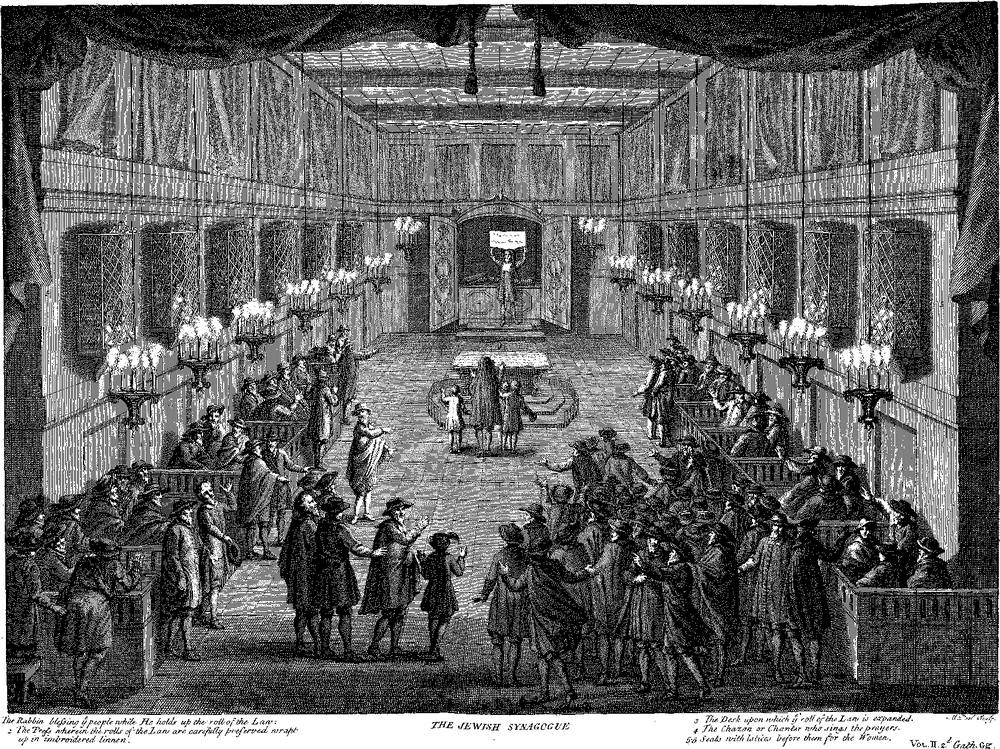
2 Kings iv. 23. Judith vi. 21. Ps. lxxiv. 8. Ezekiel xxxiii. 31Synagogue most commonly signifies the Place where the Jews assembled to pray, to read, and to hear the reading of the holy Books, and other Instructions. It is often mention’d in the Gospels and the Acts, because Jesus Christ and his Apostles generally went to preach in the Synagogues. The Origin of these Synagogues is not very well known, and many learned Men have thought them a late Institution. Yet we see some Footsteps of them even in the Time of Elisha. Devout Persons in the Time of this Prophet assembled themselves to him on the Sabbath-Day, to hear the Law read to them. Judith pass’d the Night in Prayer, in a Place of Prayer at Bethulia. Her History is commonly placed under Manasseh. The Author of Psalm lxxiv, describing the Havock that the Army of Nebuchadnezzar had made in Jerusalem, says, They have burnt up all the Synagogues of God in the Land. The Captive Jews beyond the Euphrates assembled themselves to Ezekiel, to hear the Word of the Lord. Mordecai made all the Jews of Shushan to come into the Place of Prayer, to recommend to God the Undertaking of Est. iv. 16. 3 Macc. c. ult. Act. xv. 21.Queen Esther. The Author of the third Book of Maccabees, who lived under Ptolemy Philopator, King of Egypt, a long Time before the Persecution of Antiochus Epiphanes, says, that the Jews of Egypt being deliver’d from the Danger that threaten’d them, set up a Place of Prayer near Alexandria. See PROSEUCHE. Saint James says in the Acts, that Moses of old Time hath in every City them that preach him, being read in the Synagogues every Sabbath-day.
After the Time of the Maccabees, Synagogues became so frequent in Israel, that there were some in almost every Place in the Country. Maimonides says,2 that where-ever any Israelites were found, there they us’d to build a Synagogue. ‘Tis affirm’d, that in the City of Jerusalem alone,3 were no less than four hundred and sixty, or even four hundred and eighty. Every trading Fraternity had one of their own, and even Strangers built some for those of their own Nation. Hence it is, that in the Acts of the Apostles we find the Synagogues of the Alexandrians, of the Asiaticks, of the Cilicians, of the Freed-men, of those of Cyrene, appointed for such of the Inhabitants of these Cities, or of these Nations, as should at any Time be at Jerusalem. We shall speak afterwards of the Synagogue of the Freed-men, or Synagoga Libertinorum.
The Synagogue was a publick Edifice, situate either within or without the City, and generally in an elevated Place. The Jews would have them more eminent than the other Buildings, or private Houses, and always insisted upon this, unless they were hindred by a superior Power. Generally they were cover’d, and thereby distinguish’d from the Proseuches, which were commonly in the Fields, and open to the Heavens. In the midst of the Synagogue was a Desk or Pulpit, upon which the Book or Roll of the Law was read very solemnly. There likewise he stood who intended to harangue the People. At the highest Part of the Synagogue, or towards the East,4 and over-against the Door, which is always to the West, as far as can well be, is the Chest or Press, wherein the Book or Roll of the Law is kept, wrap’d up in some fine embroider’d Cloth. The Women are there distinct from the Men, and seated in a Gallery inclosed with Lattices, so that they may see and hear, but not be seen.
Every Synagogue has its Chief, or perhaps several Chiefs and Officers, more or fewer, according to the Circumstances of Places. There is one call’d Chazan,5 who appoints and chants the Prayers. There is another who keeps the Keys, and is a kind of Church-warden, whom they call Sciamas, or Servant. The Prince of the Synagogue, in the Gospel, call’d Archisynagogus; and the Matth. v, 22, 35.Angel of the Synagogue, or Sage, in Hebrew, Chacham, presides in the Assemblies, and in judicial Affairs that are sometimes there decided, against those who have given any Scandal, and transgress’d the Law in any important Matter; They inflict upon the guilty Person thirty-nine Strokes with a Whip. The same Presidents invite those to speak in the Synagogue, whom they think capable of it, and offer that Honour to Strangers, if there are any that seem to have the Gift of Speaking. Thus our Saviour often spoke in these Assemblies; and St. Paul, Luk.iv.16. Mat.iv.13. ix. 35. & passim. Acts xiii. 13, 14, 15.being at Antioch of Pisidia, was invited by the Princes of the Synagogue, to make a Discourse to them for their Edification.
The Word Synagoga, as signifying a Place of Assembly, is us’d also to express Christian Churches. For Example, Saint Jam. ii. 2.James says, If there come unto your Assembly (or Synagogue) a Man with a Gold Ring, Heb.x.25.&c. And St. Paul says, Not forsaking the assembling of our selves together, as the manner of some is, where the Greek reads Synagogue.
The Synagogue of the Freed-men, Synagoga Libertinorum, was, according to many Acts vi. 9.Interpreters, that of those Jews, who having been led away captive by Pompey and by Sosius,6 had afterwards recover’d their Liberty, and were retired to Jerusalem, when Tiberius drove away the Jews out of Italy.7 Others will have it, that St. Luke wrote Lybistinorum, and not Libertinorum; and that the Lybistini were People of Libya, joining to Egypt. Libertini is not a Greek Word, and Lybistini would better suit with the Tenor of Saint Luke’s Discourse; but the Manuscripts are not favourable to this Conjecture. See the Commentators upon Acts vi. 9.
The Jewish Authors8 give this general Rule for the Construction of Synagogues. Where-ever there are ten Batelnim, a Synagogue ought to be built. The Signification of the Word Batelnim has been much controverted. Buxtorf9 thinks them to be Persons receiving a Stipend for duly assisting at divine Service, that there may be always ten Persons, at least, to assemble together. Lightfoot imagines them to have been Ministers and Officers of the Synagogue. But the most probable Opinion is, that they were Persons of a mature Age, free, and in a Condition to assist constantly at the Service, on all Days of assembling, which are, at least, two Days a Week, besides the Sabbath. So that always upon these Days there were present that Number of Assistants, without which the Service could not be perform’d. The three Days of assembling were Monday, Friday, and Saturday, without including the Days of Fasting or solemn Festivals. On these Days they repaired three times to the Synagogue, in the Morning, Afternoon, and in the Evening, where they said their Prayers. As for other Days, they also pray’d three times in private. See PRAYERS.
The great Synagogue. The Hebrews a give this Name to a Company of six-score Persons, at the Head of whom was Ezra or Esdras, at their Return from the Babylonish Captivity. This Company was chiefly establish’d for two Reasons. The first was to take Care of restoring the Observation of the Law, according to the antient and approved Practice, that obtained before the Captivity. The second was, to collect all the sacred Books into a Body, and to compose thereof what is call’d the Canon of the Holy Scriptures, and to give an exact and correct Edition of them. They pretend, that after Esdras, Daniel and his three Companions Shadrach, Meshech, and Abednego, held the first Places ; that Simon the Just was at the lower End of the Assembly, and that all these Members were cotemporary.
But this Disposition cannot be supported by Chronology ; for Simon the Just lived a long Time after Daniel and Esdras. But the Hebrew Chronologers do not look so narrowly into Matters. What appears to be most certain in this Affair, is, that Esdras began the Reformation now mention’d ; that it was continued by some of the wiser and more enlightned Jews, and was at last compleated, especially as to the Canon of the Scriptures, under Simon the Just, who was made Highpriest of the Jews in the Year of the World 3702, before Jesus Christ 298, before the vulgar Era 302 ; and who died in the Year of the World 3711, before Christ 289, before the vulgar Era 293.
Read this article in its place on the printed pages
Footnotes
-
Συναγωγὴ, Synagoga. Heb. בית הכנסתDomus Congregationis. ↩
-
Maimon. in Tephilla, c. 11. sect. 1. ↩
-
Gemarr. ad tit. Megillah. c. 3. ad tit. Cethuboth. c. 13. ↩
-
Maimon. apud Joan. Selden. l. 3. c. 16. n. 1. de Synedriis veter. Hebr. ↩
-
Leo of Modena, Ceremonies of the Jews, part. 1. c. 10. ↩
-
Joseph. Antiq. l. 14. c. 7, 8. & de bello, l. 1. c. 5. p. 719. & Antiq. l. 14. c. 28. ↩
-
Tacit. Annal. l. 2. Sueton. in Tiberio, c. 36. & Joseph. Antiq. l. 18. c. 5. ↩
-
Megilla c. 1. §. 3. Maimon. in Tephill. Vide & Lightfoot, Harm. c. 17. & in Matth. iv. 23. ↩
-
Buxtorf. lex. Rab. p. 292. ↩