SOLOMON, or Salomon, Son of David and Bath-sheba, was born in the Year of the World 2971, before Christ 1029, before the Vulgar Era 1033. His Name Solomon signifies Pacifick, or Peaceable. The Lord 2 Sam. xii. 24, 25.loved him, and sent the Prophet Nathan to David, to assure him of his Affection towards the Child, and to give Solomon the Name of Jedidiah, or, The Beloved of the Lord. This was, probably, when Nathan assured David, that this Son should succeed him, and that it should be he that should inherit the Promises that the Lord had made him some Years before,1 when he had conceiv’d the Design of building a Temple to the Lord: For then God told him, by the Prophet Nathan,2 “You shall not build
“ build me an House; but when your Days are compleated, and you are gather’d to your Fathers, I will set one of your Children upon the Throne after you, and will strengthen his Reign; ‘tis he that shall build a House to my Name, and I will establish his Throne for ever: I will be a Father to him, and he shall be my Son, and I will not take away my Mercy from him, as I did from your Predecessor: I will fix him in my Kingdom and in my House for ever, and his Throne shall not be shaken: I will be his Father, and he shall be my Son; and if he does any thing amiss, I will chastise him with the Rod with which Men are chastised, and will punish him with the Stripes with which the Children of Men are punished, but will not take away my Mercy from him.”
From this time David thought only of preparing what was necessary for the building of the Temple, and of giving Solomon such an Education as might bear some Proportion to the great Designs that God had ordained him to. But towards the End of David’s Reign,3 Adonijah, David’s eldest Son, began to make himself popular, to set up a Court, and to act as if he were to succeed to the Crown of his 1 Kings i. 5,6,7.Father. David did not restrain him; Joab, Abiathar, and several of the principal Men of the Court, were in his Interest: But he had neither Zadok the High-priest, nor Benaiah, nor the Prophet Nathan, on his Side. One Day, when Adonijah had invited several of his Friends to a great Feast, which he prepared for them near the Fountain of Rogel, he invited neither Zadok, nor Nathan, nor Benaiah. Upon which, Nathan went to Bath-sheba the Mother of Solomon, and said to her; “ Do you know that Adonijah is going to “ declare himself King, without David’s “ Knowledge or Consent? Go therefore, “ and present yourself before the King, “ and say to him; My Lord the King, “ did not you promise me with an Oath, “ that Solomon my Son should reign after “ you? Why then does Adonijah reign? “ While you are speaking thus to the “ King, I will come in, and support what “ you shall say.” Bath-sheba follow’d Nathan’s Counsel; 1 Kings i. 32,33,34.and David being inform’d of Adonijah’s Intrigues, sent for Zadok the High-priest, the Prophet Nathan, and Benaiah the Son of Jehoiada, and gave them these Orders; “ Go and set my Son Solomon upon “ my own Mule, and conduct him to “ Gihon, where let Zadok and Nathan “ give him the Royal Unction, and found “ the Trumpet before him, saying, Long “ live King Solomon! ” These Orders they obey’d; Solomon was anointed King of Israel; they brought him back amidst the Acclamations of all the People, and caus’d him to sit upon the Throne of David. This Prince blessed the Lord on his Account, saying; “ Blessed be the “ Lord, who has this Day permitted me “ to see with my own Eyes my Son “ Solomon sitting upon my Throne. ”
Those that were with Adonijah, hearing 1 Kings i. 49.what had passed, rose from Table in a great Consternation, and every one retired to his own Home. Adonijah himself, being in fear of King Solomon’s Resentment, took Refuge at the Horns of the Altar, and made his humble Supplication to this Prince, That he would promise him, upon Oath, not to put him to Death. Solomon made answer, That if he behaved himself for the future like a good Man, and a faithful Subject, one Hair of his Head should not fall to the Ground; but if he should ever find him guilty of any evil Practices, he should surely die. Adonijah upon this quitted his Azylum, and came to pay his Duty to King Solomon.
And now the Day of David’s Death being near at Hand,4 he sent for his Son 1 Kings ii. 1, 2, 3.Solomon to him, and earnestly recommended to him a strict Fidelity and Piety towards God. He bid him not let Joab or Shimei go unpunish’d; but to shew all possible Friendship and Acknowledgment to the Sons of Barzillai, who had succour’d him in his Distress. He told him also, that since God 1 Chron. xxii. 2, 3, 4, 5. & xxviii.had reserved for him the Honour of building him a Temple, he ought to discharge this Trust with all possible Zeal and Diligence. He put into his Hands the Schemes that he had made for the Execution of this Undertaking, and the Accounts of the Treasures he left him for the perfecting this Edifice. He gave him also the Lists of the Priests and Levites, and the Courses in which they were to wait in the Temple. He 1 Chron. xxiii,xxiv, xxv, xxvi.gave him likewise the Schemes and Regulations of the Officers of his own Court, of the Civil Officers, of the Treasurers, and of the Superintendants of the Revenues belonging to the Crown. Lastly, in a general Assembly 1 Chron. xxvii.of the People, and of all the great Men of the Kingdom, David deliver’d over all the Gold, Silver, and valuable Materials, that he had collected for the building of the Temple, and exhorted all that were present to make every one their Offering to the Lord, 1 Chron. xxix. 1, 2, 3, &c.each according to his Abilities and Inclination. They all contributed with a chearful Heart, and the Quantity of Gold and Silver was very extraordinary. After which David died in the seventieth Year of his Age, having reign’d forty Years5.
Solomon now enter’d into the full Possession of the Kingdom of his Father, and was acknowledg’d by all Israel. Soon after this his Brother Adonijah made Intercession 1 Kings ii. 13, 14.with Bath-sheba, that she would intreat for him with Solomon, that he might have Abishag the Shunammite to Wife. Bathsheba recommended this Request of his to her Son Solomon; but he perceiving Adonijah’s evil Intentions, that he asked for Abishag who had been Wife to David, only to strengthen his Interest, and to favour the Pretensions that he might one Day make to the Crown; Solomon order’d Adonijah to be put to Death. He also banish’d from his Presence the High-priest Abiathar, and confin’d him to his Country-House, because he 1 Kings ii. 26, 27.had been of Adonijah’s Party. Lastly, when Joab heard what had happen’d to Adonijah and Abiathar, he began to be afraid for himself, and retired into the Tabernacle as a Place of Refuge. Solomon commanded him 1 Kings ii. 28,29,&c.to be brought from thence, and to be put to Death. But Joab refusing to forsake his Azylum, he order’d him to be slain in that very Place; desiring that the Blood that had been unjustly spilt by that Man, might not be imputed to the House of David, or be a Blemish to his Reign. Lastly, Solomon order’d Shimei to build him a House in 1 Kings ii. 36, 37.Jerusalem, and not to stir from thence. Shimei obey’d this Order for a Time, but then some Servants of his running away from him, and entering themselves into the Service of Achish King of Gath, Shimei goes thither to reclaim them. When Solomon was inform’d of this, he sent Benaiah the Son of Jehoiada to fall upon him and kill him.
Solomon being thus confirm’d in his Kingdom,6 he contracted an Alliance with Pharaoh King of Egypt, and marry’d his Daughter. He brought her to Jerusalem, and had Apartments for her in the City of David, till he should build a Palace for her, as he did some Years after, when he had finish’d 1 Kings iii. 1, 2, 3.the Building of the Temple. ‘Tis thought it was on the Occasion of this Marriage, that Solomon composed the Canticles, or Song of Songs, which is a Kind of Epithalamium. To the same Time and Occasion is also referr’d Psalm xlv. My Heart is enditing a good Matter, &c. This Marriage has not been generally approved. The Scripture speaks of the Daughter of Pharaoh, as one 1 Kings xi. 1, 2. Neh. xiii. 26.that contributed to pervert Solomon; and it is very likely, that at first this Princess might seem to be converted to the Lord, but afterwards might return to her idolatrous Worship, and engage the King her Husband in it. Pharaoh gave the City Gezer, as a Portion with his Daughter, which City he had conquer’d from the Canaanites, in the Country of the Philistines. Solomon afterwards rebuilt and fortify’d it.
After this a Solomon, accompany’d by all his Troops, and all Israel, went up to Gibeon,7 which was then one of the most famous High-places in the whole Country. He there offer’d a thousand Burnt-offerings upon the brazen Altar that was in that Place. And the Night following God appear’d to him in a Dream, and said to him; “ Ask of me what you have a mind that I shall give you. ” After Solomon had returned Thanks for all the Favours that God had conferred upon his Father David, and for the Honour he had done him also, in placing him upon his Father’s Throne; he begg’d of God to give him a wise and understanding Heart, and such Qualities as were necessary for the Government of the People committed to him. This Request was agreeable to the Lord, who said to him; “ Since you “ have asked neither Glory, nor Riches, “ nor Victory over your Enemies, and “ have desired only Wisdom to govern “ your People; I grant it you, and shall “ add all those other Things that you “ might have asked me; so that no King “ of all the Ages past shall have been “ equal to you in this respect. ” At his awaking in the Morning he consider’d this Dream, and perceived it was not an ordinary Dream. He return’d to Jerusalem, where he offer’d a great Number of Sacrifices upon the Altar, which was before the Ark of the Lord, and made a great Feast for his Servants.
Then two Women of ill Reputation came before the King,8 and said to him; “ That one of them had stifled her Child “ in her Sleep, and having privately convey’d it to her Companion, she stole “ away her live Child, and pretended it “ to be her own. ” As each of these Women eagerly maintain’d the live Child to belong to her, and the dead one to the other, and no one could convince them, the thing being transacted without any Witnesses; the King bid the Attendants to cut the live Child into two equal Parts, that each of the Women might have half the Child they contended for. Then the real Mother of the Child, finding herself moved by natural Affection, said to the King; “ Let not the Child be divided, “ but rather let her take the whole Child.” The other, on the contrary, approved of ix. 16, 17. 1 Kings iv. 1, 2, 3, &c. 1 Kings iv. 24. 2 Chron. ix. 26.the Sentence of the King, and said; “ Let “ the Child be neither hers nor mine, but “ let it be divided between us. ” Upon which Solomon, without any further Hesitation, determin’d, that the Child should not be kill’d, but given to her that was for preserving its Life, for she was the real Mother of it. All Israel hearing of this Decision, were fill’d with Reverence and Respect for the King, perceiving the great Wisdom that was in him.
Now Solomon enjoy’d a profound Peace through all his Dominions; all Judah and Israel lived in the greatest Security; and his Neighbours either pay’d him Tribute, or were his Friends and Allies. He ruled over all the Countries and Kingdoms, quite from the Euphrates to the Nile, and his Dominion extended even beyond the Euphrates. He had a very great Number of Horses and Chariots of War. Instances of his Wisdom were as numerous as the Sand of the Sea, and he exceeded all the Orientals, and all the Egyptians, in Wisdom and Prudence. In a Word, he was the wisest of Mankind, and his Reputation was spread through all Nations. He compos’d or collected three thousand Proverbs, and a thousand and five Canticles. (The Septuagint and several Interpreters read five thousand instead of a thousand and five, as it is in the Hebrew.) He knew the Nature of all Plants and Trees, from the Cedar upon Libanus, to the Hyssop that grows upon the Wall. He treated also of Beasts, of Birds, of Reptiles, of Fishes. There was a Concourse of Strangers from all Countries to hear his Wisdom, and Ambassadors from the most remote Princes that had heard of his Fame. He made Gold and Silver as common in Jerusalem as Stones in the Street;9 and Cedars as plentiful as the Sycamores that grow in the Field.
As soon as Hiram King of Tyre knew that Solomon was made King of Israel, he sent Ambassadors to him, to congratulate his Accession to the Crown; and some time after,10 Solomon sent Ambassadors to him, to desire him to supply him with Wood and Workmen, and to assist him in building a Temple to the Lord.11 Hiram gladly undertook what Solomon desired of him: He sent him word, He would order Cedar-trees and Fir-trees to be cut down in Mount Libanus; that his People should put them on Floats, and bring them by Sea to the Harbour of Joppa, from whence Solomon might send to fetch them to Jerusalem. Solomon, on his Part, obliged himself to give Hiram for the Maintenance of his Family and Workmen, twenty thousand12Measures of Wheat, and twenty thousand Measures of Oil. a Josephus adds;13 that he furnish’d him with Wine also; and 2 Chron. ii. 10.indeed in the Chronicles it is said, that Solomon gave to Hiram’s Workmen, that work’d for him in Libanus, Wheat, Barley, Wine, and Oil.
Josephus says besides,14 that even in his Time were preserved in the Archives of Tyre, the Letters that Solomon and Hiram wrote to each other. He cites Dion and Menander, who said that these two Princes us’d to send Ænigma’s to one another, in order to be solved; that Solomon having once sent a Riddle to Hiram which he could not explain, Hiram was obliged to pay him a great Sum of Money. But after this a Tyrian, call’d Abdemon, gave a Solution of them, and propos’d others to King Solomon, which he could not explain, and therefore was fore’d to give the King of Tyre a good Sum. Thus it is related by Josephus.
Solomon began to work upon the building of the Temple in the fourth Year of his Reign, and the second after the Death of David;15 four hundred and fourscore Years after the Coming out of Egypt16. We shall not here give a Description of this Temple, but refer the Reader to the Article of the Temple of Solomon. He employ’d in this great Work seventy thousand Proselytes, who were the Remains of the antient Canaanites, in carrying Burthens upon their Shoulders; fourscore thousand in cutting Stones out of the Quarries in the Mountains; and three thousand six hundred17 to oversee the Works. Besides which, he employ’d thirty thousand Israelites to work in the Quarries of Libanus. These thirty thousand Men were commanded by Adoniram, and only ten thousand of them work’d at a Time, and that for a Month only, so that they had always two Months of 1 Kings vi. 37. 1 Kings v. 14.Rest between. Hiram also sent to Jerusalem a very skilful Workman, whose Name also was Hiram,18 whose Mother was of the Tribe of Dan,19 and his Father was by Nation a Tyrian; he could work in Gold, Silver, Brass, Iron, Marble, Wood, and in all Sorts of Work of Linen, Embroidery, and Tapestry. He had the Direction of all the Works of the Temple. ‘Twas he that had the Management of the Foundery, and cast most of the principal Things himself. See HIRAM.
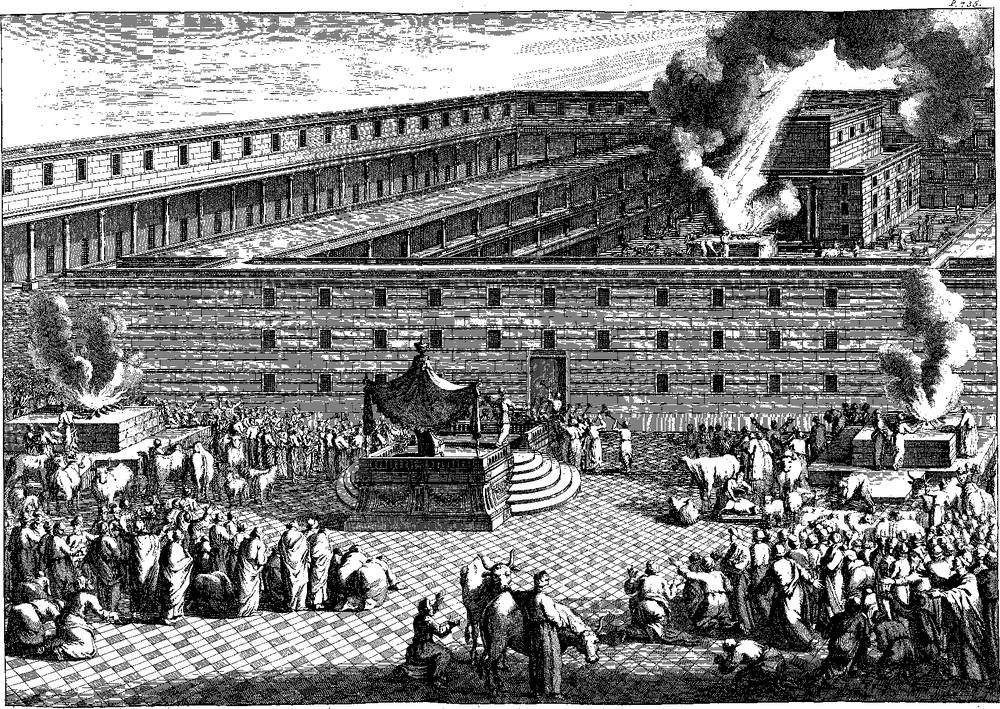
The Temple of the Lord having been begun in the fourth Year of the Reign of Solomon, was compleated in his eleventh Year; so that he was but seven Years in performing this vast Piece of Work.20 The Dedication was made in the Year following,21 which was the 3001 Year of the World. To make this Ceremony the more august, Solomon chose for it the eighth Day of the seventh Month of the Holy Year,22 which was the first of the Civil Year, and answer’d to our Month of October. The Ceremony of the Dedication lasted for seven Days, at the end of which began the Feast of Tabernacles, which continued still seven Days longer; so that all the People continued at Jerusalem fourteen or fifteen Days, from the eighth to the twenty-second of the seventh Month. Solomon caus’d to be present at this Solemnity all the Elders of Israel, and all the People. The Priests and Levites carry’d into the Temple, first, all the Presents that David had made to it, and which were laid up in the Treasuries of the Sanctuary; then they set up in their several Places, the Ornaments and Vessels appointed to the Service of the Altar and of the Sanctuary; lastly, they brought thither the Ark of the Covenant with great Solemnity, the King and all the People walking before, while the Priests offer’d an infinite Number of Sacrifices in all the Places through which the Ark passed.
When the Ark was placed in the Sanctuary, while the Priests and Levites, in their turns, were celebrating the Praises of the Lord, the Temple was fill’d with a miraculous Cloud; so that the Priests, out of Veneration, could no longer continue there, nor go on with performing the Functions of their Ministry. Then Solomon, being upon his Throne,23 prostrated himself with his Face to the Ground; then raising himself up, and turning towards the Sanctuary, he address’d his Prayer to God, and beseech’d him, that the House he had built might be acceptable to him, that he would bless and sanctify it, and hear the Prayers of those that should address themselves to him from this holy Place. He beseech’d him also to fulfil the Promises he had made to David his Servant, in favour of his Family, and of the Kings his Successors. As soon as he had finish’d his Devotions to God, he turn’d himself to the People, and blessed them; 1 Kings viii. 55, 56. 2 Chron. vii. 1, 2, 3.when Fire coming down from Heaven, consumed the Victims and Burnt-sacrifices that were upon the Altar, and the Glory of the Lord fill’d the whole Temple; so that even the Priests could not go into the Temple, to perform their respective Offices.24 Then the Children of Israel, who were all Witnesses of this Miracle, fell down upon their Faces, worshipping and adoring the Lord.
On this Day the King caused to be sacrificed twenty-two thousand Oxen, and six-score thousand Sheep for Peace-Offerings. And because the Altar of Burnt-offerings was not sufficient for all these Victims, a the King consecrated the Court of the People, and there offer’d Sacrifices in great Numbers. But the Lord appear’d a second time to Solomon in a Dream; probably in the Night that follow’d the first Day of the Dedication; and said to him: “ I have heard your Prayer, and have “ chosen this Temple to be my House of “ Sacrifice. My Eyes shall be open, and “ my Ears attentive to the Prayers of those “ that shall call upon me in this Place. “ And as for you, if you walk before me “ as David your Father walked before me, “ and if you keep my Statutes and Ordinances, I will preserve your Throne, “ and you shall always have Successors of “ your Race, to sit upon your Throne. “ But if you or your Children shall turn “ away from me, I will destroy you out “ of this Land that I have given you, and “ will make my People the Reproach of “ the World, and this Temple shall become an Occasion of Wonder to all Nations, because of the Destruction I shall “ bring upon it. ”
After the seven Days of the Dedication were over, and the other seven Days of the Feast of Tabernacles, Solomon dismiss’d the Assembly of the Israelites, and all the People return’d to their own Habitations, praying that all sorts of Blessings might shower down upon the King. Solomon afterwards25 thought of building himself a Palace, and another for his Queen the King of Egypt’s Daughter.26 He was thirteen Years in finishing these Buildings, and us’d therein whatever the most exquisite Art or the profusest Riches could furnish him with, to make them magnificent, and fit for the greatest Prince that was then in the East. The Palace in which he generally chose to reside, was call’d The House of the Forest of Libanon, probably because of the great Quantity of Cedar that was us’d therein, or because of the great Number of Columns on which it was built. To shew his Gratitude to Hiram King of Tyre, who had been very useful to him in his Buildings,27 he gave him twenty Cities in the Province of Galilee. Hiram went to see them, but it seems he did not like them, for he said; What Cities are these which thou hast given me, my Brother? And he called them the Land of Cabul unto this Day. See the Article CABUL. Hiram also sent Solomon six-score Talents of Gold; probably he lent them Solomon to go on with his Buildings.
Besides these vast Undertakings now mention’d, Solomon also built the Walls of Jerusalem,28 the Place call’d Millo in the same City; he repair’d and fortify’d Hazor, Megiddo, Gezer, the two Beth-horons Upper and Lower, Baalath, and Palmyra in the Desart of Syria. He also fortify’d all the Cities where he made his Magazines of Corn, Wine, and Oil, and those where his Chariots and Horses were kept. He brought under his Government all the Hittites, the Hivites, the Amorites, and the Perizites, which any where remain’d in the Land of Israel. He made them Tributaries, and compell’d them to work at the publick Works he had undertaken. As to the Israelites, he would not employ them in this Labour, but made use of them in his Armies, and set them over his Chariots and Horses.
He fitted out a Fleet at Ezion-geber, and at Elath or Elan, upon the Red-sea, to go to Ophir.29 Hiram King of Tyre furnish’d him with Mariners, and such as understood Navigation, who instructed the Subjects of Solomon. They perform’d this Voyage in three Years, and brought back with them Gold, Ivory, Ebony, precious Wood, Peacocks, Apes, and other Curiosities.30 In one Voyage they brought Solomon four hundred and fifty Talents of Gold, or, as it is in the First Book of Kings, only four hundred and twenty. About the same Time the Queen of Sheba,31 a Country of Arabia-Felix, or, according to others, of the Isle of Meroe, formerly call’d Sheba, came to Jerusalem, attracted by the great Fame of King Solomon. She brought with her rich Presents of Gold, Spices, and Precious-stones; and with a Design to try if Solomon’s Wisdom was as great as had been represented, she propos’d several Ænigma’s and hard Questions to him, to hear his Solutions. But Solomon gave her such satisfactory Answers, that she own’d, what had been told her of his Wisdom and Magnificence, was far short of what she had found. The King, for his Part, conferr’d great Honours on her, and made her rich Presents, so that she return’d into her own Kingdom very well pleas’d. The Reader may see what has been said of the Queen of Sheba, under the Article NICAULE.
Solomon was one of the richest, if not the very richest of all Princes that have ever lived; and the Scripture expresly32 tells us, a he exceeded in Riches and Wisdom all the Kings of the Earth. We have already observed, that in his Time Silver was not regarded, because it was as plenty as the Stones in the Street. His annual Revenues were six hundred and sixty-six Talents of Gold,33 without reckoning the Tributes which he received from tributary Kings and Nations, or the Subsidies paid by the Israelites, or the Sums that he received from the Merchants for his Customs. The Bucklers of his Guards, and the Throne that he sat upon, were overlaid with pure Gold. All the Vessels of his Table, and the Utensils of his Palaces, were of the same Metal. From all Parts they sent him Presents in Vessels of Gold and Silver, in precious Stuffs, in Spices, in Arms, in Horses and Mules; and the whole Earth had a Desire to see the Face of Solomon, and to hear the Wisdom that God had put into his Heart.
Hitherto we have seen nothing in Solomon, but what was truly great and admirable; but the later Actions of his Life sadly disgrace his Character. He deliver’d himself up to the Love of strange Women;34 and besides Pharaoh’s Daughter mention’d before, he marry’d Wives from among the Moabites, Ammonites, Idumeans, Sidonians, Hittites. He had to the Number of seven hundred Wives, who were as so many Queens, besides which he had three hundred Concubines. These Women perverted his Heart in his old Age, so that he worshipp’d Ashtoreth the Goddess of the Sidonians, Moloch the Idol of the Ammonites, and Chemosh the God of the Moabites. To these he built Temples upon the Mount of Olives, over-against and to the East of Jerusalem. He did the same by all his strange Women, and had the Complaisance to build Temples for their Gods, to whom they offer’d Incense. Wherefore the Lord said to him in a Dream; ” Since you have ” not kept my Covenant, nor obey’d my ” Commandments, I will rent and divide ” your Kingdom, and will give it to one ” of your Servants. However, I will not ” do it in your Time, for the sake of my ” Servant David, but I will divide it in ” the Hands of your Son, to whom I will ” leave but one Tribe, because of my Servant David. ” The Accomplishment of this Menace may be seen in the Article REHOBOAM; and Solomon, even before his Death, saw the Beginnings of this Revolt, and a Tendency towards it, in the Troubles raised by Jeroboam, and by Hadad the Idumean.
Solomon died after he had reign’d forty Years, in the Year of the World 3029, before Christ 1071, before the vulgar Era Joseph. Antiq. l. 8. c. 3. init. 2 Chron. ix. 29, 30.1075. We think he might be about fiftyeight Years of Age; for he was about eighteen when he began to reign. Josephus allows him fourscore Years of Reign, and fourscore and fourteen Years of Life; but this is a manifest Error. The History of this Prince was written by the Prophets Nathan, Abijah, and Iddo: He was buried in the City of David, and Rehoboam his Son reigned in his stead, but not over all Israel.
Ecclus. xlvii. 12, 13,14, &c.This is the Character that the Author of the Book of Ecclesiasticus gives of Solomon: After David rose up a wise Son, and for his sake he dwelt at large: Solomon reigned in a peaceable Time, and was honoured; for God made all quiet round about him, that he might build an House in his Name, and prepare his Sanctuary for ever. How wise wast thou in thy Youth, and as a Flood filled with Understanding! Thy Soul covered the whole Earth, and thou filledst it with dark Parables. Thy Name went far unto the Islands, and for thy Peace thou wast beloved. The Countries marvelled at thee for thy Songs, and Proverbs, and Parables, and Interpretations. By the Name of the Lord God, which is called the Lord God of Israel, thou didst gather Gold as Tin, and didst multiply Silver as Lead. Thou didst bow thy Loins unto Women, and by thy Body thou wast brought into Subjection. Thou didst stain thy Honour, and pollute thy Seed, so that thou broughtest Wrath upon thy Children, and wast grieved for thy Folly. So the Kingdom was divided, and out of Ephraim ruled a rebellious Kingdom.
A famous Question is started here, concerning the Salvation of Solomon. Some decide it in his Favour, while others speak of him in a Manner much to his Disadvantage: But, in my Opinion, they are wisest that remain in Silence, and leave the Matter doubtful, as it really is. This is what they say, who are most favourable to the Salvation of this Prince: God says to David, speaking of Solomon; I will be his Father, and he shall be my Son; if he commit Iniquity, 2 Sam. vii. 14. 1 Chr. xvii. 11.I will chasten him with the Rod of Men, and with the Stripes of the Children of Men. But my Mercy shall not depart away from him, as I took it from Saul, whom I put away before thee. The Scripture says in another 2 Chron. xi. 17.Place; For three Years they walked in the way of David and Solomon. Several Interpreters are of Opinion, that the Book of Ecclesiastes is a Monument of the Repentance of Solomon, and that this Prince compos’d it after his Fall. Bacchiarius,35 an Author of the fifth Age, has writ expressly to prove the Salvation of Solomon. St. Irenæus36, St. Hilary37, St. Cyril of Jerusalem38, St. Ambrose a, St. Jerome39, and several Moderns40, maintain expressly, that Solomon repented and was saved.
Others doubt of his Repentance, and consequently of his Salvation. The Scripture speaks plainly of his Fall, and of his Idolatry, but it says nothing that can give any Assurance of his Repentance. That which some advance, that the Book of Ecclesiastes is the Fruits of his Conversion, can by no Means be proved; and the Passage of the Proverbs which is quoted for this Purpose, is not to be found, either in the Vulgate, or in the Hebrew Original. This is what that Pro. xxiv. 30,31.Passage intimates; At last I repented, and applied myself to chuse a more regular way of Life. But the Hebrew says; I went by the Field of the Slothful, and by the Vineyard of the Man void of Understanding; And lo, it was all grown over with Thorns, and Nettles had covered the Face thereof, and the Stone-wall thereof was broken down. Then I saw, and considered it well; I looked upon it, and received Instruction. If it were true, that he seriously repented of his Fault, would he have left standing upon the Mount of Olives, the Temples that he had built in Honour of Idols, and which were to be seen a long Time afterwards, even in the Time of Josiah? The Author of Ecclesiasticus, who 2 Kings xxiii. 13.has given us the Character of Solomon, has he made any mention of his Repentance? Do we see any Effect of it, in the revoking of that Sentence that God had pronounced against him? Or rather, do not we see the quite contrary? Finally, Several of the Fathers, as Tertullian41, St. Cyprian42, St. Austin43, St. Gregory the Great44, rank Solomon among the Reprobates. Several of the more modern Authors45 are not more favourable to him; so that we may conclude, that the Salvation of this Prince, at least his Repentance, is a thing very hazardous and doubtful. Those Authors may be consulted, who have expressly treated of this Question, and the Dissertation we have composed on this Subject, in our new Collection.
Of all the ingenious Works that Solomon composed, we have nothing now remaining but his Proverbs, Ecclesiastes, and the Canticles, of which we have already spoken at length under their respective Articles. Some have also ascribed to him the Book of Wisdom, and even Ecclesiasticus. But we have shewn under their several Titles, that these Opinions are very improbable. The Jews think he was the Author of Psalm lxxii. Give the King thy Judgments, O God, and thy Righteousness unto the King’s Son, &c. And Psalm cxxvii. Except the Lord build the House, &c. There has also been publish’d under his Name, The Psalter of Solomon, containing eighteen Psalms, which were found in Greek in the Library of Ausburg by Andrew Schott; and which have been translated into Latin, and given to the Publick, by Father John Lewis, de la Cerda, with Explications after his manner. The Learned are agreed,46 that they are none of Solomon’s, but of some Hellenistical Jew, much conversant in the reading of the sacred Authors, who has composed them in Imitation of the Psalms of David, of which he has pretty closely imitated the Stile; and has inserted in them several Fragments of the Prophets Isaiah and Ezekiel, which he has well enough accommodated to his Design.
These eighteen Psalms, pretended to be Solomon’s, were not unknown to the Antients. They were formerly in the famous Alexandrian Manuscript which is preserved in England, as may be seen by the Index which is still to be found at the End of the New Testament; tho’ the Psalms themselves have either been torn out of the Book, or lost by some Accident.47 Lambecius makes mention of a Manuscript in the Emperor’s Library, wherein these Psalms are found placed between the Books of Wisdom and Ecclesiasticus. The Author of the Synopsis under the Name of Athanasius, Zonarus, and Balsamon upon the 59th Canon of Laodicea, and Nicephorus in his Stichometria, (or Enumeration of the Verses contain’d in every Book of the Scripture,) make express mention of the Psalms of Solomon.48 The Book at Ausburg copied by Andrew Schott, was sent from Constantinople to Hæschelius.49 But the Hebrews had never any Knowledge of this Work, nor the Latins neither; and the antient Greeks, who might have been acquainted with it, have never quoted it as divine Scripture.
Some of the Orientals impute to Solomon the Invention of the Syriack and Arabick Letters;50 and the Tradition of the Syrians is, that this Prince communicated the Syrian Characters to Hiram King of Tyre; and that, at the Request of this Prince, he translated not only his own Books, but all the other Scriptures too, into the Syrian Language. But these Traditions deserve little Credit. The Origin of the Arabick Characters, or the Versions of the Scripture51 into Syriack, are not so antient as Solomon; and besides, of what use could these Translations of the Scriptures into Syriack be to a Tyrian Prince, who spoke Phenician, that is, the same Language as Solomon?
Eupolemus, quoted in Eusebius, alledges a pretended Letter of Solomon to Vapres King of Egypt, and Vapres’s Answer to Solomon. Solomon notifies to him his Accession to the Crown, and asks him for Workmen to assist him in building a Temple to the Lord; and Vapres answers him, that he will send him fourscore thousand Workmen for this Undertaking. In the same Place is read a Letter of Solomon to Suran King of Tyre, Sidon, and Phenicia, by which Solomon gives him Notice of his Succession to the Kingdom, and desires him to send him Workmen. Together with Suram’s Answer (probably he means Iram or Hiram,) in which he tells him he has sent him fourscore thousand Workmen, and among the rest a very skilful Architect, a Tyrian by Birth, but whose Mother was a Jewess. But these Letters are look’d upon as merely fictitious, as well as those which are to be seen in Josephus, which are pretty nearly of the same Joseph. Antiq. l. 8. c. 2.Taste, and writ with the same Design, but in a different Stile, and more conformable to what we find in the Scriptures.
Josephus assures us,52 that Solomon composed Books of Inchantments, and several Manners of Exorcisms, or of driving away Devils, so that they shall return no more. He adds, that he had seen Experiments of it by one Eleazar a Jew, who cured several that were possessed in the Presence of Vespasian, of his Sons, and of the Officers of his Army. The Exorcist put a Ring under the Nose of the possessed, in which was inclosed a certain Root prescribed by Solomon; at the meer Smell of this Root the Demon came forth, over-set the Patient, and left him as if he were dead; and for a farther Proof of the Truth of this Cure, they set at some Distance from the Patient a Glass of Water, which was overturn’d by the Demon as he pass’d away. Origen53 speaks further of the Conjurations us’d by the Jews in his Time, to drive out Devils, by making use of some Writings that they pretended to have received from Solomon. The Orientals think,54 he had the Secret of tying or chaining up Demons, and of commanding them. The Rabbins say,55 that the Demon Asmodeus drove Solomon from his Throne, and reigned in his Place, while this Prince travell’d over the several Kingdoms and Provinces of the World; but at his Return to Jerusalem, he put Asmodeus to flight, and chain’d him up, so that he could not hurt any Body. He compell’d the same Demon to teach him the Art of cutting Stones for the Temple, without making any Noise.
Alcoran. c. 2.The Greeks tell us,56 that this Prince composed several Pieces in Physick, and wrote upon the Nature and Vertues of Stones, of Vegetables, and Simples. But King Hezekiah seeing the Abuse that was made of these Works, suppress’d them all. Yet this has not hindred, but that since his Time there have appear’d several Books of Secrets in Magick, Medicine, and Inchantments, under the Name of this Prince. They also quote several other Works under his Name; as, The Instruction of Solomon to his Son Rehoboam; Solomon’s Hygromancy to the same; The Testament of Solomon; The Book of the Throne of Solomon; The Books of Magick compos’d by the Demons under the Name of Solomon; The Clavicula or Key of Solomon; The Ring of Solomon; The Contradiction of Solomon; and several others of this Nature. See M. Fabricius in his Apocryphal Writings of the Old Testament, p. 1040, 1041, &c. We have elsewhere observed, that some impute to Solomon the Book of Job57.
D’Herbelot. Bibl. Orient. p. 819.The Orientals have entertain’d such a grand Idea of the Merit and great Qualifications of this Prince, that they give the Name of Solomon or Soliman to all the Kings, whom they thought had possessed the universal Empire of the whole Earth. They reckon up as far as forty, or even seventy-two, who they say have reigned successively for a great Number of Ages, before the Creation of Adam. All these Monarchs commanded each a Set of Creatures of their Kind, which was different from that of Adam, although they were reasonable Creatures as well as Men. They still expect another Lineage descended from Adam, after that now in being, which shall exceed them all in Majesty and Power, after which no more shall appear upon the Earth.
They say that each of these Solimans had the Hereditary Possession of a Buckler, which they continually made Use of in the Wars they had with the Demons their Enemies; and which they transmit as a Pledge of the Empire to him that is to succeed them. They had also the Thundering Sword and the Buckler, which made them invincible in Fight. They say moreover, that like Solomon they had a familiar Spirit or Genius, which in the58 Shape of a Bird delivered all their Messages, and perform’d all their Orders. But leaving these Dreams, let us return to Solomon the Son of David.
They pretend he was not only King of the Jews, and of the neighbouring Nations subdued by David, but that he possessed also the universal Monarchy of the whole Earth. His Visier, or prime Minister of State, was Asaph, of whom the Scripture makes mention, and to whom David addresses several of his Psalms. And not only all the Men of the World, but also the good and evil Spirits, the Birds, and even the Winds, were under his Direction. He had, as they say, a wonderful Ring, which discover’d to him not only Things present, but also the past and the future. The Form and Matter of his Throne was so magnificent as to exceed all Description of it. Instead of a Canopy and Pavillion, he was shaded by Birds that continually flew about him. Twelve thousand golden Thrones were at his Right-hand, and twelve thousand of Silver at his Left-hand. The golden Thrones were the Seats of the Patriarchs and Prophets, and the Silver ones for the Doctors and wise Men that assisted at his Councils.
The Demons being jealous of the Glory of Solomon, publish’d several Books of Magick and Superstition in the Name of this Prince, in order to persuade the Ignorant and Simple, that it was from these Books that Solomon derived his Knowledge in the Art of governing his Kingdom, which made him so famous in the World. But Solomon gather’d in all these pernicious Books, shut them up in a Chest under Lock and Key, and buried the Key under his Throne, that no one might get at it. But it happen’d that after the Death of this Prince, the Demons or Magicians took away these Books from this Place, and dispers’d them over the World as the Works of Solomon. This perhaps is more than enough to shew the Genius of the Eastern People, and the great Veneration they have for Solomon even to this Day.
Read this article in its place on the printed pages
Footnotes
-
In the Year of the World 2960, before Christ 1040, before the Vulgar Era 1044. ↩
-
2 Sam. vii. 5. 1 Kings viii. 17. 1 Chron. xvii. 1, 2, 3. Psal. cxxxii. 11. ↩
-
In the Year of the World 2989, before Christ 1011, before the Vulgar Era 1015. ↩
-
In the Year of the World 2990, before Christ 1010, before the vulgar Era 1014. ↩
-
In the Year of the World 2990, before Christ 1010, before the vulgar Era 1014. ↩
-
In the Year of the World 2991, before Christ 1009, before the vulgar Era 1013. ↩
-
1 Kings iii. 4, 5, 6, &c. 2 Chron. i. 3, 4, 5, &c. ↩
-
In the same Year. 1 Kings iii. 16. ↩
-
2 Chron. i. 15. ix. 27. 1 Kings x. 21, 27. ↩
-
In the Year of the World 2992, before Christ 1008, before the vulgar Era 1012. ↩
-
1 Kings v. 1, 2, 3, &c. 2 Chron. ii. 1, 2, 3, &c. ↩
-
In the Year of the World 2991, before Christ 1009, before the vulgar Era 1013. ↩
-
Joseph. Antiq. l. 8. c. 2; p. 258. ↩
-
Joseph. Antiq. l. 8. c. 2. & cont. App. l. 1. p. 1042. ↩
-
In the Year of the World 2992, before Christ 1008, before the vulgar Era 1012. ↩
-
1 Kings vi. 1, 2, 3, &c. 2 Chron. ii. 17, 18. iii. 1, 2, 3, &c. ↩
-
In 1 Kings v. 16. we read but three thousand three hundred. ↩
-
2 Chron. ii. 13, 14. 1 Kings vii. 13, 14, 15, &c. ↩
-
In 1 Kings vii. 14. his Mother is said to be of the Tribe of Naphtali. ↩
-
1 Kings vi. 37, 38, &c. From the Year of the World 2992 to 3000. ↩
-
In the Year of the World 3001, before Christ 999, before the vulgar Era 1003. ↩
-
2 Chron. v. 1, 2, 3, &c. 1 Kings viii. 1, 2, 3, &c. ↩
-
1 Kings viii. 12, 13, &c. 2 Chron. vi. 1, 2, 3, &c. ↩
-
The Hebrew and the Vulgate have only twenty Measures of Oil; but it is thought it ought to be twenty thousand. ↩
-
In the Year of the World 3001 to 3012, before Christ 988, before the vulgar Era 992. ↩
-
1 Kings vii. 2, 3, &c. 2 Chron. ii. 1, 2. ↩
-
1 Kings ix. 11, 12, &c. 2 Chron. viii. ↩
-
1 Kings ix. 15, 16, 17, &c. 2 Chron. viii. 1, 2, 3, &c. ↩
-
2 Chron. viii. 17, 18. 1 Kings ix. 26. ↩
-
1 Kings x. 11, 22. 2 Chron. ix. 21. ↩
-
1 Kings x. 1, 2, 3, &c. 2 Chron. ix. 1, 2, 3, &c. ↩
-
1 Kings viii. 64, 65. 2 Chron. vii. 7, 8, &c. ↩
-
1 Kings x. 14, 15. 2 Chron. x. 13, 14, 15, &c. ↩
-
1 Kings xi. 1, 2, 3. About the Year of the World 3020, before Christ 980, before the vulgar Era 984. ↩
-
Bacchiar. Epist. ad Januar. de recipiendis Lapsis. ↩
-
Iren. l. 4. c. 45. ↩
-
Hilar. in Psal. lvi, cxxvi. ↩
-
Cyrill. Jerosol. Cath. 2. Illum. ↩
-
Hieron. in Ezech. l. 13. c. 43. & in Eccles. c. 2. & Ep. 9. ad Salvinam. ↩
-
Vide Rubert. Rabbinos, Serrar. Salian. alios plures apud Rinedam de Reb. Salom, l. 8. c. 1. f. 1. n 44. ↩
-
Tertull. l. 2. cont. Marcion. c. 23. l. 3. c. 20. l. 5. c. 9. ↩
-
Cyprian. Ep. 6. ad Rogatian. & lib. de unit. Eccles. ↩
-
Aug. l. 22. contra Faust. c. 71. & 88. & lib. 5. de Doctr. Christ. c. 21. & in Psal. cxxvi. ↩
-
Greg. mag. l. 2. Moral. in Job. c. 2. ↩
-
Auth. l. de promiss. sub nomine Prosperi. Beda, Lyr. Tostat. &c. ↩
-
Dan. Huet. Demonstr. Evan. propos. 4. Vide & Joan. Georg. Neuman. Dissert. de Psalter. Salom. Viteberg. 1687. ↩
-
Beveridge, Cod. Can. Eccl. primitivæ vindic. 11. 9. ↩
-
Vide Fabricii notas in Scholia Lud. de la Cerda, in Psalt. Salomon. p. 973, 974. Apocryph. N. Test. ↩
-
Andr. Schotti Ep. ad Menoch. xi. Cal. Novemb. 1615. ↩
-
Vide Abraham Echell. histor. Arab. p. 2. fol. 275. Abulfarag. hist. Arab. Gabriel. Sionit. præf. in Psalter. Syriac. ↩
-
Ambros. seu alius Author. 2 Apolog. David. ↩
-
Joseph. Antiq. l. 8. c. 2. Vide Pined. l. 3. c. 29. de reb. Salom. And Nande’s Apology for Great Men that have been accused of Magick. ↩
-
Origen in Matth. xxvi. tract. 35. p. 63. ↩
-
Leont. C. P. t. 1. Auctuar. nov. Combefis, p. 724. Gregent. disput. cum Judæo, p. 27, 28. Jacob. Golius, ad Alparag. p. 18. Chardin’s Travels to Persia, l. x. p. 47. Herbelot. Bibl. Oriental. ↩
-
Rabb. apud Bartolocci, t. 1. p. 490, 491. ↩
-
Pleil. apud Glycam. parte 2 Annal. p. 182, 183. Suidas in Ezechia. Syncell. p. 200. Cedren. p. 77, 89. Anastas. q. 41. Justin. seu alius qu. 55. ad Orthodox. Procop. Gazæ. ad 3 Reg. iv. 33. ↩
-
Vide Nazianz. orat. 9. & Nicetam, in. cand. Olympiodor. in præf. in Job. Item Polychron. in Job xiii. seu xix. 23. ↩
-
Eupolem. apud Euseb. præpar. l. xi. c. 31. ↩