Volume II, pages 473–491 of the 1732 edition, from PTO to PUR: everything printed on these pages, in order.
Continued from Ptolemy Euergetes (III)
Talents, which makes at least Two thousand Five hundred Pounds Sterling; he kept the Originals himself, and sent them back the Copies very neatly and faithfully transcribed, with permission also of keeping the fifteen Talents, which he had sent as a Pledge. Under the Reign of Euergetes, Onias II. was High-priest of the Jews, a a Man of no Integrity, and who thought of nothing but heaping Riches together. He refusing to pay the King of Egypt the Sum of twenty Talents, which was due to him by way of Tribute, this Prince had taken a Resolution of sending Troops into Judea, to ravage the whole Country. But Joseph Son of Tobias, Nephew to the High-priest Onias, coming to Alexandria, he gave such Satisfaction to the King, and so far insinuated himself into his Favour, that he obtained the Farm of all the Tributes of Cele-syria, Phenicia, Samaria, and Judea, procured Two thousand Soldiers to be granted him, in order to levy the Tributes, amassed great Sums for his own Use, and paid besides Sixteen thousand Talents to the King instead of eight that he had before, and continued in this Employment for Twenty Years.
Ptolemy Euergetes died after he had reign’d five and twenty Years.1 Tacitus says, that under his Reign was seen in Egypt, Tacit. Annal. l. 6.the Bird call’d Phœnix, which appear’d in the Country, accompany’d by many other Birds, which flocked to it, because of the Novelty of the Sight. Polybius says, that Polyb. l. 2. p. 155. Justin. l. 29. c. 1.Euergetes died of a Distemper; but Justin affirms he was put to death by his Son and Successor Ptolemy Philopator.
IV. PTOLEMY PHILOPATOR, Son of Ptolemy Euergetes, began to reign in the Year of the World 3783, before Christ 217, before the vulgar Era 221. He had the Name of Philopator, or Lover of his Father, given him by way of Irony or Antiphrasis, because he had put his Father to death. Huic ex facinoris crimine cognomentum Philopator fuit, Justin. l. 29. c. 1.says Justin. He had also the Name of Tryphon, or the Glutton; also of Gallus, because he carried the Ensigns and the Crown of Ivy, like the Galli or Priests of the great Goddess; and because he affected to appear crown’d with Ivy in the Ceremonies of Bacchus.Vid. Usser. ad an. M. 3783. This Prince spent his whole time in Luxury, Drunkenness, and Debauchery, as if he had been a King for no other End but to follow his Pleasures.
Antiochus the Great, King of Syria, made War against him, and took several Places from him in Cele-syria and Palestine,2 before he would make any Attempt to oppose him, leaving this Matter to the Care of Polyb. l. 5. p. 413. Year of the World 3787.his Generals. But the Year following, Antiochus having advanced as far as Raphia, Ptolemy came forth to meet him with a powerful Army, and gave him Battle. At first the whole Advantage was on the Side of Antiochus, who, besides being a great Commander, had also an Army of excellent Soldiers. But Arsinoe, the Sister and Wife of King Philopator, having her Hair dishevelled, and her Eyes full of Tears, passed through the Ranks of the Soldiers, and so raised their Courage and Resolution, that they at last obtain’d an intire Victory over the Army of Antiochus. Antiochus therefore 3 Macc. c. 1. Polyb. l. 5.retiring with the Remains of his Army, all the Cities of Syria and Palestine, that had been obliged to submit to him, return’d of themselves to the Obedience of Philopator, omitting nothing that might shew their Zeal and Fidelity to his Government.
The chief of the Jews also having sent their Deputies to him, to congratulate with him and offer him Presents, they found him disposed to come in Person to Jerusalem. When he came thither, he enter’d into the Temple, admiring its Beauty, Magnificence, and OEconomy. He desired also to enter into the Sanctuary, in which no one was to enter but the High-priest alone, and he only once in a Year. This Attempt of the King, filled the whole Temple with Tears and Lamentations, the Noise of which spread into the City, and put it into the utmost Consternation. The High-priest Simon then betaking himself to Prayers, between the Temple and the Altar of Burnt-sacrifices, as soon as he had finished his Prayer, Philopator found himself struck with so great a Terror, that he began to tremble, and could hardly stand on his Legs; and his Attendants 3 Macc. i. 11.were forc’d to carry him out of the Temple half dead.
When he return’d to Alexandria, he plunged himself, as before, into all manner of Excesses, and began to persecute the Jews of Egypt, compelling them to forsake their Religion: For this Purpose, he caus’d to be put up at Alexandria reproachful Edicts against them, full of Blasphemies against God, commanding the Jews to sacrifice to the Gods of the Country, on the Penalty of being deprived of their Privileges, of their Right of Freedom of the City, of being reduced to the Condition of the meanest Inhabitants of Egypt, and brought into Servitude; and whoever should refuse Obedience to this Ordinance, should be put to Death. But even those that comply’d with the Orders of the King, were not continued in their ancient Privileges; they were marked with a red-hot Iron, having the Representation of an3
Ivy-Leaf, and were separated from the Citizens of Alexandria, as being reduced to the Condition of the meanest Subjects of the Country. To preserve their ancient Rights, they were required to initiate themselves into the Mysteries of Bacchus. He also put up this Inscription upon the Tower that was at the Entry of his Palace, That no one should enter but such as sacrificed to his Gods.
3 Macc. iii. 3 Macc. iv.Some of the Jews gave Way to this Persecution; others bribed his Officers with Money, to skreen themselves from Oppression. But the King finding it out, he swore the Destruction, not only of the Jews of Alexandria, but of all others in any Part of Egypt. He thereupon publish’d an Edict, by which he order’d all the Governors of his Cities and Provinces, to send to him in Chains all the Jews in their several Districts, with their Wives and Children, that they might all be put to Death at Alexandria, as Enemies to the State. By the same Edict he forbid any to conceal a Jew, upon Pain of Death, and promis’d to the Informer the Estate of any one that should make such Concealment. When these Orders were brought into the Provinces, they made all the Jews set out for Alexandria, without any Regard to Age or Sex; and as soon as they arrived there, the King order’d a List to be taken of them. For this Purpose they were shut up in the Hippodrome, without being suffer’d to enter into the City; and with them were put all the Jews of Alexandria, when it was perceived they came by Stealth to bring them Sustenance. Those that were appointed to take this List were forty whole Days about it, without being able to finish it; after which time they came to the King, and declared it was impossible for them to take an exact List, the Number of them was so prodigious.
They prepared two Lists of these Jews. One contain’d the Names of those who had consented to sacrifice, whose Lives were to be preserved, but without enjoying their antient Privileges of Freemen of Alexandria, which they possess’d before. The other was a List of those who refused to change their Religion, and who therefore were to be put to death. The King commanded that these last should be shut up in the Hippodrome, and be exposed to the Elephants, who were to tread them under Foot. Hermon the Keeper of the Elephants made them drunk, by giving them Wine mingled with Incense, to make them the more savage and unrelenting. But God brought it to pass, that the King (as his Custom was) having drank to excess overnight, slept so fast as not to awake ‘till the tenth Hour of the Day following, that is, ‘till four o’Clock in the Afternoon. This being his Time of Dinner, his Officers awaked him to sit down to Table, where he continued ‘till the Night was far spent. Then he sent for Hermon, and asked him in great Wrath, Why he had let the Day pass away without executing his Commands against the Jews? Hermon, and the King’s Friends there present, excused themselves, alledging, that every thing had been ready for Execution from betimes in the Morning, but they durst not awake him, nor in his Absence perform his 3 Macc. v.Commands against the Jews.
Then Philopator gave fresh Orders, that the Elephants should be ready against the Day following; at which time early in the Morning Hermon presented himself before him, and acquainted him, that all Things were ready for putting the Jews to death. But this Prince having forgot the Orders he had given, treated Hermon very roughly, and commended the Fidelity the Jews had always shewn to himself and his Predecessors. However, setting himself to drink again with his drunken Companions, he sent for Hermon again, and asked him why he had not obey’d his Commands. Hermon and those that were with him having acquainted him with what had pass’d, he made an Oath to send all the Jews to their Graves the Day following, and gave Orders to Hermon that the Elephants should be ready against the next Morning. To this he likewise added, that when he had destroyed all the Jews in Egypt, he would go into Judea, and there put all to Fire and Sword; that he would raze their Cities, burn the Temple of Jerusalem, and destroy those Priests that had refused him Entrance into it.
3 Macc. vi.The Jews being inform’d of what had passed, made their Addresses to God by fervent Prayer, hoping for no Assistance but from him alone. And the Day following Philopator came out of the City with his Guards, and with the Troop of Elephants that were to squeeze the Hebrews to Pieces; and almost the whole City of Alexandria came thither also, to be Spectators of this bloody Massacre. When the King was come near the Hippodrome, and the Jews had renew’d their Cries and Lamentations, all on a sudden two Angels were seen to appear, who presented themselves before the King and the whole Multitude, with a terrible Aspect but a majestick Brightness. The Jews only could not see these Angels. This Apparition struck the King with so much Terror, that he continued, as it were, without Motion. He was seized with a great Trembling through his whole Body, he forgot his usual Fierceness, and perceived his Fury to be changed into Compassion. The Elephants turn’d about against their Masters and the Soldiers that manag’d them, whom they trod under Foot. The King turn’d
his Wrath against his own Officers, and complain’d of their thus treating the Jews, as if they had done it by their own Authority; and gave Orders that the Jews should be unbound, and set at perfect Liberty. He furnish’d them with Provisions, that they might make Feasts of 3 Macc. vi.Rejoycing and Thanksgiving for seven Days, and suffer’d them to take Revenge on such of their Brethren as had renounced their Religion, of whom they flew about three hundred.
After this they obtain’d an Instrument from the King, by which they were declared innocent, and sent back with Liberty into their several Countries. The King commended and extoll’d their Fidelity, and that of their Ancestors, both towards himself and his Predecessors the Kings of Egypt; ordering the Governors of the Provinces to protect them, and to treat all such as Enemies to the King and State, as should any way molest or disturb them.
3 Macc. vii.Before they dispersed to return every Man to his own Home, the Jews erected a Column, and built a Proseuche, or Oratory, in the same Place where they had been miraculously deliver’d. After which every one went to his own House, and had their Goods restored them, which had been confiscated to the King’s Use. All this happen’d in the Year of the World 3788, before Christ 212, before the vulgar Era 216, between the Egyptian Months Pachon and Epiphi, which answer to our May and July.
Philopator died after he had reign’d seventeen Years, a and had for his Successor Ptolemy Epiphanes.
V. PTOLEMY EPIPHANES, succeeded his Father Ptolemy Philopator, being but four Years old, according to St. Hieron. in Dan. xi. Justin. l. 30. c. 1.Jerome, or five according to Justin. As soon as Antiochus the great King of Syria, and Philip King of Macedon, saw the Kingdom of Egypt in the Hands of a Child, they enter’d into secret Measures to take him out of the Way, and to divide his Diod. Sicul. l. 15. Tit. Liv. l. 31. Polyb. l. 3.Territories between them. Antiochus set upon Cele-syria and Judea, and soon became Master of them.4 But after some time5 Ptolemy Epiphanes sent his General Scopus thither with a good Army, who retook the Cities and Provinces that Antiochus had conquer’d. But scarce a Year pass’d away, but that Antiochus subdued them again. ‘Twas then the Jews surrender’d themselves to Antiochus, and always Joseph. Antiq. l. 12. c. 3. Polyb. l. 16.adhered firm to his Interests afterwards. And for this Reason upon several Occasions Antiochus gave them particular Marks of his Confidence and Friendship, by those Letters of which the Copies are preserved in Josephus.
In the Year of the World 3812, Antiochus gave his Daughter Cleopatra in Marriage to Ptolemy Epiphanes King of Egypt, with the Prospect of being Master himself, by that Means, of the Dominions of this young Prince. But the Governors of young Epiphanes penetrating into this Design, and Cleopatra espousing her Husband’s Interests rather than her Father’s, they defeated his Intentions: At last Epiphanes undertaking a War against Seleucus King of Syria,6 and one of his Generals having asked him what Assistance he depended upon, in order to make his Designs succeed; Epiphanes answer’d, that he depended upon no other Assistance than the Purses of his Friends. When this Answer was spread among the People, the Generals of Epiphanes began to be in Pain for their Wealth, thinking they were to be plunder’d for the carrying on of this War. Wherefore they prevented him by Poison, after he had reign’d four and twenty Hieron. in Dan. xi.Years, according to Eusebius, Clemens Alexandrinus, Porphyry, and St. Jerome. He left two Sons, Ptolemy Philometor who succeeded him, and Ptolemy Physcon his younger Son.
VI. PTOLEMY PHILOMETOR, Son of Ptolemy Epiphanes and Cleopatra, reign’d thirty-five Years; from the Year of the World 3824 to 3859, before Christ 141, before the vulgar Era 145. Judea being then not in Subjection to the Kings of Egypt, the general Affairs of the Jews had but little Relation to those of this Prince. But the Affairs of Antiochus Epiphanes King of Syria, of whom we have already given an Account, were much involv’d with those of the Hebrews. ‘Twas under the Government of Philometor that the Temple call’d Onion was built in Egypt,7 the History of which may be seen under the Titles ONION and ONIAS IV.
Lib. 2. cont. App. p. 1064.Josephus informs us, that Ptolemy Philometor and his Queen Cleopatra had so much Confidence in the Jews of Egypt, that they trusted them with the Care of the Kingdom; and that Dositheus and Onias, both Jews, were the Generals of their Armies; and that when the City of Alexandria rose up in Arms, in Favour of Ptolemy Physcon against Cleopatra, the Jews stood by her, and kept the City to its Duty. But this did not happen ‘till after the Death of Philometor,8 as we shall see in the following Article. Under the Reign of9
of Philometor arose in Egypt the Peripatetick Philosopher Aristobulus, a Jew by Nation, Clem. Alex.Strom. l. 1.who is mention’d by Clemens Alexandrinus and Eusebius,10 who have preserv’d some Fragments of him.
About the same time11 there arose at Alexandria a great Dispute between the Jews and Samaritans. The Jews maintain’d, that the Temple of Jerusalem was the only Place where God had appointed to be worshipped, according to the Law of Moses; and the Samaritans on the contrary pretended it was the Temple on Mount Gerizim. This Controversy was pleaded with great Earnestness before King Philometor and his Counsellors; and each Party engaged themselves by an Oath, in the Name of God and of the King, to produce no other Proofs but out of their own Law, and besought the King to put to death such of the Advocates of each Party, that should act contrary to this Oath. The King and his Council having heard the Reasons on both Sides, decided the Cause in Favour of the Jews, and condemned to death Sabas and Theodosius, the Advocates of the Samaritans.
Jos. Antiq. l. 13. c. 6.Jonathan Maccabeus, who flourish’d at this Time, espoused the Party of Alexander Balas King of Syria, Son-in-law to Philometor, against Demetrius; and had valiantly 1 Macc. x. 67, 69.maintain’d the War against Apollonius, whom Demetrius Nicanor, Son of Demetrius Soter, had sent into Palestine with a great Body of Troops. Jonathan, assisted by Simon his Brother, fought with him and beat him, kill’d a great Number of his Men, took and burnt Azoth and the Temple of Dagon, to which Apollonius and his People had retir’d, and then return’d in Triumph to Jerusalem. Two12 Years after13 Philometor went into Syria, on Pretence to assist his Son-in-law Alexander Balas against Demetrius, but really to make himself Master of his Dominions, and passed thro’ Palestine. The People of Azoth shew’d him their City and Temple destroy’d, with Heaps of Bones of the Dead which they had piled up by the Way-side, enlarging upon the Calamities that Jonathan had made them suffer. But the King did not seem to take any Notice of it, and Jonathan coming to join him at Joppa, with a magnificent Attendance, the King gave him a very favourable Reception. Jonathan accompany’d him as far as the River Eleutherus, after which he return’d to Jerusalem.
Philometor being received as a Friend into all the Cities of the Dominions of Balas, he made his Entry into Antioch, where 1 Macc. xi. 13. Just. l. 35. c. 2.being acknowledged as King, he placed two Diadems upon his Head. He died the Year following14 in the Hands of his Physicians, who thought to have effected upon him the Operation of the Trepan,15 in order to cure him of a mortal Wound he had received in his Head, in a Battle he won from Alexander Balas King of Syria.
VII. PTOLEMY PHISCON, or Fatguts, otherwise call’d Euergetes or the Benefactor, Son of Ptolemy Epiphanes, and Brother to Ptolemy Philomator, reign’d in the whole fifty-three Years, partly with his Brother and partly alone, from the Year 3859. He had great Contests with his Brother, which did not end ‘till the Death of Philometor. Cleopatra the Wife of this Prince, was desirous to preserve the Crown for her Son, against the Enterprizes of Physcon, who attempted to become Master of it; and Onias the Jew, the Founder of the Temple Onion, undertook the Defence of the Queen and the young Prince, and brought a small Army to Alexandria. Physcon prepared to march against him, and at the same Joseph. cont. App. l. 2. p. 1064.time resolved to expose all the Jews of Alexandria to be squeezed to Pieces under the Feet of the Elephants. But God brought it about in Favour of the Jews, that the Elephants having been made drunk on purpose, turn’d their Fury against their Managers, of whom they flew several. Physcon himself saw a Man with a terrible and threatning Countenance, that forbid him to do any Harm to the Hebrews; and one of his most beloved Concubines, whose Name by some is call’d Ithaca, by others Irene, interceding with him to spare the Jews, he pardon’d them upon her Request, and repair’d all the Mischief he had done to them. Josephus adds, that even to his Time the Jews of Alexandria yearly celebrated the Day of this Deliverance; but it is very probable that this Historian has not distinguish’d Physcon from Philopator, and that he has put under the former what happen’d under the latter. For we have already seen under Philopator a History very like this, of the Jews that were to be exposed to the Elephants.
Physcon being desirous to terminate the Differences he had with his Sister Cleopatra, the Sister and Wife of his Brother Philometor, made a Proposal of Marriage to her; which being concluded upon,16 Physcon was received into Alexandria, and acknowledged as King. But being willing to secure the Kingdom, he put the young Prince, his Nephew, to death, as he was in the
Arms of his Mother, the very Day of their Marriage. a This Action made him extremely odious to the Egyptians, whom he still farther provok’d by all Sorts of Cruelties. He divorced Cleopatra, took the Daughter of this Princess to Wife after he had deflower’d her, kill’d his own eldest Son, lest the People of Alexandria should make him King in his Place, put to death another of his Sons that he had by Cleopatra, and to compleat his Cruelties, he cut off his Head, Feet, and Hands, and sent them in a close Basket to the Queen, the Mother of the young Prince, as a Present he made her on her Birth-day.17 After all these Inhumanities Physcon died in Peace, after he had reign’d nine and twenty Years from the Death of his Brother, and left three Sons living. He bequeathed the Government of the Kingdom to Cleopatra his Sister and Wife, with Power to choose for King which of his three Sons she should judge fittest to reign. She first chose Alexander, the youngest of them, hoping to find him the most obedient to her Desires: But the People of Alexandria obliged her to take the eldest, Ptolemy Lathurus,18 who reign’d along with her for ten Years.
VIII. PTOLEMY LATHURUS, Son of Ptolemy Physcon and Cleopatra, began to reign in the Year of the World 3888. He sent about six thousand Men of his Army to Antiocus Cyzicenus, who came to the Assistance of the Samaritans, when they were besieged by John Hyrcanus Prince and High-Priest of the Jews. But Antiochus was obliged to retire, and the Egyptian Troops were defeated or dispersed in several different Encounters; so that this Assistance served the Samaritans in no stead, and Hyrcanus became Master of the City, after a Year’s Siege.19
Lathurus did not long enjoy the Kingdom of Egypt. Cleopatra his Mother was weary of having a Partner in the Government, and animated the People of Alexandria against him,20 compelling him to withdraw to Cyprus. While he was in this Country, the Inhabitants of Ptolemais sent to ask his Assistance against Alexander Janneus King of the Jews, who kept them, as it were, besieged. Lathurus put to Sea with his Army: But the People of Ptolemais altering their Resolution, sent to thank him, and to prevent his coming. Yet Lathurus continued his Course, and disembarquing his Men at Sycaminum, near Ptolemais, Alexander Janneus drew off his Troops from before Ptolemais, and sent secretly to Cleopatra, to desire Assistance against Lathurus. In the mean time, he pretended to accommodate Matters with him, offer’d him very advantageous Proposals, with a Promise of four-hundred Talents of Silver, if he would deliver him up those Places that Zoilus had Possession of in that Country.
But Lathurus perceiving that Alexander Janneus held secret Correspondence with his Mother Cleopatra against him, he broke with him, and did him all the Mischief he could. Coming into Judea with Part of his Troops, while the rest of his Army lay before Ptolemais, Alexander Janneus march’d against him with a powerful Army, and gave him Battle near Azoph upon Jordan. The Victory, for some time, was in Suspence; but at last Lathurus broke through the Jewish Army, put it to flight, and pursued it as long as his Troops had Strength to follow and kill those that fled. ‘Tis said, That, on this Occasion, were kill’d about thirty thousand Jews; and others say, fifty thousand21. We are assured, that when Lathurus had retired, towards Evening, into some of the Villages of the Jews, and finding only Women and Children, he order’d his Soldiers to cut them in Pieces, and to boil them in Kettles; that when their Husbands or Fathers should return, they might see the Slaughter, and think that their Enemies fed upon human Flesh, and might therefore be in greater Terror of them.
Cleopatra, Lathurus’s Mother, being alarm’d with the Progress of her Son’s Arms in Palestine,22 where, without Resistance, he made Havock of all before him, and where he had taken the City of Gaza, which is in a manner the Gate of Egypt; she sent out an Army by Land, and provided a Fleet at Sea, to stop him in his Career. She gave the Command of her Land Army to two Jews, Chelcias and Ananias, both of ‘em Sons of Onias, who founded the Temple Onion in Egypt. The Queen sent her Son Alexander Joseph. Ant. l. 13. c. 18, 21.with her Fleet into Phenicia, where having landed his Army, several Cities surrender’d to him: But Ptolemais shut her Gates against him. Chelcias, one of her Generals by Land, died in Cele-syria. Lathurus hasted into Egypt, thinking to find it unprovided of Troops, but he was deceived in his Expectation. He there found more Resistance than he thought for, and the Queen his Mother sending some Forces against him, he was obliged to withdraw out of Egypt.23 Thus24
he return’d to Gaza, where he pass’d the Winter. See the Article CLEOPATRA
IV. Ptolemy Lathurus died in the Year of the World 3923, before Christ 77, before the vulgar Era 81, after having reign’d thirty-six Years from the Death of his Brother Philometor.
The other Ptolemies Kings of Egypt, a Catalogue of whom we have given under the Article EGYPT, having no relation to the History of the Bible, are here omitted.
IX. PTOLEMY MACRON, Son of Dorymenes, was made Governor of the Isle of Cyprus by Ptolemy Philometor King of Egypt. During all the Minority of this Prince, he kept the whole Revenues of this Island, nor would send any of it to the Regents of the Kingdom. But as soon as the King came to Age, he gave in his Accounts, and sent the whole Sum that he had been collecting all the time of the King’s Minority. Polyb. l. 27. in Excerpt. Valesi.Some time after this, having received some Discontent at some Proceedings of the King of Egypt, he withdrew his Fidelity, and deliver’d up the Isle of Cyprus to Antiochus Epiphanes King of Syria. This Prince received him into the Number of his Friends, and gave him the Command of the Troops he had in Phenicia and Cele-syria. We are told in the second Book of the Maccabees, chap. iv. 45, &c. that Menelaus, the Usurper of the High-priesthood, being accused before Antiochus Epiphanes, in the Year of the World 3834, and being upon the Point of being cast by this Accusation; he gave a Bribe to Ptolemy Macron to stand his Friend. This he did while the King was at Tyre, and was the chief Instrument that Menelaus, guilty as he was, was declared innocent, and his Accusers condemned to death.
After Judas Maccabeus had routed Apollonius Governor of Samaria, and Seron Governor of Cele-syria; Philip, who was then at Jerusalem in behalf of King Antiochus Epiphanes, a sent to demand Assistance from Ptolemy Macron.25 Macron sent away Nicanor and Gorgias, two experienc’d Commanders. But Judas defeated them also, as is mention’d in the first Book of the Maccabees, iii. 38, &c. After the Death of Antiochus Epiphanes, Ptolemy was no longer in Favour as before. His Enemies gave the young Eupator an ill Opinion of him, and represented to him, that a Man who had once fail’d in his Fidelity to his Prince, was never afterwards 2 Macc. x. 12, 13, 14.to be trusted. He had also made himself suspected by the Courtiers, because upon several Occasions he had shewn his Dislike at their Proceedings against the Jews. So that at last, being no longer able to bear these Reproaches, he took Poison and kill’d himself.26 The Author of the Latin Version of the second Book of Maccabees, x. 12. calls him Ptolemeus Macer; but his true Name is Ptolemeus Macron. Macer in Latin signifies lean; but Macron in Greek signifies tall.
X. PTOLEMY, Son of Abubi or Abobi, Son-in-law of Simon Maccabeus, and Governor of the Castle of Doch or Dagon, and of the Plain of Jericho. This Man being puff’d up with Pride, pretended to the Government of all Judea, and with this View form’d a Design against the Life of Simon Maccabeus his Father-in-law.27 Simon was then employ’d in visiting all the Cities of Judea; and arriving at Jericho with his two Sons, Matthias and Judas,28 he went to lodge with his Son-in-law, at the Castle of Doch or Dagon Ptolemy made a great Entertainment for them, and in the Midst of Supper, some Men provided for that Purpose entering the Room, kill’d Simon and his two Sons, and some of their People. He gave Information of this to Antiochus Sidetes King of Syria, desiring him to send him speedy Assistance, in order to deliver the Country from the Yoke of the Maccabees, and that he might take Possession of it in the King’s Name. At the same time he sent Messengers to Gazara, to kill John Hyrcanus the eldest Son of Simon; and gave Orders to others of his People to go to Jerusalem, to seize the City and the holy Mountain.
But God did not permit him to succeed in these Projects. John Hyrcanus was quickly advertis’d of this Villainy, and put upon his guard. He caus’d those to be slain that Ptolemy had sent to put him to death, and hasting away with all Speed, he came soon enough to Jerusalem, to frustrate the Designs that Ptolemy had upon it. For John was received into the City, and the Gates were shut against Ptolemy, who had attempted to enter on the other Side. This is what is related by Josephus. The first Book of the Maccabees does not inform us what was the Event of this Murder, committed on the Body of Simon and his Sons. But the Book we quote under the Name of the fourth of the Maccabees says, that Ptolemy having massacred Simon and his two Sons, Hyrcanus being acquainted with it retired to Gaza, (probably Gazera or Gadera) whither Ptolemy pursued him with all his Forces. But the People of Gaza taking Side with Hyrcanus, shut the Gates against Ptolemy, who was therefore oblig’d to retire. Thence Hyrcanus went to Jerusalem,29
salem, was acknowledg’d as High-priest and Prince of his Nation, assembled a great Army, and march’d against Ptolemy, who had shut himself up in the Castle of Dagon.
He lay down before it, and began to batter the Place with his Rams. But as he was upon the Point of becoming Master of it, Ptolemy caus’d the Mother and two Brothers of Hyrcanus to be brought upon the Wall, and had them whipp’d in a pitiless Manner, threatning, that if he persever’d to press him, he would there whip them to death. Hyrcanus was overcome by his Compassion, and discontinued the Attack. But his Mother encourag’d him to go on, representing to him, that their Death was unavoidable; and as for himself, that no Consideration should prevail with him to forbear revenging the Death of his Father Simon. Hyrcanus being animated afresh by these Discourses, began the Assault again with new Vigour; and Ptolemy also began again to whip the Mother and Brethren of Hyrcanus. But he not being able to bear this Spectacle, retired into his Camp, contenting himself to keep the Castle block’d up. In the mean time the Feast of Tabernacles being come, he was obliged to go to Jerusalem, there to discharge his Office as High-priest; and Ptolemy taking the Advantage of his Absence, withdrew himself into another Place, whither Hyrcanus could not follow him.
This is what is said by the Author of the fourth Book of the Maccabees. Josephus relates the same Story in his Antiquities, l. 13. c. 14, 15. and in the first Book of the War of the Jews, c. 2. p. 710. But he adds, that Hyrcanus was obliged to quit the Siege because of the sabbatical Year which then began; and that Ptolemy withdrew to Zeno sirnamed Cotyla, who was King of Philadelphia, the capital City of the Ammonites. But these are Circumstances that are sufficiently refuted by Salian upon the Year of the World 3919, and by Usher upon the Year 3869. The first Book of the Maccabees, which the Church [of Rome] receives as Canonical, says nothing of the Mother of Hyrcanus, and affirms expressly, that Ptolemy not only murther’d Simon at the Banquet, but his two Sons also; which gives us Occasion to believe, that the whole Story is no more than a mere Fiction.
I. PUA, Phua, or Phurah, Son of Issachar, and Head of the great Family of the Punites. Numb. xxvi. 23.
II. PUA, or Puah, of the Tribe of Issachar, Father of Tola, who was Judge of Israel. Judg. x. 1.
III. PUA and Shiphrah, Midwives of Egypt, to whom Pharaoh gave his Commands, that when the Israelitish Women were brought to Bed, the female Children only should be saved alive, and the male Children be destroy’d.30 Josephus31 thinks that these Midwives were Egyptians, in which Opinion he has several Followers. But Aug. cont. Mend. c. 15.the Hebrews, St. Austin, and some others, contend for their being Israelites. The Rabbins even pretend, that Puah was the same as Jocabed, the Mother of Moses and Aaron; and that Shiphrah was Miriam the Daughter of Jocabed, and Sister to Moses and Aaron. But this is beyond all Probability, tho’ it is very likely they were of the Race of the Hebrews, since they shew’d so much Fear of God on this Occasion. Besides, what likelihood is there that the Hebrews, who had so much Aversion to the Egyptians, should employ them to attend their Women when they lay in?
There were, doubtless, more than two Midwives among so numerous a People as the Israelites; but Puah and Shiphrah were Exod. i. 17, 18, 19.the most noted. The Scripture says, that they did not obey the King’s Commands; but that being with-held by the Fear of God, they preserved the Male Children alive. And when Pharaoh expostulated with them about this Matter, they made him Answer, That the Hebrew Women were not as the Egyptian; for they could bring forth of themselves, without the Assistance of a Midwife. The Hebrew Text says, literally, that the Hebrew Women are as wild Beasts; or, are Brought-to-Bed with the same Ease as the Beasts of the Field. Others translate it, They are so strong, as not to need a Midwife to bring them to Bed. ‘Tis thought that they told a Lye,32 in affirming this to the King: For the Egyptian Women, and all the Eastern Women in general, are Brought-to-Bed with great facility, and often have no Occasion for Midwives,33 yet this cannot be said in general of all the Hebrew Women. And when Moses says, that God rewarded them, and built their Houses, in Consideration of the Fear of God, that they had shewn in this Matter; yet he does not commend or approve of Lying, but only their Piety, Compassion, and Fear of God, that they testify’d on this Occasion. Remunerata est benevolentia, non fallacia; benignitas mentis, non iniquitas Aug. lib. cont. Mend. c. 15.mentientis, says St. Austin.
Instead of these Words, God built their Houses; the Hebrew has only, He built them Houses. Which Place some understand, Hebr. Fag. Murs.as if Pharaoh had built Houses on purpose to lodge these Midwives, that the Hebrew Women might come thither to be Brought-to-Bed, in Presence of Officers
appointed by the King, who were to examine whether the Children were Male or Female. Others refer this to God himself, who rewarded Ita pleriq; Interp.them, by giving them a numerous Posterity ; for that is the Sense of the Words, Exod. i. 21. יעש להם בתיםHe built their Houses. But the Hebrew Text shews, that this has no respect to the Midwives, but to the Hebrews, whose Houses God built up, by giving them a Multitude of Children.
PUBERTY. This is the Age wherein the Hairs begin to grow, in young People, in those Parts which Decency forbids to name. Among the Romans, the Age of Puberty was between fourteen and sixteen ; so that, at their Entrance upon the seventeenth Year, they took the Toga virilis, as beginning then to be Men. Among the Athenians, the Youths did not commence Ephebi, or pass the Age of Puberty, ‘till they were eighteen. Lastly ; Among the Hebrews, the Age of Puberty, for Boys, was between thirteen and thirteen and a half ; so that at thirteen they were still reckon’d Children. From thirteen to six Months after, they were Puberes ; and after thirteen and a half, they were reckon’d Men, were subject to all the Precepts of the Law, and, in particular, were obliged to marry.
As to the Girls, the Age of Puberty began at twelve Years, and commonly ended at twelve Years and a half ; unless, at this Age, Nature had not yet produced the Marks of Puberty, which made an Exeption to the common Rule. As soon as a Girl had attained the Age of twelve Years and a half, or that the Tokens of Puberty had appear’d on her, she was then at Liberty, and her Father had no longer any Power to hinder her from marrying, but she was entirely Mistress of her own Conduct. But the Rabbins advise Fathers very earnestly, to make haste to marry their Daughters, as soon as they have attain’d the Age of Puberty, that is, when they are full twelve Years old34. St. Paul seems to allude to this Custom, when he says,35 But if any Man think that he behaveth himself uncomely towards his Virgin, if she pass the Flower of her Age, and Need so require, let him do what he will, he sinneth not ; let them marry.
From what we have now said, it is plain, that the Hebrews marry’d their Daughters very young. And when the Scripture would express the Irregularities of an infamous Woman, it says, she forsakes the Guide of her Youth, or of her Puberty ; Reliquit ducem pubertatis Prov. ii. 17.suæ ; The Man to whom she gave her first Inclinations. And also, when it would represent to us a strict Mourning, it com-
Joel i. 8.pares it to that of a young Widow, who has lost the Spouse of her Youth ; Plange quasi virgo accincta sacco super virum pubertatis suæ.
PUBLICAN, Publicanus ; in Greek, Telones ; a Farmer or Receiver of Publick Money, an Officer of the Revenue, a Man employ’d in Collecting such Impositions as are hateful to the People. Among the Romans there were two Sorts of Farmers : Some were General Farmers, who in every Province had their Deputies and Under-farmers, who collected the Revenues and other Profits of the Empire, of which they gave Account to the Emperor. These Principal Farmers were Men of great Consideration in the Government ; and Cicero says, that among these, were to be found the Cicero Orat. pro Planc. Theocrit. apud Munsonium.Flower of the Roman Knights, the Ornament of the City, and the Strength of the Commonwealth : Flos equitum Romanorum, ornamentum civitatis, firmamentum Reipublicæ, Publicanorum, ordine continentur. But the Deputies, the Under-farmers, the Commissioners, the Publicans of the lower Order, were look’d upon as so many Thieves and Pickpockets. Theocritus being once asked, Which was the most cruel of all Beasts ; made answer, That among the Beasts of the Wilderness, they were the Bear and the Lion ; among the Beasts of the City, they were the Publican and the Parasite.
Among the Jews, the Name and Profession of a Publican was the most odious thing in the World : This Nation, in a particular manner, valued themselves upon John viii. 33.their Freedom ; We be Abraham’s Seed, and were never in Bondage to any Man. They could not, without the utmost Reluctancy, see Publicans in their Country, rigorously exacting those Tributes and Impositions that were laid on them by the Romans : Especially the Galileans or Herodians, the Disciples of Judas the Gaulonite, submitted to this Badge of Servitude, not without the greatest Impatience, and thought it even unlawful to pay Tribute to a foreign Power ; as they shew’d by that Question they put to Jesus Christ, Luke xx. 22. Is it lawful for us to give Tribute unto Cesar, or no ? Those of their own Nation that undertook this Employ, they look’d upon as no better than Matthew xviii. 17.Heathen ; Let him be unto thee as an Heathen Man, and a Publican. ‘Tis even said, that they would not allow them to come into their Temple, or their Synagogues, nor admit them to partake of their publick Prayers, or of their Offices of Judicature, or allow them to give Testimony in a Court of Justice36. Lastly ; We are assured, they would not accept of their
Presents at the Temple, no more than they would of the Price of Prostitution, or of Blood, or of any thing else of the like Nature.
It appears by the Gospel, that there were many Publicans in Judea, in the Time of our Saviour. Zaccheus, probably, was one of the principal Farmers, since he is call’d Luke xix. 2.the Chief among the Publicans; but Saint Matthew was only an inferior Publican. Luke vii. 34.The Jews reproached our Saviour with being a Friend of Publicans and Sinners, and of eating with them. And our Saviour told Matth.xxi. 31.the Jews, that Harlots and Publicans should be preferred before them in the Kingdom of Heaven. In the Parable of the Publican and Pharisee, who made their Prayers together in the Temple, we see with what Sentiments of Humility the Lukexviii. 10.View of his Condition inspired the Publican: He keeps afar off, and, probably, dares not so much as enter the Court of the People ; he is afraid to lift up his Eyes to Heaven ; he smites his Breast, and submissively asks Pardon of God. Zaccheus assures our Saviour, who had done him the Honour to accept of a Lodging in his House, that he was ready to give half of his Luke xix. 8.Goods to the Poor, and to return fourfold of whatever he had unjustly acquir’d : And this, because at that time the Roman Laws requir’d,37 that whenever any Farmer was convicted of Extortion, he should be obliged to render four times the Value of what he had extorted.
Some have thought,38 that by the Jewish Laws, it was forbid to pay any Tribute, or to exercise the Profession of a Publican ; from this Passage of Deuteronomy,39 Non erit vectigal pendens de filii Israel. But, 1st, It is certain, that there were Publicans of the Race of Israel ; such were Zaccheus and St. Matthew ; tho’ their Employment was very odious among their Brethren. 2dly, The Herodians, that refused to pay Tribute to Strangers, did not found their Persuasion upon this Law ; since, it is not found in the Original Text of Moses ; and the Hebrews otherwise explain this Passage of Deuteronomy. 3dly, The Disciples of Judas Gaulonites founded their Refusal to pay Joseph. Antiq. l. xviii. c. 2.Tribute, upon their being the People of the Lord, and because it was not permitted to a true Israelite to acknowledge any other Sovereign but God.
PUBLIUS : He was Chief or Governor Act.xxviii. 7, 8, 9.of Malta, when St. Paul was shipwreck’d by a Tempest upon this Island, in the Year of Christ 60, or of the Vulgar Era. This Publius receiv’d St. Paul and his Company into his House very kindly, and treated them for three Days with great Humanity. St. Paul, in Acknowledgment, restor’d the Governor’s Father to his Health, who was ill of a Fever and Bloody-flux. ‘Tis said, that not only Publius the Father, but the whole Island also, was converted to the Christian Faith40. Ado, with several Latin Writers, affirm, That Publius joyning himself to St. Paul, was by this Apostle made a Bishop, and sent to preach the Gospel ; That coming to Athens, he was made Bishop of this Church, and there ended his Life by Martyrdom41. But this Opinion cannot be supported ; since Publius Bishop of Athens did not suffer Martyrdom ‘till the Time of Marcus Aurelius.
PUBLIUS LENTULUS. We have a Letter of one Publius Lentulus, pretended to have been Governor of Judea before Pilate, in which he gives an Acount of our Saviour Jesus Christ to the Senate of Rome, in a very advantageous manner. This Piece is to be found in many Manuscripts, and several Printed Books : It begins thus ; Apparuit temporibus istis, & adhuc vivit, vir praeditus potentiâ magnâ, nomine Christus Jesus, &c. But this a Piece of errant Forgery, unknown to the Antients, and deserving the utmost Contempt. Publius Lentulus was never Governor of Judea ; and Pilate was in this Office all the Time of our Saviour’s Preaching : But before Christ went to the Baptism of John, he was not famous in Judea42.
2 Tim. iv. 21. Baron. an. 44. §. 61.PUDENS, mention’d by St. Paul, in the Year 65, when he wrote his Second Epistle to Timothy from Rome. Baronius, with some others, have believed, that Pudens was a Roman Senator converted by St. Peter, with whom St. Paul abode for some time. But there is Reason to think, that he confounds him with another Pudens who was a Senator, and who is said to be the Father of Praxedus and Prudentiana, in the Time of Pope Pius, above an hundred Years after the Epistle to Timothy was written. The Greeks keep the Festival of St. Pudens, the Disciple of the Apostles, on the 14th of *April *: They put him in the List of the Seventy Disciples, and say, that after the Death of St. Paul, he was beheaded by Nero. There are some that think43 that Claudia, mention’d by St. Paul after Pudens, was Wife to this holy Man. The common Tradition is,44 That St. Peter not only lodg’d with Pudens, but also celebrated the divine Mysteries there, and there consecrated the first Church at Rome, which has since been made that of St. Peter in Bonds.
PUER.
Puer. Græc. παῖς Heb. ,נערNahar. Jer. i. 6.PUER. This Word literally signifies a Child. Commonly it expresses the lowest Age. A, a, a, Domine Deus, nescio loqui, quia puer ego sum. The Name of Puer, is given to young Men pretty well in Age: For Example; to Genesis xxxvii. 30.Joseph, when he was sold by his Brethren, being then about eighteen Years old; to Isaac, of Gen. xxi. 16.twenty-one Years old; to Benjamin, twenty-four Gen. xliv. 20.Years old. Sometimes it signifies meerly the Son of a Person, without any Regard to his Age; at other times it denotes a Servant. Thus Joshua is call’d Puer Mosi, the Servant of Exodus xxxiii. 2.Moses. Abraham is call’d the Servant of God; Gen. xxiv. 52.Quod cum audisset puer Abraham.
Puer, is sometimes used to shew Simplicity 1 Cor. xiv. 20.and Ignorance; Nolite pueri effici sensibus. Be ye not Children in Understanding, but become Eccles. x. 16.such in Malice. Woe to that Country whose Isai. iii. 41.King is a Child, (says the Wise Man). In Isaiah, the Lord threatens the Jews to give them Children for their Kings; Dabo pueros principes eorum. And the same Prophet, when Isai. lxv. 20.he describes the Time of the Messiah, says, There shall be no Child that shall live but a few Days, nor Old Man that shall not compleat the Time of his Life. He that shall die at an hundred Years of Age, shall die a Child, and the Sinner of an hundred Years old shall be accursed: Puer centum annorum morietur, & peccator centum annorum maledictus erit. Tho’ a Man should die at the Age of an hundred, yet he shall be said to die young; and it shall be at an hundred Years of Age, that God shall smite in his Anger those that fall into Wickedness.
2 Samuel ii. 14.Pueri, is often said of Soldiers; Surgant 2 Samuel iii. 22.pueri & ludant. And elsewhere: Pueri David & Joab; The Soldiers of David and of Joab. 1 Kings xx. 15,17. 1 Mac. i. 7, 9. Isai. ii. 6.Pueri principum provinciarum; The Soldiers of the Governors of the Provinces. Pueri Alexandri, are the Generals of Alexander the Great, the Princes that attended him, and were the Companions of his Victories. Isaiah reproaches the Jews with being addicted to strange Children: Pueris alienis adhæserunt. Some understand it, of the detestable Crime of the Sodomites; as likewise in Joel; Posuerunt puerum in prostibulo. Others think that Isaiah Joel iii. 3. Cyrillus Theodor.upbraids them with having married strange Wives, by whom they had Children. Others understand it more simply; They have abandon’d themselves to imitate strange Nations; they have followed their Idolatry, and have contracted Affinity with them.
Puella is also us’d in the same manner as Puer, for a young Girl, a Servant, a Waitingmaid, a Maid of Honour, a marriageable young Woman, a Virgin; and sometimes, a Woman: For Example; Filii puellarum compunxerunt Judith xvi. 14.eos. And in Amos; Filius & pater ejus ierunt ad puellam. Amos
2 Kings xv. 19. Athen. lib. vii. & xii. Dipnos. Strab. Suid. Arrian. Hos. v. 13.PUL, or Phul, King of Assyria: He came into the Land of Israel in the Time of Menahem King of the Ten Tribes: He came, at the Request of Menahem, to assist him, and confirm him in the Kingdom. The King of Israel gave him a thousand Talents of Silver, and Pul continu’d in the Country ‘till this Sum was entirely paid. We conjecture that Pul was the Father of Sardanapalus, who added the Name of Pal or Pul to that of Sardan; as Merodach added the Name of Baladan to his own, and so call’d himself Merodach-baladan. If this Conjecture is true, it must be then allow’d, that Pul is the same as Anacindaraxes, or Anabaxares, the Name which profane Authors give to the Father of Sardanapalus. Stephanus Bizantinus calls him Cyndaraxes; Julius Africanus, Acracarnes; and Eusebius, Acrazapes. Pul is properly the first King of Assyria, of whom we find any mention in Scripture.
PUNISHMENTS of the Hebrews. There were several Sorts of Punishments in use among the Jews, which are mention’d in the Scripture. They may be reduced to these following. 1. The Punishment of the Cross. 2. Suspension, or the Punishment of the Rope. 3. Stoning. 4. Fire. 5. The Tympanum, or Whipping. 6. Imprisonment. 7. The Sword, or Beheading. 8. The Precipice, or throwing down a Rock. 9. To be torn apieces by Thorns, or under the Feet of Animals. 10. The Saw, to be cut through the Middle. 11. To be thrown down into a Place full of Ashes, and to be there stifled. 12. Cutting off the Hair of the guilty Person. 13. To put out his Eyes. 14. To stretch them out upon the Wooden Horse. There are still a good many others, either mention’d in the Books of the Maccabees, or in that of the Government of Reason; as that of the Burning Pan; to tear off the Skin by the Hairs of the Head; to burn the Sides and Bowels with lighted Torches; to tear with Combs of Iron; to stretch upon the Wheel; to cut off the Extremities of the Hands and Feet.
We have already spoke of most of these Punishments, under their particular Articles: For Example; of the Cross, Lapidation, the Tympanum, the Saw, the Whip, Precipitation into a Tower fill’d with Ashes. We shall only speak briefly of those, of which nothing has been said elsewhere.
The Rabbins tell us of many Formalities which accompany’d and follow’d the Decision of the Judges in Criminal Cases. When the Matter concerned Life and Death, they proceeded with great Deliberation. After the Witnesses had been heard, the Affair was put off to the next Day; the Judges went Home, eat but
little, and drank no Wine. The Day following they assembled again, two by two, to examine the Circumstances of the Proceeding over again, at more Leisure. After this Examination, the Judgment might be rectify’d; insomuch, that he that before was for the Condemnation of the Criminal, may now be for Absolving him; or he that had Acquitted him, may now be for his Condemnation.
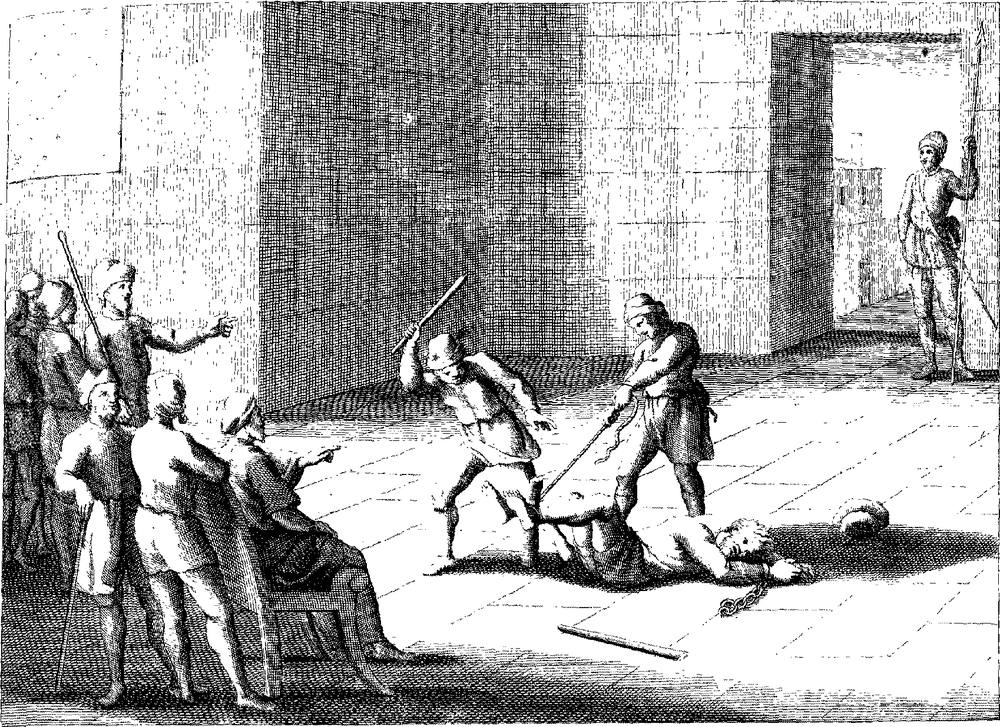
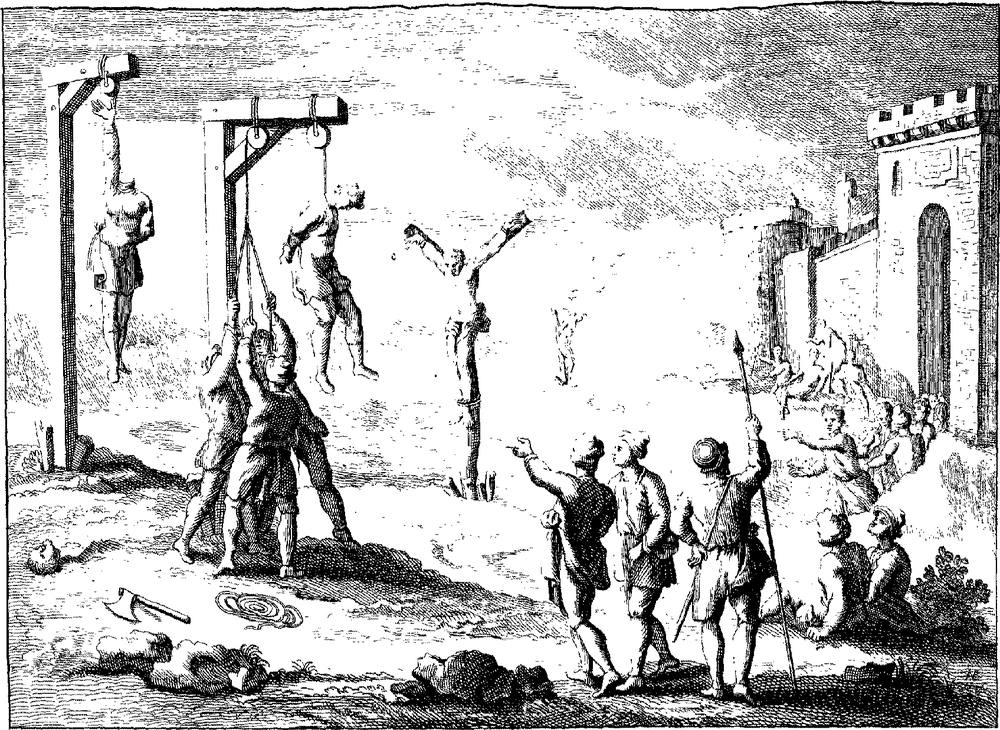
The Sentence being then confirm’d and pronounced, the Criminal was led away to Execution. A Man placed at the Door of the Court, held an Handkerchief in his Hand; a little farther was an Horseman, or a Cryer on Horseback. If any one offer’d himself to say any thing in Favour of the condemned Person, the first Centinel made a signal with his Handkerchief, and the Horseman gallop’d away, to have the Prisoner brought back again. Two of the Judges went on each Side of him, to hear if he had any thing farther to offer in his own Justification. The Criminal might be brought back as often as five times, to hear those that could say any thing in his Defence. If there was nothing further to retard the Execution of the Sentence, it was publish’d with a loud Voice; Such an one is abandon’d, for such a Crime; Such and such have depos’d against him: If any one have any Proofs of his Innocence, they may now produce them.
The Jews were of Opinion, That the Death of Offenders, might be of great Merit to procure their Salvation, if they suffer’d to satisfy the Justice of God, and to make Atonement for their Sins. They were exhorted to confess their Faults, and to say, Let my Death be for an Expiation of all my Sins. Their Maxim was, That he that confesses his Faults, has a Share in the Life to come.
They gave to Criminals, at their Execution, Wine mingled with Incense, Myrrh, and other strong Drugs, that were proper to stupify the Senses, and to make them lose Prov. xxxi. 6.the Sensation of Pain. Solomon advises to give Wine to such as are overwhelm’d with Pain. And we see an Instance of this Piece of Humanity, in what was offer’d to Jesus Christ at his Passion; they would have given him Wine mix’d with Myrrh before his Crucifixion, and Vinegar when he was upon the Cross. These Observations are general, Mat. xxvii. 34, 48.and belong to all that are executed.
Suspension, or the Punishment of the Rope. I do not observe any Crime in the Law, for which the guilty Person was condemned to be Hang’d. They often hung up Men after their Death; but I cannot see that any were hung alive. The Jews maintain, That none but Idolaters and Blasphemers underwent this Punishment. Achitophel hung himself; and also Mat. xxvii. 5. Acts i. 18. Deut. xxi. 23. Esth. xvi. 18. Gen. xli. 13. Numbers xxv. 4. Josh. viii. 29.Judas. Moses pronounces him to be accursed, that is hung upon a Tree, and he would have him cut down before the Setting of the Sun. Haman and all his Sons were hung upon an high Gallows. Pharaoh’s chief Baker was first beheaded, and afterwards hung upon a Gibbet. Moses order’d those Princes of Israel to be hang’d upon Gibbets, who had any Share in their Crimes who worshipped Baal-peor. Joshua hang’d up the King of Ai, and he continued upon the Gallows ‘till the Evening. Another Josh. x. 26. 2 Sam. xvii. 23. 2 Sam. xxi. 12. Lam. v. 12.time he hung up five Kings of the Canaanites. The Philistines hung up the Bodies of Saul and Jonathan on the Walls of Beth-shan. Jeremiah says, that the Princes of Israel were hung up by the Hand, after their Death, by the Chaldeans. The Soldiers of Antiochus Epiphanes hung 1 Macc. i. 62.up dead Children on the Necks of their Mothers, who had circumcised them.
From all these Examples, may be inferr’d, that sometimes they hung up Men alive, and sometimes hung up their Carcases after they were dead.
The Punishment of the Fire, was very common among the Hebrews. When JudahGenesis xxxviii. 24. was inform’d that his Daughter-in- Law Tamar was with Child, he would have had her burnt as an Adulteress. The Law of Moses inflicts the Punishment of the Fire upon the Daughters of the Priests, who Lev. xxi. 9.were guilty of Fornication: Sacerdotis filia, si deprehensa fuerit in stupro, & violaverit nomen patris sui, flamis exuretur. The People beyond the Euphrates inflicted the same Punishment upon those who fell into Crimes, that were contrary to that Respect, which, according to them, was due to the Gods. Abraham was cast into the Fire, because Gen. xi. 31. Nehem. ix. 7. Dan. iii. 6. Lev. xx. 4. Jer. xxix. 22.he would not worship the Gods of the Chaldeans. Nebuchadnezzar caus’d Daniel and his Companions to be thrown into the burning Fiery Furnace, upon the same Occasion. Moses order’d him to be burnt alive, who should marry the Mother and her Daughter.
Jeremiah informs us, that Nebuchadnezzar order’d Zedekiah and Ahab to be roasted in a Pan, for committing Iniquity in Israel, and abusing their Neighbours Wives. Antiochus Epiphanes exercised the same Punishment against the Brethren Maccabees: He put some to Death in Pots and burning Pans; others were roasted upon 2 Macc. vii. 35. Joseph. de Imperio Rationis, c. 9. Ecclus vii. 22.Spits, which were apply’d to their Backs, and forc’d into their Bowels. The Author of Ecclesiasticus says, That the Flesh of the Wicked shall be punished by Worms, and by the Fire; probably, because they were expos’d in the Fields, and burnt in the Valley of Hinnom: We are assured, that they burnt there the Carcases of Men, and other Creatures, to prevent the Stench from infecting the City; and to this Jesus Christ seems to make Allusion, when he
Mark ix. 43,45,47.says, That the Worm of the Damned dies not, and their Fire is not quenched.
Some Jewish Authors pretend, that he that was condemned to the Fire, was not burnt in the Flames: He was set up to the Knees in a Dunghil, his Throat ty’d about with a large Piece of Cloth, which was strain’d by the two Ends, ‘till the Patient was forced to open his Mouth. If he would not open it, it was forced open by an Instrument. Then they poured melted Lead down his Throat, ‘till his Bowels were consumed. They found this sort of Punishment, upon what is said,45 That the Fire did not consume the Bodies of the Children of Aaron. So that they thought it not lawful for them to consume the Bodies of their Brethren. Besides, they thought this a more merciful kind of Death. The Rabbi Eleazar objecting against this Determination, and affirming that he had seen the Body of a Priest’s Daughter burnt, who had committed a Crime; it was answer’d to him, That then the Sanhedrim must have been compos’d of ignorant People, or of Cushites and profane Persons, who did not understand the Law.
Imprisonment was not consider’d as a Punishment, but was to keep and secure a Person accused or suspected. Joseph detain’d his Brother Simeon in Prison, to be assured of the Truth of what his Brethren Gen. xliii. 19.had told him, concerning his Father and his Brother Benjamin. The Blasphemer that Lev. xxiv. 12.was brought to Moses, and the Man that was found gathering Sticks on the Sabbath-dayNumb.xv. 34., were put in Ward ‘till the Lord declared the Kind of Punishment they were to Jer. xxxii. 2, 8. Matthew xiv. 3.undergo. Jeremiah and John the Baptist were shut up in Prison, that they might not have the Power of Speaking with so much Freedom to the People.
But, often, Imprisonment was made a Punishment, when it was attended with Shame and Severities. When Joseph was unjustly accused by Potiphar’s Wife, he Genesis xxxix. 20.was put into Prison, and loaded with Fetters. Samson was taken by the Philistines, Judg. xvi. 21.cast into a Dungeon, had his Eyes put out, and forced to grind at the Mill. Hoshea King of Israel, Jehoahaz, and Manasseh King of Judah, were shut up in Prison by their Conquerors the Kings of Assyria and Chaldea. Zedekiah underwent the same Hardships, to which was added the Punishment of having his Eyes put out. Ahab King of Israel gave Orders, that the 1 Kings xxii. 27.Prophet Micaiah should be shut up in Prison; that he should be fed with the Bread of Affliction, and drink of the Water of Distress, ‘till his Return from his Expedition against Ramothgilead.
Jer. xxvii. 2.Bonds, Fetters, Shackles, Manacles, and Chains, which usually attended Imprisonment, must be look’d upon as Punishments, which were a great Aggravation to that of being kept in Prison. Bonds, Hand-cuffs, and Chains are still known, and in use; but the ancient Hebrews had a kind of Yoke, framed of two Pieces of Wood, long, and pretty broad, in which they made a Notch for the Criminal to put his Neck in. Jeremiah received an Order from the Lord, to make Bonds and Yokes, and to put them upon his Neck, and to send some to the Kings of Edom, Moab, Ammon, and Tyre, to declare their approaching Captivity by the King of Chaldea. They also made use of Stocks, wherein were Holes at several Distances, through which they made the Prisoners put their Legs, at a greater or lesser Distance, according as they had a mind to torment them more or less. See Job xiii. 27. & xxxiii. 11. Prov. viii. 22. Prudentius has described this Punishment, in these two short Verses;
Prudent. hymn. 4.Lignoque plantas inserit,
Divaricatis cruribus.
To throw headlong into the Sea from a Precipice, with a Stone ty’d about the Neck, was not a common Punishment: If it has been sometimes us’d among the Hebrews, it was in singular Cases. Amaziah 2 Chron. xxv. 12.King of Judah forced ten thousand Idumeans, whom he had taken Prisoners of War, to leap from the Top of a high Rock. There are some of Opinion also, that they precipitated from the Rock of Horeb, or Oreb, the King of the Midianites of the same Name, when they were defeated by Judg. vii. 25. Luke iv. 29.Gideon; Interfecit Oreb in petrâ Oreb. The Jews intended to precipitate Jesus Christ from the Top of their Mountain. St. James the Just was thrown down from the highest Part of the Temple, into the Valley below. Zachariah Son of Baruch was put Joseph. de Bello, l. 5. c. 1.to Death in the midst of the Temple, and his Body thrown into a deep Place that was beneath the Walls of that holy Place. Jesus Christ mentions the Punishment of casting Mat. xviii. 6. Grot. & le Clerc, in Mat. xviii. Gen. xl. 19.a Man into the Sea, with a Stone about his Neck: Expedit ei ut suspendatur mola asinaria in collo ejus, & demergatur in profundum maris. We are told, this was a common Punishment among the Syrians.
The Punishment of the Sword. In Scripture we meet with several Instances of Decapitations. Pharaoh’s chief Baker had his Head cut off; after which, his Body was hung upon a Gibbet. Abimelech Son
of Gideon cut off the Heads of seventy Sons of Gideon, his Brethren, upon one Stone. The Judg. ix. 11.People of Samaria cut off the Heads of seventy of the Sons of Ahab, and sent them in 2 Kings x. 7. Mat. xiv. 8, 11.Baskets to King Jehu. John the Baptist was beheaded in Prison, by the Order of Herod. ‘Tis needless to enlarge any farther upon this Subject, as it will not supply us with any particular Observation, either upon the Matter or Instrument of this Sort of Execution.
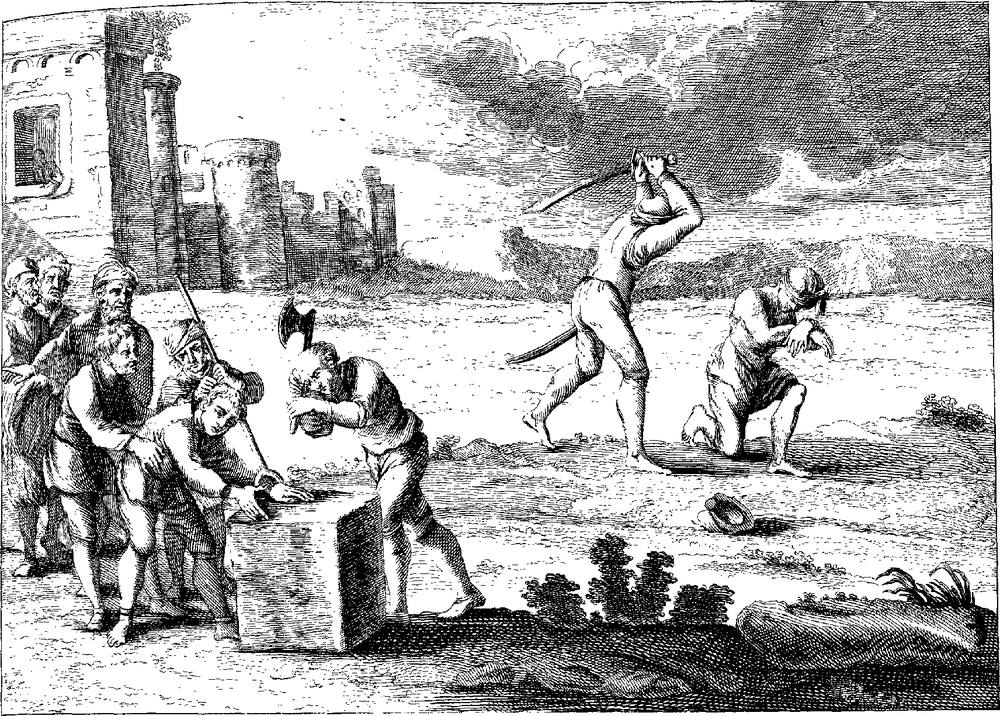
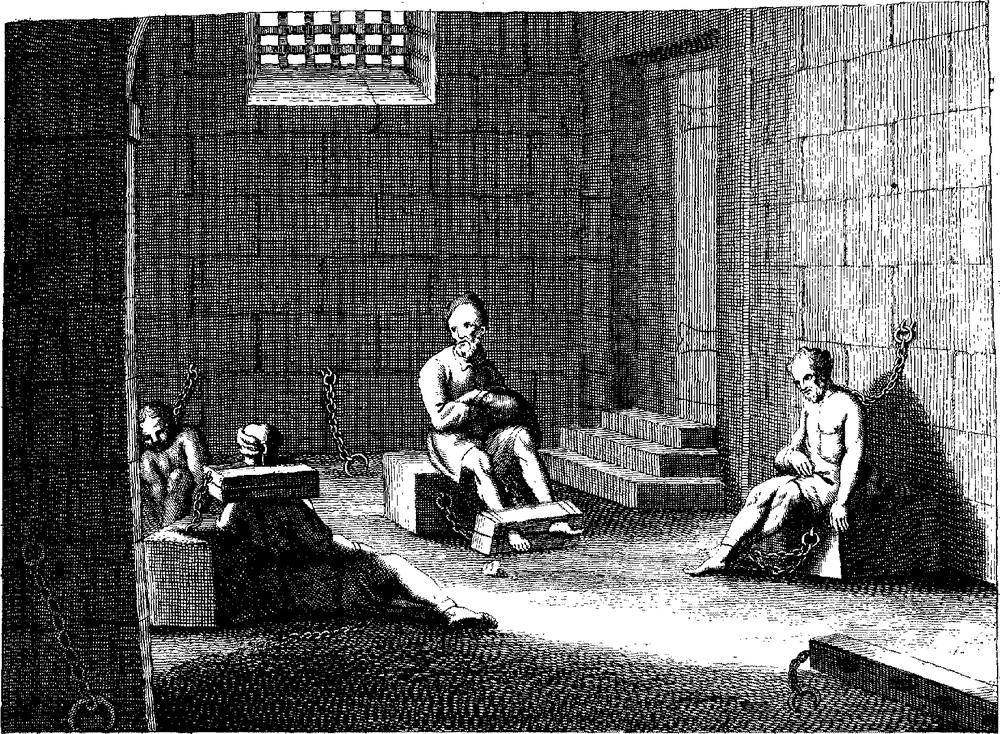
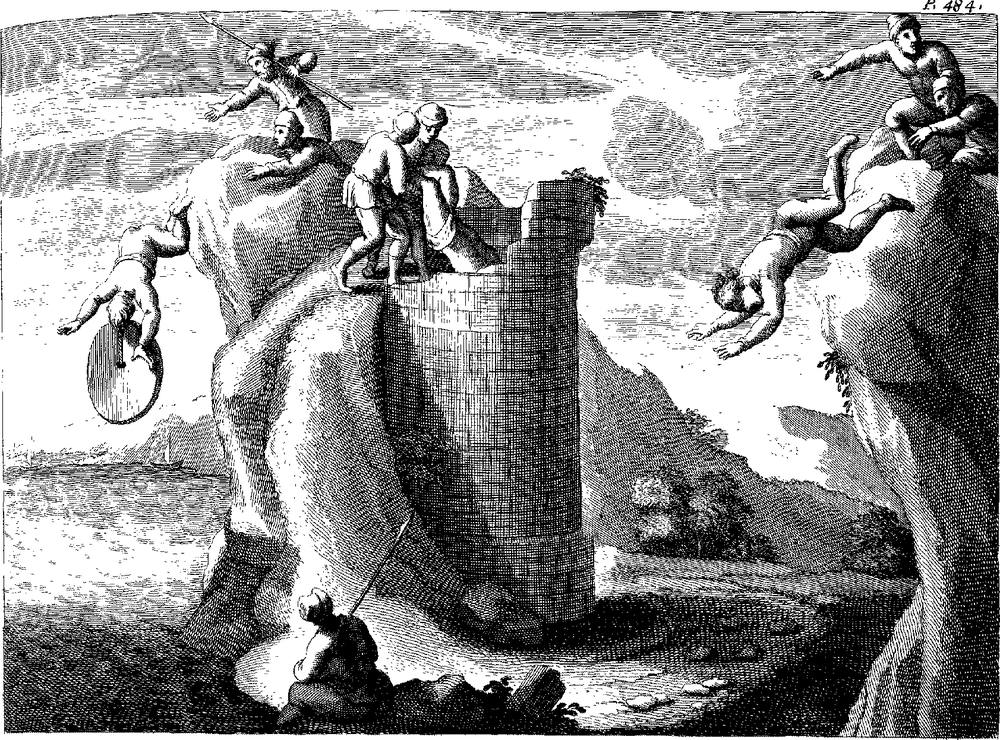
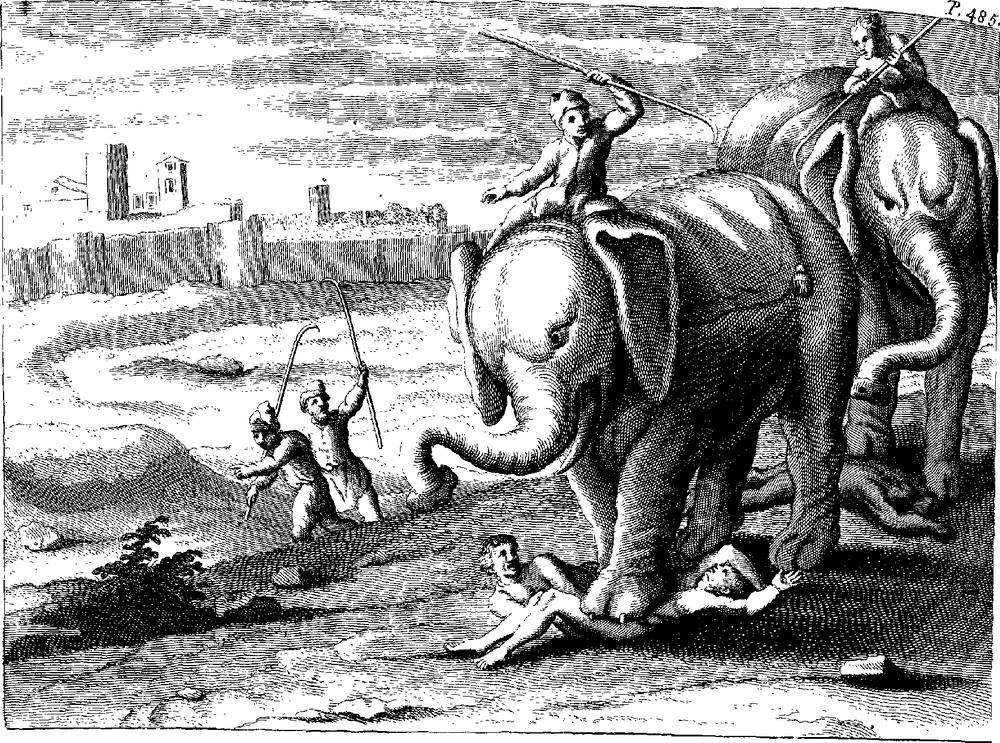
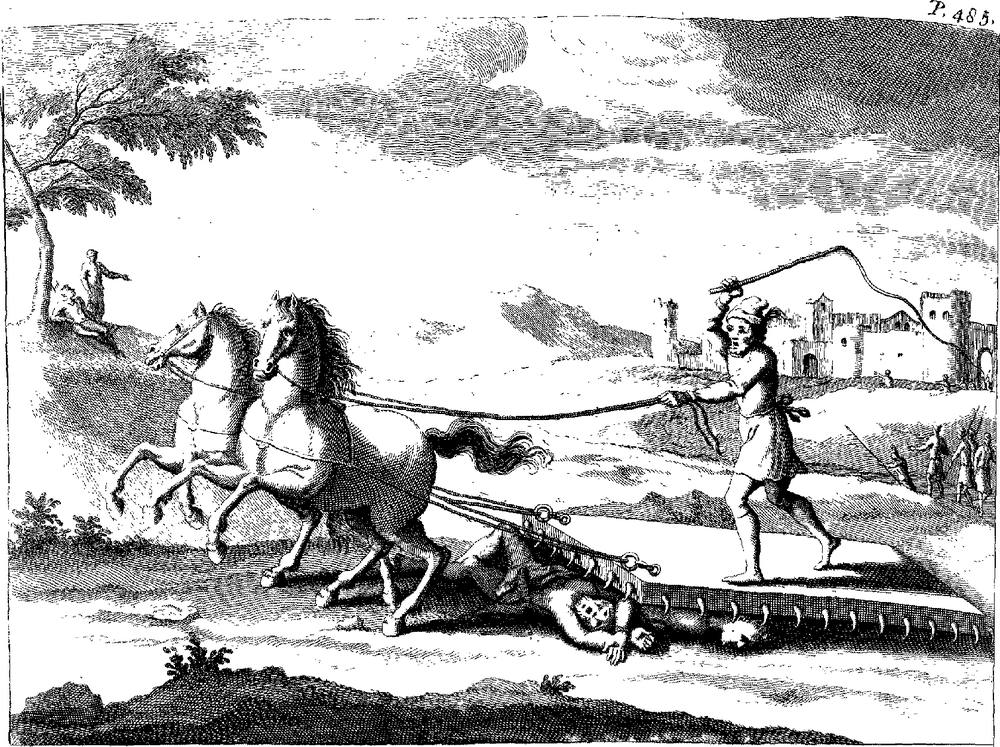
To tear to death under Thorns, under Harrows, under the Feet of Elephants, are things not to be heard of among the Western People; but we find some Examples of them in Scripture. When Gideon returned from pursuing the Midianites, he tore with Thorns and Brambles of the Desart, the chief Men of the City of Succoth, who had insulted him. ‘Tis thought that David did something Judg. viii. 16. 2 Sam. viii. 2.like this to the Moabites. And he smote Moab, and measured them with a Line, casting them down to the Ground; even with two Lines measured he, to put to death, and with one full Line to keep alive. What is said in the Text of casting them down to the Ground, is favourable to this Explication.
He made the Ammonites undergo a Punishment2 Sam. xii. 31. that was still more cruel. Populum (Regis Ammon) adducens serravit, & circumegit super eos ferrata carpenta, divisitque cultris, & traduxit in typo laterum. That is, he put them under Saws, and under Harrows of Iron, and under Axes of Iron, and made them pass thro’ the Brick-kiln.
We shall particularly speak of the Punishment of the Saw, under the Article SAW. The Harrows or Sledges of Iron here mentioned, were Machines proper for thrashing of Corn, in order to get the Grain out of the Straw; of which there were several Kinds. But they were all loaded with Iron or Stones for bruising the Straw. See HARROWS. Lastly, he made them pass under Axes of Iron, and through the Places for making of Bricks. Whether by these last Words we are to understand the Furnace in which the Bricks are burnt, or the Place where the Earth is beat and macerated, in which these miserable Wretches were executed; these Punishments were very horrible, but were tolerated among those People, who allowed themselves the Liberty of putting all to death that they took in War.
Senec. Tragic. Troad.Lex nulla capto parcit, aut poenam impedit.
Ptolemy Philopator, King of Egypt,46 thinking to enter by Force into the Sanctuary of the Temple of Jerusalem, and being prevented by the Priests, resolved to exterminate all the Jews in his Dominions, who would not embrace the Pagan Religion. He had a List taken of them, and gave Orders to the Keeper of his Elephants, to give those Creatures a Quantity of Wine mingled with Incense, to increase their Fury by this intoxicating Liquor. After this the Jews were to be exposed to them, to be trod under Foot and killed by them. But God prevented the Execution of this barbarous Design: For the Elephants turn’d themselves against the Soldiers that were to manage them, and trod them to Pieces. The Prophet Micah alludes to this kind of Punishment, when he says, He Mic. iv. 12, 13.shall gather them as the Sheaves into the Floor. Arise and thresh, O Daughter of Zion, for I will make thine Horn Iron, and I will make thy Hoofs Brass, and thou shalt beat in Pieces many People. Amilcar the Carthaginian General, caused some Carthaginians and Prophyr. de abstin. l. 2. p. 227.some Strangers, who had betray’d the Interests of the Republick, to be trod under Foot by his Elephants.
To cut off the Hair of guilty Persons, seems to be a Punishment rather shameful than painful; and yet it is thought, that Pain likewise was added to the Disgrace; and that they were not contented to shave or cut the Hair, but tore it off with Violence, as if they were plucking a Bird alive. This is the genuine Signification of the Hebrew Word,47 and of the Greek as it is read in Nehemiah. I contended with them, and smote certain of them, and plucked off their Hair. Sometimes they put hot Ashes on the Skin, after they had torn off the Hair, to make the Pain the more exquisite. ‘Twas thus they served Adulterers at Athens; as is observed by the Scholiast on Aristoph. nubibus.Aristophanes.
This kind of Punishment was common in Plutarch. apothegm.Persia. King Artaxerxes made some Alterations in it. Instead of plucking off the Hair of such of his Generals, who had been guilty of a Fault, they were obliged to lay aside the Tiara. The Emperor Domitian caused the Hair and Beard of the Philosopher ApolloniusPhilostrat. l. 3. c. 24. to be shaved. In France they cut off the Hair of Sorcerers and Magicians. This Torture has often been inflicted upon the Martyrs of the Christian Religion. In the impious Book that the Jews composed of the Life of Jesus Christ, under the Name of Toledos Jesu, they say their Ancestors caused his Hair to be cut off, and afterwards his Head to be rubb’d with a Liquor, which prevented the Hair from growing again, and made him bald all his Life after. It is observed in the Book, call’d The Government of Reason, and which is quoted under the Name of the fourth Book of the Mac
cabees, that Antiochus Epiphanes caus’d the Hair and Skin and all, to be tore from the 4 Macc. c. 7. 2. Macc. vii. 4.Heads of some of the Seven Brethren the Maccabees.
To pluck out the Eyes, and to make blind, are Punishments not common; and though Moses had appointed, that an Eye should be given for an Eye, and a Tooth for a Tooth, a yet it is the Opinion of Commentators, Ita Rabb. & Interp. passim.that this was very seldom put in Practice according to the Letter; and that the Offender was generally punished by a pecuniary Penalty, which was converted to the Use of the injur’d Party. When the Philistines laid hold on Samson, and intended to prevent his doing them any more Harm, they put him in Prison, and bored out his Eyes. Eruerunt oculos ejus. When Nahash King of the Ammonites made War with the City of Jabesh-gilead, he threatned them to admit of no other Composition with them, but that of their submitting to have every one his right Eye put out. Nebuchadnezzar took King Zedekiah, and had his Children put to death in his Presence, then caused his 2 Kings xxv. 7.Eyes to be put out, and afterwards had him carried to Jerusalem in Chains.
To cut off the Extremities of the Feet and Hands, was a Piece of Cruelty formerly exercised by Adonibezek, King of Bezek, Judg. i. 6, 7.upon seventy Kings who had the Misfortune to be conquer’d by him, and who eat like Dogs under his Table. But God thought fit to have him tortured after the same manner that he had tortured others. The Israelites conquer’d him, took him, and cut off the Extremities of his Hands and Feet. David treated the Murderers of Ishbosheth in the same manner, and had their Bodies hung up over the Pool of Hebron. Antiochus Epiphanes also cut off the Extremities of the Hands and Feet from the seven Brothers Maccabees. When Alexander the Great came 1 Macc. 1. 4. & 2 Macc. vii. 4.near to Persepolis, a Company of Eight hundred Greeks came to present themselves before him, and to entreat his Protection and their own Liberty. They had been taken Diodor. Sicul. Just. Quint. Curt.Captives by the Kings of Persia, and been maimed by them, some having their Feet or Hands cut off, and others their Noses. They had also the Marks of Slavery imprinted upon them, which were a sort of rough Characters in their Skins, that could not be got out.
The Punishment of the Wheel is not known in the Canonical Books either of the Old or New Testament. But it is found in the fourth Book of the Maccabees, otherwise called The Government of Reason, which is commonly ascribed to the Historian Josephus. He says, that the fifth and sixth of the 4 Macc. seu de imperioBrethren Maccabees were
9. In Græc.rationi c. 20. put upon the Wheel. The first of them was dragged upon a Machine, which the Author calls Catapulta, upon which they ty’d his Knees with strong Chains, and violently bent his Back upon a Wheel, so that he was rolled like a Scorpion about the Wheel. The second was also brought and fastened with Violence upon the Wheel, so that all his Bones were dislocated; then they burned his Sides and Bowels with red hot Spits, which the Soldiers had heated for that Purpose.
I doubt not but what is here called a Wheel, is nearly the same thing as the wooden Horse or Tressel, concerning which so much has been said. The Reader may compare what is here said of the Punishment of the Wheel, with what has been said of the wooden Horse, and he will find almost the same Characters observable in both. They violently stretch’d out the Criminals upon the Machine, drawing their Limbs with Ropes or Pullies; then they whipt them, dislocated their Joints, burnt their Sides, tore off their Skin with Iron Pincers, kept them lying sometimes upon their Backs, sometimes upon their Bellies, sometimes with their Heads uppermost, sometimes bending double, and sometimes with their Heads hanging downwards. The Form of the Wheel gave them Opportunity of putting the miserable Patients into all manner of painful Postures. The Wheel to which Ixion was fastened according to the Fable, was always turning round. Suidas says, that they used to fasten Slaves to the Wheel, and there whip them. The Acts of the Martyrs often tell us, that they stretch’d the Bodies of these Saints upon the Engine, and there made them suffer several Kinds of Torture.
To be exposed to wild Beasts, and to fight with the Beasts, was a Punishment very frequent among the Romans. It has some relation to that which we have mentioned before, of being squeezed to death under the Feet of Elephants. St. Paul says, that he fought with Beasts when he was at Ephesus. Ad bestias pugnavi Ephes. See what has been said in the Article of St.
PAUL. Sometimes they were only expos’d to the Beasts, to be devour’d by them, as St. Ignatius the Martyr was to the Lions; either to serve as Sport to them, as Saint Perpetua, who was exposed to a wild Cow, being enclosed within Nets, that she could not make her Escape; or, lastly, to fight with the Beasts, as was the Case of St. Paul at Ephesus.
Sometimes they demolished the Houses of Offenders, and reduced them to a common Place for Filth and Dung. Thus was treated the Temple of Baal by King Jehu. Destruxerunt ædem Baal, & fecerunt pro ea48
Dan. ii. 27. Dan. iii. 29. Ezr. vi. 11.latrinas. Nebuchadnezzar threatened the Diviners of Chaldea, to make them undergo this Punishment and Disgrace, if they did not declare his Dream to him. Domus vestræ publicabuntur. He afterwards decreed the same Penalty to all such, as should not worship the God of Shadrach, Meshech, and Abednego. And King Darius in the same manner threatned those, who should any how withstand the Jews. Domus ejus publicetur. However, there are good Interpreters, who explain these Passages only as Confiscations to the King’s Use.
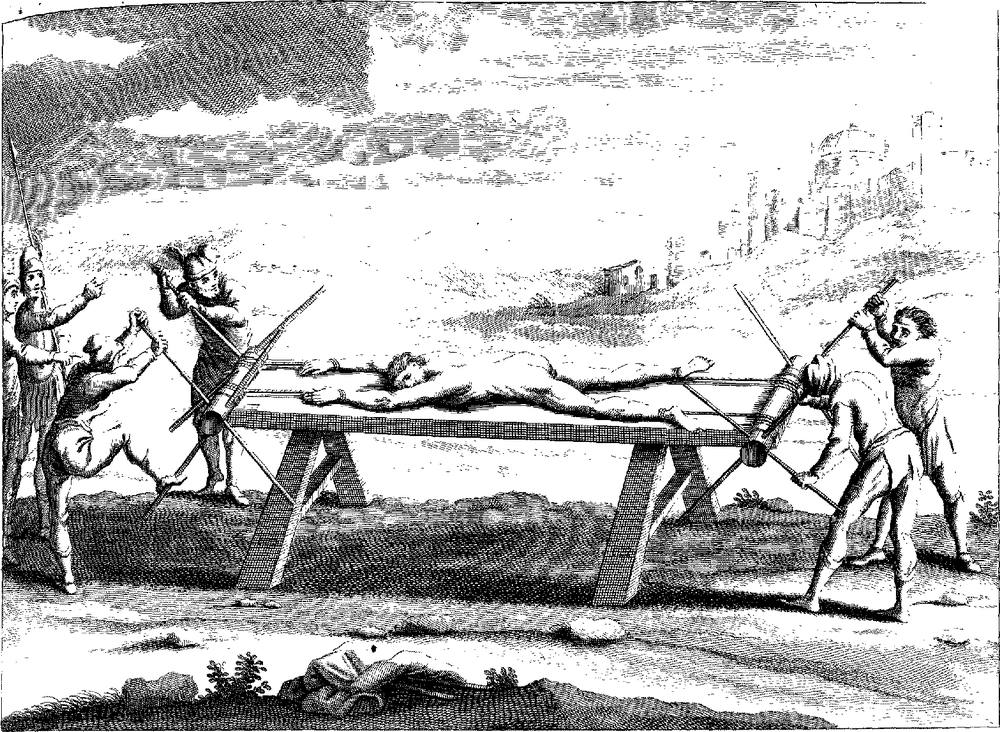
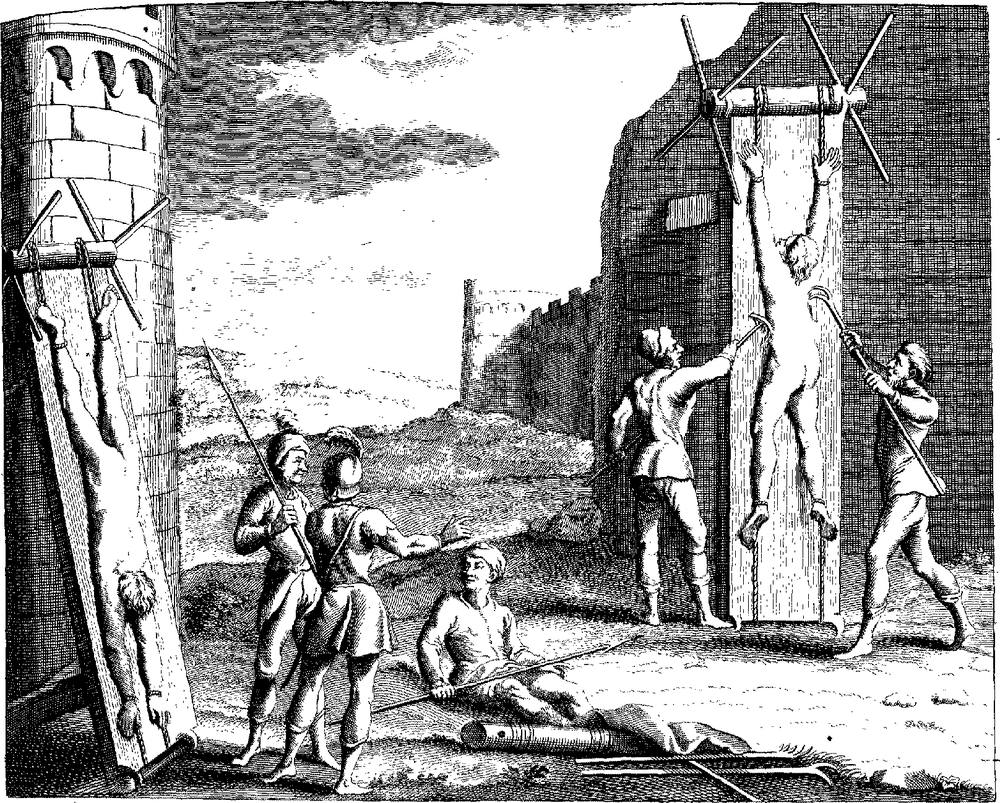
Ibid.Some are of Opinion, that the Punishment of Impaling was not unknown to the Persians, and that it is intimated by Ezra. Tollatur lignum de domo illius, & erigatur, Var. Grot.& configatur in eo. Others will have it, that the guilty Person was to be hanged on a Post that should stand upright, after the Demolition of his House. Others understand Shindler & Lud. de Dieu, in 1 Esdr.it, that they were to be fixed to a Piece of Wood belonging to the House, and there to undergo the Punishment of Whipping.
PUNITES. See PUAH I.
PUNON, or Phunon, a Station of the Numb. xxxiii. 42, 43.Hebrews in the Wilderness. ‘Tis also call’d Phæno, Phaino, and Metallo-phænon, because of the Mines of Metals there found. Eusebius says, that this Place was situate between Petra and Segor; and elsewhere he places it four Miles from Dedan. St. Athanas. Epist. ad Solitarios.Athanasius says, that these Mines of Phanos were so dangerous, that Murtherers condemn’d to work there, could not live but a few Days. We find Bishops of Phenos in the Subscriptions of the Councils.
Lucan l. 9. Isai. xiv. 29. xxx. 6.‘Tis thought to be at Punon that Moses erected the Brazen Serpent, for the Cure of the murmuring Israelites, who had been bit by the fiery Serpents. Others believe this happened at the Encampment of Zalmonah. The Matter is thus related in the Book of Numbers. a The People began to be tired of their Journey, and to murmur against the Lord. Wherefore the Lord sent Serpents among them, the biting of which burned like Fire. The Hebrew reads Seraphim, Serpents, or burning Serpents, which is generally understood by the Præster, a sort of Serpent, which by its biting causes a great Inflammation in the Face, and a Swelling through the whole Body. Isaiah says expresly, that the Saraph was a flying Serpent, and Historians inform us, that such are found in Arabia and Egypt. See Herodot. l. 2. c. 76. and the Authors quoted in Bochart, de Animalibus sacris, part. 2. l. 3. c. 13. and the Article SERPENT hereafter.
But Moses goes on thus: Several Israelites having been kill’d and wounded by the John iii. 14, 15.biting of these Serpents, the People came to Moses, and said to him; We have sinn’d in speaking against the Lord, and against thee. Pray to him, that he would deliver us from these Serpents. Moses therefore having pray’d for the People, the Lord said to him; Make a Brazen Serpent, and set it up for a Sign: Whosoever is bit, and shall look upon it, shall be forthwith healed. Moses therefore made a Serpent of Brass, and fix’d it upon a Standard, to serve as a Sign; and whoever look’d upon it when wounded, were immediately healed. Our Saviour in the Gospel says to Nicodemus; As Moses lifted up the Serpent in the Wilderness, even so must the Son of Man be lifted up; that whosoever believeth in him, should not perish, but have eternal Life. Shewing by this, that he was to die upon the Cross, for the Salvation of Mankind.
We have shewn under the Article NOHESTAN, that this Brazen Serpent was preserved among the Jews to the time of King Hezekiah; and that this wise Prince seeing the Abuse that was then made of it by the People, who paid an idolatrous and superstitious Worship to it, he caused it to be destroy’d, and named it Nohestan, in Derision.49
Esther iii. 7.PUR, or Phur, or Purim; that is to say, Lots. This was a very solemn Feast of the Jews, instituted in Memory of the Lots that were cast by Haman, the Enemy of the Jews. These Lots were cast in the first Month of the Year, and mark’d out the twelfth Month of the same Year, for the Execution of Haman’s Design, which was to destroy all the Jews of the Kingdom of Persia. Thus the Superstition of Haman, in casting and pursuing the Event of these Lots, was the Cause of his own Ruin, and of the Preservation of the Jews; who had now Time to avert this Blow, by means of Esther the Spouse of Ahasuerus, and to remove those ill Impressions he had conceived of the Jews. In memory of this so signal and miraculous Deliverance, the Jews instituted a Feast, to which they gave the Name of Pur or Purim. See the Articles HAMAN, ESTHER, and MORDECAI.
The Word Phur or Pur is rather Persian than Hebrew. It properly signifies Lot; and in that Passage of the Vulgate, Missa est sors in urnam, quæ Hebraicè dicitur Phur; the last Word has not relation to urnam but to sors. The Feast of Lots was celebrated among the Jews of Shushan on the 14th Day of Adar, and among the other People of the Persian Empire on the 15th of the same Month, which answers to our February. See Esther ix. 18, 19, 21. and 2 Macc. xv. 39. The Jews have exactly kept this Feast down to our Times,50
and these are the Ceremonies they observe in the Celebration of it. a On the Eve of the Feast, if it is a Day on which they may fast, they keep a strict Fast, in memory of that kept by Esther and Mordecai. If the Day will not allow them to fast, because it may happen to be the Sabboth, or the Eve of the Sabboth, on which they never fast, they anticipate the Fast; that is, instead of fasting on the 13th of Adar, they fast on the 11th of the same Month. According to Rule they should remain without eating for four and twenty Hours, or from one Evening to the next; and from thirteen Years old they are obliged to keep this Fast.
On the Eve of the Feast, they give their Alms liberally to the Poor, that these also may make much of themselves on the Feast of Lots: And on the Day of the Feast they send a Share of what they have at Table, to those that have need. On the Evening of the Thirteenth of Adar, when the Feast begin, they assemble in the Synagogue, and light up their Lamps; and as soon as the Stars begin to appear, they begin to read the Book of Esther. They continue the reading of it from one end to the other. There are five Places in the Text, wherein the Reader raises his Voice with all his Might, and makes such a dreadful Howling, as to frighten the Women and Children. When he comes to the Place that mentions the Names of the ten Sons of Haman, he repeats them very quick without taking Breath, to shew that these ten Persons were destroyed in a Moment. Every time the Name of Haman is pronounced, the Children with great Fury strike against the Benches of the Synagogues with Mallets, or Stones, and make lamentable Cries. ‘Tis said that heretofore they used to bring into their Synagogues a great Stone, with the Name of Haman written upon it, and all the while the Book of Esther was reading, they struck against it with other Stones, till they had beat it to Pieces.
After the Reading was finish’d, they return’d into their Houses, where they made a Meal rather of Milk-meats than of Flesh. The Day following, early in the Morning, they return’d to the Synagogue, where, after they had read that Passage of Exodus, wherein is mention’d the War of Amalek, they begin again to read the Book of Esther with the same Ceremonies as before. After which they return home, and make as good cheer as they can, and pass the rest of the Day in Sports and dissolute Mirth, the Men dressing themselves in Womens Cloaths, and Women in Mens, contrary to an express Deut. xxiii. 5. Cod. de Judæis & Cælicol. L. Jud.Prohibition of the Law. And their Doctors have decided upon this Point,51 that upon this Day they may drink Wine ‘till they cannot distinguish between, Cursed be Haman, and Cursed be Mordecai. Heretofore they used to erect a Gibbet, and upon it to burn a Man made of Straw, which they call’d Haman. But it was thought they had an Intention of insulting the Christians upon the Death of Christ, and therefore the Emperors forbad them to use this Ceremony, on Penalty of forfeiting all their Privileges.
The Feast of Purim, or Lots, in the manner that the Jews observe it, has a good deal of Resemblance to the antient Bacchanalia of the Pagans. Pleasures, Diversions, Joy, good Cheer, make as it were the very Essence of it. The Spirit of Revenge which animated the Jews of Shushan against their Enemies, has pass’d even to their Posterity. They deliver themselves up to it without Measure and without Bounds. They allow themselves the drinking of Wine even to Excess, because, say they, it was by making King Ahasuerus drink, that Esther procured the Deliverance of the Jews. They compel every one to be present at the Synagogue, Man, Woman, Child, and Servant; because all had a Share in the Deliverance, as all were expos’d to the Danger. On this Day Scholars make Presents to Leo of Modena, Ceremonies of the Jews, p. 3. c. 10. Esth. ix. 22.their Masters, Heads of Families to their Domesticks, great ones to those of mean Condition. In a Word, the whole Day is spent in Joyfulness and Feasting. As it is said in the Book of Esther; That they should make them Days of Feasting and Joy, and of sending Portions one to another, and Gifts to the Poor.
This Festival continues for two Days, but only the first of them is kept with Solemnity. During these two Days they may work or do Business; yet they refrain the first Day, though they are not obliged to it. The second Day they read no new Lesson in the Synagogue, and the Feast is not so great; but they however shew some Marks of Festivity. When the Year consists of thirteen Months, and that there are two Adars, that is to say, when at the End of two or three Years there is a supernumerary Month in the Lunar Year, they reckon’d the Month Adar twice over, which they insert between February and March, and then the second Adar is call’d Ve-Adar. See the Articles MONTH and INTERCALATION. When therefore there are two Adars, they celebrate the Feast of Lots twice over; the grand Purim is on the fourteenth of the first Adar, and the lesser Purim is on the fourteenth of the52
second Adar. But this second Feast of Lots Basnage, Hist. of the Jews, t. 5. l. 7. c. 16.is not accompany’d with the Diversions of the first, it has properly nothing but the Name of it.
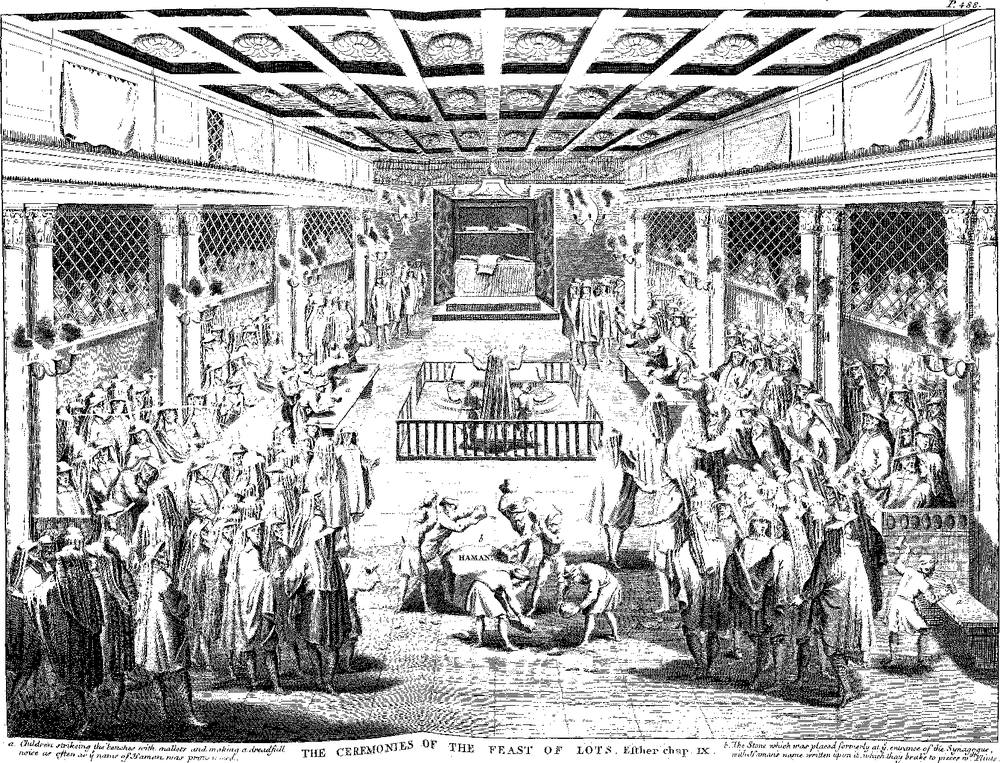
On the Eve of the Festival they gather the Half-shekel which was formerly paid to the Temple, and which at present they distribute among such as undertake a Journey to Jerusalem, whither several of them repair out of Devotion, and where they covet to be buried; believing that all the Jews are to rendezvous there at the last Judgment, and that they shall even pass thither thro’ the Bowels of the Earth.
They read the Text of Esther, not out of a printed Book, nor out of a Book in Form of ours, but out of a Roll of Vellum, in the antient Manner, which is wrote with a particular kind of Ink. After they have spread open the Volume, they make three Prayers, to thank God for calling them to this Ceremony, for having deliver’d them, and for having continued their Lives to the Celebration of this Festival. On this Day the Reader may sit down while he reads, whereas at other Times he must stand up while he reads the Law. The reading of the Book of Esther is concluded with Curses against Haman and his Wife Seres, with Blessings of Mordecai and Esther, and with Praises to God for having preserved his People. Rest is observed very religiously, especially the first Day; and the Jews tell us, that a Man having sown Flax on this Day, not one Grain of it came up.
It was the Emperor Theodosius II. who Idem. t. 8. l. 8. c. 6. p. 194.forbad the Jews to erect Gibbets, to fix an Image upon them, which they call’d Human, and afterwards to burn them both; because it was not fit that in their Festivals they should insult the Mysteries of the Christian Religion. This Decree was publish’d through the whole East in the Year 408, and directed to Anthemius, who was Prefect there. Yet three Years after, some Jews in the Extravagance of their Passion and Height of their Frolicks, notwithstanding this express Prohibition of the Emperor, fasten’d a young Christian to a Gibbet instead of a Human, whom they whipp’d so cruelly, that he died on the Spot. This Fact was committed in the City of Inmestar, situated in Chalcis and Syria. The Christians in the Country took up Arms; the Fight was bloody, because the Jews were numerous in those Parts. The Governor of the Province having acquainted Theodosius with it, he gave Orders for the Punishment of those that were the Occasion of the Riot, which then was soon appeas’d.
PURGATORY. This Word is not to be found in Scripture, neither in the Old or New Testament. But the sacred Authors of both the Covenants believed the thing intended by this Word, and have express’d it in equivalent Terms, upon more Occasions than one. We mean therefore by the Word Purgatory, that State of those Souls, which having departed out of this Life without expiating certain Impurities that deserve not eternal Damnation, or which not having undergone the Punishments due to their Sins, expiate them by such Punishments as God inflicts on them, before they enjoy his Presence.
2 Mac. xii. 43, &c.‘Tis said in the Maccabees, that when Judas had stripp’d his Soldiers who had been slain in Battle, he found hid under their Cloaths Things that had been consecrated to Idols, which the Law forbad to Deut. vii. 25, 26.take away. Non inferes quicquam ex Idolo in domum tuam. ‘Tis added, Then every Man saw that this was the Cause wherefore they were slain. All Men therefore praising the Lord the righteous Judge, who had opened the Things that were hid, betook themselves unto Prayer, and besought him, that the Sin committed might wholly be put out of Remembrance. And when he had made a Gathering throughout the Company, to the Sum of two thousand Drachms of Silver, he sent it to Jerusalem to offer a Sin-offering, doing therein very well and honestly, in that he was mindful of the Resurrection. For if he had not hoped that they that were slain should have risen again, it had been superfluous and vain to pray for the Dead. And also in that he perceived that there was great Favour laid up for those that died godly. It was an holy and good Thought. Whereupon he made a Reconciliation for the Dead, that they might be delivered from Sin. This Passage fully declares the Sentiments of the Jews before the Time of our Saviour.
Matth. xii. 32.As to the New Testament, Christ in the Gospel says, that there are certain Sins that shall not be forgiven, neither in this World, nor in the World to come. Consequently he allows, that there are some Sins that may be forgiven in the other World. St. 2 Tim. i. 18.Paul prays for Onesiphorus then departed, The Lord grant unto him that he may find Mercy of the Lord in that Day. But if Prayers may be made for the Dead, then there is a Purgatory, and a State wherein they may be benefited by our Prayers.
The Jews acknowledge a kind of Purgatory, which continues for one whole Year after the Person is departed. During these first twelve Months, the Soul is at
Liberty to come upon Earth, to visit its Body, and to frequent those Places and Persons, to which it had a particular Relation during its Life here. They pray for the Repose of the Dead for all this Time, and are persuaded, that they administer much Consolation to them by their Prayers, that they procure Rest for them, and Pardon of their Sins.
The Place wherein the Prevaricators of Israel are punished after their Death, or such Jews as are one Day to be deliver’d out of their Pains; this Place is the same as Hell, where the Impious are kept, or such whose Calamity is without Resource and without Hope. But there is a great deal of Difference between these two Sorts of Sufferers; first, as to the Pain, which is much more tolerable as to the former than the latter; and secondly, as to the Duration of it, since that of the Prevaricators of Israel will one Day have an End, and may be much shorten’d and abated by the Prayers and Offerings of the Living; whereas the Torments of the Wicked are to endure for ever.
We read some Stories in the Books of the Rabbins, which prove, that Purgatory is a popular Opinion among them. The Vide Cod Chagigeah Bartolocci t. 2.p.152Rabbi Elisha Son of Abia fell into the Error of the two Principles, from which he was converted towards the End of his Life. However, his Salvation was doubted of. One of his Friends, call’d Meir, undertook to cause Smoke to proceed out of his Tomb, as a Token that he was in Purgatory. Another Rabbi named Jehonan took upon himself to cause this Smoke to cease, as a Token that he was deliver’d out of Purgatory. They both accomplish’d what they had propos’d, and then it was no longer doubted but that Elisha was saved.
Rab. Tanchan. Parasch. Toledoth Noah.The Rabbi Akiba saw once in a Churchyard, a Man that had been departed a good while, walking in great Haste with a Burthen of Wood upon his Shoulders. Akiba ask’d him if he had Occasion for any Assistance. The dead Man told him, that in his Life-time he had been a Receiver of Customs, and to expiate the Extortions he had committed in this Employment, he was condemned to perform the Office of carrying Wood in this manner. He desir’d him to inform his Widow and Son of the State he was in. Akiba found out the Wife and Son, and taught him to say, Blessed be the Lord, and let him be blessed. And no sooner had he pronounced these Words, but his Father was deliver’d out of Purgatory, and appear’d to Akiba to thank him. We have as much Contempt for this kind of Stories as they deserve; but they may serve as a Proof, that the Jews believe a Purgatory.
They call Purgatory, Abraham’s Bosom, the Treasury of the Living, the Garden of Eden, and Upper Gehenna. Hell they call the Lower Gehenna. They believe that all the Israelites have a Portion in the World to come, or the State of Happiness, either immediately after Death, or after they have attoned for their Sins in Purgatory. There are but a very small Number of their Nation, who are great Profligates, that are for ever excluded out of Heaven. a As for the rest, they hold that they continue not above a Year in Purgatory. The Sabbath-day is a Day of Remission for the Souls in Purgatory; they do not burn upon that Day. The Jews offer up a great many Prayers, and Works of Satisfaction, on the Day of solemn Expiation, for the Comfort of such Souls as are in the Upper Gehenna.
The Mussulmen, whose false Religion is a Composition of Judaism, Christianity, and Deism, have, doubtless, borrow’d from the Jews and Christians the Notions they have of Purgatory. They acknowledge at least two of ‘em. The first is what D’Herbelot Bibl. Orient. p. 57.they call Adhabalcabor, the Penalty of the Sepulchre. No sooner is a Man buried, but two Angels call’d Moukir and Nekir examine the dead Man, and condemn him to expiate the Crimes he has committed in that same Place: But at the Day of Judgment they are deliver’d from them by their Submission to the Justice of God, and by the Intercession of their false Prophet. In this first Judgment of the Sepulchre, it is allow’d every one to speak in his own Justification; but at the last Judgment Men must not dare to say any thing, nor presume to bring any Extenuation or Excuse. The Turks call’d Motazals do not admit of this first Purgatory of the Sepulchre; but it is the general Belief of the other Mahometans.
Idem, p. 121, 122.The second Purgatory, according to many of the Mussulmen, is the Place call’d Araf, lying between Paradise and Hell. What divides them is only a Vale, according to some, or a thick Wall, according to others. They are not agreed who they are that inhabit this Araf. Some place the Patriarchs and Prophets there, others the Martyrs, and the most eminent for Sanctity among the Faithful. But several Doctors dispose of such Mussulmen there, whose good and bad Actions approach so near to an Equality, that they had not Merit enough to deserve Paradise, nor Demerit enough to be condemned to the Pains of Hell. From thence they see the Happiness of the Blessed; but they do not partake of it; and this Privation gives them their greatest Torment. But at the great Day of Judgment, those that are kept in53
this Place will prostrate themselves before the Throne of the great Judge, will acknowledge and adore his Power, and by those Acts of Adoration their good Actions will so far exceed their bad ones, that they will be admitted into Happiness.
Besides these two Purgatories now mention’d, they have still a third call’d Barzak. D’Herbelot. Bibl. Orient. p. 191.By this Name the Mahometans call that Space of Time which is to pass between Death and the Resurrection. They think there is neither Paradise nor Hell for Men during this Interval. This seems to have been taken from the Opinion of some of the Fathers, not well understood, who have thought that the State of Souls was not fix’d and determin’d, ‘till after the Day of Judgment.
PURIFICATIONS. There were several kinds of Purifications among the Hebrews, which had relation to the several Impurities that might be contracted. See before the Article of LEGAL IMPURITIES. We have also spoke of several of these Impurities, as Occasion was offer’d in the different Articles. See for Example, LEPROSY, GONORRHEA, DEAD BODIES, NAZARITES. When a Woman was brought to Bed of a Boy, she was esteem’d impure for forty Days; Lev. xii. 1,2,3,&c.that is, seven Days during which she could not touch any thing, but that it became defiled. After this she was still impure for thirty Days, but her Impurity was such, as did not hinder her from taking Care of her houshold Affairs. She was only excluded from the Use and Participation of holy Things. If she had brought forth a Girl, she was judged unclean for sixty Days; that is, two Weeks in which she could not touch any thing without defiling it, but the rest of her Time she was only excluded from the Use of holy Things, and might not go to the Temple, nor celebrate the Passover, nor eat of the Peace-offering, &c.
When the Days of her Purification were ended, she carry’d a Lamb to the Entrance of the Tabernacle, or the Temple, to be offer’d for a Burnt-offering, and a young Pigeon or Turtle for a Sin-offering. If she was not of Substance enough to offer a Lamb, she gave two Turtles, or two young Doves, of which one was for a Burnt-offering, and the other for a Sin-offering.
Though the Holy Virgin was not subject to the Law that says,54 Mulier si suscepto semine pepererit masculum, &c. yet she did not scruple to comply with it, to give us an Example of the profoundest Humility and Submission. Luk. ii. 2, 23, &c.And to preserve the Memory of this, the Church has instituted the Feast of the Purification of the Virgin Mary, commonly call’d Candlemas-Day, which is kept on the second Day of February, and on which those of the Church of Rome carry Wax Candles in their Hands, as it were, to shew more sensibly the coming of Jesus Christ, whom Simeon in his Canticle, pronounced on this Occasion, calls the Light of the Gentiles, and the Glory of the People of Israel. But those that have most examin’d into this Matter think, that the true historical Reason of the solemn Procession made upon this Day, was instituted to wear out the Memory of those profane Sacrifices, that the Pagans us’d to make in the Month of February,55 to lustrate or purify the Men, Fields, and Cities; and that the Candles us’d in this Solemnity were instead of the Torches carry’d by the Pagans in the Feasts of Lupercalia,56 wherein naked Men ran through the Streets with lighted Torches, and committed a thousand Insolencies.
This Feast was solemnly instituted by the Emperor Justinian, about the Middle of the sixth Century; and perhaps in some Places it was celebrated before. But this Prince fixed it to the second Day of February, and ordain’d, that it should be celebrated in an uniform Manner through the whole Empire. And this was readily follow’d by such Places as were not under his Dominion. They gave to this Feast the Name of Hypapante, which in Greek signifies meeting, because when Jesus Christ came into the Temple, Simeon and Anna may be said to have come before him, and there to have met with Joseph and Mary, in order to give their Testimony of him.
In the same Feast is celebrated the Memory of the Presentation of Jesus Christ in the Temple, in Quality of the First-born of Mary, in Obedience to the Law which enjoyns, Exod. xiii. 13.that all the First-born Children should be presented to the Lord, and redeem’d by their Parents with the Sum of five Shekels. We have already spoken of this Law under the Article of FIRSTBORN, and we have there examin’d whether Jesus Christ was subject to it, having not been conceived and born as other Men. Upon the Feast of the Purification of the Virgin Mary, the Reader may consult the Bollandists on the second of February; Father Thomassin in his Treatise upon the Feasts, M. Baillet, and those that have wrote Notes upon the Martyrologies; M. de Tillemont, t. 1. n. 7. upon Jesus Christ.
The Jews that lived at too great a Distance from the Temple, and could not resort thither to purify themselves from some certain Defilements, which were unavoidable
Purifications continues on the next page
Footnotes
-
In the Year of the World 3783, before Christ 217, before the vulgar Era 221. ↩
-
In the Year of the World 3787, before Christ 213, before the vulgar Era 217. ↩
-
Joseph. Antiq. l. 12. c. 3, 4. In the Year of the World 3771, before Christ 229, before the vulgar Era 233. ↩
-
In the Year of the World 3802, or 3803. Vid. Uffer. ad Ann. M. 3801. ↩
-
In the Year of the World 3806, before Christ 194, before the vulgar Era 198. Vid. Joseph. Antiq. l. 12. c. 3. Hieronym. in Dan. xi. ↩
-
In the Year of the World 3824, before Christ 176, before the vulgar Era 180. ↩
-
In the Year of the World 3854, before Christ 146, before the vulgar Era 150. Joseph. Antiq. l. 13. c. 6. ↩
-
In the Year of the World 3859, before Christ 141, before the vulgar Era 145. ↩
-
Ptolem. Canon. Clem. Alex. Strom. l. 1. Eufeb. Porphyr. In the Year of the World 3800, before Christ 200, before the vulgar Era 204. ↩
-
Euseb. Præp. l. 3. c. 7. l. 8. c. 3. ↩
-
In the Year of the World 3854, before Christ 146, before the vulgar Era 150. ↩
-
In the Year of the World 3856, before Christ 144, before the vulgar Era 150. ↩
-
In the Year of the World 3858, before Christ 142, before the vulgar Era 146. Vid. 1 Macc. xi. 1 - - - - 12. Joseph. Antiq. l. 13. c. 8. ↩
-
In the Year of the World 3859, before Christ 141, before the vulgar Era 145. ↩
-
Polyb. in Excerp. p. 194. Diodor. Sicul. in Bibl. Photii. Cod. 244. Liv. lib. 52. Joseph. Antiq. l. 13. c. 8. ↩
-
In the Year of the World 3859, before Christ 141, before the vulgar Era 145. ↩
-
In the Year of the World 3875, before Christ 125, before the vulgar Era 129. See Justin. l. 38. c. 8. Diodor. in Excerpt. Vales. p. 374. Liv. l. 59. Valer. Max. l. 9. c. 2. ↩
-
In the Year of the World 3888, before Christ 112, before the vulgar Era 114. See Usher, ad Ann. M. 3888. ↩
-
In the Year of the World 3895, before Christ 105, before the vulgar Era 109. Vide Joseph. Antiq. l. 13. c. 17. ↩
-
In the Year of the World 3898, before Christ 102, before the vulgar Era 106. See Justin. l. 39. c. 4. ↩
-
Joseph. Antiq. l. 13. c. 20, 21. In the Year of the World 3900, before Christ 100, before the vulgar Era 104. ↩
-
In the Year of the World 3901, before Christ 99, before the vulgar Era 103. ↩
-
In the Year of the World 3902, before Christ 98, before the vulgar Era 102. Vide Joseph. Antiq. l. 13. c. 21. ↩
-
Justin. l. 38. c. 8. Diodor. Sicul. in Excerpt. Vales. p. 350. ↩
-
2 Macc. viii. 8. 1 Macc. iii. 38, 39. ↩
-
In the Year of the World 3840, before Christ 160, before the vulgar Era 164. ↩
-
1 Macc. xvi. 11, 12, 13, &c. Joseph. Antiq. l. 13. c. 14, 15. de bello, l. 1. c. 2. p. 710. & 4 Macc. i. ↩
-
In the Year of the World 3866, before Christ 134, before the vulgar Era 138, in the Month Sebet, which answers to our January and February. ↩
-
In the Year of the World 3939, before Christ 161, before the vulgar Era 165. ↩
-
Exod. i. 15, 16. In the Year of the World 2431, before Christ 1569, before the vulgar Era 1573. Antiq. l. 2. c. 5. Carthus. Abul. Lyr. alii. ↩
-
Joseph. ↩
-
Aug. cont. Mendac. Gregor. Mag. l. 18. Moral. c. 3. Ludolf. Hist. Ethiop. l. 1. c. 14. & Chardin’s Travels into Persia, t. 2. p. 279. ↩
-
See ↩
-
Vide Buxtorf. Lexic. in פגרתante an. xii. קטנהminor. dicebatur. Post. xii. an. נערהJuvencula. Post xii. & dimid. בוגרתdicebatur. Vide Selden. l. 6. c. de jure nat. & gent. & lib. de successione in bona, c. 9. ↩
-
1 Cor. vii. 36. Ἐὰν … ὑπέρακμος. ↩
-
Vide Grot. ad Matth. xviii. Lightfoot Hor. Heb. in Matth. ↩
-
L. Hoc Edicto in fine digest. de Publican. ↩
-
Tertull. de Pudicitia, c. 9. Vide Casaubon. in Baron. Exercit. 2. §. 19. Grot. in Deut. xxiii. 17. ↩
-
Deut. xxiii. 17. 70. Οὐκ ἔσται τελεσφόρος. ↩
-
Chrysost. Homil. 54. in Acta Apost. Gregor. Mag. in Job. l. 27. c. 11. & recent. plerique. ↩
-
Vide Adon. Usuard. & Raban. Notker. Rom. Martyrol. ad xxi. Januar. Tillemont. Not. 64. in St. Paul. ↩
-
Vide, si placet. Fabric. Apocryph. N. T. p. 301, &c, & Authores ab eo laudatos. ↩
-
Est. in 2 Tim. 4. Bolland. xix. Maii, p. 296. ↩
-
Baron. ad xix Maii. Florentin. p. 697. ↩
-
Translators’ note. Levit. xx. 1, 2, 3. This is not said expressly in Scripture, where it only takes notice, that they were carry’d out of the Camp in their Habits. This shews, that they were not consumed by the Fire. ↩
-
Joseph. l. 2. cont. Appion. in Latino, & lib. 3. Macc. c. 5. ↩
-
Nehem. xiii. 25. Decalvavi, depilavi. אמרטםLXX. Ἐμαδάρωσα αὐτῶς. ↩
-
Exodus xxi. 24. Deut. xix. 18, 19, 20. Levit. xxiv. ↩
-
2 Kings xviii. 4. About the Year of the World 3278. Therefore this Serpent had been preserved for 1726 Years. ↩
-
Numb. xxi. 6, 7, &c. In the Year of the World 2552, before Christ 1448, before the vulgar Era 1452. ↩
-
Rabb. in Minhagim. מצורת לשתות .בפורים ושלא יכירבין ארור המן וארור מרדכי ↩
-
Vide Schickard. Orat. de Festo Purim, & Buxtorf. Synagog. Jud. c. 24. ↩
-
Leo of Modena, part 5. c. 10. Vindet. de Vita Functorum Statu. Sect. 8, &c. ↩
-
Vide Origen. homil. 8. in Levit. Basil. in Isai. vii. 14. Chrysost. homil. in occurs. domini. Cyrill. Alex. l. 2. de fide ad Reginas. Procop. Theophyl. ad Luc. ii. Bern. serm. purific. ↩
-
Februa sacra were kept in honour of Pluto ↩
-
The Lupercalia were celebrated on the fifteenth of February, in honour of Pan. 3 as ↩