Volume I, pages 40–59 of the 1732 edition, from ADA to AGE: everything printed on these pages, in order.
Continued from Adam
was called Pourous, and the Woman Parcontee. They lived together and had four Sons; the name of the first was Bramon, of the second Cuttery, of the third Schuddery, and of the fourth Urise.
Each of these four Men had a constitution peculiar to himself, according to the element which principally prevail’d in him. Bramon had most of the Earth in him, and consequently was of a melancholy humour; Cuttery had a great deal of Fire in his constitution, and was of a martial and warlike spirit; Schuddery was phlegmatick, and was of a gentle peaceable spirit; Urise was of an airy constitution, and had a ready wit for Invention.
God gave Bramon, as the most serious and composed, a book wherein the laws of Religion were written; to Cuttery, as the most valiant, he gave a sword and scepter, to command and govern Mankind, and contain them within the bounds of Duty; Schuddery, who was of an easy meek spirit, received balances from God, and a sack filled with all sorts of weights hung at his girdle, in order to carry on the businesss of Merchandising, and teach Men to trade; lastly, God gave Urise, who was of a subtle airy spirit, the gift of Invention, Mechanicks, and Arts, together with a sack filled with all sorts of mechanical instruments.
God did not permit Pourous and Parcontee to have Daughters, lest their Brothers living with them might pollute themselves with some incestuous act; but he created four Women for the four Sons we have been speaking of, and disposed them in places remote from the habitation of the first Men; one in the East, another in the West, a third in the North, and a fourth in the South; that so the Sons of Pourous seeking for them in these places, the Propagation of Mankind might be more easily and speedily carried on over all the Earth.
God having resolved to people the World, sent Bramon towards the East, with the book of divine Laws in his possession: Here he met the Woman whom God had design’d for him, and who was of a Stature and Constitution like his; he took her to wife, and was the Father of the Eastern People. This Woman’s name was Savanée. Cuttery, the second Son of Pourous, took his Rout westward, and in like manner met the Woman who was appointed for him; she was called Todicastree: She did not yield without fighting; she had as much courage as her Husband, and was arm’d as well as he. They fought for three or four days; at last Todicastree was taken, and became the Wife of Cuttery: They peopled together the West. Schuddery, who was design’d for Trade and Merchandising, went northward, with his Weights and Balances, and having met with Pearls and Diamonds, took abundance of them; afterwards he found the Woman who was prepar’d for him: she was called Visagundah; he married her, and was Father of the Northern People. Urise, the fourth Son of Pourous, whose talent was Invention, Industry, and Mechanicks, departed with his instruments, and took his rout towards the South: He travers’d seven seas, and passed them by the help of a vessel of his own inventing. Upon his arrival into a country called Derpe, he built a fine house there upon the Sea-shore. Some time after the Woman whom God had created for him walking that way, drew near to his House to take a view of it, Urise came down to see her, and expressed his Admiration and Affection to her; but Jejunogundah, for that was her name, retiring, Urise courted her for several days following, and at last she yielded to his desires, became his Wife, and by their means the whole Southern part of the Earth was peopled.
The four Brothers, after they had thus peopled the World, found themselves inclin’d to return to the place of their first Original: Hither they came from the four corners of the World; but they quarrelling, and their Children falling into very great disorders, God destroyed them by the Deluge. Thus ended the first age of the World.
The Mahometans likewise, after their manner, relate the Creation of Adam and Eve, their fall, and that of the Angels¹, and add several particulars which we read nothing of in Moses. God, they say, by rains of long continuance prepared the slime of the Earth out of which he was to form the body of Adam; after this he sent the Angel Gabriel, and commanded him to take out of seven lays of earth of each an handful. Gabriel obeyed, declared to the Earth what orders he had received from God, and withal mentioned that the Lord had determined to extract that out of her entrails with which he proposed to form Man, who was to be the Monarch over her, and God’s Vicegerent. The Earth amazed at this proposition, desired Gabriel to represent her fears to God, that this Creature whom he designed to form out of her bosom, would one day rebel against him, and draw down his curse upon her. Gabriel returned and made a report to God of the Earth’s remonstrances; but God resolving to execute his design, dispatched Michael, and afterwards Asraphel, with the same commission. These two Angels returned in like manner to report the Earth’s excuses, and absolute refusal to contribute to this work.
Last1
Last of all, the Lord deputed Azrael, who without saying any thing to the Earth, or asking any questions, took hastily and carried off by force seven handfuls of seven different beds or lays out of the mass belonging to her, which he carried to a place in Arabia lying between Mecca and Taïef. Azrael, as a reward of this action, received a commission from God to separate the souls of men from their bodies; for which reason he is called the Angel of Death.
It is scarce credible that the Mussulmen should literally believe a creation in this manner; but we read this as a tradition in their Authors. Mahomet says no more than that God created and framed Man partly out of a sandy earth, and partly out of a stinking slime; but as for the Genii, he had already framed them out of a hot glowing fire. As to this difference of Earth made use of in the formation of Adam, it is of great service to them in explaining the different colours and qualities of Men who are derived from it, some of whom are white, or black, others tawny, yellow, olive-coloured, and red: some of one humour, inclination and complection, others of another quite different.
The Angels therefore having with their hands kneaded this Earth brought by Azrael, God with his own hand formed out of it a human statue, which being left for some time in the same place to dry, the Angels had leisure to examine it, and Eblis, or Lucifer, the first of them, having viewed it on all sides, and striking it upon the breast and belly perceived it sounded; from thence he concluded, that being empty within, it would be liable to several wants and temptations in order to fill itself; then turning to his companions, he said to them, If God should oblige you to acknowledge this Monarch, whom he proposes to establish as such over the Earth, what would you do? They answered, It would be highly necessary to obey God. Eblis said as much; but with a secret resolution to do nothing of it.
Some time after, God communicated his Spirit, or his enlivening Breath, to this Statue, infused Life and Understanding into it, and clothed it in a wonderful dress, suitable to its dignity. At the same time he commanded the Angels to fall prostrate before it, as a Mark of honour and respect. The Angels obeyed; Eblis only refused submission, and was therefore driven out of Paradise. Adam was placed in his room, and soon after God took out of his left side, while he was sleeping, the Woman whom he gave him for a Companion. Adam in a very short time after received God’s command, forbidding him to eat of a certain fruit, on pain of falling under his Curse.
Hereupon Eblis resolved to be revenged on Adam: He associated with the Peacock and the Serpent, and approaching Adam and Eve had a long Conversation with them, wherein he persuaded them to eat of the forbidden fruit. They had no sooner tasted of it but the splendid Habits wherein they were dress’d fell at their feet, they discerned themselves to be naked, and being ashamed of their condition ran towards a Fig-tree, with a design of covering themselves with its leaves. Soon after they heard a voice like Thunder, crying out to them, Come down, and depart out of this place: You shall become enemies to one another, and shall have your habitation and subsistence for a time on earth. Adam therefore was thrown headlong from Heaven to Earth, and fell, according to the most general opinion, in the isle of Ceïlan, upon Mount Serandib. Eve fell at Gidda, a port of the Red Sea, pretty near to Mecca. The fall of Eblis happened to be at Missan, near Bassora; the Peacock’s at Indostan, the Serpent’s at Nisibe, or Ispahan; that is to say, in the places where these Cities were built in after-times.
In the Isle of Ceïlan, or Zeïlan, which is the same with Serandib, or Zeran-Dir, in the middle almost of the Island, they shew still at this day a very high Mountain, which the Arabians call Rahoun, and the Portugueze, Elpico d’ Adam, or Adam’s Mountain, upon which there is the impression or mark of a Man’s foot, which they say is Adam’s. This impression of his foot is, they say, seventy cubits in length; and they assure us that at that time Adam’s other foot was in the Sea. But Robert Knox, an Englishman, who lived twenty years in this Island, in his Account published in the year 1681, makes this print of Adam’s foot to be no more than about two feet in length2. Others3 tell us that it is a Tradition, not in the Indies only, but over all the East, that Adam was buried there. But we shall see other opinions a little lower, concerning the place of his Death and Interment.
Adam therefore finding himself alone in this Island, destitute of every consolation of any kind, reflected upon himself, and being touched with Repentance, lifted up his Hands and Eyes to Heaven, imploring the clemency of his Creator. God, moved by his Repentance, caused a tent or pavilion to descend from Heaven by the hands of Angels, which they say was placed in that very spot where Abraham built afterwards the Temple of Mecca.
Gabriel shew’d him all the ceremonies which were to be made use of in this Sanctuary, in order to obtain the pardon of his Sin. Adam went thither, and performed every thing which he was enjoined to do. Soon after he was conducted by the same Angel to Mount Arafat, where Adam and Eve met again, after a separation of above two hundred years.
From thence they retired into the Isle of Serandib, or Ceïlan, where they employ’d themselves in cultivating the Earth, and multiplying their Family. Eve lay in twenty several times, and at each had two Twins, one whereof was Male the other Female. Adam lived 960 Years, of all which, according to the Mussulmen, he spent but half a day in Paradise; but then they explain this day by one of Paradise or the other World, which is equivalent to a thousand years with us; so that this half day was equivalent to 500 years. During his whole life Men had but one Religion, and were often visited by Angels, who assisted and instructed them. The number of Men at the time of Enoch’s translation amounted to forty thousand.
They assert that Adam was buried near Mecca, upon Mount Aboucaïs. Others think that Noah, at the time of the Deluge, put his Body into the Ark, and took care to have it carried to Jerusalem by Melchisedech the Son of Shem his Grandson. The Eastern Christians, and many of the Fathers, have followed this Tradition, and believed that he was buried on Mount Calvary, at the very place where Jesus Christ was crucified. They shew a Chapel still to this day, at Naplouse, or Samaria in Palestine, which goes by Adam’s name, and is there respected by the Turks4; but the ancient Persians are of opinion, that he was buried at Serandib, and that his Sepulchre was guarded by Lions at the time of the Giants making War against one another.
The Mussulmen believe that Adam was inspired by God, and that a ray of the Divinity passed successively from him to other Prophets. They suppose him to have written ten Volumes, for so we are to understand them, when they say, that God sent them down from Heaven to him.
Some Rabbins, and oriental Authors5, inform us, that Adam, during the time of his Separation from his Wife, after the Commission of his Sin, as some will have it, or after the Death of Abel, according to others, begat Genii, or familiar Spirits, who, as the Ancients affirm, had Bodies, to whom likewise they apply what is said in Scripture, That the Sons of God beheld the Daughters of Men, and took such of them as they pleased for Wives. Others maintain that these Genii, or Ginns, or Dir, as the Arabians call them, are Creatures older than Adam, that they having rebell’d frequently against God, he resolved to give the government of the World to a new species of Creatures. To this end he created Adam, and commanded the Ginns or Dir to obey him. They who refused submission to him, having Eblis or Lucifer at their head, are what we call the evil Angels; the rest who continued in their duty are the good Angels, or Sons of God; both are corporeal, and even subject unto death.
We shall have another opportunity to speak of Adam in the Articles TERRESTRIAL PARADISE and ADAM’s
LANGUAGE, or the first original Language of the World.
Besides the three Sons of Adam whose names are given us by Moses, and are Cain, Abel and Seth, the Eastern People6 have likewise preserved the names of two others, viz. Abdal-Harth and Rocaïl. The last was, as they say, the Patriarch Seth’s younger Brother, and was perfect Master of the most elevated and obscure Sciences. His Understanding was so lively and penetrating, that he seem’d to be more of an Angel than a Man. Surkrage, who was a powerful Dir or Giant at that time living, desired Seth to send his Brother Rocaïl to him, to assist him in the government of his Dominions. Seth accordingly sent him, and Rocaïl became first Minister to this Prince, for whom he built a Palace and a Sepulchre, of so magnificent a Structure, and with so much Art, that there were several Statues belonging to it, of different Metals made by talismanick art, which moved and acted as if they had been animated.
This gives us a specimen of the Eastern People’s way of thinking, and the particular Character of their Wit; it shews how much they are lovers of Fictions, of Wonders and Mysteries; for we are not to imagine that all which they relate of Adam, and the other Patriarchs is to be always understood literally; they are frequently no more than Allegories, or moral Reflections included in certain kinds of Parables.
The Cabalists, who are a species of Jewish Doctors, that cover moral, physical and theological Truths under mysterious and dark Expressions; the Cabalists, I say, tell us of the first Adam, Adam Kadmon7, who is the first and most perfect Emanation that proceeded from the Essence of God, and the first of all that was created in the Beginning. They re
present him like a Man, with a skull, brain, eyes, feet and hands, but some profound Mystery is included in every one of these parts: His skull signifies Wisdom, his right ear Understanding, his left Prudence, and so of the rest. Some Christians have thought, that hereby they described Jesus Christ, the second Person of the Trinity: It is true the Cabalists believe that God, not intending to create the World immediately by himself, created it by the first, the celestial Adam, thereby displaying his Power in a more perfect manner: But they acknowledge that this first Adam had a beginning, and was not without Imperfections; he could not therefore be the Son of God whom we adore.
The Talmudists tell abundance of fabulous Stories relating to Adam and his Creation8. They say that at the first hour of the day God collected the Dust together, out of which he designed to compose him, and so disposed it as to receive the form which he was to give it; at the second Adam stood upon his feet ; at the fourth he gave the several Animals their names; the seventh was imployed in the marriage of Adam and Eve. The Lord, as it were a Brideman, conducted her to her new Spouse, with her locks curled, and dressed out in all her Ornaments. At ten a-clock Adam sinn’d, immediately after which Judgment was pass’d upon him; and at twelve he began to feel the punishment of his Sin, and the effects of the Sentence which had been pronounc’d against him. According to the Rabbins9, Adam was created so excessive tall that he touched Heaven; but after the guilt contracted by him, God put his hand upon his head, and reduced him to a less enormous stature. These Extravagancies they would support from the following passage in Deuteronomy iv. 32. God created Man upon the Earth, and from the one side of Heaven unto the other. They found his Diminution upon this other passage in Psal. cxxxix. 5. Thou hast beset me behind and before, and laid thine hand upon me. The matter of his Body was taken out of different Provinces; the head out of Palestine, the trunk out of Babylonia, and the other parts from other Provinces.
The Angels, upon sight of this unmeasurable Creature, murmur’d at it, as if the Lord had proposed to make a second God in person; but he put a stop to their Murmurs by resting his hand upon the head of Adam, and reducing him to a thousand cubits in stature. They who undertake to explain these expressions, tell us, that God created him with a vast extent of Knowledge in all the sciences of Nature, but that after the commission of his Sin, God deprived him of many Prerogatives which before he was possess’d of.
If. xlii. 8.They add, that he was of so elevated a Nature, that the matter of his Body was so subtle, fine, and thin, as to be almost like the Angels; that he had as perfect a knowledge of God and his Attributes as a creature is capable of. He was not unacquainted even with the incommunicable name of God, Jehovah; for when Adam had appropriated their several names to all the brute Creation, God asked him What is my name? Adam answer’d Jehovah, he who is. This they say Isaiah points to in these words: I am Jehovah, that is my Name; that is to say, the Name which Adam gave me at the beginning of the World.
As Circumcision is, according to the Jews, the seal of the Covenant between God and Believers, they have imagined that Adam was created circumcised, and, as much as he could, defaced the mark of his Circumcision by violating the covenant of the Lord at his Fall. They ground this Vision Hof. vi. 7.upon a passage in Hosea, which runs thus; But they like Adam have transgressed the Covenant; they have dealt treacherously against me.
Some have imagined that Eve was the forbidden Fruit, which he could not touch without Sin; that the Serpent having first eat of it, produced Cain, who consequently was not the Son of Adam; that the latter was so afflicted at the death of Abel, that he continued an hundred and thirty years without coming near his Wife, after which time only he began to have Children after his own image and resemblance. Some are of opinion, as has been before observed by us, that during this interval he begat Genii or Spirits, which others think were born of Adam and his first Wife, whose name was Lilith. See the Article LILITH.
Gen. iii. 17, 18. Wisd. x. 1.Notwithstanding the repentance of Adam is so particularly taken notice of in Scripture, and St. Austin10 mentions his Salvation as the common opinion of almost the whole Church, and that the Son of God at his Resurrection deliver’d him out of Hell, together with the rest of the Just, who expected there his Coming; notwithstanding all this the Church has never thought itself obliged publickly to consecrate his memory, nor place him in the rank of Saints; but neither has it believed itself concern’d to prevent several private Persons from paying a religious wor
ship to him. There is a Chapel built to him on Mount Calvary11, upon presumption that he was buried there: This Chapel is served by Greeks, but it is not perfumed with Incense, nor is any particular Veneration paid to it, like other Chapels or Altars in the publick Processions. The Greeks put Adam and Eve together, with all the righteous of the Old Testament, and honour them on the nineteenth of December12, or, more properly speaking, on the Sunday which immediately precedes the Festival of Christmas. They moreover celebrate the banishment of our first Parents out of Paradise with a religious mourning, and very doleful Prayers on the fourth of February, or first day of their Lent. Some Latin Martyrologies commemorate Adam upon the twenty fourth of April: There is a Julian Calendar which takes notice of him on the twenty fourth of December, and some Martyrologies make mention of the creation and death of Adam on the twenty fifth of March, as it were with a design of bringing the first old Adam nearer to the new, who was conceiv’d and died upon the same day, according to many of the Ancients.
We shall speak of the PRÆADAMITES in the Article particularly design’d for them.
ADAMA, one of the five wicked Cities which were destroyed by fire from Heaven, and buried under the waters of the Dead Gen. xix. 24.Sea. It was the most easterly of all those which were swallowed up; and there is some probability that it was not intirely sunk under the waters, or that the Inhabitants of the Country rebuilt a new City of the same name upon the eastern shore of the Dead Sea; for Isaiah, according to the Septuagint, If. xv. ult. Ἀρῶ τὸ σπέρμα Μωὰβ καὶ Ἀριὴλ, καὶ τὸ καταλοιπον Ἀδαμα.says, that God will destroy the Moabites, the City of Ar, and the remnant of Adama.
ADAMAH, a City of the Tribe of Naphtali, Josh. xix. 36. The Septuagint call it Armath, and the Vulgate Edema.
ADAMI, a City situated in the Tribe of Naphtali, Josh. xix. 33.
ADAMITES,13 a sort of Hereticks of the second Age: The Author of this Sect was one Prodicus, a Disciple of Carpocrates; they assumed the title of Adamites, pretending to the innocence of Adam, whose nakedness they imitated in their Churches, which they called Paradise. Community of Women was one of their principal tenets; they lived, or made a shew of living, in Solitude and Continency, condemning the state of Matrimony; and when any of them were guilty of any particular crimes, such an one they called Adam, and that he had eaten of the forbidden Fruit; and when they expelled him from their Assembly, they drove him, as their phrase was, out of Paradise. This Heresy was renewed in these last Ages by one Picard14, a native of Flanders, who retired into Bohemia, where he introduced this Sect. There were some in Poland and England who were followers of it, and the modern Adamites are said to hold their Assemblies in the night-time, and to observe these rules exactly, Swear, forswear, and reveal not the secret. Some Anabaptists are accused with falling into the extravagances of the Adamites.
ADAR, the twelfth month of the ecclesiastical year among the Hebrews, and the sixth of their civil year. There are but nine and twenty days in it, and it answers our February; it sometimes enters into the month of March, according to the course of the Moon. See hereafter the Article MONTHS.
On the third day of Adar the building of the Temple was finished, at the sollicitations of Haggai and Zechariah, and the Dedication of it made in a solemn manner.
On the seventh day the Jews celebrate a Fast upon the occasion of the death of Ezra vi. 15. In the Year of the World 3489, before J.C. 511, before the vulgar Æra 515.Moses.
On the thirteenth day they celebrate the Fast which they call Esther’s, in memory of that observ’d by Mordecai, Esther, and the Jews of Susa, to divert the calamities with which they were threaten’d by Haman.
On the fourteenth they celebrate the Festival of Purim, on the score of their Deliverance from the cruelty of Haman, Esth. ix. 17.
The twenty fifth day is kept in commemoration of Jehoiachim, King of Judah, advanced by Evil-merodach above other Kings, who were at his Court, Jerem. lii. 31, 32.
As the Lunar year, which the Jews have been used to follow in their calculation, is shorter than the Solar year by eleven days, which at the end of three years make a month, they then insert a thirteenth month, which they call Veadar, or a second Adar, which has nine and twenty days in it.
ADAR, a City in the Tribe of Judah, Josh. xv. 3. Eusebius places another Town of this name in the neighbourhood of Lidda or Diospolis, in the canton of Thamna.
ADAR, or Hazer-addar, a Village taken notice of in the book of Numbers, xxxiv. 4.
ADARCONIM15, a sort of Money, whereof there is mention made in 1 Chr. xxix. 7. and Ezra viii. 27. The Vulgate translates it golden Pence, the Septuagint
pieces of Gold. We do not question but that these Adarconim16 were Daricks, a sort of gold coin, which some ¹ value at twenty drachms of Silver, and others17 at eleven livres, eleven pence, nine deniers, and a quarter of French Money. See hereafter DARCMONIM, which is the same with Adarconim. Herodotus18 says, that Daricks were first coin’d in the Reign of Darius, the Son of Hystaspes, who lived long after the Author of the Chronicles and Ezra; but the Scholiast of Aristophanes affirms, that they were first made current by another Darius, who lived long before Darius, the Son of Hystaspes19.
ADARSA, or as it is called in Greek, 1 Macc. vii. 40. Adasu, a City of the Tribe of Ephraim, four miles from Bethoron º, and not far from Gophna20. We place it between the upper Bethoron and Diospolis; because 1 Macc. vii. 45.it is said in the Maccabees that the victorious Army of Judas pursued the Syrians from Adasa to Gadara, or Gazara, which is the length of one day’s journey. The same City of Adarsa is called likewise Adazer, and Adaco, or Acedosa, in Josephus21. Here it was that Nicanor was overcome, and his Army put to flight by Judas Maccabæus, notwithstanding that his Army consisted of three thousand Men only, and Nicanor’s of thirty five thousand. Josephus tells us, that Judas, in another War, was killed in the same place22.
ADBEEL, the third Son of Ishmaë23, and Head of one of the Tribes of the Ishmaelites, Gen. xxv. 13.
ADDAN, Cherub and Immer not being able to prove whence they derived their original, at their return from Babylon, were excluded from the number of the true Israelites, Ezra xi. 59.
ADDAR, the Son of Bela, the Son of Benjamin, 1 Chron. viii. 3.
ADDER. See ASP.
ADDI, the Son of Cosam, and the Father of Melchi. He is placed by S. Luke among the Ancestors of Jesus Christ, according to the Flesh, Luke iii. 28.
ADEODATUS, filius saltus, polymitarius de Bethleem; that is to say, Given of God, the Son of the Wood, a Weaver of Bethlehem; or to speak more correctly 2 Sam. xxi. 19.according to the Hebrew, Elhanan the Son of the Jarim, who were Weavers of Bethlehem; or according to the Text of the Chronicles, which seems to be more pure, Elhanan the Son of Jaïr, a Beth-lemite, slew the Brother of Goliath. This, in all probability, 1 Chron. xx. 5.is the very Elhanan spoken of in 2 Sam. xxiii. 24. who was the Son of Joab’s Uncle by the Mother’s side; that is to say, Son to one of David’s Brothers, who was a Native of Bethlehem, and very much distinguished by his valour. The passage of Samuel being thus restored, the Difficulty is easily resolved, which some have started concerning Adeodatus filius saltus, which several Interpreters24 have endeavoured to confound with David. Elhanan did not kill Goliath, but the Brother of Goliath, whether by the word Brother we understand his Brother in blood, or barely one like him.
ADER, the Tower of Ader. St. Jerom observes25, that the place where the Angels declared the Birth of Jesus Christ to the Shepherds, was called by this name, Luke xi. 8, 9. It is said that the Empress Helena built a Church upon the same spot, the remains whereof are seen at this day. See Mich. iv. 8. Turris gregis.
ADER, one of those who took the City of Gath, 1 Chron. viii. 15.
ADIABENE, a Country in Assyria, thro’ which the River Lycus passes, and discharges itself into the Tigris. The name of Adiabene is not to be met with in our Vulgate; but Josephus26 speaks much of Helena Queen of the Adiabenians, and of Izates her Son, who were both Converts to Judaism in the time of the Emperor Claudius, about the year of J. C. 41. There are some Authors27, who believe that this Queen and her Son embraced Christianity, and that Josephus had a mind to do honour to his Nation by a Conversion which belonged properly to the Christian Church. But I see the marks of Judaism only, both in Helena and Izates, and am of opinion, that Adiabene is the Province of Ava, thro’ which the River Ahava, or Adiava runs. See hereafter AHABA.
ADIDA, a City of Judah, at which place Simon Maccabæus encamped, in order to dispute the entrance into the Coun
try with Tryphon, who had treacherously 1 Macc. xiii. 13.seized on his Brother Jonathan at Ptolemais. We think this to be the Adida mentioned in 1 Macc. xii. 38.
ADIEL, the Son of Adiel, of the Tribe of Judah, 1 Chron. iv. 36.
ADITHA, or Adatha, Adia, or Adathaim, a City belonging to the Tribe of Judah, Josh. xv. 36. Eusebius mentions two Cities of this name Adatha, one lying towards Gaza, the other towards Lidda, Eastward of this City.
ADLAI, principal Herdsman to King David, 1 Chron. xxvii. 29.
Ps. iv. 3.ADMATHA, one of the seven principal Officers belonging to the Court of Ahasuerus.Esth. i. 14. xvii. 7.
ADMIRE, Admiration, Admirable. Besides the common signification of these words, which all the world is acquainted with, the Hebrews often make use of them to signify the conduct of God, as well towards his Children as Sinners, in trying or rewarding the one, and chastising the other, in this or in the other world. The Lord hath shewed his wonders to his Holy One, Mirificavit Dominus sanctum suum. Shew thy marvelous Loving-kindness, Mirifica misericordias tuas, &c. I will make the Exod. viii. 22. ix. 4.Land of Goshen to be admired, Faciam mirabilem terram Gessen. That is to say, I will distinguish it in a wonderful manner from the rest of Egypt. The most learned Interpreters agree, that the Hebrew Pale, פלא Pale.or Pele, which is generally translated admirable, signifies properly to distinguish, separate28. See likewise Exod. ix. 4. Faciet Dominus mirabile inter possessiones Israel, & possessiones Ægyptiorum. In this sense every thing remote from the common course of Life or of Nature, every thing which is any way distinguishable, is admirable.
ADMIRABLE, is often placed for difficult, or even for impossible. Sarah laughing when the Angel promised to make her Gen. xviii. 14.the Mother of a Son, he answered, Will this be admirable to God?
It is likewise taken for what is above our capacity or condition. Such knowledge is too wonderful for me, I cannot attain unto Ps. cxxxix. 6. cxxxi. 1.it, Mirabilis facta est scientia tua ex me, or pro me. And in another place, I do not exercise my self in great matters, or in things too high for me, Non ambulavi in magnis neque in mirabilibus super me. There is nothing admirable before God, says the Son of Sirach; nothing is hid from his eyes. Ecclus. xxxix. 20.And the Man born blind, upon his being healed by Jesus Mat. viii. 10. Luke vii. 9. Mat. xv. 28. Judg. xiii. 18. 2 Sam. i. 26. Ps. cxviii. 23.Christ, It is admirable that ye should not know whence he is; and yet he hath opened mine Eyes. It is said somewhere, that our Saviour admired, for example, when he admired the Centurion’s and the Woman of Canaan’s faith. That is to say, he expressed himself as if he admired it; for admiration being the effect of ignorance, it is impossible that he should admire any thing. Why askest thou thus after my name, seeing it is admirable? It is above thy comprehension, and of no service to you to know it. My love to thee, O Jonathan, is more admirable29; greater, more ardent, than that of a Lover for the person whom he is most passionately fond of. The Stone which the builders refused, is become the head Stone of the Corner; this seems admirable to us. It is an effect of God’s power.
ADNA, a Levite, who, when the Jews returned from the Captivity of Babylon, forsook his Wife, whom he had married Ezra x. 30.contrary to the Law.
I. ADNAH, a valiant Man of the Tribe of Manasseh, and one of those who left his 1 Chron. xii. 20. 2 Chron. xvii. 15. Josh. iii. 16.party, to espouse that of David.
II. ADNAH, General of the Troops belonging to Jehoshaphat King of Judah.
ADOM, or Adam, a Town upon the Banks of the River Jordan. Some30 place it upon the Dead Sea, below the place where the Israelites passed the Jordan. Others place it much above, towards Scythopolis and Zarthan; and this is its true situation.
ADONAI, is one of the names of God31. This word signifies properly My Lords, in the plural number, as Adoni signifies My Lord, in the singular number. The Jews, who either out of respect or superstition do not pronounce the name of Jehovah, read Adonai in the room of it, as often as they meet with Jehovah in the Hebrew Text. But the ancient Jews were not so nice: There is no Law which forbids them to pronounce the name of God.
Judg. i. 4. vi. 7.ADONIBEZEK, King of the City of Bezek, in the land of Canaan, seventeen miles from Naplouse eastward32. Adonibezek was a powerful and cruel Prince, who took seventy Kings, and having order’d the extremities of their hands and feet to be cut off, made them eat the remains of what was served up to him under his table. After the death of Joshua, the Hebrews finding themselves to be press’d within too narrow a compass by the Canaanites, who endeavour’d to keep their
footing in the Country, consulted the Lord, that they might know who should lead them to the war against their Enemies. The Lord directed that they should put themselves under the conduct of the Tribe of Judah. This Tribe engaged that of Simeon to unite with it, in order to reduce the Canaanites, who possess’d several places within their allotment, with a promise mutually to assist those of the Tribe of Simeon in making a conquest of what the Canaanites still possess’d within their Division. The two Tribes marched therefore against Adonibezek, who was at the head of an Army of Canaanites and Perizzites. They beat him, killed ten thousand of his Men, and having taken him alive, they cut off his toes and fingers: Then Adonibezek acknowledged the justice of this Punishment, and owned that God treated him in the manner wherein he had treated the seventy Princes who had fallen into his Power. The Hebrews afterwards carried him to Jerusalem, which they were going to besiege, and there he died, in the year of the World 2585, before Jesus Christ 1415, before the vulgar Æra 1419.
ADONIJAH, the fourth Son of David 2 Sam. iii. 4.and Haggith, was born at Hebron, at the time when his Father was acknowledged King by one part only of Israel, while the most considerable paid obedience still to Ishbosheth, the Son of Saul. Adonijah seeing his eldest Brothers Amnon and Absalom were dead, believed that the Crown of Judah, by right of birth, unquestionably belong’d to him; and as his Father David, towards the latter end of his Life, was fallen into so weak a condition that he could take no care of the affairs of Government, he thought he should endeavour before his death to have himself acknowledged King: he therefore set up a magnificent Equipage, commanded chariots to be made, took 1 Kings i. 5, 6, &c.Horsemen into his service, and fifty Men to run before him, and these at all times attended him. David his Father was not displeased with his doing this, and never reproved him for it. Adonijah was then the eldest of the Royal Family, extremely handsome in his person, was beloved by the King his Father, and had a strong party in the Court.
He had a very close engagement, particularly with Joab, the General of David’s Armies, and with the High-priest Abiathar; and these were the two persons who had more interest in the King than any others of his Dominions; but neither the High-priest Zadok, (for at that time there were two High-priests in the Kingdom) nor Benaiah, the Son of Jehoiada, Captain of the King’s guards, nor Nathan the Prophet, nor the body of David’s Army, were of his party. One day therefore, Adonijah having made a great entertainment for his Adherents near the fountain of Rogel, eastward of the City, and below the walls of Jerusalem, he invited all the King’s Sons to it except Solomon, and the principal Persons of Judah, except Nathan, Zadok, and Benaiah. His design was to procure himself at that meeting to be proclaimed King of the Country, and to get possession of the Government before the death of David. But matters fell out quite otherwise.
Nathan having understood what was transacting, went directly to Bathsheba, the Mother of Solomon, and said to her, Do you know that Adonijah designs to get himself proclaim’d King? and do you observe the danger which you and your Son Solomon will be expos’d to if he succeeds in this attempt? Be advis’d therefore by me; go to the King, tell him what is doing, and put him in mind of the promise which he made you, that Solomon your Son should be his Successor, and while you are thus conversing with the King, I will come in as by surprise and second what you shall have said. Bathsheba therefore went immediately to the King, and while she was talking with him, the King was told that the Prophet Nathan was there. David gave orders for his admission, and Nathan address’d himself to him in these terms: My Lord O King! is it by your orders that Adonijah has directed himself to be declared King, and Successor to your Majesty? for he has this day made a great entertainment for the chief officers of the Army, and the great men of the Court; and after it was over they all saluted him with the cries of Long live King Adonijah: But neither the High-priest Zadok, nor Benaiah, nor Solomon, or myself, were invited by him.
Then David, commanding Bathsheba to be again called in, swore to her that he would perform the Promise he had made in favour of Solomon; and sending immediately for Zadok, Nathan, and Benaiah, he said to them, Take my guards with you, mount Solomon upon my mule, conduct him to the fountain of Gihon, which is westward of the City, and at this place let Zadok and Nathan crown him, and with trumpets sounding proclaim him King of Israel, with cries of Long live King Solomon. After this you shall bring him back hither, and seat him on my Throne; he shall reign in my place, and I will put the Government of Judah and Israel into his hands. This was all immediately executed, and all the People being got in crowds together, the sound of Instruments was every where heard, and the acclamations of the People, saying, God save King Solomon. Jonathan, the Son of Abiathar the High-priest, gave notice instantly of this to Adonijah, Joab, and all those of
his party who were still in the tent where they had been eating.
Upon this they rose from table in great fright, and retired every one to his own home: Adonijah went out with the rest, and fearing lest Solomon should put him to death, retired to the Tabernacle, and laid hold of the horn of the Altar of Burnt-offerings, which being reported to Solomon, he said, If Adonijah would shew himself a worthy man, not a hair of his head should fall to the Earth; but if Wickedness should be found in him, he should surely die. King Solomon therefore sent, and they brought him down from the Altar, and he came and bowed himself to King Solomon; and Solomon said unto him, Go to thine House. This happened in the year of the World 2989, before Jesus Christ 1011, before the vulgar Æra 1015.
In the Year of the World 2990, before J. C 1010, before the vulgar Æra 1014. 1 Kings ii. 13.Some time after David dying, Adonijah waited upon Bathsheba, the mother of Solomon, who said to him, Comest thou peaceably? He answer’d peaceably, and that he had a favour to ask of her. Thou knowest, added he, that the Kingdom was mine, and that all Israel set their faces on me that I should reign, howbeit the Kingdom is turned about, and is become my Brother’s, for it was his from the Lord. And now I ask one petition of thee: Speak, I pray thee, unto Solomon the King (for he will not say thee nay) that he give me Abishag the Shunamite to Wife. Bathsheba promised him to speak unto the King about it, and in effect did so, telling him that Adonijah would be glad to have Abishag for his Wife, who had been given to David to warm him in his old Age. To this Solomon replied, Why dost thou ask this of me? ask for him the Kingdom also, (for he is mine elder Brother) even for him, for he has the High-priest Abiathar already for him, and Joab the General of the Troops. Then Solomon swore by the Lord, saying, God do so to me and more also, if Adonijah has not spoken this word against his own life. I swear by the Lord Adonijah shall be put to death this day. And Benaiah, the Son of Jehoiada, being sent to execute this order, fell upon Adonijah and slew him, in the year of the World 2990, before Jesus Christ 1010, before the vulgar Æra 1014.
ADONIKAM, returned from Babylon with Ezra ii. 13.six hundred Men of his Family.
ADONIRAM, the principal Receiver of Solomon’s tributes, and chief Director of the thirty thousand men whom this Prince sent to Lebanon, to cut timber for his buildings. I cannot 1 Kings v. 14.tell whether he may not be the same Person with Adoram, who had the same Employment in the beginning of Rehoboam’s Reign. 1 Kings xii. 18. & 2 See ADORAM. Chr. x. 18. xi. 9.
Ezek. viii. 14. Ps. cvi. 28. Levit. xix. 27, 28. Ezek. viii. 3, 5.ADONIS. The text of the Vulgate in Ezekiel viii. 14. imports, that this Prophet saw Women sitting in the Temple, and weeping for Adonis; but according to the reading of the Hebrew text, they are said to weep for Tammuz, or the hidden one. Among the Egyptians Adonis was adored under the name of Osiris, the husband of Isis33: But he was sometimes called too by the name of Ammuz34, or Tammuz, the concealed, to denote probably his death or burial. The Hebrews in derision call him sometimes the Dead, because they wept for him, and represented him as one dead in his coffin; and at other times they call him the Image of Jealousy, because he was the object of the God Mars’s Jealousy. The Syrians, Phœnicians, and People of the isle of Cyprus, called him Adonis; and we are of opinion that the Ammonites and Moabites gave him the name of Baal-peor35.
The manner wherein they celebrated the festivals of this false Deity was this: They represented him as lying dead in a coffin, they wept for him, bemoaned themselves, and sought for him with great eagerness and inquietude. After this they feigned that they had found him again, and he was living: At this good news they shewed marks of the most extraordinary joy, and were guilty of a thousand lewd practices to convince Venus how gladly they congratulated her upon the return and recovery of her Husband, as before they had condoled with her upon the loss of him, and his death. The Hebrew Women therefore, of whom Ezekiel is speaking, celebrated the Feasts of Tammuz or Adonis in Jerusalem, and God shewed the Prophet these Women weeping, even in his Temple, for this infamous God.
The Rabbins tell us, that Tammuz36 was an idolatrous Prophet, who having been put to death by the King of Babylon, all the Idols of the Country flocked together about a statue of the Sun, which this Prophet, who was a magician, had suspended between Heaven and Earth: There they began all together to deplore the Prophet’s death; for which reason a Festival was instituted every year, to renew the memory of this Ceremony, at the beginning of the month Tammuz, which answers pretty nearly to our June. In this Temple a statue was † Ausonius.erected, re
presenting Tammuz to the life. The Statue was hollow, the Eyes were of lead. Below a gentle fire was kindled, which insensibly heated the Statue, melted the lead, and made room for the People to believe that the Idol wept. During all this time the Babylonish Women who were in the Temple fell a shrieking, and made strange lamentations. This is the Story they tell us. But I should be glad to see good Proofs of it.
As to Adonis; the account we have of him from fabulous History is this. Adonis was the Son of Cyniras, King of Cyprus, and Myrrha the Daughter of this Prince. So that he was at once both the Brother and the Son of Myrrha. He was so very beautiful that Venus run away with him, and lived with him in the midst of a wood, where Adonis exercised himself in hunting. A wild Boar having unhappily killed him, Venus lamented for him in an inconsolable manner. The Eastern People, in imitation of her mourning, generally established some solemn days for the bewailing of Adonis. The Poets relate, that Venus obtained the favour of Proserpine to have her Minion restored to life, and that he should pass six months on Earth, and six in Hell. Hereupon those publick Rejoicings were founded, which succeeded the Lamentations of his death. Some say he was of Syria, others again of Cyprus, others again of Egypt. See those Authors, who treat of Fables; and in particular, M. Le Clerc’s Biblioth. Universelle. T. 3. Septemb, 1686. An historical Explanation of the Fable of Adonis.
What the fabulous Relations tell us concerning the Birth of Adonis, is much the same with what we learn from the sacred History concerning Lot’s Incest with his Daughters. Myrrha the Daughter of Cyniras King of Cyprus, conceived an infamous Passion for her Father; she was got with child by him, without his knowing it, and was delivered of Adonis. Chemosh was the Deity of the Moabites. Moab sprung like Adonis, from an incestuous Conversation. There is some affinity between the words Chemosh, and Ammuz or Tammuz, whom we take to be the same with Adonis. Adonis, as Macrobius informs us, was the Sun; Chemosh likewise represented this Luminary, and under this Idea was adored by the Moabites.
The Scene of Adonis’s History is said to have been at Biblos in Phœnicia37, and this pretended Deity is supposed to have been killed by a wild Boar in the Mountains of Libanus, from which the River Adonis descends. This River once a year changed the colour of its Waters, and appeared as red as Blood. This was the signal for celebrating their Adonia, or Feasts of Adonis. It was not lawful to omit the observance of them; great Lamentations were made at this time thro’ Town and Country, they cried dreadfully, whipt themselves, and imitated all the Ceremonies of the most serious Mourning for a dead Person. After the Mourning was ended, they performed the funeral Solemnities for him as one just deceased. The next day it was given out that he was alive, and had ascended into the Air.
The common People were persuaded to believe, that the Egyptians, at the feasts of Adonis, sent a Box by Sea made of rushes or Egyptian paper, and fashioned in the form of a Headf, in which a letter was inclosed, informing the Inhabitants of Biblos, a City above seven days journey distant from the Coasts of Egypt, that their God Adonis, whom they apprehended to be lost, had been discovered. The vessel which carried this Letter arrived always safe at Biblos at the end of seven days. Lucian tells us38 he was a witness of this Event. Procopius, S. Cyril of Alexandria39, and some other learned Men, are of opinion that Isaiah alludes If. xviii. 2. .השלח ביום ציריםto this superstitious Custom, when he says, Wo to the Land shadowing with wings, which is beyond the River of 70. ‘Αποστέλλων ἐν θαλάσσῃ ὅμηρα. Mittens in mari obsides.Ethiopia: that sendeth Ambassadors by the Sea, even vessels of bul-rushes upon the Waters. Some translate, That sendeth Images or Idols by the Sea40. But the Hebrew signifies properly Ambassadors deputed thither by Sea, to carry the news of Adonis’s Resurrection. In our Comment on Isaiah, we have given another sense to this Passage, which has no relation to Adonis.
The Heathens who were reproached with the impertinency of these Feasts of Adonis, and the childish and shameful subject which had given occasion for them, explained things by saying that Adonis, by his Death and Resurrection, represented the Sun, which every year is more remote from us during the Winter, and advances nearer to us in the spring; or Seeds sown in the Earth, which die there before they shoot up and appear above ground. But these Explanations come too late. It is a large concession, to allow that the Women of Israel, who worshiped Adonis, intended no more than paying their Adorations to the Sun: These, it is very credible, were limited to Adonis the Husband of Venus, or, if you please, to Osiris the Husband of Isis: For it is very probable, that in Ezekiel’s time none had as yet any knowledge in Judea of the Deities or Theology of the Greeks.
ADONIZEDEK, King of Zedek, or Jerusalem; for this City is believed to
have had four names; viz. Salem, Jerusalem, Jebus, and Zedeck. A proof of this last name we have in Melchisedeck; that is to say, the King of Sedech, or Salem. Adonizedeck therefore having understood that the Inhabitants of Gibeon had made their composition with the Hebrews, and that the Cities of Jericho and Ai had been destroyed by them, was struck with terror, and considered how he might put a stop to the Conquests of the Josh. x. 1, 2, &c. In the Year of the World 2553. before J. C. 1447. before the vulg. Æra 1451.Israelites. He sent to Hoham King of Hebron, to Piram King of Jarmuth, to Japhia King of Lachish, and unto Debir King of Eglon, inviting them to join with him, in order to go and take Gibeon, and chastise the Inhabitants who had submitted to the Israelites. These five Kings therefore marched against Gibeon, and besieged it.
The Gibeonites, upon this, sent in haste to demand Succours of Joshua, who was still at Gilgal. Joshua, without delay, chose some of the most gallant Men of his Army, and marching all night, fell in with the Enemy at break of day. The Lord spread terror among their Troops, and Joshua made a great slaughter of them. He pursued them towards Bethoron, cutting them in pieces till they reached Azekah and Makkedah. In this battle the Lord showered down Hail-stones upon them, and stopped the Sun and Moon at Joshuah’s prayer.
The five Kings having saved themselves by flight, went and hid themselves in a Cave, near the Town of Makkedah; which being reported to Joshua, he gave orders for stopping the mouth of the Cave with large stones, and left Men sufficient to guard it. In the mean time, the Israelites continued the pursuit till Evening; and when they returned unto the Camp near Makkedah, Joshua gave orders to have the mouth of the Cave opened; and producing the five Kings before the whole Army of Israel, he said to the principal Officers, Come near, put your feet upon the necks of these Kings; fear not, nor be dismayed; for thus shall the Lord do to all your Enemies, against whom ye fight. And afterwards Joshua smote the five Kings, and slew them, and hanged them on five Trees, and they were hanging upon the Trees untill the Evening; and when the Sun was going down, Joshua commanded that they should take them down off the Trees, and cast them into the Cave wherein they had been hid, and laid great stones in the Cave’s mouth; all which was executed.
ADOPTION, is an action whereby a Man takes a Stranger into his family, in order to make him part of it, acknowledge him for his Son, and design him for the heir of his Estate. I do not find that Gen. xlviii. 1.Adoption, properly speaking, was in use among the Hebrews. Moses says nothing of it in his Laws, and Jacob’s Adoption of his two Grandsons Ephraim and Manasseh, is not properly such, but a kind of Substitution, whereby he intended that the two Sons of Joseph should have each their lot in Israel, as if they were his own Sons. Thy two Sons, says he, Ephraim and Manasseh, are mine, as Reuben and Simeon they shall be mine. But as he gives no inheritance to their Father Joseph, all the favour he does him is, that instead of one part which he would have had to divide between Ephraim and Manasseh, he gives him two: The effect of this Adoption related only to the increase of fortune and inheritance between the Sons of Joseph.
Deut. xxv. 5. Ruth iv. Mat. xxii. 24. Gen. xxviii. 8.Another kind of Adoption in use among the Israelites consisted in the obligation one Brother was under to marry the Widow of another who died without Children; so that the Children born of this marriage were look’d upon as belonging to the deceas’d Brother, and went by his name, a practice which was customary before the Law, as we see in the History of Tamar; but neither was this the manner of adopting so well known among the Greeks and Romans.
Exod. ii. 10. Esther ii. 7, 15.Pharaoh’s Daughter adopted young Moses, and Mordecai Esther. We are not acquainted with the Ceremonies observed on these occasions, nor how far the Privileges of Adoption extended, but it is to be presumed that they were the same with those we meet with in the Roman Laws; that adopted Children shared in the estate with the natural Children; that they assumed the name of the Person who adopted them, and became subject to his paternal Power who received them into his Family.
By the passion of our Saviour, and the communication of the Merits of his death, which are applied to us by Baptism, we become the adopted Children of God, and have a part in the inheritance of Heaven. This is what St. Paul teaches us in several Rom. viii. 15.places; Ye have not received the Spirit of bondage again to fear, but ye have received the Spirit of Adoption, whereby we cry Ver. 23.Abba Father. And, We wait for the Adoption of the Children of God. And again, God Gal. iv. 4, 5.sent forth his Son to redeem them that were under the Law, that we might receive the Adoption of Sons.
Among the Mahometans 1 the ceremony of Adoption is performed by obliging him who is adopted to pass through the shirt of the Person who is adopting him. For this reason, to adopt among the Turks is expressed by saying to draw any one through one’s shirt, and an adopted Son is called by 1 D’Herbelot Bibl. Orient. p. 47.
by them Akietogli, the Son of another life, because he was not begotten in this. Something like this is observable among the Hebrews: Elijah adopts the Prophet Elisha, 1 Kings xix. 19.and communicates the gift of Prophecy to him by putting his mantle upon him, Elias misit pallium suum super illum; and when Elijah was carried away in a fiery Chariot, 2 Kings ii. 15.he let fall his mantle, which was taken up by Elisha his disciple, his spiritual Son, and Successor in the office of a Prophet.
Moses dress’d Eleazar in Aaron’s sacred Num. xx. 26.vestments, when this High-priest was upon the point of being gather’d to his Fathers, to shew thereby that Eleazar succeeded him in the functions of the Priesthood, and in some sort adopted him for the exercise of this Dignity. The Lord told Shebna, the Captain of the Temple, that he would deprive him of this honourable station, and substitute Eliakim, the Son of Hilkiah, in If. xxii. 21.his room. I will cloath him with thy robe, saith the Lord, and strengthen him with thy girdle, and I will commit thy Government into his hand. St. Paul in several places Rom. xiii. 14. Gal. iii. 27. Ephes. iv. 24. Col. iii. 10.says, that Christians put on the Lord Jesus, that they put on the new Man, to denote the Adoption of the Sons of God, wherewith they are invested by Baptism.
ADOR, is probably the same as Adora. See 2 Macc. xiii. 20.
ADORA¹, or Adoraim, sometimes called 1 Macc. xiii. 20.Ador or Dora, was a City belonging to the Tribe of Judah, and could not be far from Maresa, or Narisa, near Eleutheropolis, in the Southern part of Judah, and upon the confines of Idumæa.
1. ADORAM, the Son of Tou King of Hamath, who came commission’d by his Father to congratulate David upon the victory which he had obtain’d over Hadadezer, King of Syria, 1 Chr. xviiii. 10. In the second book of Samuel, Ch. viii. 10. Adoram is called Joram.
2. ADORAM, chief Treasurer to Rehoboam. This Prince having provoked the ten Tribes by his too haughty and imprudent answers, and given them occasion to make a Schism, and separate from the house 1 Kings xii. 14, 15, 18.of David, thought he should be able to appease them by sending to them Adoram, who was chief Receiver of the Tribute-money, or principal Surveyor of the works. Whether he intended to reduce the People by gentle or by harsh means, or whether he designed to make some concessions to the People who were so violently inraged, by putting Adoram into their hands, who had been the instrument of those vexations which they had suffer’d under the preceding Reign, (for many believe Adoram to be the same with Adoniram, who had executed the same office under Solomon;) however this may be, the People, who had been extremely irritated, fell upon Adoram, stoned him, and put him to death; whereupon Rekoboam got as soon as he could into his chariot, and returned to Jerusalem. This happened in the year of the World 3029, before Jesus Christ 971, before the vulgar Æra 975.
3. ADORAM, principal Receiver of 2 Sam. xx. 24.the tributes under the Reign of David, may be the Father of Adoram who had the same employment under Solomon and Reboam. See above ADORAM and ADONIRAM.
2 Chr. xi. 9.ADORAIM, a Town fortified by Reboam, perhaps the same as Adar or Hazer-addar, a City belonging to Judah. See above what has been said of this place under the name of ADORA, and Reland’s Palæstin. T. 2. p. 547.
1 Kings iv. 5. v. 14.ADORE. This word, taken in the literal and etymological meaning of it, borrowed from the Latin, signifies properly to carry to one’s mouth, to kiss one’s hand, or to kiss something, but with a sense of Veneration Job xxxi. 26, 27.and Worship. If I beheld the Sun when it shined, or the Moon walking in brightness, and my mouth hath kissed my hand, this also were Iniquity, that is to say, if I have adored them by kissing my hand at the sight of them. And in the book of 1 Kings xix. 18.Kings, Yet I have left me seven thousand in Israel, all the knees which have not bowed unto Baal, and every mouth which hath not kissed him. Minutius Felix41 says, that as Cæcilius pass’d before the statue of Serapis, he kissed his hand, as is the custom of superstitious People. They who adore are used to kiss their hands, says St. Jerom42, and to bow down their heads, and the Hebrews, according to the propriety of their Language, put Kissing for Adoration; for this reason it is said, Kiss the Son, lest he Ps. ii. 12.be angry, and ye perish from the right way, that is to say, Adore the Son, and submit to his empire. And Pharaoh speaking to Joseph, And according unto thy word shall Gen. xli. 40. Ch. xviii. 2.all my People kiss, Receive your orders as the commands of God or the King. The word Adore in Scripture is taken not only for that Worship and Adoration which is due to God only, but likewise for those marks of outward respect which are paid to Kings, great Men, and superior Persons. In Adoration of both kinds Men bowed their bodies very low, and often threw themselves prostrate on the Earth to demonstrate their respect. Abraham, prostrate upon the ground, adored the three Angels who appear’d to him under a human form at Mamre. Lot adored them43
in the same manner upon their arrival at Gen. xix. 1. Acts xxvii. 27. Rev. viii. 10, 11.Sodom. It is very probable that neither of them at first sight took them for any other than Men. Abraham adored the People of Ch. xxiii. 7.Hebron, Adoravit populum terræ; he fell prostrate before them, entreating them to sell him a Burying-place for Sarah. The Israelites understanding that Moses was sent by God to deliver them from their servitude in Egypt, bowed their heads and worshipped Ex. iv. 31.the Lord. It is needless to multiply Examples of this way of speaking, they are to be met with in almost every page of Scripture.
ADRAA, in the Batanæa, five and twenty miles from Bostri ○. It is the same as Edrai. See hereafter EDRAI.
1. ADRAMMELECH, the Son of Sennacherib,If. xxxvii. 38. King of Assyria. This King returning 2 Kings xix. ult.to Nineveh after the unhappy Expedition which he had made into Judæa against King Hezekiah, was killed by his two Sons Adrammelech and Sharezer, while he was at his devotions in the Temple of his God Nisroch. It is not known what induced these two Princes to commit this parricide: Some conjecture that they were ingaged to it by a report that Sennacherib had vowed to sacrifice them to his Gods; but of this conjecture there is no Proof. What we know certainly is, that these two Princes, after they had murdered their Father, fled for safety to the mountains of Armenia, and that Esar-haddon their Brother succeeded to the Crown. The death of Sennacherib is placed in the year of the World 3295, before Jesus Christ 705, before the vulgar Æra 709. Adrammelech and Sharezer, the Sons of Sennacherib, are called in Said Son of Batrick, Anzarmelach, and Serassera: The last of these names comes very near that of Siassernera, which the Arabians give King Sennacherib.
2. ADRAMMELECH, one of the Gods adored by the Inhabitants of Sepharvaim, who were settled in the Country of Samaria, in the room of those Israelites who were carried beyond the Euphrates. The People of Sepharvaim made their Children pass through the fire in honour of this false Deity, Ch. xvii. 31.and another called Anamelech. The Rabbins say that Adrammelech was represented under the form of a Mule, which is not at all probable: There is much more reason to believe that Adrammelech was the Sun, and Anamelech the Moon; the first signifies the magnificent King, the second the gentle King. Many of the Eastern People adored the Moon under the name and form of a God, not of a Goddess.
ADRIA, a City of Italy upon the Tartaro, in the State of Venice. It gives its this name, rigorously speaking, belongs only to the Sea which is incloled within the Adriatick Gulf, yet in the Acts of the Apostles the sacred Author, describing the Navigation of St. Paul, takes it for the Sicilian and Ionian Sea.
ADRIAN. We do not find the name of this Emperor in the Bible, but we are of opinion that he is described in that passage of the Revelations where it is said, that upon the third Angel’s sounding the trumpet there fell a star from Heaven, which caused the death of an infinite number of Persons. The text runs thus: And the third Angel sounded, and there fell a great star from Heaven, burning as it were a lamp, and it fell upon the third part of the Rivers, and upon the fountains of Waters. And the name of the star is called Wormwood, and the third part of the Waters became Wormwood; and many men died of the Waters because they were made bitter. By this star was described Barchochebas, the famous Jewish Impostor, who prevailed with his Countrymen to rebel against the Romans. The Emperor Adrian sent Tinnius Rufus and Julius Severus, who carried on a bloody war with them. See below the Article BARCHOCHEBAS.
The Emperor Adrian, who did not love the Jews, because he had seen the disturbances produced by them under Trajan, resolved to mortify them, and keep them in subjection, by sending a Colony to Jerusalem, and building a Temple there to Jupiter. Jerusalem at that time was not very considerable, and since the ruin and destruction of it by Titus, could have recovered itself but very imperfectly. The Jews not being able to endure that this Colony of Strangers should come and inhabit their City, and introduce there a foreign Religion, began to mutiny,44 about the Year 134.45 Barchochebas who appeared about the same time, and undertook to procure himself to be owned for the Messiah, animated and encouraged them in their Rebellion. The presence of Adrian, who was then in Syria and Egypt, kept them within the bounds of Respect. But as they were enemies to the Romans, they forged bad Arms for them46, with a purpose of disabling them from making any use of them, in the encounters which they themselves might have with them; they afterwards raised little Forts with Walls, in places which seemed most for their advantage; and made subterraneous Passages for the better holding a communication with one another, and concealing themselves from the pursuit of their Enemies; but these were so many vain efforts47
efforts, which the Romans at first despised.
But when they saw that the number of the mutineers encreased, that they fought like People in despair, that the thieves of all the neighbouring Provinces join’d them, with the hopes of Booty, and that their Rebellion had an influence upon the adjacent Countries, and even staggered the whole Universe, as a certain Historian expresses himself, they were obliged to alter their measures. Tinnius Rufus, who sometime before had been the Emperor’s Lieutenant in Syria, was at that time with the same character in Judea; he attacked the Jews, and killed great numbers of them, but then the loss of Men was considerable on his side too. Adrian therefore sent a Reinforcement to him, notwithstanding which he was routed in several skirmishes. At last Adrian sent for Julius Severus, one of the greatest Generals of his Age, from England, in order to make head against them. Severus thought it too hazardous to engage the Jews in a set Battle, who were too numerous; he therefore attacked them in small Bodies, cut off their Provision, and at length marched and laid siege to Bether, or Bethron, which served as a place of retreat for them.
The City defended it self with much obstinacy. Barcbochebas, who had shut himself up in it, encouraged the Jews with vain promises of Succour. The Town was taken48, and the Romans made a dreadful Slaughter in it. The Jews say, that more People perished there than came out of Egypt; and they have inserted an Hymn49 in their Liturgy for the 18th of the month Ab (which answers to July and August) wherein they call Adrian a second Nebuchadnezzar, and beg of God to remember this cruel Prince, who destroyed four hundred and eighty Synagogues: They reckon that the number of Jews killed in the several Battles and Rencounters, amounted to five hundred and fourscore thousand. The Jews say that the Skulls of three hundred Children were seen upon one stone at Bether; that the streams of Blood were so large as to carry away Stones of four pounds weight into the Sea, which was at the distance of four miles from the City; lastly, that the Lands thereabouts were so fattened with the dead Bodies, that they were not dunged for seven years afterwards.
The number of Roman Soldiers and auxiliary Troops that perished in the course of this War, which lasted, as S. Jerom50 and the Rabbins say, three years and a half; or as others only two years51, was very great; and Dio remarks that the Emperor, when he wrote to the Senate, relating the Succes of this War, did not venture to use the common form in the beginning of his Letters, If you and your Children are in good health I am glad of it; I and the Army are in good condition; by reason of the great losses which he had sustained in this War. Dio, l. 69. p. 794.
This Affair being over, Adrian took care to have the building of Jerusalem finished, the name whereof he changed to that of Ælia, which was the name of his family; he drove the Jews out of it, forbad them, under a severe penalty, ever to enter it52, commanded a great number of them whom he had made prisoners during the War, to be carried to the fair held near the Turpentine Tree, where Abraham was believed to have received the three Angels; there they were sold at the price of Horses; and what could not be put off here, was conveyed to another fair held at Gaza. The rest were sent to Egypt53. S. Jerom54 applies the following words of Zachariah, to this calamity of the Jews, I will feed the flock of Slaughter. And the Hebrew Doctors explain Jer. xxxi. 15.these words of Jeremiah as relating to the same War, A voice was heard in Ramah, Lamentation and bitter Weeping, Rachel weeping for her children, &c. The Jews purchased with a sum of Money the liberty, not of entring Jerusalem, but only of looking at a distance on it, and going to lament the fall and desolation of it.
We are assured that Tinnius Rufus, or, as the Rabbins call him, Turannus, or Turnus Rufus, plowed up the spot of ground on which the Temple formerly stood. There are some Medals of Adrian’s shewn to this day, which were struck on this occasion, on the reverse whereof Judea is represented like a Woman, holding two naked Children by her, and sacrificing upon an Altar55; to signify, probably, that the Emperor had subdued Judea, and constrained it to sacrifice to false Gods. In another Medal we see Judea on her knees, submitting to the Emperor, and three Children begging mercy of him56.
From this time, as no more Jews were suffered in Jerusalem, we begin to find Bishops taken from the Gentile Converts to Christianity.
1 Sam. xviii. 19. In the Year of the World 2987. before J. C. 1013. before the vulg. Æra 1017.ADRIEL, the Son of Barzillai, married Merab the Daughter of Saul, who at first was promised to David. Adriel had five Sons by her, who were delivered up to the Gibeonites, to be put to death before the Lord, in revenge for the Cruelty which Saul their Grandfather had exercised against the Gibeonites. The Text of the
second Book of Samuel imports, that these five were the Sons of Michal and Adriel; but there is all the probability in the world, that the name of Michal is put for that of Merab; or that Michal had adopted the Sons of her Sister Merab.
ADRIS, or Edris, the same with Enoch. See ENOCH.
ADRUMETUM, a City of Africk in Lybia, Capital of the Province of Byzatium. We read in the Acts of the Apostles, Acts xxvii. 1,2. Navigantibus nobis in Adria.that St. Paul in his first voyage to Italy embarked in a Vessel that was going to Adrumetum. But it is much more probable that we should read Adramyttium in the Text; because we know St. Paul was going into Asia, as St. Luke testifies, and Adramyttium was a maritime Town of Mysia, in Asia Minor, over-against the Island of Lesbos.
ADULLAM, a City belonging to the Josh. xv. 35.Tribe of Judah, situated in the Southern part of this Tribe, towards the Dead Sea. Eusebius57 says, that in his time it was a large Town, ten miles from Eleutheropolis, Eastward. Rehoboam rebuilt this place, and strengthned it with good Fortifications. 2 Chr. xi. 7, 8.Judas Maccabæus incamped in the Plain of Adullam, and there passed the Sabbath-day. 2 Macc. xii. 38. Josh. xii. 15.Joshua killed the King of Adullam. David, during his flight, hid himself in the Cave of Adullam.
1 Sam. xxii. 1,2.ADULTERESS. The story of the Woman taken in Adultery, and presented 2 Sam. xxiii. 14. Joh. viii. 3.to Jesus Christ, which is related in the Gospel of St. John, is not to be met with in many Greek Copies of this Evangelist. S. Jerom observes58, that so long ago as his time there was nothing of it in many Books, as well Greek as Latin. The generality of the Greek Fathers never read it. Of three and twenty Commentators in the Greek Catena on St. John, not one has explained it; which induces us to think that it was not inserted in their Books. Maldonat assures us, that of all the Greek Copies consulted by him, he found it but in one; viz. in that which contains Leontius’s Comment on St. John; nor does Leontius say one word of it in his Comment; and in the Greek Text which is joined with it, this story is marked with Obelisks, to shew that it was added to the Text. Dr. Mill cites many other Greek Manuscripts, wherein it is not to be seen. Neither Origen, S. Chrysostom, Theophylact, nor Nonnus, had any knowledge of it. Nor can Eusebius59 be said to have read it, since he takes notice that it was contained in the Hebrew Copy of St. Matthew which the Nazarenes made use of. It is true, some assert that Eusebius has acknowledged this story in his Canons, or in his Harmony of the Gospel; but others60 maintain that he had a regard, not to the History of the Adulteress, but to the verses which precede it.
To all this they add, that the Armenians have suppressed this passage in their Bible, that neither the Syriac printed in the Polyglots of Paris and London, nor the old Gothic Version by Ulphilas read it. The Manuscripts wherein it is to be met with vary extremely; some have it inserted only at the end of St. John’s Gospel, others at the end of the XXI Chapter of St. Luke; others in the margin of the VIII Chapter of S. John; others again mark it with Obelisks, to denote that it is dubious. Euthymius, who mentions it in his Comment, confesses that it is not in the best Manuscripts. Thus you have the full force almost of what is said against this Story.
What is produced in favour of it shall now follow. All the Copies made use of by Robert Stephens, to the number of 16, and those consulted by Theodorus Beza, which amounted to 17, one only Manuscript excepted, which is cited by him, read this Story. Those likewise which Dr. Mill had recourse to, for the most part do acknowledge it. Tatian, who lived in the year 160, and Ammonius, who lived in 220, have owned it to be canonical, and placed it in their Harmonies of the Gospel. The Author of the Apostolical Constitutions61, and the Synopsis ascribed to Athanasius, have it; S. Jerom, S. Austin, Ambrose, and the other Latin Fathers, have made no scruple of receiving it, tho’ they were not unacquainted with the differences of the Greek Copies. S. Austin62 conjectures, that some of the faithful of too little judgment, or even some who were Enemies to the true Faith, expunged this Story out of the Copies of S. John, lest our Saviour should be thought to authorize the disorder, by forgiving it so easily. Many Syriac Manuscripts of good antiquity read it; and we meet with it in all the printed Copies, both Greek and Latin; it should be admitted therefore without any difficulty. You may consult, if you please, the Commentators on the VIII Chapter of S. John, Dr. Mill’s Annotations on the New Testament, M. Fabricius’s Cod. Apocr. N. Test. Tom. 1. p. 355, &c. and the Authors by him cited.
Levit. xi. 10.ADULTERY. The Law of Moses punished Adultery with the death of both the Man and Woman who were guilty of this crime. When any Man, prompted by the spirit of Jealousy, suspected his Wife to have committed Adultery63, he
brought her first before the Judges, and set forth to them, that having often admonished his Wife not to be conversant in private with a certain Person, she regarded not his admonition; but as she asserted her Innocency, and would not acknowledge her fault, he required that she should be sentenced to drink the waters of Bitterness, that God by this means might discover what she was willing to conceal. The Man produced his witnesses, and had them heard; after which both the Man and Woman were carried to Jerusalem, and brought before the Sanhedrim, which was the sole Judge of such Causes. This is what we learn from the Rabbins, for all these particulars are not in Moses.
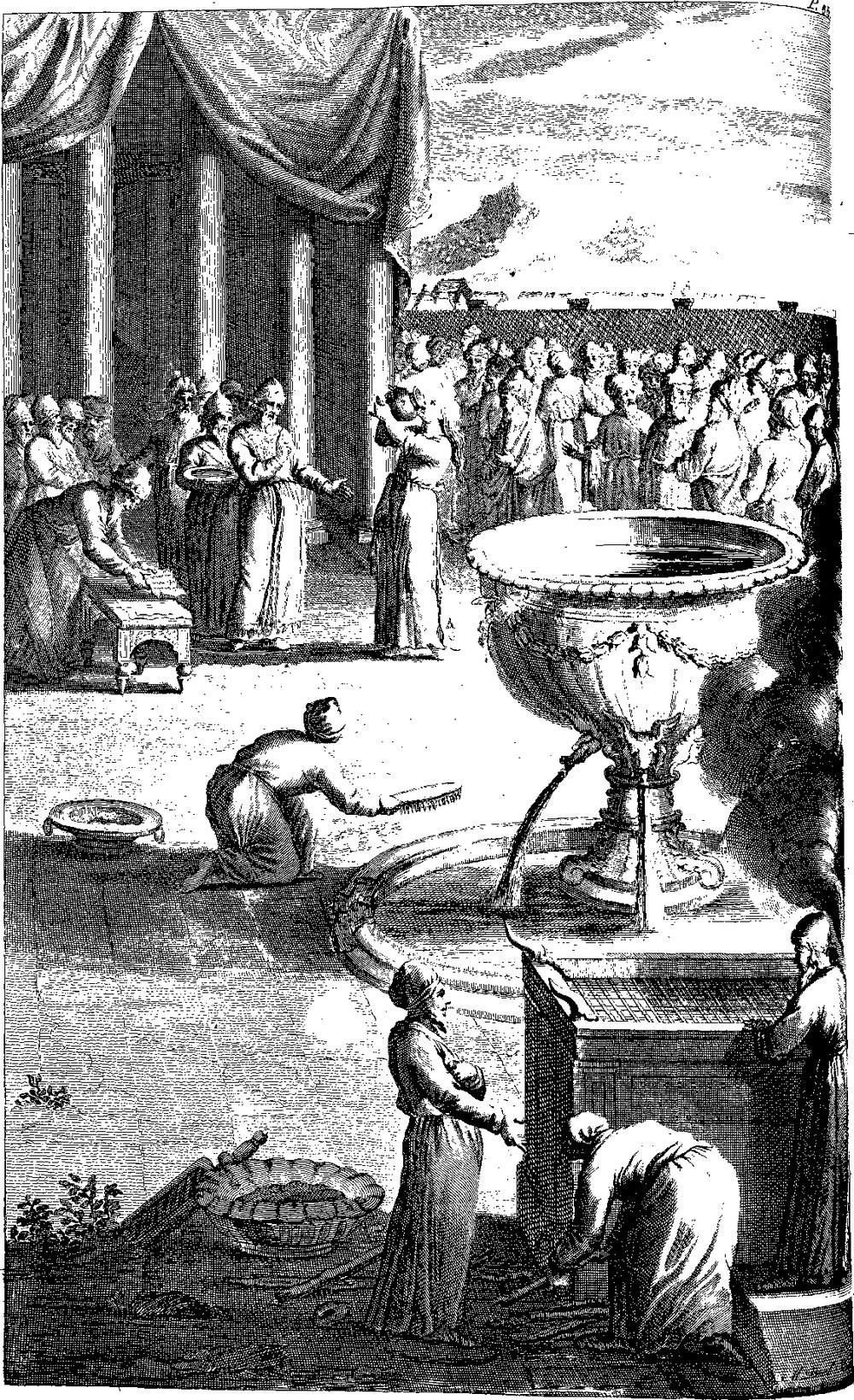
The Judges of the Sanhedrim at first endeavour’d with their threatnings to confound the Woman, and oblige her to confess her crime. If she persisted in denying it they had her well tired with walking, to see if any thing could be got out of her by this means: And if she still own’d nothing, she was led to the eastern gate of the Court of Israel, and when she was stript of the clothes she wore, and was dressed in black before a multitude of Persons of her own Sex, the Priest then told her, that if she knew herself to be innocent of that which she was accused of, she had nothing to apprehend; but that if she were guilty, she might expect to suffer all that the Law threaten’d her with; (and what that was we shall see hereafter) to which she answer’d Amen, Amen.
The Priest wrote the terms of the Law upon a piece of Vellum, with ink made particularly for this use, without vitriol, that it might more easily be blotted out: The words were these, If a strange Man has not come near you, and you are not polluted by forsaking the bed of your Husband, these bitter waters which I have cursed will not hurt you; but if you have gone astray from your Husband, and have polluted yourself by coming near to another Man, may you be accursed of the Lord, and become an example for all his People; may your Thighs rot, and your Belly swell till it burst; may these cursed waters enter into your Belly, and being swelled therewith, may your Thighs putrify.
After this the Priest took a pitcher made of new Earth, filled it with water out of the brazen bason, which was near the Altar of Burnt-offerings, cast some dust into it, taken from the pavement of the Temple, mingled something bitter with it, as Wormwood or some other drug; and having read the Curses above mentioned to the Woman, and received her answer of Amen, he scraped them into the pitcher of water. During all this time another Priest was tearing her cloaths as low as her bosom, made her head bare, untied the tresses of her hair, fasten’d her cloaths together which were torn after this manner, with a girdle bound under her breasts, and presented her with the tenth part of an Epha, or about three pints of Barley meal, which was in a frying-pan, without oil or incense.
The other Priest, who had prepared the waters of Jealousy or Bitterness, then gave them to be drank by the accused Person, and as soon as she had got them down he put the pan with the meal in it into her hand. This was stirr’d before the Lord, and part of it thrown into the fire of the Altar. If the Woman were innocent, she returned with her Husband, and the Waters, instead of incommoding her, increas’d her health, and made her more fruitful than ever: If on the contrary she were guilty, she was seen immediately to grow pale, and her eyes started out of her head; and, lest the Temple should be polluted by her death, she was carried out with all speed, and died instantly, with all the ignominious circumstances related in the Curses, which, as they say, had their effect too upon him with whom the Woman had transgressed, tho’ he were absent and at a distance. If her Husband had himself been guilty of Adultery, the bitter Waters had no bad effect upon her.
The Rabbins tell us, that since the return of the Jews from their captivity, the trial of Women suspected of Adultery has been suppressed, and that for two reasons: First, because Adulteries were become too frequent; and secondly, that the name of God might not be made liable to be too often erazed in the waters of Bitterness. When therefore any Husband had conceived just suspicions against the fidelity of his Wife, and had witnesses to depose that they had seen her privately with the suspected Persons, contrary to the directions of her Husband, she was immediately divorced, and deprived of her Dowry. Leo of Modena ¹ assures us, that in this case the Husband is obliged to dismiss his Wife whether he will or no, and to separate for ever from her. After this the Woman is at liberty to marry again, not however till four months are expir’d, that it may be discern’d whether she is with child by her Husband before she takes another.
John viii. 3.The Jews having one day surpriz’d a Woman in Adultery, brought her to Jesus Christ, and asked what they should do with her, Moses having commanded Women of this character to be stoned: But this they said tempting him, in order to find matter of accusation against him; Je64
sus therefore stooping, wrote with his Finger upon the ground65, and raising himself again, said, Let him who is without Sin cast the first Stone; then stooping once more, he continued writing on the ground. His Accusers hearing him speak after this manner, retired one after another, the oldest first withdrawing: Then Jesus getting up, and seeing himself left alone with the Woman, said to her, Woman, where are thy Accusers? has no one condemned thee? She said, No, Lord. Jesus answer’d her, Neither will I condemn thee, go away and sin no more.
Deut. xxii. 23.It is presumed with reason, first that this Woman’s Accusers were themselves guilty of the crime which they laid to her charge, in the same manner almost as the Accusers of the chaste Susanna. Now it is not just to receive the accusations of those Persons who are guilty of the evil which they find fault with in another66. Non modo accusator, sed me objurgatur, quidem ferendus est is, qui quod in alio reprehendit in eo ipse reprehenditur. Secondly, there is room to believe that the Woman here spoken of had suffer’d some violence, and that her crime was much lessen’d by the circumstances attending it. Selden67 and Fagius68 are of opinion that her case was the same with that related by Moses in these terms; If a Damsel, that is, a Virgin be betrothed to an Husband, and a Man find her in the City and lie with her, then ye shall bring them both unto the gate of that City, and ye shall stone them with stones that they die; the Damsel, because she cried not, being in the City, and the Man, because he hath humbled his Neighbour’s Wife.
ADUMMIM, a Town and Mountain in Josh. xv. 7. xviii. 17. Ch. x. 30, & seq.the Tribe of Benjamin. Some place it to the South, others to the North of Jericho. If it be true, as is generally believed, that they who went from Jerusalem to Jericho passed through Adummim, this place must have been seated to the West of Jericho. Some will have it that the Traveller mentioned by our Saviour in St. Luke, who, in his way from Jerusalem to Jericho, fell into the hands of Thieves, was attacked at Adummim between these two Cities69.
ÆLIA CAPITOLINA. This was the name given to Jerusalem when the Emperor Adrian, about the year of Jesus Christ 134, settled a Roman colony there, and intirely banished the Jews, forbidding them, upon pain of death, to continue there70. Some assert that they were even prohibited to circumcise their Children. St. Jerom71 says, in his time the Jews bought permission of the Roman Soldiers to look upon Jerusalem, and shed tears over its misfortune. Thus they who bought Jesus Christ with money were obliged to pay a price even for their own tears: Old Men and Women, loaded with rags and years, were observed to go weeping to the Mount of Olives, and from thence to lament the ruin of the Temple. They were forced to purchase at a very dear rate the sight of this place, and the liberty of spreading Perfumes on a stone which was there fix’d. The name of Ælia became so common that People almost forgot that of Jerusalem, which was preserved only among the Jews, and such Christians as were better informed of things than the rest. It went by this name till the Emperor Constantine’s time, when it resumed that of Jerusalem.
The name of Ælia however was not abolish’d, for it was still called so long after this, as may be seen in Greek, Latin, and Mahometan Authors. This name was given it because Ælius was that of Adrian’s Family, and it was called Capitolina from Jupiter Capitolinus, to whom the City was consecrated. There was a Temple built to him in the place where Jesus Christ rose from the dead; a marble Venus was set up at Calvary, upon the Rock where the Cross stood72; a Hog in Marble was placed upon the Gate which looked towards Bethlehem; and at Bethlehem there was a Grove planted in honour of Tammuz or Adonis73, to whom was dedicated the Cave where our Saviour was born. Notwithstanding all which, these Places consecrated by the Birth, Death, and Resurrection of Jesus Christ, were honoured by the Christians, and continued to be in great repute among even Heathens. Adrian’s Order prohibiting the Jews to enter Jerusalem, did not exclude the Christians; they still remained there, and had Bishops of this Place. Hitherto the Church had scarce been composed of any besides convert Jews, who with the liberty of the Gospel74 retained the old legal Ceremonies; but from that time there were none but Gentile Converts, who abolished the remains of these Jewish Observances. Some affirm75, that the Emperor Adrian, when he set about the rebuilding of Jerusalem, made use of one Aquila, a Native of Sinope in Pontus, who at first embraced Christianity, then being expell’d out of the Church, received Circumcision, turned Jew, and became celebrated
brated for his Translation of the Old Testament into Greek. See the two Articles ADRIAN and AQUILA.
AEN, otherwise Ain. This term signifies a Fountain, and is to be met with in compound with several names of Cities. Ain, the City we are here speaking of, was first Josh. xv. 32. 1 Chron. iv. 32.given to the Tribe of Judah; afterwards it was yielded up to the Tribe of Simeon. Eusebius says this is Beth-anin, four miles from Hebron, and two from Terebinthus.
ÆRA, is the same thing very near with Epoch, of which we shall say something in its place. The Chronologers call the fixed points of their Chronology Æra. The Heathens, for example, talk much of the first Olympiad, the Trojan War, the Voyage for the golden Fleece, the Æra of the Foundation of Rome, the Æra of Nabonassar, of Alexander the Great, of the Seleucidæ, or, as in the language of the books of Maccabees, the year of the Greeks, and last of all, the year of Jesus Christ.
The Æra of the first Olympiad we fix at the year of the World 3228, before Jesus Christ 772.
The taking of the Town of Troy by the Greeks at the year of the World 2820, before Jesus Christ 1180.
The Voyage undertaken in order to bring away the golden Fleece, at 2760.
The Foundation of Rome at 2856. The Æra of Nabonassar at 3257, before Jesus Christ 743.
The Æra of Alexander the Great, or his last victory over Darius, at 3674, before Jesus Christ 326.
The Æra of the Seleucidæ at the year of the Julian Period 4403, of the World 3692, before Jesus Christ 308, before the vulgar Æra 312. The Jews call it the Æra of Contracts76. The first book of Maccabees places the beginning of it in Spring, the second in Autumn.
The Æra of the birth of Jesus Christ in 4000, the 25th of December, three years and six days before our vulgar Æra, wherein we reckon this year 1719; whereas if we were to take exactly the Æra of our Saviour’s birth, we should reckon 1722. Other Æra’s may be seen under the Article EPOCH. Here are as many as are necessary for fixing the Chronology of the several books in the Bible. See also the Chronological Table.
ÆTHAN, or Ætham, between Jerusalem and Bethlehem. See ETHAN.
AFFINITY. There were several degrees See Lev. xviii. 7. & seq.of Affinity among the Hebrews, which were obstructions to Matrimony. For example, 1. The Son could not marry his Mother, nor his Father’s second Wife; 2. The Brother could not marry his Sister, whether she were so by the Father only, or by the Mother only, much less if she were thus related to him on both sides; 3. The Grandfather could not marry his Grandaughter, either by his Son or Daughter; 4. No one could marry the Daughter of his Father’s Wife; 5. Nor the Sister of his Father or Mother; 6. Nor the Uncle his Niece, nor the Aunt her Nephew; 7. Nor the Nephew the Wife of his Uncle by the Father’s side; 8. The Father-in-law could not marry his Daughter-in-law; 9. Nor the Brother the Wife of his Brother, while living, nor even after the death of his Brother, if he left Children. If he left no Children, the surviving Brother was to raise up Children to his deceased Brother, by marrying his Widow. 10. It was forbidden to marry the Mother and the Daughter at one time, or the Daughter of the Mother’s Son, or the Daughter of her Daughter, or two Sisters together.
It is true, the Patriarchs before the Law sometimes married their Sisters, as Abraham married Sarah, who was his Father’s Daughter by another Mother; and two Sisters together, as Jacob married Rachel and Leah; and their own Sisters by both Father and Mother, as Abel and Cain: But these Cases are not to be proposed as Examples, because in some they were authorized by necessity, in others by custom; and the Law as yet was not in being. If some other examples may be found, either before or since the Law, the Scripture expressly disapproves of them; as Reuben’s Incest with Balah his Father’s Concubine, and the Action of Ammon with his Sister Tamar, and that of Herod Antipas, who married Herodias his Sister-in-law, his Brother Philip’s Wife, while her Husband was yet living.
AFRICA, one of the four parts of the World. It was peopled principally by Ham Gen. x. 6, 13, 14.and his Descendants. Mizraim peopled Egypt. The Pathrusim, the Naphluhim, the Casluhim and the Ludim, peopled other parts of this Country; the limits whereof are not at this day known distinctly. We place Lebabim in Libya, and Phut between Numidia and Libya, along the Mediterranean. It is thought that many of the Canaanites, being driven out of their Country by Joshua, retired
into Africk77. The Mahometans believe likewise, that the Amalekites, who dwelt in ancient times in the neighbourhood of Mecca, were forced from thence by the Kings descended from Zioram78. This matter may be seen treated at large in our Dissertation concerning the Country whither the Canaanites retired, printed before the Book of Joshua.
AGABA, a Fortress near Jerusalem, which Galestus, who was Governour of it, restored to Aristobulus, the Son of Alexander Jannæus. Joseph. Antiq. l. 13. c. 24. Agaba, or Haggabah, in Hebrew signifies a rising ground, or eminence.
AGABUS, a Prophet, and as the Greeks say, one of the seventy Disciples of our Saviour, foretold that there would be a great famine over all the Earth; and St. Act. xi. 28. In the year of J. C. 43.Luke, in the Acts, informs us that it accordingly fell out, under the Emperor Claudius, in the fourth Year of his Reign, and in the forty fourth Year of Jesus Christ. Profane Historians take notice of this famine; and Suetonius79 observes, that the Emperor himself was insulted upon this occasion, attacked by the People in the middle of the Market-place, and obliged to retire to his Palace. As this famine afflicted principally Judæa, the Christians of Antioch, upon information of the great Want which their Brethren were reduced to at Jerusalem, resolved to send assistance to relieve them. St. Paul and St. Barnabas were entrusted with their Charity, Acts xi. 29, 30. In the year of J. C. 44.and conveyed it to Jerusalem.
Ten years after, that is to say, in the year of J.C. 58. as St. Paul was going to Jerusalem, and had already landed at Acts xxi. 10.Cæsarea in Palestine, the same Prophet Agabus arrived there, and coming to visit St. Paul and his company, he took this Apostle’s girdle, and binding himself hand and foot, he said, Thus saith the Holy Ghost, so shall the Jews at Jerusalem bind the Man that owneth this Girdle, and shall deliver him into the hands of the Gentiles. And when they heard these things, all they who were present besought St. Paul to go no farther. But he answered, That he was ready not to be bound only, but also to die at Jerusalem, for the name of the Lord Jesus. We know no other particulars of the life of Agabus. The Greeks say he suffered Martyrdom at Antioch; and they observe his Festival on the eighth of March. The Latins, ever since the ninth Age, have kept it on the ninth of February.
AGAG, King of the Amalekites. The Amalekites having inhumanly attacked the Israelites in the Wilderness, after their coming out of Egypt, while they were sinking under the fatigues which they had suffered, and having massacred all those who were not able to keep up with the body of the Army, the Lord was not satisfied with the Victory which Joshua obtained over them in the same Wilderness, but protested with an Oath that he would destroy the memory of Amalek from under Heaven, and would make eternal War with them, without mercy. This happened in the year of the World 2513. before J.C. 1487. before the vulgar Æra 1491. About four hundred years after, the Lord remembred the malice which Amalek had shewn formerly to his People, and he commanded Samuel to tell Saul, that he should march against the Amalekites, cut them in pieces, and destroy every thing belonging to them: Spare them not, nor desire any thing that is theirs, but slay both Man and Woman, Infant and Suckling, Ox and Sheep, Camel and Ass. Saul thereupon issued out his Orders to the People, and having assembled them, he found, upon the review of them, that their number amounted to two hundred thousand foot, without reckoning the ten thousand Men of the Tribe of Judah, which made a separate Body.
Being entred therefore into the Country of the Amalekites, he cut in pieces all he found from Havilah to Shur, which is over-against Egypt. He took Agag their King alive, and preserved him, with the best of the Sheep and Oxen, the Fatlings and the Lambs, and the richest and most valuable part of all the spoil. Then came the Word of the Lord to Samuel, saying, It repenteth me that I have set up Saul to be King; for he hath turned back from following me, and hath not performed my Commandments. And it grieved Samuel, and he cried unto the Lord all night. The next day therefore he went to meet Saul, who was returned with his Army to Gilgal; where he offered a Burnt-offering unto the Lord out of the spoil which he had taken from the Amalekites. When Samuel drew near to Saul, this Prince saluted him, and said, I have performed the Commandment of the Lord. And Samuel said, What meaneth then this bleating of the Sheep in mine ears, and the lowing of the Oxen, which I hear? And Saul said, They have brought them from the Amalekites; for the People spared the best of the Sheep, and of the Oxen, to sacrifice unto the Lord thy God, and the rest we have utterly destroyed. Then Samuel said unto Saul, Stay, and I will tell thee what the Lord hath said to me this night. And he said unto him, Say on. Then Samuel signified unto him the resolution which the Lord had taken, of rejecting him, and of transferring the
Kingdom to another. Saul would have excused himself; but Samuel told him that God required neither Sacrifices nor Burnt-offerings, but perfect Obedience; and that to resist and disobey him, was as the sin of Witchcraft and Idolatry. Having said this, he called for Agag King of Amalek to be brought unto him, who, when he was presented to him in fetters, and trembling in 1 Sam. xv. 32.every limb, said80, Must I then be separated from all things by a bitter death? And Samuel said to him, As thy Sword hath made Women childless, so shall thy Mother be childless among Women. And he hewed Agag in pieces before the Lord in Gilgal. Thus Agag King of Amalek finished his life, about the year of the World 2930. before J. C. 1070. before the vulgar Æra 1074.
Isai. xv. 8. 1 Sam. xxv. 44.AGALLA,81 or Ægalla, Gallim, or Ægallim, or Eglaim, a City beyond Jordan, to the East of the Dead Sea, in the land of Moab. Eusebius82 places it at eight miles distance from Ar, or Areopolis, towards the South.
AGAPE. This is a Greek word, and signifies properly Friendship. The feasts of Charity, which were in use among the Christians of the Primitive Church, were called by this name. They were celebrated in memory of the last Supper which Jesus Christ made with his Apostles, when he instituted the Holy Eucharist. These Festivals were kept in the Church, towards the Evening, after the common Prayers were over, and the word of Salvation had been heard. When this was done, the Faithful eat together with great Simplicity and Union, what every one had brought with them; so that the Rich and Poor were no way distinguished. After a frugal and modest Supper, they partook of the Lord’s Body and Blood, and gave each other the Kiss of Peace. This Custom, so good and laudable in its Original, soon degenerated, and was abused. St. Paul, in his first Epistle to the Corinthians, complains, 1 Cor. xi. 21.that so early as in his time the Rich despised the Poor in these Assemblies, and would not condescend to eat with them: When ye come together, says he, in one place, this is not to eat the Lord’s Supper; for in eating every one taketh before other, his own Supper: and one is hungry, and another is drunken. What, have ye not Houses to eat and to drink in? or despise ye the Church of God, and shame them that have not? What shall I say to you? Shall I praise you in this? I praise you not?
The Jews had certain devotional Entertainments, which had some relation to the Agapæ we are speaking of. Upon Deut. xiv. 22, 27-29. xxxvi. 10, 11, 12. Neh. viii. 12. Esth. ix. 19.their great Festival-days they made Feasts for their Family, their Friends and Relations; to these they invited the Priests, the Poor, and Orphans, and sent portions to them of their Sacrifices. These Repasts were made in the Temple, and before the Lord. And there were certain Sacrifices and First-fruits appointed by the Law, which were to be set apart for this purpose.
AGATE, a precious Stone called Achates, or Gagathes; and in Hebrew, Shebo. There is mention of it in some places of the Scripture. It is said to take its name from a Ex. xxviii. 19. xxix. 12. שבו Schebo. 70. Ἀχάτης, Achates.river in Sicily, where it is found. Some of these Agates are seen likewise in Phrygia and the Indies. There are many sorts of them; one is called Agate Sardonyx, or only Sardonyx; another Agate Onyx, or Onyx only, another Agate Calcedony, or Calcedony, and nothing more; another, Roman Agate; and lastly, another, German Agate. All these Agates differ in colour and price. Some are to be seen with black and white veins, with veins of gold, and like Amethysts. They make Cups and Vessels of Agate. The oriental Agates are polished and glittering, and sometimes very pretty things are to be seen in them, represented after a natural manner.
AGES OF THE WORLD, the times preceding the Birth of Jesus Christ, have been generally divided into six Ages.
The first extends from the beginning of the World to the Deluge; and comprehends one thousand six hundred and fifty six years.
The second Age, from the Deluge to Abraham’s coming into the Land of Promise, in 2082, comprehends four hundred and twenty six years.
The third Age of the World, from Abraham’s entrance into the Promised Land, to the deliverance of the Hebrews out of Egypt, in the year of the World 2523, includes four hundred and thirty years.
The fourth Age, from the going out of Egypt to the foundation of the Temple by Solomon, in the year of the World 2992, takes up four hundred and seventy nine years.
The fifth Age of the World, from Solomon’s laying the foundations of the Temple, to the Babylonish Captivity in the year of the World 3416, contains four hundred twenty four years.
The sixth Age of the World reaches from the Babylonish Captivity to the Birth of Jesus Christ, which happened in the year of the World 4000, and in the fourth year before the vulgar Æra, and includes five hundred fourscore and four years.
Ages of the World continues on the next page
Footnotes
-
Alcoran, Chap. of the Stone. See D’Herbelot. Bibl. Orient. p. 55, &c. ↩
-
See Les Notes de M. Renaudot sur le voyage de la Chine de deux Arabes, p. 134. Bibl. Orient. p. 806. ↩
-
D’Herbelot ↩
-
D’Herbelot Bibl. Orient. p. 56. col. 2. ↩
-
Idem, p. 243. ↩
-
Idem ex Thahmurath Nameh. ↩
-
Abrah. Cohen-Irira Philosoph. Cabbal. Diss. 6. c. 7. See Basnage’s Continuation of the History of the Jews. ↩
-
Midras Tehillim. Ps. xcii. Vide Basnage, ibid. t. 4. p. 186. ↩
-
Gemar. Sanhedrin. fol. 582. ↩
-
Aug. Ep. 163. nov. Edit. p. 575. Et de illo quidem primo homine quod eum inde (ex inferno) solverit, Ecclesia fere tota consentit quod eam non inaniter credidisse credendum est, undecunque hoc traditum sit, &c. Vide & de peccatorum meritis & de nat. & grat. contra Julian. l. 6, &c. ↩
-
Quaresm. t. 2. l. 5. p. 481 & 483. ↩
-
Bolland. die 4. Febr. p. 449. t. 3. Apr. p. 260. t. 3. Mart. p. 541. ↩
-
Vide Epiphan. hæref. 52. Theodoret. hæretic. Fab. l. 1. c. 6. Augustin. de hæref. See M. Bayle’s Dictionary under the Name of Adamites. ↩
-
He lived in the fifteenth Century. ↩
-
אדרכוניםAdarconim. ↩
-
Translators’ note. The Adarconim of the Scripture, and Darkonoth of the Talmudists, so called from the Greek Δαρεικοὶ, Darics. A Daric was a piece of Gold of the value of one of our Jacobus’s. See Prid. Con. ↩
-
M. le Pelletier of Roan. ↩
-
Herodot. l. 4. c. 166. º Joseph. Antiq. l. xii. c. 17. ↩
-
Translators’ note. It was Darius the Mede, who coined a great number of pieces of pure Gold called Darics, or Stateres Darici: This Darius was the first King of the Medes and Persians, who coined Gold Money. They were stamped on one side with the effigies of an Archer, who was crowned with a spiked Crown, had a Bow in his left hand, and an Arrow in his right, and was clothed with a long Robe. I have seen one of them in Gold, and another in Silver. They were of the same weight and value with the Attic Stater, or piece of Gold Money weighing two Attic Drachms. Darius seems to have learnt the art and use of Money from the conquered Kingdom of the Lydians, and to have re-coined their Gold; for the Medes, before they conquered the Lydians, had no Money. The Lydians were the first who coined Gold and Silver; and Crœsus coined Gold Monies in plenty, called Crœsei; and it was not reasonable that the Monies of the Kings of Lydia should continue current after the Overthrow of their Kingdom, and therefore Darius re- coined it with his own effigies, but without altering the current weight and value. See The Chronology of the ancient Kingdoms amended, by Sir Isaac Newton, p. 319, &c. ↩
-
Eufeb. in Adasa. ↩
-
Joseph. Antiq. l. xii. c. 17. & de bello, l. 1. c. 1. ↩
-
Joseph. de Bello, l. 1. c. 1. p. 710. b. ↩
-
Gronov. de pecunia veterum, l. 3. c. 7. ↩
-
Chald. Rabb. Rupert. Raban. alii recentiores. ↩
-
Hieronym. Ep. 27. ↩
-
Joseph. Antiq. l. 20. c. 2. ↩
-
Orosius, l. 7. c. 6. ↩
-
Translators’ note. And this Interpretation is followed by our English Translators, who in the several places cited by our Author, read set apart, sever. Buxtorf, under פלאobserves, Sunt & quædam ex hujus verbi formâ, pro segregare, quæ pertinent ad פלהNiph. Segregari, separari. Buxt. Lex. ↩
-
Translators’ note. The Author, in this passage, varies from the Text, where David describes the affection of his Friend to himself, not his to Jonathan. I confess, Errors of this nature are very inconsiderable, and not worth remarking; but few of more importance have escaped this diligent and exact Writer. ↩
-
Celler. Geogr. antiq. l. 3. c. 13. ↩
-
אדניAdonai, Dom. Gr. Κύριος, יהוהJehovah. ↩
-
Euseb. in loc. in Βεζεκ. ↩
-
Translators’ note. The Greeks worshipp’d Isis and Osiris under other Names; as for example, under that of Bacchus, and the Arabians under that of Adonis. Ogygia † me Bacchum canit; Osyrin Ægyptus vocat; Arabica gens, Adoneum. ↩
-
Vide Plutarch de defectu oracul. ↩
-
See our Dissertation on Baal-peor, before the book of Numbers. ↩
-
Kimchi, Maimon, alii Hebr. Vide & Sant. Pagnin. in Thesauro. ↩
-
Idem Ibidem Βυβλίνην κεφαλήν. ↩
-
Lucian de Dea Syra. Vide & Bochart. Phaleg. l. 4 c. 2. ↩
-
Procop. & Cyril. Alex. in Isai. xviii. ↩
-
Bochart. loc. cit. ↩
-
Minutius in Octavio. ↩
-
Hieronym. contra Rufin. l. 1. ↩
-
Joseph. Antiq. l. 13. c. 17. ↩
-
Xiphilin. p. 262. Dio cass. ↩
-
Basnage Hist. des Juifs, T. 2. l. 4. c. 8. ↩
-
Xiphilin. loco cit. ↩
-
Euseb. in Astaroth. ↩
-
The 10th of August, in the 18th year of Adrian, of J. C. 135. ↩
-
Basnage Hist. des Juifs. t. 2. p. 138. ↩
-
Hieronym. in Dan. ix. ↩
-
Basnage Hist. des Juifs. t. 2. p. 133. ↩
-
Euseb. Hist. Eccl. l. 4. c. 6. ↩
-
Hieron. Chron. an. ↩
-
Hieron. in Zach. xi. 7. ↩
-
Tristan. Comm. Hist. Adrian, p. 363. ↩
-
Freher. de Num. Census, p. 3648. ↩
-
Euseb. in locis in Adullam. S. Jerom, places it at eleven miles distance from Eleutheropolis. ↩
-
Hieron. l. 2. contra Pelag. c. 6. ↩
-
Euseb. l. 3. Hist. Eccl. c. 39. ↩
-
Simon hist. critique du N. T. p. 150. ↩
-
Constit. Apost. l. 2. c. 24. ↩
-
Aug. de conjug. adulter l. 2. c. 7. ↩
-
See Levit. v. 11, 12. and the Commentators on this place; and Philo de specialib. legib. ↩
-
Leo of Modena, his Customs of the Jews, Part 5. c. 6. ↩
-
Translators’ note. St. Jerom aggravates the matter, and tells us, that our Saviour not only wrote the Sins of the Accusers, but those too of all Mankind, Jesus inclinans se digito scribebat in terrâ, eorum videlicet qui accusabant, & omnium peccata mortalium. Secundùm quod scriptum est in Propheta, relinquentes autem te, in terra scribentur. Hieron. Advers. Pelag. 1. 2. ↩
-
Cicero in verrem, Orat. 5. ↩
-
Selden Uxor Hebr. l. 3. c. 11. ↩
-
Fagius ad Deut. xxii. 22. ↩
-
Vide Hieronym in Matt xx. & Ep. 27. ↩
-
Spartian. in vita Adriani. ↩
-
Hieron. in Sophon. 1. ↩
-
Paulin. ad Sever. Epist. xi. ↩
-
Hieron. ad Paulin. Ep. 13. ↩
-
Sever. Sulpit. Hist. l. 2. ↩
-
Epiphan. de Pond. & Mens. c. 14, 15. ↩
-
Translators’ note. When the Jews became subject to the Syro-Macedonian Kings, they were obliged to make use of this Æra in all their Contracts, and other Civil Affairs; for which reason it was termed the Æra of Contracts. In the Maccabees, it is called the Æra of the Kingdom of the Greeks. All other Nations that computed by this Æra, began it from the Autumn of the Year before Christ 312. but the Chaldeans from the Spring following; because till then they did not think Seleucus thoroughly settled in the possession of Babylon. See Prid. Connect. Part I. Book VIII. ↩
-
Procop. de bello Vandelico, l. 2. c. 10. Gemar. alii. ↩
-
Pocock. in specimine hist. Arab. ↩
-
Sueton. in Claudio. c. 18. Joseph. Antiq. l. 20. c. 2. ↩
-
The Text does not say that he was thus trembling; but the Septuagint and Vulgate do. The Hebrew Text, which we have rendred by in fetters, may be translated in deliciis, .מַעֲדַּנֹות ↩
-
Joseph. Antiq. lib. 14. c. 2. ↩
-
Euseb. in Agallim. ↩