Volume I, pages 21–39 of the 1732 edition, from ABR to ADA: everything printed on these pages, in order.
Continued from Abram
World 2133. Isaac being then about the Age of five and twenty.
Twelve Years after this, that is, in the Year of the World 2145. before J. C. 1855. before the vulgar Æra 1859. Sarah the Wife of Abraham died, in the City of Gen. xxiii.Hebron, otherwise called Arba. Abraham was then probably at Beer-sheba, but being informed of her death, he came to Hebron, there to mourn, and perform the last Offices for her. He appeared before the People assembled in a body at the City Gate, entreating them to allow him the liberty of burying his Wife among them; for as he was a Stranger in the Country, and had no Land then of his own, he could pretend to no right of giving honourable Interment to his dead in the Sepulchres of that Country, without the consent of the Proprietors. He therefore desired Ephron, one of the Inhabitants, to sell him the Field called Machpelah, with the Cave and Sepulchre belonging to it. The Purchase was made before all the People of Hebron, at the price of four hundred Shekels of Silver; which are equivalent to forty five Pounds twelve Shillings and six Pence1. And Abraham buried Sarah, after he had mourned for her according to the custom of the Country.
Abraham perceiving himself to be Ch. xxiv.grown old, sent Eliezer, the Steward of his House, into Mesopotamia, with directions to bring a Woman of his own Nation, with whom he might marry his Son Isaac. Eliezer executed this Commission with all the Prudence that could be desired; and brought Rebekah the Daughter of Bethuel, Grand-daughter to Nahor, and consequently Abraham’s Niece. Isaac married her, and lodged in his Mother Sarah’s In the Year of the World 2148. before J. C. 1852. before the vulg. Æra 1856. In the Year of the World 2183. before J. C. 1817. before the vulg. Æra 1821.Tent. Abraham, after the Death of Sarah, married Keturah, by whom he had six Sons, Zimram, Jokshan, Medan, Midian, Ishbock, and Shuah; who were all Heads of different People, whose Habitation was in Arabia, and in the Neighbourhood of Palestine. At last, after he had lived an hundred and seventy five Years, he died, worn out with Age, and was buried with Sarah his Wife, in the Field and Cave of Machpelah, which he had purchased of Ephron.
The Eastern People, not only Christians and Mahometans, but the very Indians and Infidels, have some knowledge of the Patriarch Abraham, and speak with great commendation of him. I shall produce here what the Arabians, who are descended from the Patriarchs, inform us of him. Abraham2, they tell us, was the Son of Azar, and Grandson of Terah; in this Account all the Arabian Historians agree. Terah therefore, whom the Scripture mentions as the Father of Abraham, went likewise by the name of Azar, which is not any thing extraordinary in the East, where several Persons have two names; whereof we have divers instances in the Scripture. If our Chronologers, according to the Remark of M. D’Herbelot, had been acquainted with this Arabian Genealogy, they would never have had recourse to the Expedient of Abraham’s transplanting himself a second time, in order to reconcile thereby the Epoch of his Departure from Ur with the years of his Age; they would have easily disengaged themselves out of all those Difficulties, by admitting two Terahs, one sirnamed Azar, and the Father of Abraham; the other the Grandfather of this Patriarch; which does not any way contradict the sacred Text.
There might be a coherent History of the Life of Abraham extracted from the Traditions of the Eastern People; I shall here present you with a short Specimen of one.3 Nimrod, the celebrated Nimrod, Son of Canaan, and the mighty Hunter, who is thought to have been the first King after the Deluge, kept his residence at Babylon, which was built by him. This Prince in a dream saw a Star rising above the Horizon, the light whereof eclipsed that of the Sun. The Soothsayers being hereupon consulted, foretold, that a Child should be born in Babylon, who in a short time should become a great Prince, and that he had reason to fear every thing from him, tho’ he was not yet conceived. Nimrod, terrified with this answer, immediately gave orders that the Men should be separated from their Wives; and appointed an Officer over every ten Houses, whose business it was to prevent their seeing one another. Azar, Nimrod’s Guide, deceived his Guards, and lay one night with his Wife Adna. The next day the Magi, who made their Observations every moment during this time, came and inform’d Nimrod, that the Child with whom he was threatned had been conceived that very night; which obliged this Prince to issue out his Orders, that all the Women who were with Child should be guarded with great care, and that all the Children who should be born of them should be put to death.
Adna, who did not appear by any outward signs to be with Child, was not put under guard; but was at liberty to go into the Country, where she was delivered in a Cave, the mouth whereof she closed very diligently; and at her return told her Husband that she had been brought to bed of a Son, who died immediately after his birth.
Adna
Adna however went frequently to the Cave to visit her Son, and give him Milk; but she continually found him sucking the End of his Fingers, one whereof furnish’d him with Milk, the other with Honey. This Miracle surprized her, but reliev’d her of the Concern which she might otherwise have had for the Nourishment of her Child; and as she saw that Providence had taken this Care upon itself, she was satisfied with going thither from time to time to visit him. She soon perceiv’d that he grew as much in three Days as other Children in a Month; so that fifteen Moons were scarce passed before he appear’d to be as large as a Boy of fifteen Years of Age. Hereupon Adna declar’d to Azar, that the Son of whom she had been deliver’d, and who was reported by her to be dead, was living, and that God had provided in a miraculous manner for his Subsistence.
Azar, upon this Discovery, run immediately to the Cave, where he found his Son, and desir’d his Mother to convey him to the City, because he was resolved to present him to Nimrod, and place him about the Court. In the Evening Adna brought him forth out of his Den, and conducted him through a Meadow, where Herds of tame Cattle of all sorts were feeding. This was a Sight intirely new to young Abraham, who was inquisitive to learn their several Names of his Mother, and by her was informed of their respective Names, Qualities, and Uses. Abraham continued his Enquiries, and desired to know who it was that produced all these things. Adna told him that all Things in the World had their Lord and Creator. Who then, says he, was it that brought me into the World? It was I, says Adna. And who is your Lord, replied Abraham? She answer’d Azar. As he continued to ask her who was Azar’s Lord, she told him Nimrod. He shewed an Inclination to carry on his Enquiries in this Method, but she check’d him, telling him withal, that it was not convenient to search farther into Matters for fear of Danger.
At last he came to the City, which he saw deeply engaged in Superstitions and Idolatries of all kinds. After this he return’d to his Grotto, but was continually possess’d with a Desire of knowing his Creator. One day, as he was upon the way to Babylon, he saw towards the Evening the Stars shining in the Heavens, and among the rest Venus, which was ador’d by many: Hereupon he said within himself, Perhaps this is the God and Creator of the World: But observing some time after that this Star was set, he said, This certainly cannot be the Master of the Universe, for it is not possible he should be subject to such a Change. Soon after he took notice of the Moon in the Full, and it came into his Thoughts that this probably might be the Author of all Things, after whom he was enquiring; but when he perceived it to have passed over the Horizon like the other Stars, his Judgment of it was the same as he had before made of Venus. At length, as he came nearer to the City, he saw Multitudes of People adoring the rising Sun, and was tempted to follow their Example; but having viewed this Star declining, and pursuing its Course westward like the rest, he from thence concluded that it was neither his Creator, his Lord, nor his God.
Azar presented him to Nimrod, who was sitting on a lofty Throne, with a great Number of the most beautiful Slaves of both Sexes about him. Abraham asked his Father who that Person was so far exalted above the rest; Azar answer’d, That this was the King Nimrod, whom all these People acknowledged for their God. It is impossible, replied Abraham, that he should be their God, since he is not so beautiful, and consequently not so perfect as the Generality of those who are about him. Abraham from hence took an opportunity of speaking to his Father concerning the Unity of God, which afterwards drew him into great Contests with the principal Men of Nimrod’s Court, who would by no means acquiesce in the Truth, which he declared to them. Nimrod having been informed of these Disputes, commanded him to be thrown into a burning Furnace, out of which he came without receiving the least hurt.
Having distributed all the Provision in his Granaries to the Poor during a great Plague, he sent to one of his Friends in Egypt, desiring him to supply him with some Corn: But he, as soon as he understood from Abraham’s People the occasion of their Journey, told them they apprehended a Famine likewise in that Country: Besides, says he, I know that Abraham wants no Provisions necessary for his own Family; and the Corn which he desires of me is not for himself, but for the Poor only; for which Reason I do not think it just to send him that which we may want ourselves for the Subsistence of our own People.
This Refusal, tho’ season’d with fair Speeches, extremely afflicted Abraham’s Messengers; and when they drew near to their Master’s Dwelling, fearing lest the People of the Country, when they saw in what condition they returned, might ridicule them, and from hence take occasion possibly to despise Abraham, they determined to disguise their Confusion by filling their Sacks with a very fine white Sand which they found in their Way. Upon their Arrival at the House, he who was the Principal of the Company, related to their Master all that had happen’d to them,
and what they had done. Abraham, without shewing any concern at it, went into his Oratory, there to comfort himself with God upon this Disappointment.
In the mean time, Sarah his Wife, who was ignorant of all this, seeing the Camels return’d, took immediately a Sack, which she found full of excellent Meal, and with it made Bread for the Poor. As soon as Abraham had finish’d his Devotions, he came out of his Closet, and perceiving the Smell of new-bak’d Bread, he ask’d Sarah of what Meal she had made it: With that she replied, of your Egyptian Friend’s which your Camels lately conveyed hither. Say rather, answer’d Abraham, of our faithful Friend God, who never forsakes us in our Necessities. From this time Abraham was styl’d the Friend of God, a Name which is If. xli. 8. Dan. iii. 35.given him by the Prophets, and by which he is generally called by the Mahometans. Hence it is that Hebron, where he was buried, is termed by them the City of the Friend of God: Nevertheless, they place him much below their false Prophet Mahomet. Abraham, says one of them, was only an Officer in his Army, and the Messiah is no more than the Master of the Ceremonies at his Court.
As to the number of Angels who were received in Abraham’s Tent, they are not agreed. Demiathi acknowledges three, viz. Gabriel, Arraphel, and Michael; the first had a Commission to destroy Sodom, the second to declare the Birth of Isaac to Abraham, and the third to preserve Lot from the Ruin of Sodom. Abraham, having received them in his Tent, entertained them with a roasted Calf, says Mahomet in his Alcoran; but observing that they did not eat, was in great Consternation, apprehending them to be Enemies; for, according to the Custom of the Eastern People, there is not a greater Sign of Enmity than to refuse eating and drinking with one who invites them to his Table. The Angels therefore encourag’d him, saying, Fear not, for we are sent to Lot’s People: Sarah, who was present, fell a laughing, continues Mahomet, who was unacquainted with the true History of Abraham, and relates it after his own manner. His Interpreters tell us, that the Cause of Sarah’s laughing was either her Joy to find Abraham deliver’d from his Fears, or the Desire of seeing the Sodomites punished, or her Admiration to behold Angels appearing in a human Form.
The Angels therefore having observed her to laugh, communicated the good news to her that she should have a Son called Isaac, and that Isaac should become the Father of Jacob. To this Sarah answer’d, How can this be, that I who am old, my Husband also being far advanced in years, should be deliver’d of a Son? This would indeed be something very wonderful! But the Angels replied, Why should you be surpriz’d at what is God’s doing? This is a Blessing to you and Abraham, for you are chosen to be the Heads of a great Family. After this, the Angels proceeded on their way to Sodom, and Abraham debated with God a long time, endeavouring to divert him from the Destruction of Lot’s People, saying to them, You are going to lay several Cities in Ruin, in each of which perhaps there may be an hundred righteous Persons. This is the Account we have of this History in the Alcoran.
The Story of Hagar and Ishmael is likewise something alter’d in it; for here we read this Prayer made by Abraham, Lord I have placed one of my Sons in a barren Valley near thy sacred House. The Interpreters hereupon relate that Sarah being unable to endure Hagar or her Son Ishmael in Palestine, entreated Abraham to send them into the Wilderness, where there was no Water. This Request gave Abraham some Uneasiness; but the Angel Gabriel convincing him that he ought to acquiesce in Sarah’s Will, he instantly obey’d; and taking the Mother and her Child, he transplanted them into the Territory of Mecca, which at that time was barren and destitute of Water: But the Angel caused a Spring to rise under Ishmael’s Feet; and this is the Well of Zemzem, so famous among the Turks, and the only one in these Cantons. At the same time God pour’d forth his Blessings on the Country, and it became so fertil that we see the Fruits of the four Seasons of the Year growing together, and in great abundance.
As yet there was no Temple built at Mecca, but only a large Edifice called Sorah, erected, as they say, in the form of a Temple by Seth, ever since the time of Adam. It was respected for its Antiquity, and all the Inhabitants of the Country visited it out of Devotion. Afterwards Abraham and Ishmael rebuilt this Temple, which had been destroy’d by the Deluge. The Mahometans call it Cabah, or the Square House, and visit it at least once in their Lives out of Devotion; and in whatsoever Part of the World they may be, they turn themselves towards it at their Prayers.
There is a great deal of Probability that the ancient Arabians and Ishmaelites paid an idolatrous Worship in this Temple to Bacchus and Urania, or the Celestial Venus. Herodotus4 assures us, that they ador’d only these two Deities, whom they called Bacchus Urotalt, and Urania Alilat.
Strabo says5, that they had no other Deities besides Jupiter and Bacchus. Ammianus makes Cœlus and Bacchus, to be their Gods. Philostorgius in Photius tells us, that they sacrificed to the Sun and Moon, and to Demons. Nilus in his History of the Massacre of the Monks at Mount Sina, affirms, that they sacrificed to the Sun and Morning-Star. Maximus Tyrius speaks of a great square Stone, to which they paid divine Honours; and when the Saracens were converted to Christianity, they were obliged to anathematize this Stone, which before was the Object of their Worship.
It is related6, that the Tribe of the Arabians called Gioram, having been obliged to surrender Mecca and its Temple to the Ishmaelites, who were become too powerful for them, the Prince of the Gioramides threw the black Stone, and two Antelopes of Gold into the Well Zemzem abovementioned, and closed the mouth of it so carefully, that for a long time no one could discover it.
Abdalmotleb, Mahomet’s Grandfather, drew the Stone out of the Well, and restored it to its place in the Temple from whence it had been taken.7 It is still at this day fastned to one of the Pillars belonging to the Porch of the Temple of Mecca; and the Turkish Pilgrims would think their Pilgrimage not duly performed, if they did not kiss this Stone several times, to which they ascribe a thousand pretended miraculous qualities. This black Stone is not the only one to which the Arabians pay a superstitious Worship. The old Ishmaelites8, who frequented the Temple built at Mecca by Abraham, pulled several Stones out, which they carried with them, and placed under a Tent, towards which they turned at their Devotions. As the Worship of the Temple of Mecca consisted in a diversity of Whirlings or Turnings round, they called these Stones Dasuar, which signifies the same thing; and observed the same Ceremonies as they went about them, which they did about the Temple. Thus an extreme respect for the memory of Abraham has engaged these miserable People in Superstition and Impiety. All that they say of the Temple of Mecca built by Abraham, is very probably no more than a Fiction, added to Moses’s account of the Altar erected by this Patriarch at Beer-sheba, and of the Grove Gen. xxi. 33.planted round about it.
They tell us farther9, that Abraham one day prayed to God in these terms, Lord, shew me how thou raisest the dead. The Lord answered, Hast thou not Faith? Yes, Lord, but this is the Request which I make only for my own satisfaction. At the same time the Devil observing10 the Carcase of a Man thrown by the Sea upon the shoar, part whereof had been devoured by the Birds, wild Beasts, and Fishes, thought this was a fair Opportunity to ensnare Men with regard to their belief of the Resurrection. At that time Abraham, by God’s appointment, appeared upon the shore, and the Devil immediately accosting him in the shape of a Man under surprize, asked him how it was possible that the Members of this Carcase, dispersed in the bellies of so many different Animals, should be re-united at the day of a general Resurrection. Abraham replied, He who had power to form all the parts of our Bodies out of nothing, may be very well able to find them again in the several places of Nature where they are scattered. The Potter breaks in pieces an earthen Vessel, and when he pleases makes it over again of the same Clay.
Gen.xv.9, 10,11.God afterwards says to Abraham11, Take four Birds, tear them in pieces, and lay the divided Parts of them upon four separate Mountains; then call them, and you shall see that all these four Birds will immediately come to you. This is an Imitation of what is said in Genesis, concerning the Sacrifice of an Heifer, a She-Goat, and a Ram, each of them three years old, of a Turtle Dove and a young Pigeon, which Abraham divided into two pieces, and placed upon different Altars: But the Turks have added several Circumstances to it. They tell us that the four Birds mentioned by Mahamet, were the Cock, the Pigeon, the Raven, and the Peacock; that Abraham after he had divided them, dissected them with great Accuracy, then mingled them all together. Some add that he pounded them in a mortar, and composed but one mass of them, out of which he made four portions, and these he placed upon the tops of four different Mountains; after which, as he held their Heads, which had been reserved by him, he called them separately by their names, and each of them immediately returned and joined its Head again, so flew away. Thus God convinced Abraham of a future Resurrection.
One of the greatest Prerogatives of Abraham, as the Mussulmen assert12, is his being the Stock from which the glorious Virgin Mary and her Son sprung, whose Conception and miraculous Birth of a Virgin, exempt from all original Corruption, are acknowledged by them.
The Magi, or Worshippers of Fire, who are still subsisting at this day in Persia, have as much respect for Abraham as the Followers of Mahomet13. They believe Zoroastres, their great Master, to be the same with Abraham, and that he was called Zerdoust, or Zoroastres; that is to say,
the Friend of Fire, because when he was thrown by Nimrod into a fiery Furnace, he came out of it unhurt, the Fire having, if we may be allowed to say so, caress’d and treated him as a Friend, instead of doing mischief to him. We have before taken notice of the Books which are ascribed to him.
There is14 a Book of S. Ephrem’s the Syrian, translated out of Syriac into Arabic, concerning Abraham’s Journey into Egypt. It is in the King’s Library, N° 792. and in the same Volume there is a Discourse of S. Athanasius, Patriarch of Alexandria, upon Abraham’s Death, pronounced upon the 28th of March, upon which day the Coptic or Egyptian Christians celebrate his Festival. We are told15, that in the Year of Jesus Christ 1119. Abraham’s Tomb was discovered near Hebron, in which Sepulchre Jacob likewise and Isaac were interr’d. The Bodies of these Patriarchs were still very intire, and many Gold and Silver Lamps were found in the places where they were deposited. The Mahometans have so great a respect for this Tomb that they make this their fourth Pilgrimage, the three others being those of Mecca, Medina and Jerusalem. The Christians built a Church over the Cave of Machpelah16, where this holy Patriarch was buried; and the Turks afterwards changed it into a Mosque.
The place where he received the three Angels, that is to say, the Oak of Mamre, was likewise honoured by Christians, and even by the Jews and Pagans. See hereafter the Articles TEREBINTHUS and MAMRE. Lastly, there is a Chapel built upon Moriah, which makes part of Mount Sion, or Calvary, upon a supposition that this was the place where Abraham intended to have sacrificed his Son Isaac17.
John viii. 56.Our Saviour assures us in the Gospel, that Abraham desired earnestly to see the day of his coming, that he saw it, and was glad. In Matt. viii. 11.another place he tells us, that the happiness of the Righteous consists in being seated with Abraham, Isaac and Jacob in the Kingdom of Heaven, and in being received into Abraham’s Bosom, as into a place of Rest, opposite to the Misery of Hell. The Luke xvi. 22.Emperor Alexander Severus18, who knew Abraham only by the Wonders which the Jews and Christians related of him, conceived so high an Idea of him, that he ranked him, with Jesus Christ, among his Gods.
The Fathers of the Church have been very large in their commendations of this great Patriarch; the Saints of the Old Testament, and the Prophets, have proposed him as the Pattern of perfect Faith and Obedience to God’s Commands. There has been mention made of his Sacrifice for a long time in the Canon of the Mass; and he is called upon in the Prayers for Persons at the point of death. He has had a place in the Martyrologies ever since the ninth Century. In those of Ado, Usuardus, and in the old Roman Calendar, he is commemorated on the ninth of October. A particular Worship is paid to him by the Order of Fontevraud and the Congregation of the Oratory in France, which perform an Office peculiarly in honour of him.
Many fabulous Tales are told of Abraham, and his History has been embellished with great variety of Fictions. Some have averr’d that he reigned at Damascus19, that he dwelt a long time in Egypt20, and that he taught the Egyptians Astronomy and Arithmetick21. Some will have it that he invented Letters, and the Hebrew Language22, or the Characters of the Syrians and Chaldeans23. He is said to be the Author of several Works, among others, of the famous Book intitled Jezira, or the Creation24. There is mention made of it in the Talmud, and some celebrated Rabbins set a great value on it. But they who have examined it without prejudice, speak of it with a great deal of contempt. In the first Ages of Christianity, the Hereticks called Sethians published Abraham’s Revelations25. Athanasius in his Synopsis speaks of the Assumption of Abraham. Origen26 takes notice of an apocryphal Book of Abraham’s, wherein two Angels, one good, the other bad, dispute concerning the Damnation or Salvation of Abraham. The Jews likewise attribute to him the Morning Prayers, and the 89th Psalm, Misericordias Domini in æternum cantabo w, and a Treatise of Idolatry27, and some other Works. The Magi or Worshippers of Fire, who profess the Doctrine of two Principles, believe Zoroastres28, who is their great Prophet, to be the same
with Abraham. They affirm him to be the Author of the Books which they call Zend29, Pazend, and Vostha, wherein all Points of their Religion are comprehended30. But we have said enough of these spurious Books.
ABSALOM, the Son of David, born of Maachah, the Daughter of Talmai, King of Geshur, was, according to the Scripture, the most beautiful Man in all Israel, and had the 2 Sam. xiv. 25.finest Head of Hair. When he had his Hair cut, which he had once a year, because it was heavy, and incommoded him, it weighed two hundred shekels by the King’s weight; which two hundred shekels may be computed to be about one and thirty Ounces, which is indeed pretty extraordinary, but by no means is incredible; since by the relation of Perriwigmakers, there are some Women who have two and thirty ounces of Hair upon their Heads31. Absalom had a Sister named Tamar, who also was extremely handsome. Amnon, the Son of David, but not by the same Mother, conceived so violent a Passion for his Sister, that it made him languish away exceedingly. He prevailed with the King to let Tamar come into his chamber, and prepare something for him to eat. While she was there he ravished her, and then dismissed her with Reproach and Shame.
2 Sam. xiii.In the Year of the World 2972, before J. C. 1028, before the vulgar Æra 1032.Absalom received her into his House, and resolved to revenge the outrage offer-ed to his Sister. He took no notice of it to Amnon, expecting perhaps that the King his Father should punish so wicked an Attempt. Two years after, Absalom going to a Sheep-shearing at Baal-hazor, near Ephraim, invited the King thither, with all the Royal Family. David excused himself, but, pressed by Absalom’s Entreaties, he consented that Amnon and his Brethren should go. When they were warmed with Wine, Amnon, by Absalom’s Direction, was assassinated; upon which the In the Year of the World 2974, before J. C. 1026, before the vulgar Æra 1030.King’s Sons fled immediately to Jerusalem. Absalom, for his part, retired to King Talmai, his Mother’s Father in the Country of Geshur: There he continued for three Years, in all which time David gave himself no trouble in pursuing him; but Joab, Absalom’s Uncle, observing a Fondness in the King’s Heart for his Son, found means by the Interposition of a Woman of Tekoah, who spoke to the King to procure his 2 Sam. xv.Consent for Absalom’s Return. Absalom came back therefore to Jerusalem, but David would not suffer him to come into his Presence. He continued thus for two Years in Disgrace, 2 Sam. xiv.In the Year of the World 2977, before J. C. 1023. before the vulgar Æra 1027. In the Year of the World 2979, before J. C. 1021. before the vulgar Æra 1025.at the end of which Time he sent for Joab with a purpose of engaging him to intercede with the King on his behalf; but he refusing to come, Absalom commanded his Servants to set fire to a Field of Barley belonging to him, which he being informed of, he came and made his complaints to Absalom: Absalom confessed that this was done by his Orders, with the hopes only of having an opportunity thereby to desire his Mediation with his Father, to intreat the King intirely to forgive him, and admit him to his Presence. Joab went, and related all that had passed to David, who order’d Absalom to be introduced, immediately embraced him, and received him into favour as before.
After this Absalom set up a magnificent Equipage, looking upon himself as presumptive Heir to the Crown; and every morning he came constantly to the Palace-gate, calling all those who had any business, and came to demand justice of the King, saying, Whence are you? and when they had reported their Business, he told them, Your Matters indeed seem good and right, but there is no Man deputed of the King to hear you: O that I were made Judge in the Land, that every Man which hath any Suit or Cause, might come unto me, and I would do him justice! And when any Man came nigh to do him reverence, he put forth his Hand, and took him and kissed him. He was thus for four Years preparing the Minds of the People, and winning by degrees upon them; and when he thought he might declare himself, he desired permission from the King to go to Hebron, under pretence of performing some Vow there, which he had made during his Abode at Geshur.
The Text reads 40 Years, but several Latin MSS. Josephus, and Theodoret, read 4 only. This happened in the Year of the World 2980, before J. C. 1020, before the vulgar Æra 1024.He went therefore to Hebron, attended by two hundred Men, who followed him in the Simplicity of their Hearts, without having the least Knowledge of his wicked Design. At the same time he sent particular Persons, whom he had made his own intirely, throughout all the Tribes of Israel, with Orders to sound the trumpet
pet, and publish every where that Absalom was King at Hebron. Hereupon there was very soon a great resort of People to him, and Absalom was acknowledged by the greatest part of Israel. David was informed of Absalom’s Revolt, and that all Israel was of his Party; David therefore and his Officers fled from Jerusalem, leaving no other Guard in the Palace but the King’s Wives. 2 Sam. xvi.Absalom, without loss of time, went directly to Jerusalem, where he was received without any Resistance. Abitophel advis’d him publickly to abuse his Father’s Concubines, that all the People might comprehend by this Action that the Breach was without hopes of Reconciliation, and might continue firm to him, without any thoughts of returning to their Obedience.
At the same time Ahitophel proposed to Absalom that some Troops might be sent in pursuit of David, that so he might be quite oppress’d before he had leisure to look about him, and gather strength; but Hushai, David’s Friend, who pretended to be of Absalom’s Party, diverted him from this Council, and gave notice of it secretly to David, advising him to pass the Jordan with all diligence, and throw himself into some place of Defence, where he might be able to secure himself. David therefore retired to Mahanaim, which was before the Residence of Ishbosheth, the Son of Saul, and there received several Reinforcements from those who continued faithful to him.
Absalom the next day marched against David with all his Forces, and having cross’d the River Jordan, disposed himself to attack the King his Father. David on his part order’d his Troops to march out of the City under the Command of Joab; and both Sides engaging, Absalom’s Army was routed, and cut in pieces: twenty thousand were killed upon the Spot, the rest saved 2 Sam. xviii.themselves by flight. Absalom was mounted on a Mule, and as he fled into the Forest of Ephraim, and was passing under a large Oak with very thick Boughs, his Head was intangled in the Branches, and his Mule going on swiftly, he hung between Heaven and Earth.
A Soldier seeing him in this Condition, gave intelligence of it to Joab, who ask’d him why he did not kill him; and the Man answered, Tho’ I should receive a thousand Shekels of Silver in mine Hand, yet would I not put forth mine Hand against the King’s Son; for in our hearing the King charged thee and Abishai, saying, Beware that none touch the young Man Absalom. Then said Joab, I may not tarry thus with thee; and he took three darts in his Hand, and thrust them through the Heart of Absalom. And while he was yet breathing, and hanging on the Oak, ten young Men that bare
VOL. I. a Joseph. Antiq. l. 7. c. 9. Joab’s Armour, compassed about, and smote him and slew him. His Body was carried off, and thrown into a great Pit which was there in the Wood, and a large Heap of Stones was laid upon him.
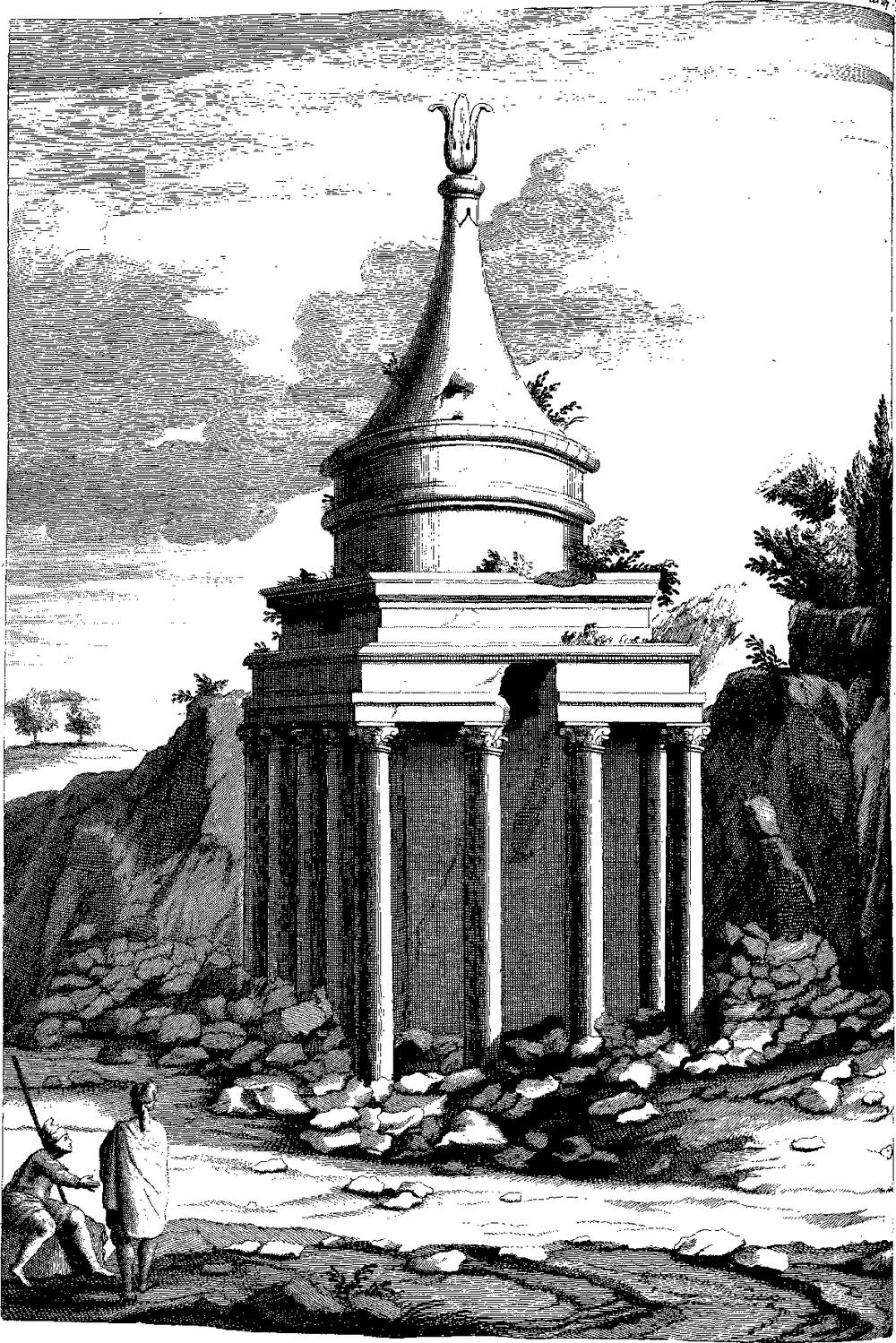
Now Absalom in his Life-time had erected a Pillar in the King’s Valley, saying, I have no Son, and this shall be a Monument to perpetuate my Name. He called the Pillar therefore after his own name, and it is called unto this day Absalom’s Place. This is what the Author of the Books of Samuel tells us. There is a Monument shewn at present Eastward of Jerusalem, in the valley of Jehosaphat, which is said to be this of Absalom’s. After the death of Absalom, the 2 Sam. xviii. 17.Scripture says, They took him, and cast him into a great Pit in the Forest (of Ephraim, where the Battle was fought) and laid a very great Heap of Stones upon him, &c. From hence it might be concluded that he remained buried under these Stones; but we may believe with more probability, that David, who lamented him with such excessive grief, remov’d him from thence, in order to have him laid in the Sepulchre belonging to the Kings, or perhaps somewhere about the place where the Monument which is still at this day shewn to Travellers, was dug in a Rock.
It is a little Chamber wrought with a Chisel out of one piece of Rock, standing apart at some little distance from the Mountain, being a Square of eight paces from out to out. The inside of this Cabinet is all plain, but the outside is adorn’d with some Pilasters of the same kind of Stone. The upper part or Covering is made in the form of a Conick Pyramid, pretty high and large, with a kind of Flower-pot upon the Top. The whole is about four or five Fathoms in height; the Pyramid is composed of several Stones, but the Monument itself is square, and cut out of one Block of Stone.
This may be very well called the Pillar or Hand of Absalom; for the Hebrews give every thing the name of Pillar which is set up for a Monument, and call every thing by the name of Hand which is made use of to shew and preserve the Memory of any thing. For example, that which Saul erected on Mount Carmel, to perpetuate the Remembrance of his Victory against the 1 Sam. xv. 12. Ex. xvii. 16.Amalekites, is called Hand. And Moses, in the Book of Exodus, seems to allude to something like this, when after the Battle with the Amalekites, he says, that the Hand is upon the Throne of the Lord, as a Monument of their Malice, and of the Vengeance which God, by reason thereof, would one day take on them. Josephus, speaking of Absalom’s Monument a, says it was a marble Column, dis
tant about two furlongs, or three hundred paces from Jerusalem. Travellers assure us, that all who pass by Absalom’s Pillar throw a Stone at it, to shew their abhorrence of the Son’s Rebellion against his Father. There is so great a Heap of Stones near it that they almost hide the lower part of this Monument.
2 Sam. xviii. 18.The Scripture seems to intimate, that when this Prince erected it, he had no Children. It is said however four Chapters before 2 Sam. xiv. 27.that he had three Sons and one Daughter of exceeding beauty, whose name was Tamar: But there is some probability that these Children, at least the Sons, did not live; for there are persons who believe that Tamar his Daughter married Rehoboam, King of Judah. The death of Absalom happened in the year of the World 2980, before Jesus Christ 1020, before the vulgar Æra 1024.
Observations upon Absalom’s Defeat by David’s Army in the Forest of Ephraim. 2 Sam. xviii.The order and disposition of the two Armies, as described by the Designer, do not agree entirely with my notions of this matter. The Action was in a forest, where the Troops were ranged, not according to the order usual at that time, but according to the nature of the Ground, which must have been a rule to the Combatants. Here one would believe that the Battle was fought in a plain. The Army marched in order of Battle against Israel, says the Scripture, and the Battle was in the wood of Ephraim; which proves that there were some few trees in this place, where formerly there had been an Engagement, wherein Gideon got the better of Zeb and Zebah. Here is a passage which deserves our Observation: Considerato David populo suo, constituit super eos Tribunos & Centuriones. David having reviewed his People, set Tribunes and Centurions over them. In this there was nothing new; the Jewish Armies, as well as those of other Asiaticks, were divided into Regiments, and these into Companies, and the Companies were subdivided into three parts. David was not the first who introduced this discipline, and these Subdivisions among his troops, the Captains over hundreds, and Commanders of thousands, whom the Vulgate calls Tribunos & Centuriones. This would induce me to believe that David had been deserted by the greatest part of his Forces and principal Officers, who were gone over to Absalom’s Party; so that this Prince was obliged to levy a new Army, to distribute it into Regiments of a thousand, which he split into Companies of an hundred each, which proves that his Army was much more numerous than Josephus32 allows, who tells us that it consisted of no more than four thousand men. Dom Calmet is of Grotius’s opinion, which is opposite to that of Josephus: For, says he, David never would have hazarded a Battle, if his Army had been so much inferior in number to that of his Enemies. This however does not prove that he actually did not run this hazard, because we every day see small Armies beat others that are more numerous, when they happen to be commanded by able Generals; and Joab, who was a very great Captain, risked very little by encountring Generals of much less experience and capacity for Command. I am very well persuaded that David’s Army was a great deal inferior to that of the Rebels. The Scripture says nothing of the disposition of the two Armies in the Forest; it only tells us that David marched in order of Battle against Israel. The wood and the nature of the Country would scarce have permitted him to draw up in a parallel line: it is my opinion that they engaged in Bodies and small Detachments; and as David’s Army was doubtless not by half so strong as the other; he must have left large intervals between the several Bodies, because they fought independently of one another, by reason of the extraordinary depth of the Files, and particularly when they were so far exceeded on their wings, without troubling themselves about being broken, whatever intervals they left between them. Absalom was defeated, and his Army cut in pieces, and twenty thousand Men were left upon the spot. I should not be surprized to find that four thousand Men, to keep to Josephus’s computation, should overcome a great Army, but I should be scarce able to comprehend how so small a number could kill twenty thousand.
2. ABSALOM, of Jerusalem, induced Manahem, the Son of Judas the Galilæan, to think of making himself King of the Jews33, in the twelfth year of Nero’s Reign, and the sixty sixth of the vulgar Æra.
3. ABSALOM, Uncle and Father-in-law to Aristobulus, King of the Jews. He was made prisoner by Pompey at the Siege of Jerusalem34, in the year of the World 3941, before Jesus Christ 59, before the vulgar Æra 63.
ABSALON, the Ambassador of Judas Maccabæus to Lysias, General of Antiochus’s Army, who was sirnamed Eupator, 2 Macc. xi. 17.
ABSTINENCE. Many are of opinion that the Men who lived in the first Ages of the World, before the Deluge, abstained from Wine and Flesh meats, because the Scripture expresly takes notice that Noah after the Deluge began to plant a Vineyard, and that God permitted him to eat Flesh; whereas he gave Adam no other food than Herbs and the Fruits of the Earth. But the contrary opinion is
supported by many learned Interpreters, who believe that the Men who lived before the Deluge denied themselves none of the pleasures of wine and good cheer, and the Scripture in few words intimates enough to convince us to what an excess of Corruption they were grown, when it tells us, that all Gen. vi. 11, 12.Flesh had corrupted his way upon the Earth; and that if God had not permitted them to use either Flesh or Wine, they wou’d have taken very little notice of his Prohibition.
The Law ordained that the Priests should forbear the use of Wine during all the time of their being imployed in the service Lev. x. 9.of the Temple. The same Abstinence was enjoined the Nazarites for the whole Numb. vi. 3.time of their Nazariteship or Separation. The Jews abstain from several sorts of Animals, whereof we have spoken under the general Article ANIMALS. St. Paul says 1 Cor. ix. 25.that Wrestlers abstain from all things, in order to obtain a corruptible Crown; that is to say, they abstain from every thing which may weaken them: And in his Epistle to Timothy, he blames certain Hereticks who 1 Tim. iv. 3.condemned Marriage, and the use of those Meats which God hath created. Among the primitive Christians some denied themselves the use of such Meats as were prohibited by the Law, and Flesh that had been sacrificed to Idols. Others looked with contempt upon these Acts of Forbearance, as unprofitable, and made use of that liberty which Jesus Christ had procured for his Followers. St. Paul has laid down very 1 Cor. viii. 7, 10. & Rom. xiv. 1, 2, 3.wise rules as to this particular, whereof we have an account in his Epistles to the Corinthians and Romans.
The Council of Jerusalem, which was held by the Apostles, enjoins Believers converted from Heathenism to abstain from Acts xv. 20.Blood, from Meats strangled, from Fornication and Idolatry.
St. Paul requires the faithful to abstain 1 Thess. v. 21.from all appearance of Evil; and with much stronger reason from every thing which is really evil, and contrary to Religion and Piety.
ABUBUS, the Father of Ptolemy, by whose procurement his Father-in-law Simon Maccabæus was assassinated in the Castle of Docus, 1 Mac. xvi. 11, 12, &c. In the Year of the World 3869. before J.C. 131. before the vulgar Æra 135.
ABUMA, a City of Judah, the place of Zebudah’s Birth, the Mother of King Jehoiakim35. But in the second Book of Kings 2 Kings xxiii. 36. Luke viii. 31. Rom. x. 7. Rev. ix. 1. xi. 7. &c. Gen vii. 11. Ex. xv. 5. & alibi passim.this City is called Rumah.
ABYSS, or Deep. Hell is called by this name in Scripture; as are likewise the deepest parts of the Sea, and the Chaos, which in the beginning of the World was covered with Darkness, and upon which the Spirit of God moved, Gen. i. 2.
The ancient Hebrews, as well as the generality of the Eastern People at this day, were of opinion that the Abyss, the Sea and Waters encompassed the whole Earth; that the Earth was as it were immersed, and floating upon the Abyss, almost, say they, like a Water-melon swimming upon and in the Water, which covers a small moiety of it. Farther, they believed that the Earth was founded upon the Waters, Ps. xxxiii. 2. xxxv. 6.or at least that it had its Foundation on the Abyss. Under these Waters, and at the bottom of this Abyss, the Scripture represents the Giants to be groaning and suffering the punishment of their Sin: Job xxv. 5.There the Rephaims are confined, those old Giants, who when they were living made the People round about them tremble. Prov. xi. 18. ix. 18. xxi. 16. Ps. lxxxvii. 11. lxx. 20. Isai. xxvi. 14.Lastly, in these dark Dungeons it is, that the Prophets describe to us the Kings of Tyre, Babylon, and Egypt to be lying down and buried, yet alive and expiating the guilt of their pride and cruelty.
Isai. xiv. Ezek. xxviii. 10. xxxi. 18. xxxii. 19. Rev. ix. 1, 2, 11.These depths are the abode of Devils and wicked Men: I saw, says St. John in the Revelations, a Star fall from Heaven, and to him was given the key of the bottomless Pit. And he opened the bottomless Pit, and there arose a smoke out of it, as the smoke of a great furnace which obscured the Sun and Air; and there came out of the smoke locusts which scattered themselves over the whole Earth… And they had a King over them which is the Angel of the bottomless Pit, whose name is the Destroyer.Rev. xi. 7. And in another place, the Beast is represented to us as ascending out of the bottomless pit, and making War against the two Witnesses of God. Lastly, the Angel of the Rev. xx. 1, 3.Lord descends from Heaven with the key of the bottomless Pit, and a great chain in his hand. He laid hold on the Dragon that old Serpent, which is the Devil and Satan, and cast him into the bottomless Pit, and shut him up, and set a seal upon him, that he should deceive the nations no more till the thousand years should be fulfilled; and after that he should be loosed a little season.
Fountains and Rivers, in the opinion of the Hebrews, are derived from the Abyss Eccl. i. 7.or Sea. They issue from thence thro’ invisible channels, and return thither thro’ others of their own forming upon the Earth. At the time of the Deluge the depths below, or the waters of the Sea, broke down their Banks, the fountains forced their Gen. viii. 11.Springs, and spread over the Earth, while at the same time the Cataracts of Heaven were opened, and overflowed the whole World.
The Abyss which covered the Earth in
the beginning of the World, and was put in agitation by the Spirit of God, or by an Gen. i. 2.impetuous Wind, this Abyss was so called by way of anticipation, because it afterwards composed the Sea, and the Waters of the Abyss issued from it, and were formed by the flowing of it: or if you please, the Earth sprung up out of the midst of this Abyss, like an Island rising out of the Sea, and appearing suddenly to our Eyes, after having been for a long time conceal’d under water.
ACABARES or Chabares, was a Castle or City situated upon a Rock, which Josephus fortified during the War between the Jews and Romans36.
ACCAD, a City built by Nimrod, the Gen. x. 10.situation whereof is not very well known. The Septuagint read it Archad; whereupon it is conjectured that it was situated upon the River Argad in the Sittacene.
ACCHO, called since Ptolemais, lay north of Mount Carmel, with a Harbour to the Sea. It fell to the Tribe of Asher, upon Judg. i. 31. vide & Jos. xix. 25. in Græco.the division. They who were employed in the holy Wars called it Acra. The River Belus falls into the Mediterranean at the foot of Accho, towards the North of this City. The Israelites would not extirpate the Inhabitants of Accho; and it continued in the hands of the Canaanites, or Phœnicians. It is often mentioned in the Books of the Maccabees under the name of Ptolemais.
ACELDAMA, or rather Chakel-dam Mat. xxvii. 8. Acts i. 19.37, the inheritance or portion of Blood; by this name was that Field called which the Priests purchased with the thirty pieces of Silver that had been given to Judas Iscariot, as the price of Jesus Christ’s Blood. Judas having brought this Money back into the Temple, and the Priests not thinking it was lawful to make use of it for the service of so holy a Place, because it was the price of Blood, they bought a Potter’s Field with it to be a Burying-place for Strangers. This Field was shewn in St. Jerom’s time South of Jerusalem; and is still at this day shewn to Travellers. The place is very small, and covered with an arched roof, under which the Bodies that are there deposited, are, they say, consumed in less than three or four days. Drutmar, a Monk of Corbie, says, that in his time there was an Hospital in this place for the entertainment of French Pilgrims, in their Journey to the Holy Land.
ACHAIA, a Province of Greece, whereof Corinth was the Capital. St. Acts xviii. 12.Paul preached at Corinth, and in Achaia. The Acts of St. Andrew relate how he suffered Martyrdom in the same Province.
ACHAICUS, a Disciple of St. Paul’s, whom this Apostle recommended in a peculiar 1 Cor. xvi. 15, 17.manner to the Corinthians. We know nothing particular of Achaicus’s Life. He, with Stephanus and Fortunatus, was the Bearer of St. Paul’s first Epistle to the Corinthians, in the 56th Year of J. C.
ACHAN, the Son of Carmi, of the Tribe of Judah, having discovered a Scarlet Cloak, an Ingot of Gold, and two hundred Shekels of Silver among the Spoils of Jericho, took and concealed them, against the express prohibition of God, who had cursed the City of Jericho, and devoted it to ruin, without reserving the least thing Josh. vi. 17. Josh. vii. 1, 2, 3. In the Year of the World 2553, before J. C. 1447, before the vulgar Æra 1451.belonging to it. Some days after Joshua sent three thousand Men to take the little Town of Ai, which was three or four Leagues distant from Jericho. But they were charged by those of Ai, and obliged to fly. However, the loss was not great, thirty six only of the Israelites being killed in the Action; but notwithstanding their loss was so inconsiderable, they were much discouraged. Joshua and the Elders rent their Clothes, and put dust upon their Heads38, crying to the Lord, and conjuring him not to forsake his People in the midst of their Enemies. Then the Lord said unto Joshua, Get thee up, why liest thou upon thy face? Israel hath sinn’d, and they have also transgressed my Covenant; for they have taken of the accursed thing, they have stolen and dissembled also, and they have put it even amongst their own Stuff: Therefore I will be with you no more, unless ye destroy the accursed from among you. Up, sanctify the People against to morrow, the lot shall discover him who is guilty of this Crime, and he shall be burnt, with all that belongs to him.
The next day therefore Joshua assembled all the Tribes of Israel, and having cast lots, the lot fell upon the Tribe of Judah, then upon the Family of Zarhi, then upon the House of Zabdi, and last of all upon the Person of Achan; to whom Joshua said, My Son give glory unto the Lord, confess your fault, and declare what you have done, without concealing any thing. Achan replied, It is true that I have sinned against the Lord, and look what I have done. Having seen among the spoils a scarlet Cloak, and two hundred Shekels in Silver, with an Ingot of Gold, of fifty Shekels in weight, I took them and laid them in a pit which I dug for this purpose
in my Tent. Joshua immediately sent some People to Achan’s tent, who found there what he had mentioned; and having produced the things in the presence of all the Israelites, they laid them out before the Lord. Then Joshua and all the People taking Achan, with what had been discover’d in his tent, the Gold, Silver, and Furniture, his Sons and Daughters, his Oxen and his Asses, his very tent, and every thing belonging to him, brought all into the valley of Achor, and said to Achan, Since thou hast troubled us, the Lord shall trouble thee this day; then they stoned him, with all those of his Family, whom they presumed to have been accomplices in his Crime; and all that he had was consumed with Fire. They laid together a great heap of Stones upon him, which remains there to this day. This is the account given by the Author of the book of Joshua. This fell out in the year of the World 2553, before Jesus Christ 1447, before the vulgar Æra 1451. The place where Achan was stoned was afterwards called the Valley of Achor, and lies to the north of Jericho.
ACHARIS, is a Greek word39, which signifies in general an ungrateful, uncivil, troublesome, or impertinent Man, Eccluf. xx. 21. Homo acharis quasi fabula vana in ore indisciplinatorum assidua erit; the unbred, impertinent, and troublesome Man is as tiresome as the insipid buffoonries of ignorant and mean People.
1. ACHBOR, the Father of Baal-hanan, King of Edom, Gen. xxxvi. 38.
2. ACHBOR, an Officer belonging to King Josiah, who was sent by this Prince to consult the Prophetess Huldah concerning the book of the Law, which had been found 2 Kings xxii. 14.by the High-priest Hilkiah, in the year of the World 3380, before Jesus Christ 620, before the vulgar Æra 624.
3. ACHBOR, the Father of Elnathan, spoken of in Jerem. xxvi. 22. We shall say something of ELNATHAN under the Letter of his Name.
ACHIAB, Nephew to Herod the Great, and Governour of one of the Fortresses of Jerusalem. Herod falling sick at Samaria, Achiab prevented Alexandra the Mother of Mariamne, in her design of seizing the several Fortresses of Jerusalem40. Upon another occasion he hinder’d his Uncle Herod from laying violent hands upon himself, and killing himself as he intended in his excess of Grief, with a short Sword which he held in his hand41. He likewise render’d ineffectual the efforts of two thousand Men, who kept the field, and sought an opportunity to attack him42.
ACHIM, the Son of Zadok, Father of Eliud, of the Tribe of Judah, and Family of David. Achim is named in the Genealogy of our Saviour, Matt. i. 14.
1. ACHIOR, the Friend and Relation of Tobit; he was as well as Tobit of the City and Tribe of Naphtali, and carried by Salmanesser to Niniveh, where he always was very intimate with Tobit.
2. ACHIOR, General of the Ammonites, who joined Holofernes’s Army with the auxiliary troops of his Country, in that General’s expedition into Egypt. The inhabitants of Bethulia having shut their Gates against Holofernes, and refusing to execute his orders, he called the Princes of Moab, and Commanders of the Ammonites, demanding of them, with great passion, who those people were that opposed his Passage, for he presumed that the Moabites and Ammonites, being neighbours to the Hebrews, could better inform him of the truth than any other persons. Then Achior, General of the Ammonites, answer’d, My Lord, these People are originally of Chaldæa; their Ancestors dwelt first in Mesopotamia, and because they would not worship the Gods of the Chaldæans, were obliged to leave their Country, and settle in the land which at present is possess’d by them. He continued to relate to him Jacob’s descent into Egypt, the Miracles wrought by Moses for the deliverance of the Israelites, and the Conquest which they had made of Canaan. Lastly, he told him that this People had at all times been invincible, and were protected visibly by God as long as they continued faithful to him; but that as soon as they shewed any marks of Infidelity, God never failed to take vengeance on them. Now therefore, added he, learn whether these People have committed any fault against their God; if so, attack them, for he will deliver them up into your hands; if not, we shall not be able to resist them, because God will undertake their defence, and cover us with Confusion.
Judith v. 2, 3, &c.Upon hearing these words, the great Men of Holofernes’s Army, moved with indignation, were inclined to fall upon him and kill him; and Holofernes, transported with fury, said to Achior, Since you have taken upon you to be a Prophet, in telling us that the God of Israel would be the Defender of his People, to shew you that there is no other God besides Nebuchodonozor my Master, when we have put all these People to the edge of the sword, we will destroy you likewise, and you shall understand that Nebuchodonosor is Lord of all the earth; and, that you may yourself experience the vanity of your own Prophecy, I will have you carried to Bethulia, there
whom you believe to be invincible. They carried him therefore through the Hill countries till he came pretty near the City; there they tied his hands behind him, and fastened him to a tree, that the People of Bethulia, who were come out against them, might take him and carry him into the City, where, in the midst of the Elders, and in a full assembly of the People, he declared to them what he had said, and what had happened to him: Then all the People of Bethulia fell with their faces to the ground, and with great cries begg’d God’s assistance, beseeching him to vindicate the honour of his Name, and humble the pride of their Enemies; after which they took Achior and comforted him. Ozias, one of the great leaders of the People, received him into his House, and made a splendid entertainment for him.
Achior continued in Bethulia as long as the Siege lasted; and when God had deliver’d Holofernes into the hands of Judith, and she was returning to the City with his Head, Judith xiii. 27, 28, &c.Achior was called, and Judith spoke thus to him: The God of Israel, to whom you have borne testimony, has this Night, by my hands, cut off his head who was General of all these Infidels; and immediately she drew out the head of Holofernes, and shewed it to him, saying, Behold the head of that Man who insulted the God of Israel, and boasted that he would put you and us to the edge of the sword. Achior seeing the head of Holofernes, was so terrified, that he fell with his Face to the ground, and his Spirit failed him; but recovering soon after, Judith said to him, Blessed art thou throughout all the house of Jacob, for the God of Israel will be for ever glorified in thee among all People who shall hear mention of thy Name. After this Achior abandoned the Superstitions of the Heathen, believed in God, was circumcised, and received into the number of the Israelites.
Ch. xiv. 6, &c.The War with Holofernes is by some fixed to the time of Manasseh, King of Judah, in the year of the World 3348, before Jesus Christ 652, before the vulgar Æra 656: According to others it fell out after the return from the Captivity of Babylon. Upon this subject see the Commentators, and our Preface to the book of Judith.
ACHIRAM, or Ahiram, of the Tribe of Benjamin, was chief of one of the greatest families of this Tribe at the time when they Num. xxvi. 38.came out of Egypt.
ACHISH, King of Gath. David having resolved to withdraw to some distant place from Saul, who sought an opportunity to take away his life, retired to Gath, a City in the land of the Philistines, where Achish 1 Sam. xxi. 10.then reigned. The Officers the King whether this was not that David who was respected as the King of his own Country; whether this was not he of whom it had been said at a publick time of dancing, Saul hath killed his thousands, and David his ten thousands. David having heard these Discourses, began to apprehend his life to be in danger; he therefore counterfeited madness before the Philistines, scribbled on the doors of the Gate, and let his spittle fall down his Beard. Then Achish said unto his Servants, Lo, you see the Man is mad, wherefore then have ye brought him to me? Have we not Madmen enough without bringing him too hither? David therefore by this Stratagem got out of Gath, and escaped this danger, in the year of the World 2944, before Jesus Christ 1056, before the vulgar Æra 1060.
In the Year of the World 2947, before J.C. 1053, before the vulgar Æra 1057. 1 Sam. xxvii. 14, &c.Three or four years after, David having first in all probability acquainted Achish with his intentions, sent him an offer of his Services, and desired to be received either in the City or some other part of his Dominions. Achish, who knew the valour of David, and the subject of that Discontent which was between him and Saul received him willingly in Gath, with six hundred Men, their wives and children, which he had brought with him. Here they continued for some time; after which David said to Achish, If I have found Grace in thine eyes, give me a Place of retreat in some Town in the Country, for why should thy servant dwell in the royal City with thee. Achish therefore gave him the property of Ziklag, and there David settled. Now during his four months abode in Gath, he made frequent excursions with his People, and plundered the Neighbours round about, killing all the men he met with, lest any one should discover where it was that he made war. In the mean while he persuaded Achish that he ravaged the lands belonging to Judah, and from thence brought all the Spoil he took, part whereof he never failed to give him. Achish therefore confided absolutely in David, saying, He has done so much mischief to his own People, that he will never more think of returning to them, and so will be always engaged closely to my Service.
In the Year of the World 3949, before J.C. 1051, before the vulgar Æra 1055. 1 Sam. xxviii. 1, 2, &c.About two years after the Philistines took the Field, in order to encounter the Israelites; and David had orders from Achish to prepare to march, and imbark in this war with him; whereupon he replied to Achish, Surely thou shalt know what thy Servant can do: The other then said, that he would at all times trust him with the guard of his Person. The Philistines therefore being come to Aphek, a Town situated in the great plain or valley
1 Sam. xxix.of Jezreel, David and his People marched in the rear with Achish. Then said the Princes of the Philistines to Achish, What do these Hebrews here? To this he answer’d, Is not this David, which hath been with me these days or these years, and I have found no fault in him? But the Princes of the Philistines were wrath with him, and said unto him, Make this Fellow return, and let him not go down with us to battle, lest in the midst of the Combat he turn upon us, and endeavour to reconcile himself with Saul at the expence of our Blood. Then said Achish to David, Surely as the Lord liveth thou hast been upright, I approve thy whole Conduct; thou hast given me no reason for complaint, but thou art not acceptable to the Lords about me, return therefore that thou mayst not offend them. David answer’d, What have I done? and what hast thou found in thy Servant so long as I have been with thee unto this day, that I may not go fight against the enemies of my Lord the King? Then said Achish, To me thou art as an Angel of God, but the Princes of the Philistines have determined that thou shalt not engage with them in the Battle. David returned therefore the next day to Ziklag, which, during his absence, had been plunder’d by the Amalekites. David continued but a very little while with this Prince after the Battle of Gilboa, wherein Saul and his Sons were slain. From Ziklag he came to Hebron, in the Tribe of Judah; from which 2 Sam. ii. 1, 2, &c.time there is no more mention of Achish in Scripture.
ACHOR, a Valley in the Territory of Jericho, and in the Tribe of Benjamin, where Achan, his Sons and Daughters were Josh. vii. 24.stoned to death, and burnt in the year of the World 2553, before Jesus Christ 1447, before the vulgar Æra 1451.
ACHSAH, the Daughter of Caleb, who was promised by her Father to him, who should take Kirjath-sepher, which, upon the division, was fallen to his Lot. Othniel Ch. xv. 16,17,&c.having taken it, married Achsah. After the Wedding, while they were conducting her in a ceremonious manner to her Husband’s house, Othniel persuaded her to ask her Father Caleb for a field that was well watered: She therefore lighted off her ass, and threw herself at her Father’s feet, who desiring to know what she would have, she answer’d, Father, thou hast given me a South-land, give me also Springs of water. And he gave her the upper Springs and the nether Springs, or a field water’d with good Springs as well as with the Dews and Rains.
ACHZIB, is the Town of Ecdippa, situated near the Mediterranean, between Tyre and Ptolemais. See ACKSHAPH.
Ch. xii. 20. Akshaph. אכשף Ch. xix. 29. אכזיב Akzib.ACKSHAPH, a City belonging to the Tribe of Asher. The King of Ackshaph was conquer’d by Joshua. Some are of opinion that Ackshaph is the same as Ecdippa, a Town of note upon the Mediterranean, between Tyre and Ptolemais: Others will have it that Ecdippa is described in Joshua under the name of Achzib. The Arabians at this day call a Place three hours distant from Ptolemais, towards the North, Zib, which is the place where formerly stood Ecdippa. It is probable enough that Ackshaph and Achzib are but different names for the same Town of Ecdippa, upon the Coast of Phœnicia.
ACRA, is a Greek word, and signifies in general a Citadel. The Syrians and Chaldæans make use of it likewise in the same Sense43. King Antiochus gave orders for the building of a Citadel, northward of the Temple, upon an eminence which commanded this holy Place44; for which reason this Hill was called Acra. Josephus45 says, that this Eminence was in the form of a Semicircle, and that Simon Maccabæus having driven away the Syrians, who had seized on the Citadel of Acra, demolished it, and spent three years in levelling the Mountain upon which it was built. The ruins of it were thrown, by his directions, into the Vale below, that no Situation hereafter should command the Temple. Upon Mount Acra was built afterwards the Palace of Helena, Queen of the Adiabenians46, Agrippa’s Palace47, the place where the publick Records were lodged, and that where the Magistrates of Jerusalem assembled48.
1. ACRABATENE, a Canton of Judæa, extending itself between Naplouse or Shechem and Jericho49, inclining towards the East. It was about twelve miles or four leagues in length. The Acrabatene had its Name from a place called Akrabbim, seated at nine miles or three leagues distance from Shechem, Eastward50. Josephus speaks of the Acrabatene in several places.
2. ACRABATENE, another Canton of Judæa, upon the frontier of Idumæa, towards the Southern extremity of the Dead Sea. This Canton derives its name from Akrabbim, which in the Vulgate is Num. xxxiv. 4. 1 Macc, v. 3.translated the Staircase of Scorpio. There is mention made of this Acrabatene in the first Book of Maccabees.
ACROSTICKS, Acrostick Writings. See the Article LETTERS.
ACTS OF THE APOSTLES, a Canonical Book of the New Testament, which contains a great part of St. Peter’s life, and of St. Paul’s, beginning at the Ascension of our Saviour, and continued as far as
St. Paul’s arrival at Rome, after his appeal to Cæsar, that is to say, this book includes the History of eight and twenty or thirty years. St. Luke has been always taken for the Author of the Acts. After that he had described the Actions of Jesus Christ in his Gospel, he resolved likewise to leave the lives and actions of the first Apostles, and a Relation of the wonderful manner, wherewith the holy Spirit formed that Church which Christ had redeemed with his Blood.
OEcumenius51 calls the Acts the Gospel of the Holy Ghost, and St. Chrysostom52 the Gospel of our Saviour’s Resurrection, or the Gospel of Christ Jesus risen from the Dead. Here in the Lives and Preaching of the Apostles, we have the most miraculous instance of the power of the Holy Ghost; and in the account of those who were the first Believers, we have the most excellent pattern of the true Christian Life; so that in this work, tho’ St. Luke seems to give us but a plain narrative of Facts, yet herein does this divine Physician, according to St. Jerom’s expression53, offer to us as many remedies, fit to heal the diseases of our Souls, as he speaks words.
It is believed that St. Luke’s principal Design in the composition of the Acts, was to write a true History of the Apostles, and of the foundation of the Christian Church, in opposition to the false Acts and false Histories which begun to be dispersed up and down the World. The fidelity and understanding of this holy Evangelist have been so much valued by the Church, that all other Acts of the Apostles which appeared either before or after him, have been despised by it, and those only adopted which were of his composing. We shall hereafter give a List of the several spurious Acts, the names whereof have been handed down to us; for few of them have been preserved entire.
The exact time wherein St. Luke wrote the Book of the Acts is not known: It is agreed that they were penn’d after his Gospel, and must have been written two years after St. Paul’s abode at Rome upon the first journey that he made thither, that is to say about the sixty second or the sixty third year of the vulgar Æra; for St. Luke speaks of this journey, and of St. Paul’s continuance at Rome for such a time after it. He might have written it at Rome while he remained with St. Paul during the time of his Imprisonment; for St. Luke stay’d with him for the two years of his abode at Rome till his Deliverance.
St. Luke wrote this work in Greek, and his Greek is generally purer and more elegant than that of other Authors of the New Testament. Epiphanius says54, that this Book was translated by the Ebionites out of Greek into Hebrew, that is to say, into Syriac, which was the common language of the Jews in Palestine; but these Hereticks corrupted it with the mixture of many Falsities and Impieties, injurious to the memory of the Apostles. St. Jerom55 assures us, that a certain Priest of Asia added to the true genuine Acts, the Voyages of St. Paul and St. Thecla56, and the Story of baptizing a Lion. Tertullian tells us, that St. John the Evangelist having convicted this Priest of varying from the truth in this Relation, he excused himself, saying, he did it purely out of love to St. Paul57.
The book of the Acts has always been esteemed canonical in the Church. The Marcionites58 indeed, the Manichees59, and some other Hereticks, rejected it, because they were sensible that their errors were too clearly condemned by it. St. Austin says60, that the Church received this work with great edification, and read it every year in the assembly of the Faithful. St. Chrysostom complains, that in his time this Book was too little known, and that the reading of it was too much neglected. As for himself, he very much extols the advantages of it, and maintains with good reason that it is as useful as the Gospel.
APOCRYPHAL ACTS OF THE
APOSTLES, supposed to be written by Abdias, the pretended Bishop of Babylon. The Impostor, who composed these Acts, gives himself out to be a Bishop ordain’d at Babylon by the Apostles themselves when they were upon their Journey into Persia. This work is neither antient nor authentick: It was not known either to Eusebius or St. Jerom, or to any of the other Fathers who lived before them. The Author says that he wrote in Greek, and that his Book was translated into Latin by Julius Africanus, who is himself a Greek Writer. He cites Hegesippus, who lived in the second age of the Church. In short, the lives of the Apostles which he gives us do so abound with Fables, that we can scarce look upon them as any thing better than a Romance very ill put together.
THE ACTS OF ST. PETER, otherwise called the Voyages of St. Peter, Periodi Petri, which we have at present under another title, Recognitiones sancti Clementis, are much longer than they were formerly. This is a book stuffed with vi
sions and fables, that come originally from the school of the Ebionites61.
THE ACTS OF S. PAUL, were composed after the death of this Apostle, as a Supplement to S. Luke, and a continuation of his Narrative from the second year of St. Paul’s first voyage to Rome, to the very end of his life. This Book, which is entirely lost, must have been twice as long as the Canonical Acts of the Apostles, since in a Manuscript cited by Cotelerius, it is said to have contained four thousand five hundred and sixty lines or verses; whereas in the same Manuscript it is aver’d that in the genuine Book of the Acts, written by St. Luke, there are no more than two thousand five hundred. Eusebius, who had seen this Work, says it was a spurious Piece, or without any authority.
THE ACTS OF S. JOHN THE
EVANGELIST, mentioned in Epiphanius62 and S. Austin63, contain incredible Stories of this Apostle. The Encratites, Manichees and Priscillianists, made use of them: It is probable that the Author of the Synopsis, who is said to be Athanasius, may quote them under the title of S. John’s Voyage. These are thought to be the Acts of St. John, which are among the others published under the forged name of Abdias.
THE ACTS OF S. ANDREW, mentioned in S. Austin, and received by the Manichees, were different from those which we have at present under the name of the Priests of Achaia. The Manichees64, Encratites65, and Apotacticks, made use of the Acts of S. Andrew. See Epiphanius, Hæres. 61, & 62.
THE ACTS OF S. THOMAS, S. Austin cites something out of them:66He says, that the Manichees particularly made use of them: Part of them is to be met with in the life of S. Thomas, written by the counterfeit Abdias. M. Simon thinks he has found these old Acts of S. Thomas, under the name of Voyages, Periodi Sancti Apostoli Thomæ, in a Greek Manuscript of the French King’s Library, N° 1832. He gives us some fragments of them in his observations on the Text and Versions of the New Testament.
THE ACTS OF S. PHILIP. This was a Book which the Gnosticks made use of; Pope Gelasius placed them among the Apocryphal Writings. Anastasius the Sinaïte has preserved a fragment of them in his work concerning three Lents, published by M. Cotelier, among his Monuments of the Greek Church, Tom. 3. p. 428.
THE ACTS OF S. MATTHIAS67. Some have imagined that the Jews for a long time had concealed the original Acts of the Life and Death of S. Matthias, written in Hebrew, and that a Monk of the Abby of S. Matthias at Treves, having got them out of their hands, procured them to be translated into Latin, and published them: But the Criticks will not allow them to be genuine or authentick68. It is probable that the Jews abused the honesty and simplicity of the Person to whom they communicated them.
Josh. xv. 22.ADADA, a City in the Southern part of Judah.
ADAD-RIMMON, or Hadad-Rimmon, a City in the Valley of Jesreel. There the fatal Battle was fought, wherein Josiah King of Judah was killed by the forces of 2 Kings xxiii. 29.Pharaoh-Necho King of Egypt. Adad-rimmon was afterwards called Maximianopolis69, in honour of the Emperor Maximian. It is seventeen miles from Cæsarea in Palestine, and ten miles from Jezreel70.
I. ADAH, one of Lamech’s two Wives, Gen. iv. 19.was the Mother of Jabel and Jubal. The names of the rest of her Children (for it is presumed that she had more) are no where mentioned. One day, upon what occasion Ch. iv. 23.we are not told, Lamech said to his two Wives Adah and Zillah, Hear my voice, ye Wives of Lamech, hearken unto my Speech; for I have slain a Man to my wounding, and a young Man to my hurt. If Cain shall be avenged seven-fold, truly Lamech seventy and seven fold. See the Conjectures of Commentators on this matter.
II. ADAH, the Daughter of Elon the Ch. xxxvi. 4.Hittite, and Wife to Esau. She was the Mother of Eliphaz.
I. ADAIAH, of the Tribe of Levi, the Son of Ethan, and Father of Zerah, 1 Chron. vi. 41.
II. ADAIAH, of the Tribe of Benjamin, the Son of Shimhi, 1 Chron. viii. 21.
III. ADAIAH, of the sacerdotal Race, was the Son of Jeroham, and Father of Maasiai, 1 Chron. ix. 12.
IV. ADAIAH, a Jew, who returned from Babylon; he was one of those who dismissed the Wives, which, contrary to the Law, they had taken from among the Gentiles.
ADALIAH, the fifth Son of Haman, who was hanged, with the rest of his Esth. ix. 8.Brethren, by the command of Ahasuerus.
ADAM,
Ver. 19.ADAM, was the first Man created by God. It is said, that he was called Adam by reason of the reddish colour of the Earth out of which he was formed; for Adam in Hebrew signifies red71. This name denotes likewise every Man in general. God having made Man out of the Dust of the Earth, breathed in him the Breath of Life, and gave him Dominion over all the Creatures of the Earth. He created him after his own image and resemblance, and blessed him. He placed him in a delicious Garden, that Ch. ii. 8, 15. Ver. 16, 17.he might cultivate it agreeably, and feed upon the fruits of it; but at the same time left this command with him, “ Eat of all the “ Fruits of Paradise, but of the Tree of “ the knowledge of Good and Evil thou “ shalt not eat of it; for in the day that “ thou eatest thereof thou shalt surely “ die.
Ch. ii.Some little time after, God brought all the Beasts of the Earth, and all the Fowls of the Air to Adam, that he might see by what names he would call them; and Adam gave to every one of them their true name; such a name as best suited them, and described the principal properties of them: Now all other Animals had been created by pairs, male and female, and Man only was without a Fellow creature of his own species: Wherefore God said, It is not good for Man to be alone; I will make an Helpmate for him. The Lord caused therefore a deep sleep to fall upon him, and while he slept he took one of his Ribs, and closed up the Flesh instead thereof; and of the Rib which he took from Man made he a Woman, whom he presented to him, when he awoke. Then said Adam, This is now bone of my bone, and flesh of my flesh; she shall be called Woman, because she was taken out of Man72. Therefore shall a Man leave Father and Mother, and shall cleave unto his Wife, and they two shall be one Flesh. And they were both naked, the Man and his Wife, and were not ashamed. Adam called likewise his Wife’s name Eve73; because she was the Mother of all living.
Now the Serpent, which is more subtle than any Beast of the field, came to Eve, and said, Why has not God permitted you to eat indifferently of all the fruits of Paradise? The Woman answered, that they might eat the Fruit of all the Trees in the Garden, one only excepted, which they were forbidden to touch lest they should die. And the Serpent said unto the Woman, Ye shall not surely die; for God doth know, that in the day ye eat thereof, then your eyes shall be opened, and ye shall be as Gods, knowing Good and Evil. ii. 7.The Woman therefore seeing that the Tree was good for food, and pleasant to the eyes, took the fruit of it, eat, and then gave it to her Husband, who likewise did eat of it. At the same time their eyes were opened, and they knew that they were naked, and having sown fig-leaves together, they made themselves aprons for a covering to their nakedness: And as they heard the Lord walking in the garden about sun-set, they hid themselves from his presence amidst the thickest trees of Paradise. Then the Lord called unto Adam, and said unto him, Where art thou? He answered, I heard thy voice in the garden, and I was afraid, because I was naked, and I hid myself. And God said, Who told thee that thou wast naked? Hast thou eaten of the Tree whereof I commanded thee that thou shouldst not eat?
Adam replied, The Woman, whom thou gavest to be with me, she gave me of the Tree, and I did eat. And the Lord said unto the Woman, What is this that thou hast done? And the Woman said, The Serpent beguiled me, and I did eat. Then the Lord said unto the Serpent, Because thou hast done this, thou art cursed above all Cattle, and above every Beast of the field; upon thy belly shalt thou go, and dust shalt thou eat, all the days of thy life. And I will put enmity between thee and the Woman, and between thy Seed and her Seed: It shall bruise thy Head, and thou shalt bruise his Heel. Unto the Woman he said likewise, I will greatly multiply thy sorrow and thy conception, in sorrow thou shalt bring forth Children, and thy desire shall be to thy Husband, and he shall rule over thee. As to Adam to him he said, Because thou hast hearkened unto the voice of thy Wife, and hast eaten of the Tree, the fruit whereof I had forbidden thee to eat, the Ground, for thy sake, shall be cursed, and in sorrow shalt thou eat of it all the days of thy life. Thorns also and Thistles shall it bring forth to thee, and thou shalt eat the Herb of the field. In the sweat of thy face shalt thou eat Bread, till thou return unto the ground; for out of it wast thou taken; for dust thou art, and unto dust shalt thou return.
Then the Lord made coats of skin for Adam and his Wife, and clothed them74; and said, Behold Adam is become as one of us, to know Good and Evil. And now, lest he put forth his hand, and take also of the Tree of Life, and eat, and live for ever; therefore the Lord God sent him forth from the Garden of Eden to till the ground, from whence he was taken. So he drove out the Man; and he placed at
the East of the Garden of Eden, Cherubims, and a flaming Sword which turned every where, to keep the way of the Tree of Life. It is not known how long Adam and Eve continued in Paradise. Interpreters are very much divided upon this point75. Some allow them to have lived there many years; others many days; and some again but many hours. We think they might have remained there for ten or twelve days, and that when they were forced from this delicious place they were pure Virgins.
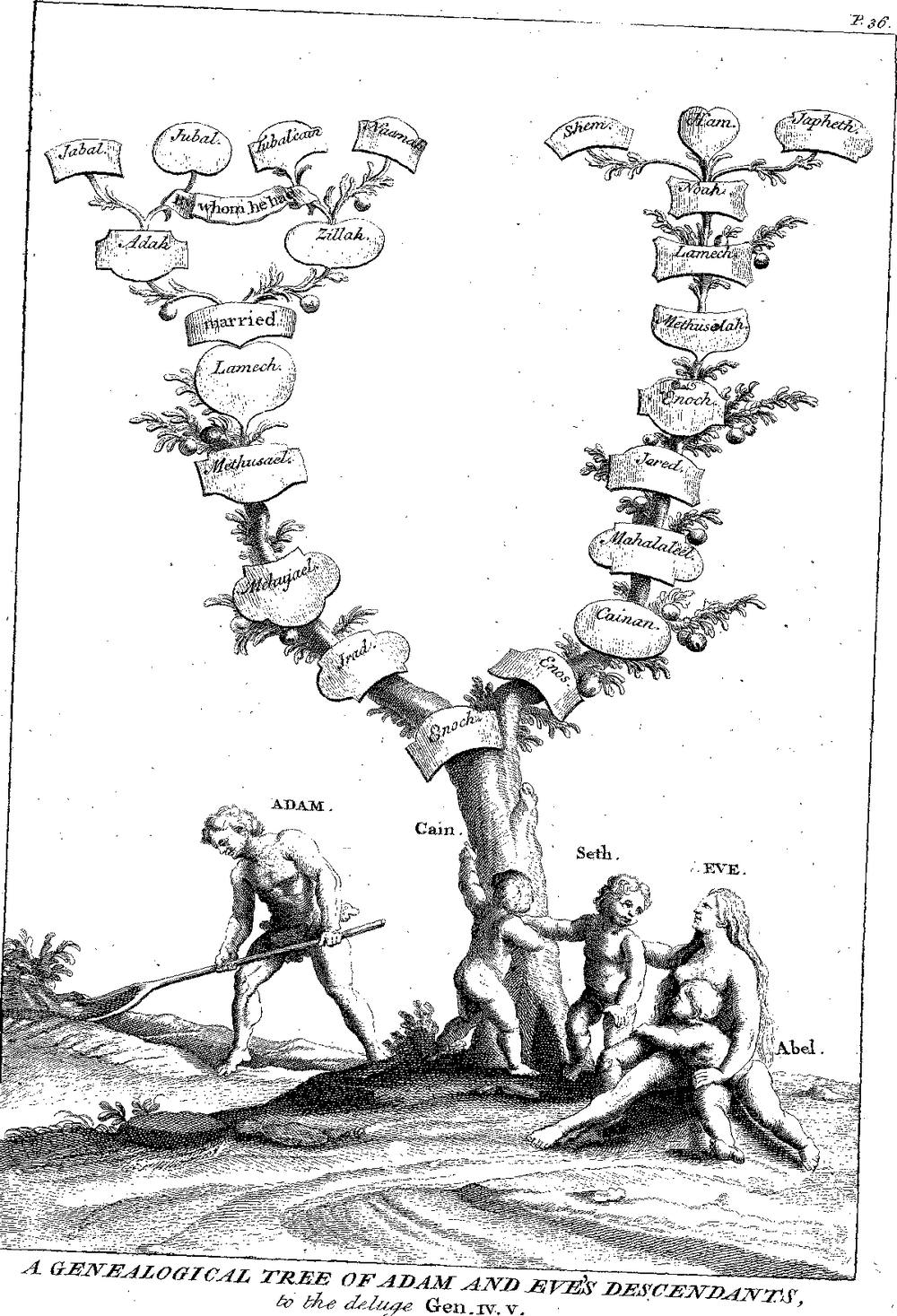
Ch. v. 5. Gen. iv. 1, 2, &c.In some little time after Eve conceived, and brought forth Cain, saying, I have gotten a Man from the Lord. It is believed that she had a Girl at the same time, and that generally she was delivered of twins. Scripture takes notice of but three Sons that Adam had, Cain, Abel and Seth, and does not say particularly that he had any Daughter: But Moses will not suffer us to doubt at all of his having many Children, when he tells us, that he begat Sons and Daughters. He died at the age of nine hundred and thirty years; before J. C. 3070. before the vulgar Æra 3074. This is all we learn from Moses concerning our first Parent. But Interpreters do not stop here; they have proposed a thousand questions on this subject. It is true, no History can furnish us with more room for questions of curiosity and consequence; and we should be scarce able to excuse ourselves if we did not examine some of them in this place.
It is agreed that the Serpent, which tempted Eve, was the Devil, and nothing else;76 that infernal Serpent, who envying the privileges of Man in innocence, tempted him, and was the cause of his forfeiting all those advantages which he had received from God at his Creation. But in order to make this trial of his fidelity, he assumed the form of a Serpent; and of what kind of Serpent? Some77 believe that the Serpent had then the use of speech, and conversed familiarly with the Woman, without her conceiving any distrust of him; and that God, to punish the malice with which he had abused Eve, deprived him of the use of Speech. Others78 believe, that the Devil transformed himself into a Serpent, and spoke to Eve under the figure of this Animal. Others79 maintain, that a real and common Serpent having eaten of the forbidden Fruit, Eve from thence concluded, that she too might eat of it without danger; that in effect she did eat of it, and incur’d the Displeasure of God by her disobedience. This, say these Authors, is the plain matter of fact, which Moses would relate under the allegorical representation of the Serpent conversing with Eve.
Cajetan will have this whole story, as it is recited by Moses, in the way of dialogue between the Woman and the Serpent, to be figurative only, to signify the inward suggestions of the Devil, and the Woman’s weak resistance. Others affirm, that the Serpent’s speech was nothing but his hissing; and that Eve understanding all Creatures by their voices, apprehended what this Animal had to say to her, by the noise it made. Lyranus reports the opinion of some to be, that the Serpent put on the face of a beautiful young Woman to tempt Eve. We are assured80, that the Hereticks called Ophitæ, or Serpentini, believed Jesus Christ to be the Serpent which tempted the first Woman; for which reason they bred up a Serpent, which at a word from their Priests would creep under their Altars, lick up their Oblations, and then retire to its hole. After this they would advance towards the Altar, and receive the Sacrament, being then persuaded that Jesus Christ himself, under the form of a Serpent, had sanctified it. Tertullian81 and Epiphanius tell us82, that the same Hereticks believed the Serpent which tempted Eve to be a certain Power or Virtue, produced in the shape of a Serpent by Saldebaoth, out of vexation for what God, the Great Jehovah, had done in making Man to walk, who before was no better than a worm. Some Rabbins believe that Sammael Prince of the Devils came in person to tempt Eve, mounted on a Serpent as large as any Camel.
The nature of the forbidden Fruit has been enquired into, and what sort of Tree it was which bore it. Some Rabbins believe it was the Vine83; others that it was Wheat; Theodore, who is quoted in Theodoret, St. Isidore, and Procopius, tell us that it was the Fig-tree: And this opinion they ground upon the circumstance of Adam and Eve’s covering themselves with Fig-leaves immediately after their Transgression. Others think it was the Cherry tree; the generality of the Latins will have it to be an Apple-tree. But we must confess, that there is nothing certain in this matter, since nothing has been said by Moses concerning the nature of this tree.
Many Jewish Writers84 have asserted that Man and Woman were created together, and were fasten’d together by the shoulders, having four feet, four hands, and two heads, alike in every thing excepting Sex, and that God having cast them into a proa
profound sleep, separated them, and made two Persons of them. Eugubinus85 affirms, that they were joined together not by the back, but by the sides; so that God, according to the Scripture, took the Woman from Adam’s side; but Moses, instead of saying this, declares, that he took a rib from Adam, out of which he form’d Woman. Many fabulous Stories are told of Adam’s stature and beauty: Some have maintain’d86, that he was the handsomest Man that ever was, and that God before he form’d him assum’d an human body of the most perfect beauty, after the pattern whereof he created Adam. In this manner it was literally true they say that Adam was made, after the image and resemblance of God.
Others87 have declared, that he was the greatest Giant there ever was, which opinion they pretend to prove by these words of the Vulgate, Josh. xiv. ult. Adam maximus inter Enachim (ibi) Hebrone, situs est. The Rabbins tell us88, that this first Man was of so prodigious a stature, that he reached from one end of the World to the other; but that after this Transgression God pressed his hand heavily upon him, and reduced him to the measure of an hundred Ells. Others allow him to have been nine hundred cubits in Height, and maintain that God reduced him to this measure at the request of the Angels, who were frighten’d at his first stature.
There has been much dispute in the Church concerning the Salvation of Adam. Tatian and the Encratites were positive that he was damned; but this opinion the Church condemned. The Author of the Wisd. xi.book of Wisdom says, that God deliver’d him from his Sin; Custodivit & eduxit illum a delicto suo; and the Fathers say that he did hard Penance. The Rabbins believe the same: Some will have it that Adam and Eve continued in a state of Continency for an hundred years after their Fall; others say but thirty, and some again but fifteen. No one knows the place where our first Parents were buried: Some of the Antients believe89, that they were interr’d at Hebron, which opinion they ground on the words of Joshua already cited by us; Josh. xiv. ult.Nomen Hebron ante vocabatur Coriath- Arbe. Adam maximus ibi inter Enachim situs est. But the Hebrew text of this Passage is otherwise explained, thus; And the Name of Hebron before was Kirjath-Arba, which Arba was a great Man among, or Father of, the A-nakims: Others in greater number hold90, that Adam was buried upon Calvary, and this opinion has its Advocates even at this day. There is a Chapel to be seen upon Mount Calvary, dedicated to the honour of Adam91: But St. Jerom confesses92, that this opinion, which is very proper to sooth the Ears of the common People, is not however the more certain for this Reason; Favorabilis opinio, & mulcens aurem populi, nec tamen vera.
Adam has been reputed the Author of some books; it has been supposed that he was master of a great deal of profound and very extensive Knowledge. His giving names to the several Animals not only proves, as the same persons alledge, his Dominion over them, but likewise his vast knowledge of the Properties belonging to them, God having created him perfect, there is no question to be made but that he gave him a very clear and comprehensive Mind; but all this speculative Science and superior Genius is not inconsistent with the experimental ignorance of those things which are to be learned by use only and reflection. There have been People who believed that he invented the Hebrew Letters. The Jews say he is the Author of the ninety first Psalm, which begins with Bonum est confiteri Domino. They affirm that he compos’d it soon after the Creation: The Gnosticks likewise had a book intitled The Revelations of Adam, which was placed among the apocryphal Writings by Pope Gelasius. The same Pope makes mention also of a Book called Adam’s Penance. Masius93 speaks of another of the Creation, which is said to have been composed by Adam. The Arabians94 inform us that Adam received twenty Books which fell from Heaven, and contained many Laws, Promises, and Prophecies.
The antient Persians relate95 the Creation of Adam and the first of Mankind in such a manner as deserves our notice: They say that there was a God before all things, and that he is the Author of them; that having resolved to manifest himself by his Works, he created the Universe, and divided it into six parts. First he made the Heavens and their Spheres, which he adorn’d with great and small luminaries, such as the Sun, Moon and Stars. He created also the Angels, some of whom are placed above others, according to their rank and dignity, and Heaven was appointed to be the abode of those who should keep God’s Commandments, and live piously in this life. After he had finished this great work, he rested for six days, to instruct us that time and meditation are
necessary for the execution of great designs.
After this he made Hell, which he placed in the lowest region of the World; from whence he banished all sort of light and consolation, that it might be a place of horror and punishment for the violators of his Laws: Here, as well as in Heaven, he made different Dwellings, wherein the wicked were to be tormented according to the measure and quality of their Crimes. About this time Lucifer, chief of the Angels, and some of his order, having conspired against God, in order to wrest his sovereign Power from him, God threw them headlong into Hell, and changed their figure into a black, hideous, and terrible form, and thus confin’d them in Hell, where they are to remain till the end of the World; then sinners shall receive their punishment, and undergo the sentence of their Condemnation. After this God again rested, and forbore working for five days more.
The third work of the Creation was the Earth or terraqueous Globe, which includes the waters and dry element; so that the Waters make the Earth fruitful, and the Earth includes the Waters within their just bounds. This great work being over, God continued five days without producing forth any thing.
The fourth work was that of the Creation of Trees, Plants, and Herbs, that so the earth might bring forth fruits, and every thing which might serve for food to Man and Beasts: After which God rested from his labours as before.
The fifth work was that of Beasts, Birds, and Fishes, which were to live upon the earth, and feed on what it produced. The World being adorned, and furnished with all sorts of Creatures, God again ceased from working for five days.
Lastly, he undertook his sixth work, and made Man and Woman, Adamah and Evah, for whose use all things had been form’d. In order to have the World peopled with more speed, God appointed that Eve should be deliver’d every day of Twins, and that for a thousand years Death should not diminish the number of Mankind.
Lucifer, who had been cast down headlong into Hell, studied how he might do mischief to Man, and tempt him to incur the guilt of Sin, and so deprive him of all his happiness. God, in order to prevent the evil effects of his Malice, appointed certain Overseers to have a vigilant eye upon his Creatures, in order to preserve them in the state wherein he had created them. The care of the Heavens he allotted to one Hamul, the care of Angels to Acrob, the care of the Sun, Moon, and Stars was given to Isoder, that of the Earth to Soreh, that of the Water to Josah, that of Animals to Sumbola, that of Fishes to Daloo, that of Trees to Rocan; that of Man and Woman to Cooz; lastly, he set Sertan and Asud as a guard to Lucifer and his accomplices, to prevent their doing mischief to his Creatures.
This did not hinder Lucifer from tempting Men, and engaging them in many disorders, which obliged God to destroy them by a Deluge which cover’d the whole Earth, and spared but very few of Mankind, from whom all the present inhabitants of the World are deriv’d.
The96 Banians, who are People that dwell in the East Indies, and are dispersed over the Kingdom of Cambaye, say that God, intending to display his Almighty Power, created the Universe, that is to say, the Earth, Air, Fire and Water, which are as it were the basis of all sensible Creatures. These four things were at first mingled and confounded together; God separated them by blowing upon the Waters with a kind of great trunk; hereupon they immediately swelled, and became like a vastly large round bottle, in the shape of an egg, which extending itself gradually, made the Firmament that encompasses the World, light and transparent, such as we now behold it.
After this he created the Sun and Moon, which he placed in the Firmament, in order to make the difference of Seasons. By this means the four Elements were disentangled; every one was disposed in its proper place, and each perform’d its function; the Air filled every thing that was void, the Fire gave light and action to all things by its heat, the Earth produc’d its Creatures, and the Sea likewise. To every one of them God gave the seminal virtues necessary for production. Thus this great World was finished, which was divided into four parts, as it had been form’d of four Elements; and these four parts are the East, West, North, and South.
This World was to last four Ages, and to be peopled by four sorts of Men, married to four Women, made particularly for them: God therefore set about the Creation of Man after he had form’d the Universe. He commanded the Earth to produce out of its intrails this excellent Creature. The Earth obeyed, and immediately there appeared the head, then successively the other parts of Man’s body, into which God breathed life and motion; his eyes were open’d, and Man employ’d the first operations of his Mind in acknowledging and adoring his Creator. At the same time God gave him a Woman like unto himself for a companion: The Man
Adam continues on the next page
Footnotes
-
Translators’ note. Four hundred Shekels make sixty Pounds English, at three Shillings per Shekel, according to the Estimate made by the very accu- rate and learned Doctor Prideaux. See his Preface to of his Connect. of the Hist. of the Old and New Testament. ↩
-
Tarik Montekheb, D’Herbelot Bibl. Orient. p. 12. ↩
-
Idem p. 13. ex lib. Maallem. ↩
-
Herodot. l. 3. c. 8. ↩
-
Strabo l. 16. ↩
-
D’Herbelot. Bibl. Orient. p. 219. Cabah. ↩
-
Idem voce Hagiar alassorad. ↩
-
Idem p. 15. & Chardin Voyage de Perse t. 2. p. 451. ↩
-
Alcoran, c. 2. ↩
-
D’Herbelot. Bibl. Orient. p. 15. ↩
-
Alcoran loc. cit. ↩
-
D’Herbelot. Bibl. Orient. p. 583. ↩
-
Idem p. 16. ↩
-
Herbelot. Bibl. Orient. p. 16. col. 2. ↩
-
Ben. Scholmah, ibid. ↩
-
Quaresm. Elmid. t. 2. p. 772. ↩
-
Idem. t. 2. p. 767, 768. ↩
-
Lamprid. in Severo. ↩
-
Nicol. Damasc. apud Joseph. l. 1. c. 7. Justin. l. 36. ↩
-
Artapan. & Eupolem. apud Euseb. Præpar. l. 9. c. 17, 18. ↩
-
Joseph. Antiq. l. 1. c. 8. ↩
-
Suidas in Abraham. ↩
-
Isidor. Hispal. l. 1. c. 3. Origen. ↩
-
Translators’ note. This Book, whereof the Patriarch Abraham is said to be the Author, has been publish’d, with a Comment written by a celebrated Rabbin of the same Name. In it there are two and thirty Ways de- scribed, and fifty Gates which lead Men to the Knowledge of all Mysteries. Liber Jezirah Abrahami Patriarchæ cum Commentario super xxxii. semitis Sapientiæ, a quibus Liber Jezirah incipit, cum Not. Rittangel. p. 1, &c. ↩
-
Epiphan. hæres. 39. c. 5. ↩
-
Origen in Luc. homil. 35. w Rab. Salem in Bava Bathra, c. 1. ↩
-
Vide Gemar. Codic. Talmud. Aboda Zarah, c. 1. ↩
-
Translators’ note. Dr. Prideaux has given us a full and curious Account of Zoroastres, and the Magi in the first Part of his Connection, &c. and fourth Book, which the Reader, if he pleases, may have recourse to. He tells us that Zoroastres, out of a particular Veneration for Abraham, called his Book the Book of Abraham, and his Religion the Religion of Abraham. —— Not only the Jews, Magians, and Mahometans, but the Sabians, and also the Indians, all challenge him to themselves, as the great Patriarch and Founder of their several Sects, every one of them pretending that their Religion is the same which Abraham professed, and by his Reformation established among you; and to restore this Reformation was all that Zoroastres, Mahomet, and the Author of the Sabian Sect, whoever he was, pretended to. ↩
-
Translators’ note. Dr. Prideaux calls this Book Zendavista, and by contraction Zend. The Vulgar he says pronounce it Zundavestow and Zund. The Word originally signifies a Fire-kindler, which Name the Impostor gave it, because, as he pretended, all that would read this Book and meditate thereon, might from thence, as from a Fire-kindler, kindle in their Hearts the Fire of all true Love for God and his holy Religion. —— This Book Zoroastres pretended to have received from Heaven, as Mahomet his Alcoran, and in every Oratory and Fire-Temple a Copy of it is kept at this Day in the old Persian Lan- guage, out of which at certain stated times the Priests read a Portion of it to the People. Prid. Connect. &c. P. 1. B. iv. ↩
-
Herbelot’s Bibliot. Orient. p. 16. ↩
-
See M. le Pelletier of Roan, his Differt. upon the Weight of Absa- lom’s Hair. The Journal of Trevoux, 1702, p. 176. ↩
-
Joseph. Antiq. l. 7. c. 9. ↩
-
Joseph. de Bello, l. 2. c. 33. ↩
-
Joseph. Antiq. l. 14. c. 8. ↩
-
Joseph. Antiq. l. 14. c. 8. ↩
-
Lib. 2. de bello, c. 25. Vide & in ejus vita p. 1013. Χαροβη. ↩
-
חקל דםor ,חלק דםHæreditas Sanguinis. ↩
-
Translators’ note. This was an expression of Sorrow in use among the Ancients almost generally, and not peculiar to the Jews; that it was so among the old Latins, appears from these Lines of Virgil, ——It scissâ veste Latinus, Conjugis attonitus fatis, urbisque ruinâ, Canitiem immundo perfusam pulvere turpans. Æneid. lib. 12. h ‘Άχαρις Minimè gratiosus. ↩
-
Ἄχαρις, Minimè gratiosus. ↩
-
Joseph. Antiq. l. 15. c. 9. p. 531. ↩
-
Ibid. l. 17. c. 9. p. 509. ↩
-
Ibid. l. 17. c. 12. p. 607. ↩
-
Græc. Ἄκρα. Syr. Chald. .הקרא ↩
-
Joseph. Antiq. l. 12. c. 7. & 14. ↩
-
Ibid. l. 13. c. 11. p. 446, 447. ↩
-
Joseph. de Bello, l. 7. c. 13. ↩
-
Joseph. Antiq. l. 20. c. 7. p. 964. ↩
-
Joseph. de Bello. l. 7. c. 13. Ἀρχεῖον καὶ τὸ Βουλευτήριον, &c. ↩
-
Euseb. in voce ἀκραβέειν. Item in Ἰδυμαία. Vide & Joseph. de Bello. l. 2. c. 11. ↩
-
Vide Euseb. in Akrabbim. ↩
-
Œcumenius in Acta, p. 20. ↩
-
Chryf. in Acta, homil. 1. ↩
-
Hieronym. Ep. 103. p. 9. ↩
-
Epiphan. hæref. 30. c. 3 & 6. ↩
-
Hieronym. de Script. Eccles. ↩
-
M. Grabe, in his Spicilegium of the Fathers, has given us an History of S. Thecla, which he believ’d to be the antient History mentioned by St. Jerom. ↩
-
Tertull. de Baptismo, c. 17. ↩
-
Tertull. l. 5. contra Marcion. c. 1, 2. ↩
-
Aug, de utilitate credendi c. 3. & Ep. olim 253, nunc 237. n. 2. ↩
-
Aug. Ep. 315. novæ Edit. n. 1. ↩
-
See what Cotelerius says of these Recognitions, in his Fathers of the first Age. See likewise M. Fabricius’s Apocr. N. T. p. 759, &c. ↩
-
Epiphan. Hæres. 47. ↩
-
Aug. de fide c. 4. & 405. contra adversar. Legis & Prophet. l. 1. c. 20. ↩
-
Aug. de fide contra Manich. c. 38. & alibi. ↩
-
Epiph. Hær. 42. ↩
-
Aug. lib. contra Adimant. c. 17. & lib. 22. contra Faust. c. 79. & lib. 1. de Serm. Domini in monte c. 20. ↩
-
Bolland 24 Februar. ↩
-
See M. de Tillemont, T. 1. of his Eccl. Hist. p. 1186. and M. Fabricius’s Apoc. N. T. p. 782. ↩
-
Hieronym. ad Zach. xii. vide & ad Ose. i. ↩
-
Itin. Jerosol. antiq. ↩
-
Joseph. Antiq. l. 1. c. 1. ,אדםΠύρρος. Rufus. ↩
-
,איׁשIsch. Man. ,אׁשהIssha, Woman. ↩
-
,חוה Chavvah, vivifica or vivens. ↩
-
Literally, Coats of skin, or Coats to cover their skin, their nakedness, ,כתנות עורTunicas pellis. Chald. vestimenta honoris 70. Χιτῶνας δερματίνους. ↩
-
Vide Mos. Barcepham de Paradiso, & Perer. in Genes. iii. & alios. ↩
-
The Devil is called Serpent, or the Old Ser- pent, John viii. 44. 2 Cor. xi. 3. Rev. xii. 9. ↩
-
Joseph. Antiq. l. 1. c. 2. Basil. Homil. de Paradiso. Ephrem apud Barcepham de Paradiso. ↩
-
Cyril. l. 3. contra Julian. ↩
-
Abarben. in Gen. iii. ↩
-
Aug. de hæres. c. 17. ↩
-
Tertul. de Præscript. c. 47. ↩
-
Epiphan. de hæres. 37. ↩
-
Sanhedrin. fol. 70. Bemidbar Rabbi fol. 170 & 238. ↩
-
Rabb. Samuel, Abarbanel, Manasseh Ben. Israel. vide Leidegger hist. Patriarch. &c. ↩
-
Eugubin. in Cosmopœia. ↩
-
Idem ibidem, Salian. Annal. T. 1. p. 106. ↩
-
Philo de mundi opificio Joan Lucidus. ↩
-
Vide lib. Sanhedrin. & Bartoloci, T. 1. p. 65, 66. ↩
-
Hieronym. in quæst. Hebr. ↩
-
Origen. tract. xxxv. in Matth. Epiphan. hæres. 46. Ambros. l. 10. in Luc. Hiero- & in Epitaph. Paulæ. ↩
-
Quæresm. T. 2. l. 5. p. 481. 482, &c. ↩
-
Hieronym in Matth xxvii. nym. in Matth. xxvii. ↩
-
Apud Salian. T. 1. Annal. p. 230. ↩
-
Hottinger. Histor. Oriental. p. 22. ↩
-
Histoire de la Religion des anciens Persans, c. 2. imprimée à Paris, 1667. in 12mo. ↩
-
Histoire de la Religion des Banians, traduite de l’Anglois de Henry Lord, à Paris 1667, in 12mo. ↩