Ver. 19.ADAM, was the first Man created by God. It is said, that he was called Adam by reason of the reddish colour of the Earth out of which he was formed; for Adam in Hebrew signifies red1. This name denotes likewise every Man in general. God having made Man out of the Dust of the Earth, breathed in him the Breath of Life, and gave him Dominion over all the Creatures of the Earth. He created him after his own image and resemblance, and blessed him. He placed him in a delicious Garden, that Ch. ii. 8, 15. Ver. 16, 17.he might cultivate it agreeably, and feed upon the fruits of it; but at the same time left this command with him, “ Eat of all the “ Fruits of Paradise, but of the Tree of “ the knowledge of Good and Evil thou “ shalt not eat of it; for in the day that “ thou eatest thereof thou shalt surely “ die.
Ch. ii.Some little time after, God brought all the Beasts of the Earth, and all the Fowls of the Air to Adam, that he might see by what names he would call them; and Adam gave to every one of them their true name; such a name as best suited them, and described the principal properties of them: Now all other Animals had been created by pairs, male and female, and Man only was without a Fellow creature of his own species: Wherefore God said, It is not good for Man to be alone; I will make an Helpmate for him. The Lord caused therefore a deep sleep to fall upon him, and while he slept he took one of his Ribs, and closed up the Flesh instead thereof; and of the Rib which he took from Man made he a Woman, whom he presented to him, when he awoke. Then said Adam, This is now bone of my bone, and flesh of my flesh; she shall be called Woman, because she was taken out of Man2. Therefore shall a Man leave Father and Mother, and shall cleave unto his Wife, and they two shall be one Flesh. And they were both naked, the Man and his Wife, and were not ashamed. Adam called likewise his Wife’s name Eve3; because she was the Mother of all living.
Now the Serpent, which is more subtle than any Beast of the field, came to Eve, and said, Why has not God permitted you to eat indifferently of all the fruits of Paradise? The Woman answered, that they might eat the Fruit of all the Trees in the Garden, one only excepted, which they were forbidden to touch lest they should die. And the Serpent said unto the Woman, Ye shall not surely die; for God doth know, that in the day ye eat thereof, then your eyes shall be opened, and ye shall be as Gods, knowing Good and Evil. ii. 7.The Woman therefore seeing that the Tree was good for food, and pleasant to the eyes, took the fruit of it, eat, and then gave it to her Husband, who likewise did eat of it. At the same time their eyes were opened, and they knew that they were naked, and having sown fig-leaves together, they made themselves aprons for a covering to their nakedness: And as they heard the Lord walking in the garden about sun-set, they hid themselves from his presence amidst the thickest trees of Paradise. Then the Lord called unto Adam, and said unto him, Where art thou? He answered, I heard thy voice in the garden, and I was afraid, because I was naked, and I hid myself. And God said, Who told thee that thou wast naked? Hast thou eaten of the Tree whereof I commanded thee that thou shouldst not eat?
Adam replied, The Woman, whom thou gavest to be with me, she gave me of the Tree, and I did eat. And the Lord said unto the Woman, What is this that thou hast done? And the Woman said, The Serpent beguiled me, and I did eat. Then the Lord said unto the Serpent, Because thou hast done this, thou art cursed above all Cattle, and above every Beast of the field; upon thy belly shalt thou go, and dust shalt thou eat, all the days of thy life. And I will put enmity between thee and the Woman, and between thy Seed and her Seed: It shall bruise thy Head, and thou shalt bruise his Heel. Unto the Woman he said likewise, I will greatly multiply thy sorrow and thy conception, in sorrow thou shalt bring forth Children, and thy desire shall be to thy Husband, and he shall rule over thee. As to Adam to him he said, Because thou hast hearkened unto the voice of thy Wife, and hast eaten of the Tree, the fruit whereof I had forbidden thee to eat, the Ground, for thy sake, shall be cursed, and in sorrow shalt thou eat of it all the days of thy life. Thorns also and Thistles shall it bring forth to thee, and thou shalt eat the Herb of the field. In the sweat of thy face shalt thou eat Bread, till thou return unto the ground; for out of it wast thou taken; for dust thou art, and unto dust shalt thou return.
Then the Lord made coats of skin for Adam and his Wife, and clothed them4; and said, Behold Adam is become as one of us, to know Good and Evil. And now, lest he put forth his hand, and take also of the Tree of Life, and eat, and live for ever; therefore the Lord God sent him forth from the Garden of Eden to till the ground, from whence he was taken. So he drove out the Man; and he placed at the East of the Garden of Eden, Cherubims, and a flaming Sword which turned every where, to keep the way of the Tree of Life. It is not known how long Adam and Eve continued in Paradise. Interpreters are very much divided upon this point5. Some allow them to have lived there many years; others many days; and some again but many hours. We think they might have remained there for ten or twelve days, and that when they were forced from this delicious place they were pure Virgins.
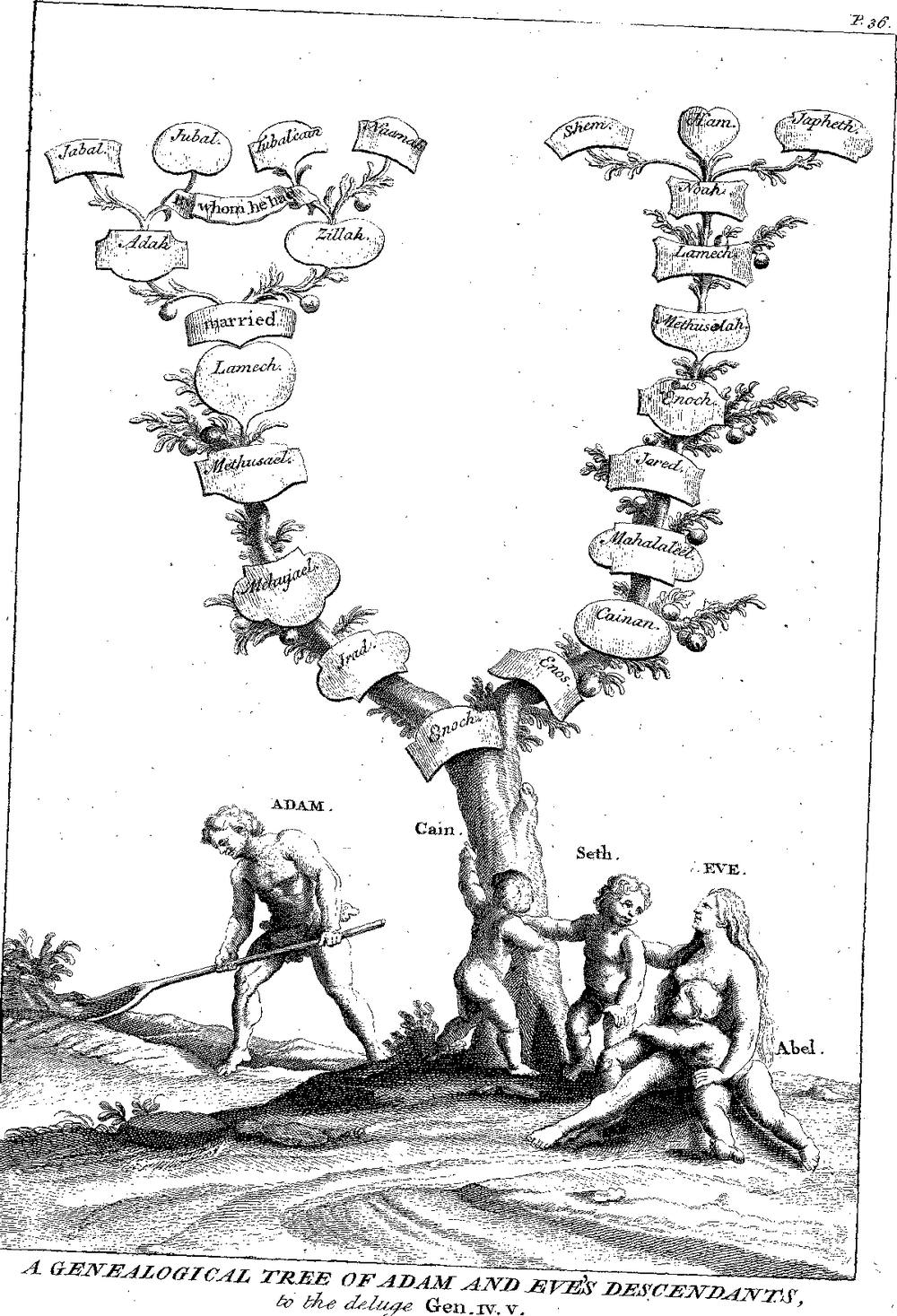
Ch. v. 5. Gen. iv. 1, 2, &c.In some little time after Eve conceived, and brought forth Cain, saying, I have gotten a Man from the Lord. It is believed that she had a Girl at the same time, and that generally she was delivered of twins. Scripture takes notice of but three Sons that Adam had, Cain, Abel and Seth, and does not say particularly that he had any Daughter: But Moses will not suffer us to doubt at all of his having many Children, when he tells us, that he begat Sons and Daughters. He died at the age of nine hundred and thirty years; before J. C. 3070. before the vulgar Æra 3074. This is all we learn from Moses concerning our first Parent. But Interpreters do not stop here; they have proposed a thousand questions on this subject. It is true, no History can furnish us with more room for questions of curiosity and consequence; and we should be scarce able to excuse ourselves if we did not examine some of them in this place.
It is agreed that the Serpent, which tempted Eve, was the Devil, and nothing else;6 that infernal Serpent, who envying the privileges of Man in innocence, tempted him, and was the cause of his forfeiting all those advantages which he had received from God at his Creation. But in order to make this trial of his fidelity, he assumed the form of a Serpent; and of what kind of Serpent? Some7 believe that the Serpent had then the use of speech, and conversed familiarly with the Woman, without her conceiving any distrust of him; and that God, to punish the malice with which he had abused Eve, deprived him of the use of Speech. Others8 believe, that the Devil transformed himself into a Serpent, and spoke to Eve under the figure of this Animal. Others9 maintain, that a real and common Serpent having eaten of the forbidden Fruit, Eve from thence concluded, that she too might eat of it without danger; that in effect she did eat of it, and incur’d the Displeasure of God by her disobedience. This, say these Authors, is the plain matter of fact, which Moses would relate under the allegorical representation of the Serpent conversing with Eve.
Cajetan will have this whole story, as it is recited by Moses, in the way of dialogue between the Woman and the Serpent, to be figurative only, to signify the inward suggestions of the Devil, and the Woman’s weak resistance. Others affirm, that the Serpent’s speech was nothing but his hissing; and that Eve understanding all Creatures by their voices, apprehended what this Animal had to say to her, by the noise it made. Lyranus reports the opinion of some to be, that the Serpent put on the face of a beautiful young Woman to tempt Eve. We are assured10, that the Hereticks called Ophitæ, or Serpentini, believed Jesus Christ to be the Serpent which tempted the first Woman; for which reason they bred up a Serpent, which at a word from their Priests would creep under their Altars, lick up their Oblations, and then retire to its hole. After this they would advance towards the Altar, and receive the Sacrament, being then persuaded that Jesus Christ himself, under the form of a Serpent, had sanctified it. Tertullian11 and Epiphanius tell us12, that the same Hereticks believed the Serpent which tempted Eve to be a certain Power or Virtue, produced in the shape of a Serpent by Saldebaoth, out of vexation for what God, the Great Jehovah, had done in making Man to walk, who before was no better than a worm. Some Rabbins believe that Sammael Prince of the Devils came in person to tempt Eve, mounted on a Serpent as large as any Camel.
The nature of the forbidden Fruit has been enquired into, and what sort of Tree it was which bore it. Some Rabbins believe it was the Vine13; others that it was Wheat; Theodore, who is quoted in Theodoret, St. Isidore, and Procopius, tell us that it was the Fig-tree: And this opinion they ground upon the circumstance of Adam and Eve’s covering themselves with Fig-leaves immediately after their Transgression. Others think it was the Cherry tree; the generality of the Latins will have it to be an Apple-tree. But we must confess, that there is nothing certain in this matter, since nothing has been said by Moses concerning the nature of this tree.
Many Jewish Writers14 have asserted that Man and Woman were created together, and were fasten’d together by the shoulders, having four feet, four hands, and two heads, alike in every thing excepting Sex, and that God having cast them into a proa profound sleep, separated them, and made two Persons of them. Eugubinus15 affirms, that they were joined together not by the back, but by the sides; so that God, according to the Scripture, took the Woman from Adam’s side; but Moses, instead of saying this, declares, that he took a rib from Adam, out of which he form’d Woman. Many fabulous Stories are told of Adam’s stature and beauty: Some have maintain’d16, that he was the handsomest Man that ever was, and that God before he form’d him assum’d an human body of the most perfect beauty, after the pattern whereof he created Adam. In this manner it was literally true they say that Adam was made, after the image and resemblance of God.
Others17 have declared, that he was the greatest Giant there ever was, which opinion they pretend to prove by these words of the Vulgate, Josh. xiv. ult. Adam maximus inter Enachim (ibi) Hebrone, situs est. The Rabbins tell us18, that this first Man was of so prodigious a stature, that he reached from one end of the World to the other; but that after this Transgression God pressed his hand heavily upon him, and reduced him to the measure of an hundred Ells. Others allow him to have been nine hundred cubits in Height, and maintain that God reduced him to this measure at the request of the Angels, who were frighten’d at his first stature.
There has been much dispute in the Church concerning the Salvation of Adam. Tatian and the Encratites were positive that he was damned; but this opinion the Church condemned. The Author of the Wisd. xi.book of Wisdom says, that God deliver’d him from his Sin; Custodivit & eduxit illum a delicto suo; and the Fathers say that he did hard Penance. The Rabbins believe the same: Some will have it that Adam and Eve continued in a state of Continency for an hundred years after their Fall; others say but thirty, and some again but fifteen. No one knows the place where our first Parents were buried: Some of the Antients believe19, that they were interr’d at Hebron, which opinion they ground on the words of Joshua already cited by us; Josh. xiv. ult.Nomen Hebron ante vocabatur Coriath- Arbe. Adam maximus ibi inter Enachim situs est. But the Hebrew text of this Passage is otherwise explained, thus; And the Name of Hebron before was Kirjath-Arba, which Arba was a great Man among, or Father of, the A-nakims: Others in greater number hold20, that Adam was buried upon Calvary, and this opinion has its Advocates even at this day. There is a Chapel to be seen upon Mount Calvary, dedicated to the honour of Adam21: But St. Jerom confesses22, that this opinion, which is very proper to sooth the Ears of the common People, is not however the more certain for this Reason; Favorabilis opinio, & mulcens aurem populi, nec tamen vera.
Adam has been reputed the Author of some books; it has been supposed that he was master of a great deal of profound and very extensive Knowledge. His giving names to the several Animals not only proves, as the same persons alledge, his Dominion over them, but likewise his vast knowledge of the Properties belonging to them, God having created him perfect, there is no question to be made but that he gave him a very clear and comprehensive Mind; but all this speculative Science and superior Genius is not inconsistent with the experimental ignorance of those things which are to be learned by use only and reflection. There have been People who believed that he invented the Hebrew Letters. The Jews say he is the Author of the ninety first Psalm, which begins with Bonum est confiteri Domino. They affirm that he compos’d it soon after the Creation: The Gnosticks likewise had a book intitled The Revelations of Adam, which was placed among the apocryphal Writings by Pope Gelasius. The same Pope makes mention also of a Book called Adam’s Penance. Masius23 speaks of another of the Creation, which is said to have been composed by Adam. The Arabians24 inform us that Adam received twenty Books which fell from Heaven, and contained many Laws, Promises, and Prophecies.
The antient Persians relate25 the Creation of Adam and the first of Mankind in such a manner as deserves our notice: They say that there was a God before all things, and that he is the Author of them; that having resolved to manifest himself by his Works, he created the Universe, and divided it into six parts. First he made the Heavens and their Spheres, which he adorn’d with great and small luminaries, such as the Sun, Moon and Stars. He created also the Angels, some of whom are placed above others, according to their rank and dignity, and Heaven was appointed to be the abode of those who should keep God’s Commandments, and live piously in this life. After he had finished this great work, he rested for six days, to instruct us that time and meditation are necessary for the execution of great designs.
After this he made Hell, which he placed in the lowest region of the World; from whence he banished all sort of light and consolation, that it might be a place of horror and punishment for the violators of his Laws: Here, as well as in Heaven, he made different Dwellings, wherein the wicked were to be tormented according to the measure and quality of their Crimes. About this time Lucifer, chief of the Angels, and some of his order, having conspired against God, in order to wrest his sovereign Power from him, God threw them headlong into Hell, and changed their figure into a black, hideous, and terrible form, and thus confin’d them in Hell, where they are to remain till the end of the World; then sinners shall receive their punishment, and undergo the sentence of their Condemnation. After this God again rested, and forbore working for five days more.
The third work of the Creation was the Earth or terraqueous Globe, which includes the waters and dry element; so that the Waters make the Earth fruitful, and the Earth includes the Waters within their just bounds. This great work being over, God continued five days without producing forth any thing.
The fourth work was that of the Creation of Trees, Plants, and Herbs, that so the earth might bring forth fruits, and every thing which might serve for food to Man and Beasts: After which God rested from his labours as before.
The fifth work was that of Beasts, Birds, and Fishes, which were to live upon the earth, and feed on what it produced. The World being adorned, and furnished with all sorts of Creatures, God again ceased from working for five days.
Lastly, he undertook his sixth work, and made Man and Woman, Adamah and Evah, for whose use all things had been form’d. In order to have the World peopled with more speed, God appointed that Eve should be deliver’d every day of Twins, and that for a thousand years Death should not diminish the number of Mankind.
Lucifer, who had been cast down headlong into Hell, studied how he might do mischief to Man, and tempt him to incur the guilt of Sin, and so deprive him of all his happiness. God, in order to prevent the evil effects of his Malice, appointed certain Overseers to have a vigilant eye upon his Creatures, in order to preserve them in the state wherein he had created them. The care of the Heavens he allotted to one Hamul, the care of Angels to Acrob, the care of the Sun, Moon, and Stars was given to Isoder, that of the Earth to Soreh, that of the Water to Josah, that of Animals to Sumbola, that of Fishes to Daloo, that of Trees to Rocan; that of Man and Woman to Cooz; lastly, he set Sertan and Asud as a guard to Lucifer and his accomplices, to prevent their doing mischief to his Creatures.
This did not hinder Lucifer from tempting Men, and engaging them in many disorders, which obliged God to destroy them by a Deluge which cover’d the whole Earth, and spared but very few of Mankind, from whom all the present inhabitants of the World are deriv’d.
The26 Banians, who are People that dwell in the East Indies, and are dispersed over the Kingdom of Cambaye, say that God, intending to display his Almighty Power, created the Universe, that is to say, the Earth, Air, Fire and Water, which are as it were the basis of all sensible Creatures. These four things were at first mingled and confounded together; God separated them by blowing upon the Waters with a kind of great trunk; hereupon they immediately swelled, and became like a vastly large round bottle, in the shape of an egg, which extending itself gradually, made the Firmament that encompasses the World, light and transparent, such as we now behold it.
After this he created the Sun and Moon, which he placed in the Firmament, in order to make the difference of Seasons. By this means the four Elements were disentangled; every one was disposed in its proper place, and each perform’d its function; the Air filled every thing that was void, the Fire gave light and action to all things by its heat, the Earth produc’d its Creatures, and the Sea likewise. To every one of them God gave the seminal virtues necessary for production. Thus this great World was finished, which was divided into four parts, as it had been form’d of four Elements; and these four parts are the East, West, North, and South.
This World was to last four Ages, and to be peopled by four sorts of Men, married to four Women, made particularly for them: God therefore set about the Creation of Man after he had form’d the Universe. He commanded the Earth to produce out of its intrails this excellent Creature. The Earth obeyed, and immediately there appeared the head, then successively the other parts of Man’s body, into which God breathed life and motion; his eyes were open’d, and Man employ’d the first operations of his Mind in acknowledging and adoring his Creator. At the same time God gave him a Woman like unto himself for a companion: The Man was called Pourous, and the Woman Parcontee. They lived together and had four Sons; the name of the first was Bramon, of the second Cuttery, of the third Schuddery, and of the fourth Urise.
Each of these four Men had a constitution peculiar to himself, according to the element which principally prevail’d in him. Bramon had most of the Earth in him, and consequently was of a melancholy humour; Cuttery had a great deal of Fire in his constitution, and was of a martial and warlike spirit; Schuddery was phlegmatick, and was of a gentle peaceable spirit; Urise was of an airy constitution, and had a ready wit for Invention.
God gave Bramon, as the most serious and composed, a book wherein the laws of Religion were written; to Cuttery, as the most valiant, he gave a sword and scepter, to command and govern Mankind, and contain them within the bounds of Duty; Schuddery, who was of an easy meek spirit, received balances from God, and a sack filled with all sorts of weights hung at his girdle, in order to carry on the businesss of Merchandising, and teach Men to trade; lastly, God gave Urise, who was of a subtle airy spirit, the gift of Invention, Mechanicks, and Arts, together with a sack filled with all sorts of mechanical instruments.
God did not permit Pourous and Parcontee to have Daughters, lest their Brothers living with them might pollute themselves with some incestuous act; but he created four Women for the four Sons we have been speaking of, and disposed them in places remote from the habitation of the first Men; one in the East, another in the West, a third in the North, and a fourth in the South; that so the Sons of Pourous seeking for them in these places, the Propagation of Mankind might be more easily and speedily carried on over all the Earth.
God having resolved to people the World, sent Bramon towards the East, with the book of divine Laws in his possession: Here he met the Woman whom God had design’d for him, and who was of a Stature and Constitution like his; he took her to wife, and was the Father of the Eastern People. This Woman’s name was Savanée. Cuttery, the second Son of Pourous, took his Rout westward, and in like manner met the Woman who was appointed for him; she was called Todicastree: She did not yield without fighting; she had as much courage as her Husband, and was arm’d as well as he. They fought for three or four days; at last Todicastree was taken, and became the Wife of Cuttery: They peopled together the West. Schuddery, who was design’d for Trade and Merchandising, went northward, with his Weights and Balances, and having met with Pearls and Diamonds, took abundance of them; afterwards he found the Woman who was prepar’d for him: she was called Visagundah; he married her, and was Father of the Northern People. Urise, the fourth Son of Pourous, whose talent was Invention, Industry, and Mechanicks, departed with his instruments, and took his rout towards the South: He travers’d seven seas, and passed them by the help of a vessel of his own inventing. Upon his arrival into a country called Derpe, he built a fine house there upon the Sea-shore. Some time after the Woman whom God had created for him walking that way, drew near to his House to take a view of it, Urise came down to see her, and expressed his Admiration and Affection to her; but Jejunogundah, for that was her name, retiring, Urise courted her for several days following, and at last she yielded to his desires, became his Wife, and by their means the whole Southern part of the Earth was peopled.
The four Brothers, after they had thus peopled the World, found themselves inclin’d to return to the place of their first Original: Hither they came from the four corners of the World; but they quarrelling, and their Children falling into very great disorders, God destroyed them by the Deluge. Thus ended the first age of the World.
The Mahometans likewise, after their manner, relate the Creation of Adam and Eve, their fall, and that of the Angels¹, and add several particulars which we read nothing of in Moses. God, they say, by rains of long continuance prepared the slime of the Earth out of which he was to form the body of Adam; after this he sent the Angel Gabriel, and commanded him to take out of seven lays of earth of each an handful. Gabriel obeyed, declared to the Earth what orders he had received from God, and withal mentioned that the Lord had determined to extract that out of her entrails with which he proposed to form Man, who was to be the Monarch over her, and God’s Vicegerent. The Earth amazed at this proposition, desired Gabriel to represent her fears to God, that this Creature whom he designed to form out of her bosom, would one day rebel against him, and draw down his curse upon her. Gabriel returned and made a report to God of the Earth’s remonstrances; but God resolving to execute his design, dispatched Michael, and afterwards Asraphel, with the same commission. These two Angels returned in like manner to report the Earth’s excuses, and absolute refusal to contribute to this work.
Last27 Last of all, the Lord deputed Azrael, who without saying any thing to the Earth, or asking any questions, took hastily and carried off by force seven handfuls of seven different beds or lays out of the mass belonging to her, which he carried to a place in Arabia lying between Mecca and Taïef. Azrael, as a reward of this action, received a commission from God to separate the souls of men from their bodies; for which reason he is called the Angel of Death.
It is scarce credible that the Mussulmen should literally believe a creation in this manner; but we read this as a tradition in their Authors. Mahomet says no more than that God created and framed Man partly out of a sandy earth, and partly out of a stinking slime; but as for the Genii, he had already framed them out of a hot glowing fire. As to this difference of Earth made use of in the formation of Adam, it is of great service to them in explaining the different colours and qualities of Men who are derived from it, some of whom are white, or black, others tawny, yellow, olive-coloured, and red: some of one humour, inclination and complection, others of another quite different.
The Angels therefore having with their hands kneaded this Earth brought by Azrael, God with his own hand formed out of it a human statue, which being left for some time in the same place to dry, the Angels had leisure to examine it, and Eblis, or Lucifer, the first of them, having viewed it on all sides, and striking it upon the breast and belly perceived it sounded; from thence he concluded, that being empty within, it would be liable to several wants and temptations in order to fill itself; then turning to his companions, he said to them, If God should oblige you to acknowledge this Monarch, whom he proposes to establish as such over the Earth, what would you do? They answered, It would be highly necessary to obey God. Eblis said as much; but with a secret resolution to do nothing of it.
Some time after, God communicated his Spirit, or his enlivening Breath, to this Statue, infused Life and Understanding into it, and clothed it in a wonderful dress, suitable to its dignity. At the same time he commanded the Angels to fall prostrate before it, as a Mark of honour and respect. The Angels obeyed; Eblis only refused submission, and was therefore driven out of Paradise. Adam was placed in his room, and soon after God took out of his left side, while he was sleeping, the Woman whom he gave him for a Companion. Adam in a very short time after received God’s command, forbidding him to eat of a certain fruit, on pain of falling under his Curse.
Hereupon Eblis resolved to be revenged on Adam: He associated with the Peacock and the Serpent, and approaching Adam and Eve had a long Conversation with them, wherein he persuaded them to eat of the forbidden fruit. They had no sooner tasted of it but the splendid Habits wherein they were dress’d fell at their feet, they discerned themselves to be naked, and being ashamed of their condition ran towards a Fig-tree, with a design of covering themselves with its leaves. Soon after they heard a voice like Thunder, crying out to them, Come down, and depart out of this place: You shall become enemies to one another, and shall have your habitation and subsistence for a time on earth. Adam therefore was thrown headlong from Heaven to Earth, and fell, according to the most general opinion, in the isle of Ceïlan, upon Mount Serandib. Eve fell at Gidda, a port of the Red Sea, pretty near to Mecca. The fall of Eblis happened to be at Missan, near Bassora; the Peacock’s at Indostan, the Serpent’s at Nisibe, or Ispahan; that is to say, in the places where these Cities were built in after-times.
In the Isle of Ceïlan, or Zeïlan, which is the same with Serandib, or Zeran-Dir, in the middle almost of the Island, they shew still at this day a very high Mountain, which the Arabians call Rahoun, and the Portugueze, Elpico d’ Adam, or Adam’s Mountain, upon which there is the impression or mark of a Man’s foot, which they say is Adam’s. This impression of his foot is, they say, seventy cubits in length; and they assure us that at that time Adam’s other foot was in the Sea. But Robert Knox, an Englishman, who lived twenty years in this Island, in his Account published in the year 1681, makes this print of Adam’s foot to be no more than about two feet in length28. Others29 tell us that it is a Tradition, not in the Indies only, but over all the East, that Adam was buried there. But we shall see other opinions a little lower, concerning the place of his Death and Interment.
Adam therefore finding himself alone in this Island, destitute of every consolation of any kind, reflected upon himself, and being touched with Repentance, lifted up his Hands and Eyes to Heaven, imploring the clemency of his Creator. God, moved by his Repentance, caused a tent or pavilion to descend from Heaven by the hands of Angels, which they say was placed in that very spot where Abraham built afterwards the Temple of Mecca. Gabriel shew’d him all the ceremonies which were to be made use of in this Sanctuary, in order to obtain the pardon of his Sin. Adam went thither, and performed every thing which he was enjoined to do. Soon after he was conducted by the same Angel to Mount Arafat, where Adam and Eve met again, after a separation of above two hundred years.
From thence they retired into the Isle of Serandib, or Ceïlan, where they employ’d themselves in cultivating the Earth, and multiplying their Family. Eve lay in twenty several times, and at each had two Twins, one whereof was Male the other Female. Adam lived 960 Years, of all which, according to the Mussulmen, he spent but half a day in Paradise; but then they explain this day by one of Paradise or the other World, which is equivalent to a thousand years with us; so that this half day was equivalent to 500 years. During his whole life Men had but one Religion, and were often visited by Angels, who assisted and instructed them. The number of Men at the time of Enoch’s translation amounted to forty thousand.
They assert that Adam was buried near Mecca, upon Mount Aboucaïs. Others think that Noah, at the time of the Deluge, put his Body into the Ark, and took care to have it carried to Jerusalem by Melchisedech the Son of Shem his Grandson. The Eastern Christians, and many of the Fathers, have followed this Tradition, and believed that he was buried on Mount Calvary, at the very place where Jesus Christ was crucified. They shew a Chapel still to this day, at Naplouse, or Samaria in Palestine, which goes by Adam’s name, and is there respected by the Turks30; but the ancient Persians are of opinion, that he was buried at Serandib, and that his Sepulchre was guarded by Lions at the time of the Giants making War against one another.
The Mussulmen believe that Adam was inspired by God, and that a ray of the Divinity passed successively from him to other Prophets. They suppose him to have written ten Volumes, for so we are to understand them, when they say, that God sent them down from Heaven to him.
Some Rabbins, and oriental Authors31, inform us, that Adam, during the time of his Separation from his Wife, after the Commission of his Sin, as some will have it, or after the Death of Abel, according to others, begat Genii, or familiar Spirits, who, as the Ancients affirm, had Bodies, to whom likewise they apply what is said in Scripture, That the Sons of God beheld the Daughters of Men, and took such of them as they pleased for Wives. Others maintain that these Genii, or Ginns, or Dir, as the Arabians call them, are Creatures older than Adam, that they having rebell’d frequently against God, he resolved to give the government of the World to a new species of Creatures. To this end he created Adam, and commanded the Ginns or Dir to obey him. They who refused submission to him, having Eblis or Lucifer at their head, are what we call the evil Angels; the rest who continued in their duty are the good Angels, or Sons of God; both are corporeal, and even subject unto death.
We shall have another opportunity to speak of Adam in the Articles TERRESTRIAL PARADISE and ADAM’s
LANGUAGE, or the first original Language of the World.
Besides the three Sons of Adam whose names are given us by Moses, and are Cain, Abel and Seth, the Eastern People32 have likewise preserved the names of two others, viz. Abdal-Harth and Rocaïl. The last was, as they say, the Patriarch Seth’s younger Brother, and was perfect Master of the most elevated and obscure Sciences. His Understanding was so lively and penetrating, that he seem’d to be more of an Angel than a Man. Surkrage, who was a powerful Dir or Giant at that time living, desired Seth to send his Brother Rocaïl to him, to assist him in the government of his Dominions. Seth accordingly sent him, and Rocaïl became first Minister to this Prince, for whom he built a Palace and a Sepulchre, of so magnificent a Structure, and with so much Art, that there were several Statues belonging to it, of different Metals made by talismanick art, which moved and acted as if they had been animated.
This gives us a specimen of the Eastern People’s way of thinking, and the particular Character of their Wit; it shews how much they are lovers of Fictions, of Wonders and Mysteries; for we are not to imagine that all which they relate of Adam, and the other Patriarchs is to be always understood literally; they are frequently no more than Allegories, or moral Reflections included in certain kinds of Parables.
The Cabalists, who are a species of Jewish Doctors, that cover moral, physical and theological Truths under mysterious and dark Expressions; the Cabalists, I say, tell us of the first Adam, Adam Kadmon33, who is the first and most perfect Emanation that proceeded from the Essence of God, and the first of all that was created in the Beginning. They re present him like a Man, with a skull, brain, eyes, feet and hands, but some profound Mystery is included in every one of these parts: His skull signifies Wisdom, his right ear Understanding, his left Prudence, and so of the rest. Some Christians have thought, that hereby they described Jesus Christ, the second Person of the Trinity: It is true the Cabalists believe that God, not intending to create the World immediately by himself, created it by the first, the celestial Adam, thereby displaying his Power in a more perfect manner: But they acknowledge that this first Adam had a beginning, and was not without Imperfections; he could not therefore be the Son of God whom we adore.
The Talmudists tell abundance of fabulous Stories relating to Adam and his Creation34. They say that at the first hour of the day God collected the Dust together, out of which he designed to compose him, and so disposed it as to receive the form which he was to give it; at the second Adam stood upon his feet ; at the fourth he gave the several Animals their names; the seventh was imployed in the marriage of Adam and Eve. The Lord, as it were a Brideman, conducted her to her new Spouse, with her locks curled, and dressed out in all her Ornaments. At ten a-clock Adam sinn’d, immediately after which Judgment was pass’d upon him; and at twelve he began to feel the punishment of his Sin, and the effects of the Sentence which had been pronounc’d against him. According to the Rabbins35, Adam was created so excessive tall that he touched Heaven; but after the guilt contracted by him, God put his hand upon his head, and reduced him to a less enormous stature. These Extravagancies they would support from the following passage in Deuteronomy iv. 32. God created Man upon the Earth, and from the one side of Heaven unto the other. They found his Diminution upon this other passage in Psal. cxxxix. 5. Thou hast beset me behind and before, and laid thine hand upon me. The matter of his Body was taken out of different Provinces; the head out of Palestine, the trunk out of Babylonia, and the other parts from other Provinces.
The Angels, upon sight of this unmeasurable Creature, murmur’d at it, as if the Lord had proposed to make a second God in person; but he put a stop to their Murmurs by resting his hand upon the head of Adam, and reducing him to a thousand cubits in stature. They who undertake to explain these expressions, tell us, that God created him with a vast extent of Knowledge in all the sciences of Nature, but that after the commission of his Sin, God deprived him of many Prerogatives which before he was possess’d of.
If. xlii. 8.They add, that he was of so elevated a Nature, that the matter of his Body was so subtle, fine, and thin, as to be almost like the Angels; that he had as perfect a knowledge of God and his Attributes as a creature is capable of. He was not unacquainted even with the incommunicable name of God, Jehovah; for when Adam had appropriated their several names to all the brute Creation, God asked him What is my name? Adam answer’d Jehovah, he who is. This they say Isaiah points to in these words: I am Jehovah, that is my Name; that is to say, the Name which Adam gave me at the beginning of the World.
As Circumcision is, according to the Jews, the seal of the Covenant between God and Believers, they have imagined that Adam was created circumcised, and, as much as he could, defaced the mark of his Circumcision by violating the covenant of the Lord at his Fall. They ground this Vision Hof. vi. 7.upon a passage in Hosea, which runs thus; But they like Adam have transgressed the Covenant; they have dealt treacherously against me.
Some have imagined that Eve was the forbidden Fruit, which he could not touch without Sin; that the Serpent having first eat of it, produced Cain, who consequently was not the Son of Adam; that the latter was so afflicted at the death of Abel, that he continued an hundred and thirty years without coming near his Wife, after which time only he began to have Children after his own image and resemblance. Some are of opinion, as has been before observed by us, that during this interval he begat Genii or Spirits, which others think were born of Adam and his first Wife, whose name was Lilith. See the Article LILITH.
Gen. iii. 17, 18. Wisd. x. 1.Notwithstanding the repentance of Adam is so particularly taken notice of in Scripture, and St. Austin36 mentions his Salvation as the common opinion of almost the whole Church, and that the Son of God at his Resurrection deliver’d him out of Hell, together with the rest of the Just, who expected there his Coming; notwithstanding all this the Church has never thought itself obliged publickly to consecrate his memory, nor place him in the rank of Saints; but neither has it believed itself concern’d to prevent several private Persons from paying a religious wor ship to him. There is a Chapel built to him on Mount Calvary37, upon presumption that he was buried there: This Chapel is served by Greeks, but it is not perfumed with Incense, nor is any particular Veneration paid to it, like other Chapels or Altars in the publick Processions. The Greeks put Adam and Eve together, with all the righteous of the Old Testament, and honour them on the nineteenth of December38, or, more properly speaking, on the Sunday which immediately precedes the Festival of Christmas. They moreover celebrate the banishment of our first Parents out of Paradise with a religious mourning, and very doleful Prayers on the fourth of February, or first day of their Lent. Some Latin Martyrologies commemorate Adam upon the twenty fourth of April: There is a Julian Calendar which takes notice of him on the twenty fourth of December, and some Martyrologies make mention of the creation and death of Adam on the twenty fifth of March, as it were with a design of bringing the first old Adam nearer to the new, who was conceiv’d and died upon the same day, according to many of the Ancients.
We shall speak of the PRÆADAMITES in the Article particularly design’d for them.
Read this article in its place on the printed pages
Footnotes
-
Joseph. Antiq. l. 1. c. 1. ,אדםΠύρρος. Rufus. ↩
-
,איׁשIsch. Man. ,אׁשהIssha, Woman. ↩
-
,חוה Chavvah, vivifica or vivens. ↩
-
Literally, Coats of skin, or Coats to cover their skin, their nakedness, ,כתנות עורTunicas pellis. Chald. vestimenta honoris 70. Χιτῶνας δερματίνους. ↩
-
Vide Mos. Barcepham de Paradiso, & Perer. in Genes. iii. & alios. ↩
-
The Devil is called Serpent, or the Old Ser- pent, John viii. 44. 2 Cor. xi. 3. Rev. xii. 9. ↩
-
Joseph. Antiq. l. 1. c. 2. Basil. Homil. de Paradiso. Ephrem apud Barcepham de Paradiso. ↩
-
Cyril. l. 3. contra Julian. ↩
-
Abarben. in Gen. iii. ↩
-
Aug. de hæres. c. 17. ↩
-
Tertul. de Præscript. c. 47. ↩
-
Epiphan. de hæres. 37. ↩
-
Sanhedrin. fol. 70. Bemidbar Rabbi fol. 170 & 238. ↩
-
Rabb. Samuel, Abarbanel, Manasseh Ben. Israel. vide Leidegger hist. Patriarch. &c. ↩
-
Eugubin. in Cosmopœia. ↩
-
Idem ibidem, Salian. Annal. T. 1. p. 106. ↩
-
Philo de mundi opificio Joan Lucidus. ↩
-
Vide lib. Sanhedrin. & Bartoloci, T. 1. p. 65, 66. ↩
-
Hieronym. in quæst. Hebr. ↩
-
Origen. tract. xxxv. in Matth. Epiphan. hæres. 46. Ambros. l. 10. in Luc. Hiero- & in Epitaph. Paulæ. ↩
-
Quæresm. T. 2. l. 5. p. 481. 482, &c. ↩
-
Hieronym in Matth xxvii. nym. in Matth. xxvii. ↩
-
Apud Salian. T. 1. Annal. p. 230. ↩
-
Hottinger. Histor. Oriental. p. 22. ↩
-
Histoire de la Religion des anciens Persans, c. 2. imprimée à Paris, 1667. in 12mo. ↩
-
Histoire de la Religion des Banians, traduite de l’Anglois de Henry Lord, à Paris 1667, in 12mo. ↩
-
Alcoran, Chap. of the Stone. See D’Herbelot. Bibl. Orient. p. 55, &c. ↩
-
See Les Notes de M. Renaudot sur le voyage de la Chine de deux Arabes, p. 134. Bibl. Orient. p. 806. ↩
-
D’Herbelot ↩
-
D’Herbelot Bibl. Orient. p. 56. col. 2. ↩
-
Idem, p. 243. ↩
-
Idem ex Thahmurath Nameh. ↩
-
Abrah. Cohen-Irira Philosoph. Cabbal. Diss. 6. c. 7. See Basnage’s Continuation of the History of the Jews. ↩
-
Midras Tehillim. Ps. xcii. Vide Basnage, ibid. t. 4. p. 186. ↩
-
Gemar. Sanhedrin. fol. 582. ↩
-
Aug. Ep. 163. nov. Edit. p. 575. Et de illo quidem primo homine quod eum inde (ex inferno) solverit, Ecclesia fere tota consentit quod eam non inaniter credidisse credendum est, undecunque hoc traditum sit, &c. Vide & de peccatorum meritis & de nat. & grat. contra Julian. l. 6, &c. ↩
-
Quaresm. t. 2. l. 5. p. 481 & 483. ↩
-
Bolland. die 4. Febr. p. 449. t. 3. Apr. p. 260. t. 3. Mart. p. 541. ↩