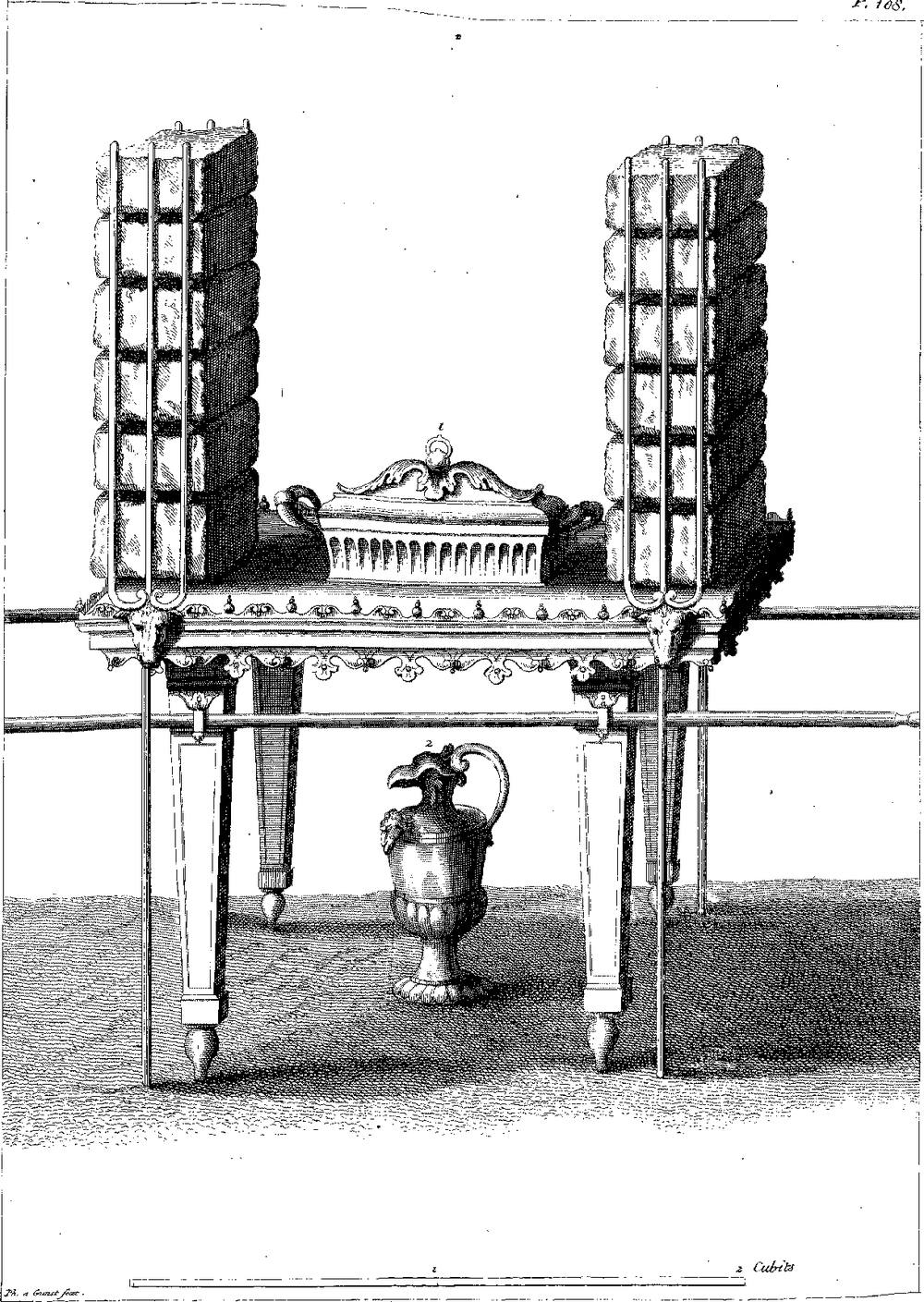
III. ALTAR, or Table, for the Shew-Bread, was a small Table of Shittim Wood, Exod. xxv. 23, 24.covered with plates of Gold, having a little border round it, adorned with sculpture. It was two cubits long, one cubit wide, and one and an half in height. It was placed in the Holy. Upon this Table, every Sabbath -day, were put twelve loaves with salt and incense. See SHEW-BREAD.
IV. ALTAR OF BURNT-OFFERINGS. This was a kind of Coffer of Shittim Wood, covered with brass plates. It Ch. xxvii. 1, 2, 3.was five cubits square, and three in height. Moses placed it to the East, before the entrance of the Tabernacle, in the open air, that so the fire which was to be kept perpetually upon it, and the smoak arising from the Sacrifices which were burnt there, might not spoil the inside of the Tabernacle. At the four corners of this Altar there was an appearance as it were of four horns, covered with the same metal as the rest of the Altar. Within the depth or hollow of it was a grate of brass, on which the fire was made; thro’ this fell the ashes in proportion as they increased upon the Altar, and were received below within a pan which was placed under it. At the four corners of this grate were four rings, and four chains, which kept it up at the four horns of the Altar above mentioned. As this Altar was portable, Moses had rings made, and fastened to the sides of it, into which were put staves of Shittim Wood, overlaid with brass, by the help whereof it was removed from place to place.
Such was the Altar of Burnt-Offerings belonging to the Tabernacle erected by Moses in the Wilderness: but in Solomon’s Temple it was much larger. This was a kind of Cube, twenty cubits long, as many wide, and ten in height. It was covered with thick plates of brass, and filled with rough stones; on the East side there was an easy ascent leading up to it. When the Jews returned from the captivity of Babylon, they rebuilt the Altar of Burnt-Offerings after the model of Solomon’s; but after both the Temple and Altar had been prophaned by the orders of Antiochus Epiphanes, this Altar was demolished, and the stones of it were laid up in some part of the Temple which was unpolluted, till a Prophet should be raised up by God, who should come and declare the use for which they were reserved. Herod the Great having made a new Temple, 1 Macc. xiv. 41.built an Altar of Burnt-Offerings like that which had been there before; but Josephus says, that the ascent up to it was on the South side.
The Altar of Burnt-Offerings, according to the Rabbins1, was a large mass all built of rough and unpolish’d stones, the basis whereof was two and thirty cubits, or forty eight feet square. From thence the Altar rose one cubit or a foot and an half, then there was a diminishing of one cubit in thickness; from thence the Altar being only thirty cubits square, rose five cubits, and received a new diminution or in-benching of two cubits, and consequently was reduced to twenty eight cubits square. From thence again it rose three cubits, and grew two cubits smaller. Lastly, it rose again one cubit, and so being in all twenty four cubits, or thirty six foot square, it formed the hearth on which the Sacrifices were burnt, and the perpetual fire kept up.
The diminution of two cubits abovementioned, which was about the middle of the Altar, served as a passage for the Priests to go and come about the Altar, to attend the fire, and place the Sacrifices on it. This Altar was composed of large plates of massy Brass, whence it is called the 1 Kings viii. 64.brazen Altar. It is believed that the Altar was all filled with rough Stones or Earth, according to what is said in Exodus, An Altar Exod. xx. 24, 25.of Earth thou shalt make unto me, and shalt sacrifice thereon thy Burnt-Offerings, and thy Peace-Offerings—— and if thou wilt make me an Altar of Stone thou shalt not build it of hewen Stone, for if thou lift up thy tool upon it, thou hast polluted it. At the four corners of the Altar, on the last diminution or inbenching, were four small pillars of a cubit square, hollow in the middle for half a cubit square, and in the form of a perfect cube. These are the horns of the Altar, so often mentioned in Scripture, they were hollow, that part of the blood of the Sacrifices might be poured into them.
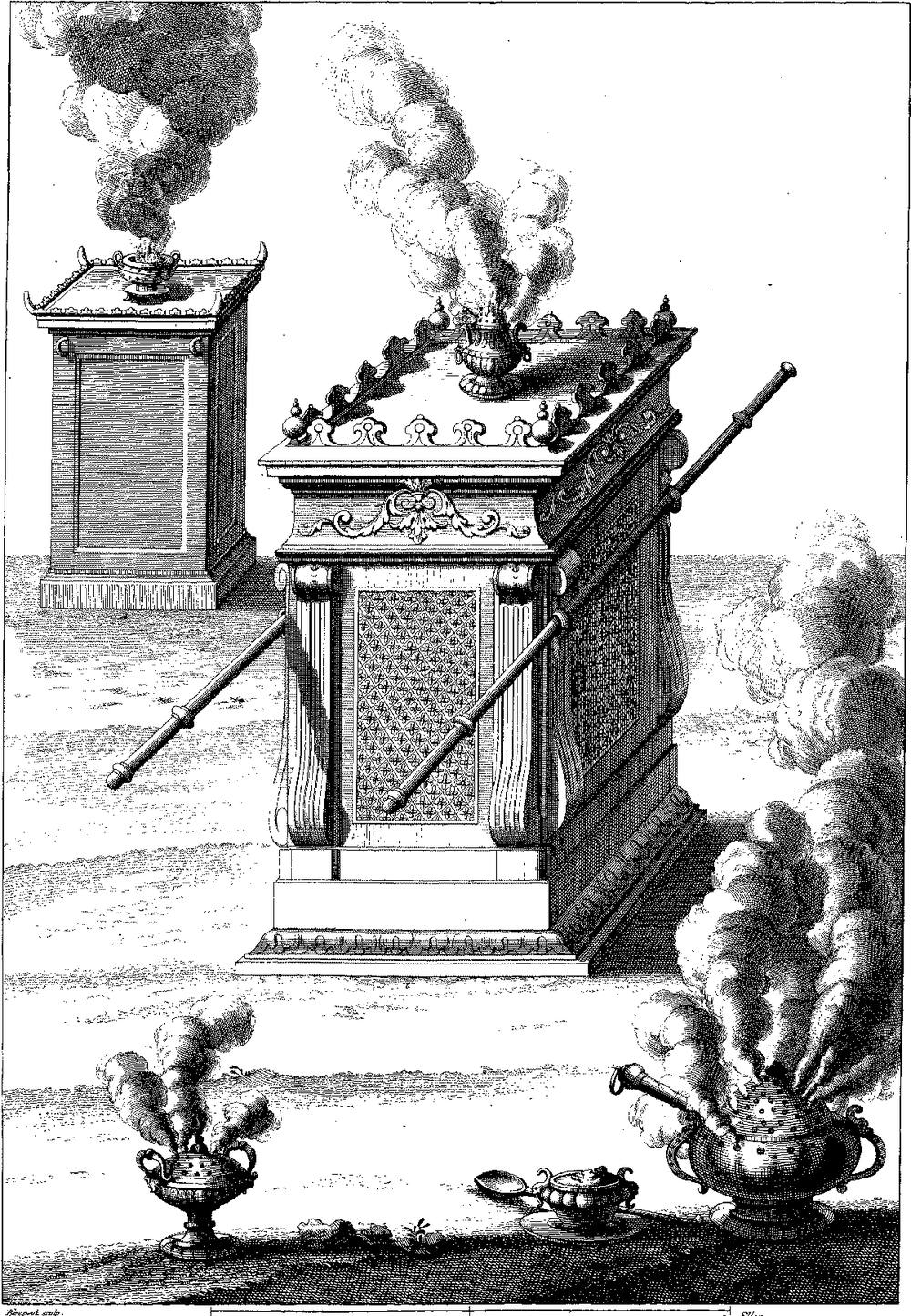
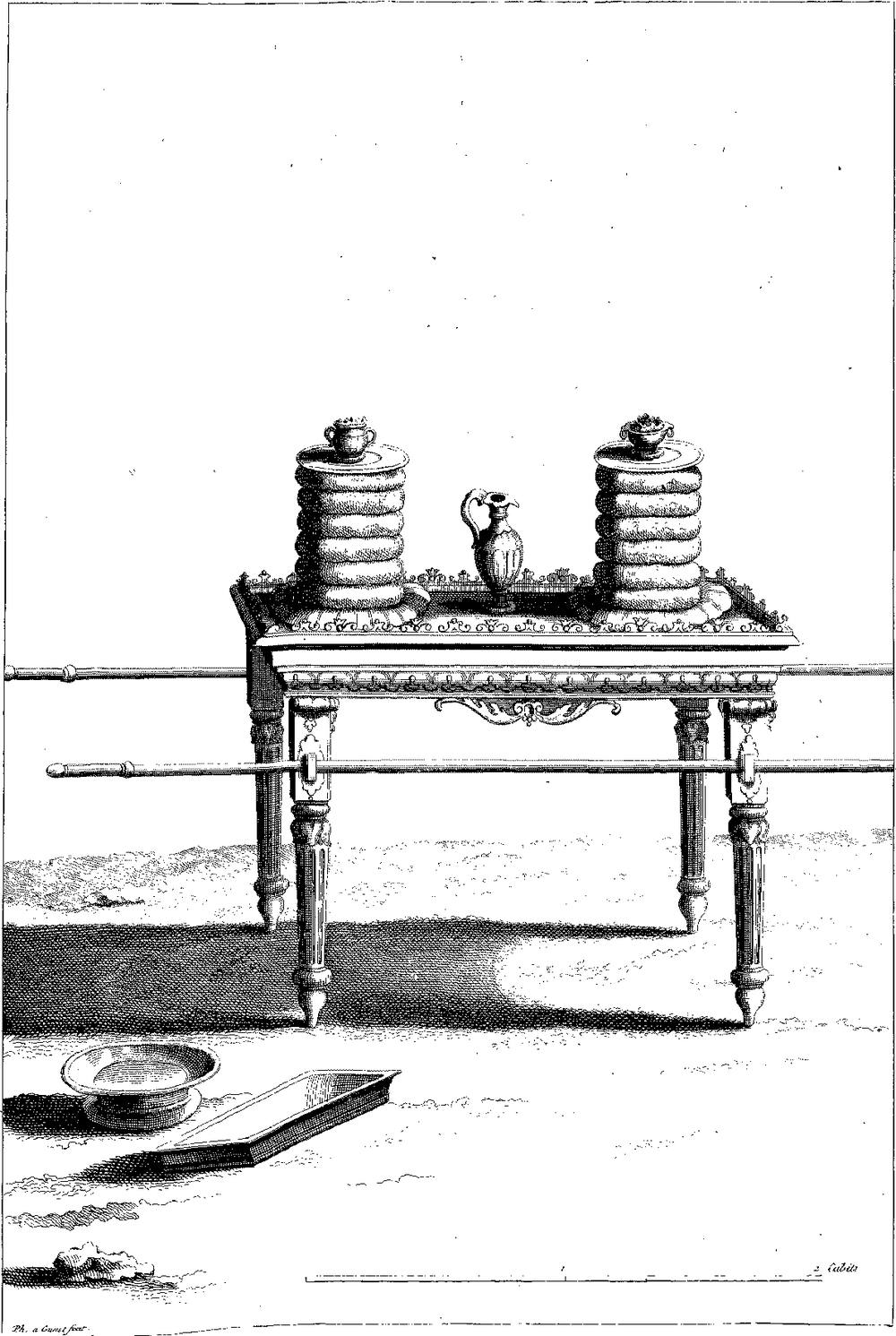
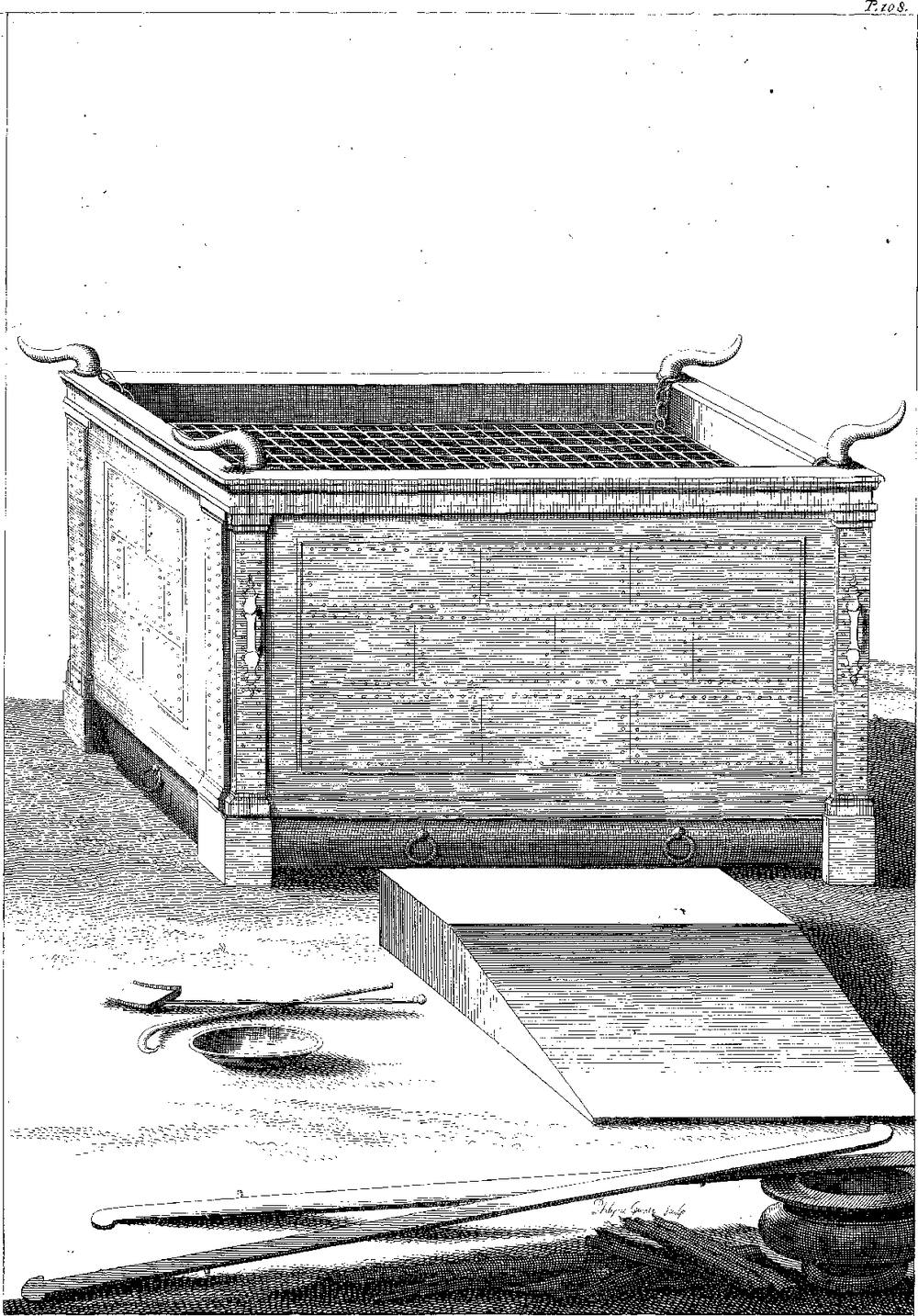
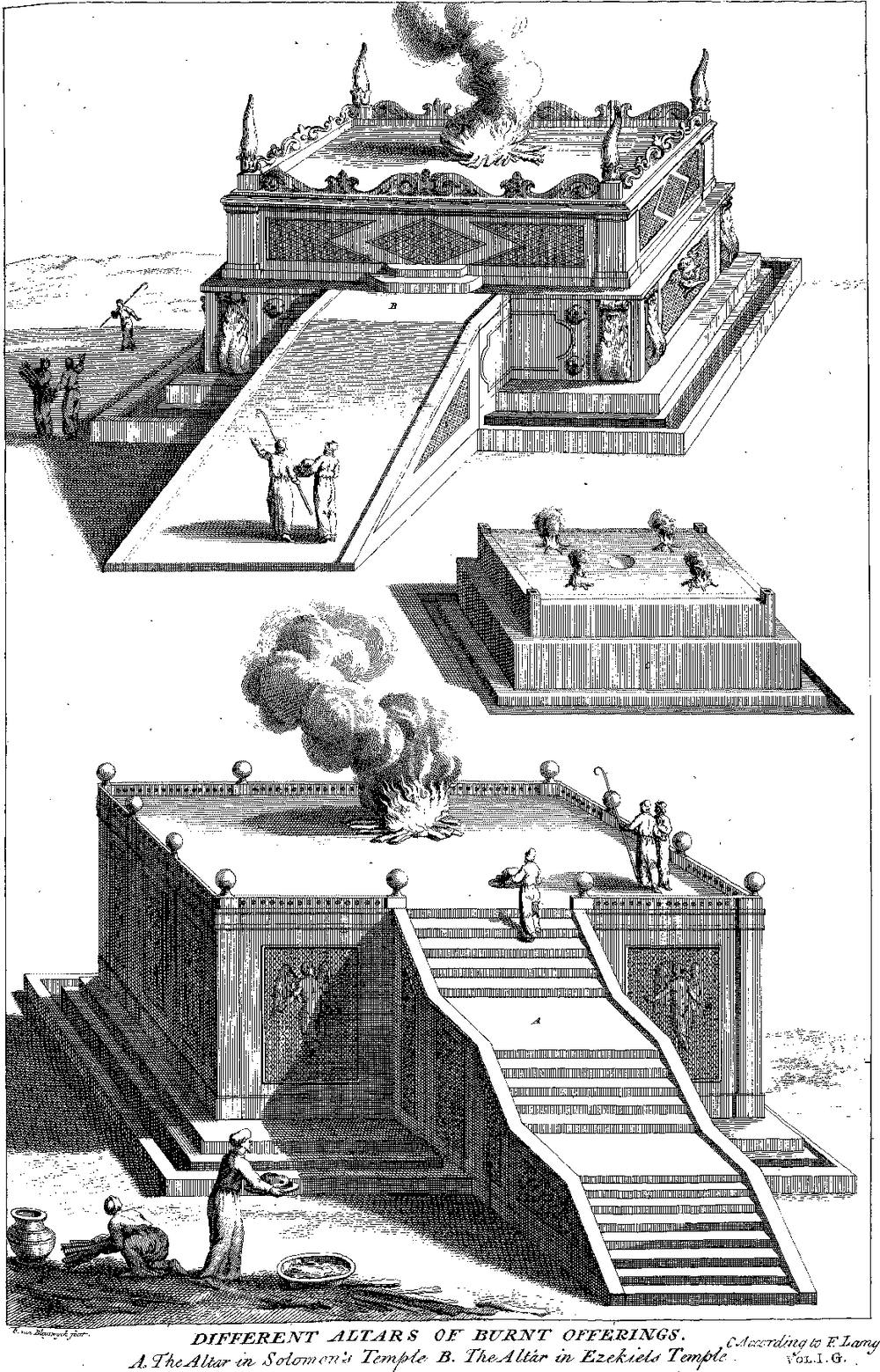
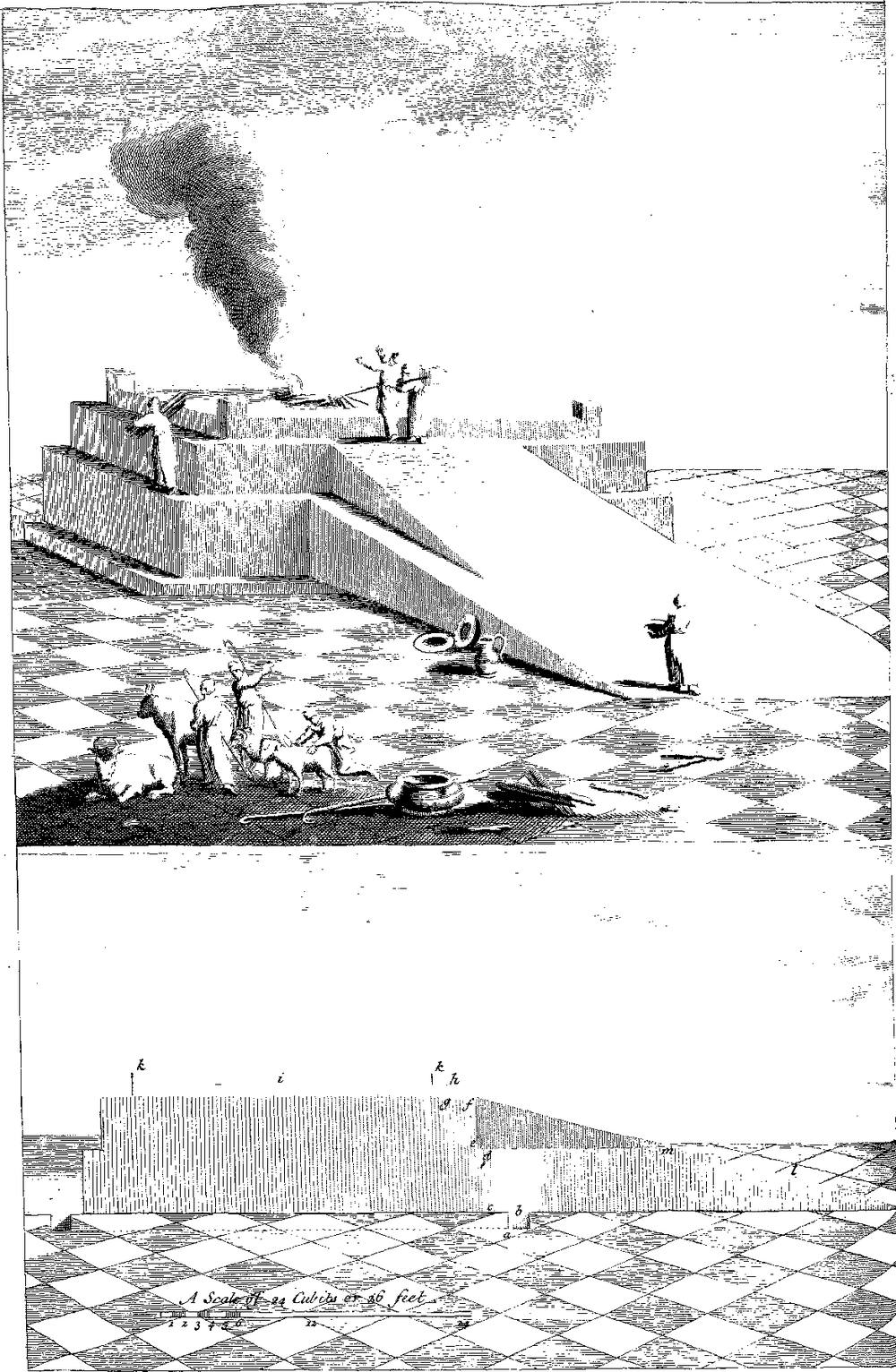
The ascent to the Altar was by an insensible rise on the South side, and was called Kibbesh; it was two and thirty cubits in length, and sixteen in breadth, and landed upon the upper benching-in, near the hearth or top of the Altar; for to go up to the Altar by steps was by the Law forbidden. Ver. 26.The Priests might go round about the Altar, and perform their offices very conveniently upon the two inbenchings which we have described; namely, that of the middle, which was a cubit, and that above it, which was likewise a cubit broad; for it would have been very uneasy for them to have walked bare-foot on the hearth, which was always heated by the fire that was continually burning there.
An Explanation of the Profil of the Altar of Burnt-Offerings, according to the Rabbins. a. A Trench which went quite round the Altar, wherein was thrown the blood of the Sacrifices. a. b. The foundation of the Altar one cubit high, and thirty two cubits square. b. c. The first in-benching, one cubit broad. c. d. The elevation of five cubits. d. e. The second in-benching, a cubit broad. e. f. The elevation of three cubits. f.g. The third in-benching, a cubit broad on every side. g. h. The last rising, of one cubit.
m. The passage on both sides the Kibbesh, to the second in-benching.
Read this article in its place on the printed pages
Footnotes
-
Mishnaioth. in Middoth. Maimon. in Beth-Habb. Ahirach. c. 1, 2. ↩