Volume III, pages 20–40 of the 1732 edition, from TE to TH: everything printed on these pages, in order.
Continued from Temple
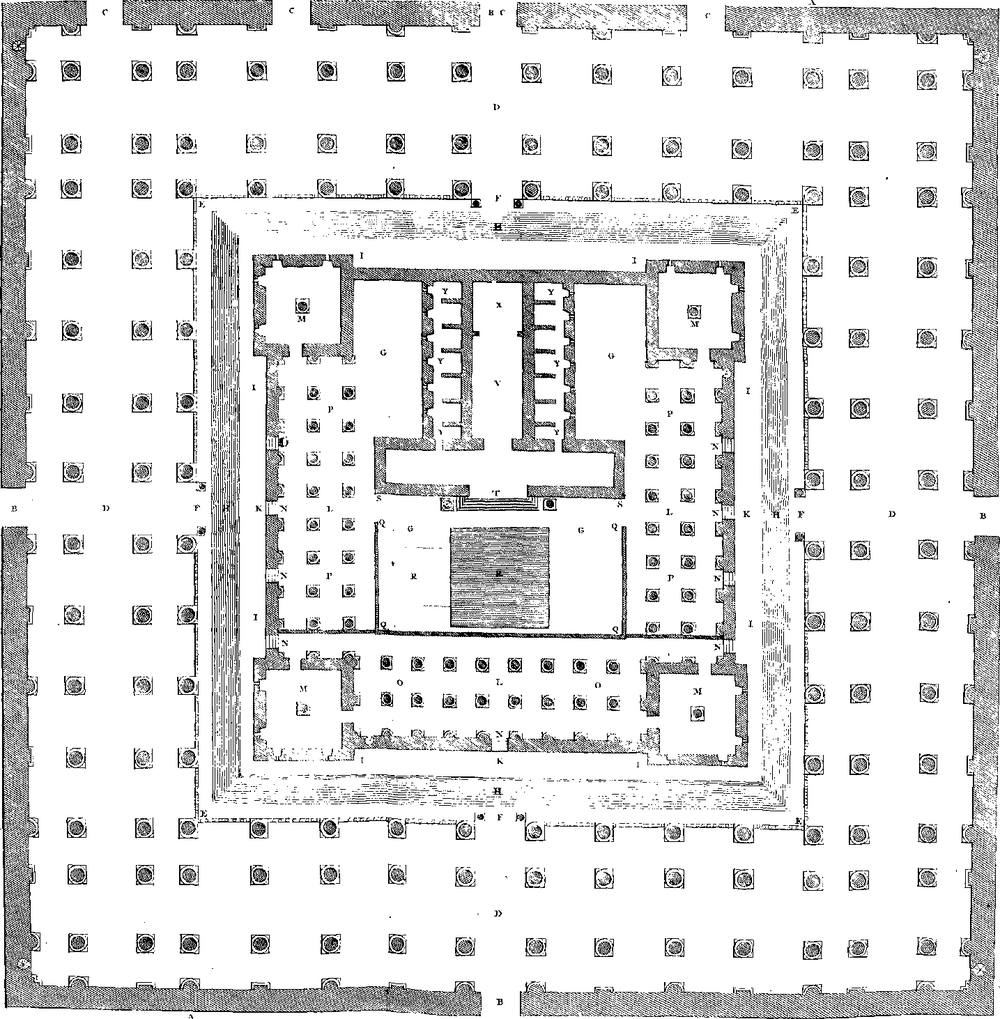
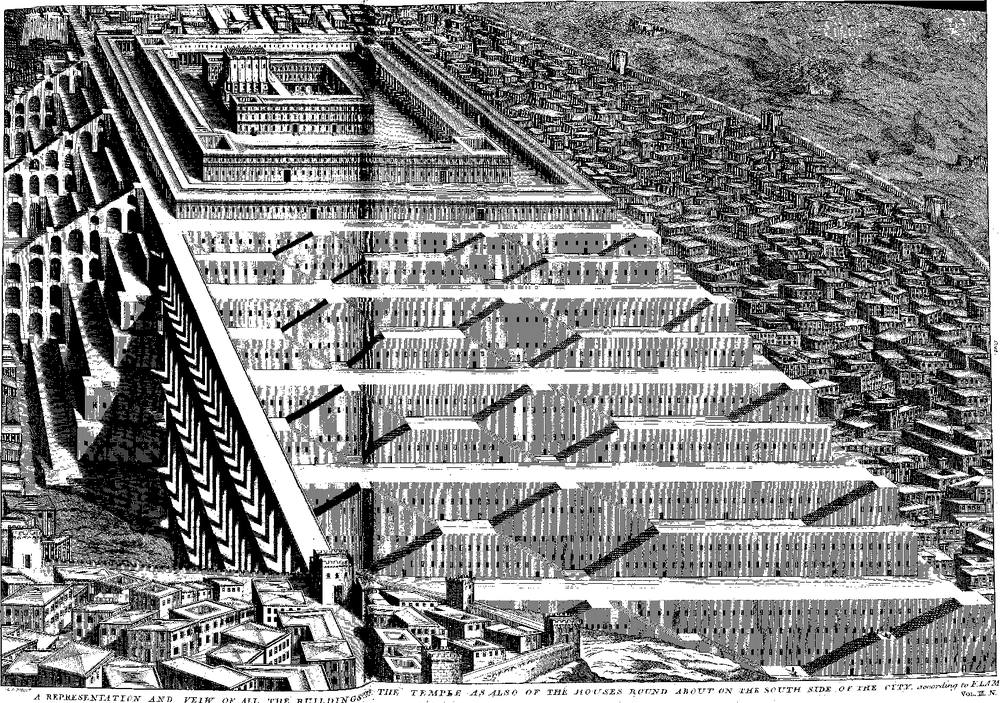
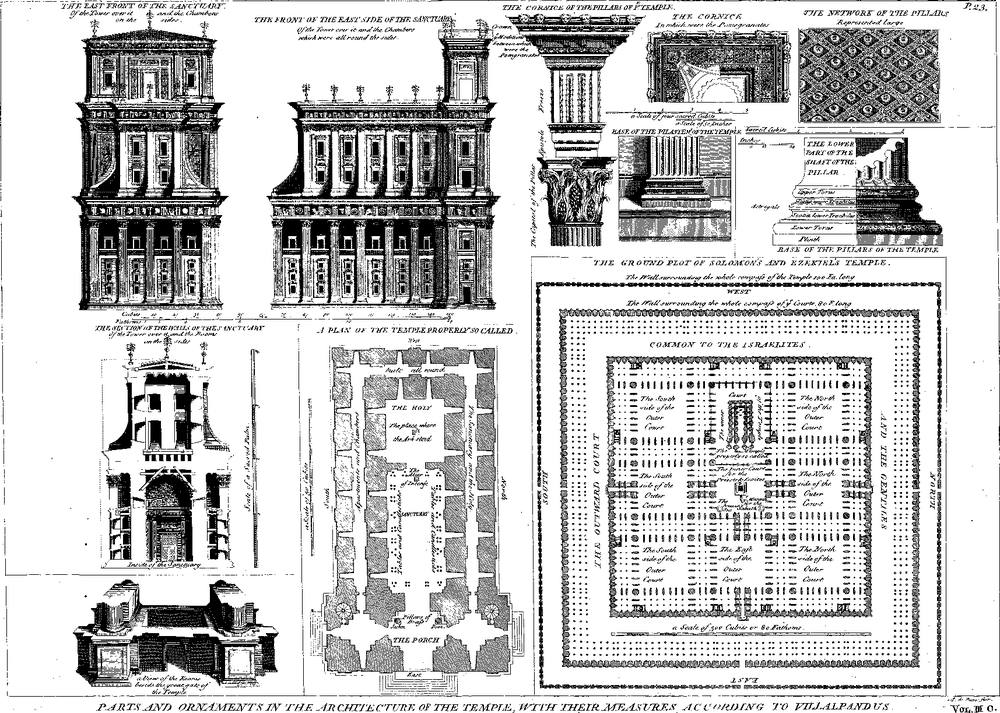
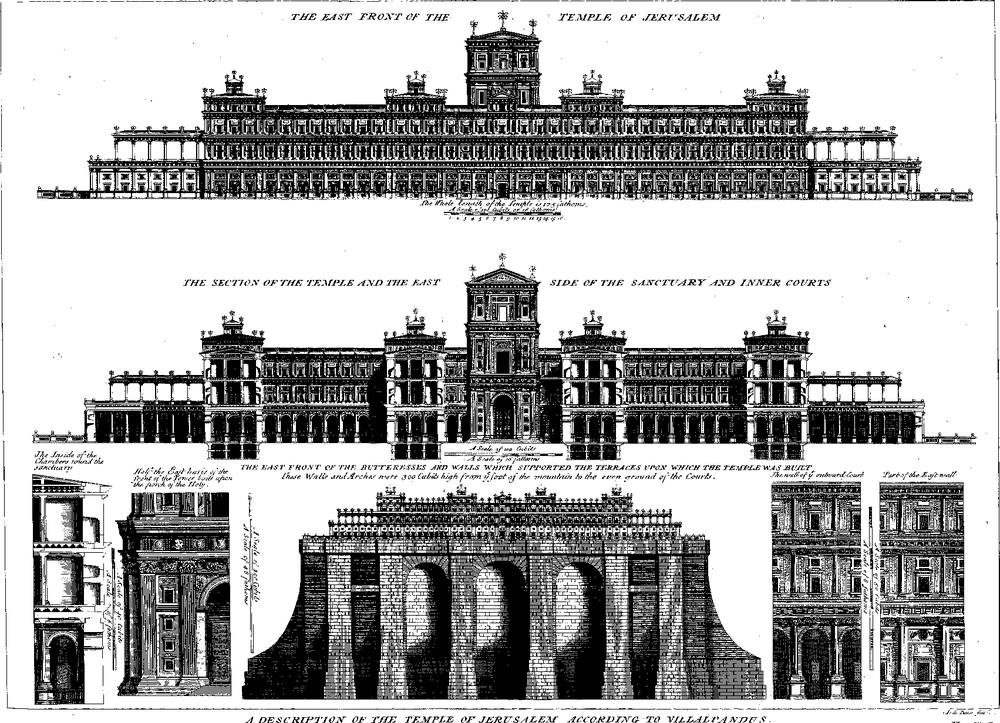
The Temple was built upon a very irregular Joseph. de Bell. l. 6. p. 915. κεφ. ιδ. Antiq. l. xv. c. 14.Mountain; and at first there was hardly Plain enough on the Top of it for the Site of the Temple and Altar. The rest of it was steep and sloping. But when King Solomon built it, he raised a Wall towards the East, to support the Earth on that Side; and after this Side was filled up, he there built one of the Portico’s or Galleries. At that time only this Face was cased with Stone; but in succeeding times the People endeavouring to enlarge this Space, and the top of the Mountain being now much extended, they broke down the Wall which was on the North side, and enclosed a second Space as large as that as the whole Circumference of the Temple contained at first. So that at last, against all Hope and Expectation, this Work was carried so far, that the whole Mountain was surrounded by a treble Wall. But for the compleating this great Work whole Ages were no more than sufficient; and all the sacred Treasures were applied to this Use, that the Devotion of the People had brought to the Temple from all the Provinces of the World. In some Places these Walls were above three hundred Cubits high; and the Stones used in this Work were some forty Cubits long. They were fastened together by Iron Cramps and Lead, to be able to resist the Injuries of Time. The Platform on which the Temple was built was a furlong Square, or one hundred and twenty-five Paces. See the Plan.
The Entrance into the first Enclosure, which was a Square of a Furlong on every side A, was by a Gate on the Eastern side, one on the South side, and one on the North side B: But there were four towards the West, one of which went to the Palace, another into the City, and the two others into the Fields C. See the Plan. This Enclosure was secured without by a very high and solid Wall; and within, all round about it on the four sides, were stately Portico’s or Galleries, sustained by Columns that were so thick that hardly three Men could grasp them with their Arms; for each of them was of the thickness of twenty-seven Feet. The Number of these Columns was an hundred and sixty-two. See the Plan D. They supported a Roof of Cedar very well work’d, and made three Galleries, of which the middlemost was the the highest and the widest, having the width of forty-five Feet, and the height of an hundred. Those on the two sides were but thirty Feet wide, and fifty high.
The Court or Area before these Galleries was paved with Marble of several Colours; and at a little Distance from the Galleries was a second Enclosure E, form’d by a handsome Balustrade of Stone, with Pillars at equal Distances F, on which were Inscriptions in Greek and Latin, to give warning to Strangers, and such as were unclean, not to proceed any farther on pain of Death. This Enclosure had but one Entrance to the East, but towards the North and South it had three at equal Distances. See the Plan.
The third Enclosure, which included the Temple and the Altar of Burnt-sacrifices, was surrounded by a Wall of forty Cubits high. It was Square as well as the former G, and the Height of the Wall did not appear so much without as it really was, because it was lost behind the Steps H, by which it was surrounded, and partly covered. First, there were fourteen Steps, upon which was a Terrass of about ten Cubits wide I, which went all round the Enclosure. From thence there was another Ascent of five Steps, to come to the Platform of the Gate K: So that the Wall was but five and twenty Cubits high within. The Entrance into this Portico was by a Gate towards the East, by four towards the South, and as many towards the North N. There was no Gate on the West side, but a great Wall ranged all along, from North to South. At the Entrance of each Gate within were large Rooms, in form of Pavilions, of thirty Cubits square, and forty high, each sustained by a Pillar of twelve Cubits, or eighteen Foot in Circumference. See M.
Within this Enclosure were also double covered Galleries, with two Rows of Pillars, to the East, to the North, and South; but there were none to the West L, as may be seen by the Plan. The Women had a Gate to themselves on the East side, and one to the South and the North, by which they passed to the Place appointed for them, which was distant from that of the Men O.
The Altar of Burnt Sacrifices was fifteen Cubits high, and forty Cubits wide every way: They went up to it by a Slope without Steps, towards the South R. At the four Corners were so many Eminencies, like Horns; and it was built of rough Stones, on which no Iron was used, or Tool of any other Metal.
The Front of the Temple, which was an hundred Cubits high, and as many wide S, as was said before, was adorned with many rich Spoils, which the Kings of the Jews had dedicated to God, as the Monuments of their Victories: When Herod had finished the Temple he dedicated them a-new, to which he added some of his own, which he had taken in his Wars against the barbarous Nations.
The
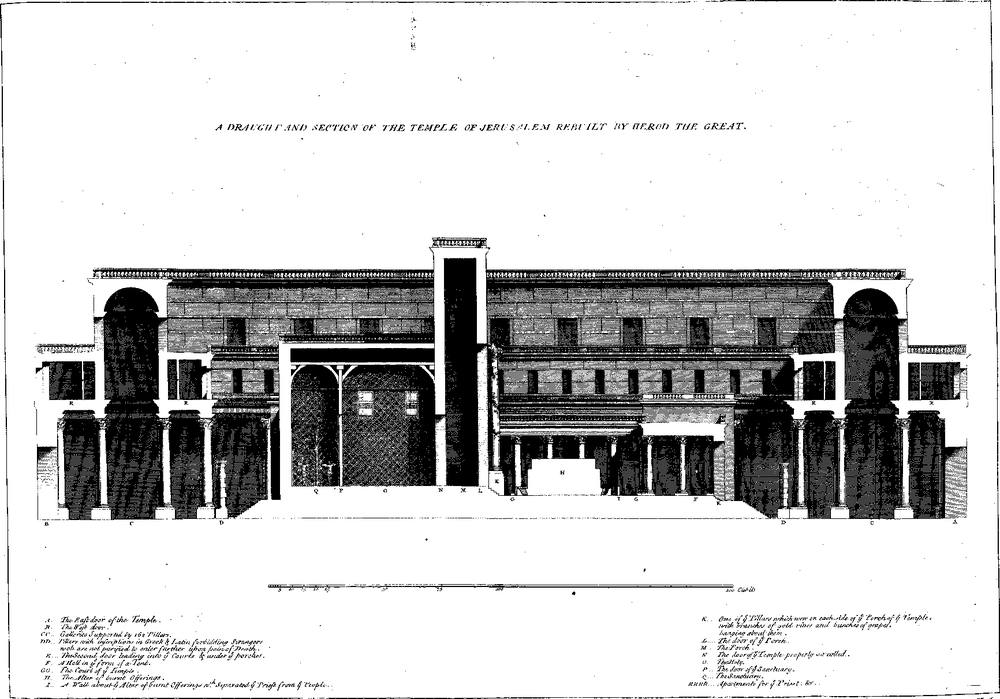
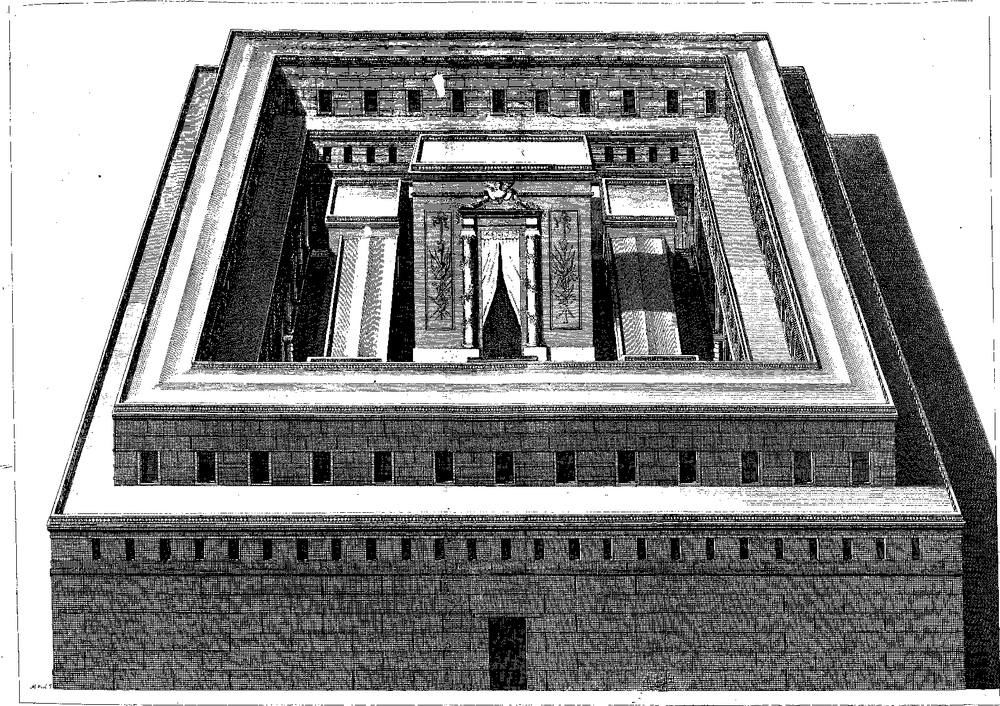
The Porch of the Temple was ninety Cubits high, and an hundred in length from North to South T. The Door was seventy Cubits high, and twenty-five wide. I do not mention the Sanctum or the Sanctuary, nor the Apartments that ranged along the two sides of the Temple, because these had nothing singular, or different from what has been seen before. Josephus observes, that as soon as it was resolved to build the Temple and the Altar, Herod durst not enter into the Courts of the Priests, as being only a Laick. He left to the Priests the care of finishing this Work themselves, who compleated it in eighteen Months; and the rest had taken up eight Years in perfecting.
Within this Inclosure was a Wall of one Cubit high, which surrounded the Temple and the Altar of Burnt-Sacrifices Q, and which parted the Priests from the rest of the Israelites. This Place was not to be entered by the Laity: They came as far as this Wall, to offer their Sacrifices and Offerings, but they went no farther.
Josephus relates a thing, which he said he received by Tradition from his Fathers, that all the time they were at work upon the Temple, there fell no Rain in the Day-time, but only in the Night; so that the Workmen were not hindered in their Work. When the Temple was finished, the Dedication of it was performed with great Solemnity: The People rendered hearty Thanks to God, and gave the King much Praise and Commendation, which he well deserved for the Execution of this great Work. Herod offered to God three hundred Oxen in Sacrifice, and all the People, with great Alacrity, brought their Victims to celebrate this august Ceremony. The number of them was so very great, that it was not easy to count them. What contributed still more to make this Festival the more solemn, was, that it happened on the same Day that Herod came to the Throne, which Anniversary he always celebrated with much Pomp.
In the Corner of the Northern side of the first Inclosure of the Temple, was a very strong Tower, built by the Asmonean Kings, who were in Possession both of the Regal State and the Priest-hood at the same time. ‘Twas there they kept the sacred Ornaments worn by the High-Priest on great Occasions. After them, Herod continued to keep them there; and after Herod, the Romans had them in their Power, till the time of the Emperor Tiberius. But during his Reign, Vitellius coming to Jerusalem in quality of Governor of Syria, the Inhabitants of Jerusalem received him with so much Honour, that to shew his Acknowledgment for it, he obtained from Tiberius that the care of this sacred Deposit should be put into their hands. They enjoyed this Favour till the death of King Agrippa: Then Cassius Longinus Governor of Syria, and Cuspius Fadus Governor of Judea, commanded the Jews to lay it up in the Tower of Antonia, that it might be in the Custody of the Romans, as before. The Jews sent to desire it again from the Emperor Claudius; and young King Agrippa being then at Rome, obtained that the keeping of it might be committed to him.
Before this, the manner of keeping this precious Habit was thus: It was kept in the Tower Antonia, under the Seal of the High-Priest, and of the Treasurers of the Temple. On the Eve of any solemn Festival, they went to wait upon him that commanded the Castle for the Romans; where after they had viewed and examined the Seals, they received the holy Vestments from his hands; and brought them back to him when the Festival was over; and sealed them up again as before. This Tower or Castle was already very strong, but Herod fortified it still more, and called it Antonia in honour to his Patron Anthony. Herod had made a Passage under Ground, which went from the Tower Antonia to the Eastern Gate of the Temple, near which he also built another Tower. This was to preserve a Communication between the two Towers and the Temple, that might be serviceable to himself, or the Kings his Successors, in case of any Sedition in the City.
An Explanation of the Plan of the Temple, as rebuilt by Herod the Great, according to the Dimensions given by Josephus.
AAAA The Temple was four Stadia or Furlongs in circuit, or a Square of one Stadium. The Stadium was an hundred and twenty-five Paces, or six hundred and twenty-five Feet. Joseph. Antiq. l. 25. c. 14. p. 544. BBBB It had four great Gates or Doors, fifteen Cubits wide, and thirty high. They were placed at the four sides of the Temple; to the East, West, North, and South. Joseph. de Bell. l. 6. c. 6.
CCCC But elsewhere he says, that to the West there were four great Gates, one of which went to the Palace, another to the City, and the two others into the Country. Joseph. Antiq. l. 25. c. 14. p. 544, 545.
DDDD About the first Inclosure of the Temple within, there were upon the four sides of the Courts four large Galleries, supported by four
Rows of Pillars, of which one Row was fixed to the Wall, and the other three were at a distance from it. There were one hundred and sixty-two in all, whose Height was seven and twenty Feet, and their Thickness as much as three Men could embrace. The Gallery in the middle was the highest and broadest, being forty-five Foot wide, and an hundred Foot high. Those on the Sides were but thirty Foot wide, and fifty high. Their Roofs were of Cedar, finely carved, adorned with Mouldings and Gilding. Joseph. Antiq. l. 25. c. 14. EEEE Beyond the Portico or Piazza we now speak of, there was a Separation or Balustrade of Stone, with Columns at several Distances, on which were Inscriptions in Greek and Latin, which upon pain of death forbid any Strangers, or the Jews that were not purified, to advance any farther. Joseph. Antiq. l. 15. c. 14. p. 545. Of the Wars of the Jews, l. 6. c. 6. p. 916.
FFFF This Balustrade had three Passages at equal Distances, both to the North and South: But towards the East there was but one Entrance, through which all Jews that were purified might enter, as also the Jewesses, indifferently. Joseph. Antiq. l. 15. c. 14. p. 545.
GGGG The Court of the Priests, which was the second Inclosure of the Temple, where the Priests performed their several Functions, and which inclosed the Temple, strictly so called, and the Altar of Burnt-Sacrifices. This Court was square, and inclosed by a Wall of forty Cubits high without; but one part of this Height was taken up, or covered by Steps; so that within the Wall was but five and twenty Cubits high. For, first, there were fourteen Steps (H), after which there was a Terrass of ten Cubits wide (I), from whence they went into the Gate, and ascended yet five Steps (K) to arrive at the Platform of the Court, and of its Portico’s, which were but twenty-five Cubits high, which was also the Height of the Wall within. Joseph. Wars of the Jews, l. 6. c. 6. p. 916. Compare also l. 5. c. 5. p. 906.
LLL This Court was square, and surrounded by double Galleries on the three Sides; that is, to the East, North, and South: But there was no Gallery to the West. The Pillars were plain, seph. Wars of the Jews, l. 6. c. 6. p. 916. Antiq. l. 15. c. 14. p. 544.
MMM Adjoining to the Gates of the Court of the Priests within, were two square Rooms, in the form of Towers, supported by two Columns, having each twelve Cubits, or eighteen Feet in Diameter or Thickness. These Rooms were thirty Cubits square, and forty high. Wars of the Jews, l. 6. c. 6. p. 917.
NNNN This Court had no Doors on the Western side, but one to the East, four to the North, and four to the South. That on the Eastern side was for the Women, and on the North and South there was one for the Women also. Joseph. Wars of the Jews, l. 6. c. 6. p. 916. So that they had four Ways to their Place of Worship.
OO The Place appropriated to the Women in the Temple, was to the East, over against the Altar of Burnt-Sacrifices, and the Porch of the Temple.
PP The North and South sides were for the Men. See Joseph. Wars of the Jews, l. 6. c. 6. p. 916, 917. QQQQ The Priests were separated from the People by a Wall of three Cubits high, according to Josephus, Antiq. l. 8. c, 2.; or only one Cubit high. Wars of the Jews, l. 6. c. 6. p. 918.
RR The Altar of Burnt-Offerings; it was fifteen Cubits high, forty long, and as many broad. They went up to it by a Slope towards the South. Wars of the Jews, l. 6. c. 6. p. 918. SS The Front of the Temple to the East, was an hundred Cubits square, Wars of the Jews, l. 6. c. 6. p. 917. Elsewhere Josephus says, that the Temple was at first an hundred Cubits wide, and an hundred and twenty high; but that it afterwards settled as far as twenty Cubits, and was by that means reduced to the height of an hundred. Joseph. Antiq. l. 15. c. 14. p. 543.
This Front was that of the Porch of the Temple, which was not near so wide as this; for the Front was an hundred Cubits wide, and the Temple itself was but twenty. T The Door of the Porch was seventy Cubits high, and five and twenty wide. Wars of the Jews, l. 6. p. 917.
V The Sanctum was forty Cubits long, and twenty Cubits wide. Ibid. p. 917. X The Sanctuary was a Square of twenty Cubits. Ibid. p. 918. their Height twenty-five Cubits, all of one Stone. The Galleries were thirty YYY On the sides of the Temple were Apartments contiguous to it in great num- Cubits wide. Jobers,
numbers, and of different Dimensions. Wars of the Jews, l. 6. c. 6. p. 918.
Here follow some Reflections upon the Description of the Temple of Jerusalem, according to Villalpandus and Dr. Prideaux.
Father John-Baptist Villalpandus, a Spanish Jesuit, who died May 22. 1608, and who was employed by the King of Spain to draw up a Description of the Temple and City of Jerusalem, has acquired an immortal Glory by this Work, which is printed in three Volumes in folio. What he hath performed in this matter has hitherto been looked upon as the most finished Piece we have of the kind. As he was a very skilful Architect, he was in a much better Capacity of doing Justice to this Design than the generality of Interpreters of Scripture, who are not possess’d of this Qualification, and who commonly have but a slender Acquaintance with Architecture.
Yet however, there are very able Men, who think this learned Jesuit, tho’ extremely well furnished with profound Knowledge in the Greek and Roman Architecture, was too much prejudiced in favour of the Temple of Solomon, of which God himself gave the Model to David, and which had been managed and directed by Solomon, the wisest, the richest, and the most enlightened of all Kings; he imagin’d, I say, that he could not make it too splendid, too grand, or too magnificent, and therefore exhausted all the force of his Imagination and Genius, to describe a Temple that should be the most perfect Pile of Building that was possible.
He has introduced many Embellishments which are not mentioned in the sacred Text, but which ought to have been there according to the Rules of Architecture, which it is supposed Solomon could not be ignorant of; as if the same Taste must needs prevail in Architecture, among all Nations, and in all Ages: And as if Solomon, who lived so long before the first Architects of Greece, must needs have followed the same Rules that they found out, and gave afterwards. Besides, Villalpandus has multiplied the Courts, and the Portico’s, and instead of three Courts, which only are mentioned in Scripture, he has described eleven in his Plan: That is to say, the Court of the Gentiles, or the outward Court, the great Court, or the Court of the Israelites, and besides these, nine other Courts, all surrounded with Portico’s and Rows of Pillars.
This Multitude of Courts is founded only upon Ezek. xlii. 3, 6. where the Prophet says, that the Angel shewed him a Portico joining to a treble Portico in the outward Court of the Temple; Ubi erat porticus juncta porticui triplici: As if that was to express three Portico’s in Front, whereas it signifies only three Rows of Columns, or three Galleries, or, if you please, three Stories. Compare Ezekiel. Add to this, that the extent of Ground on the top of Mount Moriah could not be sufficient to receive such vast Edifices.
Villalpandus supposes that all the Courts were surrounded with three Ranks of Columns, and that upon these Columns were three Stories of Apartments; which, to me, does not seem at all to be warranted from Scripture: For the Passage of the Prophet Ezekiel, xlii. 3, 4, 5, 6, does not affirm it expressly; it literally imports, that each Court had three Galleries below, and above, three Rows, the middlemost of which was an open Gallery, which served to part the Chambers that were on each side. But it is very doubtful whether there were three Stories upon the Rows of Pillars or over the Portico’s. The Orientals did not commonly build several Stories thus one upon another; and these must have been of a very extraordinary Height.
What he says of Pavements of Porphyry, and of Walls built with Marble of Paros, is very little probable; at least it is not mentioned in Scripture, tho’ indeed there is nothing in all that which is not much below the Majesty of so holy a Place, and the Riches of Solomon: But we are not here to enquire what was most splendid, most rich, or most agreeable; but rather we are to examine what was Fact, and what is most conformable to the sacred Text.
As to Dr. Prideaux’s System, which he has extracted from the Books of the Rabbins, we may say of it in general, that it is very commodious in this, that it gives us very plausible Explications of whatever is said in Scripture of the different Parts of the Temple, and concerning their several Uses. We find there whatever is taken notice of in the Gospel; the beautiful Gate, Solomon’s Porch, the Chests of the Temple, wherein the Offerings were put, the Gazophylacium or Treasury; lastly, those that contrived this Plan have taken care for every thing. There is but one thing wanting, but that is very essential, which is this: The Authors of the Talmud, and the other Rabbins, have never proved, nor will ever be able to prove, their Suppositions, either from Scripture, or from Authors that have seen the Temple, or had consulted those that had seen it. For neither the Talmudists nor Rab -
Rabbins are either of Antiquity or Authority sufficient to convince us, when the Question is about a Matter of Fact, of which they could not be Witnesses, neither themselves nor those whose Testimony they alledge, I mean their Fathers or Grandfathers: The Talmud of Jerusalem was composed at least three hundred Years after the Destruction of the Temple; that of Babylon is still more modern than that of Jerusalem by an hundred Years. The most celebrated Rabbins whose Writings we have, did not live sooner than the 11th or 12th Century since Jesus Christ. We know very certainly that they were but little conversant in the Study of Antiquity, and that they have no ancient Monuments, except the sacred Writings and Josephus, that can give them any Information about the true Form of the Temple. How then can they acquaint us with so many Particulars, which are different from what the Scriptures and Josephus tell us of them?
If the Rabbins had been satisfied with describing the Temple, such as it was when the Romans destroyed it, one might endeavour either to reconcile them with Josephus, which I think to be impossible, or we might say they had some Tradition, or some private Writing more faithful and exact than Josephus: But to pretend the Temple they describe to us is the same with that of Solomon, or Ezekiel; this indeed is utterly insupportable.
What they say, for Instance, about the Court of the Women, is to be found in no place of Scripture. The Chel, or the Wall that separated the Court of the Israelites from that of the Gentiles, was not within, but without the Temple. The Pillars Jachin and Boaz were not to be seen in the second Temple. It is very uncertain whether the Veil that was rent at our Saviour’s Crucifixion is that which parted the Sanctum from the Sanctuary. It is much more probable it was that which separated the Sanctum from the Vestibulum. The Wideness of the Vestibulum of Solomon’s Temple did not exceed the Wideness of the Temple itself: And where shall we find that it was one of the Wings of the Temple on which the Devil placed our Saviour? Matth. iv. 5. How shall we prove the Existence of all those Gates, both on the West and South sides of the Temple; and of so many small Apartments, the Uses of which are so minutely determined?
I would not be here understood to intend to disparage the Pains that Dr. Prideaux has taken in these Matters; I would only insinuate, that the greatest part of the things set down in the Plan of the Temple that he has given us, are of but little Certainty; that the Jewish Authors he has followed are Guides to be but little relied on in these Matters, and that to know the ancient Temple of Solomon we must keep to the Text of the Books of the Kings and of Ezekiel; and that as to the Temple of Herod, which was demolished by the Romans, we have no other Guide to follow but Josephus.
Explanation of the Plan of the Temple of Jerusalem, according to the Notions of Dr. Prideaux.
AAAA The outward Circuit of the Temple, including a Square whose Circumference was two thousand Cubits, and the Side five hundred Cubits. It was a Wall of twenty-five Cubits high within; and this was the Height of all the other Walls of the Temple, except the Chel. The Length of a Cubit was a Foot and a half. B The Eastern Gate, otherwise called the Gate of Shushan. CC Shops where they sold Wine, Oil, Salt, Meal, and other things used in the Sacrifices. There were Chambers over on both Sides. D The Northern Gate, called Tedi. EE Apartments for the Porters above and below, on either side. Between this Gate and the Eastern Corner, upon the top of the Mountain that stretched out a little, was the Fort Antonia, formerly called Baris, where the Romans kept a Garison, as a Bridle to the Temple. Hence it was that the Commander of this was called the Captain of the Temple, Luke xxii. 52. Acts iv. 1. It was a square Pile, of two Furlongs in compass, pretty near the Wall of the Temple. It had a Communication with it by a pair of Stairs, which terminated below in the Cloisters, on the North-west side. ‘Twas this Way that the Soldiers went down to appease the Tumult on account of St. Paul, Acts xxi. 32. ‘Twas from thence also that St. Paul made his Speech, mentioned in the 40th Verse.
FF The two Southern Gates, called the Gates of Huldab.
GGGG Porters Lodges on both Sides. H The Gate Shallecheth, or of Coponius, to the West. I The Gate of Parbor, on the same side.
KKKK Porters Lodges. LL The two Gates Asuppim, on the same Western side.
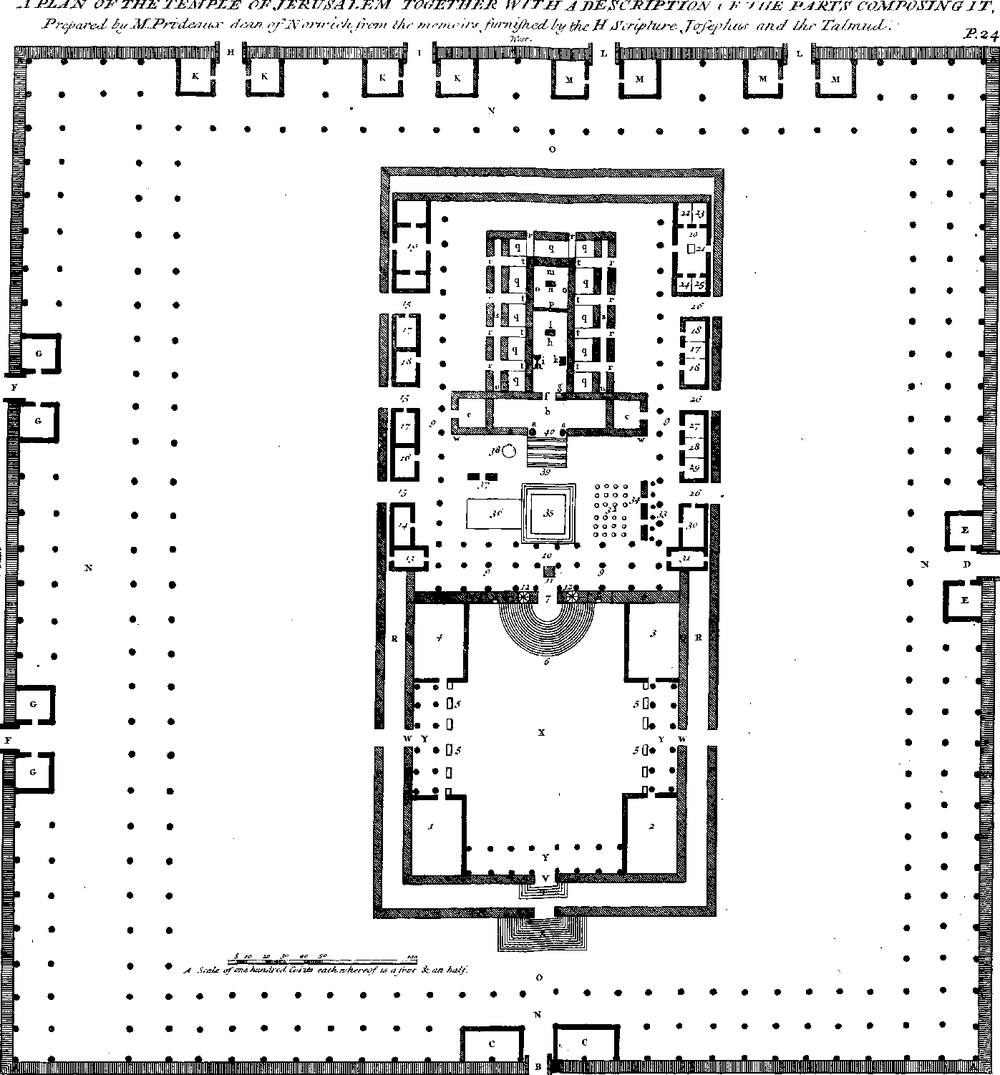
MMMM The Apartments of these two Gates, where was the Treasure of the Temple. The side of these Gates was fifteen Cubits, and the Height thirty. The Opening was ten Cubits wide, and twenty high. All the Gates of the Temple, within and without, were of the same Dimensions. N The Cloister, or cover’d Gallery that went round the Temple. On the South side it was called The King’s Portico, where it was much more spacious than elsewhere; for it had three Walks, the middlemost of which was forty-two Cubits and a half wide, and fifty high. The other two were but fifteen Cubits wide, and twenty-five high. And these last Dimensions were the same in all others of this Court. That to the East was called Solomon’s Porch, because it was built upon the great Terrass that Solomon had raised in the bottom of the Valley, which was four hundred Cubits deep. This was the only Work of Solomon that remained in the Temple, at the time of Jesus Christ. This Name is given it in John x. 23. Acts iii. 11.
O The outward Court of the Temple, called The Court of the Gentiles. P The outward Inclosure of the inward Courts. This was a fine Wall of three Cubits high, within the Inclosure of which it was not allow’d for any Gentile to enter; nor for any one that was polluted by being near a dead Body.
Q The Wall that included the second Court of the Temple. R The Space between this last Wall, and the outward Circumference of this Court. It was ten Cubits, and was what they called the Chel. S The Stairs on the East side, by which they went up out of the Court of the Gentiles into the Chel. It had fourteen Steps, each of the Height of nine Inches. T The Stair-case of the Chel, which went up to the Court of the Women; of five Steps, each nine Inches. V The Gate which enter’d into the Women’s Court on the East side. It was called Beautiful, Acts iii. 2. because of its magnificent Structure. WW Two other Gates which went into the Women’s Court; one to the South, the other to the North. X The Womens Court; so called because Women were allowed to enter in there, to be present at divine Service, but not to go farther. It was a Square of a hundred and thirty-five Cubits.
YYY Portico’s on three sides of the Womens Court; over which there were Galleries for the Womens use. ZZ Two subterraneous Chambers under the Court of Israel, where the Musicians laid up their Instruments. 1, 2, 3, 4. Four small Courts adjacent to the four sides of that of the Women; these were oblong Squares, of forty Cubits long, and thirty wide. 1 Here the Nazarites accomplish’d their Vows. 2 Here the blemish’d Priests cleansed the Wood from Worms before it was used.
3 Here the Purification of Lepers was performed. 4 Here they laid up the Oil and Wine for the Altar, in Cellars built within, all round about. 5 The Chests of the Treasury of the Temple, where our Saviour saw the Widow put in her two Mites, as he sat upon the Benches under the Portico. For there were Benches in all the Portico’s of the Temple, all along the Wall within, as well as without this Court. ‘Tis of some place near these Chests, that we must understand that of St. John viii. 20, where it is said that our Saviour preached in the Treasury. 6 The semicircular Stair-case, which went up from the Womens Court to the great Brazen Gate. It had fifteen Steps.
7 The great Brazen Gate, or the Gate of Nicanor. It was the great Entrance into the farthest Court, in which were the Temple and the Altar. This Court represented the Tabernacle, and included what was properly called the Sanctuary. It was a hundred and thirty -five Cubits wide, and a hundred eighty-seven long. 8 The Wall which parted the Sanctuary from the Womens Court. 9 The Place of the Sanctuary, which was properly called the Court of Israel; For here it was that the Residentiaries, or Stationary-Men, always abode, who in the publick Worship represented the whole Body of the People of Israel; and it was thither also that all other Israelites repaired, when they had any Sacrifice to offer. For as for bare Worshipping, without any particular Offering, they remained in the Court of the Women; the Men in the open Space, and the Women in the Portico’s. This Court contained at its first Entrance, which was to the East, a double Portico, and only one Isle to the North and South.
10 The Place properly called the Court of the Priests. It contained the second Walk, or Isle, of the double Portico now mentioned. The Desks of the Musicians made a Row of two Cubits under this Porch, joining to the Court. The remaining part was the Place where the Priests attended the Service, that were then out of Waiting. 11 The Throne, where the King sat, near one of the Columns, 2 Chron. vi. 13. 12 Winding Stairs, leading up to the Chambers over the Gate Nicanor. That to the right went to the Wardrobe, where the Priests laid up their Habits; the other to the Chamber where they kept the Cakes for the Continual Offering made by the High Priest every Morning and Evening. 13 The Hall called Gazeth, where the Sanhedrim assembled. One part of this Hall was within the Sanctuary, and the other part without. ‘Twas in this outward part they usually sat. 14 The Hall of the Fountain. ‘Twas this Fountain that supplied all the Water that was used in the Temple.
15 Three Gates of the Sanctuary, towards the South: The first and nearest to the Well-Room, was thence called the Well-Gate; over which was the Room where the Incense was prepared: The second was the Gate of Firstlings, and the third of Kindling. 16 The Wood-Chamber, where the Wood was laid up for the use of the Altar, after it had been purged from the Worm-eaten. Over this Chamber was that of the High Priest, called Paradrin, where the Council of the Temple was held, in which he was President. 17 A Hall, for a Body of Guards of Levites. 18 One of the Chambers of the Treasury. 19 The Hall, wherein was kept the common Fire for the grand Guard of Levites.
grand Guard of Priests. 21 A Stone in the midst of this Hall, under which were laid every Night all the Keys of the Temple. 22 A Closet, wherein were shut up the Lambs for the continual Morning and Evening Sacrifices. 23 The Bath, where the Priests washed themselves after any Uncleanness. 24 The Closet were the Shew-bread was made. 25 The Closet where the Maccabees put the Stones of the Altar, that had been polluted by Antiochus. 26 Three Gates of the Sanctuary towards the North. The first and most Eastern was called Nitzotz, or of Singing; the second the Gate of the Women; and the third the Gate of the Corban.
27 The Salt-Chamber, for keeping of Salt for the Use of the Altar. 28 A Chamber, where the Skins of the Victims were deposited. 29 The Room where the Bowels of the Victims were washed. 30 Another Body of Guards of Levites; over which there was also one for the Priests. 31 The Chamber where the Priest lived private for seven Days, who was to burn the Red Heifer.
32 Rings, to which the Victims were fastened that were to be killed.
33 Eight Posts, on which the Victims were hung up to be flea’d.
34 Marble Tables, on which the Sacrifices were cut up.
35 The Altar of Burnt-Offerings, the Square of which above was twenty-four Cubits, a side, and below thirty-two Cubits. 36 The Slope that went up to the Altar, of thirty-two Cubits. 37 The Marble-Tables, on which they put the Pieces of the Victims that were ready to be laid on the Altar.
38 The Brazen Sea. 39 The Stair-case of the Porch. It had twelve Steps. 40 The Passage of the Porch. It was twenty Cubits wide, and forty high.
cc The Chambers for laying up the Instruments used in sacrificing. a The two Pillars Jachin and Boaz, on each side of the Entrance. b The Porch, eleven Cubits wide, and sixty long. d The outward Wall of the Porch. e The inward Wall of the Porch. f The Door that went out of the Porch into the holy Place. g The Wicket, by which the Priest passed to unbar and open the Gates in the Morning, and to bar up the Gate in the Evening, and afterwards to return. h The Holy Place. It was twenty Cubits wide, and forty long. Here stood the three following Pieces, i, k, l. i The Golden Candlestick, with seven Lamps. k The Table of Shew-Bread.
l The Altar of Incense.
m The Most Holy. It was a Square, of twenty Cubits, wherein were the three following Pieces, n, o, p. n The Ark of the Govenant.
o The two Cherubims, of ten Cubits high, their Faces inwards, and their Wings extended towards each other, over the Ark, and quite to the Wall, on each side. p The Veil of the Temple, that parted the Holy and the Most-Holy. It was rent from top to bottom at our Saviour’s Crucifixion. q The Chambers of the Treasury, on the two sides, and at the bottom of the Temple. They were of three Stories, and therein the Tythes were lock’d up.
r Passages that went to those Chambers. s Galleries before the Chambers. t Stair-cases for going up to those above. u Stair-cases for going up to the Apartments, that were above the Porch and the Temple. x x The Wings of the Temple.
N.B. The Length of the Temple, properly so called, taking in the Thickness of the Walls, was a hundred Cubits. The Breadth of the Temple, with the two Wings, was a hundred Cubits, without the Wings 70. The Height of the Temple was a hundred Cubits; that of the Wings a hundred and twenty. It was upon one of these Wings that the Devil placed our Saviour, Matth. iv. 5.
The Scripture also speaks of several other Temples that were in or near Palestine; for Example, the Temple of Dagon, at Gaza, Judg. xvi. 23. and another at Ashdod, or Azotus, 1 Sam. v. 1, 2, 3. and 1 Macc. x. 84. The Temple of the Samaritans upon Mount Gerizim, 2 Macc. v. 23. vi. 2. The Temple of Ashtaroth, one of the chief of the Philistines, 1 Sam. xxxi. 10. The Temple of Baal, which Ahab built in Samaria, 1 Kings xvi. 32. The Temple of Rimmon, at Damascus, 2 Kings v. 18. The Temple of Nisroch at Babylon, Isai. xxxvii. 38. The Temple of Bel at Babylon, Dan. xiv. 9. The Temples of Chemosh and Moloch, built by Solomon, upon the Mount of Olives, over-against the Temple of the Lord, 1 Kings xi. 7. The Temple of Nannæa, which Anti -ochus Epiphanes attempted to plunder, 2 Macc. i. 13.
The Temple of Babylon, wherein Nebuchadnezzar laid up the Vessels of the Temple of the Lord, Dan. i. 2.
Joseph. de Bell. l. 4. c. 1.The Temple of the Golden Calf at Bethel, and at Dan. Josephus says, that even in his time the Temple of the Golden Calf was still to be seen at Dan, near the River called the little Jordan. In his Text is read at Daphne, but it is plain it ought to be read at Dan.
Rev. iii. 12. 2 Thessal. ii. 4.1. TEMPLE is also said of the Church of Jesus Christ. Him that overcometh will I make a pillar in the temple of my God. And St. Paul says, that Antichrist as God sitteth in the Temple of God, shewing himself that he is God.
Psal. xi. 4.2. TEMPLE sometimes is put for Heaven. The Lord is in his holy temple; the Lord’s throne is in Heaven. The Martyrs in Rev. vii. 15.Heaven are said to be before the throne of God, and serve him day and night in his temple.
1 Cor. iii. 16. 17.3. The TEMPLE of God, in a spiritual Sense, is the Soul of a righteous Man. Know ye not that ye are the temple of God, and that the Spirit of God dwelleth in you? If any man defile the temple of God, him shall God destroy; for the temple of God is holy, which temple ye are. And elsewhere, Know ye not that your body is 1 Cor. vi. 19. 2 Cor. vi. 16.the temple of the Holy Ghost, which is in you, which ye have of God, and ye are not your own? And again; And what agreement hath the temple of God with Idols? For ye are the temple of the living God; as God hath said, I will dwell in them, and walk in them; and I will be their God, and they shall be my people.
TEMPTATION, to tempt, to prove. God tempted Abraham, and commanded him Gen. xxii. 1.to offer up his Son Isaac. By this he intended to prove his Obedience and his Faith, to confirm and strengthen him by this Trial, and to give to all succeeding Ages, in the Person of Abraham, an Example and Pattern of perfect Obedience. God does not tempt or try Men in order to know their Tempers and Dispositions, as if he were ignorant of them; but he proves them, to exercise their Virtue, to purify it, and make it conspicuous to others, and to give them an Opportunity of deserving Favours at his Hands. Thus, when we read in Scripture, that God proved his People, whether they would walk in his Law, or no; Exod. xvi. 4.that he permitted false Prophets to arise among them, who prophesy’d vain things to ‘em, to try them, whether they would seek the Lord with their whole Hearts; all these Expressions ought not to be understood literally, Deut. xiii. 3.but should be explained by that of St. James, Let no man say when he is tempted, I am tempted of God; for God cannot be James i. 13.tempted with evil, neither tempteth
he any man. But every man is tempted when he is drawn away of his own lust, and enticed. God forbid that we should say, that God tempts us to commit what he forbids, and what he will punish us for Fulgent. ad Monim. l. 1.committing. Deus non est autor eorum quorum est ultor.
The Devil indeed tempts us, to bring us to Evil, to Sin, to Distrust, to Contempt of God and his Laws, to Pride and Vanity. He lays Snares for us, even in our best Actions, to endeavour to make us lose the Benefit of them, by imputing the Merit of them to ourselves, and not to God. Satan tempted David, and prevail’d with him 1 Chron. xxi. 1.to number the People, out of Confidence and vain Curiosity. He tempted our Saviour in the Wilderness,1 and endeavour’d to infuse into him Sentiments of Pride and Ambition. He tempted Ananias and SapphiraActs v. 3., to make them lye to the Holy Ghost. St. Paul recommends to the 1 Cor. vii. 5.Corinthians, not to expose themselves to the Temptation of Incontinence, under pretence of affecting to live in Marriage to a greater degree of Perfection. Lastly, in the Prayer that Christ himself hath taught Matth. vi. 13.us, we pray God not to lead us into Temptation; and a little before his Death, our Saviour exhorts his Disciples to watch and Matth. xxvi. 41.pray, that they might not enter into Temptation. St. Paul tells us, that God will not suffer us to be tempted above what we are 1 Cor. x. 13.able to bear.
Men are said to tempt the Lord when they unseasonably require of him sensible Proofs of his divine Presence, of his Power, or of his Goodness. Without doubt we are allowed to seek to the Lord for his Assistance, and to pray to him to give us what we have need of; but it is not allowed us to tempt him, nor (for Example) to desire Miracles of him, nor to expose ourselves to such Dangers from which we cannot escape but by the miraculous Interposition of his Providence. God is not obliged to work Miracles in our favour, and he requires of us only the Performance of such Actions as are within the ordinary Measures of our Strength. The Israelites in the Desart have often tempted the Lord,2 as if they had had reason to have doubted of his Presence among them, or of his Goodness, or of his Power, after all he had done in their favour. God forbids us to tempt him; Before thou prayest, prepare thy self, and be not as one that tempteth Ecclus. xviii. 23.the Lord.
Men tempt one another when they would know whether things are really so as they seem to be, whether Men are such as they are thought or desired to be. The Queen of Sheba came to prove the Wisdom 1 Kings x. 1. 2 Chron. ix. 1.of Solomon, by proposing Riddles to him, for him to explain. Daniel desired of him who had the care of feeding him and his Companions, to prove them for some Days, Dan. i. 12, 14.whether the abstaining from polluted Food would make them leaner. The Scribes and Pharisees have often tempted our Saviour in the Gospel,3 and endeavoured to make him fall into their Snares.
TEMPTATION was also the Name of an Encampment of the Israelites in the Exod. xvii. 7. Deut. vi. 16.Wilderness: See Massah, which in Hebrew signifies Temptation. The same Encampment is also called Riphidim. ‘Twas there that Moses made the Water come forth out of the Rock Horeb.
TENT. See Tabernacle.
TEPHILIM,4 or Tepilim, otherwise Totaphot,5 Frontals or Phylacteries, which the Jews used at their Morningprayer, and some Devotees put them on also at Evening-prayer: But, except the Chanter, there were but few that put them on then. See the Description that Leo of Modena gives of them,6 which we have inserted under the Article Phylacteries. The Jews took the Commandment of God in a literal Sense, when he bid them wear the words of his law as a sign upon their forehead; and so should always wear them. But, that they might not expose themselves to the Raillery of the People, and to preserve the Respect due to so sacred a thing, they only wear them at the Leo of Modena, ch. 5.times of Prayer.
The Jews heretofore wore square Cloaks or Mantles, at the four Corners of which hung a Tuft, which they called Zizith. They intended to distinguish themselves from other Nations by this Habit. Instead of this, they now wear a square Piece of Stuff under their Cloaths, with four Strings and four little Tossels at the four Corners. This is what they call Arbah Casoth. When they are at the Synagogue at Prayers, they take a square Veil, with four Tufts at the Corners, which Veil they call Taled. Some put it about their Necks, and others cover their Heads with it. See Taled.
Then they put on their Telephim, or Frontlets. They held these Telephim or Phylacteries so sacred, that some of them persuade themselves even God himself wears them at his Head and Arms as well as the Jews. And this is not one of those Allegories, under which their Doctors conceal a figurative Sense;7 for they maintain, that when God permitted Moses
to see him behind, he only had a mind to shew him the Knot of the String that tied the Telephim to his Head; and that the Face which he refused to discover to this Legislator, was properly, truly, and substantially the Face of God. This is only with a Design to extol the Original and Excellence of their Telephim.
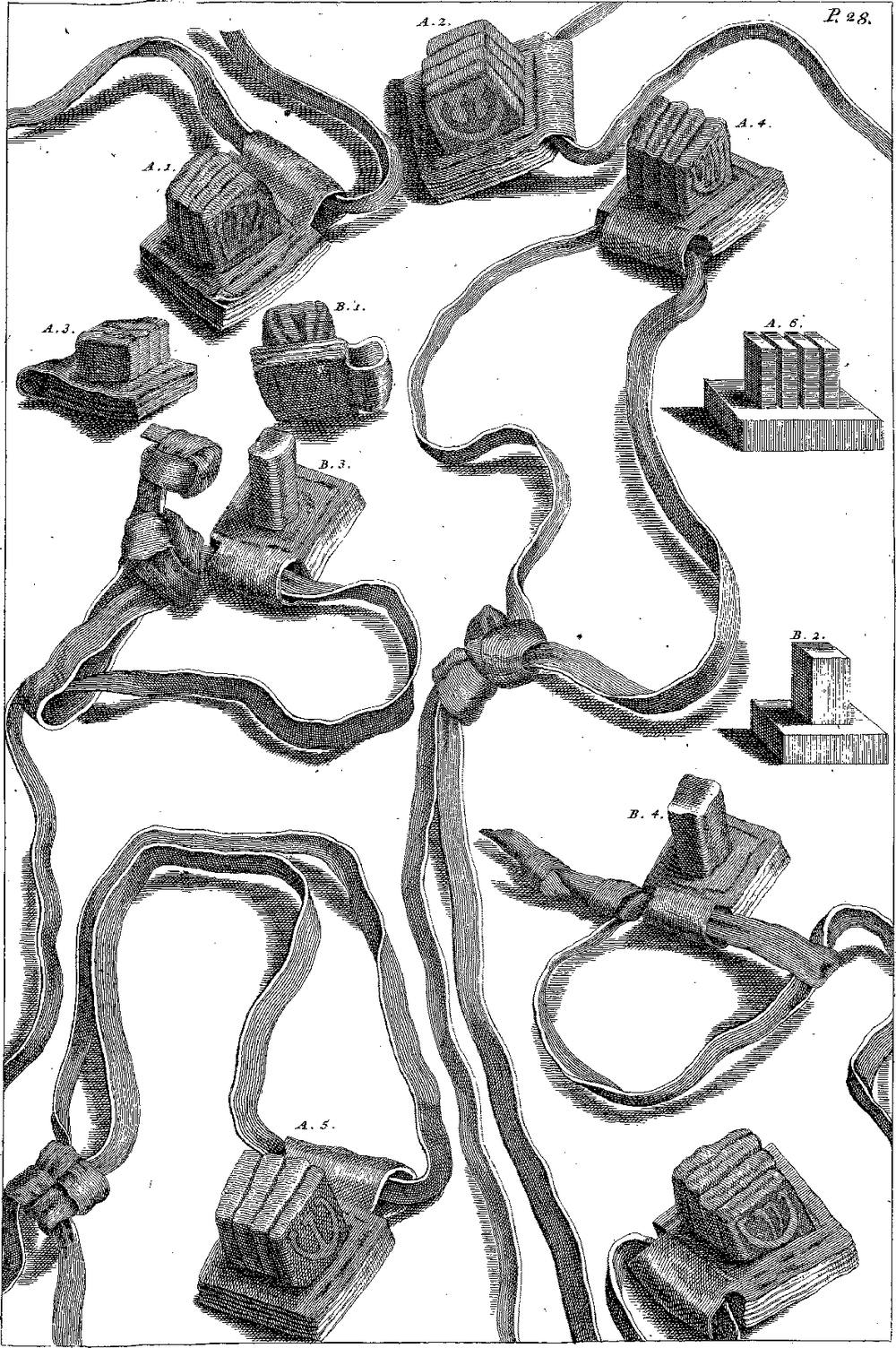
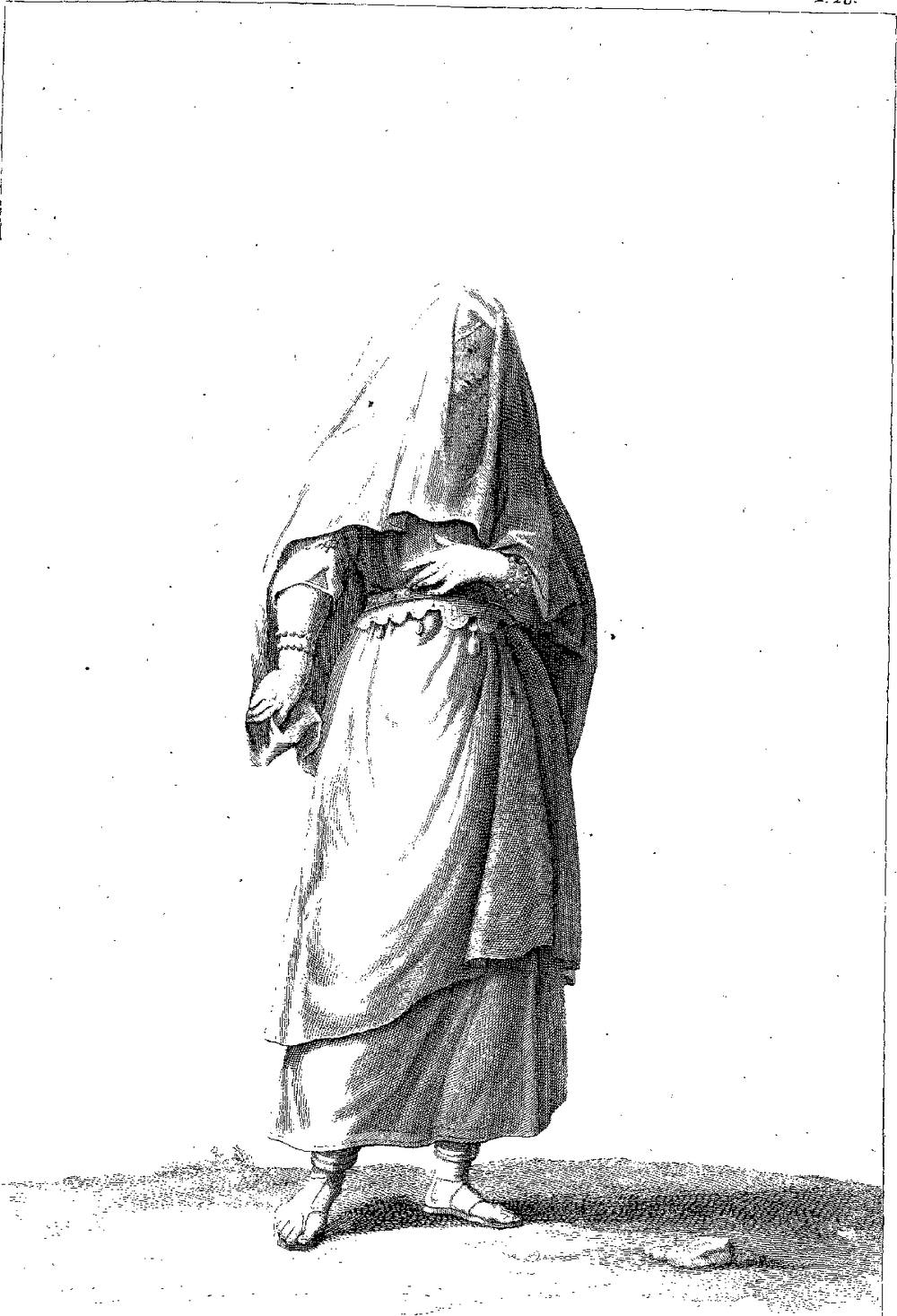
And they are not in the wrong to refer the Original of them to God himself, if we are to take those Expressions of Moses in a literal Sense: And thou shalt bind them for a Deut. vi. 8, 9.Sign upon thine hand, and they shall be as Frontlets between thine Eyes; and thou shalt write them upon the posts of thine house, and on thy gates. As these last Words are taken literally, which relate to the Words of the Law, which were to be wrote upon the Posts of the Houses; so the Command of wearing them upon their Fore-heads must not be understood as a mere Allegory. ‘Tis observed, that as the Pagans wore their Phylacteries, or Amulets, upon several parts of their Bodies, so God commanded his People to wear Telephim upon their Fore-heads and their Arms, to put them in mind of the Law of God, and to divert his People from the superstitious abuse of the Talismans and Phylacteries of the Pagans.
But St. Jerome maintains, in which he is followed also by several learned Commentators, that the Words of Moses are to be understood in a figurative Sense, and that the ancient Jews did not otherwise understand them: And it is only since the time of the Pharisees that they were taken in a literal Sense. Jesus Christ did not absolutely condemn the use of the Telephim, but he blamed the Affectation of the Pharisees, who must needs wear them much larger and broader than other Men; I mean, than other Men that wore them, for it is not probable that all Men wore them in general. See the Commentators upon Matth. xxiii. 5.
TERAH, or Thare, Son of Nabor, and Father of Nahor, Haran, and Abraham. He Gen. xi. 24.was born in the Year of the World 1878, before Christ 2122, before the Vulgar Era 2126. He had Abraham at the Age of seventy-two Years, in the Year of the World 2008, before Christ 1992, before the Vulgar Æra 1996. He came with Abraham out of Ur of the Chaldeans, to go to settle at Haran in Mesopotamia, in the Year of the World 2082. He died there the same Year, Gen. xi. 31, 32.aged two hundred and seventy-five Years, in the Year of the World 1918, before Christ 1922, before the Vulgar Era 1926.
The Scripture says plainly, that Terah had fallen into Idolatry. Your Fathers Josh. xxiv. 2, 14.dwelt on the other side of the flood in old
a Vagenseil. in Sota. p. 192. ex Schalschelet hakkabala; p. 8. time; even Terah, the Father of Abraham, and the Father of Nahor; and they served other Gods. Some think that Abraham himself was at first addicted to the Worship of Idols; but that afterwards God was so gracious to him as to make him sensible of the Vanity of this Worship, and that he also undeceived his Father Terah. See our Commentary upon Gen. xi. 31. Judith v. 7. Isai. xliii. 23.
Biblioth. Orient. p. 12.The Arabians and Turks say, that one Azar was the Father of Abraham, and that Terah was his Grandfather. Justin says, Justin. l. 36.that Adores, Abraham, and Israel, reigned successively at Damascus. Suidas assures us, Suidas in Abraham. Syncel. Chronic. p. 99.that Abraham converted his Father Terah, who was an Idolater; and Georgius Syncellus acquaints us, that he threw his Father Terah’s Idols into the Fire, and that Haran endeavouring to rescue them from the Flames, was burned with them; that Terah having at first quitted the Worship of these false Gods, afterwards relapsed into his former Idolatry, and continued obstinate in it till his dying Day.
The Jews relate, a that Terah was not only an Idolater, but also a Carver and Dealer in Idols. That one Day when Terah was gone a Journey, he left Abraham to take care of the Shop; but Abraham being already convinced of the Vanity of Idols, asked all that came to buy Gods of him, How old are you? They told him their Age, and he replied to them, This God that you would buy and worship is younger than you are; it is but a few Days since it was made of a vile and contemptible Matter, therefore, believe me, and renounce this vain Worship. The Buyers were struck with Confusion at these Reproaches, and went away without buying. One Day there came an old Woman bringing a Mess of Pottage, saying she would offer it to all the Gods in Terah’s Shop. Then Abraham was out of patience, and taking a Stick, he broke all the Idols in pieces, except the largest of all, in whose Hands he put the Stick that had performed this Execution. When Terah came home, and found all his Images in this Condition, he asked Abraham the Reason of it, who told him, that a certain Person came thither to offer some Pottage to the Gods; but they could not agree among themselves who should have it. Then the great one of all took a Stick, beat the rest to pieces, and seized the Offering. Terah easily perceived that Abraham intended to insult his vain Superstition; he went and accused his Son to King Nimrod, as an Enemy to the Worship of the Gods. The King caused him to be thrown into a Fire;
but he escaped miraculously, without suffering any harm. But these are mere Fables.
Several of the Orientals think, that Hazor is the same as Terah, and that he was Abraham’s Father. The Persians and the Turks call him Pour-Tirasch; that is to say, The Carver of Idols. For it is a Tradition among the Mussulmen that he was not only an Idolater, but also a Maker and Vender of Idols; that he had great Disputes with his Son Abraham upon this Account; that he accused him before Nimrod, who caused him to be cast into a burning Furnace.
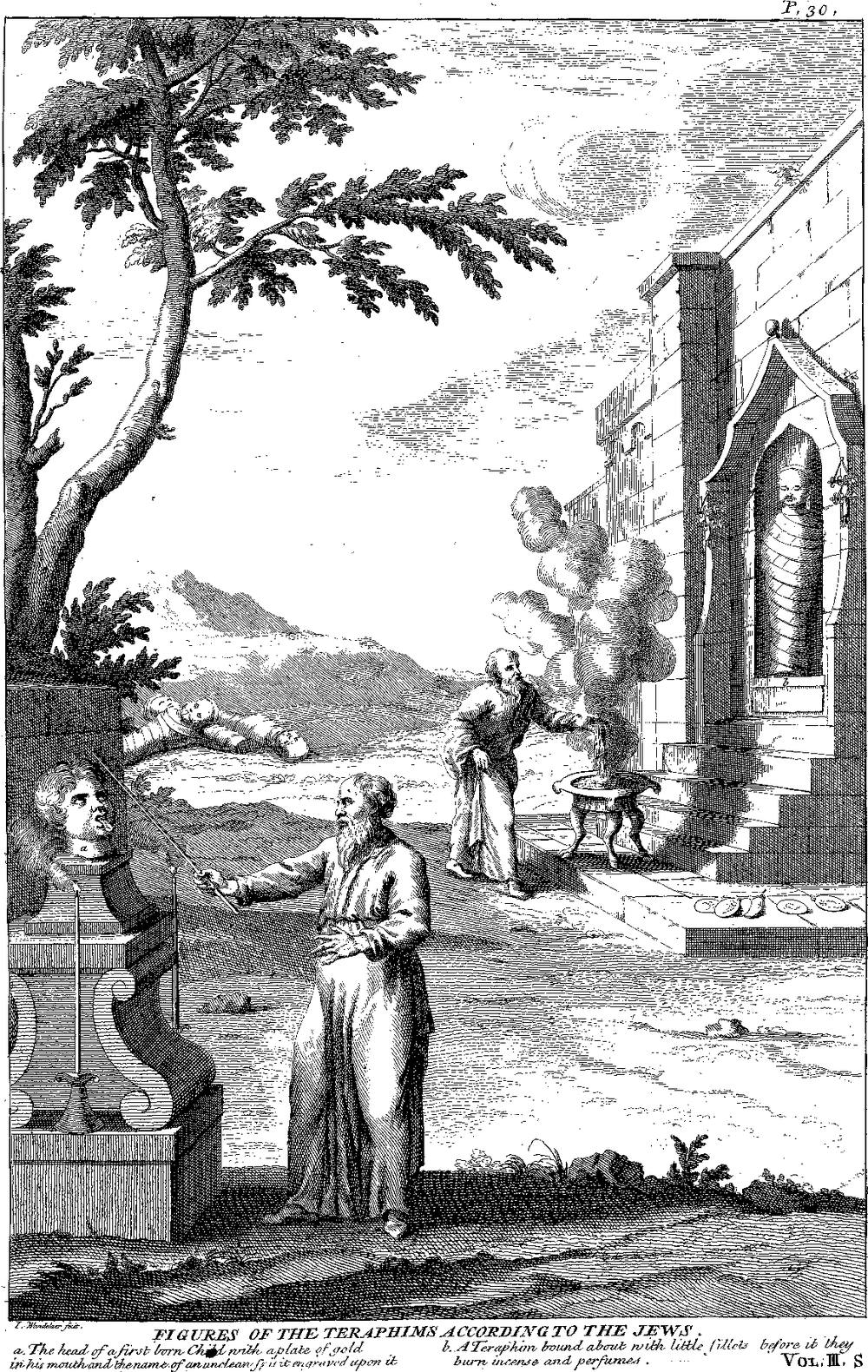
TERAPHIM, or Theraphim. It is said in Genesis, that Rachel had stolen the images Gen. xxxi. 19.that were her father’s: The Hebrew says,8 the Teraphim of her Father. ‘Tis enquired, what these Teraphim were? The Seventy sometimes translate this Word by Oracle,9 and sometimes by vain Figures.10 Aquila generally translates it by Figures.11 It appears indeed from all the Passages in which this Word is used, that they were Idols, or superstitious Figures. The Jews say it was the Head of a Man, taken off from the Trunk, and embalmed; under the Tongue of which was placed a Plate of Gold, with the Name of a false Deity; that this Head was placed in a Nich, that Candles were lighted up to it, and that they pretended to divine by it.
Others think that the Teraphim were Talismans, that is, Figures of Metal, cast and engraved under certain Aspects of the Planets, to which they ascribed extraordinary Effects, but in proportion to the Nature of the Metal, to the Qualities of the Planets, and to the Figures represented upon the Talismans. This Opinion appears the most probable. All the Eastern People are still much addicted to this Superstition of Talismans. The Persians called them Telesim,12 a Name nearly approaching to Teraphim. In that Country no Man is seen without them, and some are even loaded with them. They impute many Virtues to them. They hang some to the Necks of Animals, and to the Cages of Birds. But those of Rachel must be gross Images, and of some precious Metal. See the Commentators upon Gen. xxxi. 19. 1 Sam. xv. 23. Ezek. xxi. 21. Zech. x. 2. where also the Word Teraphim is used for an Idol, or superstitious Figure.
‘Tis asked, Why Rachel stole the Perer. Jansen. alii.Teraphim of her Father Laban? Some have thought it was to make Reparation for the Wrongs she pretended to have received Abenezra.from him. Others imagine, that by this she thought to deprive him of the Means of discovering their Flight, by taking away his Oracles. Others say, that with the Teraphim she thought to take away the Prosperity of her Father’s House, and transfer it to that of her Husband. Some again think,13 that she intended to remove the Occasion of her Father’s superstitious Worship, and hinder him from going on in his Idolatry. Lastly, some believe that both she and her Sister Leah were addicted to this idolatrous Superstition,14 which they had a mind to continue in the Land of Canaan. But Jacob compell’d them to discard all these false Deities, which he afterwards hid under Genesis xxxv. 4.the Oak which was by Schechem.
Besides these superstitious Teraphim, that Rachel stole away from her Father, and the others of the same Nature that we have mentioned, the Scripture speaks of two other kinds. The first are those that Michal put into David’s Bed, pretending he was there sick. And Michal took an image, and laid it in the bed. The Hebrew reads Teraphim for what is here translated an Image. ‘Twas probably a Figure of Sticks, made up in haste, which was dress’d with Cloaths like a great Baby; or like one of those Malkins that Countrymen set up in the Fields to fright away the Birds from their Corn. Michal put it in her Husband’s Bed, to make those believe he was there sick, who were sent by her Father to seek him.
The other sort of Teraphim mention’d in Scripture, were those that the Jews sometime consulted, without imagining that by this they abandon’d the Worship of the Lord. Such was the Teraphim that Judg. xvii. 5, &c.Micah made, and set up in his House, and to which he appointed a Priest of the Race of Levi, with an Ephod, by the Power of which he flatter’d himself that God would bless his House. This Teraphim was taken Judg. xviii. 14, 17, &c.away by the Men of Dan, and set up at their new Settlement in Laish, and continued there till the Israelites were carried away beyond the Euphrates. ‘Twas probably some Hieroglyphical Figure, to which the superstitious Jews attributed the Virtue of an Oracle, and the Power of foretelling things to come. It would be rash to undertake to give a Description of it; but we may imagine, it
was pretty nearly like the Cherubims; that is to say, something made up of the Parts of several Animals, a Collection that did not subsist in Nature, a mere Chimera; for Example, a Man with Wings, having the Feet of an Ox, and the Head of a Bird; or some other Figure of the like nature.
Hos. iii. 4, 5.The Prophet Hosea, threatening the Israelites of the ten Tribes, tells them, the Children of Israel shall abide many days without a king, and without a prince, and without a sacrifice, and without an image, and without an ephod, and without teraphim; that is to say, that during their Captivity they should have no publick Exercise of their Religion. They had indeed before, their Altars, Ephods, Teraphims, while they paid their impious Adoration to the Golden Calves; but after they were led into Captivity beyond the Euphrates, they had no longer any Priests or Altars, Sacrifices or Ephods, Teraphim, Golden Calves, or other superstitious Figures, to whom they might address themselves, or receive Answers from, whether true or false, and which they might any how worship. Hosea adds, Afterwards shall the children of Israel return, and seek the Lord their God, and David their King, and shall fear the Lord, and his goodness in the latter days; which is as much as to say, that after their Return from Captivity they should be re-united to the Tribe of Judah, and should return to the Temple of the Lord at Jerusalem, from which they had before separated themselves by their Schism.
Spencer tract. de Urim & Thummim.Spencer pretends, that the Word Teraphim is Chaldee, and that it is the same thing as Seraphim, by changing the Hebrew Shin into Thau, which is very common; that is, the S into T. He maintains that the Images of Teraphim are derived originally from the Amorites, the Chaldeans, and the Syrians: He adds, that the God Serapis of the Egyptians is the same as Teraphim. It may be added to this, that the Figure of the flying Serpent called Seraph, gave occasion, without doubt, to the naming those Angels Seraphim which appeared to the Prophets, and which are represented to us flying round about the Throne of God. The Heathens gave such kind of Likenesses as these to their superstitious and magical Figures. We know that the Abraxas, which are real Talismans, or Teraphim; are adorned with grotesque Figures formed after a thousand manners. Sometimes there is a Serpent having Antiquity explained. t. 2. p. 2. and elsewhere.a radiating Head. Sometimes there is a Human Figure, with a Cock’s Head, and the Arms terminating in two Serpents, which are instead of Feet and Legs to the Figure. Lastly, the Serpent is there represented after several Manners. The God Serapis is also almost Ibid. t. 2. Suppl. Plate 42.always accompanied by Serpents, which wind about him, or are along with him. There are Figures of Mithras, or of the Sun, having four Wings, like the Seraphims, with the Head of a Lion, over which is the Head of a Serpent, the Body Diarium Italicum, and Antiquity explained, t. 1. Part 2. p. 378.of which surrounds the whole Statue.
All this, in my opinion, very well exhibits the Teraphim. As these superstitious Talismans were common to almost all the Eastern Nations, it is natural to think that every one engraved thereon, and represented, such a Deity as they thought most powerful and favourable. The Sun was worshipped by almost all the World; the Serpent was one of his Symbols: The Sun was a beneficent Deity, the God of good Fortune. The Orientals generally represented him upon their Talismans, sometimes under one Emblem, and sometimes under another. The Jews, who had lived a long time in Egypt, always shewed an Inclination to worship their Gods rather than others. Hence proceeded the Worship of the Golden Calf in the Wilderness, and in the Kingdom of Jeroboam. It is therefore probable that the Teraphim of Laban, which were stolen by Rachel, were Hieroglyphical Figures and Talismans, shaped after the manner of the Syrians; that the Teraphim of Micah were nearly approaching to the Cherubim of Moses, or to the Seraphim described by Isaiah. In a word, that these Figures were by no means uniform, no more than the Cherubim and Seraphim described in Scripture. Every one made them, or caused them to be made, according to his own Fancy and Devotion.
R. David Kimchi.The Rabbins pretend, that the Teraphim were not mere Idols, but they were Idols that gave out Oracles, and foretold future Events. The Rabbi David of Pomire says, that they had a Human Shape, and that when they were once set up and dedicated, they spoke, and gave Answers at certain Hours, and under certain Constellations, by the Influence of the Heavenly Bodies; and that this Influence was communicated to them by the Art of him that made them of a certain Metal, with certain Characters, and under certain Aspects of the Stars.
Rabbi Eliezer pretends, Ch. xxxvi. that the Teraphim spoke. He proves it by those Hos. x. 2.Words of Hosea, The Teraphim speak vain things. To make a Teraphim, this is the way they proceeded according to this Rabbi: They kill’d a first-born Child, they clove his Head open, they sprinkled it with Salt and Oil, they wrote down the Name of some unclean Spirit upon a Plate of Gold, which Plate they put under the Tongue of the dead Child. They
set this Head in a Nich in the Wall, where they lighted up Lamps, pray’d to it, ask’d it Questions, and it spoke. See the Figure.
This Account of Eliezer has much of the Air of a Fable; and yet the Rabbi Jonathan. Targum in Gen. xxxi.Tanibuma, and Jonathan the Paraphrast, relate it in the same manner. But, as we said before, we must not imagine that there was but one kind of Teraphim: This Name was given to very different things, as well as to Matter as Figure. The Teraphim that was laid in David’s Bed, to make it be thought that he was there himself, must have been a large Figure. Those that Hosea speaks of, which were consulted by the Israelites of the Ten Tribes, and those of Micah, probably represented either the Cherubim of the Ark of the Covenant, or some other superstitious Figure; but however, such as the Israelites thought that they might reconcile the Worship of them with the Worship of the Lord. The greatest part of the Abraxas, which were certainly a kind of Talismans, or Teraphim, have the Names of Gods assign’d to them, as Iao, Adonai, Elohim, &c.
Kircher. Oedip. Ægypt. Synt. iv. c. 3. p. 259.Father Kircher, and after him Cuneus, in his Republick of the Hebrews, maintain that all the ancient Idolatry came from the Egyptians; and that the use of the Teraphim passed from that Country into the East; for that Ham, or his Son Mizraim, were the Inventers of Statues, which the Egyptians had in such great multitudes, that no City, Village, High-way, or Cross-way, were without them. They ascribed many Virtues to them, especially to such as were formed under the Aspects of certain Stars and Constellations. ‘Twas thought they had the Power of foretelling what was to come to pass, of revealing things concealed, of preventing Evils that were threatened, and of procuring certain Advantages, as that of pleasing, of being lucky at Play, in Trade, &c. The Rabbins own that the Word Teraphim is foreign to the Hebrew Tongue, from whence it is concluded that it is Egyptian, and the same as Serapis. Abenephius assures us, that when Abraham made some Abode in Egypt, his Domesticks were tainted with this kind of Idolatry, and carried it with them into Canaan; from whence it passed into the Family of Laban. All this is very precarious, and it would be very difficult to produce Vouchers for it.
Jurieu Hist. des Cultes.A modern Author has proposed another Conjecture concerning the Teraphim. He conceives that the Teraphim that Rachel stole might be the Dii Penates, the
Ovid. Fast. l. 2.Houshold Gods of Laban. The Gods that were set up in the Highways were also the Guardians of the House. Ovid, speaking of Lariunda, the Mother of the Gods Lares and Viales, says, that she brought forth two Sons who were the tutelar Gods of the Cross-ways and of private Houses:
Fitque gravis, geminosque parit, qui compita servant,
Et vigilant nostrâ semper in æde Lares.
Genesis xxxi. 30.These Lares, and Gods of the Highways, were the Souls of the Heroes of the Families, who had been deified, and then worshipped. Thus the Teraphim of Laban, according to this Author, were the Images of Noah, the Restorer of Mankind, and of Shem, the Head of Laban’s Family. This, according to him, was the first Institution of Domestick Gods. There were but two of them, and their Worship was introduced quickly after the Deluge. Laban does not only complain that Gods or Statues had been stolen from him, in which he put Confidence, and to which he paid a religious Adoration; but he complains that he was deprived of his Gods: Cur juratus es Deos meos? that is to say, the Gods of his Family.
But this Conjecture is not more satisfactory than the preceding. It is not at all credible, that the Worship of the Gods Lares and Penates was known at the time of Laban. And I am much in doubt, whether it was in use among the People of the East for several Ages after this Patriarch.
Nor is it probable that Laban would place among his Gods the Patriarchs Noah and Shem, who had been dead so little a while before: For Noah died in the Year of the World 2006, and Shem in the Year of the World 2158; that is to say, but 87 Years before Jacob came to Laban into Mesopotamia.
TEREBINTHUS, the Turpentine-tree. The Author of the Vulgate, and the Septuagint, generally translate by Terebinthus, the Hebrew Word Elah,15 which others render by an Oak, an Elm, a Chesnut -tree, or in general, a Tree. St. Jerome is not more uniform in his Translation of this Word; for sometimes he renders it by Quercus, or Ilex, an Oak. The Terebinthus is a Tree whose Wood and Bark resembles the Lentisk-Tree, and whose Leaves are like those of the Ash, but a little thicker, and more glutinous. Its Flower resembles that of the Olive, and its Fruit grows in Bunches or Clu
sters. This Fruit is hard, resinous, of the Bigness of Juniper-berries, and has little red Horns, like those of Goats, in which Insects breed. They have also a kind of Liquor, like the Lentisk. Its Resin or Gum distils from the Trunk, like that of other resinous Trees. This Tree was frequent in Judea.
The Terebinthus, under which AbrahamGen. xvii. 1, 2, &c. entertained the three Angels, is very famous in Antiquity. Josephus says,16 that six Furlongs from Hebron they shew’d a very large Terebinthus, which the Inhabitants of the Country thought to be as old as the World itself. Eusebius assures us, that even in his time the Terebinthus of Abraham was still to be seen, and that the neighbouring People, both Christians and Gentiles, held it in great Veneration, as well for the sake of Abraham, as of the heavenly Guests he entertained under it. St. Jerom says, this Terebinthus was two Miles from Hebron. Sozomen places it fifteen Sozomen. l. 2. c. 4. Hist.Stadia from this City; and an old Itinerary puts it at two Miles distance. These Varieties might make one doubt whether this Terebinthus that Josephus speaks of, were the same that was to be seen in the Times of Eusebius, St. Jerom, and Sozomen.
Some Ancients have pretended, that this Terebinthus was the Staff of one of the three Angels,17 that were treated by Abraham, who fixing it in the Earth, it took root, and grew to be a great Tree. At the foot of this Tree was an Altar, on which were offered profane Sacrifices; which the Emperor Constantine being inform’d of,18 wrote to Eusebius, Bishop of Cæsarea, and gave him Orders to pull down the Altar, and to build an Oratory in the Place.
‘Tis said that when this Terebinthus was set on fire, the Flame took hold of it all at once, but that after the Fire was extinguished, the Tree was found to be as whole and sound as before. The Concourse of People, who came from all Parts to visit this Terebinthus, gave occasion to a Fair to be kept there. St. Jerom, and some others tell us,19 that after the War that the Emperor Adrian made with the Jews, they sold there a great multitude of Slaves of this Nation, at a very low Price; and that such as could not be put off there, were carried into Egypt, where the greatest part of ‘em perished miserably. Sanutus informs us, that the Trunk of this Terebinthus was Sanut. in Secret. fidel. crucis. p. 248.still in be-
Vol. III. ing in his Time, and that they carried it away in pieces, to which they ascribed great Virtues.
Genesis xxxv. 4.The Terebinthus of Jacob, where he buried the Gods that his People had brought with them out of Mesopotamia, was behind the City of Shechem, and very different from that where Abraham set up his Tent, near the City of Hebron; yet they have been very absurdly confounded together. ‘Tis thought to be under this same Terebinthus (which the Vulgate calls an Oak, Josh. xxiv. 26.) that Joshua renew’d the Covenant with the Lord, and Judg. ix. 6.that Abimelech, the Son of Gideon was made King by the Shechemites.
TERTIUS. He was St. Paul’s Amanuensis, when he wrote his Epistle to Rom. xvi. 22.the Romans, in the Year 58. I Tertius, who wrote this Epistle, salute you in the Grot. Tol. Bez.Lord. Some think that Tertius copied this Letter from the Original written by St. Paul’s own Hand. Lightfoot conjectures Lightfoot. Chorograph. p. 123.that Tertius is the same as Silas, who accompany’d St. Paul in part of his Journies. Silas in Hebrew signifies the same as Tertius in Latin. Some Greek Editions instead of Tertius read Terentius. The Greeks keep his Feast on the tenth of November, and give him great Commendations. They make him Successor to Sosipater in the Bishoprick of Iconium.
Acts xxiv. 1, - - - 9.TERTULLUS, an Advocate who pleaded against St. Paul before Felix Governor of Judea, in the Year 58 of the Vulgar Æra. Some have thought that Tertullus became a Convert.
TERUMAH, or Thrumah, a Hebrew Word,20 that in general signifies an Offering or Oblation, and is commonly translated by the Septuagint and St. Jerom, oblatio, primitiæ, separatio, donarium. The Hebrew Word Rum, from whence Terumah is derived, signifies to lift up; because they generally lifted up on high before the Lord the Offerings that were made to him in the Tabernacle, and which they waved towards the four Quarters of the World. The Word Terumah is not read in the Latin Text of the Scripture.
TESTAMENT, is taken in Scripture for Covenant, and answers to the Hebrew Word Berith,21 which the Greeks have rendered by Diatheke, which signifies an Act of the last Will of a Person who hath Death in his View, and disposes of his Estate, and gives Orders as to what he would have done after his Decease.
K
The Word Testament is no where found in this Sense, as I know of, in the Old Testament, but only in the Sense of Pact, or Covenant. But St. Paul, in his Epistle to the Hebrews, arguing about the Greek Word Diatheke, which signifies the Testament of one that declares his Last Will, makes use of these Words, And for this Heb. ix. 15, 16, 17, 18.cause he is the Mediator of the New Testament, that by means of death, for the redemption of the transgressions that were under the first Testament, they which are called might receive the promise of eternal inheritance. For where a Testament is, there must also of necessity be the death of the Testator; for a Testament is of force after Men are dead, otherwise it is of no strength at all whilst the Testator liveth; whereupon neither the first Testament was dedicated without blood. Where we may observe, that he speaks of the Old and New Covenants, as of two Testaments, in the Sense of a Person’s making his Last Will.
Galat. iii. 15. 17.In the Epistle to the Galatians, he speaks also of the Covenant that God made with Abraham, under the Notion of an ordinary Testament. Brethren, says he, I speak after the manner of men; though it be but a man’s covenant, (or Testament) yet if it be confirmed, no man disannulleth, or addeth thereto. Now to Abraham and his seed were the promises made. Therefore the Law, which was given four hundred and thirty Years after this Promise, this Testament, this Covenant, cannot abrogate or revoke it.
But through all the Old and New Testament, the Word Testamentum generally signifies the Covenant, the Law, the Promises. Exod. xxx. 26.For example, the Ark of the Testament, stands for that Chest or Coffer wherein the Tables of the Law of the Covenant were Ecclus. xlv. 30.deposited. Testamentum Pacis, the Covenant of Peace: Testamentum Regni, Ibid. xlvii. 13.the Promise by which God engages himself to give the Kingdom. Respice in Testamentum Psal. lxxiii. 20.tuum, remember thy Promises, thy Covenant: Non profanabo Testamentum tuum, I shall not fail of performing my Is. xiv. 13.Promises: Sedebo in monte Testamenti, I will sit down upon the Mountain of the Temple, where the Ark of the Covenant is laid up: Angelus Testamenti, the Son of Mal. iii. 1. Matth. xxvi. 28.God, who was to renew the Covenant: Sanguis Novi Testamenti, the Blood that confirms the New Covenant: Dedit illi Testamentum Acts vii. 8.Circumcisionis, God made a Covenant with Abraham, by enjoining Circumcision to himself and his Posterity.
In Scripture we may take notice of several Covenants or Testaments, between God and Man. The first is that which God made with Adam, by promising him Happiness and Immortality, if he would continue faithful and obedient to him, in Gen. ii. 16. 17. Gen. ix. 9, 10, &c.forbearing from eating the forbidden Fruit. The second is that which God made with Noah and his Children, by which he promised them no more to drown the World by an universal Deluge. The third is that which God made with Abraham Gen. xvii. 1, 2, 3, &c.and his Race, the Token of which was Circumcision. The fourth is that which God made with the People of Israel, by Exod. xix. xx.the Mediation of Moses, at the foot of Mount Sinai.
Deut. xxix. 1, 2, &c. Josh. xxiv. 25, 26, 27.This Covenant was several times renew’d: By Moses, some time before his Death; by Joshua, at the Age of one hundred and ten Years; by Josiah, by Nehemiah, and by the Maccabees.
The Books of the Old Testament are these that follow:
Genesis. Exodus. Leviticus. Numbers. Deuteronomy. Joshua. Judges. Ruth. The Two Books of Samuel. The Two Books of Kings. The Two Books of Chronicles. Ezra. Nehemiah. Tobit. Judith. Esther. Job. The Psalms. The Proverbs. The Canticles. Ecclesiastes. The Book of Wisdom. Ecclesiasticus. Isaiah. Jeremiah. Baruch. Ezekiel. Daniel.
The Twelve Lesser Prophets are, Hosea. Joel. Amos. Obadiah. Jonah. Micah. Nahum. Habakkuk. Zephaniah. Haggai. Zechariah. Malachi.
The Two Books of Maccabees.
2
The Books of the New Testament are these fol-lowing:
The Four Evangelists, which are St. Matthew. St. Mark. St. Luke. St. John.
The Acts of the Apostles.
The Epistles of St. Paul, which are To the Romans. First and Second to the Corinthians. To the Galatians. To the Ephesians. To the Philippians. To the Colossians. First and Second to the Thessalonians. First and Second to Timothy. To Titus. To Philemon. To the Hebrews.
The Canonical Epistles are seven:
Of St. James. First and Second of St. Peter. First, Second, and Third, of St. John. Of St. Jude the Apostle. The Revelation of St. John.
All these Books are declared to be Canonical by the Council of Trent, and acknowledged as such by the Catholick Church.
The Reader may have recourse to what we have already said under the Article Bible, and to our critical Observations upon each Book of the Scripture, under their particular Titles, or under the Titles of their Authors. As to the Apocryphal Books both of the Old and New Testament, we have already treated of them under the Word Apocrypha, and under the Names of those to whom they are ascribed; for example, Esdras, Maccabeus, Apocalypse, &c. And those that would see this Affair discussed at full length, may consult our particular Prefaces to all the Books of both the Old and new Testament, and the two Tomes published by M. Fabricius, under the Title Codex Pseudepigraphus veteris Testamenti, &c. and Codex Apocryphus Novi Testamenti.
The Word TESTAMENT is sometimes used for the Law of God: Inique non egimus in Psal. xliii. 18. Psal. xlix. 16.Testamento tuo, we have not transgressed thy Laws. And elsewhere, Quare tu assumis Testamentum meum per os tuum, why dost thou pronounce the Words of my Law: And Psal. lxxvii. 10.again; Non custodierunt Testamentum Dei, & in lege ejus noluerunt ambulare, they have not kept the Laws of the Lord, to walk in them.
TESTAMEMTUM inferorum, the Covenant of the Grave, or that Sentence pronounced against us, that All must die: The Greek says,22 The Covenant of the God of the Dead has not been shewn to you: Pluto has not informed you how long time he has appointed you to live. This Expression is borrowed from the Religion of the Pagans; but it is easy to affix a good Idea to it, by substituting the true God instead of the God Pluto.
Daniel says, that during the Persecution of Antiochus Epiphanes,c the Wicked would dissemble with the holy Covenant: Testamentum simulabunt fraudulenter; the Hebrew says, by his Caresses he will oblige the Prevaricators of the Covenant to dissemble, or disguise their Belief. And indeed many of the Jews renounced their Religion, others cowardly dissembled their Sentiments. And in the Maccabees;23 Fratres mei sub Testamento æternæ vitæ effecti sunt, My Brethren are dead in the Hope of eternal Life. The Greek may be translated, They are dead for the Covenant that God gave them, which he has sworn to them, of everlasting Life.
The Orientals being fruitful in Fictions, have trumpt up the Testaments of Adam, of Noah, of Abraham, of Job, of Moses, and of Solomon, and of the Twelve Patriarchs, the Sons of Jacob. ‘Tis obvious how little Credit is to be given to these kind of things: But, however, we should supply the Reader with some just Reason for despising them. They tell us,24 that Adam, a little before his Death, called to him Seth, Enoch, Cainan, and Mahalaleel, and bid them take his Body after his Death, and bury it in the Middle of the Earth, that is to say, upon Mount Calvary near Jerusalem. A Mahometan Author says,25 that the first Father made his Will, and had it wrote and signed by the Angel Gabriel, and sixty thousand other Angels, and deposited it with the Patriarch Seth, his Son.
As to Noah’s Testament, ‘tis pretended that when he was nine hundred and thirtyfour Years of Age, he made a Distribution of the several Parts of the Earth to his three Sons. He gave to Ham the Blacks, to Japhet the Ruddy, and to Shem the Brown: That he order’d Shem to take Melchisedech along with him, and to carry the Coffin with the Body of Adam to such a Place as the Angel of the Lord should conduct them; which Shem did not fail to perform.
Lambec. Biblioth. Vin. Cod. 337.Lambecius speaks of a Greek Manuscript called The Testament of Abraham; but this is a modern Work, and altogether fabulous.
In the Catalogue of Apocryphal Books condemned by Pope Gelasius, we read of The Testament of Job: But the best Copies, instead of Job read Jacob.
St. Athanasius, in his Synopsis of Holy Scripture, and some other of the Ancients, mention The Testament of Moses, which was an Apocryphal Book composed probably by the Hereticks called Sethians. M. Gilbert Gaulmin quotes, in some Places of his Notes upon Psellus, a Greek Manuscript called The Testament of Solomon: But he lets us know it is a bad Work, composed by some modern Greek, who gave it the pompous Name of Solomon’s Will, to give it the more Credit.
The Testament of the Twelve Patriarchs, is an Apochryphal Work composed in Greek by some converted Jew, in the First or Second Age of the Church. Origen26 had seen this Work, and found some good Sense in it, tho’ the Jews did not admit it into their Canon. It was for a long time unknown to the learned Men of Europe, and even to the Greeks. Robert Grossetest, Bishop of Lincoln, having had Intelligence of it by means of Johannes de Basingstokes, Deacon of Legies, who had studied at Athens, sent for a Greek Copy into England, and translated it into Latin by the Assistance of Master Nicolas, a Grecian by Birth, and a Clergyman belonging to the Abbot of St. Albans, about the Year 1252. Afterwards it was published in Greek by Dr. Grabe, in his Spicilegium S. Patrum, and then again by M. Fabricius, in his Apocryphal Books of the Old Testament. The Author there gives several Particulars of the Life and Death of the Twelve Patriarchs, whom he makes to speak, to relate, and foretell, whatever he thinks proper. He speaks of the Destruction of Jerusalem, of the Coming of the Messiah, of the several Actions of his Life, and even of the Writings of the E-
3 vangelists, in a manner that can agree to none but a Christian, but very probably converted from Judaism, and still possessed with many Prejudices of his own Nation.
TESTIMONY, Testimonium. This Word is taken
- For the Testimony, or Witnessing exhibited in a Court of Justice, by affirming or denying something, about which we are judicially interrogated. The Scripture prohibits false Testimony in several Places, Exod. xx. 16. xxiii. 1.
Gen. xxxi. 47, 48, 52.2. Testimony is used for a Monument or Memorial. For example, this heap be witness, or Testimony: It was called Jegar- Jahadutha, or the Heap of Testimony. The Tribes of Israel that abode beyond Jordan raised a kind of very high Altar on Josh. xxii. 27.the Banks of that River, to serve as a Testimony or Monument of their Union with their Brethren who dwelt on this side Jordan.
- Testimony is often put for the Law of the Lord, because when the Lord gave it to the Israelites, he gave Testimony of his Presence by the Prodigies he perform’d in their Sight, and required an Oath of them, that they should continue faithful to him: Testimonium in some Sense is equivalent to Juramentum. Thus it is called The Ark of Testimony, because it contained the Tables of the Law; and the Tabernacle of Testimony, because that was the Tent wherein the Tables of the Law were kept: In Psal. cxix. Testimonies are often put for the Law of the Lord, for the Wonders he had perform’d, and for the Instructions he had given to his People.
St. Jerome often translates the Hebrew Word Moed by Testimony. Thus Tabernaculum Testimonii, the Tent of Testimony. But Moed27 signifies more properly Assembly, Convention, because it was at the Entrance of this Tent or Tabernacle that the People assembled, and where Moses declared to them the Orders of the Lord.
Testimony is sometimes taken also in the Sense of Praise. For example, it is said that Cornelius the Centurion had a good Testimony from the whole Nation of the Jews. Vir Justus & timens Deum, & Testimonium habens ab universâ gente Judæorum: Acts x. 22. Acts vi. 3.And elsewhere, Men of good Testimony. Viros boni Testimonii septem: Persons to whom every body gives a good Character. Sometimes the Ark of the Covenant is called absolutely Testimonium; because it included28
John i. 8.included the Tables of the Law, or of Testimony. For example, it is said that Aaron put an Omer of Manna into the Testimony.29 The Vulgate reads in Tabernaculo, but the Hebrew has it in Testimonio. 2 Kings xi. 12.In the Second Book of Kings the Book of the Law, or the Volume which was used to be put upon the King’s Head on his Coronation-day, was called Testimonium: Produxit filium regis, & posuit super eum diadema & Testimonium. Isaiah calls Testimonium a Writing he had drawn up by the If. vii. 16. Lord’s Command, in which was contained a Prophecy he had pronounced, and written in the Presence of two Witnesses. God bids him seal it up to the time appointed: Liga Testimonium, signa legem, &c.
In the New Testament Testimonium is put for that Attestation which is given to the Probity of any one. John Baptist came to bear Testimony to the Light, to declare that Jesus Christ was come, and to confirm that he was the true Messiah. Jesus Christ John v. 31.says, that if he gave Testimony of himself, on that account his Testimony would not be true; which is as much as to say, that we are not obliged to be determined by one that is Judge in his own Cause, and who proclaims his own Qualifications: It is to be presumed that he would extol himself, and raise himself to Honour and Esteem. The Heavenly Father, and the Works of Jesus Christ, as well as John the Baptist, bear sufficient Testimony for him; and their Testimony ought to be esteem’d as of irrefragable Authority.
TETRAGRAMMATON,30 or Name of four Letters. ‘Tis thus the Name Jehovah is often called, which the Hebrews, out of Respect, never pronounce. Instead of it they say Adonai, or Elohim: and when they have occasion to mention this sacred Name, they call it Shem-hamphorash, that is to say, The Name explain’d. The Greeks chuse rather to say Tetragrammaton, or Name of four Letters, which are Jod, He, Vau, He.31
TETRAPLA of Origen. ‘Twas thus that Origen called his Edition of the Bible, in which he placed, in four Columns set one against another, the four Versions of the Septuagint, of Aquila, of Symmachus, and of Theodotion. The Term Tetrapla in Greek properly signifies fourfold, or composed of four Parts.
Τετράρχης. Tetrarcha.TETRARCH, Tetrarcha. This Word, according to the Force of the Greek, signifies a Lord that hath the fourth part of a State, Province, or Kingdom, under his Dominion, without wearing the Diadem, or bearing the Title of King. The Word Tetrarch is sometimes found in Scripture,32 and was frequent among the Descendants of Herod the Great, among whom the Emperors of Rome distributed his Demesnes at their Pleasure. But the Words Tetrarch and Tetrarchy ought not to be understood in a rigorous Sense, though indeed they signify but a fourth Part of a Kingdom or Province. The Name Tetrarch was given to him that possessed sometimes an Half, sometimes a third Part. Oftentimes also the Name of King was given to him who was but a Tetrarch, and that of Kingdom to a Tetrarchy.
TEXT of Scripture. 1. The Text of Scripture is taken, sometimes by way of opposition to the Gloss, Comment, or Explication, without any respect had to the Language in which the Text is written, whether it be the Original, or only a Translation. For example, the Text informs us that God was angry, or repented; and the Gloss acquaints us that this must be taken in a figurative Sense, and as if it had been said, that God acted as tho’ he had been angry, or as if he had repented.
- The Text of Scripture is put in opposition to the Translations that have been made of it. Thus the Hebrew Text of the Old Testament, and the Greek Text of the New, are as it were the Fountains from whence all the Translations are derived. ‘Tis to these Fountains we must have recourse, to understand well the Sense of the Translations.
The Original Text of all the Books of the Old Testament, which are received into the Canon of the Jews, is the Hebrew. But the Christian Church receives also as Canonical certain other Books of the Old Testament, of which the Greek is thought to be the Original. For example, the Book of Wisdom, Ecclesiasticus, Tobit, Judith, the Maccabees, the xiiith and xivth Chapters of Daniel, the Additions at the end of the Book of Esther, and that part of the iiid Chapter of Daniel which is from Verse 24 to 91. Tobit, Judith, Ecclesiasticus, and probably the first Book of the Maccabees, were originally written in Syriac, or in Hebrew with a Mixture of Chaldee and Syriac; but as the Originals written in these Lan-
L guages
the Greek, which is the oldest Version, is accounted as the Original. We have no certain Proof that the Book of Wisdom, and the Second Book of Maccabees, were written originally either in Syriac or Hebrew.
The original Text of the Books of the New Testament is the Greek; though it be certain that St. Matthew wrote his Gospel in Hebrew, and some think St. Mark wrote his Gospel in Latin, and that St. Paul wrote his Epistle to the Romans in Latin, and his Epistle to the Hebrews in Hebrew. But as the Original Hebrew Text of St. Matthew is lost, and as there are good Proofs that all the other Books of the New Testament were written in Greek, the Greek passes for the original Language of all the New Testament.
For the Samaritan Text, see Samaritan, before.
Tho’ it cannot be maintained that the Original Texts of both the Old and New Testaments are entirely free from Faults, yet it must be agreed that they are perfectly Authentick, and that the Faults which, by length of Time, or by the Negligence of Transcribers, have crept into the Text, are not of such Consequence as to make them be look’d upon as corrupted Fountains, or as Monuments of no Authority. These Faults are not numerous, they are not of great Importance, they do not go to the Bottom of Things. Perhaps, for Example, some Date may be changed, some proper Name of a Person or a City, or something like this, may be alter’d and corrupted: Defects which may easily be supplied, either by the help of ancient Manuscripts, or old Translations that were made before such Alterations happened in the Text. Some of the ancient Fathers33 have complained that the Jews had purposely corrupted several Passages of the Old Testament, which they thought too favourable to Jesus Christ: But this Accusation has not been well supported: The Passages which they have been said to have taken out of the Hebrew Text, were probably never in it. Lastly, this Opinion is at this day quite given up by all the Criticks. See St. Jerome upon Isaiah, Chap. vi. Eusebius, Hist. Eccles. l. 3. c. 10. St. August. l. 15. c. 13. de Civitate Dei.
1. THADDEUS. This is the Surname of Jude the Apostle, of whom we have already spoke, under the Article Jude. deus, without any Addition, to avoid the Name Judas, and for fear of not distinguishing him from Judas Iscariot, who for his Treason was justly had in Detestation. To St. Thaddeus the Apostle has sometimes been imputed34 what only agrees with St. Thaddeus the Disciple of Jesus Christ, of whom we shall now speak.
Eusеb. Hist. Eccles. l. 1. c. 13. p. 32.2. THADDEUS, or Tatteus, according to Rufinus, was, as is believed, Brother of St. Thomas the Apostle,35 and one of the seventy Disciples. Soon after our Saviour’s Ascension into Heaven, St. Thomas sent him from Jerusalem to Edessa to King Abgarus, who reigned there then, and of whom we have spoke under his Title. Jesus Christ, they tell us, had wrote to this Prince, promising to send him one of his Disciples, who should cure him of a Disease he then laboured under. When Thaddeus was come to Edessa, he lodged at first with one called Tobiah, where he soon became famous by the great number of Miracles he perform’d in the Name of Jesus Christ.
Abgarus being inform’d of this, concluded he must be the same whom our Saviour had promised to send him, and had him brought to him by Tobiah. Abgarus threw himself at his Feet, and asked him if he was not the Person that was to cure him? to which Thaddeus answered, Yes, and that he was come by way of a Recompence to him for his great Faith: Then, asking him if he believed in Jesus Christ, and in his Father? Abgarus affirm’d that he believed with his whole Heart; and at the same time Thaddeus laid his Hands upon him, and perfectly cured him. He did also many other Miracles there, and converted the whole City of Edessa. Abgarus offer’d him a great quantity of Gold, but he refus’d it, saying, If we have abandon’d our own Goods, why should we take those of others? ‘Tis not known what St. Thaddeus did after this time: Nor is his Memory much celebrated by the Church, because he has not been well distinguished from St. Jude. The Latins honour one St. Thaddeus on the 11th of May, whom they seem to make a Martyr in Asia: And the Greeks remember him on the 21st of August; they say he died in Peace at Berytus in Phœnicia, after he had there baptized many Persons.
THAHASH, or Tachas, the third Son of Nahor and Reuma, Gen. xxii. 24.
THALASSA, a City or Haven to the South of the Isle of Crete. It is also called Lasea, or Lassos, Acts xxvii. 8.
Josh. xix. 7.THALCA, a City belonging to the Tribe of Simeon. It is not in the Hebrew, but only in the Septuagint. Eusebius and St. Jerome speak of a Place called Thala, at sixteen Miles from Eleutheropolis, towards the South.
THALLUS.36 We read this Word in the Second Book of Maccabees, xiv. 4. Super hæc37 & Thallos, qui templi esse videbantur. But Thallus signifies a Rod or Staff surrounded with green Branches, or otherwise mere Branches of the Olive-tree, or any other Tree. From whence came the Word Thallophori, who were Children or old Men, who carry’d these kind of Branches, or Wands surrounded with green Leaves, or Sprigs of Olive, in honour of Pallas or Minerva.
THAMNA. See Timnah.
THANATH. It was a Village ten Miles from Shechem, towards the Jordan. St. Eufeb. & Hieron. in locis.Jerome calls it Thenath; Ptolemy also places Thena in Samaria.
THAPSACUS, a famous City upon the Euphrates, where they passed over this River to go from Mesopotamia into Arabia Deserta, or back again. It is not far from the Mouth of Chaboras, where it empties itself into the Euphrates. The ancient Geographers have talked much of it. It appears to us, by the Course that the Kings of Assyria observed in coming towards Palestine, that they must pass the Euphrates at Thapsacus.
THARRA, or Thara; one of the two Eunuchs that had conspired against King Abasuerus, and who were discover’d by Mordecai, Esth. xii. 1.
THARBIS. This is the Name that they give to the Queen of Ethiopia, whom they pretend that Moses married when he made war in Ethiopia, and besieged the City of Joseph. Antiq. l. 2. c. 5.Meroe. See Moses, before.
1. THARSHISH, or Tharsis, Son of Bilhan, of the Tribe of Benjamin, 1 Chron. vii. 10.
2. THARSHISH. The Country of Tharshish, whither Solomon sent his Fleets.38 There is a multitude of different Opinions concerning this Country. Josephus, the Chaldee and Arabick Paraphrasts, explain it of Tarsus, a City of Cilicia: The Septuagint, St. Jerome, and Theodoret, understand it of Carthage. Eusebius makes the Spaniards to be descended from Tharshish: The Arabian Geographer will have it to be Tunis in Africa. Bochart makes it to be Tartessus, an Island in the Streights of Gades. By Tharshish, M. Le Clerc understands Thassus,
an Island and City in the Ægean Sea.
Grotius thinks the whole Ocean to be called Tharshish, because of the famous City of Tartessus, now mention’d. Sanctius believes the Sea in general to be called Tharshish, and that the Ships of Tharshish are those that are employ’d in Voyages at Sea, in opposition to the small Vessels that are used only in some navigable River. The Seventy translate Tharshish sometimes by the Sea; and the Scripture gives alike the Name of Ships of Tharshish to those that were fitted out at Eziongeber, on the Red-Sea, and which sailed upon the Ocean, as to those that were fitted out at Joppa, and in the Ports of the Mediterranean. We cannot apprehend any other way than this to explain all the Passages wherein mention is made of the Ships of Tharshish.
For on one side we see plain enough that Tharshish signifies the City of Tarsus, and Cilicia; and on the other side we observe, that they fitted out Ships of Tharshish, or Ships to go to Tharshish, in Places from whence we cannot suppose that they went to Tarsus in Cilicia. For example, the Author of the Book of Judith, describing the Course or Judith ii. 12, 13. Vulgat. Jonah i. 3, &c. Psalm lxxii. 10.Conquests of Holofernes, says he went into Cilicia, and destroyed all the Children of Tharshish, or Tharsis. Jonah, flying from before the Face of the Lord, went on Ship-board at Joppa to go to Tharshish, probably to Tarsus in Cilicia. The Prophets c Isaiah and Ezekiel, among the Merchant Ships that came to traffick at Tyre, put those of Tharshish. Cilicia was altogether within reach from Tyre; and there is but little Probability that they should come from the Coasts of the Ocean to trade there. Lastly, the Psalmist puts the Kings of Tharshish with those of the Isles: The kings of Tarshish and of the Isles shall bring presents. But by the Isles or Islands are generally meant those of the Mediterranean, and the Maritime Places, whither the Hebrews were used to go by Sea.
From all these Passages it may be concluded, that the Country of Tharshish was upon the Mediterranean, and that probably it was Cilicia.
Therefore, when we see Ships fitted out upon the Red-Sea, or at Ezion-geber, in order to go to Tharshish, we must conclude one of these two things; either that there were two Countries called Tharshish, one upon the Ocean, and another upon the Mediterranean, which by no means seems to be probable; or that Ships of Tharshish in general signifies nothing else but Ships able to bear a long Voyage, large Merchant Ships, in opposition to the
small Craft intended for a Home-Trade in navigable Rivers. See our Commentary upon Gen. x. 4.
THASSI, or Thasi. This was the Surname of Simon Maccabeus, Son of Mattathias, 1 Macc. ii. 3.
תוTHAU, or Tau, the last Letter of the Thau. Hebrew Alphabet, which they pretend had formerly the Figure of an X, or of a Cross.39 And indeed this may be observed in the Samaritan Medals, and other ancient Monuments40 where the Letter Thau is found very near of the Shape of X, or the Cross; and the greatest part of our Commentators think that in this Passage of Ezekiel, Signa Thau super frontes virorum gementium, it must be understood that the Letter Thau, or the Image of a Cross, was imprinted on their Foreheads. But why Thau rather than any other Letter? Some say, because this Letter is the first in the Word Thorah, the Law. The Septuagint have translated barely,41 Set a Mark upon the Foreheads of the Men that sigh. The Chaldee and the Syriac have understood it in the same manner, as also Aquila and Symmachus, according to the Testimony of St. Jerome.
Origen, in a Fragment printed in the new Edition of the Hexapla, says that Aquila and Theodotion had it thus: Put the Mark Thau upon the Foreheads of those that sigh. But St. Chrysostom, Theodoret, Eusebius of Cæsarea, and the other Greeks, have followed the Seventy, and have understood it of a particular Mark that was to be put upon the Foreheads of those Persons, that they might not be confounded with the multitude of those which were to be put to death; and the Latin Fathers, who lived before the Edition of St. Jerome appeared, have read the same as the Septuagint, nor were of opinion, that they put the Mark Thau, or a Cross, upon the Foreheads of the good Men that were found in Jerusalem. See the Commentators upon Ezek. ix. 4.
The Samaritans were accused for a long time with having expunged three Letters out of their Alphabet; but their Innocence in this has been cleared up, since their Manuscripts have been inspected, and the ancient Medals that were struck in Phœnicia, bordering upon their Country. They can only be reproached with having changed the Shape of the Letter Thau, which Origen, and other Fathers that followed him, assures us was in the Form of a Cross. St. Jerome,42 who might have seen the ancient Copies of the Samaritan Pentateuch, informs us likewise, that their Thau had the Figure of a Cross. ‘Tis agreed that this Letter at this Day has quite another Shape, and we know by the Medals that the Thau was really made very much resembling a Cross. Is this Change merely the Effect of Chance, or of Length of Time? Or is it a Contrivance of the Samaritans to deprive us of a Proof of the Mystery of the Cross, consecrated in the Prophecy of Ezekiel? I would decide nothing in this Affair; but however, it is certain, that this kind of Changes are not frequent, except they are brought about by Design. If we compare the ancient Samaritan Letters with the modern ones, there appears a much greater Difference between the ancient and modern Thau, than between any other Letters of the same Alphabet. See our Dissertation, Whether or no Esdras changed the ancient Hebrew Characters, printed before the Commentary upon Esdras, and the Samaritan Medals engraven at the End of this Dictionary.
THEATRE, Theatrum, the Place where publick Shews were exhibited. These kinds of Buildings were in the Form of a Semicircle, in which the Spectators beheld the Games that were represented on the Scene or Stage over-against them: The Musick was placed in the Orchestrum. The Reader may find these things treated of at length in such Authors as have wrote upon the Roman Antiquities. The Word Theatre is found but once in the Holy Scriptures: In the Tumult that was raised by Demetrius the Silver-smith at Ephesus,43 on occasion of the Worship of Diana, the whole City was filled with confusion; and having caught Gaius and Aristarchus, men of Macedonia, Paul’s companions in travel, they rushed with one accord into the Theatre.
THEBES, a very famous City in Higher Egypt, and Capital of Thebais. Its Name is not to be found in the Vulgate, nor is it known by what Name the ancient Hebrews called it. Bochart pretends it was the City of No-ammon, or No, which is often mentioned by the Prophets,44 and which is commonly translated by Alexandria. But we have endeavoured to prove from Nahum, that No-ammon rather signifies the City of Diospolis in the Lower Egypt.
These are the Reasons that may prevail with us to believe that Thebes, the
Thebes continues on the next page
Footnotes
-
Matth. iv. 1. Mark i. 13. Luke iv. 2. ↩
-
Exod. xv. 2, 7, 17. Numb. xiv. 22. Psal. lxxviii. 18, 41, &c. ↩
-
Matth. xvi. 1. xix. 3. xxii. 18. alibi passim. ↩
-
תפיליןTephilim, from the Verb פללorare. ↩
-
טוטפותTotaphot, Deut. xi. 18. vi. 8. ↩
-
Leo of Modena’s Ceremonies of the Jews, Part I. Ch. 11. ↩
-
Basnage Hist. of the Jews, T. 5. l. 7. c. 17. n. 13. Bartolocci Bibl. Rabbin. T. 1. p. 557. ↩
-
Theraphim. 70. Εἴδωλα. Aqu. Μορφώματα Figuræ. Sym. & Theodot. Θεραφὴν. ↩
-
Hos. ii. 4. Δήλους. Zech. x. 2. Ἀποφθεγγομένους. ↩
-
1 Sam. xix. 13. Κενοταφία. ↩
-
Aqu. Μορφώματα. Alibi Πέμπμαι. Busts. ↩
-
Chardin. Tom. 2. of the Science of the Persians, Ch. x. ↩
-
Theodoret. qu. 90. Nazianz. Orat. de Sancto Pascha. Rab. Salomon. ↩
-
Vide Cyrill. in Genes. l. xi. Chrysost. in Genes. ↩
-
Gen. xxxv. 4. אלהElah. 70. Τερέβινθος. Vulg. Terebinthus. 70. Aliquando, Βάλανος. Gen. xxxv. 8, &c. Aliquando Δρῦς, Quercus. ↩
-
Joseph. de bell. l. 4. c. 7. p. 895. Φασὶ τὸ δένδρον ἀπὸ τῆς κλίσεως μέχρι νῦν διαμένειν. ↩
-
Vide Eustath. ab Allatio editum, & Jul. African. apud Sycell. ↩
-
Vide Socrat. Hist. l. 1. c. 18. Euseb. de vitâ Constant. l. 3. c. 52. ↩
-
Hieron. in Jerem. xxxi. & in Zach. x. Vide & Chronic. Paschal. p. 253. ↩
-
תרומהTherumah, from the Root רוםRum. 70. Ἀπαρχαὶ, primitiæ, εἰσφορά, oblatio, ἀφαίρημα, separatio. ↩
-
בריתBerith. Διαθήκη, Testamentum. ↩
-
Eccles. xvii. 12. Διαθήκη ᾅδου οὐχ ὑπέδειχθη σοι. ↩
-
2 Macc. vii. 36. ‘Αρτίως ζωῆς ὑπὸ διαθήκην Θεοῦ πεπτώκασι. ↩
-
Elmacim. & Eutych. Alex. apud Fabric. Apocryph. v. T. t. 2. p. 35. ↩
-
Lib. de generat. Mahomet. apud Sgambat. p. 111. ↩
-
Origen. in Josh. 1. Homil. 15. Mr. Grabe conjectures that Tertullian knew it also. Præfat. in Testament. xii Patriarch. ↩
-
אהל מועדObel mohed, Tabernaculum conventionis, vel cætûs. ↩
-
Georg. Syncell. Abulpharag. Dynast. p. 9. 10. Eutych. T. 1. Annal. p. 44. ↩
-
Exod. xvi. 34. לפני העדהCoram Testimonio. ↩
-
Τετραγράμματον, nomen quatuor literarum. ↩
-
יהוהJehovah. See the Article Jehovah. ↩
-
Matth xiv. 1. Luke iii. 1, 19. ix. 7. Acts xiii. 1. ↩
-
Justin. Dialog. cum Tryphone. Tertull. de habitu mulier. c. 3. Origen. Homil. 12. in Jerem. Idem Epist. ad Jul. Afric. Chrysost. Homil. 5. in Matth. Vide & Hieron. in Galat. iii. ↩
-
St. Jerome upon Matth. x. 4. seems to have confounded St. Thaddeus the Apostle, with St. Thaddeus one of the Seventy Disciples. ↩
-
The Edition of Eusebius at Geneva, in 1612. p. 23. and the Latin Translation of Musculus, p. 13. read, that Thaddeus was Brother to St. Thomas; but neither the generality of Manuscripts, nor the Version of Rufinus, nor Nicephorus, mention this Particular. ↩
-
Θαλλὸς, Thallus, Θαλλόφοροι, Thallophori. ↩
-
Isaiah xxiii. 1, 14. lx. 19. Ezek. xxvii. 12. 25. xxxviii. 13. ↩
-
1 Kings x. 22. 2 Chron. ix. 11. תרשישTharshish. ↩
-
Ita quidam Judæi ad Christum conversi, apud Origen Hieron. Sanct. Prado, &c. in Ezek. ix. ↩
-
Vide Palæograph. Græc. D. Bernard. de Montfauc. l. 2. c. 1. p. 120, 121. ↩
-
- Δὸς τὸ σημεῖον ἐπὶ τὰ μέτωπα. Et ita Aqu. & Sym. apud Hieron. in Ezech.
-
Hieron. qu. Hebr. in Genes. c. 4. & in Ezech: c. 9. ↩
-
Acts xix. 29. In the 57th Year of the Vulgar Æra. ↩
-
Ezek. xxx. 14, &c. Nahum iii. 8. Jerem. xlvi. 25. ↩