Volume II, pages 57–72, 77–80 of the 1732 edition, from LET to LIN: everything printed on these pages, in order.
Continued from Letters
Sculptaque servabant magicas animalia linguas.
It was probably therefore in Imitation of the Phœnicians, that the Egyptians began to use Letters in their Writing. We cannot be certain that the Egyptians borrowed them from the Phœnicians or Canaanites their Neighbours; but two Things we know certainly, first that there was a great Resemblance in the ancient Characters of these two People ¹; and secondly, that Moses, who was instructed in all the Learning of the Egyptians, and brought up from his Youth in their Countrey, wrote his Books and Laws in Phœnician Characters. The old Egyptian Letters are at present entirely unknown to us, though there are many Monuments of them remaining. These People lost the Use of their Writing under the Dominion of the Greeks, and the Coptic or modern Egyptian Character is formed from the Greek.
As to the Phœnicians, they spread the Use of their Letters throughout all their Colonies. Cadmus carried them into Greece, and the Greeks perfected them, and added some to them. They communicated them to the Latins, and after the Conquests of Alexander procured them to be received even in Egypt, and over all Syria: So that the Phœnician Writing, which is so ancient, and the Parent of so many others, would at this Day be entirely forgotten, was it not for the Samaritans, who have preserved the Pentateuch of Moses, written in the old Canaanite or Hebrew Character, by the Help whereof Medals, and the small Remains of Phœnician Monuments, have been deciphered.
What I have said of the old Characters of the Samaritan Pentateuch, is not assented to by all the World. Some learned Men, such as Postellus, Buxtorf the Son, and certain Talmudist Doctors maintain, that the square Hebrew Character, which the Jews use at this Day, is the very same with that made Use of by Moses. Others in greater Number, such as Origen, Eusebius of Cesaræa, Saint Jerom, Bede, Genebrard, Bellarmin, many of the Rabbins, and the most learned of the Criticks pretend, that the Jews laid aside their old Characters at their Return from the Captivity of Babylon, and substituted the Chaldee Letters in their Room, which are those used at this Day by them; while the Samaritans preserved their Pentateuch written in old Hebrew, or Phœnician Characters. Lastly, some other Men of Learning, such as Rabbi Azarias, Abdias de Bartenora, Postellus, Buxtorf, Conringhius, and Father Sghambati, distinguished two Sorts of Characters among the old Hebrews, civil and sacred. The civil is that of the Samaritans, the sacred that of the Jews; but this Distinction of two Sorts of Letters is chimerical, and there can be no Proof produced for it.
It is generally said, that the Hebrews have no Vowels, and that to supply the Want of them, they invented the Vowel Points, sometimes made Use of by them in their Books. But it is certain that they have Vowels as well as other People, tho’ they do not always express them in their Writing; and that the Sound, Powers, and Quantity of these Vowels are not always the same, as it happens likewise in other Languages. Aleph, Vau, Jod and Hain are Vowels; He is nothing but an Aspiration. The Vowel Points are modern, and the Invention of the Masorets. They were not invented till the Middle of the ninth Age, or about the Beginning of the tenth. The Honour of them is ascribed principally to the Rabbins Asher and Nephtali, who lived at that Time1. The Vowel Points are ten in Number, and express the five Vowels according to all their different Changes and Pronunciations. The Reader may see F. Morinus’s Exercitations, Walton’s Prolegomena, and many other Works which have been written on this Matter.
The Hebrews have certain Acrostick Verses, which begin with Letters ranged in alphabetical Order: They may be called likewise alphabetical, as if they had been composed with a Design of teaching Children their Alphabet, and the Order of their Letters with Respect to one another. The most considerable Work of this Kind is the cxix Psalm, which contains two and twenty Stanzas of eight Verses, all Acrosticks; so that the eight first begin with Aleph, the next eight with Beth, and so on. Other Psalms, as the twenty fifth and thirty third, have but two and twenty Verses, beginning with the two and twenty Letters of the Alphabet. Others, as the Hundred and eleventh, and the Hundred and twelfth, have one half of the Verse only beginning with one Letter, and the other half with another. Thus in Blessed is the Man who feareth the Lord, who delighteth greatly in his Commandments. The first half of the Verse begins with Aleph, and the second with Beth. The Lamentations of Jeremiah are likewise in Acrostick Verse, as well as the xxxi Ch. of Proverbs2
, beginning at the eighth Verse, and so on to the End.
The Jews make Use of their Characters not only for Writing, but likewise for numbring in like Manner as the Greeks, who in their arithmetical Supputations fix a numerical Value on the Letters of their Alphabet. But I do not believe the ancient Hebrews did so, nor that the Letters were among them Numerical. I see no Evidence for this in Scripture. The sacred Authors always write the Numbers intire and without Abbreviation. I know some learned Men have attempted to rectify Dates, or supply Years, upon a Supposition that the Letters served for Cyphers in the Text of Scripture; but it was incumbent on them first, to prove that the ancient Hebrews, as the present Jews now do, observed the same Custom.
Saint John in the Revelations speaks of Rev. xiii. 17, 18, &c.the Mark of the Beast, and the Cypher of his Name, which makes the Sum of six hundred sixty six. Many have thought, that the Cypher was to be sought for in the Hebrew Language, and upon this Supposition some have attempted to explain it. But it is much more credible, that as Saint John wrote in Greek, he would have set down the Numerical Value of the Greek Letters, comprizing his Name whom he points out by that of Beast; or that intending to describe some Roman Emperor, who was to be a Persecutor of the Church, he designed that we should look for the Number 666, in the Numerical Letters which compose his Name and Qualities.
The cabalistical Doctors have refined much upon the Letters of the Hebrew Alphabet. Other Rabbins, though more serious than the Cabalists, have likewise found some Mystery in certain Letters of the Hebrew Text, some whereof are turned topsy turvy, others suspended, others closed; all which according to these Doctors is mysterious, and deserves particular Consideration; but whether this is done designedly or by Chance, we may affirm, that the Letters in themselves, taken separately from the Word which they compose, have no Sense, and include no Mystery; and if any have a Mind to refine upon the Order and Form of them, and discover some edifying Morality in them, or, if they please, Mystery, let them, provided they don’t pretend to make Use of these Ideas or Reflexions as Proofs of any Thing. At most they can but serve for the Edification of simple People, or to confirm the Minds of those who are convinced already of the Truths which they shall find in these Combinations of Letters. Our Saviour in the Gospel says, That not one Jot or one Tittle of the Matth. v.
- Law shall pass away till all be fulfilled:
Hieronym. But this is a proverbial Way of Speaking, that all whatsoever is written shall, without Exception, be accomplished. The same Thing may be said of these Words of Saint Jerom. Quæ minima putantur in lege Domini, plena sunt Sacramentis As to the Extravagancies of the Cabalists, I shall not amuse my self either with reporting them here, or refuting them; they are not worth the Trouble. See M. Basnage Hist. des Juifs. Tom. vi. l. ix. c. 8. and ch. 20, 21, and 23.
Testam. xii. Patriarch.Some of the Ancients have spoken of the Book of Heaven, legi in tabulis cæli, and the Letters which were there as it were ingraved, by the Help whereof they who understood it, discovered what was to come, and saw into Mysteries that were ineffable. Picus of Mirandula3, who had studied the Cabalists very much, said, that as the Astrologers saw certain Images in Heaven, from whence they drew their Consequences, so the Jewish Masters have their Alphabet in Heaven, and maintain, that they find there the Elements and Characters of their Language. Agrippa4 affirms the same Thing, and Gaffarel5 adds the Authority of many celebrated Rabbins to their Testimony, such as Maimonides, Nachman, Aben -ezra, Kimchi, Abravanel.
Postellus is more positive, for he says he has made the Experiment. Perhaps, says he, I may pass for an Impostor, if I affirm, that I have read in the Heavens in Hebrew Characters, whereof Ezra left the Key, whatsoever there is in Nature; nevertheless God and his Son are my Witnesses that I do not lye; I will only add that I so read it implicitely only. Now I do not at all question but a prejudiced Person, whose Imagination is struck powerfully, may read what he pleases, and in what Characters he pleases in the Heavens and in the Stars. To support such a whimsical Opinion, these Doctors misapply the following Words of Scripture, Psalm xix. 1, 5. The Heavens declare the Glory of God, and the Firmament sheweth his handy Work: Their Sound is gone out into all Lands, &c. But it is to no Purpose to insist longer on this Matter. See Basnage Hist. des Juifs. T. vi. l. ix. c. 22. The Letter contrary to the Spirit. A Way of Speaking which is to be met with in Saint Rom. ii. 27, 29. vii. 6. 2. Cor. iii. 6, 7.Paul’s Epistles, and very common in the Ecclesiastical Style. God hath made us Ministers of the new Testament, not by the Letter, but by the Spirit: For the Letter killeth, but the Spirit quickeneth. That is to say, the Law of Moses literally observed,
is not capable of giving Life to the Soul, and justifying those before God who continue servilely addicted to the literal Observances of it. To obtain Righteousness we must join the Spirit with it, and Faith, Hope and Charity; or supply what is deficient in these literal Observances, with spiritual Actions of a more sublime, perfect and excellent Nature; for Example, bloody Sacrifices, with the Sacrifice of an humble and contrite Heart, with the Mortification of our Passions, with Death unto Sin and Vice, &c.
Gen. xxv.LETTICE. It is said, that God commanded the Paschal Lamb to be eaten with wild Lettice, Ex. xii. 8. Edant carnes node illa cum lactucis agrestibus. But the Import of the Hebrew is only with Bitters, with something to improve the Taste, like Mustard, &c.
LETUSHIM, the second Son of Dedan, the Son of Abraham and Keturah. Letushim is rendred by some, Workers in Brass and Iron. Hieronym. qu. Hebr. in Genes.
LEVI, the third Son of Jacob and Leah, Gen. xxix. 34.was born in Mesopotamia, in the Year of the World 2248, before J. C. 1752. before the Vulgar Æra 1756. After Sichem, the Son of Hamor had violated Dinah, Jacob’s Daughter, and Sister by the same Mother to Levi and Simeon; these two Brethren fraudently engaged Sichem to receive Circumcision, and upon the third Day when the Pain was greatest, they entred the Town of Gen. xxxiv. 25, 26.Sichem, and slew all the Males, retook their Sister Dinah, and pillaged the Place6. This Action was very displeasing to their Father Jacob, who said to them; ye have troubled me and rendred me odious to the Canaanites; we are few in Number, they will fall upon me, and destroy me and my Family. Simeon and Levi replied, Should they have thus abused our Sister? After this Levi went down into Egypt with his Father, having already had three Sons7 Gershom, Kohath, and Merari. When Jacob saw that he was near his End, he sent for his Sons with a Design Gen. xlvi. 11.of blessing them8; and said to Simeon and Levi: Ye are Brethren, and too much united to do Mischief; ye are the Instruments of an unjust War. God forbid that I should be a Partaker in their evil Designs, and that my Honour should be concerned in their Combinations; for in their Fury they killed a Man, and in their Resentment they pierced a Wall. Cursed be their Anger for it was fierce, and their Wrath for it was cruel. I will divide them in Jacob, and scatter them in Israel.
Accordingly Levi was scattered over all Israel, having no Share in the Division of the Land of Canaan; but only some Cities which were assigned him in the Portion of the other Tribes. Nevertheless he was not the worse provided for, since God having chosen the Tribe of Levi for the Service of his Temple, and Exercise of the Priesthood, he bestowed many great Privileges on it, which set it far above the other Tribes, both in Dignity, and with a Respect to the Advantages of Life; for all the Tithes, First-Fruits, and Offerings, which were presented at the Temple, and several Parts of all the Victims which were offered to the Lord, belonged to them.
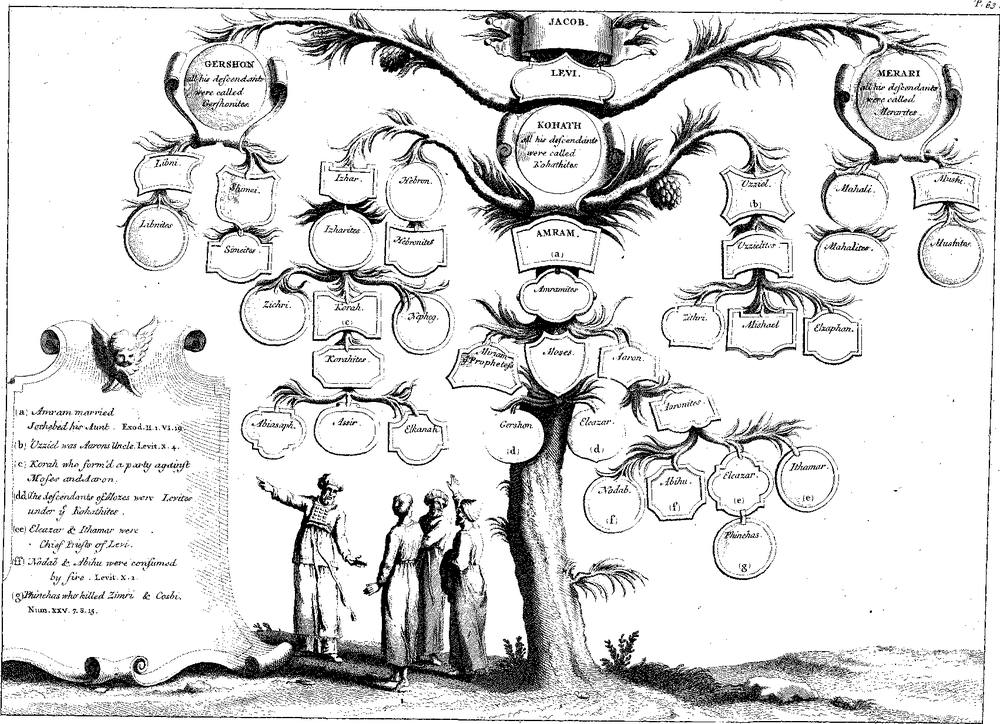
The Testament of the twelve Patriarchs, an ancient, but Apocryphal Book informs us, that Levi was transported as far as the seventh Heaven, where he had many Revelations; among the rest, that the Priesthood should be settled in his Family, and that the Saviour of the World should be born of his Tribe, and that of Judah. It is in Reality the Opinion of many of the Ancients, that the blessed Virgin was of the two Tribes of Levi and Judah; of Judah by her Father, and of Levi by her Mother. This Book farther adds, that the Sons of Levi should crucify the Saviour of Mankind; that the Angel of the Lord ingaged Levi to massacre the Sichemites; that in a Vision which he had at Bethel, the Angel put the sacerdotal Robes on him, and anointed him Priest. After this they revealed to him the coming of the Messiah, the eternal Priest. When he was drawing towards his End, he declared to his Sons all the Evil which they should bring upon the Person of the Messiah; and the Calamities which would attend them, as a Punishment of their Sins. He foretold, that the Veil of the Temple should be rent, in Order to discover their Iniquities. He said that when he was eight and twenty Years of Age, he married a Woman whose Name was Milcah: She was the Mother of Gershom, Kohath and Merari, and of a Daughter named Jochabed, who was born to him in Egypt. Gershom was the Father of Libni and Shimei. The Sons of Kohath were Amram, Izhar, Hebron, and Uzziel. Merari begot Mahli and Mushi. Amram the Son of Kohath merried Jochabed his Aunt, who was born the same Day as he was. Jochabed was the Mother of Aaron, Moses and Miriam. He concluded with foretelling the Sin they should commit in putting to Death the Messiah, the Destruction of their Temple, and their Captivity. Levi, as this Book says, died in Egypt, at an Hundred and Thirty Seven Years of Age; and his Sons, at their Return into the Land
of Canaan, buried him in the Cave of Hebron.
LEVIATHAN. This Word is often to be met with in the Scripture, and the Fathers understand it generally in a moral Sense of the Devil, who is the Enemy of Mankind, the Serpent. The Jews maintain, that upon the fifth Day of the Creation, God created 2 Esdras vi. 47, 48, 49, 50, 51.two Animals; the one called Enoch, the other Leviathan. Enoch was placed upon the Earth in Order to live there, and God gave him the Grass of a Thousand Mountains to feed upon. Leviathan was left in the Water wherein he had been created, and will continue till the Day of Judgment, at which Time he will be killed, and served up at Table, as Part of an Entertainment provided for the Elect. The Word Leviathan, according to the Etymology of it, signifies a large Fish, or Sea Monster. Leviath may signify what is joined, fastened, or tied together; and Than, a great Fish; as if we לויתןLeviathan.should say, the great Fish covered with Scales, stuck close one upon another. The Job xl. 20, 21. xli. 1, 2, &c. כלביתChalbith.Crocodile we know is very long and large, and has Scales so strong, and so thick, that the Darts of Huntsmen and the Fishermens Hook cannot penetrate them. In our Opinion therefore Leviathan signifies a Crocodile.
Job gives us an admirable Description of the Leviathan, in xl. and xli. Chapters of his Book, and therein says nothing but what may be very naturally explained of the Crocodile. Others interpret it of the Whale, or what the French call the Mulart, which is a very large Fish to be met with in the Mediterranean: Others by the Name of Leviathan, understand in general all large Fish and Sea Monsters. Many of the Ancients have interpreted it allegorically of the Devil. Bochart9 shews at large, that it is the Crocodile. He proves it by a Place out of the Talmud, in the Treatise upon the Sabbath, where it is said, that the Calbit, or Sea Dog, is the Terror of the Leviathan: He pretends that this Calbit is the Fish called Ichneumon, which darts itself into the Crocodile’s Mouth, gnaws its Intrails, and never goes any other Way out of its Belly, than through the Hole which it makes by gnawing so continually.
Job speaks of the Leviathan in the Manner following, Canst thou draw out Leviathan with an Hook, or his Tongue with a Cord which thou lettest down? Is the Crocodile one of those Fish which is to be caught with an Hook, and fastened by the Tongue, or strung through the Mouth and Gills, in Order to be carried up and down as one pleases? He does not ask this as if there were Danger in doing so, but as if it were a Thing very impossible, which no one could attempt without great Temerity. Herodotus10 relates a Way of taking the Crocodile with an Hook; but this probably was not invented in the Time of Job. This Historian says, that it was their Way to throw a Piece of Hog’s Flesh, together with a large strong Hook, into the Midst of the Nile. The Fishermen stood upon the Shore, where they made a young sucking Pig cry. Hereupon the Crocodile immediately came forward, and swallowed the Hog’s Flesh with the Hook; the Fishermen immediately drew it on Shore, threw Mud into its Eyes, which are very small in Proportion to the rest of the Body, and then killed it.
Canst thou put a Hook through his Nose, or bore his Jaws through with a Thorn? As they did Beasts of Service, such as Camels and Buffles, which were guided in this Manner, and trained as they please. Is the Crocodile one of those gentle and tractable Animals? See Isai. xxxvii. 29. where he speaks of piercing in this Manner the Muzzles of Beasts of Burden. I will put my Hook in thy Nose, and my Bridle in thy Mouth. The Hebrew of Job may be otherwise interpreted: Wilt thou put Light into his Nostrils, or pierce his Jaw with a Thorn? As those small Fish which are carried to Market, strung together in this Manner. Shall the Companions make a Banquet of him? Shall they part him among the Merchants? Or as others will have it, Shall the Inchanters cut him up, and the Canaanites divide him in Pieces for Sale? Shall they charm him like a Serpent, and cause him to burst with their Inchantments?
Lay thine Hand upon him, remember the Battle, and talk no more; or according to the Hebrew, Lay thine Hand upon him and never think of the Battle: Behold, the Hope of him is in vain, shall not one be cast down even at the Sight of him? The Crocodile is a very dreadful Creature; the hardiest Warrior will not dare so much as to appear before him. They tell11 of one Artemidorus, that lighting by Chance upon a Crocodile while he was sleeping on the Sands, he was so scared, that he instantly lost both his Understanding and Memory. Cnemon in Heliodorus12 was in very great Disorder at the Sight of a Crocodile, which he had only a Glimpse of, and saw rather the Shadow than the Body of it. Job continues, None is so fierce that dare stir him up. It would be very great Rashness to attempt it. None but the Tentyrians are capable of being so hardy; the Inhabitants
of Tentyrus destroyed Crocodiles wherever they could find them.
But we have here a more particular Description of this Animal. Who can discover the Face of his Garment, or who can come to him with his double Bridle? The Crocodile sleeps in the Day Time on the Sand, with his Mouth open; but notwithstanding his being asleep, who will dare so much as to approach him? His Body is like Shields of cast Brass: It is covered with Scales press’d close one upon another. The Crocodile is one of the largest River Fish we know of; there have been some seen five and twenty or thirty Foot in Length: The Skin of its Back is so hard, that there is no piercing it with Iron. Under the Belly it is tender, and this is the only Place wherein it is to be wounded. Who shall open the Entrance of his Jaws? Terror dwells about his Teeth. The Head of this Animal is oblong, and the Mouth of it extremely large. It has six and thirty very solid, sharp Teeth belonging to its upper Jaw, and as many to the lower. His Teeth fall in one with another like the Teeth of a Saw. When he opens his Mouth, the Opening is so wide, that he could swallow a Man, or even an Heifer intire. His Head is oblong, and slit almost as far as his Ears. There have been some seen in the Indies of such a Size, that a Man of tall Stature might stand upright between his Jaws. They are said to stir none but the upper Jaw, whereas other Animals move the lower only. But this is not confirmed by any late Observations.
By his Weesings a Light doth shine, and his Eyes are like the Eyelids of the Morning. But of his Mouth go burning Lamps, and Sparks of Fire leap out. Out of his Nostrils goeth Smoak, as out of a seething Pot or Cauldron: His Breath kindleth Coals, and a Flame goeth out of his Mouth. This poetical Description admirably expresses the Vivacity of the Crocodile’s Eyes, when he springs out of the Water, and the Rapidity wherewith he pursues his Prey, and the Rapaciousness with which he devours it. Strength is in his Neck, and Famine walketh before him. The Crocodile is in Shape almost like a Lizard. His Strength consists principally in his Neck and Head. He ravages every Thing in the Places where he is found; he kills Animals of all Kinds, and lays waste the Fields; which cannot be expressed better than by saying, that Famine walketh before him.
The Flakes of his Flesh are joined together, they are firm in themselves, they cannot be moved. His Body is all Nerve and Muscle, it is in some Sort impenetrable and invulnerable. His Heart is as firm as a Stone, yea as hard as a Piece of the nether Millstone. These Expressions describe in a lively Manner the Strength, Courage, and Intrepidity of the Crocodile. Nothing frightens him. If any one attacks him, neither Swords, Darts, nor Breast-plates can stand before him. Travellers agree, that the Crocodile’s Skin is Proof against Swords, Darts, Arrows, and Fire-arms; if any would pierce him, he must take him under the Belly. He esteemeth Iron as Straw, and Brass as rotten Wood. The Arrows cannot make him flee; Slingers are turned with him into Stubble.
He maketh the Deep to boil like a Pot: He maketh the Sea like a Pot of Ointment.
In the Oriental Style, great Rivers and Lakes are sometimes called Seas. There are Crocodiles not only in the Nile, but in Lakes too. Those of the Lake Mæris were adored in Egypt; they carefully prepared Provision for them to eat, they put rich Pendants in their Ears, and costly Bracelets on their Feet. When the Crocodile stirs himself with Impetuosity, or casts up Water through his Mouth, he makes the Lake or River he is in, boyl like a Cauldron of boiling Oil; the Odour which he leaves behind him is like that of Musk. This is attested by several Authors of good Repute13. He scatters this agreeable Scent not only while he is alive, but his Flesh even after his Death retains it: His Eggs likewise smell like Musk; and the like Odour, when they are wounded, issues from their Wound and Entrails.
Ezek. xxxii. 12.He beholdeth all high Things, he is a King over all the Children of Pride; which some explain by saying, that the Crocodile is the King of other Fish; but it may be better understood of the Egyptians, who are often called in Scripture Children of Pride, or proud. The Crocodile was their God, their King; they paid divine Honours to him. In the Hebrew Style by the Word King is often Job xxvi.meant the God of any Nation; every one knows, that the Egyptians worshipped the Crocodile, and that the Crocodile was the Emblem or Figure of Egypt.
In the third Chapter and eighth Verse he says; Let them curse it that curse the Day, who are ready to raise up a Leviathan. He means, in our Opinion, the Atlantes, and the People of Upper Egypt, who curse the Sun14, because they are burnt with the excessive Heat of it; and who are so daring, as to wake the Crocodile in Order to attack, kill and eat it15. Ezekiel describes
the King of Egypt by the Name of great Than, or great Dragon; great Fish. Isaiah16 threatens Leviathan the piercing Serpent with Death; that is the King of Babylon; and Leviathan, the crooked Serpent, that is the King of Egypt. The Crocodile was esteemed the King of Fresh-Water Fish; and the Hebrews call all Fish Serpents, or Reptils. The Ps. lxxiii. 14.Royal Prophet says, that the Lord created the Leviathan to play in the Waters. It is therefore an Animal that liveth in the Water.
LEVIR, LEVIRATE. We make Use of this Term, as other Authors have done before us, who have written on the Law and Customs of the Jews, to denote particularly the Law of Moses, which obliges one Brother to marry the Widow of another, who died without Children, and to raise up Seed to him. From Levir, which signifies in Latin the Husband’s Brother, the Brother-in-Law; the Word Levirate has been formed by some, to express the Law whereof we have been speaking. Moses says as follows on this Subject: If Ruth iv. 1, 2, 3.Brethren dwell together, and one of them die and have no Child, the Wife of the dead shall not marry without unto a Stranger: Her Husband’s Brother shall go in unto her, and take her to him to Wife, and perform the Duty of an Husband’s Brother unto her; and it shall be, that the First-born which she beareth, shall succeed in the Name of his Brother which is dead, that his Name be not put out of Israel. And if the Man like not to take his Brother’s Wife, then let his Brother’s Wife go up to the Gate unto the Elders, and say, My Husband’s Brother refuseth to raise up unto his Brother a Name in Israel, he will not perform the Duty of my Husband’s Brother. Then the Elders of his City shall call him and speak unto him, and if he stand to it, and say, I like not to take her, then shall his Brother’s Wife come unto him in the Presence of the Elders, and loose his Shoe from off his Foot, and spit in his Face, and shall answer and say, So shall it be done unto that Man that will not build up his Brother’s House; and his Name shall be called in Israel the House of him that hath his Shoe loosed.
This Law is an Exception to that which condemns Marriages between Brothers and Sisters, and between Brother’s-in-Law and Sister’s-in-Law. This Law seems to have been in Use among the Hebrews and Canaanites, before the Time of Moses, since Judah gives his first born Er, and Onan his second Son, successively to Tamar, and obliges himself to give her likewise Selah his third Son.
The Terms made Use of by Moses, If two Brothers dwell together, &c. intimate, that the first Intention of the Law respects only Brethren who live together in their Father’s House, or perhaps in the same Place; but Custom extended it even to more remote Relations, who dwelt in Judæa, and in the Division of their Brother’s Tribe, so that their Estates and Inheritances lay in the same Place; for the Law had two Objects, first to preserve the Name of the deceased in Israel, by the Means of such Children as should be born of his Wife, and go by his Name; and secondly, to continue Inheritances in the same Tribe, and Family.
The Example of Ruth, who married Boaz her Husband’s Relation, is an Evidence of the Practice of the Israelites in the Times of the Judges. Boaz was neither the Father nor nearest Relation to Elimelech, Father-into Law Ruth, the Wife of Mahlon, and yet he married her upon his Refusal, who was the nearest Relation. The Rabbins17 of their own Accord have produced many Exceptions and Limitations to this Law. They believe, that the Obligation on the Brother of marrying his Sister-in-Law, regards only Brothers born of the same Father and Mother. Besides, it has a Respect only to the eldest Brother of the deceased, and farther supposes that he was not married: For if he were married, he might at his own Choice, either take or leave his Brother’s Widow. If the deceased Brother had left a natural or adoptive Son or Daughter, a Grandson or Grand-daughter, the Brother was under no Obligation to marry his Widow. If the dead Person left many Wives18, the Brother could marry but one of them: If the deceased had many Brothers, the eldest alone had a Right to all his Estate, and enjoyed the Dowry which his Wife had brought him.
They add, that the Marriage of the Widow with her Brother-in-Law was performed without Solemnity; because the Widow of the Brother who died without Children, passed for the Brother-in-Law’s Wife, by Virtue of the Law, without there being any Occasion for more Ceremony. Notwithstanding Custom required that this should be done in the Presence of two Witnesses, and that the Brother should give a Piece of Money to the Widow. The Nuptial Blessing was farther added, and a Writing given to secure the Wive’s Dower. There are some who believe, that this Law was not observed Fagius in Deut. xxv.after the Babylonish Captivity, because since that Time there has been19
no more any Distinction of the Inheritances of the Tribes. The present Jews20 do not practice this Law, or at least very rarely, particularly among the Germans and Italians, they chuse rather to set their Women at Liberty, that they may marry again where they please.
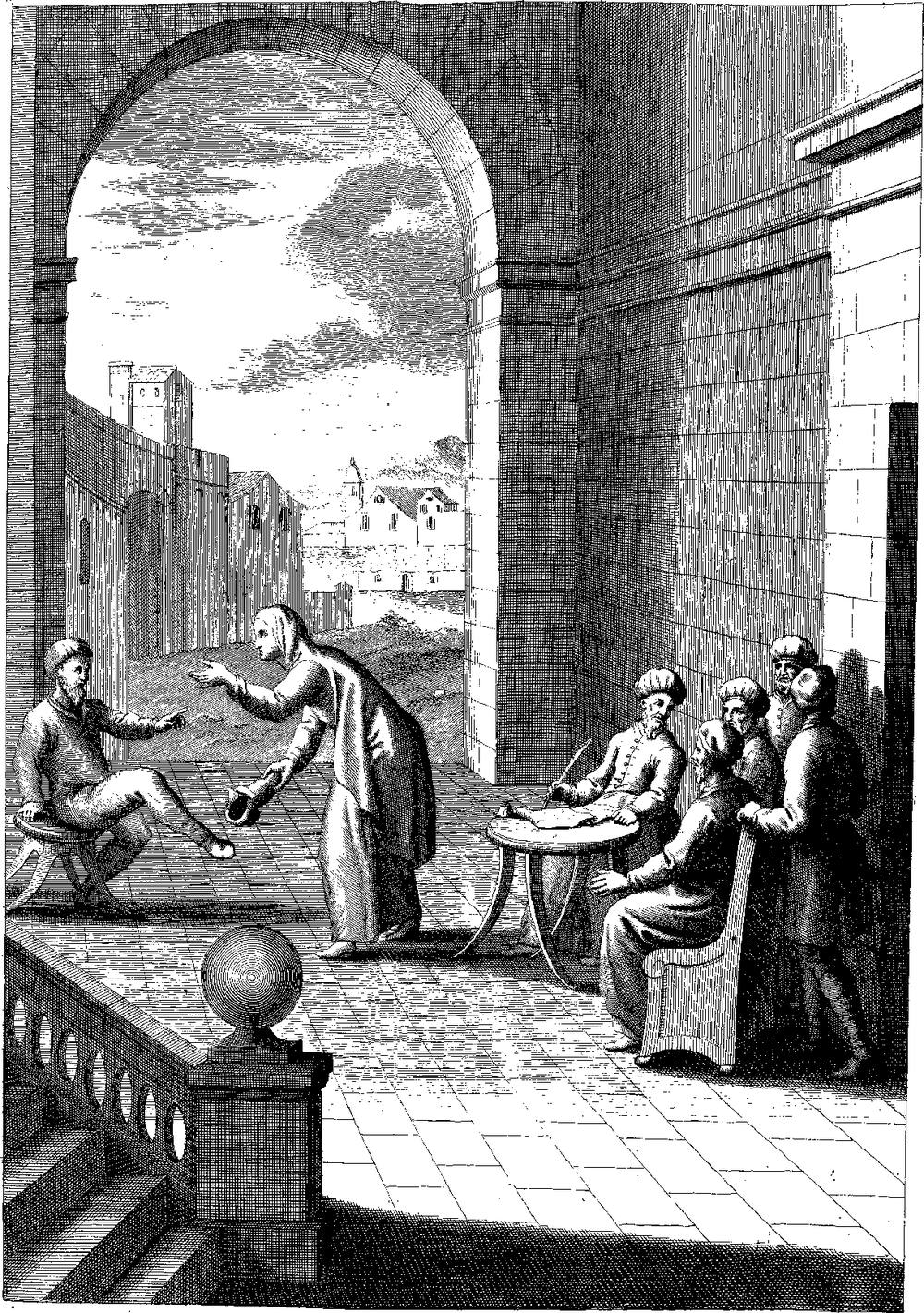
But in Leo of Modena’s Account of the Matter, it is done after the following Manner. “Three Rabbins and two other Witnesses go the Evening before, and choose a Place where the Ceremony may be performed. The next Day when they come from Morning Prayers, they all follow the Rabbins and Witnesses, who as soon as they come to the appointed Place, sit down, and order the Widow and her Brother-in-Law to appear before them, who declare that they there present themselves, in Order to be free. The principal Rabbin proposes several Questions to the Man, and exhorts him to marry the Widow, then seeing him persist in his Refusal, after some other Interrogatories, the Man puts on one of the Rabbin’s Shoes, which is fit for any Foot; and the Woman in the mean Time draws near to him, and assisted by the Rabbin, says to him in Hebrew, My Husband’s Brother will not continue the Posterity of his Brother in Israel, and refuses to marry me, as being my Brother-in- Law. The Brother-in-Law answers, I have no Mind to take her. Hereupon the Woman stoops down, loosens and pulls off the Shoe, throws it upon the Ground, spits before him, and says in Hebrew to him, with the Help of the Rabbin. So shall it be done unto that Man who will not build up his Brother’s House; and his Name shall be called in Israel the House of him that hath his Shoe loosed. These Words she repeats three Times, and they who are present answer as often, He that hath his Shoe loosed. Hereupon the Rabbin immediately tells her, that she may marry again; and if she requires any Certificate of what is done, the Rabbins deliver one to her.
You have here a Form of the Certificate taken out of the Gemara of Jerusalem, where it is shorter than that which we meet with among the Rabbins. Before us whose Names are so and so, such an one, the Widow of such an one, pulled off such an one’s Shoe, the Son of such an one. She brought it before us, and has pulled off the Shoe of his right Foot, and hath spit in our Presence, so that we have seen her Spittle on the Ground, and she hath said unto him, Thus shall the Man be treated who buildeth not up his Brother’s House.
From what has been said it appears, that the Rabbins do not understand Moses’s Words literally, when he says, that the Woman shall spit in his Face who will not marry his Brother’s Widow; and that they explain it thus, She shall spit in his Presence, she shall spit upon the Ground before him; but the Text of the Law is expressly for the former Meaning, and Josephus took it literally in the History of Ruth21. To spit in any one’s Face is a Numb. xii. 14. If. i. 6, &c.Mark of the highest Contempt.
What is said in the Text, of his giving his Brother’s Name to the eldest Son which he shall have by her, may be understood two Ways. 1. He shall bear the Name of the deceased; if that was Abraham, the Son shall be called, Abraham. 2. He shall bear the Name of the deceased; he shall go for his Son, he shall support his Name and Family. The Hebrew literally says22, He shall be raised upon his Brother’s Name, he shall be like a young Sucker shooting out of his Father’s Name. The Example of Ruth, who called the Son she had by Boaz, Obed, and not Mahlon, the Name of her first Husband23, proves, that it was not necessary the Child should go by the Name of his Mother’s first Husband.
Leo of Modena24 observes, that the Jews sometimes out of a Principle of Avarice, keep their Sisters-in-Law a long Time in Suspence, without declaring whether they will marry them or no, that so they may tire their Patience, and draw some Money out of them: Wherefore there are some Fathers, who if they marry their Daughters to Men that have several Brothers, stipulate, that in this Case they shall set the Widow at Liberty for nothing. Others oblige the Husband, in Case he falls sick, and is thought by his Physicians to be in Danger, to divorce his Wife upon the Spot, that so she may not come into the Power of her Brother-in-Law. The marrying a Sister-in-Law the Jews call Ibum, and the pulling off the Shoe and setting a Woman at Liberty, Chaliza.
LEVITES. All the Descendants of Levi may be comprized under the Name of Levites: But they are principally meant by it, who were employed in the lowest Ministries of the Temple, whereby they were distinguished from the Priests, who being descended from Aaron, were likewise of the Race of Levi by Kobath, but were employed in higher Offices. We have
spoken of them in the Article Aaron; and shall again speak of them in that of Priests.
The Levites therefore were all the Descendants of Levi by Gershom, Kohath, and Merari, excepting only the Family of Aaron; for the very Children of Moses had no Part in the Priesthood, and were no more than common Levites. God chose them in the Room of the First-born of all Numb. iii. 6, &c.Israel, for the Service of his Tabernacle and Temple. They were obedient to the Priests in the Ministrations of the Temple, and brought Wood to them, Water, and other Things necessary for the Sacrifices. They sung and played upon Instruments in the Temple, and in other Ceremonies. They applied themselves to the Study of the Law, and were the ordinary Judges of the Countrey, but always subordinate to the Priests.
God provided for the Subsistence of the Levites, by giving them all the Tythe of Corn, Fruit and Cattle throughout Israel. Numb. xviii. 21, 22, 23, 24.But they were to give the Priests the Tenth of their Tythes; and as the Levites possessed no Estates in Land, the Tythes which the Priests received from them, were looked upon as the First-Fruits which they were to offer to the Lord.
God assigned them eight and forty Cities Numb. xxxv. 1, 2, 3, &c.for their Habitations, with Fields, Pastures, and Gardens. Of these eight and forty Cities thirteen were given to the Priests, six whereof were chosen to be Cities of Refuge. While the Levites were actually imployed in the Service of the Temple, they were subsisted out of the Provisions in Store there, and out of the daily Offerings which were made there; and if any Levite quitted the Place of his Abode, to go and do Service at the Temple, even out of the Time of his half-yearly or weekly Waiting; he was received there, kept and provided for, in like Manner, as his other Brethren, who were regularly in Waiting. Deut. xviii 6, 7, 8.The Consecration of Levites was performed without much Ceremony. They wore no peculiar Habits to distinguish them 2 Chr. xxix. 34.from other Israelites, and God ordained nothing particularly for their Mourning. The Manner of their Consecration was as Numb. viii. 5, 6, 7, &c.follows.
The Lord said to Moses; take the Levites from among the Children of Israel, and cleanse them, sprinkle them with the Water of Expiation; and let them shave all their Flesh, and wash their Clothes. They shall bring two Oxen, or rather two Bullocks before the Door of the Tabernacle. Then all the Children of Israel being assembled, shall put their Hands upon the Levites Head, as an Indication, that they k Joseph. Antiq. l. xx. c. 8. p. 699. offer them unto the Lord. After this the Levites shall put their Hands upon the Heads of the two Bullocks, one whereof shall be offered for a Burnt-Offering, and the other for a Sin-Offering. You shall present the Levites to the High-Priest Aaron and his Sons, who shall offer them unto the Lord, by lifting them up in the Air towards the four Corners of the World, or by obliging them to use particular Motions, which have some Relation to that practiced by the Priests, while they waved certain Offerings towards the four Quarters of the Earth.
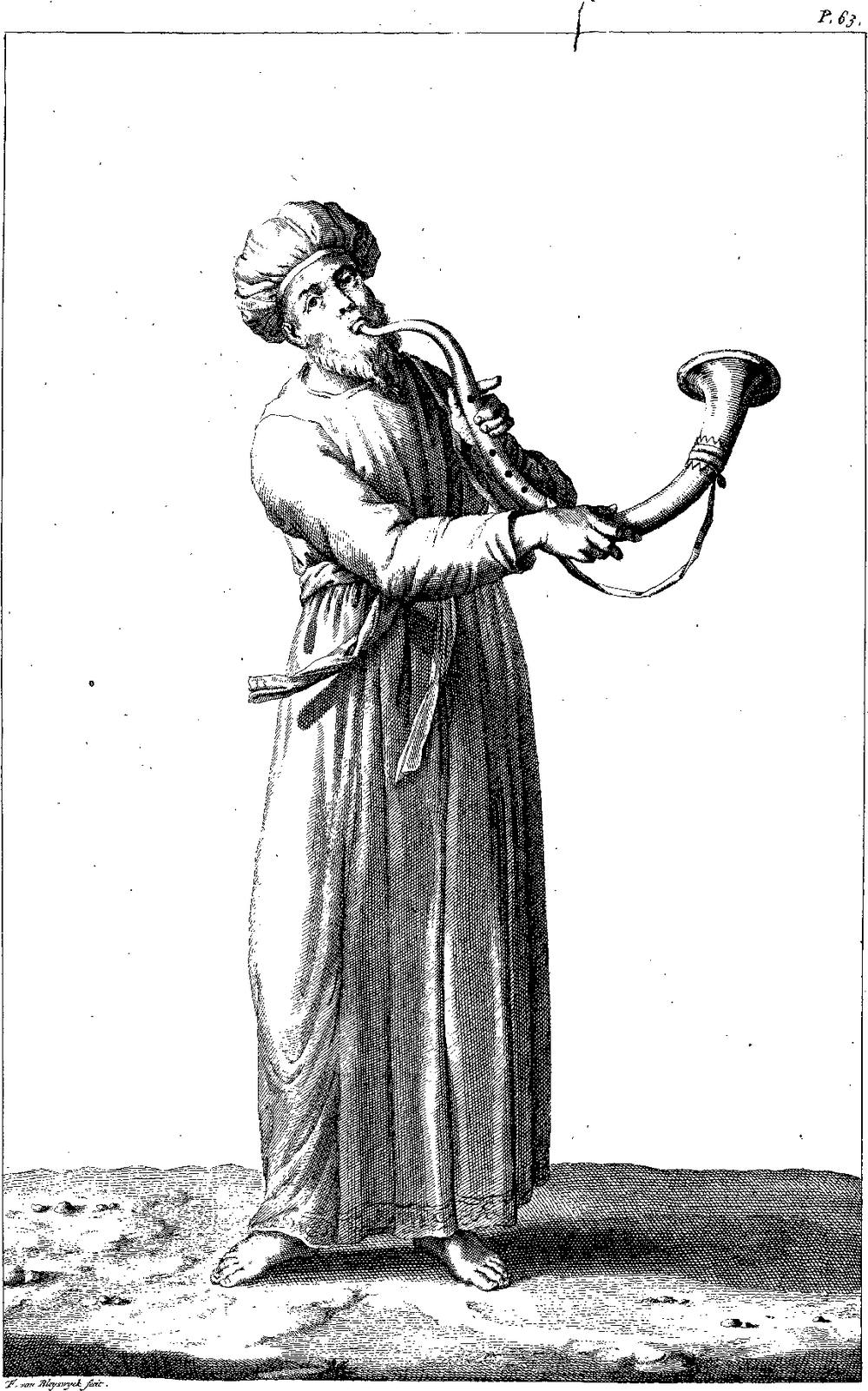
Josephus k tells us that in the Reign of Agrippa King of the Jews, about the Year of J. C. 62, and six Years before the Destruction of the Temple by the Romans, the Levites desired Permission from this Prince to wear the Linnen Tunick as the Priests did; which Request was granted. This Innovation was displeasing to the Priests; and the Jewish Historian remarks, that the old Customs of the Countrey never were forsaken with Impunity. He adds, that Agrippa permitted likewise the Families of the Levites, whose common Office it was to guard the Doors, and perform other troublesome Offices, to learn to sing and play on Instruments, that they might be qualified for the Service of the Temple as Musicians.
The Levites were divided into different Classes, namely the Gershomites, Koathites, Merarites, and Aaronites or Priests. Here follows the Enumeration made by Moses, after their Departure out of Egypt, of all the Males from one Month old and upwards, according to the particular Order which he received from God to this Purpose.
The Gershomites were in Number seven Thousand five Hundred. Their Office in the Marches through the Wilderness was to carry the Veils and Curtains of the Tabernacle. Eliasaph, the Son of Lael, was the chief of them.
The Koathites were imployed in carrying the Ark and sacred Vessels of the Tabernacle, their Number was eight Thousand six Hundred. Elizaphan, the Son of Uzziel was at the Head of them.
The Merarites were in Number six Thousand two Hundred. Their Office consisted in carrying the several Pieces of the Tabernacle which they could not place upon the Chariots; Zariel, the Son of Abibail, was their Commander.
The Aaronites were the Priests who served in the Sanctuary; Eleazar, the Son of Aaron, was their General. Their Genealogy may be seen at full Length in the genealogical Tree which we have had engraved here.
As often as the Hebrews incamped in the Wilderness, the Levites were distributed round about the Tabernacle. Moses and Aaron were placed at the East, Gershom at the West; Kohath at the South; and Merari Numb. iii. 17, 18, &c. Numb. viii. 24. Numb. iv. 3.at the North. Moses ordained, that the Levites should not do Service at the Tabernacle till they were five and twenty Years of Age, or as he says elsewhere, from thirty to fifty Years old. But David finding that they were imployed no longer in those grosser Offices, of transporting the Vessels of the Tabernacle, obliged them to enter upon Service at the Temple as soon as they were twenty Years of Age. The Priests and Levites waited by Turns, and weekly in the Temple. They began their Weeks upon one Sabbath Day, and upon the same Day in 1 Chr. xxiii. 24. 2 Chr. xxxi. 17. and Ezra iii. 8. Deut. xii. 18, 19.the following Week they went out of waiting. When any Israelite made a religious Entertainment in the Temple, God required, that the Levites should be invited to it.
LEVITICUS. This is the third Book in the Pentateuch. It is called Leviticus, because it contains principally the Laws and Regulations relating to the Priests, the Levites, and Sacrifices; for which Reason the Hebrews call it the Priest’s Law, because it includes many Ordinances concerning Sacrifices. The Jews term it likewise Vajicra, because in Hebrew it begins with this Word, which signifies, and he called. In the seven first Chapters of Leviticus God prescribes those Ceremonies to Moses, which were to be observed in the Offering of burnt Sacrifices, of Meat-Offerings, of Bread and Cakes, Peace-Offerings or Thanksgivings, and Sin-Offerings; and regulates what Parts of these Sacrifices were to be consumed upon the Fire of the Altar, and what were to be given to the Priest, who offer’d them. After this Moses relates in what Manner the Priests were consecrated, and what Sacrifices were offered upon this Occasion; and the fatal Misfortune which happened to Nadab and Abihu, who were consumed with Fire, for attempting to offer Incense to the Lord with strange Fire. Upon this Occasion Moses prescribes some Laws, appointing what the Mourning of the Priests should be, and forbids them to drink Wine, while they were in Waiting at the Temple.
In the xi, xii, xiii, xiv, xv Chapters, Moses gives Rules for distinguishing clean and unclean Beasts, and the Leprosy of Men, Houses and Habits; for the Purification of Men indisposed with a Gonorrhæa, and of Women after Child-birth. After this, God appoints the Ceremonies which were to be observed upon the Day of solemn Expiation: He regulates the Degrees of Relation, wherein any one was either permitted or forbidden to marry. He prohibits Alliances with the Canaanites, Idolatry, Theft, Perjury, Calumny, Hatred, the Superstitions of the Gentiles, Magick, Divinations, Soothsaying, Prostitutions and Adultery. He forbids any one to use the Fruits of a Tree, during the first five Years after it is planted. He requires something to be left in the Fields for the Benefit of the Poor, when the Corn is cut. He mentions the Defects which make Sacrifices unfit to be offered to the Lord. In the xxiii Chapter he takes Notice of the principal Festivals in the Year, which are the Passover, Pentecost, the Feast of Tabernacles, the Great Day of Expiation, the Feast of Trumpets, or beginning of the civil Year. We find the Story in it of a Man who was stoned to Death for having blasphemed the Name of the Lord. He prescribes what was to be observed in the Sabbatical, and in the Jubilee Years. Lastly, he Lev. xxv. 3, 4, 5, &c.concludes with Regulations concerning Vows, and Tythes which were too be offered in the Tabernacle.
Lev. xxviiAll the World agrees, that Leviticus is a Canonical Book, and of divine Authority. It is generally held to be the Work of Moses, as well as the rest of the Pentateuch. It contains the History of what passed during the eight Days of Aaron’s and his Sons Consecration, which was performed in the Year of the World 2514, before J. C. 1486 before the Vulgar Æra 1490. The Laws which were prescribed in it upon other Subjects besides Sacrifices, have no other chronological Mark, whereby we may be directed to judge at what Time they were given.
LIBANUS, a famous Mountain which separates Syria from Palestine. It forms a kind of Horse-shoe in its Length, beginning at three or four Leagues distance from the Mediterranean above Smyrna; and going from North to South towards Sidon, from thence bending from West to East, from Sidon towards Damascus; and at last returning from the South Northward, from the Streight of Damascus, as far as Laodicea Scabiosa. The western Part of this Chain of Mountains is what we properly call Libanus. The other Part, which is opposite to it Eastward, and extends from South to North, is called by the Greeks, Antilibanus. Between these two Mountains is a long Valley called Cœle-Syria, or hollow Syria; in Joshua the Valley of Lebanon, Josh. xi. 17. at present Bekkab, from the Hebrew, Bekab, which signifies a Plain. We have spoken of the
Cedars of Libanus under the Article Cedars. The Name of Libanus comes from the Hebrew, Leban, or Laban, which signifies White. This Name was given it, in all Probability, by Reason of the Snow25, with which it is always covered in many Places. Jeremiah speaks of the Snow of Libanus; and Tacitus: Mirum dicitur tantos inter ardores opacum, fidumque Nivibus.
Zech. xi. 1. Ezek. xvii. 3.Libanus is about an hundred Leagues in Circumference. It has Mesopotamia to the East, Armenia to the North, the Holy Land to the South, and the Mediterranean to the West. There are four Rivers which issue out of Libanus, Jordan, Rocham, Nahar-Rossien, and Nahar-Cadicha. It is composed of four Enclosures of Mountains, which rise one upon the other. The first is very fruitful in Grain and Fruits; the second is very barren, abounding in nothing but Thorns, Rocks and Flints; the third, though higher than this, enjoys a perpetual Spring, the Trees being always green there, and the Orchards filled with Fruit: In a Word, it is so agreeable and fertile, that some have called it a terrestrial Paradise. The fourth is so high, that it is almost always covered with Snow; so as to be uninhabitable by Reason of the great Cold.
The Temple of Jerusalem is also called Libanus. Open thy Doors of Lebanon, that the Fire may devour thy Cedars, says Zachary, speaking of the future Desolation of the Temple by the Romans. And Ezekiel; A great Eagle with large Wings came unto Lebanon, and took the highest Branch of the Cedar. He speaks of Nebuchadnezzar, who took the Temple, burnt it, and carried away all the Treasures belonging to it.
Lastly, the Palace built by Solomon at Jerusalem, was called the House of Libanus, domus saltus Libani, probably by Reason of its Height, or the Whiteness of its Walls; or rather by Reason of the great Quantity of Cedar Wood and Pillars which were in it.
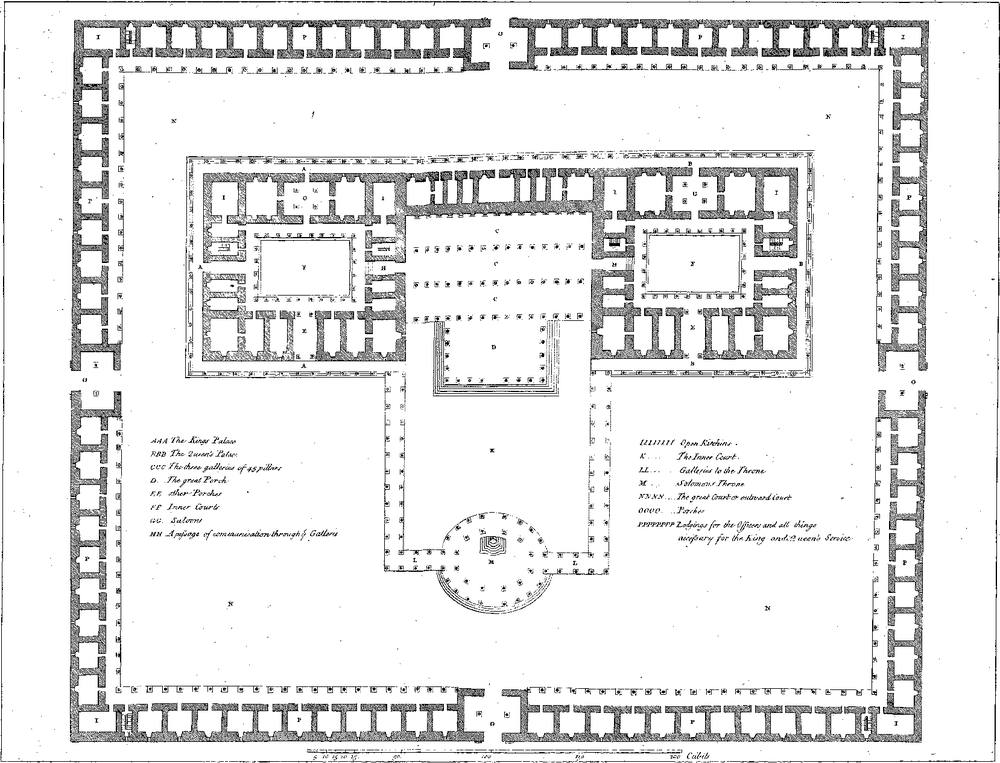
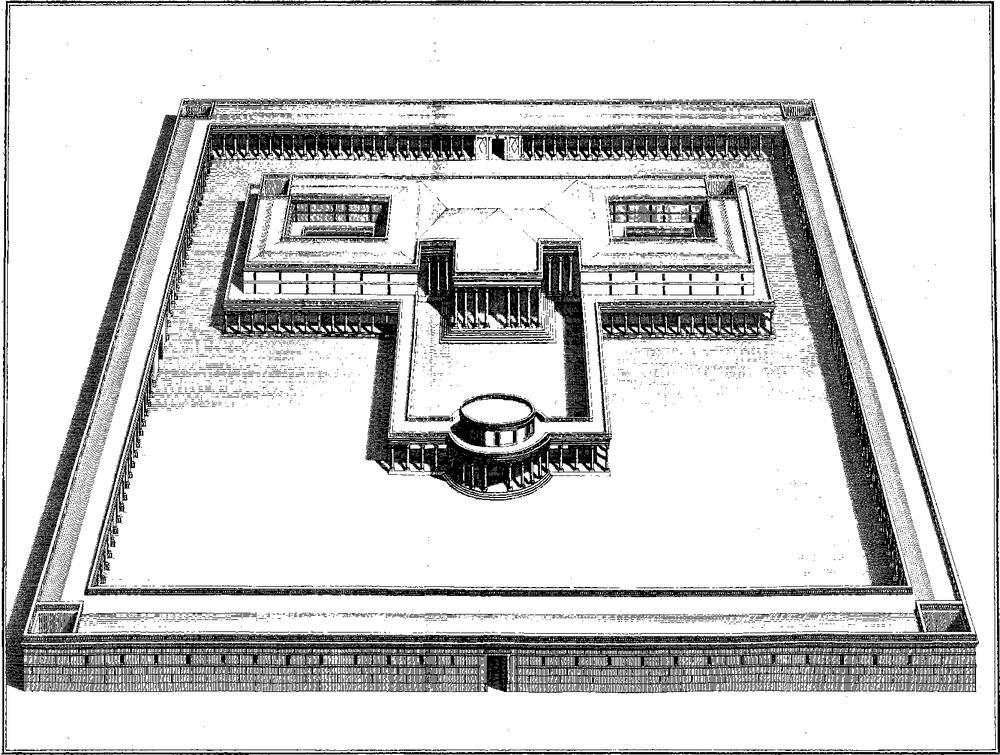
This Palace of Solomon’s was lofty and magnificent, it consisted in one large Pile of Buildings, an hundred and seventy Foot and ten Inches in Length, eighty five Foot five Inches wide, and one and fifty Foot three Inches high; the Middle whereof was supported by four Ranges of Columns, or rather three Ranges of Columns, and one of Pilasters, which formed three cover’d Galleries before the Apartments; in Jer. xviii. 14. Tacit. l. v. Hist. c. 6. Cant. vii. 4.each Range were fifteen Columns; and in all three five and forty.
Before this Palace, and next to the Portico and Columns which supported it, Solomon made a Court fifty Cubits long, and thirty wide, which was also encompassed with Galleries, the Cielings whereof were supported by a great Number of Pillars; and before this first Court he made another larger and wider, with the same Ornaments, and the same Order of Pillars, which was called the Court of the Throne, because Solomon placed the Throne there, on which he sat to administer Justice to the People. See the Plan.
TOWER OF LIBANUS. Solomon in the Canticles compares his Spouse’s Nose to the Tower of Libanus, which looketh towards Damascus. Travellers speak of a Tower to be seen upon Libanus on the Side of Damascus, which seems to have been very high. Benjamin of Judela assures us, that the Stones of this Tower, the Remains whereof he had seen, were twenty Palms long, and twelve wide26. Maundrell speaks likewise of the same, but he saw it only at a Distance.
Lev. vi. 20. viii. 25, 26. ix. 4. xvi. 12, 20. xxiii. 13.LIBATION. This Word is particularly made Use of in the Scripture Language, to signify the Effusion of Liquors, poured upon the Victims sacrificed to the Lord. The Measure of Wine for Libations was the fourth Part of an Hin; that is to say, two Pints, and something over.
Libations among the Hebrews were made upon the Victim after it was killed, and the several Pieces of the Sacrifice were laid upon the Altar, ready to be consumed in the Flames. See Leviticus. Moses, after he had sacrificed the Victims, which were to be made Use of at the Consecration of his Brother Aaron, took the Fat and the Rump, and the Fat that was upon the Inwards, and the Caul above the Liver, and the two Kidneys and their Fat, and the right Shoulder. And out of the Basket of unleavened Bread that was before the Lord, he took one unleavened Cake, and a Cake of oiled Bread, and one Wafer, and put them on the Fat, and upon the right Shoulder. And he put all upon Aaron’s Hands, and upon his Son’s Hands, and vowed them for a Vow-Offering before the Lord. And Moses took them from off their Hands, and burnt them on the Altar, &c.
These Libations consisted in Offerings of Bread, Wine and Salt; the Offerings of Bread were Cakes of several Sorts, some baked in the Oven, others in a Frying or
Baking Pan; some kneaded with Oil, others rubbed over with Oil, others fried in Oil; sometimes they were of nothing but Meal, or a Cake moistened with Oil. Part of it, which was to be consumed with the Victim, was offered upon the Altar, the rest was left for the Priest in Waiting, and was divided among the other Priests who were actually in the Temple: For the Offerings were not carried or consumed out of it.
Libations were likewise offered among the Greeks and Latins, together with the Sacrifices, but they were poured upon the Head of the Victim, while it was yet living. This appears from twenty Places of the Ancients. Æneid ii. V. 130, 131.For Example, Sinon relating in what Manner he was to be sacrificed, says, that he was in the Priests Hands ready to be slain, that he was loaded with Bands, and Garlands or Festoons, and that they were preparing to pour upon him the Libations of Grain and salted Meal.
Jamque dies infanda aderat, mihi sacra parari, Et salsæ fruges, & circum tempora vittæ.
And Dido, upon the Point of sacrificing, pours Wine between the Horns of the Æneid.iv.Victim.
Ipsa tenens dextra pateram pulcherrima Dido, Candentis vaccæ media inter cornua fudit.
Saint Paul says, that he is, as it were, a Victim made to be sacrificed, and that the accustomed Libations of Meal and Wine were already, in some Sort, poured upon 2 Tim. iv. 6.him: Ego enim jam delibor, & tempus resolutionis meæ instat.
LIBER27. Bacchus. The Scripture never mentions the Name of Bacchus, but we find that of Liber, which is the same Thing in the Maccabees. See 2 Macc. vi. 7. Cum Libri sacra celebrarentur, cogebantur hederâ coronati Libero circuire. And xiv. 33. Istud Dei fanum in planiciem deducam, & Templum hoc Libero patri consecrabo. Lastly, there is Mention of him in the third Book of Maccabees, where it is said, that King Ptolemy Philopater ordered the Leaf of an Ivy, a Tree consecrated to Bacchus, to be impressed on such Jews as refused to renounce their Religion.
Profane Authors speak of several Bacchus’s or Dionysius’s. Cicero names three; Cicer. l. i. De Naturâ Deorum.the first the Son of Jupiter and Proserpine; the second the Son of Nile, who is said to have killed Nysa; the third, the Son of Caprius, who reigned in Asia, and was Author of the Sabæan Laws; the fourth was the Son of Jupiter and the Moon; the fifth, the Son of Nisus and Thione: He might have added another who was the most celebrated of them all, and this was the Son of Jupiter and Semele, who was the Theban Bacchus, There was besides Bacchus the Indian, Son to Ammon and Amalthea: And there is Mention likewise made of Bacchus the Assyrian: But the most famous of them all is Bacchus the Son of Jupiter and Semele. The Poets give the following Account of his Birth: Semele being with Child of Bacchus, desired Jupiter to come and visit her as he did Juno, that is to say with Thunder and Lightning. Jupiter granted her Request; but the Splendor of his Appearance was insupportable to her. She died of the Fright, or was stifled by the Flames. Jupiter took young Bacchus out of Semele’s Womb, and enclosed him in a Hole which he had made in his Thigh, wherein the Child continued till the Time was come for his Production; then Jupiter took him out, and gave him to Mercury, who carried him to Nysa in Arabia, where he was brought up by the Muses.
Bacchus is the God of Wine. Some pretend that he planted the Vine, and taught Men to extract the Juice of the Grape. He is said to have made several Conquests, and performed several Journies into Arabia, and to the Indies. The Ivy is consecrated to him as well as the Vine, and several Particulars are observed in his Life; which have persuaded some learned Men, that Part of his History has been confounded with that of Moses. For Example, Bacchus is said to have been the Son of Nile, that he was of an uncommon Beauty, that he was shut up in a Box, and exposed upon the Water; that he had two Mothers, and was born out of his Father’s Thigh. Moses, in some Sort, was the Son of Nile, having been exposed and found upon the River in a kind of Box made of Rushes. He was of an extraordinary Beauty, and had for his first Mother the Wife of Amram, and for his second the Daughter of Pharaoh. No one doubted, when he was discovered, but that he was the Son of an Hebrew, and issued out of his Thigh according to the Scripture Expression, Egressi sunt de femore illius; but his Mother was not known.
Gen. xlv. 26. Ex. i. 5. & passim.Bacchus was bred up by Nymphs in the Mountains of Nysa in Arabia; Moses was brought up by the Care of Pharaoh’s Daughter in the Land of Goshen, which lies between
Egypt and Phœnicia, in like Manner as the Mountains of Nysa. The first made great Conquests, and undertook great Voyages. He had Bacchanalians in his Army, advanced as far as the Indies; and while he was in the Light, the Indians were in Darkness. Moses was at the Head of the Men and Women of his People in Arabia, about Mount Sinai, which Countrey is sometimes called the Indies. The Female Bacchanalians who accompanied Bacchus with their Drums and Cymbals, describe very well the female Israelites, who upon their coming out of the Red Sea, fell a dancing and playing with these Instruments. We know that the Egyptians were for three Days in such Darkness as might have been felt, whereas in the Land of Goshen, where the Israelites were, there was the clearest Light.
Bacchus is said to have passed the Rivers Orontes and Hydaspes dry shod, having first struck them with his Thyrsus; that his Ivy Wand crawled along when it was thrown upon the Ground; that the Bacchanals who accompanied this God, produced Water out of a Rock, by striking it with the Thyrsus: It is farther added, that Streams of Wine, Milk and Honey were seen to flow wherever they passed. These are Particulars which suit so well with Moses, that it is impossible not to know him by them. The God Liber was dressed in a magnificent Manner, his Head was bound about with a Ribband. He is sometimes represented with Horns; he granted an Exemption from all Offices to those who applied themselves to Musick; he is called Legislator; his Ass spoke to him. These are so many Marks of Resemblance borrowed from the sacred History, and applied to Bacchus. Moses had Rays upon his Face, which in Scripture are termed Horns: He granted considerable Privileges to the Priests and Levites who were imployed in the Service of God, and in chanting his Praises. The Ass which spoke to Balaam, and the magnificent Ornaments of Aaron, relate no farther to Moses, than as Legislator and sacred Historian. The Reader may see these Matters treated more at large in Vossius, Bochart, Huet, &c.
The Heathens accused the Jews of worshipping Bacchus. Tacitus28 takes Notice of this Charge against them; it was founded, he said, upon the Hebrew Priests playing on Instruments of Musick, on the Flute and Drum; on their being crowned with Ivy, and the Discovery of a golden Vine in their Temple; upon which Observations it was believed that they adored Bacchus. But then he adds, that the Laws and Manners of the Jews are too different from the Genius of Bacchus. This God is a Friend to Joy and Cheer, and the Jews live in a vile, absurd and sordid Manner. Quippe Liber festos lætosque ritus instituit: Judæorum mos absurdus, sordidusque. What he says of the Jewish Priests being crowned with Ivy, is without Foundation. The golden Vine in the Temple was a Present made to it, and had no Relation to the Religion of the Jews. This supposed Worship of Bacchus is as real as that of an Ass, which some Heathens imputed to the Jews. Bacchus is called Liber, because of the Liberty which Wine inspires. Antiochus Epiphanes having resolved upon compelling the Jews to forsake the Law of God, persecuted them in a very severe Manner, and upon the Day when the Feast of Bacchus was celebrated, they were constrained to go through the Streets covered with Ivy, in Honour of their false God29. The Greek literally imports, that they were compelled to follow the March, or Procession, of Dionysius or Bacchus, having Ivy either on their Heads or in their Hands; that is to say, wearing Crowns of Ivy, or carrying Thyrsus’s, which were Spears wrapped about with Ivy. Nicanor, one of Antiochus’s Generals, threatened if they did not deliver up Judas Maccabæus, to demolish their Temple, and erect one in the Place of it, consecrated to Bacchus.
Ptolomy Philopater King of Egypt, having taken the cruel Resolution of extirpating the Jews out of his Dominions, who should refuse to renounce the Religion of their Ancestors, first of all divested them of the Privileges they enjoyed as Freemen of Alexandria, then branded them with a hot Iron, and an Ivy Leaf, which is the Sign of any Thing’s being consecrated to Bacchus. This Prince is said to have had an Ivy Leaf impressed upon himself, in Imitation of the Priests of the Great Goddess.
LIBERTINUS. Synagoga Libertinorum, A Freed Man. See SYNAGOGUE.
LIBERTY, as opposite to Servitude and Slavery, denotes the Condition of a Man, who may act without Obstacle or Constraint, and independently on the Will of any other Person. There is frequent Mention of this Sort of Liberty in Scripture. The Hebrews valued themselves mightily upon Liberty; they boasted in our Saviour’s Time, that they had never been deprived
Tacit. Hist. l. v. n. 8.of it: We were never in Bondage to any Man; this from them was a ridiculous Rhodomontade, since we know that they were so often subject to foreign Powers under the Judges, and afterwards in the Time of the Kings of Assyria, Chaldæa and Persia; that Tacitus without Scruple has observed of them, that under the Assyrians, Medes, and Persians, they were the meanest and most abject Slaves: Dum Assyrios penes, Medosque & Persas Oriens fuit, despectissima pars servientium fuere.
It is however true, that the Israelites, according to the first Design of Moses, were never to be reduced intirely to a State of Bondage. They might be sold, or fall into Servitude among their Brethren; but they always had a Power of redeeming themselves, or procuring themselves to be redeemed by some of their Relations, or of being freed from Bondage in the Sabbatical Year, or lastly, in the Jubilee Year, which restored all the Hebrews to their Liberty, and to the Possession of their Inheritances. And it was probably upon this Account they boasted, that they never had been reduced to Slavery. Their whole Nation was equally free and noble; Saul, David, and Jeroboam, who ascended the Throne, were of no better Quality than the meanest Shepherd in Israel. In the Articles Sabbatical Year and Jubilee, we have taken Notice of the Ceremonies which were observed upon setting an Hebrew Slave free. See the Article SLAVES.
LIBERTY, Freedom, is likewise applicable to People living according to their own Laws, without Dependance on any other. The Kings of Syria, after they had a long Time persecuted the Jews, at last granted them Liberty, when Simon Maccabæus was 1 Macc. xiv. 26.High Priest: Statuerunt eis Libertatem, they suffered them to live according to the Law of Moses, and freed them from Tributes and other Services, which before they paid to the Kingdom of Syria: Jerusalem sanctam esse & liberam, 1 Macc. xv. 6.
Domus libera, an House separated from the Commerce of other Men. King Azariah being smitten with a Leprosy, was separated from the rest of Mankind, and reduced to the Condition of a private Person. 1 Reg. xv. 5. Psalm lxxxvii. 6. במתים חפשי כמו חללים שכבי קבר תהליםHabitavit in domo liberâ seorsum.
The Psalmist says, that he is as one destitute of all Help, free among the dead, Inter mortuos liber. This is explained of Jesus Christ, who descended into Hell, and was all the while perfectly at Liberty to come from thence, and deliver those who were detained there. Or it may be understood of our Saviour shut up in the Grave, and nevertheless having it absolutely in his Power to issue forth from thence when he pleased by his Resurrection. The Hebrew may be translated thus: I am as these dead John viii. 33.Men of Liberty, like those who are dead of their Wounds, and sleeping in the Grave; or otherwise, like those Men of Liberty, those ancient Heroes, who boasted of Liberty and Independency, and are nevertheless dead of their Wounds, and asleep in the Grave.
LIBERTY of the Gospel, in Opposition to the Servitude of the Law. Saint Paul has often spoken of this Liberty, which Jesus Gal. iv. 31.Christ hath procured for us: We are not the Children of the Bond-Woman, but of the Free. We are not derived from Hagar, who and her Descendants are Slaves, meaning the Jews; but we are the Sons of Sarah the free Woman: We enjoy the Liberty of God’s Children, by Virtue of the Adoption procured for us by Jesus Christ. Which Liberty delivers us from the Yoke of legal Ceremonies, from the Obligation of observing Purifications and Distinctions of Meats, and many other troublesome and uneasy Practices, to which the Jews were subjected by the Law. See Rom. viii. 21. and 1 Cor. x. 29. and 2. Cor. iii. 17. and Galat. ii, iv, v. and James i. 25. ii, 12.
LIBERTY to Righteousness, in Opposition to the Bondage of Sin. This is the Justification which Jesus Christ hath procured for us by his Death, which we acquire by Baptism, preserve by a good Life, and the Practice of Christian Virtues, and recover by Repentance when we have had the Misfortune to forfeit it, by becoming Slaves to Sin and the Devil.
Ecclus. xv. 14, &c.LIBERTY, and Free-will, in Opposition to Constraint and Necessity: Man is at Liberty to do Good or Evil, God hath made Man from the beginning, and left him in the Hand of his Counsel. If thou wilt, to keep the Commandments, and to perform acceptable Faithfulness. He hath set Fire and Water before thee: Stretch forth thy Hand unto whether thou wilt. There is however a great Difference between the Liberty we have of doing Good and Evil. We have of our selves the unhappy Liberty of doing Evil, we are engaged to it by our Concupiscence, which indeed we are always able to resist, but shall not really and effectually without the Assistance of God’s Grace; whereas as to Good, though we always have the Liberty of doing or not doing it, we cannot however perform it as we might, and in a Manner useful to our eternal Salvation, without the Help of a particular Grace, which without hurting our Liberty, and laying any Necessity and Constraint upon us, incites us agreeably, gently, and nevertheless efficaciously, to prefer what is pleasing to God, to what our Self-love and Concupiscence desire.
The Rabbins have an Idea of Liberty and free Will, very different from that which Christian Authors give us of it. They acknowledge, that Man has Liberty, without
out which he would not be Man: If he loved what is Good, and followed what is Evil, without Knowledge, or by Instinct, he would cease at the same Time to be reasonable. What would become of the Rewards and Punishments, the Threats and Promises, and all the Precepts of the Law, if it were not in the Power of Men to fulfill or violate them? They admit Liberty of Indifference in its full Extent; they are persuaded that People dissemble their Opinion as often as they take any Thing of its Liberty from free Will.
Maimonides confutes the Fatality of Astrologers, but he makes every Thing to depend on Constitution: As God, says he, has created Man upright in Stature, and with Hands and Feet, so hath he likewise given him a Will to move and act as he pleases; and it is the Goodness of his Constitution which makes Things easy or difficult to him. The Fear of God, he says, is not in the Hand of Heaven; that it is in the Power of Man to observe or not observe the Law, and Precepts. The Fear of God is of this Class; it depends not on God, but on the Will of Man.
Manasseh Ben Israel30, another famous Rabbin, maintains, that the preventing Grace acknowledged by some Rabbins, is an Opinion that does not agree with Tradition. That if the Will were prevented by Grace, it would cease to be free. He allows but of two Sorts of Aids from God, one whereby he produces favourable Opportunities of executing the good Designs which any one has formed; the other consists in his assisting Man when he has begun to live well. He says farther, that we stand in Need of the Concurrence of Providence in all virtuous Actions; and as a Man, who is going to lay a heavy Burden on his Shoulders, calls somebody to help him up with it: So the just Man first endeavours to fulfill the Law, and God like the Arm of some strange Person, comes to his Assistance, that he may be able to execute his Resolution.
If Man were so wicked as not to be able to do well without Grace, God would be the Author of Sin and Corruption; and although this Corruption be not absolutely to be overcome without Assistance, yet we may begin the Conflict, and open a Way to Victory, notwithstanding that we cannot absolutely obtain it, unless God come to our Aid. Besides, if God vouchsafes to all Men common and efficacious Helps, how comes it that all are not saved? And if he gives particular Assistances to some only, how can it be said, that there is no Respect of Persons with him? How comes he to suffer some to perish, while he saves others? Is it not much more natural to believe, that God imitates Men, who lend their helping Hand to those who they see have formed good Resolutions, and use their best Endeavours to accomplish some laudable Undertaking? See hereafter the Article ORIGINAL SIN. By this System of Grace we see that the Jews either did not believe it, or were but very imperfectly acquainted with the Effects of it.
Josh. xv. 42.LIBNAH, a City in the Tribe of Judah, in the Southern Part of this Tribe. A Cession was made of it to the Priests, for their Habitation, and it was declared a City of Refuge. 1 Chr. vi. 55, 57.Eusebius and Saint Jerom say, that it was in the Canton of Eleutheropolis. It is the same as Libna or Lebna, in the Neighbourhood whereof (between Rimmon-Parez and Rissah) the Israelites encamped, when they were upon their Journey through the Numb. xxxii. 20.Wilderness.
LIBNATH, a City in the Tribe of Asher. Joshua xix. 26. We believe it to be the whole Promontory, situated between Ecdippa and Tyre. Plin. l. v. c. 19. The Hebrew Reading, instead of Sihor & Labaneth, in the Vulgate is Shicor-Libenath. Which induces us to think, that these two Words denote the same Place, and that Shichor is the Name of a Rivulet; as if it were said: And the Rivulet of foul Water which is upon the white Promontory.
LIBNI. The Son of Gershom. Numb. iii. Joan. xii. 3. xix. 39.18.
LIBRA, a sort of Weight. The Roman Pound is twelve Ounces; the French Pound is sixteen Ounces. The Hebrews, at least in the Old Testament, and before the Empire of the Greeks in the East, never measured by Pounds. The Word Libra is to be met with only in the New Testament. The ancient Hebrews made Use of the Word Siclus, when there was any Mention of common Weights; and of the Word Talent, when they were speaking of large Weights. Now a Shekel weighed an Ounce, or four Roman Drachms. So that two and thirty Shekels went to a Paris Pound; and the Hebrew Talent made ninety two Pound six Ounces of Paris Weight.
LIBRARY. See BIBLIOTHECA.
LIBYA. See LYBIA.
Ex. viii. 16. ,כינים Chinnim.LIDIA. See LYDIA.
LICE, Pediculi. The Hebrew, Kinnim, in the Septuagint and Vulgate translated Sciniphes, signifies Lice according to the Rabbins, and the Generality of modern Interpreters. See hereafter SCINIPHES31.
LIFE, Future, Eternal Life, or Life Simply, signifies the State of Happiness, whereunto the Righteous and Prædestinated are admitted after Death in Heaven.
Matth. vii. 14. Matth. xix. 17. Matth. xix. 16.Narrow is the Way which leadeth unto Life, says our Saviour: If thou wilt enter into Life, keep the Commandments: Master, what good Thing shall I do that I may have eternal Life.
Jesus Christ is sometimes called the Life: John xiv. 16. John xi. 25. John i. 4.I am the Way, the Truth, and the Life. And again: I am the Resurrection and the Life. And elsewhere: In him was Life, and the Life was the Light of Men: And, He that hath the Son hath Life, and he that hath not the Son, hath not Life. Jesus Christ is 1 John 5. 12.the Life of the Soul, he enlightens, comforts it, and fills it with Graces; he leads it to eternal Life: He is himself the Life of it, the Sustenance, Light, and Happiness of it.
The Book of Life, is the Book of Predestination, wherein are written all the Elect, whose Names are in the Book of Life. Philip. iv. 3. And I will blot out his Name out of the Book of Life, Rev. iii. 5. See likewise Rev. xiii. 8. xxi. 27. xxii. 19. And Moses: If not, blot me, I pray thee out of the Book that thou hast written. See above BOOK.
The Tree of Life planted in Paradise to preserve the Life of Adam, if he had continued faithful to God. See TREE.
In the Old Testament God often promises those who observe his Laws, long Life, and temporal Prosperities, which were the Figure and Shadow of eternal Life, and those future Blessings whereof God assures us in a clearer Manner in the New Testament. The carnal Jews confined their Hopes to these transitory Goods; but the holy Patriarchs and Prophets, and the more enlightened Part of the Hebrews, carried their Views and Expectations farther. Moses says Deut. xxx. 15, 19, 20.to the Israelites; See I have set before thee this Day Life and Good, and Death and Evil; and a little lower: I have set before you Life and Death, Blessing and Cursing: Therefore choose Life that thou and thy Seed may live; That thou mayest love the Lord thy God; for he is thy Life, and the Length of thy Days. Hence it is that Baruch calls the Law of God, the Commandments of Life: Hear, O Israel, the Commandments of Ps. xvi. 11.Life. And the Psalmist, The Path of Life.
Wisdom, and Knowledge of the Truths relating to Salvation, a wise and regular Conduct, are called likewise, the Way of Life, the Truth of Life, the Fountain of Life; Life simply. As Life is the first of all Advantages belonging to the Body, so Wisdom is the supreme Happiness of the Soul; it procures a happy Life for us in this World; it is the Source of Felicity to all Eternity. The principal Wisdom, the most serious Study of the Hebrews consisted in the Knowledge of their Law: Wherefore the holy Spirit terms the Law as well as Wisdom, Life, and the Source of Life, because both the one and the other produce the same Effects for Time, and for Eternity.
Life is sometimes used for Subsistence; Initium vitæ hominis aqua & Panis. And again, Panis egentium pauperum est Vita: In these Passages Vita is synonymous to Victus; it is said in Mark that a poor Widow who put two very small Pieces of Silver, duo minuta, into the Treasury of the Temple, gave more than any of the rest, because it was all she had, omnem victum suum, that which was even necessary to her Support.
In a figurative and hyperbolical Sense, it is said sometimes, that God restores Life, revives those from the dead whom he delivers out of some great Danger. This Expression is frequent in the Psalms; posuit animam meam ad Vitam; and elsewhere, Tu conversus vivificasti me, & vivifica me, & custodiam sermones tuos. And vivificabis nos & nomen tuum invocabimus. He represents Captivity to be as it were Death, and Liberty as Life.
Life is also taken for Conduct. We Fools accountid his Life Madness. His Life is different from that of others. Your Life is Coloss. iii. 3.hid in God. We find an Expression in Moses and in Job, which requires some Explanation. Thy Life shall hang in Doubt before thee, and thou shalt fear Day and Night, and shalt have none Assurance of thy Life. Some of the Fathers 9 understood this of Jesus Christ, crucified in the Sight of the incredulous Jews, who rejected the Belief of that Saviour who was their Life and Salvation. Ye shall be under perpetual Fear and Uneasiness, and shall have no Assurance of your own Lives. The following Words of Job must be interpreted in the same Sense. Cum sterit non credet vitæ suæ. When the wicked Man appears most resolute, he shall not be assured of his Life; or according to the Hebrew, when he riseth in the midst of his Guards, he shall not be sure of his Life.
LIFE, to Live: These two Words, as well as those of Death and to die, which have been spoken of in another Place, are equivocal, and understood in a proper and figurative Sense for the Life of the Body, and the Life of the Soul; for the Life of Faith, Grace and Innocency, for temporal
Life, and Life eternal. A living Soul signifies a living Animal, a living Person, and my Gen. xii. 13.Soul shall live because of thee. My Life will be preserved in Consideration of thee. No Man shall see me and live; that is to say, if a Ex. xxxiii. 20.Man has a supernatural Vision, if God appears to him, he is in Danger of losing his Life. No Man will be able to sustain the Splendor of my Majesty. As the Lord liveth, and as thy Soul liveth. I swear by the 1 Sam. xx. 3.Life of God and by thine. The Lord swears by his own Life; I lift up my Hand to Deut. xxxii. 40Heaven and say, I live for ever.
The Lord is called the living God in Opposition to the Gods of the Gentiles, who were but dead Men, or Stars or Animals, whose Lives are of a borrowed Nature, and transitory; whereas the Lord is living, immortal, and the Author of Life, to every Thing that enjoys it; it is in him we live, from him we derive Motion and Existence, Acts xvii. 28.In him we live and move, and have our Being.
Rom. i. 17.The just Man lives by Faith, says Saint Paul: It is Faith which gives Life to the Soul, but this Faith must be animated by Gal. v. 6.Charity, and accompanied with Works; for Faith without Works is dead. Even they James ii. 20. John xi. 25, 26.who are dead in Sin rise again, and lead a new Life, if they believe in Jesus Christ; and they who have a lively and entire Faith never dye, or rather after Death enjoy eternal Life. I am the Resurrection and the Life, he that believeth in me, though he was dead; yet shall he live; and whosoever liveth and believeth in me shall never dye. The Widow who lives in Delights is dead, though she appear to be alive; vivens mortua 1 Tim. v. 6.est. Jesus Christ, says Saint Paul, is my Phil. i. 21.Life, To me to live is Christ: I desire nothing passionately but his Glory, I live only for him, and if I can lay down my Life for him I shall be happy: To die is Gain. See VIVIFICO.
TO LIFT UP ONES HANDS, is the Gesture of a Man, who is taking an Oath: I have lift up mine Hand unto the Lord, says Gen. xiv. 22.Abraham, that I will not take the least Thing that belongs to you. And: I will bring you into the Land concerning which I Ex. vi. 8.lift up my Hand, which I promised with an Oath to give you.
To lift up one’s Hand against any one, to attack him, to make War with him. Blessed be the Lord thy God which hath delivered up the Men that lift up their Hand against 2 Sam xviii. 28.my Lord the King. And; Sheba, the Son of Bichri, hath lift up his Hand against David, rebelled against him: The Scripture speaking of the Revolt of Jeroboam, the Son of Nebat, makes Use of the same Expression.
1 Kings xi. 26.To lift up one’s Face in the Presence of any one, to appear boldly in his Presence. 2 Sam. ii. 21.I should not dare to hold up my Face to Joab thy Brother. And Esdras; O Lord my God I am ashamed and blush to lift up my Face to Ezra ix. 6.thee. See also Job x. 15. xi. 15.
To lift up one’s Hands, Eyes, Soul, or Heart unto the Lord, are Ways of speaking used commonly in Scripture, to describe the Sentiments and Emotion of one who prays earnestly, and beseeches God with all his Heart to give him the Assistance that he stands in Need of. By lifting up the Eyes, no more than barely looking is meant frequently: I lift up mine Eyes and saw.
To lift up one’s Soul to any Thing, to desire it with Ardor. But to the Land whereunto they lift up their Mind to return, thither shall they not return. We find this Expression often enough in the Psalms. Lord I lift up my Soul unto thee. I beseech Ps. xxvi. lxxxvi. 4. cxliii. 8. Ezek. xviii. 6, 12, 15. xxii. 27. xxxiii. 25. John xiii. 18. Zech. i. 21. Ezek. xxviii. 11. Is. xxxvii. 4. Ex. ii. 8. Job xix. 25.thee with all the Ardor of my Soul.
To lift up one’s Eyes towards Idols, to honour, to invoke them, to put one’s Trust in them.
To lift up one’s Heel against any one, to kick, to rise up against one.
To lift up one’s Horn, to be exalted with Pride, to threaten one with Blows, to insult.
To lift or take up a Lamentation, levare planctum; to begin a mournful Song.
To lift up a Prayer, levare orationem, to address one’s Prayers to God for the People.
To be lifted up, to rise, surgere: There arose a new King in Egypt, a new King reigned. In the Scripture Men generally rose early in the Morning, and even before Day, like the Heroes in Homer. Surgere, to rise, signifies nothing else frequently but to begin an Action. Arise and go, rise and do this, &c. Surgant pueri & ludant: Surge, & comede panem; Surge fac nobis Deos, &c. Surge, Domine, in requiem tuam.
Matth. xxviii. 6.Surgo, is taken likewise for to rise from the dead: De terra surrecturus sum, says Job; Multi qui dormierunt, surrexerunt; surrexit Jesus, non est hic. And; Corpus surget Matth. xxvii. 52. 1 Cor. xv. 42. John vii. 52. Ps. xxxiv. 11.in incorruptione.
A great Prophet is risen up among us, Luke vii. 16. And no Prophet ariseth out of Galilee: A Galilæa Propheta non surgit.
To rise against any one, is said of Accusers and false Witnesses; Surgentes testes iniqui; quæ ignorabunt, interrogabunt me. Two false Witnesses arose and accused Jesus.
Mark xiv. 57. Gen. i. 2, 3, 4.LIGHT. Moses tells us, that God having created the Matter of Heaven and Earth, and Darkness being spread over the Chaos, God said, let there be Light, and there was Light; and God saw the Light that it was good, and he separated the Light from the Darkness. And this made the first Day. Some demand, what this Light of the first
Day could be, different from the Sun, which wrs not created till the fourth Day? Certain Rabbins maintain, that it was the Light of the Sun, and that what is said in the seventh Verse of the same Chapter concerning the Creation of the Sun, Moon, and Stars on the fourth Day, is a Recapitulation. Others believe, that God upon the first Day of the World created particularly a luminous Body, much like that which gave Light to the Israelites in the Night Time, when they were in the Wilderness. Something like this must of Necessity be admitted, if we would maintain a successive Creation, and follow the Order pointed out by Moses in the Creation of Things.
To see the Light of Heaven. Lumen cœli non video. I see not the Light of Heaven, said Tobit during his Misfortune, while he was blind. Light is often put for Prosperity, in like Manner as Night for Adversity. The Light shall shine upon thy Ways, God shall favour thy whole Conduct. Signatum est super nos lumen vultus tui. Thou hast heaped thy Favours on us.
Jesus Christ foretels his Disciples, that what he said to them in Darkness should be published in the Light, and spread throughout all the World.
The Light of the Living, in a literal Sense signifies an happy Life, Life attended with great Prosperity; but in a moral and spiritual Sense, it signifies the Felicity of eternal Life; in like Manner as the Misery of the wicked is Ps. lvi. 13. cxxix. 12. cxlviii. 3. and Job xxxiii. 30. James i. 17. John viii. 12. John i. 8.described by the Darkness of Death God is styled the Father of Lights, the Author of all Graces; and Jesus Christ is called the Light of the World, a Light to light the Gentiles, the Light of Righteousness, the Light of Life.
The Apostles are the Light of the World, Saint Matth. v. 14. And the Just shall shine in the State of Eternity, as the Stars in the Firmament.
LIGURIUS, a precious Stone; in Hebrew Leschem32. Theophrastus and Pliny describe the Ligurius to be a Stone like a Carbuncle, of a Brightness sparkling like Fire: Saint Epiphanius and Saint Jerom took it for a kind of Hyacinth. Some have asserted, that it is the same as Lyncurius, or the Lynx-stone, formed, as is said,33 of the Lynx’s Urine, which is congealed into a shining Stone, as soon as it comes out of this Creature’s Body. But this is fabulous, as Pliny himself observes who relates it. The Ligurius was the first Stone in the third Row upon the High Priest’s Pectoral, and the Name of God was inscribed upon it.
LILITH. This, as the Rabbins say34; was Adam’s first Wife, who separated from her Husband, and refused to return to him, though God sent two Angels to compel her to it. They believe that she eats new-born Children. For which Reason the Jews, when a Child is born in any House, write with Chalk, or something else; May Adam and Eve be present in this Place, may Lilith keep at a Distance from it35. They write down the Names also of the three Angels, who pursued Lilith; Sennoï, Sansennoï, and Samangeloph; because Lilith promised them to do no Harm to any Places, where she should find their Names. We have already spoken of Lilith in the Article Lamia. Isaiah36 makes Mention of Lilith; Saint Jerom translates it Lamia, and the Septuagint, Onocentauri. We are of Opinion that this Word signifies a Bird of Night, and of bad Omen, such as the Scritch-Owl, Bat and Lapwing. Lilith in Hebrew signifies the Night. Isaiah says, that Edom will be reduced to a frightful Solitude, wherein there will be nothing to be seen but wild and ominous Beasts, Demons, Satyrs, Scritch-Owls, &c.
LILLY, in Latin, Lilium, in Hebrew, Susan, or Schuschan, perhaps by Reason of the Number of its Leaves, which are six, in Hebrew, Ses, or Schesch. The Lilly is a very common Flower. There are Lillies of different Colours, white, red, yellow, and Orange Colour. They were very common in Judæa, and grew in the open Fields. Consider the Lillies of the Field, says Jesus Christ in the Gospel; how they grow, they toil not, neither do they spin; yet I say unto you that Solomon in all his Glory is not arrayed like one of these. Wherefore if God so clothe the Grass of the Field, which to Day is, and to Morrow is cast into the Oven, shall he not much more clothe you, O ye little of Faith? We see here, that when the Lillies were withered, they were cut down and thrown into the Fire to burn.
Father Souciet a Jesuit affirms37, that the Lilly mentioned in the Scripture by the Name of Sousan, is the Crown Imperial,
that is to say, that sort of Plant the Flowers whereof are disposed, as it were, like a Crown, with a Bunch of Leaves on the Top; this is the Persian Lilly, the Tusaï of the Persians, the Royal Lilly, or Lilium Basileium of the Greeks. In Reality it appears from the Canticles, that the Lilly spoken of by Solomon was red, and distilled a Cant. v. 13.certain Liquor: Labia ejus lilia distillantia Myrrham. There are Crown Imperials with yellow Flowers, others with red, which are the most common. The Stock that bears them is about an Inch thick, watered with a deep Purple, and about three Foot high. The Flowers differ very little from the white Lilly, except in Colour. They are always bent downwards, and disposed in the Manner of a Crown at the Extremity of the Stem, which has a Tuft of Leaves at the Top. Some have a double Row of Flowers, or double Flowers. They do not always grow in an equal Number, nor in the same Order. Sometimes there is but little Flower, and sometimes a great deal. At the Bottom of every Leaf of this Flower there is a certain watry Humour, which forms, as it were, a very white Pearl, which gradually distils very clear and pure Drops of Water. This Water is probably what the Spouse in the Canticles calls Myrrh: Labia ejus lilia distillantia Myrrham.
Judith speaks of an Ornament belonging to the Women, which was called Lilly38: Assumpsit dextraliola, & lilia & inaures. What these Lillies were we cannot tell. They might be something in the Judgment of Grotius, which hung about the Neck. Perhaps likewise Lilia in the Text may be a Fault of the Copist, who instead of Monilia Bracelets, which he did not understand, might have inserted Lilia. It is certain that the Greek says Pselia, and the Syriac had the same Reading.
LIMBUS. See LYMBUS.
LIMITS, Bounds. Moses forbids any one’s touching the Bounds of his Neighbour’s Inheritance. Thou shalt not remove Deut. xix. 14.thy Neighbour’s Land-Mark which they of old Time have set on thine Inheritance which thou dost inherit, &c. All the People curse the Man who should remove the Bounds planted by their Ancestors. Job reckons those who are guilty of this Crime among Thieves and Robbers, and Oppressors of the Poor. Boundaries are sacred Things, and Matters of publick Right. Siculus Flaccus de conditionib. agrorum says, that when they were settled, they were anointed and crowned, and covered with rich Veils: Unguento velaminibusque & coronis eos coronabant. The Jewish Doctors condemn those who transfer their Neighbour’s Bounds to be scourged twice, first because of stealing another’s Inheritance, and secondly by Reason of the Violation of the Law, which expresly forbids touching it.
Joseph. Antiq. l. iv. c. 8.Josephus has interpreted this Law of Moses in a very particular Sense. “ He “ says, that it is not lawful to change the “ Limits, either of the Land belonging to “ the Israelites, or that of their Neighbours, with whom they are at Peace; “ but that they ought to be left as they “ are, having been so placed by the Order “ of God himself: For the Desire which “ avaritious Men have to extend their Limits, is the Occasion of War and Division; and whosoever is capable of removing the Boundaries of Lands, is not far “ from a Disposition to violate all other “ Laws.
Among the Romans39, if a Slave of his own Head, and with an evil Design, changed any Boundary, he was punished with Death. Men of Condition were sometimes banished, and private Persons were punished according to the Circumstances of the Crime, by pecuniary Fines, or corporal Punishments. The Respect which the Ancients had for Boundaries proceded almost to Adoration. Numa Pompilius, King of the Romans ordained, that Offerings should be made to Boundaries, with thick Milk, Cakes, and First-Fruits. Ovid says, that a Lamb was sacrificed to them, and that they were sprinkled with Blood.
Spargitur & cæso communis terminus agno.
Juvenal speaks of Cake and Pap, which were laid every Year upon the sacred Bounds.
Et sacrum effodit medio de limite Saxum,
Quod mea cum patulo coluit puls annua libo.
The Limits of the Sea. The Scripture often reckons it among the Effects of God’s Omnipotency, to have fixed Bounds to the Sea: Thou hast set a Bound that they may not pass over, neither turn again to cover the Earth. And Job: He hath compassed the Waters with Bounds until the Day and Night come to an End. And Solomon introduces Wisdom, saying, When he gave to the Sea his Decree, that the Waters should not pass his Commandments; when he appointed the Foundation of the Earth, then I was by him. And in Jeremiah, the Lord says, that he has made the Sands to be a Boundary to the Sea: Posui arenam terminum Mari.
LINE, to extend a Line over a City, to
destroy, to raze it, and level it with the Ground. Perpendiculum extenditur super Jerusalem, says Zachary i. 16. And Jeremiah in his Lamentations, ii. 8. The Lord hath proposed to destroy the Wall of the Daughter of Zion, He hath stretched out a Line.
LINUM, called in Hebrew, Bad, a ,בדBad Linum.Plant very well known, the Bark whereof being prepared, serves to make very fine, and very much esteemed Linnen Clothes.
,בוץ Buz. Byssus. ,שש Schesch. Gossypion.There is another Sort of Linnen which the Scripture calls Schesch, and which we believe to be Cotton. See above the Article COTTON.
Under the Name of Linnen Byssus is included; but this was something very different from both Linnen and Cotton. It was a kind of Silk fastened to a Fish inclosed in the red Naker, which Rondelet calls Pinna magna. See above BYSSUS.
Lastly, the Plant Linum is in Hebrew named40 Phishtah, as well as that whereof Clothes were made.
LINUS, mentioned by Saint Paul in his second Epistle to Timothy, Chap. iv. V.21. Linus and Claudia, and all the Brethren greet thee, was, as some say, the Son of Claudia spoken of in the same Verse. Saint Irenæus, Eusebius, Optatus, Epiphanius, Saint Austin, Saint Jerom, and Theodoret, affirm that Linus succeeded immediately Saint Peter in the See of Rome. He governed twelve Years and some Months. The Book of Apostolical Constitutions says41, that Linus was ordained Bishop of Rome by Saint Paul, long before the Death of Saint Peter. Rufinus asserts42, that Linus and Anacletus having governed the Church of Rome, while the Apostles Saint Peter and Saint Paul were living, but in their Absence, Saint Peter a little before his Death chose at last Clement to succeed him in the See of Rome: And Epiphanius will Epiphan. hæres. 27have it, that Clement out of Modesty refused to exercise this Office, till after the Death of Linus and Cletus. From all which we may easily conclude, that we are but very imperfectly acquainted with the History of Linus. The Destruction of Jerusalem happened during his Pontificate, in the Year of J.C. 70. The Greeks keep his Festival upon the fifth of November, and the Latins upon the twenty third of September. See M. de Tillemont.
LION, a Beast very well known to every one, and frequently spoken of in Scripture. The Lion is esteemed the King of fourfooted Beasts. His Hair is inclining to red. The forepart of his Head is square, his Nose flat and large, his Eyes terrible, his Mouth wide, his Neck covered with a bushy Mane, his Belly slender, his Legs and Thighs large and nervous, and his Tail long, large and very strong. He has five Claws upon his Fore-feet, and four on those behind. The Hebrews have seven Words whereby to signify the Lion in his different Ages43. 1. Gur or Gor, a young Lion, a Lion’s Whelp. 2. Chephir, a young Lion. 3. Ari or Arié, a young and vigorous Lion. 4. Schachal, a Lion in the full Strength of his Age. 5. Schachaz, a vigorous Lion. 6. Lebi, an old Lion. 7. Laisch, a decrepit Lion worn out with old Age. But these Distinctions are not always made in speaking of the Lion.
This is the fiercest and most courageous of all Beasts. It was very common in Palestine, and the sacred Authors make frequent Mention of it, and borrow Similitudes and Comparisons from it. Some of the Ancients were of Opinion, that the Lion’s Neck was composed but of one Bone, because they observed it to be very stiff: But it is made of many Bones or Vertebræ, like the Necks of other Beasts. Its Tongue is sharp, and stuck thick with Points of a very hard Matter like that of Nails, whereof it has likewise the Figure. These Points are about two Lines in Length. There is no Animal that more resembles a Lion than a Cat. The Paws, Teeth, Eyes, and Tongue of a Lion are of the same Figure with those of a Cat, only larger. He throws his Urine behind him, and copulates with the Lioness like Hares and Camels. His Bladder is small, because he drinks very little. The female differs from the male in that she has no Mane or long Hair upon her Neck. It is a popular Mistake to think, that Lions are afraid of Cocks. There have been tame Lions seen. It is likewise a Fable, that Lions sleep with their Eyes open. Lions were consecrated to the Sun, and the Heathens represent the Chariot of Cybele to be drawn by them.
The Lion of the Tribe of Judah, mentioned Rev.v. 5.in the Revelations, is Jesus Christ, who sprung from the Tribe of Judah, and the Race of David, and who overcame Death, the World, and the Devil.
Jer. l. 44.The Lion from the swelling of Jordan, is Nebuchadnezzar marching like a Lion against Judæa; contra fortitudinem robustam. This Conqueror is compared to a Lion by Reason of his Strength and Fierceness; to a Lion sallying from the Pride of Jordan, that is to say, which is driven out from the Neighbourhood of Jordan, where it lay amidst the Thickets which cover the
Banks of this River, and falls with Fury upon every Thing it meets with in the Fields. The Scripture speaks in several See Jer. xii. 5. xlix. 19. l. 44. Zach. xi. 3.Places of this Swelling of Jordan, thereby describing the Inundations of it. Travellers observe, that this River has, as we may say, Zach. xi.two Channels, one wherein it commonly flows, and another which it takes up only while the Snows of Libanus are melting, whereby it is much increased. At this Time it is swelled, and out of that other Channel, which extends on both Sides its Banks, it drives the Lions and other Beasts, which have their Retreats there during the Heats of Summer.
Samson being on the Road to Timnath with his Father and Mother, tore a young Lion to Pieces with his Hands. Some Time Judg. xiv.after he took Notice as he passed by, that Bees had made their Honey in the Mouth of this Lion, which was then dried up. This supplied him with Matter for the Riddle which he proposed to the young Men, who were of the Company at his Wedding: Out of the Eater came forth Meat, and out of the Strong came forth Sweetness. De comedente exivit cibus, & de forti egressa est dulcedo.
David boasts, that he had killed both a Lion and a Bear: Thy Servant, said he to Saul, kept his Father’s Sheep, and there came a Lion and a Bear and took a Lamb out of the Flock, and I went out after him, and smote him, and delivered it out of his Mouth: And when he arose against me, I caught him by his Beard, and smote him and slew him: Thy Servant slew both the Ecclus. xlvii. 3.Lion and the Bear. Ecclesiasticus says, that this Prince played with Bears and Lions, as he would with Lambs.
The two Lions of Moab, mentioned in the second Book of Samuel, denote in all 2 Sam. xxiii. 20.Probability the City of Ar the Capital of the Moabites, described in the Chronicles under the Name of the two Lions of Moab; now Ariel in Hebrew signifies the Lion of God.
If. xi. 6.The Prophet Isaiah describing the happy Time of the Messiah says, that then the Calf, the young Lion and the Fatling should lie down together, and a little Child should lead them; and that the Lion should eat Straw like the Ox. Which is all hyperbolical, and signifies the Peace and Happiness which the Church of Jesus Christ should enjoy.
Amos iii. 8.The roaring of the Lion is terrible. Leo rugiet, quis non timebit? The Lion shall roar, and who is there that shall not be afraid? The King’s Wrath is as the Roaring of a Lion: Whoso provoketh him to Anger Prov. xix. 12. xx. 2.sinneth against his own Soul. He seeketh his own Death. The Lion, when angry, beats his Sides with his Tail, bristles up his Mane, and roars in such a Manner as scares those who hear him.
A living Dog is better than a dead Lion, Melior est canis vivens Leone mortuo, Eccl. ix. 4says the wise Man. This is a Proverb, shewing that Death renders those contemptible who otherwise are the greatest, most powerful, and most terrible.
There is a great deal of Perplexity about the Way of reading the Text of Psalm xxii. V. 17. The Septuagint and Vulgate read44: They pierced my Hands and my Feet. And the Hebrew Text, as it stands in our printed Bibles, and the Generality of Manuscripts, reads; like a Lion my Hands and my Feet, which we can make no Sense of; but in Order to render it intelligible, the Rabbins distribute the Verses of this Psalm after the following Manner, V. 17. The Assembly of the Wicked have enclosed me, like a Lion my Hands and my Feet; V. 18 They tell all my Bones. Kimchi and Abenezra say, that the Lion encompasses the Hands and Feet of the Jews, in the present State to which they are reduced, that their Enemies enclose them on every Side, and hinder them not only from defending themselves, but from flying too.
Kimchi hereupon relates a Fable. The Lion, says he, when he is hunting describes a large Circle with his Tail upon the Ground; all the wild Beasts which are within this Circle continue there shut up, as if they were encompassed with Nets. They roll about with their Feet gathered under their Belly, without daring to fly or to defend themselves; thus the Lion devours them, and eats them without Resistance. Such, adds he, is our Condition since our last Dispersion. We are as it were shut up within a Circle among our Enemies the Ishmaelites on one Side, and the Uncircumcised on the other; there we continue detained by our Fears, without being able to make Use of our Hands for our Defence, or of our Feet for our Escape.
But it is to no Purpose to rack our Brains to fix a literal Sense to a bad Way of Reading. The Septuagint, Aquila, and other old Greek Translations of the Scripture, read in the Hebrew, Caru, they pierced. Origen, Saint Jerom, Justin, and other ancient Fathers read so too, and never made any Difficulty of this Passage. The Rabbins themselves own that in the old Manuscripts of their Time, Caru was still to be seen in the Text, or at least in the Margin. And some we have at this Day, wherein the same Reading is to be observed. Very good Sense is made of it, and
Lion continues on the next page
Footnotes
-
Translators’ note. The inquisitive Reader may find the Substance of the Dispute for and against the Antiquity of the Vowel Points clearly and concisely repre- sented by Doctor Prid. in the first Part of his Connection, &c. Book V. and from thence may have a distinct View of the chief Arguments produced pro and con in this Controversy, by those eminent Antago- nists Capellus, and the two Buxtorfs, &c. ↩
-
See Plutarch. libello de dæmonio Socratis, Kircher. Vossius, &c. ↩
-
Pic. Mirandul. in Astrolog. l. viii. c. 5. 445. ↩
-
Agrippa de occult. Philosoph. l. iii. c. 20. ↩
-
Gaffarel Curiositez inouies, c. 20. ↩
-
About the Year of the World 2271, before J. C. 1728, before the Vulgar Æra 1732. the Year of the World 2298, before J. C. 1702, before the Vulgar Æra 1706, the World 2315, before J. C. 1685, before the Vulgar Æra 1689. ↩
-
In ↩
-
In the Year of ↩
-
Bochart. De Anim. Sacr. part. i. l. i. c. 7. & part. ii. l. v. c. 16, 17. ↩
-
Herodot. l. ii. c. 70. ↩
-
Cælius Aurelian. de insania apud Bochart. ↩
-
Heliodor. Æthiopic. l. i. ↩
-
Damit. Alkazuin. Vincent. le Blanc, Peter Martyr. John. de Zaid, Purcher, alii apud Boch. de Anim. Sacr. p. 2. l. 5. ↩
-
Vide Strabo l. xvii. p. 563. Plin. l. v. c. 8. Herodot. l. iv. c. 184. ↩
-
Pf. lxxiii. 14. Herodot. l. ii. c. 69. Plin. l. viii. c. 25. & l. xxviii. c. 3. ↩
-
Is. xxvii. 1. Visitabit Dominus super Leviathan, Serpentem vectem, & super Leviathan Serpentem tortuosum. על לויתן נחש ברח ועל לויתן נחש עקלתון ↩
-
Rabb. apud Selden. de successione in bona c. ↩
-
Leon. de Modene, ceremonies des Juifs, p. 4. c. 7. ↩
-
If. xxvii. 1. Visitabit Dominus super Leviathan, Serpentem vectem. & super Leviathan Serpentem tortuosum. 14. & uxor Hebraica, l. i. c. 4. ↩
-
Buxtorf. de Syn. Judæor. c. 30. Cuneus de Rep. Hebr. l. i. c. 7. Leon. de Modene ceremonies des Juifs. p. 4. c. 7. ↩
-
Joseph. Antiq. l. v. c. 11. πτύειν εἰς τὸ πρόσωπον, instead of τύπτειν. ↩
-
Deut. xxv. 6. .יקרם עלשם אחיו ↩
-
Ruth iv. 17. Vide Aug. Retract. l. ii. c. 12. ↩
-
Leon de Modene ceremonies des Juifs. p. 4. c. 7. 1 Plin. l. v. c. 20. Euseb. & Hieronym. in locis Hebr. in Antilibano. ↩
-
Translators’ note. And the Ground, Maundrell tells us, where not concealed by the Snow, appeared to be covered with a sort of white Slates, thin and smooth. Mount Libanus in M. de la Roque’s Opinion, who visited it in his Travels, is higher than either the Alps or Pyrenees. See Voyage du Mont. Liban. T. i. p. 90. ↩
-
Gabriel Sionita says, that this Tower was an hundred Cubits high, and fifty broad. ↩
-
Translators’ note. Liber, says Seneca, non ob licentiam linguæ dictus est inventor vini, sed quia liberat servitio curarum animum, & aperit, vegetioremque & audaciorem in omnes conatus facit. Sen. de Tranquillitate animi. tween ↩
-
Tacit. Hist. l. v. Sed quia Sacerdotes eorum tibiâ tympanisque concinebant, hederâ vinciebantur, vitisque cuna templo reperta, Liberum patrem coli, domitorem orientis, quidam arbitrati sunt. ↩
-
2 Macc. vi. 7. Ἀναγκαζόμενοι κισσοὺς ἔχοντες πομπεύειν τῷ Διονύσῳ. 2 Macc. xiv. 33. ↩
-
Manasseh Ben Israel de fragil. humana. § xiv. p. 116. ↩
-
Translators’ note. Swarms of Lice were one of the Egyptian Plagues. The Word for them in the LXX is Κνῖπες. And Hesychius says, Κνὶψ ἐστι ζῶον πτηνὸν ὅμοιον κώνωπι. Diodorus Siculus l. iii. c. 3. speaking of the Acridophagi, or eaters of Locusts, says, that when they grow old, their Bodies breed a kind of winged Lice, by which they are devoured. It is the Conjecture of Pererius, and approved by Rivet, that it was some new kind of Creature, called analogically by an old known Name. 9 Irenæ. l. iv. Tertull. contra Judæos. c. xi. Cyprian. de Idol. Vanitat. Lactant. l. iv. c. 18. Cyrill. Jerosol. cathech. 13. Athanas. l. i. de Incarn. Aug. l. xvi. c. 22. contra Faust. ↩
-
Ex. xxviii. 19. לשםLeschem Ligurius LXX Hieronym. Epiph. Joseph. l. iv. c. 17. Plin. l. viii. c. 38. and l. xxxvii. c. 3. ↩
-
Ælian. de animal. ↩
-
Ben. Sira, p. 23. Elias in Tisbi, &c. ↩
-
Translators’ note. Some Jewish Doctors are of Opinion, that Lilith is the Moon, and is so called from לילLil, which signifies Night, the In- fluences whereof may be beneficial or hurtful to new-born Children; herein intimating the Superstition of the Heathens, who invoke the Goddess Lucina, or the Moon, at the Time when Women are in Labour. Montium Custos nemorumque Virgo, Quæ laborantes utero Puellas Tervocata audis, adimisque Letho, Diva triformis. Horat. Carm. l. iii. Ode xii. ↩
-
If. xxxiv. 14. שם הרגיעו לילית ↩
-
Dissert. sur un revers des Medailles d’Herodes. ↩
-
Judith x. 3. Græc. χλιδῶνας κ̣ τὰ ψέλια, κ̣ τὰς δακτυλίας. de termino moto. ↩
-
Digest. l. xlvii. Tit. 21. ↩
-
Ex. ix. 31. הפשתהHappishtah, Linum vivens. ↩
-
Constit. Apost. l. vii. c. 46. ↩
-
Rufin. recognit. pag. 398. 6. . ליש7 . .לביא ↩
-
- ,גורGur. 2. . ארי3 . ,כפירvel . שחץ5 .. שחל4 ..אריה
-
Ps. xxii. 17. In the Hebrew כאריsicut Leo. כארוfoderunt. LXX. ὤρυξαν, foderunt Aqu. ἤχυναν, fædaverunt. it ↩