ARK, Noah’s, in Hebrew, Thebath1, a kind of Coffer. The term made use of by Moses to express it, is different from the common name whereby he describes a Coffer. He imploys the same Hebrew word Thebath, when he speaks of the little basket wherein he was expos’d upon the Nile. It was a sort of bark in form much like a chest or trunk. The ancients inform form us, that the Egyptians used barks made of bulrush on the Nile2, and that they were so light as to be carried sometimes on their shoulders, when they met with falls of water, which prevented their passage.
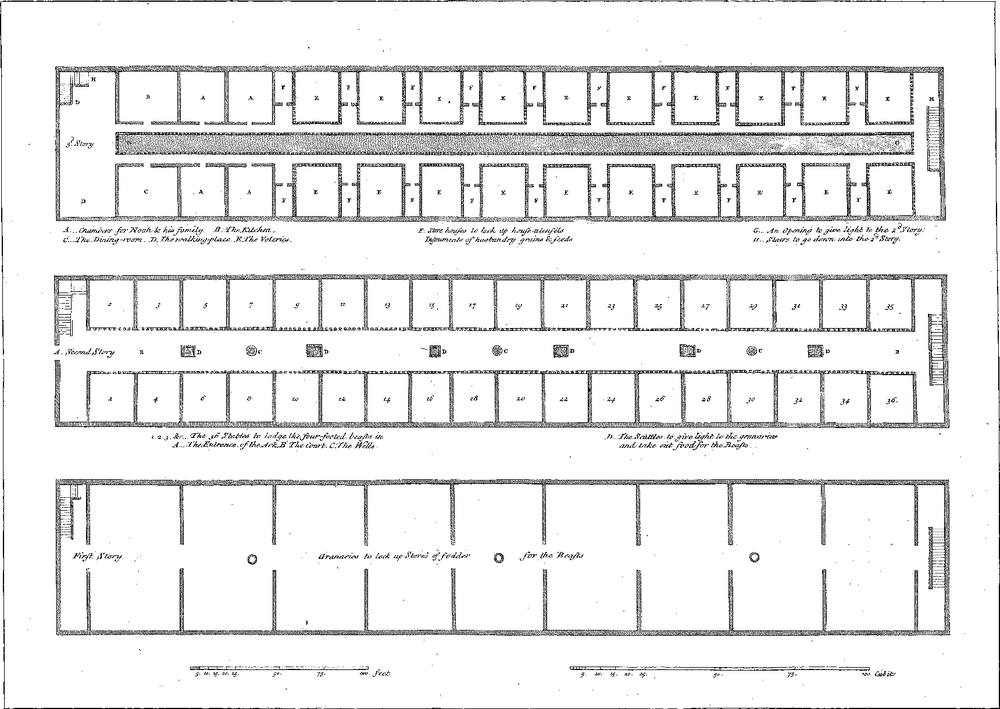
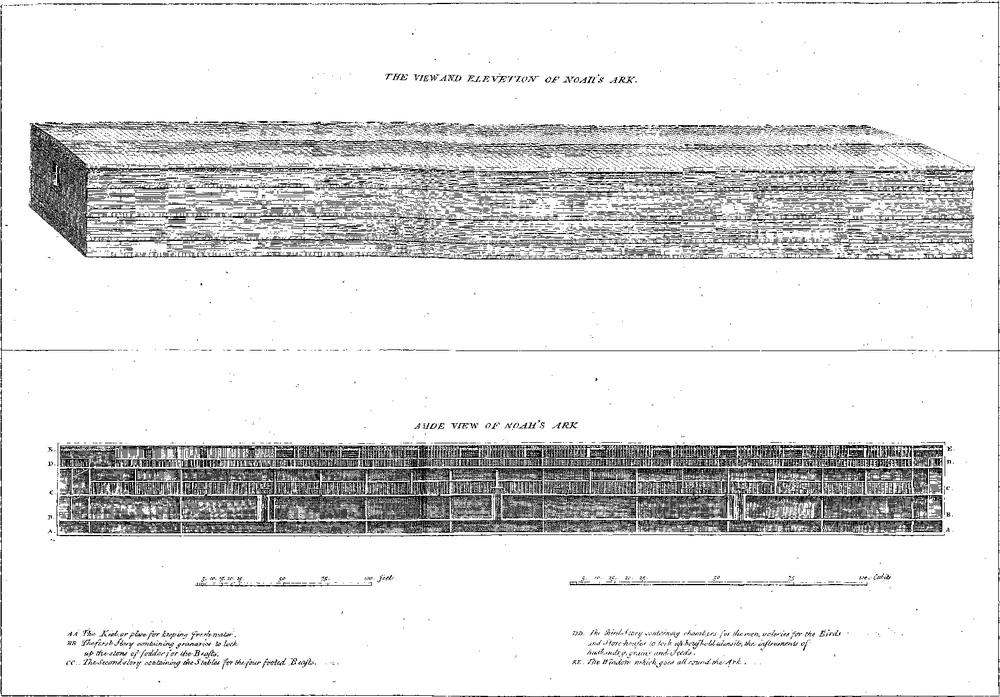
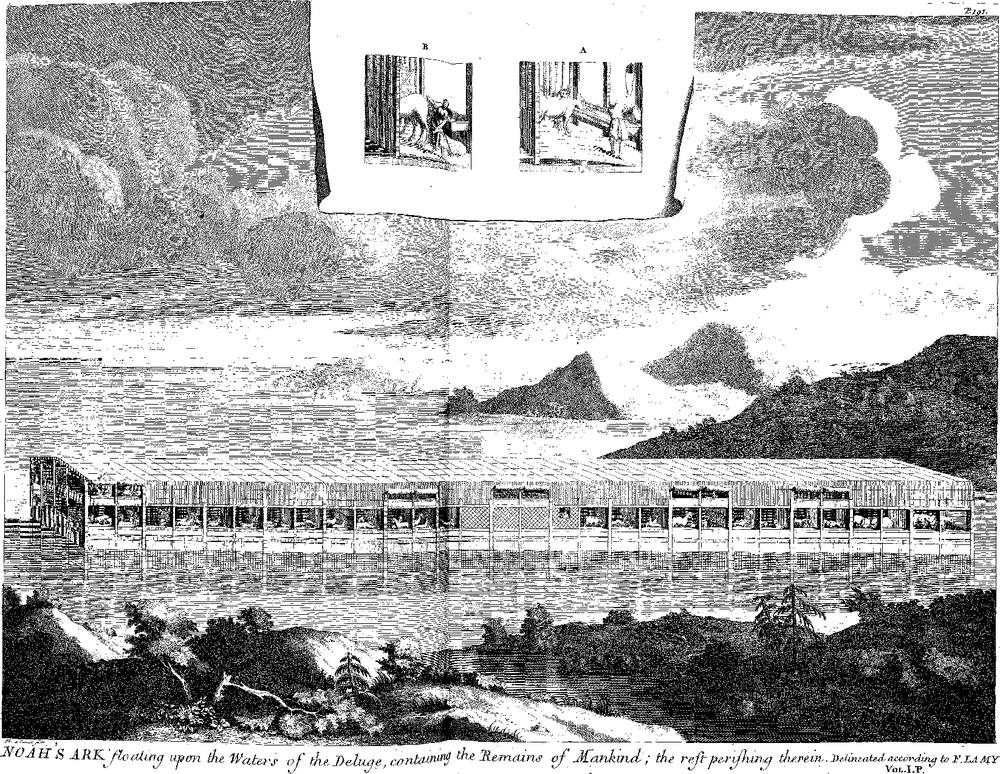
As to Noah’s Ark, there is all the probability in the world, that it was made in the form of these Egyptian boats, but of an infinitely larger size. If we reckon the Hebrew cubit at twenty inches ⁴⁄₉, or almost twenty inches and an half of Paris measure, the outside of Noah’s Ark must be five hundred twelve feet and ¹⁄₉ long, fourscore five feet and ¹⁄₉ wide, and one and fifty feet ¹⁄₉ high; and the whole capacity of the hollow part of the Ark was three hundred fifty seven thousand six hundred cubical Hebrew cubits; and supposing every cubit to be only eighteen inches, its length was four hundred and fifty feet; its width seventy five, and its height forty five feet. Its figure was an oblong square, the covering whereof might have something of a declivity in order to carry off the water that fell upon it. Its length was such that there are few Churches in Europe exceeding it. The height of it might be divided into four Stories, allowing three cubits and an half to the first, seven to the second, eight to the third, and five and an half to the fourth, and leaving the remaining five cubits of the thirty in height for the thickness from top to bottom, and the three bridges or floors of the three last Stories.
The first of these Stories might be the bottom, or what is called the keel of Ships. The second might be used for a granary or magazine. The third might contain the stables; and the fourth places for the fowls. But the keel not being reckoned as a Story, and serving only for a conservatory of fresh water, Moses says, that there were but three Stories in the Ark, and if interpreters set down four, they include the keel. In the stables the four-footed beasts were lodged, and in the voleries, the birds: Some count as many stables as there were sorts of beasts, which is not at all necessary; because there are many kinds of birds and beasts, which use the same food, and may live very well together.
The number of beasts which must have entred into the Ark, is not so great as might be imagined. We do not know above an hundred and thirty species of four -footed beasts; of birds about the same number; and of reptiles at most not above thirty species. We know not of more than six species of beasts larger than an horse. There are very few equal to this creature, and many much less, and which are under the size even of sheep: So that all the four-footed beasts, including three thousand six hundred and fifty sheep, which may be supposed necessary for the nourishment of such animals as live on flesh, take up scarce any more room, than an hundred and twenty oxen, three thousand seven hundred and thirty sheep, and fourscore wolves.
Of birds or fowls few are larger than the swan, and almost all are less.
As for reptiles, or creeping animals, their number is not great. They generally are small. Many of them can live in water, and it might not be necessary to bring them into the Ark.
All the four-footed beasts might have been easily lodged in six and thirty stables; and all the birds in as many voleries, allowing for each stable and volery, five and twenty feet and an half in length, nine and twenty in width, and thirteen and an half in height.
There might be more than thirty one thousand, one hundred and seventy four bushels of fresh water in the keel; which is more than is sufficient for four times as many men and beasts to drink in one year, as were in the Ark.
The granary and magazine, which was in the first Story, might contain more provisions than were necessary for the nourishment of all the animals in the Ark for one year; whether they all lived on hay, fruits and herbs; (which is very probable at this juncture, there being none, which in cases of necessity might not do well enough without flesh;) or whether there were sheep designed for the food of such animals as live on flesh.
Besides the places requisite for the beasts, and birds, and their provisions, Noah might spare room in the third Story for six and thirty cabbins to lock up houshold utensils, the instruments of husbandry, grains and seeds to sow the earth with after the deluge. He might make room in it for a kitchen, a hall, four chambers, and a space of about eight and forty cubits in length to walk in. The Reader may consult M. Le Pelletier’s work upon Noah’s Ark, and that of John Buteo an Englishman on the same Subject; and our Comment upon Genesis vi. 14.
There are several difficulties proposed with relation to Noah’s Ark. For example, one question is, How long time Noah was a building it? Interpreters generally believe, that he was an hundred and twenty years; and this opinion is founded upon the following Gen. vi. 3.words of Genesis, My Spirit shall not always strive with Man; his Days shall be an hundred and twenty years. Some have pretended3, that God in this intended to declare, that there were not But his answer to them was, I shall have my turn, and you will learn, at your expence, who he is that punishes the wicked in this world, and reserves chastisements hereafter for them in the other.
The greatest difficulty which is formed relating to Noah’s Ark, turns principally upon the size and capacity of it; and how they were able to build a Vessel sufficient to contain the Men and Beasts, besides the provisions necessary for the support of both during a whole year. To resolve these difficulties it has been requisite to be very particular in enquiring into the largeness of the Cubit mentioned by Moses, into the number of the Beasts which were admitted into the Ark, and all the dimensions of this vast Building; and after the nicest examination, computations, and taking the dimensions, with all the greatest geometrical exactness, the most learned and accurate Calculators, and most understanding in building Ships4, conclude, that if the ablest Mathematicians had been consulted about regulating the proportions of the several apartments in the Ark, they could not have done it with more exactness than Moses has done; and the narration in the Sacred History of this particular, is so far from furnishing Deists with weapons wherewithal to weaken the authority of the Holy Scriptures, that on the contrary it supplies us with good arguments to confirm it; since it seems as it were impossible for a man in Noah’s time, wherein Navigation was not as yet perfected, by his own wit and invention, to discover such an accuracy and regularity in proportions, as is remarkable in the different apartments of the Ark, and the end for which they were designed. Whence it follows, that it is therefore to be attributed to the inspiration of God, and a supernatural light.
Some have started difficulties with regard to the square and oblong figure of the Ark; but they did not consider that this Vessel was not made for rowing, but for floating only, to be upon the water for some considerable time, and to preserve the several species of Men, Animals and Plants, which were contained in it: besides, it may be proved to them by examples5, that it was not less commodious for rowing than for carrying a great deal. George Hornius, in his history of the several Empires, tells us that in the beginning of the seventeenth Century one Peter Hans, of Horne, had two Ships built after the model and proportions of the Ark, one whereof was an hundred and twenty foot long, twenty wide, and twelve deep. These Vessels had the same fate with Noah’s, they were at first the subject of ridicule and raillery to those who saw them; but experience demonstrated, that they carried a third part more than others, tho’ there was no occasion for a larger Crew, they were better Sailors, and made their way with much more swiftness. All the inconveniency which was found in them was, that they discovered them to be fit only for times of peace, because they were not proper to carry guns.
The number of Men and Animals which were to enter into the Ark, supplies the Criticks plentifully with matter of dispute. As to the number of Men, if we kept to the texts of Moses and St Peter, we shou’d have no contests about it; for Moses expressly Gen. vii. 13. 1 Pet. iii. 20. Gen. vii. 2.says, that Noah went into the Ark, he, his Wife, his three Sons, and their three Wives. And St. Peter tells us, that there were but eight persons saved from the waters of the Deluge. But the mind of Man, which is fruitful in imaginations, and always curious and unquiet, has considerably augmented this number. Some have hereby thought to do God service, supposing eight persons not to be sufficient to supply the wants of so many Animals. Others have imagined, that to affirm eight persons only to have been preserved from the Deluge would be to set too narrow bounds to God’s mercy. Mahomet in the Alcoran says6, that Noah climbing up to the top of the Ark cried out to the incredulous, In the name of God imbark; and while he was saying thus, the Ark moved forward, and stop’d at the invocation of the Lord’s name. God had commanded them to receive as many as should offer themselves, even the Infidels; but foretold that there would be very few. The Mahometan Interpreters believe, that besides the eight persons whom we have mentioned, there were seventy two more who entred, not the Sons only of Noah, but their servants likewise. Of all Noah’s family, his Grandson Canaan, according to the Alcoran, was the only one who refused to go into the Ark; and he was swallowed up by the flood.
Some Rabbins inform us, that a certain King of Basan was preserved from the waters of the Deluge, by getting up on horseback on the top of the Ark. Others affirm, that Philemon, an Egyptian Priest, and his Family, retired thither with Noah. The Babylonian Sybil says, she was saved there, together with her Husband. Mere Fables! It is beyond comparison more difficult to fix the number of Animals, than that of Man. Moses himself helps to perplex us in these words of his7, Of every clean beast thou shalt Mark vi. 7. Ver. 39, 40.take to thee by scores, the male and his female; and of beasts that are not clean, by two, the male and his female. Several questions are raised concerning these words; first, what these clean and unclean Animals were; and secondly, whether fourteen clean and four unclean were put into the Ark, or only seven clean and two unclean. The reading of the Hebrew Text runs thus: Of Beasts thou shalt take seven clean, seven males and females, and of unclean beasts two, (he places two here but once,) male and female. But the Samaritan Text, the Septuagint, and the Vulgate, read two twice; and the Hebrew itself, ver. 9. of chap. vii. reads twice two, duo & duo; which leaves the difficulty in all its force, the text being equally to be construed seven and seven; in like manner as it is said in the Gospel, that our Saviour sent his Disciples two and two; and that he made the Multitude to sit down by companies; and they sat down in ranks, by hundreds, and fifties: that is to say, they sat down in distinct ranks of an hundred, and of fifty; and they went away two and two, not four and four.
This opinion is followed by Josephus the Historian8, by several of the Fathers9, and by almost all the Commentators. But the contrary opinion is not without defenders, and the original Text may favour them. It may signify, Thou shalt introduce them into the Ark, fourteen clean beasts, or seven pair; and if they are unclean two pair; or only one pair two and two. Origen10, the Author of Questions to the Orthodox, under the name of Justin11, Abenezra, Dionysius the Carthaginian, Oleaster, and some others, have followed this last opinion.
But what are we to understand here by the name of clean and unclean beasts? The distinction declared by Moses in the Law between Animals whereof there was a permission to eat, and those the use whereof was unlawful, was this distinction known and practised before the Deluge, or did Moses here mention it in the way of anticipation? It is probable that this distinction was not unknown to Noah, since God, without explaining himself farther, commands him to take a greater number of pure than of impure Animals; and that the same Animals were pure and impure, with regard both to Noah and the Jews, since Moses makes no difference. Now it is manifest, that by pure Animals in general, those only were meant which might be offered up in sacrifice, as Bulls, Sheep, Goats, and the several species of them; and some sorts of Birds, such as Pigeons, Turtles, Hens and Sparrows. For the common uses of life Moses allows of a greater number of Animals; but I question whether in the place which we are examining we are to extend the name of pure Animals beyond those which were sacrificed. The couple of unclean Beasts could be meant only of one male and one female; but the seven clean Beasts might be two males, and five females; one of the males was reserved for the Sacrifice, and the other for the multiplication of the species.
Aran, Arca.We have explained our selves above, with relation to the place where the Ark settled, in the Articles ARARAT, and APAMEA of Phrygia.
Read this article in its place on the printed pages
Footnotes
-
חבתThebat. Arca. Græc. Κιβωτὸς or Λάρναξ a Coffer. ↩
-
See Herodot. l. ii. Diodor. l. i. Plin. l. vii. c. 56. & lib. xiii. c. 11. Genes. Aug. l. xv. de Civit. c. 24. Hieronym. l. de qu. Heb. ↩
-
Chrysost. Homil. xxii. in ↩
-
Wilkins Bishop of Chester’s Essay towards a real Character, Part II. c. 5. p. 162. Saurin Discours Histori. &c. T. 1. p. 87, 88. ↩
-
Le Pelletier Dissert. sur l’Arche de Noe. c. 2. p. 29, 30. ↩
-
Bibl. Orient. p. 676. col. 2. ↩
-
תקח לך שבעה שבעה איש ואשתו … אשר לא טהורה הוא שנים איש ואשתו 70. Ἑπτὰ ἑπτὰ ἄρσεν καὶ θῆλυ … δύο δύο ἄρσεν καὶ θῆλυ. ↩
-
Joseph. Antiq. l. i. c. 3. ↩
-
Chrysost. Hom. 24. in Genes. Theodor. qu. 50. in Gen. Hi- eron. l. i. contra Jovinian. Aug. de Civit. l. xv. c. 27, &c. ↩
-
Origen. l. iv. contra Cels. ↩
-
Justin. Martyr. q. 43. ad orthodox. ↩