Volume II, pages 587–605 of the 1732 edition, from SAL to SAM: everything printed on these pages, in order.
Continued from Salt
2 Kings ii. 21.a new Vessel to be brought to him, and some Salt to be put therein. They follow’d his Orders: He threw this Salt into the Spring, and said; Thus saith the Lord, I have healed these Waters; and for the future they shall not be the Occasion either of Death or Barrenness. And in Reality, the Waters became good for Drinking, and lost all their former bad Qualities. Naturally the Salt must only have served to increase the Brackishness or Bitterness of this Fountain; but the Prophet purposely made use of a Remedy that seem’d contrary to the Effect he would produce, that the Miracle might become the more evident.
Ecclus. xxxix. 31.The Wiseman reckons up Salt in the Number of those Things that are most necessary for Life; as Water, Fire, Iron, Milk, Honey, Grapes, Oil, and Cloaths. Job asks if any one could eat that which is Job vi. 6.not salted: Aut poterit comedi in sulsum, quod non est sale conditum?
The Valley of Salt was situate in Idumea. See VALLEY.
II. The Salt of the Earth, is, probably, Marl, with which they manure their Land in some Countries, instead of Dung. See our Commentary upon Matth. v. 13.
III. Mineral Salt, or Salt that is dug out of Mines, in Form of a hard Stone. ‘Tis thought that Lot’s Wife was changed into Gen. xix. 26.a Statue of such Mineral Salt, that she became as a Rock or Stone of Salt.
IV. Salt is the Symbol of Wisdom: Let Col. iv. 6.your Speech be always with Grace, seasoned with Salt, says St. Paul. And our Saviour Mark ix. 50.says, Have Salt in your selves, and have Peace one with another.
V. Salt is the Symbol of Perpetuity and Incorruption. Thus they said of a Numbers xviii. 19.Covenant, It is a Covenant of Salt for ever, before the Lord. And elsewhere, The 2 Chron. xiii. 5.Lord God of Israel gave the Kingdom over Israel to David for ever, even to him and to his Sons, by a Covenant of Salt.
VI. Salt is the Symbol also of Barrenness and Sterility. When Abimelech took Judg. ix. 45.the City of Shechem, he destroy’d it, and sow’d the Place with Salt, that it might always remain desart and unfruitful. ZephaniahZeph. ii. 9. threatens the Ammonites and Moabites, from the Lord; Moab shall be as Sodom, and the Children of Ammon as Gomorrha, even the breeding of Nettles, and Salt-pits, and a perpetual Desolation. See also Job xxxiv. 6. Psal. cvi. 34. Jer. xvii. 6.
VII. Salt is likewise the Symbol of Hospitality, and of that Fidelity that is due from Servants, Friends, Guests, and Domesticks, to those that entertain them and receive them at their Tables. The Go vernors of the Provinces beyond the Euphrates, writing to King Artaxerxes, tell Ezr. iv. 14.him, Because we have Maintenance from the King’s Palace, &c. which, in the Chaldee, is, Because we are salted with the Salt of the Palace.
Gen. xiv. 3. Numb. xxxiv. 12.The Salt-sea: This is the Dead-sea, or the Lake Asphaltites. The Scripture and profane Writers sometimes give the Name of Salt to Asphaltus or Bitumen; whence it is that Moses, speaking of a burning or Deut. xxix. 23. Vulg.parching Salt, Salis ardore consumentur, means Asphaltus, Bitumen, or Pitch. Herodotus also makes mention of certain Lamps that were lighted up in Egypt, in which were put Salt, that is, Bitumen, or such-like combustible Matter.
Psal. lx. Tit.The Valley of Salt. Interpreters generally place it to the South of Mare Mortuum, towards Idumea; because it is said in 2 Samuel viii. 13. 1 Chron. xviii. 12.Scripture, that Abishai kill’d there eighteen thousand Idumeans; that Joab kill’d there twelve thousand of them; and that a long while after this, Amaziah King of 2 Kings xiv. 7. 2 Chron. xxv. 11.Judah kill’d ten thousand Idumeans. Galen informs us,1 that they made use of the Salt of the Lake Asphaltites to season their Meat; and that it was a stronger Caustic, and digested much more, than the other Salts; because (says he) it is more 1 Macc. xi. 35. & x. 29.boiled. We see also by the Maccabees, that the Kings of Syria had Brine-pits in Judea. Ezekiel, ch. xlvii. 11. says, that the Shores and Marshes on the Dead-sea should be assigned for the Making of Salt. Mr. Halifax, in his Account of Palmyra, speaks of a great Plain all cover’d with Salt, from whence the whole Country round about is supply’d. This Plain is about a League from Palmyra, and extends itself towards the Eastern Parts of Idumea, the capital City of which was Bozra. David beat the Idumeans in the Valley of Salt, as he return’d from Syria of Zobah. It is very probable, that this Plain of Salt, is the Valley of Salt mention’d in Scripture.
SALTUS. This Word signifies a Forest. We read in the Books of Samuel and the 2 Sam. xxi. 19. 1 Chron. xx. 5. Vulgat.Chronicles, of the Name Adeodatus filius Saltûs Polymitarius Beth-lehemites; but the Hebrew is, Elhanan the Son of Jaare- Oregim a Beth-lehemite2. This Elhanan is probably the same mention’d in 2 Sam. xxiii. 24. Elhanan the Son of Dodo of Bethlehem3. This Elhanan was one of the valiant Men of David’s Army.
1 Macc. ii. 26.SALU, or Salomi, Father of Zimri, of the Tribe of Simeon. Numb. xxv. 14. Zimri was kill’d by Phinehas, in the Abomination of Peor. The First Book of Maccabees calls him Salom.
SALUMIAS, or Salomias, a Village in the Country about Scythopolis4. This is the same as Salem, where, St. Jerom says, were to be seen the Ruins of the Palace of Melchisedech. See SALEM.
SALUS, Salvation. This Word is taken in several Senses in the Scripture:
I. For eternal Happiness and Salvation hereafter, which is the Object of our Hopes Luke i. 77. Eph. i. 33.and Desires. Thus it is said; To give Knowledge of Salvation to his People. The Gospel of your Salvation. Godly Sorrow 2 Cor. vii. 10.worketh Repentance to Salvation; that is, which leads to eternal Life.
Gen. xlii. 15, 16. Vulgat. Gen. xlvii. 25.II. Salus is put for Life. Per salutem Pharaonis; By the Life of Pharaoh. Salus nostra in manu tua est; Our Life is in your Hands. Per salutem tuam, & per salutem animæ tuæ, &c.
1 Reg. xi. 9. Vulg. 1 Sam. xiv. 45.III. For Deliverance, or Victory. Cras erit vobis salus, cùm incaluerit Sol; You shall be relieved To-morrow, after the Rising 4 Reg. xiii. 17.of the Sun. Shall Jonathan die, who hath wrought this great Salvation in Israel? Qui fecit Salutem hanc magnam in Israel? Sagitta salutis Domini contra Syriam; The Arrow of Victory, or Deliverance.
IV. Salvation, is put for the Praise and Rev. xix. 1.Benediction that is given to God. Alleluiah, Salvation, and Glory, and Honour, and Rev. vii. 10.Power unto the Lord our God. Salvation to our God which sitteth upon the Throne, and unto the Lamb.
Lastly, Salus is put for that Salutation that we give to such Persons as we salute, or to whom we write; a Salutation of Civility James i. 1.and Friendship: To the twelve Tribes that are scattered abroad, greeting, or Health. 1 Macc. x. 18.King Alexander to his Brother Jonathan sendeth greeting, or wisheth Health.
The Hebrews but rarely make use of concrete Terms, as they are call’d, but often of abstracted. Thus, instead of saying, that God saves them, and protects them; they say, that God is their Salvation. Thus, Vox salutis, gaudium salutis, rupes salutis, scutum salutis, sagitta salutis, veritas salutis, cornu salutis, verbum salutis, arx salutis, &c. is as much as to say, a Voice declaring Deliverance; the Joy that attends the escaping a great Danger; a Rock where any one takes Refuge, and where he may be in Safety from his Enemy; a Buckler that secures them from the Arms of the Enemy; an Arrow that procures Safety and Liberty to a whole People; a Truth that saves us; a Horn or Ray of Glory, of Happiness, and Salvation; the Glory that attends those who have escaped out of some great Danger, &c. Thus, Facere salutem magnam in Israel, signifies, to deliver the Israelites from some imminent Danger; to obtain a great Victory over their Enemies. Fieri, or, esse in salutem, is, to save, to protect any one. Ps. cv. 4. Ps. cxlix. 4. Ps. xlii. 5. Ps. xliii. 5.Magnificans salutes Regis, to bring a very powerful Succour to the King. Visita nos in salutari tuo; Visit us and save us. Exaltabit mansuetos in salutem; He will replenish them with Glory, and bring them out of Danger. Salutare vultus mei; The Salvation of the Face of the Lord; that is, the Favour he does us, in beholding us with a kind Aspect, or, in shewing us a merciful Countenance; or rather, the Salvation of my Face, the Salvation which is before me, in which I hope, which I wait for. Qui mandas salutes Jacob; Who commandest with Authority, and says, Let Jacob be safe, thou who savest him, and powerfully protectest him. Longè à salute meâ verba delictorum meorum5; My Sins cry against me, and prevent my Salvation. The Hebrew says, Thou art far from my Salvation, and from the Words of my Crying; Thou refusest to succour me, and to Prov. vii. 14. Vid. & 2 Macc. iii. 32. Isai. lxi. 10. Jer. xxxix. 18. & xlv. 5. Ps. xxxii. 17. Wisd. vii. 10.deliver me, or even to hear me.
A Victim or Sacrifice for Salvation; Victimas pro salute vovi. These were pacifick Sacrifices offered to God, either to return him Thanks for his Benefits, or to ask Favours, Protection, or Assistance from him. Fallax equus ad salutem; ‘Tis in vain that you put your Confidence in Horses; they cannot save you from Danger, without the Assistance of God. I preferr’d Wisdom before Safety or Beauty: Super salutem & speciem dilexi eam: Before Life, Health, and Beauty. Divitiæ salutis, sapientia & scientia; The Treasures of Salvation; or, according to the Hebrew, the Strength of Safeties, Wisdom and Knowledge, shall adorn the Kingdom of the Messiah. He shall save, protect, defend, and deliver his Elect, by his infinite Power. He shall enrich them with the Gifts of Wisdom and Knowledge.
The Lord hath cloathed me with the Garments of Salvation; Induit me vestimentis salutis, & indumento justitiæ. These Garments of Salvation, may signify the Habits of Joy and Festivity, which were wore on Festival Days, and after the receiving any signal Favour from God, after a Deliverance from any great Danger. Erit tibi anima tua in salutem. The Hebrew says literally, Erit tibi anima tua in spolium; You shall escape Danger, and you shall save your Life, but not without Danger: Your Life shall be saved, but as a Part of the Prey is rescued; or, it shall be your Part of the Booty. Happy that you are deliver’d, even upon these Terms! You shall lose every thing else but your Life. Ezekiel says,6 Aquâ non est lota in salutem.
Salutem. He speaks of a new-born Child, that had not been wash’d, nor salted, and whose Navel-string had not been cut. Probably, they imagined this contributed to Health, ad Salutem. The Hebrew reads; You have not been wash’d with Water, for solacing, for refreshing, and cleaning you.
SAMAEL. This is the Name that the Rabboth. in Deuter. cap. ult. fol. 302.Rabbins, in their mystical Commentaries upon the Pentateuch, give to the Prince of the Devils, who expected, with great Impatience, the Hour of Moses’s Departure, that he might seize him, and carry him to the Place where the Dead are detained. But St. Michael reproved him, and said to him; O Wretch! shouldst thou be joyful, while I shed Tears? He quotes to him that Passage of Micah; Rejoyce not against me, O mine Enemy: When I fall, I shall arise; when I sit in Darkness, the Lord shall be a Light unto me. He added; I fell when Moses died; but I rose again when Joshua succeeded him, and led the Hebrews into the Land of Promise. See SAMMAEL.
SAMARIA, the capital City of the Kingdom of Samaria, or of the Ten Tribes. It was built by Omri King of Israel, who began to reign in the Year of the World 3079, 1 Kings xvi. 24.and died in 3086. He bought the Hill Samaria of Shemer, or Shomeron, for two Talents of Silver, or for the Sum of Six hundred eighty four Pounds, seven Shillings and six Pence. It took the Name of Samaria, from Shemer the Owner of the Hill; tho’ some think there were already some Beginnings of a City, because before the Reign of Omri there is mention made of Samaria7. But others take this for a Prolepsis, or an Anticipation, in the Discourse of the Man of God, who speaks of Samaria under the Reign of Jeroboam.
However this be, it is certain that Samaria was no considerable Place, and did not become the capital City of the Kingdom of Israel ‘till after the Reign of Omri. Before him, the Kings of Israel dwelt at Shechem, or at Tirzah. Samaria was situated upon an agreeable Euseb. in Dothaim. Merro, & Atharo.and fruitful Hill, had an advantageous Situation, and was twelve Miles from Dothaim, twelve from Merrom, and four Jos. Antiq. l. 15. c. 11.from Atharoth. Josephus says, it was a Day’s Journey from Jerusalem. Besides, tho’ it was built upon an Eminence, yet it must have Water in abundance; since we find Medals struck in this City, whereon is represented the Goddess Astarta, treading a River under Foot; which proves it to have been well watered. And Josephus observes, that when it Jos. Antiq. l. 13. c. 18.was taken by John Hyrcanus the Prince of the Jews, he entirely demolish’d it, and caused even the Brook to flow over its Ruins, to obliterate all the Footsteps of it.
The Kings of Samaria omitted nothing to make this City the strongest, the finest, and the richest that was possible. Ahab built 1 Kings xxii. 39.there a Palace of Ivory, that is, in which there were many Ornaments of Ivory. Amos describes Samaria, under Jeroboam II. as a City sunk into all Excesses of Luxury and Amos iii. 15. & iv. 1, 2.Effeminacy: I will smite (says he) the Winter-house with the Summer-house, and the Houses of Ivory shall perish, and the great Houses shall have an end, says the Lord. Hear this Word, ye Kine of Bashan, that are in the Mountain of Samaria, which oppress the Poor, which crush the Needy; which say to their Masters, Bring, and let us drink, Mic. vii. 8.&c.
Ben-hadad King of Syria built Publick 1 Kings xx. 34.Places or Streets in Samaria, probably, for Traffick, where his People dwelt, to promote Trade. His Son Ben-hadad besieged 1 Kings xx. 1, 2, 3. &c.this Place, under the Reign of Ahab, in the Year of the World 3103, before Christ 897, before the Vulgar Era 901.
He came at the Head of thirty-two 1 Kings xx. 1, 2, 3, &c.Kings, with a numerous Army, to lay Siege to Samaria. First of all, Ben-hadad sent Ambassadors to the King of Israel, to demand his Treasures, his Wives and Children, and whatever was dearest to him. Ahab finding himself too weak to oppose him, consented to all that was proposed to him. But the Ambassadors returning, insisted upon having whatever they should find, that they liked, in the Houses of his Subjects also. Then Ahab call’d all the Elders of his People together, and acquainted them, That the King of Syria laid Snares for them; That he had surrender’d whatever belong’d to himself; but, not content with that, he demanded all that belong’d to them likewise. All the Elders reply’d, That they exhorted him, not to hearken to these Proposals, nor to submit to such unjust Demands. Ahab then sent back the Messengers, and told them; I will deliver up to you all that belongs to me, to buy a Peace, but I cannot give up the Goods that belong to my Subjects. Ben-hadad being provoked at this Answer of the King of Israel, sent Messengers to threaten him, and gave Orders forthwith to besiege the City.
Then there came a Prophet to Ahab, and encourag’d him from the Lord, saying, Thus 1 Kings xx. 13, &c.saith the Lord, Hast thou seen all this great Multitude? Behold, I will deliver it into thine Hand this Day, and thou shalt know that I am the Lord. And Ahab said, By whom? And he said, Thus saith the Lord, Even by the young Men of
the Princes of the Provinces. Then he said, Who shall order the Battle ? And he answered, Thou.
The King of Israel then made a Review of those young Men of the Princes, and found their Number to be Two hundred and thirty-two. Then he made a Review of all his People, and of the whole Army of the Children of Israel, and found them to the Number of Seven thousand. They made a Sally about Noon, while Ben-hadad was diverting himself in his Tent, eating and drinking with the thirty-two Kings that attended him in this Expedition. The young Men of the Princes marched at the Head of the Army of Israel. When Ben-hadad was informed, that some People were coming out of Samaria, he gave Orders, That whether they came to Fight, or to ask for Terms of Peace, they should be taken alive. The little Army of Israel came on, and every one began to kill all that came in their way. When the Syrians found themselves without any Leader at their Head, they presently gave ground, and began to fly. The Army of Israel pursued them briskly, and Ben-hadad was forced to take to his Horse, to save himself, and the other Kings also that were with him.
Observations upon the Investiture of Samaria, by Benhadad, and upon the Routing of his Army by the young Men of the Princes of Israel. 1 Kings xx.I thought I ought rather to make use of the Term Investing, than that of Siege, in this Attempt of Ben-hadad King of Syria, upon the City of Samaria. This Prince marched thither, in the Company of thirty-two Kings, or petty Princes, with an Intention of laying Siege to it, with a vast Preparation of Machines of War, and a very numerous Army; which made him speak very big, and conceive a great Assurance of Success. He encamped before the Place, and sent to summons Ahab King of Israel to surrender. The Conditions that Ben-hadad offered him by his Ambassadors, were such as were commonly granted to Cities taken by Storm, or upon the Point of being so. As if he had imagin’d, that a People secured within strong Walls, with their Arms in their Hands, their King at their Head, their Religion and Liberty to maintain, would be so cowardly as to surrender, upon such hard Conditions. This is what the King of Syria sends them Word by his Ambassadors; Thy Silver and thy Gold is mine, thy Wives also and thy Children, even the goodliest, are mine. We find, that Ahab paid an extraordinary Submission to these haughty Commands; and never any Vassal shewed a greater. He does not look upon himself as his Vassal and Tributary only; but, in his Answer to the Messengers of Ben-hadad, he seems to acknowledge, that himself and his whole People are of the Number of his Slaves. Without doubt, he must be terrify’d at the immense Number of the Syrian Troops; and he must think himself but little secure in the Place he was in, tho’ he had near eight thousand Men of disciplin’d Troops. What does Ahab answer then to these Proposals? My Lord, O King, according to thy Saying, I am thine, and all that I have. Probably, he must mean, all that he had of his own, and what he could properly dispose of, and not what belong’d to his People, which he could not pretend to give away. No doubt but that Ben-hadad intended that this should be included also, and therefore he sent his Ambassadors back again, to acquaint him, Yet I will send my Servants unto thee to-morrow about this time, and they shall search thine House, and the Houses of thy Servants; and it shall be, that whatsoever is pleasant in thine Eyes, they shall put it in their Hand, and take it away. There is a great Difference, as the learned Commentator observes, between what was intended by Ahab, and what was claim’d by the King of Syria. The latter pretended absolutely to dispose of all the Goods, the Persons, and the Subjects belonging to the King of Israel, who only submitted, in Hopes to obtain moderate Terms, and that he might only be obliged to pay a Tribute, or to purchase Peace, and to ransom the Pillaging of the City. But when he saw that Ben-hadad’s Designs were not only upon the Possessions, but the Liberty also of his People, he call’d his Elders together, and asked their Opinions. They all unanimously answered, Hearken not unto him, nor consent. Wherefore the King return’d this Answer to the Ambassadors; I consented to your first Proposals; but as to your last, tell the King my Lord, that I cannot comply with them: Hanc autem rem facere non possum.
At this Refusal of the King of Israel, the Ambassadors withdrew, and made their Report to Ben-hadad, who sent them back with bitter Menaces, to intimidate Ahab and his Subjects; and to raise in them an high Idea of his Power and Strength. This is what he makes them say; The Gods do so unto me, and more also, if the Dust of Samaria shall suffice for Handfuls for all the People that follow me. This Hyperbole may surprize the Reader; yet I should not wonder, if the term pulvis Samariæ expresses the Force of the Original. But F. Calmet is of Opinion, that the Chaldee has much greater Force. All the Soil of the Country will not suffice for my People, if every one of ‘em only takes away so much of it as will stick to his Shoes. This exceeds the most extravagant Gasconnade. Ahab’s Answer is very good, and retrenches much of that unmeasurable Pride. Let not him that girdeth on his Harness boast himself, as he that putteth it off.
Ben-hadad received this Answer as he was drinking in the Shade, probably under an Arbor, with the other Kings. He immediately gave Orders to his People, that they should surround the City, which they did. Ahab’s Answer had so nettled him, that he resolved to carry on the Siege in Form; for which Purpose he invested the City on all Sides, and even drew a Line of Circumvallation, to hinder any from going in, or coming out.
At the same time there came a Prophet to encourage the King of Israel, who brings this Message from the Lord: I will confound the Pride of Benhadad, and of all the Kings that are with him. Hast thou seen all this great Multitude? Behold, I will deliver it into thine Hand this Day, and thou shalt know that I am the Lord. Even by the young Men of the Princes of the Provinces, shall this formidable Army be put to Confusion, that thou may’st know that I am the Lord. It is probable, as Father Calmet says, that these young Men of the Princes of the Provinces were Pages or young Gentlemen, bred up at the King’s Court, who made a Review of them, and found them to be two hundred and thirty-two. And then reviewing the People, he found them to be seven thousand of the Children of Israel.
They went out of the City about Noon; while Ben-hadad was drinking in his Tent, and perhaps drunk, with the thirty-two Kings that were come to his Assistance. What can be expected from a General, and a King that is drunk, and from thirty-two others that were guilty of the same Excess? One may easily conceive what thirty-three Drunkards could do on such an Occasion, who were fitter to lie down and sleep, than to set themselves at the Head of an Army.
The young Men of the Princes of the Provinces march’d forth at the Head of the Army; and Ben-hadad sending out to know who they were, he was told, that they were People coming forth from Samaria. He then gave Orders, that whether they came to sue for Peace, or to try the Event of War, they should all be secured alive. It was not easy to seize a whole Embassy of seven thousand, two hundred and thirty-two Men, who came against an Army without Generals, divided into several Bodies round the City, and of which there were hardly one perhaps in his right Senses and Judgment; for, in Imitation of their Commanders, they might probably have been tippling too. In the mean time the young Men of the Princes advanced, and the rest of the Army after them. That is to say, the small Body compos’d of those young Men, form’d, as it were, an Avant-guard, and first attack’d the Syrian Troops, who presented themselves in order to seize them; but they were repulsed, and driven back into their Camp. The main Body of the Israelitish Army follow’d close after, and attack’d and cut in Pieces all they met in their March, spread Terror and Confusion into the Army of Ben-hadad, who had but just Time enough to take to his Horse, and to fly with the other Kings that accompany’d him.
I marshal the Army of Israel in two Bodies, the Foot in the Center, and the Horse in the Wings. For in the Battle of Aphek, which is mention’d presently after, the sacred Author says, The Children of Israel 1 Kings xx. 27.pitched before them, like two little Flocks of Kids; but the Syrians fill’d the Country; that is to say, they were divided into two Bodies, and made, as it were, two little Armies. Joab, the General of David’s Army, thus divided his Forces into two Bodies in that Battle wherein he defeated the Syrians and the Ammonites. 2 Sam. x. 9, 10.As to the Cavalry, I presume they had some, because they pursued the Syrians, who abounded in Forces of this Kind.
What is very remarkable, and yet very common, is, that the King of Syria’s Flatterers would ascribe the Shame of their Defeat, not to the Pride and Drunkenness of their King, and of the other Kings; but to the Interposition of the Gods of the Jews: Their Gods are Gods of the Hills, say they, therefore they were stronger than we; but let us fight against them in the Plain, and surely we shall be stronger than they. This is the Manner in which the Defects of great Men are palliated, when they commit any Blunders; ‘tis not their want of Conduct that is blamed, but their evil Fortune, which deprived them of Victory. Therefore these Flatterers advise Ben-hadad to send away all his Kings, and to put good Officers in their Place, to reinforce all his Army with the same Number of Soldiers, Horses, and Chariots which he had lost. But they did not advise him to dismiss that Pride that swell’d his Heart, that Inclination to Drunkenness, and all his other Vices. Wherefore the Lord deliver’d up his Army into the Hands of the Children of Israel, who cut them to Pieces, and by that gave them to understand, that he was the Almighty Lord, the God of the Plains, as well as of the Hills.
1 Kings xx. 26, 27.The following Year Ben-hadad brought an Army into the Field, probably, with a Design to march against Samaria; but his Army was again cut in Pieces. Some Years after this, a Ben-hadad came again, and lay down before Samaria, and reduced8
it to such Necessities by Famine, that a Mother was there forced to eat her own Child; but the City was relieved by a sensible Effect of the Protection of God. Lastly, it was besieged by Shalmaneser, King of 2 Kings xvii. 6, 7, &c.Assyria, in the ninth Year of Hoshea King of Israel, which was the fourth of Hezekiah, King of Judah, and the 3280th of the World. It was taken three Years after, in the Year of the World 3283, before Christ 720, before the vulgar Era 724. The Prophet Hosea speaks of the Cruelties exercised Hos. x. 4, 8, 9. xiv. 1. Mic. i. 6.by Shalmaneser against the Besieged; and Micah says, that this City was reduced to a Heap of Stones. The Cuthites that were sent by Esar-haddon to inhabit the Country of Samaria, did not think it worth their while to repair the Ruins of this City; they dwelt at Shechem, which they made the capital City of their State9. They were still upon this footing, when Alexander the Great came into Phenicia and Judea10.
However, the Cuthites had rebuilt some of the Houses of Samaria, even from the Time of the Return from the Captivity, Ezr. iv. 17. Nehem. iv. 2.since Ezra then speaks of the Inhabitants of Samaria; and that the Samaritans being jealous of the Favours that Alexander the Great had conferr’d on the Jews, revolted from him while this Prince was in Egypt, and burnt Andromachus alive, whom this Q. Curt. l. 4. c. 21.Prince had left Governor of Syria. Alexander marches against them, took Samaria, and put in Macedonians to inhabit it11, giving the Country round about it to the Jews, and to encourage them to cultivate it, he granted them an Exemption from Tribute.12 The Kings of Egypt and Syria, who succeeded Alexander, deprived them of the Property of this Country.
But Alexander Balas King of Syria, restored to Jonathan Maccabæus the Cities of Lydda, Ephrem, and Ramatha, which he cut off from the Country of Samaria13. Lastly, the Jews re-enter’d into the full Possession of this whole Country under Johannes Hyrcanus the Asmonean, who took Samaria, and ruin’d it in such a manner, according to Josephus14, that he made the River run through its Ruins. It continued in this Condition to the Year of the World 3947, when Aulus Gabinius, the Proconsul of Syria, rebuilt it, and gave it the Name of Gabiniana.15 But it was yet but very inconsiderable, till Herod the Great restor’d it to its antient Lustre, and gave it the Greek Name of Sebaste, which in Latin is Augusta, in Honour of the Emperor Augustus, who had given him the Propriety of this Place16.
The sacred Authors of the New Testament speak but little of Samaria; and when they do mention it, ‘tis rather in respect of the Country about it, than of the City itself. Luk. xvii. 11. John iv. 4.For Example, when it is said, He passed through the midst of Samaria; the Meaning is, he pass’d through the midst of the Country about Samaria. And again, John iv. 5.Then cometh he to a City of Samaria which is called Sychar. ‘Twas there where he had the Conversation with the Woman of Samaria, that is, with a Samaritan Woman of the City of Sychar. After the Death of Acts viii. 1, 2, 3.St. Stephen, when the Disciples were dispersed through the Cities of Judea and Samaria, St. Philip the Deacon withdrew into the City of Samaria, where he made several Converts. When the Apostles heard that this City had received the Word of God, they sent Peter and John thither, to communicate the Holy Ghost to such as had been baptized. ‘Twas there they found Simon Magus, who offer’d Money to the Apostles, being in hopes to buy this Power of communicating the Holy Ghost. Samaria is never call’d Sabaste in the Books of the New Testament, tho’ Strangers hardly knew it but by this Name. St. Jerome says,17 that it was thought Obadiah was buried at Samaria. They also shew’d there the Tombs of Elisha and of St. John the Baptist18. There are found many antient Medals that were struck at Sabaste or Samaria, and some Bishops of this City have subscribed to the antient Councils.
Kings of Samaria. See the Article KINGS.
SAMARITANS. We have already spoken of the Samaritans, under the Title Cuthites. The Samaritans are the People of the City of Samaria, and the Inhabitants of the Province, of which Samaria was the capital City. In this Sense it should seem, that we might give the Name of Samaritans to the Israelites of the ten Tribes, who lived in the City and Territory of Samaria. However, the sacred Authors commonly give the Name of Samaritans only to those strange People, whom the Kings of Assyria sent from beyond the Euphrates, to inhabit the Kingdom of Samaria, when they took away Captive the Israelites that were there before. Thus we may fix the Epoch of the Samaritans at the taking of Samaria by Shalmaneser, in the Year of the World 3283. This Prince carry’d away Captive the Israelites that he found in the Country, and assign’d them Dwellings beyond the Euphrates, and in Assyria. He sent other 2 Kings xvii. 24.Inhabitants in their stead, of which the
most considerable were the Cuthites, a People descended from Cush, and who are probably of the Number of those, whom the Antients knew by the Name of Scythians.
After Shalmaneser, his Successor Esar-haddon being inform’d, that the People which had been sent to Samaria, were infested by Lyons that devoured them; a this he imputed to the Ignorance of the People in the Manner of worshipping the God of the Country. Wherefore Esar-haddon sent a Priest of the God of Israel, that he might teach them the Religion of the Hebrews. But they thought they might blend this Religion with that they profess’d before; so they continued to worship their Idols as before, in Conjunction with the God of Israel, not perceiving how absurd and incompatible these two Religions were.
Esr. iv. 1, 2, 3.‘Tis not known how long they continued in this State; but at the Return from the Captivity of Babylon, it appears they had intirely quitted the Worship of their Idols; and when they ask’d Permission of the Israelites, that they might labour with them at the rebuilding of the Temple of Jerusalem,19 they affirm’d, that from the Time that Esar-haddon had brought them into this Country, they had always worshipp’d the Lord. And indeed after the Return from the Captivity, the Scripture does not any where reproach them with idolatrous Worship, tho’ it does not dissemble either their Jealousy against the Jews, nor the ill Offices they had done them at the Court of Persia, by their Slanders and Calumnies, or the Stratagems they contrived to hinder the repairing of the Walls of Jerusalem20.
It does not appear there was any Temple in Samaria, in common to all these People who came thither from beyond the Euphrates, before the coming of Alexander the Great into Judea. Before that Time every one was left to his own Discretion, and worshipp’d the Lord where he thought fit. But they presently comprehended, from the Books of Moses which they had in their Hands, and from the Example of the Jews their Neighbours, that God was to be worshipp’d in that Place only which he had chosen. So that since they could not go to the Temple of Jerusalem, which the Jews would not allow of, they bethought themselves of building a Temple of their own upon Mount Gerizim, near the City of Shechem, which was then their Capital. Therefore Sanballat the Governor of the Samaritans, apply’d himself to Alexander,21 and told him he had a Son-in-law, call’d Manasses, Son to Jaddus the High-priest of the Jews, who had retired to Samaria with a great Number of other Persons of his own Nation; that he desir’d to build a Temple in his Province, where he might exercise the High-priesthood; that this Undertaking would be to the Advantage of the King’s Affairs, because in building a Temple in the Province of Samaria, the Nation of the Jews would be divided, who are a turbulent and seditious People, and by such a Division would be made weaker, and less in a Condition to undertake new Enterprizes.
John iv. 20.Alexander readily consented to what Sanballat desir’d, and the Samaritans presently began their building of the Temple of Gerizim, which from that Time they have always frequented, and still frequent to this Day, as the Place where the Lord intended to receive the Adoration of his People. ‘Tis of this Mountain, and of this Temple, that the Samaritan Woman of Sychar said to our Saviour; Our Fathers worshipped in this Mountain, and ye say, that in Jerusalem is the Place where Men ought to worship. See the Article GERIZIM before, where we have mention’d the several Changes of Fortune that have happen’d to this Temple.
The Samaritans did not long continue under the Obedience of Alexander. They revolted from him the very next Year22, and Alexander drove them out of Samaria, put Macedonians in their room, and gave the Province of Samaria to the Jews. This Preference that Alexander gave to the Israelites, contributed not a little to increase that Hatred and Animosity that had already obtain’d between these two People. When any Israelite had deserved Punishment, for the Violation of some important Point of the Law, he presently took Refuge in Samaria or Shechem, and embraced the way of Worship according to the Temple of Gerizim.23 When the Jews were in a prosperous Condition, and Affairs were favourable to ‘em, the Samaritans did not fail to call themselves Hebrews, and pretended to be of the Race of Abraham. But no sooner were the Jews fallen into Discredit or Persecution, but the Samaritans immediately disown’d them, would have nothing in common with them, acknowledg’d themselves to be Phenicians originally,24 or that they were descended from Joseph and Manasseh his Son. This us’d to be their Practice in the Time of Antiochus Epiphanes25.26
When this Prince would have compell’d the Jews to renounce their Religion, and to conform to that of the Gentiles, they withstood him with great Resolution, and underwent the last Extremities, rather than abandon the God of their Fore-fathers. But the Samaritans wrote in another Strain to Antiochus; that being originally Sidonians or Phenicians, and being now settled at Shechem, they found themselves under a Necessity, by reason of many Misfortunes that had happen’d to ‘em, to conform to certain Customs and Usages of the Jews, as the Observation of the Sabbath; that they had built a Temple upon Mount Gerizim, which had not been dedicated to any particular Deity ;27 that since he had thought fit to shew the Jews the Effects of his Indignation, to chastise them for their Wickedness, they besought him not to confound them with this People; since they were ready to obey his Commands, and to consecrate their Temple to the Grecian Jupiter. Antiochus admitted their Plea, and wrote to the Governors of Samaria, to give the Samaritans no Disturbance upon the Account of their Religion.
Alexander the Great carry’d with him into Egypt six thousand Samaritans,28 which Sanballat had sent him from Tyre, as auxiliary Troops. He appointed them Lands in Thebais, and trusted them with the Security of that Province. In this Country, and throughout all Egypt, these Samaritans retain’d their antient Antipathy against the Jews, maintaining that Mount Gerizim was the true Place where God was to be worshipp’d; and the Jews, on the contrary, that it was only the Temple of Jerusalem. This Dispute was managed with such Warmth between them, that it grew into a kind of Sedition, and King Philometor himself would take Cognizance of the Affair.29 It was therefore argued in his Presence, and it was agreed between the contending Parties, that no Proofs should be admitted but what should be taken out of the Books of the Law, and that the Advocates that lost their Cause should be put to Death. One call’d Sabæus and Theodorus defended the Samaritans; and Andronicus, the Son of Messalami was Advocate for the Jews. These latter gain’d their Suit, and the King condemned to Death the Advocates of the Samaritans.
We do not warrant the Truth of this Fact, tho’ it is affirm’d by Josephus in a very circumstantial manner.30 But we give still less Credit to what the Samaritans relate themselves to their own Advantage in their Chronicon,31 which was compos’d since Constantine’s Time, and under the Christian Emperors. They imagine that Joshua, the General of the People of God, caus’d a Temple to be built upon Gerizim, and there appointed Rus, one of the House of Aaron, to perform divine Service. They produce a Succession of Highpriests, who they pretend have officiated here, quite from the Time of Joshua, down to the present Age, without any Interruption. They will not admit that Jeroboam the Son of Nebat, was the first Author of their Schism ; nor own the Transplantation of the Israelites by Tiglath-pileser and Shalmaneser. They tell us, that the Kings of Syria in Confederacy with the King of Jerusalem, made an Insurrection against Bachtnezer King of the Persians. (For so they call Nebuchadnezzar King of Babylon.)
This Prince brought an Army into the Field, took Jerusalem, pass’d from thence to Shechem, gave the Inhabitants but seven Days to quit the Country, and threatned those with the severest Punishment that should dare to continue in it beyond this Time.
At the same Time he sent other People into Samaria and Judea, to inhabit the Cities thus forsaken. But these new Inhabitants could not live there, because the Fruits, which otherwise appear’d fair, contain’d a Poison in them that was mortal to all that eat of them. When Bachtnezer was inform’d of this, he consulted the former Inhabitants upon this Matter. They declared to him that this Evil would not be remedied, till the Hebrews were sent back, who had been unjustly driven away. They were allow’d then to return into their own Country again. They obtain’d an Edict that they should all assemble together to one Place, and all depart together. There arose a Dispute among the Samaritans, Sons of Joseph and Aaron, and the Jews, whether they should return to Jerusalem, and rebuild the Temple of Mount Sion ; or whether they should go to Shechem, to rebuild that of Mount Gerizim. Zerubbabel, who espoused the Part of the Jews, maintain’d, that Jerusalem was the Place mark’d out by the Writings of the Prophets. Sanballat, who stood up for Gerizim, alledged, that the Writings appeal’d to had been corrupted. The Determination of this Difference was referr’d to the Fire. The Copy of Zerubbabel was consumed in an Instant ; whereas that of Sanballat resisted the Fire in three Tryals. For this Reason the King honour’d Sanballat, made him Presents, and sent him back at the Head of the ten Tribes, who went to take Possession of Mount Gerizim and Samaria.
We need not give our selves any Trouble to refute this History, which is inconsistent with it self. We have the sacred Histories of the Kings, the Chronicles, the Books of Ezra and Nehemiah, and the Writings of the Prophets, which inform us of the Time, the Cause, the Circumstances of the coming of the Cuthites into the Country of Samaria; the Cause and the Manner in which they embraced the Law of the Jews. And Josephus has acquainted us with the History and Original of the Temple of Gerizim. The Monuments produced by the Samaritans are too modern, they have too much the Appearance of a Fiction, and are contradicted by Accounts of too undoubted Authority, to deserve the least Credit. The Rabbins have added to the History of Nehemiah, some Circumstances much to the Disadvantage of the Samaritans. They tell us that these People, to the Number of one hundred and fourscore thousand Men, going to beset Jerusalem; Ezra and Nehemiah got together three hundred Priests, who excommunicated them according to the greater Excommunication. These Priests were attended by three hundred young Boys, carrying a Copy of the Law in one Hand, and a Trumpet in the other. They sounded the Trumpet at the same Time that the Cuthites were excommunicated by the Priests. They cursed whoever should eat Bread with them, with as heavy a Curse as if they should eat Pork. They asked of God, that they might have no Part in the future Resurrection, and that they might never be allow’d to become Proselytes. This terrify’d the Cuthites in such a manner, that they all betook themselves to Flight.
The Samaritans having received the Pentateuch, or the five Books of Moses, from the Priest that was sent by Esar-haddon, have preserved it to this Day, in the same Language and Character it was then, that is, in the old Hebrew or Phenician Character, which we now call the Samaritan, to distinguish it from the modern Hebrew Character, which we now find in the Books of the Jews. They after their Captivity changed their old Characters, and took up those of the Chaldees, which they had been us’d to at Babylon, and which they continue still to use. ‘Tis wrong to give this the Name of the Hebrew Character, for that can be said properly only of the Samaritan Text. The Criticks have taken notice of some Variations between the Pentateuch of the Jews and that of the Samaritans; but these Varieties of reading chiefly regard the Word Gerizim, which the Samaritans seem to have purposely introduced, to favour their Pretensions, that Mount Gerizim was the Place in which the Lord was to be adored. The other various Readings are of small Importance.
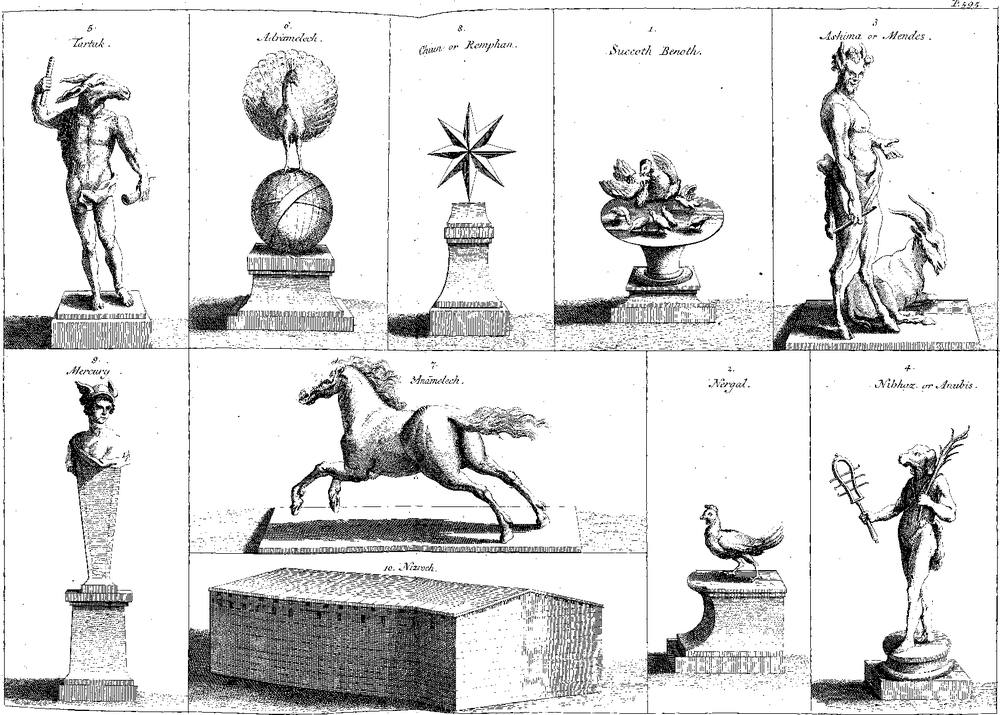
The Religion of this People was at first the Pagan. Every one worshipped the Deity they had been us’d to in their own 2 Kings xvii. 25. 2 Kings xvii. 30, 31.&alibi.Country. The Babylonians worshipp’d Succoth-benoth; the Cuthites, Nergal; the Hamathites, Ashima; the Avites, Nibhaz & Tartak; the Sepharvites, Adrammelech and Anammelech. If we would enumerate all the Names of false Gods, to whom the Samaritans have paid a sacrilegious Worship, we should have enough to do. This Matter is sufficiently perplex’d, by reason of the different Names by which they were adored by different Nations, insomuch that it would be almost impossible to clear up this Affair. We shall content our selves to relate those only, of which mention is made in Scripture, and of which we find something in antient Monuments. The Reader may see them represented in the Plate we have caused to be here exhibited.
Explication of the Figures.
- Succoth-benoth signifies the Tents of the young Women. ‘Tis believed,32 that the Scripture would here mark out these infamous Places, where the Babylonish Women were us’d to prostitute themselves once in their Lives, to the Honour of Mylitta, and for the Benefit of her Temple. Selden33 will have it, that the Name of Venus is derived from Benoth. ‘Tis perhaps Venus propagatrix, or Venus with her Harlots, represented under the Similitude of a Hen with her Chickens.
Grot.Mun. alii.2. Nergal. She was a Goddess that was worshipped under the Form of a wooden Hen, according to the Rabbins, and several Interpreters. Others think it to be the perpetual Fire, which in Persia was worshipp’d in Honour of the Sun. The Hebrew Word Nergal34, may literally signify Light, or the Fire that flames, that sparkles, that rouls.
-
Ashima, or Mendez. The Rabbins describe this Deity to us, some under the Shape of a Goat without Hair35; others36 as a Satyr, or as the Poets describe the God Pan. But all this to me seems very uncertain.
-
Nibhaz, or Anubis, was represented under the Form of a Dog, according to the Jews. The only Proof they give of it is, Latrare.that in Hebrew, Nabuch signifies to bark. We know that the Egyptians worshipp’d Dogs, and that Anubis, one of their Deities, had the Head of a Dog. Omnigenûmq; Deûm monstra, & latrator Virg. Æneid. viii. v. 698.Anubis.
SAM [ 596 ] SAM
Tartak תרתק5. Tartak had the Head of an Ass, as the Jews affirm. It is no Hebrew Word. Perhaps it may be the same as Sar-sak. Sar in שרShar, princeps. שקor שכSaca.the Hebrew signifies a Prince. Sak was a Prince, or a Babylonish God, that was very famous. The Feasts called Sacæa are mentioned by profane Authors37. Thus Tartak, according to the Chaldean Pronunciation, may signify the God Sak.
-
Adrammelech may be Juno, represented under the Form of a Peacock, or a kind of Pheasant.
-
Anammelech is under the Figure of a Horse. The Agreement that may be observed between the Victims offered to these Deities, and to Moloch the God of the Ammonites, and to Saturn the Deity of the Phenicians, has made many imagine, that they were only the same Idol under different Names.
-
Chiun, or Remphan, is commonly explained by Saturn, one of the seven Planets, represented by a great Star. Interpreters have been at great Pains to discover who this Deity was. The Reader may consult what we have said in the Dissertation concerning the Idolatry of the Israelites in the Desart, before our Commentary upon the twelve lesser Prophets.
-
Mercury. This Divinity is sufficiently known. He was the God of Eloquence, the Messenger and Interpreter of the Gods; for which Reason the Greeks called him Hermes.Acts xiv. 11. In the Acts St. Paul was taken for Mercury, because of his Eloquence, and the Vehemence of his Discourse.
2 Kings xix. 37.10. Nisroch. The Scripture says, that Sennecharib was assassinated by his two Sons, Adrammelech and Sharezer, as he was worshipping his God Nisroch, in his Temple at Nineveh. We do not exactly know who this God was. M. Basnage believes38, that it is Janus represented by Noah’s Ark, perhaps because Noah had seen both Worlds, having lived both before and after the Deluge; for, as ‘tis known, Janus had two Faces, one before, and the other behind, because he comprehended both the Time past and present, as being the God of Time. They have included all the Gods worshipped by the Samaritans, in these four Verses,
Numina, quæ Samaria colat, vis scire? tuere, Semi-hominemq; asinum, semi-hominemq; canem. En Capriceps, Gallina, Pavo, saxumq; Trigonum, Et sidus cæli: Numinis illa loco.
Afterwards, to this prophane Worship the Samaritans added that of the Lord, the 2 Kings xvii. 29, 30, 31, 32.God of Israel. They gave a Proof of their little Regard to this Worship of the True God, when under Antiochus Epiphanes, they Josep. Ant. l. 11. c. 8.consecrated their Temple at Gerizim to Jupiter Argivus. In the Time of Alexander the Great, they celebrated the Sabbatical Year, and consequently the Year of Jubilee also. We do not know whether they did it exactly at the same time as the Jews, or whether they observed any other Epoch; and ‘tis to little Purpose that some Criticks have attempted to ascertain the Petit Ecl. Chronol. l. 2. c. 4.first Beginning of it. Under the Kings of Syria they followed the Epoch of the Greeks, or that of the Seleucidæ, as other People did that were under the Government of the Seleucidæ. After that Herod had re-established Samaria, and had given it the Name of Sebaste, the Inhabitants of this City, in their Medals, and all publick Acts, took the Date of this new Establishment. But these Inhabitants of Samaria, of which the greater Part were Pagans or Jews, were no Rule to the other Samaritans, who probably reckoned their Years according to the Reigns of the Emperors they were subject to, till the Time they fell under the Jurisdiction of the Mahometans, under which they live at this Day; and they reckon their Year by the Hegira, or, as they speak, according to the Reign of Ishmael, or the Ishmaelites.
Epiphan. hæref. 9. Aug. lib. de hæref. Epiphan. hæref. 9.Some of the Antients, as Epiphanius and St. Austin, have placed the Samaritans upon the Foot of Hereticks; but they were rather Schismaticks in respect to the Jews. They have no more relation to the Christian Religion than the Jews have, since they do not acknowledge Jesus Christ as the Messiah, and are in Expectation of another. As to their Belief, ‘tis objected to them as an Error, that they receive only the Pentateuch, and reject all the other Books of Scripture, chiefly the Prophets, who have more expresly declared the Coming of the Messiah. However, they say, in their Letter to M. Ludolph, that they admit the Book of Joshua; but probably, by this Name they mean no other than their own Chronicon. They have also been accused of believing God to be Corporeal, of denying the Holy Ghost, and the Resurrection of the Dead39. Jesus Christ reproaches them with worshipping what they know not. John iv. 22. Epiphanius says, they worshipped the Teraphims that Rachel brought away from Laban, and which Jacob hid under Ground. Lastly, ‘tis said, they paid a superstitious Worship to a Pigeon, or to the Representation of one40, and that they even gave Circumcision in the Name of a Pigeon. M. Reland, in his Letter to M. Basnage, maintains, that they deny the Existence of Angels; and Leontius among the Antients, had already asserted, that they denied Angels, and the Immortality of the Soul.
Jesus Christ seems to exclude them from Salvation, when he says, that Salvation is of the Jews. True it is, that these Words might only signify, that the Messiah was to proceed from the Jews; but the Crime of Schism alone, and a Separation from the True Church, was sufficient to exclude them from Salvation. The Samaritan Woman is sufficient Testimony that the Samaritans expected a Messiah, who they hoped would clear Joh. iv. 25.up all their Doubts. Several of the Inhabitants of Shechem believed at the preaching of Jesus Christ, and several of Samaria believed at that of St. Philip; but it is said, they soon fell back to their former Errors, being perverted by Simon Magus. Josephus informs Vide Lightfoot in Mat. x. 5.us41, that a certain Impostor having persuaded the Samaritans, that he would make a Discovery of some sacred Vessels that Moses42 had hid in a hollow Place of the Mountain; the credulous People followed him, and took Possession of a pretty large Town called Tirataba, where they staid for the rest of the Nation, who were to be Spectators of this Sight. But Pilate being jealous of some intended Insurrection, sent some Troops against the Multitude, who were easily dispersed, and the Ring-leaders of this Assembly were punished with Death.
As to the present Samaritans, we may see by their Letters written to their pretended Brethren of England, and to Scaliger, that they believe in God, in his Servant Moses, the holy Law, the Mountain Gerizim, the House of God, the Day of Vengeance and of Peace; that they value themselves upon observing the Law of Moses, in many Points, more rigidly than the Jews themselves. They keep the Sabbath with the utmost Strictness required by the Law, without stirring from the Place they are in, but only to the Synagogue. They go not out of the City, and abstain from Marriage on that Day. They never delay Circumcision beyond the eighth Day. They still sacrifice to this Day in the Temple on Mount Gerizim, and give to the Priest what is injoin’d by the Law. They do not marry their own Nieces, as the Jews do, nor do they allow themselves a Plurality of Wives.
Joh. iv. 9.Their Hatred for the Jews may be seen through all the History of Josephus, and in several Places of the New Testament. The Jewish Historian informs us43, that under the Government of Coponius, one Passover-Night, when they opened the Gates of the Temple, some Samaritans had scattered the Bones of dead Men there, to insult the Jews, and to interrupt the Devotion of the Festival. The Evangelists shew us, that the Jews and Samaritans hold no Correspondence together. The Jews have no Dealings with Joh. iv. 22. the Samaritans. And the Samaritan Woman of Sychar was much surprized, that Jesus talked with her, and asked Drink of her, being a Samaritan. When our Saviour sent his Apostles to preach in Judea, he forbad them to enter into the Samaritan Cities, because Mat. x. 5. he looked upon them as Schismaticks, and as Strangers to the Covenant of Israel. One Day when he sent his Disciples to provide him a Lodging in one of the Cities of the Samaritans, they would not entertain him, because they perceived he was going to Luke ix. 52, Jerusalem. Because his Face was as though 53. he would go to Jerusalem. And when the Jews were provoked at the Reproaches of Jesus Christ, they told him he was a Samaritan, thinking they could say nothing more severe against him. Josephus relates44, that John viii. some Samaritans having killed several Jews 48. as they were going to the Feast at Jerusalem, this occasioned a kind of a War between them. The Samaritans continued their Fealty to the Romans, when the Jews revolted from them; yet they did not escape however from being involved in some of the Calamities of their Neighbours. See Josephus de bello, l. 3. c. 22.
Lib. Josue apud Hotting. p. 116.The Chronicon Samaritanum says, that the Emperor Adrian having raz’d Jerusalem, passed on to Naplouse, otherwise Shechem, and took all their Books from them; not leaving so much as their Genealogies and Histories. They were forbid to circumcise their Children, but they sent them, as fast as they were born, into the Caverns of the Earth, where they received the Sacrament of the Covenant, and they did not return till they were cured. The Romans mingled Hog’s-Flesh in the Feasts of the Samaritans; who were forced to use their Industry to avoid the eating of it. They placed a Pigeon upon Mount Gerizim, to hinder them from going thither to worship ; and they posted Troops at the Foot of the Mountain, to stop those that would go up notwithstanding the Prohibition. Some of ‘em were bold enough to attempt going up, and cunning enough to escape the Watch; but the Bird discovered them, and cried out, To the Hebrew. The Guards at this awoke; and flew those that were coming up.
This Calamity continued till Babar-raba sent one of his Nephews, called Levi, to go through a Course of Study at Constantinople. This young Man made so great a Progress in Learning, that he was made Patriarch, and obtained of the Emperor the Liberty of returning to Gerizim. His Design was to free his Nation from the Yoke of the Romans, and to restore it to its former Liberty. We are not told what became of him afterwards, for there ends the
Chronicon of the Samaritans. And what it says of the City of Constantinople, is a sufficient Proof that this Chronicon can’t be antient. Just. Mart.Justin Martyr assures us, that when the Emperor Antoninus Pius granted the Jews the Liberty of circumcising their Children, he excepted the Samaritans. This holy Man being himself of Shechem, might be well informed of this Fact. Symmachus, the famous Translator of the holy Scriptures out of the Hebrew into Greek, was a Samaritan. He left his Country, and became a Jew, and for this received a second Circumcision.
Under the Empire of Zeno, the Samaritans made themselves a King in the City of Naplouse, and kill’d a great Number of Christians. But Zeno punished them severely for it, and put their King to Death. They revolted again under the Empire of Justinian, burnt the Churches of the Holy Land, and massacred many Christians; and among others the Bishop of Naplouse. Their Rage proceeded so far, that the Emperor Justinian was forced to send some regular Troops against them, who destroyed most of the Rebels.
The Chronicon of the Samaritans, called Tarik Samari, intimates, that the Samaritans separated from the antient Jews after the Death of Samson, under the Pontificate of the D’Herbelot, Bibl. Orient. p. 753.High-Priest Eli; because, they say, it was then that the Presence and Favour of the Lord, which they call Redhat, and Redhonan, departed from them, and that then Darkness expelled the Light, and involved all those that were in Palestine, except those that then withdrew upon Mount Gerizim, where they have always had Priests since that time, and afterwards Kings of their own to govern them. They also affirm, that the Prophet Samuel was a Magician, and that all his Successors were Apostates from true Judaism.
Epiph. de ponder. & mentur.There are still at this Day45 some Samaritans at Shechem, otherwise called Naplouse. They have Priests there, who say they are of the Family of Aaron. They have a High-Priest, who resides at Shechem, or at Gerizim, who offers Sacrifices there, and who declares the Feast of the Passover, and all the other Feasts, to all the dispersed Samaritans. Some of ‘em are to be found at Gaza, some at Damascus, and some at Grand-Cairo. Scaliger received a Letter from the Samaritans of Shechem, printed in 1676. They have also writ since that to their pretended Brethren in England, and M. Ludolf printed a Letter in 1688, which he received from them.
Those that would be more particularly informed of the History, the Creed, the Ceremonies of the Samaritans, may consult the Letters we have now mentioned, Hottinger, Cellarius, the Horæ Hebraicæ of Lightfoot, and the Continuation of the History of Josephus by M. Basnage, through the whole eighth Book, where he gives an Account of the Samaritan Chronicon, and of the Works that have been composed on their Occasion.
Samaritan in the Books of the Jews, is a Term of Injury and Reproach. Say we not John viii. 48.well that thou art a Samaritan, and hast a Devil? said the Jews to Jesus Christ, in their Indignation. Our Saviour (as has been already said) would not suffer his Disciples to Mat. x. 5.preach in the Cities of the Samaritans; In Civitates Samaritanorum ne intraveritis. To prove that there are no Persons whatever, but what are our Neighbours, even those from whom we are the most estranged, our Saviour in his Parable of the Jew that was wounded, Luk. x. 33.on his Journey between Jerusalem and Jericho, says it was a Samaritan that had Compassion upon him. The Samaritan Woman (as has been observed) was not a little surprized, to find that Jesus Christ conversed with her, and asked Drink from her who was a SamaritanJoh. iv. 9.; for, as the Evangelist adds, the Samaritans and Jews have no Correspondence with each other. Non enim co-utuntur Judæi Eccles. i. 25, 26.Samaritanis. The Author of Ecclesiasticus places the Samaritans among those People for whom he has the greatest Abhorrence. There be two manner of Nations which my Heart abhorreth, and the third is no Nation. They that sit upon the Mountain of Samaria46, and they that dwell amongst the Philistines, and that foolish People that dwell in Sichem. These last are the Samaritans, the most odious of all.
The Samaritan Woman converted by Jesus Christ. See the Article PHOTINA The Martyrologies put her Feast upon the Twentieth of March; and this is an Abstract of what the Greeks inform us about her. When Photina was converted by Jesus Christ, or even by St. Peter, for these Acts mention St. Peter also, she instructed her whole Family, composed of two Sons, Joseph and Victor, with Anatolina, Photo, Photis, Parascue, and Cyriaca, who were her Sisters. Photina went into Africa, where she converted the whole City of Carthage to Christianity, under the Empire of Nero. Victor, Son to Photina, was one of the Emperor’s Generals, and the Greeks say he commanded his Armies against the People call’d Avari. But the Spaniards say he was sent against the Rebels of Braga in Spain, and that he was Governor of the City Italica in Andalusia.
Victor received Orders from Nero to put to Death all the Christians in his Government. The General of the Troops knowing
that Victor had been baptized by St. Peter, made great Remonstrances to him on this Head, but could gain nothing upon the Mind of Victor. God struck this General, and took from him the Use of his Speech. At the End of three Days he was enlightned of God, recovered his Speech, and cried out; That there was but one only God, which was the God of the Christians. He was then forthwith instructed and baptized by Victor.
Nero being informed of what had passed in Africa, by the Preaching of Photina, and what had happened in Spain by the Constancy of her Son Victor, ordered that the whole Family should be brought to Rome. Jesus Christ appeared to them on the Way, and encouraged them. Photina presented to the Emperor her two Sisters Photo and Photis. Nero caused them to be tortured, and then sent his own Daughter Arethusa to them, with a large Quantity of Pearls and precious Stones, thinking to corrupt them. Photina seeing her coming, cried out to her, Spouse of the Lord, you are welcome. To which the Princess replied, Madam, my Mistress, the Brightness of Jesus Christ, the Lord be with you. The Princess became a Convert, and an hundred young Women that attended on her, and they were immediately baptized by Photina. Nero was so provoked, that he would have ‘em all poisoned; but Lampadius the Magician, who prepared the Poison, became a Convert also, as soon as he perceived that his Poison had no Effect upon them. No Cruelties were spared to shake their Resolution; but when it was found that all was ineffectual, they were flay’d alive. One need but read this Story, in order to be convinced of its being fabulous. So that it is quite needless to stand to confute it.
Samaritan-Pentateuch. This is the Collection of the five Books of Moses written in Samaritan Characters, or the antient Hebrew Characters, which were in Use before the Captivity of Babylon. I have already spoken of it under the Articles PENTATEUCH and SAMARITAN. Here are still some farther Remarks upon this Subject. The Copies of the Samaritan Pentateuch were unknown in Europe till the sixteenth Century. The famous James Usher was the first, or at least one of the first, who procured it out of the Eastern Countries. Usher Ep. ad Lud. Capell.This learned Man having observed, that Eusebius of Cæsarea, Diodorus of Tharsus, St. Jerome, Cyril of Alexandria, Procopius of Gaza, Georgius Syncellus, and some others, had quoted the Samaritan Pentateuch; he could not be at rest till he had procured five or six Copies out of Syria or Palestine. And by examining these Copies carefully, he thought he could discover that they had been corrupted by one Dositheus, of whom Origen makes mention in his first Book against Celsus: An Opinion in which the Learned do not agree with him.
Pietro della Valle bought a very neat Copy at Damascus, in the Year 1616, for M. de Sansi, then Ambassador of France to Constantinople, and afterwards Bishop of St. Malos. This Book was presented to the Fathers of the Oratory, Rue St. Honoré, where it is preserved to this Day. And it was from this Copy that Father Morinus printed the Samaritan Pentateuch in 1632, which is found in M. le Jay’s Polyglot, which is the first Copy that has been printed in this Language. It has been reprinted more correctly in Walton’s Polyglot, from three Samaritan Manuscripts that belonged to Usher. See Father le Long’s Bibliotheca Sacra, t. 1. p. 124, &c.
The Criticks are much divided about the Samaritan Pentateuch. Father Simon47 in his Critical History of the Old Testament, is of Opinion, that the Priest who was sent by King Assaradon, or Esar-haddon, to the Cuthites, did not carry with him the Books of the Law of Moses, which would have been useless to a People that did not understand Hebrew, and to himself also, since without this Book, he could not put in Practice the Ceremonies of the Law, in which he had been inured from his Infancy. Therefore it was a long time after this, viz. when Manasseh undertook to build a Temple upon Mount Gerizim, that they carried thither the Copy of the Law, as it was made or reformed by Esdras, and which the Jews read in their Temple at Jerusalem.
M. Vandale maintains48, that we must distinguish between the Law and the Pentateuch. The Volume of the Law, contained only such Ordinances, the Observation of which was necessary for securing the People from the Anger of God; but the Pentateuch comprehended the History of the Creation of the World, of their Bondage in Egypt, of their Deliverance, of their Wanderings in the Wilderness, and the Body of Laws compiled by Moses. The Priest sent by Esar-haddon, brought to the Samaritans only that Law that was necessary for the Observation of all the Rites of the Hebrews; but the Pentateuch that was lost or buried under the Ruins of Jerusalem, was restored and reformed by Esdras, and could not be communicated to the Samaritans till a long time afterwards. This is the System of this Critick.
Another Critick49 thinks, that he has discovered in the Pentateuch of the Jews and the Samaritans, some Footsteps of an Author that had lived beyond the Euphrates, who was acquainted with that Country, and who mentions some Particulars of it, which Moses could not have any Knowledge
of. He therefore imagines, that the Pentateuch was compos’d by the Priest who was sent to the Cuthites or Samaritans. This Man, who came from Chaldea to instruct those Idolaters, thought proper to write them a History of the Creation of the World, and of the Affairs of the Hebrews, ‘till the Delivery of the Law to them, that he might shew them there was but one God. As he wrote this exactly in the eighteenth Year of Josiah, in which the Copy of the Law was found in the Temple, he inserted this Piece into his own Work, as being very essential to it. He wrote the Whole in Hebrew, because he had not had Time enough to learn the Chaldee Tongue. The Jews made no Difficulty of receiving this Work; because the Author was not suspected by them, and because the Book contain’d only their History and their Law. This Author pretends, (who is thought to be M. le Clerc) that this Hypothesis avoids all the Difficulties that are rais’d about the Pentateuch compos’d by Moses, and about the Variations that are found between that of the Jews and that of the Samaritans.
The Generality of Divines believe, that the Samaritan Pentateuch, and that of the Jews, are but one and the same Work, written in the same Language, but in different Characters; and, that the Differences that are found between these two Texts, only proceed from the Inadvertency and Inaccuracy of Copiers, or from the Affectation of the Samaritans, who have foisted Things into it, to promote their own Interests and Pretensions; That the Additions were inserted afterwards; and that, originally, these two Copies were exactly the same. According to this Opinion, it must be allow’d, that the Pentateuch of the Jews is preferable to that of the Samaritans, as being exempt from those Alterations which have been made in the latter. But, on the contrary, others give the Preference to the Samaritan Pentateuch as an Original, which has been preserved in the same Character and the same Condition in which Moses compos’d it.
Prideaux Connect. t. 2. l. 6. An. 409 before Christ:Dr. Prideaux, who espouses M. Simon’s System, before explain’d, maintains, That the Pentateuch of the Samaritans, is only a Copy, taken in other Characters, from the Copy compos’d or reform’d by Esdras; That even this Copy has been altered by Variations, Transpositions, and remarkable Additions. To prove, that the Samaritan Code is only a Copy, he says; First, That it has all the Interpretations of the Edition of Esdras; which it would not have, if it were more ancient. Secondly, There are several Variations in the Samaritan Pentateuch, which evidently proceed from taking one Hebrew Letter for another that is like it; though, in the Samaritan Alphabet, those two Letters have no Resemblance; and consequently, the Samaritan is only a Copy from the Hebrew Pentateuch of the Jews. This incontestably proves, says he, that it was Manasseh the Son-in-law of Sanballat, who brought the Pentateuch with him, when he took Refuge among the Samaritans. And as the Samaritans were then accustomed to the Phenician Letters, the Pentateuch was written in those Characters, for their Use.
He acknowledges, that Esar-haddon sent a Priest to his new Colony at Samaria, to instruct them in the Manner in which the Israelites, who were the ancient Inhabitants of that Country, had worshipped the God of their Fathers: But it does not appear that this Priest executed this Commission, by introducing the Law of Moses among them. For, had they received this at the Beginning, would they have continu’d in their Idolatry, as it is notorious they did? And would they have made a Medley of the Worship of the True God, and of their Idols, which is expressly forbidden by the Law? It is therefore very probable, that they were instructed in the worshipping of God only by Use and Tradition.
As to the Variations, the Additions, and Transpositions which are found in the Samaritan Pentateuch, when compared with the Hebrew, they are all carefully collected, with the utmost Exactness, in the Book written by Hottinger against Father Morinus, and in the confronting of the two Texts, which is inserted in the last Volume of the English Polyglot. Of these Interpolations, some are for the better understanding of the Text; other are a kind of Paraphrase, expressing at length, what was only hinted at in the Original: Others are such Changes as the Samaritans have purposely made, to favour their Pretensions against the Jews; as when, for Example, they put Gerizim instead of Ebal. Other Varieties are only such as are pure Lapses of the Transcribers.
Besides the Hebrew Pentateuch in Phenician Characters, of which we have been now speaking, the Samaritans have also another, in the Language which they spoke at the Time that Manasseh took Shelter among them. This Language is a Mixture of the Chaldee, the Syrian, and the Hebrew, or Phenician. And, just as the Jews were obliged, in Favour of those People who did not understand the pure Hebrew, to make Versions or Paraphrases in Chaldee; so the Samaritans had their Pentateuch in the Vulgar Samaritan Tongue. This is call’d the Samaritan Version, which differs from the Jewish Paraphrases, there being Glosses and Explications; whereas the Samaritan Version is literal, and ex
presses the Text Word for Word: It is printed with the Samaritan Text in the Polyglot of Paris, and also in that of London; and because of its great Conformity with the Text, they have only given one Latin Version for both of ‘em.
SAMEAS, or Sameias, or Shammai, a famous Rabbin, of whom the Jews say many things. They tell us, he was Head of their Schools, and Master of a great Number of Learned Men; among others, of the famous Hillel, who afterwards separated from his Master, and was Head of another School or College, which taught Principles very different from those of Shammai. Hieron. in Isai. viii.Some think this Division of Hillel and Sameas produced the Sect of the Pharisees: But this Opinion can by no means be supported; because the Pharisees were a numerous and powerful Sect a long time before Sameas, who lived but under Herod the Great.
Jos. Antiq. l. 15. c. 1.Josephus says, that Sameas was the Disciple of Pollio the Pharisee. I have often thought, that this Pollio might be Hillel: For Josephus never mentions Hillel, yet speaks of Pollio more than once. But the Rabbins make Hillel the Disciple of Sameas, and Josephus makes Pollio his Master. It is certain there were two Hillels, and both of ‘em very famous Men; one of ‘em lived before Christ, and the other afterwards: The last of ‘em was Prince of the Captivity in the West, and lived, according to the Jews, about the Hieron. in Isai. viii.Year 240. St. Jerom says, that a little time before the Birth of Jesus Christ, two famous Rabbins, Sameas and Hillel, Heads of two celebrated Schools, made two Parties among the Jews, and became Masters, one of the Scribes, and the other of the Pharisees. The Jews, in the Time of this holy Father, ascribed their Misna and their Deuteroses to Shammai and Hillel, or, as he says elsewhere, to Simeon and Helles50.
This is what Josephus51 tells us of Sameas: “ Herod being yet but Governor of “ Galilea, was summoned before the Grand “ Council of Hyrcanus Prince of the Jews, “ for having committed several Violences “ in the Province of which he had the “ Government. Herod made his Appearance, but not as a Suppliant; he was “ cloathed in Purple; his Hair comb’d and “ perfum’d, and accompany’d by a Troop “ of armed Men. All that were there assembled to decide his Cause, were so “ astonish’d at his Presence, that none of “ ‘em durst open his Mouth against him. “ There was only Sameas, who spoke with “ a great deal of Freedom, and who foretold to the Judges, that this young Man, “ whom they durst not condemn, should “ one Day be their King, and should put “ them all to Death, and Hyrcanus himself, who then, as Prince of the Jews, “ presided in the Assembly.”
The Event did but too-much verify these Predictions: For when Herod came to the Kingdom, he put to Death all these Judges, except Sameas himself, for whom he always testify’d a great Esteem. When Herod was declared King by the Romans, and came with Socius to besiege Jerusalem,52 Sameas was always of Opinion, that the Gates should be set open to him, and that he should be received into the City; for he said, their Sins were such, that they could no longer hope God would preserve them from his Government. For this Reason, Herod always favoured Sameas, and those of his Party. The Rabbins say, by way of Proverb, Be humble as Hillel, and stedfast as Sameas.
SAMEGA, a City of Judea, that was taken by Hyrcanus. Joseph. Antiq. l. 13. Josh. xv. 26. שמש Shemash.c. 17. He calls it Samæa, l. 1. c. 2. de Bello. Perhaps it is the same as Shema.
SAMLAH, or Semla, King of Masrekah in Idumea. Gen. xxxvi. 36.
Buxtorf. Lexicon. Rabinic. in Samael.SAMMAEL, an evil Angel, of which the Rabbins relate many things: They say, he deceived Eve, mounted upon the old Serpent; That he is the Angel of the Dead, the Prince of the Air, the Chief of the Demons. Other Rabbins look upon him as the Prince of the Angels, and believe he is to preside at the Last Judgment; for which Reason, they make him Offerings on the Day of solemn Expiation, to appease his Anger.
SAMOCHON, a Lake in Galilee. See Semechon.
SAMOS, a famous Island of the Archipelago, upon the Coast of Asia Minor. The Romans writ to the Governor of Samos in 1 Macc. xv. 23.Favour of the Jews, in the Time of Simon Maccabæus, in the Year of the World 3865, before Christ 135, before the Vulgar Acts xx. 15.Era 139. St. Paul went ashore in the same Island, as he went to Jerusalem, in the 58th Year of the Vulgar Era. Isaiah speaks of the Vessels of Clay of Samos;53 Væ qui contradicit fictori suo, testa de Samiis terræ; Woe to the Man who disputes against him that has form’d him; Man, who is but a Potsherd of an Earthen Vessel of Samos. But the Hebrew reads only, A Vessel of Clay in the midst of Vessels of Clay.
Acts xvi. 11.SAMOTHRACIA, an Island of the Ægean Sea. St. Paul, departing from Troas, to go to Macedonia, arrived first at Samothracia, then landed in Macedonia; thence he went to Neapoli, and then to Philippi.
SAMPHO, a City of Galilee, or of the Country of Samaria. Joseph. Antiq. l. 17. c. 12. Elsewhere he calls it Sappho. De Bello, l. 1. c. 3.
SAMSON, Son of Manoah, of the Tribe of Dan, and of a Mother whose Name we Judg. xiii. 2, 3, 4, &c.no-where find in Scripture. This Woman was barren; and the Angel of the Lord appeared to her,54 telling her she should become the Mother of a Son; but she must take care, not to drink any Wine, nor any other intoxicating Liquor, nor must she eat any impure Thing: That when God should make her a Mother, she must take the same Care, with regard to her Son: That she must consecrate him to God from his Infancy: That she must make him observe the Rules of the Nazarites, and not let a Razor come upon his Head; for, says the Angel, He shall begin to deliver Israel from the Hands of the Philistines. This Woman went presently to her Husband, and acquainted him with all that had been told her. Manoah begg’d of the Lord to condescend to send his Angel a second time, that he might be inform’d himself of what was to be done to his Son that was to be born. The Lord heard him. The Angel appear’d again to the Woman, and she ran presently to acquaint Manoah with it. He came and spake to the Angel, who repeated to him, what he had before told the Woman. See MANOAH.
Samson was born the Year following;55 and the Spirit of God began to appear visibly in him, by the extraordinary Strength of his Body. He dwelt in a Place call’d the Camp of Dan, between Zorah and Eshtaol. One Day, as Samson went to Timnath a City of the Philistines,56 he there saw a young Woman whom he had a mind to marry: He desired his Father and Mother to obtain her for him. They ask’d him, Is there never a Woman among the Daughters of thy Brethren, or among all my People, that thou goest to take a Wife of the uncircumcised Philistines? But Samson still insisted, saying, Get her for me, for she pleaseth me well. His Parents knew not that this was appointed of God, and that this was the Means he thought fit to use, for the Destruction of the Philistines, who then domineered over Israel. He went therefore with his Parents to Timnath; they made a Demand of the young Woman, who was agreed to be given in Marriage to Samson.
As they were going thither, Samson Greek verse turn’d a little out of the Road, and all of a sudden he saw a young Lion, who was going to seize him. But Samson took hold of him, and tore him in Pieces, as if it had been a young Kid, tho’ he had then nothing in his Hand. Afterwards he return’d again to his Father and Mother, but told them nothing of what he had done. Some time after, returning to Timnath, to celebrate his Marriage there, he pass’d by the same Place, to see the Carcase of the Lion. But he found it dry’d up, and a Swarm of Bees had lodg’d themselves in his Throat, and had there form’d an Honey-comb. He took some of it and eat it, and carry’d some to his Father and Mother, who eat of it also. But he told them nothing of his first Exploit, nor of what had happen’d after. Being come to Timnath, the Ceremony of the Marriage was perform’d, and the Wedding-feast was kept, and the Inhabitants of the Place provided thirty young Men for Samson, to do him Honour at his Wedding.
Then Samson said to these young Men at the Entertainment, I will propose a Riddle to you; and if you can explain it to me before the seven Days of the Feast are at an end, I will give you thirty Changes of Raiment: But if you cannot explain it to me, you shall give me thirty Changes of Raiment, or thirty Coats and thirty Clokes, or thirty compleat Suits of Cloaths,57 which consisted of a Coat or a Gown, and a Cloak. They bid him propose his Riddle, that they might know what it was. Samson told them, That out of the Eater came forth Meat, and out of the Strong came forth Sweetness. They continued as far as the seventh Day, endeavouring to find out the Meaning of this Riddle, but all to no Purpose. Then they apply’d themselves to the young Woman whom Samson had marry’d, and sometimes by Threats, sometimes by Entreaties, they urged her to get the Secret out of her Husband, and to tell it them. She being therefore very importunate with Samson, at last he told her the Meaning of his Riddle; which she had no sooner heard, but she told it again to her own People. Before Sun-set they came to Samson, and asked him, What is sweeter than Honey, and what is stronger than a Lion? He presently told them, That if they had not plough’d with his Heifer,58 they could never have expounded his Riddle.
At the same Time the Spirit of God moved him. He went to Askalon, a City of the Philistines, and having there killed thirty Men, he gave their Cloaths to those that had explained this Riddle. Hereupon he left his Wife, and returned again to his Father. Some time after this, the Woman married one of the young Men who had accompanied Samson at his Wedding: And Samson’s Anger being now over, he return’d to see his Wife, bringing her a young Kid along with him. a But when he came to enter her Chamber, the Father of the young Woman would not let him go in, saying to him; I thought you had hated her, and therefore I have given her to another: But she has a Sister who is younger and handsomer than she; you shall have her for a Wife instead of the other. Samson made no other Answer but this; Hereafter the Philistines will have no Reason to complain of me, if I return them the Evils they have done to me. He then went and caught three hundred Foxes, which he ty’d together in Pairs, Tail to Tail, and every Pair had a Fire-brand between. He sets fire to the Fire-brands, and turns the Foxes into the Corn-fields of the Philistines, who presently set the ripe Corn on fire, and made a great Havock, the Flame not sparing even the Vines and the Olive-Trees. When the Philistines knew it was Samson that had done this, to revenge the Affront he had received from his Father-in-law at Timnath; they took him and his Daughter, and burn’d them both in the Fire. But Samson was not satisfied with this; he told them he would still carry his Vengeance further, before he would have done.
Upon this he flew a great Number of them,59 and then retired into the Cave of Etam, in the Tribe of Judah. When the Philistines knew this, they came in great Numbers into the Land of Judah, to lay waste the Country; and the People of Judah coming to ask the reason of this Outrage, the Philistines told them; We are come to bind Samson, and to repay him the Injuries he has done to us. Then three thousand Men of the Tribe of Judah came to the Cave of Etam, and told Samson they were come to bind him, in order to deliver him up to the Philistines. He asked them, Will you promise me with an Oath that you will not kill me? When they had sworn to him, he suffered them to bind him with two new strong Cords, and to bring him to the Philistines. No sooner did they see him in this Condition, but they set up loud Shouts, and were going to fall upon him. Then the Spirit of the Lord seizing Samson all at once, he snapt in Pieces the Cords he was bound with, and happening to find at his Feet the Jaw-bone of an Ass, he took it up, and with this Weapon he flew a thousand of the Philistines. Then he sung that Song, With the Jaw-bone of an Ass, Heaps upon Heaps, with the Jaw of an Ass have I slain a thousand Men. And throwing away the Jaw-bone, he gave that Place the Name of Ramath-lehi, which is as much as to say, the Lifting up of the Jaw-bone. He was afterwards overcome with a great Thirst; and crying to the Lord, the Lord open’d a Rock that was in that Place, and which was call’d Maktesh, that is, the Jaw-tooth, from whence Water gushed out to assuage his Thirst. Here is some Difficulty in this Place,60 which we have already inquired into, under the Article LEHI, and under MAKTESH. See also the Commentators upon Judg. xv. 19.
After this Samson went to Gaza, a City of the Philistines, and having there seen a Harlot, or a Woman that kept a publick House, he went in to lodge with her.61 The Philistines being inform’d of it, set a Guard about the House, and at the Gates of the City, to kill him as he went out in the Morning. But Samson rising at Midnight, went and took away the two Gates of the City, and the Gate-Posts, Bar and Chain, and carried them up the Hill which is near Hebron.
Some time after he fell in Love with a Woman call’d Delilah,62 who dwelt in the Valley of Sorek. Many of the Antients have thought,63 that Samson had taken her as his lawful Wife; but most of ‘em maintain, that Delilah was a publick Woman, and was never marry’d to Samson. The Philistines therefore came to this Woman, and promis’d her a good Sum of Money, if she would discover to ‘em in what this extraordinary Strength of Samson consisted, and wherein it lay: This she undertook to do, and omitted nothing to get out this Secret from Samson. He amused her for a considerable Time, and made her believe that his Strength consisted sometimes in one thing, and sometimes in another; and when the Philistines were ready to fall upon him, he burst his Bonds asunder, and defeated his Enemies. He suffer’d himself to be bound while he slept, sometimes64
with Bands made of green Withs; sometimes with Ropes that had never been us’d; at another time the Locks of his Hair were woven into Tresses, and fastened down to the Floor with a Pin: But all this signify’d nothing. At last Delilah teized him so much, that he told her his Strength lay in his Hair, which had never been shorn, for he was a Nazarite from his Mother’s Womb; and that if his Hair was cut off, he should be no stronger than another Man. Delilah then cut off his Hair as he lay sleeping in her Lap; and the Philistines fell upon him, bound him, and put out his Eyes. Then they took him to Gaza, shut him up in Prison, and made him grind at the Mill, as a base and contemptible Slave65.
‘Tis here inquired, whether Samson’s Hair was the natural and physical Cause of his Strength; or whether it was only the moral Cause, and, as it were, the Pledge of the Assistance of the Holy Spirit, who thought fit to endue him with this prodigious Strength, as a permanent Quality, so long as he should observe the Laws of Nazariteship, and should keep his Hair untouch’d, which was the visible Token of it. The greatest Part of the Fathers and Interpreters66 maintain this last Opinion, which indeed seems to be the most probable. For tho’ a strong and thick Head of Hair, and of a considerable Length, may be a Token of natural Strength, yet that Strength will not be the less after the Hair is cut off. But it was not so with Samson. Therefore his Hair was neither the Cause nor the Sign of his great Strength; this Strength was supernatural and miraculous, and God had thought fit to connect it with Samson’s Hair; or with his due Observance of that Nazariteship that had been injoin’d him.
Samson continued in Prison at Gaza for about a Year67. Then his Hair being grown out again,68 God restored him his first Strength; and the Princes of the Philistines met in a general Assembly, in the Temple of their God Dagon, to return him Thanks for having deliver’d them out of the Hand of this their formidable Enemy. After they had ended their Feast of rejoycing, they order’d Samson to be sent for, that they might make Sport with him, and be diverted by him: He was therefore fetch’d out of Prison, and after they had insulted him as long as they thought fit, by making themselves Pastime with the absurd Behaviour of a blind Man; he desir’d him that led him, to let him lean against the Pillars that supported the Temple, that he might rest himself a little. The Temple was then full of People, both above and below the Galleries. We imagine the Temple to have been round, and perhaps encompass’d with a double Row of Pillars69. Then Samson calling upon the Name of the Lord, said; O Lord, my God, remember me: Restore me now my first Strength, that I may once revenge myself of my Enemies, that have deprived me of my Sight. And laying hold of the two Pillars, by which the Temple was supported, taking one in his Right-hand, and the other in his Left, he said; Let me also dye with the Philistines. Then violently shaking the Pillars, the Temple fell down upon the Princes and People that were therein, to the Number of about three thousand Persons; and so he kill’d more at his Death, than he had done before in his Life-time. He lived in the whole about thirty-eight Years; and was Judge of Israel about twenty Years. Judges xvi. 20. from the Year of the World 2867 to 2887.
Some Difficulties are started about the State of the Salvation of Samson. Ought he to have put himself to Death? And when he was wishing to dye, should he have sought Revenge for the Loss of his Eyes? St. Bernard maintains70, that if he had not a particular Inspiration of the Holy Ghost to move him to this, he could not without Sin be the Author of his own Death. St. Austin71 also does not excuse him, but only upon the Supposition, that he was urged by the inward Motions of Him, who is Master of our Life and Death. Others maintain72, that without having recourse to this supernatural Motive, this Action of Samson might be vindicated from his Office, as being the Judge and Defender of Israel; and therefore, without considering the Danger he expos’d himself to, might have nothing in View but the Death of his Enemies, and the Deliverance of his People. But finally, in whatever manner this Action is excus’d, it must be own’d, that he is in the Number of the Saints, since St. Paul himself places him among those Heb. xi. 32.whose Faith was commended and recompensed.
SAMUEL, Son of Elkanah, and of 1 Sam. i. 1,2,3,&c. 1 Chron. vi. 29.Hannah, of the Tribe of Levi, and of the Family of Kobath; he was a Prophet and Judge of Israel for several Years. The Dwelling of his Father was at Ramathaim-
Zophim, or the City of Ramatha, inhabited by the Levites of the Family of Zophai or Ziph, one of the Descendants of Kohath. Samuel dwelt there himself for the greatest Part of his Time. Ramatha or Ramath was in the Mountains of Ephraim, between Bethel and Gibeah. See RAMATH. ‘Tis disputed whether Samuel was a Priest or no. Some of the Antients believed, that he was of the Race of Aaron,73 and that he exercised the 1 Sam. ii. 18.Function of High-priest74. He wore the Ephod; he consecrated two Kings, Saul and David; he offer’d Sacrifices, and that Ps. xcix. 6.out of the Tabernacle. The Psalmist places him in the Rank of Priests; Moses and Aaron among his Priests, and Samuel Joseph. Antiq. l. 7. c. 15.among them that call upon his Name. Josephus says, that Samuel appear’d to Saul in a Sacerdotal Habit. We find no one of the Family of the High-priest Eli, after the Death of Hophni and Phinehas, that could exercise the High-priest’s Office. It is therefore very probable, that Samuel perform’d the Duties of this Office, till such time as the Grandsons of Eli were of an Age to take it upon themselves.
But it is reply’d, that Samuel not being of the Race of Aaron, there is no likelihood that he should ever have been High-priest. If he had wore an Ephod, and anointed Kings, and even sacrificed in extraordinary Cases, that will not prove that he was a Priest. David wore the Ephod; Gideon 2 Sam. vi. 14. 1 Sam. xiii. 9, 10. xv. 12. Judg. vi. 18. 1 Kings xix. 15,16. 2 Kings xi. 1, 2, 6, 12, &c.and Saul had sacrificed; some of the Prophets consecrated Kings; Samuel is put in the Number of those who call upon the Lord, that is, the Levites. And if we will have him put in the Rank of Priests, we must take the Word Priest in its greatest Latitude and generical Sense, for all those that are imploy’d in the Service of the Lord, and who perform the Office of Mediators between God and the People. Lastly, in this Question, as well as in many others, we may oppose Authority against Authority; and both Antients and Moderns may be cited, who expressly deny that Samuel was a Priest75. As to the Age of the Children of Hophni and Phinehas, we have nothing certain upon that Matter; and if any one was to be employ’d to perform the Functions of the High-priest, they chose rather to take a Priest than a mere Levite.
But now let us come to the Life of Samuel. Elkanah his Father had two Wives, one of which was call’d Peninnah, and the other Hannah. Peninnah had Children; but Hannah was barren. Elkanah loved Hannah very tenderly, and was much concern’d that she had no Children. One Day when he went with all his Family to Shiloh, where the Ark of the Lord was deposited,76 he there offer’d Peace-offerings, and made an Entertainment for his Wives and Children. Hannah seeing herself alone, while Peninnah was surrounded with a Troop of Children, began to bewail herself; and rising from Table, she went to the Tabernacle, where she pour’d out her Heart before the Lord. Eli the High-priest being near, and hearing her speak pretty loud, thought she had been overcome with Wine; but Hannah soon discover’d to him the Occasion of her Affliction; and made a Vow, that if God would give her a Son, she would dedicate him to his Service all the Days of his Life; that she would cause him to profess the Order of a Nazarite, and suffer no Razor ever to come upon his Head. Eli blessed her, and begg’d of God to grant her her Petition. Hannah, being return’d to Ramatha, conceived and brought forth a Son, to whom she gave the Name of Samuel77, saying; Because I have asked him of the Lord78. Some Years after, when the Child was weaned, she brought him to Shiloh, into the House of the Lord, with an Offering of three Calves, of three Measures of Flour, and of three Baths of Wine. She made her Offering to God, and told the High-priest she was the same Woman, for whom he had pray’d some few Years ago. See the Article HANNAH. The young Samuel officiated in the Temple, as far as his Age 1 Sam. ii. 18, 19, 20.would allow. He was cloathed with a linen Ephod, and his Mother made him a little Coat of Linen, which she brought to him on the solemn Days, when she and her Husband came to offer their Sacrifices to the Lord.
But Eli was now become very old, and his Eye-sight was grown so dim, that he could hardly see at all. He heard of the Irregularities of his two Sons Hophni and Phinehas, but had not Courage to restrain them, nor the Power to make them remove that Scandal they caus’d to all the People of Israel. One Day as Samuel was in Bed in Eli’s Chamber, near the Tabernacle of the Lord,79 he heard a Voice calling him by his Name very early in the Morning, before they had extinguish’d the Lamps of the golden Candlestick, which burnt in the Holy Place over-against
Samuel continues on the next page
Footnotes
-
Galen de Simpl. Medicam. Facult. l. 4. c. 19 ↩
-
Translators’ note. So the English Translation. ↩
-
Translators’ note. So the English, and so the Hebrew, which may be interpreted as in the Latin Vulgate, Elchanan filius patrui ejus (nempe Joab) de Bethlehem. ↩
-
Hieronym. Onomast. ad Salem. Vid. Euseb. ibidem. ↩
-
Psal. xxi. 2. רחוק משועתי דברי שאגתי Ps. xvii. 51. ↩
-
Ezek. xvi. 4. במים לא רחצת למשעי ↩
-
1 Kings xiii. 32. In the Year of the World 3030, before Christ 970, before the Vulgar Era 974, and consequently 49 Years before the Reign of Omri. ↩
-
2 Kings vi. 24. vii. 1, 2, 3, 4. In the Year of the World 3119, before Christ 881, before the vulgar Era 885. ↩
-
Joseph. Antiq. l. xi. c. ult. ↩
-
In the Year of the World 3672, before Christ 328, before the vulgar Era 332. ↩
-
Eu- seb. Chronic. & Cedren. ↩
-
Hecatæus apud. Joseph. l. 2. cont. Appion. p. 1063. ↩
-
1 Macc. x. 30, 38. xi. 28, 34. ↩
-
Joseph. Antiq. l. 13. c. 18. In the Year of the World 3995, before Christ 105, before the vulgar Era 109. ↩
-
Syncell. Chronic. p. 308. Usser. ad an. 3979, before Christ 21, before the vulgar Era 25. ↩
-
Joseph. Antiq. l. xv. c. 11. ↩
-
Hi- eronym. in Abdiam. 1. ↩
-
Idem. in Mich. 1. & Osee 1. & Ep. ad Marcellam. ↩
-
In the Year of the World 3469, before Christ 531, before the vulgar Era 535. ↩
-
See Nehem. ii. 10, 19. iv. 2, 7, &c. vi. 1, 2, &c. ↩
-
Joseph. Antiq. l. 11. c. 8. p. 384. In the Year of the World 3672, before Christ 328, before the vulgar Era 332. ↩
-
In the Year of the World 3673. Vid. Joseph. cont. App. l. 2. p. 1063. Q. Curt. l. 4. c. 21. Euseb. in Chronico. Usser ad ann. 3673. ↩
-
Joseph. Antiq. l. 11. c. ult. ↩
-
Joseph. Antiq. l. 11. c. ult. p. 386. & l. 12. c. 7. p. 410. ↩
-
Joseph. Antiq. l. 12. c. 7. In the Year of the World 3836, before Christ 164, before the vulgar Era 168. ↩
-
2 Kings xvii. 25. In the Year of the World 3295, before Christ 705, before the vulgar Era 709. See also Ezra iv. 1, 2. ↩
-
According to the Letter, that it was dedicated to a God without a Name; or rather, that the Temple was without a Name. Ἰδρυσάμενοι ἀνώνυμον ἱερὸν. ↩
-
Joseph. Antiq. l. 11. c. ult. p. 386. ↩
-
Joseph. Antiq. l. 13. c. 6. p. 433. ↩
-
See M. Bas- nage’s Critique upon it. About the Year of the World 3854, before Christ 146, before the vulgar Era 150. ↩
-
Liber Jeshue, seu Chronic. Samarit. apud in his History of the Jews, l. 8. c. 1. p. 38, 39. tom. 6. Paris Edition. Hottinger exercit. Antimorin. ↩
-
Ita Grot. hic, & Selden de Diis Syr. Syntag. 2. c. 7. נירor נרvoluit גללd Baal-aruch, Kimchi. Rab. Salv. ↩
-
Ita sentire videtur Selden loco citato. ↩
-
Lampas Druf. in Gen. i. 1. ↩
-
Baal-aruch, Kimchi. Rab. Salv. Drus. in Gen. i. 1. ↩
-
Elias Levita. Talmud. Jerosol. 5. Tartak, ↩
-
Athen. lib. 14. c. 10. Dio Chrysost. Orat. 4. de Regno. ↩
-
Basnage Republick of the Hebrews, tom. 1. p. 214. ↩
-
Epiphan. hæref. 9. Greg. Mag. Moral. in Job, l. 1. c. 6. l. 2. c. 19, &c. ↩
-
Ita Rabb. quidam in Thalmud. Ganz. Zemach. David. p. 106. ↩
-
Joseph. Antiq. l. 18. c. 5. In the Year of the vulgar Era 36. ↩
-
This is a gross Error, because Moses never enter’d into the Land of Promise; the Chronicon of the Samaritans says, that Oziz, the fifth High-Priest from Aaron, had hid some sacred Vessels. ↩
-
Joseph. Antiq. l. 18. c. 3. p. 618. The Year of the Vulgar Era 8. from the true Birth of Christ 11. ↩
-
Joseph. Antiq. l. 20. c. 5: de bello, l. 2. c. 21. p. 794. In the Year of the Vulgar Era 51, of Christ 54. ↩
-
See the History of the Jews by M. Basnage, t. 6. l. 8. c. 2. Paris Edition. ↩
-
Translators’ note. The Author here reads, There are two Na- tions that I hate, but the third I abhor above all Things; those that dwell in Seir, that is, the Idumeans, the Philistines, and the foolish People that dwell at Sichem. ↩
-
Simon Hist. Critique du vieux Testament. l. 1. c. 10. ↩
-
Vandal. epist. ad Morin. in tract. de Idolatr. ↩
-
The Sentiments of some Divines of Holland. ↩
-
Hieron. Epist. ad Algariam, qu. 10. & in Eccles. vii. before Christ 42, before the Vulgar Era 46. before Christ 33, before the Vulgar Era 37. ↩
-
Jos.Antiq. l. 14, c. 17. p. 484. In the Year of the World 3958, ↩
-
Joseph. loco citato, p. 484. a. l. 15. In the Year of the World 3967, ↩
-
Isai xlv. 9. Vulgat. חרש את חרשי ארמה ↩
-
In the Year of the World 2848, before Christ 1152, before the Vulgar Era 1156. ↩
-
Judg. xiii. 24, 25. In the Year of the World 2849, before Christ 1151, before the Vulgar Era 1155. ↩
-
Judg. xiv. 1, 2, 3, &c. In the Year of the World 2867, before Christ 1133, before the Vulgar Era 1137. ↩
-
Judg. xiv. At 13. Tres sindonas & tres mutatorias vestes. ↩
-
He meant by that, that they had abus’d him, in their too great Familiarity with his Wife, and that she had been wanting in her Fidelity to him. Theognid. Sent. 58. Milo domi non est, peregrè ac Milone profecto, Arva vacant, uxor non minus inde parit. Martial. l. 7. ↩
-
The Hebrew says, He beat them, the Thigh upon the Leg. As we say, Hip and Thigh, or Back and Belly. The Vulgate says, He made so great a Slaughter of them, that putting the Leg upon the Thigh, they remained quite slain. ↩
-
Judg. xv. 19. Et scidit Dominus dentem molarem, qui erat in Lechi, & exiit ex eo aqua. The Lord open’d the Jaw-tooth, (or the Rock so called) which was in the Place called Lehi, or the Jaw-bone, and Water gushed out. ↩
-
Judg. xvi. 1, 2, 3, &c. The Year of this Event is not known. ↩
-
Judg. xvi. 4, 5, 6. In the Year of the World 2886, before Christ 1114, before the vulgar Era 1118. ↩
-
Chrys. Homil. 17. de variis in Matt. locis, & in Ep. ad Philipp. c. xii. & Anast. Antioch. qu. 63. & Abbas Joseph. apud Cassian. coll. 17. c. 20. & Ephræm. contra improb. mulieres, & Perer. in Genes. & alii apud Serrar. qu. 5. in Judic. xvi. ↩
-
Judg. xv. 1, 2, 3. In the Year of the World 2868, before Christ 1132, before the vulgar Era 1136. ↩
-
Some take the Word here render’d by grinding in an obscene sense; as also in Job xxxi. 10. and Lam. v. 13. Vid. Hieronym. in Isai. xlvii. ↩
-
Ambros. l. 2. de Spirit. Sanct. in Prolog. & l. 2. Offic. c. 28. Auth. de mirabil. sacr. scrip. l. 2. c. 6. Paulin. Ep. 4. Serrar. in Judic. qu. 14. Menoch. Tirin. Bonfr. Cornel. Grot. in Judic. xvi. ↩
-
From the Year of the World 3886 to 3887. ↩
-
Judg. xvi. 22. The Hebrew says literally, The Hairs of his Head began to put forth as they were shaved. Which some explain, as if they were restored to the same Condition they were in before. Vat. Jun. ↩
-
See the Description that Marcus Diaconus has given of the Temple of Mennas at Gaza, in the Life of Porphyry Bishop of Gaza, c. 9, 10. Apud Boll. ↩
-
Bern. de præcepto & dispensf. c. 3. Gaudent. ↩
-
Aug. l. 1. de Civit. c. 21, 26. & l. 2. contra ↩
-
Tost. qu. 54. in Judic. xvi. Lessius de justitia, l. 2. c. 9. Franc. Victoria de homicidio, sub finem. Serrar. qu. 31. Bonfr. in Judic. xvi. ↩
-
Aug. in Psal xcviii. & l. 12. contra Faust. c. 33. & l. 17. de Civit. c. 5. & l. 2. Retract. c. 43. & 55. ↩
-
Vide Ambros. in Psal. xcviii. Chrysost. homil. 1. & 2. de Anna. Bernard. in sentent. Sulpit. Sever. l. 1. hist. Greg. M. in Lib. Reg. Alii plures apud Mendoz. in 1 Reg. ii, &c. ↩
-
Hieronym. contra Jovian. l. 1. & in Psal. xcviii. Auth. qu. in V. & N. Test. qu. 46. Geneb. in Psal. xcviii. Beda, Raban, Carthus. Hugo, Lir. Tost. Cajet. in Lib. 1. Reg. &c. ↩
-
1 Sam. i. 1, 2, 3. In the Year of the World 2848, before Christ 1152, before the vulgar Era 1156. ↩
-
1 Sam. i. 19, 20. In the Year of the World 2849, before Christ 1151, before the vulgar Era 1155. ↩
-
Samuel is put for Saül-me-el: שאול מאלAsked of the Lord. ↩
-
1 Sam. iii. 1, 2, 3. In the Year of the World 2861, before Christ 1139, before the vulgar Era 1143. ↩