Volume II, pages 492–510 of the 1732 edition, from PUR to RAM: everything printed on these pages, in order.
Continued from Purifications
P U R
able in the ordinary Way of Life; for Example, such Pollutions as they contracted at the Burial of the Dead, to whom they were obliged to pay their last Duties; made use of the Ashes of the Red Heifer which was sacrificed for this Purpose at Jerusalem, and the Ashes of which were distributed to all Israelites at a Distance. See the Article Numb. xix. 5.RED HEIFER.
If a Man and Woman made use of the Marriage-bed, they were unclean ‘till the Levit. xv. 16,17,18.Evening; they wash’d their Cloaths, and purify’d themselves by Bathing. If a Woman Levit. xv. 19,20,21, &c.had her monthly Infirmities, she was unclean for seven Days; whatever she touched during those seven Days was defiled; and those that touched her Bed, Cloaths, or Seat, were unclean ‘till the Evening, were to wash their Cloaths, and to purify themselves by Bathing. If during the time of this Infirmity, any Man should come near her, he would be defiled for seven Days, and the Bed they lay upon would also be polluted. If it were with his Knowledge that he then came near her, and the Affair was brought before the Judge, both of them were to be put to death. The antient Christians on many Occasions look’d upon these Infirmities of Women as Defilements, Levit. xx. 18.and did not think it lawful then to come near them, perhaps as much out of Decency as Religion. The Turkish Women even to this Day forbear to come to Church while this lasts. The Indians do not so much as suffer their Women to come into their Houses, Tournefort’s Travels to the Levant, t. 1. p. 44.while they have this Malady upon them.
Even involuntary Pollutions that might Deut. xxiii. 10.happen in Sleep, were purify’d by Bathing. He to whom this happen’d was to go out of the Camp, and not to return ‘till after Sun-set, and after he had wash’d himself in Water.
The Hebrews had an infinite Number of Mark vii. 3, 4, 7, 8.other Purifications. For Example; they did not so much as eat, nor sit down to Table, ‘till after they had wash’d their Hands, by pouring Water from their Fingers Ends up to their Elbows. When they return’d into their Houses, they were to wash their Hands. They also purify’d their Pots and Cups, their Beds, and whatever else they made use of, following the Traditions of their Elders. They more than once reproved Jesus Christ and his Apostles, for not washing Matth. xv. 2. Mark. vii. 2. John. ii. 6.their Hands before they sate down to eat. At the Feast of the Marriage of Cana, there were six great Pitchers of Water set forth, for the Purification of the Guests.
PURIM, see Pur before.
PURITY; the Words Pure and Purity, are taken in Scripture in two different Senses: 1. For External Purity; and, 2. For Internal. External Purity is either in respect of such Persons as are capable of partaking of holy Things, and of performing among Men the Duties of civil Life; or in respect of Animals which are declared pure by the Law, and of which they were allow’d to eat; or lastly, in respect of such Things, which having none of the Impurities express’d in the Law, are fit for all the Uses for which they are intended: As for Example; Cloaths, Houses, Utensils, were capable of Impurities, which hinder’d their being made use of. No sooner were they purged from these Impurities, but they became clean, and might be used without any Scruple.
To recover this State of Purity when lost, and to wipe out any contracted Impurity, there were several Sorts of Purifications appointed by the Law. We have already spoken of these under the Article IMPURITIES. Things that were impure of their own Nature, as Carcases and Animals that died of themselves; and such as were so by the Appointment of God, as Animals declared impure by the Law, could never become clean. But Men or Women overtaken by any transient Inconveniencies, which render’d them unclean for a Time, might recover their usual Purity, when these Inconveniencies or Accidents were pass’d or expiated. ‘Twas the same in respect of Cloaths, Houses, and Goods; they were purified by Water, Fire, or by some Lustrations. As to such Persons as had contracted any Impurities, sometimes it was necessary that they should offer certain Sacrifices of Expiation. But the most general Method of Purification was the Bath, or the washing of the whole Body. When a Man had been defiled by touching a dead Body, or by assisting at a Funeral, he was wash’d with the Water of Lustration, in which was mixed some of the Ashes of the Red Heifer, which had been sacrificed on the Day of the solemn Expiation. See the Article of IMPURITIES.
Internal Purity consisted in Innocence of Life, in the Purity of the Mind and Heart, in Justice, and in the exact Observation of the Law of the Lord; and the only Way of recovering this Purity when impaired, was the Conversion of the Heart, the Detestation of Sin, and inward Sorrow and Compunction for it. These Dispositions, accompany’d by the Sacrifices required by the Law, in such Cases wherein Men had fallen into any Faults of Negligence, Inadvertency, or Ignorance, or even of Perverseness and Malice, might obtain Pardon for ‘em, not by virtue of the external Sacrifice, but by means of the Faith, Contrition, and Charity of him that offer’d it.
Moses is not very explicit upon the Means of recovering this internal Purity, nor is he so minute and accurate upon this, as upon external Purity; and that because
as a Law-giver, his first and principal View was to restrain the Hands of Men, and to regulate the external State of his Commonwealth. Not but that Moses, and the other sacred Authors of the Old Testament, say enough to those that have a mind to understand, to prove how little they rely’d upon these outward Purifications and Sacrifices, in respect of the inward Affections of the Heart, of Contrition, Faith in God, and Charity. St. Paul in his Epistles, and particularly in that to the Hebrews, has admirably display’d this Truth to us, telling us, that the Sacrifices and Ordinances of the old Law were of no Virtue in themselves, to heal the inward Distempers of the Soul, and to repair the Outrages done to God by our Sins.
In the new Law, Christians are freed from the Yoke of Ceremonies and legal Impurities, and esteem as real Defilements, none but those of the Soul. Their chief Care is (or ought to be) employ’d, in preserving an inward Purity and Innocence of Mind, and to recover these by Repentance, whenever they shall have the Frailty to part with them. See the Article REPENTANCE.
Plin. l. 9. c. 36. Idem, l. 9. c. 38. ארגמן Argaman. Πορφύρος, ἀμόργη. Suidas. Plin. l. 9. c. 41.PURPLE, the Colour of Purple; in Hebrew, Argaman, in Greek, Porphyros, in Latin, Purpura. The Greeks also made use of the Word Amorge, which is derived from the Hebrew Argaman. ‘Tis thought that the fine purple Colour was first invented by Hercules Tyrius, whose Dog by chance having eaten a Shell-fish call’d Murex, or Purpura, and returning to his Master with his Lips tinged with a purple Colour, gave occasion to the Discovery of this fine and precious Dye. But sure it is, that Purple is much more antient than Hercules, since we find it mentioned by Moses in several Places; except under the Name of Hercules, the Tyrians mean some very antient Hero, whom the Greeks afterwards confounded with others. However this be, the Colour of Purple was of a very deep Red, and at the same time soft and shining. Pliny compares it to the Colour of a Rose, which makes some approach to a black Colour. Nigricantis rosæ colore sublucens: Or, of coagulated Blood drawing towards Black, the Red of which has a soft kind of shining. Concreti sanguinis nigricans aspectu, idemque suspectu refulgens. Purple was of more Sorts than one. One was deeper, drawing towards Violet, mingled with a little Red, which was the Ground of it. The other was of a deep Red, but shining, as coagulated Blood. Another more faint, pretty near as our Scarlet. They pretended that the true Purple should strike the Sight mildly and agreeably, in a manner not so forcibly as the Carbuncle. Aspectu leniter blandum, neque in oculos ut carbunculi vibrat.
Jerem. x. 9. Baruc. vi. 12, 71. Judg. viii. 26. Prov. xxxi. 22. Luk. xvi. 19.Moses made use of much Wool of a purple Colour in the Works of the Tabernacle, and in the Ornaments of the High-priest. Purple was the Colour made use of by Princes and great Men, by way of Distinction. In the Book of Judges it is observed, that they made Gideon a Present of the purple Habit, which the Kings of Midian used to wear. The Spouse of the Virtuous Woman was cloathed with Silk and Purple. The wicked rich Man of the Gospel, was cloathed in Purple and fine Linen. We see by Jeremiah and Baruch, that the Babylonians put upon their Idols Habits of a purple and azure Colour. When Daniel had explain’d the Writing that God caused to appear to Belshazzar, while he was making his impious Feast at Babylon; he (Daniel) was cloathed in Purple, and Dan. v. 7.adorn’d with a Chain of Gold. Alexander Balas King of Syria, sent to Jonathan Maccabeus, a Crown of Gold, and a Habit of Purple, allowing him to take the Title of the King’s Friend. Lastly, to make the Royalty 1 Macc. x. 20.of our Saviour ridiculous and contemptible, they cloathed him with a purple Robe at the Mark xv. 17. Matth. xxvii. 28.time of his Passion.
PUTEOLI. Pozzolo, a City in the Kingdom of Naples, and eight Miles from this City, where St. Paul abode for seven Days, after he had landed in Italy. Acts xxviii. 13.
PUTIEL, or Phutiel, the Father of the Mother of the High-priest Phineas. Exod. vi. 25.
PYGARGUS. This Word literally signifies White Buttocks. This Name is given to a Deut. xiv. 5. Heb. רישון Dishon. Græc. Πύγαργος.kind of Eagle with a white Tail. In Moses, it signifies a four-footed Animal, called in Hebrew, Dishon, as much as to say Ash-coloured. The Tragelaphus has a Part of its Back Ash-colour’d Bellon, Ob. l. 2. c. 51.; and Bellon, under the same Name Tragelaphus, describes an Animal with ash-colour’d Spots or Streaks on its Sides. Pliny Plin. l. 8. c. 53.speaks of a kind of Roe-buck call’d Pygargus. Herodotus, Ælian, and Juvenal, mention it also. See Bochart. Animal. sacr. p. 2. l. 3. c. 20. And probably this is what the Septuagint and Vulgate mean here by Pygargus.
PYGMIES. Mention is made of the Pygmies in the Latin Translation of Ezekiel. Every one knows what the Meaning of Pygmies is. They were extreamly little Men, from whence the Word Pygmy comes, which Eze. xxvii. גמדים Gamadim. 70. Φύλακες. Custod. Theodot. Sym. Καὶ Μῆδοι. Et Medi.signifies a Man of the Stature of a Cubit.
Quorum tota cohors cubito non altior uno. And these were at continual War with the Cranes, from whom they had much ado to defend themselves. But it is believed, that these People never existed any where else, but in the Imagination and Writings of the Poets. The Hebrew Word Gamadim,
Plin. l. 2. c. 91.dim, has some Relation to Pymæi, since literally it may signify Men of the Stature of a Cubit. But what should Pygmies do upon the Walls of Tyre, in order to defend them? for there they are placed by Ezekiel, as being good Warriors. The Seventy have rendered Gamadim by Guards, as if they had read Somerim. Symmachus has rendered it by the Medes; as if he had read Gam Madai, and the Medes. The Chaldee makes it the Cappadocians. By a slight Alteration, one might read Gomarim instead of Gamadim. But the Gomerim are well known in Gen. x. 4. among the Children of Japheth; and in Ezek. xxxviii. 6. where he mentions them as a very war-like People. Pliny speaks of a City of Phenicia called Gamade; unless there is some Fault in the Text, and instead of Gamade should be read Gamale.
PYRÆA, or Pyrethea, were great Inclosures uncovered, that were dedicated to the Sun, in which a perpetual Fire was kept up, in honour of this Luminary, which was worshipped by most of the Eastern Nations. See before the Article CHAMANIM, and what we have said under the Article PERSIA, concerning the Religion of the antient Persians. See also FIRE, and ZOROASTER.
PYRAMIDS. The Pyramids of Egypt are well known, by the Descriptions that have frequently been given of them, both by Antients and Moderns. ‘Tis thought they were intended for Tombs for the antient Kings of Egypt. The Mahometans pretend, D’Herbel. Bibl. Orien. p. 311. Ezek. xxxii. 18.that they were built by the Preadamites. They mention particularly Gian-ben-gian, the universal Monarch of the World, in the Ages that went before Adam’s Creation. Ezekiel speaks of the Sepulchres of the Kings of Egypt, or rather he describes in a poetical Manner, the Retinue of Pharaoh going down to Hell, or into the deepest Parts of the Earth, with his Army put to death by the Sword of the Chaldeans. Son of Man, wail for the Multitude of Egypt, and cast them down, even her, and the Daughters of the famous Nations, unto the nether Parts of the Earth, with them that go down into the Pit; or into Hell, or the Place where the Souls of antient Heroes are contained; Whom dost thou pass in Beauty? Go down, and be thou laid with the Uncircumcised. “ The Sword has been drawn, Egypt has been put to death, make her go down with all her Multitude; the most Mighty among the Dead shall come to receive her, to attend upon her publick Entry. They shall make their Compliments at her Arrival. There is Ashur with his People; there is Elam; there Meshech and Tubal, they have their Abode there; they lie down in their Tombs, having their Swords under their Heads. You shall crumble to dust in the “ midst of these uncircumcised People: There is Edom, his Kings and his Captains. There are the Princes of the North, and all the Men of Violence. Pharaoh has seen them, and has comforted himself for the Multitude of his People, who are slain by the Edge of the Sword, &c.
PYRRHUS, Father of Sopator, of the City of Berœa in Macedonia. Acts xx. 4. We know nothing of this Pyrrhus.
Quid. apud Clem. Alex. l. 1. Strom.PYTHAGORAS, a famous Philosopher, whom some think to have been a Disciple of the Prophet Ezekiel: For they will have Nazaratus the Assyrian, the Master of Pythagoras, to be the same as Ezekiel. Certain it is, that Pythagoras travelled into Chaldea and Egypt; and it is pretended, that it was in these Voyages that he learned what he knew about the Law of Moses, and especially his Tetrachys, or Quartenary, which is thought to be nothing else but the sacred Name Jehovah, consisting of four a Hermipp. apud Josep. l. 1. contra Appion. p. 1046. Aristobul. Judæus apud Clem. Alex. Strom. l. 1.Letters.
But it may be demonstrated, that Pythagoras could not have seen Ezekiel in Chaldea. This Prophet was carry’d thither along with King Jeconiah in 3405, and began to prophesy in 3409; he prophesy’d yet in 3430, fourteen Years after the Taking of Jerusalem. He might then be about fifty Years old, supposing him not to have been above Five and twenty, when he was carry’d away Captive beyond the Euphrates. After the Year 3430, we have no certain Date, either of the Life or Death of this Prophet.
Dion. Hal. l. 2. hist. p. 120, 121. About 3418. Plin. l. 36. c. 9. Jambl. vit. Pyth. c. 3. 4. Cicero l. 4. Quæst. Thusc. Jambl. vit. Pyth. c. 3.Dionysius Halicarnassensis shews, that Pythagoras came into the World about the Forty-seventh Olympiad, four Generations after Numa. Usher places his coming into Egypt in the Year of the World 3457, under the Reign of Amasis. He continued there Two and twenty Years, according to Jamblicus. He was taken and carried to Babylon by the Soldiers of Cambyses, in the Year of the World 3479. He returned into Italy at the Time that Brutus deliver’d his Country from the Yoke of the Tarquins, about the Year 3506. Therefore it is not credible that Pythagoras could have been the Disciple of Ezekiel. Jamblicus, in the Life of this Philosopher, says, That he went gladly and dwelt long in the Temple of Mount Carmel in Phenicia, or in Palestine. This Passage is made use of to prove, that he had had Correspondence with the Jews.
The generality of those who have mentioned Apulei Floridor. l. 2. Jamb. vita Pyth. c. 4. Porph. vita Pyth. Clem. Alex. Stromat. l. 1.this Philosopher, will have him to have been a Disciple of Zoroaster at Babylon, and that he derived all that fine Knowledge from him, by which he afterwards became so famous in the West. For we make no doubt but that it was Zoroaster, whom Porphyry describes under the Name Zabratus, or Zaratus, and Clemens Alexandrinus under the Name of Nazaratus. Thus he
relates the Matter.a When Cambyses conquer’d Egypt, he there met with Pythagoras, who had repair’d thither in the View of instructing himself in the Learning of the Country. He took him Prisoner, and sent him with his other Captives to Babylon, where Zoroaster lived at that time. He committed himself to the Discipline of that great Man; ” Zoroaster purified him ” from the Defilements of his Life past, ” instructed him in such things, in which ” a vertuous Man ought to be free; he ” taught him what were the Principles of ” the Universe, and the Secrets of Nature.
This History agrees very well with our Chronology, and it is allow’d that Pythagoras was at Babylon, and that he improved much by the Acquaintance he had with the Magians. Besides, what we have taken notice of before, he there learned Arithmetick, Musick, the Knowledge of divine Things, and particularly the Doctrine of the Immortality of the Soul. All the antient Greek Authors acknowledge, that he was the first that taught these important Truths. But he did not teach them in their native Purity; but disfigured them with his Notion of a Metempsychosis, which he had borrowed from the Indians, where also it is said, that he had travelled. He made the Soul’s Immortality to consist in a certain Revolution or Transmigration of the Soul out of one Body into another.
Many Touches have been observed in the Doctrine of Pythagoras, in his Maxims, and in the Lives of his Disciples, which have made it be suspected, that he derived several things from the Therapeutæ and the Essenians, and that he was one of the Number of those antient Disciples of the Prophets, from whom the Carmelites boast that they take their Original.1
The Pythagoreans abstained from Meat, brought all their Goods into a common Stock, eat nothing that had had Life, rejected all anointing with Oil, contemn’d Pleasures, wore white Cloths, not Linen, but Woollen, abstained from Swearing, had a great Veneration for old Men, never durst make Water before the Sun, kept Silence for a long time in their Schools, paid an immense Deference to the Sentiments of their Masters.
Pythagoras acknowledg’d an Unity of Diogen. Laert. l. 8 vita Pyth.Principle, from whence proceeded the Duality in an indefinite manner. But this Duality always adhered like Matter to its Principle, or its Author. They believed that all things proceded from this Unity. Some have imagin’d that they perceived in these Expressions, the Unity of the Godhead in three Persons. He condemned all Images of the Deity, and would have his Worship to be burthened with as few Ceremonies as might be. God was the principal Object of his Worship and of his Studies. He said that Salt at Meals was the Symbol of Union; and among the Hebrews in their Sacrifices, it was esteemed as a Token of the Covenant with God, who had forbid that any Victim should be offer’d to him without Levit. ii. 13. Levit. xx. 27. 2 Kings xxi. 6. 2 Kings xxiii. 24. Matth. vii. 6. Acts xvi. 16. Ovid. Met. l. 1. v. 441, &c. Deut. xviii. 11. Levit. xx. 6. 1 Samuel xxviii. 7, 8, &c.Salt. The figurative and symbolical Manner in which he gave his Instructions, was borrowed from the Hebrews, and other Orientals, who generally concealed the Mysteries of their Knowledge under Allegories and Parables. Jesus Christ himself forbids his Disciples to give their Holy Things to Dogs, or to cast their Pearls before Swine.
All these things together confirm their Conjecture, who suppose Pythagoras to have had some Communication with the Hebrews, either in Egypt, or in Chaldea, or in Palestine.
PYTHON. The Grecians gave to Apollo the Surname of Pythius, because he killed the Serpent Python; and as Apollo was regarded as the God of Divination and of Oracles, ‘twas said that those that had the Gift of foretelling future Events, were filled with the Spirit of Python. The Septuagint and Vulgate have often used this Expression, to signify Fortune-tellers, Magicians, Ventriloquists, or such as spoke out of their Bellies. Among all these sort of People were much Knavery, Imagination, and often diabolical Operations. Under Penalty of Death God had forbid his People to consult this kind of Wizards. Saul had drove them out and destroyed them, throughout all the Land of Israel, and yet after this had the Weakness to have recourse to a Sorceress. Moses ordered them to be stoned, that were possessed by the Spirit of Python, or had a familiar Spirit. The Kings of Judah that forsook the Lord, such as Manasseh, increased the Number of Wizards; and the pious Kings, such as Josiah, rooted them out of their Country. When St. Paul in the City of Philippi in Macedonia, found a Pagan Servant-Maid that was possess’d by a Spirit of Python, and who brought great Gain to her Masters by Fortune-telling, he drove out this evil Spirit, and delivered the Maid from it; but this so provoked her Masters, that they raised a Tumult against him on this account.
The Hebrew Word Ob or Oboth, which the Vulgate translates by Python, signifies also a Bottle or Vessel of Leather, wherein Liquors were put. Perhaps this Name was given to Wizards, because at the times that they were in their Fits of Enthusiasm, whether real or feigned, they2
swell’d and became big as a Bottle, and they were heard to bring out their Words as it were from the Bottom of their Stomach; from whence the Latins called them Ventriloqui, and the Greeks, Engastrimythoi; that is, People that speak out of their Bellies. Isaiah Isai. xxix. 4.says, that Jerusalem being afflicted and brought low, shall speak as it were out of the hollow of the Earth, as a Pythoness. She shall groan, and bring out her Words, as from the Bottom of a Cave.
In the Article of Samuel, it shall be inquired, whether the Witch of Endor caus’d this holy Man really to appear to Saul, or whether it was only an Illusion on his Part, and a mere Forgery on hers.
Diodor. Sicul. l. 16.Diodorus Siculus relates, that at Delphos there was a certain Pit, from whence a Vapour proceeded that disturbed the Understanding. A Shepherd having observed, that whatever came near it and looked into it, presently fell a dancing, and cry’d out in a manner different from what was usual to them; he had a mind to go near it himself, and having look’d into it, he was seized with a kind of Enthusiasm, which made him foretel future Things. At the Report of this Miracle, great Numbers had a mind to look into this Pit, and were all seized with this Spirit of Prophecy. But as several of them were violently agitated by this Vapour, and fell down the Precipice, they thought convenient to pitch upon one Woman only to be a Prophetess, and to exercise alone the Function of giving out Oracles. And for fear that she might fall into the Hole, as well as
QUADRAGENA. St. Paul uses this Word to denote the thirty-nine Lashes which were given in the Synagogues, to those that were convicted of certain Violations of 2 Cor. xi. 24.the Law. Quinquies quadragenas, una minus, accepi. Five times have I received forty Stripes, save one. ‘Twas in obedience to Moses’s Command, who ordered, that the Judges should condemn those to be whipped, who should deserve this Punishment. And it Deut. xxv.shall be, if the wicked Man be worthy to be 23.nor beyond the Number of thirty-nine Stripes. beaten, that the Judge shall cause him to lie down, and to be beaten before his Face, according to his Fault, by a certain Number. Forty Stripes he may give him, and not exceed; lest if he should exceed, and beat him above these with many Stripes, then thy Brother should seem vile unto thee. They often went below this Number of Forty, because of the Weakness of the Offender, or the Smallness of his Crime. But they never went above it, others, they built her a kind of Stool with three Feet, upon which she might support herself, when she received the Vapour, had her Fits of Enthusiasm, and foretold future Events. This Machine was afterwards called a Tripos, and became a sacred Instrument at Sacrifices; and the Prophetess was called Pythian. Such was the Original of the Oracle at Delphos.
Apollodor. Bibli. l. 1. Ovid. Met. l. 1.‘Tis reported that the most antient Temple of Delphos was only composed of Branches of Laurel Trees. Afterwards it was made of Wax and Bees Wings; then it was made of Brass. The Mythologists pretend, that a Dragon call’d Python kept the Entrance, from whence Themis pronounced the Oracles. That Apollo came thither, and slew this Dragon with his Bow and Arrows, which gave him the Name of Pythian Macrob. Saturn. l. 1. c. 17.Apollo. Others say, that the Serpent Python was produced by the Earth, after the Flood of Deucalion. That Juno made use of this Dragon, to hinder the Delivery of Latona, the eldest Daughter of Jupiter, which obliged her to fly to the Island of Asteria, afterwards called Delos, where she was brought to Bed of Apollo and Diana. That the Python setting upon these two Infants in their Cradle, Apollo killed him with his Arrows, from whence he had the Name of Pythian; and in Memory of this Atchievement, the Pythian Games were instituted. From hence it was also, that they gave the Name of Pythoness to those Women, who undertook to foretel future Events.
See Joseph. Antiq. l. 20. c. 5. De bello, l. 2. c. 21. p. 795.I. QUADRATUS. Numidius, or Caius Umidius Durmius Quadratus, was made Governor of Judea in the Year 51 of the vulgar Era. In 52 he composed the Troubles of Judea, by putting to death such of the Samaritans and Jews as had taken up Arms against the Romans. He sent Cumanus to Rome, with a Tribune called Celer, to give account of their Conduct to the Emperor Claudius. Also he sent thither Jonathan Son of Annas, Ananias the Highpriest, and Ananus Son of Annas. These last were carried thither loaded with Chains, as being the principal Authors of the Sedition. Quadratus’s Successor in this Government was Corbulo, whom Nero sent thither in the Year of Christ 60, after the death of Quadratus.
II. QUADRATUS. There was also another Quadratus, an Apologist for the
Christian Religion, under the Emperor Adrian. He had been instructed by the Euseb. Chronic. an. 127.Apostles, and was a Prophet, and full of the Holy Ghost. Many of the modern Interpreters will have him to be the Angel of Philadelphia, to whom Jesus Christ addresses himself in the Revelations. But it is not easy to reconcile this Opinion with the Chronology and History of this holy Man. Eusebius says, he was already become famous in the Church in the time of Trajan. He was of the Number of those Apostolical Men, who following the Zeal of their Masters, built up the Edifice of the Church, and sow’d every where the Seed of the Word of the Gospel. They began by distributing their Substance to the Poor, and then went from Province to Province, preaching Jesus Christ to them that had not yet heard of him. Their Preaching was generally attended with Miracles, and with the Power of the Holy Ghost; and they sometimes converted a whole Nation at once.
Quadratus is the first that composed an Apology for the Christian Religion. He presented it himself to Adrian, in the Year 126, according to the Chronicon of Eusebius.Hieron. de Vir. illust. c. 19. St. Jerom calls this Apology a very useful Work, full of strong Reasoning, replenished with the Light of Faith, and worthy of a Disciple of the Apostles. This Piece had Power enough to extinguish the Persecution, which was then raised against Hieron. Ep. 84.the Church. We have only a few Fragments remaining of it. St. Jerom and the Latin Martyrologies make Quadratus Bishop of Athens, under Marcus Aurelius, and will have him to have suffered Martyrdom in the Persecution of those Times. a But others think that Quadratus Bishop of Athens, was very different from the Apologist. See M. de Tillemont t. 2. Persecution under Adrian, art. 7. p. 237. and not. 7. upon this Persecution.
QUAILS. ‘Tis known, that God gave Quails to his People in the Wilderness, upon two Occasions. First, in the Wilderness of Sin, or Zin, a few Days after they had passed over the Red-Sea. The second time was, at the Encampment, call’d in Hebrew Kibroth-hataavah, or, The Graves of Numb. xi. 32. Psal. civ. 40.Lust. Both of these happen’d in the Spring, when the Quails pass’d from Asia into Europe. Then they are to be found in great Quantities upon the Coasts of the Red-Sea and the Mediterranean. God caus’d a Wind to arise, that drove them within and about the Camp of the Israelites; and ‘tis in this that the Miracle consists, that they were brought so seasonably to this Place, and in so great Numbers, as to suffice for above a Million of Persons above a Month. The Hebrew Word Shalav3 signifies a Quail, by the Agreement of the ancient Interpreters. And the Chaldee, Syriac, and Arabic Languages call them nearly by the same Name. Yet Mr. Ludolf, in his Ethiopic History, l. 1. c. 13. . 96. takes great Pains to shew, that Moses did not here mean Quails, but Locusts.
These are the Reasons alledg’d by Mr. Ludolf, to prove that Moses intended not Quails, but Locusts, in Exod. xvi. 3, 13. and Numb. xi. 32. He observes, that the original Word Selavv may be derived from a Root that signifies Abundance; which agrees better with Locusts than Quails. He owns, that the Oriental Versions explain it by Quails: but he maintains, that they did not understand the true Sense of the Text. Porphyry observes, that an Army in Africa being ready to perish by Famine, was seasonably reliev’d by a Cloud of Locusts, which they fed upon. Ludolf conjectures, that it was a like Event that satisfy’d the Desires of the Israelites in the Desarts of Arabia. ‘Tis an easy thing to prove, by the Testimony of many Authors, both ancient and modern,4 that there is an almost incredible Number of Locusts in the East; that the People of Arabia live upon the Locusts which are brought to ‘em by the Winds; that they lay them up upon Heaps, preserve them in Salt, eat of ‘em gladly, and serve them up even at Kings Tables; that they are of an excellent Taste, and very wholsome and nourishing.
Sometimes the Locusts fly in the Air in such vast Quantities as to darken the Sun, and to cover the Harvesters as with a Cloud of ill Omen. And when they come down upon a Country, they leave nothing untouch’d; they gnaw, devour, and blast every thing, even the hardest Wood. Whole Nations have been compell’d to forsake their Habitations, to avoid these troublesome Insects.
Ludolf afterwards shews, that the Account of Moses is favourable to his Opinion. First; Locusts are good to eat, and expresly allow’d by the Law of Moses. Secondly; It was the Wind that brought the Animals, mention’d by that Law-giver, into the Camp: And this agrees much better to Locusts than to Quails. Thirdly; It is said, that they were scatter’d over the Field, and that they cover’d the Ground all over for a Day’s Journey; that they were of the Depth of a Cubit; that they gather’d them up on Heaps; that they fill’d ten Omers with them. These Expressions are very difficult to reconcile, in the common Supposition of Quails, but5
may be very naturally understood of Locusts. Fourthly; These Animals were spread all round the Camp; or, according to the Vulgate, they dry’d them all round the Camp: Which cannot be understood of Quails; for they would soon have been full of Worms, if they had been thus exposed to the Sun.
*Moses says Selav, and Mahomet says Salva. † Houssain Vaez, vide Bibl. Orient. p. 749. col. 1.But what overthrows all these Conjectures, is, First, the Consent of the Languages, and of the Oriental Versions, which have understood Quails by the Name of Selavv. The Septuagint, Josephus, and all the Commentators both ancient and modern, understand it in the same manner. Besides, the Hebrews ask’d Moses for Flesh, being disgusted with Manna; and would they have been contented with Locusts?
Mahomet, in his Alcoran, speaks of the Miracle that God perform’d in favour of the Israelites, by sending them Flesh. He makes use of the same Word with Moses. One of his Interpreters says, that the Word Salva does not only signify Quails, but also Honey. Another Interpreter says, that the Word Salva is usually explain’d by Sumani, which is a Word more in use among the Arabians, to signify a Quail; which the Persians also call Semavah. However, adds he, this is a Bird peculiar to Arabia Felix, larger than a Sparrow, and smaller than a Pigeon, which has neither Sinews, Bones, nor Veins, and of which the Flesh is very agreeable. He says besides, that the Wind which God sent was so violent, that it broke the Wings of those Birds, and made them fall like a very thick Cloud into the Camp of the Israelites, who took them with their Hands, and eat them along with the Manna. What they tell us of this Bird, that it has neither Bones, Veins, or Sinews, must be understood as an Hyperbole, to express its being very fat and tender, something like our Fig-peckers, Ortolans, and Red-breasts.
Prov. xxvi. 17.QUARREL. Solomon compares him, that, going along the Streets, meddles with the Quarrels of People unknown, to one that will take a Dog by the Ears, and so will rashly expose himself to be bit. This is what we may see every Day, in publick Quarrels. Those that endeavour to mediate a Peace among Persons engaged in a Controversy; instead of reconciling them, do but provoke ‘em, and still irritate them more, and often meet with Anger on both Sides for intermeddling. But it must not be concluded from hence, that we ought never to endeavour to reconcile our Neighbours; yet it must be attempted with a great deal of Prudence, Caution and Charity, for fear of increasing that Evil which we undertake to appease.
QUARTODECIMANS. This Name was given to certain Hereticks, who kept Numb. xi. 32. Easter-day always upon the Fourteenth Day of the Moon, upon whatsoever Day it happen’d: Whereas most of the Churches kept it upon the Sunday that follow’d the Fourteenth Day of the Moon. The Quartodecimans were a Branch of the Sect of the Montanists and Quintilians, according to Epiphanius. Yet they have not been properly Epiphan. hæref. 50. c. 1. Concil. Nic. can. 21. Arab.treated as Hereticks, but since the Council of Nice, which ordain’d, That all the Churches should keep Easter-day on the Sunday that follow’d the Fourteenth Day of the Moon.
Rom. xvi. 23.QUARTUS, a Disciple of the Apostles, of whom mention is made by St. Paul, in his Epistle to the Romans. The Greeks keep his Feast on the 10th of November, and say he was of the Number of the Seventy Disciples, and Bishop of Berythus. The Latins, as Usuard, Ado, &c. place his Feast upon the 3d of November.
QUEEN of Heaven: This is the Name that the Hebrew Idolaters used to give to the Moon. Jeremiah, chap. vii. ver. 8. says, The Children gather Wood, and the Fathers kindle the Fire, and the Women knead their Dough to make Cakes to the Queen of Heaven. And elsewhere, ch. xliv. ver. 16, 17, 18. the disobedient Israelites tell the same Prophet; As for the Word that thou hast spoken unto us in the Name of the Lord, we will not hearken unto thee. But we will certainly do whatsoever thing goeth out of our own Mouth, to burn Incense unto the Queen of Heaven. — But since we left off to burn Incense to the Queen of Heaven, and to pour out Drink-offerings unto her, we have wanted all things, and have been consumed by the Sword, and by the Famine. We think it to be the same that is call’d Meni in the Hebrew of Isaiah, chap. lxv. 2. But ye are they that forsake the Lord, that forget my holy Mountain, that prepare a Table for that Troop, and that furnish the Drink-offering unto that Number. The Hebrew says, That prepare a Table for Gad, and furnish the Drink-offering to Meni. See the Article MENI. We take all these to be nothing else than the Moon, Astarte, Trivia, Hecate, Diana, the Heavenly Venus, Isis, according to the different Superstitions of the People. They set up Altars to her upon the Plat-forms or Roofs of their Houses, at the Corners of the Streets, near their Doors, and in Groves. They offer’d Cakes to her, kneaded up with Oyl or Honey, and made Libations to her with Wine and other Liquors. The Rabbins think they printed upon these Cakes the Resemblance of a Star, or Half-Moon.
Ex. xxiv. 14.QUESTION. Quæstio. This Word is often put for Dispute, Difficulty, Suit at Law. Si quid natum fuerit quæstionis, if any Difficulty should arise. St. Paul would have 2 Tim. ii. 23. Tit. iii. 9.his Disciples Timothy and Titus, to avoid vain Questions, or vain Disputes, which are only concerning Genealogies, and the Sense of the Law, because this kind of Questions are more apt to give Offence than to Edify. The wise Man says, that he knew Eccles. vii. 30.God created Man upright; but that he has perplexed himself with a Thousand Questions, and incumbered himself with a Thousand tiresome and intricate Disputes.
Question or Punishment. ‘Twas a Custom among the Romans, to put Criminals to the Question, by whipping them, not with Rods, but with Whips or Scourges. Some Cornel. Menoch. Pis.think, that the Offender was stripp’d to his Waist, and that his Hands were ty’d to a Pillar, that his Back might be stretch’d out to receive the Blows. Others will have it, Lud. de Dieu.that his Hands were fastened to a Stake drove into the Ground, of a Foot and half, or two Foot high; so that the Criminal stooping with his Face towards the Ground, might present his naked Back to the Soldiers. Lastly, others are of Opinion, a that the Soldiers tied him Neck and Heels, and held him stretch’d out upon the Ground, while other Soldiers beat him all over his Body. This way of whipping is still common among the Orientals.
When St. Paul made an Oration to the Acts xxii. 21.People at Jerusalem, and related to them the Manner of his Conversion, they listned to him very attentively till he came to that Part of his Discourse, where he told them that God had sent him to preach to the Gentiles; then they raised their Voices, and cried out, that he was not fit to live, and were going to put him to death. Lysias the Tribune gave Command, that he should be put to the Question; but when they were binding him, Paul asked a Centurion there present, Is it lawful for you to scourge a Roman Citizen, and uncondemn’d? The Centurion acquainted the Tribune with it, who presently came to Paul, and asked him whether or no he was a Roman Citizen? he continued to affirm it; then those that were to put him to the Question retired, and Lysias caus’d him to be unbound.
QUIA, or Quoniam: Because. This Particle answers to the Hebrew Ki, and to the Greek Hoti, the Signification of which is generally causal, and is translated by because. But sometimes also these Particles are redundant in the Discourse; and at other times they should only be translated by that, and other times by wherefore. ‘Tis needless to give Examples of quia, when it signifies that and because, for they will recur often. This same Particle seems to be redundant in these Passages. Nisi quia Dominus erat in nobis. If the Lord had not been with us. Psal. xciii. 17.Nisi quia Dominus adjuvit me. Unless the Lord had help’d me.
It is used for wherefore in this Passage of Luke viii. 47.St. Luke. Remittuntur ei peccata multa, quoniam dilexit multum. Cui enim minus dimittitur, minus diligit. The Tenour of the Discourse requires, that we should understand it, as hinted before. A Master had two Debtors, one of them owed him an hundred Pence, the other Fifty. They not having wherewithal to pay, he forgives them their Debts; which of the two ought to love him most? Doubtless he to whom the greatest Sum was remitted. He adds, Many Sins are forgiven this Woman, Quoniam dilexit multum. It is plain it should be translated, wherefore she loves much; but he to whom less is forgiven will love less. Here are other Examples, where quia is put for quapropter. John viii. 29.Qui me misit, mecum est; quia ego quæ placita sunt ei facio semper. And elsewhere; John xiv. 17.Vos autem cognoscetis eum, quia apud vos manebit. And in the Psalms; Ego clamavi Psal. cxxiii. 1. Psal. xvi. 6. Psal. cxv. 1. Jer. xxix. 16.quoniam exaudisti me. And again; Credidi propter quod locutus sum. The Hebrew says, Credidi quia locutus sum. Jeremiah; Qui dixistis, suscitavit nobis Dominus Prophetas in Babylone, quia hæ dicit Dominus. Instead of, Quapropter hæc dicit Dominus, &c.
QUINTILIUS VARUS. It is not positively known whether or no Quintilius Varus was Governor of Syria the Year of our See Not. 4 of M. de Tillemont, upon J. C. tom. 1. p. 447.Saviour’s Birth, but however this is the general Opinion. He governed this Province with great Wisdom and Moderation to the time of the Banishment of Archelaus, in the sixth Year of Christ. He succeeded Saturninus in the Government of Syria, and had for Successor Quirinius or Cyrenius. Varus presided in the Assembly in which Antipater Son of Herod was judged.6 He supported the Interests of Archelaus, another of Herod’s Sons, before Augustus,7 that he might obtain the Kingdom of Judea. He afterwards appeased the Troubles that had been raised in the Country, by the Avarice of Sabinus.8 Lastly, being recalled from his Government of Syria, he and his whole Army perished in Germany, in the ninth Year of Jesus Christ.9 Augustus tore his Cloaths at this News, and let his Beard and Hair grow for several Months; so much he laid this Loss to Heart.
QUIRINIUS, Successor to Quintilius Varus, in the Government of Syria. See CYRENIUS before.
QUOTIDIAN. Give us this Day our daily Bread, or our quotidian Bread, or every Day’s Bread. The Latin Text of St.10
Luk. xi. 3.Luke reads it; Panem nostrum quotidianum. But that of St. Matthew11 has, Panem nostrum supersubstantialem da nobis hodie. The Greek Word Epiousios, made use of by the Evangelists, may signify either supersubstantialis, or sufficiens, or futurus, crastinus. Hieron. in Matth. vi.St. Jerom observes, that the Hebrew Gospel us’d by the Nazareans, had Machus, which signifies the next Day, or the future. Give us our Bread, or Food necessary to sustain us to Morrow, or for the Time to come. We have Recourse to
RAAMAH, Reema, or Regma, the fourth Son of Cush,12 who peopled a Country of Arabia, from whence they brought to Tyre, Spices, precious Stones, and Gold. We think this Country to have been in Arabia fœlix, at the Entrance into the Persian Gulph.
II. RAAMAH, or Raamias; he return’d from Babylon with Zerubbabel. Nehem. vii. 7.
RAAMSES, or Rameses, a City built by Ex. i. 11.the Hebrews, during the time of their Servitude in Egypt, and which probably took its Name from the King of the Country, who Horodot. l. 2. c. 59. 71, & 165. Plin. l. 6. c. 27.set them to work. Its Situation is not known. Herodotus speaks of Papremisus in the Lower Egypt, and Pliny joins together the Ramisians and Patamians; which are probably the People that inhabited the two Cities of Pithom and Raamses. He joins them to the Arabians bordering upon Egypt.
RAB, Rabbin, Rabban, Rabbam; a Name of Dignity among the Hebrews. The Name of Rab was given to Masters and Doctors, to the Chief of a Class, and to the principal Officers of the Court of a Prince: For Example, Nebuzaradan, General of the Army of King Nebuchadnezzar, is always called Rab Tabachim,13 Magister Laniorum, the Esth. i. 6.Master of the Butchers, Cooks, or Guards. Esther says, that Ahasuerus appointed a Rab of his Court over every Table of his Guests, to take Care that nothing should be Dan. i. 3. רב סריסיםwanting. Daniel speaks of Ashpenaz the Rab of the Eunuchs of the House of Nebuchadnezzar, and of the Rab of the Saganim,Dan. ii. 48. or Chief of the Governors or Peers. This Prophet himself was preferred to be Chief of the Interpreters of Dreams, or the Rab of Dan. v. 11.the Chartumim. It appears that this Name came originally from the Chaldees; for before the Captivity, when any mention was made of Judea, we do not find it used, but only when any mention was to be made of the Officers of the King of Babylon. thy Providence for our Support for the time to come. Theophylact and Suidas, Give us our sufficient Bread, the Nourishment we have need of. Epiousios in this Place, is oppos’d to Periousios, superfluous. Those that contend for the Reading which has Supersubstantialem,14 maintain, that in this Prayer Christians do not ask of God the Nourishment of the Body, but that of the Soul, the Knowledge of the Will of God, his Word, his Grace, the holy Eucharist.
Rab or Rabban, properly signifies Master, or one that excells in any thing; Rabbi or Rabbani, is my Master. Rabbin is the Plural. Thus Rab is of greater Dignity than Rabbi, and Rabbin or Rabbim, is a Word of greater Dignity than either Rab or Rabbi.
There were several Gradations before they could arrive at the Dignity of Rabbin, as among us to arrive at the Degree of Doctor. He that was Master or Head of the School, was called Cacham, or Wise; and he had the Name of Bachur, or Elou, who aspired to the Doctorship, and for this Purpose frequented the School of the Chacham. When he was further advanced, he had the Title of Cabar of the Rab, or the Master’s Companion. Lastly, when he was further skill’d in the Knowledge of the Law and the Traditions, he was call’d only Rab, or Rabin, and Morena, our Master.
Leo of Modena says, that among the Cerem. Jud. p. 2. c. 3.Jews it was a kind of Shame, to be known to seek for the Doctorship, and this passed for a presumptuous Piece of Vanity. Thus there was no Examination for it, but when a Man was found to have studied the Oral Law more than any other Science, he was saluted by the publick Voice with the Title of Cacham, that is, Wise. At least this is the Custom among the Eastern Jews; whereas in Germany and Italy, he receives this Title from the most antient of the Rabbins, who either by Word of Mouth, or Writing, declares him Cabar of the Rab, Companion of the Master, or Rab, or Morena, Master.
The Cacham Rab, or Master Rabbin, decides all Sorts of Differences, determines what Things are allowed or forbidden, and judges in all Matters of Religion, and even in Civil Controversies. He celebrates Marriages, and declares Divorces. He preaches, if he has a Talent for it, and is Head of the Academies. He has the head Seat in
the Assemblies, and in the Synagogues. He reprimands the Disobedient, and can even excommunicate them; which procures him great Respect and Authority.
In their Schools they sate upon raised Chairs, and their Scholars were at their Acts xxii. 3.Feet. Hence it is, that in the Acts of the Apostles, St. Paul is said to have studied at Philo lib. quod omnis probus liber.the Feet of Rabbi Gamaliel. Philo affirms, that among the Essenians, the Children sate in the Schools at the Feet of their Masters, who explain’d the Law to them after an Allegorical Manner. Ambrosiaster, upon the first Epistle to the Corinthians, informs us, that in their Schools the Rabbins sate in their Chairs, the most advanced of their Scholars sate by them upon Benches, and the least sate upon the Ground on Mats. The Jews are us’d to say to their Children, Pirke Avoth. c. 1. §. 4.by way of Proverb, Roll yourselves in the Dust of your Masters Feet; instead of saying, Frequent their Schools diligently, and sit down at their Feet. a Our Saviour upbraids the Rabbins and Masters of Israel Matth. xxiii. 6.with their Vanity, and Eagerness to have the first Places at the Feasts, and the head Seats in the Synagogues; also with their being saluted in the Streets, and desiring to be call’d Rabbi, My Master.
The Studies of the Rabbins are employ’d, either upon the bare Text of the Law, or the Traditions, or the Cabala, which is the mysterious Doctrine contain’d in the Scripture. These three Objects of their Study form so many different Schools, and different Sorts of Rabbins. Those that chiefly apply themselves to the Letter and Text of Scripture, are call’d Caraites, which is as much as to say Literalists. Those that place their chief Study in the Traditions and Oral Laws of the Talmud, are call’d Rabbinists; as applying themselves to the Doctrine and Opinions of their old Masters, from whom they have received their Traditions by the Mediation of their Cachams. Lastly, those that give up themselves to their secret and mysterious Divinity, which consists in explaining the Scripture, according to certain Combinations of the Letters and Numbers, are call’d Cabalists; as much as to say Traditionaries, because that these Explications and Combinations are perform’d according to certain Rules, which they have receiv’d from their Masters.
Leo of Modena, p. 5. c. 1.Leo of Modena says, that the Caraites keep to the Pentateuque only, rejecting all the Explications, Paraphrases, or Constitutions of the Rabbins. This Author adds, that they are originally Sadducees, but reform’d and meliorated; and that they might not become odious to all Sorts of Religions, they have thought fit to forsake such Opinions of the Sadducees as gave most Offence, and to espouse some of the most antient of the Traditions. But for all this the Rabbinists mortally hate the Caraites, and treat them only as Mamzerims, or Bastards. They refuse all Alliance with them, nor will they so much as converse with ‘em; and though a Caraite should desire to become a Rabbinist, the other Jews would not receive him.
See our Answer to M. Fourment, Let. 2.M. Simon, in his Supplement to that Passage of Leo of Modena we have now cited, believes with F. Morin, that the Caraites did not appear among the Jews ‘till after the Publication of the Talmud, or about the eighth Century; and that the most understanding of the Jews at that Time, being desirous to withstand that Multitude of Whimsies then impos’d under the specious Name of Moses, were call’d Caraites, by the Defenders of those Traditions; as if they would insinuate, that they adher’d only to the Letter of Scripture. We have but few of the Works of the Caraites. M. Simon quotes some of the Manuscripts. It were to be wish’d that some of ‘em were printed, which would be of much more use to us than those of the Rabbinists, which every-where abound, and wherein we find a vast Number of Trifles, of vain, frivolous, and childish Explications, founded upon pretended Traditions of the Antients. The Rabbins are generally very ignorant in History, Chronology, Philology, Antiquity, and Geography. They understand the Holy Language but very imperfectly. They know not the true Signification of a Multitude of Words that are found in the sacred Text of Scripture. They are prodigiously conceited about their Traditions, so that there is very little Profit to be had by reading them; and ‘tis known by Experience, that most of those who have apply’d themselves to peruse their Books, have been but little benefited by them, and have entertain’d a perfect Contempt of their Understanding and Works.
Beside the Names of Rab, and Rabbi, or Rabboni, which the Jewish Doctors assum’d to themselves, they took also those of Maran, Lord, More, Doctor, Cacam, Sage, Marbitz Thora, Cousin to the Law, because the Law rested upon them, Dom, or Sir. ‘Twas chiefly in Spain that they took formerly this latter Title, which is still given to Persons of the first Distinction.
The chief Function of the Rabbins is to preach in the Synagogue, to make publick Prayers there, and to interpret the Law. They have the Power of binding15
and loosing, that is to say, of declaring what is forbidden, and what is allow’d. When the Synagogue is poor and small, there is but one Rabbin, who at the same time discharges the Offices of a Judge and a Doctor. But when the Jews are numerous and powerful in a Place, they appoint three Pastors there, and a House of Judgment, where all their Civil Affairs are determin’d. And then the Rabbin applies himself to Instruction only, unless it is thought proper to call him into the Council, to give his Advice there; in which Case he takes the chief Place.
They have the Authority of creating new Rabbins. They pretend, that formerly every Doctor had a Right of giving this Title to his Disciple: But that since the Time of Hillel they relinquish’d this Power, in Consideration of him, and restrain’d themselves to the asking the Leave of the Head of the Captivity, at least in the East. At present they content themselves with installing the new Rabbin in an Assembly of some Doctors. Sometimes it is sufficient for one Rabbin alone to lay on his Hands, when it is difficult for several to come together. In Germany they are created by Word only, and often at their Creation their Power is restrain’d to certain Functions, and not extended to others. For Example, to teach the Law, but not to judge; neither were they to exercise those Functions to which they were appointed, unless when their Master was absent.
The Rabbins omitted nothing to procure to themselves Credit, Authority, and Respect among the People, who yet were generally inclined to dispise them. They maintain, that their Laws and Commands were not to be transgress’d, but on the Penalty of hazarding the Lives of the Offenders. They quote the Example of Rabbi Jochanan, who made of one of his Disciples an Heap of Bones, because he would not believe what he taught him. They boast also, that a Rabbin cannot be damn’d. They bring a Proof of it in the Person of Rabbin Acher, who fell into capital Errors and Crimes, which were enough to have plunged him into Damnation. ‘Tis pretended that he derogated from the Power of the Supream Being, that he admitted of two Principles; that he had blasphemed against the Angel Metatron, that he had rode on Horseback on the Sabbath-day; that he had tore to Pieces a young Scholar, and had sent the divided Parts of his Body to thirteen Levites. But however, Rabbi Meir, the Disciple of Acher, maintain’d, that he was not damned, but only detain’d in Purgatory, which he proved by causing Smoke to come out of his Tomb on a Excerpta Gemarae apud Hott. p. 101, &c.Sabbath-day. Another Rabbin caus’d this Smoke to cease, and it was concluded from thence, that he was saved.
The Jews have several Books which were composed by their Rabbins. These Books are written in Hebrew, tho’ much different from that of the Bible. It is not so pure, and has a great Mixture of Words and Phrases taken from strange Languages. As their Writings are upon Subjects foreign to such as are treated of in the Bible, they have been obliged to borrow other Terms, proper to express what they would treat of; for Example, in Astronomy, Physick, Theology; but their Style is still in Imitation of what they find in the Scripture. Their manner of pronouncing Hebrew is different from each other. The Italians pronounce it otherwise than the Germans, and the Germans different from the Spaniards and the Levantines. The Characters they commonly use in their Writings are not so square nor so beautiful as those of the Bible: They are rounder, and more of a Runninghand. And he that reads and understands very well the Hebrew of the Bible, will neither read nor understand the Hebrew of the Rabbins. The Writing and Style of these Doctors is a particular Study.
Nine Classes of Doctors are distinguish’d among the Hebrews. a The first is that of Moses, Joshua, Eleazar, and the seventy Elders chosen by Moses, to ease himself in Exod. xviii. 21.the Goverment. The second is that of the Antients, who succeeded Joshua and Eleazar, and according to them comprehends the Judges, Senators, and the Sanhedrim. The third is that of the Prophets. The fourth is the great Synagogue composed of six score Persons, after the Return from the Captivity. The fifth is of the Tanaim, mention’d in the Mishna. The sixth of the Amoraim, or Commentators upon the Mishna. The seventh of the Giours, or eminent Doctors. The eighth of the Soboreans, or Doubters. The ninth and last of the Gaons.
We must not suffer ourselves to be prejudic’d by the pompous Titles that the Hebrews give their Doctors, nor by that pretended Antiquity that they ascribe to them. They would be very much puzzled to prove that long Succession of Rabbins they boast of, from Moses down to the present Times. Abraham Son of one call’d David, who lived at Pescaire at the Beginning of the twelfth Century,16 has made a Succession of Rabbins quite from Adam to Abrah. Zacuth. Inchasim.his own Time. Abraham Zaccuth a Jew, drove out of Spain with the other Jews, compos’d a Catalogue of them from the Beginning of the World as far as the17
Year 1500. Gedaliah also has made a Traditional Chain of ‘em down to the Year 1586, in which he lived. But there is so great a Difference in the Calculations of these Historians, they fall into such Anachronisms, they disagree so much in the Names of these Doctors, that it is easy to see they go upon no certain Principles, nor have any distinct Knowledge of what they advance.
In vain do the Rabbins boast of the Antiquity of their Schools and of their Doctors; when we search into the Bottom of these Things, we find nothing but Confusion and Uncertainty. They speak with great Emphasis of their Schools at Japhne and Tiberias, set up in Palestine after the Destruction of the Temple; and of those of Nahardea, Pundebita, and Sora, in the East. They produce Lists of Doctors who have taught therein; but all these Things are so ill put together, that nothing can be concluded from them. They have certain Books, whose Antiquity they very much brag of; the Midraschins, for Example, or Commentaries upon Scripture, which they say were compos’d by the Rabbins who liv’d in the Time of Judas the Holy; that is, in the Year of Christ 215. Yet the Gemara is quoted therein, which was compos’d a long time after the Midraschins Rabboth, or the grand Commentaries imputed to Nachmanides, who lived, they say, at the End of the third Century; and yet Mention is made there of the Endeavour of the Emperor Julian, to rebuild the Temple of Jerusalem. The Sentences of the Fathers, or Pirke Aboth, published under the Name of Eleazar, who lived under Gamaliel the second, is much more modern than that Time, as may be seen from the Work itself.
We have spoken elsewhere of the Paraphrasts Onkelos, Jonathan, Joseph the Blind, and of the Gemara, of the Thalmud, and the Misna. These Articles may be consulted, and Bartolocci in his Bibliotheca Rabbinica, and Mr. Basnage’s History of the Jews, t. 7. l. 10. c. 3, 4, 5, 6, 7, 8.
The most famous Rabbins that they quote to us, are Nathan, Abenezra, Abraham Hallevi, Maimonides, or Moses the Son of Maimon, Joseph and David Kimchi, and Solomon Jarchi. But all these Doctors are modern. Nathan, Head of the Academy of Rome, who has explain’d all the Terms of the Thalmud, lived at the Beginning of the twelfth Century. Abenezra died in 1174; his Explications of Scripture are literal and grammatical, and they are in great Esteem among Commentators. Abraham Hallevi was Cotemporary with Aben-ezra. Maimonides was born at Corduba in 1131. His Father Maimon pretended to be of the Race of David. ‘Tis commonly affirm’d, that Maimonides is the first of the Doctors among the Jews who left off trifling. He is sometimes call’d Moses the Egyptian, because he left Spain and went to settle in Egypt. He died at the Beginning of the thirteenth Century.
Joseph Kimchi, who lived in 1160, has compos’d some Commentaries upon Scripture, which are in Manuscript in the Library of the Vatican, and a Book against the Christian Religion. We know that he dwelt at Narbonne, but it is disputed whether he were a Spaniard or a Frenchman. He had two Sons, David and Moses Kimchi, who were both famous for their Learning.
David Kimchi, Son of Joseph Kimchi, apply’d himself much to Grammar, and his Works are very well esteem’d. The Jews alluding to his Name, which signifies a Miller, or white with Meal, say by way of Proverb, That there is no Meal without Kimchi; that is, there is no real Knowledge without Kimchi. Moses Kimchi, his Brother, has also compos’d a Work whose Title is, The Garden of Pleasure, which is in Manuscript in the Vatican Library.
Solomon Jarki was a Native of Troy in Champagne, but he had the Surname of Jarchi, or Jarki, that is, Lunatick, because he taught in the Academy of Lunel in Languedoc, where the Jews had an Academy in the twelfth Age. He chiefly apply’d himself to the Study of the Thalmud; and his Commentary upon the Gemara seem’d so full of Erudition, that he was call’d the Prince of Commentators. Concerning these Rabbins, and all the rest of ‘em, the Reader may consult the Authors before quoted, especially the Bibliotheca Rabbinica of Bartholocci.
RABBAH, or Arebba, a City mention’d by Joshua xv. 60. Perhaps it’s the same as Arbea, or Hebron. St. Jerome speaks of a City call’d Rebbo, bordering upon Eleutheropolis towards the East.
Deut. iii. 2.RABBATH, or Rabbat-Ammon, Rabbat-Ammana, or only Ammana; or Rabbath of the Children of Ammon, afterwards call’d Philadelphia, the capital City of the Ammonites, situated beyond Jordan. It was famous and considerable even in the Time of Moses, who tells us, that there was still to be seen there the iron Bedstead of King Og. When David declared War against the Ammonites, his General Joab laid Siege to Rabbath-Ammon,2 Sam. xi. 1, 15, 16, &c. 2 Sam. xii. 28, 29. where the brave Uriah lost his Life, by the secret Order given by this Prince, that Uriah should be forsaken in a Place of Danger. And when the City was reduced to the last Extremity, David himself went thither, that he might have the Honour of taking it. From this time it became subject to
the Kings of Judah. Afterwards the Kings of Israel became Masters of it, with all the rest of the Tribes beyond Jordan.
But towards the Conclusion of the Kingdom of Israel, Tiglath-pileser having taken away a great Part of the Israelites of that Country, the Ammonites put in Execution many Cruelties against those that remain’d; from whence it follow’d, that the Prophets JeremiahJer. xlix. 1, 2, 3. Vide & Sophon. ii. 8. Ezek. xxi. 20. xxv. 5. and Ezekiel pronounced very severe Prophecies against Rabbath, the capital City of the Ammonites, and against the rest of the Country, which probably had their Completion five Years after the Destruction of Jerusalem. Antiochus the Great took the City Jos. Antiq. l.13. c.17. Polyb. l. 5.of Rabbath-Ammon about the Year of the World 3786. Some time before this Ptolemy Jer. xlviii. 31, 36, &c. Vulgat.Philadelphus had given it the Name of Philadelphia. ‘Tis thought it was to this City of Philadelphia, that St. Ignatius the Martyr wrote his Epistle, a little time before his Martyrdom. Philadelphia is not far from the Fountain of Arnon.
RABBATH-MOAB, or Rabbath of the Children of Moab, the capital City of the Moabites, call’d otherwise Rabbat-Moba, Ar, Areopolis, Ariel of Moab, Kir-heres, or the City with Brick Walls. Clamabo ad viros muri fictilis, says Jeremiah. This City lay upon the River Arnon, by which it was divided into two ; whence it is, that in the Books of Kings it is call’d the two Ariels of Moab, or the two Lions of Moab, in allusion to its Name Ar or Arie, signifying a Lion. This City has gone thro’ a great Variety of Revolutions, and the Prophets have often threaten’d it with great Misfortunes. The Kings of Judah, Israel, and Edom once laying Siege to it, when the King 2 Kings iii. 5, 6, 7, &c.of Moab saw he must fall into the Enemies Hands, he took his eldest Son, and was going to sacrifice him to his Gods. But this excited such an Abhorrence or Compassion in the Kings without the City, that they drew off, and broke up the Siege. We have already spoken of this City under the Article AR. The Romans generally kept a Garrison at Areopolis, because of the Importance of this Pass over the Arnon. See the antient Notitia, and Eusebius and St. Jerome upon the Word ARNON.
RABBIN ; see Rab.
RABBITH, or Rabboth, a City of the Tribe of Issachar. Josh. xix. 20.
RAB-MAG, or Reb-mag, one of the general Officers of Nebuchadnezzar’s Army, who assisted with Nebuzaradan at the taking of Jerusalem. a I imagine that Rab-mag signifies רבמג Rab-mag.the Chief of the Magi.18
RAB-SHAKEH, or Rab-saces, that is, the chief Butler, or Cup-bearer. This is a Term of Dignity, and not a proper Name. Rab-shakeh was sent by Sennacherib King of Assyria to summon Hezekiah to surrender to him.19 He made a Halt in the Fuller’s Field, and sent to speak with Hezekiah. This Prince sent out to him Eliakim, Shebna, and Joah, three of the chief Officers of his Court. Rab-shakeh spoke to ‘em in a very haughty and insolent manner, and told them in Hebrew, that they ought not to put any Confidence, either in the King of Egypt, who was not able to assist them, or in the Lord, whose Altars upon the high Places Hezekiah had destroy’d, and who had order’d Sennacherib to march against Judea. Then Hezekiah’s Commissioners desir’d him to speak in the Chaldee Language, and not in the Hebrew, that the People upon the Walls might not hear their Conversation. But Rab-shakeh raised his Voice so much the more, and address’d his Discourse to the People, persuading them to surrender themselves to Sennacherib; adding such blasphemous Expressions as these, That as the Gods of the Nations were not able to secure their Worshippers from the Power of Sennacherib, so neither could the God of Israel protect them from the Force of his Arms.
Isa. xxxvii. 36, 37, &c. 2 Kings xix. 35, 36, 37.After this Rab-shakeh return’d towards his Master, who had quitted the Siege of Lachish to meet the King of Egypt, who was then come forth to the Assistance of Hezekiah. But in this March the destroying Angel slew an hundred and eighty-five thousand Men of the Army of Sennacherib, so that he was obliged to hasten back to Niniveh, where he was put to death by his own Sons. See HEZEKIAH and ISAIAH.
RABSARIS, or Rab-sares,20 Chief of the Eunuchs of King Sennacherib. He was sent with Rab-shakeh and Tartan, to summon Hezekiah to surrender. Rab-saris is not a proper Name, but a Name of Dignity.
RACA, or Racha; a Syriack Word, which properly signifies empty, vain, beggarly, foolish, and which includes in it a strong Idea of Contempt. Jesus Christ in the Matth. v. 22.Gospel says, that whoever shall say to his Neighbour, Raca, shall be condemn’d by the Council or Sanhedrim. We read in the Hebrew Bible, that when Jephthah was driven away by his Brethren, he put himself at the Head of a Company of worthless People, of Rakim,21 Men of desperate Fortunes. So Jeroboam the Son of Nebat assembled a 2 Chron. xiii. 7.Company of Rakim, Beggars, Sons of Belial. Lightfoot assures22
us, that in the Books of the Jews, the Word Raca is a Term of the utmost Contempt, and is us’d to be pronounced with certain Gestures of Indignation, as spitting, turning away the Head, &c.
RACHAL, a City of the Tribe of Judah1 Sam. xxx. 29., whither David sent some of the Prey which he had taken from the Enemies, who had plunder’d Ziklag.
RACHEL, Daughter of Laban, and Sister of Leah. The Word Rachel signifies a Sheep. When Jacob fled from his Brother Esau’s Resentment, he arrived in Mesopotamia, near the City of Haran or Charres; and finding some Shepherds there, he inquired if they knew Laban the Son of Nahor. a They answer’d him, We know him well, and there’s his Daughter Rachel coming with the Flock. No sooner was Rachel come, but Jacob open’d the Well for her, water’d her Flock, embrac’d her, and told her he was the Son of Rebecca, Laban’s Sister. Immediately Rachel ran home to her Father, and acquainted him with his Nephew’s coming. Jacob was brought into Laban’s House, and entertain’d there with great Civility; and when he had been there about a Month, Laban told him it was not fit he should serve him for nothing, and desir’d him to propose some Recompence, which he should be willing to give him. Jacob told him he would serve him seven Years, provided he would give him his younger Daughter Rachel in Marriage. Laban agreed to this, and the Day appointed for the Wedding being come, instead of Rachel, Laban put her elder Sister Leah in Bed to Jacob.
Jacob did not perceive the Trick that had been put upon him ‘till the next Morning. Then he made bitter Complaints, and Laban could find no better Excuse for it than to tell him, that it was not the Custom of the Country to marry the younger Daughter before the elder: But if he was willing to serve him another seven Years, he should have Rachel also. This Jacob agreed to, and when the Week of Leah’s Wedding was over, he marry’d Rachel. The Affection he had for Rachel made him have a kind of Indifference for Leah; but the Lord gave Children to Leah, and none to Rachel. This excited in her a great Aversion Gen. xxx. 1,against her Sister; and she said to Jacob, Give me Children or else I die. Jacob 2, 3, &c.
with some Indignation made Answer; Do you take me for a God? Is it I that have made you barren? To which Rachel reply’d; Here is my Maid Bilhah, take her, that I may have Children by her. Jacob therefore taking Bilhah, she conceived and brought forth a Son, whom Rachel call’d Dan; saying, the Lord has judged me, and decided in my Favour. Bilhah had also another Son the Year following, to whom Rachel gave the Name of Naphthali.
One Day as Reuben, Leah’s Son, returning home out of the Field, had brought to his Mother a certain Fruit call’d Dudaim, which is generally render’d by Mandrakes; Rachel said to Leah, Give me some of your See the Ar-Son’s Mandrakes. Leah reply’d, Is it not ticle Man-drakes. enough that you take my Husband from me, but must you also take my Son’s Mandrakes? Rachel tells her, that if she might have some of the Mandrakes, Jacob should be her’s that Night. For it seems that Jacob divided his Favours equally among his Wives, as was the Custom of those Countries where Polygamy obtain’d.23 At last the Lord remember’d Rachel; she conceived and brought forth a Son, whom she named Joseph,24 saying, That the Lord shall still give me another Son. Some Years after25 Jacob taking a Resolution to return into the Land of Canaan, Rachel unknown to Jacob, privately took away the Teraphim, or Domestick Gods, of her Father Laban.
See the Article Teraphim.Jacob went away without acquainting his Father-in-law Laban with his Intention, and Laban knew nothing of it ‘till three Days after his Departure. He then began his Pursuit after him, and overtook him after seven Days, upon the Mountains of Gilead. He reproach’d him very warmly with his clandestine Flight, and even used Threats, telling him, that if God had not warned him in a Dream not to do him any Violence, he should have made him repent of so rash a Resolution. To which he added, Why have you robb’d me of my Gods? Jacob being altogether ignorant that Rachel had done this thing, made him Answer; That whosoever the Gods should be found upon should be put to death, in Presence of all his Brethren. Examine every thing strictly, and take whatever you find belonging to you. Laban then began to search the Tents of Jacob, Leah, Bilhah, and Zilpah, without finding any thing. Then coming into Rachel’s Tent, she hid the Teraphim under her Camel’s Funiture, and sate down upon it. When her Father had searched every where and found nothing, she said to him; Let not my Lord be angry that I cannot rise in his Presence, for the common Infirmity of Women is now upon me. And thus she evaded her Father’s Inquiry.26
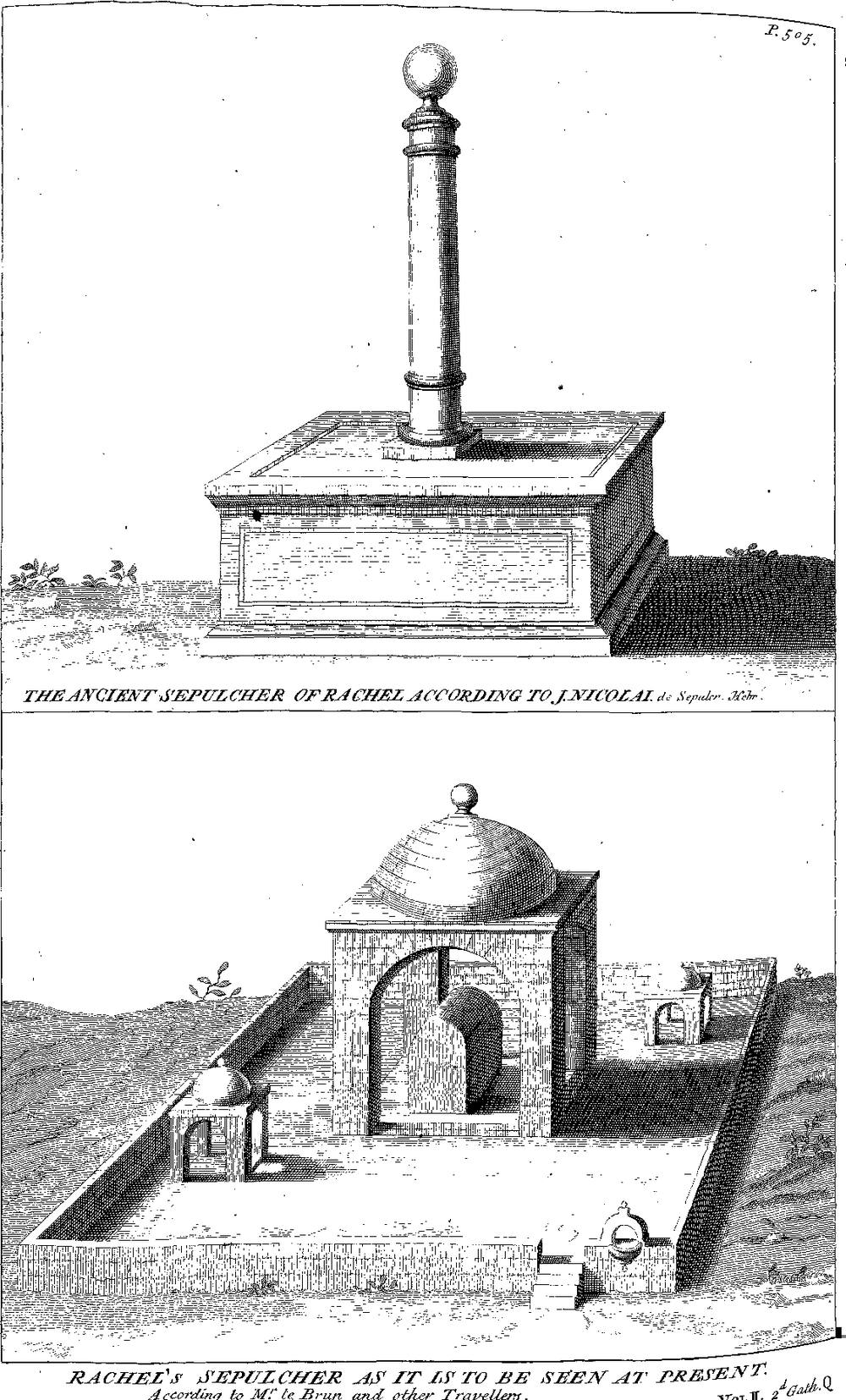
When Jacob had pass’d over the Brook Jabok, he divided his Wives and Children into three Companies. He put the two Maids Gen. xxxiii. 1, 2, 3. Gen. xxxv. 1, 2, 3, 4, &c.and their Children in the first Place; then Leah and her Children made the second Company; and lastly, Rachel and her Son Joseph. This he did, that if Esau should do any Violence to the first Company, the second and third might escape; or if he should not spare the second, that at least the third might avoid his Fury. After he had pass’d over Jordan, he went first to Salem, then to Shechem, and thence to Bethel, where he was to sacrifice to God, who had appear’d to him at his going into Mesopotamia. Lastly, as he advanced towards Hebron, and was not above a Furlong27 from Bethlehem, otherwise call’d Ephrath, Rachel was seized with the Pains of Child-birth. She brought forth a Son, to whom she gave the Name of Ben-oni, or the Son of my Pain; but Jacob gave him the Name of Benjamin, or the Son of my right Hand. Rachel’s Pangs were so violent, that they kill’d her, and Jacob buried her in the same Place, erecting a Monument28 for her, which continued for many Ages.
There is still to be seen at this Day a kind of Pyramid or Dome, supported by four square Pillars, which form as many Arches. This Monument is surrounded by a low Wall of three Foot high, with a little Entrance of three Steps. Cotovic says, that the Sepulchre is six Foot above the Ground, seven Foot long, and three and a half broad. The upper Part is round. On the two Sides of Rachel’s Tomb there are two other empty ones. M. le Brun, who made a Draught of it on the Place, says this Tomb is cut in the Cavity of a Rock, and cover’d with a Dome, supported by four Pillars or Fragments of a Wall, which open to the Sepulchre. The Work is rude enough, and without any Ornament. The whole is as entire as if it had been but just made, and it is hard to imagine it has subsisted ever since Jacob’s time. But it may have been renew’d afterwards. Rachel died in the Year of the World 2265, or 2266; before Christ 1734, or 1755; before the vulgar Era 1738, or 1739.
Jer. xxxi. 15. Matth. ii. 18.The Prophet Jeremiah, and after him St. Matthew, have put Rachel for the Tribes of Ephraim and Manasseh, born from Joseph the Son of Rachel. In Rama (or upon the high Places) was there a Voice heard, Lamentation and Weeping, and great Mourning, Rachel weeping for her Children, and would not be comforted because they are not. This Prophecy was compleated when those two Tribes were carried into Captivity beyond the Euphrates. St. Matthew has made an Application of this Prophecy to what happen’d at Bethlehem, when Herod put to death there all the Children of two Years old and under. Then Rachel, who was buried thereabouts, in some manner may be said to make her Cries and Lamentations, for the Death of so many young Innocents, sacrificed to the Jealousy and the Cruelty of a distrustful Prince.
RADDAI, the fifth Son of Jesse, and Brother of David. 1 Chron. ii. 14.
Jos. Antiq. l. 13. c. 23.RAGABA, a very strong Castle beyond Jordan. This is probably Argob, of which Mention is made in several Places of the Old Testament.29 Eusebius places Argob in the Canton of Gerasa, fifteen Miles from it towards the East.
RAGAU, a large Plain wherein Nebuchadnezzar King of Nineveh, overcame Arphaxad King of the Medes, in the Country Judith i. 5, 6.of Arioch King of the Elymeans. These Plains of Ragau are probably those that lie about Rages in Media, of which we shall presently speak. This Nebuchadnezzar that conquer’d Arphaxad, in our Opinion, is the Saosduchim King of Assyria, who made War with Phraortes King of the Medes, in the Year of the World 3347, before Christ 653, before the vulgar Era 657. See the Preface to the Book of Judith.
RAGES, or Ragæ, a City of Media, standing upon the Mountains of Ecbatana. Tobit having deposited the Sum of ten Talents with Gabael, a Citizen of Rages, or rather having lent it him, according to the Latin Vulgate, sent his Son Tobias to fetch it. But he being obliged to stay some Time at Ecbatana,30 to celebrate his Marriage with Sara the Daughter of Raguel; he desired the Angel Raphael, whom he took only for a Man, to go to Gabael, and bring him the ten Talents; which Request Raphael perform’d. Rages was a little Day’s Journey from Ecbatana, and situate on the Southern Part of Media, in the Mountains that divide this Country from Parthia.
I. RAGUEL, otherwise Jethro, Father-in-law to Moses. See JETHRO.
II. RAGUEL, Father of Sara, and Father-in-law to young Tobias. He dwelt in the City of Ecbatana, and had a great Estate. But having given his Daughter Sara to seven Husbands successively, the Evil Tob. vi. 11----14.Spirit had slain them all. However, Tobias coming to Ecbatana, the Angel Raphael urged him to demand Sara for Wife, and so much the rather, because he was the nearest Kinsman to Raguel, and therefore
Numb. xxxvi. 6.obliged to marry her, according to the Law. Raguel gave his Consent to this Marriage, though not without Difficulty, as fearing it might happen to him as it had happen’d to his Daughter’s seven former Husbands. But the Lord preserving Tobias, Raguel kept him fifteen Days at his House, made great Feasts for all his Friends, gave him the Half of his Estate, and secured the other Half to him after his own death.31
Josh. ii. 3, 4, 5.I. RAHAB, an Hostess of the City of Jericho, who received into her House and concealed the Spies sent by Joshua to view the City. The Hebrew Text calls her Zona,32 which St. Jerom and many others understand of a Woman of an ill Life. But others33 think she was only an Hostess or Innkeeper, and that this is the true Signification of the original Word. Had she been a Woman of ill Fame, would Salmon, a Prince of the Tribe of Juda, have taken her to Wife, or could he have done it by the Law? Besides, the Spies of Joshua would hardly have gone to lodge with a Prostitute, a common Harlot, they who were charged with so nice and dangerous a Commission. Those that maintain she was an Harlot pretend, that perhaps she was one of those Women that prostituted themselves in Honour of the Pagan Deities; as if this could any way extenuate her Crime, or the Scandal of her Profession, if it were true that she was a publick Woman.
But whatever was Rahab’s Profession, the Spies of Joshua were no sooner entered her House,34 a but Notice was given of it to the King of Jericho, who sent to tell Rahab, that she must produce those Men that were come to her House. But she hid them, and told the Messengers, that it was true, indeed, such Men had been at her House, but she did not know from whence they came; and when the Gates of the City were shutting, they went out, and she could not tell whither they were gone. Pursue them quickly, she said, and you may overtake them. They forthwith pursued them, but in vain, for they were conceal’d upon the Terrass of Rahab’s House.
When the King’s Messengers were gone away, Rahab went up to the Terrass or Roof of her House, and said to the Israelites, I know the Lord has delivered this Country into your Hands, the Terror of your Name has seized us, and all our People are in a Consternation. Promise me therefore, that you will save the Lives of me and my Family, when you shall take Possession of this City. The Spies promis’d her with an Oath, and bid her tie a scarlet String to her Window, that her House might be distinguished when the Israelites should enter into Jericho. If we should touch any one that belongs to you, added they, which shall be then in your House, his Blood be upon us; but if they are without, their Blood shall fall upon their own Heads, and we will be blameless.
Having obtained these Promises, she let them down by a Rope that she fastened to her Window; for her House joined to the Walls of the City. She advised them to return by the Way of the Mountains, for fear of meeting those that had been sent in quest of them; and to continue upon the Mountains for three Days, in which time the Messengers would return, after which they might proceed on their Way. The Spies followed Rahab’s Counsel exactly, and at the End of three Days arrived at Joshua’s Camp, to whom they related all they had discovered at Jericho, which had happened to themselves, and the Promises they had made to their Benefactress Rahab. Some time after this, when the People for six Days had made a Circuit round Jericho with much Silence, Joshua commanded all Israel to make a Tour the seventh Time, Josh. vi. 16, 17.and when the Priests sounded the Trumpets, to cast forth a very loud Cry. To which he added, that the whole City, and whatever was found therein, was to be utterly extirpated; only Rahab and those that were found in her House, should have their Lives saved.
Joshua’s Orders were duly executed. The Walls fell down at the Cry of the Hebrews, and the City was taken and destroyed. Joshua sent the two Spies to the House of Rahab, to bring her out with all her Relations, that they might be secured from all Violence. As soon as they were come out, Joshua put fire to the City, and cursed him that should undertake to rebuild it. Rahab married Salmon, a Prince of Judah, by whom she had Boaz. Boaz was Father to Obed, and Obed to Jesse, the Father Ruth iv. 20.of King David. Thus Jesus Christ has condescended to reckon this Canaanitish Matt. i. 5. 1 Chron. ii. 11. Heb. xi. 31.Woman among his Ancestors. In the Chronicles it is said, that Nathon begat Salma, who is the same as Salmon. St. Paul magnifies the Faith of Rahab, who escaped the great Calamity of her Country, by having entertain’d and concealed the Spies.
Psalm lxxxvii. 4. אוכיר רהבII. RAHAB. The Psalmist speaks of another Rahab, different from this now mentioned. I will make mention of Rahab, and Babylon, to them that know me. And again, Psalm lxxxix. 10. Thou hast broken Rahab in pieces, or the Egyptian. Isaiah li. 9. and xxx. 7. makes use of the same Word Rahab to mark out the Destruction of Pharaoh and his Army in the Red Sea.
See also Job xxvi. 12. By his Understanding he smiteth through the Proud; the Hebrew says, Rahab. The most skilful Commentators35 explain this of Egypt, and particularly of that Part of Lower Egypt which is called Delta, because of its Likeness to the Letter Δ, making a Kind of Triangle, whose Base is the Mediterranean Sea. This Part of Egypt is still called Rib or Rif, the Pear, because of its Similitude to the Shape of this Fruit. M. d’Herbelot says, in his Bibliotheca Orientalis, that the Name Rif, is given to that Part of Egypt, which begins at Cairo, and stretches out towards the North: And that the Arabians call by the Name of Giouf, that Part of the same Country which the Greeks call Delta, and which contains all the Country enclosed by the Nile, till it empties itself into the Mediterranean Sea.
St. Jerom and the antient Greek Interpreters have often translated Rahab by Pride, or the Proud. But the Fathers, and such Interpreters36 who have not consulted the Original, have understood by Rahab, no other than the Woman of Jericho, of whom we have spoke in the foregoing Article.
RAHAM, Son of Shema, and Father of Jorkoam, of the Race of Caleb. 1 Chron. ii. 44.
RAIN. It should seem by some Expressions of the Scripture, that the antient Hebrews imagin’d the Rain to be derived from certain great Refervatories, which they supposed to be above the Heavens, and which Moses calls the superior Waters, by way of Contradistinction from the inferior Waters, which are those of the Sea. For Example, Moses says, that at the Time of the Deluge, the Rain did not fall according to the ordinary Course of Nature, but that the Cataracts of Heaven were set open.37 All the Fountains of the great Deep were broken up, and the Windows of Heaven were opened. Hos. ii. 21.And Hosea says, that in times of great Drought the Clouds cry to the Lord, beseeching him to permit the Waters which he keeps in his Treasuries and Repositories, to fall into them and replenish them. In other Places of Scripture,38 the Clouds are described to us as great Bags or Bottles, filled with the Waters that are supply’d to them from the Firmament. Even the Dews themselves Deut. xxxiii. 28.are represented as proceeding from the superior Waters. His Heavens shall drop down Dew.
The Sacred Writers often speak of the Rain of the former Season, and of the Rain of the latter Season: Imber temporaneus, & Deut. xi. 14.Imber serotinus. I will give you the Rain of your Land in his due Season, the first Rain and the latter Rain. So Hosea, He Hos. vi. 3.shall come unto us as the Rain, as the latter and former Rain unto the Earth. The Rabbins, and the Generality of Interpreters are of Opinion, that the former Rain, pluvia temporanea, called in Hebrew, Jorah, signifies יורה Jorah מלקוש Malchush. Job xxix. 23. Prov. xvi. 15. Hos. vi. 3. Joel ii. 23.the Rain of the Autumn; and that the latter Rain, pluvia serotina, called in the Hebrew, Malchush, signifies the Rain of the Spring-season. ‘Tis known that the Jews began their Year at Autumn, which gives some Probability to their Opinion, who suppose the pluvia temporanea to signify the Rain that falls in Autumn. But on the contrary, we think that Jorah signifies the Rain of the Spring, and Malchush that of the Autumn. In Judea it commonly rained but in two Seasons, in the Spring and in the Autumn. Jorah is always put first, and Malchush afterwards. The natural Order of the Season is, that the Spring should come before the Autumn. Malchush is derived from the Verb Lakash, which signifies to make a Vintage, to delay, to put off, to gather in the After-marth, or the Grass that grows in the Meadows in the latter Season. Besides, Malchush signifies a Rain that is (as it were) earnestly desired by the Earth, as coming after the dry Season of the Summer. Joel says, He will cause to come down for you the Rain, the former Rain, and the latter Rain in the first Month. But if Malchush signifies the Rain of the Autumn, it will be easily granted, that Jorah must signify that of the Spring. The Septuagint39 have taken it in the Sense we now contend for: And Hesiod40 has express’d the Rain of the Spring and Autumn in Words of the same import, as those made use of by the Septuagint.
Moses describing the Land of Canaan, the Advantages of which he compares to Deut. xi. 10, 11.those of Egypt, says, that the Land of Canaan is not like that of Egypt, where they are obliged to convey the Water by artificial Canals, and by great Labour and Industry, to water the Fields and the Gardens. For it never rains in this Country; whereas Palestine being a Country of Hills and Vales, is watered by the Rains from Heaven. Sed montuosa est & campestris, de cœlo expectans pluvias. We have already described, under the Article Foot, the Manner in which they water the Soil of Egypt, to which the Inundations of the Nile cannot arrive. As to the Land of Canaan, ‘tis well known that it is water’d by copious Dews in the Summer, and by Showers of Rain in the Spring and Autumn. Whence it is that God promised the
Israelites, if they will continue obedient to his Commands, that he would send them Lev. xxvi. 3.Rain in due Season. Dabo vobis pluvias temporibus suis. And on the other hand, Moses threatens them, if they depart from that Fidelity that they owe to God, to send them Showers of Sand and Dust. Det Deuteron. xxviii. 24.dominus imbrem terræ tuæ pulverem; Showers that will be more apt to dry up and burn, than to refresh the Earth.
The Hebrews often compare Speech and Deuteron. xxxii. 2. Ecclus. xxxix. 9.Discourse to Rain. Concrescat ut pluvia doctrina mea. And Ecclesiasticus, Tanquam imbres (sapiens) mittet eloquia sapientiæ suæ. Job says, that in the Time of his Prosperity, he was attended to with great Respect and Eagerness; that his Discourse Job xxix. 21,22,23.distilled like soft Rain. Super illos stillabat eloquium meum. That they expected it like Rain, and opened their Mouths as it were to receive the Rains of the latter Season. Expectabant me sicut pluviam, & os suum aperiebant quasi ad imbrem serotinum.
Psalm cxxxv. 7. Jer. x. 13. & li. 16.The Psalmist and Jeremiah observe, as an Effect of the Power of God, that he changes Lightning into Rain. Fulgura in pluviam facit. Lightning goes before Thunder and Rain; and when we perceive Lightning, and hear a fresh Clap of Thunder during a Storm, we conclude that the Shower will soon come. This is easy to be apply’d. Lightning and Thunder are produced only by the Shock of Clouds one against another; and the same Shock is the Cause of Rain also. The Prophet therefore may observe here, it is as it were the Forerunner, and the natural Token of Rain. Perhaps also the People might be of Opinion, that Lightning was changed into Rain, or produced it as a Cause. Some understand Chrysost. Theodor. Heraclit. Theodor. in Psalm.it thus: God by his Power unites Lightning with Rain, Fire with Water; things which are naturally incompatible.
RAITHU, or Raitho, a famous Place among Authors of the middle Age, about Mount Sinai.
RAKEM, or Recem, Son of Shereth. 1 Chron. vii. 16. He was of the Tribe of Gad, and of the Family of Machir.
RAKKATH, Raccath, or Reccath, a fenced City belonging to the Tribe of Naphtali. Josh. xix. 35.
RAKKON, Raccon, or Arecon, a City of the Tribe of Dan. Josh. xix. 46.
I. RAM, Son of Hezron, and Father of Aminadab, of the Tribe of Judah. 1 Chron. ii. 9.
II. RAM. Job xxxii. 2. Then was kindled the Wrath of Elihu, the Son of Barachel, the Buzite, of the Kindred of Ram. In this Place Ram is apparently put for Aram. Elihu was of the Race of Buz, Son of Nahor the Aramean, or Syrian.
RAM, or battering Ram. This is a well-known Engine of War. ‘Tis mentioned Ezek. iv. 1, 2. & xxi. 22.by Ezekiel in two Passages, and Nebuchadnezzar made use of it at the Siege of Jerusalem. Pliny says, it was Plin. l. 7. c. 56. Vitruv. l. x. c. 19. Tertul. de Pallio.Epeus that invented the Ram at the Siege of Troy: But Vitruvius and Tertullian ascribe the Invention to the Carthaginians. I believe Ezekiel is the earliest Author that has made any mention of this Machine.
Josh. xviii. 25.RAMAH, or Aramah; this Word signifies an Eminence, from whence it is that there are so many Places in Palestine, that go by the Name of Rama, Ramath, Ramatha, Ramoth, Ramathaim, Romola, and Ramathan. Sometimes the same Place shall be called at once Rama, Ramatha, Ramoth, and Ramathaim, all these Words only signifying an Eminence or high Situation. Sometimes Rama or Ramoth is joined to another Name, to determine the Place of such City or Eminence. Lastly, Ramah is sometimes put only for a high Place, and signifies neither City nor Village. These following are the chief Places that are mentioned in Scripture by the Name Ramah.
I. RAMAH, a City of Benjamin, situate Judg. iv. 5. & xix. 3. Euseb. in locis. Hieron. in Osee v. Idem in Sophon. 1. 1 Kings xv. 17. 2 Chron. xvi. 1. Joseph. Antiq. l. 8. c. 6.between Gaba and Bethel, towards the Mountains of Ephraim, six Miles distant from Jerusalem towards the North. Saint Jerom places it near Gaba, seven Miles from Jerusalem: It was still in being in his Time, and was then only a small Village. This City stood upon the Road that went from Samaria to Jerusalem; whence it was that Baasha King of Israel caus’d it to be fortify’d, that there might be no Passage out of the Land of Judah into that of Israel. Josephus calls it Ramathan.
I make no doubt but that this is the 1 Sam. i. 1, 19. & ii. 11, &c.same as Ramatha, or Ramathaim-zophim, the Country of the Prophet Samuel. This City was on the Frontiers of Ephraim and Benjamin; and these Sorts of Cities were often inhabited by Men of both the Tribes. Rama, Ramath, and Ramathaim, may express but one and the same Place. The other Ramah, or Ramula, thought to be the Country of Samuel, cannot be so; as will be seen afterwards.
‘Tis also very probable that Jeremiah Jer. xl. 1, 2, 3.speaks of this Ramah, when he says, that Nebuzar-adan, who had the Command of the Chaldean Army, having found him among the Captives at Ramah, whither they had been all brought together, set him at Liberty, and permitted him to go where-ever he pleas’d. And ‘tis of the same Place that we explain that other Prophecy of Jeremiah, wherein the Lord Jer. xxxi. 15,16,17.comforts Rachel, for the taking away of her Children of the Tribes of Ephraim and Manasseh, which had been carried into Captivity: A Voice was heard in Ramah, Lamentation and bitter weeping: Rachel weeping
weeping for her Children, refused to be comforted for her Children, because they were not. Thus saith the Lord, Refrain thy Voice from Weeping, and thine Eyes from Tears: for thy Work shall be rewarded, saith the Lord, and they shall come again from the Land of the Enemy. And there is Hope in thine End, saith the Lord, that thy Children shall come again to their own Border. St. Matth. ii. 18.Matthew hath made an Application of this Passage of the Mourning of Rahel or Rachel, to the Massacre of the Infants of Bethlehem by Herod. But it is plain, that That was not the literal and historical Sense of this Passage of Jeremiah.
The Scripture often joins Ramah with Gaba, Geba, or Gibeah, as being two neighbouring Places: So Ezra ii. 26. Nehem. vii. 30. Isai. x. 29. Hosea v. 8. We also see, 1 Sam. xxii. 6. that when Saul abode in Gibeah, and sate under a Tree at Ramah, that he was inform’d of David’s having been seen in the Forest of Haresh: But in this Place we take Ramah only to signify the Eminence that was at Gibeah.
II. RAMAH, or Ramatha, Ramola, Ramula, Ramba, Ruma, or Remphtis, a City lying to the West of Jerusalem, between Hieron. in Epitaph. Paulæ. Le Brun, p. 251.Lydda and Joppa, as St. Jerom places it; or between Joppa and Jerusalem, as the modern Travellers describe it. Phocas puts it about six and thirty Miles from Jerusalem. Heretofore, near this Place, and towards Lydda, was to be seen the neat Church of St. George, with a Monastery bearing his Name, wherein the Body of this Saint and Martyr Bernard. Monach. Itin. an. 870. Reland. Palæst. l. 3. p. 950. Sanut. in secretis fidel. crucis, p. 152.was deposited. Abulfeda, quoted by M. Reland, says, that this City was built by Solyman Son of Abdolmelic, after the Destruction of Lydda; and Sanutus also says, that the Arabians built it near Lydda, after the Crusadoes began to come into that Country. M. le Brun describes the fine Reservoirs of Water to be seen there, and many other Marks of Antiquity: He says it is but four Leagues from Jafa, or Joppa, and stands in a plain and even Country: He says also, that Lydda is on one Side, and about three Miles from Rama.
These Circumstances determine me to Euseb. in Ἀρμαθαίμ. Hieron. in Epitaph. Paulæ. Matt. xvii. 57.think that this is the same Place that Eusebius and St. Jerom took for Arimathea, the Country of Joseph of Arimathea, so well known in the Gospel. St. Jerom places it between Lydda and Joppa: And Eusebius says it is in the Canton of Thamnis, and near to Diospolis, otherwise call’d Lydda. This is the same that was taken from Samaria, and added to Judea. See 1 Mac. xi. 34. and Josephus’s Antiquities, l. 13. c. 8. p. 438. But if this be so, we must acknowledge this City to have been very ancient, and to have been in being long before our Saviour’s time: And, consequently, when it is said, that it was built only since the Time of the Crusadoes, it must be understood only to have been then rebuilt, repair’d, or fortify’d anew. Eusebius and some others seem to have thought, Euseb. & Hieron. in Armathasophim.that this City is the same as Ramath of Samuel, or Ramathaim-zophim of the Mountains of Ephraim. But this Opinion cannot be supported by any means.
Le Brun, Voiage de Syrie, p. 259.III. RAMA, or Ramatha. Phocas says, in his Travels, that Ramah, or Armath, where the Great Samuel was born, was to be seen at about six Miles from Jerusalem, towards the West. Le Brun says, that going from Ramah in order to come to Jerusalem, he pass’d through Cobeb, Benop, Carithleneb, Soud, Souba, and Samuel; which is a Church upon a Hill, where, they say, heretofore was the City of Samuel. But this City of Samuel was to the North, and not to the West, from Jerusalem, in the Mountains of Ephraim, and not in those of Judah. See the Article of ARIMATHEA.
IV. RAMA, a City of the Tribe of Naphtali, Josh. xix. 36. upon the Frontiers of Asher, Josh. xix. 29. St. Jerom read Horma in the Hebrew; but the Septuagint and Eusebius read Rama. The same Eusebius and Cyrillus of Jerusalem, upon Zechariah, p. 805, own there was a Rama in the Tribe of Asher, and another belonging to Napthtali.
RAMATHA, and Ramathaim-zophim, the same as Rama, between Bethel and Judg. xv. 17. רמת .לחי LXX. Ἀναίρεσις σιαγόνος.Gaba, of which we spake under I. RAMA.
RAMATH-LEHI, or Ramat-lechi, or the Height of the Jaw-bone, or the Cast of the Jaw-bone. ‘Twas thus they call’d the Place where Samson threw the Jaw-bone upon the Ground, that he had taken up against the Philistines, and with which he had beat them. Probably, this is the same Syncel. Chronic. p. 101, 103.as the Place call’d Lehi, Judg. xv. 9.
RAMESSES, or Ramesse. Several Kings of Egypt are known by the Name of Ramesses. Syncellus reckons up six of ‘em; viz.
I. RAMESSES, the Successor of Uses, who reigned nine and twenty Years.
II. RAMESSE-MENES, fifteen Years.
III. RAMESSE-SEOS, three and twenty Years.
IV. RAMESSE-MENOS, nineteen Years.
V. RAMESSE-TUBAETE, nine and thirty Years.
VI. RAMESSE-VAPHRES, nine and twenty Years.
All these Princes reign’d successively; only between the second and third there was one call’d Thusmares. The same Syncellus speaks elsewhere of another Ramesses, whom he places between Armais and Amenophis, Kings of Egypt; and also of one
Ramesse-Vaphres (VI) continues on the next page
Footnotes
-
See Gale, Court of the Gentiles, l. 2. Stanley, Hist. of the Philosophers. Faidit Lettre nouvelle de la Rep. des Lettr. 1703. Octob. Theses des Carmes de Beziers, in 1682. ↩
-
Jamblic. de vita Pythag. c. 4. Apulei Florid. l. 2. ↩
-
Exod. xvi. 13. שלוChald. סלויSelau. Syr. סלויSalvái. ↩
-
Strabo l. 16. Diodor. Sicul. l. 3. Plin. hist. nat. l. 10. c. 23. may ↩
-
Hieronym. de Vir. illust. c. 19. & Bolland. 26. Maii. Arab. סלויSalva. Coturnix. LXX. ‘Ορτυγομήτραν. Clenard. epist. l. 1. Kirsten. in Matth. iii. 4, &c. ↩
-
Joseph. de Bell. l. 1. c. 20. In the Year of the Birth of Jesus Christ. ↩
-
Joseph. Antiq. l. 17. c. 12. de Bell. l. 2. c. 5. p. 979. ↩
-
Joseph. de Bell. l. 2. c. 7. p. 780, 781. ↩
-
Vell. Paterc. l. 2. c. 117. Dio l. 5. p. 585. Sueton. l. 2. c. 23. ↩
-
Arab. Æthiop. See our Dissertation upon Punishments, and the Article Punishment in this Dictionary. ↩
-
Matth. vi. 11. τὸν ἄρτον ἡμῶν τὸν ἐπιούσιον δὸς ἡμῖν σήμερον. ↩
-
Gen. x. 7. Ezek. xxvii. 22. רעמהRegnemah. ↩
-
2 Kings xxv. 8, 20. & passim. Jer. xxxix. 9, 10. & passim. .רב טבחים ↩
-
Vid. Hieron. in Matth. vi. Am- bros. de Sacrament. l. 5. c. 4. Abailard. Epist. ad S. Bernardum. ↩
-
Very learned Men think, that they never sate down in the Temple, but only in the Synagogues. They will have it, that when our Saviour was sitting in the Midst of the Doctors, ‘twas only in the Synagogue adjoining to the Temple. See Deytin. Observ. t. 3. c. 30. ↩
-
Abrah. Ben-David, Hallevi Sepher Hakkabal. Vide Bartolocci t. 1. p. 18. ↩
-
Abravanel. proem. in lib. Nachalatathrooth. Morin. l. 2. exercit. Bibl. exercit. 2. c. 1. ↩
-
2 Kings xviii. 17. רבשקהPrinceps pincerna. ↩
-
In the Year of the World 3292, before Christ 708, before the vulgar Era 712. See 2 Kings xviii. 17, 18, &c. Isai. xxxvi. 1, 2, 3. ↩
-
2 Kings xviii. 17. רבסריסRab-siris. Princeps Eunuchus. ↩
-
Judges ix. 4. xi. 3. אנשים רקיםLXX. Ἄνδρες κενοί. us, ↩
-
Jerem. xxxix. 3. In the Year of the World 3416, before Christ 584, before the vulgar Era 188. ↩
-
Herodot. l. 3. c. 79. Vide Aug. contra Faust. l. 22. c. 49. ↩
-
Gen. xxx. 22, 23, 24. In the Year of the World 2259, before Christ 1741, before the vulgar Era 1745. ↩
-
In the Year of the World 2265, before Christ 1735, before the vulgar Era 1739. Gen. xxxi. 1, 2, 3, &c. ↩
-
Gen. xxix. 1, 2, 3, &c. In the Year of the World 2245, before Christ 1755, before the vulgar Era 1759. ↩
-
The Hebrew reads Kiberath. See the Article Kiberath-aretz. ↩
-
Hebr. מצבהMatzebah. LXX. Στήλην, a Pillar. Hieronym. Titulum. ↩
-
Deut. iii. 4, 13, 14. 1 Kings iv. 3. 2 Kings xv. 25. ↩
-
Tob. vi. 6. ix. 3. The Latin Text of Tobit iii. 7. reads Rages, instead of Ec- batana, which is a palpable Fault. ↩
-
Tob. viii. 22, 23, 24. In the Year of the World 3322, before Christ 678, before the vulgar Era 682. ↩
-
Josh. ii. 1. אשה זונה LXX. Γυναικὸς πόρνης. Ita PP. passim. ↩
-
Ita Chald. Rabb. Lyr. Arias. Pagn. Titelman. Vide, si placet, sanct. in 3 Reg. iii. 26. ↩
-
In the Year of the World 2553, before Christ 1447, before the vulgar Era 1451. ↩
-
Chald. R. Salom. Abenez. Kimchi, Jun. Pag. Munst Muis, Boch. Phaleg. l. 4. c. 14, &c. Hieronym. Theodoret. Euthym. Latini plures in Psalm lxxxvi. 4. ↩
-
Aug. pseud. ↩
-
Gen. vii. 11. See also Psalm xxxiii. 7. xlii. 7. ↩
-
Job xxxvii. 12. xxxviii. 37. Psalm xviii. 11. 2 Kings xxii. 12. ↩
-
LXX. Τετὸν τῆς γῆς σε καθ’ ὥραν πρόϊμον καὶ ὄψιμον ↩
-
Hesiod. Oper. & Dies. l. 2. calls ὥεινον ὄμβρον, that of the Spring; and ὀπώεινον ὄμβρον, that of Autumn. ↩