I. HEZEKIAH, King of Judah, the son of Ahaz and Abi, was born in the year of the World 3251, Ahaz his father being 2 Kings xvi. 1. compar’d with 2 Kings xviii. 1. See our Comment upon 2 Kings xvi. 1, &c.then no more than eleven years of age. There is some difficulty with respect to this particular; but the Scripture asserting, that Ahaz was but twenty years old when he began to reign, and that he reigned but sixteen years, it follows, that he lived but six and thirty. Now the same Scripture says, that Hezekiah was five and twenty years old, when he began to reign: we must conclude therefore, that Ahaz his father had him, when he was but yet eleven years old: which is indeed very extraordinary, but not at all impossible.
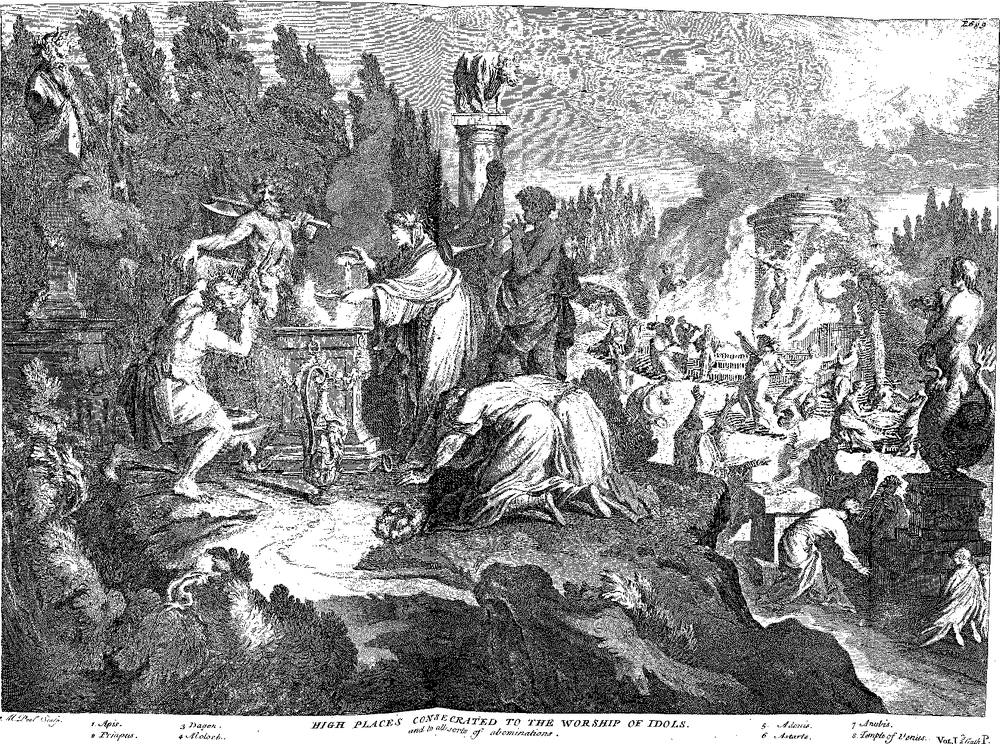
Hezekiah succeeded his father Ahaz in the year of the World 3277, or 3278, before Jesus Christ 722, before the Vulgar Æra 726. He did that which was good 2 Kings xviii.and agreeable to God. He destroyed the High-places, cut down the prophane Groves, and broke the Statues which the people adored in the reign of Ahaz. He broke in pieces the brazen Serpent which Moses had made, because the Children of Israel burnt incense to it. In the first 2 Chr. xxix. 3.month of the first year of his reign, he ordered the great doors of the Lord’s House to be opened, and repaired them: he convened the Priests and Levites, and exhorted them to purify and cleanse the Temple, and to put it into a condition to have Sacrifices offered in it as formerly. The Priests and Levites having executed the King’s commands, they began to offer Sin-offerings and Burnt-sacrifices upon the Altar of the Temple; which Sacrifices were furnished by the King. After this, the Princes of the people offered again abundance of Victims, and the Worship of God was perfectly restored in his House.
As the Feast of the Passover had been hitherto neglected, Hezekiah invited not only all his own people to it, but those 2 Chr. xxx.likewise of the kingdom of Israel. Some ridiculed the proposal; but many came into it: and this was the most solemn Passover that had been observed for a long time. After this, the people began generally to destroy all the remains of Idolatry, which were still subsisting not only in the territories subject to Hezekiah, but in those likewise belonging to Hosea, the last King of Israel; who saw his people, without jealousy, returning to the worship of the Lord. Hezekiah took all necessary care to keep up the good regulations, which he had 2 Chr. xxxi.established in the Temple, and to provide sustenance for the Priests and other Ministers of the Lord, together with such other things as were requisite for their support. All the people brought their Tythes, and First-fruits, in so large a quantity, that there was some left.
In the year of the World 3290, or 3291. 2 Kings xviii. 7. 2 Chr. xxxii. 1, 2, 3, &c.Some years after, Hezekiah shook off the Assyrian yoke, and refused to pay the accustomed tribute to that King. He defeated the Philistins, and destroyed all their country from the Tower of the watchmen to the fenced Cities. He set about repairing the Walls of Jerusalem, and fortified it by building Towers about it. He laid in stores of arms and provisions, set good commanders over his troops, stopp’d up the springs which were without the city, and omitted nothing which was necessary to put himself into a condition of making a vigorous resistance.
In the mean time, Sennacherib King of Assyria marched against him; entred the territories of Judah, and made himself master of almost all the towns in it. Hezekiah observing that the Kings of Egypt and Cush, with whom he had made 2 Kings xviii. 24. xix. 9.an alliance, did not come to his assistance, and being sensible, that he was not of himself strong enough to resist so powerful an enemy, he sent Ambassadors to him, desiring him to retire out of his dominions, and promising to submit to such terms, as he should think fit to impose upon him.
Sennacherib demanded of him three hundred talents of silver, and thirty talents of gold1; and to raise this sum, Hezekiah was obliged to exhaust all his treasures, and to pull off the gold plates, which he had put formerly upon the Temple-doors. But Sennacherib having received this money, instead of returning, and leaving Hezekiah in peace, sent three principal Officers of his Court to him from Lachish, which he was besieging, to Jerusalem, with a summons to him to surrender. These Officers desired to speak with Hezekiah; but the King did not think it proper to go out of the city: he sent Eliakim, Shebna, and Joah to them, whom Rabshakeh spoke to in an insolent manner, aggravating the power of his master, and saying, that Hezekiah was not able to furnish him with a thousand men to mount a thousand horses, which Sennacherib should supply him with: he added, that the Jews in vain placed their confidence in the King of Egypt; that Pharaoh would be to them as it were a bruised reed, which breaks under him who would rest upon it, and pierces his hand: that Sennacherib was come into Judæa in obedience purely to the Lord’s Order, who had said to him, Go up against this Land, and destroy it.
And as Rabshakeh spoke Hebrew, and the people of Jerusalem were upon the walls and heard him, the Deputies appointed by Hezekiah desired him to speak Syriac, because they understood this language, and not Hebrew, before all the people who heard them from the walls. Rabshakeh answered, Did my Lord send me hither to speak to you only and your master? or to these men rather, who hear me from the walls; and whom you would reduce to the necessity of drinking their own urine and eating their own excrements? At the same time he raised his voice, and exhorted the people to surrender to his master; adding, that as there were no Gods who were able to rescue the nations out of his hands, which he had subdued, so the Lord could not preserve them from the arms of the Assyrian King.
Hezekiah having heard these blasphemies, rent his clothes, covered himself with sackcloth, went to the House of the Lord, and sent a message to the Prophet Isaiah, with an account of what Rabshakeh had said. But Isaiah said, thus saith the Lord, fear not the menacing and blasphemous discourses which you have heard, I will send out the spirit of fear against Sennacherib, which will oblige him to return to his own country, where he shall perish by the sword. Accordingly this King having broke up the siege of Lachish, and setting down before Libnah, was informed that Tirhakah King of Cush, was marching against him, with a design to engage him. He left the siege of this place therefore, to go and meet Tirhakah; and at the same time sent letters to Hezekiah, wherein he told him, that he ought not to place his confidence in his God; that this would never secure him from his power, no more than the Gods of other nations had been able to protect them against his arms.
Hezekiah having received these letters, went up to the Temple, spread them before the Lord, and begg’d of God to deliver him out of the hands of this insolent and proud enemy. The Lord heard his prayer, and sent the Prophet Isaiah to tell him, that he should not fear Sennacherib’s threats; that this Prince would be soon obliged to return home; that he should not lay siege to Jerusalem and attack it, and that the Lord would protect and defend the city and his people. Accordingly, the very night after this Prediction, the Angel of the Lord came down into the camp of the Assyrians, and killed there an hundred fourscore and five thousand men of Sennacherib’s army; so that this Prince was obliged to retire immediately to Niniveh, where two of his sons smote him with the sword, as he was worshipping in the Temple of Nisroch his God. He was succeeded by Esar-haddon, in the year of the World 3291, before Jesus Christ 709, before the Vulgar Æra 713.
2 Kings xxi. 23, &c. and Isai. xxxviii. & 2 Chron. xxxii. 29, 30. Rabb. apud Hieronym. in Isai. xxxix. 2 Chron. xxxii. 24.Soon after this war, and in the very year of Sennacherib’s invading the territories of Judah, which was the fourteenth year of Hezekiah, this Prince fell very dangerously sick. His disease was probably an imposthume or an ulcer. The Rabbins are of opinion, that God afflicted him with this indisposition to punish his neglect, because he had not composed a song of thanksgiving for his deliverance from Sennacherib’s war. But the second book of Chronicles seems to attribute this disease to the elevation of Hezekiah’s heart, and his not acknowledging sufficiently, that his deliverance was owing to the pure favour of God. However this may be, the Prophet Isaiah came to him, and said, Set the affairs of thine house in order, for thou shalt live no longer, but shalt die. Hezekiah, turning his face to the wall, addressed his prayer to God with abundance of tears. Isaiah was not got above half way the court, when the Lord commanded him to return to Hezekiah. He did so, and said to him, Thus saith the Lord, I have heard thy prayer, and have seen thy tears. I have healed thee, and in three days thou shalt go to the Temple, and I will add still fifteen years to thy life. Besides, I will protect thee against the King of the Assyrians, and will defend Jerusalem from his insults. At the same time, Isaiah ordered some figs to be brought, which he put upon the King’s ulcer and he was cured.
But Hezekiah had before said to him, what sign shall I have, that the Lord will heal me? Isaiah answered him, would you have the shadow of the sun advance ten degrees, or retire ten degrees in the dial of Ahaz? Hezekiah desired, that the shadow might go back ten degrees, for this seemed to him most difficult; and the Prophet calling upon the Lord, the shadow, as he had promised, returned ten degrees backward. It is very probable, that this retrogradation, which was very sensible and real in the dial of Ahaz, was caused by some reflection of the sun’s rays, without a necessity of there being any real retrogradation of this Luminary. Hezekiah, after his recovery, composed a song of thanksgiving to the Lord, which the Prophet Isaiah has preserveda.
a Isai. xxxviii. 10, 11, &c. b In the Year of the World 3291, before J.C. 709, before the VulgarAt this time b Merodach or Berodach- Baladan King of Babylon, sent letters and presents to Hezekiah c, because he understood that he had been sick, and knew that at the time of his cure, some great proprodigy 2 Chr. xxxii. 31.had happened at Jerusalem. Hezekiah was mightily delighted with this Ambassy; he shewed the King of Babylon’s Envoys all his treasures, his spices, his rich vessels; in a word, he concealed nothing in his palace from them. The Prophet Isaiah came afterwards to the King; and having understood what had passed, told him as from God, that a time would come, when all that was in his house, and his fathers had amassed together to that day, would be removed to Babylon: that his sons would be made Eunuchs to serve in the palace of the King of Babylon. Hezekiah answered, The Will of God be done: whatever he hath ordained is just: let peace and truth reign during the remaining days of my life. This Prince passed the latter years of his life with great tranquillity, laid up great riches, conveyed water into the city, and died in the year of the World 3306, before Jesus Christ 694, before the Vulgar Æra 698. He was succeeded by Manasseh, who inherited neither his wisdom nor his piety. The Sacred Writings evidence upon many occasions, the piety and merit of Hezekiah; and Jesus the son of Sirach, Author of the book of Ecclesiasticus, hath dedicated an Encomium to him in the xlviiith Chapter of his work.
Read this article in its place on the printed pages
Footnotes
-
Translators’ note. An Hebrew talent, according to the Scripture, (Exod. xxxviii. 25, 26, 27. containing 3000 shekels, and every shekel three shillings of our money, these 300 talents of silver must contain of our money 135000 pounds; and the thirty talents of gold two hundred and sixteen thousand pounds. So the whole sum here paid by Hezekiah, amounted to three hundred fifty one thousand pounds of our money. Prid. Connect. &c. P. 1. B. 1. ↩