Volume II, pages 511–529 of the 1732 edition, from RAM to REN: everything printed on these pages, in order.
Continued from Ramesse-Vaphres (VI)
call’d Rhampsis, whom he places between Kertos and Amenemes.
Maneth. apud Joseph. cont. App. l. 1. p. 1041.Manetho speaks of Ramesses or Armesses, and of Ramesses Miamum Predecessor of Amenophis. We have already taken notice elsewhere, that the Chronology of the ancient Kings of Egypt was very perplex’d; and that very little was known of the Actions of those Princes. Usher places the Reign of Ramesses, the Successor of Armais, in the Year of the World 2426, before Christ 1574, before the Vulgar Era 1578. He reigned but a Year and four Months; and Ramesses Miamum succeeded him, in the Year of the World 2427, and reigned sixty-six Years and two Months. His Successor was Amenophis. Usher thinks that Ramesses was that new King who oppress’d the Israelites in Exod. i. 8.Egypt, and who knew not the Services that Joseph had done that Country. ‘Twas he that caus’d to be built the Cities of Exod. i. 11. Exod. xiv. 28.Phitom and Ramesses, and that pursued the Israelites into the Red-Sea, where he was drowned, with all his Army.
Marsham places this Ramesses in the sixteenth Age of the Egyptian Era; which answers to the Reigns of Joash, Amasiah, Azariah, Jothan, and Ahaz, Kings of Judah. He thinks it was he that caus’d to Plin. l. 36. c. 8. Hermap. apud Ammianum. Marcel. l. 17.be made the famous Obelisk mention’d by Pliny, Hermapion, and Ammianus Marcellinus, and which is still to be seen at Rome, before the Church of Lateran. The magnificent Encomiums of this Prince, Ammian. Marcel. l. 17. Plin. l. 36. c. 8.which are read upon this Obelisk in hieroglyphical Characters, and the Empire of the World ascribed to him, cannot agree, according to Marsham, to any other than a Successor of Sesostris, whom he thinks to be much later than Moses’s time.
Pliny says, that Ramesses who caus’d the great Obelisk to be made, which we have now mention’d, reign’d in Egypt at the time of the Taking of Troy. Ramises quo regnante Ilium captum est. That this Obelisk was ninety-nine Foot high, and four Foot wide; That twenty thousand Men were employ’d to cut it: And that when it was rais’d in the City of Heliopolis, in order to excite the Care and Diligence of the Workmen, the King fix’d his own Son upon the Top of the Spire, that they might raise it with the greater Caution and Circumspection, for fear of killing the young Prince.
When Cambyses King of Persia put Fire to the City of Heliopolis, he was moved with the Beauty of this Monument, and caus’d the Flames to be extinguish’d when they approach’d the Foot of this Obelisk. Ammian. Marcel. l. 17. Vid. Gruter. Inscr. p. 186.The Emperor Augustus, tho’ he caus’d two others to be brought from Egypt to Rome, yet he durst not attempt to meddle Vid. Marsham. Can. Chronol. Ægypt. sæculo 16.with this. Constantine the Great resolved to remove it from the Place where it was, in order to bring it to Rome; but being surpriz’d by Death before he could accomplish his Design, the Obelisk was brought no farther than Alexandria. The Emperor Constantius, his Son, had it brought to Rome, and placed it in the great Circus. It is not known how long it continu’d there, nor when it was thrown down; but Sixtus V. having taken it out of the Ground, and having repair’d it as far as possible, erected it in the Year 1588, before the Portal of the Church of Lateran, where it is still at this Day.
RAMIAH, or Remeia, Son of Parosh a Singer, who return’d from the Captivity of Babylon; Ezra x. 25.
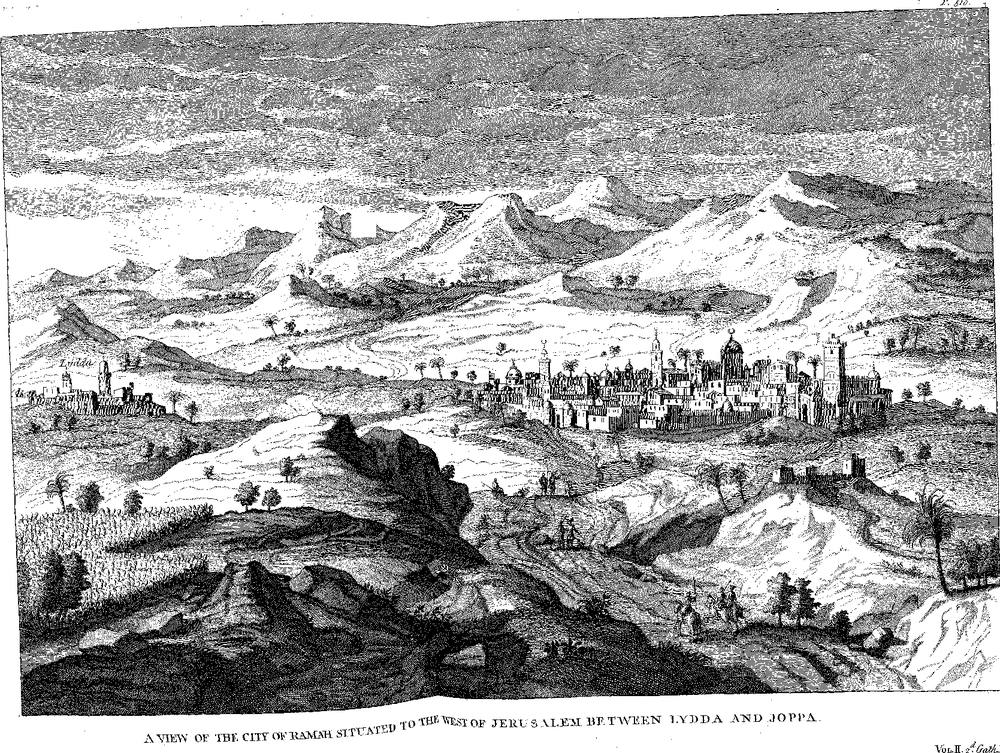
RAMLA a City of Palestine, on the Road from Joppa to Jerusalem. See II. RAMAH. This City was formerly very magnificent, and surrounded by strong Walls. We are assured, that the House there which is the ordinary Residence of Pilgrims, belong’d to Nicodemus a private Disciple of Jesus Christ. There are still to be seen two fine Churches, which at present are reduced to Mosques; one dedicated to St. John, and the other to the Holy Virgin, under the Name of the forty Martyrs, whose Bodies were brought from Sebaste in Armenia. About three Miles from thence are to be seen the Ruines of the ancient Lydda, very well known afterwards by the Name of Diospolis. This 1 Mac. xi. 34. Acts ix. 33, 34.City belong’d to the three Toparchies added to Judea: It is celebrated for the Miracle of St. Peter, who there cured Eneas of his Palsy. At present it is only a small Village. The only Thing there worth Observation, is a Church of St. George, which seems to have been a pretty good one. The Mussulmen pay a great Reverence to the Tomb of Loeman the D’Herbelot. Bibl. Orient. p. 709.Wise, near this Place; and the Sepulchres of the Seventy Prophets, who, they believe, were buried there.
RAMOTH, a famous City in the Mountains of Gilead. It is often call’d Ramoth-gilead; sometimes only Ramoth; and sometimes Ramath-mizpeh, or the Watch-tower1. Josephus calls it Ramathan, or Aramatha. This City belonged to the Tribe of Gad. It was assigned for an Deut. iv. 43. & xx. 8. Josh. xx. 8. & xxi. 37.Habitation to the Levites, and was one of the Cities of Refuge beyond Jordan. It became famous during the Reigns of the later Kings of Israel, and was the Occasion of several Wars between these Princes and the Kings of Damascus, who had made a Conquest of it, and from whom the Kings of Israel, who laid claim to it, endeavour’d 1 Kings xxii. 3, 4, &c. 2 Kings viii. 28, 29. 2 Chron. xxii. 5.to regain it. Jehoram King of Judah was dangerously wounded at the Siege of this
2 Kings ix. 1,2,3, &c.Place: And Jehu the Son of Nimshi was here anointed a King of Israel, by a Prophet sent by Elisha. Ahab King of Israel was kill’d 2 Chron. xviii. 3,4, 5, &c.in the Battle that he fought with the Syrians before this Place. Eusebius says, that Ramoth was fifteen Miles from Philadelphia towards the East. St. Jerom places it in the Neighbourhood of Jabok, and consequently to the North of Philadelphia.
RAMOTH Son of Bani. See Ezra x. 29.
I. RAPHA the fifth Son of Benjamin. 1 Chron. viii. 2.
II. RAPHA, or Rephaiah, Son of Binea, of the Tribe of Benjamin. 1 Chron. viii. 37.
RAPHAEL, one of the seven Arch-Angels which are continually before the Throne of God, and are always at Hand to Tob. xii. 15.perform his Commands. The Name of the Angel Raphael is not found in Scripture, but only in the History of Tobit. It is not mention’d in the New Testament; and, in general, the Names of the Angels do not appear to have been known before the Captivity of Babylon. Tobit the Father having lent, or, according to the Greek Text, having only deposited, the Sum of ten Talents with a Jew call’d Gabael, resolved, in his old Age, to send his young Son Tobias to fetch this Money2. As Tobias, therefore, was seeking a Guide to conduct him from Nineveh to Rages a City of Media, he happily found an Angel, who having assum’d an human Form, offer’d himself, for a Drachma a Day, and his Food,3 to conduct him safe to Rages, and to bring him back again to Nineveh. This holy Guide took the Name of Azarias, he eat and drank with Tobias during the whole Journey, and did nothing that could give him any Suspicion of his being an Angel.
They departed from Nineveh; and when they came to their Lodging upon the Banks of the River Tigris, Tobias went to wash his Feet in the River; when a great Fish made up to him, as if it intended to devour him. But Raphael bid him to seize it by the Fins, draw it to Land, cut it up, and take out the Heart, Gall, and Liver, which he was to reserve Tob. vi. 1, 2, 3.for an Use he would acquaint him with hereafter. When they came near to Ecbatana, Tob. vi. 10,11,12.Raphael said to Tobias; In this City dwells one call’d Raguel, who has an only Daughter whom you ought to marry, according to the Law; for you are her nearest Kinsman, and she is the only Heiress of the Goods of her Father. Tobias inform’d him, that he had heard this young Woman had already had seven Husbands, who had all been put to Death by an Evil Spirit. Raphael bid him take Courage; and told him, The Devil could have no Power over those, that enter’d into the State of Matrimony in the Fear of the Lord; That, besides, he had a sure Remedy against all Evil Spirits, in the Heart of the Fish he had about him; for he need but broil it on the Fire, and they would presently be put to flight.
Tob. vii. 7,2,3,&c.They went therefore to Raguel’s House; and Tobias marry’d Sara. And by observing the Direction of Raphael he was secured from all Misfortunes, the Devil that had (in a manner) besieged Sara, being banish’d into the higher Egypt. While the Days of the Marriage were celebrating, TobiasTob. ix. 1,2,3,&c. Tob. xi. desired Raphael to go to Gabael, and to take up the Money out of his Hands, which was the chief Occasion of their Journey. Raphael accordingly went to Rages, and brought the Money to Ecbatana. After the Ceremony of the Marriage was over, Tobias and his Spouse took their leaves, in order to return to his Father at Nineveh. But when they came to Haran, in the midst of their Journey, Raphael persuaded Tobias to go before, to deliver his Father and Mother from their Impatience, who were much grieved because of his long Absence. They went therefore together, and being arrived at Nineveh with old Tobit, who was blind; after the first Salutations were over, Tobias, by the Advice of Raphael, put upon his Father’s Eyes the Gall of the Fish he had taken, by which in half an Hour’s time the old Man recover’d his Sight again.
After this was over, they both apply’d themselves to Raphael, whom they took Tob. xii. 1,2,3,&c.still for a Man, and desir’d him, that he would accept of half of their Substance, as a Recompence for the great Services he had done them. Then Raphael told them in private, that they must give Thanks to God the Author of all their good Fortune. When you gave Alms, said he, and when you buried the Dead, I presented your Prayers to the Lord; and because you were acceptable in his Eyes, he brought you into Temptation in order to prove you. Now therefore the Lord has sent me to cure you, and to deliver Sara your Son’s Wife from the Power of the Devil; for I am the Angel Raphael, one of the seven that are always before the Lord. Bless him therefore, and sing his Praises. It seem’d to you that I eat and drank with you; but as for me, I am fed with an invisible Food. I must now return to him that sent me. Having said this, he vanish’d out of their Sight. The Story of Tobit and Tobias may be further seen under their Articles.
The Word Raphael signifies the Remedy of God, or the Physick of God; and nothing could agree better to the Part acted by the Angel on this Occasion, and to the Design of God in sending him to Tobias and Sara, than the Name of the Physician of God.
He calls himself Azarias Son of Ananias the Great; and Tobit, who knew this Family, said he was of an illustrious Birth. The Hebrew, Greek, and Syriack Texts of this Passage have it thus. My Brother, you are of a good and honest Family, for I know Ananias and Joathan, Sons of the illustrious Shemeias. We went together to worship the Lord at Jerusalem, to offer our First-fruits and Tenths of all our Fruits. They have not fallen into the Irregularities of their Brethren. You are of an illustrious Race, my Brother.
It has been Matter of Inquiry, whether in all this Raphael did not tell a Lye? It should Vide Gataker, l. 1. contr. Edmund. Campian. p. 77.seem, that it cannot be deny’d but that he must have told an Untruth, since certainly he was neither Azarias, nor the Son of Ananias, nor an Israelite, nor, in a Word, was he a Man as he appear’d to be. He speaks contrary to his own Thoughts, and against his own Knowledge; he made Tobias believe what was contrary to the Truth; he has in some sort deceived him, and all that took him for an human Guide. But the Commentators4 generally acquit him of Lying. He was sent of God, to conduct young Tobias, under the Shape of a young Man call’d Azarias; he was therefore to act and speak like him, and in his Name. The Angels that appear’d to the Patriarchs, and to Moses, have spoke and acted as if it were God himself, because God sent them to represent his own Person. An Actor in a Tragedy that represents Cyrus, says, without lying, that he is Cyrus. Besides, supernatural Actions, such as are here in question, are not subject to the common and ordinary Rules, but are of an higher Order and Character; they are figurative and mysterious, they have none of the Qualities essential to a Lye, consider’d as an Action purely human, moral, and contrary to Truth and Justice.
‘Tis inquired also how Raphael eat and drank? whether he did really eat and drink, or whether in Appearance only? The Opinions of Men are divided upon this Question. Some maintain that he did not drink, and Raphael seems express for this Opinion, when he says, It seemed to you that I eat and drank with you; but as for me, I am fed with invisible Food. Therefore he only seem’d to eat, and the Senses of Tobias and the rest were imposed upon, when they thought he took Nourishment, whereas really he took none. Others5 pretend, that such Angels as have appear’d to Men Dialog. cum Tryphon.have really eaten. Justin Martyr makes no Difficulty of it, since in Heaven the blessed Spirits are fed, as he says, with the Bread of Angels, as the Scripture speaks. Tertullian Tertul. cont. Marcion. l. 3. c. 9.also acknowledges, that Angels having appear’d cloath’d with natural Flesh, may also have eaten really and naturally.
St. Austin6 puts no other Difference between the eating of Men and Angels, excepting that we eat out of Necessity, to repair our Strength and to support ourselves; whereas Angels have no Occasion to eat. He thinks that when Raphael said to Tobias, It seemed to you that I eat and drank, he does not deny his eating and drinking; but he means, that it seem’d to them, as if he eat and drank out of Necessity, whereas he only did it because he had a Mind to do it. ‘Twas thus that our Saviour eat and drank after his Resurrection. But it may be ask’d, What became of that Nourishment that the Angels took in their several Appearances, and that Jesus Christ took after his Resurrection? why, it was dispers’d by Transpiration, by Rarefaction, and by other Ways unknown to us; but was not Grot. Menoch. Just. in Tob. xii.converted into the Substance of those that took it.
RAPHAIM, or Rephaim. This Word is appropriated to those Giants, who lived in the Holy Land before the Arrival of the Hebrews in that Country. There are some Passages of Scripture, wherein this Term is Ps. lxxxvii. 11.translated by Physicians. For Example, Numquid mortuis facies mirabilia, aut medici suscitabunt & confitebuntur tibi. The Hebrew has, Wilt thou make thy Miracles to display themselves among the Dead, and shall the Rephaim arise to declare thy Praise? But St. Jerome commonly translates this Word by Gigantes, Giants, and the Scripture often mentions Hell where the Rephaim groan, and whither the Wicked, the Impious, and the Shameless descend. See the Article GIANTS.
RAPHANEA, a City of Syria, between which and Arca, or Arac, a City of Judea belonging to the Kingdom of Agrippa, the Joseph. de Bell. l. 7. c. 24.Sabbatical River flow’d, which we shall speak of in its Place. Raphanea perhaps is the same as Arpad, mention’d 2 Kings xviii. 34. xix. 13. Isai. x. 9. xxxvi. 19. xxxvi. 13. Jerem. xlix. 23. See ARPAD.
RAPHIA, a famous City upon the Mediterranean Sea, between Gaza and Rhinocorura. I do not find its Name in the Books of the Old Testament, which is pretty 1 Chron. xx. 6.remarkable, except it be the City of Gath, which belong’d to the Rephaim;
Jos. Antiq. l. 13. c.21. Jos. Antiq. l. 14. c. 10. Joseph. de Bello, l. 5. c. 14. Polyb. hist. l. 5. Reland. Palæst. l. 3. p. 967.from whence perhaps it might have its Name Raphia or Rapheia. Gath could not be far from thence. Raphia is famous for the Victory that Philopator King of Egypt obtain’d here, over Antiochus the Great, King of Syria.7 Josephus says, that Raphia was taken by King Alexander Janneus, and that having been ruin’d in the Wars, it was repair’d by Gabinius. The same Josephus and Polybius put Raphia as the first City of Syria, that is met with on the Road from Egypt. There are found some antient Medals that have been struck at Raphia, and some Bishops of this City are found in the Lists of the Eastern Councils.
RAPHON, a City beyond Jordan, upon a Brook, not far from Carnaim.
This City is hardly known in Scripture, but by the Victory of Judas Maccabeus over Timotheus. After the Defeat of his Army before the Fortress of Dathman, he assembled a new Army, composed of Arabians, and what other People he could get, to the Number of six-score thousand Foot, and two thousand five hundred Horse. And 1 Macc. xii. 20.having sent the Women and Children, and all the Baggage, into the City of Carnion, or Ashteroth-Carnaim, which was a Place beyond Jordan of very difficult Access, he encamped at Raphon, or perhaps Saphon, beyond and to the North of the Brook Jabbok.
Judas had then but six thousand effective Men: He sent to observe the Enemies Ibid.Army, and Word was brought him, that it was very numerous, and consisted of all the neighbouring Nations; and that Timotheus was preparing to come to attack him. Judas presently march’d to meet him, and pass’d over the Brook at the Head of his little Army. The Enemy was so surpriz’d at this bold Attempt, that they could not stand the Assault, but fled with great Precipitation.
Observations on the Passage of the Brook Jabbok, and the Defeat of Timotheus near Raphon, by Judas Maccabeus. 1 Macc. v. 37,38, &c. 2 Macc. xii. 20, 21, &c.We may observe a surprizing Boldness and Intrepidity in all the Exploits of Judas Maccabeus, and an admirable Conduct in the Execution of them; not only to avoid the Stratagems of his Enemy, but even to make them fatal to themselves. Judas had no sooner Notice that Timotheus had raised a new Army, and that he was posted near Raphon, beyond the Brook Jabbok, but he sent to get Intelligence of this Army; and he was acquainted, that all the Nations round about had repair’d to Timotheus, and made up an extraordinary Army. And so it was indeed, in comparison of that of Judas, since the sacred Author says, that Maccabeus ranged his Army about him, which consisted of six thousand Men, and having divided them into 514 ] Bands, he marched against Timotheus, who had six-score thousand Foot, and two thousand five hundred Horse. The Number of his Enemies does not dishearten him; he hears they are preparing to come to attack him, he does not think proper to stay so long for them, but resolves to prevent them, and to take the Field before them: And this Resolution makes him appear more formidable to his Enemies.
Timotheus, who was well acquainted with Judas’s Valour, seems to have foreseen what would happen; and what he said to the principal Officers of his Army, leaves us no room to doubt of his Cowardice, and the little Bravery he shew’d at the Head of so numerous an Army. When Judas, says he, shall come with his People near the Brook, if he comes over to us first, we shall not be able to oppose his Efforts, because he will have all the Advantage over us. But if he is cautious of passing, and encamps on the other Side the River, let us go over to him and beat him. The learned Commentator says upon this, “That Timotheus intended to draw a Presage of his future Victory, or of his “Defeat, from the free Motion of his “Enemies, which of all Things in the “World is the most uncertain, and the “most superstitious.” I shall make Answer to this, that there is no Superstition in it, and that every Day’s Experience may teach us, that a skilful and prudent General may easily foresee, without being a Prophet, and without being tainted with Superstition, that if the Enemy takes such or such a Step, if he makes such a Motion, he may be beaten; but if he does the contrary, he is assured of Victory. Sometimes dangerous Expedients are resolved on, with a Notion that an unskilful Adversary will not perceive it, and in this one may be mistaken: So that here is an Uncertainty. Often the wisest Measures, built upon the nicest Rules of War, are frustrated by contrary Management, and Methods that were not expected. Because it was not imagin’d, that the Enemy was capable of putting them in Practice, which he often does by Chance, and without Design. M. de Turenne has acknowledged, that upon some Occasions he found himself more perplex’d against an ignorant General, than against one that was very knowing and skilful. But when we are well acquainted with the Genius and Capacity of our Antagonist, we take our Measures against him accordingly, and may be too hard for him, when-ever he makes an Attempt. The second Reflection of the Commentator seems to me more just than the
former. ” It must, however, be acknowledged, says he, that Timotheus takes a ” thing for a Presage of his Victory, which ” must shew a kind of Timorousness in ” the Troops of Judas.” If he comes over the Brook we shall be beaten; but if he is afraid to pass it, then we shall beat him. If this General had had more Courage, he would not have contented himself to stay beyond the Brook, with such superiour Forces; nothing would have hinder’d him from going over and meeting Judas, whom doubtless he might have surrounded; but he stay’d for him on the other Side, and was beaten, and that perhaps by his own Miscarriage, that is, by hindering his General Officers of that Victory they might have obtain’d.
Now when Judas came near the Brook, says the sacred Author, he caused the Scribes of the People to remain by the Brook, unto whom he gave Commandment, saying; Suffer no Man to remain in the Camp, but let all come to the Battle. ‘Tis very likely Judas might apprehend, that there were timorous People in his Army, who were discouraged at the great Number of the Enemy, for which Reason he gave out these Orders. Without doubt the Brook was fordable, and Judas having divided his six thousand Men into Companies, under different Captains, that is to say, into several Corps, of a considerable Depth according to Custom, so he went first over unto them, and all the People after him. Judas might be accused of Rashness, in venturing to pass over a River with so few Troops, in the View of an Army of an hundred and twenty-two thousand Men; if we were not assured that he put his whole Strength and his whole Trust in the Lord, for his Protection, and that having such an invincible Support, he durst undertake any thing, and perform’d Prodigies of Valour. This is what the Author of 2 Macc. xii. 22,23.the second Book of Maccabees expresses very well in the manner following. But when Judas his first Band came in Sight, the Enemies (being smitten with Fear and Terrour, through the appearing of him that seeth all Things) fled amain, one running this Way, another that Way, so as that they were often hurt of their own Men, and wounded with the Points of their own Swords. Judas also was very earnest in pursuing them, killing those wicked Wretches, of whom he slew about thirty thousand Men.
In the Maccabees it is a very remarkable thing, that we seldom or never find any Horse in their Armies; we hear of nothing but Infantry, but so brave and so resolute, that they make no Scruple to attack the Enemies Cavalry. And indeed, the great Depth with which they fought, made them impenetrable. As to the Army of Timotheus, I suppose his Foot ranged in a Phalanx, and his Horse upon the Wings, according to the Method of the People of Asia, which was that of all the Western Nations, except the Romans. Judas fell on him vigorously, and with so much Bravery, that he open’d himself a Way into the Heart of the Enemy where-ever he made his Attack, and so put them to flight.
RAVEN, a Bird of Prey, having black Feathers, and declared unclean by the Levit. xi. 15.Law of Moses. When Noah sent the Raven out of the Ark, to see if the Waters were withdrawn from covering the Earth, Gen. viii. 6, 7.this Bird did not return again into the Ark. ‘Tis said, that when the Raven sees its Young newly hatch’d, and cover’d with a white Down, or Pen-feathers, it conceives such an Aversion to them, that it forsakes them, and does not return to its Nest ‘till after these first Pen-feathers are fallen off, and they begin to be cover’d with black Feathers. ‘Tis to this, they say Psal. cxlvii. 9. Job xxxviii. 41.the Psalmist makes allusion, when he says, He giveth to the Beast his Food, and to the young Ravens which cry. And Job; Who provideth for the Raven his Food? when his young ones cry unto God, they wander for lack of Meat. But those who have more diligently examin’d the Nature of Birds and other Animals, are not agreed about this Fact, which indeed has too much the Air of a Fable to be believed without good Proofs.
Vossius says,8 that it is the extream Voracity of the young Ravens, that makes the old ones sometimes forsake their Nests, when they find themselves not able to satisfy them. Others will have it, that this proceeds merely from the Forgetfulness of the old Ravens, that they think no longer of returning to their Nests, in order to feed their Young. Others imagine, that Job and the Psalmist allude to what is said by some Naturalists,9 that the Ravens drive out their young ones early from their Nests, and oblige them to retire a great way off from the Habitation of their Parents; and that it is on this account, that Providence has the Care of their Support. Lastly, there are others, who without refining upon these Passages, think it is only meant, that Providence extends its Care over all Beasts and Birds, which in their manner call for its Assistance; and that Ravens are only put here instead of Birds in general. When the Prophet Elijah, by an Order from the Lord, dwelt in his Retirement near the Brook Cherith,10 the Lord fed him
for some time by means of the Ravens, who brought him Bread and Flesh every Morning and Evening. Some Interpreters, instead of Ravens, translate the Words of the Original by Arabians, or Merchants, or even Inhabitants of the City of Arabo, or Oreb, near to Bethshan. a To support these Translations it is observed, that the Raven being a Bird declared unclean by the Law, there is no Probability Levit. xi. 15.that God would make use of him in this Service. But notwithstanding these Reasons, the Generality of Interpreters and Commentators keep to the Version that renders it by Ravens. If those that supply’d Elijah with Flesh and Bread had been Men, why could they not also have supply’d him with Water, when the Brook Cherith was dry’d up; that he need not have been forc’d to look out for another Retreat, with the poor Widow of Zerephrath or Sarepta?
The Raven was consecrated to Apollo, as to the God of Divination. The Blackness of Cant. v. 11. Plin. l. 7. c. 48.the Raven is pass’d into a Proverb. His Locks are bushy, and black as a Raven. Yet however, there are white Ravens to be seen, and they are not rare in the Northern Countries,11 where the Snow lies for a long time upon the Ground. It has been thought that the Raven conceived by its Beak, but this is a mere Fable. The Raven lives a long time. Pliny says, that it lived the Age of nine Men; but he allows this to be a Story. We are assured, that they live sometimes an hundred Years. They feed upon Carrion, and eat the Bodies of Men that are hung up or crucify’d :
Hor. Epist. l. 1. v. 48.——— Non pasces in cruce corvos, says Horace.
Prov. xxx. 17.And the Wise Man says; The Eye that mocketh at his Father, and despiseth to obey his Mother, the Ravens of the Valley shall Zeph. ii. 14. Isai. xxxiv. 11.pick it out, and the young Eagles shall eat it. Zephaniah seems to insinuate, that they fed Ravens at the Doors of their Houses. Vox cantantis in fenestra, corvus in superliminari. But he rather insinuates, that after the Desolation of the Edomites, the Moabites, and the Ammonites, the Ravens12 shall be seen upon their Windows, and upon the Doors of their ruinated Houses. This Bird may be pretty easily taught to talk, and to imitate the human Voice.
There are several Kinds of Ravens. Some have been seen that had their Bills and Legs as red as Coral. There is also a red Raven, Pyrrhus corax; it is smaller than a Crow, and about the Bigness of a small Owl or Howlet. Its Legs and Beak are yellow, inclining towards black, and every where else is quite black. This Bird is found in the Alps, in Swisserland, in Auvergne, in Candia, on Mount-jura. The Water-Raven has its Beak long and hooked at the End, the Top of the upper Part of its Bill is black, and the rest is of a Colour compos’d of red and yellow. The Feathers of his Wings and Back are of a Chesnut Colour, the Extremities of them are black, and all the rest is black. The Feathers of his Belly are white, those of his Back are ting’d with a blackish green at the Ends, and in the Middle with bright ash-colour and red. The upper Part of the Neck is cover’d with black and white Feathers, and the Fore-part with black and green. Its Wings are very long, and of the same Colour as its Back.
The Wood-Raven, call’d by the Lorrainers, the Sea-Crow, is of the Bigness of a Hen. To look on it at a Distance, it seems to be black all over its Body; but when we see it at hand, especially when the Beams of the Sun shine upon it, it appears of a green Colour. Its Bill is reddish and pretty long, its Feet are very like those of a Hen, it feeds upon Worms and Insects; its Legs are long and of a dark ruddy Colour. It builds its Nest at the Top of uninhabited Towers that are going to decay.
The Small-Raven, or Night-Raven, Nicticorax, haunts the Waters, and retires into the Reeds, where in the Night-time it makes a very disagreeable Noise, such as a Man when he is vomiting. It builds its Nest at the Tops of Trees, lays two or three Eggs, and generally feeds upon Fishes. We find in Moses the Name of a Bird which is translated Pelican, Psal. cii. 6. and Levit. xi. 18. which comes from a Root that signifies to vomit, and which may very well be the Raven of which we are now speaking. See the Article PELICAN before.
2 Sam. xvii. 13.Mention is made in Scripture, of certain Machines with which they demolish’d Cities, and tore up the Stones of Walls. These Machines were call’d Ravens, and the Antients made great Use of ‘em at the Sieges of Cities and fortify’d Places. Diodor. l. 17. Vitruv. l. 10. c. 19. Homer Iliad. M.
RAVISH, Rapere. This Word in its common Signification imports the taking away of any thing from any one by Violence. Alii rapiunt non sua. It is also used for the taking away by Force, or for the Rape of a Woman, Prov. xi. 24. Gen. xxxiv. 2. Judg. xxi. 21. 1 Sam. xx. 30.or Virgin. Sichem rapuit Dinam, & dormivit cum eâ. And in Judges; Rapite ex iis singuli uxorem sibi. Saul in his Anger calls Jonathan his Son, Fili mulieris virum ultro rapientis, the Son of a Woman that ravisheth a Man.13
1 Kings xx. 30.To ravish the Word out of a Man’s Mouth. Rapuerunt verbum ex ore ejus. They seized on the Word that he happen’d to let slip; they took him at his Word, as we may say.
To be rapt up into Heaven, into Paradise, as St. Paul was rapt up into the third Heaven; this is said of a Man who is raised in Spirit into a supernatural State, even into Paradise, tho’ his Body be still upon Earth. The Spirit of God rapt up Philip, and carry’d him far from the Place where he had baptized the Eunuch. It carry’d Acts viii. 39.him with so great Rapidity, that no human Force could have carry’d him so fast. Jesus Christ says in the Gospel, that since the Time of John the Baptist, the Kingdom of Heaven suffers Violence, and the Violent take it by Force. Vim patitur, & violenti rapiunt illud; which is explain’d after two different manners. To obtain the Kingdom of Heaven, and to arrive at eternal Life, we must use Violence towards ourselves, and towards our own Passions. We must mortify the Flesh, bear our Cross, exercise Penance. Otherwise, from the Time of John the Baptist, the Kingdom of Heaven, the Preaching of the Gospel, the Truth that Jesus Christ taught, suffers Violence, or is violently assaulted by the Wicked. The Kingdom of Heaven, as we may say, is exposed to the Plundering and the Violence of the Wicked. Or lastly, God refuses to none to enter into the Kingdom of Heaven, but lays it open to the Seizure of all. Every one enters therein that pleases.
The Son of God thought it no Robbery, no Rapine, to equal himself to God. Non rapinam arbitratus est esse se æqualem Deo. He is God, and equal to God of his own Nature; ‘tis neither Usurpation, nor Robbery, nor Injustice, if he calls himself equal to God. When Lucifer says, I will be equal to the Most High, ‘tis Blasphemy, ‘tis Usurpation, ‘tis Sacrilege, ‘tis the most heinous of all Crimes.
RAZIS, or Razias; he was one of the most considerable of the Doctors that were then at Jerusalem, at the time of the Persecution of Antiochus Epiphanes. After the Death of this Prince, and of Antiochus Eupator his Son, and under the Reign of Demetrius Soter Son of Seleucus;14 Alcimus the Usurper having obtain’d the High-priesthood of the Jews, by giving Money to King Demetrius, was sent into Judea with Nicanor, who had Orders to support him in the Possession of this Dignity. But Nicanor being reconcil’d to Judas Maccabeus, and living in good Understanding with him at Jerusalem; Alcimus took Umbrage at it, and went to accuse Nicanor of betraying the King’s Interests, affirming, that he kept Correspondence with Judas Maccabeus. Demetrius upon this writ to Nicanor, and order’d him to seize Judas, and to send him to Antioch. Nicanor therefore broke with Judas, and began to seek for Means of apprehending him; but Judas discover’d his Design and made his Escape.
Nicanor having fail’d in his Design, was resolved to make the Priests pay for it, and began to threaten them very much. At the same time Razis was accused to him, whom we now speak of, probably as being much in the Interest of Judas Maccabeus, and very averse to that of Alcimus, as having no Right to the High-priesthood. The Scripture does not expressly say what he was accused of, but it gives him this Testimony, that he was very zealous for the Interests of the City of Jerusalem, and of the whole Nation, insomuch that he was call’d the Father of the Jews. His Life was pure and unblameable, and in the Times of Persecution he had already given substantial Proofs of his Firmness to Judaism,15 by his Opposition to those that would have introduced Idolatry into Israel. Nicanor therefore sent five hundred Men to arrest him, thinking that if he could succeed in bringing him over, it would make a great Impression upon the rest of the Jews.
When therefore Razis saw that the Soldiers would break into his House, and put Fire to it, and that he could not avoid falling into their Hands; he fell upon his Sword, choosing rather to die bravely, than to see himself in the Power of wicked Men, and to suffer Indignities unbefitting his Birth and Quality. But in the Hurry he was in, not having given himself a mortal Wound, and seeing the Soldiers enter in Multitudes into his House, he ran with great Resolution to the Platform of his House, and throwing himself from the Top to the Bottom into the Street, he pitch’d with his Head foremost upon the Ground. But neither did this Fall entirely dispatch him, so that he made new Attempts; he rais’d himself up, ran through the People, and got upon a sharp Stone, where he drew his own Bowels out of his Body, and threw them with both his Hands among the People, invoking the Ruler of Life and of the Soul, to restore them again to him another Day. And in this manner he died.
The Jews put Razis among their most illustrious Martyrs, and pretend to prove from his Example, and from those of Saul and Samson, that in some certain Cases the Murder of one’s self is not only allow’d,
but is also laudable and meritorious. These Cases are, first, the reasonable Distrust of a Man’s own Strength, and the Fear that he may yield in time of Persecution: Then, according to them, it is allow’d to prevent the Danger, by laying Hands upon our selves. The second Case is, that when one can foresee, that by falling into the Hands of the Enemy, they will thence take Occasion to insult the Lord, and to blaspheme his Name. The Circoncellions, a Sort of noted Hereticks of Africa, in the Time of St. Austin, made use of the Example of Razis, to justify themselves in those Cruelties that they exercis’d against themselves, by throwing themselves headlong, and putting themselves to Death in a thousand different Manners; to promote, as they pretended, the Glory of God. Some modern Divines a endeavour also to vindicate Razis, by the Example of certain Christian Virgins, who, to escape the defiling of their Bodies, threw themselves into the Water, and were drowned. They add, That, in this, Razis acted by the Inspiration of the Holy Ghost; That the Manner of his former Life, and the Sentiments in which he died, would hardly allow one to doubt of his Salvation, and of the Integrity of his Action.
Nevertheless, St. Austin16, Thomas Aquinas17, and several other Casuists18, have maintain’d, that the Example of Razis being only related in Scripture, but not approved, nothing could be concluded from thence to justify the Morality of the Action. ‘Tis agreed it was brave, and such as might befit the greatest of the Pagan Heroes: But the present Question is, Whether it was agreeable to the Law of God, and to that eternal Order that God commands us to observe, and forbids us to interrupt? What does the Scripture commend Razis for, but because he was very stedfast in Judaism, which was then the true Religion; very zealous for his Country, and for his Brethren; so that he was look’d upon as the Father of the Jews; and because, at his Death, he call’d upon the Name of the Lord. But is this sufficient to justify an Action so notoriously contrary to the Law of God? If Razis is neither just nor innocent, why should he be imitated? says St. Austin. If he is just and innocent, why does he put a just Man to death; that is, why does he kill himself? Is it thus that the Martyrs us’d to behave themselves? ‘Tis already said, that he died bravely and heroically; but were it not better to have died humbly, patiently, and submissively? St. Austin’s Words are; Dictum est quod elegerit nobiliter mori. Melius vellem humiliter; sic enim utiliter. Illis autem verbis historia gentium laudare consuevit, sed viros fortes hujus sæculi, non Martyres Christi.
I. REAIAH, Raaia, or Raia, Reia, Son of Shobal, Father of Jahath, and Grandson of the Patriarch Judah. 1 Chron. iv. 2.
II. REAIAH Son of Micah, Father of Baal, of the Tribe of Reuben. 1 Chr. v. 5.
III. REAIAH; his Children return’d from Babylon. Nehem. vii. 50.
Numbers xxxi. 8.REBA, or Rebe, or Reb, one of the Princes of the Midianites, who was kill’d in the War that Moses, by Order from the Lord, waged against them by the Hand of Phinehas Son of the High-Priest Eleazar, for the Punishment of the Crime to which they had seduced the Israelites, by sending their Women into the Camp, and inviting them to the Festival of Peor19.
REBEKAH, or Rebecca, Daughter of Bethuel, and Wife of Isaac. Eliezar the Steward of Abraham’s House went to fetch her from Haran a City of Mesopotamia,20 and brought her to Isaac, who then dwelt at Beer-sheba in the Land of Canaan. Rebekah lived with Isaac twenty Years, without having any Children: At last Isaac interceded for her by his Prayers, so that she conceived, and became with Child of two Children21. The two Sons with which she was big struggling together in her Womb, and giving her some Uneasiness, she went to consult the Lord upon this Occasion; who told her, That two Nations were in her Womb; That one of ‘em should overcome the other, and that the elder should be subject to the younger. It is not agreed who was the Person that Rebekah here consulted with: Some will have it, that she went to Shem the Son of Noah; others, to Melchisedech; others, to Heber; others, to Abraham: And, lastly, some think she went to sacrifice upon Mount Moria, or upon the Altar that Abraham had erected Petr. Comestor. hist. Scholiast. Diodor. & Procop. in Genes. Theodor. qu. 76. in Genes. Gen. xxv. 24,25 &c.in the Forest of Beer-sheba, and that while she slept God revealed this Matter to her.
When Rebekah’s Time of Delivery was now come, she found herself the Mother of two Twins. He that came first into the World was ruddy and hairy, as if he had had a Bear’s Skin, and they gave him the Name of Esau. The other immediately follow’d, holding in his Hand the Heel of his Brother; wherefore they call’d him Jacob, or the Supplanter. When they grew up, Esau betook himself to Hunting and Tillage; but Jacob was a plain, unactive Man, and dwelt in the Tent of his22
Father. Isaac had more Inclination for Esau, but Jacob was a Favourite to Rebekah: She found Means of making him obtain the Blessing of his Father Isaac, to the Prejudice of Esau; and this against Isaac’s first Intention, who thinking himself near his Death, intended to give his last Blessing to his eldest Son Esau23. We have already related this famous History, under the Articles JACOB and ISAAC.
A great Famine having obliged Isaac to go to dwell at Gerar a City of the Philistines, of which Abimelech was King24; when the Inhabitants of the Place asked him who Rebekah was, he answered, she was his Sister, because he feared they might put him to Death, in order to possess his Wife. Abimelech had heretofore taken away Sarah, Abraham’s Wife, upon whose Account Gen. xx. 5,6,7,8.the Lord had threatned him with great Calamities; he therefore distrusted the Truth of what Isaac had told him, that Rebekah was his Sister. He watched him so narrowly, that one Day he perceiv’d him to caress her in such a manner, as better agreed with an Husband than a Brother. Abimelech then order’d him to be call’d, and said to him; Why have you thus imposed upon us? It is plain she is your Wife; and if any one had abused her, you might have drawn upon us some great Punishment from God. Then he caus’d it to be publish’d in Gerar, That if any one should meddle with this Man’s Wife, he should be put to Death.
Jacob, by the Management of his Mother Rebekah, having got his Father’s Blessing by Surprize, to the great Prejudice of his Brother Esau; he could not but be in great Wrath with him on this Account, and secretly threatned to be his death for it, as soon as his Father’s Head was laid. Rebekah had Notice of this Design,25 and, to prevent it, advised Jacob to go into Mesopotamia to his Uncle Laban, and there to marry one of his Daughters; and when Esau’s Passion should grow cool, she would send him Word, that he might return. She prevailed with Isaac to consent to this Journey, by insinuating to him, That her Life was become a Burden to her, on Account of the Daughters of Heth whom Esau had marry’d; and that if Jacob should also do the same, and take a Wife of this Country, her Life would no longer be supportable to her. After this Time the Scripture makes no farther mention of Rebekah; and the Year of her Death is uncertain: But it is plain, that she died before Isaac; because it is said, that Isaac Gen. xlix. 31. & xxxv. 29.was put in the Tomb with Rebekah his Wife, and that this Tomb was the same wherein Abraham and Sarah had been before buried, and where afterwards Jacob and Leah were deposited.
I. RECHAB and Baanah were the two 2 Kings iv. 2.Assassins of Ish-bosheth the Son of Saul. See ISH-BOSHETH, or Baanah.
II. RECHAB, Father of Jonadab, the Founder of the Order of Rechabites. It is not known in what Age this Rechab liv’d, nor what was his Original. Some will have him to proceed from the Tribe of Judah26. Others think he was a Priest, or at least a Levite27; because it is said in Jeremiah, Jer. xxxv. 19.that there shall be always found of the Descendants of Jonadab sted-fast to the Service of the Lord. Some Rabbins pretend, that the Rechabites having marry’d the Daughters of the Priests or Levites, the Children produced by these Marriages were employ’d in the Service of the Temple. Sanct. & Cornel. in Jer. xxxv.Others think, that indeed they waited in the Temple, but only as Servants, like the Gibeonites and Nethinims, who were nothing but the Servants of the Priests and Levites28. We read in the Chronicles, that the Rechabites were originally Kenites, and 1 Chron. ii. 55.that they were Singers in the House of God; Canentes atque resonantes, atque in tabernaculis commorantes; hi sunt Cinæi, qui venerunt de calore patris domus Rechab. The Hebrew has it; Porters and the Obedient, that dwell under Tents; these are those that are called Kenites, who are descended from Hemath, Chief of the House of Rechab.
The Kenites were not of the Race of Jacob, but descended from Midian Son of Cush. They were the Issue of Hobab, or Jethro the Father of Zipporah, and Father-in-Law of Moses. They enter’d into the Promis’d Land along with the Hebrews, and dwelt in the Portion of the Tribe of Judah, about the Dead-Sea. They were distinguish’d from the Israelites only by their retired Sort of Life, and by the Contempt they express’d of Cities and Houses. Some have thought,29 that Hobab or Jethro was himself the first Founder of the Rechabites; that Rechab was one of his Names; that Jonadab, known in the Time of Jehu, was one of his Descendants; that Heber the Kenite follow’d the Institution of the Rechabites. Serrarius distinguishes between the ancient Rechabites, descended from and instituted by Jethro, and the new Rechabites instituted by Jonadab Son of Rechab, who liv’d in the Time of Jehu King of Israel.
Jacob. Boulduc. de Ecclesiae ante leg. l. 3. c. 16.Father Boulduc has contrived a very extraordinary Scheme to explain this Matter of the Rechabites: He seeks their Original even before the Deluge, and fetches it as far as Enoch and his Descendants. After the Deluge they were known successively by the Names of Kenites, Kenizeans, Hebrews, Nazarites, Sons of the Prophets; lastly, Rechabites and Pharisees. All these People were a Sort of Religious, living in a Society, having their Superiors general and particular, just as we see it now among the several Religious Orders of the Latin Church. But from whence came the Name Rechab? Its Etymology is very remarkable: Elisha, seeing his Master ascend into Heaven, cry’d out 2 Kings ii. 12.to him; My Father, my Father, the Chariot of Israel, and the Horsemen thereof. The Hebrew Words are; My Father, my Father, the Rechab of Israel. And from hence the Name of Rechabites descended to the Disciples of Elijah and Elisha, Sons of the Rechabaim, or the two Chariots of Israel. But our Author does not think it sufficient to derive the Rechabites from the Chariot of Elijah: He makes the Pharisees also to proceed from its Horses; for, in Hebrew, the Word Pharasim signifies Horses.
But it is altogether impertinent to have recourse to these harsh, remote, doubtful, and even childish Etymologies. The Scripture Jer. xxxv. 6, 7.it self acquaints us, that Jonadab the Son of Rechab, who lived in the Time of Jehu King of Israel, laid an Injunction upon his Posterity, never to drink any Wine, not to build Houses, not to sow any Grain, to plant no Vineyards, to have no Lands, and to dwell in Tents all their Lives. Such was the Institution of the Rechabites, or of the Children of Rechab. It laid no Obligation upon the other Kenites, nor the other Descendants of Jethro. And this they continued to observe for above three hundred Years30. In the last Year of the Reign of Jehoiakim King of Judah, Nebuchadnezzar coming to besiege Jerusalem, the Rechabites were forced to leave the Country, and to take Refuge in the City, yet, however, without quitting their Custom of lodging in Tents. During this Siege, Jeremiah received Order from the Lord, to apply himself to the Disciples of Rechab, to cause them to enter into Jer. xxxv. 1, 2, 3, &c.the Temple, and to offer them Wine to drink. Jeremiah perform’d the Orders of the Lord: But the Rechabites answer’d him; We will drink no Wine; for Jonadab the Son of Rechab our Father commanded us, saying, Ye shall drink no Wine, neither ye nor your Sons, for ever. Neither shall ye build House, nor sow Seed, nor plant Vineyard, nor have any: but all your Days ye shall dwell in your Tents, that you may live many Days in the Land where ye be Strangers. But it came to pass, when Nebuchadnezzar King of Babylon came up into the Land, that we said, Come, and let us go to Jerusalem, for fear of the Army of the Chaldeans, and for fear of the Army of the Syrians; so we dwell at Jerusalem. Then came the Word of the Lord unto Jeremiah, saying, Thus says the Lord of Hosts, the God of Israel, Go, and tell the Men of Judah, and the Inhabitants of Jerusalem, Will ye not receive Instruction, to hearken unto my Words? saith the Lord. The Words of Jonadab the Son of Rechab, that he commanded his Sons not to drink Wine, are performed; for unto this Day they drink none, but obey their Father’s Commandment: notwithstanding I have spoken unto you, rising early and speaking, but ye hearkned not unto me. Lastly, directing his Discourse to the Rechabites, he tells them; Because ye have obeyed the Commandment of Jonadab your Father, and kept all his Precepts, and done according to all that he hath commanded you: Therefore thus saith the Lord of Hosts, the God of Israel, Jonadab the Son of Rechab shall not want a Man to stand before me for ever.
The Rechabites were, probably, led away Captives, after the taking of Jerusalem by the Chaldeans31; since we read, in the Title of Psalm lxxi. 1. that it was sung by the Sons of Jonadab, and by the principal Captives32, which were Ezekiel and Mordecai, carry’d away by the Chaldeans beyond the Euphrates, after the Taking of Jerusalem under King Jehoiakim. They return’d from their Captivity, and settled in the City of Jabez beyond Jordan; as it appears by the Chronicles; The 1 Chron. ii. 55.Race of the Scribes that dwelt at Jabez, called Porters, obedient, and dwelling in Tents, are the Kenites, descended from Hemath Father of the House of Rechab33. There are some Difficulties in this Passage. There be those that think, that, in this Place, Jabez is not a City, but some Man, whom the Kenites acknowledge as their Master. However this be, no farther mention is made of the Kenites, in the Books written after the Captivity of Babylon.
Some have pretended, that the Assideans, of whom mention is made in the Books of
the Maccabees34, were Successors and Followers of the Rechabites. Others35 have confounded the Rechabites with the Essenians. But if the Assideans were the same as the Essenians, their Principles and Opinions must be the same. But certain it is, that the Manner of Life of the Essenians, which is very well known, was very different from that of the Rechabites; as it appears from what Josephus36 says of ‘em, who informs us, that the Essenians had Fields which they cultivated in common; that they dwelt in Houses; that they had neither Wives nor Children; and perform’d not their Religious Ceremonies with the other Jews in the Temple of Jerusalem. But all this was contrary to the Practice of the Rechabites. Hegesippus, as cited by Eusebius,37 relates, that as St. James was led away to be put to Death, one of the Priests of the Race of the Rechabites cry’d out to the Jews, as they were going to stone him, What are you going to do? The just Man prays for you. It is certain, as we have before observed, that the Rechabites were not of the Race of the Priests: But, as they served in the Temple, this Author might have taken them for Priests; or he may have taken the Word Priest in a generical Sense, which will include all the Ministers of the Lord.
Benjaminus Judelensis says,38 that, in his Travels, he saw a large Country inhabited by the Sons of Rechab. These are his Words: “From Pundabita upon the Euphrates I went into the Country of Seba, call’d at present Aliman, which borders upon the Country of Sennaar or Shinar. After a Journey of one and twenty Days through Desarts, I arrived at the Place inhabited by the Jews call’d the Sons of Rechab, otherwise, the People of Theima: For Theima is the Beginning of their Territory, which is govern’d at this Day by the Prince Hanan. The City of Theima is large and well-peopled. The Length of the Country is twenty Days Journey, between the Northern Mountains. It abounds with fine and strong Cities, that acknowledge no foreign Jurisdiction. The People of this Country make Excursions upon their Neighbours, and even upon distant Nations. They cultivate their Fields, and breed Cattle, having a large and fruitful Country. They appropriate the Tythe of their whole Income to the maintaining of the Disciples of the Sages, who continually attend upon Preaching; and to the Support of the Pharisees, who bewail the Misfortunes of Sion, and the Destruction of Jerusalem; never making use of either Wine or Flesh, going always in Black, and having no other Habitations but the Caves; fasting every Day except the Sabbath, and being constantly at Prayer, to obtain from God the Liberty and Return of Israel from their Captivity.
“All the Jews of Theima and Thelimas put up the same Prayers to the Lord, and they are in Number about one hundred thousand Men. Their Prince is Solomon the Brother of Hanan, both of the Race of David, as they prove by the Genealogical Histories they preserve. They generally wear torn Mourning Cloaths, and fast forty Days for all the Jews that are in Captivity. The Province contains about forty Cities, two hundred Towns, and an hundred Castles. The Metropolis of the Country is Thenai; and the Number of Jews inhabiting this Province is about three hundred thousand. The Metropolis now mention’d is incompass’d by good Walls, which inclose a large Spot of Ground within them, where they sow good Quantities of Wheat: For ‘tis fifteen Miles long, and as many broad; (that is to say, five large Leagues square, and about fifteen Leagues round). There is to be seen the Palace of King Solomon, with very splendid Gardens.”
And such is the Country of the Rechabites, according to this Traveller, who lived in the twelfth Century. But this whole Relation hath so much the Air of a Fable, that no Credit ought to be given to it.
RECHAH, Recha, or Racha. ‘Tis not known to what Tribe this City belong’d, or even whether it was a City or no. See 1 Chron. iv. 12.
REDEEMER. This Name is given, by way of Eminence, to Jesus Christ the Redeemer and Saviour of the whole World. But, in the Stile of the Law of Lev. xxv. 25. Lev. xxv. 47, 48.Moses, it is also given to him who has the Right of Redemption in any Inheritance, or even the Person of a near Kinsman, that may redeem it out of the Hands of a Stranger, or of any other Jew that had bought it. Moses, or rather God, whose Instrument he was, had ordain’d, that neither the Estates of Land, or the Persons of the Hebrews, should be sold for ever; but that every one might re-enter upon the Possession of his Estate or Liberty in the Sabbatical Year, and in the Year of Jubilee. But without staying for these Years, when any Relation was rich enough, and had Power to redeem the Goods or Liberty of his Brother, the Law enabled him to do it. And this is what it calls Right of Redemption; giving also
the Name of Redeemer to the near Relation that had a Claim to this Right. There are several Particulars upon this Head, which may be found in chap. xxv & xxvii. of Leviticus. We see an Instance of the Practice of this Ruth ii. 20. & iii. 9, &c.Law, in the History of Ruth. Boaz being one of the nearest Relations of Elimelech, marry’d Ruth the Heiress of Elimelech, and by that means re-enter’d into the Possession of her Estate, which had pass’d through several strange Hands. Also Jeremiah redeem’d the Field of his Nephew Hanameel, Jer. xxxii. 7, 8.which was upon the Point of being sold to another. He was also call’d The Redeemer of Blood39; in Hebrew, Goel haddam; who had a Right of taking Revenge, for the Blood of his Kinsman who had lost his Life40. To curb the first Transports of the Resentment of these Avengers, or of these Redeemers, God appointed Cities of Refuge through all the Coasts of Israel, to prevent Murders, and the Effects of violent Passion.
REDEMPTION, of the First-born. See FIRST-BORN. Exod. xiii. 2. xiii. 29, 30. Numb. xviii. 15, 16, 17.
Num. xix. 2, 3, 4, &c.RED-HEIFER. The Lord spake unto Moses, saying: “Command the Children of Israel to bring to you a Red-Heifer, perfect and without Blemish, which has never born the Yoke. You shall put it into the Hands of Eleazar the Highpriest, who, taking it without the Camp, shall kill it before all the People. He shall dip his Finger in the Blood of this Heifer, and shall make Aspersions seven Times towards the Entry of the Tabernacle, and shall burn it in the Presence of all the People, putting into the Flames not only the Flesh and the Hide, but also the Blood and the Excrements of the Victim. Also the Priest shall cast into the Fire that consumes the Heifer, a Bundle of Cedar-wood, some Hyssop, and double-dy’d Scarlet. Then he shall wash his Garments and his Body, and returning into the Camp, shall be unclean till the Evening.
“He also that burns the Heifer, shall wash his Body and his Cloaths, and shall remain unclean until Evening. A Man that is clean shall gather up the Ashes of the Heifer, and shall carry them out of the Camp into a clean Place, that the Israelites may take of them, and preserve them carefully, and make use of them to make a Water of Aspersion or Separation, because this Heifer was burnt for Sin. He that shall carry out the Ashes shall wash his Body and his Cloaths, and shall continue unclean till Evening. “This Ordinance shall be holy, and inviolably observed, not only by the Israelites, but also by the Strangers that live among you.
“He that shall have touched the Body of a dead Man, and for this Reason shall have contracted an Uncleanness that continues seven Days, shall be sprinkled with this Water the third and the seventh Day, and shall then be purified. If he receives no Aspersion on the third Day, but only on the Sixth, he cannot be purified on the Seventh, but on the Tenth or Eleventh. Whoever shall touch the dead Body of a Man, and shall not be sprinkled with Water, in which is mingled some of the Ashes of the Red-Heifer, shall pollute the Tabernacle of the Lord, if he presumes to present himself there in this Condition, and shall be cut off from the midst of his People. He shall be unclean, because he was not purified with the Water of Expiation, and his Uncleanness shall continue upon him.”
This is what was ordain’d by Moses in this Matter, and these are the Reflexions that Commentators have made upon it. Spencer thinks, that this Ceremony has Relation to Spencer. de Leg. Rit. l. 2. c. 15.an Opposition to the Egyptian Superstitions. The Egyptians never sacrificed Cows or Heifers, and the Hebrews themselves seldom sacrificed any other but Male Animals. The first had Red Hairs in abhorrence, and all Animals of that Colour. The Hebrews made no Distinction in the Colour of their Victims, but only upon this Occasion. St Jerom, and several others think, that they sacrificed the Hieron. Epist. 27.Red-Heifer every Year, and distributed the Ashes into all the Cities and Towns of Israel. Some Rabbins maintain, that there was but one burnt from the Times of Moses to Esdras; and that from Esdras to the Destruction of the Temple by the Romans, there were but six burnt, or nine at most. The same St. Jerom teaches us, that this Ceremony was always performed upon the Mount of Olives, over-against the Temple, after the placing the Ark at Jerusalem; and the Jews inform us, that it was always the Highpriest that offered this Sacrifice, from the first Building of the Temple.
Heb. ix. 13.The Red-Heifer offered without the Camp, was a Type of Jesus Christ, whose Blood purifies our Consciences from all Sin. For if the Blood of Bulls, and of Goats, and the Ashes of an Heifer sprinkling the Unclean, sanctifieth to the purifying of the Flesh; how much more shall the Blood of Christ, who through the eternal Spirit, offered himself without Spot to God, purge your Conscience from dead Works to serve the
Living God? See the Commentators upon Numbers, Chap. xix.
REED. The Vale or Brook of Reeds; vallis arundineti, or the River of Kanah. a It was at the utmost Limits of the Tribe of Ephraim, towards the North, bordering upon the Tribe of Manasseh. The true Situation is unknown.
REED. This was put into the Hands of our Saviour, to insult him at his Passion. ‘Tis thought it was nothing else but a common Reed or Cane, that might serve him as a Staff, and was given him by way of Derision, instead of a Sceptre.
REELAIAH, or Rahelaia, of the Race of the Priests. He return’d to Jerusalem with Zerubbabel. Ezr. ii. 2.
REFUGE. Cities of Refuge: In order to provide for the Security of those, who by Chance, and without any Design, should happen to kill a Man, in whatever manner Exod. xxi. 13. Numbers xxxv. 11,it should be; the Lord commanded Moses to appoint Six Cities of Refuge, or Asyla, that whoever against his Will should spill the 12,13,&c. Blood of a Man, might retire thither, and have time to prepare for his Defence and Justification before the Judges, so that the Kinsman of the Deceased might not pursue him thither and kill him. Of these Cities there were three on each Side Jordan. Those on this Side Jordan were Kedesh of Naphtali, Hebron, and Shechem. Those beyond Numbers xxxv. 15.Jordan were Bezer, Golan, and Ramoth-Gilead. They served not only for the Hebrews, but for all Strangers also, that should dwell in their Country. The Rabbins confined the Name Strangers only to such as were Proselytes; but in this I think they depart from the Design of the Law. Deut. xix. 8.The Lord also commanded, That when the Hebrews should multiply, and should enlarge the Limits of their Country, they should add three other Cities of Refuge to those now mentioned. And as this Command was never fulfilled, the Rabbins say, that the Messiah will accomplish what God has commanded in this respect.
Maimonides from the Traditions of the Antients, assures us, that all the Forty-eight Cities, appointed for the Habitation of the Priests and Levites, were also Cities of Refuge; and that all the Difference between them was, that the six Cities appointed by the Law, were obliged to receive and lodge for nothing all that should fly to them; whereas the other two-and-forty Cities might refuse to admit such as fled to ‘em, and were not obliged to lodge them gratis. Besides the Cities of Refuge, the Temple of Philo Legat. adthe Lord, and especially the Altar of Burnt-offerings, enjoy’d the Privilege of being an Caium. Asylum. The Rabbins say, that generally the Altar was only for the Priests. Those that took Sanctuary in the Temple, were presently judged by the Judges; and if they were found Guilty of wilful Murder, they were forc’d away even from the Altar, and put to death without the Temple. But if they were found innocent, they had a Guard appointed them to conduct them safe to some City of Refuge.
These Cities were to be of easy Access, and to have smooth and good Roads to ‘em, and Bridges where-ever there shou’d be Occasion. The Width of these Roads was, at least, to be two and thirty Cubits, or eight and forty Feet. When there were any Cross -Roads, they took care to set up Posts, with an Inscription, directing the Way to the City of Refuge. Every Year, on the fifteenth of the Month Adar, which answers to our February Moon, the Magistrates of the Cities visited the Roads, to see if they were in good Condition. The City was to be well supply’d with Water, and all kind of Provisions. It was not allow’d there to make any Weapons, that the Relations of the Deceased might not be furnish’d there with Arms to gratify their Revenge. Lastly; it was necessary, that whoever took Refuge there, should understand a Trade or Calling, that he might not be chargeable to the Inhabitants. They us’d to send some prudent and moderate Persons, to meet those who were pursuing their Revenge for their Relations, that they might dispose them to Clemency and Forgiveness, and might persuade them to await the Decision of Justice.
Tho’ the Manslayer had fled to the City of Refuge, yet he was not thereupon exempt from the Pursuits of Justice: An Information Numbers xxxv. 12.was preferr’d against him; he was summon’d before the Judges, and before the People, to clear himself, and to prove the Murder was merely casual and involuntary. If he was found innocent, he dwelt safely in the City to which he had retired; if otherwise, he was put to Death, according to the Severity of the Law. The Texts of Scripture Compare Deut. xix. 11, 12. Josh. xx. 4,5,6. Numbers xxxv. 25.are not very express, whether the Affair was under the Cognizance of the Judges of the Place where the Murder was committed, or of the Judges of the City of Refuge, to which the Murderer had fled; and the Commentators are at Variance in this Matter. But it appears to us, from a Passage of Joshua, that they were to undergo two Trials: First in the City of Refuge, where the Judges summarily examined the Affair, and heard his Allegations at his first Arrival: Secondly, when he was taken back to his own City, to be judg’d by the Magistrates of the Place, who took the Cause into a more strict and scrupulous Examination. If the41
latter Judges declared him Innocent, they had him re-conducted under a good Guard to the City of Refuge to which he had fled.
He was not therefore immediately set at Liberty: But to inspire the greater Horror, even of involuntary Murder, it seems as if the Law would punish it by a kind of Banishment; for he was obliged to dwell in this Numbers xxxv. 25, 26,27,28.City, without going out of it, ‘till the Death of the High-Priest: And if before this time he should anywhere go out of the City, the Revenger of Blood might safely kill him: But after the High-Priest’s Death, he was free to go where he pleas’d, and no one had any Right to molest him on this Account. See the Commentators upon Numb. xxxv. and Josh. xx.
As to the Places of Refuge among the Greeks and Romans, we have already mention’d something of them under the Article AZYLUM: We have there spoke of the Azylum set up at Athens by the Heraclidæ, in the Temple of Misericordia. Theseus built one in the same City, in favour of the Slaves and poor People that should fly thither, from the Oppression of the Rich. There was also one in the Isle of Calauria. The Temples of Apollo at Delphos, of Juno at Samos, of Æsculapius at Delos, of Bacchus at Ephesus, and many others in Greece, had the Privilege of being Asyla42. Romulus gave this Right to a Wood adjoyning to the Temple of Vejovis43. Ovid speaks of a consecrated Wood near Ostium, that enjoy’d the same Prerogative44. St. Austin observes45, that the whole City of Rome was an Asylum open to all Strangers. The Number of these Privileged Places was grown so great in Greece, under the Emperor Tiberius, that he was obliged to recall their Licences, and to suppress them all46: But his Decree was little observed after his Death.
The Right of being an Asylum, pass’d from the Temple of Jerusalem to the ChristianCod. Justin. l. 9. tit. 29. Churches. The Emperors Gratian, Valentinian, and Theodosius the Great, condemned to Banishment, to Whipping, to the Loss of Hair and Beard, all those that, of their own Authority, should take a Man out of a Church, who had fled thither for Cod. Justin. l. 1. tit. 11.Refuge. Honorius and Theodosius the Younger order’d, that all such Offenders should be punish’d as if guilty of Treason. But afterwards they were obliged to retrench these Privileges, and to exempt certain Crimes from the Benefit of an Asylum. The Emperor Justinian allow’d, that they might take from the Asylum all wilful Murderers, Adulterers, Ravishers, or those that carry away Virgins. Innocent III. also excepts publick Robbers, and those that spoil the Fields in the Night-time. The Right of Azylum subsists still in Italy, and in some other Places. See Masius and Serrarius upon Josh. xx.
REGEM, or Regom, Son of Jahdai. 1 Chron. ii. 47.
REGEM-MELECH, or Rogom-Melech, and Sherezer, sent a Deputation to the Priests and to the Prophets at Jerusalem, to know if they were still to fast and to mortify themselves on the fifth Month of the holy Year, in Memory of the Destruction of the Temple of Jerusalem, which had been burnt by the Chaldeans on the tenth Day of the fifth Month47. The Answer of Zechariah the Prophet, was, That God little regarded their Fasts, which were not accompany’d by Justice and Charity: But he did not answer directly to the Question that had been proposed to him, concerning the Fast of the fifth Month. For which Reason they continu’d the Observation of it, and still continue it to this Day.
It may be asked, Who were Regem-melech and Sherezer? Some think48 they were Babylonian Proselytes, fearing God, and Officers of King David, who conform’d to the religious Observances of the Jews of their Country. Theodoret conjectures they were Chief of the Cushites settled in Palestine, or of some other People that came into this Country. Grotius, Sanctius, Menochius will have them to be Jews dwelling at a Distance from Jerusalem, and who had at their Head Sherezer and Regem -Melech. And indeed there is great Probability that this Deputation came from the Jews beyond Euphrates, of whom Sherezer and Regem-Melech were the Chief. For, could the Jews of Palestine be ignorant of what was to be observed in the Country where they lived; they who every Year went up thrice to Jerusalem?
Ephes. ii. 3.REGENERATION. This Term is used in two Senses, by the sacred Authors of the New Testament: 1st, for that Spiritual Birth that we receive by Baptism; and, 2dly, for that New Life that we expect at the general Resurrection. By the Transgression of the first Man, we are all born Children of Wrath, according to St. Paul. To erase this Original Blemish, which makes us Children of the Devil, we must have a New Birth by Grace, which may make us Children of John i. 12,13.God. St. John mentions it in several Places: For Example; in the Beginning of his Gospel, he says, that all those who believe in Jesus Christ, and who receive him, become Children of God; not by the Will of the Flesh, nor
by the Will of Man, but by a New Birth that proceeds from God. And our Saviour, speaking to Nicodemus, says, Verily, verily I say unto thee, Except a Man be born again, he cannot see the Kingdom of God. Nicodemus saith unto him, How can a Man be born when he is old? Can he enter the second time into his Mother’s Womb, and be born? Jesus answered, Verily, verily I say unto thee, Except a Man be born of Water, and of the Spirit, he cannot enter into the Kingdom of God.
The Apostle St. Peter says in like manner, that God has regenerated us; that is to say, has given us a New Birth, by the Resurrection of Jesus Christ, who gives us a lively Hope of obtaining an incorruptible and eternal Inheritance. And St. Paul, Tit. iii. 5.writing to Titus; Our Saviour has procured Salvation for us; not by the Works of Righteousness, which we have done, but according to his Mercy he saved us by the Washing of Regeneration, and Renewing of the Holy Ghost; that is to say, by Baptism. And St. John; Whoever is born of God, doth not commit Sin; for his Seed remaineth in him: and he cannot sin, because he is born of God. This is the New Birth, or the Regeneration, which comes from God, and is exactly described, together with its Effects, which are to preserve us from Sin.
The second Acceptation of the Term Regeneration, has respect to another New Birth for another Life, for Eternity, or for Immortality. The first Regeneration makes us Children of God, endues us with Innocence, and gives us a Claim to eternal Life, which is the Inheritance of the Regenerate. But the second Regeneration, the Resurrection, puts us in Possession of this Inheritance: Matth. xix. 28.And Jesus said unto them, Verily I say unto you, that ye which have followed me in the Regeneration, when the Son of Man shall sit in the Throne of his Glory, ye also shall sit upon twelve Thrones, judging the twelve Tribes of Israel.
Proverbs xxiii. 32. & Isai. xi. 8. צפעני or צפעREGULUS, a sort of Serpent, call’d also BASILISCUS, (which see). St. Jerom has render’d the Hebrew Word Zipphoni, by Regulus; which the Greeks have sometimes translated by Cerastes, and sometimes by Aspis. See, for Example, Prov. xxiii. 32. Isai. xi. 8. Jerem. viii. 17. The Hebrew Word Saraph, is render’d in Isaiah by Regulus49, which signifies a Flying Serpent; of which we have treated under BRAZEN SERPENT. As for Zipphoni, it rather signifies the Basilisk50. See Bochart.
Regulus is also taken for a Little King, a Tributary Prince, that depends upon another. As for Example, Josh. xiii. 3. Vulg. Quinque Regulos Philistinorum.
Regulus is also put for an Officer of the King: As in John iv. 46, 49. Vulg. Erat quidam Regulus. The Greek has Basilicos51, which may be translated by Regius, or Palatinus52.
REHABIAH, Rahabia, or Robobia, eldest Son of Eliezer, and Grandson of Moses. 1 Chron. xxiii. 17. & xxvi. 25. He and his Brethren were Levites, and Treasurers of the Temple.
REHOB, or Robob, Father of Hadadezer King of Syria of Zobah. 2 Sam. viii. 3.
REHOB, a City of the Tribe of Asher, given for a Dwelling to the Levites of the Family of Gershom53. This City was in Syria, upon the Road of Hamath54, and, probably, betwen Libanus and Antilibanus. The Judges xviii. 28. רחבRechob.City of Laish, or Dan, was situate in the Canton of Rehob, or, as the Hebrews call it, Rechob.
REHOB, an Israelite who return’d from the Captivity of Babylon. Nehem. x. 11.
REHOBOAM, or Roboam, Son and Successor of Solomon: He was born of 1 Kings xiv. 20, 21.Naamah an Ammonitish Woman, whom Solomon had marry’d. He was one and forty Years old when he began to reign; and consequently, he was born in the first Year of his Father’s Reign, or the Year before55. He began to reign in the Year of the World 3029, before Christ 971, before the Vulgar Era 975. His Father Solomon was about eighteen or nineteen Years old when Rehoboam was born. This Prince reigned seventeen Years at Jerusalem, and died in the Year of the World 3046, before Christ 954, before the Vulgar Era 958.
Josh. xix. 28. 1 Kings xii. 1, 2, 3, &c.After the Death of Solomon, Rehoboam came to Shechem, because all Israel was there assembled, to make him King there. Jeroboam the Son of Nebat, who had headed a Sedition against Solomon, and had been forc’d, towards the End of his Reign, to take Refuge in Egypt, as soon as he heard this Prince was dead, return’d into Judea, and came to the Assembly of the People at Shechem. The Israelites would have made Terms with Rehoboam, and said to him, ” Your Father loaded us with an hard ” and heavy Yoke; but do you take off ” from the Weight of this Yoke, and ” we will serve you, as we have served ” your Father.” This Proposal makes it plain, that the Succession to the Kingdom was not then fully establish’d in the House of David. Rehoboam reply’d to them, ” Go all of you Home, and in ” three Days return to me again, and I
“ will give you an Answer ”. In the interim he advised with the antient Counsellors of the State, who had been of his Father’s Council, and they represented to him, that if he would give the People an obliging Answer, and condescend to their Request, he would fix them to his Interest for ever. But Rehoboam did not like this Advice; he chose rather to follow that of his young Counsellors, who had been brought up with him. They advised him to say to the People; “ The least of my “ Fingers is thicker than my Father’s whole “ Body. You say he laid a heavy Yoke “ upon you, and I intend to make it still “ heavier. My Father whip’d you with “ Rods, but I will whip you with Scorpions.”
The People returning again the third Day, as had been appointed, the King answer’d them roughly, according to the Advice of his young Counsellors; but he had soon reason to repent of it; for the whole Multitude began to cry out, What Part have we in David, or what Interest have we in the Son of David? To your Tents, O Israel; now David, look to your own House. When the People were departed, Rehoboam sent his Treasurer Adoram or Hadoram after them, to persuade them to return. But they took him and stoned him, so that he died upon the Spot. Rehoboam seeing this, thought it Time to betake himself to his Chariot, and to fly to Jerusalem. The Tribes of Judah and Benjamin continued in their Fidelity to King Rehoboam; but the other ten Tribes would acknowledge no other for their King, but Jeroboam, the Son of Nebat; who took the Opportunity of this seditious Temper of the People, to execute a Design he had long been forming, of shaking off the Yoke of the House of David.
Rehoboam was no sooner come to Jerusalem,56 but he assembled together the Tribes of Judah and Benjamin, who had continued faithful to him, and put himself at the Head of One hundred and eighty thousand chosen Troops, in order to reduce the revolted ten Tribes to his Obedience. But when the Prophet Shemaiah came to him with a Message from the Lord, saying; Ye shall not go up, nor fight against your Brethren the Children of Israel; return every Man to his House, for this thing is from me; they obey’d the Word of the Lord, and every one returned to his own Home. Then Rehoboam, continuing at Jerusalem, began 1 Kings xiv. 22. 2 Chron. xi. 5, 6, 7, &c.to apply himself to the strengthening of his Kingdom against his Enemy Jeroboam, and fortify’d several Cities of his Dominions; as Bethlehem, Etam, Tekoa, Beth-zur, Shoco, Adullam, Gath, Maresbah, Ziph, Adoraim, Lachish, Azekah, Zorah, Aijalon, Hebron. And after he had enclosed them with strong Walls, he put Garisons into them, laid up great Magazines of Wine and Oyl, and built Arsenals, well replenish’d with Bucklers, Lances, and other Arms.
The Number of his Subjects was considerably encreas’d by the Addition of the Priests and Levites, who being in the Cities and Territories of Jeroboam, and seeing this King had abolish’d the Worship of the Lord, and made Priests for his golden Calves of the first of his Subjects that offer’d themselves for this Service; they all withdrew themselves into the Land of Judah and Benjamin, that they might be ready to perform their Functions in the Temple of the Lord at Jerusalem. But Rehoboam and his People did not continue faithful to the Lord for above three Years. After this short Space of Time, Judah also did Evil before the Lord, and provoked him by their Wickedness, more than their Fathers had done before them. They set up prophane Altars and Statues, and consecrated Groves and High-places upon all the Hills and Eminencies. They had also Men and Women among them appointed for publick Prostitution. In short, they committed all the Wickedness and Abominations that had been committed by the Canaanites, whom the Lord had driven out before them.
Rehoboam marry’d eighteen Wives, and had to the Number of sixty Concubines, or Wives of an inferior Order. By these he had twenty-eight Sons, and sixty Daughters. But of all his Sons, he that he had most Affection for, and whom he intended for his Successor, was Abijah, the Son of Maachah, the Daughter of Absalom. No sooner did he see himself confirm’d in his Kingdom, but he forsook the Lord, and all his People with him; when God, to punish their Prevarications, in the fifth Year of Rehoboam, sent against Judah Shishak (or Sesac), King of Egypt,57 who took away all the Treasure of the House of the Lord, the King’s Treasures, the golden Bucklers made by King Solomon, and laid waste the whole Country. He brought with him an Army of twelve hundred Chariots, sixty thousand Horse, and of Foot an innumerable Multitude. He subdued the strongest Places of Judah, and reduced the whole Country, as far as Jerusalem. Then the Prophet Shemaiah went to attend Rehoboam, and the Princes of Judah that were with him in Jerusalem, and said to ‘em from the Lord; You have forsaken me, and I, in my Turn, have forsaken you, and delivered you into
the Hands of Shishak. The Princes being convinced of the Justice of these Reproaches, humbled themselves, and made Answer; That the Lord was just in all his Proceedings. Then God said to Shemaiah, that he would not utterly abandon them, but only make them sensible of the Difference there is, between serving the Lord, and being subject to a foreign Power.
After the Departure of Shishak, Rehoboam caus’d brazen Bucklers to be made, in the room of those of Gold, that the King of Egypt had taken away; and when he went to the Temple, his Guards us’d to carry these brazen Bucklers before him, and afterwards lay them up in the Arsenal. The Lord had therefore Compassion of this Prince, because he humbled himself before him, and because there were still found some Remains of Righteousness in Judah. The History of the Reign of Rehoboam had been written at length, and with great Care, by the Prophets Shemaiah and Iddo; but these Accounts are not come down to our Hands, any more than the Particulars of those Wars which were continually between Rehoboam and Jeroboam, during the Time of their whole Reigns. Rehoboam died after he had reigned seventeen Years, was buried in the City of David, and left his Son Abijah his Successor to the Throne.
The Scripture speaks of this Prince in a manner that does not at all redound to his Honour. See what Jesus the Son of Sirach says of Rehoboam, after he had spoke of Ecclus. xlvii. 23.Solomon. Thus rested Solomon with his Fathers, and of his Seed he left behind him Roboam, even the Foolishness of the People, and one that had no Understanding, who turned away the People through his Counsel. Abijah, the Son of Rehoboam, speaking of his Father, says, he was an ignorant Prince, unskill’d in the Art of Government, a weak Man and without Courage. Porro 2 Chron. xiii. 7. Vulg.Roboam erat rudis, & corde pavido, nec potuit resistere eis. Lastly, Solomon seems to have had his Son and Successor before his Eyes, when he said; Yea, I hated all my Eccles. xi. 18, 19.Labour which I had taken under the Sun, because I should leave it unto the Man that should be after me: And who knoweth whether he shall be a Wise Man or a Fool? Yet shall he have rule over all my Labour wherein I have laboured, and wherein I have shewed myself wise under the Sun. This is also Vanity.
REHOBOTH, or Rohoboth, a River of Idumea. Saul or Shaul, a Descendant of Esau, who reigned in Idumea, was a Native of the Country bordering upon the River Rehoboth. Gen. xxxvi. 37. 1 Chron. i. 48.
Luk. iii. 27.REHSA, or Resa, Son of Zorobabel, and Father of Joanna. One of the Ancestors of our Saviour.
REHUM, or Rheum, a Levite, Son of Bani; he return’d from Babylon to Jerusalem with Zorobabel. Ezr. xi. 2. Nehem. iii. 17. xii. 3.
REHUM the Chancellor, or Reumbeltheem. Ezr. iv. 8, 9, 17, 23. See BELTHEUM before.
Ps. vii. 10. Wisd. i. 6.REI. St. Jerom has understood this Word, 1 Kings i. 8. as if it signify’d some General of the Troops, or some chief Officer of the House of David. Semei, & Rei, & robur exercitus David, non erat cum Adonia.58 The Septuagint have taken it in the same Sense. The Author of the Hebrew Traditions upon the Books of Samuel, the Kings, and Chronicles, will have Shimei to be the same as Nebat, Father to Jeroboam, and Governor to Solomon; and that Rei is the same as Ira, the Jairite, a chief Ruler about David, 2 Sam. xx. 26. The Hebrew59 may be thus translated: Shimei and Rei, or Shomei and Roei may be the Hearers and Seers; that is, the Publick, all Israel, or those that acted with Circumspection, and knew the Intentions of the King. Or lastly, the Prophets and their Disciples, the Seers and their Auditors. Some Greek Copies read, Shimei and his Companions or Friends.
REINS, or Kidneys. The Hebrews ascribe to the Reins or Kidneys, Knowledge, Joy, Pain, Pleasure; hence it is that in Scripture it is so often said, that God Rev. ii. 23. Jer. xvii. 10. xx. 12.searches the Hearts and the Reins. Scrutans renes & corda Deus. That he tries the Jerem. xi. 20.Heart and the Reins. Probans renes & corda. Elsewhere the Scripture imputes to the Reins Love and the Fountain of Generation. Filius tuus qui egredietur de renibus 1 Kings viii. 19.tuis. God upbraids the Jews with having him enough in their Mouths, but not in their Reins, and in their Hearts. Propè es Jer. xii. 2.tu ori eorum, & longè a renibus eorum. Thou art far from their Hearts and Affections. The Prophet entreats the Lord to kindle the Fire of his Love in his Heart. Psal. xxv. 2.Ure renes meos, & cor meum. Elsewhere he complains, that his Distemper had set fire to his Heart, and caused a great Inflammation Psal. lxxii. 21.in his Reins. Inflammatum est cor meum, & renes mei consumati sunt.
In Trouble and in Fear the Reins are 1 Macc. ii. 24. Nahum ii. 10.disturbed and fall a trembling. Contremuerant renes ejus. They faint away. Defectio in cunctis renibus. They are relaxed, and let the Water pass from them.
Dan. v. 6. Ez. xxix. 7. Psal. xv. 7. Lam. iii. 13.Compages renum ejus solvebantur. Dissolvisti omnes renes eorum. The Psalmist says, that his Reins have encouraged and excited him to praise the Lord. Increpuerunt me renes mei. Jeremiah says, that the Lord has sent the Daughters of his Quiver into his Reins. Misit in renibus meis filias pharetræ suæ. That is, he has pierced me with his Arrows, he hath exhausted his whole Quiver upon me: For the Daughters of the Quiver are a poetical Expression for Arrows. By a Metaphor it is said, the Fat of the Reins of Wheat, to signify the finest Flower; or, as the Vulgate has translated it, medulla tritici, the Marrow of Wheat.
I. REKEM, or Recem, one of the Princes of Midian, who was put to Death by Phinehas, Son of the High-priest Eleazar, for the Abomination of Baal-peor. a
1 Chron. ii. 43.II. REKEM, Son of Hebron, and Brother of Corah.
III. REKEM, a City of the Tribe of Benjamin. Josh. xviii. 27.
IV. REKEM, otherwise Petra, the Metropolis of Arabia Petra. See PETRA.
RELICKS. Reliquiæ. I do not pretend that the Word Reliquiæ, in any Passage of Scripture, is to be taken for Relicks, in the Sense it is understood by the Church [of Rome,] or for the Relicks of any Saints. Yet it cannot but be acknowledg’d, that the Hebrews had a Respect for such Relicks. They preserved for a long Time the Urn in which the Manna was kept, the Rod of Aaron, the brazen Serpent. They had a singular Veneration for the Tombs of the Patriarchs and Prophets; they repaired and adorned them. Elisha kept the Cloak of Elijah, as something very valuable; but this is not a proper Place to treat of this Matter.
Reliquiæ is commonly put for Posterity. Sunt Reliquiæ homini pacifico. The peaceable Man shall see a numerous Posterity; but the Posterity of the Wicked shall be rooted out. Reliquiæ impiorum interibunt. Often it is us’d for a small Number that escapes Numb. xxiv. 19. Judg. v. 13.out of a War, from Captivity, or the Pestilence. Perdat reliquias civitatis. Nobody shall remain alive in the City. Salvatæ sunt reliquiæ populi. The Remainder of the Israelites, who had escaped from the Cruelty of Jabin, or had avoided Slavery, were saved by Deborah and Barak. The Israelites that return’d from the Captivity of Babylon are call’d reliquiæ Israel, in this Passage of Scripture. For Example, De Jerusalem exibunt reliquiæ; Hebrews shall still be seen going out of Jerusalem, this Jerem. xlii. 15.City shall be restored. Audite verbum Domini reliquiæ Juda. O Remains of Judah, hear ye the Word of the Lord. The Remnant of Israel shall Wisd. iii. 13.not commit Iniquity; The Israelites, who shall return from Captivity, shall not fall into Idolatry as their Ancestors have done heretofore. A Remnant of Israel were Rom. ix. 27. xi. 5.saved by Faith in Jesus Christ. That is to say, though God rejected the Israelites, because of their Hardness and Infidelity, yet he has saved a Remainder; those to whom he has thought fit to give his Spirit, and the Grace of Faith; as a Conqueror spares a small Number of Rebels, when they implore his Clemency and Pardon.
Reliquiæ is also put for Provisions. Benedicta horrea tua, & benedictæ reliquiæ tuæ. The Frogs which God sent to Egypt fill’d their Houses, and spoiled Ex. viii. 3.the Provisions of the Egyptians. In reliquias ciborum tuorum. Lastly, Reliquiæ is put for the Remainder of any thing. They gather’d twelve Baskets full of the Remains, that were left by the five thousand Men, whom Jesus Christ had fed in Matt. xiv. 20.the Wilderness, with five Loaves and two Fishes. Tulerunt reliquias duodecim cophinos.
RELIGION. This Latin Word Religio, is taken in three Senses in Holy Scripture. Ex. xii. 43.First, for the external and ceremonial Worship of the Jewish Religion. Hæc est Religio Phasæ. This is the Ceremony of the Passover. Quæ est ista Religio? What is the Meaning of this Ceremony? Lev. xvi. 3.You shall afflict your Souls by a perpetual Religion. Religione perpetuâ. By a Worship that shall continue for ever. Esth. viii. 17.After the Death of Haman, many embraced the Religion of the Jews. Plures eorum religioni & cæremoniis jungerentur.
Secondly, Religio is put for the true Religion, the best manner of serving and honouring Jacob. i. 27. Act. xxvi. 5.God. Religio munda & immaculata apud Deum & Patrem, hæc est; visitare pupillos, &c. St. Paul says, that he had lived in the Sect of the Pharisees, which was look’d upon as the most perfect of the Religion of the Jews.
Thirdly, and lastly, The Word Religion in Scripture, as well as in profane Authors, is often put for Superstition. Do not imitate those who affect to humble themselves before the Angels, and to pay them a superstitious Worship. Nemo vos seducat, volens in Col. ii. 18. Acts ii. 5. x. 2. xiii. 50. Vulg.humilitate & Religione Angelorum, &c.
RELIGIOSUS; in Greek, Eusebes. This Term is sometimes put for a Proselyte, who, without making Profession of the Jewish Religion, fears the Lord, and observes the Precepts of natural Right. See Proselyte.
REMALIAH, or Romelia, Father of Pekah, King of Israel. 2 Kings xv. 25.
REMEMBRANCE, or Memory. God requires, that we should keep his Commandments in Remembrance. He tells60
Ex. xvii. 14.Moses, that he will utterly put out the Remembrance of Amalek from under Heaven. That is, he will destroy him in such a Manner, that no farther mention shall be made of him, as a People, in the World. He says Psa. xxxiv. 16.elsewhere, that the Face of the Lord is against them that do Evil, to cut off the Remembrance of them from the Earth. Psal. ix. 6.And thou hast destroyed Cities, their Memorial is perished with them. On the contrary, God has promised to the Righteous and Just, that their Memory shall be blessed, and shall never perish.
I. REMETH, or Ramath, or Beerremeth,Josh. xix. 21. 8. 1 Kings xxx. 27. or South-ramath. All these Words signify one and the same Thing; that is, a City of the Tribe of Simeon, in the southern Part belonging to this Tribe.
II. REMETH, a City of the Tribe of Issachar. Josh. xix. 21. The same as Ramoth, 1 Chron. vi. 73. and very likely also the same as Jerimoth, Josh. xxi. 29. It was a City assign’d to the Levites.
REMISSION, is sometimes taken for Lev. xxv. 10. Num. xxxvi. 4. Deut. xv. 1,2,3, &c.the Year of Jubilee, or the Sabbathical Year, in which the Slaves were set at Liberty, and in which every one return’d into his own Inheritance.
Remission is also used for the Pardon of Mark i. 4. Luk. iii. 3.Sins. Our Saviour says, that John did baptize in the Wilderness, and preach the Baptism of Repentance, for the Remission of Sins. And it is said in several Places of the Ephes. i. 7. Col. i. 14. Math. xvi. 28, &c.New Testament, that the Blood of Jesus Christ was shed for us, to procure the Remission of our Sins.
I. REMMON, or Rimmon; this Word may be taken in a generical Sense, for any Eminence. It also stands for a City in the Josh. xix. 7.Tribe of Simeon; probably the same as is ascribed to Judah, Josh. xv. 32. Nehem. xi. 29. and which is also call’d Remmus. Eusebius places it to the South of Judah, Euseb. in Remmon.sixteen Miles from Eleutheropolis, to the South. We know that several Cities of Judah were yielded up to Simeon. Probably this is the City mention’d by Zechariah xiv. 10. De colle Remmon ad austrum. The Hebrew says, From Geba to Rimmon, South of Jerusalem.
II. REMMON, a Village fifteen Miles Euseb. in Remmon.from Jerusalem, towards the North.
III. REMMON, Adad-Remmon, or Maximinianopolis. See Adad-Remmon.
REMMON-METHOAR, Anthar, or Amtar, Josh. xix. 13. There are some that make but one City of this, but it is plain they were two. Josh. xix. 7. See Remmon of the Tribe of Simeon.
REMPHAN, or Rephan. Amos a upbraids the Hebrews with having carry’d, during their Wanderings in the Wilderness, the Tent of their Moloch, the Image of their Idol, and the Star of their God61. And St. Stephen in the Acts62, quoting this Passage of Amos, according to the Septuagint, says, Ye took up the Tabernacle of Moloch, and the Star of your God Remphan. This last Word has given occasion to a great Number of Conjectures. Grotius Grot. in Amos v.thinks it to have been the same Deity as Rimmon, of which we shall speak hereafter. The u Vowel has been changed into v Consonant, and instead of Remuan they have read Remvan. The Septuagint read Remman instead of Remmon, in the second Book of Kings, v. 18. This Remvan, according to him, is the Planet Saturn. Others derive Rephan from the Hebrew Word Rapha, to be negligent, soft, or slothful; because Saturn is the slowest or most slothful of all the Planets. Capellus and Hammond, in their Commentaries upon Acts vii. 43. think Remphan to be the Name of a King of Egypt, who was placed by his People in the Rank of the Gods. Diodorus Diodor. l. 1. p. 39.Siculus says, that King Remphis succeeded Proteus. But this Author does not say that he had ever been deify’d, and speaks of him as a Prince very unworthy of having divine Honours paid to him.
Lud. de Dieu in Amos v. & in Act. vii. 43. Voss. de origin. Idololat. l. 2. c. 23.Louis de Dieu thinks, that Rephan is an Egyptian Term, and that in this Language it signifies Saturn. In a Coptick Alphabet that was sent from Rome to Scaliger, the Planet Saturn is call’d Rephan. The Arabick Word Reph, signifies Voracity, a Quality very well agreeing to Saturn, who, according to the Fable, devoured his own Children. Vossius believes Rephan, or, as Amos has it, Chiun or Chevan, was the Moon. Those that reject Rephan, and keep to the Hebrew Text of Amos, maintain, that Chiun or Chevan signifies Saturn.63 The Arabians, Syrians, and Persians, thus call that false Deity. Others have thought,64 that Rephan, of the Seventy, is a meer Fault of the Transcribers, who have taken a K for a P, and so instead of ΚΕΦΑΝ have read ΡΕΦΑΝ. And these are the principal Conjectures that have been proposed concerning Rempham. The Reader may see our Dissertation concerning the Idolatry of the Israelites in the Wilderness, printed before the Commentary upon the twelve lesser Prophets.
REMPHTIS, a City of Palestine, the Euseb. in Ruma.same as Rama or Ruma, near Lydda.
RENGAN, a Place where the Philistines encamped,65 when they came to attack Saul, in the last Battle, wherein he died. It is probable that Rengan is a Fault of the Copy, and that in Josephus it ought to be read Sunam or Shunem, instead of Rengan.66
Repast continues on the next page
Footnotes
-
Josh. xiii. 26. .רמות המצפהThe Vulgate makes two Cities of it, Ramoth and Masphe. Place: ↩
-
Tob. v. 5, 6, 7, &c. In the Year of the World 3322, before Christ 678, before the Vulgar Era 682. ↩
-
The Vulgate makes no mention of this Bargain; but the old Hebrew, Greek, and Latin Texts take notice of it. The Roman Drachma or Denarius was about Seven pence three farthings of our Money. ↩
-
Vide Tom. 5. Oper. S. Aug. in Append. serm. 43, Carthus. Serar. Justinian. Menoc. Tirin. Drus. &c. ↩
-
Paraphrast. Jonath. Rabb. quid. in Talmud. Theodoret. qu. 69. in Genes. Thom. 1. part. qu. 51. art. 2, & 3, ad 5. ↩
-
Aug. serm. 362. de Resurrect. c. 11. & l. 13. de Civit. l. 3. ↩
-
3 Macc. i. 11. In the Year of the World 3787, before Christ 213, before the vulgar Era 217. former. ↩
-
Vossius l. 3. c. 84. de Idololat. Vide & Valef. c. 55. de Sac. Phil. Aristot. l. 2. c. 41. ↩
-
Plin. lib. 10. c. 12. Ælian. l. 11. c. 49. ↩
-
1 Kings xvii. 5. צויתי העורבים אר ↩
-
Aristot. Scaliger, Olaus magnus. Longolius, Vossius, alii. ↩
-
The English Translation says, The Cormorant and the Bittern. ↩
-
Euseb. & Hieronym. in Araba, seu Aravas. ↩
-
2 Macc. xiv. 37. In the Year of the World 3843, before Christ 157, before the vulgar Era 161. ↩
-
2 Macc. xiv. 38. Ἐν γὰρ τοῖς ἔμπροσθεν χρόνοις τῆς ἀμιξίας κρίσιν εἰσενηνεγμένος Ἰουδαϊσμοῦ. ↩
-
Aug. Epist. 204. l. 1. c. 31. c. G. ↩
-
Thom. 2. qu. 64. art. 5. ad 5. ↩
-
Est. in 2 Macc. Natal. Alex. hist. V. T. &c. ↩
-
In the Year of the World 2553. before Christ 1447, before the Vulgar Era 1451, some Months before the Israelites enter’d into the Land of Promise. ↩
-
Gen. xxiv. 1, 2, 3, &c. In the Year of the World 2148, before Christ 1852, before the Vulgar Era 1856. ↩
-
Gen. xxv. 21, 22, &c. In the Year of the World 2168, before Christ 1832, before the Vulgar Era 1836. ↩
-
Vid. Lyran. Tirin. Serrar. in 2 Macc. 14. & Francisc. Victoria Relect. de Homicidio. ↩
-
Gen. xxvii. 1, 2, 3, &c. In the Year of the World 2245, before Christ 1755, before the Vulgar Era 1759. ↩
-
Gen. xxvi. 1, 2, 3, &c. In the Year of the World 2187, before Christ 1813, before the Vulgar Era 1817. ↩
-
Gen. xxvii. 41,42, &c. & xxviii. 1, 2, 3, &c. In the Year of the World 2245, before Christ 1755, before the Vulgar Era 1759. ↩
-
Theodoret. in 1 Paral. initio. ↩
-
Hegesip. apud Euseb. l. 2. c. 23. hist. Eccles. ↩
-
Vid. Josh. ix. 27. 1 Chron. ix. 2. Ezra ii. 43, 55, 58, 70. Nehem. vii. 57, &c ↩
-
Arias Montan. in Judic. i. Sanctius in Jerem. xxxv. n. 5, 6, 7. Serrar. tri-hæres. l. 3. c. 9. Minerval. c. 13, 14, 15. ↩
-
Jehu began to reign in the Year of the World 3120. Jehoiakim King of Judah was put to Death in the Year of the World 3405, before Christ 595, before the Vulgar Era 599. ↩
-
In the Year of the World 3405, before Christ 595, before the Vulgar Era 599. ↩
-
Translators’ note. The Title of Psal. lxx. in the Vulgate, is, Psalmus David, filiorum Jonadab, & priorum captivorum. ↩
-
Translators’ note. Thus the Author translates this Passage, which is variously render’d by Interpreters. The Latin Vulgate has it; Cognationes quoque scribarum, habitantium in Jabes, canentes atque resonantes, & in tabernaculis commorantes. Hi sunt Cinai, qui venerunt de calore patris domus Rechab. The English reads; And the Families of the Scribes which dwelt at Jabez; the Tirathites, the Shimeathites, and Suchathites: These are the Kenites that came of Hemath the Father of the House of Rechab. The Hebrew Original will admit of any of these Interpretations. ↩
-
1 Macc. ii. 42. & vii. 13. & 2 Macc. xiv. 6. ↩
-
Ita ex Nilo & Suid. Serrar. trihæref. l. 3. c. 9. ↩
-
Joseph. Antiq. l. 18. c. 2. e. 12. p. 785, 786, &c. ↩
-
Eufeb. l. 2. c. 23. ↩
-
Benj. Itiner. p. 75, 76. ↩
-
Translators’ note. In the English Translation, The Avenger of Blood. ↩
-
Numb. xxxv. 12, 19, 21. Deut. xix. 6, 12. .גאל הדם ↩
-
Josh. xvi. 8. & xvii. 9. .נחל קנהVallis Arundineti; Torrens Canna, vel Torrens Arundineti. latter Zech. vii. 2,3,4,&c. ↩
-
Vid. Marsham Canon. Ægypt. sæculo 13. ↩
-
Virgil. Æneid. 8. v. 342. ↩
-
Ovid. Fast. l. 1. ↩
-
Aug. de Civit. l. 1. c. 34. ↩
-
Sueton. in Tiberio. Tacit. Annal. l. 3. c. 6. ↩
-
Jerem. lii. 12, 13. In the Year of the World 3416, before Christ 584, before the Vulgar Era 588. ↩
-
Ita Hebræi tempore D. Hieronym. ad Zech. vii. ↩
-
Isai. xxx. 6. .שרף מעופףLXX. Ἔκγονα ἀσπίδων πετομένων. ↩
-
Isai. lix. 5. .אפעהLXX. Βασιλίσκου. Alii, Vipera. ↩
-
Βασιλικός, Regius Some Greek Copies have Βασιλισκός, Regulus. ↩
-
Hieronym. in Isai. lxv. initio. ↩
-
1 Chron. vi. 75. & Josh. xxi. 31. ↩
-
Numb. xiii. 21. & 2 Sam. x. 6, 8. ↩
-
In the Year of the World 2989, or 2996; before Christ 1010, or 1011; before the Vulgar Era 1014, or 1015. ↩
-
1 Kings xii. 21. In the Year of the World 3030, before Christ 970, before the vulgar Era 974. See 2 Chron. x. 1, 2, 3, &c. ↩
-
2 Chron. xii. 1, 2, 3, &c. 1 Kings xiv. 25. In the Year of the World 3033, before Christ 967, before the vulgar Era 971. 3 ↩
-
Translators’ note. Thus our English Translation reads it. But Zadok the Priest, and Benaiah the Son of Jehoiada, and Nathan the Prophet, and Shimei, and Rei, and the mighty Men which belonged to David, were not with Adonijah. ↩
-
1 Kings i. 8. שמעי ורעיor 70 .שמע ורואיΚαὶ Σεμεὶ καὶ ῥησί. forte ῥέοι. Edit. Complut. & Antwerp. & Paris. Καὶ Σεμεὶ καὶ οἱ ἑταῖροι αὐτοῦ. ↩
-
Numb. xxxi. 8. In the Year of the World 2553, before Christ 1447, before the vulgar Era 1451. ↩
-
Translators’ note. The English Translation thus reads this Passage: But ye have born the Tabernacle of your Moloch and Chiun, your Images, the Star of your God, which ye made to yourselves. ↩
-
Acts vii. 43. Ῥεμφάν, alii Ῥαιφάν, vel Ῥεφά, vel Ῥεφάν. ↩
-
Vide Abenezra. Kimchi, Lud. de Dieu, Grot. Castell. Lexicon. Pokoc. fol. ult. ↩
-
Druf. Mercer. Vitringa. Livell. ↩
-
Joseph. Antiq. l. 6. c. 14. p. 203. Ῥεγγάν. Confer. 1 Reg. xxviii. 4. Sunam. ↩
-
Amos v. 26. כיוןKion. 70. Τὸ ἄστρον τοῦ Θεοῦ ὑμῶν Ῥαιφάν. ↩