Volume I, pages 158–178 of the 1732 edition, from ANT to ARA: everything printed on these pages, in order.
Continued from Antiochus of Cyzicus (IX)
patra Queen of Egypt, laid waste the lands belonging to the Jews, imagining that he should hereby oblige Hircanus to raise the Siege of Samaria. But his Troops were at last dispersed, and Samaria taken by Storm, In the Year of the World 3895. before J.C 105. before the vulg. Æra 109.and razed by Hircanus1. Antiochus was conquered and put to death by Seleucus the Son of Antiochus Gryphus2, in the year of the World 3910, before J.C. 90, before the vulgar Æra 94. Justin says, that Antiochus of Cyzicus died in Battle; Josephus, that he was taken and executed by Seleucus; Porphyry in Eusebius, that he killed himself, being upon the point of falling into his Enemy’s hands. He reigned eighteen years. He left a Son named Antiochus, and firnamed the Pious. But as there is no mention made of him in Scripture, and the Story of him has no relation to the History of the Jews, we shall say no more of him in this place.
X. ANTIOCHUS, a Jew of Antioch, Son to the chief Jew of this City, accused his Father and the rest of the Jews in a full Assembly of the people, with a design of setting fire to the City. The people of Antioch hearing this Accusation, fell upon the Jews, who were then present, and killed a great Number of them; but Antiochus, who endeavoured not so much to procure their Destruction, as to oblige them to forsake their Religion, told the inhabitants of Antioch, that the way to distinguish those who were entred into this Conspiracy, from others that were innocent, was, to compel them to sacrifice after the manner of the Gentiles; and that all they who should refuse to comply, were guilty of the Crime they were accused of. Many perished upon this occasion, choosing to die rather than to sacrifice to Idols. Others apostatized and saved their lives by Sacrilege3. This happened about thirty five years after the Passion of Jesus Christ.
I. ANTIPAS-HEROD4, or Herod Antipas, Son of Herod the Great, and one of his Wives call’d Cleopatra, a Native of Jerusalem. Herod the Great in his first Will declared him Successor to his Kingdom; but afterwards he changed his mind, and named Archelaus King of Judæa, giving to Antipas the Title only of Tetrarch of Galilee and Peræa. Archelaus the Son of Herod going to Rome, in order to persuade Augustus to confirm his Father’s Will, Antipas went thither likewise, and the Emperor gave Archelaus one Moiety of what had been assigned him by Herod’s will, with the quality of Ethnarch, promising to grant him the Title of King, as soon as he had shewn himself deserving of it by his Virtue. His Revenues amounted to six hundred Talents. As to Antipas, Augustus gave him Galilee and Peræa, which produced to him a Revenue of two hundred Talents. Lastly, he gave Philip, Herod’s other Son, the Batanæa, Trachonitis, and Auranitis, and some other places, the income whereof came to an hundred Talents5.
Antipas returning to Judæa, took a great deal of pains in adorning and fortifying the principal places of his Dominions. He gave the name of Julias to Bethzaida in honour of Julia, the Wife of Augustus; and Cinnereth he called Tiberias in honour of Tiberius. He married the Daughter of Aretas King of Arabia, whom he divorced about the year of J.C. 33, to marry his Sister-in-law Herodias, Wife to his Brother Philip, who was still living6. S. John Matt. xiv. 3, 4. Mark i. 14. vi. 17, 18. Luke iii. 19, 20.Baptist exclaiming continually against this Incest, was taken into custody by order of Antipas, and imprisoned in the Castle of Machærus. Josephus says, Antipas caused S. John to be laid hold of, because he drew too great a concourse of People after him, and that he was afraid lest he should make use of the Authority, which he had acquired over the minds and affections of the People, to induce them to revolt against him. But Josephus has taken the pretence for the true Cause. The Evangelists, who were better informed than he, since they were Eye-witnesses of what passed, and were acquainted in a particular manner with S. John and his Disciples, assure us, that the true Reason of imprisoning S. John was the Aversion which Herod and Herodias had conceived against him, on the score of that Liberty he used in censuring their scandalous Marriage.
Matt. xiv. 5, 6, &c.The Virtue and Holiness of St. John were such, that even Herod feared and respected him, and did many things out of the regard he had for him. But his Passion for Herodias had prevailed with him to kill him, had he not been restrained by his apprehensions of the People, who esteemed John-Baptist as a Prophet. One day while the King was celebrating the Festival of his Birth with the principal Persons of his Court, the Daughter of Herodias danced before him, and pleased him so well, that he promised with an Oath to give her whatever she should ask of him. She went to her Mother to learn of her what it might be proper for her to desire upon this occasion, and Herodias’s Advice to her was, to ask nothing but the Head of John the Baptist. At her return therefore to the Hall, she addressed herself to the King and said, Give me now immediately
to have the Title of King and High Priest, and Hircanus to continue quietly at home, and enjoy his fortune with tranquillity7. Antipater fearing the power and enterprizing humour of Aristobulus, and besides having been for a long time secretly his enemy, was always animating the most powerful of the Jews against him, and solliciting Hircanus to recover those privileges which Aristobulus had unjustly robb’d him of. He represented to him, that his life was not safe at Jerusalem, and offer’d to provide a secure retreat for him in Arabia, with Aretas Antipater’s good friend8.
When he was arrived there, Antipater press’d Aretas to re-establish him in his dominions, and Hircanus promised, that if he did, he would restore twelve Cities to him, which his Father Alexander Jan-næus had taken from the Arabians. Aretas hereupon marched against Aristobulus, and overcame him. Aristobulus, forsaken by the greatest part of his Troops, retired to Jerusalem and the Temple, where he was for some time besieged by Aretas. In the mean while Pompey having sent Scaurus into Syria, and coming thither himself soon after in person, Hircanus and Aristobulus both went to Damascus, to justify their conduct to him. Antipater on all occasions strongly supported the party of Hircanus; and Pompey, without declaring openly either for one side or the other, dismissed them, telling them that he should be going very soon into their Country, and that there he would put an end to their dispute. He came accordingly, took Jerusalem, and carried Aristobulus and his Children prisoners to Rome. But Alexander the Son of Aristobulus having escaped out of the hands of those who had the charge of him, returned into Judæa, and had raised new troubles there, if Antipater, with the Roman Soldiers that were in the Province, had not opposed him9.
During the war which Julius Cæsar carried on in Egypt10, Antipater did him very great services, by accompanying Mithridates of Pergamus, who brought him succours from Syria. He engaged the Jews of Egypt to declare for him, and to give him all the assistance they were able; and in the battle, which was fought in the Delta11, Antipater commanded the left wing, and came so seasonably to the aid of Mithridates, who had the command of the right wing, that without him the battle had been lost. Cæsar was so obliged to Antipater for the important service which he had done him upon this occasion, that he gave Hircanus the office of High Priest, offered Antipater what government he pleased, and gave him the administration of Judæa. He permitted likewise Hircanus, at the request of Antipater, to rebuild the walls of Jerusalem, and appointed a rescript to be drawn up for this purpose in terms which were very much to the honour of Hircanus and the Jewish Nation.
As soon as Antipater returned to Jerusalem, he took care to have the City walls rebuilt12, which had been demolished by Pompey’s orders, and procured the government of Jerusalem, and the Country round about, for his eldest Son Phasael; and the government of Galilee for his other Son Herod, who was not then above fifteen years of age. After the death of Julius Cæsar, Cassius, one of his murderers, came into Judæa, and exacted great sums of money of the Provinces. Antipater, like an expert Politician, so managed matters that his Sons Herod and Phasael were some of the most diligent to supply what was required of them: he contributed an hundred talents out of his own purse, to compleat the sum which was demanded; whereby he very much gained the affections of the Romans13 But Malichus, who was employed in levying this Tax, conceived so much jealousy against Antipater, that he resolved to put him to death. Antipater distrusted him, and got some Troops together to enable him to defend himself. Malichus affirmed with many oaths, that he had formed no ill design against Antipater, and pretended to be reconciled with him, by the mediation of Marcus Governour of Syria.
But this was all done only the better to conceal the snares which he was laying for him. He corrupted Hircanus’s Cup-bearer, and engaged him to give Antipater a In the Year of the World 3961. before J.C. 39. before the vulgar Æra 43.cup of poison, while they were together at this Prince’s table. As soon as Antipater was dead, Malichus took possession of the Government of Jerusalem, and denied strongly that he was any way concerned in procuring his death. Herod and Phasael made as if they believed him; but in a little time after he was killed by their directions near Tyre, to revenge the murder of their Father14.
III. ANTIPATER, Son of Herod the Great, and Grandson of the Antipater we have been speaking of, was born of Doris, Herod’s first Wife. His Father made him marry the Daughter of Antigonus, who had been beheaded at Antioch by Antony’s order. As Antipater’s Mother was not a Woman of quality, and he was born while Herod was no more than a private Gentleman, this Prince kept him and his Mother for some time at a distance from the Court; and never determined to recall him, till it appeared that Alexander
and Aristobulus, his two Sons by Mariamne, who was of the Asmonæan race, talked in such a manner as raised some distrust in him of their submission to his will; and till they had been rendred suspected to him by ill reports, which were carried to him, of their conduct and conversation15.
Then he began to treat Antipater with a great deal of distinction, and encouraged him to hope that he might declare him his Successor to the Kingdom. When he visited Agrippa, who was returning to Rome, he carried Antipater with him, recommended him to Agrippa, and desired him to present him to Augustus, and procure for him the honour of this Emperor’s good graces. As soon as Antipater saw the preference thus given to him before his Brothers, he thought of nothing so much as their destruction, that so he might have no competitors who might dispute the Crown with him. He accused them, tho’ he was absent; and Herod, who already, upon other accounts, was not very well disposed towards them, carried them to Rome, in order to accuse them before Augustus. But the Emperor reconciled them with their Father, and Herod brought them back from Rome, and Antipater with them. At his return, he In the Year of the World 3993, before J. C. 7. before the vulgar Æra 11.called the people together in the Temple, and then declared to them that his Sons should reign after him in their order, first Antipater, then the two Brothers Alexander and Aristobulus16.
Antipater’s ambition soon filled Herod’s palace with apprehensions and troubles, by the calumnies which he raised against his Brothers. Herod, who had placed all his confidence in him, heard his accusations without any distrust, because Antipater feigned often to take their part, and defend them in the King’s presence, against those who said any thing to their disadvantage s. At last he accomplished their destruction, and they were strangled at Sebaste, by Herod’s order17, in the year of the World 3999. a year before the birth of our Saviour. When this was done, the Wretch had only one thing more to do, which was to procure his Father’s death, that he might be the sooner in possession of the Kingdom. He formed a conspiracy therefore against him, with his Uncle Pheroras, Herod’s Brother v. Some concerned in the plot were discovered and punished. The King forbad Antipater to have any correspondence with Pheroras; and Antipater, to remove any suspicion which might be entertained against his own person, prevailed with his friends at Rome to demand him, who accordingly wrote to Herod that he must immediately send his Son to the Emperor.
Antipater therefore departed from Jerusalem with great presents, and Herod’s will, wherein he was declared first Successor to his Father, in case of his mortality; and next to him was named Herod born of Mariamne, Daughter to the High Priest Simon. During Antipater’s absence, Herod discover’d in an unquestionable manner, that he had conspired against his life, and had procured poison to dispatch him. Bathyllus, Antipater’s slave, whom he had made free, coming from Rome, confessed that he had brought poison to Doris and Pheroras, which the King was to take, in order effectually to destroy him; if the first dose which they were to give him, and as he supposed, they had given him, did not operate, as they expected. Herod no longer doubting his Son’s wickedness, wrote to him, without revealing any thing he knew to him, desiring he would return with all speed possible, lest something should happen in his absence, that might give him disturbance. Antipater returned into Judæa, without learning from any one what had passed, tho’ there had been seven months between the discovery of the treason, and his return to Palestine w.
When he arrived at Cæsarea, he was surprized to find that no one came to meet him, or shewed any forwardness to do him honour. At Jerusalem, as soon as he came thither, his friends were not permitted to enter into the palace with him; and when he would have embraced the King, he thrust him from him, reproached him with the death of his Brothers Alexander and Aristobulus, and with the parricide which he had intended to commit on his person. The next day, he was ordered to appear before Varus Governour of Syria, Herod himself being his accuser. The poison which he had prepared for his Father was produced, and a criminal under sentence of death was compelled to take it, who died instantly. Antipater having nothing to say in his own justification, was loaded with irons, and put in prison. Herod at the same time wrote to Augustus, to acquaint him with his Son’s proceedings. In the mean time the King fell sick, and was carried by his own appointment to Jericho, there to be looked after. Not long after, the Ambassadors whom he sent to Rome returned, and reported that Augustus left him In the Year of the World 4001. before J. C. 1. before the vulgar Æra 3.at liberty to do what he thought proper with Antipater; to send him into banishment, or put him to death, as he should judge to be most fitting.
This news was agreeable to Herod: but his indisposition increasing daily, he called for an apple and a knife, as it were with a design to pare it, and as he was preparing
to stab himself with the knife, Achiab his Grandson, who was present, held him by the arm, and made a great outcry; whereupon it was concluded that the King was dead. This rumour reached Antipater’s prison, who begg’d his keeper to set him at liberty, making him large promises both for the present and the time to come. Herod being informed of this, raised himself upon his elbow, and sent one of his Guards that instant, to dispatch him18. Such was the end of Antipater Herod’s eldest Son, in the year of the world 4001, of J. C. 1, before the vulgar Æra 3. Herod was buried without ceremony in the Castle of Hircanium. Herod died in few days after.
ANTIPATRIS, called anciently Caphar -Saba19. Adricomius has confounded it with Dora, and James de Vitry with Assus or Arsus, a maritime town of Palestine20. Antipatris did not border upon the Sea; for it lay in the way from Jerusalem to Cæsarea. Josephus21 says, it was about one hundred Acts xxiii. 31.and fifty furlongs, or about seventeen miles from Joppa. The old Itinerary of Jerusalem places it at ten miles distance from Lydda, and six and twenty from Cæsarea. Herod the Great changed its old name, and gave it that of Antipatris, in honour of his Father Antipater, whom we have spoken of above. Antipatris was situated in a very fruitful and agreeable plain22, watered with many fine springs and rivulets, and pretty near the mountains in the way from Jerusalem to Cæsarea.
ANTONIA, a Tower or Fortress of Jerusalem, situated towards the west and north-angle of the Temple, and built by Herod the Great in honour of his Friend Mark Antony, upon an eminence cut steep on all sides, and inclosed with a wall three hundred cubits high. It contained many apartments, bagnio’s and halls, so that it might well pass for a very fine Palace. It was in form of a square Tower, with four Towers at the four corners to defend it. It was so high that one might look from thence into the Temple; and there was a bridge or vault, whereby a Communication was kept up between this Tower or Palace and the Temple23: So that as the Temple was in some sort the Citadel of the Town, the Tower of Antonia was the Citadel of the Temple. There is frequent mention made in Josephus of the Tower of Antonia, particularly in his History of the Jewish War. The Romans generally kept a Garrison in it, and from thence it was, that the Tribune ran with his Soldiers to rescue S. Paul out of the hands of the Jews, who had seized him in the Temple, Acts xxi. 31, 32.and designed to put him to death.
ANTONINUS PIUS, Emperor of Rome, adopted by Adrian, was originally of Nîmes. The Jews relate many very apocryphal things of him24. They say he received Circumcision, that he always favoured their Nation, while he persecuted the Christians. He became a Disciple of Judas the Holy, and made himself eminent in the study of the Mosaick Law. He circumcised himself, that he might be qualified to eat the Paschal-Lamb. He dissembled his Religion, and while he worshipped Idols, privately professed himself a Jew. They tell us he was so learned in traditions, that he was employed with his Master in the composition of his Mishna. Antoninus went every day to Judas’s house through a subterraneous passage from his Palace, in order to study with him, and set two Centinels, one at his palace-gate, the other at the Rabbin’s, that no one might perceive his going backward and forward so frequently, and left his guards should reveal this secret, at his return he killed them.
One day he found the Rabbin Chanina at Judas the Holy’s house, and was inclined to kill him, to prevent his discovering the correspondence which the Emperor carried on with this Jew. Chanina hereupon said to him, I am not a man but an angel. Go then, replied Antoninus, and raise him from the dead whom I have killed at the entrance of the subterraneous passage: Chanina went, and raised him. The Emperor in conversation with his Rabbin maintained, that the Soul and Body after death might each excuse themselves, and impute the guilt of their Sin to one another, the Soul affirming, that it was the Body which had finn’d, for from the time of its separation it continued free; and the Body on the contrary, that it had done nothing since Death had made this division. But the Rabbin undeceived him, by producing the parable of a certain Master, who trusted a blind man and one who had no legs with the keeping of his fruit, the blind man took him who was lame upon his shoulders, and the fruit was eaten; their Master discovered their cunning, and punished both of them.
Judas asserted that the Soul was united with the Body in the very instant it was formed. Antoninus on the contrary maintained, that it was united with it much sooner, because a piece of flesh could not be three days without being salted. Judas submitted, and agreed that this union was effected at the moment of Conception.
The Emperor one day asked Judas why the Sun was lower every evening at its sitting. The reason, answered Judas, is, because it pays its adorations to the Lord; but it defers doing so till the evening for the conveniency of labourers and travellers.
The Jews say, Antoninus had a Son whose name was Abasuerus, whom he designed for the Empire; but he died young. All that has been here produced by us is nothing but fable. Capitolinus informs us, that the Jews rebel’d in the reign of Antoninus; that this Prince made war with them, and defeated them, nevertheless he left them the liberty of being circumcised, which he denied the Samaritans; whom he forbad likewise to bring any over to them as Proselytes, and to make themselves Eunuchs.
ANTONY, Mark Antony, of the illustrious family of the Antonys at Rome. His name is very much celebrated in the Roman and Greek Histories. But in this work we are concerned no farther to take notice of him, than as he had a share in the affairs relating to the Jews. After the battle of Philippi, wherein Brutus and Cassius were defeated, Mark-Antony came into Asia, and when he arrived in Bithynia, he found Envoys there from all the nations in Asia, and among the rest, Deputies from the Jews, who were come with accusations against Herod and Phasael; who, as they said, assumed the whole authority of the Government, and left Hircanus the name only of a King25. But Herod so wrought upon Antony by his presents, that he would not so much as give his accusers audience, and confirmed the two Brothers Herod and Phasael in the government, which they In the Year of the World 3963, before J. C. 37, before the vulg. Æra 41. The same year when M.Antony was come to Ephesus. Joseph. Antiq. l. 14. c. 22.possessed in Judæa.
Some time after, Hircanus sent an Embassy to him, to desire that he would please to issue out his orders for restoring those Jews to liberty, who had been unjustly carried into captivity by Cassius, and dispersed in the Provinces of Asia. Antony granted his request, and wrote to Hircanus, to the Tyrians, and Sidonians, to the inhabitants of Antioch and Aradus, that they should set all those at liberty, who had been sold by Cassius. Towards the end of the same year, when Antony was at Daphne, near Antioch in Syria, an hundred of the principal among the Jews came with fresh accusations against Herod and Phasael26. But Antony asking Hircanus, who governed first the Province, Herod and his Brother, or his Accusers? Hircanus replied Herod and Phasaël; whereupon Antony confirmed them in their Government, and established them Tetrarchs over all Judæa. He wrote even letters in their favour, and ordered fifteen of the warmest of their accusers to be put in chains.
At last, when Antony came to Tyre, the Jews sent a deputation to him of a thousand, the most considerable among them, to carry their complaints against the two Brothers; but Antony, who had already been ingaged by Herod, commanded the Magistrates of Tyre to punish the male-contents, and support the Tetrarchs whom he had appointed. Herod advised these Deputies to retire, but they not regarding him, the Jews and other inhabitants of the City fell upon them, as they were upon the Sea shore, killed some and wounded others, and some saved themselves. The Jews made a great noise about the treatment which their Envoys had received, whereupon Antony ordered those whom he kept in fetters to be killed. So Herod and Phasael continued quiet in their Governments.
In the Year of the World 3964. before J. C. 36, before the vulgar Æra 40.The next year the Parthians having entred Syria, and Antigonus the Son of Aristobulus having promised them a thousand talents, and five hundred women27, if they re-established him in the Throne of his Ancestors; they came into Judæa, took Hircanus and Phasael, and obliged Herod to fly to Rome, where he found Mark-Antony and Augustus very ready to grant him their protection, as much out of aversion to Antigonus, whom they looked on as one of a very turbulent spirit, and an enemy to the Romans, as for the sake of those services, which Antony and Augustus had formerly received from Antipater Herod’s Father. Thus they procured Herod to be declared King of the Jews by the Senate, and Antigonus an enemy to the Roman Commonwealth. Antony and Augustus conducted Herod between them to the Capitol; and when they had offered the usual Sacrifices, and there deposited the act of his election by the Senate, they entertained him In the Year of the World 3967, before J. C. 33, before the vulgar Æra 37.magnificently.
Herod returned into Judæa with letters of recommendation from Antony, addressed to the Roman Officers, enjoining them to be assisting to him in getting possession of his Kingdom; and when by the help of his own party, and the Roman troops he had made himself master of Jerusalem and Antigonus, he prevailed with Antony to have Antigonus’s head struck off28, by that means to deliver him from the greatest enemy he could have. After this Antony made war against the Parthians, but performed nothing memorable; and his return was more like a real flight, than an
honourable retreat. Having given himself up intirely to his passion for Cleopatra, he dismissed Octavia, and plunged himself into all manner of excesses. At last being defeated by Augustus at Actium, he returned to Egypt, where after having tried several means of accommodating matters, he was forced to kill himself, in the year of the world 3974, before J. C. 27, and before the vulgar Æra 31. Concerning the particulars of his Life the Reader may consult Plutarch, Dion and Usher, ad ann. 3965. pag. 483, &c.
ANUA, a Village fifteen miles from Neapolis, otherwise called Sichem or Naplouse, in the way towards Jerusalem29.
ANUB, the Son of Coz, of the Tribe of Judah. 1 Chron. iv. 8.
ANUS of the Philistines. The Ark of the Lord having been taken by the 1 Sam. v. 6. 70. ‘Εις τὰς ἕδρας αὐτῶν. Vulg. In secretiori parte natium.Philistines, and laid up at Ashdod, the hand of God was heavy upon their City, and other Principalities of the Philistines, and afflicted them with a painful disease in the Anus, or in the most secret part of that place, whence the excrements issue. The Interpreters are not agreed concerning the signification of the original word which is translated Anus, nor as to the nature of the disease with which God visited the Philistines; some are of opinion, that God sent them the inward or hidden Piles: The Hebrew properly signifies, that which is obscure and hidden. Others suppose the Dysentery to be meant here; others again, a Fistula or Condyloma, which is a descent of the fundament out of its place. The Psalmist describes pretty clearly a Fistula in Psalm lxxviii.66.these words, He smote his enemies in the hinder parts, he put them to a perpetual shame. The Septuagint and Vulgate add to the ninth verse in the Hebrew, that the Philistines made them seats of skins to sit with more ease, by reason of their indisposition. Herodotus seems to have had some knowledge of this History; but he did not understand it rightly, and has attributed the cause of it to something else30. He says, the Scythians having plundered the temple of Askalon, a celebrated City of the Philistines, the Goddess (Derceto or Venus) who was adored there, afflicted them with an unhappy disease, thought to have been the Hæmorrhoids, which was communicated to their posterity. The Philistines perhaps related the story after this manner, but it passed all along for certain truth, that this disease was ancient, and sent by God among them, and that it descended to their Children.
The Philistines to secure themselves from this uneasiness, and the ravages committed by rats which laid waste their Country, were advised by their Priests and 1 Sam. vi. 1, 2, 3, &c.Soothsayers to send back the Ark into the territories of Israel, but not without some presents, to make five figures of a golden Anus, and as many in the same metal of rats, to place them in or near the Ark, and give glory to God by acknowledging, that this plague was the pure effect of his justice. This advice was followed, and the Ark was returned. Josephus31 and some Interpreters after him believed, that the five Cities of the Philistines made each a statue, which they consecrated to God, as a monument of their deliverance. The Heathens have often imitated this conduct of the Philistines, in offering figures to the Gods representing those parts of the body, which have been diseased. Christians in imitation of them still at this day, in several places, consecrate in honour of the saints Images made of wax or metal, describing those parts of the body, wherein they believe they have experienced their power, in the cure wrought for them32.
APADNO. Daniel speaking of Antichrist, according to the generality of the Commentators, or of Antiochus Epiphanes according to the literal meaning, says (as the Vulgate reads it) He shall plant his tabernacles at Apadno between the Seas, in the glorious holy mountain, that he shall ascend to the very top of it, and none shall help him. The question is to know where Apadno is situated. Some understand by it the Mount of Olives, where the faithful shall be assembled, where Antichrist shall march to attack them, and pitch his tent between the two Seas, the Dead Sea and the Mediterranean. Others take Apadno in an appellative sense33 for his Palace, He shall plant the tabernacles of his palace between the Seas and the glorious holy Mountain. Porphyry34 says, that Apadno was the name of a place in the mountains of Elimæa or Persia, where Antiochus Epiphanes pitched his tents, between the Euphrates and the Tigris, when he undertook to pillage the Temple of Belus or Diana of Elimaïs; but his design having been discovered he was obliged to retreat. Symmachus translates ito, He will set up the tents of his cavalry, between the Mountains. Fuller35, He shall plant the tabernacles of his tunick between the two Seas. Among the Romans there was a Cuirass or Tunick of a purple colour, put sometimes at the top of the General’s tent as a signal for battle36.
We translate the Hebrew after this manner, He shall pitch his tents in Apadno of two Seas, or in Padan of two Rivers, Mesopotamia situated between the Euphrates and the Tigris, two large rivers, and justly compared with the sea, particularly for their inundations. Antiochus Epiphanes being upon an expedition against Artaxias King of Armenia, who had rebelled against him37, led his Army, and pitched his Tents in Mesopotamia, between Gen.xxiv. 10. Deut. xxiii. 4. Judg.iii.8. Gen. xxv. 20. xxviii. 2.the two rivers Tigris and Euphrates. He shall place himself upon the glorious Mountain; in the Hebrew, upon the Mountain of Zobi. He shall go up to the very top of it, and shall die there, without any one’s giving him the least assistance. Antiochus Epiphanes returning from Persia to Babylon, fell from his chariot, and bruised all his limbs. He died miserably, in the Mountains of Tabes, as the Historians inform us38.
Theodoret39 believes, that Apadno was a place in the neighbourhood of Jerusalem. St. Jerom40 says, in a more particular manner, that Apadno was near Nicopolis, otherwise called Emmaus, where the Mountains of Judæa have their beginning. M. Reland v has shewn, that Emmaus, which was called Nicopolis, was very different from the Emmaus mentioned by St. Luke, Luk. xxiv. 13.which was sixty furlongs from Jerusalem. Procopius41, speaking of certain places which were rebuilt by Justinian, about Amida in Mesopotamia, mentions in particular Apadna and Byrthus. Which confirms our opinion, viz. that by Apadno of the two Seas, we are to understand Mesopotamia, called in Hebrew, Padan- Aram, or Aram Naharaim; the Plain of Aram, or Aram of the two Rivers.
APAMEA, a City of Syria, lying upon the Orontes. It was built, as is believed, by Seleucus I. King of Syria; or by his Son Antiochus Soter, in honour of Queen Apamea, the Wife of Seleucus, and Mother of Antiochus. It is probably the same with Shepham, a City of Syria, whereof there is Numb. xxxiv. 10, 11.mention sometimes in the Scripture.
APAMEA, a City of Phrygia, upon the river Marsyas. Some have been of opinion, that Noah’s Ark rested near Apamea. This City took the firname of Ark; and its medals were struck with the figure of an Ark. In a piece coined in honour of Adrian, there is the image of a Man, who represents the river Marsyas, with these words,42 A Medal of the Apameans, the Ark and River Marsyas. And in the Sybilline verses, the Author whereof is pretty ancient43, we read that Mount Ararat, where the Ark settled, is upon the confines of Phrygia, at the sources of the river Marsyas. But this opinion is not to be defended; Mount Ararat was in Armenia, not in Phrygia.
APE, Simia; in Hebrew Koph. Interpreters agree concerning the signification of this word. The Scripture a says, that Solomon’s fleet, among other things, brought back Ivory and Apes. The Greek Writers speak of a sort of Ape which was to be seen in Ethiopia, and upon the Red Sea, called Kephos, or Keipos, or Kebos44, a name which comes pretty near the Hebrew, Kuph or Koph. The Kepus had hands and feet like a Man’s, the face of a Lion, and the body of a Panther. It was about the size of a Roe-buck. The Egyptians of Babylon in Egypt adored a kind of Ape, which Strabo45 calls Keipos46.
An Ape, of all animals, comes nearest to the figure of a Man. There are several sorts of them; some with, and others without a tail. Some have a head, or long snout, like a Dog’s; others have a rounder head, and a flatter nose. The toes of their feet are as long as their fingers; they have generally red hair, inclining to be greenish. There are some in Indostan all white; others are red upon their backs, but their breast, belly, and inside of their thighs and arms, are white or grey. These Creatures have a thousand stratagems to defend and save themselves. They live commonly upon the tops of trees, leaping from one branch to another with admirable dexterity. On both sides their jaws they have pockets where they lock up every thing which they wou’d keep. The females never have more than one young one, which they carry upon their backs, as a Mother does her Child. When they wou’d give it suck, they take it in their paws, and present the breast to it, like a Woman.
The Egyptians are not the only people who have adored Apes. They are still worshiped in many places of the Indies. Maffeus47 describes a magnificent Temple dedicated to the Ape, with a portico designed for receiving the Victims which are sacrificed to it; and supported by seven hundred columns not inferior, as he says, to those of the Pantheon at Rome. When48
the Portugueze, in 1554, pillaged the Isle of Ceylan, there was a magnificent Temple upon the top of Pike Adame, or Mount Adam, wherein they found nothing but a little box full of gold and jewels, with an Ape’s tooth. The Kings of the Country were desirous of redeeming this tooth, which they worshiped, and offered seven hundred thousand Ducats for the purchase of it. But the Bishop hindred them from accepting the offer, had the tooth burnt, and the ashes thrown into the sea49. The Inhabitants of Goa did not dare to kill an Ape, no more than a Serpent. They believed them to be Spirits created by God with an intention to afflict Mankind, and punish them for their sins.
APELLES, is one whom St. Paul speaks of in Chap. xvi. ver. 10. of the Epistle to the Romans, and calls approved in Christ, or an honest man, probum in Christo. The Greeks believe that Apelles was one of the seventy two Disciples, and made Bishop of Heraclea. They observe his festival on the 31st of October. In the Roman Martyrology we find him registred on the 22d of April, and on the 10th of September with Luke or Lucius.
APHACA, or Aphek, a City of Syria in Mount Libanus, between Heliopolis and Biblos. See APHEK.
APHARSACHITES, or Apharsathchites, people sent by the Kings of Assyria to inhabit the Country of Samaria, in the room of those Israelites who had been removed Ezra v. 6. Ezra iv. 9.beyond the Euphrates. They, with other Samaritans, opposed the rebuilding of the walls of Jerusalem. We are of opinion, that the Apharsachites are the Prosochytes.
APHEK. There are more Cities than one of this name in Scripture.
I. APHEK in the Tribe of Judah. There it was that the Philistines encamped 1 Sam. iv. 1, 2, 3, & seq.when the Ark was brought from Shiloh, which was taken in battle by the Philistines. It is probably the same as Aphekah mentioned in Josh. xv. 53.
II. APHEK, in the Valley of Jezreel. It was there that the Philistines incamped, 1 Sam. xxix. 1, &c.while Saul and his Army were near Jezreel, upon the Mountains of Gilboa.
III. APHEK, a City belonging to the Josh. xix. 30. xiii. 4.Tribe of Asher, near the Country of the Sidonians. We are of opinion that it is the same with that which follows, and we are now going to speak of.
IV. APHEK, a City of Syria, one of the 1 Kings xx. 26, & seq.principal in Ben-hadad’s Kingdom, near unto which the battle was fought between Ahab and Ben-hadad, wherein the Syrians were worsted; and as they retreated with precipitation into the City, the wall fell upon them, and crushed in pieces seven and twenty thousand. It is probably in this very City of Aphek, or Aphaca, situated in Libanus, upon the River Adonis50, where the famous Temple of Venus the Aphacite was to be seen. This City lay between Heliopolis and Biblos, and is that probably which Paul Lucas speaks of51, as swallowed up in a Lake of Mount Libanus, which is about nine or ten miles in circumference, wherein he says there are several houses all intire under water. See our Comment upon Josh. xix. 30. and upon 1 Kings xx. 26.
APHEREMA, one of the three Toparchies added to Judæa by the Kings of Syria. We think it to be the same as Ephræm, or Ephraim, mentioned in St. 1 Macc. xi. 34. John xi. 54.John.
APHES-DAMMIM, Ephes-dammim, Dommim, or Phes-dommim, a place belonging to the Tribe of Judah, between Shochoh and Azekah, where the Philistines encamped when Goliath insulted the battalions of Israel.
APHRAIM, Eusebius places a Town of this name at six miles distance from Legio, towards the North.
APHSES, Head of the eighteenth sacerdotal family out of the twenty four which David chose for the service of the Temple.
APHUTÆI, Israelites who returned from the Captivity, and settled in their old Country. There is some probability that the name of Aphutæ52 comes from Jiphtah, a City mentioned in Josh. xv. 43.
APIS. The Egyptians worshiped an Ox or a Bull; this all the Ancients testify. They had an Ox consecrated to the Sun, which they fed at Heliopolis, and called Mnevis. They had another named Apis, dedicated to the Moon, and fed at Memphis. The God Osiris was adored under the figure of this Animali. The following marks were those whereby it was distinguished. The whole body was black, except a white square spot upon the forehead: It had the figure of an Eagle on its back, as some say; or as others, the figure of a Crescent: The hairs of the tail were double, and it had the form of a Beetle under its tongue.
1 Chron. xxiv. 15. ii. 53.When a Calf was found with these marks, it was carried with great tokens of joy to the Temple of Osiris, where it was fed, kept and worshiped in the room of this God as long as it lived. After its death it was buried with great solemnity and mourning. This done, they looked out for another with the same marks. Sometimes they were many years before they found one; but when they had, there was a great Festival kept all over the Country.
country. There is no question but that the Golden Calf which Aaron made for the Israelites in the wilderness, and the Calves set up by Jeroboam to be worshipped in his Kingdom of the ten Tribes, were an imitation of the superstitious adoration which the Egyptians paid to their bull Apis.
Some learned men53 have thought, that the Egyptians paid divine honours to the Patriarch Joseph under the figure of a Calf, or under the name of Apis. They say Apis was King of Memphis, who provided food for his subjects during the time of a great famine; that the name Apis signifies an ox; that this animal is the symbol of agriculture. Some imagine, that the King of Memphis is the same with Joseph, who, as we know, preserved Egypt during the seven years of barrenness. The Patriarch Jacob speaking of the violence exercised by Simeon and Levi against Joseph, says, that in their fury they Genes. xlix. 6. ex Hebr.killed a man, and in their indignation boughed an ox, which several interpreters explain of Joseph. Besides King Pharaoh called Joseph, Abis, my Father, which comes pretty near the word Apis. But these .עקרו שור Gen. xlv. 8. Fecit me quasi patrem Pharaonis.reasons are not certainly convincing enough to confirm this opinion. There is no probability that the Egyptians should worship Joseph, who was of a religion different from theirs, and who had always shewn an aversion to their superstitions. Besides the Egyptian Divines gave different reasons for the worship of Apis from those given for the supposed worship of Joseph.
I. APOCALYPSIS, this word signifies in general revelation; and in particular the Apocalypse or Revelation which S. John had in the Isle of Patmos, whither he had Between the years of J. C. 95 and 97.been banished by Domitian. Caius, Priest of the Church of Rome, who lived about the end of the second Age, seems to assure us, that the Apocalypse or book of Revelations was written by the Archheretick Cerinthus54. Dionysius Bishop of Alexandria says, that some indeed thought Cerinthus to be the author of it; that for his part, he believed it to be written by an holy man, whose name was John, but he would not take upon him to affirm, that it was really the work of the Apostle and Evangelist of this name. It passes however in the Church for a point very clear, that the book of Revelations was composed by S. John the Son of Zebedee, and Brother of S. James; and notwithstanding the doubts of Caius and Dionysius of Alexandria, the ancients have unanimously acknowledged him to be the Author of it.
The Apocalypse has not at all times been owned to be canonical. S. Jerom, Amphilochius, and Sulpitius Severus remark, that in their time there were many Churches in Greece, which did not receive this book. It is not in the catalogue prepared by the Council of Laodicea, nor in that of S. Cyril of Jerusalem; but Justin, Irenæus, Origen, Cyprian, Clemens of Alexandria, Tertullian, and after them all the Fathers of the fourth, fifth and following Ages, quote the Revelations as a book then acknowledged to be canonical. The Hereticks called Alogi by Epiphanius, the Marcionites, and the Disciples of Cerdo, Luther, and many other modern Hereticks, have likewise rejected the Revelations of S. John; but even this proves that it was received by the Catholick Churches, and Protestants themselves have forsaken Luther in this particular; and Beza has strongly maintained against his objections, that the Apocalypse is authentick and canonical.
The Book of Revelations contains two and twenty Chapters; the three first are an instruction to the Bishops of the seven Churches in Asia Minor, which are Ephesus, Smyrna, Pergamus, Thyatira, Sardis, Philadelphia, and Laodicea. The fifteen following Chapters contain the persecutions, which the Church has suffered from the Jews, Hereticks, and Roman Emperors, principally from Dioclesian, Maximian, Herculius, Galerius Maximian, Severus, Maxentius, Maximinus, and Licinius; and last of all from Julian the Apostate. After this we have a view of that Vengeance which God has exercised against the persons of persecutors, against the Roman Empire, and City of Rome, described under the name of Babylon the great prostitute, seated upon seven Hills. Lastly, the xix, xx, xxi, xxii Chapters include the description of the triumph of the Church, and its victories over its enemies, of the marriage of the Lamb, and the happiness of the Church triumphant. They who would see more at large what relates to the Apocalypse, may consult the Dissertations, which the Abbot Du Pin has joined with the Analysis of this book; and the Preface which we have inserted before our Comment on the Revelations.
II. APOCALYPSIS, or Revelations of S. Peter, an apocryphal Book mentioned by Eusebius55, and S. Jerom56, and cited by Clemens of Alexandria in his Hypotyposes57. There is none of it remaining that we know of. Sozomen58 says, that in his time there was an Apocalypse of S. Paul read upon Good-Fridays in the Church,
when all the people fasted religiously, in memory of our Saviour’s Passion.
III. APOCALYPSIS or Revelation of S. Paul, an apocryphal Book, which was in use among the Gnosticks and Cainites59. This Book contain’d, as these Hereticks pretended, those ineffable things, which the Apostle had seen during his extasy, and 2 Cor. xii. 4.which, as he tells the Corinthians, he was not permitted to divulge. Sozomen says60, that several monks in his time set a great value on this work, and affirmed, that it had been discovered by a divine revelation, in the reign of Theodosius, at Tarsus, in S. Paul’s house, where it had been hidden in a marble trunk under ground. But Sozomen enquiring into this fact, of an old Priest belonging to the Church of Tarsus, the Priest answered, that he had never heard any thing about it, and believed this story to have been the invention of some Hereticks.
IV. APOCALYPSIS or Revelation of S. John, different from the true Apocalypse, whereof we have been speaking above. Lambecius says, that there is a Manuscript of it in the Emperor’s Library. Cod. 119. Biblioth. fol. 108… 15.
V. APOCALYPSIS or Revelation of Cerinthus. This Arch-heretick composed certain Revelations, which he pretended to have had61, wherein he spoke of an earthly kingdom, and particular sensual pleasures which the Saints should enjoy for a thousand years at Jerusalem. It has been already observed in another place, that some of the ancients believed Cerinthus to be the author even of S. John’s Revelations perhaps for no other reason, but because of the ill use which this Heretick made of the Apostle’s words, the better to authorize his visions.
VI. APOCALYPSIS or Revelation of S. Thomas. This is known only by Pope Gelasius’s Decree, which ranks it among the Apocryphal books.
VII. APOCALYPSIS or Revelation of Adam. The Gnosticks, as Epiphanius informs us62, had an Apocalypse, of which they supposed Adam to be the Author. They who were concerned in writing this work, took occasion doubtless of forging it from what is said in Genesis of the Lord’s causing a deep sleep to fall on Adam, or as Gen. xi. 21. Heb. 70. Ἔκστασιν.the Septuagint have it, an extasy.
VIII. APOCALYPSIS or Revelation of Abraham. The Sethian Hereticks had in like manner forged a spurious Apocalypse of Abraham’s, which as Epiphanius says63, was a work abounding with filth and nastiness.
IX. APOCALYPSIS or Revelation of Moses. Georgius Syncellus64 speaking of this Apocalypse, says, that the following passage of S. Paul to the Galatians is taken from it, c. vi. 15. Neither Circumcision availeth any thing, nor Uncircumcision, but a new creature. Cedrenus says some Authors will have this Apocalypse to be the same thing as Genesis the less, another apocryphal Book, which the ancients were well acquainted with.
X. APOCALYPSIS or Revelation of Elias. S. Jerom tells us65, that the following passage of S. Paul to the Corinthians, Eye hath not seen, nor ear heard, neither hath it entred into the heart of man, to conceive what God hath prepared for those that love him, that these words, I say, are borrowed from the Revelation of Elias. Origen in his citation of them tells us66, that they are no where to be found but in the secret books of Elias.
1 Cor. xi. 9.APOCRYPHAL, signifies properly hidden, according to the sense of the Greek root from which it is derived67. Those books are called apocryphal 1°. The author whereof is not known, whether he has put no name at all to his work, or a false one68. 2°. Those which are not in the Sacred Canon of the Scriptures, and are not publickly read in the congregation of the faithful, but which may be read in private for our own edification. 3°. Those books, which are not esteemed to be authentick, and of divine authority, tho’ they may be thought to be composed by some sacred Author and Apostle; for example the Epistle of St. Barnabas. 4°. Lastly we call those dangerous books apocryphal, which were composed by some Hereticks of old to authorize their erroneous opinions.
There are apocryphal Books therefore of several degrees. Some are absolutely false, dangerous, and impious, composed by Hereticks to defend error or superstition, such as the spurious Gospels of S. Thomas, the Gospels of the Valentinians, Simonians, Gnosticks, Marcion, &c. Others are simply apocryphal, and contain nothing contrary to faith and good manners, and may be read privately with edification; such as the third and fourth Books of Esdras, and the third and fourth of Maccabees, the Epistle of S. Barnabas, and the Book of Hermas. Others after they had been long contested by some, have at last been received into the Canon with the consent of the Church69; such as Judith, Tobit, the two first Books of Maccabees, Wisdom, Ecclesiasticus, Baruch, the Greek additions to Daniel and Esther, the Story of Susanna,
of Bel and the Dragon, which S. Jerom70 places among apocryphal Writings, and says, that the Church reads them but without receiving them into the Canon: Ecclesia quidem legit, sed intra Canonicas Scripturas non recipit. Lastly there are some parts of Scripture, which are still at this day contested, and received by some as canonical, but are held by others to be apocryphal; for example the titles of the Psalms, the short preface of Jeremiah, that of Ecclesiasticus, and according to some, the additions to Esther and Daniel.
The Protestants do not only reckon those Books to be apocryphal which are esteemed such in the Church of Rome; as the Prayer of Manasseh King of Judah, the third and fourth Books of Maccabees, the third and fourth Books of Esdras, S. Barnabas’s Epistle, the Book of Hermas, the addition at the end of Job, and the hundred and fifty first Psalm; but they reckon likewise the Book of Wisdom, Ecclesiasticus, the two first Books of Maccabees, Tobit, Judith, Baruch, and the additions to Daniel and Esther, which are not in the Hebrew, to be all apocryphal. And for the New Testament, they are divided in their opinions, whether the Epistle to the Hebrews, the Epistle of S. James, the second Epistle of S. Peter, the second and third Epistles of S. John, the Epistle of S. Jude, and the Revelations are to be acknowledged as canonical or not.
They who have any curiosity to see a larger and more exact Catalogue of those spurious and apocryphal Writings of the Old and New Testament, I mean of books composed by old Authors under the venerable names of Patriarchs or Prophets, may consult the two Volumes of Fabricius printed on this subject; the first upon the Old Testament, with this title, Codex Pseudepigraphus veteris Testamenti, and the second, intitled, Codex apocryphus novi Testamenti.
APOLLO, one of the false Gods worshipped by the Heathens, to whom they attributed Oracles, and the art of Divination. See hereafter the word Python and Spirit of Python, or Divination, Acts xvi. 16. See likewise Deut. xviii. 11. and 1 Sam. xxviii. 7. and 2 Kings xxi. 6.
I. APOLLONIA, a City of Macedonia, through which, and Amphipolis S. Paul passed in his way to Thessalonica. Acts xvii. 1.
II. APOLLONIA, a City of Palestine, situated pretty near the Sea, between Joppa and Cæsarea, almost at an equal distance. Josephus, Pliny, and Ptolemy speak of it. The Peutingerian tables place it at an equal distance between Joppa and Cæsarea. Some very improperly confound it with Antipatris. Josephus, Antiq. l. xiii. c. 23. speaks of Antipatris and Apollonia as of two different places. There is no mention of it in the Scripture.
APOLLONIUS, an Officer belonging to Antiochus Epiphanes, whom Grotius believes to have been Governor of Mysia. He is called Misarches in the Greek, which may be understood either in the interpretation I have given it, or as signifying the Chief of a crew of villains and wicked fellows. Antiochus Epiphanes having resolved to draw great sums from Jerusalem, sent Apollonius to execute this design. He came thither at the head of an Army of two and twenty thousand men. He pretended that he would continue there without giving any disturbance, and waited without saying any thing till the Sabbath-day See 1 Macc. i. 30, 31. and 2 Macc. v. 24, 25, &c. 1 Macc. v. 24. In the Year of the World 3836, before J. C. 164, before the vulgar Æra 167. In the Year of the World 3838, before J. C. 162, before the vulgar Æra 165. 1 Macc. iii. 10, 11, 12. In the Year of the World 3856, before J. C. 144, before the vulgar Æra 148.came; then he fell upon the people, and put great numbers of them to the sword. The City was burnt and pillaged, and ten thousand persons taken and carried away captives, in order to be sold to the King’s advantage. Two years after, Judas Maccabæus having gathered together an Army of six thousand Jews, who had continued faithful to the Lord, Apollonius, who at that time was in Samaria, marched against him, and gave him battle. But Judas got the victory, defeated Apollonius, killed him, dispersed his Army, carried off a very rich booty, and took Apollonius’s sword which he made use of in times of action.
II. APOLLONIUS DAUS, Governor of Cœle-Syria, and General of Demetrius Nicanor’s Armies, the Son of Demetrius Soter; having abandoned the party of Alexander Balas, and gone over to Demetrius Nicanor, he put himself at the head of a powerful Army, in order to compel the Jews to declare for Demetrius. He incamped at Jamnia, and wrote to Jonathan Maccabæus Prince of the Jews, challenging him to descend into the plain, and reproaching him for continuing among rocks and mountains for no other reason, but because he was sensible that he was not strong enough to encounter him in the open field71. Jonathan stung with these reproaches, took his Brother Simon with him, and ten thousand chosen troops, and set down before Joppa. The Garrison, which was composed of Apollonius’s troops, shut
the gates against him. But the Citizens seeing Jonathan was preparing to force them, opened the gates, and received him into the City.
Apollonius being informed that Jonathan had made himself master of Joppa, advanced as far Azotus with three thousand horse, and eight thousand foot; having besides left a thousand horse in ambuscade near a brook to fall upon the Jews in their rear. But Jonathan having got intelligence of the design, ranged his troops in such a manner, that they could face the enemy on every side, and forbad them to stir out of their ranks; commanding them to stand firm, and receive the first onset of the enemy. Apollonius’s horse were tiring themselves all day with throwing darts and arrows against Jonathan’s troops, who received them on their bucklers, and were very little incommoded by them: towards the evening Jonathan gave orders to charge the Enemy; the horse fled, and the infantry was entirely defeated. Some of those who escaped threw themselves into the Temple of Dagon, near Azotus; thither Jonathan pursued them, and burnt them, with the Temple. He took likewise the City of Azotus, pillaged and set fire to it. In this Action Apollonius lost eight thousand men. Upon this victory Alexander Balas bestowed new favours, and new praises, upon Jonathan. He sent him a golden buckle, such as the King’s relations wear, and gave him the property of Accaron.
Observations on Jonathan’s victory over Apollonius. 1 Macc. x.Jonathan’s behaviour in this Action, and the excellent disposition of his troops, shewed abundance of intrepidity and skill, and is a demonstration that a body of foot drawn up very deep, with close ranks and files, is always of advantage, (let the situation of the Country where they are obliged to engage be what it will,) either against horse, which seems so formidable in plains; or against foot, if the Enemy does not attack in the like order. Jonathan being convinced of this truth, and of Apollonius’s ignorance, who was General of King Demetrius’s Army, the number and forces whereof he despised, made it evident to him in this Action, that he would sustain the effort of the horse, which Apollonius represented to be so terrible, telling 1 Macc. x. 73.Jonathan, with some surprize at his daring resolution, in determining to keep the field, Wherefore now thou shalt not be able to abide the horsemen, and so great a power in the plain, where is neither stone nor flint, nor place to flee unto. We may read the commendations which this General gives himself, in the Author above-cited, which have a great air of rodomontade. The brave Israelite soon undeceived him, and made it appear clearly to him Ver. 74.that a small number is more to be valued than one more considerable, when a man of ability takes upon him the conduct of them.
Jonathan took the field with a body of ten thousand men, and was joined by his Brother Simon with the troops, in all probability, which were under his command. Simon his Brother met him for to help him. Which words are not to be understood with relation to his own person only, but to the union of his troops with those headed by his Brother. Apollonius upon receiving this piece of news, marched as if he were going to Azotus, and on a sudden led his Army into the plain, because his horse were numerous, in which he principally confided. Jonathan, who had none, followed him to Azotus, and there the two Armies engaged.
Apollonius, who knew the intrepidity of the Jewish General, laid a thousand men in ambush for him, and posted them behind Jonathan in his march: He had intelligence of what was done, but took no great notice of it, so that on a sudden he saw himself in the midst of the enemy attacked in front and rear, and on all sides. Circuierunt castra ejus: these words would be very perplexing to me in what I have to say farther, if the Benedictine Commentator did not inform me, that castra signifies the Army; for it is sufficiently manifest from what the Author of the Book of Maccabees says, that the Jews did not incamp since the combat began as soon as the two Armies came in sight of each other: this is demonstration. Dom. Calmet in his Comment cites Josephus, who explains the text of this place after another manner; and in my judgment with reason; it is likewise upon the credit of this Historian, whose truth and reputation are generally acknowledged, that I regulate the disposition of the two Armies. Josephus’s words therefore are these72, Jonathan discovering the enemy behind him was not at all disturbed at it, but having drawn up his troops in a square battalion, (literally speaking like a Tile, according to the form of the Macedonian Phalanx) he commanded them to face the enemy every way. From hence it would appear, that he formed an oblong Square of a very great depth, that is to say, a Phalanx-doubled. Apollonius fearing lest his Phalanx might recoil against this impenetrable mass of infantry, endeavoured to break through it with his cavalry by attacking it on all sides, in order afterwards to cut them in pieces with his Foot, if the horse could once disorder them. But he was mistaken, for he met with equal force and valour in this enormous mass of combatants, notwithstanding the showers of ar
rows which were let fly against them; and this particular leaves me no room to question that the archers were dispos’d on every side. These words, like a tile, evidently shew, that the Jews made use of their bucklers like Antony’s foot in his retreat, when he was upon his expedition against the Parthians; that is to say, they formed as it were a wood of this defensive kind of arms: this literally speaking is without contest the Testudo; and the word tile sufficiently proves that it was an oblong square.
There is here one considerable difficulty from which it will be hard to disengage ourselves. The Author of this book says not a word relating to the place where Simon was with his troops. He was therefore detached from his Brother: where was he then? Was not the whole Jewish Army surrounded? Simon notwithstanding brings on his troops, and attacks the foot, or phalanx of the Enemy, because the horse were already fatigued; and having broken them, put them to flight. Let us clear this point a little, for it was not possible he should be separated from his Brother: the truth of the matter is this; the foot being as much tired as the horse who surrounded them, lost all patience, moved, and quitting their first post marched up to the phalanx, and falling with all their weight upon it, broke and routed it. And as Simon drew up in the rear of his Brother’s Infantry, he found he was opposite to the Enemy’s phalanx, which he therefore charged, while Jonathan faced the Cavalry and Archers. I think I am right in my argument, and that my conjecture is more than probable; which is all that I propose to aim at. If the Author of this Book had reported this affair not altogether so obscurely, we should have discoursed more pertinently concerning it.
APOLLOPHANES, was killed with his Brothers Chæreas and Timotheus in the fortress of Gazara, by twenty of Judas Maccabæus’s Soldiers, 2 Macc. x. 37.
APOLLOS, a Jew of Alexandria, who In the year of J. C. 54.came to Ephesus during the absence of St. Paul, who was gone to Jerusalem. He was an eloquent man, and mighty in the Scriptures. Acts xviii. 24.He was instructed in the way of the Lord; and as he spoke with zeal and fervour, he taught diligently the things of the Lord, knowing only the baptism of John. So that he was only a Catechumen, and did not as yet distinctly know the mysteries of our Religion: But he knew that Jesus Christ was the Messiah, and declared himself openly to be his Disciple. When therefore he was come to Ephesus, he began to speak boldly in the Synagogue, and to shew that Jesus was the Christ. Aquila and Priscilla having heard him, took him home with them, instructed him more fully in the ways of God, and baptized him, probably, in the name of Jesus Christ.
Some time after he had a mind to go into Achaia, and the brethren having exhorted him to undertake this journey, they wrote to the Disciples, desiring them to receive him. He arrived at Corinth, and was there very useful in convincing the Jews out of the Scriptures, and demonstrating to them that Jesus was the Christ. Thus he watered what St. Paul had planted in this City. But 1 Cor. iii. 7.the great fondness which his Disciples had for his person had like to have produced a Rev.ix.11.Schism; some saying, I am of Paul; others, I am of Apollos; I am of Cephas. But this division, which St. Paul speaks of in his first Epistle to the Corinthians, did not prevent St. Paul and Apollos from being closely united by the bands of charity. Apollos hearing that the Apostle was at Ephesus, went to meet him, and was there when St. Paul wrote the first Epistle to the Corinthians, wherein he testifies that he had earnestly entreated Apollos to return to Corinth, but hitherto had not been able to prevail with him; that nevertheless he gave him room to hope that he would go when he had an opportunity.
St. Jerom says73, that Apollos was so dissatisfied with the division which had happened upon his account at Corinth, that he retired into Crete, with Zena a Doctor of the Law; and that this disturbance having been appeased by the Letter which St. Paul wrote to the Corinthians, Apollos returned to this City, and was Bishop there. The Greeks, in their Calendars, make him Bishop of Duras; and in their Menæa they set him down as second Bishop of Colophon in Asia. Ferrarius says, he was Bishop of Iconium in Phrygia; others that he was Bishop of Cæsarea.
APOLLYON,74 a Greek word, which signifies the Destroyer, and answers to the Hebrew Abaddon; which signifies the same thing. St. John in the Revelations says, that an Angel having opened the bottomless pit, a thick smoke issued out of it, and with this smoke locusts like horses prepared for battle, and commanded by the Angel of the bottomless pit, called in Hebrew, Abaddon; in Greek, Apollyon; and in Latin, Exterminans.
APORIOR, this verb is not common; it signifies to be in doubt, uncertainty, or perplexity: we meet with it in the Vulgate, Eccl. xviii. 6. Cum quieverit aporiabitur; when a man shall meditate quietly upon the wonders wrought by God, he will be exceedingly amazed. And in Isai. lix. 6. Aporiatus est, quia non est qui occurret; he was grieved
that no one interposed to stop him. And in S. Paul, 1 Cor. iv. 8. Aporiamur, sed non destituimur; we are perplexed, but are not discouraged. In Eccluf. xxvii. 5. we likewise meet with aporia, which is derived from the same root, Sic aporia hominis in cogitatu illius; by often ruminating and reflecting, we at last find our selves more embarrassed and uncertain.
APOSTATE. They principally are called by this name, who forsake true Religion to imbrace idolatry, Mahometism, Heresy, Schism, or any other Religion whatsoever, besides that which is approved of God, as Judaism was before the coming of Jesus Christ, and Christianity now is, since the death of our Saviour. They likewise are called Apostates, who forsake any holy profession, whereunto they have ingaged themselves by solemn vows, in order to return to a secular way of life. In Scripture the name of Apostate is not always taken in this sense. For example, in Job, God says to the King, Thou art an Apostate, as the Vulgate translates it; the Hebrew imports only, Who says to the King Belial, Thou art one of no worth, a wicked man. And in Proverbs vi. 12. The man who is an Apostate is good for nothing. The Hebrew has it, the man of Belial, the wicked man. And in Ezekiel ii. 3. Gentes apostatrices, that is, Nations that have rebell’d against the Lord. And when it is said, that wine and women will make wise men apostatize, the meaning is, that these two things are the most dangerous rocks, that man is exposed to, and ingage him most in sin and irregularity.
APOSTLE. This word comes from the Greek, Apostolus, which signifies an Envoy. The Hebrews had their Apostles, who were sent by their Patriarch to collect every year a certain kind of tribute, which the Jews paid him, and was called Aurum coronarium75. Some assert, that before Jesus Christ, they had another sort of Apostle76, whose imployment it was to collect the half Shekel, which was to be paid by every Israelite to the Tabernacle or Temple of the Lord. The Deputies whose businels it was to levy the half Shekel before the destruction of the Temple, might be called Apostles. But I cannot observe distinctly that this name was given them, as it was to other officers, belonging to the High-Priests and Heads of the people, who were sent to carry their orders to the cities and provinces, when any affairs relating to Religion were to be transacted.
For example, S. Paul was deputed to the Synagogues of Damascus, with directions to seize on and imprison all those who professed the Religion of Christ Jesus. The Apostle alludes to this custom, according to the remark of S. Jerom77, when in the beginning of his epistle to the Galatians, he says, that he is an Apostle not of man, neither by man, but by Jesus Christ: as if he had said, that he was not an Apostle, after the manner of such as were seen among the Jews, who derived their mission from the chief Priests only, or principal men of the nation, but that he was the Apostle of Jesus Christ himself.
Eusebius and the same St. Jerom78 speak likewise of Apostles who were sent by the Jews to defame Jesus Christ and his Disciples. Justin the martyr in his Dialogue against Trypho, says, they sent those whom they called Apostles, who dispersed circular letters filled with calumnies against the Christians. Epiphanius speaking of these Apostles79, observes, that this was a very honourable and profitable imployment among the Jews.
As to the Apostles of Jesus Christ, they were the first and most distinguished of his Disciples; he invested them with an authority superior to that of any others, filled them with his Spirit, trusted them particularly with his mysteries, and chose them out of all those, who followed him, to raise the edifice of his Church upon them. Jesus Christ after his Resurrection sent them into all the parts of the world with commission to preach and baptize in the name of the Father, and of the Son, and of the Holy Ghost, and with power to work miracles and cures of all kinds. The names of the twelve Apostles chosen by Jesus Christ are these, 1. Peter, 2. Andrew, 3. John the Evangelist, 4. Philip, 5. James Major, 6. Bartholomew, 7. Thomas, 8. Matthew, 9. Simon, 10. Thaddæus, or Jude, 11. James Minor, 12. Judas Iscariot. This last having betrayed his Master, and in despair hanged himself, S. Mathias was chosen in his place. Lastly, S. Paul having been converted in a miraculous manner by Jesus Christ himself, was reckoned among the Apostles of the first rank. We shall give some account of the life of every Apostle in particular under the titles belonging to them.
APPAIM, the Son of Nadab, 1 Chr.xi.30.
APPHUS, the Sirname given to Jonathan Maccabæus, 1 Macc. xi. 5. This word Apphus may signify one who faints away80, or one who abounds, or one who scatters and disperses, according to the different ways of writing it.
APPIA, the Wife of Philemon, S. Paul’s friend. It is believed, that she suffered martyrdom with her husband Philemon; and their festival is observed upon the 22d of November.
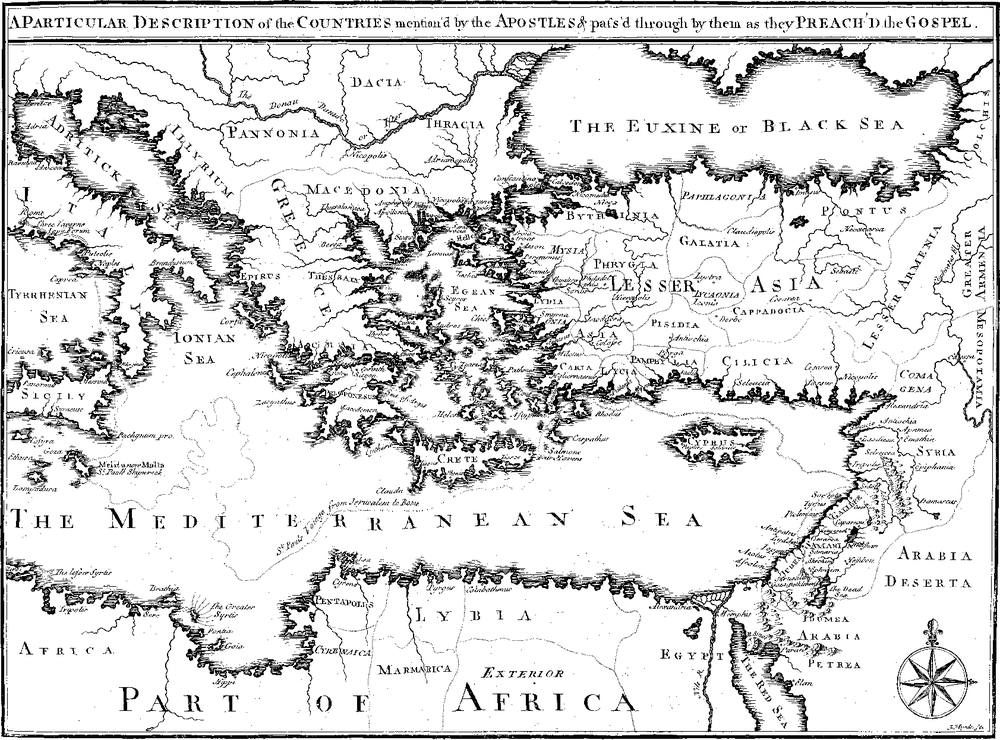
APPLE, Pomum, Malum. The word Malus or Malum is sometimes taken in general, and answers to the Hebrew Peri81, which signifies Fruit; and sometimes for an Apple and Apple-tree, and answers to the Deut. xxxiii. 14.Hebrew Taphuah82. Moses blessing Joseph, wishes him the precious fruits brought forth by the Sun and Moon, that is to say, fruits produced by the rains and dews of Heaven, and by the gentle influences of the Sun and Moon. Or, according to the letter of the Hebrew, The precious fruits brought forth by the Sun, and the precious things put forth by the Moon. The reading in the Vulgate is, De pomis cœli; de pomis fructuum solis & lunæ. The Chaldee and several others by the fruits of the Moon understand those, which come every month, and by the fruits of the Sun, those which come but once in the year. There are some trees, such as the fig-trees and the orange-trees, which have fruit almost always upon them. Moses adds, the fruits of the ancient mountains, which probably signifies the vines, olive-trees, and other trees, which grow in the mountains.
Job. ix. 26. אניות .אבהJob describing very light vessels, which go very swiftly, makes use of this expression, Quasi naves poma portantes: but the Hebrew has it, As the ships of Abah, which is differently explained, Ships of desire, which have the wind wished for; in the Syriac it is, Enemies Ships; in the Chaldee, Ships loaden with excellent fruit; others say, Ships well equipt; lastly, Ships of the river Aba, in Babylonia.
Psalm lxxviii. 1.The Psalmist complains to God83, that the enemies had reduced Jerusalem to pomorum custodiam, to such a condition as to be no better than the cabbin of a centinel, who guards the fruits and vineyards. The Hebrew Hijim, signifies properly an heap of sand and ruins, or a mass of stones laid together in the fields or vineyards. Compare Micah i. 6. Ponam Samariam quasi acervum lapidum in agro, cum plantatur vinea.
Cant. vii. 13 מגדים Magadim.The Spouse in the Canticles says, that she has all sorts of fruits new and old at her house, which she has laid up for her beloved, In portis nostris omnia poma, &c. But the Hebrew reads Magadim, things delicious and sweet. In our gates are all sorts of delights, new and old, which I have reserved for thee, O my beloved.
Prov. xxv. 2.Solomon in his Proverbs says, that a word fitly spoken is like apples of gold in pictures of silver. The Vulgate says, in lectis argenteis, in silver beds; but in the Hebrew it is, like apples of gold in baskets of silver. These golden apples are probably oranges or citrons. The first fruits, as the Rabbins say, were carried in silver baskets to the Temple. Lev. xix. 23.God commanded the Hebrews, when they planted fruit-trees, to pluck off the first fruits, and not to eat them. For the three first years these fruits were thought to be unclean. In the fourth year all the fruit was consecrated to the Lord, and in the fifth, not before, the proprietor began to gather it for his own use. This shewed the sovereign dominion of God over all the Earth, and all that it produced.
Brocard84 acknowledges, that apples, pears, cherries, and such like fruits are very rarely found in Palestine; but in their room they have abundance of other fruits, which are to be seen all the year upon their trees; so that very frequently there are blossoms and fruit at the same time upon them: and this perhaps is what Moses intended to describe under the name of Fruits of the Moon; as we have observed a little higher. They have likewise abundance of citrons, and a sort of apple-tree of a very particular species. It is a tree which lasts not above two years; but when it is withered, the roots of it produce another. Its leaves are so long, that they equal the height of a man standing upright; and so large, that two of these might easily cover a man’s whole body. It bears apples in great plenty, as large as an egg, covered with a pretty thick skin, and of a yellow colour. Its fruit hangs in clusters like grapes; these bunches, wherein there are sometimes an hundred apples, are as large as a moderate basket. We see in Josephus85, and throughout all the Scripture, that figs, olives, dates, mulberries, pistacho-nuts, almonds, capers, and grapes, were very common in Palestine. Authors speak likewise of the Balsam-tree of Judæa, as of a shrub, which is to be found only in that country. There were nuts also and carob-beans growing there, such as the prodigal Son would have been glad to have satisfied his hunger Luke xv. 16.with. The Spouse in the Canticles speaks of a cluster of cypress, which is a shrub about the height of a pomegranate tree; but the Cant. i. 14.fruit of this tree was probably to be commended only for its good scent.
Scripture86 and the Historians87 mention fruits brought from the neighbourhood of Sodom, which on the outside appeared to be fair and of a lively red colour, and within were very bitter, and as it were full of soot and ashes. Terram ipsam specie torridam vim frugiferam perdidisse, says Tacitus88, nam cuncta sponte edita, aut manu sata, sive herbâ tenùs aut flore, seu solitam in speciem adolerunt, atra & inania velut in cinerem vanescunt. Tertullian speaks of them after the same manner89, Olet adhuc incendio Terra, & si qua illic
arborum poma cernantur oculis tenus, cæterum contacta cinerescunt90.
ADAM’s APPLES. James de Vitry91 relates that there are trees in Palestine which bear very fine fruit, and are observed to have the mark as it were of a man’s biting. Hottinger speaks likewise of a tree which is to be seen at Tripoli in Syria, commonly called Almauz, or Adam’s Apples. This tree produces no branches, but only leaves, extended in the form of fingers, and so long and large that one alone is sufficient to cover a man. The fruit of this tree is like a green bean, with a sweetness like that of honey, and the scent of a rose. Some likewise call that fruit Adam’s Apples which grows in Palestine, and at Alexandria; and is seen to hang in clusters in such great quantity that there are sometimes twenty of them together, and of such a size that they equal the largest pears. They are very sweet, and of a very good taste, and the leaves of this tree are every one almost two foot or a cubit in length. Some say, that if this fruit is cut in a particular manner, the figure of a Crucifix is to be discerned in it. See hereafter MANDRAKES.
APRIES, King of Egypt, called Pharaoh-Hophrah, in the Sacred Writings. Jerem. xliv. 30.Apries was the Son of Psammis, and Grandson of Nechos, or Necho, who made war against Josiah King of the Jews. He reigned five and twenty years, and for a long time was looked upon as one of the happiest Princes in the world92. But having equipp’d a fleet in order to reduce the Cyrenians, he lost almost his whole army in this expedition. The Egyptians were resolved to make him responsible for their ill success, and rebell’d against him, pretending that he undertook this war with a design only to get rid of his subjects, and govern the remaining part of them with a more absolute authority. He deputed to them one of his principal officers, named Amasis, with the hopes of bringing them to a sense of their duty. But while he was haranguing them, one of the multitude placed a diadem about his helmet, and proclaimed him King; the rest applauded him, and Amasis did not oppose it. He then put himself at the head of them, marched against Apries, gave him battle, defeated him intirely, and took him prisoner. Amasis treated him with a great deal of kindness, but the people were not satisfied till they had taken him out of Amasis’s hands, and strangled him. Such was the end of Apries according to Ibid.Herodotus. Jeremiah threatned this Prince with being put into the hands of his enemies, as he had delivered Zedekiah King of Judah into the hands of Nebuchadnezzar King of Babylon.
Ezek. xvii. 15. Ezek. xxix. In the Year of the World 3414. before J. C. 584.This Prince had made a league with Zedekiah, and promised him his assistance. Zedekiah therefore relying upon the forces of Egypt, revolted from Nebuchadnezzar King of Babylon; who in the beginning of the year following marched against Zedekiah; but as there were some other people in Syria, who likewise had shaken off their obedience, he proceeded first to attack 2 Kings xxv. 5. 2 Chron. xxxvi. 17 Jerem. xxxix. 1. — lii. 4.them, and reduce them to their duty; then towards the end of the year he laid siege to Jerusalem. Zedekiah defended himself there for a long time, that he might give Pharaoh -Hophrah, or Apries, leisure to come to his assistance. Apries left Egypt with a powerful army; the King of Babylon thereupon raised the siege of Jerusalem, and marched to meet him; but Apries and his people not daring to run the hazard of a battle with the Chaldeans, retreated into Egypt, and abandoned Zedekiah to all the dangers of war wherein they had themselves ingaged him. Ezekiel reproaches them severely with this baseness, and threatens them that since they had been a staff of reed to the house of Israel, and an occasion of falling; for when they took hold of thee by thy hand, thou didst break and rent all their shoulder; he prophesies that Egypt should be reduced to a solitude, that God would send the sword against it which should destroy man and beast in it: And this was afterwards executed. First in the person of Apries, who was deprived of his kingdom by Amasis, as we have before mentioned, and next by the conquest which the Persians made of Egypt. To this King likewise we apply the following words of Hab. xi. 15.Habbakuk, Wo unto him that giveth his neighbour drink, that puttest thy bottle to him, and makest him drunken also, that thou mayest look on their nakedness.
Acts xxvii. 2 &c.I. AQUILA, a native of Pontus in Asia Minor, was converted by S. Paul, together with his Wife Priscilla to the Christian Religion. As Aquila was by trade a tent-maker, as well as S. Paul, the Apostle lodged with him at Corinth. Aquila came thither not long before from Italy, being obliged to leave Rome upon the Edict which the Emperor Claudius had published, banishing all the Jews from that City93. S. Paul afterwards quitted Aquila’s house, and abode with Justus near the
Jewish Synagogue at Corinth, probably because Aquila was a converted Jew, and Justus was a convert from Paganism; that so the Gentiles might come and hear him with more liberty. When the Apostle left Corinth, Aquila and Priscilla acompanied him as far as Ephesus, where he left them to confirm that Church by their instructions and example, while he pursued his journey to Jerusalem. They did him very great services in this City, so far as to expose their own lives to preserve his. They were returned Rom. xvi. 4.to Rome, when S. Paul wrote his epistle to the Romans, wherein he salutes them with great encomiums. Lastly they were come back to Ephesus again when S. Paul wrote his second epistle to Timothy, wherein he desires him to salute them in 2 Tim. iv. 19.his name. What became of them from this time to that of their death is not distinctly known. The Greeks give Aquila the title of Bishop and Apostle, and perform their grand office in honour of him upon the 12th of July. The Festival of Aquila and Priscilla is set down in the Calendar upon the eighth of the same month.
II. AQUILA, a celebrated Translator of the writings of the Old Testament out of Hebrew into Greek. He was made Surveyor of the works by the Emperor Adrian, when the city of Jerusalem, from him called Ælia, was rebuilt by his orders, and had an opportunity, while he was in this imployment, to see the first Disciples of Jesus Christ, with the purity of whose lives, and eminent examples of their virtues, he was so affected as to embrace Christianity, and desire Baptism, which he obtained. But as he was very much addicted to judicial Astrology, the governor of the Church remonstrated to him, that this curious and unprofitable art was inconsistent with the profession of Christianity; and observing that he was not willing to relinquish it, they expell’d him out of the Church. Aquila not able to endure the shame of their excommunication, renounced Christianity, embraced Judaism, and received Circumcision. He then applied himself to the study of the Hebrew tongue; and having acquired an accurate knowledge of it, he undertook to translate the Old Testament out of Hebrew into Greek; and designing to conceal the ignominy of his apostacy, he endeavoured, as Epiphanius says94, from whom we learn these particulars, to distort the sense of those passages, which related to our Saviour, and to interpret them in a sense different from that of the Septuagint. Which he executed, as is believed in the Emperor Adrian’s time.
Acts xviii. 7.Aquila at first set about his translation of the Scripture, designing to keep close to the meaning of the text, but to render it in a more free and easy manner. After which he undertook another more exact one, wherein he attempted to render the most minute terms in their literal signification95; and this last the Jews call’d an accurate translation, and valued it above any other version. Aquila contentiosus interpres, qui non solum verba, sed etymologias quoque verborum transferre conatus est, says S. Jerom in his epistle to Pammachius. Notwithstanding in other places the same Father commends Aquila’s very scrupulous and literal exactness96. Aquila, qui non contentiosius ut quidam putant, sed studiosius verbum interpretatur ad verbum. And whereas the generality of the Ancients accuse him of changing the sense of such passages as favour Christianity, S. Jerom writing to Marcella a Roman lady, tells us, that he was continually examining Aquila’s translation, and every day discovered many things in it, which confirm our belief, Ut amicæ menti fatear, quæ ad nostram fidem pertineant roborandam plura reperio.
We do not know certainly, whether Aquila was originally a Jew, or whether he was a Gentile before he embraced Christianity. Epiphanius makes no doubt but that he was by birth a Gentile, but others urge such difficulties against it, as it is not easy to resolve. It is matter of dispute likewise whether he be the same person with Onkelos, the celebrated Paraphrast of the Pentateuch. There are some Rabbins and Christian authors for the affirmative, and others for the negative. This is certain, that in the account of the generality of the Jews, Onkelos is more ancient than the Aquila we are speaking of; and there are many places in Onkelos and Aquila, that are differently translated. The reader may consult F. Montfaucon’s Dissertation before his Hexapla, p. 51. and Walton’s and Serrarius’s Prolegomena.
AQUILO, the North-wind. The Hebrews generally denote the North by the left hand, the South by the right, with the West behind, and the East before according to the disposition of a man, whose face is turn’d to the East. See our Comment upon Genesis xiii. 9.
1 Chr. ii. 22.AR, Areopolis, Ariel of Moab, or Rabbath-Moab. All these names signify the same City, the Capital of the Moabites, situated upon the river Arnon, which divides it in two. Theodoret97 calls it simply Ariel. Eusebius98 says the same thing, and adds, that the idol of these people, probably Moabites, was called Ariel. E
Isa. xvi.7, 11.piphanius says, that a small tract of land, adjoining to that of Moab, Iturǽa, and the Country of the Nabathæans, is called Arielitis99. The Prophet Isaiah calls it the City with walls of burnt brick; ad muros cocti lateris; in Hebrew, Kirharescheth, or Kirjath-hares. St. Jerom says h this City was entirely destroyed by an earthquake, when he was a young man. We believe Charac-Moba, or Charax- Moab, to be the same with Ar and Areopolis.
ARA, the Son of Jether, of the Tribe of Asher, 1 Chron. vii. 38.
ARAB, a City belonging to the Tribe of Judah, Josh. xv. 52.
ARABAH, a City belonging to the Tribe of Benjamin, Josh. xviii. 28.
ARABIA, one of the most considerable parts of Asia. Arabia lies to the South-East of Judæa, or the Country of the Hebrews. It is distinguished into three parts, Deserta, Petræa, and Arabia Felix. Arabia Deserta is to the East of the mountains of Gilead, between the Euphrates to the East, and the mountains of Gilead to the West. It comprehends the Itureans, the Eastern part of the Edomites, the Nabathæans, the people of Kedar, and others, who lead a wandring life, and have no cities, houses, or fixed habitations. This Country seems more generally to be described in Scripture under the word Arab, which signifies properly in Hebrew, the West, or people gathered together. They may have taken the name of Arabim, or Western, from their situation to the West of the Euphrates. In Eusebius, and the Authors of that time, and of the following ages, the Country and greatest part of the Cities beyond Jordan, and of what they call the third Palestine, are made parts of Arabia.
Arabia Petræa reaches to the South of the Holy Land; Petra is the Capital of it. This Country contains the Southern Edomites, the Amalekites, the Cushims, called Ethiopians by the interpreters of Scripture; and some other people, such as the Hivites, the Meonians, or Maonims. These people are at present known only under the general name of Arabians. But it is of consequence to take notice of the ancient inhabitants of these Cantons, as they are set down in the Text of Scripture. In this Country was Kades-barnea, Gerar, Beersheba, Lachish, Libnah, Paran, Arad, Hasmona, Oboth, Phunon, Dedan, Segor, &c. There, lastly, is Mount Sinai, where the Law was given to Moses.
Arabia Felix lay extended more towards the South. It was bounded to the East by the Persian Gulph; to the South by the Ocean, and to the West by the Dead Sea. As this part of Arabia did not immediately 1 Kings x. 1.border on the Holy Land, or the Country of the Hebrews, there is not so frequent mention of it in Scripture. We are of opinion that the Queen of Sheba, who came to visit Solomon, was Queen of part of Arabia Felix. This Country abounds with riches, and particularly in odoriferous spices.
2 Chron. xvii. 1. Ch. ix. 14. Ch. xxii. 1. Isai. xiii. 20.The Scripture mentions pretty frequently the Arabians as a powerful people, who valued themselves upon their wisdom. Their riches consisted principally in their flocks and their cattle. They paid King Jehoshaphat an annual tribute of seven thousand seven hundred sheep, and as many goats. The Kings of Arabia furnished Solomon with a great quantity of gold and silver. They loved war, but made it rather like thieves and plunderers, than soldiers under discipline, and accustomed to military exercises. Their abode was generally under tents; they lived at liberty in the field, concerned themselves little about cultivating the earth, and were not very obedient to their Kings. This is the idea which the Scripture gives us of them.
1 Chron. iv. 40,41. 2 Chron. xx. 21. Gen. xiv. 5. Deut. ii. 8,9, &c.The ancient inhabitants of Arabia, who dwelt there before Abraham came into the Land of Promise, were descended from Ham. We find the Midianites there, of the race of Cush, among whom Moses retired. Abimelech King of Gerar is known to have lived there in the time of Abraham; and the Amalekites in the time of Moses. The Hivites, the Amorites, Kenites, Meonians or Mahonians, extended themselves a good way into Arabia Petræa; the Horims in the Mountains which lie to the South of the land of Canaan, and to the East of the Dead Sea. The Rephaïms, Emims, Zuzims, and Zamzummims, inhabited the Country called afterwards Arabia Deserta, which was peopled by the Ammonites, Moabites and Edomites.
As to Arabia Petræa, and Arabia Felix, they were possessed by the descendants of Ishmael, who were more particularly known by the name of Arabians. See the Article ISHMAELITES.
Here follows the history of the first inhabitants of Arabia, as it is related by the Arabians themselves, together with an account of the manner wherein they are said to have settled there.
The first people of Arabia100, whom they call pure and unmix’d Arabians, descended from Cahtan, or Joktan, the Son of Eber, and Brother of Peleg; who after the division of languages came and inhabited this Peninsula of Asia, which may have derived its name from Jarab, the Son of Joktan, or from a wide plain in the Province of Tahamat, called Arabor.101
The second Arabians, who succeeded these first, are the descendants of Ishmael the Son of Abraham and Hagar, who came and settled among the ancient pure Arabians, and was the Father of the mix’d Arabians, or Mota- Arabes, or Mosta-Arabes, or Ishmaelites, very different from the modern Mosarabians, or Mostarabians, so called by the Spaniards, because they are Arabians blended with the nations which lie out of Arabia.
The pure and ancient Arabians were divided by Tribes, as well as the Sons of Ishmael; and some of these Tribes are still in being in Arabia, others are lost and extinct; whether they were exterminated for their sins by the particular wrath of God, or were consumed by intestine wars, which were very common in this country.
As to the Ishmaelites, they formed twelve Tribes, according to the number of the twelve Sons of Ishmael, viz. Nebajoth, 13,14,&c.Kedar, Abdiel, Mibsam, Mishma, Dumah, Massa, Hadar, Tema, Jetur, Naphish, and Kedemah. But altho’ these people are very careful in their enquiries into, and preservation of their genealogy, yet they cannot trace it so high as Ishmael; they are obliged to stop at Adnan, one of his descendants; and the genealogy even of Mahomet rises no higher.
Ver. 1, 2, 3, &c.Besides the descendants of Ishmael, who peopled the greatest part of Arabia, it must be acknowledged likewise, that the Sons of Abraham and Keturah, of Lot and Esau, and some of Nahor’s, dwelt in the same country, and extirpated part of the old inhabitants.
The inhabitants of Arabia are divided into those who dwell in cities, and those who live in the open fields: the latter have their abode continually under tents, and in desart places; they are called Bedoui, or Arabi; they are much honester and more subtle than the Arabians who live in towns. The Arabians are farther divided into Gentiles and Mussulmen; the former preceded Mahomet, and are called among them Arabians in the days of ignorance; the others are those who have received the doctrine of the Unity of God, which was preached by Mahomet. These are called Mos-lemoun, or Mussulmen; that is to say, Believers; these are the people who conquered the greatest part of Asia and Africk, and several large Provinces even in Europe, and who founded the four great Monarchies of the Turks, and Persians, of Morocco, and Mogul; without taking notice of several Provinces possessed by them in the Indies.
Arabia, as we have already observed, is divided into three principal parts, viz. Teman, which we call Arabia the Happy; the Provinces of Tahamah and Temanah, are as it were in the center of the country. Arabia the Desart is called Hegiaz, and is become the most celebrated of all, by reason of the Cities of Mecca and Medina, which are situated in it. Arabia the stony goes at present by the name of Hagar, or Hagiar; which signifies Stone, and the Capital of this Country is so called. But Arabia Deserta, in the account of the Ancients, extended much farther towards Syria and Euphrates.
Joktan the Son of Eber having settled in Teman, erected a Kingdom there, whereof he was himself the first Monarch102. His Son Jarab succeeded him, who introduced the Arabian language, which borrowed its name from him, as did in like manner the whole Country. The third King of Arabia Felix was Jaschab; and the fourth Abdalscham, he was sirnamed Sobas, and from him the old Sabæans derived their name. His descendants reigned in Teman above two thousand years before the original of Mahometanism.
The Arabians in general are a cunning, witty, generous, and ingenious people; excessive lovers of Eloquence and Poetry; but then they are superstitious, vindictive, and sanguinary, and make no scruple of robbing, which they think allowable, because Abraham the Father of Ishmael gave his Gen. xxv. 5, 6.Son nothing.
The old Aarabians were all idolaters: they worshiped a Stone, says Clemens Alexandrinus103. Maximus Tyrius, and the modern Arabians, accuse them of the same superstition. The black Stone which was the object of their worship is still to be seen in the Porch of the Temple of Mecca. Herodotus104 says they were acquainted only with two Deities, viz. Bacchus, and Venus the Celestial. Bacchus, or Dionysius, they called Urostalt; and Venus, Alilat, or Alilatta. Strabo105 tells us, that they adored none but Jupiter and Bacchus: which Alexander the Great being informed of, resolved to subdue them, that he might oblige them to worship him as their third Deity.
The modern Arabians, who are descended from Ishmael, acquaint us with some names of the old Deities adored by these ancient people of Arabia; for example, Lakiah, whom they invoked for rain; Hafedah, to whom they had recourse for preservation from bad accidents in their journeys; and Razora, of whom they desired the necessaries of life. They likewise worshiped Lath, or Ablat, which is a diminitive of Abla, the true name of God; Aza, or Uza, derived from Aziz, which signifies the Mighty God. Menat, derived from Menan, distributer of fa
vours. It is very probable that they adored likewise the two golden Antelopes, whereof there is such frequent mention in their histories, and which were offered at the Temple of Mecca. The ancient Midianites, among whom Moses retired, and was received by Jethro, worshipped Abda and Hinda106. Finally Urotalt, mentioned by Herodotus, denotes probably the Sun, and Alitat the Moon. The first of these words may signify the God of light; the second the God, or Goddess without any addition: the Goddess in the way of eminence. See farther what we have said above in the article Abraham.
Since the Gospel was first preached, many of the Arabians have embraced Christianity: we know of some Bishops and Martyrs, who were of Arabia; and in Origen’s time a Council was held there against certain hereticks. The Mahometans themselves acknowledge107, that before Mahomet there were three tribes in the country which professed Christianity viz. those of Thanouk, Babera and Naclab. That of Thanouk having had some difference with their neighbours upon the subject of Religion, retired to the province of Baharain upon the Persian Gulf, and there settled.
ARACEANS, or Arkites, people descended from Arak the Son of Canaan, who dwelt in the City of Arce or Arca, of the foot of mount Libanus. Josephus and Ptolemy both speak of this City. Antoninus’s itinerary places it between Tripolis and Antaradus. Josephus108 produces a fragment of the history of Assyria, wherein it is related, that the inhabitants of Arce submitted to the Assyrians, together with those at Sidon and old Tyre. And in another place he says109, that the river Sabbaticus empties itself into the Mediterranean between Arce and Raphanæa. I do not at all doubt, but that this is the very Arce mentioned in Josephus, and said to belong to the tribe of Asher110, and otherwise called Antipas. In Solomon’s time Baariah was intendant of the tribe of Asher, according to the Hebrew Text; but 1 Kings iv. 16.Josephus says, he was governor of the country round about the City of Arce, which lies upon the sea111. In the latter times of the Jewish commonwealth, this City was part of Agrippa’s Kingdom112.
ARACH, a City of Chaldæa, built by Nimrod the Grandson of Cush, Gen. x. 8. This in all probability is the town of Aracca, placed by Ptolemy in the Susiana upon the Tigris below the place of its confluence with the Euphrates. Ammian calls it Arecha. From this City it is that the Arectæan plains113, which abound with Naphta, and some times take fire, derive their name. From this City of Chaldæa it is, probably that the Arabians have taken the name Iraca or Eraca, a large province of Asia, which is extended along the two shores of the Tigris, in like manner as Egypt includes the two coasts of the Nile.
The length of Iraca is measured from Takrith to Abadan, where the Tigris discharges itself into the Persian Gulf114, and is an extent of twenty days journey: Its breadth is taken from Cadisic to Habran, and is of eleven days journey. The Capital of this province under the Chaldæans and Assyrians was Babylon, under the Princes of the name of Cosroës Madain, and under the Arabians, Bagdat. This is the province which is called Chaldæa or Babylonia by the Greeks and Latins.
Numb. xxi. 1.ARAD, Arada, Arath, Adraa, or Adra, a city lying to the South of the tribe of Judah and the land of Canaan, in Arabia Petræa.Numb. xxxiii. The Israelites having advanced towards the land of Canaan, the King of Arad opposed their passage, defeated them, and took a good booty from them. But they devoted his country as a thing accursed, and destroyed all the Cities thereof as soon as they became masters of the land of Canaan. Arad was rebuilt, and Eusebius places it in the neighbourhood of Kades, at four miles distance from Malathis, and twenty from Hebron. The Israelites in their journey through the wilderness having departed from Sepher came to Arad, and from thence went to Makkelath, which I take to be the same as Molathis.
ARADUS, a City and Island in the Mediterranean, near the coast of Phœnicia, over against Antaradus, which is a City upon the continent. The Isle of Aradus is but seven furlongs, or eight hundred seventy five paces about, and is two hundred paces distant from the continent. The Aradians or Arkites, who were the descendants of Canaan, dwelt at Aradus, Gen. x. 17. This country was promised to the Israelites; but they did not get possession of it till perhaps the reign of David or Solomon.
I. ARAH, the Son of Ullah, a Grandson of Asher. 1 Chr. vii. 39.
II. ARAH. His Descendants returned from Babylon to the number of seven hundred seventy five. See Esra ii 5.
Genes. x. 22. Aram.I. ARAM, fifth Son of Shem, was the Father of the people of Syria, who from him are called Aramæans. There are many countries of this name, distinguished in Scripture, Aram Naharaïm, or Syria of the two rivers, that is, Mesopotamia, Aram of Damascus, Aram of Soba, Aram Bethrohob, and Aram of Maacha; be
Aram (I) continues on the next page
Footnotes
-
Joseph. ibidem. ↩
-
Joseph. Antiq. l. xiii. c. 21. p. 460. Porphyr. apud Euseb. Græc. p. 227. Justin. l. xl. Prolog. ↩
-
Vide Joseph. de Bello l. vii. c. 21. in Lat. p. 975. seu ⁎⁎φ. θ. in Græc. ↩
-
The Name of Antipas is the same with that of Antipater, which signifies equal to the Father, or comparable to the Father. In my opinion the Hebrew Name answerable to Antipater is Abihu ,אביהוhe is my Father, he shall be instead of a Father to me. ↩
-
See Joseph. Antiq. l. xvii. c. 13. ↩
-
Joseph. Antiq. l. xviii. c. 2. ↩
-
Joseph. Antiq. l. xiv. c. 1. ↩
-
Ibid. c. 2. ↩
-
Ibid. c. 10. ↩
-
Ibid. c. 14. ↩
-
Ibid. c. 15. ↩
-
Ibid. c. 16, 17. ↩
-
Ibid. c. 18, 19. ↩
-
Ibid. c. 20. ↩
-
Joseph. Antiq. l. xvi. c. 6. & de Bello, l. i. c. 17. ↩
-
Antiq. l. xvi. c. 11. f Ibid. ↩
-
De Bello, l. i. c. 17. v Antiq. l. xvii. c. 3. w Ibid. c. 6. & l. i. de Bell. c. 2. ↩
-
Joseph. Antiq. l. xvii. c. 9. ↩
-
Antiq. l. xiii. c. 13. & lib. xvi. c. 9. ↩
-
Jacob. de Vitriaco hist. Jerosol. c. 23 Vide Reland. ↩
-
Joseph. Antiq. l. xiii. c. 23. ↩
-
De Bello, l. i. c. 16. ↩
-
Joseph. Antiq. l. xv. c. 14. p. 544. & de Bello, l. vi. c. 12. p. 919. ↩
-
Basnage hist. des Juifs, l. ii. l. iv. c. 9. p. 149. Edit. Paris. ex Gantz. Zemach. David. & Gedalia Schial. Schelet Kabbala. ↩
-
Joseph. Antiq. l. xiv. c. 22. & l. xx. c. 8. & de Bello, l. i. c. 13. ↩
-
Antiq. l. xiv. c. 23. ↩
-
Antiq. l. xiv. c. 25. ↩
-
An- tiq. l. xiv. c. ult. ↩
-
Euseb. in locis. ↩
-
Herodot. l.i. c. 105. ↩
-
Joseph. l. vi. Antiq. c. 1. ↩
-
Vide Theodoret. l. viii. de Græc. affection. curand. ↩
-
Translators’ note. And thus it is construed by the Translators of our English Bible. Buxtorf. interprets this word in the same manner; and says, Sic in Targum Et extendit augustale suum super eos. Baxt. ↩
-
Porphyr. apud Hieronym. in Dan. xi. ↩
-
Fuller. Miscellan. l. v. Amicire; Ephod, amictus. ↩
-
Plutarch. in Fabio. p. 182. in Bruto, p. 1002. Isidor. orig. l. xix. c. 22. Vide Lipf. de Milit. Rom. l. iv. c. 12. ↩
-
Appian. Syriac. p. 117, 131. Porphyr. apud Hieronym. in Dan. xi. ↩
-
Polyb. in Excerptis Valesii, p. 144. ↩
-
Theodoret in Dan. xi. ↩
-
Hieronym. in Dan. xi. v Reland. Palæstin. l. ii. c. 6. & l. iii. p. 788. ↩
-
Procop. l. ii. c. 4. de ædificiis Justiniani. ↩
-
ΑΠΑΜΕΩΝ ΚΙΒΩΤΟϹ ΜΑΡϹΙΑϹ. ↩
-
Ἐστὶ δί τις Φρυγίης ἐπὶ ἠπείροιο μελαίτης. Ἠλίβατον ταυύμηκες ὄρος Ἀραρὰς δὲ καλεῖται. Μαρσύεω ἔνθα φλέβεις μεγάλου ποταμοῖο πέφυκαν. ↩
-
πίθηκος, κῆβος, κῆπος, κεῖφος. ↩
-
Strabo, l. xvii. ↩
-
See Bochart, de Animal. Sacr. P. I. l. ii. c. 23. ↩
-
Maffei Hist. Ind. l. i. ↩
-
1 Kings x. 22. 2 Chron. ix. 21. ,קופיםKophim. Bochart. de animal. Sacr. Par. I. l. ii. c. 31. ↩
-
Lymchot. F. Syrard. Voyage du Levant. T. 1. ch. 20. p. 265. ↩
-
Sozomen. l. xi. c. 55. & Theophan. in Chronico p. 18. ↩
-
Paul Lucas, ↩
-
Herod. l. iii. c. 38. Plin. l. viii. c. 46. Strabo l. xvii. ↩
-
Gerard. Voss. l. ix. de Idolatr. Vide apud illum Julium Firmin. & Rufin. &c. ↩
-
Apud Euseb. l. iii. c. 28. Hist. Eccl. ↩
-
Euseb. l. iii. c. 3. Hist. Eccl. ↩
-
Hieronym. in Catalog. Scriptur. Eccl. ↩
-
Apud Euseb. l. vi. c. 14. Hist. Eccles. ↩
-
Sozomen. l. vii. c. 19. ↩
-
Epiphan. Hæres. 18. c. 38. G. Eycar. part. 2. animal. p. 120. Aug. tract. 98. in Joan. ↩
-
Sozomen. l. vii. Hist. Eccles. c. 19. ↩
-
Theodoret. l. ii. hæretic. Fab. c. 3. ↩
-
Epiphan. Hæres. 31. c. 8. Gnostic. ↩
-
Epiphan. Hæres. 39. c. 5. ↩
-
Georg. Syncell. p. 27. ↩
-
Hieron. Ep. 101. ad Pammach. ↩
-
Origen. Hom. ult. in Matt. xxvii. 9. a ἀπόκρυφος absconditus, ab ἀποκρύπτω abscondo. ↩
-
Ἀπόκρυφος absconditus, ab Ἀποκρύπτω abscondo. ↩
-
Hieron. Ep. ad Lætam. Aug. l. xv. de Civit. c. 23. ↩
-
Concil. Lateran. & Tridentin. ↩
-
Hieron. Præfat. in lib. Salomon. ↩
-
Joseph. Antiq. l.xiii. c. 8. & 1 Macc. x. 69. & seq. ↩
-
Joseph. Antiq. l. xiii. c. 8. ↩
-
Hieronym. ad Tit. iii. ↩
-
Ἀπολλύων, Disperdens. Heb. .אבדון ↩
-
L. xiv. Codic. Theod. de Judæis. ↩
-
Vide Gothofredi Notas in Cod. Theod. l. xiv. ↩
-
Hieronym. in Epist. ad Galat. v. 1. ↩
-
Euseb. in Isai. xviii. Hieronym. ibidem. ↩
-
Epiphan. Hæres. 30. ↩
-
אפוסdefi-ciens. abundare. spargere. ↩
-
פריPeri. Fructus, Pomum. In acervos lapidum. Aquil. Εἰς λιθύριον. ↩
-
תפוחTaphuah. Pomum, Malus. ↩
-
לעייםHieronym. ↩
-
Brocard. Descript. Terræ Sanctæ p. 281. ↩
-
De Bello, l. ii. c. 18. ↩
-
Deut. xxxii. 32. De vinea Sodomorum vinea eorum. ↩
-
Vide Joseph. Plin. l. v. c. 16. Strabo. l. xvi. alios passim. ↩
-
Tacit. hist. l. v. c. 6. ↩
-
Tertull. Apolog. c. 40. ↩
-
Translators’ note. Maundrell describing the Dead Sea, tells us, that for the Apples of Sodom so much talked of, he neither saw nor heard of any hereabouts: nor was there any tree to be seen near the Lake, from which one might expect such a kind of fruit. Which induces him to believe that there may be a greater deceit in this fruit than that which is usually reported of it; and that its very being, as well as its beauty is a Fiction, only kept up, as my Lord Bacon observes many other false notions are, because it serves for a good allusion, and helps the Poet to a similitude. Maundrell’s Journey from Aleppo to Jerusalem. p. 85. ↩
-
Jacob. de Vitriaco hist. Jerosolym. c. 85. ↩
-
Herodot. l. ii. c. 161, 162. & 169. ↩
-
Sueton. Claud. c. 25. ↩
-
Epiphan. lib. de ponderib. & mensuris. ↩
-
Origen. ad African. Hieron. in Ezechiel. Idem ad Pammach. ↩
-
Hieronym. ad Damas. ↩
-
Theodoret. in Isai. xv. & xxix. ↩
-
Euseb. in locis Hebr. in Areopolis. ↩
-
Epiphan. l. i. contra hæref. p. 40. ↩
-
Hieron. in loc. Hebr. ↩
-
Bibl. Orient. p. 120, 121. ↩
-
Bibl. Orient. p. 477. Jaman, or Jeman. ↩
-
Clem. Alex. in Protreptico. 29. Οἱ Ἄραβες τὸν λίθον. ↩
-
Herod. l. i. & 3. c. 8. ↩
-
Strabo, l. xvi. p. 510. ↩
-
D’Herbolet. Bibl. Orient. p. 476. ↩
-
Dem. p. 852. Thanouk. ↩
-
Antiq. l. ix. c. 14. ↩
-
De Bello Jud. l. vii. c. 14. ↩
-
Joseph. Antiq. l. v. c. 1. p. 142. ↩
-
Antiq. l. viii. p. 256. ↩
-
De Bello l. vii. c. 24. ↩
-
Ardet Aracteis aut unda per hospita campis. Tibull. ↩
-
Bibl. Orient. p. 317. ↩