Volume I, pages 138–157 of the 1732 edition, from ANI to ANT: everything printed on these pages, in order.
Continued from Animals
sorts of Animals that were sacrificed was Lev. iii. 17. vii. 23, 24, 25. Ch. vii. 26, 27. Ver. 27. xvii. 10.forbidden to be eat. And the blood of all kinds of Animals generally, and in all cases, was likewise prohibited upon pain of death to those Hebrews who should eat it. Neither do they eat the sinew which is upon the hollow of the thigh, tho’ it be otherwise pure, because the Angel that wrestled with Jacob at Mahanaim touched the hollow of his thigh in the sinew that Gen. xxxii. 25. Ex. xxii. 31. Levit. v. 2. xi. 39. xvii. 15. xxii. 8. Levit. xi. 39. 40.shrunk. Lastly, neither did they eat of those Animals which had been taken and touched by a devouring and impure beast, such as a Dog, a Wolf, or a Boar, &c. Nor of any Animal that died of itself. Whoever touched the carcass of it was impure until the evening; and till that time, and after he had washed his clothes, he did not return to the common conversation of other Jews.
Fish that had neither fins nor scales were declared unclean, Levit. xi. 10.
Birds which walk upon the ground with four feet, such as Bats; and the several sorts of flies that have many feet were Ch. xi. 21, 22.declared impure. But the Law excepts the different kinds of Grashoppers which have their hind feet higher than those before, and rather leap than walk. These Animals Ver. ibid.are clean, and may be eaten; as in effect they were in Palestine.
Interpreters are very much divided with relation to the legal purity or impurity of Animals. It is believed that it was already in use before the Flood, since God commanded Gen. vii. 2.Noah to carry seven couple of clean Animals into the Ark, and only two of those which were unclean. Some are of opinion1 that this distinction is altogether symbolical, and that it denotes only the moral purity or impurity which the Hebrews were to endeavour after, or avoid, according to the nature and inclinations of those Animals which they were to use or to abstain from. A Hog, for example, signifies gluttony; a Hare lasciviousness, a Sheep gentleness, a Pigeon simplicity; and so of others. The principal design of Moses in prohibiting the use of Swine’s flesh, was to condemn gluttony, and excesses in eating and drinking. S. Barnabas, in his Epistles, is very large upon these symbolical significations.
Others2 believe that God intended to preserve the Hebrews from the temptation of adoring Animals, by permitting them to eat those the generality whereof were looked upon as Gods in Egypt; and by obliging them to think with horror on other Animals, to which likewise divine honours were paid. They never had any imagination of worshiping the Animals they eat, and still less of adoring those which they could not persuade themselves to use, even for their nourishment. Tertullian3 thought, that God proposed by this means to accustom the Hebrews to temperance, and make them averse to gluttony, by thus enjoining them to deprive themselves of several sorts of food.
Lastly, many Commentators allow nothing more to be in the Animals which are declared unclean, besides some natural qualities which are really hurtful, or which at least are so in the idea of certain people. Moses has forbidden the use of Beasts, Birds and Fishes, the flesh whereof was thought to be bad and pernicious to health; those which are wild, dangerous, or venomous, or that were thought to be such by the people. God likewise, who design’d to separate the Hebrews from other people, as a holy nation consecrated to his service, seems to have interdicted them the use of certain Animals, which were esteemed unclean, that by this outward and figurative purity they might be inclined to another more real and perfect. This he intimates sufficiently in these words, Levit. xx. 24,25,26.I am the Lord, the God who have separated you from other people; ye shall therefore put difference between clean Beasts and unclean, and between unclean Fowls and clean: And ye shall not make your souls abominable by Beast or by Fowl, or by any manner of living thing that creepeth on the ground, which I have separated from you as unclean. And ye shall be holy unto me: for I the Lord am holy, and have severed you from other people, that ye should be mine.
I shall here set down a list of those unclean Animals, whereof Moses has made any express mention.
| Four footed Beasts. | The Camel. The Porcupine, or Hedge-hog. The Hare. The Hog. |
| Birds. | The Eagle. The Griffin, or rather the Ossifraga. The Sea-Eagle. The Kite. The Vultur, and those of its species. The Raven, and all Birds of the same species. The Ostrich. The Owl. The Moor-hen. The Spar-hawk. The Scritch-Owl. The Cormorant. The Ibis. The Swan. The Bittern. The Porphyrio, or perhaps the Vultur. The Hern. The Curlew. The Lap-wing. The Bat. |
| Four-footed Creatures. | The Weasel. The Mouse. The Crocodile. The Shrew-Mouse. The Cameleon. The Eft. The Lizard. The Mole. |
But it may be proper to advertise the Reader, that we know but very imperfectly the signification of the Hebrew terms, which denote the generality of these Animals. We have followed the Vulgate in the Catalogue above written. They who please may consult on this matter the large work composed by Samuel Bochart, concerning the several Animals whereof there is any mention in the Bible, and the Commentators on the XI chapter of Leviticus; as also S. Barnabas’s Epistle. They may likewise turn to the names of each of these Animals, inserted under their proper Articles in this Dictionary.
ANISE, an herb very well known, which produces small seeds of a very good smell. Our Lord reproaches the Pharisees with their scrupulous exactness in paying tythe of Anise, Mint and Cummin, while they neglected Justice, Mercy and Faith, which Matth. xxiii. 23. Tobit i. 1, 2, &c. Ch. xi. 19.were the more essential practices of Religion.
I. ANNA, the Wife of Tobit, of the Tribe of Nephthali, who was carried in captivity to Nineveh by Salmanesar King of Assyria. After that Tobit had lost his sight, and was fallen into poverty, Anna found her self obliged to go every day to get her livelihood by spinning; and what she earned by the labour of her hands, she brought home for the subsistence of her family. One day, having received a kid, she conveyed it to her house, and Tobit having heard it, said, Take care that this kid be not stolen; send it back to those who own it. To which Anna with great passion replied, Where then is the reward of thine alms? and what are become of all thine hopes? Thus was the patience of Tobit tried amidst his other afflictions.
Some time after, Tobit believing himself to be near his end, called his Son Tobias, and charged him to have always a Tobit xiv. 12.great respect for his Mother; and to remember all that she had done and suffered for him. Last of all he added, When the course of her life is finished, bury her near me. Tobit lived still a great while after this, and Anna his Wife survived him. Some few moments before his death he repeated the request he had made before to Tobias, of placing his Wife Anna near him in his grave, after his decease. Tobit died about the year of the World 3363. before J. C. 637. before the vulgar Æra 641. Anna therefore must have died after this time, but before 3378. which was the year wherein Nineveh was taken: for Tobias left this City before it was taken, as his Father had forewarned him it would be.
Luke ii. 36, 37.II. ANNA, the Daughter of Phanuel, a Prophetess and Widow of the Tribe of Asher, is mentioned in S. Luke. She was married early, and lived but seven years with her Husband. Being then disengaged from the ties of marriage, she thought only of pleasing God. She continued, without ceasing, in the Temple, serving God day and night, with fasting and prayers4. She was fourscore years of age, when the holy Virgin came to present Jesus in the Temple, and entring accidentally while old Simeon was pronouncing the hymn of thanksgiving, which we read in the Gospel, Anna likewise began to praise God, and to speak of the Messiah to all those who waited for the redemption of Israel. We know nothing more either of the life or death of this holy Prophetess. The Roman Martyrology fixes her festival to the first day of September; that published by Canisius, to the twenty eighth of August; that of Ugellus, and the Menæa of the Greeks, join the festival of S. Anna the Prophetess and that of old Simeon together, on the third of February.
III. ANNA, the Mother of the Blessed Virgin, and Wife to Joachim. The names of Anna and Joachim are not to be met with in the Canonical Scriptures of the New Testament, but they are in books of good antiquity, which indeed are of no great authority, particularly in the Western Church, yet deserve some respect. We see them quoted in the writings of the Fathers. The tradition of the Church has preserved the names of Anna and Joachim; and hath paid suitable honours to their memory, notwithstanding that it hath not adopted every story of their lives, which has been published by the zeal of some ignorant persons. Whatever we know of Joachim and Anna, is handed
down to us from the Christians of the East, who have preserved several historical traditions, which the Christians of the West were strangers to.
We read in the Protevangelium, or preparatory Gospel , whereof S. James is said to be the author5, that Joachim intending once upon some solemn day to present his offering in the Temple, was prevented by a Jew, whose name was Reuben; this man told him that it was not lawful for him to do it, because he had no posterity in Israel. Joachim, upon this, was in a great deal of confusion, and retired into the Wilderness, where he continued for forty days and forty nights in fasting and prayer. His Wife Anna stayed at home, afflicting herself before God, upon the account of her own barrenness, and the absence of her Husband Joachim. Upon some great festival day, Judith her maid-servant said to her, How long will you continue thus sorrowful? It is not lawful for you upon this day to afflict yourself; for it is the great day of the Lord. Take this head-dress and wear it; for it does not become me to put it on, who am your servant; but you it does, who are of royal extraction. Anna replied, Be gone, I will not, for the Lord hath humbled me. Her maid was provoked with this answer, and reproached her with her barrenness. Anna upon this laid aside her mourning, dressed her head, and put on her wedding-clothes.
About the ninth hour she came into her garden, and began to beg of God that he would vouchsafe to bless her, and deliver her from the ignominy of barrenness; and as she was thus at her devotions under a lawrel-tree, she look’d up and saw a bird’s nest with young ones in it. This object encreased her grief; she cried unto the Lord, and complained bitterly that she continued barren, while animals of all kinds produced their young, and the earth brought forth its fruit in season, and blessed the Creator. I am, says she, as one who is accursed in Israel: I am reviled, and covered with confusion, and driven from the Temple of my God. To what can I compare myself?
Hereupon, an Angel descended from Heaven, and said to her, Anna, God hath heard your prayer; you shall conceive and bear a Child, and your generation shall be praised throughout all the world. Anna answered, As the Lord my God liveth, if he give me either Son or Daughter, I will consecrate him to the Lord, and he shall serve in his Temple all the days of his life. At the same time two Angels came and declared to her, that God had heard Joachim’s prayer, and that he should return very soon with his flocks. Accordingly, he returned from the mountains, and Anna went to meet him. Some few days after she conceived, and at the end of nine months brought forth Mary, and suckled her with her own milk. At six months old Mary began to go alone; and at the year’s end Anna weaned her, made a great entertainment for the Priests, and offered Mary to them. The Child continued still two years in her Father’s house, and when she was three years old, Joachim and Anna presented her in the Temple, to be brought up and serve the Lord there. This is what we read of Joachim and Anna, in S. James’s Preparatory Gospel.
Mahomet in the Alcoran6, and other Arabians, have preserved several traditions relating to Joachim, Anna, and Mary their Daughter. They say that Anna was the Daughter of Nahor, and Wife of Amram. These words would induce any one naturally to say, that Mahomet believed Amram the Son of Koath, Grand-son of Levi, and Father of Moses, Aaron and Miriam, to be the same with Amram Husband to Anna, and Father of Mary; and consequently, that this false Prophet has confounded the Virgin Mary with Miriam or Mary the Sister of Moses. And upon this is founded the reproach with which he is charged, of having jumbled two persons together, who lived at more than sixteen hundred years distance from one another. It is certain that Mahomet was ignorant enough to fall into such an anachronism.
The Interpreters of the Alcoran endeavour however to excuse Mahomet, by saying that Amram Husband to Anna, and Father to Mary the Mother of Jesus Christ, was indeed of the same family with Aaron and Moses; which in some sort may be defended, because it is said in S. Luke, that Elizabeth was of the sacerdotal Family, of the Daughters of Aaron. They add, that Amram, Father of the Blessed Virgin Mary, was the Son of Mathée; so that their Amram would be the same with our Joachim, Husband to S. Anna.
They say moreover, that Anna being big with Mary, devoted the fruit of her womb to God, without knowing whether what she bore was a Son or Daughter; that God was pleased with her prayer and vow; that Anna being delivered, God himself named Mary; that Anna offered her to Zachary the Priest, who shut her up in one of the chambers of the Temple, the door whereof was so high that there was no going up to it without a ladder, and carried the key always about him.
Zachary
Zachary from time to time paid visits to the Blessed Virgin, and as often as he visited her found abundance of fine fruit near her, which grew in the Holy Land, and at times always when it was out of season; which induced him at last to ask Mary how she came by such a variety of beautiful fruits. She answered, All you see comes from God, who provides every thing without any limitation of number or quantity for those who please him.
Some have said that S. Anna had three Husbands; Joachim, by whom she had Mary, our Saviour’s Mother; and Cleophas, by whom she had Mary the Daughter of Cleophas, and Mother of James Minor, Joseph the Just, Simon the Zealot, and Thaddæus; and last of all, Salomas her third Husband, of whom she had a third Daughter named Mary, who was married to Zebedee, and was Mother to S. James Major, and S. John the Evangelist. There are some old verses cited for the confirmation of this genealogy; but both these verses, and they who maintain this opinion, are of too little authority to make way for the reception of it among learned Men. The verses are these,
Anna tribus nupsit, Joachim, Cleophæ, Salomæque, Ex quibus ipsa viris peperit tres Anna Marias. Quas duxere Joseph, Alphæus, Zebedeusq; Prima Jesum; Jacobum, Joseph, cum Simone Judam, Altera dat. Jacobum dat tertia, datque Joannem7.
There is a great deal of probability that the Marys who are mentioned in the Gospel, and are said to have been the Holy Virgin’s Sisters, were her relations only, or other Daughters of Joachim and Anna, born after the Holy Virgin. We know nothing exactly concerning the time of Joachim’s and Anna’s death, nor even of their tomb; tho’ particular monuments are shewn to Travellers, and pains taken to persuade them that these were their sepulchers. The Latins observe the festival of S. Anna upon the 26th of July, and the Greeks that of her conception upon the 9th of December, and that of her marriage with Joseph on the 9th of September.
IV. ANNA, or Anno, or Thecemine, the Wife of Jeroboam King of Israel. The name of this Princess is not to be met with in the Hebrew or Vulgate, but in the Greek only. What we know of this Queen may be seen under the Article A-BIJAH, the Son of Jeroboam I. The Greek of the first Book of Kings says that Pharaoh King of Egypt married his Wife’s eldest Sister Thecemine to Jeroboam, while he abode as a Refugee in Egypt.
ANNAS, or Ananus, High Priest of Jerusalem. See ANANUS.
ANNIUS RUFUS, succeeded Ambivius in the Government of Judæa, and was himself succeeded by Valerius Gratus8. He governed this Province from the year of the World 4016, to 4018. He was sent by Augustus, and recalled by Tiberius.
ANNUNTIATION. Upon this festival the Christian Church celebrates the conception or incarnation of the Son of God in the womb of the Virgin Mary. The Angel Gabriel brought the first news of it to Zechary, telling him that he should have a Son, who should be the Fore-runner and Prophet of the Messiah. Six months after, the same Angel Gabriel was sent into a City of Galilee called Nazareth, to the Virgin Mary, of the Tribe of Judah, and Family of David. The Angel said to her, Hail Thou that art highly favoured of the Lord; the Lord is with Thee, blessed art Thou among Women! Mary, when she saw him, was troubled at his saying; and considered with her self, what this salutation could mean. And the Angel said unto her, Fear not, Mary; for thou hast found favour with God. Thou shalt conceive and bring forth a Son, and shalt call his name Jesus. He shall be great, and shall be called the Son of the Highest. The Lord shall give unto him the Throne of his Father David, and he shall reign over the House of Jacob for ever, and of his Kingdom there shall be no end.
Then said Mary unto the Angel, How shall this be, seeing I know not a Man? The Angel answered, The Holy Ghost shall come upon thee, and the power of the Highest shall overshadow thee; therefore also, that Holy Thing which shall be born of thee, shall be called the Son of God. And behold thy Cousin Elizabeth she hath also conceived a Son in her old age; and this is the Luke i. 5, 25. Ver. 26, & seq.sixth month with her, for with God nothing shall be impossible. And Mary said, Behold the Handmaid of the Lord, be it unto me according to thy word. At the same time the Angel separated from her, and by the operation of the Holy Ghost she conceived the only Son of the Father, who had been four thousand years expected, and was to be the happiness, the light and salvation of all men.
We celebrate the memory of this mystery on the 25th of March; and S. Austin9 says, that the Church, upon the authority of some old tradition, believed that the Saviour of the world was conceived upon this day. Not only the Greek and Latin Churches have chosen the 25th of March to celebrate this mystery upon;
but the Syrians likewise, Chaldees, and Copticks10 do the same. This opinion seems to be founded principally upon the supposition of Christ’s being born upon the 25th of December. As a consequence of this opinion, it has been believed, that he was conceived upon the 25th of March, because generally there are nine months between the birth and conception of children. In the Article of NAZARETH, we shall speak of a Church built in this City, in the place where the Virgin was saluted by the Angel.
To ANSWER. Besides the common signification of this word, which is very well known, there are other interpretations of it; to answer, signifies to sing in two Ex. xv. 21.Chorus’s; for example, it is said that Moses having composed a song of thanksgiving, after the passage of the Red Sea, Miriam answered them, Sing ye to the Lord, &c. That is to say, Moses, with the Men on one side, and Miriam with the Women on the other, sung the same song by turns, and as it were with two Chorus’s. And in the Num. xxi. 17.Book of Numbers, Then Israel sang this song, Spring up, O well, answer unto it; sing in the way of responses, or one side of the Quire singing one verse, the other another. And in the first Book of Samuel, Is Ver. ibid.not this David, of whom they sung one to another in dances, saying, Saul hath slain his thousands, and David his ten thousands. They sung this song to his honour in the several Chorus’s. The Vulgate generally translates the Hebrew, Hanah, by concinere; but, as is well known, it signifies properly to answer.
This word is taken likewise for to accuse or defend any one in a judicial way. Gen. xxx. 33.For example, Respondebit mihi cras justitia mea. My righteousness shall answer for me, it shall be my advocate before thee. And Deut. xxxi. 21.in Deuteronomy, The song which thou shalt compose and teach them. Responde-bit ei canticum istud pro testimonio. Isaiah says, Agitatio vultus eorum, respondebit eis. The shew of their countenance will testify against them; their impudence will be like a witness and an accuser, who replies to what the person accused endeavours to say Hosea v. 5.in his own justification. Hosea says the same thing, Respondebit arrogantia Israel.
To answer, is likewise taken in a bad construction, as when it is said that a Son answers his Father insolently, or a Servant his Master. Who art thou that repliest Rom. ix. 20. Joh. xviii. 22. 1 Cor. i. 9. Τὸ ἀπόκριμα τοῦ θανάτου ἐσχήκαμεν.against God? Who art thou to answer God to excuse thy self to him, to contest with him? Et sic respondes Pontifici? Answerest thou the High Priest so?
St. Paul says, that he had in himself the answer of death; like people who have notice given them of their condemnation. He had a certain assurance of dying. Others translate the Greek, We had a forethought of death within ourselves. Heinsius maintains, that the translation ought to be, We have had within ourselves a caution of death; that is to say, an assurance that we shall not die.
ANT, a very common Infect, which hath furnished the Wise Man with a symbolical expression representing a diligent Prov. vi. 6. Gen. x. 18. 1 Chron. i. 16.and laborious life. See likewise Prov. xxx. 24, 25. where the Wise Man commends the prudence of the Ant, in gathering together in the summer, what is necessary for its subsistence in the winter11.
ANTARADA, a City of Syria or Phœnicia, lying upon the Continent, opposite to, and Eastward of, the Island Arada, and of the City of the same name situated in that Island. The Scripture does not speak expressly of the City Antarada; but in several places it mentions Arada, or Arva, or the Arvadites, who are reckoned among the Canaanites, whose Country God gave up to the Hebrews. Antarada is at present called Tortosa. The City is still considerable, chiefly for its fine Harbour. There is an ancient Monument shewn there of about twenty cubits in length.
ANTHEDON, a City of Palestine, lying upon the Mediterranean, about twenty furlongs South from Gaza. Herod the Great called it Agrippias, in honour of Agrippa12. See AGRIPPIAS.
ANTICHRIST. This is the name of that Man of Sin, who is to precede the second coming of our Saviour; and who is represented in Scripture, and in the Fathers, as the Epitome of every thing that
is most impious, cruel and abominable. To him is attributed what the Prophets have said of Antiochus Epiphanes, of Gog and Magog, of the foolish Shepherd mentioned by Zachary, of the Son of Perdition, and the Man of Sin spoken of by S. Paul, which many have applied in an historical sense to Nero. For it may be said, that Nebuchadnezzar, Cambyses, Antiochus Epiphanes, Caius and Nero, were so many Antichrists, or Fore-runners of Antichrist13. And S. John in his Epistle informs us, that already in his time there were many such Antichrists. Little Children, says he, it is John ii. 18.the last time: and as ye have heard that Antichrist shall come, even now are there many Antichrists, whereby we know that it is the last time. The Antichrists which this Apostle speaks of were no other than Hereticks and Persecutors.
But Antichrist, the true, real Antichrist, who is to come before the universal Judgment, will in himself alone include all the marks of wickedness which have been separately discern’d in different persons, who for their impiety have deserved the name of Types or Fore-runners of Antichrist. I will give you here some of those touches wherewith the Sacred Authors have described Dan. vii. 19, 20.him. I saw, says Daniel, an horn that had eyes, and a mouth that spake very great things: the same made war with the Saints, and prevailed against them until the Antient of Days came, and judgment was given to the Saints of the Most High, and the time came that the Saints possessed the kingdom. The Prophet was told, that he who was represented by this Horn should utter blasphemies against the Most High, should trample upon the Saints, and flatter himself that he should produce a change of times and laws; but that the supreme Judge should destroy his power, and for ever exterminate him.
Ch. viii. 9, 10.In another vision, the same Prophet saw a little Horn, which was exalted in an extraordinary manner, and was so insolent as to attack the Heavens, the Stars whereof he beat down and trampled on. He made war against the King of Strength, against God himself, abolished his perpetual Sacrifice, and overthrew the place which was consecrated to him. God permitted all this to punish the sins of his people. Truth was banished out of the earth; the Enemy was in every thing successful, and did what he pleased for the space of two thousand three hundred days. All these misfortunes were followed with the Resurrection of the dead, and the eternal happiness of the Faithful: Many of them that sleep in the dust of the earth shall awake, some to everlasting life, and some to shame and everlasting contempt.
Zach. xi. 16, 17.Zachary represents the adversary of the Messiah under the Idea of a foolish Shepherd, who does not visit those that be cut off, neither seeketh the young one, nor healeth that that is broken, nor feedeth that that standeth still. He shall eat the flesh of the fat, and tear their claws in pieces. Wo to the idol Shepherd that leaveth the flock: the sword shall be upon his arm, and upon his right eye; his arm shall be clean dried up, and his right eye shall be utterly darkned. Such will Antichrist be, and such his dominion.
Matt. xxiv. 4, 5, &c.Our Saviour in the Gospel describes the times that shall precede his coming, as times of war, famine and rebellion; and says that all this is but the beginning of sorrows. Then the just shall be given up into the hands of the wicked, and put to death by them; many good men shall be offended; and the Abomination of Desolation shall be seen in the Holy Place. The calamities which will then happen, will be so extreme, that if they were not to be shortned, no one would be saved: but for the Elects sake they will be shortned. Then shall arise false Christ’s and false Prophets, and shall shew great signs and wonders, insomuch that (if it were possible) they should deceive the very Elect. After all this, the Son of Man shall appear in all the brightness of his Majesty.
2 Thess. ii. 3, 4, 5.St. Paul, writing to the Thessalonians, says, that this Man of Sin, this Son of Perdition, this Enemy of God, shall exalt himself above all that is called God, or that is worshiped; so as to sit in the Temple of God, shewing himself that he is God. He adds, Ye know what withholdeth, that he might be revealed in his time: for the mystery of iniquity doth already work—— then shall that wicked be revealed whom the Lord shall consume with the Spirit of his mouth, and shall destroy with the brightness of his coming; even him whose coming is after the working of Satan, with all power, and signs, and lying wonders; and with all the deceivableness of unrighteousness in them that perish; because they received not the love of the truth, that they might be saved.
This terrible picture of Antichrist drawn by S. Paul, seemed so like Nero, that many of the Antients14 thought this Prince was Antichrist, or at least his Fore-runner, and that Antichrist would appear very soon after him. Others15 were of opinion, that Nero would rise again before the consummation of Ages, to accomplish all that was said of Antichrist in the Scriptures.
Lastly, S. Austin assures us, that there were others who maintain’d that Nero was not dead, but was still living in some unknown and unaccessible place; that his vigour and his cruelty were the same they had been, the effects whereof were to be one day felt by God’s faithful Servantsa.
Rev. xi. 7. xiii.St. John in the Revelations describes Antichrist under the name of the Beast that ascendeth out of the bottomless pit, and killeth the two Witnesses (which are supposed to be Enoch and Elias) who maketh war with the Saints, killeth them, and leaveth their dead bodies exposed in the market-place of the great City, which spiritually is called Sodom and Egypt, where also our Lord was crucified. He afterwards represents him to be a Beast rising up out of the sea with ten Horns and ten Crowns upon his Horns, and upon his Heads the name of Blasphemy. The Dragon (or the Devil) gave him his strength and power. The Beast was worshiped, and a mouth given him, speaking great things, and Blasphemies, and power to make war against the Saints for two and forty months: the Beast overcame, and was worshiped for two and forty months.
Ch. xiii. 17, 18.In another place he says, that the Beast should oblige all, both small and great, rich and poor, free and bond, to receive a mark in their right hand, or in their foreheads. So that no one might buy or sell, save he that had the mark, or the name of the Beast, or the number of his name. Here is Wisdom. Let him that hath understanding count the number of the Beast: for it is the
a Aug. l. 20. de Civit. c. 19.
(a) Ο Υ Λ Π Ι Ο Σ number of a Man: and his number is six hundred threescore and six.
Some believe this number of six hundred sixty six, to be that of the letters in the name of Antichrist, set down according to their numerical valuation: for the letters of the Hebrew, Greek and Latin Alphabet have a certain numerical value; for example, I in Latin stands for number one, V for five, X for ten, L for fifty, C for an hundred, D for five hundred, M for a thousand. In Greek A stands for one, I for ten, K for twenty, Λ for thirty, M for forty; and so on.
Here the curious are perplexed to know whether the name of the Beast which St. John speaks of is to be Hebrew, Syriac, Greek or Latin; and secondly, whether his name will be that of his person, or his dignity, or that which his followers shall give him; or lastly, whether it will be that which he will merit by his crimes. There are many conjectures on this matter, and almost all the Commentators have tried their abilities, without being able to say certainly that any of them have succeeded, in giving us the true mark of the Beast, or the cypher whereby he will distinguish his followers. The number 666 has been discovered in the names of Ulpius Trajanus (a), Diocletian (b), Julian the Apostate (c), Luther (d), Evanthas (e), Latinus (f), Titan (g), Lampetis (h), Niketes (i), Kakos Hodegos (k), that is to say, bad guide; Arnoumai (l), I renounce Romiit (m) Roman, Abinu Kadescha Papa (n), our holy Father the Pope; and lastly of Elion Adonai, Jehovah, Kadosch (o), 70. 400. 30. 80. 10. 70. 6.
ATHEUS.
AUG. (e) Ε Υ Α Ν Θ Α Σ 5. 400. 1. 50. 9. 1. 200. (f) Λ Α Τ Ε Ι Ν Ο Σ (g) Τ Ε Ι Τ Α Ν 300. 5. 10. 300. 1. 50. (h) Λ Α Μ Π Ε Τ Ι Σ (i) Ο Ν Ι Κ Η Τ Η Σ (k) Κ Α Κ Ο Σ Ο Δ Η Γ Ο Σ (l) Α Ρ Ν Ο Υ Μ Ε 1. 100. 50. 70. 400. 40. 5.
the most High, the Lord, the holy God. This last Name could have been invented only to shew the vanity of all that pains which has been taken in this Enquiry, since the number 666 is found in Names, which are most sacred and most opposite to Antichrist. The wisest and the safest way is, to be silent with respect to both this Name and Character.
I may say the same almost of the time when Antichrist will appear. We know certainly that he will come before the consummation of Ages, and will precede the second coming of Jesus Christ. But all those who have attempted to fix the year of his Appearance, have only discovered their ignorance and rashness. There have been 2 Thess. ii 1, 2.Impostors ever since S. Paul’s time, who have terrified Believers by persuading them that the Day of the Lord was at hand. To encourage these People, S. Paul wrote to the Thessalonians, in these terms, We beseech you, Brethren, by the coming of our Lord Jesus Christ, and by our gathering together to him, that ye be not soon shaken in Mind neither by Spirit, nor by Word, nor by Letter, as from us, as that the Day of Christ is at hand. Let no man deceive you by any means; for that Day shall not come except there come a falling away first, and that man of Sin be revealed, the Son of Perdition; who oppos- eth and exalteth himself above all that is called God. S. John in his first Epistle says, Every Spirit that confesseth 1 John iv. 3.not that Jesus is come in the Flesh, is not of God; this is that Spirit of Antichrist, whereof you have heard that it should come, and even now already is it in the World. The Hereticks of that time were true signs of Antichrist, but this still shews that the Christians of that time expected the coming of the Messiah.
The same Opinions and Dispositions are observable in the generality of the Fathers of the first Ages. The Churches of Vienne and Lions in Gaul16, seeing the violence of the persecution, which was set a-foot by Marcus Aurelius, believed they then beheld the Preludes to the persecution of Antichrist. An old ecclesiastical Author, called Judas17, who lived under the Emperor Severus, asserted, that Antichrist would very soon appear; because the Persecution was then carrying on with great heat against the Church. Tertullian, who lived at the same time18, and S. Cyprian19, who flourished soon after, never questioned but that the coming of Antichrist was very near. S. Hilary20 observing the progress of Arianism, believed he saw those Signs which were to be the fore-runners of Antichrist. S. Basil the Great21, S. Ambrose22, S. Jerom23, S. Martin24, S. Chrysostom25, and Gregory the Great26, were of Opinion, that the end of the World was at hand, and that the coming of Antichrist could not be far off.
After the tenth Age, which concluded the sixth millenary, according to their opinion who reckoned the Birth of Jesus Christ to have happened about the five thousandth year of the world, people began to get the better of that apprehension they had been under, of the conclusion of the world, which was to be according to the tradition of the Antients, after the duration of six thousand years. They began to build larger churches, and larger edifices. S. Jerome’s translation of the Scriptures, which allowed the world to have existed not above four thousand years before Jesus Christ, contributed likewise to persuade men, that the last period of the World, and the coming of Antichrist, were not so near. Notwithstanding this did not hinder some from attempting once more, to fix the year of Antichrist’s appearance. The Council of Florence assembled in 1105 condemned Fluentius Bishop of that City, for maintaining that Antichrist was then already born. Abbot Joachim, who lived in the twelfth Age, pretended that Antichrist was to appear in the sixtieth year of his time. Arnaud de Ville-neuve said, Antichrist would come in 1326. Peter Dailly was of opinion, that according to his observations He must appear in 1789. Cardinal de Cusa in 1730 or 1734. John Pico at Mirandola in 1994. Francis Melet in 1530, or 1540. John of Paris in 1560. Jerom Cardan in 1800. Vincent Ferrier, who lived in the fifteenth Age, wrote to Pope Benedict the XIII. that Antichrist would appear in a very little time, and that an holy Hermit had inform’d him nine years before, that this Enemy of God was then born. The event has already confuted the generality of these predictions: And we may affirm without rashness, that the rest are no better grounded, nor at all more certain than the preceding ones.
There is a Tradition which seems to be received among the Antients, that Antichrist should be born of some Jewish Family27, and should come out of the Tribe of Dan. In which sense these words of JeremiahJerem. viii. 16. are explained28, The snorting of his horses are heard from Dan: the whole Land
of his strong ones; for they are come and have drowned the Land and all that is in it. The most ancient Commentators upon the Revelations, such as Aretas, Bede, Primasius, Rupert, Haimo, and many others are of opinion, that S. John’s omission of the name of Dan in his enumeration of the Rev. vii. 5, & seq.Tribes of Israel, proceeds from the knowledge he had, that Antichrist should be born of this Tribe. And how should he come from this Tribe, since the Jews dwell no longer in Judæa, or at least are no longer Masters of this Province? Why he will come, say the Fathers, from the other side of the Euphrates, from Babylonia, where some suppose that the ten Tribes, and in particular that of Dan, subsists still intire. This opinion is followed by almost all those, who have written since S. Jerom29, in whose time it was very common in the Church.
As to the Father of Antichrist, the world is not agreed. Some think30 he will be ingendered of a Devil and some very corrupt Woman; others tell us, that Antichrist will be a Devil incarnate and not a Man. Unus de hominibus in quo Satanas habitaturus sit corporaliter, says S. Jerom31. Hilary the Deacon32 thought, that as Jesus Christ was incarnate, and proved his Divinity by his Miracles; so the Devil will appear in Antichrist, and endeavour to persuade the world that he is God, by working false Miracles. And in like manner as Jesus Christ was born of a Virgin, says S. Hippolytus, will Antichrist boast that he has derived his Birth from a Mother, who never had any Conversation with Man: But whereas the Son of God assumed real Flesh, Antichrist, as this Author says, will take only the image or phantom of Flesh. It is best to follow the Opinion of S. Chrysostom33, Theodoret, Theophylact, and many others, that Antichrist will be a real Man, and an Agent of the Devil in exercising all his cruelty and malice against the Faithful.
They who tell us that the Mother of Antichrist will be the most debauched and most impure of all Woman-kind, or that he will be born in Incest committed between the Father and his Daughter, or the Son and his Mother, or lastly between a Man and Woman who are both obliged to Celibacy by vows and solemn engagements, cannot maintain this Opinion without falling into a kind of Contradiction; for how will Antichrist prove his Mother’s Virginity, if her original is so polluted and corrupt, and she is so infamous in the assert, that he will be of Jewish extraction, if he is to be born of a Father and a Mother both solemnly engaged in the monastick Profession, which, as is very well known, is not in use among the Hebrews? It is true, some suppose that this Woman will make an outward profession of Retirement, Piety, and Virginity, and will so well conceal her ignominious course of Life, as to persuade all the world, that the Son, who will be born of her, was produced in her after a supernatural manner. But where will she find persons credulous enough to believe her upon her bare Word? The birth of any Man of a pure Virgin is not a thing that People are apt easily to credit. All the Authority of the Prophets both of the old and new Testament, and all the Miracles wrought by Jesus Christ, and related in the Gospel, were no more than necessary to convince us of Mary’s Virginity, after the Conception and Birth of our Saviour.
It remains now to examine the Dominion of Antichrist. As it is supposed that he will be born in Babylonia, it is said, that he will there lay the Foundations of his Empire34, and that the Jews will be the first, who will declare35 for him, acknowledge his Dominion, and enjoy the principal Imployments in his Government. These he will win upon by his delusions, his caresses and false miracles, and by all the appearances of goodness, piety and clemency; so that this unhappy People will take him for the Messiah; and will flatter themselves with expectations of seeing the Kingdom of Israel restored by his means to its former Splendor.
As soon as Antichrist shall appear, he will begin with attacking the Roman Empire, which will be then divided among ten powerful Kings according to these words of Dan. vii. 7, 8, 9, 24, 25.Daniel, which are applied to the Kingdom of Antichrist, The fourth Beast which I saw was dreadful, and terrible, and strong exceedingly; it had great iron teeth, it devoured and broke in pieces, and stamped the residue with the feet of it: It was not like any other Beasts that I have seen; it had ten horns, and as I considered these ten horns, I saw another little horn, before whom there were three of the first horns pluckt up by the roots. The Beast here with ten Horns, according to the generality of Interpreters, is the Roman Empire. The little Horn is Antichrist; the three Horns which fell before it, are three Monarchs, who will be overcome by the arms of this Enemy to God.
Daniel describes these three Monarchs in Dan. xi. 42, 43.another Place, He shall stretch forth his Hand also upon the Countries, and the Land of Egypt shall not escape. But he shall have Power over the Treasures of gold and silver, and over all the precious things of Egypt; and the Lybians and Ethiopians shall be at his Steps. These are the three Kingdoms whereby the Fall of the Roman Empire will begin; their Subjection shall draw on the Ruin of all the rest. We do not warrant these applications, but relate only what the Ancients have said of them.
After he has subdued Egypt, Ethiopia and Lybia, he will march against Jerusalem, which he will make an easy conquest of, and there establish the seat of his Empire. He will be then informed, See Ezek. xxxviii, xxxix.that the Kings Gog and Magog are coming to oppose him, he will give them battle and without difficulty defeat them in the midst of Palestine. The whole Country will be enriched with their Spoils. After this Antichrist seeing himself master of the Eastern and Western Empire, will turn all his application towards the destruction of Christ’s Kingdom, and the persecution of good Men. He shall exalt himself above all that is called God or that is worshipped; so that he as God sitteth in the Temple of 2 Thess. ii. 4.God: In the Temple of Jerusalem which he will rebuild. Nay, there are some of the Ancients36, who believe that he will be seated in the Churches of Christians, and there receive the adorations of great numbers of Apostates, who will renounce the Faith of Jesus Christ. Then God will give his Spirit to his two witnesses, who are thought to be Enoch and Elias, they shall Rev. xi. 2, 3, 4.prophesie a thousand two hundred and threescore days cloathed in Sackcloth. —— And when they shall have finished their testimony, the Beast that ascendeth out of the bottomless pit, shall make War against them, and shall overcome them and kill them. And their dead shall lie in the street of the great City, which spiritually is called Sodom and Egypt, where also our Lord was crucified. But after three days and an half the Spirit of Life from God entered into them, and they stood upon their feet, and great fear fell upon them which saw them: And they heard a great voice from Heaven saying unto them, Come up hither; and they ascended up to Heaven in a Cloud. The Scripture does not particularly tell us what the Duration will be of Antichrist’s kingdom; but in several places it seems to Rev. xv. 2, 3. Dan. vii. 25. & xii. 11.allow three years and an half for the continuance of his Persecutions. At least it assigns three years and an half for the Persecutions of those, who are looked upon as Figures of Antichrist.
The Righteous under the persecution of Antichrist will retire to the Mount of Olives37, when they will be soon attacked by this Enemy to God. Then they will cry unto the Lord, and he will send Jesus Christ to deliver them. He will descend from Heaven attended by his Angels, and preceded by a flame which nothing will be able to extinguish. The Angels will give up the army of the wicked into the hands of the righteous, who will make so great a slaughter of them, from the third hour of the day until the Evening, that their Blood shall flow like a torrent in the Valley. Antichrist will come as far as the top of Mount Olivet38, and there will be put to death in his own tent, and upon his own throne, without receiving the least assistance from any one. Which is agreeable to these words of Daniel, which are applied Dan. ix. 45.to Antichrist, He shall plant the tabernacles of his Palace between the Seas and the glorious holy Mountain, yet he shall come to his end and none shall help him. They who would know more particularly what is said of Antichrist , may consult Malvenda the Dominican De Antichristo, and our Dissertation on the same Subject, placed before the Epistle to the Galatians.
The Mussulmen as well as the Jews and Christians, expect another Christ. The Mussulmen call him Daggial, or Deggial, from a name which signifies properly an Impostor, or a Liar; and they hold, that their Prophet Mahomet taught one of his Disciples, whose name was Tamini-Al Dari, every thing relating to Antichrist; and upon the faith of this man they tell us that Antichrist must come at the end of the world, that he will make his entry into Jerusalem like Jesus Christ upon an Ass; but that Christ, who as they will have it, is not yet dead, will come at his second advent to encounter him, and that after having conquered him, he will then die indeed39. That the Beast described by St. John in the Revelations, will appear with Antichrist, and make war against the Saints. That Imam Mahadi, who remains concealed among the Mussulmen will then shew himself, join Jesus Christ, and with him engage Daggial, after which they will unite the Christians and Mussulmen, and of the two Religions
make but one. After this manner do these people pervert the truths of Christianity, and attribute those promises to themselves, which the Apostles made to the Jewish Rom. ix. 24. xi. 26. 2 Cor. iii. 16.Nation, viz. that at the end of the world they shall be united with the Church, and acknowledge the Saviour whom they crucified.
I. ANTIGONUS SOCCHÆUS, Sadoc’s Master, who was head of the Sadducees. Antigonus taught, that a pure and disinterested worship should be paid to God. Be not like slaves, said he to his Disciples, let not the view of rewards only be the motive of your obedience; obey without interest, without the hope of receiving any fruit from your labours. Let the fear of the Lord be upon you. Sadoc his Disciple not being able to reconcile himself to such a disinterested spirituality, interpreted his Master’s maxim in a quite opposite meaning. He concluded from it, that there were no rewards or punishments to be expected in another life; and that it was necessary to do good and to avoid evil in this, without any motives of hope or fear. This, say the Jews, was the original of the Sect of the Sadducees. Antigonus was a great Master and Teacher of the Jewish Law, and succeeded Simon the Just in this employment, who was High Priest from the year of the World 3702. to 3711. before J. C. 209. before the vulgar Æra 213.
II. ANTIGONUS, the Son of John Hircanus, and Grandson to Simon Maccabæus. His Brother Aristobulus made him his Associate in the Kingdom40. Their union was interrupted by the envy and false accusations of their Enemies, who attempted to make Antigonus suspected by Aristobulus; who would never hearken to the ill which they reported of his Brother, till Antigonus one day returning from the war in a suit of rich armour, attended with a numerous retinue, went directly to the Temple, armed as he was, upon the day when the feast of Tabernacles, one of the principal which the Jews observed, was celebrated. Antigonus’s enemies represented to Aristobulus, who was then indisposed, that his Brother affected visibly the Royal Power, and took upon him the airs of a Sovereign; and that he would come very soon with a great number of soldiers in his company, to kill him.
Aristobulus could not imagine things to be as they were reported; yet thought it was not proper intirely to neglect this intelligence. He ordered therefore his guards to be posted in an obscure subterraneous place, through which Antigonus was to pass, and directed them to seize and kill him, if he came that way armed; and if he came unarmed to let him pass. Now Aristobulus lay in the Tower which was afterwards called Antonia. He sent therefore to his Brother, desiring him to come and visit him without arms. But the Queen on the contrary, and Antigonus’s enemies, inform’d him that the King having understood he had the finest arms in the world, desired he would come to see him with them. Antigonus, who had no distrust of any thing, went armed as he was to wait upon the King; but as he passed under the Tower called Strato’s, he was killed by Aristobulus’s Guards.
There was at that time one Judas at Jerusalem, who had the gift of Prophecy, so as to foretel always what was to come to pass, with great certainty. He being upon this day in the midst of his Disciples, and seeing Antigonus going, as we have said, to the Temple, cried out that he could not be able to survive his own shame; for whereas he had formerly foretold that Antigonus should on this day be killed in Strato’s Tower, he saw him living, and in perfect health. But in a little time after, it was known that this Prince was massacred in a place called Strato’s Tower, which confirmed the opinion some had entertained of his predictions being infallible. This happened in the year of the world 3899. before J. C. 101. before the vulgar Æra 105.
III. ANTIGONUS, Son of Aristobulus, who was Brother to Hircanus and Alexandra. Pompey having taken Jerusalem41, and In the Year of the World 3943, before J. C. 57, before the vulgar Æra 61. In the Year of the World 3948. before J. C. 52. before the vulg. Æra 56.seized on Aristobulus and his two Sons, Alexander and Antigonus, Alexander by the way found means to escape. But Aristobulus and Antigonus his Son, were carried away Prisoners to Rome. They made their escape, and returned into Judæa five or six years after. There they endeavoured to re-establish their affairs by the assistance of their friends: but they were defeated and taken by Gabinius42, who sent them once more to Rome. Aristobulus continued there: but Alexander and Antigonus his Sons were sent back into Judæa, because Gabinius had signified that he had made this promise to their Mother.
In the year of the World 3955. before J. C. 45. before the vulgar Æra 49. Cæsar sent Aristobulus and his Son Antigonus back into Judæa, that he might bring over this Province to his party, and raise an insurrection there against Pompey43: but Aristobulus was poisoned by those of Pompey’s party. His eldest Son Alexander was beheaded at Antioch by Scipio; and Antigonus seeing himself shut out of Judæa by Antipater and his Sons, had recourse to Cæsar, and laid before him the misfortunes which his Father and his Brother had un
dergone on his account44. But Cæsar had more regard to Antipater’s reasons, and rejected In the Year of the World 3957. In the Year of the World 3963. In the Year of the World 3964.the petition of Antigonus. About six years after, Antigonus being assisted with troops by his Father-in-law, Ptolemy the Son of Mennæus, made an irruption into Judæa, but was repulsed with loss by Herod the Son of Antipater, who at that time was only a private person45.
The year following, Antigonus having promised to give the Parthians a thousand talents of Silver, and five hundred Women, upon condition that they would establish him in the Kingdom of Judæa, in the room of his Uncle Hircanus, and put Herod and his relations to death; Pacorus the King of Parthia’s Son entred Judæa, and advanced as far as Jerusalem. Herod and his Brother Phasael, after a vigorous resistance, retired to the Temple, and were besieged by an army consisting of Parthians and Jews in the interest of Antigonus, who had joined them. Hircanus and Phasael having imprudently relied upon the Parthians word, were seized on; Phasael killed himself; and Hircanus had his ears cut off, to prevent his ever exercising the High-Priesthood; the law excluding all those from this Office who had any such bodily defects. Lev. xxi. 17, 18.Herod was obliged to retire to Idumæa, with his relations. Thus Antigonus was established King of Judæa, and High-Priest, by the Parthians, who afterwards returned into their own Country, carrying the High-Priest Hircanus with them.
In the mean time Herod, being gone to Rome, left his Mother and his Wife with his Brother Joseph in the Castle of Massada, where they were besieged by Antigonus. But Herod, by the credit of Antony and Cæsar, having obtained the title of King of Judæa46, Antigonus was declared by the Senate an enemy to the Commonwealth. In the year 3965.Herod returned speedily into Judæa, and with the succours he received from Ventidius and Silo, marched immediately to Massada, in order to deliver his relations, who were shut up in this castle; after this was effected, he laid siege to Jerusalem. But Silo, who had been corrupted by Antigonus, refused to continue the siege any longer; the Roman army went into winter quarters, and Antigonus himself received them into some of his Cities. Some time after, Herod going to reinforce Mark Antony, who was then employed in the siege of Samosata, was honourably received by him, and when the war was ended, was sent back into Judæa. Then Antony gave orders to Sosius, Governour of Syria and Cilicia, to assist Herod with all his forces against Antigonus.
In the Year of the World 3966. before J. C. 34. before the vulgar Æra 38. In the Year of the World 3967. before J. C. 33. before the vulgar Æra 37.He returned therefore into Judæa, and overcame Antigonus in a set battle; and if he had not been hindred from pursuing his victory by the rigour of the season, he might have taken Jerusalem, and finished the war. The year following Sosius having joined Herod with his troops, they marched together to besiege Antigonus in Jerusalem. The City endured the siege for five whole months47, after which the lower City and the outward part of the Temple were taken. Antigonus and the Jews in his interest continued Masters of the upper City, and the inward parts of the Temple. Herod attacked those quarters of the City, which still held out for Antigonus, with so much vigour that at last he took them upon the first day of the year 4677, according to the Julian period. After this Antigonus seeing no more hope of safety, descended from the Tower where he was, and threw himself at Sosius’s feet, who insulted him for his mean spirit, calling him Antigona, instead of Antigonus.48 He ordered him to be put in chains, and guarded strictly. After he had pacified all things in Jerusalem, he departed from thence, carrying Antigonus with him to Antioch, where was Mark Antony; who designed to keep Antigonus for the ornament of his triumph, when he returned to Rome; but Herod fearing lest Antigonus might set forth too effectually his rights and pretensions to the Kingdom of Judæa, and might find protection from the Senate, so wrought upon Antony by great sums of money, as to prevail with him to put Antigonus to death. This unhappy Prince therefore had his head cut off at Antioch49, in the year of the World 3967. before J. C. 33. before the vulgar Æra 37.
ANTI-LIBANUS. Thus the Greeks called that chain of Mountains which lay to the East of Libanus, and which properly speaking formed together with Libanus but one ridge of Mountains, which extended from North to South, and afterwards from South to North, in the shape almost of an horse-shoe50, for the space of about fourscore leagues. The Eastern part of these Mountains was called Antilibanus; and the Western part Libanus: the latter reached along the Mediterranean, from Sidon almost to Arada, or Symira. The Hebrew Text of Scripture never mentions Anti-libanus; but calls it always by the general name of Libanus. And the coins stampt at Laodicæa and Hierapolis have the name of the Cities of Libanus inscribed upon them, tho’ they belong rather Deut. i. 7. iii. 25. xi. 24. Josh. i. 4. ix. 1.to Anti-libanus. The Septuagint, on the contrary, put Anti-libanus often in the room of Libanus. The valley which separates
Libanus from Anti-libanus, is very fruitful. It was formerly, on the side of Syria, inclosed with a wall, whereof there are no footsteps to be seen at this day51. Strabo52 says that the name of Cœle-Syria, or the hollow part of Syria, belongs principally to that valley which lies between Libanus and Antilibanus.
ANTILOGIA, or Contradiction, Opposition. There are many seeming contradictions in the Scripture, which Interpreters and Commentators have endeavoured to reconcile. It is impossible that the Holy Spirit, which is the Author of the Scriptures, should contradict himself, or that there should be any real disagreement in what he delivers; but the little knowledge which we have of things divine and supernatural; our ignorance of the language, history and customs of the Jews; the loss of many ancient monuments; the condescension of God in being pleased to express himself often after a popular and human manner, whenever he speaks of his divine perfections and operations; all these things contribute to make the Text of Scripture obscure, and occasion that appearance of Antilogies and Contradictions, which are indeed but appearances, and relate all to our imperfect way of conceiving things. There is nothing but Truth in the Sacred Writings, tho’ it be sometimes clearer or obscurer than at others53.
Cum in voluminibus Sacrarum literarum… aliqua velut a veritate diversum sonante sententiâ vel movetur lector, vel sollicitatur auditor, certa & inconcussa fide teneri debet unius atque ejusdem Spiritûs, & ejus præter quem nihil est veritatis, apertius alibi, paulò obscurius alibi sonare mysteria, &c.
ANTIMONY. In Latin, Stibium; in Hebrew, Phuc; in Greek, Stimmi; is a mineral which comes near the nature of metals; it is found in Silver and Lead Mines. It is of a black colour, and filled with long glittering streaks like needles. It is mixed with several metals, and is generally used in melting them. Antimony is at this day very much employed in Physick; but before the twelfth age, it was of service only in the composition of Paint; and it is in this sense, and with relation to this use, that we shall 2 Kings ix. 30.speak of it. The Scripture describes it to us as a sort of Paint, with which the Women blackened their Eyebrows. Jezabel understanding that Jehu was to enter Samaria, painted her Eyes with Antimony; or, according to the Hebrew, put her Eyes in Antimony. She rub’d them with it all over, or even dip’d them in the Paint, in order to speak to this Usurper, and shew herself before him.
Isai. iii. 22.As large black Eyes were thought the finest, they of both sexes, who were careful of their beauty, rub’d their Eyes, the Eye-lids, and round the Eyes, with a needle dip’d in a box of Paint made of Antimony, with a design of blackening them, of enlarging the Eye-lid, or rather wrinkling it, that the Eye might appear the larger. At this day the Women of Syria, Arabia and Babylonia54, anoint and blacken themselves about the Eyes; and both Men and Women put black about their Eyes in the Desart, to preserve them from the heat of the Sun, and the piercing of its rays. M. Darvieux55 tells us, that the Arabian Women border their Eyes with a black colour made of Tutie, which the Arabians call Rehel. They draw a line of this kind of blacking without the corner of their Eyes, to make them appear larger. Isaiah, in his enumeration of the several ornaments belonging to the Daughters of Sion, has not forgotten the needles which they made use of in painting their Eyes, and Eye-lids.
Ille Supercilium madidâ fuligine tinctum Obliquâ producit acu, pingitque trementes Attollens oculos56.
Jer. iv. 30. Ezek. xxiii. 40. Job xlii. 14.Jeremiah, addressing himself to the Daughters of Sion, says, Though thou cloathest thy self with Crimson, though thou deckest thee with ornaments of gold, though thou rentest thy face with painting, (Antimony) thy lovers will despise thee. And Ezekiel, discovering the irregularities of the Jewish Nation, under the idea of a debauched Woman, says, that she bathed, perfumed herself, that she anointed her Eyes with Antimony; that she adorned herself, sat upon a fine bed, and before a well-covered table, &c. Job shews sufficiently how much Antimony was in esteem, by calling one of his Daughters a vessel of Antimony, or a box to put Paint in, cornu stibii. The Author of the Book of Enoch says, that before the Deluge the Angel Azleel taught young Women the art of painting themselves.
Tertullian57 and St. Cyprian58, have declaimed very warmly against this custom of painting their Eyes and Eyebrows, which was much practised in Africk, even by the Men, Inunge oculos tuos non stibio diaboli, sed collyrio Christi, says St. Cyprian. Pliny speaking of the Roman ladies, says, that they painted their very Eyes. Tanta est decoris affectatio, ut tingantur oculi quoque. Sardanapalus painted his Eyes and Eyebrows. Josephus reproaches the Seditious with the same, who assumed the name of Zealots, and made themselves Masters of the Temple of Jerusalem59.
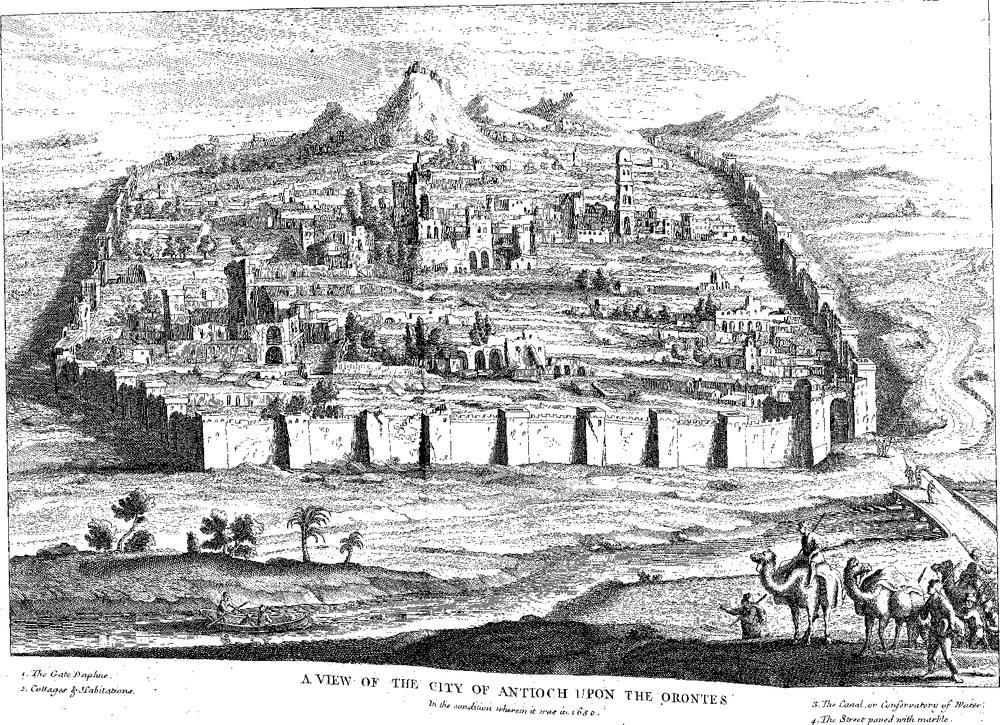
ANTIOCH. There are several Cities which are known to be of this name; but the Scripture speaks only of the greater Antioch, which was the Capital of Syria, and of another Antioch, of Pisidia, whereof we shall say something in the next Article. Antioch of Syria was formerly called Riblath, if we believe S. Jerom60.
There is no mention of Antioch, excepting in the book of Maccabees, and in the New Testament; but of Riblath, or Numb. xxxiv. 11. 2 Kings xxiii. 33. xxvii. 6, 20, 21. Jer.xxxix. 5. lii. 9, 10,26,27.Riblatha, there is in the book of Numbers, in the books of Kings, and in Jeremiah. Theodoret says, that in his time there was a City of Riblah near Emesa in Syria, which is very contrary to S. Jerom’s opinion. However this may be, ‘tis certain Antioch was not known under this name till after the reign of Seleucus Nicanor, who built it, and called it Antioch, in consideration of his Father Antiochus, in the year 301. before the vulgar Æra of J. C. The Kings of Syria, Successors to Alexander the Great, resided generally at Antioch. There the Disciples of Jesus Christ were first called Acts xi. 26.Christians. This City, which was formerly so beautiful, so flourishing, and so illustrious, is scarce any thing at present but a heap of ruins. The walls are still standing; but within the City there is nothing but gardens, ruins, and some bad houses. The river Orontes runs near the City, on the outside of it. Antioch is the place where S. Peter had his first See. The Bishop of Antioch has the title of Patriarch; and at all times has had a great share in the affairs of the Eastern Church.
Antioch was almost square, had many gates, and part of it on the North side was raised upon an high mountain. It was adorned with galleries and fine fountains. Ammianus Marcellinus61 says it was celebrated throughout the world, and that no other City exceeded it, either in fertility of soil, or richness of trade. The Emperors Vespasian, Titus, and others, granted very great privileges to it; but it has likewise been exposed to great revolutions. It was almost demolished by earthquakes, which happened in the fourth and fifth Centuries. In the Years 340. 394. 396. 458. 526. and 528.The Emperor Justinian repaired it in 529. and called it, as Evagrius says, Theopolis; that is to say, the City of God. Chosroes King of Persia took it in 548. massacred the inhabitants, and burnt it. Justinian had it rebuilt in 552, in a more beautiful and regular manner than it was before. Chosroes took it a second time in 574. in the reign of Justin, and destroyed its walls. In 588 it suffered again a dreadful earthquake, whereby above sixty thousand persons perished. It was once more rebuilt, and afterwards exposed to new calamities. The Saracens made themselves masters of it in 637, or 638. in the reign of Heraclius. Nicephorus Phocas retook it in 966. Cedrenus relates, that in 970. the Saracens, to the number of an hundred thousand, laid siege to it without being able to get possession of it; but that afterwards they subdued it, added new fortifications to it, and made it almost impregnable. The Christians who were of the Croisade with Godfrey of Bouillon, when he attempted the conquest of the Holy Land, besieged it in 1097. The siege was long and bloody; the Christians, by their indefatigable labours, and the help of a secret correspondence in the place, carried it on Thursday the 3d of June 1098. Lastly, this City being frequently attacked by the Saracens, was taken on the 29th of May 1268. under the Sultan of Egypt, who demolished it. It has ever since lost its reputation and magnificence, and groaned under the dominion of the Turk.
Antioch abounded with great men, and the Church there was a long time governed by illustrious Prelates; but it suffered much upon several occasions, sometimes being exposed to the violence of Hereticks, and at other times rent in pieces by deplorable Schisms.
ANTIOCH of Pisidia, a City mentioned in the Acts, ch. xiii. 14. S. Paul and S. Barnabas preached in this City; and the Jews, who were concerned to see that some of the Gentiles had received the Gospel, raised a Sedition against Paul and Barnabas, and obliged them to leave the City. It is at present called Versategli, according to some; and as others say, Tahoya, or Sibi, or Antiochio.
ANTIOCHIS, the Concubine of Antiochus Epiphanes, who gave her the Cities of Tarsus and Mallo, that she might make what use she pleased of the revenues of them. This disposal of these places by the King was received by the inhabitants of them as a mark of insupportable contempt. They took arms against Antiochus Epiphanes, who was obliged to march in person, in order to reduce them to obedience. 2 Macc.iv. 30.It was a custom with the Kings of Persia to give their Wives particular Cities, some for their table, some for their head-dress, some for their attire, and others for their girdles. Uxoribus attribuunt civitates hoc modo: Hæc civitas mulieri in redimiculum præbeat; hæc in collum; hæc in crines. Ita populos habent universos non solum conscios libidinis suæ, sed etiam administros, says Cicero62.
I. ANTIOCHUS. There were many
Kings of this name in Syria, from the time of Seleucus Nicanor, who is reckoned the first King of Syria after Alexander the Great, and was Father to Antiochus Soter. This last was sirnamed Soter, or Saviour, for having hindred the invasion of the Gauls, who intended to invade Asia63. It happened probably upon this occasion, as is related in the second book of Maccabees; that the 2 Macc. viii. 20.Galatians having marched to attack the Jews in Babylonia, whose army consisted only of eight thousand men, re-inforced with four thousand Macedonians, the eight thousand Jews fell upon the Galatians so briskly, that they killed an hundred and twenty thousand men. It was perhaps too on this occasion, that Antiochus Soter made the Jews of Asia free of all the Cities belonging to the Gentiles, and permitted them to live according to their own Laws64. The event of this Privilege is recorded under the year of the World 3743, before J. C. 257, before the vulgar Æra 261.
II. ANTIOCHUS II. Sirnamed Theos, God, the Son and Successor of Antiochus Soter, third King of Syria, married Berenice the daughter of Ptolemy Philadelphus King of Egypt. Laodice his first Wife seeing herself despis’d poisoned Antiochus, Berenice, and their Son, who was designed for their Successor in the Kingdom. After this Laodice procured Seleucus Callinicus, her Son by the same Antiochus to be acknowledged King of Syria. These events were foretold by Daniel in these terms. Dan. ix. 6.And in the end of years the King of Egypt, or of the South, and the King of Syria, or of the North, shall make an Alliance together, and the King’s Daughter of the South shall come to the King of the North to make an Agreement: but she shall not retain the Power of them, neither shall he stand, nor his arm; but she shall be given up, and they that brought her, and he that begat her, and he that strengthened her in these times. See the Commentators on this place.
In the Year of the World 3800, before J. C. 200, before the vulgar Æra 204.III. ANTIOCHUS THE GREAT, is very much celebrated in the Greek and Roman Histories for the Wars carried on by him against the Egyptians and Romans. We shall not enlarge much on his Actions in these Wars; but shall confine ourselves to what more immediately relates to the History of the Jews. Antiochus was the Son of Seleucus Callinicus, and Brother to Seleucus Ceraunus. Antiochus succeeded his Brother Seleucus in the year of the World 3781. before J.C. 219. He made War with Ptolemy Philopator King of Egypt, but was defeated near Raphia, as is related in the third book of Maccabees, Chap. i. Thirteen years after, Ptolemy Philopator being dead, Antiochus resolved to make himself Master of Egypt; and immediately seized on Cœle-Syria, Phœnicia, and Judæa65. But Scopas, General of the King of Egypt’s Troops, having entred Judæa, while Antiochus was taken up with the War against Attalus, re-took those places which Antiochus had usurped In the Year of the World 3806, before J. C. 194, before the vulgar Æra 198. In the same year 3806.from the King of Egypt66. Soon after this, Antiochus recovered what Scopas had retaken from him67.
Upon this occasion happened that which Josephus relates, concerning this Prince’s journey to Jerusalem. After the Victory which Antiochus obtained over Scopas near the Springs of Jordan, he made himself Master of the strong places in Cœle- Syria, and Samaria; and the Jews submitted freely to him, received him into their City and furnished his army plentifully with provisions, and what was necessary for his Elephants. As an acknowledgment of their affection, Antiochus made a Grant to them, which is mentioned by Josephus68 of twenty thousand pieces of Silver to purchase Beasts for their Sacrifices, of one thousand four hundred and sixty measures of Meal, and three hundred seventy five measures of Salt, to be offered with the Sacrifices, and of so much Wood as was necessary to rebuild the Porches of the Lord’s House. He declared his will, that the Senators, Priests, Scribes, and singing Men of the Temple should be exempt from the Tribute paid in the way of Capitationtax. Lastly, he gave the Jews liberty to live according to their own Laws all over his Dominions. He remitted the third part of their Tribute to indemnify them for the losses which they had sustained during the Wars; he forbad the Heathens from entring the Temple without being purified, and to bring into the city the flesh of Mules, Asses, and Horses to sell, under the penalty of paying three thousand Drachma’s, as a Fine for the offence.
In the Year of the World 3815, before J. C. 185.In the year of the world 3812 he married his daughter Cleopatra with Ptolemy Epiphanes King of Egypt, and gave Cœle- Syria, Phœnicia, and Judæa for her Dowryi, upon condition that the Tributes arising from these three Provinces, should be equally divided between the two Sovereigns, that is to say, between the King of Syria, and the King of Egypt. Three years after he was overcome by the Romans, and obliged to make a cession of all that he possessed beyond Mount Taurus, and to give twenty hostages, among whom was his own Son Antiochus, sirnamed afterwards Epiphanes. The Romans moreover imposed a Tribute on him, consisting of twelvetwelve-thousand
Euboic Talents69, each of fourteen Roman pounds weight. To satisfy the charge which the Romans had put him to, Antiochus resolved to carry off the great treasures laid up in the Temple of Belus at Elymais70. But the people of this Country being informed of his design, surprized him, and destroyed him with all his army, in the year of the world 3817, before J. C. 183, before the vulgar Æra 187. He left two Sons, Seleucus Philopator, and Antiochus Epiphanes, who succeeded him, and both reigned one after the other.
IV. ANTIOCHUS EPIPHANES, was the Son of Antiochus the Great, whom we have been speaking of, and Brother to Seleucus Philopator King of Syria. Having continued as an hostage at Rome for fourteen years, his Brother Seleucus resolved to procure his return to Syria. It is thought that he intended to make use of him in the design which he had formed, of conquering Egypt, a Country that the Kings of Syria had for a long time looked on, as an object worthy of their ambition. However this might be, Seleucus sent his own Son Demetrius as an hostage to Rome, in the room of Antiochus; but while this last was upon his journey SeleucusIn the Year of the World 3829, before J. C. 171, before the vulgar Æra 175. died, so that when he landed in Syria, the people received him as some propitious Deity, come to take upon him the Government, and oppose the Enterprizes of Ptolemy King of Egypt, who threatned to invade Syria. For this reason Antiochus had the Sirname given him of Epiphanes, that is, of one appearing as it were like a God, and manifesting himself to men.
This Prince thought betimes of possessing In the Year of the World 3831, before J. C. 169. before the vulgar Æra 173. 2 Macc. iv. 21. seq.himself of Egypt, which was then injoyed by Ptolemy Philometor his nephew, Son to his Sister Cleopatra. He sent Apollonius one of his Officers into Egypt, under pretence of being present at Ptolemy’s Coronation; but in reality to observe how the great men of the Kingdom were disposed towards him, and to get intelligence, whether they were inclined to put the Government of Egypt into his hands, during the minority of the King his Nephew. But Apollonius found them no way disposed in favour of his Master, which obliged Antiochus to make war against Philometor. He came to Jerusalem in 3831, and was received there by Jason, to whom he had sold the High-Priesthood. He designed to attack Egypt, but returned without doing any thing.
The Ambition of the Jews, who sought after the High-Priesthood, and bought it of Antiochus, was the beginning of those Calamities which overwhelmed their Nation, under the reign of Antiochus Epiphanes. Jason procured himself to be established in this Dignity in the room of his brother Onias III. Menelaus having offered more, Jason was deprived, and he confirmed in his place. These Usurpers of the High-Priesthood, to gratify the Syrians, took up all the Manners of the Greeks, their Games and Exercises, and neglected the Worship of the Lord, and the Service of the Temple. In the mean time the War broke out between Antiochus Epiphanes, and Ptolemy Philometor. Antiochus entred Egypt in 3833, and reduced it almost all intirely to his obedience71. The next year he returned, and while he was taken up with the Siege of Alexandria, a false report was spread of his Death; and the inhabitants of Jerusalem shewing their joy on this occasion, Antiochus as he came back from Egypt entred this City by force, treated the Jews as Rebels, and commanded his Troops to put all they met with to the sword. Fourscore thousand of them were killed in three days time, forty thousand were made captives, and as many sold72. He entred into the Holy of Holies in the Temple conducted by the pretended High-Priest Menelaus, took and carried off the most precious vessels of this holy place, to the value of eighteen hundred talents.
2 Macc. v. 24, 25. 2 Macc. v. 29.In 3835 Antiochus made a third Expedition against Egypt, werein he subdued it intirely73. The year following he sent Apollonius into Judæa, with an army of two and twenty thousand men, and gave him orders to kill all those who were of full age, and to sell the women and young men. Apollonius executed these Orders but too punctually. It was upon this occasion that Judas Maccabæus retired into the wilderness with his Father and his Brethren. But these misfortunes were no more than preludes to those which they were afterwards to suffer. Antiochus apprehended, that the Jews would never be constant in their obedience to him, unless he oblig’d them to change their Religion, and embrace the ceremonies and worship of the Greeks. He commanded therefore an Edict to be published, injoining them to conform themselves to the laws of other Nations, and forbidding them to offer their usual Sacrifices in the Temple, and to celebrate their Festivals and Sabbath. Many corrupt Jews complied with these Orders, but others opposed them. Mattathias and his Sons retired to the mountains: Old Eleazar and the seven Bre
thren, Maccabees, suffered death with great 2 Macc. vii.courage at Antioch. The Statue of Jupiter Olympias was placed upon the Altar of the Temple, and the abomination of desolation was seen in the House of God.
Mattathias being dead, Judas Maccabæus put himself at the head of those Jews, who continued faithful to the Lord. He made war against the Generals, whom King Antiochus sent into Judæa, with the success which we shall see in another place: The King being informed of Judas’s valour, and of the resistance of the Jews, sent new forces against them; and observing his treasures to be exhausted, resolved to go into 1 Macc. iii. 27.Persia, there to levy the Tributes due from the people, and gather large sums of money, which he was to pay the Romans. He understood that there was a very great mass of riches in the Temple of Elymais, and he determined to carry it off with him. But the Ch. v. 1, 2, 3, &c and 2 Macc. ix. 1, 2, 3.inhabitants of the Country made so vigorous a resistance, that he was forced to retreat towards Babylonia. When he was come to Ecbatana, he received news of Nicanor’s and Timotheus’s defeat; and that Judas Maccabæus had retaken the Temple of Jerusalem, and restored the worship of the Lord, and Sacrifices.
Upon this intelligence the King, transported with indignation, commanded the person who drove his chariot to make the horses put on, and hasten his journey, threatning to make Jerusalem a grave for the Jews. But the Divine Vengeance soon overtook him; for he fell from his chariot and bruised all his limbs. He was tormented with such a pain in his bowels, as would allow him no rest. Grief and vexation at so much ill success concurring with his disease, reduced him speedily to death’s door. In this condition he wrote to the Jews, in a very submissive manner, made them large promises, and engaged even to turn Jew, if God restored him to his health. He recommended his Son Antiochus to them very earnestly, who was to succeed him, and intreated them to favour him, and to continue faithful to him. He died overwhelmed with pain and grief, in the mountains of Paratacene, in the little town of Tabes, in the year of the World 3840. before J. C. 160. before the vulgar Æra 164.
V. ANTIOCHUS EUPATOR, Son of Antiochus Epiphanes, was but nine years old, when Epiphanes his Father died, and left him the Kingdom of Syria. Lysias, who governed the Kingdom in the name of this young Prince, led an Army against Judæa, consisting of an hundred thousand foot, twenty thousand horse, and thirty elephants. 2 Macc. xiii. & 1 Macc. vi.He laid siege to, and took, the fortress of Bethsura; from thence he marched against Jerusalem, notwithstanding the valour and resistance of the Maccabees. The City was ready to fall into the Enemy’s hands, when Lysias received news that Philip, whom King Antiochus Epiphanes, a little before his death, had trusted with the Regency of the Kingdom, during the minority of young Eupator his Son; that Philip, I say, was come to Antioch, to take the government upon him, according to the disposition of the late King, whereupon he proposed an an accommodation to the Jews, that he might return speedily to Antioch, and oppose the undertakings of Philip. Thus having made peace, he immediately returned with the young King and his Army into Syria.
In the mean time Demetrius Soter, Son of Seleucus Philopator, Nephew of Antiochus Epiphanes, to whom by right of birth the Kingdom belonged, (for Antiochus Epiphanes enjoyed it by usurpation only from his Nephew;) Demetrius, I say, having 1 Macc. vii. 2 Macc. xiii.made his escape from Rome, where he was an Hostage, came into Syria, where finding the people disposed for a revolt, he put himself at the head of an Army, and marched directly to Antioch, against Antiochus and Lysias. But the inhabitants did not wait till he besieged it, they opened the gates, and delivered to him Lysias, and the young King Antiochus Eupator, who were put to death by his orders, without suffering them to appear before him. Antiochus Eupator reigned but two years. He ascended the Throne of Syria in the year of the World 3840, and died in 3842. before J. C. 158. before the vulgar Æra 162.
1 Macc. xi. 39, 40, &c. In the year of the World 3859, before J. C. 141, before the vulgar Æra 145.VI. ANTIOCHUS THEOS, or the God, Son of Alexander Balas, King of Syria, was brought up by an Arabian Prince called Elmalchuel. Demetrius Nicanor King of Syria having made himself odious to his Troops, one Diodotus, otherwise called Tryphon, came to Zabdiel, and desired him to trust him with young Antiochus, promising to place him on the Throne of Syria, which was possessed by Demetrius Nicanor. Zabdiel at first was unwilling to consent, fearing lest Diodotus should destroy this young Prince, after he had made use of him to divest Nicanor of the Kingdom. But at last he trusted him with Antiochus. Tryphon carried him into Syria, and put the Crown upon his head. The Troops which Demetrius had dismissed, came and surrendred themselves to him; and having formed a powerful Army he marched against Demetrius; who was overcome, and forced to retreat to Seleucia. Tryphon seized his Elephants, and made himself Master of Antioch.
Antiochus Theos, to strengthen himself in his new acquisition, sent letters to Jonathan
nathan Maccabæus, High Priest and Prince of the Jews, whereby he confirmed him in possession of the High Priesthood, granted him four Toparchies, or four considerable places in Judæa, received him into the number of his friends, sent him vessels of gold, permitted him to use a gold cup, to wear purple, and a golden buckle; and gave his Brother Simon Maccabæus the general command of all the Troops upon the coast of the Mediterranean, from Tyre as far as the frontiers of Egypt. Jonathan, engaged by so many favours, declared resolutely against Demetrius for Antiochus, or rather for Tryphon, who reigned under the name of this young Prince; and on many occasions attacked Demetrius’s Generals, who were still possessed of several 1 Macc. xi. 63, & seq. xii. 24, 34.places beyond Jordan, and in Galilee.
Tryphon seeing young Antiochus peaceable possessor of the Kingdom of Syria, resolved to get rid of him, and himself In the year of the World 3861. before J. C. 139. before the vulgar Æra 143.usurp the Crown. He thought it was necessary in the first place to secure Jonathan Maccabæus, who was one of the most powerful supports of Antiochus’s Throne. He came therefore with Troops into Judæa, invited Jonathan to Ptolemais, and there, upon frivolous pretences, made him a prisoner. Simon, Jonathan’s Brother, headed the Troops of Judæa, and opposed the designs of Tryphon, who intended to make himself Master of Jerusalem. Tryphon, disappointed of his hopes, put Jonathan to 1 Macc. xiii. 2 Macc. xiv.death at Bassa, or Bascama, and returned into Syria, where, without delay, he executed the design he had conceived, of killing Antiochus. He corrupted the Physicians, who having published that the young Prince was tormented with the stone, murdered him, by cutting him without any necessity. Thus Tryphon was left sole Master of the Kingdom of Syria, in the year of the World 3861. before J. C. 139. before the vulgar Æra 143.
VII. ANTIOCHUS SIDETES, or Soter, or Eusebes; that is to say, the Pious; (for he is mentioned by the Ancients under these different names;) was Son of Demetrius Soter, and Brother to Demetrius Nicanor. Tryphon, the Usurper of the Kingdom of Syria, having rendred himself odious to his Troops, his Soldiers deserted him, and offered their services to Cleopatra In the Year of the World 3864, before J. C. 136, before the vulgar Æra 140.the Wife of Demetrius Nicanor, who lived in the City of Seleucia, where she was shut up with her Children, while her Husband Demetrius was a prisoner in Persia, where he had married Rodegune the Daughter of Arsaces King of Persia °. Cleopatra therefore sent to Antiochus Sidetes her Brotherin-law, and offered him the Crown of Syria, if he would take her to Wife. Antiochus consented. This Prince was then at Cnidus, where his Father Demetrius Soter had placed him with one of his friends. He came into Syria, and wrote to Simon Maccabæus, to engage him in his party against 1 Macc. xv. 1, 2, 3, & seq.Tryphon. He confirmed the privileges and favours which the Kings of Syria his predecessors had granted him, permitted him to coin money with his own stamp, declared Jerusalem and the Temple exempt from all royal Jurisdiction, and promised to add many other favours to these, as soon as he should become peaceable possessor of the Kingdom, which had belonged to his Ancestors.
Antiochus Sidetes being come therefore into Syria, in the year of the World 3865. married his Sister-in-law Cleopatra. Tryphon’s Troops resorted to him in crouds, and surrendred themselves to him; and Tryphon seeing himself abandoned, retired to Dora in Phœnicia, whither Antiochus pursued him with an Army by land, consisting of an hundred and twenty thousand foot, and eight hundred horse, and with a powerful fleet by sea. Simon Maccabæus sent him two thousand chosen men, but Ver. 25, & seq.Antiochus would not receive them, and revoked all the promises he had made him. He sent Athenobius to Jerusalem, to oblige Simon to restore to him Gazara and Joppa, together with the citadel of Jerusalem; and to demand of him five hundred talents, as so much tribute for the places which he held out of Judæa; and five hundred talents more in the way of reparation for injuries which the King had suffered, and as tribute-money for his own Cities; threatning to make war upon him if he did not comply with these demands. Simon shewed Athenobius all the lustre of his wealth and power, told him he had no place in his possession which belonged to Antiochus; and as to Gazara and Joppa, which were Cities that had done infinite damage to his people, he was willing to give the King the sum of an hundred talents, provided the property of them might be continued to him.
Athenobius returned with great indignation to Antiochus, who was extremely offended at Simon’s answer. In the mean time Tryphon having stollen privately from Dora, imbarked in a vessel and fled. Antiochus immediately pursued him, and sent Cendebeus with Troops into the maritime parts of Palestine, with orders to rebuild Cedron, and to fight the Jews. John Hircanus the Son of Simon Maccabæus, who was at Gaza, gave notice to his Father of Cendebeus’s coming. Simon furnished his Sons John Hircanus and Judas with Troops, and sent them against Cendebeus,74
debeus, whom they routed in the plain, and pursued as far as Azotus.
Antiochus never left Tryphon till he had forced him to dispatch himself75, in the year of the World 3856, after five or six years reign. After this he thought of nothing but reducing those Cities to his obedience, which in the beginning of his brother’s reign had shaken off their subjection76. In the Year of the World 3869. before J. C. 131. before the Vulg. Æra 135. 1 Macc. xvi. 11. xvii. 18, &c.Some years after, Simon Maccabæus, Prince and High Priest of the Jews, having been treacherously killed by Ptolemy his Son-in-law, in the Castle of Docus near Jericho, the Murderer sent immediately to Antiochus Sidetes, to demand Troops of him, that he might recover for him the Country and Cities belonging to the Jews. Antiochus came thither in person with an Army, and laid siege to Jerusalem77. John Hircanus defended it with much vigour, and the siege lasted a long time. The King divided his Army into seven parts, that he might possess all the avenues to the City. The Feast of Tabernacles being to be celebrated, the Jews desired Antiochus to allow them a truce of seven days. This was granted them; and moreover, this Prince sent them Bulls with gilded horns, and vessels of gold and silver filled with incense, to be offered in their Temple. He ordered likewise such provisions to be given to the Jewish Soldiers, as they wanted. This courtesy of the King so won upon the hearts of the Jews, that they sent Ambassadors to treat with him of peace, and to desire that they might be permitted to live according to their own Laws.
Antiochus required of them to give up their arms, to demolish the City walls, to pay tribute for Joppa, and the other Cities they possessed out of Judæa; and lastly, to receive a garrison into their City. The besieged consented to these conditions, the last only excepted; for they could not resolve with themselves to see strangers in their Capital. They rather chose to give the King Hostages, and five hundred talents of silver. The King therefore entred the City, beat down the breast-work which was above the walls, and went back into Syria, in the year of the World 3870. before J. C. 130. before the vulgar Æra 134.
Three years after, Antiochus marched against the Persians78, or Parthians, demanding the liberty of his Brother Demetrius Nicanor, or Nicator, who had been made prisoner of war long before, by Arsaces; and was detained by the King of Persia against his inclination, because he intended to make use of him upon occasion, in stirring up a war against Antiochus. Antiochus therefore thought it proper to prevent him. He had an Army of fourscore, or according to Orosius79, of an hundred thousand men. Their equipage was so numerous and magnificent, that according to the computation of some there were two hundred thousand servants, or as others will have it, three hundred thousand, the greatest part whereof were Cooks, Pastry-cooks, and Comedians. King Antiochus entertained his Officers in his Camp with as much delicacy and profuseness as he could have done in the midst of his Capital. His Army imitated the extravagancy of their Prince. The generality of the soldiers had nails of gold under their shoes, made use of plate, and had their tents adorned with works of embroidery. As soon as he appeared upon the frontiers of Persia, several Eastern Kings came and surrendred themselves to him, detesting the pride and avarice of the Persians. Antiochus defeated his Enemies in three engagements, and made himself Master of Babylon. John Hircanus, High Priest of the Jews, accompanied him in these expeditions v; and it is believed that he had from hence the name of Hircanus w, or Hircanion, which he probably acquired by some gallant action performed by him in this war.
As Antiochus’s Army was too numerous to continue in any one place, he was obliged to divide it, in order to put it into winter-quarters. These troops behaved themselves with so much insolence that they alienated the minds of all men. The Cities privately surrendred to the Persians, and all resolved on one day to attack each the particular garrison lodged in it; that so the troops which were separated might not be able to assist one another. Antiochus, who was at Babylon, had intelligence of this design; and endeavoured to succour his people with the few soldiers whom he had about him. Phraates King of Persia attacked him in the way, whom he fought with very great bravery. But at last being deserted by his own forces, he was overpowered and killed by the Persians, or Parthians, according to the generality of Historians80; or according to others killed himself81; or as Ælian has it, threw himself headlong from a precipice z. This happened in the year of the World 3874. before J. C. 126. before the vulgar Æra 130. Demetrius Nicanor, or Nicator, whom the King of Parthia had sent into Syria to make a diversion, reascended the Throne after the death of Sidetes.
VIII. ANTIOCHUS GRYPHUS, or Philometor, the Son of Demetrius Nicanor and Cleopatra, revenged the Death of his Father upon Alexander Zebina, who had usurped the Kingdom of Syria. He attacked, defeated him, and compell’d him to shut himself up in Antioch; from whence he was forced very soon by the multitude of People which flocked together, upon notice that he intended to carry off a golden Statue of Jupiter, which was very massy. At Sea he was overtaken with a violent Storm, deserted by his own People, taken by Pyrates, and carried to Antiochus Gryphus, by whose direction he was put to death82. Josephus83 says, that Zebina was killed in the Battle which he fought against Gryphus; and Porphyry relates84, that he poisoned himself, not being able to survive the loss of his Army. Cleopatra, Gryphus’s Mother, envying the happy success of her Son, upon a certain day as he came from performing some Exercise, presented him with a cup of poisoned Liquor, which Gryphus, who had been informed of this Design, refused to drink, and forced Cleopatra to make a proof of it upon herself; and upon her doing so, she died instantlyh. After this Gryphus enjoyed the Kingdom peaceably for eight
From the year of the World 3882 to 3890.At the expiration of this time, as he was preparing to make War against the Jews85, he understood that Antiochus of Cyzicus, his Brother by the Mother’s side, the Son of Cleopatra and Antiochus Sidetes, was disposing things in order to march against him. Gryphus prevented him, attacked, defeated, and obliged him, to fly. After this he went and laid siege to Antioch, where Cleopatra, Wife to Antiochus of Cyzicus had shut herself up. The City being taken, Cleopatra retired for Sanctuary to a Temple, thinking to secure herself thereby from the violence and outrage of the Conqueror. But Tryphena her Sister, the Wife of Gryphus, whether her Husband would or no, sent Soldiers into the Temple, who killed Cleopatra at the feet of the Goddess, whom she held within her arms86.
The year following the two Brothers Antiochus Gryphus, and Antiochus of Cyzicus, coming to an Ingagement, Gryphus lost the Battle, and Tryphena his Wife falling into the hands of Antiochus of Cyzicus, was by him put to death, to revenge the Murder of Cleopatra, which had been executed by Tryphena’s Order. By this Victory Antiochus of Cyzicus became Master of the Kingdom of Syria; and Gryphus his Brother retired to Aspendus, where he continued till the next year, when he returned into Syria, and divided the Kingdom with his Brother. Gryphus remained Master of Syria, and Antiochus of Cyzicus possessed Cœle-Syria87. While the two Brothers made War against one another, and mutually weakened each other, John Hircanus fortified himself in Judæa, and every day made new Progresses88. Antiochus Gryphus, after he had lived five and forty years, and reigned eleven years alone, and fifteen with his Brother Antiochus of Cyzicus, was put to death by Heraclion’s means89, who drew him into an Ambuscade in the year of the World 3907. Gryphus left five Sons, 1. Seleucus who succeeded him; 2 and 3. Antiochus and Philip, who were Twins; 4. Demetrias Eucærus; 5. Antiochus sirnamed Dionysius.
IX. ANTIOCHUS OF CYZICUS, Brother by the Mother to Antiochus Gryphus, and the Son of Cleopatra and Antiochus Sidetes his Uncle, was brought up at Cyzicus by his Mother Cleopatra, who was apprehensive, lest Demetrius Nicanor, her first Husband, should kill him. Hence he is called the Cyzicenian, or Antiochus of Cyzicus. Cyzicus is a City in Asia Minor upon the Propontis. Antiochus Gryphus having undertaken to poison Antiochus of Cyzicus his Brother, the latter levied troops, and prevented the effects of Gryphus’s ill Will to him90. We have seen in the preceding Article, how Gryphus after he had won the first Battle, was defeated in a second, and how the two Brothers were reconciled, so that Syria continued in the possession of Gryphus, and the Cyzicenian had Cœle-Syria. This last seeing himself in a state of Tranquillity, gave himself up to Debauchery of all kinds, to the Pleasures of Eating and Drinking, Hunting, Shews, Buffoonries, and the making of Machines and Clockworks, which by the help of certain threads and wheels performed very surprizing Movements91.
In the Year of the World 3895. before J. C. 105. before the vulg. Æra 109.In the mean while John Hircanus, Prince and High Priest of the Jews, besieged Samaria; and the City being reduced by Famine to Extremities, the Samaritans invited Antiochus of Cyzicus to their Assistance. This Prince came speedily to their Succour, but was overcome by Antigonus and Aristobulus the Sons of John Hircanus, who commanded the Siege, and pursued him as far as Scythopolis. After which they returned to the Siege of Samaria, and blocked up the City so close, that the inhabitants were once more obliged to have recourse to Antiochus of Cyzicus92. This Prince having received six thousand Men from Ptolemy Lathyrus, the Son of Cleo93
Antiochus of Cyzicus (IX) continues on the next page
Footnotes
-
Aug. l. vi. contra Faust. c. 7. Iren. l. v. adversus hæres. Origen. in Levit. Homil. 7. Cyril. l. vii. in Levit. ↩
-
Theodoret. qu. 1. in Levit. ↩
-
Tertull. l. ii. contra Marcion. c. 18. ↩
-
Translators’ note. Her serving God at the Temple day and night, says Dr. Prideaux*, is to be understood no otherwise than that she constantly at-* tended the morning and evening Sacrifice at the Temple, and then with great devotion offered up her prayers to God; the time of the morning and evening Sacrifice, being the solemnest time of prayer among the Jews*, and the Temple the solemnest place for it*. ↩
-
Protevangelium, Jacobi, c. 1. ↩
-
Alcoran Surat. iii. See Meravius’s notes on this place. ↩
-
Vide apud Joan. Gerson. Cancellar. t. 3. p. 59. ↩
-
Joseph. Antiq. l. xviii. c. 3. ↩
-
Aug. l. iv. de Trinit. ↩
-
Vide Bolland. 25 Mart. ↩
-
Translators’ note. I shall be excused, if to what the wisest of men has observed of this little Insect, I add what one of the most ingenious of mankind has said much to the same purpose. Parvula nam exemplo est, magni formica laboris Ore trahit quodcunque potest, atque addit acervo Quem struit haud ignara ac non incauta futuri. Quæ simul in versum contristat Aquarius annum, Non usquam prorepit & illis utitur ante Quæsitis sapiens. Horat. Serm. l. 1. 1. And Pliny gives us so agreeable a description of the prudence and good œconomy, &c. of this little creature, that it may not be improper to insert it at length Et iis, says he, Reipublicæ ratio, memoria, cura, semina arrosa condunt, ne rursus infruges exeant e terrâ majora ad introitum dividunt: madefacta imbre proferunt, atque siccant: operantur & noctu plenâ Lunâ: eædem interlunio cessant. Jam in opere qui labor, quæ sedulitas? Et quoniam ex diverso convehunt altera alterius ignara, certi dies ad recognitionem mutuam nundinis dantur. Quæ tunc earum concursatio, quam diligens cum obviis quædam collocutio atque percontatio! Plin. Hist. Nat. l. xi. c. 30. ↩
-
Joseph. Antiq. l. 13. c. 21. ↩
-
Vide Hieronym. in Dan. xi. 24. 2 Thess. alii. ↩
-
Victorin. in Apocal. Ambrosiast. in 2 Thess. ii. Chrysost. in (b) DIOCLES AUGUSTUS. DCLXVI. (c) C. F. JULIANUS CESAR. DCLXVI. Or rather, C. F. JULIANUS CAES. DCLXVI. (d)ר ת ל ו ל200. 400. 30. 6. 30. 30. 1. 300. 5. 10. 50. 70. 200. 30. 1. 40. 80. 5. 300. 10. 200. 70. 50. 10. 20. 8. 300. 8. 200. 20. 1. 20. 70. 200. 70. 4. 8. 3. 70. 200. (m)רומיית400. 10. 10. 40. 6. 200. (n)אבינוהקדושאאפיפי10. 80. 10. 80. 1. 1. 300. 6. 4. 100. 5. 6. 50. 10. 2. 1. (o)עליוןאדנייהוהקדש300. 4. 100. 5. 6. 5. 10. 10. 30. 4. 1. 50. 6. 10. 30. 70. ↩
-
Hieronym. in Dan. xi. ↩
-
Apud Euseb. l. v. hist. Eccl. c. 1. ↩
-
Judas Syrus apud Euseb. l. vi. c. 6. hist. Eccl. ↩
-
Tertull. de Fuga in persecut. c. 2. ↩
-
Cyprian. Ep. 56. ad Tibarit. & Ep. 53. ad Fortunat. ↩
-
Hilar. contra Auxentium. n. 5. p. 1265. ↩
-
Basil. Ep. 71. ↩
-
Ambros. l. x. in Luc. c. 3. ↩
-
Hieronym. ad Ageruchiam. ↩
-
Apud Sulpit. Sever. Dialog. 2. ↩
-
Chrysost. homil. 33 in Joan. ↩
-
Greg. Mag. lib. iv. Ep. 35, & 38. & homil. 1. in Evangel. ↩
-
Pseudo-Hippolyt. de consumm. mundi. Ambrosiast. in 2 Thessal. xi. Hieronym. in Dan. xi. ↩
-
Iren. l. v. advers. hæres. c. 38. Pseudo-Hippolyt. de consum. mundi. Ambros. l. de Bened. Patriarch. c. 7. & in Psal. xl. Aug. q. 12. in Josu. Theodoret. q. 109. in Genes. Greg. Mag. l. xxxi. in Job. c. 18. Prosper de Promiss. parte 4, &c. ↩
-
Hieronym. in Dan. xi. Nostri interpretantur hæc omnia de Antichristo, qui nasciturus est de populo Judæorum, & de Babylone venturus. ↩
-
Lactant. l. xvi. c. 17. Beda in Apoc. xiii. Sulpit. Dialog. 2. Hieronym. in Isai. xvii. ↩
-
Hieronym. in Dan. vii. Vide & Bedam in Apoc. xiii. ↩
-
Ambrosiast. in 2 Thessal. ii. ↩
-
Chrysost. Theodoret Theophyl. in 2 Thess. ii. ↩
-
Aretas in Apocal. c. ix. 14. Lactant. l. vii. c. 17. Hier. in Dan. xi. ↩
-
Cyril. Jerosol. Cathech. 15. Hieron. Theodoret. Strab. in Dan. xi. ↩
-
Hieronym. Epist. ad Aglas. quæst. Œcumen. in 2 Thess. ii. ↩
-
Lactant. l. vii. de Divino pretio, c. 17, 19. ↩
-
Hieronym. in Dan. xi. Theodoret. Haymo. Strab. idem, &c. ↩
-
Bibl. Orient. p. 282. & 531. mahadi. ↩
-
Joseph. Antiq. l. xiii. c. 18, 19. & de Bello l. i. c. 6. ↩
-
Ibid. l. xiv. c. 11. & lib. 1. de Bello c. 6. ↩
-
Antiq. l. xiv. c. 11. ↩
-
Antiq. l. xiv. c. 13. & de Bello l. i. c. 7. & Dio l. xli. ↩
-
Joseph. Antiq. l. xiv. c. 15. & l. i. de Bello, c. 8. ↩
-
Antiq. l. xiv. c. 21. & l. i. de Bello, c. 10. ↩
-
Antiq. l. xiv. c. 24, 25. ↩
-
Ibid c. 26. ↩
-
Ibid. c. 27. ↩
-
Ibid. c. ult. & l. xx. c. 8. & l. i. de Bell. c. 13. ↩
-
See Plin. l v. c. 20. Ptolem. & Euseb. & Hieronym. in Libano & Anti-libano. Maundrel. in Itinerario. Reland. Palæstina. l. i. c. 48. p. 318. & seq. ↩
-
Plin. l. v. c. 20. ↩
-
Strabo, l. xvi. ↩
-
Aug. de prædest. & gratia, c. 1. ↩
-
Tavernier Voyage de Perse l. ii. c 7. Gabriel. Sonit. de morib. Orient. c. ii. ↩
-
Darvieux Voyage au Camp du Grand Emir en 1664. Printed at Paris in 1717. p. 27, 28. ↩
-
Juvenal. Satyr. 2. ↩
-
Tertull. de cultu fæmin. ↩
-
Cyprian. de lapsis & de disciplina & cultu virgin. & de opere & eleemosyn. ↩
-
Joseph. l. v. c 9. de Bell. Jud. ↩
-
Hieronym. in Ezek. xlvii. & in Isai. xiii. 1. & in Amos vi. 2. ↩
-
Amm. Marcell. l. iv, & xxii. ↩
-
Tullius in Verrem, 5. ↩
-
Appian. Syriac. p. 130. ↩
-
Joseph. Antiq. l. xii. c. 3. ↩
-
Antiq. lib. xii. c. 3. Polyb. l. iii. ↩
-
Antiq. lib. xii. c. 3. Polyb. l. xvi. ↩
-
Tit. Liv. l. xxxiii. ↩
-
Antiq. lib. xii. c. 3. Ibid. ↩
-
Translators’ note. Con- cerning the Euboic Talent and its Valuation, compared with the Attick and Babylonish Talents, See Dr. Prideaux’s Connect. pt. II. p. 128. of the Ed. in Fol. See likewise Dr. Arbuthnot’s Dissertations &c. Of the Tal- ents. ↩
-
Vide Diodor. in Excerptis Valesi. p. 292, 298. Strabo. l. xvi. p. 744. Justin. l. xlii, &c. ↩
-
Vide 2 Macc. v. 3, 4, 5, &c. Liber de Maccab. c. 4. ↩
-
The construction of the Greek intimates, that eighty thousand was the Sum total of those who were punished upon this occasion. *‘Οκτὼ μυριάδες κατεφθάρησαν· τέσσαρες μὲν ἐν χειρῶν νομαῖς. ‘*Ουκ ἧττον δὲ τῶν ἐσφραγμένων ἐπράθησαν. ↩
-
Polyb. Legation. Diodor. in Excerptis Valesii. ↩
-
Translators’ note. Joseph. Antiq. l. xiii. c. 12. ↩
-
Strabo, l. xiv. p. 668. Vide & Joseph. Antiq. l. xiii. c. 12. & Appian. Syriac. p. 132. ↩
-
Justin, l. xxxvi. c. 1. ↩
-
Joseph. Antiq. l. xvi. c. 13. ↩
-
Justin l. xxxviii. c. 9, & 10. Livius l. lix. Appian Syriac. p. 132. ↩
-
Orosius, l. v. c. 10. v Nicolaus Damasc. apud Joseph. l. xiii. Antiq. c. 16. w Euseb. in Chronic. Sever. Sulpit. l. ii. hist. ↩
-
Jul. Obsequens lib. de prodigiis. Justin l. xxxviii, & xxxix. Joseph. l. xiii. c. 16. Euseb. in Chronic. Orof. l. v. c. 10. ↩
-
Appian. Syriac. p. 132. z Ælian. l. x. c. 34. de animalib. ↩
-
Justin. l. xxxix. c. 2. ↩
-
Joseph. lib. xiii. c. 13. ↩
-
Porphyr. in Græcis. Euseb. Scaliger. p. 227. ↩
-
Joseph. Antiq. l. xiii. c. 17. ↩
-
Justin l. xxxix. c. 3. ↩
-
Vide Justin. l. xxxix. Appian. Syriac. p. 132. Porphyr. in Græc. Euseb. p. 227. ↩
-
Joseph. Antiq. l. xiii. c. 17. ↩
-
Joseph. Widem. & Euseb. Græc. p. 227. ↩
-
Justin. l. xxxix. c. 3. ↩
-
Diodor. Sicul. in Excerpt. Valesii p. 385. ↩
-
Joseph. Antiq. l. xiii. c. 18. ↩
-
Justin. l. xxxix. Appian. Syriac. p. 132. ↩