Volume I, pages 406–423 of the 1732 edition, from DAR to DEL: everything printed on these pages, in order.
Continued from Darius Codomannus (III)
till she was delivered of Alexander, whom Philip declared to be his, and left him his successor in the kingdom. Darab king of Persia died likewise about the same time, and was succeeded by his son Dara, (this is Darius Codomannus) who was a violent and cruel prince, and so alienated the affections of the People, and Grandees of his Court, that they sent a deputation to Alexander, exhorting him to make a conquest of Persia. Alexander therefore refusing to pay the ordinary tribute, and answering those who came to demand it, that the Hen which laid Beizaths, or golden Eggs, was fled to the other world, Dara levied a great army to make war against him. Alexander prepared to give him a good reception, and went even into Persia to meet him; gave him battle, and defeated him. Dara retiring to his tent, two of his Officers, natives of Hamadan, run him through the body with their swords, and fled to the victor’s camp. Alexander, upon information of what had passed, came in great haste to Dara’s tent, who was still breathing, took his head, placed it upon his knees, lamented his sad fate, and protested to him, that he had no hand in his death. Dara opening his eyes, desired him to revenge him on his servants for their perfidiousness; gave him his daughter Roxana in marriage, and recommended to him not to put the Government of Persia into the hands of Greeks. Thus he died within Alexander’s arms, who was his brother, as the Historians relate, being born of Philip’s daughter, wife to Darab, as Dara was born of another wife of the same Darab, father to Dara.
Darius Codoman, or Codomannus, reigned but six years, from the year of the world 3668 to 3674. He died in 3674, in the year 326 before the birth of Jesus Christ, and the year 330 before the Vulgar Æra.
Gen. i.DARKNESS, Obscurity. Darkness was upon the face of the deep; that is to say, the Chaos was plunged in thick Darkness, because hitherto the Light was not created. One of the most terrible sorts of Darkness was that which Moses brought upon Egypt as a plague to the inhabitants of it. It was so thick, as to be, as it were, palpable, and so that no one could discover any object; so horrible, that no one durst to stir out of his Exod. x. 21, 22.place; and so lasting, that it endured three days and three nights1. The Author of the Book of Wisdom describes it thus: ” The Egyptians were ” shut up in their houses, the prisoners of ” darkness, and fettered with the bonds of ” a long night … . . The corner that held ” them did not keep them from fear: but Wisd. xvii. 1, 3, 4, &c.” noises, as of waters falling down, sounded ” about them, and sad visions appeared ” unto them with heavy countenances. No ” power of the fire might give them light, ” neither could the bright flames of the ” stars endure to lighten that horrible ” night. Only there appeared unto them ” a fire kindled of itself, very dreadful: ” for being much terrified, they thought ” the things which they saw to be worse ” than the sight they saw not.”
The Darkness which happened at our Saviour’s death, began at the sixth hour of the day, that is to say, at noon; and ended not till the third hour, that is to say, at three a-clock in the afternoon. Thus it lasted for the whole time almost of our Saviour’s being upon the cross, he having been crucified a little before the sixth hour, and dying a little after the ninth. Compare St. Matthew, chap. xxvii. v. 45. with St. John, chap. xix. v. 14. and with St. Mark, chap. xv. v. 25. and see the Commentators and Authors of Concordances on these places. Origen on St. Matthew, Maldonat, Erasmus, Vatablus, and several others were of opinion, that this Darkness covered Judæa only, which is sometimes mentioned by the name of the whole earth. St. Chrysostom, Euthymius, Theophylact, and some others, assert that it extended over our whole Hemisphere, or at least over the greatest part of it. Origen says, that it was caused by a thick mist, which deprived men of the sight of the sun; and it is certain that we can scarce conceive it otherwise, since the moon being then at the full, the eclipse of the sun was naturally impossible.
Julius Africanus, Eusebius, and St. Jerom, in their several Chronicles, refer that eclipse of the sun, which Phlegon mentions, to the time of our Saviour’s death. This author says, it was the greatest eclipse that till then had been seen, since at noon-day the stars were discernible in the heavens. This happened in the fourth year of the hundred and second Olympiad, which is the year of Jesus Christ’s death. Tertullian refers the Heathens to the publick Archives for an account Tertull. Apolog. c. xxi.of that Darkness which happened at noon upon the day of Jesus Christ’s death. The Author known by the name of DionysiusDionys. Areop. Ep. 7. ad Polycarp. the Areopagite says, that being in Egypt, and seeing the eclipse which happened at that time, against all the rules of Astronomy, Allophanes, who then studied with him, cried out, These, my dear Dionysius, are supernatural and divine changes. Suidas in Dionys.Suidas makes St. Dennis himself say the same thing upon this occasion: God either suffers, or com
passionates one who is suffering. Concerning this event, see the Commentators on St. Matthew xxvii. 45. the Ecclesiastical Historians, such as Baronius, M. de Tillemont, and our Dissertation on the Darkness which was observable at our Saviour’s death, printed in the new Collection of our Dissertations.
I. DARKNESS, is sometimes put for Job x. 22. Psal. cvii. 10.Death. The land of darkness is the Grave. They who sit in darkness and in the shadow of death, are the dead. The false Gods of the Heathen, are, says Baruch, like a dead body Baruch vi. 70. Esth. xi. 8. Job iii. 4, 5.that is cast into the dark.
II. DARKNESS, Night, Obscurity, signify likewise very frequently the greatest Misfortunes and Calamities. This day was a day of darkness, an unhappy day. Let that day be darkness, let darkness stain it, let it be reckon’d among the unfortunate days. I am encompassed with darkness. I will cover the heavens with darkness. The sun shall be turned into darkness, and the moon into blood, &c. All these expressions signify nothing else but very great calamities.
III. DARKNESS, in the moral sense of the word, denotes Sin. The children of light, set in opposition to the children of darkness, mean the righteous in opposition to the wicked; the faithful in opposition to the incredulous and infidels. Ye were once darkness, but now are ye light. Walk as children Ephes. v. 8, 11. 1 Pet. ii. 9.of light. God hath called us out of darkness into his marvellous light, &c.
IV. By DARKNESS is meant likewise the kingdom of Satan, who is called the Angel of darkness; and Jesus Christ calls 2 Cor. xi. 14.the exercise of Satan’s power, The power of darkness. The works of darkness are the works of the devil, sin, and all infamous and ignominious actions.
DARKON, a Jew, who returned from the captivity of Babylon, Nehem. vii. 58.
DAROMA, the same as Darom, which in Hebrew signifies the south. Eusebius and St. Jerom frequently make use of the word Daroma to denote the southern part of Judah. The canton of Daroma from north to south extends from the city of Eleutheropolis, in the way towards Arabia Petræa to the length of about twenty See Reland. Palæst. l. 1. c. 32. p. 185, 186. Numb. xvi. 1— 31. Psal. cv. 17. About the year of the World 2552, before J. C. 1448, before the Vulgar Æra 1452.miles; and from east to west as far as from the dead sea to Gerara and Beersheba.
DATHAN, the son of Eliab, was one of those who conspired with Korah, Abiram, and On, to deprive Moses and Aaron of the authority which God had given them for the service of his people. Dathan and his accomplices were swallowed up in the earth, and descended quick into the grave.
DATHEMA, or Dathman, a fortress in the land of Gilead, whither the Jews beyond Jordan retired, and maintained 1 Macc. v, &c. Joseph. Antiq. l. xii. c. 11. 1 Macc. v. 9.themselves against the attacks of Timotheus, till Judas Maccabæus came to their relief.
The true situation of this fortress is not known to us; but this is nothing to the history of what passed there. Before the captivity of Babylon, and upon the declension of the two kingdoms of Judah and Israel, the nations which inhabited the land of Gilead, that is to say, the Arabians, Ammonites, and Moabites, assembled together in order to extirpate the Jews out of their country; for after the Edict of Antiochus, obliging them to forsake their religion, all their neighbours and their enemies, thought themselves at liberty to treat them as they pleased, and even joined Antiochus’s troops to make war against them: but the Jews having intelligence of their design, retired into the fortress of Dathema, and immediately sent letters to Judas Maccabæus and his brethren, to acquaint them with the condition they were reduced to, and demand speedy succour from them. While they were reading these letters, news to the same purpose was brought them from the Jews of Galilee: Hereupon Judas convened all the people, to deliberate upon what was to be done in these conjunctures. It was resolved that Judas and his brother Jonathan should pass the Jordan, to go to their assistance who were in the land of Gilead; and that Simon their other brother should go into Galilee, to deliver their brethren, who were threatned there with entire destruction. They left Joseph and Azarias in Judæa, to guard the country, with express orders not to fight till their return.
Simon therefore being gone into Galilee, engaged the nations which were enemies to the Jews, in several battles; they were defeated and fled before him: he pursued them as far as the gates of Ptolemais, kill’d 1 Macc. v. 21, 22.three thousand of their men, and carried off a rich booty.
Judas Maccabæus on his side, and Jonathan his brother, having passed the Jordan, probably at Bethsan, marched three days into the wilderness; and the Nabathæans, people of Arabia, who were not in the plot with those who designed to massacre the Jews, came in a friendly manner to meet them, and being received by them with a peaceable spirit, related to them all that passed in Gilead, with respect to their brethren there, who were shut up in places of the greatest strength, that their enemies still continued to besiege them, and were resolved to march their army the next Ibid. ver. 27.day, in order to destroy them all at one time.
Judas having received this intelligence, immediately led his army against Bosor, surprized the city, burnt it, put all the males he found in it to the sword, and
carried away all the booty. From thence he marched all night in order to reach the fortress of Dathema, and he arrived there just at break of day, in the very instant when the attack began with great cries on both sides, and the enemies were mounting to the assault, with their machines and ladders. Hereupon Judas divided his army into three bodies, advanced against the enemy in order of battle, and when he came within reach of them, his troops sounded their trumpets, and cried to heaven, invoking God’s assistance. Timotheus’s soldiers immediately discovered that it was Judas Maccabæus, they therefore quitted the attack of Dathema, and fled. Judas pursued them, made a great slaughter of them; and near eight thousand were that day left upon the spot.
Observations on the storming Dathema by Timotheus, and the succour of this fortress by Judas Maccabæus.The attacking cities by the way of scaling them, is, I believe, as ancient as their fortifications, and all the machines which industry could invent to get possession of them, were produced long afterwards. It is true, that at first, before there was any thought of scaling, people used to block them up, and they often proceeded no further, when at any time the walls of a town were secured by their extraordinary height, from enterprizes 1 Macc. v. 9, &c.of this kind. Attacks by onset and storm were generally made by the Hebrews all round the place invested; to these they sometimes added sapping, and breaking down of gates, in order to divert the enemy’s forces. The Greeks and Romans observed likewise this method; the whole army fell on at the same time, and the very cavalry had their share in the assault. As soon as the army was arrived before any place, the infantry encompassed it on all sides; the flingers and archers formed a second line behind the heavy-armed soldiers, who were commanded to the escalade, and the cavalry formed a third line, which surrounded the two others.
These three lines thus disposed at a certain distance, formed each a circle about the city, and in proportion as they made their approaches, the circle became continually less, so that there was no interval remaining as soon as they were lodged upon the borders of the ditch, which was to be dry for enterprizes of this nature; the archers and flingers poured a shower of stones and arrows upon those who appeared in defence of the walls, while ladders were distributed to the heavy-arm’d soldiers, who descended with great haste into the ditch, advanced to the foot of the walls, fastened their ladders to them, and endeavoured to get upon the top of them. The Romans called this way of attacking, coronâ capere; but certainly they were not the first, who carried on their attacks in this manner, no more than the Greeks: the people of Asia observed this method before they were known in the world. What they called Testudines, the Hebrews were acquainted with, and practised in their sudden attacks and onsets; that is to say, the soldiers covering themselves with their bucklers, which they raised over their heads, and closing their ranks and files, advanced to the foot of the walls without fearing the stones and fires which were cast down upon them from above, and run over them. M. de Brebeuf has very well explained this in his Lucan’s Pharsalia, book 3.Pharsalia: The Romans joining their shields by consent in the form of a tortoise, march under this cover to the very foot of the ramparts, and leave the stones and darts behind them. This Tortoise, or Testudo, is not so clearly explained in the sacred Books, but we may perceive sufficiently, that the Hebrews were not strangers to it. This seems to me enough to give the Reader a competent knowledge of these sorts of attacks. Let us come now to the action above mentioned, begun under the conduct of Judas Maccabæus.
This enterprize against Timotheus is worthy of so great a General as Judas was: He does not go in search of an enemy, disingaged from all incumbrances, and encamped only before a place; he chuses his opportunity more prudently, waits till Timotheus had fixed his ladders to the walls, and brought all his forces thither, and had nothing to oppose him, that he might the more effectually surprize him, and attack him immediately as soon as his army was divided, so as not to have leisure to unite again, and put themselves in order of battle to resist him. Judas was sensible, that his army was too weak to come openly to a general action; his industry therefore furnished him with an expedient which secured the success of his undertaking: the better to deceive his enemy, he ordered his army to march towards the wilderness of Bosora, and suddenly surprized the city. Timotheus, informed that Judas 1 Macc. v. 28.was drawing this way, believed without doubt that he had time remaining to take Dathema by assault, and proceed afterwards to the relief of Bosora, but he was mistaken; for this city was immediately taken. After this expedition, Judas marched his army all night with so much secrecy and diligence to succour Dathema, that he arrived there, and at break of day lifting up their eyes, says the Ibid. ver. 30.Author of the Book of Maccabees, they perceived an innumerable company of people bearing ladders and other engines of war, in order to get possession of the fortress, and take those within it. He arrived just at the lucky moment he wished, that is to say, when the attack was already begun: in such a surprize, people do not know what to go about, orders are to be issued out, an assault abandoned, the troops which lay round the city to be got together,
and put in battle-array; all which is not to be done in an instant. Timotheus was under this perplexity, having the enemy upon his back, and in his very camp.
The Author describes the order wherein Ibid. ver. 33. Ibid. ver. 58.Judas engaged. He marched in three bodies behind the enemy; these at the same time sounded their trumpets and cried to God in their prayers. To the surprize of their enemies, they joined valour and good conduct, together with a recourse to him, who is the God of Hosts, and heard them; whereas Joseph and Azarias, who were left to guard the country, envying the happy success of their brethren, and, contrary to their orders, marching their troops towards Jamnia, were beaten by Gorgias, who went out of the city to meet them, and put them to flight. Thus their temerity and disobedience were justly punished, and shewed, that the success of holy wars does not depend on courage or numbers, but that God only is the Author of it, and does not approve the criminal dispositions of those, who undertake things for the service of Religion upon motives of vanity and glory.
DAUGHTER of the Voice; in Hebrew Bath-kol. See above BATH-KOL, and Basnage’s History of the Jews, t. 7.
1 Sam. xvi. 1, 2, 3, &c.DAVID, the son of Jesse, of the Tribe of Judah, and little town of Bethlehem. After the rejection of Saul, the Lord sent Samuel to Bethlehem, in order to anoint one of the sons of Jesse, whom he should appoint to be king. Samuel coming to the house of Jesse, and declaring the occasion of his journey, Jesse produced his seven sons one after another; but the Lord revealed to his prophet, that he who was to reign was not among them: David therefore was sent for, who was very young, being no more than about fifteen years of age, and Samuel confer’d on We fix the birth of David to the year of the World 2919, and his anointing by Samuel to 2934. before J. C. 1066. 1 Sam. xvi. 15, 16.him the Royal Unction in the midst of all his brethren. After which, David returned to his ordinary occupation, which was that of feeding his father’s flocks.
Some time after, Saul falling into a dismal state of melancholy, wherewith an evil spirit troubled him, was advised to send for David, to play to him on some musical instruments, and relieve him, when his distemper came upon him2. He was told, that David was a mighty valiant man, and a man of war, and prudent in matters, and a comely person, and that the Lord was with him. David therefore must In the year of the World 3942, before J. C. 1058. David was then two or three and twenty. 1 Sam. xvii. 1, 2, 3, &c.have acquired this reputation for valour, between the age of fifteen, when he was anointed king, and two or three and twenty, which was his age at that time. David acquitted himself so well in performing what was required of him, that the king made him his armour-bearer: notwithstanding which, he returned to his father’s, as soon as Saul grew better. Some years after, the Philistins took the field, and incamped at Azekah and Shocoh. There was a Giant in their army, of an extraordinary strength and stature, called Goliath, who insulted the Israelites, and challenged any of their number to come out and fight him. The two armies continued incamped in sight of one another for forty days, and not one Israelite was found, who had the courage to undertake the combat with Goliath.
In the mean time, Jesse sent David to the camp, where he had three sons in the service, to enquire after them. David, upon his arrival, hearing how this Giant had defied the whole forces of Israel, was inspired with a generous resolution, and declared he would encounter him. His eldest brother reproved him for his rashness; but David’s declaration being at last reported to the king, he sent for him, and asked him, if he thought himself able to engage with the Philistin. David replied, he was, and that none ought to be terrified with the discourses and threatnings of this Giant. Saul told him, he was too young to attack a man who had been all his life enured to war. But to this David answered, Thy servant kept his father’s sheep, and there came a lion and a bear, and took a lamb out of the flock: And I went out after him, and smote him, and delivered it out of his mouth; and when he arose against me, I caught him by his beard, and smote him and slew him. Thy servant slew both the lion and the bear, and this uncircumcised Philistin shall be as one of them.
Saul admiring David’s courage, would have dressed him in his own armour: but David having tried it, and attempting to go, returned it, saying, he could not go with it. He took his staff therefore, which he generally carried with him, and having chosen five well-polish’d stones out of the brook, he put them in his scrip, and with the sling in his hand, marched against Goliath, who, advancing near to him, and observing him to be a young man of a beautiful and fresh complexion, despised him, and said, Am I a dog, that thou
comest to me with staves? Come, come, and I will give thy flesh unto the fowls of the air, and to the beasts of the field. David, without being at all dismay’d, marched against him, and flung a stone at him, which struck him in the middle of his forehead with so much violence, that he fell down upon the ground: whereupon David run immediately and threw himself upon him, drew Goliath’s sword and cut his head off with it. The Philistins therefore seeing their hero was thus killed, fled, and were pursued with great cries by the Hebrews.
When Saul saw David marching against this Philistin, he enquired of Abner, who he was? Abner answered, That he had no knowledge of him. Which is very strange, considering that this prince had seen him so often in his own house, when he play’d before him on his harp, and had made him his armour-bearer. His face, his voice, and air, must have been very much changed since he last appeared before Saul, or else he must at this time have been very intent upon something else. But however this may be, Abner presented David to the king, after the victory, with the head and sword of Goliath in his hands. From this instant Jonathan conceived a great affection for David, and continued ever afterwards to love him as himself. Now it happened, that when Saul and David returned from this expedition, the women of Israel came out to meet them, singing and dancing, and said, Saul has killed his thousands, 1 Sam. xviii. 6, 7.and David his ten thousands; which so enraged Saul against David, that from this time he no longer looked on him with a good eye. Notwithstanding, he kept him about his person, and would not permit him to return any more to his father’s house. He farther gave him the command of some troops; but refused to give him his daughter in marriage, though he had promised her to any man, who should kill Goliath.
The next day Saul returning to his own house, the evil Spirit seized on him, and 1 Sam. xviii. 10.David play’d upon the harp before him. Saul had a spear in his hand, with which he attempted twice to run David through; but he avoided the blow: from this time Saul began to be apprehensive of him, and defend himself against him. Yet still he promised him his eldest daughter Merab, hoping all along, that he would at last fall into the hands of the Philistins, and that he would be killed by them: but David behaved himself with so much prudence and discretion, that he disengaged himself out of all dangers. Nevertheless Saul, instead of giving him his daughter Merab, married her to Adriel the Meholathite.
Michal, Saul’s second daughter, entertained kind thoughts of David; her father was extremely pleased at it, and appointed some persons to tell him, that to merit the honour of becoming the king’s son-in-law, he required no more of him, than an hundred foreskins of the Philistins: his design in this demand was, to have him fall into their hands. Some days after, David, with his people, went and attacked the Philistins, killed two hundred of them, and brought their foreskins to the king. Saul therefore no longer could refuse him the marriage of his daughter; but still did not lay aside his intention to procure his destruction. He conversed with his son Jonathan about it, and with the principal persons of his court: and Jonathan diverted him from this resolution.
Soon after the war broke out again; and David defeated the Philistins. He cut in pieces a great number of them, and put the rest to flight. Now it happen’d that the evil Spirit once more possessing Saul, David again play’d upon the harp before him; the king endeavoured to pierce him with his lance by darting it at him, but he avoided once more the intended blow, and fled away that night. Saul sent his guards, as soon as it was light, to seize him; but Michal let him down through a window, and so he made his escape. The next day, when they came with a purpose to lay hold on him, Michal pretended that he was sick; and the king having given his orders that he should be brought even in his bed, Michal discovered to them that he was not there, and shewed them an image in the bed, with a pillow of goat’s hair for his bolster.
David being thus happily delivered, went to Samuel at Ramah, and related what had passed to him; from whence they both went together to Naioth, which was not far off, where there was a community of prophets3. Saul having intelligence of this, sent people to seize on David; but they upon their arrival at the place where the prophets were, began to prophesy with them. Saul still sent other messengers, who did the same; at last, he went himself, and he too prophesied with the rest of them. Nevertheless, David not thinking himself secure at Naioth, made a visit secretly to Jonathan, and complained to him of his father’s conduct
towards him. Jonathan gave him encouragement, and desired him to conceal himself in a certain field, with a promise of discovering Saul’s real dispositions on the third day after their conference. The next day, which was the first of the month, Saul being at table with Jonathan and Abner, the place which David should have been in, remained void. The king took no notice of it, imagining that perhaps he might have been prevented by some pollution, which he might have contracted. But the day after, Saul asked, why the son of Jesse did not come. Jonathan replied, that he had requested him to give him leave to go to Bethlehem, in order to be present at a solemn Sacrifice made there by his family, and that he had permission from him to go thither. Whereupon Saul was very much enraged with Jonathan, and threatned to kill him with his lance.
Jonathan was assured by this, that the destruction of David was a thing resolved on, and the day following he went to the particular field agreed upon between him and David, with a shew of exercising himself in shooting; and after he had shot some arrows, he dismissed his armour-bearer with his bow and quiver: when he was alone, David came to him, and was informed by him, that Saul had determined to destroy him. The two friends made new protestations to each other of perpetual friendship; after which, David retired to the High-priest 1 Sam. xxi. 1 Sam. xxi. 6, 7, 8, 9, 10.Abimelech at Nob, to whom he said, that the king had sent him upon an affair which required dispatch, without giving him leisure to take his arms and necessary provision with him. Abimelech gave him Goliath’s sword, which was deposited in the Tabernacle, and some of the Shew-bread, which the day before was taken from the golden table. Doeg the Edomite was then at Nob, and some time after discovered what had passed between David and Abimelech to Saul; which was the cause of Abimelech’s death, and of the other Priests, who were cruelly massacred by Saul’s order.
David believing himself not to be secure in Saul’s territories, retired to Achish king of Gath, a prince of the Philistins: but being there soon discovered, he preserved himself by counterfeiting madness, and an epilepsy. From thence he went to Adullam, 1 Sam. xxii.where his brethren and relations, with many other persons resorted to him, so that he saw himself at the head of about four hundred men. But he did not continue here long. Upon the prophet Gad’s, admonition to return into the land of Judah, he went into the forest of Hareth, whither Abiathar the priest followed him, bringing with him the High-priest’s Ornaments. At that time the Philistins having made an inroad into 1 Sam. xxii. 20.the country, and fallen upon 1 Sam. xxiii. 6, 7,the threshing-floors of Keilah, David came with speed to their assistance, and dispersed the Philistins. Saul having understood that David was at Keilah, marched with an intention to besiege and take him. But David retreated into the wilderness of Ziph, and from thence removed to the desart of Maon. Saul had notice of it, and pursued him with all his people. David lay on one side of the mountain, and Saul on the other. But upon information at the same time, that the Philistins had invaded the land, he desisted from pursuing David, and made haste to oppose them.
1 Sam. xxiv. About the year of the World 2946. before J.C. 1054. before the Vulgar Æra 1058.David being delivered out of this danger, retired to the wilderness of En-gedi, whither Saul soon followed with three thousand men in search of him. But going into a cave upon some natural necessity, David, who lay there concealed with his people, cut off the skirt of his robe, without his perceiving any thing of it, and suffered him to go out without doing him any harm. When he was got to some distance, David went out, cried after him, remonstrated his innocence to him, and assured him that he was so far from having any design upon his life, that he had made no attempt upon it at a time, when God seemed to have delivered him up into his hands: and then immediately produced the skirt of his robe, which he had cut off in the cave. Saul was touched with what he said, shed tears, and acknowledged, that David was a more just person than himself. He proceeded to desire of him, that he would promise with an oath not to exterminate his family, whenever he should be advanced to the throne of Israel; and David having sworn this to him, he returned to his house; and David retreated to places of greater security.
1 Sam. xxv. About the year of the World 2047. before J.C. 1053. before the Vulgar Æra 1057.While David continued in the Wilderness of Maon, he took a great deal of care to restrain his people from doing any injury to Nabal’s flocks, who dwelt not far from him at Carmel, which lies south of Judah, and is very different from another Carmel, situated on the Mediterranean to the south of Ptolemaïs. The time being come, when Nabal was to shear his sheep, David sent some of his people to desire he would give him something. Nabal received his messengers very ill, spoke to them very brutally, and dismissed them without sending any present. David, provoked at this refusal, and Nabal’s insolent behaviour, pursued the first fire of his resentment; and swore, that he would that very day utterly destroy Nabal’s whole family. And with this resolution he set forward. But Abigail, Nabal’s wife, being informed of what had passed, made haste to meet David, made him presents. and stopt the effects of his indignation. David was very thankful to God for sending her, and so preventing him from executing
what he had too rashly sworn to do. Some few days after Nabal died, and David married Abigail.
The Ziphites knowing that David lay 1 Sam. xxvi.concealed in the hill of Hachilah, gave notice of it to Saul, who marched with three thousand men to take him. But David by night getting into Saul’s tent, took his spear, and a cruse of water that was near his bolster, and went away, without any one’s perceiving it. When he was got to the other side of the hill, he called to Abner with a loud voice, and told him, that he was a bad guardian; that they had entred into the king’s tent, and taken thence his spear and cruse of water; but that he would send some person who should restore them. Saul hereupon acknowledged the integrity of David, and returned to his house.
After all this, that Saul might no longer have any inclination to pursue him farther, David fled for refuge among the 1 Sam. xxvii.Philistins to Achish king of Gath. This prince gave him Ziklag for an habitation; and while he abode there, he made several excursions on the Amalekites, and upon the people of Geshur and Gezri, and in these expeditions killed all he met with, both men and women, to prevent any one’s discovering where he had been: but he brought all the cattle he could take to Achish, telling this prince, that these were what he had found in the southern parts of Judah, Jerahmeel, and Keni; thus disguising things in a manner, which is by no means to be imitated. By this conduct, David so far acquired the confidence of Achish, that this prince made no scruple of carrying him with him to the war which the Philistins declared some time after, against Saul. But the other princes of the Philistins observing him, prevailed with In the year of the World 2949 before J. C. 1051 before the Vulgar Æra 1055. 1 Sam. xxviii. 1 Sam. xxix.Achish to send him back, being apprehensive, that in the day of battle he might turn against them, in order to procure a reconciliation with Saul.
There can scarce be any doubt, but that this dismission was very agreeable to David, who was engaged in very nice circumstances, and must either have failed in the performance of his promise, or have fought against his king and country: notwithstanding he politickly pretended to be much concerned at it; and Achish made excuses to him upon this occasion. David 1 Sam. xxx.therefore returned to Ziklag, and coming thither after a march of three days, he perceived that the Amalekites had pillaged it, set fire to the place, and carried off all the persons they could find there. David and his people pursued them, and meeting with an Egyptian slave, whom his master, who was an Amalekite, had been obliged to leave behind him in the wilderness, because he was not able to follow, they learned from him, where they were who had plundered Ziklag. David, upon this intelligence, fell upon them, cut them in pieces, and recovered all the persons and the booty which they had taken.
In the mean time a battle was fought by the Philistins and Hebrews on mount 1 Sam. xxxi.Gilboa, wherein Saul was overpowered, and died in the engagement, together with Jonathan his son, and a great number of the 2 Sam. i. 2 Sam. iv, v. In the year of the World 2957. In the year of the World 2959. 2 Sam. xi.Israelites. Three days after this action, an Amalekite came to Ziklag with the news of it to David, and boasted that he had assisted Saul in dispatching himself. At the same time he presented him with Saul’s diadem and bracelet. David and all his people expressed abundance of sorrow for the death of Saul, and the defeat of the Israelitish forces. David composed a mournful song in honour of Saul and Jonathan; and ordered the Amalekite to be put to death, who boasted that he had laid his hands upon the Lord’s Anointed.
Then David by God’s direction withdrew to Hebron, and the places adjacent, 2 Sam. ii.with his company; and they of the Tribe of Judah acknowledged him to be their King, and accordingly anointed him. In the mean time, Ishbosheth the son of Saul reigned at Mahanaim beyond Jordan, over the other Tribes of Israel. There were some conflicts from time to time between the parties of Ishbosheth and David, wherein David’s 2 Sam. iii. In the year of the World 2956. before J. C. 1044. before the Vulgar Æra 1048.had always the advantage. Ishbosheth having one day reprimanded Abner, the General of his Forces, he was so exasperated at it, that he went to David, and promised to make him master of all Israel. But Joab growing jealous of him, and fearing lest David might confer on him the command of his army, he treacherously killed him at the gate of Hebron. David was extremely displeased with this Action, but Joab at that time had so much credit with the soldiers, that he could not take a just revenge; he contented himself therefore with declaring publickly his detestation of it, and with making a magnificent funeral for Abner.
Ishbosheth having been assassinated soon after in his bed, David commanded the murderers to be put to death, and was proclaimed king over all Israel. He dispossessed the Jebusites of Jerusalem, and there settled his residence. The Philistins being informed that he was acknowledged king of all Israel, came twice and incamped near Jerusalem; but they were defeated by him, and forced to fly. Some years after he removed the Ark of the Lord from Kirjath -jearim to Jerusalem, into a place, which he had prepared for it in his palace. But upon the death of Uzzah, who was smitten of God for laying his hand upon the Ark, David left it near the city in the
house of Obed-edom. Nevertheless he brought it soon after to his own palace; upon which occasion Michal having rallied him for dancing, as she thought, in an indecent manner before the Ark, David replied to her; Yes, before the Lord, who chose me before thy father, to appoint me ruler over all his people, I will play, and will be yet more vile than thus, and will be base in mine own sight, and shall be had in honour for it of all the people.
2 Sam. viii.David observing himself to be at peace in his palace, formed the design of building In the year of the World 2960. before J. C. 1040. before the Vulgar Æra 1044.a Temple to the Lord. He communicated his thoughts to the prophet Nathan, who applauded him for his intention. But the night following, God discovered to this Prophet, that this was an honour reserved for David’s son; and that for his part, he had shed too much blood to be employ’d in so holy a work. David therefore was satisfied with preparing every thing in gold, silver,4 copper, iron, and wood, which was necessary for this Edifice.
After this, David made war with the Philistins, and freed Israel intirely from these enemies, who had so long molested them. He attacked also the Moabites, and treated them with such a degree of severity, as we shall not venture to condemn, or to approve, because we are not well acquainted with the motives and circumstances of these wars. The Scripture informs us, that he divided them into two parts, one whereof was crushed in pieces by chariots armed with iron and stones, such as were made use of at that time in grinding; and the other part was preserved, and made subject to the payment of a tribute. He subdued likewise all Syria, and obliged Hadadezer to pay him tribute. At his return from an expedition, which he made as far as the Euphrates, he conquered the eastern Edomites in the Valley of Salt, which lies in all probability between Palmyra and Idumæa, killed eighteen thousand of their men, and placed garrisons every where in the country. The particular time of all these wars is not exactly known to us.
Nahash king of the Ammonites being dead, David sent his compliments of condolance to the son and successor of this Prince. But the great men who were about the king, persuaded him, that David sent Ambassadors to him with no other view than to observe his forces, with a design at one time or other of making war against him. The too credulous young prince hereupon commanded the Ambassadors to be seized, their beards to be half shaved, and half their clothes to be cut off. To revenge this affront, David sent Joab the General of his troops, against Nahash, by whom the Ammonites were routed, and the Syrians, whom they had incited to assist them. The next year David marched in person against the Ammonites, who had received succours from the Syrians inhabiting beyond the In the year of the World 2968. before J. C. 1033. before the Vulgar Æra 1037.river Euphrates. But both the Ammonites and they who came to their aid, were intirely dispersed. The war however was not yet ended. David therefore the year following resolved to make himself master of the capital City of the Ammonites, and subject them to his dominion. To this end he sent Joab with his army to besiege Rabbah; and for his part he continued at Jerusalem.
David rising one day from his bed after refreshing himself at noon, and walking on his Terrace5, saw Bathsheba bathing herself in a place provided for that purpose, belonging to her house. She was the wife of Uriah the Hittite, who was at that time in Joab’s army beyond Jordan. David sent for her, lay with her, and dismissed her. In some short time after she gave intelligence to him, that she was with child by him: whereupon, to conceal his crime, and secure the honour of Bathsheba, he sent for Uriah, directing him to leave the camp, and come immediately to Jerusalem. When he came, he persuaded him to pass the night at his own house with Bathsheba his wife; but he not complying, David sent him to the Camp again, with Letters directed to Joab, wherein he commanded him so to manage matters, that Uriah might be killed by the Ammonites. These orders Joab executed; and in an assault made upon the Town, Uriah being deserted by the other soldiers, perished by the enemy’s sword. As soon as David was informed of this, he married Bathsheba, and sent for her to his own house. This action was extremely displeasing to God. All Israel was scandalized at it; and the very Strangers themselves took from hence an opportunity of blaspheming the name of the Lord.
Nathan, by God’s appointment, visited David, and under a parable invented for this purpose, of a rich man, who had taken
from another, that was poor, the only Ewe-lamb 2 Sam. xii.he had, obliged David to condemn himself, and acknowledge his offence. Nathan threatned him to fill his house with blood, and deliver up his wives to a stranger, who should abuse them in the sight of all the world; and this as a punishment of the crime, which he had secretly committed. He farther added, For your part, the Lord hath transferred your sin, and you shall not die: but the Child which is born to you, shall lose its life; accordingly he died within a few days after. But the year after, Bathsheba had another son, called Solomon, In the year of the World 2971. before J. C. 1029. before the Vulgar Æra 1033.and by Nathan named, The beloved of the Lord.
Joab having reduced Rabbah to extremities, invited David to come and take it. David went, took the City and plunder’d it; ordered his people to saw the bodies of the inhabitants asunder, to crush them in pieces under harrows of iron and axes of iron, and throw them into the brick-kilns. We do not pretend to justify David’s conduct in this particular. It is very credible, that he fell into this excess of cruelty before his acknowledgement of the crime, whereof he had been guilty with Bathsheba, while he was yet in all the pollution of his iniquity, and forsaken by the Spirit of grace.
In the year of the World 2972. before J. C. 1028. before the Vulgar Æra 1032. 2 Sam. xiii. In the year of the World 2974. before J. C. 1030. 2 Sam. xiv. 2 Sam. xv. In the year of the World 2980. before J. C. 1020. before the Vulgar Æra 1024.After this, Amnon, David’s son, having conceived a violent passion for his sister Tamar, and forced her in the manner related under the Article Amnon, Absalom, Tamar’s own brother, resolved to be revenged of him; and accordingly did take full vengeance for this rape two years after, by procuring Amnon to be killed at an entertainment to which he had invited him. When this was done, he fled to his father-in-law the king of Geshur, with whom he continued three years.
At the expiration of this term, David, by Joab’s means was reconciled to him, and invited him to Jerusalem; and was at last prevailed with to suffer him to come into his presence: but he soon abused his father’s indulgence, and aspired to the royal dignity. He went to Hebron with a company of people in whom he could confide, and there procured himself to be acknowledged king of Israel. As soon as David was informed of it, he fled from Jerusalem with a design to go beyond Jordan; and was followed by his guards, his best troops, and principal friends. Hushai the Archite intended likewise to accompany him; but David enjoined In the year of the World 2981.him to return, and told him, that he would be more serviceable to him in the city, by pretending to adhere to Absalom, and defeating the councils of Ahitophel, who was engaged in his son’s party, and gave strange uneasiness to David, who was well acquainted with his abilities.
David had scarce passed mount Olivet, which lies to the east of Jerusalem, before Ziba the servant of Mephibosheth, met him 2 Sam. xvi.with a couple of asses loaded with provisions, which he presented to the king. David asked him, why Mephibosheth did not come? Ziba replied, that he continued at Jerusalem, and said, To-day shall the house of Israel restore to me the kingdom of my father. David, without examining the matter more particularly, gave Ziba the whole inheritance of his master; and the sequel shewed, that he gave credit too easily to Ziba, who, as it appeared afterwards, would not provide an ass for Mephibosheth, that so he might be in a condition to follow the king.
David being arrived near Bahurim, Shimei the son of Gera, advanced towards him, loading him with curses and injurious language; but David endured all with a truly heroick patience, which shewed very evidently, how deeply he was affected with the sense of his past faults. In the mean while, Absalom came to Jerusalem, and was received there by all the people. Even Hushai, David’s friend, waited on him with offers of his service, and protested that he would be his, as before he had been David’s. All which was but disguise: for Hushai being called to Absalom’s council, opposed the advice that was given by Ahitophel to pursue the king, without allowing him leisure to look about him. Hushai gave intelligence of every thing to David, who understood how to make a proper use of it, and passed the river Jordan without halting, till he came to Mahanaim. Absalom followed him thither the next day, and a battle 2 Sam. xvii. 2 Sam. xviii.immediately ensued, wherein Absalom’s army was defeated, and put to flight, and he hanging by the hair upon a tree, was run through by Joab and killed.
The news of his death being brought 2 Sam. xix.unto the king, he was overwhelmed with sorrow, and expressed his concern in the most passionate and tender exclamations. Joab represented to him how much his interests would suffer by this conduct, whereupon he shewed himself publickly to the people, and set forward on his journey to Jerusalem. The Tribe of Judah met him; but the other tribes complained with envy, that this tribe seemed solely to engross the king; and some harsh expressions passed on both sides. At last, one Sheba the son of Bichri, began to sound the trumpet, saying, We have no part 2 Sam. xx.in David, neither have we inheritance in the son of Jesse. Every Man to his tents, O Israel. All Israel therefore followed Sheba. But the Tribe of Judah adhered with constancy to David. As soon as this Prince came to Jerusalem, he sent Joab after Sheba, who had retired to Abila, a Town in the country of Maachah, where Joab besieged him.
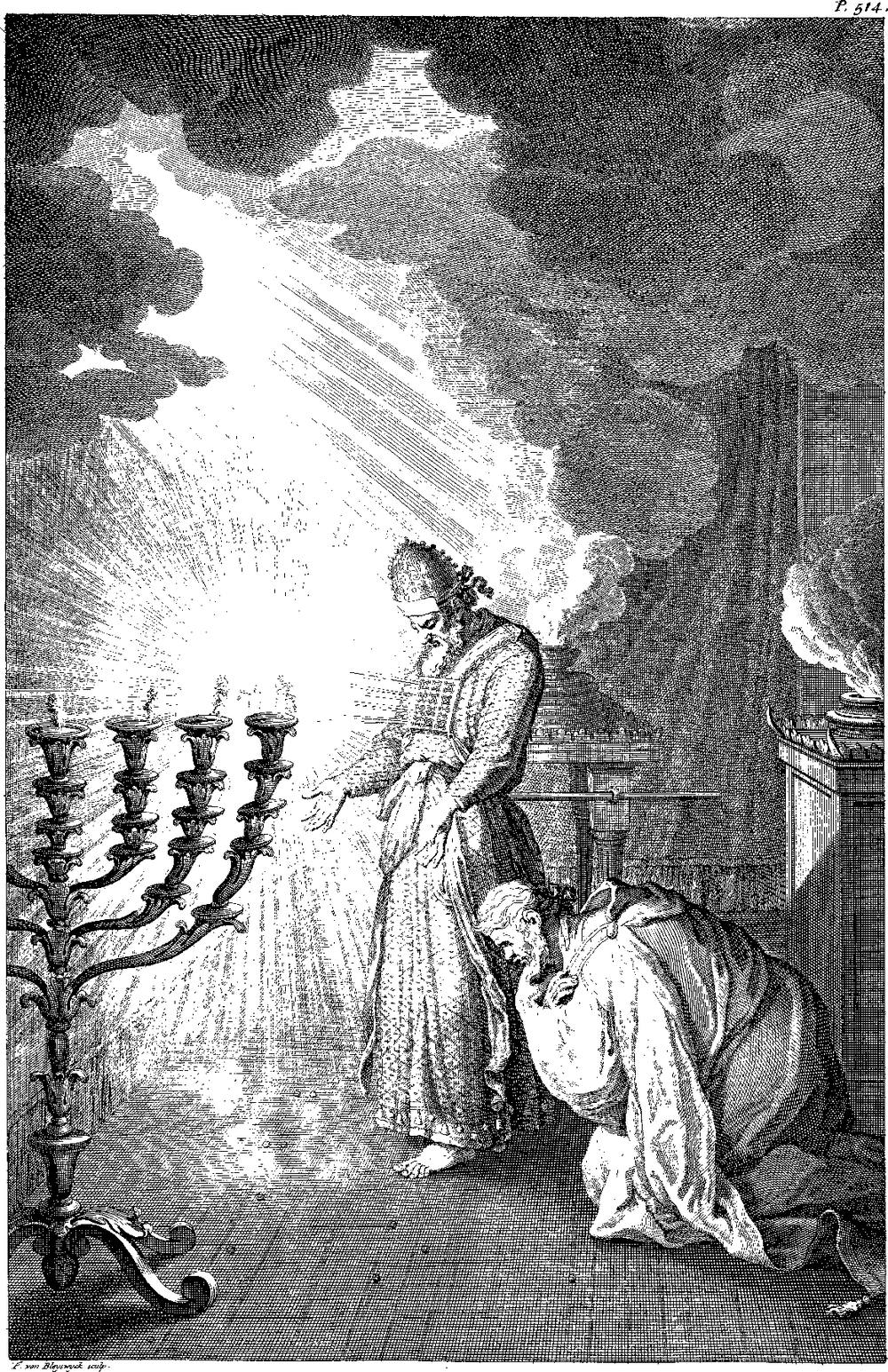
But a wise woman of the city persuaded the inhabitants to give up Sheba; and his head being thrown over the wall, the siege was raised, and the insurrection quell’d.
God having visited the land with a great famine of three years continuance, the oracle In the year of the World 2983. before J. C. 1017. before the Vulgar Æra 1021. 2 Sam. xxi.of the Lord declared, that it was owing to the blood of the Gibeonites which had been unjustly shed by Saul. David sent therefore for the Gibeonites, and asked what satisfaction they required to repair the injury which they had sustained. They demanded seven of Saul’s sons, in order to hang them up in Gibeah. David complied with this demand, and they hanged them up accordingly in Gibeah, the place of Saul’s birth.
Some years after, David having commanded In the year of the World 2987. before J. C. 1013. before the Vulgar Æra 1017. 2 Sam. xxiv.all the people to be numbred, the Lord was offended at it, and the prophet Gad came to him, and said, That he was sent by God to offer him the choice of three scourges which were prepared for him; either that the land should be afflicted with a famine for seven years, or that he should fly three months before his enemies, or that the pestilence should make havock in his dominions for three days. David chose the latter, and the next day it began to rage, and during those three days, seventy thousand persons died. Nor was the sentence executed with full rigour; for God was mov’d by David’s prayers, and said to the destroying Angel, It is enough. David, as an act of thanksgiving, erected an Altar in the threshing-floor of Araunah, where the Angel had appeared to him. Some are of opinion, that the Temple was built afterwards in this place.
The king being very old, could scarce receive In the year of the World 2989. before J. C. 1011. before the Vulgar Æra 1015. 1 Kings i.any warmth: a young woman therefore, a Shunamite, whose name was Abishag, was brought to him; she lay with him, and attended him in his old age. It is our opinion, that she was really David’s wife; though she always continued a virgin. In the mean time, Adonijah began to set up the equipage of a king, and formed a party of the great Men in the kingdom, who upon occasion might be able to support him. Nathan, who knew what promises had been made by David in favour of Solomon, acquainted Bathsheba with what was carrying on, and advised her to go to the king about it. She went, and while she was in conversation with him, Nathan came himself, and remonstrated to him, that Adonijah without his knowledge, and contrary to what the Lord had promised Solomon, intended to have himself proclaimed king. David hereupon immediately gave orders, that Solomon should be mounted on his own mule, and conducted to Gihon, and there should be anointed king. Which was executed without any delay.
David perceiving himself to be now near his end, sent for Solomon, put into his hands the plans and models of the Temple, the gold In the year of the World 2990. before J. C. 1010. before the Vulgar Æra 1014. 1 Kings ii.and silver which he had prepared for this purpose; charged him to be constantly faithful to God, and advised him not to let Joab go unpunished, whom too great credit had made insolent, and who besides had committed several actions, whereby he had deserved death. This was what this pious Prince believed was due from him to justice and posterity. He likewise enjoined him to punish Shimei for the ignominious language, which he had given him, while he was flying from Absalom at the time of his rebellion. After this, he slept with his fathers, and was buried in the City of David, in the year of the World 2990, before the birth of Jesus Christ 1010, before the Vulgar Æra 1014. He reigned seven years and an half at Hebron, and three and thirty at Jerusalem, in all forty years. He died in the seventy first year of his Age6.
Joseph. Antiq. l. 7. c. ult.Josephus relates, that Solomon put abundance of riches into David’s Monument, and that thirteen hundred years after, the High-priest In the year of the World 3870. before J. C. 130. before the Vulgar Æra 134.Hircanus being besieged in Jerusalem by King Antiochus the Pious, and not knowing where to get the money, which he wanted to induce this prince to raise the siege, Hircanus opened David’s monument, took out three thousand talents, and gave him part of them. He adds, that many years after, Herod the Great having once more searched this monument, took great sums out of it.
It is very probable that Josephus had read something like this in other Memoirs of his country, and added such improvements as had been made by the tradition of the people. In the Memoirs which are published in the Arabian tongue by M. le Jay in his Polyglot, we read of a report, that Hircanus, while he was besieged by King Antiochus Sidetes, opened a treasure chamber, which belonged to some of David’s descendants, and that after he had taken a large sum of money out of it, he still left a great deal in it, and sealed it up again. This is very different from Josephus’s account.
Benjamin of Tudela, who wrote about the year 1173, relates, that not above fifteen years before, a wall belonging to Mount Sion, fell down, and the Priests set twenty men at work upon it. Two of these workmen being one day left alone there, when the rest were gone, took up a stone, which opened a passage into a subterraneous place, which they entered. They found there a Palace supported by marble Pillars, and crusted over with gold and silver. At the entrance was a Table, and upon this Table a golden Crown and Scepter. This, says the Jew, was David’s Monument, and opposite to it was Solomon’s, adorned in the same manner. There too they saw Urns, but could not discern what it was that they contained. As they were attempting to penetrate farther, they were over-set by a whirlwind, and remained there senseless till the evening. Then they heard a voice bidding them rise and be gone. Benjamin assures us, that he had this story from the mouth of one Abraham a Pharisee, who, as he said, had been consulted concerning this event by the Patriarch of Jerusalem; and declared, that this was David’s Monument. But this whole account has so much the air of a fable, that it is needless to confute it.
It is certain, that David’s Monument was always very much respected by the Jews. St. Peter in his discourse to the Jews, tells them, that this Prince’s Sepulchre was still with them: The Heathens themselves knew it; and Dio in Adriani vita.Dio informs us, that part of this Mausolæum fell down in the Emperor Adrian’s reign. St. Jerom relates, Hieronym. Ep. ad Marcellam.that he often went to pray at this holy Prophet’s Sepulchre. Cardinal Grimani has given us the representation of this Monument, which some assert to be David’s. Apud Sefinon de Architectura, l. 3. & apud Pinedam de Rebus Salom. l. 8. c. 3. Doubdan, ch. 26. Morizon, &c.Modern Travellers describe to us some very magnificent Monuments, dug in a Rock, which are said to be those that were made formerly for the kings of Judah7. They are doubtless very ancient, but it would be very hard to distinguish David’s from the rest.
David is generally reputed the Author of the Book of Psalms, and these sacred hymns are cited under his name. It is certain that he composed a good number of them; but it would be difficult to prove in particular that he composed them all. Amos vi. 5.Amos reproaches the voluptuaries of Israel with sleeping in beds of ivory, with diverting themselves in singing to the sound of instruments, and flattering themselves that they had, like David, the gift of writing songs. Sicut David putaverunt se habere vasa cantici. See the Article PSALMS.
The Jewish Doctors have added several particulars to the history of David. They say, that Jesse, the father of David, having sollicited his maid-servant, she informed her mistress of it, who took her servant’s place, and conceived David. Jesse believing he was born of a slave, sent him to keep his flocks, and did not think him worthy to appear before Samuel. But Samuel declared to Jesse, that this stone rejected by the Architect, would become the head of the corner. They add, that David came into the world circumcised. This opinion they found upon the title of some Psalms, which have Michtam in the front of them; that is to say, perfectly struck, as having been circumcised with the hand of God. Others say, that he was not circumcised till he was fourteen years of age; and that it was not till this moment that God said to him, Thou art my son, this day have I begotten thee. He would have died as soon as he was born, if Adam, to whom God had foretold this, had not lent him seventy years of his life.
They tell us, that David was red like Esau, and of a physiognomy not much to be liked; that Samuel having taken notice of him, and designing to reject him by reason of his savage air, God told him, that Esau killed men without the forms of justice, and of his own authority; but that David would not put any one to death, without consulting the Sanhedrim. When David looked askew upon any one, he made a leper of him; thus Goliath, and particularly the front of this giant, was immediately covered with a leprosy. Joab suffered the same fate, and something worse. David himself became leprous, God withdrew from him, and the whole Sanhedrim forsook him, during the six months continuance of this disease.
When he appeared before Saul to go and encounter Goliath, Saul was astonished to see his armour fitted him, though they were of a very different stature. He concluded from thence, that David would be king; but David penetrating Saul’s thoughts, excused himself from using his armour.
His son Absalom was damned: of the seven gates through which there is an entrance into hell, he had already passed five of them; but upon David’s crying five times, Absalom my son, at each time he repassed one of these gates; and thereupon David sung aloud this verse of the lxxxvi. 17. Lord give me some marks of thy favour, that they who hate me may see it, and be ashamed.
They say, that David had a harp, which when a certain wind blew, play’d of itself all night; this sound sometimes awakened
him, and he was used to value himself upon it, observing that he awakened the morning, whereas the morning awakens other kings. We are moreover told, that he married the two sisters, daughters of Saul, both living at the same time, namely Merab and Michal. But we know he never wedded Merab, though she had been promised to him in marriage. They accuse this Prince of having given into the follies of Astrology, Magick, and even into Idolatry, and of having despaired of his own salvation.
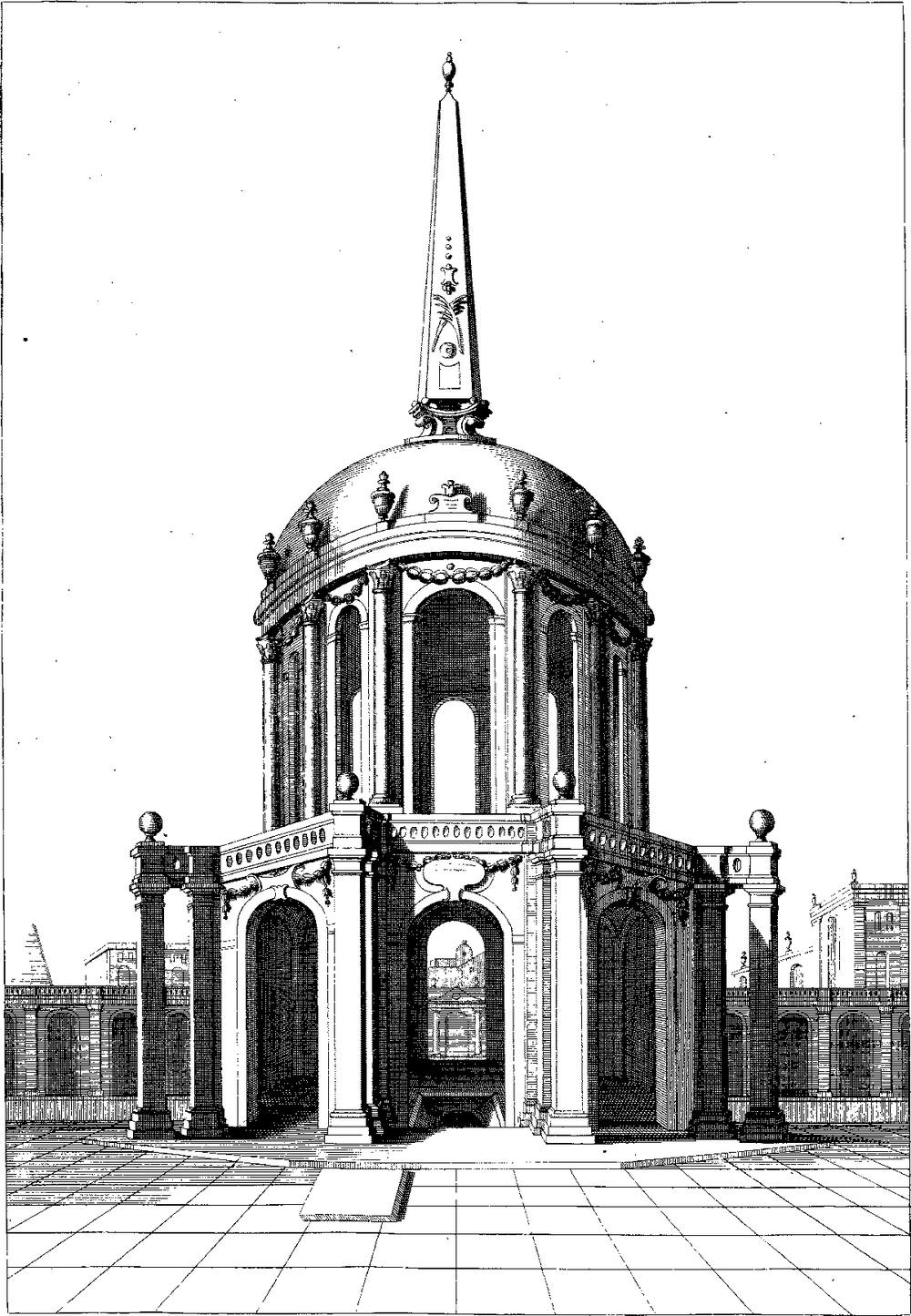
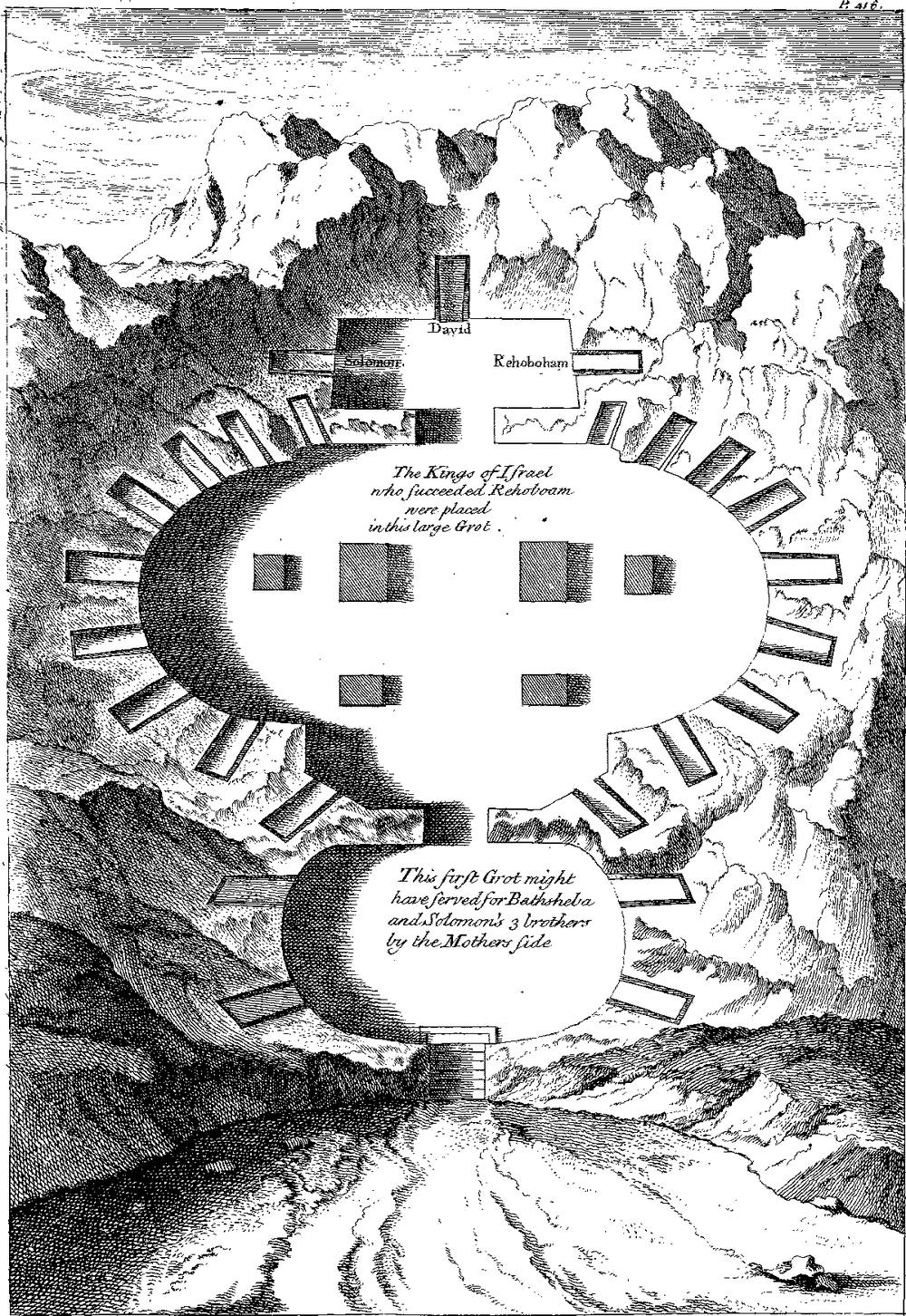
But that which shews the height of their extravagancy, is, the story they relate of this Patriarch’s death. He knew by revelation that he should die upon some sabbath-day. He did not like the day, because they could neither mourn for him upon it, nor provide for his funeral. He desired some little delay till the next day, but could not obtain it; all the favour God would grant him, was, not to die till saturday in the evening. The devil waited the moment of his ceasing to read the law, in order to give him his death’s wound; but as he did not discontinue the reading of it, Satan bethought himself of going and knocking down apples in the king’s garden, and by this means to draw him off. David run out upon the noise, and as he was descending too hastily by a wooden-ladder, in order to discover the thief, the devil moved it, and the king fell and killed himself.
His dead body remained exposed to the dogs, because no one would venture to stir it on the sabbath-day. The University was consulted to know what was to be done in so melancholy a juncture, and the Doctors directed pieces of bread to be thrown about the dead body for the dogs, till the sabbath was over. The dogs prefer’d the bread to the dead body of the king, and David was buried. Thus the Hebrew Doctors disfigure the most serious histories with their silly impertinences; we should not amuse our selves with relating them, if we were to consult only our own inclination, or the contempt we have of them: but it is one part of wisdom to know the errors and follies of mankind. Transivi ad contemplandam sapientiam, Eccl. ii. 12.erroresque & stultitiam, says Solomon.
Bibl. Orient. p. 284.The Mahometans have as many fabulous stories as the Jews, when they speak of David. Mahomet says, that this Prince killed Goliath; that God gave him the kingdom, and wisdom, and taught him whatever he desired to know. Hereupon a certain Commentator Alcoran Cap. Bacrat.of the Alcoran, says, that Saul’s army consisted only of three hundred and thirteen men, whom God had chosen, because they had drunk of the stream only out of their hands. He confounds the history of Gideon with that of Saul. After David had killed Goliath, God gave him the kingdom; because Saul had promised his daughter in marriage and half his kingdom to him, who should dispatch the Giant; and Saul dying soon after, David entred into the possession of his dominions. God gave him likewise wisdom; that is to say, the gift of prophecy, and his Spirit in order to compose the Psalms. Lastly, God taught him every thing he had a mind to know; that is to say, the gift of making coats of mail, of hair-shirts and sackcloaths, which was the common trade of the prophets; and even the gift of understanding the language of birds. Some add, that the birds and stones obey’d him, that iron grew soft within his hands; and that during the forty days of his lamenting his sins, his tears were so copious and so fertile, that they made plants grow.
DAY. The Day is distinguish’d four several ways; there is the natural, astronomical, civil, and artificial Day8. The natural or solar Day, is the duration of four and twenty hours. The astronomical Day, is the duration of the intire revolution of the Æquator, and of that portion besides of the same Æquator through which the sun passes with its own proper motion in one natural Day. The civil Day is that, the beginning and end whereof is determined by the common custom of any nation. The Hebrews began their civil and ecclesiastical Day from one Evening to another. From Even unto Even shall ye celebrate your Sabbath. The Lev. xxiii. 32.Roman Catholick Church still does the same in the ecclesiastical Office, but not with regard to that rest from labour, which it appoints to be observed on festivals. The Babylonians reckoned their Days from one sun-rising to another; which is the practice of the inhabitants of Nuremburg at this day: the Italians from one sun-set to another; the astronomers from noon to noon; the Roman Catholicks from midnight to midnight. Lastly, the artificial Day is the time of the sun’s continuance above the horizon, which is unequal according to different times and seasons, by reason of the obliquity of the sphere. The sacred writers generally divide the Day and Night into twelve unequal hours. The sixth hour is always answerable to noon-day in all seasons of the year; and the twelfth hour to the last hour of the Day. But in summer-time, the twelfth hour, as well as all the rest, were longer than the winter hours. See the Article HOURS.
TO-DAY, does not only signify the particular Day upon which we are speaking, but
Psal. xcv. 8.but likewise any indefinite time. To-day if you will hear his voice, harden not your hearts. This To day, says St. Paul, denotes Heb. iii. 13.our whole life. Daily while it is called to-day. And, This day have I begotten thee; Psal. cx.that is to say, from all eternity, and I do not cease to beget thee. And St. Paul, Jesus Heb. xiii. 8.Christ, the same yesterday, to-day, and to-morrow. And Nehemiah, Behold we are servants Nehem. ix. 36.this day: we are so as we have always been. And Ecclesiasticus, Yesterday for me, Ecclus. xxxviii. 22.and to-day for thee. You must undergo the same fate as I. And Jesus Christ, in St. Luke, I must walk to-day, and to-morrow, and the day following: that is to say, still a Luke xiii. 33.little while.
DEACON, comes from the Greek, DiaconosΔιάκονος. Diaconus. Minister. Acts vi. 1., which signifies, Minister, Servant. This word is made use of in the language of the Church, to denote those whose office it is to assist the Bishop or Priest in the distribution of the Eucharist, and besides this, in the service of the poor, and administring what is necessary for them. The number of the disciples increasing daily at Jerusalem, the Greeks, that is to say, the Gentile Converts, began to murmur against the Hebrews, and to complain, that their widows were neglected in the distribution of Alms, which was made every day. Hereupon the Apostles called the multitude of Believers together, and said, It is not reasonable that we should leave the word of God, and serve tables: wherefore look ye out among you seven men of honest report, full of the Holy Ghost and Wisdom, whom ye may appoint over this business. They therefore chose seven, viz. Stephen, Philip, Prochorus, Nicanor, Timon, Parmenas, and Nicolas: these they presented to the Apostles, and they were ordained by prayer, and imposition of hands.
1 Tim. iii. 8, 12.Saint Paul in his first Epistle to Timothy, requires that Deacons should be chaste, sincere, and blameless; that they should be neither great drinkers, nor given to filthy lucre; that they should hold the mystery of the faith in a pure conscience; that they should be well proved before they were admitted into the sacred ministry; that they should be the husbands of one wife, and should take care of their house and family.
DEACONESS. Such particular Widows and Virgins were called Deaconesses, who served the Church in those Offices, which the Deacons could not exercise themselves; such as, first, keeping the doors of that part of the Church where the women used to sit: for they were not seated promiscuously with the men, but had separate places in the Church assigned them. Secondly, the Deaconesses assisted the women to undress before Baptism, and dress again after this ceremony. Thirdly, They privately instructed those of their own sex, and visited others who were imprisoned for the faith. They were of mature and advanced age, when they were chosen, of good manners and reputation. They were in the primitive times appointed to Concil. Laodic. c. 11. Rom. xvi. 1.this office with ceremony, and with the imposition of hands. St. Paul, in his Epistle to the Romans, speaks of Phœbe, Deaconess of the Church belonging to the port of Cenchrea. The same Apostle requires, that 1 Tim. v. 9, 10.such only should be received as widows for the service of the Church, who were at least sixty years of age, had been married only to one husband, were well reported of for their good works, had brought up their children well, had exercised hospitality, had washed the saints feet, had relieved the afflicted, and had diligently followed all good works. The younger widows were excluded out of this number.
The DEAD. It is our opinion, that the Hebrews by this name sometimes understood the false god Adonis: and in this sense we explain the following words of Moses; Deut. xiv. 1.Ye are the children of the Lord your God, ye shall not cut yourselves, nor make any baldness between your eyes for the dead. Which were circumstances practised in the time of Deut. xxvi. 14.mourning for Adonis. And in another place, the Israelites coming to present their first-fruits to the Lord, make this profession; I have not eaten thereof in my mourning, neither have I taken away ought thereof for the dead, probably for Adonis. The offerings of the dead, which the Psalmist speaks Psal. cvi. 28.of, and whereof he says the Hebrews did partake in the abomination of Baal-peor, are likewise, in our judgment, sacrifices which were offered in honour of Baal-peor. See our Dissertation on Baal-peor, printed before our Comment upon Numbers.
The DEAD. It is not strange that the Hebrews should have a great deal of consideration Jerem. viii. 2. xxii. 14. Eccl. vi. 3. 2 Macc. v. 10. Tob. i. 20. ii. 10. vi. 18.for the Dead, since they believed the soul’s immortality, and a future resurrection. They esteemed it to be one of the greatest misfortunes that could happen to be deprived of burial, and the best men made it a point of duty to bury the dead, to perform their obsequies, to leave something on their graves to eat, that the poor might have the advantage of it. When an Israelite died in any house or tent, all who were in it, and the furniture belonging to it contracted Numb. xix. 14, 15, 16.a pollution, which continued for seven days. All likewise who touched the body of one who either died of himself, or was killed in the open fields; all who touched his bones or his grave, were impure for seven days; and the manner of expiating this pollution was as follows: They took the ashes of a red heifer sacrificed by the High-priest upon the day of
solemn Expiation. Some of these ashes they Numb. xix. 3, 4, 5, 6.threw into a vessel full of water, and one who was free from all uncleanness dipt a bunch of hyssop in the water, and sprinkled the furniture with it, the chamber and persons that were polluted. This ceremony was performed upon the third and seventh day. But besides this, it was required that he who had contracted this pollution should bathe his whole body, and wash his clothes upon the seventh day; after which he was thought to be perfectly purified.
Joan. Nicolai de Sepulcris Hebr. l. 2. c 3.The Rabbins tell us, that no uncleanness was contracted at funerals, unless the dead person was an Israelite; for as to the Gentiles, say they, they pollute those who come near Basnage’s hist. of the Jews, l. 7. c. 25.them while they are living; but after death, their carcases are clean, and communicate no impurity. The Israelites, on the contrary, while they are living, exhale a pure smell, which sanctifies those who come near them; but after death, their Soul and the holy Spirit having forsaken them, they are then fit only to spread infection and pollution. The rules which we have related for the purification of those, who had touched a dead body, or been present at any funeral, are now no more observed since the destruction of the Temple, and the sacrifice of the red heifer has ceased. The Jews therefore no longer look upon themselves to be polluted by a dead body. See Leo of Modena concerning the ceremonies of the Jews, p. 1. c. 8.
All they who are present in the place where any sick person has just expired, tear their clothes, according to the most ancient custom of the Hebrews; but then they generally tear only the extremities of them, about the breadth of their hand, and this more out of ceremony, than to express a sense of great sorrow. It is an old custom with them to pour out all the water into the street, which is at that time in the house and neighbourhood. The Rabbins say, that the destroying Angel hath in this water washed the sword of execution with which he killed the sick person, whereby the water becomes mortal poison. After this they put the dead body upon a sheet spread upon the pavement, turn his thumb inward to his hand, and light a wax taper at his feet, or head. This done, they wash the body, put a shirt upon it, and over the shirt another garment of fine linnen, which he wore upon the day of solemn expiation; then his taled, which is a piece of square cloth with tufts. Lastly, they put a white cap upon his head, and in this condition he is shut up in his coffin.
It appears to have been a custom anciently in Palestine, to embalm the dead bodies of persons, who were of any distinction, and left a good fortune behind them: but this usage John xix. 39.was never general. St. John remarks, that our Saviour was wrapt up in linnen clothes, and rub’d with perfumes, according to the custom of the Jews; as the manner of the Jews is to bury. We read, that either with or near the bodies of some Kings 2 Chr. xxi. 19. xxvi. 14. Jer. xxxiv. 5. Matth. ix. 23. Vide Jer. ix. 17, 18. Joseph. de Bello, l. 2. c. 15. Misna tit. Chetuboth. c. 4.of Judah abundance of spices was burnt; but we cannot certainly affirm that there was any uniform custom in this particular. After the body has been for some time exposed, the Relations meet in order to carry it to the ground. They carry it out the feet foremost, according to the prescription of the Rabbins. Anciently they had women, who were hired to cry, and persons that play’d on doleful instruments, who walked in the funeral procession. The Rabbins say, that an Israelite was not allowed to have less than two of these Musicians at his wife’s obsequies, without reckoning the woman who was hired to cry, and was always to be present upon such occasions. They who met the funeral procession were in civility to join the company, Gemar. Babyl.and mingle their groans with those of the Relations to the deceased. To this our Saviour seems to allude in these words, We have ibidem. Joseph. l. 2. contra Appion. p. 1075. Luke vii. 32. Rom. xii. 15.mourned to you, and ye have not wept. And St. Paul requires us to weep with those that weep, and rejoice with those who rejoice.
When they come to the place of burial, the coffin is set down upon the ground; then if the deceased be of any consideration, some one of the company makes his Encomium: after which, they walk ten times about the grave, repeating a long prayer, which begins with these words, God is the rock, his way is Deut. xxxii. 4.perfect, &c. Then the dead body is let down into the grave, with its face turned towards heaven: the nearest Relations throw the earth first upon it, and then the grave is filled with a shovel. When they depart from the place where the corpse is buried, they walk backward, and pulling up some grass three several times, they throw it behind their backs, with these words, They shall flourish like the grass of the earth. They believe that all the dead bodies of the Jews are conveyed through subterraneous passages Rab. Salomon in Gen. xlvii. 29. Abarbanel, alii.to Palestine, and this they call the rolling of the dead, or the rolling of the caves. They hope to rise again and enjoy a state of bliss in this country. They do not believe the Soul of the dead person to be received into the place of rest, before the body is reduced to dust. They imagine that for a year after his decease, it often visits its body in the grave. See our Dissertation on the funerals of the Hebrews, prefixed to the Book of Numbers.
Prayers for the DEAD. See PURGATORY and PRAYERS.
DEAD, the state of the Dead after their decease. See SOULS.
DEAF, Surdus; in Hebrew, Cheresch; in חרשCheresch. κωφος. Surdus.Greek, Kôphos. Every one knows what natural Deafness is. The Gospel relates many miracles, whereby Jesus Christ cured the Deaf. Deafness produces mutes, because these not hearing the articulate founds, which we utter, cannot bring forth any like them to make themselves understood. Wherefore the Hebrew word Charasch, which signifies to be Deaf, signifies likewise to be mute, or silent. The word Deaf is alfo taken in a metaphorical sense for one, who is not present, or cannot understand. For example: Thou shalt not curse the deaf. Thou shalt not abuse or calumniate him, Numb. xxx. 8, 12. 1 Sam. x. 28.who is absent. If a woman makes a vow, and her husband is as though he were deaf; hath made as if he did not understand her, or did not contradict her; she shall be obliged to perform it. The Israelites who did not approve of Saul’s Election, brought him no present, And he was as though he had been deaf. He dissembled, made a shew Isa. xxxv. 5. xlii. 18. xliii. 8.as if he did not see it. Isaiah says in several places, that the Ears of the Deaf shall be opened at the coming of the Messiah. He means those who are spiritually Deaf; such of his people as had been hitherto Deaf to his word.
DEATH. Man having eaten of the forbidden fruit, incurred the penalty of Death for himself and all his posterity. The Death of the Soul was what he instantly suffered, and he was made liable to bodily Death; tho’ this was what he did not undergo till a long time after. Had he continued obedient to God, and not violated the precept which he gave him of abstaining from the forbidden fruit, he had not died, and the use of the fruit growing on the tree of life would have preserved him in a happy state of constant health; and after a long life spent on earth, God would have transported him, as he did Enoch and Elijah, into a life absolutely immortal. The Fathers and Councils teach us, that without sin Adam had not died; but the Rabbins believe, that after he had lived a long time, his soul would have been separated from his body without pain and violence, by receiving a salute from the Lord, and so would have enjoyed a life still much happier in a state of eternity and immortality. It is unquestionable, that Death was brought into the World by the Envy and Malice of the Devil. Invidia Diaboli mors Wisd. iii. 24.introivit in orbem terrarum; and that the sin of Adam produced the death of the first of Mankind, and of all his descendants. Rom. v. 12.By one man sin came into the world, and death by sin; wherefore death hath passed upon all. St. Austin distinguishes two sorts of immortality in man, the greater and the lesser: the greater and more perfect immortality consists in an impossibility of dying, which is the happy prerogative of God and Angels: the lesser immortality consists in a possibility of not dying: this Adam enjoyed in the state of innocency. By continuing in the obedience which he owed to his creator, he might have avoided Death, and from this lesser degree of immortality he might have arrived at that of not dying, which is the condition of the Blessed after the resurrection. He was therefore driven out of Paradise after his guilt, lest he should eat the fruit of the tree of life, which would have procured for him eternal life. Discerne immortalitatem majorem scilicet à minore, nam & ista non absurdè immortalitas dicitur, quâ potest quisque non mori, si non faciat unde moriatur. In hac immortalitate fuit Adam. Hanc immortalitatem merito prævaricationis amisit. Hæc ei subministrabatur de ligno vitæ, à quo non est prohibitus, quando legem bonam ne peccaret, accepit, sed quando malâ voluntate peccavit; tunc enim de paradiso ejectus est, ne extenderet manum ad lignum vitæ, & manducaret, & viveret in æternum.
The Socinians pretend, that Adam was created, and that sin in this particular wrought no change in his condition; and in this belief they affirm, that they have the authority of the Rabbins for their support. But these evidently maintain, that if our first parents had persevered in innocence, they had lived always. Manasseh Ben-Israel, who flourished in the middle of the last Century, asserts, that the immortality of the first man is founded upon Scripture, and that many famous Rabbins who are cited by him, are of this opinion. He shews that this immortality of Adam agrees with reason, since there was no inward cause in him which might occasion his death, and that he had nothing to fear from without, living, as he did, in a delicious and agreeable place, where every thing was subject to him; and that the fruit which he was to feed upon, increased his strength, and preserved his health. The Rabbins maintain that the tree of life was of a prodigious size; that all the waters of the earth issued from the foot of it; that if any one had been to have walked five hundred years, he could scarce have gone round it: these are exaggerations, or figurative expressions. But they do not at all question its having an enlivening virtue, or that the natural quality which God had given it, was sufficient to preserve men in a state of immortality; and they affirm, that to prevent his eating of it, and living eternally, God forced our first parent out of Paradise after his disobedience.
Jesus Christ by his death hath subdued Death, and hath merited for us a blessed immortality. By which I do not mean, that the Soul was before mortal, and by him made immortal, nor that he has merited for us the favour of not dying; for he has
not changed the nature of our Soul, nor thought fit to exempt us from the necessity of dying: but he hath given us the life of grace, and by his resurrection hath merited an happy immortality for us; provided the merits of his blood and death are applied to us by faith, and the use of the sacraments, and that we, through our own fault, do not frustrate his intentions to save all men.
As to the Resurrection of the Dead, we shall speak of it under the title of RESURRECTION.
Cant. viii. 6.The word Death is taken in Scripture not only for the death of the body, and soul; for the first death, which is that which happens when the soul is separated from the body; and for the second death, which is that of eternal damnation: but likewise for any great danger, for imminent danger of Death; for the plague and contagious diseases; for poison, and any great misfortune. By the gates of Death, the grave is signified, and the state of the Dead after this life: by the vessels or instruments of death, dangerous and deadly weapons are meant; by the bonds or snares of death, the snares which are laid to destroy an enemy; a son of Death, a man who merits Death, or is condemned to death; by the dust of death, the state to which the dead person is reduced in the grave. Love is strong as death, says Solomon; no one can resist death or love.
Josh. x. 39. xii. 13.I. DEBIR, otherwise called Kirjath-sepher, the City of Letters; or Kirjath-arba, a City in the Tribe of Judah, very near Hebron. The first inhabitants of it were Giants of the race of Anak. Joshua took it, and put the King to death, who commanded in it. Debir fell by lot to Caleb; and Othniel going first to the assault, and entring the place, Caleb gave him his Josh. xv. 15, 16.daughter Achsah in marriage. Debir was one of the Cities belonging to the Levites. Josh. xxi. 15. and 1 Chron. vi. 58.
II. DEBIR, a Town beyond Jordan in the Tribe of Gad. Josh. xiii. 26.
III. DEBIR, King of Eglon, spoken of in Joshua x. 3.
IV. DEBIR, a City of Benjamin, which before belonged to the Tribe of Judah. Josh. xv. 7.
Judg. iv. 4, 5, & seq.I. DEBORAH, a Prophetess, the wife of Lapidoth, who judged the Israelites, and dwelt under a palm-tree9 between Rama and Bethel. She sent for Barak the son of Abinoam, and by God’s command enjoined him to get together an army of ten thousand men, to lead them to Tabor, and promised him victory over Sisera, General of Jabin’s army. Barak refused to go, unless Deborah went with him. She went, but withal told him, that the success of this expedition would be imputed to a woman and not to him. The event verified her prediction. Sisera was defeated, as has been shewn in the Article of Barak: and after the victory, Deborah and Barak composed a fine thanksgiving-song, which we read in the fifth Chapter of Judges. This victory was obtained in the year of the World 2719, before Jesus Christ 1281, before the Vulgar Æra 1285.
II. DEBORAH, Rebecca’s nurse, who, when Jacob returned from Mesopotamia into the Land of Promise, went with him, died there, and was buried at the foot of Bethel, under an oak, which for this reason Gen. xxxv. 8.was called the Oak of weeping, in the year of the world 2266. before the birth of Jesus Christ 1734. before the vulgar Æra 1738. The word Deborah signifies a Bee.
DECACHORDON, a musical instrument with ten strings, called in Hebrew, Hasur, was almost the same as our harp, of a triangular figure, with an hollow belly, and sounding from the lower part. See our Dissertation on the musical instruments of the Hebrews, prefix’d to the second Tome of our Comment on the Psalms.
DECALOGUE, the ten principal points of Moses’s Law, contained in the seventeen first verses of the twentieth chapter of Exodus. The word Decalogue is formed from the Greek, deca, ten, and logos, word; as if any should say, the ten words: and thus the Jews call the ten precepts I am speaking of. See LAWS.
DECAPOLIS, a country in Palestine, so called, because it contained ten principal cities, situated some on this, and some on the other side of Jordan. The first and principal city of Decapolis, is Scythopolis: the rest are, according to Pliny, 2. Philadelphia; 3. Raphanæ; 4. Gadara; 5. Hippos; 6. Dion; 7. Pella; 8. Gerasa; 9. Canatha; 10. Damascus. Others reckon them after another manner, as Pliny himself observes. The Decapolis is Matth. iv. 45. Mark v. 20.mention’d in two or three places of the Gospel; and Jesus Christ preached there frequently.
vii. 21.DECURIO. An Officer of the Roman troops, who commanded ten men. There were some of these Officers in the Hebrew Ex. xviii. 21, 25. Deut. i. 15.Armies, as may be seen in Moses, who by the advice of Jethro his father-in-law, appointed Captains of a thousand, an hundred, fifty, and ten men, to govern, and judge the people, and to have the conduct 1 Macc. iii. 55.of them both in peace and war. Judas Maccabæus imitating Moses in this disposition of the people, appointed Officers of all sorts in his Army. Joseph of ArimathæaMark xv. 43. is called in the Gospel, Nobilis Decurio: but the Greek Text imports a rich Coun-
Εὐσχήμων Βουλευτής. Luk. xxiii. 10. Βουλευτὴς ὑπάρχων.Counsellor or Senator. The Senators of the municipal towns and colonies were called Decuriones; and this probably might oblige the Author of the Vulgate to transflate the Greek Bouleutes, Decurio.
DEDAN, a People of Idumæa or Arabia. See above DADAN.
It is very credible, that the two names signify the same thing, and that the people called Dedan or Dedanim in Isaiah, Jeremiah, and Ezekiel, are descendants of Dadan the son of Raamah, grandson of Canaan, Gen. x. 7. or of Dadan the son of Jochshan, grandson to Abraham by Keturah, Gen. xxv. 3. But it is hard to discern one from the other, because the characters which the Scripture gives us of these two are not sufficiently distinct. The Prophets If. xxi. 3. Jerem. xxv. 23. xlix. 8. Ezek.xxv. 13.Isaiah, Jeremiah, and Ezekiel, place visibly the Dedanim with the Arabians and Edomites, in the severe prophecies which they pronounce against them. We believe these predictions were accomplished in the time of Nebuchadnezzar, who subdued all Joseph. Antiq. l. x. c. 11.these people, five years after the taking of Jerusalem. Ezekiel puts Dedan among the merchants who came to traffick at Tyre. He Ezek. xxvii. 15, 20.places them with Gog and Magog, who came to ravage and lay waste the land of Israel. As these people dwelt probably in Idem xxxviii. 13.Arabia Deserta, it is impossible to point out exactly the place of their abode. Jeremiah seats them with the Arabians, who cut their hair round. Et Dedan, & Thezna, & Buz, & universis qui attonsi sunt in comam.
Joseph. Antiq. l. 14. c. 25, 26. & Antiq. l. 15. c. 14.DEDICATION, a religious ceremony, whereby any Place, Temple, Altar, or vessel is consecrated to the worship of God. Moses dedicated the Tabernacle which he Exod. xl. Numb. vii.built in the wilderness. He likewise consecrated the vessels which were set apart for the service of the Tabernacle, and the worship of the Lord. Solomon solemnly dedicated 1 Kings viii.the Temple which he erected. The Israelites, who returned from the Babylonish captivity, dedicated the new Temple Ezra vi. 16, 17.which they built, and upon the day of this dedication sacrificed a great number of 1 Mac. iv. 52, 53, 54, &c.victims. The Maccabees having cleansed the Temple, which had been polluted by Antiochus Epiphanes, again dedicated the Altar; and this is believed to be the Dedication which the Jews continued to celebrate in the winter, and at which our Lord was one day present, as is observed in St. John x. 22.John’s Gospel. The Temple likewise rebuilt by Herod was dedicated; it was the most beautiful and magnificent of any that were built after the Jews returned from their captivity. Herod celebrated the dedication of it with great solemnity; and in order to make the festival on this occasion more august, he appointed it to be performed upon the anniversary day of his accession to the crown. Now he was declared King towards the end of the year 3964. before Jesus Christ 36. before the vulgar Æra 40. and the Temple which he built was dedicated at the end of the 32d year of Herod, of the world 3996, four years before the birth of Jesus Christ. It is very probably of this Dedication of the Temple, that there is mention made in Saint John, which was celebrated in the winter, and at which Jesus Christ was present.See Bassage’s Antiquit. des Juifs, t. 1. P. 103. Nehem. xii. 27. Deut. xx. 5.
Not only sacred places were thus dedicated, but cities, walls and the gates belonging to them; and lastly, the houses of private persons. When Nehemiah had finished the walls and gates of Jerusalem, he dedicated them in a solemn manner. The title of the xxix Psalm implies, that it was sung at the dedication of David’s house. And Moses ordered proclamation to be made upon the day of battle at the head of the Army, What man is there that hath built a new house, and hath not dedicated it? let him go, and return to his house, lest he die in the battle, and another man dedicate it. This dedication Vide Chald. ad Deut. vi. Talmud. Maimon. Halac Tephilim. Deut. vi. 9, 10, 11.was performed principally, according to the Rabbins, by pronouncing a certain blessing, while some particular words of the Law written upon parchment, rolled up in a cane or hollow stick, were fasten’d on the doorpost.
From hence the custom of dedicating Churches, Oratories, Chapels and Altars took its rise among Christians: a custom practis’d among all people of all religions. But we confine ourselves to what relates more particularly to the Holy Scriptures.
DEEP. See ABYSS. Deut.
DEER. A fallow wild beast of a mid- xii. 15,
-
xiv. dle size, between the Stag and the Roe- 5, &c. buck, bearing its horns turned inward; the main horn and branches whereof are large and flat, and not round. It is naturally very timorous and fearful. A Deer was thought to be a clean beast, the flesh whereof was good to eat; young Deer were particularly Cant. ii.
-
esteemed for the delicacy and good juice of Prov. vi. their flesh. They are spoken of in the Can- 5. ticles, Proverbs, and in Isaiah, as beautiful, Isa. xiii.
-
lovely creatures, and very swift runners. The Hebrew Tzeb or Tzebi, is taken for Caprea the Roe-buck or Deer. vel Dama.
DEGREES of Relation, wherein it was forbidden to contract marriage. See RELATIONS.
Ezra. iv.
DEHAVITES, people mentioned in 9. the book of Ezra. The same in all proba- 2 Kings xvii. 24. bility with those of whom it is said in the second Book of Kings, that the King of Assyria brought them from Cutha and Ava into Samaria. The Dehavites are the people of Ava, and perhaps were of Ammian.
l. 23. that canton of Assyria, which was watered by the river Diaba.
1 Chr. iii. 24.I. DELAIAH, the son of Eliænai, of David’s family.
II. DELAIAH, one of king Jehoiakim’s Counsellors, who opposed this Prince, when he determined to burn the prophet Jeremiah’s Book, which Baruch had taken down in writing, as he dictated to him. The opposition of Delaiah, Elnathan, and Gemariah did not however prevent king Jehoiakim from burning the Prophecies of Jeremiah; because they were contrary to his inclination.
III. DELAIAH, of the Race of the Priests, was of the three and twentieth Order appointed for the service of the Temple; 1 Chr. xxix. 18.
DELILAH; a Strumpet who dwelt in the valley of Sorek, belonging to the Tribe of Dan, near the land of the Philistins. Judg. xvi. 4.Samson falling in love with her, devoted himself to her, and, as some say, was married to her10. The Princes of the Philistins being acquainted with this woman, came to her, and promised each of them to give her eleven hundred pieces of silver, if she could discover whence that extraordinary strength proceeded, which he was master of, and would inform them of it. She assured them that she would use her best endeavours to satisfy them; and accordingly she asked him how he came by this great strength, and how he might be deprived of it. Samson told her, that if they bound him with seven green Withs, that were never dried, he should be as weak as other men. The Philistin Lords therefore brought her seven green Withs, which she had mentioned, with which she bound Samson; and having concealed men in her house, who waited the event of this trial, she cried out, Samson, the Philistins are upon thee. Immediately he broke the Withs, as if they had been threads; so that there was no knowing the cause of his great strength.
Delilah having once more asked, and with more earnestness, wherein it consisted, he answered, If they bind me with new ropes, I shall become as weak as another. She therefore bound him, and cried out as before, the Philistins are upon thee. Whereupon Samson, without any straining at all, broke these cords as if they had been a piece of thread. Delilah asking him the same question a third time, and with more impetuosity, he told her, that if she wove the seven locks of his head with the web, and fastened it with a pin, he should be weak. She did so, and Samson awoke as at other times, and went away with the pin of the beam, and the web, without any trouble.
Then Delilah began to reproach him with want of affection, and with deceiving Δ Delta.her three several times. She importuned him with so much obstinacy, that finding no rest to be had without making this discovery, his heart at last was mollified, and he lost all his resolution. He told her therefore, that his head had been never touched with a razor, because he was a Nazarite, and consecrated to God from his mother’s womb; that if he were shaved, all his strength would forsake him, and he should be as weak as other men. Hereupon Delilah gave notice to the Philistin Princes, that they should come once more to her house; for Samson had at last discovered the truth to her. They came there with the money, which they had promised her, and Delilah having taken care to have his head shaved, while he was sleeping in her bosom, she pushed him from her with violence, and said, the Philistins are upon thee. Samson hereupon waking, would have put himself into a posture of defence, believing that he had still the same strength as before: but the Philistins hem’d him in, took him, put out his eyes, bound him in chains, and carried him to Gaza, where he continued in prison till his death; as we shall see in the Article SAMPSON.
Ps. xxviii. 10. ℸ Daleth.DELTA, is the fourth letter of the Greek Alphabet, and comes from the Hebrew Daleth. In Geography, that part of Egypt is called Delta, which is watered by the seven branches of the Nile, from its division as far as the seven mouths through which it discharges itself into the Mediterranean: septemplicis ostia Nili. This part of Egypt is called Delta, because it comes pretty near to the figure of this letter, its point lying towards Grand Cairo, and its basis upon the coasts of the Mediterranean.
DELUGE. Not only that terrible Inundation is in Scripture called Diluvium, or Deluge, whereby God destroyed all Mankind, and all the animals of the earth and air, which were not in the Ark; but likewise all sorts of Inundations or collections of extraordinary Waters. Thus the Psalmist speaking of the waters of the sea, or of a violent tempest, expresses it by the word Deluge. Dominus diluvium inhabitare facit. And in another place, that a deluge of water shall not come near the righteous: Ps. xxxi. 6.In diluvio aquarum multarum ad eum non appropinquabunt. The same expression may be observed in the common language of the World. All extraordinary Inundations are called Deluges, such as those which happened in the time of Deucalion and Ogyges, and those which we see in our rivers after long rains or unusual storms. In a spiritual and alleallegorical
Deluge continues on the next page
Footnotes
-
Translators’ note. It is the opinion of a very ingenious Author, that this Egyptian Darkness was the Darkness of Hell below, which is called Utter Darkness, and which arose and over-shadowed the land: and herein he says he is authorized by the Wisdom of Solomon, c. 17. v. 14. where he calls it a night, that came upon them out of the bottom of inevitable Hell; and therefore was the more proper to be (as he says after) an Image of that Darkness, which should afterwards receive them. ↩
-
Translators’ note. That Musick should cure settled diseases in the Body, we should hardly believe, if we had not both human and divine Testimony for it. Pliny tells us of the Gout and Sciatica being cured by it; that it had the effect of a good Styptick, and stopt a flux of blood. Plin. l. 28. c. 1. And Theophrastus witnesses, that many in his time, especially the Thebans, used the Pipe for the cure of several sicknesses, which Galen calls καταυλεῖν τῷ τόπῳ, super loco affecto tibia canere; or, Loca dolentia decantare. An ingenious Author assigns the true natural Reason of this Effect to be, that as musical Sounds move the outward Air, so that does the inward, and that the Spirits, and they the Humours, (which are the seat of diseases) by condensation, rarefaction, dissipation, or expulsion of Vapours. As for the cure of the Tarantism by Musick, the experiments of it are too notorious to be denied. ↩
-
Translators’ note. These, as a learned Man observes, were not properly called Prophets, or Foretellers of future things, but religious Persons, who separated themselves from the business of the world, to employ their time in the contemplation and praise of God. Saul’s messengers saw the company of Prophets prophesying (that is, saw them together in divine Service) and Samuel standing as appointed over them; Stantem super eos, which the Chaldee interprets Stantem docentem eos, preaching to them. At Bethel and Jericho there were Sons of the Prophets, 2 Kings ii. 3, 5. so called because taught by some great Prophets; or as the Greeks term Physicians Ἰατρῶν παῖδας. ↩
-
Translators’ note. The Sum collected for this use by David is so prodigious, says Dr. Prideaux, as gives reason to think, that the Talents whereby that sum is reckoned, were another sort of Talents of a far less value than the Mosaick Talents. For what is said to be given by David (1 Chr. xxii. 14, 15, 16. and xxix. 3, 4, 5.) and contributed by his Princes (xxix. 6, 7, 8.) towards the building of the Temple of Jerusalem, if valued by the Mosaick Talents, exceeded the value of eight hundred millions of our money. The 3000 Talents of gold which David gave out of his own private fortune, amounted to one and twenty millions of our mon- ey, besides the 7000 Talents of refined silver, which made part of his present. Prid. Connect. &c. P. 1. B. 1. ↩
-
Translators’ note. Some be- lieve the Terrace here mentioned to be a Garden upon the top of David’s Palace, the use whereof was very frequent among the Ancients; and that it was so particularly among the Hebrews in David’s time, several Texts of Scripture seem to shew; as 2 Sam. xxvi. 22. They spread for Absalom a Tent upon the top of the house, and Absalom went unto his father’s concubines in the sight of all Israel. And 1 Sam. ix. 25. Samuel communed with Saul upon the top of the house. It appears from Seneca and Pliny, that this piece of luxury had made its way from Asia to Rome. ↩
-
Translators’ note. It is surprizing to see in what manner the Rabbins treat this great Prince, the man after God’s own heart, and the Glory of their nation: They tell us, that he was begotten after a criminal manner; that he lived for some years without a soul; that there was something of Sorcery in his looks; that in his Physiognomy he resembled Esau*; that he was ignorant, proud, hypocritical, and guilty of incest; that he was a Magician, and great dealer in judi-* cial Astrology; and that he died in a tragical manner by a stratagem of the devil’s See Basnage Histoire des Juifs, l. v. c. 2. Thus it is that the Rabbins falsify the clearest Histories, and blemish the memory of those, whom in other places of their writings they mention with the greatest honour. ↩
-
Translators’ note. Maundrell describes particularly these famous Grots, call’d the Sepulchres of the Kings: but for what reason they go by that name, is, he says, hard to resolve; for it is certain, none of the Kings either of Jerusalem or Judah were buried here; the Scriptures assigning other places for their Sepultures. ↩
-
Translators’ note. There is another distinction of the Day, which may be term’d Prophetical; the Prophets being the only Persons who call Years, Days; whereof there is an Example in the Explanation which is given of Daniel’s seventy Weeks. ↩
-
Translators’ note. Judea was celebrated among the Ancients for its great abundance of Palm-trees, as appears from this expression in Lucan, l. iii.——Arbusto Palmarum dives Idume. For by Idume they meant Judæa. ↩
-
Chrysost. seu alius de variis in Matt. locis; & in Philipp. homil. 12. apud Anast. Antioch. q. 63. Abb. Joseph. apud Cassian. Collat. 17. c. 20. Ephrem. Serm. adverf. improbas mulieres. Perer. in Genes. Alii apud Serar. quæst. in Judic. ↩