Volume I, pages 398–417 of the 1732 edition, from CIS to COR: everything printed on these pages, in order.
Continued from Circumcision
the means practised by them in making the Skin which had been so curtailed grow again. The celebrated Physician Cornelius Celsus has a whole Chapter particularly upon this Opinion: And Galen mentions it much in the same manner as Celsus. Bartolin1 cites Ægineta and Fallopius, who taught the secret of covering the marks of Circumcision; and Buxtorf the Son, in his Letter to Bartolin, cites a great number of Jews, who speak of this practice, as customary among Apostates from their Religion.
Jer. xxxvi. 23.CISLEU, the ninth month in the Ecclesiastical year, and the third in the Civil or political year among the Hebrews. It answers pretty nearly to November. The seventh of Cisleu is a great Fast day with the Jews, in memory of Jehoiakin’s piercing the Book of Jeremiah’s Prophecies with a Penkife, and throwing them into the fire that was on the hearth. On the fifteenth of the same month, they afflict themselves before the Lord; because on that day Antiochus Epiphanes profaned the Temple of Jerusalem, and placed the 1 Mac. i. 57.Statue of Jupiter Olympius in it. On the twenty fifth of Cisleu Judas Maccabæus purified the Temple, and dedicated it 2 Macc. i. 18.anew: The memory whereof is religiously preserved; and in S. John, we see, that Jesus Christ was present at the Festival which was every year celebrated on this John x. 22.occasion. And it was at Jerusalem the feast of the dedication, and it was winter. It is said likewise, that on the thirteenth of this month, Nehemiah offered a solemn Sacrifice, and sprinkled the Victim with muddy water, which had been found in the place, where before the sacred fire had been hidden. A flame from Heaven by God’s appointment descended on the Altar, 2 Mac. i. 19, 20.and kindled a fire there.
CISTERN. There were Cisterns all over the Country in Palestine: There were some likewise in Cities and private Houses. As the Cities for the most part were built on Mountains, and the Rains fall regularly in Judæa at two seasons of the year only; in Spring and Autumn, People were obliged to keep water in Cisterns in the Country, for the use of their Cattel, and in Cities for the conveniency of the Inhabitants. There are Cisterns of very large dimensions to be seen still at this day in Palestine: Some whereof are an hundred and fifty paces long, and sixty wide; others an hundred and two and twenty paces long, and fifty four wide. There is one to be seen at Ramah of two and thirty paces in length, and eight and twenty in width. Wells and Cisterns, Fountains and Springs, are generally confounded in the Scripture Language.
CITHARA. The Hebrew term Kinnor is frequently translated Cithara. Now כנור Kinnor. Cithara.the Cithara or ancient Harp, is an Instrument which is no longer in use. It was composed of a base or hollow sounding belly, and of two Branches raised perpendicularly on the two sides of this belly. Above these Branches was a piece of Wood, which went across, and was fastened to each of them. To this piece of Wood were fixed three, six, or nine strings, which made a very harmonious sound as often as they were either play’d upon with the fingers, or touched with the Bow. See above Cinyra.
CLAUDA, was a small Island situated towards the South-west extremity of the Isle of Crete. It is called Cauda or Gauda in Pliny, but in the Greek Text of the Acts, and in Ptolemy, Clauda.
CLAUDIA, a Roman Lady converted 2 Tim. iv. 21.by S. Paul. Some believe her to have been the Wife of Pudens, who is named immediately before her in S. Paul’s second Epistle to Timothy. Martial speaks of one Claudia the Wife of Pudens.2 Others think, that Claudia was the wife of Pilate, that she returned to Rome with her Husband, and persevered in the Faith, which she had received, during her abode in Palestine. But this is absolutely apocryphal. We know not so much as the name of Pilate’s Wife; and tho’ we did know that she was called Claudia, yet what proofs have we, that she ever embraced the Christian Religion? Others will have it, that Claudia was an English Woman, and the Wife of Aulus Rufus Pudens. But these are vain conjectures.
I. CLAUDIUS. The Emperor Claudius, of whom there is mention made in some places of the Scripture, succeeded Caius Caligula, in the year of J. C. 41, and reigned thirteen years eight months and nineteen days, and died in the year of J. C. 54. King Agrippa contributed a great deal by his persuasions, to his accepting, and keeping possession of the Empire, which was tendered to him by the Soldiers. As an Acknowledgment of this Service, he gave Agrippa all Judæa, and the Kingdom of Chalcis to his Brother Herod3. He put an end to the dispute which had been for some time on foot between the Jews of Alexandria, and the other Freemen of that City, confirmed the Jews in the possession of their Right of Freedom, which they had enjoyed from the beginning, and every where maintained them in the free exercise of their Religion and Laws4; but he would not permit them to hold any Assemblies at Rome5.
King Agrippa dying in the fourth year of Claudius, and of J. C. 44, the Emperor
Acts xviii. 2.again reduced Judæa into a Province, and sent Cuspius Fadus to be Governor. About the same time the Famine happened, which is mentioned in the Acts of the Acts xi. 28, 29, 30.Apostles6, and was foretold by the Prophet Agabus. In this extremity the Christians of Antioch assisted those of Jerusalem, and sent Alms to them by the hands of Barnabas and Saul, in the year of J. C. 44. Claudius the year following ordained, that the High Priest’s pontifical Robes should remain in the possession of the Jews7; whereas the Governors of the Province had a mind to have the keeping of them.
At the same time Herod King of Chalcis obtained the favour from the Emperor of having Authority over the Temple, and the Money consecrated to God, with a power of deposing and establishing the High Priests. At length, in the ninth year of Claudius, and of J. C. 49, the Emperor published an order for expelling all Jews out of Rome. It is very probable that the Christians, who were at that time confounded with the Jews, were banished thence likewise; and8 Suetonius plainly intimates it, when he tells us, that Claudius drove the Jews out of Rome, by reason of the continual disturbances which were then excited by them, at the instigation of Chrestus: Judæos, impulsore Chresto, assidue tumultuantes, Roma expulit. This is almost all that we can find in the Reign of Claudius, particularly relating to the affairs of Jews and Christians, and which is proper to be inserted in a Dictionary of the Bible. Claudius was poisoned by his Wife Agrippina, and was succeeded by Nero.
II. CLAUDIUS LYSIAS, Tribune of the Roman Troops, which kept guard at the Temple of Jerusalem. He observing the Tumult which was raised upon S. Acts xxi. 27, 28, &c. xxii. 1, 2, 3, &c.Paul’s account, whom the Jews had seized on, and designed to put to death, came seasonably to Paul’s assistance, and rescued him out of their hands. He ordered him to be bound with two Chains, and carried him to the Fortress Antonia, where the Roman Cohort was in Garrison. Then Lysias being desirous to know what the reason was of this animosity which the Jews expressed against St. Paul, ordered him to be extended on the ground, with a design of putting him to the Torture by whipping him. But S. Paul having demanded whether it was lawful to treat a Roman Citizen after this manner, Lysias was afraid, and directed those to withdraw, who were preparing to scourge him. The next day the Tribune sent for the Priests, and the whole Council of the Jews, to learn particularly the reason of that Commotion which had happened the day before. S. Paul was permitted to speak to them; and understanding that the Assembly was composed of Pharisees and Sadducees, he cried out, that he was a Pharisee, and that the accusation which was brought against him, proceeded from his believing the Resurrection of the dead. This was enough to sow division among those who made up this meeting. The Pharisees took Paul’s part; and as the Tumult increased, Lysias sent Soldiers with Orders to carry off Paul by force out of the Assembly, and convey him to the Tower of Antonia, where he was imprisoned.
The day after, above forty of the Jews having engaged themselves in a Conspiracy to kill Paul; notice was given him of their design by his Nephew, his Sister’s Son. And the Tribune, upon receiving intelligence of it by the same person, commanded a good Guard to be provided the night following, in order to conduct Paul to Cæsarea. This is what we know of Lysias, so far at least as relates to our purpose.
III. CLAUDIUS FELIX, the Successor of Cumanus in the Government of Judæa. Felix found means to sollicit Drusilla, In the year of the vulg. Æra 53.young Agrippa’s Sister,9 to leave her Husband Azizus King of the Emessenians, and marry him. Drusilla consented, and was divorced from Azizus. Felix sent to Rome Eleazar, the Son of Dinæus, Captain of a band of Robbers, who committed great Ravages in Palestine10: He likewise procured the death of Jonathan the High-Priest, who took the liberty sometimes to represent his duty to him11. He defeated a body of three thousand Men, which an Egyptian, a false Prophet, had got together in the Mount of Olives12. Lastly, S. Paul being brought to Cæsarea, the place where Acts xxiii. 26, 27, &c. xxiv. 1, 2, 3, &c. In the year of the vulg. Æra 58.Felix kept his usual Residence, he treated him very well, and permitted his friends to see him, and do him what services they pleased, hoping that S. Paul would procure his Redemption with a sum of Money. He did not think it convenient either to condemn him, or to set him at liberty, when the Jews accused him; but chose rather to adjourn the determination of this Affair till the arrival of Lysias, who commanded the Troops at Jerusalem, where he had taken Paul into custody, and who was expected at Cæsarea.
Felix being one day with his Wife Drusilla, who was of the Jewish Religion, sent for S. Paul, and desired him to explain Acts xxiv. 24.to him the Religion of Jesus Christ. S. Paul on this occasion spoke with his usual boldness; and as he discoursed to
him concerning Justice, Chastity, and the last Judgment, Felix was terrified, and sent Paul back to the place of his Confinement. He had S. Paul thus brought to him from time to time, and heard him, as if he were disposed to receive some benefit from his Instructions. For this reason he detained S. Paul two years at Cæsarea, without terminating his affair, and besides was glad of this opportunity to oblige the Jews, who were otherwise extreamly dissatisfied with him. He was recalled to Rome in the year of J. C. 60, and many of the Jews going thither to complain of the Extortions, and several acts of violence committed by him in Judæa, he had certainly been executed, if the credit of his Brother Pallas, who had been Claudius’s Slave, and was made free by him, had not preserved him.13 Felix was succeeded by Pontius Festus.
CLAUTHMON. This is a Greek word, which signifies Tears, and answers to the Hebrew, Bochim, and the Latin, Locus Bochim. Κλαυθμῶν. Ps. lxxxix. 6.flentium, Judg. ii. 1. An angel of the Lord came up from Gilgal to Bochim, ad locum flentium. There is mention of the same place in 2 Sam. v. 24. When thou hearest the sound in the top of Bochim, thou shalt bestir thyself. Lastly, the Psalmist seems to speak of the same place, when he says, Who going through the vale of misery. Others translate the Hebrew, Bochim, Mulberry-trees, or Pear-trees, and instead of the Vale or place of Tears, read, the vale or place of Mulberry-trees.
The difficulty consists in fixing the place of Bochim, whether we understand by it Mulberry Trees or they who weep. Some fix it at Shiloh, because the People were assembled at the place where the Angel came to find them, and there they sacrificed. Now, it was not lawful to sacrifice any where but at the Tabernacle. It is very probable therefore that Clauthmon and Bochim are the same as Shiloh, where the Tabernacle at that time was. Others place Bochim near Jerusalem. It is certain, that the Battel between David and the Philistines in the Valley of Bochim, 2 Sam. v. 24. was fought near Jerusalem. Wherefore, unless two places are distinguished by the same name Bochim, it must be confessed, that this was near Jerusalem.
CLAVUS. Moses told the Hebrews, that if they spared the Canaanites, these People would prove to them quasi clavi in oculis, & lanceæ in lateribus. Or, according to some Interpreters, They shall be pricks in your eyes, and thorns in your sides. By the word Clavi, those Stakes are often Numb. xxxiii. 55. If. xxxiii. 20. Isai. xxii. 23.meant, which were fixed into the Earth for the support of Tents. Isaiah speaking of the new Jerusalem, under the allegory of a Tent newly set up, says, Non auferuntur clavi ejus in sempiternum, & omnes funiculi ejus non rumpentur. And elsewhere speaking of Eliakim the Son of Hilkiah, Figam illum paxillum in loco fideli--- & suspendens super eum omnem gloriam domus patris ejus. I will fasten him as a nail in a sure place, and they shall hang upon him all the glory of his Father’s house.
CLAVI. Jesus Christ without doubt was fastened to the Cross with Nails, and his Hands and Feet were pierced with them: The Text of the Gospel clearly John xx. 26. Luke xxiv. 39. Ps. xxxii. 17.shews the truth of this. The Psalmist had foretold long before, that they should pierce his Hands and Feet. But there are disputes concerning the number of the Nails. The Greeks represent our Saviour always to be fastened to the Cross with four Nails; in which particular Gregory of Tours agrees with them14, one at each Hand and Foot, and under his Feet a kind of Basis, to prevent his Body’s sinking with its weight, and the Hands from being torn. Gregory of Tours adds, that the Empress Helena had two of them put into the Bit of a Bridle, which her Son Constantine made use of when he rode on Horseback, and that she threw another of them into the Adriatick Sea, to calm the violent agitation of it. Others15 tell us, that she put another of these Nails into Constantine’s Helmet.
But others are of Opinion, that our Saviour’s Hands and Feet were pierced with three Nails only, viz. one at each Hand, and one at both his Feet; and the custom of the Latins is rather for this last opinion: For the generality of the old Crucifixes made in the Latin Church, have only three Nails wherewith Christ was nailed to the Cross. Nonnus16 thinks, that our Saviour’s Arms were besides bound fast to the Cross with Chains; and S. Hilary speaks of the Cords wherewith he was tied to it. The Nails, or rather parts of the Nails with which our Lord was pierced are shewn in several Churches. But from hence it cannot be concluded, either that these Relicks are all false and uncertain, or that more than four Nails were used to fasten Jesus Christ to the Cross. Those which are to be seen in the Treasuries of several Churches, are but parts of the Nails which we are speaking of; and some of them perhaps were used, not in piercing our Saviour’s Hands and Feet, but in nailing together the several pieces of the Cross, the Foot-board on which his
Feet rested, and the Inscription which Pilate appointed to be placed on the upper end of the Cross: These might all afterwards have been confounded with the Nails which pierced the Hands and Feet of Jesus Christ. The Figure of them may be seen under the Article Thorns.
It has been questioned, whether the weight of our Saviour’s Body fastened to the Cross was sufficiently stayed by the Nails made use of in fixing him to it; and it has been the opinion of some, that to supply what was wanting in this particular, and prevent its being dragg’d down by its own weight, as also his Hands from taring asunder, there was a necessity to put a kind of Basis or Prop under his Feet; and besides this, a piece of Wood between his Thighs, or a seat to uphold him17. But Bartholin has very well observed, that not a living person only might be held while he is hanging upon the Cross by two Nails grove through his two Hands, but a dead Man likewise; that indeed they did sometimes place something under the Feet, or in the middle of the crucified Bodies, that so Malefactors might continue long after death upon the Cross, even when their Bodies were so rotten and putrified, that they could not be stayed nor continue fastened by Nails only. The Reader may likewise see Nicholas Fontaine’s Letter on the same subject, wherein he produces some examples of Persons who remained hanging by the Hands, or by even one Hand alone, or by the Skin of the Side.
CLEMENT. There is mention of Clement in S. Paul’s Epistle to the PhilippiansPhilip. iv. 3.. S. Paul says, Clement’s name is written in the Book of Life. The generality of the Fathers and other Interpreters make no question, but that this is the same Clement who succeeded S. Peter after Linus and Cletus, in the Government of the Church of Rome, and the Church seems to intimate the same thing, when in the Office on S. Clement’s day, it appoints this part of the Epistle to the Philippians to be read. Grotius on the contrary is of opinion, that Clement, whom S. Paul speaks of, was no more than a Priest of the Church of Philippi.
We find many things relating to the Life of Clement in the Recognitions and Constitutions called Apostolical: But as these Works are not believed to be authentick, tho’ there may be many truths in them derived from the Tradition of the first Ages, we dare not lay any great stress upon their Testimony. S. Chrysostom18 thinks, that Clement whom S. Paul speaks of in his Epistle to the Philippians, was one of this Apostle’s constant fellow Travellers. S. Irenæus19, Origen20, Clemens of Alexandria21, and others of the Antients, assert, that Clement was a Disciple of the Apostles; that he had seen them, and heard their Instructions. S. Epiphanius, Jerom, Rufinus, Bede, and some others were of opinion, that as the Apostles S. Peter and S. Paul could not be continually at Rome, by reason of the frequent Journies which they were obliged to make to other Places, and it was not proper that the City of Rome should be without a Bishop, there was a necessity to supply the want of them, by establishing Linus, Anaclet, and Clement there. The Constitutions22 inform us, that Linus was ordained by S. Paul.23 Tertullian and Epiphanius24 say, that S. Peter ordained Clement. Rufinus v tells us, that this Apostle chose S. Clement for his Successor: But Epiphanius believes, that after he had been made Bishop of Rome by S. Peter, he refused to exercise this Office, till after the death of Linus and Anaclet; he was obliged to take upon him the care of the Church: And this is the most generally received Opinion. The immediate Successor of S. Peter was Linus; Linus was succeeded by Anacletus, and Anacletus by w S. Clement, in the year of J. C. 91, which was the tenth of Domitian’s reign.
During his Pontificate, the Church of Corinth having been disturbed by the spirit of division, S. Clement wrote a large Letter to the Corinthians, which is still remaining, and was so much esteemed by the Antients, that they read it publickly in many Churches; and some have been inclined to range it among the Canonical Writings. The Emperor Domitian intending to declare War against the Church of Jesus Christ, a revelation of his design was made to Hermas, and he ordered to give a copy of it to Pope Clement25, that he might communicate it to other Churches, and exhort them to provide against the Storm. We have no certain Accounts of what happened to S. Clement during this Persecution, but we know, and are very well assured,26 that he lived to the third year of Trajan, which is the hundredth of J. C. His Festival is
set down by Bede, and all the Latin Martyrologies on the twenty third of November. The Greeks honour him on the twenty fourth or twenty fifth of the same Month. Rufinus and Pope Zozimus give him the Title of Martyr, and the Church in its Canon places him among the Saints who have sacrificed their Lives for Jesus Christ.
We read in an antient History, to which however there are some exceptions, that S. Clement was banished by Trajan to the Chersonesus, beyond the Euxin Sea: That he produced a Fountain by his Prayers, for the service of other holy Confessors, who were banished to the same place with him; that after about a year’s abode there, he converted all the Country round about; that Trajan sent an Officer thither, by whose order Clement was drowned in the Sea, with an Anchor fastned to his neck; that the Sea afterwards retired as far as the place where his Body was thrown into it, which was at a full league’s distance from the Shore, and that the Christians going thither, found his Body in a Stone Monument under a Temple all made of Marble; and that every year the Sea retired in the same manner on the Festival day of this Saint, and left the Faithful the liberty of visiting his Grave.
Luk. xxiv. 13—35.CLEOPAS, according to the antient Fathers, who speak of him27, was brother to Joseph, and both of them the Sons of Jacob. He was the Father of S. Simeon Bishop of Jerusalem, of S. James the lesser, of S. Jude, and Joseph or Joses. Cleopas married Mary Sister to the Blessed Virgin: So that he was Uncle to Jesus Christ, and his Sons were Cousin Germans to our Saviour. Cleopas, his Wife and his Sons were some of the faithful Disciples of Jesus Christ, and of their number, who looked upon him as the Redeemer and Salvation of Israel. But Cleopas did not sufficiently understand the mystery of the Cross, and what Jesus had so often told his Disciples, that it was expedient that he should die, and return unto his Father. Cleopas having beheld our Saviour expire upon the Cross, lost all hopes of seeing the Kingdom of God established by his means upon Earth.
He departed from Jerusalem two days after our Saviour’s death; that is to say, on the very day of his Resurrection; and as he was going to Emmaus with another Disciple28, while they were entertaining themselves with what had passed during the Feast, particularly with respect to Jesus Christ, our Saviour joined them in the form of a Traveller, asked what they were discoursing upon, and encouraged them, convincing them from the Scriptures, that it was necessary Christ should suffer death. When they came near Emmaus, Jesus made a shew as if he intended to go farther: But Cleopas and his Companion detained him, and made him sup with them. Jesus, while they were at Table, took Bread and blessed it, brake it, and presented some of it to them. Hereupon their Eyes were opened, and they knew him: But he disappeared and left them.
Immediately they returned to Jerusalem, and sought for the Disciples, whom they found assembled in the same place. They related what had happened to them. The Apostles and Disciples in their turn declared to them the reason which they had for believing Christ’s Resurrection, and how he had appeared to Peter. While they were yet talking, Jesus appeared standing in the midst of them, tho’ the Doors were shut. He saluted, blessed and encouraged them, shewed them the wounds in his Hands and Feet, eat in their presence, expounded the Scriptures to them, and directed them to go and preach the Gospel throughout the World.
We do not know particularly the actions of S. Cleopas during the remainder of his Life. But Usuardus and Ado tell us, that he suffered Martyrdom, and was buried in the same house where he had received Jesus Christ at his Table. It is indeed the opinion of S. Jerom,29 that Cleopas abode generally at Emmaus, and that it was in this house that he invited our Saviour to continue with him. Some believe, that afterwards a Church was built there. But supposing Cleopas to have been the Brother of Joseph, and Father of S. James, S. Jude, Simon and Joses, it is more probable that he was a Galilæan, and that his habitation was in some City of Galilee. However this may be, the Latins honour Cleopas as a Saint upon the twenty fifth of September. The Greeks make mention of him on the thirteenth of October, or rather on the thirtieth, and give him the Title of Apostle.
CLEOPATRA. There are many Princesses of this name, who are either tacitly or expresly mentioned in the Scripture.
I. CLEOPATRA, the Daughter of Antiochus the Great, and Wife of Ptolemy Epiphanes King of Egypt. Antiochus the Great having formed the design of making himself Master of Egypt, gave his Daughter Cleopatra in Marriage to the
young King Ptolemy, with hopes that she would espouse his interest, and so render the conquest of her Husband’s Kingdom more easy to him: But it fell out quite otherwise. Cleopatra preferr’d the Interest of her Husband to the unjust views of her Father30. We are of opinion, that this Princess is described in these words of Daniel; He shall Dan. xi. 17.be confirmed in his design of getting possession of the whole kingdom belonging to the king of the South, the King of Egypt, he shall pretend to act uprightly with him; he shall give him his daughter (Cleopatra) in marriage, in order to destroy him: But she shall not stand on his side, neither be for him.
II. CLEOPATRA, Daughter of the Cleopatra we have been speaking of, and Ptolemy Epiphanes King of Egypt. She married Ptolemy Philometor her own Brother. There is mention of this Cleopatra and Ptolemy her Husband in the Book of Esther, xi. 1. where it is said, In the fourth year of the reign of Ptolemeus and Cleopatra, Dositheus, who said he was a Priest and Levite, and Ptolemeus his son brought to the Jews of Alexandria the Book of Esther, or the Epistle of Pharim, translated out of Hebrew into Greek by Lysimachus the Son of Ptolemy. This happened in the year of the World 3827, of the Julian Period 4537, before J. C. 177, before the vulgar Æra 181.
III. CLEOPATRA, the Daughter of Ptolemy Philometor, and the Cleopatra we have been last speaking of, married first of all Alexander Balas King of Syria. Four years after her Father Philometor took her from Balas, with an intention to give her to Demetrius Nicanor, who likewise was King of Syria. But Demetrius remaining a Prisoner with the Parthians, against whom he had made War, and having married Radeguna the Daughter of Arsaces his Conqueror, Cleopatra was wedded to Antiochus Sidetes, the Brother of Demetrius Nicanor. At last Demetrius Nicanor returning into Syria, and re-ascending the Throne of his Ancestors, Cleopatra was reconciled to him, and returned with him. There is no express mention of this Princess in the sacred Writings; but she is sometimes spoken of in the Comments on the Maccabees. She had laid a design to poison her Son Gryphus, but he prevented her, and obliged her to drink the draught which she had provided for him31, in the year of the World 3882, before J. C. 118, before the vulg. Æra 122.
IV. CLEOPATRA, the Sister and Wife of Ptolemy Physcon. She, after the death of her Husband Ptolemy was desirous to place Alexander the youngest of her two Sons upon the Throne of Egypt: But the great Men of the Kingdom having obliged her to follow the Law of Nature, and make Lathyrus King, she so embroiled his affairs, that he was compelled to retire to Cyprus. This Princess had a particular confidence in the Jews of Egypt, and gave the command of her Troops to Chelcias and Ananias, who were both of this Nation:32 She pursued her Son Lathyrus into the Isle of Cyprus, whither he had fled. He went into Palestine, to which Country he had been invited by the Inhabitants of Ptolemais, that they might have the benefit of his assistance against Alexander Jannæus King of the Jews, who was then besieging them. We shall have occasion to say more of this Princess in the Articles of Ptolemy Physcon, and Ptolemy Lathyrus.
In the year of the World 3901, and 3902. In the year of the World 3902 before J. C. 98, before the vulg. Æra 102. Antiq. l. iii. c. 21.Alexander Jannæus, who knew how ill disposed Cleopatra was to Lathyrus, invited this Princess to enter into an alliance with him against Lathyrus. The Queen was easily induced to do so33, and sometime after, sent her Army under the command of Ananias, against the City of Ptolemais. Thither she came soon after in person; and having taken the City, Alexander Jannæus visited her there, and brought presents for her. The Enemies of Alexander would have persuaded her to possess herself of the Country of the Jews; but Ananias diverted her from it, by remonstrating to her, that if she were guilty of so perfidious an action, all the Jews in the World would be her Enemies. Cleopatra therefore made an alliance with Jannæus in the City of Scythopolis. She died in the year of the World 3916, before J. C. 84, before the vulgar Æra 88. As she had formed a design to rid herself of her Son Alexander King of Egypt, he prevented her, and put her to death34. This Alexander reigned eighteen years with his Mother. See Ptolemy Lathyrus.
V. CLEOPATRA, the last Queen of Egypt, Daughter of Ptolemy Auletes, that is to say, the player on the Flute, sacrificed her two Brothers, and her Sister Arsinoë to her ambition. She had such an ascendant over Mark Antony, that he put away Octavia the Sister of Augustus to marry her. She was no way concerned in the religious Affairs either of the Jews or Christians; and her name is not to be met with in the Bible: But there was an intimate Friendship between her and Alexandra the Mother of Mariamne, and Motherin-law to Herod the Great; who, having received some Mortifications at her Son-in-law’s Court, wrote to Cleopatra concerning them, and was invited by her
to come with her Son Aristobulus into Egypt35. This being known by Herod, extremely provoked him against Alexandra, and contributed not a little to the resolution which he took, of putting her to death, and which he executed some years after, first against Aristobulus, and afterwards In the year of the World 3970, before J. C. 30.against Alexandra.
Cleopatra never ceased solliciting Antony, to revenge this wicked act committed by Herod against Aristobulus. Antony hereupon commanded Herod to attend him, and give an account of his Conduct. But Herod wrought on Antony by his Presents, and engaged him in his Interests. About the end of this year 3970, Cleopatra passed through Judæa in her return from a Journey she had made with Antony, as far as the Euphrates. Herod received her with all imaginable Magnificence; she endeavoured to inspire him with Love, and solicited him to converse criminally with her: But Herod always appeared to be insensible of her allurements, and deliberated with his Friends, whether he should not take this opportunity to dispatch her. But they dissuaded him from any such attempt. He conducted her therefore as far as Pelusium, and loaded her with Presentsh. Soon after the Battel of Actium was fought, wherein Antony was overcome by Augustus: Antony upon this defeat fled to Cleopatra in Egypt, and Augustus followed him. Cleopatra killed herself with the sting of an Asp, in the Year of the World 3974, before J. C. 26. before the vulgar Æra 30.
CLERUS, comes from the Greek, 1 Pet. v. 3.Cleros, which signifies Inheritance. Neither as being Lords over God’s heritage, but being ensamples to the flock. Neque ut dominantes in Clero, sed forma facti gregis ex animo. Others readi, Neque dominantes in Clero, and explain it as a prohibition directed by S. Peter to the Bishops, forbidding them to exercise a too despotick Authority over Priests, Deacons, and others of the Clergy, who are subject to them.
Psal. lxviii. 13.We find the same term Cleros in the lxvii. Psalm of the Vulgate Translation. Si dormietis inter medios Cleros, pennæ columbæ deargentatæ, & posteriora dorsi ejus in pallore auri. Which may be rendered thus, Tho’ ye have lien still amidst the lands allotted you, yet shall ye be like pigeons with silver wings and gilded feathers. And it is our opinion, that the Psalmist in this place speaks to the Tribes of Reuben and Gad, which were not present in the Battel fought by Deborah and Barak with Sisera. He tells them; it is true, O ye Pigeons with silver Wings, and gilded Feathers, that upon this occasion ye had no share in Deborah’s victory, when the Lord put to flight the confederated Kings. You continued in the quiet Injoyment of your Inheritance amidst your Streams and Rivers; yet are you become there white as Snow in Salmon: You have made yourselves illustrious by other gallant Actions.
I. CLOUD. When the Israelites departed out of Egypt, God gave them a Pillar of Cloud to direct them in their march. It attended them from the time of their leaving Succoth, according to S. Jerom in his Epistle to Fabiola, or from Ramesses, according to others, or only from Ethan, till the death of Aaron, as the Hebrews say, or as far as the Passage over Jordan, as the generality of Commentators will have it. This Pillar was commonly in the front of the Israelitish Army. But when they were come to the Red Sea over against Pihahiroth, and the Egyptian Army appeared before them, the Pillar of Cloud which stood before the Camp of Israel, placed itself between that and the Camp of the Egyptians, so that the Egyptians could not come near the Israelites all night.
But in the morning about break of day, seeing the Cloud moving on toward the Sea, and following the Israelites who had passed through its Channel, which was left dry for them in the night time, the Egyptians resolved upon pursuing them, and were all covered with the waters of the Red Sea, which returned upon them and destroyed them. This Cloud continued always from that time to attend the Israelites in the Wilderness. It was clear and bright during the night, in order to give them light when it grew dark, and in the day time it was thick and gloomy, the better to defend them from the excessive heats of the Arabian Desarts, through which they performed their Journey. It appears that the Angel of the Lord governed the motions of this Cloud, since it is said, Exod. xiv. 19. The Angel of God which went before the Camp of Israel, removed and went behind them; and the pillar of the cloud went from before their face, and stood behind them. Where we may observe, that the Angel and the Cloud made the same motion.
The same Cloud by its motions gave likewise the signal to the Israelites, either to encamp or to decamp; so that where that stayed, the People stayed, till it rose again, then they broke up their Camp, and Exod. xiii. 21, 22. Exod. xiv. 19, 20. Numb. ix. 15, 16, 17, &c. x. 34, 35. and Exod. xl. 34, 37. e Joseph. Antiq. l. xv. c. 2. In the year of the World 3969. before J. C. 31. before the vulg. Æra 35. f Joseph. de Bello l. i. c. 13. Antiq. l. xv. c. 5.
and followed it till it stopped. It was called a Pillar by reason of its form, which was high and elevated as it were a Pile and Heap of Fogs. There are some Interpreters, who will have it, that there were two Clouds36; one to give light to, the other to cover and shade the Camp of Israel1 Cor. x. 1, 2.. S. Paul says, that the Pillar of Cloud was a figure of Baptism. In effect it enlightned the Israelites in the night time, as Baptism enlightens us, and makes us Children of Light. It protected them, and was a continual earnest of God’s Power and Protection, in like manner as Baptism procures both these advantages for us. See the Commentators upon Exodus xiii. 21, 22. and xiv. 19, 20. and the Dissertation by Christian Mandenus, De Columna nubis & ignis. At Goslar 1712.
The Lord appeared at Sinai in the Exod. xix. 9. xxxiv. 5.midst of a Cloud; and after Moses had built and consecrated the Tabernacle, the Cloud filled the Court round about it, so that neither Moses nor the Priests could Exod. xl. 32, 33. 2 Chr. v. 13, and 1 Kings viii. 10.go in. The same thing happened at the dedication of the Temple of Jerusalem by Solomon. When the Cloud appeared upon the Tent, before which were held the Assemblies of the People in the Desart, it was then believed that God was present. Exod. xvi. 10. xxxiii. 9. Numb. xi. 25.The motion of the Cloud which rested upon this Tent, was the sign of God’s presence. The Angel descended in the Cloud, and from thence spoke to Moses, without being seen by the rest of the People. See Exod. xvi. 10. Numb. xi. 25. xxi. 5. It is common in Scripture, when there is any mention of God’s appearing, to represent him always, as incompassed with Clouds, which serve him for a Chariot, and cast a Veil before his dreadful Majesty, Job xxii. 14. Isai. xix. 1. Mat. xvii. 5. xxiv. 30, &c. Psal. xviii. 11, 12. xcvii. 2. civ. 3.
Ecclus. xxiv. 6. Hosea vi. 4. & xiii. 3. Mat. xxiv. 30. Luke xxi. 17. Rev. xiv. 14,15, 16. Job xxvi. 8. Isai. xlv. 8.II. CLOUD is used sometimes for morning Mists, Your goodness is as a morning cloud, and as the early dew it goeth away. And Isaiah xviii. 7. Quasi nubes roris. The Scripture represents the Clouds as Conservatories of Water or Rain, which are scattered upon the Earth at God’s Command. Qui ligat aquas in nubibus suis. God confines the Waters in the Clouds as in a Bottle, he scatters them afterwards on the Earth as it were 2 Sam. xxii. 12.through the Nozzle of a watering Pot; Cribrans aquas de nubibus cœli. Job speaking of the matter of the Chaos, which covered the whole Earth at the beginning of the World, says, that God had Job xxxviii. 9.hem’d in the Sea or the Waters as it were with a Cloud, and covered it with darkness, as a Child at nurse is wrapped up in its Blankets. The Author of Ecclesiasticus uses the same expression. Quasi nubicula texi omnem terram. Isaiah prays to God to hasten the coming of the righteous One, and to command the Clouds to pour him down upon the Earth. Et nubibus pluant Justum. When the sacred Writers speak of the coming of the Son of God at his second Advent, they describe him to us as descending upon the Clouds, and encompassed with all his Majesty.
CLYSMA, or Clisma, or Colsum. This is the place, where the Israelites passed the Red Sea, as is expresly shewn by Eusebius37, Philostorgius38, Cosmas the Egyptian a Monk39, and Gregory of Tours40. Clysma, according to S. Epiphanius41, was one of the three ports which lay upon the Red Sea. The first was Ailat; the second Berenice; and the third at the Castle of Clysma. Some42 place it to the East, others43 to the West of the Red Sea; but we are persuaded it should be placed eastward; and that Clysma is the same with the present Colsuma. And as the whole western Coast of this Sea received its name from Clysma; so in like manner at this day the Arm of this Sea, which extends towards Egypt, and is opposite to the Gulf of Elat or Ailath is called the Sea of Colsuma, or Baharel-Colsum. Clysma lay towards the extremity, or point of the Red Sea: But I cannot exactly tell the distance, which there was from Clysma to the extremity of this Sea. Gregory of Tours, Paulus Orosius, and some others assure us, that still in their time, at the place where the Hebrews passed the Red Sea, the remains of Pharaoh’s Chariots, and the tracks of their Wheels were to be seen.
According to Abulfeda’s account of Colzum44, It is a small Town situated upon the northern extremity of the Red Sea, in the forty fourth degree and ¼. Others say in the forty sixth degree of Longitude and ½, and in the twenty third degree of Latitude and ⅓. It lies to the west of Ailat or Elat; both being almost in the same Latitude. Ailat is seated on the extremity of the eastern Arm or Channel, and Colsum at the extremity of the western Channel. Between Ailat and Colzum is Mount Al-tour or Sinai, which is more southern than Colzum. They who come from Sinai in their way to Egypt, must necessarily pass through the Neighbourhood of Colzum. The Red Sea, at some distance beyond Colzum, extends it
self on both sides towards the South and East, till its Channel from one Shore to the other becomes about sixty thousand paces wide; and this place, which is one of the widest, is called Barka Gorandal. Clysma and Colzum are the same.
COA. There is mention of Coa45 in 1 Kings, x. 28. and 2 Chr. i. 16. and it is said in these places, that Horses were brought to Solomon from Coa at a certain price. Some by Coa understand the Isle of Coos, celebrated for the Silks and Woollen Stuffs that were wrought there. But this is no proof that there were fine Horses there, or that any were brought from thence to Solomon. Others are of opinion46, that these Horses came from the City of Coa in Arabia Felix. Others47 bring them from Co a City of Egypt, and Capital of the Province called Cypopolitana.
The Hebrew may be thus translated; They brought horses to Solomon from Egypt and from Michoe48. Pliny assures us49, that antiently the Country of the Troglodytes near Egypt was called Michoë. Others translate the Hebrew thus.50They brought Horses to Solomon out of Egypt, and the King’s merchants bought thread for Money. They pretend that the Hebrew Mikoa, signifies Thread. Jarchi supposes a string of Horses to be meant by it, fastned by the tail to one another; and this Interpretation is followed by several modern Expositors51. Bochart52 by Mikoa understands Tribute, and his Translation of this passage runs thus. They brought Horses for Solomon out of Egypt; and as to the Tributes, this Prince’s Farmers received them at certain rates.
COCCUS, Coccinum, Coccineus color, Crimson, or according to others, Scarlet. Moses often makes use of coccum bis tinctum, of Scarlet twice dyed, because in reality Scarlet or Purple was twice dyed53.
Nec quæ bis Tyrio murice lana rubet.
In the Hebrew it is Tolahat Schani; that תולעת שני S. hani. Tolahat.is to say, the double Worm, or the Worm Schani, as if Schani were the proper name of this Worm. I shall set down here the account which Bellonius gives us of the Worm which is made use of in dying Crimson54. There is abundance of Coccus in the Isle of Crete, with which they drive a great Trade there. It is found in the month of June, upon a sort of small Oak, the Leaves whereof are prickly, and are covered with certain small Berries about the bigness of a little Pea, and full of little red Worms, no larger than Nits. These Berries are plucked from the Leaves, and the little Animals come out through a hole on that side, which was fastened to the Leaf. These little Animals are separated from the Berry by a Sieve, and are put together and pressed gently. They make balls of them about the size of a Pullet’s Egg. The Arabians call these Worms Charmes, whence the French word Cramoisy or Crimson is derived; because they are of use in dying this colour. See hereafter Ver, Vermiculus.
COCK, Gallus, a tame Bird very well xxxviii. 36. Vulg.known to every one. It is said in Job, Quis dedit Gallo intelligentiam? Which, as some explain it55, relates to the exactness with which the crowing of the Cock distinguishes the hours of the night; for he generally crows three times in a night, at Midnight, two hours before Day, and at break of Day. But the Hebrew term56 translated Cock, signifies, in the opinion of many Interpreters57, the Soul, and Understanding. The Septuagint seem to understand by it a Woman well skilled in embroidering.
Prov. xxxi. 31. זריז מתניםIn the Proverbs the majestick gate of a Cock is commended, Gallus succinctus lumbos58. Several Interpreters translate the original word, Leopard, Greyhound, War-Horse, or Bee: But there are many too, who interpret it Cock.
Isai. xxii. 17.Isaiah59 threatens Shebna with being transported out of his own Country, as a Cock is carried to Market. Dominus asportari te faciet sicut asportatur gallus gallinaceus. S. Jerom says, that the Rabbi who taught him Hebrew, inform’d him, that the term in the Original, which generally signifies a Man, stood in this place for a Cock. But this has not prevented several Interpreters from keeping to the common signification of this word, and translating the verse thus, The Lord will cause thee to be transported to some other place, O man of war; or, he will make thee to forsake thy Country like a warrior, &c.
The Jews in the evening before the solemn Expiation, take a white Cock60, if they can find one of this colour, and never a red one, imagining a white Cock to be a mark of Innocence, a red one of Sin. After having pronounced some Prayers, they strike themselves three times on the head with the Cock, using at the same time this expression, May this Cock be sacrificed in my stead; he shall suffer death for me, he shall be my expiation, and re
conciliation. This done, they kill the Cock, cut off his neck, throw him against the ground, take out his Bowels, and throw them upon the top of the House, and roast him. In every one of these particulars some figurative significations are implied, which it is not necessary to collect in this place. Leo of Modena61 says, that the Jews of Italy, and in the Levant, scarce ever practise this Ceremony; because they own it to be a piece of superstition, without any foundation. But it appears by Buxtorf, that it is still observed in Germany.
COCYTUS, a River of Arcadia; it takes its rise from the Styx, and the Poets feigned, that it was one of the four Rivers of Hell. There was one of the same name in the Campania, which fell into the Lucrine Lake. The Latin Translator of the Book of Job has inserted this term in his Translation, in order to describe the descent of the wicked into Hell, Job xxi. 33. There is nothing in the Hebrew, or in the old Versions, which has any relation to Cocytus, and there is no probability at all, that Job ever intended to speak of it. These fables are of a much later invention, than the time he lived in. In the Hebrew it is said only, The clods of the Valley shall be sweet unto him, whereas in the Vulgate we read, Dulcis fuit glareis Cocyti. His presence was agreeable to the Banks of Cocytus.
COELE-SYRIA, in Greek Coile-Syria, hollow Syria. The Valley between Libanus and Antilibanus, was principally called by this name62. It reaches in length from North to South, from the entrance of Emath as far as beyond Heliopolis or Baal -Bek. Dionysius the Geographer supposes it to lye between Libanus and Mount Casius.
But in the larger sense, the whole Country southward of Seleucia, and extending as far as Egypt and Arabia, is called Cœle- Syria. Josephus places the Country of Ammon in Cœle-Syria63, and Stephens the Geographer fixes the City of Gadara in it, which is eastward of the Sea of Tiberias. You have here a list of the several Cities in Cœle-Syria, according to Ptolemy’s account of it; Abila, Lysanium, Saana, Inna, Damascus, Samulis, Abida, Hippos, Capitolias, Gadara, Adra, Scythopolis, Gerasa, Pella, Dium, Gadara, Philadelphia, and Canatha. Whereby we see that it included several Cities of the Peræa.
Cœle-Syria is distinguished by no particular name in Scripture, but is comprized under that general one of Aram; and perhaps Syria of Soba, or Aram Soba Genes. xiv, xv.reached to Cœle-Syria; of which notwithstanding I do not know that there are any good proofs; for we cannot tell where the City of Soba was, whence Aram of Soba is supposed to take its name; unless it be the same with Hobah mentioned in Genesis, or Chobal, as the Septuagint reads it, whence Abyla is derived, which is seated at the entrance of Cœle-Syria.
COENACULUM, in Greek, Hyperoon, signifies properly an upper Room, or an apartment wherein people generally eat. Our Saviour, the evening before his Passion, directed his Disciples to go and provide a supper for him in Jerusalem, and told them that they would find a large upper Room furnished. Cœnaculum grande stratum, a Dining-room, with Beds for the accommodation of the Guests at Table. In after Ages there was a great Room shewn at Jerusalem, which was converted into a Church by the Empress Helena, where it was supposed that our Saviour eat his last Supper, and instituted the Eucharist. But there is great reason to question, whether this Room were preserved, when Jerusalem was so totally ruined by the Romans.
COENA MORTUI. An entertainment in honour of some dead Person. See hereafter Dead.
Ps. lxxvii. 50. civ. 31COENOMUYA, or Cynomya, or Cinomuia. This word is differently written in the Psalms. At present we read Cœnomyian. But the old Latin Copies read Cynomyian, Dog’s fly, as the generality of the Greek Copies do at this day. The proper and right reading is that of the Vulgate, which has Cœnomyian, a mixture of all sorts of flies; this agrees with the Hebrew64, and the old Greek Copies. Some old Latin Psalters, such as those of Rome, Milan, and S. Peter of Chartres read, Muscam Caninam, which literally expresses the Greek, Kynomyian. S. Jerom in Exodus viii. 21. translates it Omne genus muscarum. But the Septuagint at the same place read Dog’s Fly, Cynomyian. Now this Fly is a very dangerous Insect, which fastens principally upon Dogs, and the sting of it is very malignant.
COHORT, in Latin, Cohors, in Greek, Spira. A military term in use among the Romans. A Cohort was generally composed of six hundred foot Soldiers. A Legion consisted of ten Cohorts, every Cohort of three Maniples, and every Maniple of two hundred Men; and a Legion consequently of six thousand. Others allow but five hundred Men to a Cohort, which if we suppose, there would be then no more than five thousand in a Legion. It is very probable, that Cohorts among
the Romans, as companies among us, often varied as to the number whereof they were composed.
COLHOSEH, the Father of Shallum, Neh. iii. 15.
COLOSSÆ, a Town in Phrygia the greater. Some believe that S. Paul never was in this place65, tho’ he preached in Phrygia; but the Colossians received the Faith in all probability from Epaphras their Bishop. S. Paul having been informed that there had been false Apostles at Colossæ, who had preached the necessity of Circumcision, and other legal observances, and out of a mistaken humility, had recommended the superstitious worship of Angels, telling the People there, that they were to address their Prayers not to God the Father or Jesus Christ, but to the Angels, who were Mediators between God and Man; the Apostle, I say, being informed of all this, either by Epaphras, who was then a Prisoner with him at Rome, or by a Letter from the Laodiceans, wrote the Epistle to them, which we now have, wherein he insists upon Jesus Christ, being the only Mediator of Christians, the Reconciler of Mankind with God, and the Head of the Church, from whom all his Members receive Action, Sense, Life and Spirit. He attacks the false Apostles, and with great solidity confutes their Doctrine concerning the obligation of observing Circumcision, and the legal Ceremonies; and afterwards delivered lessons to them of the most excellent and sublime Morality.
The Apostle was then a Prisoner at Rome, in the year of J. C. 62, there were with him besides Epaphras, Timotheus, Aristarchus, Marcus, Luke, Demas, and Jesus, firnamed Justus. The Letter was carried to the Colossians by Tychicus his faithful Minister, and Onesimus, whom Philemon had sent to attend him in his Confinement. Several Greek Copies, instead of Colossæ read Colassæ; and some Criticks there are, who maintain this last reading to be the best. But the Latin Copies do not vary, and constantly read Colossæ. There have been some Greek as well as Latin Writers66, who have been of opinion, that this Epistle was written to the Faithful of Rhodes, a City famous for the Colossus of the Sun.
COLOSSUS. The Colossus of Rhodes was a brazen Statue of such a prodigious height, that Ships with full Sails might pass between its Legs. It was one of the seven wonders of the World67, was seventy Cubits, or an hundred and five Feet high. Chares, disciple to the famous Lysippus, cast it in a mould. There were few People who could encompass the Thumb of it: It was consecrated to Apollo or the Sun. King Demetrius, after he had besieged the City of Rhodes for one whole year, without being able to get Possession of it, concluded a Peace with the Inhabitants, and upon his return presented them with all the warlike Machines made use of in the Siege. These they sold some time after for three hundred talents, which with other sums added to them, they imployed in making this Colossus. Chares was twelve years at work upon it. It was begun in the year of the World 3700, and overthrown by an Earth-quake sixty years after it had been erected.
The Rhodians pretending that they design’d to set up the Colossus again, made gatherings over all the States of Greece, and begg’d of all the Kings68 of Egypt, Macedonia, Syria, Pontus and Bithynia; they so far aggravated their loss, that the Collection which was raised for them, amounted to five times as much as their real damage. Instead of imploying these Sums in restoring their Colossus, they gave out, that the Oracle forbad it absolutely, and so kept the Money for themselves. The Colossus continued thus broken down as it was for 894 years, at the end whereof, in the year of Jesus Christ 672, Moravias, sixth Caliph of the Sarracens, having taken Rhodes, sold the Brass of the Colossus to a Jewish Merchant, who had as much of it as loaded nine hundred Camels: Which reckoning eight Quintals to a Load, amounted to 7200 Quintals, or 720000 Pounds. See Rhodes.
The Rhodians generally represented on one side of their Medals the head of Apollo, or the Sun, and on the other a Rose, with this Legend, POΔΙΩΝ, belonging to the Rhodians. It has been affirmed, that the Jews gave some of these pieces to Judas, as the reward of his treachery. See Rhodium and Rhodes.
COLZUM, the City of Colzum, formerly so celebrated, and considerable, lay on the Red Sea upon the Shore, opposite to that where Elana stood, a Town situated at the foot of Mount Sinai º. Both these places are now in Ruins. There was formerly a Canal made from Colzum to Cairo, whereof at present no Footsteps are visible. Omar second Caliph after the Conquest of Egypt, commanded Arnon, who had subdued it, to have this Canal dug, that by this means Corn might be more easily transported from Egypt into the Red Sea. But as Medina in process of time ceased to be the seat
of the Caliphs, the use of this Canal being then no longer so necessary, it was neglected and filled up with Sands.
COMMON. By Common is meant sometimes profane, unclean. To eat with common hands; that is to say, without washing ones Hands. Communibus Mat. vii. 2, 5. Acts x. 4, 15.manibus, id est, non lotis manducare. I have never eaten any thing common, says S. Peter, but he heard a voice from Heaven saying unto him, What God hath purified, that call not thou common: Quod Deus purificavit, tu commune ne dixeris. And S. Paul, Rom. xiv. 14. There is nothing in its own nature common or profane: Nihil commune per ipsum, nisi ei qui existimat quid commune esse. Moses, almost in the same sense calls a Vineyard common or prophane, which all the World was permitted to eat of. What man is he that hath planted a vineyard, and hath not yet made it common? If there be such an one, he may return to his Deut. xx. 6.House, because the first fruits of Trees and Vines were reckoned unclean, or rather were consecrated to the Lord, and the owner was not allowed to touch them, till after the fourth year. See hereafter Lev. xix. 24, 25.Profane.
COMPUNCTION. This is a word particularly set apart in the Language of the Church, to signify sorrow for our Sins. Have Compunction69 in your Bed for what you have said in your Heart. Psal. iv. 4. Ps. cix. 17The wicked hath persecuted the Poor, he hath mortified him, whose heart is full of Compunction, Compunctum corde mortificare.
But the Septuagint use frequently the word Catanuxis, which signifies Compunction, in a very different sense for Sleep, Heaviness, Stupefaction, Hardness, Insensibility. For example, Isaiah; The Isai. xxix. 10. רוח תרדמה Vulg. Spiritum soporis. 70. πνεῦμα Κατανύξεως.Lord hath poured out upon you the spirit of deep sleep, of heaviness, of dulness. The Septuagint translate it the spirit of compunction. And S. Paul hath followed them, Rom. xi. 8. Dedit eis Dominus spiritum compunctionis. Thus in Psalm. lx. 5. where we read in the Hebrew, Thou hast made us to drink the wine of astonishment, Wine which intoxicates, and takes away the Senses, such as was given to persons condemned to death. The Septuagint read the Wine of Compunction. Lastly, in the passage above cited, of the beginning of this Article, In cubilibus vestris compungimini, Psal. iv. 4. The Hebrew imports, Speak in your hearts upon your beds, and continue in silence. The Septuagint, Be touched with compunction on your beds.
In all these instances we must recur to the original, and by the word Compunction in Isaiah xxix. and Psalm lx. must understand deep Sleep, such as disturbs and clouds our reason. In some other places; for example, Acts ii. 35. Compuncti sunt corde. And Psalm cix. 17. Compunctum corde mortificare, we are to understand by it Compunction of Heart. But in other passages, Psalm xxix. 13. Ut cantet tibi gloria mea, & non compungar; the Hebrew reads, Et non taceat, that my Glory may publish thy praises, and not be silent. And Psal. xxxiv. 16. Dissipati sunt nec compuncti, the Hebrew reads, They tore me to pieces with their malicious tongues, and were not silent.
CONCORDANCES of the Bible. By this name we call a sort of Dictionary, wherein the words of the Bible are ranged in alphabetical order, with the several Books, Chapters, and Verses quoted, in which they are contain’d; we have discoursed of them at sufficient length in the Preface to this Dictionary, and in the Bibliotheca Sacra, which is placed at the end of it.
CONCUBINE. This term in Latin Authors signifies commonly a Woman, who tho’ she be not married with a Man, yet lives with him as his Wife. But in the sacred Writers, the word Concubine is understood in another sense; it means a lawful פלגש Pilgesch, Pellex, Concubina.Wife, who has not been wedded with the common Ceremonies and Solemnities; a Wife of the second rank, inferior to the Matron and Mistress of the House. The Children of Concubines did not inherit their Father’s Fortune; but the Father in his life-time might provide for them, and make presents to them. Thus Sarah was Abraham’s Wife, of her he had Isaac, the Heir of all his Wealth: But he had besides two Concubines, namely Hagar, and Keturah; of these he had other Children, whom he distinguished from Isaac, and made presents to them. As Polygamy was tolerated among the Jews, it was a common thing to see one, two, or many lawful Wives in every Family; and besides these, several Concubines. David had seven Wives, and ten Concubines. Solomon had seven hundred Wives, who all lived in the quality of Queens, and three hundred Concubines. Rehoboam his Son had eighteen Wives, and sixty Concubines. 2 Sam. i. 2, 3. xx. 3. 1 Kings xi. 3.Ever since the Abrogation of Polygamy by Jesus Christ, and the reduction of Marriage to its primitive Institution, the abuse of Concubines 2 Chr. xi. 21.has been concondemned
and forbidden among Christians; notwithstanding which clandestine Marriages were a long time tolerated, and the Women so married were frequently called Concubines.
CONCUPISCENCE. This term is made use of by S. John, to signify an irregular love of Pleasure, Wealth, and Honours, comprehended by this Apostle in the following words, All that is in the world, the lust of the flesh, and the lust of the eyes, and the pride of life. Concupiscence is not a Sin; but it is the effect and cause of Sin. And as in both Testaments bad desires, as well as bad actions, are equally forbidden; the first and principal care of every Man who would please God, is to restrain his Concupiscence. This word is generally taken for a disorderly appetite to any thing whatsoever. The Hebrews demanding of Moses change of Diet in mutinous terms, and with an irregular desire, God punished many of them with death, and the place hereupon was called the Graves of lust. God prohibits the desiring any thing, with a love of Concupiscence, which belongs to our Neighbour. Exod. xx. 17. Deut. v. 21.Concupiscence is most generally understood in a bad sense, particularly for the inclinations of the flesh; but sometimes it is taken in a good meaning; for example, for the love of Knowledge and Wisdom; Initium sapientiæ, verissima est disciplinæ concupiscentiaWisd. vi. 18, 20.; and a little after, Concupiscentia sapientiæ deducit ad regnum perpetuum; and in Psalm lxxxiii. 3. Concupiscit & deficit anima mea in atria Domini. And Psalm cxviii. 20. Concupiscit anima mea desiderare justificationes tuas. The Lord says to Cain, who envied the favours which Abel had received from him, thy Concupiscence shall be subject to thee, and thou shalt rule over it. Sub te erit appetitus ejus, & tu dominaberis illius. Thus this passage is generally understood; but others explain it in another sense, referring ejus not to Sin, but to Abel; as if God had said to Cain, what art thou afraid of, and why doest thou suffer thyself to be so dejected? If thou doest well, doest thou not receive the reward of it? and if thou doest evil, Sin is at thy door. Abel shall be subject to thee, and thou shalt preserve thy right of Seniority over him. Thus S. Chrysostom70 explains it after the Septuagint, and this passage has a manifest relation to that, whereby God gives Man the Superiority over Woman, Gen. iii. 16. Thou shalt be under the power of the man, and he shall rule over thee. The Hebrew, Ad virum tuum concupiscentia tua, & ille dominabitur tui.
To CONDEMN, declare guilty; is an expression used not only in judicial Acts but in every other thing likewise, which relates to them. The Priests condemn’d Lepers of impurity; that is to say, they declared them unclean, Daniel i. 10. Condemnabitis caput meum morte. Thou shalt be the cause of my being condemned to lose my Life. My mouth shall condemn me, God shall judge me by my own words. The righteous which are dead, shall condemn the Wisd. iv. 16.ungodly that are living. The conduct of the Righteous who are dead, is a condemnation of the disorders of the Wicked. It is much in the same sense that the criminal and idolatrous Jerusalem justifies Sodom and Gomorrha; she makes them appear righteous in comparison of her. Thou hast justified Ezek. xvi. 51, 52.thy sisters in all thy abominations.
CONFESSION. The publick or private Declaration which any one makes of his Sins to a Minister, who has the power of absolving, in order to receive Penance and Absolution, is called Confession. S. Matthew Mat. iii. 6.says, that the Jews came from all parts to confess their Sins to John the Baptist, and receive Baptism; S. James requires us to confess our Sins to one another, that so we may be saved; and S. John says, that if we confess our Sins, God is faithful and just to forgive them.
The Confession required by S. John Baptist, of those who desired to be partakers of his Baptism, was not only a general Declaration, whereby they acknowledged themselves to be sinners, or an indefinite Confession of faults committed by them in thought or deed, or by omissions; but it was a definite and particular Declaration of such Offences as they might have committed against the Law, like that which the Hebrews made when they put their hands upon the head of the Sin-offering. Moreover, the Baptism of John did not really remit the Sins which were thus confessed: he only promised the forgiveness of them, which was received by the Baptism of Jesus Christ. Ut ab eo baptizatis in spe remitterentur peccata, re-ipsa vero in Domini baptismo id fieret71. He was not satisfied even with this Confession, and the inward Sorrow which was to accompany it, he required Mat. iii. 8. Acts xix. 18.fruits meet for repentance.
We see in the Acts of the Apostles, that the Gentiles who were converted, came and confessed their Sins at the feet of the Apostles: Multi credentes veniebant confitentes & annuntiantes actus suos. The Jews at present confess much after the same manner as the Romanists on their Death-bed72. The most ignorant have a general form of Confession, which they repeat. Others express their Sins more particularly. They confess likewise their Sins
in the beginning of the year, standing in a Tub full of water. There are two and twenty words in their form of Confession, as many as there are Letters in the Alphabet; and as often as they pronounce any word in the Confession, one who is present thrusts their Heads into the water, and the Penitent smites his Breast with his right Hand73.
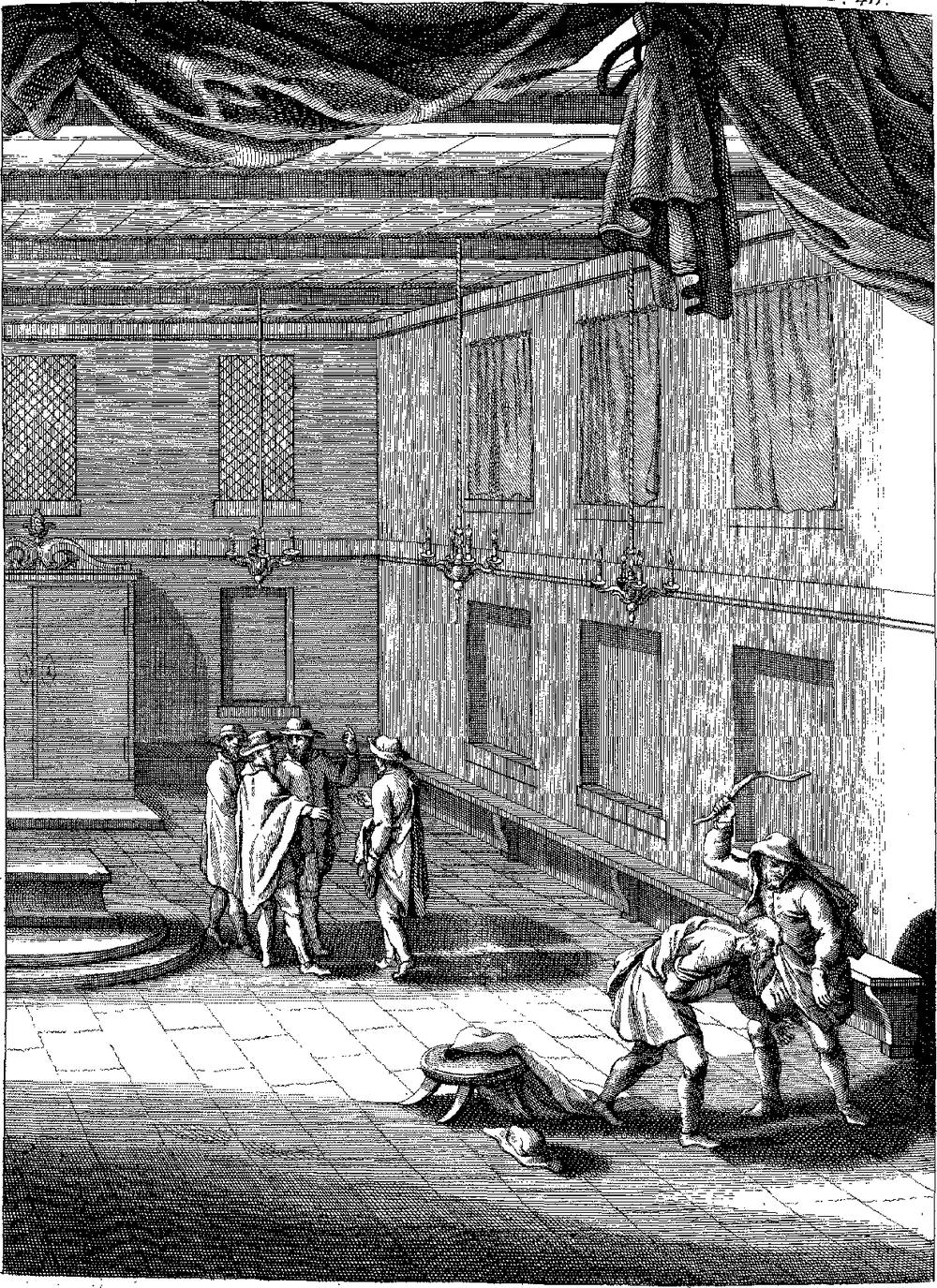
Upon the great day of Expiation, they confess themselves after the following manner74. Two Jews retire into a corner of the Synagogue, one bows very low before the other, with his Face turned towards the North: He who performs the Office of Confessor, gives the Penitent nine and thirty blows upon the back with a leathern strap, repeating these words, God being full of Ps. lxxvii. 38.Compassion, forgave their iniquity, and destroyed them not; yea many a time turned he his Anger away, and did not stir up all his Wrath: And as there are but thirteen words in this verse recited in the Hebrew, he repeats it three times, and at every word strikes one blow; which makes nine and thirty words, and as many Lashes. In the mean time the Penitent declares his Sins, and at the Confession of every one, beats himself upon his Breast. This done, he who has performed the Office of Confessor, prostrates himself on the ground, and receives nine and thirty Lashes from his Penitent.
Grotius75 on S. Matthew explains himself in a remarkable manner, with relation to private Confession. As to the Question, says he, which is proposed among learned Men, namely, whether the Passages in Numbers and Leviticus, wherein mention is made of Confession, refer to a Man’s confessing himself to God only, or whether every one ought to declare his Sins to the Priests: I hold their opinion to be very probable, who maintain, that a particular Confession was made by every one of his Sins to the Priests, in cases which did not expose the guilty to the penalty of Death; for in other cases it was sufficient for them to accuse themselves in general; and it is very credible, that the same thing was observed with still more Piety and Confidence, by those who came to John the Baptist, who was both Priest and Prophet; and besides, one whose fidelity was very well known .
CONFESSOR, Confession. In the language of the Church, the name of Confessors is given to those who have confessed the name of Jesus Christ before Judges, or have undergone some punishment for defending the Faith. If they died under their Torments, they were called Martyrs. Jesus Christ says, he will confess those before his heavenly Father, who shall have confessed him generously before Men; Mat. x. 32. 1 Tim. vi. 12. 1 Tim. vi. 13.and S. Paul commends Timothy for having confessed a good Confession; that is to say, for having, at the hazard of his Life, given a glorious Testimony to the Truth. The same Apostle says, that Jesus Christ witnessed a good Confession before Pontius Pilate.
Lev. xvi. 6.We find two sorts of Confessions in the Old Testament; the Confession of Praises, and the Confession of Sins. Nothing is more common in Scripture, than these words, Confitemini Domino; confitebor Domino, &c. that is to say, Praise the Lord, I will praise the Lord. Confession of Sins too both in publick and private, was in use among the Israelites. They confessed their Sins to God and the Priests. In the Ceremony of the solemn Expiation, the High Priest confessed in general his own Sins, the Sins of other Ministers of the Temple, and those of Ib. xvi. 21.all the People; and upon all other occasions, when any Israelite came to offer a Sacrifice for Sin, he put his hands upon the head of the Victim, and confessed his faults. There are some Interpreters, who believe, that it Levit. iv. 1, 2, 3, 4, &c.was not sufficient for him to declare himself in general a Sinner; but that he was to confess in particular the Sin for which he offered this Sacrifice. We are assured, that the Jews still at this day make a private Confession of their Sins upon the day of solemn Expiation, by them termed Cippur.
Acts viii.CONFIRMATION. The Sacrament of Confirmation is that which makes us perfect Christians, and impresses an indelible Character upon us after Baptism, and imparts to us the spirit of Fortitude, whereby we are enabled to confess Christianity, even at the hazard of our Lives. It is frequently called by the Antients, laying on of Hands, because it is conferred by imposition of Hands. The administration of this Sacrament was in the beginning reserved to the Apostles, or the Bishops their Successors, who only are the ordinary Ministers of it. We see the practice of it in the Acts of the Apostles, where it is 14, 15, 16, &c.said, that the Apostles being informed, that the People of Samaria had received the word of God, and had been baptized by Philip the Deacon, S. Peter and S. John went thither, and laid their hands upon all the Faithful there, who immediately received the Holy Ghost. S. Paul speaks likewise of the effects of this Sacrament, saying to the Ephesians, Grieve not the holy Spirit of
God, whereby ye are sealed unto the day of redemption.
Acts x. 44, 45, 46, &c. Acts viii. 9. 14, 16, 17, 18. 1 Cor. xii, xiii. Rom. xii. 6, 7. Ephes. iv. 7.In the Infancy of Christianity, the laying on of Hands by the Apostles, or Confirmation, was attended generally with miraculous Gifts and Graces, and with external Gifts of the Holy Ghost, such as that of Tongues, Prophecy, Miracles, and healing of Diseases. This is what manifestly appeared at the Baptism of Cornelius, the Holy Ghost descending upon those who like him desired Baptism, and by such an extraordinary Dispensation of Providence preventing Imposition of Hands. The Jews who came with S. Peter to Cæsarea, were amazed at it; and beheld those Gentiles with admiration, who spoke divers Languages, and glorified God as they did, who had been baptized, and received Imposition of Hands. And when the Apostles came to Samaria, to confirm the Faithful who imbraced Christianity on S. Philip’s preaching, they laid their Hands on them, and gave them the Holy Ghost. Hereupon Simon the Magician observing the wonderful effects wrought by their thus laying on their Hands, offered them a Sum of Money, to procure this surprising Power from them of conferring the Holy Ghost. Lastly, S. Paul in his Epistles speaks very often of these supernatural Gifts granted to the Faithful, by the laying on of Hands. And it appears by the Fathers76, that this extraordinary Power continued in the Church so long as to the third and fourth Ages.
As to the manner of Confirming made use of by the Apostles, the Scripture speaks only of Prayer, and Imposition of Hands. The most antient of the Fathers, and the oldest Rituals, do likewise take notice only of the laying on of Hands. In the eastern Churches, the Bishops and Priests for a very long time, have confirmed by anointing with the holy Oyl; and in the Latin Church the Bishops, who only are the ordinary Ministers of this Sacrament, confer it by laying on of their Hands, and by anointing the Forehead with the holy Chrism, using at the same time this Prayer, I sign you with the Sign of the Cross, and confirm you with the Chrism of Salvation, in the name of the Father, and of the Son, and of the Holy Ghost.
CONSCIENCE, is the Testimony or secret Judgment of the Soul, which gives its approbation to Actions that it thinks good, or reproaches itself with those which it believes to be evil. It is a Consequence of the light of Nature, which judges of the good or ill tendency of our Actions. Est Prov. xii. 18.qui promittit & quasi Gladio pungitur conscientiæ, says the Wiseman. There are People who engage themselves too easily, and have no sooner promised than they are touched with remorse for doing so: Such was Herod, who promised Salome the Daughter of Herodias all that she should ask, and had very soon the Mortification to hear, that she desired the Head Mat. xiv. 6, &c.of John the Baptist. A troubled Conscience, an evil Conscience, presumes always that some misfortune must follow. Semper præsumit sæva perturbata conscientia.Sap. xvii. 10. S. Paul says, that they who are without the written Law, have their Conscience, which gives them an inward Testimony of the Good and Evil performed Rom. ii. 15.by them. He requires Christians to be submissive to secular Powers, not only for fear, but also for conscience sake: Non solum propter iram sed etiam propter conscientiam. In another place, he permits the faithful to go and eat at the houses of the Gentiles, if they are invited thither, and to partake of every thing which is served up at their Tables, without making particular inquiries out of any scrupulosity of Conscience; asking no questions for Conscience sake. But if any one says to them, this has been sacrificed to Idols, do not eat of it, says he, for his sake who gave you this Information; and likewise lest you wound not your own, but another’s Conscience: Conscientiam autem dico, non tuam sed alterius. If he who gives you this notice is a Christian, and notwithstanding the Information so given you forbear not to eat; he will condemn you in his heart, or will eat of it after your example against his own Conscience, and so the guilt of his Sin will be imputed to you. If he is an Heathen, who thus advertises you, and he sees you eat of it, he will conceive a contempt for you and your Religion.
CONSECRATE, Consecration. To consecrate is to offer or devote any thing to God’s Worship and Service. In the old Law, God ordained that all the first born both of Man and Beast should be consecrated. Exod. xiii. 2, 12, 15. xxxiv. 19. Numb. iii. 12. Exod. xix. 6. 1 Pet. ii. 9. Numb. i. 49. iii. 6. & seq. Deut. x. 8.He likewise consecrated the whole Race of Abraham particularly to his Worship. Lastly, he devoted the Tribe of Levi, and the Family of Aaron in a more especial manner to his Service. Besides these Consecrations which God thus ordain’d by his own absolute and sovereign Authority, there were others which depended on the good will of Men, who consecrated themselves, or the things belonging to them, or the persons depending on them, to the service of God for ever, or for a time only.
Joshua devoted or consecrated the Gibeonites
Josh. ix. 27. Ezra viii. 20. & ii. 58. & 1 Kings ix. 20, 21. 1 Sam. i. 11.beonites to the service of the Tabernacle. David and Solomon in like manner devoted the Nethenims, who were some remains of the Canaanites, to the service of the Temple; they thus devoted them and their Descendants for ever. Hannah, Samuel’s Mother offered her Son to the Lord, to serve all his life-time in the Tabernacle. Luke i. 15.The Angel who promised Zachary a Son, commanded him from God, to consecrate him to the Lord, and to take care, that he observed those Laws for his whole life, Numb. vi. 1, 2, 3, &c.with the Nazarites, who are likewise consecrated to God, tho’ but for a certain time, observed during this time of their Consecration.
The Hebrews sometimes devoted their Fields or Cattle to the Lord; after which they were no longer in their power. If they had a mind to enjoy them again, they Levit. xxvii. 28, 29.were obliged to redeem them. David, and the Kings his Successors, often vowed and consecrated to the Lord the Arms and 1 Chr. xviii. 11.Spoils taken from their Enemies. As to the consecrating and devoting, as they did 2 Chr. xxiii. 9.sometimes, their Enemies, their Cities, and their Country to intire ruin, the Reader upon this Point may consult the Article Anathema.
In the New Testament we see in proportion the same Consecrations, as in the Old. All the Faithful are consecrated to the Lord; they are his holy Race, his chosen 1 Pet. ii. 9.People. Bishops and other sacred Ministers are devoted to him in a more peculiar manner, than common Christians, and they who consecrate themselves to God by solemn Vows, and the exercise of a Religious Life, come very near to the perpetual Nazarites of the Mosaic Law. Churches, Church-yards, Religious Houses, Monasteries, Sacred Vessels, and every thing belonging to the Worship of God, are likewise things consecrated , which deserve more or less Respect, as they relate more or less to the unbloody Sacrifice of the Body and Blood of Jesus Christ, who is offered for us upon our Altars, is the Holy of Holies, and sanctifies every thing that comes near him.
CONSISTORY, Consistorium Palatii, mentioned in Esther, is called likewise Est. v. 1.Basilica Regis; in Hebrew, the Kingdom’s House. It is to be observed, that in the King of Persia’s apartment there were three principal pieces of Work. The first was the outward Court, Atrium exterius, where the Courtiers met, who came to Court, Esth. vi. 4. The second was the Hall, or inner Court, Atrium interius, where every one was forbid to come on pain of Death, unless he were called, Esth. iv. 11. The third was the Cabinet, or a sort of corner or alcove, wherein was the King’s Throne, called Consistorium Palatii, or Basilica Regis, Esth. v. 1, 2.
As to the different Consistories, or places where the Hebrews administred Justice, we shall speak of them under the Title Sanhedrim or Tribunal.
Neh. ix. 14. Nahum i. 8, 9.CONSOLATION, to Console, are words often used by the Hebrews in the Sense of Revenge. See Revenge.
CONSUMMATION, Consummatio. This word does not signify only the Finishing, the End, the Perfection of any thing, but it likewise denotes frequently the utmost Misery. Numquid iratus es nobis usque ad consummationem? Art thou angry with us so far as to destroy us without hopes of recovery? And Psalm lviii. 14. Annuntiabuntur in consummatione, in ira consummationis, & non erunt: It will be every where published, that thou exercisest thy Vengeance in the day of Wrath, and they shall not subsist any longer. And Isaiah x. 22. Consummatio abbreviata inundabit justitiam; consummationem & abbreviationem faciet Dominus: The Justice of God shall be poured out upon Sinners, like a Deluge of Water; their ruin is resolved on, he will in a little time exterminate and destroy them: Consummatio abbreviata, or rather according to the Hebrew Consummatio or desolatio decisa, resolved, fixed, determined Destruction. The Prophet Nahum speaking of the ruin of Nineveh, In diluvio prætereunte consummationem faciet---- consummationem faciet, & non consurget duplex tribulatio: God will overflow this City with the Flood of his Wrath, he will destroy it, and will do it at once.
Jeremiah iv. 27. Deserta erit omnis terra, sed tamen consummationem non faciet: The Lord will reduce the Land to a meer solitude, but will not intirely destroy it. And Ezekiel xi. 13. Heu, heu, heu, Domine Deus, consummationem tu facis reliquiarum Israel: Alas! Lord, thou art going to annihilate the remains of Israel. We may observe expressions much alike in Isaiah xxxviii. 22. Jeremiah v. 10,18. xxx. 11. xlvi. 28. Ezekiel xx. 17. Daniel ix. 27, &c. In Psalm cxviii. 96. there is a more difficult passage, which however comes to the same. Omnis consummationis vidi finem, latum mandatum tuum nimis: I have seen, I have gone through the greatest dangers and misfor
tunes, I have been exposed to utter Destruction; but thy Commandments have set me free, have protected me. The Hebrew, Latitudo mandatorum tuorum, is opposite to finis consummationis, or extremæ consummationis.
CONTRADICTION. Waters of Strife, or Contradiction. This is the name of the place where Moses encamped when he smote the Rock with his Rod, and water thereupon issued out of it, where also he expressed some diffidence of God’s Promises: For which reason God declared to him, that he should never enter into the Land of Promise. This happened in the Desert of Paran, when the Israelites were encamped at Kadesh; and these Waters were called the Waters of Strife; because they rebell’d against Moses, and murmured against the Lord.
CONTRITION, or Sorrow for our Sins, attended with a sincere resolution of reforming them77. The Scripture never uses this term in this sense; but there are many expressions to be observed in it, which are equivalent, and prove that without Contrition there is no Repentance, and without Repentance no Remission of Sins: A broken and contrite heart, O God, thou shalt not despise. Psal. li. 17. I shall go softly all my years in the bitterness of my soul. Isai. xxxviii. 15. But if from thence thou shalt seek the Lord thy God, thou shalt find him, if thou seek him with all thy heart, with all thy soul, or, with all the sorrow of thy soul. See likewise Deut. iv. 29. xxx. 1, 2. S. Paul speaking to Agrippa, said, I have shewed unto the Jews and Gentiles that they should repent, and turn to God, and do works meet for repentance.
In those places generally where we meet with the words conterere and contritio, they signify to bruise, Bruising, Humiliation, Grief, Ruin, Destruction. For example, Contrition and Unhappiness are in the way of the Wicked; that is to say, God shall destroy them, and overwhelm them with Misfortunes. Pride goeth before Contrition; that is to say, Pride and Elevation are commonly followed with a Fall, with Destruction, &c.
CONVERTERE. Every one knows, that the literal signification of this word denotes changing, Thou hast turned my tears into joy. Turn ye not unto Idols: Ad idola Lev. xix. 4.nolite converti. God converted the heart of the King of the Assyrians. Turn us, O Lord, and we shall be turned, &c. These are ways of speaking in use even among ourselves. But Converti is often taken in Scripture for returning from the Babylonish Captivity. When the Ps. cxxvi. 1. Jer. xxiii. 3. Jer. xxxii. 44.Lord hath turned the Captivity of Sion; when he hath delivered his People from Captivity. I will gather the remnant of my flock out of all countries whither I have driven them, and will bring them again to their folds: Et convertam eos ad rura sua. And elsewhere, Convertam captivitatem eorum, &c.
COPHER. It is said in Cant. i. 14. My Beloved is to me as a cluster of Copher in the vineyards of Engedi. Copher is translated Cyprus in the Vulgate. Botrus Cypri. Now the Cypress Tree is a Shrub that grows as high as a Pomegranate Tree, its Leaves are like those of the Olive Tree, its Blossom is white and sweet, and its Fruit hangs like clusters of Grapes, and is of a very agreeable scent. When its leaves are dry and bruised, they make a yellow powder, with which the Egyptians and Turks painted their nails, and the Women among them their hands, part of their hair, and of their body.
COPONIUS, was the first Governor of Judæa established by Augustus, after the Banishment of King Archelaus to Vienne in France. Coponius was succeeded by Marcus Ambivius78.
COPTÆ. The Egyptians who profess Christianity are called thus at this day. This name is derived probably from Aiguptos, or Aicuphtos, by cutting off the first syllable Ai. There is frequent mention of Egypt in the Scripture, under the name of Misraïm in those Books which are written in the Hebrew, and of Aigyptos in those written in Greek.
CORAL. The Rabbins assert, that the Hebrew, Almugim, which S. Jerom has translated ligna Thyina, 1 Kings x. 11. signifies Coral. See Almugim.
CORBAN, Mark vii. 11. or Corbona, Mat. xxvii. 6. This word comes from the קרבKarob. קרבן Corban.Hebrew, Karab, or Hekerib to offer, present. It stands for an Offering, a Gift, a Present made to God, or his Temple. The Jews sometimes swore by Corban, or the Mat. xxiii. 18.Gifts offered unto God. Whosoever sweareth by the Gift that is upon the Altar, is bound. Theophrastus says, that the Tyrians forbad the use of such Oaths as were peculiar to Foreigners, and particularly of Corban; which, as79 Josephus informs us, was in use only among the Jews.
Jesus Christ reproaches the Jews in the Gospel with the cruelty which they shewed towards their Parents, and says that to excuse themselves from giving any part of their fortune to them, they would tell them, May what you ask of me be corban,80
and consecrated to God, or, May all that I am able to give you, be corban, and devoted to God in such a manner, that neither you nor I may be able to employ any thing of it to our use; or, lastly, I swear by corban, or the Gift which is made to God, that I will not assist you in any thing whatsoever. S. Matthew expresses much after this manner the reply which Children made to their Parents; It is a Gift by whatsoever thou mightest be profited by me81. The Offering which I make to God will be of service to you, I have devoted that to God, which you ask of me; it is no longer either yours or mine, but you will share in the merit of my Offering.
Josephus82 remarks, that among the Hebrews, Men and Women sometimes made themselves Corban; that is to say, consecrated themselves to God, or certain Ministries in his service. When Persons of this sort were desirous to releasc themselves from the obligation which they had thus imposed upon themselves, or the Ministry to which they had devoted themselves, they gave a sum of Money to the Priest, a Man fifty, a Woman thirty Shekels. If they were not in a condition to pay this sum, they agreed with the Priest, and gave him so much as he was satisfied with.
Philo83 speaking of those who devote themselves to God, relates what Moses says in Leviticus, ch. xxvii. 2, 3, 4. and following verses, He who has devoted his soul, his Life, his Person to God, shall pay the price estimated by the Priest. A man from twenty to fifty, shall give fifty shekels, according to the measure of the Sanctuary; and a woman thirty. From five to twenty a boy shall pay twenty shekels, and a girl ten. From a month old to five years, five shekels shall be given for a male child, and three for a female. From sixty and above, a man shall give fifteen, and a woman ten shekels. If he who has made the vow is too poor, he shall present himself before the Priest, and shall pay according to the estimation which shall be made of him. What is the reason, says Philo, that in all this there is no consideration of the age, wealth, or other qualities of those who make the Vow? To this he answers, The reason is first, because the Vow is of equal dignity, let the condition of those who make it be what it will. 2°. It is not decent to value those who make Vows, as we do Slaves, who are rated according to their beauty, their graceful stature, or good health. The third and principal reason is this, that equality of Conditions, which is despised by Men, is considered and esteemed by God.
Lev. xxvii. 9, 10, &c.Moses speaks farther of different sorts of Corban, or Dedications made by the Hebrews, of some part of their Estates, which was afterwards redeemed, or if it consisted in Cattle was sanctified, in the manner appointed by the Legislator.
Acts xxiii. 12. Mat. vii. 11.When a Man had devoted all his fortune, he was forbidden to make use of it; if all that he was to give his Wife, or his Father and Mother, was declared Corban, he was no longer permitted to allow them necessary subsistence. They who in the Acts of the Apostles made a Vow neither to eat nor drink, till they had killed S. Paul, in some sort made every thing Corban that belonged to them; or every thing that might supply them with Meat and Drink. The Sons mentioned in the Gospel, who declared every thing Corban that they could contribute to the support of their Father and Mother, were induced to this cruelty by some transport of Passion only; for had they done so through avarice, what could they have gained by devoting that to God which they refused their Parents? But without devoting it to God, they were satisfied with declaring it to be Corban with respect to those to whom a part of it was due; for example, they said, my whole fortune as to you is Corban, I can give you no share of it: I have made a Vow to communicate nothing of it to you84.
To facilitate the practice of these Vows, which were so contrary to Charity and Religion, or rather to confirm and increase the spirit of Superstition in the People, the Jewish Doctors did not require them to be pronounced in the most formal manner; it was of little consequence whether the word Corban were so much as mentioned, tho’ this was most in use, provided something was said which might come near it. These are the Vows, thus imperfect in the terms of them, which the Talmudists call Handles85 °, because, as it is sufficient to take a Vessel by the handle, in order to lift it up all intire; so to compleat a Vow, it is enough to pronounce any word of it; and if any said, May this be as the Temple to me, or as the Altar, or as the Fire, or lastly, as the Sacrifice this was not to be dispensed with. They permitted even Debtors to defraud their Creditors, by consecrating their debt to God86, as if the thing were theirs, and not their Creditors.
Corbona signifies also the Treasury of
the Temple, where the Offerings which were made in Money were deposited. The Jews taking up the Money which Judas cast into the Temple, after he had betrayed Jesus Christ, made a scruple of laying it up in the Treasury of the Temple, Mat. xxvii. 6.because it was the price of Blood; and an Offering of such a nature was esteemed to be impure. They resolved therefore to purchase a field with it, to be a burying place for Strangers.
CORD. To put Cords about ones Reins, or to girt ones self about with a Cord, was a mark of Sorrow and Humiliation. God loosetb the bond of kings, and girdeth their loins with a girdle, says Job. Job xii. 18.The servants of Benhadad King of Syria presented themselves before the King of Israel with sackcleth upon their loins, and 1 Kings xx. 31,32.ropes on their heads, imploring Ahab’s clemency to Benhadad. Isaiah iii. 24. threatens the Daughters of Sion with giving them pro zona funiculum, Cords for Girdles.
CORD, Funiculus is often used for Inheritance, I will give thee the land Psal. cv. 11. Ezek. xlvii. 13.of Canaan the Cord of thine inheritance. Joseph hath a double Cord, a double Portion: Which expression had its Original from their custom of measuring land with a Cord; so Joshua distributed to every Tribe a certain number of Cords or Acres, Ps. xv. 6.&c. Funes ceciderunt mihi in præclaris, my Lot is fallen in an excellent Country.
The cords of hell compassed me about; or 2 Sam. xxii. 6.as the Hebrew reads it, the cables of Hell, of the Grave, closed me in. He alludes to the Fillets which were bound about dead Bodies: He farther calls them in the same place, the bands of death. The Septuagint, instead of cables of Hell, have translated it in Psalm xviii. 6. the pains of death. S. Peter says, 2 Pet. ii. 4.that God dragg’d the rebellious Angels into Hell with the Cables of Hell, thereby meaning Cords of such a solidity and strength, as nothing is capable of resisting.
cxix. 61.The Cords of Sinners, funes peccatorum circumplexi sunt me, are the snares with which they catch weak and innocent People. The Cords of Sins mentioned by the wise Man, Prov. v. 22. are the consequences of crimes and bad habits: Sin never goes unpunished, either in this World or the other; and the bad habits which are contracted, are as it were indissoluble bands, from which it is almost impossible to secure ourselves.
Baruch vi. 43.Baruch speaks of a very extraordinary custom among the Babylonians. The women with cords about them sitting in the ways, burn bran for perfume: but if any of them drawn by some that passeth by lie with him; she reproacheth her fellow that she was not thought as worthy as herself, nor her cord broken. He alludes to the ceremony mentioned by Herodotus87; the Babylonian Women, says he, have a custom of prostituting themselves once in their lives, in honour of Melitta: they stand near the Temple of the Goddess with Cords about their heads, as marks of their devoting themselves: They are separated from one another by lines; into these separations Strangers enter, carry off those whom they like best, and break the Cords which hang about their heads.
To stretch a cord or line about a city, signifies to ruin, to destroy it intirely, to level it with the ground. Jeremiah, Lament. ii. 8. The Lord hath purposed to destroy the wall of the daughters of Zion; he hath stretched out a line, he hath not withdrawn his hand from destroying.
The Cords extended in setting up Tents, do likewise furnish several Metaphors; for example, the Cords of Jerusalem shall not be broken, nor the If. xxxiii. 20, 23.nails which fasten them be pull’d out. And in another place, Thy cords are loose, they could not well strengthen their mast. And Jeremiah ch. x. v. 20. My tabernacle is spoiled, and all my cords are broken.
CORNER, Angulus, is taken for the extremity of any Land, Country, Habit, of the Beard and Hair, of a People, Building, Table, Altar, &c. Ye shall not round the corners of their heads, neither shalt thou mark the corners of thy beard, says Moses. Lev. xix. 27.Thou shalt not cut it off intirely towards the ears, at the extremity of the Chin. All Israel, all the extremities of the people, omnes anguli populorum; and all the Tribes assembled together at Mizpeh. In the opinion of some, by the extremity of Judic. xx. 2.the people, is meant all the People without exception, from one end of the land to the other. Others think this expression denotes the principal and first88. See likewise 1 Sam. xiv. 38. Draw near all ye chief (or corners) of the people. And Isai. xix. 13. They have reduced Egypt, even they who are the stay (corner) of all the tribes thereof. And Zephaniah iii. 6. I have cut off the nations, their corners are desolate. In all these passages the Corner of the People seems to denote the whole Body of the People from one Corner to another.
The Corner sometimes signifies the most devoted place, the part of the Edifice most in sight. Zachary speaking of the Tribe of Judah after their return
Zech. x. 4.from the Captivity, says, Out of him came forth the corner, out of him the nail. This Tribe shall afford Corners, Heads; it shall produce the Corner Stone, the Messiah reproved If. xxviii. 16. Psal. cxvi. 22. Mat. xxi. 42, &c.and rejected by the Jews, but exalted to great Glory by his heavenly Father. Corner is taken likewise for the most obscure place of a House, Prov. xxi. 9. xxv. 24. It is better to dwell in a corner of the house top, than with an angry woman in a wide house; and Acts xxvi. 26. S. Paul speaking before Agrippa of matters relating to our Saviour and his resurrection, calls him to witness, and tells him, that these things are known sufficiently, and that they were not transacted in a Corner.
COREÆ. Josephus89 says, that Coreæ was the first place in Judæa, on the North side of it. This Town lay near the Castle of Alexandrium, which was situated on the top of a Mountain in the way between Coreæ and Jericho90.
CORIANDER, a small round Seed, of a good scent. Moses says, that the Manna which God gave the Israelites in the Wilderness, as to the form of it, was like Exod. xvi. 31. Num. xi. 8.Coriander seed; as to its colour, was white, or the colour of Bdellium, as Moses describes it in those very places, where he compares it with Coriander seed.
CORINTH, a celebrated City, the Capital of Achaia seated on the Isthmus which separates the Peloponnesus from Attica. S Paul came to preach at Corinth Acts xviii. 1, 2, & seq.in the year of J. C. 52. This City was one of the best peopled, and most wealthy of all Greece. Its situation between two Seas drew thither the Trade of both the East and West from all parts. Its Riches produced Pride, Ostentation, Effeminacy, and all manner of Vices, which are the consequences of too great Plenty. Lasciviousness particularly was not only tolerated there, but in some sort consecrated, by the worship of Venus, and the publick prostitution of those who were devoted to her. The Corinthians as well as other Greeks, pretended to Philosophy, Politeness and Learning. Such was the condition of Corinth, when S. Paul arrived there: These were the Monsters which he was to encounter.
He lodged there with one Aquila and his Wife Priscilla, who, as well as he, made Tents; thus he got a Livelihood by the labour of his own hands, to prevent his being burdensome to any one. He preached every Saturday in the Jewish Synagogues, and converted some who heard him. From Corinth he wrote his two Epistles to the Thessalonians in the year of J. C. 52. Some time after, observing, that the Jews of Corinth, instead of being benefited by his Instructions, opposed him with very blasphemous language; he shook his Raiment, and said, Your Blood be upon your own heads, I am clean; from henceforth I will go unto the Acts xviii. 6, 7, 8.Gentiles. He went therefore and lodged with Justus sirnamed Titus, who was a Gentile indeed, but one who feared God: And many of the Gentiles afterwards embraced the Faith. S. Paul suffered a great deal at Corinth, but Jesus Christ appeared one night to him, and said, Be not afraid, for I have much People in this City. Encouraged by these words, he continued eighteen Months at Corinth, or in the Acts xviii. 11.neighbouring places.
He departed from thence in the fifty fourth year of J. C. and went to Jerusalem. About two years after, that is to say, in the year of J. C. 56. He wrote his first Epistle to the Corinthians from Ephesus, where he was at that time. Herein the Apostle reproves some particular Persons, who disturbed the Peace of this Church, and, upon pretence that there were different Sects and Parties in the Church, as well as among the Philosophers, called themselves the followers of Paul, of Peter or Cephas, and of Apollos, according to their different affections. He complains likewise that there were some disorders in their Assemblies, that there were Law-suits among them, and that a Christian had committed Incest with his Mother-in-law his Father’s Wife. This Letter was sent by Stephanus, Fortunatus and Achaicus. It had all the Success S. Paul could hope for, since it produced a saving sorrow, great vigilance against the vices wherewith he had reproached them, and a very beneficial dread of God’s anger. They repaired the scandal which had been given, and expressed abundance of zeal against the Crime of the incestuous person.
2 Cor. vii. 9, 10, 11.S. Paul having understood the good effects which his first Letter had produced among the Corinthians, wrote a second to them, in the year of J. C. 57. He wrote from Macedonia, and probably from the City of Philippi. He expressed his satisfaction at the Conduct they had observed with regard to the incestuous person; justified himself in those particulars, which the false Apostles had objected to him, and exalted the Gospel Ministry above that of Moses. He glories in the Labours and Persecutions which he had suffered; and lastly, exhorts the Corinthians to prepare their Alms which they designed to send to the Faithful in Judæa. This second Epistle was carried by Titus, and another Brother, whom the Churches had associated with him, in order to col
Corinth continues on the next page
Footnotes
-
Bartolin de Morb. Bibl. Art. 26. ↩
-
Vide Bolland. 19 Maii. ↩
-
Joseph. Antiq, l. x. c. 4. De Bello l. ii. c. 18. p. 793. ↩
-
Antiq. l. xix. c. 4 p. 674. ↩
-
Dio. l. 60. p. 669. ↩
-
Joseph. Antiq. l. xx. c. 3. ↩
-
Antiq. l. xx. c. 1. p. 682. ↩
-
Sueton. l. v c. 25. ↩
-
Antiq. l. xx. c. 5. ↩
-
Antiq. l. xx. c. 6. ↩
-
Ibidem, p. 695. ↩
-
Idem, p. 695. ↩
-
Antiq. l. xx. c. 7. p. 696. ↩
-
Greg. Turon. l. i. de gloria Martyr. c. 6. ↩
-
Theodorit. l. ii. Hist. Eccles. c. 18. Ambros. &c. ↩
-
Nonnus in Joan. Nazianz. Poemat de Christo, &c. ↩
-
Justin. contra Tryphon. Irenæ. l. ii. 42. Ipse habitus crucis fines & summitates habet quinque, duas in longitudine, & duas in latitudine, & unum in medio, ubi requiescit qui clavis affigitur. Vide Bartholin. de cruce, c. 1. & sedili medio. ↩
-
Chrysost. homil. 1. in Timoth. i. p. 403. ↩
-
Iren. l. iii. c. 3. ↩
-
Origen, Princip. l. ii. c. 3. ↩
-
Clem. Alex. Strom. l. iv. p. 516. ↩
-
Constit. l. vii. c. 46. v Recognit. prim. parte, p. 398. ↩
-
Tertul. Præscript. c. 32. ↩
-
Epiphan. Hæres. xxvii. c. 6. w Iren. l. iii. c. 3. Euseb. l. iii. c. 2, 4, 21. Hist. Eccles. ↩
-
Hermas Pastor, l. i. c. 2. ↩
-
Euseb. l. iii. c. 34. Hist. Eccles. Hieronym. de viris illustrib. c. 15. ↩
-
Euseb. l. iii. hist. Eccles. c. 11. Epiph. hæres. 78. c. 7. ↩
-
Gregory the Great in Job, l. i. c. 1. believes, that the Disciple, who went to Emmaus with Cleopas, was S. Luke. Origen in Jerem. Homil. 19. and S. Basil in Isai. vi. call him Simon. S. Epiphanius hæres. 23. c. 6. thinks it was Nathanael. S. Ambrose in David’s Apology, l. ii. c. 8. and upon S. Luke, c. xii. and elsewhere calls him Emmaus. He has the same name given him in a very antient Manuscript kept at Corbie, the various readings whereof have been set down by us at the end of our Comment on the Revelations. ↩
-
Hieron. Epist. 27. ↩
-
Hieronym. in Dan. xi. 17. Appian. Syriac. p. 88. ↩
-
Justin. l. xxxix. c. 2. Appian. Syriac. p. 132. ↩
-
Joseph. Antiq. l. xiii. c. 18. & Strabo apud eundem, p. 457. ↩
-
In the year of the World 3898, J. C. 102. before the vulg. Æra 106. ↩
-
Justin, l. xxxix. c. 4. Pausan. Atticis, p. 8. ↩
-
Septima Synod. general. Can. Hieronym. ad Nepotian. Ep. 2. Bernard. Ep. 237, &c. ↩
-
Rab. Solom. & Abenezra. ↩
-
Eufeb. in locis in Beelsephon. Διὰ τῦ Κλύσματος παρὰ τὴν Θάλασσαν. ↩
-
Philostorg. Hist. Eccles l. iii. c. 6. ↩
-
Cosm. Ægypt. l. v. p. 194. ↩
-
Greg. Turon. Hist. l. i. c. 10. ↩
-
Epiphan. l. ii. contra hæres. p. 613. ↩
-
Vide Athenas. Hist. Arian. ad Monach. t. 1. p. 385. & Tabul. Peutinger. ↩
-
Ptolem. Itinerar. Antonini, &c. ↩
-
Abulfeda’s description of the Red Sea, p. 70, 71, 74, 75. ↩
-
Translators’ note. The Septuagint read, ἐν Οἴκῳ. ↩
-
Malvenda. ↩
-
Serar. Cornel. ↩
-
יקחו מקוה במחיר ↩
-
Plin. l. 6. c. 29. ↩
-
Montan. Jun. Lud. de Dieu. Braun. ↩
-
Pagnin. Vatab. Castal. ↩
-
Bochart. de anim. sacr. parte I. l. ii. c. 9. ↩
-
Ovid. Amor. l. iii. ↩
-
Bellon. observ. l. i. c. 17. ↩
-
Chald. & Hebræi. Lyr. Thom. in Job. xxxviii. 36. ↩
-
מי נתן לשכוי בינה ↩
-
Syr. Mercer. Grot. Vatab. Scultet. Boch. ↩
-
Translators’ note. Vulgate. ↩
-
יהוה מטלטלך גבר ↩
-
Buxtorf. Synag. Jud. c. 20. ↩
-
Ceremon. of the Jews, part iii. c. 6. ↩
-
Strabo, l. xvi. ↩
-
Joseph. Antiq. l. i. c. 11. ↩
-
Heb. ערבMixtura Κοινόμυιαν Muscæ variæ. Κυνόμυιαν, Muscam Caninam. ↩
-
Vide Col. ii. 1. Hieronym. ad Philemon. v. 22. Chrysost. Theophyl. Athanas. in Synopsi. Estius, alii. ↩
-
Suidas. Zonar. Glycus. Eustat. Calepin. Munster. ↩
-
Plin. l. xxxiv. c. 7. Strabo l. xiv. ↩
-
Polyb. l. v. Strabo l. xiv. º Bibl. Orient. p. 171. ↩
-
Translators’ note. Our Author here, as usual, follows the Latin Vulgate, which runs thus, Quæ dicitis in cordibus vestris in cubilibus vestris compungimini. The incomparable Grotius disapproves of this Version, and produces one more accurate, and agreeing better with the Hebrew. Cogitate in corde vestro, in cubili vestro, & silete; id est, pœnitentiam agite according to the Arabic Interpretation. Our English Translation, which seldom varies from the Original, is in this Passage a literal Explanation of it, Commune in your own heart upon your bed, and be still. The Hebrew is, אמרו בלבבכם על־משכבכם ודמו ↩
-
Chrysost. Homil. 18. in Gen. p. 203. ↩
-
Aug. l.v. contra Donatist. ↩
-
Buxtorf. Syn. Judæor. c. 35. ↩
-
Idem, c. 18. ↩
-
Idem, c. 20. ↩
-
Grot. in Mat. iii. 6. ↩
-
Vide Iren. l. ii. c 52, & 57. & l. v. c. 6. Justin. Apolog. 1. & Dialog. cum Tryphone, p. 315. Constit. Apost. l. viii. c. 1. Hilar. in Psal. lxiv. v. 12. Eufeb. in Psal. xlvi. ↩
-
Concil. Trident. Sess. xiv. c. 4. Contritio est animi dolor ac detestatio de peccato commisso, cum proposito non peccandi de cætero. ↩
-
Vide Joseph. Antiq. l. 18. c. 1, 2, 3. & de Bello, l. ii. c. 12. ↩
-
Apud Joseph. l. i. contra Appion. ↩
-
Translators’ note. The Form of this Vow is in express Terms mentioned in the Talmud: And tho’ such a Vow as this is against both Nature and Reason, yet the Pharisees, and the Talmudists their Successors approve of it. ↩
-
Translators’ note. By this word such Persons were likewise meant, as devoted themselves to the service of God and his Temple, Joseph. contra Appion. lib. i. There are various Cases relating to this Practice in the Mishnah, under the Title Nedarim. ↩
-
Antiq. l. iv. c. 4. Καὶ οἱ Κορβᾶν αὐτὸς ὀνομάζοντες τῷ Θεῷ, δῶρον δὲ τῦτο σημαίνει κατὰ Ἑλλήνων γλῶτταν. ↩
-
Philo de specialib. legib. p. 774. ↩
-
Basnage Hist. des Juifs l. vii. c. 19. ↩
-
ירותansas or manus, handles, hands. ↩
-
Vide Capell. in Mat. i. 15. ex Origen. ↩
-
Herodot. l. i. c. 199. ↩
-
Translators’ note. And so our English Translation understands it: that reading the Original פנות כל־העםthe Chief of all the People: And in the following Passages referr’d to by our Author, it adheres generally to the same Interpre- tation of the word .פנות ↩
-
Antiq. l. xiv. c. 6. ↩
-
Antiq. l. xiii. c. 24. xvi. 2. xiv. 6. ↩