Volume I, pages 418–438 of the 1732 edition, from COR to CYP: everything printed on these pages, in order.
Continued from Corinth
lect the Charity of the Faithful. Some think this Brother to have been S. Luke, others Barnabas. There is a great deal of probability, that S. Paul came himself to Corinth, towards the end of this fifty seventh year1.
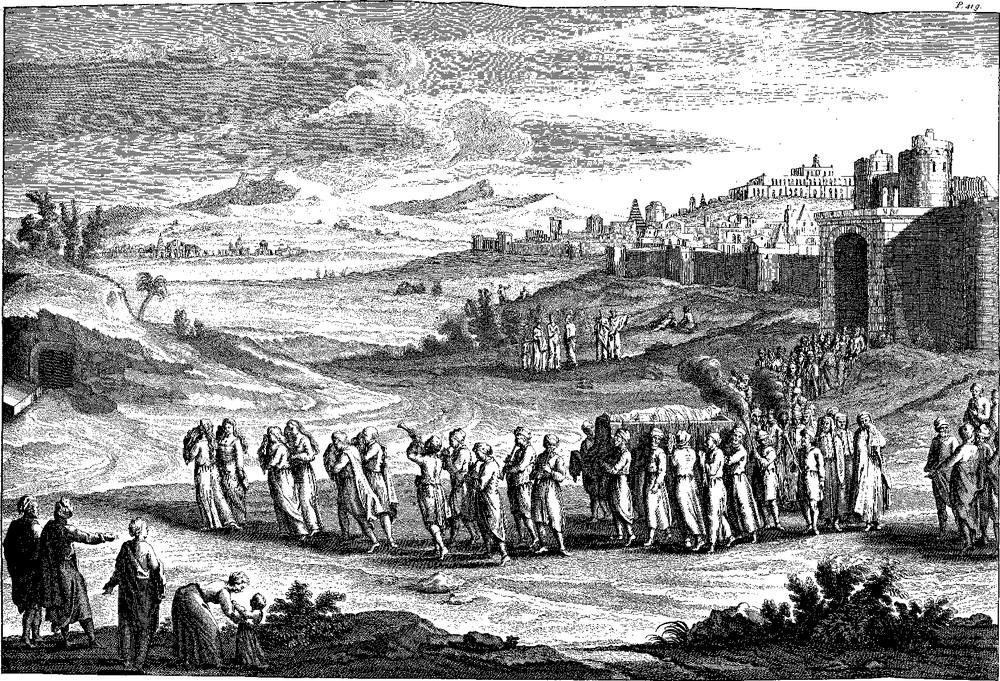
CORNELIUS, Centurion of a Cohort belonging to the Legion sirnamed Italian. Acts x. 1, 2, 3, 4, 5, 6, &c.He was a Gentile, but one that feared God, was constant at his Devotions, and did many charitable Acts. His whole Family served God as he did. He had learned these pious Practices in all probability from the Jews, who were very numerous at Cæsarea, where he was in Garrison. While he was one day fasting and praying, about three a clock in the afternoon, he saw an Angel in a vision very distinctly, who enter’d into his Chamber in the form of a Man, cloathed in a bright glittering Robe,and called him by his name, saying, thy Prayers and thine Alms are come up for a memorial before God: Send therefore presently to Joppa, and call for Simon Peter, he shall tell thee what thou must do, that thou and thy whole Family may be saved. After this the Angel informed him where Peter lived, and so withdrew.
When the Angel was departed, Cornelius called two of his Servants, and a Soldier, who feared God: To these he related what had happened, and sent them to Joppa with a request to Peter, that he would come to him. They immediately set out upon their Journey, and the next day arrived there, about noon, or something later. Before their arrival, Peter went upon the Terrass of the House where he lodged, and while he was there praying, he fell into an extasy, and saw something like a large cloth held by the four corners, which descended to him from Heaven. In this cloth were Beasts, Birds, and creeping things of all kinds; and he heard a voice, saying, Rise, Peter, kill, and eat. The meaning of which words was, that there was nothing impure which God declared to be pure. He excused himself from touching any thing, because he had never tasted any thing unclean. But the voice answered him, Call not that unclean which God has purified. The same thing was repeated three times, and then the Cloth was drawn up into Heaven.
At the same time the three Men arrived at Joppa, whom Cornelius had sent thither; and the Holy Spirit inwardly suggested to him, that they came by his direction, and that he should make no difficulty of going with them. Peter therefore received them, detained them that day, and the next departed with them. The next day about three in the afternoon they reached Cæsarea. Cornelius waited for S. Peter with all his most intimate Friends and Relations, whom he had got together for this purpose. As soon as he understood that he was near, he went out to meet him, and threw himself at his Feet. But S. Peter raised him, saying to him, I my self also am a Man. They proceeded therefore to the house, and entered it conversing together. Cornelius gave him a particular Relation of what had happened to him, and told him, that he, and all who were there present, expected him to declare what God should reveal to them by his mouth.
Then Peter in few words told him, that Jesus Christ had been sent by God for the Salvation of all Men, to be Judge both of the quick and dead, and to grant remission of Sins to such as should believe in him: That the Jews had unjustly crucified him, but that God had raised him from the dead, and his Disciples had eat and drunk with him after his Resurrection.
Acts xi. 1, 2, & seq.While S. Peter was discoursing in this manner, the Holy Ghost, which had purified their Hearts by Faith, descended on all those who heard him; and they began to speak divers Languages, and glorify God; which extremely surprized the believing Jews, who came from Joppa with S. Peter. Then said he, Can any one refuse these People Baptism, who have already received the Holy Ghost as well as we? And he commanded them to be baptized in the name of Jesus Christ. Cornelius desired S. Peter to stay some days with him, which he did without any difficulty. The news being brought to Jerusalem, that one uncircumcised had been baptized, the Faithful there were very much offended; for hitherto the door of Faith had not yet been opened to the Gentiles. But S. Peter returning to Jerusalem, and relating what had passed to them, they were appeased, and glorified God, who had thus imparted the Gift of Repentance to the Gentiles, in order to prepare them for that inestimable one of eternal Life.
Usuardus and others of the Latins, make Cornelius Bishop of Cæsarea in Palestine. The Apostolical Constitutions take notice likewise of one Cornelius, as Bishop of this City next after Zachæus2: But they do not tell us that he was the Centurion, of whom we are now speaking. Eusebius, who was Bishop of this Church, does not reckon him among his Predecessors. We have the Acts of Cornelius, but they are not an original or authentick piece. Some modern Greeks
make him Bishop of Illium, others of Scepsis, which is not far from it. The Greeks in their Menologies, treat him as a Martyr. They keep his Festival on the thirteenth of September, and the Latins on the second of February. S. Jerom says, that the House which Cornelius lived in at Cæsarea, was afterwards changed into a Church, which S. Paula visited with great Devotion in the year of J. C. 385.
CORNU-STIBII, an Horn or Vessel full of Paint or Antimony. In old times Horns were much used instead of Vessels, and Antimony was imployed in colouring the Eyes, and dilating the Eye-lids: For black and large Eyes were thought to be the most beautiful. In the Hebrew we read, Horn of Phuc. Now, the word Phuc, signifies sometimes Job xlii. 14. 70קרן .פוך Κέρας ἀμαλθείας. 1 Chr. xxix. 2. Isai. liv. 11.Antimony, and sometimes a precious Stone. The Septuagint translate it, Horn of plenty, or Amalthæa’s Horn: The Chaldee, sparkling like an Emerald.
CORSEUS, the name of a River, which runs near Cæsarea in Palestine. Ptolem.
I. CORUS, or Omer, a sort of Hebrew Measure, containing ten Baths, or seventy five Gallons and five Pints, as a Measure of things liquid, and thirty two Pecks and one Pint as a Measure for things dry3. When God sent Quails a second time into the Israelites Camp, every one gathered so large a quantity of them, that they who got least had ten Corus’s. Qui parum, decem coros.
II. CORUS, a sort of wind, which in Summer rises in the West, and is called at present the North East. S. Luke in the Acts says, that the Vessel which carried S. Paul to Rome, went from the Fair Havens to Phœnice, which is a port in the Island of Crete, and lies between the Winds called Africus and Corus; that is to say, the South-West and North-East.
COSAM, Son of Elmodam, and one of our Saviour’s Ancestors, according to his human Luke iii. 28.Nature.
COSTOBARUS, an Idumæan descended from one of the most illustrious Families of the Country, whose Ancestors had been Priests of the God Chosen, who was worshipped by the Idumæans, before they were subdued by John Hircanus, and by him compell’d to receive Circumcision4. Herod the Great, to whom Costobarus had been very serviceable, gave him his Sister Salome in Marriage. But Costobarus, pushed on by an unmeasurable ambition, intended to persuade the Idumæans to shake off the Jewish Yoke, and wrote to Queen Cleopatra, desiring her to ask this Kingdom of Mark Antony, imagining that this Princess would set the Crown upon his Head. Herod, upon a discovery of this Conspiracy, determined to put Costabarus to death: But Salome his Sister, and Costobarus’s Wife, obtained his Pardon, and preserved his Life.
Sometime after, Costobarus having quarrelled with Salome, she separated from him, and accused him afterwards to Herod, of being concerned in the Conspiracy, which Antipater, Lysimachus, and Dositheus were engaged in, and of saving and receiving into one of his Castles the Children of Babas, whom Herod had commanded to be executed, when he took Jerusalem. These Accusations upon enquiry proving true, Herod put Costobarus to death5, in the year of the World 3978. before the vulgar Æra 26.
II. COSTOBARUS, a Relation of King Agrippa’s, having put himself, together with one Saul, at the head of a Troop of Thieves and Villains, did an infinite deal of Mischief in Judæa. They left Jerusalem after the defeat of Cassius, foreseeing well the Misfortunes with which their Country would be overwhelmed6, and went away to Cestius, who sent them to Nero, at that time in Achaia, that they might lay before him the State of Judæa, and impute the whole Cause of the War to Florus’s ill conduct.
COTTON, in Latin Gossypium, a kind of white soft Wool, which is found in a sort of brown Nut, growing upon a Shrub, the Leaves whereof are like those of a Sycomore Tree, and almost of the same Figure. This Plant puts forth abundance of beautiful yellow Flowers, finer than those of that kind of Mint which smells like Musk; the ground of this Flower is of a Purple colour, and all striped within. There is an oval Bud that appears in the middle, and grows in time as big as a Pigeon’s Egg. When it is ripe, it turns black, and divides itself at top into three parts; the Cotton of it looks as white as Snow, and with the heat swells to the largeness of a Pullet’s Egg. There are three black Berries in the bud as big as Lupines that stick close together.
שש Schesch, Byssus. Exod. xxv. 4.It is our opinion, that the Scripture speaks of Cotton under the Hebrew name Schesch, which in Latin is translated Byssus. The word Xylinum, which signifies Cotton, may be derived from Schesch or
Xes and Linum, and that of Gossypium, which signifies the same thing, may be formed from the Hebrew Ægos, a Nut, and Pioth, Mouths, because the Nut, which produces Cotton, opens itself, and shews the Wool which it is filled with. See our comment upon Exodus xxv. 4. p. 333.
COVENANT. The word Testamentum is often used in holy Scripture, and Diatheke in the Greek, to express the meaning of the בריתBerith. Fœdus. Græc. διαθήκη Testamentum.Hebrew word Berith, which signifies Covenant; from whence come the words Old and New Testament, to denote the Old and New Covenant. The first Covenant with the Hebrews, is that sworn between God and Abraham, when the Lord chose Abraham and his Posterity for his People, and gave them Circumcision for a mark of his Covenant with them; which was solemnly renewed at Sinai, where principally the Old Covenant begins, as comprehending all those who observe the Law of Moses. The New Covenant, whereof Jesus Christ was the Mediator and Author, and which was cemented by his Blood, comprehends all who believe in him, and are in his Church. This succeeded the Old Covenant, and will subsist to the end of Ages.
The first Covenant between God and Man, was that which he made with Adam at his Creation, when he required him to Gen. ii. 16.forbear the use of the forbidden Fruit. The Lord took the man, and put him into the garden, and commanded him saying, Of every tree of the garden thou mayest freely eat: but of the tree of knowledge of good and evil thou shalt not eat of it; for in the day that thou eatest thereof thou shalt surely die, or you shall become mortal. This, says S. Austin, is the first Covenant which God made with Man.7 Testamentum autem primum quod factum est ad hominem primum, profecto illud est: Qua die ederitis, Eccl. xiv. 17. according to the Greek. 1 Cor. xv. 22.morte moriemini: Hence it is written, Testamentum a sæculo morte moriens.
The second Covenant, is that which God made with Man after his Fall, by promising him not only forgiveness, provided he repented; but also the coming of the Messiah, who should redeem him and all his Race from the death of Sin, and from the second death, which is that of Eternity. St. Paul in many places speaks to us of this Covenant, whereby the second Adam has redeemed and delivered those from Death, who had been condemned to die, by the procurement of the first Adam. As in Adam all die, so in Christ shall all be made alive. And in another place, As by Rom. v. 12.— 19.one man sin entred into the world, and death by sin, and so Gen. iii. 15. Heb. ii. 14.death passed upon all men, for that all have sinned---- as by one man’s disobedience many were made sinners, so by the obedience of one many shall be made righteous. And God said to the Serpent, I will put enmity between thee and the woman, and between thy seed and her seed: it shall bruise thy head, and thou shalt bruise his heel. The Woman’s Posterity which should bruise the Serpent’s Head, is the Messiah, who by his death hath been the destruction of the Devil, who had the power of Death.
Gen. vi. 18. With thee will I establish my Covenant.A third Covenant, is that which God made with Noah, when he directed him to build an Ark, or large Vessel, wherein he might preserve all the Animals of the Earth, and convey a certain number of Men into it, that by their means the new World after the Deluge might be repeopled.
Gen. ix. 8, 9, 10, 11.This Covenant was renewed an hundred and one and twenty years afterwards, when the Waters of the Deluge having fallen, and Noah with his Wife and Children left the Ark, God said to him, Behold I establish my Covenant with you, and with your seed after you; and with every living creature that is with you, from all that go out of the Ark, to every beast of the earth: so that all flesh shall not be cut off any more by the waters of a flood: and I will set my bow in the cloud, and it shall be a token of a covenant between me and the earth.
Gen. xii. 1, 2, 3, &c. xv. 4, 5. —18.All these Covenants were generally between Adam and Noah, and all their Posterity. But that which God made afterwards with Abraham, was more limited, it concerned this Patriarch only, and his Family, which should be derived from him by Isaac. The other Descendants of Abraham by Ishmael, and the Sons of Keturah, were to have no share in it.
The Mark and Seal of this Covenant was the Circumcision, which all the Males of Abraham’s Family were to receive, Gen. xvii. 10, 11, 12.upon the eighth day after their Birth. The Effects and Consequence of this Covenant are discernible throughout all the History of the Old Testament; the coming of the Messiah is the Consummation and End of it. The Covenant of God with Adam forms what we call the State of Nature; that with Abraham explained farther in the Law of Moses, constitutes the Law in all its rigour; the Covenant of God with all Mankind, through the Mediation of Jesus Christ, makes the Law of Grace. In common discourse, we seldom speak but of the Old and New Testament, of the Covenant between God and the Posterity of Abraham, and of that which he
hath made with all Men by Jesus Christ, because these two Covenants contain in the way of Eminence all the rest, which are Consequences, Emanations, and Explanations of them: For example, when God renewed his Promises to Isaac and Exod. ii. 24. vi. 4,7. ib. xix. 5, 6, &c. xx. 1, 2,5,&c.Jacob, and made a Covenant at Sinai with the Israelites, and gave them his Law: When Moses a little before his death, received the Covenant which God had made Deut. xxix.with his People, and recalled to their remembrance all the Miracles which he had wrought in favour of them: When Joshua Josh. xxiii, xxiv. 25.perceiving himself to be near his end, swore with the Elders of the People, that they would observe an inviolable Fidelity to the God of their Forefathers; all this was no more than a consequence of the first Covenant made with Abraham. Josiah2 Kings xxiii, 1, 2, 3., Esdras, and Nehemiah renewed in like manner at different times their Engagements and Covenant with the Lord; 2 Chr. xxxiv. 26. Esdr. x. 3. Neh. ix. 38.but this renewal of them was only an Act of Zeal, and a promise of observing the Law already given to their Fathers with more Fidelity.
The greatest, most solemn, most excellent, and most perfect of all the Covenants which God ever made with Men, is that which he entred into with us through the Mediation of Jesus Christ: That eternal Covenant which must subsist to the end of Ages, whereof the Son of God is the Guarantee, which is cemented and confirmed with his Blood, the End and Object whereof is Eternal Life, the Priesthood, Sacrifice and Laws whereof are infinitely more exalted than those of the Old Testament. See S. Paul in the Epistles to the Galatians and Hebrews.
COVERING of Legs and Feet, used by the Hebrews. The Hebrews, commonly speaking, had their Legs and Feet covered, particularly in the Field and in Cities; but in their Houses, and in private very frequently, they wore no Covering to these parts. Sometimes they laid it aside Exod. iii. 5. Josh. v. 15.out of respect, as Moses before the burning Bush, Joshua before the Angel, who appeared to him in the Plain of Jericho, the Ex. xxx. 19.Priests in the Temple during the time of their Service; sometimes out of a Principle of Sorrow and Repentance, as David did when he departed from Jerusalem, during Absalom’s Rebellion, and the Jews upon 2 Sam. xv. 30.the great day of Expiation, and in the time of mourning. God forbids Ezekiel to undress his Legs, and mourn for his Wife who was just dead. Isaiah received Orders Ezek. xxiv. 17.to go barefoot, and pull off his Clothes, to denote in a more express manner the future Captivity Isai. xx. 2. Mat. iii. 11. John i.27. Mark vi. 9.of Egypt.
Some of the Antients believed8, that our Saviour had no Shoes, and generally walked barefoot; but others maintain the contrary. S. John Baptist says, that he was not worthy to bear or to untye our Saviour’s Shoes; and it is not credible, that in a matter so indifferent, he would depart from the Custom of his Nation, or permit his Apostles to wear Shoes, if he himself had worn none.
Judith x. 3. xvi. 11.Women of Quality covered their Feet and Legs with something very rich, as we may see by the Spouse in the Canticles, Judith and Ezekiel, who places precious materials for this use among the Presents which he made his Wife, meaning by her his People. The Scripture says, that Judith, with the Finery of this part of her Dress, raised the Eyes of Holofernes. The Shoes which the Lord gave his Spouse, Ezek. xvi. 10. Amos ii.6. viii. 6.were of a Purple colour.
The matter of this Covering for their Feet and Legs, was of Leather, Linen, Rush, or Wood; for we have nothing certain in this particular; what they generally used was of a very low price; and it was said in a proverbial way among them, as vile, as contemptible as his Shoes. They sold the poor for a pair of shoes, says Amos. The Scripture testifies the disinterestedness of Samuel, that he received not so much as a Shoe from any one. Soldiers sometimes Ecclus. xlvi. 20. Deut. xxxiii. 25.wore Brass and Iron upon their Feet and Legs: Ferrum & æs calceamentum ejus. See the Article Sandals.
Acts xv. 7,8,& seq.COUNCIL, in Latin, Concilium. This word is sometimes taken in general for all sorts of Assemblies; sometimes for the meeting of the Sanhedrim, at others for a convention of Pastors met together to terminate Ecclesiastical Affairs, whether they relate to Faith, Discipline or Manners. Thus the Assembly of the Apostles and Priests at Jerusalem, called together to determine, whether the yoke of the Law should be imposed upon the Gentile Converts, is reputed the first Council of the Christian Church. The same Apostles, soon after the Ascension of our Saviour, were cited, and appeared before the Sanhedrim, which ordered them to be scourged, and forbad them to preach the Doctrine of Jesus Christ. But they did not submit to this Sentence, and departed out of the Assembly, thinking themselves happy to have suffered something for the name of their Divine Master. See hereafter Acts v. 41.Sanhedrim.
Some Authors give us an account of a Succession of the Jewish Councils, which
they believe to have been held before and after the coming of our Saviour: But there is no mention of these pretended Councils in the Scripture. As to the first Council convened at Jerusalem, after which it has been proposed to model all those that have been since assembled, it ordained, that the yoke of Circumcision should not be imposed upon the Gentile Converts, nor any other legal Observances; but that they should be obliged to abstain from Meats sacrificed to Idols, from Fornication, from things strangled, and from Blood. I say nothing here of other Councils held in the Church since the time of the Apostles, because there is no mention of them in the Scripture. Some believe, that the Apostles met in Council to compose the Creed: This is a particular which we shall examine under the Article Symbolum.
Ps. xxxiii. 11. Ps. lxvi. 5. Ps. cvii. 11. Gen. xlv. 8.COUNSEL. Besides the common signification of this word, we may observe, that it is used frequently in Scripture for the Decrees of God, the Orders of his Providence. Non vestro concilio, sed Dei voluntate huc missus sum: It is an effect of God’s Decree, and by the direction of his Providence, that I was brought hither, rather than by any design concerted by you. God frustrates the Counsel, the Views, the Designs of Princes; but the counsels of the Lord stand for ever. His Desires, his Will, his Resolutions are executed, without any thing’s being able to oppose them. The counsels of God are terrible against the children of men, his Views, his Designs. They have contemned the counsel of the most High; they have opposed his Will. I have declared unto you all the counsel of God, his Will, his Doctrine. The Jews rejected the Acts xx. 27. Luke vii. 30.counsel of God against themselves, the Favours of God, his Designs of saving them. God will manifest the counsels of the Heart, the Designs, Thoughts, the most secret 1 Cor. iv. 5.Resolutions. Jesus Christ in Isaiah ix. 6. according to the Septuagint, is called Magni consilii Angelus; the Angel, the Minister, the Executor of this great and admirable Design of God, for the Salvation of Mankind.
COUNTRY, Patria. By this word is meant the Land where we were born, and the Town where we dwell.
It is taken likewise for Family; for example, Ps. xcv. 7.Afferte Domino patriæ gentium; bring Sacrifices unto the Lord, O ye Kindreds of the People; ye People of foreign Nations come and offer your Sacrifices unto the Lord. Patria in Greek signifies a Race, a Nation.
The Heavenly Country, denotes the happiness of Heaven, which is hoped for by all Christians: We have here no continuing city, but we seek one to come, says S. Paul, Hebr. xiii. 14.
2 Mac. vii. 8, 21, 27. xii. 37. xv. 27.Patria voce in the Book of Maccabees, signifies the Hebrew tongue, or Syriac, Respondit voce Patria? He answered in his Mother tongue in Hebrew, which was the language of his Country. The Author makes this distinction, because this whole Affair of the Martyrdom of the Maccabees was transacted before the Greeks, and even in the midst of Antioch, where Greek was spoken.
COURIERS. See Posts.
COURT, in Hebrew, Chazer; in Latin, Atrium. The great Courts belonging to the Temple of Jerusalem were three, the first called the Court of the Gentiles, because the Gentiles were allowed to enter so far, and no farther. The second was called the Court of Israel, because all the Israelites, provided they were purified, had a right of admission. The third Court was that of the Priests, where the Altar of Burnt-offerings stood, where the Priests and Levites exercised their Ministry. Common Israelites, who were desirous to offer Sacrifices, were at liberty to bring their Victims as far as the inner part of the Court, but they could not go beyond a certain Vail of separation, which divided it into two; and the Laity withdrew as soon as they had delivered their Sacrifices and Offerings to the Priest, or had made their Confession, with the Ceremony of laying their Hand upon the Head of the Victim, if it were a Sin-offering.
As to the Form, Ornaments, and Dimensions of the Court of the Temple, see the Article Temple, and the Plans which have been made of it.
Esth. iv. 11. v. 1. vi. 4. Mat. xxvi. 58. John xviii. 15. Luke xi. 21.Before the Temple was built, there was a Court in the Tabernacle, but not near so large as that in the Temple, and encompassed only with Pillars, and Vails hung by Cords. See the Article Tabernacle. These Courts were intirely after the fashion of the Egyptian Temples, belonging to which there were large Courts surrounded with Colonnades. The same in proportion were visible in the Palaces of Kings, and the Houses of great Men, wherein there were great Courts, as appears from the Palaces of Solomon, and King Ahasuerus mentioned by Esther. The Evangelists in the History of our Saviour’s Passion, speak of the High Priest’s Court; and S. Luke mentions the strong armed Man who guardeth the palace; that is to say, the Guard, who continues always armed at a great Man’s door, as we see Swisses at the Gates of great Houses.
Court
Ezek. xlvii, 17, xlviii. 1.Court, Atrium, is often used for a City; Atrium Ennon, Atria Netophati, the Cities of Ennon and Netophath. In the Hebrew this is still much more frequent; for all the Towns, with the word Hazer are so called, as if it were said, the Court of Suza, &c. Hazer-Suza, Hazer-Shual; in like manner also Hazera, Huzerim, Haziroth, are names of Towns, and signify Courts. The Courts of Jerusalem are put for the City itself; Stantes erant pedes nostri in atriis tuis, Jerusalem.
Acts xxi. 1.COOS or Cos, an Island in the Archipelago, opposite to Cnidus and Halicarnassus. S. Paul departing from Miletus, came to Coos, and from thence went to Rhodes.
COZ, the Father of Anub and Zobebah, 1 Chr. iv. 8.
COZAR. The Oriental Historians relate9, that Chozar, or Khosar, the seventh Son of Japheth, having separated from his Brethren, who were settled in different places of the Countries included within Great Tartary, came as far as the Banks of the River Volga, and there built a City which he called by his name, and sowed Millet round about it, which is the only Grain that grows in that Country. The Land has retained the name of Chozar, and the Inhabitants are known by that of Chozarians. It is situated to the north of the Caspian Sea, and extends itself from the Volga eastward. The Caspian Sea, by the Persians called the Sea of Chozar, borrowed its name from him.
The Jewish Authors10 pretend, that Cozar or Chozar was Grandson to Japheth by Thogorma, that he founded the Kingdom of Cozar, whereof the City of Thogorma is one of the principal in the Country. The Rabbin Petachias11 assures us, that he continued eight days in this Kingdom, which a Vein of the Sea separates from Tartary; that from the Frontiers of this Kingdom issue seven great Rivers; that there are two Seas separated a day’s Journey from one another. There is such a stench arises from one, that all who sail that way are killed by the bad scent. The City of Thogorma is situated upon the Mountains of Ararat. The Law of Mahomet is observed there. You go from thence to Nisibe, which is eight days Journey distant from it There are three Synagogues there.
Another Jewish Traveller12, being inquisitive to know whether the Scepter continued still in Judah, and there were still any Country in the World where the Jews enjoyed regal Rights, was informed by a Jew, Physician to a certain Prince, that in the Kingdom of Cozar the King made profession of the Law of Moses, and he was confirmed in this opinion, when he saw the Letters of Joseph King of Cozar, to a Spanish Rabbin.
Abulfaragius writes, that the Cozarians and Georgians13 are the same People, and Eutychius Patriarch of Alexandria says, that the Emperor Heraclius procured considerable succours against the Persians, from the King of the Cozarians, and that in return he promised them a Throne; that is to say, an honourable seat in the Assemblies at his Imperial Palace. Edrissi in his Geography relates, that among the Cozarians every Man follows the Religion which appears best to him, and that they enjoy an intire liberty of Conscience, that there are Mussulmen, Christians and Jews mingled among them. It is affirmed, that the Caliph Abdalmelech made War with the Cozarians in Armenia, that he burnt them in their Churches, that he defeated them at the Iron Gates, and that they who remained turned Christians.
Notwithstanding all these Testimonies, there are still some Men of Learning14, who question much whether there be in reality any such Kingdom as that of Cozar, or rather who maintain it to be evident, that there is none, that whatever is said of it is founded only upon Fables, and that neither Jews nor Christians have hitherto been able to shew the Situation of it. I should choose rather to say, that this Country at present is not known to our Geographers by the name of Cozar; but after the Testimonies which we have produced from the Oriental Authors, can there be any doubt of there being such a Country, and that it is well known to them?
However this may be, it is related, that about the Year of Jesus Christ 740, a certain King of Cozar desiring, in consequence of a dream which he had15, to make himself acquainted with all Religions, that so he might be able to discern which was best, sent for a Philosopher, a Christian and a Mahometan, disputed with each of them; and was not affected with any of their Reasons. After this he sent for a Jew, whose name was Sangari, who succeeded so well as to persuade him, that the Jewish Religion was the only true one.
We have Sangari’s supposed Conference with Cozri, wherein certainly such things are to be read, as are very improper to convince an Infidel. But at last Cozri being converted, discovered his secret in confidence to the General of his Army; both of them departed privately from Cozar, and came fortunately to certain Mountains, where the Jews were celebrating the Sabbath. There the King and his General received Circumcision, made profession of Judaism; and upon their return to the Capital, engaged the People of the Country to take the same resolution. If the Letter from Joseph King of Cozar, to the Spanish Rabbi Chardac, were genuine, we should be obliged to own, that Judaism subsisted in the Kingdom of Cozar, till the end of the fourteenth Century, since this Rabbi lived about the year 1394. See Bartolocci Bibl. Rabbin. t. 2. p. 853.
But both this Letter from King Joseph and the pretended Conversion of the King of Cozar, are very dubious; it is very probable that the Book called Cozri, which the Jews so much value, that they would have it all got by heart; that this Book, I say, which includes the History of this Conversion, and Rabbi Sangari’s Arguments, is a pure Romance. The Jewish Author of the Hebrew Book entitled, Meor-enaïm16, questions whether there ever were such a King of the Cozarians, who embraced the Religion of the Jews. This Confession from an Author of this Nation, in a matter of such consequence, is very remarkable.
COZBI, the Daughter of Zur a Prince of the Midianites. This young Woman going with others of her Sex and Age into the Hebrew Camp, engaged some of the principal Israelites by her Allurements to commit the most ignominious Crimes, and among the rest, to be guilty of Idolatry. Zimri the Son of Salu, of the Tribe of Simeon, having entred publickly the Tent where she was, Phinehas the Son of Eleazar followed him, and thrust them Numb. xxv. 6. 15.both through their Bodies with his Sword, in the midst of their infamous embraces.
CRASSUS17. When Marcus Crassus In the year of the World 3950, before J. C. 50. before the vulgar Æra 54.was upon the expedition against the Parthians, he came into Judæa, and took eight thousand one hundred Talents of Gold, and two thousand Talents of Silver out of the Treasury of the Temple at Jerusalem; and as he intended farther to carry off the sacred Vessels, and richest Vails of the Temple, the Priest Eleazar, who had the keeping of them, told him, that he would shew him a Beam of massy Gold, if he would promise him upon Oath, that he would touch nothing else. Crassus swore, he would not; whereupon Eleazar discovered a golden Beam to him, which weighed three hundred Mina’s; now a Mina is two pounds and an half Hebrew. This Beam lay concealed in another hollow one of Wood, upon which were hung the richest Vails of the Temple. But the avarice of Crassus was not yet satisfied with all this Wealth; for after this he carried off all the Gold that was in the Temple. It was not long ere the vengeance of God overtook him, and punished him severely for his Sacrilege: For having invaded the Territories of the Parthians, he perished there with the greatest part of his Army.
CREATOR, Creation, to create. These Terms properly signify a Passage from Non-entity to Being; the production of something out of nothing, or the Act of God, producing things out of nothing. The Hebrews make use of the verb Bara, to signify Creation properly speaking, and Ποιεῖν, κτί-ζειν.have no words, which now accurately express it. But this, as well as the Latin, Creo, is used also sometimes to denote the Conformation of Matter only, the change of its Form, State and Situation. Creation successive and simultaneous. See upon this Subject the Article Sabbath.
CRESCENS. S. Paul in his second Epistle to Timothy, chap. iv. v. 10. says, Crescens is departed to Galatia, or Gaul18, and Titus to Dalmatia. Eusebius, Theodoret, Epiphanius, the Chronicon Alexandrinum, Nicephorus, an anonymous Author cited by Oecumenius, and Dorotheus maintain, that Crescens preached in Gaul. S. Jerom, Usuardus and Ado affirm the same. It is believed by some, that he founded the Church of Vienne in Dauphiny; and this is a Tradition handed down in this Church. Serrarius in his History of Mentz, says, he was the Apostle of the Church of Mentz, and cites Abbot Rupert to justify his Opinion: But he confesses, that neither the Missal nor Breviary of this Church, nor any antient Monument whatever, speaks
of Crescens as Founder of the Church of Mentz.
The Tradition of the Church of Vienne is not much better grounded. This Tradition is not very antient; it is not two hundred years since the name of S. Crescens was first put into the Litanies of this Church. In the Disputes which were afoot between the Churches of Arles and Vienne, concerning the right of a Metropolitan, no one ever thought of taking any advantage from the Mission of S. Crescens. It is true, there is a Letter produced from Pope Paul I. to Charlemain, wherein he says, that Crescens, a Collegue of the Apostles, was Master of the City of Vienne: But this Letter having been produced in these later Times only, there is reason to suspect, that it is spurious. Crescens died, as the Latins say, on the twenty seventh of June, as the Greeks on the thirtieth of July. The Apostolical Constitutions19 fix his Apostleship in Galatia, and declare that he died there.
CRETE, the Isle of Crete, now called Candia, in the Mediterranean. S. Paul made Titus, his dear Disciple, Bishop of Crete, and in the Epistle which he wrote to him, charges him to rebuke the People of this Island severely, and in strong terms, to prevent their being fond of Jewish Fables, human Ordinances, and the Observances of the Law: For as he adds, the Cretians, as Tit. i. 12, 13.one of their own Prophets or Poets bears witness, are always liars, evil beasts, slow bellies. This Cretian Prophet, whom the Apostle speaks of, is Epimenides, a Native of Crete, who asserts this particular so much to the disadvantage of his own Countrymen. St. Chrysostom, Theodoret, and many others, make Callimachus the Author of this remark cited by S. Paul, because there are two verses which are certainly his, the purport whereof is this, The Cretians are always liars, for they have erected a monument to thee, O King Jupiter, who art not dead, but on the contrary art immortal. Notwithstanding the verses quoted by S. Paul are certainly Epimenides’s, the first words whereof only were cited by Callimachus.
In the Article Caphtor or Caphtorim, we said, that this was the antient name of Crete; that the Philistines came from thence, and that the name of Ceretim or Cretim, which is so often mentioned in the Scripture, was the same as that of Cretians. See our Dissertation concerning the Origin of the Philistines, prefixed to the first Book of Samuel.
CRISPUS, Chief of the Jewish Synagogue at Corinth, was converted by S. Acts xvi- Paul, and baptized by the same Apostle, ii. 8. about the year of J. C. 52. Some affirm 1 Cor. i.20 Crispus to have been Bishop of Ægina, 14. an Island near Athens. The Greeks observe his Festival on the fourth of October.
CROCODILE, an amphibious, cruel, voracious Animal, in shape almost like a Lizard, but much larger. It is found principally in the Nile. Some likewise have been seen in the River Darat, in Mauritania21, and in the Indies22. It seems as if there had been some also in Palestine, since Pliny and Ptolemy both speak of a City called Crocodilon, between Ptolemais and Cæsarea in Palestine. The Crocodile is covered with very hard Scales, which are not to be pierced without great difficulty; excepting under the Belly, where the Skin is tender. It has a wide Throat, with Teeth sharp, and separated, which enter one within another; of these it has several rows. It is very low upon its Feet, and crawls almost on the Earth. It runs with great swiftness, but does not easily turn itself. It lives a long time, and is said to grow continually till its death; but this is not at all probable. There are some of fifteen or eighteen Cubits long.
Crocodiles lay their Eggs upon the Ground, or on the Sand near the Waterside. Their Eggs are like Goose Eggs; and sometimes they lay sixty of them. They cover them in the Sand, that the heat of the Sun may contribute to hatch them. When their Bowels are taken out, or they are wounded, they smell very agreeably. There are several ways of taking them. Sometimes they are caught with great Hooks, baited with Hog’s flesh, which they love mightily: At other times they are taken in Pits covered with Boughs and Earth, which they fall into, and are not able to get out. It is said, that the Ichneumon or Indian Rat, which is as large as a tame Cat, breaks the Crocodile’s Eggs as often as it finds them on the Shore, and that it gets into the very Belly of this creature, while it is sleeping with its Throat open, gnaws its Intrails, and kills it.
The word Crocodile is supposed to come from the Greek, Croco-deilos, which signifies afraid of Saffron; because in reality this creature abhors the Flower and smell of Saffron. Its sight is very piercing, when it is upon the Ground; but in the Water it sees but dimly. The Egyptians we know adored the Crocodile. It is said to spend the four Winter
Months under Water, without eating any thing. The Egyptians paid divine Honours to it23, particularly the Inhabitants of Arsinoe, and they who dwelt in the Neighbourhood of Thebes, and the Lake Mæris. But the People of Tentyra and Elephantis killed and eat them. It is our Opinion, that Job speaks of these People in the following words. Let them curse it that curse the day, who are ready to raise up a Leviathan, or to awake the Crocodile, let them curse the day of my birth. See our Comment on this Passage. See likewise Psal. lxxiv. 15. Thou smotest the heads of the Leviathan in pieces, and gavest him to be meat for the people in the wilderness.
Job gives an admirable description of the Crocodile, under the name of the Leviathan, in the xl. Chapter, the 20 and Leviathan Κροκόδειλος.following Verses, and in the xli. 1, 2, &c. See Bochart, De Animal. Sacr. parte 2. l. v. c. 16. Ezekiel, xxix. 3, 4. and xxxii. 2, 3. directs his speech to the King of Egypt, under the name of Leviathan, or Crocodile. Behold I am against thee, thou great dragon, that liest in the midst of thy rivers, which hast said, my river is mine own, and I have made it for myself. There are some24 who think, that the name of Pharaoh, which commonly denotes the King of Egypt, does properly signify a Crocodile.
LAND CROCODILE. This Animal is otherwise called Stinx; it lives partly in the Water, and partly upon the Land; it has four short slender Legs like a Lizard; its Snout is sharp, and its tail short and thin. It is covered with small Scales, disposed in very good order, of a Silver colour, in some places brownish, and particularly upon the Back of Gold colour. It always continues small, and is hatch’d in Egypt, near the Red Sea, in Lybia and the Indies. It has a streak all along its Body, from the Head to the Tail.
In Leviticus there is mention of a kind of Crocodile, in the Hebrew called Choled, Levit. xi. 27. 70 .חלד Κροκόδειλος χερσαῖος. לויתן Gen. xl. 19. Esth. vii. 10. Josh. viii. 29.which the Septuagint translate Land Crocodile, and is numbered among the unclean Animals. This Land Crocodile is a sort of Lizard, which feeds upon the sweetest Flowers it can find; this makes its Intrails to be very much valued for their agreeable smell. S. Jerom25 says, the Syrians eat Crocodiles of this kind, which live upon the Land only. Some Interpreters translate the Hebrew Choled, Tortoise, or green Frog. S. Jerom has followed the Septuagint, and translated it Crocodile.
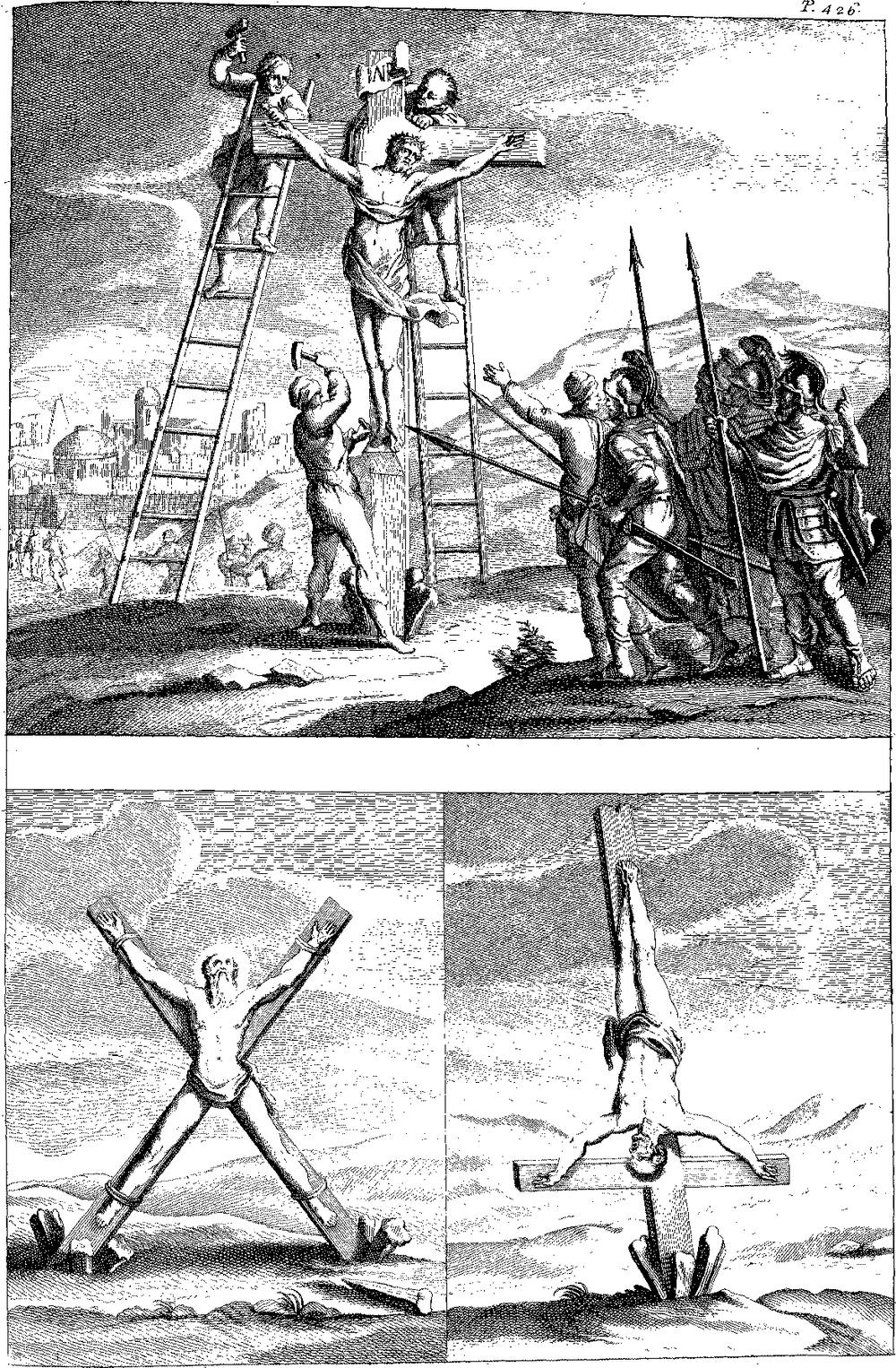
CROSS. By the word Cross, we understand a Gibbet made of two pieces of wood put cross-wise; whether they cross with right Angles at the top of one of them, or in the middle of their length, or like a S. Andrew’s Cross, or fork-wise. The Greek, Stauros, which signifies a Cross, is put often for a piece of Wood only fixed in the Ground, by the Latins called Palus or Vallum: But the Cross properly speaking, resembles a T, and the Cross which Jesus Christ was nailed to, is commonly believed to have been of this sort. The Cross was the punishment of the vilest Slaves; it was called Servile supplicium26. To be crucified was a great mark of Infamy to Soldiers, Officers, and Men of Quality. This Penalty was so common among the Romans, that Pains, Afflictions, Troubles, and unprosperous Affairs were called Crosses, and the verb cruciare was used for all sorts of Chastisements, and Pains of Body and Mind.
The Punishment of the Cross was common among the Syrians, Egyptians, Persians, Africans, Greeks, Romans and Jews. Pharaoh’s chief Baker was beheaded, according to Joseph’s prediction, and his Carcase afterwards fastened to the Cross. Haman prepared a great Cross to hang Mordecai upon, but he was himself executed upon it. Joshua gave orders for hanging the King of Ai upon a Cross. Moses in like manner hung the Princes of Israel upon Stakes or Crosses, who had fallen into the abominations of Baal-peor. Numb. xxv. 4.Every one knows, that this Punishment was very common among the Greeks and Romans, and it is needless to produce proofs and examples of it; which are every where to be met with in History.
The Jews confess, that indeed they crucified People in their Nation, but deny that they inflicted this Punishment on any alive: They first put them to death, and then fastned them to the Cross, either by the hands or neck; accordingly many instances are to be met with of Men thus hung upon a Stake after death. But there are indisputable proofs to be produced, of their crucifying men frequently alive. The worshippers of Baal-peor and the King of Ai, whom we have mentioned, were hung up alive, and so were the Descendants of Saul, who were put into the
2 Sam. xxi. 9. Psal. xxii. 17. Zech. xii. 10.hands of the Gibeonites. The Psalmist speaking of the death of the Messiah, says, They pierced my hands and my feet, I may tell all my bones. The Prophet Zechary says, that at the day of Judgment, the Jews shall look upon him whom they have pierced with Nails. Aspicient ad me quem confixerunt. Josephus27 relates, that Alexander King of the Jews having ordered eight hundred of his rebellious Subjects to be crucified, commanded their Wives and Children to be executed before their Eyes at the foot of their Cross, while they were yet living. See our Dissertation on the capital Punishments of the Jews, prefixed to the Comment upon Deuteronomy, p. xlii, &c.
Deut. xxi. 22.The Law ordained, that the persons executed should not be left upon the Cross after Sun-set, because he that is hanged in this manner is cursed by God. His Body shall not remain all night upon the tree, but thou shalt in any wise bury him that day; for he that is hanged is accursed of God. The King of Ai having been crucified by Joshua’s Orders, his Body was left upon Josh. viii. 29, 30.the Cross no longer than till the evening. The Jews28 believe, that the Souls of those who remain upon the Gibbet, and without burial, enjoy no peace, and receive no benefit from the Prayers of other People, but wander up and down till their Bodies are buried; which agrees with the notion which the Greeks and Romans had of this matter. Homer Iliad 4. and Virgil’s Æneid. 6.
Nec ripas datur horrendas & rauca fluenta
Transportare prius quam sedibus ossa quierint.
The Cross which our Saviour was nailed to, was made in the form of a T, that is to say, of the old Samaritan Tau29, which resembled the Greek Tau, and not that of the present Hebrews. But we are not to understand it so rigorously; for the Tau is one line drawn over another at right Angles, whereas our Saviour’s Cross represented a line crossing another at right Angles, and traversing it. . Thus old Monuments, the Coins of the Emperor Constantine, and the antient Crosses describe it to us. S. Jerom v compares it to a Bird flying, a Man swimming, or praying with his Arms extended like a Cross. Besides the Trunk therefore, and the Arms, there was a piece of Wood which rose above them: And on this Pilate ordered the following words to be inscribed, Jesus of Nazareth King of the Jews, which exposed the Crime whereof our Saviour was supposed to be guilty.
Sometimes the Criminal was crucified on a Tree, and fastened to it with Cords: After this manner Tiberius ordered the Priests of Saturn to be crucified at Carthage upon Trees, before the Temple of their God: w Saturni sacerdotes in eisdem arboribus templi sui obumbratricibus scelerum, votivis crucibus exposuit. Ausonius30 after this manner describes Cupid crucified on a Tree.
Hujus in excelso suspensum stipite Amorem Devinctum post terga manus, substrictaq; plantis Vincula mœrentem, nullo moderamine pœnæ Affigunt.
Sometimes he that suffered was fastned with his Head downwards: Thus S. Peter chose to be crucified, out of respect to his Master Jesus Christ, not thinking himself worthy to be fixed to the Cross like him31. Seneca speaks of this punishment32, Alios converso capite in terram supendere.
Eusebius33 remarks, that in Egypt the same Punishment was inflicted upon several Martyrs. Sometimes a Fire was kindled at the foot of the Cross, that so the Sufferer might perish by the Smoak and Flame. The Emperor Alexander Severus, commanded one to be executed in this manner, who was a Cheat, a Quack, and a dealer in Smoak, that by this means there might be some relation between his Crime and his Penalty34. Præcone dicente: fumo punitur qui fumum vendidit.
The common way of crucifying was by fastening the Criminal with Nails, one at each Hand, and one at both his Feet, or one at each of them; for this was not always performed in the same manner; the Antients representing Jesus Christ to us, as sometimes crucified with four Nails35, and sometimes with three36: They were likewise bound frequently with Cords; and this Penalty which seems in one sense gentler, because it occasions less pain, in another was more cruel, because the condemned Person by this means was made to languish for a longer time. Arbori infelici recte suspendite37. S. Andrew is said to have been thus fastened to the Cross with Cords;38 he continued also three days alive upon it. Our Saviour in the following words, foretold, that S. Peter would die upon a Cross. When thou wast young thou girdest thyself
and walkedst whither thou wouldest: But when thou shalt be old, thou shalt stretch forth thy hands, and another shall gird thee, and carry thee whither thou wouldest not. They who were going to be nailed in this manner to the Cross, were so girt about:39 Tunc Petrus ab altero cingitur, cum cruci adstringitur. They were loaded with Fetters, and so led to the place of Execution, where they were fastened to the Cross with Cords40.
Sometimes they used both Nails and Cords. Lucan speaking of one who had been crucified, who was afterwards taken down from the Cross, says41,
Laqueum nodosq; nocentes Ore suo rupit. Insertam manibus chalybem, nigramq; per artus Stillantis tabi saniem, virusq; coactum Sustulit.
Altho’ the condemned person was generally fixed to the Cross with Nails; yet sometimes it was otherwise. The holy Martyr Pionius having been sentenced to undergo this Punishment, stript himself, extended himself upon the Tree, and gave his Members to the Soldiers to be fastened with Nails. When they used both Cords and Nails, there was no inconveniency in lifting up the Person who was to suffer together with the Cross, he was sufficiently upheld by the Cords, and people concerned themselves very little about lessening the Pains and Torments of a Malefactor condemned to die in this manner.
Before they nailed him to the Cross, they generally scourged him with Whips, or leathern Lashes, which was thought to be severer, and more infamous than to be scourged with Cords. Sometimes little Bones, or pieces of Bones were tied to these Scourges, that so the condemned person might suffer more severely. Our Saviour was cruelly scourged during his Passion. Pilate having pronounced Sentence against him, ordered him to be scourged, and delivered him up to be crucified. Mat. xxvii. 26.Slaves when guilty of any great Crime, were often fastened to a Gibbet or a Cross; and in this condition they were led about the City, and beaten with Rods.42 After this manner our Saviour was loaded with his Cross; and as he sunk under the burthen, Simon the Cyrenian was constrained to bear it after him, and with him.
The Criminal was crucified quite naked43. The Saviour of the World in all probability, was not used more tenderly than others, upon whom this Punishment was inflicted. The Soldiers divided his Cloaths among them, and cast Lots for his Mat. xxvii. 3. John xix. 23, 24.Tunick, which is an under Garment, worn over the Flesh like a Shirt. Christians out of respect, and a principle of Modesty, have represented Jesus Christ covered in a decent manner, sometimes dress’d intirely,44 sometimes covered from his Loins to his Knees, and sometimes with those parts only covered with a Vail which Modesty requires us to conceal: But this does by no means prove the general practice to be such, nor that they had this regard to Jesus Christ, whom they did not know, and whose design it was to load himself with the Shame and Punishment of our Sins.
Several Questions have been started concerning our Saviour’s Cross. Some45 think that it was made of four different pieces of Wood, viz. Cypress, Cedar, Pine and Box. S. Bernard46 says, it was made of Cypress, Cedar, Olive and Palm Wood. The Foot or Basis of it was of Cypress, the Top of it of Cedar, the Chapiter of it, if it may be so called, was of the Olive Tree, and the Arms of the Palm Tree. Proba Falconia in her Rhapsodies, says, it was made of Oak.
Ingentem quercum divisis undique ramis Constituunt.
The Author of Historia Scholastica, and many others after him, tell us, that the Queen of Sheba, as she entered Solomon’s Palace, which was called the House of Cedar, took notice of a Beam there, which, as she foretold, would at some time or other be made use of in the execution of a Man, who should cause the Destruction of all Israel. Solomon, to prevent this Misfortune, ordered, as they say, that this Beam should be buried in that very spot where the Pool was in the Sheep-Market, which is taken notice of in S. John. At the time John v. 2, 3, 4.of our Saviour’s Passion, this piece of Wood was discovered, and used in making up his Cross. Others not content with these Fables, add further, that Seth, the third Son of Adam, going to Paradise, procured of the Angel, who kept guard there, three kernels of the Tree of Life, which he planted on his Father’s Grave. From these three Kernels sprung three little Wands, which joined together, formed the Beam of Solomon’s Palace lately mentioned
tioned, which was afterwards used in the Crucifixion of our Saviour. But the bare relating of such Fables, is doing them too much Honour.
Some say, this Cross was fifteen Foot high; that the Arms of it were seven or eight Foot long; that the Top on which the Title or Sentence of Christ’s Condemnation was fastened, was a piece of Wood added afterwards, with a Board on which these words were written, Jesus of Nazareth King of the Jews. But it is not easy to get any certain knowledge of these matters, which neither the sacred Writers, nor the primitive Fathers take any notice of. Those Authors who have spoken of them, are too modern to prove a matter of fact of this Nature.
Painters commonly represent the Cross to be pulled down, when our Saviour is fastened to it, and afterwards to be set up again, and the Body of our Saviour to be raised with it: Speculative persons make use of these Considerations to aggravate the excess of pain which he endured at his Crucifixion. But this opinion is not at all probable. Is it common to have the Gibbet first pulled down, when the Criminal is to be hang’d upon it, in order afterwards to put it up again, when the person to be executed is fastened to it? The shaking and motion of the Cross, together with the weight of the Body, might, without any thing else, have broken the crucified person’s Hands and Feet, and have loosened him from the Cross with inexplicable Pains. Nonnus, Author of the Tragedy intitled, The suffering Jesus; S. Austin, and the most learned Interpreters47, are of opinion, that J. C. was nailed to the Cross, as it stood already erected.
It has been the opinion of some48, that below the crucified Person’s Feet, there was a kind of Footstool, or piece of Wood jutting out, upon which his Feet were laid and fastened. S. Gregory of Tours49 particularly intimates this, and there are many Crosses to be seen made after this manner. It must be confessed, that without this the Criminal could not continue long nailed to the Cross, the whole weight of his Body bearing upon his Hands. But others assert50, that there are no marks of this Footstool to be seen in the descriptions of the Cross, which the most antient Greek and Latin Writers have left us. But they speak of a kind of wooden Horse, upon which the suffering person was, as it were, mounted, that so his Hands might not be torn asunder by the weight of his Body. This was a large Peg fixed about half way the Cross: As appears very clearly in Justin51, Irenæus52, and Tertullian53: And the same is asserted by several able criticks54.
In the Article Wine, we shall speak of the Wine made of Myrrh, which was given our Saviour to drink upon the Cross. Sometimes they who were fastened upon the Cross, lived a good while in that Condition; S. Andrew is believed to have continued three days alive upon it. Eusebius speaks of certain Martyrs in Egypt55, who were kept upon the Cross till they were starved to death. It is said, that S. Victorinus the Martyr lived three days upon the Cross56, and that the Saints Timotheus and Maanes lived nine days upon it57. Pilate was amazed at Jesus Christ’s dying so soon, because naturally he must have lived Mark xv. 44.longer, if it had not been in his Power to have laid down his Life, and to take it up again. The Thighs of the two Thieves were broken, in order to hasten their death, that their Bodies might not remain upon the Cross on the Sabbath day, and to comply with the Law of Moses, which forbids John xix. 31, 32, 33. Deut. xxi. 22.the Bodies to be left there after Sun-set.
But among other Nations they were suffered to continue there a long time. Sometimes they were devoured alive by Birds and Beasts of Prey58.
———Cruxillum tollat in auras,
Viventesque oculos offerat alitibus.
And generally they were devoured after their death by Wolves, Dogs, and Birds: If the Crosses were higher than usual, they either were a prey to the Birds, or putrified, and fell in Pieces. Guards were appointed to observe, that none of their Friends or Relations should take them down, and bury them59. The History of the Ephesian Matron, and the Soldier who was set to guard the Crosses, is very well known. The Roman Soldiers, who had crucified Jesus Christ and the two Thieves, continued near the Crosses, till the Bodies were taken down from thence.
The Hebrews do not pray for those of their Nation who are left hanging on the Gibbet, or at least they do not pray for them in publick, and in the Synagogue, as is the practice for other dead persons
during eleven Months immediately after their decease60. Besides, they did not permit the Relations of the Persons executed to place their Kinsmen in the Tombs belonging to their Families, till their Flesh had been first consumed in the publick Sepulchres61: Then they were allowed to remove their Bones into private Sepulchres. It was perhaps for this reason, that Joseph of Arimathea desired leave from Pilate, to lodge the Body of Jesus in his own Tomb, that he might not be thrown into the publick Burying-place appointed for Criminals.
Gal. ii. 19. Idem vi. 14.Jesus Christ says often in his Gospel, that he who would be his Disciple, must take up his Cross and follow him: The Cross is the sign of Ignominy and Sufferings; it is, as I may say, Gal. v. 24.the Device and Glory of Christians. S. Paul says, that he is crucified with Jesus Christ, and that he glories only in the Cross of Christ; that they who are Christ’s have crucified the flesh with the affections and lusts. Jesus Christ is the way that we are to follow: There is no attaining to that Glory and Happiness which is promised to us by any other means than by the Exod. xxv. 11. & xxviii. 36, 37.Cross.
CROWN. There is frequent mention in the Scripture of Crowns, and the use of them seems to be very common among the Hebrews. The High Priest wore a Crown, which girt about his Mitre, or the lower part of his Bonnet, and was tied behind his head. On the forepart was a plate of Gold, with three words engraven on it, Holiness to the Lord. It seems as if private Priests, and even common Israelites, wore also a sort of Crown, since God commands Ezekiel not to take off his Crown, Ecclus. xlv. 14. Ezek. xxiv. 17, 23. פאר Peer.nor assume the marks of one in mourning. Which shewed that the Israelites in their Captivity should act after this manner, and should not be able to express their Sorrow for the death of their Relations. This Crown was nothing more than a Ribbon or Fillet, in Hebrew called Peer, with which the Jews girt their Head; a custom practised by them and several other People in the East, who wore nothing else upon their Heads besides this Fillet or Ribbon, which differed in colour only and value from the Diadem of Princes. When Moses commanded the Israelites to bind the words of the Law for a sign upon their Hands, See our Comment upon Ex. xxiv. 17. Isai. lxi. 10. Cant. iii. 11.and to have them as Frontlets fixed between their Eyes, he intimates the use of Crowns and Bracelets among them.
New married People of both Sexes wore Crowns, but richer and more beautiful, than were generally used. In prosperity it was customary for People to put on o Bar. Nachman in Bereschit. Rab. c. 22. Thalmud. tract. Sanhedr. c. 4. p Mishna c. 6, 4, 14, 15. Crowns of Flowers, on Festivals, and other joyful occasions.
Wisd. ix. 8. 2 Mac. iv. 7. Isai. xxviii. 5. 1 Chr. xx. 2. 2 Sam. xii. 30. 2 Chr. xxiii. 11.The Crown, Mitre and Diadem, Royal Fillet, and Tiara, are frequently confounded. Crowns were bestowed on Gods, Kings and Princes, as the principal mark of their Dignity. David took the Crown from the God Moloch, or Melcom, which was of Gold, and enriched with Jewels, and placed it on his own Head; or rather he held it suspended over his Head, for it weighed a Talent, that is to say, 173 Marks, six Ounces, three Drams, one half Dram, twenty two Grains and two sevenths. The Amalekite who valued himself upon killing Saul, brought this Prince’s Diadem or Royal Fillet to David. The Spouse in the 2 Sam. i. 10. Cant. iii. 11.Canticles invites her Companions to see King Solomon with the Diadem, whereof his Mother had made a present to him upon his Wedding day. This was a Fillet made of some rich stuff, adorned with embroidery, and wrought in all probability by Queen Bathsheba. The Diadem was placed upon the Head of young King Josiah, when he was presented to the People, in order to be acknowledged by them. Baruch says, the Idols of the Babylonians wore Gold Crowns. Queens too wore Diadems among the Persians. King Ahasuerus honoured Vashti the Queen Consort with this mark of Power; Baruch vi. 9. Esth. ii. 17. Ezek xvi. 12.and after he had divorced her, granted the same favour to Esther. God says, that he had put a Crown of Gold upon the head of the Jewish Nation, which is represented by him as his Spouse. Gold Crowns were sent to Kings and Conquerors.
1 Mac. x. 20, 29. xiii. 33. & 2 Mac. xiv. 4. 1 Mac. xi. 13. Rev. xii. 3.Kings sometimes used several Diadems, when they were possessed of several Kingdoms. For example, King Solomon having conquered Syria, made his entry at Antioch, and put two Diadems upon his Head, that of Egypt and that of Asia. In the Revelations the Dragon with seven Heads had seven Diadems, one to each Head; and in the same Book, the Beast which sprung out of the Sea with ten Horns, had likewise ten Diadems. Lastly, the eternal Word, the true and faithful Rev. xix. 12.One, had many Diadems on his Head. In capite ejus diademata multa.
Isai. lxi. 10. Ezek. xvi. 12.New married Men and Women wore Crowns upon their Wedding day, as we have already observed of Solomon. Isaiah gives us a further proof of it, Quasi sponsum decoratum corona. And Ezekiel, Coronas speciosas in capitibus eorum. The same Prophet intimates the same thing for the Spouse. Dedi coronam decoris in capite tuo.
Persons of an elevated Dignity wore the same Ornament. Haman tells King Aha-
Ahasuerus, that he whom the King was pleased to honour in an extraordinary manner, should be cloathed in Royal Robes, and have a Diadem on his Head; these Honours were in reality conferr’d on Esth. viii. 15.Mordecai: He appeared in publick with a Crown of Gold. Fulgebat vestibus regiis—coronam auream portans in capite.
Lastly, in Feasts, in times of Merriment People wore Crowns or Diadems: but there always was a difference either in form or matter between the Crowns of Kings and great Men, and those of private Persons. The Diadem of Kings was generally a white Fillet bound about their Foreheads, the Extremities whereof being tied behind the Head, fell back upon the neck. Sometimes they were made of Gold Tissue, adorned with Jewels. That of the Jewish High Priest, which is the most antient, whereof we have any description, was a Fillet of Gold, placed upon the Forehead, and tied with a Ribbon of Hyacinth colour, or Azure blue; this Diadem or Crown was not put on till after the High Priest had taken his Bonnet.
Our Saviour’s CROWN of Thorns. Pilate’s Guard set a Crown of Thorns upon the Head of Jesus Christ, with an intention to insult him, he calling himself King of the Jews. We cannot tell of what matter it was compos’d, whether of white Thorn, buck Thorn, the Thorns of the Barberry or Gooseberry, the Sea Rush, or the Acacia; all which have their several Advocates. See Thorn.
CROWN, in the figurative Sense signifies Honour, Joy; Much experience is the Crown of old men, Ecclus. xxv. 6. ye are my Joy and my Crown, says S. Paul to the Philippians iv. 1. This word is used likewise for reward, because Conquerors in the publick Games were crowned.
To CRY. The Blood of Abel crieth Gen. iv. 10. Gen. xviii. 20. Ex. iii. 9.from the Ground where it was spilt. The cry of the irregularities of Sodom, ascended up to Heaven. The cries of the Israelites oppressed by the Egyptians, went up to the Throne of God. I expected that my Vineyard should produce Fruits of Righteousness, and behold a cry. If my land cry Job xxxi. 38.against me, and the furrows thereof complain, says Job. The Emphasis of all these Expressions is such, that the explanation which may be given them, would only weaken them.
Luke xix. 39, 40.Jesus Christ in the Gospel, speaking to the Pharisees, who complained that he permitted his Disciples to cry, Blessed is the King who cometh in the name of the Lord, said to them, If these should hold their peace, the stones of the street would cry out against them. In Psalm cxlvi. 9. it is said, that the young ravens cry towards God. Pullis corvorum invocantibus eum. In the Hebrew, clamantibus ad eum. The holy Spirit crieth in our hearts Abba, Father. In all which examples the verb to cry is understood in a metaphorical Sense. God would permit rather that the Stones should cry out, and eccho forth voices, than close the mouths of my Apostles upon this occasion. The work of God must be accomplished; it is time that the Son of God was manifested. The young ravens cry and speak their wants to God after their manner. The holy Spirit crieth in our Hearts, when he inspires us to cry to God, thou art my Father.
There is mention in the Scripture of Cries from the Heart as well as from the mouth. My heart crieth unto the Lord. And in Exodus he says to Moses, Wherefore criest thou unto me, tho’ as yet he had said nothing. The Prophets whose stile is generally very bold and figurative animate Beasts, Trees, Mountains, Lands and Cities, and by the help of Prosopopœias, make them speak, whereof we have examples, but not so frequent, in profane Authors.
Lastly, to Cry, especially in the Psalms, signifies to desire earnestly, and with repeated Cries.
CRYSTAL. see Glass.
CTESIPHON, a City lying upon the Tigris, at three miles distance from Seleucia, and Capital of that part of Assyria, called Calonitis. Eusebius, Jerom, and the Chaldee Interpreters are of opinion, that it was built in the same place where Calneh stood of old, mentioned in Genesis x. 10.
CUBIT, a sort of Measure in use among the Antients. The Hebrews call it Amma, or as one might say, the Mother of other Measures. A Cubit originally was nothing else but the distance from the Elbow bending inwards to the extremity of the middle Finger. This Measure is the fourth part of a well proportioned Man’s Stature62. The common Cubit is eighteen Inches. The Hebrew Cubit, according to the computation of Dr. Cumberland, and M. Pelletier of Rohan, which we have followed, is twenty Inches and an half, Paris measure. Many others fix it at exactly eighteen Inches. The Talmudists observe, that the Hebrew Cubit was larger by one quarter, than the Roman. It was Origen’s opinion63, that the Cubit which Noah made use of, when he built the64
Ark, was equal to six common Cubits. S. Austin65 has followed Origen in his conjecture, and thinks those objections to be very ridiculous, which some raised against the enormous size, which the Ark must have been of, if these dimensions were observed.
Lewis Capellus, and several others, have asserted, that there were two sorts of Cubits among the Hebrews, one sacred, the other common; the first of three Royal Feet, the second, of a Foot and an half. Moses, Numb. xxxv. 4. assigns to the Levites a thousand sacred Cubits of Land, round about the City, where they dwelt; and in the next verse, he gives them two thousand (common ones). In like manner, 1 Kings vii. 15. the two columns of Brass, which were in Solomon’s Temple, are said to be eighteen Cubits high; and in the second Book of Chronicles, iii. 15. thirty five Foot; which is no way to be reconciled without distinguishing two sorts of Cubits, the one whereof is double the other.
Villalpandus, and several Writers after him, allow the sacred Cubit to be but an Hand’s breadth above the common Cubit. He supposes Moses to have spoken of the common Cubit, when he said, Deut. iii. 11. that it was of the length or measure of a Man’s arm folded inward, Ad mensuram cubiti virilis manus; and that the sacred Cubit was an Hand’s-breadth above this other common Cubit, as is plainly observed in Ezekiel xliii. 13. These are the measures of the altar after the cubits; the cubit is a cubit and an hand-breadth.
Notwithstanding these Reasons, we are persuaded, that there was but one sort of Cubit among the Hebrews, from the time of their going out of Egypt to the Babylonish Captivity: And this was the Egyptian Cubit66; the Measure whereof was taken some years since from the old Standards of Grand Cairo; and that it is only since the Jews returned from their Captivity, that the Scripture has taken notice of two sorts of Measures, to distinguish the old Hebrew Cubit from that of Babylon, which the Captives were used to during their abode on the other side of the Euphrates. Upon this is grounded the precaution taken by Ezekiel in observing that the Cubit he is speaking of, is the true old Cubit, larger by an hand’s breadth than the common Cubit. As to other Passages, they are easily to be reconciled, without having recourse to this distinction of a sacred Cubit, which some suppose to have been double to the common one. See the Commentators.
CULON, or Caulon, a Town belonging to the Tribe of Judah, which is mentioned only in the Greek, Joshua xv. 60.
CUMANUS, was Governor of Judæa Year of J. C. 48. of the vulgar Æra 51.after Tiberius Alexander; he committed so many Acts of injustice against the Jews, and was guilty of so much extortion, that they were obliged to lay their complaints before Quadratus, Governor of Syria, by whose order Cumanus was taken into custody, and conveyed in Chains to the Emperor Claudius at Rome, by whom Cumanus was sent into exile, and the Government of Judæa given to Claudius Felix Brother to Pallas t.
CUMMIN, a sort of Plant very like If. xxviii. 25.Fennel, it produces its Blossom and Branches in the form of a Nosegay. Isaiah says, that the Plowman opens and breaks the Clods of the Ground, then sows the Fitches and the Cummin; and threshes it, not with large Flails, and Cart Wheels, but with Rods only. These Seeds, and the manner of threshing them, signify the most gentle effects of God’s Justice. God reserves his severe Chastisements for the greatest Sinners. Jesus Christ tells the Scribes and Mat. xxiii. 23.Pharisees, that they are very careful to pay Tythe of Mint, Anyse, and Cummin, but neglect good Works, and the more essential practices of God’s Law.
CUP. This word is often taken in Scripture in a proper, and in a figurative sense. In the proper sense it signifies a common Cup, which People drink out of at Meals; or a Cup of Ceremony made use of at solemn and religious Meals,67 as at the Passover, at which
time the Father of the Family pronounces certain Blessings over the Cup, and after having tasted of it, makes all the company, and his whole Family, drink round of it68.
The word Cup in the figurative sense of it, is taken generally for the Afflictions which God sends. To drink of the Cup, signifies to endure those Punishments which God has determined we shall suffer. Stand up, O Jerusalem, which Isai. li. 17.hast drunk at the hand of the Lord the Cup of his fury, says Isaiah. And the Ps. lxxv. 8.Psalmist, In the hand of the Lord there is a Cup, the dregs thereof all the wicked of the Earth shall wring them out, and drink them. In the same sense Men are said to be made drunk with Sorrow, with Afflictions, and the Wine of God’s Wrath; all which expressions are consequences of this first Metaphor of Cup. It is derived from the custom observed at entertainments, to drink round, and in the same Cup. Such persons as refused the Cup in their turn at Feasts, were not endured: Let him drink or be gone, was a kind of Proverb. When the Sons of Zebedee desired of our Saviour, that they might have the first places in his Kingdom, and be seated at his Table, one on his right hand, the other on his left; he answered them, Are ye able to drink of the cup that I shall drink of? &c.
The Cup of Blessing, is that which was blessed in Entertainments of ceremony, wherein the Company drunk round. Luke xxii. 20.Thus our Saviour in the last Supper, blessed the Cup, and gave it to all his 1 Cor. xi. 28.Apostles to drink. The Cup of Salvation mentioned in the Psalms, is a Cup of Ps. cxvi. 13.Thanksgiving, which while People drunk, they blessed the Lord, and were thankful to him for his Mercies. We see the continuation of this Practice in the third Book of Maccabees, wherein the Jews of Egypt, in the Festivals which they made for their deliverance, offered 3 Mac. vi. 27.Cups of Salvation.
Κώθωνα σωτήριον συστησά-μενοι.The Jews have still at this day Cups of Thanksgiving, which are blessed in their Marriage Ceremonies, and in Entertainments made at the Circumcision of their Children.69 Some Commentators believe, the Cup of Salvation to be nothing else but the Wine poured upon the Victims, sacrificed upon Thanksgivings, See Exod. xxix. 40. Numb. xv. 5. xxviii. 7. 14.according to the Law of Moses.
The Cup in the Stile of Scripture denotes likewise sometimes Portion. Dominus pars hæreditatis meæ & calicis mei; because at Meals every one had his Cup, which was filled with Wine as often as he wanted any: Or the Prophet speaks of those Cups which were drunk in the way of Ceremony, and by every one in his turn. God is mine Inheritance, and my Cup, I will have no share in the Inheritance, the Feasts, Sacrifices, Portions, Society of the Wicked; God alone is sufficient for me; he is my Portion and my Cup, I desire nothing further.
Joseph’s Cup mentioned in the Scripture, Gen. xliv. 5.which was concealed in Benjamin’s Sack, the younger Brother of this Patriarch, is the subject of many different conjectures, founded on the words of Joseph’s Officers. Is not this the cup in which my Lord drinketh? and whereby he divineth? Some question whether Joseph did indeed make use of this Cup in foretelling what was to come, whether his People believed so, or whether this was said by them, according to the common opinion of the Egyptians, who held Joseph for a great Magician, or whether they said so to intimidate Joseph’s Brethren, making them believe, that Joseph, whom as yet they knew not to be their Brother, was a Man very expert in the art of divining, and had discovered the Theft which they had committed, by vertue of this art.
All these several opinions have their defenders. It is certain, that the Antients had a sort of Divination by Cups. The eastern People say, that old King Giamschid, who is the Solomon of the Persians, and Alexander the Great, had Cups, by means whereof they knew all things natural, and sometimes even supernatural. The Antients70 speak of certain divining Cups full of Wine or other Liquors, which were poured out with Ceremony from the side where the handle was, and that from thence they drew presages of what was to come. Pliny71 speaks of Divinations with Water and Basons. The manner of divining by the Goblet was this, little Plates of Gold or Silver, or some precious Stones with certain Characters engraved upon them, were thrown into it; and after some Invocations, and superstitious Ceremonies, the Demon was consulted. He answered in several ways, sometimes by articulate sounds, sometimes he made the Characters in the Goblet appear upon the superficies of the water, and formed his answer by the order in which they stood. Sometimes he traced the Image of the per
son, on whose account he was interrogated.
At other times a Ring was fastned to a thread, and held suspended over the Water in the Cup: The Ring by its different Percussions, shewed the several things which were enquired after. Sometimes likewise drops of melted Wax were cast into the Water, which was contained within the Goblet, these were artificially dispos’d, and formed answers to the Questions that were proposed.
We by no means pretend to prove from hence, that Joseph made use of his Cup in Divinations: He was certainly very skilful in the Science of foretelling things to come; but this knowledge was not acquired, it was no curious and diabolical art, but some supernatural faculty which God had communicated to him, whereby he procured that high consideration he was in throughout Egypt. It is not incredible that the Egyptians, and perhaps some of his own People, might think him to be truly a Magician, and might have spoken of him according to this prejudice, but it does not follow, that he made use of a Cup in divining.
The Hebrew Text of Genesis will bear another Construction. Is not this the cup wherein my lord drinks and searches for so carefully? or, Is not this the cup wherein my lord drinks, and by which he has tried you? He will try whether you are as acknowledging as you ought to be, for the particular favours he has shewn you. This Cup will serve to give a proof of their ingratitude and infidelity.
CURSES. God from the beginning denounced his Curse against the Serpent, which seduced Eve, and against the Gen. iii. 14, 17. Gen. iv. 11. Gen. xii. 3.Earth, which thenceforth was to produce only Briars and Thorns: He cursed Cain also, who had imbrued his hands in his Brother Abel’s Blood. The Lord promised to bless those who should bless Abraham, and to curse those who should curse him. The Divine Maledictions are not merely Imprecations, impotent and fruitless desires, they carry their effects with them, and are attended with all the Miseries denounced by God. Balaam being invited to curse Israel, answered, Numb. xxiii. 8.How shall I curse whom the Lord hath not cursed? Neither my Curses nor my Blessings will avail any thing, unless God inspires me with both the one and the other, unless he is the first Author of them.
Jude v. 9.The Apostle S. Jude relating Michael the Archangel’s conflict with the Devil about the Body of Moses, remarks Gen ix. 25. Gen. xix. 7.that the Archangel did not venture to curse him, nor use any imprecations against him, but was content with saying to him, The Lord rebuke thee. From whence he concluded, that it is not allowable for the Faithful to utter Blasphemies, Imprecations or Curses against any one. Nevertheless we find, that the Saints sometimes did Curse particular persons: For example, Noah cursed his Grandson Canaan, and Jacob the Fury of his two Sons Levi and Simeon, who massacred the Sichemites, and plundered their City. Moses enjoins the People of Israel to denounce Curses against the violators Deut. xxxiii. Josh. vi. 26.of the Law; Joshua cursed him who should undertake to rebuild Jericho; and History informs us, that these Imprecations were not without effect, no more than those which our Saviour pronounced against the barren Fig-tree, Mark. xi. 21.which withered that very day, or those written against the Woman, who lay under the suspicion of Adultery, supposing her to be guilty, for the marks of them were soon visible in the Evils which overwhelmed her.
But these Curses are either ordain’d by God himself, or pronounced by Men abounding with his Spirit, or are mere Predictions of what should happen, uttered in the terms of Imprecations. They are not the effects of Passion, Impatience or Revenge. They are not therefore such as God condemns in his Law, and in his Scriptures: For example, he ordains that no one shall presume to curse his Father or his Mother upon pain of death; that no one should curse the Prince of his People, Exod. xxi. 17. Lev. xix. 14. Exod. xxii. 28. Lev. xxiv. 10, 11. Mat. v. 11. Rom. xii. 14. Luke vi. 28. 1 Cor. iv. 12. 1 Tim. iv. 10.or one that is deaf; whether a Man really deaf is meant here, or one that is absent, and cannot hear what is said against him; Blasphemy, or cursing of God is punished with death. In the Gospel, Jesus Christ pronounces those of his Disciples to be blessed, who are loaded with Curses, and requires them to bless those who curse them, to render Blessing for Cursing, which in reality is what S. Paul in his Sermons requires to be exercised towards his Enemies, as he himself tells us.
The Hebrews inform us, that Barak cursed and excommunicated one Meroz, who dwelt near the Brook Kison, but came not to the assistance of the Israelites in the Battle which they fought with Jabin. Wherefore Barak excommunicated him by the sound of four hundred Trumpets, according to the expression in Judg. v. 23.the Book of Judges, Curse ye Meroz, saith the Angel of the Lord, curse ye bitterly the inhabitants
thereof, because they came not to the help of the Lord. Barak himself, they say, was this Angel of the Lord; others believe it was the Archangel Michael, General of the Lord’s Army, who cursed Meroz the Angel of the Land of the Canaanites. See Devoting, Excommunication, Anathema.
I. CUSH, the eldest Son of Ham, and Gen. x. 8. Gen. x. 7, 8.Father of Nimrod. The eastern People72 affirm Cush the Son of Canaan, and Grandson of Ham, to have had a Son whose name was Habaschi or Haboschi, the Father of the Abyssinians, or Egyptians, whom the Persians call Black Indians. The Hebrew Grammarians derive the word Habaschah, which signifies Ethiopia, from Hobouscha, which signifies a People raised from a mixture of different Nations, originally of different Countries, who live together united, and that this is the true derivation of the word Habasch, which comprehends the Abyssinians, Nubians, and the Fongi. The sacred Books know nothing of Cush the Son of Canaan, nor of Habasch the Son of Cush; but only of Cush the Son of Ham, whose Sons they tell us, were Seba, Havilah, Sabtah, Raamah, Sabtecha and Nimrod. Part of Arabia, and that particularly which we call the happy, was formerly comprized under the name of Ethiopia, because the Abyssinians, who conquered it, possessed it for a long time. Dhou-Iren King of Yemen drove them from thence with the assistance of the Persians. We have no other Person in Scripture of this name besides Cush, but there are several Countries that are called by it; whether the same Man may have dwelt in several places: Or that there was some other Cush, whom we know nothing of. The Vulgate, Septuagint, and other Interpreters both antient and modern, generally translate Cush, Ethiopia. But there are many passages, wherein certainly this translation cannot take place. It is necessary therefore to examine the several acceptations of the word Cush.
II. CUSH, is the name of the Country which was watered by the Araxes. They who on this occasion have translated Cush Æthiopia, have made way for that unwarrantable opinion which some have entertained of the River Gihon’s being the Nile. The Nile is too far from the Tigris and Euphrates, to have it said, that it flowed as they did from Paradise. We believe therefore, that by Cush upon the River Gihon, is meant only the antient Country of the Scythians upon the Araxes. Herodotus73 says, that the first Habitation which these People had, was upon the Araxes, and that being forced from thence by the Messagetæ, they passed this River, and retired into the Country of the Cimmerians. Justin74 makes the Phasis and Araxes to be as it were the limits of the Scythians on the south side. Diodorus the Sicilian75 says, that the Scythians who are near Media, abode at first upon the Araxes, and that the Saci and Messagetæ are different Branches of the Scythians. The word Cuthæ and Cutha, whence some have derived Scythæ or Scuthæ, is the same as Cush. The Chaldees generally put the tau where the Hebrews use Schin; they say Cut instead of Cush. The Cuthæans, who came and inhabited the Country of Samaria, were Chusch. Chutb, or Chutha, whence some have derived Scytha.originally belonging to that part of the Country of the Medes, which bordered upon the Caspian Sea. They were therefore of the Cush we are speaking of. There are very sensible Footsteps of this name to be met with round about this Country, as the Quitians, the Cetheans, or Coëtæ, the Cytheans; the Cities of Cotatis, Cetemane, Cythanum, Cyta, Cytaïa, Cethyæum, Cethena.
III. CUSH, Josephus says,76 that the Ethiopians call themselves by this name, and that the same is given them by all Asia. S. Jerom77 tells us likewise, that the Hebrews call the Ethiopians by the same name, and the Septuagint give them no Jer. xiii. 23. Ezek. xxix. 10: Isai. xi. 11.other. Jeremiah says, Can the Cushæan, or Ethiopian change his skin, then may ye also do good. In Ezekiel, the Lord threatens to reduce Egypt to a desart, from the Tower of Syene, even unto the Border of Cush, or Ethiopia, and in Isaiah, he says, He will recover the remnant of his People, which shall be left from Assyria, and from Egypt, and from Pathros and from Cush. All these marks agree with Ethiopia, properly so called, which lies to the South of Egypt.
IV. CUSH. Bochart78 has shewn very clearly, that there was a Country called the Land of Cush in Arabia Petræa, bordering upon Egypt; that this Country extended itself principally upon the Eastern shore of the Red Sea; and at its extremity, to the Point of this Sea inclining towards Egypt and Palestine. The proofs of his opinion are these. Zipporah the Wife of Moses, who was of Midian, is called a Cushite by Moses himself. Now Numb. xii. 1.Midian, as Josephus,
Ptolemy and S. Jerom all agree, lay upon the Red Sea, to the eastward of it, in Arabia. Cush was therefore in the same Hab. iii. 7.Country. Habakkuk mentions the Land of Cush or Cushan, as synonymous with that of Midian, I saw the tents of Cushan in affliction, and the curtains of the land Job xxviii. 19.of Midian did tremble. Job speaks of the Topaz of Cush. Now the Topaz is to be found only in an Island of the Red Sea, near the Country which we are speaking Isai. xviii. 1. Zeph. iii. 10.of ¹. Isaiah and Zephaniah describe Egypt to us as situated beyond the Rivers of Cush; which cannot be understood of the Rivers of Ethiopia. King Tirhakah, 2 Kings xix. 9.who marched to attack Sennacherib and Zerah, who at another time made an irruption upon the Land of Judah, were 2 Chr. xiv. 9.both Kings of Cush, of the Country which we have been speaking of, bordering upon Egypt and Palestine, as all the circumstances of the History demonstrate. Thus there are three Countries of the name of Cush, described in Scripture, and all confounded by Interpreters, under the general name of Ethiopia.
I. CUSHI, brought David news of the Defeat and death of Absalom, 2 Sam. xviii. 21.
II. CUSHI, Father of Shelamiah, Jer. xxxvi. 14.
III. CUSHI, Father to the Prophet Zephaniah, Zeph. i. 1.
In the year of J. C. 48. of the vul. Æra 45.CUSPIUS FADUS, was sent after the death of Agrippa the Great to govern Judæa. As soon as he came into the Province, he ordered one Ptolemy to be hang’d, who was Captain of a band of Robbers, and plundered Judæa with impunity. After this, being informed, that one Theudas a Sorcerer, pretended to be a Prophet, and had seduced great numbers of the People, whom he had prevailed with to believe, that he would stop the course of the River Jordan with a word only, and would procure them a passage through it, without being wetshod, Fadus sent a Body of Horse against him and his followers. Many of them were killed, and the rest put to flight. Theudas was taken, and had his head cut off79 in the year of J. C. 45. Fadus was succeeded by Tiberius Alexander80 the year following, and of J. C. 46.
CUTHAH, a Province in Assyria, the Inhabitants whereof were transplanted 2 Kings xvii. 24. 2 Kings xvii. 30.into Samaria by Salmanefer. The Cuthæans worshipped the Idol Nergal. We are of opinion, that Cutha and Scytha are the same place, and that the Cuthites who were removed to Samaria, came from the Land of Cush or Cuth mentioned in Gen. ii. 13. See the following Article Cuthites.
CUTHITES, People who dwelt beyond the Euphrates, and were from thence transplanted into Samaria, in the room of the Israelites, who before inhabited it. It is our opinion, that they came Samaria was taken in the year of the World 3283. before J. C. 717, before the vulg. Æra 721. 2 Kings xvii. 17, 24--- compared with xviii. 34. & xvii. 6. & xviii. 11. & xix. 12, 16. 2 Kings xvii. 25.from the Land of Cush or Cutha, upon the Araxes, and that their first settlement was in the Cities of the Medes subdued by Salmanefer, and the Kings of Syria his Predecessors; and that the Israelites were removed to those places whence the Cuthites came. The Scripture observes, that the Cuthites upon their arrival in this new Country, continued to worship the Gods formerly adored by them beyond the Euphrates. The Lord provoked by their Sins, sent Lions among them, which destroyed them. The news hereof was carried to Esarhaddon King of Assyria, who succeeded Sennacherib, and he was informed, that the Cushites, who had been sent into Samaria, being ignorant of the way wherein the God of this Country required to be worshipped, he had sent Lions against them, which devoured them.
About the year of the World 3295. he began to reign in 3293. before J. C. 707.Hereupon Esarhaddon appointed an Israelitish Priest to go thither, and instruct them in that sort of worship, which was well pleasing unto God. This Priest upon his arrival settled at Bethel, and began to teach the Cuthites the Religion of the Hebrews. But these People thought they might reconcile their old superstition with the worship of the true God. They framed particular Gods for themselves, which they placed in the several Cities where they dwelt. The Babylonians set up Succoth-benoth; that is to say, Tents for the prostitution of young Women, in honour of their false Deities. The Cuthites set up Nergal, those of Hamath, Ashima, the Avites, Nibbaz and Tartak: And the Sepharvites burnt their Children in honour of their Gods Adramelech and Anammelech. The Reader may see our account of these Deities under the particular Articles relating to them.
The Cuthites therefore worshipped both the Lord and their false Gods together, and chose the lowest of the People to make Priests of them in the high Places: And they continued this practice for a long time. But afterwards they forsook the worship of Idols, and adored only to the Law of Moses, as the Samaritans, who are descended from the Cuthites, do at this day. When the Jews returned from their Captivity, In the year of the World 3469, before J. C. 531. ¹ Plin. l. xxxvii. c. 8. Strabo l. xvi. m Antiq. l. xx. c. 2. n Antiq. l. xx. c. 3.
Captivity, the Samaritans deputed to them some of their Community, desiring that they might be permitted to assist Ezra iv. 1, 2.them in the building the Temple, telling them withal, that since the reign of Esarhaddon, they had worshipped constantly the Lord. But Zerubbabel, and Jeshua the Son of Jozadak, with the Elders of the People answered them, that they could not grant them their request; the King of Persia having given his Licence to the Jews only to build a Temple to the Lord. Hereby it appears that the Cuthites hitherto had no common Temple in their Country; but that in every City they worshipped God, and perhaps Idols in consecrated places, or upon the high places of the old Israelites. Accordingly Josephus81 informs us, that they were not impowered to build a common Temple on Mount Gerizim, till the reign of Alexander the great. We shall speak more at length of the Cuthites and their Adventures, under the Title of Samaritans.
CYATHUS, a Cup made use of in the Temple for Libations. The Hebrews had likewise a Measure which they called Kos or Cup, and held the quantity of four Cubick Inches, and something over. This was the Cup of Blessing out of which they drank, when they gave thanks after solemn Meals, as on the day of the Passover. See Cup.
CYAMON, a place situated opposite to Esdraelon, Judith vii. 3. in the Greek. It is called Chelmon in the Latin. It is perhaps the same as Camon mentioned by Eusebius, and placed by him in the great Plain six miles from Legio, northward.
CYAXARES I. Son of Phraortes: He having succeeded his Father in the Kingdom of the Medes82, levied a great Army in order to revenge himself on the Assyrians; and having defeated them in a memorable Battle, he led his Troops a second time to the Siege of Nineveh; but while he was employed in carrying it on, the Scythians from the Palus Mæotis having marched round Mount Caucasus, made an irruption into Media. He made haste to defend his own Country, but was defeated, and divested of the Empire of upper Asia, which the Scythians possessed eight and twenty years. From thence they passed into Syria and Palestine. Some believe, that during this Expedition they made themselves Masters of Bethsan, which was afterwards Tob.ult.& Dan. ix.1.named Scythopolis, or the City of the Scythians, and that they plundered the Temple of Venus of Askalon.83 Cyaxares died after forty years reign, and was succeeded by Astyages, otherwise called Ahasuerus. Cyaxares began to reign about the year of the World 3391, and died about the year 3430.
CYAXARES II. Son and Successor of Astyages King of the Medes, observing the great progress which was made by Evilmerodach King of the Assyrians, or Belshazar his Son, called Cyrus to his assistance, who was his Nephew, the Son of Cambyses King of the Persians, and Mandane the Daughter of King Astyages, and consequently Sister to Cyaxares. They jointly attacked Babylon, as may be seen under the Articles Belshazar and Babylon, in the year of the World 3448. Xenophon says, that Cyrus left the Government of the Kingdom of Babylon to his Uncle Cyaxares, who held it only two years, he dying in 3468, before Jesus Christ 550. This Cyaxares goes likewise by the name of Darius the Mede; and under this Article we shall speak of him.
CYDIDA, Cydis, are the same as Kadesh of Naphtali, a City of Galilee.
CYDOESSA, or Cydossus, mentioned by Josephus84, is a Town belonging to the Tyrians, upon the frontier of Galilee, and was on all occasions an Enemy to the Galilæans. Eusebius says, Cydossus is a place near Paneas, twenty Miles from Tyre.
CYPRESSUS or Cupressus, a very tall strait Tree, that is produced with great difficulty, the fruit of it is of no use, its leaves are bitter, and the very smell and shade of it are dangerous: Arbor natu morosa, fructu supervacua, baccis torva, folio amara, odore violenta ac ne umbra quidem gratiosa, says Pliny85. Hence it was, that the Romans looked upon it to be a fatal Tree, and made use of it at Funerals, and in mournful Ceremonies. The wood of the Cypress Tree is always green, very heavy, of a good smell, and never either rots, or is worm-eaten, no more than that of Cedar, Ebony, Yew, Box, and of the Olive Tree. It is averse to Dunghills and watery places, which kill it. The Cypress Tree is distinguished into Male and Female: The Branches of the first are as it were horizontal, and those of the Female are upright; and from this latter it is that People generally take for Palissades of Gardens,
and to make Pyramids. The fruit of the Cypress Tree is round, of an Olive colour, and as large as Nuts when they are ripe, and it grows in separate places. The Latins call it Conus, because of its figure. This Fruit is composed of a kind of Scales, in the clefts whereof are hidden little Seeds that are flat and angular. This Tree grows very well from the Seed, and comes on apace. The Cypress Tree is common on Mount Libanus86; and the sacred Writers sometimes draw Comparisons from it, as a beautiful and large Tree. I was exalted like a cedar in Ecclus. xxiv. 13.Libanus, and as a cypress tree upon the mountains of Hermon. Mount Hermon made a part of Libanus. And in another place, Simon son of Onias the High- Ecclus. l. 10. Cant. i.17.Priest appeared as a fair olive-tree budding forth fruit, and as a cypress-tree, which groweth up to the clouds. The Spouse in the Canticles says, The beams of our house are cedar, and our rafters of cypress, in the Hebrew, Beroth, which by many is interpreted Fir; but it signifies more properly a sort of Cypress called Bruta, which has the smell and solidity of Cedar, but does not grow so tall87.
CYPRIARCHES. Nicanor has this Title given him in the second Book of Maccabees, Ch. xii. v. 2. that is to say, he was Governor of Cyprus.
CYPROS, a Castle built by Herod the Great above Jericho, in honour of his Mother Cypros88.
I. CYPROS, the Wife of Antipater, and Mother of Herod, Phazael, Pheroras, Joseph and Salome.
II. CYPROS, the Daughter of Herod the Great and Mariamne, the Sister of Alexander and Aristobulus, and Wife of Antipater the Son of Salome.89 This Cypros had a Daughter of the same name.
III. CYPROS, the Daughter of Phazael, Brother to Herod the Great, and Salampso, Daughter of the same Herod and Mariamne. She married Agrippa the Great, and was Mother of young Agrippa, Drusius, Berenice, Mariamne, and Drusilla90.
CYPRUS, a famous Island in the Mediterranean, and the largest in this Sea; it is situated between Cilicia and Syria: Its Inhabitants were plunged in all manner of Luxury and Debauchery.91 Their principal Deity was Venus. The Apostles Paul and Barnabas departed from Antioch, imbarked at Seleucia, and landed in the Isle of Cyprus. While they continued at Salamis, they preached Jesus Christ in the Acts xiii. 4, 5, 6, &c.Jewish Synagogues; and from thence they went and visited all the Cities in the Island, preaching every where the Gospel: while they were at Paphos, they found there a false Prophet, whose name was Bar-Jesus, who was with Sergius Paulus, the Pro-Consul or Governor of the Island. From him S. Paul met with opposition in his preaching, and by him the Pro-Consul was dissuaded from believing in Christ Jesus. But S. Paul struck him with Blindness; and the Pro-Consul touched with this In the year of J. C. 44. Acts xx. 39.Miracle, embraced Christianity.
Some time after, S. Barnabas went again into this Island with John sirnamed Mark in his company. He is considered as the principal Apostle, and first Bishop of Cyprus. It is said, that he suffered Martyrdom there, being stoned to death by the Jews of Salamis;92 and that his Body was found there in the Emperor Zeno’s reign93, with S. Matthew’s Gospel on his Breast, which S. Barnabas had copied with his own hand.
CYPRUS or Cyperus, a shrub mentioned in Scripture by the name of CopherCant. i. 13. iv. 13. כפר in Hebrew, and Cyprus in Latin. It is so common in the Isle of Cyprus, that the Island itself is thought to take its name from it. This Shrub produces a very sweet Flower; but those which grow in the Isle of Cyprus in this particular excell all others.94 There were some likewise which grew in the territory of Engedi, as the Spouse in the Canticles expresses, who compares her Husband to a bunch of Cyprus growing in the Vineyards Cant. i. 13. Vulg.of Engedi. Pliny says, that the best Cyprus was that of Canopus, and next to it that of Askelon in Palestine: Dioscorides says the same thing. There are persons who are of opinion, that the Cyprus and the Ligustrum or Privet, are the same Plant. But it is rather the Alhanna of the Arabians. The eastern People use it with the Leaves of Senna, to blacken their Hair withal95. Now the Leaves of this kind of Rush, in Latin, Cyperus odoratus, are like those of the Reed, longer, thinner, and harder than those of a Leek: The Stock of it grows to the height of about two Feet; it is strait, triangular, without knots, at the top of it the Blossoms put out, which have several Stamina collected into large Buttons. The Seed of it is hard, triangular, and covered with a black Skin. The Roots of it are long, knotty, twisted one within another, blackish, and of an agreeable smell. There is another Species of this Rush
Cyprus continues on the next page
Footnotes
-
Vide Acts xx. 2. & 2 Cor. xii. 14. xiii. 1. Usher, Tillem. alii. ↩
-
Constit. Apostol. l. vii. c. 46. ↩
-
Translators’ note. The Corus or Omer was most commonly a measure for things dry, and the greatest that was used among the Jews. As of Barley, Lev. xxvii. of Wheat, 1 Kings iii. 2. 2 Chr. ii. 1. It contained, according to the Rabbins, ten Ephahs, or thirty Sata or Seabs. Corus is the most usual term in the historical Writers, and Omer or Chomer among the Prophets. Arbuthnot’s Tables, &c. p. 100. ↩
-
Antiq. l. xv. c. 11. ↩
-
Ibid. ↩
-
Antiq. l. xx c. 8. p. 699. & de Bello l. ii. c. 25. p. 821. ↩
-
Aug. de Civit. Dei, l. xvi. c. 27. ↩
-
Hieronym. ad Eustochium de servanda Virgin. Ita & Dionys. Chartus. Bonavent. Lyran. &c. ↩
-
De Herbelot Bibl. Orient. p. 1102. Khozar. ↩
-
Basnage Hist. des Juifs, t. 3. l. v. c. 1. ↩
-
Apud Buxtorf. in Cozri Præfat. ↩
-
Isaac Son of Abraham, 1562. ↩
-
Bibl. Orient. p. 1003. ↩
-
See Basnage Hist. des Juifs, l. v. c. 3. ↩
-
Vide Libr. Cozri a Buxtorf. editum & Latine versum. ↩
-
Vide Bibl. Orient. p. 1003. col. 2. Basnage loco citato. ↩
-
Translators’ note. He was celebrated for his great Wealth and Avarice. Dr. Prideaux tells us from Plutarch, that after he had consecrated the tenth of all he had to Hercules, had feasted all the Roman People at ten thousand Tables, and given to every Roman Citizen a Donation of as much Corn as would last him three Months, he found the remainder of his Estate to be seven thousand one hundred Roman Talents, which amounts to above a Million and an half of our Money. Prid. Connect. &c. Part i. B. v. ↩
-
Ita Theodoret. Euseb. libri quidam Εἰς Γαλλίαν. Alii passim εἰς Γαλατίαν. ↩
-
Constit. l. vii. c. 46. ↩
-
Ibid. ↩
-
Strabo. l. xvii. Plin. l. vi. c. 1. & v. 9. ↩
-
Plin. l. vi. c. 20. ↩
-
Translators’ note. Quis nescit——qualia demens Ægyptus portenta colat? Crocodilon adorat Pars hæc: illa pavet saturam serpentibus Ibin. Juv. Sat. xv. ↩
-
Bochart. de Animal. Sac. P. ii. l. v. c. 16. p. 795. ↩
-
Hieronym. contra Jovinian. l. ii. ↩
-
Lipsius de cruce, l. i. c. x. 12. ↩
-
Joseph. l. xiii. c. 22. Antiq. ↩
-
Talmud, tract. Sanhedr. Rab. BarNachman in Berefchith Rabba c. 22. ↩
-
Hieronym. in Ezek. c. ix. v Idem in Marc. xi. w Tertull. in Apolog. c. 8. ↩
-
Auson. in Cupidine affixo. ↩
-
Chrysost. in Petr. & Paul. Abdias in Petro, &c. ↩
-
Senec. Consol. ad Matr. c. ↩
-
Euseb. Hist. Eccl. l. viii. c. 8. ↩
-
Lamprid. in Alexan20. dro. ↩
-
Cyprian de Passione: clavis ↩
-
Greg. Naz. carm. de Christo Pasacros pedes terebrantibus. tiente. ↩
-
Tit. Liv. l. i. ↩
-
Abdias l. iii. Hist. Apostol. ↩
-
Tertull. in Scorpiac. ↩
-
Theophylact. in Joan. ↩
-
Lucan l. vi. de Magâ Thessalâ. ↩
-
Lips. l. iii. c. 5 de cruce & l. ii. c. 2, 3. ↩
-
Lips. l. ii. de cruce c. 7. Artemidor. Γυμνοὶ γὰρ σταυροῦνται. ↩
-
I have seen in the House of Refuge belonging to the Abby of Epternach at Luxemburg, a Manuscript Volume containing the four Gospels in Gold Letters, of a Royal Magnificence and Beauty, given by the Emperor Otho, and the Empress Theophania, wherein our Saviour and the Thieves are represented upon the Cross dress’d in all their Cloaths. ↩
-
Chrysost. seu alius Serm. de cruce Beda in Collectam. ↩
-
Bernard in Cant. vii. v. 8. ↩
-
Vide Bynæum de morte Christi l. ix. c. 6. art. 7. Lips. de cruce l. ii. c. 7. ↩
-
Lips. not. in l. ii. de cruce c. 10. Fuardent. not. in Iren. l. ii. c. 42. Neus. in Nonni Par. in Joan. xx. 18. ↩
-
Gregor. Turon. de Gloria Martyr. l. i. c. 9. ↩
-
Scaliger. Anim. in Euseb. digress. de litter. Gonicar. origine lit. T. Bynæus de morte Christi, l. iii. c. 5. art. 11, 12, 13. ↩
-
Justin. Dial. cum Tryphone. ↩
-
Iren. l. i. c. 46. ↩
-
Tertull. l. ii. contra Nationes. ↩
-
Scaliger. loco citato. Salmas. de cruce. Bartholin. de latere Christi aperto, & de cruce. Bynæus t. iii. c. 5. art. 12. ↩
-
Euseb. l. 8. c. 8. τηρούμενοι τε ζῶντες εἰσὶν καὶ ἐπ’ αὐτῶν θηρίων λιμῷ διαφθαρεῖεν. ↩
-
Martyrol. 5. Sept. ↩
-
3 Maii Martyrolog. ↩
-
Prudent. περὶ στεφάν. Cor. xi. ↩
-
Vide Lips. de cruce l. ii. c. 15, 16. ↩
-
Bar. Nachman in Bereschit. Rab. c. 22. Thalmud. ↩
-
Mishna c. 6, 4, 14, 15. ↩
-
Translators’ note. A Cubit was reckoned by Aristotle the fourth part of the height of a Well-proportioned human Body. For he saith, a Man is ζῶον πεζὸν δίπουν τετράπηχυ, or a walking Animal, with two Feet, and four Cubits (above six Feet) high. There are several, says Dr. Arbuthnot, that pass for human Creatures, who are excluded by this Definition. Arbuthnot’ ↩
-
Origen Homil. iv. in Genes. & l. iv. contra Celsum. ↩
-
Tables of antient Coins, weights and Measures, &c. p. 58. ↩
-
Aug. quæst. in Genes. l. i. c. 4. & de Civit. Dei. l. xv. c. 27. t Antiq. l. xx. c. 5. ↩
-
Translators’ note. The very learned and ingenious Dr. Arbuthnot says, that to him it seems plain, that the Jews used two sorts of Cu- bits, the sacred one, and the profane or common one. For (Deut. iii. 11.) the Bed of Og is said to have been nine Cubits long, and four Cubits broad, after the Cubit of a Man. And (Ezek. xl. 5.) Ezekiel’s Reed is said to be six Cubits long, by the Cubit and Hand-breadth. From whence it appears, that the larger Cubit by which the Reed was measured, was longer than the common one by a Hand-breadth, or three Inches, &c. Tables of Coins, Weights and Measures, &c. ↩
-
Translators’ note. Among the Ancients, as a learned Author observes, there was always some hereditary Bowl, with which they made their Libations to the Gods, and entertained Strangers. Hic Regina gravem gemmis, auroque poposcit Impleviique mero pateram, quâ Belus & omnes And presently she begins to the Gods. So Stat. l. i. Theb. Signis perfectam au- roque nitentem Iasides pateram famulos ex more poposcit Qua Danaus libare Deis, seniorque Phoroneus Assueti.—— ↩
-
Leo of Modena part v. c. 3. of the Ceremonies of the Jews. Buxtorf. Synagog. Jud. de Paschate. ↩
-
See Leo of Modena, Ceremonies of the Jews. ↩
-
Eustath. in Odyss. ↩
-
Plin. l. xxx. c. 2. ↩
-
Bibl. Orient. p. 409. ↩
-
Herodot. l. i. c. 201. & l. 4. c. 11. ↩
-
Justin. l. i. & l. ii. ↩
-
Diodor. l. xi. p. 355. ↩
-
Joseph. Antiq. l. i. c 7. ↩
-
Hieronym. quæst. Hebr. in Genes. ↩
-
Bochart. Geogr. Phaleg. l. iv. c. 2. ↩
-
Antiq. l. xx. c. 2. ↩
-
Antiq. l. xx. c. 3. ↩
-
Joseph Antiq. l. xi. c. 8. p. 384, 385. ↩
-
Herodot. l. 1. ↩
-
Idem ibidem. ↩
-
Joseph. de Bello l. iv. c. 4. ↩
-
Plin. l. xvi. c. 33. ↩
-
Cyril. in Isai. l. v. p. 848. Phocas in descript. Terræ Sanctæ. ↩
-
Plin. l. xii. c. 17. ↩
-
Joseph. Antiq. l. xvi. c. 9. & de Bello l. ii. c. 20. p. 816. ↩
-
Antiq. l. xvii. c. 7. ↩
-
Antiq. l. xviii. c. 7. ↩
-
Justin. l. xviii. c. 5. Lactant. l. i. c. 17. ↩
-
Acta S. Barnabæ 11. Junii. ↩
-
Theodor. Lector. l. ii. p. 557,558. Cedren. t. 1. p. 353. ↩
-
Plin. l. xii. c. 24. ↩
-
D’Herbelot. Bibl. Orient. p. 803. ↩