Gen. xvii. 10.CIRCUMCISION. This Term is taken from the Latin, circumcidere, which signifies to cut all round, because the Jews who circumcised their Children, cut off the little skin after this manner, which covers the Prepuce. God enjoined Abraham to use Circumcision, as a sign of that Covenant which he had entered into with him. This is the covenant, says the Lord to Abraham, which ye shall keep between me and you, and thy seed after thee. Every male child among you shall be circumcised. And ye shall circumcise the flesh of your foreskin, and it shall be a token of the covenant betwixt me and you. And he that is eight days old shall be circumcised among you, every man-child in your generations, he that is born in the house or bought with money of any stranger, which is not of thy seed. And the uncircumcised man-child whose flesh of his foreskin is not circumcised, that soul shall be cut off from his people: he hath broken my covenant. In pursuance of this order, Abraham, who was then ninety nine years of age, was circumcised; he circumcised also his Son Ishmael, and all the Slaves in his family.
God repeated the Precept of Circumcision to Moses, and ordained that all those who intended to partake of the Paschal Sacrifice, should receive Circumcision, and that this operation should be performed on Children newly born, on the eighth day after their birth. The Jews have been always very exact in observing this Ceremony, and it appears that they did not neglect it in Egypt. But Moses, while he was in Midian with Jethro his Father-in-law, did not circumcise the two Sons which he had in that Country; and dur ing the journey of the Israelites through the Wilderness, the Children who were then born, were not circumcised: Probably by reason of the danger which their lives might have been exposed to, because they were not fixed in any one place, and were obliged very often to change their habitation.
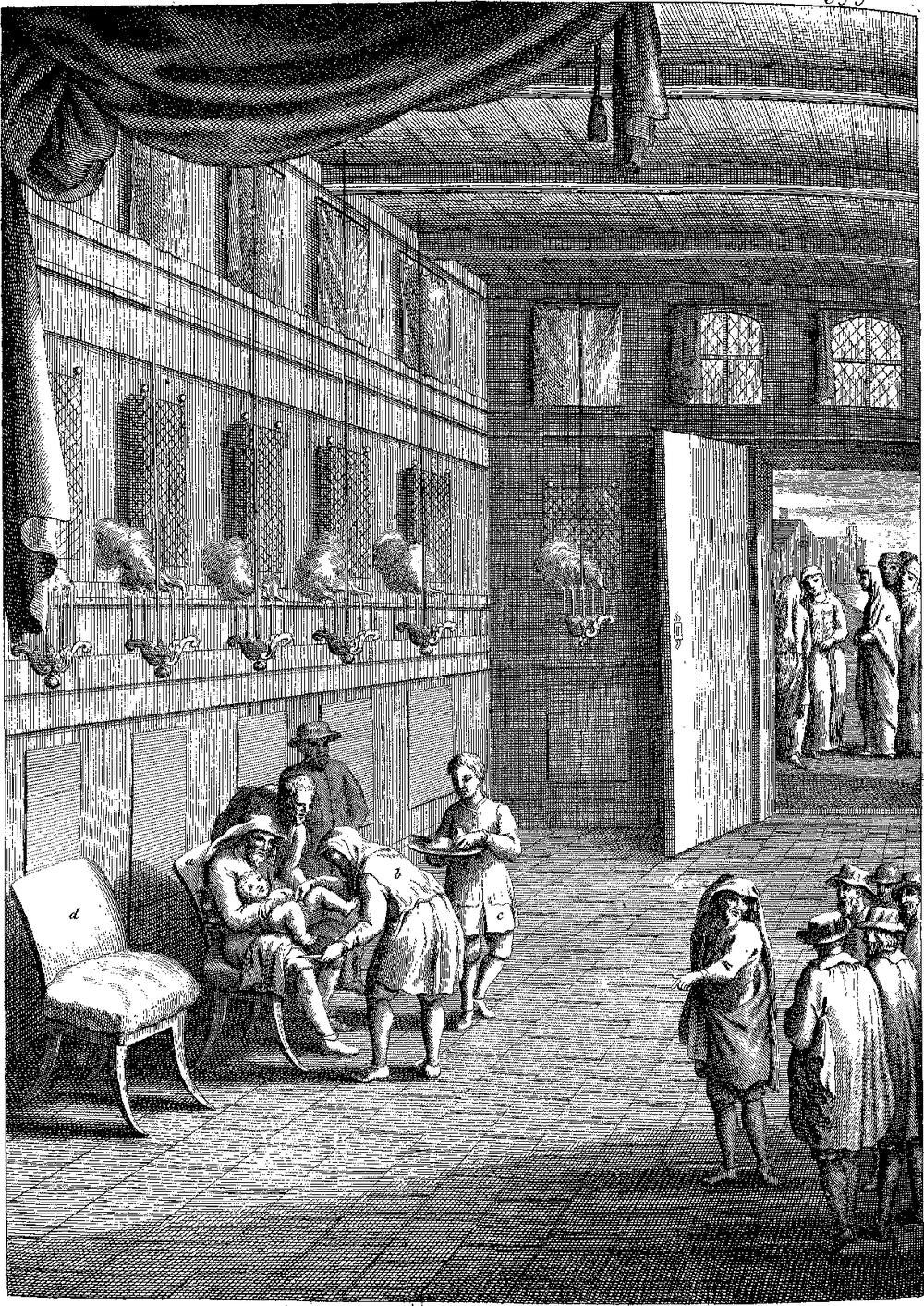
The Law has ordained nothing either concerning the Minister, or the Instrument of Circumcision. The Father, or any other Relation, or a Surgeon, or any other whom they had a mind to choose, might perform this Ceremony. They generally made use of a Knife or Razor. Zipporah the Wife of Moses circumcised her Son Eliazer with a sharp Stone. Joshua made use of the like Exod. iv. 25.Instrument in circumcising those who had not received Circumcision in the Wilderness. Josh. v. 3. Exek. xvi. 6.It is very probable that the Egyptians with these Stones fashioned like Knives, opened the bodies of such persons as they embalmed1. Some pretend that the Knives of this kind are much less dangerous than others made of Brass or Iron, and that they do not cause so great an Inflammation in the Wound. The Galli who were the Priests of Cybele, the Mother of the Gods, castrated themselves with a sharp Stone, or with a broken pot-sherd, not knowing how to do it otherwise without endangering their Lives2.
The Ceremonies now observed in Circumcision by the Jews, are such as these. When a Son is3 born in any Family, it is customary for some to put little Notes in the four corners of the Chamber, with these words inscribed, Adam and Eve; Lilith, be gone. (The Jews assert, that Lilith was Adam’s first Wife, who upon her separation from him, took up her habitation in the air, where she still continues, and is a great enemy to the delivery of Women, and new born Children.) They write likewise in these Notes the names of three Angels, in order to defend the Child from all sorts of Witchcraft. But all do not observe these superstitious Practices.
The Father is obliged to have his Son circumcised upon the eighth day, unless the weakness or indispolition of the Child oblige him to defer it. The night before Circumcision is called watching; because the whole Family is awake to guard the Child; and the Father and Mother are visited by their male and female Friends: On which occasions abundance of Joy and Civility is expressed. The Godfathers and Godmothers are chosen some time before. The Godfather holds the Child while the Operation is performing, and the Godmother carries it to the Synagogue. As to the person who circumcises, they choose for this purpose whom they please. The Father himself may do this Office, if he is capable of it. It is esteemed a great honour among the Jews to be Mohel; that is to say, a Circumciser. It is not necessary to go to the Synagogue in order to perform this Ceremony; the Child may be circumcised at home, if the Parents please.
Two Seats are provided for this purpose, with two silk Cushions: One of the Seats is for the Godfather who holds the Child; the other is left empty, and is designed, as some say, for the Prophet Elias, whom they believe to be invisibly present at all Circumcisions, so great was his Zeal for the observance of the Law. He who circumcises comes with a dish, wherein are the Instruments, and other things necessary for that Operation, such as the Razor, the astringent Powders, the Linen Cloth, the Lint, and Oil of Roses. They who are present sing some Songs, while they wait for the Godmother, who brings the Child upon her arms, and is attended with a company of Women. But not one of them go beyond the door of the Synagogue: There they deliver the Child to the Godfather, and immediately all who are there cry, Baruch haba welcome.
The Godfather sits down upon his Seat, and settles the Child in a proper posture on his Knees; then he who is to circumcise him, opens the Blankets. Some make use of Silver Tweezers to take up so much of the Prepuce as they design to cut off. Others take it with their Fingers. Then he who circumcises holding the Razor in his hand, says, Blessed be thou, O Lord, who hast commanded us to use Circumcision. And while he is saying this, he cuts off the thick Skin of the Prepuce; then with his Thumb nails he tears off another finer Skin still remaining. He sucks the Blood two or three times, which flows plentifully upon this occasion, and spits it out into a Cup full of Wine. After this, he puts some Dragon’s Blood upon the Wound, some Coral Powder, and other things to stop the bleeding; to all which he adds Bolsters of Oil of Roses, and covers all close. In the next place, he takes the Cup into which he had spit the Blood sucked by him from the Wound, blesses that and the Child, gives him the name appointed for him by the Father, at the same time pronouncing these words of Ezekiel, I said unto thee when thou wast in thy blood, live; and then moistens his lips with the Wine which is in the Cup. After which they repeat the 128 Psalm, Blessed is every one that feareth the Lord. This being over, the Godfather returns the Child to the Godmother, who carries him home, and returns him to his Mother. All those who were present at the Ceremony, say to the Father as they take their leave, May you thus be present at his Wedding. The Child is commonly cured of the Wound received by Circumcision in four and twenty hours. If he dies before the eighth day, there are some who circumcise him after death, by cutting off the Foreskin with a Reed.
As to the Girls born of Jewish Parents, they receive not Circumcision; but with relation to them, this custom is observed. The Mother continues in her House for Levit. xii. 5, 6.fourscore days; after which she goes to the Synagogue, and the Chanter blesses the little Girl, and names her as the Father or Mother desires. In some places, the Child is not carried to the Synagogue, but the Chanter goes to the House of the lying in Woman, and there performs the Ceremony. They do not now observe what the Law appoints, that the Mother who had a Son or Daughter, should go to the Temple Gate, or to the door of the Tabernacle, and offer a Lamb, a young Pigeon, or a Turtle Dove. Since the destruction of the Temple, this Ceremony is no longer practicable.
It is matter of dispute, whether Circumcision took away the guilt of Original Sin, or was a mark only of distinction between Jews and Gentiles. The old Fathers, who lived before S. Austin, set bounds to the effects of Circumcision, and allowed it only to imprint a sensible mark upon the Hebrews, whereby they were distinguished from other People, who were not in Covenant with God. This is the opinion of S. Justin the Martyr4, of S. Irenæus5, S. Chrysostom6. S. Epiphanius7, of Hillary the Deacon8, S. Jerom9, and John Damascen10. But S. Austin a maintained, that Circumcision procured the Remission of Original Sin; and he founded his opinion on the Scripture, which declares those to be utterly cut off from God’s People, who were not circumcised upon the eighth day. Gen. xvii. 12. 14Now, what other Sin besides that which is original, could such Children be guilty of? Gregory the Great11, venerable Bede12, Fulgentius, Prosper, S Bernard, have followed this opinion of S. Austin. Our Dissertation on this subject may be consulted, which is prefixed to our Comment on S. Paul.
Circumcision was in use not only among the Hebrews, but likewise among the Arabians, Ethiopians, Egyptians, and Idumæans. There are some Authors of Reputation, who assert, that all other people received this practice from the Egyptians. Celsus and Julian the Apostate affirmed, that Abraham learnt this Ceremony in Egypt13. Marsham14, and M. le Clerc15, have adopted this opinion: But the Authority of Herodotus16, who assures us that Circumcision was known to those People only, to whom the Egyptians had communicated it, does not deserve credit in this instance on his bare word, or rather upon that of the Egyptian Priests, who imposed upon him with a vain-glorious relation of their Antiquity and Ceremonies. The Scripture speaks of the Institution of Circumcision, when first it was enjoined Abraham, as of a thing intirely new. It informs us, that this was the Seal of that Covenant which God had made with this Patriarch. And how should Circumcision be a mark to distinguish Abraham and his Posterity from the rest of Mankind, if it were then common among the Egyptians, Ethiopians, Phœnicians, and so many other People who had before practised it?
We are not at all perplexed in discovering the original of Circumcision among the Arabians, Saracens and Ishmaelites. These People as well as the Hebrews sprung from Abraham; but they never looked on Circumcision as an essential Ceremony which obliged them, upon pain of being cut off from their People. They received it rather out of devotion than necessity. Circumcision was introduced with the Law of Moses among the Samaritans and Cuthæans. The Idumæans, tho’ descended from Abraham and Isaac, never were circumcised, till they were subdued by John Hircanus, and compell’d by him to receive both Circumcision and the Law of Moses17. They who assert, that the Phœnicians were circumcised, mean probably the Samaritans; for we know from other hands, that the Phœnicians did not observe this Ceremony.
As to the Egyptians, Circumcision never was of general and indispensible obligation upon their whole Nation. Some certain Priests only, and particular Professions were obliged to it. Philo18 gives none but natural or symbolical reasons for this Practice. Westing19, an eminent Physician, is of opinion, that there were some natural reasons for the Egyptians, both men and Women, receiving Circumcision. Artapanus, as he is cited in Eusebius20, assures us21 us, that Moses communicated this Rite to the Egyptians. Origen1 thinks, that Circumcision became so much in vogue among Strangers upon a Belief entertained by them, that there was an Angel, who put those to death, that were not circumcised, and had no power over those who had received Circumcision. Many are of opinion, that the Egyptians began to be circumcised in the reign of Solomon. Others, as Bochart, suspect, that the Egyptians borrowed this custom not from the Jews, but from the Arabians. Lastly, it is generally supposed, that the Hebrews were the first who ever practised it. See Spencer de Legib. Ritual.22. i. c. 4. and our Dissertation on the Original of Circumcision prefixed to our Comment upon Genesis.
As to the Circumcision of Women, it never was in use among the Hebrews, but only among the Egyptians, and in some places of Arabia and Persia. S. Ambrose23 asserts indefinitely, that the Egyptians circumcise both Men and Women in the beginning of the fifteenth year. Strabo24 says likewise, that the Egyptian Women receive Circumcision. But those Travellers and Physicians25 who inform us, that this Custom is still at this day common in Egypt, do not tell us that it is general there, or of any obligation. It is founded only upon natural reasons, which are not applicable to all the Women of this Country. Chardin26 says, it is binding only in some particular Countries of Arabia and Persia; as towards the Persian Gulph and the Red Sea, where both Sexes are circumcised with equal regularity. But with this difference, that the Males may be circumcised at five, six, nine, or thirteen years of age. But for the Women, they were not circumcised till they were passed their youth, because before, there was no excrescence to be cut off.
The Question is, whether Circumcision is sometimes repeated? Never by the Hebrews, no more than we ever rebaptize those who have once received Baptism in a due manner; but when the Jews admitted a Proselyte of any other Nation, wherein Circumcision has been customary, as a Samaritan, an Arabian or Egyptian, if he had already received Circumcision, they were satisfied with drawing some drops of Blood from the part usually circumcised; and this Blood was called the Blood of the Covenant. S. Epiphanius27 says, that the Samaritans when they became Jews, were circumcised again, as was Symmachus, who embraced Judaism. Three Witnesses were present at this Ceremony, in order to make it more authentick: They blessed God, and recited the following prayer, O God, grant we beseech thee, that as thou hast received this Man into thy Covenant, we may find good Works and thy Protection in the Law.
The Jews who renounced Judaism, endeavoured to erase the mark of Circumcision, as may be seen in the Book of Maccabees28, They made themselves uncircumcised, and forsook the holy Covenant. The Rabbins pretend, that Esau was the first who put in practice this way of disguising his Circumcision, when he deserted the Covenant of the Lord, and the Religion of Abraham and Jacob. Some are of opinion, that the Israelites in the Wilderness had likewise concealed the mark of their Circumcision, which obliged Joshua to circumcise them a second Josh, v. 2.time. It is said, that many Jews used some Art to make their Foreskin grow, during the Persecution which they suffered under the Romans, after the destruction of the Temple; but that Barchochebas made them all be circumcised again. It seems as if S. Paul apprehended, lest the Jews who were converted to Christianity should bethink themselves of doing the same, Is any man called being circumcised? let him not become 1 Cor. vii. 18.uncircumcised.
It is true, S. Jerom29, and some others30 after him, have affirmed, the mark of Circumcision to be so indelible, that nothing was capable of suppressing it in the flesh of the circumcised person: Neque enim potestatis nostræ est adducere præputium post circumcisionem. And that what is said in the Maccabees, should be understood of those Fathers, who would not circumcise their Sons. Origen31 somewhere says likewise, that it is impossible to make the Skin which is once cut in Circumcision grow again, but in another place32 he acknowledges, that many, in order to conceal the deformity of their Circumcision, put themselves into the Surgeons hands to recover their Skin again.
Epiphanius33 speaks of the instruments used by Physicians for this purpose, and the means practised by them in making the Skin which had been so curtailed grow again. The celebrated Physician Cornelius Celsus has a whole Chapter particularly upon this Opinion: And Galen mentions it much in the same manner as Celsus. Bartolin34 cites Ægineta and Fallopius, who taught the secret of covering the marks of Circumcision; and Buxtorf the Son, in his Letter to Bartolin, cites a great number of Jews, who speak of this practice, as customary among Apostates from their Religion.
Read this article in its place on the printed pages
Footnotes
-
Herodot l. ii. c. 86. ↩
-
Plin. l. xxxv. c. 12. Samiâ testâ matris Deûm sacerdotes, qui Galli vocabantur, virilitatem amputabant, nec aliter citra perniciem. Ovid Fast. 4. Ille etiam saxo corpus laniavit acuto, &c. ↩
-
Leo of Modena c. 8. and Part the fourth, of the Ceremonies of the Jews. See the Dissertation of John James Quandt de cultris circumcisor. Hebræorum. ↩
-
Justin. Dialog. cum Tryph. p. 241. ↩
-
Iren. l. iv. c. 3. ↩
-
Chrysost. homil. 39. in Genes. ↩
-
Epiphan. hæres. 30. ↩
-
Ambrosiast. in Rom. iv. 11. ↩
-
Hieronym. in Epist. ad Galat. i. 2. ↩
-
Damascen. de fide Orthod. l. iv. c. 25. ↩
-
Greg. l. iv. Moral. in Job. c. 3. ↩
-
Beda in Luc. ii. ↩
-
Vide Origen contra Cels. l. i. & l. v. & Cyrill. l. x. contra Julian. ↩
-
Marsham Canon. Ægypti sæculo v. ↩
-
Cleric. in Genes. Cap. xvii. v. 10. ↩
-
Herodot. l. ii. c. 35, 36. ↩
-
Joseph. Antiq. l. 13. c. 17. ↩
-
Philo de Circumcisione, p. 810. ↩
-
Westing. Syntagm. Anatom. c. 6. ↩
-
Euseb. Præpar. l. ix. c. 28. ↩
-
Aug. l. ii. de nuptiis & concupisc. c. 11. & l. xvi. de Civit. c. 17. & de Baptisimo contra Donatistas, l. iv. c. 24. ↩
-
Origen. contra Cels. l. v. p. 163. ↩
-
Ambros. l. ii. de Abrah. c. 11. ↩
-
Strabo l. xvii. ↩
-
Vide Huët not. in Origen. p. 5. Circumcisio fœminarum fit resectione clitoridis, quæ pars in Australium præsertim mulieribus ita excrescit, ut ferro sit coercenda. Ita tradunt medici insignes Paul. Ægineta l. vi. c. 70. Aët. tetrabib. l. iv. Serm 4. c. 103. Quorum hic ita pergit. Quapropter Egyptiis visum est, ut antequam exuberet (pars illa corporis) amputetur, tum præcipue, cum virgines nubiles sunt elocandæ---- Porro hanc consuetudinem circumcidendarum mulierum hodieque retinere Ægyptios ferunt ii, qui regiones illas lustraverunt, igitur nemque ad compescendam partis hujus luxuriem adhiberi scribit. Bellon l. iii. cap. 28. Morem hunc servare fœminas in Persia, & Cophtes etiam in Æthiopia, Christi licet nomen professas. Leo Africanus, l. viii. Narrat Mahumedi lege id præscribi, quamvis in Ægypto tantum & Syria obtineat, munusque id obire vetulas quasdam per vicos Cairi ministerium suum venditantes. ↩
-
Chardin Voyage de Perse. t. 3. p. 207. ↩
-
Epiphan. de ponderib. & mens. l. ii. p. 172. ↩
-
Joseph. Antiq. l. xii. c. 6. την των αιδοιων περιτομην απεκαλυψαν. ↩
-
Hieronym in Pac. ii. & in Jovinian, l. i. ↩
-
Rupert. l. 9. de victoria, c. 18. Haimo in 1 Cor. vii. 18. ↩
-
Origen. Περὶ ἀρχῶν, l. 4. c. ↩
-
Philocalias. c. i. ↩
-
Epiphan. de ponderib. & mensuris. ↩
-
Bartolin de Morb. Bibl. Art. 26. ↩