Volume I, pages 378–397 of the 1732 edition, from CHA to CIR: everything printed on these pages, in order.
Continued from Chanters
man on the Mislothaim, which was a sort of Bell.
The Chanters and Levites, who were employed in singing, playing upon Instruments, and other Functions of the Temple, had no habits distinct from the rest of the People. Nevertheless, in the Ceremony of removing the Ark to the Temple of 2 Chr. v. 12.Jerusalem built by Solomon, the Chanters appeared dressed in Tunicks of Byssus or fine Linnen. Josephus1 remarks, that in King Agrippa’s time, they obtained the favour from this Prince of wearing a Linnen Robe in the Temple like the Priests. Agrippa believed it would be for the Honour of his Reign, to signalize it by so considerable a change as this. The other Levites imployed in different Exercises under the Command of the Priests in the Temple, procured likewise permission to learn to sing, to the end that they might enjoy the same Privileges with their Brethren. This was contrary to the Laws of God, says Josephus, which were never violated with impunity.
CHAOS. This is the name whereby we call that Confusion, wherein matter lay, when newly produced out of nothing at the beginning of the World, before God, by his Almighty Word, had put it into the order and condition wherein it was after the six days Creation. Moses makes use of the Terms Tohu and Bohu2, to express this Gen. i. 2.Chaos, which the Septuagint translate invisible, and in disorder; Symmachus, a Mass without motion, and in disorder; Aquila and Theodotion, a void and nothing. Ovid describes the Chaos very well in these verses.
——Rudis indigestaque moles,
Nec quidquam nisi pondus iners, congestaq; eodem
Non bene junctarum discordia semina rerum.
Chaos is taken likewise for an Abyss, an impenetrable Space, which prevents any one’s passing from one place to another. Thus Abraham told the rich Man, that Luke xvi. 26. Μέγα χάσμα.there was a great Chaos or Gulf (or as in the Greek a great Hollow) which separated them. Inter vos & nos chaos magnum firmamentum est.
CHARABE, a Town in upper Galilee, fortified by Josephus the Historian3. It is probably the same which he calls the Stone of the Achabanes4.
CHARACA, a City in the Tribe of Gad, from whence Judas Maccabeus drove Timotheus, 2 Macc. xii. 17.
CHARAC-MOBA, or perhaps Charac- Moab, a City of the third Palestine. It is joined to Areopolis, Petra and Zohar, in the antient Accounts of the Empire, and in the Subscriptions to Councils5. I take it to be the same with Characa, which I have been speaking of.
Rev. xiii. 6. xiv. 9. xvi. 2. xix. 20. xx. 4.I. CHARACTER, the Character or Mark of the Beast or Antichrist, mentioned in the Revelations, is nothing else but the number of Letters which compose his name, according to the numerical value of these Letters. See what we have said above concerning Antichrist.
II. CHARACTER, of certain Sacraments of the new Law, such as Baptism, Confirmation and Orders, whereby we understand some Sign and invisible Mark impressed upon the Souls of those who have received these Sacraments; for which reason they should never be repeated.
CHARACTERS Hebrew. See Hebrew Letters.
I. CHARIOTS of WAR. The Scripture speaks of two sorts, one was for Princes and Generals to ride in, the other to break the Enemies Batalions, by letting loose these Chariots against them, armed with Iron, which made terrible havock in the Troops. The most antient Chariots of War whereof we have any knowledge, are Pharaoh’s, which were drowned in the Red Sea. The Canaanites, whom Joshua engaged with at the waters of Merom, had Cavalry, and a multitude of Chariots. Equi & currus immensæ multitudinis. Sisera, Jabin the King of Hazor’s General, had nine hundred Chariots of Iron in his Army. The Tribe of Judah could not get Possession of the lands belonging to their partition, because the antient Inhabitants of the Country were strong in Chariots of Iron. The Philistines in the War carried on by them against Saul, had thirty thousand Chariots, and six thousand Horsemen. David having taken a thousand Chariots of War from Hadadezer King of Syria hamstrung the Horses, and burnt nine hundred Chariots, reserving only an hundred to 1 Chr. xxiii. 4. & 2 Sam. viii. 4. 1 Kings x. 26.himself.
It does not appear that the Kings of the Hebrews ever made use of Chariots in War. Solomon had a considerable number of them; but we know of no military expedition wherein they were employed by him. He had, says the Scripture, fourteen hundred Chariots, and twelve thousand Horses. As Judæa was a very mountainous Country, Chariots could be of no use but in the Plains, and the Hebrews often made them needless, by combating upon their Mountains; and from hence in all probability it came, that they never were very curious of having any in their Armies.
2 Macc. xiii. 2.In the Books of the Maccabees there is mention made of Chariots armed with Scythes, which the King of Syria led against Judea. The Descriptions which the Antients give us of these Chariots, is
much after the following manner6. The Beam to which the Horses were fastened, was armed with Pikes having iron points to them, which projected forward; the Yokes of the Horses had likewise two long points of three Cubits. To the Axle-tree also were fixed iron Spits, armed at their extremities with Scythes; between the Spokes of the Wheels were placed Javelins, and the very fellows of the wheels were furnished with Scythes, which tore every thing they met with to pieces.
The Axle-tree was longer than usual, and the Wheels stronger, that they might be able to resist the shock of the motion, and the Chariot be less subject to overturn. The Driver’s seat was a kind of little Tower made of very solid Wood, and raised breast high. The Charioteer was armed all over, and covered with Iron. Sometimes several Men well armed were put in the Chariots, who fought with Darts and Arrows. Any one may judge what dreadful Shocks were caused by these Machines, when once they were in motion, and met the Enemies Troops7.
The Kings of Israel, when they went to War, were generally mounted on their Chariots; they fought thus, and issued out their orders; and there was always a second Chariot empty which followed them, that if the first were broke, they might immediately 2 Chron. xxxv. 24. 2 Kings xxiii. 31.get up into the other.
Chariots were sometimes consecrated to the Sun; and the Scripture observes, that Josiah burnt those which had been offered to the Sun by the Kings his Predecessors. This superstitious custom was an imitation of the Heathens, and principally of the Persians, who had Horses and Chariots consecrated in honour of the Sun. Herodotus, Xenophon, and Quintus Curtius8 speak of white Chariots, crowned, which were consecrated to the Sun, and among the Persians in their Ceremonies, were drawn with white Horses consecrated to the same Luminary.
The Rhodians threw a Chariot every year into the Sea, in honour of the Sun; because they believed, that every day he travelled round the Earth riding in a Chariot. Festus in Octobri.
II. CHARIOTS, or Sledges made use of in threshing out Corn. See hereafter Sledges.
CHEBAR, a River of Assyria, which empties itself into the Euphrates in the upper part of Mesopotamia. Ezekiel was upon the River Chebar, when God made him sensible of the impression of his holy Spirit, Ezek. i. 1.
CHEDORLAOMER, King of the Elymæans or Elamites, who were either the Persians, or People bordering upon
Gen. xiv. 1, 2, & seq.them. Chedorlaomer was one of the four confederated Kings, who made war against the five Kings of the Pentapolis of Sodom, and who after having defeated them, and made themselves Masters of a great Booty, were pursued and dispersed by Abraham, in the year of the World 2092, before the Birth of J. C. 1908, and before the vulgar Æra 1911.
Before J.C. 1909. before the vulgar Æra 1933. See Mat. iv. 15. Isai. ix. 1.This Prince, after he had for twelve years kept five Kings subject to his Dominion, viz. Bera King of Sodom, Birsha King of Gomorrah, Shinab King of Admah, Shemeber King of Zeboïm, and the King of Bela, which is Zoar: They at last revolted from him about the year of the World 2091. Chedorlaomer gathered a great Army, and entring into a Confederacy with Amraphel King of Shinar, Arioch King of Ellasar, perhaps Thalassar, near Assyria, in the Province of Eden, and with Tidal King of the Nations; probably the Nations which lay beyond Jordan, in Galilee of the Gentiles: These four Kings with their Troops marched towards the Land of Canaan; in their way they attacked some People of the Countries beyond Jordan, such as the Rephaims, Giants, who possessed the Land lying between the Brook Jabbok and the Arnon: They took and pillaged Ashteroth Karnaim, a famous City situated eastward of the Sea of Galilee.
They likewise defeated the Zuzims, the same probably with the Zumzummims, antient Inhabitants of the Country afterwards Deut. ii. 20, 21. Deut. ii. 20, 21. Josh. xiii. 19, 21. See Judg. x. 5. and the Notes on Gen. xiv. 5. Gen. xxxii. 3. & xxxvi. 20.possessed by the Ammonites. Moses says, the Zuzims were beaten at Ham, perhaps Chamin, an antient City of the same Territory. They farther routed the Emims in Shaveh Kiriathaim. The Emims are an antient People, who dwelt originally in the Country which was afterwards possessed by the Moabites; and Shaveh Kiriathaim is a City in the same Land, which afterwards belonged to King Sihon. Lastly, in the Mountains of Gilead, the Horites, a famous People descended from Seir the Horite, whose Country was afterwards seized by the Edomites. They carried on their Conquests as far as the Plains of Paran in Arabia Petræa. From thence they returned towards Kadesh-Barnea, where is the Fountain of Mishpat, which however did not go by this Name till the time of Moses. Numb. xx. 13.They ravaged the Country of the Amalekites, who inhabited part of Arabia Petræa, and defeated the Amorites, whose settlement was at Hazezon-tamar, which some believe to be the same as Engeddi, a City adjacent to the Pentapolis and Gomorrha; thus the four Kings, who were Allies, began to destroy the Power of the several
People bordering upon Sodom and Gomorrha, that so these Cities having no more assistance to expect from this Quarter, might not be able to escape their vengeance.
The five revolted Kings seeing the Allies drawing towards their City, took the Field with their Army, and put it in order of Battel in the very Plain, where their About the year of the World 2092.several Towns were situated. Now there were many Wells in this Plain, out of which People got Bitumen, a circumstance which might have rendred the access to it more difficult and dangerous to the Enemies Horse. Here the Battel was fought, and the Kings of Sodom, Gomorrha, Zeboim, Admah, and Zoar, were put to flight; one part of their Army was cut in pieces, and the other fled to the neighbouring Mountains, leaving their Cities a Prey to the Conquerors. Sodom, Gomorrha, and the other places were pillaged, and the Enemy loaded with Spoil and Captives returned by the way of the Euphrates.
Observations on the Battel between the five confederate Kings and Chedorlaomer in the Valley of Woods. Gen. xiv. 8.☞ I shall not enquire much about this Battel; for how can we discourse upon facts of such remote Antiquity? It will be hard for any one to cure me of an opinion entertained by me, that at this time, and ever before, the People of Asia were not so ignorant and unskilful as we may imagine. In the manner wherein the Scripture speaks of them, they may be said to make War very well; for even then we perceive there was military Discipline regulated with a great deal of good Sense and Knowledge. If you were to hear certain Persons, you would say that Armies in the time of Abraham fought as the Hottentots would have done. If the World be not older than is generally supposed, it must be surprizing to find People who were able, in so short a time, to make so great a progress in War. This is what I shall make appear to be very remarkable in my Dissertation on the Tacticks of the Hebrews and People of Asia; but this is not a proper place to do so.
The Scripture says not one word concerning the disposition of the two Armies; but this does not prevent us from putting them in order of Battel: Because we cannot be unacquainted with their Tacticks. It is certain that they fought in great Bodies, drawn up with a great depth: This a thousand Examples will demonstrate. The order of Abraham’s Troops, who upon notice of the loss of this Battel, marched against the five victorious Kings, is a good proof that they engaged in this manner; that is to say, in Portions or Divisions of a Phalanx, and often in a perfect Phalanx: For the so much boasted Phalanx of the Greeks differed in name only from that of the Asiatick People.
I range therefore the Troops of these five Kings in so many Bodies of a great depth, according to the method of these old times, which shews a better Understanding, and more Judgment than ours. It is probable Chedorlaomer’s Army was disposed in the same order to make head against them. Let no one object that these two Dispositions are imaginary: For, as I have already said, we are acquainted with their method of fighting, and this is sufficient to give us a competent insight into such other Orders of Battel as are not explain’d by the Sacred Writers, which yet is very rare. It would be easy for an Author, who would make a plan of the Battel of Lens a thousand years hence, to draw up the Army in this Plain, tho’ our method of fighting now in use were to be lost, provided he was not a Stranger to the French Tacticks, and those of other People in these times. We have no Plan of the Battle of Cannæ; nevertheless since Polybius acquaints us with the Disposition of it, we cannot be mistaken in the Plans of both the Carthaginian and Roman Armies, whose method is well known to us; and although that of the latter be not intirely conformable to the common Disposition of their Cohorts, yet the Historian explains it to us so clearly, that it is impossible for one, who has any little degree of Experience, to be mistaken in the Plan which he would give of it. The Scripture does not set forth the particular Circumstances of this Battel between Chedorlaomer and the five Kings; the latter were beaten, and consequently put to flight, which is all we learn from it.
Gen. xiv. 14.After the defeat of the five Kings by Chedorlaomer and his Allies, Lot who had retired to Sodom, was involved in the Calamity of this City. He was plundered of all he had, and was himself carried away with the other Captives. Hereupon one who had preserved himself by flight, went and gave intelligence to Abraham of what had passed. Abraham dwelt at that time in the Valley of Mamre, and had made a kind of offensive and defensive League with Mamre, Eshcol, and Aner, who all dwelt in the same Plain. As soon as he heard this News, he gave Intelligence of it to his Allies, and exhorted them to be assisting to him in the deliverance of his Nephew Lot: They armed their People; Abraham put himself at the head of three hundred and eighteen of his Servants, all Men of Resolution, and began to pursue the Army of the four victorious Kings. They marched near seventy Leagues without being able to overtake them; at last they joined them at Dan, near the Springs of Jordan. Abraham formed several Bodies out of his own
People, and those of his Allies, and falling upon the Enemy by night, he struck their Camp with great Terror, routed, and pursued them as far as Hobah, or Abila, to the north of Damascus, in the Valley between Libanus and Antilibanus. He brought back his Nephew Lot with him, and all that belonged to him, the captive Women, and all the Booty which Chedorlaomer and his Allies had taken upon defeating the five revolted Kings, and plundering Sodom and Gomorrha.
Observations on Abraham’s surprizing Chedorlaomer’s Camp.There was a great Battel fought in the Vale of Siddim: Chedorlaomer King of the Elamites, and three other Kings his Allies, obtained a signal Victory over five Kings, who were confederated against them. Gen. c. xiv. v. 14.Abraham being informed that his Nephew Lot was taken in this Battel. without losing a moment’s time, immediately prepared to rescue him; He armed his trained Servants, says the Scripture, born in his own house, three hundred and eighteen, and pursued them unto Dan.
To translate Persecutus est eos usque Hoba in a true military Sense, I would say, that Abraham fell upon the Conquerors in their March; for the word pursue would signify, that Abraham had already broken them, whereas it was another Enemy, an Enemy quite new, who followed them in their Rear, and concealed his March, that so he might prevent discovery and surprize them. He was too weak to attack them in broad day light; he therefore waited for the night, which is the refuge of Generals, who have small Armies, and the most commodious time for surprising Camps. And having divided his People into several Troops, he fell upon the Enemy by night, defeated them, and pursued them as far as Hobah, which is on the left hand of Damascus.
The Stratagem was good, and it is always most advisable in Attacks by night, to find employment for the Enemy in several places. Not only darkness encreases the Terror, and the Surprize magnifies every thing for the worse; but the Enemies Forces are not known, and they are believed always to be more considerable than in reality they are, because it cannot be imagined that a handful of People would venture upon attacking a great Army; and this opinion in Surprizes is very common.
Abraham therefore drew up in several small Bodies, divisis sociis; the number of them is not particularly expressed in Scripture: I believe these three hundred and eighteen Men might do some execution in four little Bodies. We may easily comprehend, that he might beat his Enemies; Night and Surprize, are two things of more dangerous Consequence in great than in small Armies; because they are more subject to pannick Frights. The example of the defeat of the Bavarians near Rhinsfelt, who had just before obtained a remarkable Victory over the Duke of Weimar, is a demonstrative proof of this maxim: For he having got together again the sad remains of his Defeat, rallied them, and making a good March by night, fell suddenly upon the Bavarian Camp; whereupon the whole Army fled, without offering to come to action. It is probable Abraham might set fire to the Camp, after having given the Plunder of it to his victorious Troops.
CHELAL, an Israelite, who returned from Babylon, and forsook his wife, whom he had married contrary to the Law, Ezra x. 30.
CHELCIAS, the Father of Susanna, Dan. xiii. 2.
CHELLUS, is a Canton in the Province of Palmyra, or it may be the same as Allush, a City in the southern part of Edom, otherwise called Eluza, or Chaluza: Eusebius and S. Jerom place Allush in the Neighbourhood of Petra, the capital City of Arabia Petræa.
CHELMON, a City opposite to EsdraelonJudith vii. 3.; near unto which, part of Holofernes’s Army was encamped before he went, and laid siege to Bethulia. Chelmon is perhaps the same with Salmon mentioned in Ps. lxviii. 15. and Judg. ix. 48.the Psalms, and elsewhere; or Cedmon, or lastly Belmon or Cyamon, as the Greek has it, Judith vii. 3. or Cammon spoken of by Eusebius, and placed by him seven Miles from Legio, towards the North.
1 Chr. xv. 22.CHELUB, the Father of Ezri. 1 Chr. xxvii. 26.
CHEMOSH. See Chamos.
I. CHENAANAH, the fourth Son of Bilhan, 1 Chr. vii. 10.
II. CHENAANAH, Father to the 1 Kings xxii. 11.false Prophet Zedekiah.
CHENANI, a Levite, Ezra ix. 4.
CHENANIAH, a Master of the Temple Musick. He tuned the Songs in the ceremony of removing the Ark from Obed -edom, because he excelled mightily in his Art.
I. CHEPHIRAH, a City of the Gibeonites, afterwards given up to the Tribe of Benjamin, Josh. ix. 17. xviii. 26.
II. CHEPHIRAH, the Son of Kirjatharim, Ezra ii. 25.
CHERAN, the youngest Son of Dishon, Gen. xxxvi. 26.the Son of Seir the Horite.
CHEREAS. See Chæreas.
Cherem, Anathema. Niddui.CHEREM, Anathema. The Hebrews distinguish three sorts of Excommunications. The first is Niddui, Separation, the lesser Excommunication. The second is Cherem, the greater Excommunication, or 5 H Ana-
שמחהSchammathab. Anathema; and the third Shammathah, to which the punishment of Death is annexed9. The Cherem, whereof we are here speaking, deprives the excommunicated person of most of the Advantages belonging to civil Society. He can have no Commerce with any one, he can neither buy nor sell, except such things as are absolutely necessary to Life, nor resort to the Schools, nor enter the Synagogues. No one is permitted to eat or drink with him. The Sentence of Cherem was to be pronounced by ten persons only, or at least in the presence of ten persons. But the excommunicated person might be absolved by three Judges, or even by one, provided he were a Doctor of the Law. The form of Excommunication was loaded with a multitude of Curses and Imprecations, taken from different places of the Scripture. See Bartolocci’s Bibl. Rabbin. t. 3. Selden de Synedriis, l. i. Basnage’s History of the Jews, t. 5. l. vii. c. 20. Edit. Paris. &c. See Anathema and Excommunication.
CHERETHIM, or Cretim. These terms are Denominations of the Philistines, as we see by Ezekiel and Zephaniah: I will stretch out mine hand upon the Philistines, and will cut off the Cherethim, and destroy the remnant of the sea coast, says Ezekiel. And Zephaniah Ezek. xxv. 16.exclaiming against the Philistines, says, Zeph. ii. 5.Wo unto the inhabitants of the sea-coasts, the nation of the Cherethites. It is said in the first Book of Samuel, that the 1 Sam. xxx. 14.Amalekites made an Invasion upon the South of the Cherethites; that is to say, of the Philistines. David, and some of the Kings of Judah his Successors, had foreign Guards, called Cherethites and Pelethites, 2 Sam. xv. 18.who were of the Philistines Country.
See our Comment on this place.It has been a Question, whence the Philistines or Cherethites came when they removed into Palestine. The Scripture expressly says, that the Philistines came from the Isle of Caphtor. We have endeavoured Jer. xlvii. 4. Amos ix. 7.to shew in a Dissertation made particularly on this place,10 that the Isle of Caphtor signified the Isle of Crete. The Septuagint translateth it Cherethim, Cretenses, and Chereth, Crete. There are many Footsteps of their Original from Crete to be observed. from the Religion and Customs of the Philistines. There is reason therefore to believe, that they came originally from this Island. Others bring them from Cappadocia, as we have shewn in the Article Caphtor.
CHERITH. The Brook Cherith is beyond Jordan, and falls into this River below Bethsan. Near this Brook, and in the Valley through which it runs, the Prophet Elijah lay concealed for some time, to avoid the Persecution of Jezabel, and here the Ravens every Morning and 1 Kings xvii. 3, 4,Evening brought him Bread and Meat.
I. CHERUB, one of the Israelites, who returned from Babylon, and was not able to prove his Genealogy, Ezra ii. 59.
Ezek. i. 10. compared with Ezek. x. 14, כרוב Cherub.II. CHERUB, Cherubim. The term Cherub in Hebrew is sometimes taken for a Calf or an Ox. Ezekiel sets down the Face of a Cherub as synonymous to the Face of an Ox. The word Cherub in Syriac and in Chaldee, signifies to till or plough, which is the proper work of Oxen. Cherub also signifies strong and powerful. The strength of an Ox, is what every one is well acquainted with. Grotius says, that the Cherubins were Figures much like that of a Calf. Bochart thinks likewise, that the Cherubins were more like the figure of an Ox, than of any thing besides; and Spencer is of the same opinion. Lastly, S. John in the Revelations calls Cherubins Beasts. And round about the throne were four beasts. Josephus11 says, the Cherubins were extraordinary creatures, and of a figure unknown to Mankind. Clemens of Alexandria12 believes, that the Egyptians imitated the Cherubins of the Hebrews, in the Representation of their Sphinx’s, and their hieroglyphical animals.
All the several descriptions which the Scripture gives us of Cherubins differ from one another; but all agree in representing a figure composed of various creatures, as a Ezek. i. 5, & seq. x. 20, 21. Isai. vi. 2.Man, an Ox, an Eagle and a Lion. Such were the Cherubins described by Ezekiel. Those which Isaiah saw, and are called Seraphins by him, had the figure of a Man with six wings, with two whereof they covered their Faces, with two more they covered their Feet, and with the two others they flew. Those which Solomon placed in the Temple of Jerusalem must have been pretty nearly in the same form, Rev. iv. 6, 7. Rev. iv. 6, 7.1 Kings vi. 23. Those which S. John describes in the Revelations, were all Eyes before and behind, having each six Wings. The first was in the form of a Lion, the second of a Calf, the third of a Man, and the fourth of an Eagle. They cried continually day and night, Holy, Holy, Holy. Exod. xxv. 18, 19, 20.&c. Those which Moses placed upon the Ark of the Covenant, are not well described to us in the Scripture, no more than those which God posted at the entrance of that delightful Garden, out of which he Gen. iii. 24.had driven Adam
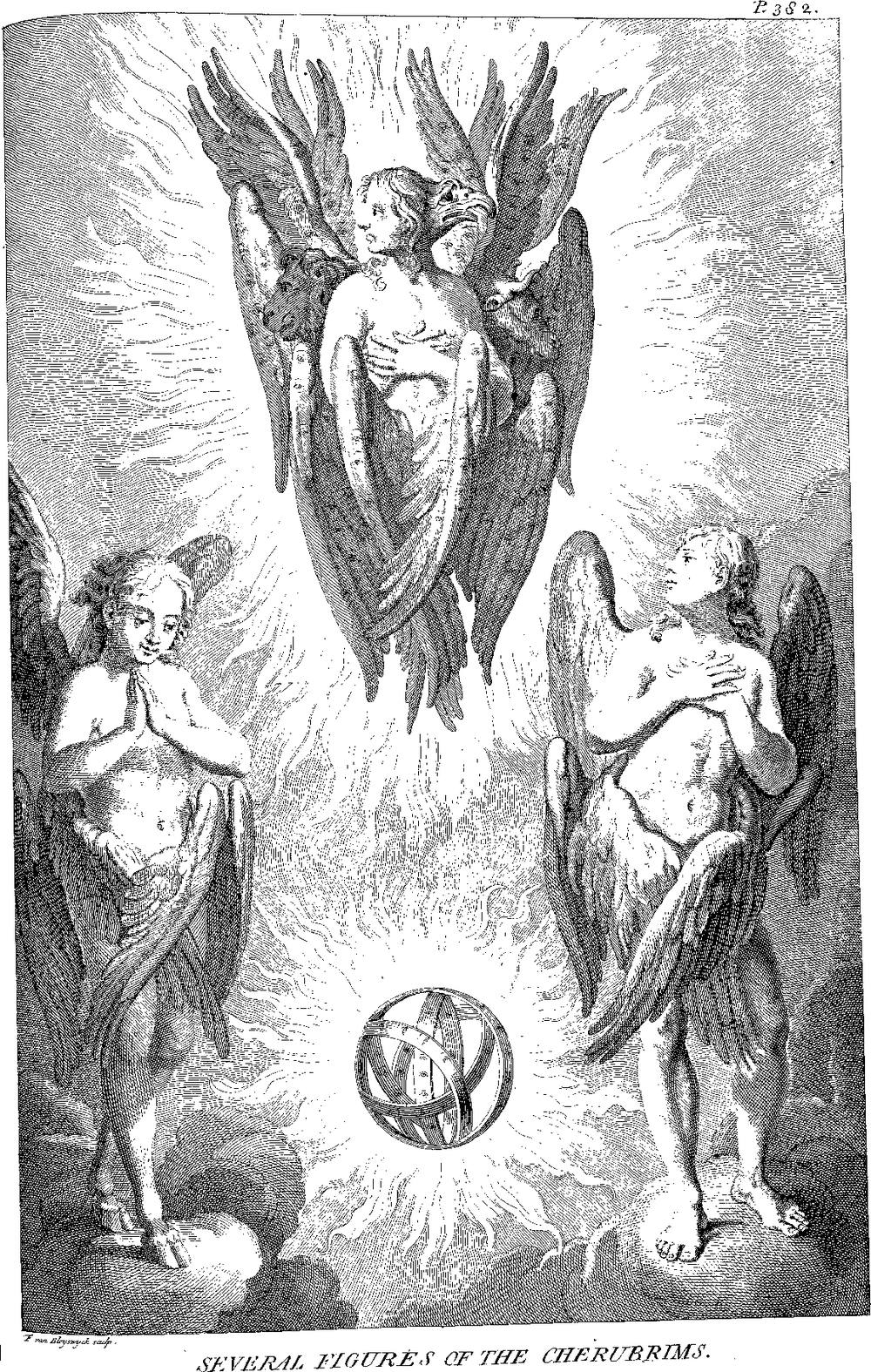
and Eve. But it is very probable, that both one and the other had a human figure, since it is said of those which were placed at the entrance of Paradise, that they had their Station there assigned them to guard Gen. iii. 24. Ezek. xxviii. 14.the entrance to it, and held a flaming Sword in their hands. And Ezekiel compares the King of Tyre to the Cherubin that covered the Ark of the Covenant, upon the holy mountain; that is to say, that he was like this Cherub glittering all over with Gold and Glory. Moreover, Moses says, that two Cherubins covered the Mercy-seat with their Wings extended on both sides, and looked one upon another, having their Faces turned towards the Mercy-seat, which covered the Ark.
The result of all that I have said is this, that the figure of the Cherubins was not always uniform, since they are differently described in the shapes of Men, Eagles, Oxen, Lions, and in a composition of all these figures Exod. xxvi. 1.put together. Moses likewise calls those symbolical or hieroglyphical Representations which were represented in Imbroideries upon the Veils of the Tabernacle, Cherubins of costly work13. Such were the symbolical Figures which the Egyptians placed at the gates of their Temples, and the Images of the generality of their Gods, which were nothing commonly but Statues composed of Men and Animals14.
Omnigenumque Deûm monstra, & latrator Anubis.
CHESALON, a City in the Tribe of Judah, Josh. xv. 10.
CHESED, Father of the Casedim or Casdim. Thus the Hebrews call the Chaldæans. Chesed was the Son of Nahor and Milcah. Gen. xxii. 22.But there is a great deal of probability, that the Casdim or Chaldæans came from some other Chesed.
CHESIL, a City in the Tribe of Judah, Josh. xv. 30. Eusebius calls it Xil, and places it in the southern part of Judah.
CHESITAH. Genes. xxxiii. 19. This term is translated Lambs. See Kesitah.
CHESULLOTH, or Chesulloth Thabor, a City situated on the side of mount Thabor, Josh. xix. 18. Eusebius and S. Jerom call iti Casalus or Exalus, and place it ten Miles from Diocæsarea towards the East.
CHETIIM. See Kittim. Macedonia is so called, 1 Macc. ii. 1.
Gen. xxxviii. 5.CHESIB. In Genesis, instead of these words, Judah’s Wife ceased to have Children, after the birth of Shelah: The Hebrew reads, She was at Chesib when she bare him. Chezib is the name of a place in Joshua, and Josh. xv. 44. Micah i. 14.in Micah. Chesib was a desart place near Adullam, in Eusebius’s time.
CHIDON. The threshing floor of Chidon is the place where Uzzah was suddenly struck dead, for having imprudently laid his hands upon the Ark, which tottered in the Cart. In the second Book of 2 Sam. vi. 6.Samuel, this threshing floor is called the threshing floor of Nachon. We do not know whether the names of Nachon and Chidon are the names of Men or Places.
Gen. xxxvii. 2, 3, 4, &c. 1 Chr. xiii. 9. Gen. xxii. 5. Psal. xviii. 46. Isai. ii. 6. Gen. xliv. 20. Isai. lxv. 20.CHILD, puer or filius. In the Scripture Disciples are often called Children or Sons. Solomon in his Proverbs gives this name to his Disciple, Audi; Fili mi, &c. The Children of the Devil, the Sons of Belial are those who follow the maxims of the World and the Devil. The descendants of a Man, how remote soever they may be, are called Sons or Children; for example, the Children of Edom, the Children of Moab, the Children of Israel. This Expression, the Children of the Wedding, the Children of Light, the Children of Darkness, is sometimes used to signify those who are invited to the Wedding, who follow Light, who remain in Darkness; the Children of the Kingdom, those who belong to the Kingdom.
Persons who are almost of Age, are often called Children. For example, Joseph is called puer, tho’ he were at least sixteen. Isaac was above twenty, when Abraham still gave him this name. Benjamin of the age of above thirty, is still called puer parvulus. The Hebrews as well as the Greeks and Latins, called their Servants and Slaves pueri. Lastly, Men of full age have often the name of Children given them: The strange Children shall fail. They pleased themselves in the children of strangers. The child shall die an hundred years old; that is to say, Men shall die at the age of an hundred years; there shall be no more untimely deaths seen.
Psal. lxxxii. 6. Job i. 6. ii. 1.CHILDREN, Sons of God. By this name the Angels are sometimes described: for example, Now there was a day when the sons of God came to present themselves before the Lord, and Satan came also among Psal. lxxxix. 6.them. And in the Psalms, Who among the sons of the mighty can be likened unto the Lord? Good Men, in opposition to the wicked, are likewise called by this name, the Children of Seth’s family, in opposition Gen. vi. 2.to the Race of Cain. The Sons of God saw the daughters of men and they were fair; and they took them wives of all that they chose.
Judges, Magistrates, and Priests are likewise termed Children of God. I said ye are Gods, and the children of the Most High. He speaks to Judges. And in another place, directing himself to Priests, he says, Give unto Psal. xxix. 1.the Lord, O ye Children of the mighty, give unto the15
Lord glory and strength. All this in the way of opposition to the sons of men, who are the common part of Mankind, ordinary People, Men in general.
Wisd. v. 5. Hos. i. 10. See John xi. 52.The Israelites are elsewhere called Sons of God, in opposition to the Gentiles, whereas before it was said unto them, ye are my people, they shall be called the children, the sons of God. Sometimes the Elect, the Blessed, have this name given them. How is he numbred among the children of God, and his lot is among the Saints!
John i. 12. Rom. viii. 14.In the New Testament, Believers are commonly called children of God by vertue of their adoption, and the prerogatives which Christ acquired for them, by assuming human flesh, and communicating this quality to us by Baptism, and a participation in the merits of his death. He hath given us, says S. John, power to become the sons of God. And St. Paul in several places extols the advantages of being adopted to be the Sons of God, which adoption we have received by the holy Spirit. For as many as are led by the Spirit of God, they are the sons of God---the Spirit it self beareth witness with our spirit that we are the children of God. And in another place, Gal. iii. 26.Ye are all the children of God by faith, &c.
Children, Sons of Men. This name is given to the Men of Cain’s family, who lived before the Deluge, and in particular to the Giants, those violent and corrupt Men, who before the Deluge had corrupted their ways, and drew down the most terrible effects of God’s anger upon the Earth. Afterwards the impious, the wicked, bad Israelites, were called the Sons of Men: Psal. iv. 3. Psal. xii. 1. Ps. lvii. 4.For example, How long will ye love vanity, O ye Sons of men? And, The faithful are minished from among the children of men. And, The sons of men, whose teeth are spears and arrows. But very often, by the Sons of Men, mankind are to be understood without any odious notion. What is man, Ps. viii. 4. Psal. xi. 4. Ps. cxlv. 12.that thou art mindful of him; or the son of man, that thou visitest him? And, His eye-lids try the children of Men. And again, To make known to the sons of men his mighty Acts.
Children, or Sons of Belial. See Belial. Children sacrificed to Moloch. See Moloch.
2 Sam. iii. 3.CHILEAB the Son of David, and Abigail, formerly Wife to Nabal.
CHILION, the Son of Elimelech and Noami, of the City of Bethlehem in Judah, who, during a great famine, retired with his Father and Mother into the land of Moab, where he married a Moabite Woman, whose name was Orpah. He Ruth i. 1, 29. 2 Sam. xix. 37, 38.died sometime after in this Country, without leaving any Children behind him.
CHIMHAM, the Son of Barzillai the Gileadite. He followed David to Jerusalem after the War with Absalom; and David bestowed great riches on him, in consideration of his Father Barzillai, who had so generously assisted him in his flight.
CHIMHAM, a place in the Neighbourhood of Bethlehem, Jer. xli. 17.
CHIMNEY. See Caminus.
CHINA, is one of the finest Countries in Asia. The Arabians write it Sin; the Persians, and other eastern People Tehin. They tell us, that this Country derives its name from one of the Sons of Japheth¹, called Sin. He was, say they, the eldest and most understanding of Japheth’s Children; he had likewise the best partition, and the large Country of China for his Inheritance. He it was who taught his Sons painting, sculpture, and the art of preparing Silk, so as to make different sorts of Stuffs with it. In a word, some assert, that the Works so much in vogue in China, and so much valued by Foreigners, are for the most part of his Invention.
His eldest Son was Matchin, who peopled the southern part of China, wherein we comprehend Cochinchina, Tunquin, and the Kingdom of Anan, together with those of Siam and Pegu. The antient Histories of the Persians say, that Feridoun King of the first Dynasty, called the Peichadians, gave China and Furkaston to his Son Tour for his Inheritance, with the title of Fagfour, which has continued hereditary to the Kings of this Country, like Pharaoh to those of Egypt. It is a very antient Tradition among the eastern People,16 that there is a very great number of Jews in China, and that they removed thither in the time of Joshua, God having opened a way thither for their arrival. But there is much more probability, that they who are to be met with in this part of the World, went thither after the Captivities of Israel under Salmanesèr, and the other three Kings of Assyria. In reality the passage thither is not very difficult from the Territories of the Medes and Persians.
It cannot be denied, that formerly there was a great number of Jews in China; the oldest relations17 that we have of this Country declare, that at the general desolation of it, principally at the taking of Cumdan, there was a great number of Christians and Jews massacred. But when, and upon what occasion the Jews came thither, we do not know. The Chinese Histories give us no intelligence in this18
this particular, either because the settlement of this People was made there insensibly, and without noise, or because the Chinese Historians, with whom it is a maxim to take no notice of foreign affairs, did not think proper to make mention of them.
At present there are few of them in China, where they lye dispersed in several Provinces, and particularly in the trading Cities. F. Ricci relates, that a Jew of Caisamfu coming to Pekin, in order to take his degrees there, had the curiosity to visit him, upon receiving information that he adored one God only, and was not engaged in the Superstitions practised by the Idolaters of that Country. F. Ricci carried him to a Chapel, where there was a picture of the Blessed Virgin holding the Child Jesus in her arms, and S. John Baptist near him. The Jew imagined these to be Rebekah, Jacob and Esau. He made the like judgment of a Picture representing the four Evangelists. This Father afterwards proposed several Questions to him, and discovered by his Answers, that he was Professor of the old Law, and owned himself to be an Israelite, not a Jew; whereupon he concluded, that he was a descendant of the ten Tribes, which were led into Captivity.
Father Ricci shewed him afterwards the Polyglot Bible of Antwerp; the Jew found out the Hebrew Characters in it, but could not read them; because, as he confessed, he had neglected the study of this Language, and had applied himself to that of the Chinese Letters, upon which account he had been like to be expelled out of the Synagogue. He was likewise informed by him, that there were ten or twelve families of Jews in the same City, where they had a handsom Synagogue, and had preserved the Pentateuch written in Volumes or Rolls for about five or six hundred years; that there was likewise in the Province of Chequiang a greater number of Israelites, and a Synagogue; but that in the other Provinces, their number was very much diminished, and they had no Synagogue.
Father Adam Shaal, a famous Missionary, wrote from Pekin, that he had seen Jews in the Kingdom of Kaschemir, who had preserved Judaism and the Old Testament, and knew nothing of the death of Jesus Christ; that they shewed an inclination to choose this Jesuit for their Chakam, provided he would abstain from eating Swine’s flesh.
Another Jesuit, whose name is Gozani, mentions the discovery of a Synagogue in the Province of Heman in China. He believes that there were Jews in this Country before Jesus Christ: They were acquainted with Esdras and Jesus the Son of Sirach (probably Jesus the Son of Sirach, author of Ecclesiasticus) and followed the method of the Talmudists in their explanations. But all this is more proper to persuade us, that these Jews are modern, than that they are derived from the old dispersion of the ten Tribes; for neither the Talmudists nor Ecclesiasticus, nor the History of Judith, could have been known to them.
There is a long Letter from the Jews of Cochin19, written to the Synagogue of Amsterdam, wherein they say, that they retired to the Indies at the time when the Holy Land was conquered by the Romans; that they have had seventy two Kings succeeding one another, for the space of a thousand years; that a division arising between two Brothers, who contended for the Kingdom, the neighbouring Princes subdued them: From which time they have continued subject to the Kings of China; that by their constant fidelity to these Princes they had merited many marks of esteem and confidence; that in the year 1640, Samuel one of their brethren died Governor of Cochin, and left his Office to a Jew of the same name.
Isai. xlix. 12.Manasseh-Ben-Israel, who was persuaded that there was a great number of Israelites in China, applied the following Passage of Isaiah to them;20 Those from the land of Sinim shall come from far; that is to say, according to him, from the land of the Chinese. S. Jerom translates it from the land of the south. The Septuagint from Persia; but the Hebrew Sin signifies dirt, and the City of Pelusium, or Damietta; so that the Prophet in all probability intended to describe Damietta and Egypt by these words from the land of Sinim.
As to what the eastern People say of Schin or Sin the Son of Japheth, and Father of the Chinese, we believe there is no great account to be made of it, the sacred Books taking no notice of him. Hereafter, under the Article of S. Thomas, we shall speak of the Christians of China, and the famous inscription found in this Country.
CHIPPUR or Kippur, the Feast of solemn expiation among the Jews. This term comes from Caphor or Kipper to expiate. See Expiation.
CHISLON, the Father of Elidad of the Tribe of Benjamin. He was one of those deputed to make a distribution of the land of Canaan, Numb. xxxiv. 21.
CHITTIM. Isaiah speaking of the destruction of Tyre by King Nebuchadnezzar, says, Howl ye vessels of the sea, for the place where the ships were used to sail is destroyed, its ruin shall come from the land of Chittim. If the land of Chittim signifies Macedonia, as we have shewn in our Comment on the tenth Chapter of Genesis, and in this Dictionary, how can it be said here, that the destruction of Tyre occasioned by Nebuchadnezzar, should come from the land of Chittim? might it not be more properly interpreted as relating to the destruction of this City by Alexander the great? A modern Author21 by the word Chittim understands the Cuthæans, Inhabitants of the Suziana near Babylon, and Subjects to Nebuchadnezzar, who marched under the Conduct of this Prince, and contributed to the siege of Tyre, with the other People who composed his Army. But in what place of Scripture are the Cuthæans described by the name Chittim? Bochart supposes the Romans to be meant by Chittim; but the Romans were not concerned in the Siege of Tyre, here mentioned by Isaiah, and Tyre under the Roman Empire was not an object worthy of their indignation.
Isai. xxiii. 1.We are of opinion, that in this place, as well as every where besides, the Macedonians are intended by the word Chittim, and we translate the Hebrew of Isaiah after the following manner, Howl ye ships of Tarshish, because Tyre is destroyed within; it is open on the side where people enter who come from Chittim. They come from Macedonia to Tyre from the Sea-ward. The City was thought to be impregnable on this side, because it was built upon a Rock washed every way by the Sea. Notwithstanding the Prophet foretels, that it would be taken, laid waste, and open on this side: Moreover that it should be ravaged from within, by its own Inhabitants; division would arise among the Citizens, or Soldiers who defended it.
Isaiah adds, v. 12. Thou daughter of Zidon, city of Tyre, arise, pass over to Chittim, there also thou shalt have no rest. Seek for refuge in Macedonia in a remote and maritime Country; yet even thither God will pursue you; his hand will not suffer you to rest there.
Jeremiah reproaching the Israelites with their inconstancy in the Religion of Jer. ii. 10.their Forefathers, says to them, Pass over the isles of Chittim and see; and send into Kedar and consider diligently, and see if there be such a thing. Hath a nation changed their gods which are yet no gods? The Prophet speaks of the Isles of Chit-
- tim, of the Country of Macedonia, under the name of an Island, after the manner of the Hebrews, who call thus Peninsulas and maritime Countries.
Acts vii. 4. 3. Amos v. 26.CHIUN, or Chevan. We meet with this word in the Hebrew of the Prophet Amos, cited in the Acts of the Apostles. S. Luke reads the passage thus: Ye took up the tabernacle of Moloch, and the star of your god Remphan, figures which ye made to worship them. The import of the Hebrew is as follows, Ye have born the Tabernacle of your kings, and the pedestal (the Chiun) of your images, the star of your gods, which ye made to yourselves. The Septuagint in all probability read Repham or Revan, instead of Chiun or Chevan, and took the pedestal for a God. Others are of opinion, that three false Deities are to be distinguished here, Moloch, Chiun and Remphan. Others again affirm, that the three mean only one God, adored under so many different names; and that this God was Saturn, and his planet. Salmasius and Kircher assert, that Kiion is Saturn, and that his Star is called Keiran among the Persians and Arabians, and that Remphan or Rephan signified the same thing among the Egyptians. They add, that the Septuagint, who made their Translation in Egypt, changed the word Chiun into that of Remphan, because they had the same signification. See the Article Remphan and our Dissertation upon the Idolatry of the Hebrews in the Wilderness, prefixed to the twelve Prophets. M. Basnage in his Book intitled, Jewish Antiquities, after having discoursed a good deal upon Chion or Remphan, concludes, that Moloch was the Sun, and Chion, or Chiun, or Rephan, the Moon. t. 2. p. 576--- 581, 611, 614, 617.
1 Cor. i. 11. Ab his qui sunt Chloes ὑπὸ τῶν Χλόης.CHLOE, a Woman of Corinth, and a Christian: She gave S. Paul notice of the divisions which were then reigning at Corinth, upon the account of Cephas, Apollos and himself. See 1 Cor. i. 11. Chloe did not herself write to Paul; but procured some of her family to do this for her. r S. Chrysostom conjectures, that she made use of Stephanus, Fortunatus and Achaicus, who were the first fruits of Achaia. Some have taken Chloe for a Man; but it is the name of a Woman. Pausanias gives Ceres the firname of Chloë.
CHOEROGRYLLUS, a Hedgehog, or a Porcupine, an animal which the Law Levit. xi. 5. שפן χοιρογρύλλιος. Chœrogryllus.of Moses has declared to be unclean s. The Legislator says, that the Hedge-hog chews the Cud; but as it divides not the hoof, it is judged unclean. The Hebrew Schaphan is not very well understood by us.
us. Some say it is the Hare, others the Rabbit. But Moses had before spoken of the Hare, and the Rabbit does not chew the cud. It cannot therefore be either of these animals. Nor can it be the Chærogryllus or Hedgehog, because it does not chew the cud. Bochart believes it to be a kind of large Rat, common in Arabia, good to eat, and called Aliarbuho. These animals chew the cud, dwell in rocks, and go in troops; qualities which the Scripture ascribes to the See the Hebrew Psal. civ. 18. Prov. xxx. 26. Levit. xi. 5.Schaphan.
CHOREBA, a Town in Judah, 1 Chr. iv. 22. the same probably as Caseb or Casbi, Josh. xv. 44. Micah i. 14.
CHRIST. This word comes from the Greek, Christos, which signifies anointed, and answers to the Hebrew Messiah. This is the name attributed by the Hebrews to that Saviour and Deliverer whom they expected, and who was promised to them by all the Prophets. As the holy Unction was given to Kings, Priests and Prophets, by describing the promised Saviour of the World, under the name of Anointed, or Messiah, it was sufficiently evidenced, that the qualities of King, Prophet and High-Priest, would all eminently meet in him, and that he should exercise them not only over the Jews, but over all Mankind; and in a particular manner over those who should believe in him, and acknowledge him for their Saviour, their King, their Priest and their Prophet. We shall in another place speak of Jesus Christ the true Messiah and Redeemer of Mankind. See the Article Jesus Christ, and that of Messiah.
CHRISTIAN, Christianus, Disciple of Jesus Christ. Christians were distinguished from Jews first at Antioch, and there were called Christiani, or Disciples of Christ. Acts xi. 26.They were generally called Brethren, Faithful, Saints, Believers. The name of Nazarens and Galilæans, was likewise given them by the Gentiles. It has been the opinion of several, that Christian was derived originally from the Greek, Chrestos, good, useful; and Suetonius22 speaking of Claudius, and of his expelling the Jews out of Rome, says, that he banished them thence, because they were continually quarrelling concerning Christ. Judæos, impulsore Chresto, assidue tumultuantes, Româ expulit. Christ, as Lactantius says, is no proper name, but one denoting power23; for the Jews were used to give this appellation to their Kings, and called them Christs, or anointed by reason of the Sacred Unction received by them. But, as he adds, the Heathen by mistake call Jesus Christ Chrestus: Sed eum, immutata littera, Chrestum solent dicere. And Tertullian24, The name of Christian comes from the Unction received by Jesus Christ; and that of Chrestianus, which you sometimes through mistake give us, (for you are not particularly acquainted with our name) signifies that Gentleness and Benignity whereof we make profession: Sed & perperam Christianus pronuntiatur a vobis (nam nec nominis certa est notitia penes vos) de suavitate vel benignitate compositum est.
CHRISTIANS of S. John. They whom Travellers call Christians of S. John, and the Eastern people Sabians25, are not a particular Nation, as that might be of the Sabeans in Arabia, but they who make profession of a particular Religion, prevailing pretty much in the Provinces of the East: It is not easy to demonstrate in what particularly this Religion consists, the eastern Authors being very little agreed about it; but this is evident, that the Religion of the Sabians, is one of the three to which Mahomet granted his protection in the Alcoran; which three Religions are Judaism, Christianity, and Sabiism. See the Article Zabians or Sabians.
The Christians of S. John, or Sabians, have borrowed many observances from the Christian Religion; they have a kind of Baptism, and great veneration for S. John Baptist, whose Disciples they call themselves. They read not only the Book of Psalms, which they call Zebour, but another Book also, which they attribute to Adam, and look upon as their Bible, the characters whereof are very particular, but the language of it is almost intirely Chaldee.
The Arabian Authors tell us26, that these people are descendants of the most antient Nation in the World, that they still at this day, in their Books at least, speak the language used by Adam and his Sons; that they hold their Religion and their Law from Scheith and Edris, who are the Patriarchs Seth and Noah, whose Books abounding with moral instructions are still in their possession. They pray to God seven times a day, and intermix no other action with this exercise. They fast during the whole course of a Moon, and take no nourishment from the rising to the setting of the Sun. This fast always ends at the vernal Equinox, which answers very nearly to the Jewish Passover.
They honour the Temple of Mecca, and have likewise much respect for the Pyramids of Egypt; because they believe Sabi the Son of Enoch to be buried in the third. Their principal Pilgrimage is performed at a place near Haran in Mesopotamia, which some maintain to be the place of Abraham’s birth; but is certainly that from whence he departed when he
set out upon his journey to Palestine. Others are of opinion, that this place is honoured by them, by reason of Sabi the Son of Mari, who lived in Abraham’s time, and from whom probably they derive their original, much rather than from Sabi the Son of Enoch, who is not known to us in the Scripture, and must have lived before the Deluge.
Another Arabian Author27 says, that the Religion of the Sabians was not only the most antient, but farther, the general and only Religion of the World, till the time of Abraham, from whom all other Religions are descended. They say, that the antient Persians, Chaldæans, Assyrians, Greeks, Egyptians, and Indians, were all Sabians, before they embraced Judaism, Christianity, or Mahometanism. And the eastern Christians make no scruple of affirming that Constantine the Great forsook the Religion of the Sabians, to espouse that of the Christians.
M. Chardin28 in his travels into Persia, says, that the Disciples of S. John are inconsiderable in number, and scattered over Arabia, Persia, and along the Persian Gulph; that they come originally from Chaldæa, and were the antient Disciples of Zoroastres, many of whose opinions are maintained by them: they received the Baptism of S. John, and blended the Doctrine of Christianity with Jewish practices, and the extravagancies of Mahometanism. They esteem S. John Baptist to be the Author of their Creed, their Rites, and even of their Books. They receive every year the Baptism of S. John, who, with his Father and Mother, is their great and only Saint. They place his Tomb near Chuster the Capital of Chusistan; where likewise they suppose to be the source of Jordan. They do not hold Jesus Christ to be the Son of God, but only for a Prophet, and the Spirit of God. Their veneration for the Cross proceeds almost to idolatry.
They have a Book called Divan, which they esteem sacred: There we may read that God is corporeal, and that he has a Son whose name is Gabriel, by whom he hath created the World. He created also Angels with bodies, and of different sexes, capable of engendering. It is said, that they consecrate, or believe they consecrate Bread kneaded with Wine and Oil, and that after they have carried it in procession, they eat it. They have Bishops and Priests who succeed one another from Father to Son; their Priests marry young Virgins. Some assure us, that once every year they sacrifice a Hen upon the banks of some River; they sacrifice also a Ram.
They receive their Baptism every year with aspersion or immersion, as they please, and in the name of God only; for they acknowledge neither the Son nor Holy Ghost. Polygamy is permitted among them. They are almost as scrupulous in observing Purifications as the Jews. Such are the pretended Christians of S. John.
Christians of the Girdle. In the East29, they call the Nestorians or Jacobites, and sometimes even the Maronites by this name, tho’ the latter are Catholicks: The original of this denomination is as follows. Motavakel, tenth Caliph of the house of the Abbastides, was the first Mahometan Prince who obliged the Christians and Jews of his Dominions to wear a black leathern Girdle30, which they continue to do at this day, principally in Asia, in order to be distinguished from Mahometans. From this time the Christians of Syria and Mesopotamia, who are almost all Nestorians or Jacobites have generally worn it; for which reason they are called the Christians of the Girdle. When any of these people were excommunicated, their Girdle called Zonar was cut, and with it some stripes were given them upon the shoulders. When the eastern Poets intend to praise their Princes, and exaggerate their conquests over Christians, they say they have silenced their Bells, and cut their black Girdles in a thousand pieces.
CHRONICLES. The two Books, by the Greeks called Paralipomena, and by the Hebrews Dibrei-haiamim, or words of days go under this name. See Paralipomena.
The Jews have Chronicles or Histories in their Language, but they are uncorrect, and very modern. We have discoursed concerning the History of Joseph Ben- Gorion under the title of this Author. Besides this, there are seven Chronicles or historical Books among the Jews, whereof it may be proper to say a word or two in this place.
1°. Seder-olam-Rabba, that is to say, the great Chronicle, or the great order of the Age, so called, to distinguish it from the small Chronicle, which goes under the name of Seder-olam-Seutah; because this is shorter, and a later composition31. It is thought Rabbi Jose Son of Caliptha is the Author of Seder-olam-Rabba; he lived a little after the beginning of the second Century, and was, as is reported, Master to Rabbi Judah the Holy, who composed the Mishna. But Rabbi Azarias in the third part of his Meor-enaim, says, he had seen a Manuscript of it, wherein it was asserted, that the Author lived seven hundred seventy two years after the
destruction of the Temple at Jerusalem, which answers to the year of Jesus Christ 832. It is very certain, that he did not write till after the Babylonish Talmud, for it contains abundance of fables, and extravagant conceits, which may be clearly discerned to have been taken from thence. The Author scarce speaks of any thing but events which are recorded in the Scripture. Buxtorf says, that it descends to the time of Adrian; and the victory obtained by this Prince over Barchochebas: What proves R. Jose not to be the Author of it is, that he is cited in many places of it. The Author affirms, that the Prophet Elijah, after his transportation, wrote ten letters to King Jehoram; that he wrote the history of the World in the place of his abode; that Job was the Father of Balaam; that Joshua, after the passage of Jordan, wrote the Law in seven Languages, upon the twelve stones which by his order were taken out of Jordan.
The second Chronicle of the Jews is intitled Teshuvoth R. Sherira Gaon. The answers of R. Sherira the sublime Doctor. This is an historical treatise written by way of Questions and Answers; the Work is very short. The Author was President at Babylon, and head of all the Schools and Academies in this Country. He entred upon his office in 967, and was thirty years in possession of this dignity, which he resigned to his Son R. Haia, the last of those who bore the title of Gaon or Sublime Doctors. It was in his time, in 1037, that the King of Babylon, who was a Mahometan, banished all the Jews out of his Dominions; so that all their Schools were forsaken. Sherira wrote the History of these Academies, and inserted the Succession of the several Rabbins who had appeared in them from the Talmud to his time.
The third Chronicle is intitled Sederolam-Zutha, or the lesser Chronicle, to distinguish it from the Seder-olam-Rabbah above-mentioned. The lesser Chronicle was written 1053 years after the destruction of the Temple; that is to say, in the year of Jesus Christ 1123; who the Author of it is we know not. He gives us a very short abridgment of History from the Creation of the World, to the year of Jesus Christ 522. From this time it is continued further for eight Generations, but without mentioning any thing besides names.
The Title of the fourth Chronicle is, Sepher Kabbalah R. Abraham Levitæ Ben -Dior, the Book of Tradition composed by Rabbi Abraham the Levite, Son of Dior. The principal design of this Work is to give an account of the succession of those through whose hands the Traditions of the Jews passed from Generation to Generation, from Moses down to the Author, who was living in the year of Jesus Christ 1160. He follows very much Josephus the Son of Gorion, and is one of those who brought him most into vogue.
The fifth Chronicle is, Sepher Juchasin, or the Book of Genealogies. This Work is larger than any of the four abovementioned. He begins with the Creation, and continues the History down to the year of Jesus Christ 1500. The Author of it was Abraham Zacuth, who published it at Cracow in Poland in the year 1580. he describes with great care the Succession of the Jewish Traditions from mount Sina, and the names of those eminent Doctors, who taught them as low as his own time.
The Title of the sixth Chronicle is Shalsheleth Haccabalah, or the Chain of Tradition. It is an historical Book of the same kind with that preceding. The Author was Rabbi Gedaliah, the Son of Jechaiah, who published it at Venice in 1587.
The seventh Chronicle is Zemah David, or the branch of David. It begins at the Creation, and descends to the year of Jesus Christ 1592, when it appeared at Prague in Bohemia. The subject is the same with that of the two last preceding. The Author was David Ganz a Bohemian Jew. William Henry Vorstius Son of Conrad Vorstius, translated it into Latin, and published it at Leyden in 1644.
The Chronicle of the Prophet Moses, intitled in Hebrew, Dibrei-Hajamina-Schel -Mose, is a fabulous Book concerning the life of Moses, printed at Venice, in 1544, translated into Latin by M. Gaulmin.
The Samaritan Chronicle was published by M. Bernard, and communicated to the Journalists of Lipsick. M. Basnage32 has inserted it with some remarks in his History of the Jews. It begins at the Creation of the World, and continues to the taking of Samaria by Saladin 1187. It is very short and unaccurate. See the Article Samaritans.
CHRYSOLITE, a precious Stone, the tenth fixed upon the High-Priest’s Pectoral, with the name of Zebulun engraven on it. This Stone is transparent, of the colour of Gold, with a mixture of green in it, which casts a fine lustre. The Hebrew word is Tarshish, which the Septuagint and S. Jerom translate sometimes Carbuncle; the Rabbins in their explanation of it, will have it to be the Beryl. But
we may be very certain that they do not know well what it is.
CHRYSOPRASUS, the tenth of those precious Stones, which adorned the foundation of the heavenly Jerusalem; the colour of it was green, much like that of a Leak, but something inclining to that of Gold, as its name imports.
CHRYSTAL. See Glass.
CHUB. This is a word which we meet Ezek. xxx. 5.with in Ezekiel; it probably signifies the Cubians, placed by Ptolemy in the Mareotis33. Chub, is a term which occurs in no other part of Scripture.
CHUN, a City of Syria, conquered by David. We think it to be Cunna, described in Antonin’s Itinerary, and perhaps called Ganna in Ptolemy.
CHURCH. The Greek word Ecclesia signifies Assembly: It is taken both for the place where the Assembly is held, and for the persons there assembled. We find it made use of to signify either a profane, or a sacred and religious Assembly. In the Books of the New Testament it generally stands for the Church of Christ, which is the Congregation of the Faithful; who under the conduct of lawful Ministers, make but one Body, whereof Jesus Christ is the Head. Particular Churches are likewise meant by it, as that of Corinth, Ephesus, Thessalonica and others.
Ibid. v. 8.In the Books of the Old Testament, Ecclesia is sometimes taken for the Society of the Jews; for example, Cur eduxisti Ecclesiam Numb. xx. 4.Domini in solitudinem? Why hast thou brought the Assembly, the Body, the multitude of God’s People into the Wilderness? And elsewhere: Eunuchs, Deut. xxiii. 1, 23, &c.Bastards, the Ammonites and Moabites shall not be admitted into the Church of God. They shall not be received into the Land; the Israelites shall neither marry with them, nor permit them to dwell among the People; or they shall not be received as Proselytes to profess the Religion of the Lord: This shews an extreme aversion and contempt for these People; they were looked upon as profane persons, with whom the Hebrews were to have no commerce, either in civil or religious affairs.
But as to the Edomites and Egyptians, Moses suffers them to enter into the church of the Lord after the third generation; that is to say, if an Egyptian or Edomite settle in the Land, and is willing to become there a sojourning Proselyte34, his Children after the third generation, may marry Israelitish Women, and be let into the privileges of the Hebrews: Or otherwise, if an Hebrew marries an Edomite or Egyptian Woman, his Children cannot be esteemed true Israelites till the third Generation: They cannot marry an Israelitish Woman, and be admitted into the Temple, and publick employments.
The Church is likewise taken for a Communion in the Society and Prayers of God’s People; to be excluded from the Church, signifies Excommunication: For example, it is said, that he, who after he had touched a dead body, or been present at a funeral, should not purify himself with lustral water, wherein were cast the ashes of a red Heifer sacrificed for that purpose, should be cut off from among the congregation, Numb. xix. 20, 21.because he had defiled the Sanctuary: He should be excommunicated and shut out from the Congregation of Israel; he should be looked upon as a profane and uncircumcised person. The Rabbins understand this as meaning bodily death, a sudden, or violent death; or the death of the Soul, or of both Body and Soul, according to the grievousness of the crime, and the importance of the matter.
The Church is likewise used for the holy place, the Tabernacle, Temple, or Synagogue, where the People of the Lord assembled. The Elders of Israel performed their Prayers in the Church or Judith vi. 21. Psal. xxii. 23, 26.Synagogue of Bethulia. Intra Ecclesiam oraverunt. And the Psalmist, I will praise thee in the Church; I will publish thy praises in the church of the Saints; in a great Church; that is to say, in the Temple, where the Saints, the Israelites, and in a word, all the People assembled together.
By the Church is sometimes meant the society of the Faithful, who have preserved the true Religion committed to their care, from the beginning of the World to this day, and will preserve it to the consummation of Ages. The Succession of this Church hath been delivered down to us by Moses, from the beginning of the World unto his time; and from Moses to the coming of Jesus Christ, we have the sacred Writings of the Hebrews, and their Histories, which inform us of the different Revolutions that have happened in Religion among the Israelites. Adam instructed his Sons in the true Religion; but corruption of manners soon crept into his
family: Two Churches were hereupon formed, one composed of the Children of God, descended from Seth, the other of the Children of men issuing from the Race of Cain. Both continued till the Deluge, after which Noah inspired his Sons with such sentiments of Religion, as he himself abounded with: But how long these were preserved by them, we cannot tell.
Moses is our Guide from Shem down to Abraham the Father of the Faithful; but he does not inform us, whether the true Religion was preserved by the Descendants of Ham and Japheth, nor how long it subsisted among them: But on one side we see, that Abraham’s Ancestors worshipped Idols in Chaldæa, and on the other we know, that Gen. xx. 3, 4, 5. כירים Gen. xii. 17, 18, &c. Kiraim,the fear of the Lord was not intirely banished out of Palestine and Egypt, when Abraham came thither: For the King of Gerar, as well as the King of Egypt, feared God, and had a great abhorrence of sin. The High Priest Mel-chisedech is a farther Proof Χυτρόποδες of what we have been saying. The same Gen. xiv. 18. כיור Gen. xviii. 23, 24, 25.Abraham imagined, that there were at least ten or twenty righteous persons in Sodom. From Abraham down to Jesus Christ we find a continued succession of the true Church among the Jews, and other descendants of this Patriarch; for it is very credible that the Sons of Abraham, by Hagar and Keturah, did likewise for some time preserve the depositum of the Faith, which they had received from their Father. Job, who was one of Esau’s Posterity, and his friends, knew the Lord. The Ammonites and Moabites, descended from Lot, did not probably fall immediately into that Idolatry wherein we see them plunged so early as in the time of Moses.
The Ishmaelites Sons of Hagar and Abraham, value themselves upon having adhered always to the worship of the true God, and extended the knowledge of him in Arabia, as Isaac did in Palestine. We do not credit them upon their bare word; for it is certain, that in the time of Mahomet, and long before, they had forsaken the true Faith; but it is impossible to shew exactly the particular period of their perversion. As to the Descendants of Isaac, we have indubitable proofs, that notwithstanding so many revolutions as happened in their Nation, the frequent transgressions of the Law by most of their Princes, and the almost continual Infidelities of the Israelites in general, God was at all times known among them, and reserved to himself a good number of true worshippers. And lastly, that we are to look for the true Church in Israel, till the formation of the Church of Christ.
CHUSHAN-RISHATHAIM, King of Mesopotamia, oppressed the Israelites
- From the year of the World 2591, to 2599. Judg. iii. 8, 9, 10.for eight years. At the end whereof, the Hebrews cried unto the Lord, and he raised up a deliverer for them; Othniel, the Son of Kenaz, and Son-in-law of Caleb. Othniel marched against Chushan-Rishathaim, and the Lord delivered him into his hands.
CHUZA, Steward to Herod Agrippa, and husband to Joanna, of whom there is mention made in S. Luke. viii. 3.
Levit. xi. 35.CHYTROPODES, Skillets or Pots. We meet with this term in Leviticus xi. 25. where God commands the earthen Pots to be broken, into which any unclean thing should fall. The Hebrew word Kiraim, which S. Jerom has translated Pots, is understood by others to mean an Hearth, or Oven, a Cistern or Bason to wash ones feet in. Kiraïm is of the dual number, and signifies a vessel composed of two pieces.
Concha, Luter. A Bason, a Cistern.CICER, Chich Pease. The antient Hebrews made use of chich Pease as their common provision, when they took the field. They parched them, and so eat them. Among other provisions wherewith Barzillai supplied David in his flight, 2 Sam. xvii. 28. Account of Ethiopia.parched Pease is reckoned, frixum cicer. And still at this day in Egypt, when people undertake a journey, they lay in a good stock of chich Pease parched in a Frying-pan. c Bellon assures us, that at Grand Cairo and Damascus there are abundance of Shops, where people do nothing else but fry Pease, it being a sort of Provision wherewithal they furnish Travellers. In Ethiopia they take Barley with them roasted in the same manner. In Turky they lay in a stock of Rice on these occasions, which they prepare and shell. The Hebrew term cali signifies properly any thing roasted in general, and by it is understood roasted Pease, Rice or Barley. Some will 2 Kings vi. 25.have even Coffee to be meant by it. There is a sort of chich Pease called Dove’s Dung, which will be spoken of in its proper place.
CIDARIS, the Mitre used by the Jewish High Priests. Whenever there is mention Exod. xxviii. 4. מצנפת Misnepheth, Cidaris. מגבעותof the High Priest’s Mitre, the Hebrew word made use of to express it, is always Miznepheth, and Mygbaoth, to signify the Bonnet belonging to common Priests. The Rabbins say, the same thing is meant by both these terms, and that the Bonnet used by Priests in general, was made of a piece of Pileus.linen cloth sixteen yards long, which covered their heads like an Helmet, or a Turbant; and they allow no other difference to be between the High Priest’s Bonnet, and that of other Priests than this, that one is flatter, and more in the form of a Turbant, whereas the other worn by ordinary Priests, rose something more in a point. I say nothing here of c Bellon l. ii. c.
the plate of Gold, which was an Ornament peculiar to the High Priest’s Mitre.
Josephus says35, that the Bonnet worn by private Priests, was composed of many rounds of Linen Cloth turned in and sewn together, so as to appear like a thick Crown made of Linen wove together. The whole was intirely covered with a piece of Linen Cloth, which came as low as the Forehead, that so the deformity of the seams might be concealed. As to the High Priest’s Bonnet, he says it is like that which we have been describing, but that another was put over it of a Violet colour, which covered the hinder part of the Head, and the two Temples, and was encompassed with a triple Crown of Gold, wherein were small Buttons of henbane Flowers. This circle of Flowers was interrupted in the fore-part of the Tiara, at that place where the plate of Gold, with the name of God on it was fixed.
S. Jerom assures us, that the Priest’s Bonnet was round, like that with which Ulysses was generally painted, as if a Sphere were cut in two, and one half of it were made use of for a Bonnet36. There was no point upon the top of it, nor did it cover the whole head of hair, but left one third part of it before bare: And to prevent its falling off, it was fastened with a Ribbon, which was hid behind. It was of fine Linen, and so neatly covered with a Linen Cloth, as to hide all the Seams. This he takes to be what the Hebrews called Miznepheth; and that this kind of Bonnet was used both by the Priests and High Priest. Pileo de quo diximus; tam Sacerdotes, quam Pontifices utebantur.
It appears from all that we have said, that the form of these Bonnets is not now well understood, the descriptions which are given us of them being so various and different. Moses expressly tells us, that the High Priest’s Tiara was made of Schesh, that is Cotton, and that of other Priests, of Linen only. The Tiara and the Priests Bonnets were tied with a Ribbon, which Ezekiel calls Crown; but that used by the High Priest was richer, and remarkable for the plate of Gold, with the name of God engraven on it, which was placed on the fore-part of the Tiara, and covered some of the High Priest’s Forehead; the Ribbon was tied behind his Head. Lastly, the Hebrew term Migbaoth, whereby the Bonnet of the common Priests was expressed, and which S. Jerom translates Mitra, intimates, that this Bonnet had some resemblance with an Helmet. And that of Miznepheth, which denotes the High Priest’s Tiara, and is translated Cidaris by the same S. Jerom, was probably of another form, and perhaps like those strait Tiaras, which were worn by the Kings of Persia37. We see in Isaiah, that the Kings of Judah wore a Bonnet on their Heads called Zenuph, which is derived from the same root as Miznepheth. It is to be observed, that the Hebrew Priests never appeared in the Temple without covering their Heads. And still at this day it is reckoned an incivility in the East, and a mark of contempt, for any Man to pull off his Hat or Turbant to another, or to shew his naked head before any one.
CIGNUS. The Swan is a large water Fowl, that has a long and very straight Neck; it is very white, excepting when it is young. Its Legs, Feet and Bill are black; its Bill is very like that of a Goose, but something rounder, and a little hooked at the lower end of it; the two sides below its Eyes are black and shining like Ebony. This Bird stretches its Wings like Sails, that the wind may drive it along, when it is in the water. It feeds upon herbs, and some sort of grain like a Goose. It is very long lived, and some there have been which are said to have lived three hundred years. There is a sort of Swan, the right foot whereof is like the talons of a Bird of prey; this it makes use of in catching Fish by diving for them; but its left foot is like that of a Goose, and is of use only in swimming. There is besides another species, which has all the feathers of its head towards the breast marked at the ends with yellow points like Gold, inclining to red38; and in all probability this is the species of Swans which Horace39 calls purpurei, and by which he represents the Chariot of Venus to be drawn. The Swan was consecrated to Apollo as to the God of Musick, because it was thought to sing melodiously40 when it was near expiring. The Latin Text of Scripture speaks no where of the Swan, but in the enumeration of the Birds which were forbidden to be eat.
Lev. xi. 18. 70תנשמת .Πορφυ -ρίωνα.Moses reckons the Swan among the unclean creatures; at least S. Jerom thus translates the Hebrew Tanschemeth, whereby
by the Septuagint understood the Porphyrio to be meant, which is a Bird, the bill whereof and legs are red like Porphyry. Onkelos the Samaritan Translator, and Bochart, explain it by the Owl. We have offered some conjectures on Isaiah, xiii. 21. to shew, that the Hebrew, Bath-janah was the Swan. This Bird loves the water; it is very cruel; it is celebrated for its mournful way of singing, and the shrill cries which it sometimes sends forth with so much force, and for so long a time, as to kill itself41: Which has given room for the observation made by many, of its singing, when it is upon the point of expiring.
Lev. xi. 16. Deut. xiv. 16.Sic ubi fata vocant udis abjectus in herbis
Ad vada Mæandri concinit albus olor.
Moses ranks the young of the Haiana, which is generally translated Ostridge, among the unclean Animals.
CILICIUM, a sort of habit made of coarse stuff, of a black or dark colour formerly in use among the Hebrews in times of mourning and distress. It was called Cilicium, because it came from Cilicia, or rather because the Cilicians invented this kind of habit, made of Goats hair, and used principally in Camps and Ships, by Soldiers and Mariners42. The Septuagint and Hebrew call that Sackcloth, which S. Jerom translates Cilicium, either because Sacks were made of this sort of stuff, or because Hair-cloths were strait and close like a Sack. S. John in the Revelations shews plainly, that these Sack-cloths, or Hair-cloths were black, when he says, that the Sun became black as Sack-cloth made of hair. Sol factus est niger tanquam saccus cilicinus.
It is said in Scripture, that Jacob put on Gen. xxxvii. 34. 2 Sam. xxi. 10. 1 Kings xxi. 27.Sackcloth, when he was told that his Son Joseph was dead. Rizpah Saul’s Concubine lay on Sackcloth, while she guarded her Sons, whom the Gibeonites had hanged. Ahab cloathed himself with Sackcloth, when he heard how terribly the Prophet Elijah had by God’s Command threatned him. The same Prince put Sackcloth on his 2 Kings vi. 29, 30flesh, while the Syrians besieged Samaria; and having understood that a Woman had eaten her own Child, he tore his royal Robes, and all the people saw the Sackcloth which he wore upon his flesh. So that these Hair-cloths were very different from what we call at present by this name. The old Monks were very often cloathed with these Hair-cloths of the old fashion; that is to say, with coarse rough habits of a darkish colour, much like the habit of the Capuchins. Paulinus speaking of S. Martin, says43,
Quin & contexto setis coopertus amictu, Exesa assiduo compunxit acumine membra.
CINIPHES. See Sciniphes.
CINNAMOMUM. God commands Moses to take Cinnamon, and several other sweet Spices, and make a perfumed Oil with them, to anoint the Tabernacle, and all the vessels belonging to it. The Cinnamomum is a shrub, the bark whereof has an admirable scent; several of the Moderns confound it with the Cinnamon Tree and Cassia Aromatica. Others distinguish these Species. It is certain that the true Cinnamomum is very rare. Matthiolus assures us, that whatever inquiries he had made after it, he could never find any of it; and in Galen’s time it was so scarce, that it was hardly to be found any where but in the Emperor’s Cabinet. Pliny44 says, that it was formerly valued at a thousand Denarii; but that the price of it was raised to double what it had been by the great waste made by the Barbarians, who had burnt all these Trees. Matthiolus is of opinion, that the Cinnamomum is quite lost in Arabia, as the Balsam Tree in Judæa. Some Rabbins by the Hebrew Cinnamon suppose Aloes to be understood.
קנמוןKinnamon. 70. Κινναμώμον.No one at present makes the least question, but the Cinnamomum spoken of so confusedly by the Antients, is Cinnamon; now Cinnamon is a long thin Bark, rolled up together, of a dark red colour, of a poignant taste, aromatick, and very agreeable. The fine Cinnamon comes all from the Isle of Ceylon. Some other Barks are likewise called Cinnamon, such as Clove Cinnamon, white Cinnamon, and the Cassia Lignea. Clove Cinnamon is the bark of a Tree to be found in the Isle of Madagascar, and called Ravendsara. White Cinnamon is the bark of a Tree which grows in America, at Jamaica, and S. Domingo. The Cassia Lignea is the Bark of a Tree called by the People of Malabar Katoukarva. Some believe it to be the second Bark of the wild Cinnamon Tree.
But there is no probability that Moses intended to speak of the Cinnamon of Ceylon, nor those of America, which was an unknown Country, and in all likelihood not peopled in his time, and Trade was not as yet opened with the Isle of Ceylon, or Tapobrana. But there might be Cinnamon in Arabia, or Ethiopia; or however, the Hebrew word Cinnamon made use of by Moses, signifies something else besides Cinnamon. The Hebrew reading is Kinnamon here and Exod. xxx. 23.in Cant. iv. 14. Matthiolus tells us, that the Cinnamomum has failed in Arabia, in like manner
ner as the Balsam Tree in Judæa. This should seem to be rather a Gum or Oil, than a Bark or odoriferous Wood.
CINNERETH, or Ceneroth, or Cinneroth, a City in the Tribe of Naphtali, to Josh. xix. 35. Josh. xi. 2. xii. 3. Deut. iv. 49.the South whereof there lay a great Plain, which reached as far as the Dead Sea all along the River Jordan. Many believe, with a good deal of probability, that Cinnereth was the same as Tiberias; and as the Lake of Genezareth, which in Hebrew is called the Lake of Cinnereth, is without doubt that of Tiberias, there is some reason to believe that Cinnereth and Tiberias are likewise the same City. See Tiberias, where we relate some reasons for the contrary opinion.
The Lake of Cinnereth, the Sea of Cinnereth or Tiberias, or the Lake of 1 Macc. ii. 67.Genezareth, or Genezar45, are so many names given to it from the situation of the City Cinnereth or Tiberias, lying upon the western Shore, and towards the southern Extremity of it; and because the Canton of Genezar lies upon the eastern coast of it. It is called likewise the Sea of Galilee, because the north and east sides of it are enclosed by Galilee. In Josephus’s Account of it, it is an hundred Furlongs in length, and forty wide; that is to say, about twelve Miles or four Leagues and an half long, and two over. The water of this Lake is very good to drink, and breeds abundance of Fish. There S. Peter, S. Andrew, S. John, and S. James, who were Fishermen, carried on their Trade. The River Jordan passes through this Lake, and is continually bringing into it a fresh supply of water. The Country which borders upon the Sea of Galilee is very beautiful and fruitful.
כנורCinnor. Κιθάρα, ψαλτήριον, κινύρα. Gen. iv. 21. 1 Sam. xvi. 16, 23. Psal. cxxxvii. 2. 1 Kings x. 12. & 2 Chr. ix. 11.CINYRA. This, and the Hebrew, Cinnor, which is generally translated Cithara, or Lyra, or Psalterium, are the same. This instrument was in use before the Flood, and Jubal the Son of Lamech was the inventor of it. It was upon the Cinnor that David played before Saul, and it was this the captive Levites hung upon the Willows of Babylon. It was made of Wood, and was played on in the Temple of Jerusalem. The Prophet Isaiah intimates, that the sound of it was sad and mournful, when he says, Isai. xvi. 11. my bowels shall sound like the Cinnor or Harp. Hesychius observes, that Cinnyros in Greek signifies sad and lamentable. Josephus says, that the Cinyra of the Temple had ten strings, and that it was touched with a Bow46. In another place he says,47 that Solomon made a great number of them with a precious kind of Metal called Electrum; wherein he contradicts the Scripture, which informs us that 1 Kings x. 12.Solomon’s Cinnors were of Wood.
The first Book of Maccabees seems to distinguish the Cithara from the Cinyra; Templum renovatum est in Canticis & citharis & cinyris. Others confound them. It is certain, that there was very little difference in these Instruments, and all that there was, consisted perhaps in the number only, or disposition of the strings. For among the Antients there were Citharæ or Harps of several sorts. So much seems to be out of all dispute, that the generality of the Instruments, whereof the Antients make any mention, are derived from the Cinnor of the Hebrews, and even those too which are in use at present, as the Harp, the Guitar, Psaltery, Lute, Violin, Base Viol, &c. What the Greeks tell us of the invention of the Harp by Mercury, and the perfection it was brought to by several Musicians, relates to Greece only. Musick, and the Instruments of it were known in perfection among the Hebrews long before Mercury, Orpheus, Linus, Terpander, Simonides, and Timotheus.
Gen. xvii. 10.CIRCUMCISION. This Term is taken from the Latin, circumcidere, which signifies to cut all round, because the Jews who circumcised their Children, cut off the little skin after this manner, which covers the Prepuce. God enjoined Abraham to use Circumcision, as a sign of that Covenant which he had entered into with him. This is the covenant, says the Lord to Abraham, which ye shall keep between me and you, and thy seed after thee. Every male child among you shall be circumcised. And ye shall circumcise the flesh of your foreskin, and it shall be a token of the covenant betwixt me and you. And he that is eight days old shall be circumcised among you, every man-child in your generations, he that is born in the house or bought with money of any stranger, which is not of thy seed. And the uncircumcised man-child whose flesh of his foreskin is not circumcised, that soul shall be cut off from his people: he hath broken my covenant. In pursuance of this order, Abraham, who was then ninety nine years of age, was circumcised; he circumcised also his Son Ishmael, and all the Slaves in his family.
God repeated the Precept of Circumcision to Moses, and ordained that all those who intended to partake of the Paschal Sacrifice, should receive Circumcision, and that this operation should be performed on Children newly born, on the eighth day after their birth. The Jews have been always very exact in observing this Ceremony, and it appears that they did not neglect it in Egypt. But Moses, while he was in Midian with Jethro his Father-in-law, did not circumcise the two Sons which he had in that Country; and dur
ing the journey of the Israelites through the Wilderness, the Children who were then born, were not circumcised: Probably by reason of the danger which their lives might have been exposed to, because they were not fixed in any one place, and were obliged very often to change their habitation.
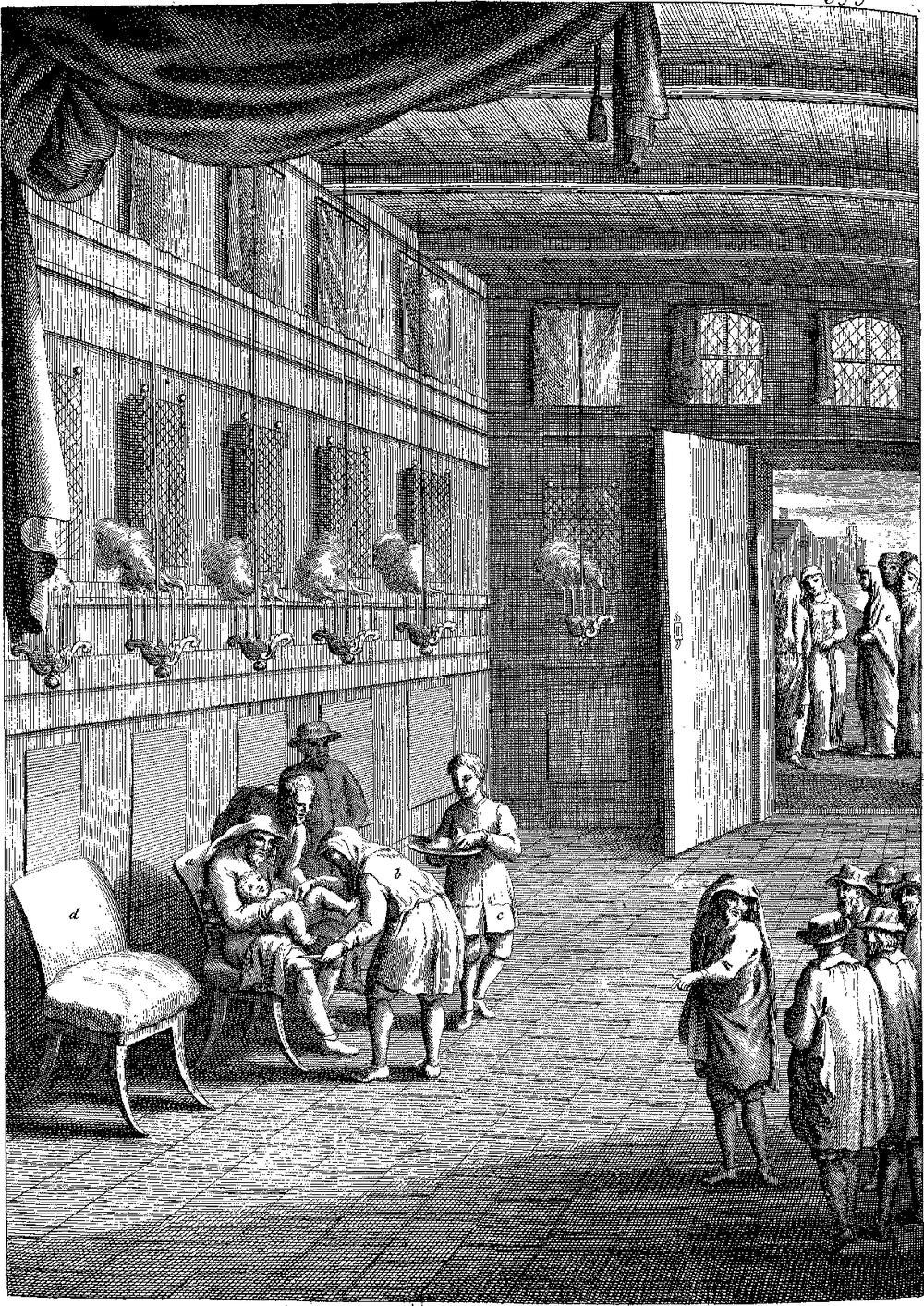
The Law has ordained nothing either concerning the Minister, or the Instrument of Circumcision. The Father, or any other Relation, or a Surgeon, or any other whom they had a mind to choose, might perform this Ceremony. They generally made use of a Knife or Razor. Zipporah the Wife of Moses circumcised her Son Eliazer with a sharp Stone. Joshua made use of the like Exod. iv. 25.Instrument in circumcising those who had not received Circumcision in the Wilderness. Josh. v. 3. Exek. xvi. 6.It is very probable that the Egyptians with these Stones fashioned like Knives, opened the bodies of such persons as they embalmed48. Some pretend that the Knives of this kind are much less dangerous than others made of Brass or Iron, and that they do not cause so great an Inflammation in the Wound. The Galli who were the Priests of Cybele, the Mother of the Gods, castrated themselves with a sharp Stone, or with a broken pot-sherd, not knowing how to do it otherwise without endangering their Lives49.
The Ceremonies now observed in Circumcision by the Jews, are such as these. When a Son is50 born in any Family, it is customary for some to put little Notes in the four corners of the Chamber, with these words inscribed, Adam and Eve; Lilith, be gone. (The Jews assert, that Lilith was Adam’s first Wife, who upon her separation from him, took up her habitation in the air, where she still continues, and is a great enemy to the delivery of Women, and new born Children.) They write likewise in these Notes the names of three Angels, in order to defend the Child from all sorts of Witchcraft. But all do not observe these superstitious Practices.
The Father is obliged to have his Son circumcised upon the eighth day, unless the weakness or indispolition of the Child oblige him to defer it. The night before Circumcision is called watching; because the whole Family is awake to guard the Child; and the Father and Mother are visited by their male and female Friends: On which occasions abundance of Joy and Civility is expressed. The Godfathers and Godmothers are chosen some time before. The Godfather holds the Child while the Operation is performing, and the Godmother carries it to the Synagogue. As to the person who circumcises, they choose for this purpose whom they please. The Father himself may do this Office, if he is capable of it. It is esteemed a great honour among the Jews to be Mohel; that is to say, a Circumciser. It is not necessary to go to the Synagogue in order to perform this Ceremony; the Child may be circumcised at home, if the Parents please.
Two Seats are provided for this purpose, with two silk Cushions: One of the Seats is for the Godfather who holds the Child; the other is left empty, and is designed, as some say, for the Prophet Elias, whom they believe to be invisibly present at all Circumcisions, so great was his Zeal for the observance of the Law. He who circumcises comes with a dish, wherein are the Instruments, and other things necessary for that Operation, such as the Razor, the astringent Powders, the Linen Cloth, the Lint, and Oil of Roses. They who are present sing some Songs, while they wait for the Godmother, who brings the Child upon her arms, and is attended with a company of Women. But not one of them go beyond the door of the Synagogue: There they deliver the Child to the Godfather, and immediately all who are there cry, Baruch haba welcome.
The Godfather sits down upon his Seat, and settles the Child in a proper posture on his Knees; then he who is to circumcise him, opens the Blankets. Some make use of Silver Tweezers to take up so much of the Prepuce as they design to cut off. Others take it with their Fingers. Then he who circumcises holding the Razor in his hand, says, Blessed be thou, O Lord, who hast commanded us to use Circumcision. And while he is saying this, he cuts off the thick Skin of the Prepuce; then with his Thumb nails he tears off another finer Skin still remaining. He sucks the Blood two or three times, which flows plentifully upon this occasion, and spits it out into a Cup full of Wine. After this, he puts some Dragon’s Blood upon the Wound, some Coral Powder, and other things to stop the bleeding; to all which he adds Bolsters of Oil of Roses, and covers all close. In the next place, he takes the Cup into which he had spit the Blood sucked by him from the Wound, blesses that and the Child, gives him the name appointed for him by the Father, at the same time pronouncing these words of Ezekiel, I said unto thee when thou wast in thy blood, live; and then moistens his lips with the Wine which is in the Cup. After which they repeat the 128 Psalm,
Blessed is every one that feareth the Lord. This being over, the Godfather returns the Child to the Godmother, who carries him home, and returns him to his Mother. All those who were present at the Ceremony, say to the Father as they take their leave, May you thus be present at his Wedding. The Child is commonly cured of the Wound received by Circumcision in four and twenty hours. If he dies before the eighth day, there are some who circumcise him after death, by cutting off the Foreskin with a Reed.
As to the Girls born of Jewish Parents, they receive not Circumcision; but with relation to them, this custom is observed. The Mother continues in her House for Levit. xii. 5, 6.fourscore days; after which she goes to the Synagogue, and the Chanter blesses the little Girl, and names her as the Father or Mother desires. In some places, the Child is not carried to the Synagogue, but the Chanter goes to the House of the lying in Woman, and there performs the Ceremony. They do not now observe what the Law appoints, that the Mother who had a Son or Daughter, should go to the Temple Gate, or to the door of the Tabernacle, and offer a Lamb, a young Pigeon, or a Turtle Dove. Since the destruction of the Temple, this Ceremony is no longer practicable.
It is matter of dispute, whether Circumcision took away the guilt of Original Sin, or was a mark only of distinction between Jews and Gentiles. The old Fathers, who lived before S. Austin, set bounds to the effects of Circumcision, and allowed it only to imprint a sensible mark upon the Hebrews, whereby they were distinguished from other People, who were not in Covenant with God. This is the opinion of S. Justin the Martyr51, of S. Irenæus52, S. Chrysostom53. S. Epiphanius54, of Hillary the Deacon55, S. Jerom56, and John Damascen57. But S. Austin a maintained, that Circumcision procured the Remission of Original Sin; and he founded his opinion on the Scripture, which declares those to be utterly cut off from God’s People, who were not circumcised upon the eighth day. Gen. xvii. 12. 14Now, what other Sin besides that which is original, could such Children be guilty of? Gregory the Great58, venerable Bede59, Fulgentius, Prosper, S Bernard, have followed this opinion of S. Austin. Our Dissertation on this subject may be consulted, which is prefixed to our Comment on S. Paul.
Circumcision was in use not only among the Hebrews, but likewise among the Arabians, Ethiopians, Egyptians, and Idumæans. There are some Authors of Reputation, who assert, that all other people received this practice from the Egyptians. Celsus and Julian the Apostate affirmed, that Abraham learnt this Ceremony in Egypt60. Marsham61, and M. le Clerc62, have adopted this opinion: But the Authority of Herodotus63, who assures us that Circumcision was known to those People only, to whom the Egyptians had communicated it, does not deserve credit in this instance on his bare word, or rather upon that of the Egyptian Priests, who imposed upon him with a vain-glorious relation of their Antiquity and Ceremonies. The Scripture speaks of the Institution of Circumcision, when first it was enjoined Abraham, as of a thing intirely new. It informs us, that this was the Seal of that Covenant which God had made with this Patriarch. And how should Circumcision be a mark to distinguish Abraham and his Posterity from the rest of Mankind, if it were then common among the Egyptians, Ethiopians, Phœnicians, and so many other People who had before practised it?
We are not at all perplexed in discovering the original of Circumcision among the Arabians, Saracens and Ishmaelites. These People as well as the Hebrews sprung from Abraham; but they never looked on Circumcision as an essential Ceremony which obliged them, upon pain of being cut off from their People. They received it rather out of devotion than necessity. Circumcision was introduced with the Law of Moses among the Samaritans and Cuthæans. The Idumæans, tho’ descended from Abraham and Isaac, never were circumcised, till they were subdued by John Hircanus, and compell’d by him to receive both Circumcision and the Law of Moses64. They who assert, that the Phœnicians were circumcised, mean probably the Samaritans; for we know from other hands, that the Phœnicians did not observe this Ceremony.
As to the Egyptians, Circumcision never was of general and indispensible obligation upon their whole Nation. Some certain Priests only, and particular Professions were obliged to it. Philo65 gives none but natural or symbolical reasons for this Practice. Westing66, an eminent Physician, is of opinion, that there were some natural reasons for the Egyptians, both men and Women, receiving Circumcision. Artapanus, as he is cited in Eusebius67, assures us68
us, that Moses communicated this Rite to the Egyptians. Origen1 thinks, that Circumcision became so much in vogue among Strangers upon a Belief entertained by them, that there was an Angel, who put those to death, that were not circumcised, and had no power over those who had received Circumcision. Many are of opinion, that the Egyptians began to be circumcised in the reign of Solomon. Others, as Bochart, suspect, that the Egyptians borrowed this custom not from the Jews, but from the Arabians. Lastly, it is generally supposed, that the Hebrews were the first who ever practised it. See Spencer de Legib. Ritual.69. i. c. 4. and our Dissertation on the Original of Circumcision prefixed to our Comment upon Genesis.
As to the Circumcision of Women, it never was in use among the Hebrews, but only among the Egyptians, and in some places of Arabia and Persia. S. Ambrose70 asserts indefinitely, that the Egyptians circumcise both Men and Women in the beginning of the fifteenth year. Strabo71 says likewise, that the Egyptian Women receive Circumcision. But those Travellers and Physicians72 who inform us, that this Custom is still at this day common in Egypt, do not tell us that it is general there, or of any obligation. It is founded only upon natural reasons, which are not applicable to all the Women of this Country. Chardin73 says, it is binding only in some particular Countries of Arabia and Persia; as towards the Persian Gulph and the Red Sea, where both Sexes are circumcised with equal regularity. But with this difference, that the Males may be circumcised at five, six, nine, or thirteen years of age. But for the Women, they were not circumcised till they were passed their youth, because before, there was no excrescence to be cut off.
The Question is, whether Circumcision is sometimes repeated? Never by the Hebrews, no more than we ever rebaptize those who have once received Baptism in a due manner; but when the Jews admitted a Proselyte of any other Nation, wherein Circumcision has been customary, as a Samaritan, an Arabian or Egyptian, if he had already received Circumcision, they were satisfied with drawing some drops of Blood from the part usually circumcised; and this Blood was called the Blood of the Covenant. S. Epiphanius74 says, that the Samaritans when they became Jews, were circumcised again, as was Symmachus, who embraced Judaism. Three Witnesses were present at this Ceremony, in order to make it more authentick: They blessed God, and recited the following prayer, O God, grant we beseech thee, that as thou hast received this Man into thy Covenant, we may find good Works and thy Protection in the Law.
The Jews who renounced Judaism, endeavoured to erase the mark of Circumcision, as may be seen in the Book of Maccabees75, They made themselves uncircumcised, and forsook the holy Covenant. The Rabbins pretend, that Esau was the first who put in practice this way of disguising his Circumcision, when he deserted the Covenant of the Lord, and the Religion of Abraham and Jacob. Some are of opinion, that the Israelites in the Wilderness had likewise concealed the mark of their Circumcision, which obliged Joshua to circumcise them a second Josh, v. 2.time. It is said, that many Jews used some Art to make their Foreskin grow, during the Persecution which they suffered under the Romans, after the destruction of the Temple; but that Barchochebas made them all be circumcised again. It seems as if S. Paul apprehended, lest the Jews who were converted to Christianity should bethink themselves of doing the same, Is any man called being circumcised? let him not become 1 Cor. vii. 18.uncircumcised.
It is true, S. Jerom76, and some others77 after him, have affirmed, the mark of Circumcision to be so indelible, that nothing was capable of suppressing it in the flesh of the circumcised person: Neque enim potestatis nostræ est adducere præputium post circumcisionem. And that what is said in the Maccabees, should be understood of those Fathers, who would not circumcise their Sons. Origen78 somewhere says likewise, that it is impossible to make the Skin which is once cut in Circumcision grow again, but in another place79 he acknowledges, that many, in order to conceal the deformity of their Circumcision, put themselves into the Surgeons hands to recover their Skin again.
Epiphanius80 speaks of the instruments used by Physicians for this purpose, and
Circumcision continues on the next page
Footnotes
-
Joseph. Antiq. l. xx. c. 8. ↩
-
70 .תהו ובהוἈόρατος, καὶ ἀκατασκεύαστος. ↩
-
Joseph. in vita, p. 1013. ↩
-
Idem, l. ii. de Bello. c. 25. ↩
-
Vide Reland. Tom. i. p. 212, 213. & Tom. ii. p. 533. & 705. ↩
-
Diodor. Sicul. l. xvii. Q. Curt. l. 4. Xenophon. Cyropæd. l. 6. ↩
-
Vide Lucret. de rerum naturâ, l. iii. ↩
-
Herod. l. vii. Xenoph. l. viii. Cyrop. Q. Curt. l. iii. ↩
-
Translators’ note. Cherem and Shammathah in the antient signification of the words, implied Sentence of Death, and total Destruction, inflicted either by the People when victorious, or by Decree of the Senate. God ordains that he who sacrifices to strange Gods, shall be Cherem*; that is to say, shall be punished with Death, or as* the Spanish Jews have translated it Sera destruido, Histoire des Juifs*, l. vi. c. 21*. ↩
-
See our Dissertation on the Original, and Gods of the Philistines, prefixed to the first Book of Samuel, p. 8, 9. ↩
-
Antiq. l. iii. c. 6. p. 83. ↩
-
Clem. Alexandr. l. 5. Stromat. ↩
-
Vulg. variatas opere plumario. Heb. כרבים מעשה חשבCherubim opus industrii hominis. ↩
-
Virg. Æneid. 8. ↩
-
Vide Euseb. & Hieronym. ad Acsaph. ↩
-
Idem. p. 474. ↩
-
See the account of China printed at Paris in 1718. p. 324. ↩
-
Bibl. Orient. p. 811. ↩
-
Basnage Hist. des Juifs. t. 5. l. 7. c. 33. Persarum. Ἄλλοι δὲ ἐκ γῆς Περσῶν. ↩
-
מארץ סיניםVulg. de terra Australi, 70 de terra ↩
-
Basnage Antiquitez des Juifs t. 1. p. ↩
-
Sueton in Claudio. ↩
-
Lactant. de vera Sapient. l. 4. c. 7. ↩
-
Tertull. Apoleget. ↩
-
Bibl. Orient. p. 725, ↩
-
Ben. Schunah. ibid. ↩
-
Ben-Hazem. ↩
-
Chardin. Voyage de Perse. t. i. p. 307. ↩
-
D’Herbelot. Bibl. Orient. p. 68, 939. ↩
-
This Ordinance was published in the 235th year of Hegira. ↩
-
Prideaux’s Preface to his History of the Jews, Bartholocci Bibl. Rabbin. ↩
-
Hist. des Juifs. t. 6. l. viii. c. 6. ↩
-
Ptolem. l. 4. c. 5. p. 107. ↩
-
Translators’ note. There were two sorts of Proselytes among the Jews, the Proselytes of the Gates, and the Proselytes of Justice. The former were obliged to renounce Idolatry, and worship God according to the Law of Nature, which they reduced to seven Articles, called by them the seven Precepts of the Sons of Noah; such were al- lowed to live with them, and from hence were called Gerim Toshavim, or sojourning Proselytes, and likewise for the same reason Gere Shaar, or Proselytes of the Gates, as being permitted to dwell with those of Israel, within the same Gates. Concerning these Proselytes, see Mede Book i. Discourse 3. Hammond’s Annotations on Mat. iii. 1. and xxiii. 15. Buxtorf’s Lexicon Rabbinicum, p. 407—10. But the fullest account of both these sorts of Proselytes, is in Maimonides’s Yed, from whence it was published by D. Prideaux, about 50 years since, with a Latin Version, and An- notations under the Title, de Jure Pauperis & Peregrini. See Dr. Prideaux’s Connection, &c. Book v. Part ii. ↩
-
Antiq. l. iii. c. 8. ↩
-
Hieronym. ad Fabiolam. ↩
-
Xenophon de expedit. Cyri junioris. ↩
-
See the word Cygnus in the Dictionary of Trevoux. ↩
-
Hor. Carm. l. iv. Od. 1. Purpureis ales oloribus. ↩
-
Translators’ note. The sweetness of its singing is a Tradition generally received, but fabulous, Geese making as much melody as these creatures. But from this opinion the Poets have assumed the Title of Swans. Horace would be thought to be metamorphosed into one. l. ii. Od. 20. Jam, jam residunt cruribus asperæ Pelles & album mutor in alitem Superne, nascunturq; leves Per digitos humerosq; plumæ. ↩
-
Ælian l. v. c. 34. ↩
-
Nec minus interea barbas incanaque menta Cinyphii tondent hirci, setasque comantes; Usum in castorum & miseris velamina nautis. Virgil. Georgic. l. iii. v. 311. Paulin. l. ii. de vita Sancti Martini. ↩
-
Paulin. l. ii. de vita Sancti Martini. ↩
-
Vide Plin. l. xii. c. 19. ↩
-
Joseph. Antiq. l. xiii. c. 19, &c. ↩
-
Antiq. l. vii. c. 20. p. 243. ↩
-
Idem. l. viii. c. 2. ↩
-
Herodot l. ii. c. 86. ↩
-
Plin. l. xxxv. c. 12. Samiâ testâ matris Deûm sacerdotes, qui Galli vocabantur, virilitatem amputabant, nec aliter citra perniciem. Ovid Fast. 4. Ille etiam saxo corpus laniavit acuto, &c. ↩
-
Leo of Modena c. 8. and Part the fourth, of the Ceremonies of the Jews. See the Dissertation of John James Quandt de cultris circumcisor. Hebræorum. ↩
-
Justin. Dialog. cum Tryph. p. 241. ↩
-
Iren. l. iv. c. 3. ↩
-
Chrysost. homil. 39. in Genes. ↩
-
Epiphan. hæres. 30. ↩
-
Ambrosiast. in Rom. iv. 11. ↩
-
Hieronym. in Epist. ad Galat. i. 2. ↩
-
Damascen. de fide Orthod. l. iv. c. 25. ↩
-
Greg. l. iv. Moral. in Job. c. 3. ↩
-
Beda in Luc. ii. ↩
-
Vide Origen contra Cels. l. i. & l. v. & Cyrill. l. x. contra Julian. ↩
-
Marsham Canon. Ægypti sæculo v. ↩
-
Cleric. in Genes. Cap. xvii. v. 10. ↩
-
Herodot. l. ii. c. 35, 36. ↩
-
Joseph. Antiq. l. 13. c. 17. ↩
-
Philo de Circumcisione, p. 810. ↩
-
Westing. Syntagm. Anatom. c. 6. ↩
-
Euseb. Præpar. l. ix. c. 28. ↩
-
Aug. l. ii. de nuptiis & concupisc. c. 11. & l. xvi. de Civit. c. 17. & de Baptisimo contra Donatistas, l. iv. c. 24. ↩
-
Origen. contra Cels. l. v. p. 163. ↩
-
Ambros. l. ii. de Abrah. c. 11. ↩
-
Strabo l. xvii. ↩
-
Vide Huët not. in Origen. p. 5. Circumcisio fœminarum fit resectione clitoridis, quæ pars in Australium præsertim mulieribus ita excrescit, ut ferro sit coercenda. Ita tradunt medici insignes Paul. Ægineta l. vi. c. 70. Aët. tetrabib. l. iv. Serm 4. c. 103. Quorum hic ita pergit. Quapropter Egyptiis visum est, ut antequam exuberet (pars illa corporis) amputetur, tum præcipue, cum virgines nubiles sunt elocandæ---- Porro hanc consuetudinem circumcidendarum mulierum hodieque retinere Ægyptios ferunt ii, qui regiones illas lustraverunt, igitur nemque ad compescendam partis hujus luxuriem adhiberi scribit. Bellon l. iii. cap. 28. Morem hunc servare fœminas in Persia, & Cophtes etiam in Æthiopia, Christi licet nomen professas. Leo Africanus, l. viii. Narrat Mahumedi lege id præscribi, quamvis in Ægypto tantum & Syria obtineat, munusque id obire vetulas quasdam per vicos Cairi ministerium suum venditantes. ↩
-
Chardin Voyage de Perse. t. 3. p. 207. ↩
-
Epiphan. de ponderib. & mens. l. ii. p. 172. ↩
-
Joseph. Antiq. l. xii. c. 6. την των αιδοιων περιτομην απεκαλυψαν. ↩
-
Hieronym in Pac. ii. & in Jovinian, l. i. ↩
-
Rupert. l. 9. de victoria, c. 18. Haimo in 1 Cor. vii. 18. ↩
-
Origen. Περὶ ἀρχῶν, l. 4. c. ↩
-
Philocalias. c. i. ↩
-
Epiphan. de ponderib. & mensuris. ↩