Volume I, pages 1–20 of the 1732 edition, from A to ABR: everything printed on these pages, in order.
A
A, A. This is what we meet with in several Places of the Vulgate Bible, viz. Jer. i. 6. and xiv. 13. in Ezek. iv. 15. xx. 49. and in Joel i. 15. In all which Passages, A, a, a, are to be understood in the Way of Exclamation, as if it were said, Alas, alas, alas! In Jer. i. 6. Et dixi a, a, a, Domine Deus, ecce nescio loqui qui puer ego sum. This one might think to be the stammering of a Child that cannot speak distinctly. But the Hebrew reads only ahah, or heu, once without Repetition; and after the same Manner, in ch. xiv. 13. as well as in the Places above cited from Ezekiel and Joel. So that in all these Passages the Translation should be Alas! without saying any thing more. A. The Apocryphal Gospel concerning the Infancy of Jesus Christ1, informs us that the Schoolmaster who had requested our Saviour might be sent to him, was preparing to shew him his Alphabet, but that Jesus repeated it all entire to him before he had learnt it of him, and began even to explain the Prophets to him. Another Copy of the same Gospel imports, that his Master having pointed out to him the Letter a, or Aleph, Jesus desired to know of him what the Letter Aleph meant; that is to say, he asked him the mysterious Signification of it; and as his Master was reproving him with Threats, Jesus discoursed to him concerning the several Letters of the Alphabet, of their
Figures, Power and Signification, in a Manner which so much surprized him that he sent him back to his Parents.
A and Ω. Alpha and Omega, the first and last Letter of the Greek Alphabet. Jesus Rev. i. 8. xxi. 6. xxii. 13.Christ, in the Revelations, says that he is A and Ω, the Beginning and End; he who gives Being to all things, and to whom every thing should be refer’d.
Ex. vi. 20.AARON, the Son of Amram and Jochebed, of the Tribe of Levi, was born in the Year of the World 24302. He was Ch. vii. 7.three Years older than Moses, being born the Year before Pharaoh’s Edict, which enjoined the Hebrews to drown all their male Children as soon as they came into the Ch. i. 22.World. God having revealed himself to Moses in the burning Bush, and declared the Resolution he had taken to deliver the Israelites, thro’ his Means, from the Oppression of the Egyptians, Moses excused himself, representing the Difficulty of the Undertaking, and the natural Impediment Ch. iv. 16. xiv. 15.of his Speech. But God, in Reply to this, told him that his Brother Aaron should be his Prophet and Interpreter, and in their Addresses to Pharaoh should deliver what they had to say. At the same time the Lord inspired Aaron with the Design of meeting Moses, who left Arabia, or the Country of Midian, in order to return into Egypt. Aaron advanced as far as the Holy Ch. iv. 27. In the Year of the World 2513. before J. C. 1487. before the Vulg. Æra 1491.Mountain, where Moses related to him all that God had said to him; after which both perform’d their Journey together into Egypt.
Soon after they assembled the Elders of the Children of Israel, and communicated to them the good Pleasure of God, to free them from the Bondage which they groan’d under. At the same time they presented themselves before Pharaoh, declared to him the Orders they had received, and wrought several Miracles in his View, according to the Commission which God had Ch. iv. 29, 30, 31. Ch. v. 1, 2, &c.given them to this Purpose. But this Prince’s Heart was hardened; he obliged them therefore to retire from his Presence, Ver. 6, 7.and commanded his Officers to supply the Hebrews with no more Straw while they were employed in making Bricks. The Hebrews, upon this, overwhelmed with Despair, made bitter Complaints to Moses and Aaron; but God encouraged them, and assured them, that he would overcome the Opposition of the Egyptians, and the Obstinacy of Pharaoh, with so many Plagues and Prodigies as should at last compel them to dismiss the Hebrews; which in effect so happened. See the Article Moses.
During their Journey thro’ the Wilderness, Aaron and his Sons for ever were appointed by God to exercise the Office of Ch. xxix. 9. Vid. & Ch. xix. 22, 24.Priests in the Tabernacle. He was always respected in the Army of Israel as next in Dignity to Moses. When the Amalekites attacked the Israelites, Moses went up an Hill, with Aaron and Hur in his Company, and while Joshua was engaging the Enemy in the Plain, and Moses on the Hill was Ch. xvii. 10, 11, & seq.lifting up his Hands, Aaron and Hur supported his Arms, to prevent their being tired.
Moses being gone up the Mountain to receive the Law of God, after the Ratification of the Covenant which he had made Ch. xxiv. 1.with Israel, Aaron, his Sons, and the Seventy Elders, followed him, not indeed so far as to the Top, and there saw the Place where the Lord was present, without receiving any Prejudice: But during the forty Days of Moses’s Continuance there, the People, grown impatient at his long Absence, in a tumultuous Manner addres’s’d themselves to Aaron, saying, Make Ch. xxxii. 1, & seq. In the Year of the World 2513. before J. C. 1487. before the Vulg. Æra 1491.us Gods, which shall go before us: for as for this Moses, who brought us up out of the Land of Egypt, we wot not what is become of him. Aaron, disturb’d in all probability at the Resolution of the People, bid them bring their Pendants, and the Ear-rings of their Wives and Children; and when they were brought, he melted them down, and made a golden Calf of them, in Imitation of the Ox Apis, adored by the Egyptians, and by the Generality of the Hebrews, while they dwelt in Egypt. They placed it, when they had thus formed it, on a Pedestal, danced and diverted themselves about this Idol, saying, These be thy Gods, O Israel, which brought thee up out of the Land of Egypt.
Ch. xxxii. 7.The Lord informed Moses of the Sin which the Israelites had committed; Moses hereupon immediately descended, having in his Hands the Tables of the Law, engraved by God himself; which, as he came near the Camp, and observ’d what pass’d there, he threw upon the Ground, and broke in pieces, reproaching the People with their Transgression, and Aaron with his Weakness. Aaron excused himself after the best Manner that he could, humbled himself for his Fault, and God continued to him the Priesthood. After the Tabernacle was built, Moses consecrated him with the Holy Oil, Levit. viii. 1, 2, & seq.and invested him with the Sacred Ornaments of his Dignity. First of all he put on him a kind of small linen Drawers, wove very close; over these a Tunick of fine Linen doubled; over the Tunick a long Robe of azure Colour, at the Bottom whereof was a Border adorned with golden Bells, and Pomgranates wrought with Threads of various Colours; and these placed alter
nately, a Bell and a Pomgranate. Over this Robe he wore a Girdle of different Colours exquisitely embroidered, which the Scripture Ex. xxv. 7. אפודE -phod.calls the Ephod.
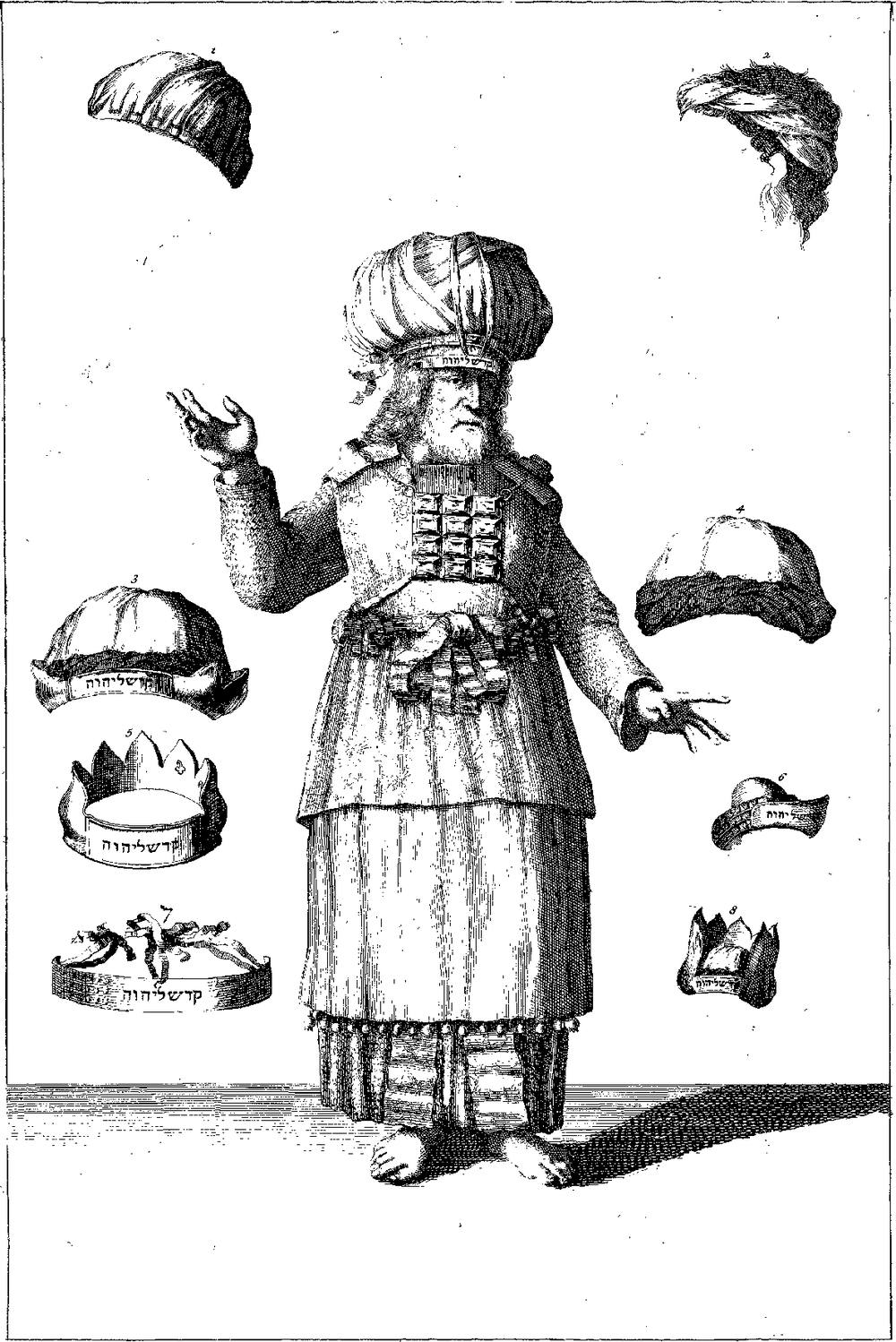
This Ephod, or Girdle3 consisted of two Ribbons of the most delicate Work, which descending from the Shoulders cross’d each other on the Stomach, and then being brought round the Body, served as a Girdle to the High Priest’s Robe. At the Place where the Ribbons of the Ephod met upon the Breast, was seen what the Scripture calls the Rational4, or Pectoral, or Breast-plate; which was a square Piece of about ten Inches wide, substantially embroidered, wherein were set twelve precious Stones, on each whereof the Name of one of the Tribes of Israel was engraved.
Upon the High Priest’s two Shoulders were two precious Stones, on each whereof Ex. xxviii. 9, 10, & seq.the Names of six Tribes were engraved. The Covering for the High Priest’s Head was a sort of Miter, fastened below upon his Forehead with a Crown, the fore-part whereof was composed of a thin Plate of Gold, on which these Words were written, Holiness to the Lord; and it was tied behind with a Ribbon. He wore likewise the Urim and Thummim on his Breast, which were either the Stones themselves of the Rational, or some hieroglyphical Figures, or some other Ornaments fixed to the Rational, by means whereof God promised to discover his Will to the High Priest.
Aaron and his Sister Miriam having one day murmured against Moses, on the Score Num. xii. 1. & seq. about the Year of the World 2514. before Jesus Christ 1586. before the vulgar Æra 1490.of Zipporah their Brother’s Wife, who was an Æthiopian, or rather a Midianite, a Native of the Land of Cush, in Arabia Petræa, on the Red Sea; Miriam was immediately struck with a Leprosy; which Punishment having opened Aaron’s Eyes, he acknowledged his Fault, and ask’d Forgiveness of Moses both for himself and Sister. Some time after Corah, Dathan and Abiram rose Ch. xvi. about the Year of the World 2015. before Jesus Christ 1585. before the vulg. Æra 1489.up against Moses and Aaron: Corah pretended that the Priesthood belonged to him as much as Aaron, both being of the Tribe of Levi; and Dathan and Abiram being of the Tribe of Reuben, had a mind to share with Moses in the Sovereign Authority and Government of the People. God discovered his Indignation against these Rebels in a remarkable Manner, and the Earth opening swallowed them up, and others of their Faction. Immediately a Fire issuing from the Tabernacle destroyed 250 Levites, the Accomplices of Corah, who attempted insolently of their own Head to offer Incense to the Lord. Moses commanded the 250 Censers belonging to these Conspirators to be got together, and reduced into Plates, which were fastened to the Altar of Burnt-offerings, there to remain as a Monument of what had happened.
The next Day the People murmuring against Moses and Aaron, the Lord caused a Plague to break out among them, which seized on the Camp, and consumed part of Num. xvi. 41.the People. But Aaron running with his Censer, placed himself between the living and the dead, and so the Plague was stayed. Another new Miracle God wrought in order to secure the Priesthood to him. For Moses Num. xvii.having taken twelve Rods from the Princes of the twelve Tribes, and Aaron’s separately, he placed them in the Tabernacle of Witness, having first written upon each the Name of that Tribe whereunto it belonged, and upon Aaron’s the Name of this High Priest. The next Day, when the Rods were taken out, Aaron’s, which was made out of an Almond Tree, appeared to be all covered with Leaves, and in full Blossom; but the rest were all in the Condition wherein they were seen to be the Day before. This Rod therefore was placed either within the Ark, or on the Side of it, to perpetuate the Remembrance of this Prodigy.
He married Elisheba the Daughter of Ex. vi. 23.Amminadab, of the Tribe of Judah, by whom he had four Sons, Nadab and Abihu, Eleazar and Ithamar. The two first were Lev. x. 1, 2.killed by Fire sent from God, as a Punishment upon them for presuming to offer Incense with strange Fire in their Censers. From the two others the Race of the High Priests was continued in Israel. Aaron and Moses not expressing sufficiently their Confidence in God, when he commanded them to Num. xx. 8, 12.strike the Rock at Kadesh, he in his Wrath declared to them that they should not enter into the Promised Land; and soon after the Lord ordered Aaron to ascend Mount Hor, Num. xx. 26, 26.at the Foot whereof the Hebrews were encamp’d, there to be gathered to his Fathers. As soon as he had got thither he strip’d himself of his Pontifical Ornaments in the view of all the People, and put them on Eleazar his eldest Son and Successor in the High Priesthood; this being done, he
In the Year of the World 2522. before J. C. 1448. before the Vulg. Æra 1452. Ecclus. xlv.7, &c.died at the Age of an hundred and twenty three Years, and was buried by Moses and his Sons in a Cave of this Mountain. All Israel mourned thirty Days for him.
The Author of Ecclesiasticus gives us an Encomium of Aaron, in these Terms: “ The Lord exalted Aaron the Brother of “ Moses, of the Tribe of Levi. An everlasting Covenant he made with him, “ and gave him the Priesthood among the “ People; he beautified him with comely “ Ornaments, and cloathed him with a “ Robe of Glory. He put upon him perfect Glory, and strengthened him with “ rich Garments, with Breeches, with a “ long Robe and the Ephod. And he “ compassed him with Pomgranates, and “ with many golden Bells round about, “ that as he went there might be a Sound “ and a Noise made, that it might be “ heard in the Temple, for a Memorial “ to the Children of his People; with an “ holy Garment, with Gold, and blue “ Silk and Purple, the Work of the Embroiderer, with a Breast-plate of Judgment, and with Urim and Thummim. “ With twisted Scarlet, the Work of the “ cunning Workman; with precious “ Stones graven like Seals, and set in “ Gold, the Work of the Jeweller; with “ a Writing engraved for a Memorial, after the Number of the Tribes of Israel. “ He set a Crown of Gold upon the “ Mitre, wherein was engraved Holiness, “ an Ornament of Honour, a costly Work, “ the Desire of the Eyes, costly and beautiful. Before him there was none such, “ neither did ever any Stranger put them “ on, but only his Children, and his Childrens Children perpetually. Their Sacrifices shall be wholly consumed every “ Day twice continually. Moses consecrated him, and anointed him with Holy Oil. This was appointed unto him “ by an everlasting Covenant, and to his “ Seed, so long as the Heavens should “ remain, that they should minister unto “ him, and exercise the Order of Priesthood, and bless the People in his Name. “ He chose him out of all Men living to “ offer Sacrifices to the Lord, Incense and “ a sweet Savour, for a Memorial, to “ make Reconciliation for his People. He “ gave unto him his Commandments and “ Authority in the Statutes of Judgments, that he should teach Jacob the “ Testimonies, and inform Israel in his “ Laws. Strangers conspired together against him, and maligned him in the “ Wilderness, even the Men that were on “ Dathan’s and Abiram’s Side, and the “ Congregation of Core, with Fury and “ Wrath. This the Lord saw, and it “ displeased him, and in his wrathful Indignation were they consumed: He did “ Wonders upon them to consume them with the fiery Flame. But he made Aaron more honourable, and gave him an Heritage, and divided unto him the First-fruits of the Increase, especially he prepared Bread in Abundance; for he did eat of the Sacrifices of the Lord, which he gave unto him and his Seed. Howbeit in the Land of the People he had no Inheritance, neither had he any Portion among the People; for the Lord himself is his Portion and Inheritance.
St. Paul, in the Epistle to the Hebrews, Chap. v, vi, vii, viii, ix, x. compares the Priesthood of Aaron with that of Jesus Christ and the New Law; and shews the Superiority of the New Priesthood, above that instituted of Old. We shall give a Catalogue of the High Priests who succeeded Aaron, and shall say something of the Rights, Privileges and Functions of the Hebrew Priests, under the Word PRIEST. As to the Life of Aaron, the Reader may consult Exodus, Leviticus, and the Book of Numbers, as far as the twentieth Chapter, and twenty fourth Verse of this last Book, wherein we have a Relation of his Death.
The Hebrews settle the Day of his Death, and the Feast which they observe upon this Occasion, on the first Day of their fifth Month, which they call Ab, and which answers pretty nearly to our July, supposing the Year to begin at Easter. In Imitation of them, the Christian Church has fixed the Festival of this Patriarch to the first of July, with a Persuasion that by his Repentance he had made Atonement for the Fault committed by him, in permitting the Israelites to adore the golden Calf; and for the Diffidence expressed by him at the Waters of Strife. This religious Respect paid to Aaron is no new thing; for we find his Death on Mount Hor taken notice of in the first Martyrologies which go under St. Jerom’s Name, and in those of Ado, Usuardus, and others of a more modern Date.
Aaron’s Sepulcher has hitherto continued unknown to the World. The Scripture Deut. x. 6. And the Children of Israel took their Journey from Beeroth of the Children of Jaakan to Mazera, there Aaron died, and there he was buried. * Numb. xxxiii. 38. Deut. xxxii. 50.tells us in a particular Place, that Aaron died at Mosera; and elsewhere , that he died upon Mount Hor; because, in all Probability, Mount Hor was near the Place of their Encampment at Mosera, where the People had their Station when God called to himself the High Priest Aaron. He died in the Arms of Moses his Brother, and of Eleazar his Son and Successor in the High Priesthood. They buried him in some Cave belonging to this Mountain, and kept the Place of his Interment from the Knowledge of the Israelites; perhaps from an Apprehension that in After-Ages they might pay some superstitious Worship to him; or that the Arabians, in the midst of whom they
then were, might some time after violate the Sanctity of his Grave.
They who have most diligently enquired into the several Marks of Resemblance between sacred and fabulous History compared together, observe several Instances of Conformity between Aaron and Mercury. This false Deity was, say they, an Egyptian, born of Nile, a Shepherd, the God of Shepherds, Travellers and Merchants, the Messenger and Intepreter of the Gods. They describe him with a miraculous Rod in his Hand, wreathed about with Serpents; they ascribe to him an extraordinary Degree of Knowledge, the Gift of foretelling Things future, and interpreting Dreams. He is adored as the God of the High-ways, of Houses, Thieves, and Musicians; the Invention of the Harp is attributed to him.
Aaron was born in Egypt, had been, like his Ancestors before him, by Trade a Shepherd, was with Moses his Brother at the Head of the People of Israel, who were a Nation of Travellers in the Wilderness. He was appointed by God himself to be Moses’s Interpreter, and the Messenger of God to Pharaoh and the Egyptians. Mercury’sExod. vii. 1, 2. Wand, with the Snakes twisted about it, represents the Wonder-working Rod which Aaron cast before Pharaoh on the Ground, and which thereupon was changed into a Serpent. The Caduceus, the miraculous Instrument of a thousand Prodigies, describes but imperfectly the many wrought in Egypt by the Means of Moses’s Rod, which this Legislator put into his Brother’s Hands. The Gifts of Prophecy and Knowledge attributed to Mercury are the Symbol of those Favours which God vouchsafed to Aaron, and communicated even to his Successors in the Pontifical Dignity, to whom he granted the Privilege of wearing the Urim and Thummim, which was as it were an Oracle at all times present in Israel. The Harp, the Flute, the Instruments of Musick, and the Sacred Trumpets, were peculiarly in the Care and Management of the Priests and Levites. To them only it belonged to make Use of them in the Temple, and in religious Assemblies. The pretended Robbery committed by the Hebrews, when on the point of their Departure, upon the Egyptians, of whom they borrowed what they had which was most valuable, might have contributed something towards the confounding Aaron with Mercury the God of Thieves and the High-ways. Mercury conducts the dead to Hell, and when the Gods please delivers them from thence. Aaron and Moses led the Hebrews into the Channel of the Red Sea, and miraculously brought them out of it, as it were Ch. iv. 14, 15, 16.from the Grave. Korah, Dathan and Abiram, who were swallowed up in the Earth, together with all their Faction, for rebelling against Aaron, may have been another Occasion of what we are told of Mercury. Lastly, Mercury the God of Eloquence is represented by Aaron, of whom it is said, I know that Aaron thy Brother can speak well: and also behold he cometh forth to meet thee. Thou shalt speak unto him, and put Words into his Mouth: And I will be with thy Mouth and with his Mouth: He shall be thy Spokesman unto the People, and he shall be to thee instead of a Mouth, or thy Interpreter.
AB. The eleventh Month of the civil Year, according to the Computation of the Hebrews; and the fifth of the ecclesiastical Year, which begins with Nisan. The Month Ab answers the Moon of July: There are thirty Days in it. Upon the first Day of this Month the Jews fast, in Consideration of Aaron’s Death; and on the ninth, because on this Day the Temple of Solomon was burnt by the Chaldæans; and the second Temple, built after the Captivity, by the Romans. The Jews believe, that on this Day the Persons who were commissioned to survey the Land of Canaan returning to the Camp, engaged the People in Rebellion. They fast likewise upon this Day, in Memory of the Edict published by the Emperor Adrian’s Command, wherein they were forbid to continue in Judea, or even to look back at a Distance on Jerusalem, with an Intention to lament its Ruin. On the eighteenth Day of the same Month they fast, because the Lamp which was in the Sanctuary was that Night extinguished, in the Time of Ahaz.
ABAGARUS, or Abgarus, King of Edessa, was afflicted with a very grievous Disease, for which he could find no Remedy; and while he lay in this Condition, was informed of the miraculous Cures which were performed by Jesus Christ in Judæa; thereupon he sent a Courier to him, whose Name was Ananias, with a Letter drawn up in these Terms. Abagarus King of Edessa, to Jesus, the merciful Saviour of Mankind, who has appeared clothed with human Flesh, in the Country of Jerusalem, wishes Health. I have been made acquainted with the Prodigies and Cures wrought by You, without the Use of Herbs or Medicines, and by the Efficacy only of your Words. I am told that You make Cripples and the Maimed to walk; that You force Devils from the Bodies of the Possessed; that there is no Disease, however incurable it may seem to be, which You do not heal; and that You restore the Dead to Life. These Wonders5
persuade me, that You are some God descended from Heaven, that You are the Son of God: For this Reason I have taken the Liberty to write this Letter to You, beseeching You to come and see me, and cure me of the Indisposition under which I have so long laboured. I understand that the Jews persecute you, murmur at your Miracles, and seek your Destruction. I have here a beautiful and agreeable City, which tho’ it be not very large, will be sufficient to supply you with every thing that shall be necessary.
Jesus Christ returned him an Answer in these Terms. You are very happy, Abagarus, thus to have believed in me without having seen me; for it is written of me, that they who shall see me will not believe in me, and that they who have never seen me, shall believe and be saved. As to the Desire you express of receiving a Visit from me, I must tell you, that all things for which I am come must be fulfilled in the Country where I am; when this is done, I must return to him who sent me. And when I am departed hence, I will send one of my Disciples to you, who shall cure you of the Disease which you complain of, and give Life to you and those that are with you. Eusebius says6, that he took these Letters out of the Records of Edessa; and adds, that St. Thomas, after the Resurrection of our Saviour, sent Thaddæus, one of the seventy Disciples, and very different from the Apostle of this Name, to preach Jesus Christ in this City, and heal King Abagarus. Thaddeus went thither, converted the King and all his People, wrought an infinite Number of Miracles among them, and recovered the King’s Health. There are some who believe, that besides the Letter which we have been speaking of, our Saviour sent his Picture to him, printed on an Handkerchief. But the generality of eCriticks reject this whole Story, and look upon the two Letters we have mentioned as Pieces without any Authority. See M. de Tillemont, in the Article of S. Thomas, T. 1. p. 400,401,402. and the Notes 5,6,7. p. 657, &c.
King Abagarus, or Abgarus, was so called because he was lame7: We should not therefore give him the Name of Agbar, as if it were deriv’d from the Arabic Akbar, which signifies great. The City of Edessa, where he reigned, goes generally by the Name of Orfa; it is a common Tradition among the Eastern People, both Christians and Mahometans, that this Prince wrote a Letter to our Saviour, and received an Answer from him, together with a Handkerchief with the Impression of our Lord’s Face upon it. This we are told by M. D’Herbelot in his Oriental Library, which however does not destroy what we have said of Abgarus, nor is it sufficient to confirm the Authentickness and Truth of Abgarus’s pretended Letter to Jesus Christ, and our Saviour’s Reply to Abgarus. The Eastern People are generally not very exact in Matters of History, and their Traditions are not always to be depended upon. Edessa, which some have placed upon the Euphrates, was at the Distance of a Day’s Journey from it; the River upon which it is situated is the Scyrtus, the Overflowings whereof are dangerous and frequent. In the Reign of Justin it was intirely ruined by Inundations; the Emperor rebuilt it, and gave it the Name of Justinopolis; but afterwards it was called Orfa. There were Kings of Edessa before the Reign of Augustus, and they generally bore the Name of Abgarus: M. Vaillant has preserved a Succession of these Kings, who from the first Century were all Christians.
It is something surprizing that they should all go by the Name of Abgarus, which signifies, as M. D’Herbelot says, lame. It is much more credible that they assumed the Name of Akbar, which signifies great, and that he who wrote to Jesus Christ was nicknam’d Abgar instead of Akbar, by reason of his Infirmity; if however this Tradition of the Eastern People be not an Imposition upon us.
THE many Difficulties which are alledged8 to destroy Eusebius’s Story, and the Truth of our Saviour’s Letters to Abgarus, and Abgarus’s to our Saviour, are without doubt very solid; but should they oblige us to reject both this History, and the Letters we are speaking of, might it not be sufficient to conclude from hence, that the Truth of the Matter has been in some degree alter’d, and the Letters corrupted. To me it seems out of all dispute, that a certain King of Edessa was converted in the earliest Years of Christianity by one of the seventy Disciples, and that after his Example the whole City embraced the same Faith. As to other Circumstances, People, if they please, may look upon them as no more than Embellishments and popular Traditions ill put together; that the Letters, as they are at present, are apocryphal and without Authority; but does it follow that there never were any genuine and authentick, and that the whole is only a Fable invented with a Design to delude the World?
It is related9 that Abgarus, King of Edessa, who had contributed to the Defeat of Crassus, was obliged to submit to Augustus,10
Augustus, who depriv’d him of the Title of King, and left him that only of Toparch, or Governor of the Place, and carried him to Rome, in order to secure himself of his Fidelity. Abgarus, weary of abiding in this great City, bethought himself of a little Stratagem, whereby to work upon Augustus, and prevail with him to grant Permission for his Return to Edessa. When he was a hunting he caught several wild Beasts alive, and having directed some of the Earth to be taken up belonging to the Holes where each of them had been laid hold of, he appointed it to be spread separately in different Places of the Amphitheatre. Upon letting loose these Animals, each went immediately towards the Earth belonging to his Den. The Emperor easily understood Abgarus’s Meaning, and sent him back to his little Kingdom. When he took his Leave, he desir’d and obtain’d Permission to build a Circus at Edessa. He died some few Years after, leaving a Son behind him very unworthy of him; the Son having used his Subjects ill, and fearing he should be punish’d for so doing by the Romans, went over to the Persians, and embraced their Party.
This Account we have from Procopius, who affirms the first Abgarus to be the same with him who wrote to Jesus Christ, and that the second was his Son, and both Christians: But this can never be made out; for Jesus Christ did not begin to preach till the Fourteenth of Tiberius, the Thirtieth of the vulgar Æra, and above eighty Years after the Defeat of Crassus. Nor could Abgarus believe in Christ till after the Preaching, nay, not till after the Death of our Saviour, which happen’d in the seventeenth Year of Tiberius. Moreover, we have some Medals struck at Edessa, under the Reign of Tiberius11, in which this Emperor is called the God of the Edessenians; they were not therefore at that Time converted to Christianity.
According to Procopius’s Recital, it should seem that the Prince who treated his Subjects so ill as to be oblig’d to fly for Safety to the Persians, was he who believed in Jesus Christ, and brought over his whole People to the Faith. Eusebius12 places this Conversion in the Year 340, which answers to the twenty ninth of Jesus Christ, observing the Æra of the Edessenians, which is the same with that of the Seleucidæ, who began it at the Death of Alexander the Great. But in the twenty ninth Year of our Saviour Abgarus could not as yet have any Knowledge of our Jesus, who did not enter upon the Business of Preaching till the Year following. We had better therefore read with Rufinus the Year 343, which answers to the Year of Christ’s Death13, according to the vulgar Æra.
ABANA, a River of Damascus, mention’d by Naaman, the King of Syria’s 2 Kings v. 12.General, in these Terms, Are not Abana and Pharphar, Rivers of Damascus, better than all the Waters of Israel? We are of Opinion that this River is the same with Barrady or Chrysorroas, which derives its Source from the Foot of Mount Libanus, towards the East, runs round Damascus, and through it, and so continues its Course till its Waters are lost in the Wilderness, at the Distance of four or five Leagues South from this City14.
Deut. xxxii. 19. xxxiv. 1. 2 Macc. xi. 4.ABARIM, Mountains beyond Jordan, spreading far into the Tribe of Reuben, and the Country of the Moabites, on both Sides the River Arnon: They were composed of many little Hills, under different Names. It is impossible to describe exactly the Extent of them; Eusebius and St. Jerom speak of them in several Places. Eusebius15 fixes them at six Miles Distance Westward from Hesbbon, and seven from Livias Eastward16. The Mountains Nebo, Pisgah, and Peor, were Parts of the Abarim. Upon Nebo Moses died, and in the same Mountains Jeremiah concealed the Ark, when the Chaldæans took Jerusalem. Abarim in Hebrew signifies Passengers, or Passages.
ABARON is the Sirname of Eleazar, the fourth Son of Judas Maccabæus. Abaron in Hebrew signifies Anger, passionate, or passing away. Josephus calls him Auran or Avran, and the first Book of Maccabees Savaran, 1 Macc. vi. 43. He got a great deal of Honour by his Death, being crush’d in pieces under an Elephant, which he slew by piercing him with his Sword, as we shall shew under Eleazar. See 1 Macc. vi. 43. Joseph. Antiq. l. 12. c. 14.
ABBA17, in Syriac signifies Father. Ab Rom. viii. 15. Mark xiv. 36.has the same Signification in Hebrew. St. Paul says, that we have received the Spirit of Adoption, whereby we cry Abba, Father. Jesus Christ, praying in the Garden, says, Abba, Father, all Things are possible unto thee.
ABDIEL, Son of Guni, of the Tribe of Gad, was the Head of his Family, 1 Chron. v. 15.
1. ABDON, the Son of Hillel, of the Tribe Judg. xii. 13, 14, &c.of Ephraim, and tenth Judge of Israel. He succeeded Elon in the Year of the World 2840, before Jesus Christ 1160, before the vulgar Æra 1164. He judg’d
Israel eight Years, and was buried at Pirathon, in the Land of Ephraim. He left forty Sons and thirty Grandsons, who rode on seventy Asses, which were the Beasts generally made use of for this Purpose by Persons of the best Quality in Judæa18. He died in 2856, before Jesus Christ 1144, before the vulgar Æra 1148.
2. ABDON, of the Tribe of Benjamin, a Son to Jehiel, 1 Chr. ix. 36.
3. ABDON, the Son of Abigabaon and 1 Chr. viii. 29.Maachah.
4. ABDON, the Son of Micah, was sent by King Josiah to Huldah the Prophetess, with Directions to ask her Opinion concerning the Book of the Law, which had been 2 Chr. xxxiv. 20.found lately in the Temple.
Josh. xxi. 30.ABDON, a City belonging to the Tribe 1 Chr. vi. 74.of Asher: It was given to the Levites of Gershon’s Family.
ABEDNEGO, is the Chaldee Name Dan. i. 7.given by the King of Babylon’s Officer to Azariah, Daniel’s Companion. This Name imports the Servant of Nago or Nego, which is the Sun or Morning Star, so called because of its Brightness. Abednego was thrown into the fiery Furnace at Babylon, with his two Companions Shadrach and Meshach, for refusing to Dan. iii.adore the Statue which was erected by the Command of Nebuchadnezzar. Daniel was in all probability at that Time absent from Babylon, for we do not find that he had the same Fate with his Companions. The Condemnation of Shadrach, Meshach, and Abednego, by God’s Appointment, redounded to his Honour; for he did not suffer them to be injured by the Flames, but sent his Angel in the midst of them, to rescue them out of the Furnace.
ABEL, the second Son of Adam and Eve, was born in the second Year of the World, before Jesus Christ 3998. Some are of Opinion that he and Cain were Twins19: Others believe that he was his younger Brother, being born in the second Year of the World: Others again maintain that he was born 15 Years after Cain, while others make an Interval of 30 Years between the Birth of these two Brothers. The Eastern People say that Anvina his Sister was born at the same Time with Abel: She is called Delbora, Decla, or Edocla, by different Writers20. Cain and Abel being instructed by their Father Adam in their Duty to the Creator, offered each to him the First Fruits of their Labours; Cain, as an Husbandman, of his Corn; Abel, as a Shepherd, of the Milk or Fattlings of his Flock. God was pleased to shew that the Offerings of Abel were agreeable, and those of Cain contemptible to him. How God gave these Marks of Preference to Abel is not distinctly known, whether by Fire sent from Heaven21, which consumed his Offering, or by any other Means; but this we know, that Cain perceiving this Distinction, fell into Fits of deep Melancholy, and giving himself up to the Suggestions of his Envy, formed the Design of killing Abel.
Commentators agree, that the true Cause of Cain’s Aversion was God’s Acceptance of his Brother’s Sacrifices, and the Rejection of his own; but they are not so well agreed about the Pretence which he made use of to take away his Brother’s Life, whether it were on the Score of some Woman, whom Adam was inclined that he should marry22, or whether he sought an Opportunity of quarrelling23 with Abel, and to that End uttered Blasphemies before him. As to this Particular, the Interpreters may be consulted: So much however is certain, that Cain having invited Abel to go with him into the Field, there Genef. iv. 8, 9.murdered him.
The Scripture does not specify either the Manner or Instrument of this Murder, and Expositors are divided upon it; some arm Cain with the Jaw-bone of an Ass, others with a Scythe24; some again with a Bill25, others with a Knife or Sword26, a Stone27 or Pitch-fork. However this be, the Blood of this innocent Person crying towards Heaven, the Lord demanded of Cain where Abel was; to which he answer’d, Am I my Brother’s Keeper? We shall see in another Place how God punished Cain.
Josephus28 is of Opinion that Cain buried Abel to prevent the Discovery of his Murder; and at sixteen Miles from Damascus a Travellers are shewn a Tomb said to be Abel’s, which is an hundred and sixty Palms, or fourscore Cubits in Length. St. Jerom assures us, that there was a constant Tradition among the Hebrews of Abel’s being murder’d in the Plain of Damascus. But nothing is more uncertain than this.
Some of the Fathers were of Opinion that Abel continued always in the State of Celibacy29. The Chronicon of Alexandria shews very clearly that he died before Marriage; but others maintain that he was married, tho’ perhaps he had no Children30, since Moses has made no mention
of his Posterity. St. Chrysostom is expresly for his Marriage31, excusing him, on the Score of pure Necessity, for having married his own Sister. They who explain what is said of Abel’s Blood crying unto God from the Ground, as meant of the Posterity of this righteous Person, are of the same Opinion.
Under the Emperors Arcadius and Honorius, certain Hereticks rose up in Africk, called Abelites, or Abelonites, from Abel, who condemned Marriages; not that they thought this State of Life to be in itself blameable, for they were themselves married; but they condemned the Use of Wedlock, and abstained from that Conversation with their Wives, which was allowable. They said they would not bring unhappy Creatures into the World to be polluted with original Sin. The Mixture of both Sexes they looked upon as an Act to be detested; and that their Sect might not perish, they adopted the Sons and Daughters of their Neighbours, and made them Heirs to their Fortunes, on Condition that the Children to be born of them should belong to them. This Sect was of no long Continuance; such poor Creatures, so grosly deluded, must have been very soon undeceived32.
Besides the Traditions of the Ancients which we have touched upon, the Mahometans, as well as Rabbins and Eastern Christians33, have others which it may be proper to relate in this Place, for this, if for no other Reason, viz. that we may be thereby enabled to understand their Histories. The Mahometans say, that Eve was delivered at the same time of Cain and Aclima, or Aclimia, his Twin-Sister; and afterwards of Abel and Lebuda. The Eastern Christians call the two Sisters Azrun and Orain, and differ in this Story from the Mahometans in the Names only.
The two Brothers being arrived to a Maturity of Age, Adam was desirous of marrying them, and giving Abel’s Twin-Sister to Cain for his Wife, and Cain’s to Abel. This Choice was not agreeable to Cain, because his Sister Aclima was much more beautiful than Lebuda: He alledged that as they were created together in the same Womb, it was just that they should live together in the same Bed. Adam replied to him, that God had ordained otherwise in this Matter, and that it did not depend on him. To this Cain made Answer, You design to give the most beautiful Woman to my Brother, because he is more your Favourite than I am. Well, says Adam, if you would be better instructed in the Will of God, let each of you offer a Sacrifice to him, and he whose Sacrifice shall be accepted by God, shall have Aclima to Wife.
To this Abel consented, and in case God should not testify by some Marks that he approved his Sacrifice, resolved to marry Lebuda his Twin-Sister. Cain, on the contrary, pretended indeed to acquiesce in Adam’s Proposal, but with a secret Resolution, that let what wou’d happen to his Sacrifice, he wou’d never resign his Sister to his Brother.
Abel, who was a Shepherd, chose the fattest Weather of his Flock, and offered it to God upon the Brow of a Hill. Cain, who was a Husbandman, took a Sheaf out of his Crop with the least Quantity of Ears in it that he could find, and presented it to God upon the Top of a neighbouring Mountain. The Offerings of the two Brothers were no sooner disposed in a proper Manner, but a Flame from Heaven very bright and without Smoke, descended and consumed Abel’s Sacrifice, without touching that of Cain.
Rage, Spite, and Envy took immediate Possession of Cain’s Heart: He determined to make away with his Brother, insulted him with opprobrious Language, and threatned to kill him. Abel replied to him, God accepts the Sacrifices of those only who fear him, and who offer them with a sincere and pure Intention: If you attempt to lay violent Hands on me, I will not defend my self by taking away your Life; but he who is the Lord of all Creatures, whom I fear and worship, he will be my Avenger.
Cain hearkening only to his Passion, was confirmed in the Design of destroying his Brother, but not knowing how to go about it, the Devil appear’d to him in the Shape of a Man holding a Bird in his Hand; the Bird he placed upon a Rock, took up a Stone and with it squeezed its Head to Pieces. Cain instructed by this Example, resolved to serve his Brother in the same way. He waited till Abel was asleep, and lifting up a large Stone, he let it fall with all its Weight upon his Head, and killed him. At the same time God caused him to hear a Voice from Heaven, which cried out to him in these Terms, Thou shalt pass the rest of thy Days in continual Fear.
In reality, from this Moment he found himself terribly perplexed; for he was apprehensive lest the Crime committed by him should be discovered to his Father, and not knowing what to do with his Brother’s Body, he inclosed it in a Skin, which for forty Days he carried about with him, wheresoever he went. But as the Stink of the dead Body grew troublesome to him, he was forced from time to time to set it down, and the Birds of Prey and wild Beasts took the Opportunity of
falling upon it, and always carried off some Pieces of it.
One Day he perceived two Ravens fighting in the Air, one whereof falling down dead, the other with his Beak and Claws made a Hole to bury it. Cain thought it was convenient for him to do the same, and in Imitation of the Raven buried his Brother. From that time Terror and Remorse laid fast hold of him, he began to run here and there over the World like a Vagabond, dreading to meet one Day the same Treatment from some or other, which his Brother had received from him, and fearing to appear before his Parents after the Perpetration of so great a Sin. His Repentance wrought no Change in his wicked Heart, nor did he endeavour to make any Expiation of his Crime to God. He was unhappily killed by one of his Grand-children, who having an Imperfection in his Sight mistook him for a wild Beast. See hereafter the Article CAIN. The Hebrew Book intitled Cozri, informs us, that the Ground of the Quarrel between Cain and Abel, proceeded from Cain’s desiring to have Possession of Palestine, exclusive of his Brother Abel.
St. Paul speaks in Commendation of Heb. xi.4.Abel, telling us, that by Faith he offered unto God a more excellent Sacrifice than Cain; and that he was declared righteous, God himself having testified that he had accepted his Gifts, and that by Reason of his Faith his Blood still speaketh, even after Ch. xii. 24.his Death. The same Apostle compares the Voice of Abel’s Blood, to that of Jesus Christ’s; and our Saviour in the Gospel places him at the Head of those Saints who had been persecuted for Righteousness Mat.xxiii 35. and Luke xi. 51.sake; and distinguishes him by the Name of righteous. St. Ambrose with much Eloquence extols the Merit and Sanctity of Abel, in the two Books composed by him upon this Occasion. He may be properly reckoned the first Martyr to Truth and Justice. His Sacrifice is mentioned in the Sacrifice of the Mass, together with those of Abraham and Melchisedec; and Invocation has been made to him a long time in Litanies, for the Recommendation of the Souls of the deceased. The Worship of him does not appear to be of any great Antiquity in the Church, and his Name is not to be met with in any of the Martyrologies of the Latins before the tenth Century34. Some Calendars commemorate him on the twenty fifth of March, on the very Day of our Saviour’s Death, as many have fixed it; others on the second of January; others on the thirtieth of July. It is said that he is honoured among the Ethiopians, upon the twenty eighth of December.
ABEL, Abila, Hobal, or Hoba, or Abelbeth-Maacah, or Abel-maim, a Town situated to the left, that is, to the North of Damascus, between Libanus and Antilibanus. It is the same with Abila, under the Government of Lysanias, mentioned by St. Luke. Joab besieged it, during the Revolt of Sheba, Son of Bichri. Eusebius35 places this Town between Paneas and Damascus. We are not to be surprized to see the same Place described under so many different Names; many Examples of the same nature will be seen in the Course of this Work. Antoninus, in his Itinerary, fixes it between Damascus and Heliopolis. Josephus and others call it sometimes Abilla in Libanus.
We have related the Occasion of the War carried on by Joab against Sheba, under the Article SHEBA; we shall here only make some Observations on the Siege abovementioned.
The investing of Places, and Lines of Circumvallation, against the Attacks of those without, as well as Lines of Contravallation against the Enemy within, are so ancient that it is to no purpose to enquire after their Original in the Authors of Sacred and Prophane Antiquity, no more than of infinite other Practices attributed to the Greeks and Romans, or even to the Moderns themselves, which are not of a less elder Date than the Lines wherewith Places are environed. Herodotus asserts, in his first Book, that Harpagus the General, who commanded Cyrus’s Army, was the Inventor of this kind of Lines, made use of to cut off all Hopes of Succour to the besieged, and prevent Attempts upon the Camp of the Besiegers. He tells us expressly, that the first City which was taken by this Invention was Phocæa in Ionia. But herein he is very wide of the Truth, for they were in use many Ages, even before the Persians were known in the World. When the Scripture speaks of investing Cities, we see no Particular whereby we may judge that this was the first time, or that the doing so was any thing new, or very uncommon. We can be sure therefore of nothing in this respect, since the Original of such Practices is not discovered to us.
We are farther to observe in this Siege, that the City was not only invested, but that a Ditch was dug in the Ground close to that belonging to the City, where the Archers made their Discharges without Annoyance from the Besieged, while they thus prevented any from appearing on the Walls, and so covered their Miners. So that Attacks carried on by crown’d Works were in use among the Hebrews long before the Greeks and Romans. Dom Calmet believes that they raised Terrasses or Cavaliers against the Walls: I am not of
his Opinion; nor was it indeed possible, by Reason of the Greatness of the Work, which would have been exceeding tedious. This Terras was nothing else but a Ditch carried on near the Sides of the Counterscarp, and like our Trenches.
ABELA, a City in Peræa, or Batanæa, or Land of Bashan, beyond Jordan, in the half Tribe of Manasseh, twelve Miles, or four Leagues, from Gadara Eastward. Eusebius and St. Jerom observe, that it was remarkable for its good Wines.
Judg. xi. 33.ABEL OF THE VINEYARDS36 was, according to Eusebius, six Miles from Philadelphia, otherwise Rabbath, the Capital of the Ammonites. It is probably the same with Abela, between Jabez and Gadara, and near to Pella. Eusebius takes notice of a Town called Arbela, subject to Pella, which may very well be the same with Abela.
ABEL THE GREAT, is a large Stone 1 Sam. vi. 18, 19. in the Year of the World 2888. before J. C. 1112. before the vulg. Æra 1116.found in a Field belonging to one Joshua a Bethshemite, on which the Ark was placed when it was sent back by the Philistines. It was called by this Name, which signifies great Mourning; probably by reason of the great Number of Bethshemites that were destroyed by God on this Occasion; for the Scripture tells us, that fifty thousand threescore and ten Bethshemites were smitten for looking into the Ark of the Lord.
1 Kings xix. 6. Ch. iv. 12.ABEL-MEHOLAH, or Abel-mea, was Elisha’s Country. It could not be far from Scythopolis. Eusebius places it in the great Plain, sixteen Miles from Scythopolis towards the South. Not far from hence Jud. vii. 23.Gideon obtained a Victory over the Midianites.
ABEL-MITZRAIM, or the Mourning of the Egyptians, otherwise called, the Floor of Atad. St. Jerom, and some others after him, believe that this is the same Place which was afterwards called Bethagla, at some Distance from Jericho and Jordan, Westward of this River.
ABEL-SHITTIM, was situated in the Plains of Moab, beyond Jordan, opposite to Jericho. Josephus37 says, that Abel-Shittim, or Abela, as he calls it, was sixty Furlongs from Jordan; that is, seven Miles and a half from this River. Eusebius38 says, it is in the Neighbourhood of Mount Peor. Moses encamped at Abel-Shittim some time before the Hebrew Army passed the Jordan, under the Conduct of Joshua. Numbers xxxiii. 49. xxv. 1. Josh. xi. 1. Num. xxv. 1, 2, &c.There the Israelites fell into Idolatry, and worshiped Baal-Peor. There it was too that God so severely punished them by the Hands of the Levites. This City is often called Shittim only.
ABEN-BOHAN, is the Josh. xviii. 17.Boundary-Stone which makes the Separation between the Tribes of Judah and Benjamin Eastward, in the Valley which leads to Adummim. It took its Name from Bohan, one of the Sons or Descendants of Reuben.
ABEZ. A City belonging to the Tribe of Issachar, Josh. xix. 20.
ABI. The Daughter of Zachariah, and Mother of Hezekiah King of Judah, 2 Kings xviii. 2.
ABIAH. Second Son to Samuel, and Brother to Joel. Samuel having trusted them with the Administration of publick Justice, and admitted them to a Share of the Government, they behaved so ill in this Employment, that they obliged the People 1 Sam. viii.to require a King of him. This happened in the Year of the World 2909. before J. C. 1191. before the vulgar Æra 1195.
ABI-ALBON, a Native of Arbath, and 2 Sam. xxiii. 31.one of the gallant Men in David’s Army.
ABIATHAR, the Son of Ahimelech, and the tenth High Priest among the 2 Sam. viii. 17. 1 Chron. xviii. 16.Jews. He is sometimes called Ahimelech or Abimelech. When Saul sent his Emissaries to Nob, in order to destroy all the Priests there, Abiathar, who at that time was young, was preserved from this 1 Sam. xxii. 11, & seq.Slaughter, and retired to David in the Wilderness. There he continued in the Quality of High Priest, while Saul, out of Aversion to Ahimelech, who, as he thought, had betray’d his Interests, transferr’d the Dignity of High Priest from Ithamar’s Family into that of Eleazar, by conferring 1 Chr. vi. 53.this Office upon Zadock. Thus there were at the same time two High Priests in Israel; Abiathar in David’s, and Zadock in Saul’s Party. In this State Things continued from the Death of Ahimelech, until the Reign of Solomon; when Ahimelech being attached to the Party of Adonijah, was deprived by Solomon of his Priesthood in the Year 2989, and the Race of Zadok alone performed the Functions of this Ministry, during the Reign of Solomon, exclusive of the Family of Ithamar, according to the Prediction which had been made to Eli the 1 Sam. xi. 30, 31, & seq. & iii. 11,12,&c. Ex. xiii. 4. אביב A-bib.High Priest.
ABIATHAR. This Name is sometimes given to Ahimelech the Father of Abiathar, of whom we have been just now speaking, Mark xi. 26.
ABIB, is the Name given by the Hebrews to the first Month of their Ecclesiastical Year. This Month was afterwards called Nisan. It answers to our March. Abib signifies green Ears of Corn, or fresh Fruits, according to St. Jerom’s Translation: Mense novarum frugum, Exod. xiii. 4.
ABIDAN, the Son of one Gideon, of
the Tribe of Benjamin. He was Prince of his Tribe at the time when the Tabernacle was built, and the Israelites came out of Egypt. His Offering, like that of other principal Persons of the several Tribes, was a silver Charger, the weight whereof was an hundred and thirty shekels, a silver Bowl of an hundred Num vii. 60.and seventy shekels, a vessel of Gold weighing ten shekels, filled with Incense; a young Bullock, a Ram, a Lamb of a year old, for a Burnt-offering; two Oxen, five Rams, five He-goats, five Lambs, for a Peace -offering, and a Kid for a Sin offering.
ABIEL, or Jehiel, the Father of Kish and Ner, and Grandsfather to Saul, the first 1 Sam. ix. 1.King of the Jews.
ABIEZER, of the Tribe of Benjamin, and Town of Anathoth, was one of the 1 Chr. xi. 28.thirty gallant Men of David’s Army.
ABI-GABAON, otherwise called Ner, the Father of Abdon and Kish, and was one of Saul’s Ancestors, and a principal Inhabitant 1 Chr. viii. 29.of Gibeon.
ABIGAIL, was first of all Wife to Nabal of Carmel, and after his Death was married to David, which Particular happened after this Manner: David flying from the Persecution of Saul, continued for a long Time in the Mountains where Nabal kept his Flocks, South of Palestine, towards Carmel of the Tribe of Judah, very different from another Carmel in the Tribe of Issachar, situated on the Mediterranean. David’s Troops did no Prejudice to Nabal’s People or his Flocks, but were rather a great Assistance to them in protecting them from Robbers; so that during all the Time of their Abode there, he lost none of his 1 Sam. xxv. 15, 16, 21.Cattle. Upon a certain Day, when Nabal was come to Carmel to the sheering of his Sheep, David sent some of his People to him, desiring some Present from him in consideration of that happy Circumstance (for the Time of Sheering was a Festival, and Time of great Rejoicing) and as a Reward for the many Services which his Shepherds had received from him, and those under his Command. Nabal not only refused to make David any Present, but treated him as a Servant, a Fugitive, and Rebel to his Prince, and so dismiss’d his Soldiers: This being reported to him, so inrag’d him, that he swore he would destroy Nabal and all his Family. Abigail being informed what kind of Answer her Husband had returned to David’s Messengers, made all the Haste she could to repair this Fault: Some of her Asses she loaded with Provisions, and went herself to meet him, attended with several of her Domesticks: She offer’d him her Presents, and so won upon him by her discreet Conversation, that David conceived a great Esteem for her, accepted her Presents, and returned. Nabal, having understood the Danger he had run, fell sick, and died ten Days after. As soon as this was known to David, he sent to demand Abigail for his Wife: She received this Honour with great Acknowledgments, and when the Days of Mourning for her Husband were over, she went to David’s Camp, and was married to him. The Issue of this Marriage was two Sons, Chileab and Daniel.
1. ABIHAIL, the Son of Huri, and Father of Michael, Meshullam, and some others, 2 Sam. iii. 3, &c. and 1 Chr. iii. 1. It may be that Chileab and Daniel are but one and the same Person; for the 2d of Samuel, which speaks of Chileab, says nothing of Daniel; and the 1st of Chr. which mentions Daniel, says nothing of Chileab. Chileab, says nothing of Daniel; and the 1st of Chr. which mentions Daniel, says nothing of Chileab. 2 Chr. xi. 18, 19. Lev. x. 2. Lev. x. 9, 1 Kings xiv. 10, &c.1 Chr. v. 12, 14.
2. ABIHAIL, the Father of Zuriel, of the Family of Merari, Numb. iii. 35.
3. ABIHAIL, the Father of Queen Esther, and Brother of Mordecai, Esth. xi. 15.
4. ABIHAIL, the Daughter of Eliab, David’s Brother, and Wife to Rehoboam, King of Judah: She was the Mother of Jeush, Shamariah, and Zaham.
ABIHU, the Son of Aaron the High-Priest, and Elisheba, was consumed together with his Brother Nadab, by Fire sent from God1, because he had offer’d Incense with strange Fire instead of taking it from the Altar of Burnt-offerings. This Misfortune happen’d within eight Days after the Consecration of Aaron and his Sons, and the Dedication of the Tabernacle in the Year of the World 2514, before Jesus Christ 1486, before the vulgar Æra 1490. Many Commentators are of Opinion39, that Nadab and Abihu were overtaken with Wine, and so forgot to take the sacred Fire in their Censers. This Conjecture is founded on the Command of God immediately after deliver’d to the Priests, forbidding them the Use of Wine all the Time they should be imploy’d in the Service of the Temple. Some Interpreters tell us, that these two Brothers, who were punished by God so severely for this Fault, did not herein commit any mortal Sin40, but that God in this World inflicted on them the whole Penalty of their Neglect, in order to procure eternal Salvation for them in the other, and exhibit an Example in their Persons of that Exactness and Fidelity wherewith God requires his Ministers to serve him.
1. ABIJAH, the Son of Jeroboam, who was the first King of the ten Tribes. This young Prince was seized with a very dangerous Disease; and his Mother having disguised herself, in order to go and ask the Prophet Ahijah whether he would recover; Abijah answer’d, that he would die, that he would be the only Person of his Family who should receive Funeral Honours, and be lamented by all Israel; but that all the other Descendants from Jero
boam should be either eaten by Dogs, or devoured by Birds, as a Punishment of his Impiety and Ingratitude. Abijah on his Mother’s Return died, in the Year of the World 3046, before Jesus Christ 954, before the vulgar Æra 958.
2. ABIJAH was King of Judah, and Successor to Rehoboam: His Mother’s Name Compare 2 Chr. xi. 20. and 2 Chr. xiii. 2.was Maachah or Micaiah, the Daughter of Uriel or Absalom. Rehoboam had eighteen Wives and sixty Concubines, but Maachah had most of his Affection. Her Son Abijah he advanced above all his other Sons, whom he had by so great a Number of Wives. Abijah succeeded his Father in the Year of the World 3046, before Jesus Christ 954, before the vulgar Æra 958. He reigned three Years, and imitated the Impiety and bad Conduct of his Father. He died in the Year of the World 3049, before Jesus Christ 951, before the vulgar Æra 955.
Abijah, King of Judah, and Jeroboam1 Kings xv. 5. 2 Chr. xiii. 1, 2, 3, 4, &c. There are many MSS. and printed Bibles that read only 40 and 80 thousand instead of 400 and 800 thousand Men, as we read in the Vulgate: But the Heb. and LXX, Josephus and the best Latin Bibles, both MSS. and printed, agree in this Place with the Vulgate., the first King of Israel, were at War with one another. Abijah having got together an Army of four hundred thousand Men of Judah and Benjamin, incamped upon Mount Zemaraim, upon which Samaria afterwards was built. Jeroboam march’d against him at the Head of eight hundred thousand Men, collected out of all his Dominions. Abijah was willing to harangue the Enemies Army, with the Hopes of engaging them by this Means to submit themselves once more to the House of David, and return to the Worship of the Lord. But while he was speaking, Jeroboam order’d Part of his Troops to file off behind the Mountain without the Enemy’s perceiving it, with a Design to hem in Abijah’s Army, which was much inferior in Number. Abijah and his People saw what was doing, and began to cry unto the Lord, and implore his Assistance. The Priests sounded the holy Trumpets; God struck the Hearts of the Enemy with Terror, and the Army of Judah attacked them with so much Fury, that they killed five hundred thousand upon the Spot. Abijah pursuing his Victory took several Cities from Jeroboam; among others Bethiel, Jeshanah, and Ephrain, and the Israelites were so much humbled under the Hand of Judah, that they had not the Courage to undertake any thing farther against them. The Rabbins reproach Abijah with neglecting to destroy the profane Altar which Jeroboam had erected at Bethel, and with not suppressing the Worship of the Golden Calves there. He was married to fourteen Wives, of whom he had two and twenty Sons and sixteen Daughters. Asa succeeded him, in the Year of the World 3049, before Jesus Christ 951, before the vulgar Æra 955.
2 Chr. xxiv. 21.3. ABIJAH, the Wife of Ahaz, and the Mother of Hezekiah, King of Judah. Some are of Opinion that she was the Daughter of Zechariah, who was killed by the Command of Joash between the Temple and the Altar.
4. ABIJAH was one of the Descendants of Eleazar, the Son of Aaron, and Chief of one of the four and twenty Companies of Priests, whom David distributed into so 1 Chr. xxiv. 10. Luke i. 5.many Classes. Zechariah, the Father of John Baptist, was of the Course of Abia or Abijah, which was the eighth of the four and twenty.
5. ABIJAH, King of the Parthians, who made war with Izates, King of the Adiabenians, at the Sollicitation of the Grandees of his Kingdom, who were in Arms against him, because he had embraced the Jewish Religion. Abijah was routed, and compell’d to shut himself up in a Castle, where he was so much straiten’d, that in despair he killed himself, to prevent his falling into the Enemy’s Hands41.
ABILA, the same as Abela, the Capital of Abylene. See ABELA.
ABILENE, a small Province in Cœle-Syria, between Libanus and Antilibanus, whereof Lysanias was some time Master. Abela or Abila, the Capital of Abylene, was North of Damascus and Paneas, and South of Heliopolis. See the Map, and ABEL above.
ABIMAEL, the Son of Joktan, according to some Authors, dwelt in Arabia; according to others in Armenia, in the neighbouring Countries. See our Comment upon Genesis x. 25.
1. ABIMELECH, King of Gerar, having been extremely touch’d with the Beauty of Sarah, the Wife of Abraham, forced her from him, and took her for his Wife: But God did not permit him to meddle with her; for he appeared to him in the Night, and threaten’d him with death unless he restored her instantly to Abraham her Husband. Abimelech pleaded Ignorance in excuse for this Action, saying, that he took her upon Assurances from Abraham that she was his Sister: The next day therefore he sent her back to him, and complained to him of being thus deceived by him. Abraham confessed she was his Wife, but withal told him that she was his Sister also, being born of the same Father, but by another Mother. Abimelech made great Presents to him, and gave Sarah a thousand pieces of silver, desiring her to purchase a Veil with this money for a covering to her Face. At the same time he gave Abraham a Caution not to expose himself any more to the like inconveniency. He made an offer to him of chusing any part of his Dominions that was most agreeable to him for his Habitation
tion, and begg’d him to intercede with God for the Cure of his Family, which, for the sake of Sarah, had been afflicted with great Plagues. Abraham did so, and the Wives of this Prince, by the favour of God, recover’d their Fertility, or the faculty of Conception. It appears by the 17th Verse of the 20th Chapter of Genesis, that Abimelech himself was seized with some indisposition, which was the Cause of Impotency. See likewise the 6th Verse of the same Genes. xx. 17. So Abraham prayed unto God, and God healed Abimelech and his Wife, and his Maid servants, and they bare Children.Chapter, Therefore suffered I thee not to touch her. The Commentators may be consulted concerning the moral goodness or evil of this Action of Abraham. All this fell out in the year of the World 2107, before Jesus Christ 1893, before the vulgar Æra 1897.
2. ABIMELECH, King of Gerar, and son to him of whom we have been just now speakingp. This Prince having one day seen Isaac sporting with his Wife Rebekah, whom he called his Sister, Abimelech order’d him to be sent for, and said to him, It is visible that this woman is your Wife, why then do you say she is your Sister? Isaac answer’d, because, I said, lest I die for Genes. xxvi. 1, 2, &c. In the Year of the World 2200, before J. C. 1800. before the vulgar Æra 1807.her. Whereupon Abimelech publish’d this Declaration, He that toucheth this Man or his Wife shall surely be put to death. Now as Isaac grew extremely rich and powerful, his Posterity stirr’d up the envy of the Philistines; and Abimelech said to him, Go from us, for thou art much mightier than we. Hereupon Isaac immediately retired into the valley of Gerar, and afterwards to Beersheba, where Abimelech some time after came to visit him, in order to make an Alliance with him: In his company were Abuzzath, his Favourite, and Phicol, the Commander in chief of his Army. Isaac when he received them said, Wherefore come ye to me, seeing ye hate me, and have sent me away from you? To which Abimelech replied, that he had observed how much he was favour’d by God, and was therefore come to make a Covenant with him. Upon this Isaac entertained them splendidly, and the next day made a Treaty with them; after which they returned in Peace to their own home. This happened about the year 2200, before Jesus Christ 1800, before the vulgar Æra 1804.
3. ABIMELECH, the Son of Gideon, was begotten of a Concubine, whom Gideon had at Shechem. After the death of his Father, he took possession of the Government, Judg. ix. 6. In the Year of the World 2768. before J. C. 1232. before the vulgar Æra 1236. Judg. ix. 22.and procured himself to be acknowledged King, or Judge of Israel, first by those of Shechem, where his Mother’s family had an interest, and afterwards by a great part of the other Israelites. They of Shechem having made a present to him of seventy shekels of Silver, with this Money he levied a troop of Vagabonds, who follow’d him. Being come to his Father Gideon’s house at Ophrah, he killed seventy Sons whom he had left behind him upon one Stone; so that Jotham only remained, the youngest of them all, who was concealed, and privately deliver’d from his Cruelty. Soon after the inhabitants of Shechem, with those of Millo, being all assembled near the Oak of Shechem to make Abimelech the Son of Gideon King, Jotham, upon receiving intelligence of their Design, appear’d upon the top of Mount Gerizim, and raising his Voice, address’d himself to the Assembly of the People in these Terms: “The Trees went forth on a time to appoint a King over them, and they said unto the Olive-tree Reign thou over us: But the Olive-tree said unto them, Should I leave my Fatness, wherewith by me they honour God and Man, and go to be promoted over the Trees? And the Trees said to the Fig-tree, Come thou and reign over us: but the Fig-tree said unto them, Should I forsake my Sweetness, and my good Fruit, and go to be promoted over the Trees? Then said the Trees unto the Vine, Come thou and reign over us; and the Vine said unto them, Should I leave my Wine, which cherisheth God and Man, and go to be promoted over the Trees? Then said all the Trees unto the Bramble, Come thou and reign over us; and the Bramble said unto them, If in truth ye anoint me to be King over you, then come and put your Trust in my shadow; and if not, let Fire come out of the Bramble, and devour the Cedars of Lebanon. Now therefore consider, said Jotham, proceeding in his Harangue, whether you had reason to elect Abimelech for your King, one who was the lowest of all Gideon’s Family, and whether you have acknowledged as you ought to do the Services of my Father, who deliver’d you from the Bondage of the Midianites, and exposed his Life to procure your Liberty, by chusing that Person for your King who upon one Stone murder’d seventy of my Father’s Sons, thereby demonstrating your Approbation of this Action, and making yourselves Accomplices in it. You have chosen Abimelech to be your Prince, who is the Son of my Father’s Maidservant: If in this Particular your Conduct be just, may Abimelech and you contribute to the Happiness of each other; but if you have acted contrary to all Equity, may Abimelech and the Inhabitants of Shechem and Millo, be mutually the Destruction of each other; “ may42
” may Fire issue out from each to the utter Ruin of you all.” Having so said, he fled, and retired to Beer, where he dwelt, fearing the violence of Abimelech. The Lord permitted Division to arise very soon among the Inhabitants of Shechem, who beginning to reflect on the injustice of their Conduct, detested the Cruelty of Abimelech, who had massacred seventy Sons of Gideon his Father. While therefore he was absent, they revolted from him, and laid an Ambuscade in the Mountains, with a design to kill him in his return to Shechem. Abimelech had intelligence of what was doing from Zebul, whom he had left Governour of Shechem. Those of the City had invited one Gaal to their assistance, with whom, at a great entertainment, they began to utter a thousand Imprecations against Abimelech; who in the mean time got some Troops together, and marched all night towards Shechem. The next day in the morning it was perceived that there were People descending from the Hills, and it was immediately discovered that Abimelech was there with his Forces. Gaal went out of Shechem with what Soldiers he had, and gave Battle to Abimelech, but lost it; and as he was endeavouring to re -enter the City, Zebul forced him from thence, and obliged him to retire.
Observations on the Battle fought near Shechem, between Gaal and Abimelech.☞ To give a true and accurate explanation of this Battle we are not obliged to have recourse to Conjectures, nothing being more exact and clear than the account we have from Scripture of the order and disposition of the two Armies.
Upon the intelligence which Abimelech Judg. ix. 30, &c.received from Zebul, who commanded in Shechem, that Gaal had made himself Master of it, and had a number of Troops sufficient to encourage him to take the Field, and try the Fortune of a Battle; he resolved to march towards him under the favour of a dark night, and attack him in the Plain, to prevent by this means his engaging in a Siege, and giving the Enemy an opportunity to look about him, and take those Advantages which a surprize never fails to deprive us of. If we were to keep to the French Translation, we might imagine from Zebul’s message to Abimelech, that the latter was superior to his Adversary in the number of his Troops. This Passage might be produced as a proof of it, Gaal and the People that is with him will come out against thee, then, usez de vos forces. Which words usez de vos forces, might be understood as if Abimelech was the strongest in number; but the Latin Text to me seems to say the quite contrary, fac ei quod potueris, do all that is possible for you to do against such an Enemy. I am very much inclined to think that he was inferior to the other, or at least that their Forces were on both sides pretty equal. Had Abimelech been the strongest, he would have attempted something against the City, or Gaal would not have ventured out of it; but he lay waiting for the appearance of day, behind the Mountains near Shechem, lest he should be discovered by the Inhabitants who were marched out of the City, and had had all that time to range themselves in order of Battle, and choose the most advantageous Post to engage in.
The Author makes use of the Word Insidiæ, which in the case here before us does not seem to me to signify an Ambuscade laid for Gaal; for by the word Ambuscade is meant a covert or secret place, where People lie in wait for an Enemy in order to surprize and hem him in on all sides. Whereas it was Abimelech’s design to quit this Post, and march forward to his Enemies, in order to engage them in the Plain without the City: Let this be as it will, Abimelech, after he had allowed his Troops some time to rest themselves in a place which was not in the least proper for an Ambuscade, descends about break of day from the Mountains, or shews himself upon the Hills, in order to leave his Enemy at liberty to draw all his Troops out of the City, and fall upon him with all his Forces, without giving him leisure to recover out of the Surprize wherein he expected certainly to find him. It appears that Gaal had intelligence of his Adversary’s advancing towards him. It appears likewise, that Zebul, whom he did not in the least distrust, had given him certain notice of their march; Treacheries of this kind are hard to be discovered, and the Traitors who are concerned in them pass always for Men of fidelity with a rash and unexperienced General. Gaal shews Zebul that his Enemies appeared upon the Eminences near the City, but pretends not to be assured of it. To this Zebul replies, Thou seest the shadow of the Mountains, which seem to be Mens heads to thee, and this deceives thee. At length Gaal demonstrates to him that they are the Enemy. The Traitor hereupon observing him to be in dispute with himself what resolution to take, and fearing lest he should pursue one quite contrary to that which he had determined upon when he was at a distance from Abimelech, and which was the least discreet and prudent one that he could follow, he endeavours to engage him to it by the sharpness of his Raillery, saying, Where is now thy Mouth, wherewith thou saidst, Who is Abimelech that we should serve him? Is not this the People that thou hast despised? Go out, I pray thee, now, and fight with them. He marched out therefore, without doubt hastily; which Abimelech made advantage
of. It is clear from the account in Scripture that Abimelech drew up his Army in four Bodies. It is probable that Gaal’s Troops appeared in the same Order, and like People surprized were broke at the first onset.
The next day after Gaal’s defeat the Men of Shechem all in Arms made a sally upon Abimelech; but he being before inform’d of their design, had divided his Army into three Bodies, and dispos’d it in Ambuscade at different places. As soon therefore as the Shechemites appeared, he rose from the place of his concealment, and charged them so fiercely, that he broke and routed them. Then the rest of his People, who had hitherto kept close, rose likewise from the place where they lay hid, and pursued the Run-a-ways through the Plain. As for Abimelech, he marched directly to the City, and having battered it for one whole day, he made himself Master of it, sack’d and destroy’d it in such a manner that he sowed Salt upon the ground where it stood. Those of Shechem who escaped, fled to a Tower which was extremely strong. Abimelech resolved that they should all perish in it; to this end he went with his People to Mount Zalmon, and having cut down great quantities of Wood, he set fire to the Tower, and all who were in it were either destroyed by the flames, or stifled with the smoke. See hereafter, TOWER OF SHECHEM.
Observations on the Battle between Abimelech and the Shechemites. Judg. ix.Abimelech had defeated Gaal near Shechem, who was determined to be revenged of him; by which resolution it appears that Abimelech’s Victory was a little dubious, or that it was no more than a Rout; now a Rout so near a place of strength cannot be supposed to be very bloody. Without question Zebul informed Abimelech of this Enterprize, and was as much consulted by Gaal, as he had been the day before. We must imagine that the word Ambuscade, which the Scripture every where makes use of, had different significations: There is no room to doubt of this, if we consider with the least attention the different Actions wherein this word is employed; for we shall find that it rarely signifies an Ambuscade in the literal sense of this Term; nor even a Stratagem, or piece of martial Cunning. This deserves notice, for it is not said that the Shechemites fell into a Snare laid for them by Abimelech, who perhaps was encamp’d behind the Hills near the City, where he waited till Gaal should lead his Troops out, in order to engage him in the Plain. Abimelech took his Army, says the sacred Author, and divided it into three Companies, and laid Ambuscades for them in the Fields: When he saw therefore that the Inhabitants were come forth out of the City he rose from his Ambuscade. In this Action Abimelech drew up his Forces in three Bodies, in tres turmas. I should be glad to know whether the word turmas answers to the Hebrew term in this place; the Latin word here used signifies a Squadron; now it is certain that the two Armies were composed of Foot only. I know very well that the word cohors does not always mean a Body of between five and six hundred Foot. In Vegetius it is often taken for a Wing. The turmæ of the Asiatick People were very large, they consisted frequently of a thousand Horse in front and depth, as may be seen in many places of Polybius, and in Xenophon’s Retreat. It may be very well supposed therefore, that the Jews might alike call a large Body of Horse or Foot turmæ. But however this may be, Abimelech might notwithstanding draw up his Army in three Bodies, encamp in the same disposition, and engage the Enemy, who perhaps were ranged in the same order. But I return to the word Ambush, which perplexes me as often as I meet with it in Scripture, where, as I have said already, it is frequently made use of. I am of Opinion, that this word was farther used to signify leaving one’s Post, and marching towards the Enemy. See what D. Calmet says under the word Ambushes. I shall say nothing of what happeded on the score of Gaal’s Defeat, but shall refer the Reader to the Author’s learned Comment, which is admirable, and abounds with curious and uncommon Learning.
From Shechem Abimelech marched towards the City of Thebez, which was about three Leagues Eastward from it, and had likewise taken up Arms against him. The People of Thebez had all retired to a strong Tower situated in the midst of the City, and there had fortified themselves. Abimelech made his Approaches, and was determin’d to set fire to the Gate; but a Woman from the top of the Tower throwing a piece of a Milstone on his Head, broke his Skull so that his Brains issued from the Wound. He immediately therefore called his Armour-bearer, and said, Draw thy Sword and slay me, that Men say not of me, a Woman slew him. When they who followed him saw him dead, they all returned to their own Houses. This happened in the Year of the World 2769. before J. C. 1231. before the vulgar Æra 1235. Tola succeeded him in his Office of Judge of Israel.
ABIMELECH. The Priest of the Lord, who gave Goliath’s Sword to David, at the time when this Prince was flying from the Persecutions of Saul. Several Latin Copies read Abimelech; the Septuagint do the same. But in the Hebrew it is Achimelech, and this is the true
Reading. See hereafter ACHIMELECH. He is called Abiathar in the Gospel of St. Mark, c. xi. 26.
1. ABINADAB, David’s Brother, the Son of Jesse, 1 Chr. ii. 13.
2. ABINADAB, the Son of Saul. See AMINADAB.
3. ABINADAB, a Levite of Kirjath-jearim. See AMINADAB.
ABINOAM, the Father of Barak, Judg. iv. 6.
1. ABIRAM, the eldest Son of Hiel the Beth-elite. Joshua having destroyed the City of Jericho, pronounced this Curse, Cursed be the Man, before the Lord, that riseth up and buildeth this City Jericho: He shall lay the Foundation thereof in his First-born, and in his youngest Son shall he set up the Gate of it. Hiel of Bethel, about five hundred and thirty seven Years after this Imprecation, having undertaken to rebuild Jericho, while he was laying the Foundation of it, lost his eldest Son Abiram, and Josh. vi. 26. In the Year of the World 2553, before J. C. 1447, before the vulgar Æra 1451. 1 Kings xvi. 34. In the Year of the World 3090, before J. C. 910. before the vulgar Æra 914. Num. xvi.Segub the youngest when they hung up the Gates of it.
2. ABIRAM, one of those who conspir’d with Corah and Dathan against Aaron and Moses in the Wilderness. Abiram was the Son of Eliab, and Grandson to Phallu, of the Tribe of Reuben. Every one knows the terrible Punishment which God inflicted on these Rebels, by causing them to be swallowed up alive in the Bowels of the Earth, which opened to receive them.
ABISHAG, a young Woman, a Native of Shunam, in the Tribe of Issachar. David, at the Age of about seventy, finding no Warmth in his Bed, was advis’d by his Physicians to procure some young Person who might communicate the Heat he wanted. To this End Abishag was presented to him, who was one of the most beautiful young Women in all Israel. The King made her his Wife, but did not know her for one whole Year that she continued near him. After his Death Adonijah demanding her in Marriage, Solomon believed with reason 1 Kings i. 3. In the Year of the World 2989, before J. C. 1011, before the vulgar Æra 1015. 1 Kings xi. 17.that he might affect the regal Power when he was married to one of the late King’s Wives; therefore he dispatch’d him, in the Year of the World 2991, before Jesus Christ 1009, before the vulgar Æra 1013.
ABISHAI, the Son of Zuri and Zeruiah, David’s Sister, was one of the most valiant Men of his time, and one of the principal Generals in David’s Armies. Abishai vanquished Ishbi-benob, a Giant descended from the Rephaims, who bore a Lance, the Head whereof weighed three hundred shekels of Brass. This Giant was upon the point of killing David, when Abishai prevented him by giving him his Death’s Wound. The same Abishai having one day enter’d 2 Sam. xxi. 16.Saul’s Tent in company with David, and finding him asleep, would have pierced him with his Sword; but David would not suffer it, contenting himself with carrying off this Prince’s Spear, 1 Sam. xxvi. 7.to shew that his Life had been within his power. When David, to preserve himself by flight from Absalom, was obliged to leave Jerusalem, Abishai shewed an inclination to kill Shimei, who insulted David in very offensive Language; but David check’d his Zeal, telling him that the Lord permitted this to happen with a design to humble him, and that he hoped God would have a regard to his Humility and Patience. 2 Sam. xvi. 9, 12. Ch. xviii. 2. Ch. x. 10.Abishai commanded the third part of David’s Army against Absalom. He commanded likewise part of the Army when his Brother Joab gave battle to the Ammonites. It is said in Scripture that he lift up his Spear against three hundred, and slew them all; but it is not known on what Occasion Ch. xxiii. 18.this happen’d, no more than the Time and manner of his Death.
ABISHALOM, Father of Maacha, who was Mother to Abijah, King of Judah, 1 Kings xv. 2.
ABISHUA, the Son of Phinehas, and 1 Chr. vi. 50.fourth High Priest of the Hebrews. He was succeeded by Bukki. Neither the Time of his continuing High-Priest, nor any other Particularity of his Life, is known to us. The Chronicon of Alexandria places Abishua under Ehud, Judge of Israel. He is called Abiezer in Josephus, Antiq. l. 5. c. ult.
ABITAL, the sixth Wife of David, and Mother of Shephatiah, 1 Chr. iii. 3.
ABIUD, the Son of Zorobabel, and one of our Saviour’s Ancestors according to the Flesh. See Matth. i. 13.
From the Year of the World 2949 to 2956, before J. C. 1044, before the vulgar Æra 1048.ABNER, Son of Ner, and General of Saul’s Armies, preserved the Crown to Ishbosheth, the Son of this Prince, and supported him at Mahanaim beyond Jordan for seven Years, against the Forces of David, who then reigned at Hebron, in the Tribe of Judah. There were some Skirmishes from time to time between the two Parties of David and Ishbosheth, wherein David always had the Advantage. The two Generals Joab and Abner, one whereof commanded the Troops of David, the other Ishbosheth’s, marching one day at the Foot 2 Sam. iii. 1. Ch. ii.of Gibeon with their Armies, Abner said to Joab, Let the young Men now arise and play before us: And Joab said, Let them arise. Immediately twelve Men of Benjamin appeared which pertained unto Ishbosheth, and twelve of the Servants of David; and they caught every one his Fellow by the Head, and thrust his Sword in his Fellow’s Side; so they fell down together. And there was a sore Battle that Day, and Abner was beaten before the Servants of David. The three
Sons of Zeruiah, David’s Sister, Joab, Abishai, and Asahel, were in the Battle. Now Asahel was extremely swift, and as light of Foot as a wild Roe43. He therefore undertook to pursue Abner, without turning either to the right Hand or the left. Abner did all he could to make him fasten on some other Person ; but observing that he still continued to pursue him, he struck him with the hinder End of the Spear, and killed him on the Spot. Joab and Abishai notwithstanding persisted still to follow after Abner until Sunset. Then Abner’s whole Army being gather’d about him on an Eminence, he called to Joab and said, Shall your Sword be never satisfied with Blood and Slaughter? Don’t you know that it is dangerous to make an Enemy desperate? Joab replied, As the Lord liveth, if you had spoken sooner the People had long since retir’d. At the same time he sounded the Trumpet, and the whole Army withdrew from the Pursuit of Abner.
Some time after Abner quarrelled with Ishbosheth about a Concubine of Saul’s, with abusing of whom Ishbosheth accused 2 Sam. iii. 7, 8, & seq. about the Year of the World 2956, before J.C. 1044, before the vulgar Æra 1048.Abner. Abner was strangely provok’d with this Reproach; and answer’d, Am I one to be treated like a Dog, I who have declared against Judah, and supported the House of Saul your Father, while it was sinking; and after all do you now quarrel with me for a Woman? May God treat me with all the Severity that can be, if I do not procure that which he hath promised with an Oath to David, and make him to be acknowledged King throughout all Israel, from Dan even to Beersheba. Ishbosheth had not Resolution to make any Reply, because he fear’d Abner. Then Abner sent Messengers to David on his Behalf, saying, Whom does all this Country belong to but to you? If therefore you will admit me to your Friendship, I offer you my Service, and will make you Master of all Israel. To this David consented, and sent him word that he asked only one thing of him, which was, that he would bring Michal back with him, the Daughter of Saul, who had been his Wife, but was given to Phaltiel by her Father. Abner therefore sent her to him, and began to speak to the Elders of Israel in favour of David. When he had thus wrought upon them, he went to David, who was at Hebron, to acquaint him with their good Dispositions. David received him with abundance of Caresses, made a great Entertainment for him, and bad him go and endeavour to reduce all Israel as he had promised. He was scarce got out of Hebron, when Joab and his People return’d thither from an Expedition : they were told that Abner had been with David, and had made an Alliance with him. Joab thereupon immediately applied himself to the King, saying, What have you done? Why have you let Abner go? Do you not know what sort of a Man he is, and that he came only to deceive you, and to observe your Motions? At the same time he went out of the King’s Presence, and without his Knowledge sent after Abner, desiring him to return: Accordingly Abner being come to Hebron, Joab took him aside in the Gate as if he had a design of speaking to him privately, and stabb’d him in the Groin, to revenge by this means the Death of his Brother Asahel. David being informed of what had pass’d, shewed publickly his Concern at it, made a solemn Funeral for Abner, attended it himself in Person, composed a mournful Song in honour of him, and after this swore that he would eat nothing till the Evening. Thus Abner died in the Year of the World 2956, before Jesus Christ 1044, before the vulgar Æra 1048.
ABOMINATION, Shepherds were an Gen. xlvi. 34. Ex. viii. 26.Abomination to the Egyptians. The Hebrews were to sacrifice the Abominations of the Egyptians in the Wilderness, that is to say, their sacred Animals, Oxen, Goats, Lambs, and Rams, the Sacrifices whereof were look’d upon by the Egyptians as Abominations, and Things utterly unlawful. The Scripture generally terms Idolatry and Idols Abomination, not only because the Worship of Idols is in itself something abominable, but likewise because the Ceremonies of Idolaters were almost always attended with Licentiousness, and Actions of an infamous and abominable Nature. Moses also calls those Animals abominable, the use whereof was prohibited to the Hebrews.
THE ABOMINATION OF DESOLATION, foretold by Daniel, according to the best Interpreters, denotes the Idol of Jupiter Olympius, which was erected in the Temple of Jerusalem by the Command of Antiochus Epiphanes; and by the same Abomination of Desolation which was seen at Jerusalem, during the last Siege of this City, carried on by the Romans under Titus, the Ensigns of the Roman Army were meant, with the Images of their Gods and Emperors upon them, which were lodged in the Temple when that and the City were taken.
ABRA, or Habra. This is a general Word made use of to signify a Maid of
Honour, a waiting Gentlewoman, the Maid -servant of a Woman of Quality. By this Name the Scripture calls the young Genes. xxiv. 61. in Græco Ἁβρᾶς. Ex. ii. 5. Esth. ii. 9. iv. 4. 15. Judith viii. 33.Women of Rebekah’s Retinue, those of Pharaoh, King of Egypt’s Daughter, Queen Esther’s, and last of all Judith’s Waiting-woman. Abra is said to signify properly a Milliner or Dresser44.
ABRAM, afterwards called Abraham, the Son of Terah, was born at Ur, a City of Chaldæa, in the Year of the World 2008, before Jesus Christ 1992, before the vulgar Æra 1996. He spent the first Years of his Life in his Father’s House, where they Vid. Interpp. ad Jos. xxiv. 2. & Neh. ix. 7. & Isa. xliii. 27. & Gen. xi. 31.adored Idols. Many are of Opinion that he himself at first was engaged in this wrong way of Worship, but that God giving him a better understanding, he renounced it; and for this reason suffer’d a severe Persecution from the Chaldæans, who threw him into a fiery Furnace: But God miraculously rescued him45. The Text of the Vulgate, 2 Esd. ix. 7. shews clearly that he was deliver’d from the Fire of the Chaldæans, and the Jews generally teach the same. But this Opinion, in all probability, is founded only on the Ambiguity of the Word Ur, which signifies Fire, and the City of Ur, from which Place God took Abraham, and sent him into the Land of Promise. It is very likely therefore that he demonstrated to his Father the Vanity of Idolatry, since he engaged him to forsake the City of Ur where he was settled, and remove to that Place whither the Lord had called Abraham. The first City they came to was Haram in Mesopotamia, where Terah, Gen. xi. 31, 32.Abraham’s Father, died. From thence Abraham went into Palestine, which was in the Possession of the Canaanites. God promised to give him the property of this Ch. xii. 1, 2, &c.Country, and to heap Blessings on him. The Patriarch however did not acquire one inch of Ground there, and lived there always as a Stranger. Some time after his Arrival in this Country there was a great Famine, which obliged him to go into Egypt, there Ch. xii. 10, 11, & seq. in the Year of the World 2084, before J.C. 1916, before the vulgar Æra 1920.to procure some Provisions. He foresaw that the Egyptians would be touched extremely with the Beauty of Sarah, and might not only force her from him, but take away his Life too if they knew she was his Wife; he desired her therefore to give him leave that he might call her Sister. To this Sarah consented; and when she was in Egypt her uncommon Beauty was talk’d of to Pharaoh, who took her forcibly away, and would have made a Wife of her; but God afflicted him with such great Plagues, that he was obliged to restore her. After the Famine was over Abraham left Egypt, and returned to Canaan; there he pitch’d his Tents between Bethel and Hai, where some time before Gen. xiii. 1, 2, & seq.he had built an Altar. Now as Abraham and his Nephew Lot had large Flocks, and for this Reason could not dwell together, they separated. Lot retired to Sodom, and Abraham to the Plain of Mamre, near Hebron, in 2084, before Jesus Christ 1916, before the vulgar Æra 1920.
In the Year of the World 2092, before J. C. 1808, before the vulgar Æra 1912.Some Years after Lot having been taken in the War which Chedorlaomer and his Allies were carrying on against the Kings of Sodom and Gomorrah, of Admah, Zeboim, and Zoar, Abraham with his People pursued the Conquerors, and having overtaken them at Dan, near the Springs of Jordan, he defeated them, retook all the Spoil, together with his Nephew Lot, and brought them back to Sodom. At his Return, as he marched near Salem or Jerusalem, Melchisedech, King of this City, and Priest of the most High, met him, bestowed many Blessings on him, and presented him with Bread and Wine for himself, and for the Gen. xiv. 12, &c.Service of his Army, or else offered Bread and Wine to God as a Sacrifice of Thanksgiving. After this the Lord renewed all the Promises which he had made to Abraham, Ch. xv. 1, 2, & seq.gave him fresh Assurances that he should possess the Land of Canaan, and that his Posterity should be as numerous as the Stars of Heaven. As he had no Children, and could no longer reckon upon having any, by reason of his advanced Age, and the Barrenness of Sarah, he complied with the Sollicitation of his Wife, who entreated him to marry her Servant Hagar, imagining that if he should have Children by her, God might perform the Promises which he had made to him of a numerous Posterity.
Ch. xvi. 1, 2, &c.He therefore married Hagar in the Year of the World 2093, before Jesus Christ 1907, before the vulgar Æra 1911. But she finding that she had conceived, began to treat her Mistress with Contempt; whereof Sarah complain’d to Abraham, who told her that she might do as she pleased with her Servant. Hagar therefore having been very ill used by Sarah fled; but the Angel of the Lord appearing to her in the Wilderness, commanded her to return to her Master, and be more submissive to her Mistress: She returned therefore to his House, and some time after was deliver’d of Ishmael, in the Year of the World 2094, before Jesus Christ 1906, before the vulgar Æra 1910.
Ch. xvii.Thirteen Years after, in the Year of the World 2107, before Jesus Christ 1893, before the vulgar Æra 1897, the Lord renewed his Covenant with Abraham, and the Promises which he had made to him. He changed the Name of Abram, or an elevated Father, which he had hitherto borne, into that of Abraham, or the Father of a great
signifies Princess, into Sarai, that is, my Princess46. As a Mark and Earnest of the Covenant which he had enter’d into with him, he enjoined him to be himself circumcised, and to circumcise all the Males of his Family, and promised him expressly that he should have a Son of Sarah his Wife, and that too within a Year.
In the Year of the World 2107. before J. C. 1893. before the Vulg. Æra 1897. Gen.xviii.In a little time after this, the Sins of Sodom, Gomorrah and the neighbouring Cities being compleated, God sent three Angels to destroy them: They came first of all into the Valley of Mamre, where Abraham had pitched his Tents; and as soon as he saw them, he ran to them, invited them to eat, washed their Feet, and made haste to prepare Meat for them: Sarah made Cakes upon the Hearth for them, and when they had eaten, they asked Abraham where Sarah his Wife was? Abraham answered, In the Tent. Then one of them said, I will certainly return unto thee according to the time of Life, and lo, Sarah thy Wife shall have a Son. Sarah, who was behind the door, hearing this, laughed. Whereupon the Angel said to Abraham, wherefore did Sarah laugh? Is any thing too hard for the Lord? In a year I will return, as I have promised, and Sarah shall have a Son.
When they were resolved to go, Abraham with respect waited on them, and they went towards Sodom, whither two of these Angels advancing with more haste, the third remained with Abraham, and said, The Cry of Sodom and Gomorrah is great, and their Sin is very grievous; I will therefore go down and see whether they have done altogether according to the Cry of it which is come unto me. Abraham fearing left his Nephew Lot should be involved in the misfortune of this City, said, Lord, wilt thou destroy the righteous with the wicked? If there be found fifty righteous in the City, wilt thou destroy them with the others, and not spare this City for the fifty righteous that are therein? The Lord answered, I will spare it for their sakes. Abraham added, If there shall lack five of this number, wilt thou destroy all the City for lack of five? No, said the Lord. Abraham continuing to speak, reduced the number by degrees to ten righteous persons, and God promised him not to destroy the City for ten’s sake; but there was one only to be found, Lot, Abraham’s Nephew, and him God preserved from the calamity of Sodom; as we shall relate in another Ch. xix.place.
In the mean while, Sarah conceived, according to God’s promise; and Abraham having left the valley of Mamre, went farther towards the South, and dwelt as a Ch. xx.stranger at Gerar, where Abimelech reign- Abraham, who feared left Sarah should be forced from him, and he himself be put to death, gave out here, as he had done in Egypt, that she was his Sister. Abimelech immediately fell in love with her, and took her to his own House, with a design of marrying her: but God having appeared to him in a dream, and informed him that she was Abraham’s Wife, he returned her to him with great presents. In the same year Sarah was delivered of Isaac, and Abraham circumcised Gen. xxi. In the Year of the World 2108. before J. C. 1892. before the vulg. Æra 1896.him according to God’s order. The Child grew, and Abraham made a great entertainment when he was weaned. Sarah having one day observed Ishmael the Son of Hagar playing with her Son Isaac, said to Abraham, Cast out this Bond-woman and her Son, for Ishmael shall not be Heir with Isaac. Whatever Reluctancy Abraham might have to do this, as soon as God had declared to him that it was his Will, he complied.
Ch. xxi. 22, & seq.About the same time, Abimelech King of Gerar came with Phicol the General of his Army to visit Abraham, and make an Alliance with him. Abraham made him a Present of seven Ew-Lambs out of his Flock, as a monument that the Well which he had made was his own. They swore each of them to the Covenant they had made, and called the place Beer-Sheba, or The Well of Swearing; because of the Covenant there ratified by them with an Oath. Here Abraham planted a Grove, built an Altar, and continued for some time.
After this God directed Abraham to sacrifice Ch. xxii. In the Year of the World 2133. before J. C. 1867. before the vulg. Æra 1871.his Son Isaac to him upon a Mountain which he shewed him. Abraham therefore took his Son, with some Servants, and conducted him towards the Mountain Moriah, or Vision. As they were together on their Journey, Behold the Fire and the Wood, says Isaac to his Father, but where is the Victim for a Burnt-offering? Abraham answered, My Son, God will provide one. When they were come within sight of the Mountain, Abraham left his Servants behind him, and ascended it with his Son only; and there having bound him, he prepared to sacrifice him; but as he was ready to give the blow, an Angel from Heaven cried out to him, Lay not thine hand upon the Lad, neither do thou any thing to him; now I know that thou fearest God, since to obey him thou hast not spared thine only Son. At the same time Abraham seeing a Ram intangled in a Bush by his Horns, took him and offered him up as a Burnt-offering instead of his Son Isaac. The place he called Jehovah-jireh, or The Lord will see. This happened in the Year of the
Abram continues on the next page
Footnotes
-
Apocryph. N. T. á Fabricio, Edit. p. 166, & 207. ↩
-
1570 Years before Christ, and 1574 before the Vulgar Æra, which begins four Years after the true Year of Jesus Christ’s Birth. This Remark may serve for the whole Sequel of this Work. ↩
-
See a more particular Description of this Ornament in the Article Ephod, in Braunius de Vestit. Hebræor. Cunæus de Repub. Hebr. and others. ↩
-
Translators’ note. So our Author terms it from the Vulgate, and Greek λόγιον. The Hebrew Word for it is .חשןThe Stones here mentioned engraven and disposed as God appointed, Ex. xxviii. 15. are by some conceived to be the Urim and Thummim in Ver. 30. the Doctrina and Veritas, as the Latin; the Φωτισμοὶ καὶ τελειώσεις, as Aquila; the ἀλήθεια καὶ δήλωσις, as the Septuagint: All which signify no more than Truth and Manifestation, or the Manifestation of Truth, by those Stones. ↩
-
Clem. Alex. l.1. Strom. ↩
-
See F. Alexander, M. Du Pin, M. de Tillemont. ↩
-
D’Herbelot, Bibl. Orient. Abgar. ↩
-
See Basnage’s Continuation of Josephus’s Hist. t. 1. l. 1. c. 6. p. 158. ↩
-
Procop. de Bello Persico l. 2. c. 12. ↩
-
Euseb. l. 1. Hist. Eccl. c. 13. p. 32, 33. ↩
-
Basnage loco cit. p. 163. ΤΙΒΕΡΙΟΣ ΚΑΙΣΑΡ ΣΕΒΑΣΤΟΣ ΘΕΟΣ ΕΔΕΣΣΕΩΝ. Ἐπράχθη ταῦτα τεσσαρακοσῷ καὶ τριακοσιοςῷ ἔτει. ↩
-
Euseb. Valef. p. 35. ↩
-
Basnage loco cit. p. 173. ↩
-
Maundrell’s Journey from ↩
-
Eufeb. in Nabo. ↩
-
Idem in voce Bethphogor. Aleppo to Jerusalem. ↩
-
אבאAbba. אבAb, Pater. ↩
-
Goujon’s Travels into the Holy Land. ↩
-
Ita Joseph. Antiq. l. 1. c. 3. & Hebræi, & Calvin. ↩
-
Autor Operis imperfecti in Matth. homil. 1. ↩
-
Theodotion in Genes. Hieronym. qu. Hebr. in Genes. ↩
-
Eutych. Alexand. Annal. Arab. Lat. p. 16. ↩
-
Targum Ierosol. in Genes. iv. 5. ↩
-
Iren. l. 5. c. 67. ↩
-
Prudent. Hamartigen. ↩
-
Chrys. in Genes. homil. 19. ↩
-
Translators’ note. It is most probable that Cain knock’d his Brother on the Head with some great Stone, which, as is observ’d by an ingenious Author, was one of the first ordinary and most natural Weapons of Anger. ——— Saxum circumspicit ingens Ille manu raptum trepidâ torquebat in hostem. VIRG. Æn. XII. ↩
-
Joseph. Antiq. l. 1. c. 3. ↩
-
Basil. Amb. alii apud Cornel. à Lapide Auth. de Mirabilib. S. Script. l. 1. c. 3. ↩
-
Vide Salian. Annal. T. 1. p. 94. ↩
-
Chrysost. in Matth. Homil. 1. ↩
-
See S. Aug. Hæresf. 87. ↩
-
D’Herbelot. Bibl. Orient. Cabil. ↩
-
Baillet vie des SS. de l’ancien Test. xxx. Juillet. ↩
-
Euseb. in Locis. ↩
-
Translators’ note. In our English Translation, The Plain of the Vineyards. Heb. .אבל כרמים ↩
-
Joseph. Antiq. l. 4. c. 7. & v. 1. & de Bello l. 5. c. 3. ↩
-
Euseb. in Φογώρ. 1 Some believe that this Fire came from the Altar of Burnt-offerings; others that it proceeded from the Altar of Perfumes. ↩
-
Rabbini, Lyran. Cajet. alii. ↩
-
Tostat. & Corn. a Lapide in Levit. x. ↩
-
Joseph. Antiq. l. xx. c. 2. ↩
-
Some Interpreters think this to be the same Abimelech, which is not absolutely impossible; but it is more probable that this is his Son. ↩
-
Translators’ note. Josephus says of him, that he would out-run ἵππον κατασπάντα εἰς ἁμιλλαν, which, as one observes, is no such great Matter. The Poets are bolder in their Expressions upon the Swiftness of some Persons. Virgil upon Nisus, Æn. 5. Emicat & ventis, & fulminis ocyor alis. And of Camilla, with more of an Hyperbole, Æn. 7. Illa vel intactæ segetis per summa volaret Gramina, nec teneras cursu læsisset aristas. ↩
-
Vid. Eutych. Alex. Arab. Lat. p. 304. ↩
-
Vide Hieronym. tradit. Hebr. in Genes. ↩
-
אברםAbram. Pater excelsus, ;אב רהםas if it were ,אב רב המוןPater magnæ Multitudinis. ↩