II. SAUL, the Son of Kish, of the Tribe 1 Sam. ix. 1, 2, 3, &c.of Benjamin, the first King of the Israelites. One Day when Kish had lost his She-asses, he sent his Son Saul to seek after them1. After he had in vain travell’d over a good Part of the adjacent Country, and was upon the Point of returning to Gibeah to his Father, one of his Servants, that went with him, made this Proposal to him; Here is a very famous Prophet hard by, let us go and consult him; perhaps he may give us some Light into the Matter we were sent about. They went therefore to Ramah, where they were told that Samuel was just come into the City, and was going to offer a solemn Sacrifice with the Chief of the People. Saul therefore advanced towards him, and as soon as Samuel perceived him, he knew by Revelation, that this was he that was to reign over Israel. Saul asked him, where the Seer or the Prophet lived? and Samuel said to him; “‘Tis I that am the Seer. Come along with me, you shall eat with the Chief of the People whom I have invited, and to Morrow I will send you away, and will tell you all that you desire to know. As to the Asses you have lost, you need not be in any Concern for them, for they are already found. Who should have of the best of all Israel but you, and the House of your Father?” Saul answered him; “Am I not of the Tribe of Benjamin, which is the smallest in Israel? And is not my Family the least in the whole Tribe? Why therefore do you speak to me in this manner?” Samuel made Saul and his Servant enter into the Room where the Feast was kept, and placed them at the Head of the Table, and, by way of Distinction, served up to Saul a whole Shoulder of a Sacrifice. After Supper Samuel conducted Saul to his Lodging, which was upon the Platform of the House, and on the Morrow Morning he brought him down again, and came with him below the City of Ramah.
As they were going down the Hill, Samuel said to Saul; Make your Servant go before, and stay with me a little, that I may let you know what the Lord has said to me concerning you. At the same time Samuel took a little Phial of Oil, which he poured upon the Head of Saul, kissed him, and 1 Sam. x. 1, 2, 3, &c.told him; “By this Unction the Lord consecrates you this Day to be the Prince of his Inheritance, and you shall deliver his People from their Enemies. And this is the Token that you shall have, that the Lord has chosen you for King: As soon as you shall have left me, you shall meet two Men coming from towards the Grave of Rachel, who will tell you that your Father’s Asses are found again. From thence, when you come to the Oak of Tabor, you shall meet three Men who come to worship the Lord at Bethel; they shall present you with three Loaves, which you shall receive from their Hands. Lastly, when you shall come to the Hill of God, where is the Station of the Philistines, you shall find a Company of Prophets coming down from the high Place, with all Sorts of Instruments of Musick. At the same Time the Spirit of the Lord shall seize you, you shall prophesy along with them, and you shall be changed into another Man. After all these Signs shall have been given you, act as Occasion shall require, and the Lord shall be with you.” All that Samuel had foretold him was fulfilled that same Day, and God changed him into another Man. When he came to the Company of the Prophets, he began to prophesy along with them; and all those that saw him, said with wonder; What is it that has happened to the Son of Kish? Is Saul also among the Prophets? And this afterwards became a kind of Proverb among them.
Some time after this,2 Samuel assembled all the People at Mizpeh, to give them a King as they had desired. He cast Lots upon all the Tribes of Israel, and the Lot fell upon the Tribe of Benjamin. Then he cast them upon all the Families of this Tribe, and it fell upon the Family of Matri. Lastly, he cast them upon the Family of Kish, and the Lot fell upon the Person of Saul. He was immediately sought for, but could not be found. They then consulted the Lord, and he gave Answer; That he was then concealed in his own House. They ran thither, and brought him forth; and when he was in the midst of the People, he appeared taller than the rest by the whole Head. Then Samuel said to the People; You see who it is that the Lord hath chosen. And all the People shouted and cry’d, God save the King. After this Samuel declared before all the People, what were the Laws and Conditions of the new Kingdom, and then dismiss’d the Assembly. Saul returned to Gibeah, accompanied by a Part of the Army, consisting of such whose Hearts the Lord had inclined to the Interests of Saul. Others despised Saul, and said; How shall this Man save us? But Saul regarded them not, and pretended not to hear them.
About a Month afterwards, Nahash King of the Ammonites, laid Siege to the City of Jabesh-Gilead; and the Men of Jabesh agreed to surrender themselves to him, if in seven Days none should appear in Israel to bring them Relief. To this Nahash consented, and Messengers were sent from Jabesh to Gibeah, to acquaint the People, that the King of the Ammonites had lain down before the City, and threatened to put out every Man’s right Eye, and to make them all a Reproach to Israel. Saul then happened to return out of the Field with his Oxen, and seeing the People weep, he asked the Reason of it. When he was told it, he fell into a great Passion, took his Oxen and cut them to Pieces, and sent the Pieces into all the Coasts of Israel, saying; Thus shall it be done to the Oxen of all those that shall not follow Saul and Samuel. All the People therefore repaired to Bezek, where Saul reviewed them, and found the Number of the Men of Israel to be three hundred thousand, and those of Judah thirty thousand. The Army then began to march, pass’d over Jordan, and the Day following by Break of Day arrived near the Camp of the Ammonites. Saul attack’d them in three Places at once, put them to the Rout, and kill’d a great Number of them; and so dispersed them, that hardly two could be found together. After this all the People return’d to Gilgal, where they solemnly renewed the Election and Inauguration of King Saul. This is what happened in the first Year of the Reign of Saul3.
Two years afterwards4 Saul chose three thousand Men out of all Israel, of which he gave a thousand to Jonathan, and kept two thousand about his own Person, that he might make head against the Philistines, who had taken Possession of strong Posts at Mickmash, Bethel, and Gibeah. Jonathan defeated the Garison that was at Gibeah, upon the News of which the People took Courage, and thought that this was the Time for shaking off the Yoke of the Philistines. They assembled therefore in great Numbers, and appear’d in Arms before Saul in Gilgal. On the other side, the Philistines having Intelligence of this, came with a prodigious Army, and encamped at Michmash, to the East of Bethel. When the Israelites saw themselves thus inclosed, they began to withdraw themselves, some one way and some another. Saul continued seven Days at Gilgal, expecting the Arrival of the Prophet Samuel. At last, seeing he did not come, tho’ he had promised to be with him within seven Days, he began to offer Sacrifices to God. But he had no sooner finished than Samuel arrived, and told him he had done ill to offer Sacrifices, without staying for an Order from the Lord. If he had done this, God would have confirmed his Kingdom for ever over Israel. But now, added he, your Reign will not continue long; the Lord has found out a Man according to his Heart’s Desire, whom he has appointed to be the Head of his People, because you have not obey’d what he had directed by my Mouth, and have not staid for my Arrival for seven Days.
1 Sam. xiv. 1, 2, 3, &c.Samuel and Saul, with the six hundred Men that had continued with them, went from Gilgal to Gibeah; and the Philistines that were at Michmash came also and encamped at Gibeah. One Day as Jonathan and his Armour-bearer went towards the Camp of the Philistines, and entering therein in such manner as is mentioned before under the Article JONATHAN; all on a sudden the Camp of the Enemy was in Confusion, and the Centinels of the Camp of Saul saw the Ground all covered with dead Bodies. They began to examine then who was gone out of the Camp, and it was found to be Jonathan. Saul then consulted the Lord by the High-priest; but before the Ceremony was over, a great Noise was heard, ‘twas perceived that the Philistines had slain one another, and had made a great Havock in their Camp. Saul with his People then began to pursue the Enemy; and the Israelites rallying that had fled away before, they kill’d a great Number of the Philistines, and pursued them on one Hand as far as Bethel, called afterwards Beth-aven, because of the golden Calves that were set up there; and on the other Hand as far as Aijalon.
But upon this Occasion there happened a thing that gave some Disturbance in Israel. Saul on this Day had denounced a Malediction, and said; Cursed be he that shall eat any thing till the Even. Now Jonathan not knowing what had passed, as he went through a Wood he found some Honey, and taking some upon the End of his Staff, he just tasted it. In the Evening, when the People were gathered together after the Victory, Saul said to ‘em; This Night let us make an Assault upon the Camp of the Philistines, and let not one remain till to morrow Morning. The People answered him; Do what you please. The High-priest proposed to them to consult the Lord, but the Lord answered not. Then Saul judging that God was provoked by some Crime that had been committed among them, he ordered the Lot to be cast upon all the Tribes, and all the Families of Israel; and the Lot fell upon Jonathan. Saul told him, that on Necessity he must dye for his Inadvertence; but all the People opposed it, and delivered him from this Danger. When Saul had strengthned himself in the Kingdom of Israel, he carried his Arms abroad, among all the Enemies of his Nation; against Moab, Ammon, Edom, against the Kings of Zobah in Syria, and against the Philistines;5 and which way soever he turn’d himself, he always remained victorious. The Times and Circumstances of these Wars are unknown.
After this Samuel brought him Orders from the Lord, that he should make War against the Amalekites, and utterly exterminate this People; that he should spare no body, neither Man nor Beast, nor any valuable Things whatever that should fall into their Hands. Saul therefore took the Field against the Amalekites, set upon them and defeated them; but he saved the Life of the King, and of the best of the Cattle, and preserved some of the best Things of the Booty. Afterwards he returned to Gilgal; but as he passed by Mount Carmel, which is to the South of the Portion of Judah, and very different from that Carmel that lies upon the Mediterranean, he there erected a Triumphal Arch; or, as the Hebrew speaks,6 He set him up a Hand,7 or Monument. Samuel also coming to Gilgal, Saul went to meet him, and said to him; I have fulfilled the Word of the Lord. To which Samuel replied; Whence then is this lowing of Oxen, and bleating of Sheep, that sounds in my Ears? Saul answered him; The People have brought of the best of the Flocks of Amalek, to offer Sacrifices to the Lord. Then Samuel said to him; When you were little in your own Eyes, the Lord made you the Head of his People, and he sent you utterly to root out Amalek; but you, on the contrary, have preserved what you thought fit of the Plunder of this People. Saul endeavoured to excuse himself, and would have thrown the Fault upon the People, who were obstinately bent to preserve these Things for a Sacrifice to the Lord. But Samuel told him; It is not Sacrifice that the Lord requires, but an implicit Submission to his Commands: That Obedience was better than Burnt-offerings, and that God regards the Sin of Disobedience with the same Detestation as Witchcraft or Idolatry. As you have rejected the Word of the Lord, so has the Lord rejected you, and will not have you any longer as a King over his People.
Saul then replied to Samuel; I have sinn’d in disobeying the Commands of the Lord; but pray to God that he will forgive me this Fault, and come along with me to worship the Lord. Samuel said he would not go, and at the same time turn’d away from him. But Saul laying hold of his Garment, it tore in his Hands. Then Samuel said to him; Thus has the Lord torn away the Kingdom from you, and has given it to another that is better than you. a The Strength (or Victory) of Israel will not lye nor repent; for he is not a Man that he should repent. Some apply these Words to Saul; as if Samuel, by a bitter Irony, should say, that a Prince like him that could erect triumphal Arches, was not a Man to repent: But it seems most eligible to refer them to God, who would not revoke the Sentence he had pronounced against Saul. However Samuel did not persist in refusing to follow Saul, but return’d with him to the Camp at Gilgal. Then he made Agag King of the Amalekites be brought before him, and cut him in Pieces with his own Hand.
Some Years afterwards8 Samuel went by Order from the Lord, to give the Royal Unction to David; from which Time the Spirit of the Lord withdrew from Saul, and God suffered that he should be actuated by an evil Spirit, who taking Occasion from the evil Disposition of the Humours of this Prince, and his melancholy Temper, moved and agitated him, or possessed him. Then his Courtiers caus’d David to attend him, to sooth his Distemper by the Sound of musical Ita Rab. & Interpret. plures.Instruments, upon which David could play very skilfully. Saul took an Affection for David, made him his Esquire or Armour-bearer, and always had him near his Person. About eight Years afterwards,9 when the Philistines came and encamped between Shochoh and Azekah, Saul with the Army of Israel took their Station in the Vale of Elah. But in the Army of the Philistines there was a Giant, by Name Goliath, who came daily to insult the Army of Israel, challenging any one to come forth and fight him. Saul had promis’d to give his Daughter in Marriage to any one that should fight with him and overcome him, but no one was found hardy enough to encounter him. David, who now for a long Time had retired from Court, and lived with his Father at Bethlehem, was sent by him into the Camp about this Time; and being offended at these daily Insults of Goliath, undertook to fight with him, which he did, and beat him, as we have elsewhere observed under the Articles GOLIATH and DAVID. Saul had now so far lost all Remembrance of David, that he knew him not when he presented himself before him. But after this Victory over Goliath, he kept him always about him, and made him one of his Commanders.
1 Sam. xviii. 1, 2, 3, &c.But he took a Grudge against him, because at his Return from an Expedition against the Philistines, the Women that sung and danced before the victorious Army, cry’d out, that Saul had kill’d his thousands, and David his ten thousands. One Day therefore, as he was in his House under the Influence of the evil Spirit, and David was playing upon an Instrument before him, he attempted to pierce him through with a Lance that he held in his Hand: But David turned aside, and avoided the Blow. He afterwards gave him the Command of a thousand Men, and promis’d him Merab his eldest Daughter, tho’ at the same Time he had no Intention to let him have her. He only sought for an Occasion of putting him to Death by the Hand of the Philistines, by often exposing him to imminent Dangers. He afterwards marry’d his Daughter Merab to another, and promis’d him his second Daughter Michal; then he acquainted David, that he required no other Dowry for his Daughter than an hundred Foreskins of the Philistines. David soon perform’d this Condition, and married Michal. Saul seeing that David by his Valour acquired new Reputation every Day, resolved to put him to Death10. Jonathan for a time diverted him from his Purpose; but afterwards, when Saul relapsed into his usual Melancholy, and being moved by the evil Spirit, he attempted once more to pierce David with the Lance he held in his Hand. David escaped this Blow also, and immediately retired to his own House, which Saul order’d to be beset. In the Night-time Michal let him down out of a Window, by which means he escaped.11 He then withdrew to Samuel at Naioth in Ramah. Saul sent some Messengers thither to apprehend him, but those he sent, for three times together, were no sooner come to Naioth, but were seized there by a prophetick Spirit, and began to prophesy among the Prophets, in the midst of whom was David. When Saul at last came thither himself, he began to prophesy as well as the rest. In the mean Time David withdrew 1 Sam. xix. 1, 2, 3, &c.to Gibeah, where he had a Conference with Jonathan Saul’s Son. There they renew’d their Friendship, and Jonathan promis’d David to let him know two Days after, all that he could discover of Saul’s Intentions concerning him. The Day following he spoke to his Father, and easily perceived by the Answer he received, that David’s Destruction was resolved upon. He gave him Information of it, and then they parted. See the Articles DAVID and JONATHAN.
1 Sam. xxii. 6, 7, 8, &c.David then came to Nob, a and having received a Sword and some Refreshments from the High-priest Ahimelech, Saul was inform’d of it some time after by Doeg the Idumean, who happened to be at Nob when David came thither. Saul immediately sent to Nob, to fetch all the Priests to him that were there; and no sooner did they come before him, but he severely reproached them with having supported his Enemy; and not having Patience to hear their Excuses, he had them all butcher’d before his Face, to the Number of fourscore and five Persons. He went himself afterwards to Nob, and put all the Inhabitants to the Sword, Man, Woman, and Child; not so much as sparing the sucking Infants, nor the Cattle that came in his way.
Some time after,12 Saul being informed that David was in the City of Keilah, he said to himself; Now has God delivered him into my Hands, since he is shut up in a walled City. But David quitted this City, and retired into the Wilderness of Ziph, so that Saul’s Expectation was disappointed. Once when this Prince was advertised, that David concealed himself in the Desart of Maon, he pursued him thither with an Army; but when he was very near taking him, he had Intelligence that the Philistines were just coming to make an Irruption into the Country; upon which he quitted his Pursuit, and went to the Succour of his own People.
Then David retired into the Wilderness of En-gedi,13 and Saul went after him with his Troops; but finding himself constrain’d by the Necessity of Nature, he enter’d into a Cave, where David and his People were hid. David coming softly behind him, cut off the Lappet of his Coat, he not perceiving any thing of the Matter. When he went out, and was at a good Distance, David went after him, and shew’d him the Lappet of his Coat that he had cut off, and told him, that it was in his Power to have killed him, but that he would never lift up his Hand against the Lord’s Anointed. Saul was moved with the Generosity of David, and could not forbear shedding Tears; acknowledging himself to be unjust, in thus pursuing the Life of a Man that intended him no Harm. After this he went back into his own House, and David retired into the Wilderness of Ziph14. When the Ziphites knew it, they went presently and gave Saul Notice of it, who came with his Army upon the Hill of Hachilah. While he was encamped in this Place, David went by Night into his Camp, and penetrated even into the King’s Tent, where having found every body asleep, he took the King’s Lance and Cup, and then went again out of the Camp.
When he was on the other Side of the Mountain, he cry’d out to the Camp of Saul, that some one should come to fetch the King’s Cup and Lance that he had taken; and at the same Time made Remonstrances of his Innocence to Saul, and of his Injustice in persecuting him thus, tho’ he had never done him any Injury. Saul acknowledged both, and returned again to own House. But David being apprehensive that he might at last fall into the Hands of this Prince, he took Refuge with the King of Gath; which when Saul 1 Sam. xxvii. 1, 2, 3, &c.knew, he thought no longer of seeking after him. Some Years after this the Philistines invaded the Land of Israel with a powerful Army,15 and encamped at Shunem in the Valley of Jezreel. Saul and his Troops took the Field also, and encamped upon the Mountains of Gilboa. But when Saul saw the Army of the Philistines, which was very formidable, his Heart began to fail. He consulted the Lord by his Priests and Prophets, but the Lord returned him no Answer; so that not knowing who to address himself to, he found out a Witch or Enchantress, who had a Spirit of Prophecy, or a familiar Spirit, and who was then famous for raising the Ghosts of the Dead.
Some time before, Saul had banish’d all Wizards and Magicians out of his Dominions; and that he might not be known by the Witch, he disguised himself, and16 went with a small Retinue. He desired her to raise up Samuel to him, who had been now dead for some time. As soon as she saw the Prophet come up, she put forth a great Cry, and said to Saul; Why have you deceived me, for you are Saul? Saul bid her fear nothing, and asked her who she saw. She answer’d, I see the Gods, or a great 1 Sam. xxviii. 13. אלהים ראיתMan, a Prince, a Judge of Israel. The Hebrew makes use of Elohim, which is a Name given to Princes and great Men. What is he like? says Saul. She answer’d; He is an old Man covered with a Mantle. Saul knowing it to be Samuel, fell down at his Feet; and Samuel said to him; Why have you disturbed my Rest, by raising me up? The Lord is withdrawn from you, and will perform all that he has promis’d in favour of your Competitor. To Morrow you shall be with me, you and your Sons, and the Lord will deliver the Camp of Israel into the Hands of the Philistines. Saul fell down immediately, and remain’d extended upon the Earth; for he had eat nothing all that Day.
The Witch intreated him to take a little Nourishment, and not to suffer himself to be overcome by his Trouble. He refused it at first, but being much importuned by the Woman, and by his own People, he eat something of what was at hand; after which he went away, and marched all Night, that he might come soon enough to his Camp. The next Day the Battle was 1 Sam. xxix. 1, 2, 3, &c.fought, in which the Israelites were put to Flight before the Philistines; and the Sons of Saul, Jonathan, Abinadab, and Malchishua, were slain in the Battle. Saul himself was pressed very hard, the Archers shooting at him, and wounding him dangerously. Seeing his Case was desperate, he said to his Armour-bearer; Draw your Sword and kill me, that these Uncircumcised may not still insult me, and take away my Life; but his Armour-bearer was startled at this Proposal, and refused to do it. Saul then took his Sword and fell upon it; and his Armour-bearer finding him to be dead, follow’d his Example, and slew himself also. Thus died Saul the first King of Israel, after a Reign of forty Years. An Amalekite, who by chance was near, took off his Crown and Bracelet, and brought 2 Sam. i. 1, 2, 3, &c.them to David. He told David that he himself had slain Saul, because the Sword of Saul could not pierce through his Armour; but we think he disguised the Truth to David, and falsly boasted that he had slain the King of Israel. He hoped, no doubt, that David would have given him some great Reward for this Service; but instead of that he had him put to Death, for presuming to lay Hands upon the Lord’s Anointed. David bewail’d the Fate of Saul and Jonathan, and composed a mournful Elegy upon this Occasion, in which he celebrated the Valour and great Actions of those two Princes.
1 Sam. xxxi. 8, 9.The Day after the Battle, when the Philistines came to take the Spoils of the Dead, they found Saul and his three Sons extended upon the Plain. They cut off Saul’s Head, and took away his Armour, which was carried to the Temple of Ashtaroth; and they hung up his Body against the Walls of Beth-shan, which probably were opposite to the chief Street, 2 Sam. xxi. 12.because it is said in the Second Book of Samuel, that his Body was hung up in the Street of this City. As to his Head, we 1 Chron. x. 10. 1 Sam. xxxi. 11, 12, 13.read in the Chronicles, that it was fastened up in the Temple of Dagon. Some time after, when the Inhabitants of Jabesh-gilead were inform’d of the Indignities that were offer’d by the Philistines to the Bodies of Saul and his Sons, whom they had hung up against the Walls of Beth-shan; they went by Night and took them down, and brought them into their City beyond Jordan, where they burnt the Remains of the Flesh of the Bodies, and buried the Bones in the Grove that was near their City. They fasted and mourned for the King for seven Days, in Commemoration of that Service he had done their City at the Beginning of his Reign, when he delivered them from the Cruelty of the King of the Ammonites. Several Years afterwards David had these Bones removed from the Grove at Jabesh, and put into the Sepulchre of Kish the Father of Saul, at 2 Sam. xxii. 12, 13, 14.Gibeah. Ish-bosheth, the fourth Son of Saul, succeeded him in the Kingdom, and reigned at Mahanaim beyond Jordan, over the eleven Tribes; for David then began to reign over the Tribe of Judah.
It has been Matter of Inquiry, whether Saul upon this Occasion could put himself to Death, without being guilty of a Crime? And what may be thought of his Salvation? The Rabbins a commend Saul for his Submission to the Orders of God, and exalt the Obedience of this Prince, who notwithstanding the terrible Denunciations of Samuel, and the Certainty of his own and his Sons Death in the Battle, yet did not endeavour to avoid it. They add, that what induced him to put himself to Death was, the Fear he had that the Name of God should be blasphemed and affronted by the Philistines, if the King of his People should come alive into their Hands. But these Reasons have but little Solidity in them. In the last Actions of Saul, no more than in the first, there does not appear any Mark of a certain and solid17 Rom. iii. 8.Repentance. We do not see that he had Recourse to God, or that he had any View to his Glory, when he put himself to Death. And tho’, by an erroneous Conscience, he might persuade himself that by this means he should hinder the Philistines from blaspheming the Name of God; it would not follow that his Action would be lawful or praise-worthy. St. Paul tells us, that we must not do Evil that Good may come of it. But Self-murder is certainly a very great Evil. Besides Saul by his Death could not prevent the blaspheming of the Philistines, since they would equally blaspheme the Name of the Lord, whether Saul fell into their Hands dead or alive. Lastly, the Scripture will not allow us to doubt of the final Perdition of Saul, when 1 Chron. x. 13, 14.it says; So Saul died for his Transgression which he committed against the Lord, even against the Word of the Lord, which he kept not, and also for asking Counsel of one that had a familiar Spirit, to enquire of it: And enquired not of the Lord. Therefore he slew him, and turned the Kingdom unto David the Son of Jesse.
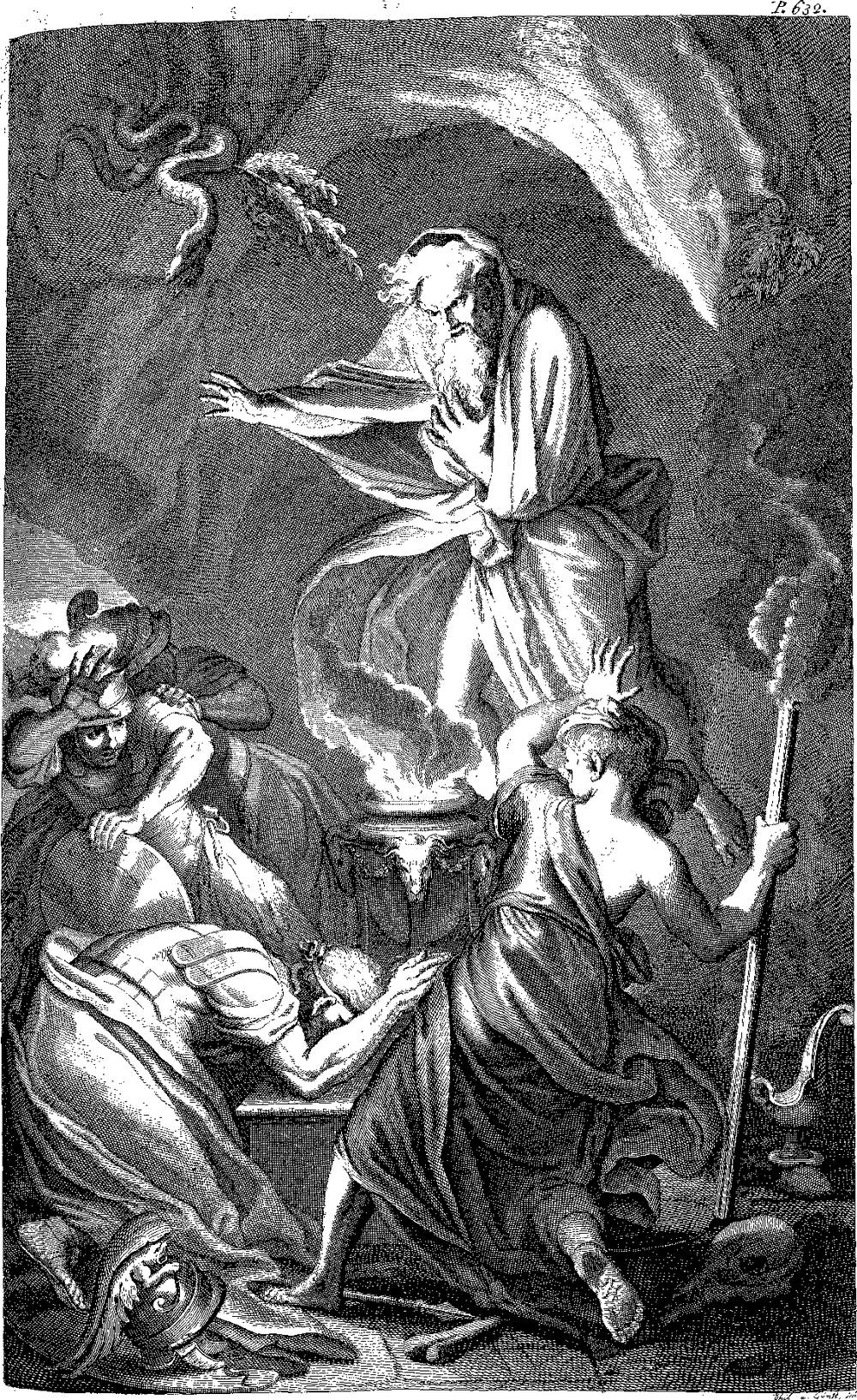
As to Saul’s Action of consulting the Witch, it is needless to examine it according to the Rules of Morality, since it is so manifestly contrary to the Laws of God. Under the Article SAMUEL, we have already seen the several Opinions that have been advanced concerning the Appearance of this Prophet to Saul.
Read this article in its place on the printed pages
Footnotes
-
In the Year of the World 2909, before Christ 1091, before the vulgar Era 1095. Shoulder ↩
-
1 Sam. x. 17, 18, &c. In the Year of the World 2909, before Christ 1091, before the vulgar Era 1095. ↩
-
See what has been observed under Samuel, in the Year 2911. ↩
-
1 Sam. xiii. 1, 2, 3, &c. In the Year of the World 2911, before Christ 1089, before the vulgar Era 1093. ↩
-
1 Sam. xv. 1, 2, 3, &c. In the Year of the World 2930, before Christ 1070, before the vulgar Era 1074. ↩
-
1 Sam. xv. 12. והנה מציב לו ידEt ecce erexit sibi manum. Confer 2 Reg. xviii. 18. Absalom erexit sibi manum. ↩
-
Translators’ note. Eng. He set him up a Place. ↩
-
1 Sam. xvi. 1, 2, 3, &c. In the Year ↩
-
1 Sam. xvii. 1, 2, 3, &c. In the Year of ↩
-
1 Sam. xix. 1, 2, 3, &c. In the Year of the ↩
-
1 Sam. xv. 29. In the Year of the World 2934, before Christ 1066, before the vulgar Era 1070. In the Year of the World 2942, before Christ 1058, before the vulgar Era 1062. In the Year of the World 2943, before Christ 1057, before the vulgar Era 1061. ↩
-
1 Sam. xxiii. 1, 2, 3, &c. In the Year of the World 2945, before Christ 1055, before the vulgar Era 1059. ↩
-
1 Sam. xxvi. 1, 2, 3, &c. In the Year of the World 2946, before Christ 1054, before the vulgar Era 1058. ↩
-
1 Sam. xxiv. 1, 2, 3, &c. In the Year of the World 2947, before Christ 1053, before the vulgar Era 1057. ↩
-
1 Sam. xxviii. 1, 2, 3, &c. In the Year of the World 2949, before Christ 1051, before the vulgar Era 1055. ↩
-
1 Sam. xxi. 1, 2, 3, &c. In the Year of the World 2944, before Christ 1056, before the vulgar Era 1060. ↩
-
Vide Rabb. in Hymno in 1 Reg. xxxi. & Grot. l. 2. de jure B. & P. c. 19. n. 5. ↩