Volume II, pages 549–556, 559–562, 561–567 of the 1732 edition, from RIM to SAB: everything printed on these pages, in order.
Continued from Right-Hand
Ex. xiii. 9.be for a Sign unto thee upon thine Hand, as a Seal fastned to their Ring or Bracelet. Compare this Passage with Ecclus. xlix. 13. Quomodo amplificemus Zerobabel? Nam & ipse quasi signum in dextra manu.
The Right and Left-hand joined together signify on this Side, or that Side, indifferently. If you go to the Right, I will go to the Left. Turn not aside from the Commandments of God, neither to the Right or Left; or do not turn from them at all. David’s Archers are commended, 1 Chron. xii. 2.who could use their Sling as well with their Left-hands as Right; they were Ambidexters. Jonah iii. 11.In Jonah it is said, that there were above six-score thousand Persons in Nineveh, who could not distinguish between their Right and Left-hands. This may be understood as the former Passage, of Persons that could make use of either Hand indifferently, to fight with; but it is generally explain’d of Infants, who knew not yet any Distinction of Right and Left-hands, as a Token of their Innocence.
To give the Hand, dare dexteram, is a Mark of Society and Friendship. St. Paul says, that James, Cephas, and John, gave him the Right-hand. Dexteras dederunt mihi & Barnabæ societatis. In the Books of the Maccabees this Expression recurs very often. Demus dexteras hominibus. Postulaverunt ab eo dexteras. Dexteram dedit, accepit, abiit.
In taking an Oath they lifted up their Is. lxii. 8.Right-hand. Juravit Dominus in dexterâ suâ.
I. RIMMON, Remmon, or Remmona, a City of Zebulun, 1 Chron. vi. 77. Perhaps it is the same as Dimnah, or Dimona, or Damna, Josh. xxi. 35.
II. RIMMON, a Rock to which the Children of Benjamin retreated after their Defeat. Judg. xx. 45. xxi. 13.
III. RIMMON, an Idol of the People of Damascus. Naaman the Syrian, makes his Confession to Elisha, that he had often been in the Temple of Rimmon with the 2 Kings v. 18.King of Damascus his Master, who lean’d upon his Arm, while he paid his Adorations to Rimmon. ‘Tis thought this God is no other than the Sun, and that the Name of Rimmon, or High, is given to him, because Grot. in iv. Reg. 5. Selden. de Diis Syris, Syntag. 2. c. 10.of his Elevation. Grotius takes it for Saturn, because this Planet is the most elevated of all. Selden will have it to be the God most-high, the God Elion of the Phenicians. Serrarius believes it to be the Goddess Venus. We know of no other God, in all Antiquity, but this, by the Name of Rimmon.
RIMMON-PAREZ, or Remmonphares, an Encampment of the Israelites in Numb. xxxiii. 19.the Wilderness; from Rithmah they went to Rimmon-parez, and from hence to Libnah.
RIMMON the Beerothite; or of Beroth, the Father of Baanah and Rechab, the Murderers of King Ishbosheth. 2 Sam. iv. 5, 9.
1 Kings xxi. 8.RINGS. The Antiquity of Rings is known from Scripture and profane Authors. Gen. xxxviii. 18.Judah left his Ring with Tamar. When Pharaoh committed the Government of all Egypt to Joseph, he took his Gen. xli. 42.Ring from his Finger, and gave it to Joseph. After the Victory that the Israelites obtained over the Midianites, they offer’d to the Lord the Rings, the Bracelets, and the golden Necklaces, that Numb. xxxi. 50.they had taken from the Enemy. The Israelitish Women wore Rings, not only on their Fingers, but also in their Nostrils and their Ears. St. James distinguishes a Man of Wealth and Dignity by the Ring of James ii. 2. Vir aureum annulum habens, &c. Luke xv. 22. Jer. xxii. 24.Gold that he wore on his Finger. At the Return of the prodigal Son, his Father orders him to be dress’d in a new Suit of Cloaths, and to have a Ring put upon his Finger. When the Lord threatned King Jeconiah with the utmost Effects of his Anger, he tells him, that tho’ he were the Signet or Ring upon his Finger, yet he should be torn off.
The Ring was us’d chiefly to seal with, and the Scripture generally puts it in the Hands of Princes and great Persons; as the King of Egypt, Joseph, Ahaz, Jezabel, King Ahasuerus, his favourite Haman, Esther iii. 10, &c. Dan. vi. 17.Mordecai, who succeeded Haman in his Dignity, King Darius. The Patents and Orders of these Princes were sealed with their Rings or Signets, and it was this that Bibliot. Orient. titul. Solyman, p. 819.secured to ‘em their Authority and Respect.
The Ring was one of the Marks of Sovereign Authority. We have already observed, that Pharaoh gave his Ring to Joseph, as a Token of that Authority with which he invested him, and which he intended Quint. Curt. l. x. c. 5.he should exercise over all his People. When Alexander the Great gave his Ring to Perdiccas, this was understood as 1 Macc. vi. 15.nominating him to be his Successor. When Antiochus Epiphanes was at the Point of Death, he committed to Philip, one of his Friends, his Diadem, his Royal Cloak, and his Ring, that he might give them to his Son and Successor young Antiochus. Augustus being very sick of a Distemper which he thought mortal, he gave his Xiphilin. in Aug.Ring to Agrippa, as to a Friend of the greatest Integrity.
We read of certain magical Rings, to which several extraordinary Effects were ascribed, either as Preservatives against certain Evils, or for procuring certain Advantages and good Fortune. The Orientals, for Example, relate a thousand things of a pretended Ring of Solomon’s, which communicated to him a wonderful Sagacity, and caus’d him to be esteem’d the wisest and happiest of Kings. They tell us, that one Day this Prince put off his Ring to go into a Bath, when an infernal
Fury stole it from him, and threw it into the Sea. Upon this Accident Solomon would not sit upon his Throne for forty Days, not thinking himself able to govern as he should, when he was depriv’d of so necessary an Assistant. But at last he recover’d his Ring again, by the Means of a Fish that had swallow’d it, and which happen’d to be served up at his Table.
The Rings and Pendants for the Ears, so frequent in Palestine and Africa, were also probably superstitious Rings, Talismans, or Phylacteries, to which certain supernatural Effects were imputed. When Jacob arrived at the Land of Canaan, at his Return from Gen. xxxv. 4.Mesopotamia, he gave Orders to his People to put into his Custody, all the strange Gods which were in their Hand, and all their Ear-rings which were in their Ears. This seems to insinuate, that those strange Gods were superstitious or magical Figures, engraven upon their Rings, their Bracelets, and the Pendants in their Ears. Or else, according to some Commentators, that these Rings and Pendants were upon the Hands, and in the Ears of these false Gods. St. Austin inveighs very pathetically against these Phylacteries of false Gods, which his Countrymen the Africans fastened to their Aug. qu. cxi.inGen.Ears, and to which they imputed a thousand supernatural and superstitious Vertues; intending by this kind of Ornament, not so much to dress themselves out to please Men, as to please and serve Dæmons. Execranda superstitio ligaturarum, Aug. Ep. ad Possidium. 73.in quibus etiam in aures virorum in summis ex una parte auriculis suspensæ deputantur; non ad placendum hominibus, sed ad serviendum dæmonibus, adhibetur.
RINNAH, or Rinna, Son of Shimon, of the Tribe of Judah. 1 Chron. iv. 20.
Gen. x. 3. רִיפַת Riphat. 1 Chron. i. 6. דִיפַת Diphat.RIPHATH, or Riphat, second Son of Gomer, and Grandson of Japhet. He is call’d Diphath in the Chronicles. The Resemblance of the two Hebrew Letters רResh and דDaleth is so much, that they are very often confounded. The Learned are not agreed about the Country that was peopled by the Descendants of Riphath. The Chaldee and Arabick take it for France; Eusebius for the Country of the Sauromatæ; the Chronicon Alexandrinum for that of the Garamantæ; Josephus for PaphlagoniaMela l. 1.. Mela assures us, that antiently the People of this Province were call’d Riphatæi, or Riphaces; and in Bithynia, bordering upon Paphlagonia, may be found the River Rhebeus, a People call’d Rhebantes, and a Canton of the same Name. These Reasons have prevail’d with Bochart to believe, that Riphath peopled Paphlagonia. Others think he peopled the Montes Riphei, and this Opinion seems the most reasonable to us, because the other Sons of Gomer
ἁλμυρῷ ποταμῷ. peopled the northern Countries towards Scythia, and beyond the Euxine Sea.
RISSAH, or Ressa, an Encampment of the Israelites in the Wilderness. They came from Libnah to Rissah, and from Rissah they went to Kehelathah. - Numb. xxxiii. 22.
RITHMAH, or Rethma, an Encampment of the Israelites in the Desart. From Hazeroth they arrived at Rithmah, from Numb. xxxiii. 18.whence they went to Rimmon-parez. This Station must be in the Wilderness of Paran, not far from Cadesh-barnea.
RIVER. The Hebrews give the Name of the River, without any Addition, sometimes to the Nile, sometimes to the Euphrates, and sometimes to Jordan. ‘Tis the Tenour of the Discourse that must determine the Sense of this uncertain and indeterminate Way of Speaking. They give also the Name of River to Brooks and Rivulets that are not very considerable.
Here follows a List of the principal Rivers or Brooks of Palestine.
The Jordan. The Arnon, } beyond Jordan.
The Jabok, The Karith, The Sorek. The Beser. The Kishon. The Belus. The Brook of Jezreel, which falls into the Jordan, near Scythopolis.
The Eleuthera. The Sabbation. The Brook of Reeds, or of Kannah. The Barrady, otherwise Abanah and Pharphar, Rivers of Damascus.
All these Rivers may be seen under their proper Articles, or under the Cities to which they belong.
Jonah ii. 4.The Name of River is sometimes given to the Sea; for Example, Jonah says, He found himself surrounded by the Rivers, that is, by the Waters of the Sea. And Habakkuk, speaking of the Passage Habak. iii. 8, 9.through the Red Sea, says, That the Lord divided the Waters of the Rivers. And the Psal. lxxiv. 15. Ps. xxiv. 2.Psalmist, That the Lord dried up the rapid Rivers, or the Rivers of Strength. And elsewhere, That the Lord had founded the Earth upon the Sea, and established it upon the Rivers: Which signifies the same in both Places. Herodotus relates,1 that when King Xerxes cast Bonds into the Hellespont, and order’d it to be whip’d, he said to it: ‘Tis with good Reason that no Body offers Sacrifices to thee, O thou deceitful and turbulent River.
RIZPAH, or Respha, the Daughter of Aiah, the Concubine, or Wife of the second degree, to King Saul. This Prince having put to Death a great Number of the Gibeonites,
beonites, for what Reason, or upon what 2 Sam. xxi. 1, 2, 3, &c.Occasion is not known; God, to punish this Massacre, sent a great Famine into the Land of Israel,2 which held for three Years. David, who then reign’d, being acquainted by the Oracle of the Lord, that this Famine was sent as a Punishment for the Cruelty of Saul to the Gibeonites, caus’d them to come to him, and said to them; “What can I do to repair the “Injury that has been done you, that you “may bless the Lord’s Inheritance?” They answer’d him; “Let seven of the “Children or Grand-children of Saul be “deliver’d to us, and we will hang them “up, to appease the Anger of the Lord.” Then David gave them up Armoni and Mephibosheth, two Sons that Saul had by Rizpah, the Daughter of Aiah; and also five Sons that Michal, the Daughter of Saul, had by Adriel, the Son of Barzillai; or rather by Phaltiel. These they hung up upon the Mountain near to Gibeah, at the beginning Vid. 1 Sam. xxv. 43.of Barley-Harvest.
Then Rizpah the Daughter of Aiah took a Sackcloth and spread it upon the Rock; and continued there from the beginning of Harvest, till the Waters of the Heavens fell down upon them, or till the Lord sent his Rain upon the Earth, and restored it to its former Fertility. She hinder’d the Birds from tearing the Bodies by Day, and the ravenous Beasts from devouring them by Night. When this Action of Rizpah was related to David, he was moved with Compassion, and sent to fetch the Bones of Saul and Jonathan, which were at Jabesh-gilead, brought them to Gibeah, and put them in the Tomb of Kish, the Father of Saul; together with the Bones of the seven Men that had been executed by the Gibeonites.
On this Occasion they acted contrary to Deut. xxi. 23.the Law of Deuteronomy, which orders that they should take the Bodies down from the Cross or Gibbit, before the setting of the Sun. Non permanebit cadaver ejus in ligno; sed in eadem die sepelietur. But these unhappy Remains of the Family of Saul were left there, probably from the beginning of the Spring to Autumn: Whether it was because the Crime of their Father deserved this severe Treatment, or because the Gibeonites, being only Proselytes of Habitation, were not obliged to the Observation of this Law of Moses. Lastly, Whereas God had order’d David to give Satisfaction to the Gibeonites, this Prince thought fit to leave the Management of it to themselves.
A long Time before what we have now related, and soon after the Death of Saul,3 Abner, the General of his Army, fell in Love with Rizpah, and took her for Wife, or, at least, us’d her as such. It was thought a heinous Crime, according to the Notions of those People, for a Subject to meddle with one of the Wives of a King. Ishbosheth, the Son of Saul, who reign’d at Mahanaim beyond Jordan, and who was supported in his regal State, only by the Credit of Abner’s Valour, resented this as a great Injury, and upbraided him with daring to approach his Father’s Concubine. 2 Sam. iii. 7, 1. 1 Sam. xxiv. 2, 4, 5.Abner was so nettled at this Reproach, that from that Minute he vow’d the Ruin of Ishbosheth, and enter’d into a League with David, to bring into his Interest all those that had adhered to Ishbosheth. This is all we are told about Rizpah.
ROCK. Palestine being a mountainous Country, had also many Rocks; which Rocks made Part of the Strength of the Country, for in Times of Danger they retired to them, where they found a Refuge against any sudden Irruptions of the Enemy. When the Benjamites were overcome and almost exterminated by the Israelites of the other Tribes, they secured themselves Judg. xx. 47. Jud. xv. 8. 2 Sam. xxiii. 25, 28. xxii. 1.in the Rock of Rimmon. Samson kept Garison in the Rock Etam. When David was persecuted by Saul, he often concealed himself in Caverns made in a Rock; for Example, at Maon, at Adullam, at En-gedi, where there was a Cave of a vast Extent, in which David and his People hid themselves, and wherein Saul enter’d and continued for some Time, without discovering them. Joshua shut up five Kings of the Canaanites, whom he had Josh. x. 16, 17, &c. Judg. vi. 2. Hieronym. Numb. xxiv. 21. Bellon. observat. l. 2. c. 61.subdued, in the Cave of Makkedah. During the Oppression that the Children of Israel suffer’d from the Midianites, they were forced to hide themselves in the Cavities of the Rocks. St. Jerome says, that the southern Parts of Judah are full of Caves under Ground, and of Caverns in the Mountains, to which the People retired in Time of Danger. The Kenites dwelt in the hollow Places of the Rocks. Even at this Day, the Villages of this Country are subterraneous, or in the Rocks. Josephus in several places speaks of hollow Rocks, where Thieves and Robbers had their Haunts; and Travellers still find a great Number of them in Palestine, and the Provinces adjoining to it.
Ps. xviii. 2.The Name of Rock is also given to God, by way of Metaphor, because God is the Strength, the Refuge, and the Azylum of Israel; as the Rocks were of those Places, whither the People retired in case of an unforeseen Attack or Irruption of the Enemy. The Lord is my Rock, and my Fortress, and my Deliverer: My God, my Strength, in whom I will trust, my Buckler,
Psal. lxi. 2, 3. Psal. lxxi. 3. Psal. xciv. 22.and the Horn of my Salvation, and my high Tower. Who is a Rock, save our God? Be thou my strong Rock, for an House of Defence to save me. For thou art my Rock, and my Fortress. Then he forsook God which made him, and lightly esteemed the Rock of his Salvation. Of the Rock that begat thee thou art unmindful, and hast forgotten God that formed thee. How should one chase a Thousand, and two put ten Thousand to Flight, except their Rock had sold them, and the Lord had shut them up? For their Rock is not as our Rock, even our Enemies themselves being Judges. And so of others; for this way of speaking is very common in the Hebrew Text.
The Hebrews also give in general the Name of Rock to all Places of Retreat and Security, to which they retire. Lead me to the Rock that is higher than I. For thou hast been a Shelter for me, and a strong Tower from the Enemy. Be thou to me for a Rock of Habitation, whereunto I may continually resort: Thou hast given Commandment to save me, for thou art my Rock and my Fortress. But the Lord is my Defence, and my God is the Rock of my Refuge.
The Word Rock or Stone is also used to signify Knives; for they made use of Knives of Stone or Flint in Circumcision. Ex. iv. 25. Josh. v. 2, 3.Zipporah took a sharp Stone, and cut off the Foreskin of her Son. At that Time the Lord said unto Joshua, make thee sharp Knives, (or Knives of Flint) and circumcise again the Children of Israel a second time. And Joshua made him sharp Knives, and circumcised the Children of Israel, at the Hill of the Fore-skins.
Deut. viii. 9. Isai. li. 1. Deut. xxxii. 13.Moses says, that the Lord had settled his People in a high Country, and made him to suck Honey out of the Rock, and Oyl out of the flinty Rock. That is, he brought them out of Egypt, which was a flat Country, and subject to Inundations, and placed them in Palestine, which was a mountainous Country of great Fertility, the Hills of which were loaded with Vines and Olive-trees; and of which the very Rocks were fill’d with Swarms of Bees, whose Honey did not add a little to the Happiness of the Climate. He says in another Place, Palestine was a Land whose Stones were Iron, and out of whose Hills thou mayst dig Brass. That is, it abounded with good Mines of Iron and Brass.
Rock is also us’d for a Quarry, and in a figurative Sense, for the Patriarch of a Nation, or the first Father, who is, as it were, the Quarry from whom the Men of that Nation have proceeded. For Example, Look unto the Rock whence ye are hewn, and to the Hole of the Pit whence ye are digged. Look unto Abraham your Father, and unto Sarah that bare you. And Moses, ii. 31. Psal. xxxi. 2, 3. Deut. xxxii. 15, 18, 30, 31. Deut. xxxii. 18. Numb. xxi. 14, 15.speaking to the Jews, says; Of the Rock that begat thee thou art unmindful; that is, of the Quarry from whence thou wast taken.
Mention is made in Scripture of several Rocks. As, for Example,
The Rocks of Arnon: Probably these were Rocks upon the Banks of the River or Brook Arnon, chiefly at the Place where the Israelites pass’d over it. They us’d to say, as it were by an antient Proverb, that the Lord had broke down or made plain the Rocks of Arnon, to make a Passage for his People. Scopuli torrentium inclinati sunt.
The Rocks Bozez and Seneh, 1 Sam. xiv. 4. They were between Michmash and Gibeah.
Sela-hammah-lekoth, or the Rock of 1 Sam. xxviii. 21.Divisions. This was in the Desart of Maon, and had this Name given it, because Saul was here obliged to quit his Pursuit after David, and to return to the Assistance of his Country, which was then invaded by the Philistines.
Ex. xvii. 6. Ex. xxxiii. 21, 22, 23. xxxiv. 6, 7. 1 Kings xix. 10, 11, 12, &c. Judg. vii. 25. Isa. x. 26.The Rock of Horeb. There are three Rocks by this Name, distinctly mark’d out in Scripture. The first is that from whence Moses caus’d the Waters to gush out, to supply the Necessities of the People, when they were encamped at Rephidim. The second is that on the Top of Mount Horeb, where God manifested a Part of his Glory to Moses, and afterwards to Elijah. The third is that where Oreb, the Prince of the Midianites, was put to Death. But this latter is rather written Oreb, whereas the other two are written Horeb.
The Rock Adullam; it was in the Neighbourhood of the City of this Name, in the Tribe of Judah.
Judg. xv. 8, 11, 13.The Rock Etam; probably near the City of this Name, mark’d in the Greek. Josh. xv. 60. 1 Chron. iv. 32. 2 Chron. xi. 6. They were in the Tribe of Judah; to the South of Jerusalem. See ETAM.
The Rock Jektiel. This, according to several Interpreters, is the same as Petra, the capital City of Arabia Petrea. See PETRA and JEKTIEL.
The Rock or Stone of Zoheleth, 1 Kings i. 9. See ZOHELETH.
The Rock of the Waters of Meribah, or Strife. This is the Rock where the Faith of Moses fail’d, and where the Scripture reproaches him with having hesitated in his Heart, and did not honour God as he ought, before the Children of Israel. Num. xx. 10, 11. It had the Name of the Rock of Strife given to it, and to the Waters, the Waters of Strife, because of the Murmurings of the Children of Israel, and their Sedition against Moses.
If there are still any other considerable Rocks, they may be seen under their proper
per Articles, or under the Articles of those Cities, in whose Neighbourhood they were situated.
ROD, Virga. This Word is us’d, sometimes for the Branches of a Tree: And Jacob took him Rods of green Poplar, and of Gen. xxx. 37. Ex. iv. 17, 20. Lev. xxvii. 32.the Hasel and Chesnut-tree. Sometimes for a Staff or Wand: And thou shalt take this Rod in thine Hand, wherewith thou shalt do Signs. And Moses took the Rod of God in his Hand. Or for a Shepherd’s Crook: And concerning the Tythe of the Herd, or of the Flock, even of whatsoever passeth under the Rod; the tenth shall be holy unto the Lord. Or for a Rod, properly so call’d, which God makes use of to correct Men: If he commit Iniquity, I will chasten him with the Rod 2 Sam. vii. 14. Job ix. 34. Esth. iv. 11. Psal. xlv. 6. Heb. i. 8. Psal. ii. 9. Rev. ii. 27. xii. 5. xix. 15. Numb. xxiv. 17. Is. xi. Ps. lxxiv. 2. Jer. x. 16.of Men, and with the Stripes of the Children of Men. Let him take his Rod away from me. Sometimes it is taken for a royal Scepter: Auream virgam ad eam tetendit. Virga æquitatis, virga regni tui. The Empire of the Messiah is sometimes represented by a Rod of Iron, to shew its Power and its Might. Thou shalt break them with a Rod of Iron. Elsewhere Virga is put for a young Sprout or Branch, and to point out the miraculous Birth of the Messiah, who was to proceed from a Virgin Mother. Consurget virga de Israel. There shall come a Star out of Jacob, and a Scepter (or Rod) shall rise out of Israel. And Isaiah says; There shall come forth a Rod out of the Stem of Jesse, and a Branch shall grow out of his Roots. Lastly, Rod is sometimes put to signify a Tribe, or a People; Remember thy Congregation which thou hast purchased of old, the Rod of thine Inheritance which thou hast redeemed. Israel is the Rod of his Inheritance. In Jeremiah, the watchful Rod (Virgam vigilantem ego video. Jerem. i. 11. Vulgat.) according to the Hebrew, stands for a Branch or Rod of an Almond-tree. This Tree flourishes before any other, and the Lord intended to mark out Nebuchadnezzar by it, who was just then ready to pour out all his Forces upon Judea.
Exod. iv. 2, 3, &c.The Rod of Moses, is that which God gave him, or rather, it was the Staff or Wand that Moses generally made use of for driving his Flock, and which God commanded him to take along with him, for the working of those Miracles he was to perform before Pharaoh, and before all his People. The Lord said unto him, What is that in thine Hand? And he said, A Rod. And he said, Cast it on the Ground, and it became a Serpent. And Moses fled from before it. And the Lord said unto Moses; Put forth thine Hand, and take it by the Tail. And he put forth his Hand and caught it; and it became a Rod in his Hand. This Rod Moses kept as long as he lived, and it became the Instrument of performing a great Number of Miracles, which he wrought through the Course of his Life: The Scripture does not inform us what became of it after his Death; it is probable that it devolved to Joshua, as Moses’s Successor in the Government of the People: But of this there is no Proof. The Musulmen say, that it was laid up in the Ark of the Covenant; but they confound it with that of Aaron.
The Rabbins relate many wonderful things of this famous Rod. They say, it was first created by God for the Use of Adam; that it came by Succession to Abraham, and thence to the Patriarch Joseph, who left it to the Kings of Egypt as a Pledge of his Acknowledgment. Jethro coming into Egypt, stole it away from thence, and carry’d it into his own Country. He there planted it in a Garden, where it took such Root, that no one could pluck it up. Jethro, who knew the whole Virtue of it, promis’d his Daughter in Marriage to whosoever could pull it up. Many young Men offered themselves, and attempted to pull it out of the Ground; but no one could perform it, till Moses undertook it, and plucked it up without any Difficulty. Zipporah was the Reward of his Success. The Name of God was written upon this Rod, and it was this that indued it with all its Virtue and Merit.
The Rod or Caduceus of Mercury, which is always represented to us as twisted about with two Serpents, and endued with prodigious Vertues, is an Imitation of what the sacred History tells us of the Rod of Moses changed into a Serpent, and of the Miracles that God wrought by its Means.
Numb. xvii. 1,2,3.The Rod of Aaron, is the Staff that this High-priest commonly us’d. In the Conspiracy of Corah, Dathan, and Abiram, against Moses and Aaron, God gave Orders to Moses, to receive a Rod from every one of the Heads of the Tribes, and to add that of Aaron to the Number, that the Lord might shew by a Miracle which was the Tribe that he chose, for the Exercise of the Priest’s Office. They gathered therefore twelve Rods, according to the Number of the Tribes, and that of Aaron made the thirteenth. They wrote upon each of those Rods the Name of the Prince of the Tribe who offer’d it; they put them in the Tabernacle of the Congregation, where the Lord had used to manifest himself to Moses; and the Day following, when they took these Rods again, they observed, that in the Night-time the Rod of Aaron had put forth Buds, had blossom’d, and that the Blossoms were those of the Almond-tree.
There was no Room for any Suspicion, that the Rods had been changed. Every one had wrote his Name upon his own, and that of Aaron was very well known; and no human Industry could produce so
great a Change. Thus the Priesthood, by this Prodigy, was confirm’d to Aaron and his Posterity. To preserve the Memory of so miraculous an Event, God commanded Moses to lay up this Rod in the Tabernacle of the Congregation, or of Testimony, that it might serve as a Monument of what had happen’d upon this Occasion.
Some think it preserved its Leaves and Fruit as long as it continued in this holy Place. And indeed it was necessary, that to answer the Design of God, it must preserve those Marks of the Miracle, for the Conviction of Posterity.
It is inquired, whether it was put within the Ark of the Covenant, or only by it. God commands Moses only to put it in the Numb. xvii. 20. Heb. ix. 4.Tabernacle to be preserved there. But St. Paul says it was within the Ark, with the Urn full of Manna, and the Tables of the Law. Others affirm, it was not put within, but only at the Side of the Ark. They alledge for this Opinion, a Passage out of 1 Kings viii. 9.the first Book of the Kings, which intimates, that there was nothing in the Ark but the Tables of the Law; but others contend, that this Passage of St. Paul ought to be understood literally; that there could be no Hindrance to prevent the putting of Aaron’s Rod into the Ark, since it was five Foot long, and its Capacity was much more than would be requir’d to hold it. This Rod was sanctified by the Miracle that was work’d upon it; and when the Scripture says, that there was nothing in the Ark, but the Tables of the Law, it may be understood with this Limitation, that nothing else was originally there, the Ark being only intended for this Use. But this need not hinder, but that afterwards other things might be put into it.
Artapan in Eusebius4 informs us, that the Rod of Moses, which Aaron made use of in performing so many Prodigies in Egypt before Pharaoh, became in after Ages the Object of Idolatrous Worship to the Egyptians, that they kept it in the Temple of Isis, and paid Adoration to it. ‘Tis also said, that even at present it is shew’d at Rome in the Church of St. John Lateran, where it is honour’d as a very precious Relick.
Some Learned Men have thought,5 that the Thyrsus, carry’d by Bacchus and the Bacchanals, and which is represented to us as a Lance or Dart, incircled with Vinebranches, is an Imitation of Aaron’s Rod that flourish’d. Euripides relates, that one of the Priestesses of Bacchus struck one of the Rocks of Mount Cytheron with her Thyrsus, and that a Spring of Water immediately gush’d out; another Imitation of the Miracle that happen’d at Horeb, where Moses and Aaron brought forth Water out of a Rock, by means of this miraculous Wand.
Isai. xi. 1, 2.The Rod of St. Joseph, the Husband of the Virgin Mary. We read in the false Gospel of the Nativity of the Holy Virgin, that when Mary was arrived at the Age of Matrimony, and that, according to Custom, they were about to send her to her Parents, that she might be marry’d; she answer’d, that she could not consent to be bestow’d in Marriage, because she had made a Vow of Virginity. This being a singular Case, the Highpriest consulted the Lord upon it, who answer’d by an intelligible Voice, that was heard by every one present, that they must provide a Person, to whom this Virgin was to be committed as the Guardian of her Virginity. That for this purpose all the unmarried Men of the House of David must present themselves before the Altar, each holding a Rod in his Hand; and that he whose Rod should bud and blossom, and upon whom the Spirit of the Lord should light in the Form of a Dove, should be the Person chosen by the Lord to be the Spouse and Guardian of the Virgin, according to those Words of Isaiah; And there shall come forth a Rod out of the Stem of Jesse, and a Branch shall grow out of his Roots. And the Spirit of the Lord shall rest upon him, the Spirit of Wisdom and Understanding, the Spirit of Counsel and Might, the Spirit of Knowledge, and of the Fear of the Lord.
Those, therefore, that were mark’d out presented themselves in the Temple, each holding a Rod in his Hand. Joseph came thither also, but had brought no Rod with him. The Highpriest not finding upon any of the Rods the Token that God had promis’d, he consulted the Lord again, and it was answer’d him, that he that had brought no Rod was the only one whom God had chosen. He had no sooner then brought his Rod, but a Dove came down from Heaven, and rested upon it; by which Mark every body knew that he was appointed to be the Spouse of Mary.
The Protevangelium of St. James6 relates the same thing, but with some Variety of Circumstances. It says, that when the Virgin had attain’d the tenth Year of her Age, the Priests told the Highpriest Zachariah, that he should think of marrying her, for fear the holy Place might be exposed to some Defilement. That Zachariah consulted the Lord thereupon, who told him by an Angel, that he must assemble all the single Men of Isreal; that he should command every one to bring his
Rod, and that he upon whom a Miracle should be wrought was to be the Spouse of Mary. The Affair was publish’d through the whole Country by Sound of Trumpet; there came to the Temple a vast Number of Candidates; Joseph left his Carpenter’s Shop and came with the rest.
The Highpriest took all their Rods, and went into the Temple, where, having pray’d, he return’d to each his Rod. When Joseph received his, a Dove flew out of it, and went to light upon his Head. Then the Highpriest declared to him, that it was the Will of God he should take Mary to Wife: Joseph excused himself, saying; I have Children, I am Old, she is Young, I am afraid of becoming the Sport of Israel. The High-priest answer’d; Fear the Lord, remember what happen’d to Corah, Dathan, and Abiram. Oppose not the Will of God, which has been manifested by this Prodigy. Joseph consented and took Mary; but he left her in a House, and return’d to work at his Carpenter’s Trade.
It is from these antient Gospels, and from the Tradition of the Orientals, that our Painters have a Custom of representing Joseph with a flourishing Rod; but as the Fountain from whence this is drawn, is of no Authority in the Church, as the Story itself is but ill put together, and as a Miracle is by no means necessary on this Occasion, all this may be reckon’d only as a Fable. See St. Jerome upon St. Matthew, l. 2.
ROGELIM, a Place in the Country of Gilead beyond Jordan, where lived Barzillai the Friend of David. 2 Sam. xvii. 27.
ROHGAH, or Roaga, Son of Shamer, of 1 Chron. vii. 34.the Tribe of Asher.
ROMANS. St Jerome seems to have thought, that Chittim was put for Italy, since he translates this Word by Italy. BalaamNumb. xxiv. 24. Ezekiel xxvii. 6. says; And Ships shall come from the Coasts of Chittim, and shall afflict Ashur, and shall afflict Eber, and he also shall perish for ever. Here St. Jerome translates, Ships shall come from Italy. But this Passage ought rather to be understood of the Greeks, who under the Conduct of Alexander the Great, came to invade the Hebrews, that is, the Persians who reign’d beyond the Euphrates. They overthrew their Empire, but were afterwards overthrown themselves by the Romans. The same St. Jerome says in Ezekiel,7 that the Workmen of Tyre made use of what came from the Isles of Italy, to make Lodgings (or Cabbins) for the Captains of the Tyrian Ships. Praetoriola de insulis Italiae. Vulgat. But what Rarities could there be in these Islands of Italy, that were not to be found in Phenicia and the neighbouring Provinces?
The Hebrew may be translated two Ways. They have made thy Benches of Ivory trod under Foot, and brought from the Isles of Chittim; or from Macedonia. Ivory trod under Foot, is that which has been for a long Time hid under Ground, where the Elephants are used to conceal their Teeth when they shed them. Dentes deciduos casu aliquo, vel senectute, defodiunt. ‘Tis known that Macedonia was a Country where Ivory was not common, any more than in Italy; Bochart. de Animal. part. 1. l. 8. c. 3. Glass. Gram. l. 3. c. 1. Plin. l. 16. c. 16. Vid. Liv. l. 44, 45. Bochart. Phaleg. l. 3. c. 5. Plin. l. 8. c. 3.wherefore Bochart and Glassius maintain, that the Hebrew ought to be translated thus; They have made thy Benches of Ivory, and of Box brought from Macedonia. Now the Box of Macedonia was in great Reputation, as may be seen from Pliny: And we have shewn under the Article CHITTIM, that this Word stood for Macedonia.
The same St. Jerome also translates the Hebrew Word Tubal by Italy, in Isaiah lxvi. 19. which according to some signifies Spain, and according to others the Tibarenians. See the Article TUBAL.
Lastly, the same Father has render’d the Hebrew Word Chittim by Romans, which elsewhere8 he has translated by Italy, and which, as far as we can judge, signifies Macedonia. See Gen. x. 4. and the Commentators upon Dan. xi. 30. True it is, that in this Place the Prophet speaks of the Romans; but it is because the Romans he mentions sailed from Delos in a Macedonian Fleet, which they found in the Harbour of the Isle of Delos. Bochart has display’d all his Learning to support the Opinion of the Rabbins, who by Chittim understand Rome and Italy. He shews, that in this Country are found Cities by the Name of Cethim and Echetia, and a River call’d Cethus; but he also brings very good Proofs that Chittim is put for Macedonia.
The Jews generally call the Romans, Idumeans, and the Roman Empire, the cruel Empire of Edom. It is difficult to guess for what Reason they give this Denomination to Italy, and Rome, which are so far from Idumea, and have never had any Communication with the Idumeans. When the more knowing Rabbins are asked the Reason of this, they maintain with great Assurance and Obstinacy, that the Idumeans embraced Christianity, settled themselves in Italy, and there extended their Dominions.
Abravanel, who passes among them for a Man of Sense, pretends that the Romans, and all Christians in general, may be call’d Idumeans, in the same Sense as Isaiah call’d the wicked Jews of his Time by the Name of People of Sodom and Gomorrah, because they follow’d their Manner, and espoused their Sentiments. As Esau brought
many Strangers into the Family of Jacob; so in the Roman Empire, and in the Christian Church, are to be found a Confusion of all Sorts of Nations that provoke God. Esau hated Jacob, and endeavour’d to rob him of his Birth-right and other Privileges; the Christians do the same thing by the People of Israel. The Cabalists maintain, that the Soul of Esau passed into the Body of Jesus Christ by Transmigration; whence it is that we find the Names of Jesua and Esau to be written in Hebrew with the same Letters, though not in the same Order. Esau was born under the Constellation of Mars, from whence he became a great Hunter, and a Man of Blood. The Roman Heroes, who were descended from Kings, had the same Inclinations. Esau was Red; the Roman Emperors wore Purple Robes, and the Cardinals wear them still. Jesus Christ was born under the same Planet Mars, he was a Man of Blood, for which Reason he was put to death, with a Part of his Disciples. But what Impertinencies are these?
JOSEPH the Son of Gorion relates this Affair in a more Historical, or rather more Fabulous Manner. Tsepho the Grandson of Esau, being kept Prisoner by Joseph in Egypt, made his Escape to Æneas then King of Carthage, who made him the Commander of his Forces. Æneas went from Africa into Italy, where he twice defeated Turnus King of Beneventum, and took Lavinia from him to make her his own Wife. Pablus the Nephew of Æneas was kill’d in the Battle, as also Turnus, and they had two Towers, or Mausolea, erected to their Memory, which were still to be seen between Alba and Rome, at the Time that this Historian wrote: One of which was call’d Copablus, and the other Cophurnus.
The Africans under the Command of Tsepho, often made Incursions into Italy, and committed great Havock. ‘Twas in one of these Expeditions, that losing a young Heifer, he found it again in a Cave, where it was devour’d by a monstrous Beast, half a Goat and half a Man, whom he then kill’d. The Inhabitants being delivered from this Monster, honour’d Tsepho as an Hero, and made Offerings and Libations to him. They gave him the Name Janus, which was the Name of the Monster slain by him, and also that of Saturn, which was the Name of a Star that was then worshipped. Such therefore was Tsepho, the Grandson of Esau.
Latinus succeeded him, then Æneas the Trojan; and a long time after that reign’d Romulus, the Founder of Rome. At this Time David made War with the Idumeans;
ישועJesu. עשוEsau. then Adarezer had his Grandson Zir, Officers of King David, revolted from him, and fled into Italy, where they built old Alba. There they reign’d, and their Posterity continued there down to the Times of Joseph Son of Gorion, the Contriver of all these Whimsies. I pass over a great many Circumstances, that I may not trespass too much upon the Patience of the Reader. And thus he makes out, how the Idumeans by the Means of Tsepho, and the Jews by means of Adarezer and Zir, settled themselves in Italy. It is not amiss now and then to shew something of the Genius of the Jews, by the Traditions and Histories of their own Invention. See Basnages’s History of the Jews, t. 1. l. 2. c. 5.
But this Tradition is not peculiar to the Jews; for it has pass’d from them to the Arabians, and we read it in almost all the Mussulman Authors. That Esau had a Son called Roum, from whom are descended all D’Herbelot. Bibl. Orient. p. 80.the Grecian and Roman Emperors. Lastly, this Tradition is common to almost all the Nations of the Levant, who have any Knowledge of the Sacred Writings; that from the Time of Abdon, Judge of the Hebrews, a Colony of Idumeans pass’d into Italy and settled there. That Latinus reigned among them, and that Romulus the Founder of Rome derived his Original from them. There is a great deal of Probability, that these Fables were first invented with no other Design, than to give a Pretence to the Jews among themselves, to apply to the Christians all those Curses that they find in their Holy Writings against Edom, and the Idumeans. And when these Stories once got footing, they became the common Belief of all the Jews and Orientals.
The Roman Empire is mark’d out in Dan. ii. 40.Daniel, by the Kingdom of Iron, which bruises and breaks in Pieces all the other Kingdoms. This is the Explication of almost all Interpreters. But we think it is rather the Empire of the Lagidæ in Egypt, and of the Seleucidæ in Syria. See our Commentary upon Dan. ii. 40. In the Books of the Old Testament written in Hebrew, I find no mention of the Names Rome, Romans, or Italy.
But in the Books of the Maccabees, and in the New Testament, there is often mention made of them. For Example, it is said,9 That Judas had heard of the Fame of the Romans, that they were mighty and valiant Men, and such as would lovingly accept all that joined themselves unto them, and make a League of Amity with all that came unto them. And that they were Men of great Valour. It was told him also of their Wars and noble Acts, which they had
done among the Galatians, and how they had conquered them, and brought them under Tribute. Judas had also been informed of the Conquests they had made in Spain; that they had brought under their Empire very distant Countries, and had overcome Kings that came to make War with them, from the Extremities of the World. Lastly, that they had conquer’d Philip and Perseus, Kings of Macedonia, or of the Chittims, and Antiochus the great King of Syria; that they had deprived him of a great Part of his Provinces ; that they had also reduced the Greeks, who had attempted to make Head against them ; and in a Word, that they confirm’d in their Kingdoms all those they had a mind should reign, and on the contrary deprived those of their Crowns whom they did not intend should enjoy them any longer : Yet nevertheless, that none of them would wear either the Diadem or the Purple, but that they had chosen a Senate from among themselves, consisting of Three hundred and Twenty Senators, who consulted every Day about the Affairs of the Republick ; that they committed every Year the Sovereign Magistracy to one Person, who had the whole Command through all their Territories, and that thus all were obedient to one, without any Envy or Jealousy among them.
This is what Fame had published in Judea concerning the Romans, and what inclined Judas Maccabeus to send two Ambassadors to Rome, to make Friendship and Alliance with them, and to desire them to free them from the Yoke of the Syrians, who would oppress them in their Liberties, and overturn their Religion. These Ambassadors were very well received by the Romans, and here is the Substance of the Reply they sent back to Jerusalem, which remained written at Rome upon Tables of Brass : “ May the Romans and the Nation “ of the Jews, be replenish’d with all “ Happiness for ever, both by Sea and “ Land, and may the Sword and the “ Enemy be removed at a great Distance “ from them. If any War should happen “ against the Romans or their Allies, thro’ “ the whole Extent of their Dominions, “ the Jews shall assist them heartily in the “ same, as far as the Circumstances shall “ allow them to do, nor shall the Romans “ be obliged to provide any thing for such “ Troops as shall come to their Assistance. “ And on the other Side, if any War “ should happen against the People of the “ Jews, the Romans shall assist them “ heartily in the same, as far as the Circumstances shall allow them to do, nor “ shall the Jews be obliged to provide “ any thing for such Troops as shall come “ to their Assistance. That if in time to “ come, either of the Parties shall think “ fit to add any thing to, or to take any “ thing from, what is here agreed to, it “ shall be done by mutual Consent, and “ whatever shall be added or taken away, “ shall be firm and stable. And as to the “ Misfortunes that Demetrius Soter has “ occasion’d to the Jews, we have writ to “ him in these Words ; Why have you “ laid such a heavy Yoke upon the Jews, “ who are our Friends and Allies ? Know “ therefore, that if they shall any more “ make these Complaints to us, we shall “ do them Justice, and shall invade your “ Dominions by Sea and Land.”
1 Macc. xii. 1, 2, 3, &c.Such was the first Alliance that the Jews made with the Romans, in the Year of the World 3842, before Christ 158, before the vulgar Era 162. Some Years after this, in the Year of the World 3860, before Christ 140, before the vulgar Era 144, Jonathan, the Brother of Judas Maccabeus, finding the Opportunity to be favourable, sent a Deputation to Rome, to renew their Alliance with the Senate ; and the Senate gave them Letters directed to the Governors of the several Provinces, to have them reconducted safe to Judea. Lastly, Simon Maccabeus, Brother to Judas and Jonathan, a sent to Rome upon the same Errand, an Ambassador call’d Numenius, with a Present of a great golden Buckler. Numenius was very well received, the Senate granted what was desired, and the Romans called the Jews their Friends, Brethren, and Allies. Demetrius Nicator being inform’d of this, conferr’d great Honours upon Simon the Highpriest, confirm’d him in the Priesthood, declared him his Friend, and rais’d him to a high Degree of Glory.
Before this happen’d, in the Year of the World 3841, before Christ 159, before the vulgar Era 163, Quintus Memmius and 2 Macc. xi. 34, 35, 36.Titus Manilius, the Roman Legats, being sent into Syria to settle some Affairs with King Antiochus Eupator, interested themselves in promoting the Tranquility of the Jews, and wrote to them in this Manner. “ We confirm to you the same Things that “ Lysias the King’s Kinsman has granted to “ you. And as to such things which he “ thinks ought to be laid before the King, “ send somebody hither as soon as you “ can, after you have well consider’d “ among your selves, that we may make “ such Determinations about them as may “ be for your Advantage ; for we are “ going soon to Antioch. Wherefore “ make haste to write to us, that we may “ be well inform’d of what you desire.”
The Romans took the City of Jerusalem no less than three times : First by the Arms of Pompey, in the Year of the World 3941,10
before Christ 59, before the vulgar Era 63. The second was by Sosius, in the Year of the World 3967, before Christ 33, before the vulgar Era 37. The third and last Time was under Titus, in the Year of the World 4070, in the Year of Christ 73, and of the vulgar Era 70; at which time both the City and the Temple were utterly destroy’d.
They reduced Judea into a Province; that is, they took from it the Privilege of being a Kingdom, and of having Kingly Government. First after the Banishment of King Archelaus, Son of Herod the Great, in the ninth Year of Jesus Christ, which was the sixteenth Year of the vulgar Era; and the Country continued in this State to the fortieth Year of Christ, which was the Thirtyseventh of the vulgar Era. Secondly, it was again reduced to a Province after the Death of King Agrippa, in the Year of Christ 47, which is the 43d of the vulgar Era; and it remained in this Condition till it was intirely overthrown, which happen’d in the Year of Christ 73, or the 70th Year of the vulgar Era.
Roman Governors, who govern’d Judea after it was reduced to a Province. See the Article GOVERNORS.
Epistle of St. Paul to the Romans. This was placed before the other Epistles of St. Paul, not because it was first in order of Time, but either because of the Dignity of the Romish Church to which it is directed, or because of the Excellence of the Matter; or, lastly, because of the Magnificence and Sublimity of the Mysteries, which are here treated of and explain’d. It passes for the most exalted and the most difficult of all St. Paul’s Hieron. Epist. 151. c. 8.Epistles. St. Jerome was of Opinion, that not one Book only, but many Volumes were necessary, for a full Explanation of it. And some have thought, that St. Peter had chiefly this Epistle in his Eye, when he said, As our beloved Brother Paul also, according to the Wisdom given unto him, hath written unto you. As also in all his Epistles, speaking in them of these things; in which are some things hard to be understood, which they that are unlearned and unstable, wrest, as they do also the other Scriptures, unto their own Destruction. But it must also be observed, that others with good Reason think, these Words of St. Peter are rather to be referr’d to St. Paul’s Epistle to the Hebrews.
St. Paul’s Design, in the Epistle to the Romans, is to put an End to certain domestick Disputes, which then prevailed among the Believers at Rome, and divided among themselves the converted Jews, and the Gentiles that were become Christians. The Jews were opinionated concerning their Birth-right, and the Promises made to their Fathers; and for this, pretended to a certain Priority or Preference before the converted Gentiles, whom they look’d upon as Foreigners and Interlopers, that out of pure Favour had been admitted into the Society of the Faithful, and to the Participation of the Prerogatives of Christianity. The Gentiles on the other hand, being irritated by these Reproaches of the Jews, stood up for the Merit of their own Sages and Philosophers, the Prudence of their Legislators, the Purity of their Morality, their Exactness in following the Rules of the Law of Nature. And at the same time they accused the Jews with Infidelity towards God, and with Violation of his Laws. They aggravated their Faults, and those of their Fathers, which had excluded the greatest Part of them from the Inheritance of the Saints, and from the Gift of Faith; whereas the Gentiles, being found less blameable than they in the Eyes of God, had deserved to be call’d to the Faith, when they were excluded.
To put an End to these Contentions, St. Paul applies himself to restrain the Presumption of the Jews, and of the converted Gentiles. He sets forth the Extravagancy of both Parties, and shews that neither of them could pretend to any Merits, nor had any Reason to glory or boast of their Vocation, which proceeded from the mere Grace and Mercy of God. He proves to ‘em, that even though the Jews had observed the Law of Moses, and the Gentiles had kept the Law of Nature, this could not have merited for them the Grace of their Vocation, nor of Justification. That nothing but Faith in Jesus Christ, enlivened by Charity, and accompanied with good Works, is able to justify us; that without Faith, all the rest signifies nothing. He answers some Objections in his Way, by Arguments taken from the Principles he had laid down. As for Example, about the gratuitous Vocation, and absolute Reprobation, of both Jews and Gentiles; about the Insufficiency of the Works of the Law, without Faith; about the Superiority of the Jews above the Gentiles; about the Infallibility of the Promises of God. This leads him into a Discussion of the Mystery of Predestination and Reprobation, which though in some manner foreign to his first Design, yet, however, makes a principal Part of this Epistle, and contains some of the greatest Difficulties in it.
In Chapters xii. xiii. xiv. xv. he gives them excellent Rules of Morality, concerning the Harmony that ought to subsist among them, and concerning that mutual Forbearance and Condescention they ought to have for one another’s Infirmities, for fear of scandalizing or offending one another, by any indiscreet Liberties. He marks out the false Apostles, and exhorts the Faithful to avoid them. Chap. xvi.
contains only some Civilities and Recommendations, which he addresses to some particular Persons whom he salutes. This Letter was writ in the 58th Year of the vulgar Era, in the City of Corinth, from whence St. Paul was immediately to depart, in order to carry to Jerusalem some Collections that had been made for the Saints there. Phebe, a Deaconess of the Church of Cenchrea, which was near Corinth, was the Bearer of this Letter. No doubt has ever been made of its being Authentick, and though it was address’d to the Romans, yet it was written in Greek. a Tertius was St. Paul’s Secretary on this Occasion.
The Marcionites made great Defalcations in the Epistles of St. Paul, especially in this to the Romans, of which they suppress’d the two last Chapters intirely. There is some likelihood that St. Paul’s first Design was to finish his Epistle to the Romans at the End of the fourteenth Chapter; but finding Leisure afterwards, he added the two last Chapters to it. At the End of the fifteenth Chapter, we see this Conclusion. Now the God of Peace be with you all. Amen; which seems to shew that the Letter was then finished. We see the Rom. xvi. 20, 24, 27.same Conclusion no less than three Times in the sixteenth Chapter, which gives Room to imagine that it was compos’d at several Intervals of Time.
ROME. The City of Rome was founded by Remus and Romulus, according to Usher, in the Year 3966 of the Julian Period, in the Year of the World 3256, before Christ 744, before the vulgar Era 748, towards the End of the Reign of Hezekiah King of Judah. This City is so well known, that it is needless to give any Account of it here; nor I believe will any one expect it in a Dictionary of the Bible. The Sacred Authors of the Old Testament have never once mention’d it, as we know; but it is well known in the Books of the Maccabees, and of the New Testament. St. Peter in his first Epistle, v. 13. has mark’d it out by the figurative Name of Babylon. The Church that is at Babylon elected together with you, Rev.xiv.8. xvi. 19. xvii. 5. xviii. 2,10, 21.saluteth you. St. John in his Revelation, points it out more than once by the same Name, and describes it in such a Manner, as can only agree to Rome; by its Command over all Nations, by its Cruelty towards the Saints, and by its Situation upon Seven Hills. Rev. xvii. 9.
The Rabbins commonly give to Rome the Name of Edom, and think that the Prophesies pronounced against Edom, shall have their Accomplishment in the Destruction of this great City.
Some Protestants have deny’d, against the concurrent Testimony of all Antiquity, that St. Peter the Apostle ever was at Rome. They pretend that the City of Babylon, mentioned by him in his first Epistle, is the Babylon of Chaldea, or that of Egypt. They reject as so many Fables, all that has been published concerning the Voyages of St. Peter to Rome, his Opposition to Simon Magus, and his Martyrdom in this City. But surely if this Fact is not to be depended upon, I do not know any thing that can, in all Ecclesiastical History. We have all Antiquity to attest it, which consequently affirms it, nor has any one till now ever deny’d it. Lastly, we have Monuments, Tombs, Statues, Paintings, publick Places, which give Testimony to the Imprisonment and Martyrdom of St. Peter at Rome. The Authors may be consulted who have spoken of this Matter, and our Dissertation upon this Subject, printed in the last Tome of our Commentary.
St. Paul came twice to Rome. First, in the 61st Year of Jesus Christ, when he appeal’d to Cæsar. And, secondly, in the Year 65, a Year before his Martyrdom, which happened in the Year 66 of the vulgar Era.
St. Peter was also at Rome more than once. ‘Tis thought he went thither in the Year 42, and that then he fix’d his Episcopal Seat there. He might return thither again about the Years 45, 58, and 65, of the vulgar Era. He suffer’d Martyrdom there in the Year 66.
St. John the Evangelist was banished from Ephesus, and sent to Rome, during the Persecution of Domitian, in the Year 95 of the vulgar Era. He was there plunged11 into boiling Oil, without receiving any Hurt from it, but on the contrary, came out more Hale and Vigorous than he was before.
I. ROOB, or Rooba, a City of Syria, in the Country of Emesa. See ROHOB before.
II. ROOB, a Village four Miles from Scythopolis. Euseb.
1 Tim. vi. 10.ROOT. Covetousness or Desire is the Root of all the Evils, and of all the Sins that we commit. The Root, that is, the Fountain, the Cause, the Occasion. Ne sit inter vos radix germinans fel & amaritudinem.Deut. xxxix. 18. Let there not be seen among you pestilential Men, who draw down upon you the Effects of the Anger of God. Roots of Gall and Bitterness. Radicem verbi inveniamus Job xix. 28.contra eum. Let us seek against him Occasions of Discourse and Reproof; or let us find Opportunities to accuse him. The Hebrew says, The Root of the Word is in me. I am always in a Condition of defending myself sufficiently. Deus evellet Psal. li. 7.radicem tuam de terra viventium. God will pluck up thy Root out of the12
Land of the Living. He will snatch you out of the World, and destroy you.
The Root may also denote the Race, the Posterity. Radix justorum non commovebitur.Prov. xii. 3. Jerem. xii. 1. The Root of the Just shall not be disturb’d, shall not fail. And Jeremiah; Whence is it that the Wicked prosper in all things? Thou hast planted them, and they have taken Root. In Daniel, and in the Books of the Maccabees, Antiochus Epiphanes, the Persecutor of the Jews, is represented as a young Sprout or Sucker, or Root of Iniquity, proceding from the Kings, the Successors of Alexander the Great. And Jesus Christ, in his Passion, is de-scribed to us as a Root illnourished, plant-ed in a dry and barren Soil. Sicut radix de terra sitienti. And elsewhere Isai. liii. 2. Isai. xi. 1, 10.he is call’d a Root of Jesse.
In a contrary Sense St. Paul says, that the Rom. xi. 16, 17, 18.Jews are, as it were, the Root that bears the Tree, upon which the Gentiles are ingrafted. And that the Patriarchs are the pure and holy Root, of which the Jews are, as it were, the Branches. Si radix sancta, & rami. And elsewhere, that Jesus Christ is the Root, upon which Christians depend, and from whence they derive their Life and Subsistence. Radicati Coll. ii. 7.& super ædificati in ipso.
ROSH, or Ros, Son of Benjamin, Gen. xlvi. 21.
We find in the Hebrew of Ezekiel xxxviii. 2, 3. a People call’d Rosh, which is not found in the Vulgate. St. Jerome has taken it in an appellative Sense, to signify the Head, or the Prince.13 Principem capitis Mosoch & Thubal. Whereas the Hebrew reads, b Principem Rosh, Mesech & Thubal. In Genesis,14 where mention is made of Tubal and Meshech, we find also Tiras, which has some Relation to Rosh. The Septuagint have follow’d the Hebrew in Ezekiel, and the best Interpreters make no Question, but that Rosh is the Name of a People. But they are not agreed about the Country they inhabit, nor the Name they are known by now.
D’Herbelot. Bibl. Orient. p. 722.The Orientals hold, that Japheth had an eighth Son call’d Rous, who is not men-tion’d in Moses, and who peopled the Russia we now call Moscovy. They add, that Rous was of a very uneasy and turbulent Disposition. He possess’d the Country be-yond the Esel, or the Volga, and often made Inroads into his Brother’s Territories, call’d Khozar, who to live in Peace with him was forced to make a Cession of all the Islands of this great River, which empties itself into the Caspian Sea. In all these Islands Rous caused to be sown Turkey Wheat, which the Turks to this Day in their own Tongue, call Wheat of Rous, or of Bulgaria; and in all his Dominions he caus’d very unjust Laws to be proclaim’d, to which he forc’d all his Subjects to sub-mit. One amongst others there was, which excluded the Male Heirs from succeeding to their Fathers Estates, and made them devolve intirely to the Females. He like-wise introduced the Custom, of putting a Sword into the Hands of the Boys, as soon as they were able to manage it, with these Words; This is your Inheritance.
Idem, p. 795.The same Authors relate, that Japheth had a Son call’d Seclab, who chiefly turn’d his Mind to building of Houses and Cities, because of the Number of his Children. When these were increased to a great Multitude, they desired Lands for Cultivation, of their Brethren the Children of Rous, but they would not grant their Request. They afterwards address’d themselves to the Descendants of Khozar and Gomari, their Brethren also, but not with better Success; so that they thought themselves obliged to take Possession by Force. But then all their Neighbours enter’d into a Confederacy against them, so that they were obliged to desist from their Enterprize, and to retire into a very cold Country, be-yond the seventh Climate. Mirkond says, that the Seclabs inhabit the Country of the Hyperboreans even to this Day, where they are forced to live under Ground during the Winter Season. M. D’Herbelot thinks, that these are the Samoiedes, or the Laplanders.
The same Mirkond says, that Seclab had a Son, whose Mother died when she brought him into the World; so that they were obliged to feed him with the Milk of a Hare. And this was the Reason, that when the Child grew up, he could leap and run with an incredible Nimbleness and Swiftness, which Qualities continued hereditary in the whole Family. The Name of Se-clab has so much Relation to that of Sclaves, or Sclavonians, and to what M. D’Herbelot says elsewhere of the Sclaves, that I am much inclined to think it is of these that Mirkond speaks. See Bibl. Orient. p. 470.
To return to Rosh, or Ros, mentioned by Ezekiel: We question not but it signi-fies Russia, or the People that dwell upon the Araxes, call’d Rosch by the Inhabi-tants, and which is the antient Habitation of the Scythians.
ROXANA, Daughter of Herod the Great, and of Phædra his eighth Wife. She marry’d one of the Sons of Pheroras.
RUE, Rutha; a well-known Garden-herb. Jesus Christ reproaches the Phari-sees with their superstitious Affectation, of paying the Tythe of the Mint and Rue that grew in their Gardens, and which for this Reason was not in reality subject to the Law that injoin’d paying of Tythe. He did not blame, however, this scrupulous
Exactness of theirs, which in the main had nothing of Evil in it; but he chiefly reproves them for the strict Observance of these Niceties, while at the same time they neglected the more essential Parts of the Law. Hæc15 autem oportuit facere, & illa non omittere.
Mark xv. 21. Joseph. de Bello, l. 7. c. κε. p. 981. a.Josephus the Historian relates, that there was in the Castle of Maqueron, beyond Jordan, a Plant of Rue of such extraordinary Magnitude, that there was no Fig-tree that was equal to it, either in Height or Extent. ‘Twas said to have been in that Place ever since the Time of Herod the Great; that is, at least Seventy-three Years before the End of the Jewish War, at which time it perished.
I. RUFUS, Son of Simon the Cyrenean, which Simon assisted our Saviour in carrying his Cross to Mount Calvary. Rufus probably was famous among the first Christians, since St. Mark names him with Distinction. Simonem Cyrenæum patrem Alexandri & Rufi. Is this the Rufus whom St. Paul in his Epistle to the Romans Rom. xvi. 13.salutes with his Mother? St. Polycarp in his Letter to the Philippians, written in the Year 107, proposes to ‘em St. Ignatius, and one St. Rufus, as Models and Patterns of Patience. Usuard, Ado, and other antient Martyrologers, place St. Rufus the Martyr, on the 18th of December, and insinuate, that he was the Son of Simon the Cyrenean, since they say he was one of the antient Disciples, by whom the first Churches were founded among the Jews and Gentiles. The Chronicon of Lucius Dexter, a Work of no Credit, and contrived by an Impostor, speaks of St. Rufus Bishop of Tortosa in Catalonia, and honour’d upon the 11th of November, or rather the 14th, according to Ferrarius; and of St. Alexander his Brother, martyr’d at Cartagena on the 11th of March.
II. RUFUS, of whom St. Paul speaks, in his Epistle to the Romans; he is, perhaps, the same as St. Rufus Son of Simon the Cyrenean. The ancient Martyrologies of Bede, Usuard, Ado, and the Roman, put his Feast on the 21st of November. The false Dorotheus makes him Bishop of Thebes. We have seen, in the foregoing Article, what the Spaniards say of him.
III. RUFUS (Annius) was made Governor of Judea, about the 16th Year of Christ, and the 13th of the Vulgar Era. He succeeded Ambivius in this Employment, and was succeeded himself by Valerius Gratus, in the 15th or 16th Year of the Vulgar Era.
IV. RUFUS (Terentius) or, as the Jews call him, Turnus Rufus; he was left by Titus at Jerusalem with the tenth Legion, after the Destruction and Desolation of that City. a The Jews assure us, that Rufus caused the Plough to go over it. He sent to Titus one of the Chiefs of the Jews, call’d Simon of Gioras, who had hid himself in one of the Common Sewers of the Temple.
2 Kings xxiii. 36.RUMA. Josephus speaks of Ruma a Village of Galilee. De Bello, l. 3. c. 9. In the Second Book of Kings there is also mention made of Ruma; but Josephus there reads Abuma.
RUMP of the Sacrifices. Moses had ordain’d, that the Rump and Fat of the Sheep, that were offered for a Peace-offering, should be put upon the Fire of the Altar16. The Rump was esteem’d as the most delicate Part of the Animal, as being the fattest. Travellers both ancient and modern speak of these Rumps of the Sheep of Syria and Arabia, that are so large as to weigh, some of ‘em, not less than twenty or thirty Herodot. l. 3. c. 113.Pounds. Herodotus says, that some of ‘em may be seen that are no less than three Cubits long, or four Foot and an half: They draw upon the Ground; and for fear they should be hurt, or the Skin torn off, the Shepherds are us’d to put under the Tails of these Sheep certain little Carriages, which these Animals always draw after them. The Pagans had also this Regard for the Rumps or Tails, that they always made them a Part of their Sacrifices c.
RUNCINA, properly signifies a Joiner’s Plane17. Hermolaus Barbarus and Calepin are mistaken, taking this for a Saw to saw Timber with. The Latin Translator of Isaiah xliv. 13. makes use of the Word Runcina: Artifex lignarius extendit normam, & formavit lignum in runcina. The Hebrew Word Shared18 signifies rather the Line which the Carpenters rub with Red, White, or Black, to mark the Wood they intend to cut. The Septuagint make use of the Word Paragraphis, which, according to Martinius, signifies the Ruler with which Children rule their Paper. Isaiah therefore would say, that the Carpenter first takes a Piece of Wood without Shape, which he cuts; and to square it, he uses a colour’d String, to draw Right Lines upon it.
1 Sam. vi. 7.RUPTURE; Confractio. To make a Rupture, is a common Expression in the Original Text of Scripture, instead of saying, to strike dead. The Lord made a Rupture in Uzzah; he smote him dead. Purify Exod. xix. 10, 12.your selves, for fear the Lord should be angry, and make a Rupture in the midst of Psal. cv.you. And in the Psalms,19
God resolved to destroy them; and would have done it, had not Moses his Servant stood in the Gap, or the Rupture, in his Presence; had he not presented himself between, to turn away the Wrath of God.
Isai. lviii. 12.Ruptura is also put for a Breach: Thou shalt be called Repairer of the Breach, or Rupture: Vocaberis ædificator sepium. The Hebrew says, Sepient rupturas. And Amos; Amos ix. 11.In that Day will I raise up the Tabernacle of David that is fallen, and close up the Breaches thereof, or its Ruptures.
Ruth, ch. i.RUTH, a Moabitish Woman, who having marry’d Chilion the Son of Elimelech and Naomi, who had settled themselves in the Country of Moab, dwelt some time with him, without having any Children. Naomi having lost her Husband and two Sons, and being desirous to return to Bethlehem her own Country, her two Daughters-in-law being now Widows, would also go along with her. But she making known to them her Inability of providing for them there, Orpah was persuaded to continue in the Land of Moab, but Ruth would go along with Naomi to Bethlehem. This happen’d at the End of the Time of the Judges, and under the Government of Eli, if we may take Josephus’s Word for it. Joseph. Antiq. l. 5. c. 11.The Rabbins pretend, that Boaz, who married Ruth, was the same as Ibzan the Judge of Israel, who govern’d them for seven Years, about the Year of the World 2823, between Jephthah and Elon. The great Chronology of the Hebrews places this History in the Time of Ehud, and of the Servitude of the Israelites under Eglon King of Moab. Others place it under Barak and Deborah; others, under Gideon; others, under Abimelech. Usher,Tostat. Lyran. Torniel. Genebr. &c. whom we follow, places it under Shamgar, about sixscore Years after the Time of Joshua.
When Naomi came to Bethlehem, she found her self reduced to great Poverty, and Ruth went a Gleaning, to get something to support them. She came by chance into the Field of a rich Citizen of Bethlehem, named Boaz, who was akin to Elimelech her Father -in-law. When Boaz came to see his Harvesters, he found Ruth, and commended her Dutifulness to Naomi her Mother-in-law, bid her go and eat and drink with his People, and gave them Orders to leave something behind them, that she might have the better Gleaning. Ruth returned Home at Evening, told Naomi what had happen’d to her, and inform’d her of the Civilities of Boaz, who had also bid her to go no-where else to glean but in his Field. Naomi blessed God for it, that he had put such Sentiments of Humanity in Boaz’s Heart, and acquainted Ruth that this was their Kinsman.
At the End of Harvest Naomi told Ruth, Ruth iii. 9.that she had a Design to provide for her, and to procure her a solid State of Repose. Go this Night, says she, and lie at the Feet of Boaz, who is to go this Evening to winnow his Corn; and you must do what he shall bid you. Ruth agreed to it; and having observed the Place where Boaz went to lie down, probably, under some Tree in his Field, Ruth went thither also in the Night, and lay down at his Feet. Boaz awaking, and seeing something near him, was afraid. But Ruth said, I am Ruth thine Handmaid; spread therefore thy Skirt over thy thine Hand-maid, for thou art a near Kinsman. Boaz acknowledg’d, that indeed he was a near Kinsman, but there was another nearer than he; and if this Man should refuse to marry her, he himself would take her to Wife. Then rising very early in the Morning, before it was Day-light, he filled Ruth’s Lap with Corn, and sent her away to Naomi.
When it was Day, Boaz went to the Gate of Bethlehem, and having call’d together the Elders of the City, he cited him to appear who was the nearest Kinsman to Elimelech, that he might marry Ruth the Widow of Chilion his Son. This saying, that he could not do it; Boaz then insisted, that he should renounce his Right to it. This he willingly did; and then Boaz declared, that he intended to marry her himself. Thus Ruth became the Wife of Boaz, by whom she had a Son call’d Obed, who was Father to Jesse, and Grandfather to King David.
The Book of Ruth, which contains the History of which we have now given an Abstract, is placed, in our Bibles, between the Book of Judges and the Books of Samuel, as being the Sequel of the former, Hieron. Prolog. Galeat.and an Introduction to the latter. Saint Jerom informs us, that the Jews added it to the Book of Judges, because the Transactions it treats of happen’d in the Time of Judg. i. 1.the Judges of Israel: In diebus unius Judicis, quando Judices præerant. And several of the ancient Fathers make but one Book of the Judges and of Ruth. But the modern Jews commonly place in their Bibles, after the Pentateuch, the five Megilloth, which are, first, The Song of Songs; secondly, Ruth; thirdly, the Lamentations of Jeremiah; fourthly, Ecclesiastes; and fifthly, Esther. Sometimes Ruth is plac’d the first of the five, sometimes the second, and sometimes the fifth.
The Scope of the Author of this Book, is to make known to us the Genealogy of David; and, in all Probability, he was the same Author as composed the First Book of Samuel; in which, because he could not conveniently place this Genealogy of David, he chose rather to give it by it self, than to perplex his Discourse. The Writer observes, at the Beginning of his
Work, that the History he was going to relate, happen’d at the Time that the Judges governed Israel; therefore they ceased to govern it at the Time he wrote. Besides, he speaks of David at the End of his Book; which shews, that, at sooneft, it must be written in the Time of David. Besides, I have observed two ways of Speaking in it, or particular Phrases, which are only found in the Books of Samuel and of the Kings: The first is,a The Lord do so to me, and more also: The second, b I have discovered to your Ear; for I have told you.
The Canonicalness of this Book was never disputed. We have observed before, that the Learned are not agreed about the Epocha of the History it relates. Ruth the Moabitess is found in the Genealogy of our Saviour, Matth. i. 5.
RYDDA, a City that the Jews conquer’d from the Arabians, under the Reign of Alexander Janneus. See Josephus’s Antiquities, l. 14. c. 2. a Ruth i. 17. Compare 1 Sam. iii. 16. xiv. 44. xx. 22. 2 Sam. iii. 9. 31. xix. 13. 1 Kings ii. 23. xix. 1. xx. 10. 2 Kings vi. 21.b Ruth iv. 4. Compare 1 Sam. xx. 2. 2 Sam. vii. 27.
SAAB, a Place in Galilee, of which was Eleazar the Son of Samæus. Joseph. de Bello, l. 3. c. 9.
SAARA, a Village dependant on Eleutheropolis, ten Miles from this City towards Euseb. & Hieron.Nicopolis.
SABACON King of Egypt. Herodotus gives an Account, that Sabacus, or Sabacon, King of Ethiopia, having made an Incursion Herodot. l. 2.into Egypt, Anysis, who reigned there at that time, being blind, made his Escape into the Marshes, and abandon’d his Kingdom to Sabacon, who reigned there fifty Years. His Maxim was, Never to put any Person to Death, but to condemn all Offenders to work upon the Banks of the Nile, to prevent the Inundations of that River. At last he withdrew into his Kingdom of Ethiopia, having first had a Dream, which commanded him to put to Death all the Priests of Egypt, and to cut them in two in the Middle. He could not comply with this Command, and chose rather to quit the Country; and this so much the rather, because the Number of Years was compleated, which the Oracle had told him he should reign in Egypt. After he was withdrawn, Anysis came again out of his Retreat, and resumed the Government of his Kingdom. He had Sethon for his Successor, who lived under SENNECHARIB. See his Article.
2 Kings xviii. 9. See Africanus in Syncellus, 8, 74. Euseb. Chronic.Some Authors relate, that when Sabacon invaded Egypt, he laid hold of King Bocchoris, then reigning there, and caused him to be inhumanely burnt alive, and seized his Kingdom. It is probable, that Sabacon is the same whom the Scripture calls So. After this Usurper had in a short time made himself very powerful, Hoshea King of Israel made an Alliance with him; thinking, by his Assistance, to shake off the 2 Kings xvii. 4.Yoke of the Assyrians. With this Hope, he refused to pay to the Assyrians the Tribute that was due to them. To revenge this, Shal-manesar marched with an Army against him, ravaged all the plain Country, and besieged Hoshea in Samaria. He was forced to surrender, after he had sustained a Siege of three Years, in the Year of the World 3283, before Christ 717, before the Vulgar Era 721.
SABACHTHANI, or Sabactani. We Mat. xxvii. 46. Mark xv. 34.read this Word in the Gospel: Jesus Christ upon the Cross, cry’d out, Eli, Eli, lama sabachthani? My God, my God, why hast thou forsaken me? This is a corrupt Reading of the Word Azabthani, or Gnazabthani; Thou hast forsaken me. This is Psal. xxii. 2. למה עזבתניtaken out of Psal. xxii. 1.
SABAOTH, or rather Zabaoth, an Hebrew Word that signifies Hosts or Armies. Jehovah Sabaoth, The Lord of Hosts. Whether, by this Expression, we understand 1 Kings xxii. 19. Numb. iv. 3, 23, 30, &c.the Host of Heaven, or the Angels and Ministers of the Lord; or the Stars and Planets, which are as an Army ranged in Battle-array, and performing the Will of God; or, lastly, whether it be explain’d by the People of the Lord, both of the Old and New Covenant, which is truly the Army of the Lord, of which God is the General and Commander. The Hebrew Word Zaba is often used also, to signify the Service that his Ministers perform for him in the Temple; because they are there, as it were, Soldiers or Guards attending at the Court of their Prince. This Word is also us’d, to express Exodus xxxviii. 8.the Duty of the Women who watched at the Door of the Tabernacle, and kept Guard there in the Night-time.
SABEANS. Isai. xlv. 14. The Sabeans, Men of Stature. These are probably the Sabeans of Arabia Fœlix, or those of Asia. They submitted themselves to Cyrus, and acknowledg’d his Government.
The Sabeans, a People of Arabia, were descended from Saba: But as there are several known by the Name of Saba, who were
Job i. 15.were all Heads of a People, or of Tribes; we must also distinguish several Kinds of Sabeans. Those that took away the Flocks of Job, were, probably, a People of Arabia Deserta, who dwelt about Bozra; or, perhaps, they were a flying Troop of Sabeans that infested that Country. We shall hereafter mention Saba, or Sheba, the Son of Jockshan, who might be the Father of the Sabeans here spoken of.
The Sabeans, Descendants from Sheba Gen. x. 7.Son of Cush, are, probably, those of Arabia Fœlix, who are famous for their Spices; to whom the Poets give the Epithet of soft and effeminate, and who had Women to command them:
Claud. in Eutrop. l. 2.Medis, levibusque Sabæis Imperat hic Sexus. Several are of Opinion, that it was from 1 Kings x. 1,2.hence the Queen of Sheba came to hear the Wisdom of Solomon; and that it is of these Sabeans that the Psalmist speaks; Psal. lxxi. 10. Jer. vi. 20. Isai. lx. 6.Reges Arabum & Saba dona Domino Deo adducent. And in Jeremiah; Ut quid mihi thus de Saba affertis? And in Isaiah; Omnes de Saba venient, aurum & thus deferentes.
The Sabeans, Sons of Shebah, Son of Rheumah, probably also dwelt in Arabia Fœlix. I imagine it to be these of whom Ezekiel speaks, who came with their Merchandises Ezekiel xxvii. 22.to the Fairs of Tyre: Venditores Saba, & Reema, ipsi negotiatores tui. And Joel iii. 8.in Joel; I will deliver up your Children to the Tribe of Judah, who shall sell them to the Sabeans, a Nation at a great Distance: Venundabunt eos Sabæis, genti longinquæ.
Ezekiel xxvii. 23.The Sabeans, Descendants from Joktan, may very well be those mention’d by Ezekiel; Saba, Assur, and Chelmud, Venditores tui. We believe they inhabited beyond the Euphrates; from whence it is that they are put with Assur and Chelmad.
The Sabeans are also placed in Africa, in Joseph. Antiq. l. 2. c. 5.the Isle of Meroe. Josephus brings the Queen of Sheba from thence, and pretends, that this Country had the Name of Shebah, or Saba, before it was call’d Meroe.
Sabeans, or Sabians, or Zabians, is the Name which is given to the ancient Idolaters, or Image-worshippers, in Persia. We shall speak of them at Length in the Article ZABIANS.
,שבתSabatum, Requies. Genef. ii. 2, 3.SABBATH. This Word, in Hebrew, signifies Rest. God having created the World in six Days, rested on the seventh; that is to say, he left off producing any new Beings, in the outward and visible Creation. He blessed this Day, and sanctified it, because he had rested upon it. From that time he set it apart, and appointed it in a peculiar Manner for his Worship. And the Hebrews, afterwards, in Consequence of this Designation, and to preserve the Memory of the Creation, sanctify’d, by his Order, the Sabbath-day, or the Seventh Day, by abstaining from all Work, Labour, and servile Employments, and by applying themselves to the Service of the Lord, to the Study of his Law, and to Prayer.
Sabbath (or Sabathum) is sometimes taken meerly for Rest; sometimes, for eternal Rest and Felicity in Heaven. See Hebrews iv. 4, &c.
The Days of Sabbath (Sabbatha) are taken, sometimes, for all the Jewish Festivals Lev. xix. 3, 30.indifferently. Keep my Sabbaths, that is, my Feasts, as, the Passover, Pentecost, Feast of Tabernacles, and the rest.
Sabbathum is also taken for the whole Week. Jejuno bis in Sabbatho, a I fast twice a Week. Una Sabbathi20 the First Day of the Week.
Upon Occasion of the Sabbath, it is disputed, whether God created the whole World by one only Fiat, all at once, by a simultaneous Action, and by a simple Act; or if he perform’d it at six distinct Operations, and in six Days successively, so that the seventh Day was really and truly a Day of Rest to the Lord, at the End of his successive Creation. Authors are much divided upon this Question. Philo21, Origen22, St. Austin23, Procopius24, and some Moderns, maintain, that God not only created Matter all at once, and in an Instant, but that at the same time He disposed it in Order, and gave every thing its proper Form, without staying for a Term of six Days. That the Account Moses gives of it, and the Distribution of the Works of the Creator into six Days, is not a Succession of Time, but only a Succession of Order and Reason, propos’d only by way of Accommodation to the Comprehension of the People, and to give them a distinct Notion of the Material Creation, by distributing it into Parts, and into a certain Disposition or Order.
But the greatest Part of the Fathers and Commentators maintain a successive Creation, agreeably to the Account given by Moses. And indeed, there is no Necessity of departing from the literal Sense of Scripture in this Place. The reiterated Acts, and the different Operations mentioned by Moses, ought indeed to be explain’d in such a manner, as is consistent with the infinite Power and perfect Simplicity of the Acts of the Creator, and which may exclude any manner of Notion of his Weakness, Weariness, or Imperfection. But all25
this may be done, without receding from a successive Creation. God, by his infinite Power, drew forth, out of Nothing, all the Matter of the Universe, or the Chaos; and, by his Wisdom, he gave the Parts all the Motions necessary, that the Chaos might display it self; and that its Parts being disengaged from one another, and each united again with others of the same Nature, might form what we call the Universe in the Condition in which we find it. This Motion, conducted by the Spirit and Wisdom of God, might continue six Days; after which, God rested himself, or ceased to produce any outward Being; but He continued still to act by his Providence and Concurrence, and to preserve the Work he had made, in the State of Beauty and Perfection in which he had created it.
As to those particular Beings, that could not be produced by a Continuation of the general Laws of Motion, communicated by God to Matter, as for Example, Men, Plants, and Animals, it must necessarily be acknowledged, that God form’d them successively, as Moses acquaints us, by applying, forming, animating Matter, agreeably to the Designs of his Wisdom; by inspiring into Man a reasonable Soul; by giving other Animals their several Instincts, for their Preservation and Producing their Kind; by putting into the Plants those Qualities that distinguish them from each other, and their Seeds and Grains that are proper for their Renovation.
Another great Question that is moved about the Sabbath, is, Whether, from the Beginning of the World, God gave the Law of the Sabbath; and whether this Day was always observed, at least among the better sort of the first Men, as the Patriarchs, before the Promulgation of the Law. Whether this be the Sense of these Words, Gen. ii. 2.And God blessed the seventh Day, and sanctified it. Some Fathers26 and some Jewish Doctors27 have asserted the Affirmative; and Menasseh Ben-Israel28 assures us, that, according to the Tradition of the Antients, Abraham and his Posterity having preserved the Memory of the Creation, observed the Sabbath also, in Consequence of the Natural Law that obliged them thereto. There are some also that believe, that the Religion of the Seventh Day is preserved among the Pagans, and that the Observation of this Day is as old as the World it self.
Philo de Mundi Opificio.In a Word, Philo says, that the Sabbath is not a Festival peculiar to any one People or Country, but is common to the whole World, and that it may be named the General and Publick Feast, and that of the Nativity of the World. Josephus advances, Joseph. contr. Apion. l 2. Euseb. l. 13. c. 12. Præp.that there is no City, either of Greeks or Barbarians, or any other Nation, where the Religion of the Sabbath was not known. Aristobulus, in Eusebius, quotes Homer and Hesiod, who speak of the Seventh Day as of a Day that is sacred and venerable. Clemens Clem. Alex. Strom. l. 5.Alexandrinus speaks of the Sabbath in the same Terms as Aristobulus, just now cited, and he adds some Passages from the Antients, which celebrate the Seventh Day.
Abenezra apud Boulduc in Job i. 2, 5. Bechaï ad Berefith. fol. 37. Ezek. xx. 12, 20.There are some that believe, that Job observed the Sabbath-day; because at the End of Seven Days he offered a Sacrifice to the Lord for his Children. Some Rabbins inform us, that Joseph also observed the Sabbath in Egypt.
But the contrary Opinion is not without its Proofs also. The greatest part of the Fathers and Commentators hold, that the Benediction and Sanctification of the Sabbath, mention’d by Moses in the Beginning of Genesis, signifies only that Appointment then made of the Seventh Day, to be afterwards solemnized and sanctified by the Jews. It does not appear from any Passage of Scripture, that the ancient Patriarchs have observed the Sabbath, or that God had any Design to oblige them thereto, before Philo Vit. Mos. l. 1.the Law took Place. Philo says, that the Hebrews having forgot which was the Day of the Creation of the World, began again to be apprised of it, when God having caused it to rain Manna all the other Days of the Week, did not permit it to rain any on the Sabbath-day. The Seventh Day, which was honoured by some Pagans, and of which they have spoke as of an Holy Day, was either dedicated to the Honour of Apollo; or it was in Imitation of the Jewish Sabbath, which some Pagans had in Honour heretofore, either out of Superstition or Devotion.
Ezekiel says expressly, that the Sabbath, and the other Feasts of the Jews, are Signs that God has given to his People, to distinguish them from other Nations. I gave them my Sabbaths, to be a Sign between me and them, that they might know that I am the Lord that sanctify them. And again, Hallow my Sabbaths, and they shall be a Sign between me and you, that ye may know that I am the Lord your God. And Moses in Deuteronomy v. 15. The Lord hath brought thee out of Egypt, therefore the Lord thy God commanded thee to keep the Sabbath-day. Justin Martyr29, Tertullian30, Eusebius31, St. Bernard32, advance, as a Matter not to be doubted, that neither the Patriarchs before the Deluge, nor those which came afterwards, observed the Sabbath.
Irenæus says expressly, that Abraham had Faith, and was call’d the Friend of God; and yet was neither circumcised, nor observed the Sabbath. Abraham ipsè sine circumcisione, & sine observatione Sabbathorum, Deo credidit, & amicus Dei appellatus est. On this Subject may be seen Selden de jure naturali & gentium, juxta disciplinam Hebræorum, l. 3. c. 13, 14, 15. Spencer de legibus Hebræorum ritualibus, l. 1. c.4. Sect. 7, &c. and our Commentary upon Gen. ii. 3.
Ex. xxxi. 13. xxxv. 2.God gave the Precept of the Sabbath to the Hebrews, when they came to Marah, one Month after their coming out of Egypt, on the 15th of the Month Abib, which answers to our March, in the Year of the World 2513, before Christ 1487, and before the vulgar Era 1491. Manna began to fall, according to several of the Fathers,33 upon the Sunday, six Days before the Sabbath. According to others, it fell upon the very Eve of the Sabbath. However this be, ‘twas probably upon the Occasion of the Manna, that God commanded the Hebrews to observe the seventh Day, and not to go out to gather any on that Day, for none would fall then. The same Command of celebrating the Sabbath is found several times repeated in the Law.34 “ Remember to sanctify “ the Sabbath Day. You shall labour for “ six Days, and shall do whatever you “ have to do; but the seventh Day is the “ Sabbath of the Lord your God. Upon “ this Day you shall do no Work, neither “ you, not your Son, nor your Daughter, “ nor your Man-servant, nor your Maidservant, nor your labouring Beasts, nor “ the Stranger that shall reside among you. “ For the Lord in six Days made the Heaven and the Earth, and whatever is contain’d in them, and rested upon the “ seventh Day. Wherefore he blessed the “ seventh Day, and hath consecrated it to “ his Service ”.
Numb. xv. 32, 35.In another place it is said, that God established his Sabbath among the Children of Israel, as a Sign to make them call to mind, that he is the Lord that sanctifies them. He adds, that whosoever shall prophane the Sabbath shall be punish’d with Death; and we see the Execution of this Law upon the Man, who having gather’d Wood upon the Sabbath Day, was stoned by all the People for this Offence. Upon other Holy Days it was allow’d to light a Fire, and to dress Victuals; Ex. xii. 16.but this was expressly forbid on the Sabbath Day. The Rabbins confine this Prohibition Ex. xxxv. 2, 3.to servile Works only; as to bake Bread, to dress Meat, to forge Metals, &c. They suppose that for such sort of Works it is forbid to light a Fire, but not for one to warm himself. On the Sabbath Days the
hær. l. 4. c. 30.Ministers of the Temple enter’d upon their Week; and those that had attended the foregoing Week went out on that Day. They put upon the golden Table new Loaves of Shew-bread, and took away the Lev. xxiv. 8.old ones. Also upon this Day were offer’d particular Sacrifices of two Lambs for a Burnt-offering, with the Wine and the Meal that always accompanied these Sacrifices. Lastly, the Sabbath was celebrated, as also the other Festivals, from Evening to Evening. They began in the Evening, at which Time also they ended. A vesperâ usque ad vesperam celebrabitis Sabbatha vestra. And this is the whole, or very near it, that is commanded in the Law, concerning the Observation of the Sabbath.
And now let us inquire what has been the Practice of the Jews, in Consequence of this Institution. The first Obligation of the Sabbath express’d in the Law, is to sanctify Numb. xxviii. 9, 10it. Remember to sanctify the Sabbath Day. But it is sanctify’d by doing good Works upon it, by Prayer, by Praises and Thanksgivings, by publick and private Worship of God, by the Study of his Law, by Justice, Innocence, and Tranquillity of Mind. The second Obligation is that of Rest. Thou shalt do no Work upon the Sabbath. It was forbid to do any servile or laborious Works, that might fix the Mind, and interrupt that Attention which was to be given to God, and which is necessary when we pay any Worship to him worthy of his Majesty. The Jews have often varied about the Manner, in which they think they ought to observe the Rest of the Sabbath. In the Time of the Maccabees, they carry’d their Respect for this Day so far, as that they 1 Mac. ii. 32, 33, &c.durst not so much as defend themselves from any Invasion of the Enemy on this Day, even in the most pressing Necessity. Since this Time they have not scrupled to take Arms, and stand upon their necessary 1 Mac. ii. 41.Defence. But it may be seen by Josephus, that they would not attack their Enemies, nor hinder them from advancing their Works; nor would they march with their Antiq. l. xii. c. 3. xiii. c. 1. Antiq. l. xiii. c. 16. p. 450. Mat. xii. 11, 12.Armies, even in Time of War, or in the Enemies Country, upon the Sabbath Day.
In the Time of our Saviour, they would not water their Cattle, or take a Beast out of a Ditch that should happen to fall in, on the Sabbath Day: But by a false Delicacy they could not bear with our Saviour’s Healing the Sick on that Day. Since that Time they have determin’d, that a Man might give Food to a Beast, that should happen to fall into a Pit, but must not take him out on that Day. The same Jews complain’d of our Saviour’s Mat. xii. 1, 2. Mark ii. 27.Disciples, that passing through the Corn-fields
on the Sabbath Day, and being pressed with Hunger, they gather’d some Ears of Corn, and rubb’d them between their Hands, in order to eat the Grains of Wheat. This Action of his Apostles, our Saviour excused only from the Necessity of the thing, and because they had need of Nourishment; adding, that the Priests themselves in the Temple do some Work, which every where else would be esteem’d Violations of the Sabbath; and that the Son of Man was Lord of the Sabbath; and lastly, that the Sabbath was made for Man, and not Man for the Sabbath.
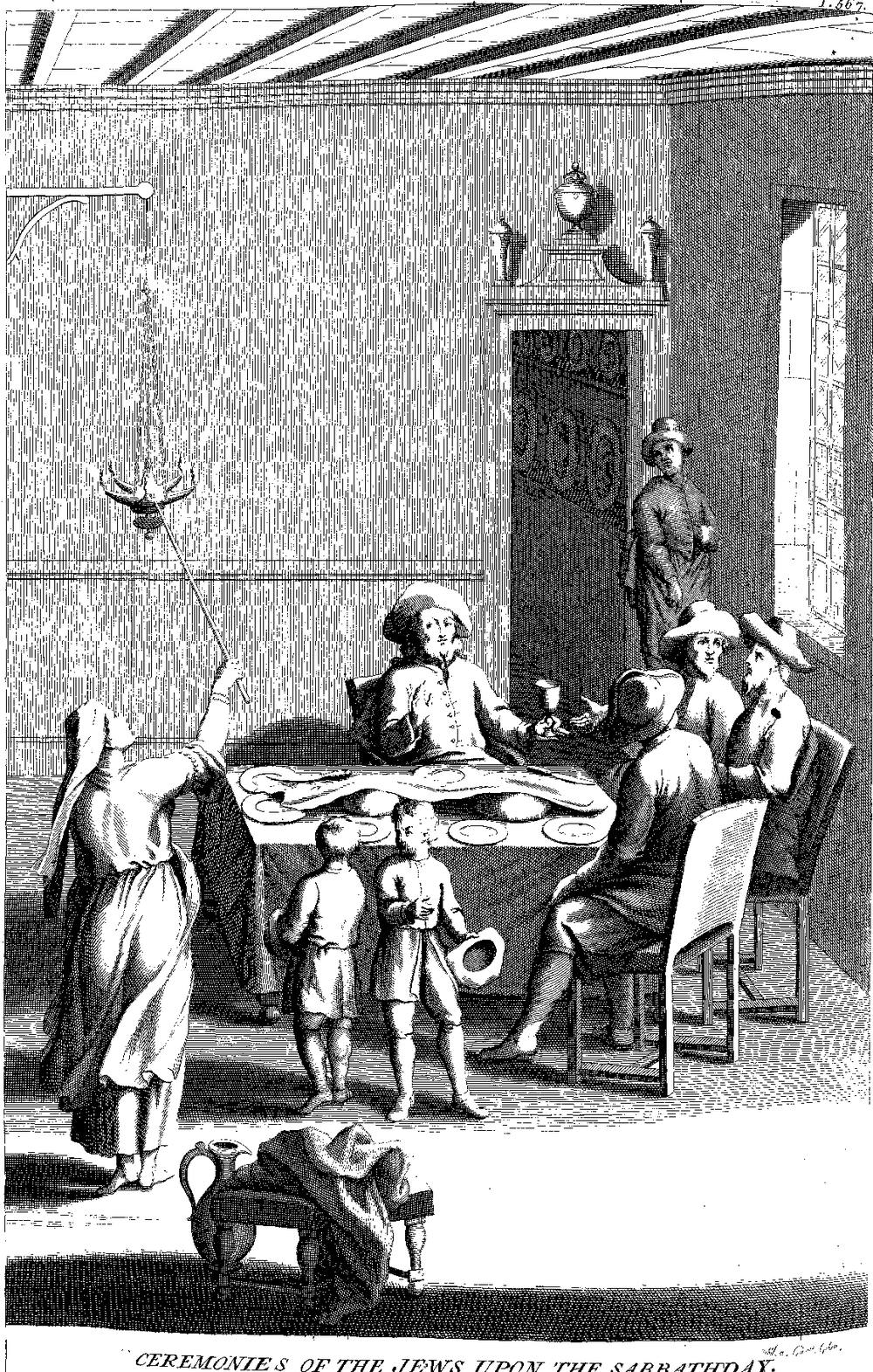
The Rabbins reckon up nine and thirty primary Prohibitions, which ought to be observed on the Sabbath Days, and several other secondary ones dependant on them, which are also obligatory. Their Number is so great, that it is almost impossible to keep them all; and the Rabbins make no Difficulty to own, that if the People of Israel could keep but two Sabbaths as they ought to be kept, they should soon see themselves deliver’d from the Evils under which they groan. Their Scrupulosity Vid, Buxtorf. Syn. Jud. c. xi.goes so far, as even to forbid to peel or to roast an Apple, to kill a Flea, a Fly, or any other Insect, if it is big enough, as that the Sex may be distinguish’d; to sing, or to play upon an Instrument, so as it may be loud enough to awaken a Child. Yet notwithstanding all this, the Samaritans35 pretend that the Jews are not religious enough in the Observation of the Sabbath. As for them, they will not light a Fire on this Day, they abstain from the Use of the Marriage-bed, they don’t stir from their Places, save only to go to the House of the Lord. They employ themselves wholly upon that Day in reading the Law, in praying to God, and in Thanksgivings.
Of all the Festivals that God has enjoin’d them in his Law, there are none of which the Jews are so jealous, or of which they speak so magnificently, as of the Sabbath. They call it their Spouse, because God has given it to them alone, exclusive of all other Nations of the World36. Here is an Extract of what may be found concerning this Matter, in Leo of Modena,37 who alone is equivalent to all the modern Jews. The Rabbins, says he, have reduced all that is forbid to be done on the Sabbath Day, to these thirty-nine Heads, each of which have their Circumstances and Dependences: These are, to till the Ground, to sow, to reap, to make Hay, to bind up Sheaves of Corn, to thrash, to winnow, to grind, to sift Meal, to knead the Dough, to bake, to shear, to whiten, to comb or card Wool, to spin, to twine or twist, to warp, to dye, to tye, to untye, to sew, to tear or pull in Pieces, to build, to pull down, to knock with a Hammer, to hunt or fish, to kill a Beast, to flay it, to dress it, to scrape the Skin, to tan it, to cut Leather, to write, to scratch out, to rule Paper for writing, to light a Fire, to extinguish it, to carry any thing from Place to Place, to expose any thing to Sale.
Besides these, there are other things forbid, as Consequences from these. For Instance, to file is comprehended under grinding, to curdle Milk under building, and so of others. They must neither light or put out a Fire or Lamp, and commonly they keep Christian Servants in their Houses, to do such Offices for them on the Sabbath Day. They not only forbear from carrying any Burdens, but upon this Day they will not put on their Cloaths, even what is necessary; and carry their Exactness so far, as to inspect the Ornaments and Cloaths of their Women, Children, and Servants. On this Day they speak of no Business or secular Affairs; they neither give or receive, neither sell or buy, or make any Bargain. They handle no Tool, nor any thing that is heavy; they touch no Money, go neither on Horse-back or in a Boat. They don’t bathe themselves, nor use any chirurgical Operations, but in Cases of great Necessity.
They may walk as much as they please within the City or Suburbs where they inhabit; but they must not go out of the City or Suburbs, above the Distance of two thousand Cubits, as we shall mention by and by.
They undertake no Work on the Friday, but such as may be easily finish’d before the Evening. About an Hour before Sun-set, they put into a warm Place what they have prepar’d to eat the Day following; and about half an Hour before Sun-set all Work is left off, and the Sabbath is suppos’d to be begun. Then the Women are obliged to light a Lamp in their Chambers, which Lamp commonly has six Wicks, or, at least, four, and it burns a great Part of the Night. They also set out a Table cover’d with a fair Table-cloth, whereon they put Bread, which they cover with another long, narrow Cloth.
There are some of ‘em, who, to begin the Sabbath well, will put on clean Linen, and wash their Hands and Face. They all go to the Synagogue, where they rehearse certain Prayers set down in their Books, after which they return to their Houses, and salute one another by wishing a good Sabbath.
Being come Home, the Fathers bless their Children, and the Masters their Disciples; then sitting down to Table, the
Sabbath continues on the next page
Footnotes
-
Herodot. l. 7. ὡς ἐόντι κỳ δολερῷ τε κỳ ↩
-
From the Year of the World 2983, to 2986, before Christ 1014, before the vulgar Era 1018. Saul had been now dead 34 Years, having been kill’d in 2949. ↩
-
About the Year of the World 2956, before Christ 1044, before the vulgar Era 1048. ↩
-
Artapan. apud Euseb. præpar. l. 9. p. 435. c. 16. p. 431. ↩
-
Gerard. Voss. de Idololat. c. 12. p. 86. Bochart. Phalel. l. 1. p. 2. ↩
-
Apud Fabric. apocryph. n. 7. p. 87, 88. Rod, ↩
-
Ezek. xxvii. 6. עשו שן נת אשורים מאי כתיםread בתאשוריםin one Word, instead of בת אשורים ↩
-
Dan. xi. 30. באו בו ציים כתים many ↩
-
1 Macc. viii. 1, 2, 3, &c. In the Year of the World 3842 and 3843, before Christ 157 and 158, and before the vulgar Era 161 and 162. ↩
-
1 Macc. xiv. 24, &c. In the Year of the World 3855, before Christ 145, before the vulgar Era 149. ↩
-
Tertull. lib. de præscription. c. 36. Hieronym. in Jovin. l. 1. c. 14. ↩
-
Salmeron. l. 1. Prolegem. 35. in fine. thinks it was written in Latin. I believe he is the only one of this Opinion. ↩
-
The English Version takes it in the same Sense. ↩
-
Gen. x. 2. תבל משך ותירסb Ezek. xxxviii. 2, 3. ותובל משך ראש נשיא ↩
-
Aristophan, in pace, & Acharnes. act. 3. scen. 3. Pampinato semper orbe se volvens, ad incitatos runcinatorum raptus. Arnob. l. 6. contra gentes. Simulachra runcinarum lævigata de planis. ↩
-
Vid. Exod. xxix. 22. Levit. iii. 9. vii. 3. viii. 25. ix. 19. ↩
-
Plin. l. 16. c. 42. ↩
-
Isaiah xliv. 13. יתארהו בשרדLXX. Ἐμόρφωσεν αὐτὸ ἐν παραγραφίδι. ↩
-
Joseph de Bello, l. 7. c. 17. p. 971. In the Year of Christ 73, of the vulgar Era 70. ↩
-
John xx. 1, 19, Luke xxiv. 1. Acts xx. 7. 1 Cor. xvi. 2. ↩
-
Philo Allog. l. 1. & de Mundi Opificio, p. 6, 41. de Civit. l. 7. lib. xii. Conf. c. 29. ↩
-
Orig. l. 6. cont. Celf. ↩
-
Aug. l. 4. de Genef. ad Litter. c. 18, &c. lib. xi. ↩
-
Cajet. Canus. ↩
-
Luke xviii. 12. Vulgate. ↩
-
Vide, si placet, Clem. Alex. l. 5. Strom. Euseb. Præpar. l. 13. c. 12. ↩
-
Men. B. Is. de Creat. Prob. 8. ↩
-
Vide Rab. apud Selden. de Jure Nat. & Gent. l. 3. c. 13, &c. ↩
-
Just. Dial. cum Tryph. ↩
-
Tertul. l. 4. cont. Jud. c. 4. ↩
-
Euseb. Hist. Eccl. l. 1. c. 4. Præp. l. 7. c. 3. Dem. l. 1. c. 6. in Psalm xci. 1. ↩
-
Bern. in Cantic. serm. 50. ↩
-
Origen. homil. 7. in Exod. Synod. Cæsar. apud. Bed. Ambrosiaster in 1 Cor. x. 5. Athanas. serm. 25. de temp. apud Aug. ↩
-
Exod. xx. 8, 9, 10, 11. Levit. xxiii. 3. Deut. v. 12. ↩
-
Letter of the Samaritans to Mr. Huntington. ↩
-
Vide Selden. & Rabb. ab eo citatos l. 3. c. 10. de jure nat. & gent. ↩
-
Leo of Modena, part 3. c. 1. of the Ceremonies of the Jews. ↩