Volume II, pages 118–137 of the 1732 edition, from MAN to MAR: everything printed on these pages, in order.
Continued from Manasseh (IV)
acquaint us how this Change and Succession was brought about, and what he does relate upon this Matter appears very hard to believe, and includes a Contradiction not easy to reconcile.
The Book of Nehemiah mentions SanballatNehem. xiii. 28. the Heronite, who had given his Daughter in Marriage to a Son of the High-priest Joiada, Son of Eliashib; and acquaints us, that Nehemiah was obliged to drive away from Jerusalem this Son-in- Law of Sanballat, because he had taken a strange Woman to Wife. It says not what was his Name, or what became of him; but Josephus calls him Manasses1, and assures us, that he withdrew to his Father-in-Law at Samaria, under the Reign of Darius Codomannus, the last King of Persia. Here is a manifest Anachronism. Nehemiah could not live under Darius Codomannus; he came the second Time into Judæa in the Year of the World 3555, under Artaxerxes Longimanus, and died in the Year 3580. And Darius Codomannus did not come to the Throne till about the Year 3670.
Some learned Men have been of Opinion, that we must admit of two Sanballats and of two Manassehs, of which the first lived under Nehemiah, and the others under Darius Codomannus. Others have thought, that Josephus has perplexed this History, by confounding the Years, and referring Facts to the Time of Alexander the Great, and the latter Darius, which happened a long Time before under Nehemiah. Doctor Prideaux2 is of this last Opinion. He maintains that Josephus has confounded the High-priest Joiada with his Grandson Jaddus, and that what this Author has said about this Matter, ought to be corrected by what we find in Nehemiah. Upon this Footing also it must be allowed, that Manasseh the High-priest, who succeeded Eleazar, was a very different Person from the Son-in-Law of Sanballat, whose Name Nehemiah does not inform us of.
Manasseh is allowed a Pontificate of twenty six Years, from the Year of the World 3745 to 3771, before Jesus Christ 229, before the Vulgar Æra 233.
V. MANASSEH, Son of Asom, was one of those who, after the Return from Babylon, separated themselves from the strange Wives that they had taken contrary to the Law, 1 Esdras ix. 33. Ezra mentions two Manassehs in the same Circumstances, one the Son of Pahath-moab, the other the Son of Hashum, see Ezra x. 30, 33.
MANDANE, Daughter of Astyages King of the Medes, married to Cambyses, and Mother of Cyrus the Great3.
Jerem. xl. 17.MANDIA, the Name which Josephus4 gives to a certain Place near Bethlehem, where Johanan Son of Kareah overtook Ishmael the Murderer of Gedaliah. Jeremiah calls it by the Name of Gheruth Chimham, which the Vulgate translates by Peregrinantes in Chamaham.
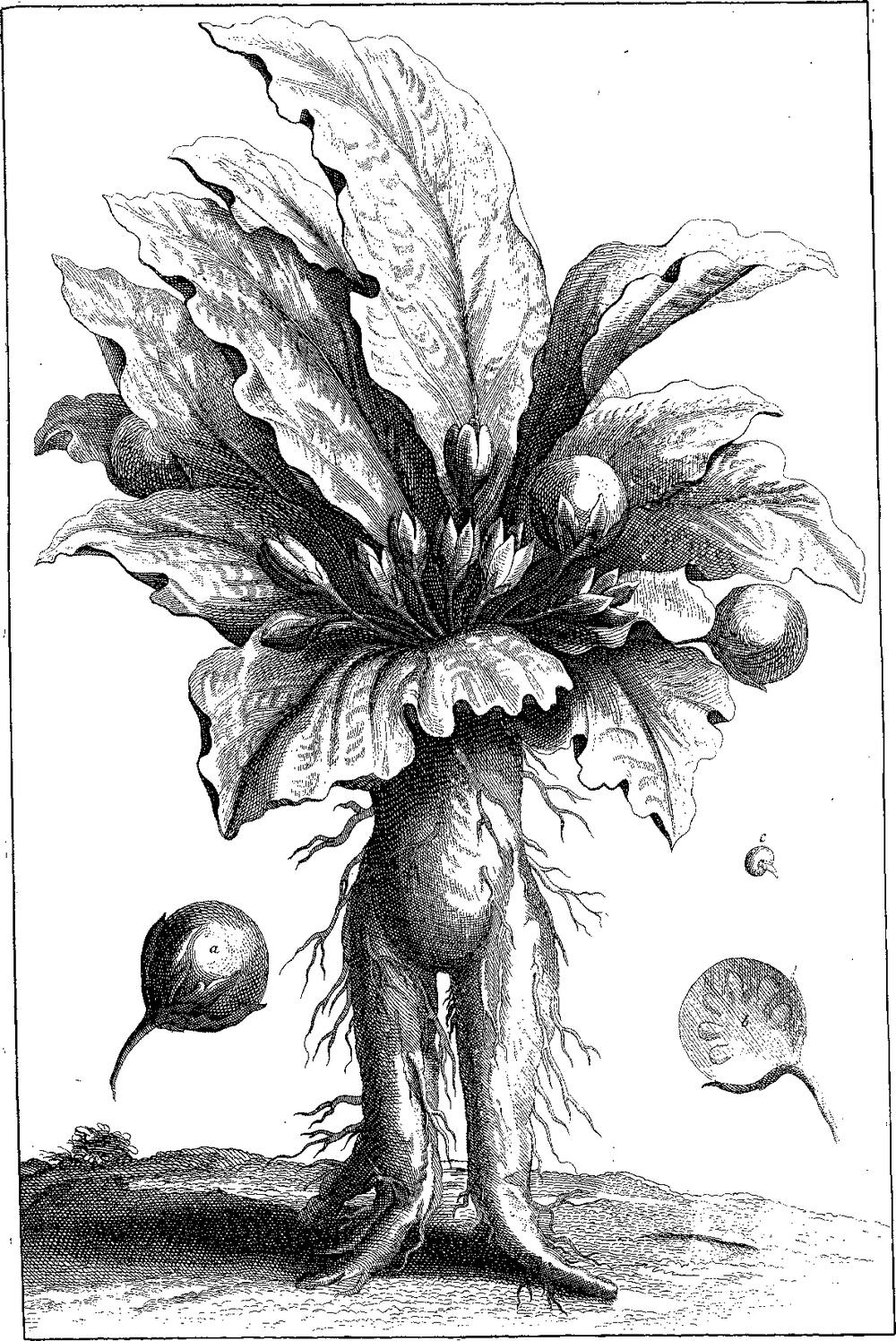
MANDRAKES. A kind of Plant that stupifies, and sometimes causes Phrenzy. ‘Tis said to be a Provocative, and is therefore used in Philters. There are two Sorts of it, one is black, and called the female Mandrake, having Leaves not unlike Lettice, tho’ less and narrower, which spread upon the Ground, and are of a very disagreeable Scent. It bears Berries something like Services, being pale and of a strong Smell, which have Kernels within like those of Pears. It has two or three very large Roots, twisted together, black without, and white within, and covered with a thick Rind. The other Kind, or the male Mandrake, is called Morion, or Folly, because it takes away the Use of the Senses. It produces Berries as big again as those of the Female, of a good Scent, and of a Colour approaching towards Saffron. Its Leaves are large, white, broad, and smooth, like the Leaves of the Beach-tree. Its Root resembles that of the Female, but is thicker and bigger. This Plant stupifies those that make Use of it, sometimes depriving them of Understanding; and often causes such Vertigoes and Lethargies, that if those that have taken it have not some present Assistance, they die in Convulsions.
Matthiolus tells us, that what is reported of Mandrakes having their Roots of the Form of a human Body, is all a Fable. What has given Occasion to Mandrakes having the Name of Anthropomorphos, or the human Shape, is only because most of the Roots of this Plant are forked from the Middle downwards, which makes a kind of Thighs and Legs: So that being gathered when the Mandrake sheds its Berries, they have something of the Appearance of a Man without Arms. This Author adds, that the Roots made in the Fashion of a Man’s Body, and called Mandrakes, or Hands of Glory, which your Quacks pretend to be of singular Virtue to procure Children to barren Women, are only artificial, and made of the Roots of the Reed, white Briony, and such like. He tells us also, that he had learned from one of these Impostors, that they put Grains of Barley or Millet into the Figures when cut, in such Places as Hair should grow, and then burying them in the Ground, they let them continue till the Barley or Millet begins to shoot, which happens in about three Weeks; then digging them up, and adjusting the small Roots or Fibres in the Form of Hair, they appear then to have a Beard, and Hair on their Heads.
Moses informs us5, that Reuben the Son of Leah, being in the Field, happened to find Mandrakes, which he brought home to his Mother. Rachel had a Mind to ‘em, and obtained them from Leah on this Condition, that she should consent that Jacob should be her Bedfellow the Night following. The Term Dudaim here made Use of by Moses, is one of those Words, of which the Jews at this Day do not understand the true Signification. Some translate it by Violets, others Lillies, or Jessamin; Junius calls it agreeable Flowers, Codurquus makes it Truffle or Mushroom. We have proposed our Conjectures in the Commentary upon Genesis, Chap. xxx. V. 14. shewing that it might be Citrons. It appears by Scripture, that the Dudaim are a Sort of Fruit, known in Mesopotamia and Judæa, which are ripe about Wheat-harvest, have an agreeable Scent, may be preserved, and are placed with Pomgranates6. Those that Cant. vii. 13.would support the Translation of this Word by Mandrakes, rely upon this Reason. Rachel having a very great Desire to have Children, it may be presumed that she coveted Leah’s Mandrakes with that View. The Ancients have given to Mandrakes the Name of the Apple of Love, and to Venus the Name of Mandragoritis. The Emperor Julian in his Epistle to Calixenes says, that he drinks the Juice of Mandrakes to excite amorous Inclinations. The Hebrew Word Dod, whence comes Dodaïm or Dudaïm, signifies Love, or Nipples. See Baubin. Hist. of Plants, Tom. iii. p. 614, &c. Matthiolus upon Dioscorides, and Brodeus upon Theophrast.
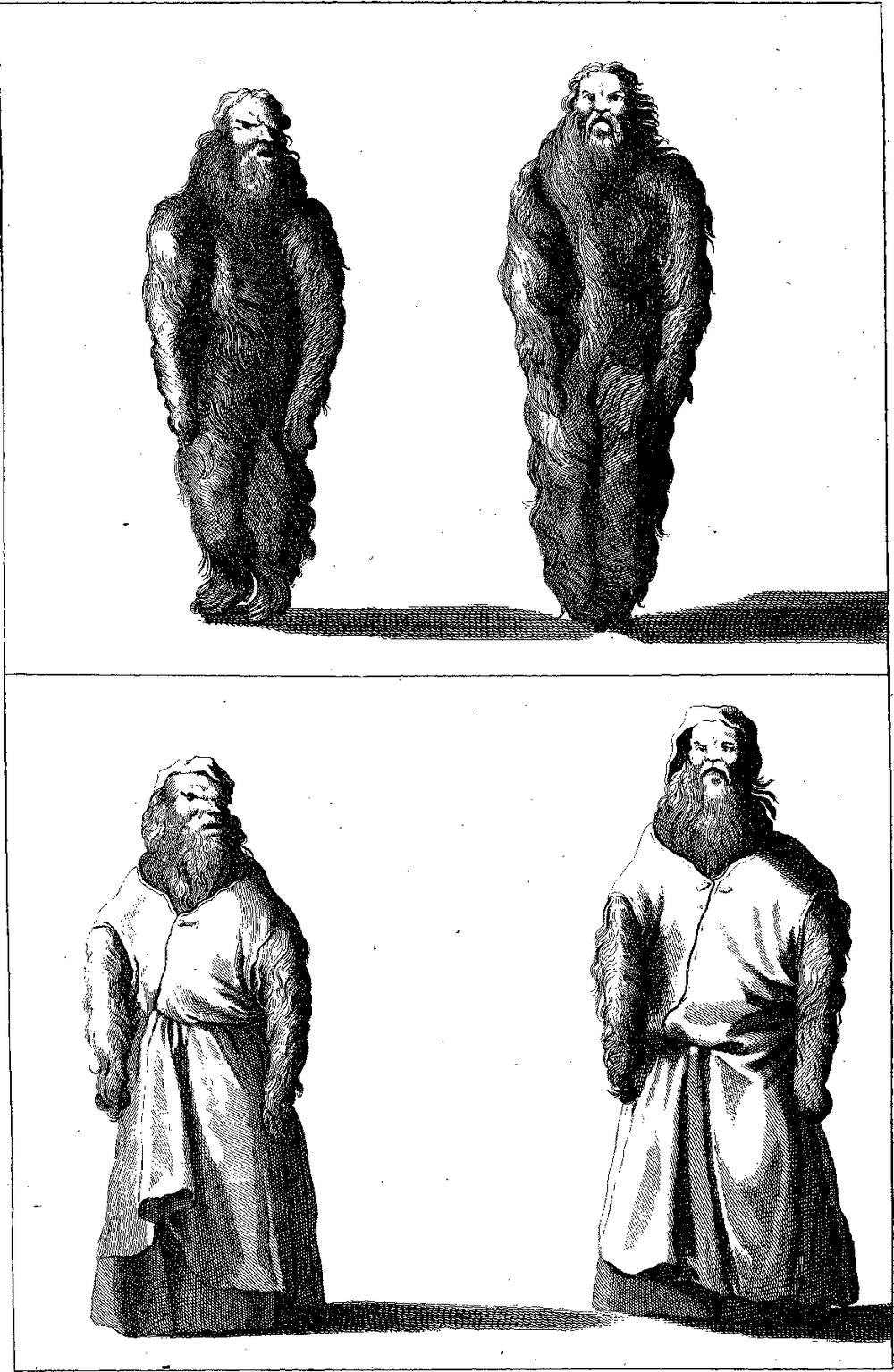
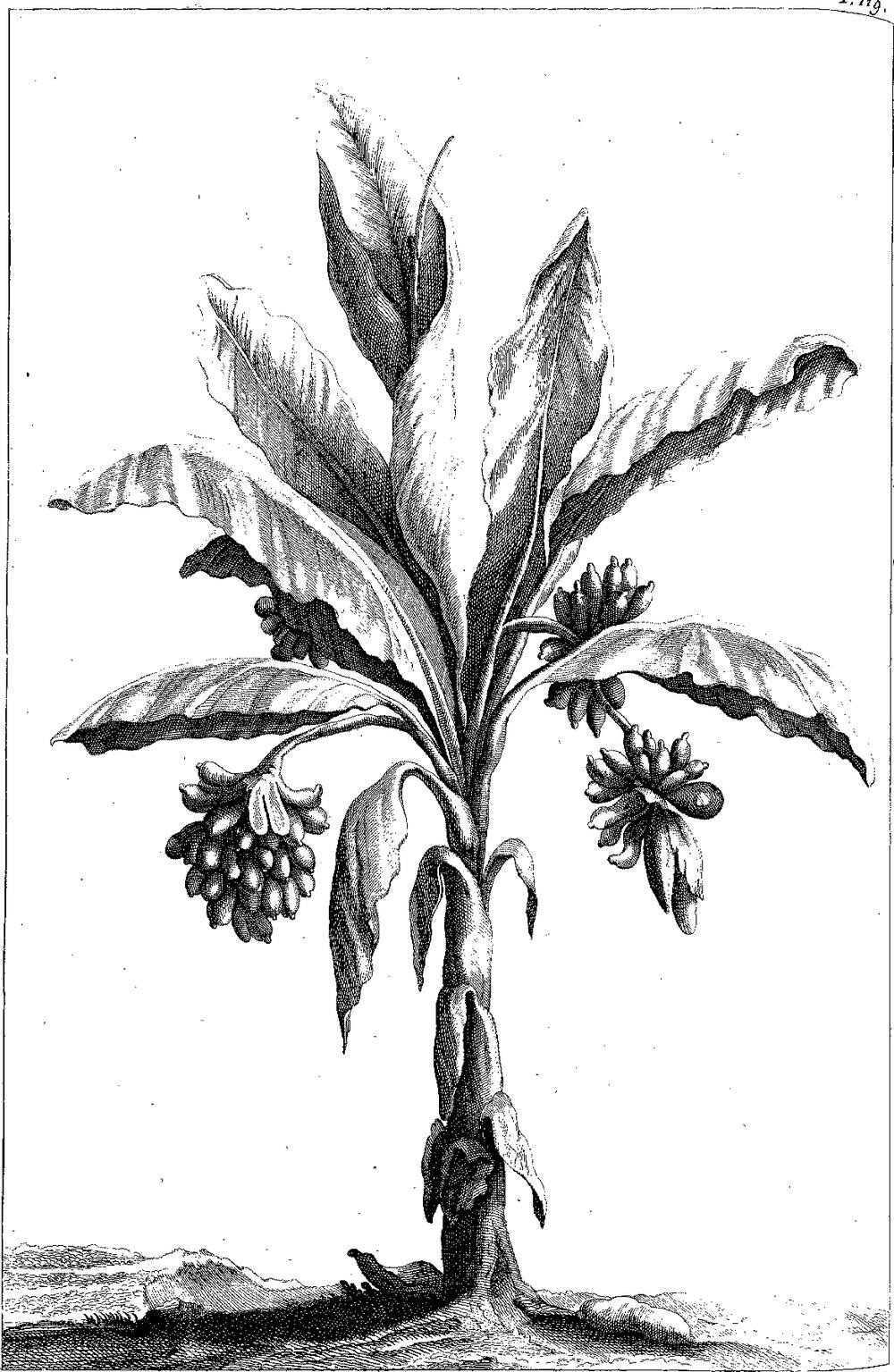
Ludolff7 in his History of Ethiopia has confuted that Opinion, which would have the Hebrew Word Dudaïm to signify Mandrakes. He maintains it stands for a certain Fruit which the Syrians call Mauz8, of which the Figure and Taste has a great Resemblance to the Ficus Indica, or Indian Fig. This Fruit is as big as a small Cucumber, and there are found sometimes upwards of forty hanging upon the same Stalk. Travellers give an Account, that in the Island of Hainan in China, there grows a little Shrub, that in fifteen Days puts out a Stalk surrounded with six or seven large Leaves, and loaded with Fruit not unlike large Figs. They add, that these Leaves are so large as to be able to encompass a Man’s Body. Hence it may be conjectured, that the Leaves of the Fig-tree with which Adam and Eve covered themselves after their Disobedience, might belong to this Tree. There are even some Authors of Opinion9, that it was the Fruit of this Tree with which Eve was tempted, which they pretend also to be the Dudaïm or Mandrakes of Reuben. As to the Mandrake, the Persians call it Abronzanam, that is to say, the human Figure, because the Orientals, and in particular the Jews, so artificially dress up the Root of the Mandrake with Hairs and Filaments, that it appears to have the Figure of a Man or Woman. The Reader may observe the Figure of it. Lusfallah says, that there is Danger in digging up or cutting this Plant; to avoid which, when they intend to pluck one up, they tie a Dog to the Stalk, which they then beat, that by endeavouring to run away he may tear up the Plant.
Josephus improves much upon all this10. He calls this Plant Baaras, a Name not very remote from the Abron of the Persians, or the Jabron of the Arabians. He says it is found in a Valley, to the North of the Castle of Macheron, which was built by Herod the Great. That towards Evening it appeared glittering like the Sun; that when any one came near it in Order to pull it up, it withdrew itself and seemed to fly, unless there were thrown upon it any menstruous Blood, or the Urine of a Woman. That even then it was not safe to pluck it up, unless he that undertook it had a Root of the same Plant hanging upon his Arm; without which Precaution he exposed himself to certain Danger of dying.
There is however a Way of taking it up without Danger. They dig all round the Root, so that it sticks to the Earth only by its Extremities. Then they fasten a Dog to the Root by a String, and the Dog striving to follow his Master who calls him away, easily tears up the Plant, but then he dies upon the Spot, and the Master can take this wonderful Root in his Hand without any Danger. Now the Use that is made of this Root deserves well that they should take all this Trouble to obtain it. For those Devils or evil Spirits that had animated the greatest Profligates, if they enter into the Body of a Man, and seem ready to choak him if he be not presently assisted; these Demons, I say, cannot bear with the Smell, nor the Presence of this Plant. They fly immediately if it be applied to the Body of the possessed. This is what Josephus relates of the Plant called
Baaras. I have also read a Traveller11 who confirms the greatest Part of this Relation of Josephus.
The Arabians sometimes call Mandrake by the Name of Serag-al-coshrob, or the Devil’s Candle, because in the Night Time it appears all over luminous. But the Cause of this Brightness is nothing but Glowworms, who are fond of this Plant, and love to be about it. And Lutfalla-al-balimi12, who was a Physician, assures us, that all the wonderful Things that have been written of this Plant, are nothing but meer Fictions. That he has often gathered them without any Danger, that the Cry they make when gathered is none at all; and lastly, that all the Uses to which they are applied are vain and superstitious.
Algedi a Persian Poet says, that in China the Asterenk or Mandrake grows in a human Form; and we are informed that in the Province of Peking in China there is a kind of Mandrake so valuable, that a Pound of this Root is worth thrice its Weight in Silver. For they say it so wonderfully restores the sinking Spirits of dying Persons, that there is often Time for the Use of other Means, and thereby of recovering them to Life and Health. The Chinese call it Ginseng. F. Tachard says, that this Root has sometimes something of the human Shape; and others assure us, that they give it the Name of Ginseng, because it has the Figure of a Man that puts his Legs in a stradling Posture, which the Chinese call Gin. Another Author derives the Name Genseng from the Chinese Word Gin, signifying a Man, and Sem which stands for a Plant; as much as to say, the human Plant, or the Plant with a human Shape.
Here is a Description of this Plant. Its Root is white and something rough, being two or three Times as big again as the Stem, and always grows taper. Generally at some Distance from its upper Part it divides into two Branches, which is the Reason that this Root has something of the Figure of a Man, whose two Thighs are represented by the two Branches. From the Sides of this Root proceed a great Number of small Fibres in several Places, which serve to imbibe the Juice of the Earth, for the Nourishment of the Plant. From the Root there rises a round and smooth Stem, of a pretty deep red, and at the Top of the Stem grow four Branches, which spread at equal Distances from each other. Every Branch has five Leaves, which are indented, of an obscure Green, and terminate in a Point. From the Center of these Branches proceeds another very strait and smooth Stem, at the Extremity of which grows a Knob of about twenty four Fruits, round, and of a beautiful Red. Within the Fruit is a kind of Nut, pretty near of the Figure of a Lentil. This Nut includes the Seed of the Plant. It dies and grows again every Year. We know not what Flower it bears; nothing is valuable but its Root, the Virtues of which are wonderful, as has been related. This whole Description sufficiently shews, that this Plant is a kind of Mandrake. See the Universal Dictionary of Trevoux, under the Word GENSENG.
MANETHO: This Author was an Egyptian, and Priest of Heliopolis in Egypt. As his History is often quoted by Josephus, it will be necessary to give some Account of it here. He had written in Greek the History of the several Dynasties, from the Foundation of the Egyptian Monarchy to the Time of Nectanebus, the last King of the Egyptian Race, and to the Time that Darius Ochus invaded this Countrey, and made himself Master of it, fifteen Years before the Expedition of Alexander the Great against the Persians. Manetho had the Office of Secretary or Writer to the Temples of Egypt; he lived under Ptolemy Philadelphus, to whom he dedicated his Work: Therefore he was far from being Cotemporary with the Things he treats of. He admits thirty Dynasties of one hundred and thirty Generations which have reigned in Egypt, from the Beginning of the Egyptian Government down to Nectanebus. He places in this Succession of Kings, Gods, Demigods, and Men, and assigns to each a certain Number of Years, the Amount or Sum of which far exceeds the Number of Years, which are acknowledged by the Books of the Hebrews.
‘Tis to Syncellus that we are obliged for the Abstract of this antient Historian, which he has preserved for us. His History was divided into five Parts. The first contained the History of the Gods; the second that of the Demigods, or Kings of Egypt. The third that of the Kings of this Country. In the Abridgment which yet remains, we only find the Names of the Princes, and the Years of their Reigns. Nor must we imagine that they all reigned successively, for they were Princes of different Parts of Egypt, and have sometimes reigned together in the several Provinces of this Countrey. Josephus13 in his first Book against Appion makes large Extracts out of this Author, in which he distinguishes what Manetho had taken out of the antient Records of the Temples of Egypt, from what he says of his own, or what he borrows from the fabulous Reports of the Egyptians. He found in the sacred Monuments
of the Kingdom, that the Hebrews had penetrated into Egypt with a great Army, and had subdued this Countrey; that being afterwards driven out again, they had made a Conquest of Judæa, where they built Jerusalem, and its Temple. So far is agreeable to Truth. But what he then adds, that under the Reign of a pretended King called Amenophis, they went out of Egypt with a Multitude of Lepers among them, and other diseased Persons, with other fabulous Stories; all this deserves no Credit, as having no other Foundation but common Fame and popular Tradition.
MANGER, wherein they laid the Infant Jesus just after his Birth. Saint Luke Luke ii. 7.relates, that the Holy Virgin and Joseph could not have any Accommodation in the publick Inn wherein they were, and therefore were obliged to take up with a Stable, where the Virgin Mary brought forth Jesus Christ, and having swaddled him up, she laid him in the Manger. The antient Fathers14, who speak of the Birth of our Saviour, all concur that he was born in a Cave dug within a Rock. Justin15 and Eusebius16 say, that this Place is not in the City of Bethlehem, but in the Countrey, and near to this City. They ought to be better acquainted with this Circumstance than others, because Justin was a Native of that Countrey, and Eusebius had dwelt there. Saint Jerom17 places this Cave in the Suburbs of the City of Bethlehem, towards the South.
MAN-HU, that is, What’s this? When the Hebrews first saw Manna, they said to one another, Man-hu18, what’s this? Or, this is Manna. See MANNA.
MANIATH, or Manahat19, called in the Hebrew Minnith, Judg. xi. 33, 34. Jephthah beat the Ammonites, and made a great Spoil in their Countrey, from Aroer as far as Maniath.
MANILIUS, Titus Manilius and Quintus Memmius, Roman Legats, having been sent by the Senate to Antioch, writ to the Senate of Jerusalem, that they had confirmed all that King Lycias had granted them, and that if they had any Thing to represent to ‘em, if they would come to ‘em at Antioch, they would see that Justice should be done them, 2 Macc. xi. 34, &c. In the Year of the World 3841, before Christ 159, before the Vulgar Æra 163.
MANNA. This is generally put for the Manna, wherewith the Children of Israel were fed in the Wilderness, and of which we shall speak presently. Also in Baruch, i. 10. it is used for an Offering called in Hebrew, Mincha. Facite manna, & offerte pro peccato. This is what the Captives of Babylon wrote to their Brethren the Jews of Jerusalem. We send you Money to buy Sacrifices and burnt Offerings. Make Offerings of Bread, Cakes, Meal, Wine, &c. This they call Manna in this Place. See OFFERING afterwards.
MANNA. It was the Food of the Children of Israel, which God gave them in the Desarts of Arabia, during their Continuance there for forty Years, from their eighth Encampment in the Wilderness of Exod. xvi. 14, 14, &c.Sin. Manna began to fall on Friday Morning, the sixteenth Day of the second Month, which from thence was called Jiar, which according to Usher was on Friday the fifth of June. It continued to fall every Day in the Morning, except on the Sabbath Day, till after the Passage over Jordan, and to the Passover of the fortieth Year from the coming out of Egypt. Therefore Manna fell from Friday the fifth of June, in the Year of the World 2513, to the second Day of the Passover, which was on Wednesday the fifth of May, in the Year of the World 2553, before Jesus Christ 1447 Years, and before the Vulgar Æra 1451 Years.
The Manna mentioned by Moses was a little Grain, white like Hoarfrost, round, Exod. xvi. 14. Numb. xi. 7.and of the Bigness of Coriander-Seed. It fell every Morning upon the Dew, and when the Dew was exhaled by the Heat of the Sun, the Manna appeared alone, lying Ex. xvi. 5.upon the Rocks or the Sand. It fell every Day, except on the Sabbath, and this only Exod. xvi. 5. Numb. xi. 5about the Camp of the Israelites. It fell in so great Quantities during the whole forty Years of their Journey in the Wilderness, that it was sufficient to feed the whole Multitude, of above a Million of Souls; every one of whom gathered the Quantity of an Omer, for his Share every Day, which is about three Quarts of our Measure. It maintained all this Multitude, and yet none of them found any Inconvenience from the constant eating of it. Every Friday there fell a double Quantity of it, and though it putrified and bred Maggots when it was kept any other Day, yet on the Sabbath it suffered no such Alteration. And the same Manna that was melted by the Heat of the Sun, when it was left in the Field, was of so hard a Consistence when it was brought into the House, that it was used to be beaten in Mortars, and would even endure the Fire, was baked in Pans, made into Paste, and so into Cakes. The Scripture gives to Manna the Name
of the Bread of Heaven, and the Food of Wisdom xvi. 20. Psalm lxxviii. 25.Angels, whether it would insinuate to us, that the Angels sent and prepared this Food, or that Angels themselves, if they had Need of any Food, could not have any that was more agreeable than Manna was. Wisd. xvi. 20, 21.The Author of the Book of Wisdom says, that Manna so accommodated itself to every one’s Taste, that every one found it pleasing to him; and that it included every Thing that was agreeable to the Palate, and fit for good Nourishment; which Expressions some have taken in the literal Sense20, tho’ others understand them figuratively. There are some who think, that it even took the Form of such Things as a Man liked best. Josephus21 understood it in a more simple Manner, saying that those that eat of it found it so delicious, that they desired nothing else; and Saint Austin observes22 very discretely, that the sacred Author only says, Manna had this Quality, to conform itself to the Taste of those that eat it, in Favour of the Children of God: Ut dulcedinem tuam in filios demonstrares. And how could the Israelites complain, that Manna was nauseous to ‘em, if it was always accommodated to their Taste at their own Will?
And still at this Day there falls Manna in several Places of the World: In Arabia, in Poland, in Calabria, in Mount Libanus, in Dauphine, and elsewhere. The most common and the most famous is that of Arabia, which is a kind of condensed Honey, to be found in the Summer Time upon the Leaves of the Trees, the Herbs, the Rocks, or the Sand of Arabia Petrea. It is of the same Figure as Moses describes. That which is gathered about Mount Sinai is of a very strong Smell, which is communicated to it by the Herbs upon which it falls. It very easily evaporates, insomuch that if thirty Pounds of it were to be kept in an open Vessel, there would hardly ten of it remain at the End of fifteen Days. This Arabian Manna is sold in the Apothecaries Shops, at Grand Cairo in Egypt. Salmasius thinks, that the Manna wherewith the Israelites were fed in the Wilderness, is the same now to be found in Arabia. Several Moderns are of the same Sentiment. ‘Tis true that the Arabian Manna has a medicinal Quality, which is rather purgative and weakening, than that it affords any Nourishment, or has any strengthening Faculty. But they pretend, that if one makes it habitual, the Stomach might be accustomed to it, as we see People may be brought to such a Diet, as naturally is but little convenient for maintaining of Health. But we ought also to acknowledge, that the Manna spoke of by Moses had miraculous Qualities, not to be found in the common Manna, and which probably subsisted no longer than while the Israelites were fed with it. Upon this Subject of Manna may be consulted the Dissertations of M. Saumaise, Buxtorf, and Bochart, and our Commentary upon Exodus, Chap. xvi. Verse 14, and the following. See also Altomare’s Treatise of Manna.
The Criticks are divided about the Original of the Word Manna. Some think that Man is put instead of the Hebrew Word Mah, which signifies, What is this? And that the Hebrews then first seeing that new Food which God had sent them, cried to one another, Man-hu, instead of Mah-hu, What is this? Others maintain, that the Hebrews very well knew before what Manna was, and that seeing it in great Abundance about their Camp; they said to one another, Man-hu, This is Manna. Mr. Saumaise, and some other Moderns, are of this last Opinion. They imagine that the Manna which God sent the Israelites was nothing else but that Fat and thick Dew, which still falls in Arabia, which presently condensed, and served for Food to the People. That this is the same Thing as the wild Honey, mentioned Matth. iii. 4. wherewith John the Baptist was fed; and that the Miracle of Moses did not consist in the Production of any new Substance, but in the exact and uniform Manner in which the Manna was dispensed by Providence, and in the Quantity of it that fell daily, so as to suffice for the Maintenance of so great a Multitude.
On the contrary the Hebrews and Orientals believe, that the Fall of the Manna was wholly miraculous. The Arabians call it The Sugar Plumbs of the Almighty23, and the Jews are so jealous of this Miracle24, that they pronounce a Curse against all such as presume to deny the Interposition of a miraculous Power. Akiba contends25, that Manna was produced by the Condensation of the heavenly Light, which became material, and proper for the Nourishment of Man. But Rabbi Ishmael rejected this Opinion, and opposed it upon this Principle, that the Scripture calls Manna the Bread of Angels. But the Angels, says he, are not nourished by Light become material, but by the Light of God himself. These are some Examples of the
Notions that have been formed about Manna.
That which is sold in Apothecaries Shops, and which is commonly called Manna of Calabria, is a white and sweet Liquor, which distils of itself, or by Incision made in the Branches and Leaves or Keys of the Ash-Tree, both common and wild. In the Dog-Days, or a little before, it is only found upon the Ash-Trees, and that only in Calabria, and about Briançon. ‘Tis gathered in the open Sun-shine, which hardens and dries it. In July it comes of its own Accord out of the Tree; in August they make an Incision in the Tree, which then affords a certain Quantity. And in the same Month, when this has left off to run, there comes out a third Sort, which exsudes out of the nervous Part of the Leaves of the Ash. Manna purges moderately taken in Broth. Fuschius says, that the Countrey People about Mount Libanus eat the Manna that is found there, as others would eat Honey.
MANOAH, or Manue, Father of Samson, of the Tribe of Dan, and of the City of Zorah. Upon a Time an Angel of the Lord appearing to the Wife of Manoah, and having promised her a Son; Manoah, whether Judg. xiii. 1, 2, 3, &c.moved by a Fit of Jealousy, or influenced by Sentiments of Gratitude towards this Angel26, desired of the Lord that he might see him that had appeared to his Wife, that he might know from him what he should do with this Son when born. The Lord heard his Prayer, and the Angel appeared again to his Wife, being then in the Fields. She ran presently to her Husband to acquaint him, that the Man she had seen before was come again. Manoah went to him and asked him, Is it you that spake to my Wife? When that shall be accomplished that you have foretold us, what must we do with the Child? He answered, let your Wife abstain from every Thing that I have commanded her; let her eat nothing that is unclean, and refrain from Wine and strong Drink. Manoah said to the Angel; My Lord, I pray you be pleased to let us prepare you a Kid. To which the Angel replied, However urgent you may be, I must not eat any Food; but you may offer it for a Burnt-Sacrifice to the Lord. Manoah said to him, not knowing him to be an Angel, What is your Name, that we may pay you Honour and Acknowledgment, if that shall happen that you have foretold? He answered, Why ask you my Name, which is a Secret27? the Wine for the Libations; and having put them upon the Fire which he had lighted on a Stone, he observed with his Wife what would come to pass. Josephus28, who is followed by the greatest Part of Commentators, believes that the Angel touched the Flesh with a Rod that he had in his Hand, upon which there came forth a Flame that consumed the Burnt-Sacrifice: Which is a Circumstance not expressly mentioned in Scripture. As the Smoke began to ascend, the Angel also rose up in the midst of the Flame, and ascended towards Heaven. Then Manoah perceived that it was an Angel, and said to his Wife, we shall certainly die since we have seen the Lord. But his Wife answered him, If the Lord would have killed us, he would not have conferred so many Favours upon us; he would not have received our Burnt-Offering; nor would have declared to us the Birth of a Son. This happened in the Year of the World 2848, and Samson was born in 2849, before Christ 1151, and before the Vulgar Æra 1155.
MAOCH, Father of Achish King of Gath, 1 Sam. xxvii. 2.
MAON, a City of the Tribe of Judah, in the most southerly Parts belonging to this Tribe. Nabal the Carmelite had great Josh. xv. 55. See also 1 Sam. xxiii. 24, xxv.Possessions in the Desert of Maon, and David dwelt for a good while in these Quarters, during the Time of Saul’s Persecution. We think Maon to be the Capital of the Meonians, of whom Mention is made in the Hebrew of 1 Chron. iv. 40, 41. and 2 Chron. xx. 1. The Vulgate in this last Place reads Ammonites instead of Maonim; and in the other Passage it has Habitatores, and the Seventy Minæos. The City of Maon, which gave Name to the Desart of Maon, is probably the same as Mænois, or Mæonis29, which Eusebius places in the Neighbourhood of Gaza; and as Menæum in the Codex Theodosianus, which is near Beersheba, or Versabinum Castrum. It is called Minois in the Subscriptions of the Council of Chalcedon, in the Year 451. See Cellarius and Reland under Minois or Menois.
MAPSE. Ptolemy speaks of the City of Mapse in Idumæa, to the West of Jordan. The antient Notitia Ecclesiastica places it in the third Palestine, under the Name of Mapse or Mapsis. We know of no City in the Scriptures by this Name, but we read of Mibsam Son of Ishmael, who may probably give Occasion to the Name of this Place.
I. MARAH, or Mara. This Word fignifies30
Bitterness. When the Israelites came out of Egypt, being arrived at the Desart of Etham, they there found the Exod. xv. 23.Waters so bitter, that neither themselves nor their Cattle could drink of it. Therefore they gave the Name of Mara or Bitterness, to this Encampment. Then they began to murmur against Moses, saying, What shall we drink? And Moses praying to the Lord, he shewed him a kind of Wood, which being thrown into the Water, presently made it potable. This Wood was called Alnah, according to the Orientals. They believe that it came from Noah to Moses by Succession; and that Noah had preserved it in the Ark.
II. MARAH; Naomi, after her Return from the Countrey of Moab, said to those that called her Naomi, which signifies handsome; call me rather Marah, or Bitterness, because the Lord has overwhelmed me with Trouble and Affliction, Ruth i. 20.
MARALAH, or Merala, a City of the Tribe of Zebulun, Josh. xix. 11.
MARAN-ATHA. These Words are Syriac, and signify, The Lord comes, or The Lord is come. ‘Twas a Form of Threatning, Cursing, or Anathematizing among the Jews. Saint Paul pronounces Anathema Maran-atha against all those who love not Jesus Christ31. Si quis non amat Dominum nostrum Jesum Christum, sit Anathema, Maran-atha. The greatest Part of the Commentators32 inform us, that Maran-atha is the greatest of all Anathema’s among the Jews, and equivalent to Shamatha, or Shem-atha, the Name comes, or the Lord comes: Which is as much as to say, ” Mayest thou be devoted to the greatest of Evils, and to the utmost Severity ” of God’s Judgments; may the Lord come ” quickly to take Vengeance of thy Crimes. But Selden33 and Lightfoot34 maintain, that Maran-atha is not to be found in this Sense among the Rabbins. Maran-atha may well enough be understood in an absolute Sense, Let him that does not love our Lord Jesus Christ be Anathema. The Lord is come, the Messiah has appeared; Evil to whomsoever receives him not. He particularly applies himself to the unbelieving Jews. Upon this Head may be consulted, besides the ordinary Commentators, Selden de Synedriis, l. i. c. 8. Lightfoot in a particular Dissertation upon Maran-atha, printed in the first Volume of his Works, Ultrajecti, 1699. and in the Dissertations of Elias Weihemajerus, de Paulino anathematismo, ad 1 Cor. xvi. 22. and of Johannes Rennerus, Maranatha, in the Collection of Dissertations called Thesaurus Theologicophilologicus, Part ii. p. 578, 582, &c.
MARATHE, a Town of Phœnicia, beyond and to the North of Eleutheria, between Balanea and Antarade.
Luke xi. 27.MARCELLA. This is the Name that some Authors of small Credit give to the Servant of Saint Martha. They pretend that it was she who hearing our Saviour preach, cried out, ” Blessed is the Womb ” that brought thee forth, and the Breasts ” that gave thee suck.” ‘Tis said, that having followed Mary and Martha into Provence, she died at Aix. There is under her Name a Life of Mary Magdalen, which is said to have been composed in Hebrew, and was translated into Latin by Synther: But it is a Work of no Authority.
MARCH of the Army of Israel about Jericho. The taking and Destruction of Jericho was not a Conquest, upon the which Joshua could assume to himself any great Glory or Reputation. If a General could make an hundred Conquests of this Kind, it would hardly make him be Observations upon the Overthrow of the Walls of Jericho, after the seven Days March of the Israelites about this City, Josh. vi.taken for a great Soldier. And if he had done nothing else but this, we might safely affirm, that he only made a Triumph of six Processions, and that at the seventh God was pleased by an Effect of his Omnipotence to give this General and all his People a miraculous Spectacle of a City whose impregnable Walls were overturned by an invisible Hand, in Sight of a whole Army which surrounded its Walls only to be the Spectators of this great Wonder, and afterwards to enter it on all Sides, to exterminate its Inhabitants, and to burn to Ashes the devoted City.
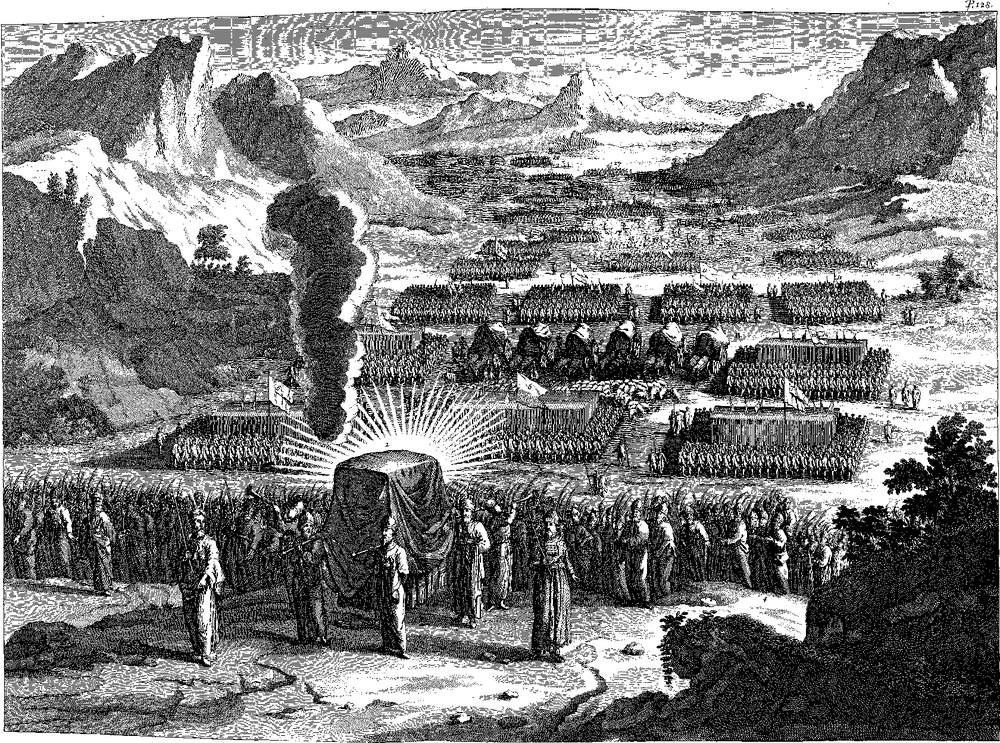
It cannot be doubted but that the Army of Israel, led by a Captain of such Experience, marched about Jericho in very great Order, in two or three surrounding or circular Columns, with some Space between them, because of the great Number of Troops, and to be sure out of Reach of the Enemies Arrows. Joshua follows, accompanied by the Elders; afterwards came the Ark carried by the Levites, and preceded by the Priests, who sounded the seven Trumpets. The Ark was guarded by the Levites, who encompassed it under Arms. The Residue of the People brought up the Rear, and closed the March.
Masius maintains35, that in this March
the Army was ranged in the same Order as when it marched in the Wilderness, and with all the Parts of the Tabernacle. I am apt to think it marched in the same Order as was observed in the Desert, but to say that it was accompanied by the Tabernacle and all its Utensils, is what the Scripture says nothing of, and what is not at all probable. For the Army returned every Day after its March into the Camp, where no doubt a Detachment was left, to guard the Tabernacle, &c.
The Command given by Joshua to all the People, not to make any Noise or Cry, but to observe a profound Silence for the first six Days, is a Thing not very difficult to account for. Yet the Commentators have said nothing of it, which I wonder at, that they should not think it deserved to be taken Notice of, though it seems to me to be well worth the Trouble. This then is the Reason of it, and Joshua was sensible of it. Had the People been accustomed to make Shouts and Cries, and to turn themselves towards the City, the greatest Part of ‘em might have been less attentive to turn their Eyes towards the City when the general Cry was made, to observe the miraculous and surprizing Fall of the Walls of the City. Joshua knew well, that the seventh Day was to determine the Fate of the City, but it does not appear that the People were informed of it. From whence I make this Conjecture, that the Cry or Shouting which the Israelites had Orders to make, after a Silence of six Days, when the Trumpets were to sound with a longer and stronger Blast, was appointed to make them turn their Faces at that Moment towards the Walls, that they might behold the Downfall of that unhappy City.
The Scripture does not inform us what were the particular Crimes, that drew down this Vengeance upon the Heads of the miserable Inhabitants. But they must necessarily have been very great, since we are told, that Josh. vi. 17.the City shall be accursed, even it and all that are therein, to the Lord; only Rahab the Harlot shall live, she and all that are with her in the House, because she hid the Messengers that we sent. This proves that the People of this City had made themselves obnoxious to a greater Degree of Punishment than the other Inhabitants of the Land of Canaan, Deut. vii. 1, 2.since it was entirely devoted and anathematized by the Lord, who commanded the utter Destruction of Jericho, and that every Thing therein should be put to the Sword; to kill every living Thing thereof, even the very Animals, to burn up every Thing else, and preserve nothing of the Booty, but only such valuable Metals as were to be consecrated to the Lord: Whereas at other Times they were used to preserve the Plunder and the Cities of the Land of Canaan.
Observations upon the Marches and Encampments of the Israelites in the Desert, Numb. x.☞ MARCHES and Encampments of the Israelites in the Wilderness. When Moses relates the several Marches and the different Encampments of the Children of Israel in the Desert, we are not to imagine it was always in dry barren Places, without Water, without Pasture, without Trees or Culture, and lastly that they were Places intirely uninhabited, and utterly abandoned. ‘Tis true indeed that such sometimes they found, and were constrained to abide in them; but God there exerted his infinite Power, in the Miracles that he performed in their Favour, in Order to retain them in Submission and Duty. However it appears, that always almost Moses took Care to encamp in inhabited Places, which were not very far from Cities or Villages, whose Territory was cultivated, and might furnish Subsistence for his People. I make this Observation, that no one should imagine from the Word Desart or Wilderness, if literally understood, that this vast Multitude of People always marched through such Sort of Places, and that they were always fed by a perpetual Miracle, such as the Manna, and afterwards the Quails, which grew uneasy to those who were cloyed with always eating the same Food. How many other Prodigies were required to provide for so great a Multitude what was necessary for their Support, for their Carriages and other Things, which an Army cannot subsist without, but must be exposed to the utmost Danger? Moses acquaints us with nothing of all this: But when I observe that a People, who came almost naked and without Arms out of Egypt, that after their Passage through the Red-Sea, they should want nothing in the Wilderness, I find Reason to be surprized. If they lived upon Plunder and Pillage, they must have passed through Countries that were able to furnish them abundantly with such Things as were necessary for the Maintenance and Support of such a Multitude. But what I am most surprized at is, that Moses was able to discipline his People in such Manner, that he made them excellent Soldiers, taught them to march, encamp, and to fight with so much Skill, that I can see nothing that is more to be admired.
The Partizans of Antiquity, I mean those who admire none but the Greeks and Romans in the Art of War, think that none can go beyond them in military Discipline; I should be ready to admit what they contend for, if by Discipline they mean only
what belongs to the Art of forming and training up good Soldiers; but to believe that they were the first that marched, encamped, and fought in the strictest Order and Method, this would be to impose on themselves very grossly. Yet for all this the greatest Part of learned Men, not to say all of them, are ready to assure us, that except the Greeks and Romans, all other Nations were without Discipline, without Science, and very ignorant in the Art of War.
We have no Books more antient than those of Moses; yet this does not prove, that in Relation to the Motions and Encampments of Armies, and the Art of marshalling them, and leading them to Battle, that the Hebrews were the first Authors and Inventors of so sublime and difficult a Science, as is that of War. I am thoroughly persuaded, that we must not expect to find its Original in Moses, but that it must be presumed that he had learned it from the Egyptians, whom he had seen put it in Practice; and of this I make no Doubt, whatever Mr. Basnage may say to the contrary⁹. If we attend never so little, says he, to the Laws of Moses, and consider without Prejudice what it contains, it cannot be denied that Policy and the Art of Government derive their Original from this divine Law. But further, says he, I believe the Art Military also proceeds nearly from the same Source. This would be easily proved if the Time would allow me, &c. With all the Respect that is due to so learned a Man, I must take the Liberty to affirm, that were he now alive he would find it a hard Task to prove what he has ventured to assert, and what the Scripture does not once mention. Are we not assured that Egypt was then a great and flourishing Kingdom, where Politicks and the Art of Government, to keep the People in good Order, and to secure them from any Enterprizes of their Neighbours, were studied and well understood by their Governours?
Does not the Scripture tell us expressly, that Exod. xiv. 6, 9.Pharaoh marched against the Israelites at the Head of a powerful Army, composed of Infantry, Cavalry, and a great Number of Chariots of War? These formidable Preparations shew plainly enough, that we must not by any Means place the Origine of this Art in the great Lawgiver, that it was well known by the Egyptians, and that we must not even seek for the Invention of Chariots of War from them, since the Scripture speaks of it as a Thing then well known. Besides, did not Moses meet with Enemies upon his Rout, which gave Opposition to his Passage, and even attacked
- him with all the Art and Method which were practised in those Times? And on several Occasions he found himself in such perplexing Circumstances by their Means, that Miracles became needful to extricate him, and to prevent the intire Rout and Overthrow of his whole Army.
This great Legislator is very succinct in the Description of his Marches. He has not confined himself to set down all of ‘em, much less his Encampments, except those only which were observable for producing some notable Events. And to say the Truth, he could never have finished his History, if he had obliged himself to take Notice of every Thing, since it took up thirty nine Years in passing through but a small Space of Ground, by infinite Turnings and Windings, which much lengthened his Marches, and multiplied his Encampments, and by the long Abode he made in some of his Camps, where sometimes he spent whole Years. To this we may add those Obstacles he met with on his Way, which contributed not a little to make his People warlike, and by making Conquests, prepared them for waging Wars by War itself, to settle them in the Land of Promise, and to secure the Possession of it to them and their Children, especially by what his Successor also contributed to it. For this Favourite of the Lord did not himself see this wished-for Land, except at a Distance; the Conquest of it was reserved for Joshua, who was a great, skilful, wise, and courageous General. For this Reason God made Choice of him to be Moses’s Successor; and this may be a useful Lesson to Princes, and to such who have the Province of governing a Nation, that the Strength, Power, and Prosperity of a State consists in the Choice of brave and able Ministers, who are to have the Execution and Management of Affairs, whether Civil or Military.
We see every where in Scripture, and this is a Thing too remarkable not to give our Attention to it, that God has always chosen Men of great Courage and great Virtue, to humble the Pride of Princes, when too long a Course of Prosperity has tempted them to undertake unjust Enterprizes, and plunged them into enormous Vices; or to correct the Vices of their People, or lastly to raise up one on the Ruine of another. Moses was not chosen of God for the Conquest of the Land of Promise, and for the Punishment of the Crimes of its Inhabitants; he was only appointed to be the Conductor of his People, and the Dispenser of his Laws, without giving him the Qualities that were necessary for a great
Commander, as may be judged from his Conduct. For God’s Design was not to make him a Man of Blood; he intended to take him into his Bosom with pure Hands and without Blemish.
But to return to our present Subject. The Antients so closely adhered to their Maxime, not to relate any Thing but the Substance and Gross of Things, that they give us but little Light into some Practices and Usages, which would be very satisfactory to know. Not one of ‘em have given us a compleat and circumstantial Account of the Marching and Encampment of Armies, by which we may know their Order and Method. Are the Moderns without this Defect? We must not therefore wonder, that the sacred Authors have neglected this Kind of Things; yet however in several Passages of Scripture I seem to collect the Order of the Hebrew Marches, and their Discipline in their Encampments and Decampments; they made Use of Trumpets, to the different Sounds of which they were accustomed, and which intimated the Times of preparing themselves, of packing up their Baggage, of attending at their Standards, and of marching. If they made Use of this Method for their Decampments, they did the same also for their several military Functions, when to fight and when to retreat. See the fourth Chapter of Numbers, where it may be seen how they took down the Tabernacle, and in what Order the Levites marched who carried it.
It can by no Means be doubted, but that the Hebrews marched with a great deal of Order. They had the Pillar of Clouds in their Front, which served them for many Purposes. For besides its being a sensible Signal of the Presence of the Lord, it was bright and luminous in the Night-Time, to give them Light during the Season of Darkness, and by Day it was dark and thick, to defend them from the excessive Heats of the Desarts of Arabia, through which they were to march. Also by its Motions it gave them Notice when to encamp or to decamp. For Numb. ix. 15, 16, 17. x. 34, 35. Exod. xl. 34, 35.when it stopped they encamped, they set up the Tabernacle; when it moved on, they took it down, and packed it up, they put it upon its Carriages, and marched in Order. Their Marches were not much different from ours, and indeed the Thing cannot be otherwise. It is the Opinion of the Rabbins, that they marched in the same Order that they encamped; and this perhaps is the only Opinion in which they seem to me to have Reason on their Side. They marched in several Columns, according to the Nature of the Places, they opened Ways a-cross the Plains, that they might march in a greater Number of Columns, each Tribe to the Post that was assigned it; so that their Army arrived at their Camp without any Confusion.
The heavy and light Baggage marched separately, that it might not encumber the March. The Tribes of Dan, Asher, and Naphthali, brought up the Rear, and covered the March of one Body of the People, that is, the Stragglers, the Sick, the Feeble, the old Men, Women, and Children. This was their Post, because of the slow March that the Rear-Band is forced to make, more or less according as the Way is in Length, and according to the Number of Columns, in which an Army is obliged to march.
Mr. Bashage pretends, that this great Army commonly made but a March of a League in a Day and an half. He takes an Estimate from what the Scripture says, that the Israelites parted from Sinai, and came in three Days to Kibrothavah, to the Graves of Lust, the Distance of which places it not above two Leagues. This learned Man must allow me to answer, that this does not prove that the Army always marched so slowly as he affirms; perhaps it was obliged to go through some Passes in the Mountains, where they could only march in File. For in an open Countrey, an Army of six hundred thousand Men may march three or four Leagues a-day, and even a good deal more.
The Order of the March given us by the same Author, is very apposite to convince us, that an Army of six hundred thousand Men may very well march four Leagues in one Day. To speak the Truth, I think his Notion to be pretty imaginary; for the Scripture does not say that this Army marched with several Bodies in Front, by double Lines, with Intervals between these Bodies; and those that followed over against the Intervals of those which preceded them, as he supposes to have been the Case. They marched in Columns, as may be very probably concluded, and in the most open Plains they always marched in Columns to a great Number, except they were approaching towards an Enemy. And when it was perceived they approached near an Enemy, they marched in Order of Battle, when the Ground would allow them. Such was the March of Cyrus against Cræsus in the Plain of Tymbraia.
As to their Marches in hilly Countries, they opened several Routs upon the Eminencies; and in the Valleys, which let into other Valleys, and into Plains. They practised the same Thing in close Countries, marching always in great Order, and with all the Caution imaginable.
I know nothing more to be admired than their Method in their Encampments; and
in the Form of their Camps I observe a wonderful Art. It seems probable that the Greeks have imitated them as to their Encampments, and the Romans have followed the Greeks. But the Camps of the Romans were still nearer those of the Jews, for I can perceive no Difference. Both of ‘em used to fortify their Camps with an Intrenchment, with a Ditch, and a Palisade. See the Camp of the Israelites, which we have caused to be engraved under the Article TRIBE. A particular Explication of the March of the Israelites in the Desert.
-
The Column of Clouds that marched before the Army of Israel. 2. The Ark inclosed in its Covering, and carried by the Levites. 3. Moses and Aaron conducting the Ark.
-
The Priests, Levites, and Elders, accompanying the Ark.
-
Judah in the Front of the Army, having under him Issachar and Zebulun.
-
The Tribe of Issachar, whose Post was at the right Hand of Judah.. 7. The Tribe of Zebulun marching at the left Hand of the Tribe of Judah.
-
The Cattle and Baggage belonging to the first Corps of the Army.
-
The Chariots presented by the Heads of the twelve Tribes, upon which were loaded the Curtains, the Boards of the Tabernacle, &c. 10. The right Wing, and left Wing, that covered the Baggage belonging to the first Corps. 11. The Gershonites and Merarites, who carried the other Pieces of the Tabernacle, and who relieved each other from Time to Time. 12. Reuben at the Head of the second Body of the Army, having Simeon and Gad under him. 13. The Tribe of Simeon at the right Hand of Reuben. 14. The Tribe of Gad on the left Hand. 15. The Baggage of the second Corps, ranged behind the Tribes to which it belonged. 16. The Wings that covered the Baggage of the second Corps. 17. The Cobathites who carried the sacred Utensils of the Tabernacle well packed up. 18. A void Space shewing the Place of the Ark, when it marched in the Middle of the Army. Moses, Aaron, the Priests, Levites, and Elders always went along with it. 19. Several Plattoons of Cohathites marching in good Order, and carrying the sacred Utensils by Turns. 20. Ephraim at the Head of the third Body of the Army, having Manasseh and Benjamin under its Conduct. 21. Manasseh at the right Hand of Ephraim. 22. Benjamin at the left. 23. The Baggage of this third Body.
-
The Wings that covered the Baggage of the third Corps. 25. The Tribe of Dan, with Asher and Nephthali under its Command. 26. Asher to the right Hand of Dan.
-
Nephthali to the left. 28. The Baggage of this fourth Corps.
-
The Wings that covered this Baggage. 30. A Body of the Aged, Sick, Feeble, Women, Children, and such others as could not march with the Army. 31. Strangers in the Rear of the Army.
MARCUS ANTONIUS JULIANUS, Superintendant of Judæa, in the Year of Christ 70. He was present at the Siege of Jerusalem, and was one of those that advised the intire Destruction of it, and even of the Temple, for Fear the Jews might again revolt36. Minutius Fœlix37 refers the Pagans to Josephus and to Antonius Julianus, to be convinced, that the Jews were destroyed for this Reason alone, because they had forsaken their God; and that they had suffered no other Misfortunes, than what had been foretold them they should suffer, if they persisted in their Disobedience. This is perhaps the same Marc Anthony Julian mentioned by Josephus.
MARDOCEMPADUS, King of Babylon; the same as MERODACHBALADAN. See it.
MAREON. This is the Name of the City that the Greeks call Samaria, says Josephus Antiq. l. viii. c. 7. p. 285. a. Compare Joshua xii. 20. where it is called Shimron-meron, or Shomeron-maron.
I. MARESHA, or Maresa, Son of Laadab; or perhaps Laadah is called the Father of Maresha, because he peopled this City, and his Family dwelt in it, 1 Chron. iv. 21.
II. MARESHAH, or Marissa, a City of the Tribe of Judah t. ‘Tis also called Moresheth and Morasthi. The Prophet Micah was a Native of this City; and in the Time of Eusebius it was forsaken, being two Miles from Eleutheropolis. ‘Twas near Mareshah, in the Vale of Zephathah, that the famous Battle was fought between Asa King of Judah, and Zerah King of Chus,38
in which Asa obtained the Victory against an Army of a Million of Men, which he put to Flight, and pursued as far as Gerar39. In 1 Macc. v. 66. is read Samaria instead of Marissa. In the latter Times of the Jewish Commonwealth, Maresbah was given to Idumæa40, as also several others of the southerly Cities of Judah. It was peopled by the Jews, and their Allies, in the Time of John Hyrcanus41. King Alexander Jannæus took it from the Arabians42. Pompey restored it to its first Inhabitants43. Gabinius rebuilt it44, and lastly the Parthians destroyed it in the War of Antigonus against Herod45.
I. MARIAMNE. Daughter of Alexander, Son of King Aristobulus, and of Alexandra, Daughter of Hyrcanus High-Priest of the Jews, was the finest Princess of her Age. She married Herod the Great46, by whom she had two Sons Alexander and Aristobulus, and two Daughters, Salampso and Cypros; and besides these a Son called Herod, that died young, during his Studies at Rome. We have already given the History of Mariamne, under the Articles of Herod the Great, Alexander her Son, and Alexandra her Mother. We shall but just touch upon it here, by Way of Abridgment. Herod had an excessive Fondness for Mariamne, but she made but small Returns to his Passion. Nay, she began to hate him, after he had put to Death Aristobulus her Brother, to whom he had given the High-Priesthood but a Year before47. Mariamne shewed her Aversion to him openly enough, but overcome by his Passion for her, he could never resolve upon parting with her.
After the Victory that Augustus obtained over Marc Anthony48, Herod who had always been of Antony’s Party, and who had sent Succours to him against Augustus, was forced to have Recourse to Augustus’s Clemency. When he left Jerusalem, he gave secret Orders to Josephus and Sohemus, whom he left to govern in his Absence, that if they should hear of any Misfortune to befal him in his Journey, they should put Mariamne to Death, and her Mother Alexandra49. Mariamne having cunningly got this Secret out of Sohemus, conceived an implacable Hatred against Herod; and at his Return, instead of answering his Caresses, she repelled him from her, and reproached him with his Inhumanity. At length she became so importunate, that Herod could no longer bear with her Contempt; being otherwise exasperated by the ill Reports that were made continually of Mariamne, and by the Accusations of Salome, Herod’s Sister, and sworn Enemy of Mariamne, who suborned a Cupbearer of the Kings to depose, that Mariamne had solicited him to give a Potion to the King, on Pretence to make her be more beloved by him.
Herod having put one of Mariamne’s Eunuchs to the Torture, whom he knew to be very faithful to her; could get nothing out of him as to the Potion or Poison; but overcome by the Force of the Torture he confessed, that his Mistress’s Hatred for the King proceeded only from what she had learned from Sohemus. Then Herod being in a Rage, and believing that Mariamne could never have got this Secret out of Sohemus, if there had not been other Correspondence between them, immediately caused Sohemus to be seized, and led away to Punishment. After this he called his Friends together, and accused the Queen to them in such bitter Terms, that they easily perceived he desired to have her condemned to Death. This therefore they did unanimously, and Mariamne50 walked to her Execution with such an Air of Grandeur and Intrepidity, as astonished all that saw her51. After her Death Herod’s Affection for her renewed again, and became stronger than ever. Often he called her by her Name, as if she was still living. He bewailed her in a Manner little agreeing to his high Station, and whatever he did to endeavour to divert himself, he could never get her out of his Mind. He was even compelled to relinquish the Care of his Affairs, and delivered himself up so to his Grief, that sometimes he ordered his Attendants to call Mariamne, as if she had been still alive. Josephus52 mentions a Tower that Herod built in Jerusalem, to which he gave the Name of Mariamne. ‘Twas the finest and best adorned of all that he built. It was fifty five Cubits high, and had a square Base of twenty Cubits wide.
II. MARIAMNE. Daughter of the High-Priest Simon, and Wife of Herod the Great53. She had a Son by him called Herod- Philip, who married for his first Wife the famous Herodias, who afterwards
took for her Husband Herod Antipas, who Mark vi. 17, &c. Matth. xiv. 3, &c.put to Death John the Baptist.
There are several other Persons mentioned by Josephus by the Name of Mariamne, who not being known to Scripture, do not belong to our Design. The Universal Dictionaries and Josephus may be consulted in this particular. This Author gives the Name of Mariamne to Miriam, Sister of Moses, which see in its Place.
I. MARK. Saint Mark the Evangelist, according to Papias54, Saint Irenæus55, and the greatest Part of both Ancients and Moderns, was the Disciple and Interpreter of Saint Peter; and several Ancients56 believe, that ‘tis him of whom Saint Peter speaks in his first Epistle57, and whom he calls his Son in the Spirit, probably because he had converted him. ‘Tis thought he was of the Number of the Seventy Disciples, before he put himself in the Retinue of the chief of the Apostles. But some of the Fathers58 add this Particular, that Saint Mark was one of those who forsook our Saviour, when he had heard him say those Words, John vi. 55. Verily verily I say unto you, except ye eat the Flesh of the Son of Man, and drink his Blood, ye have no Life in you. But after Saint Peter had brought him back again to the Faith, he continued stedfast in it, always joining himself to this Apostle, and went to Rome with him, where he writ his Gospel.
Some have not distinguished him from John Mark, mentioned in the Acts of the Apostles, and in the Epistles of Saint Paul; but this Notion is now almost intirely given up. Others maintain, that Saint Mark was of the Race of the Priests, and wore their Bonnet. This is affirmed by the anonymous Author of his Acts. ‘Tis also said that he was Nephew to Saint Peter, being the Son of one of his Sisters59. This Apostle going to Rome about the Year of Christ 44, Saint Mark accompanied him thither, where he writ his Gospel60; at the Request of the Brethren, who desired that he would give them in Writing what he had learned from Saint Peter by Word of Mouth. When this Apostle was acquainted with what his Disciple had done, he commended and approved his Undertaking, and gave out his Gospel to be read in Churches as an authentick Work. Tertullian61 ascribes this Gospel to Saint Peter, and the Author of the Synopsis imputed to Saint Athanasius will have this Gospel to be dictated to Saint Mark by Saint Peter. Eutychius, Patriarch of Alexandria asserts, that Saint Peter writ it himself; and some mentioned by Saint Chrysostom62 were of Opinion, that Saint Mark writ it in Egypt. Others affirm that he writ it after Saint Peter’s Death. All these different Sentiments are enough to prove, that the Circumstances of Time and Place are uncertain, when and where Saint Mark composed his Gospel.
Men are as much divided as to the Language in which it was writ, some saying it was composed in Greek, and others in Latin. The Ancients, and most of the Moderns, stand up for the Greek, which still at this Day passes for the Original of Saint Mark. But some Manuscript Greek Copies of this Gospel insinuate, that it was writ in Latin. The Syriac and Arabic concur in this also. It should seem probable, that writing it at Rome, and for the Use of the Romans, he might write it in their Language. Baronius63 and Selden64 have declared themselves of this Opinion, which however has but few Followers. They shew at Venice some loose Sheets, which they pretend to be the Original in Saint Mark’s own Hand. If this were certain, and the Manuscript could be read, it would be an infallible Argument for deciding this Dispute: But it is doubted whether this be Saint Mark’s Original Writing, and it is so worn out by its Antiquity, that scarce one Letter can be made out. The last Author that has mentioned it, as I know of, is F. Montfaucon65. He affirms that it is writ in Latin, and owns that he never saw so ancient a Manuscript. It is written upon Egyptian Paper, much thinner and finer than what is to be seen in several Places. Father Montfaucon thinks66, that it may be fairly supposed to be at least of the fourth Century. In 1564 it was put into a Cave, in Marsh-ground, the Roof of which was lower than the neighbouring Sea. So that the Water perpetually drops upon those, who have the Curiosity to go thither. It was legible when it was deposited there, in 1564. An Author that had seen it before him, believed that he had observed Greek Characters in it. Our Preface to Saint Mark’s Gospel may be consulted.
Several of the Moderns67 think, that Saint Mark was sent by Saint Peter from Rome to Aquileia, where he continued two
Years and a half, and founded a Church; but this Fact has no Proofs from Antiquity. ‘Tis thought68, that it was in the Year of Christ 49, which was the ninth of the Emperor Claudius, that the Jews being driven out of Rome, Saint Peter and Saint Mark were obliged to retire from thence also. Saint Peter sent Saint Mark into Egypt, there to preach the Gospel. He first went down to Cyrene in Pentapolis, where he made many Converts. From thence he went to Alexandria, where he converted Anienus, whom he ordained first Bishop of this City. The Number of Christians there increased exceedingly, and they lived in so exemplary a Manner, that in the Judgment of several69, Philo the Jew70 was willing to give the Honour of it to his own Nation, by describing the Manner of Life of the primitive Christians, under the Name of Therapeutes. See THERAPEUTES.
The Number of Christians increasing every Day, the Pagans opposed themselves to Saint Mark, who was come to overthrow the Worship of their Gods. He thought it prudent to withdraw, and let the Tempest blow over. He returned to Cyrene, where he continued two Years longer; after which he came back to Alexandria. There he beheld with Joy, that the Faithful were increased in Faith and Grace, as well as in Number, and then he departed again. Probably he went to Rome, if it be true as is affirmed by the Chronicon Alexandrinum, that there he was present at the Death of Saint Peter and Saint Paul, in the Year of Christ 66. Thence he returned to Alexandria, where the Pagans provoked by the great Number of Miracles performed by him, and by the Reproaches made them by the Christians on Account of their Idols, sought after him to put him to Death. God concealed him for some Time, but afterwards they found him celebrating the Holy Communion. ‘Twas on the Lord’s Day, the 24th of April, in the Year of Christ 68. They put a Rope about his Neck, and drew him along the whole Day, saying, they must lead this Ox to Bucoles, which was a Place near the Sea, full of Rocks and Precipices. At Evening they put him into Prison, where in the Night he had two Visions. One of an Angel, assuring him that his Name was written in the Book of Life; and another of our Saviour, to give him Peace and Tranquillity of Mind. The Day following the Infidels began again to drag him through the Streets, till he gave up his Soul to God, April the 25th, in the Year of Christ 68. Several71 have said, that he ended his Life by Fire, probably they burnt his Body after his Death.
Several antient Hereticks, as Saint Irenæus72 reports, received only the Gospel of Saint Mark. Others among the Catholicks rejected the twelve last Verses of this Gospel73, beginning at Verse 9. Now when Jesus was risen early, &c. Probably because it appeared, that in one Place Saint Mark was too opposite to Saint Matthew, and related Circumstances in this latter Part contrary to the other Evangelists. The ancient Fathers, the old oriental Versions, and almost all the old Copies, whether printed or Manuscript, Greek or Latin, read these twelve last Verses, and acknowledge them as genuine, as well as all the rest of Saint Mark’s Gospel.
As far as may be judged by comparing the Gospels of Saint Mark and Saint Matthew, the first is an Abridgment of the second. Saint Mark very often uses the same Terms, relates the same Facts, and takes Notice of the same Circumstances. Saint Mark sometimes adds new Particulars, which give great Light to Saint Matthew’s Text. There are also two or three Miracles in Saint Mark, which are not to be found in Saint Matthew. See Mark74. 23. and Chap. i. v. ix. xvi. What is most remarkable in our Evangelist is this, that tho’ he follows Saint Matthew in almost every Thing else, yet he forsakes him in the Order of his Narration, from Chap. iv. V. 12. to Chap. xiv. V. 13. of Saint Matthew. In these Places, instead of following Saint Matthew, he pursues the Order of Time as expressed by Saint Luke and Saint John. This has prevailed with the Chronologers to follow Saint Luke, Saint Mark, and Saint John, rather than Saint Matthew. He begins his Gospel with an Account of the preaching of John the Baptist, and omits several Parables related by Saint Matthew, Chap. xx, xxi, and xxv, and several Discourses of our Saviour to his Disciples and to the Pharisees, Chap. v, vi, vii, xvi, xxiii.
II. MARK. John Mark Cousin of Barnabas. See JOHN MARK.
MARNAS, the God of the People of Gaza, or the chief Deity of the Philistines. They said that Marnas was the true Jupiter, born in Crete i. His Temple was
round, having two Porticoes or Wings, which commanded the whole Circumference. ‘Twas probably a Temple like to that of Marnas, that was overturned by Samson, Judges xvi. 23, — 26. The God whose Temple was overturned by Samson, is called Dagon in Scripture.
MARRIAGE, Wedding, and the Festivity on that Occasion. The Hebrews commonly made Use of the Word Mishtheb75 which comes from the Verb Shathab, to drink, to signify a Feast in general, and a Marriage-Feast, or a Marriage in particular. The Greeks made Use of the Word Gamos in the same Sense, which signifies Marriage, a Wedding, and the Feasting that usually accompanies it. Sometimes this Word seems to be put for a Feast in General. See Luke xii. 36. xiv. 3.
Marriage passes among the Hebrews for a Matter of strict Obligation. They understand litterally, and as a Precept, those Gen. i. 28. Gen. i. 23.Words uttered to our first Parents, Be fruitful, and multiply, and replenish the Earth. They believe that he that does not marry his Children, deprives God of the Glory that is due to him, becomes in some Sort a Homicide, destroys the Image of the first Man, and is a Reason that the Holy Ghost withdraws himself from Israel. This Question is moved in the Thalmud. Who is he that prostitutes his Daughter? To which it is answered, The Father that keeps her too long in his House, or that marries her to an old Man. The Age at which Wedlock becomes an Obligation upon them, is the Age of twenty Years. But generally the Jews marry their Children before this Age. However, if a Father marries his Daughter before the Age of Puberty, which is at twelve Years and an half, she may be separated from her Husband for any slight Disgust she may conceive against him.
The Marriage of Adam and Eve was the grandest and most august that ever was solemnized, whether we consider the Person officiating, the Witness, the Brideman, who was God; or whether we regard the Merit and Dignity of the contracting Persons, who were the Stem of all Mankind that ever have been, or that ever shall be.
In the first Ages, Marriage, between Brothers and Sisters were not only allowable, but even necessary, because of the small Number of Persons then in the World. After Mankind were become numerous, they were unlawful, and even prohibited under great Penalties. However the Patriarchs for a good while took the Liberty of espousing their near Relations, even after the World was sufficiently peopled, so that they might have been supplied elsewhere: But this was done with a good View. For they would avoid any Alliance with Families that were corrupted by the Worship of false Gods, or to preserve in their own Families the Worship of the true God, and the Use of the true Religion, of which they were the Depositaries. ‘Twas for this Reason that Abraham married his Sister or Niece Sarah, and that this Patriarch gave such strict Orders to his Steward Eliezer, to fetch a Wife for his Son from among the Daughters of his Nephews; and that Jacob espoused two Sisters, who were the Daughters of his Uncle.
As we have appointed this Place to treat of the Solemnity of a Jewish Wedding, we shall describe it in its due Length. We shall not speak of this Affair in Qual’ty of a Lawyer, nor altogether as a Divine. In this Matter Selden may be consulted in his Uxor Hebraica, as to what concerns the Jews; and as to what relates to theological Questions concerning the Marriage of Christians, the Christian Authors may be consulted who have expresly treated of Marriage. We have already said something of Repudiation under the Article DIVORCE, and we have treated of it at Length in our Dissertation printed before our Commentary upon Numbers. So that nothing properly remains to be treated of here, but what has Relation to the Marriage -Ceremonies of the antient Hebrews. We have already discussed this Matter at full Length in a Dissertation made on Purpose, and printed before our Commentary on the Song of Songs; of which we shall content our selves here to give an Abstract.
The Hebrews generally married young. According to the Rabbins, Men should marry at eighteen76. Whoever is not married at this Age, offends against the Commandment by God given to the first Men; where he bids ‘em increase and multiply. They may anticipate this Age, but they are not allowed to go beyond it. As soon as they have compleated thirteen Years, they may marry; and they think a Man cannot live in Celebacy without Sin, or at least without great Danger of Sin. As to the Virgins, they are contracted very early; but generally they are not married till they arrive at what is called the Age of Puberty, that is, at twelve Years compleat. From whence comes these Expressions, the Spouse of one’s Youth, or, one espoused in Joel i. 8. Mal. ii. 14, &c. Prov. ii. 17.our Youth, and the Guide of one’s Youth,
expressing a Husband married young,
From these Principles ‘tis easy to give an Account, why Celebacy and Barrenness was a Reproach in Israel; and why the Daughter of Jephthah went to bewail her Virginity, Judges xi. 37.that is to say, to deplore her Condition because she was to die before she was married, and before she should leave Heirs to her Father, who might make his Name to survive in Israel. From thence proceeds their Exactness, in causing the Brother of a Husband who died without Issue, to marry the Widow he had left behind; and the Disgrace that attended him who should refuse this Offer, nor would build up the House of his Brother by giving him Heirs. From hence those Threatnings of the Lord Gen. xxxviii. 3. Ruth iv. 5. Isai. iv. 1.by Isaiah: And in that Day seven Women shall take hold of one Man, saying, We will eat our own Bread, and wear our own Apparel; only let us be called by thy Name, to take away our Reproach. That we may have it to say, we have such an one for our Husband, and that we may no longer be looked on with Contempt. See also Jeremiah xxxi. 22. A Woman shall compass a Man, or Women shall apply themselves to Men for Husbands. And Cant. viii. 1. I should not be despised, or I should be delivered from the Disgrace of living single. Maids before their Marriage seldom appeared in publick. They were called Alma, Virgin, secret, shut up. Oftentimes they were sought in Marriage, without having seen the Persons that desired them. Jesus the Son of Sirach says, Ecclesiasticus xlii. 2. The Father waketh for the Daughter when no Man knoweth, and the Care for her taketh away Sleep; when she is young, lest she pass away the Flower of her Age; and being married, lest she should be hated. See also Saint Paul, 1 Cor. vii. 36. If any Man think that he behaveth himself uncomely toward his Virgin, if she pass the Flower of her Age. ‘Tis a kind of Shame to a Father, if he does not marry his Daughter in due Time.
One may see the Manner in which they demanded a Daughter in Marriage, in what was done by Hamor, the Father of Shechem, and by Shechem himself, when he Gen. xxxiv. 8, 9, &c.demanded Dinah of Jacob. ” The Soul ” of my Son Shechem longeth for your ” Daughter; I pray you give her him to ” Wife. Let me find Grace in your Eyes, ” and what ye shall say unto me I will ” give. Ask me never so much Dowry ” and Gift, and I will give according as ye ” shall say unto me; but give me the Damsel to Wife. See also Genesis xxiv. 33. the Manner in which Eliezar makes a Demand of Rebekah for his young Master Isaac; and Tobit vii. 10, 11. the Demand that Tobias made of Sara the Daughter of Raguel for his Wife. And lastly, Cant. viii. 8. What shall we do for our Sister in the Day when she shall be spoken for? In that Day when she shall be spoken to, in Order to have her Consent for her Marriage.
The Husband used to give a Dowry to his Wife; ‘twas a kind of Purchase that the Man made, of the Person that he desired to marry. Before the Contract they agreed on the Portion that the Husband should give his Bride, and the Presents he should make to her Father and Brethren. We have just now seen, that Hamor, Father of Shechem, tells Jacob and his Sons, that they might ask what Portion and what Presents they pleased, and they would gladly give them, provided they might but have Dinah. Jacob undertakes to serve seven Years for Rachel, and seven Years more for Leah; and the two Sisters complain some Years after, that their Father Laban had applied Gen. xxxi. 15.their Portion to his own Use. Saul did not give his Daughter Michal to David, till after he had received one hundred Foreskins of the Philistines. When it was insinuated to David, that he might be the King’s Son-in-Law, he answered that he was not rich enough to pretend to this Honour. But it was told him, the King did not require any other Dowry for his Daughter, but only an hundred Foreskins of the Philistines, that he might be avenged of his Enemies. Hosea bought his Wife at the Price of fifteen Pieces of Silver, and a Measure and half of Hos. iii. 2.Barley. Yet however the Rabbins assure us, that the Father was used to give his Daughter certain Presents for her Cloaths, and other Necessaries77. This was fixed at fifty Zuzims, which was a Piece of Money of one fourth Part of a Shekel.
The Betrothing was performed, either by a Writing, or by a Piece of Silver that was given to the Bride, or by Cohabitation and Consummation78. This is the Form of the Writing that was prepared on these Occasions. On such a Day, of such a Month, in such a Year, N. the Son of N. has said to N. the Daughter of N. be thou my Spouse according to the Law of Moses and the Israelites, and I will give thee for the Portion of thy Virginity the Sum of two hundred Zuzims, as is ordained by the Law. And the said N. has consented to become his Spouse upon these Conditions, which the said N. has promised to perform upon the Day of Marriage. To this the said N. obliges himself, and for this he engages all his Goods, even as far as the Cloak that he wears upon
his Shoulder. Moreover he promises to perform all that is generally intended in Contracts of Marriage, in Favour of the Israelitish Women. Witnesses N. N. N.
Deut. xxiv. 1.The Promise by a Piece of Silver, and without Writing, was made before Witnesses, when the young Man said to his Mistress; Receive this Piece of Silver as a Pledge that you shall become my Spouse. Lastly, the Engagement by Cohabitation, according to the Rabbins, was allowed by the Law; but it had been wisely forbid by the Antients, because of the Abuses that might happen, and to prevent the Inconveniencies of clandestine Marriages. After the Marriage was contracted, the young People had the Liberty of seeing each other, which was not allowed them before79. If during this Time the Bride should commit any Fault against that Fidelity that she owed to her Bridegroom, she was treated as an Adulteress P. Thus the holy Virgin, after she was betrothed to Joseph, and having conceived our Saviour Jesus Christ, according to the Rigour of the Law might have been punished as an Adulteress, if the Angel of the Lord had not acquainted Joseph with the Mystery in which she was concerned. The Jewish Doctors teach, that if those that are bethrothed should make an ill Use of the Liberty of seeing each other, they are condemned to the Punishment of the Whip. Often between the Time of being espoused and married, there passed a considerable Time, whether because of the Under-age of the Persons espoused, or for other Reasons of Necessity or Decency.
When the Parties were agreed upon the Terms of Marriage, and upon the Time on which it was to be celebrated, they drew up the Contract in the Form following.
The Form of the Contracts of Marriage among the Hebrews.
Upon such a Day of such a Month, in such a Year, and upon the Banks of such a River, (for they commonly married in the open Air, and by the Side of some River) N. Son of N. said to N. Daughter of N. be thou my Wife according to the Rites of Moses and the Israelites. And with the Help of God I will honour thee, maintain thee, cloath thee, and feed thee, according to the Custom of other Husbands of our Nation, who honour, maintain, cloath, and feed their Wives, as they ought to do. I give thee for a Portion, and for the Price of thy Virginity, two hundred Zuzims of Silver80, which are due to thee according to the Law. Besides which, I engage my self to provide thee with Cloaths, and convenient Food, as also to discharge that conjugal Duty which is due to thee, according to the Custom of all Nations.
And the said N. has consented to become his Spouse. Moreover, the said Bridegroom has promised by Way of Augmentation of Dowry, that besides the principal Sum he will give ——. And what the said Bride has brought with her is estimated at the Value of ——, which the said Bridegroom acknowledges to have received and to charge himself with, and has made us the Declaration following. I accept and receive under my Care and Keeping all that is abovementioned. as well for Dowry, as upon any other Account; and oblige my self and my Heirs, under the Security of all my Goods, whether moveable or not, present or to come, even to the Cloak that I wear upon my Shoulders, to give a true and faithful Account to my said Spouse, of all that she has brought me as a Dowry, or upon any other Account, during my Life, or at my Death. All which I promise to put in Execution, according to the Form and Tenour of the usual Contracts of Marriage, in Use among the Children of Israel, and according to the Rules of our Rabbins of pious Memory. In Testimony of which we have signed these Presents, &c.
Leo of Modena says, that the Custom of the Jews is to make Choice of a Wednesday or Friday for the Celebration of a Marriage, if it is a Maid that is to be married, or of a Thursday if it is a Widow. The Evening before the Solemnity, the Bride goes to a Bath, and plunges her self into the Water. She is accompanied with several Women, who lead her to the Bath by the Sound of several kitchen Instruments, to give Notice to the Neighbourhood that she is going to be married. There is some Disagreement between Selden, Buxtorf, and Leo of Modena, upon the Subject of Marriage-Ceremonies; which shews that the Customs vary according to the Difference of Places and Persons. The Bride is set out with every Thing that can be had that is fine and rich, and then she is led into the open Air, either upon the Banks of a River, into a Court, or a Garden. Sometimes this is performed in a Hall, dressed and adorned on Purpose. The Bridegroom and Bride are placed under a Canopy, each of em’ covered with a black Veil. On their Heads is put another square Veil, having four Tufts hanging at the four Corners. This Veil is what the Hebrews call Taled, of which see the Figure.
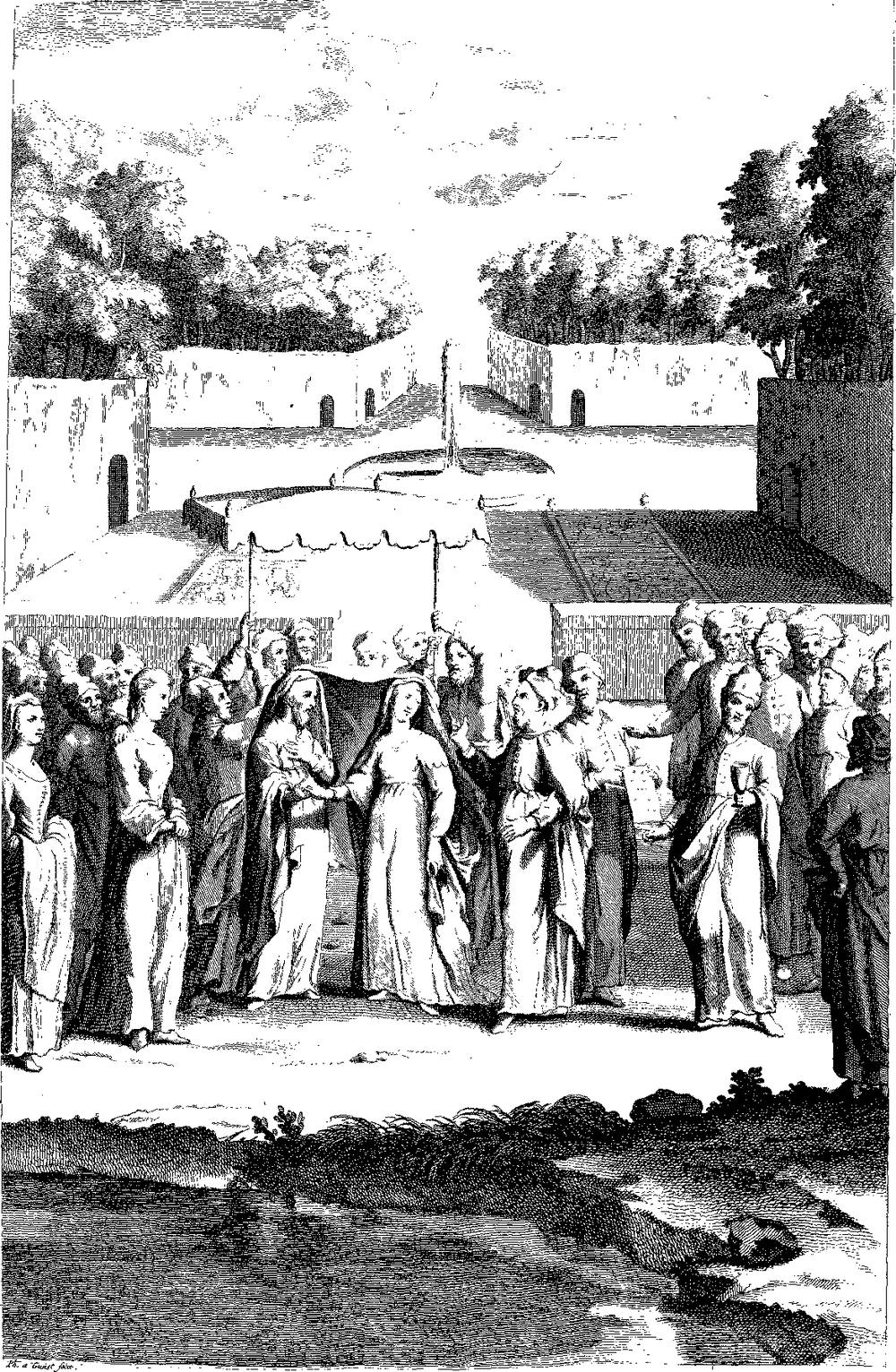
Then the Rabbin of the Place, or the Chanter of the Synagogue, or the nearest Relation of the Husband, takes a Cup full of Wine, and having pronounced this Benediction, Blessed be thou, O Lord, who hast created Man and Woman, and ordained Marriage, &c. he presents the Cup to the Bridegroom, and then to the Bride, that they may just taste it. Afterwards the Bridegroom puts a Ring upon the Finger of his Bride, in Presence of two Witnesses, saying, By this Ring thou art my Spouse, according to the Custom of Moses and the Children of Israel. Buxtorf says, that this Ring ought to be of massy Gold, and not set with any Stones; and that the Bridegroom takes the Company to Witness, that it is good Gold, and of a due Value. After this they read the Contract of Marriage, which the Bridegroom puts into the Hands of the Bride’s Relations. Then they bring Wine again in some brittle Vessel, they rehearse six Blessings, they make the married Couple drink, and they throw the rest on the Ground in Token of Chearfulness. The Bridegroom takes the Vessel, and throws it with Violence against the Ground, or against the Wall, and breaks it in Pieces in Memory, as they say, of the Destruction of the Temple.
The Rabbins inform us, that before the Temple of Jerusalem was laid in Ruines, the Bridegroom and Bride wore Crowns in the Ceremony of Marriage; but since that Time they have ceased to wear any. In the Scripture we see plainly the Crown of the Bridegroom, but not that of the Bride: And indeed, the Head-dress of the Women was by no Means convenient for the wearing of a Crown. Isai. lxi. 10. Vulg. Quasi sponsum decoratum coronâ. And Cant. iii. 11. Go forth, O ye Daughters of Zion, and behold King Solomon with the Crown wherewith his Mother crowned him in the Day of his Espousals, and in the Day of the Gladness of his Heart. The modern Jews in some Places have a Custom, to throw Handfuls of Wheat upon the married Couple, and particularly upon the Bride, saying, Increase and multiply. In other Places they mingle Pieces of Money with the Wheat, which are to be gathered up by the Poor.
Judg. xiv. Cant. v. 1. viii. 1. John iii. 29.We see by the Gospel, that the Bridegroom had a Paranymphus or Brideman, called by our Saviour the Friend of the Bridegroom. A Number of young People kept him Company during the Days of the Wedding, to do him Credit; as also young Women kept Company with the Bride all this Time. The Companions of the Bridegroom are expressly mentioned in the History of Samson, and in the Canticles; and the Companions of the Bride in the same Canticles, i. 4. ii. 7. iii. 5. viii. 4. and in Psalm xlv. 9, 14, 15. The Office of the Brideman was to perform the Ceremonies of the Wedding instead of the Bridegroom, and to obey John iii. 29.his Orders. He that has the Bride is the Bridegroom, says John the Baptist, speaking of Jesus Christ; but the Friend of the Bridegroom, which standeth and heareth him, rejoyceth greatly, because of the Bridegroom’s John ii. 9.Voice. Some think that the Archi-triclinus, or Governor of the Feast, of whom Mention is made in the Marriage of Cana, at which Jesus Christ and his Mother Mary were present, was the Brideman, Paranymphus, or Friend of the Bridegroom; who presided at the Feast, and had the Care of providing for the Guests. The Friends and Companions of the Bride sang the Epithalamium, or Wedding-Song, at the Door of the Bride the Evening before the Wedding. Psalm xlv. is an Epithalamium, intitled, A Song of Rejoycing of the well-beloved. The Ceremony of the Wedding was performed with a great deal of Decency, the young People of both Sexes not being promiscuously together. They were in distinct Apartments, and ate at different Tables, diverting themselves, young Women with young Women, and young Men with young Men. The Reservedness of the Eastern People towards their Women required this. We see Proofs of this in the Story of the Marriage of Samson, in that of Esther, and in the Canticles. The young Men diverted themselves sometimes in proposing Riddles to each other, and the Bridegroom appointed the Prize to those that could explain them.
The Story of Samson is well known, and the Riddle that he proposed to the young Philistines, who accompanied him at his Wedding.
The Wedding Ceremonies commonly held seven Days for a Maid, and three Days for a Widow. When Jacob espoused Rachel, and Laban put Leah in her Room; Jacob complaining of it, Laban told him, that it was not the Fashion in that Countrey to marry the younger Daughters before the Elder; and that he did not refuse to give him Rachel also, after he had passed with Leah the seven Days of her Marriage. Fulfil her Gen. xix. 27. Judg. xiv. 17, 18. Tob. xi. 19.Week, and we will give thee this also. The Ceremonies of Samson’s Wedding continued also seven whole Days, as also that of Tobias. The Rabbins acquaint us that the Term of seven Days was of indispensable Obligation to all married Men; and that they were to allow seven Days for the Marriage of every Wife they took, though they should marry several the same Day. In this Case they
made so many wedding Weeks successively as they married Wives. These seven Days of Rejoycing were commonly spent in the House of the Woman’s Father, after which they conducted the Bride home to her Husband’s House with great Solemnity.
This Part of the Ceremony was generally performed with great Pomp, according to the Condition and Circumstances of the married Couple; and for this they often chose the Night. And from hence it comes, that in the Parable of the ten Virgins that went to meet the Bride and Bridegroom, it is said that the Virgins were asleep; and at Matth. xv. 1, &c.Midnight being awaked at the Cry of the Bridegrooms coming, the foolish Virgins found that they had no Oil to supply their Lamps; which while they went to the Shops to buy, the Bridegroom and his Attendants passed by, and at their Return they found themselves shut out from the Marriage Feast. We read in the Book of 1 Macc. ix. 37. Maccabees, that the Children of Jambri having made a magnificent Wedding at Medaba or Nadabatha, a City beyond Jordan, as they were bringing the Bride along with great Solemnity to the Dwelling of the Bridegroom, and as the Relations and Friends of the Husband went before her with Instruments of Musick and with Arms, the Maccabees fell upon them and dispersed them.
In the Ceremonies of Marriage, the Hebrews pretend that they chiefly imitate what was done at Tobias’s Wedding, which they justly look upon as a Model of a regular and happy Marriage. However the Ceremonies we have described are different enough from what was then practised. First Raguel consents that Tobias shall have his Daughter, and at the same Time puts Tobias’s Hands into those of his Daughter Sara, and gives them his Blessing. This is the essential Ceremony of the Marriage. After this Raguel calls for Paper, writes the Contract, and has it signed by the Witnesses. Then the Feast begins, which is kept for a Tob x. 7.whole Fortnight; though according to the Rules mentioned by the Rabbins, they ought to have held but three Days, because Sara was the Widow of several Husbands.
When the married Couple and their Relations are come into the House, they sit down at Table, and the Bridegroom begins to sing, as musically as he can81, a long Blessing in Hebrew. After Supper the most honourable Person in the Company takes the Bridegroom by the Hand, and the rest all round, and begin to dance together. The Women likewise do the same, but separately from the Men. This Dancing is of a very antient Tradition among them; they call it the Dance of the Commandment, pretending that God himself commanded it, in the Ceremony of Marriage.
The leading the Bride into the Marriage Chamber, is, in the Opinion of the Rabbins82, what compleats the Marrirge. For neither the Blessing, nor the other Ceremonies before it, are thought to give to this Rite its whole Perfection. The Woman has then the Name of a compleat Bride, as soon as she is entered into this Chamber, even though the Marriage had not been yet consummated. As it happens when the Woman is under the Inconveniencies attending her Sex, at which Time it is unlawful for the Man to come near her, under Pain of Lev. xx. 18.Death. Before the leading of the Bride into the Marriage-Chamber, they rehearse this Blessing, in the Presence of ten Persons of Age sufficient and free. Be thou blessed, O Lord our God, King of the World, who hast created all Things for thy Glory. Be thou blessed, O Lord our God, Creator of Man. Be thou blessed, O Lord our God, who hast created Man in thy own Image and Likeness, and hast provided him a Companion for ever. Be thou blessed, O Lord our God, Creator of Man. She that was barren shall rejoice, in gathering her Children into her Bosom. Be thou blessed, O Lord our God, who makest Sion rejoice in the Multitude of its Children. Replenish with Joy these two Spouses, as thou didst replenish Man and Woman in the Garden of Eden. Be thou blessed, O Lord our God, who heapest Pleasure upon the Bridegroom and Bride, and hast prepared for them Joy, Songs, Gladness, Dancing, Love, Friendship, Peace, and brotherly Kindness. Grant, O Lord, as soon as may be, that in the Cities of Judah and in the Places of Jerusalem may be heard Songs of Joy, the Voice of the Bridegroom and the Voice of the Bride, the Voice of the mutual Love of Spouses, and the Voice of singing Children. Be thou blessed, O Lord our God, who replenishest with Joy the Bridegroom and the Bride.
Mat. v. 32. Luke xvi. 18.As to the Marriage of Christians, Christ has restored it to its first Perfection, by banishing Polygamy intirely, and not suffering Divorce but in the Case of Adultery; nor leaving to the Parties so separated, the Liberty of marrying again. And this is very different from what the Law allowed. Our John ii. 1, 2.Saviour has blessed and sanctified Marriage, by being present himself at the Wedding of Cana. Saint Paul declares the Excellence of Eph. v. 33.a Christian Marriage, when he says, Let every one of you in Particular so love his Wife, even as himself, and the Wife see that she Reverence her Husband. And a little above, So ought Men to love their
Wives, as their own Bodies; he that loveth his Wife, loveth himself. For this Cause shall a Man leave his Father and Mother, and shall be joined unto his Wife, and they two shall be one Flesh. This is a great Mystery; but I speak concerning Christ and the Church. The Union of Husband and Wife is a Mystery, which represents the Union, the sacred and spiritual Marriage of Christ with his Church. The same Apostle, assures us, that Marriage is honourable in all, and the Heb. xiii. 4.Bed undefiled; but Whoremongers and Adulterers God will judge. The sacred Books of the New Testament prescribe no particular Ceremony for the solemnizing of Matrimony; but it is certain that in the Church a Blessing has always been given to the married Couple83, and that to raise Marriage to the Dignity of one of the Sacraments of the Church , it ought to be celebrated in the Name of Jesus Christ, and with religious Ceremonies, which have varied according to Circumstances of Time and Place. We may see by Tertullian84, that they put a Veil over the married Couple, and that in Imitation of Tobias and Sara, they gave each other their Hands. Saint Ambrose says85, that Marriage ought to be sanctified by the Veil, and by the Blessing of the Priest. Saint Ignatius the Martyr86 would have Marriages be contracted by the Advice of the Bishop, that they may be according to God, and not according to the Flesh. And Tertullian87 commends those Marriages that the Church unites, the Offering of the Sacrifice confirms, of which the Angels declare the Accomplishment to God, and God himself ratifies. Unde sufficiam ad enarrandam felicitatem ejus Matrimonii, quod Ecclesia conciliat, & confirmat oblatio, & obsignatum Angeli renunciant, Pater ratum habet. The Ceremony of Espousals is very antient, as may be seen by several Councils88, and by Saint Austin89; Institutum est ut jam pactæ sponsæ non tradantur statim ne vilem habeat maritus datam, quam non suspiravit sponsus dilatam. Heretofore in several Churches the married People communicated the Day of their Marriage, and abstained that Night from the Use of the Marriage-Bed90. Sponsus & sponsa cùm benedicendi sunt à Sacerdote, à parentibus suis, vel paranymphis offerantur; qui cùm benedictionem acceperint, eadem nocte, pro reverentia ipsius benedictionis, in virginitate permaneant. This Practice is still in Use in some Places, as I am informed.
MARSENA, or Marsana, one of the seven principal Officers or Councellors of King Abasuerus, Esther i. 14.
MARTHA, Sister of Lazarus and Mary, and Mistress of the House where our Saviour was used to be entertained, in the Village of Bethany. We have already spoke of her under the Article LAZARUS, and shall speak of her again under the Article MARY. Martha is always named before Mary, which makes it probable that she was the elder Sister. Once as our Saviour came to lodge with Martha and Mary, Martha was very busy in preparing Supper, whilst Mary sat at our Saviour’s Feet, hearing his Doctrine with great Assiduity and Luke x. 38, 42.Attention. Martha complained of this to our Saviour, desiring him to bid Mary rise and assist her. But Jesus made Answer, Martha, Martha, you are very busy and in much Trouble to provide indifferent or unnecessary Things; there is but one Thing necessary, and Mary has chosen the better Part, which shall not be taken from her.
Some Time after Lazarus falling sick91, the two Sisters sent Word of it to Jesus, John xi. 11, 45.who was then beyond Jordan. He made no Hast to go to heal him, nor departed from thence till he knew Lazarus was dead. Being come almost to Bethany, Martha knowing of his coming, went out to meet him. As soon as she saw him, she said to him, Lord, if thou hadst been here, my Brother had not died. Jesus answered, thy Brother shall rise again. To this Martha replied, I know that he shall rise again at the last Day. But Jesus told her, I am the Resurrection and the Life, he that believeth in me, though he were dead, yet shall he live; and whoever liveth and believeth in me, shall never die. Believest thou this? Yea, Lord, answered she, I believe that thou art the Christ, the Son of God, which should come into the World. Having said this, she went away, and gave her Sister private Notice that Jesus was come. Mary, without saying any Thing to those about her, rose, and went to Jesus. She said to him as Martha had done before, that if he had been here, Lazarus
Martha continues on the next page
Footnotes
-
Joseph. Antiq. l. xi. c. 7, 8. ↩
-
Prid. Connect. Vol. ii. l. vi. p. 288. ↩
-
Justin. Xenophon. l. i. ↩
-
Antiq. l. x. c. 10. ↩
-
Gen. xxx. 14. דודאיםDudaïm. LXX. Μῆλα μανδραγορῶν. Chald. יברוחיןJabruchim Mandragoræ. ↩
-
Compare Cant. vi. 11. with vii. 12, 13. ↩
-
Ludolf. Hist. Æthiop. comment. l. i. c. 72. p. 104. ↩
-
Herbelot. Bibl. Orient. p. 17, and 140. ↩
-
See Basnage’s Republick of the Hebrews. L. ii. p. 340. ↩
-
Joseph. de bell. l. vii. c. 25. ↩
-
P. Eugen. Roger, Recolet. Description of the Holy Land in Quarto. ent. p. 141. ↩
-
Herbelot. Bibl. Orients ↩
-
Joseph. cont. App. l. i. p. 1051. ↩
-
Origenes in Cels. l. i. Athanas. Ambros. in Luc. p. 27. Epiphan. hæres. 51. Nyssen. de sancta Christi nativ. Theodoret. l. viii. de Græc. affect. curatione. ↩
-
Justin. Dialog. p. 304. ↩
-
Euseb. demonstr. l. vii. c. 4. & vita Constantini l. iii. c. 41. ↩
-
Hieronym. Ep. 24. ad Marcell. ↩
-
Exod. xvi. 15. מן הואMan-hu. ↩
-
Jos. Ant. l. xv. c. 60. ↩
-
Vide Catacuzen. in Sapien. Salom. Hessel de Eucharist. Saintes. Rep. 7. Bosium. de not. Ecc. l. xiii. c. ult. ↩
-
Joseph. Ant. l. iii. c. 1. ↩
-
Aug. l. ii. Retract. c. 20. Vide & Greg. l. vi. Mor. c. 9. ↩
-
Herbelot. Bibl. Orient. p. 547. ↩
-
Abenezra in Exod. xvi. 15. ↩
-
Vid. Buxtorf. de Manna, c. 2. p. 351. ↩
-
Ambros. Ep. lxx. ↩
-
Judg. xiii. 18. Which may be translated, Why do you ask my Name, which is Peli? Or, why do you ask my Name? And it was admirable; or else, And God is admirable. ↩
-
Joseph. Ant. l. v. c. 10. ↩
-
Euseb. Onomastic. voce Μηβηνα. ↩
-
Ita Joseph. Ant. l. v. c. 10. ↩
-
1 Cor. xvi. 22. מרנ אתה ↩
-
Grot. ad 1 Cor. xvi. 22. & ad Luc. vi. 22. Druf. ad Johan. ix. 22. Hieronym. Ep. 137. Chrysost. Theodoret. Theophyl. in 1 Cor. xv. 22. ↩
-
Seld. de Synedr. l. i. c. 8. ↩
-
Lightfoot Dissert. singul. de Maranatha. ↩
-
Andreas Masius in lib. Josua. ⁹ Republick of the Hebrews, Tom. ii. p. ↩
-
Joseph. de Bello. l. vi. c. 24. 2 Chron. xiv. 9. Mic. i. 15. Joseph. Antiq. l. viii. c. 3, 6. ↩
-
Minut. Felix. Apol. p. 27. ↩
-
Josh. xv. 44. ↩
-
2 Chron. xiv. 10, 11, 12, &c. In the Year of the World 3063, before Christ 937, before the Vulgar Æra 941. ↩
-
Joseph. Antiq. l. xiii. c. 17. ↩
-
Antiq. l. xiii. c. 18. p. 452. ↩
-
Antiq. l. xiv. c. 2. 469. ↩
-
Antiq. l. xiv. c. 8. p. 473. ↩
-
Antiq. l. xiv. c. 10. E. ↩
-
Antiq. l. xiv. c. 27. ↩
-
Year of the World 3966, before Christ 34 Years, before the Vulgar Æra 38 Years. ↩
-
Year of the World 3970, before Christ 30 Years, before the Vulgar Æra 34. ↩
-
Year of the World 3974, before Christ 26, before the Vulgar Æra 30. ↩
-
Antiq. l. xv. c. 9, 11, &c. ↩
-
Joseph. Antiq. l. xv. c. 11. ↩
-
Year of the World 3976, before Christ 24, before the Vulgar Æra 28. ↩
-
Joseph. de Bello, l. vi. c. 6. seu 7. p. 914. G. 915. a. ↩
-
Antiq. l. xv. c. 12. p. 537. c. d. Bolland. 25 April. ↩
-
Papias apud Euseb. l. ii. c. 14. Hist. Eccl. ↩
-
Iren. l. iii. c. 1. ↩
-
Origen. apud Euseb. l. vi. cap. 26. Hist. Eccl. Hieronym. in Catalogo. Theophyl. in Marc. ↩
-
1 Petri. v. 13. Marcus my Son. ↩
-
Origen. de recta in Deum fide Doroth. in Synopsi. Procop. Diacon. apud ↩
-
Niceph. Callist. l. ii. c. 43. ↩
-
Clem. Alex. apud Euseb. Hist. Eccl. l. ii. c. 15. Epiphan. hæres. 51. Nazian. car. 34. & orat. 25. Hieron. de ↩
-
Tertull. l. iv. cont. Marcion. ↩
-
Chrys. Homil. i. in Matt. i. 5. ↩
-
Baron. Annal. an. 45. art. 41. ↩
-
Selden. Not. in Eutychii origines. Alexand. p. 152. ↩
-
De Montfaucon, Iter. Italic. c. 4. p. 55. & seq. ↩
-
D. Montfaucon, Antiq. expliq. l. xii. ↩
-
Vide Bolland. 25 April. p. 345, 347. ↩
-
Vid. Eufeb. l. ii. c. 16. Hist. Eccl. Epiphan. hæres. 51. Hieron. de viris illust. Eutych. Alex. T. i. p. 328. ↩
-
Vide Eufeb. l. ii. c. 17. Hier. de viris illust. Epiphan. hæref. 29. ↩
-
Philo Judæus de vit. cont. ↩
-
Eutych. Alex. in Chronic. Hippolyt. in MS. Bodlei, & Anonym. apud Mill. in cap. Evang. Secundum Marc. ↩
-
Iren. l. iii. c. 2. ↩
-
Vide Hieronym. ↩
-
Vita Sancti Porphyr. Gaz. Epist. c. 9. & ad Hedibiam. & Nyssen. Orat. ii. de Resurrect. 19. Act. 55. l. iv. p. 655. ↩
-
משחהMishteh, Nuptiæ, Convivium, Γάμος. Part iv. c. 3. ↩
-
Leo of Modena, Ceremonies of the Jews, ↩
-
Selden. Uxor Heb. l. ii. c. 10. ↩
-
Id. ibid. l. ii. c. 2. ↩
-
Leo of Modena, Part iv. c. 3. of the Ceremonies of the Jews. Apud Selden Uxor Hebr. l. ii. c. 15. ↩
-
P Selden. Uxor Heb. l. ii. c. 1. These two hundred Zuzims make about 50 Shekels of Silver. ↩
-
Buxtorf. Synag. Jud. c. 28. ↩
-
Apud Selden. Uxor Hebraica, l. ii. c. 13. Wives, ↩
-
Concil. Carth. iv. Can. xiii. Siric. Epist. ad Ec. Mediol. ↩
-
Tertul. de veland. Virg. c. 11. ↩
-
Amb. l. iii. Ep. vi. N. 7. ↩
-
Ignat. Mar. Ep. ad Polycarp. c. 5. ↩
-
Tertul. l. ii. ad Uxor c. 9. ↩
-
Concil. Ancyr. Can. xi. xxiv. Carthag. iv. Citat. iii. Pars Cap. xxvii. q. ii. c. 45, 50, 51. ↩
-
Aug. l. viii. Confes. c. 3. ↩
-
Concil. Charth. iv. Can. xiii. ↩
-
Year of Christ 36, of the Vulgar Æra 33. ↩