OFFERINGS. The Hebrews had several kinds of Offerings, which they presented at the Temple. Some were Free-will Offerings, and others were of Obligation. The First-Fruits, the Tenths, the Sin -Offerings were of Obligation; the Peace-Offerings, Vows, Offerings of Wine, Oil, Bread, Salt, and other things, which were made to the Temple, or to the Ministers of the Lord, were Offerings of Devotion. The Hebrews called all Offerings in general Corban1. But the Offerings of Bread, Salt, Fruits and Liquors, as Wine and Oil, which were presented to the Temple, they call’d Mincha2. The Sacrifices are not properly Offerings; they are not commonly included in this Name.
The Offerings of Grain, Meal, Bread, Cakes, Fruits, Wine, Salt, Oil, were common in the Temple. Sometimes these Offerings were alone, and sometimes they accompanied the Sacrifices. Honey was never offered with the Sacrifices, but it might be offered alone, in the Quality of First-Fruits. Now these were the Rules that were observed in the presenting of those Offerings call’d in Hebrew, Mincha3, or Korban Mincha: In the Septuagint, Offerings of Sacrifice, and the same in St. Jerome, oblationem sacrificii. There were five Sorts of these Offerings. First, Fine Flour or Meal. Secondly, Cakes of several Sorts, baked in an Oven. Thirdly, Cakes baked upon a Plate. Fourthly, Another Sort of Cakes, baked upon a Gridiron, or Plate with Holes in it. Fifthly, The First-Fruits of the new Corn, which were offered either pure and without Mixture, or roasted or parched in the Ear, or out of the Ear.
The Cakes were kneaded with Oil-Olive, or fry’d in Oil in a Pan, or only dip’d in Oil after they were bak’d. The Bread offer’d to be presented upon the Altar, was to be without Leaven; for Leaven was never offer’d upon the Altar, nor with the Levit. ii. 11, 12. See Lev. ii. 2, 13. Numb. xv. 4, 5.Sacrifices. But they might make Presents of Common Bread to the Priests and Ministers of the Temple.
The Offerings now mention’d were appointed in Favour of the poorer Sort, who could not go to the Charge of sacrificing Animals. And even those that offer’d living Victims were not excused from giving Meal, Wine, and Salt, which was to go along with the greater Sacrifices. And also those that offer’d only Oblations of Bread, or of Meal, offer’d also Oil, Incense, Salt, and Wine, which were in a manner the seasoning of it. The Priest in waiting received the Offerings from the Hand of him that offer’d them, laid a Part of them upon the Altar, and reserved the rest for his own Subsistence. That was his Right as a Minister of the Lord. Nothing was burnt quite up but the Incense, of which the Priest kept back nothing for his own Share.
When an Israelite offered a Loaf to the Priest, or a whole Cake, the Priest broke the Loaf or the Cake into two Parts, setting that Part aside that he reserved to himself, and broke the other into Crumbs, pour’d Oil upon it, Salt, Wine and Incense, and spread the whole upon the Fire of the Altar. If these Offerings were accompany’d by an Animal for a Sacrifice, it was all thrown upon the Victim, to be consumed along with it.
If these Offerings were the Ears of new Corn, either of Wheat or Barley, these Ears were parched at the Fire, or in the Flame, Levit. ii. 14, 15.and rubb’d in the Hand, and then offer’d to the Priest in a Vessel; over which he put Oil, Incense, Wine, and Salt, and then burnt it upon the Altar, first having taken as much of it as of right belong’d to himself.
The greatest Part of these Offerings were voluntary, and of pure Devotion. But when an Animal was offer’d in Sacrifice, they were not at Liberty to omit these Offerings. Every thing was to be supply’d that was to accompany the Sacrifice, and which served as a seasoning to the Victim. There are some Cases in which the Law requires only Offerings of Corn, or Bread; for Example, when they offer’d the First-Fruits of their Harvest, whether they were offer’d solemnly by the whole Nation, or by the Devotion of private Persons.
As to the Quantity of Meal, Oil, Wine, or Salt, which was to go along with the Sacrifices, I cannot easily see that the Law had determin’d it. Generally the Priest threw an handful of Meal or Crumbs upon the Fire of the Altar, with Wine, Oil, and Salt in Proportion, and all the Incense. All the rest belong’d to him, the Quantity depended upon the Liberality of the Offerer. I observe in more Places than one, that Moses appoints an Assaron, or the tenth Part of an Ephah of Meal, for those that had not wherewithal to offer the appointed Sin-Offerings. See Levit. v. 11. xiv. 21. In the solemn Offerings of the First-Fruits for the whole Nation, they offer’d an entire Sheaf of Corn, a Lamb of an Year old, two Tenths or two Assarons of fine Meal mix’d with Oil, and a Quarter of an Hin of Wine for the Libation.
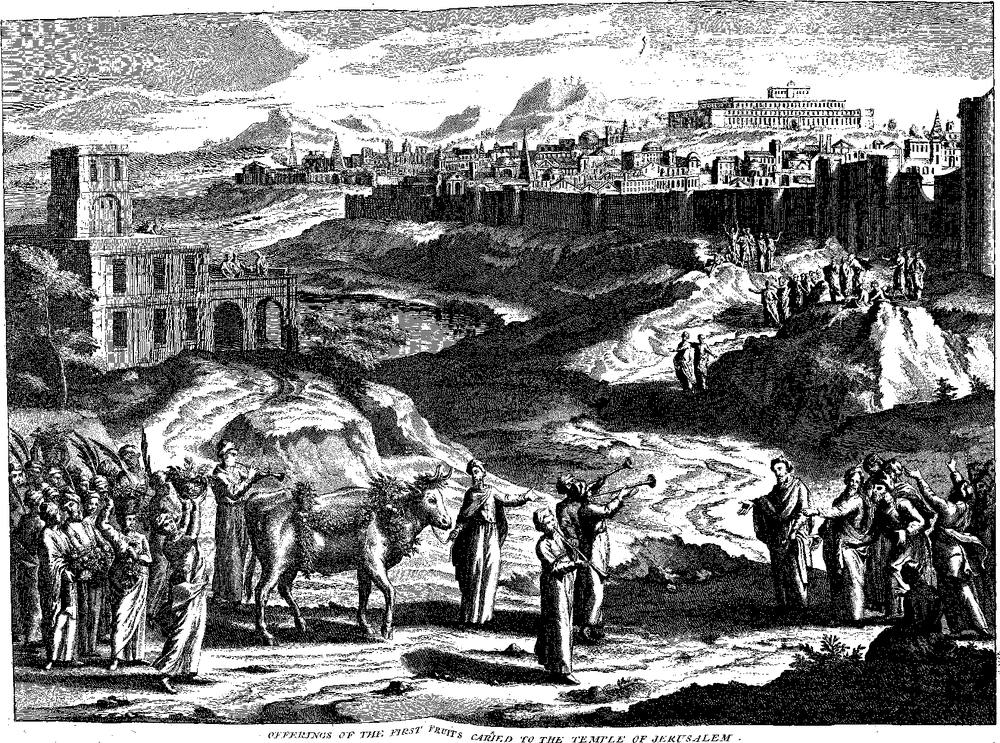
Lev. xxiii. 10, 11, 12, &c. Numb. v. 15.In the Sacrifice of Jealousy, when a jealous Husband accused his Wife of Infidelity, the Husband offer’d the tenth Part of a Satum of Barley-meal, without Oil or Incense, because it was a Sacrifice of Jealousy, to discover whether his Wife was guilty or no.
The Offerings of the Fruits of the Earth, of Bread, of Wine, Oil, and Salt, are the most ancient of any that have come to our Knowledge. Cain offer’d to the Lord of the Fruits of the Earth, the First-Fruits of his Labour. Abel offer’d the Firstlings of his Flocks, and of their Fat. The Heathen have nothing more ancient in their Religion, than these sorts of Offerings made to their Gods4. They offer’d clean Wheat, Flour, and Bread.
Farra tamen veteres jaciebant, sarra metebant,
Primitias Cereri sarra refecta dabant.
Numa Pompilius, who first gave Laws, and established the Religion of the Romans5, taught them to offer to the Gods, Fruits, Corn, Meal, or the Crumb of Bread with Salt, Wheat roasted or parched. Numa instituit fruge Deos colere, & molâ salsâ supplicare, atque, ut author est Hemina, far torrere. Before the Use of bloody Sacrifices they offer’d only Corn6.
Ante Deos homini quod conciliare valeret,
Far erat, & puri lucida mica salis.
Theophrastus observes7, that among the Greeks Meal mix’d up with Wine and Oil, which they call Thylemata, was the Matter of the ordinary Sacrifices of the Poor.
The Difference between the Offerings of Meal, Wine, and Salt, with which the Greeks and Latins accompany’d their bloody Sacrifices, and those that the Hebrews made use of in their Temple, consisted chiefly in this, that the Hebrews cast these Oblations upon the Flesh of the Victims, being already offer’d and put upon the Fire, whereas the Greeks put them upon the Head of the Victim whilst alive, and just going to be sacrificed. See LIBATION before.
Read this article in its place on the printed pages