Volume II, pages 721–739 of the 1732 edition, from SIS to SOL: everything printed on these pages, in order.
Continued from Sirens
would do, that was going to be murder’d. It is not impossible but that Isaiah and St. Jerome might have a Knowledge of these Sea-monsters, and may intend to describe them in this Place. The Word Siren may be derived from the Hebrew Shir, or Sir, which signifies a Song.
שירShir, Canticum.SIRION, or Sarion; this is the Name that the Sidonians give to Mount Hermon, Deut. iii. 9. See HERMON.
SISAI, a Giant of the Race of Anak. Numb. xiii. 23.
SISERA, or Sisara, General of the Army of Jabin, King of Hazer.1 He was sent by his Master against Barak and Deborah, who had got an Army together of ten thousand Men upon Mount Tabor. Sisera marched against them with nine hundred Chariots armed with Scythes, and a great Number of Infantry. Barak with his small Army fell upon Sisera’s with that Impetuosity, that he intirely routed them, kill’d a great Number of them, and put the rest to Flight. Sisera himself fled among the rest, and, as if his Horses did not make Speed enough, he quitted his Chariot, and fled away on Foot towards Harosheth of the Gentiles. He came near the Tent of Heber the Kenite, and Jael, the Wife of Heber, desir’d him to come in and hide himself. She cover’d him with a Mantle; and because he thirsted, she gave him Milk to drink. Then Sisera said to her; ” Do you stay at the Door of the ” Tent, and if any one asks you who is ” here, you shall say No-body. ” Jael went out to the Door of the Tent, and afterwards returning, and finding him fast asleep, she drove a great Nail through his Temples with a Hammer, and fastned him down to the Ground. At the same Time Barak arrived, and she shew’d him Sisera weltering in his Blood, and without Life.
We shall hear make some Remarks upon this Defeat of Sisera.
Observations upon the Defeat of the Army of Sisera, at the Brook Kishon, near Mount Tabor, Judg. iv. 3, &c.Panick Fears oftener happen in large Armies, than in small ones; for these are less susceptible of them. What hap-pen’d to Sisera has happen’d to a thousand other Generals; and it would not be easy to apprehend the Reason of certain Panick Terrors. An Imagination, a Phantom, a Whim may produce them, and yet this Whim is unknown, as if it proceeded from a superior Impulse. For it seizes at once upon a whole Army, as if it had but one Head. A Prepossession, a foolish Fear, the Cause of which is imperceptible, gets Possession in an Instant, and seizes Armies of one or two hundred thousand Men. All fly, all are for securing themselves in a Hurry, and often a Distance of many Leagues is not able to stop their Course. Every one asks his Neighbour, and would inform himself of the Cause of so strange an Accident; but no one can tell the Reason. Those in the Rear quicken the Flight of those in the Front; they are more afraid, because they think themselves in most Danger. And tho’ they neither see nor hear any thing behind them, yet they still imagine there must be Some-body, because the Confusion is general, and none would fly without Occasion. We find in History a Multitude of Examples of this kind of Events; so that there is nothing supernatural in them; tho’ I would not infer, for all that, that the Terror of Sisera and his Army, was not the immediate Effect of the divine Power. But let us proceed to the Story.
The Prophetess Deborah had a great deal of Difficulty to persuade Barak to set himself at the Head of the Israelites, in order to deliver them from the Yoke of the King of Hazor. He seem’d to doubt of her Inspiration, for Prophetesses were not frequent in Israel. However, the Commands of the Lord, which she declared to him, would not allow him to hesitate any longer. Then Barak answer’d her; If thou wilt go with me, then I will go; but if thou wilt not go with me, then I will not go. He was afraid, with good Reason, that the People would not be obedient to him, nor follow him to an Enterprize which seem’d to be so rash and dangerous. To this End, as the People had great Confidence in what she said, he would constrain her to accompany him. To this she consented, and when Barak had got together an Army of ten thousand Men of the Tribes of Zebulun and Naphtali, they took the Field. And they shew’d Sisera, that Barak the Son of Abinoam was gone up to Mount Tabor. And Sisera gathered together all his Chariots, even nine hundred Chariots of Iron, and all the People that were with him, from Harosheth of the Gentiles, unto the River of Kishon. The Scripture does not inform us of the Number of the Troops that compos’d Sisera’s Army; but it is easy to perceive it must be very numerous, and vastly superior to that of the Israelites, by what the Prophetess says to Barak from the Lord: I will draw unto thee, to the River Kishon, Sisera the Captain of Jabin’s Army, with his Chariots, and his Multitude; and I will deliver him into thine Hand. Josephus allows him three hundred thousand Foot, ten thousand Horse, and three thousand Chariots.
Sisera therefore came down into the Plain, at the Bottom of Mount Tabor, on the Banks of the Kishon, where he marshal’d his Troops, and set forth his Chariots in great Pomp. Then the Prophetess
inspired Barak with new Courage, saying to him; Up; for this is the Day in which the Lord has delivered Sisera into thine Hand: Is not the Lord gone out before thee? This was but a short Speech, but a very powerful one, as it proceeded from the Mouth of a Woman inspired from Heaven, who gives him Assurance of a Victory. To this is to be added, the ardent Desire of being deliver’d from the Vassalage of an insolent Conqueror, the natural Hatred they had to the Enemies of their Religion, and the Necessity they were under either to conquer or to die. All these Motives have a mighty Influence, rouse the Spirits exceedingly, and excite the Courage and Hope both of the General and the Soldiers.
There is great Reason to believe, that the mighty Confidence Sisera had in his superior Strength, made him believe, that the Israelites, who were encamped upon the Height of Tabor, would not have done this if they had not been in Fear of an Engagement in the Plain, or in a Place of less advantageous Situation. For this intimates, as he thought, that the Hebrews were much afraid; and far from having any Desire of provoking the Battle, they thought themselves very happy if they could only defend themselves by a vigorous Resistance. Having such Notions as these, Sisera disposed his Army in Battle-array along the Side of the River with a very large Front, as well to shew his Strength, and terrify the Enemy, as afterwards to gain the Ascent of the Mountain, where the Jews were posted, and to attack them in several Places. This Disposition would at first appear well contrived, and very prudent; and indeed it would have been so against any other People but the Israelites, who were wearied out with Oppression, and resolved upon gaining their Liberty whatever it should cost them; and what was more, they were full of Assurance that Heaven would fight for them.
When such Troops as these are concern’d, if very much Prudence and Precaution are not used, there is no relying upon the superior Numbers of the opposite Party. If Barak had continued in his Post upon the Defensive Side only, Sisera would have attack’d him on all Sides, and could not but have forc’d him from his Retreat. He imagin’d it could not be otherwise, and that his Enemy would never have the Boldness to come down with so small a Body of Troops. He was deceived; and this very Disposition of his Army was the Occasion of its being put to Confusion.
So Barak went down from Mount Tabor, and ten thousand Men after him, over the Rocks and Precipices, and fell upon the Army of Sisera, which was ranged in Order of Battle along the Banks of the River. Sisera at first took this Motion to be only a Feint, and without doubt could not think that Barak would quit the Advantage of the higher Ground, to come down into the Plain; which made him not draw his Wings together, to re-inforce his Center.
When the Israelites were come to the Foot of the Mountain, they form’d themselves into several Bodies, upon the Side of the River, before Sisera’s Face, who doubtless must admire the Boldness and Resolution of Barak. From admiring so uncommon a Piece of Intrepidity, he passes to Astonishment, and thence to a kind of Discomposure, which generally terminates in Fear. At last the ten thousand Men prepared for all Events, and ranged according to the Manner of the Jews in a great Depth, pass over the River or Brook, and fall so impetuously upon the Center of this formidable Army, that they separate it from its Wings, and make their Way over the Bodies of all that dare to oppose them. ‘Tis the greatest Misfortune that can happen to an Army, to be open’d and penetrated at its Center. This is nothing in Appearance to so prodigious an Army as Sisera had; but this nothing soon becomes something, and at last proves very fatal in a Battle. When the Wings are cut off from the Body, they make but a feeble Resistance, and are soon put to flight.
And the Lord discomfited Sisera, and all his Chariots, and all his Host with the Edge of the Sword, before Barak; so that Sisera lighted down off his Chariot, and fled away on his Feet. The sacred Author explains himself here in such a Manner, that one would imagine the whole Army of Sisera made no Resistance, but fled away at the very Sight of the Israelites. Yet notwithstanding Joseph. Antiq. l. 5. c. 6.the Tempest that Josephus raises upon this Occasion, it is easy to perceive that the Enemies did defend themselves, but that they were penetrated. There are Generals who have been surprized by Fear, upon much more slender Occasions. Several Instances of this might be produced, if this were a proper Place for it.
What creates some Astonishment, is, to see Sisera jump from his Chariot, to run away on Foot, as if he had had the Nimbleness of a Hind, and as if his Horses were not as swift as himself, in order to make his Escape. The learned Commentator observes, that “ this General must “ have been much discomposed in his Understanding, to think of leaping out of “ his Chariot, that he might fly away the “ better. ‘Tis thus, says he, in Homer, “ where a Trojan Warrior being in a Consternation, throws himself out of his “ Chariot, that he might escape from Dio- “ medes;
Hom. Iliad. v. Ibid. Iliad. xx.“ medes; and another does the same thing “ before Achilles. Their Horses were not “ so swift as their Fears.” So truly it may be affirm’d, that nothing hurries us into Danger so much, as the inconsiderate Eagerness we generally have, of delivering our selves from it.
It is observ’d, that to be discreetly Afraid, requires a good Degree of Courage. This Maxim is true; When our Fears do not intercept our Judgment, when they do not disturb the Understanding, and when of two Dangers we know how to chuse the least, without any Blemish to our Honour. In our own Days we have seen a Horseman take to a River, very deep and wide, after the losing of a Battle. It was hardly possible he should swim over without a kind of Miracle. His Fears had so discomposed him, that he took the River for a small Brook, and thus miserably drowning himself, he lost both his Life and Reputation at once. For he might have escaped the Peril he was in, if he had not quitted his Post. He might have made an honourable Retreat, or surrender’d himself a Prisoner of War. But he had lost his Presence of Mind, and it was not in his Power to chuse the wisest and the safest Measures.
SISOE. This Term is found in the Text of the Septuagint, in Leviticus xix. 27. where we read in the Vulgate; Neque in rotundum attondebitis comam; You shall not cut your Hair round, or in a Circle. The Septuagint says; a You shall make no Sisoe of the Hairs of your Head. The Hebrew Text; You shall not cut round the Corner of your Head. ‘Tis inquired, what is this Sisoe? The antient Scholiast upon Leviticus says,2 it was a Lock of Hair that was consecrated to Saturn. Bochart affirms it to be a Tress of Hair permitted to grow behind the Head, when all the rest was shaved round. The Arabians still wear a Tuft of Hair upon their Heads, and this Custom is very antient in that Country, and in Syria. Lucian mentions it in his Treatise of the Pestilence of Syria. Moses therefore would forbid the Hebrews to imitate the Fashions of these People in cutting the Hair; which was doubtless to avoid some Superstition common among the People of Arabia, in the midst of whom the Israelites then were. See HAIR.
SISTER, Soror. This Name, in the Stile of the Hebrews, has much the same Latitude as that of Brother. It is used, not only for Sister by Father and Mother; but also for her who is a Sister only by Father or Mother, or is only a near Relation. Thus Sarah is call’d Sister to Abraham, tho’ she Gen. xii. 13. xx. 12.was only his Niece, according to some, or his Sister by the Father’s
Side only, according to others. Thus, in Leviticus,3 it is forbidden to take to Wife the Sister of a Wife; that is to say, to marry two Sisters. Or, according to some Interpreters, to marry a second Wife when one has one before. Thus it is literally, Thou shalt not take a Wife over her Sister to afflict her; as if this Passage was to forbid Matt. xii. 55. Mark vi. 3.Polygamy. In the Gospel, the Brothers and Sisters of Jesus Christ, are no other than his Cousins, the Sons and Daughters of the Sisters of the Holy Virgin.
Cant. iv. 9, 10, 12. v. 1, 2.In the Song of Songs, the Name of Sister is a Name of Tenderness between the two Spouses. Sometimes the Word Sister shews a Resemblance of Conditions and Inclinations. Jerem. iii. 8, 10. Ez. xvi. 46.The Prophets call Jerusalem the Sister of Sodom and Samaria, because it delighted in the Imitation of their Idolatry and Iniquity.
Jesus Christ says, that those who keep his Commandments, are his Brothers and Matth. xii. 50. Job xvii. 14.his Sisters. Job, in his Misfortunes, exclaims; I have said to Corruption, Thou art my Father; to the Worm, Thou art my Mother and my Sister. The Wise-man advises Pro. vii. 4.his Pupil to say to Wisdom; Thou art my Sister; that is, to love her, and become familiar with her. St. Paul asks, whether it were not as lawful for him as the other Apostles, to carry along with him in his 1 Cor. ix. 5.Journies some pious Christian Woman; Mulierem sororem circumducere. As Christians were used to salute one another by the Name of Brothers or Brethren, so they call’d Christian Women their Sisters. James ii. 15, 16.St. James says, If a Brother or Sister be naked, and destitute of daily Food; and one of you say unto them, Depart in Peace, be you warmed and filled; notwithstanding ye give them not those things which are needful to the Body; what doth it profit?
SISTRUM, an Instrument of Musick, heretofore very common among the Egyptians.
Auson. Ep. 25Isiacos agitant mareotica Sistra tumultus.
They say Isis invented this Instrument, and her Priests generally us’d it in her Ceremonies.
Ovid. de Ponte.Jactantem Pharia tinnula Sistra manu.
The Sistrum was of an oval Figure, or a dilated Semicircle, in the Shape of a Shoulder -belt, with brass Wires a-cross, which play’d in Holes wherein they were stopp’d by their flat Heads. They play’d on it by shaking the Sistrum in Cadence, and thereby the brass Wires, which made a shrill and loud Noise. This is the Description4
that Apulius gives of it: Dextrá quidem Apul. Metamorph. l. xi.gerebat aureum crepitaculum, cujus per angustam laminam, in modum balthei recurvatam, trajectæ mediæ paucæ virgulæ, crispante brachio trigeminos jactus, reddebant argutum sonum.
The Word Sistrum is found in two Passages of Scripture, 1 Sam. xviii. 6. The Women of Israel came to meet Saul, in tympanis lætitiæ, & in Sistris. a And 2 Sam. vi. 5. They brought the Ark of the Lord with the Sound of all Sorts of musical Instruments: Tympanis & Sistris, b & Cymbalis. I do not observe that the Septuagint have made use of this Term. The modern Interpreters think, that Zalzelim signifies a Sistrum; but the Seventy generally translate it by Cymbalon, a Cymbal. Isaiah has evidently described the Sistrum, Chap. xviii. 1. Væ terræ Cymbalo alarum, quæ est trans flumina Æthiopiæ.5 The Hebrew reads,6 Zalzel cenapei, or the winged Zalzel; which agrees very well with our Description of the Sistrum, in which the Rods or Wires are as Wings. The first Instrument that St. Jerome has translated by Sistrum is call’d in Hebrew, Salisim, or Shalishim, which may signify an Instrument with three Strings, or a triangular Instrument. The second is Mananim, or Minnim, which many understand of a string’d Instrument.
SISUTHRUS, or Xisuthrus. ‘Tis believed that the Babylonians had a Knowledge of the Deluge of Noah, and that this Patriarch was known to them by the Name of Sisuthrus.7 They say, that Saturn appear’d in a Dream to Sisuthrus, and inform’d him, that all Mankind was to perish by a Flood. He commanded him to write down the Originals, the Progress, and the Completion of all Things, and to bury them in the Ground in the City of Sipharis, probably Kariath Sepher, or Dabir: And to build a Vessel, to go therein with his Relations and Friends, and to put out into the deep Sea. Sisuthrus follow’d his Orders, loaded his Vessel with all sorts of Provisions, and made all sorts of Animals to go in along with him. His Vessel was, as they say, five Stadia, or 625 Paces long, and two Stadia, or 250 Paces wide.
When the Deluge came, all those were drowned that were not with Sisuthrus. When he perceived the Waters to abate, he let go a Bird, which finding no Food nor Resting-place, return’d to him again. Some time after, he sent out others, which return’d with their Legs dawb’d with Mud. Lastly, a good while after, he let others go, which did not return any more. Then he understood that the Earth was quite dry; he broke up his Vessel, and went out with his Wife, his Daughter, and the Pilot. He went up into a Mountain, where he worshipp’d the Earth, erected an Altar, and sacrificed to the Gods. After this he appear’d no longer upon the Earth, neither himself, nor those which went out of the Ark with him. The others that continued in the Vessel, going out likewise, sought every-where for Sisuthrus to no Purpose; and having call’d him several times, they heard his Voice, recommending Piety to them, and the Worship of the Gods. He also told them, that for the future he was to have no more Conversation with Men, but was to live with the Gods. This is what they relate of Sisuthrus, which will easily be observed to have a very great Conformity with the History of Noah.
Baruch i. 8.SIVAN, the Name of an Hebrew Month. It answers to the Moon of May, and is the third Month of the Holy Year, and the ninth of the Civil Year.
Lev. vii. 8. Lev. iv. 11. viii. 17. ix. 11. Gen. iii. 7, 21.SKINS. Our first Parents had no sooner committed Sin, but they perceived their own Nakedness, and made themselves Aprons with Fig-leaves few’d together. But soon afterwards God gave them Coats of Skins to cloath themselves withal: Fecit eis tunicas pelliceas & induit eos. By these Coats of Skins, some Antients8 understood the Barks of Trees. Others translate the Hebrew thus: He made them Coats to cover their Skins. The Chaldee says, He made them Robes of Honour, to cover their Flesh.
Moses leaves to the Priests the Skins of the Victims, and this was one of their chief Perquisites. But when the Sacrifice was offer’d for the Sins of the Priest, the Skin was burn’d out of the Camp, or without the City.
Levit. xi. 32. xiii. 48. xv. 17. Hab. iii. 7. Cant. i. 4. 2 Sam. vii. 2. Ps. ciii. 2. Jer. iv. 20. 2 Kings i. 8. Matth. iii. 4.Tents were antiently made of Skins. Pelles terræ Madien: The Tents of the Midianites. Pelles Salomonis: The Tents of King Solomon. The Ark of the Lord was lodg’d under a Covering of Skins: Cùm arca Dei posita sit in medio pellium. The Psalmist compares the Heavens to a vast Tent of Skins. Extendens Cœlum sicut pellem. And Jeremiah; Suddenly are my Tents spoiled, and my Curtains in a Moment. Repentè vastata sunt Tabernacula mea, subito pelles meæ.
Country People were often cloathed with Skins; and Skins are found enumerated among the Cloathing of the People. The Prophets, and such as profess’d a more than ordinary Austerity, wore Girdles of Leather. Elijah and John the Baptist wore Girdles of this Kind; Zona pellicea circa lumbos ejus.9
When the Philistines were smitten with Emerods, for having taken away the Ark of the Lord, they made themselves Cushions or Seats of Skins. Fecerunt sibi sedes pelliceas; probably that they might sit down with the greater Ease. But this Passage is neither in the Hebrew, nor in the Chaldee, nor in a good many Editions of the Septuagint. But some others read it as well as the Vulgate.
SLAVES. All Men were created free and equal, and Slavery enter’d the World only by Sin. Noah, to punish the Affront that his Son Ham put upon him, by exposing his Nakedness, gave his Curse to Canaan, the Son of Ham, and made him subject to Slavery; Gen. ix. 25.Maledictus Chanaan, servus servorum erit fratribus suis. When Abraham was chosen of God, to become the Father of the Race of the Faithful, he received the Badge of Circumcision, as a Character that made him known to be the Servant of the Lord. His Descendants always valued themselves upon their Liberty. Nemini servivimus unquamJohn viii. 33., said the Jews to Jesus Christ. And St. Paul magnifies the Liberty of the true Children of Abraham, as being really free, born of a free Mother, in Opposition to the Race of Ishmael, born of a Mother that was a Slave; Non sumus ancillæ filii, sed liberæ, quâ libertate Christus nos liberavit. This has regard to moral Liberty and Servitude. But the Rabbins maintain, that they have never been in Subjection to any one by a Servitude which they call Intrinsick, and which changes the Condition of the Person. If they have been reduced to Slavery, that does not destory that State of Liberty to which they were born.
But this does not hinder, but that the Hebrews have often been subjected by several Princes. For Example, the Egyptians, the Philistines, the Chaldeans, the Grecians, and the Romans. Many, compell’d by Necessity, have been forced to sell their Liberty; and others, being taken in War, remain’d Slaves to the Conquerors. Moses himself takes Notice of two or three Sorts of Slaves among the Hebrews. They had foreign Slaves, obtain’d by the way of War, or by their Money, or born in their Houses. The Masters had an intire Sovereign Authority over these; they might sell them, change them, punish them, judge them, and even put them to Death, without any form of Process. If a Man smite Exod. xxi. 20, 21.his Servant, or his Maid with a Rod, and he die under his Hand, he shall be surely punished; notwithstanding, if he continue a Day or two, he shall not be punished, for he is his Money.
This must be understood, as the Rabbins say,10 of Hebrew Slaves, but not of Foreign Slaves, which a Master might Job xxxi. 13, 14, 15. 1 Sam. v. 9. Vulg.have, and might use what Severity towards them they pleas’d with Impunity; for in this Case the Law of Moses had enjoined nothing. They follow’d the Rules common to other Nations, among whom all Masters had an absolute Power over their Slaves.11 Apud omnes perquè nationes animadvertere possumus, dominis in servos vitæ necisque potestatem fuisse. Yet wise Men have always much disapproved that Liberty which certain Masters have assumed to themselves, of thus putting their Slaves to Death. Cato the Plutarch. in Catone.Censor would never put any of his Slaves to Death, before they had been condemned and found worthy of Death by his other Slaves.
Job testifies, that he had never declined to enter into Judgment with his Slaves, when any Difficulty arose between them. The Athenians punish’d with Death him that had kill’d a Slave, as much as if he had been a Free-man.
The Samaritan Text, in this Passage now cited, is very different from the Hebrew. It is read thus: He that shall strike his Man-servant, or his Maid-servant with a Rod, if they die under his Hand, he shall not be molested, he shall not die; and if the Servant survives for two or three Days, he shall not be punished, because it is the Price of his Money. As if all this only related to a Slave, Canaanitish or Gentile, which the Civil Laws allow’d to put to Death with Impunity.
Lev. xxv. 39, 40.The Chaldee Paraphrast, some Rabbins, and some Commentators, are of the same Opinion, that this has no regard to Hebrew Slaves; for, say they, it cannot be said of an Israelitish Slave, that he was the Price of the Money of his Master: Pecunia illius est. He was in Servitude but for a few Years, and the Damage that his Master would suffer by putting him to Death, and so depriving himself of the Service he might have expected from him, would not have punish’d him enough for it. Whereas the Loss of a Foreign Slave brought a considerable Prejudice to an interested Master, and he was in some measure justly punish’d for his Cruelty, by the Death of a Man that was his own for ever, and who might have left him Children of the same Condition as himself.
Here are the Rules that Moses appoints should be observed, in respect to Hebrew Slaves: If thy Brother, that dwelleth by thee, be waxen poor, and be sold unto thee; thou shalt not compel him to serve as a Bond-servant. But as an hired Servant, and as a Sojourner, he shall be with thee, and shall serve thee unto the Year of Jubilee. And then shall he depart from thee, both he and his Children with him, and shall return unto his own Family, and unto the Possession
of his Fathers shall he return. For they are my Servants, which I brought forth out of the Land of Egypt; they shall not be sold as Bond-men. Thou shalt not rule over them with Rigour, but shalt fear thy God. Both thy Bond-men and thy Bond-maids, which thou shalt have, shall be of the Heathen that are round about you; of them shall ye buy Bond-men and Bond-maids. It was not therefore the Design of the Lord, that the Israelites should be reduced to perpetual Slavery by their Brethren, or that they should be sold to Strangers, to remain Slaves for their whole Lives. But if an Hebrew should have sold himself to a Stranger living in the Country; this Hebrew might redeem his Freedom by his Parsimony, if he had Means for it. If not, one of his nearest Relations might redeem him, by paying to his Master the Sum that he had given for him, Deduction being made for the Service he had done him, and reckoning what Time he had still to serve to the Year of Jubilee, for then he had a Right to go out of Servitude without any Ransom.
Exod. xxi. 1, 2, &c.In another Place Moses makes these Regulations concerning Hebrew Slaves: If thou buy an Hebrew Servant, six Years he shall serve, and in the seventh he shall go out free for nothing. The Rabbins will have it, that a Slave was obliged to serve for seven Years compleat; but the Generality of Commentators think, that he went out free in the Sabbatical Year, even tho’ he should not have served two or three Years. Moses adds; He shall have at going out the same Cloaths he had at coming in, and his Wife shall go out with him. The Hebrew has it; If he came in by himself [with his Body] he shall go out by himself; if he were marry’d, then his Wife shall go out with him. The Rabbins say, that the Master was obliged to maintain the Wife and Children of the Slave, although none but the Husband was a Slave.
If his Master have given him a Wife, and she hath born him Sons or Daughters; the Wife and her Children shall be her Master’s, and he shall go out by himself; [or with his Body.] Several Meanings may be affix’d to this Law. A Master might make a Hebrew Slave marry a Woman Slave of a another Nation; and as this Woman is no Israelite, she could not enjoy the Privilege of the Sabbatical Year; but her Husband might quit her, and enter upon his Liberty this Year. ‘Tis ask’d, Whether the Marriage was dissolved upon this Separation? The Opinions of Interpreters are divided upon this Question12. What to us appears to have the greatest Certainty, is, that as there could properly be no Marriage among Slaves, who had took one another without Choice and without Liberty, so there could be no Dissolution of Marriage in their Separation. See the Commentators upon this Passage.
Exod. xxi. 5, 6.If the Servant shall plainly say, I love my Master, my Wife, and my Children, I will not go out free: Then his Master shall bring him unto the Judges; [Heb. Gods] he shall also bring him to the Door, or unto Deut. xv. 17.the Door-post, [of his Master’s House] and his Master shall bore his Ear through with an Aul, and he shall serve him for ever. That is to say, according to the Commentators,13 till the Year of Jubilee; for then all Slaves, without Exception, recover’d their Liberty. The Rabbins add, that they were thus set free also at the Death of their Masters, and did not descend to their Heirs.
If a Man sell his Daughter to be a Maid -servant, [or a Slave] she shall not go out as Exod xxi. 7.the Men-servants do. That is to say, the Laws we have now mention’d do not concern her. There is another kind of Jurisprudence for Girls, than for Hebrew Men or Boys. A Father could not sell his Daughter for a Slave, according to the Rabbins,14 till she was at the Age of Puberty, and unless he was reduced to the utmost Indigence. Besides, when a Master bought an Israelitish Girl, it was always with this Presumption, that he would take her for Wife, or that he would permit his Son to marry her. Hence it is that Moses adds, If she please not her Master, and he does not think fit to marry her, he shall set her at Liberty; or, according to the Hebrew, he shall let her be redeemed: To sell her unto a strange Nation he shall have no Power, seeing he hath dealt deceitfully with her, as to the Promise, implicitely at least, that he had made her, of taking her to be his Wife.
Exod. xxi. 9, 10.If he have betrothed her unto his Son, he shall deal with her after the manner of Daughters. He shall take care that his Son uses her as his Wife, that he does not despise her, or use her ill. ” If he makes ” his Son marry another Wife, he shall ” give her her Dowry, her Cloaths, and ” what is due to her, for her Virginity; ” or, according to the Hebrew, ” If he make ” his Son marry another Wife, he shall ” not diminish the Cloaths, the Maintenance, and the Habitation of the former.” That is, according to several Commentators,15 If the Master that bought this Maid, and who made his Son marry her, makes his Son marry a second Wife, he shall take care that his Son treat this first Woman as his Wife, that he allow her
Food and Raiment, and perform the Duties of Marriage to her as to his true Wife; if he does not, then shall she go out free without Money.
Otherwise, if the Father of the Family who has bought an Israelitish Maid, does not marry her, nor makes his Son to marry her; or if he would dismiss her after he had kept her for some time, he shall be obliged to marry her to another, or to sell her to another Hebrew Master, on the same Conditions that he had taken her himself, giving her a Portion, her Cloaths, and the Price of her Virginity, agreeable to Custom, or according as it should be regulated by the Judges.
An Hebrew might fall into Slavery several ways. First, If reduced to extream Lev. xxv. 29.Poverty, he might sell himself. Secondly, A Father might sell his Children for Lev. xxi. 7. 2 Kings iv. 1.Slaves. Thirdly, Insolvent Debtors might be deliver’d up to their Creditors for Slaves. Thieves that were not able to make Restitution for their Thefts, or the Value of them, were sold for the Benefit of the Exod. xxii. 3.Sufferers. Fifthly, They might be taken in War, or by Thieves. Sixthly, They might be stole away, by the Crime call’d Plagium, and afterwards sold for Slaves, as Joseph was sold by his Brethren. Lastly, An Hebrew Slave redeem’d from a Gentile by one of his Brethren, might be sold by him to another Israelite.
By the Word Slavery, Servitude, or Bondage, the Scripture often expresses the Subjection of one People to another. For Gen. xxvii. 37.Example, Isaac says to Esau; Behold, I have made him thy Lord, and all his Brethren have I given to him for Servants. And elsewhere the Egyptians say to Joseph; Buy us and our Land for Bread, and we and our Land will be Servants unto Pharaoh. And when Samuel declares to the Hebrews what are the Rights and Prerogatives of a 1 Sam. viii. 16, 17.King, he says; ” He shall take your ” Slaves, and your Maids, and you yourselves shall be subject to him as Slaves: ” Vosque eritis ei servi. And Goliah says to the Israelites; Am not I a Philistine, and you Servants to Saul? 1 Sam. xvii. 8, 9.Choose you a Man for you, and let him come down to me. And if he be able to fight with me, and to kill me, then will we be your Servants. But if I prevail against him, and kill him, then shall ye be our Servants, and serve us.
SLEEP, Sleeping, Slumbering, is taken either for the Sleep or Repose of the Body, or for the Sleep of the Soul which is Supineness, Indolence, Stupidity, or for the Sleep of Death.
You shall sleep with your Fathers, you shall die as they are dead. And Jeremiah Dan. xii. 2.li. 39. Dormiam somnum sempiternum. And Daniel says; Qui dormiunt in terræ John xi. 11.pulvere: Those that sleep in the Dust of the Grave. Lazarus our Friend sleepeth; let us go and awake him: He is dead, let us go and raise him up. Awake thou that sleepest, and arise from the Dead, and Christ shall Ephes. 4. 14. 2 Pet. ii. 3.give thee Light. He speaks to those that were dead in Sin and Infidelity. Saint Peter says of the Wicked, their Damnation slumbereth not. God is not asleep, he will not forget to punish them in his own due Time. And Solomon says, Prov. xxiii. 21. Vestietur pannis dormitatio. The Slumberer shall be cloathed with Rags, the Slothful shall live in Poverty.
Isaiah speaks of a superstitious Practice among the Pagans, who went to sleep in the Temples of their Idols, to obtain Isa. lxv. 4. בנצורים ילינוProphetick Dreams: Qui habitant in Sepulchris, & in delubro idolorum dormiunt. He speaks of the superstitious and idolatrous Jews, who, in Contempt of the Prophets and of the Temple of the Lord, went into the Tombs and Temples of Idols, to sleep there, and to have Dreams that might discover future Events to them. The Pagans for this Purpose us’d to lie upon the Skins of the sacrificed Victims.
Virgil. Æneid. 7.—— Cæsarum ovium sub nocte silenti Pellibus incubuit stratis, somnosque petivit.
The Hebrew Passage that we have quoted from Isaiah may be thus translated; They remained in the Sepulchres, and passed the Night among the Monuments, or in deserted Strab. l. 16. P. 523.Places. Strabo says, that the Jews slept in their Temples, and there expected Prophetick Dreams, both for themselves and for others; but that God sends none but only to such as live in Purity and Justice. To sleep, is also taken for the Commerce between the Sexes. Thus Gen. xix. 33. The Daughters of Lot slept with their Fathers.
SLING, in Latin, Funda; an Instrument of Cords, made use of to throw Stones with the greater Violence. The Invention of the Sling is ascribed to the Phenicians, Plin. l. 7. c. 56. Vegetius de re militari, l. 4.or to the Inhabitants of the Islands Baleares, call’d now Majorca and Minorca. The Hebrews heretofore made great use of them. Those of the Tribe of Benjamin had so much Skill and Dexterity in managing the Sling, that they could hit their Mark to a Hair, without the least Error. This must be own’d to be an Exaggeration; but however, Judg. xx. 16.it proves their great Abilities in the Managment of the Sling. ‘Tis known what Glory David obtain’d, when he knock’d down the Giant Goliah by a Stroke of his Sling, who was the Terror of all Israel. The Scripture takes Notice, that when 1 Sam. xvii. 49. 1 Chron. xii. 2.David was at Ziklag, there came to him a Company of able Slingers, who could use their Left-hands with the same Facility as their right. Uzziah, King of Judah, made great Collections of Arms in his Magazines, 2 Chron. xxvi. 14.and parparticularly
there were Bows, and Slings for casting of Stones.
Genesis xxxiv. 30.SMELL. Jacob said to his Sons, after the Slaughter of the People of Shechem, Ye have troubled me, to make me to stink among the Inhabitants of the Land: or, Ye have given me an ill Scent or Smell among this People. The Israelites in like manner complain’d to Exod. v. 21.Moses and Aaron; The Lord look upon you, and judge, because you have made our Savour to be abhorred in the Eyes of Pharaoh, and in the Eyes of his Servants. This manner of Speaking occurs pretty frequently in the Hebrew Text, but St. Jerom has render’d it by equivalent Expressions. In a contrary Sense, St. Paul says, We are unto God a sweet 2 Cor. ii. 15, 16.Savour of Christ, in them that are saved, and in them that perish: To the one we are the Savour of Death unto Death, and to the other the Savour of Life unto Life.
In the Sacrifices of the old Law, the Smell of the Burnt-offerings is represented to us, in the Scripture, as an Odour agreeable to God: Gen. viii. 21. Ps. cxli. 2.And thou shalt burn the whole Ram upon the Altar: It is a Burnt-offering unto the Lord; it is a sweet Savour, an Offering made by Fire unto the Lord. The same thing, by Analogy, is said of Prayer, which is, as it were, a sweet Smell ascending before the Lord: Let my Prayer be set forth before thee as Incense; and the lifting up of my Hands, as the Evening Sacrifice. And St. John, in Rev. v. 8.the Revelations, represents the twenty-four Elders with golden Phials full of Odours, which are the Prayers of the Saints.
Judg. xv. 14. & xvi. 9. Dan. iii. 94.The Smell of Fire, is sometimes put for the Flame it self consuming any thing: For Example; Quomodo si rumpat quis filum de stupæ torsum putamine, cum odorem ignis acceperit. And again; Sicut solent ad odorem (otherwise ad ardorem) ignis ligna consumi. In Daniel, Odor ignis, the Smell of Fire, seems to insinuate, that not so much as the Cloaths of the three young Men, that were thrown into the fiery Furnace, were singed, or had the Smell of Fire upon them: Quod odor ignis non transisset per eos.
SMERDIS King of Persia, the same who is call’d Artaxerxes, or Artachsarta, in the Book of Ezra, chap. iv. 7. This is is his History: Cyrus the Great left two Sons, Cambyses,Xenoph. Cyropæd. and Tanaoxares, otherwise call’d Smerdis, or Mergis, according to Justin. Cambyses took his Brother along with him in his Expedition against Egypt. But when it was found that Smerdis was the only one of his Army who could draw the Bow that the Ethiopians had sent him, Cambyses conceived such a Jealousy against him, that he would not suffer him to stay in his Army, but sent him back into Persia. But, some time after this, having had a Dream, that Smerdis had taken Possession of the Crown of Persia, he sent one of his Confidents, named Prexaspes, with Orders to put him to Death; which was perform’d accordingly.
After a Stay of about three Years in Egypt, Cambyses set out to return into Persia.Vid. Herodot. l. 3. When he was come as far as Syria, he there found a Courier dispatched from Persia, with an Account, that Smerdis the Son of Cyrus had ascended the Throne. And indeed, one of the chief of the Magi, or Magians, call’d Pathisites, to whom Cambyses had left the Government of his Kingdom in his Absence, had placed his own Brother call’d Smerdis upon the Throne of Persia. He had a great Resemblance to Smerdis the Prince of that Name, who had been kill’d by Prexaspes, and whose Death was not known to every Body. Cambyses caus’d this Messenger to be stopp’d; and making an exact Enquiry concerning what had been done to his Brother Smerdis, he found that he had been really put to Death, and that it was another Smerdis who had usurp’d the Crown.
Herodot. l. 3.Upon this, he gave Orders for the marching of his Troops with all Expedition, to punish this Usurper: But as he was mounting his Horse with too great Precipitation, his Sword happen’d to fall out of the Scabbard, which gave him a Wound in his Thigh, of which he died soon after: But before his Death, he sent for all the Grandees of Persia, acquainted them with the Death of his Brother Smerdis, and with the Usurpation of the Magian, conjuring them all not to submit to the surreptitious Authority of this Impostor. Herodotus calls him Smerdis; Œschilus, Mardus; Ctesias, Spendates; and Justin, Oropastes.
Ezra iv. 7.No sooner was he confirm’d in his Government by the Death of Cambyses, but the Samaritans, who always were at Enmity with the Jews, wrote a Letter to him against them, telling him, that the Jews, who were always a factious and turbulent Nation, were now rebuilding the City and Temple of Jerusalem; and that when they had compleated this Undertaking, it was much to be apprehended, that they intended to revolt and shake off the Persian Yoke; which Example might encourage the neighbouring Nations of Syria and Palestine to do the same: That he had need only of consulting the Records of Persia, to be convinced of this Truth, and of the dangerous Temper of the Jews. This Letter having been received at Court, the Archives of the Kingdom were inspected, where indeed it was easy to observe, that the Hebrews had for a long Time maintain’d a War against the Kings of Assyria and Babylon, and that at last they had been subdued by the Arms of King Nebuchadnezzar.
Upon this, an Order was dispatch’d to the Jews, that they shou’d not go on with their Works, nor proceed in Repairing Jerusalem, or the Temple16; and Commission was given to the Samaritans, to see that this Order was comply’d with. This they had no sooner receiv’d, but they came in all Haste to Jerusalem, where notifying to the Jews the Resolution of the Court of Persia, they obliged them, by Force and Authority, to suspend the Execution of their Designs. Thus a Stop was put to this Work ‘till the second Year of Darius Son of Hystaspes,17 who gave Leave to the Jews to go on with their Work for the Repairing Ezra vi. 1, &c.of the Temple: But the Prohibition of Repairing or Rebuilding their Walls was not taken off ‘till the Year 3550, by Artaxerxes Longimanus.
But to return to Smerdis: He omitted nothing to secure himself in the Possession of the Throne of Persia. He marry’d Atossa Daughter of Cyrus, and granted his Subjects an Exemption from Taxes, and all military Services, for three Years: And as he had great Reason to be afraid of every thing, if it should be once known that he was not the real Smerdis, he took great Care to avoid appearing in Publick; which was no unusual thing in Persia, where their Kings, to preserve the Respect due to Majesty, shew’d themselves but very seldom in Publick. Yet this exceeding Caution of his made him the more suspected. Ozanes, one of the noblest of the Persians, and whose Daughter Phedyma was of the Number of the King’s Wives, privately enquired of his Daughter, If the King was the true Smerdis or no? She gave him to understand, that having never seen Smerdis the Son of Cyrus, she could be no Judge of this Matter. He gave her Orders to enquire into the Truth of this, by the means of Atossa the Daughter of Cyrus, and Sister to Smerdis. But Phedyma let her Father know, that the Wives of the King had no Correspondence with one another, nor were allow’d to see one another. At last, Ozanes gave his Daughter Orders to observe, whether or no the King had his Ears; for Cyrus had cau’d the Ears of the counterfeit Smerdis to be cut off, having been convicted of some Crime. Phedyma very artificially discharged this Commission, and while the King was sleeping very soundly by her, she satisfy’d herself, that his Ears were not to be found, of which she gave Intelligence to her Father.
Ozanes open’d the Matter to six of the chief of the Nobility, who forming a Party against him, enter’d the Palace, fell upon the Usurper, and upon his Brother Pasisthes the Contriver of this Intrigue: They kill’d them both,18 and exposing their Heads to the People, the whole Imposture was fully discover’d. Darius the Son of Histaspes succeeded Smerdis, in the manner as is related under his Article.
SMIRIS, a Burnish-stone; a certain very hard Stone. See SAMIR.
Psal. lxxvii. 66.SMITE. To Smite, is often used for to put to Death. David smote the Philistine: he put Goliah to Death. The Lord smote Nabal; he smote Uzzah; that is, he put them to Death. To Smite, is also put for to Afflict, to strike with Fear, with the Pestilence, with Poverty, with Ulcers, with Distempers, with Wounds. To smite an Army, is, to beat it, to rout it intirely. To smite the Camp of the Philistines, is, to disperse it, to obtain a Victory over them. Percutere fœdus, is literally, to strike or smite a Covenant, to contract an Alliance; because generally they kill’d Animals, and offered Sacrifices, for ratifying Covenants or Alliances. God smote the Philistines, in posteriora; he sent them the Piles, or Hemorrhoides, or other Diseases of the Fundament. To smite the Tongue, Jer. xviii. 18. Venite & percutiamus eum linguâ; Let us overwhelm him with Injuries and Reproaches; Let us load him with all sorts of scandalous Reflections. To smite or strike the Hands, is sometimes an Action of Applause and Approbation; and at other times is a Token of Grief, Trouble, and Astonishment.
Lam. iii. 30. Jer. xxxi. 19. Ezek. xxi. 14.To smite the Cheek, to smite with the Fist, require no Explication. To smite the Thigh, denotes Indignation, Trouble, Astonishment. To strike Hand against Hand, Percute manu ad manum, signifies, Express your Trouble, by smiting your Isai. xi. 4. 1 Cor. viii. 12.Hands. He shall smite the Earth with the Rod of his Mouth, is, God shall destroy them with his Breath. To wound [or smite] the weak Conscience of a Brother, is, to create unnecessary Scruples in his Conscience, and to expose him to the Commission of Sin. To strike or smite one’s Heart: David 1 Samuel xxiv. 6.smote his Heart; he had a Remorse, at having cut off the Lappet of Saul’s Garment. See STROKE.
Rev. ii. 8, 9, 10.SMYRNA, a City of Asia Minor, upon the Archipelago, having a fine Harbour. St. John the Evangelist, in his Revelation, or rather Jesus Christ by the Mouth of St. John, thus speaks to the Angel or Bishop of Smyrna: These things saith the first and the last, which was dead, and is alive. I know thy Works, and Tribulation, and Poverty, (but thou art rich), and I know the Blasphemy of them which say they are Jews, and are not, but are the Synagogue of Satan. Fear none of those things
which thou shalt suffer: behold, the Devil shall cast some of you into Prison, that ye may be tried, and ye shall have Tribulation ten Days. Be thou faithful unto Death, and I will give thee a Crown of Life.
‘Tis asked, Who was this Angel, or this Bishop of Smyrna? The Generality think a it was St. Polycarp, who was made Bishop of Smyrna by the Apostle St. John the Evangelist19. The Commendations which the Holy Ghost here gives to the Angel of Smyrna, perfectly well agree with St. Polycarp; and it is observable, that here is not one Word of Reproach. There is some Probability, that ‘tis the Martyrdom of St. Germanicus, and of the other Martyrs of Smyrna, who suffer’d Martyrdom under Marcus Aurelius, that St. John has here in View, when he says, that the Devil shall cause some of them to be put in Prison.
Exod. xxv. 38. & xxxvii. 23.SNUFFERS, Emunctoria. The Snuffers mention’d in Scripture, were to snuff the Lamps of the great golden Candlestick with seven Branches, that was in the Sanctuary. Their Matter was Gold, and their Form was probably like our Snuffers or Pinchers, which we use to snuff our Lamps or Candles. The original Word comes from a Root that signifies, to lay hold of, to pinch, to shut up, to receive.
SO, or Sua, a King of Egypt: He made an Alliance with Hoshea King of Israel,20 and having promis’d him all sorts of Assistance, yet gave him none at all, nor prevented Shalmaneser King of Assyria from taking Samaria, and subverting the Kingdom of Israel, in the Year of the World 3283, before Christ 717, before the Vulgar Era 721. Usher and Marsham think that So, otherwise Soos or Sous, is the same as Sabachon King of Ethiopia,21 who is taken for the first King of the Dynasty of the Egyptians in Egypt. Usher says, he began to reign in Egypt in the Year of the World 3277, having taken and burnt alive Bocchoris King of this Country. He reign’d eight Years, from 3277 to 3285, before Christ 723, before the Vulgar Era 727. He had for his Successor Sevechus, whom Usher thinks to be the same as Sethon, mention’d by Herodotus, l. 2. c. 141.
SOBA; Syria of Soba, or Aram of Soba. We think Soba to be a City which gave its Name to a Part of Syria. But this City having been destroy’d, or else having chang’d its Name, we cannot certainly say how far Syria of Soba extended. It appears to us, that it must have been at the Northern Extremity of Celo-Syria, from Libanus and Antilibanus as far as towards Antioch; for it is different from Syria of Damascus, of Emath, of Rohob, of Maachah, and of Geshur. Soba is call’d Sobol, or Sobal, in Judith iii. 1, 14. I suppose Soba or Sobal might be Hoba or Hobal, or Abyla, lying between Libanus and Antilibanus.
I. SOBAL, the City of Seir the Horite, Gen. xxvi. 30.
II. SOBAL, Syria of Sobal. See SOBA.
SOBER, Sobriety: This is commonly taken for the Vertue opposite to Intemperance. Sometimes also it is put for Moderation, Modesty, and that Vertue that knows how to chuse the Mean or Mediocrity in Rom. xii. 3.every thing. For I say, through the Grace given unto me, to every Man that is among you, not to think of himself more highly than he ought to think; but to think soberly, according as God hath dealt to every Man the Measure of Faith. St. Paul would have 1 Tim. ii. 9.Women dress themselves in modest Apparel, with Shame-facedness and Sobriety, as Decency requires. Also the Word Sobriety is taken for Vigilance:22 A Bishop must be vigilant, sober. Elsewhere it is taken for Prudent, Moderate:23 For God has not given us the Spirit of Fear; but of Power, and of Love, and of a sound Mind, or Sobriety. When Antiochus Epiphanes was told of the Murther of the High-priest Onias, he was so moved at it, that he shed Tears; remembring the Wisdom and the Moderation of that Great Man: Because of 2 Macc. iv. 37.the sober and modest Behaviour of him that was dead.
SOCOH, Soco, or Socho, a City of Judah, Josh. xv. 35. 1 Sam. xvii. 1. Heber, of whom mention is made in the Chronicles, repair’d Socoh, 1 Chron. iv. 18. and his Family dwelt there. Rehoboam fortify’d it afterwards: See 2 Chron. xi. 7. Eusebius says, there were two Cities of Socoh, one the Higher, and the other the Lower Socoh, nine Miles from Eleutheropolis towards Jerusalem.
SODOM, the capital City of PentapolisGen. xiii. 12, 13., which for some time was the Dwelling-place of Lot the Nephew of Abraham. The Crimes of this City were come to such an Height, that God destroy’d it by Fire from Heaven, with three other neighbouring Cities, Gomorrah, Zeboim, and Admah, which were as wicked as it self24. The Plain wherein they stood, which before was pleasant and fruitful like an earthly Paradise, was first inflamed by Lightning, which put Fire to the Bitumen, with which it was replete, and was afterwards overflow’d by the Waters of the Jordan, which diffused themselves there, and form’d the Dead-sea, or Lake of Sodom, call’d also25
the Lake Asphaltites, because of the Asphaltus or Bitumen with which it abounded. ‘Tis believed Sodom was one of the more Southermost of the five Cities that were destroy’d by the Fire from Heaven, because it was near Zoar, which was known to be beyond the Southermost Point of the Dead-sea.
‘Tis doubted whether it was within the Space of Land that now is possess’d by this Sea, or whether it was only upon its Border. Jer. xlix. 18. & l. 38.The Prophets speak often enough of the Destruction of Sodom and Gomorrah, or make Allusions to it, and every-where insinuate, that these Places shall be desert, dry’d up, and uninhabited ; that they shall be Places cover’d with Briars and Brambles, a Land of Salt and Sulphur, where there can be neither Planting nor Sowing : Sicitas spinarum, & Deut. xxix. 22. Wisd. ii. 9. Amos iv. 11.acervi salis, & desertum usque in æternum. They shall be, says Amos, as a Firebrand pluckt out of the Burning, half burnt up, and unprofitable to any Use. In a Word : Through all the Scripture the Ruin of Sodom and Gomorrah is represented as one of the most signal Effects of God’s Anger. Joseph. de Bello, l. 5. c. 5. p. 892. f.Josephus says, that round about the Lake of Sodom, and about the Cities that were heretofore destroy’d by Fire from Heaven, the Land is all burnt up, and there are still to be seen the dismal Effects of this terrible Burning, and the Remains of those unfortunate Cities26. The Fruits which grow there have a fine outward Appearance, and seem to the Sight to be good to eat ; but they are full of Ashes, and, when open’d, they fly away in Dust.
It should seem then, that in Josephus’s Time, the Ruins of these five Cities were Strab. Geograph. l. 15.still in Being. Strabo also speaks of the Ruins of Sodom, which were sixty Furlongs in Compass, and were to be seen on the Shore of the Dead-sea. The Notitia makes express mention of Sodom as an Episcopal City. There is found one Severus a Bishop of Sodom, among the Bishops of Arabia, who subscribed to the first Council of Nice. M. Reland cannot persuade himself that Sodom was ever rebuilt ; he believes the Word Sodom, which is read among the Subscriptions to the Council of Nice, must be a Fault of the Copiers ; but I cannot be of his Opinion. The Record is very circumstantial ; it puts the Episcopal City of Sodom between Thamar and En-geddi. Stephen the Geographer27 also puts En-geddi near Sodom. So that I cannot see it can be made a Question of, that the City of Sodom was rebuilt, either in the same Place it was before, or over-against this Place ; for tho’ it appears to me very probable, that it was not cover’d by the Waters of the Dead-sea, and that it stood upon the Shore of this Sea, yet I would not too strenuously oppose the common Opinion, that holds the contrary.
Lake of Sodom, or Sea of Sodom. See ASPHALTITES.
Gen. xix. 5, 6, 23, 24, &c. Judg. xix. xx. Lev. xviii. 22. & xx. 13. Rom. i. 27. Gal. iii. 28. 1 Cor. vi. 10. 1 Tim. i. 10.SODOMY ; a Crime against Nature, which consists in the abominable Use of a Man, as if he were a Woman. This Crime drew down the most terrible Effects of God’s Anger against the Inhabitants of Sodom, Gomorrah, Admah, and Zeboim. ‘Twas this same Enormity, with several others, which was the Reason that God destroy’d the Canaanites by the Arms of the Hebrews, under the Conduct of Joshua. The Inhabitants of Gibeah were also given to this abominable Sin ; which brought a War against the whole Tribe of Benjamin, which had like to have utterly exterminated them. Moses condemns this Crime, and forbids it, upon Pain of Death. St. Paul informs us, that it was very common among the Heathen, and declares, that all who fall into such Enormities, shall not inherit the Kingdom of God.
SOGANE, a Village of Gaulanitis, beyond Jordan. Josephus28 being Governor of Galilee, caus’d it to be fortify’d. It appears to be twenty Miles from Gabara. De Vitâ suâ, p. 1019. It should be read of Gadara, instead of of the Arabians, which the Text insinuates.
Gen. ii. 12. Shohem.SOHEM, or Shohem, a sort of precious Stone, which is often spoke of in the Scripture. St. Jerom and the Septuagint generally render this Word by the Onyx-stone ; but we think it rather signifies an Emerald. See Gen. ii. 12. and the Article of PRECIOUS STONES. In the History of the East, we find several Princes by the Name of Soheme, so call’d from the Hebrew Word Sohem, an Emerald or Onyx.
Tectum, Solarium. Josh. ii. 6. 1 Sam. ix. 25. Deut. xxii. 8. 2 Kings i. 2, 3.SOLARIUM, a Roof. By the Word Solarium, St. Jerom commonly translates the Terrass or Plat-form which serv’d for the Roof or Covering of the House. Rabab lodg’d Joshua’s Spies upon the Plat-form of her House : In solarium domûs suæ. Samuel also put Saul to lodge there. These Plat-forms were all uncover’d, and were defended with a Wall round about, that was Breast-high, to prevent falling down into the Street. Moses had thus appointed it in his Law. Also in the Middle of this Plat-form there was generally an Opening which answer’d to the Hall that was below. ‘Twas through this that King Ahaziah fell down from his Terrass to the Dining-room, and was mortally wounded. Lastly ; They descended generally from these Plat-forms, by Stairs that were with
Luke v. 19.out the House. Thus, in the Gospel, those that brought the Paralytick to our Saviour, not being able to bring him through the Door of the House, because of the Croud that was there, carry’d him upon the Solar or Roof, and having taken up some of the Covering, they let him down, with his Bed, and all, before Jesus Christ. In the same Sense we are to understand what our Mat. xxiv. 17. Luke xvii. 31.Saviour says, that those who are upon the House-top, should not come down to take any thing out of the House, but should make haste to save themselves. To save themselves, they must indeed come down; but he would have them come down by the Stairs that were without the House, and not enter into the House at all, to amuse themselves with taking Leave, or providing Cloaths or Provisions. See our Dissertation upon the Dwellings of the ancient Hebrews, before the Commentary upon Judges.
SOLIMA, or Solyma. This Name is sometimes given to Jerusalem. See its Article.
SOLITUDE, Desart, or Wilderness29. The Hebrews give the Name of Wilderness to all Places that are not cultivated, but which are chiefly destin’d to the feeding of Cattle, and on which Trees grow wild. So when a Desart or Wilderness is mention’d in Scripture, we must not imagine it to be a Place forsaken, abandon’d, void of Cities or Inhabitants; this Word only represents the Soil near a City or Village which was appointed for Pasture, and where the Plough never came. Thus, in Scripture, there are few Cities which had not their Wilderness, Desart, or Solitude. Thus we read of the Desarts of Zin, of Kadesh, of Tekoa, of Auran, of Damascus, of Ziph, of Jeruel, of Jericho, of Jerusalem, of Maon, of Gibeon, of Bethel, of En-geddi, of Bethsaida, and so of others. See DESART.
SOLOMON, or Salomon, Son of David and Bath-sheba, was born in the Year of the World 2971, before Christ 1029, before the Vulgar Era 1033. His Name Solomon signifies Pacifick, or Peaceable. The Lord 2 Sam. xii. 24, 25.loved him, and sent the Prophet Nathan to David, to assure him of his Affection towards the Child, and to give Solomon the Name of Jedidiah, or, The Beloved of the Lord. This was, probably, when Nathan assured David, that this Son should succeed him, and that it should be he that should inherit the Promises that the Lord had made him some Years before,30 when he had conceiv’d the Design of building a Temple to the Lord: For then God told him, by the Prophet Nathan,31 “You shall not build
“ build me an House; but when your Days are compleated, and you are gather’d to your Fathers, I will set one of your Children upon the Throne after you, and will strengthen his Reign; ‘tis he that shall build a House to my Name, and I will establish his Throne for ever: I will be a Father to him, and he shall be my Son, and I will not take away my Mercy from him, as I did from your Predecessor: I will fix him in my Kingdom and in my House for ever, and his Throne shall not be shaken: I will be his Father, and he shall be my Son; and if he does any thing amiss, I will chastise him with the Rod with which Men are chastised, and will punish him with the Stripes with which the Children of Men are punished, but will not take away my Mercy from him.”
From this time David thought only of preparing what was necessary for the building of the Temple, and of giving Solomon such an Education as might bear some Proportion to the great Designs that God had ordained him to. But towards the End of David’s Reign,32 Adonijah, David’s eldest Son, began to make himself popular, to set up a Court, and to act as if he were to succeed to the Crown of his 1 Kings i. 5,6,7.Father. David did not restrain him; Joab, Abiathar, and several of the principal Men of the Court, were in his Interest: But he had neither Zadok the High-priest, nor Benaiah, nor the Prophet Nathan, on his Side. One Day, when Adonijah had invited several of his Friends to a great Feast, which he prepared for them near the Fountain of Rogel, he invited neither Zadok, nor Nathan, nor Benaiah. Upon which, Nathan went to Bath-sheba the Mother of Solomon, and said to her; “ Do you know that Adonijah is going to “ declare himself King, without David’s “ Knowledge or Consent? Go therefore, “ and present yourself before the King, “ and say to him; My Lord the King, “ did not you promise me with an Oath, “ that Solomon my Son should reign after “ you? Why then does Adonijah reign? “ While you are speaking thus to the “ King, I will come in, and support what “ you shall say.” Bath-sheba follow’d Nathan’s Counsel; 1 Kings i. 32,33,34.and David being inform’d of Adonijah’s Intrigues, sent for Zadok the High-priest, the Prophet Nathan, and Benaiah the Son of Jehoiada, and gave them these Orders; “ Go and set my Son Solomon upon “ my own Mule, and conduct him to “ Gihon, where let Zadok and Nathan “ give him the Royal Unction, and found
“ the Trumpet before him, saying, Long “ live King Solomon! ” These Orders they obey’d; Solomon was anointed King of Israel; they brought him back amidst the Acclamations of all the People, and caus’d him to sit upon the Throne of David. This Prince blessed the Lord on his Account, saying; “ Blessed be the “ Lord, who has this Day permitted me “ to see with my own Eyes my Son “ Solomon sitting upon my Throne. ”
Those that were with Adonijah, hearing 1 Kings i. 49.what had passed, rose from Table in a great Consternation, and every one retired to his own Home. Adonijah himself, being in fear of King Solomon’s Resentment, took Refuge at the Horns of the Altar, and made his humble Supplication to this Prince, That he would promise him, upon Oath, not to put him to Death. Solomon made answer, That if he behaved himself for the future like a good Man, and a faithful Subject, one Hair of his Head should not fall to the Ground; but if he should ever find him guilty of any evil Practices, he should surely die. Adonijah upon this quitted his Azylum, and came to pay his Duty to King Solomon.
And now the Day of David’s Death being near at Hand,33 he sent for his Son 1 Kings ii. 1, 2, 3.Solomon to him, and earnestly recommended to him a strict Fidelity and Piety towards God. He bid him not let Joab or Shimei go unpunish’d; but to shew all possible Friendship and Acknowledgment to the Sons of Barzillai, who had succour’d him in his Distress. He told him also, that since God 1 Chron. xxii. 2, 3, 4, 5. & xxviii.had reserved for him the Honour of building him a Temple, he ought to discharge this Trust with all possible Zeal and Diligence. He put into his Hands the Schemes that he had made for the Execution of this Undertaking, and the Accounts of the Treasures he left him for the perfecting this Edifice. He gave him also the Lists of the Priests and Levites, and the Courses in which they were to wait in the Temple. He 1 Chron. xxiii,xxiv, xxv, xxvi.gave him likewise the Schemes and Regulations of the Officers of his own Court, of the Civil Officers, of the Treasurers, and of the Superintendants of the Revenues belonging to the Crown. Lastly, in a general Assembly 1 Chron. xxvii.of the People, and of all the great Men of the Kingdom, David deliver’d over all the Gold, Silver, and valuable Materials, that he had collected for the building of the Temple, and exhorted all that were present to make every one their Offering to the Lord, 1 Chron. xxix. 1, 2, 3, &c.each according to his Abilities and Inclination. They all contributed with a chearful Heart, and the Quantity of Gold and Silver was very extraordinary. After which David died in the seventieth Year of his Age, having reign’d forty Years34.
Solomon now enter’d into the full Possession of the Kingdom of his Father, and was acknowledg’d by all Israel. Soon after this his Brother Adonijah made Intercession 1 Kings ii. 13, 14.with Bath-sheba, that she would intreat for him with Solomon, that he might have Abishag the Shunammite to Wife. Bathsheba recommended this Request of his to her Son Solomon; but he perceiving Adonijah’s evil Intentions, that he asked for Abishag who had been Wife to David, only to strengthen his Interest, and to favour the Pretensions that he might one Day make to the Crown; Solomon order’d Adonijah to be put to Death. He also banish’d from his Presence the High-priest Abiathar, and confin’d him to his Country-House, because he 1 Kings ii. 26, 27.had been of Adonijah’s Party. Lastly, when Joab heard what had happen’d to Adonijah and Abiathar, he began to be afraid for himself, and retired into the Tabernacle as a Place of Refuge. Solomon commanded him 1 Kings ii. 28,29,&c.to be brought from thence, and to be put to Death. But Joab refusing to forsake his Azylum, he order’d him to be slain in that very Place; desiring that the Blood that had been unjustly spilt by that Man, might not be imputed to the House of David, or be a Blemish to his Reign. Lastly, Solomon order’d Shimei to build him a House in 1 Kings ii. 36, 37.Jerusalem, and not to stir from thence. Shimei obey’d this Order for a Time, but then some Servants of his running away from him, and entering themselves into the Service of Achish King of Gath, Shimei goes thither to reclaim them. When Solomon was inform’d of this, he sent Benaiah the Son of Jehoiada to fall upon him and kill him.
Solomon being thus confirm’d in his Kingdom,35 he contracted an Alliance with Pharaoh King of Egypt, and marry’d his Daughter. He brought her to Jerusalem, and had Apartments for her in the City of David, till he should build a Palace for her, as he did some Years after, when he had finish’d 1 Kings iii. 1, 2, 3.the Building of the Temple. ‘Tis thought it was on the Occasion of this Marriage, that Solomon composed the Canticles, or Song of Songs, which is a Kind of Epithalamium. To the same Time and Occasion is also referr’d Psalm xlv. My Heart is enditing a good Matter, &c. This Marriage has not been generally approved. The Scripture speaks of the Daughter of Pharaoh, as one 1 Kings xi. 1, 2. Neh. xiii. 26.that contributed to pervert Solomon; and it is very likely, that at first this Princess might seem to be converted to the Lord, but afterwards might
return to her idolatrous Worship, and engage the King her Husband in it. Pharaoh gave the City Gezer, as a Portion with his Daughter, which City he had conquer’d from the Canaanites, in the Country of the Philistines. Solomon afterwards rebuilt and fortify’d it.
After this a Solomon, accompany’d by all his Troops, and all Israel, went up to Gibeon,36 which was then one of the most famous High-places in the whole Country. He there offer’d a thousand Burnt-offerings upon the brazen Altar that was in that Place. And the Night following God appear’d to him in a Dream, and said to him; “ Ask of me what you have a mind that I shall give you. ” After Solomon had returned Thanks for all the Favours that God had conferred upon his Father David, and for the Honour he had done him also, in placing him upon his Father’s Throne; he begg’d of God to give him a wise and understanding Heart, and such Qualities as were necessary for the Government of the People committed to him. This Request was agreeable to the Lord, who said to him; “ Since you “ have asked neither Glory, nor Riches, “ nor Victory over your Enemies, and “ have desired only Wisdom to govern “ your People; I grant it you, and shall “ add all those other Things that you “ might have asked me; so that no King “ of all the Ages past shall have been “ equal to you in this respect. ” At his awaking in the Morning he consider’d this Dream, and perceived it was not an ordinary Dream. He return’d to Jerusalem, where he offer’d a great Number of Sacrifices upon the Altar, which was before the Ark of the Lord, and made a great Feast for his Servants.
Then two Women of ill Reputation came before the King,37 and said to him; “ That one of them had stifled her Child “ in her Sleep, and having privately convey’d it to her Companion, she stole “ away her live Child, and pretended it “ to be her own. ” As each of these Women eagerly maintain’d the live Child to belong to her, and the dead one to the other, and no one could convince them, the thing being transacted without any Witnesses; the King bid the Attendants to cut the live Child into two equal Parts, that each of the Women might have half the Child they contended for. Then the real Mother of the Child, finding herself moved by natural Affection, said to the King; “ Let not the Child be divided, “ but rather let her take the whole Child.” The other, on the contrary, approved of ix. 16, 17. 1 Kings iv. 1, 2, 3, &c. 1 Kings iv. 24. 2 Chron. ix. 26.the Sentence of the King, and said; “ Let “ the Child be neither hers nor mine, but “ let it be divided between us. ” Upon which Solomon, without any further Hesitation, determin’d, that the Child should not be kill’d, but given to her that was for preserving its Life, for she was the real Mother of it. All Israel hearing of this Decision, were fill’d with Reverence and Respect for the King, perceiving the great Wisdom that was in him.
Now Solomon enjoy’d a profound Peace through all his Dominions; all Judah and Israel lived in the greatest Security; and his Neighbours either pay’d him Tribute, or were his Friends and Allies. He ruled over all the Countries and Kingdoms, quite from the Euphrates to the Nile, and his Dominion extended even beyond the Euphrates. He had a very great Number of Horses and Chariots of War. Instances of his Wisdom were as numerous as the Sand of the Sea, and he exceeded all the Orientals, and all the Egyptians, in Wisdom and Prudence. In a Word, he was the wisest of Mankind, and his Reputation was spread through all Nations. He compos’d or collected three thousand Proverbs, and a thousand and five Canticles. (The Septuagint and several Interpreters read five thousand instead of a thousand and five, as it is in the Hebrew.) He knew the Nature of all Plants and Trees, from the Cedar upon Libanus, to the Hyssop that grows upon the Wall. He treated also of Beasts, of Birds, of Reptiles, of Fishes. There was a Concourse of Strangers from all Countries to hear his Wisdom, and Ambassadors from the most remote Princes that had heard of his Fame. He made Gold and Silver as common in Jerusalem as Stones in the Street;38 and Cedars as plentiful as the Sycamores that grow in the Field.
As soon as Hiram King of Tyre knew that Solomon was made King of Israel, he sent Ambassadors to him, to congratulate his Accession to the Crown; and some time after,39 Solomon sent Ambassadors to him, to desire him to supply him with Wood and Workmen, and to assist him in building a Temple to the Lord.40 Hiram gladly undertook what Solomon desired of him: He sent him word, He would order Cedar-trees and Fir-trees to be cut down in Mount Libanus; that his People should put them on Floats, and bring them by Sea to the Harbour of Joppa, from whence Solomon might send to fetch them to Jerusalem. Solomon, on his Part, obliged himself to give Hiram for the Maintenance of his Family and Workmen, twenty thousand41
Measures of Wheat, and twenty thousand Measures of Oil. a Josephus adds;42 that he furnish’d him with Wine also; and 2 Chron. ii. 10.indeed in the Chronicles it is said, that Solomon gave to Hiram’s Workmen, that work’d for him in Libanus, Wheat, Barley, Wine, and Oil.
Josephus says besides,43 that even in his Time were preserved in the Archives of Tyre, the Letters that Solomon and Hiram wrote to each other. He cites Dion and Menander, who said that these two Princes us’d to send Ænigma’s to one another, in order to be solved; that Solomon having once sent a Riddle to Hiram which he could not explain, Hiram was obliged to pay him a great Sum of Money. But after this a Tyrian, call’d Abdemon, gave a Solution of them, and propos’d others to King Solomon, which he could not explain, and therefore was fore’d to give the King of Tyre a good Sum. Thus it is related by Josephus.
Solomon began to work upon the building of the Temple in the fourth Year of his Reign, and the second after the Death of David;44 four hundred and fourscore Years after the Coming out of Egypt45. We shall not here give a Description of this Temple, but refer the Reader to the Article of the Temple of Solomon. He employ’d in this great Work seventy thousand Proselytes, who were the Remains of the antient Canaanites, in carrying Burthens upon their Shoulders; fourscore thousand in cutting Stones out of the Quarries in the Mountains; and three thousand six hundred46 to oversee the Works. Besides which, he employ’d thirty thousand Israelites to work in the Quarries of Libanus. These thirty thousand Men were commanded by Adoniram, and only ten thousand of them work’d at a Time, and that for a Month only, so that they had always two Months of 1 Kings vi. 37. 1 Kings v. 14.Rest between. Hiram also sent to Jerusalem a very skilful Workman, whose Name also was Hiram,47 whose Mother was of the Tribe of Dan,48 and his Father was by Nation a Tyrian; he could work in Gold, Silver, Brass, Iron, Marble, Wood, and in all Sorts of Work of Linen, Embroidery, and Tapestry. He had the Direction of all the Works of the Temple. ‘Twas he that had the Management of the Foundery, and cast most of the principal Things himself. See HIRAM.
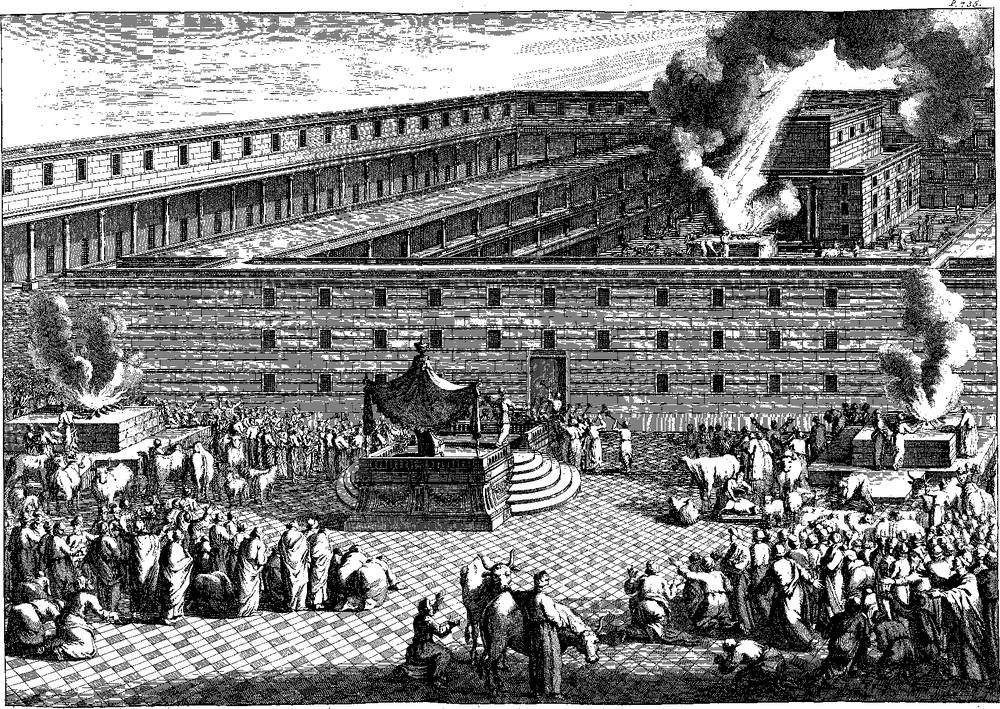
The Temple of the Lord having been begun in the fourth Year of the Reign of Solomon, was compleated in his eleventh Year; so that he was but seven Years in performing this vast Piece of Work.49 The Dedication was made in the Year following,50 which was the 3001 Year of the World. To make this Ceremony the more august, Solomon chose for it the eighth Day of the seventh Month of the Holy Year,51 which was the first of the Civil Year, and answer’d to our Month of October. The Ceremony of the Dedication lasted for seven Days, at the end of which began the Feast of Tabernacles, which continued still seven Days longer; so that all the People continued at Jerusalem fourteen or fifteen Days, from the eighth to the twenty-second of the seventh Month. Solomon caus’d to be present at this Solemnity all the Elders of Israel, and all the People. The Priests and Levites carry’d into the Temple, first, all the Presents that David had made to it, and which were laid up in the Treasuries of the Sanctuary; then they set up in their several Places, the Ornaments and Vessels appointed to the Service of the Altar and of the Sanctuary; lastly, they brought thither the Ark of the Covenant with great Solemnity, the King and all the People walking before, while the Priests offer’d an infinite Number of Sacrifices in all the Places through which the Ark passed.
When the Ark was placed in the Sanctuary, while the Priests and Levites, in their turns, were celebrating the Praises of the Lord, the Temple was fill’d with a miraculous Cloud; so that the Priests, out of Veneration, could no longer continue there, nor go on with performing the Functions of their Ministry. Then Solomon, being upon his Throne,52 prostrated himself with his Face to the Ground; then raising himself up, and turning towards the Sanctuary, he address’d his Prayer to God, and beseech’d him, that the House he had built might be acceptable to him, that he would bless and sanctify it, and hear the Prayers of those that should address themselves to him from this holy Place. He beseech’d him also to fulfil the Promises he had made to David his Servant, in favour of his Family, and of the Kings his Successors. As soon as he had finish’d his Devotions to God, he turn’d himself to the People, and blessed them; 1 Kings viii. 55, 56. 2 Chron. vii. 1, 2, 3.when Fire coming down from Heaven, consumed the Victims and Burnt-sacrifices that were upon the Altar, and the Glory of the Lord fill’d the whole Temple; so that even the Priests could not go into the Temple, to perform their respective Offices.53
Then the Children of Israel, who were all Witnesses of this Miracle, fell down upon their Faces, worshipping and adoring the Lord.
On this Day the King caused to be sacrificed twenty-two thousand Oxen, and six-score thousand Sheep for Peace-Offerings. And because the Altar of Burnt-offerings was not sufficient for all these Victims, a the King consecrated the Court of the People, and there offer’d Sacrifices in great Numbers. But the Lord appear’d a second time to Solomon in a Dream; probably in the Night that follow’d the first Day of the Dedication; and said to him: “ I have heard your Prayer, and have “ chosen this Temple to be my House of “ Sacrifice. My Eyes shall be open, and “ my Ears attentive to the Prayers of those “ that shall call upon me in this Place. “ And as for you, if you walk before me “ as David your Father walked before me, “ and if you keep my Statutes and Ordinances, I will preserve your Throne, “ and you shall always have Successors of “ your Race, to sit upon your Throne. “ But if you or your Children shall turn “ away from me, I will destroy you out “ of this Land that I have given you, and “ will make my People the Reproach of “ the World, and this Temple shall become an Occasion of Wonder to all Nations, because of the Destruction I shall “ bring upon it. ”
After the seven Days of the Dedication were over, and the other seven Days of the Feast of Tabernacles, Solomon dismiss’d the Assembly of the Israelites, and all the People return’d to their own Habitations, praying that all sorts of Blessings might shower down upon the King. Solomon afterwards54 thought of building himself a Palace, and another for his Queen the King of Egypt’s Daughter.55 He was thirteen Years in finishing these Buildings, and us’d therein whatever the most exquisite Art or the profusest Riches could furnish him with, to make them magnificent, and fit for the greatest Prince that was then in the East. The Palace in which he generally chose to reside, was call’d The House of the Forest of Libanon, probably because of the great Quantity of Cedar that was us’d therein, or because of the great Number of Columns on which it was built. To shew his Gratitude to Hiram King of Tyre, who had been very useful to him in his Buildings,56 he gave him twenty Cities in the Province of Galilee. Hiram went to see them, but it seems he did not like them, for he said; What Cities are these which thou hast given me, my Brother? And he called them the Land of Cabul unto this Day. See the Article CABUL. Hiram also sent Solomon six-score Talents of Gold; probably he lent them Solomon to go on with his Buildings.
Besides these vast Undertakings now mention’d, Solomon also built the Walls of Jerusalem,57 the Place call’d Millo in the same City; he repair’d and fortify’d Hazor, Megiddo, Gezer, the two Beth-horons Upper and Lower, Baalath, and Palmyra in the Desart of Syria. He also fortify’d all the Cities where he made his Magazines of Corn, Wine, and Oil, and those where his Chariots and Horses were kept. He brought under his Government all the Hittites, the Hivites, the Amorites, and the Perizites, which any where remain’d in the Land of Israel. He made them Tributaries, and compell’d them to work at the publick Works he had undertaken. As to the Israelites, he would not employ them in this Labour, but made use of them in his Armies, and set them over his Chariots and Horses.
He fitted out a Fleet at Ezion-geber, and at Elath or Elan, upon the Red-sea, to go to Ophir.58 Hiram King of Tyre furnish’d him with Mariners, and such as understood Navigation, who instructed the Subjects of Solomon. They perform’d this Voyage in three Years, and brought back with them Gold, Ivory, Ebony, precious Wood, Peacocks, Apes, and other Curiosities.59 In one Voyage they brought Solomon four hundred and fifty Talents of Gold, or, as it is in the First Book of Kings, only four hundred and twenty. About the same Time the Queen of Sheba,60 a Country of Arabia-Felix, or, according to others, of the Isle of Meroe, formerly call’d Sheba, came to Jerusalem, attracted by the great Fame of King Solomon. She brought with her rich Presents of Gold, Spices, and Precious-stones; and with a Design to try if Solomon’s Wisdom was as great as had been represented, she propos’d several Ænigma’s and hard Questions to him, to hear his Solutions. But Solomon gave her such satisfactory Answers, that she own’d, what had been told her of his Wisdom and Magnificence, was far short of what she had found. The King, for his Part, conferr’d great Honours on her, and made her rich Presents, so that she return’d into her own Kingdom very well pleas’d. The Reader may see what has been said of the Queen of Sheba, under the Article NICAULE.
Solomon was one of the richest, if not the very richest of all Princes that have ever lived; and the Scripture expresly61
tells us, a he exceeded in Riches and Wisdom all the Kings of the Earth. We have already observed, that in his Time Silver was not regarded, because it was as plenty as the Stones in the Street. His annual Revenues were six hundred and sixty-six Talents of Gold,62 without reckoning the Tributes which he received from tributary Kings and Nations, or the Subsidies paid by the Israelites, or the Sums that he received from the Merchants for his Customs. The Bucklers of his Guards, and the Throne that he sat upon, were overlaid with pure Gold. All the Vessels of his Table, and the Utensils of his Palaces, were of the same Metal. From all Parts they sent him Presents in Vessels of Gold and Silver, in precious Stuffs, in Spices, in Arms, in Horses and Mules; and the whole Earth had a Desire to see the Face of Solomon, and to hear the Wisdom that God had put into his Heart.
Hitherto we have seen nothing in Solomon, but what was truly great and admirable; but the later Actions of his Life sadly disgrace his Character. He deliver’d himself up to the Love of strange Women;63 and besides Pharaoh’s Daughter mention’d before, he marry’d Wives from among the Moabites, Ammonites, Idumeans, Sidonians, Hittites. He had to the Number of seven hundred Wives, who were as so many Queens, besides which he had three hundred Concubines. These Women perverted his Heart in his old Age, so that he worshipp’d Ashtoreth the Goddess of the Sidonians, Moloch the Idol of the Ammonites, and Chemosh the God of the Moabites. To these he built Temples upon the Mount of Olives, over-against and to the East of Jerusalem. He did the same by all his strange Women, and had the Complaisance to build Temples for their Gods, to whom they offer’d Incense. Wherefore the Lord said to him in a Dream; ” Since you have ” not kept my Covenant, nor obey’d my ” Commandments, I will rent and divide ” your Kingdom, and will give it to one ” of your Servants. However, I will not ” do it in your Time, for the sake of my ” Servant David, but I will divide it in ” the Hands of your Son, to whom I will ” leave but one Tribe, because of my Servant David. ” The Accomplishment of this Menace may be seen in the Article REHOBOAM; and Solomon, even before his Death, saw the Beginnings of this Revolt, and a Tendency towards it, in the Troubles raised by Jeroboam, and by Hadad the Idumean.
Solomon died after he had reign’d forty Years, in the Year of the World 3029, before Christ 1071, before the vulgar Era Joseph. Antiq. l. 8. c. 3. init. 2 Chron. ix. 29, 30.1075. We think he might be about fiftyeight Years of Age; for he was about eighteen when he began to reign. Josephus allows him fourscore Years of Reign, and fourscore and fourteen Years of Life; but this is a manifest Error. The History of this Prince was written by the Prophets Nathan, Abijah, and Iddo: He was buried in the City of David, and Rehoboam his Son reigned in his stead, but not over all Israel.
Ecclus. xlvii. 12, 13,14, &c.This is the Character that the Author of the Book of Ecclesiasticus gives of Solomon: After David rose up a wise Son, and for his sake he dwelt at large: Solomon reigned in a peaceable Time, and was honoured; for God made all quiet round about him, that he might build an House in his Name, and prepare his Sanctuary for ever. How wise wast thou in thy Youth, and as a Flood filled with Understanding! Thy Soul covered the whole Earth, and thou filledst it with dark Parables. Thy Name went far unto the Islands, and for thy Peace thou wast beloved. The Countries marvelled at thee for thy Songs, and Proverbs, and Parables, and Interpretations. By the Name of the Lord God, which is called the Lord God of Israel, thou didst gather Gold as Tin, and didst multiply Silver as Lead. Thou didst bow thy Loins unto Women, and by thy Body thou wast brought into Subjection. Thou didst stain thy Honour, and pollute thy Seed, so that thou broughtest Wrath upon thy Children, and wast grieved for thy Folly. So the Kingdom was divided, and out of Ephraim ruled a rebellious Kingdom.
A famous Question is started here, concerning the Salvation of Solomon. Some decide it in his Favour, while others speak of him in a Manner much to his Disadvantage: But, in my Opinion, they are wisest that remain in Silence, and leave the Matter doubtful, as it really is. This is what they say, who are most favourable to the Salvation of this Prince: God says to David, speaking of Solomon; I will be his Father, and he shall be my Son; if he commit Iniquity, 2 Sam. vii. 14. 1 Chr. xvii. 11.I will chasten him with the Rod of Men, and with the Stripes of the Children of Men. But my Mercy shall not depart away from him, as I took it from Saul, whom I put away before thee. The Scripture says in another 2 Chron. xi. 17.Place; For three Years they walked in the way of David and Solomon. Several Interpreters are of Opinion, that the Book of Ecclesiastes is a Monument of the Repentance of Solomon, and that this Prince compos’d it after his Fall. Bacchiarius,64 an Author of the fifth Age, has writ expressly to prove the Salvation of Solomon. St. Irenæus65, St. Hilary66, St. Cyril of Jerusalem67, St. Ambrose
a, St. Jerome68, and several Moderns69, maintain expressly, that Solomon repented and was saved.
Others doubt of his Repentance, and consequently of his Salvation. The Scripture speaks plainly of his Fall, and of his Idolatry, but it says nothing that can give any Assurance of his Repentance. That which some advance, that the Book of Ecclesiastes is the Fruits of his Conversion, can by no Means be proved; and the Passage of the Proverbs which is quoted for this Purpose, is not to be found, either in the Vulgate, or in the Hebrew Original. This is what that Pro. xxiv. 30,31.Passage intimates; At last I repented, and applied myself to chuse a more regular way of Life. But the Hebrew says; I went by the Field of the Slothful, and by the Vineyard of the Man void of Understanding; And lo, it was all grown over with Thorns, and Nettles had covered the Face thereof, and the Stone-wall thereof was broken down. Then I saw, and considered it well; I looked upon it, and received Instruction. If it were true, that he seriously repented of his Fault, would he have left standing upon the Mount of Olives, the Temples that he had built in Honour of Idols, and which were to be seen a long Time afterwards, even in the Time of Josiah? The Author of Ecclesiasticus, who 2 Kings xxiii. 13.has given us the Character of Solomon, has he made any mention of his Repentance? Do we see any Effect of it, in the revoking of that Sentence that God had pronounced against him? Or rather, do not we see the quite contrary? Finally, Several of the Fathers, as Tertullian70, St. Cyprian71, St. Austin72, St. Gregory the Great73, rank Solomon among the Reprobates. Several of the more modern Authors74 are not more favourable to him; so that we may conclude, that the Salvation of this Prince, at least his Repentance, is a thing very hazardous and doubtful. Those Authors may be consulted, who have expressly treated of this Question, and the Dissertation we have composed on this Subject, in our new Collection.
Of all the ingenious Works that Solomon composed, we have nothing now remaining but his Proverbs, Ecclesiastes, and the Canticles, of which we have already spoken at length under their respective Articles. Some have also ascribed to him the Book of Wisdom, and even Ecclesiasticus. But we have shewn under their several Titles, that these Opinions are very improbable. The Jews think he was the Author of Psalm lxxii. Give the King thy Judgments, O God, and thy Righteousness unto the King’s Son, &c. And Psalm cxxvii. Except the Lord build the House, &c. There has also been publish’d under his Name, The Psalter of Solomon, containing eighteen Psalms, which were found in Greek in the Library of Ausburg by Andrew Schott; and which have been translated into Latin, and given to the Publick, by Father John Lewis, de la Cerda, with Explications after his manner. The Learned are agreed,75 that they are none of Solomon’s, but of some Hellenistical Jew, much conversant in the reading of the sacred Authors, who has composed them in Imitation of the Psalms of David, of which he has pretty closely imitated the Stile; and has inserted in them several Fragments of the Prophets Isaiah and Ezekiel, which he has well enough accommodated to his Design.
These eighteen Psalms, pretended to be Solomon’s, were not unknown to the Antients. They were formerly in the famous Alexandrian Manuscript which is preserved in England, as may be seen by the Index which is still to be found at the End of the New Testament; tho’ the Psalms themselves have either been torn out of the Book, or lost by some Accident.76 Lambecius makes mention of a Manuscript in the Emperor’s Library, wherein these Psalms are found placed between the Books of Wisdom and Ecclesiasticus. The Author of the Synopsis under the Name of Athanasius, Zonarus, and Balsamon upon the 59th Canon of Laodicea, and Nicephorus in his Stichometria, (or Enumeration of the Verses contain’d in every Book of the Scripture,) make express mention of the Psalms of Solomon.77 The Book at Ausburg copied by Andrew Schott, was sent from Constantinople to Hæschelius.78 But the Hebrews had never any Knowledge of this Work, nor the Latins neither; and the antient Greeks, who might have been acquainted with it, have never quoted it as divine Scripture.
Some of the Orientals impute to Solomon the Invention of the Syriack and Arabick Letters;79 and the Tradition of the Syrians is, that this Prince communicated the Syrian Characters to Hiram King of Tyre; and that, at the Request of this Prince, he translated not only his own Books, but all the other Scriptures too, into the Syrian Language. But these Traditions deserve little Credit. The Origin of the Arabick Characters, or the Versions of the Scripture80
into Syriack, are not so antient as Solomon; and besides, of what use could these Translations of the Scriptures into Syriack be to a Tyrian Prince, who spoke Phenician, that is, the same Language as Solomon?
Eupolemus, quoted in Eusebius, alledges a pretended Letter of Solomon to Vapres King of Egypt, and Vapres’s Answer to Solomon. Solomon notifies to him his Accession to the Crown, and asks him for Workmen to assist him in building a Temple to the Lord; and Vapres answers him, that he will send him fourscore thousand Workmen for this Undertaking. In the same Place is read a Letter of Solomon to Suran King of Tyre, Sidon, and Phenicia, by which Solomon gives him Notice of his Succession to the Kingdom, and desires him to send him Workmen. Together with Suram’s Answer (probably he means Iram or Hiram,) in which he tells him he has sent him fourscore thousand Workmen, and among the rest a very skilful Architect, a Tyrian by Birth, but whose Mother was a Jewess. But these Letters are look’d upon as merely fictitious, as well as those which are to be seen in Josephus, which are pretty nearly of the same Joseph. Antiq. l. 8. c. 2.Taste, and writ with the same Design, but in a different Stile, and more conformable to what we find in the Scriptures.
Josephus assures us,81 that Solomon composed Books of Inchantments, and several Manners of Exorcisms, or of driving away Devils, so that they shall return no more. He adds, that he had seen Experiments of it by one Eleazar a Jew, who cured several that were possessed in the Presence of Vespasian, of his Sons, and of the Officers of his Army. The Exorcist put a Ring under the Nose of the possessed, in which was inclosed a certain Root prescribed by Solomon; at the meer Smell of this Root the Demon came forth, over-set the Patient, and left him as if he were dead; and for a farther Proof of the Truth of this Cure, they set at some Distance from the Patient a Glass of Water, which was overturn’d by the Demon as he pass’d away. Origen82 speaks further of the Conjurations us’d by the Jews in his Time, to drive out Devils, by making use of some Writings that they pretended to have received from Solomon. The Orientals think,83 he had the Secret of tying or chaining up Demons, and of commanding them. The Rabbins say,84 that the Demon Asmodeus drove Solomon from his Throne, and reigned in his Place, while this Prince travell’d over the several Kingdoms and Provinces of the World; but at his Return to Jerusalem, he put Asmodeus to flight, and chain’d him up, so that he could not hurt any Body. He compell’d the same Demon to teach him the Art of cutting Stones for the Temple, without making any Noise.
Alcoran. c. 2.The Greeks tell us,85 that this Prince composed several Pieces in Physick, and wrote upon the Nature and Vertues of Stones, of Vegetables, and Simples. But King Hezekiah seeing the Abuse that was made of these Works, suppress’d them all. Yet this has not hindred, but that since his Time there have appear’d several Books of Secrets in Magick, Medicine, and Inchantments, under the Name of this Prince. They also quote several other Works under his Name; as, The Instruction of Solomon to his Son Rehoboam; Solomon’s Hygromancy to the same; The Testament of Solomon; The Book of the Throne of Solomon; The Books of Magick compos’d by the Demons under the Name of Solomon; The Clavicula or Key of Solomon; The Ring of Solomon; The Contradiction of Solomon; and several others of this Nature. See M. Fabricius in his Apocryphal Writings of the Old Testament, p. 1040, 1041, &c. We have elsewhere observed, that some impute to Solomon the Book of Job86.
D’Herbelot. Bibl. Orient. p. 819.The Orientals have entertain’d such a grand Idea of the Merit and great Qualifications of this Prince, that they give the Name of Solomon or Soliman to all the Kings, whom they thought had possessed the universal Empire of the whole Earth. They reckon up as far as forty, or even seventy-two, who they say have reigned successively for a great Number of Ages, before the Creation of Adam. All these Monarchs commanded each a Set of Creatures of their Kind, which was different from that of Adam, although they were reasonable Creatures as well as Men. They still expect another Lineage descended from Adam, after that now in being, which shall exceed them all in Majesty and Power, after which no more shall appear upon the Earth.
They say that each of these Solimans had the Hereditary Possession of a Buckler, which they continually made Use of in the Wars they had with the Demons their Enemies; and which they transmit as a Pledge of the Empire to him that is to succeed them. They had also the Thundering Sword and the Buckler, which made them invincible in Fight. They say moreover, that like Solomon they had a familiar Spirit or Genius, which in the87
Solomon continues on the next page
Footnotes
-
Judg. iv. 2. In the Year of the World 2719, before Christ 1281, before the vulgar Era 1285. ↩
-
Scholiast. in Levit. κούρικον ἀνάθημα. ↩
-
Levit. xviii. 18. אשה אל אחתה לא תקח לצרר ↩
-
Levit. xix. 27. לא תקפו פאת ראשכםLXX. Οὐδὲ ποιήσετε Σισόην ἐκ τῆς κόμης τῆς κεφαλῆς ὑμῶν. ↩
-
Translators’ note. Our Translation thus ↩
-
Isai. xviii. 1. Cyrill. Alex. l. 1. in Julian. Euseb. præp. l. 9. c. 12. ↩
-
Vide ↩
-
Theodor. Heraclert. ↩
-
בשלישיםLXX. ‘Εν κυμβάλοις. reads this Passage; Wo to the Land shadowing with Wings, &c. Alex. Polyhist. apud Syncell. p. 30. Gennad. Constantinop. Vide Theodoret. qu. 39. in Genes. ↩
-
Vide Selden. de jure Nat. & Gent. l. 4. c. 1. ↩
-
L. 1. de his qui sui vel alieni sunt juris. ↩
-
Vide Cornel. à Lapide. & Estius in loca difficiliora, &c. ↩
-
Hieronym. in Galat. 1. Grot. Vatab. Tirin. &c. ↩
-
Vide Selden. l. 6. c. 7. de jure Nat. & Gent. ↩
-
LXX. Chald. Jonath. Rabb. alii plures. ↩
-
In the Year of the World 3483, before Christ 517, before the Vulgar Era 521. ↩
-
In the Year of the World 3485, before Christ 515, before the Vulgar Era 519. ↩
-
In the Year of the World 3483, before Christ 517, before the Vulgar Era 521. which ↩
-
Ita Irenæ. l. 3. c. 3. Tertull. Præscript. c. 32. Hieron. de Viris Illust. c. 32. alii. ↩
-
2 Kings xvii. 4. In the Year of the World 3279, before Christ 721, before the Vulgar Era 725. ↩
-
Usher. ad An. M. 3279. Can. Ægypt. sæculo 16. p. 484. ↩
-
1 Tim. iii. 2. Νηφάλιον, Vigilantem Pagn. Mont. Erasm. Est. Menoch. Pisc. ↩
-
2 Tim. i. 7. Σωφρονισμός, sobrietas, frugalitas, modestia, animi tranquillitas, &c. ↩
-
Gen. xix. In the Year of the World 2107, before Christ 1893, before the Vulgar Era 1897. the ↩
-
Aureolus, Riber. Perer. Eleazar. Lyr. Cornel. Men. Est. Parœ. ↩
-
Λείψανα τε θείου πυρὸς, καὶ πέντε πόλεων σκιάς. l. 2. c. 25. in Vita, p. 1019. ↩
-
Stephan. in Ἐσδαδὰ & in Σόδομα. ↩
-
Joseph. de Bello, out ↩
-
Heb. ,מדברMidbar. Gr. Ἔρημος, Eremus. ↩
-
In the Year of the World 2960, before Christ 1040, before the Vulgar Era 1044. ↩
-
2 Sam. vii. 5. 1 Kings viii. 17. 1 Chron. xvii. 1, 2, 3. Psal. cxxxii. 11. ↩
-
In the Year of the World 2989, before Christ 1011, before the Vulgar Era 1015. ↩
-
In the Year of the World 2990, before Christ 1010, before the vulgar Era 1014. ↩
-
In the Year of the World 2990, before Christ 1010, before the vulgar Era 1014. ↩
-
In the Year of the World 2991, before Christ 1009, before the vulgar Era 1013. ↩
-
1 Kings iii. 4, 5, 6, &c. 2 Chron. i. 3, 4, 5, &c. ↩
-
In the same Year. 1 Kings iii. 16. ↩
-
2 Chron. i. 15. ix. 27. 1 Kings x. 21, 27. ↩
-
In the Year of the World 2992, before Christ 1008, before the vulgar Era 1012. ↩
-
1 Kings v. 1, 2, 3, &c. 2 Chron. ii. 1, 2, 3, &c. ↩
-
In the Year of the World 2991, before Christ 1009, before the vulgar Era 1013. ↩
-
Joseph. Antiq. l. 8. c. 2; p. 258. ↩
-
Joseph. Antiq. l. 8. c. 2. & cont. App. l. 1. p. 1042. ↩
-
In the Year of the World 2992, before Christ 1008, before the vulgar Era 1012. ↩
-
1 Kings vi. 1, 2, 3, &c. 2 Chron. ii. 17, 18. iii. 1, 2, 3, &c. ↩
-
In 1 Kings v. 16. we read but three thousand three hundred. ↩
-
2 Chron. ii. 13, 14. 1 Kings vii. 13, 14, 15, &c. ↩
-
In 1 Kings vii. 14. his Mother is said to be of the Tribe of Naphtali. ↩
-
1 Kings vi. 37, 38, &c. From the Year of the World 2992 to 3000. ↩
-
In the Year of the World 3001, before Christ 999, before the vulgar Era 1003. ↩
-
2 Chron. v. 1, 2, 3, &c. 1 Kings viii. 1, 2, 3, &c. ↩
-
1 Kings viii. 12, 13, &c. 2 Chron. vi. 1, 2, 3, &c. ↩
-
The Hebrew and the Vulgate have only twenty Measures of Oil; but it is thought it ought to be twenty thousand. ↩
-
In the Year of the World 3001 to 3012, before Christ 988, before the vulgar Era 992. ↩
-
1 Kings vii. 2, 3, &c. 2 Chron. ii. 1, 2. ↩
-
1 Kings ix. 11, 12, &c. 2 Chron. viii. ↩
-
1 Kings ix. 15, 16, 17, &c. 2 Chron. viii. 1, 2, 3, &c. ↩
-
2 Chron. viii. 17, 18. 1 Kings ix. 26. ↩
-
1 Kings x. 11, 22. 2 Chron. ix. 21. ↩
-
1 Kings x. 1, 2, 3, &c. 2 Chron. ix. 1, 2, 3, &c. ↩
-
1 Kings viii. 64, 65. 2 Chron. vii. 7, 8, &c. ↩
-
1 Kings x. 14, 15. 2 Chron. x. 13, 14, 15, &c. ↩
-
1 Kings xi. 1, 2, 3. About the Year of the World 3020, before Christ 980, before the vulgar Era 984. ↩
-
Bacchiar. Epist. ad Januar. de recipiendis Lapsis. ↩
-
Iren. l. 4. c. 45. ↩
-
Hilar. in Psal. lvi, cxxvi. ↩
-
Cyrill. Jerosol. Cath. 2. Illum. ↩
-
Hieron. in Ezech. l. 13. c. 43. & in Eccles. c. 2. & Ep. 9. ad Salvinam. ↩
-
Vide Rubert. Rabbinos, Serrar. Salian. alios plures apud Rinedam de Reb. Salom, l. 8. c. 1. f. 1. n 44. ↩
-
Tertull. l. 2. cont. Marcion. c. 23. l. 3. c. 20. l. 5. c. 9. ↩
-
Cyprian. Ep. 6. ad Rogatian. & lib. de unit. Eccles. ↩
-
Aug. l. 22. contra Faust. c. 71. & 88. & lib. 5. de Doctr. Christ. c. 21. & in Psal. cxxvi. ↩
-
Greg. mag. l. 2. Moral. in Job. c. 2. ↩
-
Auth. l. de promiss. sub nomine Prosperi. Beda, Lyr. Tostat. &c. ↩
-
Dan. Huet. Demonstr. Evan. propos. 4. Vide & Joan. Georg. Neuman. Dissert. de Psalter. Salom. Viteberg. 1687. ↩
-
Beveridge, Cod. Can. Eccl. primitivæ vindic. 11. 9. ↩
-
Vide Fabricii notas in Scholia Lud. de la Cerda, in Psalt. Salomon. p. 973, 974. Apocryph. N. Test. ↩
-
Andr. Schotti Ep. ad Menoch. xi. Cal. Novemb. 1615. ↩
-
Vide Abraham Echell. histor. Arab. p. 2. fol. 275. Abulfarag. hist. Arab. Gabriel. Sionit. præf. in Psalter. Syriac. ↩
-
Ambros. seu alius Author. 2 Apolog. David. ↩
-
Joseph. Antiq. l. 8. c. 2. Vide Pined. l. 3. c. 29. de reb. Salom. And Nande’s Apology for Great Men that have been accused of Magick. ↩
-
Origen in Matth. xxvi. tract. 35. p. 63. ↩
-
Leont. C. P. t. 1. Auctuar. nov. Combefis, p. 724. Gregent. disput. cum Judæo, p. 27, 28. Jacob. Golius, ad Alparag. p. 18. Chardin’s Travels to Persia, l. x. p. 47. Herbelot. Bibl. Oriental. ↩
-
Rabb. apud Bartolocci, t. 1. p. 490, 491. ↩
-
Pleil. apud Glycam. parte 2 Annal. p. 182, 183. Suidas in Ezechia. Syncell. p. 200. Cedren. p. 77, 89. Anastas. q. 41. Justin. seu alius qu. 55. ad Orthodox. Procop. Gazæ. ad 3 Reg. iv. 33. ↩
-
Vide Nazianz. orat. 9. & Nicetam, in. cand. Olympiodor. in præf. in Job. Item Polychron. in Job xiii. seu xix. 23. ↩
-
Eupolem. apud Euseb. præpar. l. xi. c. 31. ↩