Volume II, pages 702–720 of the 1732 edition, from SIH to SIR: everything printed on these pages, in order.
Continued from Sihon
Arms with Joy, set themselves in Battle-array, and marched against their Enemies. Yet the Scripture says positively, that Sihon Numbers xxi. 23.gathered all his People together, and went out against Israel into the Wilderness; and he came to Jahaz, and fought against Israel. We cannot tell what Strength Sihon might have, nor what was the Number of his Troops; nor are we better instructed as to those of the Israelites, unless we adhere to that Enumeration made of them in the Numbers xxvi.Book of Numbers, and which amounted to above six hundred and twenty-four thousand Men. Then it will appear almost impossible that Sihon should have an Army sufficient to dare to attack such a formidable Power; and therefore I can only advance some Conjectures concerning the Disposition of the Troops of both Armies. We know the Tacticks of the People of Asia: The Jews who came out of Egypt marshalled themselves in Phalanx. In vain should we seek for the Original of this manner of Fighting, it lying too far back in the first Ages; but it is certain, that the Phalanx of the Jews was distinguish’d by large Bodies with a very great Depth, each Body being larger or smaller, according to the Strength and Ability of the Tribes, because each furnish’d its Contingent.
The Phalanx of the Greeks, when Philip carry’d it to its highest Degree of Perfection, was of sixteen thousand Infantry with heavy Arms. This Number compos’d an Army, not including the Cavalry. Philip divided Arrian. de Bello Alex. Mag.this Phalanx into four Corps, each of four thousand Men, and each Corps was call’d a Phalanx. This Division is not observ’d to have obtain’d among the People of Asia, and their military Discipline was nothing near so perfect as that of the Greeks; they set themselves in Array like these, but they left several small Intervals between, to give a Passage for such as brought Orders from the General, and to give Room for the Wounded to retire during the Fight.
The Army of Sihon was therefore ranged in Phalanx, according to the ordinary Custom of those Times. As to the Horse, since the Scripture does not mention them, we only supply them by Conjecture. The Jews never had many of these, and it was but late that they were admitted at all; for I can observe none at the Beginning of the Conquest of the Land of Promise.
I. SIHOR, or Sichor: This is the Name of the Nile1. Sihor, or Shicor, in Hebrew, signifies Trouble. The Water of the Nile is generally troubled or turbid. See NILE.
II. SIHOR: This is thought to be a City in the Western Part of the Tribe of Asher. This Place cannot be far from Carmel. M. Reland imagines,2 that this may be the City, or the River, of Crocodiles, which Pliny3 and Strabo place in this Country. Strabo says, it is between Ptolemais and the Tower of Straton, or Cæsarea of Palestine. The Hebrew reads Shibor-libnath4; and we think Libnath to be the white Promontory between Ecdippe and Tyre5, and that Sihor is a Rivulet of this Canton. Shihor signifies Trouble.
Acts xv. 22.SILAS, or Sylvanus, was, according to St. Luke, one of the chief Men among the Brethren; which gives Room to judge, that he was of the Number of the Seventy Disciples. When a Dispute was rais’d at Antioch, about the Observation of the Legal Ceremonies, they chose Paul, Barnabas, Judas, and Silas, to go to Jerusalem, to advise with the Apostles concerning this Question. ‘Tis believ’d to be the same Hieron. Grot. Fromond.Silas, who is mention’d by the Name of Sylvanus, in the Title of the two Epistles of St. Paul to the Thessalonians. St. Peter sent his first Epistle by him from Rome, wherein he stiles him a faithful Brother. Silas join’d himself to St. Paul; and after Acts xv. 37—41. In the Year of Christ 51.that Paul and Barnabas parted, on Account of John Mark, Silas follow’d St. Paul, and went with him to visit the Churches of Syria and Cilicia. Thence they passed into Lycaonia, into Phrygia, and Galatia; and lastly, they cross’d the Sea, and came into Macedonia. The Reader may see the Article of St. Paul, who had the chief Part in all these Transactions.
Acts xvi. 11,12,&c.Being at Philippi, they found a Woman who was possess’d with a Spirit of Python, from which St. Paul dispossess’d her. Upon which, the Masters of the young Woman were much provoked, for they got great Gains by the Predictions and Oracles the Devil pronounced, by making use of her Organs; wherefore they seized upon Paul and Silas, dragg’d them before the Magistrates, and accused them of introducing Customs among them, that were contrary to those of the Romans. The People flock’d together in a tumultuous manner, and the Magistrates gave Orders that Paul and Silas should be publickly whipp’d, and then put into Prison. In the Night there was a great Earthquake, the Doors of the Prison open’d, and the Fetters of the Prisoners fell off on their own accord. The Jailor thinking the Prisoners had made their Escape, was going to lay violent Hands on himself; but Paul call’d out to him, and bid him do himself no Harm, for all the Prisoners were safe. At this the Jailor was converted, and received Baptism, with his whole Family, as has been already related
in the Article of St Paul. The Day following, the Magistrates sent Orders to set Paul and Silas at Liberty; but Paul reply’d, that Roman Citizens were not to be us’d thus, and that the Magistrates themselves might come and fetch them out of Prison. These Words of St. Paul give Room to judge, that Silas also might have the Freedom of the City of Rome.
From Philippi they went to Thessalonica and Berea, where they preached Jesus Christ; and St. Paul proceeding from Berea to Athens, he sent Silas thither, who however did not join him again ‘till they met at In the Year of Christ 52. 2 Cor. i. 19.Corinth; ‘twas there they wrote together the two Epistles to the Thessalonians. Silas was very useful to him in preaching the Gospel. The Roman Martyrology places the Feast of St. Silas upon the 13th of July. Ado says, he died in Macedonia, and seems to hint, that it was by Martyrdom. The Greeks improperly distinguish between Silas and Sylvanus, and put both their Feasts upon the 30th of July. There are some that refer to Silas, what St. Paul says to the Corinthians; And we have sent with 2 Cor. viii. 18, 19.him the Brother, whose Praise is in the Gospel, throughout all the Churches: And not that only, but who was also chosen of the Churches to travel with us, with this Grace which is administred by us, to the Glory of the same Lord, and Declaration of your ready Mind.
Silas and Carpus. ‘Tis pretended, that these were the two Disciples sent by John Matth. xi. 2, 3, &c.the Baptist to Jesus Christ, to enquire whether he were the Christ or no. Not that he had any Doubt about it, but to give these two Disciples an Opportunity of knowing our Saviour, of being instructed by him, and of being satisfy’d who he was. See Gerhard. Comment. ad Matth. xi. & Baron. Not. in Martyrol. Rom. xiii. Jul. & xiii. Octob.
Concerning the Motive of this Deputation of John the Baptist to Jesus Christ, there are many Sentiments both in ancient and modern Commentators; some thinking, that John had entertain’d some Suspicion about Jesus Christ; others, that it was only his Disciples that doubted of his Mission; others, that John desired Instructions from him, concerning the other Life. To this Purpose, the Reader may consult our Commentary upon the Eleventh Chapter of St. Matthew.
SILENCE. This Word does not only signify the ordinary Silence, or refraining from Speaking; but also, in the Stile of the Hebrews, it is taken for to be quiet, to remain Exod. xv. 16. ירמו כאבןimmoveable. As for Example; As still as a Stone. The Vulgate has it, Fiant Lam. ii. 18. Josh. x. 12, 13.immobiles quasi lapis. Give thy self no Rest; Let not the Apple of thine Eyes cease, i. e. to shed Tears. Sun, stand thou still upon Gibeon: Heb. be silent. And the Sun stood still, and the Moon stayed, or were silent, at the Commandment of Joshua.
Isai. xv. 1. ער נרמה Jer. viii. 14.2dly, Silence is taken for an entire Ruin and Destruction, for a total Subjection. Ar of Moab is laid Waste, and brought to Silence, or, is utterly destroy’d. The Lord our God hath put us to Silence, or, has brought great Calamities upon us.
Psal. xciv. 17.3dly, Silence is taken for Death and the Grave: Unless the Lord had been my Help, my Soul had almost dwelt in Silence.
Esth. viii. 15. תכרין בוץSILK, Sericum. No mention is made of Silk, in the Latin Text of Scripture, but in three Places. Esth. viii. 15. Mordecai being raised up into Haman’s Place, went cloathed in a Mantle of Silk6. Ezekiel xxvii. 16. places Silk among the Merchandises that were brought to Tyre. Lastly, St. John, in his Revelation, chap. xviii. 12. speaking of the Downfall of Rome, says, that no longer any Silk shall be seen there, nor the other rich Merchandizes that were formerly brought thither. But the Hebrew Word Buz, which in Esther is translated by Sericum, signifies rather the true Byssus, which is a kind of Silk that comes next to the Shell-fish call’d Pinna, of which we have spoke already in the Article BYSSUS. The Word Ramoth, which in the Vulgate is render’d by Sericum, according to the Chaldee, signifies Precious-stones; Ezekiel xxvii. 16. ראמותaccording to Aquila, Works of Silk; according to modern Interpreters, Coral.
But it is generally thought,7 that the Hebrew Word Meshi, which in Ezek. xvi. 10. St. Jerom has translated by Subtilia, fine Linen, signifies Silk. The Septuagint have render’d it by Trichapton8, which some understand of a Web wove with Hair, which Women put upon their Heads, as a kind of Peruke; others, of a Web of Silk, which Women wore upon their Hair. Symmachus translated Meshi by an Head-dress; and Aquila, by flourish’d Work9; the Syriac, by a Woman’s Dress. All which shew, that the Antients were not well convinced that Meshi signify’d Silk; and that it is very doubtful whether Ezekiel intended to speak of it or no, or that the Scripture has at all made mention of it; unless perhaps in Isaiah,10 where we find the Hebrew word Shericoth, which St. Jerom has translated by Subtilia; and which others translate by Silk, or fine Flax, or crude Flax, of a yellow or whitish Colour; the Seventy, by divided
Flax; Symmachus, by carded Flax. One might imagine that the Word Sericum, Silk, comes from forek, which signifies yellow, Isai. v. 7. for such is generally the natural Colour of raw Silk. But in that Passage of Isai. xix. 9. What is meant by they that work in fine Flax? Sherikoth here probably signifies the Colour of the Flax.
The ancient Greeks and Romans had but little Knowledge of the Nature of Silk: They imagin’d it to come from the Country of the Seres, a People of Scythia; that a kind of Spider spun it out of its own Bowels, wound it with its Feet about little Rods or Branches of Trees, and that these Threads of Silk were unravell’d again by Plin. l. 6. c. 17.sprinkling it with Water. Seres lanificio sylvarum nobiles, perfusam aquâ depertentes sylvarum canitiem, says Pliny. The Seres communicated their Silk to the Persians, from whom it pass’d to the Greeks, and from them to the Romans. But the Persians and Orientals for a long Time kept the Secret of manufacturing it among themselves, and would not communicate it to any. ‘Tis still unknown by what Means it came, and how it was work’d up in Pliny’s Time. Its first Appearance in Europe was after the Conquests of Alexander the Great; and even then it continu’d to be so little known, that it was usually sold for its Weight in Gold. About the Beginning of the Reign of Tiberius, a Law was made, which prohibited the Use of Silk Tacit. l. 2. Annal. c. 33. Isai. viii. 6.Garments to Men: Ne vestis seriaca viros fœdaret: None might wear it but Women of prime Quality. Vopiscus assures us, that the Emperor Aurelian refused his Empress a Silk Gown, which she very earnestly desired of him.
The Emperor Justinian, being curious to know the true Method of Making Silk, and desiring to save himself the Expence of buying it of Strangers, about the Year 555, as we are told, sent two Monks into the Indies, to inform themselves in the Silken Manufacture. These Monks, at their Return, made their Report to the Emperor, That it was almost impossible to transport the Silkworms so far alive, but that their Eggs might be brought with more Safety. The Emperor sent them a second time, with a Command to bring some along with them. This they did; and the Managing of them succeeded so well at Constantinople, that it was soon spread over all Europe. They set up Manufactures for them at Athens, at Thebes, and at Corinth. For a further Account, the Reader is referr’d to Salmasius, in his Notes upon Solinus, Tertullian, and the Historiæ Augustæ Scriptores.
SILLA, or Sella. Joash King of Judah was assassinated in Jerusalem, or near this City, in Beth-millo, or in the House of Millo, which goeth down to Silla, 2 Kings xii. 20. It is not exactly known where this Place of Millo was.
SILLEUS, the Spouse, or rather Suitor, of Salome, the Sister of Herod the Great. See SYLLÆUS.
SILOAM, Shiloah, Siloe, or Siloa, a Fountain under the Walls of Jerusalem, towards the East, between the City and the Brook Kidron. Epiphanius writes,11 that God gave this Fountain, at the Intercession of the Prophet Isaiah. But it was in Being a long Time before this Prophet; and there is great Likelihood, that it is Josh. xv. 7. & xviii. 16. 2 Sam. xvii. 17. 1 Kings i. 9.the same as the Fountain En-rogel, or the Fullers Fountain, which is known in Joshua, and in the Books of Samuel and the Kings. The Situation of the Fountain of Rogel to the East, and below the Walls of Jerusalem, just the same as the Fountain of Siloam, convinces us, that it must be the same Fountain; for there was but one on Joseph. de Bello, l. 5. c. 26.this Side. Josephus often speaks of the Waters of Siloe, or Siloam: He says, that when Nebuchadnezzar besieged Jerusalem, this Fountain increased its Waters; and that the same thing happen’d when Titus laid Siege to the City. So that, whereas before Water could hardly be bought for Money, during the Siege it abundantly supply’d the Roman Army, and furnish’d enough beside for watering the Gardens.
Isaiah insinuates, that its Waters flow’d gently, and without Noise: Forsomuch as this People refuseth the Waters of Shiloah Hieron. in Jer. xiv.that go softly, &c. St. Jerom says, that Jerusalem has none but the Fountain of Siloam, from whence to draw its Water: And besides, this Spring did not run always; Uno fonte Siloe, & hoc non perpetuo, utitur civitas. But anciently it was not so, at least the Scripture does not give us this Notion of it. St. Jerom himself affirms,12 that the Waters of Siloam made the Valley through which they ran to be very delicious and agreeable, because it water’d the Gardens and Plantations there. Monconis says,13 that the Water of this Fountain is a little brackish, and has not a good Taste. The Rabbins relate,14 that the Priests drank of the Water of Siloam, when they had eat too much Flesh, to assist their Digestion. The Saltness that Monconis mentions might contribute to this.
St. John speaks of the Pool of Siloam, call’d, in Latin, Natatoria Siloe; in Greek, Kolymbethra Siloe, otherwise, the Pool of Bethesda. ‘Twas a Pool just below the Walls of Jerusalem, towards the East: Its Waters were supply’d by the Fountain of Siloam. Our Saviour sent the Man that was
born blind, to wash his Eyes in the Brook of Siloam, John ix. 7.
Luke xiii. 4.The Tower of Siloam. It is said in the Gospel, that the Tower of Siloam fell upon eighteen Men, and buried them in its Ruins. ‘Tis thought this Tower was near the Fountain of Siloam, of which we have now spoke.
SILVANUS. See Silas.
SILVER. This Metal does not appear to have been in Use before the Deluge; at least, Moses says nothing of it; he speaks only of the Metals of Brass and Iron: But in Abraham’s Time it was become common, and Traffick was carry’d on with this Gen. xiii. 2.Metal. The Scripture observes, that this Patriarch was rich in Gold and Silver, and that he bought a Sepulchre for his Wife Sarah for four hundred Shekels of Silver. This Silver was not coined, according to all Appearance, but was only in Bars or Ingots; and in Commerce it was always weighed. See the Article MONEY.
Gen. xxx. 33.I. SIMEON, Son of Jacob and Leah: He was born in the Year of the World 2247, before Christ 1753, before the Vulgar Era 1757. He was Brother to Dinah by the same Mother; and after Shechem the Son of Hamor had defiled her, in the manner we have said under the Articles DINAH and SHECHEM, Simeon and Levi15 took Arms, to revenge the Affront, enter’d into Shechem, kill’d all the Men they found there, and brought back their Sister to their Father’s House. ‘Tis thought that Simeon was one of those who shew’d most Inhumanity to his Brother Joseph, and advised his Brethren to kill him16. This Conjecture is founded upon Joseph’s keeping him Prisoner in Egypt,17 and treating him with more Rigour than the rest of his Brethren. Jacob, on his Death-bed,18 shew’d his Indignation against Simeon and Levi, and cursed the Resentment they shew’d against the Shechemites. : Simeon and Levi are Brethren; Instruments of Cruelty are in their Habitations. O my Soul, come not thou into their Secret; unto their Assembly, mine Honour, be not thou united: for in their Anger they slew a Man, and in their Self-will they digged down a Wall. Cursed be their Anger, for it was fierce; and their Wrath, for it was cruel: I will divide them in Jacob, and scatter them in Israel.
And in Effect, the Tribes of Simeon and Levi were scattered and dispersed in Israel. As to Levi, he never had any fix’d Lot or Portion; and Simeon received for his Portion only a Canton that was dismembred from the Tribe of Judah, and some other Lands they went to conquer in the Mountains of Seir, and in the Desart of 1 Chron. iv. 27, 39, 42.Gedor. The Targum of Jerusalem, and the Rabbins follow’d by some ancient Fathers, believe,19 that the greatest Part of the Scribes and learned Men in the Law were of the Tribe of Simeon: And as these Persons were dispersed throughout all Israel, we see by that the Accomplishment of Jacob’s Prophecy, which foretold, that Simeon and Levi should be scatter’d among their Brethren. Judith seems to vindicate this Action of Simeon; but she approved only of his Zeal, and not of the other Circumstances of the Action.
The Testament of the twelve Patriarchs intimates, that Simeon died at the Age of One hundred and twenty Years20; that he was a Man of an intrepid, implacable, and severe Temper; that he had conceiv’d a strong Aversion against his Brother Joseph, because his Father Jacob loved him better than the rest of his Brethren; that Judah pressing rather to sell Joseph, than to put him to death, Simeon was so far provoked at him, that he would have kill’d him, had not God prevented it, by suffering his Hand to become wither’d; that Simeon, however, humbled himself before God, and had the Use of his Hand restor’d to him again after seven Days. This Author adds, that Simeon was buried at Hebron, and that his Children carry’d him thither secretly, while they had War with the Egyptians. But ‘tis well known how little Credit we ought to give to the Testimony of such a Book.
Exod. vi. 15.The Sons of Simeon were Jemuel, Jamin, Ohad, Jachin, Zohar, and Shaul. Their Descendants were to the Number of fifty-nine Numbers i. 22.thousand and three hundred fighting Men, at the coming out of Egypt; but only twenty-two thousand and two hundred of Numbers xxvi. 14, 15.these enter’d into the Land of Promise, the rest dying in the Desart, because of their Murmurings and Impiety. The Portion of Josh. xix.Simeon was to the West and South of the Lot of Judah, having the Tribe of Dan and the Philistines to the North, the Mediterranean to the West, and Arabia Petræa to the South.
II. SIMEON, Uncle of Mattathias Father of the Maccabees, of the Race of the Priests, and of the Posterity of Phinehas, 1 Macc. ii. 1.
III. SIMEON, one of the Israelites that put away their Wives after the Captivity, because they were of a strange Nation, Ezra x. 31.
IV. SIMEON, an holy old Man that was at Jerusalem, full of the Holy Ghost, and expecting the Redemption of Israel:
Luke ii. 25,26,&c.The Holy Ghost had assur’d him, that he should not die, before he had seen the Christ of the Lord: He therefore came into the Temple, moved by a supernatural Inspiration, just at the time that Joseph and Mary presented Jesus Christ there, in Obedience to the Law. Then Simeon took the Child into his Arms, gave Thanks to God, and said, Lord, now lettest thou thy Servant depart in Peace, according to thy Word; for mine Eyes have seen thy Salvation, which thou hast prepared before the Face of all People, a Light to lighten the Gentiles, and the Glory of thy People Israel. After which, Simeon blessed Joseph and Mary, and said to Mary, as he deliver’d the Child Jesus into her Arms, Behold, this Child is set for the Fall and Rising again of many in Israel, and for a Sign which shall be spoken against: Yea, a Sword shall pierce through thy own Soul also, that the Thoughts of many Hearts may be revealed. And this is all that the Gospel informs us of this holy Man. ‘Tis believed, and with good Reason, that he died soon after he had given this Testimony to Jesus Christ.
Epiphan. de Vita & Morte Prophetarum.An ancient Author call’d Celsus21, who has made a Preface concerning the Dispute between John and Papiscus, which is lost, says, that Simeon was blind; and upon taking Jesus Christ into his Arms, he immediately recover’d his Sight, and gave Testimony to our Saviour, in the Presence of all the People. Others think, that Simeon was the officiating Priest, and that, as such, he took our Saviour into his Arms, as a First -born that belong’d to the Lord; and that afterwards he return’d him to his Parents, after they had redeem’d him according to the Law. And indeed, several of the Antients maintain he was a Priest22; but others again deny it, with a great deal of Reason23. The Silence of Scripture alone upon this Occasion, is a sufficient Proof of it, since it would hardly have omitted mentioning such a Circumstance.
Leo Allatius, in his Dissertation upon the Writings of the Simeons, relates several Particulars that happen’d, as they say, when Simeon came into the Temple to see the Messiah. Among the other Mothers that brought their Children into the Temple, he observ’d the holy Virgin all-shining with Rays of Light. Then putting aside the Multitude, he went directly to her, gave her his Blessing, took the Child Jesus into his Arms, and with a divine Enthusiasm pronounced the Canticle, Nunc dimittis, &c. Nicephorus relates, that Simeon died as soon as he had return’d the Child Jesus to his Mother. And Epiphanius adds, that the Hebrew Priests refused to give him Burial, because he had spoke of our Saviour with too much Advantage. ‘Tis easily understood, that this kind of Traditions are not much to be rely’d on.
Vid.Baron. anno J.C. 1. §. 40.It has been pretended,24 that Simeon who receiv’d Jesus Christ into his Arms, was the same as Simeon the Just, the Son of Hillel, and Master of Gamaliel, who had the Honour of having St. Paul among his Disciples. ‘Tis also said, that as Simeon one Day was explaining that Passage of Isaiah, A Virgin shall conceive, and bring forth a Son, &c. and not being able to penetrate into the Depth of this Mystery, it was reveal’d to him, that he should not die before he had seen the Accomplishment of it25. Others have advanced a thing still more incredible26, that this Simeon was one of the Seventy-two Interpreters who translated the Hebrew Law into Greek, under the Reign of Ptolemy Philadelphus; and that being come to this Passage of Isaiah now mention’d, he had some Sentiments of Incredulity; but that the Holy Ghost promis’d him, that he should see the Completion of it before his Death. All these Circumstances being added to the true History of Simeon, are an Instance to shew us, what is the Spirit of the modern Grecians, and what Credit we ought to give to their Relations.
The most ancient Latin Martyrologists place the Feast of St. Simeon on the Fifth Day of January. Others put it on the Second or Fourth of February. Usuard and Ado place it on the Eighth of October, which has been follow’d by the Roman Martyrology. The Menologia publish’d by Canisius unite his Feast with that of the Purification of the Virgin. Those of Venice and Hughellus fix it on the Day following. His Tomb was heretofore to be seen in the Valley of Jehoshaphat, near Jerusalem. His Relicks, as they say, were transported from Constantinople to Venice, about the Year 1220. See M. de Tillemont, Not. 6. on Jesus Christ.
Mark vi. 3.V. SIMEON, Son of Judah, and Father of Levi; one of the Ancestors of our Saviour, Luke iii. 30.
VI. SIMEON, or Simon, Cousin-german to Jesus Christ, Bishop of Jerusalem, Son of Cleophas and of Mary Sister of the holy Virgin; probably the same that St. Mark speaks of, by the Name of Simon. It is very likely that Simeon was one of the first Disciples of Jesus Christ27, and that he began early to follow him. Epiphanius
Epiphan. Hæref. 78. c. 14.says, that when the Jews massacred Saint James minor, his Brother St. Simeon reproach’d them with this Piece of Cruelty. After the Death of St. James, in the Year 62, of the common Era, the Apostles, the Disciples, and the Kindred of Jesus Christ assembled together, to appoint him a Successor Euseb.hist. Eccl. l. 3. c. 32.in the See of Jerusalem, and with unanimous Consent they elected St. Simeon to supply his Place. Probably he withdrew with the rest of the Faithful to Pella beyond Jordan, during the three Years of the War of the Jews against the Romans. After the Destruction of Jerusalem, they return’d into this City,28 and the Church of Christ appear’d there with new Splendor, by the great Number of Miracles that God work’d by their Means. When the Emperor Trajan made strict Enquiry for all those that were of the Race of David, St. Simeon was accused Euseb.hist. Eccl. l. 3. c. 32.before Atticus the Governor of Palestine. He endured several Tortures for many Days together, to the great Astonishment of every Body, and particularly of Atticus himself; for he was then one hundred and twenty Years of Age. At last he was crucify’d, Euseb. Chronic.about the 107th Year of the vulgar Era. He had govern’d the Church of Jerusalem about three and forty Years. The Latins place his Feast on the 18th of February, and the Greeks on the 27th of April. He had St. Justus for his Successor to the Bishoprick of Jerusalem. See M. Tillemont, Hist. Eccl. t. 2. p. 202, &c.
I. SIMON, surnamed the Just, High-priest of the Jews, promoted to this Dignity in the Year of the World 3702, or 3703, and died in 3711, before Christ 289, before the vulgar Era 293. He was Son Joseph. Antiq. l. 12. c. 2.and Successor of Onias I. He left a Son behind him, call’d Onias II. who being but a Child at the Death of his Father, and not in a Capacity of exercising the sovereign Priesthood, it was committed to Eleazar, his Uncle by the Father’s Side, who dying, left it to his great Uncle Manasseh, the Brother of Jaddus, to whom Onias II. Son of Simon the Just succeeded, in the Year of the World 3771. Several refer to Simon the Just the Character that Jesus the Son of Sirach makes of Simon Son of Ecclus. l. 1, 2, &c.Onias: But we rather think it should be referr’d to Simon II. Son of Onias II. of whom we shall speak in the next Article. We do not reject the Opinion of those who think, that Simon the Just is the same as old Simeon, who received Jesus Christ in the Temple.
The Jews tell us very extraordinary Things of this High-priest. It is said in the Talmud of Jerusalem,29 that during the whole Time of his Pontificate, the Goat Azazel, or the Scape-goat, was already all fall’n to Pieces, before he could fall half way the Height of the Precipice, down which he was thrown. But after the Death of this great Man, the Goat made his escape into the Desart, where he was caught, and eaten by the Saracens; which was look’d upon as a great Misfortune. And moreover, during his whole Life, when upon the Day of solemn Expiation the High-priest drew Lots for the two Goats, one of which was to be sacrificed to God, and the other set at Liberty; or Levit. xvi. 7, 8, 9, &c.thrown down a Precipice in the Desart, the Lot which he drew with his Right-hand, had always upon it the Inscription, Pray to God; and those which he drew with his Left-hand were always for the Azazel, or Scape-goat; whereas after his Death this was varied, and the High-priest sometimes drew the Lot for the Azazel with his Right-hand: And this was look’d upon as an evil Omen.
Isai. i. 18.Besides, the Scarlet Ribbon30 which was ty’d to the Head of the Goat Azazel, appointed to be precipitated, always appear’d White the whole Time of the Pontificate of Simon the Just; which was look’d upon as a certain Proof of the Remission of the Sins of the People, which was obtained by the Prayers of the High-priest according to those Words of Isaiah; Though your Sins be as scarlet, they shall be as white as Snow. But after the Death of Simon, this was also varied, and the scarlet Ribbon appear’d sometimes red, and sometimes white. While he lived, the western Lamp of the golden Candlestick was always burning; but after his Death it sometimes went out. While he continued alive, the Fire of the Altar burn’d clear; and after a Billet or two were put on it in the Morning, there was no Occasion of putting on any more Wood the whole Day; but when he was dead, the Fire languish’d, and required a continual Supply to keep it in.
While he lived, the Blessing of God multiply’d the two Loaves of First-fruits, which were offer’d on the Day of Pentecost, Lev. xxiii. 15, 21.and the twelve Loaves of Shewbread which were set upon the golden Altar in the Sanctum, and which was left there for the whole Week till the Sabbath following, when others were put there in their Lev. xxiv. 5, 9.stead. These Loaves, I say, were multiply’d in such a manner under the Pontificate of Simon the Just, that when they were distributed to all the Priests that waited in the Temple, as a kind of Blessing, every one had, at least, one as big as an Olive, which was enough for their Refreshment, and some had to spare. But
when he was dead, this Blessing ceased, and the Shares that were distributed to the Priests were so small, that the more modest return’d their Thanks, and the others still held out their Hands. This is what the Hebrews inform us concerning Simon the Just.
II. SIMON, High-priest of the Jews, Son of Onias II. He was advanced to the High-priesthood in the Year of the World 3785, and died in the Year 3805, before Christ 195, before the vulgar Era 199. ‘Twas in his Time, and in the Year of the World 3787, that Ptolemy Philopator came to Jerusalem, and attempted to penetrate into the inward Parts of the Temple, where none but the High-priest alone should enter. But Simon, with the other Priests, oppos’d him, and God struck the King of Egypt, and would not suffer him to execute his Design. See the third Book of the Maccabees. We think it to be of this Simon the High-priest, that the Author of the Book of Ecclesiasticus gives the following Ecclus. i. 1, 2, 3.Encomium. Simon the High-priest the Son of Onias, who in his Life repaired the House again, and in his Days fortified the Temple. And by him was built from the Foundation the double Height, the high Fortress of the Wall about the Temple. In his Days the Cistern to receive Water, being in Compass as the Sea, was covered with Plates of Brass. He took Care of the Temple that it should not fall, and fortified the City against besieging. How was he honoured in the midst of the People, in his coming out of the Sanctuary! He was as the Morning Star in the midst of a Cloud, and as the Moon at the Full. As the Sun shining upon the Temple of the most High, and as the Rain-bow giving Light in the bright Clouds, &c.
The Author goes on with his Character, representing the High-priest Simon in all the Splendor of his Dignity, adorn’d in his priestly Habit, surrounded by his Priests, and offering a solemn Sacrifice of Thanksgiving. ‘Tis thought that Jesus the Son of Sirach intended to describe the Sacrifice that the High-priest Simon II. offer’d in the Presence of Ptolemy Philopator, as a Thanksgiving for the Victory he had then obtain’d over Antiochus the Great, near Raphia. Simon II. had for Successor Onias III.
III. SIMON MACCABEUS, surnamed Thassi, Son of Mattathias, and Brother of Judas and Jonathan. He was Chief, Prince, and Pontiff of the Jews, from the Year of the World 3860 to 3869, before Christ 131, before the vulgar Era 135. He had for Successor John Hircanus his Son. Mattathias the Father of the Maccabees, just before his Death, spoke thus to his other Sons, of their Brother Simon; a I know that your Brother Simon is a Man of Counsel; give ear unto him alway, he shall be a Father unto you. He gave Proofs of his Valour in the Battle fought between his Brother Judas Maccabeus and Nicanor, in 2 Macc. viii. 22, 23.the Year of the World 3838; and also in another Battle between the same in 3843. 2 Macc. xv. 17.Upon another Occasion31 Simon was sent into Galilee, to succour the Jews of that Province, who were threatened with an intire Destruction, by the Inhabitants of Tyre, Sidon, and Ptolemais. Simon having an Army of but three thousand effective Men, yet fought several Battles, dispersed the Enemy, kill’d above three thousand of them, obtain’d a great Booty, brought into Judea the Israelites that were in Galilee, and return’d triumphant to his Brethren. He again signalized his Valour in the Battle between his Brother Jonathan and Apollonius,32 the Governor of Celosyria, whom they defeated, and kill’d above eight thousand of his Men. Simon was made Governor of the whole Coast of the Mediterranean Sea, from Tyre, as far as the Frontiers of Egypt, by the young King Antiochus 1 Macc. x. 82.Theos33. He also took Bethsura, and Joppa, and built Adida in the Plain call’d Sephela. 1 Macc. xii. 33. 1 Macc. xii. 48, &c.All these things he did while his Brother Jonathan was Chief and High-priest of the Jews.
But Jonathan being surprized by Tryphon,34 and a Report being spread that he was put to Death, Simon came to Jerusalem, and having assembled all the People, he thus address’d himself to ‘em; “ You “ very well know how many Battles we “ have fought, I and my Brethren, and “ the whole House of my Father, in Defence of our Laws, and for the Temple “ of the Lord. All my Brothers are slain “ for the Welfare of Israel, and I am left “ alone. But God forbid that I should be “ sparing of my Life in the same Cause; I “ am no better than my Brethren, and I “ shall be always ready for the Defence of “ my People, against all Nations that shall “ attempt to oppress them. ” At these Words the People were inspired with a new Courage, and said to him; “ Be our “ Chief in the room of Jonathan and of “ Judas, your Brethren; go before us in “ our Battles, and we will be obedient to “ you in every thing. ” Then Simon had the Walls of Jerusalem repair’d; and knowing that Tryphon was coming into Judea with a great Army, he march’d35
out to meet him, resolving to give him Battle.
But Tryphon sent Ambassadors to him, to tell him; that he had only detained his Brother Jonathan, because he was a Sum of Money in the King’s Debt, occasion’d by some Affairs of which he had had the Management; but if he would send him one hundred Talents of Silver, and his two Sons for Hostages, he should be set at Liberty. Tho’ Simon well knew this Message was only to trick him, yet he order’d the Money and his Brother’s Sons to be sent, that he might not draw any Odium upon himself from the People of Israel. Tryphon forfeited his Word and Honour, would not send back Jonathan, but fell to spoiling and ravaging the Country. Simon, on his Part, endeavour’d to prevent it what he could, by wheeling about, and continually coasting him. When Tryphon came to Bascama, he there slew Jonathan and his two Sons, and afterwards return’d into Syria. Simon sent to fetch away the Bones of his Brother, and buried them honourably at Modin in the Sepulchre of his Fathers, which he adorn’d very much with Pillars, Pyramids, and Trophies in Sculpture.
Tryphon being come into Syria, there put to Death the young King Antiochus,36 and usurped his Kingdom. But Simon Maccabeus would not acknowledge him, but his Competitor Demetrius Nicator as King of Syria; to whom he apply’d for confirming Judea in its antient Franchises, and for Freedom from Tribute. Demetrius granted Simon more than he asked, and gave him a general Amnesty for all that had passed, restor’d Judea to Freedom and Liberty, and left Simon the free Possession of all the Places he had fortify’d in the Country: So that this Year, which was the hundred and seventieth of the Greeks, he began to write upon the Tables and publick Registers; The first Year, under Simon sovereign Pontiff, great Chief, and Prince of the Jews. After this he took Gaza, and made a Composition with the Syrians that were in the Citadel of Jerusalem, and appointed an annual Festival in Commemoration of the Reduction of this Fortress, which for so long a 1 Macc. xiii. 43.Time had been in the Hands of Foreigners.
Simon made his Son, John Hircanus, General of his Troops,37 and appointed him his Station at Gazara, or Gadara, which was an important Post, for the Defence of the Country. During this Time Simon apply’d himself to Civil Affairs, and to give his Countrymen the Enjoyment of that Peace he had procured them.38 All Israel beheld with Pleasure the prudent Administration of this great Man. His whole Study was to advance the Happiness of his Nation, and to make them dwell in Prosperity and Security. He took Joppa, and made a Harbour of it, to improve the Trade of the Jews; and every way extended the Limits of his Country. Then did every one cultivate his Lands in Peace, the Fields produced all sorts of Fruits, the Elders sat in the publick Places, and discoursed of what was for the general Advantage, the young Men dress’d themselves splendidly in warlike Habits; in short, every one sat under his Vine, and under his Fig-tree, and no one had Power to disturb the Tranquillity they enjoy’d. And thus the Name of Simon became famous to the utmost Parts of the Earth.
He renew’d their Alliance with the Romans,39 and with the Lacedemonians,40 and had a favourable Reception from ‘em both. The whole Jewish Nation41 concurr’d in registring a publick Act, by which they acknowledged their Obligations to Simon and all his Family, and recognized him and his Children as perpetual Prince and Pontiff of their Nation, till some faithful Prophet should arise from among them. They order’d, that he should be obey’d in all things, that all publick Acts should pass in his Name, that he should be cloathed in Purple, and adorned with Gold. This Declaration was written upon a Table of Copper, and set up in the Galleries of the Temple. A Copy of it was also deposited in the Treasury of the Temple, for the Use of Simon and his Children.
Antiochus Sidetes, King of Syria, Son of Demetrius Soter, and Brother to Demetrius Nicator, being inform’d that Demetrius Nicator was taken by the Parthians, wrote 1 Macc. xv. 1, 2, 3, &c.to Simon from the Isle of Rhodes, to endeavour to engage him on his Side against Tryphon. He confirm’d to him whatever had been granted by Demetrius Nicator, and allow’d him the Privilege of stamping Money;42 remitted to him all the Debts which he might owe to the Kings of Syria, and declared Jerusalem to be a free and an holy City. Simon consented to the Proposals of Antiochus, and sent him Men and Money to assist him in the Reduction of Dora, a City to the South of Mount Carmel, in which Tryphon had shut himself up. But Antiochus would not receive
them, nor would stand by the Articles of the Treaty that he had made with Simon. He even sent Athenobius to him, to demand of him the Surrender of several Places in his Possession, or the Sum of a thousand Talents of Silver; threatning, in case of Refusal, to enter Judea with a Body of Troops, and to treat him as an Enemy. But Simon was not at all discouraged with his Threats, and sent him Word, he had usurped nothing from him, but had only took Possession of the Inheritance of his Fathers. He offer’d to give him an hundred Talents for the Cities of Joppa and Gazara, of which he had made himself Master, because they were the Occasion of great Calamities to the Country.
Antiochus was but ill satisfy’d with this Answer, and therefore sent Cendebeus43 with an Army into the Country that lies upon the Coasts of the Mediterranean, and order’d him to make what Spoil and Havock he could in Judea. John Hircanus, the Son of Simon, who had his Quarters at Gazara or Gadara, came to inform his Father of this; who sent him back, with his other Son Judas, at the Head of twenty thousand Men of good Troops, and bid them give Battle to Cendebeus. They did so, and defeated this General. See the Article of JOHN HIRCANUS. Three Years afterwards,44 when Simon went to make a Visit to the Cities of Judea; he came to the Castle of Docus or Dagon, where his Son-in-law Ptolemy, Son of Ambubus, resided. Ptolemy received him, and made him a great Entertainment; but in the midst of the Feast he caus’d him to be massacred, with his two Sons Mattathias and Judas, hoping by this to make himself Master of Jerusalem, and the whole Country. But John Hircanus having Notice of this Treachery, was before-hand with him, and came first to Jerusalem. He was acknowledg’d Sovereign Pontiff and Prince of the Jews, in the place of his Father. The Reader may see the Consequences of this Murder of Simon, under the Article of PTOLEMY, Son of Ambubus.
IV. SIMON, of the Tribe of Benjamin, who had the Superintendence of the Temple45. He attempted to perform some unjust Enterprize in the City; and not being able to succeed in it, because of the Opposition of the High-priest Onias III; he apply’d himself to Apollonius, Son of Thraseas, at that Time Governour of Celo-syria, and told him there were great Riches in the Temple of Jerusalem, which might easily be put into the Hands of Seleucus the King of Syria. He prevail’d so far, as that the King sent Heliodorus to Jerusalem, to fetch away their Treasures. But God did not suffer him to succeed. See HELIODORUS. Simon seeing his wicked Design baffled,46 publish’d every-where, that it was Onias himself who had discover’d to the King the Treasures of the Temple; and the Friends of the High-priest opposing these Calumnies, the Dispute grew up to such a Height between the two Parties, that even Murders were committed by the Partisans of Simon, who were supported by Apollonius Governor of Phenicia. This obliged Onias the High-priest to take a Journey to Antioch, to vindicate himself to King Seleucus: For he found, that nothing but the Royal Authority itself was sufficient to prevail with Simon, to desist from his foolish and unjust Enterprizes.
While this Matter was in Agitation, King Seleucus dies,47 and Antiochus Epiphanes succeeding him, Jason the Brother of Onias III. bought the High-priesthood of this Prince; and some Years after he sent Menelaus, Brother to Simon now mention’d, to carry to Antioch some of the Money to the King. But Menelaus took this Opportunity to buy the High-priesthood for himself, and to cheat Jason of his Money and Bargain48. This Circumstance gives Reason to suspect, that neither Simon nor his Brother Menelaus could be of the Tribe of Benjamin, since ‘tis known this Tribe could have nothing to do with the Priesthood; and consequently Simon could not regularly be Governor or Captain of the Temple, and much less could Menelaus be High-priest. But they might however pretend to be of the sacerdotal Line, tho’ in effect they were not. Or else perhaps the Word Benjamin is a Corruption of the Text. The Scripture does not acquaint us what became of Simon.
V. SIMON, Son of Boethus, High-priest of the Jews. He was rais’d to the High-priesthood in the Year of the World 3981, and depos’d in 3999, one Year before the Birth of Jesus Christ, and four Years before the vulgar Era. Simon was originally of Alexandria, and Herod the Great promoted him to the Dignity of High-priest,49 that he might with the better Grace marry his Sister Mariamne. But this Pontiff being suspected of being concern’d in the Conspiracy of Pheroras and Antipater against Herod, he deprived him of the Priesthood, and put up in his Place Matthias the Son of Theophilus50.
VI. SIMON, Son of Camithus, High-priest of the Jews. He succeeded Eleazar,
Son of Ananus, in this Dignity, in the Year of the World 4028. He held this Office but one Year, being removed from it by Gratus, Governor of Judea, in 4029. His Successor was Joseph surnamed Caiphas.
VII. SIMON, surnamed Canthara, Son of Simon Boethus, High-priest of the Jews; he succeeded Theophilus, Son of Jonathan,51 in 4044, and had for Successor Matthias, Son of Ananus, in 4045, which is the 42 Year of the vulgar Era. He was again advanced to this Dignity in 4048, by Herod King of Calchis52. This second time he succeeded Elioneus, and had for Successor Joseph the Son of Caneus.
VIII. SIMON, the Galilean. He maintain’d, that the Jews ought not to pay Tribute to the Romans, or acknowledge Joseph. de Bello, l. 2. c. 12.them for Masters. The Latin Text calls him Simon, but the Greek reads Judas, which was his true Name. Compare Antiq. Joseph. Antiq. l. 20. c. 3.l. 18. c. 2. But Judas had a Son call’d Simon, who was crucify’d in the Time of Claudius.
IX. SIMON, the Cyrenean. When Jesus Mat. xxvii. 32. Mark xv. 21.Christ went to Calvary, and was not able to bear the Weight of the Cross, the Soldiers found a Man who was a Native of Cyrene in Lybia, whose Name was Simon, and was Father of Alexander and Rufus, whom they compell’d to carry the Cross after Jesus; that is, to carry it whole and intire according to some; or only to carry one End of it along with Jesus. ‘Tis asked whether Simon was a Jew or a Pagan? Several Fathers have thought that he was a Gentile,53 and that he was a Type of that idolatrous People, that afterwards was to be call’d to the Profession of the Gospel, and to carry the Cross after Christ. Others54 hold that he was a Jew. The Latin Text of St. Mark intimates, that he was coming from a Farm near Jerusalem; and there were many Jews that dwelt at Cyrene in Lybia, of which Place he was. Some55 will have him to be the same as Simon surnamed Niger, mention’d in the Acts. If it were so, then we must readily acknowledge him to have been a Jew. There are those that believe he was Bishop of Bostres in Arabia, and that he ended his Life by Martyrdom, having been burnt alive by the Pagans. As to his Sons Alexander and Rufus, they have been spoken of under their proper Articles.
X. SIMON, the Canaanite, or Simon Zelotes, an Apostle of Jesus Christ. ‘Tis doubtful whether the Name of Canaanite was derived to him from the City Cana in Galilee; or whether it might not be written Chananean;56 or lastly, whether it should not be taken according to its Signification in the Hebrew, by deriving it from the Root Kana,57 to be zealous. St. Luke gives Luke vi. 15. Acts i. 13. Matt. x. 4. Mar. iii. 18.him the Surname of Zelotes, the Zealous or Zelot, which seems to be the Translation of the Surname Cenaanite, which is given him by the other Evangelists. Some Fathers say,58 he was of Cana, of the Tribe of Zebulun or Naphtali. The Learned are still divided about the Signification of the Term Zelotes, what it may stand for. Some take it only for the Zeal he shew’d in embracing the Gospel of Jesus Christ; while others think59 he was of a certain Sect call’d Zealots, of which mention is made in Josephus60.
The Particulars of his Life are unknown, nor does it appear where he preach’d, or where he died. Nicephorus and the modern Greeks say, that he travell’d through Egypt, Cyrenaica, and Africa; that he preached in Mauritania, and through all Lybia; that he carry’d the Gospel even into the Isles of Britain, and that after an infinite Number of Miracles and Sufferings, he was crown’d with Martyrdom by the Death of the Cross, which he endured with incredible Courage. Others61 will have it, that he suffer’d Martyrdom in the City of Sunir in Persia; and the antient Martyrology given by Florentinius, sets it down so on the 28th of October, upon which the Latin Church celebrates his Festival. It puts his Martyrdom on the First of July, on which Abdias says he was massacred, in a Tumult rais’d by the Idol-priests against him and St. Jude, whose Feast is kept on the same Day. The Greeks honour him on the Tenth of June, and will have Menæa. Jun. p. 93him to be Nathanael, the Bridegroom at the Marriage of Cana.
Matt. xiii. 55. Mark vi. 3.XI. SIMON, Brother of our Lord, that is to say, his Cousin-german, and Son of Mary the Sister of the Holy Virgin. We believe him to be the same as St. Simeon Bishop of Jerusalem, and Son of Cleophas, of whom we have spoke under the Name of SIMEON.
XII. SIMON the Pharisee, with whom Jesus dined, after he had raised the Child of the Widow of Nain62. While he was at Table with Simon, a Woman of the Town, who was noted for her ill Life, enter’d into the Room, and pour’d out a Box of Perfume on the Feet of Jesus, wiped them with her Hair, washed them with her Tears, and did not cease to kiss them all the Time he was at Table. Simon
seeing this, said within himself; This Man, if he were a Prophet, would have known who, and what manner of Woman this is that toucheth him, for she is a Sinner. Jesus knowing his Thoughts, said to him; There was a certain Creditor which had two Debtors, the one owed five hundred Pence, and the other fifty. And when they had nothing to pay, he frankly forgave them both. Tell me therefore which of them will love him most? Simon made answer; I suppose that he to whom he forgave most. Jesus replied; Thou hast rightly judged. Then turning towards the Woman, he made it appear, that she had done much more for him than Simon, and thus concludes; Wherefore I say unto thee, her Sins, which are many, are forgiven, for she loved much; but to whom little is forgiven, the same loveth little. Jesus had a mind to point out Simon, and those that are like him, under the Character of those to whom little is forgiven, and who love but little.
XIII. SIMON the Leper; he dwelt at Bethany, near Jerusalem63. Jesus coming thither a few Days before his Passion, was invited by Simon the Leper to eat with him. Lazarus, whom our Saviour had raised from the Dead some time before, was at Table with them. Martha, his Sister, was very busy in attending upon them; and Mary, his other Sister, to shew her Love and Respect for our Saviour, brought a Box of Perfumes, which she pour’d out upon his Feet. This Entertainment is very different from that which our Saviour had about two Years before, at the House of Simon the Pharisee; as likewise Mary the Sister of Lazarus was a different Person from the Sinner of Nain.
XIV. SIMON, Son of John, or of John, surnamed Cephas or Peter. See St. PETER.
John vi. 72.XV. SIMON, Father of Judas Iscariot. He is known only by the Misfortune of being Father to such a Son.
XVI. SIMON NIGER, or the Black, of whom mention is made in the Acts of the Apostles64. He was of the Number of the Prophets and Teachers, that were of the Christian Church at Antioch. He was one of those that laid their Hands on St. Paul and St. Barnabas, for the Office to which the Holy Ghost had appointed them. Some think he was the same as Simon the Cyrenean mention’d before; but there is no other Proof of this Opinion, but the Similitude of Names; nor is this a very good one, since St. Luke always calls Simon the Cyrenean by the Name of Simon; but Simon Niger, by Epiphan. hæres. 20. c. 4.the Name of Simeon. Epiphanius reckons up one Niger among the seventy Disciples. The Church makes no mention of Simon Niger in its Offices, nor in its Martyrology.
XVII. SIMON the Tanner. St. Peter lodg’d several Days at Joppa, with Simon the Tanner,65 and was in his House when the Messengers from Cornelius the Centurion came to him, to desire him to come to Acts x. 6, &c.their Master at Cesarea. The History tells us of nothing particular concerning this Simon.
XVIII. SIMON Magus, or the Sorcerer; he was, as they say,66 of the Village of Gitton, in the Country of Samaria. St. Philip the Deacon coming to preach at Samaria,67 converted several Persons there, and among others this Simon, who believed and was baptized. He seeing the Miracles perform’d by St. Philip, was in the utmost Amazement. The Apostles St. Peter and St. John then coming to Samaria, to lay on their Hands, and communicate the Holy Ghost to such as had been baptized by St. Philip; Simon was full of Admiration, upon seeing the wonderful Effect of this Imposition of Hands, and offer’d Money to the Apostles, saying; Give me also this Power, that on whomsoever I lay Hands, he may receive the Holy Ghost. But Peter said to him in great Indignation; Thy Money perish with thee, because thou hast thought that the Gift of God may be purchased with Money. Thou hast neither Part nor Lot in this Matter, for thy Heart is not right in the Sight of God. Repent therefore of this thy Wickedness, and pray God, if perhaps the thought of thine Heart may be forgiven thee. For I perceive thou art in the Gall of Bitterness, and in the Bond of Iniquity. Simon made answer; Pray ye to the Lord for me, that none of these things which ye have spoken come upon me.
Acts viii. 9, 10, 11.St. Luke adds, that Simon had addicted himself to the Use of Magick Arts before St. Philip came to Samaria, and that by his Impostures and Enchantments he had seduced the People of this City, and would fain pass for some extraordinary Person, so that they all follow’d him from the Highest to the Lowest, saying among themselves; This Man is the great Power of God. But after St. Peter had reproved him; and had rejected with Horrour the Proposal he made to him, of selling the Power of imparting the Holy Ghost; Simon fell into much greater Errors and Abominations, applying himself to Magick more than ever, taking Irenæ. l. 1. c. 20.Pride in withstanding the Apostles, and infecting a great Number of Persons with his impious Errors. For this Purpose he left Samaria,68 and travell’d thro’
several Provinces, seeking out such Places where the Gospel had not been yet preached, that he might prejudice the Minds of Men against it.
When he was at Tyre in Phenicia, a he there bought a publick Prostitute call’d Selene or Helene, and carry’d her every-where along with him, committing all sorts of Crimes in secret with her. He pretended this was the Hellen who had been the Occasion of the Trojan War. Having run through several Provinces, and made himself admired by a vast Number of Persons, for his false Miracles and Impostures; he quitted the Eastern Parts of the World, and came to Rome in the Time of the Emperor Claudius, about the Year of Christ 41. ‘Tis said69 he was honour’d as a Deity by the Romans, and by the Senate itself, who decreed a Statue to be erected for him in the Isle of the Tyber, with this Inscription; To Simon the holy God.70 This Fact however is disputed by several able Criticks, who think Justin mistook a Statue dedicated to Semo Sanctus, a Pagan Deity, for one erected to Simon Magus. And indeed within this hundred and twenty-five Years there has been found a Statue in the Isle of Tyber, with this Inscription, nearly approaching to that mention’d by Justin. Semoni Sanco Deo Fideo Sacrum Sext. Pompeius Sp. F. Mutianus —— donum dedit. We shall not here enter upon a Scrutiny into this Difficulty. The Reader may peruse those that have expresly treated on it; as Baronius, ann. 44. . 55. Salmasius, Notes upon Spartian, p. 39. F. Halloix in his Life of Justin, M. du Pin, Mr. de Tillemont, Not. 1. upon Simon Magus, t. 2. p. 521, 522, &c.
When St. Peter came to Rome,71 some time after the Arrival of Simon Magus, he soon reversed all that this Impostor had been doing there. Yet Simon however did not quit this great City, where there was so much Room for spreading his Errors; and under the Reign of Nero, he again acquired a great Reputation by his Inchantments. He pretended to prove, that he was the Christ,72 and, as the Son of God, that he could ascend into Heaven: And in Reality, he caus’d himself to be rais’d into the Air in a fiery Chariot, by the Assistance of two Demons, having recourse to the Power of magical Inchantments. But St. Peter and St. Paul at the same time betaking themselves to Prayer, the Impostor was deserted by his Demons, fell down upon the Ground, and broke his Legs. And being carry’d to Brindes, for very Grief and Shame, he threw himself headlong Dio Chrysost. orat. 21.from the Top of the House where he lodg’d. ‘Tis reported, he had this Fall in the Presence of Nero; and hither is referr’d what is said by Dio Chrysostomus, that Nero kept a long while at his Court a Man that pretended to fly in the Air: And also Suetonius, l. 6. c. 12.what is said by Suetonius, that in the Publick Games, a Man undertook to fly in the Air, in the Presence of Nero; but at his first Flight he fell down upon the Ground with such Violence, that his Blood spurted up to the Gallery where the Emperor was sitting. He died, probably, in the 65th Year of the Common Era.
Acts viii. 10. Irenæ. l. 1. c. 20.As to the Heresies of Simon, besides those which are imputed to him in the Acts, wherein he asserts himself to be the great Power of God, and where he thought the Gifts of the Holy Ghost were venal, and to be purchased with Money; the Fathers accuse him of pretending to be the great Power of God, and that he came down as the Father in respect of the Samaritans, as the Son in respect of the Jews, and as the Holy Ghost in respect of all other Nations: but that it was indifferent which of these Names he went by. St. Hieron. in Mat. xxiv.Jerom quotes these blasphemous Expressions out of one of his Books; I am the Word of God, I am the Beauty of God, I am the Comforter, I am the Almighty, I am the whole Essence of God. H was the Inventer of the Eons73, which were as so many Persons, of whom they composed their fantastical Deity. His Hellen74 he call’d the first Intelligence, the Mother of all Things; he sometimes gave her the Name of the Holy Ghost, or of Prunica, or Minerva: He said, that by this first Intelligence he had at first a Design of creating the Angels; but that she knowing this Will of her Father, she had descended lower, and had produced the Angels, and the other spiritual Powers, to whom she had given no Knowledge of her Father: That these Angels and Powers had afterwards made Angels and Men: That Hellen had passed successively into the Bodies of Women, and among others, into that of Hellen the Wife of Menelaus, who was the Occasion of the War of Troy; and that at last she had descended into the Body of this Hellen of Tyre, whom he had with him.
He did not acknowledge Jesus Christ as Son of God, but look’d upon him as a Rival, and pretended himself to be the Christ. He believed neither Salvation, nor the Resurrection of the Body, but barely a Resurrection of the Soul. He taught, that Men need not trouble themselves75
Jos. Antiq. l. 17. c. 12. p. 607, 608.about good Works, for all Actions were indifferent of themselves; and that the Distinction of Actions into good and evil, was only introduced by the Angels, to bring Men into Subjection to them. He rejected the Law of Moses, and said, he was come to abolish it. He ascribed all the Old Testament to the Angels; and tho’ he every-where declared himself an Enemy to the Angels, he paid them an idolatrous Worship, pretending, Men could not be saved, without offering to the Supreme Father abominable Sacrifices, by the Means of the Principalities that he placed in each Heaven. He offer’d them his Sacrifices, not to obtain any Assistance from them, but to prevail with them that they might not oppose Men. Simon form’d a Sect of Hereticks, which were call’d Simonians, of whom we shall speak presently. Concerning Simon, such Authors may be read as have treated about Hereticks, particularly M. de Tillemont, Hist. Eccl. t. 2. . 5. p. 37, &c.
XIX. SIMON, a Slave of Herod the Great, who, after the Death of this Prince, had the Assurance of aspiring to the Diadem, having no other Merit to found his Pretensions upon, but a graceful Person, and an advantageous Stature. He burnt the Palace of Jericho, and some other Edifices, giving the Plunder to those that follow’d him. But Gratus the Governor of the Province set upon him, overcame him, and having come up with him as he fled away through narrow Passes, he kill’d him: This happen’d three Years before the Common Era.
XX. SIMON, Son of Gioras : a He put himself at the Head of a Number of seditious People, began to make Depredations, and even to commit Murders in that Part of Idumea call’d Acrabatane. Ananus sent out Troops against him, which obliged him to retire into the Castle of Massada, from whence he made Excursions into Idumea: From thence he advanced towards Jerusalem, which he put into a Consternation, by the many Cruelties he exercised against those that fell into his Power. The Zealots fearing the Progress of his Arms, fought with him, but could not subdue him; and some time after76, the People of Jerusalem being drove to Extremities by the Zealots, and seeking Means of skreening themselves from their Violence, call’d in Simon the Son of Gioras to their Assistance. Simon was received into the City with the Acclamations of the People, and began by attacking John of Giscala and the Zealots in the Temple: But they did him more Harm than he could do them. He treated very tyrannically the Inhabitants of Jerusalem who had call’d him to their Assistance, and exercised all Joseph. de Bello, l. 5. c. 33. p. 938.sorts of Cruelties against them. He caus’d the High-priest Mattathias to be kill’d, who had insisted the most strenuously upon his being call’d in to Jerusalem.
I shall not attempt to give an Account of all the wicked Actions that this Profligate committed at Jerusalem, ‘till the Taking of the City by the Romans. As his Name is not found in holy Writ, I think my self not obliged to give his whole History, but only of such as are recorded in Scripture. When therefore the Romans had taken the City and the Temple,77 Simon conceal’d himself under-ground, in some of the Common Sewers, and had taken Provisions with him. He remain’d there hid for some Months; but at last his Provisions being all gone, he was forc’d to creep out and appear above-ground, in the Place where the Temple had been, cloath’d in White, with a Robe of Purple; probably thinking, by this Means, to frighten the Romans, and so to make his Escape. They were indeed surprized at the Sight of him, and asked him, who he was? He would not tell his Name, and desired to speak with the commanding Officer. This was Terentius Rufus, for Titus was then gone from Jerusalem. He came to him, and knowing who he was, had him chain’d, sent Word to Titus of his Prisoner, and sent him after him to Cesarea. Titus carry’d him to Rome, where he serv’d to adorn his Triumph, and afterwards was publickly executed.
SIMONIANS, or Simonites, a sort of Hereticks, and Disciples of Simon Magus. They embraced all the Principles of their Master, which we have given an Account of Iren. l. 1. c. 20. Euseb. Hist. Eccl. l. 2. c. 13.above; and as to their Practices, they indulged themselves in all sorts of Extravagances as much as they could; which exceeded, as Eusebius says, all that can be said of them. And they acknowledg’d in their Books, that when first their more secret Mysteries were revealed to any one, they were fill’d with Horror and Amazement at them. Beside their shameless Filthiness, they gave themselves up to all sorts of Sorcery and Witchcraft; and tho’ outwardly they made Profession of a sort of Christianity, yet they did not refrain from worshipping Simon and Hellen, represented under the Shapes of Jupiter and Mars, and offered Victims and Libations of Wine to them. They also look’d upon the ordinary Worship of Idols as an indifferent thing; so that they were not expos’d to the Danger of Persecution and Tortures, as the Christians were, for not offering Incense to Idols: And the Heathen let them78
continue in Quiet, whilst they openly persecuted the Christians.
There is great Probability, that when St. John, St. Peter, and St. Paul, give Warning, in their Epistles against Hereticks, false Apostles, and false Teachers, that corrupted the sound Doctrine by profane Novelties, and vainly boasted of new Light and particular Revelations in divine Matters; those Enemies of the Cross of Christ, those Men that made their Belly their God, and gloried in what ought to have cover’d them with Confusion; it is likely, I say, that the Apostles intended to speak of the Disciples of Simon, of Cerinthus, and of some other Hereticks of the first Age. The Description St. Paul gives us of them in several Places of his Epistles,79 shews, that the Corruption of their Manners was grown to a great Extremity, and that their Doctrine was not purer than their Practices.
The Sect of the Simonians continu’d down to the fourth Century. Justin says, Justin. Apolog. 2. p. 69.that in his Time, that is, about the Year 150, almost all the Samaritans, and some few others in other Countries, acknowledg’d Simon as the greatest of the Gods. Clemens Alexandrinus says,80 that his Followers worshipp’d him, and endeavoured to make themselves as like him as they could. Ireneus says,81 they were call’d Simonians; and Origen assures us,82 they went also by the Name of Hellenians, from Hellen. The same Author says in one Place,83 that the Sect of the Simonians was reduced to about thirty Persons: Elsewhere84 he tells us, they were quite extinct. But ‘tis known from other Testimonies, that there were some even at the Beginning of the fifth Century. An Author that wrote upon Baptism against St. Cyprian, about the Year 256, says, that some Hereticks descended from Simon, made Fire appear above the Water, when they gave Baptism. Eusebius85 still speaks of Simonians that mingled themselves among the Catholick, and receiv’d the Baptism of the Church; afterwards spreading in secret the Venom of their Doctrine among the Faithful. Several of them were discover’d, and expell’d out of the Church, about the Beginning of the fourth Century.
SIMONY. This is giving some Temporal Consideration for a Spiritual Thing, or for something that is annex’d to a Spiritual Acts viii. 18,19,20.Thing. We do not read, that Simon or his Disciples professedly taught, that this kind of Trading was lawful; but the Example of Simon, who offered Money to the Apostles, to have the Power of communicating the Holy Ghost, as well as themselves, has caus’d the Name of Simoniacks to be given to them, who, in Imitation of Simon, would purchase for Money, or by their good Offices, or by any other way, some Spiritual Concern, or any thing relating thereto.
SIMONIAS. Josephus speak of a Village, upon the Frontier of Galilee, call’d Simonias86. ‘Tis probably the same as Shimron, or Semeron, of the Tribe of Zebulun, Josh. xix. 15. The LXX. in some Copies, read Symoon; and the Talmudists expressly say,87 that these two Names stand for the same Place. But it appears by Josephus, that Simonias was between Tiberias and Ptolemais, about sixty Furlongs from Gaba, a City lying at the Foot of Carmel.
Rom. xvi. 19.I. SIMPLE, Simplex, is sometimes taken in an ill Sense. St. Paul, for Example, would have the Romans be wise unto that which is good, and simple concerning evil; that is, discerning in the Choice of good, to distinguish the good from the bad Doctine; but they must avoid whatever has the Appearance of Evil, as Children, that, without much Reasoning, fly from every thing that does but seem hurtful to them. This is what he says elsewhere, Be not Children in Understanding; howbeit, in Malice be ye Children: Suffer yourselves not to be led away by Appearances, as Children are.
II. SIMPLE, is opos’d to a Deceiver, an unjust or a wicked Person. It stands for Sincerity, Fidelity, Innocence, and Candour. Gen. xxv. 27. Job i. 1, 8. Prov. iii. 32.‘Tis in this Sense that Jacob is call’d a plain or a simple Man. Job is call’d a perfect and upright Man, or, according to the Vulgate, a simple Man. Wisdom is given to the Simple.
III. SIMPLE, Simplex, or Simplicity, is Matth. vi. 22. Luke xi. 34. ,סיןSin. Rom. xii. 8. ,ציןTzin.sometimes taken for Liberality. The single or simple Eye, oppos’d to an evil Eye, represent a liberal Disposition, in contradistinction to a covetous one. St. Paul says, He that giveth, let him do it with Simplicity; that is, liberally, and with a chearful Heart.
SIMRI, or Semri, Son of Merari, 1 Chron. xxvi. 10.
SIMYRA, a Maritime City of Phenicia, upon the Mediterranean, between the River Eleutherus to the South, and the City of Maratha to the North.
SIN, or Zin, a City and Desart to the South of the Holy Land, in Arabia Petrea It gave its Name to the Wilderness of Sin, in the same Country. The Scripture distinguishes two Cities and two Desarts of Sin, one is wrote purely Sin, with Samech, Jod, Nun. The other is writ Zin, or Tzin, with See Num. xiii. 22. xxvii. 14. & xxxiv. 3.Tzade, Jod, Nun. The first
was nearer Egypt and the Red-sea. The Hebrews were no sooner out of this Sea, but they found themselves in the Wilderness of Exod. xvi. 1. & xvii. 1.Sin, which is between Elim and Sinai: ‘Twas there that God rain’d Manna upon them.
The second is also to the South of Palestine, but inclining more towards the Deuteron. xxxii. 51.Dead-sea. Kadesh was in the Desart of Zin: ‘Twas from this Wilderness that they sent out the Spies, to examine the Land of Num. xiii. 21. Numbers xxvii. 14. Numbers xxxiv. 3. Josh. xv. 3.Promise: ‘Twas here that Moses and Aaron offended the Lord, at the Waters of Strife. The Land of Canaan, and the Portion of the Tribe of Judah, had the Desart of Zin, or Zina, for their Southermost Limit.
SIN, Peccatum, is any Thought, Word, Action, Omission, or Desire, contrary to the Law of God. The Hebrews have several Words for expressing Sin. They think, for Example, that Chataath,88 Peccatum, signifies a Sin committed against some positive Precept; and that Ashamath,89 Delictum, expresses a Sin committed against any Negative Precept: And that Shegaga90 stands for Sins of Ignorance, Forgetfulness, Omission, or Inadvertency. But certain it is, that these Terms are often used one for another, and that the Scripture seldom observes these Distinctions: It often calls very great Sins, by the Name of Ignorance or Folly; and at other times it gives the Name of Sin to Faults of Inadvertency. Also the Name of Sin is often given to the Sacrifice of Expiation,91 or to the Sacrifice for Sin. Saint Paul says, for Example, that God was pleas’d that Jesus Christ, who knew no Sin, should be our Victim of Expiation: For he hath made him to be Sin for us, who knew no Sin; that we might be made the Righteousness of God in him.
Wisd. i. 13, 14.God was not the Author of Sin, or of Death; but Sin and Death enter’d into the Wisd. ii. 24. 1 Cor. xv. 20, 21. Rom. v. 12. & vi. 23. Psal. l. 7. Rom. iii. 23. Gen. viii. 21.World by the Malice of the Devil. Adam, by his Disobedience, has made us all guilty in the Eyes of God; his Sin has merited Death for us; he is the Reason that we are all born Children of Iniquity, and that we are inclined to Evil from our Mothers Wombs. Jesus Christ, by his Death, hath restored Life to us; by his Obedience, he has reconciled us to God the Father; instead of Children of Wrath as we were, he has merited for us the Character of Children of God. ‘Tis by our Baptism that we are admitted to the Participation of these Privileges, and by Repentance that we may recover them again, when we have had the Misfortune to lose them.
The Sin against the Holy Ghost, is differently explain’d by the Fathers and the Interpreters. St. Athanasius92, who wrote expressly upon this Matter, relates the Opinions of Origen, and of Theognostes, who made the Sin against the Holy Ghost, to consist in Crimes committed after Baptism. But Athanasius very well observes, that the Pharisees, whom our Saviour upbraided with this Crime, had not received Baptism, and consequently could not become capable of it. As for himself, he thinks it consists in this, that the Pharisees maliciously imputed the Works of Jesus Christ to the Power of the Devil; though they could not but be convinced in their own Minds, that he acted by a good Spirit: And also in this, that they deny’d the Divinity of the Son, which was so clearly proved to them by his Works. St. Hilary93 and St. Theophilus of Antioch94 follow the Opinion of Athanasius, and make the Sin against the Holy Ghost to consist, as he does, in denying the Divinity of the Son; under the Name of the Holy Ghost, meaning the Divinity.
St. Austin says in one Place,95 that the Sin against the Holy Ghost, consists in subverting brotherly Charity, by Motives of Envy and Malice; and in his Retractations, he adds,96 that to render this Crime really irremissible, the Sinner must persevere in it to the End. He says elsewhere,97 that tho’ there are several Sins that may be committed against the Holy Ghost, yet however, there are none really irremissible, except final Impenitence, Despair, the Perseverance of a hardened Sinner, who does not return to God during his whole Life. St. Chrysostom98, the Author of the imperfect Work upon St. Matthew99, St. Isidore of Damietta100, and several others, think, that the Sin we are speaking of, consists, in ascribing the miraculous Works of Jesus Christ to a diabolical Power; and that its Irremissibleness is not real and absolute, but only relative, because it is very difficult to obtain the Pardon of it.
St. Ambrose is not altogether consistent with himself, in what he says concerning this Crime: In one Place,101 he makes it consist in denying the Deity of the Son; which is the Opinion of Origen and Hilary. In the Book of the Holy Ghost,102 he says, it consists in denying the Divinity of the Holy Ghost, and in imputing his Works to the Power of the Devil. Lastly, In his
Book of Repentance,103 he extends it to Heresy and Schism. The Author of the Apostolical Constitutions104, and Philastrius105 also, accuse Hereticks of the Sin against the Holy Ghost. But were the Pharisees guilty of Heresy, those to whom our Saviour imputes this Sin? Hermas says,106 that the Sin against the Holy Ghost, is the Blaspheming of God: And the Author of the Questions upon the Old and New Testament says,107 that it is a Renouncing of God. Pacian Bishop of Barcelona says,108 it is ascribing to the Devil the Works of the Holy Ghost: He believes this Sin to be morally unpardonable. The Author of the Recognitions, imputed to Pope Clement,109 thinks the Sin against the Holy Ghost, the irremissible Sin, to be that of an harden’d and insolent Sinner. Grotius110 espouses this Opinion, and gives for Examples of this Crime, the Sin of Korah, Pharaoh, Simon Magus, Ananias and Sapphira.
The Catholick Commentators are divided into two Opinions. One Side follow Saint Austin, and place the Sin against the Holy Ghost, and its Unpardonableness, in final Impenitence. The other Side place it in the wilful Malice of those that withstand the Evidence of Truth, and will not acknowledge the Miracles of Jesus Christ to be the Finger of God, but maliciously and against the Conviction of their own Consciences, impute them to the Prince of Darkness. This was certainly the Crime of the Pharisees, to whom Jesus Christ apply’d his Discourse; and those also become guilty of the same Crime, who oppose a known Truth, and who impute either to Vanity, or Hypocrisy, or, what is still more heinous, to Magick and diabolical Confederacy, such good Actions as they see perform’d by good Men. This is the Opinion of St. Chrysostom and St. Jerom111, and that which to us seems to be most probable. The Reader may see the Dissertation upon this Subject, which we have prefix’d to our Commentary on St. Mark.
Original Sin. The Catholick Christian Church believes, that the Sin of Adam was communicated to all his Posterity, and that it has infected and corrupted it: And that all Men are born Children of Wrath; Ephes. ii. 3.Naturâ filii iræ. That by the Fault of one alone Sin came into the World, and Death Rom. v. 12.by Sin: By one Man Sin entered into the World, and Death by Sin, and so Death passed upon all Men. And this is what we call Original Sin, so well described by Job, Job xiv. 1, 4.saying; Man that is born of a Woman, &c. Who can bring a clean thing out of an unclean? Not one. And David says; Behold, I Psal. li. 5.was shapen in Iniquity, and in Sin did my Mother conceive me.
But notwithstanding the Clearness of these Texts, and of several others that might be cited, both in the Old and New Testament, some learned Men have made a Doubt, whether the ancient and modern Hebrews had any distinct Notion of Original Sin, and of the Remedy that God had provided, to deliver his People from it.
Josephus and Philo, and such among the ancient Christians as admitted the Pre-existence of Souls, and that Souls are born either good or bad, according to the Good or Evil they had done in another Life; these, I say, could not hold Original Sin as we now hold it, neither did they speak of it as we do, nor in any manner that approaches to it. Those among the ancient Jews who believed a kind of Metempsychosis, had still a less Degree of Faith in it, because of the Opposition of these two Opinions. And if they did not believe that Mankind was born criminal, in the Sight of God, they had no need of having recourse to any Remedy for Original Sin. They never speak of this: In the Institution of Circumcision, they only mention Reasons of Decency, Propriety, or of the Distinction of the Jews from other Nations.
The greatest Part of the modern Jews,112 as well as of the ancient, maintain the Pre-existence of Souls, and a kind of Transmigration, and consequently they cannot be much inclined to admit of Original Sin: They suppose their Children, who die before they receive Circumcision, to pass into a State of Happiness; therefore they do not think that Circumcision remits any Sin contracted at the Birth. They acknowledge in Man a natural Propensity to Evil, which they call Jetzirah raah; but they cannot bear with what we say, of a corrupted Mass appointed to eternal Misery, as a Punishment for the Sin of Adam and Eve. Maimonides,Maimon. more Neboth. part 1. c. 39. a famous Rabbi, maintains, that it is not easier to conceive how a Man should be born with Sin, or with Virtue, than to comprehend how he should be born a skilful Master in any Art or Science. He looks upon Original Sin as a thing impossible. Other Rabbins as formally deny Original Sin, and confine the Effects of Adam’s Sin to the introducing of Death on all his Posterity: And they also believe, that if Adam could have attain’d to eat of the Tree of Life, even after his Sin, he would not have died at all.
Yet however, we must allow, that some of the Rabbins seem to stand up for Oritempted
c.11. §.7.Eve, cast upon her such a stinking Smell, that she communicated it to all her Posterity ; but that the Israelites alone Basnage’s Hist. of the Jews, c. 4. l. 6. c. 13.were freed from it. Others acknowledge, that the bad Inclinations which we find in ourselves, are an Evil : They say, with Moses, that it is the Fore-skin of the Flesh which must be cut off: They call it, after David, a Defilement ; with Solomon, an Enemy ; with Isaiah, an Offence ; with Ezekiel, a Stone, which God must take away, to give us a Heart of Flesh ; having asserted, with Joel, that it is a secret Thing. They add, that as the Fruit is better when the Seed that produces it has any Bitterness, so likewise Children that are born from a corrupted Father must partake of his Corruption. ‘Tis asked, in the Gemara, If Concupiscence insinuates itself at the Moment of Conception, or at the Time of the Birth ? To which it is answer’d, At the Birth ; for the Scripture says, Sin lies at the Door. But the Number of Rabbins that thus speak of Original Sin is very small : Others either deny it, or know nothing of it.
Bibl. Orient. p.440, 583.The Mahometans admit of Original Sin, as a Consequence of the Sin of Adam : They call this Original Sin, or the Concupiscence that attends it, the Grain of the Heart, or, the black Seed of the Heart, from which Mahomet boasted to be purify’d by Gabriel the Arch-angel, who pull’d it out of his Heart : They affirm also, that our Lord Jesus Christ, and his Mother Mary, were the only Persons that were preserved from it.
SINAI, or Sina, a famous Mountain of Arabia Petræa, upon which God gave the Law to Moses a : It stands in a kind of Peninsula, form’d by the two Arms of the Red-sea, one of which stretches out towards the North, and is call’d the Gulph of Kolsum ; the other extends towards the East, and is call’d the Gulph of Elan, or the Elanitich-sea. At this Day the Arabians call Mount Sinai by the Name of Tor, that is, the Mountain, by way of Excellence ; or Gibel Mousa, the Mountain of Moses : It is two hundred and sixty Miles from Cairo, and generally it requires a Journey of ten Days to travel thither. The Wilderness of Sinai, where the Israelites continued incamped for almost a Year, and Coppin’s Voyage to Egypt, c. 10.where Moses erected the Tabernacle of the Covenant, is considerably elevated above the rest of the Country ; and the Ascent to it is by a very craggy Way, the greatest Part of which is cut out of the Rock ; then one comes to a large Space of Ground, which is a Plain surrounded on all Sides by Rocks and Eminencies, whose Length is nearly twelve Miles. the North Side, two high Mountains shew themselves, the highest of which is call’d Sinai, and the other Horeb. The Tops of Horeb and Sinai have a very steep Ascent, and do not stand upon much Ground, in comparison to their extraordinary Heighth : That of Sinai is at least one third part higher than the other, and its Ascent is more upright and difficult. After one is come to the Top of the Mountain, it terminates in an uneven and rugged Place, which might contain about sixty Persons. Upon this Eminence is built a little Chapel of St. Catherine’s, where ‘tis thought the Body of this Saint rested for three hundred and sixty Years ; but afterwards it was removed into a Church which is at the Foot of the Mountain. Near this Chapel issues a Fountain of very good fresh Water ; ‘tis look’d upon as miraculous, it not being conceivable how Water can flow from the Brow of so high and barren a Mountain.
Horeb is to the West of Sinai ; so that at Sun-rising the Shadow of Sinai intirely covers Horeb. Besides the little Fountain which is at the Top of Sinai, as we have mention’d, there is another at the Foot of this Mountain, or of Horeb, which supplies Water to the Monastery of St. Catherine. Five or six Paces from thence they shew a Stone, whose Heighth is four or five Feet and Breadth about three, which, they say, is the very Stone from whence Moses caus’d the Water to gush out : Its Colour is of a spotted grey, and it is, as it were, set in a kind of Earth, where no other Rock appears. This Stone has twelve Holes or Chanels, which are about a Foot wide, from whence it is thought the Water came forth for the Israelites to drink. We shall not here enter into the the Particulars of what was done during the Encampment of the Israelites at the Foot of Sinai, but refer the Reader to the Article Moses.
D’Herbel. Bibl. Orient. p.501.The Arabians reckon among the Children of Israel, one call’d Thor or Thour, who gave his Name to the Mountain of Sinai, which they call Thour-Sinai. They also give the Name of Thour to the City which is at the Foot of the same Mountain, upon the Shore of the Red-sea. Mahomet begins the Chapter in his Alcoran, call’d the Fig, by this Oath : I swear by the Fig, by the Olive, by Mount Sinai, and by the sure and faithful City. The Fig stands for a Mountain of Palestine call’d Thor-lina, the Mountain of the Fig. The Olive stands for the Mount of Olives near Jerusalem. Mount Sinai is known. The faithful City is Mecca. Sinai is in great Veneration among the Mussulmen, because of the Law which God gave to Men upon113
this Mountain. Also they call it sometimes the Mountain of Moses.
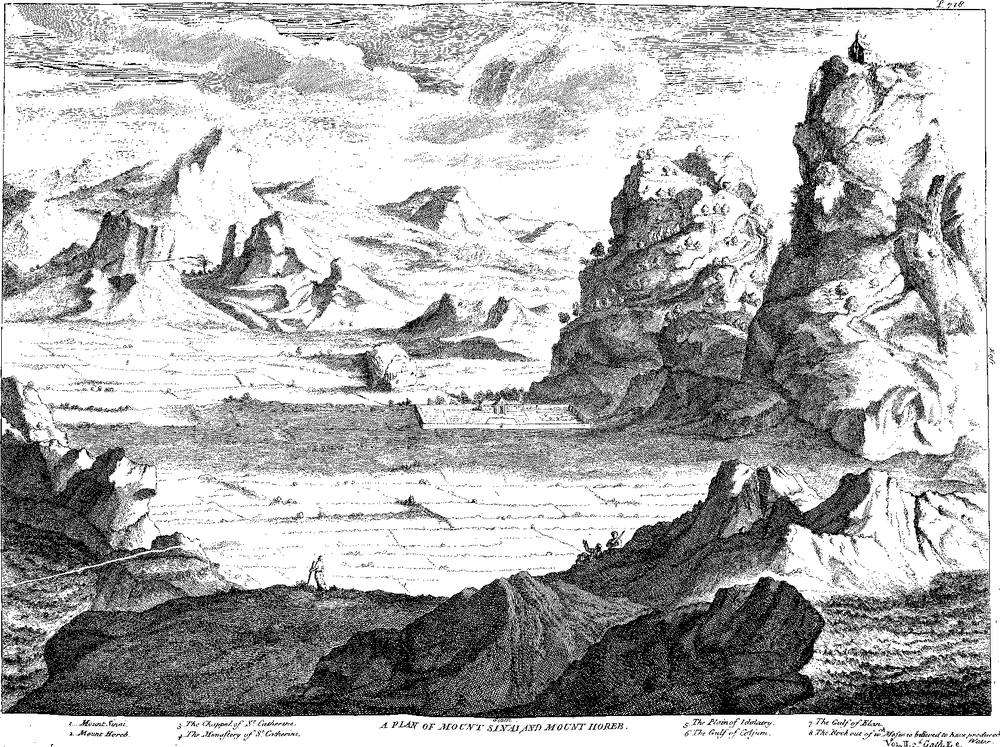
Upon this Mountain there is a Monastery of Greek Monks, who had heretofore only a Tower built near the burning Bush of Moses. But these Monks finding themselves much expos’d to the Insults of the Arabs, who devoured all their Provisions, even so much as the consecrated Bread of the Eucharist; they petition’d the Emperor Justinian to build them a strong Monastery, to secure them from the Depredations of the Arabs. The Emperor comply’d with their Request; but it is said, that he put the Architect to Death, for pitching upon this Place for the Monastery; this he did because of its Nearness to the burning Bush, and for the Conveniency of the Water.
The Name of St. Catherine was given to this Monastery, and to the Mountain itself, because of a Tradition generally received in the Country, that the Body of this Saint was transported hither by the Angels.
Mat. xxvii. 59. Mark xv. 46.SINCERITY. a This Word properly signifies Truth and Uprightness, when the Heart and Tongue agree together. Sincerity is oppos’d to Double-mindedness, Deceit, when the Sentiments of the Heart are contrary to the Language of the Mouth. The Latin Word Sincerus is derived from sine and cera, without Wax, Honey separated from the Wax, or pure Honey. In the Scripture sincere signifies pure, or without mixture. Sapientia est emanatio quædam Sap. vii. 25. Philip. i. 10.claritatis omnipotentis Dei sincera. St. Paul would have the Philippians be pure, that their Behaviour may be innocent, and give no Offence to any Body. That ye may be sincere, and without Offence till the Day of Christ. And St. Peter exhorts the pure and sincere Mind of the Faithful: Vestram 2 Pet. iii. 1. 1 Cor. v. 8.excito in commonitione sinceram mentem. St. Paul speaks of Sincerity and Truth, or of Purity and Truth, which he sets in Opposition to the leaven’d Bread of Impurity and Filthiness. He reproaches the false Apostles with not preaching Jesus Christ sincerely, purely, with upright and disinterested Sentiments of the Heart.
SINDON. This Word properly signifies a Shroud, and the Evangelists make use of it, to denote the Linen Cloth, in which Luke xxiii. 53.Joseph of Arimathea wrapp’d up the Body of Jesus Christ, after he had embalmed it, had winded Bandages about it, and had put the Napkin upon his Head. For St. John Joh. xx. 7.supplies those Circumstances that St. Matthew had omitted. The holy Napkins, or Sudaria, which are shewn in several Places, cannot be all the true Sindon in which Christ’s Body was involved, but are made in Imitation of it.
Pro. xxxi. 24.Sindon is also mention’d in the History of Samson.114 He promises the young Men that were at his Wedding; Triginta Sindones & totidem tunicas, if they could explain the Riddle that he proposed to them. The Hebrew says thirty Sedinim, and thirty Changes of Raiment. By Sedinim or Sindonem, some understand the Tunica which was put next the Skin; and by Changes of Raiment, compleat Suits of Cloaths, a Tunique and a Coat, for that was a compleat Suit; or only thirty Coats, which, with the thirty Tuniques, made up thirty Changes of Raiment.
Isa. iii. 23. Mart. l. 4 Ep. 19.The virtuous Woman mention’d by Solomon, made Sindons and Girdles, which she sold to the Phenicians. The young Women of Jerusalem wore their Sindons, as appears from Isaiah. This was a Fashion peculiar to the Sidonians and the Phenicians, and perhaps the Name was derived from the City of Sidon. Martial says, that the Sindon of Tyre or Phenicia, covers a Man all over, and puts him in a Condition to despise the Rain and the Wind.
Ridebis ventos, hoc munere tectus, & imbres,
Nec sic in Syriâ Sindone tectus eris.
The young Man that follow’d Jesus Christ the Night of his Passion, Amictus sindone super nudo, was probably by this defended against the Cold, as with a Night -Gown. Mark xiv. 51.
Vide Interp. ad Gen. xxxii. 25, 32.SINEW. The Hebrews do not eat the Sinew of the Thigh of Animals, in Memory of the Sinew of Jacob’s Thigh, which the Angel touch’d, and which contracted such a Numbness, that according to some Interpreters, he went lame of it all his Life after. This Abstinence from the Sinew of the Thigh of Animals, is not commanded to the Israelites by any Law; for they must have abstained from it even before the Law, if the Observation that we find in Genesis xxxii. 32. was inserted by Moses. There are some Interpreters that think, this Forbearance of theirs is only Matter of voluntary Devotion. In some Places they abstain’d from the Hind-quarter of Animals, and sold it to others. In other Places they contented themselves with taking away the Sinew, and then they eat the Flesh. See what we have observed concerning this in the Article of Jacob.
SINITE, Sinæus. Gen. x. 17. By this Name is denoted the eighth Son of Canaan. The Sinites dwelt near Arce, in Mount Libanus.115 Strabo mentions the Fortress in Sinna in the Mountains. By Sinæi the Arabick means the Inhabitants of Tripolis in Phenicia.116
SION. a This is one of the Names of Mount Hermon. ‘Tis probably of this Psalm cxxxiii. 3.Mountain that the Psalmist speaks, As the Dew of Hermon, and as the Dew that descended upon the Mountains of Zion.117 The Union and the good Understanding of the Priests and Levites, is as agreeable as the Dew which falls upon Hermon and Sion, two contiguous Mountains, and which make only one Chain of Mountains. Jesus Ecclus. xxxiv. 17.the Son of Sirach speaks also of Mount Hermon under the Name of Sion. Quasi Cupressus in monte Sion. In the Greek it is, in monte Hermon.
SIPHMOTH, or Sephamoth: David sent to Siphmoth the Spoils he had taken from the Amalekites. 1 Sam. xxx. 28.
SIRAH, or Sira, a Well or Cistern not far from Hebron. 2 Sam. iii. 26.
SIRACH, Father of Jesus that compos’d the Book of Ecclesiasticus; whence he is commonly call’d Jesus the Son of Sirach.
SIRACIDES, Jesus the Son of Sirach.
SIRBON. The Lake Sirbon, known by the antient Geographers, was between Palestine and Egypt, upon the Coast of the Mediterranean Sea, not far from Mount Casius. It had a Communication with the Mediterranean Sea, by a small Arm. Sometimes it is adjudged to belong to Egypt, and sometimes to Judea, because it lay between both Countries. There are some that think, that this Lake is now dry’d up, or fill’d with Sand. The Scripture no where mentions it, that we know of.
SIRENS, Sea-monsters, famous in the Writings of the Poets. They tells us, the Sirens were the Daughters of the River Achelous, and of one of the nine Muses. Some say Melpomene; others Calliope or Terpsichore, or Sterope; in a word, they are not agreed, either in their Mother’s Name, or in their own. They were three in Number. Some call’d them Aglaepe, Pisinoe, Thelxiopia; others Thelxiope, Molpe, Aglaophonos; others again, Leucosie, Ligea, Parthenope. Their Dwelling was upon the Coast of the Sicilian Sea, and they sung so harmoniously, that the Mariners that pass’d that Way were in Danger of being shipwreck’d, by approaching too near the Shore, in stopping to hear them.
Ovid. de arte, l. 3. v. 311.Monstra maris Sirenes erant, quæ voce canorâ
Quaslibet admissas detinuere rates.
Apollon. Argonaut. l. 4.They were partly like fine Women, and partly like Birds. They had the Wings and Feet of Birds, and as to the rest, they were Women. When the Argonautes pass’d that Way, the Sirens did what they could to charm them; but Orpheus taking his Harp, made their Songs and other Attempts useless. So that the Sirens, in Despair at being overcome, threw themselves into the Sea, and became Rocks. Others say, they precipitated themselves into the Sea, and were changed into Sea-monsters, having half the Body of a Woman, and the other half of a Fish; and that this happen’d to ‘em after Ulysses had disappointed their Expectation, by stopping his Companions Ears with Wax, and making himself to be lash’d fast with Ropes to the Mast of his Ship; forbidding that any one should untie him, whatever Instances he should make.
But we shall not enter upon an Examination of these Fables. What gives us Occasion to speak of Sirens here, is because we find their Name in Isaiah xiii. 22. Respondebunt ululæ in ædibus ejus, & Sirenes in ædibus voluptatis. The Prophet speaks of the Destruction of Babylon; he says, that this famous City shall be reduced to a dismal Wilderness, that the Waters shall cover its Ruins, that Sea-monsters shall be seen there, Birds of ill Omen, Owls, Bitterns, &c. The Latin Text to these adds Sirens; the Septuagint calls them Hedgehogs or Urchins; the Hebrew Text reads Thannim. But if we compare together all the Passages Thannim. LXX. ‘Εχῖνοι.in which the Word Thannim occurs, we may observe that it signifies a great Fish, a Sea-monster, a Fish that puts forth loud Cries, that feeds its Young by the Nipple, whose Abode is in the Sea, and in watry Places: Qualities which agree with a Whale, or a Sea-calf, which probably IsaiahVide Job xxx. 29. Mic. i. 8. Lament. iv. 3. Psal. lviii. 7. Isaiah xxvii. 2. Ez. xxxii. 2. intended to represent here.
Perhaps St. Jerome, in translating it by Sirens, intended to express certain Sea-monsters which, they say, have a near Resemblance to a Man. ‘Tis said in 1672 they caught a Siren at Malta. Cornelius à Lapide speaks of a Siren taken in Frizeland, which, they say, lived long enough to learn to spin. Between the Island Ceilon and the Point of Indus, they took nine Sirens and seven Tritons. Upon the Coasts of Martinico, near a Promontory call’d the Diamond, was seen a Sea-monster, who upwards from his Middle had the Shape of a Man, and the rest was like a Fish. In the Philippine Islands they catch a certain sort of Fishes like Sirens. There are many of them also to be seen in the Province of Angola. They are found to be Male and Female, being eight Foot long, and four in breadth: Their Arms are very short, but their Fingers are long; their Head and Eyes are oval, their Fore-head high, Nose flat, with a large Mouth; but they have hardly any Chin or Ears. When they are kill’d, they cry out as a Man118
Sirens continues on the next page
Footnotes
-
Josh. xiii. 3. A fluvio turbido. Heb. A fluvio Sihor. ,שיחורShichor. Vid. & Jer. ii. 18. p. 730. ↩
-
Reland. Palæstin. l. 3. ↩
-
Plin. l. 5. c. 19. Strabo, l. 16. ↩
-
Josh. xix. 26. שיחור לבנת ↩
-
Plin. l. 5. c. 19. ↩
-
Translators’ note. Our Translation says, In royal Apparel of blue and white, and with a great Crown of Gold, and with a Garment of fine Linen and purple. ↩
-
Ezek. xvi. 10. ,משיMeshi. Vulg. Subtilibus, Rabb. Kimchi, Jarchi, Abenezra, Abravanel, Jun. Munst. Pagn. Mont. Grot. Fuller, alii, Seriam. ↩
-
Τειχάπλον, Theodoret. Πλέσμα ἀπὸ τειχῶν ἐσκευασμένον, ↩
-
Sym. γυναικῶν περιτιθέμενον κεφαλαῖς. Hesychius Τειχάπλον βομβύκιον ὕφασμα ὑπὲρ τῶν τειχῶν κεφαλῆς ἀπλίμενον. Ὀπίνδυμα. Aquil. Ἄνθεμον. ↩
-
Isai. xix. 9. .עברי בשתיםLXX. Λίνον χιτόν. Sym. Λίνον κτενίσιον. ↩
-
Epiphan. de Vita & Morte Prophet. p. 248 ↩
-
Hieronym. in Jer. xiv. & xxxii. & in Matth. x. ↩
-
Monconis’s Travels to the Holy Land, part 2. p. 38. ↩
-
Rab. Nathan. in Aboth. c. 35. born ↩
-
Gen. xxxiv. 25. In the Year of the World 2265, before Christ 1735, before the Vulgar Era 1739. ↩
-
Gen. xxxvii. 19. In the Year of the World 2276, before Christ 1724, before the Vulgar Era 1728. ↩
-
Gen. xlii. 25. In the Year of the World 2297, before Christ 1703, before the Vulgar Era 1707. ↩
-
Gen. xlix. 5. In the Year of the World 2315, before Christ 1685, before the Vulgar Era 1689. ↩
-
Tertull. contra Judæos, c. 10. & contra Marcion, l. 3. c. 18. Ambros. de Benedict. Patriarch. c. 3. ↩
-
In the Year of the World 2367, before Christ 1633, before the Vulgar Era 1637. ↩
-
Cels. Præfat. in Disput. Joan. & Papisci. Inter Opera Cypriani. ↩
-
Method. Patar. Cyril. Jerosol. orat. de occursu Domini. Athanas. lib. de Essentia communi, &c. Epiphan. de PP.. V. T. Leon. Imperat. Orat. de Purific. B. M. V. Sophron. Jerosolym. Dionys. Carthus. Franc. Luc. Lyr. Tolet. Gajet. alii plures apud Allatium, de Simeonibus, p. 3. ↩
-
Phot. Euthym. Theophylact. Jansen. Barrad. Tillemont. Not. 6. sup. J.C. tom. 1. p 448. ↩
-
Galatin. l. 1. c. 3. Vide Allat. loco citato, p. 1, 2. ↩
-
Vide Nicephor. Hist. Eccl. l. 1. c. 12. ↩
-
Cedren. in Synopsi Georg. seu Gregor. Pardus Damascen. Thessalonic. apud Allat. loc. cit. p. 2, 3. ↩
-
Euseb. Hist. Eccles. l. 3. c. 32. ↩
-
Epiphan, de mensur. c. 15. Euseb. Demonstr. l. 3. c. 5. ↩
-
Vide Misnah. in Joma, & Maimon. in Jom. Hac- cipurim. ↩
-
This was not appointed in Scripture; but however, Custom had given it Authority. ↩
-
1 Macc. v. 17, 18. In the Year of the World 3841, before Christ 159, before the vulgar Era 163. ↩
-
1 Macc. x. 74, 75, &c. In the Year of the World 3856, before Christ 144, before the vulgar Era 148. ↩
-
1 Macc. xi. 59. In the Year of the World 3860, before Christ 139, before the vulgar Era 143. ↩
-
1 Macc. xii. 48, &c. xiii. 1, 2, 3, &c. In the Years of the World 3860, 3861, before Christ 140 & 139, before the vulgar Era 144 & 143. ↩
-
1 Macc. ii. 65. In the Year of the World 3838, before Christ 162, before the vulgar Era 166. ↩
-
1 Macc. xiii. 31, 32, &c. In the Year of the World 3861, before Christ 139, before the vulgar Era 143. ↩
-
1 Macc. xiii. 54. In the Year of the World 3862, before Christ 138, before the vulgar Era 142. ↩
-
1 Macc. xvi. 4, 5, 6, &c. In the Year of the World 3863, before Christ 137, before the vulgar Era 141. ↩
-
1 Macc. xv. 15, 16, 17, &c. In the Year of the World 3865, before Christ 135, before the vulgar Era 139. ↩
-
1 Macc. xiv. 18, 19, &c. About the Year of the World 3864, or 3865. ↩
-
1 Macc. xiv. 24, 25, &c. The Latin Text insinuates, The Roman People; but the Greek and Syriac say only, The People; and the whole Tenor of the Discourse shews, that it must be understood of the Jewish People. This happen’d in the Year of the World 3863, before Christ 137, before the vulgar Era 141. ↩
-
There are yet to be seen some of the Coins of Si- mon Maccabeus; they are of Silver of the Value of a Shekel, or half a Shekel, with this Inscription; Such a Year of the De- liverance of Sion, or of Israel, or of Jerusalem, &c. See the Dissertation upon Jewish Coins and Medals. ↩
-
1 Macc. xv. 38, 39 40, &c. 1 Macc. xvi. 1, 2, 3, &c. In the Year of the World 3866, before Christ 134, before the vulgar Era 138. ↩
-
1 Macc. xvi. 11, 12, &c. In the Year of the World 3869, before Christ 131, before the vulgar Era 135. ↩
-
2 Macc. iii. 4, 5. In the Year of the World 3828, before Christ 172, before the vulgar Era 176. ↩
-
2 Macc. iv. 1, 2, 3. In the same Year. ↩
-
2 Macc. iv. 7, 8, 9. In the Year of the World 3829, before Christ 171, before the vulgar Era 175. ↩
-
2 Macc. iv. 23, 24, &c. In the Year of the World 3832, before Christ 168, before the vulgar Era 172. ↩
-
Joseph. Antiq. l. 15. c. 12. p. 537. ↩
-
Joseph. Antiq. l. 17. c. 6. p. 589. ↩
-
Joseph. Antiq. l. 19. c. 5. p. 675. & l. 6. p. 676. ↩
-
Joseph. Antiq. l. 20. c. 1. p. 683. E. ↩
-
Ambros. in Luc. x. Hilar. in Matth. xxvii. Leo mag. serm. 8. de passione. Beda, Druthmar, &c. ↩
-
Maldon. Grot. Brug. Jansen. ↩
-
Vide Cornel. a Lapide in Matth. xxvii. ↩
-
From Chenani, Chananean, or Canaanite. ↩
-
From Kana, comes Kani or Kanani. ↩
-
Theodoret. in Psal. lxvii. 18. Hieron. in Matth. x. ↩
-
Hammond. in Matth. x. Grot. Lightfoot, Scaliger. &c. ↩
-
Joseph. de Bello, l. iv. c. 2. item. ↩
-
Fortunat. Pictav. Carmin. l. 8. c. 4. Beda Retract. in Acta, c. 1. v. 13. Abdias l. 6. 36, 37, &c. In the 31st Year of the vulgar Era. ↩
-
Luke vii. ↩
-
Matth. xxvi. 6. Mark xiv. 8. John xi. 1, 2. xii. 3, 4, 5. In the 33d Year of the vulgar Era, five or six Days before the Death of Christ. ↩
-
Acts xiii. 1. About the 44th Year of the vulgar Era. ↩
-
Acts ix. 43. In the 35th Year of the vulgar Era. ↩
-
Epiphan. hæres. 21. & Justin. Apolog. 2. p. 69. ↩
-
Acts viii. 5.——13. In the 34th Year of the vulgar Era. ↩
-
Theodoret. hæret. fabul. l. 1. c. 1. ↩
-
Justin. Irenæ. Tertull. Euseb. Cyrill. August. Theodoret. ↩
-
Simoni Deo sancto. Ita Justin. Tertull. Cyrill. ↩
-
Euseb. l. 2. c. 14. Hist. Eccl. Hieron. de Viris Illust. c. 1. Theodoret. Hæret. fab. l. 1. c. 1. ↩
-
Arnob. l. 2. Maxim. Tyrius, homil. 54. Ambros. Hexaemer. l. 4. Cyril. Cathech. 6, &c. ↩
-
Vid. Nazianz. Orat. 23, 24. Euseb. in Marcion. l. 4. c. 9. ↩
-
Vid. Iren. l. 1. c. 20. Epiphan. Hæres. 21. Aug. de Hæres. l. 1. ↩
-
Theodoret. Hæres. Justin. Apol. 2. Iren. l. 1. c. 20. Tertull. de Anim. c. 34. ↩
-
Joseph. de Bello, l. 4. c. 34. In the 69th Year of the Vulgar Era. ↩
-
Joseph. de Bello, l. 7. c. 7. In the 70th Year of the Vulgar Era. ↩
-
Joseph. de Bello, l. 2. c. 44. p. 828. In the 66th or 67th Year of Christ, or of the Vulgar Era. ↩
-
2 Cor. v. 10. Coloss. ii. 4, 5, &c. Philip. iii. 2, 3, &c. 2 Tim. iii. 14, 15, 16, &c. ↩
-
Clem. Alex. Stromat. l. 2. p. 383. ↩
-
Iren. l. 1. c. 20. ↩
-
Origen. in Celf. l. 5. p. 272. b. ↩
-
Idem l. 1. cont. Celf. p. 44. About the Year 249. ↩
-
Idem l. 5. p. 272. ↩
-
Euseb. Hist. Eccl. l. 2. c. 1. p. 39, 40. ↩
-
Joseph. in Vita sua, p. 1007. ↩
-
Cod. Megil. fol. 70. col. 1. Gemar. Jerosol. ↩
-
חטאת, Chataath, Peccatum. Ἁμαρτία, ἀσέβημα, πλημμέλεια, ἀνομία. ↩
-
אשמת, Ashamath, Delictum. Πλημμέλεια, ἁμαρτία, ἄγνοια, ἀδικία, ἀνομία. ↩
-
שגגה, Shegaga, Ignorantia. LXX. Ἀκουσίως, Involuntarie. ↩
-
Levit. iv. 3, 25, 29. v. 6. vii. 2. Psal. xxxix. 7. Rom. viii. 3. ↩
-
Athanas. Ep. 4. ad Serapion. n. 8, 9, 10. ↩
-
Hilar. in Matth. xii. & xxxi. n. 5. ↩
-
Theophil. Antioch. Comment. in Evangel. l. 1. ↩
-
August. l. 1. Serm. Domini in Monte, c. 22. ↩
-
Aug. Retract. l. 1. c. 19. ↩
-
Idem Exposit. inchoata in Ep. ad Rom. n. 14. & 22. & Serm. 71. nov. edit. n. 8, 9, 10, 20, &c. & Ep. 85. n. 5. ↩
-
Chrysoth. Homil. 42. in Matth. ↩
-
Auth. Oper. imp. in Matth. Hom. 31. ↩
-
Isidor. Pelus. Ep. l. 1. Ep. 59. ↩
-
Ambros. in Luk. l. x. n. 94. ↩
-
Lib. 1. de Spiritu Sancto, c. 3. ↩
-
Ambros. lib. de Poenit. l. 2. c. 4. ↩
-
Constitut. Apost. l. 6. c. 18. ↩
-
Philast. Hæresi Rhetorii. ↩
-
Hermas Pastor. l. 3. similit. 6, 8, 9. ↩
-
Auth. Qu. in V. & N. Test. qu. 102. ↩
-
Pacian. Ep. 3. ad Sympron. ↩
-
Recognit. l. 2. c. 23. ↩
-
Grot. in Matth. xii. 31. ↩
-
Hieronym. in Matth. xii. & Ep. 149. ad Marcellam. ↩
-
Vid. Manasse Ben-Israel, conciliat. in Genes. qu. 6. p. 12. & de Creatione, probl. 17. p. 61. ↩
-
Exod. xix. 1. xxiv. 16. xxxi. 18. xxxiv. 2, 4, &c. Levit. xxv. 1. xxvi. 45, &c. ↩
-
Judg. xiv. 12, 13. סדינים וחלפות ↩
-
Hieronym. quæst. ↩
-
Sincerus, ἀκέραιος, εἰλικρινής, ἁπλῶς, &c. Hebr. in Genes. ↩
-
The Hebrew here says, Zion, ;ציוןbut it seems to be put for Sion, * .שיאוןSo the Latin Vulgate; but our Translation has, Dragons in their pleasant Houses. ↩
-
Deut. iv. 48. שיאןShion or Sion. ↩