Volume II, pages 178–197 of the 1732 edition, from MEM to MIC: everything printed on these pages, in order.
Continued from Memnon
MEMNON. Josephus1 assures us, that the Tomb of Memnon was in the Neighbourhood of the River Beleus, so famous for its Sand, of which they make Glass. See BELEUS. We know not of what Memnon this can be the Tomb, which Josephus mentions. For the famous Statue of Memnon, which they say gave so agreeable a Sound at the Sun-rising, was at Thebes in the higher Egypt, and not in Palestine. And the other Memnon, Son of Tithon and Aurora, was killed at the Siege of Troy by Achilles. As there have been many famous Men by the Name of Memnon, it may easily be, that one of them was buried near the River Beleus.
MEMORY. See REMEMBRANCE.
MEMPHIS, in Hebrew, Noph, or Moph, a very famous City of Egypt, situate at about fifteen Thousand Paces above the parting of the Nile, or where the Delta begins2. Above Memphis, towards the South, were the famous Pyramids, two of which were esteemed the Wonders of the World. Memphis for a long Time was the Place of Residence of the ancient Kings of Egypt, till the Times of the Ptolemies, who commonly resided at Alexandria. The City of Memphis is now entirely destroyed. The Prophets often speak of Memphis.See Isai. xix. 13. Jerem. xliv. 1. xlvi. 14, 19. Hosea ix. 6. Ezek. xxx. 13, 16. They foretel the Miseries it was to suffer from the Kings of Chaldæa and Persia, and they threaten the Israelites that should retire into Egypt, or should have Recourse to the Egyptians, that they should perish in this Countrey. Ezekiel says, that the Lord will destroy the Idols of Memphis. ‘Twas in this City that they fed the Ox Apis, that King Cambyses put to Death.
This City is called Mesr, or Misr, by the Orientals, as being the Capital of Egypt, otherwise Mezer or Mizraim. They also call it Monf, a Name nearly approaching to the Hebrew Word Noph, or Moph, from whence the Greeks have formed their Memphis. The ancient Kings of Egypt took much Pleasure in adorning it. It continued in its Beauty till the Arabians made a Conquest of Egypt, under the Calif Omar, in the eighteenth or nineteenth Year of the Hegira, or 640 of Jesus Christ. Amron Ben-as, who took it, built another City just by it, which was called Fustbat3, because of the Tent of this General, which was for a long Time set up in this Place. The Califs Fatimites, who became Masters of Egypt, added another to it which they called Caherah, that is, the Victorious, which is still known to us at this Day by the Name of Grand Cairo.
The Mammeluck Sultans, of the Dynasty of the Circassians, having afterward built a very high and fortified Castle; on the Eastern Shore of the Nile, brought it about by little and little, that the City of Cairo changed its Place; so that what the Fatimites had built is still to this Day called the old Cairo. But it must be observed, that the ancient Mesr, or Memphis, stood on the Western Shore of the Nile, and that whatever the Arabians have built there from Time to Time, is on the Eastern Shore of this River.
Isai. xix. 11, 12, 13, &c.So that at length, after a Succession of Ages, is fulfilled what the Prophets had predicted against Memphis. “These wise Counsellors of Pharaoh have given him foolish Advice: How do you say to Pharaoh, I am the Son of the wise, the Son of ancient Kings? Let these wise Men now tell you, what the Lord has resolved upon concerning Egypt. They are Fools, these wise Men of Egypt; they are without Wisdom, these Princes of Memphis; they have deceived Egypt and all its People. The Lord has scattered amongst them a Spirit of Infatuation. They have made Egypt to wander, as a Man drunk with Wine. Egypt shall be then uncertain what she shall do. Great and Small, those that command, and those that obey, shall all be in Trouble and Confusion. They shall be astonished, they shall tremble like Women. In that Time the Land of Judah shall become the Terror of Egypt, &c.” We imagine all this relates to the Time of the War of Sennacherib against Egypt, and the Divisions that followed the Death of Sethon King of Egypt. See the Commentary upon the xix Chapter of Isaiah.
Jeremiah describes the Calamities that Jerem. xlii, xliv, xlv, xlvi.Nebuchadnezzar was to bring upon the same Countrey in a plainer Manner than this. “I shall send Nebuchadnezzar King of Babylon, my Servant, who shall set up his Throne in the City of Taphantes it self. He shall come and destroy the whole Countrey of Egypt. He shall put to Death him that is appointed for Death, and shall carry into Captivity him that is designed for Captivity, and shall put to the Sword him that is to die by the Sword. He shall set on Fire the Temples of Egypt, and shall carry away the Gods of Egypt into Captivity. He shall break down the Statues, the Pillars, or Obelisques, which are in the Temple of the Sun; probably at Memphis.” All this came to pass under the Reign of Pharaohhophra King of Egypt, whom Nebuchadnezzar overcame and put to Death. Oh thou Daughter dwelling in Egypt, furnish thy self to go into Captivity; for Noph shall be waste and desolate
without an Inhabitant.
Jer. xlvi. 19.Ezekiel also relates at large the Misfortunes which Nebuchadnezzar brought upon Egypt. He says that the Lord had delivered this Countrey into Nebuchadnezzar’s Hands, as a Recompence of those Services he had performed for him at the Siege of Tyre4. He speaks in Particular of the City of Memphis. Thus says the Lord God, I will also destroy the Idols, and will cause their Images to cease out of Noph, and there shall be no more a Prince of the Land of Egypt, and I will put a Fear in the Land of Egypt. And I will make Pathros desolate, and will execute Judgments in No.
A long while after5 Cambyses King of Persia, and Son of Cyrus, made himself Master of Egypt, having first taken Pelusium, which is as it were the Key of Egypt6, when Psammenites King of Egypt marched out to meet him, at the Head of a powerful Army. Cambyses defeated him, and those that could escape took Refuge in Memphis; whither Cambyses pursued them, and sent to the City by Means of the Nile, a Ship of Mitylene, with a Summons to ‘em to surrender. But the Egyptians in a great Rage fell upon the Herald, and upon the rest of those in the Ship, cutting them all to Pieces. When Cambyses in a short Time had made himself Master of the Place, he ordered as many Egyptians to be publickly executed, as there were Persons in the Ship of Mitylene, and those of the Chief of the Nobility. The eldest Son of King Psammenites was one of this Number. As for the King himself, Cambyses saved his Life, and even appointed him a sufficient Maintenance, but he did not enjoy it long. For it was found that he endeavoured to raise Commotions in the Kingdom, so they made him drink Bulls Blood, which killed him upon the Spot.
Egypt continued under the Government of the Persians till the Reign of Artaxerxes7. Then they shook off the Yoke, and chose Inarus Prince of the Libyans for their King. They called in the Athenians to their Assistance; Charitimis was intrusted with the Conduct of this Enterprize; and Artaxerxes sent Achemenides, one of his Brothers, against the Rebels, at the Head of an Army of 300000 Men. The Persians were beaten, and lost in one Battle 100000 Men. Those that escaped retired to Memphis, whither the Conquerors pursued them, and immediately made themselves Masters of two Parts of the City. But the Persians having fortified themselves in the third Part, called the white Wall, which was the largest and strongest of the three; they held out a Siege there of near three Years, till they were relieved by others sent to their Assistance.
Alexander the Great having conquered Egypt from the Persians, and having there built Alexandria, the Kings of Egypt his Successors thought of nothing else so much as of enlarging and beautifying Alexandria, till it became the capital City of Egypt. Memphis was then of small Consideration, and after several Revolutions in its Fortune it was finally destroyed by the Arabians, as we have said before.
MEMRA. This Word is often found in the Chaldee Paraphrases of the Books of Moses. It signifies the Word, and it is pretended, that under this Term the Authors of those Paraphrases would intimate the Son of God, the second Person of the Trinity. Now their Testimony is so much the more considerable, as having lived before Jesus Christ, or at the Time of Jesus Christ, they are irrefragable Witnesses of the Sentiments of their Nation concerning this Article, since their Targum or Explication has always been, and still is, in universal Esteem among the Jews. In the greatest Part of the Passages where the sacred Name of Jehovah is to be found, the Paraphrasts have there substituted the Word Memra, which signifies the Word, and which differs from Pitgama, which in Chaldee signifies Discourse. And as they ascribe to Memra all the Attributes of the Deity, ‘tis concluded from thence, that they believed the Divinity of the Word.
In Effect, ‘twas Memra that created the World. ‘Twas the same that appeared to Abraham in the Plain of Mamre, and to Jacob on the Top of Bethel. ‘Twas the same whom Jacob appealed to as a Witness of the Covenant made between him and Laban. Let the Word see between thee and me. ‘Twas the same Word that appeared to Moses at the Foot of Sinai, and that gave the Law to the Israelites, that spoke Face to Face with this Lawgiver, that marched at the Head of this People, and made them conquer Nations, and was a revenging and consuming Fire for all those that violated the Law of the Lord. All these Characters, where the Paraphrast makes Use of the Word Memra, clearly mark out the Almighty God. This Word therefore was God, and the Hebrews were of this Opinion, at the Time that the Targum was composed.
This Memra answers to the Cachema, or to the Wisdom mentioned by Solomon, in the Book of Proverbs, and by Jesus the Son of Sirach in his Book called Ecclesiasticus. And Prov. iii. 9, 20. viii. 11, 12, &c. Eccl. i, ii, iii, &c.to the Almighty Word, omnipotens sermo8
Wisd. xviii. 15. Wisd. xvi. 26.tuus, of the Book of Wisdom ; and again, That thy Children, O Lord, whom thou lovest might know, that it is not the growing of Fruits that nourisheth Man, but that it is thy Word which preserveth them that put their Trust in thee. And the Logos, the Word of which Philo speaks in so many Places9, and the same Logos, the Mystery of which St. John the Evangelist has so divinely discovered in the Beginning of his Gospel.
All this has perplexed those who deny the Divinity of the Word. In Order to elude the Authority of the Targum, Grotius has pretended, that according to the Jews God created a subaltern Being, or secondary Deity, whose Ministry he made Use of in the Creation of the World. But this Being that creates, whoever he be, must of Necessity be God, since nothing can have this Power but God alone, and this the Targum ascribes to the Memra.
M. le Clerc says almost the same Thing, writing upon the first Chapter of St. John. He maintains, that in all that Philo says of the Logos, he does not look upon the Word as a distinct Person, but that he makes an Angel of it, and a Principle inferior to the Deity. But tho’ Philo might have come short of due Accuracy, in some Passage wherein he discourses of the Word, treating of a Matter so sublime and abstruse as this was to him, we are not much to wonder at it; this Inaccuracy ought not to be imputed to the Word it self. But we should enquire whether St. John has not more fully explained it in his Gospel, who was much better informed than Philo in the Nature of the Memra. We may securely rely upon the Authority of this divine Writer, who had his Instructions from the Mouth of Jesus Christ himself, and by the Inspiration of his Spirit.
See the Article WORD in this Dictionary.
MEMUCAN, or Mamucan, one of the seven principal Councellors of the King of Persia, who advised Abasuerus to put away his Queen Vashti, Esth. i. 14, 16.
MENAHEM. or Manahem. See MANAHEM.
MENAN, or Menna, Son of Mattatha, and Father of Melea, one of the Ancestors of our Saviour Jesus Christ, according to the Flesh, Luke iii. 31.
MENE, or Mane; this Chaldæan Word signifies, he has numbered or counted. At a sacrilegious Feast which Belshazzar gave to his Courtiers and Concubines, he caused to be brought the sacred Vessels of the Temple of Jerusalem, which Nebuchadnezzar had carried to Babylon10. Then there appeared on the Wall like a Hand Writing these Words, Mene mene, tekel, upharsin. That is to say, God has numbered, has weighed, and divided. Nobody being able to explain the Meaning of these Words, Daniel was sent for, and told the King that God had numbered his Days, and that his Hour was come: That he had weighed his Actions, and found them too light; and lastly, that he had divided his Kingdom between the Medes and Persians. That Night Belshazzar was put to Death. See his Article11.
MENELAUS, otherwise called Onias IV. He succeeded Jason in the sovereign Priesthood of the Jews, and had Alcimus for his Successor. He was created in 3832, and put to Death ten Years after in 3842, before Christ 158, before the Vulgar Æra 162. We shall speak of him more at large under the Article ONIAS IV.
MENESTHEUS, or Mnestheus, Father of Apollonius, of whom Mention is made, 2 Macc. iv. 21. See APOLLONIUS.
MENI. The Goddess Meni is the Jerem. vii. 18. xliv. 17, 18. Isai. lxv. 11. Heb.Moon. Jeremiah speaks of her by the Title of Queen of Heaven, and Isaiah by the Name of Meni. Each of ‘em shew, that her Worship was very frequent in Palestine, and that the Hebrews were much addicted to it. Meni is probably the same as Astarta, and Venus Cælestis, in Honour among the Phœnicians and Carthaginians. ‘Twas from the Phœnicians or Canaanites, that the Israelites had learned the Worship of this false Deity. Isaiah reproaches them with setting up a Table to Gad, which is the Sun, and with making Libations to Meni. Qui ponitis Fortunæ (Heb. Gad.) Mensam, & libatis super eam: (Heb. & libatis Meni) Vulg. Jeremiah says, that in Honour of the Queen of Heaven, the Fathers light the Fire, the Mothers knead the Cakes, and the Children gather the Wood to bake them. Filii colligunt ligna, & patres succendunt ignem, & mulieres conspergunt adipem, ut faciant placentas Reginæ Cæli. Elsewhere the Israelites declare to the same Jeremiah, that notwithstanding his Remonstrances, they would continue to honour the Queen of Heaven, by offering Oblations to her, as their Fathers had done before them; and that ever since they had left off to sacrifice to the Queen of Heaven, they have been consumed by the Sword and by Famine. We may see by Strabo12, that Men, the Month or Moon, had several Temples dedicated to her Worship
in Asia Minor, and in Persia, and that they often swore by the Men of the King, that is, by his Fortune. See our Commentary upon ISAIAH, Chap. lxv. ℣ 11.
MENOIS, probably the same as Minois, of which Mention is made in the Subscriptions to some of the Councils13. Menois was not far from Gaza, as Eusebius14 informs us. ‘Tis without Doubt the same as Menoenum castrum, to be found in the Codex of Theodosius15. It was the Capital of the Maonians or Mæonians, of which Mention is made in Scripture. See 1 Chron. iv. 40, 41. and 2 Chron. xx. 1. in the Hebrew, and the Article Maon before, which is the same as Menois.
MEONOTHAI, or Maonathi, Son of Othniel, and Father of Ophrah, of the Tribe of Judah.
MEPHAATH, a City of the Tribe of Reuben, which was yielded to the Levites of the Family of Merari. Eusebius says, that in 1 Chron. iv. 13, 14. Josh. xiii. 18. Josh. xxi. 37.his Time the Romans kept a Garrison here, for the Security of the Countrey.
I. MEPHIBOSHETH, or Miphibosheth; Son of Saul and of his Concubine Rizpah. David delivered up Mephibosheth to the Gibeonites, to be by them hanged up before the Lord, by Way of Expiation for the Cruelties exercised by Saul against the Gibeonites, 2 Sam. xxi. 8, 9.
II. MEPHIBOSHETH, Son of Jonathan, otherwise named Meribbaal, as may be seen under that Article. Mephibosheth was very young, when his Father Jonathan was killed in the Battle of Gilboa16. His Nurse was in such Consternation at this News, that she let the Child fall, who from this Accident continued lame all his Life after. When David found himself in peaceable Possession of the Kingdom17, he sent to make a Search for all that remained of the House of Saul, that he might be kind to ‘em in Consideration of the Friendship between him and Jonathan. ‘Twas told him there was a Son of Jonathan’s, called Mephibosheth, in the House of Ziba, a Servant of Saul’s. The King sent for him, and told him, that for the Sake of Jonathan his Father he would shew Kindness to him, that he should have his Grandfathers Estate, and eat always at his Table. At the same Time he told Ziba, that he had given Mephibosheth all that belonged to Saul, bidding him make the best of the Lands for the Maintenance of Mephibosheth’s Son Micha; for as to himself, he should always be maintained at the King’s Table. So he dwelt at Jerusalem, and eat every Day with King David.
Some Years after this18, when Absalom rebelled against his Father, and forced him to leave Jerusalem, Mephibosheth ordered his Servant Ziba to saddle him an Ass, that he might go along with David; for being lame, he could not go on Foot. But Ziba not only refused him this, but went after David himself with two Asses loaden with Provisions, and told him that Mephibosheth, instead of coming to wait on the King, staid at Jerusalem, in Hopes that the People of Israel would restore him to the Throne of his Ancestors. Then says David to Ziba, I give to you every Thing that belonged to Mephibosheth. But after that Absalom’s Party was defeated, and David returned to Jerusalem in Peace, Mephibosheth came forth to meet the King. He appeared before him as one in deep Mourning, having neither washed his Feet, nor shaved his Beard, since the King went. When David saw him he asked him, Why did you go along with me, Mephibosheth? He answered, My Lord and my King, my Servant Ziba betrayed me in not obeying my Commands. For being lame as I am, I ordered him to prepare me an Ass that I might attend the King; instead of doing this, he went himself, to accuse me falsly to my Lord the King. But you, my Lord, are as an Angel of God, do with me as you please. For all the House of my Father have deserved nothing but Death at your Hands. instead of which you have been graciously pleased to give me a Place at your Table. What Occasion then have I to complain, and why should I be troublesome any longer? The King said to him, ‘Tis enough, what I have once ordered shall stand good; therefore do you and Ziba divide the Lands between you. To this Mephibosheth replied, I am very willing that he should have all, since I have seen my Lord the King return safely to his own House. Mephibosheth left a Son named Micha. The Time of his Death is not known.
1 Chron. viii. 34. 1 Sam. xiv. 49. xviii. 17, 19.MERAB, or Merob, the eldest Daughter of King Saul. She was promised to David in Marriage, as a Reward for that Victory which he obtained over the Giant Goliah; but Saul went from his Word, and gave her to Adriel the Son of Barzillai the Meholathite. Merab had six Sons by him, who were delivered over to the Gibeonites, and crucified upon the Mountain before the Lord, as a Reparation for that Injustice that
Saul had done the Gibeonites19. The Text of Scripture insinuates, that the six Men that were delivered to ‘em, were the Sons of Michal the Daughter of Saul, and Wife of Adriel. But there is great Room for Suspicion, that the Name of Michal is slipt into the Text instead of Merob20. For 1. Michal did not marry Adriel, but Phaltiel; and 2. We no where read that Michal had six Sons. Others21 think that these six Children were Sons of Merob by Birth, but Michal’s by Adoption.
MERAIAH, or Maraia, Son of Saraiah, of the Race of the Priests. He returned to Jerusalem from the Captivity of Babylon, Nehem. xii. 12.
I. MERAIOTH, or Maraioth, Son of Abitub the High-priest of the Jews, 1 Chron. ix. 11.
II. MERAIOTH, Son of Zerahiah. This is probably the same as before mentioned, Ezra vii. 3. See the Commentary upon this Place.
III. MERAIOTH, or Merajoth, a Priest of the Race of Aaron. He was Son of Zerahiah, and Father of Amariah. He is put among the High-priests in 1 Chron. Ch. vi. ✓ 6.MERAN, or Merrha; Baruch iii. 23.
speaks of the Merchants of Meran, whom he joins with the Hagarenes, and with the Inhabitants of Theman, who valued themselves for their superior Understanding. All these People, without Doubt, were Arabians, but we cannot say exactly where Meran was. We know Marana upon the Red-Sea, Mariaba in Arabia Fælix, and Marace, a Place of Trade in the same Countrey.
I. MERARI, the third Son of Levi, and Father of Mahali and Mushi, Exod. vi. 19.
II. MERARI, Son of Ox, and Father of Judith, of the Tribe of Simeon, Judith viii. 1.
Acts xiv. 11.MERCURY, Son of Jupiter and Maia, one of the fabulous Gods of the ancient Pagans, and the Messenger of the other Gods. He was worshipped as the Deity that presided over Learning, Eloquence, and Traffick. The Greeks gave him the Name of Hermes, which signifies an Interpreter, because they looked upon him as the Interpreter of the Will of the Gods. ‘Twas probably for this Reason that the People of Lystra having heard St. Paul preach, and having seen him heal a sick Man, would have offered Sacrifices to him, as if he had been Mercury, and to St. Barnabas as if he had been Jupiter, probably because of his venerable Aspect. They called Barnabas Jupiter, and Paul, Mercurius, because he was the chief Speaker. The Pagans seem to have confounded some Characters of the Life of Mercury, with that of Aaron the High-priest, the Brother of Moses. Mercury was the Messenger and Interpreter of the Gods, as Aaron was the Prophet and Interpreter of the Lord, and the Tongue of Moses. Mercury is represented with a miraculous Wand or Rod; Aaron also had a miraculous Rod, that budded, and was laid up near the Ark. Mercury was the God of Thieves; Aaron and the other Jews rifled the Egyptians of their Treasures. Mercury was the Inventer of the Harp; the Children of Aaron and the Levites were employed in playing upon Instruments of Musick in the Lord’s Temple. Mercury is the God of Travellers, Aaron, together with Moses, conducted the Children of Israel in their Journey through the Desert, &c.
The wise Author of the Book of Proverbs22 says, He that raises a Fool to Honour, is like him that throws a Stone to the Heap of Mercury. ‘Tis as absurd or superfluous to exalt a Fool to Honour and Dignity, as it is to cast a Stone at the Foot of a Statue of Mercury, set up in a Crossway: For this is, as we may say, to add one useless Thing to another. This Piece of Superstition, of laying a Heap of Stones at a Term or Limit, or at a half Statue of Mercury set up in a High-way, was in Practice among the Ancients23. But it may well be doubted, whether in this Place Solomon had any Intention to speak of Mercury, or of the Heap of Stones that was used to be cast at the Feet of his Statue. The Hebrew Text24 makes no Mention of Mercury. Some translate it thus, To give Honours to a Fool, is to bind a Stone in a Sling. The Stone thus bound will continue immovable, and cannot be discharged from the Sling. So a Fool can make no Use of the Honour that shall be conferred upon him. Otherwise thus. As a Stone cast upon a Heap of other common Stones is useless, so is the Honour that is conferred upon a Fool. ‘Tis only adding another Stone to a Heap of Stones. Ragam, which is the Root of Margemah, signifies to stone, or to overwhelm with Stones25. The Rabbins commonly understand it of a Heap of Stones amassed together in Honour of Mercury
, as the Author of the Vulgate has rendered it in his Translation. But the Seventy translate it by a Sling26. I could easily come into the Chaldee Explication. Like as a Plate, or Lingot of Gold or Silver, put in a Sling, is a Thing very ill placed, so is the Honour that is given to a Fool. The Hebrew Wordu Zeror-eben, an Heap of Stones, may signify a Bundle of Bars of Gold or Silver, tried by the Touch-Stone, or weighed with a Stone-Weight. The Jews made Use of Stones instead of Weights. Prov. xx. 10, 23, according to the Hebrew, is Stone and Stone, instead of Weight and Weight. See also Deut. xxv. 13.
MERCY, Misericordia. This is a Virtue that inspires us with Compassion for our Brethren, and which inclines us to give ‘em Assistance in their Necessities: That the Works of Mercy may be acceptable to God, and may purchase eternal Life for us, as Christ has promised us, it is not enough that they proceed from a natural Principle of Humanity, but they must be performed for the Sake of God, and upon supernatural Motives. In Scripture Mercy and Truth are commonly joined together27, to shew the Goodness that precedes, and the Faithfulness that accompanies the Promises; or else a Goodness, a Clemency, a Mercy that is constant and faithful, that does not deceive, and which is followed by Works. Mercy is also taken for those Favours and Benefits that we receive either from God or Man. It is taken for Probity, Justice, Goodness. Merciful Men, in Hebrew, Charidim, are Men of Piety and Goodness28. Finally, Mercy is often taken for giving of Alms.
Prov. xiv. 34. xvi. 6. Zach. vii. 9.MERCY-SEAT, Propitiatorium, otherwise Oraculum; in Hebrew, Capporeth, in Greek, Hilasterion29. We shall speak of it afterwards, under the Word ORACLE. The Mercy-Seat was the Covering of the Ark of the Covenant, or of the holy Chest in which the Tables of the Law were deposited. This Cover was of Gold, and at its two Ends were fixed the two Cherubims of the same Metal, which by their Wings extended forwards, seemed to form a Throne for the Majesty of God, who in Scripture is represented to us, as sitting between the Cherubims; and the Ark it self was as it were his Footstool. ‘Twas from hence that God gave his Oracles to Moses, or to the High-priest that consulted him; and ‘tis probable for this Reason, that St. Jerome in some Places has translated Capporeth by Oracle. In the Ecclesiastical Style of the Christian Church, they have given the Name of Propitiatorium to the Crownwork, or kind of Canopy, which was over the Altar, and which was otherwise called Ciborium, or Confessio.
I. MEREMOTH, or Maremath, Son of Urijah; he was one of those that put away their Wives, whom they had married against the Rules of the Law.
II. MEREMOTH, a Priest of the Num- Ezra x. ber of those who returned from the Captivity 30. Ne-hem. iii. of Babylon, and who set up the Vessels of 44. Gold and Silver, which had been restored to the Temple by King Artaxerxes, when Ezra returned from the Captivity of Babylon to Judæa, in 3537, before Christ 463, before the Vulgar Æra 467.
MERES, or Mares, one of the chief Princes of the Court of Abasuerus, Esth. i. 14.
MERIB-BAAL, or Meribaal, Son of Jonathan, and Father of Micah, 1 Chron. viii. 34. ix. 40. Merib-baal, is the same as Mephibosheth, 2 Sam. iv. 4. and ix. 12. The Hebrews made a Scruple of pronouncing the Name of Baal; so that instead of Mephi-baal or Meri-baal, they chose to say Mephibosheth, or Meribosheth. Bosheth in Hebrew signifies Shame, Confusion, Filth; and Baal, the Master, the Husband, the God Baal.
MERODACH, was an ancient King of Babylon, who was placed among the Gods, and worshipped by the Babylonians. Jeremiah, speaking of the Ruine of Babylon says, Babylon is taken, Bel, is confounded, Merodach is broken in Pieces, her Idols are confounded, her Images are broken in Pieces. We find certain Kings of Babylon, in whose Names that of Merodach is contained. For Example, Evilmerodach, and Merodach-baladan. Evilmerodach was the Son of Nebuchadnezzar the Great, and had for his Successor the wicked Belshazzar. Merodach-Baladan, Son of Baladan King of Babylon, having heard that Hezekiah had been cured miraculously, and that the Sun had gone backwards to give him an Assurance of his Recovery, sent him Presents, and made him Compliments upon the Recovery of his Health. Ptolemy calls him Mardocempadus, and says that he began to reign at Babylon twenty six Years after the Beginning of the Æra of Nabonassar, that is, in the Year of the World 3283, before Christ 717, and before the Vulgar Æra 721.
MERODACH-BALADAN, or Merodach, Son of Baladan, is the same as Mardocempadus, Son of Belesis, or of Nabonassar. See the foregoing Article, and Usher upon the Year of the World 3283.
MEROE, an Island, or rather a Peninsula, in the higher Egypt. It lies between two Arms of the Nile. Its ancient Name was Saba, and ‘tis believed30 that from hence was the Queen of Sheba, who came so far to 1 Kings x. 1.prove the Wisdom of Solomon. Josephus31 says, that Cambyses changed its ancient Name Saba into that of Meroe, having there built the City of Meroe in Honour of his Sister. This Countrey was usually governed by Queens32: But these Reasons have not prevailed with others, who were of Opinion that the Queen of Sheba came from Arabia Fœlix.
Josh. xi. 5.MEROM, or Marom; the Waters of Merom mentioned in Joshua xi. 5. are the Waters of Semechon, as ‘tis believed; since Hazor, where Jabin reigned, was upon this Lake, as is affirmed by Josephus33; and Joshua says, that Jabin, and the other confederate Kings, met together to fight Joshua upon the Waters of Merom. It should seem then that Merom and Semechon are the same; but this Consequence does not necessarily follow. We agree with Josephus, that the City of Hazor was upon the Lake Semechon; but where is it said that it was upon the Waters of Merom? Where is it said that the Kings in Alliance encamped at the Waters of Semechon, and near Hazor, to fight with Joshua? It is much more probable that they advanced as far as the Brook Kishon, and to the Pass that led into their Countrey, to hinder Joshua from entering into it, or even to attack him in a Countrey that he was already in Possession of; than to imagine that they waited for him in the midst of their own Countrey, leaving all Galilee at his Mercy, and the whole Countrey from the Brook Kishon, to the Lake Semechon.
But here are the Proofs which make us think that Merom and Merome, and the Waters of Merom, were near Kishon, Carmel, Taanach, and Megiddo. 1. Eusebius places the City of Merom or Merus, at twelve Miles from Sebasta, towards Dothaim. 2. The Tribes of Zebulun and Naphthali exposed themselves to great Danger, in the Battle against Sisera, in the Plains of Merome, Judges v. 18. 3. This Battle was certainly fought upon the Kishon, at Tanaach and Megiddo, Judges v. 19. Wherefore we must place the Waters of Merom near these Places. But Taanach, Merom and Megiddo are situate on this Side Kishon, and at the Foot of Carmel. ‘Twas there therefore, that not only the Battle between Joshua and Jabin was fought, but also that between Barak and Sisera. This Pass was of great Importance, and it was very difficult to march an Army any other Way, either to go from Judæa into Phœnicia or Galilee, or on the contrary from Phœnicia into Judæa.
MEROME. Mention is made of the Countrey, or, according to the Hebrew, of the Fields of Merome, in the Book of Jud. v. 13. Heb. & Vulg.Judges. ‘Tis there said that Zebulun and Naphtali exposed their Lives to great Danger in the Fields of Merome. [in the high Places of the Field, in our English Translation.] ‘Tis thought that Merome is the same as Merom mentioned by Joshua, when he says that Jabin, and the Kings of the Canaanites in Confederacy with him, were overcome at the Waters of Merom. The greatest Part of the Commentators believe, that these Waters of Merom are no other than the Lake of Semechon in the higher Galilee. Josephus has given Occasion to this Opinion, when he says that the City of Hazor, where Jabin reigned, was upon the Lake Semechon. But he says not that the Canaanites were overcome near Hazor, or near the Lake Semechon; for he says on the contrary, that this Battle was fought at the Foot of Mount Tabor, agreeably to the Text of Scripture. But Tabor is very far from the Lake Semechon. So we rather chuse to believe that the Waters of Merom were at the Foot of Mount Carmel, near to Taanach, Legio, and Megiddo. See the Commentary upon Judges v. 18, and the foregoing of Merom.
MEROTH. Josephus34 says, that the Village of Meroth is at the utmost Limits of Galilee, towards the West. In the Book called Sanhedrim it is said, that in the Age of the Messiah, the Waters of Meroth shall be turned into Blood.
MEROZ, Judg. v. 23. It was a Place in the Neighbourhood of the Brook Kishon, whose Inhabitants refusing to come to the Assistance of their Brethren when they fought with Sisera, were put under an Anathema. Curse ye Meroz, says the Angel of the Lord; curse ye bitterly the Inhabitants thereof: Because they came not to the Help of the Lord, to the Help of the Lord against the Mighty. Some have thought that Meroz is the same as Merrus or Merom, which we have just now mentioned; and this perhaps is the most probable Opinion concerning this Matter.
Others35 will have it, that Meroz was a mighty Man, who dwelt near the Kishon, who not caring to come to the Assistance of Barak and Deborah, was excommunicated by the Angel of the Lord, by the Sound of four hundred Trumpets. The Angel of the Lord, according to some, was Barak, the General of the Lord’s Army: But according to others he was the High-priest for the Time being, or a Prophet, or the Angel Michael, or some other Angel. Some believe that Meroz was the Angel of the Canaanites, who was cursed by Michael, the Guardian Angel of the Israelites.
I. MESHA, or Messa; Moses says, that Gen. x. 27, 28, 29, 30.the Children of Joktan inhabited the Countrey from Mesha, as thou goest into Sephar, a Mountain of the East. We have said before, that Mash, the Son of Aram, had probably given his Name to Mount Masius, which we understand here under the Name Mesha; and the Sons of Joktan possessed the whole Countrey between Mount Masius, and the Mountains of Sephar, or Sepharvaim.
II. MESHA, or Mesa, King of the 2 Kings iii. 4.Moabites. He fed a great Number of Flocks, and paid the King of Israel an hundred Thousand Lambs, and as many Rams, with their Fleeces. After the Death of Ahab, he revolted against Jehoram King of Israel36, who therefore declared War against him. He called to his Assistance Jehoshaphat King of Judah, who brought with him also the King of Idumea, then in Subjection to him. These three Kings marched against Mesha, beat him, and forced him to retire to his Capital, which was Areopolis. Here they besieged him, and shut him up so close, that not being able to escape through the Camp of the Idumæans, which he thought the weakest; he took his own Son, the presumptive Heir to his Crown, brought him upon the Wall of the City, and was going to sacrifice him. But the Kings of Judah, Israel and Edom, seeing this, retired without taking the Town, and contented themselves with making a great Spoil in the Land of Moab. See JEHORAM and JEHOSHAPHAT.
III. MESHA, or Messa, or Messach; the High-priest Jehoiada desiring to set the young King Joash upon the Throne of Judah, placed armed Men in different Parts of the Temple, and particularly at the House of Mesha h. Custodietis excubias domûs Messa, 4 Reg. xi. 6. Vulgat. We believe it to be the same as Musach, of which we shall speak more at length hereafter. See also 2 Kings xvi. 18.
IV. MESHA, or Mesa, the eldest Son of Caleb, Son of Hesron, different from Caleb, Son of Jephunneh; he was Father of Ziph, or of the Ziphians, in the Tribe of Judah, 1 Chron. ii. 42.
V. MESHA, or Mosa, Son of Bela and Hodesh, 1 Chron. viii. 9.
MESHACH, or Misac; the Chaldean Name given to Mishael, one of the Companions of Daniel37. See Daniel i. 7.
MESHECH, or Mosoc, the sixth Son of Japhet. He is thought to be the Father of the Mosques, a People that inhabit between Iberia and Armenia. Others believe that the Muscovites are descended from Meshech; which Opinion to us seems to be most likely. See the Commentators upon Gen. x. 2. Ezek. xxvii. 13. xxxii. 26. xxxviii. 2, 3. xxxix. 1.
I. MESHELEMIAH, or Mosellamia; Father of Zechariah, a Levite and Porter of the Temple, 1 Chron. ix. 21.
II. MESHELEMIAH, or Meselemia, Son of Kore, and Father of Zachariah, Jediael, Zebadiah, Jathniel, Elam, Jehohanan, Elioenai, who had the Office of Guards or Porters in the Temple, 1 Chron. xxvi. 2, 9.
MESHILLEMITH, or Mosollamith, Father of Meshullam, and Son of Immer, 1 Chron. ix. 12.
I. MESHILLEMOTH, or Mosollamoth, Father of Berachiah, 2 Chron. xxviii. 12.
II. MESHILLEMOTH, Father of Ahasai, Nehem. xi. 13.
I. MESHULLAM, or Mosollam, Son of Hodaviah, of the Tribe of Benjamin, 1 Chron. ix. 7.
II. MESHULLAM, Son of Shephatiah, 1 Chron. ix. 8.
III. MESHULLAM, Son of Abihail; 1 Chron. v. 13.
IV. MESHULLAM, Son of Meshillemith, 1 Chron. ix. 12.
V. MESHULLAM, one of the Descendants of Cohath, 2 Chron. xxxiv. 12. He lived under King Josiah.
VI. MESHULLAM, Son of Besodeiah; Nehem. iii. 6.
VII. MESHULLAM, Son of Berechiah; Nehem. iii. 4.
MESHULLEMETH, or Mesalemeth; Wife of Manasseh King of Judah, Daughter of Haruz, of the City of Jotbah, 2 Kings xxi. 19.
MESOBAH, or Masebia, the Name of a Place mentioned 1 Chron. xi. 47.
MESOPOTAMIA, a famous Province, situate between the Rivers Tigris and Euphrates.
phrates. The Hebrews call it Aram Naharaim38, or Aram of the two Rivers, because it was first peopled by Aram, Father of the Syrians, and is situate between two great Rivers, as we said before: This Countrey is much celebrated in Scripture, as being the first Dwelling of Men, both before and after the Deluge; and because it gave Birth to Phaleg, Heber, Terah, Abraham, Nabor, Sarah, Rebekah, Rachel, Leah, and to the Sons of Jacob. Babylon was in the ancient Mesopotamia, till by vast Labour and Industry the two Rivers of Tigris and Euphrates were reunited in one Channel. The Plains of Shinar were in the same Countrey. Often they gave it the Name of Mesopotamia Syriæ1, because it was inhabited by the Arameans or Syrians; sometimes that of Padan-aram, the Plains of Aram, or Sede-aram, the Fields of Aram; to distinguish them from the barren and uncultivated Gen. xxviii. 7. xxxi. 18. xxxiii. 18. xxxv. 9. Hosea xii 12.Mountains of the same Countrey. Balaam Son of Beor, was of Mesopotamia. Deut. xxiii. 4. Chushanrishathaim, King of Mesopotamia, kept the Hebrews in Subjection some Time after the Death of Joshua, Judg. iii. 8.
Besides the Countrey commonly called Mesopotamia in Greek, and Aram Naharaim in Hebrew, or Syria of the two Rivers; some mention another39, which was in Syria between the Rivers Marsyas and Orontes. This Opinion is founded upon what follows. First the Term Mesopotamia signifies simply a Countrey lying between two Rivers; so that this Name may be given to any Countrey that has such a Situation, whatever the Rivers may be that inclose it. Secondly the Title of Psalm lx intimates, that David burnt Mesopotamia of Syria, and Syria of Zobal. But it is known that David did not make War with the King of Zoba, but to enlarge his Conquests as far as the Euphrates, and that Syria of Zoba was beyond this River. Thirdly, the Book of Judith says, that Holofernes went over Euphrates, Judith. ii. 24.and went through Mesopotamia; and destroyed all the high Cities. Certain it is that this General came out of Assyria. Mesopotamia, properly so called, was in Obedience to Nebuchadnezzar his Master. He therefore passed over the Euphrates, to come into the Mesopotamia of Syria of which we are speaking, very different from that known to the Greeks and Latins, which was between the Tigris and Euphrates.
To chuse which Side we will take in this Difficulty, we must see whether these Objections are strong enough, to make us forsake the general Opinion of Geographers; who till now have acknowledged but one Province, called Mesopotamia in Greek and Latin, and Aram-Naharaim in Hebrew. For if the Texts upon which the Objection is founded can be explained in a probable Manner, without the Expedient of a second Mesopotamia, it is plain that we ought not to have Recourse to it. But as to the Title of Psalm lx, it is but of little Authority, since the greatest Part of these Titles of the Psalms have been placed there at Adventures, and a long Time after the Authors composed them. Besides, it may be explained by saying, that David fought with Mesopotamia of Syria; that is to say, that he conquered the auxiliary Troops which came from Mesopotamia beyond the Euphrates, to the Assistance of Hadarezor and the Ammonites, as is expresly said in the second Book of Samuel x. 16, 19. And Hadarezer sent, and brought out the Syrians that were beyond the River. And when all the Kings that were Servants to Hadarezer saw that they were smitten before Israel, they made Peace with Israel, and served them.
As to the Passage of Judith, it may be said, that Holofernes passed the Euphrates twice, by himself in Person, or by the Person of his Captains. The first Time when he came into Syria and Cilicia, and reduced these Provinces. The second Time when he had conquered them, and when he repassed the Euphrates to reduce some other People, who would not yet acknowledge his Master Nebuchadnezzar. We do not affirm that he passed through in his own Person all the Countreys that are mentioned in Judith. It is sufficient if this was performed by his Orders, and by his Lieutenants. Therefore nothing in the two Texts objected to us, can oblige us to acknowledge any other Mesopotamia, than that so well known to all Geographers.
MESSIAH, or Messias. This Word comes from the Hebrew40 Mashach to anoint. ‘Tis given principally, and by Way of Eminence, to that sovereign Deliverer that was expected by the Jews, and whom they vainly expect even to this Day, since he is already come at the appointed Time, in the Person of our Lord and Saviour Jesus Christ. They were used to anoint Kings, High-priests, and sometimes Prophets. Saul, David, Solomon, and Joash, Kings of Judah, received the Royal Unction. Aaron and his Sons received the Sacerdotal, and Elisha, the Disciple of Elijah, received the prophetick Unction; at least God ordered Elijah to give it. And Elisha, the Son of Shaphat of Abel-meholah, shalt thou anoint to be Prophet in thy Room. But we do not read that this was actually done,41
and sometimes the Phrase, to anoint one for an Employment, signifies no more than a particular Designation or Choice for such an Employment42. It is said for Example, Judges ix. 8, 15. That the Trees assembled themselves together, to anoint a King over 2 Sam. xix. 10.them. It is elsewhere said, that the Israelites had anointed Absalom to be their King, yet it does not appear that he ever received the Royal Unction. The Lord command-ed Elijah to anoint Hazael to be King over Syria; 1 Kings xix. 15.but we do not find that the Prophet performed these Orders. But his Successor Elisha foretold to Hazael that he should reign, yet he gave him not the Royal Unction, at least the Scripture mentions nothing of it; and 2 Kings viii. 11, 12, 13, 14.probably it was not the Custom to give the Unction to the Kings of Damascus. King Cyrus, who founded the Empire of the Persians, and who set the Jews at Liberty, is called in Scripture, the anointed of the Lord; Thus saith the Lord to his Anointed, to Cyrus. We read in Ezekiel, xxviii. 14. the Name of Messiah given to the King of Tyr, Thou art the anointed Cherub that covereth. And in Ecclesiasticus xlviii. 8. that Elisha anointed Kings for Vengeance, Who anointedst Kings to take Revenge. He anointed Jehu King of Israel by the Hands of a Prophet whom he 2 Kings ix. 2, 3.sent, and he acquainted Hazael by Word of Mouth, that he should reign over Damascus and Syria. These two Princes were sent of God, to revenge the Iniquities of the House of Ahab.
St. Peter and the other Believers being assembled together, Acts iv. 27. say to God from Psalm ii, Why did the Heathen rage, and the People imagine vain Things? The Kings of the Earth stood up, and the Rulers were gathered together against the Lord, and against his Christ. For of a Truth against thy holy Child Jesus, whom thou hast anoint-ed, both Herod and Pontius Pilate, with the Gentiles and the People of Israel, were gathered together.
Luke iv. 18.St. Luke says, that our Saviour entering into a Synagogue at Nazareth, there opened the Book of the Prophet Isaiah, where he read, The Spirit of the Lord is upon me, because he hath anointed me to preach the Gospel to the Poor. After which he shewed them, that this Prophecy was accomplish-ed in his Person. St. Peter speaking to Cornelius the Centurion, and to those that were with him, tells them that the Lord had sent Acts x. 36, 37.Peace to Men by Jesus Christ, whom God had anointed with the Holy Ghost, and with Power. Lastly, St. Paul says to the 2 Cor. i. 21, 22.Corinthians, Now he which stablisheth us with you, in Christ, and hath anointed us, is God. Who hath also sealed us, and given the Earnest of the Spirit in our Heart.
Isai. xlv. 1.It is not found any where, that Jesus Christ ever received any sensible Unction, or that the Apostles anointed the Faithful with any particular and external Oil or Ointment. The Unction that the Prophets and the Apostles speak of, when Jesus Christ or his Disciples are understood, is the spi-ritual and internal Unction of Grace and of the Holy Ghost, of which the outward and sensible Unction, with which they anciently anointed Kings, Priests, and Prophets, was but the Figure and Symbol. Jesus Christ has united in his own Person the Offices of King, Prophet, and Priest, and has eminently included in himself whatever the Law and the Prophets had promised or figured, that was most excel-lent or most perfect. The Christians, his Disciples and his Children, enjoy in some Sense the same Prerogatives; they have received 1 Peter ii. 9.the Royal and Priestly Unction in Baptism; But ye are a chosen Generation, a Royal Priesthood, an holy Nation, a peculiar People; that ye should shew forth the Praises of him that hath called you out of Darkness into his marvellous Light. But all this must be understood in a spiritual Sense, of the Graces of the Holy Ghost, that his holy Unction has poured into our Hearts.
The Name Messiah, Anointed, or Christ, was given to the Kings, and to the 1 Sam. xii. 3, 5.High-Priests of the Hebrews. The Lord is Witness against you, and his Anointed; that is, the Lord and the King whom he has established. And David in several Places, God forbid that I should lay my Hand, upon the Lord’s Anointed. The Patriarchs and Prophets are also represented by the Name of Messiah’s, or the Lord’s Anointed. Touch 1 Chron. xvi. 22. Psal. cv. 15.not mine Anointed, and do my Prophets no Harm. But this Name chiefly belongs to the Messiah by Way of Excellence, who was the Object of the Desire and of the Expectation of the Saints. Hannah the Mother of 1 Sam. ii. 10. Psal. ii. 2. Psal. xliv. 7.Samuel plainly alludes to him, when at the End of her Hymn, and in a Time that there was no King in Israel, she says, The Lord shall judge the Ends of the Earth; and he shall give Strength unto his King, and exalt the Horn of his anointed; that is, the Glory, the Strength, the Power of his Christ, or his Messiah. And the Psalmist, The Kings of the Earth set themselves against the Lord, and against his Messiah or Anointed. And elsewhere, Therefore God thy God hath anointed thee with the Oil of Gladness above thy Fellows.Lam. iv. 20. And Jeremiah, The Breath of our Nostrils, the anointed of the Lord, was taken in their Pits. Daniel foretels the Dan. ix. 26.Death of Jesus Christ under the
Name of Messiah the Lord. And after three Score and two Weeks shall Messiah be cut off, but not for himself. Lastly, Habakkuk says, Hab. iii. 13.Thou wentest forth for the Salvation of thy People, even for Salvation with thine Anointed. It would be needless to bring any Testimonies from the New Testament, to prove Jesus Christ to be the Messiah, since these are to be had in almost every Line. As to the Books of the Old Testament, we have confined our selves to those only, where the Word Messiah is to be found; for such only are proper to our Design.
The Greek Word Christos, from whence comes Christ and Christian, exactly answers to the Hebrew Messiah, which signifies him that has received Unction, a King, a Priest. The Greeks also make Use of the Term Eleimmenos, which has the same Signification as Christos.
The ancient Hebrews, being instructed by the Prophets, had very clear Notions of the Messiah. They were changed by little and little, so that when Jesus Christ appeared in Judæa, they had entertained a very wrong Conception of the Messias, expecting a temporal Monarch and Conqueror, that should bring the whole World under Subjection. From whence it came to pass, that they were much scandalized at the outward Appearance, the Humility, and seeming Weakness of our Saviour, which hindered them from acknowledging him as the Christ that they expected. And all the modern Jews since his Time, being delivered up to a reprobate Sense, fall into still greater Mistakes, and form to themselves chimerical Ideas of the Messiah, utterly known to their Forefathers.
The ancient Prophets had foretold, that the Messias should be God and Man, exalted and abased, Master and Servant, Priest and Victim, King and Subject, Mortal and a Conqueror of Death, Rich and Poor, a King, a Conqueror, glorious, a Man of Griefs, involved in our Infirmities, unknown, in a State of Abjection and Humiliation. All these seeming Contrarieties were to be reconciled in the Person of the Messiah, as without Dispute they did really meet in the Person of Jesus Christ. It was known that the Messiah was to be born of a Virgin, of the Tribe of Judah, of the Race of David, in the Village of Bethlehem. That he was to continue for ever, that his coming was to be concealed, that he was the great Prophet promised in the Law, that he was both the Son and Lord of David, that he was to perform great Miracles, that he should restore all Things, that he should die and rise again, that Elias should be the Fore-runner of his Appearance, that a Proof of his coming should be, the Cure of the Lepers, Life restored to the Dead, and the Gospel preached to the Poor. That he should not destroy the Law, but should perfect and fulfil it, that he should be a Stone of Offence, and a Stumbling-block, against which many should bruise themselves; that he should suffer infinite Oppositions and Contradictions, that from his Time Idolatry and Impiety should be banished, and that a strange People should come and submit themselves to his Discipline.
When Jesus Christ appeared, these Notions of him were still common among the Jews. Our Saviour herein appeals even to themselves, and asks them if these are not the Characters of the Messiah, and if they do not see the Completion of them in himself. The Evangelists take Care to put them in Mind of them, to prove thereby, that Jesus is the Christ whom they expected. They quote the Prophecies to them, which then were acknowledged to belong to the Messias, tho’ they have been controverted by them since. It may be seen in the first Fathers of the Church, and in the most ancient Jewish Authors, that in the Beginning of Christianity, they did not think fit to call in Doubt several Prophecies, which in the Judgment of their Forefathers were to be understood of the Messiah. ‘Twas but in after Ages that they began to deny, that the Passages we quote against them are to be understood of the Messiah, endeavouring to defend themselves from those Arguments that were brought against ‘em from their own Scriptures. After this they fell into new Schemes, and new Notions concerning the coming of Christ.
Some of ‘em, as the famous Hillel, who lived, according to the Jews, before Christ, maintain that ‘tis in vain now to expect the coming of the Messiah, since he is already come in the Person of King Hezekiah. Others of ‘em think, that the Belief of the coming of the Messiah is no Article of Faith, and he that denies this Doctrine makes but a small Breach in the Law; he only lops off a Branch from the Tree, without hurting the Root. Thus it was affirmed by Joseph Albo the Jew, in a Conference held in Spain, in the Presence of Pope Benedict XIII. Buxtorf says43, that the greatest Part of the modern Rabbins believe, that the Messiah has been come a good while, but that he keeps himself concealed in some Part of the World or other, and will not manifest himself, because of the Sins of the Jews. Jarchi affirms, that the ancient Hebrews believed the Messiah was born on the Day of the last Destruction of Jerusa
lem by the Romans. Some of ‘em assign him the Terrestrial Paradise for his Habitation, others the City of Rome, where according to the Talmudists he keeps himself concealed among the Leprous and infirm, at the Gate of the City, expecting Elias to come to manifest him to Men.
A great Number of others believe he is not yet come, but they are strangely divided among themselves about the Time and other Circumstances of his coming. Some expect him at the End of six Thousand Years. They make Jesus Christ to be born in the Year 3761. Add to this Number 1717, and there will arise 5478, and consequently they will have 522 Years to expect still. Kimchi, who lived in the twelfth Century, was of Opinion, that the coming of the Messiah was very near. David the Grandson of Maimonides was advised with in this Matter, who himself had been consulted about it; but neither of them could say any Thing to the Purpose about it. Maimonides pretended to have received certain Prophecies from his Ancestors, which gave him to understand, that the Gift of Prophecy should be restored to Israel after the same Number of Years from the Time of Baalam, as had passed from the Beginning of the World to Baalam’s Time. But according to him Baalam prophecied in 2488. If we double this Number, we shall find the Restoration of the Gift of Prophecy to be in 4976, or in the Year of Christ 1316. But this has been found to be a false Conclusion. Lastly, some of ‘em have fixed the End of their Misfortunes to be in 1492, others in 1598, others in 1600, others yet later. Last of all, being tired out with these Uncertainties, they have pronounced44 an Anathema against all those, that shall pretend to calculate the Time of the coming of the Messias.
To reconcile those Prophecies that seemed to oppose each other, some have had Recourse to an Hypothesis of two Messiah’s who are to succeed each other. One in a State of Humiliation, in Poverty and Sufferings; and the other in Splendor, Glory, and Magnificence; but each of ‘em to be mere Men. The first is to proceed from the Tribe of Joseph, and the Family of Ephraim. His Father is to be called Huziel, and himself Nehemiah. He is to appear at the Head of an Army, composed of the Tribes of Ephraim and Manasseh, of Benjamin and one Part of the Tribe of Gad, and shall make War with the Idumæans. ‘Tis thus they call the Christians and the Romans, whose Empire they are to destroy, and so bring back the Jews in Triumph to Jerusalem. The second Messias is to be born of the Race of David, is to bring the first Messiah to Life again, to assemble all Israel together, to raise those that are dead, to rebuild the Temple of Jerusalem, and to rule over the whole World. He is to marry several Wives, and to have many Children, which are to succeed him after his Death; for he is to die like other Men. On this Subject may be read the two Dissertations of F. Charles Joseph Imbonatus, printed at the End of the fifth Tome of the Bibliotheca Rabbinica, concerning the coming of the Messias; and also what Bartolocci has gathered together upon the same Subject, in the first Tome of his Bibliotheca Rabbinica; and what is to be found in the fourth Tome of M. Basnage’s History of the Jews, the Paris Edition; and lastly, our own Dissertation concerning the Characters of the Messias according to the Jews, printed at the Beginning of our Commentary upon Jeremiah.
Jesus Christ in his Gospel gives Warning to his Disciples, that false Prophets and false Messiahs should arise; Surgent Pseudochristi & Pseudo-prophetæ. That they should perform Signs and Wonders, by which even the Elect themselves would be in Danger of being deceived. The Event has but too much verified this Prediction. Every Age among the Jews has produced false Prophets, and false Christs, who have succeeded in deceiving many of that Nation. One appeared even in the Age of Christ himself; Simon Magus I mean, who gave out at Samaria that he was the great Power of God. In the following Age Barchochebas by his Impostures drew the most terrible Persecution upon the Jews that they had ever suffered. See his Article, and what we have related under the Name of this Impostor.
In the fifth Century, about the Year 434, there appeared in the Isle of Candy a false Messiah called Moses, who pretended to be the ancient Legislator of the Jews, descended from Heaven to procure a glorious Deliverance for the Jews of that Island, by making them pass over the Sea, and return again into the Land of Promise45. The Jews of Candy were Fools enough to be persuaded by him; many of them jumped into the Sea, in Expectation that it would open to give them a safe Passage. A great Number of them were drowned, and the rest got out again as well as they could; the Impostor was sought for in Order to be punished, but he disappeared. This made it suspected that he might be some Demon, who had assumed a human Shape to abuse the Jews.
In the following Age there appeared in Palestine a false Messiah called Julian; he
gave himself out to be a Conqueror, and undertook to his Followers, that he would deliver them from the Oppression of the Christians by Force of Arms. Misled by such Promises, the Jews took up Arms, and cut the Throats of many Christians. But the Emperor Justinian sending some Troops to their Assistance, Julian was taken and executed, and his Party dispersed.
In 71446, a Jew called Serenus, pretended to the Spanish Jews, that he would conduct them to Palestine, and set up his Empire there. Several believed in this new Messiah, forsook their Countrey and their Business, and began to follow him. But they soon found him out to be a Cheat, and had Time enough to repent of their Folly and Credulity.
The twelfth Century was very fruitful in this Kind of Impostures47. One appeared in France, who brought upon his Followers a severe Rebuke from King Louis le Jeune; he was taken and put to Death, but his Name and Countrey are not known. He appeared about the Year 1137. The Year following another started up in Persia; the Army he had got together was numerous, and hardy enough to offer Battle to the King of Persia. But this Prince chose rather to compel the Jews in his Dominions, to oblige this Man to lay down his Arms; the false Messiah answered, that the present Succes of his Undertaking was a Warrant to him of the future, and that they had nothing to fear. However at last he promised to quit his Arms, if he might be reimbursed the Charges he had been at in preparing for War. The King complied with this Proposal, but no sooner was the Army disarmed, but the King forced the Jews to pay him again what had been paid to the Impostor.
In the same Century were seen no fewer than seven or eight false Messiah’s, not only in Spain, but in Arabia, in Persia, in Moravia. He that appeared in Moravia was said to have the Secret of making himself invisible when he pleased, and to charm the Eyes of those that followed him. Another called David Al-roi was a Conjurer, who by the Assistance of some false Miracles deceived a great Number of Jews, whom he had persuaded to take up Arms. The King being amazed at the Rapidity of his Conquests, and at the Multitude of his Followers, ordered him to appear at Court, with a Promise of submitting to him, if he could prove himself to be the true Messiah. David attended upon the King, was put in Prison, but he came out again, was pursued, he disappeared. His Voice was heard, but nothing was seen of him. The King set himself at the Head of his Army in Hopes to catch him, and arrived at the Banks of the River Goran, where he heard him cry out, O Fools, but he was not seen. A Moment afterwards he was observed dividing the Waters of the River with his Cloak, when he passed over. The Army followed him, but he was no more to be found. The King then wrote to the Jews in his Dominions, to deliver up David to him, on Penalty of all being massacred without any Quarter. Zaccheus the Head of the Captivity, wrote to the Impostor to deliver himself up and save the Nation, but he made a Jest of this. However at last the Father-in-Law of David, gained over by a great Sum of Money, tempted him to him, made him drunk, and then cut off his Head.
At the Beginning of the sixteenth Century, the Jews of Media and Persia, being puffed up by the Valour, the hasty Conquests, and Succes of the Sophi Ismael, Head of the House that lately governed in Persia; they imagined that he might be the Messias. But this Prince proving a steddy Mussulman, despised all their Honours, and kept them at a Distance. He died in 1523.
James Zieglern, who died in 1559, loudly proclaimed the coming of the Messias. He maintained that he had been born for fourteen Years, and that he had seen him at Strasburg. He kept a Sword and a Scepter to put into his Hands, as soon as he should arrive at an Age that was proper for fighting. Then he was to pull down Anti-Christ, and the Turkish Empire; was to extend his Monarchy to the utmost Limits of the World, should assemble a Council at Constance, which would hold for twelve Years, and in which all Disputes about Religion should be finally determined. But the Messiah did not appear, and this Imposture was manifest. Another Visionary called Philip Zieglern arose in Holland, in 1624, and promised a Messiah whom he had seen, and who only waited for the Conversion of the Hearts of the Jews, in Order to manifest himself.
All these Impostures, with the ill Succes that has attended them, have not yet been able to cure the Jews of their whimsical Notions, concerning the pretended Messiah that they expect. One of their Nation born at Aleppo48, in the last Century, called Zabatai Tzevi, attempted about the Year 1666 to make himself received as the Messiah. He had concerted this Design very early, and learned whatever might be necessary for him, for the better acting of this Part. He preached in the Fields be-
]
fore the Turks, who only derided him, but Isai. xiv. 14.his Disciples were in great Admiration of him. He bragged that he could raise himself above the Clouds, as Isaiah had foretold. And having asked his Disciples if they had not seen him do it, he reproached the Blindness of those who had Sincerity enough not to affirm it. He was summoned before the Heads of the Synagogue at Smyrna, where he then resided, and was condemned to Death; but no one would execute this Sentence, so that they were contented to banish him.
Tzevi was three Times married, but did not consummate his Marriages. Having gone through Greece, he came to Alexandria, and thence to Gaza, where he found a Jew called Nathan-Levi, or Benjamin, whom he persuaded to act the Part of the Prophet Elias, who was to go before the Messiah. They came to Jerusalem, Nathan declared Tzevi to be him whom they expected. Part of the Jews of the Countrey were inveigled into the Cheat, but the wiser Sort opposed him, and excommunicated him. He withdrew to Constantinople, and thence to Smyrna, whither Nathan-Levi sent four Ambassadors to him, who acknowledged him for the Messiah. This Embassy imposed upon the People, and even upon some of the Doctors; they owned him as a King, and every one brought him Presents, that he might support his royal Dignity. Those of a better Understanding opposed these Innovations, but in vain. They even pronounced two Sentences of Death against him, but he was not concerned at it, because he knew they durst not put them in Execution. He waited on the Cadi of Smyrna, and put himself under his Protection. The whole Discourse was of Tzevi; he had a Throne set up for himself, and another for his Spouse. He called himself The King of the Kings of Israel, and Joseph Tzevi his Brother was The King of the Kings of Judah. He caused the Name of the Ottoman Emperor to be erased out of the Liturgy, and had his own put in the Place. Before he began the Conquest of this Empire, he distributed the Offices and Employments to all his Favourites.
He departed for Constantinople. The Grand Seignior being informed of it, gave Orders to his Vizier to seize him, to put him in Prison, and make him undergo the Bastonade. They laid hold of him, and asked him why he assumed the Title of a King: He answered, because the Jews had compelled him to do so. The Vizier ordered him to be kept in Prison at the Dardanelles. The Jews thought it was for want of Power to hurt him that Tzevi was spared. They corrupted the Governor by great Presents, and even in his Prison the Impostor was entertained with all possible Honours. In the mean Time the Grand Seignior caused Tzevi to be brought to Adrianople, and ordered him to be run thro’ with a Sword, to try if he was invulnerable. But Tzevi chose rather to turn Mahometan, than thus to suffer Death. And such was the Conclusion of this famous Transaction49.
Exod. xxiii. 20.METATRON. The Hebrews give this Name to the first of those Angels, who conducted them in the Desart, and of whom it is said by Moses, Behold I send an Angel before thee, to keep thee in the Way, and to bring thee into the Place which I have prepared. Beware of him, and obey his Voice. In Respect of the Israelites he performed the Duty of that Officer among the Romans, whom they called Metator. He marked out their Encampments, drew out the Form of them, their Dimensions and Extent. Metatron is plainly formed from the Latin Word Metator. ‘Tis supposed to be Michael the Arch-angel, who was at the Head of the People in the Wilderness; that it was he who wrestled with Jacob, and who is called the Face of God in Exodus; Exod. xxxiv. 14.My Face shall go before you; and that he is the Mediator between God and Man, that he writes down their good Actions, and preserves them in a Register.
Psal. lxxviii. 39. Eccles. xii. 7.METEMPSYCHOSIS. The Notion of a Metempsychosis, or the Transmigration of Souls from one Body to another, whatever the modern Jews may say of it, is not taught in any Place, either of the Old or New Testament. On the contrary, it appears by the Law, by the Prophets, and by the inspired Writers of the New Testament, that the Souls of Men after their Death are in a fixed State, and have no longer any Concern with this present Life. He remembered that they were but Flesh, a Wind that passeth away and cometh not again. And, Then shall the Dust return to the Earth as it was, and the Spirit shall return unto God who gave it. The Jews quote these Words of Job, to support their Job xxxiii. 29, 30.Opinion concerning the Metempsychosis. Lo all these Things worketh God oftentimes (Heb. twice and thrice) with Man. To bring back his Soul from the Pit, to be enlightened with the Light of the Living. As if he intended to speak of a threefold Revolution, or of a threefold Return of the Soul to the Body. But the true Sense of this Passage is, that God preserves from Danger the Man that puts his Confidence in him, as far as three Times, that is many Times. There is great Probability that the Jews imbibed this Notion in Chaldæa, during their long
Captivity at Babylon, or from that Intercourse they had with the Greeks, who themselves had borrowed it from the Orientals.
This is certain, that at the Time of Jesus Christ this Opinion was very common among the Jews. They shew it enough in the Gospel, when they say, that some thought Jesus Christ to be John the Baptist, others Elias, others Jeremiah, or some one Matth. xvi. 14.of the old Prophets. And when Herod the Tetrarch heard speak of the Miracles of Jesus Christ, he said, that John the Baptist, whom he had beheaded, was risen again. Josephus and Philo, who are the most ancient and the most knowing of all the Jews, next to the sacred Authors now extant, speak of the Metempsychosis as an Opinion that was very common in their Nation. The Pharisees held, according to Josephus50, that the Souls of good Men might easily return into another Body, after the Death of that which they had forsaken. He says elsewhere51, that the Souls of wicked Men sometimes enter into the Bodies of living Men, which they possess and torment. Philo says52, that the Souls which descended out of the Air into the Bodies which they animate, return again into the Air after the Death of those Bodies; that some of ‘em retain always a great Abhorrence for Matter, and dread to be again plunged into Bodies; but that others return with Inclination, and follow the natural Desire by which they are influenced.
The Jewish Doctors that treat of the Transmigration, do not speak of it after so plain and simple a Manner. They wrap it up in obscure and mysterious Terms53. They believe that God has determined for all Souls a certain Degree of Perfection, to which they cannot attain in the Course of one Life only. They are therefore obliged to return several Times upon the Earth, and to animate several Bodies successively, that they may fulfil all Righteousness, and practice the Commandments both Negative and Affirmative, without which they cannot arrive at the State, to which God intends they shall come. Whence is it, say they, that we see some People die in the most vigorous Time of their Youth? ‘Tis because they have already acquired their Degree of Perfection, and have nothing remaining to be done in a frail and mortal Body. Others, like Moses, die with Reluctance, because they have not yet accomplished all their Duties. Others on the contrary, like Daniel, die with Satisfaction, and even desire Death, because nothingVid. Dan. xii. 23. more remains for ‘em to do in this World.
The Metempsychosis, or Revolution of Souls, is performed after two Manners. The first was when a Soul came into a Body already animated. Thus it was that Herod the Tetrarch imagined, that the Soul of John the Baptist, whom he had caused to be beheaded a little before, was entered into the Body of Jesus Christ, in Order to work Miracles. At other Times Souls enter into Bodies already animated, there to acquire some new Degree of Perfection which they wanted, or to assist that Soul that is already in the Body, in the Works that God requires of it. They say, for Example, that the Soul of Moses is to be united to that of the Messiah, &c.
The second Manner of Transmigration is, when a Soul enters into a Body newly formed, either to expiate some Crime it had committed in another Body, or to acquire a greater Degree of Sanctity. Some Souls of a more exalted Nature have a great Contempt for Matter, and do not return to animate Bodies but with great Reluctance. Others that are more gross and carnal, always preserve an Inclination towards Body, and return thither often without any other Reason but to gratifie this Desire. The Jews think this Revolution is performed at least three or four Times. They even extend this Transmigration to brute Beasts, and to inanimate Things; and the Number is not small of those that maintain this Opinion. The most famous of the Jewish Doctors hold it, and pretend that Pythagoras, Plato, Virgil, and the ancient Philosophers that espoused it, had derived it from the Writings of their Prophets.
This Notion is very ancient in the East. The Chinese teach, that Xekiah an Indian Philosopher, who was born about a Thousand Years before Jesus Christ54, was the first Broacher of this Doctrine in the Indies. That from thence it spread into China, in the sixty fifth Year after Jesus Christ. The Chinese pretend, that Xekiah was born eight thousand Times, and that at his last Birth he appeared in the Form of a white Elephant. ‘Tis upon this Principle that the Indians and Chinese are so little scrupulous of putting themselves to Death, and that they so often kill their Children, when they find themselves under any Difficulty to maintain them. It is related that a King of this Countrey having had the Small-pox, and seeing his Face to be much disfigured, could not endure any longer to live under such a frightful Figure, but ordered his Brother’s Son to cut his Throat, who was
afterwards burned. The Story of the Indian Philosopher Calanus is well known, who burned himself in the Time of Alexander the Great.
The Indians look upon Death with much Indifference, being persuaded of the Metempsychosis, which passes among them as a Thing not to be doubted of. This Opinion has produced in the East a great Number of Impostors and false Messiah’s, who pretended to be animated by the Souls of Adam, or of Moses. For Example; Akem-Ben-Asha, a famous Impostor, who appeared in the Year 162 of the Hegira, and affirmed, that after the Death of Adam God appeared to Men under the Shape of several Prophets, and other great Men; till he took a human Figure in the Person of Abu-Moslem, Prince of Korasan; that after his Death the Deity had passed and descended into his Person. ‘Tis from the same Source that those Fanaticks proceeded, who would give divine Honours to Abon-Giasar-Almansor, the second Calif of the Race of the Abassides; into whom they pretended that the Soul of Mahomet, or of some ancient Prophet, had passed. Lastly, from hence it is that they abstain from killing any living Creature, for Fear of violating the Souls of their Fathers, or of some near Relation, inhabiting those Animals. They do not so much as defend themselves against wild Beasts, and charitably redeem Animals out of the Hands of Strangers, who are about to kill them. See the Article SOUL, and also RESURRECTION.
METHUSAEL, or Matthusael, Son of Mehujael; Son of Enoch, and Father of Lamech, the Father of Noah, of the Race of Seth, Gen. v. 21, 22, &c. Methuselah was born in the Year of the World 687. He begat Lamech in the Year 874, and died in the Year of the World 1656, aged nine Hundred sixty nine Years, which is the greatest Age that has been attained by any mortal Man upon Earth. This same Year 1656, before Christ 2344, before the Vulgar Æra 2348, was the Year of the universal Deluge.
St. Jerome55 in his Hebraical Questions upon Genesis tells us, there is a famous Question that used to be debated in all the Churches, which is, that Methuselah, according to the Text of the Septuagint, must have lived fourteen Years after the Deluge; and according to other Copies, he died six Years before the Deluge: In which they both must recede from the Truth of the Hebrew Text, which assures us that he died in the very Year of the Deluge. Thus the Seventy read it. Methuselah being an hundred and sixty seven Years old begat Lamech, after which he lived yet eight hundred and two Years, (or according to other Copies, seven hundred fourscore and two Years; and the whole Number of his Years was nine hundred sixty nine Years. But if Lamech was born in the Year of Methuselah 167, and if he begat Noah at the Age of 188 Years, which was the 55th Year of Methuselah, the Deluge happening in the 600th Year of Noah, as the Scripture affirms, that is, in the Year of Methujaleb 955, it must follow that the Year of the Deluge will be 14 Years before the Death of Methuselah.
But we must admit, that the Copies of the Septuagint were corrupted in this Place, and must therefore recur to the Hebrew Text, which tells us that Methuselah begat Lamech at the Age of one Hundred fourscore and seven Years. After this Time he lived on for seven Hundred fourscore and two Years; in all nine Hundred sixty nine Years. Lamech begat Noah at the Age of one Hundred fourscore and two Years, six Hundred Years before the Deluge. Add together the six Hundred Years of Noah, one Hundred and eighty two of Lamech, one Hundred and eighty seven of Methuselah, which will amount to the Sum of nine Hundred and sixty nine Years, which will be the Year of the Death of Methuselah, and also the Year of the Deluge.
The Rabbins pretend that Methuselah was a very learned Man, that he was an Hundred Years at the School of his Father Enoch, that he wrote several Works, and pronounced to the Number of three Hundred and thirty Proverbs or Parables56. Eupolemus quoted in Eusebius57 acquaints us, that Methuselah, by the Ministry of Angels, learned all the Kinds of Knowledge that are derived down to us. Solomon Jarchi thinks he died seven Days before the Deluge, that his Son Noah might have Time to lament him; and the Book of Jalkut says, that then a Voice was heard from Heaven, as if the Angels themselves bewailed the Death of Methuselah.
METRETA; this Word comes from the Greek Metretes, a Sort of Measure. The Author of the Vulgate uses the Word Metreta in two Passages of his Translation of the Old Testament, viz. 1 Chron. ii. 10. and iv. 5. but in both Places the Hebrew Word is Bath, which was a large Measure
of Capacity, containing something above John ii. 6.fifty nine French Chopins, [or English Pints.]
The Metreta of the Greeks contained, according to some, one Hundred Pounds, according to others, fourscore and ten Pounds of Liquor. But as the Attick Pound was something less than the Paris Pound, the fourscore and ten Pounds may be reduced to sixty French Pounds .
Thus the Metreta of the Greeks comes very near to the Bath of the Hebrews. St. John says, that at the Marriage of Cana, there were six large Urns, or Stone Waterpots, containing about two or three Firkins (μετρητὰς) a piece; which Christ causing to be filled with Water, changed the same into excellent Wine.
Ezek. xxvii. 19.MEUZAL, or Mosel, a City mentioned by Ezekiel, whose Situation is unknown. The Hebrew of Ezekiel may be translated as the Vulgate has done, Dan & Græcia & Mosel; or Dan and Javan of Ozel or Usal. Bochart58 thinks that by Javan of Ozel or Uzal, are meant the Descendants of Javan, whose Habitation was at Usal, a City of Arabia. Instead of Javan the Seventy have read Jain, Wine; they read Asel or Asael, and not Mosel. The Syriack has Dan and Javan of Uzel; the Arabick, They brought to your Fairs Wine of Ail. The Chaldee, Dan and Javan brought you Merchandizes in Troops, &c. I suspect that some Alteration has been made in this Passage. Dan and Javan are too far distant from each other, to be thus brought together.
MEZAHAB, or Mezaab, Mother of Matred, Gen. xxxvi. 39.
MEZUZOTH. This is the Name given by the Jews to certain Pieces of Parchment, that they fix in the Door-posts of their Houses; taking that literally, that Moses orders them, Deut. vi. 9. xi. 13. saying, Thou shalt never forget the Laws of thy God, but thou shalt write them upon the Posts of thy House, and on thy Gates. This Expression means nothing else, but that thou shalt always remember them, whether thou comest into thy House, or goest out. But the Hebrew Doctors imagined, that the Lawgiver meant something more than this. They pretended, that to avoid making themselves ridiculous, by writing the Commandments of God without their Doors, or rather to avoid exposing them to the Prophanation of the wicked, they ought at least to write them on a Parchment, and to enclose it in something. Therefore they wrote these Words upon a square Piece of Parchment prepared on Purpose, with a particular Ink, and a square kind of Character, Deut. vi. 4, 5, 6, 7, 8, 9. Hear, O Israel, the Lord our God is one Lord, &c. Then they left a little Space, and afterwards went on, Deut. xi. 13. And it shall come to pass, if thou shalt hearken diligently to my Commandments, &c. as far as, Thou shalt write them upon the Door-posts of thy House, &c. After this they rolled up the Parchment, they put it into a Case of Reeds, or other Matter; they wrote on the End of the Case the Word Shadai, which is one of the Names of God; they put it at the Doors of their Houses, Chambers, and all Places most frequented; they fixed it to the Knockers of the Door on the right Side, and as often as they entered in or went out, they touched it in this Place with the End of their Finger, which they afterwards kissed out of Devotion. The Hebrew Word Mezuza properly signifies the Door-posts of an House; but it is also given to this Roll of Parchment now mentioned. Leo of Modena may be consulted upon the Ceremonies of the Jews, Part i. c. 2.
MIA, a Village beyond Jordan. Joseph Antiq. l. xx. c. 1. p. 642. b. See afterwards MYA and ZIA.
MIAMIN, Son of Parosh, of the Race of the Priests; he was one of those, who after the Return from the Captivity of Babylon, divorced their Wives, because they were Foreigners, and not of their own Nation.
MIBHAR, or Mibahar, Son of Haggeri, one of the valiant Men of David’s Army, 1 Chron. xi. 38.
I. MIBSAM, or Mabsam, Son of Ishmael, Gen. xxv. 13.
II. MIBSAM, Son of Shallum, and Father of Mishma, 1 Chron. iv. 25.
MIBZAR, or Mabsar, of the Race of Esau. He succeeded Taman in the Principality of Edom, Gen. xxxvi. 42.
I. MICAH, Micha, or Michas, Son of Merib-baal, otherwise called Mephibosheth, 2 Sam. ix. 6, 12. Micha’s Sons were Pithon, Melech, Tarea, and Abaz, 1 Chron. viii. 34, 35.
II. MICAH, the Father of Achbor, 2 Kings xxii. 12.
III. MICAH, of the Tribe of Reuben; he was a Son of Joel, 1 Chron. v. 5.
IV. MICAH, Son of Zichri, and Father of Mattaniah, 1 Chron. ix. 15.
V. MICAH, Son of Uzziel, 1 Chron. xxiii. 20.
VI. MICAH, or Michas, of the Tribe of Ephraim, Son of a rich and superstitious Widow, who became an Occasion of falling to Israel, in the Manner as here follows. Judges xvii, xvThe Mother of Micah had laid
by a Reserve of eleven Hundred Shekels, which make about an Hundred twenty five Pounds nine Shillings and four Pence Half-penny of our Money, taking the Shekel at two Shillings and three Pence Half-penny. This Money being missing, Micah’s Mother was in a great Passion about it, and even uttered heavy Imprecations against him that had stole it. Whether Micah had taken it himself, or whether he recovered it from somebody else that had taken it, he comes and tells his Mother that it was found, and was in his Custody. The Mother soon recovered her Temper, and blessing her Son for his Diligence in this Affair, she told him it should be dedicated to the Service of God, that she would have an Ephod made, and that this Ephod should be kept at their House, for the Use of a domestick Chapel that she would have erected there. She immediately goes about it, causes an Ephod or priestly Habit to be prepared with this Money, and some other Images of Metal, which she set up in Micah’s House. He to comply with the superstitious Humour of his Mother, made one of his own Sons Priest; and afterwards providing a young Levite59, he appointed him Priest of this Domestick Chapel, in the Room of his Son.
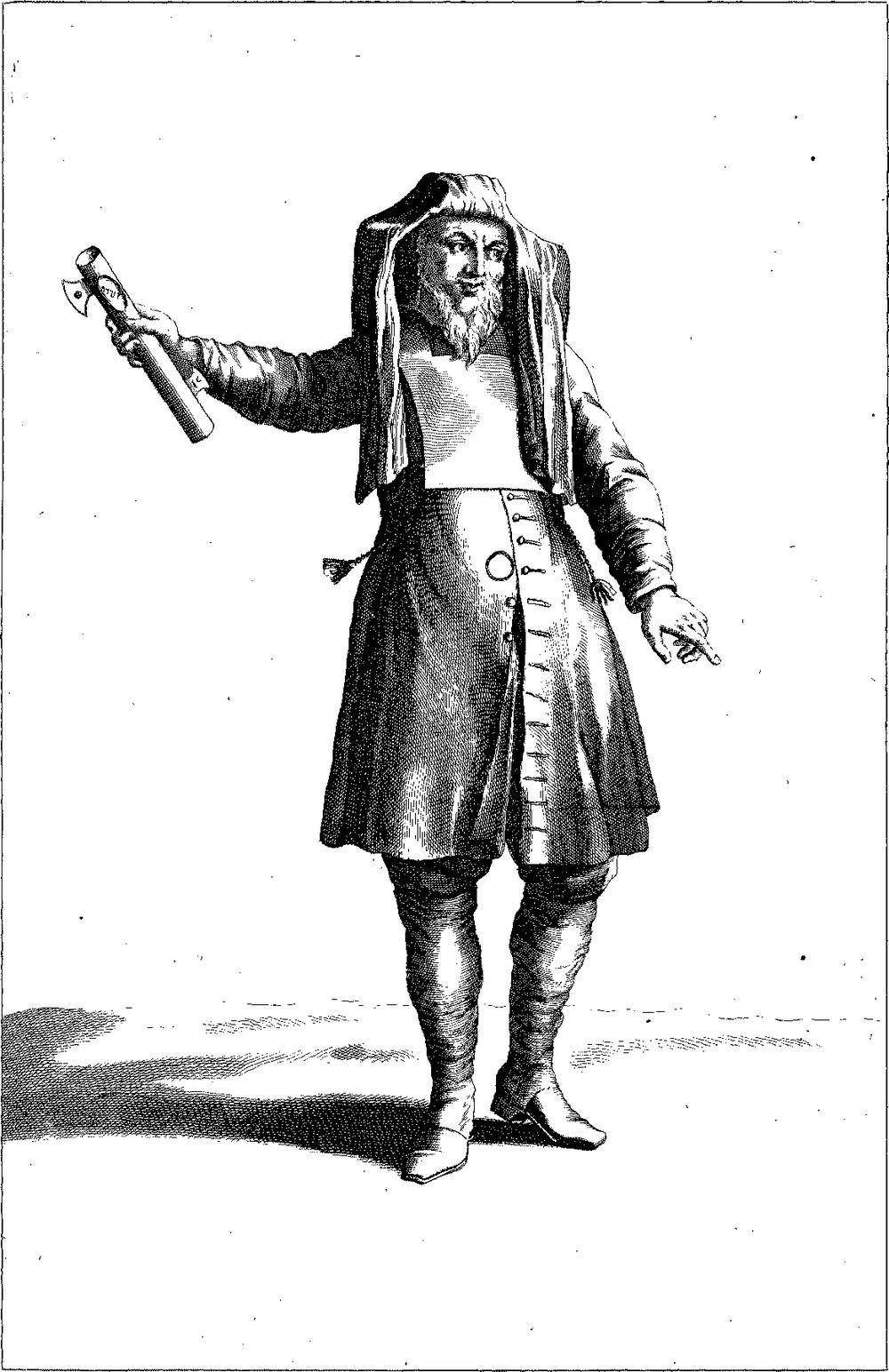
Now in those Days there was no King in Israel, and every one acted as he saw convenient. ‘Tis believed that this happened in that Interval of Time, that followed the Death of Joshua, and the Elders that succeeded him, till Othniel judged Israel60. During this Space of Time the Tribe of Dan being streightened in their Inheritance, sent six Hundred Men to look out for a more convenient Settlement. As they marched they passed by Micah’s House, which was on the Mountains of Ephraim, and desired the Levite that resided there, to enquire of the Lord about the Success of their Expedition. He answered them, that they might go in Peace, for the Lord would prosper their Undertaking. At their Return they gave Intelligence to their Tribe, that they had found a City called Laish, of which it was easy to make a Conquest, and prevailed with their Brethren to join with them in this Enterprize.
They set out, and came a second Time to the House of Micah; and having got over the Priest to their Party, they took away the Ephod, and the graven Images, and went their Way. Micah runs after them, and crying out, they threaten to use him ill, and oblige him to retire.
Having made themselves Masters of Laish, they there set up the Idol they had taken from Micah, and appoint Jonathan, the Son of Gershom, the Son of Moses, their Priest. And this Idol continued in this Place all the Time that the House of God was at Shilo, and to the Time of the Captivity of the Countrey; or, according to another Version of the Hebrew, to the Time of the Deliverance of the Countrey. Some understand it of the Deliverance of the Countrey procured by Samuel, and others of the Captivity of the ten Tribes carried beyond the Euphrates, by the Kings of Assyria, Salmanasar, and Tiglath-pilesser. During all this Time the City of Laish, otherwise called Dan, was always a Place of Idolatry and Superstition. There were to be seen, either the Teraphims of Micah, or the golden Calves of Jeroboam.
VII. MICAH, the Morasthite, or of Moresa, a Village near the City Eleutheropolis, in the Southern Part of Judah, is the seventh in Order of the twelve lesser Prophets. He prophesied under Jotham, Ahaz, and Hezekiah, Kings of Judah, for about fifty Years61. Some62 have confounded him with Micaiah Son of Imlah, but very improperly, who lived in the Kingdom of the ten Tribes, under the Reign of Ahab. The spurious Dorotheus says, that Micah was buried in the burying Place of of the Anakim, whose Habitation had been at Hebron, and round about it. This Prophet appeared almost at the same Time as Isaiah, and has even borrowed some Expressions from him; as may appear by comparing Isaiah ii. 2. with Micah iv. 1. and Isaiah xli. 15, with Micah iv. 13.
The Prophecy of Micah contains but seven Chapters. He first foretels the Calamities of Samaria, which was taken by Salmanassar, and reduced to a Heap of Mic. i. 6, 7. Mic. i. 9,Stones. Afterwards he prophesies against Judah, and declares the Troubles that Sennacherib should bring upon it, under the Reign of Hezekiah. Then he exclaims against the Iniquities of Samaria, he foretels the Captivity of the ten Tribes, and their Return again into their Countrey. The Mic. ii. 1, 2, &c. 15.third Chapter contains a pathetic Invective against the Princes of the House of Jacob, and the Judges of the House of Israel; which in my Opinion is levelled against the Chief of the Kingdom of Judah, the Judges, the Magistrates, the Priests, the false Prophets, &c. He upbraids them with their Avarice, their Injustice and Falshood, and tells them they will be the Occasion
that Jerusalem shall be reduced to a Heap of Rubbish, and the Mountain of the Temple shall be as a Forest. We are informed by JeremiahJerem. xxvi. 18, 19, &c., that this Prophecy was pronounced in the Time of Hezekiah, and that in the Days of Joachim it protected Jeremiah from Death, as was intended, for having prophesied much the same Things as Micah against Jerusalem.
After these terrible Denunciations, Micah speaks of the Reign of the Messiah, and of the Establishment of the Christian Mic. iv. 1, &c.Church. And as the peaceable Times which succeeded the Return from the Babylonish Captivity, and which was a Figure of the Reign of the Messiah, were disturbed by a Tempest of a short Continuance; Micah foretold it in such a Manner, as agrees very well with what Ezekiel says, of the War of Exek. xxxviii. xxxix.Gog against the Saints; and which we think to have Relation to the Reign of Cambyses, or the War of Holofernes. Micah speaks in Particular of the Birth of the Messiah, that he was to be born at Bethlehem, and that his Mic. v. 2, 3, &c.Dominion was to extend to the utmost Parts of the Earth. He says that God should raise seven Shepherds, who should reign by the Sword over Assyria, and in the Land of Nimrod, which we explain of Darius, Son of Hystaspes, and of the seven Confederates that killed the Magian, and who possessed the Empire of the Persians, after the Extinction of the Family of Cyrus. The fifth Chapter, from Verse 7 to the End, describes the flourishing Estate of the Jews in their own Countrey, from the Reign of Darius, and after the Maccabees: Yet in such a Manner, as that he mingles several Touches in it, that can agree only to the Church of Jesus Christ.
The two last Chapters of Micah contain first a long Invective against the Iniquities of Samaria; then he foretels the Fall of Babylon, the Re-establishment of the Cities of Israel, the Greatness of the Countrey possessed by the Israelites, their Happiness, the Graces wherewith God will favour them; and all this in such lofty Terms, that they chiefly agree with the State of the Christian Church. St. Jerome63 says, that Micah was buried at Morasthi; and Sozomenes64 says, that his Tomb was revealed to Zebennus Bishop of Eleutheropolis, under the Reign of Theodosius the Great. He calls the Place of his Burial Beretsate, which is probably the same as Morasthi, ten Furlongs from Eleutheropolis. The Author of the Life and Death of the Prophets, printed under the Name of Epiphanius, pretends that Micah was thrown headlong, and put to Death by Jehoram, Son of Ahab, because he could not bear that Freedom he made Use of, in reproaching him with his Vices. But we have already observed, that this Author, as also several others, has confounded Micah the Morasthite, with Micaiah Son of Imlah.
I. MICHAIAH, Daughter of Uriel of Gibeah, Mother of Abijah King of Judah, 2 Chron. xiii. 2. See MAACHAH before.
II. MICAIAH, or Michaia, Son of Imlah, of the Tribe of Ephraim, and a Prophet of the Lord. Once it happened, that Micaiah spoke to one of his Associates, in the Name of the Lord65; at least it is generally thought that it was Micaiah, though the Scripture does not mention his Name. He ordered him to strike him, and to wound him, which the other refusing to do, Micaiah told him, that as soon as he went away, a Lion should meet him and kill him, which happened accordingly. Micaiah meeting with another, he desired the same Thing of him, which he performed to his Satisfaction. Thus the Prophet being disfigured, and not easy to be known, he threw Dust in his Face, and went to meet King Ahab.
As the King passed by, Micaiah cried out to him, saying, Lord, thy Servant being in the Battle, one put into my Hands a Prisoner of War, and ordered me to keep him, threatning that if I let him go, my Life should pay for him, or that I should pay him a Talent of Silver. And as I was in a Hurry, looking about here and there, the Prisoner on a sudden was gone, and was no where to be found. Then says Ahab to him, Thy own Mouth has pronounced thy Sentence. At which the Prophet wiping the Dust off his Face, and discovering himself to Ahab, he says to the King; Just so says the Lord to thee. Because thou hast let go a Man that was worthy of Death, thy Life shall answer for his Life, and thy People for his People. He spoke of Ben-hadad King of Syria, whom Ahab had suffered to escape when he was in his Power. But the King of Israel had no Regard to what Micaiah had said to him, and returned full of Anger to Samaria.
About three Years after66, when Ahab had resolved to make War with Ben-hadad King of Syria, whom he had set at Liberty three Years before, he invited Jehoshaphat King of Judah to partake with him in this Expedition. Jehoshaphat, who happened to be then at Samaria, gave his Consent to it, but he desired that a Prophet of the Lord might be sent for, in Order to consult67
him about the Success of this Undertaking. For he would not rely upon the Answers of the Prophets of Baal, who had assured Ahab of a glorious Victory. Then they caused Micaiah the Son of Imlah to come before the Kings, and desired him by the Way, that his Words might be agreeable to the Words of the other Prophets that had been consulted, who all had promised the King good Success. Micaiah answered, that as the Lord lived he would say no other Thing than what the Lord should put into his Mouth. He came then before the Kings, and Ahab having enquired of him, whether they should march against Ramoth-Gilead or no? Micaiah answered, March on and prosper, the Lord shall deliver it into thy Hands. To which the King replied, I adjure thee in the Name of the Lord to answer only according to the Truth. Then Micaiah says to him with a more serious Countenance; I saw all Israel dispersed upon the Mountains, like Sheep that have no Shepherd: And the Lord said, they have no Captain, let every one return in Peace to his own House.
Then says Ahab to King Jehoshaphat, Did not I tell you that this Man would never prophesy any Good to me, but always Evil? And Micaiah added, Hear the Word of the Lord. I saw the Lord upon his Throne, and all the heavenly Host on his Right and on his Left. And the Lord said, Who shall prevail with Ahab King of Israel to march against Ramoth-Gilead, that he may die there? And one answered one Thing, and another another. Then an evil Spirit stept forth and said, I will prevail with Ahab, by putting a Lie into the Mouth of all his Prophets. The Lord said to him, Go, and thou shalt succeed as thou hast said. To which Micaiah added, Now has the Lord put a lying Spirit in the Mouth of all thy Prophets, and has passed Sentence against thee. At the same Time Zedekiah Son of Chenaanah stepped up to Micaiah, and gave him a Blow on the Face, saying, Which Way went the Spirit of the Lord from me to speak unto thee? To whom Micaiah replied, This thou shalt see, when thou shalt pass from Chamber to Chamber to hide thy self. Then Ahab King of Israel says to his People, Take Micaiah and carry him to Amon the Governor of Samaria, and let him be fed with the Bread of Grief, and Water of Affliction1, till I return in Peace. Micaiah answered him, If thou return at all in Peace, the Lord has not spoken by me. Let all the People here present be Witnesses. The Event justified the Prediction of Micaiah; for in the Fight Ahab was shot through by an Arrow, that was shot at Random by a Syrian. After this Time we hear no more what became of Micaiah the Son of Imlah.
III. MICHAIAH, Son of Gemariah. He informed the Princes of Judah, that Baruch had read the Prophecies of the Prophet Jeremiah then in Prison, in the Temple before all the People. This occasioned Baruch to be brought before King Jehoiakim, who cut Jeremiah’s Book in Pieces with a Penknife, and threw it into the Fire. This happened in the Year of the World 3399, before Christ 601, before the Vulgar Æra 605. See Jerem. xxxvi. 11, 12, 13.
Jude, v. 9, 10. 2 Peter ii. 10, 11.I. MICHAEL, that is68, Who is like to God? ‘Tis believed that Michael is the Head of the heavenly Host, in the same Manner as Lucifer is the Head of the Infernal; and that God had constituted him the Protector of the People of Israel, as also the Christian Church now flatters her self, to have him for her Guardian and Defender. This is what the Scriptures inform us concerning St. Michael. St. Jude in his Epistle says, Yet Michael the Archangel, when contending with the Devil, he disputed about the Body of Moses, durst not bring against him a railing Accusation, but said, The Lord rebuke thee. St. Jude concludes from thence, that the Faithful ought not to make Use of ill Words or Execrations, as Hereticks and false Prophets are used to do. But these speak Evil of those Things which they know not, but what they know naturally as brute Beasts, in those Things they corrupt themselves. St. Peter in a parallel Passage speaks much after the same Manner of Hereticks and false Prophets. Presumptuous are they, selfwilled, they are not afraid to speak Evil of Dignities: Whereas Angels which are greater in Power, and Might, bring not railing Accusations against them before the Lord. But these, as natural brute Beasts, made to be taken and destroyed, speak Evil of the Things that they understand not, and shall utterly perish in their own Corruption.
It may be asked, what Story St. Jude here makes Allusion to, when he says, that there was a Contention between the Archangel and the Devil about the Body of Moses? ‘Tis believed that he alludes to an History related in the Apochryphal Book of the Assumption of Moses69, where it was
Michael (I) continues on the next page
Footnotes
-
Joseph. de bello, l. ii. c. 9. seu κεφ. ιζ. p. 790, 791. ↩
-
Plin. l. v. c. 9. Vide & Strab. l. xvii. p. 555. ↩
-
Herbelot. Bibl. Orient. p. 580. c. 1. ↩
-
Ezek. xxix. 18, 19, &c. xxx. 13, 14. In the Year of the World 3416. ↩
-
In the Year of the World 3478, before Christ 522. ↩
-
Herodot. l. iii. ↩
-
Thucydid. l. i. Ctesias. Diodor. Sicul. l. ii. About the Year of the World 3530. ↩
-
ממרא דיויVerbum Dei. ↩
-
Philo de opificio, Ep. iii. Allegor. ii. p. 76. Lib. quod Deus sit. p. 248. & lib. quis rerum divin. hæres. p. 293. ↩
-
Dan. v. 25. & seq. מנהMene, divisit. ↩
-
In the Year of the World 3448, before Christ 552, before the Vulgar Æra 556. ↩
-
Strab. l. xii. p. 383, ↩
-
Concil. Calced. An. 451. Episcop. Minoidis subscripsit. ↩
-
Euseb. Onom. in Meneben. ↩
-
L. xxx. Cod. Theod. de Erog. milit. annon. ↩
-
2 Sam. iv. 4. Year of the World 2949, before Christ 1051, before the Vulgar Æra 1055. ↩
-
Year of the World 2965, before Christ 1035, before the Vulgar Æra 1039. 2 Sam. ix. 1. &c. ↩
-
Year of the World 2980, before Christ 1020, before the Vulgar Æra 1024. 2 Sam. xvi. 1, 2, 3, &c. ↩
-
2 Sam. xxi. 8. In the Year of the World 2986, before Christ 1014, before the Vulgar Æra 1018. ↩
-
Ita Salian. Cajet. Capel. Osiand. Canus, &c. ↩
-
Ita Chald. Rabb. Author. Qu. Hebr. in 2 Reg. alii. ↩
-
Prov. xxvi. 8. Sicut qui mittit lapidem in acervum Mercurii; ita qui tribuit insipienti honorem. Vulg. [Our Eng- lish Translation reads it, As he that bindeth a Stone in a Sling, so is he that giveth Honour to a Fool.] ↩
-
Nicander. Scholiast. Anyta in Epigr. ↩
-
Prov. xxvi. 8. ↩
-
Vide Levit. xx. 2, 27. xxiv. 14, 16, 23, &c. Deut. cury, ↩
-
Prov. xxvi. 8. Ὁς ἀποδεμούει λίθον ἐν σφενδόνῃ, ὅμοιός ἐστι τῷ διδόντι ἄφρονι δόξαν. ↩
-
Gen. xxiv. 27, 49. xlvii. 29, Exod. xxxiv. 6. & passim. חסד ואמתxcvii. 10. cxxxii. 9, 16, &c. ↩
-
2 Chron. vi. 41. Psal. iv. 4. xvi. 10. lxxxix. 20. ↩
-
Ἱλαστήριον. Propitiatorium. כפרתCapporeth. Exod. xxv. 17----- 22. The Hebrew Word כפרCappar, from whence comes Capporeth, signifies to cover, to shut up, to expiate, to pay. ↩
-
Joseph. Antiq. l. viii. c. 2. Origen. Homil. ii. in Cant. Grot. in 3. Reg. x. ↩
-
Joseph. Antiq. l. ii. c. 5. ↩
-
Strabo, l. xvi. and xvii. Plin. l. vi. c. 26. ↩
-
Joseph. Antiq. l. v. c. 6. ↩
-
Joseph. Antiq. l. iii. c. 2. Others ↩
-
Ita Rabbini Gemar. Babyl. ad Tit. Moed. Caton. i. 3. Jarchi, &c. ↩
-
In the Year of the World 3109, before Christ 891, before the Vulgar Æra 895. ↩
-
In the Year of the World 3398, before Christ 602, before the Vulgar Æra 606. ↩
-
Gen. xxviii. 2. &c. Heb. פדנה ארםPadan-aram. ↩
-
Harduin. Chron. Vet.Test. p. 522. ↩
-
משחMashah, unxit. משיחMeshiah, unctus. ↩
-
Gen. xxviii. 5. xlvi. 15. Deut. xxiii. 4. Ps. lix. 1. Vulg. ↩
-
Vide Theodoret. in Isai. xlv. 1. & in Psal. cv. 15. ↩
-
Buxtorf. Synag. Jud. c. 36. ↩
-
Gemarr. Tit. Sanhedr. c. xi. ↩
-
Socrat. Hist. Eccles. l. ii. c. 38. ↩
-
Marca Hist. de Bearn. l. ii. Zemath. Solomon Ben-virga Schever Judæ, p. 169. ↩
-
Maimon. Epist. de Austriæ Regione apud Vorstium, Not. in ↩
-
Some say he was born at Smyrna. ↩
-
Mr. Basnage’s History of the Jews, T. iii. l. v. c. 18. ↩
-
Joseph. Antiq. l. xviii. c. 2. de Bello, l. ii. c. 12. ↩
-
Idem l. vii. de Bello c. 25, &c. ↩
-
Philo de somniis, p. 586. & de Gigantibus, p. 285. c. 4. Cabbalæ denudatæ par 3. p. 258. ↩
-
R. Isaac Lorien. de Revolution. anim. ↩
-
Renaudot’s Notes upon the Travels of the two Arabians to China. ↩
-
Vide Hieronym. tradit. Hebr. in Genes. Aug. l. xv. c. 11, 13. de Civit. Georgius Syncellus Chronic. p. 114. believes that Methuselah was miraculously preserved from the Waters of the Deluge, and that perhaps he was taken away in the Manner of his Father Enoch; that after this he lived fourteen Years upon the Earth. Eu- sebius in his Chronicon acknowledges, that he lived fifteen Years after the Deluge, and that it was unknown where he was secured during the Deluge. ↩
-
Vide Scipion. Sgambat. Archiv. V. T. p. 139. ↩
-
Eupol. apud Euseb. Præparat. l. ix. c. 17. † 60 French Pounds make 78¾ English Pounds Troy, which allowing a Pint for a Pound, comes to 9²⁷⁄₃₂ Gallons. This differs but little from the Capacity of the Metreta, as assigned by Dr. Arbuthnot in his Tables, which is 10¼ Gallons of English Wine-Measure. But the Jewish Bath is determined by him to be only 7½ Gallons. ↩
-
Bochart. Phaleg. l. ii. c. 22. ↩
-
It appears by Chap. xviii. 30. of the Book of Judges, that this young Levite was of the Race of Moses, and was called Jonathan Son of Gershom. ↩
-
From the Year of the World 2570, to 2599, before Christ 1401, before the Vulgar Æra 1405 Years. ↩
-
That is, from about the Year 3245, or the Beginning of the Reign of Jotham, to 3306, or the last Year of Hezekiah. ↩
-
Athanas. in Synopsi. Epiphan. Doroth. de vita Prophet. Chronic. Alex. Euseb. in Chronic. Sozom. Hist. Eccl. l. 7. c. 29. ↩
-
Hieronym. Ep. 37. seu Epitaph. Paulæ. ↩
-
Sozom. l. vii. c. 29. Hist. Eccl. ↩
-
1 Kings xx. 35, &c. Year of the World 3104, before Christ 896, before the Vulgar Æra 900. ↩
-
Year of the World 3107, before Christ 893, before the Vulgar Æra 897. ↩
-
Kings xxii. 3, 4, 5, &c. 1 Kings xxii. 27. לחם לחץ ומים לחץBread and Water in a little Quantity. See 2 Chron. xviii. 26. where St. Jerom translates it, Date ei panis mod- icum, & aqua pauxillum. Compare Isai. xxx. 20. ↩
-
מיכאלMi-chael. Quis ut Deus? ↩
-
See our Dissertation concerning the Death and Burial of Moses, printed before the Canonical Epistles. ↩